
<?xml version="1.0" encoding="UTF-8"?>
<!DOCTYPE article PUBLIC "-//NLM//DTD Journal Publishing DTD v2.3 20070202//EN" "journalpublishing.dtd">
<article xmlns:xlink="http://www.w3.org/1999/xlink" xml:lang="en" article-type="research-article">
<front>
<journal-meta>
<journal-id journal-id-type="publisher-id">ijms</journal-id>
<journal-title>International Journal of Molecular Sciences</journal-title>
<abbrev-journal-title>Int. J. Mol. Sci.</abbrev-journal-title>
<issn pub-type="epub">1422-0067</issn>
<publisher>
<publisher-name>Molecular Diversity Preservation International (MDPI)</publisher-name></publisher></journal-meta>
<article-meta>
<article-id pub-id-type="doi">10.3390/ijms13055866</article-id>
<article-id pub-id-type="publisher-id">ijms-13-05866</article-id>
<article-categories>
<subj-group>
<subject>Article</subject></subj-group></article-categories>
<title-group>
<article-title>Loss of p16<sup>Ink4a</sup> Function Rescues Cellular Senescence Induced by Telomere Dysfunction</article-title></title-group>
<contrib-group>
<contrib contrib-type="author">
<name><surname>Zhang</surname><given-names>Xiufeng</given-names></name><xref ref-type="aff" rid="af1-ijms-13-05866">1</xref><xref ref-type="aff" rid="af2-ijms-13-05866">2</xref></contrib>
<contrib contrib-type="author">
<name><surname>Wu</surname><given-names>Xiaoming</given-names></name><xref ref-type="aff" rid="af1-ijms-13-05866">1</xref><xref ref-type="aff" rid="af2-ijms-13-05866">2</xref></contrib>
<contrib contrib-type="author">
<name><surname>Tang</surname><given-names>Wenru</given-names></name><xref ref-type="aff" rid="af1-ijms-13-05866">1</xref><xref ref-type="aff" rid="af2-ijms-13-05866">2</xref><xref ref-type="corresp" rid="c1-ijms-13-05866">*</xref></contrib>
<contrib contrib-type="author">
<name><surname>Luo</surname><given-names>Ying</given-names></name><xref ref-type="aff" rid="af1-ijms-13-05866">1</xref><xref ref-type="aff" rid="af2-ijms-13-05866">2</xref><xref ref-type="corresp" rid="c1-ijms-13-05866">*</xref></contrib></contrib-group>
<aff id="af1-ijms-13-05866">
<label>1</label>Faculty of Environmental Science and Engineering, Kunming University of Science &amp; Technology, Kunming 650224, China; E-Mails: <email>xiuzheng1203@163.com</email> (X.Z.); <email>xiao_tracy@163.com</email> (X.W.)</aff>
<aff id="af2-ijms-13-05866">
<label>2</label>Lab of Molecular Genetics of Aging &amp; Tumor, Faculty of Life Science and Technology, Kunming University of Science &amp; Technology, Kunming 650224, China</aff>
<author-notes>
<corresp id="c1-ijms-13-05866">
<label>*</label>Authors to whom correspondence should be addressed; E-Mails: <email>twr@sina.com</email> (W.T.); <email>yingluo@kmust.edu.cn</email> (Y.L.); Tel.: +86-871-5920753 (W.T.); +86-871-5920753 (Y.L.); Fax: +86-871-5920753 (W.T.); +86-871-5920753 (Y.L.).</corresp></author-notes>
<pub-date pub-type="collection">
<year>2012</year></pub-date>
<pub-date pub-type="epub">
<day>16</day>
<month>05</month>
<year>2012</year></pub-date>
<volume>13</volume>
<issue>5</issue>
<fpage>5866</fpage>
<lpage>5877</lpage>
<history>
<date date-type="received">
<day>11</day>
<month>02</month>
<year>2012</year></date>
<date date-type="rev-recd">
<day>03</day>
<month>05</month>
<year>2012</year></date>
<date date-type="accepted">
<day>10</day>
<month>05</month>
<year>2012</year></date></history>
<permissions>
<copyright-statement>© 2012 by the authors; licensee Molecular Diversity Preservation International, Basel, Switzerland.</copyright-statement>
<copyright-year>2012</copyright-year>
<license license-type="open-access" xlink:href="http://creativecommons.org/licenses/by/3.0">
<p>This article is an open-access article distributed under the terms and conditions of the Creative Commons Attribution license (http://creativecommons.org/licenses/by/3.0/).</p></license></permissions>
<abstract>
<p>p16<sup>Ink4a</sup> is a tumor suppressor and a marker for cellular senescence. Previous studies have shown that p16<sup>Ink4a</sup> plays an important role in the response to DNA damage signals caused by telomere dysfunction. In this study, we crossed <italic>Wrn</italic><italic><sup>−/−</sup></italic> and <italic>p16</italic><italic><sup>Ink4a−/−</sup></italic> mice to knock out the <italic>p16</italic><italic><sup>Ink4a</sup></italic> function in a Wrn null background. Growth curves showed that loss of p16<sup>Ink4a</sup> could rescue the growth barriers that are observed in <italic>Wrn</italic><italic><sup>−/−</sup></italic> mouse embryonic fibroblasts (MEFs). By challenging the MEFs with the global genotoxin doxorubicin, we showed that loss of p16<sup>Ink4a</sup> did not dramatically affect the global DNA damage response of <italic>Wrn</italic><italic><sup>−/−</sup></italic> MEFs induced by doxorubicin. However, in response to telomere dysfunction initiated by the telomere damaging protein TRF2<sup>ΔBΔM</sup>, loss of p16<sup>Ink4a</sup> could partially overcome the DNA damage response by disabling p16<sup>Ink4a</sup> up-regulation and reducing the accumulation of γ-H2AX that is observed in <italic>Wrn</italic><italic><sup>−/−</sup></italic> MEFs. Furthermore, in response to TRF2<sup>ΔBΔM</sup> overexpression, <italic>Wrn</italic><italic><sup>−/−</sup></italic> MEFs senesced within several passages. In contrast, <italic>p16</italic><italic><sup>Ink4a−/−</sup></italic> and <italic>p16</italic><italic><sup>Ink4a−/−</sup></italic><italic>Wrn</italic><italic><sup>−/−</sup></italic> MEFs could continuously grow and lose expression of the exogenous TRF2<sup>ΔBΔM</sup> in their late passages. In summary, our data suggest that in the context of telomere dysfunction, loss of p16<sup>Ink4a</sup> function could prevent cells from senescence. These results shed light on the anti-aging strategy through regulation of p16<sup>Ink4a</sup> expression.</p></abstract>
<kwd-group>
<kwd>p16<sup>Ink4a</sup></kwd>
<kwd>Werner Syndrome</kwd>
<kwd>telomere dysfunction</kwd></kwd-group></article-meta></front>
<body>
<sec sec-type="intro">
<title>1. Introduction</title>
<p>Extensive studies have demonstrated that telomere dysfunction could induce cellular senescence, ultimately resulting in either aging or cancer [<xref ref-type="bibr" rid="b1-ijms-13-05866">1</xref>–<xref ref-type="bibr" rid="b4-ijms-13-05866">4</xref>]. Telomere dysfunction, including telomere shortening due to a lack of telomerase function, telomere uncapping and structural damage due to defects in proteins maintaining telomere structure, could be recognized as a DNA damage signal that triggers the DNA damage response (DDR) in mammalian cells [<xref ref-type="bibr" rid="b5-ijms-13-05866">5</xref>,<xref ref-type="bibr" rid="b6-ijms-13-05866">6</xref>]. Depending on the intactness of the DDR system, for example, the status of the ATM-p53-p21 pathway, telomere dysfunction could either prevent or promote tumorigenesis [<xref ref-type="bibr" rid="b7-ijms-13-05866">7</xref>–<xref ref-type="bibr" rid="b9-ijms-13-05866">9</xref>].</p>
<p>The role of the Rb-p16<sup>Ink4a</sup> pathway in response to DNA damage induced by telomere dysfunction has been controversial. p16<sup>Ink4a</sup> regulates cell cycle progression by specifically binding to and inhibiting the cyclin-dependent kinases Cdk4 and Cdk6. It has previously been demonstrated that p16<sup>Ink4a</sup> accumulates in conjunction with p38 activation in ras-induced senescent cells and that this accumulation is essential for senescence [<xref ref-type="bibr" rid="b10-ijms-13-05866">10</xref>]. It has also been shown that p16<sup>Ink4a</sup> accumulates in both human and mouse cells as a function of replicative senescence [<xref ref-type="bibr" rid="b11-ijms-13-05866">11</xref>,<xref ref-type="bibr" rid="b12-ijms-13-05866">12</xref>]. In a previous study, telomere dysfunction was induced by inhibiting the telomere binding protein TRF2 with the dominant negative protein TRF2<sup>ΔBΔM</sup>. This study demonstrated that the telomere damage induced by TRF2<sup>ΔBΔM</sup> induces p16<sup>Ink4a</sup> accumulation. Inhibition of p16<sup>Ink4a</sup> with shRNA or overexpression of BMI1 (a p16<sup>Ink4a</sup> transcription regulator) showed a nearly complete bypass of the telomere-directed senescence in p53-deficient cells [<xref ref-type="bibr" rid="b13-ijms-13-05866">13</xref>]. These data demonstrated that in human cells, p16<sup>Ink4a</sup> plays an important role along with the p53 pathway in the DDR to telomere dysfunction. This same study demonstrated that in wild type MEFs, the loss of p53 function was sufficient to completely abrogate the senescence arrest, indicating that in the absence of p53, the loss of p16<sup>Ink4a</sup> function is not necessary for mouse cells to bypass senescence [<xref ref-type="bibr" rid="b13-ijms-13-05866">13</xref>]. In addition, previous studies have shown that inhibition of TRF2 results in apoptosis in MEFs and that this response is mediated by ATM and p53 [<xref ref-type="bibr" rid="b14-ijms-13-05866">14</xref>].</p>
<p>Wrn, a member of the RecQ family of DNA helicases, is deficient in patients with Werner syndrome (WS) [<xref ref-type="bibr" rid="b15-ijms-13-05866">15</xref>]. WS is an autosomal recessive progeric disease that is characterized by premature atherosclerosis, ischemic heart disease, osteoporosis, and cataracts [<xref ref-type="bibr" rid="b16-ijms-13-05866">16</xref>]. A previous study showed that inhibition of the stress-induced p38 MAP kinase could prevent the senescence of WS cells [<xref ref-type="bibr" rid="b17-ijms-13-05866">17</xref>]. Fibroblasts from WS patients have accelerated telomere erosion and senescence that can be rescued by the overexpression of telomerase, suggesting that telomere dysfunction may play an essential role in the manifestation of the WS phenotype [<xref ref-type="bibr" rid="b18-ijms-13-05866">18</xref>]. To address this hypothesis, a mouse model of WS with a double knockout of <italic>mTerc</italic> and <italic>Wrn</italic> was generated, which faithfully manifested the human phenotype of WS [<xref ref-type="bibr" rid="b19-ijms-13-05866">19</xref>,<xref ref-type="bibr" rid="b20-ijms-13-05866">20</xref>]. The Wrn protein is necessary for efficient replication of G-rich telomeric DNA, preventing telomere dysfunction and consequent genomic instability [<xref ref-type="bibr" rid="b21-ijms-13-05866">21</xref>]. In addition, the function of Wrn in telomere regulation is regulated by TRF1 and TFR2 [<xref ref-type="bibr" rid="b22-ijms-13-05866">22</xref>]. Thus, a mouse model deficient in Wrn function (<italic>Wrn</italic><italic><sup>−/−</sup></italic>) provides a very useful tool for investigating the factors involved in aging in response to telomere dysfunction.</p>
<p>By crossing mice deficient in p16<sup>Ink4a</sup> function (<italic>p16</italic><italic><sup>Ink4a−/−</sup></italic>) with mice deficient in Wrn function (<italic>Wrn</italic><italic><sup>−/−</sup></italic>), we generated mouse embryonic fibroblasts (MEFs) with the following genotypes: <italic>p16</italic><italic><sup>Ink4a−/−</sup></italic> only, <italic>Wrn</italic><italic><sup>−/−</sup></italic> only, and <italic>p16</italic><italic><sup>Ink4a−/−</sup></italic><italic>Wrn</italic><italic><sup>−/−</sup></italic>. Furthermore, we challenged these cells with either the global genomic DNA damage reagent doxorubicin or the telomere specific damaging protein TRF2<sup>ΔBΔM</sup>. By comparing their growth rates, DDR, senescence status, and genomic instability, we investigated the role of p16<sup>Ink4a</sup> in the induction of senescence by Wrn-related telomere dysfunction.</p></sec>
<sec sec-type="results|discussion">
<title>2. Results and Discussion</title>
<sec>
<title>2.1. Loss of p16<sup>Ink4a</sup> Function Overcame the Growth Barrier Caused by Dysfunction of Wrn</title>
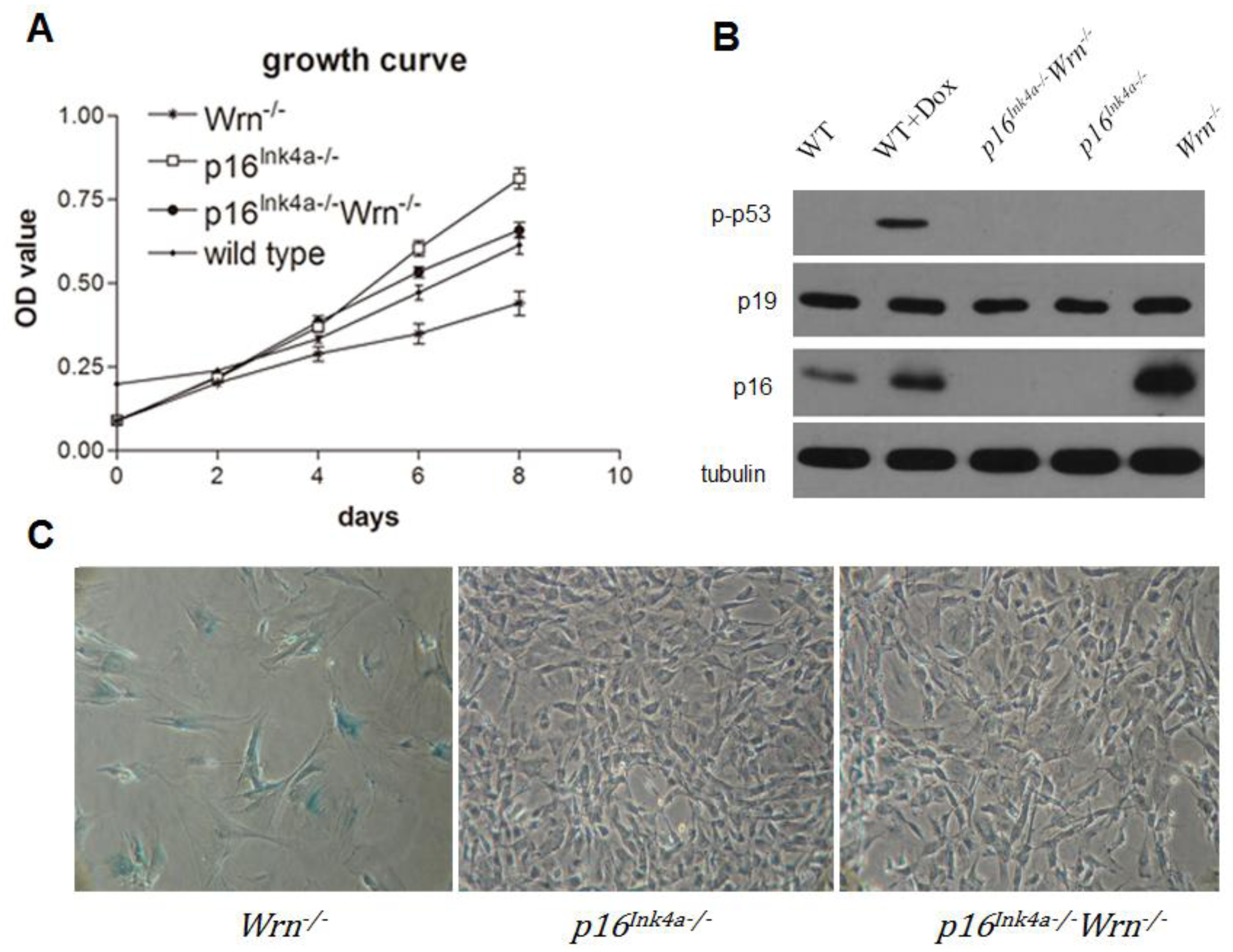
<p>To investigate the growth potential of MEFs with the genotypes <italic>p16</italic><italic><sup>Ink4a−/−</sup></italic>, <italic>Wrn</italic><italic><sup>−/−</sup></italic>, and <italic>p16</italic><italic><sup>Ink4a−/−</sup></italic><italic>Wrn</italic><italic><sup>−/−</sup></italic>, we performed a growth curve analysis using wild type MEFs as a control. We found that <italic>Wrn</italic><italic><sup>−/−</sup></italic> MEFs grew slower than <italic>p16</italic><italic><sup>Ink4a−/−</sup></italic> MEFs; however, knock out of p16<sup>Ink4a</sup> function (<italic>p16</italic><italic><sup>Ink4a−/−</sup></italic><italic>Wrn</italic><italic><sup>−/−</sup></italic>) rescued the growth potential of <italic>Wrn</italic><italic><sup>−/−</sup></italic> MEFs (<xref ref-type="fig" rid="f1-ijms-13-05866">Figure 1A</xref>). These data suggest that the growth barrier caused by dysfunction of Wrn is overcome by the loss of p16<sup>Ink4a</sup> function. Furthermore, western blot analysis revealed that compared to wild type MEFs (<xref ref-type="fig" rid="f1-ijms-13-05866">Figure 1B</xref>, WT), <italic>Wrn</italic><italic><sup>−/−</sup></italic> MEFs have dramatically increased p16<sup>Ink4a</sup> expression (<xref ref-type="fig" rid="f1-ijms-13-05866">Figure 1B</xref>, <italic>Wrn</italic><italic><sup>−/−</sup></italic>). This result suggests that loss of Wrn function stimulates the expression of p16<sup>Ink4a</sup>, which might cause the growth barrier of <italic>Wrn</italic><italic><sup>−/−</sup></italic> MEFs due to negative regulation of the cell cycle. Thus, knockout of p16<sup>Ink4a</sup> function could overcome the growth barrier caused by a defect in Wrn. Surprisingly, we did not detect an up-regulation of phosphorylated p53 in <italic>Wrn</italic><italic><sup>−/−</sup></italic> MEFs, suggesting that unlike doxorubicin treatment, the loss of Wrn did not cause sufficient DNA damage to stimulate the p53 pathway (<xref ref-type="fig" rid="f1-ijms-13-05866">Figure 1B</xref>, p-p53). In addition, p19<sup>Arf</sup>, a response protein to oncogenic stimulation, did not show up-regulation in the absence of Wrn (<xref ref-type="fig" rid="f1-ijms-13-05866">Figure 1B</xref>, p19). Furthermore, we performed SA-β-Gal staining to detect cellular senescence in passage 13 of <italic>p16</italic><italic><sup>Ink4a−/−</sup></italic>, <italic>Wrn</italic><italic><sup>−/−</sup></italic>, and <italic>p16</italic><italic><sup>Ink4a−/−</sup></italic><italic>Wrn</italic><italic><sup>−/−</sup></italic> MEFs. The results indicated that cellular senescence occurred in passage 13 of <italic>Wrn</italic><italic><sup>−/−</sup></italic> MEFs (57.31 ± 7.19% of cells were positive for SA-β-Gal staining), but not in <italic>p16</italic><italic><sup>Ink4a−/−</sup></italic> MEFs (1.40 ± 0.53% cells were positive for SA-β-Gal staining) or <italic>p16</italic><italic><sup>Ink4a−/−</sup></italic><italic>Wrn</italic><italic><sup>−/−</sup></italic> MEFs (2.23 ± 1.86% cells were positive for SA-β-Gal staining) (<xref ref-type="fig" rid="f1-ijms-13-05866">Figure 1C</xref>).</p></sec>
<sec>
<title>2.2. DNA Damage Response to Genotoxin or Telomere Dysfunction in Cells Lacking Wrn or p16<sup>Ink4a</sup> Function</title>
<p>To further understand cellular senescence caused by telomere dysfunction in Werner syndrome and the role of Wrn and p16<sup>Ink4a</sup> in the DNA damage response to telomere dysfunction, a well defined telomere damaging protein TRF2<sup>ΔBΔM</sup> [<xref ref-type="bibr" rid="b13-ijms-13-05866">13</xref>] was introduced into <italic>p16</italic><italic><sup>Ink4a−/−</sup></italic>, <italic>Wrn</italic><italic><sup>−/−</sup></italic> and <italic>p16</italic><italic><sup>Ink4a−/−</sup></italic><italic>Wrn</italic><italic><sup>−/−</sup></italic> MEFs. The global genotoxin doxorubicin was used in parallel to investigate the distinct stimulation of pathways involved in the DNA damage response.</p>
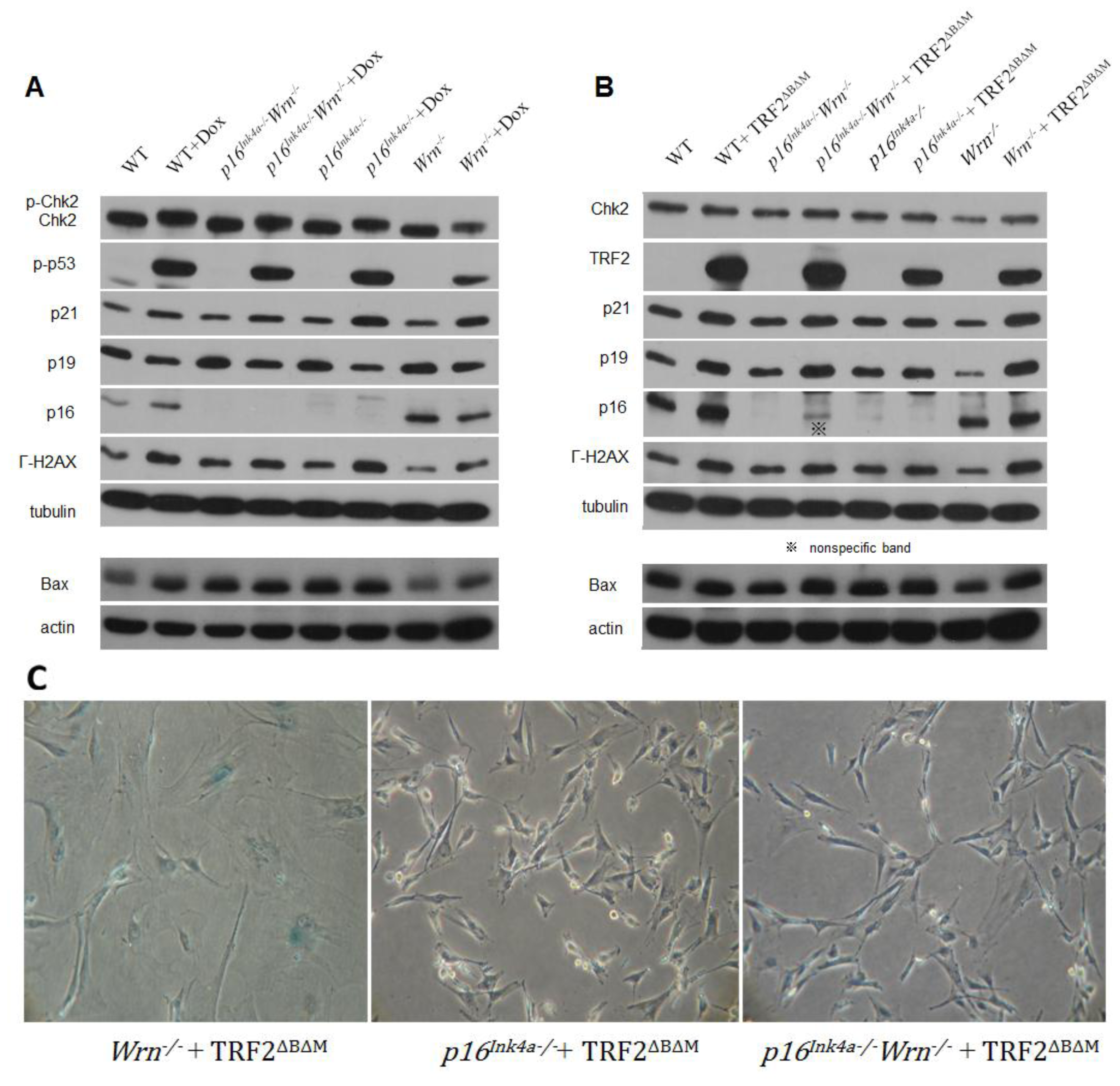
<p>Western blot analysis demonstrated that in response to the global DNA damage caused by doxorubicin, Chk2, p53, and H2AX proteins were phosphorylated in wild type, <italic>p16</italic><italic><sup>Ink4a−/−</sup></italic>, <italic>Wrn</italic><italic><sup>−/−</sup></italic> and <italic>p16</italic><italic><sup>Ink4a−/−</sup></italic><italic>Wrn</italic><italic><sup>−/−</sup></italic> MEFs (<xref ref-type="fig" rid="f2-ijms-13-05866">Figure 2A</xref>, Chk2, p-p53, γ-H2AX). These data confirm that the regular DNA damage responses were stimulated in MEFs lacking Wrn or p16<sup>Ink4a</sup> (<xref ref-type="fig" rid="f2-ijms-13-05866">Figure 2A</xref>, <italic>Wrn</italic><italic><sup>−/−</sup></italic>). Interestingly, in response to telomere dysfunction induced by the overexpression of TRF2<sup>ΔBΔM</sup> (<xref ref-type="fig" rid="f2-ijms-13-05866">Figure 2B</xref>, TRF2), Chk2 was not phosphorylated (<xref ref-type="fig" rid="f2-ijms-13-05866">Figure 2B</xref>, Chk2). In addition, no phosphorylated p53 could be detected (data not shown), suggesting a lack of response of Chk2-p53 to telomere dysfunction induced by TRF2<sup>ΔBΔM</sup> in the genetic context of these MEFs. However, p21 proteins were slightly up-regulated despite the p53 phosphorylation status (<xref ref-type="fig" rid="f2-ijms-13-05866">Figure 2B</xref>, p21). This result could be due to a p53-independent activation of p21 or a low level of p53 activation that is not detectable by western blot. H2AX proteins were phosphorylated significantly in response to TRF2<sup>ΔBΔM</sup> overexpression in wild type, <italic>p16</italic><italic><sup>Ink4a−/−</sup></italic>, <italic>Wrn</italic><italic><sup>−/−</sup></italic>, and <italic>p16</italic><italic><sup>Ink4a−/−</sup></italic><italic>Wrn</italic><italic><sup>−/−</sup></italic> MEFs (<xref ref-type="fig" rid="f2-ijms-13-05866">Figure 2B</xref>, γ-H2AX), suggesting that TRF2<sup>ΔBΔM</sup> induces the activation of the DNA damage response. p16<sup>Ink4a</sup> proteins were remarkably up-regulated in response to TRF2<sup>ΔBΔM</sup> overexpression in wild type MEFs, as well as <italic>Wrn</italic><italic><sup>−/−</sup></italic> MEFs (<xref ref-type="fig" rid="f2-ijms-13-05866">Figure 2B</xref>, p16). These data suggest that in <italic>p16</italic><italic><sup>Ink4a−/−</sup></italic> and <italic>p16</italic><italic><sup>Ink4a−/−</sup></italic><italic>Wrn</italic><italic><sup>−/−</sup></italic> MEFs, the loss of p16<sup>Ink4a</sup> function prevents cells from undergoing TRF2<sup>ΔBΔM</sup>-induced senescence.</p>
<p>Surprisingly, p19<sup>Arf</sup> proteins were up-regulated in response to TRF2<sup>ΔBΔM</sup> overexpression in wild type, <italic>p16</italic><italic><sup>Ink4a−/−</sup></italic>, <italic>Wrn</italic><italic><sup>−/−</sup></italic> and <italic>p16</italic><italic><sup>Ink4a−/−</sup></italic><italic>Wrn</italic><italic><sup>−/−</sup></italic> MEFs (<xref ref-type="fig" rid="f2-ijms-13-05866">Figure 2B</xref>, p19), which was contrary to the response of MEFs to doxorubicin in which p19<sup>Arf</sup> proteins were slightly down-regulated (<xref ref-type="fig" rid="f2-ijms-13-05866">Figure 2A</xref>, p19). These western blots were quantified (<xref ref-type="supplementary-material" rid="s1-ijms-13-05866">supplementary data 1</xref>).</p>
<p>Interestingly, the background expression levels of the apoptotic marker Bax were up-regulated in <italic>p16</italic><italic><sup>Ink4a−/−</sup></italic> and <italic>p16</italic><italic><sup>Ink4a−/−</sup></italic><italic>Wrn</italic><italic><sup>−/−</sup></italic> MEFs, but not in <italic>Wrn</italic><italic><sup>−/−</sup></italic> MEFs. Upon doxorubicin treatment or TRF2<sup>ΔBΔM</sup> overexpression, Bax was not up-regulated (<xref ref-type="fig" rid="f2-ijms-13-05866">Figure 2A,B</xref>, Bax, actin was used as the loading control). SA-β-Gal staining of <italic>p16</italic><italic><sup>Ink4a−/−</sup></italic>, <italic>Wrn</italic><italic><sup>−/−</sup></italic> and <italic>p16</italic><italic><sup>Ink4a−/−</sup></italic><italic>Wrn</italic><italic><sup>−/−</sup></italic> MEFs after TRF2<sup>ΔBΔM</sup> overexpression showed that <italic>Wrn</italic><italic><sup>−/−</sup></italic> MEFs senesced rapidly after TRF2<sup>ΔBΔM</sup> overexpression, while <italic>p16</italic><italic><sup>Ink4a−/−</sup></italic><italic>Wrn</italic><italic><sup>−/−</sup></italic> MEFs did not appear to senesce (<xref ref-type="fig" rid="f2-ijms-13-05866">Figure 2C</xref>). These data further support the conclusion that loss of p16<sup>Ink4a</sup> function prevents cells from TRF2<sup>ΔBΔM</sup>-induced senescence.</p>
<p>Telomere dysfunction could induce chromosomal aberrations, which further enhance the destructiveness of telomere dysfunction, ultimately resulting in tumorigenesis.</p>
<p>To investigate the chromosomal aberrations induced by TRF2<sup>ΔBΔM</sup> overexpression in <italic>p16</italic><italic><sup>Ink4a−/−</sup></italic>, <italic>Wrn</italic><italic><sup>−/−</sup></italic> and <italic>p16</italic><italic><sup>Ink4a−/−</sup></italic><italic>Wrn</italic><italic><sup>−/−</sup></italic> MEFs, we attempted to harvest chromosomes and perform cytogenetic analysis. However, TRF2<sup>ΔBΔM</sup> overexpression leads to cellular senescence in wild type and <italic>Wrn</italic><italic><sup>−/−</sup></italic> MEFs, thereby preventing us from harvesting chromosomes from these cells for analysis. In contrast, despite the overexpression of TRF2<sup>ΔBΔM</sup>, <italic>p16</italic><italic><sup>Ink4a−/−</sup></italic> and <italic>p16</italic><italic><sup>Ink4a−/−</sup></italic><italic>Wrn</italic><italic><sup>−/−</sup></italic> MEFs continuously grow. We harvested the chromosomes from early passaged (p4), medium passaged (p18), and late passaged (p27) cells. Chromosome analysis (<xref ref-type="table" rid="t1-ijms-13-05866">Table 1</xref>) showed that very few chromosomal breakages or fusions occurred in early and medium passages of MEFs, late passages of <italic>p16</italic><italic><sup>Ink4a−/−</sup></italic><italic>Wrn</italic><italic><sup>−/−</sup></italic> MEFs that were overexpressing TRF2<sup>ΔBΔM</sup> accumulated chromosomal fusions (12 of 30 cells in metaphase), and only a few fusions were found in late passages of <italic>p16</italic><italic><sup>Ink4a−/−</sup></italic> MEFs (2 of 30 cells in metaphase). We observed an increase of aneuploidy that correlated with increasing numbers of cell passages in both types of MEFs, which might be due to the cell passaging process itself. These data suggest that loss of p16<sup>Ink4a</sup> function in a Wrn-deficient background rescues cellular senescence, but with the price of accumulating chromosomal aberrations.</p></sec>
<sec>
<title>2.3. Loss of p16<sup>Ink4a</sup> Function Facilitated the Elimination of Exogenous TRF2<sup>ΔBΔM</sup> in MEFs</title>
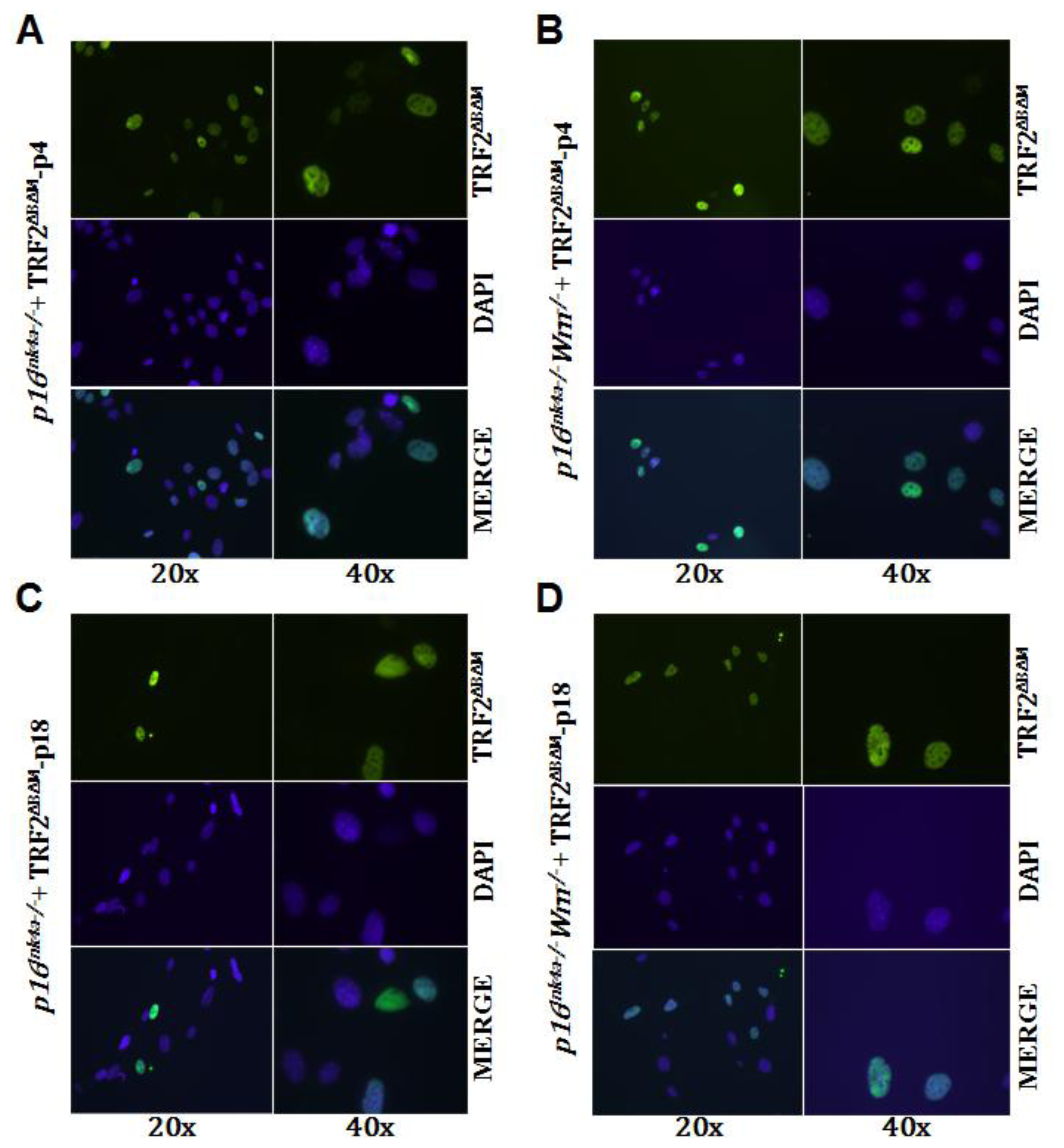
<p>The above data raise the question of how <italic>p16</italic><italic><sup>Ink4a−/−</sup></italic> and <italic>p16</italic><italic><sup>Ink4a−/−</sup></italic><italic>Wrn</italic><italic><sup>−/−</sup></italic> MEFs could continuously grow while maintaining the overexpression of TRF2<sup>ΔBΔM</sup>. First, we confirmed the overexpression of TRF2<sup>ΔBΔM</sup> in early and medium passages of <italic>p16</italic><italic><sup>Ink4a−/−</sup></italic> and <italic>p16</italic><italic><sup>Ink4a−/−</sup></italic><italic>Wrn</italic><italic><sup>−/−</sup></italic> MEFs using immunostaining. As expected, we could detect expression of TRF2<sup>ΔBΔM</sup> in the nuclei of early passages (p4) of <italic>p16</italic><italic><sup>Ink4a−/−</sup></italic> and <italic>p16</italic><italic><sup>Ink4a−/−</sup></italic><italic>Wrn</italic><italic><sup>−/−</sup></italic> MEFs (<xref ref-type="fig" rid="f3-ijms-13-05866">Figure 3A,B</xref>). However, in passage 18 of <italic>p16</italic><italic><sup>Ink4a−/−</sup></italic> and <italic>p16</italic><italic><sup>Ink4a−/−</sup></italic><italic>Wrn</italic><italic><sup>−/−</sup></italic> MEFs, the number of cells with positive staining for TRF2<sup>ΔBΔM</sup> decreased dramatically (<xref ref-type="fig" rid="f3-ijms-13-05866">Figure 3C,D</xref>).</p>
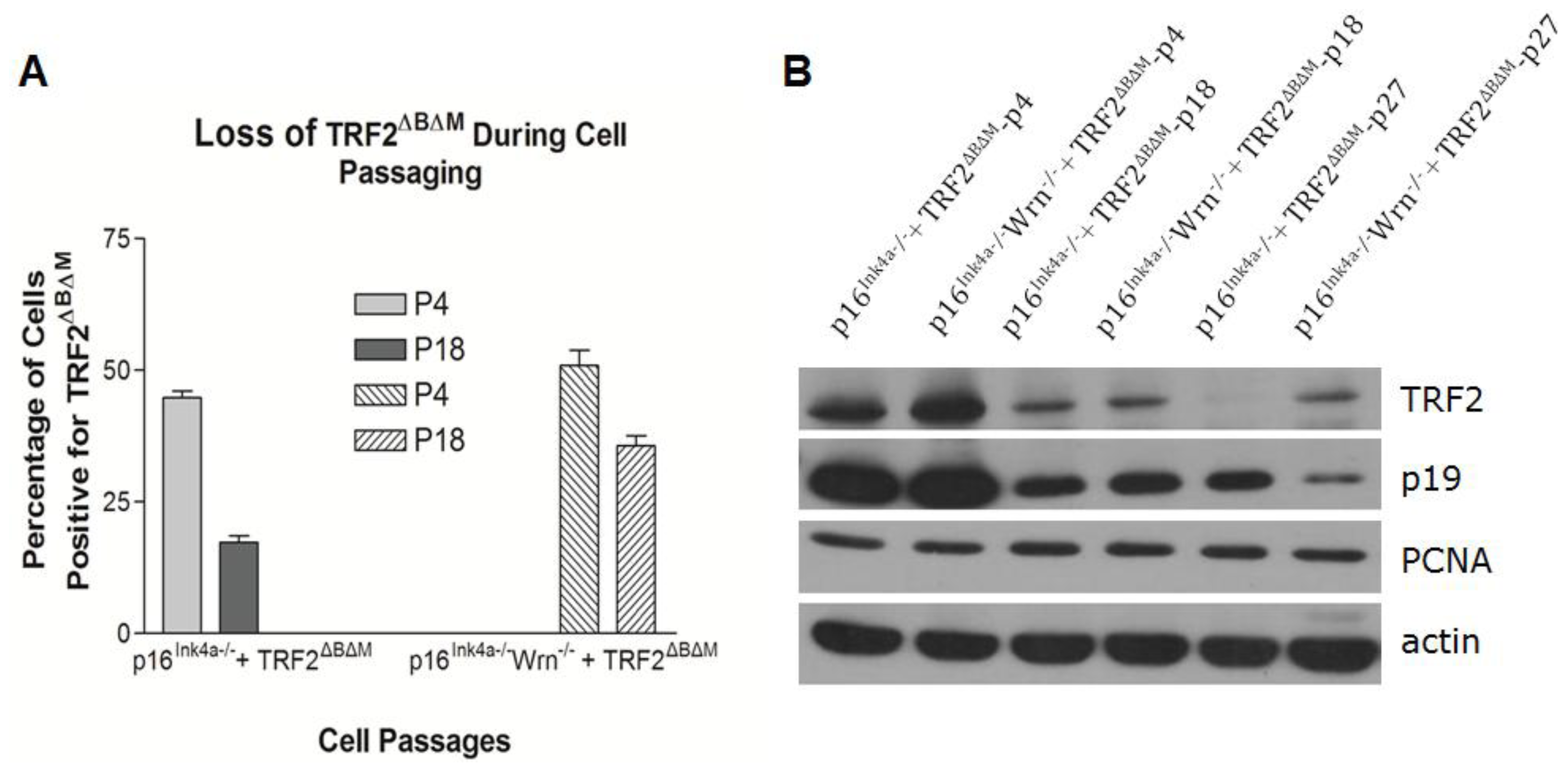
<p>The percentage of P4 <italic>p16</italic><italic><sup>Ink4a−/−</sup></italic> MEFs with positive staining for TRF2<sup>ΔBΔM</sup> was around 45%, while positive staining of P18 <italic>p16</italic><italic><sup>Ink4a−/−</sup></italic> MEFs decreased to 20% (<xref ref-type="fig" rid="f4-ijms-13-05866">Figure 4A</xref>). Similarly, positive staining of P4 <italic>p16</italic><italic><sup>Ink4a−/−</sup></italic><italic>Wrn</italic><italic><sup>−/−</sup></italic> MEFs was around 56%, while positive staining of P18 <italic>p16</italic><italic><sup>Ink4a−/−</sup></italic><italic>Wrn</italic><italic><sup>−/−</sup></italic> MEFs decreased to 39% (<xref ref-type="fig" rid="f4-ijms-13-05866">Figure 4A</xref>). Western blotting further confirmed the decrease of TRF2<sup>ΔBΔM</sup> expression in MEFs with the increasing cell passage number (<xref ref-type="fig" rid="f4-ijms-13-05866">Figure 4B</xref>, <xref ref-type="supplementary-material" rid="s1-ijms-13-05866">supplementary data 2</xref>). These data suggest that in the absence of p16<sup>Ink4a</sup>, MEFs are able to lose expression of telomere dysfunction factors and, therefore, bypass senescence and sustain cell growth.</p>
<p>When the mouse model of Werner Syndrome (<italic>Wrn</italic><italic><sup>−/−</sup></italic>) was established by deleting a segment of the Wrn gene, the premature aging phenotype of human Werner Syndrome was not observed [<xref ref-type="bibr" rid="b23-ijms-13-05866">23</xref>]. It is now clear that this observation was due to the endogenous telomerase activity in mouse somatic cells [<xref ref-type="bibr" rid="b19-ijms-13-05866">19</xref>,<xref ref-type="bibr" rid="b20-ijms-13-05866">20</xref>]. While <italic>Wrn</italic><italic><sup>−/−</sup></italic> mice display reduced embryonic survival, live-born mice appear normal during their first year of life. However, <italic>Wrn</italic><italic><sup>−/−</sup></italic> MEFs display a prematurely reduced growth rate as a function of passage number in culture, demonstrating that <italic>Wrn</italic><italic><sup>−/−</sup></italic> MEFs grow more slowly and have a lower saturation density in culture than their heterozygous and wild type counterparts [<xref ref-type="bibr" rid="b23-ijms-13-05866">23</xref>].</p>
<p>Using <italic>Wrn</italic><italic><sup>−/−</sup></italic> MEFs, we also observed the low growth potential of <italic>Wrn</italic><italic><sup>−/−</sup></italic> MEFs, which may be due to the up-regulation of the cell cycle inhibitor p16<sup>Ink4a</sup>. Knockout of p16<sup>Ink4a</sup> rescued the growth potential of <italic>Wrn</italic><italic><sup>−/−</sup></italic> MEFs, further supporting this point.</p>
<p>Furthermore, the loss of either Wrn or p16<sup>Ink4a</sup> function did not dramatically affect the cellular DNA damage response to the global genotoxin doxorubicin. However, when the dominant negative inhibitor of TRF2 (TRF2<sup>ΔBΔM</sup>) was introduced into the cells and induced cellular senescence, the up-regulation response of p16<sup>Ink4a</sup> was disabled in p16<sup>Ink4a</sup>-deficient cells, which resulted in distinct cellular consequences between <italic>Wrn</italic><italic><sup>−/−</sup></italic> MEFs and <italic>p16</italic><italic><sup>Ink4a−/−</sup></italic><italic>Wrn</italic><italic><sup>−/−</sup></italic> MEFs. In addition, the up-regulation of γ-H2AX in response to TRF2<sup>ΔBΔM</sup> is reduced in <italic>p16</italic><italic><sup>Ink4a−/−</sup></italic><italic>Wrn</italic><italic><sup>−/−</sup></italic> MEFs. Together these regulations in <italic>p16</italic><italic><sup>Ink4a−/−</sup></italic><italic>Wrn</italic><italic><sup>−/−</sup></italic> MEFs overcame the cellular senescence induced by telomere dysfunction and sustained the continuous growth of cells with the consequence of the accumulation of chromosomal aberrations. Eventually <italic>p16</italic><italic><sup>Ink4a−/−</sup></italic><italic>Wrn</italic><italic><sup>−/−</sup></italic> MEFs and <italic>p16</italic><italic><sup>Ink4a−/−</sup></italic> MEFs could lose expression of TRF2<sup>ΔBΔM</sup>, which might further stabilize the chromosomes and stop the accumulation of chromosomal aberrations. However, we found that in <italic>p16</italic><italic><sup>Ink4a−/−</sup></italic><italic>Wrn</italic><italic><sup>−/−</sup></italic> MEFs the chromosomal aberrations still accumulated slowly due to the existing overexpression of TRF2<sup>ΔBΔM</sup>. In this case, the reduction of TRF2<sup>ΔBΔM</sup> levels slowed the accumulation of chromosomal aberrations. The mechanism responsible for the loss of TRF2<sup>ΔBΔM</sup> expression is not clear; however, the loss of p16<sup>Ink4a</sup> function played a permissive role in this process because the <italic>Wrn</italic><italic><sup>−/−</sup></italic> MEFs could not survive TRF2<sup>ΔBΔM</sup> overexpression. In contrast to a previous report [<xref ref-type="bibr" rid="b24-ijms-13-05866">24</xref>], we did not observe p53 activation in response to TRF2<sup>ΔBΔM</sup> overexpression in these MEFs. A previous study also indicated that in normal human epidermal keratinocytes, TRF2<sup>ΔBΔM</sup> overexpression caused only a two fold increase in both the phosphorylation of p53 at serine 15 and 53BP1 DNA damage foci and no detectable increase in p21. Despite the weak DNA damage response, the keratinocytes demonstrated growth arrest, reduced colony formation and senescence [<xref ref-type="bibr" rid="b25-ijms-13-05866">25</xref>]. Another study demonstrated that uncapping telomeres with TRF2<sup>ΔBΔM</sup> resulted in apoptosis, not senescence. These authors found a more dramatic activation of p53, as well as an up-regulation of Bax [<xref ref-type="bibr" rid="b14-ijms-13-05866">14</xref>]. In our study, however, we did not observe activation of Chk2 or p53 or up-regulation of Bax. It is possible that a higher level of TRF2<sup>ΔBΔM</sup> results in apoptosis rather than senescence. It has also been shown that in human fibroblasts, telomere dysfunction induced senescence and signaled through ATM-p53-p21, but not p16<sup>Ink4a</sup>, suggesting that distinct senescence programs could progress in parallel, resulting in mosaic cultures as well as individual cells responding to multiple signals [<xref ref-type="bibr" rid="b26-ijms-13-05866">26</xref>].</p>
<p>Together, these data suggest different roles of p53 and p16<sup>Ink4a</sup> in response to distinct DNA damages and shed light on anti-aging strategies by the regulation p16<sup>Ink4a</sup> expression.</p></sec></sec>
<sec>
<title>3. Experimental Section</title>
<sec>
<title>3.1. Cell Lines, Constructs and Antibodies</title>
<p>MEFs were prepared and harvested from individual day 13.5 mouse embryos from designed parental mice with <italic>p16</italic><italic><sup>Ink4+/−</sup></italic> or <italic>Wrn</italic><italic><sup>+/−</sup></italic> genotypes (heterozygous knockouts of either <italic>p16</italic><italic><sup>Ink4</sup></italic> or <italic>Wrn</italic>) and the harvested MEFs were cultured and genotyped. MEFs with wild type, <italic>p16</italic><italic><sup>Ink4a−/−</sup></italic>, <italic>Wrn</italic><italic><sup>−/−</sup></italic> or <italic>p16</italic><italic><sup>Ink4a−/−</sup></italic><italic>Wrn</italic><italic><sup>−/−</sup></italic> genotypes were used for experiments. Wild type MEFs were used for experiments before passage 10 and the cells were passaged at a ratio of 1:2 or 1:3 so that the cells were not excessively diluted and senesced too quickly.</p>
<p>All cell lines were cultured in DMEM medium supplemented with 10% fetal bovine serum (Hyclone, CA, USA) in a 3% oxygen and 5% CO<sub>2</sub> incubator at 37 °C.</p>
<p>The pBabe-TRF2<sup>ΔBΔM</sup> (with a cMyc tag) construct, a gift from Dr. de Lange’s lab (as described in [<xref ref-type="bibr" rid="b27-ijms-13-05866">27</xref>]), was introduced into MEFs. For transient transfection, cells were used 48 h after transfection. For stable expression, antibiotic selection was applied for 1–2 months and expression of TRF2<sup>ΔBΔM</sup> was analyzed by both western blot and immunostaining.</p>
<p>Antibodies used for western blot were anti-p16<sup>Ink4a</sup> (M-156) (1:500, Santa Cruz, CA, USA), anti-Chk2 (1:500, BD Transduction Laboratories, CA, USA), anti-phospho-p53 (Ser15) (1:500, Cell Signaling, MA, USA), anti-cMyc (9E10) (1:500, Santa Cruz, CA, USA), anti-p19<sup>Arf</sup> (1:1250, Upstate, NY, USA), anti-γ-H2AX (1:1000, Upstate, NY, USA), and anti-γ-tubulin (1:5000, Upstate, NY, USA).</p></sec>
<sec>
<title>3.2. Growth Curve Assay</title>
<p>A total of 2.5 × 10<sup>4</sup> cells were seeded per well in 12 well plates and triplicates were prepared for each sample. At each time point, cells were fixed for 20 min at room temperature in 10% buffered formalin and stained with 1 mL 0.1% crystal violet for 20 min at room temperature. After the plates were washed and dried, cells were treated with 2 mL 10% acetic acid and the OD of the extracted dye was measured at 595 nm. Statistical analysis was performed to compare the difference between cell lines (<italic>n</italic> = 3).</p></sec>
<sec>
<title>3.3. Immunostaining Assay</title>
<p>Cells were fixed with 2% paraformaldehyde and 2% sucrose in 1× PBS (pH 7.6) for 10 min and then permeabilized with 1% NP-40. After pre-incubation with 5% BSA/PBS, cells were incubated first with the primary antibody and then with the secondary antibody in 1% BSA/PBS for 1 h at room temperature. After DAPI staining, the slides were mounted with ProLong mounting medium (Invitrogen, CA, USA). Fluorescence microscopy was performed using a Nikon Eclipse 90i fluorescence microscope and a Nikon Digital Sight CCD (controlled by NIS-Elements 3.0 software).</p></sec>
<sec>
<title>3.4. SA-β-Gal Staining</title>
<p>SA-β-Gal staining was performed as described previously [<xref ref-type="bibr" rid="b28-ijms-13-05866">28</xref>]. Briefly, cultured cells were washed in 1× PBS and fixed for 3–5 min (room temperature) in 2% formaldehyde, 0.2% glutaraldehyde. Fixed cells were stained with fresh stain solution for SA-β-galactosidase activity at 37 °C for 4 h. The percentage of cells positive for SA-β-Gal staining were quantified and statistically analyzed (<italic>n</italic> = 3).</p></sec></sec>
<sec sec-type="conclusions">
<title>4. Conclusions</title>
<p>Our data suggest that, in the context of Wrn deficiency-related telomere dysfunction, loss of p16<sup>Ink4a</sup> function could prevent cells from senescence. These results shed light on the anti-aging strategy by regulation of p16<sup>Ink4a</sup> expression.</p></sec>
<sec sec-type="supplementary-material">
<title>Supplementary Information</title>
<supplementary-material id="s1-ijms-13-05866" content-type="local-data">
<media xlink:href="ijms-13-05866-s001.pdf" mimetype="application" mime-subtype="pdf"/></supplementary-material></sec></body>
<back>
<ack>
<title>Acknowledgments</title>
<p>This work was supported by The New Century Excellent Scholarship to Y.L, NSFC grants to Y.L. (30771194, 30970598, 31170735) and to W.T. (30960152), and the Yunnan Provincial Science Foundation to W.T. (20080043M). We thank Sandy Chang from Yale University and Ronald A Depinho from MD Anderson Cancer Center for providing the transgenic mice used in this study.</p></ack>
<ref-list>
<title>References</title>
<ref id="b1-ijms-13-05866"><label>1</label><citation citation-type="journal"><person-group person-group-type="author"><name><surname>Wright</surname><given-names>W.E.</given-names></name><name><surname>Shay</surname><given-names>J.W.</given-names></name></person-group><article-title>Telomere positional effects and the regulation of cellular senescence</article-title><source>Trends Genet</source><year>1992</year><volume>8</volume><fpage>193</fpage><lpage>197</lpage><pub-id pub-id-type="doi">10.1016/0168-9525(92)90232-S</pub-id><pub-id pub-id-type="pmid">1496553</pub-id></citation></ref>
<ref id="b2-ijms-13-05866"><label>2</label><citation citation-type="journal"><person-group person-group-type="author"><name><surname>Wright</surname><given-names>W.E.</given-names></name><name><surname>Shay</surname><given-names>J.W.</given-names></name></person-group><article-title>Time, telomeres and tumours: Is cellular senescence more than an anticancer mechanism?</article-title><source>Trends Cell Biol</source><year>1995</year><volume>5</volume><fpage>293</fpage><lpage>297</lpage><pub-id pub-id-type="doi">10.1016/S0962-8924(00)89044-3</pub-id><pub-id pub-id-type="pmid">14732086</pub-id></citation></ref>
<ref id="b3-ijms-13-05866"><label>3</label><citation citation-type="journal"><person-group person-group-type="author"><name><surname>Rudolph</surname><given-names>K.L.</given-names></name><name><surname>Chang</surname><given-names>S.</given-names></name><name><surname>Lee</surname><given-names>H.W.</given-names></name><name><surname>Blasco</surname><given-names>M.</given-names></name><name><surname>Gottlieb</surname><given-names>G.J.</given-names></name><name><surname>Greider</surname><given-names>C.</given-names></name><name><surname>DePinho</surname><given-names>R.A.</given-names></name></person-group><article-title>Longevity, stress response, and cancer in aging telomerase-deficient mice</article-title><source>Cell</source><year>1999</year><volume>96</volume><fpage>701</fpage><lpage>712</lpage><pub-id pub-id-type="doi">10.1016/S0092-8674(00)80580-2</pub-id><pub-id pub-id-type="pmid">10089885</pub-id></citation></ref>
<ref id="b4-ijms-13-05866"><label>4</label><citation citation-type="journal"><person-group person-group-type="author"><name><surname>Stewart</surname><given-names>S.A.</given-names></name><name><surname>Weinberg</surname><given-names>R.A.</given-names></name></person-group><article-title>Telomeres: Cancer to human aging</article-title><source>Annu. Rev. Cell Dev. Biol</source><year>2006</year><volume>22</volume><fpage>531</fpage><lpage>557</lpage><pub-id pub-id-type="doi">10.1146/annurev.cellbio.22.010305.104518</pub-id><pub-id pub-id-type="pmid">16824017</pub-id></citation></ref>
<ref id="b5-ijms-13-05866"><label>5</label><citation citation-type="journal"><person-group person-group-type="author"><name><surname>De Lange</surname><given-names>T.</given-names></name></person-group><article-title>Protection of mammalian telomeres</article-title><source>Oncogene</source><year>2002</year><volume>21</volume><fpage>532</fpage><lpage>540</lpage><pub-id pub-id-type="doi">10.1038/sj.onc.1205080</pub-id><pub-id pub-id-type="pmid">11850778</pub-id></citation></ref>
<ref id="b6-ijms-13-05866"><label>6</label><citation citation-type="journal"><person-group person-group-type="author"><name><surname>De Lange</surname><given-names>T.</given-names></name></person-group><article-title>Shelterin: The protein complex that shapes and safeguards human telomeres</article-title><source>Gene Dev</source><year>2005</year><volume>19</volume><fpage>2100</fpage><lpage>2110</lpage><pub-id pub-id-type="doi">10.1101/gad.1346005</pub-id><pub-id pub-id-type="pmid">16166375</pub-id></citation></ref>
<ref id="b7-ijms-13-05866"><label>7</label><citation citation-type="journal"><person-group person-group-type="author"><name><surname>Artandi</surname><given-names>S.E.</given-names></name><name><surname>DePinho</surname><given-names>R.A.</given-names></name></person-group><article-title>Mice without telomerase: What can they teach us about human cancer?</article-title><source>Nat. Med</source><year>2000</year><volume>6</volume><fpage>852</fpage><lpage>855</lpage><pub-id pub-id-type="doi">10.1038/78595</pub-id><pub-id pub-id-type="pmid">10932211</pub-id></citation></ref>
<ref id="b8-ijms-13-05866"><label>8</label><citation citation-type="journal"><person-group person-group-type="author"><name><surname>Chin</surname><given-names>L.</given-names></name><name><surname>Artandi</surname><given-names>S.E.</given-names></name><name><surname>Shen</surname><given-names>Q.</given-names></name><name><surname>Tam</surname><given-names>A.</given-names></name><name><surname>Lee</surname><given-names>S.L.</given-names></name><name><surname>Gottlieb</surname><given-names>G.J.</given-names></name><name><surname>Greider</surname><given-names>C.W.</given-names></name><name><surname>DePinho</surname><given-names>R.A.</given-names></name></person-group><article-title>P53 deficiency rescues the adverse effects of telomere loss and cooperates with telomere dysfunction to accelerate carcinogenesis</article-title><source>Cell</source><year>1999</year><volume>97</volume><fpage>527</fpage><lpage>538</lpage><pub-id pub-id-type="doi">10.1016/S0092-8674(00)80762-X</pub-id><pub-id pub-id-type="pmid">10338216</pub-id></citation></ref>
<ref id="b9-ijms-13-05866"><label>9</label><citation citation-type="journal"><person-group person-group-type="author"><name><surname>Zhang</surname><given-names>X.F.</given-names></name><name><surname>Tang</surname><given-names>W.R.</given-names></name><name><surname>Luo</surname><given-names>Y.</given-names></name></person-group><article-title>Aging or tumor: The crosstalk between telomerase and p53 (in Chinese)</article-title><source>Yi Chuan</source><year>2009</year><volume>31</volume><fpage>451</fpage><lpage>456</lpage><pub-id pub-id-type="doi">10.3724/SP.J.1005.2009.00451</pub-id><pub-id pub-id-type="pmid">19586837</pub-id></citation></ref>
<ref id="b10-ijms-13-05866"><label>10</label><citation citation-type="journal"><person-group person-group-type="author"><name><surname>Wang</surname><given-names>W.</given-names></name><name><surname>Chen</surname><given-names>J.X.</given-names></name><name><surname>Liao</surname><given-names>R.</given-names></name><name><surname>Deng</surname><given-names>Q.</given-names></name><name><surname>Zhou</surname><given-names>J.J.</given-names></name><name><surname>Huang</surname><given-names>S.</given-names></name><name><surname>Sun</surname><given-names>P.</given-names></name></person-group><article-title>Sequential activation of the mek-extracellular signal-regulated kinase and mkk3/6-p38 mitogen-activated protein kinase pathways mediates oncogenic ras-induced premature senescence</article-title><source>Mol. Cell Biol</source><year>2002</year><volume>22</volume><fpage>3389</fpage><lpage>3403</lpage><pub-id pub-id-type="doi">10.1128/MCB.22.10.3389-3403.2002</pub-id><pub-id pub-id-type="pmid">11971971</pub-id></citation></ref>
<ref id="b11-ijms-13-05866"><label>11</label><citation citation-type="journal"><person-group person-group-type="author"><name><surname>Palmero</surname><given-names>I.</given-names></name><name><surname>McConnell</surname><given-names>B.</given-names></name><name><surname>Parry</surname><given-names>D.</given-names></name><name><surname>Brookes</surname><given-names>S.</given-names></name><name><surname>Hara</surname><given-names>E.</given-names></name><name><surname>Bates</surname><given-names>S.</given-names></name><name><surname>Jat</surname><given-names>P.</given-names></name><name><surname>Peters</surname><given-names>G.</given-names></name></person-group><article-title>Accumulation of p16<sup>ink4a</sup> in mouse fibroblasts as a function of replicative senescence and not of retinoblastoma gene status</article-title><source>Oncogene</source><year>1997</year><volume>15</volume><fpage>495</fpage><lpage>503</lpage><pub-id pub-id-type="doi">10.1038/sj.onc.1201212</pub-id><pub-id pub-id-type="pmid">9247303</pub-id></citation></ref>
<ref id="b12-ijms-13-05866"><label>12</label><citation citation-type="journal"><person-group person-group-type="author"><name><surname>Hara</surname><given-names>E.</given-names></name><name><surname>Smith</surname><given-names>R.</given-names></name><name><surname>Parry</surname><given-names>D.</given-names></name><name><surname>Tahara</surname><given-names>H.</given-names></name><name><surname>Stone</surname><given-names>S.</given-names></name><name><surname>Peters</surname><given-names>G.</given-names></name></person-group><article-title>Regulation of p16<sup>cdkn2</sup> expression and its implications for cell immortalization and senescence</article-title><source>Mol. Cell Biol</source><year>1996</year><volume>16</volume><fpage>859</fpage><lpage>867</lpage><pub-id pub-id-type="pmid">8622687</pub-id></citation></ref>
<ref id="b13-ijms-13-05866"><label>13</label><citation citation-type="journal"><person-group person-group-type="author"><name><surname>Jacobs</surname><given-names>J.J.</given-names></name><name><surname>de Lange</surname><given-names>T.</given-names></name></person-group><article-title>Significant role for p16<sup>ink4a</sup> in p53-independent telomere-directed senescence</article-title><source>Curr. Biol</source><year>2004</year><volume>14</volume><fpage>2302</fpage><lpage>2308</lpage><pub-id pub-id-type="doi">10.1016/j.cub.2004.12.025</pub-id><pub-id pub-id-type="pmid">15620660</pub-id></citation></ref>
<ref id="b14-ijms-13-05866"><label>14</label><citation citation-type="journal"><person-group person-group-type="author"><name><surname>Karlseder</surname><given-names>J.</given-names></name><name><surname>Broccoli</surname><given-names>D.</given-names></name><name><surname>Dai</surname><given-names>Y.</given-names></name><name><surname>Hardy</surname><given-names>S.</given-names></name><name><surname>de Lange</surname><given-names>T.</given-names></name></person-group><article-title>P53- and atm-dependent apoptosis induced by telomeres lacking trf2</article-title><source>Science</source><year>1999</year><volume>283</volume><fpage>1321</fpage><lpage>1325</lpage><pub-id pub-id-type="doi">10.1126/science.283.5406.1321</pub-id><pub-id pub-id-type="pmid">10037601</pub-id></citation></ref>
<ref id="b15-ijms-13-05866"><label>15</label><citation citation-type="journal"><person-group person-group-type="author"><name><surname>Gray</surname><given-names>M.D.</given-names></name><name><surname>Shen</surname><given-names>J.C.</given-names></name><name><surname>Kamath-Loeb</surname><given-names>A.S.</given-names></name><name><surname>Blank</surname><given-names>A.</given-names></name><name><surname>Sopher</surname><given-names>B.L.</given-names></name><name><surname>Martin</surname><given-names>G.M.</given-names></name><name><surname>Oshima</surname><given-names>J.</given-names></name><name><surname>Loeb</surname><given-names>L.A.</given-names></name></person-group><article-title>The Werner Syndrome protein is a DNA helicase</article-title><source>Nat. Genet</source><year>1997</year><volume>17</volume><fpage>100</fpage><lpage>103</lpage><pub-id pub-id-type="doi">10.1038/ng0997-100</pub-id><pub-id pub-id-type="pmid">9288107</pub-id></citation></ref>
<ref id="b16-ijms-13-05866"><label>16</label><citation citation-type="journal"><person-group person-group-type="author"><name><surname>Epstein</surname><given-names>C.J.</given-names></name><name><surname>Martin</surname><given-names>G.M.</given-names></name><name><surname>Schultz</surname><given-names>A.L.</given-names></name><name><surname>Motulsky</surname><given-names>A.G.</given-names></name></person-group><article-title>Werner’s syndrome a review of its symptomatology, natural history, pathologic features, genetics and relationship to the natural aging process</article-title><source>Medicine (Baltimore)</source><year>1966</year><volume>45</volume><fpage>177</fpage><lpage>221</lpage></citation></ref>
<ref id="b17-ijms-13-05866"><label>17</label><citation citation-type="journal"><person-group person-group-type="author"><name><surname>Davis</surname><given-names>T.</given-names></name><name><surname>Bachler</surname><given-names>M.A.</given-names></name><name><surname>Wyllie</surname><given-names>F.S.</given-names></name><name><surname>Bagley</surname><given-names>M.C.</given-names></name><name><surname>Kipling</surname><given-names>D.</given-names></name></person-group><article-title>Evaluating the role of p38 map kinase in growth of Werner Syndrome fibroblasts</article-title><source>Ann. N. Y. Acad. Sci</source><year>2010</year><volume>1197</volume><fpage>45</fpage><lpage>48</lpage><pub-id pub-id-type="doi">10.1111/j.1749-6632.2010.05195.x</pub-id><pub-id pub-id-type="pmid">20536832</pub-id></citation></ref>
<ref id="b18-ijms-13-05866"><label>18</label><citation citation-type="journal"><person-group person-group-type="author"><name><surname>Wyllie</surname><given-names>F.S.</given-names></name><name><surname>Jones</surname><given-names>C.J.</given-names></name><name><surname>Skinner</surname><given-names>J.W.</given-names></name><name><surname>Haughton</surname><given-names>M.F.</given-names></name><name><surname>Wallis</surname><given-names>C.</given-names></name><name><surname>Wynford-Thomas</surname><given-names>D.</given-names></name><name><surname>Faragher</surname><given-names>R.G.</given-names></name><name><surname>Kipling</surname><given-names>D.</given-names></name></person-group><article-title>Telomerase prevents the accelerated cell ageing of Werner Syndrome fibroblasts</article-title><source>Nat. Genet</source><year>2000</year><volume>24</volume><fpage>16</fpage><lpage>17</lpage><pub-id pub-id-type="doi">10.1038/71630</pub-id><pub-id pub-id-type="pmid">10615119</pub-id></citation></ref>
<ref id="b19-ijms-13-05866"><label>19</label><citation citation-type="journal"><person-group person-group-type="author"><name><surname>Chang</surname><given-names>S.</given-names></name><name><surname>Multani</surname><given-names>A.S.</given-names></name><name><surname>Cabrera</surname><given-names>N.G.</given-names></name><name><surname>Naylor</surname><given-names>M.L.</given-names></name><name><surname>Laud</surname><given-names>P.</given-names></name><name><surname>Lombard</surname><given-names>D.</given-names></name><name><surname>Pathak</surname><given-names>S.</given-names></name><name><surname>Guarente</surname><given-names>L.</given-names></name><name><surname>DePinho</surname><given-names>R.A.</given-names></name></person-group><article-title>Essential role of limiting telomeres in the pathogenesis of Werner Syndrome</article-title><source>Nat. Genet</source><year>2004</year><volume>36</volume><fpage>877</fpage><lpage>882</lpage><pub-id pub-id-type="doi">10.1038/ng1389</pub-id><pub-id pub-id-type="pmid">15235603</pub-id></citation></ref>
<ref id="b20-ijms-13-05866"><label>20</label><citation citation-type="journal"><person-group person-group-type="author"><name><surname>Du</surname><given-names>X.</given-names></name><name><surname>Shen</surname><given-names>J.</given-names></name><name><surname>Kugan</surname><given-names>N.</given-names></name><name><surname>Furth</surname><given-names>E.E.</given-names></name><name><surname>Lombard</surname><given-names>D.B.</given-names></name><name><surname>Cheung</surname><given-names>C.</given-names></name><name><surname>Pak</surname><given-names>S.</given-names></name><name><surname>Luo</surname><given-names>G.</given-names></name><name><surname>Pignolo</surname><given-names>R.J.</given-names></name><name><surname>DePinho</surname><given-names>R.A.</given-names></name><etal/></person-group><article-title>Telomere shortening exposes functions for the mouse werner and bloom syndrome genes</article-title><source>Mol. Cell Biol</source><year>2004</year><volume>24</volume><fpage>8437</fpage><lpage>8446</lpage><pub-id pub-id-type="doi">10.1128/MCB.24.19.8437-8446.2004</pub-id><pub-id pub-id-type="pmid">15367665</pub-id></citation></ref>
<ref id="b21-ijms-13-05866"><label>21</label><citation citation-type="journal"><person-group person-group-type="author"><name><surname>Crabbe</surname><given-names>L.</given-names></name><name><surname>Verdun</surname><given-names>R.E.</given-names></name><name><surname>Haggblom</surname><given-names>C.I.</given-names></name><name><surname>Karlseder</surname><given-names>J.</given-names></name></person-group><article-title>Defective telomere lagging strand synthesis in cells lacking wrn helicase activity</article-title><source>Science</source><year>2004</year><volume>306</volume><fpage>1951</fpage><lpage>1953</lpage><pub-id pub-id-type="doi">10.1126/science.1103619</pub-id><pub-id pub-id-type="pmid">15591207</pub-id></citation></ref>
<ref id="b22-ijms-13-05866"><label>22</label><citation citation-type="journal"><person-group person-group-type="author"><name><surname>Opresko</surname><given-names>P.L.</given-names></name><name><surname>Otterlei</surname><given-names>M.</given-names></name><name><surname>Graakjaer</surname><given-names>J.</given-names></name><name><surname>Bruheim</surname><given-names>P.</given-names></name><name><surname>Dawut</surname><given-names>L.</given-names></name><name><surname>Kolvraa</surname><given-names>S.</given-names></name><name><surname>May</surname><given-names>A.</given-names></name><name><surname>Seidman</surname><given-names>M.M.</given-names></name><name><surname>Bohr</surname><given-names>V.A.</given-names></name></person-group><article-title>The Werner Syndrome helicase and exonuclease cooperate to resolve telomeric d-loops in a manner regulated by trf1 and trf2</article-title><source>Mol. Cell</source><year>2004</year><volume>14</volume><fpage>763</fpage><lpage>774</lpage><pub-id pub-id-type="doi">10.1016/j.molcel.2004.05.023</pub-id><pub-id pub-id-type="pmid">15200954</pub-id></citation></ref>
<ref id="b23-ijms-13-05866"><label>23</label><citation citation-type="journal"><person-group person-group-type="author"><name><surname>Lebel</surname><given-names>M.</given-names></name><name><surname>Leder</surname><given-names>P.</given-names></name></person-group><article-title>A deletion within the murine Werner Syndrome helicase induces sensitivity to inhibitors of topoisomerase and loss of cellular proliferative capacity</article-title><source>Proc. Natl. Acad. Sci. USA</source><year>1998</year><volume>95</volume><fpage>13097</fpage><lpage>13102</lpage><pub-id pub-id-type="doi">10.1073/pnas.95.22.13097</pub-id><pub-id pub-id-type="pmid">9789047</pub-id></citation></ref>
<ref id="b24-ijms-13-05866"><label>24</label><citation citation-type="journal"><person-group person-group-type="author"><name><surname>Jacobs</surname><given-names>J.J.</given-names></name><name><surname>de Lange</surname><given-names>T.</given-names></name></person-group><article-title>P16ink4a as a second effector of the telomere damage pathway</article-title><source>Cell Cycle</source><year>2005</year><volume>4</volume><fpage>1364</fpage><lpage>1368</lpage><pub-id pub-id-type="doi">10.4161/cc.4.10.2104</pub-id><pub-id pub-id-type="pmid">16177573</pub-id></citation></ref>
<ref id="b25-ijms-13-05866"><label>25</label><citation citation-type="journal"><person-group person-group-type="author"><name><surname>Minty</surname><given-names>F.</given-names></name><name><surname>Thurlow</surname><given-names>J.K.</given-names></name><name><surname>Harrison</surname><given-names>P.R.</given-names></name><name><surname>Parkinson</surname><given-names>E.K.</given-names></name></person-group><article-title>Telomere dysfunction in human keratinocytes elicits senescence and a novel transcription profile</article-title><source>Exp. Cell Res</source><year>2008</year><volume>314</volume><fpage>2434</fpage><lpage>2447</lpage><pub-id pub-id-type="doi">10.1016/j.yexcr.2008.05.007</pub-id><pub-id pub-id-type="pmid">18589416</pub-id></citation></ref>
<ref id="b26-ijms-13-05866"><label>26</label><citation citation-type="journal"><person-group person-group-type="author"><name><surname>Herbig</surname><given-names>U.</given-names></name><name><surname>Jobling</surname><given-names>W.A.</given-names></name><name><surname>Chen</surname><given-names>B.P.</given-names></name><name><surname>Chen</surname><given-names>D.J.</given-names></name><name><surname>Sedivy</surname><given-names>J.M.</given-names></name></person-group><article-title>Telomere shortening triggers senescence of human cells through a pathway involving atm, p53, and p21(cip1), but not p16(ink4a)</article-title><source>Mol. Cell</source><year>2004</year><volume>14</volume><fpage>501</fpage><lpage>513</lpage><pub-id pub-id-type="doi">10.1016/S1097-2765(04)00256-4</pub-id><pub-id pub-id-type="pmid">15149599</pub-id></citation></ref>
<ref id="b27-ijms-13-05866"><label>27</label><citation citation-type="journal"><person-group person-group-type="author"><name><surname>Smogorzewska</surname><given-names>A.</given-names></name><name><surname>de Lange</surname><given-names>T.</given-names></name></person-group><article-title>Different telomere damage signaling pathways in human and mouse cells</article-title><source>EMBO J</source><year>2002</year><volume>21</volume><fpage>4338</fpage><lpage>4348</lpage><pub-id pub-id-type="doi">10.1093/emboj/cdf433</pub-id><pub-id pub-id-type="pmid">12169636</pub-id></citation></ref>
<ref id="b28-ijms-13-05866"><label>28</label><citation citation-type="journal"><person-group person-group-type="author"><name><surname>Dimri</surname><given-names>G.P.</given-names></name><name><surname>Lee</surname><given-names>X.</given-names></name><name><surname>Basile</surname><given-names>G.</given-names></name><name><surname>Acosta</surname><given-names>M.</given-names></name><name><surname>Scott</surname><given-names>G.</given-names></name><name><surname>Roskelley</surname><given-names>C.</given-names></name><name><surname>Medrano</surname><given-names>E.E.</given-names></name><name><surname>Linskens</surname><given-names>M.</given-names></name><name><surname>Rubelj</surname><given-names>I.</given-names></name><name><surname>Pereira-Smith</surname><given-names>O.</given-names></name><etal/></person-group><article-title>A biomarker that identifies senescent human cells in culture and in aging skin <italic>in vivo</italic></article-title><source>Proc. Natl. Acad. Sci. USA</source><year>1995</year><volume>92</volume><fpage>9363</fpage><lpage>9367</lpage><pub-id pub-id-type="doi">10.1073/pnas.92.20.9363</pub-id><pub-id pub-id-type="pmid">7568133</pub-id></citation></ref></ref-list>
<sec sec-type="display-objects">
<title>Figures and Table</title>
<fig id="f1-ijms-13-05866" position="float">
<label>Figure 1</label>
<caption>
<p><italic>Wrn</italic><italic><sup>−/−</sup></italic> induced up-regulation of <italic>p16</italic><italic><sup>Ink4a</sup></italic> and caused a growth barrier in MEFs. (<bold>A</bold>) Growth curves of wild type, <italic>p16</italic><italic><sup>Ink4a−/−</sup></italic>, <italic>Wrn</italic><italic><sup>−/−</sup></italic> and <italic>p16</italic><italic><sup>Ink4a−/−</sup></italic><italic>Wrn</italic><italic><sup>−/−</sup></italic> MEFs; (<bold>B</bold>) Western blot analysis of <italic>p16</italic><italic><sup>Ink4a−/−</sup></italic>, <italic>Wrn</italic><italic><sup>−/−</sup></italic> and <italic>p16</italic><italic><sup>Ink4a−/−</sup></italic><italic>Wrn</italic><italic><sup>−/−</sup></italic> MEFs. Wild type MEFs (WT) with or without doxorubicin treatment were used as controls. (<bold>C</bold>) SA-β-Gal staining of <italic>p16</italic><italic><sup>Ink4a−/−</sup></italic>, <italic>Wrn</italic><italic><sup>−/−</sup></italic> and <italic>p16</italic><italic><sup>Ink4a−/−</sup></italic><italic>Wrn</italic><italic><sup>−/−</sup></italic> MEFs at passage 13.</p></caption>
<graphic xlink:href="ijms-13-05866f1.gif"/></fig>
<fig id="f2-ijms-13-05866" position="float">
<label>Figure 2</label>
<caption>
<p>DNA damage response to genotoxin or telomere dysfunction in cells lacking either Wrn or p16<sup>Ink4a</sup> function. (<bold>A</bold>) Western blot analysis to determine the response of MEFs to doxorubicin treatment; (<bold>B</bold>) Western blot analysis to determine the response of MEFs to TRF2<sup>ΔBΔM</sup> overexpression. Wild type MEFs (WT) were used as controls; (<bold>C</bold>) SA-β-Gal staining of <italic>p16</italic><italic><sup>Ink4a−/−</sup></italic>, <italic>Wrn</italic><italic><sup>−/−</sup></italic> and <italic>p16</italic><italic><sup>Ink4a−/−</sup></italic><italic>Wrn</italic><italic><sup>−/−</sup></italic> MEFs following TRF2<sup>ΔBΔM</sup> overexpression.</p></caption>
<graphic xlink:href="ijms-13-05866f2.gif"/></fig>
<fig id="f3-ijms-13-05866" position="float">
<label>Figure 3</label>
<caption>
<p>Overexpression of TRF2<sup>ΔBΔM</sup> in early and medium passages of <italic>p16</italic><italic><sup>Ink4a−/−</sup></italic> and <italic>p16</italic><italic><sup>Ink4a−/−</sup></italic><italic>Wrn</italic><italic><sup>−/−</sup></italic> MEFs revealed by immunostaining (20× and 40× refer to the amplification power of the objective lens, DAPI was used to show the nuclear localization). (<bold>A</bold>) Early passage (P4) of <italic>p16</italic><italic><sup>Ink4a−/−</sup></italic> MEFs; (<bold>B</bold>) Early passage (P4) of <italic>p16</italic><italic><sup>Ink4a−/−</sup></italic><italic>Wrn</italic><italic><sup>−/−</sup></italic> MEFs; (<bold>C</bold>) Late passage (P18) of <italic>p16</italic><italic><sup>Ink4a−/−</sup></italic> MEFs; (<bold>D</bold>) Late passage (P18) of <italic>p16</italic><italic><sup>Ink4a−/−</sup></italic><italic>Wrn</italic><italic><sup>−/−</sup></italic> MEFs.</p></caption>
<graphic xlink:href="ijms-13-05866f3.gif"/></fig>
<fig id="f4-ijms-13-05866" position="float">
<label>Figure 4</label>
<caption>
<p>Elimination of TRF2<sup>ΔBΔM</sup> expression in the late passages of <italic>p16</italic><italic><sup>Ink4a−/−</sup></italic> and <italic>p16</italic><italic><sup>Ink4a−/−</sup></italic><italic>Wrn</italic><italic><sup>−/−</sup></italic> MEFs. (<bold>A</bold>) The percentage of cells positive for TRF2<sup>ΔBΔM</sup> measured by immunostaining; (<bold>B</bold>) Western blot showing the decrease of TRF2<sup>ΔBΔM</sup> expression with increasing cell passages.</p></caption>
<graphic xlink:href="ijms-13-05866f4.gif"/></fig>
<table-wrap id="t1-ijms-13-05866" position="float">
<label>Table 1</label>
<caption>
<p>Chromosome Analysis in MEFs overexpressing TRF2<sup>ΔBΔM</sup>.</p></caption>
<table frame="hsides" rules="groups">
<thead>
<tr>
<th align="left" valign="middle">MEFs’ Genotype</th>
<th align="center" valign="middle">metaphases counted</th>
<th align="center" valign="middle">breakage</th>
<th align="center" valign="middle">fusion</th>
<th align="center" valign="middle">Diploid 2<italic>N</italic> = 40</th>
<th align="center" valign="middle">Aneuploid 2<italic>N</italic> &gt; 40</th>
<th align="center" valign="middle">Aneuploid 2<italic>N</italic> &lt; 40</th></tr></thead>
<tbody>
<tr>
<td align="left" valign="top"><italic>p16</italic><italic><sup>Ink4a−/−</sup></italic> + TRF2<sup>ΔBΔM</sup>-p4</td>
<td align="center" valign="top">30</td>
<td align="center" valign="top"/>
<td align="center" valign="top">1</td>
<td align="center" valign="top">15</td>
<td align="center" valign="top">14</td>
<td align="center" valign="top"/></tr>
<tr>
<td align="left" valign="top"><italic>p16</italic><italic><sup>Ink4a−/−</sup></italic><italic>Wrn</italic><italic><sup>−/−</sup></italic> + TRF2<sup>ΔBΔM</sup>-p4</td>
<td align="center" valign="top">30</td>
<td align="center" valign="top"/>
<td align="center" valign="top">14</td>
<td align="center" valign="top">2</td></tr>
<tr>
<td align="left" valign="top"><italic>p16</italic><italic><sup>Ink4a−/−</sup></italic> + TRF2<sup>ΔBΔM</sup>-p18</td>
<td align="center" valign="top">30</td>
<td align="center" valign="top">1</td>
<td align="center" valign="top"/>
<td align="center" valign="top">7</td>
<td align="center" valign="top">20</td>
<td align="center" valign="top">2</td></tr>
<tr>
<td align="left" valign="top"><italic>p16</italic><italic><sup>Ink4a−/−</sup></italic><italic>Wrn</italic><italic><sup>−/−</sup></italic> + TRF2<sup>ΔBΔM</sup>-p18</td>
<td align="center" valign="top">30</td>
<td align="center" valign="top"/>
<td align="center" valign="top">15</td>
<td align="center" valign="top">13</td>
<td align="center" valign="top">2</td></tr>
<tr>
<td align="left" valign="top"><italic>p16</italic><italic><sup>Ink4a−/−</sup></italic> + TRF2<sup>ΔBΔM</sup>-p27</td>
<td align="center" valign="top">30</td>
<td align="center" valign="top"/>
<td align="center" valign="top">2</td>
<td align="center" valign="top">1</td>
<td align="center" valign="top">27</td>
<td align="center" valign="top"/></tr>
<tr>
<td align="left" valign="top"><italic>p16</italic><italic><sup>Ink4a−/−</sup></italic><italic>Wrn</italic><italic><sup>−/−</sup></italic> + TRF2<sup>ΔBΔM</sup>-p27</td>
<td align="center" valign="top">30</td>
<td align="center" valign="top"/>
<td align="center" valign="top">12</td>
<td align="center" valign="top">1</td>
<td align="center" valign="top">16</td>
<td align="center" valign="top"/></tr></tbody></table></table-wrap></sec></back></article>