<?xml version="1.0" encoding="UTF-8"?>
<!DOCTYPE article PUBLIC "-//NLM//DTD Journal Publishing DTD v2.3 20070202//EN" "journalpublishing.dtd">
<article xmlns:xlink="http://www.w3.org/1999/xlink" xml:lang="en" article-type="review-article">
<front>
<journal-meta>
<journal-id journal-id-type="publisher-id">ijms</journal-id>
<journal-title>International Journal of Molecular Sciences</journal-title>
<abbrev-journal-title>Int. J. Mol. Sci.</abbrev-journal-title>
<issn pub-type="epub">1422-0067</issn>
<publisher>
<publisher-name>Molecular Diversity Preservation International (MDPI)</publisher-name></publisher></journal-meta>
<article-meta>
<article-id pub-id-type="doi">10.3390/ijms131216668</article-id>
<article-id pub-id-type="publisher-id">ijms-13-16668</article-id>
<article-categories>
<subj-group>
<subject>Review</subject></subj-group></article-categories>
<title-group>
<article-title>Class IIa Bacteriocins: Diversity and New Developments</article-title></title-group>
<contrib-group>
<contrib contrib-type="author">
<name><surname>Cui</surname><given-names>Yanhua</given-names></name><xref ref-type="aff" rid="af1-ijms-13-16668">1</xref></contrib>
<contrib contrib-type="author">
<name><surname>Zhang</surname><given-names>Chao</given-names></name><xref ref-type="aff" rid="af1-ijms-13-16668">1</xref></contrib>
<contrib contrib-type="author">
<name><surname>Wang</surname><given-names>Yunfeng</given-names></name><xref ref-type="aff" rid="af2-ijms-13-16668">2</xref><xref ref-type="corresp" rid="c1-ijms-13-16668">*</xref></contrib>
<contrib contrib-type="author">
<name><surname>Shi</surname><given-names>John</given-names></name><xref ref-type="aff" rid="af3-ijms-13-16668">3</xref></contrib>
<contrib contrib-type="author">
<name><surname>Zhang</surname><given-names>Lanwei</given-names></name><xref ref-type="aff" rid="af1-ijms-13-16668">1</xref><xref ref-type="corresp" rid="c1-ijms-13-16668">*</xref></contrib>
<contrib contrib-type="author">
<name><surname>Ding</surname><given-names>Zhongqing</given-names></name><xref ref-type="aff" rid="af1-ijms-13-16668">1</xref></contrib>
<contrib contrib-type="author">
<name><surname>Qu</surname><given-names>Xiaojun</given-names></name><xref ref-type="aff" rid="af4-ijms-13-16668">4</xref></contrib>
<contrib contrib-type="author">
<name><surname>Cui</surname><given-names>Hongyu</given-names></name><xref ref-type="aff" rid="af2-ijms-13-16668">2</xref></contrib></contrib-group>
<aff id="af1-ijms-13-16668">
<label>1</label>School of Food Science and Engineering, Harbin Institute of Technology, Harbin 150090, China; E-Mails: <email>yhcui@hit.edu.cn</email> (Y.C.); <email>zhangchao201089@163.com</email> (C.Z.); <email>dingzhongqing@hit.edu.cn</email> (Z.D.)</aff>
<aff id="af2-ijms-13-16668">
<label>2</label>State Key Laboratory of Veterinary Biotechnology, Harbin Veterinary Research Institute, Chinese Academy of Agricultural Sciences, Harbin 150001, China; E-Mail: <email>gbhongyucui@126.com</email></aff>
<aff id="af3-ijms-13-16668">
<label>3</label>Guelph Food Research Center, Agriculture and Agri-Food Canada, Guelph, ON N1G5C9, Canada; E-Mail: <email>john.shi@agr.gc.ca</email></aff>
<aff id="af4-ijms-13-16668">
<label>4</label>Institute of Microbiology, Heilongjiang Academy of Sciences, Harbin 150010, China; E-Mail: <email>qvxiaojun@163.com</email></aff>
<author-notes>
<corresp id="c1-ijms-13-16668">
<label>*</label>Authors to whom correspondence should be addressed; E-Mails: <email>yfwang@hvri.ac.cn</email> (Y.W.); <email>lanweizhang@yahoo.com.cn</email> (L.Z.); Tel.: +86-451-8593-5058 (Y.W.); Fax: +86-451-5199-7166 (Y.W.); Tel.: +86-451-8628-2901 (L.Z.); Fax: +86-451-8628-2906 (L.Z.).</corresp></author-notes>
<pub-date pub-type="collection">
<year>2012</year></pub-date>
<pub-date pub-type="epub">
<day>06</day>
<month>12</month>
<year>2012</year></pub-date>
<volume>13</volume>
<issue>12</issue>
<fpage>16668</fpage>
<lpage>16707</lpage>
<history>
<date date-type="received">
<day>10</day>
<month>09</month>
<year>2012</year></date>
<date date-type="rev-recd">
<day>10</day>
<month>10</month>
<year>2012</year></date>
<date date-type="accepted">
<day>12</day>
<month>11</month>
<year>2012</year></date></history>
<permissions>
<copyright-statement>© 2012 by the authors; licensee Molecular Diversity Preservation International, Basel, Switzerland.</copyright-statement>
<copyright-year>2012</copyright-year>
<license license-type="open-access" xlink:href="http://creativecommons.org/licenses/by/3.0">
<p>This article is an open-access article distributed under the terms and conditions of the Creative Commons Attribution license (http://creativecommons.org/licenses/by/3.0/).</p></license></permissions>
<abstract>
<p>Class IIa bacteriocins are heat-stable, unmodified peptides with a conserved amino acids sequence YGNGV on their <italic>N</italic>-terminal domains, and have received much attention due to their generally recognized as safe (GRAS) status, their high biological activity, and their excellent heat stability. They are promising and attractive agents that could function as biopreservatives in the food industry. This review summarizes the new developments in the area of class IIa bacteriocins and aims to provide uptodate information that can be used in designing future research.</p></abstract>
<kwd-group>
<kwd>class IIa bacteriocin</kwd>
<kwd>lactic acid bacteria</kwd>
<kwd>diversity</kwd>
<kwd>genetic organization</kwd>
<kwd>discovery</kwd></kwd-group></article-meta></front>
<body>
<sec sec-type="intro">
<title>1. Introduction</title>
<p>Many Gram-positive bacteria, particularly many lactic acid bacteria (LAB) are known to secrete ribosomally-synthesized peptides or proteins that have antimicrobial activity. These compounds (bacteriocins) have been shown to display inhibitory activity against closely related bacteria [<xref ref-type="bibr" rid="b1-ijms-13-16668">1</xref>,<xref ref-type="bibr" rid="b2-ijms-13-16668">2</xref>]. Four classes of bacteriocins have been defined based on common characteristics, mainly primary structure, molecular weight, mode of action, heat stability and their genetic properties [<xref ref-type="bibr" rid="b1-ijms-13-16668">1</xref>,<xref ref-type="bibr" rid="b2-ijms-13-16668">2</xref>]. Among these classes, class II, consisting of small peptides that do not contain modified residues, has been divided further into subgroups. Class IIa bacteriocins are characterized by the occurrence of a highly conserved hydrophilic and charged <italic>N</italic>-terminal region that has a disulphide bond linkage [<xref ref-type="bibr" rid="b1-ijms-13-16668">1</xref>,<xref ref-type="bibr" rid="b2-ijms-13-16668">2</xref>]. In some bacteriocins, an additional disulphide bond is present. The unambiguous consensus amino acid sequence of class IIa bacteriocins is the “pediocin box” YGNGV (where V can be replaced by L in some cases) [<xref ref-type="bibr" rid="b1-ijms-13-16668">1</xref>–<xref ref-type="bibr" rid="b3-ijms-13-16668">3</xref>]. This consensus sequence is included in the conserved <italic>N</italic>-terminal region YGNGVxCxK/NxxC (where X is any amino acid) [<xref ref-type="bibr" rid="b1-ijms-13-16668">1</xref>,<xref ref-type="bibr" rid="b2-ijms-13-16668">2</xref>]. Class IIa bacteriocins show their strong inhibitory effect on <italic>Listeria</italic> sp. as well as other food spoilage and pathogenic bacteria. They have received much attention due to their generally recognized as safe (GRAS) status, their high biological activity, and their heat stability. These compounds show great promise and are attractive candidates for use as biopreservatives in the food industry [<xref ref-type="bibr" rid="b4-ijms-13-16668">4</xref>–<xref ref-type="bibr" rid="b7-ijms-13-16668">7</xref>].</p></sec>
<sec>
<title>2. Diversity of Class IIa Bacteriocins</title>
<p>To date, there are about 50 different kinds of class IIa bacteriocins that have been characterized to the extent that one can with a high degree of certainty determine whether the bacteriocin differs significantly from other bacteriocins (<xref ref-type="supplementary-material" rid="s1-ijms-13-16668">Supplementary Table 1</xref>). These bacteriocins have been isolated from a wide variety of LAB, including <italic>Lactobacillus</italic> sp., <italic>Enterococcus</italic> sp., <italic>Pediococcus</italic> sp., <italic>Carnobacterium</italic> sp., <italic>Leuconostoc</italic> sp., <italic>Streptococcus</italic> sp., as well as <italic>Weissella</italic> sp. [<xref ref-type="bibr" rid="b8-ijms-13-16668">8</xref>,<xref ref-type="bibr" rid="b9-ijms-13-16668">9</xref>]. They have also been found in the non-LAB <italic>Bifidobacterium bifidum</italic>[<xref ref-type="bibr" rid="b10-ijms-13-16668">10</xref>,<xref ref-type="bibr" rid="b11-ijms-13-16668">11</xref>], <italic>Bifidobacterium infantis</italic>[<xref ref-type="bibr" rid="b12-ijms-13-16668">12</xref>], <italic>Bacillus coagulans</italic>[<xref ref-type="bibr" rid="b13-ijms-13-16668">13</xref>] and <italic>Listeria innocua</italic>[<xref ref-type="bibr" rid="b14-ijms-13-16668">14</xref>]. These bacteriocin-producing LAB have been isolated from various environments, including dairy products, fermented sausages, vegetables, and the mammalian gastrointestinal tract.</p>
<p>The class IIa bacteriocins are initially produced as a protein precursor containing an <italic>N</italic>-terminal leader peptide. This leader peptide is removed by site-specific proteolytic cleavage during export, to yield the mature bacteriocins [<xref ref-type="bibr" rid="b2-ijms-13-16668">2</xref>,<xref ref-type="bibr" rid="b15-ijms-13-16668">15</xref>]. These mature bacteriocins rang in length from 25 amino acids for mutacin F-59.1 to 58 amino acids for acidocin A. The classification of Gram-positive bacteriocins is complex and several authors have proposed different classifications based on different criteria [<xref ref-type="bibr" rid="b1-ijms-13-16668">1</xref>–<xref ref-type="bibr" rid="b3-ijms-13-16668">3</xref>,<xref ref-type="bibr" rid="b16-ijms-13-16668">16</xref>–<xref ref-type="bibr" rid="b18-ijms-13-16668">18</xref>]. The present direction for defining novel classification schemes of Gram-positive bacteriocins tends to take into account the composition, three-dimensional (3D) structure and mode of action of the bacteriocins. Classification of class IIa bacteriocins have been broadly defined first on the basis of their conserved <italic>N</italic>-terminal region, the “pediocin box,” and then subdivided into 4 subclasses through sequence alignments of the less conserved <italic>C</italic>-terminal region [<xref ref-type="bibr" rid="b3-ijms-13-16668">3</xref>,<xref ref-type="bibr" rid="b17-ijms-13-16668">17</xref>,<xref ref-type="bibr" rid="b19-ijms-13-16668">19</xref>,<xref ref-type="bibr" rid="b20-ijms-13-16668">20</xref>].</p>
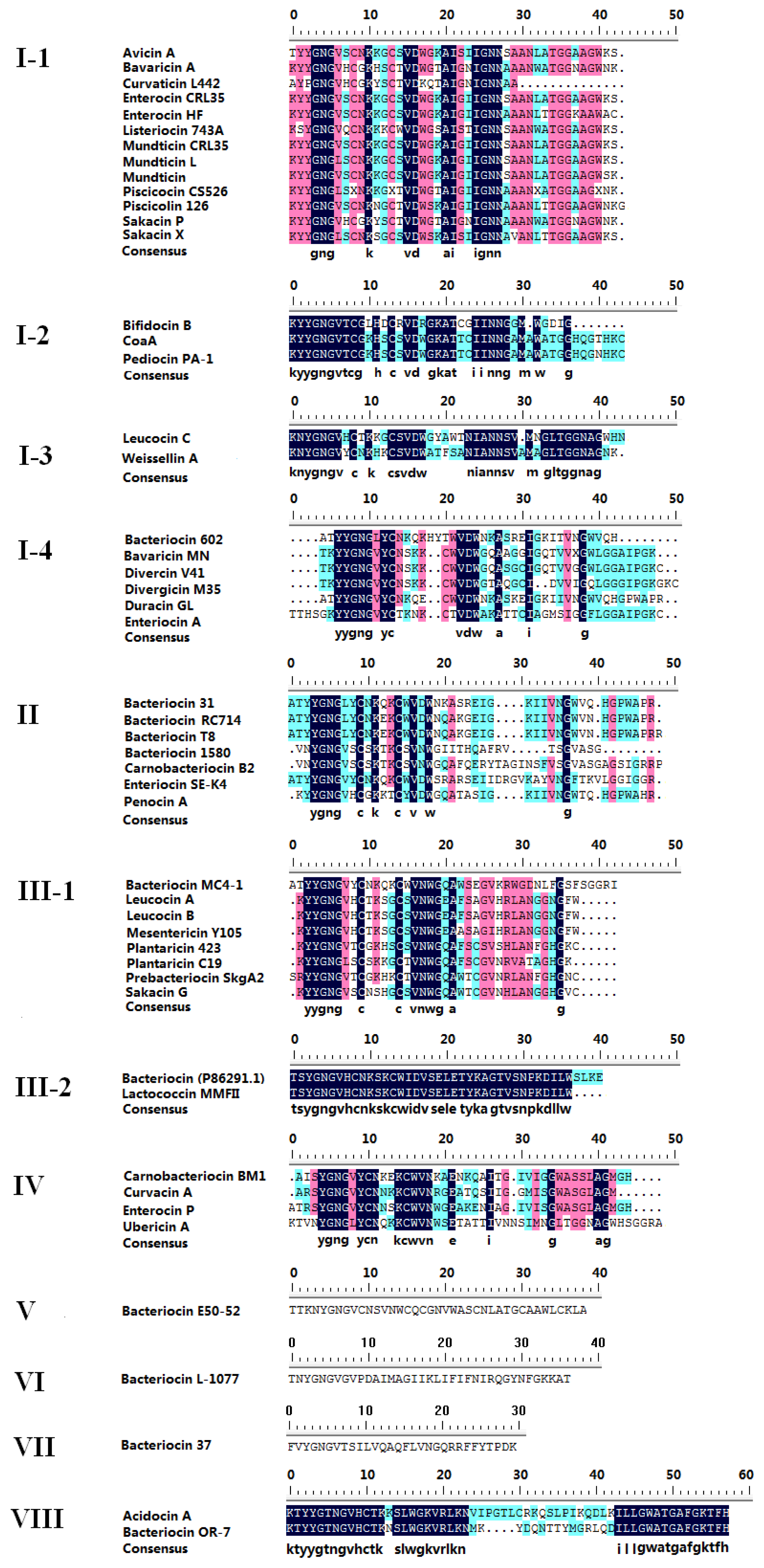
<p>The most recent repertoire of class IIa bacteriocins consists of 28 peptides [<xref ref-type="bibr" rid="b3-ijms-13-16668">3</xref>]. In this paper, some class IIa bacteriocins were supplemented, including avicin A [<xref ref-type="bibr" rid="b21-ijms-13-16668">21</xref>], bavaricin A [<xref ref-type="bibr" rid="b22-ijms-13-16668">22</xref>], curvaticin L442 [<xref ref-type="bibr" rid="b23-ijms-13-16668">23</xref>], enterocin CRL35 [<xref ref-type="bibr" rid="b24-ijms-13-16668">24</xref>], enterocin HF (P86183), bifidocin B [<xref ref-type="bibr" rid="b10-ijms-13-16668">10</xref>,<xref ref-type="bibr" rid="b11-ijms-13-16668">11</xref>], ubericin A [<xref ref-type="bibr" rid="b8-ijms-13-16668">8</xref>], weissellin A [<xref ref-type="bibr" rid="b25-ijms-13-16668">25</xref>], bacteriocin 602 [<xref ref-type="bibr" rid="b26-ijms-13-16668">26</xref>], bacteriocin 1580 [<xref ref-type="bibr" rid="b26-ijms-13-16668">26</xref>], bacteriocin 37 [<xref ref-type="bibr" rid="b26-ijms-13-16668">26</xref>], bavaricin MN [<xref ref-type="bibr" rid="b27-ijms-13-16668">27</xref>], bacteriocin (P86291.1), bacteriocin E50-52 [<xref ref-type="bibr" rid="b28-ijms-13-16668">28</xref>], acidocin A [<xref ref-type="bibr" rid="b29-ijms-13-16668">29</xref>], bacteriocin OR-7 [<xref ref-type="bibr" rid="b30-ijms-13-16668">30</xref>], bacteriocin L-1077 [<xref ref-type="bibr" rid="b31-ijms-13-16668">31</xref>], mundticin L [<xref ref-type="bibr" rid="b32-ijms-13-16668">32</xref>], leucocin B [<xref ref-type="bibr" rid="b33-ijms-13-16668">33</xref>], prebacterioncin SkgA2, bacteriocin MC4-1 [<xref ref-type="bibr" rid="b34-ijms-13-16668">34</xref>], and duracin GL. The 3D structures of bacteriocins were evaluated by SWISS-MODEL Workspace [<xref ref-type="bibr" rid="b35-ijms-13-16668">35</xref>–<xref ref-type="bibr" rid="b37-ijms-13-16668">37</xref>]. The 50 class IIa bacteriocins were classified into eight groups on the basis of their conserved primary structures, 3D structures and mode of action (See <xref ref-type="fig" rid="f1-ijms-13-16668">Figure 1</xref>). The results showed high consistency with the classification of class IIa bacteriocins that were described earlier and discussed by Nissen-Meyer <italic>et al.</italic>[<xref ref-type="bibr" rid="b3-ijms-13-16668">3</xref>] (see <xref ref-type="supplementary-material" rid="s1-ijms-13-16668">Supplementary Table 1</xref>).</p>
<p>Group I contains 24 bacteriocins with a sequence length of between 25 and 49 amino acid residues. These peptides are secreted by 17 species of seven genera, including <italic>Bacillus</italic> sp., <italic>Bifidobacterium</italic> sp., <italic>Carnobacterium</italic> sp., <italic>Enterococcus</italic> sp., <italic>Lactobacillus</italic> sp., <italic>Leuconostoc</italic> sp., and <italic>Weissella</italic> sp. The bacteriocins in this group belong to subgroup 1 which was described in the classification of Nissen-Meyer <italic>et al.</italic>[<xref ref-type="bibr" rid="b3-ijms-13-16668">3</xref>]. The bacteriocins of group I have a flexible hinge at the conserved Asp 17residue. This group can be further subdivided into three subgroups according to their sequence similarities and differences.</p>
<p>Subgroup I-1: includes avicin A, bavaricin A, curvaticin L442, enterocin CRL35, enterocin HF, listeriocin 743A, mundticin, mundticin CRL35, mundticin L, piscicocin CS526, piscicolin 126, sakacin P, and sakacin X. Members of this subgroup exhibit a common consensus motif IGNNxxANxxTGG located at the <italic>C</italic>-terminal region. Avicin A is produced by <italic>Enterococcus avium</italic> XA83 which was isolated from feces of healthy infants, and is a probiotic bacterium with diverse antimicrobial potential [<xref ref-type="bibr" rid="b21-ijms-13-16668">21</xref>]. Mundticin L is virtually identical to enterocin CRL35. The only difference in sequence occurs in the fifth amino acid residue of the conserved sequence (YGNGX) of these mature bacteriocins, but this change has no influence on antimicrobial activity [<xref ref-type="bibr" rid="b32-ijms-13-16668">32</xref>]. Sakacin P is produced by several <italic>L. curvatus</italic> strains LTH1174, L442 and CRL 705, which were isolated from Greek fermented sausages and fermented meat [<xref ref-type="bibr" rid="b38-ijms-13-16668">38</xref>,<xref ref-type="bibr" rid="b39-ijms-13-16668">39</xref>]; and by several <italic>Lactobacillus sakei</italic> strains I151 and LTH673 isolated from sausage and fermented meat [<xref ref-type="bibr" rid="b40-ijms-13-16668">40</xref>,<xref ref-type="bibr" rid="b41-ijms-13-16668">41</xref>].</p>
<p>Subgroup I-2 encompasses bifidocin B, coagulin, pediocin PA-1, which are produced by B. bifidum, B. coagulans, Enterococcus faecium, Lactobacillus plantarum, Pediococcus acidilactici, Pediococcus pentosaceus and Streptococcus mutans. The common consensus of this subgroup is KYYGNGVTCGK(L)HS(D)CS(R)VDW(R)GKATT(C)C(G)IINNG.</p>
<p>Pediocin PA-1/AcH is a 44-amino-acid class IIa bacteriocin produced primarily by strains of the genus <italic>Pediococcus</italic>, including <italic>Pediococcus acidilactici</italic> strains PAC1.0 [<xref ref-type="bibr" rid="b42-ijms-13-16668">42</xref>], H [<xref ref-type="bibr" rid="b43-ijms-13-16668">43</xref>,<xref ref-type="bibr" rid="b44-ijms-13-16668">44</xref>], E, F, M [<xref ref-type="bibr" rid="b45-ijms-13-16668">45</xref>,<xref ref-type="bibr" rid="b46-ijms-13-16668">46</xref>], K10 [<xref ref-type="bibr" rid="b47-ijms-13-16668">47</xref>], HA-6111-2, HA-5692-3 [<xref ref-type="bibr" rid="b48-ijms-13-16668">48</xref>], MM33 [<xref ref-type="bibr" rid="b49-ijms-13-16668">49</xref>]; <italic>Pediococcus parvulus</italic> ATO34, ATO77 [<xref ref-type="bibr" rid="b50-ijms-13-16668">50</xref>] and <italic>P. pentosaceus</italic> FBB61 [<xref ref-type="bibr" rid="b51-ijms-13-16668">51</xref>]. Pediocin PA-1/AcH is also synthesized by <italic>L. plantarum</italic> WHE92 [<xref ref-type="bibr" rid="b52-ijms-13-16668">52</xref>], <italic>L. plantarum</italic> DDEN 11007 [<xref ref-type="bibr" rid="b53-ijms-13-16668">53</xref>] and <italic>E. faecium</italic> Acr4.</p>
<p>The genetic determinants for the biosynthesis of pediocin PA-1/AcH are located within a plasmid-borne operon cassette in all producing lactic acid bacterial strains examined to date. In several strains, the sizes and organization of the various pediocin-encoding plasmids are similar [<xref ref-type="bibr" rid="b54-ijms-13-16668">54</xref>–<xref ref-type="bibr" rid="b59-ijms-13-16668">59</xref>]. It has been shown that the plasmids responsible for production in <italic>P. acidilactici</italic> H can be transferred intragenerically by conjugation [<xref ref-type="bibr" rid="b60-ijms-13-16668">60</xref>]. The pediocin PA-1/AcH is the only class IIa bacteriocin for which both cross-species and cross-genera synthesis are known to occur [<xref ref-type="bibr" rid="b61-ijms-13-16668">61</xref>].</p>
<p>The entire amino acid sequences of curvaticin L442 and bifidocin B have not been determined and the reported sequence for the bifidocin B contains some uncertainties. The mature sequence of enterocin CRL35 is identical to that of mundticin CRL35, but their leader sequences have some differences. The mature sequence of leucocin A was identical to that of leucocin B and they also had differences in their leader sequences. Sakacin P was identical to bavaricin A, and the peptide we list as sakacin P was a variant of sakacin P.</p>
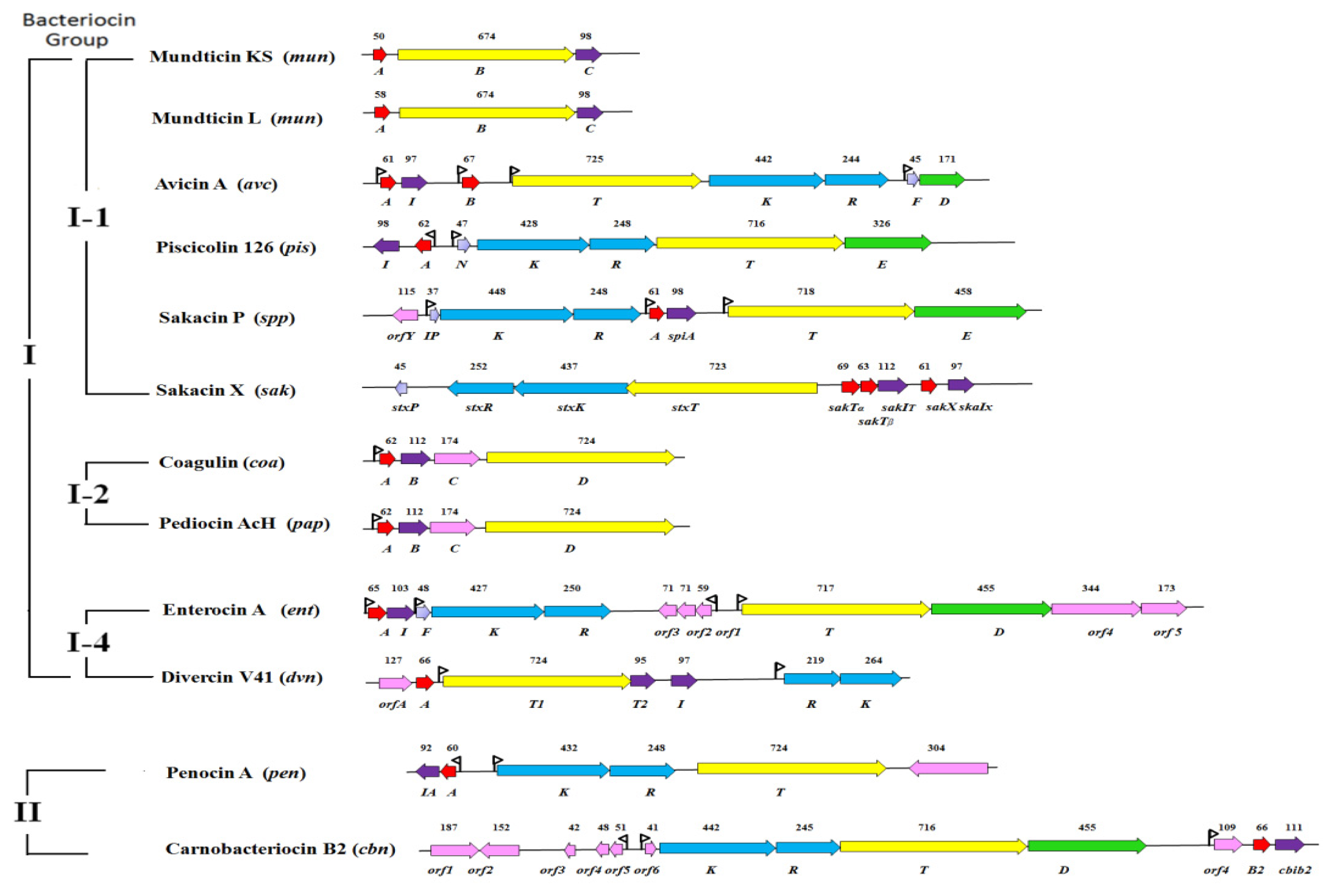
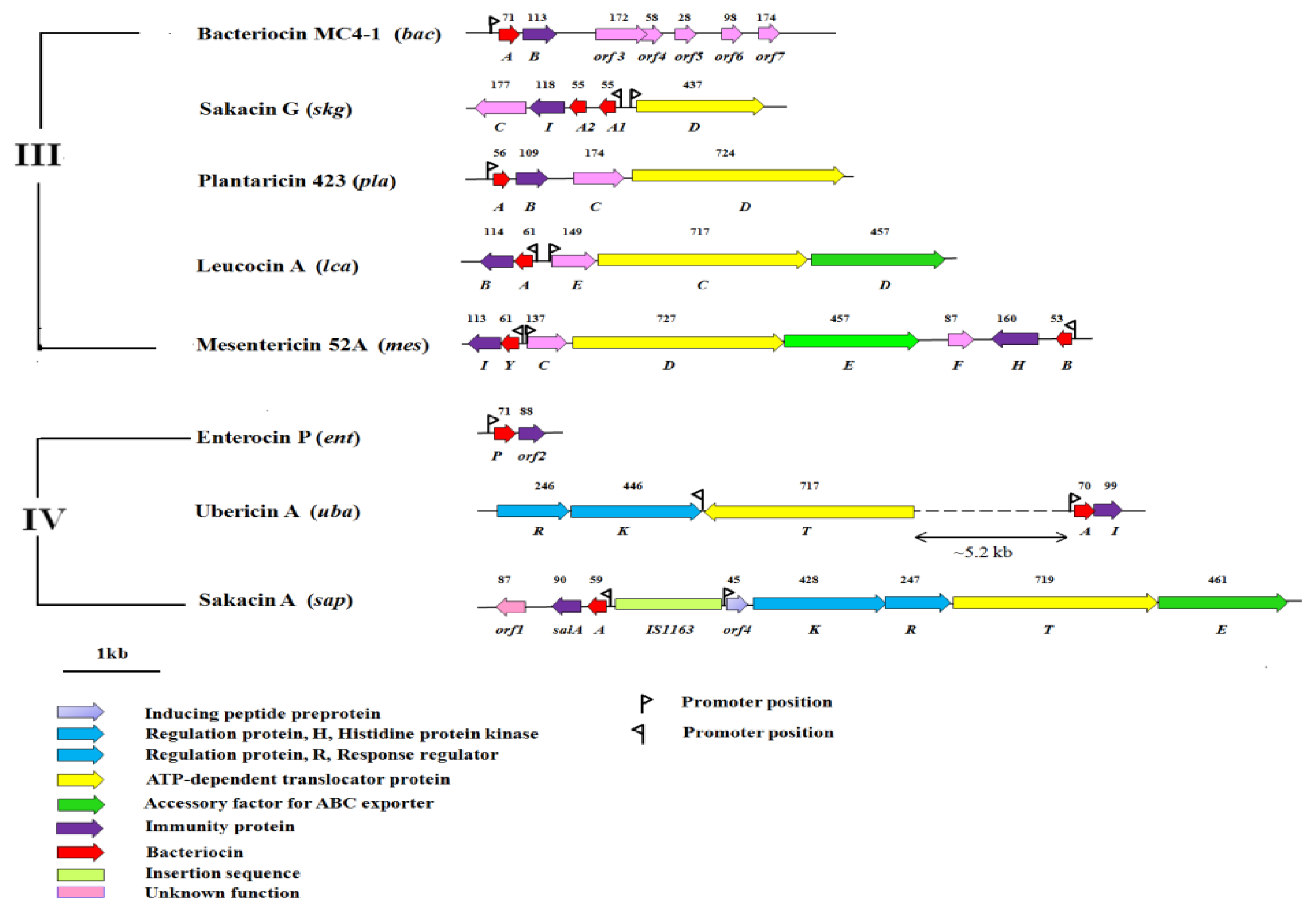
<p>Coagulin is produced by no-LAB <italic>B. coagulan</italic>s [<xref ref-type="bibr" rid="b13-ijms-13-16668">13</xref>]. Interestingly, coagulin is almost identical to pediocin PA-1/AcH, showing 97.7% identity with pediocin PA-1/AcH. More specifically, the coagulin encoding DNA (<italic>coaABCD</italic> operon) showed 99% identity to that of the <italic>papABCD</italic> operon encoding the pediocin PA-1/AcH genes [<xref ref-type="bibr" rid="b62-ijms-13-16668">62</xref>] (see <xref ref-type="fig" rid="f2-ijms-13-16668">Figure 2</xref>). A putative <italic>mob-pre</italic> (plasmid recombination enzyme) gene was identified in the coagulin-encoding plasmid pI<sub>4</sub>[<xref ref-type="bibr" rid="b13-ijms-13-16668">13</xref>]. The <italic>mob-pre</italic> genes present on several plasmids extracted from various Gram-positive genera, including <italic>Bacillus</italic>, <italic>Lactococcus</italic>, <italic>Streptococcus</italic>, <italic>Lactobacillus</italic>, <italic>Enterococcus</italic>, and <italic>Staphylococcus</italic>[<xref ref-type="bibr" rid="b13-ijms-13-16668">13</xref>]. In several cases, the corresponding <italic>mob</italic> genes have been shown to be required for conjugative mobilization and site-specific recombination [<xref ref-type="bibr" rid="b63-ijms-13-16668">63</xref>]. Therefore, it was speculated that horizontal gene/operon transfer between <italic>P. acidilactici</italic> and <italic>B. coagulans</italic> was possible despite they being relatively unrelated, one is LAB, and the other is no-LAB [<xref ref-type="bibr" rid="b13-ijms-13-16668">13</xref>,<xref ref-type="bibr" rid="b62-ijms-13-16668">62</xref>].</p>
<p>Interestingly, mutacin F-59.1 from <italic>Streptococcus mutans</italic> 59.1 shared the conserved sequence KYYGNGVTCGKHSxSVDWxKXT [<xref ref-type="bibr" rid="b9-ijms-13-16668">9</xref>]. <italic>S. mutans</italic> is a human indigenous oral bacterial species. It possesses an advantage against competitive species living in the same niche because of its bacteriocins [<xref ref-type="bibr" rid="b64-ijms-13-16668">64</xref>]. The mutacin F-59.1 has a wide activity spectrum inhibiting human and food-borne pathogens [<xref ref-type="bibr" rid="b9-ijms-13-16668">9</xref>]. Some amino acids of mutacin F-59.1 have not been determined.</p>
<p>In this subgroup, the bacteriocin-producing strains <italic>B. bifidum</italic> NCFB 1454 (bifidocin B) and <italic>P. acidilactici</italic> MM33 (pediocin PA-1), are from human intestinal origin [<xref ref-type="bibr" rid="b49-ijms-13-16668">49</xref>,<xref ref-type="bibr" rid="b65-ijms-13-16668">65</xref>]. They could be developed for their probiotic properties and as inhibitors of pathogenic bacteria in the gut. Pediocin PA-1 from <italic>L. plantarum</italic> DDEN 11007 and pediocin A from <italic>P. pentosaceus</italic> FBB61, are produced by bacteria with established probiotic properties [<xref ref-type="bibr" rid="b51-ijms-13-16668">51</xref>,<xref ref-type="bibr" rid="b53-ijms-13-16668">53</xref>,<xref ref-type="bibr" rid="b66-ijms-13-16668">66</xref>].</p>
<p>Bifidocin B is the first class IIa bacteriocin from a member of the genus <italic>Bifidobacterium</italic>, sharing 56.8% homology with coagulin and inhibiting the growth of some species of the genera <italic>Listeria</italic>, <italic>Bacillus</italic>, <italic>Enterococcus</italic>, <italic>Lactobacillus</italic>, <italic>Leuconostoc</italic> and <italic>Pediococcus</italic>[<xref ref-type="bibr" rid="b11-ijms-13-16668">11</xref>]. Recently, a new bacteriocin bifidin I from <italic>Bifidobacterium</italic> sp. was reported. Bifidin I from <italic>B. infantis</italic> BCRC 14602 and showed similarity with bifidocin B, but its whole sequences has not been determined [<xref ref-type="bibr" rid="b12-ijms-13-16668">12</xref>]. Bifidin I showed a broad spectrum antimicrobial activity against Gram-positive bacteria and Gram-negative bacteria, including some food-borne pathogens, such as <italic>Staphylococcus aureus</italic>, <italic>Bacillus subtilis</italic>, <italic>Bacillus cereus</italic>, <italic>Listeria monocytogenes</italic>, <italic>Clostridium butyricum</italic>, <italic>Salmonella enteritidis</italic>, <italic>Salmonella enterica</italic> ssp., and <italic>Shigella dysenteriae</italic>[<xref ref-type="bibr" rid="b12-ijms-13-16668">12</xref>].</p>
<p>Subgroup I-3 is represented by leucocin C, and weissellin A, which are produced by <italic>Leuconostoc mesenteroides</italic>, <italic>Streptococcus uberis</italic> and <italic>Weissella paramesenteroides</italic>. The common consensus of this subgroup is NYGNG(X)<sub>2</sub>C(X)<sub>4</sub>CXVXW(X)<sub>6</sub>IXNNS(X)<sub>3</sub>GLTG.</p>
<p>Leucocin C and leucocin C-TA33a are produced by different strains of <italic>L. mesenteroides</italic>, but they showed similar sequences [<xref ref-type="bibr" rid="b67-ijms-13-16668">67</xref>]. Leucocin C-TA33a is from <italic>L. mesenteroides</italic> TA33a, which produced three bacteriocins (leucocin C-TA33a, leucocin B-TA33a and leucocin A-TA33a) with different inhibitory activity spectra [<xref ref-type="bibr" rid="b68-ijms-13-16668">68</xref>,<xref ref-type="bibr" rid="b69-ijms-13-16668">69</xref>]. The related research revealed that production of leucocin A-, B- and C-type bacteriocins was widespread in <italic>Leuconostoc</italic>/<italic>Weissella</italic> strains, including <italic>Leuconostoc carnosum</italic> LA54a, <italic>W. paramesenteroides</italic> LA7a, and <italic>Leuconostoc gelidum</italic> UAL 187-22 [<xref ref-type="bibr" rid="b68-ijms-13-16668">68</xref>]. Weissellin A is a unique 4450 Da peptide which is produced by <italic>W. paramesenteroides</italic> DX which was isolated from a traditional Greek sausage. This bacteriocin exhibits strong activity against <italic>L. monocytogenes</italic>, <italic>Listeria inocua</italic> and <italic>Clostridium sporogenes</italic>[<xref ref-type="bibr" rid="b25-ijms-13-16668">25</xref>].</p>
<p>Subgroup I-4 is represented by bacteriocin 602 [<xref ref-type="bibr" rid="b26-ijms-13-16668">26</xref>], bavaricin MN [<xref ref-type="bibr" rid="b27-ijms-13-16668">27</xref>], divercin V41, divergicin M35, duracin GL, enterocin A, which come from <italic>Carnobacterium divergens</italic>, <italic>Enterococcus durans</italic>, <italic>E. faecium</italic>, <italic>L. sakei</italic> and <italic>Paenibacillus polymyxa</italic>. The common consensus of this subgroup is YYGNGV(L)YC.</p>
<p>Group II contains bacteriocin 31, bacteriocin RC714, enterocin SE-K4, bacteriocin T8 (hiracin JM79), penocin A, bacteriocin 1580 and carnobacteriocin B2. The common consensus of this group is YGNGL(V)xCxKxxCxVxW. The bacteriocins in this group belong to subgroup 4 which was described in the classification of Nissen-Meyer <italic>et al.</italic>[<xref ref-type="bibr" rid="b3-ijms-13-16668">3</xref>]. Most class II bacteriocin precursors contain a double-glycine-type signal peptide, and are translocated by dedicated ABC transporters and accessory proteins. However it is likely that some of these bacteriocins contain a different signal peptide. The sequence of hiracin JM79 is identical to that of bacteriocin T8. Hiracin JM79 is produced by <italic>Enterococcus hirae</italic> DCH5 isolated from wild mallard ducks, and contains a typical <italic>sec</italic> signal peptide that is believed to direct bacteriocins to the <italic>sec</italic> translocase embedded in the cytoplasmic membranes [<xref ref-type="bibr" rid="b70-ijms-13-16668">70</xref>]. The bacteriocin 31, bacteriocin RC714 and enterocin SE-K4 are also <italic>sec</italic>-dependent class II bacteriocin [<xref ref-type="bibr" rid="b71-ijms-13-16668">71</xref>,<xref ref-type="bibr" rid="b72-ijms-13-16668">72</xref>].</p>
<p>Group III contains 10 bacteriocins, which can be further subdivided into two subgroups according to their sequence similarities and differences. The bacteriocins in this group belong to subgroup 2 which was described in the classification of Nissen-Meyer <italic>et al.</italic>[<xref ref-type="bibr" rid="b3-ijms-13-16668">3</xref>].</p>
<p>Subgroup III-1, represented by 8 bacteriocins (bacteriocin MC4-1, leucocin A, leucocin B-Ta11a, mesentericin Y105, plantaricin 423, plantaricin C19, prebacteriocin SkgA2, and sakacin G) has a conserved N-terminal region YYGNGxxCxxxxCxVNWGxA. Plantaricin 423 is bactericidal for many Gram-positive food-borne pathogens and spoilage bacteria, including <italic>Listeria</italic> spp., <italic>Staphylococcus</italic> spp., <italic>Pediococcus</italic> spp., <italic>Lactobacillus</italic> spp. and so on [<xref ref-type="bibr" rid="b73-ijms-13-16668">73</xref>]. Structurally, the <italic>N</italic> terminus of leucocin A (LeuA) consists of a three-strand antiparallel β-sheet (residues 2–16) that is rigidified by this (9-14)-disulfide moiety [<xref ref-type="bibr" rid="b74-ijms-13-16668">74</xref>]. Bacteriocin MC4-1 and prebacteriocin SkgA2 are similar to leucocin A and leucocin A variant (C9L, C14L) in the 3D structures. There structures were determined by the SWISS-MODEL Workspace [<xref ref-type="bibr" rid="b35-ijms-13-16668">35</xref>–<xref ref-type="bibr" rid="b37-ijms-13-16668">37</xref>,<xref ref-type="bibr" rid="b75-ijms-13-16668">75</xref>].</p>
<p>Subgroup III-2 consists of lactococcin MMFII and bacteriocin (P86291.1). Lactococcin MMFII is produced by <italic>Lactococcus lactis</italic> MMFII, which was isolated from a traditional Tunisian cheese [<xref ref-type="bibr" rid="b76-ijms-13-16668">76</xref>]. Lactococcin MMFII is the first class IIa bacteriocin produced by a lactococcal strain. It has activity against closely related Gram-positive bacteria, including <italic>Lactococcus lactis</italic> subsp. <italic>cremoris</italic>, <italic>Lactococcus lactis</italic> subsp. <italic>lactis</italic>, <italic>Lactobacillus delbrueckii</italic>, <italic>Lactobacillus casei</italic>, <italic>E. faecium</italic>, <italic>Enterococcus faecalis</italic>, and <italic>Listeria ivanovi</italic>. The bacteriocin (P86291.1) is also produced by <italic>Lactococcus</italic> sp., showing 90.2% identity with lactococcin MMFII.</p>
<p>Group IV contains carnobacteriocin BM1, curvacin A, enterocin P and ubericin A. This group has the conserved sequences YGNGV(L)YCNxxKCWVNxxE. The group IV bacteriocins lack the hairpin-stabilizing tryptophan and/or cysteine residues that are present at or near the C-terminal end in most class IIa bacteriocins [<xref ref-type="bibr" rid="b3-ijms-13-16668">3</xref>]. Carnobacteriocin BM1 is produced by <italic>Carnobacterium piscicola</italic> LV17B, which is isolated from fresh pork [<xref ref-type="bibr" rid="b77-ijms-13-16668">77</xref>]. Curvacin A is produced by <italic>Lactobacillus curvatus</italic> LTH 1174, which originates from fermented sausage [<xref ref-type="bibr" rid="b78-ijms-13-16668">78</xref>]. Enterocin P is produced by several <italic>E. faecium</italic> strains: IJ-31, P13, GM-1, ATB 197a, JCM5804T, LHICA 51, LHICA 28-4, and LHICA 40-4, which were isolated from various environments, such as fermented sausage, dairy products, feces of newborn infants, and non-fermented animal foods [<xref ref-type="bibr" rid="b79-ijms-13-16668">79</xref>–<xref ref-type="bibr" rid="b84-ijms-13-16668">84</xref>]. Enterocin P showed strong inhibitory action toward <italic>Listeria</italic> sp. It was processed and secreted by the sec-dependent pathway [<xref ref-type="bibr" rid="b79-ijms-13-16668">79</xref>]. Ubericin A is the first streptococcal class IIa bacteriocin to be characterized [<xref ref-type="bibr" rid="b8-ijms-13-16668">8</xref>]. It is composed of 49 amino acids with an YGNGL motif at the <italic>N</italic>-terminal half [<xref ref-type="bibr" rid="b8-ijms-13-16668">8</xref>]. Although ubericin A showed high similarity with bacteriocins of subgroup I-3 in amino acid sequences, it showed high similarity with curvacin A in its 3D structure that was determined by SWISS-MODEL Workspace [<xref ref-type="bibr" rid="b35-ijms-13-16668">35</xref>–<xref ref-type="bibr" rid="b37-ijms-13-16668">37</xref>].</p>
<p>The bacteriocin E50-52, bacteriocin 37 and bacteriocin L-1077 are very different and form their own separate group. Bacteriocin E50-52 is produced by <italic>E. faecium</italic> NRRL B-30746, and shows diverse antimicrobial activity against both Gram-negative and Gram-positive bacteria, including <italic>Campylobacter jejuni</italic>, <italic>Yersinia</italic> spp., <italic>Salmonella</italic> spp., <italic>Escherichia coli</italic> O157:H7, <italic>S. dysenteriae</italic>, <italic>Morganella morganii</italic>, <italic>Staphylococcus</italic> spp., and <italic>Listeria</italic> spp. [<xref ref-type="bibr" rid="b28-ijms-13-16668">28</xref>]. Bacteriocin 37 is produced by <italic>P. polymyxa</italic> NRRL B-30507, isolated from broiler chicken, and hasstrong antimicrobial activity against <italic>C. jejuni</italic>[<xref ref-type="bibr" rid="b26-ijms-13-16668">26</xref>]. Bacteriocin L-1077 is produced by <italic>Lactobacillus salivarius</italic> 1077 (NRRL B-50053), isolated from poultry intestinal materials, and has broad-spectrum antimicrobial activity against 33 bacterial isolates (both Gram-negative and Gram-positive bacteria), including <italic>L. monocytogenes</italic> A 9-72, <italic>E. coli</italic> O157:H7, <italic>Pseudomonas aeruginosa</italic> 508 [<xref ref-type="bibr" rid="b31-ijms-13-16668">31</xref>].</p>
<p>The group VII bacteriocins consists of acidocin A and bacteriocin OR-7. This group has a conserved <italic>N</italic>-terminal region KTYYGTNGVHCTKxSLWGKVRLKN and conserved <italic>C</italic>-terminal region ILLGWATGAFGKTFH. Acidocin A is produced by <italic>L. acidophilus</italic> with activity against <italic>L. monocytogenes</italic> and other closely related Gram-positive bacteria [<xref ref-type="bibr" rid="b29-ijms-13-16668">29</xref>]. Bacteriocin OR-7 has 65.5% amino acids sequence similarity with acidocin A with a <italic>C</italic>-terminal region that is 100% identical to that of acidocin A. Interestingly, bacteriocin OR-7 has different antimicrobial activity from acidocin A. It is active against both Gram-negative and Gram-positive bacteria [<xref ref-type="bibr" rid="b30-ijms-13-16668">30</xref>] and has strong antimicrobial activity to Gram-negative bacterium <italic>C. jejuni</italic> in the chicken gastrointestinal system [<xref ref-type="bibr" rid="b30-ijms-13-16668">30</xref>].</p>
<p>The bacteriocin OR-7 and acidocin A have some differences with other class IIa bacteriocins. As a result there is a divergence of opinion as to whether bacteriocin OR-7 and acidocin A should be placed in the class IIa family of bacteriocin [<xref ref-type="bibr" rid="b3-ijms-13-16668">3</xref>,<xref ref-type="bibr" rid="b19-ijms-13-16668">19</xref>,<xref ref-type="bibr" rid="b29-ijms-13-16668">29</xref>,<xref ref-type="bibr" rid="b30-ijms-13-16668">30</xref>]. The position of the second cysteine is very different from the very conserved position of this cysteine in the class IIa bacteriocins, suggesting that bacteriocin OR-7 and acidocin A have a different 3D structure in their <italic>N</italic>-terminal region than the well conserved 3-stranded antiparallel β-sheet like structure which seems to be conserved in most class IIa bacteriocins [<xref ref-type="bibr" rid="b3-ijms-13-16668">3</xref>]. Moreover, the sequence and length of the <italic>C</italic>-terminal region of bacteriocin OR-7 and acidocin A are also very different from other class IIa bacteriocins.</p>
<p>Both bacteriocin OR-7 and acidocin A contained a “pediocin box”-like motif, YGNGVXCXnV, in the <italic>N</italic>-terminal region of the peptide typical of class IIa bacteriocins, except that a T was present as YGTNGV in the sequence [<xref ref-type="bibr" rid="b29-ijms-13-16668">29</xref>,<xref ref-type="bibr" rid="b30-ijms-13-16668">30</xref>]. Based on our assessment of previous studies, we are in agreement that bacteriocin OR-7 and acidocin A belong to class IIa family [<xref ref-type="bibr" rid="b19-ijms-13-16668">19</xref>,<xref ref-type="bibr" rid="b29-ijms-13-16668">29</xref>,<xref ref-type="bibr" rid="b30-ijms-13-16668">30</xref>].</p></sec>
<sec>
<title>3. Biosynthesis of Class IIa Bacteriocins</title>
<p>At least four genes are required for the production of class IIa bacteriocins, including a bacteriocin structural gene encoding a precursor, an immunity gene encoding an immunity protein, genes encoding an ATP-binding cassette transporter and an accessory protein for extracellular translocation of bacteriocin [<xref ref-type="bibr" rid="b2-ijms-13-16668">2</xref>].</p>
<p>The class IIa bacteriocin production was regulated by quorum sensing (QS) system. QS systems are present in the majority of Gram-positive and Gram-negative bacteria, as one primary mechanism for bacteria to monitor the environment for other bacteria and to alter behavior on a population-wide scale in response to changes in the number and/or species present in a community [<xref ref-type="bibr" rid="b85-ijms-13-16668">85</xref>–<xref ref-type="bibr" rid="b87-ijms-13-16668">87</xref>].</p>
<p>QS systems used for the regulation of class IIa bacteriocin production are composed of three gene products, including an inducer peptide, a membrane-associated histidine protein kinase (HPK), and a cytoplasmic response regulator (RR) [<xref ref-type="bibr" rid="b88-ijms-13-16668">88</xref>]. The inducer peptide is ribosomally synthesized at low levels as a precursor which appears not to be biologically active and contain an <italic>N</italic>-terminal extension or leader sequence [<xref ref-type="bibr" rid="b89-ijms-13-16668">89</xref>]. Subsequent cleavage of the precursor at a specific processing site removes the leader sequence from the antimicrobial molecule concomitantly. Then inducer peptide is secreted and exported through the dedicated transport system involving an ABC-type translocator and an accessory protein [<xref ref-type="bibr" rid="b15-ijms-13-16668">15</xref>,<xref ref-type="bibr" rid="b88-ijms-13-16668">88</xref>,<xref ref-type="bibr" rid="b89-ijms-13-16668">89</xref>]. The presequence of the bacteriocin plays a dual role in bacteriocin biosynthesis [<xref ref-type="bibr" rid="b2-ijms-13-16668">2</xref>]. One is a protective role at the cytosolic side of the cell membrane by keeping the bacteriocin inactive. The other is as a recognition signal during export [<xref ref-type="bibr" rid="b2-ijms-13-16668">2</xref>].</p>
<p>At a certain concentration threshold of the externalized inducer peptide, the transmembrane HPK detects a change in environmental signal and is activated, leading to its autophosphorylation [<xref ref-type="bibr" rid="b88-ijms-13-16668">88</xref>,<xref ref-type="bibr" rid="b90-ijms-13-16668">90</xref>]. Then the phosphorylated HPK transfers a phosphate group to its cognate RR. The phosphorylated RR acts as a transcriptional activator and activates expression of bacteriocin-related genes, including genes encoding bacteriocin, immunity protein, secretory apparatus, and regulatory proteins [<xref ref-type="bibr" rid="b2-ijms-13-16668">2</xref>,<xref ref-type="bibr" rid="b88-ijms-13-16668">88</xref>]. Bacteriocin and immunity genes most often reside on the same operon and are expressed concomitantly. The bacteriocin producer cells protect themselves from their own bacteriocin by the immunity protein. At a certain time, essentially all bacteriocin producer cells in the population are believed to secrete bacteriocins, and this result in a rapid activation of the bacteriocin production [<xref ref-type="bibr" rid="b89-ijms-13-16668">89</xref>].</p></sec>
<sec>
<title>4. Genetic Organization of DNA Coding for Class IIa Bacteriocins</title>
<p>Generally, most class IIa bacteriocin genes are arranged in one or a few operons, which include a bacteriocin structural gene encoding a precursor, an immunity gene encoding an immunity protein, genes encoding an ATP-binding cassette transporter and an accessory protein for extracellular translocation of bacteriocin, and in several cases two regulatory genes encoding a two component system for regulations of the biosynthesis of bacteriocin [<xref ref-type="bibr" rid="b19-ijms-13-16668">19</xref>] (<xref ref-type="fig" rid="f2-ijms-13-16668">Figure 2</xref>).</p>
<p>Production of bacteriocins is often correlated with the presence of a plasmid. Several class IIa bacteriocins, for example, enterocin A, divercin V41, sakacin P, carnobacteriocin B2 and carnobacteriocin BM1, have genes that have been shown to be located on chromosome fragments [<xref ref-type="bibr" rid="b19-ijms-13-16668">19</xref>,<xref ref-type="bibr" rid="b77-ijms-13-16668">77</xref>,<xref ref-type="bibr" rid="b91-ijms-13-16668">91</xref>–<xref ref-type="bibr" rid="b93-ijms-13-16668">93</xref>]. In many bacteriocin-producing bacteria, the bacteriocin structural gene and other related genes were located in one operon. However, genes encoding immunity and secretion functions may not always be linked to structure genes [<xref ref-type="bibr" rid="b89-ijms-13-16668">89</xref>,<xref ref-type="bibr" rid="b94-ijms-13-16668">94</xref>].</p>
<p>At the present time, all known class IIa bacteriocins are ribosomally synthesized as precursor peptides with an N-terminal leader sequence. The leader sequences of most bacteriocins contain two conserved glycine residues, which may serve as a recognition signal for protein processing and secretion. This double-glycine-type leader sequences were cleaved and removed by ATP-binding cassette (ABC) transporters and their accessory proteins [<xref ref-type="bibr" rid="b2-ijms-13-16668">2</xref>]. However, a few class IIa bacteriocins, including bacteriocin 31, enterocin P, enterocin SE-K4, listeriocin 743A, and hiracin JM79 are secreted by the general <italic>sec</italic>-dependent export system [<xref ref-type="bibr" rid="b14-ijms-13-16668">14</xref>,<xref ref-type="bibr" rid="b70-ijms-13-16668">70</xref>–<xref ref-type="bibr" rid="b72-ijms-13-16668">72</xref>,<xref ref-type="bibr" rid="b79-ijms-13-16668">79</xref>,<xref ref-type="bibr" rid="b95-ijms-13-16668">95</xref>]. These bacteriocins have a hydrophobic <italic>N</italic>-terminal <italic>sec-</italic>dependent leader sequence, which directs the secretory protein to the cytoplasmic membrane and is processed by a signal peptidase during translocation across the cytoplasmic membrane. The related genes for production of these bacteriocins are unknown [<xref ref-type="bibr" rid="b14-ijms-13-16668">14</xref>,<xref ref-type="bibr" rid="b71-ijms-13-16668">71</xref>,<xref ref-type="bibr" rid="b72-ijms-13-16668">72</xref>,<xref ref-type="bibr" rid="b79-ijms-13-16668">79</xref>,<xref ref-type="bibr" rid="b95-ijms-13-16668">95</xref>–<xref ref-type="bibr" rid="b98-ijms-13-16668">98</xref>].</p>
<p>Class IIa bacteriocins show a remarkable conservation of gene arrangement (<xref ref-type="fig" rid="f2-ijms-13-16668">Figure 2</xref>). The genetic organization of leucocin A gene cluster (<italic>lca</italic> locus) from <italic>L. gelidum</italic> UAL187 is a typical bacteriocin locus [<xref ref-type="bibr" rid="b99-ijms-13-16668">99</xref>]. The <italic>lca</italic> locus includes two different directions operons with four bacteriocin-related genes <italic>lcaA</italic>, <italic>lcaB</italic>, <italic>lcaC</italic> and <italic>lcaD</italic>. The immunity protein gene <italic>lcaB</italic> is located immediately downstream of the structural leucocin A gene <italic>lcaA</italic>. The accessory transporter gene <italic>lcaD</italic> occurs also downstream of gene <italic>lcaC</italic> encoding an ABC transporter [<xref ref-type="bibr" rid="b99-ijms-13-16668">99</xref>].</p>
<p>The genetic organization of sakacin P gene cluster (<italic>spp</italic> locus) from <italic>L. sakei</italic> LTH673 and LTH674 is complicate, when compared to leuconcin A [<xref ref-type="bibr" rid="b40-ijms-13-16668">40</xref>,<xref ref-type="bibr" rid="b93-ijms-13-16668">93</xref>]. It is composed of three operons, which encode a 61-amino-acid sakacin P precursor SppA, a sakacin P immunity protein SpiA; a transport and secretory system (a 718-amino-acid ABC transporter protein SppT and an accessory factor for ABC transporter protein SppE); and a three-component regulatory system (inducing peptide preprotein SppIP, HPK SppK and RR SppR), respectively [<xref ref-type="bibr" rid="b40-ijms-13-16668">40</xref>,<xref ref-type="bibr" rid="b93-ijms-13-16668">93</xref>]. The production of sakacin P in <italic>L. sakei</italic> Lb674 and LTH673 is regulated by a typical peptide pheromone-based QS mechanism [<xref ref-type="bibr" rid="b40-ijms-13-16668">40</xref>,<xref ref-type="bibr" rid="b93-ijms-13-16668">93</xref>].</p>
<p>The genetic organization of divercin V41 presents an unusual organization [<xref ref-type="bibr" rid="b92-ijms-13-16668">92</xref>]. The <italic>dvn</italic> locus encodes a 66-amino-acid divercin V41 precursor, an ATP dependent transporter, two immunity-like proteins and two components of a lantibiotic-type signal-transducing system [<xref ref-type="bibr" rid="b92-ijms-13-16668">92</xref>] (see <xref ref-type="fig" rid="f2-ijms-13-16668">Figure 2</xref>). Interestingly, a so-called transport accessory protein was absent from the locus. Generally, the genes encoding the HPK are located upstream of the genes encoding RR in anti-listeria bacteriocin operon [<xref ref-type="bibr" rid="b100-ijms-13-16668">100</xref>]. However, in the <italic>dvn</italic> locus of divercin V41, the HPK gene followed the RR gene, which is a characteristic of lantibiotic operons. The genetic organization of the fragment suggests important gene rearrangements [<xref ref-type="bibr" rid="b92-ijms-13-16668">92</xref>].</p>
<p>Sometimes one locus can include productions of two bacteriocins. <italic>L. sakei</italic> 5 produces a plasmid-encoded bacteriocin sakacin P, as well as two chromosomally encoded bacteriocins, <italic>i.e.</italic>, sakacin T, which is a class IIb two-peptide bacteriocin and sakacin X, which is a class IIa bacteriocin [<xref ref-type="bibr" rid="b101-ijms-13-16668">101</xref>]. The sakacin TX locus encodes structural genes of sakacin T and sakacin X, including two adjacent but divergently oriented gene clusters (See <xref ref-type="fig" rid="f2-ijms-13-16668">Figure 2</xref>). The first gene cluster <italic>stxPRKT</italic> is believed to encode an inducing peptide, three proteins involved in regulation and secretion of these bacteriocins. The second gene cluster includes <italic>sakT</italic><italic><sub>α</sub></italic>, <italic>sakT</italic><italic><sub>β</sub></italic>, <italic>sakI</italic><italic><sub>T</sub></italic>, <italic>sak</italic><italic><sub>X</sub></italic> and <italic>sakI</italic><italic><sub>X</sub></italic>, which encode the structural and immunity genes for sakacin T and sakacin X [<xref ref-type="bibr" rid="b101-ijms-13-16668">101</xref>].</p>
<p><italic>L. mesenteroides</italic> FR52 produces both mesentericin 52A and 52B [<xref ref-type="bibr" rid="b102-ijms-13-16668">102</xref>]. Mesentericin 52A is a 37-amino-acid class IIa bacteriocin, identical to mesentericin Y105 from <italic>L. mesenteroides</italic> Y105 [<xref ref-type="bibr" rid="b103-ijms-13-16668">103</xref>]. Mesentericin 52B is a 32-amino-acid atypical class II bacteriocin, identical to mesentericin B105 from <italic>L. mesenteroides</italic> Y105 [<xref ref-type="bibr" rid="b104-ijms-13-16668">104</xref>]. The <italic>mes</italic> locus of <italic>L. mesenteroides</italic> FR52 is involved in productions of mesentericin 52A and 52B [<xref ref-type="bibr" rid="b104-ijms-13-16668">104</xref>]. The previous study revealed that ATP dependent transporter MesD and transport accessory protein MesE were involved in secretion and transport of these bacteriocins [<xref ref-type="bibr" rid="b104-ijms-13-16668">104</xref>]. Mesentericin 52A and mesentericin 52B have own immunity genes <italic>mesI</italic> and <italic>mesH</italic>, respectively.</p>
<p>The sakacin G gene cluster (<italic>skg</italic> locus) from <italic>L. sake</italic> 2512, R1333 and CWBI-B1365 was very interesting because it contained duplicated structural genes <italic>skgA1</italic> and <italic>skgA2</italic>[<xref ref-type="bibr" rid="b105-ijms-13-16668">105</xref>–<xref ref-type="bibr" rid="b107-ijms-13-16668">107</xref>]. There is only a two-amino-acid difference in sequence occurs in leader peptides of these prebacteriocins which makes these mature peptides, SkgA1 and SkgA2, essentially identical [<xref ref-type="bibr" rid="b106-ijms-13-16668">106</xref>,<xref ref-type="bibr" rid="b107-ijms-13-16668">107</xref>].</p>
<p>The genetic organization of avicin A gene cluster (<italic>avc</italic> locus) from <italic>E. avium</italic> has been established [<xref ref-type="bibr" rid="b21-ijms-13-16668">21</xref>]. It is the first bacteriocin locus identified in <italic>E. avium</italic> to be characterized at the molecular level [<xref ref-type="bibr" rid="b21-ijms-13-16668">21</xref>]. The locus showed a particular gene organization. The accessory gene <italic>avcD</italic> associated with bacteriocin transport did not occur immediately downstream of the gene <italic>avcT</italic> (which encodes an ABC transporter), but two regulatory genes <italic>avcK</italic> (which encodes a HPK) and <italic>avcR</italic> (which encodes a RR) followed the gene <italic>avcT</italic>[<xref ref-type="bibr" rid="b21-ijms-13-16668">21</xref>]. The <italic>avcK</italic>, <italic>avcR</italic>, and induction peptide pheromone-encoding gene <italic>avcF</italic>, constituted a three-component regulatory system in the avicin locus. This indicated that the production of avicin A was regulated by the peptide pheromone-inducible regulatory system [<xref ref-type="bibr" rid="b21-ijms-13-16668">21</xref>]. For most class IIa bacteriocins, three genes responsible for regulation are located in the same operon, but <italic>avcK</italic>, <italic>avcR</italic>, and <italic>avcF</italic> were located in two different operons (See <xref ref-type="fig" rid="f2-ijms-13-16668">Figure 2</xref>). In this locus includes two bacteriocins structural genes <italic>avcA</italic> and <italic>avcB</italic>. Avicin B is a divergincin-like bacteriocin, but it didn’t show antimicrobial activity and is probably a relic of a previous functional bacteriocin [<xref ref-type="bibr" rid="b21-ijms-13-16668">21</xref>].</p></sec>
<sec>
<title>5. Structure-Function Relationship and Target Recognition of Class IIa Bacteriocins</title>
<p>To date, the 3D structures of leucocin A [<xref ref-type="bibr" rid="b74-ijms-13-16668">74</xref>], carnobacteriocin B2 [<xref ref-type="bibr" rid="b108-ijms-13-16668">108</xref>], sakacin P [<xref ref-type="bibr" rid="b109-ijms-13-16668">109</xref>] and curvacin A [<xref ref-type="bibr" rid="b110-ijms-13-16668">110</xref>] have been characterized by nuclear magnetic resonance (NMR) spectroscopy. The 3D analysis revealed that class IIa bacteriocins consist of a hydrophilic, cationic and highly conserved <italic>N</italic>-terminal β-sheet domain, and a flexible, diverse hydrophobic/amphiphilic <italic>C</italic>-terminal domain [<xref ref-type="bibr" rid="b3-ijms-13-16668">3</xref>,<xref ref-type="bibr" rid="b74-ijms-13-16668">74</xref>,<xref ref-type="bibr" rid="b108-ijms-13-16668">108</xref>–<xref ref-type="bibr" rid="b110-ijms-13-16668">110</xref>]. The former is structurally stabilized by a conserved disulfide bridge; the latter contains a central amphiphilic α-helix, ending with a structurally extended <italic>C</italic>-terminal tail. The amphipathic α-helix was critical for antimicrobial specificity and temperature-dependent activity of these class IIa bacteriocins [<xref ref-type="bibr" rid="b74-ijms-13-16668">74</xref>,<xref ref-type="bibr" rid="b108-ijms-13-16668">108</xref>,<xref ref-type="bibr" rid="b111-ijms-13-16668">111</xref>–<xref ref-type="bibr" rid="b114-ijms-13-16668">114</xref>]. The <italic>C</italic>-terminal part of some class IIa bacteriocins, such as enterocin A, divergicin M35, divercin V41, coagulin, pediocin PA-1, sakacin G and plantaricin 423, formed a hairpin structure which was stabilized by a disulfide bridge between a cysteine residue in the middle of the α-helix and a cysteine residue at the <italic>C</italic>-terminus [<xref ref-type="bibr" rid="b3-ijms-13-16668">3</xref>].</p>
<p>Two cysteines that come from the conserved <italic>N</italic>-terminal region (YGNGVxCxK/NxxC) of class IIa bacteriocins formed a conserved disulfide bond. In most class IIa bacteriocins, the disulfide bond is formed between cysteine<sup>9</sup> and cysteine<sup>14</sup>. Extensive studies indicate that this conserved disulfide bond is required for antimicrobial activity for class IIa bacteriocins [<xref ref-type="bibr" rid="b115-ijms-13-16668">115</xref>–<xref ref-type="bibr" rid="b117-ijms-13-16668">117</xref>]. Mutants of mesentericin Y105 (cysteine<sup>9</sup>→serine<sup>9</sup>, cysteine<sup>14</sup>→serine<sup>14</sup>) showed a marked loss in antimicrobial effects [<xref ref-type="bibr" rid="b115-ijms-13-16668">115</xref>]. The antimicrobial activity of pediocin PA-1 was abrogated by the substitution of 11 different amino acids at cysteine<sup>14</sup> based on NNK scanning [<xref ref-type="bibr" rid="b116-ijms-13-16668">116</xref>]. Substitution of the cysteines with serines in leucocin A (LeuA) abolished antimicrobial effects [<xref ref-type="bibr" rid="b117-ijms-13-16668">117</xref>].</p>
<p>However, some results from Derksen <italic>et al.</italic> indicated that the disulfide bond in leucocin A (LeuA) could be replaced by a noncyclic diallyl moiety without significant loss in activity [<xref ref-type="bibr" rid="b117-ijms-13-16668">117</xref>]. The leucocin A (C9F, C14F), bis-allyglycine-leucocin A, and norvaline-leucocin A retained activities comparable to that of the natural leucocin A [<xref ref-type="bibr" rid="b75-ijms-13-16668">75</xref>,<xref ref-type="bibr" rid="b114-ijms-13-16668">114</xref>]. The researchers speculated that hydrophobic or π-stacking interactions can compensate for the absence of the disulfide in this molecule and assist receptor binding [<xref ref-type="bibr" rid="b75-ijms-13-16668">75</xref>,<xref ref-type="bibr" rid="b114-ijms-13-16668">114</xref>,<xref ref-type="bibr" rid="b117-ijms-13-16668">117</xref>].</p>
<p>Three analogues of leucocin A (LeuA) and six analogues of pediocin PA-1(Ped) were synthesized by replacing the conserved cysteines that form a disulfide bond with pairs of hydrophobic amino acids [<xref ref-type="bibr" rid="b114-ijms-13-16668">114</xref>]. Noncovalent hydrophobic interactions in all of the leucocin A (LeuA) derivatives effectively replaced the disulfide and afforded peptides with full antimicrobial activity [<xref ref-type="bibr" rid="b114-ijms-13-16668">114</xref>]. Apparently the propensity of the intraloop sequence of leucocin A (LeuA) to induce β-turns in combination with the hydrophobic interaction of the two Phe residues is sufficient to achieve the appropriate conformation for bioactivity [<xref ref-type="bibr" rid="b114-ijms-13-16668">114</xref>,<xref ref-type="bibr" rid="b118-ijms-13-16668">118</xref>].</p>
<p>Sit <italic>et al.</italic> presented the 3D solution structures of the inactive (C9S, C14S)-leucocin A and the active (C9L, C14L)-leucocin A peptides [<xref ref-type="bibr" rid="b75-ijms-13-16668">75</xref>]. Mutation of the two cysteine residues to serines or leucines did not affect the overall charge of the peptide, and therefore is highly unlikely to interfere with the electrostatic interactionsbetween the peptide and the bacterial cell surfaces. It was speculated that the N terminus may be serving a more crucial function, such as forming intermolecular contacts with other leucocin A–EII<sub>t</sub><sup>man</sup> complexes during pore formation [<xref ref-type="bibr" rid="b75-ijms-13-16668">75</xref>].</p>
<p>Receptor binding might occur on the surface of a three-strand antiparallel β-sheet at the <italic>N</italic> terminus of the peptide as well as by recognition of the hydrophobic face of the amphipathic <italic>C</italic>-terminal α-helix, which is known to be required and determines specificity for particular organisms [<xref ref-type="bibr" rid="b112-ijms-13-16668">112</xref>,<xref ref-type="bibr" rid="b119-ijms-13-16668">119</xref>,<xref ref-type="bibr" rid="b120-ijms-13-16668">120</xref>]. These results indicate that although the <italic>N</italic>-terminal loop has a vital influence on the activity of the peptide, additional interactions at the <italic>C</italic> terminus with the receptor must match and contribute to the overall activity [<xref ref-type="bibr" rid="b115-ijms-13-16668">115</xref>,<xref ref-type="bibr" rid="b119-ijms-13-16668">119</xref>–<xref ref-type="bibr" rid="b121-ijms-13-16668">121</xref>].</p>
<p>Most class IIa bacteriocins present a single intramolecular disulfide bond between cysteine<sup>9</sup> and cysteine<sup>14</sup>. The <italic>C</italic>-terminal part of a few class IIa bacteriocins, contains an additional <italic>C</italic>-terminal disulfide bridge, such as sakacin G (between cysteine<sup>24</sup> and cysteine<sup>37</sup>), plantaricin 423 (between cysteine<sup>24</sup> and cysteine<sup>37</sup>), pediocin PA-1/AcH (between cysteine<sup>24</sup> and cysteine<sup>44</sup>), divercin V41 (between cysteine<sup>25</sup> and cysteine<sup>43</sup>), and enterocin A (between cysteine<sup>29</sup> and cysteine<sup>47</sup>). The second disulfide bridge not only plays an important role in stabilizing the 3D structure of the <italic>C</italic>-terminal domain, but also correlates strongly with spectrum of activity [<xref ref-type="bibr" rid="b2-ijms-13-16668">2</xref>,<xref ref-type="bibr" rid="b20-ijms-13-16668">20</xref>,<xref ref-type="bibr" rid="b109-ijms-13-16668">109</xref>,<xref ref-type="bibr" rid="b113-ijms-13-16668">113</xref>,<xref ref-type="bibr" rid="b122-ijms-13-16668">122</xref>,<xref ref-type="bibr" rid="b123-ijms-13-16668">123</xref>]. The previous studies indicated that the second disulfide bridge in the class IIabacteriocins contributes to widening of the antimicrobial spectrum as well as to higher potency at elevated temperatures [<xref ref-type="bibr" rid="b113-ijms-13-16668">113</xref>].</p>
<p>It is well known that class IIa bacteriocins kill target cells by forming pores and disrupting the integrity of target cell membranes, causing dissipation of proton motive force, depletion of interacellular ATP and leakage of amino acids and ions [<xref ref-type="bibr" rid="b2-ijms-13-16668">2</xref>,<xref ref-type="bibr" rid="b19-ijms-13-16668">19</xref>]. Numerous mode-of–action studies have demonstrated that the sugar transporter mannose phosphotransferase system (Man-PTS) serve as target receptors for class IIa bacteriocins on sensitive cells [<xref ref-type="bibr" rid="b124-ijms-13-16668">124</xref>–<xref ref-type="bibr" rid="b131-ijms-13-16668">131</xref>]. The Man-PTS, which is a complex sugar uptake system in the Gram-positive <italic>Firmicutes</italic> and Gram-negative <italic>Gammaproteobacteria</italic>, includes a general PTS protein enzyme I (EI), a histidine containing phosphocarrier protein (HPr) and a carbohydrate-specific protein complex (enzyme II, EII) [<xref ref-type="bibr" rid="b132-ijms-13-16668">132</xref>].</p>
<p>The enzyme II consists of four subunits: IIA, IIB, IIC and IID [<xref ref-type="bibr" rid="b132-ijms-13-16668">132</xref>]. Subunits IIA and IIB are located in the cytoplasm and are responsible for phosphorylation. They are often found together on one protein. The IIC subunit is an integral membrane protein involved in sugar transport. The IID subunit is also a transmembrane protein [<xref ref-type="bibr" rid="b132-ijms-13-16668">132</xref>]. The membrane proteins IIC and IID together form a membrane-located complex. IIA and IIB are in reversible contact with the membrane-located complex [<xref ref-type="bibr" rid="b129-ijms-13-16668">129</xref>,<xref ref-type="bibr" rid="b133-ijms-13-16668">133</xref>]. Other studies indicated that a single extracellular loop of the membrane-located protein IIC (MptC) was involved in specific target recognition by the class IIa bacteriocins, and was the major determinant responsible for species-specificity [<xref ref-type="bibr" rid="b125-ijms-13-16668">125</xref>,<xref ref-type="bibr" rid="b130-ijms-13-16668">130</xref>].</p>
<p>The proposed mechanism of action for IIa bacteriocins is as follows: first, the <italic>N</italic>-terminal β-sheet domain of bacteriocin binds to the extracellular loop of IIC in the Man-PTS. Then, <italic>C</italic>-terminal α-helix-containing hairpin or hairpin-like domain of the bacteriocin interacts with the transmembrane helices of the Man-PTS, leading to conformational changes in the Man-PTS proteins in a manner that renders the transporter irreversibly open thereby causing uncontrolled efflux of essential molecules, disruption of the membrane integrity and in effect, cell death [<xref ref-type="bibr" rid="b131-ijms-13-16668">131</xref>,<xref ref-type="bibr" rid="b134-ijms-13-16668">134</xref>]. In bacteriocin producing cells, a cognate immunity protein tightly binds the receptor in a bacteriocin-dependent manner, to prevent killing by the bacteriocin [<xref ref-type="bibr" rid="b129-ijms-13-16668">129</xref>]. However some class IIa bacteriocins, including enterocin P and sakacin A, showed a different mode of receptor recognition. They employ the IIC and IID complex as a receptor on target cells and then the cognate immunity protein (LciA) is tightly associated with the bacteriocin-receptor complex to render producer cells immune [<xref ref-type="bibr" rid="b129-ijms-13-16668">129</xref>,<xref ref-type="bibr" rid="b135-ijms-13-16668">135</xref>].</p>
<p>Most class IIa bacteriocins have a relatively narrow inhibitory spectrum, inhibiting predominantly genera or species closely related to the bacteriocin producers. In order to reveal the mechanism of the receptor function specificity, a phylogenetic analysis of membrane-located proteins (IIC and IID) of 86 Man-PTSs from a wide range of bacterial genera was performed [<xref ref-type="bibr" rid="b136-ijms-13-16668">136</xref>]. These man-PTSs are clustered into three distinct groups, named groups I, II and III. Fourteen man-PTSs distributed all over the phylogenetic tree were selected for heterologous expression in <italic>L. lactis</italic> indigenous man-PTS-deletion mutant [<xref ref-type="bibr" rid="b136-ijms-13-16668">136</xref>]. Bacteriocin sensitivity of the different <italic>L. lactis</italic> clones was determined with four class IIa bacteriocins, including pediocin PA-1, enterocin P, sakacin P, and penocin A [<xref ref-type="bibr" rid="b136-ijms-13-16668">136</xref>]. The results indicated that only members of group I could serve as receptors for class IIa bacteriocins. A multiple sequence alignment analysis of IIC and IID proteins revealed three sequence regions (two in IIC and one in IID) that distinguish members of the group from those of the other groups, suggesting that these amino acid regions confer the specific bacteriocin receptor function [<xref ref-type="bibr" rid="b136-ijms-13-16668">136</xref>].</p>
<p>The receptor efficiencies of <italic>Listeria</italic>, <italic>Enterococcus</italic>, <italic>Lactobacillus</italic>, <italic>Leuconostoc</italic>, <italic>Carnobacterium</italic>, <italic>Clostridium</italic>, <italic>Pediococcus</italic> and <italic>Streptococcus</italic> varied in a pattern directly related to their phylogenetic position [<xref ref-type="bibr" rid="b136-ijms-13-16668">136</xref>]. The species of <italic>Enterococcus</italic>, <italic>Listeria</italic> and <italic>Carnobacterium</italic> showed most active receptors and were highly sensitive to four IIa bacteriocins; the species of <italic>Lactobacillus</italic>, <italic>Pediococcus</italic> and <italic>Clostridium</italic> are also frequently inhibited by these bacteriocins, although they are often less sensitive; and the strains of <italic>Streptococcus</italic> and <italic>Leuconostoc</italic> are occasionally reported to be sensitive to class IIa bacteriocins at a low level. These results are in line with previous comparative analyses of the inhibitory spectra of class IIa bacteriocins [<xref ref-type="bibr" rid="b122-ijms-13-16668">122</xref>,<xref ref-type="bibr" rid="b137-ijms-13-16668">137</xref>]. Different strains of the same bacterial species can vary greatly in sensitivity to a given bacteriocin [<xref ref-type="bibr" rid="b122-ijms-13-16668">122</xref>,<xref ref-type="bibr" rid="b138-ijms-13-16668">138</xref>]. The variation in sensitivity might be due to differential expression levels of the receptor [<xref ref-type="bibr" rid="b136-ijms-13-16668">136</xref>].</p>
<p>Generally, the conserved N-terminal region of class IIa bacteriocin was speculated to be involved in the receptor interaction, and the diverse <italic>C</italic>-terminal region was responsible for target cell species-specificity [<xref ref-type="bibr" rid="b136-ijms-13-16668">136</xref>]. But some studies strongly suggest that the <italic>C</italic>-terminal region of class IIa bacteriocin might be involved in interaction between bacteriocin and its receptor [<xref ref-type="bibr" rid="b119-ijms-13-16668">119</xref>,<xref ref-type="bibr" rid="b121-ijms-13-16668">121</xref>,<xref ref-type="bibr" rid="b139-ijms-13-16668">139</xref>,<xref ref-type="bibr" rid="b140-ijms-13-16668">140</xref>]. Therefore it was speculated that <italic>N</italic>-terminal and <italic>C</italic>-terminal regions take part in the interaction with target cell receptor and that, they have different function during different stage of interaction. Synthesis of bacteriocin mutants and analogues provides valuable structure-activity relationships and tools to obtain further information on the peptide-receptor complex [<xref ref-type="bibr" rid="b117-ijms-13-16668">117</xref>,<xref ref-type="bibr" rid="b119-ijms-13-16668">119</xref>].</p>
<p>Resistance of <italic>Listeria</italic> spp. and other Gram-positive bacteria to class IIa bacteriocins was correlated with loss or reduction of expression of Man-PTS, inthe following phenotypes [<xref ref-type="bibr" rid="b132-ijms-13-16668">132</xref>,<xref ref-type="bibr" rid="b135-ijms-13-16668">135</xref>,<xref ref-type="bibr" rid="b141-ijms-13-16668">141</xref>–<xref ref-type="bibr" rid="b143-ijms-13-16668">143</xref>]: (i) absence of the IIAB subunit of Man-PTS in the proteomes of resistant bacteria [<xref ref-type="bibr" rid="b125-ijms-13-16668">125</xref>,<xref ref-type="bibr" rid="b143-ijms-13-16668">143</xref>]; (ii) mutations in the sigma transcription factor σ<sup>54</sup> (<italic>rpoN</italic>) and the σ<sup>54</sup>-dependent transcription activator ManR of the <italic>mpt</italic> operon [<xref ref-type="bibr" rid="b124-ijms-13-16668">124</xref>,<xref ref-type="bibr" rid="b126-ijms-13-16668">126</xref>,<xref ref-type="bibr" rid="b127-ijms-13-16668">127</xref>,<xref ref-type="bibr" rid="b144-ijms-13-16668">144</xref>–<xref ref-type="bibr" rid="b146-ijms-13-16668">146</xref>], (iii) a mutation in the promoter proximal <italic>mptA</italic> (IIA) cistron [<xref ref-type="bibr" rid="b125-ijms-13-16668">125</xref>], and (iv) in-frame deletions in the <italic>mptD</italic> (IID) gene (which may have compromised the folding and stability of IID and IIC) [<xref ref-type="bibr" rid="b144-ijms-13-16668">144</xref>]. Recently natural food isolates of <italic>L. monocytogenes</italic> with different susceptibilities to class IIa bacteriocins were investigated [<xref ref-type="bibr" rid="b135-ijms-13-16668">135</xref>]. The results also identified Man-PTS as a key player in the mechanisms of resistance. At the same time, downregulation of the <italic>mpoABCD</italic> (mannose permease one) operon in <italic>L. monocytogenes</italic> was shown to promote resistance to class IIa bacteriocins [<xref ref-type="bibr" rid="b147-ijms-13-16668">147</xref>]. The <italic>mpoABCD</italic> operon putatively encodes a PTS permease of the mannose family similar to that encoded by the mpt operon. <italic>In silico</italic> analysis indicated that <italic>mpo</italic> transcription might be dependent on σ<sup>54</sup>.</p>
<p>Bacterial strains sensitive to class IIa bacteriocins readily give rise to resistant mutants upon bacteriocin exposure. The development of highly tolerant and/or resistant strains may decrease the efficiency of bacteriocins as biopreservatives. The acquiring of resistance to bacteriocins can significantly affect physiological activity profile of bacteria, alter cell-envelope lipid composition, and also modify the antibiotic susceptibility/resistance profile of bacteria [<xref ref-type="bibr" rid="b148-ijms-13-16668">148</xref>].</p></sec>
<sec>
<title>6. Discovery of Class IIa Bacteriocins</title>
<p>To date, traditional screening strategies have relied on detection of antimicrobial activity as the basis for discovery of new and potent bacteriocins [<xref ref-type="bibr" rid="b131-ijms-13-16668">131</xref>]. New bacteriocins are detected and identified by screening large number of potential bacteriocin-producing bacteria for antimicrobial activity. The screened bacteriocins are then purified and characterized. These classic screening strategies are time-consuming and labor-intensive, so researchers need to explore and develop more rapid and higher-throughput approaches for identification of bacteriocins potential [<xref ref-type="bibr" rid="b149-ijms-13-16668">149</xref>–<xref ref-type="bibr" rid="b152-ijms-13-16668">152</xref>]. The PCR assays that target bacteriocin-coding genes or bacteriocin regulation-related genes for rapid detection of bacteriocins have been developed [<xref ref-type="bibr" rid="b152-ijms-13-16668">152</xref>–<xref ref-type="bibr" rid="b156-ijms-13-16668">156</xref>]. Most PCR assays can only detect known bacteriocins because they use specific primers which were designed according to previously characterized bacteriocins [<xref ref-type="bibr" rid="b154-ijms-13-16668">154</xref>,<xref ref-type="bibr" rid="b155-ijms-13-16668">155</xref>,<xref ref-type="bibr" rid="b157-ijms-13-16668">157</xref>]. Więckowicz <italic>et al.</italic> have developed a rapid PCR assay with primers which were designed on the basis of a large scale alignment of class IIa bacteriocin genes. Several potentially novel bacteriocin-coding sequences were found by means of this high-throughput PCR assay [<xref ref-type="bibr" rid="b152-ijms-13-16668">152</xref>].</p>
<p>A large number of LAB genomes have been published during the last decade [<xref ref-type="bibr" rid="b158-ijms-13-16668">158</xref>,<xref ref-type="bibr" rid="b159-ijms-13-16668">159</xref>]. At the same time, bioinformatics as well as new technologies such as transcriptomics, proteomics and metabolomic analysis have expanded tremendously in past decade. All of the above mentioned technologies have provided a basis for detection of bacteriocins by means of silico analysis [<xref ref-type="bibr" rid="b160-ijms-13-16668">160</xref>]. Recently, there has been a trend from classical screening strategies for antimicrobial activity towards silico analysis of genomic data as computational approaches are able toaccelerate the process of novel antimicrobial peptides (AMPs) discovery and design [<xref ref-type="bibr" rid="b131-ijms-13-16668">131</xref>,<xref ref-type="bibr" rid="b137-ijms-13-16668">137</xref>,<xref ref-type="bibr" rid="b161-ijms-13-16668">161</xref>,<xref ref-type="bibr" rid="b162-ijms-13-16668">162</xref>].</p>
<p>Dirix <italic>et al.</italic> identified over 50 bacteriocins or bacteriocin-like peptides by screening for peptides containing a double-glycine leader sequence and the corresponding ABC transports in 165 fully sequenced bacterial genomes (including 45 Gram-positive bacteria and 120 Gram-negative bacteria) [<xref ref-type="bibr" rid="b161-ijms-13-16668">161</xref>,<xref ref-type="bibr" rid="b162-ijms-13-16668">162</xref>]. Diep <italic>et al.</italic> identified a new class IIa bacteriocin penocin A in the genome of <italic>P. pentosaceus</italic> ATCC 25745 by means of silico-based analysis. The antimicrobial activity of penocin A has been determined by experiments [<xref ref-type="bibr" rid="b137-ijms-13-16668">137</xref>]. The silico analysis for prediction of bacteriocins, is a challenging task due to the small sizes and diversity in sequence, structure and function of bacteriocins [<xref ref-type="bibr" rid="b131-ijms-13-16668">131</xref>].</p>
<p>Some databases and bioinformatics tools have been developed and designed for prediction of AMPs production by both Gram-positive and Gram-negative bacteria. For example, an antimicrobial peptide database (APD) was developed by means of sequence similarity and certain known principles of AMPs [<xref ref-type="bibr" rid="b163-ijms-13-16668">163</xref>]. The database was updated in 2009 [<xref ref-type="bibr" rid="b164-ijms-13-16668">164</xref>]. AMPer database provided hidden Markov models (HMMs) to automatically discover AMPs [<xref ref-type="bibr" rid="b165-ijms-13-16668">165</xref>]. An integrated open-access database BACTIBASE (<ext-link xlink:href="http://bactibase.pfba-lab-tun.org" ext-link-type="uri">http://bactibase.pfba-lab-tun.org</ext-link>) [<xref ref-type="bibr" rid="b166-ijms-13-16668">166</xref>], and a genome mining software BAGEL2 (<ext-link xlink:href="http://bagel2.molgenrug.nl" ext-link-type="uri">http://bagel2.molgenrug.nl</ext-link>) [<xref ref-type="bibr" rid="b167-ijms-13-16668">167</xref>] were specifically designed for AMPs discovery [<xref ref-type="bibr" rid="b168-ijms-13-16668">168</xref>,<xref ref-type="bibr" rid="b169-ijms-13-16668">169</xref>]. Wang <italic>et al.</italic> constructed a new method by means of sequence alignment and feature selection methods to predict AMPs [<xref ref-type="bibr" rid="b170-ijms-13-16668">170</xref>]. Recently Fernandes <italic>et al.</italic> employed adaptive neuro-Fuzzy inference system (ANFIS) as a pattern recognition tool to classify a putative peptide as an AMP or non-AMP [<xref ref-type="bibr" rid="b171-ijms-13-16668">171</xref>].</p>
<p>Quantitative structure–activity relationship (QSAR) modeling is one of the most broadly used chemoinformatics approaches. It can be defined as quantitative models that correlate the variation in measured biological activity with the variation in molecular structure among a series of chemical compounds. QSAR has been applied successfully to AMPs discovery [<xref ref-type="bibr" rid="b172-ijms-13-16668">172</xref>–<xref ref-type="bibr" rid="b175-ijms-13-16668">175</xref>]. The CAMEL database employed QSAR and artificial neural networks (ANN) to predict AMPs function [<xref ref-type="bibr" rid="b176-ijms-13-16668">176</xref>]. Recently a novel quantitative prediction method of AMP was established by QSAR modeling based on the physicochemical properties of amino acids [<xref ref-type="bibr" rid="b177-ijms-13-16668">177</xref>].</p>
<p>The activity of an AMP is commonly expressed as the threshold concentration (minimum inhibitory concentration, MIC) upon which bacterial growth is inhibited. Biophysical studies with model phospholipid membranes often identify concentration thresholds upon which the peptide behavior becomes disruptive through pore formation or membrane lysis [<xref ref-type="bibr" rid="b178-ijms-13-16668">178</xref>–<xref ref-type="bibr" rid="b183-ijms-13-16668">183</xref>]. The connections between <italic>in vivo</italic> MICs and thresholds in model membranes have been recently proposed [<xref ref-type="bibr" rid="b183-ijms-13-16668">183</xref>,<xref ref-type="bibr" rid="b184-ijms-13-16668">184</xref>]. Recently, Melo <italic>et al.</italic> developed an interaction model of antimicrobial peptides with biological membranes [<xref ref-type="bibr" rid="b178-ijms-13-16668">178</xref>]. A straightforward and robust method was presented and used to implement this relationship. The methodology provides a basis for fast, cost-effective alternatives for screening AMPs, with potential application to high-throughput screening approaches. These tools will accelerate and optimize the discovery and identification of novel bacteriocins. Howerverthese bacteriocins still have to be verified by measuring their antimicrobial activities according to excepted experimental procedures.</p></sec>
<sec sec-type="conclusions">
<title>7. Conclusions</title>
<p>A large number of new class IIa bacteriocins have been detected and purified in the last decade. Some class IIa bacteriocins with wide-spectrum antimicrobial activity have been reported and new discovery methods have been introduced. Acuña <italic>et al.</italic> presented a novel procedure for designing hybrid bacteriocins through fusion of microcins with class IIa bacteriocins in order to produce new wide-spectrum bacteriocins with high specific activity [<xref ref-type="bibr" rid="b185-ijms-13-16668">185</xref>]. All of these advancements will accelerate the developments of class IIa bacteriocins.</p></sec>
<sec sec-type="supplementary-material">
<title>Supplementary Information</title>
<supplementary-material id="s1-ijms-13-16668" content-type="local-data">
<table-wrap id="t1-ijms-13-16668" position="float">
<label>Table S1</label>
<caption>
<p>Some characteristics of the class IIa bacteriocins.</p></caption>
<table frame="box" rules="all">
<thead>
<tr>
<th align="left" valign="top">Bacteriocin</th>
<th align="left" valign="top">Account Nucleotide</th>
<th align="left" valign="top">Account Protein</th>
<th align="left" valign="top">Prepeptie size (aa)</th>
<th align="left" valign="top">MP size (aa)</th>
<th align="left" valign="top">MP Mass (Da)</th>
<th align="left" valign="top">pI</th>
<th align="left" valign="top">Producer</th>
<th align="left" valign="top">Origin</th>
<th align="left" valign="top">References</th></tr></thead>
<tbody>
<tr>
<td align="left" valign="top"><bold>Group I</bold></td>
<td align="left" valign="top"/>
<td align="left" valign="top"/></tr>
<tr>
<td align="left" valign="top"><bold>Sub-group I-1</bold></td>
<td align="left" valign="top"/>
<td align="left" valign="top"/></tr>
<tr>
<td align="left" valign="top">Avicin A</td>
<td align="left" valign="top">FJ851402.1</td>
<td align="left" valign="top">ACZ36002.1</td>
<td align="left" valign="top">61</td>
<td align="left" valign="top">43</td>
<td align="left" valign="top">4291.9</td>
<td align="left" valign="top">9.32</td>
<td align="left" valign="top"><italic>E. avium</italic> XA83</td>
<td align="left" valign="top">Feces of healthy infants</td>
<td align="left" valign="top">[ <xref ref-type="bibr" rid="b21-ijms-13-16668">21</xref>]</td></tr>
<tr>
<td align="left" valign="top">Bavaricin A/SppA</td>
<td align="left" valign="top">AF526262</td>
<td align="left" valign="top">AAM88858.1</td>
<td align="left" valign="top">61</td>
<td align="left" valign="top">43</td>
<td align="left" valign="top">4435.9</td>
<td align="left" valign="top">8.76</td>
<td align="left" valign="top"><italic>L. sakei</italic> MI401</td>
<td align="left" valign="top">Sourdough</td>
<td align="left" valign="top">[ <xref ref-type="bibr" rid="b22-ijms-13-16668">22</xref>]</td></tr>
<tr>
<td align="left" valign="top">Curvaticin L442<xref ref-type="table-fn" rid="tfn2-ijms-13-16668">#</xref></td>
<td align="left" valign="top"/>
<td align="left" valign="top">P84886.1</td>
<td align="left" valign="top"/>
<td align="left" valign="top"><italic>L. curvatus</italic> L442</td>
<td align="left" valign="top">Greek fermented sausage</td>
<td align="left" valign="top">[ <xref ref-type="bibr" rid="b23-ijms-13-16668">23</xref>]</td></tr>
<tr>
<td align="left" valign="top">Enterocin CRL35</td>
<td align="left" valign="top">AY398693</td>
<td align="left" valign="top">AAQ95741.1</td>
<td align="left" valign="top">58</td>
<td align="left" valign="top">43</td>
<td align="left" valign="top">4287</td>
<td align="left" valign="top">9.82</td>
<td align="left" valign="top"><italic>E. mundtii</italic> CRL35</td>
<td align="left" valign="top">Argentinian artisanal cheese</td>
<td align="left" valign="top">[<xref ref-type="bibr" rid="b24-ijms-13-16668">24</xref>]</td></tr>
<tr>
<td align="left" valign="top">Enterocin HF</td>
<td align="left" valign="top"/>
<td align="left" valign="top">P86183</td>
<td align="left" valign="top"/>
<td align="left" valign="top">43</td>
<td align="left" valign="top">4333</td>
<td align="left" valign="top">9.37</td>
<td align="left" valign="top"><italic>E. faecium</italic> HS and TA29</td>
<td align="left" valign="top">Humans and fish</td>
<td align="left" valign="top"/></tr>
<tr>
<td align="left" valign="top">Listeriocin 743A</td>
<td align="left" valign="top">AF330821.1</td>
<td align="left" valign="top">AAK19401.1</td>
<td align="left" valign="top">71</td>
<td align="left" valign="top">43</td>
<td align="left" valign="top">4484</td>
<td align="left" valign="top">9.98</td>
<td align="left" valign="top"><italic>L. innocua</italic> 743</td>
<td align="left" valign="top">Food</td>
<td align="left" valign="top">[<xref ref-type="bibr" rid="b186-ijms-13-16668">186</xref>, <xref ref-type="bibr" rid="b4-ijms-13-16668">4</xref>]</td></tr>
<tr>
<td align="left" valign="top">Mundticin</td>
<td align="left" valign="top"/>
<td align="left" valign="top">P80925.1</td>
<td align="left" valign="top"/>
<td align="left" valign="top">43</td>
<td align="left" valign="top">4287</td>
<td align="left" valign="top"/>
<td align="left" valign="top"><italic>E. mundtii</italic> ATO6</td>
<td align="left" valign="top">Fresh chicory endive</td>
<td align="left" valign="top">[<xref ref-type="bibr" rid="b187-ijms-13-16668">187</xref>]</td></tr>
<tr>
<td align="left" valign="top">Mundticin CRL35</td>
<td align="left" valign="top">AY444743</td>
<td align="left" valign="top">AAR26473.1</td>
<td align="left" valign="top">58</td>
<td align="left" valign="top">43</td>
<td align="left" valign="top">4287</td>
<td align="left" valign="top">9.82</td>
<td align="left" valign="top"><italic>E. mundtii</italic> CRL35/AT06</td>
<td align="left" valign="top">Artisanal cheese</td>
<td align="left" valign="top">[ <xref ref-type="bibr" rid="b24-ijms-13-16668">24</xref>]</td></tr>
<tr>
<td align="left" valign="top">Mundticin KS</td>
<td align="left" valign="top">AB066267</td>
<td align="left" valign="top">BAB88211.1</td>
<td align="left" valign="top">50</td>
<td align="left" valign="top">43</td>
<td align="left" valign="top">4287</td>
<td align="left" valign="top">9.82</td>
<td align="left" valign="top"><italic>E. mundtii</italic> NFRI 7393/AT06</td>
<td align="left" valign="top">Fresh chicory endive</td>
<td align="left" valign="top">[<xref ref-type="bibr" rid="b188-ijms-13-16668">188</xref>]</td></tr>
<tr>
<td align="left" valign="top">Mundticin L</td>
<td align="left" valign="top">FJ899708.1</td>
<td align="left" valign="top">ACQ77507.1</td>
<td align="left" valign="top">58</td>
<td align="left" valign="top">43</td>
<td align="left" valign="top">4301.8</td>
<td align="left" valign="top">9.82</td>
<td align="left" valign="top"><italic>E. mundtii</italic> CUGF08</td>
<td align="left" valign="top">Alfalfa sprouts</td>
<td align="left" valign="top">[ <xref ref-type="bibr" rid="b32-ijms-13-16668">32</xref>]</td></tr>
<tr>
<td align="left" valign="top">Mundticin QU2</td>
<td align="left" valign="top"/>
<td align="left" valign="top">43 <xref ref-type="table-fn" rid="tfn3-ijms-13-16668">*</xref></td>
<td align="left" valign="top">4287</td>
<td align="left" valign="top"/>
<td align="left" valign="top"><italic>E. mundtii</italic> QU 2</td>
<td align="left" valign="top">Fermented soybean</td>
<td align="left" valign="top">[<xref ref-type="bibr" rid="b189-ijms-13-16668">189</xref>]</td></tr>
<tr>
<td align="left" valign="top">Pediocin ACCEL<xref ref-type="table-fn" rid="tfn2-ijms-13-16668">#</xref></td>
<td align="left" valign="top"/>
<td align="left" valign="top"><italic>P. pentosaceus</italic> ACCEL</td>
<td align="left" valign="top"/>
<td align="left" valign="top"/></tr>
<tr>
<td align="left" valign="top">Piscicocin CS526 <xref ref-type="table-fn" rid="tfn2-ijms-13-16668">#</xref></td>
<td align="left" valign="top"/>
<td align="left" valign="top"><italic>C. piscicola</italic> CS526</td>
<td align="left" valign="top">Cold-smoked salmon</td>
<td align="left" valign="top">[<xref ref-type="bibr" rid="b190-ijms-13-16668">190</xref>]</td></tr>
<tr>
<td align="left" valign="top">Piscicolin 126</td>
<td align="left" valign="top">AY812745</td>
<td align="left" valign="top">AAX21354.1</td>
<td align="left" valign="top">62</td>
<td align="left" valign="top">44</td>
<td align="left" valign="top">4417</td>
<td align="left" valign="top">9.32</td>
<td align="left" valign="top"><italic>C.maltaromaticum</italic> UAL26</td>
<td align="left" valign="top">Vacuum-packaged beef</td>
<td align="left" valign="top">[<xref ref-type="bibr" rid="b191-ijms-13-16668">191</xref>]</td></tr>
<tr>
<td align="left" valign="top">Piscicolin 126</td>
<td align="left" valign="top">AF275938.1</td>
<td align="left" valign="top">AAK69419.1</td>
<td align="left" valign="top">62</td>
<td align="left" valign="top">44</td>
<td align="left" valign="top">4417</td>
<td align="left" valign="top">9.32</td>
<td align="left" valign="top"><italic>C. piscicola</italic> JG126</td>
<td align="left" valign="top">Spoiled ham</td>
<td align="left" valign="top">[ <xref ref-type="bibr" rid="b192-ijms-13-16668">192</xref>]</td></tr>
<tr>
<td align="left" valign="top">Piscicocin V1a</td>
<td align="left" valign="top"/>
<td align="left" valign="top">44</td>
<td align="left" valign="top">4417</td>
<td align="left" valign="top">9.32</td>
<td align="left" valign="top"><italic>C. piscicola</italic> V1</td>
<td align="left" valign="top">Fish</td>
<td align="left" valign="top">[<xref ref-type="bibr" rid="b193-ijms-13-16668">193</xref>]</td></tr>
<tr>
<td align="left" valign="top">Sakacin P</td>
<td align="left" valign="top">DQ019413.1</td>
<td align="left" valign="top">AAY44078.1</td>
<td align="left" valign="top">61</td>
<td align="left" valign="top">43</td>
<td align="left" valign="top">4461.9</td>
<td align="left" valign="top">8.74</td>
<td align="left" valign="top"><italic>L.curvatus</italic> LTH1174</td>
<td align="left" valign="top">Meat fermentation</td>
<td align="left" valign="top">[<xref ref-type="bibr" rid="b38-ijms-13-16668">38</xref>]</td></tr>
<tr>
<td align="left" valign="top">Sakacin P</td>
<td align="left" valign="top">DQ019414.1</td>
<td align="left" valign="top">AAY44080.1</td>
<td align="left" valign="top">61</td>
<td align="left" valign="top">43</td>
<td align="left" valign="top">4461.9</td>
<td align="left" valign="top">8.74</td>
<td align="left" valign="top"><italic>L.curvatus</italic> L442</td>
<td align="left" valign="top">Greek fermented sausage</td>
<td align="left" valign="top">[ <xref ref-type="bibr" rid="b39-ijms-13-16668">39</xref>]</td></tr>
<tr>
<td align="left" valign="top">Sakacin P</td>
<td align="left" valign="top">AY875983</td>
<td align="left" valign="top">AAW79057.1</td>
<td align="left" valign="top">61</td>
<td align="left" valign="top">43</td>
<td align="left" valign="top">4435.9</td>
<td align="left" valign="top">8.76</td>
<td align="left" valign="top"><italic>L.sakei</italic> I151</td>
<td align="left" valign="top">Sausage</td>
<td align="left" valign="top">[<xref ref-type="bibr" rid="b41-ijms-13-16668">41</xref>]</td></tr>
<tr>
<td align="left" valign="top">Sakacin P</td>
<td align="left" valign="top">AF002276.1</td>
<td align="left" valign="top">AAB93970.1</td>
<td align="left" valign="top">61</td>
<td align="left" valign="top">43</td>
<td align="left" valign="top">4435.9</td>
<td align="left" valign="top">8.76</td>
<td align="left" valign="top"><italic>L.sakei</italic> LTH673</td>
<td align="left" valign="top">Meat fermentation</td>
<td align="left" valign="top">[<xref ref-type="bibr" rid="b40-ijms-13-16668">40</xref>]</td></tr>
<tr>
<td align="left" valign="top">Sakacin P</td>
<td align="left" valign="top">NZ_AGBU01000084.1</td>
<td align="left" valign="top">ZP_09041901.1</td>
<td align="left" valign="top">61</td>
<td align="left" valign="top">43</td>
<td align="left" valign="top">4435.9</td>
<td align="left" valign="top">8.76</td>
<td align="left" valign="top"><italic>L. curvatus</italic> CRL 705</td>
<td align="left" valign="top">Fermented sausage</td>
<td align="left" valign="top"/></tr>
<tr>
<td align="left" valign="top">Sakacin X</td>
<td align="left" valign="top">AY206863</td>
<td align="left" valign="top">AAP44569.1</td>
<td align="left" valign="top">61</td>
<td align="left" valign="top">43</td>
<td align="left" valign="top">4364</td>
<td align="left" valign="top">9.32</td>
<td align="left" valign="top"><italic>L. sakei</italic> 5</td>
<td align="left" valign="top">Malted barley</td>
<td align="left" valign="top">[<xref ref-type="bibr" rid="b101-ijms-13-16668">101</xref>]</td></tr>
<tr>
<td align="left" valign="top">Sakacin X</td>
<td align="left" valign="top"/>
<td align="left" valign="top">ZP_09041912.1</td>
<td align="left" valign="top">61</td>
<td align="left" valign="top">43</td>
<td align="left" valign="top">4364</td>
<td align="left" valign="top">9.32</td>
<td align="left" valign="top"><italic>L. curvatus</italic> CRL 705</td>
<td align="left" valign="top">Fermented sausage</td>
<td align="left" valign="top"/></tr>
<tr>
<td align="left" valign="top"><bold>Sub-group I-2</bold></td>
<td align="left" valign="top"/>
<td align="left" valign="top"/></tr>
<tr>
<td align="left" valign="top">Bifidocin B <xref ref-type="table-fn" rid="tfn2-ijms-13-16668">#</xref></td>
<td align="left" valign="top"/>
<td align="left" valign="top">36</td>
<td align="left" valign="top">3801.5</td>
<td align="left" valign="top">8.05</td>
<td align="left" valign="top"><italic>B. bifidum</italic> NCFB 1454</td>
<td align="left" valign="top">Human isolate</td>
<td align="left" valign="top">[<xref ref-type="bibr" rid="b10-ijms-13-16668">10</xref>,<xref ref-type="bibr" rid="b11-ijms-13-16668">11</xref>]</td></tr>
<tr>
<td align="left" valign="top">CoaA/Coagulin/CoaA</td>
<td align="left" valign="top">AF300457.1</td>
<td align="left" valign="top">AAG28763.1</td>
<td align="left" valign="top">62</td>
<td align="left" valign="top">44</td>
<td align="left" valign="top">4614.2</td>
<td align="left" valign="top">8.66</td>
<td align="left" valign="top"><italic>B. coagulans</italic> I<sub>4</sub></td>
<td align="left" valign="top">Cattle feces</td>
<td align="left" valign="top">[<xref ref-type="bibr" rid="b194-ijms-13-16668">194</xref>,<xref ref-type="bibr" rid="b13-ijms-13-16668">13</xref>]</td></tr>
<tr>
<td align="left" valign="top">Mutacin F-59.1</td>
<td align="left" valign="top"/>
<td align="left" valign="top">P86386.1</td>
<td align="left" valign="top"/>
<td align="left" valign="top">25 <xref ref-type="table-fn" rid="tfn3-ijms-13-16668">*</xref></td>
<td align="left" valign="top"/>
<td align="left" valign="top"><italic>S. mutans</italic> 59.1</td>
<td align="left" valign="top"/>
<td align="left" valign="top">[ <xref ref-type="bibr" rid="b9-ijms-13-16668">9</xref>]</td></tr>
<tr>
<td align="left" valign="top">PapA</td>
<td align="left" valign="top">NC_004832.1</td>
<td align="left" valign="top">NP_857602.1</td>
<td align="left" valign="top">62</td>
<td align="left" valign="top">44</td>
<td align="left" valign="top">4627.2</td>
<td align="left" valign="top">8.66</td>
<td align="left" valign="top"><italic>P. acidilactici</italic> H</td>
<td align="left" valign="top"/>
<td align="left" valign="top">[<xref ref-type="bibr" rid="b195-ijms-13-16668">195</xref>]</td></tr>
<tr>
<td align="left" valign="top">Pediocin</td>
<td align="left" valign="top">EU826148.1</td>
<td align="left" valign="top">ACF32966.1</td>
<td align="left" valign="top">62</td>
<td align="left" valign="top">44</td>
<td align="left" valign="top">4627.2</td>
<td align="left" valign="top">8.66</td>
<td align="left" valign="top"><italic>P. acidilactici</italic> MTCC 5101</td>
<td align="left" valign="top"/>
<td align="left" valign="top"/></tr>
<tr>
<td align="left" valign="top">Pediocin A</td>
<td align="left" valign="top"/>
<td align="left" valign="top">44</td>
<td align="left" valign="top">4628</td>
<td align="left" valign="top">8.66</td>
<td align="left" valign="top"><italic>P. pentosaceus</italic> FBB61</td>
<td align="left" valign="top">Cucumber fementations</td>
<td align="left" valign="top">[ <xref ref-type="bibr" rid="b51-ijms-13-16668">51</xref>]</td></tr>
<tr>
<td align="left" valign="top">Pediocin AcH</td>
<td align="left" valign="top">S74PEDACH</td>
<td align="left" valign="top">AAA98337.1</td>
<td align="left" valign="top">62</td>
<td align="left" valign="top">44</td>
<td align="left" valign="top">4627.2</td>
<td align="left" valign="top">8.66</td>
<td align="left" valign="top"><italic>P. acidilactici</italic> H</td>
<td align="left" valign="top">Fermented sausage</td>
<td align="left" valign="top">[<xref ref-type="bibr" rid="b44-ijms-13-16668">44</xref>]</td></tr>
<tr>
<td align="left" valign="top">Pediocin AcH</td>
<td align="left" valign="top"/>
<td align="left" valign="top">44</td>
<td align="left" valign="top">4627.2</td>
<td align="left" valign="top">8.66</td>
<td align="left" valign="top"><italic>L. plantarum</italic> WHE92</td>
<td align="left" valign="top">Soft cheese in France</td>
<td align="left" valign="top">[<xref ref-type="bibr" rid="b52-ijms-13-16668">52</xref>]</td></tr>
<tr>
<td align="left" valign="top">Pediocin PA-1</td>
<td align="left" valign="top">HQ876214.1</td>
<td align="left" valign="top">AEH68223.1</td>
<td align="left" valign="top">62</td>
<td align="left" valign="top">44</td>
<td align="left" valign="top">4627.2</td>
<td align="left" valign="top">8.66</td>
<td align="left" valign="top"><italic>E. faecium</italic> Acr4</td>
<td align="left" valign="top"/>
<td align="left" valign="top"/></tr>
<tr>
<td align="left" valign="top">Pediocin PA-1</td>
<td align="left" valign="top"/>
<td align="left" valign="top">AAB23877.1</td>
<td align="left" valign="top"/>
<td align="left" valign="top">44 <xref ref-type="table-fn" rid="tfn3-ijms-13-16668">*</xref></td>
<td align="left" valign="top"/>
<td align="left" valign="top"><italic>P. acidilactici</italic></td>
<td align="left" valign="top"/>
<td align="left" valign="top">[<xref ref-type="bibr" rid="b196-ijms-13-16668">196</xref>]</td></tr>
<tr>
<td align="left" valign="top">Pediocin PA-1</td>
<td align="left" valign="top">M83924.1</td>
<td align="left" valign="top">AAA25559.1</td>
<td align="left" valign="top">62</td>
<td align="left" valign="top">44</td>
<td align="left" valign="top">4627.2</td>
<td align="left" valign="top">8.66</td>
<td align="left" valign="top"><italic>P. acidilactici</italic> PAC1.0.</td>
<td align="left" valign="top">Sorghum beer</td>
<td align="left" valign="top">[ <xref ref-type="bibr" rid="b197-ijms-13-16668">197</xref>, <xref ref-type="bibr" rid="b42-ijms-13-16668">42</xref>]</td></tr>
<tr>
<td align="left" valign="top">Pediocin PA-1</td>
<td align="left" valign="top"/>
<td align="left" valign="top">44</td>
<td align="left" valign="top">4628</td>
<td align="left" valign="top">8.66</td>
<td align="left" valign="top"><italic>L. plantarum</italic> DDEN 11007</td>
<td align="left" valign="top"/>
<td align="left" valign="top">[<xref ref-type="bibr" rid="b53-ijms-13-16668">53</xref>,<xref ref-type="bibr" rid="b66-ijms-13-16668">66</xref>]</td></tr>
<tr>
<td align="left" valign="top">Pediocin PA-1</td>
<td align="left" valign="top"/>
<td align="left" valign="top">44</td>
<td align="left" valign="top">4628</td>
<td align="left" valign="top">8.66</td>
<td align="left" valign="top"><italic>P. acidilactici</italic> MM33</td>
<td align="left" valign="top">Human stool</td>
<td align="left" valign="top">[<xref ref-type="bibr" rid="b49-ijms-13-16668">49</xref>]</td></tr>
<tr>
<td align="left" valign="top">Pediocin PP-1</td>
<td align="left" valign="top"/>
<td align="left" valign="top">44</td>
<td align="left" valign="top">4602.2</td>
<td align="left" valign="top">8.66</td>
<td align="left" valign="top"><italic>P. pentosaceus</italic> CBT8</td>
<td align="left" valign="top">Kimchi</td>
<td align="left" valign="top">[<xref ref-type="bibr" rid="b198-ijms-13-16668">198</xref>]</td></tr>
<tr>
<td align="left" valign="top">Pediocin SJ-1</td>
<td align="left" valign="top"/>
<td align="left" valign="top"><italic>P. acidilactici</italic> SJ-1</td>
<td align="left" valign="top">Meat</td>
<td align="left" valign="top">[ <xref ref-type="bibr" rid="b57-ijms-13-16668">57</xref>]</td></tr>
<tr>
<td align="left" valign="top">Prepediocin AcH</td>
<td align="left" valign="top">S44537.1</td>
<td align="left" valign="top">AAC60413.2</td>
<td align="left" valign="top">62</td>
<td align="left" valign="top">44</td>
<td align="left" valign="top">4605.2</td>
<td align="left" valign="top">8.33</td>
<td align="left" valign="top"><italic>P. acidila I ctici</italic> Lb42-923</td>
<td align="left" valign="top"/>
<td align="left" valign="top">[<xref ref-type="bibr" rid="b44-ijms-13-16668">44</xref>]</td></tr>
<tr>
<td align="left" valign="top">Prepediocin PA-1</td>
<td align="left" valign="top">AY705375.1</td>
<td align="left" valign="top">AAT95422.1</td>
<td align="left" valign="top">62</td>
<td align="left" valign="top">44</td>
<td align="left" valign="top">4627.2</td>
<td align="left" valign="top">8.66</td>
<td align="left" valign="top"><italic>P. acidilactici</italic> K10</td>
<td align="left" valign="top">Kimchi</td>
<td align="left" valign="top">[<xref ref-type="bibr" rid="b47-ijms-13-16668">47</xref>]</td></tr>
<tr>
<td align="left" valign="top"><bold>Sub-groupI-3</bold></td>
<td align="left" valign="top"/>
<td align="left" valign="top"/></tr>
<tr>
<td align="left" valign="top">Leucocin C</td>
<td align="left" valign="top">LCCC_LEUME</td>
<td align="left" valign="top">P81053.2</td>
<td align="left" valign="top"/>
<td align="left" valign="top">43</td>
<td align="left" valign="top">4595</td>
<td align="left" valign="top">8.76</td>
<td align="left" valign="top"><italic>L. mesenteroides</italic> 6</td>
<td align="left" valign="top">Malted barley</td>
<td align="left" valign="top">[<xref ref-type="bibr" rid="b67-ijms-13-16668">67</xref>]</td></tr>
<tr>
<td align="left" valign="top">Leucocin C-TA33a</td>
<td align="left" valign="top"/>
<td align="left" valign="top">36 <xref ref-type="table-fn" rid="tfn3-ijms-13-16668">*</xref></td>
<td align="left" valign="top">4598</td>
<td align="left" valign="top"/>
<td align="left" valign="top"><italic>L. mesenteroides</italic> TA33a</td>
<td align="left" valign="top">Vacuum-packaged meat</td>
<td align="left" valign="top">[ <xref ref-type="bibr" rid="b69-ijms-13-16668">69</xref>]</td></tr>
<tr>
<td align="left" valign="top">Weissellin A</td>
<td align="left" valign="top"/>
<td align="left" valign="top">43</td>
<td align="left" valign="top">4450</td>
<td align="left" valign="top">9.32</td>
<td align="left" valign="top"><italic>W. paramesenteroides</italic> DX</td>
<td align="left" valign="top"/>
<td align="left" valign="top">[<xref ref-type="bibr" rid="b25-ijms-13-16668">25</xref>]</td></tr>
<tr>
<td align="left" valign="top"><bold>Sub-groupI-4</bold></td>
<td align="left" valign="top"/>
<td align="left" valign="top"/></tr>
<tr>
<td align="left" valign="top">Bacteriocin 602</td>
<td align="left" valign="top"/>
<td align="left" valign="top">P86393.1</td>
<td align="left" valign="top"/>
<td align="left" valign="top">39</td>
<td align="left" valign="top">3864</td>
<td align="left" valign="top">7.2</td>
<td align="left" valign="top"><italic>P. polymyxa</italic> NRRLB-30509</td>
<td align="left" valign="top">Broiler chicken, crop</td>
<td align="left" valign="top">[ <xref ref-type="bibr" rid="b26-ijms-13-16668">26</xref>]</td></tr>
<tr>
<td align="left" valign="top">Bavaricin MN</td>
<td align="left" valign="top"/>
<td align="left" valign="top">P80493.2</td>
<td align="left" valign="top"/>
<td align="left" valign="top">42</td>
<td align="left" valign="top">4769</td>
<td align="left" valign="top">10.0</td>
<td align="left" valign="top"><italic>L. sakei</italic> MN</td>
<td align="left" valign="top">Meat</td>
<td align="left" valign="top">[<xref ref-type="bibr" rid="b27-ijms-13-16668">27</xref>]</td></tr>
<tr>
<td align="left" valign="top">Divercin V41</td>
<td align="left" valign="top">AJ224003</td>
<td align="left" valign="top">CAA11804.1</td>
<td align="left" valign="top">66</td>
<td align="left" valign="top">43</td>
<td align="left" valign="top">4512.3</td>
<td align="left" valign="top">8.65</td>
<td align="left" valign="top"><italic>C. divergens</italic> V41</td>
<td align="left" valign="top">Fish viscera</td>
<td align="left" valign="top">[<xref ref-type="bibr" rid="b92-ijms-13-16668">92</xref>,<xref ref-type="bibr" rid="b199-ijms-13-16668">199</xref>]</td></tr>
<tr>
<td align="left" valign="top">Divergicin M35</td>
<td align="left" valign="top"/>
<td align="left" valign="top">P84962.1</td>
<td align="left" valign="top"/>
<td align="left" valign="top">43</td>
<td align="left" valign="top">4518.75</td>
<td align="left" valign="top">8.3</td>
<td align="left" valign="top"><italic>C. divergens</italic> M35</td>
<td align="left" valign="top">Smoked salmon</td>
<td align="left" valign="top">[<xref ref-type="bibr" rid="b200-ijms-13-16668">200</xref>]</td></tr>
<tr>
<td align="left" valign="top">Duracin GL</td>
<td align="left" valign="top">HQ696461.1</td>
<td align="left" valign="top">ADW93772.1</td>
<td align="left" valign="top">71</td>
<td align="left" valign="top">43</td>
<td align="left" valign="top">4966.7</td>
<td align="left" valign="top">8.74</td>
<td align="left" valign="top"><italic>E. durans</italic> 41D</td>
<td align="left" valign="top">Cheese product</td>
<td align="left" valign="top"/></tr>
<tr>
<td align="left" valign="top">Enterocin A</td>
<td align="left" valign="top">X94181.1</td>
<td align="left" valign="top">CAA63890.1</td>
<td align="left" valign="top">65</td>
<td align="left" valign="top">47</td>
<td align="left" valign="top">4829</td>
<td align="left" valign="top">8.98</td>
<td align="left" valign="top"><italic>E. faecium</italic> CTC492</td>
<td align="left" valign="top">Fermented sausage</td>
<td align="left" valign="top">[ <xref ref-type="bibr" rid="b91-ijms-13-16668">91</xref>]</td></tr>
<tr>
<td align="left" valign="top">Enterocin A</td>
<td align="left" valign="top"/>
<td align="left" valign="top">65</td>
<td align="left" valign="top">47</td>
<td align="left" valign="top">4833</td>
<td align="left" valign="top">8.98</td>
<td align="left" valign="top"><italic>E. faecium</italic> WHE 81</td>
<td align="left" valign="top">Cheese</td>
<td align="left" valign="top">[ <xref ref-type="bibr" rid="b201-ijms-13-16668">201</xref>]</td></tr>
<tr>
<td align="left" valign="top">Enterocin A</td>
<td align="left" valign="top">NZ_GG692545.1</td>
<td align="left" valign="top">ZP_05660016.1</td>
<td align="left" valign="top">65</td>
<td align="left" valign="top">47</td>
<td align="left" valign="top">4831.6</td>
<td align="left" valign="top">8.98</td>
<td align="left" valign="top"><italic>E. faecium</italic> 1,230,933</td>
<td align="left" valign="top"/>
<td align="left" valign="top"/></tr>
<tr>
<td align="left" valign="top">Enterocin A</td>
<td align="left" valign="top">AB038464.1</td>
<td align="left" valign="top">BAA92138.1</td>
<td align="left" valign="top">65</td>
<td align="left" valign="top">47</td>
<td align="left" valign="top">4831.6</td>
<td align="left" valign="top">8.98</td>
<td align="left" valign="top"><italic>E. faecium</italic> N15</td>
<td align="left" valign="top">Japanese rice-bran paste</td>
<td align="left" valign="top">[<xref ref-type="bibr" rid="b153-ijms-13-16668">153</xref>]</td></tr>
<tr>
<td align="left" valign="top">Enterocin A/ EntA</td>
<td align="left" valign="top">AF099088.1</td>
<td align="left" valign="top">AAD29132</td>
<td align="left" valign="top">65</td>
<td align="left" valign="top">47</td>
<td align="left" valign="top">4831.6</td>
<td align="left" valign="top">8.98</td>
<td align="left" valign="top"><italic>E. faecium</italic> DPC1146</td>
<td align="left" valign="top"/>
<td align="left" valign="top">[<xref ref-type="bibr" rid="b202-ijms-13-16668">202</xref>]</td></tr>
<tr>
<td align="left" valign="top">Enterocin BC25</td>
<td align="left" valign="top">AF240561.1</td>
<td align="left" valign="top">AAF44686.1</td>
<td align="left" valign="top">65</td>
<td align="left" valign="top">47</td>
<td align="left" valign="top">4831.6</td>
<td align="left" valign="top">8.98</td>
<td align="left" valign="top"><italic>E. faecium</italic> BC25</td>
<td align="left" valign="top"/>
<td align="left" valign="top">[<xref ref-type="bibr" rid="b203-ijms-13-16668">203</xref>]</td></tr>
<tr>
<td align="left" valign="top"><bold>Group II</bold></td>
<td align="left" valign="top"/>
<td align="left" valign="top"/></tr>
<tr>
<td align="left" valign="top">Bacteriocin 31 /BacA</td>
<td align="left" valign="top">D78257.1</td>
<td align="left" valign="top">BAA11329.1</td>
<td align="left" valign="top">67</td>
<td align="left" valign="top">43</td>
<td align="left" valign="top">5007.8</td>
<td align="left" valign="top">9.72</td>
<td align="left" valign="top"><italic>E. faecalis</italic> YI717</td>
<td align="left" valign="top">Clinical sample</td>
<td align="left" valign="top">[ <xref ref-type="bibr" rid="b72-ijms-13-16668">72</xref>]</td></tr>
<tr>
<td align="left" valign="top">Bacteriocin 1580</td>
<td align="left" valign="top"/>
<td align="left" valign="top">P86394.1</td>
<td align="left" valign="top"/>
<td align="left" valign="top">35</td>
<td align="left" valign="top">3486</td>
<td align="left" valign="top">7.8</td>
<td align="left" valign="top"><italic>B. circulans</italic> NRRLB-30644</td>
<td align="left" valign="top">Broiler chicken, crop</td>
<td align="left" valign="top">[ <xref ref-type="bibr" rid="b26-ijms-13-16668">26</xref>]</td></tr>
<tr>
<td align="left" valign="top">Carnobacteriocin B2</td>
<td align="left" valign="top">L47121.1</td>
<td align="left" valign="top">AAB81310.1</td>
<td align="left" valign="top">66</td>
<td align="left" valign="top">48</td>
<td align="left" valign="top">4969.9</td>
<td align="left" valign="top">9.97</td>
<td align="left" valign="top"><italic>C. piscicola</italic> LV17B</td>
<td align="left" valign="top">Pork</td>
<td align="left" valign="top">[<xref ref-type="bibr" rid="b77-ijms-13-16668">77</xref>,<xref ref-type="bibr" rid="b108-ijms-13-16668">108</xref>]</td></tr>
<tr>
<td align="left" valign="top">Bacteriocin 43</td>
<td align="left" valign="top">AB178871</td>
<td align="left" valign="top">BAF36626.1</td>
<td align="left" valign="top">74</td>
<td align="left" valign="top">44</td>
<td align="left" valign="top">5092.9</td>
<td align="left" valign="top">9.26</td>
<td align="left" valign="top"><italic>E. faecium</italic></td>
<td align="left" valign="top"/>
<td align="left" valign="top">[<xref ref-type="bibr" rid="b204-ijms-13-16668">204</xref>]</td></tr>
<tr>
<td align="left" valign="top">Bacteriocin RC714</td>
<td align="left" valign="top"/>
<td align="left" valign="top">43</td>
<td align="left" valign="top">4936.7</td>
<td align="left" valign="top">8.74</td>
<td align="left" valign="top"><italic>E. faecium</italic> RC714</td>
<td align="left" valign="top">Human fecal</td>
<td align="left" valign="top">[ <xref ref-type="bibr" rid="b205-ijms-13-16668">205</xref>]</td></tr>
<tr>
<td align="left" valign="top">Bacteriocin T8</td>
<td align="left" valign="top"/>
<td align="left" valign="top">74</td>
<td align="left" valign="top">44</td>
<td align="left" valign="top">5092.9</td>
<td align="left" valign="top">9.26</td>
<td align="left" valign="top"><italic>E. faecium</italic> T8</td>
<td align="left" valign="top">Children Infected with HIV</td>
<td align="left" valign="top">[ <xref ref-type="bibr" rid="b206-ijms-13-16668">206</xref>]</td></tr>
<tr>
<td align="left" valign="top">Enterocin SE-K4</td>
<td align="left" valign="top">AB092692.1</td>
<td align="left" valign="top">BAC20326.1</td>
<td align="left" valign="top">76</td>
<td align="left" valign="top">48</td>
<td align="left" valign="top">5356.2</td>
<td align="left" valign="top">9.93</td>
<td align="left" valign="top"><italic>E. faecalis</italic> K-4</td>
<td align="left" valign="top">Grass silage in Thailand</td>
<td align="left" valign="top">[<xref ref-type="bibr" rid="b207-ijms-13-16668">207</xref>,<xref ref-type="bibr" rid="b71-ijms-13-16668">71</xref>]</td></tr>
<tr>
<td align="left" valign="top">Hiracin JM79</td>
<td align="left" valign="top">DQ664500</td>
<td align="left" valign="top">ABG47453.1</td>
<td align="left" valign="top">74</td>
<td align="left" valign="top">44</td>
<td align="left" valign="top">5092.9</td>
<td align="left" valign="top">9.26</td>
<td align="left" valign="top"><italic>E. hirae</italic> DCH5</td>
<td align="left" valign="top">Mallard ducks</td>
<td align="left" valign="top">[<xref ref-type="bibr" rid="b70-ijms-13-16668">70</xref>]</td></tr>
<tr>
<td align="left" valign="top">Penocin A/PenA</td>
<td align="left" valign="top"/>
<td align="left" valign="top">YP_803635</td>
<td align="left" valign="top">60</td>
<td align="left" valign="top">42</td>
<td align="left" valign="top">4688.4</td>
<td align="left" valign="top">9.72</td>
<td align="left" valign="top"><italic>P. pentosaceus</italic> ATCC 25745</td>
<td align="left" valign="top"/>
<td align="left" valign="top">[<xref ref-type="bibr" rid="b137-ijms-13-16668">137</xref>]</td></tr>
<tr>
<td align="left" valign="top"><bold>Group III</bold></td>
<td align="left" valign="top"/>
<td align="left" valign="top"/></tr>
<tr>
<td align="left" valign="top"><bold>Sub-group III-1</bold></td>
<td align="left" valign="top"/>
<td align="left" valign="top"/></tr>
<tr>
<td align="left" valign="top">Bacteriocin MC4-1</td>
<td align="left" valign="top">EU047916</td>
<td align="left" valign="top">ABW08100.1</td>
<td align="left" valign="top">71</td>
<td align="left" valign="top">43</td>
<td align="left" valign="top">4890.6</td>
<td align="left" valign="top">9.27</td>
<td align="left" valign="top"><italic>E. faecalis</italic> MC4</td>
<td align="left" valign="top"/>
<td align="left" valign="top">[<xref ref-type="bibr" rid="b34-ijms-13-16668">34</xref>]</td></tr>
<tr>
<td align="left" valign="top">Carnocin CP52</td>
<td align="left" valign="top">CPU76763</td>
<td align="left" valign="top">AAB18989.1</td>
<td align="left" valign="top">66</td>
<td align="left" valign="top">48</td>
<td align="left" valign="top">4969.9</td>
<td align="left" valign="top">9.97</td>
<td align="left" valign="top"><italic>C. piscicola</italic> CP52</td>
<td align="left" valign="top">Cheese</td>
<td align="left" valign="top">[ <xref ref-type="bibr" rid="b208-ijms-13-16668">208</xref>]</td></tr>
<tr>
<td align="left" valign="top">Leucocin A</td>
<td align="left" valign="top">M64371.1/LEULAIP</td>
<td align="left" valign="top">AAA68003.1</td>
<td align="left" valign="top">61</td>
<td align="left" valign="top">37</td>
<td align="left" valign="top">3932.3</td>
<td align="left" valign="top">8.78</td>
<td align="left" valign="top"><italic>L. gelidum</italic> UAL 187</td>
<td align="left" valign="top">Vacuum-packaged meat</td>
<td align="left" valign="top">[<xref ref-type="bibr" rid="b209-ijms-13-16668">209</xref>,<xref ref-type="bibr" rid="b33-ijms-13-16668">33</xref>]</td></tr>
<tr>
<td align="left" valign="top">Leucocin B-Ta11a</td>
<td align="left" valign="top">S72922.1</td>
<td align="left" valign="top">AAC60488.1</td>
<td align="left" valign="top">61</td>
<td align="left" valign="top">37</td>
<td align="left" valign="top">3931.6</td>
<td align="left" valign="top">8.78</td>
<td align="left" valign="top"><italic>L. carnosum</italic> Ta11a</td>
<td align="left" valign="top">Vacuum-packaged meat</td>
<td align="left" valign="top">[ <xref ref-type="bibr" rid="b33-ijms-13-16668">33</xref>]</td></tr>
<tr>
<td align="left" valign="top">Mesentericin 52A</td>
<td align="left" valign="top">AY286003</td>
<td align="left" valign="top">AAP37395.1</td>
<td align="left" valign="top">61</td>
<td align="left" valign="top">37</td>
<td align="left" valign="top">3869.5</td>
<td align="left" valign="top">8.78</td>
<td align="left" valign="top"><italic>L. mesenteroides</italic> subsp<italic>. mesenteroides</italic> FR52</td>
<td align="left" valign="top">Raw milk</td>
<td align="left" valign="top">[ <xref ref-type="bibr" rid="b102-ijms-13-16668">102</xref>]</td></tr>
<tr>
<td align="left" valign="top">Mesentericin Y105</td>
<td align="left" valign="top">X81803.1</td>
<td align="left" valign="top"><italic>C</italic>AA57405.1</td>
<td align="left" valign="top">61</td>
<td align="left" valign="top">37</td>
<td align="left" valign="top">3869.5</td>
<td align="left" valign="top">8.78</td>
<td align="left" valign="top"><italic>L.mesenteroides</italic> Y105</td>
<td align="left" valign="top">Goat's milk in France</td>
<td align="left" valign="top">[<xref ref-type="bibr" rid="b103-ijms-13-16668">103</xref>]</td></tr>
<tr>
<td align="left" valign="top">Plantaricin 423</td>
<td align="left" valign="top">AF304384</td>
<td align="left" valign="top">AAL09346.1</td>
<td align="left" valign="top">56</td>
<td align="left" valign="top">37</td>
<td align="left" valign="top">3934.6</td>
<td align="left" valign="top">8.67</td>
<td align="left" valign="top"><italic>L. plantarum</italic> 423</td>
<td align="left" valign="top">Sorghum beer</td>
<td align="left" valign="top">[<xref ref-type="bibr" rid="b73-ijms-13-16668">73</xref>, <xref ref-type="bibr" rid="b210-ijms-13-16668">210</xref>–<xref ref-type="bibr" rid="b212-ijms-13-16668">212</xref>]</td></tr>
<tr>
<td align="left" valign="top">Plantaricin C19</td>
<td align="left" valign="top"/>
<td align="left" valign="top">36</td>
<td align="left" valign="top">3845.3</td>
<td align="left" valign="top">9.88</td>
<td align="left" valign="top"><italic>L. plantarum</italic> C19</td>
<td align="left" valign="top">Fermented cucumbers</td>
<td align="left" valign="top">[<xref ref-type="bibr" rid="b213-ijms-13-16668">213</xref>, <xref ref-type="bibr" rid="b214-ijms-13-16668">214</xref>]</td></tr>
<tr>
<td align="left" valign="top"/>
<td align="left" valign="top"/></tr>
<tr>
<td align="left" valign="top">Prebacteriocin SkgA2</td>
<td align="left" valign="top"/>
<td align="left" valign="top">ZP_08080540.1</td>
<td align="left" valign="top">56</td>
<td align="left" valign="top">38</td>
<td align="left" valign="top">4159.8</td>
<td align="left" valign="top">9.03</td>
<td align="left" valign="top"><italic>L. ruminis</italic> ATCC 25644</td>
<td align="left" valign="top">Human gastrointestinal tract</td>
<td align="left" valign="top"/></tr>
<tr>
<td align="left" valign="top">Sakacin G</td>
<td align="left" valign="top">AF395533.1</td>
<td align="left" valign="top">AAM73712.1</td>
<td align="left" valign="top">55</td>
<td align="left" valign="top">37</td>
<td align="left" valign="top">3837.4</td>
<td align="left" valign="top">7.96</td>
<td align="left" valign="top"><italic>L. sakei</italic> 2512</td>
<td align="left" valign="top">Rhodia food collection</td>
<td align="left" valign="top">[<xref ref-type="bibr" rid="b105-ijms-13-16668">105</xref>]</td></tr>
<tr>
<td align="left" valign="top">Sakacin G</td>
<td align="left" valign="top">FJ621568.1</td>
<td align="left" valign="top">ACM68469.1</td>
<td align="left" valign="top">55</td>
<td align="left" valign="top">37</td>
<td align="left" valign="top">3837.4</td>
<td align="left" valign="top">7.96</td>
<td align="left" valign="top"><italic>L. sakei</italic> R1333</td>
<td align="left" valign="top">Smoked salmon</td>
<td align="left" valign="top">[<xref ref-type="bibr" rid="b107-ijms-13-16668">107</xref>]</td></tr>
<tr>
<td align="left" valign="top">Sakacin G</td>
<td align="left" valign="top">EU570253</td>
<td align="left" valign="top">ACB72724.1</td>
<td align="left" valign="top">55</td>
<td align="left" valign="top">37</td>
<td align="left" valign="top">3837.4</td>
<td align="left" valign="top">7.96</td>
<td align="left" valign="top"><italic>L. sakei</italic> CWBI-B1365</td>
<td align="left" valign="top">Raw poultry meat</td>
<td align="left" valign="top">[<xref ref-type="bibr" rid="b106-ijms-13-16668">106</xref>]</td></tr>
<tr>
<td align="left" valign="top">Sakacin G</td>
<td align="left" valign="top">EU570253</td>
<td align="left" valign="top">ACB72725.1</td>
<td align="left" valign="top">55</td>
<td align="left" valign="top">37</td>
<td align="left" valign="top">3837.4</td>
<td align="left" valign="top">7.96</td>
<td align="left" valign="top"><italic>L. sakei</italic> CWBI-B1365</td>
<td align="left" valign="top">Raw poultry meat</td>
<td align="left" valign="top">[<xref ref-type="bibr" rid="b106-ijms-13-16668">106</xref>]</td></tr>
<tr>
<td align="left" valign="top"><bold>Sub-group III-2</bold></td>
<td align="left" valign="top"/>
<td align="left" valign="top"/></tr>
<tr>
<td align="left" valign="top">Lactococcin MMFII</td>
<td align="left" valign="top"/>
<td align="left" valign="top">P83002.1</td>
<td align="left" valign="top"/>
<td align="left" valign="top">37</td>
<td align="left" valign="top">4144.6</td>
<td align="left" valign="top">7.25</td>
<td align="left" valign="top"><italic>L. lactis</italic> MMFII</td>
<td align="left" valign="top">Tunisian cheese</td>
<td align="left" valign="top">[<xref ref-type="bibr" rid="b76-ijms-13-16668">76</xref>]</td></tr>
<tr>
<td align="left" valign="top">Bacteriocin</td>
<td align="left" valign="top"/>
<td align="left" valign="top">P86291.1</td>
<td align="left" valign="top"/>
<td align="left" valign="top">41</td>
<td align="left" valign="top">4601.3</td>
<td align="left" valign="top">7.25</td>
<td align="left" valign="top"><italic>Lactococcus</italic> sp.</td>
<td align="left" valign="top"/>
<td align="left" valign="top"/></tr>
<tr>
<td align="left" valign="top"><bold>Group IV</bold></td>
<td align="left" valign="top"/>
<td align="left" valign="top"/></tr>
<tr>
<td align="left" valign="top">Carnobacteriocin BM1</td>
<td align="left" valign="top">L29058.1</td>
<td align="left" valign="top">AAA23014.1</td>
<td align="left" valign="top">61</td>
<td align="left" valign="top">43</td>
<td align="left" valign="top">4524.6</td>
<td align="left" valign="top">8.76</td>
<td align="left" valign="top"><italic>C. piscicola</italic> LV17B</td>
<td align="left" valign="top">Fresh pork</td>
<td align="left" valign="top">[ <xref ref-type="bibr" rid="b77-ijms-13-16668">77</xref>]</td></tr>
<tr>
<td align="left" valign="top">Curvacin A</td>
<td align="left" valign="top">S67323.1</td>
<td align="left" valign="top">AAB28845.1</td>
<td align="left" valign="top">59</td>
<td align="left" valign="top">41</td>
<td align="left" valign="top">4308.0</td>
<td align="left" valign="top">9.37</td>
<td align="left" valign="top"><italic>L.curvatus</italic> LTH 1174</td>
<td align="left" valign="top">Fermented sausage</td>
<td align="left" valign="top">[ <xref ref-type="bibr" rid="b78-ijms-13-16668">78</xref>]</td></tr>
<tr>
<td align="left" valign="top">Ubericin A</td>
<td align="left" valign="top">EF203953.1</td>
<td align="left" valign="top">ABQ23939.1</td>
<td align="left" valign="top">70</td>
<td align="left" valign="top">49</td>
<td align="left" valign="top">5270.5</td>
<td align="left" valign="top">9.35</td>
<td align="left" valign="top"><italic>S. uberis</italic> E</td>
<td align="left" valign="top"/>
<td align="left" valign="top">[<xref ref-type="bibr" rid="b8-ijms-13-16668">8</xref>]</td></tr>
<tr>
<td align="left" valign="top">Enterocin P</td>
<td align="left" valign="top">GQ369522.1</td>
<td align="left" valign="top">ACU28817.1</td>
<td align="left" valign="top">71</td>
<td align="left" valign="top">44</td>
<td align="left" valign="top">4701.3</td>
<td align="left" valign="top">7.25</td>
<td align="left" valign="top"><italic>E. faecium</italic> IJ-31</td>
<td align="left" valign="top">Dairy products in Islamabad</td>
<td align="left" valign="top">[<xref ref-type="bibr" rid="b84-ijms-13-16668">84</xref>]</td></tr>
<tr>
<td align="left" valign="top">Enterocin P</td>
<td align="left" valign="top">AF005726</td>
<td align="left" valign="top">AAC45870</td>
<td align="left" valign="top">71</td>
<td align="left" valign="top">44</td>
<td align="left" valign="top">4493</td>
<td align="left" valign="top">8.22</td>
<td align="left" valign="top"><italic>E. faecium</italic> P13</td>
<td align="left" valign="top">Spanish fermented sausage</td>
<td align="left" valign="top">[<xref ref-type="bibr" rid="b79-ijms-13-16668">79</xref>]</td></tr>
<tr>
<td align="left" valign="top">Enterocin P</td>
<td align="left" valign="top">AY728265</td>
<td align="left" valign="top">AAU29394.1</td>
<td align="left" valign="top"/>
<td align="left" valign="top">44</td>
<td align="left" valign="top">4714.3</td>
<td align="left" valign="top">5.51</td>
<td align="left" valign="top"><italic>E. faecium</italic> GM-1</td>
<td align="left" valign="top">Feces of a newborn infant</td>
<td align="left" valign="top">[<xref ref-type="bibr" rid="b81-ijms-13-16668">81</xref>]</td></tr>
<tr>
<td align="left" valign="top">Enterocin P-like</td>
<td align="left" valign="top">AY633748</td>
<td align="left" valign="top">AAT58220.1</td>
<td align="left" valign="top"/>
<td align="left" valign="top">44</td>
<td align="left" valign="top">4701.3</td>
<td align="left" valign="top">7.25</td>
<td align="left" valign="top"><italic>E. faecium</italic> ATB 197a</td>
<td align="left" valign="top"/>
<td align="left" valign="top"/></tr>
<tr>
<td align="left" valign="top">Enterocin P-like</td>
<td align="left" valign="top">AB075741</td>
<td align="left" valign="top">BAC00780.1</td>
<td align="left" valign="top"/>
<td align="left" valign="top">40<xref ref-type="table-fn" rid="tfn3-ijms-13-16668">*</xref></td>
<td align="left" valign="top"/>
<td align="left" valign="top"><italic>E. faecium</italic> JCM5804T</td>
<td align="left" valign="top"/>
<td align="left" valign="top">[ <xref ref-type="bibr" rid="b80-ijms-13-16668">80</xref>]</td></tr>
<tr>
<td align="left" valign="top">Enterocin P</td>
<td align="left" valign="top">DQ867125</td>
<td align="left" valign="top">ABI29857.1</td>
<td align="left" valign="top"/>
<td align="left" valign="top">44</td>
<td align="left" valign="top">4629.3</td>
<td align="left" valign="top">8.22</td>
<td align="left" valign="top"><italic>E. faecium</italic> LHICA 51</td>
<td align="left" valign="top">Nonfermented animal foods</td>
<td align="left" valign="top">[<xref ref-type="bibr" rid="b82-ijms-13-16668">82</xref>]</td></tr>
<tr>
<td align="left" valign="top">Enterocin P</td>
<td align="left" valign="top">DQ867124</td>
<td align="left" valign="top">ABI29856.1</td>
<td align="left" valign="top"/>
<td align="left" valign="top">44</td>
<td align="left" valign="top">4629.3</td>
<td align="left" valign="top">8.22</td>
<td align="left" valign="top"><italic>E. faecium</italic> LHICA 28-4</td>
<td align="left" valign="top">Nonfermented animal foods</td>
<td align="left" valign="top">[<xref ref-type="bibr" rid="b82-ijms-13-16668">82</xref>]</td></tr>
<tr>
<td align="left" valign="top">Enterocin P</td>
<td align="left" valign="top">FJ416487</td>
<td align="left" valign="top">ACJ46053.1</td>
<td align="left" valign="top"/>
<td align="left" valign="top">44</td>
<td align="left" valign="top">4629.3</td>
<td align="left" valign="top">8.22</td>
<td align="left" valign="top"><italic>E. faecium</italic> LHICA 40-4</td>
<td align="left" valign="top">Nonfermented animal foods</td>
<td align="left" valign="top">[<xref ref-type="bibr" rid="b83-ijms-13-16668">83</xref>]</td></tr>
<tr>
<td align="left" valign="top">Piscicocin V1b</td>
<td align="left" valign="top"/>
<td align="left" valign="top">43</td>
<td align="left" valign="top">4526</td>
<td align="left" valign="top">8.76</td>
<td align="left" valign="top"><italic>C. piscicola</italic> V1</td>
<td align="left" valign="top">Fish</td>
<td align="left" valign="top">[<xref ref-type="bibr" rid="b193-ijms-13-16668">193</xref>]</td></tr>
<tr>
<td align="left" valign="top">Sakacin A</td>
<td align="left" valign="top">Z46867</td>
<td align="left" valign="top">CAA86942.1</td>
<td align="left" valign="top">59</td>
<td align="left" valign="top">41</td>
<td align="left" valign="top">4308.0</td>
<td align="left" valign="top">9.37</td>
<td align="left" valign="top"><italic>L. sakei</italic> Lb706</td>
<td align="left" valign="top">Meat</td>
<td align="left" valign="top">[<xref ref-type="bibr" rid="b215-ijms-13-16668">215</xref>–<xref ref-type="bibr" rid="b217-ijms-13-16668">217</xref>]</td></tr>
<tr>
<td align="left" valign="top"><bold>Group V</bold></td>
<td align="left" valign="top"/>
<td align="left" valign="top"/></tr>
<tr>
<td align="left" valign="top">Bacteriocin E50-52</td>
<td align="left" valign="top"/>
<td align="left" valign="top">P85148.1</td>
<td align="left" valign="top"/>
<td align="left" valign="top">39</td>
<td align="left" valign="top">4124.9</td>
<td align="left" valign="top">8.12</td>
<td align="left" valign="top"><italic>E. faecium</italic> NRRL B-30746</td>
<td align="left" valign="top"/>
<td align="left" valign="top">[<xref ref-type="bibr" rid="b28-ijms-13-16668">28</xref>]</td></tr>
<tr>
<td align="left" valign="top"><bold>Group VI</bold></td>
<td align="left" valign="top"/>
<td align="left" valign="top"/></tr>
<tr>
<td align="left" valign="top">Bacteriocin L-1077</td>
<td align="left" valign="top"/>
<td align="left" valign="top">37</td>
<td align="left" valign="top">3454</td>
<td align="left" valign="top">9.1</td>
<td align="left" valign="top"><italic>L. salivarius</italic> 1077</td>
<td align="left" valign="top">Healthy broiler chickens</td>
<td align="left" valign="top">[<xref ref-type="bibr" rid="b31-ijms-13-16668">31</xref>]</td></tr>
<tr>
<td align="left" valign="top"><bold>Group VII</bold></td>
<td align="left" valign="top"/>
<td align="left" valign="top"/></tr>
<tr>
<td align="left" valign="top">Bacteriocin 37</td>
<td align="left" valign="top"/>
<td align="left" valign="top">P86395.1</td>
<td align="left" valign="top"/>
<td align="left" valign="top">30</td>
<td align="left" valign="top">3465.4</td>
<td align="left" valign="top">10.1</td>
<td align="left" valign="top"><italic>P. polymyxa</italic> NRRL B-30507</td>
<td align="left" valign="top">Broiler chicken, crop</td>
<td align="left" valign="top">[ <xref ref-type="bibr" rid="b26-ijms-13-16668">26</xref>]</td></tr>
<tr>
<td align="left" valign="top"><bold>Group VIII</bold></td>
<td align="left" valign="top"/>
<td align="left" valign="top"/></tr>
<tr>
<td align="left" valign="top">Acidocin A</td>
<td align="left" valign="top"/>
<td align="left" valign="top">BAA07120</td>
<td align="left" valign="top">81</td>
<td align="left" valign="top">58</td>
<td align="left" valign="top">6501.5</td>
<td align="left" valign="top">10.93</td>
<td align="left" valign="top"><italic>L. acidophilus</italic> TK9201</td>
<td align="left" valign="top"/>
<td align="left" valign="top">[<xref ref-type="bibr" rid="b29-ijms-13-16668">29</xref>]</td></tr>
<tr>
<td align="left" valign="top">Bacteriocin OR-7</td>
<td align="left" valign="top"/>
<td align="left" valign="top">54</td>
<td align="left" valign="top">6214</td>
<td align="left" valign="top">10.32</td>
<td align="left" valign="top"><italic>L. salivarius</italic> NRRL B-30514</td>
<td align="left" valign="top">Cecal contents of chickens</td>
<td align="left" valign="top">[<xref ref-type="bibr" rid="b30-ijms-13-16668">30</xref>]</td></tr></tbody></table>
<table-wrap-foot><fn id="tfn1-ijms-13-16668">
<p>aa, Amino acids; MP, Mature peptide;</p></fn><fn id="tfn2-ijms-13-16668">
<label>#</label>
<p>, the whole sequence of bacteriocin has not been determined, including Curvaticin L442 and bifidocin B;</p></fn><fn id="tfn3-ijms-13-16668">
<label>*</label>
<p>, some amino acids of bacteriocin has not been determined;</p></fn><fn id="tfn4-ijms-13-16668">
<p><italic>B. circulans, Bacillus circulans; B. coagulans, Bacillus coagulans; B.bifidum, Bifidobacterium bifidum; C. divergens, Carnobacterium divergens; C. maltaromaticum, Carnobacterium maltaromaticum; C. piscicola, Carnobacterium piscicola; E. avium, Enterococcus avium; E. durans, Enterococcus durans; E. faecalis, Enterococcus faecalis; E. faecium, Enterococcus faecium; E. hirae, Enterococcus hirae; E. mundtii, Enterococcus mundtii; L. acidophilus, Lactobacillus acidophilus; L. carnosum, Leuconostoc carnosum; L. curvatus, Lactobacillus curvatus; L. gelidum, Leuconostoc gelidum; L. innocua, Listeria innocua; L. lactis, Lactococcus lactis; L. mesenteroides, Leuconostoc mesenteroides; L. pentosus, Lactobacillus pentosus; L. plantarum, Lactobacillus plantarum; L. ruminis, Lactobacillus ruminis; L. sakei, Lactobacillus sakei; L. salivarius, Lactobacillus salivarius; P. acidilactici, Pediococcus acidilactici; P. parvulus, Pediococcus parvulus; P. pentosaceus, Pediococcus pentosaceus; P. polymyxa, Paenibacillus polymyxa; S. mutans, Streptococcus mutans; S. uberis, Streptococcus uberis; W. paramesenteroides, Weissella paramesenteroides</italic>; HIV, Human Immunodeficiency Virus.</p></fn></table-wrap-foot></table-wrap></supplementary-material></sec></body>
<back>
<ack>
<title>Acknowledgments</title>
<p>This work was supported by a grant from the State Key Laboratory of Veterinary Biotechnology (No. SKLVBF201202), and a project in the Postdoctoral Science-Research Foundation of Heilongjiang province (LBH-Q11119).</p></ack>
<ref-list>
<title>References</title>
<ref id="b1-ijms-13-16668"><label>1</label><citation citation-type="journal"><person-group person-group-type="author"><name><surname>Klaenhammer</surname><given-names>T.R.</given-names></name></person-group><article-title>Genetics of bacteriocins produced by lactic bacteria</article-title><source>FEMS Microbiol. Rev</source><year>1993</year><volume>12</volume><fpage>39</fpage><lpage>86</lpage><pub-id pub-id-type="pmid">8398217</pub-id></citation></ref>
<ref id="b2-ijms-13-16668"><label>2</label><citation citation-type="journal"><person-group person-group-type="author"><name><surname>Drider</surname><given-names>D.</given-names></name><name><surname>Fimland</surname><given-names>G.</given-names></name><name><surname>Héchard</surname><given-names>Y.</given-names></name><name><surname>McMullen</surname><given-names>L.M.</given-names></name><name><surname>Prévost</surname><given-names>H.</given-names></name></person-group><article-title>The continuing story of class IIa bacteriocins</article-title><source>Microbiol. Mol. Biol. Rev</source><year>2006</year><volume>70</volume><fpage>564</fpage><lpage>582</lpage><pub-id pub-id-type="doi">10.1128/MMBR.00016-05</pub-id><pub-id pub-id-type="pmid">16760314</pub-id></citation></ref>
<ref id="b3-ijms-13-16668"><label>3</label><citation citation-type="journal"><person-group person-group-type="author"><name><surname>Nissen-Meyer</surname><given-names>J.</given-names></name><name><surname>Rogne</surname><given-names>P.</given-names></name><name><surname>Oppegård</surname><given-names>C.</given-names></name><name><surname>Haugen</surname><given-names>H.S.</given-names></name><name><surname>Kristiansen</surname><given-names>P.E.</given-names></name></person-group><article-title>Structure-function relationships of the non-Lanthionine-containing peptide (class II) bacteriocins produced by Gram-positive bacteria</article-title><source>Curr. Pharm. Biotechnol</source><year>2009</year><volume>10</volume><fpage>19</fpage><lpage>37</lpage><pub-id pub-id-type="doi">10.2174/138920109787048661</pub-id><pub-id pub-id-type="pmid">19149588</pub-id></citation></ref>
<ref id="b4-ijms-13-16668"><label>4</label><citation citation-type="journal"><person-group person-group-type="author"><name><surname>Ennahar</surname><given-names>S.</given-names></name><name><surname>Sonomoto</surname><given-names>K.</given-names></name><name><surname>Ishizaki</surname><given-names>A.</given-names></name></person-group><article-title>Class IIa bacteriocins from lactic acid bacteria: Antibacterial activity and food preservation</article-title><source>J. Biosci. Bioeng</source><year>1999</year><volume>87</volume><fpage>705</fpage><lpage>716</lpage><pub-id pub-id-type="doi">10.1016/S1389-1723(99)80142-X</pub-id><pub-id pub-id-type="pmid">16232543</pub-id></citation></ref>
<ref id="b5-ijms-13-16668"><label>5</label><citation citation-type="journal"><person-group person-group-type="author"><name><surname>Gálvez</surname><given-names>A.</given-names></name><name><surname>Abriouel</surname><given-names>H.</given-names></name><name><surname>López</surname><given-names>R.L.</given-names></name><name><surname>Ben Omar</surname><given-names>N.</given-names></name></person-group><article-title>Bacteriocin-based strategies for food biopreservation</article-title><source>Int. J. Food Microbiol</source><year>2007</year><volume>120</volume><fpage>51</fpage><lpage>70</lpage><pub-id pub-id-type="doi">10.1016/j.ijfoodmicro.2007.06.001</pub-id><pub-id pub-id-type="pmid">17614151</pub-id></citation></ref>
<ref id="b6-ijms-13-16668"><label>6</label><citation citation-type="journal"><person-group person-group-type="author"><name><surname>García</surname><given-names>P.</given-names></name><name><surname>Rodríguez</surname><given-names>L.</given-names></name><name><surname>Rodríguez</surname><given-names>A.</given-names></name><name><surname>Martínez</surname><given-names>B.</given-names></name></person-group><article-title>Food biopreservation: Promising strategies using bacteriocins, bacteriophages and endolysins</article-title><source>Trends Food Sci. Technol</source><year>2010</year><volume>21</volume><fpage>373</fpage><lpage>382</lpage><pub-id pub-id-type="doi">10.1016/j.tifs.2010.04.010</pub-id></citation></ref>
<ref id="b7-ijms-13-16668"><label>7</label><citation citation-type="journal"><person-group person-group-type="author"><name><surname>Mills</surname><given-names>S.</given-names></name><name><surname>Stanton</surname><given-names>C.</given-names></name><name><surname>Hill</surname><given-names>C.</given-names></name><name><surname>Ross</surname><given-names>R.P.</given-names></name></person-group><article-title>New developments and applications of bacteriocins and peptides in foods</article-title><source>Annu. Rev. Food Sci. Technol</source><year>2011</year><volume>2</volume><fpage>299</fpage><lpage>329</lpage><pub-id pub-id-type="doi">10.1146/annurev-food-022510-133721</pub-id><pub-id pub-id-type="pmid">22129385</pub-id></citation></ref>
<ref id="b8-ijms-13-16668"><label>8</label><citation citation-type="journal"><person-group person-group-type="author"><name><surname>Heng</surname><given-names>N.C.K.</given-names></name><name><surname>Burtenshaw</surname><given-names>G.A.</given-names></name><name><surname>Jack</surname><given-names>R.W.</given-names></name><name><surname>Tagg</surname><given-names>J.R.</given-names></name></person-group><article-title>Ubericin A, a Class IIa bacteriocin produced by <italic>Streptococcus uberis</italic></article-title><source>Appl. Environ. Microbiol</source><year>2007</year><volume>73</volume><fpage>7763</fpage><lpage>7766</lpage><pub-id pub-id-type="doi">10.1128/AEM.01818-07</pub-id><pub-id pub-id-type="pmid">17933926</pub-id></citation></ref>
<ref id="b9-ijms-13-16668"><label>9</label><citation citation-type="journal"><person-group person-group-type="author"><name><surname>Nicolas</surname><given-names>G.G.</given-names></name><name><surname>LaPointe</surname><given-names>G.</given-names></name><name><surname>Lavoie</surname><given-names>M.C.</given-names></name></person-group><article-title>Production, purification, sequencing and activity spectra of mutacins D-123.1 and F-59.1</article-title><source>BMC Microbiol</source><year>2011</year><volume>11</volume><fpage>69</fpage><pub-id pub-id-type="doi">10.1186/1471-2180-11-69</pub-id><pub-id pub-id-type="pmid">21477375</pub-id></citation></ref>
<ref id="b10-ijms-13-16668"><label>10</label><citation citation-type="journal"><person-group person-group-type="author"><name><surname>Yildirim</surname><given-names>Z.</given-names></name><name><surname>Johnson</surname><given-names>M.G.</given-names></name></person-group><article-title>Characterization and antimicrobial spectrum of bifidocin B, a bacteriocin produced by <italic>Bifidobacterium bifidum</italic> NCFB 1454</article-title><source>J. Food Prot</source><year>1998</year><volume>61</volume><fpage>47</fpage><lpage>51</lpage><pub-id pub-id-type="pmid">9708252</pub-id></citation></ref>
<ref id="b11-ijms-13-16668"><label>11</label><citation citation-type="journal"><person-group person-group-type="author"><name><surname>Yildirim</surname><given-names>Z.</given-names></name><name><surname>Winters</surname><given-names>D.K.</given-names></name><name><surname>Johnson</surname><given-names>M.G.</given-names></name></person-group><article-title>Purification, amino acid sequence and mode of action of bifidocin B produced by <italic>Bifidobacterium bifidum</italic> NCFB 1454</article-title><source>J. Appl. Microbiol</source><year>1999</year><volume>86</volume><fpage>45</fpage><lpage>54</lpage><pub-id pub-id-type="doi">10.1046/j.1365-2672.1999.00629.x</pub-id><pub-id pub-id-type="pmid">10030011</pub-id></citation></ref>
<ref id="b12-ijms-13-16668"><label>12</label><citation citation-type="journal"><person-group person-group-type="author"><name><surname>Cheikhyoussef</surname><given-names>A.</given-names></name><name><surname>Cheikhyoussef</surname><given-names>N.</given-names></name><name><surname>Chen</surname><given-names>H.Q.</given-names></name><name><surname>Zhao</surname><given-names>J.X.</given-names></name><name><surname>Tang</surname><given-names>J.</given-names></name><name><surname>Zhang</surname><given-names>H.</given-names></name></person-group><article-title>Bifidin I—A new bacteriocin produced by <italic>Bifidobacterium infantis</italic> BCRC 14602: Purification and partial amino acid sequence</article-title><source>Food Control</source><year>2010</year><volume>21</volume><fpage>746</fpage><lpage>753</lpage><pub-id pub-id-type="doi">10.1016/j.foodcont.2009.11.003</pub-id></citation></ref>
<ref id="b13-ijms-13-16668"><label>13</label><citation citation-type="journal"><person-group person-group-type="author"><name><surname>Le Marrec</surname><given-names>C.</given-names></name><name><surname>Hyronimus</surname><given-names>B.</given-names></name><name><surname>Bressollier</surname><given-names>P.</given-names></name><name><surname>Verneuil</surname><given-names>B.</given-names></name><name><surname>Urdaci</surname><given-names>M.C.</given-names></name></person-group><article-title>Biochemical and genetic characterization of coagulin, a new antilisterial bacteriocin in the pediocin family of bacteriocins, produced by <italic>Bacillus coagulans</italic> I<sub>4</sub></article-title><source>Appl. Environ. Microbiol</source><year>2000</year><volume>66</volume><fpage>5213</fpage><lpage>5220</lpage><pub-id pub-id-type="doi">10.1128/AEM.66.12.5213-5220.2000</pub-id><pub-id pub-id-type="pmid">11097892</pub-id></citation></ref>
<ref id="b14-ijms-13-16668"><label>14</label><citation citation-type="journal"><person-group person-group-type="author"><name><surname>Kalmokoff</surname><given-names>M.L.</given-names></name><name><surname>Banerjee</surname><given-names>S.K.</given-names></name><name><surname>Cyr</surname><given-names>T.</given-names></name><name><surname>Hefford</surname><given-names>M.A.</given-names></name><name><surname>Gleeson</surname><given-names>T.</given-names></name></person-group><article-title>Identification of a new plasmid-encoded <italic>sec</italic>-dependent bacteriocin produced by <italic>Listeria innocua</italic> 743</article-title><source>Appl. Environ. Microbiol</source><year>2001</year><volume>67</volume><fpage>4041</fpage><lpage>4047</lpage><pub-id pub-id-type="doi">10.1128/AEM.67.9.4041-4047.2001</pub-id><pub-id pub-id-type="pmid">11526003</pub-id></citation></ref>
<ref id="b15-ijms-13-16668"><label>15</label><citation citation-type="journal"><person-group person-group-type="author"><name><surname>Håvarstein</surname><given-names>L.S.</given-names></name><name><surname>Diep</surname><given-names>D.B.</given-names></name><name><surname>Nes</surname><given-names>I.F.</given-names></name></person-group><article-title>A family of bacteriocin ABC transporters carry out proteolytic processing of their substrates concomitant with export</article-title><source>Mol. Microbiol</source><year>1995</year><volume>16</volume><fpage>229</fpage><lpage>240</lpage><pub-id pub-id-type="doi">10.1111/j.1365-2958.1995.tb02295.x</pub-id><pub-id pub-id-type="pmid">7565085</pub-id></citation></ref>
<ref id="b16-ijms-13-16668"><label>16</label><citation citation-type="journal"><person-group person-group-type="author"><name><surname>Zouhir</surname><given-names>A.</given-names></name><name><surname>Hammami</surname><given-names>R.</given-names></name><name><surname>Fliss</surname><given-names>I.</given-names></name><name><surname>Hamida</surname><given-names>J.B.</given-names></name></person-group><article-title>A new structure-based classification of Gram-positive bacteriocins</article-title><source>Protein J</source><year>2010</year><volume>29</volume><fpage>432</fpage><lpage>439</lpage><pub-id pub-id-type="doi">10.1007/s10930-010-9270-4</pub-id><pub-id pub-id-type="pmid">20676925</pub-id></citation></ref>
<ref id="b17-ijms-13-16668"><label>17</label><citation citation-type="book"><person-group person-group-type="author"><name><surname>Rea</surname><given-names>M.C.</given-names></name><name><surname>Ross</surname><given-names>R.P.</given-names></name><name><surname>Cotter</surname><given-names>P.D.</given-names></name><name><surname>Hill</surname><given-names>C</given-names></name></person-group><article-title>Classification of Bacteriocins from Gram-Positive Bacteria</article-title><source>Prokaryotic Antimicrobial Peptides: From Genes to Applications</source><person-group person-group-type="editor"><name><surname>Drider</surname><given-names>D.</given-names></name><name><surname>Rebuffat</surname><given-names>S.</given-names></name></person-group><publisher-name>Springer Publishing Inc</publisher-name><publisher-loc>New York, NY, USA</publisher-loc><year>2011</year><fpage>29</fpage><lpage>53</lpage></citation></ref>
<ref id="b18-ijms-13-16668"><label>18</label><citation citation-type="journal"><person-group person-group-type="author"><name><surname>Diep</surname><given-names>D.B.</given-names></name><name><surname>Nes</surname><given-names>I.F.</given-names></name></person-group><article-title>Ribosomally synthesized antibacterial peptides in Gram positive bacteria</article-title><source>Curr. Drug Targets</source><year>2002</year><volume>3</volume><fpage>107</fpage><lpage>122</lpage><pub-id pub-id-type="doi">10.2174/1389450024605409</pub-id><pub-id pub-id-type="pmid">11958295</pub-id></citation></ref>
<ref id="b19-ijms-13-16668"><label>19</label><citation citation-type="book"><person-group person-group-type="author"><name><surname>Belguesmia</surname><given-names>Y.</given-names></name><name><surname>Naghmouchi</surname><given-names>K.</given-names></name><name><surname>Chihib</surname><given-names>N.-E.</given-names></name><name><surname>Drider</surname><given-names>D</given-names></name></person-group><article-title>Class IIa Bacteriocins: Current Knowledge and Perspectives</article-title><source>Prokaryotic Antimicrobial Peptides: From Genes to Applications</source><person-group person-group-type="editor"><name><surname>Drider</surname><given-names>D.</given-names></name><name><surname>Rebuffat</surname><given-names>S.</given-names></name></person-group><publisher-name>Springer Publishing Inc.</publisher-name><publisher-loc>New York, NY, USA</publisher-loc><year>2011</year><fpage>171</fpage><lpage>195</lpage></citation></ref>
<ref id="b20-ijms-13-16668"><label>20</label><citation citation-type="journal"><person-group person-group-type="author"><name><surname>Fimland</surname><given-names>G.</given-names></name><name><surname>Johnsen</surname><given-names>L.</given-names></name><name><surname>Dalhus</surname><given-names>B.</given-names></name><name><surname>Nissen-Meyer</surname><given-names>J.</given-names></name></person-group><article-title>Pediocinlike antimicrobial peptides (class IIa bacteriocins) and their immunity proteins: Biosynthesis, structure and mode of action</article-title><source>J. Pept. Sci</source><year>2005</year><volume>11</volume><fpage>688</fpage><lpage>696</lpage><pub-id pub-id-type="doi">10.1002/psc.699</pub-id><pub-id pub-id-type="pmid">16059970</pub-id></citation></ref>
<ref id="b21-ijms-13-16668"><label>21</label><citation citation-type="journal"><person-group person-group-type="author"><name><surname>Birri</surname><given-names>D.J.</given-names></name><name><surname>Brede</surname><given-names>D.A.</given-names></name><name><surname>Forberg</surname><given-names>T.</given-names></name><name><surname>Holo</surname><given-names>H.</given-names></name><name><surname>Nes</surname><given-names>I.F.</given-names></name></person-group><article-title>Molecular and genetic characterization of a novel bacteriocin locus in <italic>Enterococcus avium</italic> isolates from infants</article-title><source>Appl. Environ. Microbiol</source><year>2010</year><volume>76</volume><fpage>483</fpage><lpage>492</lpage><pub-id pub-id-type="doi">10.1128/AEM.01597-09</pub-id><pub-id pub-id-type="pmid">19933345</pub-id></citation></ref>
<ref id="b22-ijms-13-16668"><label>22</label><citation citation-type="journal"><person-group person-group-type="author"><name><surname>Larsen</surname><given-names>A.G.</given-names></name><name><surname>Vogensen</surname><given-names>F.K.</given-names></name><name><surname>Josephsen</surname><given-names>J.</given-names></name></person-group><article-title>Antimicrobial activity of lactic acid bacteria isolated from sour doughs: Purification and characterization of bavaricin A, a bacteriocin produced by <italic>Lactobacillus bavaricus</italic> MI401</article-title><source>J. Appl. Microbiol</source><year>1993</year><volume>75</volume><fpage>113</fpage><lpage>122</lpage><pub-id pub-id-type="doi">10.1111/j.1365-2672.1993.tb02755.x</pub-id></citation></ref>
<ref id="b23-ijms-13-16668"><label>23</label><citation citation-type="journal"><person-group person-group-type="author"><name><surname>Xiraphi</surname><given-names>N.</given-names></name><name><surname>Georgalaki</surname><given-names>M.</given-names></name><name><surname>van Driessche</surname><given-names>G.</given-names></name><name><surname>Devreese</surname><given-names>B.</given-names></name><name><surname>van Beeumen</surname><given-names>J.</given-names></name><name><surname>Tsakalidou</surname><given-names>E.</given-names></name><name><surname>Metaxopoulos</surname><given-names>J.</given-names></name><name><surname>Drosinos</surname><given-names>E.H.</given-names></name></person-group><article-title>Purification and characterization of curvaticin L442, a bacteriocin produced by <italic>Lactobacillus curvatus</italic> L442</article-title><source>Antonie Van Leeuwenhoek</source><year>2006</year><volume>89</volume><fpage>19</fpage><lpage>26</lpage><pub-id pub-id-type="doi">10.1007/s10482-005-9004-3</pub-id><pub-id pub-id-type="pmid">16244793</pub-id></citation></ref>
<ref id="b24-ijms-13-16668"><label>24</label><citation citation-type="journal"><person-group person-group-type="author"><name><surname>Saavedra</surname><given-names>L.</given-names></name><name><surname>Minahk</surname><given-names>C.</given-names></name><name><surname>de Ruiz Holgado</surname><given-names>A.P.</given-names></name><name><surname>Sesma</surname><given-names>F.</given-names></name></person-group><article-title>Enhancement of the enterocin CRL35 activity by a synthetic peptide derived from the NH<sub>2</sub>-terminal sequence</article-title><source>Antimicrob. Agents Chemother</source><year>2004</year><volume>48</volume><fpage>2778</fpage><lpage>2781</lpage><pub-id pub-id-type="doi">10.1128/AAC.48.7.2778-2781.2004</pub-id><pub-id pub-id-type="pmid">15215149</pub-id></citation></ref>
<ref id="b25-ijms-13-16668"><label>25</label><citation citation-type="journal"><person-group person-group-type="author"><name><surname>Papagianni</surname><given-names>M.</given-names></name><name><surname>Papamichae</surname><given-names>E.M.</given-names></name></person-group><article-title>Purification, amino acid sequence and characterization of the class IIa bacteriocin weissellin A, produced by <italic>Weissella paramesenteroides</italic> DX</article-title><source>Bioresour. Technol</source><year>2011</year><volume>102</volume><fpage>6730</fpage><lpage>6734</lpage><pub-id pub-id-type="doi">10.1016/j.biortech.2011.03.106</pub-id><pub-id pub-id-type="pmid">21511463</pub-id></citation></ref>
<ref id="b26-ijms-13-16668"><label>26</label><citation citation-type="journal"><person-group person-group-type="author"><name><surname>Svetoch</surname><given-names>E.A.</given-names></name><name><surname>Stern</surname><given-names>N.J.</given-names></name><name><surname>Eruslanov</surname><given-names>B.V.</given-names></name><name><surname>Kovalev</surname><given-names>Y.N.</given-names></name><name><surname>Volodina</surname><given-names>L.I.</given-names></name><name><surname>Perelygin</surname><given-names>V.V.</given-names></name><name><surname>Mitsevich</surname><given-names>E.V.</given-names></name><name><surname>Mitsevich</surname><given-names>I.P.</given-names></name><name><surname>Pokhilenko</surname><given-names>V.D.</given-names></name><name><surname>Borzenkov</surname><given-names>V.N.</given-names></name><etal/></person-group><article-title>Isolation of <italic>Bacillus circulans</italic> and <italic>Paenibacillus polymyxa</italic> strains inhibitory to <italic>Campylobacter jejuni</italic> and characterization of associated bacteriocins</article-title><source>J. Food Prot</source><year>2005</year><volume>68</volume><fpage>11</fpage><lpage>17</lpage><pub-id pub-id-type="pmid">15690798</pub-id></citation></ref>
<ref id="b27-ijms-13-16668"><label>27</label><citation citation-type="journal"><person-group person-group-type="author"><name><surname>Kaiser</surname><given-names>A.L.</given-names></name><name><surname>Montville</surname><given-names>T.J.</given-names></name></person-group><article-title>Purification of the bacteriocin bavaricin MN and characterization of its mode of action against <italic>Listeria monocytogenes</italic> Scott A cells and lipid vesicles</article-title><source>J. Appl. Microbiol</source><year>1996</year><volume>62</volume><fpage>4529</fpage><lpage>4535</lpage></citation></ref>
<ref id="b28-ijms-13-16668"><label>28</label><citation citation-type="journal"><person-group person-group-type="author"><name><surname>Svetoch</surname><given-names>E.A.</given-names></name><name><surname>Eruslanov</surname><given-names>B.V.</given-names></name><name><surname>Perelygin</surname><given-names>V.V.</given-names></name><name><surname>Mitsevich</surname><given-names>E.V.</given-names></name><name><surname>Mitsevich</surname><given-names>I.P.</given-names></name><name><surname>Borzenkov</surname><given-names>V.N.</given-names></name><name><surname>Levchuk</surname><given-names>V.P.</given-names></name><name><surname>Svetoch</surname><given-names>O.E.</given-names></name><name><surname>Kovalev</surname><given-names>Y.N.</given-names></name><name><surname>Stepanshin</surname><given-names>Y.G.</given-names></name><etal/></person-group><article-title>Diverse antimicrobial killing by <italic>Enterococcus faecium</italic> E 50–52 bacteriocin</article-title><source>J. Agric. Food Chem</source><year>2008</year><volume>56</volume><fpage>1942</fpage><lpage>1948</lpage><pub-id pub-id-type="doi">10.1021/jf073284g</pub-id><pub-id pub-id-type="pmid">18293921</pub-id></citation></ref>
<ref id="b29-ijms-13-16668"><label>29</label><citation citation-type="journal"><person-group person-group-type="author"><name><surname>Kanatani</surname><given-names>K.</given-names></name><name><surname>Oshimura</surname><given-names>M.</given-names></name><name><surname>Sano</surname><given-names>K.</given-names></name></person-group><article-title>Isolation and characterization of acidocin A and cloning of the bacteriocin gene from <italic>Lactobacillus acidophilus</italic></article-title><source>Appl. Environ. Microbiol</source><year>1995</year><volume>61</volume><fpage>1061</fpage><lpage>1067</lpage><pub-id pub-id-type="pmid">7793908</pub-id></citation></ref>
<ref id="b30-ijms-13-16668"><label>30</label><citation citation-type="journal"><person-group person-group-type="author"><name><surname>Stern</surname><given-names>N.J.</given-names></name><name><surname>Svetoch</surname><given-names>E.A.</given-names></name><name><surname>Eruslanov</surname><given-names>B.V.</given-names></name><name><surname>Perelygin</surname><given-names>V.V.</given-names></name><name><surname>Mitsevich</surname><given-names>E.V.</given-names></name><name><surname>Mitsevich</surname><given-names>I.P.</given-names></name><name><surname>Pokhilenko</surname><given-names>V.D.</given-names></name><name><surname>Levchuk</surname><given-names>V.P.</given-names></name><name><surname>Svetoch</surname><given-names>O.E.</given-names></name><name><surname>Seal</surname><given-names>B.S.</given-names></name></person-group><article-title>Isolation of a <italic>Lactobacillus salivarius</italic> strain and purification of its bacteriocin, which is inhibitory to <italic>Campylobacter jejuni</italic> in the chicken gastrointestinal system</article-title><source>Antimicrob. Agents Chemother.</source><year>2006</year><volume>50</volume><fpage>3111</fpage><lpage>3116</lpage><pub-id pub-id-type="doi">10.1128/AAC.00259-06</pub-id><pub-id pub-id-type="pmid">16940109</pub-id></citation></ref>
<ref id="b31-ijms-13-16668"><label>31</label><citation citation-type="journal"><person-group person-group-type="author"><name><surname>Svetoch</surname><given-names>E.A.</given-names></name><name><surname>Eruslanov</surname><given-names>B.V.</given-names></name><name><surname>Levchuk</surname><given-names>V.P.</given-names></name><name><surname>Perelygin</surname><given-names>V.V.</given-names></name><name><surname>Mitsevich</surname><given-names>E.V.</given-names></name><name><surname>Mitsevich</surname><given-names>I.P.</given-names></name><name><surname>Stepanshin</surname><given-names>J.</given-names></name><name><surname>Dyatlov</surname><given-names>I.</given-names></name><name><surname>Seal</surname><given-names>B.S.</given-names></name><name><surname>Stern</surname><given-names>N.J.</given-names></name></person-group><article-title>Isolation of <italic>Lactobacillus salivarius</italic> 1077 (NRRL B-50053) and characterization of its bacteriocin, including the antimicrobial activity spectrum</article-title><source>Appl. Environ. Microbiol</source><year>2011</year><volume>77</volume><fpage>2749</fpage><lpage>2754</lpage><pub-id pub-id-type="doi">10.1128/AEM.02481-10</pub-id><pub-id pub-id-type="pmid">21378051</pub-id></citation></ref>
<ref id="b32-ijms-13-16668"><label>32</label><citation citation-type="journal"><person-group person-group-type="author"><name><surname>Feng</surname><given-names>G.</given-names></name><name><surname>Guron</surname><given-names>G.K.</given-names></name><name><surname>Churey</surname><given-names>J.J.</given-names></name><name><surname>Worobo</surname><given-names>R.W.</given-names></name></person-group><article-title>Characterization of mundticin L, a class IIa anti-Listeria bacteriocin from <italic>Enterococcus mundtii</italic> CUGF08</article-title><source>Appl. Environ. Microbiol</source><year>2009</year><volume>75</volume><fpage>5708</fpage><lpage>5713</lpage><pub-id pub-id-type="doi">10.1128/AEM.00752-09</pub-id><pub-id pub-id-type="pmid">19581470</pub-id></citation></ref>
<ref id="b33-ijms-13-16668"><label>33</label><citation citation-type="journal"><person-group person-group-type="author"><name><surname>Felix</surname><given-names>J.V.</given-names></name><name><surname>Papathanasopoulos</surname><given-names>M.A.</given-names></name><name><surname>Smith</surname><given-names>A.A.</given-names></name><name><surname>von Holy</surname><given-names>A.</given-names></name><name><surname>Hastings</surname><given-names>J.W.</given-names></name></person-group><article-title>Characterization of leucocin B-Ta11a, a bacteriocin from <italic>Leuconostoc carnosum</italic> Ta11a isolated from meat</article-title><source>Curr. Microbiol</source><year>1994</year><volume>29</volume><fpage>207</fpage><lpage>212</lpage><pub-id pub-id-type="doi">10.1007/BF01570155</pub-id><pub-id pub-id-type="pmid">7765496</pub-id></citation></ref>
<ref id="b34-ijms-13-16668"><label>34</label><citation citation-type="journal"><person-group person-group-type="author"><name><surname>Flannagan</surname><given-names>S.E.</given-names></name><name><surname>Clewell</surname><given-names>D.B.</given-names></name><name><surname>Sedgley</surname><given-names>C.M.</given-names></name></person-group><article-title>A “retrocidal” plasmid in <italic>Enterococcus faecalis</italic>, passage and protection</article-title><source>Plasmid</source><year>2008</year><volume>59</volume><fpage>217</fpage><lpage>230</lpage><pub-id pub-id-type="doi">10.1016/j.plasmid.2008.01.002</pub-id><pub-id pub-id-type="pmid">18295881</pub-id></citation></ref>
<ref id="b35-ijms-13-16668"><label>35</label><citation citation-type="journal"><person-group person-group-type="author"><name><surname>Arnold</surname><given-names>K.</given-names></name><name><surname>Bordoli</surname><given-names>L.</given-names></name><name><surname>Kopp</surname><given-names>J.</given-names></name><name><surname>Schwede</surname><given-names>T.</given-names></name></person-group><article-title>The SWISS-MODEL Workspace: A web-based environment for protein structure homology modelling</article-title><source>Bioinformatics</source><year>2006</year><volume>22</volume><fpage>195</fpage><lpage>201</lpage><pub-id pub-id-type="doi">10.1093/bioinformatics/bti770</pub-id><pub-id pub-id-type="pmid">16301204</pub-id></citation></ref>
<ref id="b36-ijms-13-16668"><label>36</label><citation citation-type="journal"><person-group person-group-type="author"><name><surname>Schwede</surname><given-names>T.</given-names></name><name><surname>Kopp</surname><given-names>J.</given-names></name><name><surname>Guex</surname><given-names>N.</given-names></name><name><surname>Peitsch</surname><given-names>M.C.</given-names></name></person-group><article-title>SWISS-MODEL: An automated protein homology-modeling server</article-title><source>Nucleic Acids Res</source><year>2003</year><volume>31</volume><fpage>3381</fpage><lpage>3385</lpage><pub-id pub-id-type="doi">10.1093/nar/gkg520</pub-id><pub-id pub-id-type="pmid">12824332</pub-id></citation></ref>
<ref id="b37-ijms-13-16668"><label>37</label><citation citation-type="journal"><person-group person-group-type="author"><name><surname>Guex</surname><given-names>N.</given-names></name><name><surname>Peitsch</surname><given-names>M.C.</given-names></name></person-group><article-title>SWISS-MODEL and the Swiss-PdbViewer: An environment for comparative protein modelling</article-title><source>Electrophoresis</source><year>1997</year><volume>18</volume><fpage>2714</fpage><lpage>2723</lpage><pub-id pub-id-type="doi">10.1002/elps.1150181505</pub-id><pub-id pub-id-type="pmid">9504803</pub-id></citation></ref>
<ref id="b38-ijms-13-16668"><label>38</label><citation citation-type="journal"><person-group person-group-type="author"><name><surname>Tichaczek</surname><given-names>P.S.</given-names></name><name><surname>Nissen-Meyer</surname><given-names>J.</given-names></name><name><surname>Nes</surname><given-names>I.F.</given-names></name><name><surname>Vogel</surname><given-names>R.F.</given-names></name><name><surname>Hammes</surname><given-names>W.P.</given-names></name></person-group><article-title>Characterization of the bacteriocins curvacin A from <italic>Lactobacillus curvatus</italic> LTH1174 and sakacin P from <italic>L. sake</italic> LTH673</article-title><source>Syst. Appl. Microbiol</source><year>1992</year><volume>15</volume><fpage>460</fpage><lpage>468</lpage><pub-id pub-id-type="doi">10.1016/S0723-2020(11)80223-7</pub-id></citation></ref>
<ref id="b39-ijms-13-16668"><label>39</label><citation citation-type="journal"><person-group person-group-type="author"><name><surname>Cocolin</surname><given-names>L.</given-names></name><name><surname>Rantsiou</surname><given-names>K.</given-names></name></person-group><article-title>Sequencing and expression analysis of sakacin genes in <italic>Lactobacillus curvatus</italic> strains</article-title><source>Appl. Environ. Microbiol</source><year>2007</year><volume>76</volume><fpage>1403</fpage><lpage>1411</lpage></citation></ref>
<ref id="b40-ijms-13-16668"><label>40</label><citation citation-type="journal"><person-group person-group-type="author"><name><surname>Tichaczek</surname><given-names>P.S.</given-names></name><name><surname>Vogel</surname><given-names>R.F.</given-names></name><name><surname>Hammes</surname><given-names>W.P.</given-names></name></person-group><article-title>Cloning and sequencing of <italic>sakP</italic> encoding sakacin P, the bacteriocin produced by <italic>Lactobacillus sake</italic> LTH 673</article-title><source>Microbiology</source><year>1994</year><volume>140</volume><fpage>361</fpage><lpage>367</lpage><pub-id pub-id-type="doi">10.1099/13500872-140-2-361</pub-id><pub-id pub-id-type="pmid">8180701</pub-id></citation></ref>
<ref id="b41-ijms-13-16668"><label>41</label><citation citation-type="journal"><person-group person-group-type="author"><name><surname>Urso</surname><given-names>R.</given-names></name><name><surname>Rantsiou</surname><given-names>K.</given-names></name><name><surname>Cantoni</surname><given-names>C.</given-names></name><name><surname>Comi</surname><given-names>G.</given-names></name><name><surname>Cocolin</surname><given-names>L.</given-names></name></person-group><article-title>Sequencing and expression analysis of the sakacin P bacteriocin produced by a <italic>Lactobacillus sakei</italic> strain isolated from naturally fermented sausages</article-title><source>Appl. Environ. Microbiology</source><year>2006</year><volume>71</volume><fpage>480</fpage><lpage>485</lpage></citation></ref>
<ref id="b42-ijms-13-16668"><label>42</label><citation citation-type="journal"><person-group person-group-type="author"><name><surname>Gonzalez</surname><given-names>C.F.</given-names></name><name><surname>Kunka</surname><given-names>B.S.</given-names></name></person-group><article-title>Plasmid-associated bacteriocin production and sucrose fermentation in <italic>Pediococcus acidilactici</italic></article-title><source>Appl. Environ. Microbiol</source><year>1987</year><volume>53</volume><fpage>2534</fpage><lpage>2538</lpage><pub-id pub-id-type="pmid">16347470</pub-id></citation></ref>
<ref id="b43-ijms-13-16668"><label>43</label><citation citation-type="journal"><person-group person-group-type="author"><name><surname>Bhunia</surname><given-names>A.K.</given-names></name><name><surname>Johnson</surname><given-names>M.C.</given-names></name><name><surname>Ray</surname><given-names>B.</given-names></name></person-group><article-title>Direct detection of an antimicrobial peptide of <italic>Pediococcus acidilactici</italic> in SDS-PAGE</article-title><source>J. Ind. Microbiol</source><year>1987</year><volume>2</volume><fpage>319</fpage><lpage>322</lpage><pub-id pub-id-type="doi">10.1007/BF01569434</pub-id></citation></ref>
<ref id="b44-ijms-13-16668"><label>44</label><citation citation-type="journal"><person-group person-group-type="author"><name><surname>Motlagh</surname><given-names>A.M.</given-names></name><name><surname>Bhunia</surname><given-names>A.K.</given-names></name><name><surname>Szostek</surname><given-names>F.</given-names></name><name><surname>Hansen</surname><given-names>T.R.</given-names></name><name><surname>Johnson</surname><given-names>M.C.</given-names></name><name><surname>Ray</surname><given-names>B.</given-names></name></person-group><article-title>Nucleotide and amino acid sequence of pap-gene (pediocin AcH production) in <italic>Pediococcus acidilactici</italic> H</article-title><source>Lett. Appl. Microbiol</source><year>1992</year><volume>15</volume><fpage>45</fpage><lpage>48</lpage><pub-id pub-id-type="doi">10.1111/j.1472-765X.1992.tb00721.x</pub-id><pub-id pub-id-type="pmid">1368421</pub-id></citation></ref>
<ref id="b45-ijms-13-16668"><label>45</label><citation citation-type="journal"><person-group person-group-type="author"><name><surname>Ray</surname><given-names>S.K.</given-names></name><name><surname>Johnson</surname><given-names>M.C.</given-names></name><name><surname>Ray</surname><given-names>B.</given-names></name></person-group><article-title>Bacteriocin plasmids of <italic>Pediococcus acidilactici</italic></article-title><source>J. Ind. Microbiol</source><year>1989</year><volume>4</volume><fpage>163</fpage><lpage>171</lpage><pub-id pub-id-type="doi">10.1007/BF01574073</pub-id></citation></ref>
<ref id="b46-ijms-13-16668"><label>46</label><citation citation-type="journal"><person-group person-group-type="author"><name><surname>Kim</surname><given-names>W.J.</given-names></name><name><surname>Ray</surname><given-names>B.</given-names></name><name><surname>Johnson</surname><given-names>M.C.</given-names></name></person-group><article-title>Plasmid transfers by conjugation and electroporation in <italic>Pediococcus acidilactici</italic></article-title><source>J. Appl. Bacteriol</source><year>1992</year><volume>72</volume><fpage>201</fpage><lpage>207</lpage><pub-id pub-id-type="doi">10.1111/j.1365-2672.1992.tb01824.x</pub-id></citation></ref>
<ref id="b47-ijms-13-16668"><label>47</label><citation citation-type="journal"><person-group person-group-type="author"><name><surname>Kwon</surname><given-names>D.Y.</given-names></name><name><surname>Koo</surname><given-names>M.</given-names></name><name><surname>Ryoo</surname><given-names>C.R.</given-names></name><name><surname>Kang</surname><given-names>C.H.</given-names></name><name><surname>Min</surname><given-names>K.H.</given-names></name><name><surname>Kim</surname><given-names>W.J.</given-names></name></person-group><article-title>Bacteriocin produced by <italic>Pediococcus</italic> sp. in kimchi and its characteristics</article-title><source>J. Microbiol. Biot</source><year>2002</year><volume>12</volume><fpage>96</fpage><lpage>105</lpage></citation></ref>
<ref id="b48-ijms-13-16668"><label>48</label><citation citation-type="journal"><person-group person-group-type="author"><name><surname>Albano</surname><given-names>H.</given-names></name><name><surname>Todorov</surname><given-names>S.D.</given-names></name><name><surname>van Reenen</surname><given-names>C.A.</given-names></name><name><surname>Hogg</surname><given-names>T.</given-names></name><name><surname>Dicks</surname><given-names>L.M.T.</given-names></name><name><surname>Teixeira</surname><given-names>P.</given-names></name></person-group><article-title>Characterization of two bacteriocins produced by <italic>Pediococcus acidilactici</italic> isolated from “Alheira”, a fermented sausage traditionally produced in Portugal</article-title><source>Int. J. Food Microbiol</source><year>2007</year><volume>116</volume><fpage>239</fpage><lpage>247</lpage><pub-id pub-id-type="doi">10.1016/j.ijfoodmicro.2007.01.011</pub-id><pub-id pub-id-type="pmid">17368595</pub-id></citation></ref>
<ref id="b49-ijms-13-16668"><label>49</label><citation citation-type="journal"><person-group person-group-type="author"><name><surname>Millette</surname><given-names>M.</given-names></name><name><surname>Dupont</surname><given-names>C.</given-names></name><name><surname>Shareck</surname><given-names>F.</given-names></name><name><surname>Ruiz</surname><given-names>M.T.</given-names></name><name><surname>Archambault</surname><given-names>D.</given-names></name><name><surname>Lacroix</surname><given-names>M.</given-names></name></person-group><article-title>Purification and identification of the pediocin produced by <italic>Pediococcus acidilactici</italic> MM33, a new human intestinal strain</article-title><source>J. Appl. Microbiol</source><year>2008</year><volume>104</volume><fpage>269</fpage><lpage>275</lpage><pub-id pub-id-type="pmid">17927747</pub-id></citation></ref>
<ref id="b50-ijms-13-16668"><label>50</label><citation citation-type="journal"><person-group person-group-type="author"><name><surname>Bennik</surname><given-names>M.H.J.</given-names></name><name><surname>Verheul</surname><given-names>A.</given-names></name><name><surname>Abee</surname><given-names>T.</given-names></name><name><surname>Naaktgeboren-Stoffels</surname><given-names>G.</given-names></name><name><surname>Gorris</surname><given-names>L.G.M.</given-names></name><name><surname>Smid</surname><given-names>E.J.</given-names></name></person-group><article-title>Interactions of nisin and pediocin PA-1 with closely related lactic acid bacteria that manifest over 100-fold differences in bacteriocin sensitivity</article-title><source>Appl. Environ. Microbiol</source><year>1997</year><volume>63</volume><fpage>3628</fpage><lpage>3636</lpage><pub-id pub-id-type="pmid">9293015</pub-id></citation></ref>
<ref id="b51-ijms-13-16668"><label>51</label><citation citation-type="journal"><person-group person-group-type="author"><name><surname>Casadei</surname><given-names>G.</given-names></name><name><surname>Grilli</surname><given-names>E.</given-names></name><name><surname>Piva</surname><given-names>A.</given-names></name></person-group><article-title>Pediocin A modulates intestinal microflora metabolism in swine <italic>in vitro</italic> intestinal fermentations</article-title><source>J. Anim. Sci</source><year>2009</year><volume>87</volume><fpage>2020</fpage><lpage>2028</lpage><pub-id pub-id-type="doi">10.2527/jas.2008-1438</pub-id><pub-id pub-id-type="pmid">19251932</pub-id></citation></ref>
<ref id="b52-ijms-13-16668"><label>52</label><citation citation-type="journal"><person-group person-group-type="author"><name><surname>Ennahar</surname><given-names>S.</given-names></name><name><surname>Aoude-Werner</surname><given-names>D.</given-names></name><name><surname>Sorokine</surname><given-names>O.</given-names></name><name><surname>van Dorsselaer</surname><given-names>A.</given-names></name><name><surname>Bringel</surname><given-names>F.</given-names></name><name><surname>Hubert</surname><given-names>J.C.</given-names></name><name><surname>Hasselmann</surname><given-names>C.</given-names></name></person-group><article-title>Production of pediocin AcH by <italic>Lactobacillus plantarum</italic> WHE92 isolated from cheese</article-title><source>Appl. Environ. Microbiol</source><year>1996</year><volume>62</volume><fpage>4381</fpage><lpage>4387</lpage><pub-id pub-id-type="pmid">8953710</pub-id></citation></ref>
<ref id="b53-ijms-13-16668"><label>53</label><citation citation-type="journal"><person-group person-group-type="author"><name><surname>Bernbom</surname><given-names>N.</given-names></name><name><surname>Licht</surname><given-names>T.R.</given-names></name><name><surname>Saadbye</surname><given-names>P.</given-names></name><name><surname>Vogensen</surname><given-names>F.K.</given-names></name><name><surname>Norrung</surname><given-names>B.</given-names></name></person-group><article-title><italic>Lactobacillus plantarum</italic> inhibits growth of <italic>Listeria monocytogenes</italic> in an <italic>in vitro</italic> continuous flow gut model, but promotes invasion of <italic>L. monocytogenes</italic> in the gut of gnotobiotic rats</article-title><source>Int. J. Food Microbiol</source><year>2006</year><volume>108</volume><fpage>10</fpage><lpage>14</lpage><pub-id pub-id-type="doi">10.1016/j.ijfoodmicro.2005.10.021</pub-id><pub-id pub-id-type="pmid">16376449</pub-id></citation></ref>
<ref id="b54-ijms-13-16668"><label>54</label><citation citation-type="journal"><person-group person-group-type="author"><name><surname>Hoover</surname><given-names>D.G.</given-names></name><name><surname>Walsh</surname><given-names>P.M.</given-names></name><name><surname>Kolaetis</surname><given-names>K.M.</given-names></name><name><surname>Daly</surname><given-names>M.M.</given-names></name></person-group><article-title>A bacteriocin produced by <italic>Pediococcus</italic> species associated with a 5.5 megadalton plasmid</article-title><source>J. Food Prot</source><year>1988</year><volume>59</volume><fpage>29</fpage><lpage>31</lpage></citation></ref>
<ref id="b55-ijms-13-16668"><label>55</label><citation citation-type="journal"><person-group person-group-type="author"><name><surname>Jager</surname><given-names>K.</given-names></name><name><surname>Harlander</surname><given-names>S.</given-names></name></person-group><article-title>Characterization of a bacteriocin from <italic>Pediococcus acidilactici</italic> PC and comparison of bacteriocin-producing strains using molecular typing procedures</article-title><source>Appl. Environ. Microbiol</source><year>1992</year><volume>37</volume><fpage>631</fpage><lpage>637</lpage></citation></ref>
<ref id="b56-ijms-13-16668"><label>56</label><citation citation-type="journal"><person-group person-group-type="author"><name><surname>Ray</surname><given-names>B.</given-names></name><name><surname>Motlagh</surname><given-names>A.M.</given-names></name><name><surname>Johnson</surname><given-names>M.C.</given-names></name><name><surname>Bozoglu</surname><given-names>F.</given-names></name></person-group><article-title>Mapping of pSMB74, a plasmid encoding bacteriocin AcH production (Pap<sup>+</sup>) trait in <italic>Pediococcus acidilactici</italic> H</article-title><source>Lett. Appl. Microbiol</source><year>1992</year><volume>15</volume><fpage>35</fpage><lpage>37</lpage><pub-id pub-id-type="doi">10.1111/j.1472-765X.1992.tb00718.x</pub-id></citation></ref>
<ref id="b57-ijms-13-16668"><label>57</label><citation citation-type="journal"><person-group person-group-type="author"><name><surname>Schved</surname><given-names>F.</given-names></name><name><surname>Lalazar</surname><given-names>A.</given-names></name><name><surname>Henis</surname><given-names>Y.</given-names></name><name><surname>Juven</surname><given-names>B.J.</given-names></name></person-group><article-title>Purification, partial characterization and plasmid linkage of pediocin SJ-1, a bacteriocin produced by <italic>Pediococcus acidilactici</italic></article-title><source>J. Appl. Bacteriol</source><year>1993</year><volume>74</volume><fpage>67</fpage><lpage>77</lpage><pub-id pub-id-type="doi">10.1111/j.1365-2672.1993.tb02998.x</pub-id><pub-id pub-id-type="pmid">8420920</pub-id></citation></ref>
<ref id="b58-ijms-13-16668"><label>58</label><citation citation-type="journal"><person-group person-group-type="author"><name><surname>Bhunia</surname><given-names>A.K.</given-names></name><name><surname>Bhowmik</surname><given-names>T.K.</given-names></name><name><surname>Johnson</surname><given-names>M.G.</given-names></name></person-group><article-title>Determination of bacteriocin-encoding plasmids of <italic>Pediococcus acidilactici</italic> strains by southern hybridization</article-title><source>Lett. Appl. Microbiol</source><year>1994</year><volume>18</volume><fpage>168</fpage><lpage>170</lpage><pub-id pub-id-type="doi">10.1111/j.1472-765X.1994.tb00836.x</pub-id></citation></ref>
<ref id="b59-ijms-13-16668"><label>59</label><citation citation-type="journal"><person-group person-group-type="author"><name><surname>Rodríguez</surname><given-names>J.M.</given-names></name><name><surname>Cintas</surname><given-names>L.M.</given-names></name><name><surname>Casaus</surname><given-names>P.</given-names></name><name><surname>Martínez</surname><given-names>M.I.</given-names></name><name><surname>Suárez</surname><given-names>A.</given-names></name><name><surname>Hernández</surname><given-names>P.E.</given-names></name></person-group><article-title>Detection of pediocin PA-1 producing pediococci by rapid molecular producing by rapid molecular biology techniques</article-title><source>Food Microbiol</source><year>1997</year><volume>14</volume><fpage>363</fpage><lpage>371</lpage><pub-id pub-id-type="doi">10.1006/fmic.1996.0084</pub-id></citation></ref>
<ref id="b60-ijms-13-16668"><label>60</label><citation citation-type="journal"><person-group person-group-type="author"><name><surname>Ray</surname><given-names>S.K.</given-names></name><name><surname>Kim</surname><given-names>W.J.</given-names></name><name><surname>Johnson</surname><given-names>M.C.</given-names></name><name><surname>Ray</surname><given-names>B.</given-names></name></person-group><article-title>Conjugal transfer of a plasmid encoding bacteriocin production and immunity in <italic>Pediococcus acidilactici</italic> H</article-title><source>J. Appl. Bacteriol</source><year>1989</year><volume>66</volume><fpage>393</fpage><lpage>399</lpage><pub-id pub-id-type="doi">10.1111/j.1365-2672.1989.tb05108.x</pub-id></citation></ref>
<ref id="b61-ijms-13-16668"><label>61</label><citation citation-type="journal"><person-group person-group-type="author"><name><surname>Rodríguez</surname><given-names>J.M.</given-names></name><name><surname>Martínez</surname><given-names>M.I.</given-names></name><name><surname>Kok</surname><given-names>J.</given-names></name></person-group><article-title>Pediocin PA-1, a wide-spectrum bacteriocin from lactic acid bacteria</article-title><source>Crit. Rev. Food Sci. Nutr</source><year>2002</year><volume>42</volume><fpage>91</fpage><lpage>121</lpage><pub-id pub-id-type="doi">10.1080/10408690290825475</pub-id><pub-id pub-id-type="pmid">11934133</pub-id></citation></ref>
<ref id="b62-ijms-13-16668"><label>62</label><citation citation-type="journal"><person-group person-group-type="author"><name><surname>Miller</surname><given-names>K.W.</given-names></name><name><surname>Ray</surname><given-names>P.</given-names></name><name><surname>Steinmetz</surname><given-names>T.</given-names></name><name><surname>Hanekamp</surname><given-names>T.</given-names></name><name><surname>Ray</surname><given-names>B.</given-names></name></person-group><article-title>Gene organization and sequences of pediocin AcH/PA-1, production operons in <italic>Pediococcus</italic> and <italic>Lactococcus</italic> plasmids</article-title><source>Lett. Appl. Microbiol</source><year>2005</year><volume>40</volume><fpage>52</fpage><lpage>62</lpage></citation></ref>
<ref id="b63-ijms-13-16668"><label>63</label><citation citation-type="journal"><person-group person-group-type="author"><name><surname>Meijer</surname><given-names>W.J.J.</given-names></name><name><surname>Wisman</surname><given-names>G.B.A.</given-names></name><name><surname>Terpstra</surname><given-names>P.</given-names></name><name><surname>Thorsted</surname><given-names>P.B.</given-names></name><name><surname>Thomas</surname><given-names>C.M.</given-names></name><name><surname>Holsappel</surname><given-names>S.</given-names></name><name><surname>Venema</surname><given-names>G.</given-names></name><name><surname>Bron</surname><given-names>S.</given-names></name></person-group><article-title>Rolling-circle plasmids from <italic>B. subtilis</italic>: Complete nucleotide sequences and analyses of genes of pTA1015, pTA1040, pTA1050 and pTA1060, and comparisons with related plasmids from Gram-positive bacteria</article-title><source>FEMS Microbiol. Rev</source><year>1998</year><volume>21</volume><fpage>337</fpage><lpage>368</lpage><pub-id pub-id-type="doi">10.1111/j.1574-6976.1998.tb00357.x</pub-id><pub-id pub-id-type="pmid">9532747</pub-id></citation></ref>
<ref id="b64-ijms-13-16668"><label>64</label><citation citation-type="journal"><person-group person-group-type="author"><name><surname>Nicolas</surname><given-names>G.G.</given-names></name><name><surname>Lavoie</surname><given-names>M.C.</given-names></name><name><surname>Lapointe</surname><given-names>G.</given-names></name></person-group><article-title>Molecular genetics, genomics and biochemistry of mutacins</article-title><source>Genes Genomes Genomics</source><year>2007</year><volume>1</volume><fpage>193</fpage><lpage>208</lpage></citation></ref>
<ref id="b65-ijms-13-16668"><label>65</label><citation citation-type="journal"><person-group person-group-type="author"><name><surname>Collado</surname><given-names>M.C.</given-names></name><name><surname>Hernández</surname><given-names>M.</given-names></name><name><surname>Sanz</surname><given-names>Y.</given-names></name></person-group><article-title>Production of bacteriocin-like compounds by human faecal <italic>Bifidobacterium</italic> strains</article-title><source>J. Food Prot</source><year>2005</year><volume>68</volume><fpage>1034</fpage><lpage>1040</lpage><pub-id pub-id-type="pmid">15895738</pub-id></citation></ref>
<ref id="b66-ijms-13-16668"><label>66</label><citation citation-type="journal"><person-group person-group-type="author"><name><surname>Bernbom</surname><given-names>N.</given-names></name><name><surname>Jelle</surname><given-names>B.</given-names></name><name><surname>Brogren</surname><given-names>C.H.</given-names></name><name><surname>Vogensen</surname><given-names>F.K.</given-names></name><name><surname>Norrung</surname><given-names>B.</given-names></name><name><surname>Licht</surname><given-names>T.R.</given-names></name></person-group><article-title>Pediocin PA-1 and a pediocin producing <italic>Lactobacillus plantarum</italic> strain do not change the HMA rat microbiota</article-title><source>Int. J. Food Microbiol</source><year>2009</year><volume>130</volume><fpage>251</fpage><lpage>257</lpage><pub-id pub-id-type="doi">10.1016/j.ijfoodmicro.2009.02.003</pub-id><pub-id pub-id-type="pmid">19251334</pub-id></citation></ref>
<ref id="b67-ijms-13-16668"><label>67</label><citation citation-type="journal"><person-group person-group-type="author"><name><surname>Fimland</surname><given-names>G.</given-names></name><name><surname>Sletten</surname><given-names>K.</given-names></name><name><surname>Nissen-Meyer</surname><given-names>J.</given-names></name></person-group><article-title>The complete aminoacid sequence of the pediocin-like antimicrobial peptide leucocin C</article-title><source>Biochem. Biophys. Res. Commun</source><year>2002</year><volume>295</volume><fpage>826</fpage><lpage>827</lpage><pub-id pub-id-type="doi">10.1016/S0006-291X(02)00769-6</pub-id><pub-id pub-id-type="pmid">12127968</pub-id></citation></ref>
<ref id="b68-ijms-13-16668"><label>68</label><citation citation-type="journal"><person-group person-group-type="author"><name><surname>Papathanasopoulos</surname><given-names>M.A.</given-names></name><name><surname>Krier</surname><given-names>F.</given-names></name><name><surname>Revol-Junelles</surname><given-names>A.-M.</given-names></name><name><surname>Lefebvre</surname><given-names>G.</given-names></name><name><surname>le Caer</surname><given-names>J.P.</given-names></name><name><surname>von Holy</surname><given-names>A.</given-names></name><name><surname>Hastings</surname><given-names>J.W.</given-names></name></person-group><article-title>Multiple bacteriocin production by <italic>Leuconostoc mesenteroides</italic> TA33a and other <italic>Leuconostoc</italic>/<italic>Weissella</italic> strains</article-title><source>Curr. Microbiol</source><year>1997</year><volume>35</volume><fpage>331</fpage><lpage>335</lpage><pub-id pub-id-type="doi">10.1007/s002849900264</pub-id><pub-id pub-id-type="pmid">9353216</pub-id></citation></ref>
<ref id="b69-ijms-13-16668"><label>69</label><citation citation-type="journal"><person-group person-group-type="author"><name><surname>Papathanasopoulos</surname><given-names>M.A.</given-names></name><name><surname>Dykes</surname><given-names>G.A.</given-names></name><name><surname>Revol-Junelles</surname><given-names>A.-M.</given-names></name><name><surname>Delfour</surname><given-names>A.</given-names></name><name><surname>von Holy</surname><given-names>A.</given-names></name><name><surname>Hastings</surname><given-names>J.W.</given-names></name></person-group><article-title>Sequence and structural relationships of leucocins A-, B- and C-TA33a from <italic>Leuconostoc mesenteroides</italic> TA33a</article-title><source>Microbiology</source><year>1998</year><volume>144</volume><fpage>1343</fpage><lpage>1348</lpage><pub-id pub-id-type="doi">10.1099/00221287-144-5-1343</pub-id><pub-id pub-id-type="pmid">9611809</pub-id></citation></ref>
<ref id="b70-ijms-13-16668"><label>70</label><citation citation-type="journal"><person-group person-group-type="author"><name><surname>Sánchez</surname><given-names>J.</given-names></name><name><surname>Die</surname><given-names>D.B.</given-names></name><name><surname>Herranz</surname><given-names>C.</given-names></name><name><surname>Nes</surname><given-names>I.F.</given-names></name><name><surname>Cintas</surname><given-names>L.M.</given-names></name><name><surname>Hernandez</surname><given-names>P.E.</given-names></name></person-group><article-title>Amino acid and nucleotide sequence, adjacent genes, and heterologous expression of hiracin JM79, a sec-dependent bacteriocin produced by <italic>Enterococcus hirae</italic> DCH5, isolated from Mallard ducks (<italic>Anas platyrhynchos</italic>)</article-title><source>FEMS Microbiol. Lett</source><year>2007</year><volume>270</volume><fpage>227</fpage><lpage>236</lpage><pub-id pub-id-type="doi">10.1111/j.1574-6968.2007.00673.x</pub-id><pub-id pub-id-type="pmid">17326750</pub-id></citation></ref>
<ref id="b71-ijms-13-16668"><label>71</label><citation citation-type="journal"><person-group person-group-type="author"><name><surname>Doi</surname><given-names>K.</given-names></name><name><surname>Eguchi</surname><given-names>T.</given-names></name><name><surname>Choi</surname><given-names>S.-H.</given-names></name><name><surname>Iwatake</surname><given-names>A.</given-names></name><name><surname>Ohmomo</surname><given-names>S.</given-names></name><name><surname>Ogata</surname><given-names>S.</given-names></name></person-group><article-title>Isolation of enterocin SE-K4-encoding plasmid and a high enterocin SE-K4 producing strain of <italic>Enterococcus faecalis</italic> K-4</article-title><source>J. Biosci. Bioeng</source><year>2002</year><volume>93</volume><fpage>434</fpage><lpage>436</lpage><pub-id pub-id-type="pmid">16233228</pub-id></citation></ref>
<ref id="b72-ijms-13-16668"><label>72</label><citation citation-type="journal"><person-group person-group-type="author"><name><surname>Tomita</surname><given-names>H.</given-names></name><name><surname>Fujimoto</surname><given-names>S.</given-names></name><name><surname>Tanimoto</surname><given-names>K.</given-names></name><name><surname>Ike</surname><given-names>Y.</given-names></name></person-group><article-title>Cloning and genetic organization of the bacteriocin 31 determinant encoded on the <italic>Enterococcus faecalis</italic> pheromone-responsive conjugative plasmid pYI17</article-title><source>J. Bacteriol</source><year>1996</year><volume>178</volume><fpage>3585</fpage><lpage>3593</lpage><pub-id pub-id-type="pmid">8655558</pub-id></citation></ref>
<ref id="b73-ijms-13-16668"><label>73</label><citation citation-type="journal"><person-group person-group-type="author"><name><surname>Van Reenen</surname><given-names>C.A.</given-names></name><name><surname>Dicks</surname><given-names>L.M.T.</given-names></name><name><surname>Chikindas</surname><given-names>M.L.</given-names></name></person-group><article-title>Isolation, purification and partial characterization of plantaricin 423, a bacteriocin produced by <italic>Lactobacillus plantarum</italic></article-title><source>J. Appl. Microbiol</source><year>1998</year><volume>84</volume><fpage>1131</fpage><lpage>1137</lpage><pub-id pub-id-type="doi">10.1046/j.1365-2672.1998.00451.x</pub-id><pub-id pub-id-type="pmid">9717299</pub-id></citation></ref>
<ref id="b74-ijms-13-16668"><label>74</label><citation citation-type="journal"><person-group person-group-type="author"><name><surname>Gallager</surname><given-names>N.L.F.</given-names></name><name><surname>Sailer</surname><given-names>V.</given-names></name><name><surname>Niemczura</surname><given-names>W.P.</given-names></name><name><surname>Nakashima</surname><given-names>T.T.</given-names></name><name><surname>Stiles</surname><given-names>M.E.</given-names></name><name><surname>Vederas</surname><given-names>J.C.</given-names></name></person-group><article-title>Three-dimensional structure of leucocin A in trifluoroethanol and dodecylphosphocholine micelles: Spatial location of residues critical for biological activity in type IIa bacteriocins from lactic acid bacteria</article-title><source>Biochemistry</source><year>1997</year><volume>36</volume><fpage>15062</fpage><lpage>15072</lpage><pub-id pub-id-type="doi">10.1021/bi971263h</pub-id><pub-id pub-id-type="pmid">9398233</pub-id></citation></ref>
<ref id="b75-ijms-13-16668"><label>75</label><citation citation-type="journal"><person-group person-group-type="author"><name><surname>Sit</surname><given-names>C.S.</given-names></name><name><surname>Lohans</surname><given-names>C.T.</given-names></name><name><surname>van Belkum</surname><given-names>M.J.</given-names></name><name><surname>Campbell</surname><given-names>C.D.</given-names></name><name><surname>Miskolzie</surname><given-names>M.</given-names></name><name><surname>Vederas</surname><given-names>J.C.</given-names></name></person-group><article-title>Substitution of a conserved disulfide in the type IIa bacteriocin, leucocin A, with l-leucine and l-serine residues: Effects on activity and three-dimensional structure</article-title><source>ChemBioChem</source><year>2012</year><volume>13</volume><fpage>35</fpage><lpage>38</lpage><pub-id pub-id-type="doi">10.1002/cbic.201100634</pub-id><pub-id pub-id-type="pmid">22121114</pub-id></citation></ref>
<ref id="b76-ijms-13-16668"><label>76</label><citation citation-type="journal"><person-group person-group-type="author"><name><surname>Ferchichi</surname><given-names>M.</given-names></name><name><surname>Frère</surname><given-names>J.</given-names></name><name><surname>Mabrouk</surname><given-names>K.</given-names></name><name><surname>Manai</surname><given-names>M.</given-names></name></person-group><article-title>Lactococcin MMFII, a novel class IIa bacteriocin produced by <italic>Lactococcus lactis</italic> MMFII, isolated from a Tunisian dairy product</article-title><source>FEMS Microbiol. Lett</source><year>2001</year><volume>205</volume><fpage>49</fpage><lpage>55</lpage><pub-id pub-id-type="doi">10.1111/j.1574-6968.2001.tb10924.x</pub-id><pub-id pub-id-type="pmid">11728715</pub-id></citation></ref>
<ref id="b77-ijms-13-16668"><label>77</label><citation citation-type="journal"><person-group person-group-type="author"><name><surname>Quadri</surname><given-names>L.E.</given-names></name><name><surname>Sailer</surname><given-names>M.</given-names></name><name><surname>Roy</surname><given-names>K.L.</given-names></name><name><surname>Vederas</surname><given-names>J.C.</given-names></name><name><surname>Stiles</surname><given-names>M.E.</given-names></name></person-group><article-title>Chemical and genetic characterization of bacteriocins produced by <italic>Carnobacterium piscicola</italic> LV17B</article-title><source>J. Biol. Chem</source><year>1994</year><volume>269</volume><fpage>12204</fpage><lpage>12211</lpage><pub-id pub-id-type="pmid">8163526</pub-id></citation></ref>
<ref id="b78-ijms-13-16668"><label>78</label><citation citation-type="journal"><person-group person-group-type="author"><name><surname>Verluyten</surname><given-names>J.</given-names></name><name><surname>Messens</surname><given-names>W.</given-names></name><name><surname>de Vuyst</surname><given-names>L.</given-names></name></person-group><article-title>Sodium chloride reduces production of Curvacin A, a bacteriocin produced by <italic>Lactobacillus curvatus</italic> strain LTH 1174, originating from fermented sausage</article-title><source>Appl. Environ. Microbiol</source><year>2004</year><volume>70</volume><fpage>2271</fpage><lpage>2278</lpage><pub-id pub-id-type="doi">10.1128/AEM.70.4.2271-2278.2004</pub-id><pub-id pub-id-type="pmid">15066822</pub-id></citation></ref>
<ref id="b79-ijms-13-16668"><label>79</label><citation citation-type="journal"><person-group person-group-type="author"><name><surname>Cintas</surname><given-names>L.M.</given-names></name><name><surname>Casaus</surname><given-names>P.</given-names></name><name><surname>Havarstein</surname><given-names>L.S.</given-names></name><name><surname>Hernandez</surname><given-names>P.E.</given-names></name><name><surname>Nes</surname><given-names>I.F.</given-names></name></person-group><article-title>Biochemical and genetic characterization of enterocin P, a novel sec-dependent bacteriocin from <italic>Enterococcus faecium</italic> P13 with a broad antimicrobial spectrum</article-title><source>Appl. Environ. Microbiol</source><year>1997</year><volume>63</volume><fpage>4321</fpage><lpage>4330</lpage><pub-id pub-id-type="pmid">9361419</pub-id></citation></ref>
<ref id="b80-ijms-13-16668"><label>80</label><citation citation-type="journal"><person-group person-group-type="author"><name><surname>Park</surname><given-names>S.H.</given-names></name><name><surname>Itoh</surname><given-names>K.</given-names></name><name><surname>Fujisawa</surname><given-names>T.</given-names></name></person-group><article-title>Characteristics and identification of enterocins produced by <italic>Enterococcus faecium</italic> JCM 5804T</article-title><source>J. Appl. Microbiol</source><year>2003</year><volume>95</volume><fpage>294</fpage><lpage>300</lpage><pub-id pub-id-type="doi">10.1046/j.1365-2672.2003.01975.x</pub-id><pub-id pub-id-type="pmid">12859761</pub-id></citation></ref>
<ref id="b81-ijms-13-16668"><label>81</label><citation citation-type="journal"><person-group person-group-type="author"><name><surname>Kang</surname><given-names>J.H.</given-names></name><name><surname>Lee</surname><given-names>M.S.</given-names></name></person-group><article-title>Characterization of a bacteriocin produced by <italic>Enterococcus faecium</italic> GM-1 isolated from an infant</article-title><source>J. Appl. Microbiol</source><year>2005</year><volume>98</volume><fpage>1169</fpage><lpage>1176</lpage><pub-id pub-id-type="doi">10.1111/j.1365-2672.2005.02556.x</pub-id><pub-id pub-id-type="pmid">15836487</pub-id></citation></ref>
<ref id="b82-ijms-13-16668"><label>82</label><citation citation-type="journal"><person-group person-group-type="author"><name><surname>Samuel</surname><given-names>A.</given-names></name><name><surname>Calo</surname><given-names>P.</given-names></name><name><surname>Franco</surname><given-names>C.M.</given-names></name><name><surname>Prado</surname><given-names>M.</given-names></name><name><surname>Cepeda</surname><given-names>A.</given-names></name><name><surname>Barros-Velazquez</surname><given-names>J.</given-names></name></person-group><article-title>Single nucleotide polymorphism analysis of the enterocin P structural gene of <italic>Enterococcus faecium</italic> strains isolated from nonfermented animal foods</article-title><source>Mol. Nutr. Food Res</source><year>2006</year><volume>20</volume><fpage>1229</fpage><lpage>1238</lpage></citation></ref>
<ref id="b83-ijms-13-16668"><label>83</label><citation citation-type="journal"><person-group person-group-type="author"><name><surname>Hosseini</surname><given-names>S.V.</given-names></name><name><surname>Arlindo</surname><given-names>S.</given-names></name><name><surname>Böhme</surname><given-names>K.</given-names></name><name><surname>Fernández-No</surname><given-names>C.</given-names></name><name><surname>Calo-Mata</surname><given-names>P.</given-names></name><name><surname>Barros-Velázquez</surname><given-names>J.</given-names></name></person-group><article-title>Molecular and probiotic characterization of bacteriocin-producing <italic>Enterococcus faecium</italic> strains isolated from nonfermented animal foods</article-title><source>J. Appl. Microbiol</source><year>2009</year><volume>107</volume><fpage>1392</fpage><lpage>1403</lpage><pub-id pub-id-type="doi">10.1111/j.1365-2672.2009.04327.x</pub-id><pub-id pub-id-type="pmid">19426265</pub-id></citation></ref>
<ref id="b84-ijms-13-16668"><label>84</label><citation citation-type="journal"><person-group person-group-type="author"><name><surname>Javed</surname><given-names>I.</given-names></name><name><surname>Ahmed</surname><given-names>S.</given-names></name><name><surname>Manam</surname><given-names>S.</given-names></name><name><surname>Riaz</surname><given-names>M.</given-names></name><name><surname>Ahmad</surname><given-names>B.</given-names></name><name><surname>Ali</surname><given-names>M.I.</given-names></name><name><surname>Hameed</surname><given-names>A.</given-names></name><name><surname>Chaudry</surname><given-names>G.J.</given-names></name></person-group><article-title>Production, characterization, and antimicrobial activity of a bacteriocin from newly isolated <italic>Enterococcus faecium</italic> IJ-31</article-title><source>J. Food Prot</source><year>2010</year><volume>73</volume><fpage>44</fpage><lpage>52</lpage><pub-id pub-id-type="pmid">20051203</pub-id></citation></ref>
<ref id="b85-ijms-13-16668"><label>85</label><citation citation-type="journal"><person-group person-group-type="author"><name><surname>Waters</surname><given-names>C.M.</given-names></name><name><surname>Bassler</surname><given-names>B.L.</given-names></name></person-group><article-title>Quorum sensing: Cell-to-cell communication in bacteria</article-title><source>Annu. Rev. Cell Dev. Biol</source><year>2005</year><volume>21</volume><fpage>319</fpage><lpage>346</lpage><pub-id pub-id-type="doi">10.1146/annurev.cellbio.21.012704.131001</pub-id><pub-id pub-id-type="pmid">16212498</pub-id></citation></ref>
<ref id="b86-ijms-13-16668"><label>86</label><citation citation-type="journal"><person-group person-group-type="author"><name><surname>Kleerebezem</surname><given-names>M.</given-names></name><name><surname>Quadri</surname><given-names>L.E.N.</given-names></name><name><surname>Kuipers</surname><given-names>O.P.</given-names></name><name><surname>de Vos</surname><given-names>W.M.</given-names></name></person-group><article-title>Quorum sensing by peptide pheromones and two-component signal-transduction systems in Gram-positive bacteria</article-title><source>Mol. Microbiol</source><year>1997</year><volume>24</volume><fpage>895</fpage><lpage>904</lpage><pub-id pub-id-type="doi">10.1046/j.1365-2958.1997.4251782.x</pub-id><pub-id pub-id-type="pmid">9219998</pub-id></citation></ref>
<ref id="b87-ijms-13-16668"><label>87</label><citation citation-type="journal"><person-group person-group-type="author"><name><surname>Atkinson</surname><given-names>S.</given-names></name><name><surname>Williams</surname><given-names>P.</given-names></name></person-group><article-title>Quorum sensing and social networking in the microbial world</article-title><source>J. R. Soc. Interface</source><year>2009</year><volume>6</volume><fpage>959</fpage><lpage>978</lpage><pub-id pub-id-type="doi">10.1098/rsif.2009.0203</pub-id><pub-id pub-id-type="pmid">19674996</pub-id></citation></ref>
<ref id="b88-ijms-13-16668"><label>88</label><citation citation-type="book"><person-group person-group-type="author"><name><surname>Nes</surname><given-names>I.F.</given-names></name><name><surname>Eijsink</surname><given-names>V.G.H.</given-names></name></person-group><article-title>Regulation of Group II Peptide Bacteriocin Synthesis by Quorum-Sensing Mechanisms</article-title><source>Cell-Cell Signalling in Bacteria</source><person-group person-group-type="editor"><name><surname>Dunny</surname><given-names>G.M.</given-names></name><name><surname>Winans</surname><given-names>S.C.</given-names></name></person-group><publisher-name>American Society for Microbiology</publisher-name><publisher-loc>Washington, DC, USA</publisher-loc><year>1999</year><fpage>175</fpage><lpage>192</lpage></citation></ref>
<ref id="b89-ijms-13-16668"><label>89</label><citation citation-type="journal"><person-group person-group-type="author"><name><surname>Ennahar</surname><given-names>S.</given-names></name><name><surname>Sashihara</surname><given-names>T.</given-names></name><name><surname>Sonomoto</surname><given-names>K.</given-names></name><name><surname>Ishizaki</surname><given-names>A.</given-names></name></person-group><article-title>Class IIa bacteriocins: Biosynthesis, structure and activity</article-title><source>FEMS Microbiol. Rev</source><year>2000</year><volume>24</volume><fpage>85</fpage><lpage>106</lpage><pub-id pub-id-type="doi">10.1111/j.1574-6976.2000.tb00534.x</pub-id><pub-id pub-id-type="pmid">10640600</pub-id></citation></ref>
<ref id="b90-ijms-13-16668"><label>90</label><citation citation-type="journal"><person-group person-group-type="author"><name><surname>Cho</surname><given-names>H.S.</given-names></name><name><surname>Pelton</surname><given-names>J.G.</given-names></name><name><surname>Yan</surname><given-names>D.</given-names></name><name><surname>Kustu</surname><given-names>S.</given-names></name><name><surname>Wemmer</surname><given-names>D.E.</given-names></name></person-group><article-title>Phosphoaspartates in bacterial signal transduction</article-title><source>Curr. Opin. Struct. Biol</source><year>2001</year><volume>11</volume><fpage>679</fpage><lpage>684</lpage><pub-id pub-id-type="doi">10.1016/S0959-440X(01)00271-8</pub-id><pub-id pub-id-type="pmid">11751048</pub-id></citation></ref>
<ref id="b91-ijms-13-16668"><label>91</label><citation citation-type="journal"><person-group person-group-type="author"><name><surname>Aymerich</surname><given-names>T.</given-names></name><name><surname>Holo</surname><given-names>H.</given-names></name><name><surname>Havarstein</surname><given-names>L.S.</given-names></name><name><surname>Hugas</surname><given-names>M.</given-names></name><name><surname>Garriga</surname><given-names>M.</given-names></name><name><surname>Nes</surname><given-names>I.F.</given-names></name></person-group><article-title>Biochemical and genetic characterization of enterocin A from <italic>Enterococcus faecium</italic>, a new antilisterial bacteriocin in the pediocin family of bacteriocins</article-title><source>Appl. Environ. Microbiol</source><year>1996</year><volume>62</volume><fpage>1676</fpage><lpage>1682</lpage><pub-id pub-id-type="pmid">8633865</pub-id></citation></ref>
<ref id="b92-ijms-13-16668"><label>92</label><citation citation-type="journal"><person-group person-group-type="author"><name><surname>Métivier</surname><given-names>A.</given-names></name><name><surname>Pilet</surname><given-names>M.-F.</given-names></name><name><surname>Dousset</surname><given-names>X.</given-names></name><name><surname>Sorokine</surname><given-names>O.</given-names></name><name><surname>Anglade</surname><given-names>P.</given-names></name><name><surname>Zagorec</surname><given-names>M.</given-names></name><name><surname>Piard</surname><given-names>J.-C.</given-names></name><name><surname>Marion</surname><given-names>D.</given-names></name><name><surname>Cenatiempo</surname><given-names>Y.</given-names></name><name><surname>Fremaux</surname><given-names>C.</given-names></name></person-group><article-title>Divercin V41, a new bacteriocin with two disulphide bonds produced by <italic>Carnobacterium divergens</italic> V41: Primary structure and genomic organization</article-title><source>Microbiology</source><year>1998</year><volume>144</volume><fpage>2837</fpage><lpage>2844</lpage><pub-id pub-id-type="doi">10.1099/00221287-144-10-2837</pub-id><pub-id pub-id-type="pmid">9802025</pub-id></citation></ref>
<ref id="b93-ijms-13-16668"><label>93</label><citation citation-type="journal"><person-group person-group-type="author"><name><surname>Hühne</surname><given-names>K.</given-names></name><name><surname>Axelsson</surname><given-names>L.</given-names></name><name><surname>Holck</surname><given-names>A.</given-names></name><name><surname>Kröckel</surname><given-names>L.</given-names></name></person-group><article-title>Analysis of the sakacin P gene cluster from <italic>Lactobacillus sake</italic> Lb674 and its expression in sakacin-negative <italic>Lb. sake</italic> strains</article-title><source>Microbiology</source><year>1996</year><volume>142</volume><fpage>1437</fpage><lpage>1448</lpage><pub-id pub-id-type="doi">10.1099/13500872-142-6-1437</pub-id><pub-id pub-id-type="pmid">8704983</pub-id></citation></ref>
<ref id="b94-ijms-13-16668"><label>94</label><citation citation-type="journal"><person-group person-group-type="author"><name><surname>Quadri</surname><given-names>L.E.N.</given-names></name><name><surname>Kleerebezem</surname><given-names>M.</given-names></name><name><surname>Kuipers</surname><given-names>O.P.</given-names></name><name><surname>de Vos</surname><given-names>W.M.</given-names></name><name><surname>Roy</surname><given-names>K.L.</given-names></name><name><surname>Vederas</surname><given-names>J.C.</given-names></name><name><surname>Stiles</surname><given-names>M.E.</given-names></name></person-group><article-title>Characterization of a locus from <italic>Carnobacterium piscicola</italic> LV17B involved in bacteriocin production and immunity: Evidence for global inducer-mediated transcriptional regulation</article-title><source>J. Bacteriol</source><year>1997</year><volume>179</volume><fpage>6163</fpage><lpage>6171</lpage><pub-id pub-id-type="pmid">9324267</pub-id></citation></ref>
<ref id="b95-ijms-13-16668"><label>95</label><citation citation-type="journal"><person-group person-group-type="author"><name><surname>Herranz</surname><given-names>C.</given-names></name><name><surname>Driessen</surname><given-names>A.J.M.</given-names></name></person-group><article-title>Sec-mediated secretion of bacteriocin enterocin P by <italic>Lactococcus lactis</italic></article-title><source>Appl. Environ. Microbiol</source><year>2005</year><volume>71</volume><fpage>1959</fpage><lpage>1963</lpage><pub-id pub-id-type="doi">10.1128/AEM.71.4.1959-1963.2005</pub-id><pub-id pub-id-type="pmid">15812026</pub-id></citation></ref>
<ref id="b96-ijms-13-16668"><label>96</label><citation citation-type="journal"><person-group person-group-type="author"><name><surname>Gierasch</surname><given-names>L.M.</given-names></name></person-group><article-title>Signal sequences</article-title><source>Biochemistry</source><year>1989</year><volume>28</volume><fpage>923</fpage><lpage>930</lpage><pub-id pub-id-type="doi">10.1021/bi00429a001</pub-id><pub-id pub-id-type="pmid">2653440</pub-id></citation></ref>
<ref id="b97-ijms-13-16668"><label>97</label><citation citation-type="journal"><person-group person-group-type="author"><name><surname>Pugsley</surname><given-names>A.P.</given-names></name></person-group><article-title>The complete general secretory pathway in Gram-negative bacteria</article-title><source>Microbiol. Rev</source><year>1993</year><volume>57</volume><fpage>50</fpage><lpage>108</lpage><pub-id pub-id-type="pmid">8096622</pub-id></citation></ref>
<ref id="b98-ijms-13-16668"><label>98</label><citation citation-type="journal"><person-group person-group-type="author"><name><surname>Izard</surname><given-names>J.W.</given-names></name><name><surname>Kendall</surname><given-names>D.A.</given-names></name></person-group><article-title>Signal peptides: Exquisitely designed transport promoters</article-title><source>Microbiol. Biotechnol</source><year>1994</year><volume>13</volume><fpage>765</fpage><lpage>773</lpage></citation></ref>
<ref id="b99-ijms-13-16668"><label>99</label><citation citation-type="journal"><person-group person-group-type="author"><name><surname>Van Belkum</surname><given-names>M.J.</given-names></name><name><surname>Stiles</surname><given-names>M.E.</given-names></name></person-group><article-title>Molecular characterization of genes involved in the production of the bacteriocin leucocin A from <italic>Leuconostoc gelidum</italic></article-title><source>Appl. Environ. Microbiol</source><year>1995</year><volume>61</volume><fpage>3573</fpage><lpage>3579</lpage><pub-id pub-id-type="pmid">7486992</pub-id></citation></ref>
<ref id="b100-ijms-13-16668"><label>100</label><citation citation-type="journal"><person-group person-group-type="author"><name><surname>Nes</surname><given-names>I.F.</given-names></name><name><surname>Diep</surname><given-names>D.B.</given-names></name><name><surname>Håvarstein</surname><given-names>L.S.</given-names></name><name><surname>Brurberg</surname><given-names>M.B.</given-names></name><name><surname>Eijsink</surname><given-names>V.</given-names></name><name><surname>Holo</surname><given-names>H.</given-names></name></person-group><article-title>Biosynthesis of bacteriocins in lactic acid bacteria</article-title><source>Antonie Van Leeuwenhoek</source><year>1996</year><volume>70</volume><fpage>113</fpage><lpage>128</lpage><pub-id pub-id-type="doi">10.1007/BF00395929</pub-id><pub-id pub-id-type="pmid">8879403</pub-id></citation></ref>
<ref id="b101-ijms-13-16668"><label>101</label><citation citation-type="journal"><person-group person-group-type="author"><name><surname>Vaughan</surname><given-names>A.</given-names></name><name><surname>Eijsink</surname><given-names>V.G.</given-names></name><name><surname>van Sinderen</surname><given-names>D.</given-names></name></person-group><article-title>Functional characterization of a composite bacteriocin locus from malt isolate <italic>Lactobacillus sakei</italic> 5</article-title><source>Appl. Environ. Microbiol</source><year>2003</year><volume>69</volume><fpage>7194</fpage><lpage>7203</lpage><pub-id pub-id-type="doi">10.1128/AEM.69.12.7194-7203.2003</pub-id><pub-id pub-id-type="pmid">14660366</pub-id></citation></ref>
<ref id="b102-ijms-13-16668"><label>102</label><citation citation-type="journal"><person-group person-group-type="author"><name><surname>Revol-Junelles</surname><given-names>A.M.</given-names></name><name><surname>Mathis</surname><given-names>R.</given-names></name><name><surname>Krier</surname><given-names>F.</given-names></name><name><surname>Fleury</surname><given-names>Y.</given-names></name><name><surname>Delfour</surname><given-names>A.</given-names></name><name><surname>Lefebvre</surname><given-names>G.</given-names></name></person-group><article-title><italic>Leuconostoc mesenteroides</italic> subsp. <italic>mesenteroides</italic> FR52 synthesizes two distinct bacteriocins</article-title><source>Lett. Appl. Microbiol</source><year>1996</year><volume>23</volume><fpage>120</fpage><lpage>124</lpage><pub-id pub-id-type="doi">10.1111/j.1472-765X.1996.tb00045.x</pub-id><pub-id pub-id-type="pmid">8987453</pub-id></citation></ref>
<ref id="b103-ijms-13-16668"><label>103</label><citation citation-type="journal"><person-group person-group-type="author"><name><surname>Fremaux</surname><given-names>C.</given-names></name><name><surname>Héchard</surname><given-names>Y.</given-names></name><name><surname>Cenatiempo</surname><given-names>Y.</given-names></name></person-group><article-title>Mesentericin Y105 gene clusters in <italic>Leuconostoc rnesenteroides</italic> Y 105</article-title><source>Microbiology</source><year>1995</year><volume>14</volume><fpage>1637</fpage><lpage>1645</lpage></citation></ref>
<ref id="b104-ijms-13-16668"><label>104</label><citation citation-type="journal"><person-group person-group-type="author"><name><surname>Aucher</surname><given-names>W.</given-names></name><name><surname>Simonet</surname><given-names>V.</given-names></name><name><surname>Fremaux</surname><given-names>C.</given-names></name><name><surname>Dalet</surname><given-names>K.</given-names></name><name><surname>Simon</surname><given-names>L.</given-names></name><name><surname>Cenatiempo</surname><given-names>Y.</given-names></name><name><surname>Frère</surname><given-names>J.</given-names></name><name><surname>Berjeaud</surname><given-names>J.M.</given-names></name></person-group><article-title>Differences in mesentericin secretion systems from two <italic>Leuconostoc</italic> strains</article-title><source>FEMS Microbiol. Lett</source><year>2004</year><volume>232</volume><fpage>15</fpage><lpage>22</lpage><pub-id pub-id-type="doi">10.1016/S0378-1097(04)00011-4</pub-id><pub-id pub-id-type="pmid">15019729</pub-id></citation></ref>
<ref id="b105-ijms-13-16668"><label>105</label><citation citation-type="journal"><person-group person-group-type="author"><name><surname>Simon</surname><given-names>L.</given-names></name><name><surname>Fremaux</surname><given-names>C.</given-names></name><name><surname>Cenatiempo</surname><given-names>Y.</given-names></name><name><surname>Berjeaud</surname><given-names>J.M.</given-names></name></person-group><article-title>Sakacin G, a new type of antilisterial bacteriocin</article-title><source>Appl. Environ. Microbiol</source><year>2002</year><volume>68</volume><fpage>6416</fpage><lpage>6420</lpage><pub-id pub-id-type="doi">10.1128/AEM.68.12.6416-6420.2002</pub-id><pub-id pub-id-type="pmid">12450870</pub-id></citation></ref>
<ref id="b106-ijms-13-16668"><label>106</label><citation citation-type="journal"><person-group person-group-type="author"><name><surname>Dortu</surname><given-names>C.</given-names></name><name><surname>Huch</surname><given-names>M.</given-names></name><name><surname>Holzapfel</surname><given-names>W.H.</given-names></name><name><surname>Franz</surname><given-names>C.M.A.P.</given-names></name><name><surname>Thonart</surname><given-names>P.</given-names></name></person-group><article-title>Anti-listerial activity of bacteriocin-producing <italic>Lactobacillus curvatus</italic> CWBI-B28 and <italic>Lactobacillus sakei</italic> CWBI-B1365 on raw beef and poultry meat</article-title><source>Lett. Appl. Microbiol</source><year>2008</year><volume>47</volume><fpage>581</fpage><lpage>586</lpage><pub-id pub-id-type="doi">10.1111/j.1472-765X.2008.02468.x</pub-id><pub-id pub-id-type="pmid">19120930</pub-id></citation></ref>
<ref id="b107-ijms-13-16668"><label>107</label><citation citation-type="journal"><person-group person-group-type="author"><name><surname>Todorov</surname><given-names>S.D.</given-names></name><name><surname>Rachman</surname><given-names>C.</given-names></name><name><surname>Fourrier</surname><given-names>A.</given-names></name><name><surname>Dicks</surname><given-names>L.M.T.</given-names></name><name><surname>van Reenen</surname><given-names>C.A.</given-names></name><name><surname>Prévost</surname><given-names>H.</given-names></name><name><surname>Dousset</surname><given-names>X.</given-names></name></person-group><article-title>Characterization of a bacteriocin produced by <italic>Lactobacillus sakei</italic> R1333 isolated from smoked salmon</article-title><source>Anaerobe</source><year>2011</year><volume>17</volume><fpage>23</fpage><lpage>31</lpage><pub-id pub-id-type="doi">10.1016/j.anaerobe.2010.01.004</pub-id><pub-id pub-id-type="pmid">20152920</pub-id></citation></ref>
<ref id="b108-ijms-13-16668"><label>108</label><citation citation-type="journal"><person-group person-group-type="author"><name><surname>Wang</surname><given-names>Y.</given-names></name><name><surname>Henz</surname><given-names>M.E.</given-names></name><name><surname>Gallagher</surname><given-names>N.L.</given-names></name><name><surname>Chai</surname><given-names>S.</given-names></name><name><surname>Gibbs</surname><given-names>A.C.</given-names></name><name><surname>Yan</surname><given-names>L.Z.</given-names></name><name><surname>Stiles</surname><given-names>M.E.</given-names></name><name><surname>Wishart</surname><given-names>D.S.</given-names></name><name><surname>Vederas</surname><given-names>J.C.</given-names></name></person-group><article-title>Solution structure of carnobacteriocin B2 and implications for structure-activity relationships among type IIa bacteriocins from lactic acid bacteria</article-title><source>Biochemistry</source><year>1999</year><volume>38</volume><fpage>15438</fpage><lpage>15447</lpage><pub-id pub-id-type="doi">10.1021/bi991351x</pub-id><pub-id pub-id-type="pmid">10569926</pub-id></citation></ref>
<ref id="b109-ijms-13-16668"><label>109</label><citation citation-type="journal"><person-group person-group-type="author"><name><surname>Uteng</surname><given-names>M.</given-names></name><name><surname>Hauge</surname><given-names>H.H.</given-names></name><name><surname>Markwick</surname><given-names>P.R.</given-names></name><name><surname>Fimland</surname><given-names>G.</given-names></name><name><surname>Mantzilas</surname><given-names>D.</given-names></name><name><surname>Nissen-Meyer</surname><given-names>J.</given-names></name><name><surname>Muhle-Goll</surname><given-names>C.</given-names></name></person-group><article-title>Three-dimensional structure in lipid micelles of the pediocin-like antimicrobial peptide sakacin P and a sakacin P variant that is structurally stabilized by an inserted <italic>C</italic>-terminal disulfide bridge</article-title><source>Biochemistry</source><year>2003</year><volume>42</volume><fpage>11417</fpage><lpage>11426</lpage><pub-id pub-id-type="doi">10.1021/bi034572i</pub-id><pub-id pub-id-type="pmid">14516192</pub-id></citation></ref>
<ref id="b110-ijms-13-16668"><label>110</label><citation citation-type="journal"><person-group person-group-type="author"><name><surname>Haugen</surname><given-names>H.S.</given-names></name><name><surname>Fimland</surname><given-names>G.</given-names></name><name><surname>Nissen-Meyer</surname><given-names>J.</given-names></name><name><surname>Kristiansen</surname><given-names>P.E.</given-names></name></person-group><article-title>Three-dimensional structure in lipid micelles of the pediocin-like antimicrobial peptide curvacin A</article-title><source>Biochemistry</source><year>2005</year><volume>44</volume><fpage>16149</fpage><lpage>16157</lpage><pub-id pub-id-type="doi">10.1021/bi051215u</pub-id><pub-id pub-id-type="pmid">16331975</pub-id></citation></ref>
<ref id="b111-ijms-13-16668"><label>111</label><citation citation-type="journal"><person-group person-group-type="author"><name><surname>Kaur</surname><given-names>K.</given-names></name><name><surname>Andrew</surname><given-names>L.C.</given-names></name><name><surname>Wishart</surname><given-names>D.S.</given-names></name><name><surname>Vederas</surname><given-names>J.C.</given-names></name></person-group><article-title>Dynamic relationships among type IIa bacteriocins: Temperature effects on antimicrobial activity and on structure of the <italic>C</italic>-terminal amphipathic α-helix as a receptor binding region</article-title><source>Biochemistry</source><year>2004</year><volume>43</volume><fpage>9009</fpage><lpage>9020</lpage><pub-id pub-id-type="doi">10.1021/bi036018e</pub-id><pub-id pub-id-type="pmid">15248758</pub-id></citation></ref>
<ref id="b112-ijms-13-16668"><label>112</label><citation citation-type="journal"><person-group person-group-type="author"><name><surname>Fimland</surname><given-names>G.</given-names></name><name><surname>Blingsmo</surname><given-names>O.R.</given-names></name><name><surname>Sletten</surname><given-names>K.</given-names></name><name><surname>Jung</surname><given-names>G.</given-names></name><name><surname>Nes</surname><given-names>I.F.</given-names></name><name><surname>Nissen-Meyer</surname><given-names>J.</given-names></name></person-group><article-title>New biologically active hybrid bacteriocins constructed by combining regions from various pediocin-like bacteriocins: The <italic>C</italic>-terminal region is important for determining specificity</article-title><source>Appl. Environ. Microbiol</source><year>1996</year><volume>62</volume><fpage>3313</fpage><lpage>3318</lpage><pub-id pub-id-type="pmid">8795220</pub-id></citation></ref>
<ref id="b113-ijms-13-16668"><label>113</label><citation citation-type="journal"><person-group person-group-type="author"><name><surname>Fimland</surname><given-names>G.</given-names></name><name><surname>Johnsen</surname><given-names>L.</given-names></name><name><surname>Axelsson</surname><given-names>L.</given-names></name><name><surname>Brurberg</surname><given-names>M.B.</given-names></name><name><surname>Nes</surname><given-names>I.F.</given-names></name><name><surname>Eijsink</surname><given-names>V.G.H.</given-names></name><name><surname>Nissen-Meyer</surname><given-names>J.</given-names></name></person-group><article-title>A <italic>C</italic>-terminal disulfide bridge in pediocin-like bacteriocins renders bacteriocin activity less temperature dependent and is a major determinant of the antimicrobial spectrum</article-title><source>J. Bacteriol</source><year>2000</year><volume>182</volume><fpage>2643</fpage><lpage>2648</lpage><pub-id pub-id-type="doi">10.1128/JB.182.9.2643-2648.2000</pub-id><pub-id pub-id-type="pmid">10762272</pub-id></citation></ref>
<ref id="b114-ijms-13-16668"><label>114</label><citation citation-type="journal"><person-group person-group-type="author"><name><surname>Derksen</surname><given-names>D.J.</given-names></name><name><surname>Boudreau</surname><given-names>M.A.</given-names></name><name><surname>Vederas</surname><given-names>J.C.</given-names></name></person-group><article-title>Hydrophobic interactions as substitutes for a conserved disulfide linkage in the type IIa bacteriocins, leucocin A and pediocin PA-1</article-title><source>ChemBioChem</source><year>2008</year><volume>9</volume><fpage>1898</fpage><lpage>1901</lpage><pub-id pub-id-type="doi">10.1002/cbic.200800272</pub-id><pub-id pub-id-type="pmid">18642256</pub-id></citation></ref>
<ref id="b115-ijms-13-16668"><label>115</label><citation citation-type="journal"><person-group person-group-type="author"><name><surname>Fleury</surname><given-names>Y.</given-names></name><name><surname>Dayem</surname><given-names>M.A.</given-names></name><name><surname>Montagne</surname><given-names>J.J.</given-names></name><name><surname>Chaboisseau</surname><given-names>E.</given-names></name><name><surname>le Caer</surname><given-names>J.P.</given-names></name><name><surname>Nicolas</surname><given-names>P.</given-names></name><name><surname>Delfour</surname><given-names>A.</given-names></name></person-group><article-title>Covalent structure, synthesis, and structure-function studies of mesentericin Y 105(37), a defensive peptide from gram-positive bacteria <italic>Leuconostoc mesenteroides</italic></article-title><source>J. Biol. Chem</source><year>1996</year><volume>271</volume><fpage>14421</fpage><lpage>14429</lpage><pub-id pub-id-type="doi">10.1074/jbc.271.24.14421</pub-id><pub-id pub-id-type="pmid">8662868</pub-id></citation></ref>
<ref id="b116-ijms-13-16668"><label>116</label><citation citation-type="journal"><person-group person-group-type="author"><name><surname>Tominaga</surname><given-names>T.</given-names></name><name><surname>Hatakeyama</surname><given-names>Y.</given-names></name></person-group><article-title>Determination of essential and variable residues in pediocin PA-1 by NNK scanning</article-title><source>Appl. Environ. Microbiol</source><year>2006</year><volume>72</volume><fpage>1141</fpage><lpage>1147</lpage><pub-id pub-id-type="doi">10.1128/AEM.72.2.1141-1147.2006</pub-id><pub-id pub-id-type="pmid">16461660</pub-id></citation></ref>
<ref id="b117-ijms-13-16668"><label>117</label><citation citation-type="journal"><person-group person-group-type="author"><name><surname>Derksen</surname><given-names>D.J.</given-names></name><name><surname>Stymiest</surname><given-names>J.L.</given-names></name><name><surname>Vederas</surname><given-names>J.C.</given-names></name></person-group><article-title>Antimicrobial leucocin analogues with a disulfide bridge replaced by a carbocycle or by noncovalent interactions of allyl glycine residues</article-title><source>J. Am. Chem. Soc</source><year>2006</year><volume>128</volume><fpage>14252</fpage><lpage>14253</lpage><pub-id pub-id-type="doi">10.1021/ja066203q</pub-id><pub-id pub-id-type="pmid">17076487</pub-id></citation></ref>
<ref id="b118-ijms-13-16668"><label>118</label><citation citation-type="journal"><person-group person-group-type="author"><name><surname>Hutchinson</surname><given-names>E.G.</given-names></name><name><surname>Thornton</surname><given-names>J.M.</given-names></name></person-group><article-title>A revised set of potentials for beta-turn formation in proteins</article-title><source>Protein Sci</source><year>1994</year><volume>3</volume><fpage>2207</fpage><lpage>2216</lpage><pub-id pub-id-type="doi">10.1002/pro.5560031206</pub-id><pub-id pub-id-type="pmid">7756980</pub-id></citation></ref>
<ref id="b119-ijms-13-16668"><label>119</label><citation citation-type="journal"><person-group person-group-type="author"><name><surname>Yan</surname><given-names>L.Z.</given-names></name><name><surname>Gibbs</surname><given-names>A.C.</given-names></name><name><surname>Stiles</surname><given-names>M.E.</given-names></name><name><surname>Wishart</surname><given-names>D.S.</given-names></name><name><surname>Vederas</surname><given-names>J.C.</given-names></name></person-group><article-title>Analogues of bacteriocins: antimicrobial specificity and interactions of leucocin A with its enantiomer, carnobacteriocin B2, and truncated derivatives</article-title><source>J. Med. Chem</source><year>2000</year><volume>43</volume><fpage>4579</fpage><lpage>4581</lpage><pub-id pub-id-type="doi">10.1021/jm000416n</pub-id><pub-id pub-id-type="pmid">11101349</pub-id></citation></ref>
<ref id="b120-ijms-13-16668"><label>120</label><citation citation-type="journal"><person-group person-group-type="author"><name><surname>Quadri</surname><given-names>L.E.N.</given-names></name><name><surname>Yan</surname><given-names>L.Z.</given-names></name><name><surname>Stiles</surname><given-names>M.E.</given-names></name><name><surname>Vederas</surname><given-names>J.C.</given-names></name></person-group><article-title>Overproduction of the antimicrobial peptide, its engineered variants, and its precursor in <italic>Escherichia coli</italic></article-title><source>J. Biol. Chem</source><year>1997</year><volume>272</volume><fpage>3384</fpage><lpage>3388</lpage><pub-id pub-id-type="doi">10.1074/jbc.272.6.3384</pub-id><pub-id pub-id-type="pmid">9013580</pub-id></citation></ref>
<ref id="b121-ijms-13-16668"><label>121</label><citation citation-type="journal"><person-group person-group-type="author"><name><surname>Fimland</surname><given-names>G.</given-names></name><name><surname>Jack</surname><given-names>R.</given-names></name><name><surname>Jung</surname><given-names>G.</given-names></name><name><surname>Nes</surname><given-names>I.F.</given-names></name><name><surname>Nissen-Meyer</surname><given-names>J.</given-names></name></person-group><article-title>The bactericidal activity of pediocin PA-1 is specifically inhibited by a 15-mer fragment that spans the bacteriocin from the center toward the <italic>C</italic> terminus</article-title><source>Appl. Environ. Microbiol</source><year>1998</year><volume>64</volume><fpage>5057</fpage><lpage>5060</lpage><pub-id pub-id-type="pmid">9835610</pub-id></citation></ref>
<ref id="b122-ijms-13-16668"><label>122</label><citation citation-type="journal"><person-group person-group-type="author"><name><surname>Eijsink</surname><given-names>V.G.</given-names></name><name><surname>Skeie</surname><given-names>M.</given-names></name><name><surname>Middelhoven</surname><given-names>P.H.</given-names></name><name><surname>Brurberg</surname><given-names>M.B.</given-names></name><name><surname>Nes</surname><given-names>I.F.</given-names></name></person-group><article-title>Comparative studies of class IIa bacteriocins of lactic acid bacteria</article-title><source>Appl. Environ. Microbiol</source><year>1998</year><volume>64</volume><fpage>3275</fpage><lpage>3281</lpage><pub-id pub-id-type="pmid">9726871</pub-id></citation></ref>
<ref id="b123-ijms-13-16668"><label>123</label><citation citation-type="journal"><person-group person-group-type="author"><name><surname>Richard</surname><given-names>C.</given-names></name><name><surname>Cañon</surname><given-names>R.</given-names></name><name><surname>Naghmouchi</surname><given-names>K.</given-names></name><name><surname>Bertrand</surname><given-names>D.</given-names></name><name><surname>Prévosta</surname><given-names>H.</given-names></name><name><surname>Drider</surname><given-names>D.</given-names></name></person-group><article-title>Evidence on correlation between number ofdisulfide bridge and toxicity of class IIa bacteriocins</article-title><source>Food Microbiol</source><year>2006</year><volume>23</volume><fpage>175</fpage><lpage>183</lpage><pub-id pub-id-type="doi">10.1016/j.fm.2005.02.001</pub-id><pub-id pub-id-type="pmid">16943002</pub-id></citation></ref>
<ref id="b124-ijms-13-16668"><label>124</label><citation citation-type="journal"><person-group person-group-type="author"><name><surname>Robichon</surname><given-names>D.</given-names></name><name><surname>Gouin</surname><given-names>E.</given-names></name><name><surname>Débarbouillé</surname><given-names>M.</given-names></name><name><surname>Cossart</surname><given-names>P.</given-names></name><name><surname>Cenatiempo</surname><given-names>Y.</given-names></name><name><surname>Héchard</surname><given-names>Y.</given-names></name></person-group><article-title>The <italic>rpoN</italic> (σ<sup>54</sup>) gene from <italic>Listeria monocytogenes</italic> is involved in resistance to mesentericin Y105, an antibacterial peptide from <italic>Leuconostoc mesenteroides</italic></article-title><source>J. Bacteriol</source><year>1997</year><volume>179</volume><fpage>7591</fpage><lpage>7594</lpage><pub-id pub-id-type="pmid">9393729</pub-id></citation></ref>
<ref id="b125-ijms-13-16668"><label>125</label><citation citation-type="journal"><person-group person-group-type="author"><name><surname>Ramnath</surname><given-names>M.</given-names></name><name><surname>Beukes</surname><given-names>M.</given-names></name><name><surname>Tamura</surname><given-names>K.</given-names></name><name><surname>Hastings</surname><given-names>J.W.</given-names></name></person-group><article-title>Absence of a putative mannose-specific phosphotransferase system enzyme IIAB component in a leucocin A-resistant strain of <italic>Listeria monocytogenes</italic>, as shown by two-dimensional sodium dodecyl sulfatepolyacrylamide gel electrophoresis</article-title><source>Appl. Environ. Microbiol</source><year>2000</year><volume>66</volume><fpage>3098</fpage><lpage>3101</lpage><pub-id pub-id-type="doi">10.1128/AEM.66.7.3098-3101.2000</pub-id><pub-id pub-id-type="pmid">10877813</pub-id></citation></ref>
<ref id="b126-ijms-13-16668"><label>126</label><citation citation-type="journal"><person-group person-group-type="author"><name><surname>Dalet</surname><given-names>K.</given-names></name><name><surname>Briand</surname><given-names>C.</given-names></name><name><surname>Cenatiempo</surname><given-names>Y.</given-names></name><name><surname>Héchard</surname><given-names>Y.</given-names></name></person-group><article-title>The <italic>rpoN</italic> gene of <italic>Enterococcus faecalis</italic> directs sensitivity to subclass IIa bacteriocins</article-title><source>Curr. Microbiol</source><year>2000</year><volume>41</volume><fpage>441</fpage><lpage>443</lpage><pub-id pub-id-type="doi">10.1007/s002840010164</pub-id><pub-id pub-id-type="pmid">11080395</pub-id></citation></ref>
<ref id="b127-ijms-13-16668"><label>127</label><citation citation-type="journal"><person-group person-group-type="author"><name><surname>Héchard</surname><given-names>Y.</given-names></name><name><surname>Pelletier</surname><given-names>C.</given-names></name><name><surname>Cenatiempo</surname><given-names>Y.</given-names></name><name><surname>Frère</surname><given-names>J.</given-names></name></person-group><article-title>Analysis of σ<sup>54</sup>-dependent genes in <italic>Enterococcus faecalis</italic>: A mannose PTS permease (EII<sup>Man</sup>) is involved in sensitivity to a bacteriocin, mesentericin Y105</article-title><source>Microbiology</source><year>2001</year><volume>147</volume><fpage>1575</fpage><lpage>1580</lpage><pub-id pub-id-type="pmid">11390688</pub-id></citation></ref>
<ref id="b128-ijms-13-16668"><label>128</label><citation citation-type="journal"><person-group person-group-type="author"><name><surname>Ramnath</surname><given-names>M.</given-names></name><name><surname>Arous</surname><given-names>S.</given-names></name><name><surname>Gravesen</surname><given-names>A.</given-names></name><name><surname>Hastings</surname><given-names>J.W.</given-names></name><name><surname>Héchard</surname><given-names>Y.</given-names></name></person-group><article-title>Expression of <italic>mptC</italic> of <italic>Listeria monocytogenes</italic> induces sensitivity to class IIa bacteriocins in <italic>Lactococcus lactis</italic></article-title><source>Microbiology</source><year>2004</year><volume>150</volume><fpage>2663</fpage><lpage>2668</lpage><pub-id pub-id-type="doi">10.1099/mic.0.27002-0</pub-id><pub-id pub-id-type="pmid">15289562</pub-id></citation></ref>
<ref id="b129-ijms-13-16668"><label>129</label><citation citation-type="journal"><person-group person-group-type="author"><name><surname>Diep</surname><given-names>D.B.</given-names></name><name><surname>Skaugen</surname><given-names>M.</given-names></name><name><surname>Salehian</surname><given-names>Z.</given-names></name><name><surname>Holo</surname><given-names>H.</given-names></name><name><surname>Nes</surname><given-names>I.F.</given-names></name></person-group><article-title>Common mechanisms of target cell recognition and immunity for class II bacteriocins</article-title><source>Proc. Natl. Acad. Sci. USA</source><year>2007</year><volume>104</volume><fpage>2384</fpage><lpage>2389</lpage><pub-id pub-id-type="doi">10.1073/pnas.0608775104</pub-id><pub-id pub-id-type="pmid">17284603</pub-id></citation></ref>
<ref id="b130-ijms-13-16668"><label>130</label><citation citation-type="journal"><person-group person-group-type="author"><name><surname>Kjos</surname><given-names>M.</given-names></name><name><surname>Salehian</surname><given-names>Z.</given-names></name><name><surname>Nes</surname><given-names>I.F.</given-names></name><name><surname>Diep</surname><given-names>D.B.</given-names></name></person-group><article-title>An extracellular loop of the mannose phosphotransferase system component IIC is responsible for specific targeting by class IIa bacteriocins</article-title><source>J. Bacteriol</source><year>2010</year><volume>192</volume><fpage>5906</fpage><lpage>5913</lpage><pub-id pub-id-type="doi">10.1128/JB.00777-10</pub-id><pub-id pub-id-type="pmid">20870773</pub-id></citation></ref>
<ref id="b131-ijms-13-16668"><label>131</label><citation citation-type="journal"><person-group person-group-type="author"><name><surname>Kjos</surname><given-names>M.</given-names></name><name><surname>Borrero</surname><given-names>J.</given-names></name><name><surname>Opsata</surname><given-names>M.</given-names></name><name><surname>Birri</surname><given-names>D.J.</given-names></name><name><surname>Holo</surname><given-names>H.</given-names></name><name><surname>Cintas</surname><given-names>L.M</given-names></name><name><surname>Snipen</surname><given-names>L.</given-names></name><name><surname>Hernández</surname><given-names>P.E</given-names></name><name><surname>Nes</surname><given-names>I.F.</given-names></name><name><surname>Diep</surname><given-names>D.B.</given-names></name></person-group><article-title>Target recognition, resistance, immunity and genome mining of class II bacteriocins from Gram-positive bacteria</article-title><source>Microbiology</source><year>2011</year><volume>157</volume><fpage>3256</fpage><lpage>3267</lpage><pub-id pub-id-type="doi">10.1099/mic.0.052571-0</pub-id><pub-id pub-id-type="pmid">21980118</pub-id></citation></ref>
<ref id="b132-ijms-13-16668"><label>132</label><citation citation-type="journal"><person-group person-group-type="author"><name><surname>Postma</surname><given-names>P.W.</given-names></name><name><surname>Lengeler</surname><given-names>J.W.</given-names></name><name><surname>Jacobson</surname><given-names>G.R.</given-names></name></person-group><article-title>Phosphoenolpyruvate: Carbohydrate phosphotransferase systems of bacteria</article-title><source>Microbiol. Rev</source><year>1993</year><volume>57</volume><fpage>543</fpage><lpage>594</lpage><pub-id pub-id-type="pmid">8246840</pub-id></citation></ref>
<ref id="b133-ijms-13-16668"><label>133</label><citation citation-type="journal"><person-group person-group-type="author"><name><surname>Mao</surname><given-names>Q.</given-names></name><name><surname>Schunk</surname><given-names>T.</given-names></name><name><surname>Flukiger</surname><given-names>K.</given-names></name><name><surname>Erni</surname><given-names>B.</given-names></name></person-group><article-title>Functional reconstitution of the purified mannose phosphotransferase system of <italic>Escherichia coli</italic> into phospholipid vesicles</article-title><source>J. Biol. Chem</source><year>1995</year><volume>270</volume><fpage>5258</fpage><lpage>5265</lpage><pub-id pub-id-type="doi">10.1074/jbc.270.10.5258</pub-id><pub-id pub-id-type="pmid">7890636</pub-id></citation></ref>
<ref id="b134-ijms-13-16668"><label>134</label><citation citation-type="journal"><person-group person-group-type="author"><name><surname>Hassan</surname><given-names>M.</given-names></name><name><surname>Kjos</surname><given-names>M.</given-names></name><name><surname>Nes</surname><given-names>I.F.</given-names></name><name><surname>Diep</surname><given-names>D.B.</given-names></name><name><surname>Lotfipour</surname><given-names>F.</given-names></name></person-group><article-title>Natural antimicrobial peptides from bacteria: Characteristics and potential applications to fight against antibiotic resistance</article-title><source>J. Appl. Microbiol</source><year>2012</year><volume>113</volume><fpage>723</fpage><lpage>736</lpage><pub-id pub-id-type="doi">10.1111/j.1365-2672.2012.05338.x</pub-id><pub-id pub-id-type="pmid">22583565</pub-id></citation></ref>
<ref id="b135-ijms-13-16668"><label>135</label><citation citation-type="journal"><person-group person-group-type="author"><name><surname>Kjos</surname><given-names>M.</given-names></name><name><surname>Nes</surname><given-names>I.F.</given-names></name><name><surname>Diep</surname><given-names>D.B.</given-names></name></person-group><article-title>Mechanisms of resistance to bacteriocins targeting the mannose phosphotransferase system</article-title><source>Appl. Environ. Microbiol.</source><year>2011</year><volume>77</volume><fpage>3335</fpage><lpage>3342</lpage><pub-id pub-id-type="doi">10.1128/AEM.02602-10</pub-id><pub-id pub-id-type="pmid">21421780</pub-id></citation></ref>
<ref id="b136-ijms-13-16668"><label>136</label><citation citation-type="journal"><person-group person-group-type="author"><name><surname>Kjos</surname><given-names>M.</given-names></name><name><surname>Nes</surname><given-names>I.F.</given-names></name><name><surname>Diep</surname><given-names>D.B.</given-names></name></person-group><article-title>Class II one-peptide bacteriocins target a phylogenetically defined subgroup of mannose phosphotransferase systems on sensitive cells</article-title><source>Microbiology</source><year>2009</year><volume>155</volume><fpage>2949</fpage><lpage>2961</lpage><pub-id pub-id-type="doi">10.1099/mic.0.030015-0</pub-id><pub-id pub-id-type="pmid">19477899</pub-id></citation></ref>
<ref id="b137-ijms-13-16668"><label>137</label><citation citation-type="journal"><person-group person-group-type="author"><name><surname>Diep</surname><given-names>D.B.</given-names></name><name><surname>Godager</surname><given-names>L.</given-names></name><name><surname>Brede</surname><given-names>D.</given-names></name><name><surname>Nes</surname><given-names>I.F.</given-names></name></person-group><article-title>Data mining and characterization of a novel pediocin-like bacteriocin system from the genome of <italic>Pediococcus pentosaceus</italic> ATCC 25745</article-title><source>Microbiology</source><year>2006</year><volume>152</volume><fpage>1649</fpage><lpage>1659</lpage><pub-id pub-id-type="doi">10.1099/mic.0.28794-0</pub-id><pub-id pub-id-type="pmid">16735728</pub-id></citation></ref>
<ref id="b138-ijms-13-16668"><label>138</label><citation citation-type="journal"><person-group person-group-type="author"><name><surname>Katla</surname><given-names>T.</given-names></name><name><surname>Naterstad</surname><given-names>K.</given-names></name><name><surname>Vancanneyt</surname><given-names>M.</given-names></name><name><surname>Swings</surname><given-names>J.</given-names></name><name><surname>Axelsson</surname><given-names>L.</given-names></name></person-group><article-title>Differences in susceptibility of <italic>Listeria monocytogenes</italic> strains to sakacin P, sakacin A, pediocin PA-1, and nisin</article-title><source>Appl. Environ. Microbiol</source><year>2003</year><volume>69</volume><fpage>4431</fpage><lpage>4437</lpage><pub-id pub-id-type="doi">10.1128/AEM.69.8.4431-4437.2003</pub-id><pub-id pub-id-type="pmid">12902226</pub-id></citation></ref>
<ref id="b139-ijms-13-16668"><label>139</label><citation citation-type="journal"><person-group person-group-type="author"><name><surname>Johnsen</surname><given-names>L.</given-names></name><name><surname>Fimland</surname><given-names>G.</given-names></name><name><surname>Nissen-Meyer</surname><given-names>J.</given-names></name></person-group><article-title>The <italic>C</italic>-terminal domain of pediocin-like antimicrobial peptides (class IIa bacteriocins) is involved in specific recognition of the <italic>C</italic>-terminal part of cognate immunity proteins and in determining the antimicrobial spectrum</article-title><source>J. Biol. Chem</source><year>2005</year><volume>280</volume><fpage>9243</fpage><lpage>9250</lpage><pub-id pub-id-type="pmid">15611086</pub-id></citation></ref>
<ref id="b140-ijms-13-16668"><label>140</label><citation citation-type="journal"><person-group person-group-type="author"><name><surname>Haugen</surname><given-names>H.S.</given-names></name><name><surname>Fimland</surname><given-names>G.</given-names></name><name><surname>Nissen-Meyer</surname><given-names>J.</given-names></name></person-group><article-title>Mutational analysis of residues in the helical region of the class IIa bacteriocin pediocin PA-1</article-title><source>Appl. Environ. Microbiol</source><year>2011</year><volume>77</volume><fpage>1966</fpage><lpage>1972</lpage><pub-id pub-id-type="doi">10.1128/AEM.02488-10</pub-id><pub-id pub-id-type="pmid">21257813</pub-id></citation></ref>
<ref id="b141-ijms-13-16668"><label>141</label><citation citation-type="journal"><person-group person-group-type="author"><name><surname>Erni</surname><given-names>B.</given-names></name></person-group><article-title>The mannose transporter complex: An open door for the macromolecular invasion of bacteria</article-title><source>J. Bacteriol</source><year>2006</year><volume>188</volume><fpage>7036</fpage><lpage>7038</lpage><pub-id pub-id-type="doi">10.1128/JB.01074-06</pub-id><pub-id pub-id-type="pmid">17015642</pub-id></citation></ref>
<ref id="b142-ijms-13-16668"><label>142</label><citation citation-type="journal"><person-group person-group-type="author"><name><surname>Gravesen</surname><given-names>A.</given-names></name><name><surname>Ramnath</surname><given-names>M.</given-names></name><name><surname>Rechinger</surname><given-names>K.B.</given-names></name><name><surname>Andersen</surname><given-names>N.</given-names></name><name><surname>Jansch</surname><given-names>L.</given-names></name><name><surname>Héchard</surname><given-names>Y.</given-names></name><name><surname>Hastings</surname><given-names>J.W.</given-names></name><name><surname>Knøchel</surname><given-names>S.</given-names></name></person-group><article-title>High-level resistance to class IIa bacteriocins is associated with one general mechanism in <italic>Listeria monocytogenes</italic></article-title><source>Microbiology</source><year>2002</year><volume>148</volume><fpage>2361</fpage><lpage>2369</lpage><pub-id pub-id-type="pmid">12177330</pub-id></citation></ref>
<ref id="b143-ijms-13-16668"><label>143</label><citation citation-type="journal"><person-group person-group-type="author"><name><surname>Tessema</surname><given-names>G.T.</given-names></name><name><surname>Moretro</surname><given-names>T.</given-names></name><name><surname>Kohler</surname><given-names>A.</given-names></name><name><surname>Axelsson</surname><given-names>L.</given-names></name><name><surname>Naterstad</surname><given-names>K.</given-names></name></person-group><article-title>Complex phenotypic and genotypic responses of <italic>Listeria monocytogenes</italic> strains exposed to the class IIa bacteriocin sakacin P</article-title><source>Appl. Environ. Microbiol</source><year>2009</year><volume>75</volume><fpage>6973</fpage><lpage>6980</lpage><pub-id pub-id-type="doi">10.1128/AEM.00608-09</pub-id><pub-id pub-id-type="pmid">19767478</pub-id></citation></ref>
<ref id="b144-ijms-13-16668"><label>144</label><citation citation-type="journal"><person-group person-group-type="author"><name><surname>Dalet</surname><given-names>K.</given-names></name><name><surname>Cenatiempo</surname><given-names>Y.</given-names></name><name><surname>Cossart</surname><given-names>P.</given-names></name><name><surname>Hechard</surname><given-names>Y.</given-names></name></person-group><article-title>A sigma (σ<sup>54</sup>)-dependent PTS permease of the mannose family is responsible for sensitivity of <italic>Listeria monocytogenes</italic> to mesentericin Y105</article-title><source>Microbiology</source><year>2001</year><volume>147</volume><fpage>3263</fpage><lpage>3269</lpage><pub-id pub-id-type="pmid">11739758</pub-id></citation></ref>
<ref id="b145-ijms-13-16668"><label>145</label><citation citation-type="journal"><person-group person-group-type="author"><name><surname>Duffes</surname><given-names>F.</given-names></name><name><surname>Jenoe</surname><given-names>P.</given-names></name><name><surname>Boyaval</surname><given-names>P.</given-names></name></person-group><article-title>Use of two-dimensional electrophoresis to study differential protein expression in divercin V41-resistant and wild-type strains of <italic>Listeria monocytogenes</italic></article-title><source>Appl. Environ. Microbiol</source><year>2000</year><volume>66</volume><fpage>4318</fpage><lpage>4324</lpage><pub-id pub-id-type="doi">10.1128/AEM.66.10.4318-4324.2000</pub-id><pub-id pub-id-type="pmid">11010876</pub-id></citation></ref>
<ref id="b146-ijms-13-16668"><label>146</label><citation citation-type="journal"><person-group person-group-type="author"><name><surname>Xue</surname><given-names>J.</given-names></name><name><surname>Hunter</surname><given-names>I.</given-names></name><name><surname>Steinmetz</surname><given-names>T.</given-names></name><name><surname>Peters</surname><given-names>A.</given-names></name><name><surname>Ray</surname><given-names>B.</given-names></name><name><surname>Miller</surname><given-names>K.W.</given-names></name></person-group><article-title>Novel activator of mannose-specific phosphotransferase system permease expression in <italic>Listeria innocua</italic>, identified by screening for pediocin AcH resistance</article-title><source>Appl. Environ. Microbiol</source><year>2005</year><volume>71</volume><fpage>1283</fpage><lpage>1290</lpage><pub-id pub-id-type="doi">10.1128/AEM.71.3.1283-1290.2005</pub-id><pub-id pub-id-type="pmid">15746330</pub-id></citation></ref>
<ref id="b147-ijms-13-16668"><label>147</label><citation citation-type="journal"><person-group person-group-type="author"><name><surname>Arous</surname><given-names>S.</given-names></name><name><surname>Dalet</surname><given-names>K.</given-names></name><name><surname>Hechard</surname><given-names>Y.</given-names></name></person-group><article-title>Involvement of the mpo operon in resistance to class IIa bacteriocins in <italic>Listeria monocytogenes</italic></article-title><source>FEMS Microbiol. Lett</source><year>2004</year><volume>238</volume><fpage>37</fpage><lpage>41</lpage><pub-id pub-id-type="pmid">15336400</pub-id></citation></ref>
<ref id="b148-ijms-13-16668"><label>148</label><citation citation-type="journal"><person-group person-group-type="author"><name><surname>Kaur</surname><given-names>G.</given-names></name><name><surname>Malik</surname><given-names>R.K.</given-names></name><name><surname>Mishra</surname><given-names>S.K.</given-names></name><name><surname>Singh</surname><given-names>T.P.</given-names></name><name><surname>Bhardwaj</surname><given-names>A.</given-names></name><name><surname>Singroha</surname><given-names>G.</given-names></name><name><surname>Vij</surname><given-names>S.</given-names></name><name><surname>Kumar</surname><given-names>N.</given-names></name></person-group><article-title>Nisin and class IIa bacteriocin resistance among <italic>Listeria</italic> and other foodborne pathogens and spoilage bacteria</article-title><source>Microb. Drug Resist</source><year>2011</year><volume>17</volume><fpage>197</fpage><lpage>205</lpage><pub-id pub-id-type="doi">10.1089/mdr.2010.0054</pub-id><pub-id pub-id-type="pmid">21417775</pub-id></citation></ref>
<ref id="b149-ijms-13-16668"><label>149</label><citation citation-type="journal"><person-group person-group-type="author"><name><surname>Simon</surname><given-names>L.</given-names></name><name><surname>Fremaux</surname><given-names>C.</given-names></name><name><surname>Cenatiempo</surname><given-names>Y.</given-names></name><name><surname>Berjeaud</surname><given-names>J.-M.</given-names></name></person-group><article-title>Luminescent method for the detection of antibacterial activities</article-title><source>Appl. Microbiol. Biotechnol</source><year>2001</year><volume>57</volume><fpage>757</fpage><lpage>763</lpage><pub-id pub-id-type="doi">10.1007/s00253-001-0833-3</pub-id><pub-id pub-id-type="pmid">11778890</pub-id></citation></ref>
<ref id="b150-ijms-13-16668"><label>150</label><citation citation-type="journal"><person-group person-group-type="author"><name><surname>Eijsink</surname><given-names>V.G.H.</given-names></name><name><surname>Axelsson</surname><given-names>L.</given-names></name><name><surname>Diep</surname><given-names>D.B.</given-names></name><name><surname>Håvarstein</surname><given-names>L.S.</given-names></name><name><surname>Holo</surname><given-names>H.</given-names></name><name><surname>Nes</surname><given-names>I.F.</given-names></name></person-group><article-title>Production of class II bacteriocins by lactic acid bacteria: An example of biological warfare and communication</article-title><source>Antonie Van Leeuwenhoek</source><year>2002</year><volume>81</volume><fpage>639</fpage><lpage>654</lpage><pub-id pub-id-type="doi">10.1023/A:1020582211262</pub-id><pub-id pub-id-type="pmid">12448760</pub-id></citation></ref>
<ref id="b151-ijms-13-16668"><label>151</label><citation citation-type="journal"><person-group person-group-type="author"><name><surname>Rouse</surname><given-names>S.</given-names></name><name><surname>Sun</surname><given-names>F.</given-names></name><name><surname>Vaughan</surname><given-names>A.</given-names></name><name><surname>van Sinderen</surname><given-names>D.</given-names></name></person-group><article-title>High-throughput isolation of bacteriocin-producing lactic acid bacteria, with potential application in the brewing industry</article-title><source>J. Inst. Brew</source><year>2007</year><volume>113</volume><fpage>256</fpage><lpage>262</lpage><pub-id pub-id-type="doi">10.1002/j.2050-0416.2007.tb00285.x</pub-id></citation></ref>
<ref id="b152-ijms-13-16668"><label>152</label><citation citation-type="journal"><person-group person-group-type="author"><name><surname>Więckowicz</surname><given-names>M.</given-names></name><name><surname>Schmidt</surname><given-names>M.</given-names></name><name><surname>Sip</surname><given-names>A.</given-names></name><name><surname>Grajek</surname><given-names>W.</given-names></name></person-group><article-title>Development of a PCR-based assay for rapid detection of class IIa bacteriocin genes</article-title><source>Lett. Appl. Microbiol</source><year>2011</year><volume>52</volume><fpage>281</fpage><lpage>289</lpage><pub-id pub-id-type="doi">10.1111/j.1472-765X.2010.02999.x</pub-id><pub-id pub-id-type="pmid">21241342</pub-id></citation></ref>
<ref id="b153-ijms-13-16668"><label>153</label><citation citation-type="journal"><person-group person-group-type="author"><name><surname>Losteinkit</surname><given-names>C.</given-names></name><name><surname>Uchiyama</surname><given-names>K.</given-names></name><name><surname>Ochi</surname><given-names>S.</given-names></name><name><surname>Takaoka</surname><given-names>T.</given-names></name><name><surname>Nagahisa</surname><given-names>K.</given-names></name><name><surname>Shioya</surname><given-names>S.</given-names></name></person-group><article-title>Characterization of bacteriocin N15 produced by <italic>Enterococcus faecium</italic> N15 and cloning of the related genes</article-title><source>J. Biosci. Bioeng</source><year>2001</year><volume>91</volume><fpage>390</fpage><lpage>395</lpage><pub-id pub-id-type="pmid">16233010</pub-id></citation></ref>
<ref id="b154-ijms-13-16668"><label>154</label><citation citation-type="journal"><person-group person-group-type="author"><name><surname>Choho</surname><given-names>G.</given-names></name><name><surname>Abriouel</surname><given-names>H.</given-names></name><name><surname>Omar</surname><given-names>N.</given-names></name><name><surname>López</surname><given-names>R.</given-names></name><name><surname>Ortega</surname><given-names>E.</given-names></name><name><surname>Martínez-Cañamero</surname><given-names>M.</given-names></name><name><surname>Laglaoui</surname><given-names>A.</given-names></name><name><surname>Barrijal</surname><given-names>S.</given-names></name><name><surname>Gálvez</surname><given-names>A.</given-names></name></person-group><article-title>Characterization of a bacteriocin-producing strain of <italic>Enterococcus faecalis</italic> from cow’s milk used in the production of Moroccan traditional dairy foods</article-title><source>World J. Microbiol. Biotechnol</source><year>2008</year><volume>24</volume><fpage>997</fpage><lpage>1001</lpage><pub-id pub-id-type="doi">10.1007/s11274-007-9567-4</pub-id></citation></ref>
<ref id="b155-ijms-13-16668"><label>155</label><citation citation-type="journal"><person-group person-group-type="author"><name><surname>Belgacem</surname><given-names>Z.B.</given-names></name><name><surname>Abriouel</surname><given-names>H.</given-names></name><name><surname>Omar</surname><given-names>N.B.</given-names></name><name><surname>Lucas</surname><given-names>R.</given-names></name><name><surname>Martínez-Canamero</surname><given-names>M.</given-names></name><name><surname>Gálvez</surname><given-names>A.</given-names></name><name><surname>Manai</surname><given-names>M.</given-names></name></person-group><article-title>Antimicrobial activity, safety aspects, and some technological properties of bacteriocinogenic <italic>Enterococcus faecium</italic> from artisanal Tunisian fermented meat</article-title><source>Food Control</source><year>2010</year><volume>21</volume><fpage>462</fpage><lpage>470</lpage><pub-id pub-id-type="doi">10.1016/j.foodcont.2009.07.007</pub-id></citation></ref>
<ref id="b156-ijms-13-16668"><label>156</label><citation citation-type="journal"><person-group person-group-type="author"><name><surname>Yi</surname><given-names>H.</given-names></name><name><surname>Zhang</surname><given-names>L.</given-names></name><name><surname>Tuo</surname><given-names>Y.</given-names></name><name><surname>Han</surname><given-names>X.</given-names></name><name><surname>Du</surname><given-names>M.</given-names></name></person-group><article-title>A novel method for rapid detection of class IIa bacteriocin-producing lactic acid bacteria</article-title><source>Food Control</source><year>2010</year><volume>21</volume><fpage>426</fpage><lpage>430</lpage><pub-id pub-id-type="doi">10.1016/j.foodcont.2009.07.002</pub-id></citation></ref>
<ref id="b157-ijms-13-16668"><label>157</label><citation citation-type="journal"><person-group person-group-type="author"><name><surname>Knoll</surname><given-names>C.</given-names></name><name><surname>Divol</surname><given-names>B.</given-names></name><name><surname>Toit</surname><given-names>M.</given-names></name></person-group><article-title>Genetic screening of lactic acid bacteria of oenological origin for bacteriocin-encoding genes</article-title><source>Food Microbiol</source><year>2008</year><volume>25</volume><fpage>983</fpage><lpage>991</lpage><pub-id pub-id-type="doi">10.1016/j.fm.2008.06.010</pub-id><pub-id pub-id-type="pmid">18954734</pub-id></citation></ref>
<ref id="b158-ijms-13-16668"><label>158</label><citation citation-type="journal"><person-group person-group-type="author"><name><surname>Liu</surname><given-names>M.J.</given-names></name><name><surname>van Enckevort</surname><given-names>F.H.J.</given-names></name><name><surname>Siezen</surname><given-names>R.J.</given-names></name></person-group><article-title>Genome update: Lactic acid bacteria genome sequencing is booming</article-title><source>Microbiology</source><year>2005</year><volume>151</volume><fpage>3811</fpage><lpage>3814</lpage><pub-id pub-id-type="doi">10.1099/mic.0.28557-0</pub-id><pub-id pub-id-type="pmid">16339927</pub-id></citation></ref>
<ref id="b159-ijms-13-16668"><label>159</label><citation citation-type="journal"><person-group person-group-type="author"><name><surname>Pfeiler</surname><given-names>E.A.</given-names></name><name><surname>Klaenhammer</surname><given-names>T.R.</given-names></name></person-group><article-title>The genomics of lactic acid bacteria</article-title><source>Trends Microbiol</source><year>2007</year><volume>15</volume><fpage>546</fpage><lpage>553</lpage><pub-id pub-id-type="doi">10.1016/j.tim.2007.09.010</pub-id><pub-id pub-id-type="pmid">18024129</pub-id></citation></ref>
<ref id="b160-ijms-13-16668"><label>160</label><citation citation-type="journal"><person-group person-group-type="author"><name><surname>Nes</surname><given-names>I.F.</given-names></name><name><surname>Johnsborg</surname><given-names>O.</given-names></name></person-group><article-title>Exploration of antimicrobial potential in LAB by genomics</article-title><source>Curr. Opin. Biotechnol</source><year>2004</year><volume>15</volume><fpage>100</fpage><lpage>104</lpage><pub-id pub-id-type="doi">10.1016/j.copbio.2004.02.001</pub-id><pub-id pub-id-type="pmid">15081046</pub-id></citation></ref>
<ref id="b161-ijms-13-16668"><label>161</label><citation citation-type="journal"><person-group person-group-type="author"><name><surname>Dirix</surname><given-names>G.</given-names></name><name><surname>Monsieurs</surname><given-names>P.</given-names></name><name><surname>Dombrecht</surname><given-names>B.</given-names></name><name><surname>Daniels</surname><given-names>R.</given-names></name><name><surname>Marchalb</surname><given-names>K.</given-names></name><name><surname>Vanderleydena</surname><given-names>J.</given-names></name><name><surname>Michielsa</surname><given-names>J.</given-names></name></person-group><article-title>Peptide signal molecules and bacteriocins in Gram-negative bacteria: A genome-wide <italic>in silico</italic> screening for peptides containing a double-glycine leader sequence and their cognate transporters</article-title><source>Peptides</source><year>2004</year><volume>25</volume><fpage>1425</fpage><lpage>1440</lpage><pub-id pub-id-type="doi">10.1016/j.peptides.2003.10.028</pub-id><pub-id pub-id-type="pmid">15374646</pub-id></citation></ref>
<ref id="b162-ijms-13-16668"><label>162</label><citation citation-type="journal"><person-group person-group-type="author"><name><surname>Dirix</surname><given-names>G.</given-names></name><name><surname>Monsieurs</surname><given-names>P.</given-names></name><name><surname>Marchal</surname><given-names>K.</given-names></name><name><surname>Vanderleyden</surname><given-names>J.</given-names></name><name><surname>Michiels</surname><given-names>J.</given-names></name></person-group><article-title>Screening genomes of Gram-positive bacteria for double-glycine-motif containing peptides</article-title><source>Microbiology</source><year>2004</year><volume>150</volume><fpage>1121</fpage><lpage>1126</lpage><pub-id pub-id-type="doi">10.1099/mic.0.27040-0</pub-id><pub-id pub-id-type="pmid">15133070</pub-id></citation></ref>
<ref id="b163-ijms-13-16668"><label>163</label><citation citation-type="journal"><person-group person-group-type="author"><name><surname>Wang</surname><given-names>Z.</given-names></name><name><surname>Wang</surname><given-names>G.</given-names></name></person-group><article-title>APD: The antimicrobial peptide database</article-title><source>Nucleic Acids Res</source><year>2004</year><volume>32</volume><fpage>D590</fpage><lpage>D592</lpage><pub-id pub-id-type="doi">10.1093/nar/gkh025</pub-id><pub-id pub-id-type="pmid">14681488</pub-id></citation></ref>
<ref id="b164-ijms-13-16668"><label>164</label><citation citation-type="journal"><person-group person-group-type="author"><name><surname>Fjell</surname><given-names>C.D.</given-names></name><name><surname>Jenssen</surname><given-names>H.</given-names></name><name><surname>Hilpert</surname><given-names>K.</given-names></name><name><surname>Cheung</surname><given-names>W.A.</given-names></name><name><surname>Pante</surname><given-names>N.</given-names></name><name><surname>Hancock</surname><given-names>R.E.</given-names></name><name><surname>Cherkasov</surname><given-names>A.</given-names></name></person-group><article-title>Identification of novel antibacterial peptides by chemoinformatics and machine learning</article-title><source>J. Med. Chem</source><year>2009</year><volume>52</volume><fpage>2006</fpage><lpage>2015</lpage><pub-id pub-id-type="doi">10.1021/jm8015365</pub-id><pub-id pub-id-type="pmid">19296598</pub-id></citation></ref>
<ref id="b165-ijms-13-16668"><label>165</label><citation citation-type="journal"><person-group person-group-type="author"><name><surname>Fjell</surname><given-names>C.D.</given-names></name><name><surname>Hancock</surname><given-names>R.E.</given-names></name><name><surname>Cherkasov</surname><given-names>A.</given-names></name></person-group><article-title>AMPer: A database and an automated discovery tool for antimicrobial peptides</article-title><source>Bioinformatics</source><year>2007</year><volume>23</volume><fpage>1148</fpage><lpage>1155</lpage><pub-id pub-id-type="doi">10.1093/bioinformatics/btm068</pub-id><pub-id pub-id-type="pmid">17341497</pub-id></citation></ref>
<ref id="b166-ijms-13-16668"><label>166</label><citation citation-type="web"><source>Bactibase: Database dedicated to bacteriocins</source><comment>Available online: <ext-link xlink:href="http://bactibase.pfba-lab-tun.org" ext-link-type="uri">http://bactibase.pfba-lab-tun.org</ext-link></comment><access-date>accessed on 20 November 2012</access-date></citation></ref>
<ref id="b167-ijms-13-16668"><label>167</label><citation citation-type="web"><source>Bagel2: The bacteriocin mining tool</source><comment>Available online: <ext-link xlink:href="http://bagel2.molgenrug.nl" ext-link-type="uri">http://bagel2.molgenrug.nl</ext-link></comment><access-date>accessed on 20 November 2012</access-date></citation></ref>
<ref id="b168-ijms-13-16668"><label>168</label><citation citation-type="journal"><person-group person-group-type="author"><name><surname>Hammami</surname><given-names>R.</given-names></name><name><surname>Zouhir</surname><given-names>A.</given-names></name><name><surname>Lay</surname><given-names>C.L.</given-names></name><name><surname>Hamida</surname><given-names>J.B.</given-names></name><name><surname>Fliss</surname><given-names>I.</given-names></name></person-group><article-title>BACTIBASE second release: A database and tool platform for bacteriocin characterization</article-title><source>BMC Microbiol</source><year>2010</year><volume>10</volume><fpage>22</fpage><pub-id pub-id-type="doi">10.1186/1471-2180-10-22</pub-id><pub-id pub-id-type="pmid">20105292</pub-id></citation></ref>
<ref id="b169-ijms-13-16668"><label>169</label><citation citation-type="journal"><person-group person-group-type="author"><name><surname>De Jong</surname><given-names>A.</given-names></name><name><surname>van Heel</surname><given-names>A.J.</given-names></name><name><surname>Kok</surname><given-names>J.</given-names></name><name><surname>Kuipers</surname><given-names>O.P.</given-names></name></person-group><article-title>BAGEL2: Mining for bacteriocins in genomic data</article-title><source>Nucleic Acids Res</source><year>2010</year><volume>38</volume><fpage>W647</fpage><lpage>W651</lpage><pub-id pub-id-type="doi">10.1093/nar/gkq365</pub-id><pub-id pub-id-type="pmid">20462861</pub-id></citation></ref>
<ref id="b170-ijms-13-16668"><label>170</label><citation citation-type="journal"><person-group person-group-type="author"><name><surname>Wang</surname><given-names>P.</given-names></name><name><surname>Hu</surname><given-names>L.</given-names></name><name><surname>Liu</surname><given-names>G.Y.</given-names></name><name><surname>Jiang</surname><given-names>N.</given-names></name><name><surname>Chen</surname><given-names>X.Y.</given-names></name><name><surname>Xu</surname><given-names>J.Y.</given-names></name><name><surname>Zheng</surname><given-names>W.</given-names></name><name><surname>Li</surname><given-names>L.</given-names></name><name><surname>Tan</surname><given-names>M.</given-names></name><name><surname>Chen</surname><given-names>Z.</given-names></name><etal/></person-group><article-title>Prediction of antimicrobial peptides based on sequence alignment and feature selection methods</article-title><source>PLoS One</source><year>2011</year><volume>6</volume><fpage>e18476</fpage><pub-id pub-id-type="doi">10.1371/journal.pone.0018476</pub-id><pub-id pub-id-type="pmid">21533231</pub-id></citation></ref>
<ref id="b171-ijms-13-16668"><label>171</label><citation citation-type="journal"><person-group person-group-type="author"><name><surname>Fernandes</surname><given-names>F.C.</given-names></name><name><surname>Rigden</surname><given-names>D.J.</given-names></name><name><surname>Franco</surname><given-names>O.L.</given-names></name></person-group><article-title>Prediction of antimicrobial peptides based on the adaptive neuro-Fuzzy inference system application</article-title><source>Pept. Sci</source><year>2012</year><volume>98</volume><fpage>280</fpage><lpage>287</lpage><pub-id pub-id-type="doi">10.1002/bip.22066</pub-id></citation></ref>
<ref id="b172-ijms-13-16668"><label>172</label><citation citation-type="journal"><person-group person-group-type="author"><name><surname>Hammami</surname><given-names>R.</given-names></name><name><surname>Fliss</surname><given-names>I.</given-names></name></person-group><article-title>Current trends in antimicrobial agent research: Chemo- and bioinformatics approaches</article-title><source>Drug Discov. Today</source><year>2010</year><volume>15</volume><fpage>540</fpage><lpage>546</lpage><pub-id pub-id-type="doi">10.1016/j.drudis.2010.05.002</pub-id><pub-id pub-id-type="pmid">20546918</pub-id></citation></ref>
<ref id="b173-ijms-13-16668"><label>173</label><citation citation-type="journal"><person-group person-group-type="author"><name><surname>Hilpert</surname><given-names>K.</given-names></name><name><surname>Elliott</surname><given-names>M.R.</given-names></name><name><surname>Volkmer-Engert</surname><given-names>R.</given-names></name><name><surname>Henklein</surname><given-names>P.</given-names></name><name><surname>Donini</surname><given-names>O.</given-names></name><name><surname>Zhou</surname><given-names>Q.</given-names></name><name><surname>Winkler</surname><given-names>D.F.</given-names></name><name><surname>Hancock</surname><given-names>R.E.</given-names></name></person-group><article-title>Sequence requirements and an optimization strategy for short antimicrobial peptides</article-title><source>Chem. Biol</source><year>2006</year><volume>13</volume><fpage>1101</fpage><lpage>1107</lpage><pub-id pub-id-type="doi">10.1016/j.chembiol.2006.08.014</pub-id><pub-id pub-id-type="pmid">17052614</pub-id></citation></ref>
<ref id="b174-ijms-13-16668"><label>174</label><citation citation-type="journal"><person-group person-group-type="author"><name><surname>Jenssen</surname><given-names>H.</given-names></name><name><surname>Fjell</surname><given-names>C.D.</given-names></name><name><surname>Cherkasov</surname><given-names>A.</given-names></name><name><surname>Hancock</surname><given-names>R.E.</given-names></name></person-group><article-title>QSAR modeling and computer-aided design of antimicrobial peptides</article-title><source>J. Pept. Sci</source><year>2008</year><volume>14</volume><fpage>110</fpage><lpage>114</lpage><pub-id pub-id-type="doi">10.1002/psc.908</pub-id><pub-id pub-id-type="pmid">17847019</pub-id></citation></ref>
<ref id="b175-ijms-13-16668"><label>175</label><citation citation-type="journal"><person-group person-group-type="author"><name><surname>Frecer</surname><given-names>V.</given-names></name><name><surname>Ho</surname><given-names>B.</given-names></name><name><surname>Ding</surname><given-names>J.L.</given-names></name></person-group><article-title><italic>De novo</italic> design of potent antimicrobial peptides</article-title><source>Antimicrob. Agents Chemother</source><year>2004</year><volume>48</volume><fpage>3349</fpage><lpage>3357</lpage><pub-id pub-id-type="doi">10.1128/AAC.48.9.3349-3357.2004</pub-id><pub-id pub-id-type="pmid">15328096</pub-id></citation></ref>
<ref id="b176-ijms-13-16668"><label>176</label><citation citation-type="journal"><person-group person-group-type="author"><name><surname>Cherkasov</surname><given-names>A.</given-names></name><name><surname>Jankovic</surname><given-names>B.</given-names></name></person-group><article-title>Application of ‘inductive’ QSAR descriptors for quantification of antibacterial activity of cationic polypeptides</article-title><source>Molecules</source><year>2004</year><volume>9</volume><fpage>1034</fpage><lpage>1052</lpage><pub-id pub-id-type="doi">10.3390/91201034</pub-id><pub-id pub-id-type="pmid">18007503</pub-id></citation></ref>
<ref id="b177-ijms-13-16668"><label>177</label><citation citation-type="journal"><person-group person-group-type="author"><name><surname>Wang</surname><given-names>Y.Q.</given-names></name><name><surname>Ding</surname><given-names>Y.</given-names></name><name><surname>Wen</surname><given-names>H.X.</given-names></name><name><surname>Lin</surname><given-names>Y.</given-names></name><name><surname>Hu</surname><given-names>Y.</given-names></name><name><surname>Zhang</surname><given-names>Y.</given-names></name><name><surname>Xia</surname><given-names>Q.Y.</given-names></name><name><surname>Li</surname><given-names>Z.H.</given-names></name></person-group><article-title>QSAR modeling and design of cationic antimicrobial peptides based on structural properties of amino acids</article-title><source>Comb. Chem. High Throughput Screening</source><year>2012</year><volume>15</volume><fpage>347</fpage><lpage>353</lpage><pub-id pub-id-type="doi">10.2174/138620712799361807</pub-id></citation></ref>
<ref id="b178-ijms-13-16668"><label>178</label><citation citation-type="journal"><person-group person-group-type="author"><name><surname>Melo</surname><given-names>M.N.</given-names></name><name><surname>Ferre</surname><given-names>R.</given-names></name><name><surname>Feliu</surname><given-names>L.</given-names></name><name><surname>Bardají</surname><given-names>E.</given-names></name><name><surname>Planas</surname><given-names>M.</given-names></name><name><surname>Castanho</surname><given-names>M.A.R.B.</given-names></name></person-group><article-title>Prediction of antibacterial activity from physicochemical properties of antimicrobial peptides</article-title><source>PLoS One</source><year>2011</year><volume>6</volume><fpage>e28549</fpage><pub-id pub-id-type="doi">10.1371/journal.pone.0028549</pub-id><pub-id pub-id-type="pmid">22194847</pub-id></citation></ref>
<ref id="b179-ijms-13-16668"><label>179</label><citation citation-type="journal"><person-group person-group-type="author"><name><surname>Huang</surname><given-names>H.W.</given-names></name></person-group><article-title>Molecular mechanism of antimicrobial peptides: The origin of cooperativity</article-title><source>Biochim. Biophys. Acta</source><year>2006</year><volume>1758</volume><fpage>1292</fpage><lpage>1302</lpage><pub-id pub-id-type="doi">10.1016/j.bbamem.2006.02.001</pub-id><pub-id pub-id-type="pmid">16542637</pub-id></citation></ref>
<ref id="b180-ijms-13-16668"><label>180</label><citation citation-type="journal"><person-group person-group-type="author"><name><surname>Leontiadou</surname><given-names>H.</given-names></name><name><surname>Mark</surname><given-names>A.E.</given-names></name><name><surname>Marrink</surname><given-names>S.J.</given-names></name></person-group><article-title>Antimicrobial peptides in action</article-title><source>J. Am. Chem. Soc</source><year>2006</year><volume>128</volume><fpage>12156</fpage><lpage>12161</lpage><pub-id pub-id-type="doi">10.1021/ja062927q</pub-id><pub-id pub-id-type="pmid">16967965</pub-id></citation></ref>
<ref id="b181-ijms-13-16668"><label>181</label><citation citation-type="journal"><person-group person-group-type="author"><name><surname>Melo</surname><given-names>M.N.</given-names></name><name><surname>Castanho</surname><given-names>M.A.</given-names></name></person-group><article-title>Omiganan interaction with bacterial membranes and cell wall models. Assigning a biological role to saturation</article-title><source>Biochim. Biophys. Acta</source><year>2007</year><volume>1768</volume><fpage>1277</fpage><lpage>1290</lpage><pub-id pub-id-type="doi">10.1016/j.bbamem.2007.02.005</pub-id><pub-id pub-id-type="pmid">17383609</pub-id></citation></ref>
<ref id="b182-ijms-13-16668"><label>182</label><citation citation-type="journal"><person-group person-group-type="author"><name><surname>Pistolesi</surname><given-names>S.</given-names></name><name><surname>Pogni</surname><given-names>R.</given-names></name><name><surname>Feix</surname><given-names>J.B.</given-names></name></person-group><article-title>Membrane insertion and bilayer perturbation by antimicrobial peptide CM15</article-title><source>Biophys. J</source><year>2007</year><volume>93</volume><fpage>1651</fpage><lpage>1660</lpage><pub-id pub-id-type="doi">10.1529/biophysj.107.104034</pub-id><pub-id pub-id-type="pmid">17496013</pub-id></citation></ref>
<ref id="b183-ijms-13-16668"><label>183</label><citation citation-type="journal"><person-group person-group-type="author"><name><surname>Melo</surname><given-names>M.N.</given-names></name><name><surname>Ferre</surname><given-names>R.</given-names></name><name><surname>Castanho</surname><given-names>M.A.</given-names></name></person-group><article-title>Antimicrobial peptides: Linking partition, activity and high membrane-bound concentrations</article-title><source>Nat. Rev. Microbiol</source><year>2009</year><volume>7</volume><fpage>245</fpage><lpage>250</lpage><pub-id pub-id-type="doi">10.1038/nrmicro2095</pub-id><pub-id pub-id-type="pmid">19219054</pub-id></citation></ref>
<ref id="b184-ijms-13-16668"><label>184</label><citation citation-type="journal"><person-group person-group-type="author"><name><surname>Alves</surname><given-names>C.S.</given-names></name><name><surname>Melo</surname><given-names>M.N.</given-names></name><name><surname>Franquelim</surname><given-names>H.G.</given-names></name><name><surname>Ferre</surname><given-names>R.</given-names></name><name><surname>Planas</surname><given-names>M.</given-names></name><name><surname>Feliu</surname><given-names>L.</given-names></name><name><surname>Bardají</surname><given-names>E.</given-names></name><name><surname>Kowalczyk</surname><given-names>W.</given-names></name><name><surname>Andreu</surname><given-names>D.</given-names></name><name><surname>Santos</surname><given-names>N.C.</given-names></name><etal/></person-group><article-title><italic>Escherichia coli</italic> cell surface perturbation and disruption induced by antimicrobial peptides BP100 and pepR</article-title><source>J. Biol. Chem</source><year>2010</year><volume>285</volume><fpage>27536</fpage><lpage>27544</lpage><pub-id pub-id-type="doi">10.1074/jbc.M110.130955</pub-id><pub-id pub-id-type="pmid">20566635</pub-id></citation></ref>
<ref id="b185-ijms-13-16668"><label>185</label><citation citation-type="journal"><person-group person-group-type="author"><name><surname>Acuña</surname><given-names>L.</given-names></name><name><surname>Morero</surname><given-names>R.D.</given-names></name><name><surname>Bellomio</surname><given-names>A.</given-names></name></person-group><article-title>Development of wide-spectrum hybrid bacteriocins for food biopreservation</article-title><source>Food Bioprocess Technol</source><year>2011</year><volume>4</volume><fpage>1029</fpage><lpage>1049</lpage><pub-id pub-id-type="doi">10.1007/s11947-010-0465-7</pub-id></citation></ref>
<ref id="b186-ijms-13-16668"><label>186</label><citation citation-type="journal"><person-group person-group-type="author"><name><surname>Kalmokoff</surname><given-names>M.L.</given-names></name><name><surname>Daley</surname><given-names>E.</given-names></name><name><surname>Austin</surname><given-names>J.W.</given-names></name><name><surname>Farber</surname><given-names>J.M.</given-names></name></person-group><article-title>Bacteriocin-like inhibitory activities among various species of <italic>Listeria</italic></article-title><source>Int. J. Food Microbiol</source><year>1999</year><volume>50</volume><fpage>191</fpage><lpage>201</lpage><pub-id pub-id-type="doi">10.1016/S0168-1605(99)00097-5</pub-id></citation></ref>
<ref id="b187-ijms-13-16668"><label>187</label><citation citation-type="journal"><person-group person-group-type="author"><name><surname>Bennik</surname><given-names>M.H.J.</given-names></name><name><surname>Vanloo</surname><given-names>B.</given-names></name><name><surname>Brasseur</surname><given-names>R.</given-names></name><name><surname>Gorris</surname><given-names>L.G.M.</given-names></name><name><surname>Smid</surname><given-names>E.J.</given-names></name></person-group><article-title>A novel bacteriocin with a YGNGV motif from vegetable-associated <italic>Enterococcus mundtii</italic>: full characterization and interaction with target organisms</article-title><source>Biochim. Biophys. Acta</source><year>1998</year><volume>1373</volume><fpage>47</fpage><lpage>58</lpage><pub-id pub-id-type="doi">10.1016/S0005-2736(98)00086-8</pub-id><pub-id pub-id-type="pmid">9733915</pub-id></citation></ref>
<ref id="b188-ijms-13-16668"><label>188</label><citation citation-type="journal"><person-group person-group-type="author"><name><surname>Kawamoto</surname><given-names>S.</given-names></name><name><surname>Shima</surname><given-names>J.</given-names></name><name><surname>Sato</surname><given-names>R.</given-names></name><name><surname>Eguchi</surname><given-names>T.</given-names></name><name><surname>Ohmomo</surname><given-names>S.</given-names></name><name><surname>Shibato</surname><given-names>J.</given-names></name><name><surname>Horikoshi</surname><given-names>N.</given-names></name><name><surname>Takeshita</surname><given-names>K.</given-names></name><name><surname>Sameshima</surname><given-names>T.</given-names></name></person-group><article-title>Biochemical and genetic characterization of mundticin KS, an antilisterial peptide produced by <italic>Enterococcus mundtii</italic> NFRI 7393</article-title><source>J. Appl. Microbiol</source><year>2002</year><volume>68</volume><fpage>3830</fpage><lpage>3840</lpage><pub-id pub-id-type="doi">10.1128/AEM.68.8.3830-3840.2002</pub-id></citation></ref>
<ref id="b189-ijms-13-16668"><label>189</label><citation citation-type="journal"><person-group person-group-type="author"><name><surname>Zendo</surname><given-names>T.</given-names></name><name><surname>Eungruttanagorn</surname><given-names>N.</given-names></name><name><surname>Fujioka</surname><given-names>S.</given-names></name><name><surname>Tashiro</surname><given-names>Y.</given-names></name><name><surname>Nomura</surname><given-names>K.</given-names></name><name><surname>Sera</surname><given-names>Y.</given-names></name><name><surname>Kobayashi</surname><given-names>G.</given-names></name><name><surname>Nakayama</surname><given-names>J.</given-names></name><name><surname>Ishizaki</surname><given-names>A.</given-names></name><name><surname>Sonomoto</surname><given-names>K.</given-names></name></person-group><article-title>Identification and production of a bacteriocin from <italic>Enterococcus mundtii</italic> QU2 isolated from soybean</article-title><source>J. Appl. Microbiol</source><year>2005</year><volume>99</volume><fpage>1181</fpage><lpage>1190</lpage><pub-id pub-id-type="doi">10.1111/j.1365-2672.2005.02704.x</pub-id><pub-id pub-id-type="pmid">16238749</pub-id></citation></ref>
<ref id="b190-ijms-13-16668"><label>190</label><citation citation-type="journal"><person-group person-group-type="author"><name><surname>Yamazaki</surname><given-names>K.</given-names></name><name><surname>Suzuki</surname><given-names>M.</given-names></name><name><surname>Kawai</surname><given-names>Y.</given-names></name><name><surname>Inoue</surname><given-names>N.</given-names></name><name><surname>Montville</surname><given-names>T.J.</given-names></name></person-group><article-title>Purification and characterization of a novel class IIa bacteriocin, piscicocin CS526, from Surimi-associated <italic>Carnobacterium piscicola</italic> CS526</article-title><source>Appl. Environ. Microbiol</source><year>2005</year><volume>71</volume><fpage>554</fpage><lpage>557</lpage><pub-id pub-id-type="doi">10.1128/AEM.71.1.554-557.2005</pub-id><pub-id pub-id-type="pmid">15640235</pub-id></citation></ref>
<ref id="b191-ijms-13-16668"><label>191</label><citation citation-type="journal"><person-group person-group-type="author"><name><surname>Gursky</surname><given-names>L.J.</given-names></name><name><surname>Martin</surname><given-names>N.I.</given-names></name><name><surname>Derksen</surname><given-names>D.J.</given-names></name><name><surname>van Belkum</surname><given-names>M.J.</given-names></name><name><surname>Kaur</surname><given-names>K.</given-names></name><name><surname>Vederas</surname><given-names>J.C.</given-names></name><name><surname>Stiles</surname><given-names>M.E.</given-names></name><name><surname>McMullen</surname><given-names>L.M.</given-names></name></person-group><article-title>Production of piscicolin 126 by <italic>Carnobacterium maltaromaticum</italic> UAL26 is controlled by temperature and induction peptide concentration</article-title><source>Arch. Microbiol</source><year>2006</year><volume>186</volume><fpage>317</fpage><lpage>325</lpage><pub-id pub-id-type="doi">10.1007/s00203-006-0147-z</pub-id><pub-id pub-id-type="pmid">16927067</pub-id></citation></ref>
<ref id="b192-ijms-13-16668"><label>192</label><citation citation-type="journal"><person-group person-group-type="author"><name><surname>Jack</surname><given-names>R.W.</given-names></name><name><surname>Wan</surname><given-names>J.</given-names></name><name><surname>Gordon</surname><given-names>J.</given-names></name><name><surname>Harmark</surname><given-names>K.</given-names></name><name><surname>Davidson</surname><given-names>B.E.</given-names></name><name><surname>Hillier</surname><given-names>A.J.</given-names></name><name><surname>Wettenhall</surname><given-names>R.E.</given-names></name><name><surname>Hickey</surname><given-names>M.W.</given-names></name><name><surname>Coventry</surname><given-names>M.J.</given-names></name></person-group><article-title>Characterization of the chemical and antimicrobial properties of piscicolin 126, a bacteriocin produced by <italic>Carnobacterium piscicola</italic> JG126</article-title><source>Appl. Environ. Microbiol</source><year>1996</year><volume>62</volume><fpage>2897</fpage><lpage>2903</lpage><pub-id pub-id-type="pmid">8702282</pub-id></citation></ref>
<ref id="b193-ijms-13-16668"><label>193</label><citation citation-type="journal"><person-group person-group-type="author"><name><surname>Bhugaloo-Vial</surname><given-names>P.</given-names></name><name><surname>Dousset</surname><given-names>X.</given-names></name><name><surname>Metivier</surname><given-names>A.</given-names></name><name><surname>Sorokine</surname><given-names>O.</given-names></name><name><surname>Anglade</surname><given-names>P.</given-names></name><name><surname>Boyaval</surname><given-names>P.</given-names></name><name><surname>Marion</surname><given-names>D.</given-names></name></person-group><article-title>Purification and amino acid sequences of piscicocins V1a and V1b, two class IIa bacteriocins secreted by <italic>Carnobacterium piscicola</italic> V1 that display significantly different levels of specific inhibitory activity</article-title><source>Appl. Environ. Microbiol</source><year>1996</year><volume>62</volume><fpage>4410</fpage><lpage>4416</lpage><pub-id pub-id-type="pmid">8953713</pub-id></citation></ref>
<ref id="b194-ijms-13-16668"><label>194</label><citation citation-type="journal"><person-group person-group-type="author"><name><surname>Hyronimus</surname><given-names>B.</given-names></name><name><surname>Le Marrec</surname><given-names>C.</given-names></name><name><surname>Urdaci</surname><given-names>M.C.</given-names></name></person-group><article-title>Coagulin, a bacteriocin-like inhibitory substance produced by <italic>Bacillus coagulans</italic> I<sub>4</sub></article-title><source>J. Appl. Microbiol</source><year>1998</year><volume>85</volume><fpage>42</fpage><lpage>50</lpage><pub-id pub-id-type="doi">10.1046/j.1365-2672.1998.00466.x</pub-id><pub-id pub-id-type="pmid">9721655</pub-id></citation></ref>
<ref id="b195-ijms-13-16668"><label>195</label><citation citation-type="journal"><person-group person-group-type="author"><name><surname>Motlagh</surname><given-names>A.</given-names></name><name><surname>Bukhtiyarova</surname><given-names>M.</given-names></name><name><surname>Ray</surname><given-names>B.</given-names></name></person-group><article-title>Complete nucleotide sequence of pSMB 74, a plasmid encoding the production of pediocin AcH in <italic>Pediococcus acidilactici</italic></article-title><source>Lett. Appl. Microbiol</source><year>1994</year><volume>18</volume><fpage>305</fpage><lpage>312</lpage><pub-id pub-id-type="doi">10.1111/j.1472-765X.1994.tb00876.x</pub-id><pub-id pub-id-type="pmid">7764941</pub-id></citation></ref>
<ref id="b196-ijms-13-16668"><label>196</label><citation citation-type="journal"><person-group person-group-type="author"><name><surname>Nieto</surname><given-names>L.J.C.</given-names></name><name><surname>Meyer</surname><given-names>J.N.</given-names></name><name><surname>Sletten</surname><given-names>K.</given-names></name><name><surname>Peláz</surname><given-names>C.</given-names></name><name><surname>Nes</surname><given-names>I.F.</given-names></name></person-group><article-title>Purification and amino acid sequence of a bacteriocin produced by <italic>Pediococcus acidilactici</italic></article-title><source>J. Gen. Microbiol</source><year>1992</year><volume>138</volume><fpage>1985</fpage><lpage>1990</lpage><pub-id pub-id-type="pmid">1402795</pub-id></citation></ref>
<ref id="b197-ijms-13-16668"><label>197</label><citation citation-type="journal"><person-group person-group-type="author"><name><surname>Marugg</surname><given-names>J.D.</given-names></name><name><surname>Gonzalez</surname><given-names>C.F.</given-names></name><name><surname>Kunka</surname><given-names>B.S.</given-names></name><name><surname>Ledeboer</surname><given-names>A.M.</given-names></name><name><surname>Pucci</surname><given-names>M.J.</given-names></name><name><surname>Toonen</surname><given-names>M.Y.</given-names></name><name><surname>Walker</surname><given-names>S.A.</given-names></name><name><surname>Zoetmulder</surname><given-names>L.C.M.</given-names></name><name><surname>Vandenbergh</surname><given-names>P.A.</given-names></name></person-group><article-title>Cloning, expression, and nucleotide-sequence of genes involved in production of pediocin PA-1, a bacteriocin from <italic>Pediococcus acidilactici</italic> PAC1.0</article-title><source>Appl. Environ. Microbiol</source><year>1992</year><volume>58</volume><fpage>2360</fpage><lpage>2367</lpage><pub-id pub-id-type="pmid">1514784</pub-id></citation></ref>
<ref id="b198-ijms-13-16668"><label>198</label><citation citation-type="journal"><person-group person-group-type="author"><name><surname>Kim</surname><given-names>I.K.</given-names></name><name><surname>Kim</surname><given-names>M.K.</given-names></name><name><surname>Kim</surname><given-names>J.Y.</given-names></name><name><surname>Yim</surname><given-names>H.S.</given-names></name><name><surname>Cha</surname><given-names>S.S.</given-names></name><name><surname>Kang</surname><given-names>S.O.</given-names></name></person-group><article-title>High resolution crystal structure of PedB: A structural basis for the classification of pediocin-like immunity proteins</article-title><source>BMC Struct. Biol</source><year>2007</year><volume>7</volume><fpage>35</fpage><pub-id pub-id-type="doi">10.1186/1472-6807-7-35</pub-id><pub-id pub-id-type="pmid">17537233</pub-id></citation></ref>
<ref id="b199-ijms-13-16668"><label>199</label><citation citation-type="journal"><person-group person-group-type="author"><name><surname>Rihakova</surname><given-names>J.</given-names></name><name><surname>Petit</surname><given-names>V.W.</given-names></name><name><surname>Demnerova</surname><given-names>K.</given-names></name><name><surname>Prévost</surname><given-names>H.</given-names></name><name><surname>Rebuffat</surname><given-names>S.</given-names></name><name><surname>Drider</surname><given-names>D.</given-names></name></person-group><article-title>Insights into structure-activity relationships in the c-terminal region of divercin V41, a class IIa bacteriocin with high-level antilisterial activity</article-title><source>Appl. Environ. Microbiol</source><year>2009</year><volume>75</volume><fpage>1811</fpage><lpage>1819</lpage><pub-id pub-id-type="doi">10.1128/AEM.02266-08</pub-id><pub-id pub-id-type="pmid">19181835</pub-id></citation></ref>
<ref id="b200-ijms-13-16668"><label>200</label><citation citation-type="journal"><person-group person-group-type="author"><name><surname>Tahiri</surname><given-names>I.</given-names></name><name><surname>Desbiens</surname><given-names>M.</given-names></name><name><surname>Benech</surname><given-names>R.</given-names></name><name><surname>Kheadr</surname><given-names>E.</given-names></name><name><surname>Lacroix</surname><given-names>C.</given-names></name><name><surname>Thibault</surname><given-names>S.</given-names></name><name><surname>Ouellet</surname><given-names>D.</given-names></name><name><surname>Fliss</surname><given-names>I.</given-names></name></person-group><article-title>Purification, characterization and amino acid sequencing of divergicin M35: a novel class IIa bacteriocin produced by <italic>Carnobacterium divergens</italic> M35</article-title><source>Int. J. Food Microbiol</source><year>2004</year><volume>97</volume><fpage>123</fpage><lpage>136</lpage><pub-id pub-id-type="doi">10.1016/j.ijfoodmicro.2004.04.013</pub-id><pub-id pub-id-type="pmid">15541799</pub-id></citation></ref>
<ref id="b201-ijms-13-16668"><label>201</label><citation citation-type="journal"><person-group person-group-type="author"><name><surname>Ennahar</surname><given-names>S.</given-names></name><name><surname>Asou</surname><given-names>Y.</given-names></name><name><surname>Zendo</surname><given-names>T.</given-names></name><name><surname>Sonomoto</surname><given-names>K.</given-names></name><name><surname>Ishizaki</surname><given-names>A.</given-names></name></person-group><article-title>Biochemical and genetic evidence for production of enterocins A and B by <italic>Enterococcus faecium</italic> WHE 81</article-title><source>Int. J. Food Microbiol</source><year>2001</year><volume>70</volume><fpage>291</fpage><lpage>301</lpage><pub-id pub-id-type="doi">10.1016/S0168-1605(01)00565-7</pub-id><pub-id pub-id-type="pmid">11764194</pub-id></citation></ref>
<ref id="b202-ijms-13-16668"><label>202</label><citation citation-type="journal"><person-group person-group-type="author"><name><surname>O’Keeffe</surname><given-names>T.</given-names></name><name><surname>Hill</surname><given-names>C.</given-names></name><name><surname>Ross</surname><given-names>R.P.</given-names></name></person-group><article-title>Characterization and heterologous expression of the genes encoding enterocin a production, immunity, and regulation in <italic>Enterococcus faecium</italic> DPC1146</article-title><source>Appl. Environ. Microbiol</source><year>1999</year><volume>65</volume><fpage>1506</fpage><lpage>1515</lpage><pub-id pub-id-type="pmid">10103244</pub-id></citation></ref>
<ref id="b203-ijms-13-16668"><label>203</label><citation citation-type="journal"><person-group person-group-type="author"><name><surname>Morovský</surname><given-names>M.</given-names></name><name><surname>Pristas</surname><given-names>P.</given-names></name><name><surname>Javorský</surname><given-names>P.</given-names></name><name><surname>Nes</surname><given-names>I.F.</given-names></name><name><surname>Holo</surname><given-names>H.</given-names></name></person-group><article-title>Isolation and characterization of enterocin BC25 and occurrence of the <italic>entA</italic> gene among ruminal gram-positive cocci</article-title><source>Microbiol. Res</source><year>2001</year><volume>156</volume><fpage>133</fpage><lpage>138</lpage><pub-id pub-id-type="doi">10.1078/0944-5013-00090</pub-id><pub-id pub-id-type="pmid">11572452</pub-id></citation></ref>
<ref id="b204-ijms-13-16668"><label>204</label><citation citation-type="journal"><person-group person-group-type="author"><name><surname>Todokoro</surname><given-names>D.</given-names></name><name><surname>Tomita</surname><given-names>H.</given-names></name><name><surname>Inoue</surname><given-names>T.</given-names></name><name><surname>Ike</surname><given-names>Y.</given-names></name></person-group><article-title>Genetic analysis of bacteriocin 43 of vancomycin-resistant <italic>Enterococcus faecium</italic></article-title><source>Appl. Environ. Microbiol</source><year>2006</year><volume>72</volume><fpage>6955</fpage><lpage>6964</lpage><pub-id pub-id-type="doi">10.1128/AEM.00934-06</pub-id><pub-id pub-id-type="pmid">17088377</pub-id></citation></ref>
<ref id="b205-ijms-13-16668"><label>205</label><citation citation-type="journal"><person-group person-group-type="author"><name><surname>Del Campo</surname><given-names>R.</given-names></name><name><surname>Tenorio</surname><given-names>C.</given-names></name><name><surname>Jiménez-díaz</surname><given-names>R.</given-names></name><name><surname>Rubio</surname><given-names>C.</given-names></name><name><surname>Gómez-Lui</surname><given-names>R.</given-names></name><name><surname>Baquero</surname><given-names>F.</given-names></name><name><surname>Torres</surname><given-names>C.</given-names></name></person-group><article-title>Bacteriocin production in vancomycin-resistant and vancomycin-susceptible <italic>Enterococcus</italic> isolates of different origins</article-title><source>Antimicrob. Agents Chemother</source><year>2001</year><volume>45</volume><fpage>905</fpage><lpage>912</lpage><pub-id pub-id-type="doi">10.1128/AAC.45.3.905-912.2001</pub-id><pub-id pub-id-type="pmid">11181378</pub-id></citation></ref>
<ref id="b206-ijms-13-16668"><label>206</label><citation citation-type="journal"><person-group person-group-type="author"><name><surname>De Kwaadsteniet</surname><given-names>M.</given-names></name><name><surname>Fraser</surname><given-names>T.</given-names></name><name><surname>van Reenen</surname><given-names>C.A.</given-names></name><name><surname>Dicks</surname><given-names>L.M.</given-names></name></person-group><article-title>Bacteriocin T8, a novel class IIa sec-dependent bacteriocin produced by <italic>Enterococcus faecium</italic> T8, isolated from vaginal secretions of children infected with human immunodeficiency virus</article-title><source>Appl. Environ. Microbiol</source><year>2006</year><volume>72</volume><fpage>4761</fpage><lpage>4766</lpage><pub-id pub-id-type="doi">10.1128/AEM.00436-06</pub-id><pub-id pub-id-type="pmid">16820469</pub-id></citation></ref>
<ref id="b207-ijms-13-16668"><label>207</label><citation citation-type="journal"><person-group person-group-type="author"><name><surname>Eguchi</surname><given-names>T.</given-names></name><name><surname>Kaminaka</surname><given-names>K.</given-names></name><name><surname>Shima</surname><given-names>J.</given-names></name><name><surname>Kawamoto</surname><given-names>S.</given-names></name><name><surname>Mori</surname><given-names>K.</given-names></name><name><surname>Choi</surname><given-names>S.H.</given-names></name><name><surname>Doi</surname><given-names>K.</given-names></name><name><surname>Ohmomo</surname><given-names>S.</given-names></name><name><surname>Ogata</surname><given-names>S.</given-names></name></person-group><article-title>Isolation and characterization of enterocin SE-K4 produced by thermophilic enterococci, <italic>Enterococcus faecalis</italic> K-4</article-title><source>Biosc. Biotechnol. Biochem</source><year>2001</year><volume>65</volume><fpage>247</fpage><lpage>253</lpage><pub-id pub-id-type="doi">10.1271/bbb.65.247</pub-id></citation></ref>
<ref id="b208-ijms-13-16668"><label>208</label><citation citation-type="journal"><person-group person-group-type="author"><name><surname>Herbin</surname><given-names>S.</given-names></name><name><surname>Mathieu</surname><given-names>F.</given-names></name><name><surname>Brule</surname><given-names>F.</given-names></name><name><surname>Branlant</surname><given-names>C.</given-names></name><name><surname>Lefebvre</surname><given-names>G.</given-names></name><name><surname>Lebrihi</surname><given-names>A.</given-names></name></person-group><article-title>Characteristics and genetic determinants of bacteriocin activities produced by <italic>Carnobacterium piscicola</italic> CP5 isolated from cheese</article-title><source>Curr. Microbiol</source><year>1997</year><volume>35</volume><fpage>319</fpage><lpage>326</lpage><pub-id pub-id-type="doi">10.1007/s002849900262</pub-id><pub-id pub-id-type="pmid">9353214</pub-id></citation></ref>
<ref id="b209-ijms-13-16668"><label>209</label><citation citation-type="journal"><person-group person-group-type="author"><name><surname>Hastings</surname><given-names>J.W.</given-names></name><name><surname>Sailer</surname><given-names>M.</given-names></name><name><surname>Johnson</surname><given-names>K.</given-names></name><name><surname>Roy</surname><given-names>K.L.</given-names></name><name><surname>Vederas</surname><given-names>J.C.</given-names></name><name><surname>Stiles</surname><given-names>M.E.</given-names></name></person-group><article-title>Characterization of leucocin A-UAL 187 and cloning of the bacteriocin gene from <italic>Leuconostoc gelidum</italic></article-title><source>J. Bacteriol</source><year>1991</year><volume>173</volume><fpage>7491</fpage><lpage>7500</lpage><pub-id pub-id-type="pmid">1840587</pub-id></citation></ref>
<ref id="b210-ijms-13-16668"><label>210</label><citation citation-type="journal"><person-group person-group-type="author"><name><surname>Van Reenen</surname><given-names>C.A.</given-names></name><name><surname>Chikindas</surname><given-names>M.L.</given-names></name><name><surname>van Zyl</surname><given-names>W.H.</given-names></name><name><surname>Dicks</surname><given-names>L.M.</given-names></name></person-group><article-title>Characterization and heterologous expression of a class IIa bacteriocin, plantaricin 423 from <italic>Lactobacillus plantarum</italic> 423, in <italic>Saccharomyces cerevisiae</italic></article-title><source>Int. J. Food Microbiol</source><year>2003</year><volume>81</volume><fpage>29</fpage><lpage>40</lpage><pub-id pub-id-type="doi">10.1016/S0168-1605(02)00164-2</pub-id><pub-id pub-id-type="pmid">12423916</pub-id></citation></ref>
<ref id="b211-ijms-13-16668"><label>211</label><citation citation-type="journal"><person-group person-group-type="author"><name><surname>Van Reenen</surname><given-names>C.A.</given-names></name><name><surname>van Zyl</surname><given-names>W.H.</given-names></name><name><surname>Dicks</surname><given-names>L.M.</given-names></name></person-group><article-title>Expression of the immunity protein of plantaricin 423, produced by <italic>Lactobacillus plantarum</italic> 423, and analysis of the plasmid encoding the bacteriocin</article-title><source>Appl. Environ. Microbiol</source><year>2006</year><volume>72</volume><fpage>7644</fpage><lpage>7651</lpage><pub-id pub-id-type="doi">10.1128/AEM.01428-06</pub-id><pub-id pub-id-type="pmid">17056693</pub-id></citation></ref>
<ref id="b212-ijms-13-16668"><label>212</label><citation citation-type="journal"><person-group person-group-type="author"><name><surname>Maré</surname><given-names>L.</given-names></name><name><surname>Wolfaardt</surname><given-names>G.M.</given-names></name><name><surname>Dicks</surname><given-names>L.M.T.</given-names></name></person-group><article-title>Adhesion of <italic>Lactobacillus plantarum</italic> 423 and <italic>Lactobacillus salivarius</italic> 241 to the intestinal tract of piglets, as recorded with fluorescent in situ hybridization (FISH), and production of plantaricin 423 by cells colonized to the ileum</article-title><source>J. Appl. Microbiol</source><year>2006</year><volume>100</volume><fpage>838</fpage><lpage>845</lpage><pub-id pub-id-type="doi">10.1111/j.1365-2672.2006.02835.x</pub-id><pub-id pub-id-type="pmid">16553740</pub-id></citation></ref>
<ref id="b213-ijms-13-16668"><label>213</label><citation citation-type="journal"><person-group person-group-type="author"><name><surname>Atrih</surname><given-names>A.</given-names></name><name><surname>Rekhif</surname><given-names>N.</given-names></name><name><surname>Michel</surname><given-names>M.</given-names></name><name><surname>Lefebvre</surname><given-names>G.</given-names></name></person-group><article-title>Detection of bacteriocins produced by <italic>Lactobacillus plantarum</italic> isolated from different foods</article-title><source>Microbiology</source><year>1993</year><volume>75</volume><fpage>117</fpage><lpage>123</lpage></citation></ref>
<ref id="b214-ijms-13-16668"><label>214</label><citation citation-type="journal"><person-group person-group-type="author"><name><surname>Atrih</surname><given-names>A.</given-names></name><name><surname>Rekhif</surname><given-names>N.</given-names></name><name><surname>Moir</surname><given-names>A.J.</given-names></name><name><surname>Lebrihi</surname><given-names>A.</given-names></name><name><surname>Lefebvre</surname><given-names>G.</given-names></name></person-group><article-title>Mode of action, purification and amino acid sequence of plantaricin C19, an anti-<italic>Listeria</italic> bacteriocin produced by <italic>Lactobacillus plantarum</italic> C19</article-title><source>Int. J. Food Microbiol</source><year>2001</year><volume>68</volume><fpage>93</fpage><lpage>104</lpage><pub-id pub-id-type="doi">10.1016/S0168-1605(01)00482-2</pub-id><pub-id pub-id-type="pmid">11545225</pub-id></citation></ref>
<ref id="b215-ijms-13-16668"><label>215</label><citation citation-type="journal"><person-group person-group-type="author"><name><surname>Holck</surname><given-names>A.</given-names></name><name><surname>Axelsson</surname><given-names>L.</given-names></name><name><surname>Birkeland</surname><given-names>S.E.</given-names></name><name><surname>Aukrust</surname><given-names>T.</given-names></name><name><surname>Blom</surname><given-names>H.</given-names></name></person-group><article-title>Purification and amino acid sequence of sakacin A, a bacteriocin from <italic>Lactobacillus sake</italic> Lb706</article-title><source>J. Gen. Microbiol</source><year>1992</year><volume>138</volume><fpage>2715</fpage><lpage>2720</lpage><pub-id pub-id-type="pmid">1487735</pub-id></citation></ref>
<ref id="b216-ijms-13-16668"><label>216</label><citation citation-type="journal"><person-group person-group-type="author"><name><surname>Axelsson</surname><given-names>L.</given-names></name><name><surname>Holck</surname><given-names>A.</given-names></name><name><surname>Birkeland</surname><given-names>S.E.</given-names></name><name><surname>Aukrust</surname><given-names>T.</given-names></name><name><surname>Blom</surname><given-names>H.</given-names></name></person-group><article-title>Cloning and nucleotide sequence of a gene from <italic>Lactobacillus sake</italic> Lb706 necessary for sakacin A production and immunity</article-title><source>Appl. Environ. Microbiol</source><year>1993</year><volume>59</volume><fpage>2868</fpage><lpage>2875</lpage><pub-id pub-id-type="pmid">8215360</pub-id></citation></ref>
<ref id="b217-ijms-13-16668"><label>217</label><citation citation-type="journal"><person-group person-group-type="author"><name><surname>Axelsson</surname><given-names>L.</given-names></name><name><surname>Holck</surname><given-names>A.</given-names></name></person-group><article-title>The genes involved in production of and immunity to sakacin A, a bacteriocin from <italic>Lactobacillus sake</italic> Lb706</article-title><source>J. Bacteriol</source><year>1995</year><volume>177</volume><fpage>2125</fpage><lpage>2137</lpage><pub-id pub-id-type="pmid">7721704</pub-id></citation></ref></ref-list>
<sec sec-type="display-objects">
<title>Figures</title>
<fig id="f1-ijms-13-16668" position="float">
<label>Figure 1</label>
<caption>
<p>Multiple sequence alignment of class IIa bacteriocins.</p></caption>
<graphic xlink:href="ijms-13-16668f1.gif"/></fig>
<fig id="f2-ijms-13-16668" position="float">
<label>Figure 2</label>
<caption>
<p>Organization of the gene clusters of class IIa bacteriocins. The figure was involved in production of avicin A in <italic>Enterococcus avium</italic> XA83 (<italic>avc</italic>, GenBank ID: FJ851402.1); bacteriocin MC4-1 in <italic>Enterococcus faecalis</italic> MC4 (<italic>bac,</italic> GenBank ID: EU047916.1); carnobacteriocin B2 in <italic>Carnobacterium maltaromaticum</italic> LV17B (<italic>cbn</italic>, GenBank ID: L47121.1); coagulin in <italic>Bacillus coagulans</italic> I<sub>4</sub> (<italic>coa</italic>, GenBank ID: AF300457.1); divercin V41 in <italic>Carnobacterium divergens</italic> V41 (<italic>dvn</italic>, GenBank ID: AJ224003.1); enterocin A in <italic>Leuconostoc gelidum</italic> UAL 187 (<italic>ent</italic>, GenBank ID: AF099088); enterocin P in <italic>Enterococcus faecium</italic> P13 (<italic>ent</italic>, GenBank ID: AF005726.1); leucocin A in <italic>Leuconostoc gelidum</italic> UAL 187 (<italic>lca</italic>, GenBank ID: L40491.1); mesentericin 52A in <italic>Leuconostoc mesenteroides</italic> subsp. <italic>mesenteroides</italic> FR52 (<italic>mes</italic>, GenBank ID: AY286003.1); mundticin KS in <italic>Enterococcus mundtii</italic> NFRI 7393/AT06 (<italic>mun</italic>, GenBank ID: AB066267); mundticin L in <italic>E. mundtii</italic> CUGF08 (<italic>mun</italic>, GenBank ID: FJ899708.1); pediocin PA-1 in <italic>E. faecium</italic> Acr4 (<italic>pap</italic>, GenBank ID: HQ876214.1); penocin A in <italic>Pediococcus pentosaceus</italic> ATCC 25745 (<italic>pen</italic>, GenBank ID: NC_008525.1); piscicolin 126 in <italic>Carnobacterium piscicola</italic> JG126 (<italic>pis</italic>, GenBank ID: AF275938.1); plantaricin 423 in <italic>Lactobacillus plantarum</italic> 423 (<italic>pla</italic>, GenBank ID: AF304384); sakacin A in <italic>Lactobacillus sakei</italic> Lb706 (<italic>sap</italic>, GenBank ID: Z46867.1); sakacin G in <italic>Lactobacillus sakei</italic> CWBI-B1365 (<italic>skg</italic>, GenBank ID: EU570253.1) ; sakacin P in <italic>Lactobacillus sakei</italic> LTH673 (<italic>spp</italic>, GenBank ID: AF002276.1); sakacin X in <italic>L. sakei</italic> 5 (<italic>sak</italic>, GenBank ID: AAP44569.1); ubericin A in <italic>Streptococcus uberis</italic> E (<italic>uba</italic>, GenBank IDs: EF203953.1 and EF203954.1). Open reading frames (ORFs) encoding the related proteins are marked with the different color. The number of amino acid residues within each encoded protein is shown below the corresponding ORF.</p></caption>
<graphic xlink:href="ijms-13-16668f2a.gif"/>
<graphic xlink:href="ijms-13-16668f2b.gif"/></fig></sec></back></article>