<?xml version="1.0" encoding="UTF-8"?>
<!DOCTYPE article PUBLIC "-//NLM//DTD Journal Publishing DTD v2.3 20070202//EN" "journalpublishing.dtd">
<article xmlns:mml="http://www.w3.org/1998/Math/MathML" xmlns:xlink="http://www.w3.org/1999/xlink" xml:lang="en" article-type="research-article">
<front>
<journal-meta>
<journal-id journal-id-type="publisher-id">ijms</journal-id>
<journal-title>International Journal of Molecular Sciences</journal-title>
<abbrev-journal-title>Int. J. Mol. Sci.</abbrev-journal-title>
<issn pub-type="epub">1422-0067</issn>
<publisher>
<publisher-name>Molecular Diversity Preservation International (MDPI)</publisher-name></publisher></journal-meta>
<article-meta>
<article-id pub-id-type="doi">10.3390/ijms131114828</article-id>
<article-id pub-id-type="publisher-id">ijms-13-14828</article-id>
<article-categories>
<subj-group>
<subject>Article</subject></subj-group></article-categories>
<title-group>
<article-title>Involvement of Salicylic Acid on Antioxidant and Anticancer Properties, Anthocyanin Production and Chalcone Synthase Activity in Ginger (<italic>Zingiber officinale</italic> Roscoe) Varieties</article-title></title-group>
<contrib-group>
<contrib contrib-type="author">
<name><surname>Ghasemzadeh</surname><given-names>Ali</given-names></name><xref ref-type="corresp" rid="c1-ijms-13-14828">*</xref></contrib>
<contrib contrib-type="author">
<name><surname>Jaafar</surname><given-names>Hawa Z. E.</given-names></name><xref ref-type="corresp" rid="c1-ijms-13-14828">*</xref></contrib>
<contrib contrib-type="author">
<name><surname>Karimi</surname><given-names>Ehsan</given-names></name></contrib>
<aff id="af1-ijms-13-14828">Department of Crop Science, Faculty of Agriculture, University Putra Malaysia, Serdang 43400, Selangor, Malaysia; E-Mail: <email>ehsan_b_karimi@yahoo.com</email></aff></contrib-group>
<author-notes>
<corresp id="c1-ijms-13-14828">
<label>*</label>Authors to whom correspondence should be addressed; E-Mails: <email>upmali@yahoo.com</email> (A.G.); <email>Hawazej@gmail.com</email> (H.Z.E.J.); Tel.: +603-8947-1804 (H.Z.E.J.); Fax: +603-8947-4918 (H.Z.E.J.).</corresp></author-notes>
<pub-date pub-type="collection">
<year>2012</year></pub-date>
<pub-date pub-type="epub">
<day>13</day>
<month>11</month>
<year>2012</year></pub-date>
<volume>13</volume>
<issue>11</issue>
<fpage>14828</fpage>
<lpage>14844</lpage>
<history>
<date date-type="received">
<day>07</day>
<month>08</month>
<year>2012</year></date>
<date date-type="rev-recd">
<day>04</day>
<month>09</month>
<year>2012</year></date>
<date date-type="accepted">
<day>24</day>
<month>10</month>
<year>2012</year></date></history>
<permissions>
<copyright-statement>© 2012 by the authors; licensee Molecular Diversity Preservation International, Basel, Switzerland.</copyright-statement>
<copyright-year>2012</copyright-year>
<license license-type="open-access" xlink:href="http://creativecommons.org/licenses/by/3.0">
<p>This article is an open-access article distributed under the terms and conditions of the Creative Commons Attribution license (http://creativecommons.org/licenses/by/3.0/).</p></license></permissions>
<abstract>
<p>The effect of foliar application of salicylic acid (SA) at different concentrations (10<sup>−3</sup> M and 10<sup>−5</sup> M) was investigated on the production of secondary metabolites (flavonoids), chalcone synthase (CHS) activity, antioxidant activity and anticancer activity (against breast cancer cell lines MCF-7 and MDA-MB-231) in two varieties of Malaysian ginger, namely Halia Bentong and Halia Bara. The results of high performance liquid chromatography (HPLC) analysis showed that application of SA induced the synthesis of anthocyanin and fisetin in both varieties. Anthocyanin and fisetin were not detected in the control plants. Accordingly, the concentrations of some flavonoids (rutin and apigenin) decreased significantly in plants treated with different concentrations of SA. The present study showed that SA enhanced the chalcone synthase (CHS) enzyme activity (involving flavonoid synthesis) and recorded the highest activity value of 5.77 nkat /mg protein in Halia Bara with the 10<sup>−5</sup> M SA treatment. As the SA concentration was decreased from 10<sup>−3</sup> M to 10<sup>−5</sup> M, the free radical scavenging power (FRAP) increased about 23% in Halia Bentong and 10.6% in Halia Bara. At a concentration of 350 μg mL<sup>−1</sup>, the DPPH antioxidant activity recorded the highest value of 58.30%–72.90% with the 10<sup>−5</sup> M SA treatment followed by the 10<sup>−3</sup> M SA (52.14%–63.66%) treatment. The lowest value was recorded in the untreated control plants (42.5%–46.7%). These results indicate that SA can act not only as an inducer but also as an inhibitor of secondary metabolites. Meanwhile, the highest anticancer activity against MCF-7 and MDA-MB-231 cell lines was observed for H. Bara extracts treated with 10<sup>−5</sup> M SA with values of 61.53 and 59.88%, respectively. The results suggest that the high anticancer activity in these varieties may be related to the high concentration of potent anticancer components including fisetin and anthocyanin. The results thus indicate that the synthesis of flavonoids in ginger can be increased by foliar application of SA in a controlled environment and that the anticancer activity in young ginger extracts could be improved.</p></abstract>
<kwd-group>
<kwd>flavonoids</kwd>
<kwd>salicylic acid</kwd>
<kwd>chalcone synthase</kwd>
<kwd>HPLC</kwd>
<kwd>FRAP</kwd>
<kwd>DPPH</kwd>
<kwd>anticancer</kwd>
<kwd>Halia Bara</kwd></kwd-group></article-meta></front>
<body>
<sec sec-type="intro">
<title>1. Introduction</title>
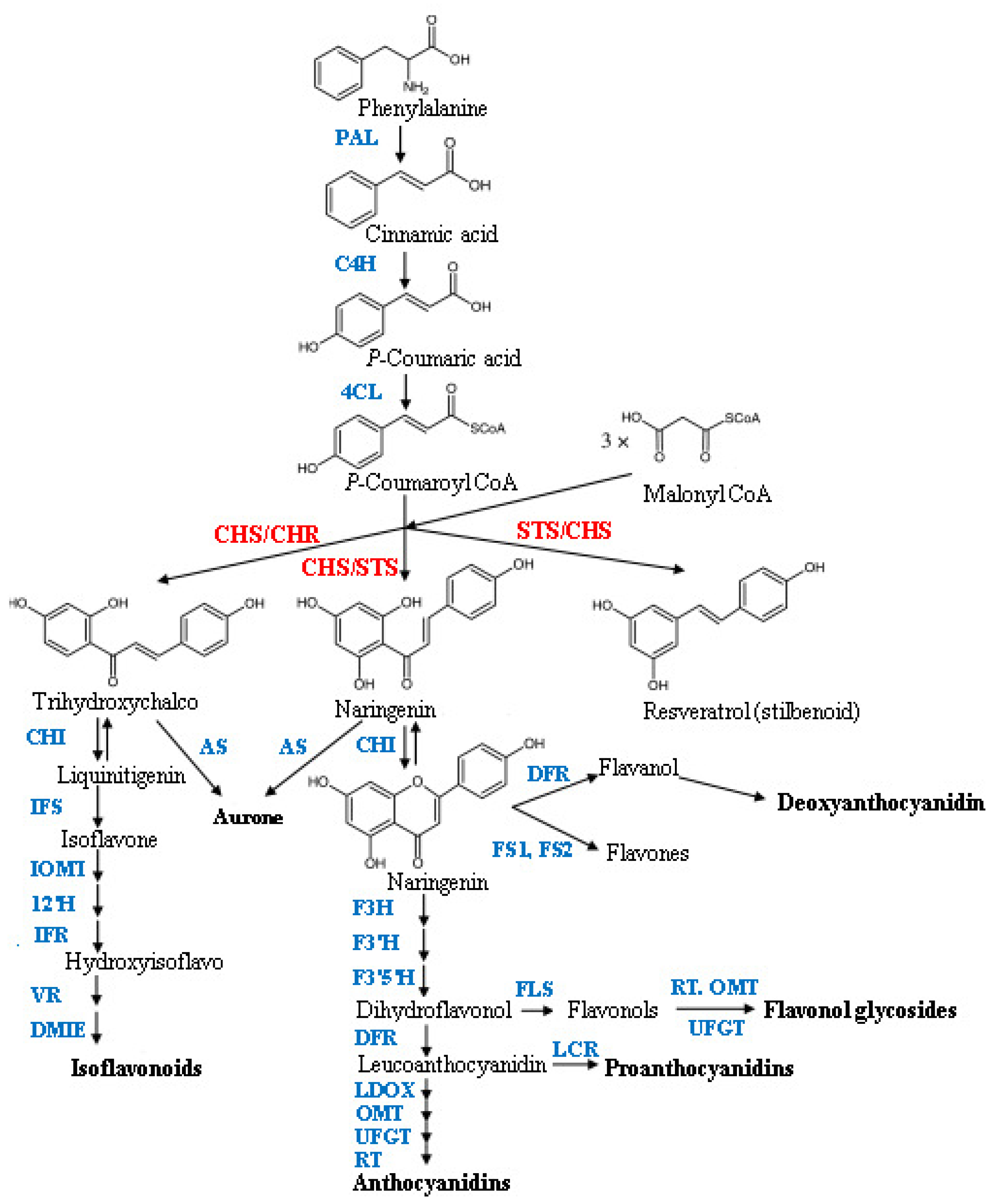
<p>Salicylic acid (SA) is a phenolic compound capable of enhancing plant growth and yield in some plants. SA acts as a potential non-enzymatic antioxidant, as well as a plant growth regulator, and plays an important role in regulating a number of plant physiological processes and bioactive compounds production [<xref ref-type="bibr" rid="b1-ijms-13-14828">1</xref>]. Plants are potential sources of natural bioactive compounds which occur as secondary metabolites. They absorb sun light and produce high levels of oxygen and secondary metabolites during photosynthesis. Flavonoids are an important group of secondary metabolites and are a source of bioactive compounds in plants [<xref ref-type="bibr" rid="b2-ijms-13-14828">2</xref>]. They are also a kind of natural product with antioxidant properties capable of scavenging free superoxide radicals, having anti-aging properties as well as reducing the risk of cancer. Sung-jin <italic>et al.</italic>[<xref ref-type="bibr" rid="b3-ijms-13-14828">3</xref>] showed that some flavonoid components in green tea are effective in inhibiting cancer or induce mechanisms that may kill cancer cells and inhibit tumor invasion. It was found that flavonoids reduced blood-lipids and glucose, and enhanced human immunity [<xref ref-type="bibr" rid="b4-ijms-13-14828">4</xref>]. Currently, flavonoids are extracted among other sources, from ginkgo leaves [<xref ref-type="bibr" rid="b5-ijms-13-14828">5</xref>], kudzu roots [<xref ref-type="bibr" rid="b6-ijms-13-14828">6</xref>], lotus leaves [<xref ref-type="bibr" rid="b7-ijms-13-14828">7</xref>] and ginger rhizomes and leaves [<xref ref-type="bibr" rid="b8-ijms-13-14828">8</xref>]. Chalcone synthase enzyme (CHS) is a key entry enzyme committed to the production of flavonoids in plants. Naringenin, the product of CHS activity is the initiator of a large variety of secondary metabolites including flavonoids, isoflavonoids, anthocyanins and phloroglucinols [<xref ref-type="bibr" rid="b9-ijms-13-14828">9</xref>]. CHS condenses three malonyl-CoA molecules with cinnamoyl-CoA to produce chalcone. This condensation is the main pathway for the production of flavonoids (<xref ref-type="fig" rid="f1-ijms-13-14828">Figure 1</xref>), [<xref ref-type="bibr" rid="b10-ijms-13-14828">10</xref>]. Ginger is one of the traditional folk medicines and it is widely used in cooking in Malaysia. It is extensively used overall especially in Asia and contains several interesting bioactive constituents which possess health promoting properties. Ginger is regarded as an important resource with a wide range of high flavonoid components, is low priced [<xref ref-type="bibr" rid="b11-ijms-13-14828">11</xref>,<xref ref-type="bibr" rid="b12-ijms-13-14828">12</xref>], and therefore serves as a cheap and important food material. Food composition and food additives play a major role in providing the required antioxidants for the body, although traditionally, spices such as ginger are commonly used in food preparations to improve flavor and taste. Previous studies by the current authors demonstrated potent antioxidant and anticancer activities of Malaysian ginger (Halia Bara and Halia Bentong) [<xref ref-type="bibr" rid="b13-ijms-13-14828">13</xref>–<xref ref-type="bibr" rid="b15-ijms-13-14828">15</xref>]. However, the impact of foliar application of SA on the production of biopharmaceuticals in Malaysian herbs has not been widely investigated. This needs to be understood, especially when the objective is production optimization with regard to herbal chemistry. Furthermore, information on SA effects on the chemistry of Malaysian ginger varieties is not available. Such data would be useful to provide information on the availability of high levels of beneficial components.</p>
<p>This study was therefore designed to examine the effects of foliar application of SA on the production of secondary metabolites in two varieties of Malaysian ginger (<italic>Zingiber officinale</italic>), namely H. Bentong and H. Bara and to evaluate CHS enzyme activity. In addition <italic>in vitro</italic> antioxidant and anticancer properties of the extracts against breast cancer cell lines were also investigated.</p></sec>
<sec sec-type="results|discussion">
<title>2. Results and Discussion</title>
<sec sec-type="methods">
<title>2.1. HPLC Analysis of Flavonoid Compounds</title>
<p>Results of high performance liquid chromatography (HPLC) analysis of flavonoids and phenolic acids are present in <xref ref-type="table" rid="t1-ijms-13-14828">Table 1</xref>. Leaf extracts of Malaysian ginger, especially the variety H. Bara contained considerably (<italic>p</italic> ≤ 0.05) high amounts of rutin (0.893 mg g<sup>−1</sup> DW) and apigenin (0.384 mg g<sup>−1</sup> DW). SA application reduced rutin production in H. Bara (6.8%) and H. Bentong (21.8%). According to the data obtained, the concentration of some flavonoids (e.g., rutin, apigenin) decreased significantly in plants treated with different concentrations of SA (<xref ref-type="table" rid="t1-ijms-13-14828">Table 1</xref>). High concentrations of these flavonoids were found in the control plants. Conversely, concentration of naringenin, fisetin and morin increased significantly in both varieties when treated with different concentrations of SA. The interesting finding was that application of SA in both varieties induced synthesis of fisetin and anthocyanin which were not detected in the control plants. Highest levels of anthocyanin (0.442 mg g<sup>−1</sup> DW) and fisetin (0.359 mg g<sup>−1</sup> DW) were observed in leaf extracts of H. Bara treated with 10<sup>−5</sup> M of SA. Obinat <italic>et al</italic>. [<xref ref-type="bibr" rid="b17-ijms-13-14828">17</xref>] also reported that production of anthocyanin was induced in cultured grape cells following foliar application of SA. Myricetin has antioxidant properties and <italic>in vitro</italic> research suggests that various concentrations of myricetin can modify LDL cholesterol and enable increased uptake by white blood cells [<xref ref-type="bibr" rid="b18-ijms-13-14828">18</xref>]. In the present study production of myricetin was enhanced in ginger varieties treated with SA compared to control plants. High levels of this potent antioxidant compound were observed in H. Bara (0.112 mg g<sup>−1</sup> DW) treated with 10<sup>−5</sup> M SA. Morien is a rare yet well known flavonoid component of plants and acts as a chemo-preventive agent <italic>in vitro</italic> and <italic>in vivo</italic> against oral carcinogenesis [<xref ref-type="bibr" rid="b19-ijms-13-14828">19</xref>,<xref ref-type="bibr" rid="b20-ijms-13-14828">20</xref>]. The importance of morin and related compounds as anti-tumour drugs has also been widely recognized [<xref ref-type="bibr" rid="b21-ijms-13-14828">21</xref>]. A high content of morin (0.193 mg g<sup>−1</sup> DW) was obtained in extracts of H. Bara treated with 10<sup>−5</sup> M SA. According to HPLC analysis, it could be concluded that the application of SA induced synthesis of some flavonoids, while conversely inhibiting production of some other flavonoids in ginger. Our results suggest the ability of SA application to modify or alter both the profile and the concentration of flavonoids in ginger.</p></sec>
<sec>
<title>2.2. Chalcone Synthase Enzyme (CHS) Activity</title>
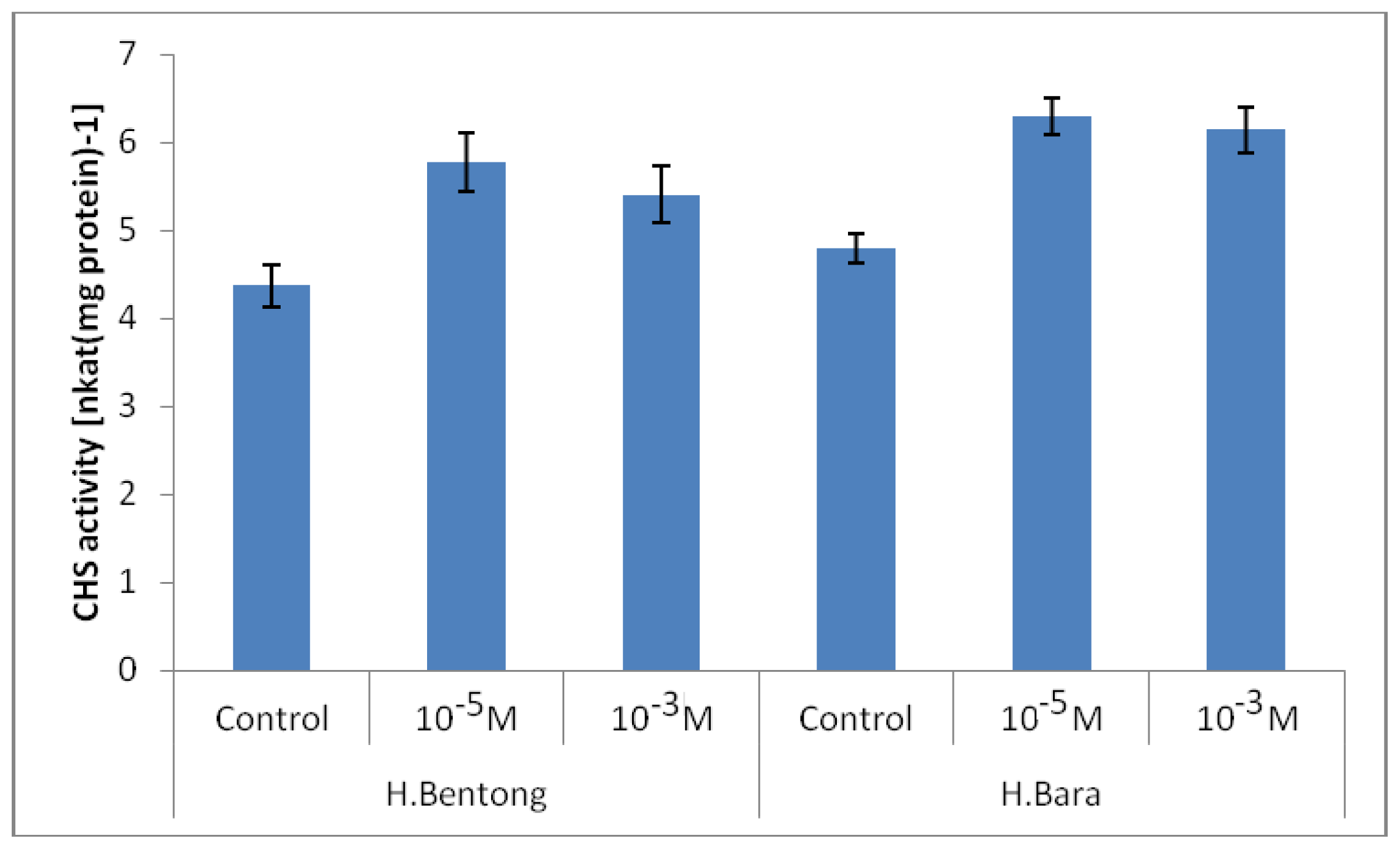
<p>According to the results CHS activity was influenced by SA concentration (<italic>p</italic> ≤ 0.01; <xref ref-type="fig" rid="f2-ijms-13-14828">Figure 2</xref>). In both varieties treated with SA, CHS activity was found to be consistently higher in ginger treated with 10<sup>−5</sup> M SA with values ranging between 5.77 and 6.30 nkat mg protein<sup>−1</sup> than in gingers treated with 10<sup>−3</sup> M SA, which recorded CHS activity of 5.40 to 6.14 nkat mg protein<sup>−1</sup>. Plants not treated with SA showed the lowest values for CHS activity which were registered between 4.37 and 4.80 nkat mg protein<sup>−1</sup>. The present study showed that with SA application the activity of CHS was enhanced. This is basically due to the fact that CHS is a precursor to flavonoids biosynthesis [<xref ref-type="bibr" rid="b22-ijms-13-14828">22</xref>,<xref ref-type="bibr" rid="b23-ijms-13-14828">23</xref>]. The increase in CHS activity is usually followed by an increase in C/N ratio due to the enhanced growth rate using SA. Results of recent studies suggest that increases in the C/N ratio in plants are an indication of increases in the synthesis of secondary plant metabolites, especially flavonoids [<xref ref-type="bibr" rid="b24-ijms-13-14828">24</xref>,<xref ref-type="bibr" rid="b25-ijms-13-14828">25</xref>].</p>
<p>It is hypothesized that the increase in production of anthocyanin and flavonoids in the present work could be attributed to an increase in CHS activity in SA treated plants. Our results are consistent with Compos <italic>et al</italic>. [<xref ref-type="bibr" rid="b10-ijms-13-14828">10</xref>] who reported SA induced CHS activity in beans. Ozeki <italic>et al.</italic>[<xref ref-type="bibr" rid="b26-ijms-13-14828">26</xref>] pointed out that change in CHS activity rather than PAL activity (also involving enzymes for flavonoid synthesis) was correlated with changes in anthocyanin accumulation under various culture conditions. CHS is the first enzyme to switch from phenylpropanoid metabolism to flavonoid metabolism and is believed to be a key enzyme in this system [<xref ref-type="bibr" rid="b27-ijms-13-14828">27</xref>]. These findings together with evidence for channeling between SA concentration and CHS activity in the general phenylpropanoid pathway [<xref ref-type="bibr" rid="b16-ijms-13-14828">16</xref>], indicate that the organization of these systems are important in the understanding of how plant metabolism is regulated.</p></sec>
<sec>
<title>2.3. Antioxidant Activity</title>
<sec>
<title>2.3.1. Ferric Reducing Antioxidant Potential (FRAP) Assay</title>
<p>Several methods have been used to measure the total antioxidant capacity of herbs, including FRAP assay, which has been adopted in this study. The FRAP assay depends on the reduction of ferric tripyridyltriazine (Fe (III)-TPTZ) complex to the ferrous tripyridyltriazine (Fe (II)-TPTZ) by a reductant at low pH. The reducing power of the leaf extract of young ginger was in the range of 476.22–793.26 μm of Fe (II)/g dry weight (<xref ref-type="table" rid="t2-ijms-13-14828">Table 2</xref>). Increasing SA concentration had a significant effect on FRAP activity of young ginger. The FRAP values for the leaf extracts of both varieties treated with SA were significantly lower than α-tocopherol (953 μmol Fe (II)/g), but higher than that of BHT (611.82 μmol Fe (II)/g). It was reported that the effect of antioxidant scavenging is due to hydrogen donating ability [<xref ref-type="bibr" rid="b28-ijms-13-14828">28</xref>,<xref ref-type="bibr" rid="b29-ijms-13-14828">29</xref>]. The FRAP assay has been used widely to estimate the antioxidant component/power of dietary polyphenols [<xref ref-type="bibr" rid="b30-ijms-13-14828">30</xref>]. It is evident that foliar application of SA significantly enhanced the content of some flavonoids in both ginger varieties, and the high flavonoid content was associated with high antioxidant activity. In a previous study, a strong positive relationship between total flavonoid content and antioxidant activity was reported, which appears to be the trend in many plant species [<xref ref-type="bibr" rid="b31-ijms-13-14828">31</xref>].</p>
<p>This study has shown that ginger has good free radical scavenging ability and therefore can be used as a radical inhibitor or scavenger, possibly acting as a primary antioxidant. Additionally, foliar application of SA can enhance the antioxidant activity of the ginger leaf extracts.</p></sec>
<sec>
<title>2.3.2. DPPH Antioxidant Activity</title>
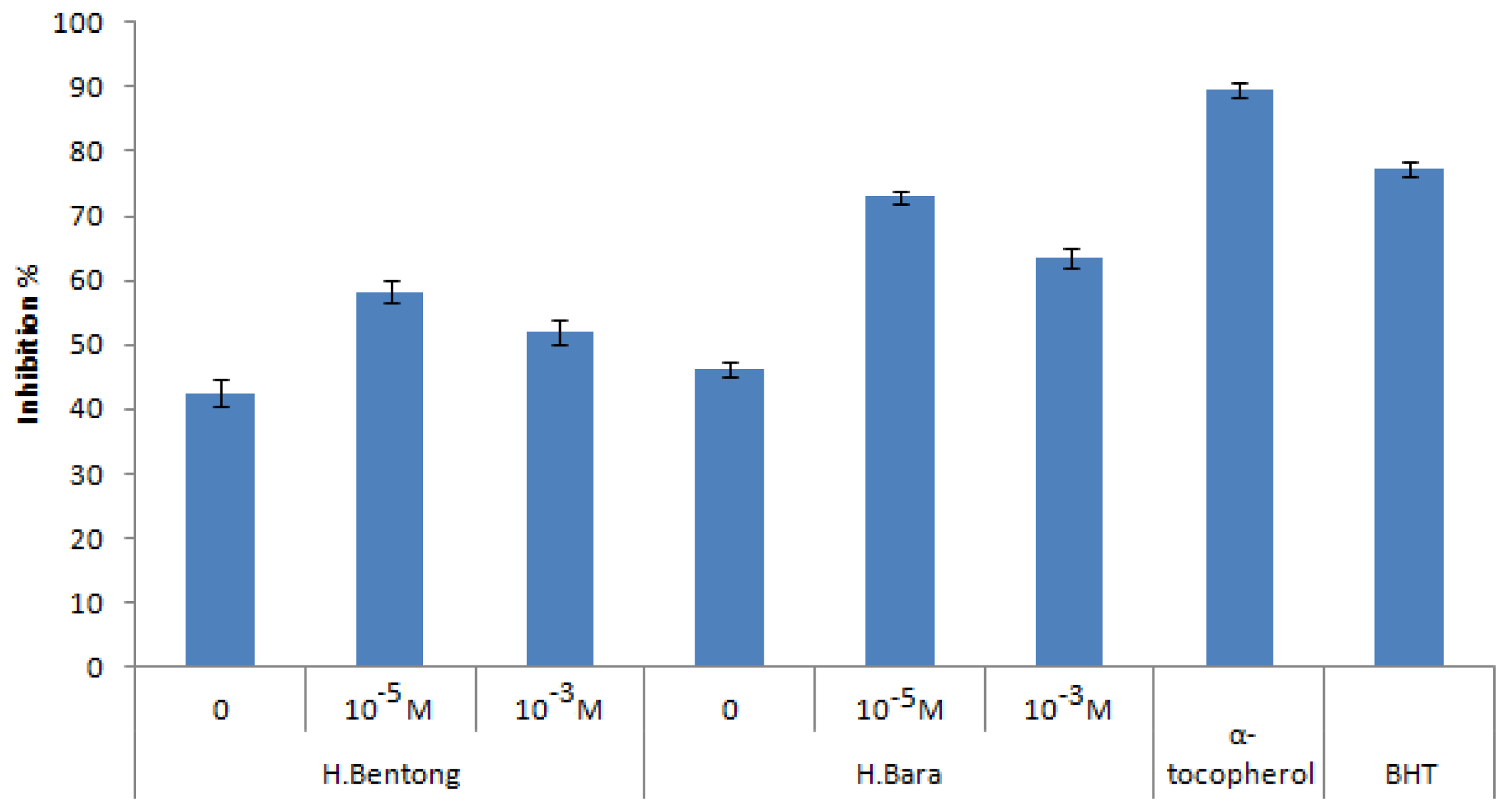
<p>DPPH antioxidant activity was highest in the leaves of both varieties treated with SA compared to non treated plants (<xref ref-type="fig" rid="f3-ijms-13-14828">Figure 3</xref>). The effects on DPPH were contributed by SA treatments (<italic>p</italic> ≤ 0.05). At a concentration of 350 μg mL<sup>−1</sup>, the DPPH antioxidant activity recorded the highest value of 58.30%–72.90% with the 10<sup>−5</sup> M SA treatment, followed by the 10<sup>−3</sup> M SA (52.14%–63.66%) treatment, while the lowest value was obtained in the nontreated plants (42.50%–46.73%). However, DPPH radical scavenging ability of the plant extracts was lower than those of butylated hydroxyl toluene (BHT; 77.17%) and α-tocopherol (89.6%) registered at 350 μg mL<sup>−1</sup>. The highest value of DPPH activity was observed in H. Bara extracts (72.90%) when plants were treated with 10<sup>−5</sup> M SA. This study showed that H. Bara extract had a good free radical scavenging activity, and hence can be used as a radical scavenger, acting possibly as a primary antioxidant. These results also imply that the 10<sup>−5</sup> M SA treatment could significantly reduce the DPPH radical scavenging activity of the Malaysian ginger varieties. The principle involved is that in the presence of a molecule consisting of a stable free radical (DPPH), an antioxidant with the ability to donate a hydrogen atom will quench the stable free radical, a process which is associated with a change in absorption that can be translated spectrophotometrically.</p>
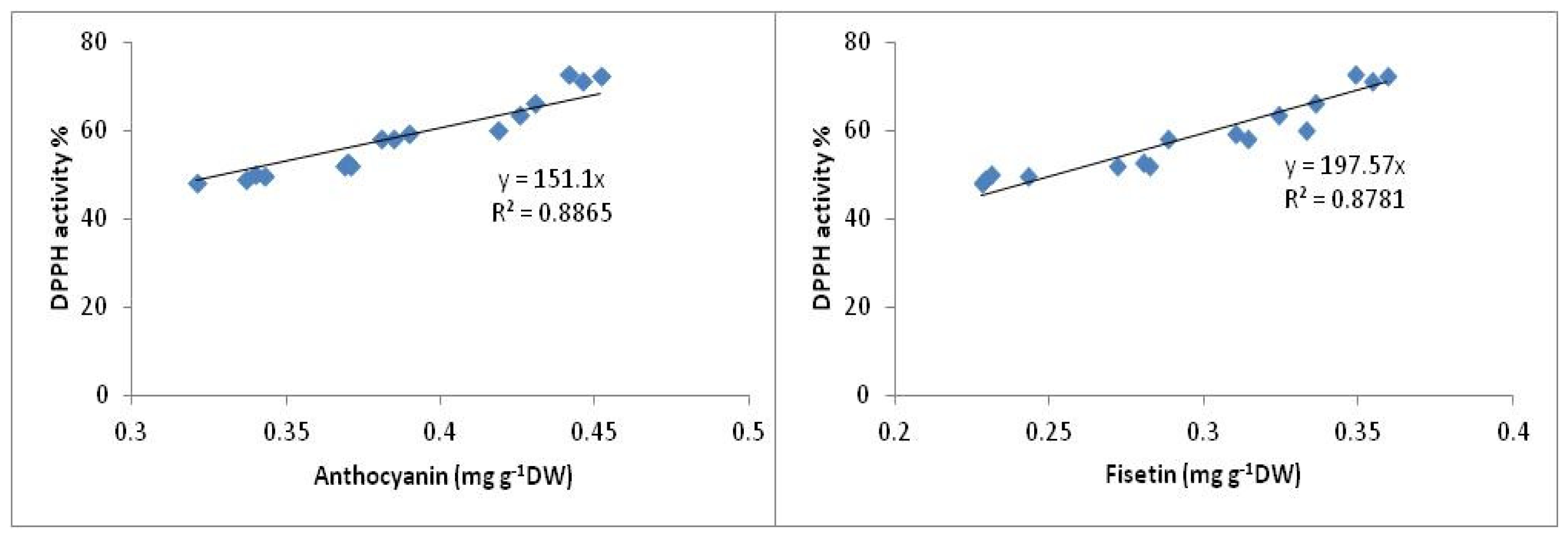
<p>To date, more than 8000 phenolic compounds are known in plants, of which almost two-thirds belong to the predominantly water soluble flavonoid antioxidant family. Fisetin and anthocyanin were reported as potent antioxidant compounds with high antioxidant activity (DPPH activity) [<xref ref-type="bibr" rid="b32-ijms-13-14828">32</xref>–<xref ref-type="bibr" rid="b34-ijms-13-14828">34</xref>], and in the current study high concentrations of fisetin and anthocyanin were observed in ginger treated with 10<sup>−5</sup> M SA. The high antioxidant activity in ginger varieties observed with the 10<sup>−5</sup> M SA treatment is attributed to the high concentrations of anthocyanin and fisetin in these varieties. In this study, positive and significant (<italic>p</italic> &lt; 0.05) correlations have been observed between anthocyanin (<italic>R</italic><sup>2</sup> = 0.88) and fisetin (<italic>R</italic><sup>2</sup> = 0.87) content with DPPH activity (<xref ref-type="fig" rid="f4-ijms-13-14828">Figure 4</xref>). The present findings are consistent with other research reports which found positive and significant correlations between anthocyanin and fisetin with antioxidant activity in medicinal plants [<xref ref-type="bibr" rid="b35-ijms-13-14828">35</xref>,<xref ref-type="bibr" rid="b36-ijms-13-14828">36</xref>]. This effect maybe due to the electron-donating ability of these compounds.</p></sec></sec>
<sec>
<title>2.4. Anticancer Activity</title>
<p>The two ginger varieties were found to express MCF-7 and MDA-MB-231 cancer inhibitory activity when tested at concentrations of 4.6875–300 μg mL<sup>−1</sup> (<xref ref-type="table" rid="t3-ijms-13-14828">Table 3</xref>). Significant tumor inhibition was observed at 37.5 μg mL<sup>−1</sup>. At a concentration of 37.5 μg mL<sup>−1</sup> most of the extracts exhibited strong anticancer activity towards MCF-7 and MDA-MB-231 cells. Maximum MCF-7 and MDA-MB-231 cell line inhibition was observed with H. Bara with values of 61.53% and 59.88%, respectively when treated with 10<sup>−5</sup> M SA, while minimum MDA-MB-231 cell line inhibition was observed with the untreated H. Bentong (with values of 45.30% and 40.64%, respectively). MCF-7 and MDA-MB-231 cell lines treated with tamoxifen (positive control) showed 77.44% and 73.82% inhibition at the same concentration. Based on several <italic>in vivo</italic> and <italic>in vitro</italic> studies, many mechanisms of anticancer action may be involved. These include cell cycle arrest, carcinogen inactivation, antiproliferation, inhibition of angiogenesis, induction of apoptosis and differentiation, antioxidation and reversal of multi-drug resistance or a combination of these mechanisms [<xref ref-type="bibr" rid="b37-ijms-13-14828">37</xref>–<xref ref-type="bibr" rid="b39-ijms-13-14828">39</xref>]. Flavonoids are among the best candidates for mediating the protective effect of diets rich in fruits and vegetables with respect to colorectal cancer. Additional information on their effects on cancer cells and their mechanisms of action were obtained by adding, a series of related flavonoids to cultures of cancer cells; all flavonoid compounds were found to increase growth inhibition and cell loss at concentrations of 1 to 100 mM, with relative effectiveness being fisetin &gt; kaempferol [<xref ref-type="bibr" rid="b40-ijms-13-14828">40</xref>]. Hence, flavonoid compounds could probably be responsible for the anticancer activity of <italic>Z. officinale</italic>. According to the American National Cancer Institute, the criterion of normal cell viability for crude extracts of herbs is 76% [<xref ref-type="bibr" rid="b41-ijms-13-14828">41</xref>]. This implies that extracts of herbs that show cell viability lower than this range are suitable for human consumption and are not harmful. Anthocyanin is a potent antioxidant [<xref ref-type="bibr" rid="b42-ijms-13-14828">42</xref>–<xref ref-type="bibr" rid="b45-ijms-13-14828">45</xref>]. Anthocyanin fractions extracted from different sources, including grape rinds and red rice [<xref ref-type="bibr" rid="b46-ijms-13-14828">46</xref>], flower petals [<xref ref-type="bibr" rid="b47-ijms-13-14828">47</xref>], Vaccinium species [<xref ref-type="bibr" rid="b48-ijms-13-14828">48</xref>], red soyabeans and red beans [<xref ref-type="bibr" rid="b49-ijms-13-14828">49</xref>], different cherry and berry extracts [<xref ref-type="bibr" rid="b50-ijms-13-14828">50</xref>–<xref ref-type="bibr" rid="b52-ijms-13-14828">52</xref>], and purple corn [<xref ref-type="bibr" rid="b53-ijms-13-14828">53</xref>], have demonstrated anticancer activity. Katsube <italic>et al.</italic>[<xref ref-type="bibr" rid="b51-ijms-13-14828">51</xref>] reported HCT-116 colon cancer cells were inhibited by anthocyanin-containing berry extracts including cowberry, blueberry, strawberry and bilberry extracts [<xref ref-type="bibr" rid="b51-ijms-13-14828">51</xref>]. Similarly, tart cherry anthocyanins were shown to inhibit the growth of human colon cancer cell lines HCT116 and HT-29 [<xref ref-type="bibr" rid="b52-ijms-13-14828">52</xref>]. Fisetin is found in several plants, fruits, vegetables, nuts and wine [<xref ref-type="bibr" rid="b54-ijms-13-14828">54</xref>] and displays a variety of biological effects including anti-inflammatory, antioxidant [<xref ref-type="bibr" rid="b55-ijms-13-14828">55</xref>,<xref ref-type="bibr" rid="b56-ijms-13-14828">56</xref>], anti-carcinogenic and <italic>in vitro</italic> anti-angiogenesis [<xref ref-type="bibr" rid="b57-ijms-13-14828">57</xref>]. <italic>In vivo</italic>, fisetin has recently been shown to possess interesting anticancer activity in mice bearing prostate tumours [<xref ref-type="bibr" rid="b58-ijms-13-14828">58</xref>], lung carcinoma [<xref ref-type="bibr" rid="b59-ijms-13-14828">59</xref>] and human embryonal carcinoma [<xref ref-type="bibr" rid="b60-ijms-13-14828">60</xref>]. The <italic>in vivo</italic> mechanism of action appears rather complex and may include anti-angiogenic, anti-metastatic and anti-androgenic activities [<xref ref-type="bibr" rid="b61-ijms-13-14828">61</xref>].</p>
<p>In the current study the highest values of both fisetin and athocyanin were detected in ginger varieties treated with 10<sup>−5</sup> M SA. Meanwhile, the highest anticancer activity against MCF-7 and MDA-MB-231 cell lines has been observed with extracts of H. Bara treated with 10<sup>−5</sup> M SA. This suggests that high anticancer activity in these varieties may be attributed to the high concentrations of potent anticancer components such as fisetin and anthocyanin. However, more research needs to be undertaken before the association between these flavonoids and anticancer activity in ginger varieties is more clearly understood. In varieties treated with SA the value of IC<sub>50</sub> decreased significantly compared to non treated plants. The IC<sub>50</sub> values of Halia Bara extract (not treated with SA) against MCF-7 and MDA-MB-231 cells were 39.1 and 42.1 μg mL<sup>−1</sup>, respectively (<xref ref-type="table" rid="t4-ijms-13-14828">Table 4</xref>). In H. Bara treated with 10<sup>−5</sup> M SA, the IC<sub>50</sub> value decreased to 31.5 and 40.6 μg mL<sup>−1</sup> for MCF-7 and MDA-MB-231 respectively; while the IC<sub>50</sub> values of tamoxifen as a positive control for MCF-7 and MDA-MB-231 cells were 17.4 and 19.5 μg mL<sup>−1</sup>, respectively.</p></sec></sec>
<sec>
<title>3. Experimental Section</title>
<sec>
<title>3.1. Plant Material and Maintenance</title>
<p>The rhizomes of ginger varieties Halia Bentong and Halia Bara (<italic>Zingiber officinale</italic>) were collected from the ginger planting area in Bentong Village, Malaysia. Voucher specimens were identified by the herbarium of the University Putra Malaysia, Selangor, Malaysia (H. Bentong Stone 6030 (KLU) and H. Bara Stone 7233 (KLU)). Rhizomes were sprouted for two weeks in 10 cm diameter pots filled with peat. They were then transferred to polyethylene bags filled with a soilless mixture consisting of burnt rice husk and coco peat (1:1). The plants were grown in a glasshouse at the Universiti Putra Malaysia (UPM) glasshouse complex. The seedlings were raised in specially constructed growth chambers receiving 12-h photoperiod and average photosynthetic photon flux density of 310 μmol m<sup>−2</sup> s<sup>−1</sup>. Day and night temperatures were maintained at 30 ± 1.0 °C and 20 ± 1.5 °C, respectively, and relative humidity of between 70% and 80%. At the second leaf stage, the ginger seedlings were sprayed with two concentrations (10<sup>−3</sup> or 10<sup>−5</sup> M) of salicylic acid solution (SA; 2-hydroxybenzoic acid +100 μL dimethyl sulfoxide +0.02% polyoxyethylenesorbitan monolaurate, Tween 20, Sigma Chemicals; pH 6.5). Control plants were sprayed with the same solution but without SA. Plants were sprayed early in the morning with 10 mL of the respective solutions once a week for four weeks.</p></sec>
<sec>
<title>3.2. Extract Preparation</title>
<p>Leaf samples (0.25 g) were extracted with 20 mL of methanol, and 5 mL of 6 M HCl was added to each extract to give a total volume of 25 mL. The extracts were then refluxed at 90 °C for 2 h. Aliquots of 500 μL were taken before and after hydrolysis, filtered through a 0.45 μm filter, and analyzed for flavonoids using High Performance Liquid Chromatography (HPLC) [<xref ref-type="bibr" rid="b62-ijms-13-14828">62</xref>].</p></sec>
<sec sec-type="methods">
<title>3.3. High Performance Liquid Chromatography (HPLC) Analysis</title>
<sec>
<title>3.3.1. Standard Curve Preparation</title>
<p>The standard stock solutions were prepared by dissolving standards in methanol to 100 μg mL<sup>−1</sup>. For the calibration curves, four additional concentrations (20, 40, 60 and 80 μg mL<sup>−1</sup>) were prepared by the dilution of the stock solutions with methanol.</p></sec>
<sec>
<title>3.3.2. Chromatography Conditions</title>
<p>Reversed-phase HPLC was used to assay flavonoid composition. The Agilent HPLC system used consisted of a Model 1100 pump equipped with a multi-solvent delivery system, an L-7400 ultraviolet (UV) detector, and fitted with an Agilent C18 (5 μm, 4.6 mm internal diameter 250 mm) column. The mobile phase consisted of: (A) 2% acetic acid (CH<sub>3</sub>COOH) and (B) 0.5% acetic acid-acetonitrile (CH<sub>3</sub>CN), (50:50 <italic>v</italic>/<italic>v</italic>). The mobile phase was filtered under vacuum through a 0.45 um membrane filter before use. Gradient elution was performed as follows: 0 min, 95:5; 10 min, 90:10; 40 min, 60:40, 55 min, 45:55; 60 min, 20:80; and 65 min, 0:100. The flow rate was maintained at 1 mL min<sup>−1</sup> and UV absorbance was measured at 280–365 nm. The operating temperature was maintained at room temperature [<xref ref-type="bibr" rid="b63-ijms-13-14828">63</xref>]. Identification of the flavonoids was achieved by comparison of retention times with standards, UV spectra and UV absorbance ratios after co-injection of samples and standards. The standards were purchased from Sigma–Aldrich (St. Louis, MO, USA).</p></sec></sec>
<sec>
<title>3.4. Chalcone Synthase (CHS) Assay</title>
<p>CHS activity was assayed spectrophotometrically as described in Obinata <italic>et al.</italic>[<xref ref-type="bibr" rid="b17-ijms-13-14828">17</xref>]. Enzymes were extracted at 4 °C by homogenizing the frozen harvested cells (0.4 g) in 1 mL of 0.1 M borate buffer (pH 8.8) containing 1 mM 2-mercaptoethanol with a homogenizer (Polytron). The homogenates were treated with 0.1 g of Dowex l × 4 for 10 min and the cell debris and resin were removed by centrifugation at 15,000 rpm for 10 min. A 0.2 g sample of Dowex l × 4 resin was added to the supernatant and treated for another 20 min. The resin was then removed by centrifugation at 15,000 rpm for 15 min. The resultant supernatant was used in the CHS assay. The CHS assay was performed with 100 μL of enzyme extract mixed with 1.89 mL of 50 mM Tris-HCI buffer, pH 7.6, containing 10 mM KCN. The enzyme reaction was allowed to proceed for 1 min at 30 °C after adding 10 mg chalcone to 10 μL ethylene glycol monomethylether. The activity was determined by measuring the absorbance at 370 nm.</p></sec>
<sec>
<title>3.5. Determination of Antioxidant Activities</title>
<sec>
<title>3.5.1. Ferric Reducing Antioxidant Potential (FRAP) Assay</title>
<p>The stock solutions consisted of 300 mM acetate buffer, 10 mM TPTZ (2,4,6-tripyridyl-<italic>S</italic>-triazine) solution in 40 mM HCl, and 20 mM FeCl<sub>3</sub> solution. Acetate buffer (25 mL) and TPTZ (2.5 mL) were mixed, and 2.5 mL FeCl<sub>3</sub> added. Leaf extract (150 μL) was added to 2850 μL of the FRAP solution and kept for 30 min in the dark place. The absorbance of solution was measured at 593 nm using a spectrophotometer (U-2001, Hitachi Instruments Inc., Tokyo, Japan) [<xref ref-type="bibr" rid="b64-ijms-13-14828">64</xref>].</p></sec>
<sec>
<title>3.5.2. 1,1-Diphenyl-2-picrylhydrazyl (DPPH) Assay</title>
<p>1,1-Diphenyl-2-picrylhydrazyl (DPPH) was purchased from Sigma–Aldrich. Butylated hydroxytoluene (BHT) and α-tocopherol were purchased from Merck (India). The radical scavenging ability was determined using the method described in Mensor <italic>et al.</italic>[<xref ref-type="bibr" rid="b65-ijms-13-14828">65</xref>]. Briefly, an alcohol solution of DPPH (1 mL, 3 mg mL<sup>−1</sup>) was added to 2.5 mL samples containing different concentrations of extracts originating from different parts of the ginger varieties. The samples were first kept in the dark at room temperature and their absorbance was read at 518 nm after 30 min. The antiradical activity was determined using the following formula:</p>
<disp-formula id="FD1">
<label>(1)</label>
<mml:math id="mm1" display="block">
<mml:semantics id="sm1">
<mml:mrow>
<mml:mtext>Percent </mml:mtext>
<mml:mo stretchy="false">(</mml:mo>
<mml:mo>%</mml:mo>
<mml:mo stretchy="false">)</mml:mo>
<mml:mi> </mml:mi>
<mml:mtext>inhibition of DPPH activity</mml:mtext>
<mml:mo>=</mml:mo>
<mml:mo stretchy="false">[</mml:mo>
<mml:mo stretchy="false">(</mml:mo>
<mml:mi>A</mml:mi>
<mml:mn>0</mml:mn>
<mml:mo>-</mml:mo>
<mml:mi>A</mml:mi>
<mml:mn>1</mml:mn>
<mml:mo stretchy="false">)</mml:mo>
<mml:mo>/</mml:mo>
<mml:mi>A</mml:mi>
<mml:mn>0</mml:mn>
<mml:mo stretchy="false">]</mml:mo>
<mml:mo>×</mml:mo>
<mml:mn>100</mml:mn>
<mml:mo>%</mml:mo></mml:mrow></mml:semantics></mml:math></disp-formula>
<p>Where <italic>A</italic>0 is the absorbance value of the blank sample or control reaction, and <italic>A</italic>1 is the absorbance value of the test sample. The optic density of the samples and controls were measured in comparison to ethanol. BHT (butylhydroxytoluene) and α-tocopherol, were used as positive controls.</p></sec></sec>
<sec>
<title>3.6. Determination of Anticancer Activity</title>
<sec>
<title>3.6.1. Cell Culture and Treatment</title>
<p>Human breast carcinoma cell lines (MCF-7 and MDA-MB-231) were cultured in 100 μL of RPMI 1640 media (Roswell Park Memorial Institute) containing 10% fetal bovine serum (FBS). MCF-7 and MDA-MB-231 cells were incubated overnight at 37 °C in 5% CO<sub>2</sub> for cell attachment.</p></sec>
<sec>
<title>3.6.2. MTT (3-(4,5-Dimethylthiazol-2-yl)-2,5-diphenyltetrazolium bromide) Assay</title>
<p>The assay was conducted as follows: Cancer cells were seeded in 96-well plates at a density of 1 × 10⁴ cells/well in 100 μL RPMI. At 24 h after seeding, the medium was removed and the cells were incubated for 3 days with RPMI in the absence or presence of various concentrations of ginger extracts. Ginger extract concentrations used ranged from 4.6875, 9.375, 18.75, 37.5, 75, 150 to 300 μg mL<sup>−1</sup>. After incubation, 20 μL of MTT [3-(4,5-dimethylthiazol-2-yl)-2,5-diphenyltetrazolium bromide] reagent was added into each well. The plate was incubated again for 4 h in a CO<sub>2</sub> incubator at 37 °C. The resulting MTT–products were determined by measuring the absorbance at 570 nm using ELISA reader [<xref ref-type="bibr" rid="b66-ijms-13-14828">66</xref>]. Each point represents the mean of triplicate experiments. The cell viability was determined using the formula:</p>
<disp-formula id="FD2">
<label>(2)</label>
<mml:math id="mm2" display="block">
<mml:semantics id="sm2">
<mml:mrow>
<mml:mtext>Viability </mml:mtext>
<mml:mo stretchy="false">(</mml:mo>
<mml:mo>%</mml:mo>
<mml:mo stretchy="false">)</mml:mo>
<mml:mo>=</mml:mo>
<mml:mo stretchy="false">(</mml:mo>
<mml:mtext>optical density of sample</mml:mtext>
<mml:mo>/</mml:mo>
<mml:mtext>optical density of</mml:mtext>
<mml:mi> </mml:mi>
<mml:mtext>control</mml:mtext>
<mml:mo stretchy="false">)</mml:mo>
<mml:mo>×</mml:mo>
<mml:mn>100</mml:mn></mml:mrow></mml:semantics></mml:math></disp-formula></sec></sec>
<sec sec-type="methods">
<title>3.7. Statistical Analysis</title>
<p>Data were analyzed using the Statistical Analysis System (SAS, system 9.0; SAS Institute, Inc.: Cary, NC, USA, 2002). Means separation was performed using the Duncan multiple range test. The experimental results were expressed as mean ± standard deviation of three replicates. Mean differences at <italic>p</italic> ≤ 0.05 were regarded as significant.</p></sec></sec>
<sec sec-type="conclusions">
<title>4. Conclusions</title>
<p>This study demonstrated that foliar application of SA could be promoting the production of secondary metabolites and as a consequence, the antioxidant and anticancer properties of ginger varieties have been improved. SA is one of the special elicitors in the study of elicitation of secondary compounds through physiological pathways. Treatment of H. Bentong and H. Bara with SA improved production of fisetin and anthocyanin who have potent antioxidant activity and which were not detected in control plants. SA can act not only as an inducer but also as an inhibitor of secondary compound production [<xref ref-type="bibr" rid="b67-ijms-13-14828">67</xref>] and in this study reduction of rutin and apigenin in both varieties was observed. In agreement with Nicholson and Hammerschmidt [<xref ref-type="bibr" rid="b68-ijms-13-14828">68</xref>], an increase in the activity of CHS can be considered as a biochemical marker for resistance, given that this enzyme is the key for the necessary synthesis of flavonoid compounds. It would appear that foliar application of SA not only significantly enhances biomass production in ginger varieties, but that it also slightly increases the concentrations of several therapeutic compounds. Halia Bentong and Halia Bara exhibited promising anticancer activity on human breast cancer cell lines (MCF-7 and MDA-MB-231). The leaf extracts of these varieties contained appreciable amounts of effective flavonoid compounds like fisetin, morien, myreciten and anthocyanin, which is a potent agent for breast cancer growth inhibition. Subsequently, our MTT assay indicated that enriched Halia Bara leaf with 10<sup>−5</sup> M of SA is a potential source of anticancer therapeutic compounds. It seems that SA could be used to enhance phyrochemical production and the pharmaceutical quality of ginger.</p></sec></body>
<back>
<ack>
<title>Acknowledgments</title>
<p>The authors are grateful to the Research Management Centre of University Putra Malaysia for financing and supporting this work.</p></ack>
<ref-list>
<title>References</title>
<ref id="b1-ijms-13-14828"><label>1</label><citation citation-type="journal"><person-group person-group-type="author"><name><surname>Amanullah</surname><given-names>M.M.</given-names></name><name><surname>Sekar</surname><given-names>S.</given-names></name><name><surname>Vincent</surname><given-names>S.</given-names></name></person-group><article-title>Plant growth substances in crop production</article-title><source>Asian J. Plant Sci</source><year>2010</year><volume>9</volume><fpage>215</fpage><lpage>222</lpage><pub-id pub-id-type="doi">10.3923/ajps.2010.215.222</pub-id></citation></ref>
<ref id="b2-ijms-13-14828"><label>2</label><citation citation-type="journal"><person-group person-group-type="author"><name><surname>Karimi</surname><given-names>E.</given-names></name><name><surname>Jaafar</surname><given-names>H.Z.</given-names></name><name><surname>Ahmad</surname><given-names>S.</given-names></name></person-group><article-title>Phytochemical analysis and antimicrobial activities of methanolic extracts of leaf, stem and root from different varieties of <italic>Labisa pumila</italic> Benth</article-title><source>Molecules</source><year>2011</year><volume>16</volume><fpage>4438</fpage><lpage>4450</lpage><pub-id pub-id-type="doi">10.3390/molecules16064438</pub-id><pub-id pub-id-type="pmid">21623314</pub-id></citation></ref>
<ref id="b3-ijms-13-14828"><label>3</label><citation citation-type="journal"><person-group person-group-type="author"><name><surname>Park</surname><given-names>S.J.</given-names></name><name><surname>Myoung</surname><given-names>H.</given-names></name><name><surname>Kim</surname><given-names>Y.Y.</given-names></name><name><surname>Paeng</surname><given-names>J.Y.</given-names></name><name><surname>Park</surname><given-names>J.W.</given-names></name><name><surname>Kim</surname><given-names>M.J.</given-names></name><name><surname>Hong</surname><given-names>S.M.</given-names></name></person-group><article-title>Anticancer effects of genistein, green tea catechins, and cordycepin on oral squamous cell carcinoma</article-title><source>J. Korean Oral Maxillofac. Surg</source><year>2008</year><volume>34</volume><fpage>1</fpage><lpage>10</lpage></citation></ref>
<ref id="b4-ijms-13-14828"><label>4</label><citation citation-type="journal"><person-group person-group-type="author"><name><surname>Chan</surname><given-names>E.W.C.</given-names></name><name><surname>Lim</surname><given-names>Y.Y.</given-names></name><name><surname>Wong</surname><given-names>L.F.</given-names></name><name><surname>Lianto</surname><given-names>F.S.</given-names></name><name><surname>Wong</surname><given-names>S.K.</given-names></name></person-group><article-title>Antioxidant and tyrosinase inhibition properties of leaves and rhizomes of ginger species</article-title><source>Food Chem</source><year>2008</year><volume>109</volume><fpage>477</fpage><lpage>483</lpage><pub-id pub-id-type="doi">10.1016/j.foodchem.2008.02.016</pub-id></citation></ref>
<ref id="b5-ijms-13-14828"><label>5</label><citation citation-type="journal"><person-group person-group-type="author"><name><surname>Xie</surname><given-names>J.</given-names></name><name><surname>Zhu</surname><given-names>L.</given-names></name><name><surname>Luo</surname><given-names>H.</given-names></name><name><surname>Zhou</surname><given-names>L.</given-names></name><name><surname>Li</surname><given-names>C.</given-names></name><name><surname>Xu</surname><given-names>X.</given-names></name></person-group><article-title>Direct extraction of specific pharmacophoric flavonoids from gingko leaves using a molecularly imprinted polymer for quercetin</article-title><source>J. Chromatogr. A</source><year>2001</year><volume>934</volume><fpage>1</fpage><lpage>11</lpage><pub-id pub-id-type="doi">10.1016/S0021-9673(01)01294-8</pub-id><pub-id pub-id-type="pmid">11762756</pub-id></citation></ref>
<ref id="b6-ijms-13-14828"><label>6</label><citation citation-type="journal"><person-group person-group-type="author"><name><surname>Liao</surname><given-names>H.B.</given-names></name><name><surname>He</surname><given-names>Z.E.</given-names></name></person-group><article-title>Research and prospect of kudzu root</article-title><source>Natl. Food Assoc</source><year>2003</year><volume>24</volume><fpage>81</fpage><lpage>83</lpage></citation></ref>
<ref id="b7-ijms-13-14828"><label>7</label><citation citation-type="journal"><person-group person-group-type="author"><name><surname>Chen</surname><given-names>H.G.</given-names></name><name><surname>Yu</surname><given-names>Y.G.</given-names></name><name><surname>Zeng</surname><given-names>O.X.</given-names></name></person-group><article-title>Study on extraction of flavonoids and alkaloids from lotus leaf</article-title><source>Food Sci</source><year>2002</year><volume>23</volume><fpage>69</fpage><lpage>71</lpage></citation></ref>
<ref id="b8-ijms-13-14828"><label>8</label><citation citation-type="journal"><person-group person-group-type="author"><name><surname>Ghasemzadeh</surname><given-names>A.</given-names></name><name><surname>Jaafar</surname><given-names>H.Z.E.</given-names></name><name><surname>Rahmat</surname><given-names>A.</given-names></name></person-group><article-title>Antioxidant activities, total phenolics and flavonoids content in two varieties of Malaysia young ginger (<italic>Zingiber officinale</italic> Roscoe)</article-title><source>Molecules</source><year>2010</year><volume>15</volume><fpage>4324</fpage><lpage>4333</lpage><pub-id pub-id-type="doi">10.3390/molecules15064324</pub-id><pub-id pub-id-type="pmid">20657444</pub-id></citation></ref>
<ref id="b9-ijms-13-14828"><label>9</label><citation citation-type="journal"><person-group person-group-type="author"><name><surname>Dao</surname><given-names>T.T.</given-names></name><name><surname>Linthorst</surname><given-names>H.J.</given-names></name><name><surname>Verpoorte</surname><given-names>R.</given-names></name></person-group><article-title>Chalcone synthase and its functions in plant resistance</article-title><source>Phytochem. Rev</source><year>2011</year><volume>10</volume><fpage>397</fpage><lpage>412</lpage><pub-id pub-id-type="doi">10.1007/s11101-011-9211-7</pub-id><pub-id pub-id-type="pmid">21909286</pub-id></citation></ref>
<ref id="b10-ijms-13-14828"><label>10</label><citation citation-type="journal"><person-group person-group-type="author"><name><surname>Campos</surname><given-names>A.D.</given-names></name><name><surname>Ferreira</surname><given-names>A.G.</given-names></name><name><surname>Hampe</surname><given-names>M.M.V.</given-names></name><name><surname>Antunes</surname><given-names>I.F.</given-names></name><name><surname>Brancão</surname><given-names>N.</given-names></name><name><surname>Silveira</surname><given-names>E.P.</given-names></name><name><surname>da Silva</surname><given-names>J.B.</given-names></name><name><surname>Osório</surname><given-names>V.A.</given-names></name></person-group><article-title>Induction of chalcone synthase and phenylalanine ammonia-lyase by salicylic acid and <italic>Colletotrichum lindemuthianum</italic> in common bean Determination of Antioxidant Activities</article-title><source>Braz. J. Plant Physiol</source><year>2003</year><volume>15</volume><fpage>129</fpage><lpage>134</lpage></citation></ref>
<ref id="b11-ijms-13-14828"><label>11</label><citation citation-type="journal"><person-group person-group-type="author"><name><surname>Ghasemzadeh</surname><given-names>A.</given-names></name><name><surname>Jaafar</surname><given-names>H.Z.</given-names></name><name><surname>Rahmat</surname><given-names>A.</given-names></name></person-group><article-title>Elevated Carbon Dioxide Increases Contents of Flavonoids and Phenolic Compounds, and Antioxidant Activities in Malaysian Young Ginger (<italic>Zingiber officinale</italic> Roscoe) Varieties</article-title><source>Molecules</source><year>2010</year><volume>15</volume><fpage>7907</fpage><lpage>7922</lpage><pub-id pub-id-type="doi">10.3390/molecules15117907</pub-id><pub-id pub-id-type="pmid">21060298</pub-id></citation></ref>
<ref id="b12-ijms-13-14828"><label>12</label><citation citation-type="journal"><person-group person-group-type="author"><name><surname>Tang</surname><given-names>Y.</given-names></name><name><surname>Zhao</surname><given-names>A.</given-names></name></person-group><article-title>Study on the flavone content of buckwheat</article-title><source>J. Sichuan Agric. Univ</source><year>2001</year><volume>19</volume><fpage>352</fpage><lpage>354</lpage></citation></ref>
<ref id="b13-ijms-13-14828"><label>13</label><citation citation-type="journal"><person-group person-group-type="author"><name><surname>Ghasemzadeh</surname><given-names>A.</given-names></name><name><surname>Jaafar</surname><given-names>H.Z.E.</given-names></name></person-group><article-title>Anticancer and antioxidant activities of Malaysian young ginger (<italic>Zingiber officinale</italic> Roscoe) varieties grown under different CO<sub>2</sub> concentration</article-title><source>J. Med. Plant Res</source><year>2011</year><volume>5</volume><fpage>3247</fpage><lpage>3255</lpage></citation></ref>
<ref id="b14-ijms-13-14828"><label>14</label><citation citation-type="journal"><person-group person-group-type="author"><name><surname>Ghasemzadeh</surname><given-names>A.</given-names></name><name><surname>Jaafar</surname><given-names>H.Z.E.</given-names></name></person-group><article-title>Effect of CO<sub>2</sub> Enrichment on Some Primary and Secondary Metabolites synthesis in Ginger (<italic>Zingiber officinale</italic> Roscoe)</article-title><source>Int. J. Mol. Sci</source><year>2011</year><volume>12</volume><fpage>1101</fpage><lpage>1114</lpage><pub-id pub-id-type="doi">10.3390/ijms12021101</pub-id><pub-id pub-id-type="pmid">21541046</pub-id></citation></ref>
<ref id="b15-ijms-13-14828"><label>15</label><citation citation-type="journal"><person-group person-group-type="author"><name><surname>Ghasemzadeh</surname><given-names>A.</given-names></name><name><surname>Jaafar</surname><given-names>H.Z.E.</given-names></name><name><surname>Rahmat</surname><given-names>A.</given-names></name><name><surname>Megat Wahab</surname><given-names>P.E.</given-names></name><name><surname>Halim</surname><given-names>M.R.</given-names></name></person-group><article-title>Effect of Different Light Intensities on Total Phenolics and Flavonoids Synthesis and Anti-oxidant Activities in Young Ginger Varieties (<italic>Zingiber officinale</italic> Roscoe)</article-title><source>Int. J. Mol. Sci</source><year>2010</year><volume>11</volume><fpage>3885</fpage><lpage>3897</lpage><pub-id pub-id-type="doi">10.3390/ijms11103885</pub-id><pub-id pub-id-type="pmid">21152306</pub-id></citation></ref>
<ref id="b16-ijms-13-14828"><label>16</label><citation citation-type="journal"><person-group person-group-type="author"><name><surname>Winkel-Shirley</surname><given-names>B.</given-names></name></person-group><article-title>Flavonoid Biosynthesis. A Colorful Model for Genetics, Biochemistry, Cell Biology, and Biotechnology</article-title><source>Plant Physiol</source><year>2001</year><volume>126</volume><fpage>485</fpage><lpage>493</lpage><pub-id pub-id-type="doi">10.1104/pp.126.2.485</pub-id><pub-id pub-id-type="pmid">11402179</pub-id></citation></ref>
<ref id="b17-ijms-13-14828"><label>17</label><citation citation-type="journal"><person-group person-group-type="author"><name><surname>Obinata</surname><given-names>N.</given-names></name><name><surname>Yamakawat</surname><given-names>T.</given-names></name><name><surname>Takamiya</surname><given-names>M.</given-names></name><name><surname>Tanaka</surname><given-names>N.</given-names></name><name><surname>Ishimaru</surname><given-names>K.</given-names></name><name><surname>Kodama</surname><given-names>T.</given-names></name></person-group><article-title>Effects of Salicylic Acid on the Production of Procyanidin and Anthocyanin in Cultured Grape Cell</article-title><source>Plant Biotechnol</source><year>2003</year><volume>20</volume><fpage>105</fpage><lpage>111</lpage><pub-id pub-id-type="doi">10.5511/plantbiotechnology.20.105</pub-id></citation></ref>
<ref id="b18-ijms-13-14828"><label>18</label><citation citation-type="journal"><person-group person-group-type="author"><name><surname>Hayder</surname><given-names>N.</given-names></name><name><surname>Bouhlel</surname><given-names>I.</given-names></name><name><surname>Skandrani</surname><given-names>I.</given-names></name><name><surname>Kadri</surname><given-names>M.</given-names></name><name><surname>Steiman</surname><given-names>R.</given-names></name><name><surname>Guiraud</surname><given-names>P.</given-names></name><name><surname>Mariotte</surname><given-names>A.M.</given-names></name><name><surname>Ghedira</surname><given-names>K.</given-names></name><name><surname>Dijoux-Franca</surname><given-names>M.G.</given-names></name><name><surname>Chekir-Ghedira</surname><given-names>L.</given-names></name></person-group><article-title><italic>In vitro</italic> antioxidant and antigenotoxic potentials of myricetin-3-<italic>O</italic>-galactoside and myricetin-3-<italic>O</italic>-rhamnoside from <italic>Myrtus communis</italic>: Modulation of expression of genes involved in cell defence system using cDNA microarray</article-title><source>Toxicol. In Vitro</source><year>2008</year><volume>22</volume><fpage>567</fpage><lpage>581</lpage><pub-id pub-id-type="doi">10.1016/j.tiv.2007.11.015</pub-id><pub-id pub-id-type="pmid">18222061</pub-id></citation></ref>
<ref id="b19-ijms-13-14828"><label>19</label><citation citation-type="journal"><person-group person-group-type="author"><name><surname>Brown</surname><given-names>J.</given-names></name><name><surname>Prey</surname><given-names>J.</given-names></name><name><surname>Harrison</surname><given-names>P.R.</given-names></name></person-group><article-title>Enhanced sensitivity of human oral tumours to the flavonol, morin, during cancer progression: Involvement of the Akt and stress kinase pathways</article-title><source>Carcinogenesis</source><year>2003</year><volume>24</volume><fpage>171</fpage><lpage>177</lpage><pub-id pub-id-type="doi">10.1093/carcin/24.2.171</pub-id><pub-id pub-id-type="pmid">12584164</pub-id></citation></ref>
<ref id="b20-ijms-13-14828"><label>20</label><citation citation-type="journal"><person-group person-group-type="author"><name><surname>Kawabata</surname><given-names>K.</given-names></name><name><surname>Tanaka</surname><given-names>T.</given-names></name><name><surname>Honjo</surname><given-names>S.</given-names></name><name><surname>Kakumoto</surname><given-names>M.</given-names></name><name><surname>Hara</surname><given-names>A.</given-names></name><name><surname>Makita</surname><given-names>H.</given-names></name><name><surname>Tatematsu</surname><given-names>N.</given-names></name><name><surname>Ushida</surname><given-names>J.</given-names></name><name><surname>Tsuda</surname><given-names>H.</given-names></name><name><surname>Mori</surname><given-names>H.</given-names></name></person-group><article-title>Chemopreventive effect of dietary flavonoid morin on chemically induced rat tongue carcinogenesis</article-title><source>Int. J. Cancer</source><year>1999</year><volume>83</volume><fpage>381</fpage><lpage>386</lpage><pub-id pub-id-type="doi">10.1002/(SICI)1097-0215(19991029)83:3&lt;381::AID-IJC14&gt;3.0.CO;2-X</pub-id><pub-id pub-id-type="pmid">10495431</pub-id></citation></ref>
<ref id="b21-ijms-13-14828"><label>21</label><citation citation-type="journal"><person-group person-group-type="author"><name><surname>Song</surname><given-names>Y.M.</given-names></name><name><surname>Kang</surname><given-names>J.W.</given-names></name><name><surname>Zhou</surname><given-names>J.</given-names></name><name><surname>Wang</surname><given-names>Z.H.</given-names></name><name><surname>Lua</surname><given-names>X.Q.</given-names></name><name><surname>Wang</surname><given-names>L.F.</given-names></name><name><surname>Gao</surname><given-names>J.Z.</given-names></name></person-group><article-title>Study on the fluorescence spectra and electrochemical behavior of ZnL2 and morin with DNA</article-title><source>Spectrochim. Acta A</source><year>2000</year><volume>56</volume><fpage>2491</fpage><lpage>2497</lpage><pub-id pub-id-type="doi">10.1016/S1386-1425(00)00340-1</pub-id></citation></ref>
<ref id="b22-ijms-13-14828"><label>22</label><citation citation-type="journal"><person-group person-group-type="author"><name><surname>Muzika</surname><given-names>R.M.</given-names></name></person-group><article-title>Terpenes and phenolics in response to nitrogen fertilization: A test of the carbon/nutrient balance hypothesis</article-title><source>Chemoecology</source><year>1993</year><volume>4</volume><fpage>3</fpage><lpage>7</lpage><pub-id pub-id-type="doi">10.1007/BF01245890</pub-id></citation></ref>
<ref id="b23-ijms-13-14828"><label>23</label><citation citation-type="journal"><person-group person-group-type="author"><name><surname>Fajer</surname><given-names>E.D.</given-names></name><name><surname>Bowers</surname><given-names>M.D.</given-names></name><name><surname>Bazaaz</surname><given-names>F.A.</given-names></name></person-group><article-title>The effects of nutrients and enriched CO<sub>2</sub> environment on the production of carbon based allelochemicals in Plantago: A test of the carbon/nutrient balance hypothesis</article-title><source>Am. Nat</source><year>1992</year><volume>140</volume><fpage>707</fpage><lpage>723</lpage><pub-id pub-id-type="doi">10.1086/285436</pub-id><pub-id pub-id-type="pmid">19426040</pub-id></citation></ref>
<ref id="b24-ijms-13-14828"><label>24</label><citation citation-type="journal"><person-group person-group-type="author"><name><surname>Winger</surname><given-names>A.</given-names></name><name><surname>Purdy</surname><given-names>S.</given-names></name><name><surname>Maclean</surname><given-names>A.</given-names></name><name><surname>Pourtau</surname><given-names>N.</given-names></name></person-group><article-title>The role of sugars in integrating environmental signals during the regulation of leaf senescence</article-title><source>New Phytol</source><year>2006</year><volume>161</volume><fpage>781</fpage><lpage>789</lpage></citation></ref>
<ref id="b25-ijms-13-14828"><label>25</label><citation citation-type="journal"><person-group person-group-type="author"><name><surname>Ibrahim</surname><given-names>M.H.</given-names></name><name><surname>Jaafar</surname><given-names>H.Z.E.</given-names></name></person-group><article-title>Impact of Elevated Carbon Dioxide on Primary, Secondary Metabolites and Antioxidant Responses of <italic>Eleais guineensis Jacq</italic>. (Oil Palm) Seedlings</article-title><source>Molecules</source><year>2012</year><volume>17</volume><fpage>5195</fpage><lpage>5211</lpage><pub-id pub-id-type="doi">10.3390/molecules17055195</pub-id><pub-id pub-id-type="pmid">22628041</pub-id></citation></ref>
<ref id="b26-ijms-13-14828"><label>26</label><citation citation-type="journal"><person-group person-group-type="author"><name><surname>Ozeki</surname><given-names>Y.</given-names></name><name><surname>Komamine</surname><given-names>A.</given-names></name><name><surname>Noguchi</surname><given-names>H.</given-names></name><name><surname>Sankawa</surname><given-names>U.</given-names></name></person-group><article-title>Changes in activities of enzymes involved in flavonoid metabolism during the initiation and suppression of anthocyanin synthesis in carrot suspension cultures regulated by 2,4-dichlorophenoxyacetic acid</article-title><source>Physiol. Plant</source><year>2006</year><volume>69</volume><fpage>123</fpage><lpage>128</lpage></citation></ref>
<ref id="b27-ijms-13-14828"><label>27</label><citation citation-type="journal"><person-group person-group-type="author"><name><surname>Takeda</surname><given-names>J.</given-names></name></person-group><article-title>Ligh induced synthesis of anthocyanin in carrot cells in suspension</article-title><source>J. Exp. Bot</source><year>1990</year><volume>41</volume><fpage>749</fpage><lpage>755</lpage><pub-id pub-id-type="doi">10.1093/jxb/41.6.749</pub-id></citation></ref>
<ref id="b28-ijms-13-14828"><label>28</label><citation citation-type="journal"><person-group person-group-type="author"><name><surname>Karimi</surname><given-names>E.</given-names></name><name><surname>Oskoueian</surname><given-names>E.</given-names></name><name><surname>Hendra</surname><given-names>R.</given-names></name><name><surname>Jaafar</surname><given-names>H.Z.</given-names></name></person-group><article-title>Evaluation of <italic>Crocus sativus</italic> L. stigma phenolic and flavonoid compounds and its antioxidant activity</article-title><source>Molecules</source><year>2010</year><volume>15</volume><fpage>6244</fpage><lpage>6256</lpage><pub-id pub-id-type="doi">10.3390/molecules15096244</pub-id><pub-id pub-id-type="pmid">20877220</pub-id></citation></ref>
<ref id="b29-ijms-13-14828"><label>29</label><citation citation-type="journal"><person-group person-group-type="author"><name><surname>Luximon-Ramma</surname><given-names>A.</given-names></name><name><surname>Bahorun</surname><given-names>T.</given-names></name><name><surname>Soobrattee</surname><given-names>A.M.</given-names></name><name><surname>Aruoma</surname><given-names>O.I.</given-names></name></person-group><article-title>Antioxidant activities of phenolic, proanthocyanidin and flavonoid components in extracts of <italic>Acacia fistula</italic></article-title><source>J. Agric. Food Chem</source><year>2005</year><volume>50</volume><fpage>5042</fpage><lpage>5047</lpage></citation></ref>
<ref id="b30-ijms-13-14828"><label>30</label><citation citation-type="journal"><person-group person-group-type="author"><name><surname>Wojdy</surname><given-names>A.</given-names></name><name><surname>Oszmiański</surname><given-names>J.</given-names></name><name><surname>Czemerys</surname><given-names>R.</given-names></name></person-group><article-title>Antioxidant activity and phenolic compounds in 32 selected herbs</article-title><source>Food Chem</source><year>2006</year><volume>105</volume><fpage>940</fpage><lpage>947</lpage></citation></ref>
<ref id="b31-ijms-13-14828"><label>31</label><citation citation-type="journal"><person-group person-group-type="author"><name><surname>Karimi</surname><given-names>E.</given-names></name><name><surname>Jaafar</surname><given-names>H.Z.</given-names></name></person-group><article-title>HPLC and GC-MS determination of bioactive compounds in microwave obtained extracts of three varieties of <italic>Labisia pumila</italic> Benth</article-title><source>Molecules</source><year>2011</year><volume>16</volume><fpage>6791</fpage><lpage>6805</lpage><pub-id pub-id-type="doi">10.3390/molecules16086791</pub-id><pub-id pub-id-type="pmid">21829154</pub-id></citation></ref>
<ref id="b32-ijms-13-14828"><label>32</label><citation citation-type="journal"><person-group person-group-type="author"><name><surname>Pasko</surname><given-names>P.</given-names></name><name><surname>Barton</surname><given-names>H.</given-names></name><name><surname>Zagrodzki</surname><given-names>P.</given-names></name><name><surname>Gorinstein</surname><given-names>S.</given-names></name><name><surname>Fołta</surname><given-names>M.</given-names></name><name><surname>Zachwieja</surname><given-names>Z.</given-names></name></person-group><article-title>Anthocyanins, total polyphenols and antioxidant activity in amaranth and quinoa seeds and sprouts during their growth</article-title><source>Food Chem</source><year>2009</year><volume>115</volume><fpage>994</fpage><lpage>998</lpage><pub-id pub-id-type="doi">10.1016/j.foodchem.2009.01.037</pub-id></citation></ref>
<ref id="b33-ijms-13-14828"><label>33</label><citation citation-type="journal"><person-group person-group-type="author"><name><surname>Astadi</surname><given-names>I.R.</given-names></name><name><surname>Astuti</surname><given-names>M.</given-names></name><name><surname>Santoso</surname><given-names>U.</given-names></name><name><surname>Nugraheni</surname><given-names>P.S.</given-names></name></person-group><article-title><italic>In vitro</italic> antioxidant activity of anthocyanins of black soybean seed coat in human low density lipoprotein (LDL)</article-title><source>Food Chem</source><year>2009</year><volume>112</volume><fpage>652</fpage><lpage>663</lpage></citation></ref>
<ref id="b34-ijms-13-14828"><label>34</label><citation citation-type="journal"><person-group person-group-type="author"><name><surname>Khanduja</surname><given-names>K.L.</given-names></name><name><surname>Bhardwaj</surname><given-names>A.</given-names></name></person-group><article-title>Stable free radical scavenging and antiperoxidative properties of resveratrol compared <italic>in vitro</italic> with some other bioflavonoids</article-title><source>Indian J. Biochem. Biophys</source><year>2003</year><volume>40</volume><fpage>416</fpage><lpage>422</lpage><pub-id pub-id-type="pmid">22900369</pub-id></citation></ref>
<ref id="b35-ijms-13-14828"><label>35</label><citation citation-type="journal"><person-group person-group-type="author"><name><surname>Shih</surname><given-names>P.H.</given-names></name><name><surname>Chan</surname><given-names>Y.C.</given-names></name><name><surname>Liao</surname><given-names>J.W.</given-names></name><name><surname>Wang</surname><given-names>M.F.</given-names></name><name><surname>Yen</surname><given-names>G.C.</given-names></name></person-group><article-title>Antioxidant and cognitive promotion effects of anthocyanin-rich mulberry (<italic>Morus atropurpurea</italic> L.) on senescence-accelerated mice and prevention of Alzheimer's disease</article-title><source>J. Nutr. Biochem</source><year>2010</year><volume>21</volume><fpage>598</fpage><lpage>605</lpage><pub-id pub-id-type="doi">10.1016/j.jnutbio.2009.03.008</pub-id><pub-id pub-id-type="pmid">19443193</pub-id></citation></ref>
<ref id="b36-ijms-13-14828"><label>36</label><citation citation-type="journal"><person-group person-group-type="author"><name><surname>Sengupta</surname><given-names>B.</given-names></name><name><surname>Banerjee</surname><given-names>A.</given-names></name><name><surname>Sengupta</surname><given-names>P.K.</given-names></name></person-group><article-title>Investigations on the binding and antioxidant properties of the plant flavonoid fisetin in model biomembranes</article-title><source>FEBS Lett</source><year>2004</year><volume>570</volume><fpage>77</fpage><lpage>81</lpage><pub-id pub-id-type="doi">10.1016/j.febslet.2004.06.027</pub-id><pub-id pub-id-type="pmid">15251443</pub-id></citation></ref>
<ref id="b37-ijms-13-14828"><label>37</label><citation citation-type="journal"><person-group person-group-type="author"><name><surname>Cragg</surname><given-names>G.B.</given-names></name><name><surname>Newman</surname><given-names>D.G.</given-names></name></person-group><article-title>Plants as a source of anti-cancer and anti-HIV agents</article-title><source>Ann. Appl. Biol</source><year>2003</year><volume>143</volume><fpage>127</fpage><lpage>133</lpage><pub-id pub-id-type="doi">10.1111/j.1744-7348.2003.tb00278.x</pub-id></citation></ref>
<ref id="b38-ijms-13-14828"><label>38</label><citation citation-type="journal"><person-group person-group-type="author"><name><surname>Davis</surname><given-names>W.</given-names></name><name><surname>Lamson</surname><given-names>M.S.</given-names></name><name><surname>Matthew</surname><given-names>S.</given-names></name><name><surname>Brignall</surname><given-names>N.D.</given-names></name></person-group><article-title>Antioxidants and Cancer III: Quercetin</article-title><source>Alter. Med. Rev</source><year>2000</year><volume>5</volume><fpage>196</fpage><lpage>204</lpage></citation></ref>
<ref id="b39-ijms-13-14828"><label>39</label><citation citation-type="journal"><person-group person-group-type="author"><name><surname>Gibellini</surname><given-names>L.</given-names></name><name><surname>Pinti</surname><given-names>M.</given-names></name><name><surname>Nasi</surname><given-names>M.</given-names></name><name><surname>De</surname><given-names>B.S.</given-names></name><name><surname>Roat</surname><given-names>E.</given-names></name><name><surname>Bertoncelli</surname><given-names>L.</given-names></name><name><surname>Cossarizza</surname><given-names>A.</given-names></name></person-group><article-title>Interfering with ROS Metabolism in Cancer Cells: The Potential Role of Quercetin</article-title><source>Cancers</source><year>2010</year><volume>2</volume><fpage>1288</fpage><lpage>1311</lpage><pub-id pub-id-type="doi">10.3390/cancers2021288</pub-id></citation></ref>
<ref id="b40-ijms-13-14828"><label>40</label><citation citation-type="journal"><person-group person-group-type="author"><name><surname>Verschoyle</surname><given-names>R.D.</given-names></name><name><surname>Steward</surname><given-names>W.P.</given-names></name><name><surname>Gescher</surname><given-names>A.J.</given-names></name></person-group><article-title>Putative cancer chemopreventive agents of dietary origin-how safe are they?</article-title><source>Nutr. Cancer</source><year>2007</year><volume>59</volume><fpage>152</fpage><lpage>162</lpage><pub-id pub-id-type="doi">10.1080/01635580701458186</pub-id><pub-id pub-id-type="pmid">18001209</pub-id></citation></ref>
<ref id="b41-ijms-13-14828"><label>41</label><citation citation-type="journal"><person-group person-group-type="author"><name><surname>Itharat</surname><given-names>A.</given-names></name><name><surname>Houghton</surname><given-names>P.J.</given-names></name><name><surname>Eno</surname><given-names>A.E.</given-names></name><name><surname>Burke</surname><given-names>P.J.</given-names></name><name><surname>Sampson</surname><given-names>J.H.</given-names></name><name><surname>Raman</surname><given-names>A.</given-names></name></person-group><article-title><italic>In vitro</italic> cytotoxic activity of Thai medicinal plants used traditionally to treat cancer</article-title><source>J. Ethnopharm</source><year>2004</year><volume>90</volume><fpage>33</fpage><lpage>38</lpage><pub-id pub-id-type="doi">10.1016/j.jep.2003.09.014</pub-id></citation></ref>
<ref id="b42-ijms-13-14828"><label>42</label><citation citation-type="journal"><person-group person-group-type="author"><name><surname>Wang</surname><given-names>H.</given-names></name><name><surname>Nair</surname><given-names>M.G.</given-names></name><name><surname>Strasburg</surname><given-names>G.M.</given-names></name><name><surname>Chang</surname><given-names>Y.</given-names></name><name><surname>Booren</surname><given-names>A.M.</given-names></name><name><surname>Gray</surname><given-names>J.I.</given-names></name><name><surname>DeWitt</surname><given-names>D.L.</given-names></name></person-group><article-title>Antioxidant and anti-inflammatory activities of anthocyanins and their aglycon, cyanidin, from tart cherries</article-title><source>J. Nat. Prod</source><year>1999</year><volume>62</volume><fpage>294</fpage><lpage>296</lpage><pub-id pub-id-type="doi">10.1021/np980501m</pub-id><pub-id pub-id-type="pmid">10075763</pub-id></citation></ref>
<ref id="b43-ijms-13-14828"><label>43</label><citation citation-type="journal"><person-group person-group-type="author"><name><surname>Pool-Zobel</surname><given-names>B.L.</given-names></name><name><surname>Bub</surname><given-names>A.</given-names></name><name><surname>Schroder</surname><given-names>N.</given-names></name><name><surname>Rechkemmer</surname><given-names>G.</given-names></name></person-group><article-title>Anthocyanins are potent antioxidants in model systems but do not reduce endogenous oxidative DNA damage in human colon cells</article-title><source>Eur. J. Nutr</source><year>1999</year><volume>38</volume><fpage>227</fpage><lpage>234</lpage><pub-id pub-id-type="doi">10.1007/s003940050065</pub-id><pub-id pub-id-type="pmid">10654159</pub-id></citation></ref>
<ref id="b44-ijms-13-14828"><label>44</label><citation citation-type="journal"><person-group person-group-type="author"><name><surname>Seeram</surname><given-names>N.P.</given-names></name><name><surname>Momin</surname><given-names>R.A.</given-names></name><name><surname>Nair</surname><given-names>M.G.</given-names></name><name><surname>Bourquin</surname><given-names>L.D.</given-names></name></person-group><article-title>Cyclooxygenase inhibitory and antioxidant cyanidin glycosides in cherries and berries</article-title><source>Phytomedicine</source><year>2001</year><volume>8</volume><fpage>362</fpage><lpage>369</lpage><pub-id pub-id-type="doi">10.1078/0944-7113-00053</pub-id><pub-id pub-id-type="pmid">11695879</pub-id></citation></ref>
<ref id="b45-ijms-13-14828"><label>45</label><citation citation-type="journal"><person-group person-group-type="author"><name><surname>Mazza</surname><given-names>G.</given-names></name><name><surname>Kay</surname><given-names>C.D.</given-names></name><name><surname>Cottrell</surname><given-names>T.</given-names></name><name><surname>Holub</surname><given-names>B.J.</given-names></name></person-group><article-title>Absorption of anthocyanins from blueberries and serum antioxidant status in human subjects</article-title><source>J. Agric. Food Chem</source><year>2002</year><volume>50</volume><fpage>7731</fpage><lpage>7737</lpage><pub-id pub-id-type="doi">10.1021/jf020690l</pub-id><pub-id pub-id-type="pmid">12475297</pub-id></citation></ref>
<ref id="b46-ijms-13-14828"><label>46</label><citation citation-type="journal"><person-group person-group-type="author"><name><surname>Koide</surname><given-names>T.</given-names></name><name><surname>Kamei</surname><given-names>H.</given-names></name><name><surname>Hashimoto</surname><given-names>Y.</given-names></name><name><surname>Kojima</surname><given-names>T.</given-names></name><name><surname>Hasegawa</surname><given-names>M.</given-names></name></person-group><article-title>Antitumor effect of hydrolyzed anthocyanin from grape rinds and red rice</article-title><source>Cancer Biother. Radiopharm</source><year>1996</year><volume>11</volume><fpage>273</fpage><lpage>277</lpage><pub-id pub-id-type="doi">10.1089/cbr.1996.11.273</pub-id><pub-id pub-id-type="pmid">10851548</pub-id></citation></ref>
<ref id="b47-ijms-13-14828"><label>47</label><citation citation-type="journal"><person-group person-group-type="author"><name><surname>Kamei</surname><given-names>H.</given-names></name><name><surname>Kojima</surname><given-names>T.</given-names></name><name><surname>Hasegawa</surname><given-names>M.</given-names></name><name><surname>Koide</surname><given-names>T.</given-names></name><name><surname>Umeda</surname><given-names>T.</given-names></name><name><surname>Yukawa</surname><given-names>T.</given-names></name><name><surname>Terabe</surname><given-names>K.</given-names></name></person-group><article-title>Suppression of tumor cell growth by anthocyanins <italic>in vitro</italic></article-title><source>Cancer Invest</source><year>1995</year><volume>13</volume><fpage>590</fpage><lpage>594</lpage><pub-id pub-id-type="doi">10.3109/07357909509024927</pub-id><pub-id pub-id-type="pmid">7583708</pub-id></citation></ref>
<ref id="b48-ijms-13-14828"><label>48</label><citation citation-type="journal"><person-group person-group-type="author"><name><surname>Bomser</surname><given-names>J.</given-names></name><name><surname>Madhavi</surname><given-names>D.L.</given-names></name><name><surname>Singletary</surname><given-names>K.</given-names></name><name><surname>Smith</surname><given-names>M.A.</given-names></name></person-group><article-title><italic>In vitro</italic> anticancer activity of fruit extracts from Vaccinium species</article-title><source>Planta Med</source><year>1996</year><volume>62</volume><fpage>212</fpage><lpage>216</lpage><pub-id pub-id-type="doi">10.1055/s-2006-957862</pub-id><pub-id pub-id-type="pmid">8693031</pub-id></citation></ref>
<ref id="b49-ijms-13-14828"><label>49</label><citation citation-type="journal"><person-group person-group-type="author"><name><surname>Koide</surname><given-names>T.</given-names></name><name><surname>Hashimoto</surname><given-names>Y.</given-names></name><name><surname>Kamei</surname><given-names>H.</given-names></name><name><surname>Kojima</surname><given-names>T.</given-names></name><name><surname>Hasegawa</surname><given-names>M.</given-names></name><name><surname>Terabe</surname><given-names>K.</given-names></name></person-group><article-title>Antitumor effect of anthocyanin fractions extracted from red soybeans and red beans <italic>in vitro</italic> and <italic>in vivo</italic></article-title><source>Cancer Biother. Radiopharm</source><year>1997</year><volume>12</volume><fpage>277</fpage><lpage>280</lpage><pub-id pub-id-type="pmid">10851476</pub-id></citation></ref>
<ref id="b50-ijms-13-14828"><label>50</label><citation citation-type="journal"><person-group person-group-type="author"><name><surname>Harris</surname><given-names>G.K.</given-names></name><name><surname>Gupta</surname><given-names>A.</given-names></name><name><surname>Nines</surname><given-names>R.G.</given-names></name><name><surname>Kresty</surname><given-names>L.A.</given-names></name><name><surname>Habib</surname><given-names>S.G.</given-names></name><name><surname>Frankel</surname><given-names>W.L.</given-names></name><name><surname>LaPerle</surname><given-names>K.</given-names></name><name><surname>Gallaher</surname><given-names>D.D.</given-names></name><name><surname>Schwartz</surname><given-names>S.J.</given-names></name><name><surname>Stoner</surname><given-names>G.D.</given-names></name></person-group><article-title>Effects of lyophilized black raspberries on azoxymethane-induced colon cancer and 8-hydroxy-2′-deoxyguanosine levels in the Fischer 344 rat</article-title><source>Nutr. Cancer</source><year>2001</year><volume>40</volume><fpage>125</fpage><lpage>133</lpage><pub-id pub-id-type="doi">10.1207/S15327914NC402_8</pub-id><pub-id pub-id-type="pmid">11962247</pub-id></citation></ref>
<ref id="b51-ijms-13-14828"><label>51</label><citation citation-type="journal"><person-group person-group-type="author"><name><surname>Katsube</surname><given-names>N.</given-names></name><name><surname>Iwashita</surname><given-names>K.</given-names></name><name><surname>Tsushida</surname><given-names>T.</given-names></name><name><surname>Yamaki</surname><given-names>K.</given-names></name><name><surname>Kobori</surname><given-names>M.</given-names></name></person-group><article-title>Induction of apoptosis in cancer cells by bilberry (<italic>Vaccinium myrtillus</italic>) and the anthocyanins</article-title><source>J. Agric. Food Chem</source><year>2003</year><volume>51</volume><fpage>68</fpage><lpage>75</lpage><pub-id pub-id-type="doi">10.1021/jf025781x</pub-id><pub-id pub-id-type="pmid">12502387</pub-id></citation></ref>
<ref id="b52-ijms-13-14828"><label>52</label><citation citation-type="journal"><person-group person-group-type="author"><name><surname>Kang</surname><given-names>S.Y.</given-names></name><name><surname>Seeram</surname><given-names>N.P.</given-names></name><name><surname>Nair</surname><given-names>M.G.</given-names></name><name><surname>Bourquin</surname><given-names>L.D.</given-names></name></person-group><article-title>Tart cherry anthocyanins inhibit tumor development in Apc(Min) mice and reduce proliferation of human colon cancer cells</article-title><source>Cancer Lett</source><year>2003</year><volume>194</volume><fpage>13</fpage><lpage>19</lpage><pub-id pub-id-type="pmid">12706854</pub-id></citation></ref>
<ref id="b53-ijms-13-14828"><label>53</label><citation citation-type="journal"><person-group person-group-type="author"><name><surname>Hagiwara</surname><given-names>A.</given-names></name><name><surname>Miyashita</surname><given-names>K.</given-names></name><name><surname>Nakanishi</surname><given-names>T.</given-names></name><name><surname>Sano</surname><given-names>M.</given-names></name><name><surname>Tamano</surname><given-names>S.</given-names></name><name><surname>Kadota</surname><given-names>T.</given-names></name><name><surname>Koda</surname><given-names>T.</given-names></name><name><surname>Nakamura</surname><given-names>M.</given-names></name><name><surname>Imaida</surname><given-names>K.</given-names></name><name><surname>Ito</surname><given-names>N.</given-names></name></person-group><article-title>Anthocyanin-Rich Extracts and Colonic Cell Growth</article-title><source>J. Agric. Food Chem</source><year>2004</year><volume>52</volume><fpage>6120</fpage><lpage>6127</lpage></citation></ref>
<ref id="b54-ijms-13-14828"><label>54</label><citation citation-type="journal"><person-group person-group-type="author"><name><surname>Arai</surname><given-names>Y.</given-names></name><name><surname>Watanabe</surname><given-names>S.</given-names></name><name><surname>Kimira</surname><given-names>M.</given-names></name><name><surname>Shimoi</surname><given-names>K.</given-names></name><name><surname>Mochizuki</surname><given-names>R.</given-names></name><name><surname>Kinae</surname><given-names>N.</given-names></name></person-group><article-title>Dietary intakes of flavonols, flavones and isoflavones by Japanese women and the inverse correlation between quercetin intake and plasma LDL cholesterol concentration</article-title><source>J. Nutr</source><year>2000</year><volume>130</volume><fpage>2243</fpage><lpage>2250</lpage><pub-id pub-id-type="pmid">10958819</pub-id></citation></ref>
<ref id="b55-ijms-13-14828"><label>55</label><citation citation-type="journal"><person-group person-group-type="author"><name><surname>Park</surname><given-names>H.H.</given-names></name><name><surname>Lee</surname><given-names>S.</given-names></name><name><surname>Oh</surname><given-names>J.M.</given-names></name><name><surname>Lee</surname><given-names>M.S.</given-names></name><name><surname>Yoon</surname><given-names>K.H.</given-names></name><name><surname>Park</surname><given-names>B.H.</given-names></name><name><surname>Kim</surname><given-names>J.W.</given-names></name><name><surname>Song</surname><given-names>H.</given-names></name><name><surname>Kim</surname><given-names>S.H.</given-names></name></person-group><article-title>Anti-inflammatory activity of fisetin in human mast cells (HMC-1)</article-title><source>Pharmacol. Res</source><year>2007</year><volume>55</volume><fpage>31</fpage><lpage>37</lpage><pub-id pub-id-type="doi">10.1016/j.phrs.2006.10.002</pub-id><pub-id pub-id-type="pmid">17079162</pub-id></citation></ref>
<ref id="b56-ijms-13-14828"><label>56</label><citation citation-type="journal"><person-group person-group-type="author"><name><surname>Woodman</surname><given-names>O.L.</given-names></name><name><surname>Chan</surname><given-names>E.C.</given-names></name></person-group><article-title>Vascular and anti-oxidant actions of flavonols and flavones</article-title><source>Clin. Exp. Pharmacol. Physiol</source><year>2004</year><volume>31</volume><fpage>786</fpage><lpage>790</lpage><pub-id pub-id-type="doi">10.1111/j.1440-1681.2004.04072.x</pub-id><pub-id pub-id-type="pmid">15566394</pub-id></citation></ref>
<ref id="b57-ijms-13-14828"><label>57</label><citation citation-type="journal"><person-group person-group-type="author"><name><surname>Fotsis</surname><given-names>T.</given-names></name><name><surname>Pepper</surname><given-names>M.S.</given-names></name><name><surname>Aktas</surname><given-names>E.</given-names></name><name><surname>Breit</surname><given-names>S.</given-names></name><name><surname>Rasku</surname><given-names>S.</given-names></name><name><surname>Adlercreutz</surname><given-names>H.</given-names></name><name><surname>Wahala</surname><given-names>K.</given-names></name><name><surname>Montesano</surname><given-names>R.</given-names></name><name><surname>Schweigerer</surname><given-names>L.</given-names></name></person-group><article-title>Flavonoids, dietary-derived inhibitors of cell proliferation and <italic>in vitro</italic> angiogenesis</article-title><source>Cancer Res</source><year>1997</year><volume>57</volume><fpage>2916</fpage><lpage>2921</lpage><pub-id pub-id-type="pmid">9230201</pub-id></citation></ref>
<ref id="b58-ijms-13-14828"><label>58</label><citation citation-type="journal"><person-group person-group-type="author"><name><surname>Touil</surname><given-names>Y.S.</given-names></name><name><surname>Fellous</surname><given-names>A.</given-names></name><name><surname>Scherman</surname><given-names>D.</given-names></name><name><surname>Chabot</surname><given-names>G.G.</given-names></name></person-group><article-title>Flavonoid-induced morphological modifications of endothelial cells through microtubule stabilization</article-title><source>Nutr. Cancer</source><year>2009</year><volume>6</volume><fpage>310</fpage><lpage>321</lpage></citation></ref>
<ref id="b59-ijms-13-14828"><label>59</label><citation citation-type="journal"><person-group person-group-type="author"><name><surname>Tripathi</surname><given-names>R.</given-names></name><name><surname>Samadder</surname><given-names>T.</given-names></name><name><surname>Gupta</surname><given-names>S.</given-names></name><name><surname>Surolia</surname><given-names>A.</given-names></name><name><surname>Shaha</surname><given-names>C.</given-names></name></person-group><article-title>Anticancer activity of a combination of cisplatin and fisetin in embryonal carcinoma cells and xenograft tumors</article-title><source>Mol. Cancer Ther</source><year>2011</year><volume>10</volume><fpage>255</fpage><lpage>268</lpage><pub-id pub-id-type="doi">10.1158/1535-7163.MCT-10-0606</pub-id><pub-id pub-id-type="pmid">21216935</pub-id></citation></ref>
<ref id="b60-ijms-13-14828"><label>60</label><citation citation-type="journal"><person-group person-group-type="author"><name><surname>Khan</surname><given-names>N.</given-names></name><name><surname>Asim</surname><given-names>M.</given-names></name><name><surname>Afaq</surname><given-names>F.</given-names></name><name><surname>Abu</surname><given-names>Z.M.</given-names></name><name><surname>Mukhtar</surname><given-names>H.</given-names></name></person-group><article-title>A novel dietary flavonoid fisetin inhibits androgen receptor signaling and tumor growth in athymic nude mice</article-title><source>Cancer Res</source><year>2008</year><volume>68</volume><fpage>8555</fpage><lpage>8563</lpage><pub-id pub-id-type="doi">10.1158/0008-5472.CAN-08-0240</pub-id><pub-id pub-id-type="pmid">18922931</pub-id></citation></ref>
<ref id="b61-ijms-13-14828"><label>61</label><citation citation-type="journal"><person-group person-group-type="author"><name><surname>Chien</surname><given-names>C.S.</given-names></name><name><surname>Shen</surname><given-names>K.H.</given-names></name><name><surname>Huang</surname><given-names>J.S.</given-names></name><name><surname>Ko</surname><given-names>S.C.</given-names></name><name><surname>Shih</surname><given-names>Y.W.</given-names></name></person-group><article-title>Antimetastatic potential of fisetin involves inactivation of the PI3K/Akt and JNK signaling pathways with downregulation of MMP-2/9 expressions in prostate cancer PC-3 cells</article-title><source>Mol. Cell Biochem</source><year>2010</year><volume>333</volume><fpage>169</fpage><lpage>180</lpage><pub-id pub-id-type="doi">10.1007/s11010-009-0217-z</pub-id><pub-id pub-id-type="pmid">19633975</pub-id></citation></ref>
<ref id="b62-ijms-13-14828"><label>62</label><citation citation-type="journal"><person-group person-group-type="author"><name><surname>Crozier</surname><given-names>A.</given-names></name><name><surname>Jensen</surname><given-names>E.</given-names></name><name><surname>Lean</surname><given-names>M.E.J.</given-names></name><name><surname>Mc Donald</surname><given-names>M.S.</given-names></name></person-group><article-title>Quantitative analysis of flavonoids by reversed-phase high performance liquid chromatography</article-title><source>J. Chromatogr</source><year>1997</year><volume>761</volume><fpage>315</fpage><lpage>321</lpage><pub-id pub-id-type="doi">10.1016/S0021-9673(96)00826-6</pub-id></citation></ref>
<ref id="b63-ijms-13-14828"><label>63</label><citation citation-type="journal"><person-group person-group-type="author"><name><surname>Wang</surname><given-names>T.C.</given-names></name><name><surname>Chuang</surname><given-names>Y.C.</given-names></name><name><surname>Ku</surname><given-names>Y.H.</given-names></name></person-group><article-title>Quantification of bioactive compounds in citrus fruits cultivated in Taiwan</article-title><source>Food Chem</source><year>2007</year><volume>102</volume><fpage>1163</fpage><lpage>1171</lpage><pub-id pub-id-type="doi">10.1016/j.foodchem.2006.06.057</pub-id></citation></ref>
<ref id="b64-ijms-13-14828"><label>64</label><citation citation-type="journal"><person-group person-group-type="author"><name><surname>Benzie</surname><given-names>I.F.F.</given-names></name><name><surname>Strain</surname><given-names>J.J.</given-names></name></person-group><article-title>The ferric reducing ability of plasma (FRAP) as a measure of antioxidant power: The FRAP assay</article-title><source>Anal. Biochem</source><year>1996</year><volume>239</volume><fpage>70</fpage><lpage>76</lpage><pub-id pub-id-type="doi">10.1006/abio.1996.0292</pub-id><pub-id pub-id-type="pmid">8660627</pub-id></citation></ref>
<ref id="b65-ijms-13-14828"><label>65</label><citation citation-type="journal"><person-group person-group-type="author"><name><surname>Mensor</surname><given-names>L.L.</given-names></name><name><surname>Menezes</surname><given-names>F.S.</given-names></name><name><surname>Leitao</surname><given-names>G.G.</given-names></name><name><surname>Reis</surname><given-names>A.S.</given-names></name><name><surname>Santos</surname><given-names>T.S.</given-names></name><name><surname>Coube</surname><given-names>C.S.</given-names></name></person-group><article-title>Screening of Brazilian plant extracts for antioxidant activity by the use of DPPH free radical method</article-title><source>Phytother. Res</source><year>2001</year><volume>15</volume><fpage>127</fpage><lpage>130</lpage><pub-id pub-id-type="doi">10.1002/ptr.687</pub-id><pub-id pub-id-type="pmid">11268111</pub-id></citation></ref>
<ref id="b66-ijms-13-14828"><label>66</label><citation citation-type="journal"><person-group person-group-type="author"><name><surname>Lau</surname><given-names>C.S.</given-names></name><name><surname>Ho</surname><given-names>C.Y.</given-names></name><name><surname>Kim</surname><given-names>C.F.</given-names></name><name><surname>Leung</surname><given-names>K.N.</given-names></name><name><surname>Fung</surname><given-names>K.P.</given-names></name><name><surname>Tse</surname><given-names>T.F.</given-names></name><name><surname>Chan</surname><given-names>H.L.</given-names></name><name><surname>Chow</surname><given-names>M.S.</given-names></name></person-group><article-title>Cytotoxic activities of <italic>Coriolus versicolor</italic> (Yunzhi) extract on human leukemia and lymphoma cells by induction of apoptosis</article-title><source>Life Sci</source><year>2004</year><volume>75</volume><fpage>797</fpage><lpage>808</lpage><pub-id pub-id-type="doi">10.1016/j.lfs.2004.04.001</pub-id><pub-id pub-id-type="pmid">15183073</pub-id></citation></ref>
<ref id="b67-ijms-13-14828"><label>67</label><citation citation-type="journal"><person-group person-group-type="author"><name><surname>Doares</surname><given-names>S.H.</given-names></name><name><surname>Narvaez-Vasquez</surname><given-names>J.</given-names></name><name><surname>Conconi</surname><given-names>A.</given-names></name><name><surname>Ryan</surname><given-names>C.A.</given-names></name></person-group><article-title>Salicylic acid inhibits synthesis of proteinase inhibitors in tomato leaves induced by systemin and jasmonic acid</article-title><source>Plant Physiol</source><year>1995</year><volume>108</volume><fpage>1741</fpage><lpage>1746</lpage><pub-id pub-id-type="pmid">12228577</pub-id></citation></ref>
<ref id="b68-ijms-13-14828"><label>68</label><citation citation-type="journal"><person-group person-group-type="author"><name><surname>Niccholson</surname><given-names>R.L.</given-names></name><name><surname>Hammerschmidt</surname><given-names>R.</given-names></name></person-group><article-title>Phenolic compounds and their role disease resistance</article-title><source>Ann. Rev. Phytopathol</source><year>1992</year><volume>30</volume><fpage>369</fpage><lpage>389</lpage><pub-id pub-id-type="doi">10.1146/annurev.py.30.090192.002101</pub-id></citation></ref></ref-list>
<sec sec-type="display-objects">
<title>Figures and Tables</title>
<fig id="f1-ijms-13-14828" position="float">
<label>Figure 1</label>
<caption>
<p>Flavonoid biosynthetic pathway. ANS, anthocyanidin synthase; AS, aureusidin synthase; C4H, cinnamate-4-hydroxylase; CHR, chalcone reductase; DFR, dihydroflavonol 4-reductase; DMID, 7,2′-dihydroxy,4′-methoxyisoflavanol dehydratase; F3H, flavanone 3-hydroxylase; F3′H, flavonoid 3′ hydroxylase; F3′5′H, flavonoid 3′5′ hydroxylase; FS1/FS2, flavone synthase; I2′H, isoflavone 2′-hydroxylase; IFR, isoflavone reductase; IFS, isoflavone synthase; IOMT, isoflavone <italic>O</italic>-methyltransferase; LCR, leucoanthocyanidin reductase; LDOX, leucoanthocyanidin dioxygenase OMTO-methyltransferase; PAL, phenylalanine ammonia-lyase; RT, rhamnosyl transferase; UFGT, UDP flavonoid glucosyl transferase; VR, vestitone reductase; STS, stilbene synthase; FLS, flavanol synthase [<xref ref-type="bibr" rid="b16-ijms-13-14828">16</xref>].</p></caption>
<graphic xlink:href="ijms-13-14828f1.gif"/></fig>
<fig id="f2-ijms-13-14828" position="float">
<label>Figure 2</label>
<caption>
<p>Chalcone synthase enzyme (CHS) activity in two ginger varieties treated with different concentration of salicylic acid (SA). Error bar represents standard error of means.</p></caption>
<graphic xlink:href="ijms-13-14828f2.gif"/></fig>
<fig id="f3-ijms-13-14828" position="float">
<label>Figure 3</label>
<caption>
<p>1,1-Diphenyl-2-picrylhydrazyl (DPPH) scavenging activities of two varieties of ginger treated with different concentration of SA compared with positive controls (α-tocopherol and BHT). Error bar represents standard error of means.</p></caption>
<graphic xlink:href="ijms-13-14828f3.gif"/></fig>
<fig id="f4-ijms-13-14828" position="float">
<label>Figure 4</label>
<caption>
<p>Relationship between anthocyanin and fisetin with DPPH activity in ginger varieties.</p></caption>
<graphic xlink:href="ijms-13-14828f4.gif"/></fig>
<table-wrap id="t1-ijms-13-14828" position="float">
<label>Table 1</label>
<caption>
<p>High performance liquid chromatography analysis of ginger (<italic>Zingiber officinale</italic>) varieties treated with salicylic acid (SA).</p></caption>
<table frame="hsides" rules="groups">
<thead>
<tr>
<th align="center" valign="middle" rowspan="3">Compounds</th>
<th colspan="3" align="center" valign="bottom">Halia Bentong</th>
<th colspan="3" align="center" valign="bottom">Halia Bara</th></tr>
<tr>
<th colspan="3" align="left" valign="bottom">
<hr/></th>
<th colspan="3" align="left" valign="bottom">
<hr/></th></tr>
<tr>
<th align="center" valign="bottom">Control</th>
<th align="center" valign="bottom">SA 10<sup>−5</sup></th>
<th align="center" valign="bottom">SA 10<sup>−3</sup></th>
<th align="center" valign="bottom">Control</th>
<th align="center" valign="bottom">SA 10<sup>−5</sup></th>
<th align="center" valign="bottom">SA 10<sup>−3</sup></th></tr></thead>
<tbody>
<tr>
<td align="left" valign="top">Rutin</td>
<td align="center" valign="top">0.893 ± 0.03 <sup>b,c</sup></td>
<td align="center" valign="top">0.736 ± 0.09 <sup>c</sup></td>
<td align="center" valign="top">0.79 ± 0.06 <sup>c</sup></td>
<td align="center" valign="top">1.13 ± 0.12 <sup>a</sup></td>
<td align="center" valign="top">0.883 ± 0.07 <sup>b,c</sup></td>
<td align="center" valign="top">0.993 ± 0.07 <sup>a,b</sup></td></tr>
<tr>
<td align="left" valign="top">Apigenin</td>
<td align="center" valign="top">0.384 ± 0.049 <sup>c</sup></td>
<td align="center" valign="top">0.276 ± 0.08 <sup>d</sup></td>
<td align="center" valign="top">0.305 ± 0.09 <sup>d</sup></td>
<td align="center" valign="top">0.553 ± 0.06 <sup>a</sup></td>
<td align="center" valign="top">0.45 ± 0.06 <sup>b</sup></td>
<td align="center" valign="top">0.55 ± 0.04 <sup>a</sup></td></tr>
<tr>
<td align="left" valign="top">Myricetin</td>
<td align="center" valign="top">0.04 ± 0.009 <sup>b</sup></td>
<td align="center" valign="top">0.088 ± 0.009 <sup>a,b</sup></td>
<td align="center" valign="top">0.059 ± 0.018 <sup>b</sup></td>
<td align="center" valign="top">0.06 ± 0.001 <sup>b</sup></td>
<td align="center" valign="top">0.112 ± 0.004 <sup>a</sup></td>
<td align="center" valign="top">0.074 ± 0.006 <sup>a,b</sup></td></tr>
<tr>
<td align="left" valign="top">Naringenin</td>
<td align="center" valign="top">0.227 ± 0.049 <sup>a</sup></td>
<td align="center" valign="top">0.29 ± 0.1 <sup>a</sup></td>
<td align="center" valign="top">0.259 ± 0.045 <sup>a</sup></td>
<td align="center" valign="top">0.259 ± 0.033 <sup>a</sup></td>
<td align="center" valign="top">0.303 ± 0.097 <sup>a</sup></td>
<td align="center" valign="top">0.304 ± 0.02 <sup>a</sup></td></tr>
<tr>
<td align="left" valign="top">Fisetin</td>
<td align="center" valign="top">ND</td>
<td align="center" valign="top">0.237 ± 0.017 <sup>c</sup></td>
<td align="center" valign="top">0.228 ± 0.03 <sup>c</sup></td>
<td align="center" valign="top">ND</td>
<td align="center" valign="top">0.359 ± 0.046 <sup>a</sup></td>
<td align="center" valign="top">0.304 ± 0.01 <sup>b</sup></td></tr>
<tr>
<td align="left" valign="top">Morien</td>
<td align="center" valign="top">0.117 ± 0.02 <sup>a,b</sup></td>
<td align="center" valign="top">0.173 ± 0.055 <sup>a,b</sup></td>
<td align="center" valign="top">0.158 ± 0.042 <sup>a,b</sup></td>
<td align="center" valign="top">0.102 ± 0.042 <sup>b</sup></td>
<td align="center" valign="top">0.193 ± 0.03 <sup>a</sup></td>
<td align="center" valign="top">0.182 ± 0.017 <sup>a</sup></td></tr>
<tr>
<td align="left" valign="top">Anthocyanin</td>
<td align="center" valign="top">ND</td>
<td align="center" valign="top">0.381 ± 0.05 <sup>b</sup></td>
<td align="center" valign="top">0.369 ± 0.053 <sup>b</sup></td>
<td align="center" valign="top">ND</td>
<td align="center" valign="top">0.442 ± 0.041 <sup>a</sup></td>
<td align="center" valign="top">0.426 ± 0.122 <sup>a</sup></td></tr></tbody></table>
<table-wrap-foot><fn id="tfn1-ijms-13-14828">
<p>All analyses are the mean of triplicate measurements ±standard deviation; Results expressed in mg g<sup>−1</sup> DW; Means not sharing a common single letter were significantly different at <italic>p</italic> ≤ 0.05.; ND: not detected.</p></fn></table-wrap-foot></table-wrap>
<table-wrap id="t2-ijms-13-14828" position="float">
<label>Table 2</label>
<caption>
<p>Antioxidant activity (FRAP) in two varieties of <italic>Zingiber officinale</italic> treated with different concentration of salicylic acid (SA).</p></caption>
<table frame="hsides" rules="groups">
<thead>
<tr>
<th align="left" valign="bottom">Variety</th>
<th align="center" valign="bottom">SA (M)</th>
<th align="center" valign="bottom">FRAP (μmol Fe (II)/g)</th></tr></thead>
<tbody>
<tr>
<td align="left" valign="top">H. Bentong</td>
<td align="center" valign="top">0</td>
<td align="center" valign="top">476.22 + 10.19 <sup>e</sup></td></tr>
<tr>
<td align="left" valign="top"/>
<td align="center" valign="top">10<sup>−5</sup></td>
<td align="center" valign="top">644.7 + 32.7 <sup>c</sup></td></tr>
<tr>
<td align="left" valign="top"/>
<td align="center" valign="top">10<sup>−3</sup></td>
<td align="center" valign="top">521.3 + 27.1 <sup>d</sup></td></tr>
<tr>
<td align="left" valign="top"/>
<td align="center" valign="top">0</td>
<td align="center" valign="top">509.4 + 14.26 <sup>d</sup></td></tr>
<tr>
<td align="left" valign="top">H. Bara</td>
<td align="center" valign="top">10<sup>−5</sup></td>
<td align="center" valign="top">793.26 + 33.2 <sup>a</sup></td></tr>
<tr>
<td align="left" valign="top"/>
<td align="center" valign="top">10<sup>−3</sup></td>
<td align="center" valign="top">716.62 + 32.5 <sup>b</sup></td></tr>
<tr>
<td align="left" valign="top">Positive controls</td>
<td align="center" valign="top">BHT</td>
<td align="center" valign="top">611.82 + 15.2</td></tr>
<tr>
<td align="left" valign="top"/>
<td align="center" valign="top">α-tocopherol</td>
<td align="center" valign="top">887.34 + 29.5</td></tr></tbody></table>
<table-wrap-foot><fn id="tfn2-ijms-13-14828">
<p>All analyses are the mean of triplicate measurements ± standard deviation. Means not sharing a common letter were significantly different at <italic>p</italic> ≤ 0.05.</p></fn></table-wrap-foot></table-wrap>
<table-wrap id="t3-ijms-13-14828" position="float">
<label>Table 3</label>
<caption>
<p>Anticancer activities (cell viability) and percent of inhibition of ginger extracts towards MCF-7 and MDA-MB-231 cell lines as determined by the MTT assay (at concentration 37.5 μg mL<sup>−1</sup>).</p></caption>
<table frame="hsides" rules="groups">
<thead>
<tr>
<th align="center" valign="middle">Variety</th>
<th align="center" valign="middle">SA (M)</th>
<th align="center" valign="middle">MCF-7</th>
<th align="center" valign="middle">MDA-MB-231</th>
<th align="center" valign="middle">Inhibition % (MCF-7)</th>
<th align="center" valign="middle">Inhibition % (MDA-MB-231)</th></tr></thead>
<tbody>
<tr>
<td align="left" valign="top">H. Bentong</td>
<td align="center" valign="top">0</td>
<td align="center" valign="top">54.7 ± 2.17 <sup>a</sup></td>
<td align="center" valign="top">59.36 ± 2.2 <sup>a</sup></td>
<td align="center" valign="top">45.3</td>
<td align="center" valign="top">40.64</td></tr>
<tr>
<td align="left" valign="top"/>
<td align="center" valign="top">10<sup>−5</sup></td>
<td align="center" valign="top">41.08 ± 1.56 <sup>b</sup></td>
<td align="center" valign="top">45.3 ± 1.63 <sup>b</sup></td>
<td align="center" valign="top">58.92</td>
<td align="center" valign="top">54.7</td></tr>
<tr>
<td align="left" valign="top"/>
<td align="center" valign="top">10<sup>−3</sup></td>
<td align="center" valign="top">47.44 ± 1.64 <sup>b</sup></td>
<td align="center" valign="top">48.69 ± 1.77 <sup>b</sup></td>
<td align="center" valign="top">52.56</td>
<td align="center" valign="top">51.31</td></tr>
<tr>
<td align="left" valign="top">H. Bara</td>
<td align="center" valign="top">0</td>
<td align="center" valign="top">51.63 ± 1.92 <sup>a</sup></td>
<td align="center" valign="top">56.2 ± 2.11 <sup>a</sup></td>
<td align="center" valign="top">48.37</td>
<td align="center" valign="top">43.8</td></tr>
<tr>
<td align="left" valign="top"/>
<td align="center" valign="top">10<sup>−5</sup></td>
<td align="center" valign="top">38.47 ± 1.15 <sup>c</sup></td>
<td align="center" valign="top">40.12 ± 1.4 <sup>c</sup></td>
<td align="center" valign="top">61.53</td>
<td align="center" valign="top">59.88</td></tr>
<tr>
<td align="left" valign="top"/>
<td align="center" valign="top">10<sup>−3</sup></td>
<td align="center" valign="top">42.28 ± 1.68 <sup>b</sup></td>
<td align="center" valign="top">47.18 ± 1.58 <sup>c</sup></td>
<td align="center" valign="top">58.72</td>
<td align="center" valign="top">52.82</td></tr>
<tr>
<td colspan="6" align="left" valign="top">
<hr/></td></tr>
<tr>
<td align="left" valign="top">Positive control</td>
<td align="center" valign="top">Tamoxifen</td>
<td align="center" valign="top">22.56 ± 1.07</td>
<td align="center" valign="top">26.18 ± 1.27</td>
<td align="center" valign="top">77.44</td>
<td align="center" valign="top">73.82</td></tr></tbody></table>
<table-wrap-foot><fn id="tfn3-ijms-13-14828">
<p>All analyses are the mean of triplicate measurements ± standard deviation. Results expressed in percent of cell viability. Means not sharing a common letter were significantly different at <italic>p</italic> ≤ 0.05.</p></fn></table-wrap-foot></table-wrap>
<table-wrap id="t4-ijms-13-14828" position="float">
<label>Table 4</label>
<caption>
<p>IC<sub>50</sub> values of ginger extracts towards MCF-7 and MDA-MB-231 cancer cell lines as determined by the MTT assay.</p></caption>
<table frame="hsides" rules="groups">
<thead>
<tr>
<th align="left" valign="bottom">Variety</th>
<th align="center" valign="bottom">SA (M)</th>
<th align="center" valign="bottom">MCF-7</th>
<th align="center" valign="bottom">MDA-MB-231</th></tr></thead>
<tbody>
<tr>
<td align="left" valign="top">H. Bentong</td>
<td align="center" valign="top">0</td>
<td align="center" valign="top">50.6 ± 1.45 <sup>a</sup></td>
<td align="center" valign="top">54.7 ± 1.74 <sup>a</sup></td></tr>
<tr>
<td align="left" valign="top"/>
<td align="center" valign="top">10<sup>−5</sup></td>
<td align="center" valign="top">42.5 ± 1.33 <sup>b</sup></td>
<td align="center" valign="top">48.8 ± 1.3b <sup>c</sup></td></tr>
<tr>
<td align="left" valign="top"/>
<td align="center" valign="top">10<sup>−3</sup></td>
<td align="center" valign="top">44.4 ± 1.72 <sup>b</sup></td>
<td align="center" valign="top">50.6 ± 1.28 <sup>b</sup></td></tr>
<tr>
<td align="left" valign="top">H. Bara</td>
<td align="center" valign="top">0</td>
<td align="center" valign="top">39.1 ± 1.18 <sup>c</sup></td>
<td align="center" valign="top">45.2 ± 1.14 <sup>d</sup></td></tr>
<tr>
<td align="left" valign="top"/>
<td align="center" valign="top">10<sup>−5</sup></td>
<td align="center" valign="top">31.5 ± 1.66 <sup>d</sup></td>
<td align="center" valign="top">40.6 ± 1.06 <sup>f</sup></td></tr>
<tr>
<td align="left" valign="top"/>
<td align="center" valign="top">10<sup>−3</sup></td>
<td align="center" valign="top">33.6 ± 1.2 <sup>d</sup></td>
<td align="center" valign="top">44.5 ± 1.66 <sup>e</sup></td></tr>
<tr>
<td colspan="4" align="left" valign="top">
<hr/></td></tr>
<tr>
<td align="left" valign="top">Tamoxifen</td>
<td align="center" valign="top"/>
<td align="center" valign="top">17.4 ± 2.16</td>
<td align="center" valign="top">19.5 ± 1.88</td></tr></tbody></table>
<table-wrap-foot><fn id="tfn4-ijms-13-14828">
<p>All analyses are the mean of triplicate measurements ± standard deviation. Results expressed in percent of cell viability. Means not sharing a common letter were significantly different at <italic>p</italic> ≤ 0.05.</p></fn></table-wrap-foot></table-wrap></sec></back></article>