<?xml version="1.0" encoding="UTF-8"?>
<!DOCTYPE article PUBLIC "-//NLM//DTD Journal Publishing DTD v2.3 20070202//EN" "journalpublishing.dtd">
<article xmlns:xlink="http://www.w3.org/1999/xlink" xml:lang="en" article-type="review-article">
<front>
<journal-meta>
<journal-id journal-id-type="publisher-id">ijms</journal-id>
<journal-title>International Journal of Molecular Sciences</journal-title>
<abbrev-journal-title>Int. J. Mol. Sci.</abbrev-journal-title>
<issn pub-type="epub">1422-0067</issn>
<publisher>
<publisher-name>Molecular Diversity Preservation International (MDPI)</publisher-name></publisher></journal-meta>
<article-meta>
<article-id pub-id-type="doi">10.3390/ijms12085135</article-id>
<article-id pub-id-type="publisher-id">ijms-12-05135</article-id>
<article-categories>
<subj-group>
<subject>Review</subject></subj-group></article-categories>
<title-group>
<article-title>Enhancing Single Molecule Imaging in Optofluidics and Microfluidics</article-title></title-group>
<contrib-group>
<contrib contrib-type="author">
<name><surname>Vasdekis</surname><given-names>Andreas E.</given-names></name><xref ref-type="corresp" rid="c1-ijms-12-05135">*</xref></contrib>
<contrib contrib-type="author">
<name><surname>Laporte</surname><given-names>Gregoire P.J.</given-names></name></contrib>
<aff id="af1-ijms-12-05135">Optics Laboratory, School of Engineering, Ecole Polytechnique Fédérale de Lausanne (EPFL), Lausanne CH-1015, Switzerland; E-Mail: <email>gregoire.laporte@epfl.ch</email></aff></contrib-group>
<author-notes>
<corresp id="c1-ijms-12-05135">
<label>*</label> Author to whom correspondence should be addressed; E-Mail: <email>andreas.vasdekis@epfl.ch</email>; Tel.: +41-21-69-33742; Fax: +41-21-69-36930.</corresp></author-notes>
<pub-date pub-type="epub">
<day>12</day>
<month>8</month>
<year>2011</year></pub-date>
<pub-date pub-type="collection">
<year>2011</year></pub-date>
<volume>12</volume>
<issue>8</issue>
<fpage>5135</fpage>
<lpage>5156</lpage>
<history>
<date date-type="received">
<day>31</day>
<month>3</month>
<year>2011</year></date>
<date date-type="rev-recd">
<day>23</day>
<month>5</month>
<year>2011</year></date>
<date date-type="accepted">
<day>25</day>
<month>7</month>
<year>2011</year></date></history>
<permissions>
<copyright-statement>© 2011 by the authors; licensee MDPI, Basel, Switzerland.</copyright-statement>
<copyright-year>2011</copyright-year>
<license license-type="open-access" xlink:href="http://creativecommons.org/licenses/by/3.0">
<p>This article is an open-access article distributed under the terms and conditions of the Creative Commons Attribution license (http://creativecommons.org/licenses/by/3.0/).</p></license></permissions>
<abstract>
<p>Microfluidics and optofluidics have revolutionized high-throughput analysis and chemical synthesis over the past decade. Single molecule imaging has witnessed similar growth, due to its capacity to reveal heterogeneities at high spatial and temporal resolutions. However, both resolution types are dependent on the signal to noise ratio (SNR) of the image. In this paper, we review how the SNR can be enhanced in optofluidics and microfluidics. Starting with optofluidics, we outline integrated photonic structures that increase the signal emitted by single chromophores and minimize the excitation volume. Turning then to microfluidics, we review the compatible functionalization strategies that reduce noise stemming from non-specific interactions and architectures that minimize bleaching and blinking.</p></abstract>
<kwd-group>
<kwd>optofluidics</kwd>
<kwd>microfluidics</kwd>
<kwd>single molecule</kwd>
<kwd>fluorescence</kwd>
<kwd>imaging</kwd>
<kwd>surface passivation</kwd>
<kwd>micro-fabrication</kwd>
<kwd>lab-on-a-chip</kwd></kwd-group></article-meta></front>
<body>
<sec sec-type="intro">
<label>1.</label>
<title>Introduction</title>
<p>Since the first attempts at low temperature [<xref ref-type="bibr" rid="b1-ijms-12-05135">1</xref>,<xref ref-type="bibr" rid="b2-ijms-12-05135">2</xref>], near [<xref ref-type="bibr" rid="b3-ijms-12-05135">3</xref>] or far field [<xref ref-type="bibr" rid="b4-ijms-12-05135">4</xref>–<xref ref-type="bibr" rid="b7-ijms-12-05135">7</xref>] single molecule imaging has evolved into a very powerful method of unmasking dynamic heterogeneities of complex material [<xref ref-type="bibr" rid="b8-ijms-12-05135">8</xref>] or biological systems [<xref ref-type="bibr" rid="b9-ijms-12-05135">9</xref>,<xref ref-type="bibr" rid="b10-ijms-12-05135">10</xref>]. In the majority of cases, single molecule imaging takes place in fluorescence; in this imaging modality, light at a specific wavelength is absorbed by the molecule, which in turn emits a Stokes-shifted signal. This signal is collected via high numerical-aperture optics and projected onto a sensitive imaging charge coupled device sensor (CCD), thus enabling its localization. It is worth noting that imaging is part of the much broader field of single molecule detection (SMD), where techniques such as Fluorescence Correlation Spectroscopy (FCS), spectroscopy and general optical sensing enable the detection of the presence and the activity of single molecules but not necessarily their localization [<xref ref-type="bibr" rid="b11-ijms-12-05135">11</xref>].</p>
<p>Single molecule imaging has been particularly aided by the possibility of trangsenically inducing light emission capabilities in living organisms [<xref ref-type="bibr" rid="b12-ijms-12-05135">12</xref>–<xref ref-type="bibr" rid="b14-ijms-12-05135">14</xref>], but also by more recent efforts of sequencing [<xref ref-type="bibr" rid="b15-ijms-12-05135">15</xref>–<xref ref-type="bibr" rid="b17-ijms-12-05135">17</xref>] and superresolution. Superresolution can be based on spectral multiplexing [<xref ref-type="bibr" rid="b18-ijms-12-05135">18</xref>], digitization for localization [<xref ref-type="bibr" rid="b19-ijms-12-05135">19</xref>,<xref ref-type="bibr" rid="b20-ijms-12-05135">20</xref>], singlet state population manipulation (STED) [<xref ref-type="bibr" rid="b21-ijms-12-05135">21</xref>], and time multiplexing via polarization [<xref ref-type="bibr" rid="b22-ijms-12-05135">22</xref>], or photoactivation [<xref ref-type="bibr" rid="b23-ijms-12-05135">23</xref>–<xref ref-type="bibr" rid="b26-ijms-12-05135">26</xref>]. Apart from recent efforts in probing single fluorescent proteins in solution using electrokinetic traps [<xref ref-type="bibr" rid="b27-ijms-12-05135">27</xref>] and more traditional ones like FCS [<xref ref-type="bibr" rid="b28-ijms-12-05135">28</xref>], the vast majority of single molecule imaging studies take place on surfaces. Microfluidic systems are synergetic to this detection principle as they are compatible with many anchoring chemistries, but simultaneously enable variable delivery of bioentities, thus achieving unsurpassed levels of multiplexing [<xref ref-type="bibr" rid="b29-ijms-12-05135">29</xref>,<xref ref-type="bibr" rid="b30-ijms-12-05135">30</xref>].</p>
<p>Microfluidics manipulates liquids at sub-millimeter length scales, enabling reduced reagent consumption and highly multiplexed studies by lithographically defining microfluidic channels in close proximity to each other. To this end, it has attracted substantial attention the past years in fundamental studies [<xref ref-type="bibr" rid="b31-ijms-12-05135">31</xref>], as well as a wide range of applications, including microscale analysis systems [<xref ref-type="bibr" rid="b32-ijms-12-05135">32</xref>–<xref ref-type="bibr" rid="b36-ijms-12-05135">36</xref>], information processing [<xref ref-type="bibr" rid="b37-ijms-12-05135">37</xref>,<xref ref-type="bibr" rid="b38-ijms-12-05135">38</xref>], bioentity manipulation [<xref ref-type="bibr" rid="b39-ijms-12-05135">39</xref>–<xref ref-type="bibr" rid="b41-ijms-12-05135">41</xref>], and chemical synthesis [<xref ref-type="bibr" rid="b42-ijms-12-05135">42</xref>]. Common materials for fabricating microfluidics are glass [<xref ref-type="bibr" rid="b35-ijms-12-05135">35</xref>,<xref ref-type="bibr" rid="b43-ijms-12-05135">43</xref>] and elastomeric polymers, such as the poly(dimethylsiloxane) (PDMS) [<xref ref-type="bibr" rid="b44-ijms-12-05135">44</xref>]. While both materials are transparent in the visible range, PDMS exhibits relatively more advantages as it is more cost-effective, compatible with replica-molding, and its elastomeric nature enables flow control and object manipulation [<xref ref-type="bibr" rid="b45-ijms-12-05135">45</xref>].</p>
<p>More recently, optofluidics emerged as the fusion of integrated optics with microfluidics [<xref ref-type="bibr" rid="b46-ijms-12-05135">46</xref>,<xref ref-type="bibr" rid="b47-ijms-12-05135">47</xref>], aiming primarily at novel photonic structures, such as light sources [<xref ref-type="bibr" rid="b48-ijms-12-05135">48</xref>], waveguides [<xref ref-type="bibr" rid="b28-ijms-12-05135">28</xref>] and optical modulators [<xref ref-type="bibr" rid="b49-ijms-12-05135">49</xref>], as well as analytical methods, such as mass transport [<xref ref-type="bibr" rid="b50-ijms-12-05135">50</xref>], on-chip imaging [<xref ref-type="bibr" rid="b51-ijms-12-05135">51</xref>] and molecular manipulation [<xref ref-type="bibr" rid="b52-ijms-12-05135">52</xref>]. More relevant to the present work is the recent report on surface optofluidics, where surfaces undertake an optical or chemical character to enable or enhance optofluidic functions [<xref ref-type="bibr" rid="b53-ijms-12-05135">53</xref>].</p>
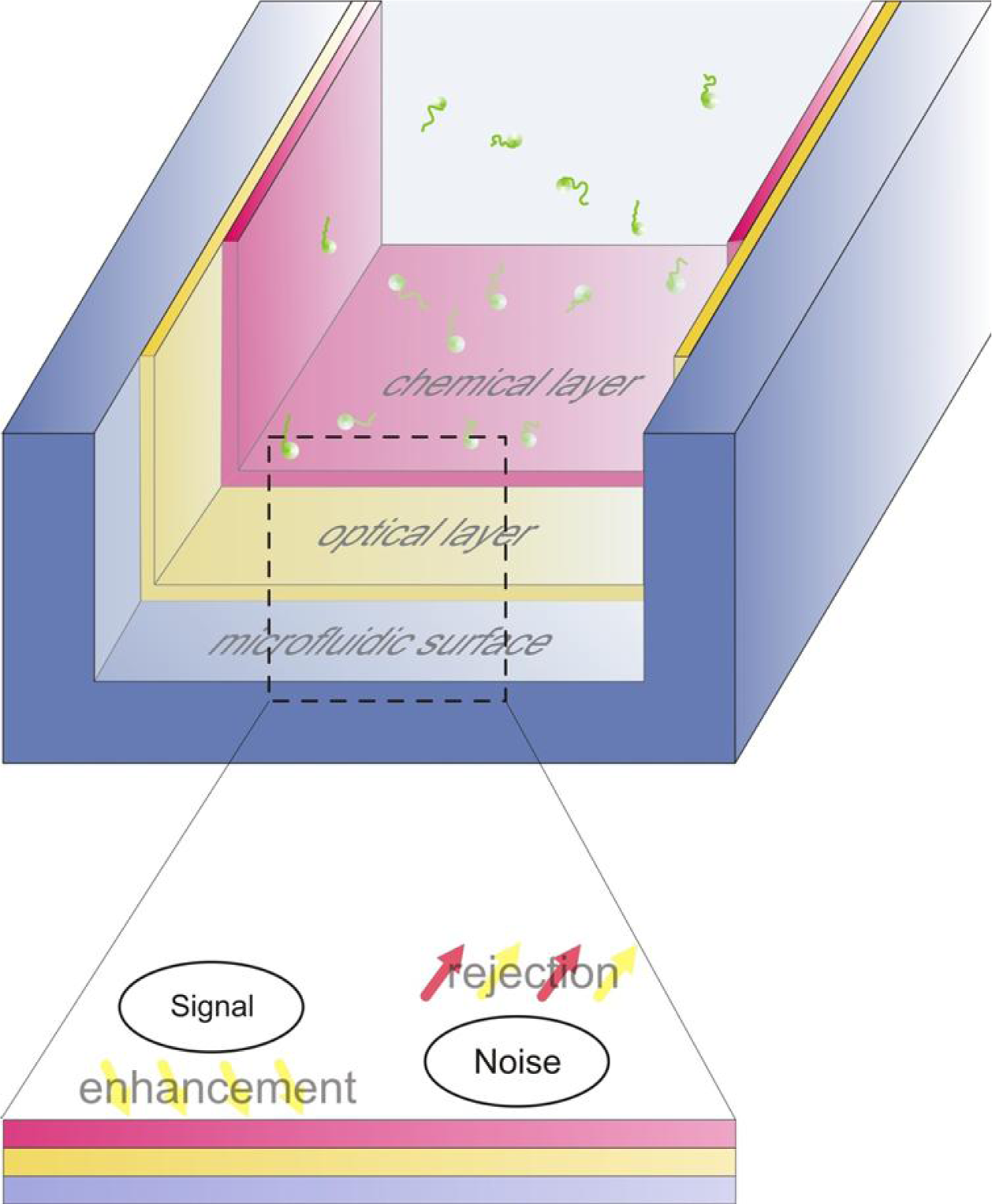
<p>Within this paper, we review recent reports on enhancing the signal to noise ratio during single molecule imaging in optofluidics and microfluidics (<xref ref-type="fig" rid="f1-ijms-12-05135">Figure 1</xref>). One way to achieve this type of enhancement is by increasing the signal emitted by single chromophores that reach the detector. We will review such methods in the optofluidic section (Section 2), highlighting the photonic structures that can be integrated with microfluidic channels. Similar performance enhancement can be achieved by minimizing the signal detected due to the presence of un-wanted molecules in the observation volume. To address this, there are in general two approaches. The first approach relates to the reduction of the observation volume, which can be achieved by both optofluidics (Section 2) and chemical techniques (Section 3). The second approach relates to the reduction of non-specific interactions, or equivalently the minimization of the number of un-wanted molecules within the observation volume. This is reviewed in section 4, where the related chemical strategies compatible with microfluidics are discussed.</p></sec>
<sec>
<label>2.</label>
<title>Signal to Noise Ratio Enhancement in Optofluidics</title>
<p>Multiple methods have been developed to push the fluorescence detection by employing photonic structures [<xref ref-type="bibr" rid="b54-ijms-12-05135">54</xref>–<xref ref-type="bibr" rid="b56-ijms-12-05135">56</xref>]. Such photonic structures exhibit a certain resonance frequency bandwidth; within this bandwidth they can passively either amplify light and/or modify its radiation pattern. Light in both cases can be either incident on such structures or be internally generated within them. In this paper, we will focus on the integration of such photonic structures with microfluidics. Such optofluidic examples involve the ‘zero mode waveguide’ [<xref ref-type="bibr" rid="b57-ijms-12-05135">57</xref>], integrated ARROW waveguides for FCS [<xref ref-type="bibr" rid="b58-ijms-12-05135">58</xref>], and evanescent wave resonators [<xref ref-type="bibr" rid="b52-ijms-12-05135">52</xref>,<xref ref-type="bibr" rid="b59-ijms-12-05135">59</xref>,<xref ref-type="bibr" rid="b60-ijms-12-05135">60</xref>]. We will highlight however only optofluidic methods for single molecule imaging and localization; such optofluidic principles are mostly related to one or a combination of the following:
<list list-type="order">
<list-item>
<p>Confinement of the excitation volume to reduce the background;</p></list-item>
<list-item>
<p>Confinement of the excitation density to enhance the pumping rate;</p></list-item>
<list-item>
<p>Modification of the radiative and non-radiative rates of the chromophores;</p></list-item>
<list-item>
<p>Scattering enhancement and optical loss minimization to increase the signal reaching the detector;</p></list-item>
<list-item>
<p>Modification of the emission pattern in order to improve the collection efficiency.</p></list-item></list></p>
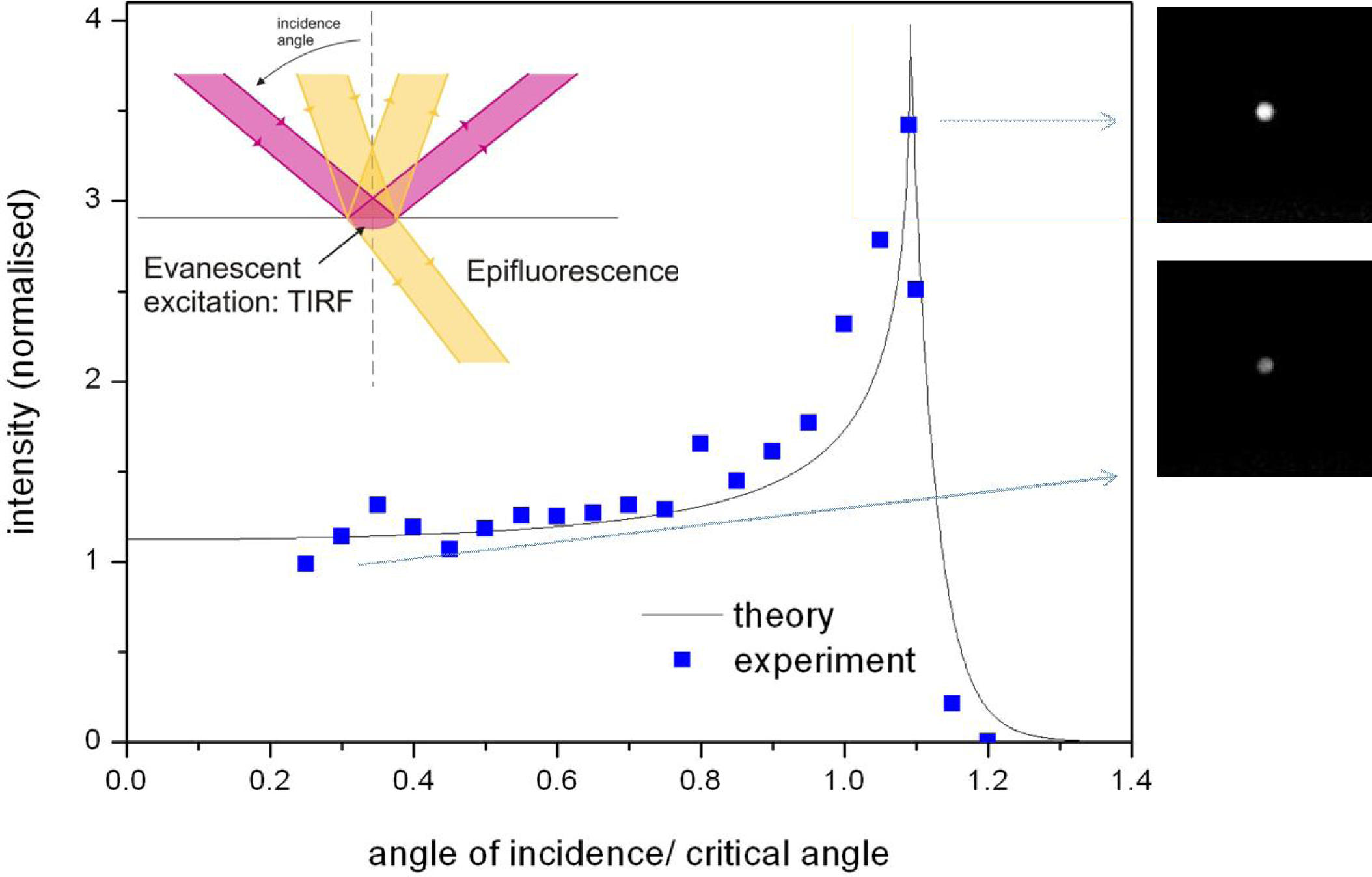
<p>Total internal reflection microscopy (TIRF) is one of the most conventional methods for fluorescence signal enhancement and, due to its compatibility with microfluidics, will be reviewed first for completeness, followed by methods to enhance the fluorescence emission by either employing metallic or dielectric micro- and nanostructures. In TIRF, evanescent waves are generated when light is totally reflected at the interface between two dielectric media (inset of <xref ref-type="fig" rid="f2-ijms-12-05135">Figure 2</xref>). The evanescent wave decays exponentially from the interface and thus selectively illuminates fluorophores in the close proximity to the interface (100’s nm) [<xref ref-type="bibr" rid="b61-ijms-12-05135">61</xref>,<xref ref-type="bibr" rid="b62-ijms-12-05135">62</xref>]. The most common TIRF configurations use a prism [<xref ref-type="bibr" rid="b55-ijms-12-05135">55</xref>,<xref ref-type="bibr" rid="b63-ijms-12-05135">63</xref>], or a high NA objective [<xref ref-type="bibr" rid="b64-ijms-12-05135">64</xref>,<xref ref-type="bibr" rid="b65-ijms-12-05135">65</xref>]. The excitation intensity and the resulting fluorescent signal [<xref ref-type="bibr" rid="b61-ijms-12-05135">61</xref>,<xref ref-type="bibr" rid="b66-ijms-12-05135">66</xref>] are several times stronger in the TIRF condition than in epifluorescence (<xref ref-type="fig" rid="f2-ijms-12-05135">Figure 2</xref>). This enhancement can be estimated by using the Fresnel equations [<xref ref-type="bibr" rid="b64-ijms-12-05135">64</xref>,<xref ref-type="bibr" rid="b67-ijms-12-05135">67</xref>,<xref ref-type="bibr" rid="b68-ijms-12-05135">68</xref>] and is synergetic to the coupling to surface modes, known as the Goos-Hänchen shift. In <xref ref-type="fig" rid="f2-ijms-12-05135">Figure 2</xref>, the intensity of the surface wave is plotted at different angles of incidence and is compared to an experimental measurement.</p>
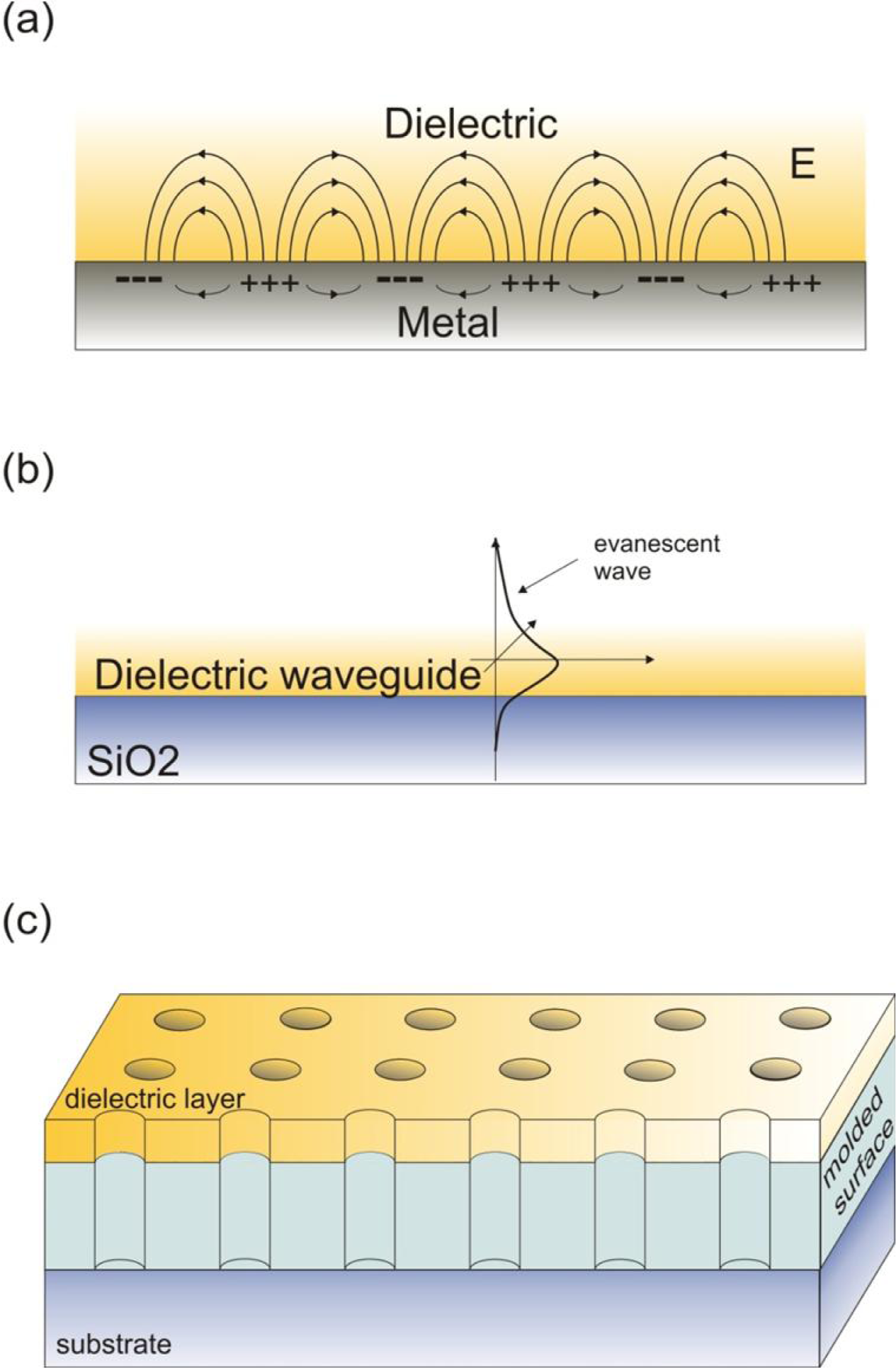
<p>An optofluidics-related approach to enhance the emission signal from single molecules is to employ surface plasmon polaritons (SPPs); these too are surface waves that only occur at the interface between a conductor and a dielectric [<xref ref-type="bibr" rid="b69-ijms-12-05135">69</xref>] (<xref ref-type="fig" rid="f3-ijms-12-05135">Figure 3a</xref>). SPPs are excited when incident light interacts with the conductor’s free charges that in turn collectively oscillate in resonance with the light wave. SPPs propagate along the conductor/external medium interface and the capability to structure such interfaces at the nanometer scale can lead to their strong resonant localization, primarily stemming from constructive interference. Plasmonic fluorescence enhancement has been demonstrated in a wide range of architectures, such as nanoparticles [<xref ref-type="bibr" rid="b70-ijms-12-05135">70</xref>–<xref ref-type="bibr" rid="b74-ijms-12-05135">74</xref>], nanowires [<xref ref-type="bibr" rid="b75-ijms-12-05135">75</xref>], thin films [<xref ref-type="bibr" rid="b76-ijms-12-05135">76</xref>], lithographically defined single [<xref ref-type="bibr" rid="b77-ijms-12-05135">77</xref>–<xref ref-type="bibr" rid="b79-ijms-12-05135">79</xref>] or composite nanostructures [<xref ref-type="bibr" rid="b80-ijms-12-05135">80</xref>–<xref ref-type="bibr" rid="b82-ijms-12-05135">82</xref>]. There are many excellent reviews on the topic [<xref ref-type="bibr" rid="b83-ijms-12-05135">83</xref>–<xref ref-type="bibr" rid="b86-ijms-12-05135">86</xref>], so we shall only highlight the most recent advances and the advantages and disadvantages of this method.</p>
<p>The most common mechanisms involved in plasmonic fluorescence enhancement are higher scattering efficiency due to the metal presence, denser excitation localization and thus pumping rate, and increased radiative rate due to the change in the photonic environment of the isolated chromophore [<xref ref-type="bibr" rid="b72-ijms-12-05135">72</xref>,<xref ref-type="bibr" rid="b87-ijms-12-05135">87</xref>]. Most recently, an enhancement of 1340 was reported using bow-tie antennas [<xref ref-type="bibr" rid="b78-ijms-12-05135">78</xref>]; these are lithographically defined plasmonic nanostructures with typical maximum dimensions in the range of 100’s nm with the capacity of strongly localizing the excitation field at their centre. Similar principles have recently found applications in non-linear imaging, by coating nanoparticles with a metal layer [<xref ref-type="bibr" rid="b88-ijms-12-05135">88</xref>]. Typical disadvantages regarding plasmonic fluorescence enhancement are its inverse relationship to the emitter’s quantum efficiency, and the substantial quenching that occurs when the chromophore is closer to the metal surface [<xref ref-type="bibr" rid="b89-ijms-12-05135">89</xref>,<xref ref-type="bibr" rid="b90-ijms-12-05135">90</xref>]. Another disadvantage of plasmonic resonators is their small size, which in turn substantially reduces the field of view. In addition, the integration of metallic structures with PDMS microfluidics may suffer from inefficient sealing, requiring the use of a specifically patterned metal layer or coating with a patterned polymer layer [<xref ref-type="bibr" rid="b91-ijms-12-05135">91</xref>] in order to eliminate the contact between PDMS and metallic surfaces.</p>
<p>Dielectric resonators coupled with single emitters have been also explored primarily within the context of quantum electrodynamics (QED) [<xref ref-type="bibr" rid="b92-ijms-12-05135">92</xref>,<xref ref-type="bibr" rid="b93-ijms-12-05135">93</xref>]. Similar principles have been applied to fluorescent imaging, albeit in the weak-coupling regime. One such dielectric architecture is thin films integrated immediately below the surface of interest (<xref ref-type="fig" rid="f3-ijms-12-05135">Figure 3b</xref>). One such embodiment is employed in TIRF, where films with appropriate optical properties and dimensions are used to resonantly enhance the evanescent field of totally internally reflected incident light via coupling to waveguide modes supported by the film [<xref ref-type="bibr" rid="b94-ijms-12-05135">94</xref>–<xref ref-type="bibr" rid="b98-ijms-12-05135">98</xref>]. Thin films can also be directly employed as waveguides, forming an integrated version of TIRF [<xref ref-type="bibr" rid="b99-ijms-12-05135">99</xref>,<xref ref-type="bibr" rid="b100-ijms-12-05135">100</xref>]; in these schemes light is end-coupled to the waveguide so that its evanescent intensity excites the fluorophores in the waveguide’s vicinity. More recently, a thin film was employed as an antenna, enhancing the collection efficiency to approximately 100% [<xref ref-type="bibr" rid="b101-ijms-12-05135">101</xref>]. In this case, the emitters are embedded in a thin polymer layer, sandwiched between a higher index medium layer (sapphire) and air. The high index medium forces the emitted light to refract at smaller angles, thereby enhancing the collection efficiency.</p>
<p>Periodic dielectric structures have also found applications in fluorescent enhancement. One such example is stacks of thin films, which exhibit very high Bragg reflectivity within a certain wavelength range. When single molecules are placed in the proximity of such structures and their emission spectrum overlaps with the mirror resonance, the spectrum and spontaneous emission rate can be substantially modified and enhanced, respectively [<xref ref-type="bibr" rid="b102-ijms-12-05135">102</xref>,<xref ref-type="bibr" rid="b103-ijms-12-05135">103</xref>]. Photonic crystals are another type of periodic dielectric structures that have been explored to the same end (<xref ref-type="fig" rid="f3-ijms-12-05135">Figure 3c</xref>). These are in most cases lithographically defined in high index dielectrics with minimal absorption in the wavelength range of interest. If carefully selected, their periodicity can impose a phase matching condition for both the excitation and emission wavelength [<xref ref-type="bibr" rid="b104-ijms-12-05135">104</xref>–<xref ref-type="bibr" rid="b107-ijms-12-05135">107</xref>]. The operational principle is based on the coupling of both the external pump and the fluorescence signal into Bloch wave modes; these modes are ‘leaky’ modes, manifested by their strong evanescent near fields on the surface of the photonic crystal, which is critical to enhancing the excitation and emission extraction. Very recently, annular Bragg resonators for focusing the excitation light have been demonstrated, exhibiting an enhancement factor of 20 [<xref ref-type="bibr" rid="b108-ijms-12-05135">108</xref>]. Colloidal microspheres, have been also employed, initially within the context of QED [<xref ref-type="bibr" rid="b109-ijms-12-05135">109</xref>]. Recently, sub-wavelength focusing was demonstrated by illuminating latex microspheres with Gaussian beams; this high excitation confinement resulted in a 5-fold enhancement of the single molecule fluorescence [<xref ref-type="bibr" rid="b110-ijms-12-05135">110</xref>]. Another practical effect of colloidal microspheres is the improvement in extraction by redirecting the light emitted at large angles toward the normal to the surface [<xref ref-type="bibr" rid="b103-ijms-12-05135">103</xref>]. More recently, the possibility to replace high-NA oil immersion objectives with colloidal particles was demonstrated [<xref ref-type="bibr" rid="b111-ijms-12-05135">111</xref>]; the use of low-NA objective lenses enabled high temperature and high photostability single molecule imaging. We note that dielectrics can be integrated with PDMS microfluidics due to the presence of a native oxide layer on their surfaces or their direct compatibility with O<sub>2</sub> plasma (e.g., polymers).</p></sec>
<sec>
<label>3.</label>
<title>Microfluidic Architectures for Minimizing Photobleaching and the Excitation Volume</title>
<p>One advantage of single molecule imaging is the higher time-domain resolution in interrogating molecular dynamics than is possible in ensemble studies. However, this can be hampered by the photostability of singlet exciton emission, due to O<sub>2</sub> and intersystem crossing mediated bleaching and blinking. The latter gives rise to stochastic fluctuations not linked to the biological behavior itself. These challenges have been addressed in microfluidics by mixing oxygen scavengers and triplet quenchers in the imaging buffer [<xref ref-type="bibr" rid="b112-ijms-12-05135">112</xref>], which recently, under careful design, enabled the shortest observation duration [<xref ref-type="bibr" rid="b113-ijms-12-05135">113</xref>]. An alternative approach integrating the imaging channels with ones continuously ventilated with nitrogen was recently demonstrated [<xref ref-type="bibr" rid="b114-ijms-12-05135">114</xref>]. Deoxygenation was possible due to the porous nature of PDMS, thus enabling measurements in the absence of the aforementioned enzymes that can interfere with biological activity [<xref ref-type="bibr" rid="b114-ijms-12-05135">114</xref>]. Another possible time-domain resolution limitation, especially in single molecule fluorescence energy transfer (smFRET), is the fluidic speed that can be relatively high especially during fluidic mixing. Sophisticated microfluidic architectures can address this by reducing the flow velocities immediately after mixing, thereby enabling longer optical interrogations [<xref ref-type="bibr" rid="b115-ijms-12-05135">115</xref>].</p>
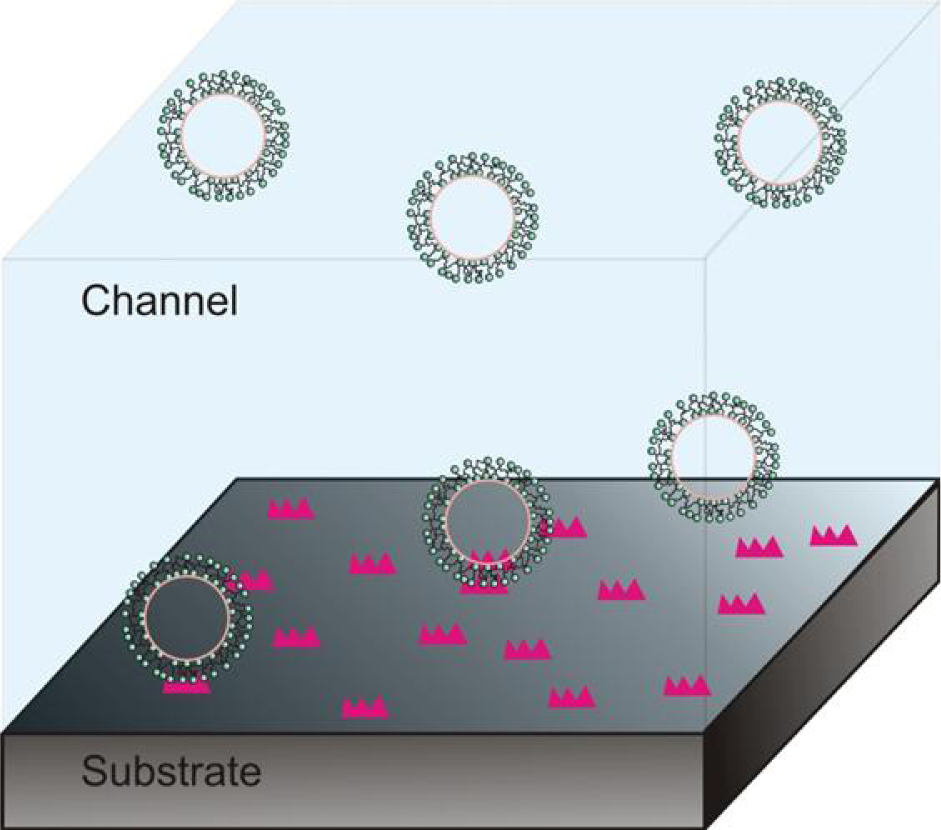
<p>Confocal imaging exhibits superior sensitivity by significantly restricting the excitation volume and thus minimizing the background fluorescence [<xref ref-type="bibr" rid="b4-ijms-12-05135">4</xref>,<xref ref-type="bibr" rid="b116-ijms-12-05135">116</xref>,<xref ref-type="bibr" rid="b117-ijms-12-05135">117</xref>]. Microfluidic and nanofluidic systems can in principle achieve the same and push the limits of fluorescence detection. Within this paper, we will focus on the former, as many excellent reviews exist on the latter [<xref ref-type="bibr" rid="b118-ijms-12-05135">118</xref>–<xref ref-type="bibr" rid="b120-ijms-12-05135">120</xref>]. Apart from reduced size microfluidic channels employed in a recent report of multidimensional investigation of molecular energy landscapes and activities [<xref ref-type="bibr" rid="b30-ijms-12-05135">30</xref>], volume restriction can be achieved by using micro-droplets [<xref ref-type="bibr" rid="b42-ijms-12-05135">42</xref>,<xref ref-type="bibr" rid="b121-ijms-12-05135">121</xref>]. The latter have not yet found widespread applications in single molecule imaging, contrary to vesicle encapsulation, which additionally exhibits much smaller volumes and the possibility of surface tethering [<xref ref-type="bibr" rid="b122-ijms-12-05135">122</xref>–<xref ref-type="bibr" rid="b123-ijms-12-05135">123</xref>]. In addition to the very small observation volumes, vesicle encapsulation (<xref ref-type="fig" rid="f4-ijms-12-05135">figure 4</xref>) enables the exclusion of any interaction of the contained molecules with the environment (including the surface), and as the possibility to combine surface immobilization with molecular recognition mechanisms, such as sequence specificity, thus forming a single molecule sensor of unlabeled oligonucleotides [<xref ref-type="bibr" rid="b124-ijms-12-05135">124</xref>].</p></sec>
<sec>
<label>4.</label>
<title>Noise Reduction Using Microfluidic Compatible Surface Passivation Strategies</title>
<p>Adhesion to biomaterials has been explored for many years, primarily focusing on the development of surfaces capable of non-specific protein adsorption for applications in implants, contact lenses and bioassays. Similar challenges have also been addressed in microfluidics. Microfluidic surfaces can act as anchoring points, where the molecules under investigation are immobilized. As discussed in the introduction, these attachment points need to exhibit certain properties in order to enhance the imaging of single molecules. In addition to their capacity to attract the ‘signal molecules’ with high affinity and resist non-specific adsorption of molecules that can contribute to noise [<xref ref-type="bibr" rid="b125-ijms-12-05135">125</xref>–<xref ref-type="bibr" rid="b128-ijms-12-05135">128</xref>], there are additional properties that we summarize below:
<list list-type="order">
<list-item>
<p>Simplicity and minimal preparation requirements: Single molecule imaging and detection is becoming a substantially interdisciplinary field, comprised of biologists, physicists and chemists. Hence, synergetic also to microfluidics, the chemical modification needs to be simple and require few implementation steps;</p></list-item>
<list-item>
<p>Compatibility with microfluidic fabrication: this necessitates that the surface chemistry is not compromised during fabrication, but also that the microfluidics retain their properties (e.g., mechanical) during surface treatment;</p></list-item>
<list-item>
<p>Bioactivity: The immobilized biomolecules must retain their activity, for example a protein that can unfold and refold, or a nucleic acid that can be recognized by site-specific proteins.</p></list-item></list></p>
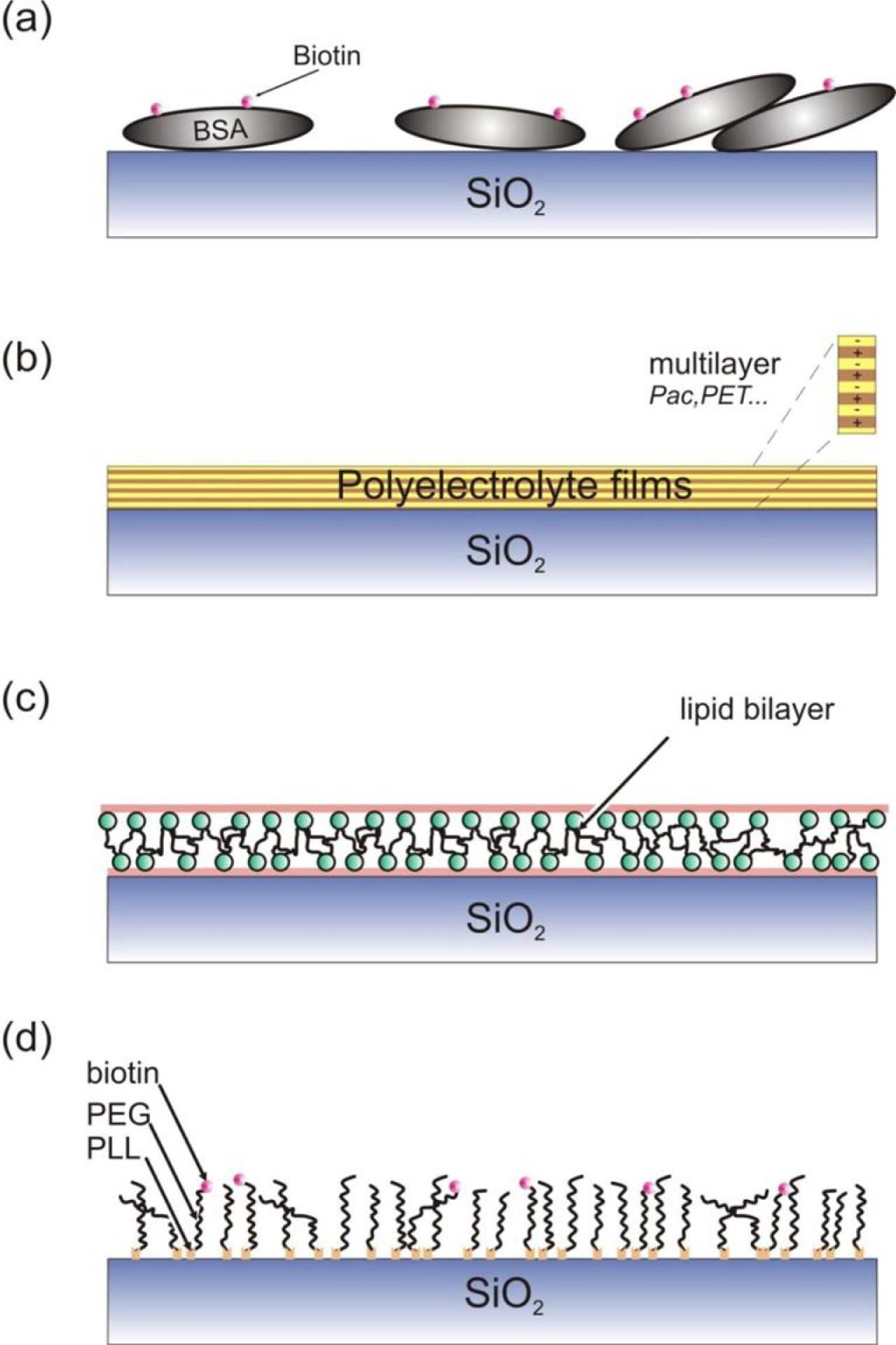
<p>Depending on the type of microfluidic devices and their fabrication, surfaces can be modified via a variety of chemistries. It is widely accepted that no single chemistry is compatible with multiple single molecule imaging analyses. Herein, we will not discuss gel confinement via polymerization [<xref ref-type="bibr" rid="b129-ijms-12-05135">129</xref>,<xref ref-type="bibr" rid="b130-ijms-12-05135">130</xref>] due to its contradiction to one of the main microfluidic advantages, namely that of flow-based delivery and multiplexing. On the contrary, we will focus on processes that can be performed either in-situ or ex-situ and comply with the aforementioned ‘ideal’ properties (<xref ref-type="fig" rid="f5-ijms-12-05135">Figure 5</xref>).</p>
<p>Self-assembly (SAM) and self-organization of molecular films have also been extensively reported. One area is the creation of monolayers of alkyl chains on thin gold films [<xref ref-type="bibr" rid="b131-ijms-12-05135">131</xref>]. While such techniques are especially important in surface plasmon resonance measurements (SPR), more recently similar approaches have been proposed for PDMS, the cornerstone medium for microfluidics. In the latter, the PDMS pre-polymer is mixed with small molecules and then cast against a template with a specific surface energy [<xref ref-type="bibr" rid="b132-ijms-12-05135">132</xref>,<xref ref-type="bibr" rid="b133-ijms-12-05135">133</xref>]. During cross-linking, the small molecules in the PDMS solution are driven to the surface in order to match the energy of the mold surface. This method is particularly pertinent for the creation of chemical patterns, however to the authors’ knowledge the bonding with micro-channels is rather challenging to achieve using such surface treated templates.</p>
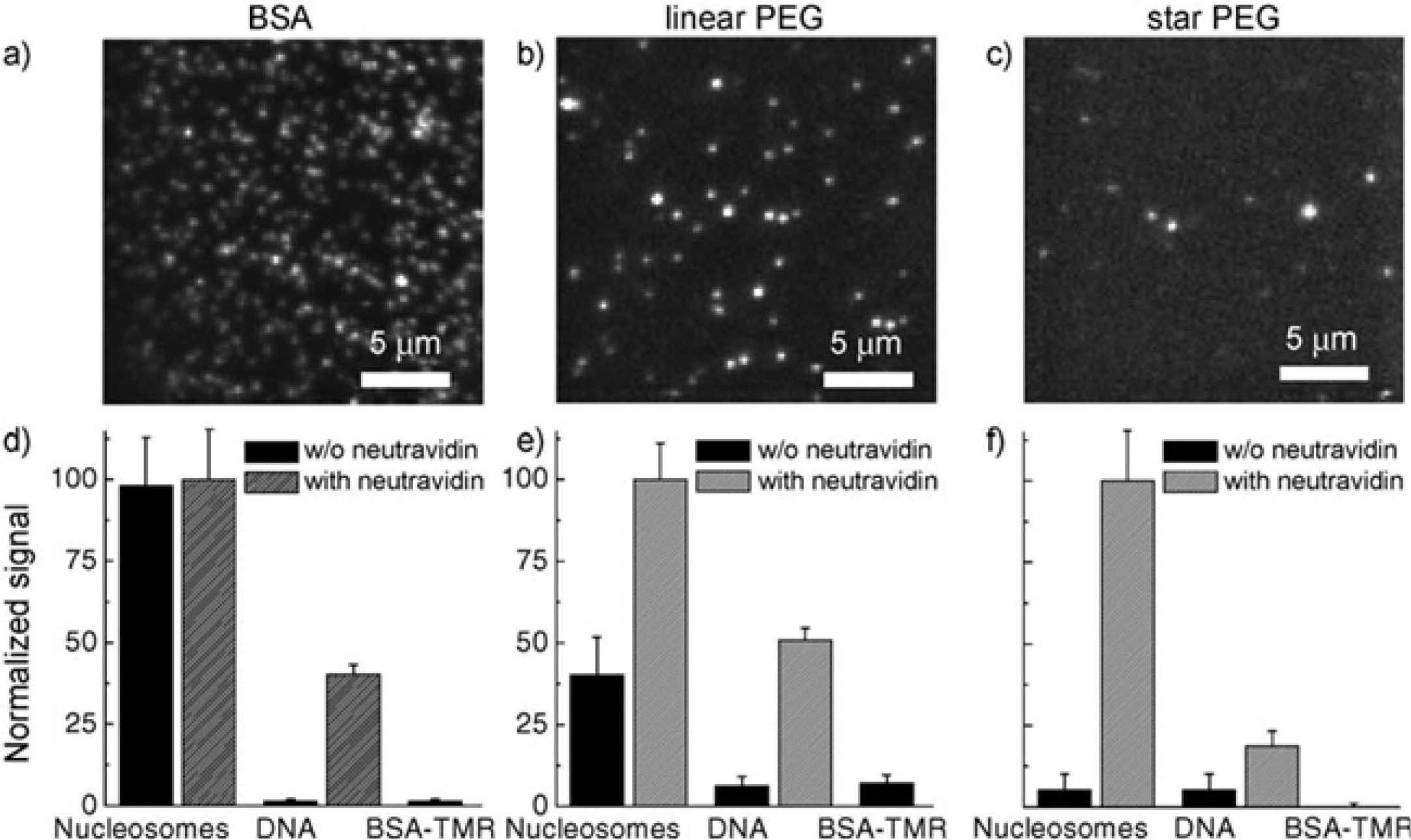
<p>A more common method to avoid non-specific interactions, is to pre-coat the surface with strongly adhering proteins. Subsequently, the resulting formed thin protein layer blocks in turn the surface recognition by other molecules. A typical protein of this type is bovine albumin (BSA) [<xref ref-type="bibr" rid="b134-ijms-12-05135">134</xref>], which can be biotinylated, providing thus the possibility of a biotin-streptavidin linkage (<xref ref-type="fig" rid="f5-ijms-12-05135">Figure 5a</xref>). This technique is rather straightforward to implement and can be performed in situ, once the microfluidics or flow channels have been realized. However, it has been shown that the technique does not exhibit the highest level of non-specific adsorption prevention [<xref ref-type="bibr" rid="b126-ijms-12-05135">126</xref>] and to also potentially interfere with the kinetics of immobilized molecules, such as ribozymes [<xref ref-type="bibr" rid="b127-ijms-12-05135">127</xref>,<xref ref-type="bibr" rid="b135-ijms-12-05135">135</xref>] (<xref ref-type="fig" rid="f6-ijms-12-05135">Figure 6</xref>).</p>
<p>An alternative approach for in-situ passivation of microchannels was recently demonstrated by Illumina in single molecule sequencing [<xref ref-type="bibr" rid="b136-ijms-12-05135">136</xref>]. The technique involved the polymerization of acrylamide in glass capillaries and exhibited significant prevention against non-specific recognition, high sensitivity in isolated nucleic acid imaging, as well as stability over repeated polymerase chain reactions (PCR) [<xref ref-type="bibr" rid="b128-ijms-12-05135">128</xref>]. With regards to single molecule DNA sequencing, another technique is based on the use of polyelectrolyte films (<xref ref-type="fig" rid="f5-ijms-12-05135">Figure 5b</xref>). One report focused on the use of single polyacrilic acid layers and was shown to exhibit low tendency to attract fluorescently labeled bases [<xref ref-type="bibr" rid="b137-ijms-12-05135">137</xref>]. Multiple films can also be used [<xref ref-type="bibr" rid="b15-ijms-12-05135">15</xref>,<xref ref-type="bibr" rid="b138-ijms-12-05135">138</xref>,<xref ref-type="bibr" rid="b140-ijms-12-05135">140</xref>]. Polyelectrolyte multi-layer films effectively tune the charge density of the substrate and thus exhibit the capacity to repel molecules with the same charge via electrostatic interactions.</p>
<p>Similar strategies of in-situ passivation of PDMS microchannels involve the use of the Pluronic copolymer [<xref ref-type="bibr" rid="b141-ijms-12-05135">141</xref>,<xref ref-type="bibr" rid="b142-ijms-12-05135">142</xref>]. However, most Pluronic treatment applications focus on the use of microfluidics as cell-culture systems. As an alternative, individual components of the Pluronic block-copolymers, namely poly(ethylene oxide) grafted on oxide surfaces, have been extensively studied in single molecule imaging. Such passivation treatments were shown to exhibit near zero adsorption both when the polymer exhibits linear and star-shape form and exhibit bioactivity evidenced by the reversible denaturation and renaturation of immobilized ribonucleases H (RNase H) [<xref ref-type="bibr" rid="b143-ijms-12-05135">143</xref>,<xref ref-type="bibr" rid="b144-ijms-12-05135">144</xref>]. However, grafting of PEO requires the surface treatment with aminosilanes, which can exhibit certain disadvantages for in-situ passivation, especially when used with PDMS which swells under treatment with organic solvents [<xref ref-type="bibr" rid="b145-ijms-12-05135">145</xref>].</p>
<p>Supported lipid bilayers have also been extensively explored as protein resistant surfaces for single molecule studies (<xref ref-type="fig" rid="f5-ijms-12-05135">Figure 5c</xref>) [<xref ref-type="bibr" rid="b146-ijms-12-05135">146</xref>]. In addition to their bio-fouling properties, bilayers exhibit a chemical nature that simulates that of the cellular environment and as a result specifically immobilized biomolecules are expected to maintain their bioactivity [<xref ref-type="bibr" rid="b146-ijms-12-05135">146</xref>]. Such membranes are commonly spontaneously assembled from small unilamellar vesicles [<xref ref-type="bibr" rid="b147-ijms-12-05135">147</xref>]. Once formed, these bilayers behave like true two-dimensional fluids and any molecules residing on them diffuse freely in the surface plane [<xref ref-type="bibr" rid="b148-ijms-12-05135">148</xref>]. Such architectures have found substantial applications within the area of DNA manipulation and stretching by flow [<xref ref-type="bibr" rid="b149-ijms-12-05135">149</xref>,<xref ref-type="bibr" rid="b150-ijms-12-05135">150</xref>]. In these experiments, highly ordered DNA arrays are formed at localized microscale lipid diffusion barriers, forming thus an elegant assay for highly multiplexed nucleic acid structural studies [<xref ref-type="bibr" rid="b151-ijms-12-05135">151</xref>]. On the contrary, dehydration, e.g. occurring during molecular combing, may be considered a disadvantage of this method.</p>
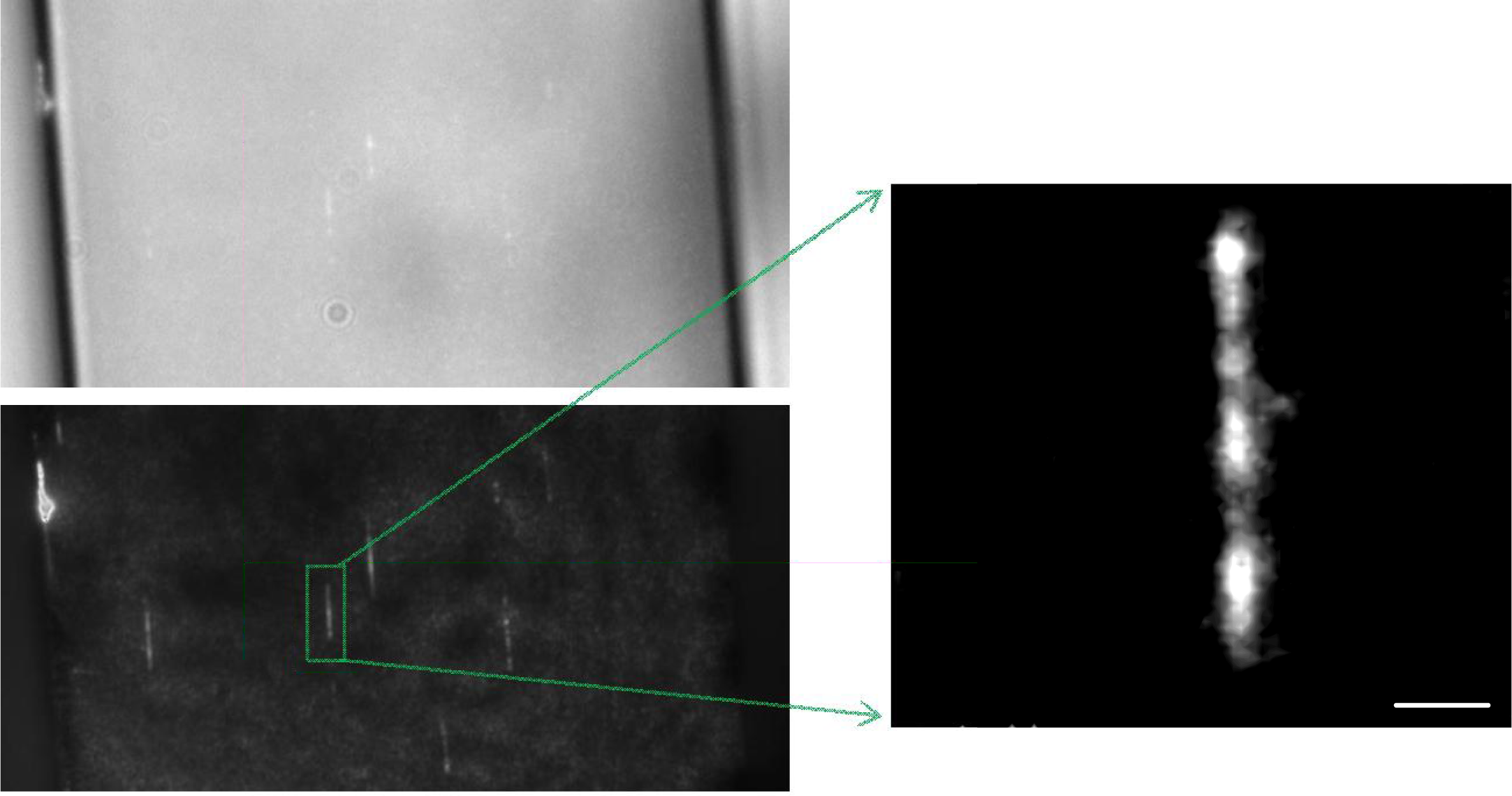
<p>The final surface functionalization approach we will discuss and possibly the most common one is poly(ethylene glycol) (PEG) (<xref ref-type="fig" rid="f5-ijms-12-05135">Figure 5d</xref>). PEG has been characterized as the benchmark in resistance of non-specific interactions via steric hindrance and has found a plethora of applications in implants, cell cultures, microfluidics and protein circulation in vivo [<xref ref-type="bibr" rid="b152-ijms-12-05135">152</xref>–<xref ref-type="bibr" rid="b156-ijms-12-05135">156</xref>]. PEG however does not react with untreated surfaces, thus necessitating an additional surface treatment step. One method is to perform the functionalization ex-situ and then fabricate the microfluidic channels [<xref ref-type="bibr" rid="b157-ijms-12-05135">157</xref>]; however, many microfluidic architectures, especially lithographically defined ones, are not compatible with this method as they require the invasive step of bonding and sealing. As a result, several methods have been developed to address this and perform in-situ PEGylation of microfluidic surfaces. Physisorption with PEG copolymers is one of the simplest ones, and involves only the incubation of aqueous buffers of the copolymer. Poly(<sc>l</sc>-lysine)-<italic>g</italic>-poly(ethylene glycol) (PLL-<italic>g</italic>-PEG) is one such copolymer, which has found numerous applications in both oxide and PDMS based microfluidics for cell cultures, protein studies and single molecule manipulation and imaging [<xref ref-type="bibr" rid="b40-ijms-12-05135">40</xref>,<xref ref-type="bibr" rid="b153-ijms-12-05135">153</xref>,<xref ref-type="bibr" rid="b158-ijms-12-05135">158</xref>,<xref ref-type="bibr" rid="b159-ijms-12-05135">159</xref>] (<xref ref-type="fig" rid="f7-ijms-12-05135">Figure 7</xref>). An alternative PEG surface functionalization is based on the covalent bonding of PEG to albumin microgels, which are recognized by the surface [<xref ref-type="bibr" rid="b160-ijms-12-05135">160</xref>]. This technique however remains to be fully explored in single molecule imaging applications. Despite recent efforts, little has been achieved specifically in replacing PEG. One such example is dextran [<xref ref-type="bibr" rid="b161-ijms-12-05135">161</xref>], which however requires additional efforts to render the functionalization process less toxic [<xref ref-type="bibr" rid="b162-ijms-12-05135">162</xref>].</p>
<p>Alternative means for in situ PEGylation of microfluidic surfaces involves direct grafting, usually by first treating the microfluidic surface and subsequently introducing the PEG solution. These processes are usually laborious and require long surface treatments that can interfere with the stability of the microchannels; however they have been shown to provide uniform and extremely stable functionalized surfaces [<xref ref-type="bibr" rid="b163-ijms-12-05135">163</xref>–<xref ref-type="bibr" rid="b165-ijms-12-05135">165</xref>]. Star-PEG has been used with similar methods, and shown to exhibit superior protein adsorption resistance due to its higher surface coverage and thickness (<xref ref-type="fig" rid="f6-ijms-12-05135">Figure 6</xref>) [<xref ref-type="bibr" rid="b126-ijms-12-05135">126</xref>,<xref ref-type="bibr" rid="b166-ijms-12-05135">166</xref>]. Alternative techniques of functionalizing surfaces with PEG involve directly mixing the PDMS prepolymer with PEG additives terminated with appropriate end groups [<xref ref-type="bibr" rid="b167-ijms-12-05135">167</xref>,<xref ref-type="bibr" rid="b168-ijms-12-05135">168</xref>], or by photografting [<xref ref-type="bibr" rid="b169-ijms-12-05135">169</xref>,<xref ref-type="bibr" rid="b170-ijms-12-05135">170</xref>], which also poses an elegant method for <italic>in-situ</italic> creating chemical patterns. Finally, the direct imprinting of PEG films with microchannels has been reported with some excellent results on non-biofouling, albeit with reported challenges in bonding and sealing [<xref ref-type="bibr" rid="b171-ijms-12-05135">171</xref>,<xref ref-type="bibr" rid="b172-ijms-12-05135">172</xref>].</p></sec>
<sec sec-type="conclusions">
<label>5.</label>
<title>Conclusions</title>
<p>We have reviewed a wide range of methods for enhancing the signal to noise ratio of single molecule imaging in microfluidics. Photonic structures can be directly integrated in the vicinity of micro-channels, forming thus optofluidic platforms that both minimize the background and enhance the signal. Multiple such structures exist that can be adopted for different fluorophores and types of measurements. When choosing, care needs to be taken in order not to substantially modify the photophysical properties of the labels, or if desired, to do it in a controlled way. Due to their fabrication simplicity (bottom-up mostly), plasmonic resonators have been explored more than dielectric ones for single molecule detection; however, recent reports demonstrate the possibility of achieving comparable performances.</p>
<p>With regards to microfluidic approaches, we reviewed architectures that can enhance the sensitivity in single molecule imaging. The latter was mostly related to time domain resolution, stability, and volume restriction methods for adapting the confocal principle in microfluidics. Finally, common surface passivation methods were reviewed; in general, there is no ideal procedure applicable to all types of single molecule experiments. We have attempted to highlight the most popular techniques that are synergetic to microfluidics, both in terms of fabrication and simplicity. One exciting emerging concept to this end is the aptamer surface functionalization [<xref ref-type="bibr" rid="b173-ijms-12-05135">173</xref>]; however, apart from affinity extractions and separations, little has been reported within the context of single molecule imaging.</p></sec></body>
<back>
<ack>
<p>We are grateful to Demetri Psaltis for fruitful and inspiring discussions; in addition, we acknowledge the assistance we received by Aleksandra Radenovic and members of her group for the DNA related experiments and many discussions on TIRF microscopy.</p></ack>
<ref-list>
<title>References</title>
<ref id="b1-ijms-12-05135"><label>1.</label><citation citation-type="journal"><person-group person-group-type="author"><name><surname>Moerner</surname><given-names>WE</given-names></name><name><surname>Kador</surname><given-names>L</given-names></name></person-group><article-title>Optical detection and spectroscopy of single molecules in a solid</article-title><source>Phys. Rev. Lett</source><year>1989</year><volume>62</volume><fpage>2535</fpage><lpage>2538</lpage><pub-id pub-id-type="doi">10.1103/PhysRevLett.62.2535</pub-id><pub-id pub-id-type="pmid">10040013</pub-id></citation></ref>
<ref id="b2-ijms-12-05135"><label>2.</label><citation citation-type="journal"><person-group person-group-type="author"><name><surname>Orrit</surname><given-names>M</given-names></name><name><surname>Bernard</surname><given-names>J</given-names></name></person-group><article-title>Single pentacene molecules detected by fluorescence excitation in a para-terpenyl crystal</article-title><source>Phys. Rev. Lett</source><year>1990</year><volume>65</volume><fpage>2716</fpage><lpage>2719</lpage><pub-id pub-id-type="doi">10.1103/PhysRevLett.65.2716</pub-id><pub-id pub-id-type="pmid">10042674</pub-id></citation></ref>
<ref id="b3-ijms-12-05135"><label>3.</label><citation citation-type="journal"><person-group person-group-type="author"><name><surname>Betzig</surname><given-names>E</given-names></name><name><surname>Chichester</surname><given-names>RJ</given-names></name></person-group><article-title>Single molecules observed by near-field scanning optical microscopy</article-title><source>Science</source><year>1993</year><volume>262</volume><fpage>1422</fpage><lpage>1425</lpage><pub-id pub-id-type="doi">10.1126/science.262.5138.1422</pub-id><pub-id pub-id-type="pmid">17736823</pub-id></citation></ref>
<ref id="b4-ijms-12-05135"><label>4.</label><citation citation-type="journal"><person-group person-group-type="author"><name><surname>Nie</surname><given-names>SM</given-names></name><name><surname>Chiu</surname><given-names>DT</given-names></name><name><surname>Zare</surname><given-names>RN</given-names></name></person-group><article-title>Probing individual molecules with confocal fluorescence microscopy</article-title><source>Science</source><year>1994</year><volume>266</volume><fpage>1018</fpage><lpage>1021</lpage><pub-id pub-id-type="doi">10.1126/science.7973650</pub-id><pub-id pub-id-type="pmid">7973650</pub-id></citation></ref>
<ref id="b5-ijms-12-05135"><label>5.</label><citation citation-type="journal"><person-group person-group-type="author"><name><surname>Macklin</surname><given-names>JJ</given-names></name><name><surname>Trautman</surname><given-names>JK</given-names></name><name><surname>Harris</surname><given-names>TD</given-names></name><name><surname>Brus</surname><given-names>LE</given-names></name></person-group><article-title>Imaging and time-resolved spectroscopy of single molecules at an interface</article-title><source>Science</source><year>1996</year><volume>272</volume><fpage>255</fpage><lpage>258</lpage><pub-id pub-id-type="doi">10.1126/science.272.5259.255</pub-id></citation></ref>
<ref id="b6-ijms-12-05135"><label>6.</label><citation citation-type="journal"><person-group person-group-type="author"><name><surname>Xie</surname><given-names>XS</given-names></name></person-group><article-title>Single-molecule spectroscopy and dynamics at room temperature</article-title><source>Acc. Chem. Res</source><year>1996</year><volume>29</volume><fpage>598</fpage><lpage>606</lpage><pub-id pub-id-type="doi">10.1021/ar950246m</pub-id></citation></ref>
<ref id="b7-ijms-12-05135"><label>7.</label><citation citation-type="journal"><person-group person-group-type="author"><name><surname>Weiss</surname><given-names>S</given-names></name></person-group><article-title>Measuring conformational dynamics of biomolecules by single molecule fluorescence spectroscopy</article-title><source>Nat. Struct. Biol</source><year>2000</year><volume>7</volume><fpage>724</fpage><lpage>729</lpage><pub-id pub-id-type="doi">10.1038/78941</pub-id><pub-id pub-id-type="pmid">10966638</pub-id></citation></ref>
<ref id="b8-ijms-12-05135"><label>8.</label><citation citation-type="journal"><person-group person-group-type="author"><name><surname>Lupton</surname><given-names>JM</given-names></name></person-group><article-title>Single-molecule spectroscopy for plastic electronics: Materials analysis from the bottom-up</article-title><source>Adv. Mater</source><year>2010</year><volume>22</volume><fpage>1689</fpage><lpage>1721</lpage><pub-id pub-id-type="doi">10.1002/adma.200902306</pub-id><pub-id pub-id-type="pmid">20496402</pub-id></citation></ref>
<ref id="b9-ijms-12-05135"><label>9.</label><citation citation-type="journal"><person-group person-group-type="author"><name><surname>Moerner</surname><given-names>WE</given-names></name></person-group><article-title>New directions in single-molecule imaging and analysis</article-title><source>Proc. Natl. Acad. Sci. USA</source><year>2007</year><volume>104</volume><fpage>12596</fpage><lpage>12602</lpage><pub-id pub-id-type="doi">10.1073/pnas.0610081104</pub-id><pub-id pub-id-type="pmid">17664434</pub-id></citation></ref>
<ref id="b10-ijms-12-05135"><label>10.</label><citation citation-type="journal"><person-group person-group-type="author"><name><surname>Joo</surname><given-names>C</given-names></name><name><surname>Balci</surname><given-names>H</given-names></name><name><surname>Ishitsuka</surname><given-names>Y</given-names></name><name><surname>Buranachai</surname><given-names>C</given-names></name><name><surname>Ha</surname><given-names>T</given-names></name></person-group><article-title>Advances in single-molecule fluorescence methods for molecular biology</article-title><source>Annu. Rev. Biochem</source><year>2008</year><volume>77</volume><fpage>51</fpage><lpage>76</lpage><pub-id pub-id-type="doi">10.1146/annurev.biochem.77.070606.101543</pub-id><pub-id pub-id-type="pmid">18412538</pub-id></citation></ref>
<ref id="b11-ijms-12-05135"><label>11.</label><citation citation-type="book"><person-group person-group-type="author"><name><surname>Lakowicz</surname><given-names>JR</given-names></name></person-group><source>Principles of Fluorescence Spectroscopy</source><publisher-name>Springer</publisher-name><publisher-loc>New York, NY, USA</publisher-loc><year>2006</year></citation></ref>
<ref id="b12-ijms-12-05135"><label>12.</label><citation citation-type="journal"><person-group person-group-type="author"><name><surname>Shimomura</surname><given-names>O</given-names></name><name><surname>Johnson</surname><given-names>FH</given-names></name><name><surname>Saiga</surname><given-names>Y</given-names></name></person-group><article-title>Extraction, purification and properties of Aequorin, a bioluminescent protein from muminous hydromedusan Aequorea</article-title><source>J. Cell. Comp. Physiol</source><year>1962</year><volume>59</volume><fpage>223</fpage><lpage>239</lpage><pub-id pub-id-type="doi">10.1002/jcp.1030590302</pub-id><pub-id pub-id-type="pmid">13911999</pub-id></citation></ref>
<ref id="b13-ijms-12-05135"><label>13.</label><citation citation-type="journal"><person-group person-group-type="author"><name><surname>Chalfie</surname><given-names>M</given-names></name><name><surname>Tu</surname><given-names>Y</given-names></name><name><surname>Euskirchen</surname><given-names>G</given-names></name><name><surname>Ward</surname><given-names>WW</given-names></name><name><surname>Prasher</surname><given-names>DC</given-names></name></person-group><article-title>Green fluorescent protein as a marker for gene expression</article-title><source>Science</source><year>1994</year><volume>263</volume><fpage>802</fpage><lpage>805</lpage><pub-id pub-id-type="doi">10.1126/science.8303295</pub-id><pub-id pub-id-type="pmid">8303295</pub-id></citation></ref>
<ref id="b14-ijms-12-05135"><label>14.</label><citation citation-type="journal"><person-group person-group-type="author"><name><surname>Giepmans</surname><given-names>BNG</given-names></name><name><surname>Adams</surname><given-names>SR</given-names></name><name><surname>Ellisman</surname><given-names>MH</given-names></name><name><surname>Tsien</surname><given-names>RY</given-names></name></person-group><article-title>The fluorescent toolbox for assessing protein location and function</article-title><source>Science</source><year>2006</year><volume>312</volume><fpage>217</fpage><lpage>224</lpage><pub-id pub-id-type="doi">10.1126/science.1124618</pub-id><pub-id pub-id-type="pmid">16614209</pub-id></citation></ref>
<ref id="b15-ijms-12-05135"><label>15.</label><citation citation-type="journal"><person-group person-group-type="author"><name><surname>Braslavsky</surname><given-names>I</given-names></name><name><surname>Hebert</surname><given-names>B</given-names></name><name><surname>Kartalov</surname><given-names>E</given-names></name><name><surname>Quake</surname><given-names>SR</given-names></name></person-group><article-title>Sequence information can be obtained from single DNA molecules</article-title><source>Proc. Natl. Acad. Sci. USA</source><year>2003</year><volume>100</volume><fpage>3960</fpage><lpage>3964</lpage><pub-id pub-id-type="doi">10.1073/pnas.0230489100</pub-id><pub-id pub-id-type="pmid">12651960</pub-id></citation></ref>
<ref id="b16-ijms-12-05135"><label>16.</label><citation citation-type="journal"><person-group person-group-type="author"><name><surname>Fuller</surname><given-names>CW</given-names></name><name><surname>Middendorf</surname><given-names>LR</given-names></name><name><surname>Benner</surname><given-names>SA</given-names></name><name><surname>Church</surname><given-names>GM</given-names></name><name><surname>Harris</surname><given-names>T</given-names></name><name><surname>Huang</surname><given-names>XH</given-names></name><name><surname>Jovanovich</surname><given-names>SB</given-names></name><name><surname>Nelson</surname><given-names>JR</given-names></name><name><surname>Schloss</surname><given-names>JA</given-names></name><name><surname>Schwartz</surname><given-names>DC</given-names></name><etal/></person-group><article-title>The challenges of sequencing by synthesis</article-title><source>Nat. Biotechnol</source><year>2009</year><volume>27</volume><fpage>1013</fpage><lpage>1023</lpage><pub-id pub-id-type="doi">10.1038/nbt.1585</pub-id><pub-id pub-id-type="pmid">19898456</pub-id></citation></ref>
<ref id="b17-ijms-12-05135"><label>17.</label><citation citation-type="journal"><person-group person-group-type="author"><name><surname>Flusberg</surname><given-names>BA</given-names></name><name><surname>Webster</surname><given-names>DR</given-names></name><name><surname>Lee</surname><given-names>JH</given-names></name><name><surname>Travers</surname><given-names>KJ</given-names></name><name><surname>Olivares</surname><given-names>EC</given-names></name><name><surname>Clark</surname><given-names>TA</given-names></name><name><surname>Korlach</surname><given-names>J</given-names></name><name><surname>Turner</surname><given-names>SW</given-names></name></person-group><article-title>Direct detection of DNA methylation during single-molecule, real-time sequencing</article-title><source>Nat. Methods</source><year>2010</year><volume>7</volume><fpage>461</fpage><lpage>465</lpage><pub-id pub-id-type="doi">10.1038/nmeth.1459</pub-id><pub-id pub-id-type="pmid">20453866</pub-id></citation></ref>
<ref id="b18-ijms-12-05135"><label>18.</label><citation citation-type="journal"><person-group person-group-type="author"><name><surname>van Oijen</surname><given-names>AM</given-names></name><name><surname>Kohler</surname><given-names>J</given-names></name><name><surname>Schmidt</surname><given-names>J</given-names></name><name><surname>Muller</surname><given-names>M</given-names></name><name><surname>Brakenhoff</surname><given-names>GJ</given-names></name></person-group><article-title>3-Dimensional super-resolution by spectrally selective imaging</article-title><source>Chem. Phys. Lett</source><year>1998</year><volume>292</volume><fpage>183</fpage><lpage>187</lpage><pub-id pub-id-type="doi">10.1016/S0009-2614(98)00673-3</pub-id></citation></ref>
<ref id="b19-ijms-12-05135"><label>19.</label><citation citation-type="journal"><person-group person-group-type="author"><name><surname>Thompson</surname><given-names>RE</given-names></name><name><surname>Larson</surname><given-names>DR</given-names></name><name><surname>Webb</surname><given-names>WW</given-names></name></person-group><article-title>Precise nanometer localization analysis for individual fluorescent probes</article-title><source>Biophys. J</source><year>2002</year><volume>82</volume><fpage>2775</fpage><lpage>2783</lpage><pub-id pub-id-type="doi">10.1016/S0006-3495(02)75618-X</pub-id><pub-id pub-id-type="pmid">11964263</pub-id></citation></ref>
<ref id="b20-ijms-12-05135"><label>20.</label><citation citation-type="journal"><person-group person-group-type="author"><name><surname>Yildiz</surname><given-names>A</given-names></name><name><surname>Forkey</surname><given-names>JN</given-names></name><name><surname>McKinney</surname><given-names>SA</given-names></name><name><surname>Ha</surname><given-names>T</given-names></name><name><surname>Goldman</surname><given-names>YE</given-names></name><name><surname>Selvin</surname><given-names>PR</given-names></name></person-group><article-title>Myosin V walks hand-over-hand: Single fluorophore imaging with 1.5-nm localization</article-title><source>Science</source><year>2003</year><volume>300</volume><fpage>2061</fpage><lpage>2065</lpage><pub-id pub-id-type="doi">10.1126/science.1084398</pub-id><pub-id pub-id-type="pmid">12791999</pub-id></citation></ref>
<ref id="b21-ijms-12-05135"><label>21.</label><citation citation-type="journal"><person-group person-group-type="author"><name><surname>Hell</surname><given-names>SW</given-names></name><name><surname>Wichmann</surname><given-names>J</given-names></name></person-group><article-title>Breaking the diffraction resolution limit by stimulated emission-stimulated emission depletion fluorescence microscopy</article-title><source>Opt. Lett</source><year>1994</year><volume>19</volume><fpage>780</fpage><lpage>782</lpage><pub-id pub-id-type="doi">10.1364/OL.19.000780</pub-id><pub-id pub-id-type="pmid">19844443</pub-id></citation></ref>
<ref id="b22-ijms-12-05135"><label>22.</label><citation citation-type="journal"><person-group person-group-type="author"><name><surname>Testa</surname><given-names>I</given-names></name><name><surname>Schonle</surname><given-names>A</given-names></name><name><surname>Middendorff</surname><given-names>CV</given-names></name><name><surname>Geisler</surname><given-names>C</given-names></name><name><surname>Medda</surname><given-names>R</given-names></name><name><surname>Wurm</surname><given-names>CA</given-names></name><name><surname>Stiel</surname><given-names>AC</given-names></name><name><surname>Jakobs</surname><given-names>S</given-names></name><name><surname>Bossi</surname><given-names>M</given-names></name><name><surname>Eggeling</surname><given-names>C</given-names></name><etal/></person-group><article-title>Nanoscale separation of molecular species based on their rotational mobility</article-title><source>Opt. Express</source><year>2008</year><volume>16</volume><fpage>21093</fpage><lpage>21104</lpage><pub-id pub-id-type="doi">10.1364/OE.16.021093</pub-id><pub-id pub-id-type="pmid">19065250</pub-id></citation></ref>
<ref id="b23-ijms-12-05135"><label>23.</label><citation citation-type="journal"><person-group person-group-type="author"><name><surname>Betzig</surname><given-names>E</given-names></name></person-group><article-title>Proposed method for molecular optical imaging</article-title><source>Opt. Lett</source><year>1995</year><volume>20</volume><fpage>237</fpage><lpage>239</lpage><pub-id pub-id-type="doi">10.1364/OL.20.000237</pub-id><pub-id pub-id-type="pmid">19859146</pub-id></citation></ref>
<ref id="b24-ijms-12-05135"><label>24.</label><citation citation-type="journal"><person-group person-group-type="author"><name><surname>Hess</surname><given-names>ST</given-names></name><name><surname>Girirajan</surname><given-names>TPK</given-names></name><name><surname>Mason</surname><given-names>MD</given-names></name></person-group><article-title>Ultra-high resolution imaging by fluorescence photoactivation localization microscopy</article-title><source>Biophys. J</source><year>2006</year><volume>91</volume><fpage>4258</fpage><lpage>4272</lpage><pub-id pub-id-type="doi">10.1529/biophysj.106.091116</pub-id><pub-id pub-id-type="pmid">16980368</pub-id></citation></ref>
<ref id="b25-ijms-12-05135"><label>25.</label><citation citation-type="journal"><person-group person-group-type="author"><name><surname>Rust</surname><given-names>MJ</given-names></name><name><surname>Bates</surname><given-names>M</given-names></name><name><surname>Zhuang</surname><given-names>XW</given-names></name></person-group><article-title>Sub-diffraction-limit imaging by stochastic optical reconstruction microscopy (STORM)</article-title><source>Nat. Methods</source><year>2006</year><volume>3</volume><fpage>793</fpage><lpage>795</lpage><pub-id pub-id-type="doi">10.1038/nmeth929</pub-id><pub-id pub-id-type="pmid">16896339</pub-id></citation></ref>
<ref id="b26-ijms-12-05135"><label>26.</label><citation citation-type="journal"><person-group person-group-type="author"><name><surname>Sharonov</surname><given-names>A</given-names></name><name><surname>Hochstrasser</surname><given-names>RM</given-names></name></person-group><article-title>Wide-field subdiffraction imaging by accumulated binding of diffusing probes</article-title><source>Proc. Natl. Acad. Sci. USA</source><year>2006</year><volume>103</volume><fpage>18911</fpage><lpage>18916</lpage><pub-id pub-id-type="doi">10.1073/pnas.0609643104</pub-id><pub-id pub-id-type="pmid">17142314</pub-id></citation></ref>
<ref id="b27-ijms-12-05135"><label>27.</label><citation citation-type="journal"><person-group person-group-type="author"><name><surname>Goldsmith</surname><given-names>RH</given-names></name><name><surname>Moerner</surname><given-names>WE</given-names></name></person-group><article-title>Watching conformational- and photodynamics of single fluorescent proteins in solution</article-title><source>Nat. Chem</source><year>2010</year><volume>2</volume><fpage>179</fpage><lpage>186</lpage><pub-id pub-id-type="doi">10.1038/nchem.545</pub-id><pub-id pub-id-type="pmid">20625479</pub-id></citation></ref>
<ref id="b28-ijms-12-05135"><label>28.</label><citation citation-type="journal"><person-group person-group-type="author"><name><surname>Rudenko</surname><given-names>MI</given-names></name><name><surname>Kuhn</surname><given-names>S</given-names></name><name><surname>Lunt</surname><given-names>EJ</given-names></name><name><surname>Deamer</surname><given-names>DW</given-names></name><name><surname>Hawkins</surname><given-names>AR</given-names></name><name><surname>Schmidt</surname><given-names>H</given-names></name></person-group><article-title>Ultrasensitive Q beta phage analysis using fluorescence correlation spectroscopy on an optofluidic chip</article-title><source>Biosens. Bioelectron</source><year>2009</year><volume>24</volume><fpage>3258</fpage><lpage>3263</lpage><pub-id pub-id-type="doi">10.1016/j.bios.2009.04.005</pub-id><pub-id pub-id-type="pmid">19443207</pub-id></citation></ref>
<ref id="b29-ijms-12-05135"><label>29.</label><citation citation-type="journal"><person-group person-group-type="author"><name><surname>Taniguchi</surname><given-names>Y</given-names></name><name><surname>Choi</surname><given-names>PJ</given-names></name><name><surname>Li</surname><given-names>GW</given-names></name><name><surname>Chen</surname><given-names>HY</given-names></name><name><surname>Babu</surname><given-names>M</given-names></name><name><surname>Hearn</surname><given-names>J</given-names></name><name><surname>Emili</surname><given-names>A</given-names></name><name><surname>Xie</surname><given-names>XS</given-names></name></person-group><article-title>Quantifying <italic>E-coli</italic> Proteome and Transcriptome with Single-Molecule Sensitivity in Single Cells</article-title><source>Science</source><year>2010</year><volume>329</volume><fpage>533</fpage><lpage>538</lpage><pub-id pub-id-type="doi">10.1126/science.1188308</pub-id><pub-id pub-id-type="pmid">20671182</pub-id></citation></ref>
<ref id="b30-ijms-12-05135"><label>30.</label><citation citation-type="journal"><person-group person-group-type="author"><name><surname>Kim</surname><given-names>S</given-names></name><name><surname>Streets</surname><given-names>AM</given-names></name><name><surname>Lin</surname><given-names>RR</given-names></name><name><surname>Quake</surname><given-names>SR</given-names></name><name><surname>Weiss</surname><given-names>S</given-names></name><name><surname>Majumdar</surname><given-names>DS</given-names></name></person-group><article-title>High-throughput single-molecule optofluidic analysis</article-title><source>Nat. Methods</source><year>2011</year><volume>8</volume><fpage>242</fpage><lpage>245</lpage><pub-id pub-id-type="doi">10.1038/nmeth.1569</pub-id><pub-id pub-id-type="pmid">21297618</pub-id></citation></ref>
<ref id="b31-ijms-12-05135"><label>31.</label><citation citation-type="journal"><person-group person-group-type="author"><name><surname>Squires</surname><given-names>TM</given-names></name><name><surname>Quake</surname><given-names>SR</given-names></name></person-group><article-title>Microfluidics: Fluid physics at the nanoliter scale</article-title><source>Rev. Mod. Phys</source><year>2005</year><volume>77</volume><fpage>977</fpage><lpage>1026</lpage><pub-id pub-id-type="doi">10.1103/RevModPhys.77.977</pub-id></citation></ref>
<ref id="b32-ijms-12-05135"><label>32.</label><citation citation-type="journal"><person-group person-group-type="author"><name><surname>Reyes</surname><given-names>DR</given-names></name><name><surname>Iossifidis</surname><given-names>D</given-names></name><name><surname>Auroux</surname><given-names>PA</given-names></name><name><surname>Manz</surname><given-names>A</given-names></name></person-group><article-title>Micro total analysis systems. 1. Introduction, theory, and technology</article-title><source>Anal. Chem</source><year>2002</year><volume>74</volume><fpage>2623</fpage><lpage>2636</lpage><pub-id pub-id-type="doi">10.1021/ac0202435</pub-id><pub-id pub-id-type="pmid">12090653</pub-id></citation></ref>
<ref id="b33-ijms-12-05135"><label>33.</label><citation citation-type="journal"><person-group person-group-type="author"><name><surname>Stone</surname><given-names>HA</given-names></name><name><surname>Stroock</surname><given-names>AD</given-names></name><name><surname>Ajdari</surname><given-names>A</given-names></name></person-group><article-title>Engineering flows in small devices: Microfluidics toward a lab-on-a-chip</article-title><source>Annu. Rev. Fluid Mech</source><year>2004</year><volume>36</volume><fpage>381</fpage><lpage>411</lpage><pub-id pub-id-type="doi">10.1146/annurev.fluid.36.050802.122124</pub-id></citation></ref>
<ref id="b34-ijms-12-05135"><label>34.</label><citation citation-type="journal"><person-group person-group-type="author"><name><surname>Burns</surname><given-names>MA</given-names></name><name><surname>Johnson</surname><given-names>BN</given-names></name><name><surname>Brahmasandra</surname><given-names>SN</given-names></name><name><surname>Handique</surname><given-names>K</given-names></name><name><surname>Webster</surname><given-names>JR</given-names></name><name><surname>Krishnan</surname><given-names>M</given-names></name><name><surname>Sammarco</surname><given-names>TS</given-names></name><name><surname>Man</surname><given-names>PM</given-names></name><name><surname>Jones</surname><given-names>D</given-names></name><name><surname>Heldsinger</surname><given-names>D</given-names></name><etal/></person-group><article-title>An integrated nanoliter DNA analysis device</article-title><source>Science</source><year>1998</year><volume>282</volume><fpage>484</fpage><lpage>487</lpage><pub-id pub-id-type="doi">10.1126/science.282.5388.484</pub-id><pub-id pub-id-type="pmid">9774277</pub-id></citation></ref>
<ref id="b35-ijms-12-05135"><label>35.</label><citation citation-type="journal"><person-group person-group-type="author"><name><surname>Effenhauser</surname><given-names>CS</given-names></name><name><surname>Manz</surname><given-names>A</given-names></name><name><surname>Widmer</surname><given-names>HM</given-names></name></person-group><article-title>Glass chips for hisgh speed capillary electrophoresis separations with submicrometer plate heights</article-title><source>Anal. Chem</source><year>1993</year><volume>65</volume><fpage>2637</fpage><lpage>2642</lpage><pub-id pub-id-type="doi">10.1021/ac00067a015</pub-id></citation></ref>
<ref id="b36-ijms-12-05135"><label>36.</label><citation citation-type="journal"><person-group person-group-type="author"><name><surname>Maerkl</surname><given-names>SJ</given-names></name></person-group><article-title>Next generation microfluidic platforms for high-throughput protein biochemistry</article-title><source>Curr. Opin. Biotechnol</source><year>2011</year><volume>22</volume><fpage>59</fpage><lpage>65</lpage><pub-id pub-id-type="doi">10.1016/j.copbio.2010.08.010</pub-id><pub-id pub-id-type="pmid">20832278</pub-id></citation></ref>
<ref id="b37-ijms-12-05135"><label>37.</label><citation citation-type="journal"><person-group person-group-type="author"><name><surname>Prakash</surname><given-names>M</given-names></name><name><surname>Gershenfeld</surname><given-names>N</given-names></name></person-group><article-title>Microfluidic bubble logic</article-title><source>Science</source><year>2007</year><volume>315</volume><fpage>832</fpage><lpage>835</lpage><pub-id pub-id-type="doi">10.1126/science.1136907</pub-id><pub-id pub-id-type="pmid">17289994</pub-id></citation></ref>
<ref id="b38-ijms-12-05135"><label>38.</label><citation citation-type="journal"><person-group person-group-type="author"><name><surname>Weaver</surname><given-names>JA</given-names></name><name><surname>Melin</surname><given-names>J</given-names></name><name><surname>Stark</surname><given-names>D</given-names></name><name><surname>Quake</surname><given-names>SR</given-names></name><name><surname>Horowitz</surname><given-names>MA</given-names></name></person-group><article-title>Static control logic for microfluidic devices using pressure-gain valves</article-title><source>Nat. Phys</source><year>2010</year><volume>6</volume><fpage>218</fpage><lpage>223</lpage><pub-id pub-id-type="doi">10.1038/nphys1513</pub-id></citation></ref>
<ref id="b39-ijms-12-05135"><label>39.</label><citation citation-type="journal"><person-group person-group-type="author"><name><surname>Di Carlo</surname><given-names>D</given-names></name><name><surname>Wu</surname><given-names>LY</given-names></name><name><surname>Lee</surname><given-names>LP</given-names></name></person-group><article-title>Dynamic single cell culture array</article-title><source>Lab Chip</source><year>2006</year><volume>6</volume><fpage>1445</fpage><lpage>1449</lpage><pub-id pub-id-type="doi">10.1039/b605937f</pub-id><pub-id pub-id-type="pmid">17066168</pub-id></citation></ref>
<ref id="b40-ijms-12-05135"><label>40.</label><citation citation-type="journal"><person-group person-group-type="author"><name><surname>Vasdekis</surname><given-names>AE</given-names></name><name><surname>O'Neil</surname><given-names>CP</given-names></name><name><surname>Hubbell</surname><given-names>JA</given-names></name><name><surname>Psaltis</surname><given-names>D</given-names></name></person-group><article-title>Microfluidic assays for DNA manipulation based on a block copolymer immobilization strategy</article-title><source>Biomacromolecules</source><year>2010</year><volume>11</volume><fpage>827</fpage><lpage>831</lpage><pub-id pub-id-type="doi">10.1021/bm901453u</pub-id><pub-id pub-id-type="pmid">20158193</pub-id></citation></ref>
<ref id="b41-ijms-12-05135"><label>41.</label><citation citation-type="journal"><person-group person-group-type="author"><name><surname>Chung</surname><given-names>K</given-names></name><name><surname>Kim</surname><given-names>Y</given-names></name><name><surname>Kanodia</surname><given-names>JS</given-names></name><name><surname>Gong</surname><given-names>E</given-names></name><name><surname>Shvartsman</surname><given-names>SY</given-names></name><name><surname>Lu</surname><given-names>H</given-names></name></person-group><article-title>A microfluidic array for large-scale ordering and orientation of embryos</article-title><source>Nat. Methods</source><year>2011</year><volume>8</volume><fpage>171</fpage><lpage>176</lpage><pub-id pub-id-type="doi">10.1038/nmeth.1548</pub-id><pub-id pub-id-type="pmid">21186361</pub-id></citation></ref>
<ref id="b42-ijms-12-05135"><label>42.</label><citation citation-type="journal"><person-group person-group-type="author"><name><surname>Huebner</surname><given-names>A</given-names></name><name><surname>Sharma</surname><given-names>S</given-names></name><name><surname>Srisa-Art</surname><given-names>M</given-names></name><name><surname>Hollfelder</surname><given-names>F</given-names></name><name><surname>Edel</surname><given-names>JB</given-names></name><name><surname>Demello</surname><given-names>AJ</given-names></name></person-group><article-title>Microdroplets: A sea of applications?</article-title><source>Lab Chip</source><year>2008</year><volume>8</volume><fpage>1244</fpage><lpage>1254</lpage><pub-id pub-id-type="doi">10.1039/b806405a</pub-id><pub-id pub-id-type="pmid">18651063</pub-id></citation></ref>
<ref id="b43-ijms-12-05135"><label>43.</label><citation citation-type="journal"><person-group person-group-type="author"><name><surname>Stjernstrom</surname><given-names>M</given-names></name><name><surname>Roeraade</surname><given-names>J</given-names></name></person-group><article-title>Method for fabrication of microfluidic systems in glass</article-title><source>J. Micromech. Microeng</source><year>1998</year><volume>8</volume><fpage>33</fpage><lpage>38</lpage><pub-id pub-id-type="doi">10.1088/0960-1317/8/1/006</pub-id></citation></ref>
<ref id="b44-ijms-12-05135"><label>44.</label><citation citation-type="journal"><person-group person-group-type="author"><name><surname>Qin</surname><given-names>D</given-names></name><name><surname>Xia</surname><given-names>YN</given-names></name><name><surname>Whitesides</surname><given-names>GM</given-names></name></person-group><article-title>Soft lithography for micro- and nanoscale patterning</article-title><source>Nat. Protoc</source><year>2010</year><volume>5</volume><fpage>491</fpage><lpage>502</lpage><pub-id pub-id-type="doi">10.1038/nprot.2009.234</pub-id><pub-id pub-id-type="pmid">20203666</pub-id></citation></ref>
<ref id="b45-ijms-12-05135"><label>45.</label><citation citation-type="journal"><person-group person-group-type="author"><name><surname>Unger</surname><given-names>MA</given-names></name><name><surname>Chou</surname><given-names>HP</given-names></name><name><surname>Thorsen</surname><given-names>T</given-names></name><name><surname>Scherer</surname><given-names>A</given-names></name><name><surname>Quake</surname><given-names>SR</given-names></name></person-group><article-title>Monolithic microfabricated valves and pumps by multilayer soft lithography</article-title><source>Science</source><year>2000</year><volume>288</volume><fpage>113</fpage><lpage>116</lpage><pub-id pub-id-type="doi">10.1126/science.288.5463.113</pub-id><pub-id pub-id-type="pmid">10753110</pub-id></citation></ref>
<ref id="b46-ijms-12-05135"><label>46.</label><citation citation-type="journal"><person-group person-group-type="author"><name><surname>Psaltis</surname><given-names>D</given-names></name><name><surname>Quake</surname><given-names>SR</given-names></name><name><surname>Yang</surname><given-names>CH</given-names></name></person-group><article-title>Developing optofluidic technology through the fusion of microfluidics and optics</article-title><source>Nature</source><year>2006</year><volume>442</volume><fpage>381</fpage><lpage>386</lpage><pub-id pub-id-type="doi">10.1038/nature05060</pub-id><pub-id pub-id-type="pmid">16871205</pub-id></citation></ref>
<ref id="b47-ijms-12-05135"><label>47.</label><citation citation-type="journal"><person-group person-group-type="author"><name><surname>Monat</surname><given-names>C</given-names></name><name><surname>Domachuk</surname><given-names>P</given-names></name><name><surname>Eggleton</surname><given-names>BJ</given-names></name></person-group><article-title>Integrated optofluidics: A new river of light</article-title><source>Nat. Photonics</source><year>2007</year><volume>1</volume><fpage>106</fpage><lpage>114</lpage><pub-id pub-id-type="doi">10.1038/nphoton.2006.96</pub-id></citation></ref>
<ref id="b48-ijms-12-05135"><label>48.</label><citation citation-type="journal"><person-group person-group-type="author"><name><surname>Song</surname><given-names>WZ</given-names></name><name><surname>Vasdekis</surname><given-names>AE</given-names></name><name><surname>Li</surname><given-names>ZY</given-names></name><name><surname>Psaltis</surname><given-names>D</given-names></name></person-group><article-title>Optofluidic evanescent dye laser based on a distributed feedback circular grating</article-title><source>Appl Phys Lett</source><year>2009</year><volume>94</volume><pub-id pub-id-type="doi">10.1063/1.3124652.</pub-id></citation></ref>
<ref id="b49-ijms-12-05135"><label>49.</label><citation citation-type="journal"><person-group person-group-type="author"><name><surname>Cuennet</surname><given-names>JG</given-names></name><name><surname>Vasdekis</surname><given-names>AE</given-names></name><name><surname>De Sio</surname><given-names>L</given-names></name><name><surname>Psaltis</surname><given-names>D</given-names></name></person-group><article-title>Optofluidic modulator based on peristaltic nematogen microflows</article-title><source>Nat. Photonics</source><year>2011</year><volume>5</volume><fpage>234</fpage><lpage>238</lpage><pub-id pub-id-type="doi">10.1038/nphoton.2011.18</pub-id></citation></ref>
<ref id="b50-ijms-12-05135"><label>50.</label><citation citation-type="journal"><person-group person-group-type="author"><name><surname>Liu</surname><given-names>GL</given-names></name><name><surname>Kim</surname><given-names>J</given-names></name><name><surname>Lu</surname><given-names>Y</given-names></name><name><surname>Lee</surname><given-names>LP</given-names></name></person-group><article-title>Optofluidic control using photothermal nanoparticles</article-title><source>Nat. Mater</source><year>2006</year><volume>5</volume><fpage>27</fpage><lpage>32</lpage><pub-id pub-id-type="doi">10.1038/nmat1528</pub-id><pub-id pub-id-type="pmid">16362056</pub-id></citation></ref>
<ref id="b51-ijms-12-05135"><label>51.</label><citation citation-type="journal"><person-group person-group-type="author"><name><surname>Cui</surname><given-names>XQ</given-names></name><name><surname>Lee</surname><given-names>LM</given-names></name><name><surname>Heng</surname><given-names>X</given-names></name><name><surname>Zhong</surname><given-names>WW</given-names></name><name><surname>Sternberg</surname><given-names>PW</given-names></name><name><surname>Psaltis</surname><given-names>D</given-names></name><name><surname>Yang</surname><given-names>CH</given-names></name></person-group><article-title>Lensless high-resolution on-chip optofluidic microscopes for Caenorhabditis elegans and cell imaging</article-title><source>Proc. Natl. Acad. Sci. USA</source><year>2008</year><volume>105</volume><fpage>10670</fpage><lpage>10675</lpage><pub-id pub-id-type="doi">10.1073/pnas.0804612105</pub-id><pub-id pub-id-type="pmid">18663227</pub-id></citation></ref>
<ref id="b52-ijms-12-05135"><label>52.</label><citation citation-type="journal"><person-group person-group-type="author"><name><surname>Yang</surname><given-names>AHJ</given-names></name><name><surname>Moore</surname><given-names>SD</given-names></name><name><surname>Schmidt</surname><given-names>BS</given-names></name><name><surname>Klug</surname><given-names>M</given-names></name><name><surname>Lipson</surname><given-names>M</given-names></name><name><surname>Erickson</surname><given-names>D</given-names></name></person-group><article-title>Optical manipulation of nanoparticles and biomolecules in sub-wavelength slot waveguides</article-title><source>Nature</source><year>2009</year><volume>457</volume><fpage>71</fpage><lpage>75</lpage><pub-id pub-id-type="doi">10.1038/nature07593</pub-id><pub-id pub-id-type="pmid">19122638</pub-id></citation></ref>
<ref id="b53-ijms-12-05135"><label>53.</label><citation citation-type="confproc"><person-group person-group-type="author"><name><surname>Vasdekis</surname><given-names>AE</given-names></name><name><surname>Cuennet</surname><given-names>JG</given-names></name><name><surname>Song</surname><given-names>WZ</given-names></name><name><surname>Choi</surname><given-names>J-W</given-names></name><name><surname>De Sio</surname><given-names>L</given-names></name><name><surname>O'Neil</surname><given-names>CP</given-names></name><name><surname>Hubbell</surname><given-names>JA</given-names></name><name><surname>Psaltis</surname><given-names>D</given-names></name></person-group><article-title>Surface optofluidics</article-title><conf-name>Proceedings of SPIE Optics and Photonics</conf-name><conf-loc>San Diego, CA, USA</conf-loc><conf-date>1–5 August 2010</conf-date><fpage>776224</fpage></citation></ref>
<ref id="b54-ijms-12-05135"><label>54.</label><citation citation-type="journal"><person-group person-group-type="author"><name><surname>Wenger</surname><given-names>J</given-names></name><name><surname>Rigneault</surname><given-names>H</given-names></name></person-group><article-title>Photonic methods to enhance fluorescence correlation spectroscopy and single molecule fluorescence detection</article-title><source>Int. J. Mol. Sci</source><year>2010</year><volume>11</volume><fpage>206</fpage><lpage>221</lpage><pub-id pub-id-type="doi">10.3390/ijms11010206</pub-id><pub-id pub-id-type="pmid">20162011</pub-id></citation></ref>
<ref id="b55-ijms-12-05135"><label>55.</label><citation citation-type="journal"><person-group person-group-type="author"><name><surname>Walter</surname><given-names>NG</given-names></name><name><surname>Huang</surname><given-names>CY</given-names></name><name><surname>Manzo</surname><given-names>AJ</given-names></name><name><surname>Sobhy</surname><given-names>MA</given-names></name></person-group><article-title>Do-it-yourself guide: how to use the modern single-molecule toolkit</article-title><source>Nat. Methods</source><year>2008</year><volume>5</volume><fpage>475</fpage><lpage>489</lpage><pub-id pub-id-type="doi">10.1038/nmeth.1215</pub-id><pub-id pub-id-type="pmid">18511916</pub-id></citation></ref>
<ref id="b56-ijms-12-05135"><label>56.</label><citation citation-type="journal"><person-group person-group-type="author"><name><surname>Hill</surname><given-names>EK</given-names></name><name><surname>de Mello</surname><given-names>AJ</given-names></name></person-group><article-title>Single-molecule detection using confocal fluorescence detection: Assessment of optical probe volumes</article-title><source>Analyst</source><year>2000</year><volume>125</volume><fpage>1033</fpage><lpage>1036</lpage><pub-id pub-id-type="doi">10.1039/b002242j</pub-id></citation></ref>
<ref id="b57-ijms-12-05135"><label>57.</label><citation citation-type="journal"><person-group person-group-type="author"><name><surname>Levene</surname><given-names>MJ</given-names></name><name><surname>Korlach</surname><given-names>J</given-names></name><name><surname>Turner</surname><given-names>SW</given-names></name><name><surname>Foquet</surname><given-names>M</given-names></name><name><surname>Craighead</surname><given-names>HG</given-names></name><name><surname>Webb</surname><given-names>WW</given-names></name></person-group><article-title>Zero-mode waveguides for single-molecule analysis at high concentrations</article-title><source>Science</source><year>2003</year><volume>299</volume><fpage>682</fpage><lpage>686</lpage><pub-id pub-id-type="doi">10.1126/science.1079700</pub-id><pub-id pub-id-type="pmid">12560545</pub-id></citation></ref>
<ref id="b58-ijms-12-05135"><label>58.</label><citation citation-type="journal"><person-group person-group-type="author"><name><surname>Schmidt</surname><given-names>H</given-names></name><name><surname>Hawkins</surname><given-names>AR</given-names></name></person-group><article-title>Optofluidic waveguides: I. Concepts and implementations</article-title><source>Microfluid. Nanofluid</source><year>2008</year><volume>4</volume><fpage>3</fpage><lpage>16</lpage><pub-id pub-id-type="doi">10.1007/s10404-007-0199-7</pub-id><pub-id pub-id-type="pmid">21442048</pub-id></citation></ref>
<ref id="b59-ijms-12-05135"><label>59.</label><citation citation-type="journal"><person-group person-group-type="author"><name><surname>Armani</surname><given-names>AM</given-names></name><name><surname>Kulkarni</surname><given-names>RP</given-names></name><name><surname>Fraser</surname><given-names>SE</given-names></name><name><surname>Flagan</surname><given-names>RC</given-names></name><name><surname>Vahala</surname><given-names>KJ</given-names></name></person-group><article-title>Label-free, single-molecule detection with optical microcavities</article-title><source>Science</source><year>2007</year><volume>317</volume><fpage>783</fpage><lpage>787</lpage><pub-id pub-id-type="doi">10.1126/science.1145002</pub-id><pub-id pub-id-type="pmid">17615303</pub-id></citation></ref>
<ref id="b60-ijms-12-05135"><label>60.</label><citation citation-type="journal"><person-group person-group-type="author"><name><surname>Zhu</surname><given-names>HY</given-names></name><name><surname>White</surname><given-names>IM</given-names></name><name><surname>Suter</surname><given-names>JD</given-names></name><name><surname>Zourob</surname><given-names>M</given-names></name><name><surname>Fan</surname><given-names>XD</given-names></name></person-group><article-title>Opto-fluidic micro-ring resonator for sensitive label-free viral detection</article-title><source>Analyst</source><year>2008</year><volume>133</volume><fpage>356</fpage><lpage>360</lpage><pub-id pub-id-type="doi">10.1039/b716834a</pub-id><pub-id pub-id-type="pmid">18299750</pub-id></citation></ref>
<ref id="b61-ijms-12-05135"><label>61.</label><citation citation-type="journal"><person-group person-group-type="author"><name><surname>Paige</surname><given-names>MF</given-names></name><name><surname>Bjerneld</surname><given-names>EJ</given-names></name><name><surname>Moerner</surname><given-names>WE</given-names></name></person-group><article-title>A comparison of through-the-objective total internal reflection microscopy and epifluorescence microscopy for single-molecule fluorescence imaging</article-title><source>Single Mol</source><year>2001</year><volume>2</volume><fpage>191</fpage><lpage>201</lpage><pub-id pub-id-type="doi">10.1002/1438-5171(200110)2:3&lt;191::AID-SIMO191&gt;3.0.CO;2-K</pub-id></citation></ref>
<ref id="b62-ijms-12-05135"><label>62.</label><citation citation-type="book"><person-group person-group-type="author"><name><surname>De Fornel</surname><given-names>F</given-names></name></person-group><source>Evanescent Waves: from Newtonian Optics to Atomic Optics</source><person-group person-group-type="editor"><name><surname>Rhodes</surname><given-names>WT</given-names></name></person-group><publisher-name>Springer-Verlag</publisher-name><publisher-loc>Berlin, Germany</publisher-loc><year>1997</year></citation></ref>
<ref id="b63-ijms-12-05135"><label>63.</label><citation citation-type="journal"><person-group person-group-type="author"><name><surname>Axelrod</surname><given-names>D</given-names></name></person-group><article-title>Total internal reflection fluorescence microscopy in cell biology</article-title><source>Traffic</source><year>2001</year><volume>2</volume><fpage>764</fpage><lpage>774</lpage><pub-id pub-id-type="doi">10.1034/j.1600-0854.2001.21104.x</pub-id><pub-id pub-id-type="pmid">11733042</pub-id></citation></ref>
<ref id="b64-ijms-12-05135"><label>64.</label><citation citation-type="journal"><person-group person-group-type="author"><name><surname>Axelrod</surname><given-names>D</given-names></name><name><surname>Burghardt</surname><given-names>TP</given-names></name><name><surname>Thompson</surname><given-names>NL</given-names></name></person-group><article-title>Total internal reflection fluorescence</article-title><source>Annu. Rev. Biophys. Bioeng</source><year>1984</year><volume>13</volume><fpage>247</fpage><lpage>268</lpage><pub-id pub-id-type="doi">10.1146/annurev.bb.13.060184.001335</pub-id><pub-id pub-id-type="pmid">6378070</pub-id></citation></ref>
<ref id="b65-ijms-12-05135"><label>65.</label><citation citation-type="journal"><person-group person-group-type="author"><name><surname>Axelrod</surname><given-names>D</given-names></name></person-group><article-title>Selective imaging of surface fluorescence with very high aperture microscope objectives</article-title><source>J. Biomed. Opt</source><year>2001</year><volume>6</volume><fpage>6</fpage><lpage>13</lpage><pub-id pub-id-type="doi">10.1117/1.1335689</pub-id><pub-id pub-id-type="pmid">11178575</pub-id></citation></ref>
<ref id="b66-ijms-12-05135"><label>66.</label><citation citation-type="journal"><person-group person-group-type="author"><name><surname>Carniglia</surname><given-names>CK</given-names></name><name><surname>Mandel</surname><given-names>L</given-names></name><name><surname>Drexhage</surname><given-names>KH</given-names></name></person-group><article-title>Absorption and emission of evanescent photons</article-title><source>J. Opt. Soc. Am</source><year>1972</year><volume>62</volume><fpage>479</fpage><lpage>486</lpage><pub-id pub-id-type="doi">10.1364/JOSA.62.000479</pub-id></citation></ref>
<ref id="b67-ijms-12-05135"><label>67.</label><citation citation-type="journal"><person-group person-group-type="author"><name><surname>Lotsch</surname><given-names>HKV</given-names></name></person-group><article-title>Beam displacement at total reflection - Goos Hanchen effect 1</article-title><source>Optik</source><year>1970</year><volume>32</volume><fpage>116</fpage><lpage>137</lpage></citation></ref>
<ref id="b68-ijms-12-05135"><label>68.</label><citation citation-type="journal"><person-group person-group-type="author"><name><surname>Lai</surname><given-names>HM</given-names></name><name><surname>Cheng</surname><given-names>FC</given-names></name><name><surname>Tang</surname><given-names>WK</given-names></name></person-group><article-title>Goos-Hanchen effect around and off the critical angle</article-title><source>J. Opt. Soc. Am. A</source><year>1986</year><volume>3</volume><fpage>550</fpage><lpage>557</lpage><pub-id pub-id-type="doi">10.1364/JOSAA.3.000550</pub-id></citation></ref>
<ref id="b69-ijms-12-05135"><label>69.</label><citation citation-type="journal"><person-group person-group-type="author"><name><surname>Barnes</surname><given-names>WL</given-names></name><name><surname>Dereux</surname><given-names>A</given-names></name><name><surname>Ebbesen</surname><given-names>TW</given-names></name></person-group><article-title>Surface plasmon subwavelength optics</article-title><source>Nature</source><year>2003</year><volume>424</volume><fpage>824</fpage><lpage>830</lpage><pub-id pub-id-type="doi">10.1038/nature01937</pub-id><pub-id pub-id-type="pmid">12917696</pub-id></citation></ref>
<ref id="b70-ijms-12-05135"><label>70.</label><citation citation-type="journal"><person-group person-group-type="author"><name><surname>Anger</surname><given-names>P</given-names></name><name><surname>Bharadwaj</surname><given-names>P</given-names></name><name><surname>Novotny</surname><given-names>L</given-names></name></person-group><article-title>Enhancement and quenching of single-molecule fluorescence</article-title><source>Phys Rev Lett</source><year>2006</year><volume>96</volume><pub-id pub-id-type="doi">10.1103/PhysRevLett.96.113002</pub-id></citation></ref>
<ref id="b71-ijms-12-05135"><label>71.</label><citation citation-type="journal"><person-group person-group-type="author"><name><surname>Kuhn</surname><given-names>S</given-names></name><name><surname>Hakanson</surname><given-names>U</given-names></name><name><surname>Rogobete</surname><given-names>L</given-names></name><name><surname>Sandoghdar</surname><given-names>V</given-names></name></person-group><article-title>Enhancement of single-molecule fluorescence using a gold nanoparticle as an optical nanoantenna</article-title><source>Phys Rev Lett</source><year>2006</year><volume>97</volume><pub-id pub-id-type="doi">10.1103/PhysRevLett.97.017402</pub-id></citation></ref>
<ref id="b72-ijms-12-05135"><label>72.</label><citation citation-type="journal"><person-group person-group-type="author"><name><surname>Tam</surname><given-names>F</given-names></name><name><surname>Goodrich</surname><given-names>GP</given-names></name><name><surname>Johnson</surname><given-names>BR</given-names></name><name><surname>Halas</surname><given-names>NJ</given-names></name></person-group><article-title>Plasmonic enhancement of molecular fluorescence</article-title><source>Nano Lett</source><year>2007</year><volume>7</volume><fpage>496</fpage><lpage>501</lpage><pub-id pub-id-type="doi">10.1021/nl062901x</pub-id><pub-id pub-id-type="pmid">17256995</pub-id></citation></ref>
<ref id="b73-ijms-12-05135"><label>73.</label><citation citation-type="journal"><person-group person-group-type="author"><name><surname>Zhang</surname><given-names>J</given-names></name><name><surname>Fu</surname><given-names>Y</given-names></name><name><surname>Chowdhury</surname><given-names>MH</given-names></name><name><surname>Lakowicz</surname><given-names>JR</given-names></name></person-group><article-title>Metal-enhanced single-molecule fluorescence on silver particle monomer and dimer: Coupling effect between metal particles</article-title><source>Nano Lett</source><year>2007</year><volume>7</volume><fpage>2101</fpage><lpage>2107</lpage><pub-id pub-id-type="doi">10.1021/nl071084d</pub-id><pub-id pub-id-type="pmid">17580926</pub-id></citation></ref>
<ref id="b74-ijms-12-05135"><label>74.</label><citation citation-type="journal"><person-group person-group-type="author"><name><surname>Cang</surname><given-names>H</given-names></name><name><surname>Labno</surname><given-names>A</given-names></name><name><surname>Lu</surname><given-names>CG</given-names></name><name><surname>Yin</surname><given-names>XB</given-names></name><name><surname>Liu</surname><given-names>M</given-names></name><name><surname>Gladden</surname><given-names>C</given-names></name><name><surname>Liu</surname><given-names>YM</given-names></name><name><surname>Zhang</surname><given-names>XA</given-names></name></person-group><article-title>Probing the electromagnetic field of a 15-nanometre hotspot by single molecule imaging</article-title><source>Nature</source><year>2011</year><volume>469</volume><fpage>385</fpage><lpage>388</lpage><pub-id pub-id-type="doi">10.1038/nature09698</pub-id><pub-id pub-id-type="pmid">21248848</pub-id></citation></ref>
<ref id="b75-ijms-12-05135"><label>75.</label><citation citation-type="journal"><person-group person-group-type="author"><name><surname>Taminiau</surname><given-names>TH</given-names></name><name><surname>Stefani</surname><given-names>FD</given-names></name><name><surname>Segerink</surname><given-names>FB</given-names></name><name><surname>Van Hulst</surname><given-names>NF</given-names></name></person-group><article-title>Optical antennas direct single-molecule emission</article-title><source>Nat. Photonics</source><year>2008</year><volume>2</volume><fpage>234</fpage><lpage>237</lpage><pub-id pub-id-type="doi">10.1038/nphoton.2008.32</pub-id></citation></ref>
<ref id="b76-ijms-12-05135"><label>76.</label><citation citation-type="journal"><person-group person-group-type="author"><name><surname>Burghardt</surname><given-names>TP</given-names></name><name><surname>Charlesworth</surname><given-names>JE</given-names></name><name><surname>Halstead</surname><given-names>MF</given-names></name><name><surname>Tarara</surname><given-names>JE</given-names></name><name><surname>Ajtai</surname><given-names>K</given-names></name></person-group><article-title><italic>In situ</italic> fluorescent protein imaging with metal film-enhanced total internal reflection microscopy</article-title><source>Biophys. J</source><year>2006</year><volume>90</volume><fpage>4662</fpage><lpage>4671</lpage><pub-id pub-id-type="doi">10.1529/biophysj.105.079442</pub-id><pub-id pub-id-type="pmid">16565065</pub-id></citation></ref>
<ref id="b77-ijms-12-05135"><label>77.</label><citation citation-type="journal"><person-group person-group-type="author"><name><surname>Rigneault</surname><given-names>H</given-names></name><name><surname>Capoulade</surname><given-names>J</given-names></name><name><surname>Dintinger</surname><given-names>J</given-names></name><name><surname>Wenger</surname><given-names>J</given-names></name><name><surname>Bonod</surname><given-names>N</given-names></name><name><surname>Popov</surname><given-names>E</given-names></name><name><surname>Ebbesen</surname><given-names>TW</given-names></name><name><surname>Lenne</surname><given-names>PF</given-names></name></person-group><article-title>Enhancement of single-molecule fluorescence detection in subwavelength apertures</article-title><source>Phys Rev Lett</source><year>2005</year><volume>95</volume><pub-id pub-id-type="doi">10.1103/PhysRevLett.95.117401</pub-id></citation></ref>
<ref id="b78-ijms-12-05135"><label>78.</label><citation citation-type="journal"><person-group person-group-type="author"><name><surname>Kinkhabwala</surname><given-names>A</given-names></name><name><surname>Yu</surname><given-names>ZF</given-names></name><name><surname>Fan</surname><given-names>SH</given-names></name><name><surname>Avlasevich</surname><given-names>Y</given-names></name><name><surname>Mullen</surname><given-names>K</given-names></name><name><surname>Moerner</surname><given-names>WE</given-names></name></person-group><article-title>Large single-molecule fluorescence enhancements produced by a bowtie nanoantenna</article-title><source>Nat. Photonics</source><year>2009</year><volume>3</volume><fpage>654</fpage><lpage>657</lpage><pub-id pub-id-type="doi">10.1038/nphoton.2009.187</pub-id></citation></ref>
<ref id="b79-ijms-12-05135"><label>79.</label><citation citation-type="journal"><person-group person-group-type="author"><name><surname>Aouani</surname><given-names>H</given-names></name><name><surname>Itzhakov</surname><given-names>S</given-names></name><name><surname>Gachet</surname><given-names>D</given-names></name><name><surname>Devaux</surname><given-names>E</given-names></name><name><surname>Ebbesen</surname><given-names>TW</given-names></name><name><surname>Rigneault</surname><given-names>H</given-names></name><name><surname>Oron</surname><given-names>D</given-names></name><name><surname>Wenger</surname><given-names>J</given-names></name></person-group><article-title>Colloidal quantum dots as probes of excitation field enhancement in photonic antennas</article-title><source>ACS Nano</source><year>2010</year><volume>4</volume><fpage>4571</fpage><lpage>4578</lpage><pub-id pub-id-type="doi">10.1021/nn1009209</pub-id><pub-id pub-id-type="pmid">20731440</pub-id></citation></ref>
<ref id="b80-ijms-12-05135"><label>80.</label><citation citation-type="journal"><person-group person-group-type="author"><name><surname>Song</surname><given-names>JH</given-names></name><name><surname>Atay</surname><given-names>T</given-names></name><name><surname>Shi</surname><given-names>SF</given-names></name><name><surname>Urabe</surname><given-names>H</given-names></name><name><surname>Nurmikko</surname><given-names>AV</given-names></name></person-group><article-title>Large enhancement of fluorescence efficiency from CdSe/ZnS quantum dots induced by resonant coupling to spatially controlled surface plasmons</article-title><source>Nano Lett</source><year>2005</year><volume>5</volume><fpage>1557</fpage><lpage>1561</lpage><pub-id pub-id-type="doi">10.1021/nl050813r</pub-id><pub-id pub-id-type="pmid">16089488</pub-id></citation></ref>
<ref id="b81-ijms-12-05135"><label>81.</label><citation citation-type="journal"><person-group person-group-type="author"><name><surname>Kim</surname><given-names>K</given-names></name><name><surname>Kim</surname><given-names>DJ</given-names></name><name><surname>Cho</surname><given-names>EJ</given-names></name><name><surname>Suh</surname><given-names>JS</given-names></name><name><surname>Huh</surname><given-names>YM</given-names></name><name><surname>Kim</surname><given-names>D</given-names></name></person-group><article-title>Nanograting-based plasmon enhancement for total internal reflection fluorescence microscopy of live cells</article-title><source>Nanotechnology</source><year>2009</year><volume>20</volume><pub-id pub-id-type="doi">10.1088/0957-4484/20/1/015202.</pub-id></citation></ref>
<ref id="b82-ijms-12-05135"><label>82.</label><citation citation-type="journal"><person-group person-group-type="author"><name><surname>Kravets</surname><given-names>VG</given-names></name><name><surname>Zoriniants</surname><given-names>G</given-names></name><name><surname>Burrows</surname><given-names>CP</given-names></name><name><surname>Schedin</surname><given-names>F</given-names></name><name><surname>Geim</surname><given-names>AK</given-names></name><name><surname>Barnes</surname><given-names>WL</given-names></name><name><surname>Grigorenko</surname><given-names>AN</given-names></name></person-group><article-title>Composite Au nanostructures for fluorescence studies in visible light</article-title><source>Nano Lett</source><year>2010</year><volume>10</volume><fpage>874</fpage><lpage>879</lpage><pub-id pub-id-type="doi">10.1021/nl903498h</pub-id><pub-id pub-id-type="pmid">20143865</pub-id></citation></ref>
<ref id="b83-ijms-12-05135"><label>83.</label><citation citation-type="journal"><person-group person-group-type="author"><name><surname>Barnes</surname><given-names>WL</given-names></name></person-group><article-title>Fluorescence near interfaces: the role of photonic mode density</article-title><source>J. Mod. Opt</source><year>1998</year><volume>45</volume><fpage>661</fpage><lpage>699</lpage><pub-id pub-id-type="doi">10.1080/09500349808230614</pub-id></citation></ref>
<ref id="b84-ijms-12-05135"><label>84.</label><citation citation-type="journal"><person-group person-group-type="author"><name><surname>Liebermann</surname><given-names>T</given-names></name><name><surname>Knoll</surname><given-names>W</given-names></name></person-group><article-title>Surface-plasmon field-enhanced fluorescence spectroscopy</article-title><source>Colloids Surf. A</source><year>2000</year><volume>171</volume><fpage>115</fpage><lpage>130</lpage><pub-id pub-id-type="doi">10.1016/S0927-7757(99)00550-6</pub-id></citation></ref>
<ref id="b85-ijms-12-05135"><label>85.</label><citation citation-type="journal"><person-group person-group-type="author"><name><surname>Lakowicz</surname><given-names>JR</given-names></name><name><surname>Geddes</surname><given-names>CD</given-names></name><name><surname>Gryczynski</surname><given-names>I</given-names></name><name><surname>Malicka</surname><given-names>J</given-names></name><name><surname>Gryczynski</surname><given-names>Z</given-names></name><name><surname>Aslan</surname><given-names>K</given-names></name><name><surname>Lukomska</surname><given-names>J</given-names></name><name><surname>Matveeva</surname><given-names>E</given-names></name><name><surname>Zhang</surname><given-names>JA</given-names></name><name><surname>Badugu</surname><given-names>R</given-names></name><etal/></person-group><article-title>Advances in surface-enhanced fluorescence</article-title><source>J. Fluoresc</source><year>2004</year><volume>14</volume><fpage>425</fpage><lpage>441</lpage><pub-id pub-id-type="doi">10.1023/B:JOFL.0000031824.48401.5c</pub-id><pub-id pub-id-type="pmid">15617385</pub-id></citation></ref>
<ref id="b86-ijms-12-05135"><label>86.</label><citation citation-type="journal"><person-group person-group-type="author"><name><surname>Fort</surname><given-names>E</given-names></name><name><surname>Gresillon</surname><given-names>S</given-names></name></person-group><article-title>Surface enhanced fluorescence</article-title><source>J Phys D</source><year>2008</year><volume>41</volume><pub-id pub-id-type="doi">10.1088/0022-3727/41/1/013001</pub-id></citation></ref>
<ref id="b87-ijms-12-05135"><label>87.</label><citation citation-type="journal"><person-group person-group-type="author"><name><surname>Purcell</surname><given-names>EM</given-names></name></person-group><article-title>Spontaneous emission probabilities at radio frequencies</article-title><source>Phys Rev</source><year>1946</year><volume>69</volume><fpage>681</fpage><lpage>681</lpage></citation></ref>
<ref id="b88-ijms-12-05135"><label>88.</label><citation citation-type="journal"><person-group person-group-type="author"><name><surname>Pu</surname><given-names>Y</given-names></name><name><surname>Grange</surname><given-names>R</given-names></name><name><surname>Hsieh</surname><given-names>CL</given-names></name><name><surname>Psaltis</surname><given-names>D</given-names></name></person-group><article-title>Nonlinear optical properties of core-shell nanocavities for enhanced second-harmonic generation</article-title><source>Phys Rev Lett</source><year>2010</year><pub-id pub-id-type="doi">10.1103/PhysRevLett.104.207402</pub-id></citation></ref>
<ref id="b89-ijms-12-05135"><label>89.</label><citation citation-type="journal"><person-group person-group-type="author"><name><surname>Sun</surname><given-names>G</given-names></name><name><surname>Khurgin</surname><given-names>JB</given-names></name><name><surname>Soref</surname><given-names>RA</given-names></name></person-group><article-title>Practical enhancement of photoluminescence by metal nanoparticles</article-title><source>Appl Phys Lett</source><year>2009</year><pub-id pub-id-type="doi">10.1063/1.3097025</pub-id></citation></ref>
<ref id="b90-ijms-12-05135"><label>90.</label><citation citation-type="journal"><person-group person-group-type="author"><name><surname>Xie</surname><given-names>XS</given-names></name><name><surname>Dunn</surname><given-names>RC</given-names></name></person-group><article-title>Probing single molecule dynamics</article-title><source>Science</source><year>1994</year><volume>265</volume><fpage>361</fpage><lpage>364</lpage><pub-id pub-id-type="doi">10.1126/science.265.5170.361</pub-id><pub-id pub-id-type="pmid">17838036</pub-id></citation></ref>
<ref id="b91-ijms-12-05135"><label>91.</label><citation citation-type="journal"><person-group person-group-type="author"><name><surname>Huang</surname><given-names>L</given-names></name><name><surname>Maerkl</surname><given-names>SJ</given-names></name><name><surname>Martin</surname><given-names>OJF</given-names></name></person-group><article-title>Integration of plasmonic trapping in a microfluidic environment</article-title><source>Opt. Express</source><year>2009</year><volume>17</volume><fpage>6018</fpage><lpage>6024</lpage><pub-id pub-id-type="doi">10.1364/OE.17.006018</pub-id><pub-id pub-id-type="pmid">19365421</pub-id></citation></ref>
<ref id="b92-ijms-12-05135"><label>92.</label><citation citation-type="journal"><person-group person-group-type="author"><name><surname>Gerard</surname><given-names>JM</given-names></name><name><surname>Sermage</surname><given-names>B</given-names></name><name><surname>Gayral</surname><given-names>B</given-names></name><name><surname>Legrand</surname><given-names>B</given-names></name><name><surname>Costard</surname><given-names>E</given-names></name><name><surname>Thierry-Mieg</surname><given-names>V</given-names></name></person-group><article-title>Enhanced spontaneous emission by quantum boxes in a monolithic optical microcavity</article-title><source>Phys. Rev. Lett</source><year>1998</year><volume>81</volume><fpage>1110</fpage><lpage>1113</lpage><pub-id pub-id-type="doi">10.1103/PhysRevLett.81.1110</pub-id></citation></ref>
<ref id="b93-ijms-12-05135"><label>93.</label><citation citation-type="journal"><person-group person-group-type="author"><name><surname>Badolato</surname><given-names>A</given-names></name><name><surname>Hennessy</surname><given-names>K</given-names></name><name><surname>Atature</surname><given-names>M</given-names></name><name><surname>Dreiser</surname><given-names>J</given-names></name><name><surname>Hu</surname><given-names>E</given-names></name><name><surname>Petroff</surname><given-names>PM</given-names></name><name><surname>Imamoglu</surname><given-names>A</given-names></name></person-group><article-title>Deterministic coupling of single quantum dots to single nanocavity modes</article-title><source>Science</source><year>2005</year><volume>308</volume><fpage>1158</fpage><lpage>1161</lpage><pub-id pub-id-type="doi">10.1126/science.1109815</pub-id><pub-id pub-id-type="pmid">15905398</pub-id></citation></ref>
<ref id="b94-ijms-12-05135"><label>94.</label><citation citation-type="journal"><person-group person-group-type="author"><name><surname>Kaiser</surname><given-names>R</given-names></name><name><surname>Levy</surname><given-names>Y</given-names></name><name><surname>Vansteenkiste</surname><given-names>N</given-names></name><name><surname>Aspect</surname><given-names>A</given-names></name><name><surname>Seifert</surname><given-names>W</given-names></name><name><surname>Leipold</surname><given-names>D</given-names></name><name><surname>Mlynek</surname><given-names>J</given-names></name></person-group><article-title>Resonant enhancement of evanescent waves with a thin dielectric waveguide</article-title><source>Opt. Commun</source><year>1994</year><volume>104</volume><fpage>234</fpage><lpage>240</lpage><pub-id pub-id-type="doi">10.1016/0030-4018(94)90548-7</pub-id></citation></ref>
<ref id="b95-ijms-12-05135"><label>95.</label><citation citation-type="book"><person-group person-group-type="author"><name><surname>Ke</surname><given-names>PC</given-names></name><name><surname>Szajman</surname><given-names>J</given-names></name><name><surname>Gan</surname><given-names>XAS</given-names></name><name><surname>Gu</surname><given-names>M</given-names></name></person-group><article-title>Optimization of the enhanced evanescent wave for near-field microscopy</article-title><source>Three-Dimensional Microscopy: Image Acquisition and Processing IV</source><person-group person-group-type="editor"><name><surname>Cogswell</surname><given-names>CJ</given-names></name><name><surname>Conchello</surname><given-names>JA</given-names></name><name><surname>Wilson</surname><given-names>T</given-names></name><name><surname>Katzir</surname><given-names>A</given-names></name></person-group><publisher-name>SPIE-International Society for Optical Engine</publisher-name><publisher-loc>Bellingham WA, USA</publisher-loc><year>1997</year><volume>2984</volume><fpage>42</fpage><lpage>49</lpage></citation></ref>
<ref id="b96-ijms-12-05135"><label>96.</label><citation citation-type="journal"><person-group person-group-type="author"><name><surname>Tsang</surname><given-names>M</given-names></name><name><surname>Psaltis</surname><given-names>D</given-names></name></person-group><article-title>Reflectionless evanescent-wave amplification by two dielectric planar waveguides</article-title><source>Opt. Lett</source><year>2006</year><volume>31</volume><fpage>2741</fpage><lpage>2743</lpage><pub-id pub-id-type="doi">10.1364/OL.31.002741</pub-id><pub-id pub-id-type="pmid">16936877</pub-id></citation></ref>
<ref id="b97-ijms-12-05135"><label>97.</label><citation citation-type="journal"><person-group person-group-type="author"><name><surname>Kim</surname><given-names>K</given-names></name><name><surname>Cho</surname><given-names>EJ</given-names></name><name><surname>Huh</surname><given-names>YM</given-names></name><name><surname>Kim</surname><given-names>D</given-names></name></person-group><article-title>Thin-film-based sensitivity enhancement for total internal reflection fluorescence live-cell imaging</article-title><source>Opt. Lett</source><year>2007</year><volume>32</volume><fpage>3062</fpage><lpage>3064</lpage><pub-id pub-id-type="doi">10.1364/OL.32.003062</pub-id><pub-id pub-id-type="pmid">17975597</pub-id></citation></ref>
<ref id="b98-ijms-12-05135"><label>98.</label><citation citation-type="journal"><person-group person-group-type="author"><name><surname>Soboleva</surname><given-names>IV</given-names></name><name><surname>Descrovi</surname><given-names>E</given-names></name><name><surname>Summonte</surname><given-names>C</given-names></name><name><surname>Fedyanin</surname><given-names>AA</given-names></name><name><surname>Giorgis</surname><given-names>F</given-names></name></person-group><article-title>Fluorescence emission enhanced by surface electromagnetic waves on one-dimensional photonic crystals</article-title><source>Appl Phys Lett</source><year>2009</year><volume>94</volume><pub-id pub-id-type="doi">10.1063/1.3148671</pub-id></citation></ref>
<ref id="b99-ijms-12-05135"><label>99.</label><citation citation-type="journal"><person-group person-group-type="author"><name><surname>Hassanzadeh</surname><given-names>A</given-names></name><name><surname>Nitsche</surname><given-names>M</given-names></name><name><surname>Mittler</surname><given-names>S</given-names></name><name><surname>Armstrong</surname><given-names>S</given-names></name><name><surname>Dixon</surname><given-names>J</given-names></name><name><surname>Langbein</surname><given-names>U</given-names></name></person-group><article-title>Waveguide evanescent field fluorescence microscopy: Thin film fluorescence intensities and its application in cell biology</article-title><source>Appl Phys Lett</source><year>2008</year><volume>92</volume><pub-id pub-id-type="doi">10.1063/1.2937840</pub-id></citation></ref>
<ref id="b100-ijms-12-05135"><label>100.</label><citation citation-type="journal"><person-group person-group-type="author"><name><surname>Budach</surname><given-names>W</given-names></name><name><surname>Abel</surname><given-names>AP</given-names></name><name><surname>Bruno</surname><given-names>AE</given-names></name><name><surname>Neuschafer</surname><given-names>D</given-names></name></person-group><article-title>Planar waveguides as high performance sensing platforms for fluorescence-based multiplexed oligonucleotide hybridization assays</article-title><source>Anal. Chem</source><year>1999</year><volume>71</volume><fpage>3347</fpage><lpage>3355</lpage><pub-id pub-id-type="doi">10.1021/ac990092e</pub-id></citation></ref>
<ref id="b101-ijms-12-05135"><label>101.</label><citation citation-type="journal"><person-group person-group-type="author"><name><surname>Lee</surname><given-names>KG</given-names></name><name><surname>Chen</surname><given-names>XW</given-names></name><name><surname>Eghlidi</surname><given-names>H</given-names></name><name><surname>Kukura</surname><given-names>P</given-names></name><name><surname>Lettow</surname><given-names>R</given-names></name><name><surname>Renn</surname><given-names>A</given-names></name><name><surname>Sandoghdar</surname><given-names>V</given-names></name><name><surname>Gotzinger</surname><given-names>S</given-names></name></person-group><article-title>A planar dielectric antenna for directional single-photon emission and near-unity collection efficiency</article-title><source>Nat. Photonics</source><year>2011</year><volume>5</volume><fpage>166</fpage><lpage>169</lpage><pub-id pub-id-type="doi">10.1038/nphoton.2010.312</pub-id></citation></ref>
<ref id="b102-ijms-12-05135"><label>102.</label><citation citation-type="journal"><person-group person-group-type="author"><name><surname>Toninelli</surname><given-names>C</given-names></name><name><surname>Delley</surname><given-names>Y</given-names></name><name><surname>Stoferle</surname><given-names>T</given-names></name><name><surname>Renn</surname><given-names>A</given-names></name><name><surname>Gotzinger</surname><given-names>S</given-names></name><name><surname>Sandoghdar</surname><given-names>V</given-names></name></person-group><article-title>A scanning microcavity for in situ control of single-molecule emission</article-title><source>Appl Phys Lett</source><year>2010</year><volume>97</volume><pub-id pub-id-type="doi">10.1063/1.3456559</pub-id></citation></ref>
<ref id="b103-ijms-12-05135"><label>103.</label><citation citation-type="journal"><person-group person-group-type="author"><name><surname>Begon</surname><given-names>C</given-names></name><name><surname>Rigneault</surname><given-names>H</given-names></name><name><surname>Jonsson</surname><given-names>P</given-names></name><name><surname>Rarity</surname><given-names>JG</given-names></name></person-group><article-title>Spontaneous emission control with planar dielectric structures: An asset for ultrasensitive fluorescence analysis</article-title><source>Single Mol</source><year>2000</year><volume>1</volume><fpage>207</fpage><lpage>214</lpage><pub-id pub-id-type="doi">10.1002/1438-5171(200009)1:3&lt;207::AID-SIMO207&gt;3.0.CO;2-O</pub-id></citation></ref>
<ref id="b104-ijms-12-05135"><label>104.</label><citation citation-type="journal"><person-group person-group-type="author"><name><surname>Neuschafer</surname><given-names>D</given-names></name><name><surname>Budach</surname><given-names>W</given-names></name><name><surname>Wanke</surname><given-names>C</given-names></name><name><surname>Chibout</surname><given-names>SD</given-names></name></person-group><article-title>Evanescent resonator chips: A universal platform with superior sensitivity for fluorescence-based microarrays</article-title><source>Biosens. Bioelectron</source><year>2003</year><volume>18</volume><fpage>489</fpage><lpage>497</lpage><pub-id pub-id-type="doi">10.1016/S0956-5663(02)00272-5</pub-id><pub-id pub-id-type="pmid">12604267</pub-id></citation></ref>
<ref id="b105-ijms-12-05135"><label>105.</label><citation citation-type="journal"><person-group person-group-type="author"><name><surname>Ganesh</surname><given-names>N</given-names></name><name><surname>Zhang</surname><given-names>W</given-names></name><name><surname>Mathias</surname><given-names>PC</given-names></name><name><surname>Chow</surname><given-names>E</given-names></name><name><surname>Soares</surname><given-names>J</given-names></name><name><surname>Malyarchuk</surname><given-names>V</given-names></name><name><surname>Smith</surname><given-names>AD</given-names></name><name><surname>Cunningham</surname><given-names>BT</given-names></name></person-group><article-title>Enhanced fluorescence emission from quantum dots on a photonic crystal surface</article-title><source>Nat. Nanotechnol</source><year>2007</year><volume>2</volume><fpage>515</fpage><lpage>520</lpage><pub-id pub-id-type="doi">10.1038/nnano.2007.216</pub-id><pub-id pub-id-type="pmid">18654350</pub-id></citation></ref>
<ref id="b106-ijms-12-05135"><label>106.</label><citation citation-type="journal"><person-group person-group-type="author"><name><surname>Zhang</surname><given-names>W</given-names></name><name><surname>Cunningham</surname><given-names>BT</given-names></name></person-group><article-title>Fluorescence enhancement by a photonic crystal with a nanorod-structured high index layer</article-title><source>Appl Phys Lett</source><year>2008</year><volume>93</volume><pub-id pub-id-type="doi">10.1063/1.2994696</pub-id></citation></ref>
<ref id="b107-ijms-12-05135"><label>107.</label><citation citation-type="journal"><person-group person-group-type="author"><name><surname>Kaji</surname><given-names>T</given-names></name><name><surname>Yamada</surname><given-names>T</given-names></name><name><surname>Ueda</surname><given-names>R</given-names></name><name><surname>Xu</surname><given-names>XS</given-names></name><name><surname>Otomo</surname><given-names>A</given-names></name></person-group><article-title>Fabrication of two-dimensional Ta<sub>2</sub>O<sub>5</sub> photonic crystal slabs with ultra-low background emission toward highly sensitive fluorescence spectroscopy</article-title><source>Opt. Express</source><year>2011</year><volume>19</volume><fpage>1422</fpage><lpage>1428</lpage><pub-id pub-id-type="doi">10.1364/OE.19.001422</pub-id><pub-id pub-id-type="pmid">21263683</pub-id></citation></ref>
<ref id="b108-ijms-12-05135"><label>108.</label><citation citation-type="journal"><person-group person-group-type="author"><name><surname>Liu</surname><given-names>YM</given-names></name><name><surname>Wang</surname><given-names>S</given-names></name><name><surname>Park</surname><given-names>YS</given-names></name><name><surname>Yin</surname><given-names>XB</given-names></name><name><surname>Zhang</surname><given-names>X</given-names></name></person-group><article-title>Fluorescence enhancement by a two-dimensional dielectric annular Bragg resonant cavity</article-title><source>Opt. Express</source><year>2010</year><volume>18</volume><fpage>25029</fpage><lpage>25034</lpage><pub-id pub-id-type="doi">10.1364/OE.18.025029</pub-id><pub-id pub-id-type="pmid">21164848</pub-id></citation></ref>
<ref id="b109-ijms-12-05135"><label>109.</label><citation citation-type="journal"><person-group person-group-type="author"><name><surname>Norris</surname><given-names>DJ</given-names></name><name><surname>KuwataGonokami</surname><given-names>M</given-names></name><name><surname>Moerner</surname><given-names>WE</given-names></name></person-group><article-title>Excitation of a single molecule on the surface of a spherical microcavity</article-title><source>Appl. Phys. Lett</source><year>1997</year><volume>71</volume><fpage>297</fpage><lpage>299</lpage><pub-id pub-id-type="doi">10.1063/1.119554</pub-id></citation></ref>
<ref id="b110-ijms-12-05135"><label>110.</label><citation citation-type="journal"><person-group person-group-type="author"><name><surname>Gerard</surname><given-names>D</given-names></name><name><surname>Wenger</surname><given-names>J</given-names></name><name><surname>Devilez</surname><given-names>A</given-names></name><name><surname>Gachet</surname><given-names>D</given-names></name><name><surname>Stout</surname><given-names>B</given-names></name><name><surname>Bonod</surname><given-names>N</given-names></name><name><surname>Popov</surname><given-names>E</given-names></name><name><surname>Rigneault</surname><given-names>H</given-names></name></person-group><article-title>Strong electromagnetic confinement near dielectric microspheres to enhance single-molecule fluorescence</article-title><source>Opt. Express</source><year>2008</year><volume>16</volume><fpage>15297</fpage><lpage>15303</lpage><pub-id pub-id-type="doi">10.1364/OE.16.015297</pub-id><pub-id pub-id-type="pmid">18795067</pub-id></citation></ref>
<ref id="b111-ijms-12-05135"><label>111.</label><citation citation-type="journal"><person-group person-group-type="author"><name><surname>Schwartz</surname><given-names>JJ</given-names></name><name><surname>Stavrakis</surname><given-names>S</given-names></name><name><surname>Quake</surname><given-names>SR</given-names></name></person-group><article-title>Colloidal lenses allow high-temperature single-molecule imaging and improve fluorophore photostability</article-title><source>Nat. Nanotechnol</source><year>2010</year><volume>5</volume><fpage>127</fpage><lpage>132</lpage><pub-id pub-id-type="doi">10.1038/nnano.2009.452</pub-id><pub-id pub-id-type="pmid">20023643</pub-id></citation></ref>
<ref id="b112-ijms-12-05135"><label>112.</label><citation citation-type="journal"><person-group person-group-type="author"><name><surname>Rasnik</surname><given-names>I</given-names></name><name><surname>McKinney</surname><given-names>SA</given-names></name><name><surname>Ha</surname><given-names>T</given-names></name></person-group><article-title>Nonblinking and longlasting single-molecule fluorescence imaging</article-title><source>Nat. Methods</source><year>2006</year><volume>3</volume><fpage>891</fpage><lpage>893</lpage><pub-id pub-id-type="doi">10.1038/nmeth934</pub-id><pub-id pub-id-type="pmid">17013382</pub-id></citation></ref>
<ref id="b113-ijms-12-05135"><label>113.</label><citation citation-type="journal"><person-group person-group-type="author"><name><surname>Campos</surname><given-names>LA</given-names></name><name><surname>Liu</surname><given-names>JW</given-names></name><name><surname>Wang</surname><given-names>XA</given-names></name><name><surname>Ramanathan</surname><given-names>R</given-names></name><name><surname>English</surname><given-names>DS</given-names></name><name><surname>Munoz</surname><given-names>V</given-names></name></person-group><article-title>A photoprotection strategy for microsecond-resolution single-molecule fluorescence spectroscopy</article-title><source>Nat. Methods</source><year>2011</year><volume>8</volume><fpage>143</fpage><lpage>146</lpage><pub-id pub-id-type="doi">10.1038/nmeth.1553</pub-id><pub-id pub-id-type="pmid">21217750</pub-id></citation></ref>
<ref id="b114-ijms-12-05135"><label>114.</label><citation citation-type="journal"><person-group person-group-type="author"><name><surname>Lemke</surname><given-names>EA</given-names></name><name><surname>Gambin</surname><given-names>Y</given-names></name><name><surname>Vandelinder</surname><given-names>V</given-names></name><name><surname>Brustad</surname><given-names>EM</given-names></name><name><surname>Liu</surname><given-names>HW</given-names></name><name><surname>Schultz</surname><given-names>PG</given-names></name><name><surname>Groisman</surname><given-names>A</given-names></name><name><surname>Deniz</surname><given-names>AA</given-names></name></person-group><article-title>Microfluidic device for single-molecule experiments with enhanced photostability</article-title><source>J. Am. Chem. Soc</source><year>2009</year><volume>131</volume><fpage>13610</fpage><lpage>13612</lpage><pub-id pub-id-type="doi">10.1021/ja9027023</pub-id><pub-id pub-id-type="pmid">19772358</pub-id></citation></ref>
<ref id="b115-ijms-12-05135"><label>115.</label><citation citation-type="journal"><person-group person-group-type="author"><name><surname>Gambin</surname><given-names>Y</given-names></name><name><surname>VanDelinder</surname><given-names>V</given-names></name><name><surname>Ferreon</surname><given-names>ACM</given-names></name><name><surname>Lemke</surname><given-names>EA</given-names></name><name><surname>Groisman</surname><given-names>A</given-names></name><name><surname>Deniz</surname><given-names>AA</given-names></name></person-group><article-title>Visualizing a one-way protein encounter complex by ultrafast single-molecule mixing</article-title><source>Nat. Methods</source><year>2011</year><volume>8</volume><fpage>239</fpage><lpage>241</lpage><pub-id pub-id-type="doi">10.1038/nmeth.1568</pub-id><pub-id pub-id-type="pmid">21297620</pub-id></citation></ref>
<ref id="b116-ijms-12-05135"><label>116.</label><citation citation-type="journal"><person-group person-group-type="author"><name><surname>Osborne</surname><given-names>MA</given-names></name><name><surname>Balasubramanian</surname><given-names>S</given-names></name><name><surname>Furey</surname><given-names>WS</given-names></name><name><surname>Klenerman</surname><given-names>D</given-names></name></person-group><article-title>Optically biased diffusion of single molecules studied by confocal fluorescence microscopy</article-title><source>J. Phys. Chem. B</source><year>1998</year><volume>102</volume><fpage>3160</fpage><lpage>3167</lpage><pub-id pub-id-type="doi">10.1021/jp9715078</pub-id></citation></ref>
<ref id="b117-ijms-12-05135"><label>117.</label><citation citation-type="journal"><person-group person-group-type="author"><name><surname>Reisner</surname><given-names>W</given-names></name><name><surname>Larsen</surname><given-names>NB</given-names></name><name><surname>Silahtaroglu</surname><given-names>A</given-names></name><name><surname>Kristensen</surname><given-names>A</given-names></name><name><surname>Tommerup</surname><given-names>N</given-names></name><name><surname>Tegenfeldt</surname><given-names>JO</given-names></name><name><surname>Flyvbjerg</surname><given-names>H</given-names></name></person-group><article-title>Single-molecule denaturation mapping of DNA in nanofluidic channels</article-title><source>Proc. Natl. Acad. Sci. USA</source><year>2010</year><volume>107</volume><fpage>13294</fpage><lpage>13299</lpage><pub-id pub-id-type="doi">10.1073/pnas.1007081107</pub-id><pub-id pub-id-type="pmid">20616076</pub-id></citation></ref>
<ref id="b118-ijms-12-05135"><label>118.</label><citation citation-type="journal"><person-group person-group-type="author"><name><surname>Eijkel</surname><given-names>JCT</given-names></name><name><surname>van den Berg</surname><given-names>A</given-names></name></person-group><article-title>Nanofluidics: What is it and what can we expect from it?</article-title><source>Microfluid. Nanofluid</source><year>2005</year><volume>1</volume><fpage>249</fpage><lpage>267</lpage><pub-id pub-id-type="doi">10.1007/s10404-004-0012-9</pub-id></citation></ref>
<ref id="b119-ijms-12-05135"><label>119.</label><citation citation-type="journal"><person-group person-group-type="author"><name><surname>Wang</surname><given-names>YC</given-names></name><name><surname>Stevens</surname><given-names>AL</given-names></name><name><surname>Han</surname><given-names>JY</given-names></name></person-group><article-title>Million-fold preconcentration of proteins and peptides by nanofluidic filter</article-title><source>Anal. Chem</source><year>2005</year><volume>77</volume><fpage>4293</fpage><lpage>4299</lpage><pub-id pub-id-type="doi">10.1021/ac050321z</pub-id><pub-id pub-id-type="pmid">16013838</pub-id></citation></ref>
<ref id="b120-ijms-12-05135"><label>120.</label><citation citation-type="journal"><person-group person-group-type="author"><name><surname>Schoch</surname><given-names>RB</given-names></name><name><surname>Han</surname><given-names>JY</given-names></name><name><surname>Renaud</surname><given-names>P</given-names></name></person-group><article-title>Transport phenomena in nanofluidics</article-title><source>Rev. Mod. Phys</source><year>2008</year><volume>80</volume><fpage>839</fpage><lpage>883</lpage><pub-id pub-id-type="doi">10.1103/RevModPhys.80.839</pub-id></citation></ref>
<ref id="b121-ijms-12-05135"><label>121.</label><citation citation-type="journal"><person-group person-group-type="author"><name><surname>Song</surname><given-names>H</given-names></name><name><surname>Chen</surname><given-names>DL</given-names></name><name><surname>Ismagilov</surname><given-names>RF</given-names></name></person-group><article-title>Reactions in droplets in microflulidic channels</article-title><source>Angew. Chem. Int. Ed</source><year>2006</year><volume>45</volume><fpage>7336</fpage><lpage>7356</lpage><pub-id pub-id-type="doi">10.1002/anie.200601554</pub-id></citation></ref>
<ref id="b122-ijms-12-05135"><label>122.</label><citation citation-type="journal"><person-group person-group-type="author"><name><surname>Rhoades</surname><given-names>E</given-names></name><name><surname>Gussakovsky</surname><given-names>E</given-names></name><name><surname>Haran</surname><given-names>G</given-names></name></person-group><article-title>Watching proteins fold one molecule at a time</article-title><source>Proc. Natl. Acad. Sci. USA</source><year>2003</year><volume>100</volume><fpage>3197</fpage><lpage>3202</lpage><pub-id pub-id-type="doi">10.1073/pnas.2628068100</pub-id><pub-id pub-id-type="pmid">12612345</pub-id></citation></ref>
<ref id="b123-ijms-12-05135"><label>123.</label><citation citation-type="journal"><person-group person-group-type="author"><name><surname>Okumus</surname><given-names>B</given-names></name><name><surname>Wilson</surname><given-names>TJ</given-names></name><name><surname>Lilley</surname><given-names>DMJ</given-names></name><name><surname>Ha</surname><given-names>T</given-names></name></person-group><article-title>Vesicle encapsulation studies reveal that single molecule ribozyme heterogeneities are intrinsic</article-title><source>Biophys. J</source><year>2004</year><volume>87</volume><fpage>2798</fpage><lpage>2806</lpage><pub-id pub-id-type="doi">10.1529/biophysj.104.045971</pub-id><pub-id pub-id-type="pmid">15454471</pub-id></citation></ref>
<ref id="b124-ijms-12-05135"><label>124.</label><citation citation-type="journal"><person-group person-group-type="author"><name><surname>Gunnarsson</surname><given-names>A</given-names></name><name><surname>Jonsson</surname><given-names>P</given-names></name><name><surname>Marie</surname><given-names>R</given-names></name><name><surname>Tegenfeldt</surname><given-names>JO</given-names></name><name><surname>Hook</surname><given-names>F</given-names></name></person-group><article-title>Single-molecule detection and mismatch discrimination of unlabeled DNA targets</article-title><source>Nano Lett</source><year>2008</year><volume>8</volume><fpage>183</fpage><lpage>188</lpage><pub-id pub-id-type="doi">10.1021/nl072401j</pub-id><pub-id pub-id-type="pmid">18088151</pub-id></citation></ref>
<ref id="b125-ijms-12-05135"><label>125.</label><citation citation-type="journal"><person-group person-group-type="author"><name><surname>Visnapuu</surname><given-names>ML</given-names></name><name><surname>Duzdevich</surname><given-names>D</given-names></name><name><surname>Greene</surname><given-names>EC</given-names></name></person-group><article-title>The importance of surfaces in single-molecule bioscience</article-title><source>Mol. Biosyst</source><year>2008</year><volume>4</volume><fpage>394</fpage><lpage>403</lpage><pub-id pub-id-type="doi">10.1039/b800444g</pub-id><pub-id pub-id-type="pmid">18414737</pub-id></citation></ref>
<ref id="b126-ijms-12-05135"><label>126.</label><citation citation-type="journal"><person-group person-group-type="author"><name><surname>Koopmans</surname><given-names>WJA</given-names></name><name><surname>Schmidt</surname><given-names>T</given-names></name><name><surname>van Noort</surname><given-names>J</given-names></name></person-group><article-title>Nucleosome immobilization microscopy</article-title><source>Chemphyschem</source><year>2008</year><volume>9</volume><fpage>2002</fpage><lpage>2009</lpage><pub-id pub-id-type="doi">10.1002/cphc.200800370</pub-id><pub-id pub-id-type="pmid">18792054</pub-id></citation></ref>
<ref id="b127-ijms-12-05135"><label>127.</label><citation citation-type="journal"><person-group person-group-type="author"><name><surname>Rasnik</surname><given-names>I</given-names></name><name><surname>McKinney</surname><given-names>SA</given-names></name><name><surname>Ha</surname><given-names>T</given-names></name></person-group><article-title>Surfaces and orientations: Much to FRET about?</article-title><source>Acc. Chem. Res</source><year>2005</year><volume>38</volume><fpage>542</fpage><lpage>548</lpage><pub-id pub-id-type="doi">10.1021/ar040138c</pub-id><pub-id pub-id-type="pmid">16028888</pub-id></citation></ref>
<ref id="b128-ijms-12-05135"><label>128.</label><citation citation-type="journal"><person-group person-group-type="author"><name><surname>Horgan</surname><given-names>AM</given-names></name><name><surname>Moore</surname><given-names>JD</given-names></name><name><surname>Noble</surname><given-names>JE</given-names></name><name><surname>Worsley</surname><given-names>GJ</given-names></name></person-group><article-title>Polymer- and colloid-mediated bioassays, sensors and diagnostics</article-title><source>Trends Biotechnol</source><year>2010</year><volume>28</volume><fpage>485</fpage><lpage>494</lpage><pub-id pub-id-type="doi">10.1016/j.tibtech.2010.06.006</pub-id><pub-id pub-id-type="pmid">20691489</pub-id></citation></ref>
<ref id="b129-ijms-12-05135"><label>129.</label><citation citation-type="journal"><person-group person-group-type="author"><name><surname>Dickson</surname><given-names>RM</given-names></name><name><surname>Cubitt</surname><given-names>AB</given-names></name><name><surname>Tsien</surname><given-names>RY</given-names></name><name><surname>Moerner</surname><given-names>WE</given-names></name></person-group><article-title>On/off blinking and switching behaviour of single molecules of green fluorescent protein</article-title><source>Nature</source><year>1997</year><volume>388</volume><fpage>355</fpage><lpage>358</lpage><pub-id pub-id-type="doi">10.1038/41048</pub-id><pub-id pub-id-type="pmid">9237752</pub-id></citation></ref>
<ref id="b130-ijms-12-05135"><label>130.</label><citation citation-type="journal"><person-group person-group-type="author"><name><surname>Chrambac</surname><given-names>A</given-names></name><name><surname>Rodbard</surname><given-names>D</given-names></name></person-group><article-title>Polyacrylamide gel electrophoresis</article-title><source>Science</source><year>1971</year><volume>172</volume><fpage>440</fpage><lpage>451</lpage><pub-id pub-id-type="doi">10.1126/science.172.3982.440</pub-id><pub-id pub-id-type="pmid">4927678</pub-id></citation></ref>
<ref id="b131-ijms-12-05135"><label>131.</label><citation citation-type="journal"><person-group person-group-type="author"><name><surname>Ostuni</surname><given-names>E</given-names></name><name><surname>Chapman</surname><given-names>RG</given-names></name><name><surname>Holmlin</surname><given-names>RE</given-names></name><name><surname>Takayama</surname><given-names>S</given-names></name><name><surname>Whitesides</surname><given-names>GM</given-names></name></person-group><article-title>A survey of structure-property relationships of surfaces that resist the adsorption of protein</article-title><source>Langmuir</source><year>2001</year><volume>17</volume><fpage>5605</fpage><lpage>5620</lpage><pub-id pub-id-type="doi">10.1021/la010384m</pub-id></citation></ref>
<ref id="b132-ijms-12-05135"><label>132.</label><citation citation-type="journal"><person-group person-group-type="author"><name><surname>van Poll</surname><given-names>ML</given-names></name><name><surname>Khodabakhsh</surname><given-names>S</given-names></name><name><surname>Brewer</surname><given-names>PJ</given-names></name><name><surname>Shard</surname><given-names>AG</given-names></name><name><surname>Ramstedt</surname><given-names>M</given-names></name><name><surname>Huck</surname><given-names>WTS</given-names></name></person-group><article-title>Surface modification of PDMS via self-organization of vinyl-terminated small molecules</article-title><source>Soft Matter</source><year>2009</year><volume>5</volume><fpage>2286</fpage><lpage>2293</lpage><pub-id pub-id-type="doi">10.1039/b901763a</pub-id></citation></ref>
<ref id="b133-ijms-12-05135"><label>133.</label><citation citation-type="journal"><person-group person-group-type="author"><name><surname>Zhou</surname><given-names>JW</given-names></name><name><surname>Voelcker</surname><given-names>NH</given-names></name><name><surname>Ellis</surname><given-names>AV</given-names></name></person-group><article-title>Simple surface modification of poly(dimethylsiloxane) for DNA hybridization</article-title><source>Biomicrofluidics</source><year>2010</year><volume>4</volume><pub-id pub-id-type="doi">10.1063/1.3523055</pub-id></citation></ref>
<ref id="b134-ijms-12-05135"><label>134.</label><citation citation-type="journal"><person-group person-group-type="author"><name><surname>Kim</surname><given-names>HD</given-names></name><name><surname>Nienhaus</surname><given-names>GU</given-names></name><name><surname>Ha</surname><given-names>T</given-names></name><name><surname>Orr</surname><given-names>JW</given-names></name><name><surname>Williamson</surname><given-names>JR</given-names></name><name><surname>Chu</surname><given-names>S</given-names></name></person-group><article-title>Mg<sup>2+</sup>-dependent conformational change of RNA studied by fluorescence correlation and FRET on immobilized single molecules</article-title><source>Proc. Natl. Acad. Sci. USA</source><year>2002</year><volume>99</volume><fpage>4284</fpage><lpage>4289</lpage><pub-id pub-id-type="doi">10.1073/pnas.032077799</pub-id><pub-id pub-id-type="pmid">11929999</pub-id></citation></ref>
<ref id="b135-ijms-12-05135"><label>135.</label><citation citation-type="journal"><person-group person-group-type="author"><name><surname>Tan</surname><given-names>E</given-names></name><name><surname>Wilson</surname><given-names>TJ</given-names></name><name><surname>Nahas</surname><given-names>MK</given-names></name><name><surname>Clegg</surname><given-names>RM</given-names></name><name><surname>Lilley</surname><given-names>DMJ</given-names></name><name><surname>Ha</surname><given-names>T</given-names></name></person-group><article-title>A four-way junction accelerates hairpin ribozyme folding via a discrete intermediate</article-title><source>Proc. Natl. Acad. Sci. USA</source><year>2003</year><volume>100</volume><fpage>9308</fpage><lpage>9313</lpage><pub-id pub-id-type="doi">10.1073/pnas.1233536100</pub-id><pub-id pub-id-type="pmid">12883002</pub-id></citation></ref>
<ref id="b136-ijms-12-05135"><label>136.</label><citation citation-type="journal"><person-group person-group-type="author"><name><surname>Bentley</surname><given-names>DR</given-names></name><name><surname>Balasubramanian</surname><given-names>S</given-names></name><name><surname>Swerdlow</surname><given-names>HP</given-names></name><name><surname>Smith</surname><given-names>GP</given-names></name><name><surname>Milton</surname><given-names>J</given-names></name><name><surname>Brown</surname><given-names>CG</given-names></name><name><surname>Hall</surname><given-names>KP</given-names></name><name><surname>Evers</surname><given-names>DJ</given-names></name><name><surname>Barnes</surname><given-names>CL</given-names></name><name><surname>Bignell</surname><given-names>HR</given-names></name><etal/></person-group><article-title>Accurate whole human genome sequencing using reversible terminator chemistry</article-title><source>Nature</source><year>2008</year><volume>456</volume><fpage>53</fpage><lpage>59</lpage><pub-id pub-id-type="doi">10.1038/nature07517</pub-id><pub-id pub-id-type="pmid">18987734</pub-id></citation></ref>
<ref id="b137-ijms-12-05135"><label>137.</label><citation citation-type="journal"><person-group person-group-type="author"><name><surname>Krieg</surname><given-names>A</given-names></name><name><surname>Ruckstuhl</surname><given-names>T</given-names></name><name><surname>Seeger</surname><given-names>S</given-names></name></person-group><article-title>Towards single-molecule DNA sequencing: Assays with low nonspecific adsorption</article-title><source>Anal. Biochem</source><year>2006</year><volume>349</volume><fpage>181</fpage><lpage>185</lpage><pub-id pub-id-type="doi">10.1016/j.ab.2005.11.013</pub-id><pub-id pub-id-type="pmid">16412374</pub-id></citation></ref>
<ref id="b138-ijms-12-05135"><label>138.</label><citation citation-type="journal"><person-group person-group-type="author"><name><surname>Kartalov</surname><given-names>EP</given-names></name><name><surname>Unger</surname><given-names>MA</given-names></name><name><surname>Quake</surname><given-names>SR</given-names></name></person-group><article-title>Polyelectrolyte surface interface for single-molecule fluorescence studies of DNA polymerase</article-title><source>Biotechniques</source><year>2003</year><volume>34</volume><fpage>505</fpage><lpage>510</lpage><pub-id pub-id-type="pmid">12661156</pub-id></citation></ref>
<ref id="b139-ijms-12-05135"><label>139.</label><citation citation-type="journal"><person-group person-group-type="author"><name><surname>Xiao</surname><given-names>M</given-names></name><name><surname>Wan</surname><given-names>E</given-names></name><name><surname>Chu</surname><given-names>C</given-names></name><name><surname>Hsueh</surname><given-names>WC</given-names></name><name><surname>Cao</surname><given-names>Y</given-names></name><name><surname>Kwok</surname><given-names>PY</given-names></name></person-group><article-title>Direct determination of haplotypes from single DNA molecules</article-title><source>Nat. Methods</source><year>2009</year><volume>6</volume><fpage>199</fpage><lpage>201</lpage><pub-id pub-id-type="doi">10.1038/nmeth.1301</pub-id><pub-id pub-id-type="pmid">19198595</pub-id></citation></ref>
<ref id="b140-ijms-12-05135"><label>140.</label><citation citation-type="journal"><person-group person-group-type="author"><name><surname>Chan</surname><given-names>TF</given-names></name><name><surname>Ha</surname><given-names>C</given-names></name><name><surname>Phong</surname><given-names>A</given-names></name><name><surname>Cai</surname><given-names>DM</given-names></name><name><surname>Wan</surname><given-names>E</given-names></name><name><surname>Leung</surname><given-names>L</given-names></name><name><surname>Kwok</surname><given-names>PY</given-names></name><name><surname>Xiao</surname><given-names>M</given-names></name></person-group><article-title>A simple DNA stretching method for fluorescence imaging of single DNA molecules</article-title><source>Nucleic Acids Res</source><year>2006</year><volume>34</volume><pub-id pub-id-type="doi">10.1093/nar/gkl593</pub-id></citation></ref>
<ref id="b141-ijms-12-05135"><label>141.</label><citation citation-type="journal"><person-group person-group-type="author"><name><surname>Gomez-Sjoberg</surname><given-names>R</given-names></name><name><surname>Leyrat</surname><given-names>AA</given-names></name><name><surname>Pirone</surname><given-names>DM</given-names></name><name><surname>Chen</surname><given-names>CS</given-names></name><name><surname>Quake</surname><given-names>SR</given-names></name></person-group><article-title>Versatile, fully automated, microfluidic cell culture system</article-title><source>Anal. Chem</source><year>2007</year><volume>79</volume><fpage>8557</fpage><lpage>8563</lpage><pub-id pub-id-type="doi">10.1021/ac071311w</pub-id><pub-id pub-id-type="pmid">17953452</pub-id></citation></ref>
<ref id="b142-ijms-12-05135"><label>142.</label><citation citation-type="journal"><person-group person-group-type="author"><name><surname>Liu</surname><given-names>VA</given-names></name><name><surname>Jastromb</surname><given-names>WE</given-names></name><name><surname>Bhatia</surname><given-names>SN</given-names></name></person-group><article-title>Engineering protein and cell adhesivity using PEO-terminated triblock polymers</article-title><source>J. Biomed. Mater. Res</source><year>2002</year><volume>60</volume><fpage>126</fpage><lpage>134</lpage><pub-id pub-id-type="doi">10.1002/jbm.10005</pub-id><pub-id pub-id-type="pmid">11835168</pub-id></citation></ref>
<ref id="b143-ijms-12-05135"><label>143.</label><citation citation-type="journal"><person-group person-group-type="author"><name><surname>Sofia</surname><given-names>SJ</given-names></name><name><surname>Premnath</surname><given-names>V</given-names></name><name><surname>Merrill</surname><given-names>EW</given-names></name></person-group><article-title>Poly(ethylene oxide) grafted to silicon surfaces: Grafting density and protein adsorption</article-title><source>Macromolecules</source><year>1998</year><volume>31</volume><fpage>5059</fpage><lpage>5070</lpage><pub-id pub-id-type="doi">10.1021/ma971016l</pub-id><pub-id pub-id-type="pmid">9680446</pub-id></citation></ref>
<ref id="b144-ijms-12-05135"><label>144.</label><citation citation-type="journal"><person-group person-group-type="author"><name><surname>Groll</surname><given-names>J</given-names></name><name><surname>Amirgoulova</surname><given-names>EV</given-names></name><name><surname>Ameringer</surname><given-names>T</given-names></name><name><surname>Heyes</surname><given-names>CD</given-names></name><name><surname>Rocker</surname><given-names>C</given-names></name><name><surname>Nienhaus</surname><given-names>GU</given-names></name><name><surname>Moller</surname><given-names>M</given-names></name></person-group><article-title>Biofunctionalized, ultrathin coatings of cross-linked star-shaped poly(ethylene oxide) allow reversible folding of immobilized proteins</article-title><source>J. Am. Chem. Soc</source><year>2004</year><volume>126</volume><fpage>4234</fpage><lpage>4239</lpage><pub-id pub-id-type="doi">10.1021/ja0318028</pub-id><pub-id pub-id-type="pmid">15053612</pub-id></citation></ref>
<ref id="b145-ijms-12-05135"><label>145.</label><citation citation-type="journal"><person-group person-group-type="author"><name><surname>Lee</surname><given-names>JN</given-names></name><name><surname>Park</surname><given-names>C</given-names></name><name><surname>Whitesides</surname><given-names>GM</given-names></name></person-group><article-title>Solvent compatibility of poly(dimethylsiloxane)-based microfluidic devices</article-title><source>Anal. Chem</source><year>2003</year><volume>75</volume><fpage>6544</fpage><lpage>6554</lpage><pub-id pub-id-type="doi">10.1021/ac0346712</pub-id><pub-id pub-id-type="pmid">14640726</pub-id></citation></ref>
<ref id="b146-ijms-12-05135"><label>146.</label><citation citation-type="journal"><person-group person-group-type="author"><name><surname>Glasmastar</surname><given-names>K</given-names></name><name><surname>Larsson</surname><given-names>C</given-names></name><name><surname>Hook</surname><given-names>F</given-names></name><name><surname>Kasemo</surname><given-names>B</given-names></name></person-group><article-title>Protein adsorption on supported phospholipid bilayers</article-title><source>J. Colloid Interface Sci</source><year>2002</year><volume>246</volume><fpage>40</fpage><lpage>47</lpage><pub-id pub-id-type="doi">10.1006/jcis.2001.8060</pub-id><pub-id pub-id-type="pmid">16290382</pub-id></citation></ref>
<ref id="b147-ijms-12-05135"><label>147.</label><citation citation-type="journal"><person-group person-group-type="author"><name><surname>Keller</surname><given-names>CA</given-names></name><name><surname>Glasmastar</surname><given-names>K</given-names></name><name><surname>Zhdanov</surname><given-names>VP</given-names></name><name><surname>Kasemo</surname><given-names>B</given-names></name></person-group><article-title>Formation of supported membranes from vesicles</article-title><source>Phys. Rev. Lett</source><year>2000</year><volume>84</volume><fpage>5443</fpage><lpage>5446</lpage><pub-id pub-id-type="doi">10.1103/PhysRevLett.84.5443</pub-id><pub-id pub-id-type="pmid">10990964</pub-id></citation></ref>
<ref id="b148-ijms-12-05135"><label>148.</label><citation citation-type="journal"><person-group person-group-type="author"><name><surname>Yoshina-Ishii</surname><given-names>C</given-names></name><name><surname>Boxer</surname><given-names>SG</given-names></name></person-group><article-title>Arrays of mobile tethered vesicles on supported lipid bilayers</article-title><source>J. Am. Chem. Soc</source><year>2003</year><volume>125</volume><fpage>3696</fpage><lpage>3697</lpage><pub-id pub-id-type="doi">10.1021/ja029783+</pub-id><pub-id pub-id-type="pmid">12656589</pub-id></citation></ref>
<ref id="b149-ijms-12-05135"><label>149.</label><citation citation-type="journal"><person-group person-group-type="author"><name><surname>Graneli</surname><given-names>A</given-names></name><name><surname>Yeykal</surname><given-names>CC</given-names></name><name><surname>Prasad</surname><given-names>TK</given-names></name><name><surname>Greene</surname><given-names>EC</given-names></name></person-group><article-title>Organized arrays of individual DIVA molecules tethered to supported lipid bilayers</article-title><source>Langmuir</source><year>2006</year><volume>22</volume><fpage>292</fpage><lpage>299</lpage><pub-id pub-id-type="doi">10.1021/la051944a</pub-id><pub-id pub-id-type="pmid">16378434</pub-id></citation></ref>
<ref id="b150-ijms-12-05135"><label>150.</label><citation citation-type="journal"><person-group person-group-type="author"><name><surname>Graneli</surname><given-names>A</given-names></name><name><surname>Yeykal</surname><given-names>CC</given-names></name><name><surname>Robertson</surname><given-names>RB</given-names></name><name><surname>Greene</surname><given-names>EC</given-names></name></person-group><article-title>Long-distance lateral diffusion of human Rad51 on double-stranded DNA</article-title><source>Proc. Natl. Acad. Sci. USA</source><year>2006</year><volume>103</volume><fpage>1221</fpage><lpage>1226</lpage><pub-id pub-id-type="doi">10.1073/pnas.0508366103</pub-id><pub-id pub-id-type="pmid">16432240</pub-id></citation></ref>
<ref id="b151-ijms-12-05135"><label>151.</label><citation citation-type="journal"><person-group person-group-type="author"><name><surname>Greene</surname><given-names>EC</given-names></name><name><surname>Wind</surname><given-names>S</given-names></name><name><surname>Fazio</surname><given-names>T</given-names></name><name><surname>Gorman</surname><given-names>J</given-names></name><name><surname>Visnapuu</surname><given-names>ML</given-names></name></person-group><article-title>DNA curtains for high-throughput single molecule optical imaging</article-title><source>Methods Enzymol</source><year>2010</year><volume>472</volume><fpage>293</fpage><lpage>315</lpage><pub-id pub-id-type="pmid">20580969</pub-id></citation></ref>
<ref id="b152-ijms-12-05135"><label>152.</label><citation citation-type="book"><person-group person-group-type="author"><name><surname>Harris</surname><given-names>JM</given-names></name></person-group><source>Poly(ethylene glycol) Chemistry-Biotechnical and Biomedical Applications</source><person-group person-group-type="editor"><name><surname>Harris</surname><given-names>JM</given-names></name></person-group><publisher-name>Plenum</publisher-name><publisher-loc>New York, NY, USA</publisher-loc><year>1992</year></citation></ref>
<ref id="b153-ijms-12-05135"><label>153.</label><citation citation-type="journal"><person-group person-group-type="author"><name><surname>Elbert</surname><given-names>DL</given-names></name><name><surname>Hubbell</surname><given-names>JA</given-names></name></person-group><article-title>Self-assembly and steric stabilization at heterogeneous, biological surfaces using adsorbing block copolymers</article-title><source>Chem. Biol</source><year>1998</year><volume>5</volume><fpage>177</fpage><lpage>183</lpage><pub-id pub-id-type="doi">10.1016/S1074-5521(98)90062-X</pub-id><pub-id pub-id-type="pmid">9545428</pub-id></citation></ref>
<ref id="b154-ijms-12-05135"><label>154.</label><citation citation-type="journal"><person-group person-group-type="author"><name><surname>Kim</surname><given-names>D</given-names></name><name><surname>Park</surname><given-names>S</given-names></name><name><surname>Lee</surname><given-names>JH</given-names></name><name><surname>Jeong</surname><given-names>YY</given-names></name><name><surname>Jon</surname><given-names>S</given-names></name></person-group><article-title>Antibiofouling polymer-coated gold nanoparticles as a contrast agent for in vivo x-ray computed tomography imaging</article-title><source>J. Am. Chem. Soc</source><year>2007</year><volume>129</volume><fpage>7661</fpage><lpage>7665</lpage><pub-id pub-id-type="doi">10.1021/ja071471p</pub-id><pub-id pub-id-type="pmid">17530850</pub-id></citation></ref>
<ref id="b155-ijms-12-05135"><label>155.</label><citation citation-type="journal"><person-group person-group-type="author"><name><surname>Huang</surname><given-names>NP</given-names></name><name><surname>Voros</surname><given-names>J</given-names></name><name><surname>De Paul</surname><given-names>SM</given-names></name><name><surname>Textor</surname><given-names>M</given-names></name><name><surname>Spencer</surname><given-names>ND</given-names></name></person-group><article-title>Biotin-derivatized poly(<sc>l</sc>-lysine)-<italic>g</italic>-poly(ethylene glycol): A novel polymeric interface for bioaffinity sensing</article-title><source>Langmuir</source><year>2002</year><volume>18</volume><fpage>220</fpage><lpage>230</lpage><pub-id pub-id-type="doi">10.1021/la010913m</pub-id></citation></ref>
<ref id="b156-ijms-12-05135"><label>156.</label><citation citation-type="journal"><person-group person-group-type="author"><name><surname>Papahadjopoulos</surname><given-names>D</given-names></name><name><surname>Allen</surname><given-names>TM</given-names></name><name><surname>Gabizon</surname><given-names>A</given-names></name><name><surname>Mayhew</surname><given-names>E</given-names></name><name><surname>Matthay</surname><given-names>K</given-names></name><name><surname>Huang</surname><given-names>SK</given-names></name><name><surname>Lee</surname><given-names>KD</given-names></name><name><surname>Woodle</surname><given-names>MC</given-names></name><name><surname>Lasic</surname><given-names>DD</given-names></name><name><surname>Redemann</surname><given-names>C</given-names></name><etal/></person-group><article-title>Sterically stabilized liposomes-improvements in pharmacokinetics and antitumour therapeutic efficacy</article-title><source>Proc. Natl. Acad. Sci. USA</source><year>1991</year><volume>88</volume><fpage>11460</fpage><lpage>11464</lpage><pub-id pub-id-type="doi">10.1073/pnas.88.24.11460</pub-id><pub-id pub-id-type="pmid">1763060</pub-id></citation></ref>
<ref id="b157-ijms-12-05135"><label>157.</label><citation citation-type="journal"><person-group person-group-type="author"><name><surname>Tanner</surname><given-names>NA</given-names></name><name><surname>van Oijen</surname><given-names>AM</given-names></name></person-group><article-title>Visualizing DNA replication at the single-molecule level</article-title><source>Methods Enzymol</source><year>2010</year><volume>475</volume><fpage>259</fpage><lpage>278</lpage><pub-id pub-id-type="pmid">20627161</pub-id></citation></ref>
<ref id="b158-ijms-12-05135"><label>158.</label><citation citation-type="journal"><person-group person-group-type="author"><name><surname>Lee</surname><given-names>S</given-names></name><name><surname>Voros</surname><given-names>J</given-names></name></person-group><article-title>An aqueous-based surface modification of poly(dimethylsiloxane) with poly(ethylene glycol) to prevent biofouling</article-title><source>Langmuir</source><year>2005</year><volume>21</volume><fpage>11957</fpage><lpage>11962</lpage><pub-id pub-id-type="doi">10.1021/la051932p</pub-id><pub-id pub-id-type="pmid">16316138</pub-id></citation></ref>
<ref id="b159-ijms-12-05135"><label>159.</label><citation citation-type="journal"><person-group person-group-type="author"><name><surname>Kenausis</surname><given-names>GL</given-names></name><name><surname>Voros</surname><given-names>J</given-names></name><name><surname>Elbert</surname><given-names>DL</given-names></name><name><surname>Huang</surname><given-names>NP</given-names></name><name><surname>Hofer</surname><given-names>R</given-names></name><name><surname>Ruiz-Taylor</surname><given-names>L</given-names></name><name><surname>Textor</surname><given-names>M</given-names></name><name><surname>Hubbell</surname><given-names>JA</given-names></name><name><surname>Spencer</surname><given-names>ND</given-names></name></person-group><article-title>Poly(<sc>l</sc>-lysine)-<italic>g</italic>-poly(ethylene glycol) layers on metal oxide surfaces: Attachment mechanism and effects of polymer architecture on resistance to protein adsorption</article-title><source>J. Phys. Chem. B</source><year>2000</year><volume>104</volume><fpage>3298</fpage><lpage>3309</lpage><pub-id pub-id-type="doi">10.1021/jp993359m</pub-id></citation></ref>
<ref id="b160-ijms-12-05135"><label>160.</label><citation citation-type="journal"><person-group person-group-type="author"><name><surname>Scott</surname><given-names>EA</given-names></name><name><surname>Nichols</surname><given-names>MD</given-names></name><name><surname>Cordova</surname><given-names>LH</given-names></name><name><surname>George</surname><given-names>BJ</given-names></name><name><surname>Jun</surname><given-names>YS</given-names></name><name><surname>Elbert</surname><given-names>DL</given-names></name></person-group><article-title>Protein adsorption and cell adhesion on nanoscale bioactive coatings formed from poly(ethylene glycol) and albumin microgels</article-title><source>Biomaterials</source><year>2008</year><volume>29</volume><fpage>4481</fpage><lpage>4493</lpage><pub-id pub-id-type="doi">10.1016/j.biomaterials.2008.08.003</pub-id><pub-id pub-id-type="pmid">18771802</pub-id></citation></ref>
<ref id="b161-ijms-12-05135"><label>161.</label><citation citation-type="journal"><person-group person-group-type="author"><name><surname>Yu</surname><given-names>L</given-names></name><name><surname>Li</surname><given-names>CM</given-names></name><name><surname>Liu</surname><given-names>YS</given-names></name><name><surname>Gao</surname><given-names>J</given-names></name><name><surname>Wang</surname><given-names>W</given-names></name><name><surname>Gan</surname><given-names>Y</given-names></name></person-group><article-title>Flow-through functionalized PDMS microfluidic channels with dextran derivative for ELISAs</article-title><source>Lab Chip</source><year>2009</year><volume>9</volume><fpage>1243</fpage><lpage>1247</lpage><pub-id pub-id-type="doi">10.1039/b816018j</pub-id><pub-id pub-id-type="pmid">19370243</pub-id></citation></ref>
<ref id="b162-ijms-12-05135"><label>162.</label><citation citation-type="journal"><person-group person-group-type="author"><name><surname>Massia</surname><given-names>SP</given-names></name><name><surname>Stark</surname><given-names>J</given-names></name><name><surname>Letbetter</surname><given-names>DS</given-names></name></person-group><article-title>Surface-immobilized dextran limits cell adhesion and spreading</article-title><source>Biomaterials</source><year>2000</year><volume>21</volume><fpage>2253</fpage><lpage>2261</lpage><pub-id pub-id-type="doi">10.1016/S0142-9612(00)00151-4</pub-id><pub-id pub-id-type="pmid">11026631</pub-id></citation></ref>
<ref id="b163-ijms-12-05135"><label>163.</label><citation citation-type="journal"><person-group person-group-type="author"><name><surname>Zhang</surname><given-names>ZW</given-names></name><name><surname>Feng</surname><given-names>XJ</given-names></name><name><surname>Xu</surname><given-names>F</given-names></name><name><surname>Liu</surname><given-names>X</given-names></name><name><surname>Liu</surname><given-names>BF</given-names></name></person-group><article-title>“Click” chemistry-based surface modification of poly(dimethylsiloxane) for protein separation in a microfluidic chip</article-title><source>Electrophoresis</source><year>2010</year><volume>31</volume><fpage>3129</fpage><lpage>3136</lpage><pub-id pub-id-type="doi">10.1002/elps.201000208</pub-id><pub-id pub-id-type="pmid">20872614</pub-id></citation></ref>
<ref id="b164-ijms-12-05135"><label>164.</label><citation citation-type="journal"><person-group person-group-type="author"><name><surname>Wang</surname><given-names>AJ</given-names></name><name><surname>Xu</surname><given-names>JJ</given-names></name><name><surname>Chen</surname><given-names>HY</given-names></name></person-group><article-title>In-situ grafting hydrophilic polymer on chitosan modified poly (dimethylsiloxane) microchip for separation of biomolecules</article-title><source>J. Chromatogr</source><year>2007</year><volume>1147</volume><fpage>120</fpage><lpage>126</lpage><pub-id pub-id-type="doi">10.1016/j.chroma.2007.02.030</pub-id></citation></ref>
<ref id="b165-ijms-12-05135"><label>165.</label><citation citation-type="journal"><person-group person-group-type="author"><name><surname>Zhang</surname><given-names>ZW</given-names></name><name><surname>Feng</surname><given-names>XJ</given-names></name><name><surname>Luo</surname><given-names>QM</given-names></name><name><surname>Liu</surname><given-names>BF</given-names></name></person-group><article-title>Environmentally friendly surface modification of PDMS using PEG polymer brush</article-title><source>Electrophoresis</source><year>2009</year><volume>30</volume><fpage>3174</fpage><lpage>3180</lpage><pub-id pub-id-type="doi">10.1002/elps.200900132</pub-id><pub-id pub-id-type="pmid">19722209</pub-id></citation></ref>
<ref id="b166-ijms-12-05135"><label>166.</label><citation citation-type="journal"><person-group person-group-type="author"><name><surname>Heyes</surname><given-names>CD</given-names></name><name><surname>Groll</surname><given-names>J</given-names></name><name><surname>Moller</surname><given-names>M</given-names></name><name><surname>Nienhaus</surname><given-names>GU</given-names></name></person-group><article-title>Synthesis, patterning and applications of star-shaped poly(ethylene glycol) biofunctionalized surfaces</article-title><source>Mol. Biosyst</source><year>2007</year><volume>3</volume><fpage>419</fpage><lpage>430</lpage><pub-id pub-id-type="doi">10.1039/b700055n</pub-id><pub-id pub-id-type="pmid">17533455</pub-id></citation></ref>
<ref id="b167-ijms-12-05135"><label>167.</label><citation citation-type="journal"><person-group person-group-type="author"><name><surname>Xiao</surname><given-names>Y</given-names></name><name><surname>Yu</surname><given-names>XD</given-names></name><name><surname>Xu</surname><given-names>JJ</given-names></name><name><surname>Chen</surname><given-names>HY</given-names></name></person-group><article-title>Bulk modification of PDMS microchips by an amphiphilic copolymer</article-title><source>Electrophoresis</source><year>2007</year><volume>28</volume><fpage>3302</fpage><lpage>3307</lpage><pub-id pub-id-type="doi">10.1002/elps.200700024</pub-id><pub-id pub-id-type="pmid">17854125</pub-id></citation></ref>
<ref id="b168-ijms-12-05135"><label>168.</label><citation citation-type="journal"><person-group person-group-type="author"><name><surname>Zhou</surname><given-names>JH</given-names></name><name><surname>Yan</surname><given-names>H</given-names></name><name><surname>Ren</surname><given-names>KN</given-names></name><name><surname>Dai</surname><given-names>W</given-names></name><name><surname>Wu</surname><given-names>HK</given-names></name></person-group><article-title>Convenient method for modifying poly(dimethylsiloxane) with poly(ethylene glycol) in microfluidics</article-title><source>Anal. Chem</source><year>2009</year><volume>81</volume><fpage>6627</fpage><lpage>6632</lpage><pub-id pub-id-type="doi">10.1021/ac900551m</pub-id><pub-id pub-id-type="pmid">19601621</pub-id></citation></ref>
<ref id="b169-ijms-12-05135"><label>169.</label><citation citation-type="journal"><person-group person-group-type="author"><name><surname>Hu</surname><given-names>SW</given-names></name><name><surname>Ren</surname><given-names>XQ</given-names></name><name><surname>Bachman</surname><given-names>M</given-names></name><name><surname>Sims</surname><given-names>CE</given-names></name><name><surname>Li</surname><given-names>GP</given-names></name><name><surname>Allbritton</surname><given-names>N</given-names></name></person-group><article-title>Surface modification of poly(dimethylsiloxane) microfluidic devices by ultraviolet polymer grafting</article-title><source>Anal. Chem</source><year>2002</year><volume>74</volume><fpage>4117</fpage><lpage>4123</lpage><pub-id pub-id-type="doi">10.1021/ac025700w</pub-id><pub-id pub-id-type="pmid">12199582</pub-id></citation></ref>
<ref id="b170-ijms-12-05135"><label>170.</label><citation citation-type="journal"><person-group person-group-type="author"><name><surname>Sebra</surname><given-names>RP</given-names></name><name><surname>Masters</surname><given-names>KS</given-names></name><name><surname>Cheung</surname><given-names>CY</given-names></name><name><surname>Bowman</surname><given-names>CN</given-names></name><name><surname>Anseth</surname><given-names>KS</given-names></name></person-group><article-title>Detection of antigens in biologically complex fluids with photografted whole antibodies</article-title><source>Anal. Chem</source><year>2006</year><volume>78</volume><fpage>3144</fpage><lpage>3151</lpage><pub-id pub-id-type="doi">10.1021/ac052246y</pub-id><pub-id pub-id-type="pmid">16643006</pub-id></citation></ref>
<ref id="b171-ijms-12-05135"><label>171.</label><citation citation-type="journal"><person-group person-group-type="author"><name><surname>Kim</surname><given-names>P</given-names></name><name><surname>Jeong</surname><given-names>HE</given-names></name><name><surname>Khademhosseini</surname><given-names>A</given-names></name><name><surname>Suh</surname><given-names>KY</given-names></name></person-group><article-title>Fabrication of non-biofouling polyethylene glycol micro- and nanochannels by ultraviolet-assisted irreversible sealing</article-title><source>Lab Chip</source><year>2006</year><volume>6</volume><fpage>1432</fpage><lpage>1437</lpage><pub-id pub-id-type="doi">10.1039/b610503c</pub-id><pub-id pub-id-type="pmid">17066166</pub-id></citation></ref>
<ref id="b172-ijms-12-05135"><label>172.</label><citation citation-type="journal"><person-group person-group-type="author"><name><surname>Han</surname><given-names>J-H</given-names></name><name><surname>Yoon</surname><given-names>J-Y</given-names></name></person-group><article-title>Reusable, polyethylene glycol-structured microfluidic channels for particle immunoassays</article-title><source>J. Biol. Eng</source><year>2009</year><volume>3</volume><fpage>1</fpage><lpage>6</lpage><pub-id pub-id-type="doi">10.1186/1754-1611-3-1</pub-id><pub-id pub-id-type="pmid">19118500</pub-id></citation></ref>
<ref id="b173-ijms-12-05135"><label>173.</label><citation citation-type="journal"><person-group person-group-type="author"><name><surname>Xu</surname><given-names>YH</given-names></name><name><surname>Yang</surname><given-names>XR</given-names></name><name><surname>Wang</surname><given-names>EK</given-names></name></person-group><article-title>Review: Aptamers in microfluidic chips</article-title><source>Anal. Chim. Acta</source><year>2010</year><volume>683</volume><fpage>12</fpage><lpage>20</lpage><pub-id pub-id-type="doi">10.1016/j.aca.2010.10.007</pub-id><pub-id pub-id-type="pmid">21094377</pub-id></citation></ref></ref-list>
<sec sec-type="display-objects">
<title>Figures</title>
<fig id="f1-ijms-12-05135" position="float">
<label>Figure 1.</label>
<caption>
<p><bold>Upper:</bold> a general schematic illustrating the aim of this work: we review the optical and chemical layers compatible with conventional microfluidics that enhance the signal to noise ratio during single molecule imaging. <bold>Lower:</bold> This enhancement is achieved by decreasing the noise stemming from non-specific interaction (chemical layer), and by enhancing the signal via modifications of the electromagnetic and electrostatic environment of the single emitter (optical layer).</p></caption>
<graphic xlink:href="ijms-12-05135f1.gif"/></fig>
<fig id="f2-ijms-12-05135" position="float">
<label>Figure 2.</label>
<caption>
<p>Characteristic intensity enhancement around the critical angle at the interface (0.2 * wavelength) between a glass-coverslip and water (the wavelength is 488 nm). The experimental curve is the integrated signal of fluorescently labeled polystyrene beads (diameter of 0.8 μm) adsorbed on the coverslip surface and coated with a water droplet; the theoretical one is the evanescent wave intensity at the water-glass interface, calculated from [<xref ref-type="bibr" rid="b67-ijms-12-05135">67</xref>]. The inset illustrates the geometries of epifluorescence and total internal reflection.</p></caption>
<graphic xlink:href="ijms-12-05135f2.gif"/></fig>
<fig id="f3-ijms-12-05135" position="float">
<label>Figure 3.</label>
<caption>
<p>An illustration of the optofluidic technologies, highlighted in the text, namely (<bold>a</bold>) surface plasmon polaritons, which are surface waves propagating at a dielectric metal interface (+ and − stand for regions where the charge density is lower and higher, respectively); In (<bold>b</bold>), a basic dielectric waveguide is shown, comprising of a thin dielectric layer where the waves propagate; In (<bold>c</bold>), a schematic representation of a photonic crystal device is shown. The surface on the substrate is lithographically molded with the periodic structure and the thin dielectric layer is sputtered on the top.</p></caption>
<graphic xlink:href="ijms-12-05135f3.gif"/></fig>
<fig id="f4-ijms-12-05135" position="float">
<label>Figure 4.</label>
<caption>
<p>An illustration of vesicles tethered on a microfluidic surface and vesicles that freely float inside the bulk volume of the micro-channel.</p></caption>
<graphic xlink:href="ijms-12-05135f4.gif"/></fig>
<fig id="f5-ijms-12-05135" position="float">
<label>Figure 5.</label>
<caption>
<p>An illustration of some common surface passivation schemes in microfluidics: bovine albumin (BSA) adsorption (<bold>a</bold>), polyelectrolyte films (<bold>b</bold>), lipid bilayers (<bold>c</bold>) and PLL-<italic>g</italic>-poly(ethylene glycol) (PEG) copolymers.</p></caption>
<graphic xlink:href="ijms-12-05135f5.gif"/></fig>
<fig id="f6-ijms-12-05135" position="float">
<label>Figure 6.</label>
<caption>
<p><bold>Upper:</bold> Images illustrating the non-specific binding on labeled nucleosomes on coverslips coated with BSA (<bold>a</bold>), PEG (<bold>b</bold>) and star-PEG (<bold>c</bold>). <bold>Lower:</bold> Quantification based on the number of fluorescent spots. Image used with permission from [<xref ref-type="bibr" rid="b126-ijms-12-05135">126</xref>].</p></caption>
<graphic xlink:href="ijms-12-05135f6.gif"/></fig>
<fig id="f7-ijms-12-05135" position="float">
<label>Figure 7.</label>
<caption>
<p><bold>Left:</bold> Microscopy images of combed λ-phage DNA molecules on a PLL-<italic>g</italic>-PEG coated microfluidic surfaces; the upper and bottom images are under white light and fluorescent conditions respectively. <bold>Right:</bold> An optically magnified image of an individual nucleic acid; the scale bar is 1 μm. In these experiments, the copolymer aided both the prevention of non-specific interactions, but also the stretching of the DNA below its contour length due to the hydrophilic nature of the PEG [<xref ref-type="bibr" rid="b40-ijms-12-05135">40</xref>].</p></caption>
<graphic xlink:href="ijms-12-05135f7.gif"/></fig></sec></back></article>