<?xml version="1.0" encoding="UTF-8"?>
<!DOCTYPE article PUBLIC "-//NLM//DTD Journal Publishing DTD v2.3 20070202//EN" "journalpublishing.dtd">
<article xmlns:mml="http://www.w3.org/1998/Math/MathML" xmlns:xlink="http://www.w3.org/1999/xlink" xml:lang="en" article-type="research-article">
<front>
<journal-meta>
<journal-id journal-id-type="publisher-id">ijms</journal-id>
<journal-title>International Journal of Molecular Sciences</journal-title>
<abbrev-journal-title>Int. J. Mol. Sci.</abbrev-journal-title>
<issn pub-type="epub">1422-0067</issn>
<publisher>
<publisher-name>Molecular Diversity Preservation International (MDPI)</publisher-name></publisher></journal-meta>
<article-meta>
<article-id pub-id-type="doi">10.3390/ijms12063857</article-id>
<article-id pub-id-type="publisher-id">ijms-12-03857</article-id>
<article-categories>
<subj-group>
<subject>Article</subject></subj-group></article-categories>
<title-group>
<article-title>Structural Characterization of Poly-<sc>l</sc>-lactic Acid (P<sub>L</sub>LA) and Poly(glycolic acid)(PGA) Oligomers</article-title></title-group>
<contrib-group>
<contrib contrib-type="author">
<name><surname>Casalini</surname><given-names>Tommaso</given-names></name></contrib>
<contrib contrib-type="author">
<name><surname>Rossi</surname><given-names>Filippo</given-names></name></contrib>
<contrib contrib-type="author">
<name><surname>Santoro</surname><given-names>Marco</given-names></name></contrib>
<contrib contrib-type="author">
<name><surname>Perale</surname><given-names>Giuseppe</given-names></name><xref ref-type="corresp" rid="c1-ijms-12-03857">*</xref></contrib>
<aff id="af1-ijms-12-03857">Dipartimento di Chimica, Materiali e Ingegneria Chimica “Giulio Natta”, Politecnico di Milano, Via Mancinelli 7, 20131 Milano, Italy; E-Mails: <email>tommaso.casalini@mail.polimi.it</email> (T.C.); <email>filippo.rossi@mail.polimi.it</email> (F.R.); <email>marco.santoro@chem.polimi.it</email> (M.S.)</aff></contrib-group>
<author-notes>
<corresp id="c1-ijms-12-03857">
<label>*</label>Author to whom correspondence should be addressed; E-Mail: <email>giuseppe.perale@polimi.it</email>; Tel.: +39-02-2399-3145; Fax: +39-02-2399-3180.</corresp></author-notes>
<pub-date pub-type="collection">
<year>2011</year></pub-date>
<pub-date pub-type="epub">
<day>10</day>
<month>6</month>
<year>2011</year></pub-date>
<volume>12</volume>
<issue>6</issue>
<fpage>3857</fpage>
<lpage>3870</lpage>
<history>
<date date-type="received">
<day>05</day>
<month>5</month>
<year>2011</year></date>
<date date-type="rev-recd">
<day>30</day>
<month>5</month>
<year>2011</year></date>
<date date-type="accepted">
<day>03</day>
<month>6</month>
<year>2011</year></date></history>
<permissions>
<copyright-statement>© 2011 by the authors; licensee Molecular Diversity Preservation International, Basel, Switzerland.</copyright-statement>
<copyright-year>2011</copyright-year>
<license license-type="open-access" xlink:href="http://creativecommons.org/licenses/by/3.0">
<p>This article is an open-access article distributed under the terms and conditions of the Creative Commons Attribution license (http://creativecommons.org/licenses/by/3.0/).</p></license></permissions>
<abstract>
<p>Structural characterization of poly-<sc>l</sc>-lactic acid (P<sub>L</sub>LA) and poly(glycolic acid) (PGA) oligomers containing three units was carried out with an atomistic approach. Oligomer structures were first optimized through quantum chemical calculations, using density functional theory (DFT); rotational barriers concerning dihedral angles along the chain were then investigated. Diffusion coefficients of <sc>l</sc>-lactic acid and glycolic acid in pure water were estimated through molecular dynamic (MD) simulations. Monomer structures were obtained with quantum chemical computation in implicit water using DFT method; atomic charges were fitted with Restrained Electrostatic Potentials (RESP) formalism, starting from electrostatic potentials calculated with quantum chemistry. MD simulations were carried out in explicit water, in order to take into account solvent presence.</p></abstract>
<kwd-group>
<kwd>DFT</kwd>
<kwd>torsion potential</kwd>
<kwd>force field</kwd>
<kwd>molecular dynamics</kwd>
<kwd>diffusion</kwd></kwd-group></article-meta></front>
<body>
<sec sec-type="intro">
<title>1. Introduction</title>
<p>Nowadays, overcoming diseases and providing worldwide medical care are high priorities. Materials science, in conjunction with biotechnology, can meet this challenge by developing safe drug delivery systems and organ implants [<xref ref-type="bibr" rid="b1-ijms-12-03857">1</xref>].</p>
<p>Among the several materials suitable for biomedical applications, polyester-based polymers hold great promises because of their feasible properties and biological affinity [<xref ref-type="bibr" rid="b2-ijms-12-03857">2</xref>], particularly those based on glycolic acid (GA) and lactic acid (both chiral isomers <sub>L</sub>LA and <sub>D</sub>LA and the raceme <sub>L,D</sub>LA). Primarily, they are well tolerated by the human body, as their degradation products are incorporated in the tricarboxylic acid cycle, or the Krebs’ one. Their degradation process is mainly due to hydrolysis mechanism: water diffuses into the material and breaks long chains in small oligomers which are able to diffuse within and out the polymeric matrix [<xref ref-type="bibr" rid="b3-ijms-12-03857">3</xref>,<xref ref-type="bibr" rid="b4-ijms-12-03857">4</xref>]. Moreover, these biopolymers possess adequate mechanical properties (<italic>i.e.</italic>, high Young modulus) that allow the employment of such materials in a wide range of applications. Indeed, such polymers are involved in different tissue-engineered devices, such as screws and pins for bone repair, scaffolds for tissue engineering, vascular stents or suture threads [<xref ref-type="bibr" rid="b5-ijms-12-03857">5</xref>–<xref ref-type="bibr" rid="b11-ijms-12-03857">11</xref>]. Currently, one of the most interesting and promising applications is the development of drug delivery systems [<xref ref-type="bibr" rid="b6-ijms-12-03857">6</xref>,<xref ref-type="bibr" rid="b8-ijms-12-03857">8</xref>,<xref ref-type="bibr" rid="b10-ijms-12-03857">10</xref>,<xref ref-type="bibr" rid="b12-ijms-12-03857">12</xref>–<xref ref-type="bibr" rid="b14-ijms-12-03857">14</xref>]. As degradation occurs, active compounds are able to diffuse outside the polymeric matrix. These mechanisms are strongly correlated, since fast degradation kinetics implies a burst release of the active compound, while a slower hydrolysis is responsible of a more prolonged delivery of the interested molecules. A great number of experimental studies regarding the synergy between these phenomena can be found in the literature [<xref ref-type="bibr" rid="b4-ijms-12-03857">4</xref>,<xref ref-type="bibr" rid="b10-ijms-12-03857">10</xref>,<xref ref-type="bibr" rid="b12-ijms-12-03857">12</xref>,<xref ref-type="bibr" rid="b15-ijms-12-03857">15</xref>], but none of them couple experimental results with simulations at atomistic level, a test bed for a deep comprehension of involved mechanisms. Molecular dynamics could be a useful tool to study polymer structures in aqueous environment and diffusion phenomena, which can be related to both the behavior in water and in polymeric matrices. Molecular dynamics simulations can be further improved applying quantum mechanics calculations, which are helpful in determining atomic charges and force field parameters that describe the investigated system more carefully. Blomqvist <italic>et al.</italic> [<xref ref-type="bibr" rid="b16-ijms-12-03857">16</xref>,<xref ref-type="bibr" rid="b17-ijms-12-03857">17</xref>] used quantum mechanics computations, through <italic>ab initio</italic> and density functional theory methods, to analyze torsional barriers of aliphatic polyesters with the purpose of optimizing polymer consistent force field (PCFF) and reproducing well chain conformations. Xiang <italic>et al.</italic> [<xref ref-type="bibr" rid="b18-ijms-12-03857">18</xref>] studied mechanical and thermal properties of poly(lactic acid) and poly(ethylene glycol) block copolymers by means of molecular dynamics, determining glass transition temperature (T<sub>g</sub>) value with COMPASS force field. Furthermore, Entrialgo-Castaño <italic>et al.</italic> [<xref ref-type="bibr" rid="b19-ijms-12-03857">19</xref>] used molecular dynamics to investigate the behavior of a polymer/water interface system. They also applied quantum mechanics to analyze hydrolysis reaction, which is responsible of material degradation. Molecular dynamics is also suitable for the study of more complex systems behavior: Walter <italic>et al.</italic> [<xref ref-type="bibr" rid="b20-ijms-12-03857">20</xref>] realized molecular dynamics simulations in order to determine conformation change of poly(<italic>N</italic>-isopropylacrilamide) hydrogels in water; Jang <italic>et al.</italic> [<xref ref-type="bibr" rid="b21-ijms-12-03857">21</xref>] simulated a double network hydrogels, reproducing mechanical properties and diffusion of small molecules into the matrix; Lee <italic>et al.</italic> [<xref ref-type="bibr" rid="b22-ijms-12-03857">22</xref>] studied the effect of water on mechanical properties of poly-<italic>N</italic>-vinyl-2-pyrrolidone-co-2-hydroxyethyl methacrylate hydrogels. Chiessi <italic>et al.</italic> [<xref ref-type="bibr" rid="b23-ijms-12-03857">23</xref>,<xref ref-type="bibr" rid="b24-ijms-12-03857">24</xref>] simulated the interactions that occur between water and a poly-vinyl alcohol hydrogel, and a thermoresponsive polymer network by means of molecular dynamics.</p>
<p>In this framework, the present work is focused on poly(<sc>l</sc>-lactic acid) and poly(glycolic acid), as mentioned, two extremely well known and widely studied biopolymers belonging to poly(α-hydroxy acids) family [<xref ref-type="bibr" rid="b25-ijms-12-03857">25</xref>], often indicated only as P<sub>L</sub>LA and PGA. In the first part, torsional barriers through polymeric chains were obtained both through molecular mechanics and quantum chemistry computations. Molecular mechanics computations were performed with AMBER8<sup>®</sup> [<xref ref-type="bibr" rid="b26-ijms-12-03857">26</xref>] suite of programs, using GAFF (General Amber Force Field) parameters [<xref ref-type="bibr" rid="b27-ijms-12-03857">27</xref>]. The second part deals with the computation of diffusion coefficients of monomers, which are lactic acid and glycolic acid, respectively. Indeed, the ultimate goal of this work is to test the suitability of the chosen force field when dealing with small oligomers, for what concerns both structural changes (torsional barriers) and transport phenomena (diffusion coefficients).</p></sec>
<sec sec-type="results|discussion">
<title>2. Results and Discussions</title>
<sec>
<title>2.1. Structural Characterization</title>
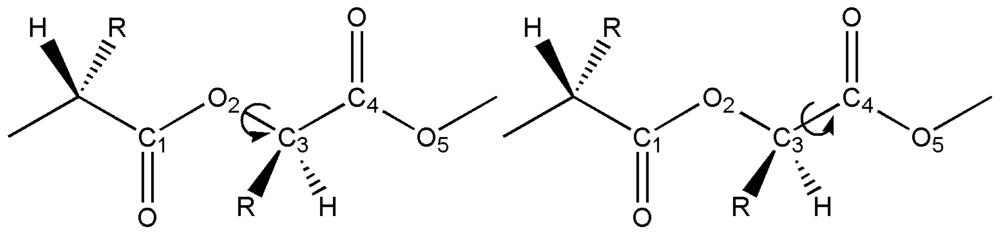
<p>Structural characterization was carried out by analyzing torsional potentials involving C-O and C-C rotations: the analysis was focused on computing energies with respect to the dihedral angles considered, C<sub>1</sub>-O<sub>2</sub>-C<sub>3</sub>-C<sub>4</sub> and O<sub>2</sub>-C<sub>3</sub>-C<sub>4</sub>-O<sub>5</sub>, as also shown in <xref ref-type="fig" rid="f1-ijms-12-03857">Figure 1</xref>.</p></sec>
<sec sec-type="methods">
<title>2.2. Structural Analysis of PGA</title>
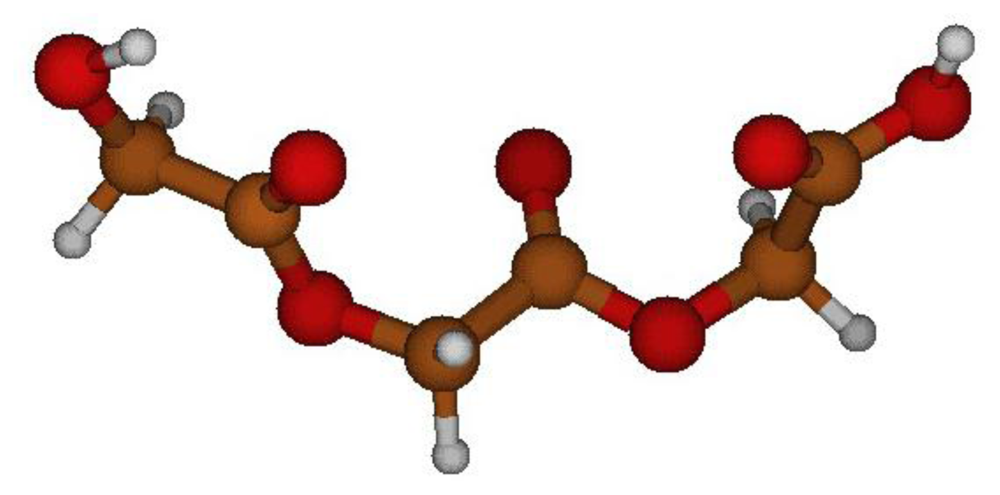
<p>PGA structure was first optimized <italic>in vacuo</italic> in order to obtain the global minimum energy structure, which was used for subsequent computations (<xref ref-type="fig" rid="f2-ijms-12-03857">Figure 2</xref>). C<sub>1</sub>-O<sub>2</sub>-C<sub>3</sub>-C<sub>4</sub> and O<sub>2</sub>-C<sub>3</sub>-C<sub>4</sub>-O<sub>5</sub> angle values of this minimum energy geometry were estimated equal to −87° and −164°, respectively.</p>
<p>Then, energy scan was done through quantum chemistry computations, changing dihedral angles with a step of 10° and optimizing the structure at every step.</p>
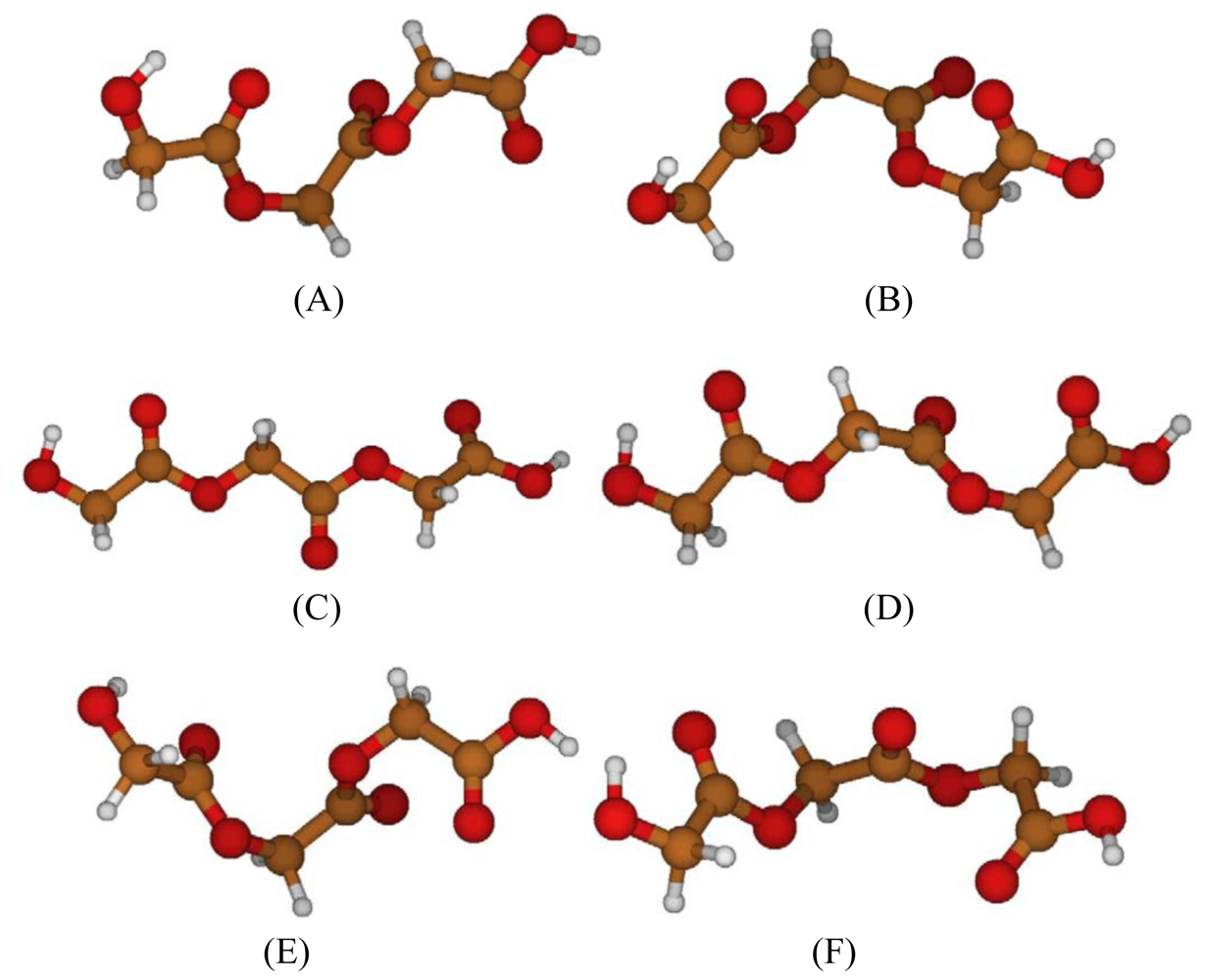
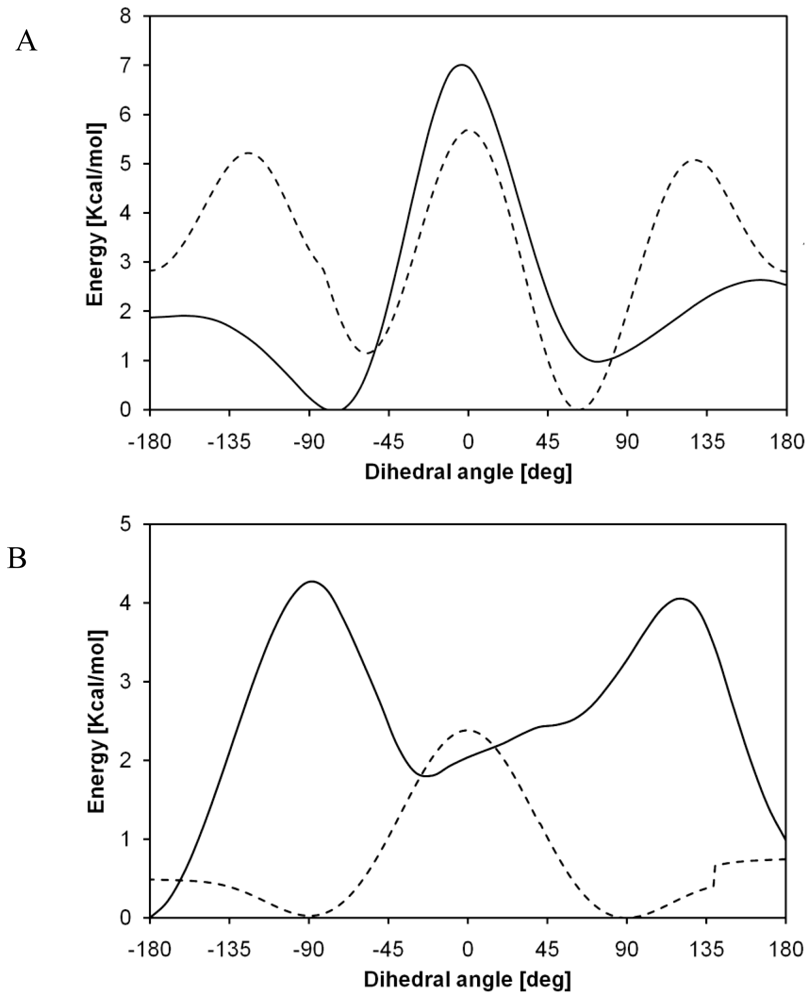
<p>Analyzing torsional potentials involving C<sub>1</sub>-O<sub>2</sub>-C<sub>3</sub>-C<sub>4</sub> angle, energy profile shows one global minimum at −80°, which corresponds to the global optimized geometry (<xref ref-type="fig" rid="f2-ijms-12-03857">Figure 2</xref>), and a global maximum at 0° (<xref ref-type="fig" rid="f3-ijms-12-03857">Figure 3A</xref>), that offers an energy barrier of 6.87 Kcal/mol with respect to minimum. There is, moreover, a local minimum at 70° (<xref ref-type="fig" rid="f3-ijms-12-03857">Figure 3B</xref>), with a barrier with respect to maximum of 5.97 Kcal/mol.</p>
<p>The energy peak corresponds to a geometry in which the repulsion between oxygen atoms is the strongest one, since they are close and almost aligned; in the local minimum, repulsions between oxygen atoms are minimized except for the oxygen of the esters bond, which are aligned.</p>
<p>Referring to O<sub>2</sub>-C<sub>3</sub>-C<sub>4</sub>-O<sub>5</sub> angle, energy profile shows a global minimum at −180° (<xref ref-type="fig" rid="f3-ijms-12-03857">Figure 3C</xref>) and a global maximum at −90° (<xref ref-type="fig" rid="f3-ijms-12-03857">Figure 3D</xref>); there are also a local minimum at −30° (<xref ref-type="fig" rid="f3-ijms-12-03857">Figure 3E</xref>) and a local maximum at 120° (<xref ref-type="fig" rid="f3-ijms-12-03857">Figure 3F</xref>).</p>
<p>The energy barrier between global minimum and maximum is equal to 4.27 Kcal/mol, while the barrier between the global minimum and the local maximum is equal to 4.05 Kcal/mol. The two maxima have a similar energy value; they present a difference in energy of 0.22 Kcal/mol. The energy barrier between the local minimum and the global and local maxima is equal to 2.42 Kcal/mol and to 2.20 Kcal/mol, respectively.</p>
<p>In the global minimum structure, oxygen repulsions are minimized, while in the global maximum, oxygen atoms are closer and in an unfavorable structure. In contrast, the local minimum structure presents a favorable conformation for oxygen atoms, except for the ones involved in esteric bonds, which are close each other. The local maximum exhibits a structure similar to the global maximum one, where oxygen interactions are not preferred.</p>
<p>The same torsional barriers were computed by means of molecular mechanics, using GAFF force field as implemented in AMBER8<sup>®</sup> suite of programs. The comparison between the energy profiles computed through quantum chemistry and those obtained via molecular mechanics (<xref ref-type="fig" rid="f4-ijms-12-03857">Figure 4</xref>) shows a deep disagreement between the results. It can be deduced that parameterization of the dihedral term of GAFF force field cannot characterize this torsional behavior.</p></sec>
<sec>
<title>2.3. Structural Characterization of P<sub>L</sub>LA</title>
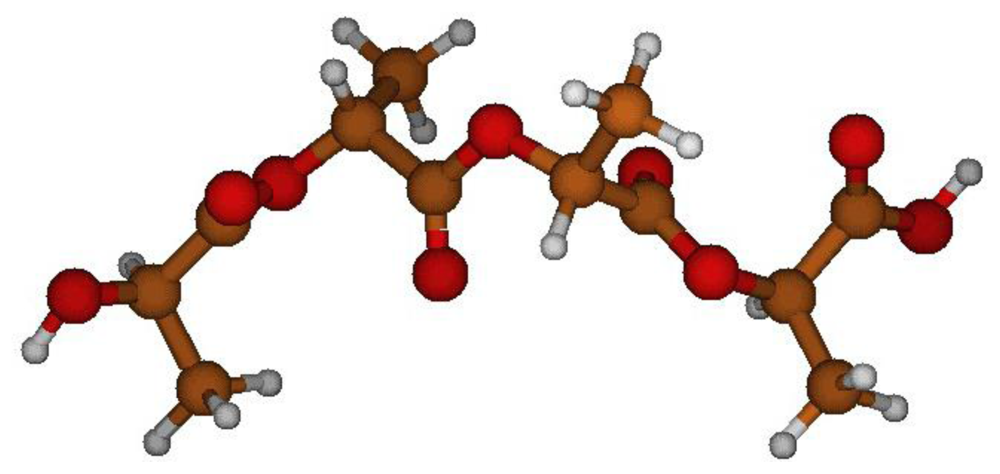
<p>P<sub>L</sub>LA structure was first optimized <italic>in vacuo</italic> in order to obtain a good guess for further computations. C<sub>1</sub>-O<sub>2</sub>-C<sub>3</sub>-C<sub>4</sub> and O<sub>2</sub>-C<sub>3</sub>-C<sub>4</sub>-O<sub>5</sub> angle of values of the minimum energy structure are equal to 70° and −164°, respectively.</p>
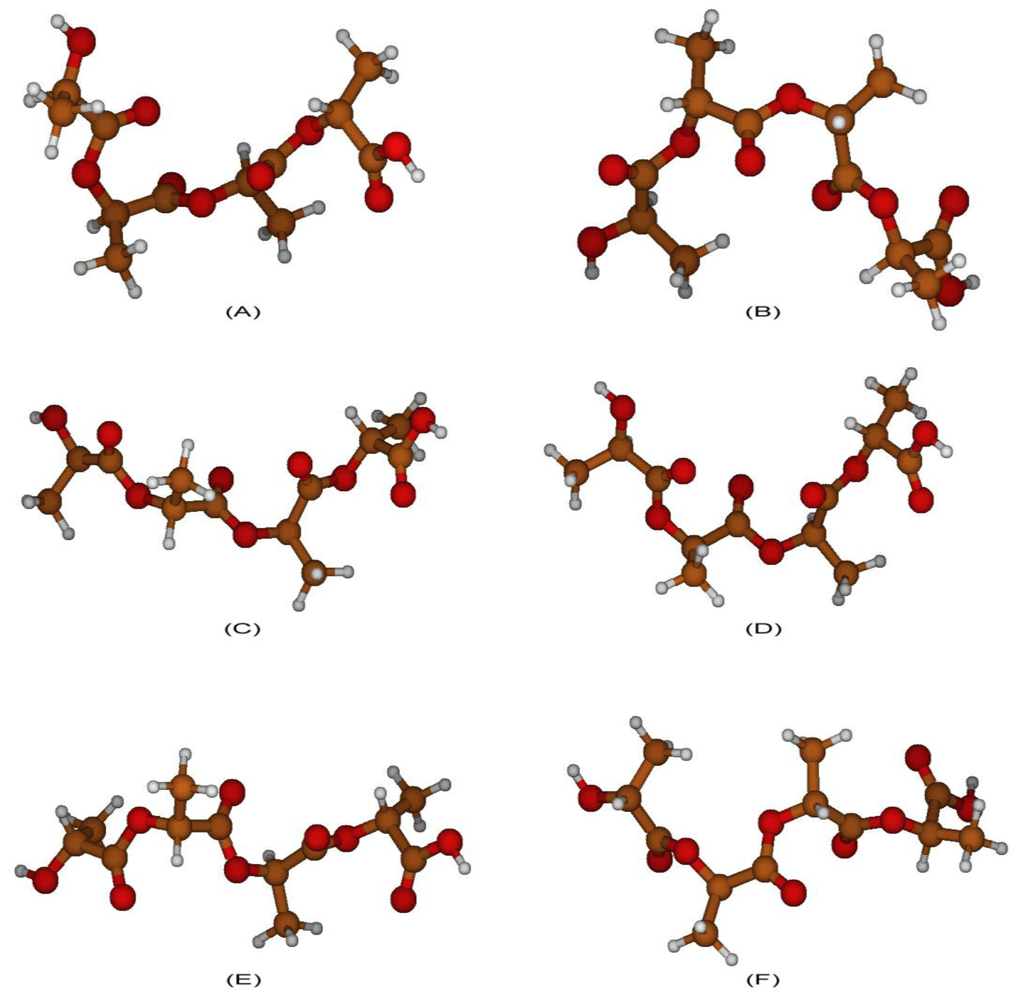
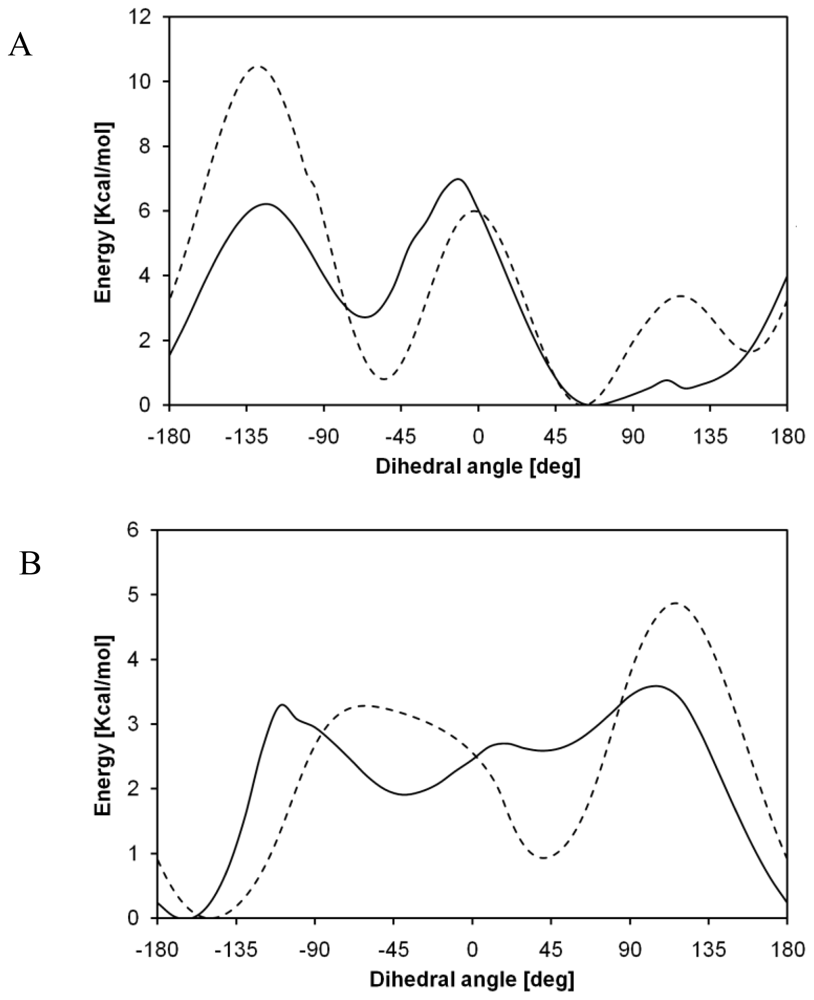
<p>Energy profile of C<sub>1</sub>-O<sub>2</sub>-C<sub>3</sub>-C<sub>4</sub> angle shows a global minimum at 70°, which corresponds to the optimized geometry shown in <xref ref-type="fig" rid="f5-ijms-12-03857">Figure 5</xref>, and a local minimum at −70°, represented in <xref ref-type="fig" rid="f6-ijms-12-03857">Figure 6D</xref>. There is also a global maximum at −10° (<xref ref-type="fig" rid="f6-ijms-12-03857">Figure 6A</xref>) and a local maximum at −120° (<xref ref-type="fig" rid="f6-ijms-12-03857">Figure 6C</xref>), which have a barrier of 6.96 Kcal/mol and 6.18 Kcal/mol, respectively. There is, in addition, one local maximum and one local minimum near 120°, but they were not taken into account due to the small difference in energy (less than 0.2 Kcal/mol).</p>
<p>The global minimum corresponds to the overall optimized geometry, where a helix conformation minimizes the interactions between oxygen atoms: in the maximum energy structure, oxygen atom positions are less favorable, increasing repulsion interactions. The same situation can be seen in the local maximum structure.</p>
<p>The local minimum energy geometry exhibits a helix structure similar to the overall minimum structure, but the energy is higher because of the repulsion between carbonyl oxygen atoms.</p>
<p>O<sub>2</sub>-C<sub>3</sub>-C<sub>4</sub>-O<sub>5</sub> angle, energy profile shows a global minimum at −160°, which corresponds to the overall optimized geometry, and a global maximum at 110° (<xref ref-type="fig" rid="f6-ijms-12-03857">Figure 6B</xref>). Moreover, there are a local minimum at −40° and a local maximum at −110° (<xref ref-type="fig" rid="f6-ijms-12-03857">Figure 6E and 6F</xref>).</p>
<p>In the global maximum structure, oxygen atoms of oligomer backbone are close each other, and thus are subjected to unfavorable repulsion interaction. The global minimum energy geometry is the same as before, where the helix conformation optimizes distances between oxygen atoms.</p>
<p>The local minimum structure has an optimized helix structure except for two close oxygen atoms of the ester bond, while the local maximum structure does not optimize oxygen atom positions.</p>
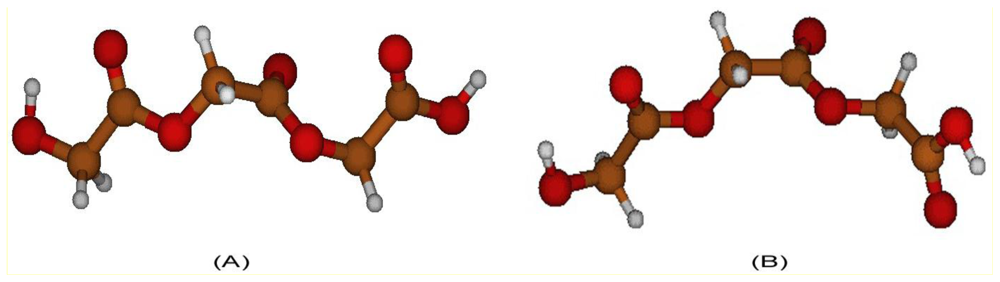
<p>Also, in this case, GAFF force field is not able to reproduce the torsional behavior of PLLA, as shown in <xref ref-type="fig" rid="f7-ijms-12-03857">Figure 7</xref>. As regards C<sub>1</sub>-O<sub>2</sub>-C<sub>3</sub>-C<sub>4</sub> angle, the global minimum is well characterized, but the other configurations are not in agreement with quantum chemistry computations. Energy profile concerning O<sub>2</sub>-C<sub>3</sub>-C<sub>4</sub>-O<sub>5</sub> angle shows a bad agreement with quantum chemistry torsional barriers. In order to understand the poor agreement of energy profiles, structures obtained through molecular mechanics can be compared with the corresponding ones characterized by means of quantum chemistry. It can be seen, indeed, that molecular mechanics geometries are very different from quantum chemistry ones. Even if a great number of minimization steps are performed, in order to obtain minimum energy structures using atoms coordinates as variables, the system is not able to relax properly. This can be related to a parameterization that is not suitable for such systems; GAFF force field, indeed, is intended to be used only with small organic molecules, and not with polymers. For the sake of completeness, an example referring to the PGA global maximum with respect to O<sub>2</sub>-C<sub>3</sub>-C<sub>4</sub>-O<sub>5</sub> angle is here reported (<xref ref-type="fig" rid="f8-ijms-12-03857">Figure 8</xref>): a deep disagreement is evident since this structure represents a global minimum for molecular mechanics, while it is a global maximum for quantum chemistry.</p></sec>
<sec>
<title>2.4. Diffusion Coefficients Computation</title>
<p>Diffusion coefficients were computed by means of Einstein equation [<xref ref-type="bibr" rid="b28-ijms-12-03857">28</xref>], starting from molecule trajectories:</p>
<disp-formula id="FD1">
<label>(1)</label>
<mml:math display="block">
<mml:semantics>
<mml:mrow>
<mml:mi>D</mml:mi>
<mml:mo>=</mml:mo>
<mml:msub>
<mml:mrow>
<mml:mrow>
<mml:mtext>lim</mml:mtext></mml:mrow></mml:mrow>
<mml:mrow>
<mml:mi>t</mml:mi>
<mml:mo>→</mml:mo>
<mml:mo>∞</mml:mo></mml:mrow></mml:msub>
<mml:mfrac>
<mml:mn>1</mml:mn>
<mml:mrow>
<mml:mn>6</mml:mn>
<mml:mi>t</mml:mi></mml:mrow></mml:mfrac>
<mml:mrow>
<mml:mo>〈</mml:mo>
<mml:mrow>
<mml:msup>
<mml:mrow>
<mml:mrow>
<mml:mo stretchy="false">(</mml:mo>
<mml:mi>r</mml:mi>
<mml:mo stretchy="false">(</mml:mo>
<mml:mn>0</mml:mn>
<mml:mo stretchy="false">)</mml:mo>
<mml:mo>-</mml:mo>
<mml:mi>r</mml:mi>
<mml:mo stretchy="false">(</mml:mo>
<mml:mi>t</mml:mi>
<mml:mo stretchy="false">)</mml:mo>
<mml:mo stretchy="false">)</mml:mo></mml:mrow></mml:mrow>
<mml:mn>2</mml:mn></mml:msup></mml:mrow>
<mml:mo>〉</mml:mo></mml:mrow></mml:mrow></mml:semantics></mml:math></disp-formula>
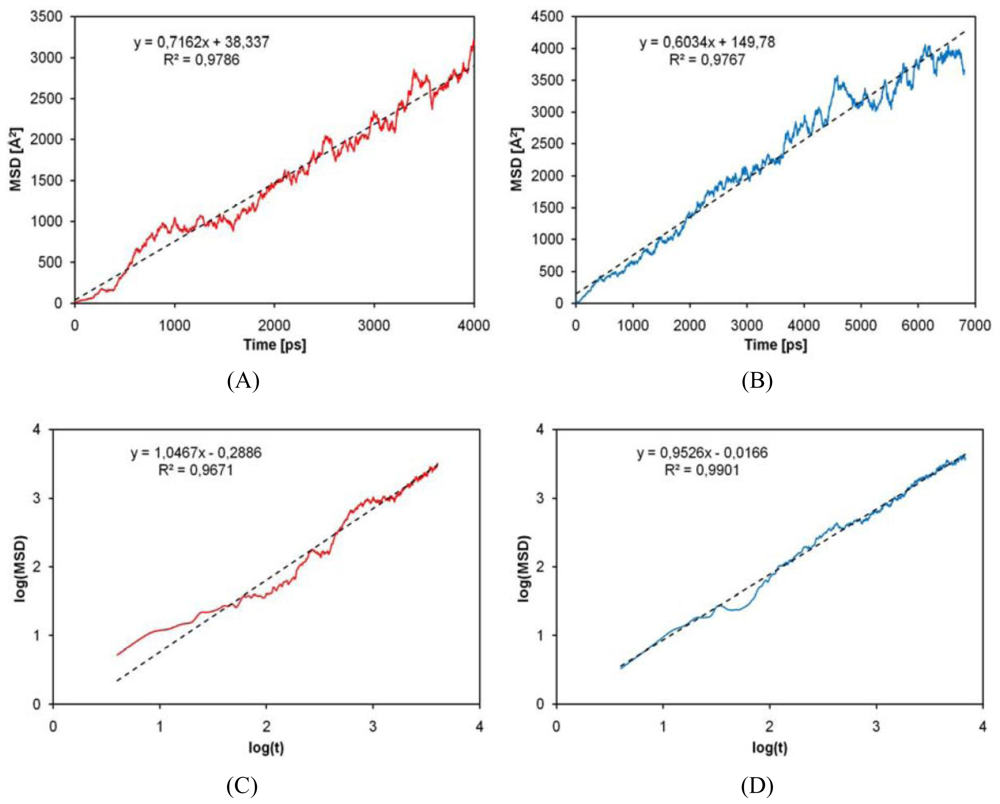
<p>Where <italic>D</italic> is the diffusion coefficient, <italic>t</italic> is the time, and <italic>r</italic>(<italic>t</italic>) is the position of the molecules at time <italic>t</italic>. The term between brackets in <xref rid="FD1" ref-type="disp-formula">equation (1)</xref> is also known as the mean square displacement (MSD), that is, the quadratic distance covered by the molecule with respect to its initial position, <italic>i.e.</italic>, <italic>r(0)</italic>. In particular, the motion of the center of mass of the molecules was here considered, while angle brackets indicate that mean square displacement used in the computation of diffusion coefficient is averaged on all solute molecules. The limit operator has a physical meaning: the simulation must be long enough in order to attain Brownian motion regime, since the equation is valid only under this hypothesis. Basically, mean square displacement plotted against time gives a straight line with a slope equal to 6D. In order to verify the Brownian motion regime, and thus the validity of its linear relationship, it is possible to plot log(MSD) against log(<italic>t</italic>): if the slope is equal to one, then MSD is a linear function of time and Einstein equation is valid [<xref ref-type="bibr" rid="b28-ijms-12-03857">28</xref>]. <xref ref-type="fig" rid="f9-ijms-12-03857">Figure 9B</xref> shows log(<italic>t</italic>) <italic>vs.</italic> log(MSD) estimated for the lactic acid monomer. Computed diffusion coefficient for lactic acid is equal to (1.006 ± 0.032) × 10<sup>−5</sup> cm<sup>2</sup>/s, and it is in good agreement with the experimental value of 0.993 × 10<sup>−5</sup> cm<sup>2</sup>/s reported by Ribeiro <italic>et al</italic>. [<xref ref-type="bibr" rid="b29-ijms-12-03857">29</xref>]. The slope of the log(<italic>t</italic>) <italic>vs.</italic> log(MSD), as shown in <xref ref-type="fig" rid="f9-ijms-12-03857">Figure 9D</xref>, is close to one and the value obtained is surely representative of the behavior of the system. <xref ref-type="fig" rid="f9-ijms-12-03857">Figure 9A</xref> shows <italic>t vs</italic>. MSD plot for glycolic acid, whose computed self-diffusion coefficient is equal to (1.194 ± 0.062) × 10<sup>−5</sup> cm<sup>2</sup>/s.</p>
<p>Up to our best knowledge, an experimental self diffusion coefficient for glycolic acid is not available in literature, but the computed result can be considered reasonable, since it is very similar to the one of lactic acid. The slope of log(<italic>t</italic>) <italic>vs.</italic> log(MSD) is very close to one and thus diffusion regime is reached.</p></sec></sec>
<sec>
<title>3. Simulation Details</title>
<sec>
<title>3.1. Structural Characterization</title>
<p>Starting structures were P<sub>L</sub>LA and PGA oligomers composed by three monomeric units. First, structure geometries were optimized <italic>in vacuo</italic> by means of density functional theory (DFT) using a Becke 3 parameters [<xref ref-type="bibr" rid="b30-ijms-12-03857">30</xref>] and Lee-Yang-Parr [<xref ref-type="bibr" rid="b31-ijms-12-03857">31</xref>] (B3LYP) functional for exchange and correlation energy, and a 6–31G(d,p) basis set [<xref ref-type="bibr" rid="b32-ijms-12-03857">32</xref>], implemented in Gaussian03 suite of programs [<xref ref-type="bibr" rid="b33-ijms-12-03857">33</xref>]. In this way, it was possible to find an overall optimized structure, which represents an energy minimum used as an initial estimate. Dihedral angles were changed stepwise from −180° to 180° at 10° intervals. Structure optimization was carried out at each step. Indeed, while the dihedral angle of interest was restrained to a certain value, the molecule geometry was optimized in order to obtain the minimum energy structure related to that dihedral angle value. In this way, it was possible to obtain the most probable structure at every step. In order to investigate torsional barriers by means of molecular mechanics, GAFF force field [<xref ref-type="bibr" rid="b27-ijms-12-03857">27</xref>] implemented in AMBER8<sup>®</sup> suite of programs [<xref ref-type="bibr" rid="b26-ijms-12-03857">26</xref>] was chosen. Optimized P<sub>L</sub>LA and PGA structures were placed <italic>in vacuo</italic>, changing dihedral angles values from −180° to 180° with a step of 5°. At every step, a minimization procedure of 10<sup>6</sup> cycles was carried out, applying a restrain to the investigated dihedral angles. As in the DFT approach, while the dihedral angle of interest was restrained, the molecule geometry was optimized through energy minimization in order to obtain the most probable structure with respect to that dihedral angle value. In particular, 100,000 minimization cycles were run with the steepest descent algorithm, while the remaining ones were accomplished through conjugate gradient algorithm, which is more efficient when the system is close to an energy minimum. Atomic charges were computed starting from electrostatic potentials (ESP) calculated through quantum chemistry at B3LYP/6–31G(d,p) level; then, charges were fitted following RESP (Restrained Electrostatic Potentials) [<xref ref-type="bibr" rid="b34-ijms-12-03857">34</xref>] formalism. As mentioned, this analysis aims to assess whether GAFF force field is able to reproduce torsional barriers, and thus if it can provide reliable predictions about oligomers conformations. Analysis was carried out <italic>in vacuo</italic> in order to neglect the solvent effect [<xref ref-type="bibr" rid="b35-ijms-12-03857">35</xref>].</p></sec>
<sec>
<title>3.2. Molecular Dynamics Simulations</title>
<p>In order to provide further proof as to the suitability of the adopted method, <italic>i.e.</italic> the chosen force field, molecular dynamics simulations were used to compute monomers’ self diffusion coefficients. Lactic acid and glycolic acid structures were first optimized by DFT calculations in implicit water. Becke 3 parameters [<xref ref-type="bibr" rid="b30-ijms-12-03857">30</xref>] and Lee-Yang-Parr [<xref ref-type="bibr" rid="b31-ijms-12-03857">31</xref>] (B3LYP) functions for exchange and correlation energy, and 6–31G(d,p) basis set [<xref ref-type="bibr" rid="b32-ijms-12-03857">32</xref>] were adopted for the geometry optimization, as implemented in Gaussian03 suite of programs [<xref ref-type="bibr" rid="b33-ijms-12-03857">33</xref>]. Water was modeled with the integral equation formalism polarizable continuum model [<xref ref-type="bibr" rid="b36-ijms-12-03857">36</xref>] (IEFPCM) at a temperature of 300 K. In order to compute atomic charges, electrostatic potentials (ESPs) were calculated at the B3LYP/6–31G(d,p) level; charges were then fitted through RESP [<xref ref-type="bibr" rid="b34-ijms-12-03857">34</xref>] formalism. Ten molecules of each compound were solvated in a cubic box with a lateral size of 60 Å, containing about 9000 explicit TIP4P water molecules [<xref ref-type="bibr" rid="b37-ijms-12-03857">37</xref>]; cutoff for non-bonded interactions was set to 15 Å, and simulations were carried out using periodic boundary conditions. Long-range electrostatic interactions were evaluated through the Particle Mesh Ewald method. As mentioned, simulations were performed using GAFF force field as implemented in AMBER8<sup>®</sup> suite of programs: in particular, the following simulation protocol was adopted. First of all, a 2000-cycle minimization, in which the solute is restrained with harmonic potential k(Δx)<sup>2</sup> (where Δx is the displacement and k is the force constant, equal to 500 Kcal mol<sup>−1</sup> Å<sup>−2</sup>), was performed in order to cut out bad contacts which derive by the random placing of solvent molecules. 1000 minimization steps were realized through the steepest descent algorithm, while the remaining 1000 were accomplished through the conjugate gradient algorithm, which is more efficient when the system is close to an energy minimum. Then a 3500-cycle minimization was performed in order to minimize the energy of the whole system, without restraints. In this case, 2000 minimization steps were done through the steepest descent algorithm, and the remaining ones were realized with conjugate gradient algorithm. The temperature was raised from 0 K to 300 K by a simulated annealing of 20 ps at constant volume, imposing a weak restraint (k = 10 Kcal mol<sup>−1</sup> Å<sup>−2</sup>) on the solute with the purpose of avoiding wild fluctuations, and afterwards the system was relaxed with a 100 ps run at constant pressure in order to reach the correct density of the solution. Finally, molecular dynamics simulations were carried out, investigating a time span of 5 ns. SHAKE algorithm was used for all covalent bonds involving hydrogen atoms, thus allowing a time step of 2 fs. Simulations were run under steady conditions (300 K and 1 atm). Temperature and pressure were controlled using Langevin dynamics (with a collision frequency equal to 1.0 ps<sup>−1</sup>) and isotropic position scaling, respectively.</p></sec></sec>
<sec sec-type="conclusions">
<title>4. Conclusions</title>
<p>Torsional barriers involving C-O and C-C bonds were investigated for PGA and PLLA oligomers, by means of quantum chemistry and molecular mechanics. The analysis shows that oligomers were allowed to conform in different structures, since there are also local minima in the energy profiles. Comparing torsional barriers computed through quantum chemistry with the ones obtained by means of molecular mechanics, it could be stated that the GAFF force field chosen is not able to describe the structural behavior. Such disagreement with quantum chemistry profile is related to parameters of dihedral term of the force field, which are not suitable for such analysis. Indeed, even if a large number of minimization steps were performed through molecular mechanics, structures were not able to relax properly. However, GAFF force field is surely suitable to characterize transport phenomena in water environment, since the computed diffusion coefficient for lactic acid satisfactorily matches the experimental one. This confirms the suitability of the method used to compute atomic charges, and that long range interactions are determined in a proper way.</p></sec></body>
<back>
<ref-list>
<title>References</title>
<ref id="b1-ijms-12-03857"><label>1</label><citation citation-type="book"><person-group person-group-type="editor"><name><surname>Ruhle</surname><given-names>M</given-names></name><name><surname>Dosch</surname><given-names>H</given-names></name><name><surname>Mittenmeijer</surname><given-names>E</given-names></name><name><surname>van der Vorde</surname><given-names>M</given-names></name></person-group><source>European White Book on Fundamental Research in Materials Science</source><publisher-name>Max-Planck-Institut für Metallforschung</publisher-name><publisher-loc>Stuttgart, Germany</publisher-loc><year>2001</year></citation></ref>
<ref id="b2-ijms-12-03857"><label>2</label><citation citation-type="book"><person-group person-group-type="author"><name><surname>Ratner</surname><given-names>BD</given-names></name></person-group><source>Biomaterials Science: An Introduction to Materials in Medicine</source><edition>2nd ed</edition><publisher-name>Elsevier Academic Press</publisher-name><publisher-loc>Amsterdam, The Netherland</publisher-loc><year>2004</year><fpage>xii</fpage><fpage>851</fpage></citation></ref>
<ref id="b3-ijms-12-03857"><label>3</label><citation citation-type="journal"><person-group person-group-type="author"><name><surname>Grizzi</surname><given-names>I</given-names></name><name><surname>Garreau</surname><given-names>H</given-names></name><name><surname>Li</surname><given-names>S</given-names></name><name><surname>Vert</surname><given-names>M</given-names></name></person-group><article-title>Hydrolytic degradation of devices based on poly(DL-lactic acid) size-dependence</article-title><source>Biomaterials</source><year>1995</year><volume>16</volume><fpage>305</fpage><lpage>311</lpage><pub-id pub-id-type="doi">10.1016/0142-9612(95)93258-F</pub-id><pub-id pub-id-type="pmid">7772670</pub-id></citation></ref>
<ref id="b4-ijms-12-03857"><label>4</label><citation citation-type="journal"><person-group person-group-type="author"><name><surname>Alexis</surname><given-names>F</given-names></name></person-group><article-title>Factors affecting the degradation and drug-release mechanism of poly(lactic acid) and poly[(lactic acid)-co-(glycolic acid)]</article-title><source>Polymer Int</source><year>2005</year><volume>54</volume><fpage>36</fpage><lpage>46</lpage><pub-id pub-id-type="doi">10.1002/pi.1697</pub-id></citation></ref>
<ref id="b5-ijms-12-03857"><label>5</label><citation citation-type="journal"><person-group person-group-type="author"><name><surname>Nagarajan</surname><given-names>S</given-names></name><name><surname>Reddy</surname><given-names>BSR</given-names></name></person-group><article-title>Bio-absorbable polymers in implantation—An overview</article-title><source>J. Sci. Ind. Res</source><year>2009</year><volume>68</volume><fpage>993</fpage><lpage>1009</lpage></citation></ref>
<ref id="b6-ijms-12-03857"><label>6</label><citation citation-type="journal"><person-group person-group-type="author"><name><surname>Zilberman</surname><given-names>M</given-names></name><name><surname>Eberhart</surname><given-names>RC</given-names></name></person-group><article-title>Drug-eluting bioresorbable stents for various applications</article-title><source>Ann. Rev. Biomed. Eng</source><year>2006</year><volume>8</volume><fpage>153</fpage><lpage>180</lpage><pub-id pub-id-type="doi">10.1146/annurev.bioeng.8.013106.151418</pub-id></citation></ref>
<ref id="b7-ijms-12-03857"><label>7</label><citation citation-type="journal"><person-group person-group-type="author"><name><surname>Tuomo</surname><given-names>P</given-names></name><name><surname>Matti</surname><given-names>L</given-names></name><name><surname>Hannu</surname><given-names>P</given-names></name><name><surname>Pentti</surname><given-names>R</given-names></name><name><surname>Henna</surname><given-names>N</given-names></name><name><surname>Pertti</surname><given-names>T</given-names></name></person-group><article-title>Fixation of distal femoral osteotomies with self-reinforced poly(L/DL)lactide 70:30/bioactive glass composite rods. An experimental study on rats</article-title><source>J. Mater. Sci.-Mater. Med</source><year>2004</year><volume>15</volume><fpage>275</fpage><lpage>281</lpage><pub-id pub-id-type="doi">10.1023/B:JMSM.0000015488.11602.4e</pub-id><pub-id pub-id-type="pmid">15335000</pub-id></citation></ref>
<ref id="b8-ijms-12-03857"><label>8</label><citation citation-type="journal"><person-group person-group-type="author"><name><surname>Lu</surname><given-names>Y</given-names></name><name><surname>Chen</surname><given-names>SC</given-names></name></person-group><article-title>Micro and nano-fabrication of biodegradable polymers for drug delivery</article-title><source>Adv. Drug Deliv. Rev</source><year>2004</year><volume>56</volume><fpage>1621</fpage><lpage>1633</lpage><pub-id pub-id-type="doi">10.1016/j.addr.2004.05.002</pub-id><pub-id pub-id-type="pmid">15350292</pub-id></citation></ref>
<ref id="b9-ijms-12-03857"><label>9</label><citation citation-type="journal"><person-group person-group-type="author"><name><surname>Nampoothiri</surname><given-names>KM</given-names></name><name><surname>Nair</surname><given-names>NR</given-names></name><name><surname>John</surname><given-names>RP</given-names></name></person-group><article-title>An overview of the recent developments in polylactide (PLA) research</article-title><source>Bioresource Tech</source><year>2010</year><volume>101</volume><fpage>8493</fpage><lpage>8501</lpage><pub-id pub-id-type="doi">10.1016/j.biortech.2010.05.092</pub-id></citation></ref>
<ref id="b10-ijms-12-03857"><label>10</label><citation citation-type="journal"><person-group person-group-type="author"><name><surname>Perale</surname><given-names>G</given-names></name><name><surname>Casalini</surname><given-names>T</given-names></name><name><surname>Barri</surname><given-names>V</given-names></name><name><surname>Muller</surname><given-names>M</given-names></name><name><surname>Maccagnan</surname><given-names>S</given-names></name><name><surname>Masi</surname><given-names>M</given-names></name></person-group><article-title>Lidocaine release from polycaprolactone threads</article-title><source>J. Appl. Polymer Sci</source><year>2010</year><volume>117</volume><fpage>3610</fpage><lpage>3614</lpage></citation></ref>
<ref id="b11-ijms-12-03857"><label>11</label><citation citation-type="journal"><person-group person-group-type="author"><name><surname>Ella</surname><given-names>V</given-names></name><name><surname>Kellomaki</surname><given-names>M</given-names></name><name><surname>Tormala</surname><given-names>P</given-names></name></person-group><article-title><italic>In vitro</italic> properties of PLLA screws and novel bioabsorbable implant with elastic nucleus to replace intervertebral disc</article-title><source>J. Mater. Sci.-Mater. Med</source><year>2005</year><volume>16</volume><fpage>655</fpage><lpage>662</lpage><pub-id pub-id-type="doi">10.1007/s10856-005-2537-1</pub-id><pub-id pub-id-type="pmid">15965598</pub-id></citation></ref>
<ref id="b12-ijms-12-03857"><label>12</label><citation citation-type="journal"><person-group person-group-type="author"><name><surname>Frank</surname><given-names>A</given-names></name><name><surname>Rath</surname><given-names>SK</given-names></name><name><surname>Venkatraman</surname><given-names>SS</given-names></name></person-group><article-title>Controlled release from bioerodible polymers: Effect of drug type and polymer composition</article-title><source>J. Contr. Release</source><year>2005</year><volume>102</volume><fpage>333</fpage><lpage>344</lpage><pub-id pub-id-type="doi">10.1016/j.jconrel.2004.10.019</pub-id></citation></ref>
<ref id="b13-ijms-12-03857"><label>13</label><citation citation-type="journal"><person-group person-group-type="author"><name><surname>Liggins</surname><given-names>RT</given-names></name><name><surname>Burt</surname><given-names>HM</given-names></name></person-group><article-title>Paclitaxel loaded poly(L-lactic acid) microspheres: Properties of microspheres made with low molecular weight polymers</article-title><source>Int. J. Pharm</source><year>2001</year><volume>222</volume><fpage>19</fpage><lpage>33</lpage><pub-id pub-id-type="doi">10.1016/S0378-5173(01)00690-1</pub-id><pub-id pub-id-type="pmid">11404029</pub-id></citation></ref>
<ref id="b14-ijms-12-03857"><label>14</label><citation citation-type="journal"><person-group person-group-type="author"><name><surname>Bettini</surname><given-names>R</given-names></name><name><surname>Catellani</surname><given-names>PL</given-names></name><name><surname>Santi</surname><given-names>P</given-names></name><name><surname>Massimo</surname><given-names>G</given-names></name><name><surname>Peppas</surname><given-names>NA</given-names></name><name><surname>Colombo</surname><given-names>P</given-names></name></person-group><article-title>Translocation of drug particles in HPMC matrix gel layer: Effect of drug solubility and influence on release rate</article-title><source>J. Control. Release</source><year>2001</year><volume>70</volume><fpage>383</fpage><lpage>391</lpage><pub-id pub-id-type="doi">10.1016/S0168-3659(00)00366-7</pub-id><pub-id pub-id-type="pmid">11182208</pub-id></citation></ref>
<ref id="b15-ijms-12-03857"><label>15</label><citation citation-type="journal"><person-group person-group-type="author"><name><surname>Crow</surname><given-names>BB</given-names></name><name><surname>Borneman</surname><given-names>AF</given-names></name><name><surname>Hawkins</surname><given-names>DL</given-names></name><name><surname>Smith</surname><given-names>GM</given-names></name><name><surname>Nelson</surname><given-names>KD</given-names></name></person-group><article-title>Evaluation of <italic>in vitro</italic> drug release, pH change, and molecular weight degradation of poly(l-lactic acid) and poly(d, l-lactide-co-glycolide) fibers</article-title><source>Tissue Eng</source><year>2005</year><volume>11</volume><fpage>1077</fpage><lpage>1084</lpage><pub-id pub-id-type="doi">10.1089/ten.2005.11.1077</pub-id><pub-id pub-id-type="pmid">16144443</pub-id></citation></ref>
<ref id="b16-ijms-12-03857"><label>16</label><citation citation-type="journal"><person-group person-group-type="author"><name><surname>Blomqvist</surname><given-names>J</given-names></name><name><surname>Ahjopalo</surname><given-names>L</given-names></name><name><surname>Mannfors</surname><given-names>B</given-names></name><name><surname>Pietila</surname><given-names>LO</given-names></name></person-group><article-title>Studies on aliphatic polyesters I: Ab initio, density functional and force field studies of esters with one carboxyl group</article-title><source>J. Mol. Struct. Theochem</source><year>1999</year><volume>488</volume><fpage>247</fpage><lpage>262</lpage><pub-id pub-id-type="doi">10.1016/S0166-1280(99)00038-X</pub-id></citation></ref>
<ref id="b17-ijms-12-03857"><label>17</label><citation citation-type="journal"><person-group person-group-type="author"><name><surname>Blomqvist</surname><given-names>J</given-names></name><name><surname>Mannfors</surname><given-names>B</given-names></name><name><surname>Pietila</surname><given-names>LO</given-names></name></person-group><article-title>Studies on aliphatic polyesters. Part II. Ab initio, density functional and force field studies of model molecules with two carboxyl groups</article-title><source>J. Mol. Struct. Theochem</source><year>2000</year><volume>531</volume><fpage>359</fpage><lpage>374</lpage><pub-id pub-id-type="doi">10.1016/S0166-1280(00)00453-X</pub-id></citation></ref>
<ref id="b18-ijms-12-03857"><label>18</label><citation citation-type="journal"><person-group person-group-type="author"><name><surname>Xiang</surname><given-names>HZ</given-names></name><name><surname>Wang</surname><given-names>YL</given-names></name><name><surname>Yang</surname><given-names>WH</given-names></name><name><surname>Hu</surname><given-names>CB</given-names></name><name><surname>Mu</surname><given-names>YH</given-names></name><name><surname>Li</surname><given-names>JF</given-names></name></person-group><article-title>Study of the mechanical and thermal properties of poly(lactic acid) and poly(ethylene glycol) block copolymer with molecular dynamics</article-title><source>Int. J. Polymer Anal. Char</source><year>2010</year><volume>15</volume><fpage>235</fpage><lpage>244</lpage><pub-id pub-id-type="doi">10.1080/10236661003746405</pub-id></citation></ref>
<ref id="b19-ijms-12-03857"><label>19</label><citation citation-type="journal"><person-group person-group-type="author"><name><surname>Entrialgo-Castano</surname><given-names>M</given-names></name><name><surname>Salvucci</surname><given-names>AE</given-names></name><name><surname>Lendlein</surname><given-names>A</given-names></name><name><surname>Hofmann</surname><given-names>D</given-names></name></person-group><article-title>An atomistic modeling and quantum mechanical approach to the hydrolytic degradation of aliphatic polyesters</article-title><source>Macromol. Symp</source><year>2008</year><volume>269</volume><fpage>47</fpage><lpage>64</lpage><pub-id pub-id-type="doi">10.1002/masy.200850908</pub-id></citation></ref>
<ref id="b20-ijms-12-03857"><label>20</label><citation citation-type="journal"><person-group person-group-type="author"><name><surname>Walter</surname><given-names>J</given-names></name><name><surname>Ermatchkov</surname><given-names>V</given-names></name><name><surname>Vrabec</surname><given-names>J</given-names></name><name><surname>Hasse</surname><given-names>H</given-names></name></person-group><article-title>Molecular dynamics and experimental study of conformation change of poly(<italic>N</italic>-isopropylacrylamide) hydrogels in water</article-title><source>Fluid Phase Equil</source><year>2010</year><volume>296</volume><fpage>164</fpage><lpage>172</lpage><pub-id pub-id-type="doi">10.1016/j.fluid.2010.03.025</pub-id></citation></ref>
<ref id="b21-ijms-12-03857"><label>21</label><citation citation-type="journal"><person-group person-group-type="author"><name><surname>Jang</surname><given-names>SS</given-names></name><name><surname>Goddard</surname><given-names>WA</given-names></name><name><surname>Kalani</surname><given-names>MYS</given-names></name></person-group><article-title>Mechanical and transport properties of the poly(ethylene oxide)-poly(acrylic acid) double network hydrogel from molecular dynamic simulations</article-title><source>J. Phys. Chem. B</source><year>2007</year><volume>111</volume><fpage>1729</fpage><lpage>1737</lpage><pub-id pub-id-type="doi">10.1021/jp0656330</pub-id><pub-id pub-id-type="pmid">17249716</pub-id></citation></ref>
<ref id="b22-ijms-12-03857"><label>22</label><citation citation-type="journal"><person-group person-group-type="author"><name><surname>Lee</surname><given-names>SG</given-names></name><name><surname>Brunello</surname><given-names>GF</given-names></name><name><surname>Jang</surname><given-names>SS</given-names></name><name><surname>Bucknall</surname><given-names>DG</given-names></name></person-group><article-title>Molecular dynamics simulation study of P (VP-co-HEMA) hydrogels: Effect of water content on equilibrium structures and mechanical properties</article-title><source>Biomaterials</source><year>2009</year><volume>30</volume><fpage>6130</fpage><lpage>6141</lpage><pub-id pub-id-type="doi">10.1016/j.biomaterials.2009.07.035</pub-id><pub-id pub-id-type="pmid">19656562</pub-id></citation></ref>
<ref id="b23-ijms-12-03857"><label>23</label><citation citation-type="journal"><person-group person-group-type="author"><name><surname>Chiessi</surname><given-names>E</given-names></name><name><surname>Cavalieri</surname><given-names>F</given-names></name><name><surname>Paradossi</surname><given-names>G</given-names></name></person-group><article-title>Water and polymer dynamics in chemically cross-linked hydrogels of poly(vinyl alcohol): A molecular dynamics simulation study</article-title><source>J. Phys. Chem. B</source><year>2007</year><volume>111</volume><fpage>2820</fpage><lpage>2827</lpage><pub-id pub-id-type="pmid">17388423</pub-id></citation></ref>
<ref id="b24-ijms-12-03857"><label>24</label><citation citation-type="journal"><person-group person-group-type="author"><name><surname>Chiessi</surname><given-names>E</given-names></name><name><surname>Lonardi</surname><given-names>A</given-names></name><name><surname>Paradossi</surname><given-names>G</given-names></name></person-group><article-title>Toward modeling thermoresponsive polymer networks: A molecular dynamics simulation study of <italic>N</italic>-isopropyl acrylamide co-oligomers</article-title><source>J. Phys. Chem. B</source><year>2010</year><volume>114</volume><fpage>8301</fpage><lpage>8312</lpage><pub-id pub-id-type="doi">10.1021/jp912209z</pub-id><pub-id pub-id-type="pmid">20521808</pub-id></citation></ref>
<ref id="b25-ijms-12-03857"><label>25</label><citation citation-type="journal"><person-group person-group-type="author"><name><surname>Codari</surname><given-names>F</given-names></name><name><surname>Moscatelli</surname><given-names>D</given-names></name><name><surname>Storti</surname><given-names>G</given-names></name><name><surname>Morbidelli</surname><given-names>M</given-names></name></person-group><article-title>Characterization of low-molecular-weight PLA using HPLC</article-title><source>Macromol. Mater. Eng</source><year>2010</year><volume>295</volume><fpage>58</fpage><lpage>66</lpage><pub-id pub-id-type="doi">10.1002/mame.200900172</pub-id></citation></ref>
<ref id="b26-ijms-12-03857"><label>26</label><citation citation-type="book"><person-group person-group-type="author"><name><surname>Case</surname><given-names>DA</given-names></name><name><surname>Darden</surname><given-names>TA</given-names></name><name><surname>Cheatham</surname><given-names>TE</given-names></name><name><surname>Simmerling</surname><given-names>CL</given-names></name><name><surname>Wang</surname><given-names>J</given-names></name><name><surname>Duke</surname><given-names>RE</given-names></name><name><surname>Luo</surname><given-names>R</given-names></name><name><surname>Merz</surname><given-names>KM</given-names></name><name><surname>Wang</surname><given-names>B</given-names></name><name><surname>Pearlman</surname><given-names>DA</given-names></name><etal/></person-group><source>Amber</source><fpage>80</fpage><publisher-name>University of California</publisher-name><publisher-loc>San Francisco, CA, USA</publisher-loc><year>2004</year></citation></ref>
<ref id="b27-ijms-12-03857"><label>27</label><citation citation-type="journal"><person-group person-group-type="author"><name><surname>Wang</surname><given-names>JM</given-names></name><name><surname>Wolf</surname><given-names>RM</given-names></name><name><surname>Caldwell</surname><given-names>JW</given-names></name><name><surname>Kollman</surname><given-names>PA</given-names></name><name><surname>Case</surname><given-names>DA</given-names></name></person-group><article-title>Development and testing of a general amber force field</article-title><source>J. Comput. Chem</source><year>2004</year><volume>25</volume><fpage>1157</fpage><lpage>1174</lpage><pub-id pub-id-type="doi">10.1002/jcc.20035</pub-id><pub-id pub-id-type="pmid">15116359</pub-id></citation></ref>
<ref id="b28-ijms-12-03857"><label>28</label><citation citation-type="book"><person-group person-group-type="author"><name><surname>Frenkel</surname><given-names>D</given-names></name><name><surname>Smit</surname><given-names>B</given-names></name></person-group><source>Understanding Molecular Simulation: From Algorithms to Applications</source><edition>2nd ed</edition><publisher-name>Academic Press</publisher-name><publisher-loc>San Diego, CA, USA</publisher-loc><year>2002</year><fpage>xxii</fpage><fpage>638</fpage></citation></ref>
<ref id="b29-ijms-12-03857"><label>29</label><citation citation-type="journal"><person-group person-group-type="author"><name><surname>Ribeiro</surname><given-names>ACF</given-names></name><name><surname>Lobo</surname><given-names>VMM</given-names></name><name><surname>Leaist</surname><given-names>DG</given-names></name><name><surname>Natividade</surname><given-names>JJS</given-names></name><name><surname>Verissimo</surname><given-names>LP</given-names></name><name><surname>Barros</surname><given-names>MCF</given-names></name><name><surname>Cabral</surname><given-names>AMTDPV</given-names></name></person-group><article-title>Binary diffusion coefficients for aqueous solutions of lactic acid</article-title><source>J. Solution Chem</source><year>2005</year><volume>34</volume><fpage>1009</fpage><lpage>1016</lpage><pub-id pub-id-type="doi">10.1007/s10953-005-6987-3</pub-id></citation></ref>
<ref id="b30-ijms-12-03857"><label>30</label><citation citation-type="journal"><person-group person-group-type="author"><name><surname>Becke</surname><given-names>AD</given-names></name></person-group><article-title>Density-functional thermochemistry. 3. The role of exact exchange</article-title><source>J. Chem. Phys</source><year>1993</year><volume>98</volume><fpage>5648</fpage><lpage>5652</lpage><pub-id pub-id-type="doi">10.1063/1.464913</pub-id></citation></ref>
<ref id="b31-ijms-12-03857"><label>31</label><citation citation-type="journal"><person-group person-group-type="author"><name><surname>Lee</surname><given-names>CT</given-names></name><name><surname>Yang</surname><given-names>WT</given-names></name><name><surname>Parr</surname><given-names>RG</given-names></name></person-group><article-title>Development of the colle-salvetti correlation-energy formula into a functional of the electron-density</article-title><source>Phys. Rev. B</source><year>1988</year><volume>37</volume><fpage>785</fpage><lpage>789</lpage><pub-id pub-id-type="doi">10.1103/PhysRevB.37.785</pub-id></citation></ref>
<ref id="b32-ijms-12-03857"><label>32</label><citation citation-type="journal"><person-group person-group-type="author"><name><surname>Ditchfield</surname><given-names>R</given-names></name><name><surname>Hehre</surname><given-names>WJ</given-names></name><name><surname>Pople</surname><given-names>JA</given-names></name></person-group><article-title>Self consistent molecular orbital methods. IX. An extended gaussian type basis for molecular orbital studies of organic molecules</article-title><source>J. Chem. Phys</source><year>1971</year><volume>54</volume><fpage>724</fpage><lpage>728</lpage><pub-id pub-id-type="doi">10.1063/1.1674902</pub-id></citation></ref>
<ref id="b33-ijms-12-03857"><label>33</label><citation citation-type="book"><person-group person-group-type="author"><name><surname>Frisch</surname><given-names>MJ</given-names></name><name><surname>Trucks</surname><given-names>GW</given-names></name><name><surname>Schlegel</surname><given-names>HB</given-names></name><name><surname>Scuseria</surname><given-names>GE</given-names></name><name><surname>Robb</surname><given-names>MA</given-names></name><name><surname>Cheeseman</surname><given-names>JR</given-names></name><name><surname>Montgomery</surname><given-names>JA</given-names></name><name><surname>Vreven</surname><given-names>JT</given-names></name><name><surname>Kudin</surname><given-names>KN</given-names></name><name><surname>Burant</surname><given-names>JC</given-names></name><etal/></person-group><source>Gaussian 03, Revision C01</source><publisher-name>Gaussian, Inc</publisher-name><publisher-loc>Pittsburgh, PA, USA</publisher-loc><year>2003</year></citation></ref>
<ref id="b34-ijms-12-03857"><label>34</label><citation citation-type="journal"><person-group person-group-type="author"><name><surname>Bayly</surname><given-names>CI</given-names></name><name><surname>Cieplak</surname><given-names>P</given-names></name><name><surname>Cornell</surname><given-names>WD</given-names></name><name><surname>Kollman</surname><given-names>PA</given-names></name></person-group><article-title>A well-behaved electrostatic potential based method using charge restraints for deriving atomic charges—The resp model</article-title><source>J. Phys. Chem</source><year>1993</year><volume>97</volume><fpage>10269</fpage><lpage>10280</lpage><pub-id pub-id-type="doi">10.1021/j100142a004</pub-id></citation></ref>
<ref id="b35-ijms-12-03857"><label>35</label><citation citation-type="journal"><person-group person-group-type="author"><name><surname>Jang</surname><given-names>SS</given-names></name><name><surname>Blanco</surname><given-names>M</given-names></name><name><surname>Goddard</surname><given-names>WA</given-names></name><name><surname>Caldwell</surname><given-names>G</given-names></name><name><surname>Ross</surname><given-names>RB</given-names></name></person-group><article-title>The source of helicity in perfluorinated <italic>N</italic>-alkanes</article-title><source>Macromolecules</source><year>2003</year><volume>36</volume><fpage>5331</fpage><lpage>5341</lpage><pub-id pub-id-type="doi">10.1021/ma025645t</pub-id></citation></ref>
<ref id="b36-ijms-12-03857"><label>36</label><citation citation-type="journal"><person-group person-group-type="author"><name><surname>Cances</surname><given-names>E</given-names></name><name><surname>Mennucci</surname><given-names>B</given-names></name><name><surname>Tomasi</surname><given-names>J</given-names></name></person-group><article-title>A new integral equation formalism for the polarizable continuum model: Theoretical background and applications to isotropic and anisotropic dielectrics</article-title><source>J. Phys. Chem</source><year>1997</year><volume>107</volume><fpage>3032</fpage><lpage>3041</lpage><pub-id pub-id-type="doi">10.1063/1.474659</pub-id></citation></ref>
<ref id="b37-ijms-12-03857"><label>37</label><citation citation-type="journal"><person-group person-group-type="author"><name><surname>Jorgensen</surname><given-names>WL</given-names></name><name><surname>Chandrasekar</surname><given-names>J</given-names></name><name><surname>Madura</surname><given-names>JD</given-names></name></person-group><article-title>Comparison of simple potential functions for simulating liquid water</article-title><source>J. Phys. Chem</source><year>1983</year><volume>79</volume><fpage>926</fpage><lpage>935</lpage><pub-id pub-id-type="doi">10.1063/1.445869</pub-id></citation></ref></ref-list>
<sec sec-type="display-objects">
<title>Figures</title>
<fig id="f1-ijms-12-03857" position="float">
<label>Figure 1</label>
<caption>
<p>Analyzed dihedral angles; R = H for poly(glycolic acid), and R = CH<sub>3</sub> for L-lactic acid.</p></caption>
<graphic xlink:href="ijms-12-03857f1.gif"/></fig>
<fig id="f2-ijms-12-03857" position="float">
<label>Figure 2</label>
<caption>
<p>Optimized PGA structure <italic>in vacuo</italic> at B3LYP/6–31G(d,p) level.</p></caption>
<graphic xlink:href="ijms-12-03857f2.gif"/></fig>
<fig id="f3-ijms-12-03857" position="float">
<label>Figure 3</label>
<caption>
<p><bold>(A)</bold> Maximum energy PGA structure, with respect to C-O bond; <bold>(B)</bold> local minimum energy PGA structure, with respect to C-O bond; <bold>(C)</bold> global minimum energy PGA structure, with respect to C-C bond; <bold>(D)</bold> global maximum energy PGA structure, with respect to C-C bond; <bold>(E)</bold> local minimum energy PGA structure, with respect to C-C bond; <bold>(F)</bold> local maximum energy PGA structure, with respect to C-C bond.</p></caption>
<graphic xlink:href="ijms-12-03857f3.gif"/></fig>
<fig id="f4-ijms-12-03857" position="float">
<label>Figure 4</label>
<caption>
<p>Comparison between energy barriers of C<sub>1</sub>-O<sub>2</sub>-C<sub>3</sub>-C<sub>4</sub> angle <bold>(A)</bold> and O<sub>2</sub>-C<sub>3</sub>-C<sub>4</sub>-O<sub>5</sub> angle <bold>(B)</bold> computed with quantum chemistry (B3LYP/6–31G (d,p), black line) and molecular mechanics (GAFF, dotted line).</p></caption>
<graphic xlink:href="ijms-12-03857f4.gif"/></fig>
<fig id="f5-ijms-12-03857" position="float">
<label>Figure 5</label>
<caption>
<p>Optimized P<sub>L</sub>LA structure <italic>in vacuo</italic> at B3LYP/6–31G(d,p) level.</p></caption>
<graphic xlink:href="ijms-12-03857f5.gif"/></fig>
<fig id="f6-ijms-12-03857" position="float">
<label>Figure 6</label>
<caption>
<p><bold>(A)</bold> Maximum energy P<sub>L</sub>LA structure, with respect to C-O bond; <bold>(B)</bold> maximum energy P<sub>L</sub>LA structure, with respect to C-C bond; <bold>(C)</bold> local maximum P<sub>L</sub>LA structure, with respect to C-O bond; <bold>(D)</bold> local minimum energy P<sub>L</sub>LA structure, with respect to C-O bond; <bold>(E)</bold> local maximum P<sub>L</sub>LA structure, with respect to C-C bond; <bold>(F)</bold> local minimum energy P<sub>L</sub>LA structure, with respect to C-C bond.</p></caption>
<graphic xlink:href="ijms-12-03857f6.gif"/></fig>
<fig id="f7-ijms-12-03857" position="float">
<label>Figure 7</label>
<caption>
<p>Comparison between energy barriers of C<sub>1</sub>-O<sub>2</sub>-C<sub>3</sub>-C<sub>4</sub> angle <bold>(A)</bold> and O<sub>2</sub>-C<sub>3</sub>-C<sub>4</sub>-O<sub>5</sub> angle <bold>(B)</bold> computed with quantum chemistry (B3LYP/6–31G(d,p), black line) and molecular mechanics (GAFF, dotted line).</p></caption>
<graphic xlink:href="ijms-12-03857f7.gif"/></fig>
<fig id="f8-ijms-12-03857" position="float">
<label>Figure 8</label>
<caption>
<p>Comparison between corresponding PGA structures obtained through quantum chemistry <bold>(A)</bold> and molecular mechanics <bold>(B)</bold>.</p></caption>
<graphic xlink:href="ijms-12-03857f8.gif"/></fig>
<fig id="f9-ijms-12-03857" position="float">
<label>Figure 9</label>
<caption>
<p>(<bold>A</bold>) <italic>t vs.</italic> mean square displacement (MSD) plot for glycolic acid; (<bold>B</bold>) <italic>t vs.</italic> MSD plot for lactic acid; (<bold>C</bold>) log(t) <italic>vs.</italic> log(MSD) plot for glycolic acid; (<bold>D</bold>) log(t) <italic>vs.</italic> log(MSD) plot for lactic acid.</p></caption>
<graphic xlink:href="ijms-12-03857f9.gif"/></fig></sec></back></article>