
<?xml version="1.0" encoding="UTF-8"?>
<!DOCTYPE article PUBLIC "-//NLM//DTD Journal Publishing DTD v2.3 20070202//EN" "journalpublishing.dtd">
<article xmlns:mml="http://www.w3.org/1998/Math/MathML" xmlns:xlink="http://www.w3.org/1999/xlink" xml:lang="en" article-type="review-article">
<front>
<journal-meta>
<journal-id journal-id-type="publisher-id">ijms</journal-id>
<journal-title>International Journal of Molecular Sciences</journal-title>
<abbrev-journal-title>Int. J. Mol. Sci.</abbrev-journal-title>
<issn pub-type="epub">1422-0067</issn>
<publisher>
<publisher-name>Molecular Diversity Preservation International (MDPI)</publisher-name></publisher></journal-meta>
<article-meta>
<article-id pub-id-type="doi">10.3390/ijms12128316</article-id>
<article-id pub-id-type="publisher-id">ijms-12-08316</article-id>
<article-categories>
<subj-group>
<subject>Review</subject></subj-group></article-categories>
<title-group>
<article-title>A Greatly Under-Appreciated Fundamental Principle of Physical Organic Chemistry</article-title></title-group>
<contrib-group>
<contrib contrib-type="author">
<name><surname>Cox</surname><given-names>Robin A.</given-names></name><xref ref-type="author-notes" rid="fn1-ijms-12-08316">†</xref></contrib>
<aff id="af1-ijms-12-08316">Formerly Department of Chemistry, University of Toronto, 80 St. George St., Toronto, ON, M5S 3H6, Canada</aff></contrib-group>
<author-notes><fn id="fn1-ijms-12-08316">
<label>†</label>
<p>Present address: 16 Guild Hall Drive, Scarborough, ON, M1R 3Z8, Canada; E-Mail: <email>robin.a.cox@sympatico.ca</email>; Tel.: +1-416-759-9625.</p></fn></author-notes>
<pub-date pub-type="collection">
<year>2011</year></pub-date>
<pub-date pub-type="epub">
<day>28</day>
<month>11</month>
<year>2011</year></pub-date>
<volume>12</volume>
<issue>12</issue>
<fpage>8316</fpage>
<lpage>8332</lpage>
<history>
<date date-type="received">
<day>19</day>
<month>10</month>
<year>2011</year></date>
<date date-type="rev-recd">
<day>10</day>
<month>11</month>
<year>2011</year></date>
<date date-type="accepted">
<day>14</day>
<month>11</month>
<year>2011</year></date></history>
<permissions>
<copyright-statement>© 2011 by the authors; licensee MDPI, Basel, Switzerland.</copyright-statement>
<copyright-year>2011</copyright-year>
<license license-type="open-access" xlink:href="http://creativecommons.org/licenses/by/3.0">
<p>This article is an open-access article distributed under the terms and conditions of the Creative Commons Attribution license (http://creativecommons.org/licenses/by/3.0/).</p></license></permissions>
<abstract>
<p>If a species does not have a finite lifetime in the reaction medium, it cannot be a mechanistic intermediate. This principle was first enunciated by Jencks, as the concept of an enforced mechanism. For instance, neither primary nor secondary carbocations have long enough lifetimes to exist in an aqueous medium, so S<sub>N</sub>1 reactions involving these substrates are not possible, and an S<sub>N</sub>2 mechanism is enforced. Only tertiary carbocations and those stabilized by resonance (benzyl cations, acylium ions) are stable enough to be reaction intermediates. More importantly, it is now known that neither H<sub>3</sub>O<sup>+</sup> nor HO<sup>−</sup> exist as such in dilute aqueous solution. Several recent high-level calculations on large proton clusters are unable to localize the positive charge; it is found to be simply “on the cluster” as a whole. The lifetime of any ionized water species is exceedingly short, a few molecular vibrations at most; the best experimental study, using modern IR instrumentation, has the most probable hydrated proton structure as H<sub>13</sub>O<sub>6</sub><sup>+</sup>, but only an estimated quarter of the protons are present even in this form at any given instant. Thanks to the Grotthuss mechanism of chain transfer along hydrogen bonds, in reality a proton or a hydroxide ion is simply instantly available anywhere it is needed for reaction. Important mechanistic consequences result. Any charged oxygen species (e.g., a tetrahedral intermediate) is also not going to exist long enough to be a reaction intermediate, unless the charge is stabilized in some way, usually by resonance. General acid catalysis is the rule in reactions in concentrated aqueous acids. The Grotthuss mechanism also means that reactions involving neutral water are favored; the solvent is already highly structured, so the entropy involved in bringing several solvent molecules to the reaction center is unimportant. Examples are given.</p></abstract>
<kwd-group>
<kwd>reaction mechanism</kwd>
<kwd>intermediate</kwd>
<kwd>lifetimes</kwd>
<kwd>excess acidity correlations</kwd></kwd-group></article-meta></front>
<body>
<sec sec-type="intro">
<title>1. Introduction</title>
<p>In recent years, the study of the mechanisms of organic reactions has been considerably enhanced by the study of putative reaction intermediates [<xref ref-type="bibr" rid="b1-ijms-12-08316">1</xref>], often under conditions in which the species are stable enough for spectroscopic examination. For instance, carbocations and other species have been studied extensively in superacid media by Olah and his colleagues [<xref ref-type="bibr" rid="b2-ijms-12-08316">2</xref>–<xref ref-type="bibr" rid="b4-ijms-12-08316">4</xref>]. However, if a species is to be a reaction intermediate, it has to be stable enough to have a lifetime of at least a few molecular vibrations <bold>under the reaction conditions</bold>, say greater than 10<sup>−13</sup>–10<sup>−14</sup> s [<xref ref-type="bibr" rid="b5-ijms-12-08316">5</xref>]. Jencks pointed this out a number of years ago now [<xref ref-type="bibr" rid="b6-ijms-12-08316">6</xref>], as the concept of an “enforced mechanism”; if a species cannot exist under the reaction conditions a mechanism involving it is impossible, and an alternate one is “enforced”.</p>
<p>At the time Jencks wrote his review [<xref ref-type="bibr" rid="b6-ijms-12-08316">6</xref>] not a lot was known about the lifetimes of putative reaction intermediates. However, more is known now, and although it is still not easy to apply, the author believes that much more attention has to be paid to what I might call the “Jencks Principle”. For instance, it is certain that primary carbocations cannot exist in a primarily aqueous medium [<xref ref-type="bibr" rid="b7-ijms-12-08316">7</xref>], although mechanisms involving them are still occasionally proposed [<xref ref-type="bibr" rid="b8-ijms-12-08316">8</xref>]. It is now apparent that this is true of secondary carbocations too [<xref ref-type="bibr" rid="b9-ijms-12-08316">9</xref>,<xref ref-type="bibr" rid="b10-ijms-12-08316">10</xref>]. In some (but not all) textbooks one still sees mention of “mixed S<sub>N</sub>1 and S<sub>N</sub>2” mechanisms involving secondary substrates [<xref ref-type="bibr" rid="b11-ijms-12-08316">11</xref>], due primarily to the early work of the Hughes and Ingold school [<xref ref-type="bibr" rid="b12-ijms-12-08316">12</xref>,<xref ref-type="bibr" rid="b13-ijms-12-08316">13</xref>], which has since been discredited [<xref ref-type="bibr" rid="b13-ijms-12-08316">13</xref>]. It is now well established that secondary substrates react by an S<sub>N</sub>2 process [<xref ref-type="bibr" rid="b14-ijms-12-08316">14</xref>], for instance as shown in <xref ref-type="fig" rid="f3-ijms-12-08316">Scheme I</xref>, although for the example shown [<xref ref-type="bibr" rid="b15-ijms-12-08316">15</xref>,<xref ref-type="bibr" rid="b16-ijms-12-08316">16</xref>] the specific mechanism given is still speculative. The scheme is drawn this way in consequence of the observation that hydroxide ion does not add to carbonyl groups directly, but instead attacks a water molecule which does the actual addition [<xref ref-type="bibr" rid="b17-ijms-12-08316">17</xref>–<xref ref-type="bibr" rid="b19-ijms-12-08316">19</xref>]. Enough kinetic evidence to prove or disprove this probably exists [<xref ref-type="bibr" rid="b15-ijms-12-08316">15</xref>,<xref ref-type="bibr" rid="b16-ijms-12-08316">16</xref>], and work to do this is underway [<xref ref-type="bibr" rid="b20-ijms-12-08316">20</xref>]. Hydroxide ion is not very reactive. It is less solvated, and hence much more reactive, in alcohol solvents, and in pure DMSO its reactivity is increased by some twelve orders of magnitude [<xref ref-type="bibr" rid="b21-ijms-12-08316">21</xref>].</p>
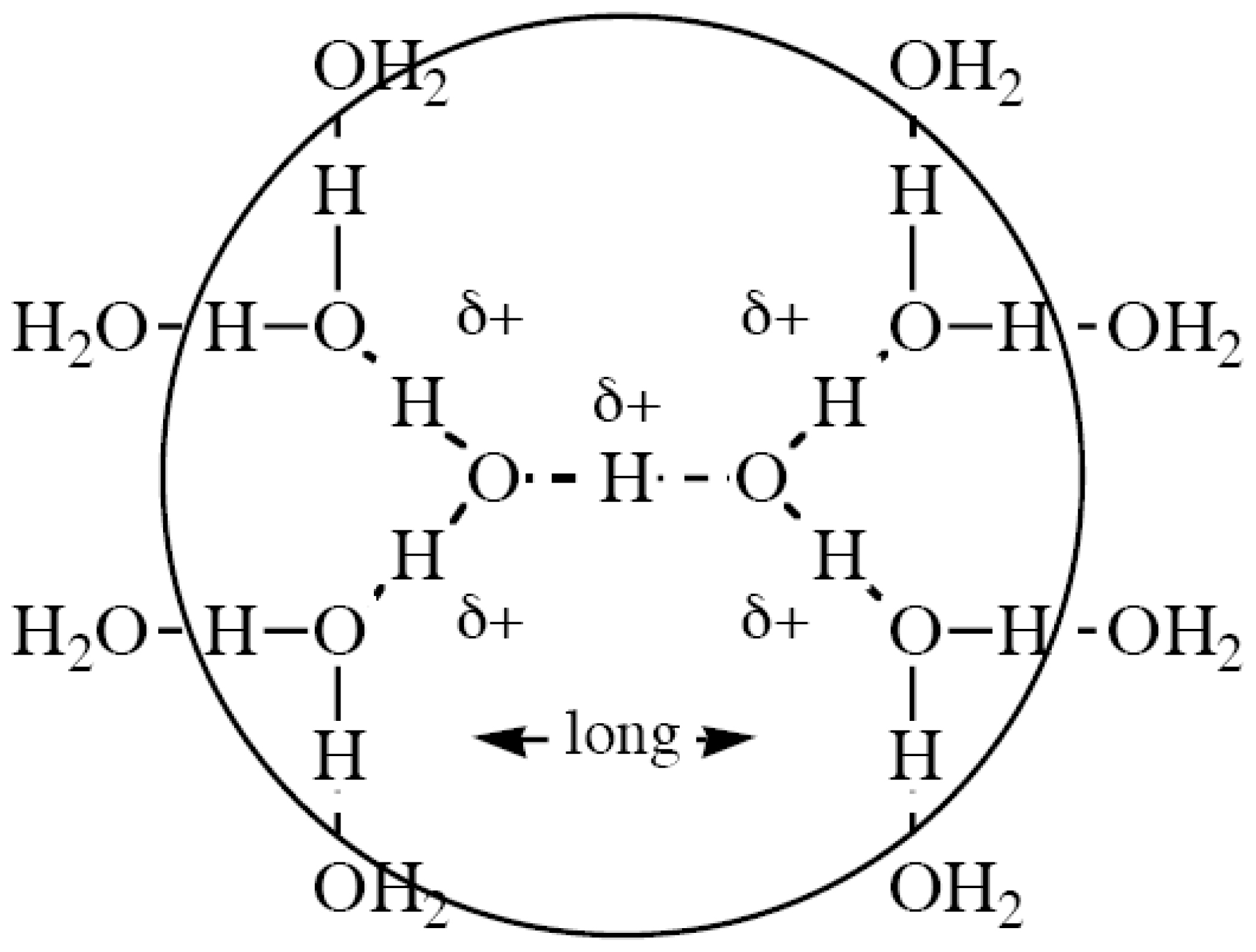
<p>For the mechanisms of reactions in aqueous media, far more important is the observation that species such as H<sub>3</sub>O<sup>+</sup> (usually called the Eigen cation [<xref ref-type="bibr" rid="b22-ijms-12-08316">22</xref>]), H<sub>5</sub>O<sub>2</sub><sup>+</sup> (usually called the Zundel cation [<xref ref-type="bibr" rid="b23-ijms-12-08316">23</xref>,<xref ref-type="bibr" rid="b24-ijms-12-08316">24</xref>], although also strongly preferred by the school of Vinnik and Librovich at the Institute of Physical Chemistry in Moscow [<xref ref-type="bibr" rid="b25-ijms-12-08316">25</xref>]), H<sub>9</sub>O<sub>4</sub><sup>+</sup> (first postulated by Bell [<xref ref-type="bibr" rid="b26-ijms-12-08316">26</xref>], but often (mistakenly) also called the Eigen cation) and the many others which have been proposed [<xref ref-type="bibr" rid="b27-ijms-12-08316">27</xref>] (not that there has ever been any believable experimental evidence for any of them [<xref ref-type="bibr" rid="b28-ijms-12-08316">28</xref>,<xref ref-type="bibr" rid="b29-ijms-12-08316">29</xref>]) do not have lifetimes long enough to exist. Although far less work has been done, recent studies show that HO<sup>−</sup> cannot exist as such in water either [<xref ref-type="bibr" rid="b30-ijms-12-08316">30</xref>–<xref ref-type="bibr" rid="b32-ijms-12-08316">32</xref>]. Recent very high-quality IR measurements on acid solutions [<xref ref-type="bibr" rid="b33-ijms-12-08316">33</xref>,<xref ref-type="bibr" rid="b34-ijms-12-08316">34</xref>] show that the only structure that has any kind of real existence in them is the proposed H<sub>13</sub>O<sub>6</sub><sup>+</sup> [<xref ref-type="bibr" rid="b35-ijms-12-08316">35</xref>], shown in <xref ref-type="fig" rid="f4-ijms-12-08316">Scheme II</xref> [<xref ref-type="bibr" rid="b34-ijms-12-08316">34</xref>], but even this has a very short lifetime; the authors state [<xref ref-type="bibr" rid="b36-ijms-12-08316">36</xref>]: “The lifetime of the five central protons is close to the time of their vibrational transitions. In ~70% of these cations it is shorter than the time of normal vibrations and the IR spectrum degenerates to a continuum absorption”. In addition, in several modern theoretical calculations on proton clusters containing many water molecules it is found not to be possible to isolate the positive charge, it is simply “on the cluster” as a whole [<xref ref-type="bibr" rid="b37-ijms-12-08316">37</xref>].</p>
<p>Consequently, we may only speak of “H<sub>aq</sub><sup>+</sup>” and “HO<sub>aq</sub><sup>−</sup>” as being reactants [<xref ref-type="bibr" rid="b28-ijms-12-08316">28</xref>–<xref ref-type="bibr" rid="b34-ijms-12-08316">34</xref>]. The Grotthuss chain transfer process along hydrogen bonds in water simply ensures that a proton or a hydroxide ion is available instantaneously where or when it is needed. (This is such a widely accepted transport mechanism in water that specific references to it are difficult to find. The original is [<xref ref-type="bibr" rid="b38-ijms-12-08316">38</xref>]). This has all kinds of consequences for reaction mechanisms in predominantly aqueous acidic and basic media. For instance, we can no longer speak of “general” and “specific” acid and base catalysis of reactions. Far better to speak of “pre-equilibrium proton transfer”, in the case of reactions that involve the formation of a stable ionized intermediate (usually by resonance), and of “proton transfer as part of the rate-determining step”, in the other cases. Several examples follow.</p>
<p>The highly structured nature of liquid water [<xref ref-type="bibr" rid="b39-ijms-12-08316">39</xref>] also ensures that reaction mechanisms involving several water molecules acting in concert are also favored. The entropy involved in bringing water molecules into the right positions is not a concern as the structure is already there, and the Grotthuss process ensures that all proton transfers are essentially instantaneous. Several examples of reactions of this type will be given as well.</p></sec>
<sec sec-type="results|discussion">
<title>2. Results and Discussion</title>
<sec>
<title>2.1. General Acid Catalysis in Strong Acid Media</title>
<p>As far as the common strong acids HCl, HClO<sub>4</sub> and H<sub>2</sub>SO<sub>4</sub> are concerned, the only acid species present is “H<sub>aq</sub><sup>+</sup>” under normal conditions, and reactions in all of them therefore ought to proceed at the same rate at the same acid concentration [<xref ref-type="bibr" rid="b40-ijms-12-08316">40</xref>].</p>
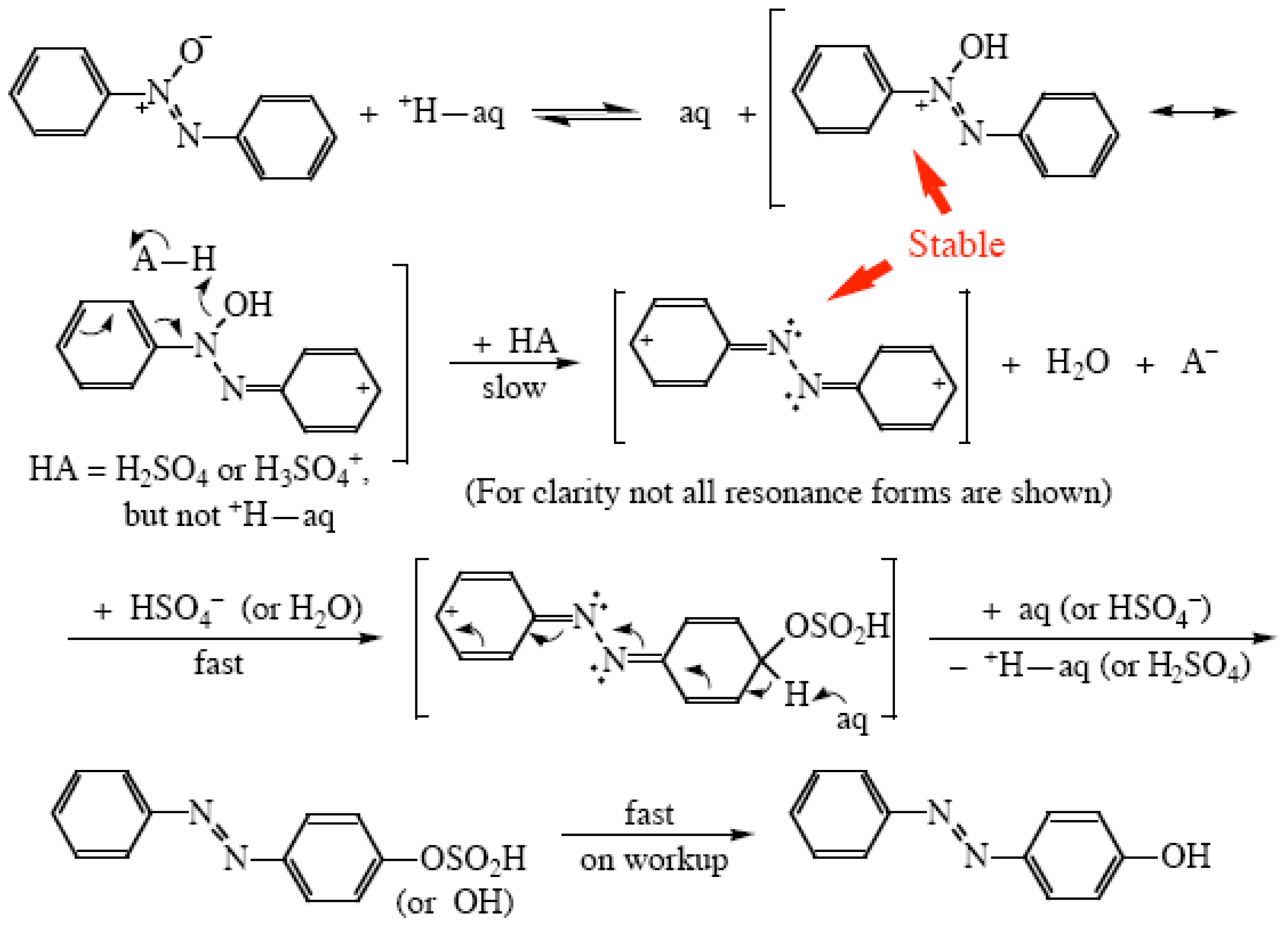
<p>Sulfuric acid is the only one that can be used from 0 wt% to 100 wt%, the dilute solution containing H<sub>aq</sub><sup>+</sup>. Above the 1:1 H<sub>2</sub>O:H<sub>2</sub>SO<sub>4</sub> molecular ratio (84.48 wt%) there is, of course, no free water present, but the solution now contains catalytically active undissociated sulfuric acid molecules. Above 99.5 wt% autoprotolysis becomes important, with the very strong acid species H<sub>3</sub>SO<sub>4</sub><sup>+</sup> present as a possible catalyst as well [<xref ref-type="bibr" rid="b41-ijms-12-08316">41</xref>]. I found catalysis by both of the latter species as far back as 1974 in the Wallach rearrangement of azoxybenzene, <xref ref-type="fig" rid="f5-ijms-12-08316">Scheme III</xref> [<xref ref-type="bibr" rid="b41-ijms-12-08316">41</xref>–<xref ref-type="bibr" rid="b43-ijms-12-08316">43</xref>]. This reaction has been extensively reviewed [<xref ref-type="bibr" rid="b44-ijms-12-08316">44</xref>,<xref ref-type="bibr" rid="b45-ijms-12-08316">45</xref>], so I will not say much about it here. The species which are stable enough to exist in the reaction solution are indicated in the Scheme; interestingly, both of them have been observed experimentally under stable ion conditions [<xref ref-type="bibr" rid="b4-ijms-12-08316">4</xref>]. Theoretical calculations have shown the dicationic species to have the structure shown, with little communication between the two halves of the molecule [<xref ref-type="bibr" rid="b42-ijms-12-08316">42</xref>].</p>
<p>Interestingly H<sub>aq</sub><sup>+</sup> is not a strong enough acid species to catalyze the reaction, only catalysis by H<sub>2</sub>SO<sub>4</sub> and by H<sub>3</sub>SO<sub>4</sub><sup>+</sup> being observed [<xref ref-type="bibr" rid="b41-ijms-12-08316">41</xref>,<xref ref-type="bibr" rid="b44-ijms-12-08316">44</xref>]. The reaction does not work in HClO<sub>4</sub>, a stronger acid system in <italic>H</italic><sub>0</sub> terms but only containing H<sub>aq</sub><sup>+</sup> with no undissociated HClO<sub>4</sub> molecules present [<xref ref-type="bibr" rid="b45-ijms-12-08316">45</xref>,<xref ref-type="bibr" rid="b46-ijms-12-08316">46</xref>]. It does go in pure FSO<sub>3</sub>H and ClSO<sub>3</sub>H, both being quite strong acid species [<xref ref-type="bibr" rid="b46-ijms-12-08316">46</xref>].</p>
<p>Another case of general acid catalysis was observed in the hydrolysis of several ethyl thiolbenzoates in sulfuric acid at concentrations above 60 wt%, where catalysis by H<sub>aq</sub><sup>+</sup> was observed, catalysis by undissociated H<sub>2</sub>SO<sub>4</sub> molecules taking over above 80 wt% in concentration [<xref ref-type="bibr" rid="b47-ijms-12-08316">47</xref>], <xref ref-type="fig" rid="f6-ijms-12-08316">Scheme IV</xref>.</p></sec>
<sec>
<title>2.2. Ether Hydrolyses</title>
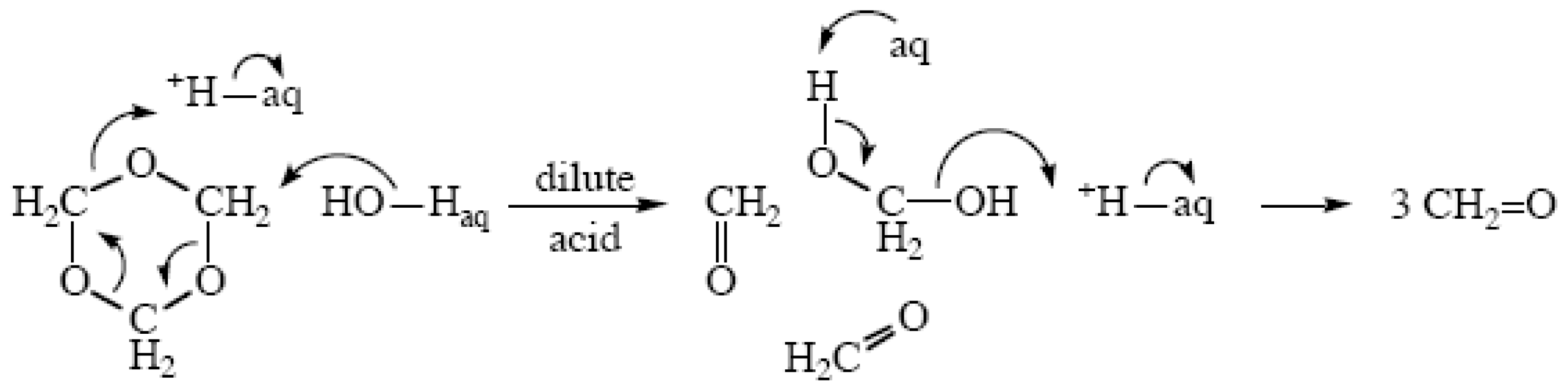
<p>The hydrolyses of trioxane and similar molecules in dilute acid have been taken by many authors (even by myself [<xref ref-type="bibr" rid="b48-ijms-12-08316">48</xref>]) to be typical A1 processes, protonation followed by rate-determining breakup of the protonated intermediate. However, if H<sub>3</sub>O<sup>+</sup> cannot exist in water, other species with positive charge on oxygen which is not resonance-stabilized are not going to be capable of existence either. This means that the mechanism of the hydrolysis of trioxane is going to be that given in <xref ref-type="fig" rid="f7-ijms-12-08316">Scheme V</xref>. (<xref ref-type="fig" rid="f7-ijms-12-08316">Scheme V</xref> shows the breakup to three formaldehyde molecules taking place all at once, but a similar stepwise breakup is of course also possible.)</p>
<p>There is plenty of kinetic data on this reaction in several different acid media available for analysis [<xref ref-type="bibr" rid="b49-ijms-12-08316">49</xref>]. The preferable method to use for this is the excess acidity correlation analysis [<xref ref-type="bibr" rid="b48-ijms-12-08316">48</xref>], which is used here. The applicable rate equation is shown as <xref rid="FD2" ref-type="disp-formula">Equation 2</xref>.</p>
<disp-formula id="FD1">
<label>(1)</label>
<mml:math id="mm1" display="block">
<mml:semantics id="sm1">
<mml:mrow>
<mml:msub>
<mml:mrow>
<mml:mi>k</mml:mi></mml:mrow>
<mml:mi>ψ</mml:mi></mml:msub>
<mml:msub>
<mml:mrow>
<mml:mi>C</mml:mi></mml:mrow>
<mml:mtext>S</mml:mtext></mml:msub>
<mml:mo>=</mml:mo>
<mml:msub>
<mml:mrow>
<mml:mi>k</mml:mi></mml:mrow>
<mml:mn>0</mml:mn></mml:msub>
<mml:msub>
<mml:mrow>
<mml:mi>a</mml:mi></mml:mrow>
<mml:mtext>S</mml:mtext></mml:msub>
<mml:msub>
<mml:mrow>
<mml:mi>a</mml:mi></mml:mrow>
<mml:mrow>
<mml:msub>
<mml:mrow>
<mml:mtext>H</mml:mtext></mml:mrow>
<mml:mn>2</mml:mn></mml:msub>
<mml:mtext>O</mml:mtext></mml:mrow></mml:msub>
<mml:msub>
<mml:mrow>
<mml:mi>a</mml:mi></mml:mrow>
<mml:mrow>
<mml:msub>
<mml:mrow>
<mml:msup>
<mml:mrow>
<mml:mtext>H</mml:mtext></mml:mrow>
<mml:mo>+</mml:mo></mml:msup></mml:mrow>
<mml:mrow>
<mml:mtext>aq</mml:mtext></mml:mrow></mml:msub></mml:mrow></mml:msub>
<mml:mo>/</mml:mo>
<mml:msub>
<mml:mrow>
<mml:mi>f</mml:mi></mml:mrow>
<mml:mo>‡</mml:mo></mml:msub>
<mml:mo>=</mml:mo>
<mml:msub>
<mml:mrow>
<mml:mi>k</mml:mi></mml:mrow>
<mml:mn>0</mml:mn></mml:msub>
<mml:msub>
<mml:mrow>
<mml:mi>C</mml:mi></mml:mrow>
<mml:mtext>S</mml:mtext></mml:msub>
<mml:msub>
<mml:mrow>
<mml:mi>a</mml:mi></mml:mrow>
<mml:mrow>
<mml:msub>
<mml:mrow>
<mml:mtext>H</mml:mtext></mml:mrow>
<mml:mn>2</mml:mn></mml:msub>
<mml:mtext>O</mml:mtext></mml:mrow></mml:msub>
<mml:msub>
<mml:mrow>
<mml:mi>C</mml:mi></mml:mrow>
<mml:mrow>
<mml:msub>
<mml:mrow>
<mml:msup>
<mml:mrow>
<mml:mtext>H</mml:mtext></mml:mrow>
<mml:mo>+</mml:mo></mml:msup></mml:mrow>
<mml:mrow>
<mml:mtext>aq</mml:mtext></mml:mrow></mml:msub></mml:mrow></mml:msub>
<mml:mfrac>
<mml:mrow>
<mml:msub>
<mml:mrow>
<mml:mi>f</mml:mi></mml:mrow>
<mml:mtext>S</mml:mtext></mml:msub>
<mml:mi> </mml:mi>
<mml:msub>
<mml:mrow>
<mml:mi>f</mml:mi></mml:mrow>
<mml:mrow>
<mml:msub>
<mml:mrow>
<mml:msup>
<mml:mrow>
<mml:mtext>H</mml:mtext></mml:mrow>
<mml:mo>+</mml:mo></mml:msup></mml:mrow>
<mml:mrow>
<mml:mtext>aq</mml:mtext></mml:mrow></mml:msub></mml:mrow></mml:msub></mml:mrow>
<mml:mrow>
<mml:msub>
<mml:mrow>
<mml:mi>f</mml:mi></mml:mrow>
<mml:mo>‡</mml:mo></mml:msub></mml:mrow></mml:mfrac></mml:mrow></mml:semantics></mml:math></disp-formula>
<disp-formula id="FD2">
<label>(2)</label>
<mml:math id="mm2" display="block">
<mml:semantics id="sm2">
<mml:mrow>
<mml:mtext>log</mml:mtext>
<mml:mi> </mml:mi>
<mml:msub>
<mml:mrow>
<mml:mi>k</mml:mi></mml:mrow>
<mml:mi>ψ</mml:mi></mml:msub>
<mml:mo>-</mml:mo>
<mml:mtext>log</mml:mtext>
<mml:mi> </mml:mi>
<mml:msub>
<mml:mrow>
<mml:mi>C</mml:mi></mml:mrow>
<mml:mrow>
<mml:msub>
<mml:mrow>
<mml:msup>
<mml:mrow>
<mml:mtext>H</mml:mtext></mml:mrow>
<mml:mo>+</mml:mo></mml:msup></mml:mrow>
<mml:mrow>
<mml:mtext>aq</mml:mtext></mml:mrow></mml:msub></mml:mrow></mml:msub>
<mml:mo>-</mml:mo>
<mml:mtext>log</mml:mtext>
<mml:mi> </mml:mi>
<mml:mi> </mml:mi>
<mml:msub>
<mml:mrow>
<mml:mi>a</mml:mi></mml:mrow>
<mml:mrow>
<mml:msub>
<mml:mrow>
<mml:mtext>H</mml:mtext></mml:mrow>
<mml:mn>2</mml:mn></mml:msub>
<mml:mtext>O</mml:mtext></mml:mrow></mml:msub>
<mml:mo>=</mml:mo>
<mml:mtext>log</mml:mtext>
<mml:mi> </mml:mi>
<mml:mi> </mml:mi>
<mml:msub>
<mml:mrow>
<mml:mi>k</mml:mi></mml:mrow>
<mml:mn>0</mml:mn></mml:msub>
<mml:mo>+</mml:mo>
<mml:msup>
<mml:mrow>
<mml:mi>m</mml:mi></mml:mrow>
<mml:mo>‡</mml:mo></mml:msup>
<mml:mi> </mml:mi>
<mml:msup>
<mml:mrow>
<mml:mi>m</mml:mi></mml:mrow>
<mml:mo>*</mml:mo></mml:msup>
<mml:mi> </mml:mi>
<mml:mi>X</mml:mi></mml:mrow></mml:semantics></mml:math></disp-formula>
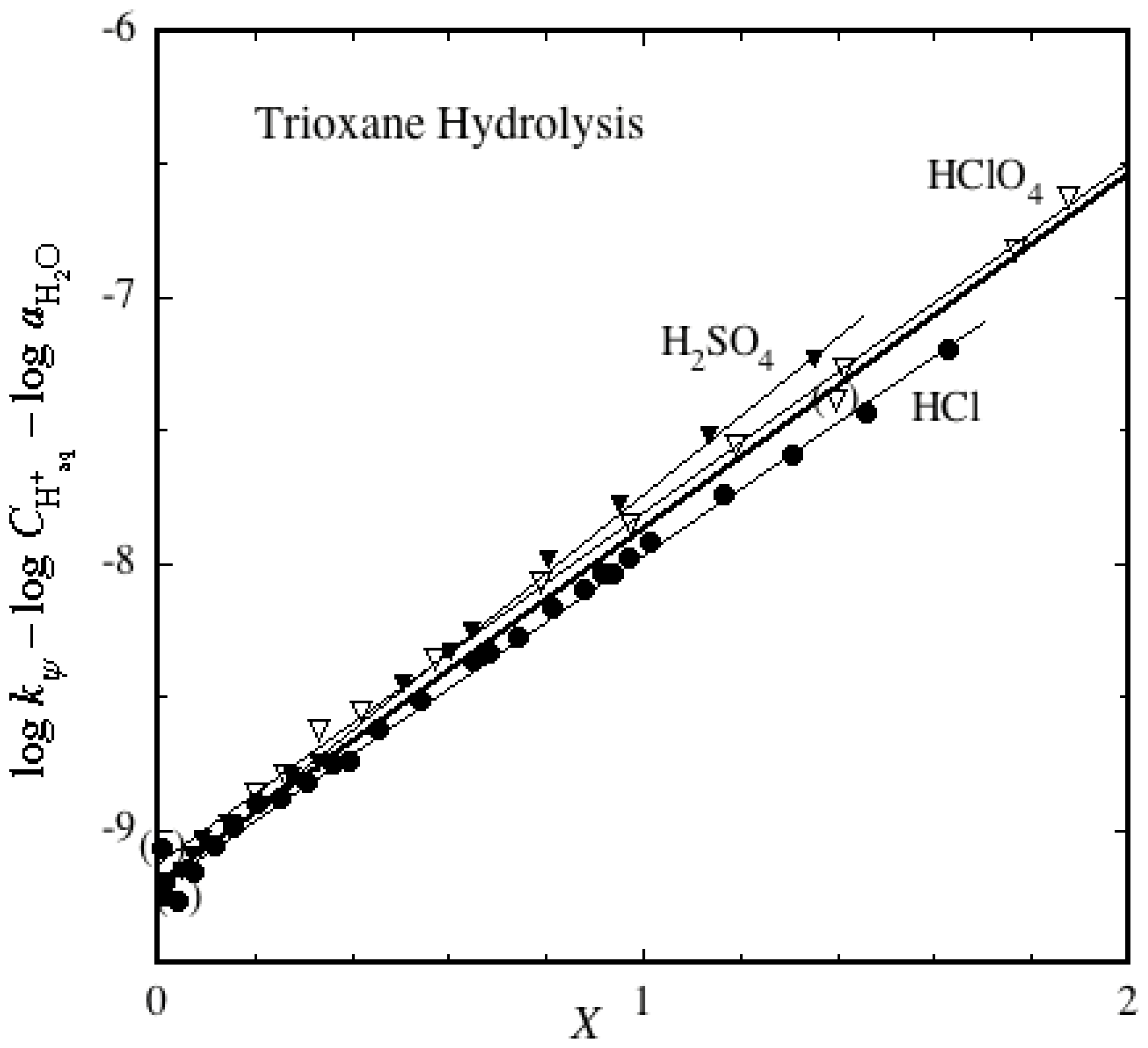
<p>Here the observed rate constants are <italic>k</italic><italic><sub>ψ</sub></italic> [<xref ref-type="bibr" rid="b49-ijms-12-08316">49</xref>], the medium-independent rate constant (<italic>i.e.</italic>, the rate constant in the aqueous standard state) is <italic>k</italic><sub>0</sub>, the proton concentration is <italic>C</italic><sub>H<sub>aq</sub><sup>+</sup></sub>, the water activity is <italic>a</italic><sub>H<sub>2</sub>O</sub> and the excess acidity is <italic>X</italic>, all available data for all three acid systems [<xref ref-type="bibr" rid="b48-ijms-12-08316">48</xref>]. The slope parameters <italic>m</italic>* and <italic>m</italic><sup>‡</sup> describe the behavior of the protonated substrate and the transition state as the acidity changes, necessarily combined here [<xref ref-type="bibr" rid="b48-ijms-12-08316">48</xref>]. Plots according to <xref rid="FD2" ref-type="disp-formula">Equation 2</xref> are given in <xref ref-type="fig" rid="f1-ijms-12-08316">Figure 1</xref>.</p>
<p>As can be seen, the plots for all three acids are accurately linear. For illustration purposes a thick line is given for all of the data combined, slope 1.333 ± 0.022, intercept –9.198 ± 0.018, correlation coefficient 0.993 over 54 points. However, the points for the three individual acids fall (very accurately, correlation coefficients 0.9990 in HCl, 0.9994 in HClO<sub>4</sub>, 0.9994 in H<sub>2</sub>SO<sub>4</sub>) on slightly different lines, which undoubtedly reflects the fact that the water activities for the three acids are not known equally well. Water activities in the aqueous sulfuric acid medium [<xref ref-type="bibr" rid="b50-ijms-12-08316">50</xref>] are very accurately known [<xref ref-type="bibr" rid="b51-ijms-12-08316">51</xref>], but this is not the case for HCl [<xref ref-type="bibr" rid="b52-ijms-12-08316">52</xref>–<xref ref-type="bibr" rid="b54-ijms-12-08316">54</xref>] and, particularly, HClO<sub>4</sub> [<xref ref-type="bibr" rid="b55-ijms-12-08316">55</xref>–<xref ref-type="bibr" rid="b58-ijms-12-08316">58</xref>]. All of the plots fit the appropriate lines more closely than was previously found by treating the process as a traditional A1 reaction [<xref ref-type="bibr" rid="b48-ijms-12-08316">48</xref>].</p>
<p>If this process is really a case of general acid catalysis, rates measured in aqueous buffer systems should show this. Trioxane hydrolysis is too slow a reaction to have been studied in this way, but the closely related hydrolysis of paraldehyde (the acetaldehyde trimer) is much faster [<xref ref-type="bibr" rid="b48-ijms-12-08316">48</xref>], and evidence for general acid catalysis has indeed been found [<xref ref-type="bibr" rid="b59-ijms-12-08316">59</xref>,<xref ref-type="bibr" rid="b60-ijms-12-08316">60</xref>], although this fact does not seem to be widely known (or has been ignored). A plot like <xref ref-type="fig" rid="f1-ijms-12-08316">Figure 1</xref> can also be drawn for paraldehyde, but the kinetics cover a much smaller acidity range, and the scatter is bad.</p>
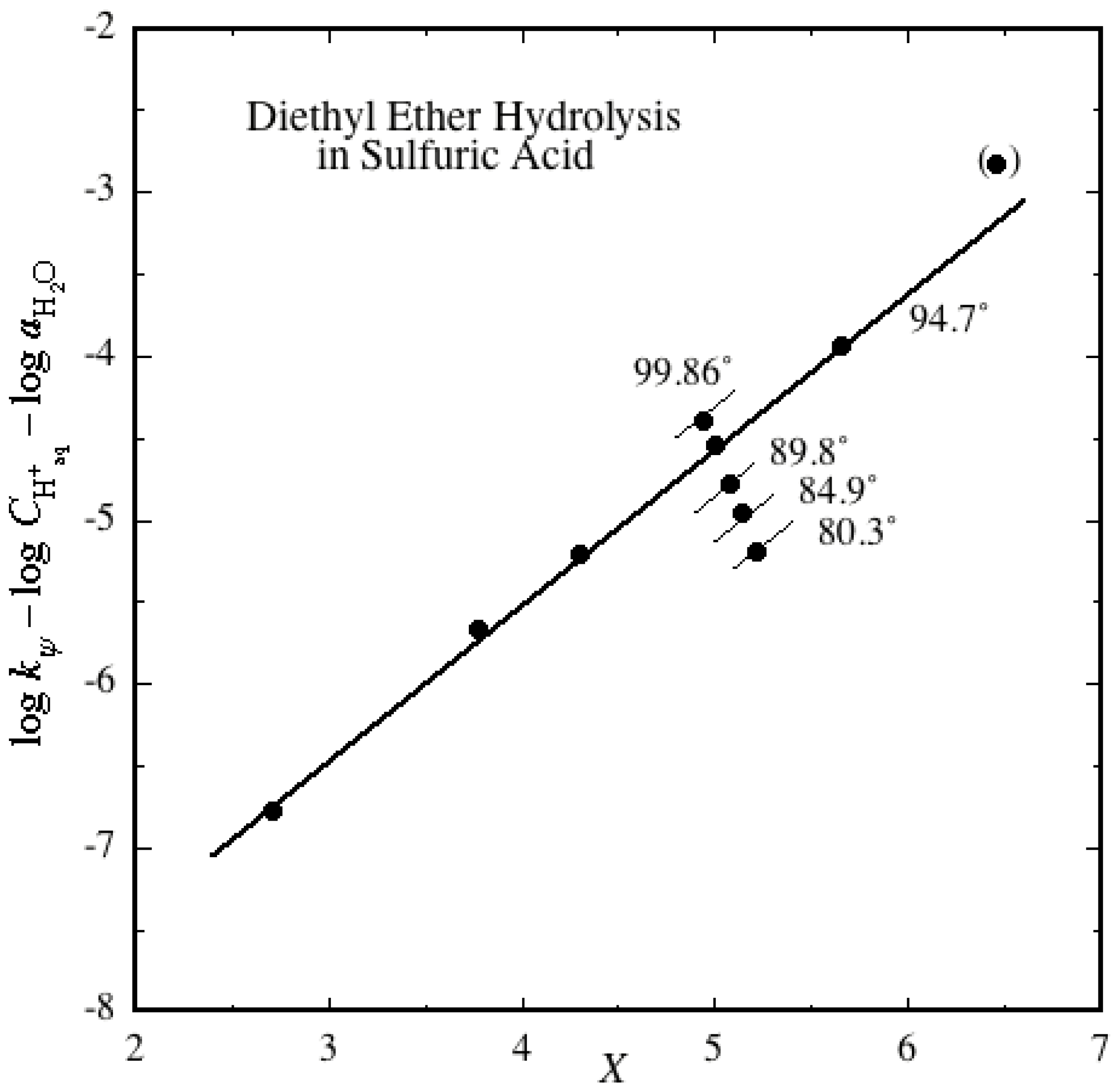
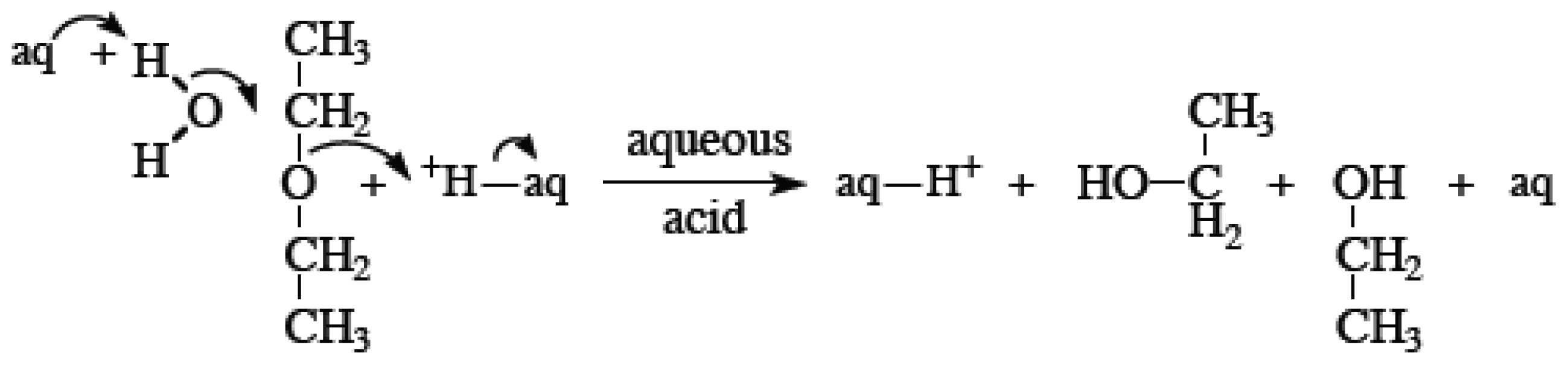
<p>Another ether system for which kinetic results are available [<xref ref-type="bibr" rid="b61-ijms-12-08316">61</xref>] is the hydrolysis of diethyl ether at high temperatures and high acidities in aqueous sulfuric acid. The mechanism proposed here is shown in <xref ref-type="fig" rid="f8-ijms-12-08316">Scheme VI</xref>.</p>
<p>This is essentially the same mechanism as that shown in <xref ref-type="fig" rid="f7-ijms-12-08316">Scheme V</xref>, and the same excess acidity rate equation, <xref rid="FD2" ref-type="disp-formula">Equation 2</xref>, applies. In sulfuric acid this mechanism is only going to apply as long as there is free water available, <italic>i.e</italic>., not above a concentration of 85.48 wt%. Above this acidity another well-characterized mechanism takes over [<xref ref-type="bibr" rid="b61-ijms-12-08316">61</xref>], involving a much faster direct reaction between the diethyl ether and SO<sub>3</sub>, which is available for reaction above this acidity. Thus in an excess acidity plot one would expect linearity below 85.48 wt%, and an upward deviation above this point. This is exactly what is observed, as <xref ref-type="fig" rid="f2-ijms-12-08316">Figure 2</xref> illustrates.</p>
<p>The topmost point in <xref ref-type="fig" rid="f2-ijms-12-08316">Figure 2</xref> is at an acidity of 90 wt%, and deviates upwards as expected. (In the original paper [<xref ref-type="bibr" rid="b61-ijms-12-08316">61</xref>] a plot of log rate constant against acidity curves downward over the acidity region which gives linearity here.) The <italic>m</italic>*<italic>m</italic><sup>‡</sup> slope is 0.949 ± 0.015, and as different temperatures are available, the activation parameters for the reaction can be calculated: Δ<italic>H</italic><sup>‡</sup> = 32.8 ± 1.4 kcal·mol<sup>−1</sup>; Δ<italic>S</italic><sup>‡</sup> = −12.4 ± 4.7 cal·deg<sup>−1</sup>·mol<sup>−1</sup>, both perfectly reasonable numbers. (They only concern the substrate, as <italic>X</italic>, log <italic>C</italic><sub>H<sub>aq</sub><sup>+</sup></sub>and log <italic>a</italic><sub>H<sub>2</sub>O</sub> have all been corrected to the reaction temperature, as before [<xref ref-type="bibr" rid="b48-ijms-12-08316">48</xref>].) The correlation coefficient is 0.9993.</p>
<p><xref ref-type="fig" rid="f1-ijms-12-08316">Figures 1</xref> and <xref ref-type="fig" rid="f2-ijms-12-08316">2</xref> constitute strong evidence in favor of the mechanisms given here. Interestingly, it does not matter whether the substrate can be considered to be primarily protonated at the acidity of the reaction or not; oxygen-protonated species in which the charge cannot be delocalized are not going to be reaction intermediates as their lifetimes are too short! When the charge <bold>can</bold> be delocalized, intermediate lifetimes are much longer. For instance, the methoxymethyl cation, where the charge is delocalized over carbon and oxygen, is calculated to have a lifetime of about 1 ps [<xref ref-type="bibr" rid="b62-ijms-12-08316">62</xref>], which, although short, is quite long enough for it to be a reaction intermediate.</p></sec>
<sec>
<title>2.3. Amide Hydrolyses</title>
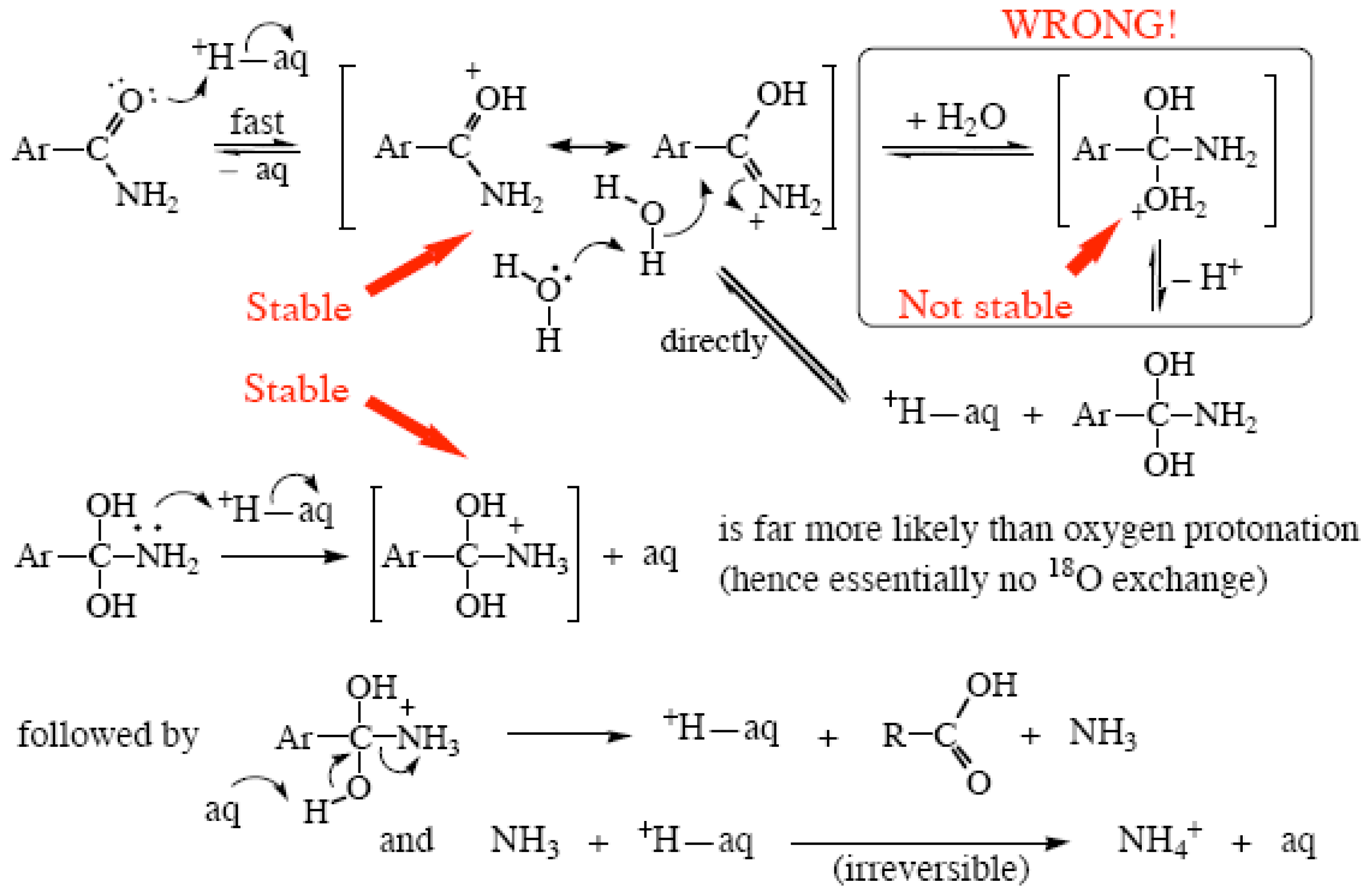
<p>Benzamides, and presumably other suitable amides, have two hydrolysis mechanisms [<xref ref-type="bibr" rid="b63-ijms-12-08316">63</xref>]. In weakly acidic aqueous H<sub>2</sub>SO<sub>4</sub> media, a pre-equilibrium proton transfer gives a stable delocalized protonated amide intermediate, to which water adds; see <xref ref-type="fig" rid="f9-ijms-12-08316">Scheme VII</xref>. From this a neutral tetrahedral intermediate is formed directly; charged ones cannot exist in an aqueous medium. (Log rate constants, corrected for incomplete amide protonation, are linear in the log water activity, slope two. Molarity-based water activities must be used for consistency with the other species concentrations, rather than the listed mole-fraction-based ones [<xref ref-type="bibr" rid="b48-ijms-12-08316">48</xref>].)</p>
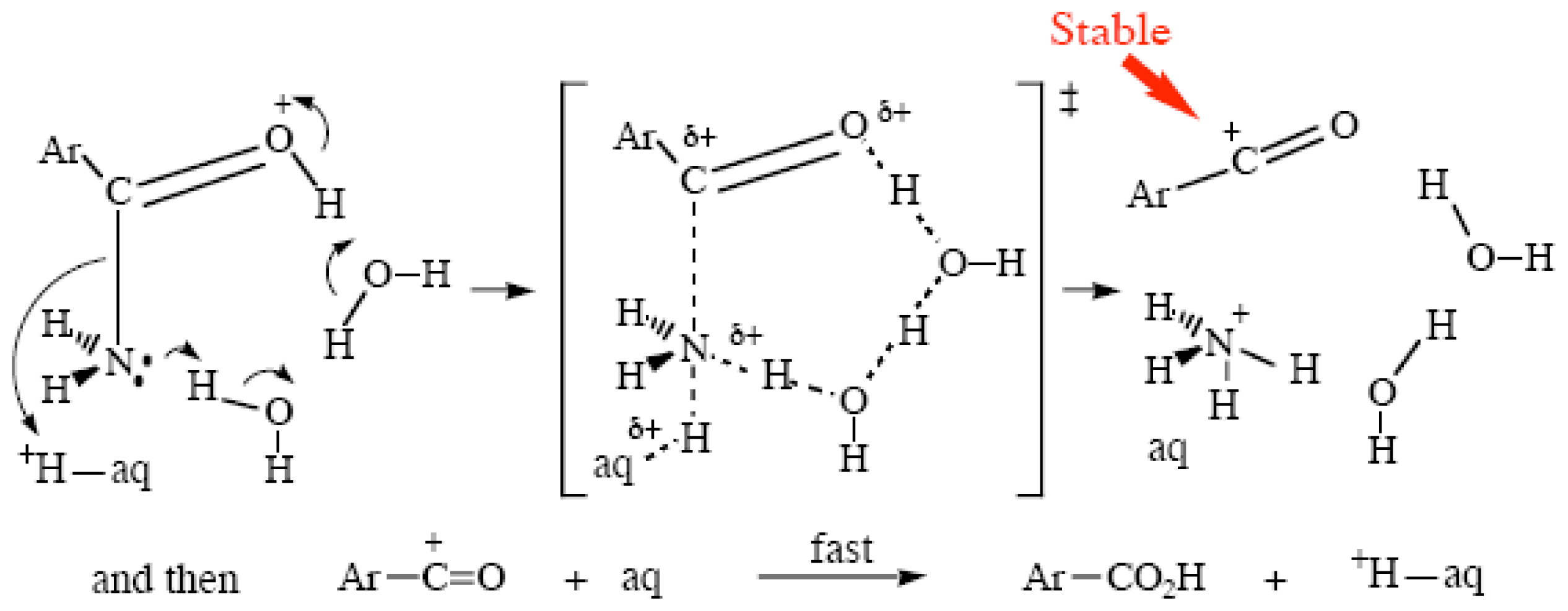
<p>In more strongly acidic media the mechanism changes [<xref ref-type="bibr" rid="b63-ijms-12-08316">63</xref>]; the kinetics show a second, concerted, proton transfer taking place, giving an acylium ion which is stable under the reaction conditions, and that two water molecules are involved [<xref ref-type="bibr" rid="b63-ijms-12-08316">63</xref>]. This mechanism is a bit tricky to draw, but I have made an attempt in <xref ref-type="fig" rid="f10-ijms-12-08316">Scheme VIII</xref>. Since an acylium ion is involved, this mechanism would only occur for those amides capable of giving stable ones, primarily benzamides. For other types of amide evidence is lacking; amides are particularly stable and their acid hydrolysis is very slow and quite difficult to study. The catalyzing acid is given as H<sub>aq</sub><sup>+</sup>; presumably in H<sub>2</sub>SO<sub>4</sub> media stronger than ~85 wt% the catalyst would be undissociated H<sub>2</sub>SO<sub>4</sub>, see above [<xref ref-type="bibr" rid="b63-ijms-12-08316">63</xref>].</p></sec>
<sec>
<title>2.4. Ester Hydrolyses</title>
<p>At acidities below ~85 wt% the mechanisms of these processes are similar to those for benzamides [<xref ref-type="bibr" rid="b63-ijms-12-08316">63</xref>] (and benzimidates [<xref ref-type="bibr" rid="b64-ijms-12-08316">64</xref>]) as shown in <xref ref-type="fig" rid="f11-ijms-12-08316">Scheme IX</xref> [<xref ref-type="bibr" rid="b64-ijms-12-08316">64</xref>], which differs from <xref ref-type="fig" rid="f9-ijms-12-08316">Scheme VII</xref> for amides in that the neutral tetrahedral intermediate does not contain a nitrogen atom, and so it is susceptible to <sup>18</sup>O-exchange, which is observed [<xref ref-type="bibr" rid="b65-ijms-12-08316">65</xref>]; it is essentially not found in amide hydrolysis [<xref ref-type="bibr" rid="b66-ijms-12-08316">66</xref>].</p>
<p>In the strong acid region, above ~85 wt% H<sub>2</sub>SO<sub>4</sub>, other mechanisms take over. If the substrate contains a group capable of forming a stable carbocation, e.g., a benzylic or a tertiary group, this can leave directly from the protonated ester, and this can be the preferred mechanism at acidities much lower than 85 wt% H<sub>2</sub>SO<sub>4</sub> [<xref ref-type="bibr" rid="b67-ijms-12-08316">67</xref>,<xref ref-type="bibr" rid="b68-ijms-12-08316">68</xref>]. This is shown in <xref ref-type="fig" rid="f12-ijms-12-08316">Scheme X</xref>.</p>
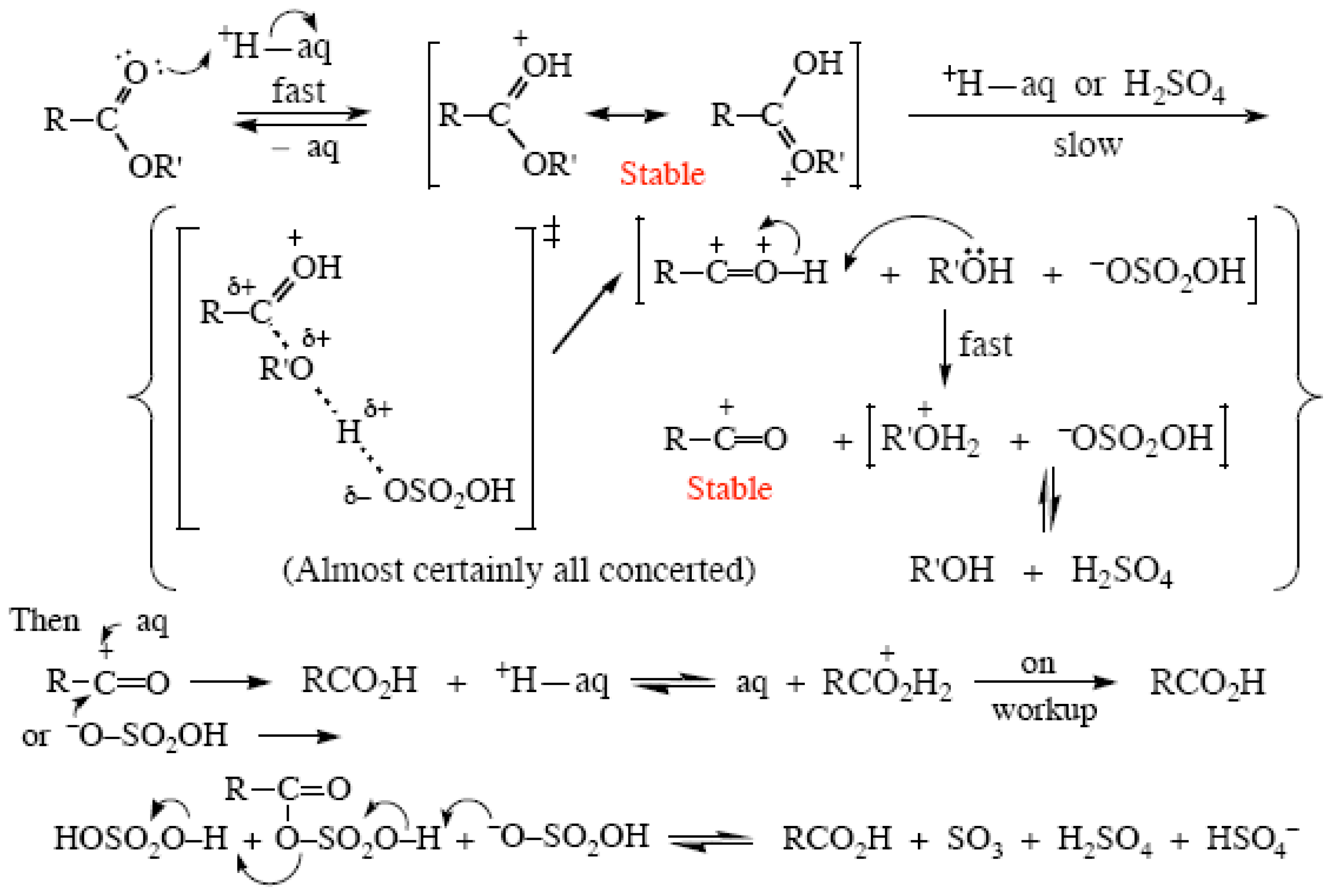
<p>For other esters in strong acid an additional proton transfer is probably involved, to give an acylium ion; the previously proposed [<xref ref-type="bibr" rid="b67-ijms-12-08316">67</xref>,<xref ref-type="bibr" rid="b68-ijms-12-08316">68</xref>] “proton switch” mechanism is probably wrong. This again is quite difficult to draw, but I have made an attempt in <xref ref-type="fig" rid="f13-ijms-12-08316">Scheme XI</xref>. This mechanism is not yet established, but work is underway to do this [<xref ref-type="bibr" rid="b20-ijms-12-08316">20</xref>].</p>
<p>In basic media, it is becoming increasingly apparent that hydroxide ions do not themselves add directly to carbonyl groups, but that HO<sub>aq</sub><sup>−</sup> removes a proton from a water molecule which then adds to the carbonyl, the result being a neutral tetrahedral intermediate [<xref ref-type="bibr" rid="b17-ijms-12-08316">17</xref>–<xref ref-type="bibr" rid="b19-ijms-12-08316">19</xref>]. Heavy-atom isotope effect studies make this appear even more likely [<xref ref-type="bibr" rid="b69-ijms-12-08316">69</xref>]. Since the process is reversible, extensive oxygen exchange into the substrate is observed as well [<xref ref-type="bibr" rid="b70-ijms-12-08316">70</xref>,<xref ref-type="bibr" rid="b71-ijms-12-08316">71</xref>]. The most probable mechanism is given here as <xref ref-type="fig" rid="f14-ijms-12-08316">Scheme XII</xref>. Formation of a neutral intermediate ensures that the negative charge is dispersed into the solvent. Electronegative oxygen is certainly more able to support a negative charge than a positive one, but the principle of having any charge, positive or negative, dispersed as widely as possible ensures that all tetrahedral intermediates formed in either acidic or basic processes would be neutral. Species that are represented by various authors as T<sup>+</sup>, T<sup>−</sup>, T<sup>±</sup> and, especially, T<sup>2−</sup> do not exist in aqueous media.</p></sec>
<sec>
<title>2.5. Mechanisms Involving Chains of Water Molecules</title>
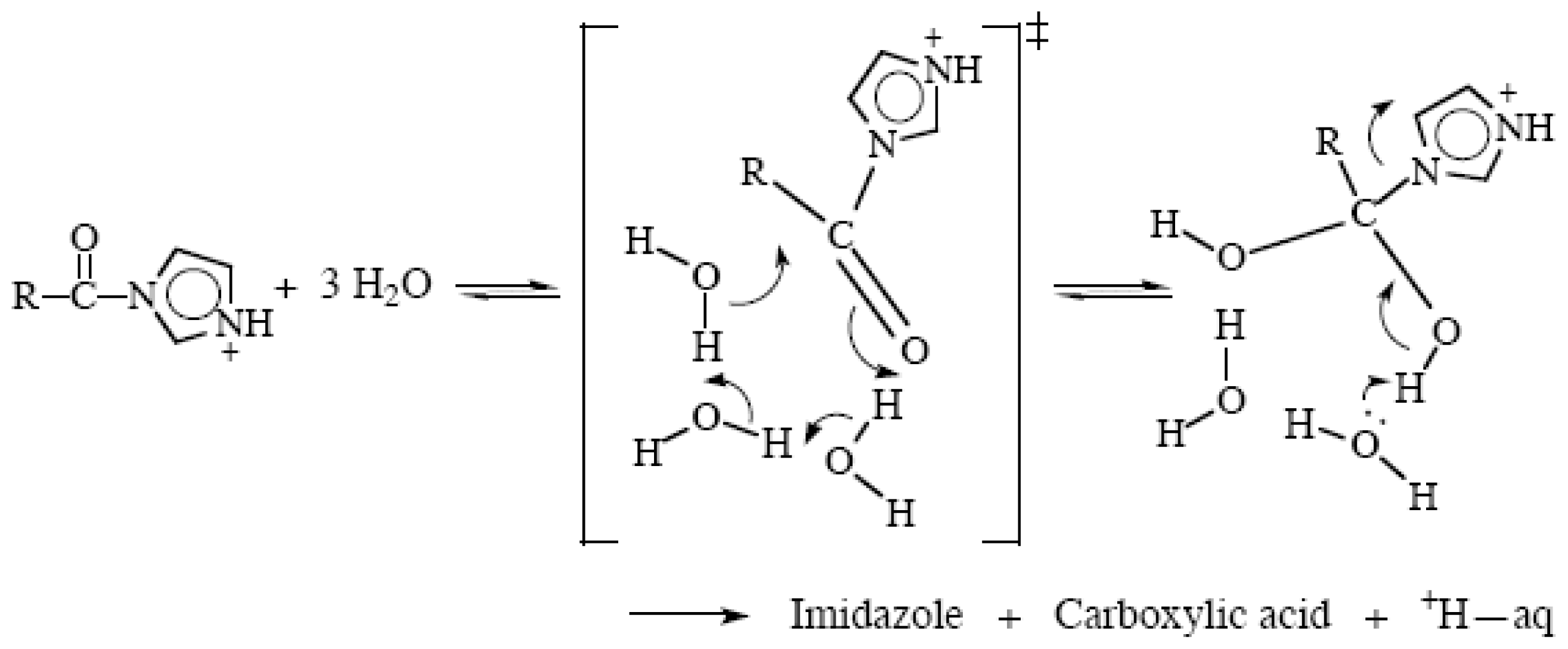
<p>There are quite a number of these known now. The principles seem to be that if a reaction can be achieved without any charge transfer taking place it is favored, and that reactions involving chains of water molecules are favorable because the structure necessary for reaction essentially already exists; water molecules do not have to be moved into position, which is unfavorable entropically. For instance, acylimidazoles hydrolyze by forming a tetrahedral intermediate directly, <xref ref-type="fig" rid="f15-ijms-12-08316">Scheme XIII</xref> [<xref ref-type="bibr" rid="b72-ijms-12-08316">72</xref>]. Incidentally, this work showed that the excess acidity correlation analysis works well even for reactions that are not acid-catalyzed [<xref ref-type="bibr" rid="b72-ijms-12-08316">72</xref>].</p>
<p>I proposed a mechanism for the hydrolysis of nitramide in neutral water on the basis of nothing but its elegance [<xref ref-type="bibr" rid="b73-ijms-12-08316">73</xref>], and was gratified that detailed modern theoretical calculations, in the gas-phase and also in solution [<xref ref-type="bibr" rid="b74-ijms-12-08316">74</xref>], showed that it was in fact correct. This is shown in <xref ref-type="fig" rid="f16-ijms-12-08316">Scheme XIV</xref>.</p>
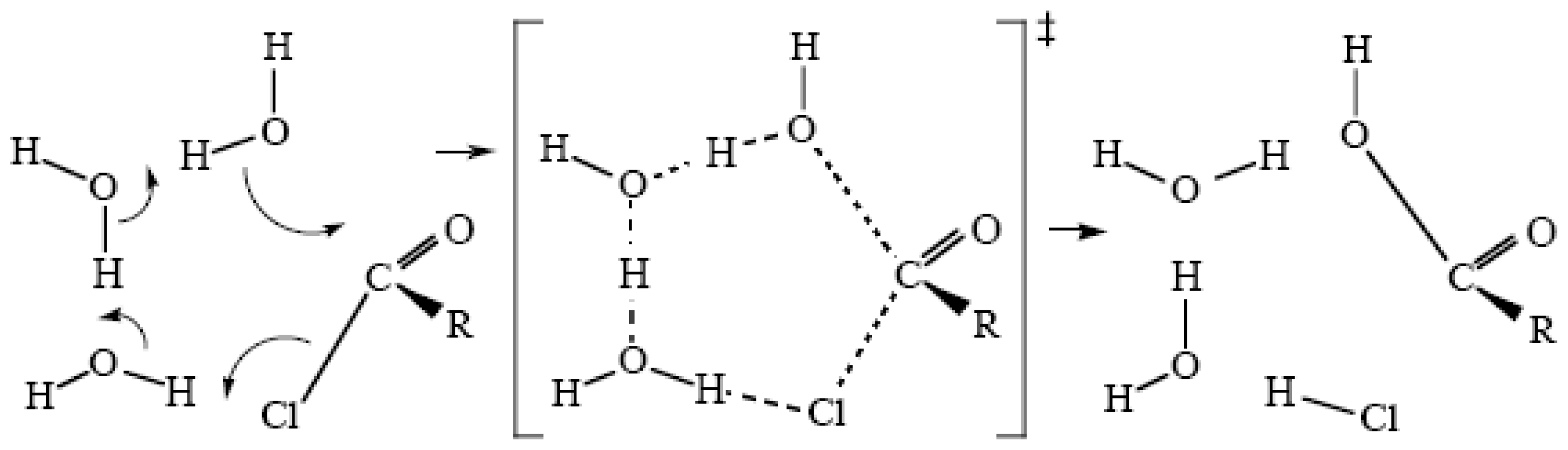
<p>The hydrolyses of acid chlorides and acid anhydrides are fast reactions which have not received a lot of attention. Several mechanisms have been proposed [<xref ref-type="bibr" rid="b75-ijms-12-08316">75</xref>–<xref ref-type="bibr" rid="b78-ijms-12-08316">78</xref>], but the latest research would indicate that the actual mechanism may well be a simple cycle involving water as well, <xref ref-type="fig" rid="f17-ijms-12-08316">Scheme XV</xref> [<xref ref-type="bibr" rid="b78-ijms-12-08316">78</xref>].</p></sec></sec>
<sec sec-type="conclusions">
<title>3. Conclusions</title>
<list list-type="order">
<list-item>
<p>If a species does not have a finite lifetime in the solution in which the reaction is performed it cannot be a reaction intermediate. No primary or secondary carbocations in aqueous media; only T<sup>0</sup>, no T<sup>+</sup>, T<sup>−</sup>, T<sup>±</sup> or T<sup>2−</sup> tetrahedral intermediates.</p></list-item>
<list-item>
<p>Positive or negative charge, if present, will be as delocalized as possible during the reaction, especially in reaction intermediates, often into the aqueous solvent. A highly electronegative atom like oxygen is simply not going to support a positive charge all by itself. O<sup>+</sup> is almost as unlikely as F<sup>+</sup>!</p></list-item>
<list-item>
<p>Also, reactions will be unimolecular, as far as possible, for entropic reasons (S<sub>N</sub>1 favored over S<sub>N</sub>2); however, mechanisms involving chains of water molecules are favored in aqueous media thanks to the highly structured nature of water and the Grotthuss process.</p></list-item></list>
<p>There are a number of philosophical implications. Many years ago chemists weaned themselves from using “H<sup>+</sup>” as a reactant, once it was pointed out that free protons are only stable in a hard vacuum. Now we are going to have to wean ourselves from using “H<sub>3</sub>O<sup>+</sup>” or “HO<sup>−</sup>” as reactants in aqueous solution as well. Of course these species do exist, under special circumstances. In sulfuric acid above the 1:1 mole ratio point (~85 wt%) all the remaining water is present in the form H<sub>3</sub>O<sup>+</sup>. The perchloric acid hydrate sold as a solid in glass vials is H<sup>3</sup>O<sup>+</sup>·ClO<sub>4</sub><sup>−</sup> (and is pretty dangerous stuff!). The terms to use are “H<sub>aq</sub><sup>+</sup>” and “HO<sub>aq</sub><sup>−</sup>”.</p>
<p>We are going to have to cease using the terms “general” and “specific” acid and base catalysis. Much to be preferred, I think, is to refer to “pre-equilibrium proton transfer” when an intermediate that is stable under the reaction conditions is formed in a first fast step, and to “concerted with proton transfer”, or something similar, when the proton transfer is involved in the rate-determining step, as in many of the examples discussed above.</p>
<p>Very recently some common organic reactions have begun to be studied in liquid ammonia as a solvent, rather than in water [<xref ref-type="bibr" rid="b79-ijms-12-08316">79</xref>,<xref ref-type="bibr" rid="b80-ijms-12-08316">80</xref>]. It is going to be very interesting to compare the mechanisms of the same reaction in the two different solvents.</p></sec></body>
<back>
<ack>
<title>Acknowledgments</title>
<p>Valuable correspondence with Tina Amyes, Bill Bentley, John Marlier, Howard Maskill, Chris Reed and Evgenii Stoyanov is gratefully acknowledged, and I thank those who saw the poster I presented on this subject at a recent conference for their (mostly!) useful comments.</p></ack>
<fn-group><fn>
<p><bold>Conflict of Interest</bold></p>
<p>The author declares no conflict of interest.</p></fn></fn-group>
<ref-list>
<title>References and Notes</title>
<ref id="b1-ijms-12-08316"><label>1</label><note><p>For instance, the many reviews given in the series <citation citation-type="book"><source>Reviews of Chemical Intermediates</source><publisher-name>Elsevier</publisher-name><publisher-loc>Amsterdam, The Netherlands</publisher-loc></citation>, commencing in1981.</p></note></ref>
<ref id="b2-ijms-12-08316"><label>2</label><citation citation-type="journal"><person-group person-group-type="author"><name><surname>Olah</surname><given-names>G.A.</given-names></name><name><surname>White</surname><given-names>A.M.</given-names></name></person-group><article-title>Stable carbonium ions. XCI. Carbon-13 nuclear magnetic resonance spectroscopic study of carbonium ions</article-title><source>J. Am. Chem. Soc</source><year>1969</year><volume>91</volume><fpage>5801</fpage><lpage>5810</lpage><pub-id pub-id-type="doi">10.1021/ja01049a017</pub-id></citation></ref>
<ref id="b3-ijms-12-08316"><label>3</label><citation citation-type="journal"><person-group person-group-type="author"><name><surname>Olah</surname><given-names>G.A.</given-names></name></person-group><article-title>My search for carbocations and their role in chemistry</article-title><source>Angew. Chem. Int. Ed. Engl</source><year>1995</year><volume>34</volume><fpage>1393</fpage><lpage>1405</lpage><comment>and references therein</comment><pub-id pub-id-type="doi">10.1002/anie.199513931</pub-id></citation></ref>
<ref id="b4-ijms-12-08316"><label>4</label><citation citation-type="journal"><person-group person-group-type="author"><name><surname>Olah</surname><given-names>G.A.</given-names></name><name><surname>Dunne</surname><given-names>K.</given-names></name><name><surname>Kelly</surname><given-names>D.P.</given-names></name><name><surname>Mo</surname><given-names>Y.K.</given-names></name></person-group><article-title>Stable carbocations. CXXIX. Mechanism of the Benzidine and Wallach rearrangements based on direct observation of dicationic reaction intermediates and related model compounds</article-title><source>J. Am. Chem. Soc</source><year>1972</year><volume>94</volume><fpage>7438</fpage><lpage>7447</lpage><pub-id pub-id-type="doi">10.1021/ja00776a029</pub-id></citation></ref>
<ref id="b5-ijms-12-08316"><label>5</label><citation citation-type="book"><person-group person-group-type="author"><name><surname>Moore</surname><given-names>W.J.</given-names></name></person-group><source>Physical Chemistry</source><edition>4th ed.</edition><publisher-name>Prentice Hall</publisher-name><publisher-loc>Englewood Cliffs, NJ, USA</publisher-loc><year>1972</year><fpage>769</fpage></citation></ref>
<ref id="b6-ijms-12-08316"><label>6</label><citation citation-type="journal"><person-group person-group-type="author"><name><surname>Jencks</surname><given-names>W.P.</given-names></name></person-group><article-title>When is an intermediate not an intermediate? Enforced mechanisms of general acid-base catalyzed, carbocation, carbanion, and ligand exchange reactions</article-title><source>Acc. Chem. Res</source><year>1980</year><volume>13</volume><fpage>161</fpage><lpage>169</lpage><pub-id pub-id-type="doi">10.1021/ar50150a001</pub-id></citation></ref>
<ref id="b7-ijms-12-08316"><label>7</label><citation citation-type="journal"><person-group person-group-type="author"><name><surname>Richard</surname><given-names>J.P.</given-names></name><name><surname>Amyes</surname><given-names>T.L.</given-names></name><name><surname>Toteva</surname><given-names>M.M.</given-names></name></person-group><article-title>Formation and stability of carbocations and carbanions in water and intrinsic barriers to their reactions</article-title><source>Acc. Chem. Res</source><year>2001</year><volume>34</volume><fpage>981</fpage><lpage>988</lpage><comment>and references therein</comment><pub-id pub-id-type="doi">10.1021/ar0000556</pub-id><pub-id pub-id-type="pmid">11747416</pub-id></citation></ref>
<ref id="b8-ijms-12-08316"><label>8</label><citation citation-type="journal"><person-group person-group-type="author"><name><surname>Vorob’eva</surname><given-names>E.N.</given-names></name><name><surname>Kuznetsov</surname><given-names>L.L.</given-names></name><name><surname>Gidaspov</surname><given-names>B.V.</given-names></name></person-group><article-title>Kinetics of decomposition of primary aliphatic <italic>N</italic>-nitroamines in aqueous sulfuric acid</article-title><source>Zh. Org. Khim</source><year>1983</year><volume>19</volume><fpage>698</fpage><lpage>704</lpage></citation><citation citation-type="journal"><source>Russ. J. Org. Chem</source><year>1983</year><volume>19</volume><fpage>615</fpage><lpage>620</lpage></citation></ref>
<ref id="b9-ijms-12-08316"><label>9</label><citation citation-type="journal"><person-group person-group-type="author"><name><surname>Dietze</surname><given-names>P.E.</given-names></name><name><surname>Jencks</surname><given-names>W.P.</given-names></name></person-group><article-title>Oxygen exchange into 2-butanol and hydration of 1-butene do not proceed through a common carbocation intermediate</article-title><source>J. Am. Chem. Soc</source><year>1987</year><volume>109</volume><fpage>2057</fpage><lpage>2062</lpage><pub-id pub-id-type="doi">10.1021/ja00241a024</pub-id></citation></ref>
<ref id="b10-ijms-12-08316"><label>10</label><citation citation-type="journal"><person-group person-group-type="author"><name><surname>Dietze</surname><given-names>P.E.</given-names></name><name><surname>Wojciechowski</surname><given-names>M.</given-names></name></person-group><article-title>Oxygen scrambling and stereochemistry during the trifluoroethanolysis of optically active 2-butyl 4-bromobenzenesulfonate</article-title><source>J. Am. Chem. Soc</source><year>1990</year><volume>112</volume><fpage>5240</fpage><lpage>5244</lpage><pub-id pub-id-type="doi">10.1021/ja00169a035</pub-id></citation></ref>
<ref id="b11-ijms-12-08316"><label>11</label><citation citation-type="book"><person-group person-group-type="author"><name><surname>Bruice</surname><given-names>P.Y.</given-names></name></person-group><source>Organic Chemistry</source><edition>3rd ed.</edition><publisher-name>Prentice Hall</publisher-name><publisher-loc>Upper Saddle River, NJ, USA</publisher-loc><year>2001</year><fpage>380</fpage><lpage>381</lpage></citation></ref>
<ref id="b12-ijms-12-08316"><label>12</label><citation citation-type="book"><person-group person-group-type="author"><name><surname>Ingold</surname><given-names>C.K.</given-names></name></person-group><source>Structure and Mechanism in Organic Chemistry</source><edition>2nd ed.</edition><publisher-name>Cornell University Press</publisher-name><publisher-loc>Ithaca, NY, USA</publisher-loc><year>1969</year><fpage>430</fpage></citation></ref>
<ref id="b13-ijms-12-08316"><label>13</label><citation citation-type="journal"><person-group person-group-type="author"><name><surname>Murphy</surname><given-names>T.J.</given-names></name></person-group><article-title>Absence of S<sub>N</sub>1 involvement in the solvolysis of secondary alkyl compounds</article-title><source>J. Chem. Educ</source><year>2009</year><volume>86</volume><fpage>519</fpage><lpage>524</lpage><pub-id pub-id-type="doi">10.1021/ed086p519</pub-id></citation></ref>
<ref id="b14-ijms-12-08316"><label>14</label><citation citation-type="journal"><person-group person-group-type="author"><name><surname>Bentley</surname><given-names>T.W.</given-names></name><name><surname>Schleyer</surname><given-names>P.v.R.</given-names></name></person-group><article-title>The S<sub>N</sub>2-S<sub>N</sub>1 spectrum. 1. Role of nucleophilic solvent assistance and nucleophilically solvated ion pair intermediates in solvolyses of primary and secondary arenesulfonates</article-title><source>J. Am. Chem. Soc</source><year>1976</year><volume>98</volume><fpage>7658</fpage><lpage>7666</lpage><pub-id pub-id-type="doi">10.1021/ja00440a036</pub-id></citation></ref>
<ref id="b15-ijms-12-08316"><label>15</label><citation citation-type="journal"><person-group person-group-type="author"><name><surname>Bunton</surname><given-names>C.A.</given-names></name><name><surname>Konasiewicz</surname><given-names>A.</given-names></name><name><surname>Llewellyn</surname><given-names>D.R.</given-names></name></person-group><article-title>Oxygen exchange and the Walden inversion in <italic>sec</italic>-butyl alcohol</article-title><source>J. Chem. Soc</source><year>1955</year><fpage>604</fpage><lpage>607</lpage></citation></ref>
<ref id="b16-ijms-12-08316"><label>16</label><citation citation-type="journal"><person-group person-group-type="author"><name><surname>Bunton</surname><given-names>C.A.</given-names></name><name><surname>Llewellyn</surname><given-names>D. R.</given-names></name></person-group><article-title>Tracer studies on alcohols. Part II. The exchange of oxygen-18 between <italic>sec</italic>-butyl alcohol and water</article-title><source>J. Chem. Soc</source><year>1957</year><fpage>3402</fpage><lpage>3407</lpage></citation></ref>
<ref id="b17-ijms-12-08316"><label>17</label><citation citation-type="journal"><person-group person-group-type="author"><name><surname>Mata-Segreda</surname><given-names>J.F.</given-names></name></person-group><article-title>Hydroxide as a general base in the saponification of ethyl acetate</article-title><source>J. Am. Chem. Soc</source><year>2002</year><volume>124</volume><fpage>2259</fpage><lpage>2262</lpage><pub-id pub-id-type="doi">10.1021/ja011931t</pub-id><pub-id pub-id-type="pmid">11878979</pub-id></citation></ref>
<ref id="b18-ijms-12-08316"><label>18</label><citation citation-type="journal"><person-group person-group-type="author"><name><surname>Haeffner</surname><given-names>F.</given-names></name><name><surname>Hu</surname><given-names>C.-H.</given-names></name><name><surname>Brinck</surname><given-names>T.</given-names></name><name><surname>Norin</surname><given-names>T.</given-names></name></person-group><article-title>The catalytic effect of water in basic hydrolysis of methyl acetate: A theoretical study</article-title><source>J. Mol. Struct. (Theochem.)</source><year>1999</year><volume>459</volume><fpage>85</fpage><lpage>93</lpage><pub-id pub-id-type="doi">10.1016/S0166-1280(98)00251-6</pub-id></citation></ref>
<ref id="b19-ijms-12-08316"><label>19</label><citation citation-type="journal"><person-group person-group-type="author"><name><surname>Hori</surname><given-names>K.</given-names></name><name><surname>Hashitani</surname><given-names>Y.</given-names></name><name><surname>Kaku</surname><given-names>Y.</given-names></name><name><surname>Ohkubo</surname><given-names>K</given-names></name></person-group><article-title>Theoretical study on oxygen exchange accompanying alkaline hydrolysis of esters and amides</article-title><source>J. Mol. Struct. (Theochem.)</source><year>1999</year><volume>461–462</volume><fpage>589</fpage><lpage>596</lpage></citation></ref>
<ref id="b20-ijms-12-08316"><label>20</label><citation citation-type="book"><person-group person-group-type="author"><name><surname>Cox</surname><given-names>R.A.</given-names></name></person-group><publisher-loc>Scarborough, ON, Canada</publisher-loc><comment>Unpublished work</comment><year>2011</year></citation></ref>
<ref id="b21-ijms-12-08316"><label>21</label><citation citation-type="journal"><person-group person-group-type="author"><name><surname>Dolman</surname><given-names>D.</given-names></name><name><surname>Stewart</surname><given-names>R.</given-names></name></person-group><article-title>Strongly basic systems. VIII. The <italic>H</italic><sub>−</sub> function for dimethyl sulfoxide-water-tetramethylammonium hydroxide</article-title><source>Can. J. Chem</source><year>1967</year><volume>45</volume><fpage>911</fpage><lpage>924</lpage><pub-id pub-id-type="doi">10.1139/v67-155</pub-id></citation></ref>
<ref id="b22-ijms-12-08316"><label>22</label><citation citation-type="journal"><person-group person-group-type="author"><name><surname>Eigen</surname><given-names>M.</given-names></name></person-group><article-title>Proton transfer, acid-base catalysis, and enzymatic hydrolysis. Part 1. elementary processes</article-title><source>Angew. Chem. Int. Ed. Engl</source><year>1964</year><volume>3</volume><fpage>1</fpage><lpage>19</lpage><pub-id pub-id-type="doi">10.1002/anie.196400011</pub-id></citation></ref>
<ref id="b23-ijms-12-08316"><label>23</label><citation citation-type="journal"><person-group person-group-type="author"><name><surname>Zundel</surname><given-names>G</given-names></name></person-group><article-title>Hydrogen bonds with large proton polarizability and proton transfer processes in electrochemistry and biology</article-title><source>Adv. Chem. Phys</source><year>2000</year><volume>111</volume><fpage>1</fpage><lpage>217</lpage><comment>and many earlier papers</comment></citation></ref>
<ref id="b24-ijms-12-08316"><label>24</label><citation citation-type="journal"><person-group person-group-type="author"><name><surname>Niedner-Schatteburg</surname><given-names>G.</given-names></name></person-group><article-title>Infrared spectroscopy and ab initio theory of isolated H<sub>5</sub>O<sub>2</sub><sup>+</sup>: from buckets of water to the Schrödinger equation and back</article-title><source>Angew. Chem. Int. Ed. Engl</source><year>2008</year><volume>47</volume><fpage>1008</fpage><lpage>1011</lpage><pub-id pub-id-type="doi">10.1002/anie.200703555</pub-id><pub-id pub-id-type="pmid">18161702</pub-id></citation></ref>
<ref id="b25-ijms-12-08316"><label>25</label><citation citation-type="journal"><person-group person-group-type="author"><name><surname>Librovich</surname><given-names>N.B.</given-names></name><name><surname>Maiorov</surname><given-names>V.D.</given-names></name><name><surname>Savel’ev</surname><given-names>V.A.</given-names></name></person-group><article-title>The H<sub>5</sub>O<sub>2</sub><sup>+</sup> ion in the vibrational spectra of aqueous solutions of strong acids</article-title><source>Dokl. Akad. Nauk SSSR</source><year>1975</year><volume>225</volume><fpage>1358</fpage><lpage>1361</lpage><source>Ann. Russ. Acad. Sci</source><year>1975</year><volume>225</volume><fpage>1383</fpage><lpage>1385</lpage><comment>and many other papers</comment></citation></ref>
<ref id="b26-ijms-12-08316"><label>26</label><citation citation-type="journal"><person-group person-group-type="author"><name><surname>Bascombe</surname><given-names>K.N.</given-names></name><name><surname>Bell</surname><given-names>R.P.</given-names></name></person-group><article-title>Properties of concentrated acid solutions</article-title><source>Discuss. Faraday Soc</source><year>1957</year><volume>24</volume><fpage>158</fpage><lpage>161</lpage><pub-id pub-id-type="doi">10.1039/df9572400158</pub-id></citation></ref>
<ref id="b27-ijms-12-08316"><label>27</label><citation citation-type="journal"><person-group person-group-type="author"><name><surname>Robertson</surname><given-names>E.B.</given-names></name><name><surname>Dunford</surname><given-names>H.B.</given-names></name></person-group><article-title>The state of the proton in aqueous sulfuric acid</article-title><source>J. Am. Chem. Soc</source><year>1964</year><volume>86</volume><fpage>5080</fpage><lpage>5089</lpage><pub-id pub-id-type="doi">10.1021/ja01077a007</pub-id></citation></ref>
<ref id="b28-ijms-12-08316"><label>28</label><citation citation-type="journal"><person-group person-group-type="author"><name><surname>Ault</surname><given-names>A.</given-names></name></person-group><article-title>Telling it like it is: Teaching mechanisms in organic chemistry</article-title><source>J. Chem. Educ</source><year>2010</year><volume>87</volume><fpage>922</fpage><lpage>923</lpage><pub-id pub-id-type="doi">10.1021/ed100099m</pub-id></citation></ref>
<ref id="b29-ijms-12-08316"><label>29</label><citation citation-type="journal"><person-group person-group-type="author"><name><surname>Silverstein</surname><given-names>T.P.</given-names></name></person-group><article-title>The solvated proton is NOT H<sub>3</sub>O<sup>+</sup>!</article-title><source>J. Chem. Educ</source><year>2011</year><volume>88</volume><fpage>875</fpage><pub-id pub-id-type="doi">10.1021/ed1010213</pub-id></citation></ref>
<ref id="b30-ijms-12-08316"><label>30</label><citation citation-type="journal"><person-group person-group-type="author"><name><surname>Roberts</surname><given-names>S.T.</given-names></name><name><surname>Ramasesha</surname><given-names>K.</given-names></name><name><surname>Petersen</surname><given-names>P.B.</given-names></name><name><surname>Mandal</surname><given-names>A.</given-names></name><name><surname>Tokmakoff</surname><given-names>A.</given-names></name></person-group><article-title>Proton transfer in concentrated aqueous hydroxide visualized using ultrafast infrared spectroscopy</article-title><source>J. Phys. Chem. A</source><year>2011</year><volume>115</volume><fpage>3957</fpage><lpage>3972</lpage><pub-id pub-id-type="doi">10.1021/jp108474p</pub-id><pub-id pub-id-type="pmid">21314148</pub-id></citation></ref>
<ref id="b31-ijms-12-08316"><label>31</label><citation citation-type="journal"><person-group person-group-type="author"><name><surname>Marx</surname><given-names>D.</given-names></name><name><surname>Chandra</surname><given-names>A.</given-names></name><name><surname>Tuckerman</surname><given-names>M.E.</given-names></name></person-group><article-title>Aqueous basic solutions: hydroxide solvation, structural diffusion, and comparison to the hydrated proton</article-title><source>Chem. Rev</source><year>2010</year><volume>110</volume><fpage>2174</fpage><lpage>2216</lpage><pub-id pub-id-type="doi">10.1021/cr900233f</pub-id><pub-id pub-id-type="pmid">20170203</pub-id></citation></ref>
<ref id="b32-ijms-12-08316"><label>32</label><citation citation-type="journal"><person-group person-group-type="author"><name><surname>Tuckerman</surname><given-names>M.E.</given-names></name><name><surname>Chandra</surname><given-names>A.</given-names></name><name><surname>Marx</surname><given-names>D.</given-names></name></person-group><article-title>Structure and dynamics of HO<sub>aq</sub><sup>−</sup></article-title><source>Acc. Chem. Res</source><year>2006</year><volume>39</volume><fpage>151</fpage><lpage>158</lpage><pub-id pub-id-type="doi">10.1021/ar040207n</pub-id><pub-id pub-id-type="pmid">16489735</pub-id></citation></ref>
<ref id="b33-ijms-12-08316"><label>33</label><citation citation-type="journal"><person-group person-group-type="author"><name><surname>Stoyanov</surname><given-names>E.S.</given-names></name><name><surname>Stoyanova</surname><given-names>I.V.</given-names></name><name><surname>Reed</surname><given-names>C.A.</given-names></name></person-group><article-title>The structure of the hydrogen ion (H<sub>aq</sub><sup>+</sup>) in water</article-title><source>J. Am. Chem. Soc</source><year>2010</year><volume>132</volume><fpage>1484</fpage><lpage>1486</lpage><pub-id pub-id-type="doi">10.1021/ja9101826</pub-id><pub-id pub-id-type="pmid">20078058</pub-id></citation></ref>
<ref id="b34-ijms-12-08316"><label>34</label><citation citation-type="journal"><person-group person-group-type="author"><name><surname>Stoyanov</surname><given-names>E.S.</given-names></name><name><surname>Stoyanova</surname><given-names>I.V.</given-names></name><name><surname>Reed</surname><given-names>C.A.</given-names></name></person-group><article-title>The unique nature of H<sup>+</sup> in water</article-title><source>Chem. Sci</source><year>2011</year><volume>2</volume><fpage>462</fpage><lpage>472</lpage><pub-id pub-id-type="doi">10.1039/c0sc00415d</pub-id></citation></ref>
<ref id="b35-ijms-12-08316"><label>35</label><citation citation-type="journal"><person-group person-group-type="author"><name><surname>Jiang</surname><given-names>J.-C.</given-names></name><name><surname>Wang</surname><given-names>Y.-S.</given-names></name><name><surname>Chang</surname><given-names>H.-C.</given-names></name><name><surname>Lin</surname><given-names>S.H.</given-names></name><name><surname>Lee</surname><given-names>Y.T.</given-names></name><name><surname>Niedner-Schatteburg</surname><given-names>G.</given-names></name><name><surname>Chang</surname><given-names>H.-C.</given-names></name></person-group><article-title>Infrared spectra of H<sup>+</sup>(H<sub>2</sub>O)<sub>5–8</sub> clusters: evidence for symmetric proton hydration</article-title><source>J. Am. Chem. Soc</source><year>2000</year><volume>122</volume><fpage>1398</fpage><lpage>1410</lpage><pub-id pub-id-type="doi">10.1021/ja990033i</pub-id></citation></ref>
<ref id="b36-ijms-12-08316"><label>36</label><citation citation-type="commun"><person-group person-group-type="author"><name><surname>Stoyanov</surname><given-names>E.S.</given-names></name><name><surname>Reed</surname><given-names>C.A.</given-names></name></person-group><publisher-name>Department of Chemistry, University of California</publisher-name><publisher-loc>CA, USA</publisher-loc><source>Private communication</source><year>2011</year></citation></ref>
<ref id="b37-ijms-12-08316"><label>37</label><citation citation-type="journal"><person-group person-group-type="author"><name><surname>Shevkunov</surname><given-names>S.V.</given-names></name></person-group><article-title>Computer simulation of molecular complexes H<sub>3</sub>O<sup>+</sup>(H<sub>2</sub>O)<italic><sub>n</sub></italic> under conditions of thermal fluctuation. II. Work of formation and structure</article-title><source>Zh. Obshch. Khim</source><year>2004</year><volume>74</volume><fpage>1585</fpage><lpage>1592</lpage></citation><citation citation-type="journal"><source>Russ. J. Gen. Chem</source><year>2004</year><volume>74</volume><fpage>1471</fpage><lpage>1477</lpage><pub-id pub-id-type="doi">10.1007/s11176-005-0039-y</pub-id></citation></ref>
<ref id="b38-ijms-12-08316"><label>38</label><citation citation-type="journal"><person-group person-group-type="author"><name><surname>Grotthuss</surname><given-names>C.J.T.</given-names></name></person-group><article-title>Sur la décomposition de l'eau et des corps qu'elle tient en dissolution à l'aide de l'électricité galvanique</article-title><source>Ann. Chim</source><year>1806</year><volume>LVIII</volume><fpage>54</fpage><lpage>74</lpage></citation></ref>
<ref id="b39-ijms-12-08316"><label>39</label><citation citation-type="journal"><person-group person-group-type="author"><name><surname>Marcus</surname><given-names>Y</given-names></name></person-group><article-title>Effect of ions on the structure of water: structure making and breaking</article-title><source>Chem. Rev</source><year>2009</year><volume>109</volume><fpage>1346</fpage><lpage>1370</lpage><comment>and references therein</comment><pub-id pub-id-type="doi">10.1021/cr8003828</pub-id><pub-id pub-id-type="pmid">19236019</pub-id></citation></ref>
<ref id="b40-ijms-12-08316"><label>40</label><note><p>Aqueous HCl is only usable up to about 38 wt%, when the water is saturated with gaseous HCl, and aqueous perchloric acid only up to 78 wt% or so, when the solution solidifies at 25 °C. Nitric acid has problems and is not normally used; it is considerably weaker, it is an oxidizing agent, as is strong perchloric acid, and it can give NO<sub>2</sub><sup>+</sup> and related species at higher concentrations. Aqueous HF is not often used; it is very weak at high dilution, and if concentrated it can dissolve glassware. Trifluoromethanesulfonic acid would probably be useful, but it is very expensive. Methanesulfonic acid is not used much. Trifluoroacetic and the other carboxylic acid variants are too weak to be useful.</p></note></ref>
<ref id="b41-ijms-12-08316"><label>41</label><citation citation-type="journal"><person-group person-group-type="author"><name><surname>Cox</surname><given-names>R.A.</given-names></name></person-group><article-title>Mechanistic studies in strong acids. I. General considerations. Catalysis by individual acid species in sulfuric acid</article-title><source>J. Am. Chem. Soc</source><year>1974</year><volume>96</volume><fpage>1059</fpage><lpage>1063</lpage><pub-id pub-id-type="doi">10.1021/ja00811a018</pub-id></citation></ref>
<ref id="b42-ijms-12-08316"><label>42</label><citation citation-type="journal"><person-group person-group-type="author"><name><surname>Cox</surname><given-names>R.A.</given-names></name><name><surname>Fung</surname><given-names>D.Y.K.</given-names></name><name><surname>Csizmadia</surname><given-names>I.G.</given-names></name><name><surname>Buncel</surname><given-names>E.</given-names></name></person-group><article-title>An <italic>ab initio</italic> molecular orbital study of the geometry of the dicationic Wallach rearrangement intermediate</article-title><source>Can. J. Chem</source><year>2003</year><volume>81</volume><fpage>535</fpage><lpage>541</lpage><pub-id pub-id-type="doi">10.1139/v03-049</pub-id></citation></ref>
<ref id="b43-ijms-12-08316"><label>43</label><citation citation-type="journal"><person-group person-group-type="author"><name><surname>Buncel</surname><given-names>E.</given-names></name><name><surname>Keum</surname><given-names>S.-R.</given-names></name><name><surname>Rajagopal</surname><given-names>S.</given-names></name><name><surname>Cox</surname><given-names>R.A.</given-names></name></person-group><article-title>Rearrangement mechanisms for azoxypyridines and axoxypyridine <italic>N</italic>-oxides in the 100% H<sub>2</sub>SO<sub>4</sub> region—the Wallach rearrangement story comes full circle</article-title><source>Can. J. Chem</source><year>2009</year><volume>87</volume><fpage>1127</fpage><lpage>1134</lpage><pub-id pub-id-type="doi">10.1139/V09-080</pub-id></citation></ref>
<ref id="b44-ijms-12-08316"><label>44</label><citation citation-type="book"><person-group person-group-type="author"><name><surname>Cox</surname><given-names>R.A.</given-names></name><name><surname>Buncel</surname><given-names>E</given-names></name></person-group>Rearrangements of Hydrazo, Azoxy and Azo Compounds<source>The Chemistry of the Hydrazo, Azo and Azoxy Groups</source><person-group person-group-type="editor"><name><surname>Patai</surname><given-names>S.</given-names></name></person-group><publisher-name>Wiley</publisher-name><publisher-loc>London, UK</publisher-loc><year>1975</year><volume>1</volume><fpage>775</fpage><lpage>859</lpage></citation></ref>
<ref id="b45-ijms-12-08316"><label>45</label><citation citation-type="book"><person-group person-group-type="author"><name><surname>Cox</surname><given-names>R.A.</given-names></name><name><surname>Buncel</surname><given-names>E</given-names></name></person-group>Rearrangements of Hydrazo, Azoxy and Azo Compounds: Kinetic, Product and Isotope Studies<source>The Chemistry of the Hydrazo, Azo and Azoxy Groups</source><person-group person-group-type="editor"><name><surname>Patai</surname><given-names>S.</given-names></name></person-group><publisher-name>Wiley</publisher-name><publisher-loc>London, UK</publisher-loc><year>1997</year><volume>2</volume><fpage>569</fpage><lpage>602</lpage></citation></ref>
<ref id="b46-ijms-12-08316"><label>46</label><citation citation-type="book"><person-group person-group-type="author"><name><surname>Cox</surname><given-names>R.A.</given-names></name><name><surname>Buncel</surname><given-names>E.</given-names></name><name><surname>Bolduc</surname><given-names>R</given-names></name></person-group><publisher-name>Department of Chemistry, Queen’s University</publisher-name><publisher-loc>Kingston, Canada</publisher-loc><comment>Unpublished observations</comment><year>1971</year></citation></ref>
<ref id="b47-ijms-12-08316"><label>47</label><citation citation-type="journal"><person-group person-group-type="author"><name><surname>Cox</surname><given-names>R.A.</given-names></name><name><surname>Yates</surname><given-names>K.</given-names></name></person-group><article-title>Mechanistic studies in strong acids. VIII. Hydrolysis mechanisms for some thiobenzoic acids and esters in aqueous sulfuric acid, determined using the excess acidity method</article-title><source>Can. J. Chem</source><year>1982</year><volume>60</volume><fpage>3061</fpage><lpage>3070</lpage><pub-id pub-id-type="doi">10.1139/v82-438</pub-id></citation></ref>
<ref id="b48-ijms-12-08316"><label>48</label><citation citation-type="journal"><person-group person-group-type="author"><name><surname>Cox</surname><given-names>R.A.</given-names></name></person-group><article-title>Excess acidities</article-title><source>Adv. Phys. Org. Chem</source><year>2000</year><volume>35</volume><fpage>1</fpage><lpage>66</lpage></citation></ref>
<ref id="b49-ijms-12-08316"><label>49</label><citation citation-type="journal"><person-group person-group-type="author"><name><surname>Bell</surname><given-names>R.P.</given-names></name><name><surname>Bascombe</surname><given-names>K.N.</given-names></name><name><surname>McCoubrey</surname><given-names>J.C.</given-names></name></person-group><article-title>Kinetics of the depolymerization of trioxane in aqueous acids, and the acidic properties of aqueous hydrogen fluoride</article-title><source>J. Chem. Soc</source><year>1956</year><fpage>1286</fpage><lpage>1291</lpage></citation></ref>
<ref id="b50-ijms-12-08316"><label>50</label><citation citation-type="journal"><person-group person-group-type="author"><name><surname>Giauque</surname><given-names>W.F.</given-names></name><name><surname>Hornung</surname><given-names>E.W.</given-names></name><name><surname>Kunzler</surname><given-names>J.E.</given-names></name><name><surname>Rubin</surname><given-names>T.R.</given-names></name></person-group><article-title>The thermodynamic properties of aqueous sulfuric acid solutions and hydrates from 15 to 300 K</article-title><source>J. Am. Chem. Soc</source><year>1960</year><volume>82</volume><fpage>62</fpage><lpage>70</lpage><pub-id pub-id-type="doi">10.1021/ja01486a014</pub-id></citation></ref>
<ref id="b51-ijms-12-08316"><label>51</label><citation citation-type="journal"><person-group person-group-type="author"><name><surname>Zeleznik</surname><given-names>F.J.</given-names></name></person-group><article-title>Thermodynamic properties of the aqueous sulfuric acid system to 350 K</article-title><source>J. Phys. Chem. Ref. Data</source><year>1991</year><volume>20</volume><fpage>1157</fpage><lpage>1200</lpage><pub-id pub-id-type="doi">10.1063/1.555899</pub-id></citation></ref>
<ref id="b52-ijms-12-08316"><label>52</label><citation citation-type="journal"><person-group person-group-type="author"><name><surname>Randall</surname><given-names>M.</given-names></name><name><surname>Young</surname><given-names>L.E.</given-names></name></person-group><article-title>The calomel and silver chloride electrodes in acid and neutral solutions. The activity coefficient of aqueous hydrochloric acid and the single potential of the deci-molal calomel electrode</article-title><source>J. Am. Chem. Soc</source><year>1928</year><volume>50</volume><fpage>989</fpage><lpage>1004</lpage><pub-id pub-id-type="doi">10.1021/ja01391a008</pub-id></citation></ref>
<ref id="b53-ijms-12-08316"><label>53</label><citation citation-type="journal"><person-group person-group-type="author"><name><surname>Åkerlöf</surname><given-names>G.</given-names></name><name><surname>Teare</surname><given-names>J.W.</given-names></name></person-group><article-title>Thermodynamics of concentrated aqueous solutions of hydrochloric acid</article-title><source>J. Am. Chem. Soc</source><year>1937</year><volume>59</volume><fpage>1855</fpage><lpage>1868</lpage><pub-id pub-id-type="doi">10.1021/ja01289a021</pub-id></citation></ref>
<ref id="b54-ijms-12-08316"><label>54</label><citation citation-type="journal"><person-group person-group-type="author"><name><surname>Liu</surname><given-names>Y.</given-names></name><name><surname>Grén</surname><given-names>U.</given-names></name><name><surname>Theliander</surname><given-names>H.</given-names></name><name><surname>Rasmuson</surname><given-names>A.</given-names></name></person-group><article-title>Simultaneous correlation of activity coefficient and partial thermal properties for electrolyte solutions using a model with ion-specific parameters</article-title><source>Fluid Phase Equilibria</source><year>1993</year><volume>83</volume><fpage>243</fpage><lpage>251</lpage><pub-id pub-id-type="doi">10.1016/0378-3812(93)87027-X</pub-id></citation></ref>
<ref id="b55-ijms-12-08316"><label>55</label><citation citation-type="journal"><person-group person-group-type="author"><name><surname>Pearce</surname><given-names>J.N.</given-names></name><name><surname>Nelson</surname><given-names>A.F.</given-names></name></person-group><article-title>The vapor pressures and activity coefficients of aqueous solutions of perchloric acid at 25°</article-title><source>J. Am. Chem. Soc</source><year>1933</year><volume>55</volume><fpage>3075</fpage><lpage>3081</lpage><pub-id pub-id-type="doi">10.1021/ja01335a004</pub-id></citation></ref>
<ref id="b56-ijms-12-08316"><label>56</label><citation citation-type="journal"><person-group person-group-type="author"><name><surname>Robinson</surname><given-names>R.A.</given-names></name><name><surname>Baker</surname><given-names>O.J.</given-names></name></person-group><article-title>The vapor pressures of perchloric acid solutions at 25°</article-title><source>Trans. Proc. R. Soc. N. Z</source><year>1946</year><volume>76</volume><fpage>250</fpage><lpage>254</lpage></citation></ref>
<ref id="b57-ijms-12-08316"><label>57</label><citation citation-type="journal"><person-group person-group-type="author"><name><surname>Wai</surname><given-names>H.</given-names></name><name><surname>Yates</surname><given-names>K.</given-names></name></person-group><article-title>Determination of the activity of water in highly concentrated perchloric acid solutions</article-title><source>Can. J. Chem</source><year>1969</year><volume>47</volume><fpage>2326</fpage><lpage>2328</lpage><pub-id pub-id-type="doi">10.1139/v69-381</pub-id></citation></ref>
<ref id="b58-ijms-12-08316"><label>58</label><citation citation-type="journal"><person-group person-group-type="author"><name><surname>Bidinosti</surname><given-names>D.R.</given-names></name><name><surname>Biermann</surname><given-names>W.J.</given-names></name></person-group><article-title>A redetermination of the relative enthalpies of aqueous perchloric acid solutions from 1 to 24 molal</article-title><source>Can. J. Chem</source><year>1956</year><volume>34</volume><fpage>1591</fpage><lpage>1595</lpage><pub-id pub-id-type="doi">10.1139/v56-208</pub-id></citation></ref>
<ref id="b59-ijms-12-08316"><label>59</label><citation citation-type="journal"><person-group person-group-type="author"><name><surname>Bell</surname><given-names>R.P.</given-names></name><name><surname>Brown</surname><given-names>A.H.</given-names></name></person-group><article-title>Kinetics of the depolymerization of paraldehyde in aqueous solution</article-title><source>J. Chem. Soc</source><year>1954</year><fpage>774</fpage><lpage>778</lpage></citation></ref>
<ref id="b60-ijms-12-08316"><label>60</label><citation citation-type="journal"><person-group person-group-type="author"><name><surname>Hamer</surname><given-names>D.</given-names></name><name><surname>Leslie</surname><given-names>J</given-names></name></person-group><article-title>The Hammett acidity function in reactions catalyzed by carboxylic acids. The hydrolysis of methylal and the depolymerization of trioxane</article-title><source>J. Chem. Soc</source><year>1960</year><fpage>4198</fpage><lpage>4202</lpage></citation></ref>
<ref id="b61-ijms-12-08316"><label>61</label><citation citation-type="journal"><person-group person-group-type="author"><name><surname>Jaques</surname><given-names>D.</given-names></name><name><surname>Leisten</surname><given-names>J.A.</given-names></name></person-group><article-title>Acid-catalysed ether fission. Part II. Diethyl ether in aqueous acids</article-title><source>J. Chem. Soc</source><year>1964</year><fpage>2683</fpage><lpage>2689</lpage></citation></ref>
<ref id="b62-ijms-12-08316"><label>62</label><citation citation-type="journal"><person-group person-group-type="author"><name><surname>Ruiz Pernía</surname><given-names>J.J.</given-names></name><name><surname>Tuñón</surname><given-names>I.</given-names></name><name><surname>Williams</surname><given-names>I.H.</given-names></name></person-group><article-title>Computational simulation of the lifetime of methoxymethyl cation in water. A simple model for a glycosyl cation: When is an intermediate an intermediate?</article-title><source>J. Phys. Chem. B</source><year>2010</year><volume>114</volume><fpage>5769</fpage><lpage>5774</lpage><pub-id pub-id-type="pmid">20380368</pub-id></citation></ref>
<ref id="b63-ijms-12-08316"><label>63</label><citation citation-type="journal"><person-group person-group-type="author"><name><surname>Cox</surname><given-names>R.A.</given-names></name></person-group><article-title>Benzamide hydrolysis in strong acids—the last word</article-title><source>Can. J. Chem</source><year>2008</year><volume>86</volume><fpage>290</fpage><lpage>297</lpage><pub-id pub-id-type="doi">10.1139/v08-015</pub-id></citation></ref>
<ref id="b64-ijms-12-08316"><label>64</label><citation citation-type="journal"><person-group person-group-type="author"><name><surname>Cox</surname><given-names>R.A.</given-names></name></person-group><article-title>A comparison of the mechanism of hydrolysis of benzimidates, esters, and amides in sulfuric acid media</article-title><source>Can. J. Chem</source><year>2005</year><volume>83</volume><fpage>1391</fpage><lpage>1399</lpage><pub-id pub-id-type="doi">10.1139/v05-142</pub-id></citation></ref>
<ref id="b65-ijms-12-08316"><label>65</label><citation citation-type="journal"><person-group person-group-type="author"><name><surname>Bender</surname><given-names>M.L.</given-names></name></person-group><article-title>Oxygen exchange as evidence for the existence of an intermediate in ester hydrolysis</article-title><source>J. Am. Chem. Soc</source><year>1951</year><volume>73</volume><fpage>1626</fpage><lpage>1629</lpage><pub-id pub-id-type="doi">10.1021/ja01148a063</pub-id></citation></ref>
<ref id="b66-ijms-12-08316"><label>66</label><citation citation-type="journal"><person-group person-group-type="author"><name><surname>McClelland</surname><given-names>R.A.</given-names></name></person-group><article-title>Benzamide oxygen exchange concurrent with acid hydrolysis</article-title><source>J. Am. Chem. Soc</source><year>1975</year><volume>97</volume><fpage>5281</fpage><pub-id pub-id-type="doi">10.1021/ja00851a045</pub-id></citation></ref>
<ref id="b67-ijms-12-08316"><label>67</label><citation citation-type="journal"><person-group person-group-type="author"><name><surname>Yates</surname><given-names>K.</given-names></name><name><surname>McClelland</surname><given-names>R.A.</given-names></name></person-group><article-title>Mechanisms of ester hydrolysis in aqueous sulfuric acids</article-title><source>J. Am. Chem. Soc</source><year>1967</year><volume>89</volume><fpage>2686</fpage><lpage>2692</lpage><pub-id pub-id-type="doi">10.1021/ja00987a033</pub-id></citation></ref>
<ref id="b68-ijms-12-08316"><label>68</label><citation citation-type="journal"><person-group person-group-type="author"><name><surname>Yates</surname><given-names>K.</given-names></name></person-group><article-title>Kinetics of ester hydrolysis in concentrated acid</article-title><source>Acc. Chem. Res</source><year>1971</year><volume>4</volume><fpage>136</fpage><lpage>144</lpage><pub-id pub-id-type="doi">10.1021/ar50040a003</pub-id></citation></ref>
<ref id="b69-ijms-12-08316"><label>69</label><citation citation-type="journal"><person-group person-group-type="author"><name><surname>Marlier</surname><given-names>J.F.</given-names></name></person-group><article-title>Heavy-atom isotope effects on the alkaline hydrolysis of methyl formate. The role of hydroxide ion in ester hydrolysis</article-title><source>J. Am. Chem. Soc</source><year>1993</year><volume>115</volume><fpage>5953</fpage><lpage>5956</lpage><pub-id pub-id-type="doi">10.1021/ja00067a008</pub-id></citation></ref>
<ref id="b70-ijms-12-08316"><label>70</label><citation citation-type="journal"><person-group person-group-type="author"><name><surname>Bender</surname><given-names>M.L.</given-names></name><name><surname>Ginger</surname><given-names>R.D.</given-names></name><name><surname>Unik</surname><given-names>J.P.</given-names></name></person-group><article-title>Activation energies of the hydrolysis of esters and amides involving carbonyl oxygen exchange</article-title><source>J. Am. Chem. Soc</source><year>1958</year><volume>80</volume><fpage>1044</fpage><lpage>1048</lpage><pub-id pub-id-type="doi">10.1021/ja01538a006</pub-id></citation></ref>
<ref id="b71-ijms-12-08316"><label>71</label><citation citation-type="journal"><person-group person-group-type="author"><name><surname>Shain</surname><given-names>S.A.</given-names></name><name><surname>Kirsch</surname><given-names>J.F.</given-names></name></person-group><article-title>Absence of carbonyl oxygen exchange concurrent with the alkaline hydrolysis of substituted methyl benzoates</article-title><source>J. Am. Chem. Soc</source><year>1968</year><volume>90</volume><fpage>5848</fpage><lpage>5854</lpage><pub-id pub-id-type="doi">10.1021/ja01023a033</pub-id></citation></ref>
<ref id="b72-ijms-12-08316"><label>72</label><citation citation-type="journal"><person-group person-group-type="author"><name><surname>Cox</surname><given-names>R.A.</given-names></name></person-group><article-title>The mechanism of the hydrolysis of acylimidazoles in aqueous mineral acids. The excess acidity method for reactions that are not acid catalyzed</article-title><source>Can. J. Chem</source><year>1997</year><volume>75</volume><fpage>1093</fpage><lpage>1098</lpage><pub-id pub-id-type="doi">10.1139/v97-129</pub-id></citation></ref>
<ref id="b73-ijms-12-08316"><label>73</label><citation citation-type="journal"><person-group person-group-type="author"><name><surname>Cox</surname><given-names>R.A.</given-names></name></person-group><article-title>The acid catalyzed decomposition of nitramide</article-title><source>Can. J. Chem</source><year>1996</year><volume>74</volume><fpage>1779</fpage><lpage>1783</lpage><pub-id pub-id-type="doi">10.1139/v96-198</pub-id></citation></ref>
<ref id="b74-ijms-12-08316"><label>74</label><citation citation-type="journal"><person-group person-group-type="author"><name><surname>Eckert-Maksic</surname><given-names>M.</given-names></name><name><surname>Maskill</surname><given-names>H.</given-names></name><name><surname>Zrinski</surname><given-names>I.</given-names></name></person-group><article-title>Acidic and basic properties of nitramide, and the catalyzed decomposition of nitramide and related compounds; an <italic>ab initio</italic> theoretical investigation</article-title><source>J. Chem. Soc. Perkin Trans</source><year>2001</year><volume>2</volume><fpage>2147</fpage><lpage>2154</lpage></citation></ref>
<ref id="b75-ijms-12-08316"><label>75</label><citation citation-type="journal"><person-group person-group-type="author"><name><surname>Bentley</surname><given-names>T.W.</given-names></name><name><surname>Harris</surname><given-names>H.C.</given-names></name></person-group><article-title>Solvolyses of <italic>para</italic>-substituted benzoyl chlorides in trifluoroethanol and in highly aqueous media</article-title><source>J. Chem. Soc. Perkin Trans</source><year>1986</year><volume>2</volume><fpage>619</fpage><lpage>624</lpage></citation></ref>
<ref id="b76-ijms-12-08316"><label>76</label><citation citation-type="journal"><person-group person-group-type="author"><name><surname>Williams</surname><given-names>A.</given-names></name></person-group><article-title>Concerted mechanisms of acyl group transfer reactions in solution</article-title><source>Acc. Chem. Res</source><year>1989</year><volume>22</volume><fpage>387</fpage><lpage>392</lpage><pub-id pub-id-type="doi">10.1021/ar00167a003</pub-id></citation></ref>
<ref id="b77-ijms-12-08316"><label>77</label><citation citation-type="journal"><person-group person-group-type="author"><name><surname>Bentley</surname><given-names>T.W.</given-names></name><name><surname>Ebdon</surname><given-names>D.N.</given-names></name><name><surname>Kim</surname><given-names>E.-J.</given-names></name><name><surname>Koo</surname><given-names>I.S.</given-names></name></person-group><article-title>Solvent polarity and organic reactivity in mixed solvents: Evidence using a reactive molecular probe to assess the role of preferential solvation in aqueous alcohols</article-title><source>J. Org. Chem</source><year>2005</year><volume>70</volume><fpage>1647</fpage><lpage>1653</lpage><pub-id pub-id-type="doi">10.1021/jo048163j</pub-id><pub-id pub-id-type="pmid">15730284</pub-id></citation></ref>
<ref id="b78-ijms-12-08316"><label>78</label><citation citation-type="journal"><person-group person-group-type="author"><name><surname>Ruff</surname><given-names>F.</given-names></name><name><surname>Farkas</surname><given-names>Ö.</given-names></name></person-group><article-title>Concerted S<sub>N</sub>2 mechanism for the hydrolysis of acid chlorides: comparisons of reactivities calculated by the density functional theory with experimental data</article-title><source>J. Phys. Org. Chem.</source><year>2011</year><volume>24</volume><fpage>480</fpage><lpage>491</lpage><pub-id pub-id-type="doi">10.1002/poc.1790</pub-id></citation></ref>
<ref id="b79-ijms-12-08316"><label>79</label><citation citation-type="journal"><person-group person-group-type="author"><name><surname>Ji</surname><given-names>P.</given-names></name><name><surname>Atherton</surname><given-names>J.</given-names></name><name><surname>Page</surname><given-names>M.I.</given-names></name></person-group><article-title>Liquid ammonia as a dipolar aprotic solvent for aliphatic nucleophilic substitution reactions</article-title><source>J. Org. Chem</source><year>2011</year><volume>76</volume><fpage>1425</fpage><lpage>1435</lpage><pub-id pub-id-type="doi">10.1021/jo102173k</pub-id><pub-id pub-id-type="pmid">21348532</pub-id></citation></ref>
<ref id="b80-ijms-12-08316"><label>80</label><citation citation-type="journal"><person-group person-group-type="author"><name><surname>Ji</surname><given-names>P.</given-names></name><name><surname>Atherton</surname><given-names>J.H.</given-names></name><name><surname>Page</surname><given-names>M.I.</given-names></name></person-group><article-title>The kinetics and mechanisms of aromatic nuclear substitution reactions in liquid ammonia</article-title><source>J. Org. Chem</source><year>2011</year><volume>76</volume><fpage>3286</fpage><lpage>3295</lpage><pub-id pub-id-type="doi">10.1021/jo200170z</pub-id><pub-id pub-id-type="pmid">21417418</pub-id></citation></ref></ref-list>
<sec sec-type="display-objects">
<title>Figures</title>
<fig id="f1-ijms-12-08316" position="float">
<label>Figure 1</label>
<caption>
<p>Excess acidity plot for trioxane hydrolysis in dilute H<sub>2</sub>SO<sub>4</sub>, HCl and HClO<sub>4</sub>.</p></caption>
<graphic xlink:href="ijms-12-08316f1.gif"/></fig>
<fig id="f2-ijms-12-08316" position="float">
<label>Figure 2</label>
<caption>
<p>Excess acidity plot for the hydrolysis of diethyl ether in relatively concentrated H<sub>2</sub>SO<sub>4</sub>, at several temperatures.</p></caption>
<graphic xlink:href="ijms-12-08316f2.gif"/></fig>
<fig id="f3-ijms-12-08316" position="float">
<label>Scheme I</label>
<caption>
<p>S<sub>N</sub>2 substitution of a secondary alkyl halide by hydroxide ion.</p></caption>
<graphic xlink:href="ijms-12-08316f3.gif"/></fig>
<fig id="f4-ijms-12-08316" position="float">
<label>Scheme II</label>
<caption>
<p>Structure of the only solvated proton species detected in water.</p></caption>
<graphic xlink:href="ijms-12-08316f4.gif"/></fig>
<fig id="f5-ijms-12-08316" position="float">
<label>Scheme III</label>
<caption>
<p>Wallach rearrangement of azoxybenzene in sulfuric acid.</p></caption>
<graphic xlink:href="ijms-12-08316f5.gif"/></fig>
<fig id="f6-ijms-12-08316" position="float">
<label>Scheme IV</label>
<caption>
<p>Hydrolysis of ethyl thiolbenzoates in sulfuric acid.</p></caption>
<graphic xlink:href="ijms-12-08316f6.gif"/></fig>
<fig id="f7-ijms-12-08316" position="float">
<label>Scheme V</label>
<caption>
<p>Hydrolysis of trioxane in dilute acid.</p></caption>
<graphic xlink:href="ijms-12-08316f7.gif"/></fig>
<fig id="f8-ijms-12-08316" position="float">
<label>Scheme VI</label>
<caption>
<p>Acid hydrolysis of diethyl ether.</p></caption>
<graphic xlink:href="ijms-12-08316f8.gif"/></fig>
<fig id="f9-ijms-12-08316" position="float">
<label>Scheme VII</label>
<caption>
<p>Acid hydrolysis of benzamides in &lt;60 wt% H<sub>2</sub>SO<sub>4</sub>.</p></caption>
<graphic xlink:href="ijms-12-08316f9.gif"/></fig>
<fig id="f10-ijms-12-08316" position="float">
<label>Scheme VIII</label>
<caption>
<p>Acid hydrolysis of benzamides in &gt;60 wt% H<sub>2</sub>SO<sub>4</sub>.</p></caption>
<graphic xlink:href="ijms-12-08316f10.gif"/></fig>
<fig id="f11-ijms-12-08316" position="float">
<label>Scheme IX</label>
<caption>
<p>Acid hydrolysis of esters in &lt;85 wt% H<sub>2</sub>SO<sub>4</sub>.</p></caption>
<graphic xlink:href="ijms-12-08316f11.gif"/></fig>
<fig id="f12-ijms-12-08316" position="float">
<label>Scheme X</label>
<caption>
<p>Acid hydrolysis of esters capable of forming carbocations.</p></caption>
<graphic xlink:href="ijms-12-08316f12.gif"/></fig>
<fig id="f13-ijms-12-08316" position="float">
<label>Scheme XI</label>
<caption>
<p>Acid hydrolysis of other esters in &gt;85 wt% H<sub>2</sub>SO<sub>4</sub>.</p></caption>
<graphic xlink:href="ijms-12-08316f13.gif"/></fig>
<fig id="f14-ijms-12-08316" position="float">
<label>Scheme XII</label>
<caption>
<p>Basic ester hydrolysis.</p></caption>
<graphic xlink:href="ijms-12-08316f14.gif"/></fig>
<fig id="f15-ijms-12-08316" position="float">
<label>Scheme XIII</label>
<caption>
<p>The mechanism of hydrolysis of acylimidazoles in water.</p></caption>
<graphic xlink:href="ijms-12-08316f15.gif"/></fig>
<fig id="f16-ijms-12-08316" position="float">
<label>Scheme XIV</label>
<caption>
<p>Nitramide hydrolysis in neutral water.</p></caption>
<graphic xlink:href="ijms-12-08316f16.gif"/></fig>
<fig id="f17-ijms-12-08316" position="float">
<label>Scheme XV</label>
<caption>
<p>A possible mechanism for acid chloride hydrolysis in water.</p></caption>
<graphic xlink:href="ijms-12-08316f17.gif"/></fig></sec></back></article>