Hazardous Effects of Curcumin on Mouse Embryonic Development through a Mitochondria-Dependent Apoptotic Signaling Pathway

Abstract
:1. Introduction
2. Results and Discussion
3. Experimental Section
3.1. Chemicals
3.2. Collection of Mouse Morulas and Blastocysts
3.3. Curcumin Treatment and TUNEL Assay
3.4. Curcumin Treatment and Cell Proliferation
3.5. Annexin V Staining
3.6. Morphological Analysis of Embryonic Development
3.7. Blastocyst Development Following Embryo Transfer
3.8. Immunofluorescent Embryo Stain
3.9. Statistics
4. Conclusions
Acknowledgments
References and Notes
- Nadkarni, KM. Indian Materia Media; Popular Prakashan: Bombay, India, 1976; pp. 414–417. [Google Scholar]
- Kuttan, R; Bhanumathy, P; Nirmala, K; George, MC. Potential anticancer activity of turmeric (Curcuma longa). Cancer Lett 1985, 29, 197–202. [Google Scholar]
- Barthelemy, S; Vergnes, L; Moynier, M; Guyot, D; Labidalle, S; Bahraoui, E. Curcumin and curcumin derivatives inhibit Tat-mediated transactivation of type 1 human immunodeficiency virus long terminal repeat. Res. Virol 1998, 149, 43–52. [Google Scholar]
- Ramirez-Tortosa, MC; Mesa, MD; Aguilera, MC; Quiles, JL; Baro, L; Ramirez-Tortosa, CL; Martinez-Victoria, E; Gil, A. Oral administration of a turmeric extract inhibits LDL oxidation and has hypocholesterolemic effects in rabbits with experimental atherosclerosis. Atherosclerosis 1999, 147, 371–378. [Google Scholar]
- Ramsewak, RS; DeWitt, DL; Nair, MG. Cytotoxicity, antioxidant and anti-inflammatory activities of curcumins I–III from Curcuma longa. Phytomedicine 2000, 7, 303–308. [Google Scholar]
- Kim, MK; Choi, GJ; Lee, HS. Fungicidal property of Curcuma longa L. rhizome-derived curcumin against phytopathogenic fungi in a greenhouse. J. Agric. Food Chem 2003, 51, 1578–1581. [Google Scholar]
- Reddy, RC; Vatsala, PG; Keshamouni, VG; Padmanaban, G; Rangarajan, PN. Curcumin for malaria therapy. Biochem. Biophys. Res. Commun 2005, 326, 472–474. [Google Scholar]
- Anand, P; Kunnumakkara, AB; Newman, RA; Aggarwal, BB. Bioavailability of curcumin: Problems and promises. Mol. Pharm 2007, 4, 807–818. [Google Scholar]
- Huang, MT; Lou, YR; Ma, W; Newmark, HL; Reuhl, KR; Conney, AH. Inhibitory effects of dietary curcumin on forestomach, duodenal, and colon carcinogenesis in mice. Cancer Res 1994, 54, 5841–5847. [Google Scholar]
- Jiang, MC; Yang-Yen, HF; Yen, JJ; Lin, JK. Curcumin induces apoptosis in immortalized NIH 3T3 and malignant cancer cell lines. Nutr. Cancer 1996, 26, 111–120. [Google Scholar]
- Jee, SH; Shen, SC; Tseng, CR; Chiu, HC; Kuo, ML. Curcumin induces a p53-dependent apoptosis in human basal cell carcinoma cells. J. Invest. Dermatol 1998, 111, 656–661. [Google Scholar]
- Mahmoud, NN; Carothers, AM; Grunberger, D; Bilinski, RT; Churchill, MR; Martucci, C; Newmark, HL; Bertagnolli, MM. Plant phenolics decrease intestinal tumors in an animal model of familial adenomatous polyposis. Carcinogenesis 2000, 21, 921–927. [Google Scholar]
- Aggarwal, BB; Sundaram, C; Malani, N; Ichikawa, H. Curcumin: The Indian solid gold. Adv. Exp. Med. Biol 2007, 595, 1–75. [Google Scholar]
- Khar, A; Ali, AM; Pardhasaradhi, BV; Begum, Z; Anjum, R. Antitumor activity of curcumin is mediated through the induction of apoptosis in AK-5 tumor cells. FEBS Lett 1999, 445, 165–168. [Google Scholar]
- Chan, WH; Wu, HY; Chang, WH. Dosage effects of curcumin on cell death types in a human osteoblast cell line. Food Chem. Toxicol 2006, 44, 1362–1371. [Google Scholar]
- Qureshi, S; Shah, AH; Ageel, AM. Toxicity studies on Alpinia galanga and Curcuma longa. Planta Med 1992, 58, 124–127. [Google Scholar]
- Lao, CD; Demierre, MF; Sondak, VK. Targeting events in melanoma carcinogenesis for the prevention of melanoma. Expert Rev. Anticancer Ther 2006, 6, 1559–1568. [Google Scholar]
- Lao, CD; Ruffin, MT; Normolle, D; Heath, DD; Murray, SI; Bailey, JM; Boggs, ME; Crowell, J; Rock, CL; Brenner, DE. Dose escalation of a curcuminoid formulation. BMC Compl. Altern. Med 2006, 6, 10. [Google Scholar]
- Cheng, AL; Hsu, CH; Lin, JK; Hsu, MM; Ho, YF; Shen, TS; Ko, JY; Lin, JT; Lin, BR; Ming-Shiang, W; Yu, HS; Jee, SH; Chen, GS; Chen, TM; Chen, CA; Lai, MK; Pu, YS; Pan, MH; Wang, YJ; Tsai, CC; Hsieh, CY. Phase I clinical trial of curcumin, a chemopreventive agent, in patients with high-risk or pre-malignant lesions. Anticancer Res 2001, 21, 2895–2900. [Google Scholar]
- Shoba, G; Joy, D; Joseph, T; Majeed, M; Rajendran, R; Srinivas, PS. Influence of piperine on the pharmacokinetics of curcumin in animals and human volunteers. Planta Med 1998, 64, 353–356. [Google Scholar]
- Hsuuw, YD; Chang, CK; Chan, WH; Yu, JS. Curcumin prevents methylglyoxal-induced oxidative stress and apoptosis in mouse embryonic stem cells and blastocysts. J. Cell. Physiol 2005, 205, 379–386. [Google Scholar]
- Thompson, CB. Apoptosis in the pathogenesis and treatment of disease. Science 1995, 267, 1456–1462. [Google Scholar]
- Brill, A; Torchinsky, A; Carp, H; Toder, V. The role of apoptosis in normal and abnormal embryonic development. J. Assist. Reprod. Genet 1999, 16, 512–519. [Google Scholar]
- Lotz, K; Proff, P; Bienengraeber, V; Fanghaenel, J; Gedrange, T; Weingaertner, J. Apoptosis as a creative agent of embryonic development of bucca, mentum and nasolacrimal duct. An in vivo study in rats. J. Craniomaxillofac. Surg 2006, 34(Suppl 2), 8–13. [Google Scholar]
- Weingaertner, J; Proff, P; Bienengraeber, V; Gedrange, T; Fanghaenel, J; Lotz, K. In vivo study of apoptosis as a creative agent of embryonic development of the primary nasal duct in rats. J. Craniomaxillofac. Surg 2006, 34, S3–S7. [Google Scholar]
- Huang, FJ; Shen, CC; Chang, SY; Wu, TC; Hsuuw, YD. Retinoic acid decreases the viability of mouse blastocysts in vitro. Hum. Reprod 2003, 18, 130–136. [Google Scholar]
- Chan, WH. Ginkgolide B induces apoptosis and developmental injury in mouse embryonic stem cells and blastocysts. Hum. Reprod 2006, 21, 2985–2995. [Google Scholar]
- Shang, EH; Wu, RS. Aquatic hypoxia is a teratogen and affects fish embryonic development. Environ. Sci. Technol 2004, 38, 4763–4767. [Google Scholar]
- Detmar, J; Rabaglino, T; Taniuchi, Y; Oh, J; Acton, BM; Benito, A; Nunez, G; Jurisicova, A. Embryonic loss due to exposure to polycyclic aromatic hydrocarbons is mediated by Bax. Apoptosis 2006, 11, 1413–1425. [Google Scholar]
- Chang, YJ; Chan, WH. Methylglyoxal has injurious effects on maturation of mouse oocytes, fertilization, and fetal development, via apoptosis. Toxicol. Lett 2010, 193, 217–223. [Google Scholar]
- Huang, FJ; Hsuuw, YD; Lan, KC; Kang, HY; Chang, SY; Hsu, YC; Huang, KE. Adverse effects of retinoic acid on embryo development and the selective expression of retinoic acid receptors in mouse blastocysts. Hum. Reprod 2006, 21, 202–209. [Google Scholar]
- Chan, WH. Impact of genistein on maturation of mouse oocytes, fertilization, and fetal development. Reprod. Toxicol 2009, 28, 52–58. [Google Scholar]
- Chan, WH; Shiao, NH. Cytotoxic effect of CdSe quantum dots on mouse embryonic development. Acta Pharmacol. Sin 2008, 29, 259–266. [Google Scholar]
- Chan, WH; Shiao, NH. Effect of citrinin on mouse embryonic development in vitro and in vivo. Reprod. Toxicol 2007, 24, 120–125. [Google Scholar]
- Chan, WH. Citrinin induces apoptosis via a mitochondria-dependent pathway and inhibition of survival signals in embryonic stem cells, and causes developmental injury in blastocysts. Biochem. J 2007, 404, 317–326. [Google Scholar]
- Chan, WH. Citrinin induces apoptosis in mouse embryonic stem cells. IUBMB Life 2008, 60, 171–179. [Google Scholar]
- Yu, F; Watts, RN; Zhang, XD; Borrow, JM; Hersey, P. Involvement of BH3-only proapoptotic proteins in mitochondrial-dependent Phenoxodiol-induced apoptosis of human melanoma cells. Anticancer Drugs 2006, 17, 1151–1161. [Google Scholar]
- Criollo, A; Galluzzi, L; Chiara Maiuri, M; Tasdemir, E; Lavandero, S; Kroemer, G. Mitochondrial control of cell death induced by hyperosmotic stress. Apoptosis 2007, 1, 3–18. [Google Scholar]
- Bush, JA; Cheung, KJ, Jr; Li, G. Curcumin induces apoptosis in human melanoma cells through a Fas receptor/caspase-8 pathway independent of p53. Exp. Cell Res 2001, 271, 305–314. [Google Scholar]
- Kuo, ML; Huang, TS; Lin, JK. Curcumin, an antioxidant and anti-tumor promoter, induces apoptosis in human leukemia cells. Biochim. Biophys. Acta 1996, 1317, 95–100. [Google Scholar]
- Anto, RJ; Mukhopadhyay, A; Denning, K; Aggarwal, BB. Curcumin (diferuloylmethane) induces apoptosis through activation of caspase-8, BID cleavage and cytochrome c release: Its suppression by ectopic expression of Bcl-2 and Bcl-xl. Carcinogenesis 2002, 23, 143–150. [Google Scholar]
- Bhaumik, S; Anjum, R; Rangaraj, N; Pardhasaradhi, BV; Khar, A. Curcumin mediated apoptosis in AK-5 tumor cells involves the production of reactive oxygen intermediates. FEBS Lett 1999, 456, 311–314. [Google Scholar]
- Choudhuri, T; Pal, S; Agwarwal, ML; Das, T; Sa, G. Curcumin induces apoptosis in human breast cancer cells through p53-dependent Bax induction. FEBS Lett 2002, 512, 334–340. [Google Scholar]
- Jaruga, E; Bielak-Zmijewska, A; Sikora, E; Skierski, J; Radziszewska, E; Piwocka, K; Bartosz, G. Glutathione-independent mechanism of apoptosis inhibition by curcumin in rat thymocytes. Biochem. Pharmacol 1998, 56, 961–965. [Google Scholar]
- Somasundaram, S; Edmund, NA; Moore, DT; Small, GW; Shi, YY; Orlowski, RZ. Dietary curcumin inhibits chemotherapy-induced apoptosis in models of human breast cancer. Cancer Res 2002, 62, 3868–3875. [Google Scholar]
- Cross, JC; Werb, Z; Fisher, SJ. Implantation and the placenta: Key pieces of the development puzzle. Science 1994, 266, 1508–1518. [Google Scholar]
- Pampfer, S; de Hertogh, R; Vanderheyden, I; Michiels, B; Vercheval, M. Decreased inner cell mass proportion in blastocysts from diabetic rats. Diabetes 1990, 39, 471–476. [Google Scholar]
- Kelly, SM; Robaire, B; Hales, BF. Paternal cyclophosphamide treatment causes postimplantation loss via inner cell mass-specific cell death. Teratology 1992, 45, 313–318. [Google Scholar]
- Tam, PP. Postimplantation development of mitomycin C-treated mouse blastocysts. Teratology 1988, 37, 205–212. [Google Scholar]
- Chen, CC; Chan, WH. Impact effects of puerarin on mouse embryonic development. Reprod. Toxicol 2009, 28, 530–535. [Google Scholar]
- Hardy, K. Cell death in the mammalian blastocyst. Mol. Hum. Reprod 1997, 3, 919–925. [Google Scholar]
- Hardy, K; Stark, J; Winston, RM. Maintenance of the inner cell mass in human blastocysts from fragmented embryos. Biol. Reprod 2003, 68, 1165–1169. [Google Scholar]
- Byrne, AT; Southgate, J; Brison, DR; Leese, HJ. Analysis of apoptosis in the preimplantation bovine embryo using TUNEL. J. Reprod. Fertil 1999, 117, 97–105. [Google Scholar]
- Long, LH; Clement, MV; Halliwell, B. Artifacts in cell culture: Rapid generation of hydrogen peroxide on addition of (−)-epigallocatechin, (−)-epigallocatechin gallate, (+)-catechin, and quercetin to commonly used cell culture media. Biochem. Biophys. Res. Commun 2000, 273, 50–53. [Google Scholar]
- Halliwell, B. Oxidative stress in cell culture: An under-appreciated problem? FEBS Lett 2003, 540, 3–6. [Google Scholar]
- Hardy, K; Handyside, AH; Winston, RM. The human blastocyst: Cell number, death and allocation during late preimplantation development in vitro. Development 1989, 107, 597–604. [Google Scholar]
- Gardner, RL; Davies, TJ. Lack of coupling between onset of giant transformation and genome endoreduplication in the mural trophectoderm of the mouse blastocyst. J. Exp. Zool 1993, 265, 54–60. [Google Scholar]
- Huang, FJ; Wu, TC; Tsai, MY. Effect of retinoic acid on implantation and post-implantation development of mouse embryos in vitro. Hum. Reprod 2001, 16, 2171–2176. [Google Scholar]
- Witschi, E. Characterization of developmental stages. Part II. Rat. In Biology Data Book, 2nd ed; Federation of American Societies of Experimental Biologies: Washington, DC, USA, 1972; pp. 178–180. [Google Scholar]
- Armant, DR; Kaplan, HA; Lennarz, WJ. Fibronectin and laminin promote in vitro attachment and outgrowth of mouse blastocysts. Dev. Biol 1986, 116, 519–523. [Google Scholar]
- Pampfer, S; Wuu, YD; Vanderheyden, I; De Hertogh, R. In vitro study of the carry-over effect associated with early diabetic embryopathy in the rat. Diabetologia 1994, 37, 855–862. [Google Scholar]

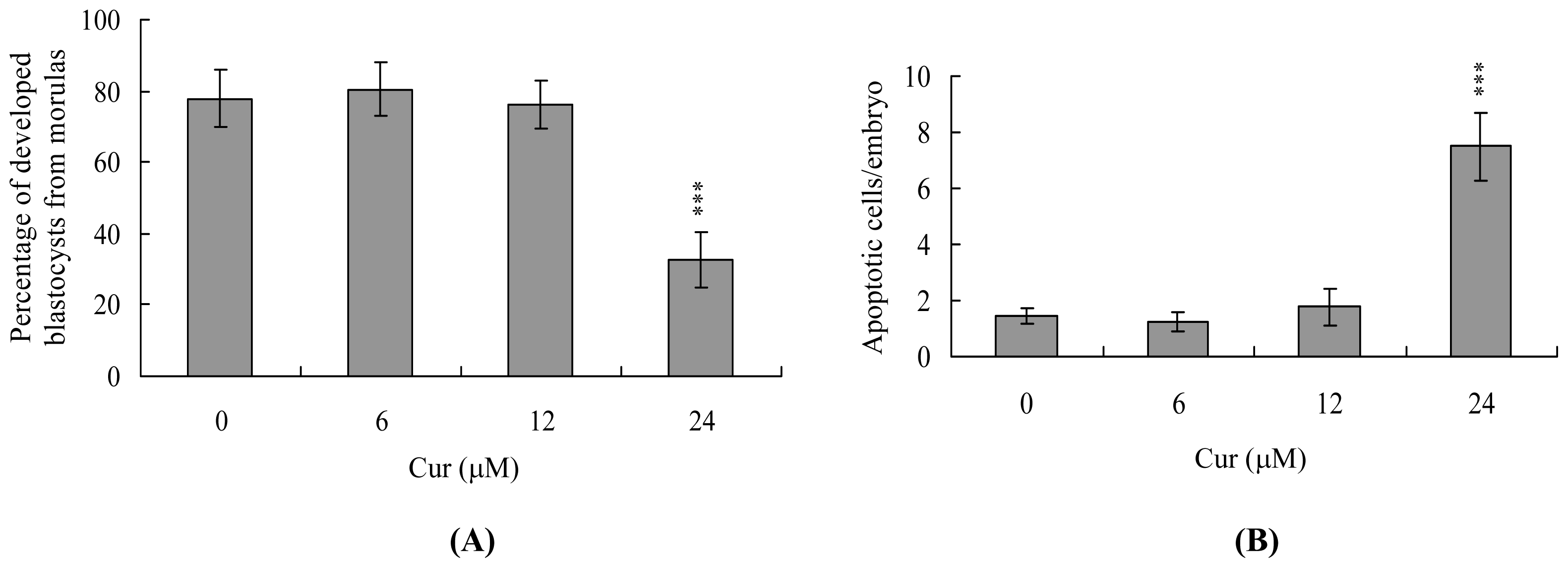
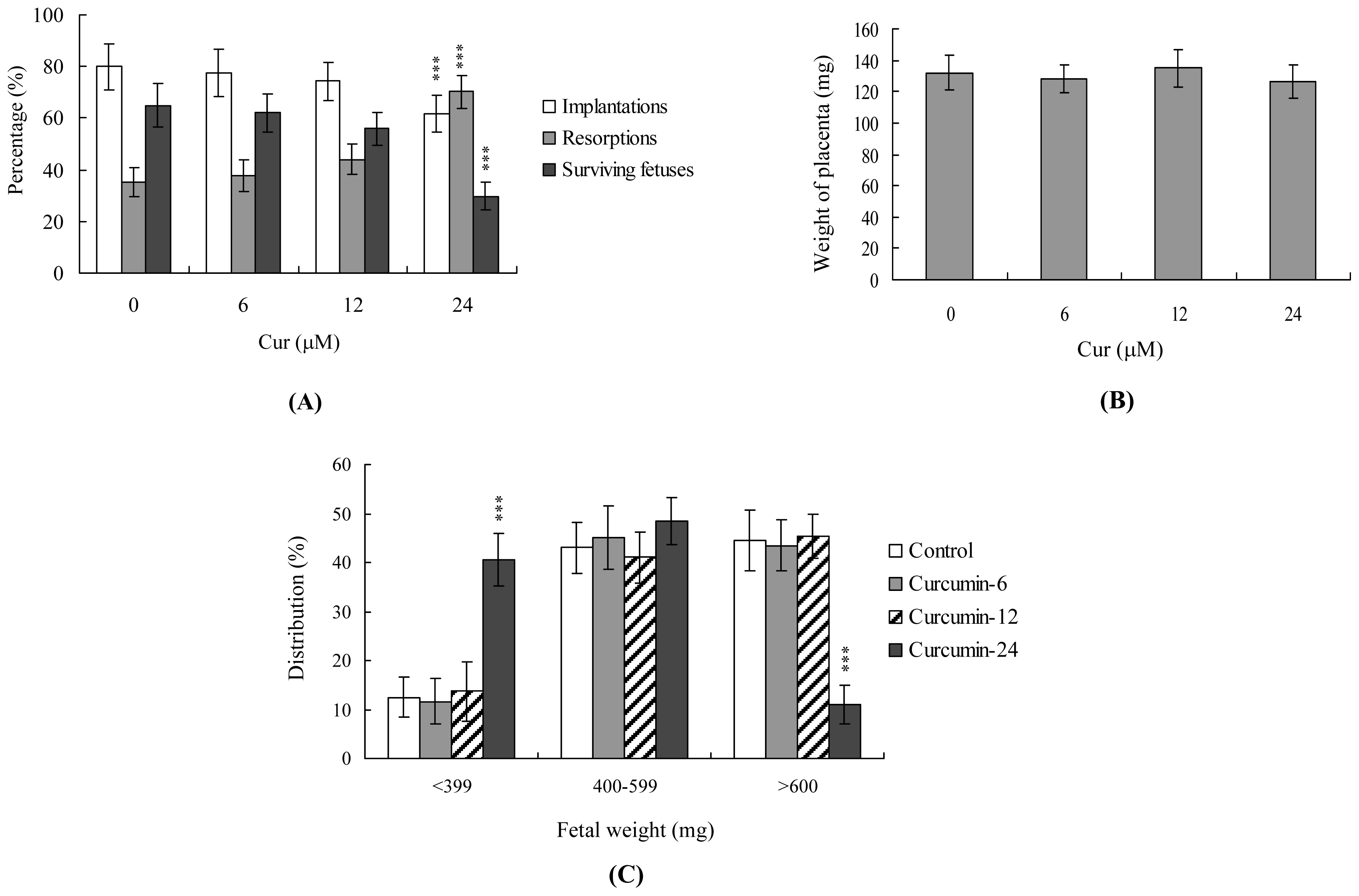
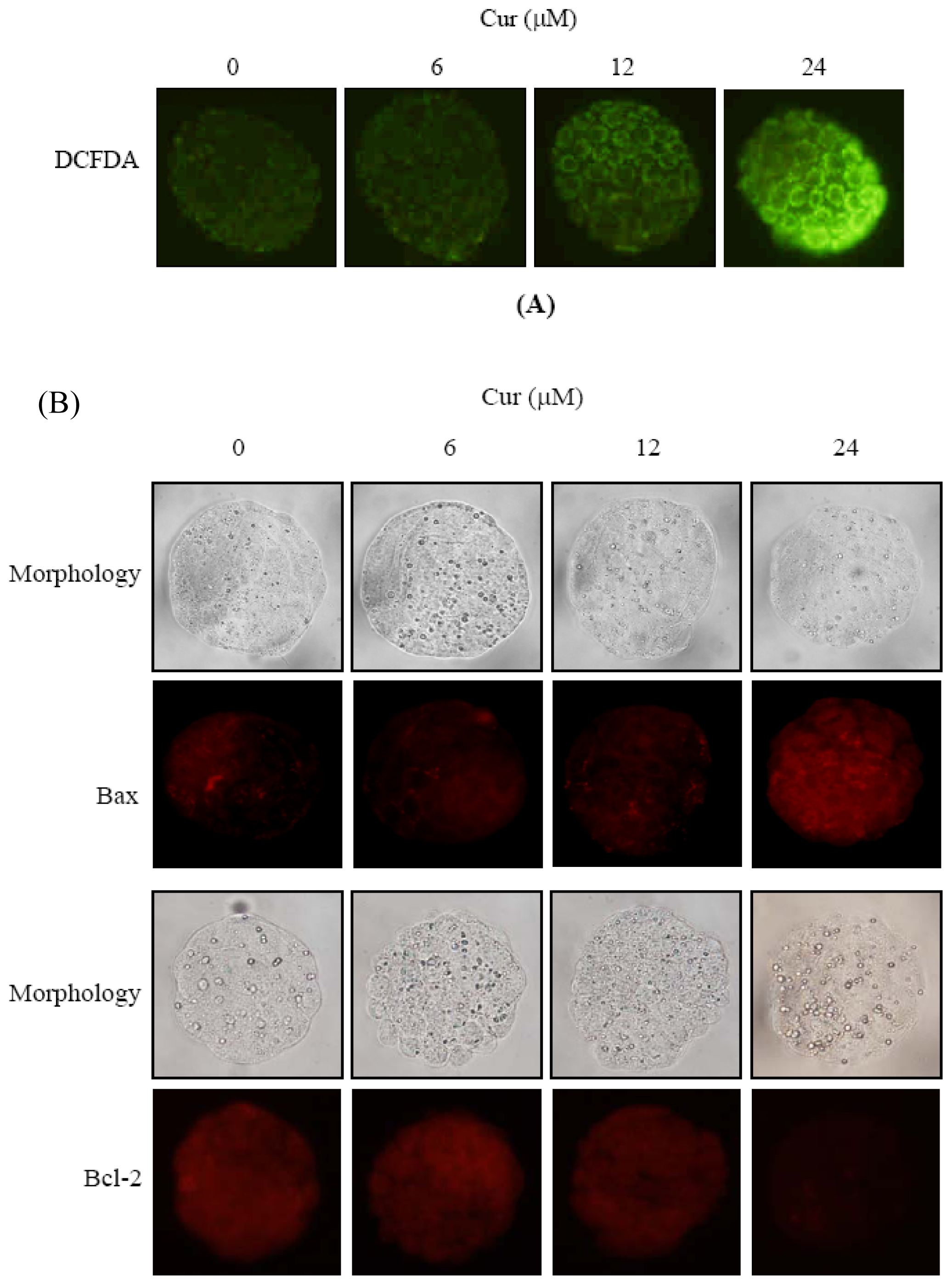
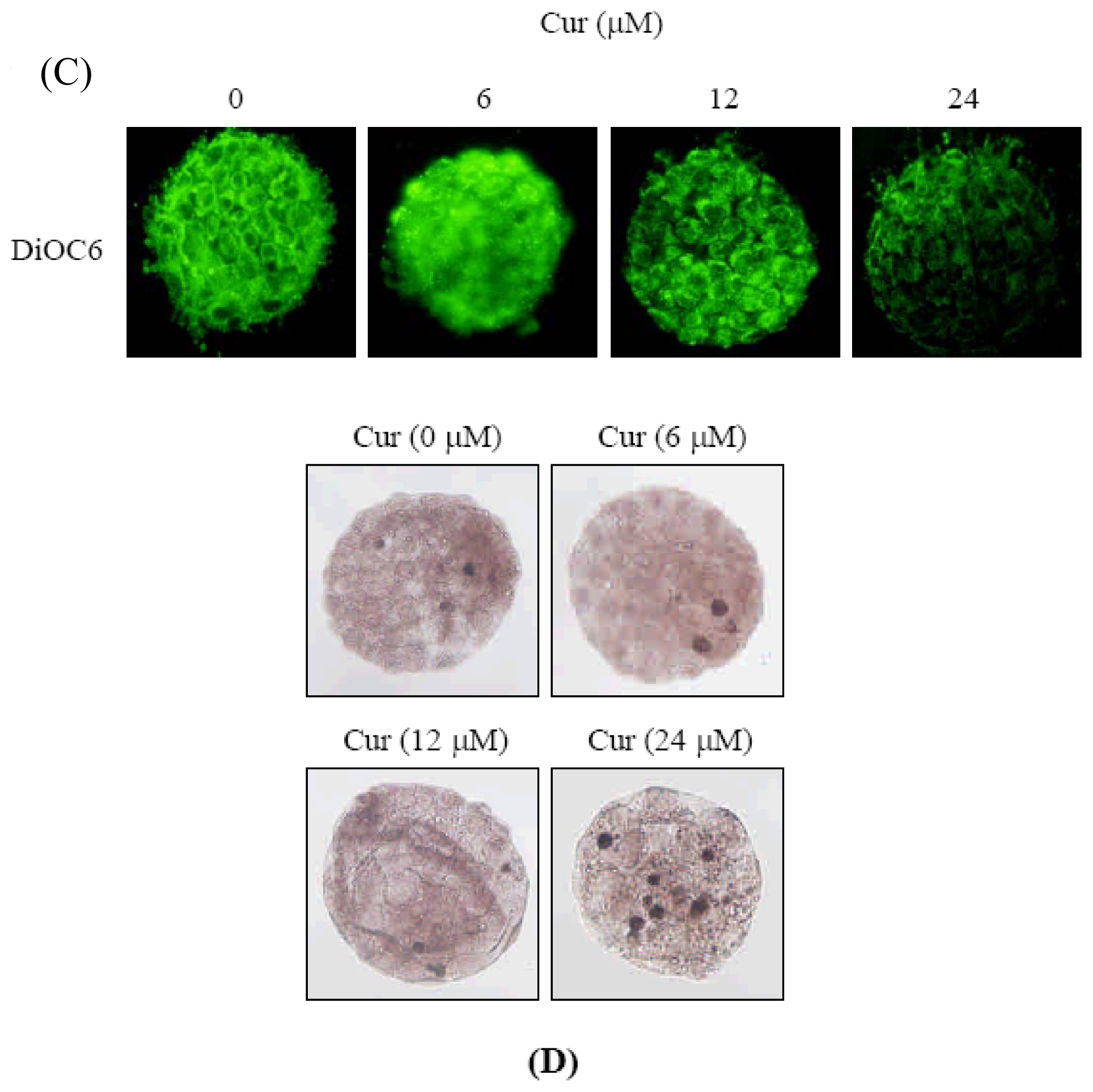


© 2010 by the authors; licensee Molecular Diversity Preservation International, Basel, Switzerland. This article is an open-access article distributed under the terms and conditions of the Creative Commons Attribution license (http://creativecommons.org/licenses/by/3.0/).
Share and Cite
Chen, C.-C.; Hsieh, M.-S.; Hsuuw, Y.-D.; Huang, F.-J.; Chan, W.-H. Hazardous Effects of Curcumin on Mouse Embryonic Development through a Mitochondria-Dependent Apoptotic Signaling Pathway. Int. J. Mol. Sci. 2010, 11, 2839-2855. https://doi.org/10.3390/ijms11082839
Chen C-C, Hsieh M-S, Hsuuw Y-D, Huang F-J, Chan W-H. Hazardous Effects of Curcumin on Mouse Embryonic Development through a Mitochondria-Dependent Apoptotic Signaling Pathway. International Journal of Molecular Sciences. 2010; 11(8):2839-2855. https://doi.org/10.3390/ijms11082839
Chicago/Turabian StyleChen, Chia-Chi, Ming-Shu Hsieh, Yan-Der Hsuuw, Fu-Jen Huang, and Wen-Hsiung Chan. 2010. "Hazardous Effects of Curcumin on Mouse Embryonic Development through a Mitochondria-Dependent Apoptotic Signaling Pathway" International Journal of Molecular Sciences 11, no. 8: 2839-2855. https://doi.org/10.3390/ijms11082839