
<?xml version="1.0" encoding="UTF-8"?>
<!DOCTYPE article PUBLIC "-//NLM//DTD Journal Publishing DTD v2.3 20070202//EN" "journalpublishing.dtd">
<article xmlns:xlink="http://www.w3.org/1999/xlink" xml:lang="en" article-type="research-article">
<front>
<journal-meta>
<journal-id journal-id-type="publisher-id">ijms</journal-id>
<journal-title>International Journal of Molecular Sciences</journal-title>
<abbrev-journal-title>Int. J. Mol. Sci.</abbrev-journal-title>
<issn pub-type="epub">1422-0067</issn>
<publisher>
<publisher-name>Molecular Diversity Preservation International (MDPI)</publisher-name></publisher></journal-meta>
<article-meta>
<article-id pub-id-type="doi">10.3390/ijms11062576</article-id>
<article-id pub-id-type="publisher-id">ijms-11-02576</article-id>
<article-categories>
<subj-group>
<subject>Article</subject></subj-group></article-categories>
<title-group>
<article-title>Eco-Contribution for the Production of <italic>N</italic>-Arylnitrones: Solvent-Free and Assisted by Microwaves</article-title></title-group>
<contrib-group>
<contrib contrib-type="author">
<name><surname>Reyes</surname><given-names>Leonor</given-names></name><xref ref-type="aff" rid="af1-ijms-11-02576">1</xref></contrib>
<contrib contrib-type="author">
<name><surname>Corona</surname><given-names>Sandra</given-names></name><xref ref-type="aff" rid="af1-ijms-11-02576">1</xref></contrib>
<contrib contrib-type="author">
<name><surname>Arroyo</surname><given-names>Gabriel</given-names></name><xref ref-type="aff" rid="af1-ijms-11-02576">1</xref></contrib>
<contrib contrib-type="author">
<name><surname>Delgado</surname><given-names>Francisco</given-names></name><xref ref-type="aff" rid="af2-ijms-11-02576">2</xref></contrib>
<contrib contrib-type="author">
<name><surname>Miranda</surname><given-names>René</given-names></name><xref ref-type="aff" rid="af1-ijms-11-02576">1</xref><xref ref-type="corresp" rid="c1-ijms-11-02576">*</xref></contrib></contrib-group>
<aff id="af1-ijms-11-02576">
<label>1</label>Departamento de Ciencias Químicas, Facultad de Estudios Superiores Cuautitlán-UNAM, Estado de México, 54754, Mexico; E-Mails: <email>lrdcistrans@yahoo.com.mx</email> (L.R.); <email>sandy_corjua@yahoo.com.mx</email> (S.C.); <email>garroyo@unam.mx</email> (G.A.)</aff>
<aff id="af2-ijms-11-02576">
<label>2</label>Departamento de Química Orgánica, Escuela Nacional de Ciencia Biológicas-IPN, México D.F., 11340, Mexico; E-Mail: <email>fdelgado@woodward.encb.ipn.mx</email> (F.D.)</aff>
<author-notes>
<corresp id="c1-ijms-11-02576">
<label>*</label>Author to whom correspondence should be addressed; E-Mail: <email>mirruv@yahoo.com.mx</email>; Tel.: +52-5556232056; Fax: +52-5556232056.</corresp></author-notes>
<pub-date pub-type="collection">
<year>2010</year></pub-date>
<pub-date pub-type="epub">
<day>22</day>
<month>6</month>
<year>2010</year></pub-date>
<volume>11</volume>
<issue>6</issue>
<fpage>2576</fpage>
<lpage>2583</lpage>
<history>
<date date-type="received">
<day>2</day>
<month>3</month>
<year>2010</year></date>
<date date-type="rev-recd">
<day>4</day>
<month>5</month>
<year>2010</year></date>
<date date-type="accepted">
<day>12</day>
<month>6</month>
<year>2010</year></date></history>
<permissions>
<copyright-statement>© 2010 by the authors; licensee Molecular Diversity Preservation International, Basel, Switzerland.</copyright-statement>
<copyright-year>2010</copyright-year>
<license license-type="open-access" xlink:href="http://creativecommons.org/licenses/by/3.0">
<p>This article is an open-access article distributed under the terms and conditions of the Creative Commons Attribution license (http://creativecommons.org/licenses/by/3.0/).</p></license></permissions>
<abstract>
<p>A simple green approach for the production of benzylideneaniline oxides is offered. This contribution was performed via the condensation of phenylhydroxylamine with several aryl aldehydes, in the absence of both catalyst and solvent, and using microwave irradiation as the activating reaction mode. In addition, good yields of the products were achieved in a short time. It is also worth noting that the work-up procedure is simple and the products do not require further purification. Finally, an interesting comparison without the use of microwave irradiation is also discussed.</p></abstract>
<kwd-group>
<kwd>green chemistry</kwd>
<kwd>arylnitrones</kwd>
<kwd>microwave</kwd>
<kwd>solvent-less</kwd>
<kwd>catalyst-less</kwd></kwd-group></article-meta></front>
<body>
<sec sec-type="intro">
<label>1.</label>
<title>Introduction</title>
<p>Microwave provides a powerful way in synthesis in light of the green chemistry protocol; in other words, it furnishes many chemical reaction improvements, such as enhanced reaction rates, higher yields of pure products as well as eco-friendly advantages [<xref ref-type="bibr" rid="b1-ijms-11-02576">1</xref>]. Thus, procedures employing microwave methodology involving an appropriate green-approach must be welcome. In a different way, benzylideneaniline oxides commonly known as arylnitrones are highly valuable synthetic intermediates [<xref ref-type="bibr" rid="b2-ijms-11-02576">2</xref>] and excellent spin trapping reagents [<xref ref-type="bibr" rid="b3-ijms-11-02576">3</xref>,<xref ref-type="bibr" rid="b4-ijms-11-02576">4</xref>]. These compounds are of high interest due to their wide spectra as synthons in the construction of natural products of the class of alkaloids [<xref ref-type="bibr" rid="b5-ijms-11-02576">5</xref>]. This, in addition to the 1,3-dipolar cycloaddition of nitrones with acetylenic or olefinic dipolarophiles yielding highly substituted isoxazolidines and isoxazole derivatives with generation of, as many as, three new contiguous stereogenic centers in a single step [<xref ref-type="bibr" rid="b6-ijms-11-02576">6</xref>,<xref ref-type="bibr" rid="b7-ijms-11-02576">7</xref>]. Nitrones, the target molecules of this work, have been prepared using many methods, for example: by the condensation of carbonyl compounds with the corresponding hydroxylamines in refluxing CH<sub>2</sub>Cl<sub>2</sub> in a suspension of anhydrous MgS0<sub>4</sub> [ <xref ref-type="bibr" rid="b8-ijms-11-02576">8</xref>]; via the oxidation of secondary amines or <italic>N</italic>,<italic>N</italic>′-disubstituted hydroxylamines [<xref ref-type="bibr" rid="b9-ijms-11-02576">9</xref>,<xref ref-type="bibr" rid="b10-ijms-11-02576">10</xref>]; also by the oxidation of secondary amines with hydrogen peroxide in the presence of catalytic amounts of sodium tungsten [<xref ref-type="bibr" rid="b11-ijms-11-02576">11</xref>–<xref ref-type="bibr" rid="b13-ijms-11-02576">13</xref>]; by direct condensation of β-hydroxylamine alcohols with <italic>ortho</italic>-esters or amide acetals [<xref ref-type="bibr" rid="b14-ijms-11-02576">14</xref>]; the catalytic oxidation of imines to nitrones [<xref ref-type="bibr" rid="b15-ijms-11-02576">15</xref>] the condensation of equimolar amounts of aldehydes and <italic>N</italic>-substituted-hydroxylamines under solvent-free conditions in a ball-mill [<xref ref-type="bibr" rid="b16-ijms-11-02576">16</xref>]. It is important to note that several methyl and <italic>ter</italic>-butyl nitrones have also been obtained employing microwaves, but using the substrates as their corresponding hydrochloride, requiring in addition the presence of sodium acetate [<xref ref-type="bibr" rid="b17-ijms-11-02576">17</xref>]. Even throughout the good to excellent results that could be achieved in all these cases, all of them show limitations: the use of organic solvents, relatively long reaction times, the use of an excess of the aldehyde to achieve high conversion, tedious chromatographic purification in addition to environmentally non-benign oxidants with metal catalysts. In this sense, and taking into account the importance of the alkylnitrones, new methods to produce the title product are always welcome.</p>
<p>As part of our research program, we are interested in the generation of novel methods, with an appropriate green approach, for the production of organic molecules of particular interest [<xref ref-type="bibr" rid="b18-ijms-11-02576">18</xref>–<xref ref-type="bibr" rid="b22-ijms-11-02576">22</xref>]. Thereby, the goal of this work is to offer of a novel method with a green approach in order to produce various nitrones (benzylideneaniline oxides), via condensation of phenylhydroxylamine with several aryl aldehydes, in the absence of catalyst and solvent, and moreover using microwave irradiation, for the target purpose, as the activating reaction mode.</p></sec>
<sec sec-type="results|discussion">
<label>2.</label>
<title>Results and Discussion</title>
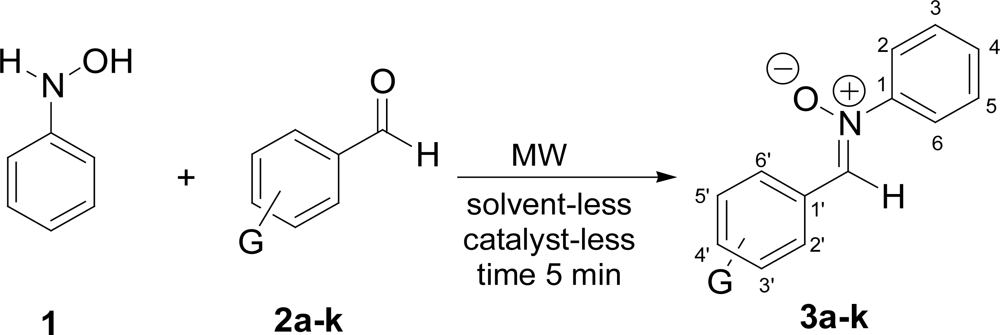
<p>In view of the potential importance of arylnitrones, and considering the limitations of existing methods, a green contribution is presented in this work. The method involves the microwave irradiation of a mixture of phenylhydroxylamine (1) and an aromatic aldehyde (<bold>2a–k</bold>) under solvent-free conditions and, moreover, without an environmentally non-benign catalyst (<xref ref-type="fig" rid="f2-ijms-11-02576">Scheme 1</xref>). The target is to produce in a stereoselectively form a series of eleven benzylideneaniline oxides (<bold>3a–k</bold>). The corresponding condensation results are summarized in <xref ref-type="table" rid="t1-ijms-11-02576">Table 1</xref>. As can be seen, the target molecules were produced in a very short time, in comparison to those methods previously reported, with good yields. The products were achieved with good purity after ethanol washing of the reaction mixture. Consequently, this procedure offers a simple work up.</p>
<p>It is important to note that in order to have an appropriated comparison, the corresponding thermal reactions were also performed using a heating mantle (neat, without catalyst, same time and temperature). However, according to the respective proton NMR data (aldehydic <italic>vs.</italic> vinilic proton), no more than 30–50% of substrate transformation was achieved.</p>
<p>For the structural attribution of the obtained compounds, common spectroscopic methods were employed. In this sense, after purification, the analysis of <sup>1</sup>H-NMR spectra of compounds <bold>3a</bold>–<bold>k</bold> allowed us to conclude that they really have a similar structure. The resonance of proton at the nitrone group carbon N=C<underline>H</underline> appears as a singlet between δ 7.86–8.77 ppm. H-2 is also more deshielded because there is one group nitro in the aromatic ring <bold>3c</bold>, <bold>3d</bold>, <bold>3g</bold> or when the group is in the <italic>ortho</italic> position <bold>3b</bold>, <bold>3j</bold>. In the <sup>13</sup>C-NMR spectra of the nitrones <bold>3a</bold>–<bold>k,</bold> the signal of the methine carbon of the imine function appeared at δ 132–134 ppm.</p>
<p>In regard to the EIMS, in general the products exhibit a set of three common peaks, corresponding to the expected molecular ions M<sup>+</sup>, in addition to [M-1]<sup>+</sup> and [M-17]<sup>+</sup> due to loss of hydrogen and a hydroxyl group, respectively, between others peaks of particular interest.</p>
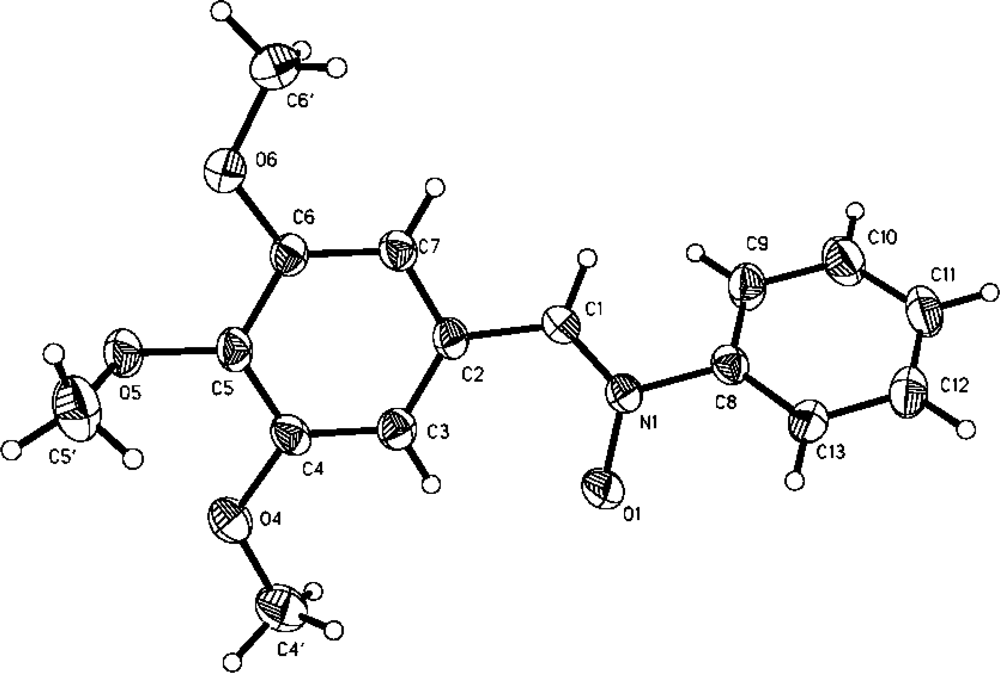
<p>Finally, it is important to note that the <italic>Z</italic>-configuration of the obtained products was inferred by the X-ray, single crystal, diffraction of compound <bold>3i</bold>, according to the corresponding Oak Ridge Thermal Ellipsoid Plot (ORTEP), <xref ref-type="fig" rid="f1-ijms-11-02576">Figure 1</xref>.</p></sec>
<sec>
<label>3.</label>
<title>Experimental Section</title>
<p>Melting points (uncorrected) were determined with a Fisher-Johns apparatus. <sup>1</sup>H and <sup>13</sup>C spectra were recorded on Varian (200 MHz), Varian Mercury (300 MHz) and Varian VNMR System (500 MHz) NMR instruments, with DMSO-d<sub>6</sub> o CDCl<sub>3</sub> as the solvent and TMS as internal standard. Mass spectra (MS) were recorded, in electron impact mode, with Hewlett–Packard 5971A and Thermo-Finnigan Polaris Q spectrometers. X-ray crystallographic structure was obtained on Siemens P4 diffractometer. Analytical TLC was carried out using E. Merck silica gel 60 F254 coated 0.25 plates, visualized by a long- and short-wavelength UV lamp. Flash column chromatography was performed over silica gel (230–400 mesh). All reagents, as well as solvents, were of reagent grade from Aldrich and were used without further treatment. Phenylhydroxylamine <bold>1</bold> was prepared as previously reported [<xref ref-type="bibr" rid="b23-ijms-11-02576">23</xref>,<xref ref-type="bibr" rid="b24-ijms-11-02576">24</xref>].</p>
<p><bold>General Method:</bold> A mixture of phenylhydroxylamine <bold>1</bold> (0.5 mmol) and the corresponding aromatic aldehyde <bold>2a</bold>–<bold>k</bold> (0.5 mmol) were irradiated with microwave at 80 °C and 60 W during 5 min. Finally, the crude product was filtered and the solid obtained was recrystallized from ethanol to give the pure nitrones <bold>3a–k</bold>.</p>
<p><bold>(<italic>Z</italic>)-<italic>N</italic>-(3-hydroxybenzylidene) aniline oxide (3a).</bold> 76% yield; yellow solid, Mp 95–96 °C; <sup>1</sup>H NMR (200 MHz, DMSO<italic><sub>d-6</sub></italic>): δ 9.67 (s, 1H, OH), 8.41 (s, 1H, N=C<underline>H</underline>), 8.17 (s, 1H, H-2’), 7.92–7.88 (m, 2H, H-2 and H-6), 7.72 (d, <italic>J</italic> = 7.4 Hz, 1H, H-6’), 7.58-7.52 (m, 3H, H-3, H-4 and H-5), 7.29 (t, <italic>J</italic> = 7.4 Hz, 1H, H-5’), 6.91 (d, <italic>J</italic> = 8.2 Hz, 1H, H-4’); <sup>13</sup>C<italic>-</italic>NMR (50 MHz, DMSO<italic><sub>d-6</sub></italic>): δ 157.1 (C-3’), 148.5 (C-1), 133.7 (C-2’), 132.0 (N=<underline>C</underline>H), 129.8 (C-4), 129.1 (C-3 and C-5), 121.5 (C-2 and C-6), 120.6 (C-6’), 117.9 (C-4’), 114.7 (C-1’); EIMS (70 eV) m/z (% relative abundance): 198 (28) [M-OH]<sup>+</sup>, 169 (100) [M-CO<sub>2</sub>H]<sup>+·</sup>.</p>
<p><bold>(<italic>Z</italic>)-<italic>N</italic>-(2-hydroxybenzylidene) aniline oxide (3b).</bold> 85% yield; yellow solid Mp 147–148 °C; <sup>1</sup>H-NMR (500 MHz, DMSO<italic><sub>d-6</sub></italic>): δ 12.51 (s, 1H, OH), 8.72 (s, 1H, N=C<underline>H</underline>), 7.94-7.92 (m, 2H, H-2 and H-6), 7.76 (d, 8 Hz, 1H, H-6’), 7.58-7.54 (m, 3H, H-3, H-4 and H-5), 7.43 (t, J = 8 Hz, 1H, H-4’), 6.93-6.88 (m, 2H, H-3’ and H-5’); <sup>13</sup>C-NMR (125 MHz, DMSO<italic><sub>d-6</sub></italic>): δ 158.7 (C-2’), 145.8 (C-1), 139.9 (C-4’), 134.1 (N=<underline>C</underline>H), 133.0 (C-6’), 130.1 (C-4), 129.1 (C-3 and C-5), 121.6 (C-2 and C-6), 118.7 (C-3’), 118.6 (C-5’), 117.3 (C-1’); EIMS (70 eV) m/z (% relative abundance): 198 (28) [M-OH]<sup>+</sup>, 169 (100) [M-CO<sub>2</sub>H]<sup>+·</sup>.</p>
<p><bold>(<italic>Z</italic>)-<italic>N</italic>-(4-nitrobenzylidene) aniline oxide (3c).</bold> 80% yield; yellow solid, Mp 120 °C; <sup>1</sup>H-NMR (500 MHz, CDCl<sub>3</sub>): δ 8.36 (d, 2H, <italic>J</italic> = 8.5 Hz, H-2’ and H-6’), 7.90 (s, 1H, N=C<underline>H</underline>), 7.77-7.75 (m, 2H, H-2 and H-6), 7.49-7.47 (m, 3H, H-3, H-4 and H-5), 7.44 (d, <italic>J</italic> = 8.5 Hz, 2H, H-3’ and H-5’); <sup>13</sup>C-NMR (125 MHz, CDCl<sub>3</sub>): δ 148.9 (C-1), 136.3 (C-4’), 133.3 (N=<underline>C</underline>H), 130.1 (C-2’, C-6’), 130.0 (C-4), 129.2 (C-3, C-5), 129.1 (C-1’), 128.9 (C-3’ and C-5’), 121.6 (C-2 and C-6); EIMS (70 eV) m/z (% relative abundance): 226 (100) [M-O]<sup>+</sup>, 225 (50) [M-OH]<sup>+·</sup>.</p>
<p><bold>(<italic>Z</italic>)-<italic>N</italic>-(2-nitrobenzylidene) aniline oxide (3d).</bold> 77% yield; yellow solid, Mp 85 °C; <sup>1</sup>H-NMR (300 MHz, DMSO<italic><sub>d-6</sub></italic>): δ 8.77 (s, 1H, N=C<underline>H</underline>), 8.44 (d, <italic>J</italic> = 12.5 Hz, 1H, H-6’), 8.10 (d, <italic>J</italic> = 12.5 Hz, 1H, H-3’), 7.93-7.90 (m, 1H, H-5’), 7.90-7.83 (m, 2H, H-2 and H-6), 7.71 (t, <italic>J</italic> = 12.5 Hz, 1H, H-4’), 7.60-7.56 (m, 3H, H-3, H-4 and H-5); <sup>13</sup>C-NMR (75 MHz, DMSO<italic><sub>d-6</sub></italic>): δ 147.9 (C-2’), 147.7 (C-1), 133.2 (N=<underline>C</underline>H), 130.7 (C-6’), 130.5 (C-5’), 130.3 (C-4), 129.4 (C-4’), 129.2 (C-3 and C-5), 124.4 (C-3’), 124.1 (C-1’), 121.4 (C-2 and C-6); EIMS (70 eV) m/z (% relative abundance): 242 (5) [M]<sup>+·</sup>, 141 (4) [M-1]+·, 226 (100) [M-O]<sup>+</sup>, 225 (50) [M-OH]<sup>+·</sup>.</p>
<p><bold>(<italic>Z</italic>)-<italic>N</italic>-(4-methoxybenzylidene) aniline oxide (3e).</bold> 86% yield; yellow solid, Mp 108 °C; <sup>1</sup>H-NMR (500 MHz, CDCl<sub>3</sub>): δ 8.41 (d, <italic>J =</italic> 8.5 Hz, 2H, H-2’ and H-6’), 7.86 (s, 1H, N=C<underline>H</underline>), 7.77 (d, <italic>J =</italic> 8.8 Hz, 2H, H-2 and H-6), 7.47-7.43 (m, 3H, H-3, H-4 and H-5), 6.98 (d, <italic>J</italic> = 8.5 Hz, 2H, H-3’ and H-5’); <sup>13</sup>C-NMR (125 MHz, CDCl<sub>3</sub>): δ 161.1 (C-4’), 148.4 (C-1), 133.7 (N=<underline>C</underline>H), 130.7 (C-6’ and C-2’), 129.2 (C-4), 128.7 (C-3 and C-5), 123.3 (C-1’), 121.2 (C-2 and C-6), 113.6 (C-3’ and C-5’), 55.0 (O<underline>C</underline>H<sub>3</sub>); EIMS (70 eV) m/z (% relative abundance): 227(50) [M]<sup>+·</sup>, 226 (80) [M-1]<sup>+</sup>, 210 (100) [M-OH]<sup>+</sup>.</p>
<p><bold>(<italic>Z</italic>)-<italic>N</italic>-(benzylidene) aniline oxide (3f).</bold> 81% yield; yellow solid, Mp 130 °C; <sup>1</sup>H-NMR (300 MHz, CDCl<sub>3</sub>): δ 8.42-8.38 (m, 2H, H-2’ and H-6’), 7.92 (s, 1H, N=C<underline>H</underline>), 7.79-7.76 (m, 2H, H-2, H-6), 7.50-7.46 (m, 6H, H-3, H-4, H-5, H-3’, H-4’ and H-5’); <sup>13</sup>C-NMR (125 MHz, CDCl<sub>3</sub>): δ 149.0 (C-1), 134.6 (N=<underline>C</underline>H), 130.9 (C-4), 130.5 (C-1’), 129.9 (C-4’), 129.1 (C-3’ and C-5’) 129.0 (C-3 and C-5), 128.6 (C-2’ and C-6’), 121.7 (C-2 and C-6); EIMS (70 eV) m/z (% relative abundance): 197 (35) [M]<sup>+·</sup>, 196 (60) [M-1]<sup>+</sup>, 180 (175) [M-OH]<sup>+</sup>, 181 (50) [M-O]<sup>+·</sup>.</p>
<p><bold>(<italic>Z</italic>)-<italic>N</italic>-(3-nitrobenzylidene) aniline oxide (3g).</bold> 68% yield; yellow solid, Mp 110 °C; <sup>1</sup>H-NMR (300 MHz, CDCl<sub>3</sub>): δ 9.19 (s, 1H, H-2’), 8.83 (d, <italic>J</italic> = 8.5 Hz, 1H, H-6’), 8.31 (d, <italic>J</italic> = 8.5 Hz, 1H, H-4’), 8.08 (s, 1H, N=C<underline>H</underline>), 7.81-7.78 (m, 2H, H-2 and H-6), 7.67 (t, <italic>J</italic> = 8.5 Hz, 1H, H-5’), 7.54-7.51 (m, 3H, H-3, H-4 and H-5); <sup>13</sup>C-NMR (75 MHz, CDCl<sub>3</sub>): δ 148.5 (C-1), 148.1 (C-3’), 138.8 (C-6’), 132.0 (N=<underline>C</underline>H), 131.9 (C-1’), 130.4 (C-4), 129.6 (C-5’), 129.2 (C-3 and C-5), 124.7 (C-4’), 123.2 (C-2’), 121.5 (C-2 and C-6); EIMS (70 eV) m/z (% relative abundance): 242 (5) [M]<sup>+·</sup>, 141 (4) [M-1]+·, 226 (100) [M-O]<sup>+</sup>, 225 (50) [M-OH]<sup>+·</sup>.</p>
<p><bold>(<italic>Z</italic>)-<italic>N</italic>-(3,4,5-trimethoxybenzylidene) aniline oxide (3i).</bold> 78% yield; yellow solid, Mp 187 °C; <sup>1</sup>H-NMR (300 MHz, CDCl<sub>3</sub>): δ 7.88 (s, 1H, N=C<underline>H</underline>), 7.79 (s, 2H, H-2’ and H-6’), 7.79-7.76 (m, 2H, H-2 and H-6), 7.50-7.47 (m, 3H, H-3, H-4 and H-5), 3.94 (s, 9H, OMe); <sup>13</sup>C-NMR (75MHz, CDCl<sub>3</sub>): δ 153.1 (C-5’ and C-3’), 149.1 (C-1), 140.4 (C-4’), 134.7 (N=<underline>C</underline>H), 130.1 (C-4), 129.4 (C-3 and C-5), 126.3 (C-1’), 121.8 (C-2 and C-6), 106.6 (C-2’ and C-6’), 61.2 (<italic>p</italic>-OMe), 56.3 (<italic>m</italic>-OMe); EIMS (70 eV) m/z (% relative abundance): 227(50) [M]<sup>+·</sup>, 226 (80) [M-1]<sup>+</sup>, 210 (100) [M-OH]<sup>+</sup>.</p>
<p><bold>(<italic>Z</italic>)-<italic>N</italic>-(2-methoxybenzylidene) aniline oxide (3j).</bold> 80% yield; yellow solid, Mp 115 °C; <sup>1</sup>H-NMR (200 MHz, CDCl<sub>3</sub>): δ 9.47 (dd, <italic>J</italic> = 8.4, 1.6, Hz, 1H, H-6’), 8.40 (s, 1H, N=C<underline>H</underline>), 7.81-7.76 (m, 2H, H-2 and H-6), 7.50-7.40 (m, 3H, H-3, H-4 and H-5), 7.13 (td, <italic>J</italic> = 8.4, 1.6 Hz, 1H, H-4’), 6.95 (m, 2H, H-3’ and H-5’), 3.88 (OMe); <sup>13</sup>C-NMR (50 MHz, CDCl<sub>3</sub>): δ 157.4 (C-2’), 132.2 (N=<underline>C</underline>H), 129.6 (C-3 and C-5), 129.0 (C-4), 128.7 (C-6’), 128.4 (C-1’), 121.7 (C-2 and C-6), 120.7 (C-3’), 109.8 (C-5’), 55.5 (O<underline>C</underline>H<sub>3</sub>); EIMS (70 eV) m/z (% relative abundance): 227(50) [M]<sup>+·</sup>, 226 (80) [M-1]<sup>+</sup>, 210 (100) [M-OH]<sup>+</sup>.</p>
<p><bold>(<italic>Z</italic>)-<italic>N</italic>-(2,3-dihydroxybenzylidene) aniline oxide (3k).</bold> 79% yield; yellow solid, Mp 210 °C; <sup>1</sup>H-NMR (200 MHz, CDCl<sub>3</sub>): δ 8.10 (s, 1H, N=C<underline>H</underline>), 7.81-7.76 (m, 2H, H-2 and H-6), 7.55-7.51 (m, 3H, H-3, H-4 and H-5), 7.13 (dd, <italic>J</italic> = 7.6, 1.6 Hz, 1H, H-6’), 6.83 (t, <italic>J</italic> = 7.6, 1H, H-5’), 6.75 (dd, <italic>J</italic> = 7.6, 1.6, 1H, H-4’); <sup>13</sup>C-NMR (50 MHz, CDCl<sub>3</sub>): δ 153.3 (C-2’), 148.0 (C-1), 141.3 (C-4), 130.6 (N=<underline>C</underline>H), 129.4 (C-3 and C-5), 123.2 (C-3’), 121.8 (C-2 and C-6), 119.8 (C-1’), 117.7 (C-5’), 115.9 (C-4’); EIMS (70 ev) m/z (% relative abundance): 198 (28) [M-OH]<sup>+</sup>, 169 (100) [M-CO<sub>2</sub>H]<sup>+·</sup>.</p>
<p><bold>Single-Crystal X-ray Crystallography.</bold> A single crystal of compound <bold>3i</bold> was obtained by recrystallization from EtOH, as yellow crystals. These were mounted on glass fibers. Crystallographic measurements were performed using Mo KR radiation (graphite crystal monochromator, e = 71073 A°) at room temperature. Three standard reflections, which were monitored periodically, showed no change during data collection. Unit cell parameters were obtained from least-squares refinement of 26 reflections in the range 2 &lt; 2e &lt; 20. Intensities were corrected for Lorentz and polarization effects. No absorption correction was applied. Anisotropic temperature factors were introduced for all non-hydrogen atoms. Hydrogen atoms were placed in idealized positions and their atomic coordinates refined. Unit weights were used in the refinement. Structure was solved using the SHELX97 [<xref ref-type="bibr" rid="b25-ijms-11-02576">25</xref>], and refined using SHELX97 on a personal computer.</p></sec>
<sec sec-type="conclusions">
<label>4.</label>
<title>Conclusions</title>
<p>An eco-friendly, novel and efficient synthesis of benzylideneaniline oxides is presented. The main advantages being: the achievement of good yields in short reaction times using microwave-assistance, and in the absence of solvent, and catalyst, together with appropriate atom economy and, moreover, the production of water as the only residuum product. According to our results, we suggest that this method displace other methods that use various organic solvents, catalysts and that are performed at high temperature.</p></sec></body>
<back>
<ack>
<p>Leonor Reyes thanks CONACyT, México, for a post-doctoral-scholarship, and René Miranda to PAPIIT IN228010-3 for financial support. Francisco Delgado also acknowledges financial support from COFAA-IPN and EDI-IPN, México.</p></ack>
<ref-list>
<title>References and Notes</title>
<ref id="b1-ijms-11-02576"><label>1.</label><citation citation-type="journal"><person-group person-group-type="author"><name><surname>Nand</surname><given-names>KS</given-names></name><name><surname>Kamar</surname><given-names>SS</given-names></name></person-group><article-title>Microwave-assisted, one-pot multicomponent synthesis of highly substituted pyridines of medicinal utility using KF/alumina</article-title><source>ARKIVOC</source><year>2009</year><volume>XIII</volume><fpage>153</fpage><lpage>160</lpage></citation></ref>
<ref id="b2-ijms-11-02576"><label>2.</label><citation citation-type="book"><person-group person-group-type="author"><name><surname>Torssell</surname><given-names>KBG</given-names></name></person-group><source>Nitrile Oxides, Nitrones, and Nitronates in Organic Synthesis</source><publisher-name>VCH Publishers</publisher-name><publisher-loc>New York, NY, USA</publisher-loc><year>1988</year></citation></ref>
<ref id="b3-ijms-11-02576"><label>3.</label><citation citation-type="journal"><person-group person-group-type="author"><name><surname>Janzen</surname><given-names>EG</given-names></name></person-group><article-title>Spin trapping</article-title><source>Acc. Chem. Res</source><year>1971</year><volume>4</volume><fpage>31</fpage><lpage>40</lpage><pub-id pub-id-type="doi">10.1021/ar50037a005</pub-id></citation></ref>
<ref id="b4-ijms-11-02576"><label>4.</label><citation citation-type="journal"><person-group person-group-type="author"><name><surname>Evans</surname><given-names>CA</given-names></name></person-group><article-title>Spin trapping</article-title><source>Aldrichim. Acta</source><year>1979</year><volume>12</volume><fpage>23</fpage><lpage>29</lpage></citation></ref>
<ref id="b5-ijms-11-02576"><label>5.</label><citation citation-type="journal"><person-group person-group-type="author"><name><surname>Hyeon</surname><given-names>KL</given-names></name><name><surname>Jong</surname><given-names>SC</given-names></name><name><surname>Chwang</surname><given-names>SP</given-names></name></person-group><article-title>Facile transformation of 3,4-disubstituted 2-azetidines to chiral 5,6-dihydro-2-pyridones</article-title><source>Tetrahedron Lett</source><year>2001</year><volume>42</volume><fpage>3483</fpage><lpage>3486</lpage><pub-id pub-id-type="doi">10.1016/S0040-4039(01)00470-1</pub-id></citation></ref>
<ref id="b6-ijms-11-02576"><label>6.</label><citation citation-type="journal"><person-group person-group-type="author"><name><surname>Martyn</surname><given-names>F</given-names></name></person-group><article-title>Optically active isoxazolidines via asymmetric cycloaddition reactions of nitrones with alkenes: Applications inorganic synthesis</article-title><source>Tetrahedron</source><year>1997</year><volume>53</volume><fpage>403</fpage><lpage>425</lpage><pub-id pub-id-type="doi">10.1016/S0040-4020(96)01095-2</pub-id></citation></ref>
<ref id="b7-ijms-11-02576"><label>7.</label><citation citation-type="journal"><person-group person-group-type="author"><name><surname>Gothelf</surname><given-names>KV</given-names></name><name><surname>Jorgensen</surname><given-names>KA</given-names></name></person-group><article-title>Asymmetric 1,3-dipolar cycloaddition reactions</article-title><source>Chem. Rev</source><year>1998</year><volume>98</volume><fpage>863</fpage><lpage>909</lpage><pub-id pub-id-type="doi">10.1021/cr970324e</pub-id><pub-id pub-id-type="pmid">11848917</pub-id></citation></ref>
<ref id="b8-ijms-11-02576"><label>8.</label><citation citation-type="journal"><person-group person-group-type="author"><name><surname>Torssell</surname><given-names>K</given-names></name><name><surname>Zeuthen</surname><given-names>O</given-names></name></person-group><article-title>Reactions of <italic>t</italic>-butyl nitrones and trimethylsilyl nitronates. Synthesis and reactions of isoxazolidines and 2-isoxazolines</article-title><source>Acta Chem. Scand. Ser</source><year>1978</year><volume>32b</volume><fpage>118</fpage><lpage>124</lpage><pub-id pub-id-type="doi">10.3891/acta.chem.scand.32b-0118</pub-id></citation></ref>
<ref id="b9-ijms-11-02576"><label>9.</label><citation citation-type="book"><person-group person-group-type="author"><name><surname>Merino</surname><given-names>P</given-names></name><name><surname>Padwa</surname><given-names>A</given-names></name></person-group><article-title>Nitrones and cyclic analogues</article-title><source>Science of Synthesis</source><publisher-name>Thieme</publisher-name><publisher-loc>Stuttgart, Germany</publisher-loc><year>2004</year></citation></ref>
<ref id="b10-ijms-11-02576"><label>10.</label><citation citation-type="book"><person-group person-group-type="author"><name><surname>Breuer</surname><given-names>EI</given-names></name><name><surname>Patai</surname><given-names>S</given-names></name></person-group><source>The Chemistry of Amino, Nitrosos and Nitro Compounds and their Derivates</source><publisher-name>Wiley</publisher-name><publisher-loc>New York, NY, USA</publisher-loc><year>1982</year><fpage>459</fpage></citation></ref>
<ref id="b11-ijms-11-02576"><label>11.</label><citation citation-type="journal"><person-group person-group-type="author"><name><surname>Murahashi</surname><given-names>SI</given-names></name><name><surname>Shiota</surname><given-names>T</given-names></name><name><surname>Imada</surname><given-names>Y</given-names></name></person-group><article-title>Oxidation of secondary amines to nitrones: 6-methyl-2,3,4,5-tetrahydropyridine <italic>N</italic>-oxide</article-title><source>Org. Synth</source><year>1991</year><volume>70</volume><fpage>265</fpage><lpage>268</lpage></citation></ref>
<ref id="b12-ijms-11-02576"><label>12.</label><citation citation-type="journal"><person-group person-group-type="author"><name><surname>Keana</surname><given-names>JF</given-names></name><name><surname>Lee</surname><given-names>TD</given-names></name></person-group><article-title>Versatile synthesis of doxyl spin labels by passing the usual ketone precursors</article-title><source>J. Am. Chem. Soc</source><year>1976</year><volume>97</volume><fpage>1273</fpage><lpage>1274</lpage></citation></ref>
<ref id="b13-ijms-11-02576"><label>13.</label><citation citation-type="journal"><person-group person-group-type="author"><name><surname>Ashburn</surname><given-names>SP</given-names></name><name><surname>Coates</surname><given-names>RM</given-names></name></person-group><article-title>Generation and [3 + 2] cycloaddition reactions of oxazoline <italic>N</italic>-oxides</article-title><source>J. Org. Chem</source><year>1984</year><volume>49</volume><fpage>3127</fpage><lpage>3133</lpage><pub-id pub-id-type="doi">10.1021/jo00191a016</pub-id></citation></ref>
<ref id="b14-ijms-11-02576"><label>14.</label><citation citation-type="journal"><person-group person-group-type="author"><name><surname>Ashburn</surname><given-names>SP</given-names></name><name><surname>Coates</surname><given-names>RM</given-names></name></person-group><article-title>Preparation of oxazoline <italic>N</italic>-oxides and imidate <italic>N</italic>-oxides by amide acetal condensation and their [3 + 2] cycloaddition reactions</article-title><source>J. Org. Chem</source><year>1985</year><volume>50</volume><fpage>3076</fpage><lpage>3081</lpage><pub-id pub-id-type="doi">10.1021/jo00217a013</pub-id></citation></ref>
<ref id="b15-ijms-11-02576"><label>15.</label><citation citation-type="journal"><person-group person-group-type="author"><name><surname>Soldaini</surname><given-names>G</given-names></name><name><surname>Cardona</surname><given-names>F</given-names></name><name><surname>Goti</surname><given-names>A</given-names></name></person-group><article-title>Catalytic oxidation of imines based on methyltrioxorhenium/urea hydrogenperoxide: A mild and easy chemo- and regioselective entry to nitrones</article-title><source>Org. Lett</source><year>2007</year><volume>9</volume><fpage>473</fpage><lpage>476</lpage><pub-id pub-id-type="doi">10.1021/ol062862w</pub-id><pub-id pub-id-type="pmid">17249790</pub-id></citation></ref>
<ref id="b16-ijms-11-02576"><label>16.</label><citation citation-type="journal"><person-group person-group-type="author"><name><surname>Colasino</surname><given-names>E</given-names></name><name><surname>Nun</surname><given-names>P</given-names></name><name><surname>Colacino</surname><given-names>FM</given-names></name><name><surname>Martinéz</surname><given-names>J</given-names></name><name><surname>Lamaty</surname><given-names>F</given-names></name></person-group><article-title>Solvent-free synthesis of nitrones in a ball-mill</article-title><source>Tetrahedron</source><year>2008</year><volume>64</volume><fpage>5569</fpage><lpage>5576</lpage><pub-id pub-id-type="doi">10.1016/j.tet.2008.03.091</pub-id></citation></ref>
<ref id="b17-ijms-11-02576"><label>17.</label><citation citation-type="journal"><person-group person-group-type="author"><name><surname>Andrade</surname><given-names>M</given-names></name><name><surname>Barros</surname><given-names>M</given-names></name><name><surname>Pinto</surname><given-names>R</given-names></name></person-group><article-title>Exploiting microwave-assisted neat procedures: Synthesis of <italic>N</italic>-aryl and <italic>N</italic>-alkylnitrones and their cycloaddition en route for isoxazolidines</article-title><source>Tetrahedron</source><year>2008</year><volume>64</volume><fpage>10521</fpage><lpage>10530</lpage><pub-id pub-id-type="doi">10.1016/j.tet.2008.08.101</pub-id></citation></ref>
<ref id="b18-ijms-11-02576"><label>18.</label><citation citation-type="journal"><person-group person-group-type="author"><name><surname>Gómez</surname><given-names>PR</given-names></name><name><surname>Ramírez-San Juan</surname><given-names>E</given-names></name><name><surname>Miranda</surname><given-names>R</given-names></name><name><surname>Villalobos-Molina</surname><given-names>R</given-names></name><name><surname>Delgado</surname><given-names>F</given-names></name><name><surname>Osnaya</surname><given-names>R</given-names></name><name><surname>Trujillo</surname><given-names>JF</given-names></name></person-group><article-title>Vasodilator effects of <italic>bis</italic>-dihydropyridines structurally related to nifedipine</article-title><source>Med. Chem</source><year>2006</year><volume>2</volume><fpage>527</fpage><lpage>534</lpage><pub-id pub-id-type="doi">10.2174/157340606778250243</pub-id><pub-id pub-id-type="pmid">17017993</pub-id></citation></ref>
<ref id="b19-ijms-11-02576"><label>19.</label><citation citation-type="other"><person-group person-group-type="author"><name><surname>Noguez</surname><given-names>MO</given-names></name><name><surname>García</surname><given-names>A</given-names></name><name><surname>Ibarra</surname><given-names>C</given-names></name><name><surname>Cabrera</surname><given-names>A</given-names></name><name><surname>Aceves</surname><given-names>JM</given-names></name><name><surname>Miranda</surname><given-names>R</given-names></name></person-group><article-title>Green synthesis of bis-biginelli esters, with vasodilatory effects, their mass spectrometric and physical studies</article-title><source>Trends Inorg Chem</source><year>2009</year><comment>in press</comment></citation></ref>
<ref id="b20-ijms-11-02576"><label>20.</label><citation citation-type="book"><person-group person-group-type="author"><name><surname>Miranda</surname><given-names>R</given-names></name></person-group><article-title>El mechero Bunsen del siglo XXI un acercamiento al protocolo de la química verde</article-title><source>Aplicaciones de microondas en química y biología</source><publisher-name>El Colegio Nacional</publisher-name><publisher-loc>México Distrito Federal, México</publisher-loc><year>2009</year><fpage>57</fpage><lpage>82</lpage></citation></ref>
<ref id="b21-ijms-11-02576"><label>21.</label><citation citation-type="journal"><person-group person-group-type="author"><name><surname>Ballesteros</surname><given-names>L</given-names></name><name><surname>Noguez</surname><given-names>O</given-names></name><name><surname>Arroyo</surname><given-names>G</given-names></name><name><surname>Velasco</surname><given-names>B</given-names></name><name><surname>Delgado</surname><given-names>F</given-names></name><name><surname>Miranda</surname><given-names>R</given-names></name></person-group><article-title>Eco-friendly conditions for the production of 1,3-dithianes using microwaves irradiation</article-title><source>J. Mex. Chem. Soc</source><year>2005</year><volume>49</volume><fpage>302</fpage><lpage>306</lpage></citation></ref>
<ref id="b22-ijms-11-02576"><label>22.</label><citation citation-type="journal"><person-group person-group-type="author"><name><surname>Miranda</surname><given-names>R</given-names></name><name><surname>Noguez</surname><given-names>O</given-names></name><name><surname>Velasco</surname><given-names>B</given-names></name><name><surname>Arroyo</surname><given-names>G</given-names></name><name><surname>Penieres</surname><given-names>G</given-names></name><name><surname>Martínez</surname><given-names>J</given-names></name><name><surname>Delgado</surname><given-names>F</given-names></name></person-group><article-title>Irradiación infrarroja una alternativa para la activación de reacciones y su contribución a la química verde</article-title><source>Educ. Quim</source><year>2009</year><volume>20</volume><fpage>421</fpage><lpage>425</lpage></citation></ref>
<ref id="b23-ijms-11-02576"><label>23.</label><citation citation-type="book"><person-group person-group-type="author"><name><surname>Gilman</surname><given-names>H</given-names></name><name><surname>Blatt</surname><given-names>AH</given-names></name></person-group><source>Organic Synthesis</source><edition>2nd ed</edition><publisher-name>John Wiley &amp; Sons, Inc</publisher-name><publisher-loc>New York, NY, USA</publisher-loc><year>1941</year><fpage>445</fpage><lpage>446</lpage></citation></ref>
<ref id="b24-ijms-11-02576"><label>24.</label><citation citation-type="journal"><person-group person-group-type="author"><name><surname>Borch</surname><given-names>RF</given-names></name><name><surname>Berstein</surname><given-names>MD</given-names></name><name><surname>Durst</surname><given-names>HD</given-names></name></person-group><article-title>The Cyanohydridoborate anion as a selective reducing agent</article-title><source>J. Am. Chem. Soc</source><year>1971</year><volume>93</volume><fpage>2897</fpage><lpage>2904</lpage><pub-id pub-id-type="doi">10.1021/ja00741a013</pub-id></citation></ref>
<ref id="b25-ijms-11-02576"><label>25.</label><citation citation-type="book"><source>SHELX97-Programs for Crystal Structure Analysis, Release 97-2</source><publisher-name>Institüt für Anorganische Chemie der Universität</publisher-name>D-3400 <publisher-loc>Göttingen, Germany</publisher-loc><year>1998</year></citation></ref></ref-list>
<sec sec-type="display-objects">
<title>Figures and Table</title>
<fig id="f1-ijms-11-02576" position="float">
<label>Figure 1</label>
<caption>
<p>ORTEP of nitrone <bold>3i</bold>.</p></caption><graphic xlink:href="ijms-11-02576f1.gif"/></fig>
<fig id="f2-ijms-11-02576" position="float">
<label>Scheme 1.</label>
<caption>
<p>Synthesis of benzylideneaniline oxides (<bold>3a–k</bold>).</p></caption><graphic xlink:href="ijms-11-02576f2.gif"/></fig>
<table-wrap id="t1-ijms-11-02576" position="float">
<label>Table 1</label>
<caption>
<p>Synthesis of <bold>3a–k</bold> with a green approach.</p></caption>
<table frame="hsides" rules="groups">
<thead>
<tr>
<th align="center" valign="middle"><bold>Product</bold></th>
<th align="center" valign="middle"><bold>G</bold></th>
<th align="center" valign="middle"><bold>Melting point (°C)</bold></th>
<th align="center" valign="middle"><bold>Yield (%)</bold></th></tr></thead>
<tbody>
<tr>
<td align="center" valign="middle"><bold>3a</bold></td>
<td align="center" valign="middle"><italic>m</italic>-OH</td>
<td align="center" valign="middle">95</td>
<td align="center" valign="middle">76</td></tr>
<tr>
<td align="center" valign="middle"><bold>3b</bold></td>
<td align="center" valign="middle"><italic>o</italic>-OH</td>
<td align="center" valign="middle">147</td>
<td align="center" valign="middle">85</td></tr>
<tr>
<td align="center" valign="middle"><bold>3c</bold></td>
<td align="center" valign="middle"><italic>p</italic>-NO<sub>2</sub></td>
<td align="center" valign="middle">180</td>
<td align="center" valign="middle">83</td></tr>
<tr>
<td align="center" valign="middle"><bold>3d</bold></td>
<td align="center" valign="middle"><italic>o</italic>-NO<sub>2</sub></td>
<td align="center" valign="middle">85</td>
<td align="center" valign="middle">77</td></tr>
<tr>
<td align="center" valign="middle"><bold>3e</bold></td>
<td align="center" valign="middle"><italic>p-</italic>OCH<sub>3</sub></td>
<td align="center" valign="middle">108</td>
<td align="center" valign="middle">86</td></tr>
<tr>
<td align="center" valign="middle"><bold>3f</bold></td>
<td align="center" valign="middle">H</td>
<td align="center" valign="middle">130</td>
<td align="center" valign="middle">81</td></tr>
<tr>
<td align="center" valign="middle"><bold>3g</bold></td>
<td align="center" valign="middle"><italic>m</italic>-NO<sub>2</sub></td>
<td align="center" valign="middle">110</td>
<td align="center" valign="middle">68</td></tr>
<tr>
<td align="center" valign="middle"><bold>3h</bold></td>
<td align="center" valign="middle"><italic>p</italic>-N(CH<sub>3</sub>)<sub>2</sub></td>
<td align="center" valign="middle">126</td>
<td align="center" valign="middle">75</td></tr>
<tr>
<td align="center" valign="middle"><bold>3i</bold></td>
<td align="center" valign="middle">3,4,5-triOCH<sub>3</sub></td>
<td align="center" valign="middle">187</td>
<td align="center" valign="middle">78</td></tr>
<tr>
<td align="center" valign="middle"><bold>3j</bold></td>
<td align="center" valign="middle"><italic>o</italic>-OCH<sub>3</sub></td>
<td align="center" valign="middle">115</td>
<td align="center" valign="middle">80</td></tr>
<tr>
<td align="center" valign="middle"><bold>3k</bold></td>
<td align="center" valign="middle">2,3-diOH</td>
<td align="center" valign="middle">210</td>
<td align="center" valign="middle">79</td></tr></tbody></table></table-wrap></sec></back></article>