<?xml version="1.0" encoding="UTF-8"?>
<!DOCTYPE article PUBLIC "-//NLM//DTD Journal Publishing DTD v2.3 20070202//EN" "journalpublishing.dtd">
<article xmlns:mml="http://www.w3.org/1998/Math/MathML" xmlns:xlink="http://www.w3.org/1999/xlink" xml:lang="en" article-type="research-article">
<front>
<journal-meta>
<journal-id journal-id-type="publisher-id">ijms</journal-id>
<journal-title>International Journal of Molecular Sciences</journal-title>
<abbrev-journal-title>Int. J. Mol. Sci.</abbrev-journal-title>
<issn pub-type="epub">1422-0067</issn>
<publisher>
<publisher-name>Molecular Diversity Preservation International (MDPI)</publisher-name></publisher></journal-meta>
<article-meta>
<article-id pub-id-type="doi">10.3390/ijms11052067</article-id>
<article-id pub-id-type="publisher-id">ijms-11-02067</article-id>
<article-categories>
<subj-group>
<subject>Article</subject></subj-group></article-categories>
<title-group>
<article-title>Antinociceptive and Anti-Inflammatory Activities of the Ethanol Extract of <italic>Annona muricata</italic> L. Leaves in Animal Models</article-title></title-group>
<contrib-group>
<contrib contrib-type="author">
<name><surname>de Sousa</surname><given-names>Orlando Vieira</given-names></name><xref ref-type="aff" rid="af1-ijms-11-02067">1</xref><xref ref-type="corresp" rid="c1-ijms-11-02067">*</xref></contrib>
<contrib contrib-type="author">
<name><surname>Vieira</surname><given-names>Glauciemar Del-Vechio</given-names></name><xref ref-type="aff" rid="af1-ijms-11-02067">1</xref></contrib>
<contrib contrib-type="author">
<name><surname>de Jesus R. G. de Pinho</surname><given-names>José</given-names></name><xref ref-type="aff" rid="af1-ijms-11-02067">1</xref></contrib>
<contrib contrib-type="author">
<name><surname>Yamamoto</surname><given-names>Célia Hitomi</given-names></name><xref ref-type="aff" rid="af1-ijms-11-02067">1</xref></contrib>
<contrib contrib-type="author">
<name><surname>Alves</surname><given-names>Maria Silvana</given-names></name><xref ref-type="aff" rid="af2-ijms-11-02067">2</xref></contrib></contrib-group>
<aff id="af1-ijms-11-02067">
<label>1</label> Departamento Farmacêutico, Faculdade de Farmácia e Bioquímica, Universidade Federal de Juiz de Fora, Campus Universitário, Martelos, 36036-330, Juiz de Fora, MG, Brazil; E-Mails: 
<email>glauciemar@gmail.com</email> (G.D.-V.V.); 
<email>jose.pinho@ufjf.edu.br</email> (J.J.R.G.P.); 
<email>hytomani@yahoo.com</email> (C.H.Y.)</aff>
<aff id="af2-ijms-11-02067">
<label>2</label> Departamento de Análises Clínicas, Faculdade de Farmácia e Bioquímica, Universidade Federal de Juiz de Fora, Campus Universitário, Martelos, 36036-330, Juiz de Fora, MG, Brazil; E-Mail: 
<email>alves_ms2005@yahoo.com.br</email></aff>
<author-notes>
<corresp id="c1-ijms-11-02067">
<label>*</label>Author to whom correspondence should be addressed; E-Mail: 
<email>orlando.sousa@ufjf.edu.br</email>; Tel.: +55-32-2102-3819; Fax: +55-32-2102-3812.</corresp></author-notes>
<pub-date pub-type="epub">
<day>6</day>
<month>5</month>
<year>2010</year></pub-date>
<pub-date pub-type="collection">
<year>2010</year></pub-date>
<volume>11</volume>
<issue>5</issue>
<fpage>2067</fpage>
<lpage>2078</lpage>
<history>
<date date-type="received">
<day>2</day>
<month>4</month>
<year>2010</year></date>
<date date-type="rev-recd">
<day>23</day>
<month>4</month>
<year>2010</year></date>
<date date-type="accepted">
<day>27</day>
<month>4</month>
<year>2010</year></date></history>
<permissions>
<copyright-statement>© 2010 by the authors; licensee Molecular Diversity Preservation International, Basel, Switzerland.</copyright-statement>
<copyright-year>2010</copyright-year>
<license license-type="open-access" xlink:href="http://creativecommons.org/licenses/by/3.0">
<p>This article is an open-access article distributed under the terms and conditions of the Creative Commons Attribution license (http://creativecommons.org/licenses/by/3.0/).</p></license></permissions>
<abstract>
<p>Antinociceptive and anti-inflammatory activities of the ethanol extract from <italic>Annona muricata</italic> L. leaves were investigated in animal models. The extract delivered per oral route (p.o.) reduced the number of abdominal contortions by 14.42% (at a dose of 200 mg/kg) and 41.41% (400 mg/kg). Doses of 200 and 400 mg/kg (p.o) inhibited both phases of the time paw licking: first phase (23.67% and 45.02%) and the second phase (30.09% and 50.02%), respectively. The extract (p.o.) increased the reaction time on a hot plate at doses of 200 (30.77% and 37.04%) and 400 mg/kg (82.61% and 96.30%) after 60 and 90 minutes of treatment, respectively. The paw edema was reduced by the ethanol extract (p.o.) at doses of 200 (23.16% and 29.33%) and 400 mg/kg (29.50% and 37.33%) after 3 to 4 h of application of carrageenan, respectively. Doses of 200 and 400 mg/kg (p.o.), administered 4 h before the carrageenan injection, reduced the exudate volume (29.25 and 45.74%) and leukocyte migration (18.19 and 27.95%) significantly. These results suggest that <italic>A. muricata</italic> can be an active source of substances with antinociceptive and anti-inflammatory activities.</p></abstract>
<kwd-group>
<kwd><italic>Annona muricata</italic></kwd>
<kwd>Annonaceae</kwd>
<kwd>antinociceptive activity</kwd>
<kwd>anti-inflammatory activity</kwd></kwd-group></article-meta></front>
<body>
<sec sec-type="intro">
<label>1.</label>
<title>Introduction</title>
<p><italic>Annona muricata</italic> L. (Annonaceae), commonly known as soursop, is found from Central America to South America, including the North, Northeast and Southeast regions of Brazil [<xref ref-type="bibr" rid="b1-ijms-11-02067">1</xref>,<xref ref-type="bibr" rid="b2-ijms-11-02067">2</xref>]. Traditionally, the leaves are used for headaches, insomnia, cystitis, liver problems, diabetes, hypertension and as an anti-inflammatory, antispasmodic and antidysenteric [<xref ref-type="bibr" rid="b1-ijms-11-02067">1</xref>,<xref ref-type="bibr" rid="b2-ijms-11-02067">2</xref>]. The decoction of the leaves have parasiticide, antirheumatic and antineuralgic effects when used internally, while the cooked leaves, applied topically, fight rheumatism and abscesses [<xref ref-type="bibr" rid="b1-ijms-11-02067">1</xref>–<xref ref-type="bibr" rid="b3-ijms-11-02067">3</xref>].</p>
<p>Among the chemical constituents found in <italic>A. muricata,</italic> the alkaloids (reticulin, coreximine, coclarine and anomurine) [<xref ref-type="bibr" rid="b4-ijms-11-02067">4</xref>,<xref ref-type="bibr" rid="b5-ijms-11-02067">5</xref>] and essential oils (β-caryophyllene, δ-cadinene, epi-α-cadinol and α-cadinol) [<xref ref-type="bibr" rid="b6-ijms-11-02067">6</xref>,<xref ref-type="bibr" rid="b7-ijms-11-02067">7</xref>] stand out. However, species of the Annonaceae family, including <italic>A. muricata</italic>, have also been targeted for investigation due to appurtenant substances in the acetogenins class [<xref ref-type="bibr" rid="b8-ijms-11-02067">8</xref>] that have been isolated from different parts of the plant [<xref ref-type="bibr" rid="b9-ijms-11-02067">9</xref>]. For example, annomuricins A and B, gigantetrocin A, annonacin-10-one, muricatetrocins A and B, annonacin, goniothalamicin [<xref ref-type="bibr" rid="b10-ijms-11-02067">10</xref>], muricatocins A and B, annonacin A, (2,4-<italic>trans</italic>)-isoannonacin, (2,4-<italic>cis</italic>)-isoannonacin [<xref ref-type="bibr" rid="b11-ijms-11-02067">11</xref>], annomuricin C, muricatocin C, gigantetronenin [<xref ref-type="bibr" rid="b12-ijms-11-02067">12</xref>], annomutacin, (2,4-<italic>trans</italic>)-10R-annonacin-A-one, (2,4-<italic>cis</italic>)-10R-annonacin-A-one [<xref ref-type="bibr" rid="b13-ijms-11-02067">13</xref>], annopentocins A, B and C, <italic>cis</italic>- and <italic>trans</italic>-annomuricin-D-ones [<xref ref-type="bibr" rid="b14-ijms-11-02067">14</xref>], annomuricine, muricapentocin [<xref ref-type="bibr" rid="b15-ijms-11-02067">15</xref>], muricoreacin and murihexocin C [<xref ref-type="bibr" rid="b16-ijms-11-02067">16</xref>] and annocatacin A and B [<xref ref-type="bibr" rid="b17-ijms-11-02067">17</xref>] were identified in the leaves. These acetogenins have cytotoxic properties against tumor cell lines [<xref ref-type="bibr" rid="b10-ijms-11-02067">10</xref>–<xref ref-type="bibr" rid="b17-ijms-11-02067">17</xref>] and molluscicidal activity [<xref ref-type="bibr" rid="b18-ijms-11-02067">18</xref>]. In addition, <italic>A. muricata</italic> leaf extracts have antioxidant [<xref ref-type="bibr" rid="b19-ijms-11-02067">19</xref>] and molluscicidal properties [<xref ref-type="bibr" rid="b20-ijms-11-02067">20</xref>].</p>
<p><italic>A. muricata</italic> ethnomedicinal use, especially for inflammation, rheumatism and neuralgy, still lacks scientifically supported pharmacological and clinical validation. In this sense, the aim of the present study was to investigate the antinociceptive and anti-inflammatory properties of the ethanol extract from <italic>A. muricata</italic> leaves using experimental animal models.</p></sec>
<sec sec-type="results|discussion">
<label>2.</label>
<title>Results and Discussion</title>
<sec>
<label>2.1.</label>
<title>Acute Toxicity</title>
<p>At the doses administered per oral route (p.o.), the ethanol extract from <italic>A. muricata</italic> leaves was toxic to animals with LD<sub>50</sub> of 1.67 g/kg (95% confidence intervals 1.24–2.26 g/kg). This result served as a parameter for dosage definition in the experiments of antinociceptive and anti-inflammatory activities.</p></sec>
<sec>
<label>2.2.</label>
<title>Writhing Response Induced by Acetic Acid in Mice</title>
<p>Doses (p.o.) of 200 and 400 mg/kg of <italic>A. muricata</italic> extract significantly reduced (<italic>p</italic> &lt; 0.01 and <italic>p</italic> &lt; 0.001, respectively) the abdominal contortions induced by acetic acid to 57.87 ± 1.55 s and 39.62 ± 1.97 s compared to the respective control (67.62 ± 2.03 s) (<xref ref-type="table" rid="t1-ijms-11-02067">Table 1</xref>).</p></sec>
<sec>
<label>2.3.</label>
<title>Effects on Formalin-Induced Nociception in Mice</title>
<p>The intraplantar injection of formalin promoted a biphasic characteristic response (<xref ref-type="table" rid="t2-ijms-11-02067">Table 2</xref>). The time spent licking in the first phase (0–5 min) was 86.62 ± 3.18 s and in the second phase (15–30 min) was 93.87 ± 2.73 s for the control group. After 60 min of treatment, doses (p.o.) of 200 and 400 mg/kg of extract significantly inhibited (<italic>p</italic> &lt; 0.001) the first phase at 23.67 and 45.02% and the second phase at 30.09 and 50.20%, respectively, when compared to the control.</p></sec>
<sec>
<label>2.4.</label>
<title>Effects on Hot-Plate Latency Assay in Mice</title>
<p>The <italic>A. muricata</italic> ethanol extract increased the latency time of mice exposed to the hot plate (<xref ref-type="table" rid="t3-ijms-11-02067">Table 3</xref>). After 60 and 90 min of treatment, doses (p.o.) of 200 (30.77 and 37.04%) and 400 mg/kg (82.61 and 96.30%) increased significantly (<italic>p</italic> &lt; 0.05 and <italic>p</italic> &lt; 0.001, respectively) the latency time in the respective control group. Morphine proved to be a potent analgesic, increasing the latency time within the evaluation periods. Naloxone, an opioid antagonist, blocked the morphine action but did not completely alter the antinociceptive effect of the tested extracts.</p></sec>
<sec>
<label>2.5.</label>
<title>Effects on Carrageenan-induced Edema in Rats</title>
<p>The <italic>A. muricata</italic> ethanol extract anti-inflammatory effect evaluated by the paw edema method induced by carrageenan is shown in <xref ref-type="table" rid="t4-ijms-11-02067">Table 4</xref>. Edema inhibition was observed 3 h after carrageenan application of doses (p.o.) of 200 (0.73 ± 0.06; 23.16 %; <italic>p</italic> &lt; 0.05) and 400 mg/kg (0.67 ± 0.04; 29.47 %; p &lt; 0.01). 4 h after carrageenan injections, the doses of 200 (0.53 ± 0.03; <italic>p</italic> &lt; 0.01) and 400 mg/kg (0.47 ± 0.02; <italic>p</italic> &lt; 0.001) reduced the respective paw edema (29.33 and 37.33%). In this time, indomethacin also reduced the paw edema (42.67%).</p></sec>
<sec>
<label>2.6.</label>
<title>Effects on Carrageenan-Induced Pleurisy in Rats</title>
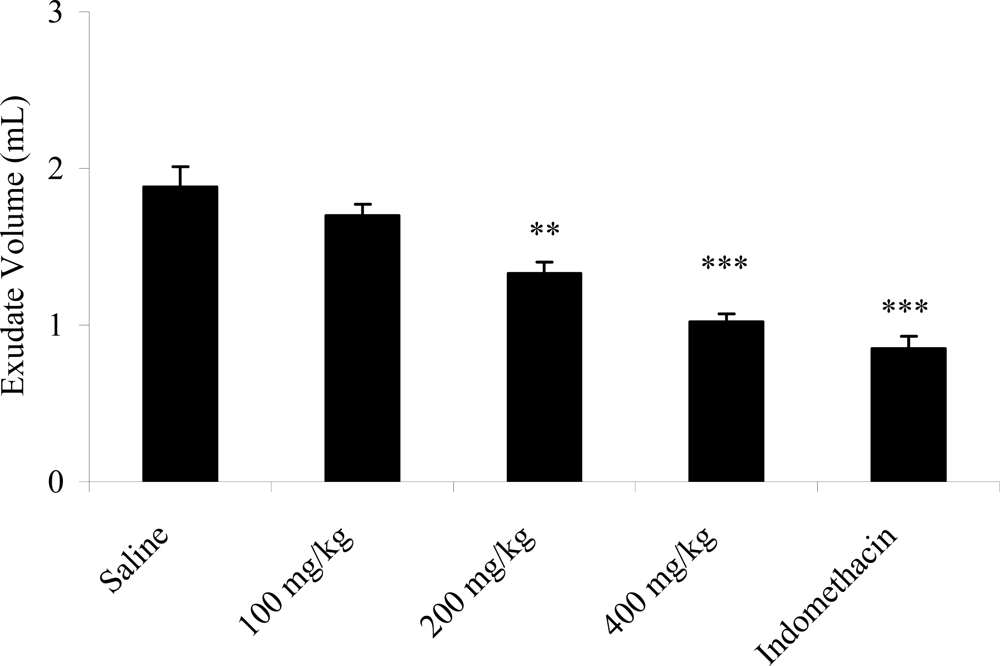
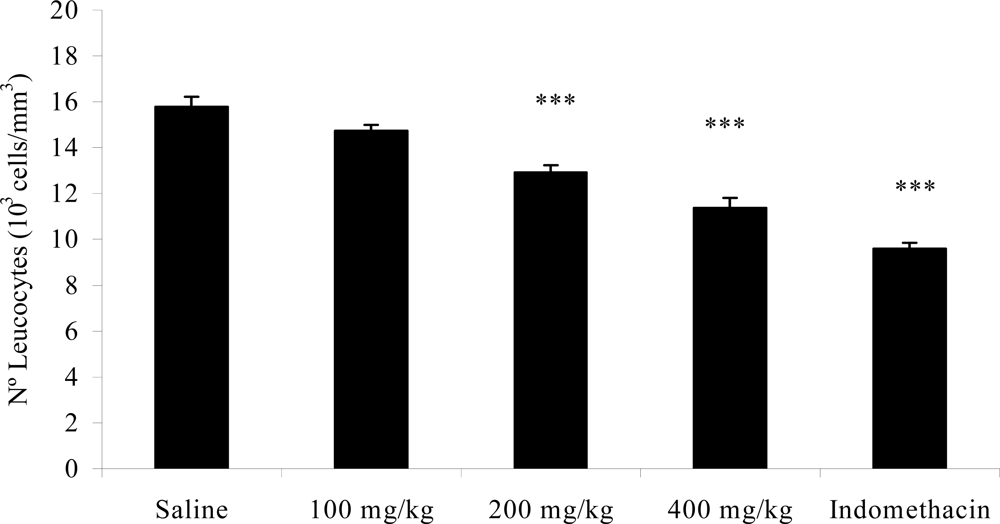
<p>The pleurisy effects demonstrated that doses (p.o.) of 200 (p &lt; 0.01) and 400 mg/kg (p &lt; 0.001) of the extracts significantly reduced the exudate volume (<xref ref-type="fig" rid="f1-ijms-11-02067">Figure 1</xref>) and the number of total leukocytes (<xref ref-type="fig" rid="f2-ijms-11-02067">Figure 2</xref>). The exudate volume was decreased by 29.25 and 45.74% at doses (p.o.) of 200 and 400 mg/kg compared to the respective control. Leukocyte migration inhibition also occurred from doses (p.o.) of 200 (12.91 ± 0.32 × 10<sup>3</sup> cells/mm<sup>3</sup>; p &lt; 0.001) and 400 mg/kg (11.37 ± 0.44 × 10<sup>3</sup> cells/mm<sup>3</sup>; p &lt; 0.001). Indomethacin reduced the exudate volume and the leukocyte migration.</p>
<p>The acute toxicity test showed that the <italic>A. muricata</italic> leaves ethanol extract doses tested were toxic to mice. However, the largest dose administered (400 mg/kg) is less than the lowest dose applied for determination of the LD<sub>50</sub> (0.5 g/kg or 500 mg/kg). Studies have demonstrated that isolated acetogenins from the <italic>A. muricata</italic> leaves are toxic to tumor cells [<xref ref-type="bibr" rid="b11-ijms-11-02067">11</xref>–<xref ref-type="bibr" rid="b17-ijms-11-02067">17</xref>] and molluscicides [<xref ref-type="bibr" rid="b18-ijms-11-02067">18</xref>]. It is possible that the toxic effect of the ethanol extract could be due to the presence of these substances. However, the pharmacological doses definition of the ethanol extract was not described in the literature. In the present study, the LD<sub>50</sub> was used to define the doses that were administered to the animals.</p>
<p>Based on the pharmacological tests results, the <italic>A. muricata</italic> ethanol extract has antinociceptive and anti-inflammatory activities, being firstly reported in the literature. Intraperitoneal administration of acetic acid releases prostaglandins and sympathomimetic system mediators like PGE<sub>2</sub> and PGF<sub>2α</sub> and their levels were increased in the peritoneal fluid of the acetic acid induced mice [<xref ref-type="bibr" rid="b21-ijms-11-02067">21</xref>]. Thus, the antinociceptive effect of the ethanol extract could be mediated by peripherical effects, including the prostaglandin synthesis inhibition. The antinociceptive effect was also demonstrated by the biphasic response time of paw licking induced by formalin [<xref ref-type="bibr" rid="b22-ijms-11-02067">22</xref>]. The first phase (0 to 5 min) corresponds to the neurogenic stage as an intensely painful process for the activation of nociceptive pathways, while inflammation mediators are produced after 15 minutes of formalin application (second phase) [<xref ref-type="bibr" rid="b22-ijms-11-02067">22</xref>,<xref ref-type="bibr" rid="b23-ijms-11-02067">23</xref>]. Substance P and bradykinin act as mediators in the first phase, while histamine, serotonin, prostaglandin and bradykinin are involved in the nociceptive response of the second stage [<xref ref-type="bibr" rid="b23-ijms-11-02067">23</xref>]. The central action was confirmed in the hot plate test (200 and 400 mg/kg), showing that the maximum effect is reached after 90 minutes. This test is considered to be sensitive to drugs acting at the supraspinal modulation level of the pain response [<xref ref-type="bibr" rid="b24-ijms-11-02067">24</xref>], suggesting at least a modulatory effect of the extract. In this study, antinociceptive action did not depend entirely on the opioid system, because naloxone treatment did not completely reverse the produced effect [<xref ref-type="bibr" rid="b25-ijms-11-02067">25</xref>,<xref ref-type="bibr" rid="b26-ijms-11-02067">26</xref>]. The formalin induced algesia test also indicated a possible anti-inflammatory activity (the second phase was reduced from 200 mg/kg).</p>
<p>The anti-inflammatory activity was confirmed by the paw edema induced by carrageenan in rats, a model widely used to study anti-inflammatory substances. Carrageenan induces paw edema resulting in the release of mediators such as histamine, serotonin, bradykinin, substance P and a platelet activating factor and prostaglandins [<xref ref-type="bibr" rid="b27-ijms-11-02067">27</xref>–<xref ref-type="bibr" rid="b33-ijms-11-02067">33</xref>]. In this study, oral treatment with the <italic>A. muricata</italic> extract significantly inhibited the paw edema. This evidence suggests that the anti-inflammatory actions of the ethanol extract are related to inhibition of one or more signaling intracellular pathways involved with these mediators effects.</p>
<p>Pleurisy produced by intrapleural injection of carrageenan leads to the formation of exudate in the pleural cavity [<xref ref-type="bibr" rid="b34-ijms-11-02067">34</xref>,<xref ref-type="bibr" rid="b35-ijms-11-02067">35</xref>] and leukocyte migration [<xref ref-type="bibr" rid="b35-ijms-11-02067">35</xref>,<xref ref-type="bibr" rid="b36-ijms-11-02067">36</xref>]. It is a method that assesses the inflammatory infiltrate and confirms the obtained paw edema results. Non-steroidal anti-inflammatory drugs, such as indomethacin, inhibit the accumulation of exudates and mobilization of leukocytes between 3 and 6 h after application of carrageenan [<xref ref-type="bibr" rid="b35-ijms-11-02067">35</xref>,<xref ref-type="bibr" rid="b37-ijms-11-02067">37</xref>]. By reducing the volume of exudate and the leukocyte migration, the <italic>A. muricata</italic> ethanol extract confirmed the results of the paw edema (<xref ref-type="table" rid="t4-ijms-11-02067">Table 4</xref> and <xref ref-type="fig" rid="f1-ijms-11-02067">Figures 1</xref> and <xref ref-type="fig" rid="f2-ijms-11-02067">2</xref>).</p>
<p>Plants belonging to the Annonaceae family have been investigated for its antinociceptive and anti-inflammatory properties [<xref ref-type="bibr" rid="b25-ijms-11-02067">25</xref>,<xref ref-type="bibr" rid="b26-ijms-11-02067">26</xref>,<xref ref-type="bibr" rid="b38-ijms-11-02067">38</xref>]. However, considering the compounds isolated from <italic>A. muricata</italic>, these properties are not been reported for the alkaloids [<xref ref-type="bibr" rid="b4-ijms-11-02067">4</xref>,<xref ref-type="bibr" rid="b5-ijms-11-02067">5</xref>] and acetogenins [<xref ref-type="bibr" rid="b8-ijms-11-02067">8</xref>–<xref ref-type="bibr" rid="b18-ijms-11-02067">18</xref>]. Antinociceptive and anti-inflammatory activities have been attributed to essential oil of <italic>Dennettia tripetala</italic> (Annonaceae) [<xref ref-type="bibr" rid="b38-ijms-11-02067">38</xref>], but such activities are not described for the major components [<xref ref-type="bibr" rid="b6-ijms-11-02067">6</xref>,<xref ref-type="bibr" rid="b7-ijms-11-02067">7</xref>] identified in <italic>A. muricata</italic>. Additional studies are necessary to establish the possible correlation between activities and chemical composition of this plant.</p></sec></sec>
<sec>
<label>3.</label>
<title>Experimental Section</title>
<sec>
<label>3.1.</label>
<title>Plant Material and Extraction</title>
<p>The plant material used in this study was collected in Juiz de Fora, State of Minas Gerais, Brazil, in February 2008. The species was identified by Dr Fátima Regina Gonçalves Salimena and a voucher specimen (CESJ number 48236) was deposited in the Herbarium of the Universidade Federal de Juiz de Fora, Brazil. Dried and powdered leaves (600 g) were exhaustively extracted in 95% ethanol (2.5 L) by static maceration for 3 weeks at room temperature with renewal of solvent every 2 days. The ethanol extract was filtered and evaporated under a rotary evaporator at controlled temperature (50–60 °C). This material was placed in a desiccator with silica to yield 36.40 g. The dried extract was dissolved using 1% DMSO in normal saline for pharmacological studies.</p></sec>
<sec>
<label>3.2.</label>
<title>Chemicals</title>
<p>Drugs and reagents used in this study (and their sources) were as follows: acetic acid (Vetec Química Farm Ltda, Rio de Janeiro, RJ, Brazil), formaldehyde (Reagen Quimibrás Ind. Química S.A., Rio de Janeiro, RJ, Brazil), morphine hydrochloride (Merck Inc., Whitehouse Station, NJ, USA), naloxone and indomethacin (Sigma Chemical Co, St Louis, MI, USA).</p></sec>
<sec>
<label>3.3.</label>
<title>Animals</title>
<p>Male Wistar rats (90–110 days) weighing 200–240 g and male Swiss albino mice (50–70 days) weighing 25–30 g were used in the experiments. The animals were provided by the Central Biotery of the Universidade Federal de Juiz de Fora. The animals were divided into groups and kept in plastic cages (47 × 34 × 18 cm) under a 12 h light/12 h dark cycle at room temperature (22 ± 2 °C), with free access to Purina rations and water. Animal care and the experimental protocol followed the principles and guidelines suggested by the Brazilian College of Animal Experimentation (COBEA) and were approved by the local ethical committee.</p></sec>
<sec>
<label>3.4.</label>
<title>Acute Toxicity</title>
<p>Groups of ten mice received oral doses of 0.5, 1, 1.5, 2 and 3 g/kg of ethanol extract from <italic>A. muricata</italic>, while the control group received the vehicle (saline). The groups were observed for 48 h and mortality at end of this period was recorded for each group [<xref ref-type="bibr" rid="b39-ijms-11-02067">39</xref>]. The LD<sub>50</sub> (50% lethal dose) was determined by probit test using a log plot of percentage death <italic>versus</italic> dose [<xref ref-type="bibr" rid="b40-ijms-11-02067">40</xref>]. The determination of LD<sub>50</sub> served to define the doses used in experiments of pharmacological activities.</p></sec>
<sec>
<label>3.5.</label>
<title>Acetic Acid-Induced Writhing Response in Mice</title>
<p>Antinociceptive activity was evaluated using the test of abdominal writhing induced by acetic acid in mice [<xref ref-type="bibr" rid="b41-ijms-11-02067">41</xref>]. Animals were divided into groups of eight mice. Control mice received an i.p. injection of acetic acid 0.6% (0.25 mL) and 10 min later the writhes were counted over a period of 20 min. One group of mice received indomethacin (10 mg/kg) by the per oral route (p.o.) as a reference compound, and the other three groups received the extract at doses (p.o.) of 100, 200 and 400 mg/kg, 1 h before the acetic acid injection.</p></sec>
<sec>
<label>3.6.</label>
<title>Formalin-Induced Nociception in Mice</title>
<p>Mice received subplantar injections of 20 μL 2.5% formalin (in 0.9% saline) and the time of paw licking (in seconds) was determined over 0–5 min (first phase - neurogenic) and 15–30 min (second phase - inflammatory) after formalin injection [<xref ref-type="bibr" rid="b22-ijms-11-02067">22</xref>]. Animals (n = 8) were pretreated p.o. with extract (100, 200 or 400 mg/kg; 0.1 mL per 10 g body weight) or the reference compound, subcutaneous morphine (1 mg/kg), 1 h before administration of formalin. Control animals were treated with sterile saline (10 mL/kg).</p></sec>
<sec>
<label>3.7.</label>
<title>Hot-Plate Latency Assay in Mice</title>
<p>Animals were placed on a hot-plate (Model LE 7406, Letica Scientific Instruments, Barcelona, Spain) heated at 55 ± 1 °C [<xref ref-type="bibr" rid="b42-ijms-11-02067">42</xref>]. Three groups of mice (n = 8) were treated p.o. with ethanol extract (100, 200 or 400 mg/kg; 0.1 mL per 10 g body weight); the control group received sterile saline (10 mL/kg). Measurements were performed at time 0, 30, 60 and 90 min after drug administration, with a cut-off time of 40 s to avoid lesions to the animals’ paws. The effect of pretreatment with naloxone (1 mg/kg, subcutaneously) on the analgesia produced by the ethanol extract (400 mg/kg) was determined in a separate group of animals. Morphine (1 mg/kg, subcutaneously), in the absence and presence of naloxone treatment, was used as a reference.</p></sec>
<sec>
<label>3.8.</label>
<title>Carrageenan-Induced Edema in Rats</title>
<p>Anti-inflammatory activity was assessed on the basis of inhibition of paw edema induced by the injection of 0.1 mL of 2% carrageenan (an edematogenic agent) into the subplantar region of the right hind paw of the rat [<xref ref-type="bibr" rid="b43-ijms-11-02067">43</xref>]. Male Wistar rats were divided into groups of six animals which received p.o. doses of extract (100, 200 and 400 mg/kg; 0.1 mL per 10 g body weight), saline or indomethacin (10 mg/kg) 1 h before the injection of carrageenan. In the left paw, used as a control, 0.1 mL of sterile saline was injected. 1, 2, 3 and 4 h after injection of carrageenan, the measure of edema was made by the difference between the volume displaced by the right paw and the left paw using a plethysmometer (model LE 7500, Letica Scientific Instruments, Barcelona, Spain).</p></sec>
<sec>
<label>3.9.</label>
<title>Carrageenan-Induced Pleurisy in Rats</title>
<p>Pleurisy was induced in male Wistar rats by intrapleural administration of 0.5 mL 2% carrageenan suspension in saline solution between the third and fifth ribs on the right side of the mediastinum [<xref ref-type="bibr" rid="b37-ijms-11-02067">37</xref>]. Extract (100, 200 and 400 mg/kg), saline or indomethacin (10 mg/kg) p.o. were given 60 min before injection of the irritant. Animals were killed 4 h after carrageenan injection, and the skin and pectoral muscles were retracted. A longitudinal incision was made between the third and fifth ribs on each side of the mediastinum. The exudate was collected and transferred to a 15 mL conical centrifuge tube and the total volume determined. A 50 μL aliquot of the exudate was used to determine the total leucocyte count in Neubauer chambers.</p></sec>
<sec sec-type="methods|results">
<label>3.10.</label>
<title>Calculations and Statistical Analysis</title>
<p>Data are expressed as mean ± s.e.m. Statistical significance was determined by one-way analysis of variance followed by the Student–Newman–Keuls test. <italic>P</italic> values below 0.05 were considered significant. The percentage of inhibition was calculated by using
<disp-formula>
<mml:math display="block">
<mml:mrow>
<mml:mn>100</mml:mn>
<mml:mo>−</mml:mo>
<mml:mtext>T</mml:mtext>
<mml:mo>×</mml:mo>
<mml:mn>100</mml:mn>
<mml:mo>/</mml:mo>
<mml:mtext>C</mml:mtext>
<mml:mo stretchy="false">(</mml:mo>
<mml:mo>%</mml:mo>
<mml:mo stretchy="false">)</mml:mo>
<mml:mi> </mml:mi>
<mml:mtext>or</mml:mtext>
<mml:mo> </mml:mo>
<mml:mtext>T</mml:mtext>
<mml:mo>×</mml:mo>
<mml:mn>100</mml:mn>
<mml:mo>/</mml:mo>
<mml:mtext>C</mml:mtext>
<mml:mo>−</mml:mo>
<mml:mn>100</mml:mn>
<mml:mo stretchy="false">(</mml:mo>
<mml:mo>%</mml:mo>
<mml:mo stretchy="false">)</mml:mo></mml:mrow></mml:math></disp-formula>where C and T indicate non-treated (vehicle) and drug-treated, respectively.</p></sec></sec>
<sec sec-type="conclusions">
<label>4.</label>
<title>Conclusions</title>
<p>The results obtained in this study confirm the ethnomedicinal use of the ethanol extract from <italic>A. muricata</italic> leaves. The data analysis supported the antinociceptive and anti-inflammatory activities, suggesting a potential for therapeutic purposes. However, further studies should be conducted to ensure its safe usage.</p></sec></body>
<back>
<ack>
<p>We are grateful to CNPq, FAPEMIG and UFJF by financial support.</p></ack>
<ref-list>
<title>References and Notes</title>
<ref id="b1-ijms-11-02067"><label>1.</label><citation citation-type="book"><person-group person-group-type="author"><name><surname>Di Stasi</surname><given-names>LC</given-names></name><name><surname>Hiruma-Lima</surname><given-names>CA</given-names></name></person-group><source>Plantas Medicinais na Amazônia e na Mata Atlântica</source><edition>2nd ed</edition><publisher-name>Editora UNESP</publisher-name><publisher-loc>São Paulo, Brazil</publisher-loc><year>2002</year><fpage>87</fpage><lpage>112</lpage></citation></ref>
<ref id="b2-ijms-11-02067"><label>2.</label><citation citation-type="book"><person-group person-group-type="author"><name><surname>Sousa</surname><given-names>MP</given-names></name><name><surname>Matos</surname><given-names>MEO</given-names></name><name><surname>Matos</surname><given-names>FJA</given-names></name><name><surname>Machados</surname><given-names>MIL</given-names></name><name><surname>Craveiro</surname><given-names>AA</given-names></name></person-group><source>Constituintes Químicos Ativos e Propriedades Biológicas de Plantas Medicinais Brasileiras</source><edition>2nd ed</edition><publisher-name>Editora UFC</publisher-name><publisher-loc>Fortaleza, Brazil</publisher-loc><year>2004</year><fpage>281</fpage><lpage>283</lpage></citation></ref>
<ref id="b3-ijms-11-02067"><label>3.</label><citation citation-type="book"><person-group person-group-type="author"><name><surname>Lorenzi</surname><given-names>H</given-names></name><name><surname>Matos</surname><given-names>FJA</given-names></name></person-group><source>Plantas Medicinais No Brasil: Nativas e Exóticas</source><edition>2nd ed</edition><publisher-name>Instituto Plantarum</publisher-name><publisher-loc>Nova Odessa, Brazil</publisher-loc><year>2008</year><fpage>62</fpage><lpage>63</lpage></citation></ref>
<ref id="b4-ijms-11-02067"><label>4.</label><citation citation-type="journal"><person-group person-group-type="author"><name><surname>Leboeuf</surname><given-names>M</given-names></name><name><surname>Legueut</surname><given-names>C</given-names></name><name><surname>Cavé</surname><given-names>A</given-names></name><name><surname>Desconclois</surname><given-names>JF</given-names></name><name><surname>Forgacs</surname><given-names>P</given-names></name><name><surname>Jacquemin</surname><given-names>H</given-names></name></person-group><article-title>Alkaloids of Annonaceae. XXIX. Alkaloids of <italic>Annona muricata</italic></article-title><source>Planta Med</source><year>1981</year><volume>42</volume><fpage>37</fpage><lpage>44</lpage><pub-id pub-id-type="doi">10.1055/s-2007-971543</pub-id><pub-id pub-id-type="pmid">17401878</pub-id></citation></ref>
<ref id="b5-ijms-11-02067"><label>5.</label><citation citation-type="journal"><person-group person-group-type="author"><name><surname>Leboeuf</surname><given-names>M</given-names></name><name><surname>Cavé</surname><given-names>A</given-names></name><name><surname>Bhaumik</surname><given-names>PK</given-names></name><name><surname>Mukherjee</surname><given-names>B</given-names></name><name><surname>Mukherjee</surname><given-names>R</given-names></name></person-group><article-title>The phytochemistry of the annonaceae</article-title><source>Phytochemistry</source><year>1982</year><volume>21</volume><fpage>2783</fpage><lpage>2813</lpage></citation></ref>
<ref id="b6-ijms-11-02067"><label>6.</label><citation citation-type="journal"><person-group person-group-type="author"><name><surname>Pélissler</surname><given-names>Y</given-names></name><name><surname>Marion</surname><given-names>C</given-names></name><name><surname>Kone</surname><given-names>D</given-names></name><name><surname>Lamaty</surname><given-names>G</given-names></name><name><surname>Menut</surname><given-names>C</given-names></name><name><surname>Besslere</surname><given-names>JM</given-names></name></person-group><article-title>Volatile components of <italic>Annona muricata</italic> L</article-title><source>J. Essent. Oil Res</source><year>1994</year><volume>6</volume><fpage>411</fpage><lpage>414</lpage><pub-id pub-id-type="doi">10.1080/10412905.1994.9698410</pub-id></citation></ref>
<ref id="b7-ijms-11-02067"><label>7.</label><citation citation-type="journal"><person-group person-group-type="author"><name><surname>Kossouoh</surname><given-names>C</given-names></name><name><surname>Moudachirou</surname><given-names>M</given-names></name><name><surname>Adjakidje</surname><given-names>V</given-names></name><name><surname>Chalchat</surname><given-names>JC</given-names></name><name><surname>Figuérédo</surname><given-names>G</given-names></name></person-group><article-title>Essential oil chemical composition of <italic>Annona muricata</italic> L. leaves from Benin</article-title><source>J. Essent. Oil Res</source><year>2007</year><volume>19</volume><fpage>307</fpage><lpage>309</lpage><pub-id pub-id-type="doi">10.1080/10412905.2007.9699288</pub-id></citation></ref>
<ref id="b8-ijms-11-02067"><label>8.</label><citation citation-type="journal"><person-group person-group-type="author"><name><surname>Rupprecht</surname><given-names>JK</given-names></name><name><surname>Hui</surname><given-names>YH</given-names></name><name><surname>McLaughlin</surname><given-names>JL</given-names></name></person-group><article-title>Annonaceous acetogenins: a review</article-title><source>J. Nat. Prod</source><year>1990</year><volume>53</volume><fpage>237</fpage><lpage>278</lpage><pub-id pub-id-type="doi">10.1021/np50068a001</pub-id><pub-id pub-id-type="pmid">2199608</pub-id></citation></ref>
<ref id="b9-ijms-11-02067"><label>9.</label><citation citation-type="journal"><person-group person-group-type="author"><name><surname>Cavé</surname><given-names>A</given-names></name><name><surname>Figadère</surname><given-names>B</given-names></name><name><surname>Laurens</surname><given-names>A</given-names></name><name><surname>Cortes</surname><given-names>D</given-names></name></person-group><article-title>Acetogenins from Annonaceae</article-title><source>Fortschr. Chem. Org. Naturst</source><year>1997</year><volume>70</volume><fpage>281</fpage><lpage>288</lpage></citation></ref>
<ref id="b10-ijms-11-02067"><label>10.</label><citation citation-type="journal"><person-group person-group-type="author"><name><surname>Wu</surname><given-names>FE</given-names></name><name><surname>Gu</surname><given-names>ZM</given-names></name><name><surname>Zeng</surname><given-names>L</given-names></name><name><surname>Zhao</surname><given-names>GX</given-names></name><name><surname>Zhang</surname><given-names>Y</given-names></name><name><surname>McLaughlin</surname><given-names>JL</given-names></name><name><surname>Sastrodihardjo</surname><given-names>S</given-names></name></person-group><article-title>Two new cytotoxic monotetrahydrofuran Annonaceous acetogenins, annomuricins A and B, from the leaves of <italic>Annona muricata</italic></article-title><source>J. Nat. Prod</source><year>1995</year><volume>58</volume><fpage>830</fpage><lpage>836</lpage><pub-id pub-id-type="doi">10.1021/np50120a002</pub-id><pub-id pub-id-type="pmid">7673926</pub-id></citation></ref>
<ref id="b11-ijms-11-02067"><label>11.</label><citation citation-type="journal"><person-group person-group-type="author"><name><surname>Wu</surname><given-names>FE</given-names></name><name><surname>Zeng</surname><given-names>L</given-names></name><name><surname>Gu</surname><given-names>ZM</given-names></name><name><surname>Zhao</surname><given-names>GX</given-names></name><name><surname>Zhang</surname><given-names>Y</given-names></name><name><surname>Schwedler</surname><given-names>JT</given-names></name><name><surname>McLaughlin</surname><given-names>JL</given-names></name><name><surname>Sastrodihardjo</surname><given-names>S</given-names></name></person-group><article-title>Muricatocins A and B, two new bioactive monotetrahydrofuran Annonaceous acetogenins from the leaves of <italic>Annona muricata</italic></article-title><source>J. Nat. Prod</source><year>1995</year><volume>58</volume><fpage>902</fpage><lpage>908</lpage><pub-id pub-id-type="doi">10.1021/np50120a013</pub-id><pub-id pub-id-type="pmid">7673935</pub-id></citation></ref>
<ref id="b12-ijms-11-02067"><label>12.</label><citation citation-type="journal"><person-group person-group-type="author"><name><surname>Wu</surname><given-names>FE</given-names></name><name><surname>Zeng</surname><given-names>L</given-names></name><name><surname>Gu</surname><given-names>ZM</given-names></name><name><surname>Zhao</surname><given-names>GX</given-names></name><name><surname>Zhang</surname><given-names>Y</given-names></name><name><surname>Schwedler</surname><given-names>JT</given-names></name><name><surname>McLaughlin</surname><given-names>JL</given-names></name><name><surname>Sastrodihardjo</surname><given-names>S</given-names></name></person-group><article-title>New bioactive monotetrahydrofuran Annonaceous acetogenins, annomuricin C and muricatocin C, from the leaves of <italic>Annona muricata</italic></article-title><source>J. Nat. Prod</source><year>1995</year><volume>58</volume><fpage>909</fpage><lpage>915</lpage><pub-id pub-id-type="doi">10.1021/np50120a014</pub-id><pub-id pub-id-type="pmid">7673936</pub-id></citation></ref>
<ref id="b13-ijms-11-02067"><label>13.</label><citation citation-type="journal"><person-group person-group-type="author"><name><surname>Wu</surname><given-names>FE</given-names></name><name><surname>Zhao</surname><given-names>GX</given-names></name><name><surname>Zeng</surname><given-names>L</given-names></name><name><surname>Zhang</surname><given-names>Y</given-names></name><name><surname>Schwedler</surname><given-names>JT</given-names></name><name><surname>McLaughlin</surname><given-names>JL</given-names></name><name><surname>Sastrodihardjo</surname><given-names>S</given-names></name></person-group><article-title>Additional bioactive acetogenins, annomutacin and (2,4-trans and cis)-10R-annonacin-A-ones, from the leaves of <italic>Annona muricata</italic></article-title><source>J. Nat. Prod</source><year>1995</year><volume>58</volume><fpage>1430</fpage><lpage>1437</lpage><pub-id pub-id-type="doi">10.1021/np50123a015</pub-id><pub-id pub-id-type="pmid">7494150</pub-id></citation></ref>
<ref id="b14-ijms-11-02067"><label>14.</label><citation citation-type="journal"><person-group person-group-type="author"><name><surname>Zeng</surname><given-names>L</given-names></name><name><surname>Wu</surname><given-names>FE</given-names></name><name><surname>Oberlies</surname><given-names>NH</given-names></name><name><surname>McLaughlin</surname><given-names>JL</given-names></name><name><surname>Sastrodihadjo</surname><given-names>S</given-names></name></person-group><article-title>Five new monotetrahydrofuran ring acetogenins from the leaves of <italic>Annona muricata</italic></article-title><source>J. Nat. Prod</source><year>1996</year><volume>59</volume><fpage>1035</fpage><lpage>1042</lpage><pub-id pub-id-type="doi">10.1021/np960447e</pub-id><pub-id pub-id-type="pmid">8946744</pub-id></citation></ref>
<ref id="b15-ijms-11-02067"><label>15.</label><citation citation-type="journal"><person-group person-group-type="author"><name><surname>Kim</surname><given-names>GS</given-names></name><name><surname>Zeng</surname><given-names>L</given-names></name><name><surname>Alali</surname><given-names>F</given-names></name><name><surname>Rogers</surname><given-names>LL</given-names></name><name><surname>Wu</surname><given-names>FE</given-names></name><name><surname>McLaughlin</surname><given-names>JL</given-names></name><name><surname>Sastrodihardjo</surname><given-names>S</given-names></name></person-group><article-title>Two new mono-tetrahydrofuran ring acetogenins, annomuricin E and muricapentocin, from the leaves of <italic>Annona muricata</italic></article-title><source>J. Nat. Prod</source><year>1998</year><volume>61</volume><fpage>432</fpage><lpage>436</lpage><pub-id pub-id-type="doi">10.1021/np970534m</pub-id><pub-id pub-id-type="pmid">9584396</pub-id></citation></ref>
<ref id="b16-ijms-11-02067"><label>16.</label><citation citation-type="journal"><person-group person-group-type="author"><name><surname>Kim</surname><given-names>GS</given-names></name><name><surname>Zeng</surname><given-names>L</given-names></name><name><surname>Alali</surname><given-names>F</given-names></name><name><surname>Rogers</surname><given-names>LL</given-names></name><name><surname>Wu</surname><given-names>FE</given-names></name><name><surname>Sastrodihardjo</surname><given-names>S</given-names></name><name><surname>McLaughlin</surname><given-names>JL</given-names></name></person-group><article-title>Muricoreacin and murihexocin C, mono-tetrahydrofuran acetogenins, from the leaves of <italic>Annona muricata</italic></article-title><source>Phytochem</source><year>1998</year><volume>49</volume><fpage>565</fpage><lpage>571</lpage><pub-id pub-id-type="doi">10.1016/S0031-9422(98)00172-1</pub-id></citation></ref>
<ref id="b17-ijms-11-02067"><label>17.</label><citation citation-type="journal"><person-group person-group-type="author"><name><surname>Chang</surname><given-names>FR</given-names></name><name><surname>Liaw</surname><given-names>CC</given-names></name><name><surname>Lin</surname><given-names>CY</given-names></name><name><surname>Chou</surname><given-names>CJ</given-names></name><name><surname>Chiu</surname><given-names>HF</given-names></name><name><surname>Wu</surname><given-names>YC</given-names></name></person-group><article-title>New adjacent Bis-tetrahydrofuran Annonaceous acetogenins from <italic>Annona muricata</italic></article-title><source>Planta Med</source><year>2003</year><volume>69</volume><fpage>241</fpage><lpage>246</lpage><pub-id pub-id-type="doi">10.1055/s-2003-38485</pub-id><pub-id pub-id-type="pmid">12677528</pub-id></citation></ref>
<ref id="b18-ijms-11-02067"><label>18.</label><citation citation-type="journal"><person-group person-group-type="author"><name><surname>Luna</surname><given-names>JS</given-names></name><name><surname>Carvalho</surname><given-names>JM</given-names></name><name><surname>Lima</surname><given-names>MR</given-names></name><name><surname>Bieber</surname><given-names>LW</given-names></name><name><surname>Bento</surname><given-names>ES</given-names></name><name><surname>Franck</surname><given-names>X</given-names></name><name><surname>Sant'ana</surname><given-names>AX</given-names></name></person-group><article-title>Acetogenins in <italic>Annona muricata</italic> L. (Annonaceae) leaves are potent molluscicides</article-title><source>Nat. Prod. Res</source><year>2006</year><volume>20</volume><fpage>253</fpage><lpage>257</lpage><pub-id pub-id-type="doi">10.1080/14786410500161445</pub-id><pub-id pub-id-type="pmid">16401556</pub-id></citation></ref>
<ref id="b19-ijms-11-02067"><label>19.</label><citation citation-type="journal"><person-group person-group-type="author"><name><surname>Baskar</surname><given-names>R</given-names></name><name><surname>Rajeswari</surname><given-names>V</given-names></name><name><surname>Kumar</surname><given-names>TS</given-names></name></person-group><article-title><italic>In vitro</italic> antioxidant studies in leaves of <italic>Annona</italic> species</article-title><source>Indian J. Exp. Biol</source><year>2007</year><volume>45</volume><fpage>480</fpage><lpage>485</lpage><pub-id pub-id-type="pmid">17569293</pub-id></citation></ref>
<ref id="b20-ijms-11-02067"><label>20.</label><citation citation-type="journal"><person-group person-group-type="author"><name><surname>Santos</surname><given-names>AF</given-names></name><name><surname>Sant'Ana</surname><given-names>AEG</given-names></name></person-group><article-title>Molluscicidal properties of some species of <italic>Annona.</italic></article-title><source>Phytomedicine</source><year>2001</year><volume>8</volume><fpage>115</fpage><lpage>120</lpage><pub-id pub-id-type="doi">10.1078/0944-7113-00008</pub-id><pub-id pub-id-type="pmid">11315753</pub-id></citation></ref>
<ref id="b21-ijms-11-02067"><label>21.</label><citation citation-type="journal"><person-group person-group-type="author"><name><surname>Deraedt</surname><given-names>R</given-names></name><name><surname>Jouquey</surname><given-names>S</given-names></name><name><surname>Delevallée</surname><given-names>F</given-names></name><name><surname>Flahaut</surname><given-names>M</given-names></name></person-group><article-title>Release of prostaglandins E and F in an algogenic reaction and its inhibition</article-title><source>Eur. J. Pharmacol</source><year>1980</year><volume>51</volume><fpage>17</fpage><lpage>24</lpage></citation></ref>
<ref id="b22-ijms-11-02067"><label>22.</label><citation citation-type="journal"><person-group person-group-type="author"><name><surname>Hunskaar</surname><given-names>S</given-names></name><name><surname>Hole</surname><given-names>K</given-names></name></person-group><article-title>The formalin test in mice: dissociation between inflammatory and non-inflammatory pain</article-title><source>Pain</source><year>1987</year><volume>30</volume><fpage>103</fpage><lpage>114</lpage><pub-id pub-id-type="doi">10.1016/0304-3959(87)90088-1</pub-id><pub-id pub-id-type="pmid">3614974</pub-id></citation></ref>
<ref id="b23-ijms-11-02067"><label>23.</label><citation citation-type="journal"><person-group person-group-type="author"><name><surname>Shibata</surname><given-names>M</given-names></name><name><surname>Ohkubo</surname><given-names>T</given-names></name><name><surname>Takahashi</surname><given-names>H</given-names></name><name><surname>Inoki</surname><given-names>R</given-names></name></person-group><article-title>Modified formalin test; characteristic biphasic pain response</article-title><source>Pain</source><year>1989</year><volume>38</volume><fpage>347</fpage><lpage>352</lpage><pub-id pub-id-type="doi">10.1016/0304-3959(89)90222-4</pub-id><pub-id pub-id-type="pmid">2478947</pub-id></citation></ref>
<ref id="b24-ijms-11-02067"><label>24.</label><citation citation-type="journal"><person-group person-group-type="author"><name><surname>Yaksh</surname><given-names>TL</given-names></name><name><surname>Rudy</surname><given-names>TA</given-names></name></person-group><article-title>Studies on direct spinal action of narcotics in production of analgesia in rat</article-title><source>J. Pharmacol. Exp. Ther</source><year>1977</year><volume>202</volume><fpage>411</fpage><lpage>428</lpage><pub-id pub-id-type="pmid">18600</pub-id></citation></ref>
<ref id="b25-ijms-11-02067"><label>25.</label><citation citation-type="journal"><person-group person-group-type="author"><name><surname>Sousa</surname><given-names>OV</given-names></name><name><surname>Del-Vechio-Vieira</surname><given-names>G</given-names></name><name><surname>Amaral</surname><given-names>MPH</given-names></name><name><surname>Pinho</surname><given-names>JJRG</given-names></name><name><surname>Yamamoto</surname><given-names>CH</given-names></name><name><surname>Alves</surname><given-names>MS</given-names></name></person-group><article-title>Efeitos antinociceptivo e antiinflamatório do extrato etanólico das folhas de <italic>Duguetia lanceolata</italic> St. Hil. (Annonaceae)</article-title><source>Lat. Am. J. Pharm</source><year>2008</year><volume>27</volume><fpage>398</fpage><lpage>402</lpage></citation></ref>
<ref id="b26-ijms-11-02067"><label>26.</label><citation citation-type="journal"><person-group person-group-type="author"><name><surname>Sousa</surname><given-names>OV</given-names></name><name><surname>Del-Vechio-Vieira</surname><given-names>G</given-names></name><name><surname>Kaplan</surname><given-names>MAC</given-names></name></person-group><article-title>Propriedades analgésica e antiinflamatória do extrato metanólico de folhas de <italic>Annona coriacea</italic> Mart. (Annonaceae)</article-title><source>Lat. Am. J. Pharm</source><year>2007</year><volume>26</volume><fpage>872</fpage><lpage>877</lpage></citation></ref>
<ref id="b27-ijms-11-02067"><label>27.</label><citation citation-type="journal"><person-group person-group-type="author"><name><surname>Di Rosa</surname><given-names>M</given-names></name><name><surname>Giroud</surname><given-names>JP</given-names></name><name><surname>Willoughby</surname><given-names>DA</given-names></name></person-group><article-title>Studies on the mediators of the acute inflammatory response induced in rats in different sites by carrageenan and turpentine</article-title><source>J. Pathol</source><year>1971</year><volume>104</volume><fpage>15</fpage><lpage>29</lpage><pub-id pub-id-type="doi">10.1002/path.1711040103</pub-id><pub-id pub-id-type="pmid">4398139</pub-id></citation></ref>
<ref id="b28-ijms-11-02067"><label>28.</label><citation citation-type="journal"><person-group person-group-type="author"><name><surname>Seibert</surname><given-names>K</given-names></name><name><surname>Zhang</surname><given-names>Y</given-names></name><name><surname>Leahy</surname><given-names>K</given-names></name><name><surname>Hauser</surname><given-names>S</given-names></name><name><surname>Masferrer</surname><given-names>J</given-names></name><name><surname>Perkins</surname><given-names>W</given-names></name><name><surname>Lee</surname><given-names>L</given-names></name><name><surname>Isakson</surname><given-names>P</given-names></name></person-group><article-title>Pharmacological and biochemical demonstration of the role of cyclooxygenase 2 in inflammation and pain</article-title><source>Proc. Natl. Acad. Sci. USA</source><year>1994</year><volume>91</volume><fpage>12013</fpage><lpage>12017</lpage><pub-id pub-id-type="doi">10.1073/pnas.91.25.12013</pub-id><pub-id pub-id-type="pmid">7991575</pub-id></citation></ref>
<ref id="b29-ijms-11-02067"><label>29.</label><citation citation-type="journal"><person-group person-group-type="author"><name><surname>Nantel</surname><given-names>F</given-names></name><name><surname>Denis</surname><given-names>D</given-names></name><name><surname>Gordon</surname><given-names>R</given-names></name><name><surname>Northey</surname><given-names>A</given-names></name><name><surname>Cirino</surname><given-names>M</given-names></name><name><surname>Metters</surname><given-names>KM</given-names></name><name><surname>Chan</surname><given-names>CC</given-names></name></person-group><article-title>Distribution and regulation of cyclooxygenase-2 in carrageenan-induced inflammation</article-title><source>Br. J. Pharmacol</source><year>1999</year><volume>128</volume><fpage>853</fpage><lpage>859</lpage><pub-id pub-id-type="doi">10.1038/sj.bjp.0702866</pub-id><pub-id pub-id-type="pmid">10556918</pub-id></citation></ref>
<ref id="b30-ijms-11-02067"><label>30.</label><citation citation-type="journal"><person-group person-group-type="author"><name><surname>Stochla</surname><given-names>K</given-names></name><name><surname>Maślinśki</surname><given-names>S</given-names></name></person-group><article-title>Carrageenan-induced oedema in the rat paw-histamine participation</article-title><source>Agents Actions</source><year>1982</year><volume>12</volume><fpage>201</fpage><lpage>202</lpage><pub-id pub-id-type="doi">10.1007/BF01965145</pub-id><pub-id pub-id-type="pmid">6123241</pub-id></citation></ref>
<ref id="b31-ijms-11-02067"><label>31.</label><citation citation-type="journal"><person-group person-group-type="author"><name><surname>Hwang</surname><given-names>SB</given-names></name><name><surname>Lam</surname><given-names>MH</given-names></name><name><surname>Li</surname><given-names>CL</given-names></name><name><surname>Shen</surname><given-names>TY</given-names></name></person-group><article-title>Release of platelet activation factor and its involvement in the first phase of carrageenin-induced rat foot edema</article-title><source>Eur. J. Pharmacol</source><year>1986</year><volume>120</volume><fpage>33</fpage><lpage>41</lpage><pub-id pub-id-type="doi">10.1016/0014-2999(86)90636-9</pub-id><pub-id pub-id-type="pmid">3948914</pub-id></citation></ref>
<ref id="b32-ijms-11-02067"><label>32.</label><citation citation-type="journal"><person-group person-group-type="author"><name><surname>De Campos</surname><given-names>RO</given-names></name><name><surname>Alves</surname><given-names>RV</given-names></name><name><surname>Kyle</surname><given-names>DJ</given-names></name><name><surname>Chakravarty</surname><given-names>S</given-names></name><name><surname>Mavunkel</surname><given-names>BJ</given-names></name><name><surname>Calixto</surname><given-names>JB</given-names></name></person-group><article-title>Antioedematogenic and antinociceptive actions of NPC 18521, a novel bradykinin B<sub>2</sub> receptor antagonist</article-title><source>Eur. J. Pharmacol</source><year>1996</year><volume>316</volume><fpage>277</fpage><lpage>286</lpage><pub-id pub-id-type="doi">10.1016/S0014-2999(96)00661-9</pub-id><pub-id pub-id-type="pmid">8982699</pub-id></citation></ref>
<ref id="b33-ijms-11-02067"><label>33.</label><citation citation-type="journal"><person-group person-group-type="author"><name><surname>Gilligan</surname><given-names>JP</given-names></name><name><surname>Lovato</surname><given-names>SJ</given-names></name><name><surname>Erion</surname><given-names>MD</given-names></name><name><surname>Jeng</surname><given-names>AY</given-names></name></person-group><article-title>Modulation of carrageenan-induced hind paw edema by substance P</article-title><source>Inflammation</source><year>1994</year><volume>18</volume><fpage>285</fpage><lpage>292</lpage><pub-id pub-id-type="doi">10.1007/BF01534269</pub-id><pub-id pub-id-type="pmid">7522223</pub-id></citation></ref>
<ref id="b34-ijms-11-02067"><label>34.</label><citation citation-type="journal"><person-group person-group-type="author"><name><surname>Ammendola</surname><given-names>G</given-names></name><name><surname>Di Rosa</surname><given-names>M</given-names></name><name><surname>Sorrentino</surname><given-names>L</given-names></name></person-group><article-title>Leucocyte migration and lysosomal enzymes release in rat carrageenin pleurisy</article-title><source>Agents Actions</source><year>1975</year><volume>5</volume><fpage>250</fpage><lpage>255</lpage><pub-id pub-id-type="doi">10.1007/BF02026439</pub-id><pub-id pub-id-type="pmid">1236640</pub-id></citation></ref>
<ref id="b35-ijms-11-02067"><label>35.</label><citation citation-type="journal"><person-group person-group-type="author"><name><surname>Almeida</surname><given-names>AP</given-names></name><name><surname>Bayer</surname><given-names>BM</given-names></name><name><surname>Horakova</surname><given-names>Z</given-names></name><name><surname>Beaven</surname><given-names>MA</given-names></name></person-group><article-title>Influence of indomethacin and other anti-inflammatory drugs on mobilization and production of neutrophils: studies with carrageenan-induced inflammation in rats</article-title><source>J. Pharmacol. Exp. Therap</source><year>1980</year><volume>214</volume><fpage>74</fpage><lpage>79</lpage></citation></ref>
<ref id="b36-ijms-11-02067"><label>36.</label><citation citation-type="journal"><person-group person-group-type="author"><name><surname>Capasso</surname><given-names>F</given-names></name><name><surname>Dunn</surname><given-names>CJ</given-names></name><name><surname>Yamamoto</surname><given-names>S</given-names></name><name><surname>Willoughby</surname><given-names>DA</given-names></name><name><surname>Giroud</surname><given-names>JP</given-names></name></person-group><article-title>Further studies on carrageenan-induced pleurisy in rats</article-title><source>J. Pathol</source><year>1975</year><volume>116</volume><fpage>117</fpage><lpage>124</lpage><pub-id pub-id-type="doi">10.1002/path.1711160208</pub-id><pub-id pub-id-type="pmid">168331</pub-id></citation></ref>
<ref id="b37-ijms-11-02067"><label>37.</label><citation citation-type="journal"><person-group person-group-type="author"><name><surname>Vinegar</surname><given-names>R</given-names></name><name><surname>Truax</surname><given-names>JF</given-names></name><name><surname>Selph</surname><given-names>JL</given-names></name></person-group><article-title>Some quantitative temporal characteristics of carrageenin-induced pleurisy in the rat</article-title><source>Proc. Soc. Exp. Biol. Med</source><year>1973</year><volume>143</volume><fpage>711</fpage><lpage>714</lpage><pub-id pub-id-type="pmid">4719457</pub-id></citation></ref>
<ref id="b38-ijms-11-02067"><label>38.</label><citation citation-type="journal"><person-group person-group-type="author"><name><surname>Oyemitan</surname><given-names>IA</given-names></name><name><surname>Iwalewa</surname><given-names>EO</given-names></name><name><surname>Akanmu</surname><given-names>MA</given-names></name><name><surname>Olugbade</surname><given-names>TA</given-names></name></person-group><article-title>Antinociceptive and antiinflammatory effects of essential oil of <italic>Dennettia tripetala</italic> G. Baker (Annonaceae) in rodents</article-title><source>Afr. J. Tradit. Complement. Altern. Med</source><year>2008</year><volume>5</volume><fpage>355</fpage><lpage>362</lpage><pub-id pub-id-type="pmid">20161957</pub-id></citation></ref>
<ref id="b39-ijms-11-02067"><label>39.</label><citation citation-type="journal"><person-group person-group-type="author"><name><surname>Dietrich</surname><given-names>L</given-names></name></person-group><article-title>A new approach to practical acute toxicity testing</article-title><source>Arch. Toxicol</source><year>1983</year><volume>54</volume><fpage>275</fpage><lpage>287</lpage><pub-id pub-id-type="doi">10.1007/BF01234480</pub-id><pub-id pub-id-type="pmid">6667118</pub-id></citation></ref>
<ref id="b40-ijms-11-02067"><label>40.</label><citation citation-type="journal"><person-group person-group-type="author"><name><surname>Litchfield</surname><given-names>JT</given-names></name><name><surname>Wilcoxon</surname><given-names>F</given-names></name></person-group><article-title>A simplified method of evaluating dose-effect experiments</article-title><source>J. Pharmacol. Exp. Therap</source><year>1949</year><volume>96</volume><fpage>99</fpage><lpage>113</lpage></citation></ref>
<ref id="b41-ijms-11-02067"><label>41.</label><citation citation-type="journal"><person-group person-group-type="author"><name><surname>Collier</surname><given-names>HDJ</given-names></name><name><surname>Dinnin</surname><given-names>LC</given-names></name><name><surname>Johnson</surname><given-names>CA</given-names></name><name><surname>Schneider</surname><given-names>C</given-names></name></person-group><article-title>The abdominal response and its suppression by analgesic drugs in the mouse</article-title><source>Br. J. Pharmacol. Chemother</source><year>1968</year><volume>32</volume><fpage>295</fpage><lpage>310</lpage><pub-id pub-id-type="doi">10.1111/j.1476-5381.1968.tb00973.x</pub-id><pub-id pub-id-type="pmid">4230818</pub-id></citation></ref>
<ref id="b42-ijms-11-02067"><label>42.</label><citation citation-type="journal"><person-group person-group-type="author"><name><surname>Eddy</surname><given-names>NB</given-names></name><name><surname>Leimbach</surname><given-names>D</given-names></name></person-group><article-title>Synthetic analgesics. II. Dithienylbutenyl and dithienylbutilamines</article-title><source>J. Pharmacol. Exp. Ther</source><year>1953</year><volume>107</volume><fpage>385</fpage><lpage>393</lpage><pub-id pub-id-type="pmid">13035677</pub-id></citation></ref>
<ref id="b43-ijms-11-02067"><label>43.</label><citation citation-type="journal"><person-group person-group-type="author"><name><surname>Winter</surname><given-names>CA</given-names></name><name><surname>Risley</surname><given-names>EA</given-names></name><name><surname>Nuss</surname><given-names>GW</given-names></name></person-group><article-title>Carrageenin-induced edema in hind paw of the rat as an assay for anti-inflammatory drugs</article-title><source>Proc. Soc. Exp. Biol. Med</source><year>1962</year><volume>111</volume><fpage>544</fpage><lpage>547</lpage><pub-id pub-id-type="pmid">14001233</pub-id></citation></ref></ref-list>
<sec sec-type="display-objects">
<title>Figures and Tables</title>
<fig id="f1-ijms-11-02067" position="float">
<label>Figure 1.</label>
<caption>
<p>Effects of the ethanol extract from <italic>A. muricata</italic> leaves on pleural exudation induced by carrageenan in rats. Data are mean ± s.e.m. of six rats. **<italic>P</italic> &lt; 0.01, ***<italic>P</italic> &lt; 0.001 <italic>vs.</italic> control group.</p></caption><graphic xlink:href="ijms-11-02067f1.gif"/></fig>
<fig id="f2-ijms-11-02067" position="float">
<label>Figure 2.</label>
<caption>
<p>Effects of the ethanol extract from <italic>A. muricata</italic> leaves on number of leucocytes in carrageenan-induced pleurisy in rats. Data are mean ± s.e.m. of six rats. ***<italic>P</italic> &lt; 0.001 <italic>vs.</italic> control group.</p></caption><graphic xlink:href="ijms-11-02067f2.gif"/></fig>
<table-wrap id="t1-ijms-11-02067" position="float">
<label>Table 1.</label>
<caption>
<p>Effects of the ethanol extract from <italic>A. muricata</italic> leaves on acetic acid-induced writhing in mice.</p></caption>
<table frame="hsides" rules="groups">
<thead>
<tr>
<th align="center" valign="bottom"><bold>Group</bold></th>
<th align="center" valign="bottom"><bold>Dose (mg/kg)</bold></th>
<th align="center" valign="bottom"><bold>Number of writhes</bold></th>
<th align="center" valign="bottom"><bold>Inhibition (%)</bold></th></tr></thead>
<tbody>
<tr>
<td align="center" valign="top" rowspan="2"><bold>Control</bold></td>
<td align="center" valign="top">Saline</td>
<td align="center" valign="top">67.62 ± 2.03</td>
<td align="center" valign="top">-</td></tr>
<tr>
<td align="center" valign="top">100</td>
<td align="center" valign="top">67.50 ± 1.74</td>
<td align="center" valign="top">-</td></tr>
<tr>
<td align="center" valign="top" rowspan="2"><bold>Ethanol Extract</bold></td>
<td align="center" valign="top">200</td>
<td align="center" valign="top">57.87 ± 1.55<xref ref-type="table-fn" rid="tfn2-ijms-11-02067">**</xref></td>
<td align="center" valign="top">14.42</td></tr>
<tr>
<td align="center" valign="top">400</td>
<td align="center" valign="top">39.62 ± 1.97<xref ref-type="table-fn" rid="tfn3-ijms-11-02067">***</xref></td>
<td align="center" valign="top">41.41</td></tr>
<tr>
<td align="center" valign="top"><bold>Indomethacin</bold></td>
<td align="center" valign="top">10</td>
<td align="center" valign="top">18.25 ± 0.80<xref ref-type="table-fn" rid="tfn3-ijms-11-02067">***</xref></td>
<td align="center" valign="top">73.01</td></tr></tbody></table>
<table-wrap-foot><fn id="tfn1-ijms-11-02067">
<p>Data are mean ± s.e.m. of eight mice.</p></fn><fn id="tfn2-ijms-11-02067">
<label>**</label>
<p><italic>P</italic> &lt; 0.01,</p></fn><fn id="tfn3-ijms-11-02067">
<label>***</label>
<p><italic>P</italic> &lt; 0.001 <italic>vs.</italic> control group.</p></fn></table-wrap-foot></table-wrap>
<table-wrap id="t2-ijms-11-02067" position="float">
<label>Table 2.</label>
<caption>
<p>Effects of the ethanol extract from <italic>A. muricata</italic> leaves on formalin-induced nociception in mice.</p></caption>
<table frame="hsides" rules="groups">
<thead>
<tr>
<th align="center" valign="middle" rowspan="2"><bold>Group</bold></th>
<th align="center" valign="middle" rowspan="2"><bold>Dose (mg/kg)</bold></th>
<th colspan="4" align="center" valign="middle"><bold>Duration of paw licking (s)</bold><hr/></th></tr>
<tr>
<th align="center" valign="middle"><bold>First phase</bold></th>
<th align="center" valign="middle"><bold>Inhibition (%)</bold></th>
<th align="center" valign="middle"><bold>Second phase</bold></th>
<th align="center" valign="middle"><bold>Inhibition (%)</bold></th></tr></thead>
<tbody>
<tr>
<td align="center" valign="top" rowspan="2"><bold>Control</bold></td>
<td align="center" valign="top">Saline</td>
<td align="center" valign="top">86.62 ± 3.18</td>
<td align="center" valign="top">-</td>
<td align="center" valign="top">93.87 ± 2.73</td>
<td align="center" valign="top">-</td></tr>
<tr>
<td align="center" valign="top">100</td>
<td align="center" valign="top">85.87 ± 2.88</td>
<td align="center" valign="top">-</td>
<td align="center" valign="top">91.25 ± 3.07</td>
<td align="center" valign="top">-</td></tr>
<tr>
<td align="center" valign="middle" rowspan="2"><bold>Ethanol Extract</bold></td>
<td align="center" valign="bottom">200</td>
<td align="center" valign="bottom">66.12 ± 1.54<xref ref-type="table-fn" rid="tfn6-ijms-11-02067">***</xref></td>
<td align="center" valign="bottom">23.67</td>
<td align="center" valign="bottom">65.62 ± 1.72<xref ref-type="table-fn" rid="tfn6-ijms-11-02067">***</xref></td>
<td align="center" valign="bottom">30.09</td></tr>
<tr>
<td align="center" valign="bottom">400</td>
<td align="center" valign="bottom">47.62 ± 2.13<xref ref-type="table-fn" rid="tfn6-ijms-11-02067">***</xref></td>
<td align="center" valign="bottom">45.02</td>
<td align="center" valign="bottom">46.75 ± 1.68<xref ref-type="table-fn" rid="tfn6-ijms-11-02067">***</xref></td>
<td align="center" valign="bottom">50.20</td></tr>
<tr>
<td align="center" valign="middle"><bold>Morphine</bold></td>
<td align="center" valign="middle">1</td>
<td align="center" valign="middle">16.25 ± 1.44<xref ref-type="table-fn" rid="tfn6-ijms-11-02067">***</xref></td>
<td align="center" valign="middle">81.24</td>
<td align="center" valign="middle">19.37 ± 0.94<xref ref-type="table-fn" rid="tfn6-ijms-11-02067">***</xref></td>
<td align="center" valign="middle">79.36</td></tr></tbody></table>
<table-wrap-foot><fn id="tfn4-ijms-11-02067">
<p>First phase = 0–5 min after formalin injection; second phase = 15–30 min.</p></fn><fn id="tfn5-ijms-11-02067">
<p>Data are mean = s.e.m. of eight mice.</p></fn><fn id="tfn6-ijms-11-02067">
<label>***</label>
<p><italic>P</italic> &lt; 0.001 <italic>vs.</italic> control group.</p></fn></table-wrap-foot></table-wrap>
<table-wrap id="t3-ijms-11-02067" position="float">
<label>Table 3.</label>
<caption>
<p>Effects of the ethanol extract from <italic>A. muricata</italic> leaves on the reaction time (s) of mice exposed to the hot-plate test.</p></caption>
<table frame="hsides" rules="groups">
<thead>
<tr>
<th align="center" valign="top" rowspan="2"><bold>Group</bold></th>
<th align="center" valign="top" rowspan="2"><bold>Dose (mg/kg)</bold></th>
<th colspan="4" align="center" valign="top"><bold>Time after drug administration (s)</bold><hr/></th></tr>
<tr>
<th align="center" valign="top"><bold>0 min</bold></th>
<th align="center" valign="top"><bold>30 min</bold></th>
<th align="center" valign="top"><bold>60 min</bold></th>
<th align="center" valign="top"><bold>90 min</bold></th></tr></thead>
<tbody>
<tr>
<td align="center" valign="top" rowspan="2">Control</td>
<td align="center" valign="top">Saline</td>
<td align="center" valign="top">5.50 ± 0.80</td>
<td align="center" valign="top">6.12 ± 0.44</td>
<td align="center" valign="top">6.50 ± 0.50</td>
<td align="center" valign="top">6.75 ± 0.79</td></tr>
<tr>
<td align="center" valign="top">100</td>
<td align="center" valign="top">5.37 ± 0.80</td>
<td align="center" valign="top">6.25 ± 0.62</td>
<td align="center" valign="top">7.12 ± 0.29</td>
<td align="center" valign="top">7.25 ± 0.45</td></tr>
<tr>
<td align="center" valign="top" rowspan="2">Ethanol Extract</td>
<td align="center" valign="top">200</td>
<td align="center" valign="top">5.50 ± 0.78</td>
<td align="center" valign="top">6.75 ± 0.45</td>
<td align="center" valign="top">8.50 ± 0.50<xref ref-type="table-fn" rid="tfn8-ijms-11-02067">*</xref></td>
<td align="center" valign="top">9.25 ± 0.67<xref ref-type="table-fn" rid="tfn8-ijms-11-02067">*</xref></td></tr>
<tr>
<td align="center" valign="top">400</td>
<td align="center" valign="top">5.75 ± 0.72</td>
<td align="center" valign="top">7.37 ± 0.80</td>
<td align="center" valign="top">11.87 ± 0.64<xref ref-type="table-fn" rid="tfn10-ijms-11-02067">***</xref></td>
<td align="center" valign="top">13.25 ± 0.84<xref ref-type="table-fn" rid="tfn10-ijms-11-02067">***</xref></td></tr>
<tr>
<td align="center" valign="top">Morphine</td>
<td align="center" valign="top">1</td>
<td align="center" valign="top">5.75 ± 0.65</td>
<td align="center" valign="top">9.62 ± 0.82<xref ref-type="table-fn" rid="tfn9-ijms-11-02067">**</xref></td>
<td align="center" valign="top">13.75 ± 1.10<xref ref-type="table-fn" rid="tfn10-ijms-11-02067">***</xref></td>
<td align="center" valign="top">16.87 ± 0.93<xref ref-type="table-fn" rid="tfn10-ijms-11-02067">***</xref></td></tr>
<tr>
<td align="center" valign="top">Naloxone + Morphine</td>
<td align="center" valign="top">1 + 1</td>
<td align="center" valign="top">6.00 ± 0.68</td>
<td align="center" valign="top">7.87 ± 0.69</td>
<td align="center" valign="top">8.00 ± 0.46<xref ref-type="table-fn" rid="tfn8-ijms-11-02067">*</xref></td>
<td align="center" valign="top">7.87 ± 0.55</td></tr>
<tr>
<td align="center" valign="top">Naloxone + Extract</td>
<td align="center" valign="top">1 + 400</td>
<td align="center" valign="top">5.62 ± 0.68</td>
<td align="center" valign="top">7.25 ± 0.75</td>
<td align="center" valign="top">8.75 ± 0,45<xref ref-type="table-fn" rid="tfn9-ijms-11-02067">**</xref></td>
<td align="center" valign="top">10.87 ± 0.83<xref ref-type="table-fn" rid="tfn9-ijms-11-02067">**</xref></td></tr></tbody></table>
<table-wrap-foot><fn id="tfn7-ijms-11-02067">
<p>Data are mean ± s.e.m. of eight mice.</p></fn><fn id="tfn8-ijms-11-02067">
<label>*</label>
<p><italic>P</italic> &lt; 0.05,</p></fn><fn id="tfn9-ijms-11-02067">
<label>**</label>
<p><italic>P</italic> &lt; 0.01,</p></fn><fn id="tfn10-ijms-11-02067">
<label>***</label>
<p><italic>P</italic> &lt; 0.001 <italic>vs.</italic> control group.</p></fn></table-wrap-foot></table-wrap>
<table-wrap id="t4-ijms-11-02067" position="float">
<label>Table 4.</label>
<caption>
<p>Effects of the ethanol extract from <italic>A. muricata</italic> leaves on carrageenan-induced paw edema in rats.</p></caption>
<table frame="hsides" rules="groups">
<thead>
<tr>
<th align="center" valign="middle" rowspan="2"><bold>Group</bold></th>
<th align="center" valign="middle" rowspan="2"><bold>Dose (mg/kg)</bold></th>
<th colspan="4" align="center" valign="middle"><bold>Volume of hind paw (mL)</bold><hr/></th></tr>
<tr>
<th align="center" valign="middle"><bold>1 h</bold></th>
<th align="center" valign="middle"><bold>2 h</bold></th>
<th align="center" valign="middle"><bold>3 h</bold></th>
<th align="center" valign="middle"><bold>4 h</bold></th></tr></thead>
<tbody>
<tr>
<td align="center" valign="top" rowspan="2"><bold>Control</bold></td>
<td align="center" valign="top">Saline</td>
<td align="center" valign="top">0.53 ± 0.06</td>
<td align="center" valign="top">0.72 ± 0.05</td>
<td align="center" valign="top">0.95 ± 0.06</td>
<td align="center" valign="top">0.75 ± 0.06</td></tr>
<tr>
<td align="center" valign="top">100</td>
<td align="center" valign="top">0.52 ± 0.09</td>
<td align="center" valign="top">0.68 ± 0.06</td>
<td align="center" valign="top">0.80 ± 0.06</td>
<td align="center" valign="top">0.63 ± 0.04</td></tr>
<tr>
<td align="center" valign="top" rowspan="2"><bold>Ethanol Extract</bold></td>
<td align="center" valign="top">200</td>
<td align="center" valign="top">0.50 ± 0.10</td>
<td align="center" valign="top">0.65 ± 0.09</td>
<td align="center" valign="top">0.73 ± 0.06<xref ref-type="table-fn" rid="tfn12-ijms-11-02067">*</xref></td>
<td align="center" valign="top">0.53 ± 0.03<xref ref-type="table-fn" rid="tfn13-ijms-11-02067">**</xref></td></tr>
<tr>
<td align="center" valign="top">400</td>
<td align="center" valign="top">0.48 ± 0.07</td>
<td align="center" valign="top">0.60 ± 0.04</td>
<td align="center" valign="top">0.67 ± 0.04<xref ref-type="table-fn" rid="tfn13-ijms-11-02067">**</xref></td>
<td align="center" valign="top">0.47 ± 0.02<xref ref-type="table-fn" rid="tfn14-ijms-11-02067">***</xref></td></tr>
<tr>
<td align="center" valign="top"><bold>Indomethacin</bold></td>
<td align="center" valign="top">10</td>
<td align="center" valign="top">0.47 ± 0.10</td>
<td align="center" valign="top">0.58 ± 0.05</td>
<td align="center" valign="top">0.62 ± 0.06<xref ref-type="table-fn" rid="tfn13-ijms-11-02067">**</xref></td>
<td align="center" valign="top">0.43 ± 0.02<xref ref-type="table-fn" rid="tfn14-ijms-11-02067">***</xref></td></tr></tbody></table>
<table-wrap-foot><fn id="tfn11-ijms-11-02067">
<p>Data are mean ± s.e.m. of six rats.</p></fn><fn id="tfn12-ijms-11-02067">
<label>*</label>
<p><italic>P</italic> &lt; 0.05,</p></fn><fn id="tfn13-ijms-11-02067">
<label>**</label>
<p><italic>P</italic> &lt; 0.01,</p></fn><fn id="tfn14-ijms-11-02067">
<label>***</label>
<p><italic>P</italic> &lt; 0.001 <italic>vs.</italic> control group.</p></fn></table-wrap-foot></table-wrap></sec></back></article>