
<?xml version="1.0" encoding="UTF-8"?>
<!DOCTYPE article PUBLIC "-//NLM//DTD Journal Publishing DTD v2.3 20070202//EN" "journalpublishing.dtd">
<article xmlns:xlink="http://www.w3.org/1999/xlink" xml:lang="en" article-type="review-article">
<front>
<journal-meta>
<journal-id journal-id-type="publisher-id">ijms</journal-id>
<journal-title>International Journal of Molecular Sciences</journal-title>
<abbrev-journal-title>Int. J. Mol. Sci.</abbrev-journal-title>
<issn pub-type="epub">1422-0067</issn>
<publisher>
<publisher-name>Molecular Diversity Preservation International (MDPI)</publisher-name></publisher></journal-meta>
<article-meta>
<article-id pub-id-type="doi">10.3390/ijms11020622</article-id>
<article-id pub-id-type="publisher-id">ijms-11-00622</article-id>
<article-categories>
<subj-group>
<subject>Review</subject></subj-group></article-categories>
<title-group>
<article-title>Biological Activities of Polyphenols from Grapes</article-title></title-group>
<contrib-group>
<contrib contrib-type="author">
<name><surname>Xia</surname><given-names>En-Qin</given-names></name></contrib>
<contrib contrib-type="author">
<name><surname>Deng</surname><given-names>Gui-Fang</given-names></name></contrib>
<contrib contrib-type="author">
<name><surname>Guo</surname><given-names>Ya-Jun</given-names></name></contrib>
<contrib contrib-type="author">
<name><surname>Li</surname><given-names>Hua-Bin</given-names></name><xref ref-type="corresp" rid="c1-ijms-11-00622">*</xref></contrib>
<aff id="af1-ijms-11-00622">Department of Nutrition, School of Public Health, Sun Yat-Sen University, Guangzhou 510080, China; E-Mails: 
<email>enqinxia@163.com</email> (E.X.); 
<email>misyfly@163.com</email> (G.D.); 
<email>guoyajunleo@163.com</email> (Y.G.)</aff></contrib-group>
<author-notes>
<corresp id="c1-ijms-11-00622">
<label>*</label> Author to whom correspondence should be addressed; E-Mail: 
<email>lihuabin@mail.sysu.edu.cn</email>; Tel.: +86-20-8733-2391; Fax: +86-20-8733-0446.</corresp></author-notes>
<pub-date pub-type="epub">
<day>4</day>
<month>2</month>
<year>2010</year></pub-date>
<pub-date pub-type="collection">
<year>2010</year></pub-date>
<volume>11</volume>
<issue>2</issue>
<fpage>622</fpage>
<lpage>646</lpage>
<history>
<date date-type="received">
<day>1</day>
<month>12</month>
<year>2009</year></date>
<date date-type="rev-recd">
<day>26</day>
<month>1</month>
<year>2010</year></date>
<date date-type="accepted">
<day>29</day>
<month>1</month>
<year>2010</year></date></history>
<permissions>
<copyright-statement>© 2010 by the authors; licensee Molecular Diversity Preservation International, Basel, Switzerland.</copyright-statement>
<copyright-year>2010</copyright-year>
<license license-type="open-access" xlink:href="http://creativecommons.org/licenses/by/3.0">
<p>This article is an open-access article distributed under the terms and conditions of the Creative Commons Attribution license (http://creativecommons.org/licenses/by/3.0/).</p></license></permissions>
<abstract>
<p>The dietary consumption of grape and its products is associated with a lower incidence of degenerative diseases such as cardiovascular disease and certain types of cancers. Most recent interest has focused on the bioactive phenolic compounds in grape. Anthocyanins, flavanols, flavonols and resveratrol are the most important grape polyphenols because they possess many biological activities, such as antioxidant, cardioprotective, anticancer, anti-inflammation, antiaging and antimicrobial properties. This review summarizes current knowledge on the bioactivities of grape phenolics. The extraction, isolation and identification methods of polyphenols from grape as well as their bioavailability and potential toxicity also are included.</p></abstract>
<kwd-group>
<kwd>grape</kwd>
<kwd>polyphenol</kwd>
<kwd>bioactivity</kwd>
<kwd>antioxidant activity</kwd>
<kwd>cardioprotective action</kwd>
<kwd>anticancer activity</kwd>
<kwd>anti-inflammation activity</kwd>
<kwd>antimicrobial effect</kwd></kwd-group></article-meta></front>
<body>
<sec sec-type="intro">
<label>1.</label>
<title>Introduction</title>
<p>Grapes have a long and abundant history. During the ancient Greek and Roman civilizations, grapes were revered for their use in winemaking. Nowadays, there are three main species of grapes: European grapes (<italic>Vitis vinifera</italic>), North American grapes (<italic>Vitis labrusca</italic> and <italic>Vitis rotundifolia</italic>) and French hybrids. Grapes are classified as table grapes, wine grapes (used in viniculture), raisin grapes, and so on, with edible seeds or seedless. People often enjoy the various grape products, such as fruit, raisins, juice and wine. Grape fruit contains various nutrient elements, such as vitamins, minerals, carbohydrates, edible fibers and phytochemicals. Polyphenols are the most important phytochemicals in grape because they possess many biological activities and health-promoting benefits [<xref ref-type="bibr" rid="b1-ijms-11-00622">1</xref>–<xref ref-type="bibr" rid="b3-ijms-11-00622">3</xref>]. The phenolic compounds mainly include anthocyanins, flavanols, flavonols, stilbenes (resveratrol) and phenolic acids [<xref ref-type="bibr" rid="b4-ijms-11-00622">4</xref>–<xref ref-type="bibr" rid="b6-ijms-11-00622">6</xref>]. Anthocyanins are pigments, and mainly exist in grape skins. Flavonoids are widely distributed in grapes, especially in seeds and stems, and principally contain (+)-catechins, (−)-epicatechin and procyanidin polymers. Anthocyanins are the main polyphenolics in red grapes, while flavan-3-ols are more abundant in white varieties [<xref ref-type="bibr" rid="b7-ijms-11-00622">7</xref>–<xref ref-type="bibr" rid="b9-ijms-11-00622">9</xref>].</p>
<p>From the clue of “French paradox”, polyphenolics from grapes and red wines attracted the attention of scientists to define their chemical composition and their properties for human health [<xref ref-type="bibr" rid="b10-ijms-11-00622">10</xref>]. The reported evidences of beneficial health effects of phenolic compounds include inhibiting some degenerative diseases, such as cardiovascular diseases [<xref ref-type="bibr" rid="b11-ijms-11-00622">11</xref>–<xref ref-type="bibr" rid="b14-ijms-11-00622">14</xref>], and certain types of cancers [<xref ref-type="bibr" rid="b15-ijms-11-00622">15</xref>–<xref ref-type="bibr" rid="b17-ijms-11-00622">17</xref>], reducing plasma oxidation stress and slowing aging [<xref ref-type="bibr" rid="b18-ijms-11-00622">18</xref>,<xref ref-type="bibr" rid="b19-ijms-11-00622">19</xref>]. Phenolic compounds are also regarded as preservatives against microbes and oxidation for food [<xref ref-type="bibr" rid="b20-ijms-11-00622">20</xref>,<xref ref-type="bibr" rid="b21-ijms-11-00622">21</xref>]. What’s more, <italic>in vivo</italic> assays showed that phenolic compounds are bioavailable [<xref ref-type="bibr" rid="b10-ijms-11-00622">10</xref>,<xref ref-type="bibr" rid="b22-ijms-11-00622">22</xref>]. Therefore, besides wine and juice, grape diet supplements would be promising functional foods worthy of popularization. However, some reports have also shown that at higher concentrations the effect of phenolic compounds on health was negative and some structures in particular promoted the negative effects [<xref ref-type="bibr" rid="b23-ijms-11-00622">23</xref>]. In addition, some high molecular weight phenolics could not be absorbed [<xref ref-type="bibr" rid="b24-ijms-11-00622">24</xref>,<xref ref-type="bibr" rid="b25-ijms-11-00622">25</xref>]. Apparently, research on direct ingestion of different doses and compositions of grape products are the urgent task in the field.</p>
<p>This review summarizes current knowledge on extraction, isolation and identification methods, bioactivities, bioavailability and potential toxicity of grape phenolics. Special attention is paid to the bioactivities, including antioxidant, cardioprotective, anticancer, anti-inflammation, antiaging and antimicrobial properties. Finally, this paper tries to show some directions for further research and applications of grapes.</p></sec>
<sec>
<label>2.</label>
<title>The Distribution of Phenolic Compounds in Grape</title>
<p>Grape is a phenol-rich plant, and these phenolics are mainly distributed in the skin, stem, leaf and seed of grape, rather than their juicy middle sections (<xref ref-type="table" rid="t1-ijms-11-00622">Table 1</xref>) [<xref ref-type="bibr" rid="b26-ijms-11-00622">26</xref>,<xref ref-type="bibr" rid="b27-ijms-11-00622">27</xref>]. Total concentration of phenolic compounds were about 2178.8, 374.6, 23.8, and 351.6 mg/g GAE (gallic acid equivalent) in seed, skin, flesh, and leaf, respectively [<xref ref-type="bibr" rid="b26-ijms-11-00622">26</xref>]. The total phenolic content of grape skins varied with cultivar, soil composition, climate, geographic origin, and cultivation practices or exposure to diseases, such as fungal infections [<xref ref-type="bibr" rid="b28-ijms-11-00622">28</xref>]. The compounds mainly included proanthocyanidins, anthocyanins, flavonols, flavanols, resveratrols and phenolic acids [<xref ref-type="bibr" rid="b4-ijms-11-00622">4</xref>,<xref ref-type="bibr" rid="b5-ijms-11-00622">5</xref>,<xref ref-type="bibr" rid="b29-ijms-11-00622">29</xref>,<xref ref-type="bibr" rid="b30-ijms-11-00622">30</xref>]. Proanthocyanidins are the major phenolic compounds in grape seed and skin of grape [<xref ref-type="bibr" rid="b30-ijms-11-00622">30</xref>]. Anthocyanins are pigments and responsible for the color of grape fruits, and flesh did not contain anthocyanins [<xref ref-type="bibr" rid="b4-ijms-11-00622">4</xref>,<xref ref-type="bibr" rid="b13-ijms-11-00622">13</xref>]. In red wine, anthocyanins and flavonoids are the major two groups of phenolic compounds, and (+)-catechin is an abundant flavonoid [<xref ref-type="bibr" rid="b31-ijms-11-00622">31</xref>].</p></sec>
<sec>
<label>3.</label>
<title>Extraction, Purification and Identification of Phenolic Compounds from Grape</title>
<p>Liquid-liquid extraction is usually used for extraction of phenolic compounds from grapes. The extraction solvent is often ethanol, methanol, acetone or formic acid and water in different ratios. For grape skin, the crude extract mainly contained anthocyanins and flavonols. Grape seeds could be extracted by pressurizing and heating, and flavanols and hydroxycinnamic derivatives were obtained [<xref ref-type="bibr" rid="b38-ijms-11-00622">38</xref>]. Although the solvent extraction offers high recovery of phenolic compounds from grapes, the use of large amounts of organic solvents poses health and safety risks to researchers, and is environmentally unfriendly. Thus, several improved methods have been developed to extract phenolics from grapes, such as microwave-assisted extraction [<xref ref-type="bibr" rid="b39-ijms-11-00622">39</xref>], ultrasound-assisted extraction [<xref ref-type="bibr" rid="b5-ijms-11-00622">5</xref>,<xref ref-type="bibr" rid="b40-ijms-11-00622">40</xref>,<xref ref-type="bibr" rid="b41-ijms-11-00622">41</xref>], supercritical fluid extraction [<xref ref-type="bibr" rid="b42-ijms-11-00622">42</xref>,<xref ref-type="bibr" rid="b43-ijms-11-00622">43</xref>], subcritical water extraction [<xref ref-type="bibr" rid="b44-ijms-11-00622">44</xref>]. These extraction methods could significantly eliminate or reduce the use of organic solvents. In addition, a Lichroprep RP-18 column was employed to isolate catechin, oligomeric and polymeric procyanidin fractions from the crude extract of grape seeds using the distilled water adjusted to pH 7.0 to eliminate phenolic acids, followed by ethyl acetate to elute catechins and oligomeric fraction. The polymeric procyanidins absorbed at the top of the bed were eluted with methanol [<xref ref-type="bibr" rid="b45-ijms-11-00622">45</xref>–<xref ref-type="bibr" rid="b47-ijms-11-00622">47</xref>].</p>
<p>Total phenolic content was analyzed by a colorimetric assay using Folin–Ciocalteu’s phenol reagent [<xref ref-type="bibr" rid="b32-ijms-11-00622">32</xref>]. Ferulic acid or gallic acid was used as standard, and the total phenolic content was expressed as mg/L of ferulic acid equivalent, or GAE against the fresh weight of the sample (mg/g) [<xref ref-type="bibr" rid="b48-ijms-11-00622">48</xref>,<xref ref-type="bibr" rid="b49-ijms-11-00622">49</xref>]. In the literature, much attention has been paid to the determination of anthocynins and flavonoids in grapes. The methods were mainly high-performance liquid chromatography (HPLC) with different detectors, in which HPLC-UV detection was a common tool [<xref ref-type="bibr" rid="b41-ijms-11-00622">41</xref>,<xref ref-type="bibr" rid="b46-ijms-11-00622">46</xref>,<xref ref-type="bibr" rid="b50-ijms-11-00622">50</xref>], followed by HPLC-mass spectrometry (MS) detection [<xref ref-type="bibr" rid="b51-ijms-11-00622">51</xref>]. Some complex devices have been employed by more than one MS. Before injection into the HPLC, the crude extract could be purified by solid-phase extraction (SPE) or improved liquid chromatography employed in order to obtain a more perfect profile of phenolic compounds in grape than ever possible before[<xref ref-type="bibr" rid="b4-ijms-11-00622">4</xref>,<xref ref-type="bibr" rid="b6-ijms-11-00622">6</xref>,<xref ref-type="bibr" rid="b53-ijms-11-00622">53</xref>,<xref ref-type="bibr" rid="b54-ijms-11-00622">54</xref>].</p>
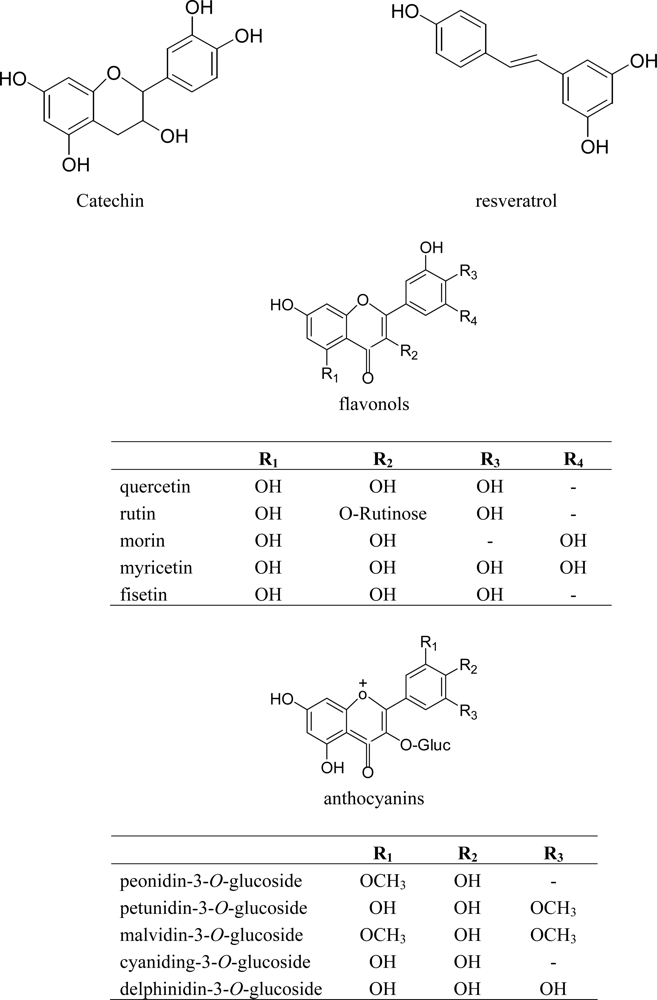
<p>In the literature, chemical structures of many phenolic compounds from grapes have been reported. The chemical structures of some important phenolic compounds are shown in <xref ref-type="fig" rid="f1-ijms-11-00622">Figure 1</xref>.</p></sec>
<sec>
<label>4.</label>
<title>Bioactivity of Phenolic Compounds from Grape</title>
<p>Recently, growing interests on phenolic compounds from grapes have focused on their biological activities linking to human health benefits, such as antioxidant, cardioprotective, anticancer, anti-inflammation, antiaging and antimicrobial properties.</p>
<sec>
<label>4.1.</label>
<title>Antioxidant Activities</title>
<p>Being most the notable bioactivity of phenolic compounds from grapes, the antioxidative characteristics have been widely studied, including scavenging of free radicals, inhibition of lipid oxidation, reduction of hydroperoxide formation, and so on [<xref ref-type="bibr" rid="b18-ijms-11-00622">18</xref>,<xref ref-type="bibr" rid="b19-ijms-11-00622">19</xref>]. Several methods were employed to evaluate the antioxidant capacities of phenolic compounds extracted from various grapes or different parts of grapes, such as the 1,1-diphenyl-2-picryhidrazyl (DPPH) method [<xref ref-type="bibr" rid="b55-ijms-11-00622">55</xref>], oxygen radical absorbance capacity (ORAC) assay [<xref ref-type="bibr" rid="b56-ijms-11-00622">56</xref>], crocin bleaching assay (CBA) [<xref ref-type="bibr" rid="b57-ijms-11-00622">57</xref>], 2,2′-azino-bis-(3-ethylbenzothiazoline-6-sulfonic acid) (ABTS) assay [<xref ref-type="bibr" rid="b58-ijms-11-00622">58</xref>], the thiobarbituric acid reactant substances (TBARS) [<xref ref-type="bibr" rid="b59-ijms-11-00622">59</xref>], Trolox equivalent antioxidant capacity (TEAC) assay [<xref ref-type="bibr" rid="b60-ijms-11-00622">60</xref>], and the ferric reducing antioxidant power (FRAP) assay [<xref ref-type="bibr" rid="b61-ijms-11-00622">61</xref>].</p>
<p>Using these methods above, notable antioxidant activities were found for grape wine and juice and the extracts from different parts of grapes. The values of antioxidant capacities were very different (<xref ref-type="table" rid="t2-ijms-11-00622">Table 2</xref>). Seen from the <xref ref-type="table" rid="t2-ijms-11-00622">Table 2</xref>, juice and wine, and even pomace from grapes had high antioxidant capacities. The extracts of defatted grape seeds expressed half less antioxidant capacity than that of whole grape seeds, which indicates that the process of oil extraction removed or damaged some antioxidant compounds. In different parts of grape, the highest antioxidant capacity was found in grape seeds, followed by skin, and the flesh displayed the lowest antioxidant capacity [<xref ref-type="bibr" rid="b26-ijms-11-00622">26</xref>]. Therefore, the extracts from grape seeds are a promising antioxidant for dietary supplement.</p>
<p>The antioxidant activities of the extracts from grape and its products have been widely studied in different biological or food system. Seen from <xref ref-type="table" rid="t3-ijms-11-00622">Table 3</xref>, the extracts from grape and its products could reduce oxidative stress of biological system and prevent food spoil.</p>
<p>Many researchers have tried to discover which phenolic compounds and chemical structure(s) are mainly responsible for the antioxidant activities of grape extracts. For same phenolic compounds, 50% and 25% (<italic>v</italic>/<italic>v</italic>) concentrations showed the same antioxidant activities, both being better than that of the 10% (<italic>v</italic>/<italic>v</italic>) concentration. The result suggested that perhaps the antioxidant capacity of phenolics has a concentration saturation limit, and above this limit, the activity could not increase further with the concentration [<xref ref-type="bibr" rid="b66-ijms-11-00622">66</xref>]. However, the relationship between phenolic compounds and antioxidant capacity was inconsistent among the results from different studies, which indicated that, besides the concentration, the antioxidant capacities of phenolic compounds were affected by other factors [<xref ref-type="bibr" rid="b49-ijms-11-00622">49</xref>,<xref ref-type="bibr" rid="b67-ijms-11-00622">67</xref>]. In a study, malvidin-3-glucoside showed the highest antioxidant capacity in wine anthocyanins [<xref ref-type="bibr" rid="b35-ijms-11-00622">35</xref>]. Although total phenolic index was lower in grape flesh than in grape skin because anthocyanins were absent in the flesh, they possessed equal amounts of reactivity to hydroxyl radicals [<xref ref-type="bibr" rid="b13-ijms-11-00622">13</xref>]. In another study, the results also showed that the anti-radical activity was due to the flavanols, rather than anthocyanins [<xref ref-type="bibr" rid="b68-ijms-11-00622">68</xref>].</p>
<p>The results showed that procyanidin polymers with higher degrees of polymerization had higher antioxidant activities [<xref ref-type="bibr" rid="b46-ijms-11-00622">46</xref>]. However, Faria <italic>et al</italic>. [<xref ref-type="bibr" rid="b74-ijms-11-00622">74</xref>] showed that in five fractions of different degrees of procyanidins polymers, the second degree fraction displayed the highest antioxidant capacity (scavenging peroxyl radicals). A similar result was obtained by Soobratteea <italic>et al</italic>. [<xref ref-type="bibr" rid="b75-ijms-11-00622">75</xref>], who showed that the most antioxidative compound in various phenolics was procyanidin dimer, and the decrease in antioxidant capacity was in order of procyanidin dimer, flavanol, flavonol, hydroxycinnamic acids and simple phenolic acids. Diphenols are more effectively antioxidant than simpler phenols due to stabilization of the phenoxy-radical through hydrogen bonding [<xref ref-type="bibr" rid="b50-ijms-11-00622">50</xref>]. The high molecule weight compounds might be as important as the monomer flavanols such as catechin, which have been demonstrated high antioxidant potential in phenolic compounds [<xref ref-type="bibr" rid="b76-ijms-11-00622">76</xref>]. Furthermore, the antioxidant activity of a sample could be synergic effect among several compositions, rather than a single compound [<xref ref-type="bibr" rid="b47-ijms-11-00622">47</xref>,<xref ref-type="bibr" rid="b77-ijms-11-00622">77</xref>].</p>
<p>Pinelo <italic>et al</italic>. studied the impact of solvent on the antioxidant activity of catechin, resveratrol and grape extracts dissolved in ethanol, methanol and water. The maximum antiradical activity was in ethanol, then in methanol, and the minimum was in water [<xref ref-type="bibr" rid="b45-ijms-11-00622">45</xref>]. By <italic>in vitro</italic> physiological procedure such as digestive enzymatic extraction, phenolic compounds from grape seed displayed a higher phenolic content and antioxidant capacity than by chemical procedure [<xref ref-type="bibr" rid="b78-ijms-11-00622">78</xref>], which could be employed for the aim of getting dietary supplements from grapes.</p>
<p>The antioxidative characteristics of phenolic compounds are mainly ascribed to their free radical scavenging and metal chelating properties, as well as their effects on cell signaling pathways and on gene expression [<xref ref-type="bibr" rid="b75-ijms-11-00622">75</xref>,<xref ref-type="bibr" rid="b79-ijms-11-00622">79</xref>]. Arora <italic>et al</italic>. [<xref ref-type="bibr" rid="b80-ijms-11-00622">80</xref>] found that flavonoids displayed higher antioxidant capacity against metal-ion-induced peroxidation than peroxyl-radical-induced peroxidation. The mechanism was mainly speculated to react directly to generate phenoxyl radicals [<xref ref-type="bibr" rid="b81-ijms-11-00622">81</xref>], which was stable and cuts off the reaction chains. The chemical functional group and structure is OH for antioxidant capacity of phenolic compounds. The number of OH group and its position on the ring of molecule determined the antioxidant capacity of flavonols [<xref ref-type="bibr" rid="b80-ijms-11-00622">80</xref>]. When the OH added onto the flavonoid nucleus, the activity enhanced, while substituted by the OCH<sub>3</sub> groups, the activity diminished. The results were proved by Majo <italic>et al</italic>. [<xref ref-type="bibr" rid="b67-ijms-11-00622">67</xref>,<xref ref-type="bibr" rid="b82-ijms-11-00622">82</xref>]. The <italic>o</italic>-diphenoxyl groups in resveratol were determined to exhibit higher antioxidant activity than other compositions [<xref ref-type="bibr" rid="b83-ijms-11-00622">83</xref>].</p></sec>
<sec>
<label>4.2.</label>
<title>Cardioprotection Action</title>
<p>Postprandial hyperlipemia and oxidative stress, a well-defined risk factor for atherosclerosis, could be reduced by grape seed extracts or phenolic-rich grape juice. These oxidative stress factors refer to plasma lipid hydroperoxides, serum lipid peroxidation products, malondialdehyde-modified-LDL (MDA-LDL). The lipid-bound polyphenols increasing in serum were found even two hours after intake of phenolics, and MDA-LDL was detected after six weeks [<xref ref-type="bibr" rid="b48-ijms-11-00622">48</xref>,<xref ref-type="bibr" rid="b69-ijms-11-00622">69</xref>,<xref ref-type="bibr" rid="b84-ijms-11-00622">84</xref>]. Grape seed extracts protected the rat liver against oxidative damage induced by irradiation <italic>in vivo</italic>, and remained the activities of superoxide dismutase and catalase at normal level [<xref ref-type="bibr" rid="b85-ijms-11-00622">85</xref>].</p>
<p>Grape seed extracts (5–50 μg/mL) rich in polyphenols displayed reduction of platelet adhesion and aggregation and generation of superoxide anion, and were more effective than pure resveratrol [<xref ref-type="bibr" rid="b12-ijms-11-00622">12</xref>]. Shanmuganayagam <italic>et al</italic>. [<xref ref-type="bibr" rid="b11-ijms-11-00622">11</xref>] employed rabbits to investigate the potential of phenolic compounds to defend the hypercholesterolemic-induced platelet aggregation. After intake of the grape juice (225 mL/day), which was rich in polyphenolics, with hypercholesterolemic diet for 96 days, platelet aggregation in rabbits was significantly ameliorated and the development of atheroma was near 30% lower than that of the control group. Aortic fatty streak areas of hamster also showed significant reduction in the groups receiving catechin (84%) or quercetin (80%) or resveratrol (76%) in comparison to the controls [<xref ref-type="bibr" rid="b37-ijms-11-00622">37</xref>,<xref ref-type="bibr" rid="b86-ijms-11-00622">86</xref>]. Dell Agli <italic>et al</italic>. [<xref ref-type="bibr" rid="b79-ijms-11-00622">79</xref>] showed anthocyanins from wine and grape skin inhibited phosphodiesterase-5 activity, which reduced the risk of cardiovascular diseases by vasorelaxation. Falchi <italic>et al</italic>. [<xref ref-type="bibr" rid="b13-ijms-11-00622">13</xref>] made ischemic to isolated heart of rats for 30 min followed by two hours of reperfusion, and found that the ischemic reperfusion injury were significantly inhibited in the rats after 30 days consumption of the extracts of flesh and skin of grapes, and flesh and skin of grapes exhibited equal effect of cardioprotection.</p>
<p>Castilla <italic>et al</italic>. [<xref ref-type="bibr" rid="b87-ijms-11-00622">87</xref>] found that phenolic compounds significantly ameliorated plasma lipid levels. After drinking 100 mL red grape juice/day for 14 days, the concentration of cholesterol-standardized-tocopherol and antioxidant capacity of plasma were significantly increased, and oxidized LDL and LDL were significantly reduced. The plasma level of HDL and apolipoprotein A-I were also elevated. In addition, consumption of red wine resulted to high concentrations of HDL cholesterol [<xref ref-type="bibr" rid="b14-ijms-11-00622">14</xref>], which linked to control of the risk of coronary heart diseases. Ardevol <italic>et al</italic>. [<xref ref-type="bibr" rid="b88-ijms-11-00622">88</xref>] reported that treatment of differentiated 3T3-L1 cells with procyanidin extracts reduced HSL in the mRNA levels, and inhibited triacylglycerol synthesis and boost its hydrolysis. After feeding to hamsters at a moderate dose of grape extracts, the plasma cholesterol was reduced 11% on average [<xref ref-type="bibr" rid="b86-ijms-11-00622">86</xref>]. Moreover, plasma apolipoprotein A1 concentration was increased 26%, 22%, and 19%, induced by catechin, quercetin, and resveratrol, respectively [<xref ref-type="bibr" rid="b37-ijms-11-00622">37</xref>].</p>
<p>For hemodialysis patients, phenolics of grapes are offered to prevent from inflammation. Red grape juice significantly reduced plasma monocyte chemoattractant protein 1, an inflammatory factor involved with cardiovascular disease risk, after three weeks’ consumption [<xref ref-type="bibr" rid="b87-ijms-11-00622">87</xref>]. Tsang <italic>et al</italic>. [<xref ref-type="bibr" rid="b14-ijms-11-00622">14</xref>] showed that after two weeks of daily red wine consumption (375 mL), the maximum concentrations of cunjugated dienes and TBAES in Cu-oxidised LDL were reduced. It was reported that red wine consumption reduced oxidative stress induced by Cu-oxidised LDL and increased HDL cholesterol concentrations. Grape juices showed complete inhibition of copper-induced oxidation of human LDL at the concentration of 0.01% [<xref ref-type="bibr" rid="b89-ijms-11-00622">89</xref>]. Phenolic compounds in grapes have showed effective power to regulate the plasma lipid and oxidative stress.</p></sec>
<sec>
<label>4.3.</label>
<title>Anticancer Activities</title>
<p>Many evidences have shown that the extracts from grapes and its products had anticancer activity. Hudson <italic>et al</italic>. [<xref ref-type="bibr" rid="b90-ijms-11-00622">90</xref>] reported that the grape skin extract induced prostate tumor cell lines apoptosis with high rates. The extract from pomace remaining after wine production inhibited activities of matrix metalloproteinases-2 and -9, and expressed a significant antiproliferative effect on human colon adenocarcinoma cells (Caco-2), which implied by-product of wine would help to fight against carcinogenesis [<xref ref-type="bibr" rid="b15-ijms-11-00622">15</xref>,<xref ref-type="bibr" rid="b91-ijms-11-00622">91</xref>]. Phenolics of grape juice also significantly inhibited carcinogen-induced DNA adduct formation in rat model [<xref ref-type="bibr" rid="b17-ijms-11-00622">17</xref>], and inhibited DNA synthesis in breast cancer cells [<xref ref-type="bibr" rid="b16-ijms-11-00622">16</xref>].</p>
<p>Anticancer activities of phenolic compounds from grapes have been studied widely, and the results are summarized in <xref ref-type="table" rid="t4-ijms-11-00622">Table 4</xref>. Phenolic compounds had dual effects on cells, and modulated cell proliferation was notablely dose-dependent [<xref ref-type="bibr" rid="b92-ijms-11-00622">92</xref>]. At high concentration, they were attributed to direct toxic effect and induced cells to death [<xref ref-type="bibr" rid="b93-ijms-11-00622">93</xref>].</p>
<p>The relationship between anticancer activity and structure of phenolic compounds was also investigated. The regulation target of grape skin extracts to cell apoptosis was the phosphatidylinositol 3-kinase–Akt and mitogen-activated protein kinase survival pathways. The extracts reduced Akt transcription, and enhanced proteosome degradation [<xref ref-type="bibr" rid="b90-ijms-11-00622">90</xref>]. Resveratrol was determined mainly bearing o-diphenoxyl groups, which displayed inhibiting DNA damage induced by ROS, and accelerating DNA damage induced by cupric ions, as well as inducing apoptosis of HL-60 cells, while the composition without such groups did not display the capacity [<xref ref-type="bibr" rid="b83-ijms-11-00622">83</xref>].</p></sec>
<sec>
<label>4.4.</label>
<title>Anti-inflammation Activities</title>
<p>Phenolic compounds in grapes, especially in grape seeds, have showed significant anti-inflammation effects on rats, mice and human [<xref ref-type="bibr" rid="b7-ijms-11-00622">7</xref>,<xref ref-type="bibr" rid="b36-ijms-11-00622">36</xref>,<xref ref-type="bibr" rid="b102-ijms-11-00622">102</xref>,<xref ref-type="bibr" rid="b102-ijms-11-00622">102</xref>], and the contributive molecules may be flavonols, flavanols and procyanidins (oligomeric flavonoids) [<xref ref-type="bibr" rid="b7-ijms-11-00622">7</xref>,<xref ref-type="bibr" rid="b36-ijms-11-00622">36</xref>,<xref ref-type="bibr" rid="b102-ijms-11-00622">102</xref>]. Bralley <italic>et al</italic>. [<xref ref-type="bibr" rid="b103-ijms-11-00622">103</xref>] found that extracts from grape skins and seeds inhibited mouse ear inflammation, edema, and polymorphonuclear leukocyte infiltration induced by 12-O-tetradecanoylphorbol 13-acetate, after treated with the extracts for 30 minutes. Moreover, the effect of the combination of grape seeds and skins almost paralleled to that of indomethacin, a common drug against degenerative diseases of joint. These findings indicated that phenolic compounds in grapes possessed obviously anti-inflammatory activity.</p>
<p>The mechanism of anti-inflammation of procyanidins was investigated, and the results showed that it might inhibit releasing proinflammation factors. Immunomodulation was the main pathway, and antioxidative action was another pathway for the anti-inflammation effect of grape phenolics [<xref ref-type="bibr" rid="b7-ijms-11-00622">7</xref>,<xref ref-type="bibr" rid="b36-ijms-11-00622">36</xref>,<xref ref-type="bibr" rid="b104-ijms-11-00622">104</xref>]. Panico <italic>et al</italic>. [<xref ref-type="bibr" rid="b36-ijms-11-00622">36</xref>] employed human chondrocytes assays to prove this. After treatment with a combination of extract of grape wine and IL-1b, a notable decrease was detected in the concentration of nitric oxide, prostaglandins E2 and reactive oxygen species in human chondrocytes culture, compared to control groups, and the effects were equal or super to that of indomethacin. Li <italic>et al</italic>. [<xref ref-type="bibr" rid="b104-ijms-11-00622">104</xref>] demonstrated that proanthocyanidins could prevent the increase of MDA in rat paws with arthritis induced by carrageenan at the concentration of 10 mg/kg by injection. Nitric oxide synthase activity and <italic>N</italic>-acetyl-β-<sc>d</sc>- glucosaminidase were also successfully inhibited by proanthocyanidins.</p>
<p>Inhibition or reduction of the cytokine gene expression may be a basic pathway to anti-inflammation for grape phenolics [<xref ref-type="bibr" rid="b7-ijms-11-00622">7</xref>,<xref ref-type="bibr" rid="b102-ijms-11-00622">102</xref>,<xref ref-type="bibr" rid="b104-ijms-11-00622">104</xref>]. After pre-treated with extracts of grape seed procyanidins, human adipocytes and macrophage-like cell lines produced less IL-6 and MCP-1 induced by inflammatory stimulus, and increase in anti-inflammatory adipokine and adiponectin appears. The results demonstrated that grape seeds procyanidins might modulate adipokine and cytokine gene expression related to anti-inflammation [<xref ref-type="bibr" rid="b7-ijms-11-00622">7</xref>]. Terra <italic>et al</italic>. [<xref ref-type="bibr" rid="b102-ijms-11-00622">102</xref>] reported that grape seed procyanidins inhibited the increase of C-reaction protein in rat plasma induced by high fat feed, and the same trend in IL-6 and TNF-α was detected in the mesenteric white adipose tissue (WAT). Further research demonstrated that CRP mRNA expression was decreased in the liver and mesenteric WAT, while adiponectin mRNA expression was increased in the mesenteric WAT. Then, lipid metabolic disorder and inflammation were availably inhibited. The results indicated that procyanidins in grapes inhibited inflammation at mRNA levels, and major health benefits brought by them involved in decreasing the risk of diseases link to high fat diets and obesity, such as cardiovascular and metabolic disorders.</p></sec>
<sec>
<label>4.5.</label>
<title>Antiaging Effects</title>
<p>It was found that polyphenolics presented in foods might be beneficial in reversing the course of neuronal and behavioral aging. Due to their notable antioxidant activity, such as scavenging free radical, they could prevent organs and tissues from oxidative damage, and modify the body negative mechanism of redox status. The evidences were obtained by observing the behaviors of rats, from age 19 to 21 months. After drinking the 10% grape juice, improvements were detected on release of dopamine from striatal slices, as well as cognitive performance in the Morris water maze, while the 50% grape juice improved action capacity [<xref ref-type="bibr" rid="b105-ijms-11-00622">105</xref>]. Further research discovered that supplement with grape seed extracts (100 mg/kg b.wt.) for 30 days, phenolic compounds from the extracts inhibited the accumulation of age-related oxidative DNA damages in neural tissue [<xref ref-type="bibr" rid="b106-ijms-11-00622">106</xref>]. Balu <italic>et al</italic>. [<xref ref-type="bibr" rid="b107-ijms-11-00622">107</xref>] reported the decreased incidence of free radical-induced lipid peroxidation in the central nervous system of aged rats.</p></sec>
<sec>
<label>4.6.</label>
<title>Antimicrobial Effects</title>
<p>Plant polyphenols have been demonstrated potential antibacterial [<xref ref-type="bibr" rid="b48-ijms-11-00622">48</xref>,<xref ref-type="bibr" rid="b107-ijms-11-00622">107</xref>,<xref ref-type="bibr" rid="b108-ijms-11-00622">108</xref>], antifungal [<xref ref-type="bibr" rid="b28-ijms-11-00622">28</xref>,<xref ref-type="bibr" rid="b110-ijms-11-00622">110</xref>] and antiviral [<xref ref-type="bibr" rid="b111-ijms-11-00622">111</xref>,<xref ref-type="bibr" rid="b112-ijms-11-00622">112</xref>] activities. Rodriguez-Vaquero <italic>et al</italic>. [<xref ref-type="bibr" rid="b113-ijms-11-00622">113</xref>] have showed that grape wine inhibited microbial, especially <italic>Escherichia coli</italic> growth, and the inhibition increased as the polyphenol concentration increased, and clarified wines were inactive against all bacteria tested. The extracts of alcohol-free red and white wine exhibited antimicrobial activity to some pathogens such as <italic>Staphylococcus aureus</italic>, <italic>Escherichia coli</italic> and <italic>Candida albicans</italic> [<xref ref-type="bibr" rid="b114-ijms-11-00622">114</xref>]. The results suggested that polyphenolic compounds contained in red wines were responsible for the antimicrobial effects. Some studies reported phenolic compounds inhibited other food-borne species such as <italic>Salmonella typhimurium</italic> [<xref ref-type="bibr" rid="b115-ijms-11-00622">115</xref>] and <italic>Listerial monocytogenes</italic> [<xref ref-type="bibr" rid="b62-ijms-11-00622">62</xref>].</p>
<p>Various bacterial species exhibit different sensitivities towards phenolic compounds. Papadopoulou <italic>et al</italic>. [<xref ref-type="bibr" rid="b114-ijms-11-00622">114</xref>] demonstrated <italic>Staphylococcus aureus</italic> were most sensitive to wine extracts, followed by <italic>Escherichia coli</italic> and the least effect of inhibition was detected in <italic>Candida albicans</italic>. The same results were obtained by Radovanovic <italic>et al</italic>. [<xref ref-type="bibr" rid="b49-ijms-11-00622">49</xref>], the diameter of the inhibition growth zone for <italic>Staphylococcus aureus</italic> and the zone for <italic>Escherichia coli</italic> were 16–22 mm and 12–20 mm, respectively, and the later exhibited less sensitive to phenolic compounds. Rotava <italic>et al</italic>. [<xref ref-type="bibr" rid="b116-ijms-11-00622">116</xref>] showed that phenolic compounds from defatted grape (<italic>Vitis vinifera</italic>) seed extract inhibited the growth of <italic>Staphylococcus aureus</italic> and <italic>Escherichia coli</italic>, while they showed no effects on <italic>Salmonella</italic> sp. Rodriguez-Vaquero <italic>et al</italic>. [<xref ref-type="bibr" rid="b21-ijms-11-00622">21</xref>] showed that <italic>Flavobacterium</italic> sp. was not inhibited by all any phenolic compounds tested. The time of reaction were also different, for example, Karapinar <italic>et al</italic>. [<xref ref-type="bibr" rid="b117-ijms-11-00622">117</xref>] demonstrated that koruk (unripe grape from <italic>Vitis vinifera</italic>) juice immediately decreased the initial populations of <italic>Salmonella typhimurium</italic> at 1–3.5 log cfu/g. But for some microbial species, the antibacterial activity acted too slowly. Baydar <italic>et al</italic>. [<xref ref-type="bibr" rid="b109-ijms-11-00622">109</xref>] showed that grape seed extract acted against <italic>Staphylococcus aureus</italic> after 48 hours and <italic>Aeromonas hydrophila</italic> after one hour.</p>
<p>The phenolic compounds from different parts of grapes displayed different antimicrobial effects. The antimicrobial activity of fermented pomace was either as effective as or significantly better than whole fruit grape extracts [<xref ref-type="bibr" rid="b118-ijms-11-00622">118</xref>]. Some researches showed that seed extracts were more effectively antimicrobial than other parts of grapes. The experimental study showed the minimum inhibition concentration (MICs) of seed and stem extracts for antilisterial were 0.26 and 0.34 mg GAE/L, respectively [<xref ref-type="bibr" rid="b119-ijms-11-00622">119</xref>]. The extracts from whole grape fruit inhibited bacterial growth at concentrations of 680 mg GAE/L and 1360 mg GAE/L for Gram(+) and Gram(−) bacteria, respectively. Jayaprakasha <italic>et al</italic>. [<xref ref-type="bibr" rid="b109-ijms-11-00622">109</xref>] showed grape seed extracts inhibited bacterial growth at 340–390 mg GAE/L and 475–575 mg GAE/L for Gram(+) and Gram(−) bacteria, respectively. The extract of grape leaves also exhibited less antimicrobial activity than seed extracts. The extract from grape flesh did not exhibit any antimicrobial effect at all [<xref ref-type="bibr" rid="b120-ijms-11-00622">120</xref>]. Brown <italic>et al</italic>. [<xref ref-type="bibr" rid="b121-ijms-11-00622">121</xref>] showed that the grape skin possessed the strongest activity in anti-<italic>Helicobacter pylori</italic>, followed by grape synergy (skin and seed) and seed. The increase order of the antimicrobial activity was flesh, whole fruit grape extracts, fermented pomace, skin, leave and seed.</p>
<p>Phenolic compounds in grape such as resveratrol displayed potent antifungal activity against the human pathogenic fungi <italic>Candida albicans</italic> at concentrations of 10–20 μL. The notable benefit of phenolics was no induction of hemolytic activity against human erythrocytes, compared to chemical medicines [<xref ref-type="bibr" rid="b110-ijms-11-00622">110</xref>]. Anastasiadi <italic>et al</italic>. [<xref ref-type="bibr" rid="b119-ijms-11-00622">119</xref>] suggested that high concentration of flavonoids and their derivatives in grape seeds and flavonoids, stilbenes, and phenolic acids in grape stem were responsible for the antimicrobial activity. Rodriguez–Vaquero <italic>et al</italic>. [<xref ref-type="bibr" rid="b20-ijms-11-00622">20</xref>] concluded that the non-flavonoid caffeic acid and the flavonoids rutin and quercetin were the compounds with higher inhibitory activities on <italic>Listerial monocytogenes</italic> growth. Rhodes <italic>et al</italic>. [<xref ref-type="bibr" rid="b21-ijms-11-00622">21</xref>] showed that polymeric phenolic fractions acted the highest inhibition activity for all <italic>Listerial</italic> species, but not for other bacteria, such as <italic>Bacillus cereus</italic>, <italic>Salmonella Menston</italic>, <italic>Escherichia coli</italic>, <italic>Staphylococcus aureus</italic> or <italic>Yersinia enterocolitica</italic>. The red-pigmented polymeric phenolics from juice and skin showed pH-dependent antilisterial activity, while the unpigmented polymeric phenolics from the seed showed antilisterial activity which was independent of pH, as some phenolic acids acted.</p>
<p>The relationship between compound structure and antimicrobial activity has been investigated. The core structures with 3,4,5-trihydroxyphenyl groups found in epigallocatechin, epigallocatechin-3-O-gallate, castalagin and prodelphinidin might be important for antibacterial activity. This indicated that the number of hydroxyls and the degree of polymerizzation might be pivotal for antimicrobial activity of phenolic compounds [<xref ref-type="bibr" rid="b122-ijms-11-00622">122</xref>]. According to anti-rabies activity of 24 phenolic compounds, Chavez <italic>et al</italic>. [<xref ref-type="bibr" rid="b112-ijms-11-00622">112</xref>] considered that free hydroxyl and ether groups mainly influenced the anti-rabies activity. Employing herpes simplex virus (HSV) and human immunodeficiency virus (HIV), De Bruyne <italic>et al</italic>. [<xref ref-type="bibr" rid="b111-ijms-11-00622">111</xref>] found epicatechin-containing dimer and the presence of <italic>ortho</italic>-trihydroxyl groups in the B-ring were important for anti-HSV, radical-scavenging and immunological activities. Thtmothe <italic>et al</italic>. [<xref ref-type="bibr" rid="b118-ijms-11-00622">118</xref>] demonstrated that the different concentration of anthocyanins and flavonols notablely decreased the activity of glucosyltransferases B and C (70%–85%) in <italic>Streptococcus mutans</italic> cells at total concentrations 62.5 μg/mL. At the same time, F-ATPase activity was reduced 30–65% at 125 μg/mL. The result suggested that conjugation of phenolic and protein in microorganism, especially key enzyme might be major pathway to inhibit the growth of microorganism.</p>
<p>The application of phenolic compounds could be better in food preservation than in medical field [<xref ref-type="bibr" rid="b54-ijms-11-00622">54</xref>,<xref ref-type="bibr" rid="b62-ijms-11-00622">62</xref>], and the potent function of phenolics as perfect nature preservative and antimicrobial agents for food is very promising. In Turkish diet, koruk juice is used as flavoring and acidifying agent. It has acted as a practicable antimicrobial agent for salad vegetables unconsciously due to its immediate inhibition against <italic>Salmonella typhimurium</italic> [<xref ref-type="bibr" rid="b117-ijms-11-00622">117</xref>]. In order to check the effect of protection food from microbial infecting, Sivarooban <italic>et al</italic>. [<xref ref-type="bibr" rid="b115-ijms-11-00622">115</xref>] exposed several species of microorganism to the soy protein isolate film with GSE 1%, nisin 10,000 IU/g, and EDTA 0.16%. This film reduced <italic>Listerial monocytogenes</italic> populations by 2.9 log CFU/mL, and <italic>Escherichia coli</italic> O157:H7 and <italic>Salmonella typhimurium</italic> were reduced by 1.8 and 0.6 log CFU/mL, respectively. This finding suggested the potential applications of phenolic compounds to maintain shelf life, and improve safety of ready-to-eat food products.</p>
<p>The antioxidant, cardioprotective, anticancer, anti-inflammation, antiaging and antimicrobial activities of grapes and its products have been discussed above. Finally, the bioactivities of phenolic compounds from grapes are summarized in <xref ref-type="table" rid="t5-ijms-11-00622">Table 5</xref>. As shown in <xref ref-type="table" rid="t5-ijms-11-00622">Table 5</xref>, the phenolic compounds have a variety of bioactivities.</p></sec></sec>
<sec>
<label>5.</label>
<title>Bioavailability</title>
<p>Several studies showed rapid absorption of the polyphenolics, such as procyanidins, quercetin and flavanols from grapes into plasma, with plasma concentrations peaking at two or three hours after ingestion [<xref ref-type="bibr" rid="b31-ijms-11-00622">31</xref>,<xref ref-type="bibr" rid="b48-ijms-11-00622">48</xref>,<xref ref-type="bibr" rid="b87-ijms-11-00622">87</xref>,<xref ref-type="bibr" rid="b127-ijms-11-00622">127</xref>–<xref ref-type="bibr" rid="b129-ijms-11-00622">129</xref>]. The increase of lipid-bound polyphenolics in serum could be detected, and as a result of the bioactivity of polyphenolics, significant decrease was detected on lipid peroxidation in serum [<xref ref-type="bibr" rid="b48-ijms-11-00622">48</xref>]. Moreover, after two weeks of daily red wine consumption (375 mL), plasma levels of total phenolic concentrations increased significantly, and trace levels of metabolites, mainly glucuronides and methyl glucuronides of (+)-catechin and (−)-epicatechin, were detected in plasma, which could not be found in a control group [<xref ref-type="bibr" rid="b14-ijms-11-00622">14</xref>]. These results indicated that phenolic compounds could be absorbed by human digestion system, and entered the blood successfully. The phenolic compounds in the extracts from defatted mill grape seed acted bioactive function by protecting the isolated rat hepatocytes from oxidative stress induced by anticancer drugs. In order to research the mechanisms involved in pathways of phenolic compounds entering into cell, Laurent <italic>et al</italic>. [<xref ref-type="bibr" rid="b33-ijms-11-00622">33</xref>] employed an <italic>in vitro</italic> digestion/Caco-2 cell culture model. However, no phenolic compounds were detected in the basal compartment of transwells or in cell monolayers. They also showed that the availability of phenolic compounds was not affected by salivary and gastric incubations but decreased during intestinal digestion.</p>
<p>The mechanisms involved in the process of digestion and absorption of phenolic compounds in gastrointestinal lumen are complex and not very clear. Some results showed that phenolic compounds were able to chelate to iron. Presence of iron and phenolic compounds has been found in the lumen during digestion, during which iron–polyphenol interacted and formed iron-chelating complexes [<xref ref-type="bibr" rid="b22-ijms-11-00622">22</xref>], which provoked a more marked decrease in the concentration of hydroxycinnamic derivatives, flavones and flavan-3-ols compared to the control assays during <italic>in vitro</italic> gastointestinal digestion. <italic>In vitro</italic> digestion, Argyri <italic>et al</italic>. [<xref ref-type="bibr" rid="b130-ijms-11-00622">130</xref>] demonstrated that red wine decreased the concentration of digest phenolics attributable to the formation of iron-polyphenolic chelates. By molecule analyzing, the interaction of iron and polyphenolic involved the chemical structures of hydroxyl groups, as reported in flavonoids: ortho-dihydroxyl groups, the presence of 5-OH and/or 3-OH in conjunction with a C4 keto group, and a large number of OH groups [<xref ref-type="bibr" rid="b131-ijms-11-00622">131</xref>].</p>
<p>It was found that phenolic compounds have affinities with some proteins after absorbed [<xref ref-type="bibr" rid="b24-ijms-11-00622">24</xref>,<xref ref-type="bibr" rid="b25-ijms-11-00622">25</xref>,<xref ref-type="bibr" rid="b132-ijms-11-00622">132</xref>,<xref ref-type="bibr" rid="b133-ijms-11-00622">133</xref>]. Employing <italic>in vitro</italic> digestion/ Caco-2 cell culture model, Laurent <italic>et al</italic>. [<xref ref-type="bibr" rid="b33-ijms-11-00622">33</xref>] found about 43.9% of catechin, 85.3% of epicatechin and all dimers disappeared at the end of 2 h of intestinal incubation, associating with a decrease of some cells enzyme activities, such as alkaline phosphatase and sucrase-isomaltase aminopeptidase N. The results showed that phenolics had interacted with pancreatic proteins, which were detected by unmasked by acetonitrile extraction. Polyphenols also seemed to have affinities with enterocyte brush border enzymes [<xref ref-type="bibr" rid="b132-ijms-11-00622">132</xref>]. Some researchers showed that phenolic compounds had strong affinities with proteins and particularly with human salivary prolinerich proteins and histatins [<xref ref-type="bibr" rid="b24-ijms-11-00622">24</xref>,<xref ref-type="bibr" rid="b25-ijms-11-00622">25</xref>,<xref ref-type="bibr" rid="b133-ijms-11-00622">133</xref>] to form both non-covalent and covalent associations according to the phenolic compound size. Flavonoids were strongly affected by the presence of milk, especially after the digestion process [<xref ref-type="bibr" rid="b129-ijms-11-00622">129</xref>]. Procyanidins from grape seed extracts strongly combined to milk protein attributing to the higher degree of polymerization. The insoluble complexes, such as protein-tannins, were stable throughout the digestive tract [<xref ref-type="bibr" rid="b131-ijms-11-00622">131</xref>,<xref ref-type="bibr" rid="b133-ijms-11-00622">133</xref>]. However, the fate of the complexes of low molecule weight phenolics and protein is still unclear.</p>
<p>Decomposition of phenolic compounds caused by pH changes has been shown in digestion lumen. After two hours of <italic>in vitro</italic> incubation, monomers and dimers were quite stable at pH 7 in intestine medium, but 20% dimers were degraded at pH 7.4, and all dimers disappeared in pH 8.5. 15%–34% of epicatechin were degraded at pH 7.5 with incubation for two hours, while catechin was stable [<xref ref-type="bibr" rid="b134-ijms-11-00622">134</xref>]. At pH 2, decomposition of high polymerized oligomers (&gt;trimers) of procyanidins might occur and the slight increase in dimers procyanidins was observed through gastric step [<xref ref-type="bibr" rid="b135-ijms-11-00622">135</xref>]. Flavanols and flavonols monomers and dimers were stable at acidic condition [<xref ref-type="bibr" rid="b136-ijms-11-00622">136</xref>,<xref ref-type="bibr" rid="b137-ijms-11-00622">137</xref>]. Anthocyanins could be digested completely in the contents of large intestine of freshly slaughtered pigs after six-hour incubation, and the metabolites were mainly 3–<italic>O</italic>-methylgallic acid, syringic acid and 2,4,6-trihydroxybenzaldehyde [<xref ref-type="bibr" rid="b138-ijms-11-00622">138</xref>].</p></sec>
<sec>
<label>6.</label>
<title>Potential Toxicity</title>
<p>The potential toxicity of some polyphenols from grape, such as epicatechin to the fibroblast, and keratinocyte cell lines, has been investigated. After exposing the two cell lines to epicatechin for 24 hours or more time, the notablely negative effects were observed when the concentration was 3–7 fold higher than that of expressing positively antioxidant activity. Moreover, the compounds with a gallate group exhibited more potential toxicity than those without the gallate group [<xref ref-type="bibr" rid="b23-ijms-11-00622">23</xref>]. In addition, noticeable DNA damage was induced in mice spleen cells by incubating with higher concentration (150 μmol/L) of catechin [<xref ref-type="bibr" rid="b98-ijms-11-00622">98</xref>]. Grape extracts was also found to promote mitomycin C inducing sister chromatid exchange at concentration from 75 to 300 μg/mL in human peripheral blood lymphocytes [<xref ref-type="bibr" rid="b139-ijms-11-00622">139</xref>]. The compounds with polyphenols, caffeic acid, gallic acid, and rutin hydrate enhanced MMC-induced clastogenicity at accordant concentrations. The results suggested that negative effects of phenolic compounds were related to the synergistic effect of some molecules, and the concentration was not always a crucial factor. Therefore, the dose and composition of grape extracts should be investigated further for secure and healthy application of grape products.</p></sec>
<sec sec-type="conclusions">
<label>7.</label>
<title>Conclusions and Future Prospects</title>
<p>Grape and products from grape have been consumed for a long time. The studies have demonstrated an inverse association between intake of grape and products from grape and mortality from age-related diseases such as coronary heart diseases. The health benefits of grapes are thought to arise mainly from bioactivities of their polyphenols. Anthocyanins, flavonoids and resveratrol are the major functional components that are responsible for most of biological activities of grape. Tremendous progress has been obtained for the extraction, analysis and biological activities of polyphenols in grape. The bioactive compounds were usually extracted from grape using the liquid-liquid extraction, and high-performance liquid chromatography with UV or MS detection could be applied to analysis of active components in grape. The grape and its main components anthocyanins, flavonoids and resveratrol have a variety of bioactivities, such as antioxidant, cardioprotective, anticancer, anti-inflammation, antiaging and antimicrobial activities, which are closely related to the prevention against disease and promotion of health, making greater potential for grape in the field of food and pharmaceutical application. The structure-activity relationships of some polyphenols have been studied, and the results obtained could be used to modify structure of polyphenol as well as to design and synthesize novel polyphenols with special function. Most of phenolic compounds were bioavailable, but some high molecular weight phenolics could not be absorbed. In addition, the effect of some phenolic compounds was negative on health at higher concentration, and some structures promoted the negative effect.</p>
<p>In the future, the extraction methods of polyphenols from grape should be improved, and the by-products of wine industry should be utilized effectively. The crude extracts from grape could be used as diet supplements for health-protection after defining the levels or limits to make sure the dose is safe for health, but bioactive components at high purity should be used instead of crude extracts in medicinal preparations from grape. In order to explore more effective functional food or pharmaceutical products based on grape, more wide pharmacological studies should be carried out to determine new pharmacodynamic effects, such as anti-influenza, anti-obesity and antidiabetic activities. The relationship of structure-activity should be studied further, and the key mechanisms of bioactivities should be understood clearly. In addition, more attention should be paid to minor components in grape because special pharmacodynamic effects could be found from minor components. The structural diversities and pronounced biological activities of compounds in grape indicate that grape are worthy of further studies that may lead to the identification of new functional constituents. The polyphenols from grape will widely be employed to prevent and treat these diseases in association with reactive oxygen species, such as atherosclerosis, coronary heart diseases and cancer.</p></sec></body>
<back>
<ack>
<p>This research was supported by the Hundred-Talents Scheme of Sun Yat-Sen University.</p></ack>
<ref-list>
<title>References and Notes</title>
<ref id="b1-ijms-11-00622"><label>1.</label><citation citation-type="journal"><person-group person-group-type="author"><name><surname>Shrikhande</surname><given-names>AJ</given-names></name></person-group><article-title>Wine by-products with health benefits</article-title><source>Food Res. Internat</source><year>2000</year><volume>33</volume><fpage>469</fpage><lpage>474</lpage><pub-id pub-id-type="doi">10.1016/S0963-9969(00)00071-5</pub-id></citation></ref>
<ref id="b2-ijms-11-00622"><label>2.</label><citation citation-type="journal"><person-group person-group-type="author"><name><surname>Silva</surname><given-names>RC</given-names></name><name><surname>Rigaud</surname><given-names>J</given-names></name><name><surname>Cheynier</surname><given-names>V</given-names></name><name><surname>Chemina</surname><given-names>A</given-names></name></person-group><article-title>Procyanidin dimers and trimers from grape seeds</article-title><source>Phytochemistry</source><year>1991</year><volume>30</volume><fpage>1259</fpage><lpage>1264</lpage><pub-id pub-id-type="doi">10.1016/S0031-9422(00)95213-0</pub-id></citation></ref>
<ref id="b3-ijms-11-00622"><label>3.</label><citation citation-type="journal"><person-group person-group-type="author"><name><surname>Wada</surname><given-names>M</given-names></name><name><surname>Kido</surname><given-names>H</given-names></name><name><surname>Ohyama</surname><given-names>K</given-names></name><name><surname>Ichibangas</surname><given-names>T</given-names></name><name><surname>Kishikaw</surname><given-names>N</given-names></name><name><surname>Ohba</surname><given-names>Y</given-names></name><name><surname>Nakashima</surname><given-names>MN</given-names></name><name><surname>Kurod</surname><given-names>N</given-names></name><name><surname>Nakashima</surname><given-names>K</given-names></name></person-group><article-title>Chemiluminescent screening of quenching effects of natural colorants against reactive oxygen species: evaluation of grape seed, monascus, gardenia and red radish extracts as multi-functional food additives</article-title><source>Food Chem</source><year>2007</year><volume>101</volume><fpage>980</fpage><lpage>986</lpage><pub-id pub-id-type="doi">10.1016/j.foodchem.2006.02.050</pub-id></citation></ref>
<ref id="b4-ijms-11-00622"><label>4.</label><citation citation-type="journal"><person-group person-group-type="author"><name><surname>Dopico-Garcia</surname><given-names>MS</given-names></name><name><surname>Fique</surname><given-names>A</given-names></name><name><surname>Guerra</surname><given-names>L</given-names></name><name><surname>Afonso</surname><given-names>JM</given-names></name><name><surname>Pereira</surname><given-names>O</given-names></name><name><surname>Valentao</surname><given-names>P</given-names></name><name><surname>Andrade</surname><given-names>PB</given-names></name><name><surname>Seabra</surname><given-names>RM</given-names></name></person-group><article-title>Principal components of phenolics to characterize red Vinho Verde grapes: anthocyanins or non-coloured compounds?</article-title><source>Talanta</source><year>2008</year><volume>75</volume><fpage>1190</fpage><lpage>1202</lpage><pub-id pub-id-type="doi">10.1016/j.talanta.2008.01.012</pub-id><pub-id pub-id-type="pmid">18585201</pub-id></citation></ref>
<ref id="b5-ijms-11-00622"><label>5.</label><citation citation-type="journal"><person-group person-group-type="author"><name><surname>Novaka</surname><given-names>I</given-names></name><name><surname>Janeiroa</surname><given-names>P</given-names></name><name><surname>Serugab</surname><given-names>M</given-names></name><name><surname>Oliveira-Brett</surname><given-names>AM</given-names></name></person-group><article-title>Ultrasound extracted flavonoids from four varieties of Portuguese red grape skins determined by reverse-phase high-performance liquid chromatography with electrochemical detection</article-title><source>Anal. Chim. Acta</source><year>2008</year><volume>630</volume><fpage>107</fpage><lpage>115</lpage><pub-id pub-id-type="doi">10.1016/j.aca.2008.10.002</pub-id><pub-id pub-id-type="pmid">19012821</pub-id></citation></ref>
<ref id="b6-ijms-11-00622"><label>6.</label><citation citation-type="journal"><person-group person-group-type="author"><name><surname>Spacil</surname><given-names>Z</given-names></name><name><surname>Novakova</surname><given-names>L</given-names></name><name><surname>Solich</surname><given-names>P</given-names></name></person-group><article-title>Analysis of phenolic compounds by high performance liquidchromatography and ultra performance liquid chromatography</article-title><source>Talanta</source><year>2008</year><volume>76</volume><fpage>189</fpage><lpage>199</lpage><pub-id pub-id-type="doi">10.1016/j.talanta.2008.02.021</pub-id><pub-id pub-id-type="pmid">18585262</pub-id></citation></ref>
<ref id="b7-ijms-11-00622"><label>7.</label><citation citation-type="journal"><person-group person-group-type="author"><name><surname>Chacona</surname><given-names>MR</given-names></name><name><surname>Ceperuelo-Mallafrea</surname><given-names>V</given-names></name><name><surname>Maymo-Masipa</surname><given-names>E</given-names></name><name><surname>Mateo-Sanzb</surname><given-names>JM</given-names></name><name><surname>Arolac</surname><given-names>L</given-names></name><name><surname>Guitierreza</surname><given-names>C</given-names></name><name><surname>Fernandez-Reald</surname><given-names>JM</given-names></name><name><surname>Ardevolc</surname><given-names>A</given-names></name><name><surname>Simona</surname><given-names>I</given-names></name><name><surname>Vendrella</surname><given-names>J</given-names></name></person-group><article-title>Grape-seed procyanidins modulate inflammation on human differentiated adipocytes <italic>in vitro</italic></article-title><source>Cytokine</source><year>2009</year><volume>47</volume><fpage>137</fpage><lpage>142</lpage><pub-id pub-id-type="doi">10.1016/j.cyto.2009.06.001</pub-id><pub-id pub-id-type="pmid">19560935</pub-id></citation></ref>
<ref id="b8-ijms-11-00622"><label>8.</label><citation citation-type="journal"><person-group person-group-type="author"><name><surname>Bagchi</surname><given-names>D</given-names></name><name><surname>Bagchi</surname><given-names>M</given-names></name><name><surname>Stohs</surname><given-names>SJ</given-names></name><name><surname>Das</surname><given-names>DK</given-names></name><name><surname>Ray</surname><given-names>CA</given-names></name><name><surname>Kuszynski</surname><given-names>SS</given-names></name><name><surname>Joshi</surname><given-names>HG</given-names></name></person-group><article-title>Free radicals and grape seed proanthocyanidin extract: importance in human health and disease prevention</article-title><source>Toxicology</source><year>2000</year><volume>148</volume><fpage>187</fpage><lpage>197</lpage><pub-id pub-id-type="doi">10.1016/S0300-483X(00)00210-9</pub-id><pub-id pub-id-type="pmid">10962138</pub-id></citation></ref>
<ref id="b9-ijms-11-00622"><label>9.</label><citation citation-type="journal"><person-group person-group-type="author"><name><surname>Cantos</surname><given-names>E</given-names></name><name><surname>Espin</surname><given-names>JC</given-names></name><name><surname>Tomas-Barberan</surname><given-names>FA</given-names></name></person-group><article-title>Varietal differences among the polyphenol profiles of seven table grape cultivars studied by LC-DAD-MS-MS</article-title><source>J. Agric. Food Chem</source><year>2002</year><volume>50</volume><fpage>5691</fpage><lpage>5696</lpage><pub-id pub-id-type="doi">10.1021/jf0204102</pub-id><pub-id pub-id-type="pmid">12236700</pub-id></citation></ref>
<ref id="b10-ijms-11-00622"><label>10.</label><citation citation-type="journal"><person-group person-group-type="author"><name><surname>Urpi-Sarda</surname><given-names>M</given-names></name><name><surname>Monagas</surname><given-names>M</given-names></name><name><surname>Khan</surname><given-names>N</given-names></name><name><surname>Lamuela-Raventos</surname><given-names>RM</given-names></name><name><surname>Santos-Buelga</surname><given-names>C</given-names></name><name><surname>Sacanella</surname><given-names>E</given-names></name><name><surname>Castell</surname><given-names>M</given-names></name><name><surname>Permanyer</surname><given-names>J</given-names></name><name><surname>Andres-Lacueva</surname><given-names>C</given-names></name></person-group><article-title>Epicatechin, procyanidins, and phenolic microbial metabolites after cocoa intake in humans and rats</article-title><source>Anal. Bioanal. Chem</source><year>2009</year><volume>394</volume><fpage>1545</fpage><lpage>1556</lpage><pub-id pub-id-type="doi">10.1007/s00216-009-2676-1</pub-id><pub-id pub-id-type="pmid">19333587</pub-id></citation></ref>
<ref id="b11-ijms-11-00622"><label>11.</label><citation citation-type="journal"><person-group person-group-type="author"><name><surname>Shanmuganayagam</surname><given-names>D</given-names></name><name><surname>Warner</surname><given-names>TF</given-names></name><name><surname>Krueger</surname><given-names>CG</given-names></name><name><surname>Reed</surname><given-names>JD</given-names></name><name><surname>Folts</surname><given-names>JD</given-names></name></person-group><article-title>Concord grape juice attenuates platelet aggregation, serum cholesterol and development of atheroma in hypercholesterolemic rabbits</article-title><source>Atherosclerosis</source><year>2007</year><volume>190</volume><fpage>135</fpage><lpage>142</lpage><pub-id pub-id-type="doi">10.1016/j.atherosclerosis.2006.03.017</pub-id><pub-id pub-id-type="pmid">16780846</pub-id></citation></ref>
<ref id="b12-ijms-11-00622"><label>12.</label><citation citation-type="journal"><person-group person-group-type="author"><name><surname>Olas</surname><given-names>B</given-names></name><name><surname>Wachowicz</surname><given-names>B</given-names></name><name><surname>Tomczak</surname><given-names>A</given-names></name><name><surname>Erler</surname><given-names>J</given-names></name><name><surname>Stochmal</surname><given-names>A</given-names></name><name><surname>Oleszek</surname><given-names>W</given-names></name></person-group><article-title>Comparative anti-platelet and antioxidant properties of polyphenol-rich extracts from: berries of <italic>Aronia melanocarpa</italic>, seeds of grape and bark of <italic>Yucca schidigera in vitro</italic></article-title><source>Platelets</source><year>2008</year><volume>19</volume><fpage>70</fpage><lpage>77</lpage><pub-id pub-id-type="doi">10.1080/09537100701708506</pub-id><pub-id pub-id-type="pmid">18231940</pub-id></citation></ref>
<ref id="b13-ijms-11-00622"><label>13.</label><citation citation-type="journal"><person-group person-group-type="author"><name><surname>Falchi</surname><given-names>M</given-names></name><name><surname>Bertelli</surname><given-names>A</given-names></name><name><surname>Scalzo</surname><given-names>RL</given-names></name><name><surname>Morassut</surname><given-names>M</given-names></name><name><surname>Morelli</surname><given-names>R</given-names></name><name><surname>Das</surname><given-names>S</given-names></name><name><surname>Cui</surname><given-names>JH</given-names></name><name><surname>Das</surname><given-names>DK</given-names></name></person-group><article-title>Comparison of cardioprotective abilities between the flesh and skin of grapes</article-title><source>J. Agric. Food Chem</source><year>2006</year><volume>54</volume><fpage>6613</fpage><lpage>6622</lpage><pub-id pub-id-type="doi">10.1021/jf061048k</pub-id><pub-id pub-id-type="pmid">16939317</pub-id></citation></ref>
<ref id="b14-ijms-11-00622"><label>14.</label><citation citation-type="journal"><person-group person-group-type="author"><name><surname>Tsanga</surname><given-names>C</given-names></name><name><surname>Higginsa</surname><given-names>S</given-names></name><name><surname>Duthiea</surname><given-names>GG</given-names></name><name><surname>Duthiea</surname><given-names>SJ</given-names></name><name><surname>Howiea</surname><given-names>M</given-names></name><name><surname>Mullena</surname><given-names>W</given-names></name><name><surname>Leana</surname><given-names>MEJ</given-names></name><name><surname>Crozier</surname><given-names>A</given-names></name></person-group><article-title>The influence of moderate red wine consumption on antioxidant status and indices of oxidative stress associated with CHD in healthy volunteers</article-title><source>Br. J. Nutr</source><year>2005</year><volume>93</volume><fpage>233</fpage><lpage>240</lpage><pub-id pub-id-type="doi">10.1079/BJN20041311</pub-id><pub-id pub-id-type="pmid">15788107</pub-id></citation></ref>
<ref id="b15-ijms-11-00622"><label>15.</label><citation citation-type="journal"><person-group person-group-type="author"><name><surname>God</surname><given-names>JM</given-names></name><name><surname>Tate</surname><given-names>P</given-names></name><name><surname>Larcom</surname><given-names>LL</given-names></name></person-group><article-title>Anticancer effects of four varieties of muscadine grape</article-title><source>J. Med. Food</source><year>2007</year><volume>10</volume><fpage>54</fpage><lpage>59</lpage><pub-id pub-id-type="doi">10.1089/jmf.2006.699</pub-id><pub-id pub-id-type="pmid">17472467</pub-id></citation></ref>
<ref id="b16-ijms-11-00622"><label>16.</label><citation citation-type="journal"><person-group person-group-type="author"><name><surname>Singletary</surname><given-names>KW</given-names></name><name><surname>Stansbury</surname><given-names>MJ</given-names></name><name><surname>Giusti</surname><given-names>M</given-names></name><name><surname>Breemen</surname><given-names>RBV</given-names></name><name><surname>Wallig</surname><given-names>M</given-names></name><name><surname>Rimando</surname><given-names>A</given-names></name></person-group><article-title>Inhibition of rat mammary tumorigenesis by concord grape juice constituents</article-title><source>J. Agric. Food Chem</source><year>2003</year><volume>51</volume><fpage>7280</fpage><lpage>7286</lpage><pub-id pub-id-type="doi">10.1021/jf030278l</pub-id><pub-id pub-id-type="pmid">14640571</pub-id></citation></ref>
<ref id="b17-ijms-11-00622"><label>17.</label><citation citation-type="journal"><person-group person-group-type="author"><name><surname>Jung</surname><given-names>K</given-names></name><name><surname>Wallig</surname><given-names>M</given-names></name><name><surname>Singletary</surname><given-names>K</given-names></name></person-group><article-title>Purple grape juice inhibits 7,12-dimethylbenz- [a]anthracene (DMBA)-induced rat mammary tumorigenesis and <italic>in vivo</italic> DMBA-DNA adduct formation</article-title><source>Cancer Lett</source><year>2006</year><volume>233</volume><fpage>279</fpage><lpage>288</lpage><pub-id pub-id-type="doi">10.1016/j.canlet.2005.03.020</pub-id><pub-id pub-id-type="pmid">15878797</pub-id></citation></ref>
<ref id="b18-ijms-11-00622"><label>18.</label><citation citation-type="journal"><person-group person-group-type="author"><name><surname>Meyer</surname><given-names>AS</given-names></name><name><surname>Yi</surname><given-names>OS</given-names></name><name><surname>Pearson</surname><given-names>DA</given-names></name><name><surname>Waterhouse</surname><given-names>AL</given-names></name><name><surname>Frankel</surname><given-names>EN</given-names></name></person-group><article-title>Inhibition of human low-density lipoprotein oxidation in relation to composition of phenolic antioxidants in g<italic>rapes (Vitis vinifera)</italic></article-title><source>J. Agric. Food Chem</source><year>1997</year><volume>45</volume><fpage>1638</fpage><lpage>1643</lpage><pub-id pub-id-type="doi">10.1021/jf960721a</pub-id></citation></ref>
<ref id="b19-ijms-11-00622"><label>19.</label><citation citation-type="journal"><person-group person-group-type="author"><name><surname>Sato</surname><given-names>M</given-names></name><name><surname>Ramarathnam</surname><given-names>N</given-names></name><name><surname>Suzuki</surname><given-names>Y</given-names></name><name><surname>Ohkubo</surname><given-names>T</given-names></name><name><surname>Takeuchi</surname><given-names>M</given-names></name><name><surname>Ochi</surname><given-names>H</given-names></name></person-group><article-title>Varietal differences in the phenolic content and superoxide radical scavenging potential of wines from different sources</article-title><source>J. Agric. Food Chem</source><year>1996</year><volume>44</volume><fpage>37</fpage><lpage>41</lpage><pub-id pub-id-type="doi">10.1021/jf950190a</pub-id></citation></ref>
<ref id="b20-ijms-11-00622"><label>20.</label><citation citation-type="journal"><person-group person-group-type="author"><name><surname>Rodriguez-Vaquero</surname><given-names>MJ</given-names></name><name><surname>Alberto</surname><given-names>MR</given-names></name><name><surname>Manca-de-Nadra</surname><given-names>MC</given-names></name></person-group><article-title>Antibacterial effect of phenolic compounds from different wines</article-title><source>Food Control</source><year>2007</year><volume>18</volume><fpage>93</fpage><lpage>101</lpage><pub-id pub-id-type="doi">10.1016/j.foodcont.2005.08.010</pub-id></citation></ref>
<ref id="b21-ijms-11-00622"><label>21.</label><citation citation-type="journal"><person-group person-group-type="author"><name><surname>Rhodes</surname><given-names>PL</given-names></name><name><surname>Mitchell</surname><given-names>JW</given-names></name><name><surname>Wilson</surname><given-names>MW</given-names></name><name><surname>Melton</surname><given-names>LD</given-names></name></person-group><article-title>Antilisterial activity of grape juice and grape extracts derived from <italic>Vitis vinifera</italic> variety Ribier</article-title><source>Int. J. Food Microbiol</source><year>2006</year><volume>107</volume><fpage>281</fpage><lpage>286</lpage><pub-id pub-id-type="doi">10.1016/j.ijfoodmicro.2005.10.022</pub-id><pub-id pub-id-type="pmid">16386816</pub-id></citation></ref>
<ref id="b22-ijms-11-00622"><label>22.</label><citation citation-type="journal"><person-group person-group-type="author"><name><surname>Hurrell</surname><given-names>RF</given-names></name><name><surname>Reddy</surname><given-names>M</given-names></name><name><surname>Cook</surname><given-names>JD</given-names></name></person-group><article-title>Inhibition of non-haem iron absorption in man by polyphenolic-containing beverages</article-title><source>Br. J. Nutr</source><year>1999</year><volume>81</volume><fpage>289</fpage><lpage>295</lpage><pub-id pub-id-type="pmid">10999016</pub-id></citation></ref>
<ref id="b23-ijms-11-00622"><label>23.</label><citation citation-type="journal"><person-group person-group-type="author"><name><surname>Ugartondo</surname><given-names>V</given-names></name><name><surname>Mitjans</surname><given-names>M</given-names></name><name><surname>Lozano</surname><given-names>C</given-names></name><name><surname>Torres</surname><given-names>JL</given-names></name><name><surname>Vinardell</surname><given-names>MP</given-names></name></person-group><article-title>Comparative study of the cytotoxicity induced by antioxidant epicatechin conjugates obtained from grape</article-title><source>J. Agric. Food Chem</source><year>2006</year><volume>54</volume><fpage>6945</fpage><lpage>6950</lpage><pub-id pub-id-type="doi">10.1021/jf061356i</pub-id><pub-id pub-id-type="pmid">16939362</pub-id></citation></ref>
<ref id="b24-ijms-11-00622"><label>24.</label><citation citation-type="journal"><person-group person-group-type="author"><name><surname>Lu</surname><given-names>Y</given-names></name><name><surname>Bennick</surname><given-names>A</given-names></name></person-group><article-title>Interaction of tannin with human salivary proline-rich proteins</article-title><source>Arch. Oral. Biochem</source><year>1998</year><volume>43</volume><fpage>717</fpage><lpage>728</lpage><pub-id pub-id-type="doi">10.1016/S0003-9969(98)00040-5</pub-id></citation></ref>
<ref id="b25-ijms-11-00622"><label>25.</label><citation citation-type="journal"><person-group person-group-type="author"><name><surname>Wroblewski</surname><given-names>K</given-names></name><name><surname>Muhandiram</surname><given-names>R</given-names></name><name><surname>Chakrabartty</surname><given-names>A</given-names></name><name><surname>Bennick</surname><given-names>A</given-names></name></person-group><article-title>The molecular interaction of human salivary histatins with polyphenolic compounds</article-title><source>Eur. J. Biochem</source><year>2001</year><volume>268</volume><fpage>4384</fpage><lpage>4397</lpage><pub-id pub-id-type="doi">10.1046/j.1432-1327.2001.02350.x</pub-id><pub-id pub-id-type="pmid">11502198</pub-id></citation></ref>
<ref id="b26-ijms-11-00622"><label>26.</label><citation citation-type="journal"><person-group person-group-type="author"><name><surname>Pastrana-Bonilla</surname><given-names>E</given-names></name><name><surname>Akoh</surname><given-names>CC</given-names></name><name><surname>Sellappan</surname><given-names>S</given-names></name><name><surname>Krewer</surname><given-names>G</given-names></name></person-group><article-title>Phenolic content and antioxidant capacity of muscadine grapes</article-title><source>J. Agric. Food Chem</source><year>2003</year><volume>51</volume><fpage>5497</fpage><lpage>4503</lpage><pub-id pub-id-type="doi">10.1021/jf030113c</pub-id><pub-id pub-id-type="pmid">12926904</pub-id></citation></ref>
<ref id="b27-ijms-11-00622"><label>27.</label><citation citation-type="journal"><person-group person-group-type="author"><name><surname>Makris</surname><given-names>DP</given-names></name><name><surname>Boskou</surname><given-names>G</given-names></name><name><surname>Andrikopoulos</surname><given-names>NK</given-names></name><name><surname>Kefalas</surname><given-names>P</given-names></name></person-group><article-title>Characterisation of certain major polyphenolic antioxidants in grape (<italic>Vitis vinifera</italic>) stems by liquid chromatography-mass spectrometry</article-title><source>Eur. Food Res. Technol</source><year>2008</year><volume>226</volume><fpage>1075</fpage><lpage>1079</lpage><pub-id pub-id-type="doi">10.1007/s00217-007-0633-9</pub-id></citation></ref>
<ref id="b28-ijms-11-00622"><label>28.</label><citation citation-type="journal"><person-group person-group-type="author"><name><surname>Bruno</surname><given-names>G</given-names></name><name><surname>Sparapano</surname><given-names>L</given-names></name></person-group><article-title>Effects of three esca-associated fungi on <italic>Vitis vinifera</italic> L : V. Changes in the chemical and biological profile of xylem sap from diseased cv. Sangiovese vines</article-title><source>Physiol. Mol. Plant Pathol</source><year>2007</year><volume>71</volume><fpage>210</fpage><lpage>229</lpage><pub-id pub-id-type="doi">10.1016/j.pmpp.2008.02.005</pub-id></citation></ref>
<ref id="b29-ijms-11-00622"><label>29.</label><citation citation-type="journal"><person-group person-group-type="author"><name><surname>Mazza</surname><given-names>GJ</given-names></name></person-group><article-title>Anthocyanins and heart health</article-title><source>Ann. Ist Super Sanita</source><year>2007</year><volume>43</volume><fpage>369</fpage><lpage>374</lpage><pub-id pub-id-type="pmid">18209270</pub-id></citation></ref>
<ref id="b30-ijms-11-00622"><label>30.</label><citation citation-type="journal"><person-group person-group-type="author"><name><surname>Hernandez-Jimenez</surname><given-names>A</given-names></name><name><surname>Gomez-Plaza</surname><given-names>E</given-names></name><name><surname>Martinez-Cutillas</surname><given-names>A</given-names></name><name><surname>Kennedy</surname><given-names>JA</given-names></name></person-group><article-title>Grape skin and seed proanthocyanidins from Monastrell x Syrah grapes</article-title><source>J. Agric. Food Chem</source><year>2009</year><volume>57</volume><fpage>10798</fpage><lpage>10803</lpage><pub-id pub-id-type="doi">10.1021/jf903465p</pub-id><pub-id pub-id-type="pmid">19856914</pub-id></citation></ref>
<ref id="b31-ijms-11-00622"><label>31.</label><citation citation-type="journal"><person-group person-group-type="author"><name><surname>Bell</surname><given-names>JRC</given-names></name><name><surname>Donovan</surname><given-names>JL</given-names></name><name><surname>Wong</surname><given-names>R</given-names></name><name><surname>Waterhouse</surname><given-names>AL</given-names></name><name><surname>German</surname><given-names>JB</given-names></name><name><surname>Walzem</surname><given-names>RL</given-names></name><name><surname>Kasim-Karakas</surname><given-names>SE</given-names></name></person-group><article-title>(+)-Catechin in human plasma after ingestion of a single serving of reconstituted red wine</article-title><source>Am. J. Clin. Nutr</source><year>2000</year><volume>71</volume><fpage>103</fpage><lpage>108</lpage><pub-id pub-id-type="pmid">10617953</pub-id></citation></ref>
<ref id="b32-ijms-11-00622"><label>32.</label><citation citation-type="journal"><person-group person-group-type="author"><name><surname>Huang</surname><given-names>D</given-names></name><name><surname>Ou</surname><given-names>B</given-names></name><name><surname>Prior</surname><given-names>RL</given-names></name></person-group><article-title>The chemistry behind antioxidant capacity assays</article-title><source>J. Agric. Food Chem</source><year>2005</year><volume>53</volume><fpage>1841</fpage><lpage>1856</lpage><pub-id pub-id-type="doi">10.1021/jf030723c</pub-id><pub-id pub-id-type="pmid">15769103</pub-id></citation></ref>
<ref id="b33-ijms-11-00622"><label>33.</label><citation citation-type="journal"><person-group person-group-type="author"><name><surname>Laurent</surname><given-names>C</given-names></name><name><surname>Besancon</surname><given-names>P</given-names></name><name><surname>Caporiccio</surname><given-names>B</given-names></name></person-group><article-title>Flavonoids from a grape seed extract interact with digestive secretions and intestinal cells as assessed in an <italic>in vitro</italic> digestion/Caco-2 cell culture model</article-title><source>Food Chem</source><year>2007</year><volume>100</volume><fpage>1704</fpage><lpage>1712</lpage><pub-id pub-id-type="doi">10.1016/j.foodchem.2005.10.016</pub-id></citation></ref>
<ref id="b34-ijms-11-00622"><label>34.</label><citation citation-type="journal"><person-group person-group-type="author"><name><surname>Karadeniz</surname><given-names>F</given-names></name><name><surname>Durst</surname><given-names>RW</given-names></name><name><surname>Wrolstad</surname><given-names>RE</given-names></name></person-group><article-title>Polyphenolic composition of raisins</article-title><source>J. Agric. Food Chem</source><year>2000</year><volume>48</volume><fpage>5343</fpage><lpage>5350</lpage><pub-id pub-id-type="doi">10.1021/jf0009753</pub-id><pub-id pub-id-type="pmid">11087484</pub-id></citation></ref>
<ref id="b35-ijms-11-00622"><label>35.</label><citation citation-type="journal"><person-group person-group-type="author"><name><surname>Rivero-Perez</surname><given-names>MD</given-names></name><name><surname>Muniz</surname><given-names>P</given-names></name><name><surname>Gonzalez-Sanjose</surname><given-names>ML</given-names></name></person-group><article-title>Contribution of anthocyanin fraction to the antioxidant properties of wine</article-title><source>Food Chem. Toxicol</source><year>2008</year><volume>46</volume><fpage>2815</fpage><lpage>2822</lpage><pub-id pub-id-type="doi">10.1016/j.fct.2008.05.014</pub-id><pub-id pub-id-type="pmid">18590944</pub-id></citation></ref>
<ref id="b36-ijms-11-00622"><label>36.</label><citation citation-type="journal"><person-group person-group-type="author"><name><surname>Panico</surname><given-names>AM</given-names></name><name><surname>Cardile</surname><given-names>V</given-names></name><name><surname>Avondo</surname><given-names>S</given-names></name><name><surname>Garufi</surname><given-names>F</given-names></name><name><surname>Gentile</surname><given-names>B</given-names></name><name><surname>Puglia</surname><given-names>C</given-names></name><name><surname>Bonina</surname><given-names>F</given-names></name><name><surname>Santagati</surname><given-names>NA</given-names></name><name><surname>Ronsisvalle</surname><given-names>G</given-names></name></person-group><article-title>The <italic>in vitro</italic> effect of a lyophilized extract of wine obtained from Jacquez grapes on human chondrocytes</article-title><source>Phytomedicine</source><year>2006</year><volume>13</volume><fpage>522</fpage><lpage>526</lpage><pub-id pub-id-type="doi">10.1016/j.phymed.2005.06.009</pub-id><pub-id pub-id-type="pmid">16785044</pub-id></citation></ref>
<ref id="b37-ijms-11-00622"><label>37.</label><citation citation-type="journal"><person-group person-group-type="author"><name><surname>Auger</surname><given-names>C</given-names></name><name><surname>Teissedre</surname><given-names>PL</given-names></name><name><surname>Gerain</surname><given-names>P</given-names></name><name><surname>Lequeux</surname><given-names>N</given-names></name><name><surname>Bornet</surname><given-names>A</given-names></name><name><surname>Serisier</surname><given-names>S</given-names></name><name><surname>Besançon</surname><given-names>P</given-names></name><name><surname>Caporiccio</surname><given-names>B</given-names></name><name><surname>Cristol</surname><given-names>JP</given-names></name><name><surname>Rouanet</surname><given-names>JM</given-names></name></person-group><article-title>Dietary wine phenolics catechin, quercetin, and resveratrol efficiently protect hypercholesterolemic hamsters against aortic fatty streak accumulation</article-title><source>J. Agric. Food Chem</source><year>2005</year><volume>53</volume><fpage>2015</fpage><lpage>2021</lpage><pub-id pub-id-type="doi">10.1021/jf048177q</pub-id><pub-id pub-id-type="pmid">15769129</pub-id></citation></ref>
<ref id="b38-ijms-11-00622"><label>38.</label><citation citation-type="journal"><person-group person-group-type="author"><name><surname>Guerrero</surname><given-names>RF</given-names></name><name><surname>Liazid</surname><given-names>A</given-names></name><name><surname>Palma</surname><given-names>M</given-names></name><name><surname>Puertas</surname><given-names>B</given-names></name><name><surname>Gonzalez-Barrio</surname><given-names>R</given-names></name><name><surname>Gil-Izquierdo</surname><given-names>A</given-names></name><name><surname>Garcia-Barroso</surname><given-names>C</given-names></name><name><surname>Cantos-Villar</surname><given-names>E</given-names></name></person-group><article-title>Phenolic characterisation of red grapes autochthonous to Andalusia</article-title><source>Food Chem</source><year>2009</year><volume>112</volume><fpage>949</fpage><lpage>955</lpage><pub-id pub-id-type="doi">10.1016/j.foodchem.2008.07.014</pub-id></citation></ref>
<ref id="b39-ijms-11-00622"><label>39.</label><citation citation-type="journal"><person-group person-group-type="author"><name><surname>Hong</surname><given-names>N</given-names></name><name><surname>Yaylayan</surname><given-names>VA</given-names></name><name><surname>Raghavan</surname><given-names>GSV</given-names></name><name><surname>Pare</surname><given-names>JRJ</given-names></name><name><surname>Belanger</surname><given-names>JMR</given-names></name></person-group><article-title>Microwave-assisted extraction of phenolic compounds from grape seed</article-title><source>Nat. Prod. Lett</source><year>2001</year><volume>15</volume><fpage>197</fpage><lpage>204</lpage><pub-id pub-id-type="doi">10.1080/10575630108041280</pub-id><pub-id pub-id-type="pmid">11858552</pub-id></citation></ref>
<ref id="b40-ijms-11-00622"><label>40.</label><citation citation-type="journal"><person-group person-group-type="author"><name><surname>Ghafoor</surname><given-names>K</given-names></name><name><surname>Choi</surname><given-names>YH</given-names></name><name><surname>Jeon</surname><given-names>JY</given-names></name><name><surname>Jo</surname><given-names>IH</given-names></name></person-group><article-title>Optimization of ultrasound-assisted Extraction of phenolic compounds, antioxidants, and anthocyanins from grape (<italic>Vitis vinifera</italic>) seeds</article-title><source>J. Agric. Food Chem</source><year>2009</year><volume>57</volume><fpage>4988</fpage><lpage>4994</lpage><pub-id pub-id-type="doi">10.1021/jf9001439</pub-id><pub-id pub-id-type="pmid">19405527</pub-id></citation></ref>
<ref id="b41-ijms-11-00622"><label>41.</label><citation citation-type="journal"><person-group person-group-type="author"><name><surname>Chafer</surname><given-names>A</given-names></name><name><surname>Pascual-Marti</surname><given-names>MC</given-names></name><name><surname>Salvador</surname><given-names>A</given-names></name><name><surname>Berna</surname><given-names>A</given-names></name></person-group><article-title>Supercritical fluid extraction and HPLC determination of relevant polyphenolic compounds in grape skin</article-title><source>J. Sep. Sci</source><year>2005</year><volume>28</volume><fpage>2050</fpage><lpage>2056</lpage><pub-id pub-id-type="doi">10.1002/jssc.200500128</pub-id><pub-id pub-id-type="pmid">16318198</pub-id></citation></ref>
<ref id="b42-ijms-11-00622"><label>42.</label><citation citation-type="journal"><person-group person-group-type="author"><name><surname>Fiori</surname><given-names>L</given-names></name><name><surname>de Faveri</surname><given-names>D</given-names></name><name><surname>Casazza</surname><given-names>AA</given-names></name><name><surname>Perego</surname><given-names>P</given-names></name></person-group><article-title>Grape by-products: extraction of polyphenolic compounds using supercritical CO<sub>2</sub> and liquid organic solvent—a preliminary investigation</article-title><source>CYTA—J. Food</source><year>2009</year><volume>7</volume><fpage>163</fpage><lpage>171</lpage><pub-id pub-id-type="doi">10.1080/11358120902989715</pub-id></citation></ref>
<ref id="b43-ijms-11-00622"><label>43.</label><citation citation-type="journal"><person-group person-group-type="author"><name><surname>Vatai</surname><given-names>T</given-names></name><name><surname>Skerget</surname><given-names>M</given-names></name><name><surname>Knez</surname><given-names>Z</given-names></name></person-group><article-title>Extraction of phenolic compounds from elder berry and different grape marc varieties using organic solvents and/or supercritical carbon dioxide</article-title><source>J. Food Eng</source><year>2009</year><volume>90</volume><fpage>246</fpage><lpage>254</lpage><pub-id pub-id-type="doi">10.1016/j.jfoodeng.2008.06.028</pub-id></citation></ref>
<ref id="b44-ijms-11-00622"><label>44.</label><citation citation-type="journal"><person-group person-group-type="author"><name><surname>Ju</surname><given-names>ZY</given-names></name><name><surname>Howard</surname><given-names>LR</given-names></name></person-group><article-title>Subcritical water and sulfured water extraction of anthocyanins and other phenolics from dried red grape skin</article-title><source>J. Food Sci</source><year>2005</year><volume>70</volume><fpage>270</fpage><lpage>276</lpage></citation></ref>
<ref id="b45-ijms-11-00622"><label>45.</label><citation citation-type="journal"><person-group person-group-type="author"><name><surname>Pinelo</surname><given-names>M</given-names></name><name><surname>Rubilar</surname><given-names>M</given-names></name><name><surname>Sineiro</surname><given-names>J</given-names></name><name><surname>Nunez</surname><given-names>MJ</given-names></name></person-group><article-title>A thermal treatment to increase the antioxidant capacity of natural phenols: catechin, resveratrol and grape extract cases</article-title><source>Eur. Food Res. Technol</source><year>2005</year><volume>221</volume><fpage>284</fpage><lpage>290</lpage><pub-id pub-id-type="doi">10.1007/s00217-005-1159-7</pub-id></citation></ref>
<ref id="b46-ijms-11-00622"><label>46.</label><citation citation-type="journal"><person-group person-group-type="author"><name><surname>Spranger</surname><given-names>I</given-names></name><name><surname>Sun</surname><given-names>B</given-names></name><name><surname>Mateus</surname><given-names>AM</given-names></name><name><surname>de Freitas</surname><given-names>V</given-names></name><name><surname>Ricardo-da-Silva</surname><given-names>JM</given-names></name></person-group><article-title>Chemical characterization and antioxidant activities of oligomeric and polymeric procyanidin fractions from grape seeds</article-title><source>Food Chem</source><year>2008</year><volume>108</volume><fpage>519</fpage><lpage>532</lpage><pub-id pub-id-type="doi">10.1016/j.foodchem.2007.11.004</pub-id></citation></ref>
<ref id="b47-ijms-11-00622"><label>47.</label><citation citation-type="journal"><person-group person-group-type="author"><name><surname>Maier</surname><given-names>T</given-names></name><name><surname>Schieber</surname><given-names>A</given-names></name><name><surname>Kammerer</surname><given-names>DR</given-names></name><name><surname>Carle</surname><given-names>R</given-names></name></person-group><article-title>Residues of grape (<italic>Vitis vinifera</italic>) seed oil production as a valuable source of phenolic antioxidants</article-title><source>Food Chem</source><year>2009</year><volume>112</volume><fpage>551</fpage><lpage>559</lpage><pub-id pub-id-type="doi">10.1016/j.foodchem.2008.06.005</pub-id></citation></ref>
<ref id="b48-ijms-11-00622"><label>48.</label><citation citation-type="journal"><person-group person-group-type="author"><name><surname>Garcia-Alonso</surname><given-names>J</given-names></name><name><surname>Ros</surname><given-names>G</given-names></name><name><surname>Vidal-Guevara</surname><given-names>ML</given-names></name><name><surname>Periago</surname><given-names>MJ</given-names></name></person-group><article-title>Acute intake of phenolic-rich juice improves antioxidant status in healthy subjects</article-title><source>Nutr. Res</source><year>2006</year><volume>26</volume><fpage>330</fpage><lpage>339</lpage><pub-id pub-id-type="doi">10.1016/j.nutres.2006.06.004</pub-id></citation></ref>
<ref id="b49-ijms-11-00622"><label>49.</label><citation citation-type="journal"><person-group person-group-type="author"><name><surname>Radovanovic</surname><given-names>A</given-names></name><name><surname>Radovanovic</surname><given-names>B</given-names></name><name><surname>Jovancicevic</surname><given-names>B</given-names></name></person-group><article-title>Free radical scavenging and antibacterial activities of southern Serbian red wines</article-title><source>Food Chem</source><year>2009</year><volume>117</volume><fpage>326</fpage><lpage>331</lpage><pub-id pub-id-type="doi">10.1016/j.foodchem.2009.04.008</pub-id></citation></ref>
<ref id="b50-ijms-11-00622"><label>50.</label><citation citation-type="journal"><person-group person-group-type="author"><name><surname>Amico</surname><given-names>V</given-names></name><name><surname>Chillemi</surname><given-names>R</given-names></name><name><surname>Mangiafico</surname><given-names>S</given-names></name><name><surname>Spatafora</surname><given-names>C</given-names></name><name><surname>Tringali</surname><given-names>C</given-names></name></person-group><article-title>Polyphenol-enriched fractions from Sicilian grape pomace: HPLC–DAD analysis and antioxidant activity</article-title><source>Bioresour. Technol</source><year>2008</year><volume>99</volume><fpage>5960</fpage><lpage>5966</lpage><pub-id pub-id-type="doi">10.1016/j.biortech.2007.10.037</pub-id><pub-id pub-id-type="pmid">18054486</pub-id></citation></ref>
<ref id="b51-ijms-11-00622"><label>51.</label><citation citation-type="journal"><person-group person-group-type="author"><name><surname>Rubilar</surname><given-names>M</given-names></name><name><surname>Pinelo</surname><given-names>M</given-names></name><name><surname>Shene</surname><given-names>C</given-names></name><name><surname>Sineiro</surname><given-names>J</given-names></name><name><surname>Nunez</surname><given-names>MJ</given-names></name></person-group><article-title>Separation and HPLC-MS identification of phenolic antioxidants from agricultural residues: almond hulls and grape pomace</article-title><source>J. Agric. Food Chem</source><year>2007</year><volume>55</volume><fpage>10101</fpage><lpage>10109</lpage><pub-id pub-id-type="doi">10.1021/jf0721996</pub-id><pub-id pub-id-type="pmid">18004803</pub-id></citation></ref>
<ref id="b52-ijms-11-00622"><label>52.</label><citation citation-type="journal"><person-group person-group-type="author"><name><surname>Serra</surname><given-names>A</given-names></name><name><surname>Macia</surname><given-names>A</given-names></name><name><surname>Romero</surname><given-names>MP</given-names></name><name><surname>Salvado</surname><given-names>MJ</given-names></name><name><surname>Bustos</surname><given-names>M</given-names></name><name><surname>Fernandez-Larrea</surname><given-names>J</given-names></name><name><surname>Motilva</surname><given-names>MJ</given-names></name></person-group><article-title>Determination of procyanidins and their metabolites in plasma samples by improved liquid chromatography-tandem mass spectrometry</article-title><source>J. Chromatogr. B</source><year>2009</year><volume>877</volume><fpage>1169</fpage><lpage>1176</lpage><pub-id pub-id-type="doi">10.1016/j.jchromb.2009.03.005</pub-id></citation></ref>
<ref id="b53-ijms-11-00622"><label>53.</label><citation citation-type="journal"><person-group person-group-type="author"><name><surname>Jeffery</surname><given-names>DW</given-names></name><name><surname>Mercurio</surname><given-names>MD</given-names></name><name><surname>Herderich</surname><given-names>MJ</given-names></name><name><surname>Hayasaka</surname><given-names>Y</given-names></name><name><surname>Smith</surname><given-names>PA</given-names></name></person-group><article-title>Rapid isolation of red wine polymeric polyphenols by solid-phase extraction</article-title><source>J. Agric. Food Chem</source><year>2008</year><volume>56</volume><fpage>2571</fpage><lpage>2580</lpage><pub-id pub-id-type="doi">10.1021/jf073478w</pub-id><pub-id pub-id-type="pmid">18376841</pub-id></citation></ref>
<ref id="b54-ijms-11-00622"><label>54.</label><citation citation-type="journal"><person-group person-group-type="author"><name><surname>Serra</surname><given-names>AT</given-names></name><name><surname>Matias</surname><given-names>AA</given-names></name><name><surname>Nunes</surname><given-names>AVM</given-names></name><name><surname>Leitao</surname><given-names>MC</given-names></name><name><surname>Brito</surname><given-names>D</given-names></name><name><surname>Bronze</surname><given-names>R</given-names></name><name><surname>Silva</surname><given-names>S</given-names></name><name><surname>Pires</surname><given-names>A</given-names></name><name><surname>Crespo</surname><given-names>MT</given-names></name><name><surname>Romao</surname><given-names>MVS</given-names></name><name><surname>Duarte</surname><given-names>CM</given-names></name></person-group><article-title><italic>In vitro</italic> evaluation of olive- and grape-based natural extracts aspotential preservatives for food</article-title><source>Inno. Food Sci. Emerg. Technol</source><year>2008</year><volume>9</volume><fpage>311</fpage><lpage>319</lpage><pub-id pub-id-type="doi">10.1016/j.ifset.2007.07.011</pub-id></citation></ref>
<ref id="b55-ijms-11-00622"><label>55.</label><citation citation-type="journal"><person-group person-group-type="author"><name><surname>Brand-williams</surname><given-names>W</given-names></name><name><surname>Cuvelier</surname><given-names>ME</given-names></name><name><surname>Berset</surname><given-names>C</given-names></name></person-group><article-title>Use of a free radical method to evaluate antioxidant activity</article-title><source>LWT - Food Sci. Technol</source><year>1995</year><volume>28</volume><fpage>25</fpage><lpage>30</lpage><pub-id pub-id-type="doi">10.1016/S0023-6438(95)80008-5</pub-id></citation></ref>
<ref id="b56-ijms-11-00622"><label>56.</label><citation citation-type="journal"><person-group person-group-type="author"><name><surname>Prior</surname><given-names>RL</given-names></name><name><surname>Hoang</surname><given-names>H</given-names></name><name><surname>Gu</surname><given-names>LW</given-names></name><name><surname>Wu</surname><given-names>XL</given-names></name><name><surname>Bacchiocca</surname><given-names>M</given-names></name><name><surname>Huang</surname><given-names>DJ</given-names></name><name><surname>Ou</surname><given-names>BX</given-names></name><name><surname>Jacob</surname><given-names>R</given-names></name></person-group><article-title>Assays for hydrophilic and lipophilic antioxidant capacity (oxygen radical absorbance capacity) of plasma and other biological and food samples</article-title><source>J. Agric. Food Chem</source><year>2003</year><volume>51</volume><fpage>3273</fpage><lpage>3279</lpage><pub-id pub-id-type="doi">10.1021/jf0262256</pub-id><pub-id pub-id-type="pmid">12744654</pub-id></citation></ref>
<ref id="b57-ijms-11-00622"><label>57.</label><citation citation-type="journal"><person-group person-group-type="author"><name><surname>Chatterjee</surname><given-names>S</given-names></name><name><surname>Poduval</surname><given-names>TB</given-names></name><name><surname>Tilak</surname><given-names>JC</given-names></name><name><surname>Devasagayam</surname><given-names>TP</given-names></name></person-group><article-title>A modified, economic, sensitive method for measuring total antioxidant capacities of human plasma and natural compounds using Indian saffron (<italic>Crocus sativus</italic>)</article-title><source>Clin. Chim. Acta</source><year>2005</year><volume>352</volume><fpage>155</fpage><lpage>165</lpage><pub-id pub-id-type="doi">10.1016/j.cccn.2004.09.012</pub-id><pub-id pub-id-type="pmid">15653110</pub-id></citation></ref>
<ref id="b58-ijms-11-00622"><label>58.</label><citation citation-type="journal"><person-group person-group-type="author"><name><surname>Cano</surname><given-names>A</given-names></name><name><surname>Hernandez-Ruiz</surname><given-names>J</given-names></name><name><surname>Garcia-Canovas</surname><given-names>F</given-names></name><name><surname>Acosta</surname><given-names>M</given-names></name><name><surname>Arnao</surname><given-names>MB</given-names></name></person-group><article-title>An end-point method for estimation of the total antioxidant activity in plant material</article-title><source>Phytochem. Anal</source><year>1998</year><volume>9</volume><fpage>196</fpage><lpage>202</lpage><pub-id pub-id-type="doi">10.1002/(SICI)1099-1565(199807/08)9:4&lt;196::AID-PCA395&gt;3.0.CO;2-W</pub-id></citation></ref>
<ref id="b59-ijms-11-00622"><label>59.</label><citation citation-type="journal"><person-group person-group-type="author"><name><surname>de Ruiter</surname><given-names>N</given-names></name><name><surname>Ottenwalder</surname><given-names>O</given-names></name><name><surname>Muliawan</surname><given-names>H</given-names></name><name><surname>Kappus</surname><given-names>H</given-names></name></person-group><article-title>Lipid peroxidation in isolated rat hepatocytes measured by ethane and n-pentane formation</article-title><source>Arch. Toxicol</source><year>1982</year><volume>49</volume><fpage>265</fpage><lpage>273</lpage><pub-id pub-id-type="doi">10.1007/BF00347874</pub-id><pub-id pub-id-type="pmid">7092565</pub-id></citation></ref>
<ref id="b60-ijms-11-00622"><label>60.</label><citation citation-type="journal"><person-group person-group-type="author"><name><surname>Wang</surname><given-names>CC</given-names></name><name><surname>Chu</surname><given-names>CY</given-names></name><name><surname>Chu</surname><given-names>KO</given-names></name><name><surname>Choy</surname><given-names>KW</given-names></name><name><surname>Khaw</surname><given-names>KS</given-names></name><name><surname>Rogers</surname><given-names>MS</given-names></name><name><surname>Pang</surname><given-names>CP</given-names></name></person-group><article-title>Trolox-equivalent antioxidant capacity assay versus oxygen radical absorbance capacity assay in plasma</article-title><source>Clinic. Chem</source><year>2004</year><volume>50</volume><fpage>952</fpage><lpage>954</lpage><pub-id pub-id-type="doi">10.1373/clinchem.2004.031526</pub-id></citation></ref>
<ref id="b61-ijms-11-00622"><label>61.</label><citation citation-type="journal"><person-group person-group-type="author"><name><surname>Benzie</surname><given-names>IF</given-names></name><name><surname>Strain</surname><given-names>JJ</given-names></name></person-group><article-title>The ferric reducing ability of plasma (FRAP) as a measure of “antioxidant power”: the FRAP assay</article-title><source>Anal. Biochem</source><year>1996</year><volume>239</volume><fpage>70</fpage><lpage>76</lpage><pub-id pub-id-type="doi">10.1006/abio.1996.0292</pub-id><pub-id pub-id-type="pmid">8660627</pub-id></citation></ref>
<ref id="b62-ijms-11-00622"><label>62.</label><citation citation-type="journal"><person-group person-group-type="author"><name><surname>Luther</surname><given-names>M</given-names></name><name><surname>Parry</surname><given-names>J</given-names></name><name><surname>Moore</surname><given-names>J</given-names></name><name><surname>Meng</surname><given-names>JH</given-names></name><name><surname>Zhang</surname><given-names>YF</given-names></name><name><surname>Cheng</surname><given-names>ZH</given-names></name><name><surname>Yu</surname><given-names>L</given-names></name></person-group><article-title>Inhibitory effect of chardonnay and black raspberry seed extracts on lipid oxidation in fish oil and their radical scavenging and antimicrobial properties</article-title><source>Food Chem</source><year>2007</year><volume>104</volume><fpage>1065</fpage><lpage>1073</lpage><pub-id pub-id-type="doi">10.1016/j.foodchem.2007.01.034</pub-id></citation></ref>
<ref id="b63-ijms-11-00622"><label>63.</label><citation citation-type="journal"><person-group person-group-type="author"><name><surname>Poudel</surname><given-names>PR</given-names></name><name><surname>Tamura</surname><given-names>H</given-names></name><name><surname>Kataoka</surname><given-names>I</given-names></name><name><surname>Mochioka</surname><given-names>R</given-names></name></person-group><article-title>Phenolic compounds and antioxidant activities of skins and seeds of five wild grapes and two hybrids native to Japan</article-title><source>J. Food Comp. Anal</source><year>2008</year><volume>21</volume><fpage>622</fpage><lpage>625</lpage><pub-id pub-id-type="doi">10.1016/j.jfca.2008.07.003</pub-id></citation></ref>
<ref id="b64-ijms-11-00622"><label>64.</label><citation citation-type="journal"><person-group person-group-type="author"><name><surname>Hogan</surname><given-names>S</given-names></name><name><surname>Zhang</surname><given-names>L</given-names></name><name><surname>Li</surname><given-names>J</given-names></name><name><surname>Zoecklein</surname><given-names>B</given-names></name><name><surname>Zhou</surname><given-names>K</given-names></name></person-group><article-title>Antioxidant properties and bioactive components of Norton (<italic>Vitis aestivalis</italic>) and Cabernet Franc (<italic>Vitis vinifera</italic>) wine grapes</article-title><source>LWT—Food Sci. Technol</source><year>2009</year><volume>42</volume><fpage>1755</fpage><pub-id pub-id-type="doi">10.1016/j.lwt.2009.05.001</pub-id></citation></ref>
<ref id="b65-ijms-11-00622"><label>65.</label><citation citation-type="journal"><person-group person-group-type="author"><name><surname>Feliciano</surname><given-names>RP</given-names></name><name><surname>Bravo</surname><given-names>MN</given-names></name><name><surname>Pires</surname><given-names>MM</given-names></name><name><surname>Serra</surname><given-names>AT</given-names></name><name><surname>Duarte</surname><given-names>CM</given-names></name><name><surname>Boas</surname><given-names>LV</given-names></name><name><surname>Bronze</surname><given-names>MR</given-names></name></person-group><article-title>Phenolic content and antioxidant activity of moscatel dessert wines from the setubal region in Portugal</article-title><source>Food Anal. Meth</source><year>2009</year><volume>2</volume><fpage>149</fpage><lpage>161</lpage><pub-id pub-id-type="doi">10.1007/s12161-008-9059-7</pub-id></citation></ref>
<ref id="b66-ijms-11-00622"><label>66.</label><citation citation-type="journal"><person-group person-group-type="author"><name><surname>Dani</surname><given-names>C</given-names></name><name><surname>Oliboni</surname><given-names>LS</given-names></name><name><surname>Vanderlinde</surname><given-names>R</given-names></name><name><surname>Pra</surname><given-names>D</given-names></name><name><surname>Dias</surname><given-names>JF</given-names></name><name><surname>Yoneama</surname><given-names>ML</given-names></name><name><surname>Bonatto</surname><given-names>D</given-names></name><name><surname>Salvador</surname><given-names>M</given-names></name><name><surname>Henriques</surname><given-names>JAP</given-names></name></person-group><article-title>Antioxidant activity and phenolic and mineral content of rose grape juice</article-title><source>J. Med. Food</source><year>2009</year><volume>12</volume><fpage>188</fpage><lpage>192</lpage><pub-id pub-id-type="doi">10.1089/jmf.2008.0090</pub-id><pub-id pub-id-type="pmid">19298214</pub-id></citation></ref>
<ref id="b67-ijms-11-00622"><label>67.</label><citation citation-type="journal"><person-group person-group-type="author"><name><surname>Majo</surname><given-names>DD</given-names></name><name><surname>Guardia</surname><given-names>ML</given-names></name><name><surname>Giammanco</surname><given-names>S</given-names></name><name><surname>Neve</surname><given-names>LL</given-names></name><name><surname>Giammanco</surname><given-names>M</given-names></name></person-group><article-title>The antioxidant capacity of red wine in relationship with its polyphenolic constituents</article-title><source>Food Chem</source><year>2008</year><volume>111</volume><fpage>45</fpage><lpage>49</lpage><pub-id pub-id-type="doi">10.1016/j.foodchem.2008.03.037</pub-id></citation></ref>
<ref id="b68-ijms-11-00622"><label>68.</label><citation citation-type="journal"><person-group person-group-type="author"><name><surname>Arnous</surname><given-names>A</given-names></name><name><surname>Makris</surname><given-names>DP</given-names></name><name><surname>Kefalas</surname><given-names>P</given-names></name></person-group><article-title>Correlation of pigment and flavanol content with antioxidant properties in selected aged regional wines from Greece</article-title><source>J. Food Compos. Anal</source><year>2002</year><volume>15</volume><fpage>655</fpage><lpage>665</lpage><pub-id pub-id-type="doi">10.1006/jfca.2002.1070</pub-id></citation></ref>
<ref id="b69-ijms-11-00622"><label>69.</label><citation citation-type="journal"><person-group person-group-type="author"><name><surname>Sano</surname><given-names>A</given-names></name><name><surname>Uchida</surname><given-names>R</given-names></name><name><surname>Saito</surname><given-names>M</given-names></name><name><surname>Shioya</surname><given-names>N</given-names></name><name><surname>Komori</surname><given-names>Y</given-names></name><name><surname>Tho</surname><given-names>Y</given-names></name><name><surname>Hashizume</surname><given-names>N</given-names></name></person-group><article-title>Beneficial effects of grape seed extract on malondialdehyde-Modified LDL</article-title><source>J. Nutr. Sci. Vitaminol</source><year>2007</year><volume>53</volume><fpage>174</fpage><lpage>182</lpage><pub-id pub-id-type="doi">10.3177/jnsv.53.174</pub-id><pub-id pub-id-type="pmid">17616006</pub-id></citation></ref>
<ref id="b70-ijms-11-00622"><label>70.</label><citation citation-type="journal"><person-group person-group-type="author"><name><surname>Dani</surname><given-names>C</given-names></name><name><surname>Bonatto</surname><given-names>D</given-names></name><name><surname>Salvador</surname><given-names>M</given-names></name><name><surname>Pereira</surname><given-names>MD</given-names></name><name><surname>Henriques</surname><given-names>JP</given-names></name><name><surname>Eleutherio</surname><given-names>E</given-names></name></person-group><article-title>Antioxidant protection of resveratrol and catechin in <italic>Saccharomyces cerevisiae</italic></article-title><source>J. Agric. Food Chem</source><year>2008</year><volume>56</volume><fpage>4268</fpage><lpage>4272</lpage><pub-id pub-id-type="doi">10.1021/jf800752s</pub-id><pub-id pub-id-type="pmid">18489120</pub-id></citation></ref>
<ref id="b71-ijms-11-00622"><label>71.</label><citation citation-type="journal"><person-group person-group-type="author"><name><surname>Cilla</surname><given-names>A</given-names></name><name><surname>Laparra</surname><given-names>JM</given-names></name><name><surname>Alegria</surname><given-names>A</given-names></name><name><surname>Barbera</surname><given-names>R</given-names></name><name><surname>Farre</surname><given-names>R</given-names></name></person-group><article-title>Antioxidant effect derived from bioaccessible fractions of fruit beverages against H<sub>2</sub>O<sub>2</sub>-induced oxidative stress in Caco-2 cells</article-title><source>Food Chem</source><year>2008</year><volume>106</volume><fpage>1180</fpage><lpage>1187</lpage><pub-id pub-id-type="doi">10.1016/j.foodchem.2007.07.059</pub-id></citation></ref>
<ref id="b72-ijms-11-00622"><label>72.</label><citation citation-type="journal"><person-group person-group-type="author"><name><surname>Valls-Belles</surname><given-names>V</given-names></name><name><surname>Torres</surname><given-names>MC</given-names></name><name><surname>Muniz</surname><given-names>P</given-names></name><name><surname>Beltran</surname><given-names>S</given-names></name><name><surname>Martinez-Alvarez</surname><given-names>JR</given-names></name><name><surname>Codoner-Franch</surname><given-names>P</given-names></name></person-group><article-title>Defatted milled grape seed protects adriamycin-treated hepatocytes against oxidative damage</article-title><source>Eur. J. Clin. Nutr</source><year>2006</year><volume>45</volume><fpage>251</fpage><lpage>258</lpage><pub-id pub-id-type="doi">10.1007/s00394-006-0591-1</pub-id></citation></ref>
<ref id="b73-ijms-11-00622"><label>73.</label><citation citation-type="journal"><person-group person-group-type="author"><name><surname>Sanchez-Alonso</surname><given-names>I</given-names></name><name><surname>Borderias</surname><given-names>J</given-names></name><name><surname>Larsson</surname><given-names>K</given-names></name><name><surname>Undeland</surname><given-names>I</given-names></name></person-group><article-title>Inhibition of hemoglobin-mediated oxidation of regular and lipid-fortified washed cod mince by a white grape dietary fiber</article-title><source>J. Agric. Food Chem</source><year>2007</year><volume>55</volume><fpage>5299</fpage><lpage>5305</lpage><pub-id pub-id-type="doi">10.1021/jf0702242</pub-id><pub-id pub-id-type="pmid">17547416</pub-id></citation></ref>
<ref id="b74-ijms-11-00622"><label>74.</label><citation citation-type="journal"><person-group person-group-type="author"><name><surname>Faria</surname><given-names>A</given-names></name><name><surname>Calhau</surname><given-names>C</given-names></name><name><surname>De Freitas</surname><given-names>V</given-names></name><name><surname>Mateus</surname><given-names>N</given-names></name></person-group><article-title>Procyanidins as antioxidants and tumor cell growth modulators</article-title><source>J. Agric. Food Chem</source><year>2006</year><volume>54</volume><fpage>2392</fpage><lpage>2397</lpage><pub-id pub-id-type="doi">10.1021/jf0526487</pub-id><pub-id pub-id-type="pmid">16536624</pub-id></citation></ref>
<ref id="b75-ijms-11-00622"><label>75.</label><citation citation-type="journal"><person-group person-group-type="author"><name><surname>Soobrattee</surname><given-names>MA</given-names></name><name><surname>Neergheena</surname><given-names>VS</given-names></name><name><surname>Luximon-Rammaa</surname><given-names>A</given-names></name><name><surname>Aruomab</surname><given-names>OI</given-names></name><name><surname>Bahoruna</surname><given-names>T</given-names></name></person-group><article-title>Phenolics as potential antioxidant therapeutic agents: Mechanism and actions</article-title><source>Mut. Res. Fund. Mol. Mech. Mutagen</source><year>2005</year><volume>579</volume><fpage>200</fpage><lpage>213</lpage><pub-id pub-id-type="doi">10.1016/j.mrfmmm.2005.03.023</pub-id></citation></ref>
<ref id="b76-ijms-11-00622"><label>76.</label><citation citation-type="journal"><person-group person-group-type="author"><name><surname>Yilmaz</surname><given-names>Y</given-names></name><name><surname>Toledo</surname><given-names>RT</given-names></name></person-group><article-title>Major flavonoids in grape seeds and skins: Antioxidant capacity of catechin, epicatechin, and gallic acid</article-title><source>J. Agric. Food Chem</source><year>2004</year><volume>52</volume><fpage>255</fpage><lpage>260</lpage><pub-id pub-id-type="doi">10.1021/jf030117h</pub-id><pub-id pub-id-type="pmid">14733505</pub-id></citation></ref>
<ref id="b77-ijms-11-00622"><label>77.</label><citation citation-type="journal"><person-group person-group-type="author"><name><surname>Monagas</surname><given-names>M</given-names></name><name><surname>Hernandez-Ledesma</surname><given-names>B</given-names></name><name><surname>Garrido</surname><given-names>P</given-names></name><name><surname>Martin-alvarez</surname><given-names>PJ</given-names></name><name><surname>Gomez-Cordoves</surname><given-names>C</given-names></name><name><surname>Bartolome</surname><given-names>B</given-names></name></person-group><article-title>Quality assessment of commercial dietary antioxidant products from <italic>Vitis vinifera</italic> L. grape seeds</article-title><source>Nutr Cancer</source><year>2005</year><volume>53</volume><fpage>244</fpage><lpage>254</lpage><pub-id pub-id-type="doi">10.1207/s15327914nc5302_13</pub-id><pub-id pub-id-type="pmid">16573385</pub-id></citation></ref>
<ref id="b78-ijms-11-00622"><label>78.</label><citation citation-type="journal"><person-group person-group-type="author"><name><surname>Li</surname><given-names>H</given-names></name><name><surname>Wang</surname><given-names>XY</given-names></name><name><surname>Li</surname><given-names>PH</given-names></name><name><surname>Li</surname><given-names>Y</given-names></name><name><surname>Wang</surname><given-names>H</given-names></name></person-group><article-title>Comparative study of antioxidant activity of grape (<italic>Vitis vinifera</italic>) seed powder assessed by different methods</article-title><source>J. Food. Drug Anal</source><year>2008</year><volume>16</volume><fpage>67</fpage><lpage>73</lpage></citation></ref>
<ref id="b79-ijms-11-00622"><label>79.</label><citation citation-type="journal"><person-group person-group-type="author"><name><surname>Dell Agli</surname><given-names>M</given-names></name><name><surname>Galli</surname><given-names>GV</given-names></name><name><surname>Vrhovsek</surname><given-names>U</given-names></name><name><surname>Mattivi</surname><given-names>F</given-names></name><name><surname>Bosisio</surname><given-names>E</given-names></name></person-group><article-title><italic>In vitro</italic> inhibition of human cGMP-specific phosphodiesterase-5 by polyphenols from red grapes</article-title><source>J. Agric. Food Chem</source><year>2005</year><volume>53</volume><fpage>1960</fpage><lpage>1965</lpage><pub-id pub-id-type="doi">10.1021/jf048497+</pub-id><pub-id pub-id-type="pmid">15769121</pub-id></citation></ref>
<ref id="b80-ijms-11-00622"><label>80.</label><citation citation-type="journal"><person-group person-group-type="author"><name><surname>Arora</surname><given-names>A</given-names></name><name><surname>Nair</surname><given-names>MG</given-names></name><name><surname>Strasburg</surname><given-names>GM</given-names></name></person-group><article-title>Structure-activity relationships for antioxidant activities of a series of flavonoids in a liposomal system</article-title><source>Free Radic. Biol. Med</source><year>1998</year><volume>24</volume><fpage>1355</fpage><lpage>1363</lpage><pub-id pub-id-type="doi">10.1016/S0891-5849(97)00458-9</pub-id><pub-id pub-id-type="pmid">9641252</pub-id></citation></ref>
<ref id="b81-ijms-11-00622"><label>81.</label><citation citation-type="journal"><person-group person-group-type="author"><name><surname>Yoshimura</surname><given-names>Y</given-names></name><name><surname>Nakazawa</surname><given-names>H</given-names></name><name><surname>Yamaguchi</surname><given-names>F</given-names></name></person-group><article-title>Valuation of the NO scavenging activity of procyanidin in grape seed by use of the TMA-PTIO/NOC 7 ESR system</article-title><source>J. Agric. Food Chem</source><year>2003</year><volume>51</volume><fpage>6409</fpage><lpage>6412</lpage><pub-id pub-id-type="doi">10.1021/jf034129e</pub-id><pub-id pub-id-type="pmid">14558755</pub-id></citation></ref>
<ref id="b82-ijms-11-00622"><label>82.</label><citation citation-type="journal"><person-group person-group-type="author"><name><surname>Majo</surname><given-names>DD</given-names></name><name><surname>Giammanco</surname><given-names>M</given-names></name><name><surname>Guardia</surname><given-names>ML</given-names></name><name><surname>Tripoli</surname><given-names>E</given-names></name><name><surname>Giammanco</surname><given-names>S</given-names></name><name><surname>Finotti</surname><given-names>E</given-names></name></person-group><article-title>Flavanones in Citrus fruit: Structure–antioxidant activity relationships</article-title><source>Food Res. Int</source><year>2005</year><volume>38</volume><fpage>1161</fpage><lpage>1166</lpage><pub-id pub-id-type="doi">10.1016/j.foodres.2005.05.001</pub-id></citation></ref>
<ref id="b83-ijms-11-00622"><label>83.</label><citation citation-type="journal"><person-group person-group-type="author"><name><surname>Qian</surname><given-names>YP</given-names></name><name><surname>Cai</surname><given-names>YJ</given-names></name><name><surname>Fan</surname><given-names>GJ</given-names></name><name><surname>Wei</surname><given-names>QY</given-names></name><name><surname>Yang</surname><given-names>J</given-names></name><name><surname>Zheng</surname><given-names>LF</given-names></name><name><surname>Li</surname><given-names>XZ</given-names></name><name><surname>Fang</surname><given-names>JG</given-names></name><name><surname>Zhou</surname><given-names>B</given-names></name></person-group><article-title>Antioxidant-based lead discovery for cancer chemoprevention: the case of resveratrol</article-title><source>J. Med. Chem</source><year>2009</year><volume>52</volume><fpage>1963</fpage><lpage>1974</lpage><pub-id pub-id-type="doi">10.1021/jm8015415</pub-id><pub-id pub-id-type="pmid">19271734</pub-id></citation></ref>
<ref id="b84-ijms-11-00622"><label>84.</label><citation citation-type="journal"><person-group person-group-type="author"><name><surname>Natella</surname><given-names>F</given-names></name><name><surname>Belelli</surname><given-names>F</given-names></name><name><surname>Gentili</surname><given-names>V</given-names></name><name><surname>Ursini</surname><given-names>F</given-names></name><name><surname>Scaccini</surname><given-names>C</given-names></name></person-group><article-title>Grape seed proanthocyanidins prevent plasma postprandial oxidative stress in humans</article-title><source>J. Agric. Food Chem</source><year>2002</year><volume>50</volume><fpage>7720</fpage><lpage>7725</lpage><pub-id pub-id-type="doi">10.1021/jf020346o</pub-id><pub-id pub-id-type="pmid">12475295</pub-id></citation></ref>
<ref id="b85-ijms-11-00622"><label>85.</label><citation citation-type="journal"><person-group person-group-type="author"><name><surname>Cetin</surname><given-names>A</given-names></name><name><surname>Kaynar</surname><given-names>L</given-names></name><name><surname>Kocyigit</surname><given-names>I</given-names></name><name><surname>Hacioglu</surname><given-names>SK</given-names></name><name><surname>Saraymen</surname><given-names>R</given-names></name><name><surname>Ozturk</surname><given-names>A</given-names></name><name><surname>Sari</surname><given-names>I</given-names></name><name><surname>Sagdic</surname><given-names>O</given-names></name></person-group><article-title>Role of grape seed extract on methotrexate induced oxidative stress in rat liver</article-title><source>Am. J. Chin. Med</source><year>2008</year><volume>36</volume><fpage>861</fpage><lpage>872</lpage><pub-id pub-id-type="doi">10.1142/S0192415X08006302</pub-id><pub-id pub-id-type="pmid">19051353</pub-id></citation></ref>
<ref id="b86-ijms-11-00622"><label>86.</label><citation citation-type="journal"><person-group person-group-type="author"><name><surname>Auger</surname><given-names>C</given-names></name><name><surname>Gerain</surname><given-names>P</given-names></name><name><surname>Laurent-Bichon</surname><given-names>F</given-names></name><name><surname>Portet</surname><given-names>K</given-names></name><name><surname>Bornet</surname><given-names>A</given-names></name><name><surname>Caporiccio</surname><given-names>B</given-names></name><name><surname>Cros</surname><given-names>G</given-names></name><name><surname>Teissedre</surname><given-names>P</given-names></name><name><surname>Rouanet</surname><given-names>JM</given-names></name></person-group><article-title>Phenolics from commercialized grape extracts prevent early atherosclerotic lesions in hamsters by mechanisms other than antioxidant effect</article-title><source>J. Agric. Food Chem</source><year>2004</year><volume>52</volume><fpage>5297</fpage><lpage>5302</lpage><pub-id pub-id-type="doi">10.1021/jf040125d</pub-id><pub-id pub-id-type="pmid">15291511</pub-id></citation></ref>
<ref id="b87-ijms-11-00622"><label>87.</label><citation citation-type="journal"><person-group person-group-type="author"><name><surname>Castilla</surname><given-names>P</given-names></name><name><surname>Echarri</surname><given-names>R</given-names></name><name><surname>Davalos</surname><given-names>A</given-names></name><name><surname>Cerrato</surname><given-names>F</given-names></name><name><surname>Ortega</surname><given-names>H</given-names></name><name><surname>Teruel</surname><given-names>JL</given-names></name><name><surname>Lucas</surname><given-names>MF</given-names></name><name><surname>Gomez-Coronado</surname><given-names>D</given-names></name><name><surname>Ortuno</surname><given-names>J</given-names></name><name><surname>Lasuncion</surname><given-names>MA</given-names></name></person-group><article-title>Concentrated red grape juice exerts antioxidant, hypolipidemic, and antiinflammatory effects in both hemodialysis patients and healthy subjects</article-title><source>Am. J. Clin. Nutr</source><year>2006</year><volume>84</volume><fpage>252</fpage><lpage>262</lpage><pub-id pub-id-type="pmid">16825703</pub-id></citation></ref>
<ref id="b88-ijms-11-00622"><label>88.</label><citation citation-type="journal"><person-group person-group-type="author"><name><surname>Ardevol</surname><given-names>A</given-names></name><name><surname>Blade</surname><given-names>C</given-names></name><name><surname>Salvado</surname><given-names>MJ</given-names></name><name><surname>Arola</surname><given-names>L</given-names></name></person-group><article-title>Changes in lipolysis and hormone-sensitive lipase expression caused by procyanidins in 3T3-L1 adipocytes</article-title><source>Int. J. Obes</source><year>2000</year><volume>24</volume><fpage>319</fpage><lpage>324</lpage><pub-id pub-id-type="doi">10.1038/sj.ijo.0801130</pub-id></citation></ref>
<ref id="b89-ijms-11-00622"><label>89.</label><citation citation-type="journal"><person-group person-group-type="author"><name><surname>Kulisic-Bilusic</surname><given-names>T</given-names></name><name><surname>Schnabele</surname><given-names>K</given-names></name><name><surname>Schmoller</surname><given-names>I</given-names></name><name><surname>Dragovic-Uzelac</surname><given-names>V</given-names></name><name><surname>Krisko</surname><given-names>A</given-names></name><name><surname>Dejanovic</surname><given-names>B</given-names></name><name><surname>Milos</surname><given-names>M</given-names></name><name><surname>Pifat</surname><given-names>G</given-names></name></person-group><article-title>Antioxidant activity versus cytotoxic and nuclear factor kappa B regulatory activities on HT-29 cells by natural fruit juices</article-title><source>Eur. Food Res. Technol</source><year>2009</year><volume>228</volume><fpage>417</fpage><lpage>424</lpage><pub-id pub-id-type="doi">10.1007/s00217-008-0948-1</pub-id></citation></ref>
<ref id="b90-ijms-11-00622"><label>90.</label><citation citation-type="journal"><person-group person-group-type="author"><name><surname>Hudson</surname><given-names>TS</given-names></name><name><surname>Hartle</surname><given-names>DK</given-names></name><name><surname>Hursting</surname><given-names>SD</given-names></name><name><surname>Nunez</surname><given-names>NP</given-names></name><name><surname>Wang</surname><given-names>TTY</given-names></name><name><surname>Young</surname><given-names>HA</given-names></name><name><surname>Arany</surname><given-names>P</given-names></name><name><surname>Green</surname><given-names>JE</given-names></name></person-group><article-title>Inhibition of prostate cancer growth by muscadine grape skin extract and resveratrol through distinct mechanisms</article-title><source>Cancer Res</source><year>2007</year><volume>67</volume><fpage>8396</fpage><lpage>8405</lpage><pub-id pub-id-type="doi">10.1158/0008-5472.CAN-06-4069</pub-id><pub-id pub-id-type="pmid">17804756</pub-id></citation></ref>
<ref id="b91-ijms-11-00622"><label>91.</label><citation citation-type="journal"><person-group person-group-type="author"><name><surname>Lazze</surname><given-names>MC</given-names></name><name><surname>Pizzala</surname><given-names>R</given-names></name><name><surname>Pecharroman</surname><given-names>FJG</given-names></name><name><surname>Garnica</surname><given-names>PG</given-names></name><name><surname>Rodriguez</surname><given-names>JMA</given-names></name><name><surname>Fabris</surname><given-names>N</given-names></name><name><surname>Bianchi</surname><given-names>L</given-names></name></person-group><article-title>Grape waste extract obtained by supercritical fluid extraction contains bioactive antioxidant molecules and induces antiproliferative effects in human colon adenocarcinoma cells</article-title><source>J. Med. Food</source><year>2009</year><volume>12</volume><fpage>561</fpage><lpage>568</lpage><pub-id pub-id-type="doi">10.1089/jmf.2008.0150</pub-id><pub-id pub-id-type="pmid">19627204</pub-id></citation></ref>
<ref id="b92-ijms-11-00622"><label>92.</label><citation citation-type="journal"><person-group person-group-type="author"><name><surname>Ramos</surname><given-names>S</given-names></name><name><surname>Alia</surname><given-names>M</given-names></name><name><surname>Bravo</surname><given-names>L</given-names></name><name><surname>Goya</surname><given-names>L</given-names></name></person-group><article-title>Comparative effects of food-derived polyphenols on the viability and apoptosis of a human hepatoma cell line (HepG2)</article-title><source>J. Agric. Food Chem</source><year>2005</year><volume>53</volume><fpage>1271</fpage><lpage>1280</lpage><pub-id pub-id-type="doi">10.1021/jf0490798</pub-id><pub-id pub-id-type="pmid">15713052</pub-id></citation></ref>
<ref id="b93-ijms-11-00622"><label>93.</label><citation citation-type="journal"><person-group person-group-type="author"><name><surname>Saleem</surname><given-names>A</given-names></name><name><surname>Husheem</surname><given-names>M</given-names></name><name><surname>Harkonen</surname><given-names>P</given-names></name><name><surname>Pihlaja</surname><given-names>K</given-names></name></person-group><article-title>Inhibition of cancer cell growth by crude extract and the phenolics of <italic>Terminalia chebula retz</italic>. fruit</article-title><source>J. Ethnopharmacol</source><year>2002</year><volume>81</volume><fpage>327</fpage><lpage>336</lpage><pub-id pub-id-type="doi">10.1016/S0378-8741(02)00099-5</pub-id><pub-id pub-id-type="pmid">12127233</pub-id></citation></ref>
<ref id="b94-ijms-11-00622"><label>94.</label><citation citation-type="journal"><person-group person-group-type="author"><name><surname>Mantena</surname><given-names>SK</given-names></name><name><surname>Baliga</surname><given-names>MS</given-names></name><name><surname>Katiyar</surname><given-names>SK</given-names></name></person-group><article-title>Grape seed proanthocyanidins induce apoptosis and inhibit metastasis of highly metastatic breast carcinoma cells</article-title><source>Carcinogenesis</source><year>2006</year><volume>27</volume><fpage>1682</fpage><lpage>1691</lpage><pub-id pub-id-type="pmid">16597645</pub-id></citation></ref>
<ref id="b95-ijms-11-00622"><label>95.</label><citation citation-type="journal"><person-group person-group-type="author"><name><surname>Shih</surname><given-names>PH</given-names></name><name><surname>Yeh</surname><given-names>CT</given-names></name><name><surname>Yen</surname><given-names>GC</given-names></name></person-group><article-title>Anthocyanins induce the activation of phase II enzymes through antioxidant response element pathway against oxidative stress-induced apoptosis</article-title><source>J. Agric. Food Chem</source><year>2007</year><volume>55</volume><fpage>9427</fpage><lpage>9435</lpage><pub-id pub-id-type="doi">10.1021/jf071933i</pub-id><pub-id pub-id-type="pmid">17935293</pub-id></citation></ref>
<ref id="b96-ijms-11-00622"><label>96.</label><citation citation-type="journal"><person-group person-group-type="author"><name><surname>Yi</surname><given-names>WG</given-names></name><name><surname>Fischer</surname><given-names>J</given-names></name><name><surname>Akoh</surname><given-names>CC</given-names></name></person-group><article-title>Study of anticancer activities of muscadine grape phenolics <italic>in vitro</italic></article-title><source>J. Agric. Food Chem</source><year>2005</year><volume>53</volume><fpage>8804</fpage><lpage>8812</lpage><pub-id pub-id-type="doi">10.1021/jf0515328</pub-id><pub-id pub-id-type="pmid">16248588</pub-id></citation></ref>
<ref id="b97-ijms-11-00622"><label>97.</label><citation citation-type="journal"><person-group person-group-type="author"><name><surname>Bagchi</surname><given-names>D</given-names></name><name><surname>Sen</surname><given-names>CK</given-names></name><name><surname>Bagchi</surname><given-names>M</given-names></name><name><surname>Atalay</surname><given-names>M</given-names></name></person-group><article-title>Anti-angiogenic, antioxidant, and anti-carcinogenic properties of a novel anthocyanin-rich berry extract formula</article-title><source>Biochemistry</source><year>2004</year><volume>69</volume><fpage>75</fpage><lpage>80</lpage><pub-id pub-id-type="pmid">14972022</pub-id></citation></ref>
<ref id="b98-ijms-11-00622"><label>98.</label><citation citation-type="journal"><person-group person-group-type="author"><name><surname>Fan</surname><given-names>P</given-names></name><name><surname>Lou</surname><given-names>HX</given-names></name></person-group><article-title>Effects of polyphenols from grape seeds on oxidative damage to cellular DNA</article-title><source>Mol. Cell Biochem</source><year>2008</year><volume>267</volume><fpage>67</fpage><lpage>74</lpage></citation></ref>
<ref id="b99-ijms-11-00622"><label>99.</label><citation citation-type="journal"><person-group person-group-type="author"><name><surname>Wenzel</surname><given-names>U</given-names></name><name><surname>Kuntz</surname><given-names>S</given-names></name><name><surname>Brendel</surname><given-names>MD</given-names></name><name><surname>Daniel</surname><given-names>H</given-names></name></person-group><article-title>Dietary flavone is a potent apoptosis inducer in human colon carcinoma cells</article-title><source>Cancer Res</source><year>2000</year><volume>60</volume><fpage>3823</fpage><lpage>3831</lpage><pub-id pub-id-type="pmid">10919656</pub-id></citation></ref>
<ref id="b100-ijms-11-00622"><label>100.</label><citation citation-type="journal"><person-group person-group-type="author"><name><surname>Kuwajerwala</surname><given-names>N</given-names></name><name><surname>Cifuentes</surname><given-names>E</given-names></name><name><surname>Gautam</surname><given-names>S</given-names></name><name><surname>Menon</surname><given-names>M</given-names></name><name><surname>Barrack</surname><given-names>ER</given-names></name><name><surname>Reddy</surname><given-names>GPV</given-names></name></person-group><article-title>Resveratrol induces prostate cancer cell entry into S phase and inhibits DNA synthesis</article-title><source>Cancer Res</source><year>2002</year><volume>62</volume><fpage>2488</fpage><lpage>2492</lpage><pub-id pub-id-type="pmid">11980638</pub-id></citation></ref>
<ref id="b101-ijms-11-00622"><label>101.</label><citation citation-type="journal"><person-group person-group-type="author"><name><surname>Subbaramaiah</surname><given-names>K</given-names></name><name><surname>Chung</surname><given-names>WJ</given-names></name><name><surname>Michaluarti</surname><given-names>P</given-names></name><name><surname>Telang</surname><given-names>N</given-names></name><name><surname>Tanabe</surname><given-names>T</given-names></name><name><surname>Hiroyasu</surname><given-names>I</given-names></name><name><surname>Jang</surname><given-names>M</given-names></name><name><surname>Pezzuto</surname><given-names>JM</given-names></name><name><surname>Dannenberg</surname><given-names>AJ</given-names></name></person-group><article-title>Resveratrol inhibits cyclooxygenase-2 transcription and activity in phorbol ester-treated human mammary epithelial cells</article-title><source>J. Biol. Chem</source><year>1998</year><volume>273</volume><fpage>21875</fpage><lpage>21882</lpage><pub-id pub-id-type="doi">10.1074/jbc.273.34.21875</pub-id><pub-id pub-id-type="pmid">9705326</pub-id></citation></ref>
<ref id="b102-ijms-11-00622"><label>102.</label><citation citation-type="journal"><person-group person-group-type="author"><name><surname>Terra</surname><given-names>X</given-names></name><name><surname>Montagut</surname><given-names>G</given-names></name><name><surname>Bustos</surname><given-names>M</given-names></name><name><surname>Llopiz</surname><given-names>N</given-names></name><name><surname>Ardevol</surname><given-names>A</given-names></name><name><surname>Blade</surname><given-names>C</given-names></name><name><surname>Fernandez-Larrea</surname><given-names>J</given-names></name><name><surname>Pujadas</surname><given-names>G</given-names></name><name><surname>Salvado</surname><given-names>J</given-names></name><name><surname>Arola</surname><given-names>L</given-names></name></person-group><article-title>Grape-seed procyanidins prevent low-grade inflammation by modulating cytokine expression in rats fed a high-fat diet</article-title><source>J. Nutr. Biochem</source><year>2009</year><volume>20</volume><fpage>210</fpage><lpage>218</lpage><pub-id pub-id-type="doi">10.1016/j.jnutbio.2008.02.005</pub-id><pub-id pub-id-type="pmid">18602813</pub-id></citation></ref>
<ref id="b103-ijms-11-00622"><label>103.</label><citation citation-type="journal"><person-group person-group-type="author"><name><surname>Bralley</surname><given-names>EE</given-names></name><name><surname>Hargrove</surname><given-names>JL</given-names></name><name><surname>Greenspan</surname><given-names>P</given-names></name><name><surname>Hartle</surname><given-names>DK</given-names></name></person-group><article-title>Topical anti-inflammatory activities of vitis rotundifolia (<italic>Muscadine Grape</italic>) extracts in the tetradecanoylphorbol acetate model of ear inflammation</article-title><source>J. Med. Food</source><year>2007</year><volume>10</volume><fpage>636</fpage><lpage>642</lpage><pub-id pub-id-type="doi">10.1089/jmf.2006.244</pub-id><pub-id pub-id-type="pmid">18158834</pub-id></citation></ref>
<ref id="b104-ijms-11-00622"><label>104.</label><citation citation-type="journal"><person-group person-group-type="author"><name><surname>Li</surname><given-names>WG</given-names></name><name><surname>Zhang</surname><given-names>XY</given-names></name><name><surname>Wu</surname><given-names>YJ</given-names></name><name><surname>Tian</surname><given-names>X</given-names></name></person-group><article-title>Anti-inflammatory effect and mechanism of proanthocyanidins from grape seeds</article-title><source>Acta Pharmacol. Sin</source><year>2001</year><volume>22</volume><fpage>1117</fpage><lpage>1120</lpage><pub-id pub-id-type="pmid">11749811</pub-id></citation></ref>
<ref id="b105-ijms-11-00622"><label>105.</label><citation citation-type="journal"><person-group person-group-type="author"><name><surname>Shukitt-Hale</surname><given-names>B</given-names></name><name><surname>Carey</surname><given-names>A</given-names></name><name><surname>Simon</surname><given-names>L</given-names></name><name><surname>Mark</surname><given-names>DA</given-names></name><name><surname>Joseph</surname><given-names>JA</given-names></name></person-group><article-title>Effects of Concord grape juice on cognitive and motor deficits in aging</article-title><source>Nutrition</source><year>2006</year><volume>22</volume><fpage>295</fpage><lpage>302</lpage><pub-id pub-id-type="doi">10.1016/j.nut.2005.07.016</pub-id><pub-id pub-id-type="pmid">16412610</pub-id></citation></ref>
<ref id="b106-ijms-11-00622"><label>106.</label><citation citation-type="journal"><person-group person-group-type="author"><name><surname>Balu</surname><given-names>M</given-names></name><name><surname>Sangeetha</surname><given-names>P</given-names></name><name><surname>Murali</surname><given-names>G</given-names></name><name><surname>Panneerselvam</surname><given-names>C</given-names></name></person-group><article-title>Modulatory role of grape seed extract on age-related oxidative DNA damage in central nervous system of rats</article-title><source>Brain Res. Bull</source><year>2006</year><volume>68</volume><fpage>469</fpage><lpage>473</lpage><pub-id pub-id-type="doi">10.1016/j.brainresbull.2005.10.007</pub-id><pub-id pub-id-type="pmid">16459205</pub-id></citation></ref>
<ref id="b107-ijms-11-00622"><label>107.</label><citation citation-type="journal"><person-group person-group-type="author"><name><surname>Balu</surname><given-names>M</given-names></name><name><surname>Sangeetha</surname><given-names>P</given-names></name><name><surname>Haripriya</surname><given-names>D</given-names></name><name><surname>Panneerselvam</surname><given-names>C</given-names></name></person-group><article-title>Rejuvenation of antioxidant system in central nervous system of aged rats by grape seed extract</article-title><source>Neurosci. Lett</source><year>2005</year><volume>383</volume><fpage>295</fpage><lpage>300</lpage><pub-id pub-id-type="doi">10.1016/j.neulet.2005.04.042</pub-id><pub-id pub-id-type="pmid">15955424</pub-id></citation></ref>
<ref id="b108-ijms-11-00622"><label>108.</label><citation citation-type="journal"><person-group person-group-type="author"><name><surname>Baydar</surname><given-names>NG</given-names></name><name><surname>Sagdic</surname><given-names>O</given-names></name><name><surname>Ozkan</surname><given-names>G</given-names></name><name><surname>Cetin</surname><given-names>S</given-names></name></person-group><article-title>Determination of antibacterial effects and total phenolic contents of grape (<italic>Vitis vinifera</italic>) seed extracts</article-title><source>Int. J. Food Sci</source><year>2006</year><volume>41</volume><fpage>799</fpage><lpage>804</lpage><pub-id pub-id-type="doi">10.1111/j.1365-2621.2005.01095.x</pub-id></citation></ref>
<ref id="b109-ijms-11-00622"><label>109.</label><citation citation-type="journal"><person-group person-group-type="author"><name><surname>Jayaprakasha</surname><given-names>GK</given-names></name><name><surname>Tamil</surname><given-names>S</given-names></name><name><surname>Sakartah</surname><given-names>KK</given-names></name></person-group><article-title>Antibacterial and antioxidant activities of grape (<italic>Vitis vinifera</italic>) seed extracts</article-title><source>Food Res. Int</source><year>2003</year><volume>36</volume><fpage>117</fpage><lpage>122</lpage><pub-id pub-id-type="doi">10.1016/S0963-9969(02)00116-3</pub-id></citation></ref>
<ref id="b110-ijms-11-00622"><label>110.</label><citation citation-type="journal"><person-group person-group-type="author"><name><surname>Jung</surname><given-names>HJ</given-names></name><name><surname>Hwang</surname><given-names>IA</given-names></name><name><surname>Sung</surname><given-names>WS</given-names></name><name><surname>Kang</surname><given-names>H</given-names></name><name><surname>Kang</surname><given-names>BS</given-names></name><name><surname>Seu</surname><given-names>YB</given-names></name><name><surname>Lee</surname><given-names>DG</given-names></name></person-group><article-title>Fungicidal effect of resveratrol on human infectious fungi</article-title><source>Arch. Pharm. Res</source><year>2005</year><volume>2</volume><fpage>557</fpage><lpage>560</lpage></citation></ref>
<ref id="b111-ijms-11-00622"><label>111.</label><citation citation-type="journal"><person-group person-group-type="author"><name><surname>de Bruyne</surname><given-names>T</given-names></name><name><surname>Pieters</surname><given-names>L</given-names></name><name><surname>Witvrouw</surname><given-names>M</given-names></name><name><surname>de Clercq</surname><given-names>E</given-names></name><name><surname>Berghe</surname><given-names>DV</given-names></name><name><surname>Vlietinck</surname><given-names>AJ</given-names></name></person-group><article-title>Biological evaluation of proanthocyanidin dimers and related polyphenols</article-title><source>J. Nat. Prod</source><year>1999</year><volume>62</volume><fpage>954</fpage><lpage>958</lpage><pub-id pub-id-type="doi">10.1021/np980481o</pub-id><pub-id pub-id-type="pmid">10425115</pub-id></citation></ref>
<ref id="b112-ijms-11-00622"><label>112.</label><citation citation-type="journal"><person-group person-group-type="author"><name><surname>Chavez</surname><given-names>JH</given-names></name><name><surname>Leal</surname><given-names>PC</given-names></name><name><surname>Yunes</surname><given-names>RA</given-names></name><name><surname>Nunes</surname><given-names>RJ</given-names></name><name><surname>Barardi</surname><given-names>CR</given-names></name><name><surname>Pinto</surname><given-names>AR</given-names></name><name><surname>Simoes</surname><given-names>CM</given-names></name><name><surname>Zanetti</surname><given-names>CR</given-names></name></person-group><article-title>Evaluation of antiviral activity of phenolic compounds and derivatives against rabies virus</article-title><source>Vet. Microbiol</source><year>2006</year><volume>116</volume><fpage>53</fpage><lpage>59</lpage><pub-id pub-id-type="doi">10.1016/j.vetmic.2006.03.019</pub-id><pub-id pub-id-type="pmid">16697126</pub-id></citation></ref>
<ref id="b113-ijms-11-00622"><label>113.</label><citation citation-type="journal"><person-group person-group-type="author"><name><surname>Rodriguez-Vaquero</surname><given-names>MJ</given-names></name><name><surname>Alberto</surname><given-names>MR</given-names></name><name><surname>Manca-de-Nadra</surname><given-names>MC</given-names></name></person-group><article-title>Influence of phenolic compounds from wines on the growth of <italic>Listeria monocytogenes</italic></article-title><source>Food Control</source><year>2007</year><volume>18</volume><fpage>587</fpage><lpage>593</lpage><pub-id pub-id-type="doi">10.1016/j.foodcont.2006.02.005</pub-id></citation></ref>
<ref id="b114-ijms-11-00622"><label>114.</label><citation citation-type="journal"><person-group person-group-type="author"><name><surname>Papadopoulou</surname><given-names>C</given-names></name><name><surname>Soulti</surname><given-names>K</given-names></name><name><surname>Roussis</surname><given-names>IG</given-names></name></person-group><article-title>Potential antimicrobial activity of red and white wine phenolic extracts against strains of <italic>Taphylococcus aureus</italic>, <italic>Escherichia coli</italic> and <italic>Candida albicans</italic></article-title><source>Food Technol. Biotechnol</source><year>2005</year><volume>43</volume><fpage>41</fpage><lpage>46</lpage></citation></ref>
<ref id="b115-ijms-11-00622"><label>115.</label><citation citation-type="journal"><person-group person-group-type="author"><name><surname>Sivarooban</surname><given-names>T</given-names></name><name><surname>Hettiarachchy</surname><given-names>NS</given-names></name><name><surname>Johnson</surname><given-names>MG</given-names></name></person-group><article-title>Physical and antimicrobial properties of grape seed extract, nisin, and EDTA incorporated soy protein edible films</article-title><source>Food Res. Int</source><year>2008</year><volume>41</volume><fpage>781</fpage><lpage>785</lpage><pub-id pub-id-type="doi">10.1016/j.foodres.2008.04.007</pub-id></citation></ref>
<ref id="b116-ijms-11-00622"><label>116.</label><citation citation-type="journal"><person-group person-group-type="author"><name><surname>Rotava</surname><given-names>R</given-names></name><name><surname>Zanella</surname><given-names>I</given-names></name><name><surname>da Silva</surname><given-names>LP</given-names></name><name><surname>Manfron</surname><given-names>MP</given-names></name><name><surname>Ceron</surname><given-names>CS</given-names></name><name><surname>Alves</surname><given-names>SH</given-names></name><name><surname>Karkow</surname><given-names>AK</given-names></name><name><surname>Santos</surname><given-names>JPA</given-names></name></person-group><article-title>Antibacterial, antioxidant and tanning activity of grape by-product</article-title><source>Cienc. Rural</source><year>2009</year><volume>39</volume><fpage>941</fpage><lpage>944</lpage><pub-id pub-id-type="doi">10.1590/S0103-84782009000300051</pub-id></citation></ref>
<ref id="b117-ijms-11-00622"><label>117.</label><citation citation-type="journal"><person-group person-group-type="author"><name><surname>Karapinar</surname><given-names>M</given-names></name><name><surname>Sengun</surname><given-names>IY</given-names></name></person-group><article-title>Antimicrobial effect of koruk (unripe grape—<italic>Vitis vinifera</italic>) juice against <italic>Salmonella typhimurium</italic> on salad vegetables</article-title><source>Food Control</source><year>2007</year><volume>18</volume><fpage>702</fpage><lpage>706</lpage><pub-id pub-id-type="doi">10.1016/j.foodcont.2006.03.004</pub-id></citation></ref>
<ref id="b118-ijms-11-00622"><label>118.</label><citation citation-type="journal"><person-group person-group-type="author"><name><surname>Thtmothe</surname><given-names>J</given-names></name><name><surname>Bonsi</surname><given-names>IA</given-names></name><name><surname>Padilla-Zakour</surname><given-names>OI</given-names></name></person-group><article-title>Chemical characterization of red wine grape(<italic>Vitis vinifera</italic> and Vitis Interspecific Hybrids)and pomace phenolic extracts and their biological activity against <italic>Streptococcus mutans</italic></article-title><source>J. Agric. Food Chem</source><year>2007</year><volume>55</volume><fpage>10200</fpage><lpage>10207</lpage><pub-id pub-id-type="doi">10.1021/jf0722405</pub-id><pub-id pub-id-type="pmid">17999462</pub-id></citation></ref>
<ref id="b119-ijms-11-00622"><label>119.</label><citation citation-type="journal"><person-group person-group-type="author"><name><surname>Anastasiadi</surname><given-names>M</given-names></name><name><surname>Chorianopoulos</surname><given-names>NG</given-names></name><name><surname>George-John</surname><given-names>EN</given-names></name><name><surname>Haroutounian</surname><given-names>SA</given-names></name></person-group><article-title>Antilisterial activities of polyphenol-rich extracts of grapes and vinification byproducts</article-title><source>J. Agric. Food Chem</source><year>2009</year><volume>57</volume><fpage>457</fpage><lpage>463</lpage><pub-id pub-id-type="doi">10.1021/jf8024979</pub-id><pub-id pub-id-type="pmid">19105651</pub-id></citation></ref>
<ref id="b120-ijms-11-00622"><label>120.</label><citation citation-type="journal"><person-group person-group-type="author"><name><surname>Yigit</surname><given-names>D</given-names></name><name><surname>Yigit</surname><given-names>N</given-names></name><name><surname>Mavi</surname><given-names>A</given-names></name><name><surname>Yildirim</surname><given-names>A</given-names></name><name><surname>Guleryuz</surname><given-names>M</given-names></name></person-group><article-title>Antioxidant and antimicrobial activities of methanol and water extracts of fruits, leaves and seeds of <italic>Vitis vinifera</italic> L. cv. Karaerik</article-title><source>Asian J. Chem</source><year>2009</year><volume>21</volume><fpage>183</fpage><lpage>194</lpage></citation></ref>
<ref id="b121-ijms-11-00622"><label>121.</label><citation citation-type="journal"><person-group person-group-type="author"><name><surname>Brown</surname><given-names>JC</given-names></name><name><surname>Huang</surname><given-names>G</given-names></name><name><surname>Haley-Zitlin</surname><given-names>V</given-names></name><name><surname>Jiang</surname><given-names>XP</given-names></name></person-group><article-title>Antibacterial effects of grape extracts on <italic>Helicobacter pylori</italic></article-title><source>Appl. Environ. Microbiol</source><year>2009</year><volume>75</volume><fpage>848</fpage><lpage>852</lpage><pub-id pub-id-type="doi">10.1128/AEM.01595-08</pub-id><pub-id pub-id-type="pmid">19047390</pub-id></citation></ref>
<ref id="b122-ijms-11-00622"><label>122.</label><citation citation-type="journal"><person-group person-group-type="author"><name><surname>Tagurt</surname><given-names>T</given-names></name><name><surname>Tanaka</surname><given-names>T</given-names></name><name><surname>Kouno</surname><given-names>I</given-names></name></person-group><article-title>Antimicrobial activity of 10 different plant polyphenols against bacteria causing food-borne disease</article-title><source>Biol. Pharm. Bull</source><year>2004</year><volume>27</volume><fpage>1965</fpage><lpage>1969</lpage><pub-id pub-id-type="doi">10.1248/bpb.27.1965</pub-id><pub-id pub-id-type="pmid">15577214</pub-id></citation></ref>
<ref id="b123-ijms-11-00622"><label>123.</label><citation citation-type="journal"><person-group person-group-type="author"><name><surname>Appeldoorn</surname><given-names>MM</given-names></name><name><surname>Venema</surname><given-names>DP</given-names></name><name><surname>Peters</surname><given-names>THF</given-names></name><name><surname>Koenen</surname><given-names>ME</given-names></name><name><surname>Arts</surname><given-names>ICW</given-names></name><name><surname>Vincken</surname><given-names>JP</given-names></name><name><surname>Gruppen</surname><given-names>H</given-names></name><name><surname>Keijer</surname><given-names>J</given-names></name><name><surname>Hollman</surname><given-names>PCH</given-names></name></person-group><article-title>Some phenolic compounds increase the nitric oxide level in endothelial cells <italic>in vitro</italic></article-title><source>J. Agric. Food Chem</source><year>2009</year><volume>57</volume><fpage>7693</fpage><lpage>7699</lpage><pub-id pub-id-type="doi">10.1021/jf901381x</pub-id><pub-id pub-id-type="pmid">19722703</pub-id></citation></ref>
<ref id="b124-ijms-11-00622"><label>124.</label><citation citation-type="journal"><person-group person-group-type="author"><name><surname>Halliwell</surname><given-names>B</given-names></name></person-group><article-title>Oxidative stress, nutrition and health. Experimental strategies for optimization of nutritional antioxidant intake in humans</article-title><source>Free Radic. Res</source><year>1996</year><volume>25</volume><fpage>57</fpage><lpage>74</lpage><pub-id pub-id-type="doi">10.3109/10715769609145656</pub-id><pub-id pub-id-type="pmid">8814444</pub-id></citation></ref>
<ref id="b125-ijms-11-00622"><label>125.</label><citation citation-type="journal"><person-group person-group-type="author"><name><surname>Romay</surname><given-names>C</given-names></name><name><surname>Ledon</surname><given-names>N</given-names></name><name><surname>Gonzalez</surname><given-names>R</given-names></name></person-group><article-title>Further studies on anti-inflammatory activity of phycocyanin in some animal models of inflammation</article-title><source>Inflamm. Res</source><year>1998</year><volume>47</volume><fpage>334</fpage><lpage>338</lpage><pub-id pub-id-type="doi">10.1007/s000110050338</pub-id><pub-id pub-id-type="pmid">9754867</pub-id></citation></ref>
<ref id="b126-ijms-11-00622"><label>126.</label><citation citation-type="journal"><person-group person-group-type="author"><name><surname>Lazze</surname><given-names>MC</given-names></name><name><surname>Savio</surname><given-names>M</given-names></name><name><surname>Pizzala</surname><given-names>R</given-names></name><name><surname>Cazzalini</surname><given-names>O</given-names></name><name><surname>Perucca</surname><given-names>P</given-names></name><name><surname>Scovassi</surname><given-names>AI</given-names></name><name><surname>Stivala</surname><given-names>LA</given-names></name><name><surname>Bianchi</surname><given-names>L</given-names></name></person-group><article-title>Anthocyanins induce cell cycle perturbations and apoptosis in different human cell lines</article-title><source>Carcinogenesis</source><year>2004</year><volume>25</volume><fpage>1427</fpage><lpage>1433</lpage><pub-id pub-id-type="doi">10.1093/carcin/bgh138</pub-id><pub-id pub-id-type="pmid">15016660</pub-id></citation></ref>
<ref id="b127-ijms-11-00622"><label>127.</label><citation citation-type="journal"><person-group person-group-type="author"><name><surname>Baba</surname><given-names>S</given-names></name><name><surname>Osakabe</surname><given-names>N</given-names></name><name><surname>Natsume</surname><given-names>M</given-names></name><name><surname>Muto</surname><given-names>Y</given-names></name><name><surname>Takizawa</surname><given-names>T</given-names></name><name><surname>Terao</surname><given-names>J</given-names></name></person-group><article-title>Absorption and urinary excretion of (−)-epicatechin after administration of different levels of cocoa powder or (−)-epicatechin in rats</article-title><source>J. Agric. Food Chem</source><year>2001</year><volume>49</volume><fpage>6050</fpage><lpage>6056</lpage><pub-id pub-id-type="doi">10.1021/jf010965h</pub-id><pub-id pub-id-type="pmid">11743807</pub-id></citation></ref>
<ref id="b128-ijms-11-00622"><label>128.</label><citation citation-type="journal"><person-group person-group-type="author"><name><surname>Baba</surname><given-names>S</given-names></name><name><surname>Osakabe</surname><given-names>N</given-names></name><name><surname>Natsume</surname><given-names>M</given-names></name><name><surname>Muto</surname><given-names>Y</given-names></name><name><surname>Takizawa</surname><given-names>T</given-names></name><name><surname>Terao</surname><given-names>J</given-names></name></person-group><article-title>In vivo comparison of the bioavailability of (+)-catechin, (−)-epicatechin and their mixture in orally administered rats</article-title><source>J. Nutr</source><year>2001</year><volume>131</volume><fpage>2885</fpage><lpage>2891</lpage><pub-id pub-id-type="pmid">11694613</pub-id></citation></ref>
<ref id="b129-ijms-11-00622"><label>129.</label><citation citation-type="journal"><person-group person-group-type="author"><name><surname>Cilla</surname><given-names>A</given-names></name><name><surname>Gonzalez-Sarrias</surname><given-names>A</given-names></name><name><surname>Tomas-Barberan</surname><given-names>FA</given-names></name><name><surname>Espin</surname><given-names>JC</given-names></name><name><surname>Barbera</surname><given-names>R</given-names></name></person-group><article-title>Availability of polyphenols in fruit beverages subjected to <italic>in vitro</italic> gastrointestinal digestion and their effects on proliferation, cell-cycle and apoptosis in human colon cancer Caco-2 cells</article-title><source>Food Chem</source><year>2009</year><volume>114</volume><fpage>813</fpage><lpage>820</lpage><pub-id pub-id-type="doi">10.1016/j.foodchem.2008.10.019</pub-id></citation></ref>
<ref id="b130-ijms-11-00622"><label>130.</label><citation citation-type="journal"><person-group person-group-type="author"><name><surname>Argyri</surname><given-names>K</given-names></name><name><surname>Proestos</surname><given-names>C</given-names></name><name><surname>Komaitis</surname><given-names>M</given-names></name><name><surname>Kapsokefalou</surname><given-names>M</given-names></name></person-group><article-title>Phenolic compounds in red wine digested <italic>in vitro</italic> in the presence of iron and other dietary factors</article-title><source>Int. J. Food Sci. Nutr</source><year>2005</year><volume>56</volume><fpage>213</fpage><lpage>222</lpage><pub-id pub-id-type="doi">10.1080/09637480500105214</pub-id><pub-id pub-id-type="pmid">16009636</pub-id></citation></ref>
<ref id="b131-ijms-11-00622"><label>131.</label><citation citation-type="journal"><person-group person-group-type="author"><name><surname>Khokhar</surname><given-names>S</given-names></name><name><surname>Richard</surname><given-names>K</given-names></name><name><surname>Apenten</surname><given-names>O</given-names></name></person-group><article-title>Iron binding characteristics of phenolic compounds: some tentative structure-activity relations</article-title><source>Food Chem</source><year>2003</year><volume>81</volume><fpage>133</fpage><lpage>140</lpage><pub-id pub-id-type="doi">10.1016/S0308-8146(02)00394-1</pub-id></citation></ref>
<ref id="b132-ijms-11-00622"><label>132.</label><citation citation-type="journal"><person-group person-group-type="author"><name><surname>Tebib</surname><given-names>K</given-names></name><name><surname>Rouanet</surname><given-names>JM</given-names></name><name><surname>Besançon</surname><given-names>P</given-names></name></person-group><article-title>Effect of grape seed tannins on the activity of some rat intestinal enzyme activities</article-title><source>Enzyme Prot</source><year>1994–1995</year><volume>48</volume><fpage>51</fpage><lpage>60</lpage></citation></ref>
<ref id="b133-ijms-11-00622"><label>133.</label><citation citation-type="journal"><person-group person-group-type="author"><name><surname>de Freitas</surname><given-names>V</given-names></name><name><surname>Mateus</surname><given-names>N</given-names></name></person-group><article-title>Structural features of procyanidin interactions with salivary proteins</article-title><source>J. Agric. Food Chem</source><year>2001</year><volume>49</volume><fpage>940</fpage><lpage>945</lpage><pub-id pub-id-type="doi">10.1021/jf000981z</pub-id><pub-id pub-id-type="pmid">11262053</pub-id></citation></ref>
<ref id="b134-ijms-11-00622"><label>134.</label><citation citation-type="journal"><person-group person-group-type="author"><name><surname>Zhu</surname><given-names>QY</given-names></name><name><surname>Holt</surname><given-names>RR</given-names></name><name><surname>Lazarus</surname><given-names>SA</given-names></name><name><surname>Ensunsa</surname><given-names>JL</given-names></name><name><surname>Hammerstone</surname><given-names>JF</given-names></name><name><surname>Schmitz</surname><given-names>HH</given-names></name></person-group><article-title>Stability of the flavan-3-ols epicatechin and catechin and related dimeric procyanidins derived from cocoa</article-title><source>J. Agric. Food Chem</source><year>2002</year><volume>50</volume><fpage>1700</fpage><lpage>1705</lpage><pub-id pub-id-type="doi">10.1021/jf011228o</pub-id><pub-id pub-id-type="pmid">11879061</pub-id></citation></ref>
<ref id="b135-ijms-11-00622"><label>135.</label><citation citation-type="journal"><person-group person-group-type="author"><name><surname>Beart</surname><given-names>JE</given-names></name><name><surname>Lilley</surname><given-names>TH</given-names></name><name><surname>Haslam</surname><given-names>E</given-names></name></person-group><article-title>Polyphenol interactions. Part 2. Covalent binding of procyanidins to proteins during acid-catalysed decomposition; observations on some polymeric proanthocyanidins</article-title><source>J. Chem. Soc. Perkin. Trans</source><year>1985</year><volume>2</volume><fpage>1439</fpage><lpage>1443</lpage></citation></ref>
<ref id="b136-ijms-11-00622"><label>136.</label><citation citation-type="journal"><person-group person-group-type="author"><name><surname>Record</surname><given-names>I</given-names></name><name><surname>Lane</surname><given-names>JM</given-names></name></person-group><article-title>Simulated intestinal digestion of green and black teas</article-title><source>Food Chem</source><year>2001</year><volume>73</volume><fpage>481</fpage><lpage>486</lpage><pub-id pub-id-type="doi">10.1016/S0308-8146(01)00131-5</pub-id></citation></ref>
<ref id="b137-ijms-11-00622"><label>137.</label><citation citation-type="journal"><person-group person-group-type="author"><name><surname>Spencer</surname><given-names>JPE</given-names></name><name><surname>Pannala</surname><given-names>AS</given-names></name><name><surname>Srai</surname><given-names>SK</given-names></name><name><surname>Debnam</surname><given-names>E</given-names></name><name><surname>Rice-Evans</surname><given-names>C</given-names></name><name><surname>Chaudry</surname><given-names>F</given-names></name></person-group><article-title>Decomposition of cocoa procyanidins in the gastric milieu</article-title><source>Biochem. Biophys. Res. Commun</source><year>2000</year><volume>272</volume><fpage>236</fpage><lpage>241</lpage><pub-id pub-id-type="doi">10.1006/bbrc.2000.2749</pub-id><pub-id pub-id-type="pmid">10872833</pub-id></citation></ref>
<ref id="b138-ijms-11-00622"><label>138.</label><citation citation-type="journal"><person-group person-group-type="author"><name><surname>Forester</surname><given-names>SC</given-names></name><name><surname>Waterhouse</surname><given-names>AL</given-names></name></person-group><article-title>Identification of Cabernet Sauvignon anthocyanin gut microflora metabolites</article-title><source>J. Agric. Food Chem</source><year>2008</year><volume>56</volume><fpage>9299</fpage><lpage>9304</lpage><pub-id pub-id-type="doi">10.1021/jf801309n</pub-id><pub-id pub-id-type="pmid">18767860</pub-id></citation></ref>
<ref id="b139-ijms-11-00622"><label>139.</label><citation citation-type="journal"><person-group person-group-type="author"><name><surname>Stagos</surname><given-names>D</given-names></name><name><surname>Spanou</surname><given-names>C</given-names></name><name><surname>Margariti</surname><given-names>M</given-names></name><name><surname>Stathopoulos</surname><given-names>C</given-names></name><name><surname>Mamuris</surname><given-names>Z</given-names></name><name><surname>Kazantzoglou</surname><given-names>G</given-names></name><name><surname>Magiatis</surname><given-names>P</given-names></name><name><surname>Kouretas</surname><given-names>D</given-names></name></person-group><article-title>Cytogenetic effects of grape extracts (<italic>Vitis vinifera</italic>) and polyphenols on mitomycin C-induced sister chromatid exchanges (SCEs) in human blood lymphocytes</article-title><source>J. Agric. Food Chem</source><year>2007</year><volume>55</volume><fpage>5246</fpage><lpage>5252</lpage><pub-id pub-id-type="doi">10.1021/jf0635255</pub-id><pub-id pub-id-type="pmid">17536817</pub-id></citation></ref></ref-list>
<sec sec-type="display-objects">
<title>Figure and Tables</title>
<fig id="f1-ijms-11-00622" position="float">
<label>Figure 1.</label>
<caption>
<p>The chemical structures of some phenolic compounds from grapes.</p></caption><graphic xlink:href="ijms-11-00622f1.gif"/></fig>
<table-wrap id="t1-ijms-11-00622" position="float">
<label>Table 1.</label>
<caption>
<p>The phenolic compounds in different parts of grape and its products.</p></caption>
<table frame="hsides" rules="groups">
<thead>
<tr>
<th valign="bottom" align="left"><bold>Resource</bold></th>
<th valign="bottom" align="center"><bold>Phenolic compounds</bold></th>
<th valign="bottom" align="center"><bold>References</bold></th></tr></thead>
<tbody>
<tr>
<td valign="top" align="left">seed</td>
<td valign="top" align="left">gallic acid, (+)-catechin, epicatechin, dimeric procyanidin, proanthocyanidins</td>
<td valign="top" align="center">[<xref ref-type="bibr" rid="b26-ijms-11-00622">26</xref>,<xref ref-type="bibr" rid="b30-ijms-11-00622">30</xref>–<xref ref-type="bibr" rid="b32-ijms-11-00622">32</xref>]</td></tr>
<tr>
<td valign="top" align="left">skin</td>
<td valign="top" align="left">Proanthocyanidins, ellagic acid, myricetin, quercetin, kaempferol, trans-resveratrol</td>
<td valign="top" align="center">[<xref ref-type="bibr" rid="b26-ijms-11-00622">26</xref>,<xref ref-type="bibr" rid="b30-ijms-11-00622">30</xref>]</td></tr>
<tr>
<td valign="top" align="left">leaf</td>
<td valign="top" align="left">myricetin, ellagic acid, kaempferol, quercetin, gallic acid</td>
<td valign="top" align="center">[<xref ref-type="bibr" rid="b26-ijms-11-00622">26</xref>]</td></tr>
<tr>
<td valign="top" align="left">stem</td>
<td valign="top" align="left">rutin, quercetin 3-O-glucuronide, trans-resveratrol, astilbin</td>
<td valign="top" align="center">[<xref ref-type="bibr" rid="b27-ijms-11-00622">27</xref>]</td></tr>
<tr>
<td valign="top" align="left">raisin</td>
<td valign="top" align="left">hydroxycinnamic acid, hydroxymethylfurfural</td>
<td valign="top" align="center">[<xref ref-type="bibr" rid="b34-ijms-11-00622">34</xref>]</td></tr>
<tr>
<td valign="top" align="left">red wine</td>
<td valign="top" align="left">malvidin-3-glucoside, peonidin-3-glucoside, cyanidin-3-glucoside, petunidin-3-glucoside, catechin, quercetin, resveratrol, hydroxycinnamic acid</td>
<td valign="top" align="center">[<xref ref-type="bibr" rid="b35-ijms-11-00622">35</xref>–<xref ref-type="bibr" rid="b37-ijms-11-00622">37</xref>]</td></tr></tbody></table></table-wrap>
<table-wrap id="t2-ijms-11-00622" position="float">
<label>Table 2.</label>
<caption>
<p>The antioxidant capacities of the extracts from different parts of grape and its products.</p></caption>
<table frame="hsides" rules="groups">
<thead>
<tr>
<th valign="bottom" align="left"><bold>Resource</bold></th>
<th valign="bottom" align="center"><bold>TEAC</bold><xref ref-type="table-fn" rid="tfn1-ijms-11-00622">a</xref></th>
<th valign="bottom" align="center"><bold>FRAP</bold></th>
<th valign="bottom" align="center"><bold>DPPH</bold></th>
<th valign="bottom" align="center"><bold>ORAC</bold></th>
<th valign="bottom" align="center"><bold>Ref.</bold></th></tr></thead>
<tbody>
<tr>
<td valign="top" align="left">grape pomace</td>
<td valign="top" align="center">0.91 g/L (EC<sub>50</sub>)</td>
<td valign="top" align="center">-</td>
<td valign="top" align="center">0.20 g/L (EC<sub>50</sub>)</td>
<td valign="top" align="center">-</td>
<td valign="top" align="center">[<xref ref-type="bibr" rid="b51-ijms-11-00622">51</xref>]</td></tr>
<tr>
<td valign="top" align="left">grape seed</td>
<td valign="top" align="center">-</td>
<td valign="top" align="center">&gt;663 μmol TE/g</td>
<td valign="top" align="center">-</td>
<td valign="top" align="center">[<xref ref-type="bibr" rid="b62-ijms-11-00622">62</xref>]</td></tr>
<tr>
<td valign="top" align="left">defatted grape seed</td>
<td valign="top" align="center">36.36 mol TE/100 g</td>
<td valign="top" align="center">21.6 mol TE/100 g</td>
<td valign="top" align="center">-</td>
<td valign="middle" align="center" rowspan="2">[<xref ref-type="bibr" rid="b47-ijms-11-00622">47</xref>]</td></tr>
<tr>
<td valign="top" align="left">whole seed</td>
<td valign="top" align="center">76.3 mol TE/100 g</td>
<td valign="top" align="center">58.04 mol TE/100 g</td>
<td valign="top" align="center">-</td>
<td valign="top" align="center">-</td></tr>
<tr>
<td valign="top" align="left">grape seed</td>
<td valign="top" align="center">-</td>
<td valign="top" align="center">16.8 to 92 mmol TE/g</td>
<td valign="top" align="center">42.18 mmol TE/g</td>
<td valign="middle" align="center" rowspan="2">[<xref ref-type="bibr" rid="b63-ijms-11-00622">63</xref>]</td></tr>
<tr>
<td valign="top" align="left">grape skin</td>
<td valign="top" align="center">-</td>
<td valign="top" align="center">15.7 to 113.3 mmol TE/g</td>
<td valign="top" align="center">36.40 mmol TE/g</td></tr>
<tr>
<td valign="top" align="left">grape seed</td>
<td valign="top" align="center">281.3 μmol TE/g</td>
<td valign="top" align="center">-</td>
<td valign="middle" align="center" rowspan="4">[<xref ref-type="bibr" rid="b26-ijms-11-00622">26</xref>]</td></tr>
<tr>
<td valign="top" align="left">grape leaf</td>
<td valign="top" align="center">236.1 μmol TE/g</td>
<td valign="top" align="center">-</td>
<td valign="top" align="center">-</td></tr>
<tr>
<td valign="top" align="left">grape skin</td>
<td valign="top" align="center">12.8 μmol TE/g</td>
<td valign="top" align="center">-</td>
<td valign="top" align="center">-</td></tr>
<tr>
<td valign="top" align="left">grape flesh</td>
<td valign="top" align="center">2.4 μmol TE/g</td>
<td valign="top" align="center">-</td>
<td valign="top" align="center">-</td></tr>
<tr>
<td valign="top" align="left">grape juice</td>
<td valign="top" align="center">25 mmol TE/L</td>
<td valign="top" align="center">32 mmol Fe<sup>2+</sup>/L</td>
<td valign="top" align="center">15 mmol TE/L</td>
<td valign="top" align="center">-</td>
<td valign="top" align="center">[<xref ref-type="bibr" rid="b48-ijms-11-00622">48</xref>]</td></tr>
<tr>
<td valign="top" align="left">grape wine</td>
<td valign="top" align="center">-</td>
<td valign="top" align="center">8.8 μmol TE/g</td>
<td valign="top" align="center">22.9 to 26.7 μmol TE/g</td>
<td valign="top" align="center">-</td>
<td valign="top" align="center">[<xref ref-type="bibr" rid="b64-ijms-11-00622">64</xref>]</td></tr>
<tr>
<td valign="top" align="left">grape wine</td>
<td valign="top" align="center">-</td>
<td valign="top" align="center">3.098 mg TE/L</td>
<td valign="top" align="center">70.7% inhibition</td>
<td valign="top" align="center">10.724 μmol/L</td>
<td valign="top" align="center">[<xref ref-type="bibr" rid="b65-ijms-11-00622">65</xref>]</td></tr></tbody></table>
<table-wrap-foot><fn id="tfn1-ijms-11-00622">
<label>a</label>
<p>TE is Trolox<sup>®</sup> antioxidant equivalent.</p></fn></table-wrap-foot></table-wrap>
<table-wrap id="t3-ijms-11-00622" position="float">
<label>Table 3.</label>
<caption>
<p>Antioxidant activities of the extracts from grapes and its products.</p></caption>
<table frame="hsides" rules="groups">
<thead>
<tr>
<th valign="bottom" align="left"><bold>Resource</bold></th>
<th valign="bottom" align="center"><bold>Antioxidant activity</bold></th>
<th valign="bottom" align="center"><bold>References</bold></th></tr></thead>
<tbody>
<tr>
<td valign="top" align="left">grape seed</td>
<td valign="top" align="left">decreasing the oxidated LDL in plasma</td>
<td valign="top" align="center">[<xref ref-type="bibr" rid="b69-ijms-11-00622">69</xref>]</td></tr>
<tr>
<td valign="top" align="left">juice</td>
<td valign="top" align="left">reducing oxidative stress in serum</td>
<td valign="top" align="center">[<xref ref-type="bibr" rid="b48-ijms-11-00622">48</xref>]</td></tr>
<tr>
<td valign="top" align="left">red wine</td>
<td valign="top" align="left">protection against membrane oxidation of <italic>Saccharomyces cerevisiae</italic> induced by H<sub>2</sub>O<sub>2</sub></td>
<td valign="top" align="center">[<xref ref-type="bibr" rid="b70-ijms-11-00622">70</xref>]</td></tr>
<tr>
<td valign="top" align="left">fruit beverage (grape+orange+apricot)</td>
<td valign="top" align="left">protecting mitochondrial and the antioxidant system against oxidative stress induced by H<sub>2</sub>O<sub>2</sub></td>
<td valign="top" align="center">[<xref ref-type="bibr" rid="b71-ijms-11-00622">71</xref>]</td></tr>
<tr>
<td valign="top" align="left">grape wine</td>
<td valign="top" align="left">protecting hypercholesterolemic hamsters against aortic fatty streak accumulation</td>
<td valign="top" align="center">[<xref ref-type="bibr" rid="b37-ijms-11-00622">37</xref>]</td></tr>
<tr>
<td valign="top" align="left">defatted milled grape seed</td>
<td valign="top" align="left">dealing with the oxidant stress induced by chemical anticancer adriamycin; reducing TBAS and elevating the levels of GSH and ATP</td>
<td valign="top" align="center">[<xref ref-type="bibr" rid="b72-ijms-11-00622">72</xref>]</td></tr>
<tr>
<td valign="top" align="left">grape seed extract</td>
<td valign="top" align="left">food preservatives for fish flesh and oil</td>
<td valign="top" align="center">[<xref ref-type="bibr" rid="b62-ijms-11-00622">62</xref>]</td></tr>
<tr>
<td valign="top" align="left">white grape dietary fiber concentrate</td>
<td valign="top" align="left">antioxidation for polyunsaturated fatty acid in oil</td>
<td valign="top" align="center">[<xref ref-type="bibr" rid="b73-ijms-11-00622">73</xref>]</td></tr></tbody></table></table-wrap>
<table-wrap id="t4-ijms-11-00622" position="float">
<label>Table 4.</label>
<caption>
<p>Anticancer activities of phenolic compounds from grapes.</p></caption>
<table frame="hsides" rules="groups">
<thead>
<tr>
<th valign="bottom" align="center"><bold>Phenols</bold></th>
<th valign="bottom" align="center"><bold>Subject</bold></th>
<th valign="bottom" align="center"><bold>Effects</bold></th>
<th valign="bottom" align="center"><bold>References</bold></th></tr></thead>
<tbody>
<tr>
<td valign="top" align="left">proanthocyanidins</td>
<td valign="top" align="left">mouse mammary carcinoma cell line</td>
<td valign="top" align="left">inhibited breast cancer metastasis</td>
<td valign="middle" align="center">[<xref ref-type="bibr" rid="b94-ijms-11-00622">94</xref>]</td></tr>
<tr>
<td valign="top" align="left" rowspan="3">anthocyanin</td>
<td valign="top" align="left">rat liver clone 9 cells</td>
<td valign="top" align="left">activated antioxidant response element upstream of genes</td>
<td valign="middle" align="center">[<xref ref-type="bibr" rid="b95-ijms-11-00622">95</xref>]</td></tr>
<tr>
<td valign="top" align="left">colon cancer cell lines (HT-29 and Caco-2)</td>
<td valign="top" align="left">induced 2–4 times increase in DNA fragmentation</td>
<td valign="middle" align="center">[<xref ref-type="bibr" rid="b96-ijms-11-00622">96</xref>]</td></tr>
<tr>
<td valign="top" align="left">vascular tumor biology</td>
<td valign="top" align="left">repaired and protected genomic DNA integrity and retard blood vessel growth in some tumors</td>
<td valign="middle" align="center">[<xref ref-type="bibr" rid="b97-ijms-11-00622">97</xref>]</td></tr>
<tr>
<td valign="top" align="left">procyanidin, catechin or gallic acid</td>
<td valign="top" align="left">mice spleen cells</td>
<td valign="top" align="left">inhibited DNA damage induced by hydrogen peroxide</td>
<td valign="middle" align="center">[<xref ref-type="bibr" rid="b98-ijms-11-00622">98</xref>]</td></tr>
<tr>
<td valign="top" align="left">catechin</td>
<td valign="top" align="left">human breast cancer cell line</td>
<td valign="top" align="left">decreased cell viability and proliferation at 30 and 60 μg/mL</td>
<td valign="middle" align="center" rowspan="2">[<xref ref-type="bibr" rid="b74-ijms-11-00622">74</xref>]</td></tr>
<tr>
<td valign="top" align="left">procyanidins</td><td valign="top" align="left"/>
<td valign="top" align="left">decreased cell viability and proliferation at 30, but not 60 μg/mL</td></tr>
<tr>
<td valign="top" align="left">flavone</td>
<td valign="top" align="left">human colon carcinoma HT-29 cells</td>
<td valign="top" align="left">reduced cell proliferation with an EC50 value of 54.8 ± 1.3 μmol/L, induced differentiation and apoptosis</td>
<td valign="middle" align="center" rowspan="2">[<xref ref-type="bibr" rid="b99-ijms-11-00622">99</xref>]</td></tr>
<tr>
<td valign="top" align="left">flavonoid</td>
<td valign="top" align="left">HT-29 cells</td>
<td valign="top" align="left">more effectively induced apoptosis than antitumor agent camptothecin</td></tr>
<tr>
<td valign="top" align="left" rowspan="2">resveratrol</td>
<td valign="top" align="left">prostate cancer cell lines</td>
<td valign="top" align="left">induced apoptotic and antiproliferative effects at ≥ 15 μmol/L and above 24 hours</td>
<td valign="middle" align="center">[<xref ref-type="bibr" rid="b100-ijms-11-00622">100</xref>]</td></tr>
<tr>
<td valign="top" align="left">human mammary epithelial cells</td>
<td valign="top" align="left">inhibited cyclooxygenase-2 transcription</td>
<td valign="middle" align="center">[<xref ref-type="bibr" rid="b101-ijms-11-00622">101</xref>]</td></tr></tbody></table></table-wrap>
<table-wrap id="t5-ijms-11-00622" position="float">
<label>Table 5.</label>
<caption>
<p>Bioactivities of some phenolic compounds from grapes.</p></caption>
<table frame="hsides" rules="groups">
<thead>
<tr>
<th valign="bottom" align="left"><bold>Phenolic compound</bold></th>
<th valign="bottom" align="center"><bold>Bioactivity</bold></th>
<th valign="bottom" align="center"><bold>References</bold></th></tr></thead>
<tbody>
<tr>
<td valign="top" align="left" rowspan="5">resveratrol</td>
<td valign="top" align="left">free radical scavenging</td>
<td valign="top" align="center">[<xref ref-type="bibr" rid="b76-ijms-11-00622">76</xref>,<xref ref-type="bibr" rid="b81-ijms-11-00622">81</xref>]</td></tr>
<tr>
<td valign="top" align="left">antiproliferation</td>
<td valign="top" align="center">[<xref ref-type="bibr" rid="b83-ijms-11-00622">83</xref>,<xref ref-type="bibr" rid="b100-ijms-11-00622">100</xref>]</td></tr>
<tr>
<td valign="top" align="left">enhancing plasma NO level</td>
<td valign="top" align="center">[<xref ref-type="bibr" rid="b123-ijms-11-00622">123</xref>]</td></tr>
<tr>
<td valign="top" align="left">regulating lipid metabolism</td>
<td valign="top" align="center">[<xref ref-type="bibr" rid="b37-ijms-11-00622">37</xref>]</td></tr>
<tr>
<td valign="top" align="left">protection against membrane oxidation</td>
<td valign="top" align="center">[<xref ref-type="bibr" rid="b124-ijms-11-00622">124</xref>]</td></tr>
<tr>
<td valign="top" align="left" rowspan="2">quercetin</td>
<td valign="top" align="left">antibacterial</td>
<td valign="top" align="center">[<xref ref-type="bibr" rid="b20-ijms-11-00622">20</xref>]</td></tr>
<tr>
<td valign="top" align="left">enhancing plasma NO level</td>
<td valign="top" align="center">[<xref ref-type="bibr" rid="b123-ijms-11-00622">123</xref>]</td></tr>
<tr>
<td valign="top" align="left" rowspan="5">catechin</td>
<td valign="top" align="left">anticancer</td>
<td valign="top" align="center">[<xref ref-type="bibr" rid="b74-ijms-11-00622">74</xref>]</td></tr>
<tr>
<td valign="top" align="left">free radical scavenging</td>
<td valign="top" align="center">[<xref ref-type="bibr" rid="b13-ijms-11-00622">13</xref>,<xref ref-type="bibr" rid="b68-ijms-11-00622">68</xref>,<xref ref-type="bibr" rid="b83-ijms-11-00622">83</xref>]</td></tr>
<tr>
<td valign="top" align="left">antibacterial</td>
<td valign="top" align="center">[<xref ref-type="bibr" rid="b119-ijms-11-00622">119</xref>]</td></tr>
<tr>
<td valign="top" align="left">anti-inflammation</td>
<td valign="top" align="center">[<xref ref-type="bibr" rid="b36-ijms-11-00622">36</xref>]</td></tr>
<tr>
<td valign="top" align="left">protection against membrane oxidation</td>
<td valign="top" align="center">[<xref ref-type="bibr" rid="b124-ijms-11-00622">124</xref>]</td></tr>
<tr>
<td valign="top" align="left">flavone</td>
<td valign="top" align="left">antiproliferation</td>
<td valign="top" align="center">[<xref ref-type="bibr" rid="b99-ijms-11-00622">99</xref>]</td></tr>
<tr>
<td valign="top" align="left">flavonol</td>
<td valign="top" align="left">free radical scavenging</td>
<td valign="top" align="center">[<xref ref-type="bibr" rid="b75-ijms-11-00622">75</xref>,<xref ref-type="bibr" rid="b81-ijms-11-00622">81</xref>]</td></tr>
<tr>
<td valign="top" align="left" rowspan="4">procyanidin</td>
<td valign="top" align="left">anticancer</td>
<td valign="top" align="center">[<xref ref-type="bibr" rid="b74-ijms-11-00622">74</xref>,<xref ref-type="bibr" rid="b94-ijms-11-00622">94</xref>]</td></tr>
<tr>
<td valign="top" align="left">free radical scavenging</td>
<td valign="top" align="center">[<xref ref-type="bibr" rid="b75-ijms-11-00622">75</xref>]</td></tr>
<tr>
<td valign="top" align="left">anti-inflammation</td>
<td valign="top" align="center">[<xref ref-type="bibr" rid="b8-ijms-11-00622">8</xref>,<xref ref-type="bibr" rid="b102-ijms-11-00622">102</xref>,<xref ref-type="bibr" rid="b125-ijms-11-00622">125</xref>]</td></tr>
<tr>
<td valign="top" align="left">antioxidant</td>
<td valign="top" align="center">[<xref ref-type="bibr" rid="b89-ijms-11-00622">89</xref>]</td></tr>
<tr>
<td valign="top" align="left" rowspan="5">anthocyanin</td>
<td valign="top" align="left">vasorelaxation</td>
<td valign="top" align="center">[<xref ref-type="bibr" rid="b79-ijms-11-00622">79</xref>]</td></tr>
<tr>
<td valign="top" align="left">free radical scavenger</td>
<td valign="top" align="center">[<xref ref-type="bibr" rid="b97-ijms-11-00622">97</xref>]</td></tr>
<tr>
<td valign="top" align="left">antibacterial</td>
<td valign="top" align="center">[<xref ref-type="bibr" rid="b118-ijms-11-00622">118</xref>,<xref ref-type="bibr" rid="b119-ijms-11-00622">119</xref>]</td></tr>
<tr>
<td valign="top" align="left">antioxidant</td>
<td valign="top" align="center">[<xref ref-type="bibr" rid="b89-ijms-11-00622">89</xref>]</td></tr>
<tr>
<td valign="top" align="left">inducing apoptosis</td>
<td valign="top" align="center">[<xref ref-type="bibr" rid="b126-ijms-11-00622">126</xref>]</td></tr>
<tr>
<td valign="top" align="left">gallic acid</td>
<td valign="top" align="left">free radical scavenger</td>
<td valign="top" align="center">[<xref ref-type="bibr" rid="b76-ijms-11-00622">76</xref>]</td></tr>
<tr>
<td valign="top" align="left">epicatechin</td>
<td valign="top" align="left">antibacterial</td>
<td valign="top" align="center">[<xref ref-type="bibr" rid="b76-ijms-11-00622">76</xref>,<xref ref-type="bibr" rid="b118-ijms-11-00622">118</xref>]</td></tr></tbody></table></table-wrap></sec></back></article>