
<?xml version="1.0" encoding="UTF-8"?>
<!DOCTYPE article PUBLIC "-//NLM//DTD Journal Publishing DTD v2.3 20070202//EN" "journalpublishing.dtd">
<article xmlns:xlink="http://www.w3.org/1999/xlink" xml:lang="en" article-type="research-article">
<front>
<journal-meta>
<journal-id journal-id-type="publisher-id">ijms</journal-id>
<journal-title>International Journal of Molecular Sciences</journal-title>
<abbrev-journal-title>Int. J. Mol. Sci.</abbrev-journal-title>
<issn pub-type="epub">1422-0067</issn>
<publisher>
<publisher-name>Molecular Diversity Preservation International (MDPI)</publisher-name></publisher></journal-meta>
<article-meta>
<article-id pub-id-type="doi">10.3390/ijms11010312</article-id>
<article-id pub-id-type="publisher-id">ijms-11-00312</article-id>
<article-categories>
<subj-group>
<subject>Article</subject></subj-group></article-categories>
<title-group>
<article-title>Melatonin and Structurally-Related Compounds Protect Synaptosomal Membranes from Free Radical Damage</article-title></title-group>
<contrib-group>
<contrib contrib-type="author">
<name><surname>Millán-Plano</surname><given-names>Sergio</given-names></name><xref ref-type="aff" rid="af1-ijms-11-00312">1</xref></contrib>
<contrib contrib-type="author">
<name><surname>Piedrafita</surname><given-names>Eduardo</given-names></name><xref ref-type="aff" rid="af1-ijms-11-00312">1</xref></contrib>
<contrib contrib-type="author">
<name><surname>Miana-Mena</surname><given-names>Francisco J.</given-names></name><xref ref-type="aff" rid="af1-ijms-11-00312">1</xref></contrib>
<contrib contrib-type="author">
<name><surname>Fuentes-Broto</surname><given-names>Lorena</given-names></name><xref ref-type="aff" rid="af1-ijms-11-00312">1</xref></contrib>
<contrib contrib-type="author">
<name><surname>Martínez-Ballarín</surname><given-names>Enrique</given-names></name><xref ref-type="aff" rid="af1-ijms-11-00312">1</xref></contrib>
<contrib contrib-type="author">
<name><surname>López-Pingarrón</surname><given-names>Laura</given-names></name><xref ref-type="aff" rid="af2-ijms-11-00312">2</xref></contrib>
<contrib contrib-type="author">
<name><surname>Sáenz</surname><given-names>María A.</given-names></name><xref ref-type="aff" rid="af1-ijms-11-00312">1</xref></contrib>
<contrib contrib-type="author">
<name><surname>García</surname><given-names>Joaquín J.</given-names></name><xref ref-type="aff" rid="af1-ijms-11-00312">1</xref><xref ref-type="corresp" rid="c1-ijms-11-00312">*</xref></contrib></contrib-group>
<aff id="af1-ijms-11-00312">
<label>1</label> Department of Pharmacology and Physiology, Faculty of Medicine, University of Zaragoza, C/Domingo Miral s/n, 50009, Zaragoza, Spain; E-Mails: 
<email>tarodmaul@hotmail.com</email> (S.M.-P.); 
<email>edpiedrafita@yahoo.es</email> (E.P.); 
<email>jmiana@unizar.es</email> (F.J.M.-M.); 
<email>lfuentes@unizar.es</email> (L.F.-B.); 
<email>emb@unizar.es</email> (E.M.-B.); 
<email>msaenz@unizar.es</email> (M.A.S.)</aff>
<aff id="af2-ijms-11-00312">
<label>2</label> Department of Human Anatomy and Histology, Faculty of Medicine, University of Zaragoza, C/Domingo Miral s/n, 50009, Zaragoza, Spain; E-Mail: 
<email>lalopicom@hotmail.com</email></aff>
<author-notes>
<corresp id="c1-ijms-11-00312">
<label>*</label> Author to whom correspondence should be addressed; E-Mail: 
<email>jjgarcia@unizar.es</email>; Tel.: 34-976-761-681; Fax: 34-976-761-700.</corresp></author-notes>
<pub-date pub-type="epub">
<day>21</day>
<month>1</month>
<year>2010</year></pub-date>
<pub-date pub-type="collection">
<month>1</month>
<year>2010</year></pub-date>
<volume>11</volume>
<issue>1</issue>
<fpage>312</fpage>
<lpage>328</lpage>
<history>
<date date-type="received">
<day>23</day>
<month>12</month>
<year>2009</year></date>
<date date-type="accepted">
<day>15</day>
<month>1</month>
<year>2010</year></date></history>
<permissions>
<copyright-statement>© 2010 by the authors; licensee Molecular Diversity Preservation International, Basel, Switzerland.</copyright-statement>
<copyright-year>2010</copyright-year>
<license license-type="open-access" xlink:href="http://creativecommons.org/licenses/by/3.0">
<p>This article is an open-access article distributed under the terms and conditions of the Creative Commons Attribution license (http://creativecommons.org/licenses/by/3.0/).</p></license></permissions>
<abstract>
<p>Since biological membranes are composed of lipids and proteins we tested the <italic>in vitro</italic> antioxidant properties of several indoleamines from the tryptophan metabolic pathway in the pineal gland against oxidative damage to lipids and proteins of synaptosomes isolated from the rat brain. Free radicals were generated by incubation with 0.1 mM FeCl<sub>3</sub>, and 0.1 mM ascorbic acid. Levels of malondialdehyde (MDA) plus 4-hydroxyalkenal (4-HDA), and carbonyl content in the proteins were measured as indices of oxidative damage to lipids and proteins, respectively. Pinoline was the most powerful antioxidant evaluated, with melatonin, <italic>N</italic>-acetylserotonin, 5-hydroxytryptophan, 5-methoxytryptamine, 5-methoxytryptophol, and tryptoline also acting as antioxidants.</p></abstract>
<kwd-group>
<kwd>melatonin</kwd>
<kwd>pinoline</kwd>
<kwd>indoleamine</kwd>
<kwd>free radical</kwd>
<kwd>lipid peroxidation</kwd>
<kwd>protein oxidation</kwd>
<kwd>synaptosome</kwd></kwd-group></article-meta></front>
<body>
<sec sec-type="intro">
<label>1.</label>
<title>Introduction</title>
<p>Free radicals are atoms or molecules with one or more unpaired electrons in their outer orbital, which makes them unstable, highly reactive species. They are capable of attacking any neighboring molecules by abstracting electrons, thereby re-establishing electronic stability [<xref ref-type="bibr" rid="b1-ijms-11-00312">1</xref>]. When free radicals react with phospholipids of biological membranes, they initiate a chain reaction, known as lipid peroxidation, which results in loss of membrane-dependent functions and even cellular death [<xref ref-type="bibr" rid="b2-ijms-11-00312">2</xref>]. It has been proposed that free radicals alter the structure of proteins and thus contribute to cellular aging [<xref ref-type="bibr" rid="b3-ijms-11-00312">3</xref>]. These modifications include the oxidation of amino acid residue functional groups, cross-linking, and oxidation of the protein backbone, resulting in protein fragmentation [<xref ref-type="bibr" rid="b4-ijms-11-00312">4</xref>].</p>
<p>Melatonin is a methoxyindole derivative produced in the pineal gland from the essential amino acid tryptophan in a four-step process, with the enzyme <italic>N</italic>-acetyltransferase being the regulator of melatonin synthesis [<xref ref-type="bibr" rid="b5-ijms-11-00312">5</xref>]. Subsequent studies have demonstrated that melatonin is also produced in other tissues such as retina, bone marrow, gastrointestinal tract, gonads and immune system [<xref ref-type="bibr" rid="b6-ijms-11-00312">6</xref>–<xref ref-type="bibr" rid="b8-ijms-11-00312">8</xref>]. Although melatonin was initially considered a modulator of circadian rhythms and seasonal reproduction in several mammals, extensive research has verified the antioxidant action of melatonin and its beneficial potential in preserving the nervous system from oxidative damage [<xref ref-type="bibr" rid="b9-ijms-11-00312">9</xref>]. Melatonin efficiently protects biomolecules, including lipids, proteins and nucleic acids [<xref ref-type="bibr" rid="b10-ijms-11-00312">10</xref>] and preserves membrane fluidity [<xref ref-type="bibr" rid="b11-ijms-11-00312">11</xref>]. All these positive effects of melatonin may be related to its ability to scavenge reactive oxygen species including hydroxyl (•OH), superoxide anion (O<sub>2</sub><sup>•−</sup>), and peroxyl radicals (ROO•), singlet oxygen (<sup>1</sup>O<sub>2</sub>), nitric oxide (•NO), peroxynitrite anion (ONOO<sup>−</sup>) and hypochlorous acid (HClO) [<xref ref-type="bibr" rid="b12-ijms-11-00312">12</xref>–<xref ref-type="bibr" rid="b17-ijms-11-00312">17</xref>], to stimulate antioxidant enzymes such as superoxide dismutase, glutathione peroxidase and catalase [<xref ref-type="bibr" rid="b18-ijms-11-00312">18</xref>,<xref ref-type="bibr" rid="b19-ijms-11-00312">19</xref>], and to inhibit some prooxidant enzymes, e.g., nitric oxide and aminolevulinate synthases [<xref ref-type="bibr" rid="b18-ijms-11-00312">18</xref>,<xref ref-type="bibr" rid="b20-ijms-11-00312">20</xref>].</p>
<p>The nervous system has an elevated blood flow and metabolic rate in mammals. Nerve tissue is highly sensitive to free radicals for several main reasons: firstly, the nervous system has a poorly developed endogenous antioxidant defense system, secondly, in the membranes of the nervous tissues, lipids are rich in polyunsaturated fatty acids, which are particularly sensitive as substrates in the lipid peroxidation reaction; and thirdly, certain areas of the brain produce hydrogen peroxide and they are rich in iron which may contribute to generating •OH <italic>via</italic> the Fenton reaction [<xref ref-type="bibr" rid="b9-ijms-11-00312">9</xref>,<xref ref-type="bibr" rid="b21-ijms-11-00312">21</xref>,<xref ref-type="bibr" rid="b22-ijms-11-00312">22</xref>].</p>
<p>While numerous studies have shown the ability of melatonin to achieve protection against free radical damage to the central nervous system, there is little information regarding the antioxidant ability of other pineal indoleamines and β-carbolines synthesized in the pineal gland. In the current study, we have investigated and compared the protective effects of melatonin and structurally-related compounds in preventing oxidative damage to lipids and proteins in membranes isolated from the whole brain. The <italic>in vitro</italic> model for induction of radical species <italic>via</italic> the Fenton reaction used a combination of FeCl<sub>3</sub> plus ascorbic acid, which is widely accepted in the field of oxidative stress research [<xref ref-type="bibr" rid="b23-ijms-11-00312">23</xref>,<xref ref-type="bibr" rid="b24-ijms-11-00312">24</xref>]. Lipid peroxidation was assessed by measuring the concentrations of malondialdehyde (MDA) and 4-hydroxyalkenals (4-HDA) and protein oxidation was monitored using methods based on carbonylation.</p></sec>
<sec sec-type="results|discussion">
<label>2.</label>
<title>Results and Discussion</title>
<sec>
<label>2.1.</label>
<title>Time Kinetics of Oxidation in the Synaptosomes</title>
<p>Incubation of synaptosomes in the absence of iron and ascorbic acid did not modify MDA + 4-HDA levels and synaptosomal protein carbonylation. However, the addition of 0.1 mM FeCl<sub>3</sub> and ascorbic acid to the incubation medium resulted in the elevation of these indices in a time-dependent manner. Lipid peroxidation increased steadily during the first 30 min of the incubation period (<xref ref-type="fig" rid="f1-ijms-11-00312">Figure 1A</xref>). Since no statistically significant difference occurred between the 30 and 60 min measurements, we selected a 30 min incubation period for the subsequent studies. Similarly, protein carbonylation increased over the first 60 min and then reached a constant value (<xref ref-type="fig" rid="f1-ijms-11-00312">Figure 1B</xref>). Therefore, we conducted all additional studies for a time of 60 min.</p></sec>
<sec>
<label>2.2.</label>
<title>Tryptophan and 5-hydroxytryptophan</title>
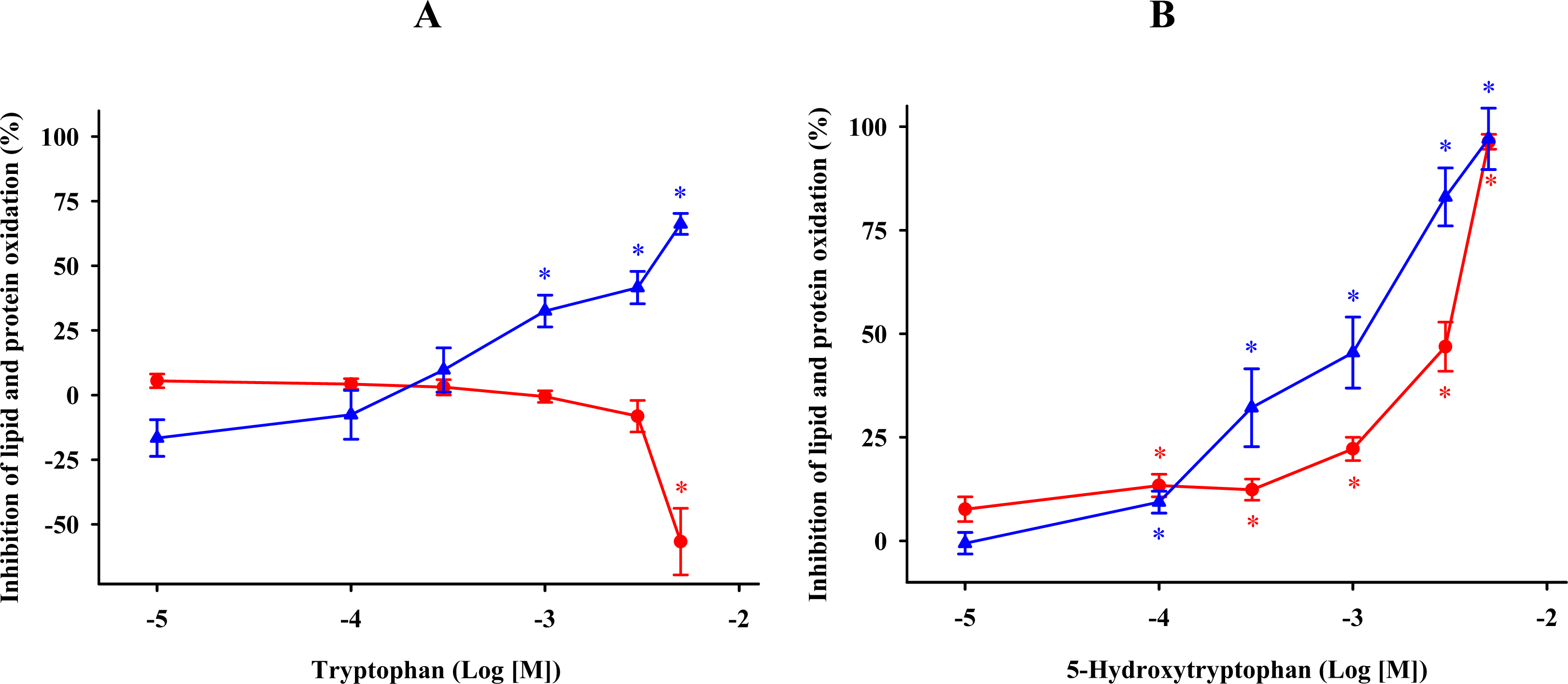
<p>We examined the effects of tryptophan, a physiological constituent of the proteins, on lipid and protein oxidation due to iron and ascorbic acid (<xref ref-type="fig" rid="f2-ijms-11-00312">Figure 2A</xref>). Tryptophan, at concentrations of ≥3 mM, significantly increased levels of MDA + 4-HDA in the membrane suspension. Exposure of the membrane suspension to 1 mM or higher tryptophan significantly reduced protein oxidation (<xref ref-type="fig" rid="f2-ijms-11-00312">Figure 2A</xref>). We have recently shown that 0.01–3 mM tryptophan failed to preserve the fluidity of hepatic membranes from the rigidity induced by lipid peroxidation [<xref ref-type="bibr" rid="b25-ijms-11-00312">25</xref>].</p>
<p>Consistent with our results, tryptophan promoted oxidative stress in the cerebral cortex of rats [<xref ref-type="bibr" rid="b26-ijms-11-00312">26</xref>]. Moreover, in rats fed with tryptophan-supplemented diets, the amino acid appeared to enhance lipid peroxidation in plasma as well as several tissues [<xref ref-type="bibr" rid="b27-ijms-11-00312">27</xref>,<xref ref-type="bibr" rid="b28-ijms-11-00312">28</xref>]. On the other hand, tryptophan showed a weak antioxidant behavior which prevented the formation of the 2,2′-azino-bis(3-ethylbenz-thiazoline-6-sulfonic acid) (ABTS) cation radical by scavenging •OH and ROO• that was five orders of magnitude lower than melatonin [<xref ref-type="bibr" rid="b29-ijms-11-00312">29</xref>]. The effect of tryptophan on protein oxidation agree with <italic>in vivo</italic> studies that have claimed that tryptophan reduces edema and oxidative stress in cerulein- or ischemia/reperfusion-induced pancreatitis [<xref ref-type="bibr" rid="b30-ijms-11-00312">30</xref>] and accelerated the healing of gastric ulcers induced by administration of acetic acid, ethanol, and aspirin [<xref ref-type="bibr" rid="b31-ijms-11-00312">31</xref>,<xref ref-type="bibr" rid="b32-ijms-11-00312">32</xref>].</p>
<p>5-Hydroxytryptophan is biosynthesized from tryptophan by 5-tryptophan hydroxylase in the pineal gland. 5-Hydroxytryptophan prevented lipid and protein oxidations in a concentration-dependent manner (<xref ref-type="fig" rid="f2-ijms-11-00312">Figure 2B</xref>). These results are consistent with two previous studies showing that 5-hydroxytryptophan reduced lipid peroxidation and reversed membrane rigidity in hepatic cells and microsomal membranes treated with iron [<xref ref-type="bibr" rid="b23-ijms-11-00312">23</xref>,<xref ref-type="bibr" rid="b25-ijms-11-00312">25</xref>]. It has been proposed that the indole nucleus of tryptophan is the moiety of the molecule responsible for the antioxidant function [<xref ref-type="bibr" rid="b33-ijms-11-00312">33</xref>]. Although our study did not address the chemical mechanism of the antioxidant activity, according to our results it seems reasonable to consider that hydroxylation of the amino acid activates its antioxidant behavior, which may be related to its ability to transfer electrons to free radicals.</p></sec>
<sec>
<label>2.3.</label>
<title>Methoxytryptamine, N-acetylserotonin, and Tryptamine</title>
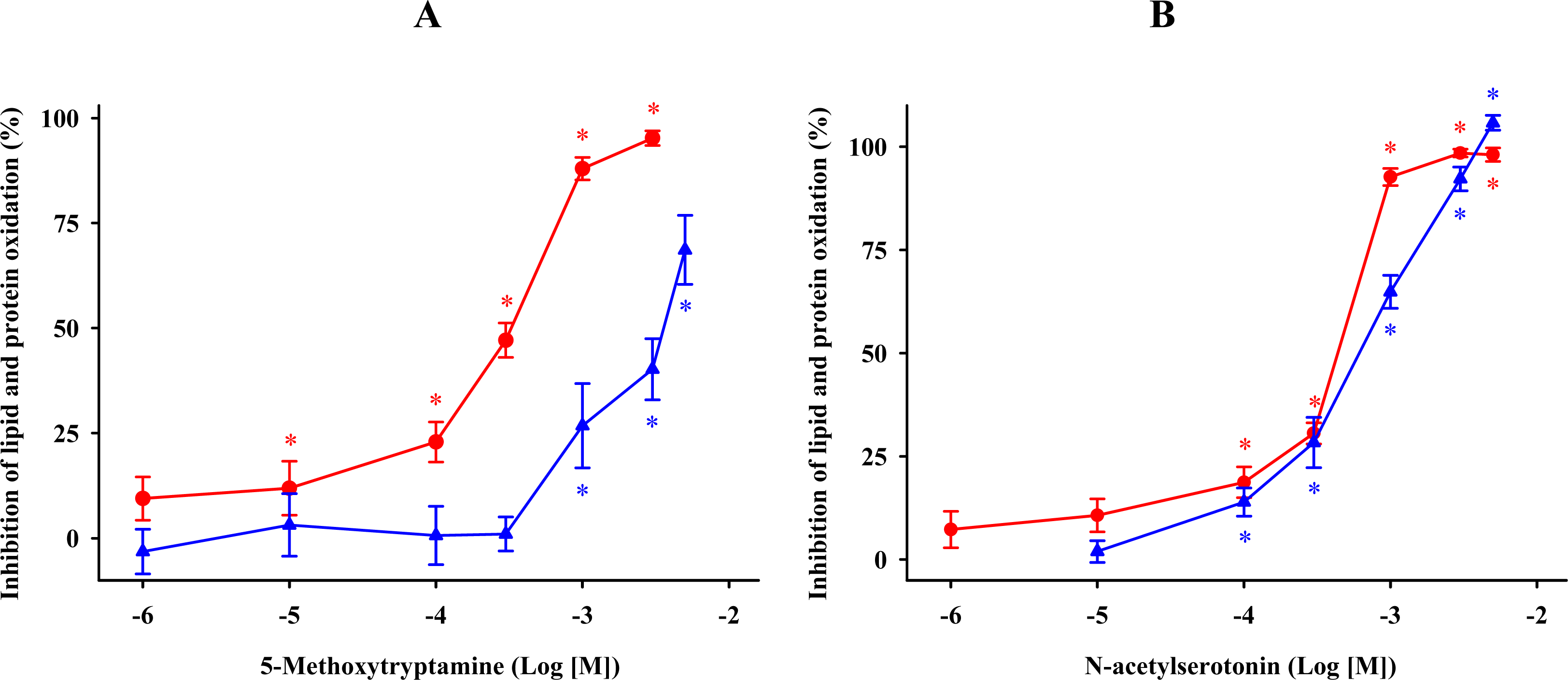
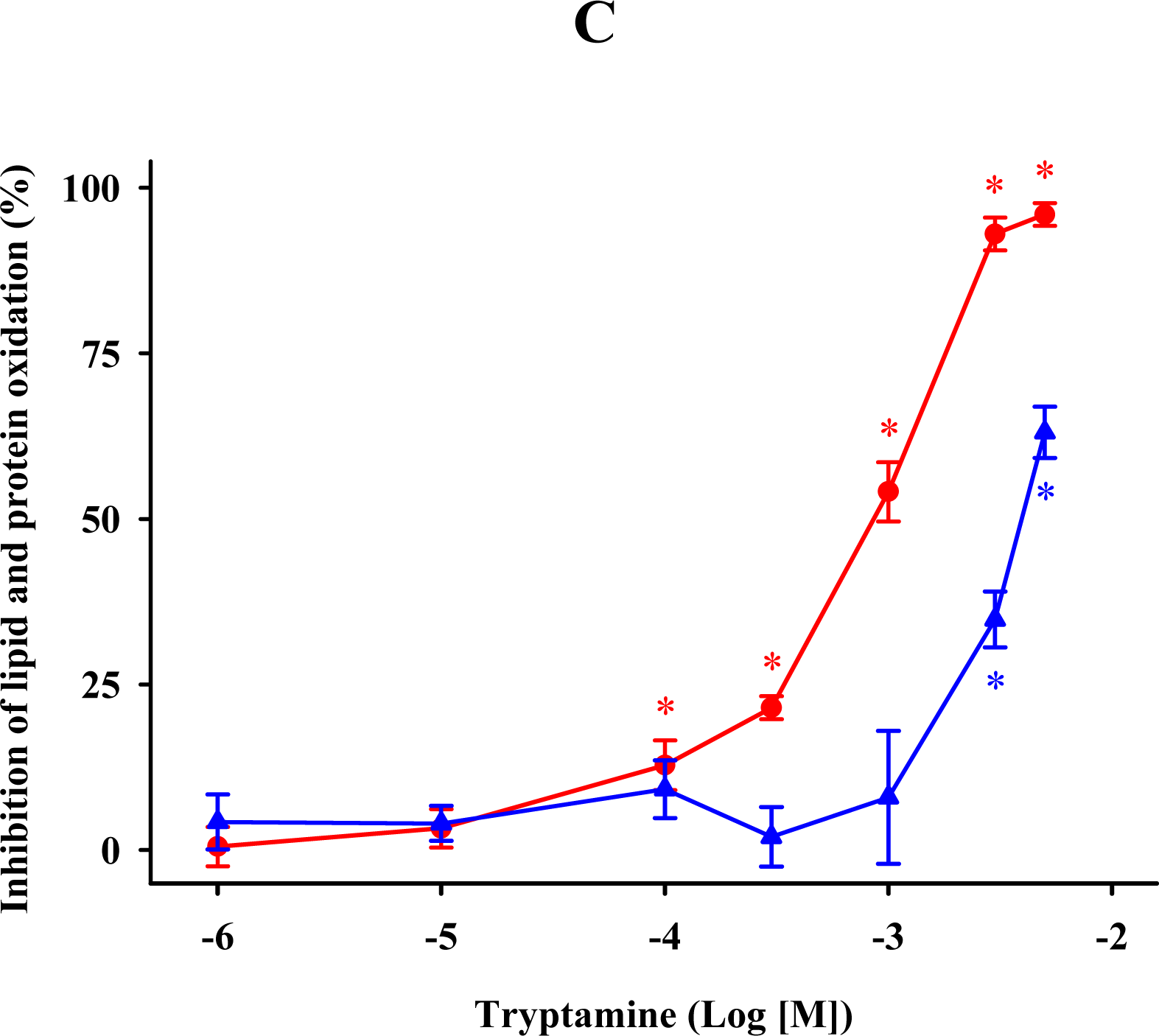
<p>The ability of 5-methoxytryptamine, <italic>N</italic>-acetylserotonin and tryptamine to inhibit MDA + 4-HDA formation and to augment the carbonyl content in the proteins of synaptosomal membranes treated with FeCl<sub>3</sub> and ascorbic acid was concentration-dependent (<xref ref-type="fig" rid="f3-ijms-11-00312">Figure 3</xref>). Tan and colleagues reported the first observation of the antioxidant effect of 5-methoxytryptamine [<xref ref-type="bibr" rid="b12-ijms-11-00312">12</xref>]. They demonstrated that this indoleamine efficiently scavenged •OH produced by photolytic rupture of H<sub>2</sub>O<sub>2</sub>. Subsequent reports also showed that 5-methoxytryptamine reduced lipid peroxidation induced by FeSO<sub>4</sub> and carbon tetrachloride in biomembranes as well as a variety of homogenates from several tissues [<xref ref-type="bibr" rid="b34-ijms-11-00312">34</xref>–<xref ref-type="bibr" rid="b36-ijms-11-00312">36</xref>]. An <italic>in vivo</italic> study reported that 5-methoxytryptamine prevented lipid peroxidation and the decrease in glutathione concentrations in active muscles of Sprague-Dawley rats after a period of acute exercise [<xref ref-type="bibr" rid="b37-ijms-11-00312">37</xref>].</p>
<p><italic>N</italic>-Acetylserotonin has been implicated in the acceleration of the pro-oxidant activity of ascorbate [<xref ref-type="bibr" rid="b38-ijms-11-00312">38</xref>] and its antioxidant role has been supported by several <italic>in vitro</italic> studies which showed that <italic>N</italic>-acetylserotonin decreased the oxidation in low-density lipoproteins caused by copper [<xref ref-type="bibr" rid="b39-ijms-11-00312">39</xref>,<xref ref-type="bibr" rid="b40-ijms-11-00312">40</xref>], protected DNA against harmful exposure to chromium III and hydrogen peroxide [<xref ref-type="bibr" rid="b41-ijms-11-00312">41</xref>], and reduced lipid peroxidation due to iron, hydrogen peroxide and 2,2′-azobis(2-amidinopropane) [<xref ref-type="bibr" rid="b34-ijms-11-00312">34</xref>,<xref ref-type="bibr" rid="b42-ijms-11-00312">42</xref>–<xref ref-type="bibr" rid="b45-ijms-11-00312">45</xref>]. In addition, <italic>N</italic>-acetylserotonin prevented the formation of ultraviolet-radiation-induced cataracts in rats [<xref ref-type="bibr" rid="b46-ijms-11-00312">46</xref>] as well as hepatic lipid peroxidation in rats treated with the toxin α-naphthylisothiocyanate, although in this study the indoleamine failed to prevent increases in hepatic enzymes and bilirubin levels in serum [<xref ref-type="bibr" rid="b47-ijms-11-00312">47</xref>].</p>
<p>Little is known about the antioxidant ability of tryptamine. This molecule reduced the formation of thiobarbituric acid reactive substances (TBARS) induced by <italic>tert</italic>-butyl hydroperoxide, the hyperglycemia subsequent to treatment with alloxan [<xref ref-type="bibr" rid="b48-ijms-11-00312">48</xref>], and the nitration of the amino acid tyrosine caused by ONOO<sup>−</sup> [<xref ref-type="bibr" rid="b49-ijms-11-00312">49</xref>]. All these results and our data are in agreement with the observation of Poeggeler <italic>et al.</italic> [<xref ref-type="bibr" rid="b29-ijms-11-00312">29</xref>] who calculated the reaction rates of tryptamine in scavenging •OH and ROO• as 0.80 × 10<sup>6</sup> and 0.96 × 10<sup>6</sup> mol·L<sup>−1</sup>·s<sup>−1</sup>, respectively.</p>
<p>Under our experimental conditions, we determined the concentrations of a variety of compounds that reduced lipid peroxidation and protein carbonylation by 50% (IC<sub>50</sub>) (<xref ref-type="table" rid="t1-ijms-11-00312">Table 1</xref>). Among these compounds, the lowest IC<sub>50</sub> value for blocking lipid peroxidation was calculated for 5-methoxytryptamine. However, in terms of protein carbonylation, the IC<sub>50</sub> values showed that <italic>N</italic>-acetylserotonin was more active than 5-methoxytryptamine and tryptamine. Thus, it seems reasonable to deduce that tryptamine is a molecule with relatively poor antioxidant capacity when compared to 5-methoxytryptamine or <italic>N</italic>-acetylserotonin. The substitution of a hydrogen atom for a methoxy group in position 5 of the tryptamine activates its antioxidant behavior, as reflected by a reduction of the IC<sub>50s</sub> required to prevent lipid peroxidation (62.1%) and protein carbonylation (14.1%). <italic>N</italic>-Acetylation of tryptamine and the incorporation of a hydroxyl group in C<sub>5</sub> of the indole ring also enhanced the antioxidant ability of tryptoline in preventing lipid and protein oxidation by 50.0 and 83.6%, respectively. These results suggest that methoxylation, hydroxylation, and <italic>N</italic>-acetylation of tryptamine reinforced its protective effect against free radical damage, possibly through mechanisms mediated by an improvement of the ability to donate electrons as well as modifying the solubility of tryptamine in the incubation medium, which would give greater access of the indoleamine to the free radicals.</p></sec>
<sec>
<label>2.4.</label>
<title>Melatonin</title>
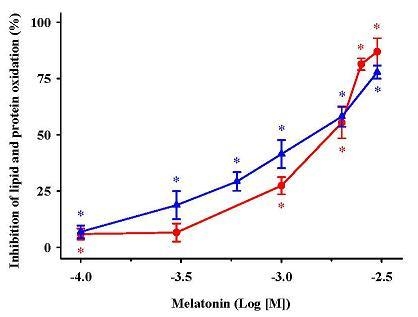
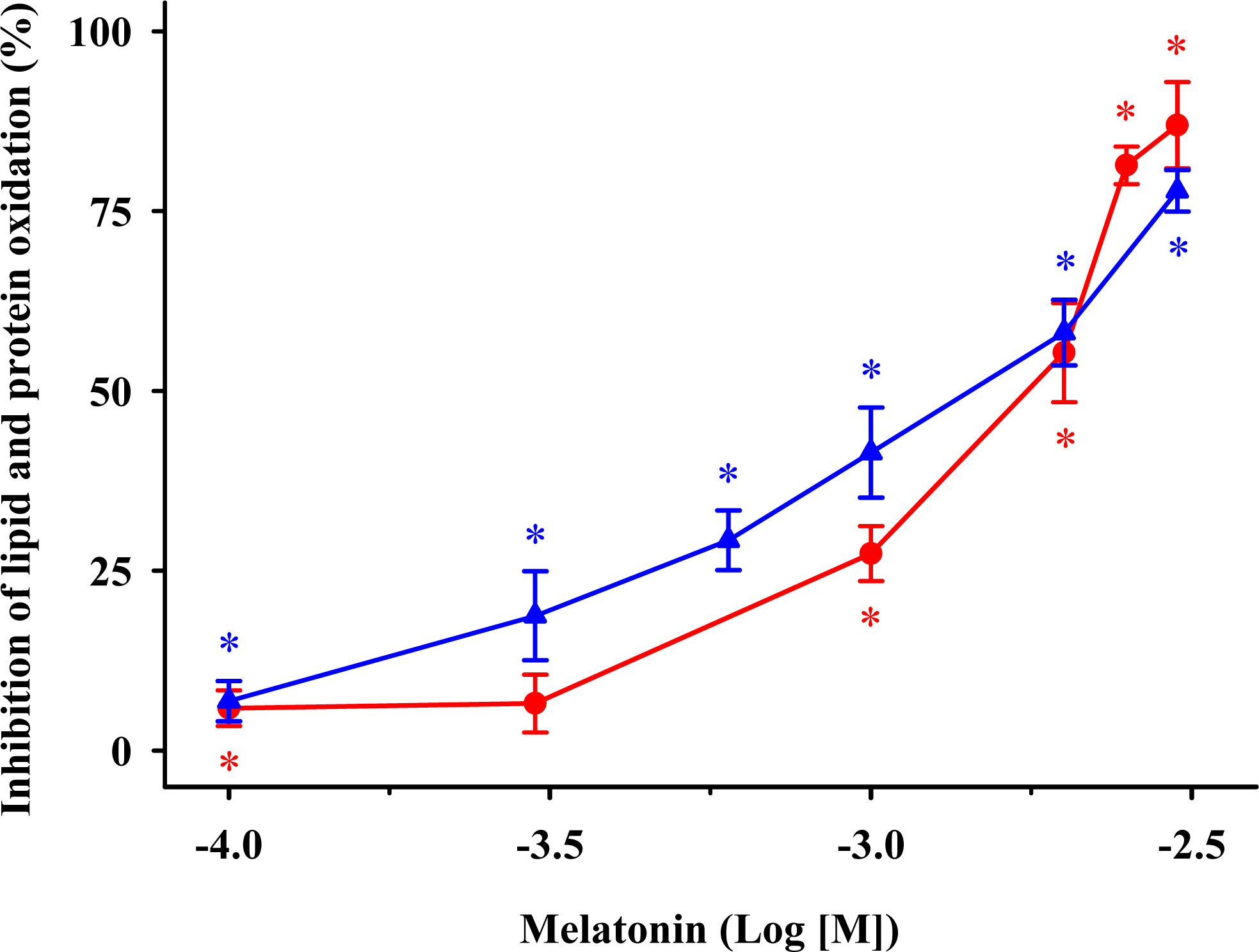
<p>Melatonin’s inhibitory effects of iron- and ascorbic acid-induced lipid and protein oxidations are concentration-dependent (<xref ref-type="fig" rid="f4-ijms-11-00312">Figure 4</xref>). Melatonin at 3 mM prevented both oxidative indices almost completely; in this case, no significant differences in MDA + 4-HDA concentration and carbonyl contents were observed relative to control membranes without FeCl<sub>3</sub> and ascorbic acid.</p>
<p>The efficiency of melatonin as an antioxidant has been demonstrated in numerous studies [<xref ref-type="bibr" rid="b9-ijms-11-00312">9</xref>]. In the brain, melatonin prevented lipid peroxidation under various experimental conditions. Thus, this indoleamine reversed the prooxidant effects caused by the excitatory amino acid glutamate [<xref ref-type="bibr" rid="b50-ijms-11-00312">50</xref>], kainic, quinolenic, and okadaic acids [<xref ref-type="bibr" rid="b51-ijms-11-00312">51</xref>–<xref ref-type="bibr" rid="b53-ijms-11-00312">53</xref>], Alzheimer amyloid peptide [<xref ref-type="bibr" rid="b54-ijms-11-00312">54</xref>], 1-methyl-4-phenyl-1,2,3,6-tetrahydropyridine [<xref ref-type="bibr" rid="b55-ijms-11-00312">55</xref>], homocysteine [<xref ref-type="bibr" rid="b56-ijms-11-00312">56</xref>], and bacterial lipopolysaccharide [<xref ref-type="bibr" rid="b57-ijms-11-00312">57</xref>]. Melatonin also reduced the severity of ischemia-reperfusion injury in brain [<xref ref-type="bibr" rid="b58-ijms-11-00312">58</xref>]. Tan and colleagues [<xref ref-type="bibr" rid="b12-ijms-11-00312">12</xref>] reported that melatonin is a very efficient •OH scavenger, while, in a exhaustive study extended to a wide number of antioxidants, Poeggeler <italic>et al.</italic> [<xref ref-type="bibr" rid="b29-ijms-11-00312">29</xref>] claimed that melatonin had an elevated reaction rate with •OH and ROO•. Melatonin’s ability to reduce lipid peroxidation is assumed to be related, at least partially, to its direct scavenging activity. However, several other mechanisms may be involved in its protective effects against these neurotoxins, e.g., by stabilizing cell membranes, allowing them to resist effectively free radical toxicity [<xref ref-type="bibr" rid="b11-ijms-11-00312">11</xref>], and by stimulating antioxidative enzymes [<xref ref-type="bibr" rid="b59-ijms-11-00312">59</xref>].</p>
<p>Previous <italic>in vitro</italic> evidence indicates that melatonin protects synaptosomal membranes against lipid peroxidation mediated by aluminum and sodium nitroprussiate [<xref ref-type="bibr" rid="b24-ijms-11-00312">24</xref>,<xref ref-type="bibr" rid="b60-ijms-11-00312">60</xref>,<xref ref-type="bibr" rid="b61-ijms-11-00312">61</xref>]. The reduction of carbonylation of proteins by melatonin was described for the first time by Kim <italic>et al.</italic> [<xref ref-type="bibr" rid="b62-ijms-11-00312">62</xref>], who proved that melatonin reduced the formation of carbonyl groups in a solution of bovine serum albumin treated with ascorbate-Fe<sup>3+</sup>-EDTA. Daily administration of melatonin in senescence-accelerated mice reduces protein carbonylation in the cerebral cortex [<xref ref-type="bibr" rid="b63-ijms-11-00312">63</xref>]. These findings are consistent with the results of the current study wherein melatonin decreased the accumulation of MDA + 4-HDA levels and protein carbonylation in synaptosomes incubated with 0.1 mM FeCl<sub>3</sub> and 0.1 mM ascorbic acid.</p></sec>
<sec>
<label>2.5.</label>
<title>5-Methoxytryptophol and 5-methoxy-3-indoleacetic Acid</title>
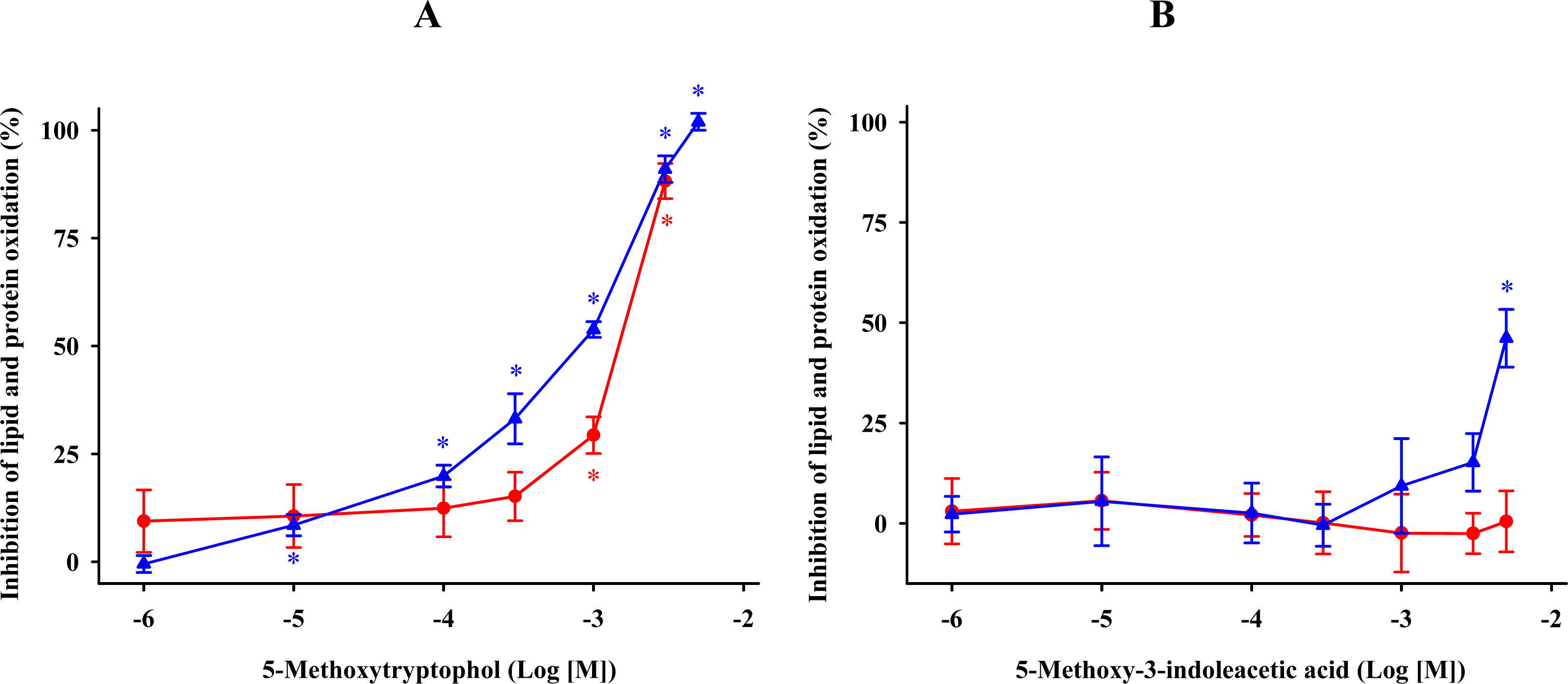
<p>Biosynthesis of 5-methoxytryptophol and 5-methoxy-3-indoleacetic acid occurs from serotonin and is catalyzed by monoamine oxidase and hydroxyindole-<italic>O</italic>-methyltransferase [<xref ref-type="bibr" rid="b64-ijms-11-00312">64</xref>]. 5-Methoxytryptophol inhibited FeCl<sub>3</sub> and ascorbic acid-induced lipid and protein oxidation in a dose-dependent manner (<xref ref-type="fig" rid="f5-ijms-11-00312">Figure 5A</xref>). The minimal effective concentration of 5-methoxytryptophol that significantly reduced oxidative damage was 0.1 mM (<italic>P</italic> ≤ 0.05). All concentrations of 5-methoxytryptophol greater than 0.5 mM caused progressively greater reductions in MDA + 4-HDA levels and protein carbonylation in synaptosomal membranes. However, 5-methoxy-3-indoleacetic acid failed to protect the membranes in terms of biochemical markers of oxidative stress. Only high levels (5 mM) of 5-methoxy-3-indoleacetic acid reduced the synaptosomal carbonylation by 46.1% (<xref ref-type="fig" rid="f5-ijms-11-00312">Figure 5B</xref>).</p>
<p>Under our experimental conditions, 5-methoxytryptophol showed an antioxidant action. Although limited knowledge exists on the antioxidant capacity of this indoleamine, our data is in agreement with previous reports that demonstrate that 5-methoxytryptophol reduced the formation of the ABTS cation radical acting as a potent electron donor [<xref ref-type="bibr" rid="b29-ijms-11-00312">29</xref>], decreased iron-induced hepatic microsomal membrane rigidity [<xref ref-type="bibr" rid="b65-ijms-11-00312">65</xref>], and prevented lipid peroxidation due to hydrogen peroxide in rat brain homogenates [<xref ref-type="bibr" rid="b66-ijms-11-00312">66</xref>]. Earlier studies with 5-methoxy-3-indoleacetic acid claimed that this molecule was unable to prevent the oxidation of low density lipoprotein [<xref ref-type="bibr" rid="b36-ijms-11-00312">36</xref>]. However, the 5-methoxy-3-indoleacetic acid reaction rate with •OH and ROO•, exclusively when the incubation medium had a very low pH [<xref ref-type="bibr" rid="b29-ijms-11-00312">29</xref>]. The difference in pH in the incubation medium may explain the lack of antioxidant effect of 5-methoxy-3-indoleacetic acid in our study.</p></sec>
<sec>
<label>2.6.</label>
<title>β-Carbolines</title>
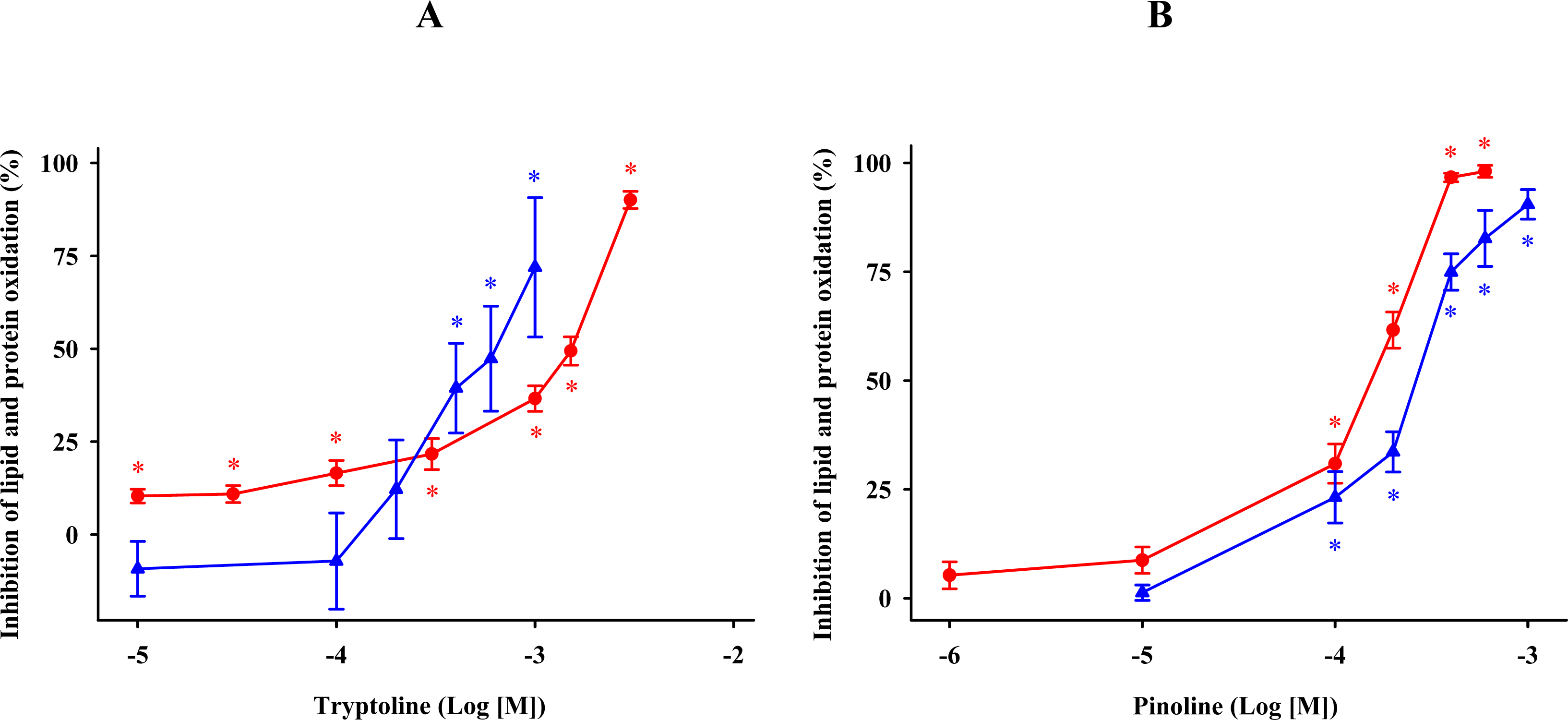
<p>β-carboline formation has been proposed via the Pictet-Spengler reaction by condensation of indoleamines with aldehydes [<xref ref-type="bibr" rid="b64-ijms-11-00312">64</xref>,<xref ref-type="bibr" rid="b67-ijms-11-00312">67</xref>]. We observed that progressively increasing concentrations of tryptoline or pinoline prevented MDA + 4-HDA formation and protein carbonylation in a concentration-dependent manner (<xref ref-type="fig" rid="f6-ijms-11-00312">Figure 6</xref>). Pinoline proved to be more potent than tryptoline in reducing lipid and protein oxidation. These data agree with a previous study showing that pinoline was more active in reducing lipid peroxidation in brain homogenates exposed to hydrogen peroxide [<xref ref-type="bibr" rid="b68-ijms-11-00312">68</xref>]. Tryptoline differs from pinoline in the absence of the methoxy group. It has been proposed that methoxylated tryptophan derivatives are more effective antioxidants than hydroxylated compounds [<xref ref-type="bibr" rid="b12-ijms-11-00312">12</xref>,<xref ref-type="bibr" rid="b29-ijms-11-00312">29</xref>]. The data reported here for β-carbolines is consistent with this observation. Several reports have claimed that pinoline reduced lipid peroxidation induced by hydrogen peroxide, iron, sodium nitroprussiate, copper (I) iodide, aluminum, and glutamate [<xref ref-type="bibr" rid="b24-ijms-11-00312">24</xref>,<xref ref-type="bibr" rid="b44-ijms-11-00312">44</xref>,<xref ref-type="bibr" rid="b60-ijms-11-00312">60</xref>,<xref ref-type="bibr" rid="b68-ijms-11-00312">68</xref>–<xref ref-type="bibr" rid="b71-ijms-11-00312">71</xref>]. Herein, we show for the first time that tryptoline also reduces oxidative stress in synaptosomal membranes. As for pinoline, our data are in agreement with two previous studies stating that pinoline limits oxidative damage to proteins in synaptosomes [<xref ref-type="bibr" rid="b24-ijms-11-00312">24</xref>,<xref ref-type="bibr" rid="b60-ijms-11-00312">60</xref>].</p></sec></sec>
<sec>
<label>3.</label>
<title>Experimental Section</title>
<sec>
<label>3.1.</label>
<title>Chemicals</title>
<p>All chemical reagents were of the purest available quality obtainable from commercial sources. FeCl<sub>3</sub>, ascorbic acid, melatonin, tryptophan, 5-hydroxytryptophan, 5-metoxytryptamine, <italic>N</italic>-acetyl-serotonin, tryptamine, melatonin, 5-methoxy-3-indoleacetic acid, 5-methoxytryptophol, tryptoline, and pinoline were purchased from Sigma-Aldrich (Madrid, Spain). The Bioxytech LPO-586 kit for lipid peroxidation was obtained from Cayman Chemical (Ann Arbor, MI, USA). Melatonin was diluted in absolute ethanol and Tris-HCl 50 mM, with ethanol constituting 2% (v/v) of the final solution. Tryptamine, 5-methoxytryptamine, 5-methoxytryptophol, 5-methoxy-3-indoleacetic acid, and pinoline were diluted in methanol and incubation buffer; the concentration of methanol was 2% (v/v) in the final solution. The rest of the reagents were dissolved in incubation buffer. All solutions were freshly prepared just prior to use.</p></sec>
<sec>
<label>3.2.</label>
<title>Animals and Isolation of Synaptosomes</title>
<p>Fifty Sprague-Dawley male rats, weighing 200–250 g were purchased from Harlan-Ibérica (Barcelona, Spain). Before being sacrificed, they were acclimated for two weeks, three animals in each Plexiglas cage. The brains were quickly removed, washed in cold saline solution (0.9% NaCl), and homogenized 1/10 (w/v) in 0.32 M sucrose using a motor-driven Teflon homogenizer. Membranes were isolated following the protocol previously described by Millán-Plano and co-workers [<xref ref-type="bibr" rid="b24-ijms-11-00312">24</xref>]. Briefly, tissue homogenates were centrifuged at 1,000 × g at 4 °C for 10 min to remove the nuclei and cellular debris. Then, supernatants were centrifuged at 30,000 × g for 20 min at 4 °C and the resulting pellets were resuspended in H<sub>2</sub>O (1/10, v/v), homogenized, and centrifuged at 10,000 × g for 20 min at 4 °C. Following this centrifugation, supernatant and buffy coat was removed, homogenized, and then recentrifuged at 48,000 × g at 4 °C for 20 min The pellet was washed twice and the final pellet was resuspended 1/2 (v/v) in Tris-HCl buffer (pH = 7.4), and frozen at −80 °C until assay.</p></sec>
<sec sec-type="methods">
<label>3.3.</label>
<title>Experimental Design</title>
<p>The induction of oxidative stress to the synaptosomal membranes was performed by using a •OH generator system. This system was based on the models proposed by Wong <italic>et al.</italic> [<xref ref-type="bibr" rid="b72-ijms-11-00312">72</xref>] and Sahu and Washington [<xref ref-type="bibr" rid="b73-ijms-11-00312">73</xref>] using FeCl<sub>3</sub> and ascorbic acid as prooxidative reagents. Aliquots of synaptosomal membranes, 0.5 mg/mL, were suspended in Tris-HCl 50 mM buffer and incubated in a water bath with shaking at 37 °C with or without 0.1 mM FeCl<sub>3</sub>, 0.1 mM ascorbic acid and in the absence or presence of the indoleamines (0.001–5 mM). The duration of the incubation was determined by time kinetics, measuring the formation of MDA + 4-HDA and carbonyl groups over 120 min after initiating incubation. The oxidation of the membranes was quenched by adding 2 mM EDTA and by placing the membrane solution into ice-cold water for 10 min. Control synaptosomes and those with induced oxidation were exposed to the same conditions (incubation and addition of ethanol or methanol) as the samples treated with the indoleamines.</p></sec>
<sec sec-type="methods">
<label>3.4.</label>
<title>Analytical Procedures</title>
<p>MDA + 4-HDA levels were used as an index of peroxidation of the synaptosomal lipids [<xref ref-type="bibr" rid="b74-ijms-11-00312">74</xref>]. The levels of the lipid peroxidation products were measured using the Bioxytech LPO-586 kit. In this assay, MDA and 4-HDA react with <italic>N</italic>-methyl-2-phenylindole to yield a stable chromophore with a peak of maximum absorbance at 586 nm. Results are expressed as nmol MDA + 4-HDA/mg of synaptosomal protein. The protein concentrations were determined employing the method of Lowry [<xref ref-type="bibr" rid="b75-ijms-11-00312">75</xref>], using bovine serum albumin as the standard.</p>
<p>Carbonyl groups in the synaptosomal proteins were measured using the reaction with 2,4-dinitrophenylhydrazine (DNPH) described by Levine <italic>et al</italic>. [<xref ref-type="bibr" rid="b76-ijms-11-00312">76</xref>], with slight modifications. Aliquots (100 μL) of 50 mM Tris-HCl buffer and 200 μL of 10 mM DNPH solution were added to 1 mL of synaptosomal membranes, and the mixture was incubated al 37 °C for 1 h. Aliquots (325 μL) of 50% ice-cold trichloroacetic acid was added to the mixture and the samples were placed on ice for 10 min. The pellets obtained after centrifugation at 3,000 × g for 10 min were washed three times with ethanol/ethyl acetate (1:1, v/v). The final pellets after the third washing were dissolved in 6 M guanidine and incubated at 37 °C for 15 min. After centrifugation at 12,000 × g for 10 min, the absorbance of the supernatants was measured spectrophotometrically at 375 nm. Protein carbonyl groups were estimated by using the molar absorption coefficient of 22,000 M<sup>−1</sup>·cm<sup>−1</sup> for DNPH derivatives, and its concentration was expressed as nmol carbonyl groups/mg protein. Guanidine solution was used as a blank.</p></sec>
<sec sec-type="methods">
<label>3.5.</label>
<title>Statistical Analysis</title>
<p>All results are expressed as means ± standard error of at least five independent experiments. Student’s <italic>t</italic>-tests were used for comparison of the means. Differences were accepted as being statistically significant when <italic>P</italic> &lt; 0.05.</p></sec></sec>
<sec sec-type="conclusions">
<label>4.</label>
<title>Conclusions</title>
<p>The findings presented in this paper demonstrate that melatonin and other structurally-related compounds afford protection against FeCl<sub>3</sub> and ascorbic acid-induced lipid and protein oxidation in synaptosomes isolated from rat brain and reinforce the idea that several secretory products of the pineal gland may play a role in protecting biological membranes from oxidative damage. <xref ref-type="table" rid="t1-ijms-11-00312">Table 1</xref> summarizes the concentrations of these molecules required to reduce lipid and protein oxidations by 50% (IC<sub>50</sub>). Although these results suggest that pinoline is the most powerful antioxidant evaluated under our <italic>in vitro</italic> experimental conditions, since there is no data regarding the <italic>in vivo</italic> effects of β-carbolines, further studies should be conducted to define the antioxidant properties of these molecules. Regarding the indoleamines, while ample evidence demonstrates that melatonin achieves neuroprotection <italic>in vivo</italic> against free radical damage in a range of toxicological models [<xref ref-type="bibr" rid="b9-ijms-11-00312">9</xref>,<xref ref-type="bibr" rid="b10-ijms-11-00312">10</xref>], further studies are needed to verify the antioxidant behavior of other indoleamines. When melatonin was compared <italic>in vivo</italic> to other indoleamines, melatonin appeared to be a more active antioxidant and free radical scavenger [<xref ref-type="bibr" rid="b47-ijms-11-00312">47</xref>]. Our results are consistent with the idea that several indoleamines and β-carbolines contribute to the antioxidant role of the pineal gland.</p></sec></body>
<back>
<ack>
<p>This work was supported by grants from the “Gobierno de Aragón” (Aging and Oxidative Stress Physiology, Grants B40 and PI036/09) and by F.I.S. from Instituto de Salud Carlos III (Grant RD06/0013/1017). The authors declare that they have no conflict of interest.</p></ack>
<ref-list>
<title>References</title>
<ref id="b1-ijms-11-00312"><label>1.</label><citation citation-type="journal"><person-group person-group-type="author"><name><surname>Gutteridge</surname><given-names>JM</given-names></name></person-group><article-title>Lipid peroxidation and antioxidants as biomarkers of tissue damage</article-title><source>Clin. Chem</source><year>1995</year><volume>41</volume><fpage>1819</fpage><lpage>1828</lpage><pub-id pub-id-type="pmid">7497639</pub-id></citation></ref>
<ref id="b2-ijms-11-00312"><label>2.</label><citation citation-type="journal"><person-group person-group-type="author"><name><surname>Kanner</surname><given-names>J</given-names></name><name><surname>German</surname><given-names>JB</given-names></name><name><surname>Kinsella</surname><given-names>JE</given-names></name></person-group><article-title>Initiation of lipid peroxidation in biological systems</article-title><source>Crit. Rev. Food Sci. Nutr</source><year>1987</year><volume>25</volume><fpage>317</fpage><lpage>364</lpage><pub-id pub-id-type="doi">10.1080/10408398709527457</pub-id><pub-id pub-id-type="pmid">3304843</pub-id></citation></ref>
<ref id="b3-ijms-11-00312"><label>3.</label><citation citation-type="journal"><person-group person-group-type="author"><name><surname>Youngman</surname><given-names>LD</given-names></name><name><surname>Park</surname><given-names>JY</given-names></name><name><surname>Ames</surname><given-names>BN</given-names></name></person-group><article-title>Protein oxidation associated with aging is reduced by dietary restriction of protein or calories</article-title><source>Proc. Natl. Acad. Sci. USA</source><year>1992</year><volume>89</volume><fpage>9112</fpage><lpage>9116</lpage><pub-id pub-id-type="doi">10.1073/pnas.89.19.9112</pub-id><pub-id pub-id-type="pmid">1409611</pub-id></citation></ref>
<ref id="b4-ijms-11-00312"><label>4.</label><citation citation-type="journal"><person-group person-group-type="author"><name><surname>Davies</surname><given-names>KJ</given-names></name><name><surname>Delsignore</surname><given-names>ME</given-names></name><name><surname>Lin</surname><given-names>SW</given-names></name></person-group><article-title>Protein damage and degradation by oxygen radicals. II. Modification of amino acids</article-title><source>J. Biol. Chem</source><year>1987</year><volume>262</volume><fpage>9902</fpage><lpage>9907</lpage><pub-id pub-id-type="pmid">3036876</pub-id></citation></ref>
<ref id="b5-ijms-11-00312"><label>5.</label><citation citation-type="journal"><person-group person-group-type="author"><name><surname>Reiter</surname><given-names>RJ</given-names></name></person-group><article-title>The pineal and its hormones in the control of reproduction in mammals</article-title><source>Endocr. Rev</source><year>1980</year><volume>1</volume><fpage>109</fpage><lpage>131</lpage><pub-id pub-id-type="doi">10.1210/edrv-1-2-109</pub-id><pub-id pub-id-type="pmid">6263600</pub-id></citation></ref>
<ref id="b6-ijms-11-00312"><label>6.</label><citation citation-type="journal"><person-group person-group-type="author"><name><surname>Bubenik</surname><given-names>GA</given-names></name></person-group><article-title>Localization of melatonin in the digestive tract of the rat. Effect of maturation, diurnal variation, melatonin treatment and pinealectomy</article-title><source>Horm. Res</source><year>1980</year><volume>12</volume><fpage>313</fpage><lpage>323</lpage><pub-id pub-id-type="doi">10.1159/000179137</pub-id><pub-id pub-id-type="pmid">6998853</pub-id></citation></ref>
<ref id="b7-ijms-11-00312"><label>7.</label><citation citation-type="journal"><person-group person-group-type="author"><name><surname>Tan</surname><given-names>DX</given-names></name><name><surname>Manchester</surname><given-names>LC</given-names></name><name><surname>Reiter</surname><given-names>RJ</given-names></name><name><surname>Qi</surname><given-names>WB</given-names></name><name><surname>Zhang</surname><given-names>M</given-names></name><name><surname>Weintraub</surname><given-names>ST</given-names></name><name><surname>Cabrera</surname><given-names>J</given-names></name><name><surname>Sainz</surname><given-names>RM</given-names></name><name><surname>Mayo</surname><given-names>JC</given-names></name></person-group><article-title>Identification of highly elevated levels of melatonin in bone marrow: Its origin and significance</article-title><source>Biochim. Biophys. Acta</source><year>1999</year><volume>1472</volume><fpage>206</fpage><lpage>214</lpage><pub-id pub-id-type="doi">10.1016/S0304-4165(99)00125-7</pub-id><pub-id pub-id-type="pmid">10572942</pub-id></citation></ref>
<ref id="b8-ijms-11-00312"><label>8.</label><citation citation-type="journal"><person-group person-group-type="author"><name><surname>Guerrero</surname><given-names>JM</given-names></name><name><surname>Reiter</surname><given-names>RJ</given-names></name></person-group><article-title>Melatonin-immune system relationships</article-title><source>Curr. Top Med. Chem</source><year>2002</year><volume>2</volume><fpage>167</fpage><lpage>179</lpage><pub-id pub-id-type="pmid">11899099</pub-id></citation></ref>
<ref id="b9-ijms-11-00312"><label>9.</label><citation citation-type="journal"><person-group person-group-type="author"><name><surname>Reiter</surname><given-names>RJ</given-names></name></person-group><article-title>Oxidative damage in the central nervous system: Protection by melatonin</article-title><source>Prog. Neurobiol</source><year>1998</year><volume>56</volume><fpage>359</fpage><lpage>384</lpage><pub-id pub-id-type="doi">10.1016/S0301-0082(98)00052-5</pub-id><pub-id pub-id-type="pmid">9770244</pub-id></citation></ref>
<ref id="b10-ijms-11-00312"><label>10.</label><citation citation-type="journal"><person-group person-group-type="author"><name><surname>Reiter</surname><given-names>RJ</given-names></name><name><surname>Korkmaz</surname><given-names>A</given-names></name><name><surname>Paredes</surname><given-names>SD</given-names></name><name><surname>Manchester</surname><given-names>LC</given-names></name><name><surname>Tan</surname><given-names>DX</given-names></name></person-group><article-title>Melatonin reduces oxidative/nitrosative stress due to drugs, toxins, metals, and herbicides</article-title><source>Neuro Endocrinol. Lett</source><year>2008</year><volume>29</volume><fpage>609</fpage><lpage>613</lpage><pub-id pub-id-type="pmid">18987585</pub-id></citation></ref>
<ref id="b11-ijms-11-00312"><label>11.</label><citation citation-type="journal"><person-group person-group-type="author"><name><surname>García</surname><given-names>JJ</given-names></name><name><surname>Reiter</surname><given-names>RJ</given-names></name><name><surname>Guerrero</surname><given-names>JM</given-names></name><name><surname>Escames</surname><given-names>G</given-names></name><name><surname>Yu</surname><given-names>BP</given-names></name><name><surname>Oh</surname><given-names>CS</given-names></name><name><surname>Muñoz-Hoyos</surname><given-names>A</given-names></name></person-group><article-title>Melatonin prevents changes in microsomal membrane fluidity during induced lipid peroxidation</article-title><source>FEBS Lett</source><year>1997</year><volume>408</volume><fpage>297</fpage><lpage>300</lpage><pub-id pub-id-type="doi">10.1016/S0014-5793(97)00447-X</pub-id><pub-id pub-id-type="pmid">9188780</pub-id></citation></ref>
<ref id="b12-ijms-11-00312"><label>12.</label><citation citation-type="journal"><person-group person-group-type="author"><name><surname>Tan</surname><given-names>DX</given-names></name><name><surname>Chen</surname><given-names>LD</given-names></name><name><surname>Poeggeler</surname><given-names>B</given-names></name><name><surname>Manchester</surname><given-names>LC</given-names></name><name><surname>Reiter</surname><given-names>RJ</given-names></name></person-group><article-title>Melatonin: A potent, endogenous hydroxyl radical scavenger</article-title><source>Endocr. J</source><year>1993</year><volume>1</volume><fpage>57</fpage><lpage>60</lpage></citation></ref>
<ref id="b13-ijms-11-00312"><label>13.</label><citation citation-type="journal"><person-group person-group-type="author"><name><surname>Cagnoli</surname><given-names>CM</given-names></name><name><surname>Atabay</surname><given-names>C</given-names></name><name><surname>Kharlamova</surname><given-names>E</given-names></name><name><surname>Manev</surname><given-names>H</given-names></name></person-group><article-title>Melatonin protects neurons from singlet oxygen-induced apoptosis</article-title><source>J. Pineal. Res</source><year>1995</year><volume>18</volume><fpage>222</fpage><lpage>226</lpage><pub-id pub-id-type="doi">10.1111/j.1600-079X.1995.tb00163.x</pub-id><pub-id pub-id-type="pmid">8531053</pub-id></citation></ref>
<ref id="b14-ijms-11-00312"><label>14.</label><citation citation-type="journal"><person-group person-group-type="author"><name><surname>Tan</surname><given-names>DX</given-names></name><name><surname>Manchester</surname><given-names>LC</given-names></name><name><surname>Reiter</surname><given-names>RJ</given-names></name><name><surname>Plummer</surname><given-names>BF</given-names></name><name><surname>Hardies</surname><given-names>LJ</given-names></name><name><surname>Weintraub</surname><given-names>ST</given-names></name><name><surname>Vijayalaxmi</surname></name><name><surname>Shepherd</surname><given-names>AM</given-names></name></person-group><article-title>A novel melatonin metabolite, cyclic 3-hydroxymelatonin: A biomarker of <italic>in vivo</italic> hydroxyl radical generation</article-title><source>Biochem. Biophys. Res. Commun</source><year>1998</year><volume>253</volume><fpage>614</fpage><lpage>620</lpage><pub-id pub-id-type="doi">10.1006/bbrc.1998.9826</pub-id><pub-id pub-id-type="pmid">9918777</pub-id></citation></ref>
<ref id="b15-ijms-11-00312"><label>15.</label><citation citation-type="journal"><person-group person-group-type="author"><name><surname>Dellegar</surname><given-names>SM</given-names></name><name><surname>Murphy</surname><given-names>SA</given-names></name><name><surname>Bourne</surname><given-names>AE</given-names></name><name><surname>DiCesare</surname><given-names>JC</given-names></name><name><surname>Purser</surname><given-names>GH</given-names></name></person-group><article-title>Identification of the factors affecting the rate of deactivation of hypochlorous acid by melatonin</article-title><source>Biochem. Biophys. Res. Commun</source><year>1999</year><volume>257</volume><fpage>431</fpage><lpage>439</lpage><pub-id pub-id-type="doi">10.1006/bbrc.1999.0438</pub-id><pub-id pub-id-type="pmid">10198231</pub-id></citation></ref>
<ref id="b16-ijms-11-00312"><label>16.</label><citation citation-type="journal"><person-group person-group-type="author"><name><surname>Zhang</surname><given-names>H</given-names></name><name><surname>Squadrito</surname><given-names>GL</given-names></name><name><surname>Uppu</surname><given-names>R</given-names></name><name><surname>Pryor</surname><given-names>WA</given-names></name></person-group><article-title>Reaction of peroxynitrite with melatonin: A mechanistic study</article-title><source>Chem. Res. Toxicol</source><year>1999</year><volume>12</volume><fpage>526</fpage><lpage>534</lpage><pub-id pub-id-type="doi">10.1021/tx980243t</pub-id><pub-id pub-id-type="pmid">10368316</pub-id></citation></ref>
<ref id="b17-ijms-11-00312"><label>17.</label><citation citation-type="journal"><person-group person-group-type="author"><name><surname>Tan</surname><given-names>DX</given-names></name><name><surname>Manchester</surname><given-names>LC</given-names></name><name><surname>Reiter</surname><given-names>RJ</given-names></name><name><surname>Plummer</surname><given-names>BF</given-names></name><name><surname>Limson</surname><given-names>J</given-names></name><name><surname>Weintraub</surname><given-names>ST</given-names></name><name><surname>Qi</surname><given-names>W</given-names></name></person-group><article-title>Melatonin directly scavenges hydrogen peroxide: A potentially new metabolic pathway of melatonin biotransformation</article-title><source>Free Radic. Biol. Med</source><year>2000</year><volume>29</volume><fpage>1177</fpage><lpage>1185</lpage><pub-id pub-id-type="doi">10.1016/S0891-5849(00)00435-4</pub-id><pub-id pub-id-type="pmid">11121726</pub-id></citation></ref>
<ref id="b18-ijms-11-00312"><label>18.</label><citation citation-type="journal"><person-group person-group-type="author"><name><surname>Antolín</surname><given-names>I</given-names></name><name><surname>Rodríguez</surname><given-names>C</given-names></name><name><surname>Sainz</surname><given-names>RM</given-names></name><name><surname>Mayo</surname><given-names>JC</given-names></name><name><surname>Uria</surname><given-names>H</given-names></name><name><surname>Kotler</surname><given-names>ML</given-names></name><name><surname>Rodríguez-Colunga</surname><given-names>MJ</given-names></name><name><surname>Tolivia</surname><given-names>D</given-names></name><name><surname>Menéndez-Peláez</surname><given-names>A</given-names></name></person-group><article-title>Neurohormone melatonin prevents cell damage: Effect on gene expression for antioxidant enzymes</article-title><source>FASEB J</source><year>1996</year><volume>10</volume><fpage>882</fpage><lpage>890</lpage><pub-id pub-id-type="pmid">8666165</pub-id></citation></ref>
<ref id="b19-ijms-11-00312"><label>19.</label><citation citation-type="journal"><person-group person-group-type="author"><name><surname>Coto-Montes</surname><given-names>A</given-names></name><name><surname>Hardeland</surname><given-names>R</given-names></name></person-group><article-title>Antioxidative effects of melatonin in Drosophila melanogaster: Antagonization of damage induced by the inhibition of catalase</article-title><source>J. Pineal. Res</source><year>1999</year><volume>27</volume><fpage>154</fpage><lpage>158</lpage><pub-id pub-id-type="doi">10.1111/j.1600-079X.1999.tb00610.x</pub-id><pub-id pub-id-type="pmid">10535764</pub-id></citation></ref>
<ref id="b20-ijms-11-00312"><label>20.</label><citation citation-type="journal"><person-group person-group-type="author"><name><surname>Pozo</surname><given-names>D</given-names></name><name><surname>Reiter</surname><given-names>RJ</given-names></name><name><surname>Calvo</surname><given-names>JR</given-names></name><name><surname>Guerrero</surname><given-names>JM</given-names></name></person-group><article-title>Inhibition of cerebellar nitric oxide synthase and cyclic GMP production by melatonin via complex formation with calmodulin</article-title><source>J. Cell Biochem</source><year>1997</year><volume>65</volume><fpage>430</fpage><lpage>442</lpage><pub-id pub-id-type="doi">10.1002/(SICI)1097-4644(19970601)65:3&lt;430::AID-JCB12&gt;3.0.CO;2-J</pub-id><pub-id pub-id-type="pmid">9138098</pub-id></citation></ref>
<ref id="b21-ijms-11-00312"><label>21.</label><citation citation-type="journal"><person-group person-group-type="author"><name><surname>Sinet</surname><given-names>PM</given-names></name><name><surname>Heikkila</surname><given-names>RE</given-names></name><name><surname>Cohen</surname><given-names>G</given-names></name></person-group><article-title>Hydrogen peroxide production by rat brain <italic>in vivo</italic></article-title><source>J. Neurochem</source><year>1980</year><volume>34</volume><fpage>1421</fpage><lpage>1428</lpage><pub-id pub-id-type="doi">10.1111/j.1471-4159.1980.tb11222.x</pub-id><pub-id pub-id-type="pmid">7381468</pub-id></citation></ref>
<ref id="b22-ijms-11-00312"><label>22.</label><citation citation-type="journal"><person-group person-group-type="author"><name><surname>Beard</surname><given-names>JL</given-names></name><name><surname>Connor</surname><given-names>JR</given-names></name><name><surname>Jones</surname><given-names>BC</given-names></name></person-group><article-title>Iron in the brain</article-title><source>Nutr. Rev</source><year>1993</year><volume>51</volume><fpage>157</fpage><lpage>170</lpage><pub-id pub-id-type="pmid">8371846</pub-id></citation></ref>
<ref id="b23-ijms-11-00312"><label>23.</label><citation citation-type="journal"><person-group person-group-type="author"><name><surname>Cadenas</surname><given-names>E</given-names></name><name><surname>Simic</surname><given-names>MG</given-names></name><name><surname>Sies</surname><given-names>H</given-names></name></person-group><article-title>Antioxidant activity of 5-hydroxytryptophan, 5-hydroxyindole, and DOPA against microsomal lipid peroxidation and its dependence on vitamin E</article-title><source>Free Radic. Res. Commun</source><year>1989</year><volume>6</volume><fpage>11</fpage><lpage>17</lpage><pub-id pub-id-type="doi">10.3109/10715768909073423</pub-id><pub-id pub-id-type="pmid">2498167</pub-id></citation></ref>
<ref id="b24-ijms-11-00312"><label>24.</label><citation citation-type="journal"><person-group person-group-type="author"><name><surname>Millán-Plano</surname><given-names>S</given-names></name><name><surname>García</surname><given-names>JJ</given-names></name><name><surname>Martínez-Ballarín</surname><given-names>E</given-names></name><name><surname>Reiter</surname><given-names>RJ</given-names></name><name><surname>Ortega-Gutiérrez</surname><given-names>S</given-names></name><name><surname>Lázaro</surname><given-names>RM</given-names></name><name><surname>Escanero</surname><given-names>JF</given-names></name></person-group><article-title>Melatonin and pinoline prevent aluminium-induced lipid peroxidation in rat synaptosomes</article-title><source>J. Trace Elem. Med. Biol</source><year>2003</year><volume>17</volume><fpage>39</fpage><lpage>44</lpage><pub-id pub-id-type="doi">10.1016/S0946-672X(03)80044-5</pub-id><pub-id pub-id-type="pmid">12755500</pub-id></citation></ref>
<ref id="b25-ijms-11-00312"><label>25.</label><citation citation-type="journal"><person-group person-group-type="author"><name><surname>Reyes-Gonzales</surname><given-names>MC</given-names></name><name><surname>Fuentes-Broto</surname><given-names>L</given-names></name><name><surname>Martínez-Ballarín</surname><given-names>E</given-names></name><name><surname>Miana-Mena</surname><given-names>FJ</given-names></name><name><surname>Berzosa</surname><given-names>C</given-names></name><name><surname>García-Gil</surname><given-names>FA</given-names></name><name><surname>Aranda</surname><given-names>M</given-names></name><name><surname>García</surname><given-names>JJ</given-names></name></person-group><article-title>Effects of tryptophan and 5-hydroxytryptophan on the hepatic cell membrane rigidity due to oxidative stress</article-title><source>J. Membr. Biol</source><year>2009</year><volume>231</volume><fpage>93</fpage><lpage>99</lpage><pub-id pub-id-type="doi">10.1007/s00232-009-9208-y</pub-id><pub-id pub-id-type="pmid">19847470</pub-id></citation></ref>
<ref id="b26-ijms-11-00312"><label>26.</label><citation citation-type="journal"><person-group person-group-type="author"><name><surname>Feksa</surname><given-names>LR</given-names></name><name><surname>Latini</surname><given-names>A</given-names></name><name><surname>Rech</surname><given-names>VC</given-names></name><name><surname>Wajner</surname><given-names>M</given-names></name><name><surname>Dutra-Filho</surname><given-names>CS</given-names></name><name><surname>de Souza Wyse</surname><given-names>AT</given-names></name><name><surname>Wannmacher</surname><given-names>CM</given-names></name></person-group><article-title>Promotion of oxidative stress by L-tryptophan in cerebral cortex of rats</article-title><source>Neurochem. Int</source><year>2006</year><volume>49</volume><fpage>87</fpage><lpage>93</lpage><pub-id pub-id-type="doi">10.1016/j.neuint.2006.01.001</pub-id><pub-id pub-id-type="pmid">16497412</pub-id></citation></ref>
<ref id="b27-ijms-11-00312"><label>27.</label><citation citation-type="journal"><person-group person-group-type="author"><name><surname>Mathur</surname><given-names>RL</given-names></name><name><surname>Sahai</surname><given-names>P</given-names></name></person-group><article-title>Effects of a tryptophan supplemented diet and U.V. radiation on the rat lens</article-title><source>Lens Eye Toxic. Res</source><year>1990</year><volume>7</volume><fpage>143</fpage><lpage>160</lpage><pub-id pub-id-type="pmid">2275928</pub-id></citation></ref>
<ref id="b28-ijms-11-00312"><label>28.</label><citation citation-type="journal"><person-group person-group-type="author"><name><surname>Aviram</surname><given-names>M</given-names></name><name><surname>Cogan</surname><given-names>U</given-names></name><name><surname>Mokady</surname><given-names>S</given-names></name></person-group><article-title>Excessive dietary tryptophan enhances plasma lipid peroxidation in rats</article-title><source>Atherosclerosis</source><year>1991</year><volume>88</volume><fpage>29</fpage><lpage>34</lpage><pub-id pub-id-type="doi">10.1016/0021-9150(91)90254-Z</pub-id><pub-id pub-id-type="pmid">1715163</pub-id></citation></ref>
<ref id="b29-ijms-11-00312"><label>29.</label><citation citation-type="journal"><person-group person-group-type="author"><name><surname>Poeggeler</surname><given-names>B</given-names></name><name><surname>Reiter</surname><given-names>RJ</given-names></name><name><surname>Hardeland</surname><given-names>R</given-names></name><name><surname>Tan</surname><given-names>DX</given-names></name><name><surname>Barlow-Walden</surname><given-names>LR</given-names></name></person-group><article-title>Melatonin and structurally-related, endogenous indoles act as potent electron donors and radical scavengers <italic>in vitro</italic></article-title><source>Redox Rep</source><year>1996</year><volume>2</volume><fpage>179</fpage><lpage>184</lpage></citation></ref>
<ref id="b30-ijms-11-00312"><label>30.</label><citation citation-type="journal"><person-group person-group-type="author"><name><surname>Jaworek</surname><given-names>J</given-names></name><name><surname>Leja-Szpak</surname><given-names>A</given-names></name><name><surname>Bonior</surname><given-names>J</given-names></name><name><surname>Nawrot</surname><given-names>K</given-names></name><name><surname>Tomaszewska</surname><given-names>R</given-names></name><name><surname>Stachura</surname><given-names>J</given-names></name><name><surname>Sendur</surname><given-names>R</given-names></name><name><surname>Pawlik</surname><given-names>W</given-names></name><name><surname>Brzozowski</surname><given-names>T</given-names></name><name><surname>Konturek</surname><given-names>SJ</given-names></name></person-group><article-title>Protective effect of melatonin and its precursor L-tryptophan on acute pancreatitis induced by caerulein overstimulation or ischemia/reperfusion</article-title><source>J. Pineal. Res</source><year>2003</year><volume>34</volume><fpage>40</fpage><lpage>52</lpage><pub-id pub-id-type="doi">10.1034/j.1600-079X.2003.02937.x</pub-id><pub-id pub-id-type="pmid">12485371</pub-id></citation></ref>
<ref id="b31-ijms-11-00312"><label>31.</label><citation citation-type="journal"><person-group person-group-type="author"><name><surname>Brzozowski</surname><given-names>T</given-names></name><name><surname>Konturek</surname><given-names>PC</given-names></name><name><surname>Konturek</surname><given-names>SJ</given-names></name><name><surname>Pajdo</surname><given-names>R</given-names></name><name><surname>Bielanski</surname><given-names>W</given-names></name><name><surname>Brzozowska</surname><given-names>I</given-names></name><name><surname>Stachura</surname><given-names>J</given-names></name><name><surname>Hahn</surname><given-names>EG</given-names></name></person-group><article-title>The role of melatonin and L-tryptophan in prevention of acute gastric lesions induced by stress, ethanol, ischemia, and aspirin</article-title><source>J. Pineal. Res</source><year>1997</year><volume>23</volume><fpage>79</fpage><lpage>89</lpage><pub-id pub-id-type="doi">10.1111/j.1600-079X.1997.tb00339.x</pub-id><pub-id pub-id-type="pmid">9392446</pub-id></citation></ref>
<ref id="b32-ijms-11-00312"><label>32.</label><citation citation-type="journal"><person-group person-group-type="author"><name><surname>Brzozowska</surname><given-names>I</given-names></name><name><surname>Konturek</surname><given-names>PC</given-names></name><name><surname>Brzozowski</surname><given-names>T</given-names></name><name><surname>Konturek</surname><given-names>SJ</given-names></name><name><surname>Kwiecien</surname><given-names>S</given-names></name><name><surname>Pajdo</surname><given-names>R</given-names></name><name><surname>Drozdowicz</surname><given-names>D</given-names></name><name><surname>Pawlik</surname><given-names>M</given-names></name><name><surname>Ptak</surname><given-names>A</given-names></name><name><surname>Hahn</surname><given-names>EG</given-names></name></person-group><article-title>Role of prostaglandins, nitric oxide, sensory nerves and gastrin in acceleration of ulcer healing by melatonin and its precursor, <sc>l</sc>-tryptophan</article-title><source>J. Pineal. Res</source><year>2002</year><volume>32</volume><fpage>149</fpage><lpage>162</lpage><pub-id pub-id-type="doi">10.1034/j.1600-079x.2002.1o811.x</pub-id><pub-id pub-id-type="pmid">12074098</pub-id></citation></ref>
<ref id="b33-ijms-11-00312"><label>33.</label><citation citation-type="journal"><person-group person-group-type="author"><name><surname>Uchida</surname><given-names>K</given-names></name><name><surname>Enomoto</surname><given-names>N</given-names></name><name><surname>Itakura</surname><given-names>K</given-names></name><name><surname>Kawakishi</surname><given-names>S</given-names></name></person-group><article-title>Formation of diastereoisomeric 3a-hydroxypyrroloindoles from a tryptophan residue analog mediated by iron (II)-EDTA and L-ascorbate</article-title><source>Arch. Biochem. Biophys</source><year>1990</year><volume>279</volume><fpage>14</fpage><lpage>20</lpage><pub-id pub-id-type="doi">10.1016/0003-9861(90)90456-9</pub-id><pub-id pub-id-type="pmid">2110800</pub-id></citation></ref>
<ref id="b34-ijms-11-00312"><label>34.</label><citation citation-type="journal"><person-group person-group-type="author"><name><surname>Chan</surname><given-names>TY</given-names></name><name><surname>Tang</surname><given-names>PL</given-names></name></person-group><article-title>Characterization of the antioxidant effects of melatonin and related indoleamine <italic>in vitro</italic></article-title><source>J. Pineal. Res</source><year>1996</year><volume>20</volume><fpage>187</fpage><lpage>191</lpage><pub-id pub-id-type="doi">10.1111/j.1600-079X.1996.tb00257.x</pub-id><pub-id pub-id-type="pmid">8836951</pub-id></citation></ref>
<ref id="b35-ijms-11-00312"><label>35.</label><citation citation-type="journal"><person-group person-group-type="author"><name><surname>Ng</surname><given-names>TB</given-names></name><name><surname>Liu</surname><given-names>F</given-names></name><name><surname>Zhao</surname><given-names>L</given-names></name></person-group><article-title>Antioxidative and free radical scavenging activities of pineal indoles</article-title><source>J. Neural. Transm</source><year>2000</year><volume>107</volume><fpage>1243</fpage><lpage>1251</lpage><pub-id pub-id-type="doi">10.1007/s007020070014</pub-id><pub-id pub-id-type="pmid">11145000</pub-id></citation></ref>
<ref id="b36-ijms-11-00312"><label>36.</label><citation citation-type="journal"><person-group person-group-type="author"><name><surname>Wang</surname><given-names>HX</given-names></name><name><surname>Liu</surname><given-names>F</given-names></name><name><surname>Ng</surname><given-names>TB</given-names></name></person-group><article-title>Examination of pineal indoles and 6-methoxy-2-benzoxazolinone for antioxidant and antimicrobial effects</article-title><source>Comp. Biochem. Physiol. C: Toxicol. Pharmacol</source><year>2001</year><volume>130</volume><fpage>379</fpage><lpage>388</lpage><pub-id pub-id-type="doi">10.1016/S1532-0456(01)00264-2</pub-id></citation></ref>
<ref id="b37-ijms-11-00312"><label>37.</label><citation citation-type="journal"><person-group person-group-type="author"><name><surname>Hara</surname><given-names>M</given-names></name><name><surname>Iigo</surname><given-names>M</given-names></name><name><surname>Ohtani-Kaneko</surname><given-names>R</given-names></name><name><surname>Nakamura</surname><given-names>N</given-names></name><name><surname>Suzuki</surname><given-names>T</given-names></name><name><surname>Reiter</surname><given-names>RJ</given-names></name><name><surname>Hirata</surname><given-names>K</given-names></name></person-group><article-title>Administration of melatonin and related indoles prevents exercise-induced cellular oxidative changes in rats</article-title><source>Biol. Signals</source><year>1997</year><volume>6</volume><fpage>90</fpage><lpage>100</lpage><pub-id pub-id-type="doi">10.1159/000109113</pub-id><pub-id pub-id-type="pmid">9266096</pub-id></citation></ref>
<ref id="b38-ijms-11-00312"><label>38.</label><citation citation-type="journal"><person-group person-group-type="author"><name><surname>Siraki</surname><given-names>AG</given-names></name><name><surname>O'Brien</surname><given-names>PJ</given-names></name></person-group><article-title>Prooxidant activity of free radicals derived from phenol-containing neurotransmitters</article-title><source>Toxicology</source><year>2002</year><volume>177</volume><fpage>81</fpage><lpage>90</lpage><pub-id pub-id-type="doi">10.1016/S0300-483X(02)00197-X</pub-id><pub-id pub-id-type="pmid">12126797</pub-id></citation></ref>
<ref id="b39-ijms-11-00312"><label>39.</label><citation citation-type="journal"><person-group person-group-type="author"><name><surname>Seegar</surname><given-names>H</given-names></name><name><surname>Mueck</surname><given-names>AO</given-names></name><name><surname>Lippert</surname><given-names>TH</given-names></name></person-group><article-title>Effect of melatonin and metabolites on copper-mediated oxidation of flow density lipoprotein</article-title><source>Br. J. Clin. Pharmacol</source><year>1997</year><volume>44</volume><fpage>283</fpage><lpage>284</lpage><pub-id pub-id-type="pmid">9296323</pub-id></citation></ref>
<ref id="b40-ijms-11-00312"><label>40.</label><citation citation-type="journal"><person-group person-group-type="author"><name><surname>Gozzo</surname><given-names>A</given-names></name><name><surname>Lesieur</surname><given-names>D</given-names></name><name><surname>Duriez</surname><given-names>P</given-names></name><name><surname>Fruchart</surname><given-names>JC</given-names></name><name><surname>Teissier</surname><given-names>E</given-names></name></person-group><article-title>Structure-activity relationships in a series of melatonin analogues with the low-density lipoprotein oxidation model</article-title><source>Free Radic. Biol. Med</source><year>1999</year><volume>26</volume><fpage>1538</fpage><lpage>1543</lpage><pub-id pub-id-type="doi">10.1016/S0891-5849(99)00020-9</pub-id><pub-id pub-id-type="pmid">10401620</pub-id></citation></ref>
<ref id="b41-ijms-11-00312"><label>41.</label><citation citation-type="journal"><person-group person-group-type="author"><name><surname>Qi</surname><given-names>W</given-names></name><name><surname>Reiter</surname><given-names>RJ</given-names></name><name><surname>Tan</surname><given-names>DX</given-names></name><name><surname>Manchester</surname><given-names>LC</given-names></name><name><surname>Siu</surname><given-names>AW</given-names></name><name><surname>García</surname><given-names>JJ</given-names></name></person-group><article-title>Increased levels of oxidatively damaged DNA induced by chromium(III) and H<sub>2</sub>O<sub>2</sub>: Protection by melatonin and related molecules</article-title><source>J. Pineal. Res</source><year>2000</year><volume>29</volume><fpage>54</fpage><lpage>61</lpage><pub-id pub-id-type="doi">10.1034/j.1600-079X.2000.290108.x</pub-id><pub-id pub-id-type="pmid">10949541</pub-id></citation></ref>
<ref id="b42-ijms-11-00312"><label>42.</label><citation citation-type="journal"><person-group person-group-type="author"><name><surname>Longoni</surname><given-names>B</given-names></name><name><surname>Pryor</surname><given-names>WA</given-names></name><name><surname>Marchiafava</surname><given-names>P</given-names></name></person-group><article-title>Inhibition of lipid peroxidation by N-acetylserotonin and its role in retinal physiology</article-title><source>Biochem. Biophys. Res. Commun</source><year>1997</year><volume>233</volume><fpage>778</fpage><lpage>780</lpage><pub-id pub-id-type="doi">10.1006/bbrc.1997.6563</pub-id><pub-id pub-id-type="pmid">9168932</pub-id></citation></ref>
<ref id="b43-ijms-11-00312"><label>43.</label><citation citation-type="journal"><person-group person-group-type="author"><name><surname>Lezoualc'h</surname><given-names>F</given-names></name><name><surname>Sparapani</surname><given-names>M</given-names></name><name><surname>Behl</surname><given-names>C</given-names></name></person-group><article-title>N-acetyl-serotonin (normelatonin) and melatonin protect neurons against oxidative challenges and suppress the activity of the transcription factor NF-kappaB</article-title><source>J. Pineal. Res</source><year>1998</year><volume>24</volume><fpage>168</fpage><lpage>178</lpage><pub-id pub-id-type="doi">10.1111/j.1600-079X.1998.tb00530.x</pub-id><pub-id pub-id-type="pmid">9551854</pub-id></citation></ref>
<ref id="b44-ijms-11-00312"><label>44.</label><citation citation-type="journal"><person-group person-group-type="author"><name><surname>Siu</surname><given-names>AW</given-names></name><name><surname>Reiter</surname><given-names>RJ</given-names></name><name><surname>To</surname><given-names>CH</given-names></name></person-group><article-title>Pineal indoleamines and vitamin E reduce nitric oxide-induced lipid peroxidation in rat retinal homogenates</article-title><source>J. Pineal. Res</source><year>1999</year><volume>27</volume><fpage>122</fpage><lpage>128</lpage><pub-id pub-id-type="doi">10.1111/j.1600-079X.1999.tb00606.x</pub-id><pub-id pub-id-type="pmid">10496149</pub-id></citation></ref>
<ref id="b45-ijms-11-00312"><label>45.</label><citation citation-type="journal"><person-group person-group-type="author"><name><surname>García</surname><given-names>JJ</given-names></name><name><surname>Reiter</surname><given-names>RJ</given-names></name><name><surname>Karbownik</surname><given-names>M</given-names></name><name><surname>Calvo</surname><given-names>JR</given-names></name><name><surname>Ortiz</surname><given-names>GG</given-names></name><name><surname>Tan</surname><given-names>DX</given-names></name><name><surname>Martínez-Ballarín</surname><given-names>E</given-names></name><name><surname>Acuña-Castroviejo</surname><given-names>D</given-names></name></person-group><article-title>N-acetylserotonin suppresses hepatic microsomal membrane rigidity associated with lipid peroxidation</article-title><source>Eur. J. Pharmacol</source><year>2001</year><volume>428</volume><fpage>169</fpage><lpage>175</lpage><pub-id pub-id-type="doi">10.1016/S0014-2999(01)01342-5</pub-id><pub-id pub-id-type="pmid">11675033</pub-id></citation></ref>
<ref id="b46-ijms-11-00312"><label>46.</label><citation citation-type="journal"><person-group person-group-type="author"><name><surname>Yildirim</surname><given-names>N</given-names></name><name><surname>Ozer</surname><given-names>A</given-names></name><name><surname>Inal</surname><given-names>M</given-names></name><name><surname>Angin</surname><given-names>K</given-names></name><name><surname>Yurdakul</surname><given-names>S</given-names></name></person-group><article-title>The effect of N-acetyl serotonin on ultraviolet-radiation-induced cataracts in rats</article-title><source>Ophthalmologica</source><year>2003</year><volume>217</volume><fpage>148</fpage><lpage>153</lpage><pub-id pub-id-type="doi">10.1159/000068555</pub-id><pub-id pub-id-type="pmid">12592055</pub-id></citation></ref>
<ref id="b47-ijms-11-00312"><label>47.</label><citation citation-type="journal"><person-group person-group-type="author"><name><surname>Calvo</surname><given-names>JR</given-names></name><name><surname>Reiter</surname><given-names>RJ</given-names></name><name><surname>García</surname><given-names>JJ</given-names></name><name><surname>Ortiz</surname><given-names>GG</given-names></name><name><surname>Tan</surname><given-names>DX</given-names></name><name><surname>Karbownik</surname><given-names>M</given-names></name></person-group><article-title>Characterization of the protective effects of melatonin and related indoles against alpha-naphthylisothiocyanate-induced liver injury in rats</article-title><source>J. Cell Biochem</source><year>2001</year><volume>80</volume><fpage>461</fpage><lpage>470</lpage><pub-id pub-id-type="doi">10.1002/1097-4644(20010315)80:4&lt;461::AID-JCB1000&gt;3.0.CO;2-P</pub-id><pub-id pub-id-type="pmid">11169730</pub-id></citation></ref>
<ref id="b48-ijms-11-00312"><label>48.</label><citation citation-type="journal"><person-group person-group-type="author"><name><surname>Stetinova</surname><given-names>V</given-names></name><name><surname>Smetanova</surname><given-names>L</given-names></name><name><surname>Grossmann</surname><given-names>V</given-names></name><name><surname>Anzenbacher</surname><given-names>P</given-names></name></person-group><article-title><italic>In vitro</italic> and <italic>in vivo</italic> assessment of the antioxidant activity of melatonin and related indole derivatives</article-title><source>Gen. Physiol. Biophys</source><year>2002</year><volume>21</volume><fpage>153</fpage><lpage>162</lpage><pub-id pub-id-type="pmid">12236544</pub-id></citation></ref>
<ref id="b49-ijms-11-00312"><label>49.</label><citation citation-type="journal"><person-group person-group-type="author"><name><surname>Nakagawa</surname><given-names>H</given-names></name><name><surname>Takusagawa</surname><given-names>M</given-names></name><name><surname>Arima</surname><given-names>H</given-names></name><name><surname>Furukawa</surname><given-names>K</given-names></name><name><surname>Kinoshita</surname><given-names>T</given-names></name><name><surname>Ozawa</surname><given-names>T</given-names></name><name><surname>Ikota</surname><given-names>N</given-names></name></person-group><article-title>Selective scavenging property of the indole moiety for the nitrating species of peroxynitrite</article-title><source>Chem. Pharm. Bull (Tokyo)</source><year>2004</year><volume>52</volume><fpage>146</fpage><lpage>149</lpage><pub-id pub-id-type="doi">10.1248/cpb.52.146</pub-id></citation></ref>
<ref id="b50-ijms-11-00312"><label>50.</label><citation citation-type="journal"><person-group person-group-type="author"><name><surname>Herrera</surname><given-names>F</given-names></name><name><surname>Sainz</surname><given-names>RM</given-names></name><name><surname>Mayo</surname><given-names>JC</given-names></name><name><surname>Martín</surname><given-names>V</given-names></name><name><surname>Antolín</surname><given-names>I</given-names></name><name><surname>Rodríguez</surname><given-names>C</given-names></name></person-group><article-title>Glutamate induces oxidative stress not mediated by glutamate receptors or cystine transporters: Protective effect of melatonin and other antioxidants</article-title><source>J. Pineal. Res</source><year>2001</year><volume>31</volume><fpage>356</fpage><lpage>362</lpage><pub-id pub-id-type="doi">10.1034/j.1600-079X.2001.310411.x</pub-id><pub-id pub-id-type="pmid">11703566</pub-id></citation></ref>
<ref id="b51-ijms-11-00312"><label>51.</label><citation citation-type="journal"><person-group person-group-type="author"><name><surname>Tan</surname><given-names>DX</given-names></name><name><surname>Manchester</surname><given-names>LC</given-names></name><name><surname>Reiter</surname><given-names>RJ</given-names></name><name><surname>Qi</surname><given-names>W</given-names></name><name><surname>Kim</surname><given-names>SJ</given-names></name><name><surname>El-Sokkary</surname><given-names>GH</given-names></name></person-group><article-title>Melatonin protects hippocampal neurons <italic>in vivo</italic> against kainic acid-induced damage in mice</article-title><source>J. Neurosci. Res</source><year>1998</year><volume>54</volume><fpage>382</fpage><lpage>389</lpage><pub-id pub-id-type="doi">10.1002/(SICI)1097-4547(19981101)54:3&lt;382::AID-JNR9&gt;3.0.CO;2-Y</pub-id><pub-id pub-id-type="pmid">9819143</pub-id></citation></ref>
<ref id="b52-ijms-11-00312"><label>52.</label><citation citation-type="journal"><person-group person-group-type="author"><name><surname>Cabrera</surname><given-names>J</given-names></name><name><surname>Reiter</surname><given-names>RJ</given-names></name><name><surname>Tan</surname><given-names>DX</given-names></name><name><surname>Qi</surname><given-names>W</given-names></name><name><surname>Sainz</surname><given-names>RM</given-names></name><name><surname>Mayo</surname><given-names>JC</given-names></name><name><surname>García</surname><given-names>JJ</given-names></name><name><surname>Kim</surname><given-names>SJ</given-names></name><name><surname>El-Sokkary</surname><given-names>G</given-names></name></person-group><article-title>Melatonin reduces oxidative neurotoxicity due to quinolinic acid: <italic>In vitro</italic> and <italic>in vivo</italic> findings</article-title><source>Neuropharmacology</source><year>2000</year><volume>39</volume><fpage>507</fpage><lpage>514</lpage><pub-id pub-id-type="doi">10.1016/S0028-3908(99)00128-8</pub-id><pub-id pub-id-type="pmid">10698016</pub-id></citation></ref>
<ref id="b53-ijms-11-00312"><label>53.</label><citation citation-type="journal"><person-group person-group-type="author"><name><surname>Tunez</surname><given-names>I</given-names></name><name><surname>Muñoz</surname><given-names>C</given-names></name><name><surname>Feijoo</surname><given-names>M</given-names></name><name><surname>Muñoz-Castaneda</surname><given-names>JR</given-names></name><name><surname>Bujalance</surname><given-names>I</given-names></name><name><surname>Valdelvira</surname><given-names>ME</given-names></name><name><surname>Montilla López</surname><given-names>P</given-names></name></person-group><article-title>Protective melatonin effect on oxidative stress induced by okadaic acid into rat brain</article-title><source>J. Pineal. Res</source><year>2003</year><volume>34</volume><fpage>265</fpage><lpage>268</lpage><pub-id pub-id-type="doi">10.1034/j.1600-079X.2003.00039.x</pub-id><pub-id pub-id-type="pmid">12662348</pub-id></citation></ref>
<ref id="b54-ijms-11-00312"><label>54.</label><citation citation-type="journal"><person-group person-group-type="author"><name><surname>Pappolla</surname><given-names>MA</given-names></name><name><surname>Sos</surname><given-names>M</given-names></name><name><surname>Omar</surname><given-names>RA</given-names></name><name><surname>Bick</surname><given-names>RJ</given-names></name><name><surname>Hickson-Bick</surname><given-names>DL</given-names></name><name><surname>Reiter</surname><given-names>RJ</given-names></name><name><surname>Efthimiopoulos</surname><given-names>S</given-names></name><name><surname>Robakis</surname><given-names>NK</given-names></name></person-group><article-title>Melatonin prevents death of neuroblastoma cells exposed to the Alzheimer amyloid peptide</article-title><source>J. Neurosci</source><year>1997</year><volume>17</volume><fpage>1683</fpage><lpage>1690</lpage><pub-id pub-id-type="pmid">9030627</pub-id></citation></ref>
<ref id="b55-ijms-11-00312"><label>55.</label><citation citation-type="journal"><person-group person-group-type="author"><name><surname>Acuña-Castroviejo</surname><given-names>D</given-names></name><name><surname>Coto-Montes</surname><given-names>A</given-names></name><name><surname>Gaia Monti</surname><given-names>M</given-names></name><name><surname>Ortiz</surname><given-names>GG</given-names></name><name><surname>Reiter</surname><given-names>RJ</given-names></name></person-group><article-title>Melatonin is protective against MPTP-induced striatal and hippocampal lesions</article-title><source>Life Sci</source><year>1997</year><volume>60</volume><fpage>PL23</fpage><lpage>PL29</lpage><pub-id pub-id-type="pmid">9000122</pub-id></citation></ref>
<ref id="b56-ijms-11-00312"><label>56.</label><citation citation-type="journal"><person-group person-group-type="author"><name><surname>Ortega-Gutiérrez</surname><given-names>S</given-names></name><name><surname>Fuentes-Broto</surname><given-names>L</given-names></name><name><surname>García</surname><given-names>JJ</given-names></name><name><surname>López-Vicente</surname><given-names>M</given-names></name><name><surname>Martínez-Ballarín</surname><given-names>E</given-names></name><name><surname>Miana-Mena</surname><given-names>FJ</given-names></name><name><surname>Millán-Plano</surname><given-names>S</given-names></name><name><surname>Reiter</surname><given-names>RJ</given-names></name></person-group><article-title>Melatonin reduces protein and lipid oxidative damage induced by homocysteine in rat brain homogenates</article-title><source>J. Cell Biochem</source><year>2007</year><volume>102</volume><fpage>729</fpage><lpage>735</lpage><pub-id pub-id-type="doi">10.1002/jcb.21327</pub-id><pub-id pub-id-type="pmid">17427950</pub-id></citation></ref>
<ref id="b57-ijms-11-00312"><label>57.</label><citation citation-type="journal"><person-group person-group-type="author"><name><surname>Sewerynek</surname><given-names>E</given-names></name><name><surname>Melchiorri</surname><given-names>D</given-names></name><name><surname>Reiter</surname><given-names>RJ</given-names></name><name><surname>Ortiz</surname><given-names>GG</given-names></name><name><surname>Lewinski</surname><given-names>A</given-names></name></person-group><article-title>Lipopolysaccharide-induced hepatotoxicity is inhibited by the antioxidant melatonin</article-title><source>Eur. J. Pharmacol</source><year>1995</year><volume>293</volume><fpage>327</fpage><lpage>334</lpage><pub-id pub-id-type="doi">10.1016/0926-6917(95)90052-7</pub-id><pub-id pub-id-type="pmid">8748685</pub-id></citation></ref>
<ref id="b58-ijms-11-00312"><label>58.</label><citation citation-type="journal"><person-group person-group-type="author"><name><surname>Sener</surname><given-names>G</given-names></name><name><surname>Tosun</surname><given-names>O</given-names></name><name><surname>Sehirli</surname><given-names>AO</given-names></name><name><surname>Kacmaz</surname><given-names>A</given-names></name><name><surname>Arbak</surname><given-names>S</given-names></name><name><surname>Ersoy</surname><given-names>Y</given-names></name><name><surname>Ayanoglu-Dulger</surname><given-names>G</given-names></name></person-group><article-title>Melatonin and N-acetylcysteine have beneficial effects during hepatic ischemia and reperfusion</article-title><source>Life Sci</source><year>2003</year><volume>72</volume><fpage>2707</fpage><lpage>2718</lpage><pub-id pub-id-type="doi">10.1016/S0024-3205(03)00187-5</pub-id><pub-id pub-id-type="pmid">12679188</pub-id></citation></ref>
<ref id="b59-ijms-11-00312"><label>59.</label><citation citation-type="journal"><person-group person-group-type="author"><name><surname>Rodríguez</surname><given-names>C</given-names></name><name><surname>Mayo</surname><given-names>JC</given-names></name><name><surname>Sainz</surname><given-names>RM</given-names></name><name><surname>Antolín</surname><given-names>I</given-names></name><name><surname>Herrera</surname><given-names>F</given-names></name><name><surname>Martín</surname><given-names>V</given-names></name><name><surname>Reiter</surname><given-names>RJ</given-names></name></person-group><article-title>Regulation of antioxidant enzymes: A significant role for melatonin</article-title><source>J. Pineal. Res</source><year>2004</year><volume>36</volume><fpage>1</fpage><lpage>9</lpage><pub-id pub-id-type="doi">10.1046/j.1600-079X.2003.00092.x</pub-id><pub-id pub-id-type="pmid">14675124</pub-id></citation></ref>
<ref id="b60-ijms-11-00312"><label>60.</label><citation citation-type="journal"><person-group person-group-type="author"><name><surname>Pinol-Ripoll</surname><given-names>G</given-names></name><name><surname>Fuentes-Broto</surname><given-names>L</given-names></name><name><surname>Millán-Plano</surname><given-names>S</given-names></name><name><surname>Reyes-Gonzales</surname><given-names>M</given-names></name><name><surname>Mauri</surname><given-names>JA</given-names></name><name><surname>Martínez-Ballarín</surname><given-names>E</given-names></name><name><surname>Reiter</surname><given-names>RJ</given-names></name><name><surname>García</surname><given-names>JJ</given-names></name></person-group><article-title>Protective effect of melatonin and pinoline on nitric oxide-induced lipid and protein peroxidation in rat brain homogenates</article-title><source>Neurosci. Lett</source><year>2006</year><volume>405</volume><fpage>89</fpage><lpage>93</lpage><pub-id pub-id-type="doi">10.1016/j.neulet.2006.06.031</pub-id><pub-id pub-id-type="pmid">16854526</pub-id></citation></ref>
<ref id="b61-ijms-11-00312"><label>61.</label><citation citation-type="journal"><person-group person-group-type="author"><name><surname>Albendea</surname><given-names>CD</given-names></name><name><surname>Gómez-Trullén</surname><given-names>EM</given-names></name><name><surname>Fuentes-Broto</surname><given-names>L</given-names></name><name><surname>Miana-Mena</surname><given-names>FJ</given-names></name><name><surname>Millán-Plano</surname><given-names>S</given-names></name><name><surname>Reyes-Gonzales</surname><given-names>MC</given-names></name><name><surname>Martínez-Ballarín</surname><given-names>E</given-names></name><name><surname>García</surname><given-names>JJ</given-names></name></person-group><article-title>Melatonin reduces lipid and protein oxidative damage in synaptosomes due to aluminium</article-title><source>J. Trace Elem. Med. Biol</source><year>2007</year><volume>21</volume><fpage>261</fpage><lpage>268</lpage><pub-id pub-id-type="doi">10.1016/j.jtemb.2007.04.002</pub-id><pub-id pub-id-type="pmid">17980817</pub-id></citation></ref>
<ref id="b62-ijms-11-00312"><label>62.</label><citation citation-type="journal"><person-group person-group-type="author"><name><surname>Kim</surname><given-names>SJ</given-names></name><name><surname>Reiter</surname><given-names>RJ</given-names></name><name><surname>Qi</surname><given-names>W</given-names></name><name><surname>Tan</surname><given-names>DX</given-names></name><name><surname>Cabrera</surname><given-names>J</given-names></name></person-group><article-title>Melatonin prevents oxidative damage to protein and lipid induced by ascorbate-Fe<sup>3+</sup>-EDTA: Comparison with glutathione and alpha-tocopherol</article-title><source>Neuro Endocrinol. Lett</source><year>2000</year><volume>21</volume><fpage>269</fpage><lpage>276</lpage><pub-id pub-id-type="pmid">11455364</pub-id></citation></ref>
<ref id="b63-ijms-11-00312"><label>63.</label><citation citation-type="journal"><person-group person-group-type="author"><name><surname>Okatani</surname><given-names>Y</given-names></name><name><surname>Wakatsuki</surname><given-names>A</given-names></name><name><surname>Reiter</surname><given-names>RJ</given-names></name><name><surname>Miyahara</surname><given-names>Y</given-names></name></person-group><article-title>Melatonin reduces oxidative damage of neural lipids and proteins in senescence-accelerated mouse</article-title><source>Neurobiol. Aging</source><year>2002</year><volume>23</volume><fpage>639</fpage><lpage>644</lpage><pub-id pub-id-type="doi">10.1016/S0197-4580(02)00005-2</pub-id><pub-id pub-id-type="pmid">12009513</pub-id></citation></ref>
<ref id="b64-ijms-11-00312"><label>64.</label><citation citation-type="journal"><person-group person-group-type="author"><name><surname>Hardeland</surname><given-names>R</given-names></name><name><surname>Reiter</surname><given-names>RJ</given-names></name><name><surname>Poeggeler</surname><given-names>B</given-names></name><name><surname>Tan</surname><given-names>DX</given-names></name></person-group><article-title>The significance of the metabolism of the neurohormone melatonin: Antioxidative protection and formation of bioactive substances</article-title><source>Neurosci. Biobehav. Rev</source><year>1993</year><volume>17</volume><fpage>347</fpage><lpage>357</lpage><pub-id pub-id-type="doi">10.1016/S0149-7634(05)80016-8</pub-id><pub-id pub-id-type="pmid">8272286</pub-id></citation></ref>
<ref id="b65-ijms-11-00312"><label>65.</label><citation citation-type="journal"><person-group person-group-type="author"><name><surname>García</surname><given-names>JJ</given-names></name><name><surname>Reiter</surname><given-names>RJ</given-names></name><name><surname>Cabrera</surname><given-names>JJ</given-names></name><name><surname>Pie</surname><given-names>J</given-names></name><name><surname>Mayo</surname><given-names>JC</given-names></name><name><surname>Sainz</surname><given-names>RM</given-names></name><name><surname>Tan</surname><given-names>DX</given-names></name><name><surname>Qi</surname><given-names>W</given-names></name><name><surname>Acuña-Castroviejo</surname><given-names>D</given-names></name></person-group><article-title>5-methoxytryptophol preserves hepatic microsomal membrane fluidity during oxidative stress</article-title><source>J. Cell Biochem</source><year>2000</year><volume>76</volume><fpage>651</fpage><lpage>657</lpage><pub-id pub-id-type="doi">10.1002/(SICI)1097-4644(20000315)76:4&lt;651::AID-JCB13&gt;3.0.CO;2-H</pub-id><pub-id pub-id-type="pmid">10653984</pub-id></citation></ref>
<ref id="b66-ijms-11-00312"><label>66.</label><citation citation-type="journal"><person-group person-group-type="author"><name><surname>Ortega-Gutiérrez</surname><given-names>S</given-names></name><name><surname>García</surname><given-names>JJ</given-names></name><name><surname>Martínez-Ballarín</surname><given-names>E</given-names></name><name><surname>Reiter</surname><given-names>RJ</given-names></name><name><surname>Millán-Plano</surname><given-names>S</given-names></name><name><surname>Robinson</surname><given-names>M</given-names></name><name><surname>Acuña-Castroviejo</surname><given-names>D</given-names></name></person-group><article-title>Melatonin improves deferoxamine antioxidant activity in protecting against lipid peroxidation caused by hydrogen peroxide in rat brain homogenates</article-title><source>Neurosci. Lett</source><year>2002</year><volume>323</volume><fpage>55</fpage><lpage>59</lpage><pub-id pub-id-type="doi">10.1016/S0304-3940(01)02530-7</pub-id><pub-id pub-id-type="pmid">11911989</pub-id></citation></ref>
<ref id="b67-ijms-11-00312"><label>67.</label><citation citation-type="journal"><person-group person-group-type="author"><name><surname>Callaway</surname><given-names>JC</given-names></name><name><surname>Gynther</surname><given-names>J</given-names></name><name><surname>Poso</surname><given-names>A</given-names></name><name><surname>Vepsalainen</surname><given-names>J</given-names></name><name><surname>Airaksinen</surname><given-names>MM</given-names></name></person-group><article-title>The Pictet-Spengler reaction and biogenic tryptamines: Formation of tetrahydro-beta-carbolines at physicological pH</article-title><source>J. Heterocyclic. Chem</source><year>1994</year><volume>31</volume><fpage>431</fpage><lpage>435</lpage><pub-id pub-id-type="doi">10.1002/jhet.5570310231</pub-id></citation></ref>
<ref id="b68-ijms-11-00312"><label>68.</label><citation citation-type="journal"><person-group person-group-type="author"><name><surname>García</surname><given-names>JJ</given-names></name><name><surname>Martínez-Ballarín</surname><given-names>E</given-names></name><name><surname>Robinson</surname><given-names>M</given-names></name><name><surname>Allué</surname><given-names>JL</given-names></name><name><surname>Reiter</surname><given-names>RJ</given-names></name><name><surname>Osuna</surname><given-names>C</given-names></name><name><surname>Acuña-Castroviejo</surname><given-names>D</given-names></name></person-group><article-title>Protective effect of beta-carbolines and other antioxidants on lipid peroxidation due to hydrogen peroxide in rat brain homogenates</article-title><source>Neurosci. Lett</source><year>2000</year><volume>294</volume><fpage>1</fpage><lpage>4</lpage><pub-id pub-id-type="doi">10.1016/S0304-3940(00)01520-2</pub-id><pub-id pub-id-type="pmid">11044572</pub-id></citation></ref>
<ref id="b69-ijms-11-00312"><label>69.</label><citation citation-type="journal"><person-group person-group-type="author"><name><surname>García</surname><given-names>JJ</given-names></name><name><surname>Reiter</surname><given-names>RJ</given-names></name><name><surname>Pié</surname><given-names>J</given-names></name><name><surname>Ortiz</surname><given-names>GG</given-names></name><name><surname>Cabrera</surname><given-names>J</given-names></name><name><surname>Sainz</surname><given-names>RM</given-names></name><name><surname>Acuñ-Castroviejo</surname><given-names>D</given-names></name></person-group><article-title>Role of pinoline and melatonin in stabilizing hepatic microsomal membranes against oxidative stress</article-title><source>J. Bioenerg. Biomembr</source><year>1999</year><volume>31</volume><fpage>609</fpage><lpage>616</lpage><pub-id pub-id-type="doi">10.1023/A:1005425213253</pub-id><pub-id pub-id-type="pmid">10682918</pub-id></citation></ref>
<ref id="b70-ijms-11-00312"><label>70.</label><citation citation-type="journal"><person-group person-group-type="author"><name><surname>Pless</surname><given-names>G</given-names></name><name><surname>Frederiksen</surname><given-names>TJ</given-names></name><name><surname>García</surname><given-names>JJ</given-names></name><name><surname>Reiter</surname><given-names>RJ</given-names></name></person-group><article-title>Pharmacological aspects of N-acetyl-5-methoxytryptamine (melatonin) and 6-methoxy-1,2,3,4-tetrahydro-beta-carboline (pinoline) as antioxidants: Reduction of oxidative damage in brain region homogenates</article-title><source>J. Pineal. Res</source><year>1999</year><volume>26</volume><fpage>236</fpage><lpage>246</lpage><pub-id pub-id-type="doi">10.1111/j.1600-079X.1999.tb00589.x</pub-id><pub-id pub-id-type="pmid">10340726</pub-id></citation></ref>
<ref id="b71-ijms-11-00312"><label>71.</label><citation citation-type="journal"><person-group person-group-type="author"><name><surname>Tang</surname><given-names>GY</given-names></name><name><surname>Ip</surname><given-names>AK</given-names></name><name><surname>Siu</surname><given-names>AW</given-names></name></person-group><article-title>Pinoline and N-acetylserotonin reduce glutamate-induced lipid peroxidation in retinal homogenates</article-title><source>Neurosci. Lett</source><year>2007</year><volume>412</volume><fpage>191</fpage><lpage>194</lpage><pub-id pub-id-type="doi">10.1016/j.neulet.2006.11.011</pub-id><pub-id pub-id-type="pmid">17125922</pub-id></citation></ref>
<ref id="b72-ijms-11-00312"><label>72.</label><citation citation-type="journal"><person-group person-group-type="author"><name><surname>Wong</surname><given-names>SF</given-names></name><name><surname>Halliwell</surname><given-names>B</given-names></name><name><surname>Richmond</surname><given-names>R</given-names></name><name><surname>Skowroneck</surname><given-names>WR</given-names></name></person-group><article-title>The role of superoxide and hydroxyl radicals in the degradation of hyaluronic acid induced by metal ions and by ascorbic acid</article-title><source>J. Inorg. Biochem</source><year>1981</year><volume>14</volume><fpage>127</fpage><lpage>134</lpage><pub-id pub-id-type="doi">10.1016/S0162-0134(00)80033-1</pub-id><pub-id pub-id-type="pmid">6265596</pub-id></citation></ref>
<ref id="b73-ijms-11-00312"><label>73.</label><citation citation-type="journal"><person-group person-group-type="author"><name><surname>Sahu</surname><given-names>SC</given-names></name><name><surname>Washington</surname><given-names>MC</given-names></name></person-group><article-title>Effect of ascorbic acid and curcumin on quercetin-induced nuclear DNA damage, lipid peroxidation and protein degradation</article-title><source>Cancer Lett</source><year>1992</year><volume>63</volume><fpage>237</fpage><lpage>241</lpage><pub-id pub-id-type="doi">10.1016/0304-3835(92)90266-X</pub-id><pub-id pub-id-type="pmid">1576592</pub-id></citation></ref>
<ref id="b74-ijms-11-00312"><label>74.</label><citation citation-type="journal"><person-group person-group-type="author"><name><surname>Janero</surname><given-names>DR</given-names></name></person-group><article-title>Malondialdehyde and thiobarbituric acid-reactivity as diagnostic indices of lipid peroxidation and peroxidative tissue injury</article-title><source>Free Radic. Biol. Med</source><year>1990</year><volume>9</volume><fpage>515</fpage><lpage>540</lpage><pub-id pub-id-type="doi">10.1016/0891-5849(90)90131-2</pub-id><pub-id pub-id-type="pmid">2079232</pub-id></citation></ref>
<ref id="b75-ijms-11-00312"><label>75.</label><citation citation-type="journal"><person-group person-group-type="author"><name><surname>Lowry</surname><given-names>OH</given-names></name><name><surname>Rosebrough</surname><given-names>NJ</given-names></name><name><surname>Farr</surname><given-names>AL</given-names></name><name><surname>Randall</surname><given-names>RJ</given-names></name></person-group><article-title>Protein measurement with the Folin phenol reagent</article-title><source>J. Biol. Chem</source><year>1951</year><volume>193</volume><fpage>265</fpage><lpage>275</lpage><pub-id pub-id-type="pmid">14907713</pub-id></citation></ref>
<ref id="b76-ijms-11-00312"><label>76.</label><citation citation-type="journal"><person-group person-group-type="author"><name><surname>Levine</surname><given-names>RL</given-names></name><name><surname>Garland</surname><given-names>D</given-names></name><name><surname>Oliver</surname><given-names>CN</given-names></name><name><surname>Amici</surname><given-names>A</given-names></name><name><surname>Climent</surname><given-names>I</given-names></name><name><surname>Lenz</surname><given-names>AG</given-names></name><name><surname>Ahn</surname><given-names>BW</given-names></name><name><surname>Shaltiel</surname><given-names>S</given-names></name><name><surname>Stadtman</surname><given-names>ER</given-names></name></person-group><article-title>Determination of carbonyl content in oxidatively modified proteins</article-title><source>Methods Enzymol</source><year>1990</year><volume>186</volume><fpage>464</fpage><lpage>478</lpage><pub-id pub-id-type="pmid">1978225</pub-id></citation></ref></ref-list>
<sec sec-type="display-objects">
<title>Figures and Table</title>
<fig id="f1-ijms-11-00312" position="float">
<label>Figure 1.</label>
<caption>
<p>Changes in the levels of lipid (A) and protein (B) oxidations as a function of time in synaptosomal membranes incubated at 37 °C in the presence (<inline-graphic xlink:href="ijms-11-00312i1.gif"/>) or absence (<inline-graphic xlink:href="ijms-11-00312i2.gif"/>) of 0.1 mM FeCl<sub>3</sub> and 0.1 mM ascorbic acid. Results are given as means ± SE (n = 6). * <italic>P</italic> &lt; 0.05, compared to controls at the same time.</p></caption><graphic xlink:href="ijms-11-00312f1.gif"/></fig>
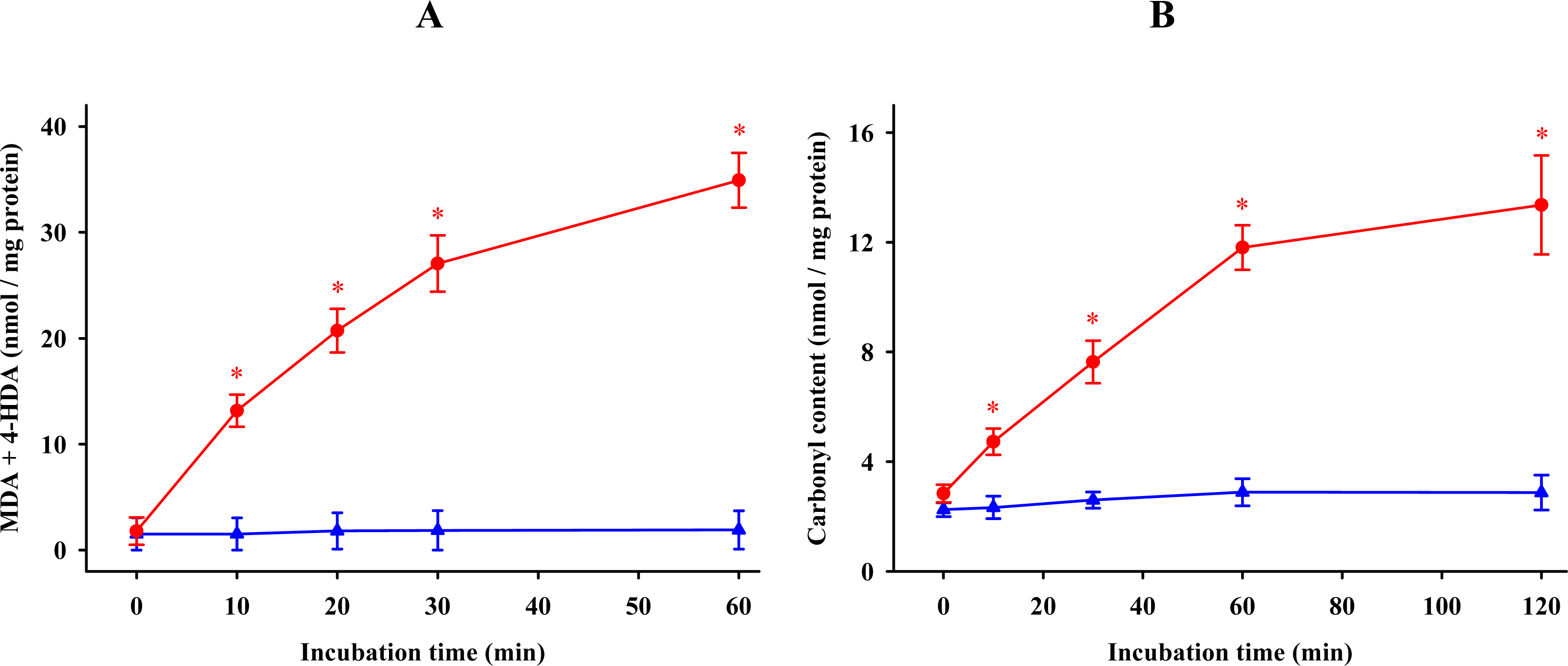
<fig id="f2-ijms-11-00312" position="float">
<label>Figure 2.</label>
<caption>
<p>The effects of tryptophan (A) or 5-hydroxy-tryptophan (B) concentrations on FeCl<sub>3</sub> and ascorbic acid-induced lipid (<inline-graphic xlink:href="ijms-11-00312i1.gif"/>) and protein (<inline-graphic xlink:href="ijms-11-00312i2.gif"/>) oxidations in synaptosomes isolated from rat brains. The incubation time was 30 min for lipid peroxidation and 1 h for protein oxidation. Both indoleamines are expressed as the logarithm of its molar concentration. Results are given as means ± SE (n = 6) and are expressed as a percentage of control membrane preparations. * <italic>P</italic> &lt; 0.05 <italic>vs</italic>. membranes treated only with FeCl<sub>3</sub> and ascorbic acid.</p></caption><graphic xlink:href="ijms-11-00312f2.gif"/></fig>
<fig id="f3-ijms-11-00312" position="float">
<label>Figure 3.</label>
<caption>
<p>Percent-inhibition curves of concentrations of 5-methoxytryptamine (A), <italic>N</italic>-acetylserotonin (B), and tryptamine (C) in reducing FeCl<sub>3</sub> and ascorbic acid-induced lipid (<inline-graphic xlink:href="ijms-11-00312i1.gif"/>) and protein (<inline-graphic xlink:href="ijms-11-00312i2.gif"/>) oxidations in synaptosomal membranes. 5-methoxytryptamine, <italic>N</italic>-acetylserotonin and tryptamine are expressed as a logarithm of its molar concentration. Results are given as means ± SE (n = 6) and are normalized with respect to control membrane preparations that were not exposed to oxidative conditions. * <italic>P</italic> &lt; 0.05 <italic>vs</italic>. membranes treated only with FeCl<sub>3</sub> and ascorbic acid.</p></caption><graphic xlink:href="ijms-11-00312f3a.gif"/><graphic xlink:href="ijms-11-00312f3b.gif"/></fig>
<fig id="f4-ijms-11-00312" position="float">
<label>Figure 4.</label>
<caption>
<p>The ability of melatonin to decrease synaptosomal lipid and protein oxidations. (<inline-graphic xlink:href="ijms-11-00312i1.gif"/>) MDA + 4-HDA concentrations; (<inline-graphic xlink:href="ijms-11-00312i2.gif"/>) carbonyl contents. Melatonin is expressed as the logarithm of its molar concentration. Values are means ± SE (n = 6) and are expressed relative to comparable control membrane preparations. * <italic>P</italic> &lt; 0.05 <italic>vs.</italic> membranes treated exclusively with FeCl<sub>3</sub> and ascorbic acid.</p></caption><graphic xlink:href="ijms-11-00312f4.gif"/></fig>
<fig id="f5-ijms-11-00312" position="float">
<label>Figure 5.</label>
<caption>
<p>Inhibition of lipid (<inline-graphic xlink:href="ijms-11-00312i1.gif"/>) and protein (<inline-graphic xlink:href="ijms-11-00312i2.gif"/>) oxidation by 5-methoxytryptophol (A) or 5-methoxy-3-indoleacetic acid (B) induced by FeCl<sub>3</sub> and ascorbic acid. The concentrations of these indoleamines are expressed as the decimal logarithm of its molar concentration. Percentage inhibitions are shown as means ± SE (n = 6) and are expressed relative to control membrane preparations. * <italic>P</italic> &lt; 0.05 <italic>vs</italic> membranes treated only with FeCl<sub>3</sub> and ascorbic acid.</p></caption><graphic xlink:href="ijms-11-00312f5.gif"/></fig>
<fig id="f6-ijms-11-00312" position="float">
<label>Figure 6.</label>
<caption>
<p>Response of tryptoline (A) or pinoline (B) in preserving synaptosomes from lipid (<inline-graphic xlink:href="ijms-11-00312i1.gif"/>) and protein (<inline-graphic xlink:href="ijms-11-00312i2.gif"/>) oxidation after oxidative stress. The concentrations of these β-carbolines are expressed as the decimal logarithm of its molar concentration. Values are means ± SE (n = 6) and are expressed relative to control synaptosome preparations. * <italic>P</italic> &lt; 0.05 <italic>vs</italic> membranes treated exclusively with FeCl<sub>3</sub> and ascorbic acid.</p></caption><graphic xlink:href="ijms-11-00312f6.gif"/></fig>
<table-wrap id="t1-ijms-11-00312" position="float">
<label>Table 1.</label>
<caption>
<p>Calculated concentrations (mM) required to inhibit lipid and protein oxidation by a 50% (IC<sub>50</sub>) in preventing lipid and protein oxidation in synaptosomal membranes exposed to FeCl<sub>3</sub> and ascorbic acid.</p></caption>
<table frame="hsides" rules="groups">
<thead>
<tr>
<th valign="bottom" align="left"><bold>Substance (n = 6)</bold></th>
<th valign="bottom" align="center"><bold>Lipid peroxidation</bold></th>
<th valign="bottom" align="center"><bold>Protein oxidation</bold></th></tr></thead>
<tbody>
<tr>
<td valign="top" align="left">Tryptophan</td>
<td valign="top" align="center">-</td>
<td valign="top" align="center">2.92</td></tr>
<tr>
<td valign="top" align="left">5-Hydroxytryptophan</td>
<td valign="top" align="center">3.05</td>
<td valign="top" align="center">1.01</td></tr>
<tr>
<td valign="top" align="left">5-Methoxytryptamine</td>
<td valign="top" align="center">0.31</td>
<td valign="top" align="center">3.40</td></tr>
<tr>
<td valign="top" align="left"><italic>N</italic>-acetylserotonin</td>
<td valign="top" align="center">0.42</td>
<td valign="top" align="center">0.65</td></tr>
<tr>
<td valign="top" align="left">Tryptamine</td>
<td valign="top" align="center">0.84</td>
<td valign="top" align="center">3.96</td></tr>
<tr>
<td valign="top" align="left">Melatonin</td>
<td valign="top" align="center">1.75</td>
<td valign="top" align="center">1.40</td></tr>
<tr>
<td valign="top" align="left">5-Methoxy-3-indoleacetic acid</td>
<td valign="top" align="center">-</td>
<td valign="top" align="center">-</td></tr>
<tr>
<td valign="top" align="left">5-Methoxytryptophol</td>
<td valign="top" align="center">1.75</td>
<td valign="top" align="center">0.76</td></tr>
<tr>
<td valign="top" align="left">Tryptoline</td>
<td valign="top" align="center">1.49</td>
<td valign="top" align="center">0.63</td></tr>
<tr>
<td valign="top" align="left">Pinoline</td>
<td valign="top" align="center">0.15</td>
<td valign="top" align="center">0.25</td></tr></tbody></table></table-wrap></sec></back></article>