
<?xml version="1.0" encoding="UTF-8"?>
<!DOCTYPE article PUBLIC "-//NLM//DTD Journal Publishing DTD v2.3 20070202//EN" "journalpublishing.dtd">
<article xmlns:xlink="http://www.w3.org/1999/xlink" xml:lang="en" article-type="research-article">
<front>
<journal-meta>
<journal-id journal-id-type="publisher-id">ijms</journal-id>
<journal-title>International Journal of Molecular Sciences</journal-title>
<abbrev-journal-title>Int. J. Mol. Sci.</abbrev-journal-title>
<issn pub-type="epub">1422-0067</issn>
<publisher>
<publisher-name>Molecular Diversity Preservation International (MDPI)</publisher-name></publisher></journal-meta>
<article-meta>
<article-id pub-id-type="doi">10.3390/ijms10083269</article-id>
<article-id pub-id-type="publisher-id">ijms-10-03269</article-id>
<article-categories>
<subj-group>
<subject>Article</subject></subj-group></article-categories>
<title-group>
<article-title>Characterization of the <italic>Sesbania rostrata</italic> Phytochelatin Synthase Gene: Alternative Splicing and Function of Four Isoforms</article-title></title-group>
<contrib-group>
<contrib contrib-type="author">
<name><surname>Li</surname><given-names>An-Ming</given-names></name><xref ref-type="aff" rid="af1-ijms-10-03269">1</xref><xref ref-type="fn" rid="fn1-ijms-10-03269">#</xref></contrib>
<contrib contrib-type="author">
<name><surname>Yu</surname><given-names>Bing-Yun</given-names></name><xref ref-type="aff" rid="af1-ijms-10-03269">1</xref><xref ref-type="fn" rid="fn1-ijms-10-03269">#</xref></contrib>
<contrib contrib-type="author">
<name><surname>Chen</surname><given-names>Fu-Hua</given-names></name><xref ref-type="aff" rid="af1-ijms-10-03269">1</xref><xref ref-type="fn" rid="fn1-ijms-10-03269">#</xref></contrib>
<contrib contrib-type="author">
<name><surname>Gan</surname><given-names>Hui-Yan</given-names></name><xref ref-type="aff" rid="af1-ijms-10-03269">1</xref></contrib>
<contrib contrib-type="author">
<name><surname>Yuan</surname><given-names>Jian-Gang</given-names></name><xref ref-type="aff" rid="af1-ijms-10-03269">1</xref></contrib>
<contrib contrib-type="author">
<name><surname>Qiu</surname><given-names>Rongliang</given-names></name><xref ref-type="aff" rid="af3-ijms-10-03269">3</xref></contrib>
<contrib contrib-type="author">
<name><surname>Huang</surname><given-names>Jun-Chao</given-names></name><xref ref-type="aff" rid="af4-ijms-10-03269">4</xref></contrib>
<contrib contrib-type="author">
<name><surname>Yang</surname><given-names>Zhong-Yi</given-names></name><xref ref-type="aff" rid="af1-ijms-10-03269">1</xref><xref ref-type="corresp" rid="c1-ijms-10-03269">*</xref></contrib>
<contrib contrib-type="author">
<name><surname>Xu</surname><given-names>Zeng-Fu</given-names></name><xref ref-type="aff" rid="af1-ijms-10-03269">1</xref><xref ref-type="aff" rid="af2-ijms-10-03269">2</xref><xref ref-type="corresp" rid="c1-ijms-10-03269">*</xref></contrib></contrib-group>
<aff id="af1-ijms-10-03269">
<label>1</label> State Key Laboratory of Biocontrol and Key Laboratory of Gene Engineering of the Ministry of Education, School of Life Sciences, Sun Yat-sen University, Guangzhou 510275, China; E-Mails:
<email>lsahmp68@yahoo.com.cn</email> (A.M.L.);
<email>ybyun96@yahoo.com.cn</email> (B.Y.Y.);
<email>cyy-gz@163.com</email> (F.H.C.);
<email>incredibly861@163.com</email> (H.Y.G.);
<email>yjgstorm@163.com</email> (J.G.Y.)</aff>
<aff id="af2-ijms-10-03269">
<label>2</label> Laboratory of Molecular Breeding of Energy Plants, Xishuangbanna Tropical Botanical Garden, Chinese Academy of Sciences, Kunming 650223, Yunnan, China</aff>
<aff id="af3-ijms-10-03269">
<label>3</label> School of Environmental Science and Engineering, Sun Yat-sen University, Guangzhou 510275, China; E-Mail:
<email>eesqrl@mail.sysu.edu.cn</email> (R.L.Q.)</aff>
<aff id="af4-ijms-10-03269">
<label>4</label> School of Biological Sciences, The University of Hong Kong, Pokfulam Road, Hong Kong, China; E-Mail:
<email>drjunchao@yahoo.com</email> (J.C.H.)</aff>
<author-notes><fn id="fn1-ijms-10-03269">
<label>#</label>
<p>These authors contributed equally to this work</p></fn>
<corresp id="c1-ijms-10-03269">
<label>*</label>Authors to whom correspondence should be addressed; E-Mails:
<email>zengfu.xu@gmail.com</email> (Z.-F.X.);
<email>adsyzy@mail.sysu.edu.cn</email> (Z.-Y.Y.); Tel. +86-20-8411-2516 (Z.-F.X.); +86-20-8411-2008 (Z.-Y.Y.); Fax: +86-20-8403-6551 (Z.-F.X.); +86-20-8403-6215 (Z.-Y.Y.)</corresp></author-notes>
<pub-date pub-type="collection">
<month>8</month>
<year>2009</year></pub-date>
<pub-date pub-type="epub">
<day>24</day>
<month>7</month>
<year>2009</year></pub-date>
<volume>10</volume>
<issue>8</issue>
<fpage>3269</fpage>
<lpage>3282</lpage>
<history>
<date date-type="received">
<day>5</day>
<month>6</month>
<year>2009</year></date>
<date date-type="rev-recd">
<day>7</day>
<month>7</month>
<year>2009</year></date>
<date date-type="accepted">
<day>17</day>
<month>7</month>
<year>2009</year></date></history>
<permissions>
<copyright-statement>© 2009 by the authors; licensee Molecular Diversity Preservation International, Basel, Switzerland.</copyright-statement>
<copyright-year>2009</copyright-year>
<license license-type="open-access" xlink:href="http://creativecommons.org/licenses/by/3.0">
<p>This article is an open-access article distributed under the terms and conditions of the Creative Commons Attribution license (http://creativecommons.org/licenses/by/3.0/).</p></license></permissions>
<abstract>
<p>Phytochelatins (PCs) play an important role in detoxification of heavy metals in plants. PCs are synthesized from glutathione by phytochelatin synthase (PCS), a dipeptidyltransferase. <italic>Sesbania rostrata</italic> is a tropical legume plant that can tolerate high concentrations of Cd and Zn. In this study, the <italic>S. rostrata</italic> PCS gene (<italic>SrPCS</italic>) and cDNAs were isolated and characterized. Southern blot and sequence analysis revealed that a single copy of the <italic>SrPCS</italic> gene occurs in the <italic>S. rostrata</italic> genome, and produces four different <italic>SrPCS</italic> mRNAs and proteins, SrPCS1–SrPCS4, by alternative splicing of the <italic>SrPCS</italic> pre-mRNA. The SrPCS1 and SrPCS3 proteins conferred Cd tolerance when expressed in yeast cells, whereas the SrPCS2 and SrPCS4 proteins, which lack the catalytic triad and the N-terminal domains, did not. These results suggested that SrPCS1 and SrPCS3 have potential applications in genetic engineering of plants for enhancing heavy metal tolerance and phytoremediation of contaminated soils.</p></abstract>
<kwd-group>
<kwd>alternative splicing</kwd>
<kwd>heavy metal tolerance</kwd>
<kwd>phytochelatin</kwd>
<kwd>phytochelatin synthase</kwd>
<kwd>phytoremediation</kwd>
<kwd>Sesbania rostrata</kwd></kwd-group></article-meta></front>
<body>
<sec sec-type="intro">
<label>1.</label>
<title>Introduction</title>
<p>Phytochelatins (PCs) have been found in all plant species investigated, a few fungal species and some marine diatoms [<xref ref-type="bibr" rid="b1-ijms-10-03269">1</xref>]. PCs can act as high affinity metal chelators and facilitate the vacuolar sequestration of heavy metals, especially Cd<sup>2+</sup> ions, and hence play in the plant kingdom an important role in detoxification of some heavy metals [<xref ref-type="bibr" rid="b2-ijms-10-03269">2</xref>,<xref ref-type="bibr" rid="b3-ijms-10-03269">3</xref>]. PCs have the general structure (γ-Glu-Cys)<sub>n</sub>-Gly, where n has been reported to be as high as 11, but generally ranges from 2 to 5 [<xref ref-type="bibr" rid="b4-ijms-10-03269">4</xref>]; they are synthesized posttranslationally in the presence of heavy metal ions from glutathione (GSH) by PC synthase (PCS), a γ-glutamyl-cysteine transpeptidase [<xref ref-type="bibr" rid="b5-ijms-10-03269">5</xref>]. So far, four different models for the catalytic mechanism of PCS have been proposed [<xref ref-type="bibr" rid="b5-ijms-10-03269">5</xref>–<xref ref-type="bibr" rid="b10-ijms-10-03269">10</xref>], although a consistent model that clearly demonstrates how PCS is activated and how PCs are synthesized has not been established. Alignment of PCS protein sequences reveals a high degree of similarity in the N-terminal domain, whereas the C-terminal domain which turns out to be extremely variable, is missing in the prokaryotic PCS proteins [<xref ref-type="bibr" rid="b11-ijms-10-03269">11</xref>,<xref ref-type="bibr" rid="b12-ijms-10-03269">12</xref>]. The N-terminal core domain of PCS, which can be referred to the catalytic domain sufficient to confer a PCS activity, has been confirmed by limited proteolysis and mutant analyses [<xref ref-type="bibr" rid="b6-ijms-10-03269">6</xref>,<xref ref-type="bibr" rid="b8-ijms-10-03269">8</xref>,<xref ref-type="bibr" rid="b11-ijms-10-03269">11</xref>,<xref ref-type="bibr" rid="b13-ijms-10-03269">13</xref>]. The variable C-terminal region was shown to ensure higher PCS activity, enhance protein stability and respond to a broader spectrum of heavy metals [<xref ref-type="bibr" rid="b11-ijms-10-03269">11</xref>]. The stereostructure of the PCS from the cyanobacterium <italic>Nostoc</italic> sp. PCC7120 (NsPCS) in its native and γ-Glu-Cys-acylated condition was reported [<xref ref-type="bibr" rid="b14-ijms-10-03269">14</xref>]. This study represented the first crystal structure of a PCS and established that prokaryotic NsPCS and the eukaryotic <italic>Arabidopsis thaliana</italic> PC synthase1 (AtPCS1) belong to the papain superfamily of cysteine proteases, with a conserved catalytic machinery that had been deduced from kinetic, protein chemical, and site mutagenic studies of the prototypical AtPCS1 [<xref ref-type="bibr" rid="b8-ijms-10-03269">8</xref>,<xref ref-type="bibr" rid="b10-ijms-10-03269">10</xref>,<xref ref-type="bibr" rid="b15-ijms-10-03269">15</xref>].</p>
<p>PCS genes have been cloned and characterized in <italic>Arabidopsis thaliana</italic> (AtPCS1, [<xref ref-type="bibr" rid="b3-ijms-10-03269">3</xref>,<xref ref-type="bibr" rid="b16-ijms-10-03269">16</xref>]), <italic>Schizosaccharomyces pompe</italic> (SpPCS, [<xref ref-type="bibr" rid="b17-ijms-10-03269">17</xref>]), <italic>Triticum aestivum</italic> (TaPCS1, [<xref ref-type="bibr" rid="b6-ijms-10-03269">6</xref>]), <italic>Lotus japonicus</italic> (LjPCS, [<xref ref-type="bibr" rid="b18-ijms-10-03269">18</xref>–<xref ref-type="bibr" rid="b20-ijms-10-03269">20</xref>], the model nematode <italic>Caenorhabditis elegans</italic> (CePCS1, [<xref ref-type="bibr" rid="b21-ijms-10-03269">21</xref>,<xref ref-type="bibr" rid="b22-ijms-10-03269">22</xref>]) and the prokaryote <italic>Nostoc</italic> sp. PCC7120 (NsPCS, [<xref ref-type="bibr" rid="b8-ijms-10-03269">8</xref>,<xref ref-type="bibr" rid="b12-ijms-10-03269">12</xref>]). It has been proposed that PCS is a constitutive enzyme in general and its gene expression is not induced in response to heavy metal exposure [<xref ref-type="bibr" rid="b23-ijms-10-03269">23</xref>]. This proposal was supported by the analysis of <italic>AtPCS1</italic> expression, which showed that the level of <italic>AtPCS1</italic> mRNA was unchanged on exposure to heavy metals such as Cd, Zn, or Cu, or to oxidative stress, salt stress, jasmonic acid or salicylic acid [<xref ref-type="bibr" rid="b6-ijms-10-03269">6</xref>,<xref ref-type="bibr" rid="b10-ijms-10-03269">10</xref>,<xref ref-type="bibr" rid="b24-ijms-10-03269">24</xref>]. During the early stages of plant development, however, the steady-state level of <italic>AtPCS1</italic> mRNA increased by 2-fold in 5-day-old Cd-treated <italic>Arabidopsis</italic> compared to non-treated seedlings [<xref ref-type="bibr" rid="b25-ijms-10-03269">25</xref>]. Clemens <italic>et al</italic>. [<xref ref-type="bibr" rid="b17-ijms-10-03269">17</xref>] found that the level of <italic>TaPCS1</italic> in wheat roots treated with 100 μM Cd<sup>2+</sup> was 5- to 10-fold higher than those of untreated roots. These studies indicated that in specific organs and developmental stages of plants, in which a strong defense against exposure to toxic heavy metals is required, the expression of the <italic>PCS</italic> genes may be regulated in response to heavy metals.</p>
<p><italic>Sesbania rostrata</italic>, a legume native to tropical West Africa, is an annual species that bears stem nodules as well as root nodules associated with <italic>Azorhizobium caulinodans</italic>, a specialized fast-growing strain of <italic>Rhizobia</italic> that can fix nitrogen in its free-living form [<xref ref-type="bibr" rid="b26-ijms-10-03269">26</xref>]. Yang <italic>et al</italic>. [<xref ref-type="bibr" rid="b27-ijms-10-03269">27</xref>] found that <italic>S. rostrata</italic> can tolerate some heavy metals, especially Zn and Cd. To understand the mechanism of heavy metal tolerance in <italic>S. rostrata</italic>, in this study the corresponding PCS gene and its cDNAs were isolated and characterized.</p></sec>
<sec sec-type="results|discussion">
<label>2.</label>
<title>Results and Discussion</title>
<sec sec-type="methods">
<label>2.1.</label>
<title>Cloning and Sequence Analysis of PCS cDNAs and Gene from S. rostrata</title>
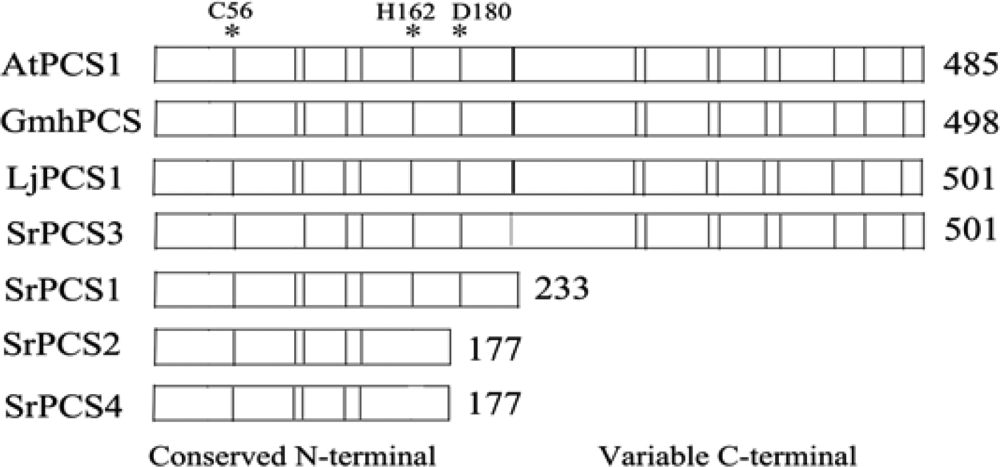
<p>Based on the conserved sequence of the known plant PCS proteins, four full-length cDNA clones encoding PCS in <italic>S. rostrata</italic>, designated <italic>SrPCS1</italic> (GenBank accession no. DQ010916), <italic>SrPCS2</italic> (GenBank accession no. GQ204308), <italic>SrPCS3</italic> (GenBank accession no. GQ204309) and <italic>SrPCS4</italic> (GenBank accession no. GQ204310), were isolated by RT-PCR amplification of conserved cDNA sequences combined with 3′ and 5′-rapid amplification of cDNA ends (RACE). The calculated molecular masses from the deduced amino acid sequences of <italic>SrPCS1, SrPCS2, SrPCS3</italic> and <italic>SrPCS4</italic> are 26 kD, 19.8 kD, 55.8 kD, and 19.9 kD, respectively (<xref ref-type="fig" rid="f1-ijms-10-03269">Figure 1</xref>).</p>
<p>Among the four <italic>SrPCS</italic> cDNAs, the ORF of <italic>SrPCS3</italic> is the longest one; its amino acid sequence shares 65% identity to <italic>Arabidopsis</italic> AtPCS1 [<xref ref-type="bibr" rid="b16-ijms-10-03269">16</xref>], 87% identity to soybean GmhPCS1 [<xref ref-type="bibr" rid="b7-ijms-10-03269">7</xref>] and 87% identity to <italic>L. japonicus</italic> LjPCS1 [<xref ref-type="bibr" rid="b18-ijms-10-03269">18</xref>]. The identity of SrPCS3 with SrPCS1, SrPCS2 and SrPCS4 is 97.9%, 87.6% and 88.1%, respectively. The N-terminal domains of SrPCS3 and SrPC1, but not SrPCS2 and SrPCS4, contain a catalytic triad of Cys-56, His-162 and Asp-180 (<xref ref-type="fig" rid="f1-ijms-10-03269">Figure 1</xref>), which is essential for the activity [<xref ref-type="bibr" rid="b9-ijms-10-03269">9</xref>,<xref ref-type="bibr" rid="b10-ijms-10-03269">10</xref>,<xref ref-type="bibr" rid="b13-ijms-10-03269">13</xref>,<xref ref-type="bibr" rid="b14-ijms-10-03269">14</xref>].</p>
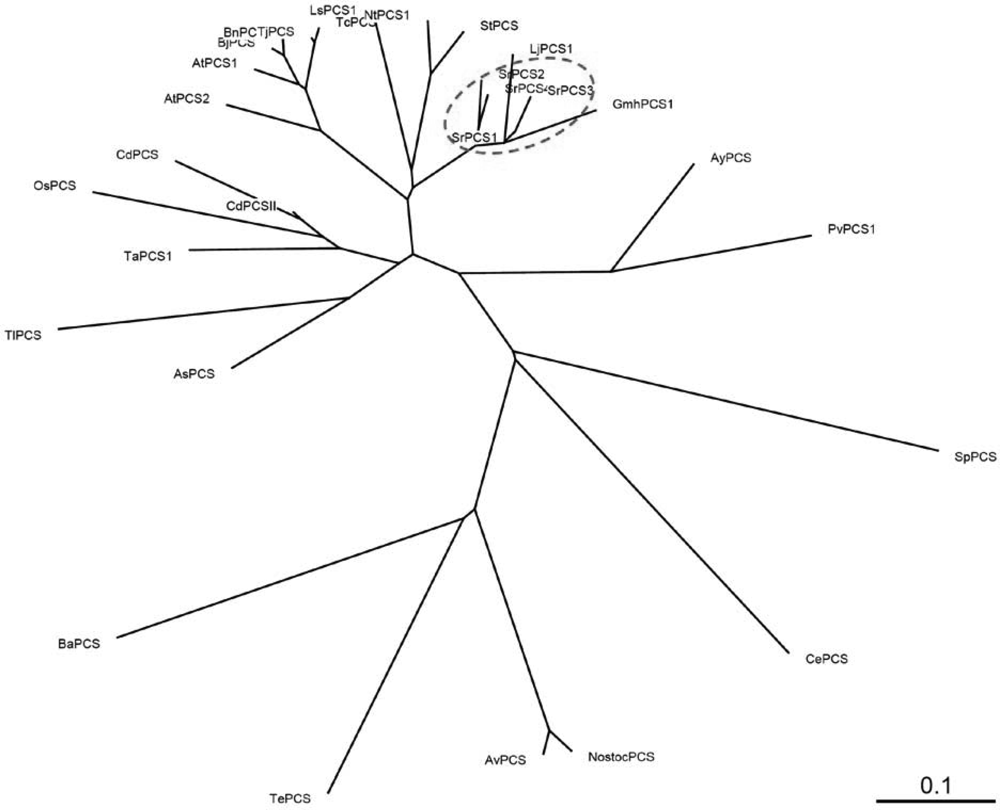
<p>An unrooted phylogenetic tree (<xref ref-type="fig" rid="f2-ijms-10-03269">Figure 2</xref>) was constructed including the majority of the predicted PCS sequences available in the databases. The tree revealed separate clusters, paralleling taxonomic distance, for the PCSs of cyanobacteria, nematodes, yeast, ferns, and the families of vascular plants Poaceae, Allaceae-Typhaceae, Solanaceae, Brassicaceae, and Leguminosae. As shown in <xref ref-type="fig" rid="f2-ijms-10-03269">Figure 2</xref>, SrPCS proteins (in red dashed ellipse of <xref ref-type="fig" rid="f2-ijms-10-03269">Figure 2</xref>) are highly homologous to leguminous soybean GmPCS [<xref ref-type="bibr" rid="b7-ijms-10-03269">7</xref>] and <italic>Lotus</italic> LjPCS1 [<xref ref-type="bibr" rid="b18-ijms-10-03269">18</xref>]. The structure and function of <italic>PCS</italic> genes have only been studied in detail in the model plant <italic>Arabidopsis</italic>. Two functional PCS genes, <italic>AtPCS1</italic> and <italic>AtPCS2</italic>, which are localized in different chromosomes (At5g44070 and Atlg03980), were found in <italic>Arabidopsis</italic> [<xref ref-type="bibr" rid="b6-ijms-10-03269">6</xref>,<xref ref-type="bibr" rid="b10-ijms-10-03269">10</xref>,<xref ref-type="bibr" rid="b17-ijms-10-03269">17</xref>,<xref ref-type="bibr" rid="b24-ijms-10-03269">24</xref>]. In order to study the structure of <italic>S. rostrata</italic> PCS gene (<italic>SrPCS</italic>), we cloned the genomic sequence of <italic>SrPCS</italic> from the genomic DNA of <italic>S. rostrata</italic> by genome walking [<xref ref-type="bibr" rid="b28-ijms-10-03269">28</xref>] with primers based on the conserved sequence of <italic>SrPCS1-4</italic> cDNAs. Unexpectedly, only a 5,112-bp genomic DNA fragment of <italic>SrPCS</italic> (GenBank accession no. GQ204307) was obtained.</p></sec>
<sec>
<label>2.2.</label>
<title>Genomic Organization and Pre-mRNA Splicing of SrPCS Gene</title>
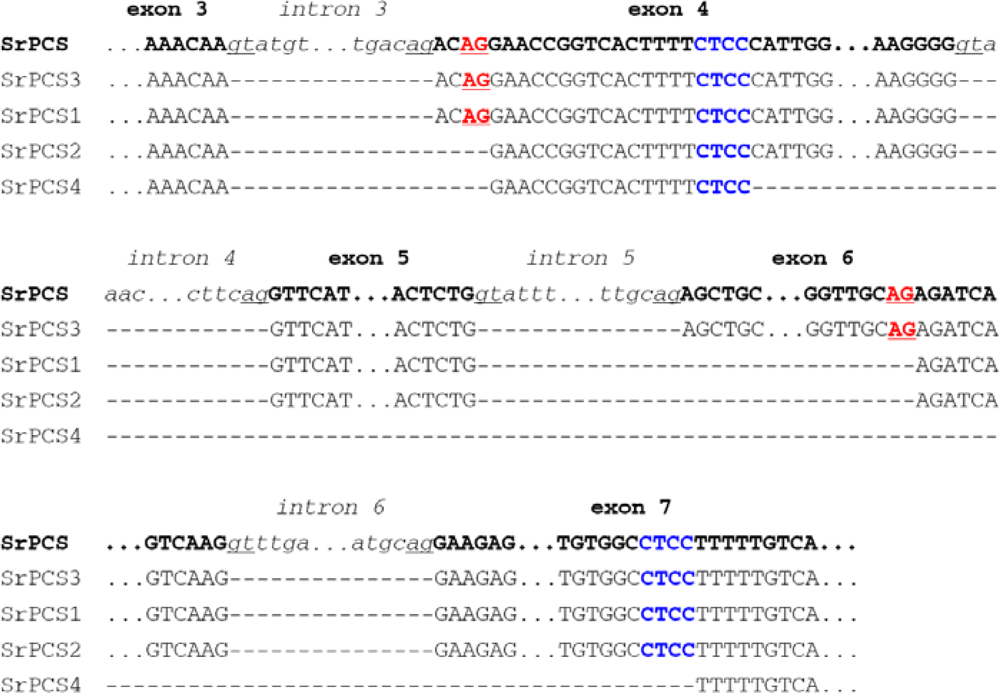
<p>Alignment of the genomic sequence of <italic>SrPCS</italic> with those of four cDNA sequences of <italic>SrPCS1-4</italic> revealed that all four mRNAs (<italic>SrPCS1-SrPCS4</italic>) were produced from the one <italic>SrPCS</italic> gene through alternative splicing (<xref ref-type="fig" rid="f3-ijms-10-03269">Figure 3</xref>).</p>
<p>By comparing with the sequence of the canonically spliced form <italic>SrPCS3</italic> mRNA, eight exons and seven introns were found in <italic>SrPCS</italic> gene. As shown in <xref ref-type="fig" rid="f3-ijms-10-03269">Figure 3</xref>, <italic>SrPCS1</italic> and <italic>SrPCS2</italic> are generated through alternative AG acceptor splice sites. And the <italic>SrPCS4</italic> is produced by atypical splice mechanism employing direct repeats at splice sites (CTCC, <xref ref-type="fig" rid="f3-ijms-10-03269">Figure 3</xref>), which is similar to the atypical mRNA processing of p53 transcripts in the human brain [<xref ref-type="bibr" rid="b29-ijms-10-03269">29</xref>].</p>
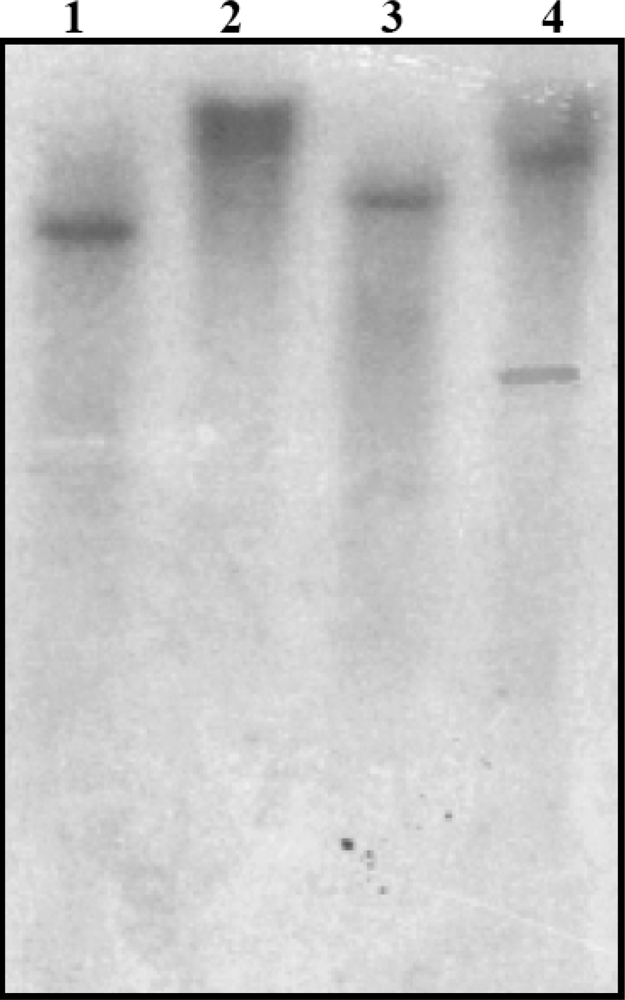
<p>The presence of a single copy of the <italic>SrPCS</italic> gene in <italic>S. rostrata</italic> genome was further confirmed by Southern blot analysis (<xref ref-type="fig" rid="f4-ijms-10-03269">Figure 4</xref>). Only a single hybridizing band was detected in DNA samples digested with either <italic>Eco</italic>RI, <italic>Bam</italic>HI or <italic>Xba</italic>I, which do not cut within the probe region (<xref ref-type="fig" rid="f4-ijms-10-03269">Figure 4, lane 1–3</xref>). When the genomic DNA was digested with <italic>Pst</italic>I that cut once within the probe region, two hybridizing bands were observed (<xref ref-type="fig" rid="f4-ijms-10-03269">Figure 4, lane 4</xref>). These results indicate that the <italic>S. rostrata</italic> genome contains only a single copy of the <italic>SrPCS</italic> gene.</p></sec>
<sec sec-type="methods">
<label>2.3.</label>
<title>Expression Analysis of SrPCS Gene</title>
<p>Alternative splicing of pre-mRNA is often regulated by specific factors in response to developmental or environmental cues [<xref ref-type="bibr" rid="b30-ijms-10-03269">30</xref>–<xref ref-type="bibr" rid="b32-ijms-10-03269">32</xref>]. To find out whether the alternative splicing of <italic>SrPCS</italic> pre-mRNA is regulated by heavy metals, we investigated <italic>SrPCS</italic> expression in plants in the presence and absence of Cd<sup>2+</sup>. As in wheat [<xref ref-type="bibr" rid="b17-ijms-10-03269">17</xref>] and <italic>Brassica juncea</italic> [<xref ref-type="bibr" rid="b33-ijms-10-03269">33</xref>] plants, <italic>SrPCS1</italic>–<italic>SrPCS4</italic> mRNA expression was very low and could not be detected by RNA blot analysis of total RNA from different organs of <italic>S. rostrata</italic>. Therefore a more sensitive real time-PCR method was used to estimate the abundance of <italic>SrPCS</italic> transcripts. Unfortunately, because of very high sequence similarity of the four <italic>SrPCS</italic> mRNA, only specific primers for <italic>SrPCS3</italic> can be designed for real time-PCR analysis.</p>
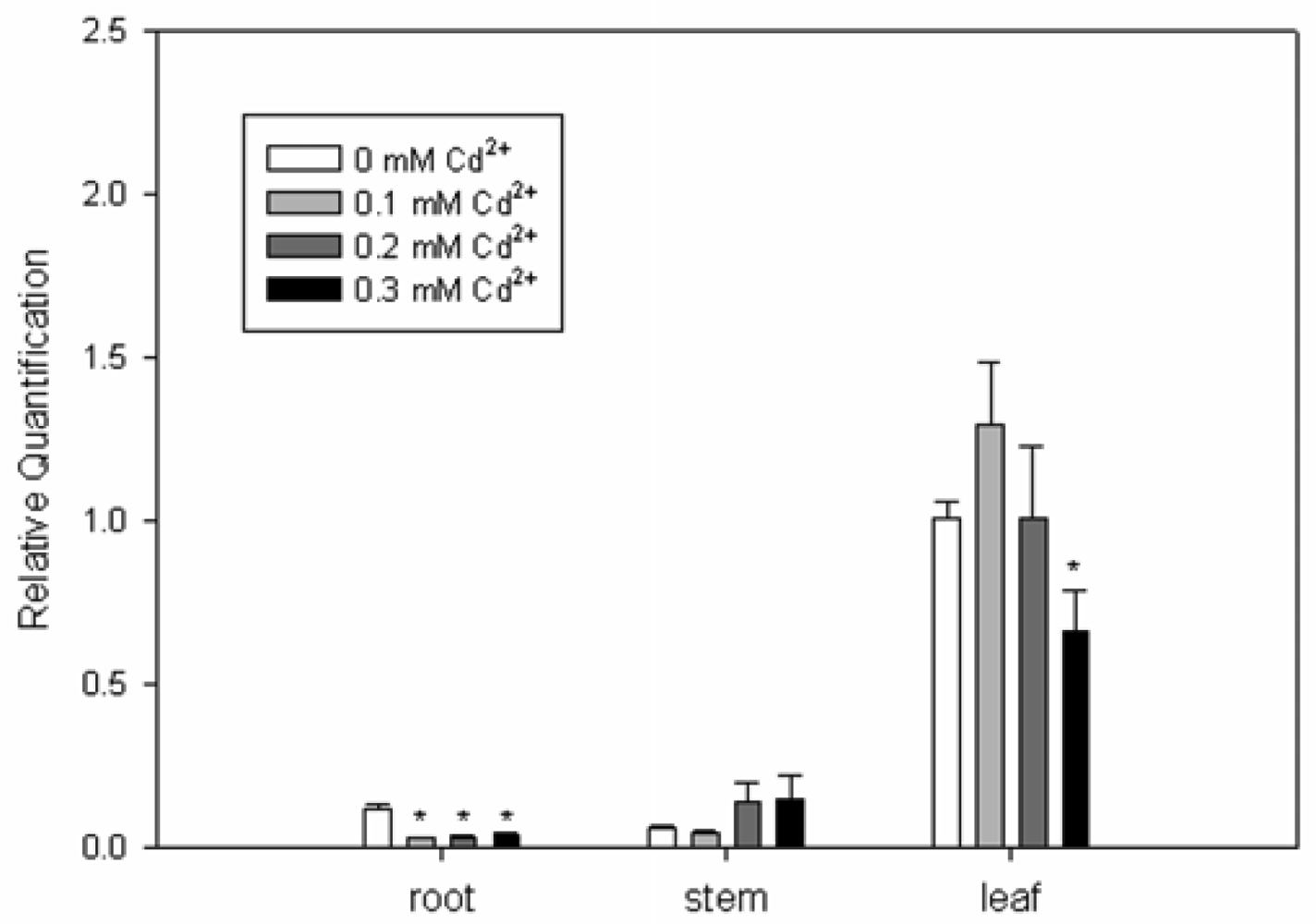
<p>Unlike in Arabidopsis and <italic>Brassica juncea</italic>, where higher amounts of Arabidopsis <italic>AtPCS1</italic> transcript [<xref ref-type="bibr" rid="b6-ijms-10-03269">6</xref>] and <italic>B. juncea</italic> BjPCS1 protein [<xref ref-type="bibr" rid="b33-ijms-10-03269">33</xref>] were detected in roots than in leaves, <italic>SrPCS3</italic> is more highly expressed in the leaves than roots and stems under normal growth conditions without Cd<sup>2+</sup> treatment (<xref ref-type="fig" rid="f5-ijms-10-03269">Figure 5</xref>). <italic>SrPCS3</italic> expression was significantly reduced in roots after exposure to different concentration of Cd<sup>2+</sup> for 24 hours. No significant change of <italic>SrPCS3</italic> expression was observed in stems, whereas <italic>SrPCS3</italic> expression was also significantly down-regulated in leaves by 0.3 mM Cd<sup>2+</sup> treatment. These observations are contrary to <italic>TaPCS1</italic> from wheat [<xref ref-type="bibr" rid="b17-ijms-10-03269">17</xref>] and <italic>LjPCSs</italic> from the model legume <italic>Lotus japonicus</italic> [<xref ref-type="bibr" rid="b18-ijms-10-03269">18</xref>]. Clemens <italic>et al</italic>. [<xref ref-type="bibr" rid="b17-ijms-10-03269">17</xref>] found that <italic>TaPCS1</italic> showed a 5- to 10-fold higher expression in wheat roots treated with 0.1 mM Cd<sup>2+</sup> for 6 h. Ramos <italic>et al</italic>. [<xref ref-type="bibr" rid="b18-ijms-10-03269">18</xref>] investigated the expression of three PCS genes in roots of <italic>L. japonicus</italic>, and found that the mRNA expression of <italic>LjPCS1-8R</italic> increased only slightly (2.1-fold) after 6 h of 0.1 mM Cd<sup>2+</sup> treatment, whereas the mRNA levels of <italic>LjPC2-7R</italic> and <italic>LjPCS3-7N</italic> increased 2.3- to 2.9-fold and 2.5- to 3.5-fold between 6 and 96 h, respectively.</p></sec>
<sec>
<label>2.4.</label>
<title>Functionality of Four SrPCS Isoforms SrPCS1–SrPCS4</title>
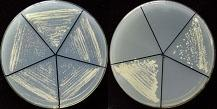
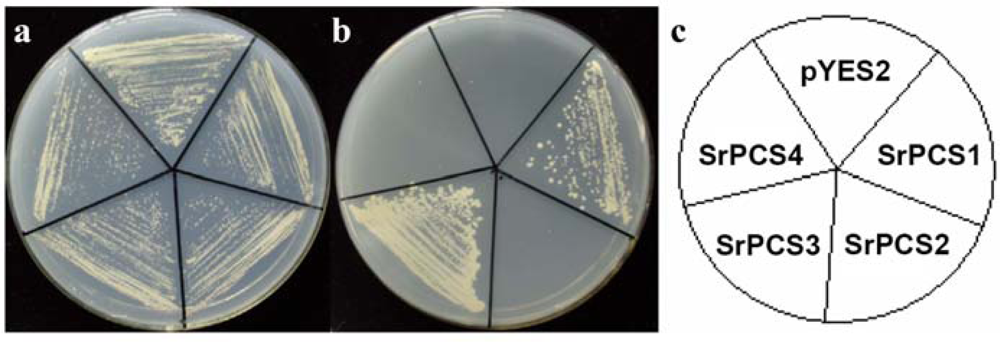
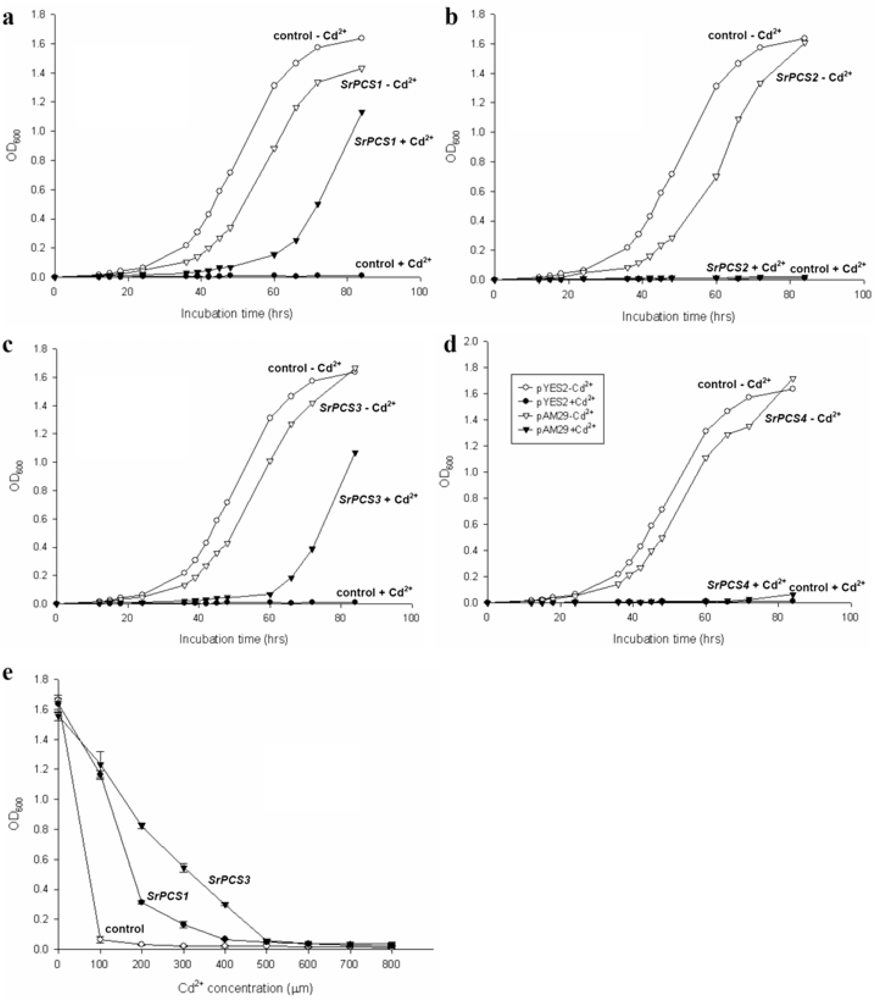
<p>To test the functionality of four <italic>SrPCS</italic> isoforms, the full-length cDNAs of <italic>SrPCS1–SrPCS4</italic> were expressed in <italic>S. cerevisiae</italic> under the control of the inducible pGAL1 promoter. Cd tolerance assay showed that <italic>S. cerevisiae</italic> cells expressing <italic>SrPCS1</italic> or <italic>SrPCS3</italic>, but not <italic>SrPCS2</italic> and <italic>SrPCS4</italic>, exhibited strong tolerance to Cd<sup>2+</sup> (600 μM), which completely inhibited the growth of cells transformed with the empty pYES2 plasmid or cells expressing <italic>SrPCS2</italic> or <italic>SrPCS4</italic> (<xref ref-type="fig" rid="f6-ijms-10-03269">Figure 6</xref>). Growth curve experiments (<xref ref-type="fig" rid="f7-ijms-10-03269">Figure 7, a–d</xref>) also demonstrated that expression of <italic>SrPCS1</italic> and <italic>SrPCS3</italic> conferred enhanced Cd tolerance to yeast cells (<xref ref-type="fig" rid="f7-ijms-10-03269">Figure 7, a and c</xref>), whereas the expression of <italic>SrPCS2</italic> and <italic>SrPCS4</italic> did not make yeast cells more Cd tolerant (<xref ref-type="fig" rid="f7-ijms-10-03269">Figure 7, b and d</xref>).</p>
<p>Dose-response analyses showed that <italic>SrPCS3</italic>-expressing yeast cells tolerated higher Cd<sup>2+</sup> concentrations than the <italic>SrPCS1</italic> expressing cells and control cells (<xref ref-type="fig" rid="f7-ijms-10-03269">Figure 7, e</xref>), which may result from the lack of the C-domain that has been shown to ensure higher PCS activity [<xref ref-type="bibr" rid="b11-ijms-10-03269">11</xref>]. Alternative splicing, unlike gene promoter activity that primarily regulates the amount of transcripts, changes the structure of transcripts and their encoding proteins [<xref ref-type="bibr" rid="b34-ijms-10-03269">34</xref>]. Therefore alternative splicing is one of the most important mechanisms to generate a large number of mRNAs and protein isoforms from a single or few genes [<xref ref-type="bibr" rid="b35-ijms-10-03269">35</xref>]. Several studies have shown that about 20% of plant genes have one or more alternative transcript [<xref ref-type="bibr" rid="b36-ijms-10-03269">36</xref>–<xref ref-type="bibr" rid="b39-ijms-10-03269">39</xref>]. And based on the alignments of ESTs from other legume species against the <italic>Medicago truncatula</italic> genome sequence, hundreds of legume genes were recently predicted to be alternatively spliced [<xref ref-type="bibr" rid="b39-ijms-10-03269">39</xref>].</p>
<p>In this study, we found that a single copy of the <italic>SrPCS</italic> gene occurs in <italic>S. rostrata</italic> genome, and that alternative splicing of the <italic>SrPCS</italic> pre-mRNA produced four different <italic>SrPCS</italic> mRNAs and proteins, SrPCS1–SrPCS4 (<xref ref-type="fig" rid="f1-ijms-10-03269">Figure 1</xref>). The SrPCS1 and SrPCS3 proteins, whose N-terminal domains contain a catalytic triad of Cys-56, His-162 and Asp-180 (<xref ref-type="fig" rid="f1-ijms-10-03269">Figure 1</xref>), conferred Cd tolerance when expressed in yeast cells (<xref ref-type="fig" rid="f6-ijms-10-03269">Figure 6</xref> and <xref ref-type="fig" rid="f7-ijms-10-03269">7</xref>), whereas the SrPCS2 and SrPCS4 proteins, which contain only a Cys-56 of the catalytic triad and lack the N-terminal domains (<xref ref-type="fig" rid="f1-ijms-10-03269">Figure 1</xref>), did not render yeast cells more Cd tolerant (<xref ref-type="fig" rid="f6-ijms-10-03269">Figure 6</xref> and <xref ref-type="fig" rid="f7-ijms-10-03269">7</xref>). This observation is similar to the findings of Ramos <italic>et al</italic>. [<xref ref-type="bibr" rid="b18-ijms-10-03269">18</xref>], who showed that a PCS gene (<italic>LjPCS2</italic>) in model legume <italic>Lotus japonicus</italic> can be alternatively spliced to encode two protein isoforms, one (LjPCS2-7N) conferring enhanced Cd tolerance to yeast cells while the other (LjPCS2-7R) did not. SrPCS1 and SrPCS3 characterized in this study have potential applications in genetic engineering of plants for enhancing heavy metal tolerance and phytoremediation of contaminated soils [<xref ref-type="bibr" rid="b40-ijms-10-03269">40</xref>]. Although we detected the mRNA expression of the four SrPCS isoforms in the current study, the corresponding proteins of these mRNAs and their physiological functions remain to be characterized. In particular, the presence of SrPCS2 and SrPCS4 proteins, which lack the catalytic triad and the N-terminal domains and do not confer enhanced Cd tolerance to yeast cells, needs to be determined in <italic>S. rostrata</italic> plants, since they are small variants of the full-length protein (about one-third of the SrPCS3) and may not be stable if translated in plant cells.</p></sec></sec>
<sec>
<label>3.</label>
<title>Experimental Section</title>
<sec sec-type="materials">
<label>3.1.</label>
<title>Plant Materials</title>
<p>Seed testae of <italic>Sesbania rostrata</italic> were scalpelled and surface-sterilized in 70% alcohol for 1 minute, followed by three rinses with sterile distilled water, and then soaked in 10% sodium hypochlorite for 15 minutes with gentle agitation. After washing three times with sterile distilled water, the seeds were germinated on 1/2 MS medium [<xref ref-type="bibr" rid="b41-ijms-10-03269">41</xref>] for 6 days. These seedlings were then transferred to 1/8 liquid MS without sugar to grow in this medium for 15 days, changing medium every three days, and then transferred to 1/4 liquid MS containing different concentration of cadmium for 1–2 days as needed at 24 ± 2 °C under fluorescent light with a 16-h photoperiod.</p></sec>
<sec>
<label>3.2.</label>
<title>Cloning of PCS cDNAs and Gene from S. rostrata</title>
<p>Total RNA was extracted from seedlings treated with Cd for 2 days as described above using the Trizol reagent (Invirtogen). The cDNA was synthesized from 2 μg of total RNA that was treated by DNaseI before reverse transcription (RT) with the M-MLV (Progema). RT-PCR amplification of the conserved partial sequence of <italic>SrPCS</italic> cDNAs was performed with a pair of primers (forward primer ZF168, 5′-GCGTTAAGAGACAATGGCGATG-3′; reverse primer ZF169, 5′-GGGAGATGCTAAG-AAAAGGGTACA-3′) based on the sequence of soybean PCS [<xref ref-type="bibr" rid="b7-ijms-10-03269">7</xref>]. The amplification parameters were as follows: 5 min at 95 °C, 30 cycles of 40 s at 95 °C, 40 s at 54 °C and 2 min at 72 °C, 10 min at 72 °C in a 20-μl reaction mixtures. The 5′- and 3′- ends of <italic>SrPCS</italic> cDNAs were isolated with a modified RACE procedure based on template-switching effect and inverse PCR [<xref ref-type="bibr" rid="b42-ijms-10-03269">42</xref>]. Genomic DNA from <italic>S. rostrata</italic> was extracted by a modified CTAB method [<xref ref-type="bibr" rid="b43-ijms-10-03269">43</xref>]. <italic>SrPCS</italic> genomic clone was obtained using the Universal GenomeWalker Kit (Clontech) according to the manufacturer's protocol. PCR products were cloned into pGEM-T easy (Progema) and sequenced. Sequence identity was calculated by the Ident and Sim program in the Sequence Manipulation Suite (<ext-link xlink:href="http://www.bioinformatics.org/sms/" ext-link-type="uri">http://www.bioinformatics.org/sms/</ext-link>).</p></sec>
<sec>
<label>3.3.</label>
<title>Real Time RT-PCR of SrPCS3</title>
<p>Real time RT-PCR was used for the quantification of the <italic>SrPCS3</italic> expression using the Premix Ex Taq<sup>™</sup> (Perfect Real Time, TakaRa) with a pair of <italic>SrPCS3</italic> specific primers (forward primer ZF332, 5′-GCTTTATACTCTGAGCTG-3′; reverse primer ZF335, 5′-TTAGATGGCAG-TGATGT-3′). As an internal control, glyceraldehyde-3-phosphate dehydrogenase (<italic>GAPDH</italic>) mRNA was simultaneously amplified to normalize <italic>SrPCS3</italic> expression with a pair of <italic>GAPDH</italic> specific primers (forward primer ZF371, 5′-GCTGGTGCTGATTATGTT-3′; reverse primer, ZF372 5′-GCTCTGGCTTGTATTCCT-3′). PCR cycling conditions were: 15 s at 95 °C; 40 cycles of 5 s at 96 °C, 20 s at 58 °C and 30 s at 72 °C in a 25-μl reaction mix containing 1x SYBR Green I. Each sample was performed in triplicates at least three times. Amplification products were measured and analyzed with an ABI Prism 7900HT sequence detection system and SDS software (Applied Biosystems).</p></sec>
<sec sec-type="methods">
<label>3.4.</label>
<title>Southern Blot Analysis of SrPCS</title>
<p>For Southern blot analysis, 25 μg genomic DNA was digested with restriction enzymes and separated on 0.8% agarose gel and transferred to Hybond-N membrane (Amersham) according to Sambrook and Russell [<xref ref-type="bibr" rid="b44-ijms-10-03269">44</xref>]. The conserved <italic>SrPCS</italic> cDNA fragment (nt 47-919 of GenBank GQ204309) was labeled with [α-<sup>32</sup>p] dCTP using Random Primer Kit (TakaRa) and used to detect DNA on the membrane as previously described [<xref ref-type="bibr" rid="b45-ijms-10-03269">45</xref>].</p></sec>
<sec>
<label>3.5.</label>
<title>Expression of Recombinant SrPCS1-4 in Yeast and Cd Tolerance Assay</title>
<p>Four ORFs of <italic>SrPCS1-4</italic> cDNAs were amplified by PCR with a pair of <italic>SrPCS</italic>-specific primers carrying a <italic>Bam</italic>HI and a <italic>Kpn</italic>I restriction enzyme site (forward primer ZF268, 5′-GGTACCATGGCG-ATGGCGGGGTTGTA-3′; reverse primer ZF269, 5′-ATGGGATCCGGAGATGCTAAGAAAAGG-3′), respectively. After digestion with <italic>Bam</italic>HI and <italic>Kpn</italic>I, each of four PCR fragments containing the ORF of <italic>SrPCS1-4</italic> was ligated in the yeast expression vector pYES2 (Invitrogen), resulting in four recombinant vectors (pAM26, pAM27, pAM28, and pAM29) that were used to transform <italic>Saccharomyces cerevisiae</italic> strain INVSc1 (MATK his3v1 leu2 trp1-289 ura3-62) cells according to the supplier’s protocol (Invitrogen). For the Cd tolerance assay, yeast cells containing the empty vector pYES2 or the <italic>SrPCS1-4</italic> cDNA constructs were grown in the yeast nitrogen base (YNB) medium supplemented with the appropriate amino acids, 1% galactose and 1% raffinose containing different concentrations of Cd<sup>2+</sup> at 30 °C.</p></sec></sec>
<sec sec-type="conclusions">
<label>4.</label>
<title>Conclusions</title>
<p>Our results demonstrate that <italic>S. rostrata</italic>, a tropical legume plant tolerant to heavy metals, contains a single copy of the <italic>SrPCS</italic> gene in its genome, which produces four mRNAs encoding different protein isoforms (SrPCS1–SrPCS4) by alternative splicing of the <italic>SrPCS</italic> pre-mRNA. When expressed in yeast cells, the SrPCS3 protein containing the catalytic triad and the N-terminal domain rendered yeast tolerant to higher Cd<sup>2+</sup> concentrations than the SrPCS1 protein containing the catalytic triad but lacking the N-terminal domain. These results suggested that <italic>SrPCS1 and SrPCS3</italic> could be used for the production of heavy metal tolerant transgenic plants. The other two alternatively spliced variants, SrPCS2 and SrPCS4, which lack the catalytic triad and the N-terminal domains and do not confer enhanced Cd tolerance to yeast cells, may play different roles in <italic>S. rostrata</italic> growth and development, although the presence of these two proteins in plants needs to be confirmed.</p></sec></body>
<back>
<ack>
<p>This work was supported by the Research Fund Program of Guangdong Provincial Key Laboratory of Environmental Pollution Control and Remediation Technology, the 863 Program of China (2001AA649020), and by the Knowledge Innovation Program of the Chinese Academy of Sciences (KSCX2-YW-Z-0723) to Z. F. Xu.</p></ack>
<ref-list>
<title>References</title>
<ref id="b1-ijms-10-03269"><label>1.</label><citation citation-type="journal"><person-group person-group-type="author"><name><surname>Cobbett</surname><given-names>C</given-names></name><name><surname>Goldsbrough</surname><given-names>P</given-names></name></person-group><article-title>Phytochelatins and metallothioneins: roles in heavy metal detoxification and homeostasis</article-title><source>Annu. Rev. Plant. Biol</source><year>2002</year><volume>53</volume><fpage>159</fpage><lpage>182</lpage><pub-id pub-id-type="doi">10.1146/annurev.arplant.53.100301.135154</pub-id><pub-id pub-id-type="pmid">12221971</pub-id></citation></ref>
<ref id="b2-ijms-10-03269"><label>2.</label><citation citation-type="journal"><person-group person-group-type="author"><name><surname>Grill</surname><given-names>E</given-names></name><name><surname>Winnacker</surname><given-names>EL</given-names></name><name><surname>Zenk</surname><given-names>MH</given-names></name></person-group><article-title>Phytochelatins: the principal heavy-metal complexing peptides of higher plants</article-title><source>Science</source><year>1985</year><volume>230</volume><fpage>674</fpage><lpage>676</lpage><pub-id pub-id-type="doi">10.1126/science.230.4726.674</pub-id><pub-id pub-id-type="pmid">17797291</pub-id></citation></ref>
<ref id="b3-ijms-10-03269"><label>3.</label><citation citation-type="journal"><person-group person-group-type="author"><name><surname>Tennstedt</surname><given-names>P</given-names></name><name><surname>Peisker</surname><given-names>D</given-names></name><name><surname>Bottcher</surname><given-names>C</given-names></name><name><surname>Trampczynska</surname><given-names>A</given-names></name><name><surname>Clemens</surname><given-names>S</given-names></name></person-group><article-title>Phytochelatin synthesis is essential for the detoxification of excess zinc and contributes significantly to the accumulation of zinc</article-title><source>Plant Physiol</source><year>2009</year><volume>149</volume><fpage>938</fpage><lpage>948</lpage><pub-id pub-id-type="pmid">19074629</pub-id></citation></ref>
<ref id="b4-ijms-10-03269"><label>4.</label><citation citation-type="journal"><person-group person-group-type="author"><name><surname>Cobbett</surname><given-names>CS</given-names></name></person-group><article-title>Phytochelatins and their roles in heavy metal detoxification</article-title><source>Plant Physiol</source><year>2000</year><volume>123</volume><fpage>825</fpage><lpage>832</lpage><pub-id pub-id-type="doi">10.1104/pp.123.3.825</pub-id><pub-id pub-id-type="pmid">10889232</pub-id></citation></ref>
<ref id="b5-ijms-10-03269"><label>5.</label><citation citation-type="journal"><person-group person-group-type="author"><name><surname>Grill</surname><given-names>E</given-names></name><name><surname>Loffler</surname><given-names>S</given-names></name><name><surname>Winnacker</surname><given-names>EL</given-names></name><name><surname>Zenk</surname><given-names>MH</given-names></name></person-group><article-title>Phytochelatins, the heavy-metal-binding peptides of plants, are synthesized from glutathione by a specific gamma-glutamylcysteine dipeptidyl transpeptidase (phytochelatin synthase)</article-title><source>Proc. Natl. Acad. Sci. USA</source><year>1989</year><volume>86</volume><fpage>6838</fpage><lpage>6842</lpage><pub-id pub-id-type="doi">10.1073/pnas.86.18.6838</pub-id><pub-id pub-id-type="pmid">16594069</pub-id></citation></ref>
<ref id="b6-ijms-10-03269"><label>6.</label><citation citation-type="journal"><person-group person-group-type="author"><name><surname>Ha</surname><given-names>SB</given-names></name><name><surname>Smith</surname><given-names>AP</given-names></name><name><surname>Howden</surname><given-names>R</given-names></name><name><surname>Dietrich</surname><given-names>WM</given-names></name><name><surname>Bugg</surname><given-names>S</given-names></name><name><surname>O'Connell</surname><given-names>MJ</given-names></name><name><surname>Goldsbrough</surname><given-names>PB</given-names></name><name><surname>Cobbett</surname><given-names>CS</given-names></name></person-group><article-title>Phytochelatin synthase genes from <italic>Arabidopsis</italic> and the yeast <italic>Schizosaccharomyces pombe</italic></article-title><source>Plant Cell</source><year>1999</year><volume>11</volume><fpage>1153</fpage><lpage>1164</lpage><pub-id pub-id-type="pmid">10368185</pub-id></citation></ref>
<ref id="b7-ijms-10-03269"><label>7.</label><citation citation-type="journal"><person-group person-group-type="author"><name><surname>Oven</surname><given-names>M</given-names></name><name><surname>Page</surname><given-names>JE</given-names></name><name><surname>Zenk</surname><given-names>MH</given-names></name><name><surname>Kutchan</surname><given-names>TM</given-names></name></person-group><article-title>Molecular characterization of the homophytochelatin synthase of soybean Glycine max: relation to phytochelatin synthase</article-title><source>J. Biol. Chem</source><year>2002</year><volume>277</volume><fpage>4747</fpage><lpage>4754</lpage><pub-id pub-id-type="doi">10.1074/jbc.M108254200</pub-id><pub-id pub-id-type="pmid">11706029</pub-id></citation></ref>
<ref id="b8-ijms-10-03269"><label>8.</label><citation citation-type="journal"><person-group person-group-type="author"><name><surname>Tsuji</surname><given-names>N</given-names></name><name><surname>Nishikori</surname><given-names>S</given-names></name><name><surname>Iwabe</surname><given-names>O</given-names></name><name><surname>Matsumoto</surname><given-names>S</given-names></name><name><surname>Shiraki</surname><given-names>K</given-names></name><name><surname>Miyasaka</surname><given-names>H</given-names></name><name><surname>Takagi</surname><given-names>M</given-names></name><name><surname>Miyamoto</surname><given-names>K</given-names></name><name><surname>Hirata</surname><given-names>K</given-names></name></person-group><article-title>Comparative analysis of the two-step reaction catalyzed by prokaryotic and eukaryotic phytochelatin synthase by an ion-pair liquid chromatography assay</article-title><source>Planta</source><year>2005</year><volume>222</volume><fpage>181</fpage><lpage>191</lpage><pub-id pub-id-type="doi">10.1007/s00425-005-1513-9</pub-id><pub-id pub-id-type="pmid">15809863</pub-id></citation></ref>
<ref id="b9-ijms-10-03269"><label>9.</label><citation citation-type="journal"><person-group person-group-type="author"><name><surname>Vatamaniuk</surname><given-names>OK</given-names></name><name><surname>Mari</surname><given-names>S</given-names></name><name><surname>Lang</surname><given-names>A</given-names></name><name><surname>Chalasani</surname><given-names>S</given-names></name><name><surname>Demkiv</surname><given-names>LO</given-names></name><name><surname>Rea</surname><given-names>PA</given-names></name></person-group><article-title>Phytochelatin synthase, a dipeptidyltransferase that undergoes multisite acylation with gamma-glutamylcysteine during catalysis: stoichiometric and site-directed mutagenic analysis of arabidopsis thaliana PCS1-catalyzed phytochelatin synthesis</article-title><source>J. Biol. Chem</source><year>2004</year><volume>279</volume><fpage>22449</fpage><lpage>22460</lpage><pub-id pub-id-type="doi">10.1074/jbc.M313142200</pub-id><pub-id pub-id-type="pmid">15004013</pub-id></citation></ref>
<ref id="b10-ijms-10-03269"><label>10.</label><citation citation-type="journal"><person-group person-group-type="author"><name><surname>Vatamaniuk</surname><given-names>OK</given-names></name><name><surname>Mari</surname><given-names>S</given-names></name><name><surname>Lu</surname><given-names>YP</given-names></name><name><surname>Rea</surname><given-names>PA</given-names></name></person-group><article-title>Mechanism of heavy metal ion activation of phytochelatin (PC) synthase: blocked thiols are sufficient for PC synthase-catalyzed transpeptidation of glutathione and related thiol peptides</article-title><source>J. Biol. Chem</source><year>2000</year><volume>275</volume><fpage>31451</fpage><lpage>31459</lpage><pub-id pub-id-type="doi">10.1074/jbc.M002997200</pub-id><pub-id pub-id-type="pmid">10807919</pub-id></citation></ref>
<ref id="b11-ijms-10-03269"><label>11.</label><citation citation-type="journal"><person-group person-group-type="author"><name><surname>Ruotolo</surname><given-names>R</given-names></name><name><surname>Peracchi</surname><given-names>A</given-names></name><name><surname>Bolchi</surname><given-names>A</given-names></name><name><surname>Infusini</surname><given-names>G</given-names></name><name><surname>Amoresano</surname><given-names>A</given-names></name><name><surname>Ottonello</surname><given-names>S</given-names></name></person-group><article-title>Domain organization of phytochelatin synthase: functional properties of truncated enzyme species identified by limited proteolysis</article-title><source>J. Biol. Chem</source><year>2004</year><volume>279</volume><fpage>14686</fpage><lpage>14693</lpage><pub-id pub-id-type="doi">10.1074/jbc.M314325200</pub-id><pub-id pub-id-type="pmid">14729665</pub-id></citation></ref>
<ref id="b12-ijms-10-03269"><label>12.</label><citation citation-type="journal"><person-group person-group-type="author"><name><surname>Tsuji</surname><given-names>N</given-names></name><name><surname>Nishikori</surname><given-names>S</given-names></name><name><surname>Iwabe</surname><given-names>O</given-names></name><name><surname>Shiraki</surname><given-names>K</given-names></name><name><surname>Miyasaka</surname><given-names>H</given-names></name><name><surname>Takagi</surname><given-names>M</given-names></name><name><surname>Hirata</surname><given-names>K</given-names></name><name><surname>Miyamoto</surname><given-names>K</given-names></name></person-group><article-title>Characterization of phytochelatin synthase-like protein encoded by alr0975 from a prokaryote, Nostoc sp. PCC 7120</article-title><source>Biochem. Biophys. Res. Commun</source><year>2004</year><volume>315</volume><fpage>751</fpage><lpage>755</lpage><pub-id pub-id-type="doi">10.1016/j.bbrc.2004.01.122</pub-id><pub-id pub-id-type="pmid">14975765</pub-id></citation></ref>
<ref id="b13-ijms-10-03269"><label>13.</label><citation citation-type="journal"><person-group person-group-type="author"><name><surname>Romanyuk</surname><given-names>ND</given-names></name><name><surname>Rigden</surname><given-names>DJ</given-names></name><name><surname>Vatamaniuk</surname><given-names>OK</given-names></name><name><surname>Lang</surname><given-names>A</given-names></name><name><surname>Cahoon</surname><given-names>RE</given-names></name><name><surname>Jez</surname><given-names>JM</given-names></name><name><surname>Rea</surname><given-names>PA</given-names></name></person-group><article-title>Mutagenic definition of a papain-like catalytic triad, sufficiency of the N-terminal domain for single-site core catalytic enzyme acylation, and C-terminal domain for augmentative metal activation of a eukaryotic phytochelatin synthase</article-title><source>Plant Physiol</source><year>2006</year><volume>141</volume><fpage>858</fpage><lpage>869</lpage><pub-id pub-id-type="doi">10.1104/pp.106.082131</pub-id><pub-id pub-id-type="pmid">16714405</pub-id></citation></ref>
<ref id="b14-ijms-10-03269"><label>14.</label><citation citation-type="journal"><person-group person-group-type="author"><name><surname>Vivares</surname><given-names>D</given-names></name><name><surname>Arnoux</surname><given-names>P</given-names></name><name><surname>Pignol</surname><given-names>D</given-names></name></person-group><article-title>A papain-like enzyme at work: Native and acyl-enzyme intermediate structures in phytochelatin synthesis</article-title><source>Proc. Natl. Acad. Sci. USA</source><year>2005</year><volume>102</volume><fpage>18848</fpage><lpage>18853</lpage><pub-id pub-id-type="doi">10.1073/pnas.0505833102</pub-id><pub-id pub-id-type="pmid">16339904</pub-id></citation></ref>
<ref id="b15-ijms-10-03269"><label>15.</label><citation citation-type="journal"><person-group person-group-type="author"><name><surname>Rea</surname><given-names>PA</given-names></name><name><surname>Vatamaniuk</surname><given-names>OK</given-names></name><name><surname>Rigden</surname><given-names>DJ</given-names></name></person-group><article-title>Weeds, worms, and more. Papain's long-lost cousin, phytochelatin synthase</article-title><source>Plant Physiol</source><year>2004</year><volume>136</volume><fpage>2463</fpage><lpage>2474</lpage><pub-id pub-id-type="doi">10.1104/pp.104.048579</pub-id><pub-id pub-id-type="pmid">15375203</pub-id></citation></ref>
<ref id="b16-ijms-10-03269"><label>16.</label><citation citation-type="journal"><person-group person-group-type="author"><name><surname>Vatamaniuk</surname><given-names>OK</given-names></name><name><surname>Mari</surname><given-names>S</given-names></name><name><surname>Lu</surname><given-names>YP</given-names></name><name><surname>Rea</surname><given-names>PA</given-names></name></person-group><article-title>AtPCS1, a phytochelatin synthase from Arabidopsis: isolation and in vitro reconstitution</article-title><source>Proc. Natl. Acad. Sci. USA</source><year>1999</year><volume>96</volume><fpage>7110</fpage><lpage>7115</lpage><pub-id pub-id-type="doi">10.1073/pnas.96.12.7110</pub-id><pub-id pub-id-type="pmid">10359847</pub-id></citation></ref>
<ref id="b17-ijms-10-03269"><label>17.</label><citation citation-type="journal"><person-group person-group-type="author"><name><surname>Clemens</surname><given-names>S</given-names></name><name><surname>Kim</surname><given-names>EJ</given-names></name><name><surname>Neumann</surname><given-names>D</given-names></name><name><surname>Schroeder</surname><given-names>JI</given-names></name></person-group><article-title>Tolerance to toxic metals by a gene family of phytochelatin synthases from plants and yeast</article-title><source>EMBO J</source><year>1999</year><volume>18</volume><fpage>3325</fpage><lpage>3333</lpage><pub-id pub-id-type="doi">10.1093/emboj/18.12.3325</pub-id><pub-id pub-id-type="pmid">10369673</pub-id></citation></ref>
<ref id="b18-ijms-10-03269"><label>18.</label><citation citation-type="journal"><person-group person-group-type="author"><name><surname>Ramos</surname><given-names>J</given-names></name><name><surname>Clemente</surname><given-names>MR</given-names></name><name><surname>Naya</surname><given-names>L</given-names></name><name><surname>Loscos</surname><given-names>J</given-names></name><name><surname>Perez-Rontome</surname><given-names>C</given-names></name><name><surname>Sato</surname><given-names>S</given-names></name><name><surname>Tabata</surname><given-names>S</given-names></name><name><surname>Becana</surname><given-names>M</given-names></name></person-group><article-title>Phytochelatin synthases of the model legume <italic>Lotus japonicus</italic>. A small multigene family with differential response to cadmium and alternatively spliced variants</article-title><source>Plant Physiol</source><year>2007</year><volume>143</volume><fpage>1110</fpage><lpage>1118</lpage><pub-id pub-id-type="doi">10.1104/pp.106.090894</pub-id><pub-id pub-id-type="pmid">17208961</pub-id></citation></ref>
<ref id="b19-ijms-10-03269"><label>19.</label><citation citation-type="journal"><person-group person-group-type="author"><name><surname>Ramos</surname><given-names>J</given-names></name><name><surname>Naya</surname><given-names>L</given-names></name><name><surname>Gay</surname><given-names>M</given-names></name><name><surname>Abian</surname><given-names>J</given-names></name><name><surname>Becana</surname><given-names>M</given-names></name></person-group><article-title>Functional characterization of an unusual phytochelatin synthase, LjPCS3, of <italic>Lotus japonicus</italic></article-title><source>Plant Physiol</source><year>2008</year><volume>148</volume><fpage>536</fpage><lpage>545</lpage><pub-id pub-id-type="doi">10.1104/pp.108.121715</pub-id><pub-id pub-id-type="pmid">18614711</pub-id></citation></ref>
<ref id="b20-ijms-10-03269"><label>20.</label><citation citation-type="journal"><person-group person-group-type="author"><name><surname>Loscos</surname><given-names>J</given-names></name><name><surname>Naya</surname><given-names>L</given-names></name><name><surname>Ramos</surname><given-names>J</given-names></name><name><surname>Clemente</surname><given-names>MR</given-names></name><name><surname>Matamoros</surname><given-names>MA</given-names></name><name><surname>Becana</surname><given-names>M</given-names></name></person-group><article-title>A reassessment of substrate specificity and activation of phytochelatin synthases from model plants by physiologically relevant metals</article-title><source>Plant Physiol</source><year>2006</year><volume>140</volume><fpage>1213</fpage><lpage>1221</lpage><pub-id pub-id-type="doi">10.1104/pp.105.073635</pub-id><pub-id pub-id-type="pmid">16489135</pub-id></citation></ref>
<ref id="b21-ijms-10-03269"><label>21.</label><citation citation-type="journal"><person-group person-group-type="author"><name><surname>Clemens</surname><given-names>S</given-names></name><name><surname>Schroeder</surname><given-names>JI</given-names></name><name><surname>Degenkolb</surname><given-names>T</given-names></name></person-group><article-title>Caenorhabditis elegans expresses a functional phytochelatin synthase</article-title><source>Eur. J. Biochem</source><year>2001</year><volume>268</volume><fpage>3640</fpage><lpage>3643</lpage><pub-id pub-id-type="doi">10.1046/j.1432-1327.2001.02293.x</pub-id><pub-id pub-id-type="pmid">11432729</pub-id></citation></ref>
<ref id="b22-ijms-10-03269"><label>22.</label><citation citation-type="journal"><person-group person-group-type="author"><name><surname>Vatamaniuk</surname><given-names>OK</given-names></name><name><surname>Bucher</surname><given-names>EA</given-names></name><name><surname>Ward</surname><given-names>JT</given-names></name><name><surname>Rea</surname><given-names>PA</given-names></name></person-group><article-title>A new pathway for heavy metal detoxification in animals. Phytochelatin synthase is required for cadmium tolerance in Caenorhabditis elegans</article-title><source>J. Biol. Chem</source><year>2001</year><volume>276</volume><fpage>20817</fpage><lpage>20820</lpage><pub-id pub-id-type="doi">10.1074/jbc.C100152200</pub-id><pub-id pub-id-type="pmid">11313333</pub-id></citation></ref>
<ref id="b23-ijms-10-03269"><label>23.</label><citation citation-type="journal"><person-group person-group-type="author"><name><surname>Grill</surname><given-names>E</given-names></name><name><surname>Winnacker</surname><given-names>EL</given-names></name><name><surname>Zenk</surname><given-names>MH</given-names></name></person-group><article-title>Phytochelatins, a class of heavy-metal-binding peptides from plants, are functionally analogous to metallothioneins</article-title><source>Proc. Natl. Acad. Sci. USA</source><year>1987</year><volume>84</volume><fpage>439</fpage><lpage>443</lpage><pub-id pub-id-type="doi">10.1073/pnas.84.2.439</pub-id><pub-id pub-id-type="pmid">16593801</pub-id></citation></ref>
<ref id="b24-ijms-10-03269"><label>24.</label><citation citation-type="journal"><person-group person-group-type="author"><name><surname>Cazale</surname><given-names>AC</given-names></name><name><surname>Clemens</surname><given-names>S</given-names></name></person-group><article-title><italic>Arabidopsis thaliana</italic> expresses a second functional phytochelatin synthase</article-title><source>FEBS Lett</source><year>2001</year><volume>507</volume><fpage>215</fpage><lpage>219</lpage><pub-id pub-id-type="doi">10.1016/S0014-5793(01)02976-3</pub-id><pub-id pub-id-type="pmid">11684101</pub-id></citation></ref>
<ref id="b25-ijms-10-03269"><label>25.</label><citation citation-type="journal"><person-group person-group-type="author"><name><surname>Lee</surname><given-names>S</given-names></name><name><surname>Korban</surname><given-names>SS</given-names></name></person-group><article-title>Transcriptional regulation of <italic>Arabidopsis thaliana</italic> phytochelatin synthase (AtPCS1) by cadmium during early stages of plant development</article-title><source>Planta</source><year>2002</year><volume>215</volume><fpage>689</fpage><lpage>693</lpage><pub-id pub-id-type="doi">10.1007/s00425-002-0821-6</pub-id><pub-id pub-id-type="pmid">12172853</pub-id></citation></ref>
<ref id="b26-ijms-10-03269"><label>26.</label><citation citation-type="book"><person-group person-group-type="author"><name><surname>Somasegaran</surname><given-names>P</given-names></name><name><surname>Hoben</surname><given-names>HJ</given-names></name></person-group><source>Handbook for Rhizobia: methods in legume- Rhizobia technology</source><publisher-name>Springer-Verlag</publisher-name><publisher-loc>New York, NY, USA</publisher-loc><year>1994</year></citation></ref>
<ref id="b27-ijms-10-03269"><label>27.</label><citation citation-type="journal"><person-group person-group-type="author"><name><surname>Yang</surname><given-names>ZY</given-names></name><name><surname>Chen</surname><given-names>FH</given-names></name><name><surname>Yuan</surname><given-names>JG</given-names></name><name><surname>Zheng</surname><given-names>ZW</given-names></name><name><surname>Wong</surname><given-names>MH</given-names></name></person-group><article-title>Responses of <italic>Sesbania rostrata</italic> and <italic>S. cannabina</italic> to Pb, Zn, Cu and Cd toxicities</article-title><source>J. Environ. Sci.-China</source><year>2004</year><volume>16</volume><fpage>670</fpage><lpage>673</lpage><pub-id pub-id-type="pmid">15495978</pub-id></citation></ref>
<ref id="b28-ijms-10-03269"><label>28.</label><citation citation-type="journal"><person-group person-group-type="author"><name><surname>Siebert</surname><given-names>PD</given-names></name><name><surname>Chenchik</surname><given-names>A</given-names></name><name><surname>Kellogg</surname><given-names>DE</given-names></name><name><surname>Lukyanov</surname><given-names>KA</given-names></name><name><surname>Lukyanov</surname><given-names>SA</given-names></name></person-group><article-title>An improved PCR method for walking in uncloned genomic DNA</article-title><source>Nucleic Acids Res</source><year>1995</year><volume>23</volume><fpage>1087</fpage><lpage>1088</lpage><pub-id pub-id-type="doi">10.1093/nar/23.6.1087</pub-id><pub-id pub-id-type="pmid">7731798</pub-id></citation></ref>
<ref id="b29-ijms-10-03269"><label>29.</label><citation citation-type="journal"><person-group person-group-type="author"><name><surname>Nikoshkov</surname><given-names>A</given-names></name><name><surname>Hurd</surname><given-names>YL</given-names></name></person-group><article-title>p53 splice variants generated by atypical mRNA processing confer complexity of p53 transcripts in the human brain</article-title><source>Biochem. Biophys. Res. Commun</source><year>2006</year><volume>351</volume><fpage>383</fpage><lpage>386</lpage><pub-id pub-id-type="doi">10.1016/j.bbrc.2006.10.029</pub-id><pub-id pub-id-type="pmid">17070776</pub-id></citation></ref>
<ref id="b30-ijms-10-03269"><label>30.</label><citation citation-type="journal"><person-group person-group-type="author"><name><surname>Li</surname><given-names>L</given-names></name><name><surname>Howe</surname><given-names>GA</given-names></name></person-group><article-title>Alternative splicing of prosystemin pre-mRNA produces two isoforms that are active as signals in the wound response pathway</article-title><source>Plant Mol. Biol</source><year>2001</year><volume>46</volume><fpage>409</fpage><lpage>419</lpage><pub-id pub-id-type="doi">10.1023/A:1010645330275</pub-id><pub-id pub-id-type="pmid">11485198</pub-id></citation></ref>
<ref id="b31-ijms-10-03269"><label>31.</label><citation citation-type="journal"><person-group person-group-type="author"><name><surname>Kazan</surname><given-names>K</given-names></name></person-group><article-title>Alternative splicing and proteome diversity in plants: the tip of the iceberg has just emerged</article-title><source>Trends Plant Sci</source><year>2003</year><volume>8</volume><fpage>468</fpage><lpage>471</lpage><pub-id pub-id-type="doi">10.1016/j.tplants.2003.09.001</pub-id><pub-id pub-id-type="pmid">14557042</pub-id></citation></ref>
<ref id="b32-ijms-10-03269"><label>32.</label><citation citation-type="book"><person-group person-group-type="author"><name><surname>Ali</surname><given-names>GS</given-names></name><name><surname>Reddy</surname><given-names>ASN</given-names></name></person-group><article-title>Regulation of alternative splicing of pre-mRNAs by stresses</article-title><source>Nuclear pre-mRNA Processing in Plants</source><person-group person-group-type="editor"><name><surname>Reddy</surname><given-names>ASN</given-names></name><name><surname>Golovkin</surname><given-names>M</given-names></name></person-group><publisher-name>Springer</publisher-name><publisher-loc>Berlin, Heidelberg, Germany</publisher-loc><year>2008</year><volume>Volume 326</volume><fpage>257</fpage></citation></ref>
<ref id="b33-ijms-10-03269"><label>33.</label><citation citation-type="journal"><person-group person-group-type="author"><name><surname>Heiss</surname><given-names>S</given-names></name><name><surname>Wachter</surname><given-names>A</given-names></name><name><surname>Bogs</surname><given-names>J</given-names></name><name><surname>Cobbett</surname><given-names>C</given-names></name><name><surname>Rausch</surname><given-names>T</given-names></name></person-group><article-title>Phytochelatin synthase (PCS) protein is induced in Brassica juncea leaves after prolonged Cd exposure</article-title><source>J. Exp. Bot</source><year>2003</year><volume>54</volume><fpage>1833</fpage><lpage>1839</lpage><pub-id pub-id-type="doi">10.1093/jxb/erg205</pub-id><pub-id pub-id-type="pmid">12815036</pub-id></citation></ref>
<ref id="b34-ijms-10-03269"><label>34.</label><citation citation-type="journal"><person-group person-group-type="author"><name><surname>Stamm</surname><given-names>S</given-names></name><name><surname>Ben-Ari</surname><given-names>S</given-names></name><name><surname>Rafalska</surname><given-names>I</given-names></name><name><surname>Tang</surname><given-names>Y</given-names></name><name><surname>Zhang</surname><given-names>Z</given-names></name><name><surname>Toiber</surname><given-names>D</given-names></name><name><surname>Thanaraj</surname><given-names>TA</given-names></name><name><surname>Soreq</surname><given-names>H</given-names></name></person-group><article-title>Function of alternative splicing</article-title><source>Gene</source><year>2005</year><volume>344</volume><fpage>1</fpage><lpage>20</lpage><pub-id pub-id-type="doi">10.1016/j.gene.2004.10.022</pub-id><pub-id pub-id-type="pmid">15656968</pub-id></citation></ref>
<ref id="b35-ijms-10-03269"><label>35.</label><citation citation-type="journal"><person-group person-group-type="author"><name><surname>Ben-Dov</surname><given-names>C</given-names></name><name><surname>Hartmann</surname><given-names>B</given-names></name><name><surname>Lundgren</surname><given-names>J</given-names></name><name><surname>Valcarcel</surname><given-names>J</given-names></name></person-group><article-title>Genome-wide analysis of alternative pre-mRNA splicing</article-title><source>J. Biol. Chem</source><year>2008</year><volume>283</volume><fpage>1229</fpage><pub-id pub-id-type="pmid">18024428</pub-id></citation></ref>
<ref id="b36-ijms-10-03269"><label>36.</label><citation citation-type="journal"><person-group person-group-type="author"><name><surname>Barbazuk</surname><given-names>WB</given-names></name><name><surname>Fu</surname><given-names>Y</given-names></name><name><surname>McGinnis</surname><given-names>KM</given-names></name></person-group><article-title>Genome-wide analyses of alternative splicing in plants: Opportunities and challenges</article-title><source>Genome Res</source><year>2008</year><volume>18</volume><fpage>1381</fpage><lpage>1392</lpage><pub-id pub-id-type="doi">10.1101/gr.053678.106</pub-id><pub-id pub-id-type="pmid">18669480</pub-id></citation></ref>
<ref id="b37-ijms-10-03269"><label>37.</label><citation citation-type="journal"><person-group person-group-type="author"><name><surname>Wang</surname><given-names>BB</given-names></name><name><surname>Brendel</surname><given-names>V</given-names></name></person-group><article-title>Genomewide comparative analysis of alternative splicing in plants</article-title><source>Proc. Natl. Acad. Sci. USA</source><year>2006</year><volume>103</volume><fpage>7175</fpage><lpage>7180</lpage><pub-id pub-id-type="doi">10.1073/pnas.0602039103</pub-id><pub-id pub-id-type="pmid">16632598</pub-id></citation></ref>
<ref id="b38-ijms-10-03269"><label>38.</label><citation citation-type="journal"><person-group person-group-type="author"><name><surname>Campbell</surname><given-names>MA</given-names></name><name><surname>Haas</surname><given-names>BJ</given-names></name><name><surname>Hamilton</surname><given-names>JP</given-names></name><name><surname>Mount</surname><given-names>SM</given-names></name><name><surname>Buell</surname><given-names>CR</given-names></name></person-group><article-title>Comprehensive analysis of alternative splicing in rice and comparative analyses with Arabidopsis</article-title><source>BMC Genomics</source><year>2006</year><volume>7</volume><fpage>327</fpage><pub-id pub-id-type="doi">10.1186/1471-2164-7-327</pub-id><pub-id pub-id-type="pmid">17194304</pub-id></citation></ref>
<ref id="b39-ijms-10-03269"><label>39.</label><citation citation-type="journal"><person-group person-group-type="author"><name><surname>Wang</surname><given-names>BB</given-names></name><name><surname>O'Toole</surname><given-names>M</given-names></name><name><surname>Brendel</surname><given-names>V</given-names></name><name><surname>Young</surname><given-names>ND</given-names></name></person-group><article-title>Cross-species EST alignments reveal novel and conserved alternative splicing events in legumes</article-title><source>BMC Plant Biol</source><year>2008</year><volume>8</volume><fpage>17</fpage><pub-id pub-id-type="doi">10.1186/1471-2229-8-17</pub-id><pub-id pub-id-type="pmid">18282305</pub-id></citation></ref>
<ref id="b40-ijms-10-03269"><label>40.</label><citation citation-type="book"><person-group person-group-type="author"><name><surname>Raskin</surname><given-names>I</given-names></name><name><surname>Ensley</surname><given-names>BD</given-names></name></person-group><source>Phytoremediation of Toxic Metals: Using Plants to Clean up the Environment</source><publisher-name>Wiley</publisher-name><publisher-loc>New York, NY, USA</publisher-loc><year>2000</year></citation></ref>
<ref id="b41-ijms-10-03269"><label>41.</label><citation citation-type="journal"><person-group person-group-type="author"><name><surname>Murashige</surname><given-names>T</given-names></name><name><surname>Skoog</surname><given-names>F</given-names></name></person-group><article-title>A revised medium for rapid growth and bioassays with tobacco tissue cultures</article-title><source>Physiol. Plant</source><year>1962</year><volume>15</volume><fpage>473</fpage><lpage>497</lpage><pub-id pub-id-type="doi">10.1111/j.1399-3054.1962.tb08052.x</pub-id></citation></ref>
<ref id="b42-ijms-10-03269"><label>42.</label><citation citation-type="journal"><person-group person-group-type="author"><name><surname>Huang</surname><given-names>JC</given-names></name><name><surname>Chen</surname><given-names>F</given-names></name></person-group><article-title>Simultaneous amplification of 5′ and 3′ cDNA ends based on template-switching effect and inverse PCR</article-title><source>BioTechniques</source><year>2006</year><volume>40</volume><fpage>187</fpage><lpage>189</lpage><pub-id pub-id-type="doi">10.2144/000112051</pub-id><pub-id pub-id-type="pmid">16526408</pub-id></citation></ref>
<ref id="b43-ijms-10-03269"><label>43.</label><citation citation-type="journal"><person-group person-group-type="author"><name><surname>Sharma</surname><given-names>AD</given-names></name><name><surname>Gill</surname><given-names>PK</given-names></name><name><surname>Singh</surname><given-names>P</given-names></name></person-group><article-title>DNA isolation from dry and fresh samples of polysacchariderich plants</article-title><source>Plant Mol. Biol. Rep</source><year>2002</year><volume>20</volume><fpage>415</fpage><pub-id pub-id-type="doi">10.1007/BF02772129</pub-id></citation></ref>
<ref id="b44-ijms-10-03269"><label>44.</label><citation citation-type="book"><person-group person-group-type="author"><name><surname>Sambrook</surname><given-names>J</given-names></name><name><surname>Russell</surname><given-names>DW</given-names></name></person-group><source>Molecular Cloning: A Laboratory Manual</source><edition>3rd ed</edition><publisher-name>Cold Spring Harbor Laboratory Press</publisher-name><publisher-loc>New York, NY, USA</publisher-loc><year>2001</year></citation></ref>
<ref id="b45-ijms-10-03269"><label>45.</label><citation citation-type="journal"><person-group person-group-type="author"><name><surname>Xu</surname><given-names>ZF</given-names></name><name><surname>Qi</surname><given-names>WQ</given-names></name><name><surname>Ouyang</surname><given-names>XZ</given-names></name><name><surname>Yeung</surname><given-names>E</given-names></name><name><surname>Chye</surname><given-names>ML</given-names></name></person-group><article-title>A proteinase inhibitor II of <italic>Solanum americanum</italic> is expressed in phloem</article-title><source>Plant Mol. Biol</source><year>2001</year><volume>47</volume><fpage>727</fpage><lpage>738</lpage><pub-id pub-id-type="doi">10.1023/A:1013623628857</pub-id><pub-id pub-id-type="pmid">11785934</pub-id></citation></ref></ref-list>
<sec sec-type="display-objects">
<title>Figures</title>
<fig id="f1-ijms-10-03269" position="float">
<label>Figure 1.</label>
<caption>
<p>Schematic comparison of PCS polypeptides from different plants.</p>
<p>The positions of the conserved Cys residues are indicated by vertical bars. They exhibit at least 60% identical amino acids in pair-wise comparison. The triad Cys-56, His-162 and Asp-180 are indicated as asterisks. AtPCS1, PCS from <italic>A. thaliana</italic>, (GenBank accession no. AAD41794); LjPCS1, PCS from <italic>Lotus japonicus</italic> (GenBank accession no. AY633847); SrPCS1-4, PCS1-4 from <italic>S. rostrata</italic> (GenBank accession nos. DQ010916, GQ204308, GQ204309 and GQ204310).</p></caption>
<graphic xlink:href="ijms-10-03269f1.gif"/></fig>
<fig id="f2-ijms-10-03269" position="float">
<label>Figure 2.</label>
<caption>
<p>Phylogenetic analysis of PCS proteins from cyanobacteria, nematodes, fungi, and plants.</p>
<p>The unrooted tree was constructed using the neighbor-joining method (ClustalW) with 1,000 bootstrp replicates. Branch lengths are proportional to genetic distance, which is indicated by a bar (0.1 substitutions per site). Abbreviations and GenBank accession numbers are as follows (in parentheses) AsPCS (<italic>Allium sativum</italic> AAO13809), AtPCS1 (<italic>A. thaliana</italic>, AAD41794), AtPCS2 (<italic>A. thaliana</italic>, AAK94671), AyPCS (<italic>Athyrium yokoscense</italic>, BAB64932), BjPCS (<italic>Brassica juncea</italic>, CAC37692), NtPCS1 (<italic>Nicotiana tabacum,</italic> AAO74500), TaPCS (<italic>Triticum aestivum</italic>, AAD50592), OsPCS (<italic>Oryza sativa,</italic> AAO13349), TjPCS (<italic>Thlaspi japonicum</italic>, BAB93119), TlPCS (<italic>Typha latifolia</italic>, AAG22095), SpPCS (<italic>Schizosaccharomyces pombe</italic>, CAA92263), StPCS (<italic>Solanum tuberosum</italic>, CAD68109), CdPCS (<italic>Cynodon dactylon</italic>, AAO13810), GmPCS (<italic>Glycine max,</italic> AAL78384), LjPCS1 (<italic>Lotus japonicus</italic>, AY633847), NsPCS (<italic>Nostoc sp.</italic> PCC 7120, NP-485018), SrPCS1 (<italic>S. rostrata</italic>, DQ010916), SrPCS2 (<italic>S. rostrata</italic>, GQ204308), SrPCS3 (<italic>S. rostrata</italic>, GQ204309), SrPCS4 (<italic>S. rostrata</italic>, GQ204310), PvPCS1 (<italic>Pteris vittata</italic>, AAT11885), CdPCSII (<italic>Cynodon dactylon</italic>, AAS48642), AvPCS (<italic>Anabaena variabilis</italic> ATCC 29413, YP_323464), TePCS (<italic>Trichodesmium erythraeum</italic> IMS101, YP_722155), BmPCS (<italic>Burkholderia mallei</italic> SAVP1, YP_993352), BnPCS (<italic>Brassica napus</italic>, CAK24968), TcPCS (<italic>Thlaspi caerulescens</italic>, BAB93120), and LsPCS1 (<italic>Lactuca sativa</italic>, AAU93349).</p></caption>
<graphic xlink:href="ijms-10-03269f2.gif"/></fig>
<fig id="f3-ijms-10-03269" position="float">
<label>Figure 3.</label>
<caption>
<p>Alternative splicing of the pre-mRNA for the <italic>SrPCS</italic> gene.</p>
<p>Exon nucleotides are shown as bold upper-case letters, and intron nucleotides are shown as italic lower-case letters. Canonical GT-AG junctions are underlined. Alternative AG acceptor splice sites are shown as bold upper-case red letters. Atypical splicing sites are shown as bold upper-case blue letters.</p></caption>
<graphic xlink:href="ijms-10-03269f3.gif"/></fig>
<fig id="f4-ijms-10-03269" position="float">
<label>Figure 4.</label>
<caption>
<p>Southern blot analysis of <italic>S. rostrata</italic> genomic DNA.</p>
<p><italic>S. rostrata</italic> genomic DNA (25μg) digested with <italic>Eco</italic>RI (lane 1), <italic>Bam</italic>HI (lane 2), <italic>Xba</italic>I (lane 3), and <italic>Pst</italic>I (lane 4) was separated by agarose gel electrophoresis, blotted onto Hybond-N membrane and hybridized to the <sup>32</sup>P-labeled conserved <italic>SrPCS</italic> cDNA fragment (nt 47-919 of GenBank GQ204309).</p></caption>
<graphic xlink:href="ijms-10-03269f4.gif"/></fig>
<fig id="f5-ijms-10-03269" position="float">
<label>Figure 5.</label>
<caption>
<p>Expression analysis of <italic>SrPCS3</italic> transcript by real-time PCR.</p>
<p>The relative expression of <italic>SrPCS3</italic> to an internal control glyceraldehyde-3-phosphate dehydrogenase (<italic>GAPDH</italic>) in <italic>S. rostrata</italic> plants, treated with different concentration of Cd<sup>2+</sup> for 24 hours, was analyzed by real-time RT-PCR. Mean values plus standard errors are given. * indicates significance at the 5% level.</p></caption>
<graphic xlink:href="ijms-10-03269f5.gif"/></fig>
<fig id="f6-ijms-10-03269" position="float">
<label>Figure 6.</label>
<caption>
<p>Cd tolerance assay of yeast cells expressing <italic>SrPCS</italic> cDNAs.</p>
<p>Growth of control <italic>S. cerevisiae</italic> cells (carrying the empty pYES2 plasmid) and cells expressing one of the <italic>SrPCS1–SrPCS4</italic> on YNB plate without (a) and with 600 μM Cd<sup>2+</sup> (b). (c) a diagram showing the cells on plates shown in (a) and (b).</p></caption>
<graphic xlink:href="ijms-10-03269f6.gif"/></fig>
<fig id="f7-ijms-10-03269" position="float">
<label>Figure 7.</label>
<caption>
<p>Growth curves of yeast cells expressing <italic>SrPCS</italic> cDNAs.</p>
<p>Growth of control <italic>S. cerevisiae</italic> cells carrying the empty pYES2 plasmid and cells expressing <italic>SrPCS1</italic> (a), <italic>SrPCS2</italic> (b), <italic>SrPCS3</italic> (c), or <italic>SrPCS4</italic> (d) in YNB medium (supplemented with 1% raffinose + 1% galactose) containing either no (open symbols) or 200 μM Cd<sup>2+</sup> (filled symbols). (e) growth of control <italic>S. cerevisiae</italic> cells carrying the empty pYES2 plasmid and cells expressing <italic>SrPCS1</italic> or <italic>SrPCS3</italic> in YNB medium (supplemented with 1% raffinose + 1% galactose) containing different concentrations of Cd<sup>2+</sup>. OD<sub>600</sub> of cultures after 65 h is shown.</p></caption>
<graphic xlink:href="ijms-10-03269f7.gif"/></fig></sec></back></article>