
<?xml version="1.0" encoding="UTF-8"?>
<!DOCTYPE article PUBLIC "-//NLM//DTD Journal Publishing DTD v2.3 20070202//EN" "journalpublishing.dtd">
<article xmlns:mml="http://www.w3.org/1998/Math/MathML" xmlns:xlink="http://www.w3.org/1999/xlink" xml:lang="en" article-type="research-article">
<front>
<journal-meta>
<journal-id journal-id-type="publisher-id">ijms</journal-id>
<journal-title>International Journal of Molecular Sciences</journal-title>
<abbrev-journal-title>Int. J. Mol. Sci.</abbrev-journal-title>
<issn pub-type="epub">1422-0067</issn>
<publisher>
<publisher-name>Molecular Diversity Preservation International (MDPI)</publisher-name></publisher></journal-meta>
<article-meta>
<article-id pub-id-type="doi">10.3390/ijms10031193</article-id>
<article-id pub-id-type="publisher-id">ijms-10-01193</article-id>
<article-categories>
<subj-group>
<subject>Article</subject></subj-group></article-categories>
<title-group>
<article-title>Quantum-SAR Extension of the Spectral-SAR Algorithm. Application to Polyphenolic Anticancer Bioactivity</article-title></title-group>
<contrib-group>
<contrib contrib-type="author">
<name><surname>Putz</surname><given-names>Mihai V.</given-names></name><xref ref-type="aff" rid="af1-ijms-10-01193">1</xref><xref ref-type="aff" rid="af2-ijms-10-01193">2</xref><xref ref-type="corresp" rid="c1-ijms-10-01193">*</xref></contrib>
<contrib contrib-type="author">
<name><surname>Putz</surname><given-names>Ana-Maria</given-names></name><xref ref-type="aff" rid="af1-ijms-10-01193">1</xref><xref ref-type="aff" rid="af3-ijms-10-01193">3</xref></contrib>
<contrib contrib-type="author">
<name><surname>Lazea</surname><given-names>Marius</given-names></name><xref ref-type="aff" rid="af1-ijms-10-01193">1</xref></contrib>
<contrib contrib-type="author">
<name><surname>Ienciu</surname><given-names>Luciana</given-names></name><xref ref-type="aff" rid="af4-ijms-10-01193">4</xref></contrib>
<contrib contrib-type="author">
<name><surname>Chiriac</surname><given-names>Adrian</given-names></name><xref ref-type="aff" rid="af1-ijms-10-01193">1</xref><xref ref-type="aff" rid="af2-ijms-10-01193">2</xref></contrib></contrib-group>
<aff id="af1-ijms-10-01193">
<label>1</label> Laboratory of Computational and Structural Physical Chemistry, Chemistry Department, West University of Timişoara, Pestalozzi Street No.16, Timişoara, RO-300115, Romania; E-Mails:
<email>lacrama.anamaria@cbg.uvt.ro</email> (M.P.);
<email>laz_marius2@yahoo.com</email> (M.L.);
<email>achiriac@cbg.uvt.ro</email> (A.C.)</aff>
<aff id="af2-ijms-10-01193">
<label>2</label> “Nicolas Georgescu-Roegen” Forming and Researching Center, 4th, Oituz Str., Timişoara, RO- 300086, Romania</aff>
<aff id="af3-ijms-10-01193">
<label>3</label> Laboratory of Inorganic Chemistry, Timişoara Institute of Chemistry of Romanian Academy, Av. Mihai Viteazul, No.24, Timişoara RO-300223, Romania</aff>
<aff id="af4-ijms-10-01193">
<label>4</label> Whatman, Part of GE Healthcare, Inc, 200 Park Avenue Suite 210, Florham Park, NJ 07932-1026, USA; E-Mail:
<email>Luciana.ienciu@ge.com</email></aff>
<author-notes>
<corresp id="c1-ijms-10-01193">
<label>*</label>Author to whom correspondence should be addressed; E-Mail:
<email>mvputz@cbg.uvt.ro</email>; Tel. +40-0256-592-633; Fax: +40-0256-592-620</corresp></author-notes>
<pub-date pub-type="collection">
<month>3</month>
<year>2009</year></pub-date>
<pub-date pub-type="epub">
<day>16</day>
<month>3</month>
<year>2009</year></pub-date>
<volume>10</volume>
<issue>3</issue>
<fpage>1193</fpage>
<lpage>1214</lpage>
<history>
<date date-type="received">
<day>18</day>
<month>1</month>
<year>2009</year></date>
<date date-type="rev-recd">
<day>9</day>
<month>3</month>
<year>2009</year></date>
<date date-type="accepted">
<day>11</day>
<month>3</month>
<year>2009</year></date></history>
<permissions>
<copyright-statement>© 2009 by the authors; licensee Molecular Diversity Preservation International, Basel, Switzerland. This article is an open-access article distributed under the terms and conditions of the Creative Commons Attribution license (<ext-link xlink:href="http://creativecommons.org/licenses/by/3.0/" ext-link-type="uri">http://creativecommons.org/licenses/by/3.0/</ext-link>).</copyright-statement>
<copyright-year>2009</copyright-year>
<license license-type="open-access">
<p>This article is an open-access article distributed under the terms and conditions of the Creative Commons Attribution license (<ext-link xlink:href="http://creativecommons.org/licenses/by/3.0/" ext-link-type="uri">http://creativecommons.org/licenses/by/3.0/</ext-link>).</p></license></permissions>
<abstract>
<p>Aiming to assess the role of individual molecular structures in the molecular mechanism of ligand-receptor interaction correlation analysis, the recent Spectral-SAR approach is employed to introduce the Quantum-SAR (QuaSAR) “wave” and “conversion factor” in terms of difference between inter-endpoint inter-molecular activities for a given set of compounds; this may account for inter-conversion (metabolization) of molecular (concentration) effects while indicating the structural (quantum) based influential/detrimental role on bio-/eco- effect in a causal manner rather than by simple inspection of measured values; the introduced QuaSAR method is then illustrated for a study of the activity of a series of flavonoids on breast cancer resistance protein.</p></abstract>
<kwd-group>
<kwd>QSAR</kwd>
<kwd>correlation factors</kwd>
<kwd>vector norms</kwd>
<kwd>spectral paths</kwd>
<kwd>flavonoids</kwd>
<kwd>EC50</kwd></kwd-group></article-meta></front>
<body>
<sec sec-type="intro">
<label>1.</label>
<title>Introduction</title>
<p>Being used in Chemistry during the second half of 20th century as an extended statistical analysis [<xref ref-type="bibr" rid="b1-ijms-10-01193">1</xref>–<xref ref-type="bibr" rid="b8-ijms-10-01193">8</xref>], the quantitative structure-activity relationship (QSAR) method had attained in recent years a special status, officially certified by European Union as the main computational tool (within the so called “<italic>in silico</italic>” approach) for the regulatory assessments of chemicals by means of non-testing methods [<xref ref-type="bibr" rid="b9-ijms-10-01193">9</xref>–<xref ref-type="bibr" rid="b15-ijms-10-01193">15</xref>].</p>
<p>However, while QSAR primarily uses the multiple regression analysis [<xref ref-type="bibr" rid="b6-ijms-10-01193">6</xref>–<xref ref-type="bibr" rid="b8-ijms-10-01193">8</xref>], alternative approaches as such neuronal-network (NN) or genetic algorithms (GA) have been advanced to somehow generalize the QSAR performance in delivering a classification of variables used, in the sense of principal component analysis (PCA) and partial least squares (PLS) methodologies; still, the claimed advantage of the NN over QSAR techniques is limited by the fact the grounding physical-mathematical philosophies are different since highly non-linear with basic multi-linear pictures are compared, respectively [<xref ref-type="bibr" rid="b16-ijms-10-01193">16</xref>–<xref ref-type="bibr" rid="b23-ijms-10-01193">23</xref>].</p>
<p>Actually, the chemical-physical advantage of QSAR stands in its multi-linearity correlation that resembles with superposition principle of quantum mechanics, which allow meaningful interpretation of the structural (inherently quantum) causes associated with the latent or unobserved variables (sometimes called as <italic>common factors</italic>) into the observed effects (activity) usually measured in terms of 50%-effect concentration (EC<sub>50</sub>), associated with various types of bioaccumulation and toxicity [<xref ref-type="bibr" rid="b24-ijms-10-01193">24</xref>].</p>
<p>Nevertheless, many efforts have been focused on applying QSAR methods to non-linearity features from where the “expert systems” emerged as formalized computer-based environments, involving knowledge-based, rule-based or hybrid automata able to provide rational predictions about properties of biological activity of chemicals or of their fragments; it results in various QSAR based databases: the model database (QMDB) - inventorying the robust summaries of QSARs that can be appealed by envisaged endpoint or chemical, the prediction database (QPDB) - when data from QMDB are used for further prediction to be stored, or together towering the chemical category database (CCD) documentation [<xref ref-type="bibr" rid="b25-ijms-10-01193">25</xref>–<xref ref-type="bibr" rid="b31-ijms-10-01193">31</xref>].</p>
<p>Therefore, although undoubtedly useful, the “official” trend in employing QSAR methods is to classify, over-classify and validate through (external or molecular test set) prediction, a gap between the molecular computed orderings and the associate mechanistic role in bio-/eco- activity assessment remains as large as the QSAR strategy has not turned into a versatile tool in identifying the inter-molecular role in receptor binding sites through recorded activities by means of structurally selected common variables; that is to use QSAR information for internal mechanistic predictions among training molecules to see their inter-relation respecting the whole class of observed activities employed for a specific correlation. Such an approach will also be helpful for checking the chemical domain spanned by training molecules – a feature of the paramount importance also for further external tests.</p>
<p>The present communication wishes to start filling this gap by deepening the modeling of inter-molecular activity through extending the main concepts of recent developed Spectral-SAR [<xref ref-type="bibr" rid="b32-ijms-10-01193">32</xref>–<xref ref-type="bibr" rid="b40-ijms-10-01193">40</xref>], developed the fully algebraic version of traditional statistically optimized QSAR picture, targeting the quantification of the competition between molecular inter-activity and inter-endpoints records.</p></sec>
<sec>
<label>2.</label>
<title>QuaSAR Methodology</title>
<p>Paradoxically, the main problem for QSAR resides not in performing the correlation itself but setting the variable selection for it; the mathematical counterpart for such problem is known as the “factor indeterminacy” [<xref ref-type="bibr" rid="b41-ijms-10-01193">41</xref>–<xref ref-type="bibr" rid="b45-ijms-10-01193">45</xref>] and affirms that the same degree of correlation may be reached with in principle an infinity of latent variable combinations. Fortunately, in chemical-physics there are a limited (although many enough) indicators to be considered with a clear-cut meaning in molecular structure that allows for rationale of reactivity and bindings [<xref ref-type="bibr" rid="b46-ijms-10-01193">46</xref>,<xref ref-type="bibr" rid="b47-ijms-10-01193">47</xref>]. However, the main point is that given a set of <italic>N</italic>-molecules, one can chose to correlate their observed activities 
<inline-formula>
<mml:math>
<mml:msub>
<mml:mi>A</mml:mi>
<mml:mrow>
<mml:mi>i</mml:mi>
<mml:mo>=</mml:mo>
<mml:mover accent="true">
<mml:mrow>
<mml:mn>1</mml:mn>
<mml:mo>,</mml:mo>
<mml:mi>N</mml:mi></mml:mrow>
<mml:mo>¯</mml:mo></mml:mover></mml:mrow></mml:msub></mml:math></inline-formula> with <italic>M</italic>-selected structural indicators in as many combinations as:
<disp-formula id="FD1">
<label>(1a)</label>
<mml:math display="block">
<mml:mi>C</mml:mi>
<mml:mo>=</mml:mo>
<mml:msubsup>
<mml:mo>∑</mml:mo>
<mml:mrow>
<mml:mi>k</mml:mi>
<mml:mo>=</mml:mo>
<mml:mn>1</mml:mn></mml:mrow>
<mml:mi>M</mml:mi></mml:msubsup>
<mml:mrow>
<mml:msubsup>
<mml:mi>C</mml:mi>
<mml:mi>M</mml:mi>
<mml:mi>k</mml:mi></mml:msubsup></mml:mrow>
<mml:mo>,</mml:mo>
<mml:mi> </mml:mi>
<mml:msubsup>
<mml:mi>C</mml:mi>
<mml:mi>M</mml:mi>
<mml:mi>k</mml:mi></mml:msubsup>
<mml:mo>=</mml:mo>
<mml:mfrac>
<mml:mrow>
<mml:mi>M</mml:mi>
<mml:mo>!</mml:mo></mml:mrow>
<mml:mrow>
<mml:mi>k</mml:mi>
<mml:mo>!</mml:mo>
<mml:mrow>
<mml:mo>(</mml:mo>
<mml:mrow>
<mml:mi>M</mml:mi>
<mml:mo>−</mml:mo>
<mml:mi>k</mml:mi></mml:mrow>
<mml:mo>)</mml:mo></mml:mrow>
<mml:mo>!</mml:mo></mml:mrow></mml:mfrac>
<mml:mo>,</mml:mo></mml:math></disp-formula>inked by different endpoint paths, as many as:
<disp-formula id="FD2">
<label>(1b)</label>
<mml:math display="block">
<mml:mi>K</mml:mi>
<mml:mo>=</mml:mo>
<mml:msubsup>
<mml:mo>Π</mml:mo>
<mml:mrow>
<mml:mi>k</mml:mi>
<mml:mo>=</mml:mo>
<mml:mn>1</mml:mn></mml:mrow>
<mml:mi>M</mml:mi></mml:msubsup>
<mml:msubsup>
<mml:mi>C</mml:mi>
<mml:mi>M</mml:mi>
<mml:mi>k</mml:mi></mml:msubsup></mml:math></disp-formula>ndexing the numbers of paths built from connected distinct models with orders (dimension of correlation) from <italic>k=</italic>1 to <italic>k=M.</italic></p>
<p>Basically, for each of the <italic>C</italic>-combinations a correlation (endpoint) QSAR equation is determined, say 
<inline-formula>
<mml:math>
<mml:mrow>
<mml:msub>
<mml:mi>Y</mml:mi>
<mml:mrow>
<mml:mi>l</mml:mi>
<mml:mo>=</mml:mo>
<mml:mover accent="true">
<mml:mrow>
<mml:mn>1</mml:mn>
<mml:mo>,</mml:mo>
<mml:mi>C</mml:mi></mml:mrow>
<mml:mo>¯</mml:mo></mml:mover></mml:mrow></mml:msub>
<mml:mo>=</mml:mo>
<mml:msub>
<mml:mrow>
<mml:mrow>
<mml:mo>{</mml:mo>
<mml:mrow>
<mml:msub>
<mml:mi>y</mml:mi>
<mml:mrow>
<mml:mi>i</mml:mi>
<mml:mi>l</mml:mi></mml:mrow></mml:msub></mml:mrow>
<mml:mo>}</mml:mo></mml:mrow></mml:mrow>
<mml:mrow>
<mml:munder>
<mml:mrow>
<mml:mi>i</mml:mi>
<mml:mo>=</mml:mo>
<mml:mover accent="true">
<mml:mrow>
<mml:mn>1</mml:mn>
<mml:mo>,</mml:mo>
<mml:mi>N</mml:mi></mml:mrow>
<mml:mo>¯</mml:mo></mml:mover></mml:mrow>
<mml:mrow>
<mml:mi>l</mml:mi>
<mml:mo>=</mml:mo>
<mml:mover accent="true">
<mml:mrow>
<mml:mn>1</mml:mn>
<mml:mo>,</mml:mo>
<mml:mi>C</mml:mi></mml:mrow>
<mml:mo>¯</mml:mo></mml:mover></mml:mrow></mml:munder></mml:mrow></mml:msub></mml:mrow></mml:math></inline-formula>, containing all computed activities for all considered <italic>N</italic>-molecules within the <italic>l</italic>- selected correlation. Now, the Spectral-SAR version of QSAR analysis computes these activities in a complete non-statistical way, i.e. by assuming the vectors for both observed (activities) and unobserved (latent variables) quantities while furnishing their correlation throughout a specific S-SAR determinant obtained from the transformation matrix between the orthogonal (desirable) and oblique (input) correlations. Yet, besides producing essentially the same results as the statistical least-square fit of residues the S-SAR method introduces new concepts as:
<list list-type="bullet">
<list-item>
<p><italic>endpoint spectral norm</italic>
<disp-formula id="FD3">
<label>(2)</label>
<mml:math display="block">
<mml:mrow>
<mml:mo>|</mml:mo>
<mml:mrow>
<mml:mrow>
<mml:mo>|</mml:mo>
<mml:mrow>
<mml:mo>|</mml:mo>
<mml:mrow>
<mml:mrow>
<mml:msub>
<mml:mi>Y</mml:mi>
<mml:mi>l</mml:mi></mml:msub></mml:mrow>
<mml:mo>〉</mml:mo></mml:mrow></mml:mrow>
<mml:mo>|</mml:mo></mml:mrow></mml:mrow>
<mml:mo>|</mml:mo></mml:mrow>
<mml:mo>=</mml:mo>
<mml:msqrt>
<mml:mrow>
<mml:mrow>
<mml:mo>〈</mml:mo>
<mml:mrow>
<mml:msub>
<mml:mi>Y</mml:mi>
<mml:mi>l</mml:mi></mml:msub>
<mml:mo>|</mml:mo>
<mml:msub>
<mml:mi>Y</mml:mi>
<mml:mi>l</mml:mi></mml:msub></mml:mrow>
<mml:mo>〉</mml:mo></mml:mrow></mml:mrow></mml:msqrt>
<mml:mo>=</mml:mo>
<mml:msqrt>
<mml:mrow>
<mml:munderover>
<mml:mo>∑</mml:mo>
<mml:mrow>
<mml:mi>i</mml:mi>
<mml:mo>=</mml:mo>
<mml:mn>1</mml:mn></mml:mrow>
<mml:mi>N</mml:mi></mml:munderover>
<mml:mrow>
<mml:msubsup>
<mml:mi>y</mml:mi>
<mml:mrow>
<mml:mi>i</mml:mi>
<mml:mi>l</mml:mi></mml:mrow>
<mml:mn>2</mml:mn></mml:msubsup></mml:mrow>
<mml:mo>,</mml:mo></mml:mrow></mml:msqrt>
<mml:mi> </mml:mi>
<mml:mi>l</mml:mi>
<mml:mo>=</mml:mo>
<mml:mrow>
<mml:mover accent="true">
<mml:mrow>
<mml:mn>1</mml:mn>
<mml:mo>,</mml:mo>
<mml:mi>C</mml:mi></mml:mrow>
<mml:mo>¯</mml:mo></mml:mover></mml:mrow></mml:math></disp-formula></p></list-item></list>allowing the possibility of the unique assignment of a number to a specific type of correlation, i.e. performing a sort of resumed quantification of the models [<xref ref-type="bibr" rid="b34-ijms-10-01193">34</xref>];
<list list-type="bullet">
<list-item>
<p><italic>algebraic correlation factor</italic>
<disp-formula id="FD4">
<label>(3)</label>
<mml:math display="block">
<mml:msub>
<mml:mi>R</mml:mi>
<mml:mrow>
<mml:mi>A</mml:mi>
<mml:mi>L</mml:mi>
<mml:mi>G</mml:mi>
<mml:mo>,</mml:mo>
<mml:mi>l</mml:mi></mml:mrow></mml:msub>
<mml:mo>=</mml:mo>
<mml:mfrac>
<mml:mrow>
<mml:mrow>
<mml:mo>‖</mml:mo>
<mml:mrow>
<mml:mrow>
<mml:mo>|</mml:mo>
<mml:mrow>
<mml:msub>
<mml:mi>Y</mml:mi>
<mml:mi>l</mml:mi></mml:msub></mml:mrow>
<mml:mo>〉</mml:mo></mml:mrow></mml:mrow>
<mml:mo>‖</mml:mo></mml:mrow></mml:mrow>
<mml:mrow>
<mml:mrow>
<mml:mo>‖</mml:mo>
<mml:mrow>
<mml:mrow>
<mml:mo>|</mml:mo>
<mml:mi>A</mml:mi>
<mml:mo>〉</mml:mo></mml:mrow></mml:mrow>
<mml:mo>‖</mml:mo></mml:mrow></mml:mrow></mml:mfrac>
<mml:mo>=</mml:mo>
<mml:msqrt>
<mml:mrow>
<mml:mfrac>
<mml:mrow>
<mml:munderover>
<mml:mo>∑</mml:mo>
<mml:mrow>
<mml:mi>i</mml:mi>
<mml:mo>=</mml:mo>
<mml:mn>1</mml:mn></mml:mrow>
<mml:mi>N</mml:mi></mml:munderover>
<mml:mrow>
<mml:msubsup>
<mml:mi>y</mml:mi>
<mml:mrow>
<mml:mi>i</mml:mi>
<mml:mi>l</mml:mi></mml:mrow>
<mml:mn>2</mml:mn></mml:msubsup></mml:mrow></mml:mrow>
<mml:mrow>
<mml:munderover>
<mml:mo>∑</mml:mo>
<mml:mrow>
<mml:mi>i</mml:mi>
<mml:mo>=</mml:mo>
<mml:mn>1</mml:mn></mml:mrow>
<mml:mi>N</mml:mi></mml:munderover>
<mml:mrow>
<mml:msubsup>
<mml:mi>A</mml:mi>
<mml:mi>i</mml:mi>
<mml:mn>2</mml:mn></mml:msubsup></mml:mrow></mml:mrow></mml:mfrac>
<mml:mo>,</mml:mo></mml:mrow></mml:msqrt>
<mml:mi>l</mml:mi>
<mml:mo>=</mml:mo>
<mml:mrow>
<mml:mover accent="true">
<mml:mrow>
<mml:mn>1</mml:mn>
<mml:mo>,</mml:mo>
<mml:mi>C</mml:mi></mml:mrow>
<mml:mo>¯</mml:mo></mml:mover></mml:mrow></mml:math></disp-formula></p></list-item></list>viewed as the ratio of the spectral norm of the predicted activity to that of the measured one, giving the measure of the overall (or summed up) potency of the computed activities respecting the observed one rather than the local (individual) molecular distribution of activities around the mean statistical yields; thus, it is a specific measure of the molecular selection under study, always with a superior value to that yielded from statistical approach [<xref ref-type="bibr" rid="b37-ijms-10-01193">37</xref>], however preserving the same hierarchy in a shrink (less dispersive) manner being therefore better suited for intra-training set molecular analysis;
<list list-type="bullet">
<list-item>
<p><italic>spectral path</italic>, with the distance defined in the Euclidian sense as:
<disp-formula id="FD5">
<label>(4)</label>
<mml:math display="block">
<mml:mrow>
<mml:mo>[</mml:mo>
<mml:mrow>
<mml:mi>l</mml:mi>
<mml:mo>,</mml:mo>
<mml:msup>
<mml:mi>l</mml:mi>
<mml:mo>′</mml:mo></mml:msup></mml:mrow>
<mml:mo>]</mml:mo></mml:mrow>
<mml:mo>=</mml:mo>
<mml:msqrt>
<mml:mrow>
<mml:msup>
<mml:mrow>
<mml:mrow>
<mml:mo>(</mml:mo>
<mml:mrow>
<mml:mrow>
<mml:mo>‖</mml:mo>
<mml:mrow>
<mml:mrow>
<mml:mo>|</mml:mo>
<mml:mrow>
<mml:msub>
<mml:mi>Y</mml:mi>
<mml:mi>l</mml:mi></mml:msub></mml:mrow>
<mml:mo>〉</mml:mo></mml:mrow></mml:mrow>
<mml:mo>‖</mml:mo></mml:mrow>
<mml:mo>−</mml:mo>
<mml:mrow>
<mml:mo>‖</mml:mo>
<mml:mrow>
<mml:mrow>
<mml:mo>|</mml:mo>
<mml:mrow>
<mml:mrow>
<mml:mrow>
<mml:msub>
<mml:mi>Y</mml:mi>
<mml:msup>
<mml:mi>l</mml:mi>
<mml:mo>′</mml:mo></mml:msup></mml:msub></mml:mrow>
<mml:mo>〉</mml:mo></mml:mrow></mml:mrow></mml:mrow></mml:mrow>
<mml:mo>‖</mml:mo></mml:mrow></mml:mrow>
<mml:mo>)</mml:mo></mml:mrow></mml:mrow>
<mml:mn>2</mml:mn></mml:msup>
<mml:mo>+</mml:mo>
<mml:msup>
<mml:mrow>
<mml:mrow>
<mml:mo>(</mml:mo>
<mml:mrow>
<mml:msub>
<mml:mi>R</mml:mi>
<mml:mi>l</mml:mi></mml:msub>
<mml:mo>−</mml:mo>
<mml:msub>
<mml:mi>R</mml:mi>
<mml:msup>
<mml:mi>l</mml:mi>
<mml:mo>′</mml:mo></mml:msup></mml:msub></mml:mrow>
<mml:mo>)</mml:mo></mml:mrow></mml:mrow>
<mml:mn>2</mml:mn></mml:msup></mml:mrow></mml:msqrt>
<mml:mo>,</mml:mo>
<mml:mo>∀</mml:mo>
<mml:mrow>
<mml:mo>(</mml:mo>
<mml:mrow>
<mml:mi>l</mml:mi>
<mml:mo>,</mml:mo>
<mml:msup>
<mml:mi>l</mml:mi>
<mml:mo>′</mml:mo></mml:msup></mml:mrow>
<mml:mo>)</mml:mo></mml:mrow>
<mml:mo>=</mml:mo>
<mml:mrow>
<mml:mover accent="true">
<mml:mrow>
<mml:mn>1</mml:mn>
<mml:mo>,</mml:mo>
<mml:mi>C</mml:mi></mml:mrow>
<mml:mo>¯</mml:mo></mml:mover></mml:mrow></mml:math></disp-formula></p></list-item></list>allows for defining complex information as path distances in norm-correlation space with norms computed from <xref ref-type="disp-formula" rid="FD3">Equation (2)</xref> while correlation free to be considered either from statistical (local) or algebraically (global) – <xref ref-type="disp-formula" rid="FD4">Equation (3)</xref> approaches; note that as far as computed activity <italic>Y</italic><italic><sub>l</sub></italic> corresponds to the measured activity <italic>A</italic><italic><sub>l</sub></italic> defined as logarithm of inverse of 50%-effect concentration (EC50), see bellow, both modulus of <italic>Y</italic><italic><sub>l</sub></italic> vectors and <italic>R</italic> values have no units so assuring the consistency of the <xref ref-type="disp-formula" rid="FD5">Equation (4)</xref>.
<list list-type="bullet">
<list-item>
<p><italic>least spectral path principle</italic>, formally shaped as:
<disp-formula id="FD6">
<label>(5)</label>
<mml:math display="block">
<mml:mi>δ</mml:mi>
<mml:mrow>
<mml:mo>[</mml:mo>
<mml:mrow>
<mml:msub>
<mml:mi>l</mml:mi>
<mml:mn>1</mml:mn></mml:msub>
<mml:mo>,</mml:mo>
<mml:mo>…</mml:mo>
<mml:msub>
<mml:mi>l</mml:mi>
<mml:mi>k</mml:mi></mml:msub>
<mml:mo>…</mml:mo>
<mml:mo>,</mml:mo>
<mml:msub>
<mml:mi>l</mml:mi>
<mml:mi>M</mml:mi></mml:msub></mml:mrow>
<mml:mo>]</mml:mo></mml:mrow>
<mml:mo>=</mml:mo>
<mml:mn>0</mml:mn>
<mml:mo>;</mml:mo>
<mml:mi> </mml:mi>
<mml:msub>
<mml:mi>l</mml:mi>
<mml:mn>1</mml:mn></mml:msub>
<mml:mstyle fontweight="bold" fontstyle="normal">
<mml:mo>,</mml:mo>
<mml:mo>…</mml:mo>
<mml:mo>,</mml:mo></mml:mstyle>
<mml:msub>
<mml:mi>l</mml:mi>
<mml:mi>k</mml:mi></mml:msub>
<mml:mo>,</mml:mo>
<mml:mo>…</mml:mo>
<mml:mo>,</mml:mo>
<mml:msub>
<mml:mi>l</mml:mi>
<mml:mi>M</mml:mi></mml:msub>
<mml:mi> </mml:mi>
<mml:mo>:</mml:mo>
<mml:mi>E</mml:mi>
<mml:mi>N</mml:mi>
<mml:mi>D</mml:mi>
<mml:mi>P</mml:mi>
<mml:mi>O</mml:mi>
<mml:mi>I</mml:mi>
<mml:mi>N</mml:mi>
<mml:mi>T</mml:mi>
<mml:mi>S</mml:mi></mml:math></disp-formula></p></list-item></list>provides a practical tool in deciding the dominant {α,...}hierarchies along the paths constructed by linking all possible <italic>k</italic>-models (i.e. models with <italic>k</italic> correlation factors) from (1a) combinations selected one time each on a formed path – generating the so called “<italic>M</italic>-endpoints containing ergodic path on <italic>K-</italic>paths assembly” of (1b). However, the implementation of the principle (5) is recursively performed through selecting the least distance computed upon systematically application of <xref ref-type="disp-formula" rid="FD5">Equation (4)</xref> on ergodic paths; if, by instance, two paths are equal there is selected that one containing the first two models with shorter norm difference in accordance with the natural least action; the procedure is repeated until all <italic>C</italic>-models where connected on shortest paths; there was already conjectured that only the first <italic>M</italic>-shortest paths (called as <italic>α</italic><sub>1</sub><italic>,..., α</italic><italic><sub>M</sub></italic><italic>)</italic> are enough to be considered for a comprehensive (and self-consistent) mechanistic analysis [<xref ref-type="bibr" rid="b34-ijms-10-01193">34</xref>–<xref ref-type="bibr" rid="b40-ijms-10-01193">40</xref>].</p>
<p>Nevertheless, for present purpose another two quantities are here introduced, namely:
<list list-type="simple">
<list-item>
<p>▪ <italic>inter-endpoint norm difference (IEND),</italic>
<disp-formula id="FD7">
<label>(6)</label>
<mml:math display="block">
<mml:mo>Δ</mml:mo>
<mml:msub>
<mml:mi>Y</mml:mi>
<mml:mrow>
<mml:mi>l</mml:mi>
<mml:mo>|</mml:mo>
<mml:msup>
<mml:mi>l</mml:mi>
<mml:mo>′</mml:mo></mml:msup></mml:mrow></mml:msub>
<mml:mo>=</mml:mo>
<mml:mrow>
<mml:mo>‖</mml:mo>
<mml:mrow>
<mml:mrow>
<mml:mo>|</mml:mo>
<mml:mrow>
<mml:msub>
<mml:mi>Y</mml:mi>
<mml:msup>
<mml:mi>l</mml:mi>
<mml:mo>′</mml:mo></mml:msup></mml:msub></mml:mrow>
<mml:mo>〉</mml:mo></mml:mrow></mml:mrow>
<mml:mo>‖</mml:mo></mml:mrow>
<mml:mo>−</mml:mo>
<mml:mrow>
<mml:mo>‖</mml:mo>
<mml:mrow>
<mml:mrow>
<mml:mo>|</mml:mo>
<mml:mrow>
<mml:msub>
<mml:mi>Y</mml:mi>
<mml:mi>l</mml:mi></mml:msub></mml:mrow>
<mml:mo>〉</mml:mo></mml:mrow></mml:mrow>
<mml:mo>‖</mml:mo></mml:mrow>
<mml:mo>,</mml:mo>
<mml:mi> </mml:mi>
<mml:mo stretchy="false">(</mml:mo>
<mml:mi>l</mml:mi>
<mml:mo>,</mml:mo>
<mml:msup>
<mml:mi>l</mml:mi>
<mml:mo>′</mml:mo></mml:msup>
<mml:mo stretchy="false">)</mml:mo>
<mml:mo>∈</mml:mo>
<mml:mi> </mml:mi>
<mml:mrow>
<mml:mo>{</mml:mo>
<mml:mrow>
<mml:msub>
<mml:mi>α</mml:mi>
<mml:mn>1</mml:mn></mml:msub>
<mml:mo>,</mml:mo>
<mml:mo>…</mml:mo>
<mml:mo>,</mml:mo>
<mml:msub>
<mml:mi>α</mml:mi>
<mml:mi>M</mml:mi></mml:msub></mml:mrow>
<mml:mo>}</mml:mo></mml:mrow></mml:math></disp-formula></p></list-item></list>that accounts for norm differences of the models lying on the <italic>M</italic>-shortest spectral paths linking <italic>M</italic>-from the <italic>C</italic>-models of <xref ref-type="disp-formula" rid="FD1">Equation (1a)</xref>;
<list list-type="simple">
<list-item>
<p>▪ <italic>inter-endpoint molecular activity difference (IEMAD),</italic>
<disp-formula id="FD8">
<label>(7)</label>
<mml:math display="block">
<mml:mo>Δ</mml:mo>
<mml:msubsup>
<mml:mi>A</mml:mi>
<mml:mrow>
<mml:mi>i</mml:mi>
<mml:mo>|</mml:mo>
<mml:mi>j</mml:mi></mml:mrow>
<mml:mrow>
<mml:mi>l</mml:mi>
<mml:mo>|</mml:mo>
<mml:msup>
<mml:mi>l</mml:mi>
<mml:mo>′</mml:mo></mml:msup></mml:mrow></mml:msubsup>
<mml:mo>=</mml:mo>
<mml:msubsup>
<mml:mi>A</mml:mi>
<mml:mi>j</mml:mi>
<mml:mrow>
<mml:mi>l</mml:mi>
<mml:mo>'</mml:mo></mml:mrow></mml:msubsup>
<mml:mo>−</mml:mo>
<mml:msubsup>
<mml:mi>A</mml:mi>
<mml:mi>i</mml:mi>
<mml:mi>l</mml:mi></mml:msubsup>
<mml:mo>=</mml:mo>
<mml:mtext>ln</mml:mtext>
<mml:mfrac>
<mml:mn>1</mml:mn>
<mml:mrow>
<mml:msubsup>
<mml:mrow>
<mml:mrow>
<mml:mo>(</mml:mo>
<mml:mrow>
<mml:mi>E</mml:mi>
<mml:msub>
<mml:mi>C</mml:mi>
<mml:mrow>
<mml:mn>50</mml:mn></mml:mrow></mml:msub></mml:mrow>
<mml:mo>)</mml:mo></mml:mrow></mml:mrow>
<mml:mi>j</mml:mi>
<mml:msup>
<mml:mi>l</mml:mi>
<mml:mo>′</mml:mo></mml:msup></mml:msubsup></mml:mrow></mml:mfrac>
<mml:mo>−</mml:mo>
<mml:mtext>ln</mml:mtext>
<mml:mfrac>
<mml:mn>1</mml:mn>
<mml:mrow>
<mml:msubsup>
<mml:mrow>
<mml:mrow>
<mml:mo>(</mml:mo>
<mml:mrow>
<mml:mi>E</mml:mi>
<mml:msub>
<mml:mi>C</mml:mi>
<mml:mrow>
<mml:mn>50</mml:mn></mml:mrow></mml:msub></mml:mrow>
<mml:mo>)</mml:mo></mml:mrow></mml:mrow>
<mml:mi>i</mml:mi>
<mml:mi>l</mml:mi></mml:msubsup></mml:mrow></mml:mfrac>
<mml:mo>=</mml:mo>
<mml:mtext>ln</mml:mtext>
<mml:mfrac>
<mml:mrow>
<mml:msubsup>
<mml:mrow>
<mml:mrow>
<mml:mo>(</mml:mo>
<mml:mrow>
<mml:mi>E</mml:mi>
<mml:msub>
<mml:mi>C</mml:mi>
<mml:mrow>
<mml:mn>50</mml:mn></mml:mrow></mml:msub></mml:mrow>
<mml:mo>)</mml:mo></mml:mrow></mml:mrow>
<mml:mi>i</mml:mi>
<mml:mi>l</mml:mi></mml:msubsup></mml:mrow>
<mml:mrow>
<mml:msubsup>
<mml:mrow>
<mml:mrow>
<mml:mo>(</mml:mo>
<mml:mrow>
<mml:mi>E</mml:mi>
<mml:msub>
<mml:mi>C</mml:mi>
<mml:mrow>
<mml:mn>50</mml:mn></mml:mrow></mml:msub></mml:mrow>
<mml:mo>)</mml:mo></mml:mrow></mml:mrow>
<mml:mi>j</mml:mi>
<mml:msup>
<mml:mi>l</mml:mi>
<mml:mo>′</mml:mo></mml:msup></mml:msubsup></mml:mrow></mml:mfrac></mml:math></disp-formula></p></list-item></list>is considered from activity difference between the fittest molecules (<italic>i, j</italic>), in the sense of minimum residues, for the models (<italic>l, l’</italic>) belonging to the shortest paths <italic>α</italic><sub>1</sub>,..., <italic>α</italic><italic><sub>M</sub></italic> for which the inter-endpoint norm difference is given by <xref ref-type="disp-formula" rid="FD7">Equation (6)</xref>.</p>
<p>This way, we can interpret the two fittest molecules (<italic>i, j</italic>) as reciprocally activated by the models (<italic>l, l’</italic>) through the spectral path whom they belong; put in analytical terms, the difference between quantities of <xref ref-type="disp-formula" rid="FD7">Eqs. (6)</xref> and <xref ref-type="disp-formula" rid="FD8">(7)</xref> may assure the “jump” or <italic>transition activity</italic> that turns the effect of <italic>i</italic> molecule on that of <italic>j</italic> molecule across the least spectral (here revealed as metabolization) path connecting the models <italic>l</italic> and <italic>l’</italic>:
<disp-formula id="FD9">
<label>(8)</label>
<mml:math display="block">
<mml:mtext>ln</mml:mtext>
<mml:mfrac>
<mml:mn>1</mml:mn>
<mml:mrow>
<mml:msubsup>
<mml:mi>q</mml:mi>
<mml:mrow>
<mml:mi>i</mml:mi>
<mml:mo>|</mml:mo>
<mml:mi>j</mml:mi></mml:mrow>
<mml:mrow>
<mml:mi>l</mml:mi>
<mml:mo>|</mml:mo>
<mml:msup>
<mml:mi>l</mml:mi>
<mml:mo>′</mml:mo></mml:msup></mml:mrow></mml:msubsup></mml:mrow></mml:mfrac>
<mml:mo>≡</mml:mo>
<mml:mo>Δ</mml:mo>
<mml:msub>
<mml:mi>Y</mml:mi>
<mml:mrow>
<mml:mi>l</mml:mi>
<mml:mo>|</mml:mo>
<mml:msup>
<mml:mi>l</mml:mi>
<mml:mo>′</mml:mo></mml:msup></mml:mrow></mml:msub>
<mml:mo>−</mml:mo>
<mml:mo>Δ</mml:mo>
<mml:msubsup>
<mml:mi>A</mml:mi>
<mml:mrow>
<mml:mi>i</mml:mi>
<mml:mo>|</mml:mo>
<mml:mi>j</mml:mi></mml:mrow>
<mml:mrow>
<mml:mi>l</mml:mi>
<mml:mo>|</mml:mo>
<mml:msup>
<mml:mi>l</mml:mi>
<mml:mo>′</mml:mo></mml:msup></mml:mrow></mml:msubsup>
<mml:mo>·</mml:mo></mml:math></disp-formula></p>
<p>Note that if we rearrange <xref ref-type="disp-formula" rid="FD9">Equation (8)</xref> in terms of 50-effect concentrations of <xref ref-type="disp-formula" rid="FD8">Equation (7)</xref> one gets the wave-like form of molecular EC<sub>50</sub> inter-molecular transformation:
<disp-formula id="FD10">
<label>(9)</label>
<mml:math display="block">
<mml:msubsup>
<mml:mrow>
<mml:mo>(</mml:mo>
<mml:mrow>
<mml:mi>E</mml:mi>
<mml:msub>
<mml:mi>C</mml:mi>
<mml:mrow>
<mml:mn>50</mml:mn></mml:mrow></mml:msub></mml:mrow>
<mml:mo>)</mml:mo></mml:mrow>
<mml:mi>i</mml:mi>
<mml:mi>l</mml:mi></mml:msubsup>
<mml:mo>=</mml:mo>
<mml:msubsup>
<mml:mrow>
<mml:mo>(</mml:mo>
<mml:mrow>
<mml:mi>E</mml:mi>
<mml:msub>
<mml:mi>C</mml:mi>
<mml:mrow>
<mml:mn>50</mml:mn></mml:mrow></mml:msub></mml:mrow>
<mml:mo>)</mml:mo></mml:mrow>
<mml:mi>j</mml:mi>
<mml:msup>
<mml:mi>l</mml:mi>
<mml:mo>′</mml:mo></mml:msup></mml:msubsup>
<mml:msubsup>
<mml:mi>q</mml:mi>
<mml:mrow>
<mml:mi>i</mml:mi>
<mml:mo>|</mml:mo>
<mml:mi>j</mml:mi></mml:mrow>
<mml:mrow>
<mml:mi>l</mml:mi>
<mml:mo>|</mml:mo>
<mml:msup>
<mml:mi>l</mml:mi>
<mml:mo>′</mml:mo></mml:msup></mml:mrow></mml:msubsup>
<mml:mtext>exp</mml:mtext>
<mml:mrow>
<mml:mo>(</mml:mo>
<mml:mrow>
<mml:mi>i</mml:mi>
<mml:mo>Δ</mml:mo>
<mml:msub>
<mml:mi>Y</mml:mi>
<mml:mrow>
<mml:mi>l</mml:mi>
<mml:mo>|</mml:mo>
<mml:msup>
<mml:mi>l</mml:mi>
<mml:mo>′</mml:mo></mml:msup></mml:mrow></mml:msub></mml:mrow>
<mml:mo>)</mml:mo></mml:mrow></mml:math></disp-formula>providing the analytic continuation in the complex plane for the <italic>IEND</italic> of <xref ref-type="disp-formula" rid="FD7">Equation (6)</xref> was assumed, i.e. Δ<italic>Y<sub>l|l′</sub></italic> → <italic>i</italic>Δ<italic>Y<sub>l|l′</sub></italic> outside the factor 
<inline-formula>
<mml:math>
<mml:msubsup>
<mml:mi>q</mml:mi>
<mml:mrow>
<mml:mi>i</mml:mi>
<mml:mo>|</mml:mo>
<mml:mi>j</mml:mi></mml:mrow>
<mml:mrow>
<mml:mi>l</mml:mi>
<mml:mo>|</mml:mo>
<mml:msup>
<mml:mi>l</mml:mi>
<mml:mo>′</mml:mo></mml:msup></mml:mrow></mml:msubsup></mml:math></inline-formula>. Remark that although the differences in <xref ref-type="disp-formula" rid="FD7">Eqs. (6)</xref> and <xref ref-type="disp-formula" rid="FD6">(7)</xref> were consider mathematically, along the “arrow” <italic>i-to-j</italic>, the “quantum transformation” from <xref ref-type="disp-formula" rid="FD10">Equation (9)</xref> suggests that the bio-chemical-physical equivalence (metabolization) of the concentration effects evolves <italic>from-j-to-i</italic>, revealing a typical quantum behavior with the factor 
<inline-formula>
<mml:math>
<mml:msubsup>
<mml:mi>q</mml:mi>
<mml:mrow>
<mml:mi>i</mml:mi>
<mml:mo>|</mml:mo>
<mml:mi>j</mml:mi></mml:mrow>
<mml:mrow>
<mml:mi>l</mml:mi>
<mml:mo>|</mml:mo>
<mml:msup>
<mml:mi>l</mml:mi>
<mml:mo>′</mml:mo></mml:msup></mml:mrow></mml:msubsup></mml:math></inline-formula> playing the propagator role as the quantum kernels in path integral formulation of quantum mechanics [<xref ref-type="bibr" rid="b48-ijms-10-01193">48</xref>].</p>
<p><xref ref-type="disp-formula" rid="FD10">Equation (9)</xref> stands as the present “quantum”-SAR equation since:
<list list-type="simple">
<list-item>
<p>○ it involves <italic>the wave-type</italic> expression of molecular effect of concentration, however, for special selected molecules (the fittest out of the <italic>C</italic>-models) and for special selected paths (the least for the <italic>M</italic>-ergodic assembly), being <italic>M</italic> and <italic>C</italic> related by <xref ref-type="disp-formula" rid="FD1">Equation (1a)</xref>;</p></list-item>
<list-item>
<p>○ it provides the <italic>specific transition</italic> or specific transformation of the effect of a certain molecule into the effect of another special molecule out from the <italic>N</italic>-trained molecules, paralleling the phenomenology of consecrated quantum transitions;</p></list-item>
<list-item>
<p>○ it has the amplitude of transformation driven by the so called <italic>quantum-SAR factor</italic> of an exponential form
<disp-formula id="FD11">
<label>(10)</label>
<mml:math display="block">
<mml:msubsup>
<mml:mi>q</mml:mi>
<mml:mrow>
<mml:mi>i</mml:mi>
<mml:mo>|</mml:mo>
<mml:mi>j</mml:mi></mml:mrow>
<mml:mrow>
<mml:mi>l</mml:mi>
<mml:mo>|</mml:mo>
<mml:msup>
<mml:mi>l</mml:mi>
<mml:mo>′</mml:mo></mml:msup></mml:mrow></mml:msubsup>
<mml:mo>=</mml:mo>
<mml:mtext>exp</mml:mtext>
<mml:mrow>
<mml:mo>(</mml:mo>
<mml:mrow>
<mml:mo>Δ</mml:mo>
<mml:msubsup>
<mml:mi>A</mml:mi>
<mml:mrow>
<mml:mi>i</mml:mi>
<mml:mo>|</mml:mo>
<mml:mi>j</mml:mi></mml:mrow>
<mml:mrow>
<mml:mi>l</mml:mi>
<mml:mo>|</mml:mo>
<mml:mi>l</mml:mi>
<mml:mo>'</mml:mo></mml:mrow></mml:msubsup>
<mml:mo>−</mml:mo>
<mml:mo>Δ</mml:mo>
<mml:msub>
<mml:mi>Y</mml:mi>
<mml:mrow>
<mml:mi>l</mml:mi>
<mml:mo>|</mml:mo>
<mml:msup>
<mml:mi>l</mml:mi>
<mml:mo>′</mml:mo></mml:msup></mml:mrow></mml:msub></mml:mrow>
<mml:mo>)</mml:mo></mml:mrow></mml:math></disp-formula>defining the specific quantum-SAR wave;</p></list-item>
<list-item>
<p>○ it allows the <italic>identity</italic>
<disp-formula id="FD12">
<label>(11)</label>
<mml:math display="block">
<mml:msubsup>
<mml:mrow>
<mml:mo>(</mml:mo>
<mml:mrow>
<mml:mi>E</mml:mi>
<mml:msub>
<mml:mi>C</mml:mi>
<mml:mrow>
<mml:mn>50</mml:mn></mml:mrow></mml:msub></mml:mrow>
<mml:mo>)</mml:mo></mml:mrow>
<mml:mi>i</mml:mi>
<mml:mi>l</mml:mi></mml:msubsup>
<mml:mo>=</mml:mo>
<mml:msubsup>
<mml:mrow>
<mml:mo>(</mml:mo>
<mml:mrow>
<mml:mi>E</mml:mi>
<mml:msub>
<mml:mi>C</mml:mi>
<mml:mrow>
<mml:mn>50</mml:mn></mml:mrow></mml:msub></mml:mrow>
<mml:mo>)</mml:mo></mml:mrow>
<mml:mi>i</mml:mi>
<mml:mi>l</mml:mi></mml:msubsup></mml:math></disp-formula>when the reverse effects is considered
<disp-formula id="FD13">
<label>(12)</label>
<mml:math display="block">
<mml:msubsup>
<mml:mrow>
<mml:mo>(</mml:mo>
<mml:mrow>
<mml:mi>E</mml:mi>
<mml:msub>
<mml:mi>C</mml:mi>
<mml:mrow>
<mml:mn>50</mml:mn></mml:mrow></mml:msub></mml:mrow>
<mml:mo>)</mml:mo></mml:mrow>
<mml:mi>i</mml:mi>
<mml:msup>
<mml:mi>l</mml:mi>
<mml:mo>′</mml:mo></mml:msup></mml:msubsup>
<mml:mo>=</mml:mo>
<mml:msubsup>
<mml:mrow>
<mml:mo>(</mml:mo>
<mml:mrow>
<mml:mi>E</mml:mi>
<mml:msub>
<mml:mi>C</mml:mi>
<mml:mrow>
<mml:mn>50</mml:mn></mml:mrow></mml:msub></mml:mrow>
<mml:mo>)</mml:mo></mml:mrow>
<mml:mi>i</mml:mi>
<mml:mi>l</mml:mi></mml:msubsup>
<mml:mfrac>
<mml:mn>1</mml:mn>
<mml:mrow>
<mml:msubsup>
<mml:mi>q</mml:mi>
<mml:mrow>
<mml:mi>i</mml:mi>
<mml:mo>|</mml:mo>
<mml:mi>j</mml:mi></mml:mrow>
<mml:mrow>
<mml:mi>l</mml:mi>
<mml:mo>|</mml:mo>
<mml:msup>
<mml:mi>l</mml:mi>
<mml:mo>′</mml:mo></mml:msup></mml:mrow></mml:msubsup></mml:mrow></mml:mfrac>
<mml:mtext>exp</mml:mtext>
<mml:mrow>
<mml:mo>(</mml:mo>
<mml:mrow>
<mml:mo>−</mml:mo>
<mml:mi>i</mml:mi>
<mml:mo>Δ</mml:mo>
<mml:msub>
<mml:mi>Y</mml:mi>
<mml:mrow>
<mml:mi>l</mml:mi>
<mml:mo>|</mml:mo>
<mml:msup>
<mml:mi>l</mml:mi>
<mml:mo>′</mml:mo></mml:msup></mml:mrow></mml:msub></mml:mrow>
<mml:mo>)</mml:mo></mml:mrow></mml:math></disp-formula>and substituted in the direct one <xref ref-type="disp-formula" rid="FD10">(9)</xref>, as absorption and emissions stand as reciprocal quantum effects;</p></list-item>
<list-item>
<p>○ it has a “phase” with unity norm, in the same manner as ordinary quantum wave functions, allowing the inter-molecular <italic>“real” quantum-SAR transformation</italic>
<disp-formula id="FD14">
<label>(13)</label>
<mml:math display="block">
<mml:mrow>
<mml:mo>|</mml:mo>
<mml:mrow>
<mml:msubsup>
<mml:mrow>
<mml:mrow>
<mml:mo>(</mml:mo>
<mml:mrow>
<mml:mi>E</mml:mi>
<mml:msub>
<mml:mi>C</mml:mi>
<mml:mrow>
<mml:mn>50</mml:mn></mml:mrow></mml:msub></mml:mrow>
<mml:mo>)</mml:mo></mml:mrow></mml:mrow>
<mml:mi>i</mml:mi>
<mml:mi>l</mml:mi></mml:msubsup></mml:mrow>
<mml:mo>|</mml:mo></mml:mrow>
<mml:mo>=</mml:mo>
<mml:msubsup>
<mml:mi>q</mml:mi>
<mml:mrow>
<mml:mi>i</mml:mi>
<mml:mo>|</mml:mo>
<mml:mi>j</mml:mi></mml:mrow>
<mml:mrow>
<mml:mi>l</mml:mi>
<mml:mo>|</mml:mo>
<mml:msup>
<mml:mi>l</mml:mi>
<mml:mo>′</mml:mo></mml:msup></mml:mrow></mml:msubsup>
<mml:mo>·</mml:mo>
<mml:mrow>
<mml:mo>|</mml:mo>
<mml:mrow>
<mml:msubsup>
<mml:mrow>
<mml:mrow>
<mml:mo>(</mml:mo>
<mml:mrow>
<mml:mi>E</mml:mi>
<mml:msub>
<mml:mi>C</mml:mi>
<mml:mrow>
<mml:mn>50</mml:mn></mml:mrow></mml:msub></mml:mrow>
<mml:mo>)</mml:mo></mml:mrow></mml:mrow>
<mml:mi>j</mml:mi>
<mml:msup>
<mml:mi>l</mml:mi>
<mml:mo>′</mml:mo></mml:msup></mml:msubsup></mml:mrow>
<mml:mo>|</mml:mo></mml:mrow></mml:math></disp-formula>exclusively regulated by the quantum-SAR factor of <xref ref-type="disp-formula" rid="FD11">Equation (10)</xref>, in the same fashion as quantum tunneling is characterized by the transmission coefficient;</p></list-item>
<list-item>
<p>○ when <italic>multiple transformations</italic> take place across paths with multiple linked models, say (<italic>l</italic>, <italic>l’</italic>, <italic>l’ ’</italic>), the inter-molecular transformation <italic>i→j→t</italic> is characterized by the overall quantum-SAR factor (10) written as product of intermediary ones
<disp-formula id="FD15">
<label>(14)</label>
<mml:math display="block">
<mml:msubsup>
<mml:mi>q</mml:mi>
<mml:mrow>
<mml:mi>i</mml:mi>
<mml:mo>|</mml:mo>
<mml:mi>t</mml:mi></mml:mrow>
<mml:mrow>
<mml:mi>l</mml:mi>
<mml:mo>|</mml:mo>
<mml:msup>
<mml:mi>l</mml:mi>
<mml:mo>″</mml:mo></mml:msup></mml:mrow></mml:msubsup>
<mml:mo>=</mml:mo>
<mml:msubsup>
<mml:mi>q</mml:mi>
<mml:mrow>
<mml:mi>i</mml:mi>
<mml:mo>|</mml:mo>
<mml:mi>j</mml:mi></mml:mrow>
<mml:mrow>
<mml:mi>l</mml:mi>
<mml:mo>|</mml:mo>
<mml:msup>
<mml:mi>l</mml:mi>
<mml:mo>′</mml:mo></mml:msup></mml:mrow></mml:msubsup>
<mml:mo>·</mml:mo>
<mml:msubsup>
<mml:mi>q</mml:mi>
<mml:mrow>
<mml:mi>j</mml:mi>
<mml:mo>|</mml:mo>
<mml:mi>t</mml:mi></mml:mrow>
<mml:mrow>
<mml:msup>
<mml:mi>l</mml:mi>
<mml:mo>′</mml:mo></mml:msup>
<mml:mo>|</mml:mo>
<mml:msup>
<mml:mi>l</mml:mi>
<mml:mo>″</mml:mo></mml:msup></mml:mrow></mml:msubsup></mml:math></disp-formula>due to the two-equivalent ways the 
<inline-formula>
<mml:math>
<mml:msubsup>
<mml:mrow>
<mml:mo>(</mml:mo>
<mml:mrow>
<mml:mi>E</mml:mi>
<mml:msub>
<mml:mi>C</mml:mi>
<mml:mrow>
<mml:mn>50</mml:mn></mml:mrow></mml:msub></mml:mrow>
<mml:mo>)</mml:mo></mml:mrow>
<mml:mi>i</mml:mi>
<mml:mi>l</mml:mi></mml:msubsup></mml:math></inline-formula> effect may be described directly from <italic>t</italic> or intermediated by <italic>j</italic> molecular effect transformations, respectively:
<disp-formula id="FD16">
<label>(15)</label>
<mml:math display="block">
<mml:mtable columnalign="left">
<mml:mtr>
<mml:mtd>
<mml:mrow>
<mml:mo>|</mml:mo>
<mml:mrow>
<mml:msubsup>
<mml:mrow>
<mml:mrow>
<mml:mo>(</mml:mo>
<mml:mrow>
<mml:mi>E</mml:mi>
<mml:msub>
<mml:mi>C</mml:mi>
<mml:mrow>
<mml:mn>50</mml:mn></mml:mrow></mml:msub></mml:mrow>
<mml:mo>)</mml:mo></mml:mrow></mml:mrow>
<mml:mi>i</mml:mi>
<mml:mi>l</mml:mi></mml:msubsup></mml:mrow>
<mml:mo>|</mml:mo></mml:mrow>
<mml:mo>=</mml:mo>
<mml:msubsup>
<mml:mi>q</mml:mi>
<mml:mrow>
<mml:mi>i</mml:mi>
<mml:mo>|</mml:mo>
<mml:mi>t</mml:mi></mml:mrow>
<mml:mrow>
<mml:mi>l</mml:mi>
<mml:mo>|</mml:mo>
<mml:msup>
<mml:mi>l</mml:mi>
<mml:mo>″</mml:mo></mml:msup></mml:mrow></mml:msubsup>
<mml:mo>·</mml:mo>
<mml:mrow>
<mml:mo>|</mml:mo>
<mml:mrow>
<mml:msubsup>
<mml:mrow>
<mml:mrow>
<mml:mo>(</mml:mo>
<mml:mrow>
<mml:mi>E</mml:mi>
<mml:msub>
<mml:mi>C</mml:mi>
<mml:mrow>
<mml:mn>50</mml:mn></mml:mrow></mml:msub></mml:mrow>
<mml:mo>)</mml:mo></mml:mrow></mml:mrow>
<mml:mi>t</mml:mi>
<mml:msup>
<mml:mi>l</mml:mi>
<mml:mo>″</mml:mo></mml:msup></mml:msubsup></mml:mrow>
<mml:mo>|</mml:mo></mml:mrow></mml:mtd></mml:mtr>
<mml:mtr>
<mml:mtd>
<mml:mi> </mml:mi>
<mml:mi> </mml:mi>
<mml:mi> </mml:mi>
<mml:mi> </mml:mi>
<mml:mi> </mml:mi>
<mml:mi> </mml:mi>
<mml:mi> </mml:mi>
<mml:mi> </mml:mi>
<mml:mi> </mml:mi>
<mml:mi> </mml:mi>
<mml:mi> </mml:mi>
<mml:mi> </mml:mi>
<mml:mi> </mml:mi>
<mml:mi> </mml:mi>
<mml:mo>=</mml:mo>
<mml:msubsup>
<mml:mi>q</mml:mi>
<mml:mrow>
<mml:mi>i</mml:mi>
<mml:mo>|</mml:mo>
<mml:mi>j</mml:mi></mml:mrow>
<mml:mrow>
<mml:mi>l</mml:mi>
<mml:mo>|</mml:mo>
<mml:msup>
<mml:mi>l</mml:mi>
<mml:mo>′</mml:mo></mml:msup></mml:mrow></mml:msubsup>
<mml:mo>·</mml:mo>
<mml:mrow>
<mml:mo>|</mml:mo>
<mml:mrow>
<mml:msubsup>
<mml:mrow>
<mml:mrow>
<mml:mo>(</mml:mo>
<mml:mrow>
<mml:mi>E</mml:mi>
<mml:msub>
<mml:mi>C</mml:mi>
<mml:mrow>
<mml:mn>50</mml:mn></mml:mrow></mml:msub></mml:mrow>
<mml:mo>)</mml:mo></mml:mrow></mml:mrow>
<mml:mi>j</mml:mi>
<mml:msup>
<mml:mi>l</mml:mi>
<mml:mo>′</mml:mo></mml:msup></mml:msubsup></mml:mrow>
<mml:mo>|</mml:mo></mml:mrow>
<mml:mo>=</mml:mo>
<mml:msubsup>
<mml:mi>q</mml:mi>
<mml:mrow>
<mml:mi>i</mml:mi>
<mml:mo>|</mml:mo>
<mml:mi>j</mml:mi></mml:mrow>
<mml:mrow>
<mml:mi>l</mml:mi>
<mml:mo>|</mml:mo>
<mml:msup>
<mml:mi>l</mml:mi>
<mml:mo>′</mml:mo></mml:msup></mml:mrow></mml:msubsup>
<mml:mo>·</mml:mo>
<mml:mrow>
<mml:mo>(</mml:mo>
<mml:mrow>
<mml:msubsup>
<mml:mi>q</mml:mi>
<mml:mrow>
<mml:mi>j</mml:mi>
<mml:mo>|</mml:mo>
<mml:mi>t</mml:mi></mml:mrow>
<mml:mrow>
<mml:msup>
<mml:mi>l</mml:mi>
<mml:mo>′</mml:mo></mml:msup>
<mml:mo>|</mml:mo>
<mml:msup>
<mml:mi>l</mml:mi>
<mml:mo>″</mml:mo></mml:msup></mml:mrow></mml:msubsup>
<mml:mo>·</mml:mo>
<mml:mrow>
<mml:mo>|</mml:mo>
<mml:mrow>
<mml:msubsup>
<mml:mrow>
<mml:mrow>
<mml:mo>(</mml:mo>
<mml:mrow>
<mml:mi>E</mml:mi>
<mml:msub>
<mml:mi>C</mml:mi>
<mml:mrow>
<mml:mn>50</mml:mn></mml:mrow></mml:msub></mml:mrow>
<mml:mo>)</mml:mo></mml:mrow></mml:mrow>
<mml:mi>t</mml:mi>
<mml:msup>
<mml:mi>l</mml:mi>
<mml:mo>″</mml:mo></mml:msup></mml:msubsup></mml:mrow>
<mml:mo>|</mml:mo></mml:mrow></mml:mrow>
<mml:mo>)</mml:mo></mml:mrow></mml:mtd></mml:mtr></mml:mtable></mml:math></disp-formula>in the same way as the quantum propagators behave along quantum paths [<xref ref-type="bibr" rid="b48-ijms-10-01193">48</xref>]; certainly, such contraction scheme may be generalized for least paths connecting the <italic>M</italic>-contained <italic>k</italic>-endpoints giving an overall quantum-SAR (“metabolization power”) factor as:
<disp-formula id="FD17">
<label>(16)</label>
<mml:math display="block">
<mml:msubsup>
<mml:mi>q</mml:mi>
<mml:mrow>
<mml:msub>
<mml:mi>i</mml:mi>
<mml:mn>1</mml:mn></mml:msub>
<mml:mo>|</mml:mo>
<mml:msub>
<mml:mi>i</mml:mi>
<mml:mi>M</mml:mi></mml:msub></mml:mrow>
<mml:mrow>
<mml:msub>
<mml:mi>l</mml:mi>
<mml:mn>1</mml:mn></mml:msub>
<mml:mo>|</mml:mo>
<mml:msub>
<mml:mi>l</mml:mi>
<mml:mi>M</mml:mi></mml:msub></mml:mrow></mml:msubsup>
<mml:mo>=</mml:mo>
<mml:munderover>
<mml:mo>∏</mml:mo>
<mml:mrow>
<mml:mi>w</mml:mi>
<mml:mo>=</mml:mo>
<mml:mn>2</mml:mn></mml:mrow>
<mml:mi>M</mml:mi></mml:munderover>
<mml:mrow>
<mml:msubsup>
<mml:mi>q</mml:mi>
<mml:mrow>
<mml:msub>
<mml:mi>i</mml:mi>
<mml:mrow>
<mml:mi>w</mml:mi>
<mml:mo>−</mml:mo>
<mml:mn>1</mml:mn>
<mml:mo>|</mml:mo>
<mml:msub>
<mml:mi>i</mml:mi>
<mml:mi>w</mml:mi></mml:msub></mml:mrow></mml:msub></mml:mrow>
<mml:mrow>
<mml:msub>
<mml:mi>l</mml:mi>
<mml:mrow>
<mml:mi>w</mml:mi>
<mml:mo>−</mml:mo>
<mml:mn>1</mml:mn></mml:mrow></mml:msub>
<mml:mo>|</mml:mo>
<mml:msub>
<mml:mi>l</mml:mi>
<mml:mi>w</mml:mi></mml:msub></mml:mrow></mml:msubsup></mml:mrow></mml:math></disp-formula></p></list-item>
<list-item>
<p>○ <xref ref-type="disp-formula" rid="FD10">Equation (9)</xref> supports the <italic>self-transformation</italic> as well, with the driven qua-SAR factor given by:
<disp-formula id="FD18">
<label>(17)</label>
<mml:math display="block">
<mml:msubsup>
<mml:mi>q</mml:mi>
<mml:mrow>
<mml:mi>i</mml:mi>
<mml:mo>|</mml:mo>
<mml:mi>j</mml:mi>
<mml:mo>=</mml:mo>
<mml:mi>i</mml:mi></mml:mrow>
<mml:mrow>
<mml:mi>l</mml:mi>
<mml:mo>|</mml:mo>
<mml:msup>
<mml:mi>l</mml:mi>
<mml:mo>′</mml:mo></mml:msup></mml:mrow></mml:msubsup>
<mml:mo>=</mml:mo>
<mml:mtext>exp</mml:mtext>
<mml:mrow>
<mml:mo>(</mml:mo>
<mml:mrow>
<mml:mo>−</mml:mo>
<mml:mo>Δ</mml:mo>
<mml:msub>
<mml:mi>Y</mml:mi>
<mml:mrow>
<mml:mi>l</mml:mi>
<mml:mo>|</mml:mo>
<mml:msup>
<mml:mi>l</mml:mi>
<mml:mo>′</mml:mo></mml:msup></mml:mrow></mml:msub></mml:mrow>
<mml:mo>)</mml:mo></mml:mrow></mml:math></disp-formula>during its evolution along the least paths when the same molecule (<italic>i=j</italic>) is metabolized by activating certain structural features (<italic>l</italic>≠<italic>l’</italic>) though specific indicators (variables) in correlation (bindings with receptor site); this case resembles the stationary quantum case according which even isolated (or with free motion), the molecular structures suffer dynamical wave-corpuscular or fluctuant transformation along their quantum paths;</p></list-item></list></p>
<p>With the present Qua-SAR methodology one can appropriately identify the molecular pairs that drive certain bio-/eco- activities against given receptor by means of selected descriptors in a “wave”-or “quantum” mechanistic formal way. The ultimate goal will be the computation of quantum-SAR factors along the least paths of actions that give the potential information of the conversion power of the fittest molecules in their specific bindings.</p>
<p>However, in order to practically understand the actual Qua-SAR approach all steps above will be in next specialized through an application for identifying the most involved polyphenolic molecules for their activity related to mammalian breast cancer.</p></sec>
<sec>
<label>3.</label>
<title>Application to Flavonoids’ Anticancer Bioactivity</title>
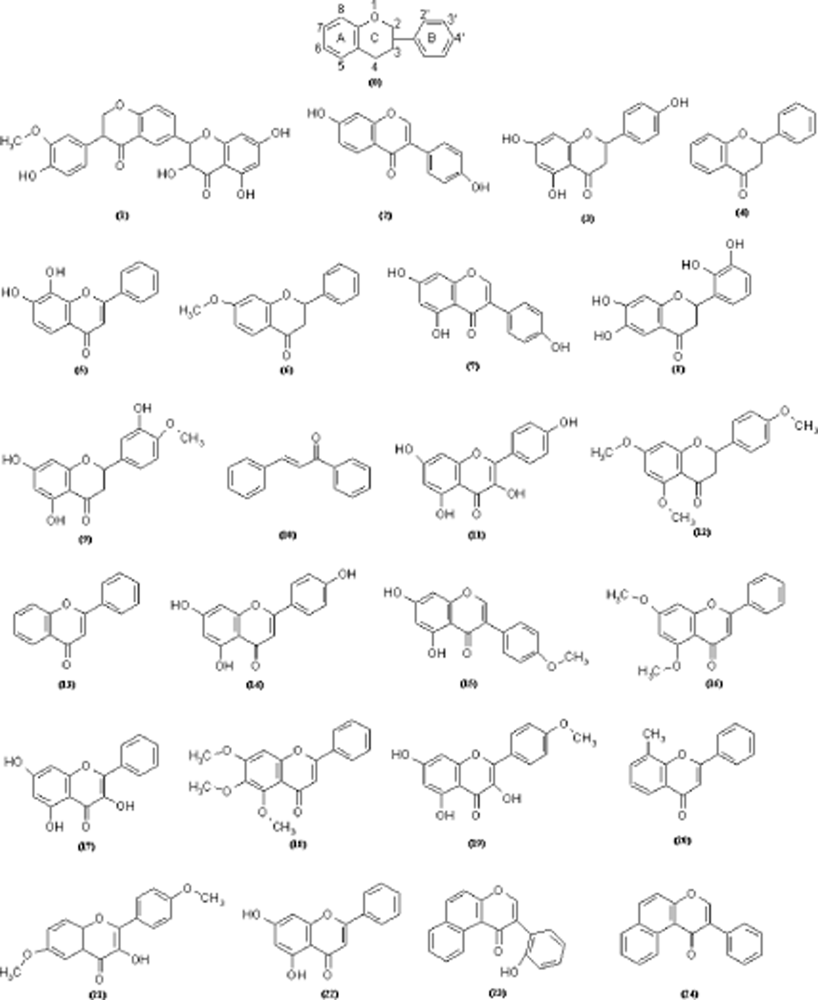
<p>Although in general considered beneficial for their protective role in many age-related diseases - flavonoids (see <xref ref-type="fig" rid="f1-ijms-10-01193">Figure 1</xref> – with the general scheme in no.0) should be more carefully studied since their pharmacokinetics are not entirely elucidated [<xref ref-type="bibr" rid="b49-ijms-10-01193">49</xref>–<xref ref-type="bibr" rid="b54-ijms-10-01193">54</xref>].</p>
<p>For instance, recently, it was inferred that for certain flavonoids such as chrysin, nbiochanin A and apigenin a very low micromolar concentration is capable of producing 50% (EC<sub>50</sub>) of the maximum increase in mitoxantrone (MX) inhibitor substrate accumulation (interaction) with breast cancer resistance protein (BCRP), helping in reversing the multidrug resistance (MDR) mechanism of overexpressing MCF-7 MX100 cancer cells [<xref ref-type="bibr" rid="b51-ijms-10-01193">51</xref>–<xref ref-type="bibr" rid="b54-ijms-10-01193">54</xref>].</p>
<p>Therefore, in order to assess the molecular role and structural- related mechanisms for potential lead compounds in the drug design for anti-cancer treatment, a series of representative classes of flavonoids have been employed, see <xref ref-type="fig" rid="f1-ijms-10-01193">Figure 1</xref>, with their recorded biological activities (A) among the computed transport (hydrophobicity-LogP), the electrostatic (polarizability POL), and steric (total energy at optimized 3D-configuration E<sub>TOT</sub>) Hantsch correlation variables [<xref ref-type="bibr" rid="b56-ijms-10-01193">56</xref>], see <xref ref-type="table" rid="t1-ijms-10-01193">Table 1</xref>, to successively provide the QSAR, S-SAR and finally to unfold the Qua-SAR analysis.</p>
<p>Note that in <xref ref-type="table" rid="t1-ijms-10-01193">Table 1</xref> the molecules were displayed in ascendant order of their recorded activities, from no. 1 to no. 24, for having present which is superior to which each time they are reciprocally quotation. Such an arrangement allows the construction of an activity differences chart, see <xref ref-type="table" rid="t2-ijms-10-01193">Table 2</xref>, with great utility in establishing <italic>the inter-endpoint molecular activity differences</italic> of <xref ref-type="disp-formula" rid="FD8">Equation (7)</xref> entering <italic>quantum-SAR factor</italic> of <xref ref-type="disp-formula" rid="FD11">Equation (10)</xref>.</p>
<p>Next, for computing the other influential activity difference in Qua-SAR, namely the <italic>inter-endpoint norm difference</italic> of <xref ref-type="disp-formula" rid="FD7">Equation (6)</xref>, the C = 10 possible endpoint models with data of <xref ref-type="table" rid="t1-ijms-10-01193">Table 1</xref> are in <xref ref-type="table" rid="t3-ijms-10-01193">Table 3</xref> presented. However, worth remarking that the traditional hydrophobicity factor LogP seems to have quite little or even no-influence from traditional statistical correlation (model Ia).</p>
<p>The first conclusion is that flavonoids have practically no exclusive or primarily role in drug transporting to BCRP site; still, the electrostatic influence through POL is practically missing as well (model Ib), while the stericity through E<sub>TOT</sub> unfolds some statistically sensitive role in ligand (MX)-receptor (BCRP) binding (model Ic). The last assertion may also be sustained by going to the two-correlated parameters endpoint models, when one can see the confirmation of the stericity role through E<sub>TOT</sub> correlation variable: while combination LogP∧POL does not improve the statistical correlation of model IIa significantly over single-parameter LogP∨POL correlations, the total energy presence provides better and better correlation behavior as it is combined with LogP (the model IIb) and with POL (the model IIc), respectively. Instead, when all the Hansch structural variables are taken into account the model III is generated with appreciable statistical correlation respecting the other computed combinations.</p>
<p>Overall, it cannot be inferred that LogP and POL does have no influence on correlation only because when alone they do not correlate at all with flavonoids’ bioactivity, because their cumulative presence in model III highly improves the single E<sub>TOT</sub> correlation of model Ic as well as mixed correlations of bi-variable models IIb and IIc. Therefore, the mechanistic “alchemy” of structural features on molecular activity seems complex enough when all hydrophobicity, electrostatic and stericity influences combine as they are reciprocally activating one each other with a superior resultant in modeling ligand-receptor binding.</p>
<p>Yet, the algebraic correlation factors in <xref ref-type="table" rid="t3-ijms-10-01193">Table 3</xref> deserve special discussion: it is clear that as they are not measuring the dispersive character of the local computed (molecular) points against the average recorded activity as statistical metrics do, their values are all close to unity and close to each other as well; however, they are modeling another reality of computation, being closer to path integral approach than to differential analysis, through indexing the global behavior or the total length of the computed vector to the recorded one. Still, while between the algebraic and statistical correlations only an indirect connection exists [<xref ref-type="bibr" rid="b37-ijms-10-01193">37</xref>], the one-to-one hierarchical ordering of models is always recorded thus supporting the usefulness of using algebraically scale when the shrink of correlation factors is more favorable. For instance, in the present case, as above revealed, according to the statistical analysis, there seems that LogP (Ia) and POL (Ib) have no influence on correlation, while when combined with E<sub>TOT</sub> in model III they considerably enrich the single E<sub>TOT</sub> correlation power of model Ic. Such behavior shows that orthogonal, i.e. independent, descriptors may provide better results when are combined than when considered apart due to the increase of the (inter) correlation space.</p>
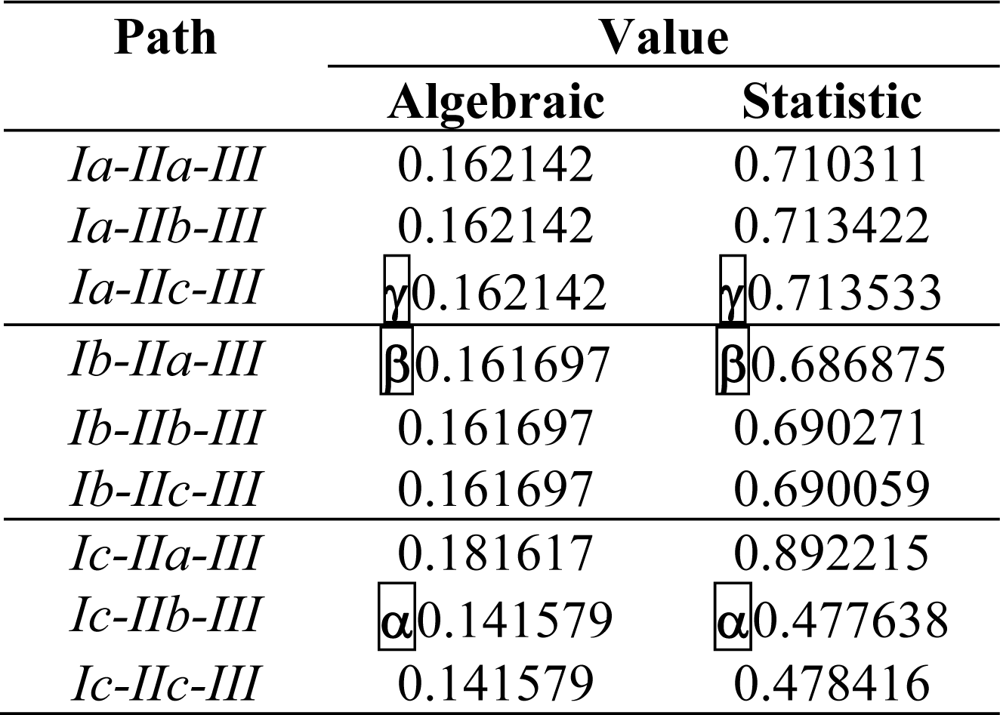
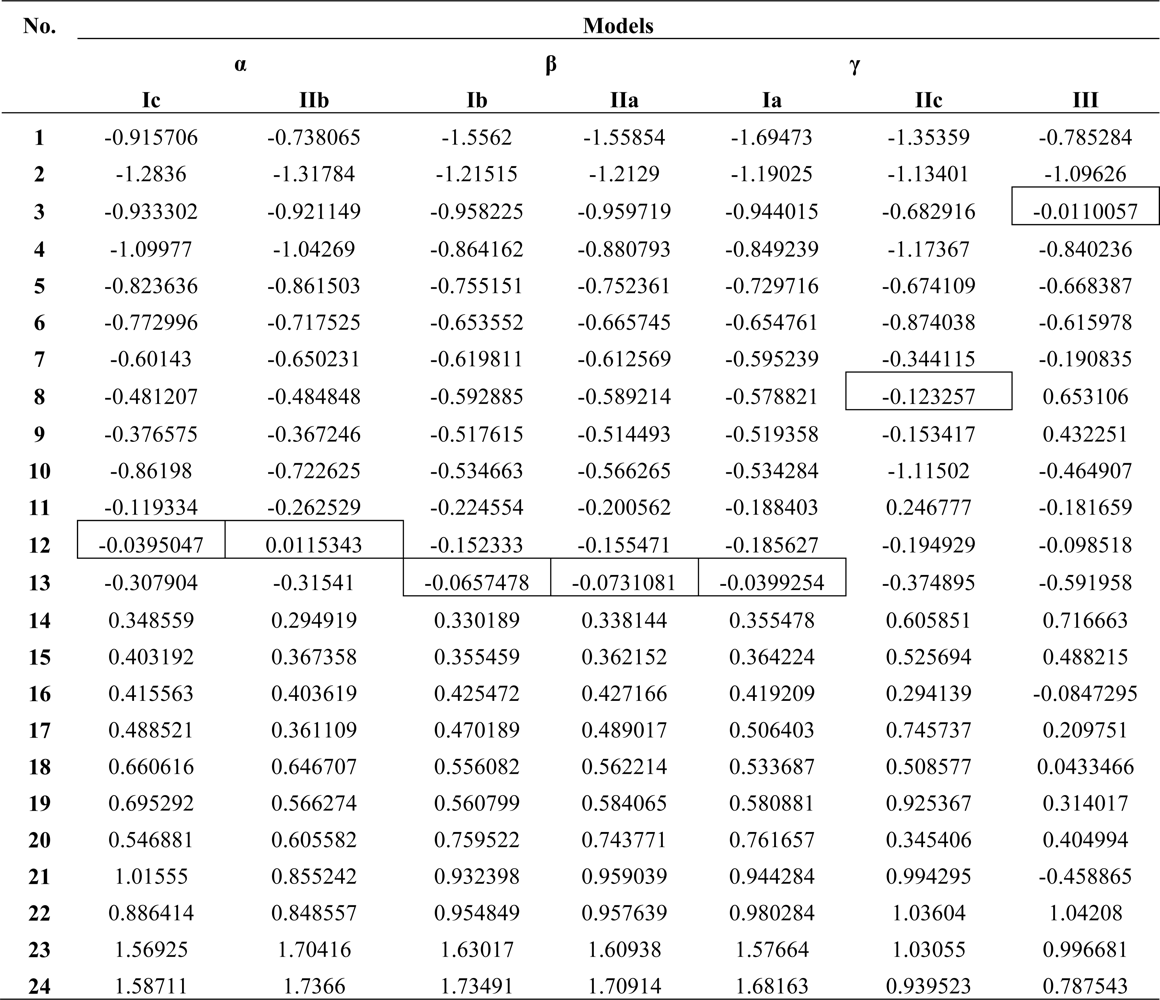
<p>Having performed the QSAR analysis, the specific Spectral-SAR stage can be unfolded by means of the <italic>(K</italic> = 9, <italic>M =</italic> 3) ergodic paths with the spectral Euclidian lengths given by <xref ref-type="disp-formula" rid="FD5">Equation (4)</xref> in both statistical and algebraic frameworks, as shown in <xref ref-type="table" rid="t4-ijms-10-01193">Table 4</xref>. Next, the least <italic>M</italic> = 3 paths with the dominant <italic>M</italic>-factors influence are selected by applying the above exposed recursive rule of <italic>least path principle</italic> resumed by <xref ref-type="disp-formula" rid="FD6">Equation (5)</xref>. Remarkably, there follows that the resulting alpha (α), beta (β), and gamma (γ) most influential paths are identically shaped no matter whether statistical or algebraically schemes are undertaken. This result, although not necessarily viewed as a general rule, shows that in this specific case the algebraically analysis leaves with systematically the same mechanistically results as those obtained with statistical tools. However, once more, we stress on that algebraically measure may give more realistic inside in the Q(Spectral)-SAR phenomenology since its inner vectorial and norm-based algorithm accounting for each individual molecular contribution to the whole activity “basin” rather than respecting the average activity.</p>
<p>Going now to the individual molecular level analysis, <xref ref-type="table" rid="t5-ijms-10-01193">Table 5</xref> lists the residual activities between computed and observed activities for each of considered models, distributed along the already identified least paths. At this instance, the most fitted molecule is outlined out of each endpoint; most impressive, the actual research selected the same molecule as the best fitted one along the both α and β paths, namely molecule no. 12 (4′-5,7-trimethoxyflavanone) and molecule no. 13 (flavone), respectively. Moreover, these molecules are not among the most potent one respecting the observed activity of <xref ref-type="table" rid="t1-ijms-10-01193">Table 1</xref>, being situated at the middle to second-half panel of the 24 molecules considered.</p>
<p>Such result tells us that the maximum recorded activity is not necessarily that one induced by <italic>specific</italic> chosen structural variables (here as LogP, POL, and E<sub>TOT</sub>). This is the case of the most fitted molecule on the most correlated endpoint (III) appeared to be no.3 (naringenin), with low activity on the observed range compared with the no. 25 (7,8-benzoflavone) in <xref ref-type="table" rid="t1-ijms-10-01193">Table 1</xref>. Consequently, one can say that the first half of the observed activities in <xref ref-type="table" rid="t1-ijms-10-01193">Table 1</xref> may be attributed to certain physicochemical indicators with clear mechanistically roles, while the rest of observed activities may be due to other unidentified specific structural descriptors or even to non-specific ones (rooting in the sub-quantum nature of the particular observer-observed system). Nevertheless, this lower activity prescribed by the computational results is in accordance with the so called “homeopathic principle” prescribing cure by moderate-to-low active drugs while better monitoring their effects through controlled physico-chemical descriptors.</p>
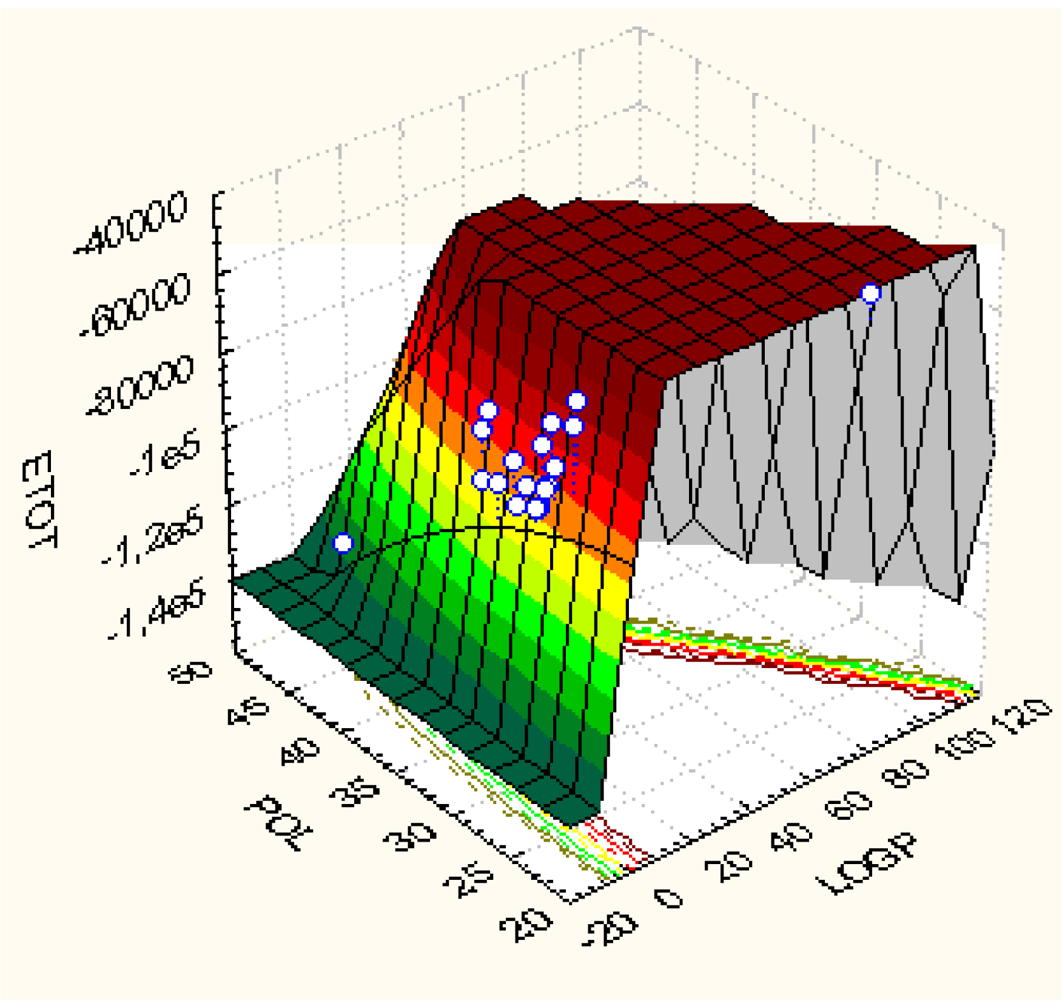
<p>For the sake of comparison, the actual Spectral(Qua)SAR results are to be compared with the consecrated Principal Component Analysis (PCA) [<xref ref-type="bibr" rid="b57-ijms-10-01193">57</xref>]. This way, <xref ref-type="fig" rid="f2-ijms-10-01193">Figure 2</xref> illustrates the graphical 3D correlations among the descriptors LogP, POL and E<sub>TOT</sub> used in this study; it offers a visual way for assessing the almost no-correlation of LogP with other concerned variables, POL and E<sub>TOT</sub>, respectively. This lead with conclusion that LogP is almost orthogonal (independent) on (respecting) the other two Hantsch variables. Instead, when further performing the factor analysis, the <xref ref-type="table" rid="t6-ijms-10-01193">Table 6</xref> is obtained while clearly revealing the scarce correlation carried by considering LogP variable alone. This is in close agreement with the Spectral-SAR results, see above. In any case, the hydrophobicity description and its descriptor cannot be rejected only by factor analysis since it drives (firstly or latter) the inter-membrane interaction that is essential for drug-cell binding. Spectral- and Qua-SAR highly proved the important role hydrophobicity plays in combination with electrostatic (POL) and steric (E<sub>TOT</sub>) interactions. Moreover, while PCA shows the POL factor influence equals that of E<sub>TOT</sub>, whereas their role in correlation is sensible different in Spectral-SAR analysis (compare model Ib-last column of <xref ref-type="table" rid="t3-ijms-10-01193">Table 3</xref> with POL-last column of <xref ref-type="table" rid="t6-ijms-10-01193">Table 6</xref>). However, again, this discrepancy is in the favor of S-SAR since the PCA results are due to the sensitive degree of POL-E<sub>TOT</sub> correlation (see <xref ref-type="fig" rid="f2-ijms-10-01193">Figure 2</xref>), from where the PCA yield that POL and E<sub>TOT</sub> display similar correlation power, while S-SAR includes also the orthogonalization of POL and E<sub>TOT</sub> variables prior correlation takes effect and better discriminates among their influence in bonding.</p>
<p>Nevertheless, going ahead with the Spectral-SAR results the Qua-SAR factors may be immediately recover by employing the molecular activity differences from <xref ref-type="table" rid="t2-ijms-10-01193">Table 2</xref> for the best fitted molecules of <xref ref-type="table" rid="t5-ijms-10-01193">Table 5</xref> along the models of the most influential paths in molecular mechanism towards MX-BCRP binding. The resulted <italic>IEND</italic> and <italic>IEMAD</italic> of <xref ref-type="table" rid="t7-ijms-10-01193">Table 7</xref> are combined to produce the quantum-SAR factors of <xref ref-type="disp-formula" rid="FD11">Equation (10)</xref> type for each two-molecules-two-models on specific paths, while the “metabolization power” <italic>per</italic> path is finally obtained by their couplings, according with multiplicative quantum rule of <xref ref-type="disp-formula" rid="FD17">Equation (16)</xref>. Worth noting that the overall quantum-SAR factors of paths are in total agreement with the previous spectral-SAR selected path hierarchy, i.e. the α path is associated with the highest q-SAR factor, being followed by that of β path and by that of γ one in last column of <xref ref-type="table" rid="t7-ijms-10-01193">Table 7</xref>.</p>
<p>This result may be quite important if such a behavior may be proven to hold in general since it would allow the effective quantification of paths according with their metabolization power. However, such endeavor exceeds the present communication purpose and will remain as a future challenge in Qua-SAR studies.</p>
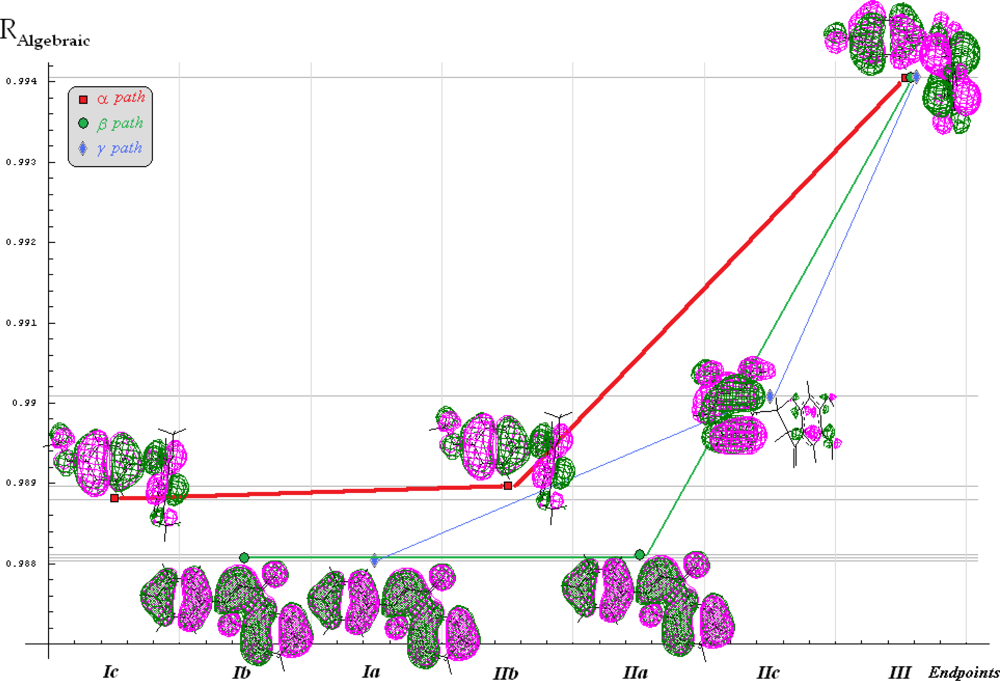
<p>Finally, all QSAR, Spectral-SAR and Qua-SAR computational results may be collected and resumed by associate “spectral” scheme for evolution of the fittest molecular structures along the endpoint models for the (<italic>M</italic>=)3 selected mechanistic paths of actions, see <xref ref-type="fig" rid="f3-ijms-10-01193">Figure 3</xref>. Note that algebraic correlation environment was chose as the “vertical” indicator for the degree with which a certain model reaches the observed activity in the vectorial norm sense (equally, the norm themselves could be used for ordinate axis [<xref ref-type="bibr" rid="b34-ijms-10-01193">34</xref>]).</p>
<p>Going now to comment upon the “metabolization power” as indicated by the quantum-SAR factors on <xref ref-type="fig" rid="f3-ijms-10-01193">Figure 3</xref>, one can firstly observe that for the α path the “first movement” from the Ic (E<sub>ToT</sub>) to IIb (LogP∧E<sub>TOT</sub>) corresponds to quantum free motion so that the null IEMAD for molecule no. 12 (4′-5,7-trimethoxyflavanone) is carried; here, the quantum metabolization factor 
<inline-formula>
<mml:math>
<mml:msubsup>
<mml:mi>q</mml:mi>
<mml:mrow>
<mml:mn>12</mml:mn>
<mml:mo>|</mml:mo>
<mml:mn>12</mml:mn></mml:mrow>
<mml:mrow>
<mml:mi>I</mml:mi>
<mml:mi>c</mml:mi>
<mml:mo>|</mml:mo>
<mml:mi>I</mml:mi>
<mml:mi>I</mml:mi>
<mml:mi>b</mml:mi>
<mml:mo>;</mml:mo>
<mml:mi>α</mml:mi></mml:mrow></mml:msubsup></mml:math></inline-formula> is consumed only for strongly activating the membrane transporter feature (LogP) of the same molecule. Instead, on the last passage of the α path the factor 
<inline-formula>
<mml:math>
<mml:msubsup>
<mml:mi>q</mml:mi>
<mml:mrow>
<mml:mn>12</mml:mn>
<mml:mo>|</mml:mo>
<mml:mn>13</mml:mn></mml:mrow>
<mml:mrow>
<mml:mi>I</mml:mi>
<mml:mi>I</mml:mi>
<mml:mi>b</mml:mi>
<mml:mo>|</mml:mo>
<mml:mi>I</mml:mi>
<mml:mi>I</mml:mi>
<mml:mi>I</mml:mi>
<mml:mo>;</mml:mo>
<mml:mi>α</mml:mi></mml:mrow></mml:msubsup></mml:math></inline-formula> is responsible for converting the electrostatic (POL) influence of the flavonoids no. 12 towards no.3 (naringenin) activity as well as for reverse-O-methylation (methoxylation) of oxygens in positions 5 and 7 (on ring A) and 4′ (on ring B) respecting the molecular pattern no.0 in <xref ref-type="fig" rid="f1-ijms-10-01193">Figure 1</xref>, respectively. Such result is in fully accordance with the reverse quantum influence that is at the foreground of quantum-SAR factor conversion prescribed by <xref ref-type="disp-formula" rid="FD10">Equation (9)</xref>, i.e. quantifying the power of back transformation of molecular EC50s respecting the “arrows” of IEND and IEMAND in <xref ref-type="disp-formula" rid="FD11">Equation (10)</xref>. However, the fact that such transformation is the first one acting at molecular level is sustained also by optimized 3D configurations of involved molecules no. 12 and 3, being both with rings A and B spatially bent in <xref ref-type="fig" rid="f3-ijms-10-01193">Figure 3</xref> respecting the ring C of the planar pattern no.0 of <xref ref-type="fig" rid="f1-ijms-10-01193">Figure 1</xref>.</p>
<p>A somewhat different situation is met for β path in <xref ref-type="fig" rid="f3-ijms-10-01193">Figure 3</xref>; in its first part a higher q-SAR factor (
<inline-formula>
<mml:math>
<mml:msubsup>
<mml:mi>q</mml:mi>
<mml:mrow>
<mml:mn>13</mml:mn>
<mml:mo>|</mml:mo>
<mml:mn>13</mml:mn></mml:mrow>
<mml:mrow>
<mml:mi>I</mml:mi>
<mml:mi>b</mml:mi>
<mml:mo>|</mml:mo>
<mml:mi>I</mml:mi>
<mml:mi>I</mml:mi>
<mml:mi>a</mml:mi>
<mml:mo>;</mml:mo>
<mml:mi>β</mml:mi></mml:mrow></mml:msubsup>
<mml:mo>&gt;</mml:mo>
<mml:msubsup>
<mml:mi>q</mml:mi>
<mml:mrow>
<mml:mn>12</mml:mn>
<mml:mo>|</mml:mo>
<mml:mn>12</mml:mn></mml:mrow>
<mml:mrow>
<mml:mi>I</mml:mi>
<mml:mi>c</mml:mi>
<mml:mo>|</mml:mo>
<mml:mi>I</mml:mi>
<mml:mi>I</mml:mi>
<mml:mi>b</mml:mi>
<mml:mo>;</mml:mo>
<mml:mi>α</mml:mi></mml:mrow></mml:msubsup></mml:math></inline-formula>) is needed for activating the transporter hydrophobicity feature in model IIa (LogP∧ POL) starting from model Ib (POL), while in its second part the molecule no. 13 (flavone) is shown to be metabolized in molecule no. 3 (naringenin) by a direct hydroxylation in positions 5, 7 (on ring A) and 4′ (on ring B), the same as before, respecting the molecular pattern no.0 in <xref ref-type="fig" rid="f1-ijms-10-01193">Figure 1</xref>, by a smaller q-SAR factor, 
<inline-formula>
<mml:math>
<mml:msubsup>
<mml:mi>q</mml:mi>
<mml:mrow>
<mml:mn>13</mml:mn>
<mml:mo>|</mml:mo>
<mml:mn>3</mml:mn></mml:mrow>
<mml:mrow>
<mml:mi>I</mml:mi>
<mml:mi>I</mml:mi>
<mml:mi>a</mml:mi>
<mml:mo>|</mml:mo>
<mml:mi>I</mml:mi>
<mml:mi>I</mml:mi>
<mml:mi>I</mml:mi>
<mml:mo>;</mml:mo>
<mml:mi>β</mml:mi></mml:mrow></mml:msubsup>
<mml:mo>&lt;</mml:mo>
<mml:msubsup>
<mml:mi>q</mml:mi>
<mml:mrow>
<mml:mn>12</mml:mn>
<mml:mo>|</mml:mo>
<mml:mn>3</mml:mn></mml:mrow>
<mml:mrow>
<mml:mi>I</mml:mi>
<mml:mi>I</mml:mi>
<mml:mi>b</mml:mi>
<mml:mo>|</mml:mo>
<mml:mi>I</mml:mi>
<mml:mi>I</mml:mi>
<mml:mi>I</mml:mi>
<mml:mo>;</mml:mo>
<mml:mi>α</mml:mi></mml:mrow></mml:msubsup></mml:math></inline-formula>, compared with that involved in the previous alpha path. Despite these, the overall quantum factor of beta path is lower than that of alpha, meaning a decrease capacity of metabolization since direct addition is involved, contrarily to the ordinary “inverse” Quantum-SAR transformation of <xref ref-type="disp-formula" rid="FD10">Equation (9)</xref>, while stericity (here founded as the most influential QSAR variable) is triggered by more steric energy difference consumed between the planar optimized configuration of molecule no. 13 on that spatially bended of molecule no. 3 in <xref ref-type="fig" rid="f3-ijms-10-01193">Figure 3</xref>.</p>
<p>Even more metabolization “operations” take place along the γ path of <xref ref-type="fig" rid="f3-ijms-10-01193">Figure 3</xref>: there is started on the same planar configuration of molecule no.13 (flavone); then, the q-SAR factor 
<inline-formula>
<mml:math>
<mml:msubsup>
<mml:mi>q</mml:mi>
<mml:mrow>
<mml:mn>13</mml:mn>
<mml:mo>|</mml:mo>
<mml:mn>8</mml:mn></mml:mrow>
<mml:mrow>
<mml:mi>I</mml:mi>
<mml:mi>a</mml:mi>
<mml:mo>|</mml:mo>
<mml:mi>I</mml:mi>
<mml:mi>I</mml:mi>
<mml:mi>c</mml:mi>
<mml:mo>;</mml:mo>
<mml:mi>γ</mml:mi></mml:mrow></mml:msubsup></mml:math></inline-formula> turn it into molecule no. 8 (6,2′,3′-7-hydroxyflavanone) by hydroxylation on the indicated positions (6 and 7 for ring A and 2′ and 3′ for ring B respecting the pattern molecule no.0 of <xref ref-type="fig" rid="f1-ijms-10-01193">Figure 1</xref>) while activating electrostatic and steric factors in model IIc (POL∧Etot) from independent hydrophobicity factor of model Ia (LogP) – a complex movement that explain why this molecular path comes at the final, with less probability and potency; nevertheless, this path has on its last passage no less complex transformation, i.e. turning the molecule no. 8 into no. 3 one by combined reverse hydroxylation in positions 2′ and 3′ with direct hydroxylation of position 4′ on B ring and with movement from ortho (6) – to – para (5) of hydroxyl group on ring A respecting pattern molecule no. 0 of <xref ref-type="fig" rid="f1-ijms-10-01193">Figure 1</xref>, respectively; the transformation efficiency 
<inline-formula>
<mml:math>
<mml:msubsup>
<mml:mi>q</mml:mi>
<mml:mrow>
<mml:mn>8</mml:mn>
<mml:mo>|</mml:mo>
<mml:mn>3</mml:mn></mml:mrow>
<mml:mrow>
<mml:mi>I</mml:mi>
<mml:mi>I</mml:mi>
<mml:mi>c</mml:mi>
<mml:mo>|</mml:mo>
<mml:mi>I</mml:mi>
<mml:mi>I</mml:mi>
<mml:mi>I</mml:mi>
<mml:mo>;</mml:mo>
<mml:mi>γ</mml:mi></mml:mrow></mml:msubsup></mml:math></inline-formula> is a bit higher than on the first part of the path since it require less steric energy consumption to bent the ring C respecting the A-B ones while accounting for electronic delocalization density (orbitals) over them until the configuration of molecule no. 3 is reached in <xref ref-type="fig" rid="f3-ijms-10-01193">Figure 3</xref>.</p>
<p>Overall, it is clear that the Qua-SAR scheme offers a quantification recipe along the most effective spectral paths combined with most fitted molecules for a trial basin of analogues compounds and structural variables. In the present case there was revealed that the energetic steric factor E<sub>ToT</sub> seems to mainly drive the mechanistic molecular transformation in MX-BCRP binding phenomenology, while the molecule no. 3 (naringenin) appears as the best fitted molecules belonging to the most relevant endpoint, in clear disjunction with the roughly molecular selection upon initial input observed activity data. That is, naringenin (no. 3) is shown to be the best adapted molecule for the actual LogP∧POL∧E<sub>TOT</sub> structural (independent) factors being metabolized from molecules as 6,2′,3′-7-hydroxyflavanone (no. 8), 4′-5,7-trimethoxyflavanone (no. 12), and flavone (no.13) by specific molecular mechanistically paths. However, there appears that these molecules are not linked even through the paths with the most active compounds of <xref ref-type="table" rid="t1-ijms-10-01193">Table 1</xref>; statistically, this can be explained by the so called “regression towards the mean” effects, in the sense that the best correlations translated to the compounds found in the middle of the mentioned sorted <xref ref-type="table" rid="t1-ijms-10-01193">Table 1</xref>; from the structural point of view such behavior may attributed to the specific parameters used for correlations that best describe molecules with specific groups, most favorable for the descriptor’s nature.</p>
<p>On the other hand, the present study affirms the position 7 of ring A and position 4′ of ring B respecting the pattern molecule no. 0 of <xref ref-type="fig" rid="f1-ijms-10-01193">Figure 1</xref> as the most suitable ones for producing an increase in BCRP inhibition activity, given that these positions belong to the α and β paths and being common to the rest of spectral paths as well. Instead, the position that does not appear at all in any of the α, β, or γ paths, namely position 8 on ring B may present adverse drug interactions.</p>
<p>Further Qua-SAR studies are necessary and will be developed for exploring other bio- and eco-active compounds for their interactions with organs and organisms; they may hopefully lead to a coherent analytical picture of chemical-biological bonding focused on selecting the most adapted molecules and of the most privileged molecular positions for delivering controlled structural based chemical reactivity and biological activity.</p></sec>
<sec sec-type="conclusions">
<label>4.</label>
<title>Conclusions</title>
<p>The modern <italic>in silico</italic> (computational) chemical analysis respecting the bio- activity and availability of analogues substances, potentially beneficial or detrimental for specific interaction in organs and organisms, faces with a paradoxical dichotomy: if searching for the best correlation useful for <italic>prediction</italic> of specific molecular bio- or eco- activity QSAR models involving un-interpretable many latent variables may be produced, while always remaining the question of correlation factor indeterminacy (i.e. the assumed descriptors can be at any time replaced with other producing at least the same correlation performances); instead, when restricting the analysis to search for molecular design and mechanisms throughout performing SARs by means of special structural indicators for a given class of relevant molecules, arises the price of limiting the use of generated models for further prediction. The present communication is mainly devoted in developing the second (Q)SAR facet by extending the recent introduced notion of spectral-path-linking-endpoints and the associate least action principle to spectral path quantification, in terms of the best fitted molecules, along the contained computed models, by means of the introduced q(uantum)-SAR factor within the generally called Quantum-SAR (QuaSAR) methodology.</p>
<p>As an application, for representative flavonoids’ inhibiting activities on breast cancer resistant protein there was clearly shown that the newly introduced q-SAR factor offers relevant analytical characterization of previously conceptually introduced spectral path hierarchy; moreover, the present QuaSAR may allow interpretation inter-conversion of concerned molecules’ towards receptor binding since belonging to the same class of analogs, while they certainly undertaking such transformation during their interaction with macromolecules, proteins and enzymes present on cellular walls or with <italic>in vivo</italic> environment.</p>
<p>Basically, the QuaSAR stands as the first step in assessing the quantum mechanically equivalent of wave function to the sample of molecules interacting with a specific organism site; it will eventually lead with the hyper-wave function with the help of which the associate hyper-density probability of binding (metabolization) is to be computed; the last information may provide the density probability map of the ligand-receptor interaction abstracted from the structural Spectral-Qua-SAR correlations; with this tool the molecular design of new chemical structures may be appropriately undertaken.</p>
<p>However, the actual QuaSAR scheme and quantum factor carry the main features of quantum dynamical systems and may stimulate future computational and conceptual developments in molecular design for structurally controlled activity. Further generalization of the present QuaSAR method to modeling all potential inter-conversions of employed molecules involved in correlation as well as for establishing their quantum metabolization complete map (through, for instance, hydrophobic, electrostatic and steric barrier tunneling) is actually in progress and will be reported in subsequent communications.</p></sec></body>
<back>
<ack>
<p>Authors are sincerely grateful to anonymous referees for their indeed useful and constructive comments.</p></ack>
<ref-list>
<title>References</title>
<ref id="b1-ijms-10-01193"><label>1.</label><citation citation-type="book"><person-group person-group-type="author"><name><surname>Anderson</surname><given-names>TW</given-names></name></person-group><source>An Introduction to Multivariate Statistical Methods</source><publisher-name>Wiley</publisher-name><publisher-loc>New York, USA</publisher-loc><year>1958</year></citation></ref>
<ref id="b2-ijms-10-01193"><label>2.</label><citation citation-type="book"><person-group person-group-type="author"><name><surname>Draper</surname><given-names>NR</given-names></name><name><surname>Smith</surname><given-names>H</given-names></name></person-group><source>Applied Regression Analysis</source><publisher-name>Wiley</publisher-name><publisher-loc>New York, USA</publisher-loc><year>1966</year></citation></ref>
<ref id="b3-ijms-10-01193"><label>3.</label><citation citation-type="book"><person-group person-group-type="author"><name><surname>Shorter</surname><given-names>J</given-names></name></person-group><source>Correlation Analysis in Organic Chemistry: An Introduction to Linear Free Energy Relationships</source><publisher-name>Oxford Univ. Press</publisher-name><publisher-loc>London, UK</publisher-loc><year>1973</year></citation></ref>
<ref id="b4-ijms-10-01193"><label>4.</label><citation citation-type="book"><person-group person-group-type="author"><name><surname>Box</surname><given-names>GEP</given-names></name><name><surname>Hunter</surname><given-names>WG</given-names></name><name><surname>Hunter</surname><given-names>JS</given-names></name></person-group><source>Statistics for Experimenters</source><publisher-name>John-Wiley</publisher-name><publisher-loc>New York, USA</publisher-loc><year>1978</year></citation></ref>
<ref id="b5-ijms-10-01193"><label>5.</label><citation citation-type="book"><person-group person-group-type="author"><name><surname>Green</surname><given-names>JR</given-names></name><name><surname>Margerison</surname><given-names>D</given-names></name></person-group><source>Statistical Treatment of Experimental Data</source><publisher-name>Elsevier</publisher-name><publisher-loc>New York, USA</publisher-loc><year>1978</year></citation></ref>
<ref id="b6-ijms-10-01193"><label>6.</label><citation citation-type="book"><person-group person-group-type="author"><name><surname>Topliss</surname><given-names>J</given-names></name></person-group><source>Quantitative Structure-Activity Relationships of Drugs</source><publisher-name>Academic Press</publisher-name><publisher-loc>New York, USA</publisher-loc><year>1983</year></citation></ref>
<ref id="b7-ijms-10-01193"><label>7.</label><citation citation-type="book"><person-group person-group-type="author"><name><surname>Seyfel</surname><given-names>JK</given-names></name></person-group><source>QSAR and Strategies in the Design of Bioactive Compounds</source><publisher-name>VCH Weinheim</publisher-name><publisher-loc>New York, USA</publisher-loc><year>1985</year></citation></ref>
<ref id="b8-ijms-10-01193"><label>8.</label><citation citation-type="book"><person-group person-group-type="author"><name><surname>Chatterjee</surname><given-names>S</given-names></name><name><surname>Hadi</surname><given-names>AS</given-names></name><name><surname>Price</surname><given-names>B</given-names></name></person-group><source>Regression Analysis by Examples</source><edition>3rd Ed</edition><publisher-name>John-Wiley</publisher-name><publisher-loc>New-York, USA</publisher-loc><year>2000</year></citation></ref>
<ref id="b9-ijms-10-01193"><label>9.</label><citation citation-type="book"><person-group person-group-type="author"><collab>European Commission</collab></person-group>Regulation (EC) No. 1907/2006 of the European Parliament and of the Council of 18 Dec. 2006 concerning the registration, evaluation, authorisation and restriction of chemicals (REACH), establishing a European Chemicals Agency, amending directive 1999/45/EC and repealing Council Regulation (EC) No. 1488/94 as well as Council Directive 76/769/EEC and commission directives 91/155/EEC, 93/67/EEC, 93/105/EC and 2000/21/EC. <source>Off. J. Eur. Union, L 396/1 of 30.12.2006</source><publisher-name>Office for Official Publication of the European Communities (OPOCE)</publisher-name><publisher-loc>Luxembourg</publisher-loc><year>2006</year></citation></ref>
<ref id="b10-ijms-10-01193"><label>10.</label><citation citation-type="book"><person-group person-group-type="author"><collab>European Commission</collab></person-group>Directive 2006/121/EC of the European Parliament and of the Council of 18 Dec. 2006 amending Council Directive 67/548/EEC on the approximation of laws, regulations and administrative provisions relating to the classification, packaging and labelling of dangerous substances in order to adapt it to Regulation (EC) No. 1907/2006 concerning the registration, evaluation, authorisation and restriction of chemicals (REACH) and establishing a european chemicals agency. <source>Off. J. Eur. Union, L 396/850 of 30.12.2006</source><publisher-name>Office for Official Publication of the European Communities (OPOCE)</publisher-name><publisher-loc>Luxembourg</publisher-loc><year>2006</year></citation></ref>
<ref id="b11-ijms-10-01193"><label>11.</label><citation citation-type="web">OECD, Report on the regulatory uses and applications in OECD member countries of (quantitative) structure-activity relationship [(Q)SAR] models in the assessment of new and existing chemicals. Organization of Economic Cooperation and Development: Paris, France, 2006; Available online: <ext-link xlink:href="http://www.oecd.org/" ext-link-type="uri">http://www.oecd.org/</ext-link>, accessed January 2009.</citation></ref>
<ref id="b12-ijms-10-01193"><label>12.</label><citation citation-type="web">OECD, Guidance document on the validation of (quantitative) structure-activity relationship [(Q)SAR] models. OECD series on testing and assessment No. 69. ENV/JM/MONO (2007) 2. Organization for Economic Cooperation and Development: Paris, France, 2007; Available online: <ext-link xlink:href="http://www.oecd.org/" ext-link-type="uri">http://www.oecd.org/</ext-link>, accessed January 2009.</citation></ref>
<ref id="b13-ijms-10-01193"><label>13.</label><citation citation-type="web"><person-group person-group-type="author"><name><surname>Worth</surname><given-names>AP</given-names></name><name><surname>Bassan</surname><given-names>A</given-names></name><name><surname>Gallegos Saliner</surname><given-names>A</given-names></name><name><surname>Netzeva</surname><given-names>TI</given-names></name><name><surname>Patlewicz</surname><given-names>G</given-names></name><name><surname>Pavan</surname><given-names>M</given-names></name><name><surname>Tsakovska</surname><given-names>I</given-names></name><name><surname>Vracko</surname><given-names>M</given-names></name></person-group><source>The characterization of quantitative structure-activity relationships: Preliminary guidance</source><publisher-name>European Commission - Joint Research Centre</publisher-name><publisher-loc>Ispra, Italy</publisher-loc><year>2005</year>Available online: <ext-link xlink:href="http://ecb.jrc.it/qsar/publications/" ext-link-type="uri">http://ecb.jrc.it/qsar/publications/</ext-link>, accessed January 2009.</citation></ref>
<ref id="b14-ijms-10-01193"><label>14.</label><citation citation-type="web"><person-group person-group-type="author"><name><surname>Worth</surname><given-names>AP</given-names></name><name><surname>Bassan</surname><given-names>A</given-names></name><name><surname>Fabjan</surname><given-names>E</given-names></name><name><surname>Gallegos Saliner</surname><given-names>A</given-names></name><name><surname>Netzeva</surname><given-names>TI</given-names></name><name><surname>Patlewicz</surname><given-names>G</given-names></name><name><surname>Pavan</surname><given-names>M</given-names></name><name><surname>Tsakovska</surname><given-names>I</given-names></name></person-group><source>The characterization of quantitative structure-activity relationships: Preliminary guidance</source><publisher-name>European Commission - Joint Research Centre</publisher-name><publisher-loc>Ispra, Italy</publisher-loc><year>2005</year>Available online: <ext-link xlink:href="http://ecb.jrc.it/qsar/publications/" ext-link-type="uri">http://ecb.jrc.it/qsar/publications/</ext-link>, accessed January 2009.</citation></ref>
<ref id="b15-ijms-10-01193"><label>15.</label><citation citation-type="web"><person-group person-group-type="author"><name><surname>Benigni</surname><given-names>R</given-names></name><name><surname>Bossa</surname><given-names>C</given-names></name><name><surname>Netzeva</surname><given-names>TI</given-names></name><name><surname>Worth</surname><given-names>AP</given-names></name></person-group><source>Collection and evaluation of [(Q)SAR] models for mutagenicity and carcinogenicity</source><publisher-name>European Commission - Joint Research Centre</publisher-name><publisher-loc>Ispra, Italy</publisher-loc><year>2007</year>Available online: <ext-link xlink:href="http://ecb.jrc.it/qsar/publications/" ext-link-type="uri">http://ecb.jrc.it/qsar/publications/</ext-link>, accessed January 2009.</citation></ref>
<ref id="b16-ijms-10-01193"><label>16.</label><citation citation-type="journal"><person-group person-group-type="author"><name><surname>So</surname><given-names>SS</given-names></name><name><surname>Karpuls</surname><given-names>M</given-names></name></person-group><article-title>Evolutionary optimisation in quantitative structure-activity relationship: An application of genetic neural network</article-title><source>J. Med. Chem</source><year>1996</year><volume>39</volume><fpage>1521</fpage><lpage>1530</lpage><pub-id pub-id-type="doi">10.1021/jm9507035</pub-id><pub-id pub-id-type="pmid">8691483</pub-id></citation></ref>
<ref id="b17-ijms-10-01193"><label>17.</label><citation citation-type="journal"><person-group person-group-type="author"><name><surname>Kubinyi</surname><given-names>H</given-names></name></person-group><article-title>Evolutionary variable selection in regression and PLS analysis</article-title><source>J. Chemometr</source><year>1996</year><volume>10</volume><fpage>119</fpage><lpage>133</lpage><pub-id pub-id-type="doi">10.1002/(SICI)1099-128X(199603)10:2&lt;119::AID-CEM409&gt;3.0.CO;2-4</pub-id></citation></ref>
<ref id="b18-ijms-10-01193"><label>18.</label><citation citation-type="journal"><person-group person-group-type="author"><name><surname>Teko</surname><given-names>IV</given-names></name><name><surname>Alessandro</surname><given-names>VAEP</given-names></name><name><surname>Livingston</surname><given-names>DJ</given-names></name></person-group><article-title>Neutral network studies. 2. Variable selection</article-title><source>J. Chem. Inf. Comput. Sci</source><year>1996</year><volume>36</volume><fpage>794</fpage><lpage>803</lpage><pub-id pub-id-type="doi">10.1021/ci950204c</pub-id><pub-id pub-id-type="pmid">8768768</pub-id></citation></ref>
<ref id="b19-ijms-10-01193"><label>19.</label><citation citation-type="journal"><person-group person-group-type="author"><name><surname>Kubinyi</surname><given-names>H</given-names></name></person-group><article-title>Variable selection in QSAR studies. 1. An evolutionary algorithm</article-title><source>Quant. Struct.-Act. Relat</source><year>1994</year><volume>13</volume><fpage>285</fpage><lpage>294</lpage></citation></ref>
<ref id="b20-ijms-10-01193"><label>20.</label><citation citation-type="journal"><person-group person-group-type="author"><name><surname>Haegawa</surname><given-names>K</given-names></name><name><surname>Kimura</surname><given-names>T</given-names></name><name><surname>Fanatsu</surname><given-names>K</given-names></name></person-group><article-title>GA strategy for variable selection in QSAR Studies: Enhancement of comparative molecular binding energy analysis by GA-based PLS method</article-title><source>Quant. Struct.-Act. Relat</source><year>1999</year><volume>18</volume><fpage>262</fpage><lpage>272</lpage><pub-id pub-id-type="doi">10.1002/(SICI)1521-3838(199907)18:3&lt;262::AID-QSAR262&gt;3.0.CO;2-S</pub-id></citation></ref>
<ref id="b21-ijms-10-01193"><label>21.</label><citation citation-type="journal"><person-group person-group-type="author"><name><surname>Zheng</surname><given-names>W</given-names></name><name><surname>Tropsha</surname><given-names>A</given-names></name></person-group><article-title>Novel variable selection quantitative structure-property relationship approach based on the k-nearest neighbour principle</article-title><source>J. Chem. Inf. Comput. Sci</source><year>2000</year><volume>40</volume><fpage>185</fpage><lpage>194</lpage><pub-id pub-id-type="doi">10.1021/ci980033m</pub-id><pub-id pub-id-type="pmid">10661566</pub-id></citation></ref>
<ref id="b22-ijms-10-01193"><label>22.</label><citation citation-type="journal"><person-group person-group-type="author"><name><surname>Lucic</surname><given-names>B</given-names></name><name><surname>Trinajstic</surname><given-names>N</given-names></name></person-group><article-title>Multivariate regression outperforms several robust architectures of neural networks in QSAR modelling</article-title><source>J. Chem. Inf. Comput. Sci</source><year>1999</year><volume>39</volume><fpage>121</fpage><lpage>132</lpage><pub-id pub-id-type="doi">10.1021/ci980090f</pub-id></citation></ref>
<ref id="b23-ijms-10-01193"><label>23.</label><citation citation-type="book"><person-group person-group-type="author"><name><surname>Duchowicz</surname><given-names>PR</given-names></name><name><surname>Castro</surname><given-names>EA</given-names></name></person-group><source>The Order Theory in QSPR-QSAR Studies</source><publisher-name>Mathematical Chemistry Monographs, University of Kragujevac</publisher-name><publisher-loc>Kragujevac, Serbia</publisher-loc><year>2008</year></citation></ref>
<ref id="b24-ijms-10-01193"><label>24.</label><citation citation-type="journal"><person-group person-group-type="author"><name><surname>Zhao</surname><given-names>VH</given-names></name><name><surname>Cronin</surname><given-names>MTD</given-names></name><name><surname>Dearden</surname><given-names>JC</given-names></name></person-group><article-title>Quantitative structure-activity relationships of chemicals acting by non-polar narcosis - theoretical considerations</article-title><source>Quant. Struct.-Act. Relat</source><year>1998</year><volume>17</volume><fpage>131</fpage><lpage>138</lpage><pub-id pub-id-type="doi">10.1002/(SICI)1521-3838(199804)17:02&lt;131::AID-QSAR131&gt;3.3.CO;2-C</pub-id></citation></ref>
<ref id="b25-ijms-10-01193"><label>25.</label><citation citation-type="journal"><person-group person-group-type="author"><name><surname>Pavan</surname><given-names>M</given-names></name><name><surname>Netzeva</surname><given-names>T</given-names></name><name><surname>Worth</surname><given-names>AP</given-names></name></person-group><article-title>Review of literature based quantitative structure-activity relationship models for bioconcentration</article-title><source>QSAR Comb. Sci</source><year>2008</year><volume>27</volume><fpage>21</fpage><lpage>31</lpage><pub-id pub-id-type="doi">10.1002/qsar.200710102</pub-id></citation></ref>
<ref id="b26-ijms-10-01193"><label>26.</label><citation citation-type="journal"><person-group person-group-type="author"><name><surname>Pavan</surname><given-names>M</given-names></name><name><surname>Worth</surname><given-names>AP</given-names></name></person-group><article-title>Review of estimation models for biodegradation</article-title><source>QSAR Comb. Sci</source><year>2008</year><volume>27</volume><fpage>32</fpage><lpage>40</lpage><pub-id pub-id-type="doi">10.1002/qsar.200710117</pub-id></citation></ref>
<ref id="b27-ijms-10-01193"><label>27.</label><citation citation-type="journal"><person-group person-group-type="author"><name><surname>Tsakovska</surname><given-names>I</given-names></name><name><surname>Lessigiarska</surname><given-names>I</given-names></name><name><surname>Netzeva</surname><given-names>T</given-names></name><name><surname>Worth</surname><given-names>AP</given-names></name></person-group><article-title>A mini review of mammalian toxicity (Q)SAR models</article-title><source>QSAR Comb. Sci</source><year>2008</year><volume>27</volume><fpage>41</fpage><lpage>48</lpage><pub-id pub-id-type="doi">10.1002/qsar.200710107</pub-id></citation></ref>
<ref id="b28-ijms-10-01193"><label>28.</label><citation citation-type="journal"><person-group person-group-type="author"><name><surname>Gallegos Saliner</surname><given-names>A</given-names></name><name><surname>Patlewicz</surname><given-names>G</given-names></name><name><surname>Worth</surname><given-names>AP</given-names></name></person-group><article-title>A review of (Q)SAR models for skin and eye irritation and corrosion</article-title><source>QSAR Comb. Sci</source><year>2008</year><volume>27</volume><fpage>49</fpage><lpage>59</lpage><pub-id pub-id-type="doi">10.1002/qsar.200710103</pub-id></citation></ref>
<ref id="b29-ijms-10-01193"><label>29.</label><citation citation-type="journal"><person-group person-group-type="author"><name><surname>Patlewicz</surname><given-names>G</given-names></name><name><surname>Aptula</surname><given-names>A</given-names></name><name><surname>Roberts</surname><given-names>DW</given-names></name><name><surname>Uriarte</surname><given-names>E</given-names></name></person-group><article-title>A mini-review of available skin sensitization (Q)SARs/Expert systems</article-title><source>QSAR Comb. Sci</source><year>2008</year><volume>27</volume><fpage>60</fpage><lpage>76</lpage><pub-id pub-id-type="doi">10.1002/qsar.200710067</pub-id></citation></ref>
<ref id="b30-ijms-10-01193"><label>30.</label><citation citation-type="journal"><person-group person-group-type="author"><name><surname>Netzeva</surname><given-names>T</given-names></name><name><surname>Pavan</surname><given-names>M</given-names></name><name><surname>Worth</surname><given-names>AP</given-names></name></person-group><article-title>Review of (quantitative) structure-activity relationship for acute aquatic toxicity</article-title><source>QSAR Comb. Sci</source><year>2008</year><volume>27</volume><fpage>77</fpage><lpage>90</lpage><pub-id pub-id-type="doi">10.1002/qsar.200710099</pub-id></citation></ref>
<ref id="b31-ijms-10-01193"><label>31.</label><citation citation-type="journal"><person-group person-group-type="author"><name><surname>Cronin</surname><given-names>MTD</given-names></name><name><surname>Worth</surname><given-names>AP</given-names></name></person-group><article-title>(Q)SARs for predicting effects relating to reproductive toxicity</article-title><source>QSAR Comb. Sci</source><year>2008</year><volume>27</volume><fpage>91</fpage><lpage>100</lpage><pub-id pub-id-type="doi">10.1002/qsar.200710118</pub-id></citation></ref>
<ref id="b32-ijms-10-01193"><label>32.</label><citation citation-type="journal"><person-group person-group-type="author"><name><surname>Putz</surname><given-names>MV</given-names></name></person-group><article-title>A spectral approach of the molecular structure – biological activity relationship part I. The general algorithm</article-title><source>Ann. West Univ. Timişoara Ser. Chem</source><year>2006</year><volume>15</volume><fpage>159</fpage><lpage>166</lpage></citation></ref>
<ref id="b33-ijms-10-01193"><label>33.</label><citation citation-type="journal"><person-group person-group-type="author"><name><surname>Putz</surname><given-names>MV</given-names></name><name><surname>Lacrămă</surname><given-names>A-M</given-names></name></person-group><article-title>A spectral approach of the molecular structure – biological activity relationship part II. The enzymatic activity</article-title><source>Ann. West Univ. Timişoara Ser. Chem</source><year>2006</year><volume>15</volume><fpage>167</fpage><lpage>176</lpage></citation></ref>
<ref id="b34-ijms-10-01193"><label>34.</label><citation citation-type="journal"><person-group person-group-type="author"><name><surname>Putz</surname><given-names>MV</given-names></name><name><surname>Lacrămă</surname><given-names>A-M</given-names></name></person-group><article-title>Introducing spectral structure activity relationship (S-SAR) analysis. Application to ecotoxicology</article-title><source>Int. J. Mol. Sci</source><year>2007</year><volume>8</volume><fpage>363</fpage><lpage>391</lpage><pub-id pub-id-type="doi">10.3390/i8050363</pub-id></citation></ref>
<ref id="b35-ijms-10-01193"><label>35.</label><citation citation-type="journal"><person-group person-group-type="author"><name><surname>Lacrămă</surname><given-names>A-M</given-names></name><name><surname>Putz</surname><given-names>MV</given-names></name><name><surname>Ostafe</surname><given-names>V</given-names></name></person-group><article-title>A Spectral-SAR model for the anionic-cationic interaction in ionic liquids: Application to <italic>Vibrio fischeri</italic> ecotoxicity</article-title><source>Int. J. Mol. Sci</source><year>2007</year><volume>8</volume><fpage>842</fpage><lpage>863</lpage><pub-id pub-id-type="doi">10.3390/i8080842</pub-id></citation></ref>
<ref id="b36-ijms-10-01193"><label>36.</label><citation citation-type="journal"><person-group person-group-type="author"><name><surname>Putz</surname><given-names>MV</given-names></name><name><surname>Lacrămă</surname><given-names>A-M</given-names></name><name><surname>Ostafe</surname><given-names>V</given-names></name></person-group><article-title>Spectral-SAR ecotoxicology of ionic liquids. The <italic>daphnia magna</italic> case</article-title><source>Res Lett Ecol</source><year>2007</year><fpage>1</fpage><lpage>5</lpage></citation></ref>
<ref id="b37-ijms-10-01193"><label>37.</label><citation citation-type="journal"><person-group person-group-type="author"><name><surname>Putz</surname><given-names>MV</given-names></name><name><surname>Duda-Seiman</surname><given-names>C</given-names></name><name><surname>Duda-Seiman</surname><given-names>DM</given-names></name><name><surname>Putz</surname><given-names>A-M</given-names></name></person-group><article-title>Turning SPECTRAL-SAR into 3D-QSAR analysis. application on H<sup>+</sup>K<sup>+</sup>-ATPase inhibitory activity</article-title><source>Int. J. Chem. Model</source><year>2008</year><volume>1</volume><fpage>45</fpage><lpage>62</lpage></citation></ref>
<ref id="b38-ijms-10-01193"><label>38.</label><citation citation-type="book"><person-group person-group-type="author"><name><surname>Lacrămă</surname><given-names>A-M</given-names></name><name><surname>Putz</surname><given-names>MV</given-names></name><name><surname>Ostafe</surname><given-names>V</given-names></name></person-group><article-title>Designing a spectral structure-activity ecotoxico-logistical battery”</article-title><source>advances in quantum chemical bonding structures</source><person-group person-group-type="editor"><name><surname>Putz</surname><given-names>MV</given-names></name></person-group><publisher-name>Transworld Research Network</publisher-name><publisher-loc>Kerala, India</publisher-loc><year>2008</year>Chapter 16, <fpage>389</fpage><lpage>419</lpage></citation></ref>
<ref id="b39-ijms-10-01193"><label>39.</label><citation citation-type="journal"><person-group person-group-type="author"><name><surname>Putz</surname><given-names>MV</given-names></name><name><surname>Putz (Lacrămă)</surname><given-names>A-M</given-names></name></person-group><article-title>Spectral-SAR: Old wine in new bottle</article-title><source>Studia Universitatis Babeş-Bolyai Chemia</source><year>2008</year><volume>53</volume><fpage>73</fpage><lpage>81</lpage></citation></ref>
<ref id="b40-ijms-10-01193"><label>40.</label><citation citation-type="journal"><person-group person-group-type="author"><name><surname>Putz</surname><given-names>MV</given-names></name><name><surname>Putz</surname><given-names>A-M</given-names></name><name><surname>Ostafe</surname><given-names>V</given-names></name><name><surname>Chiriac</surname><given-names>A</given-names></name></person-group><article-title>Application of spectral-structure activity relationship (S-SAR) method to ecotoxicology of some ionic liquids at the molecular level using acethylcolinesterase</article-title><source>Int J Chem Model</source><year>2009</year><volume>2</volume>in press.</citation></ref>
<ref id="b41-ijms-10-01193"><label>41.</label><citation citation-type="book"><person-group person-group-type="author"><name><surname>Steiger</surname><given-names>JH</given-names></name><name><surname>Schonemann</surname><given-names>PH</given-names></name></person-group><article-title>A history of factor indeterminacy</article-title><source>Theory Construction and Data Analysis in the Behavioural Science</source><person-group person-group-type="editor"><name><surname>Shye</surname><given-names>S</given-names></name></person-group><publisher-name>Jossey-Bass Publishers</publisher-name><publisher-loc>San Francisco, CA, USA</publisher-loc><year>1978</year></citation></ref>
<ref id="b42-ijms-10-01193"><label>42.</label><citation citation-type="book"><person-group person-group-type="author"><name><surname>Spearman</surname><given-names>C</given-names></name></person-group><source>The Abilities of Man</source><publisher-name>MacMillan</publisher-name><publisher-loc>London, UK</publisher-loc><year>1927</year></citation></ref>
<ref id="b43-ijms-10-01193"><label>43.</label><citation citation-type="journal"><person-group person-group-type="author"><name><surname>Wilson</surname><given-names>EB</given-names></name></person-group><article-title>Review of the abilities of man, their nature and measurement, by Spearman, C</article-title><source>Science</source><year>1928</year><volume>67</volume><fpage>244</fpage><lpage>248</lpage><pub-id pub-id-type="doi">10.1126/science.67.1731.244</pub-id></citation></ref>
<ref id="b44-ijms-10-01193"><label>44.</label><citation citation-type="journal"><person-group person-group-type="author"><name><surname>Wilson</surname><given-names>EB</given-names></name><name><surname>Hilferty</surname><given-names>MM</given-names></name></person-group><article-title>The distribution of chi-square</article-title><source>Proc. Nat. Acad. Sci. USA</source><year>1931</year><volume>17</volume><fpage>684</fpage><pub-id pub-id-type="doi">10.1073/pnas.17.12.684</pub-id><pub-id pub-id-type="pmid">16577411</pub-id></citation></ref>
<ref id="b45-ijms-10-01193"><label>45.</label><citation citation-type="journal"><person-group person-group-type="author"><name><surname>Wilson</surname><given-names>EB</given-names></name><name><surname>Worcester</surname><given-names>J</given-names></name></person-group><article-title>A note on factor analysis</article-title><source>Psychometrika</source><year>1939</year><volume>4</volume><fpage>133</fpage><lpage>148</lpage><pub-id pub-id-type="doi">10.1007/BF02288492</pub-id></citation></ref>
<ref id="b46-ijms-10-01193"><label>46.</label><citation citation-type="journal"><person-group person-group-type="author"><name><surname>Topliss</surname><given-names>JG</given-names></name><name><surname>Costello</surname><given-names>RJ</given-names></name></person-group><article-title>Chance correlation in structure-activity studies using multiple regression analysis</article-title><source>J. Med. Chem</source><year>1972</year><volume>15</volume><fpage>1066</fpage><lpage>1068</lpage><pub-id pub-id-type="doi">10.1021/jm00280a017</pub-id><pub-id pub-id-type="pmid">5069775</pub-id></citation></ref>
<ref id="b47-ijms-10-01193"><label>47.</label><citation citation-type="journal"><person-group person-group-type="author"><name><surname>Topliss</surname><given-names>JG</given-names></name><name><surname>Edwards</surname><given-names>RP</given-names></name></person-group><article-title>Chance factors in studies of quantitative structure-activity relationships</article-title><source>J. Med. Chem</source><year>1979</year><volume>22</volume><fpage>1238</fpage><lpage>1244</lpage><pub-id pub-id-type="doi">10.1021/jm00196a017</pub-id><pub-id pub-id-type="pmid">513071</pub-id></citation></ref>
<ref id="b48-ijms-10-01193"><label>48.</label><citation citation-type="book"><person-group person-group-type="author"><name><surname>Dittrich</surname><given-names>W</given-names></name><name><surname>Reuter</surname><given-names>M</given-names></name></person-group><source>Classical and Quantum Dynamics From Classical Paths to Path Integrals</source><publisher-name>Springer-Verlag</publisher-name><publisher-loc>Berlin, Germany</publisher-loc><year>1992</year></citation></ref>
<ref id="b49-ijms-10-01193"><label>49.</label><citation citation-type="journal"><person-group person-group-type="author"><name><surname>Havsteen</surname><given-names>BH</given-names></name></person-group><article-title>The biochemistry and medical significance of the flavonoids</article-title><source>Pharmacol. Ther</source><year>2002</year><volume>96</volume><fpage>67</fpage><lpage>202</lpage><pub-id pub-id-type="doi">10.1016/S0163-7258(02)00298-X</pub-id><pub-id pub-id-type="pmid">12453566</pub-id></citation></ref>
<ref id="b50-ijms-10-01193"><label>50.</label><citation citation-type="journal"><person-group person-group-type="author"><name><surname>Middleton</surname><given-names>E</given-names><suffix>Jr</suffix></name><name><surname>Kandaswami</surname><given-names>C</given-names></name><name><surname>Theoharides</surname><given-names>TC</given-names></name></person-group><article-title>The effects of plant flavonoids on mammalian cells: implications for inflammation, heart disease, and cancer</article-title><source>Pharmacol. Rev</source><year>2000</year><volume>52</volume><fpage>673</fpage><lpage>751</lpage><pub-id pub-id-type="pmid">11121513</pub-id></citation></ref>
<ref id="b51-ijms-10-01193"><label>51.</label><citation citation-type="journal"><person-group person-group-type="author"><name><surname>Zhang</surname><given-names>S</given-names></name><name><surname>Yang</surname><given-names>X</given-names></name><name><surname>Coburn</surname><given-names>RA</given-names></name><name><surname>Morris</surname><given-names>ME</given-names></name></person-group><article-title>Structure activity relationships and quantitative structure activity relationships for the flavonoid-mediated inhibition of breast cancer resistance protein</article-title><source>Biochem. Pharmacol</source><year>2005</year><volume>70</volume><fpage>627</fpage><lpage>639</lpage><pub-id pub-id-type="doi">10.1016/j.bcp.2005.05.017</pub-id><pub-id pub-id-type="pmid">15979586</pub-id></citation></ref>
<ref id="b52-ijms-10-01193"><label>52.</label><citation citation-type="journal"><person-group person-group-type="author"><name><surname>Zhang</surname><given-names>S</given-names></name><name><surname>Yang</surname><given-names>X</given-names></name><name><surname>Morris</surname><given-names>ME</given-names></name></person-group><article-title>Combined effects of multiple flavonoids on breast cancer resistance protein (ABCG2)-mediated transport</article-title><source>Pharm. Res</source><year>2004</year><volume>21</volume><fpage>1263</fpage><lpage>1273</lpage><pub-id pub-id-type="doi">10.1023/B:PHAM.0000033015.84146.4c</pub-id><pub-id pub-id-type="pmid">15290869</pub-id></citation></ref>
<ref id="b53-ijms-10-01193"><label>53.</label><citation citation-type="journal"><person-group person-group-type="author"><name><surname>Zhang</surname><given-names>S</given-names></name><name><surname>Yang</surname><given-names>X</given-names></name><name><surname>Morris</surname><given-names>ME</given-names></name></person-group><article-title>Flavonoids are inhibitors of breast cancer resistance protein (ABCG2)-mediated transport</article-title><source>Mol. Pharmacol</source><year>2004</year><volume>65</volume><fpage>1208</fpage><lpage>1216</lpage><pub-id pub-id-type="doi">10.1124/mol.65.5.1208</pub-id><pub-id pub-id-type="pmid">15102949</pub-id></citation></ref>
<ref id="b54-ijms-10-01193"><label>54.</label><citation citation-type="journal"><person-group person-group-type="author"><name><surname>Sargent</surname><given-names>JM</given-names></name><name><surname>Williamson</surname><given-names>CJ</given-names></name><name><surname>Maliepaard</surname><given-names>M</given-names></name><name><surname>Elgie</surname><given-names>AW</given-names></name><name><surname>Scheper</surname><given-names>RJ</given-names></name><name><surname>Taylor</surname><given-names>CG</given-names></name></person-group><article-title>Breast cancer resistance protein expression and resistance to daunorubicin in blast cells from patients with acute myeloid leukaemia</article-title><source>Br. J. Haematol</source><year>2001</year><volume>115</volume><fpage>257</fpage><lpage>262</lpage><pub-id pub-id-type="doi">10.1046/j.1365-2141.2001.03122.x</pub-id><pub-id pub-id-type="pmid">11703319</pub-id></citation></ref>
<ref id="b55-ijms-10-01193"><label>55.</label><citation citation-type="journal"><person-group person-group-type="author"><collab>Hypercube, Inc.</collab></person-group><source>HyperChem 701, Program package, Semiempirical, AM1, Polak-Ribier optimization procedure</source><year>2002</year></citation></ref>
<ref id="b56-ijms-10-01193"><label>56.</label><citation citation-type="journal"><person-group person-group-type="author"><name><surname>Hansch</surname><given-names>CA</given-names></name></person-group><article-title>A quantitative approach to biological-structure activity relationships</article-title><source>Acta Chem. Res</source><year>1969</year><volume>2</volume><fpage>232</fpage><lpage>239</lpage><pub-id pub-id-type="doi">10.1021/ar50020a002</pub-id></citation></ref>
<ref id="b57-ijms-10-01193"><label>57.</label><citation citation-type="book"><person-group person-group-type="author"><name><surname>Miller</surname><given-names>JN</given-names></name><name><surname>Miller</surname><given-names>JC</given-names></name></person-group><source>Statistics and Chemometrics for Analytical Chemistry</source><edition>4th Ed</edition><publisher-name>Pretience Hall</publisher-name><publisher-loc>Harlow, England</publisher-loc><year>2000</year></citation></ref>
<ref id="b58-ijms-10-01193"><label>58.</label><citation citation-type="journal"><person-group person-group-type="author"><collab>StatSoft, Inc.</collab></person-group><source>STATISTICA for Windows, Computer program and manual</source><year>1995</year></citation></ref></ref-list>
<sec sec-type="display-objects">
<title>Figures and Tables</title>
<fig id="f1-ijms-10-01193" position="float">
<label>Figure 1.</label>
<caption>
<p>The studied flavonoids (with basic structure of as no.0 while the others are in the <xref ref-type="table" rid="t1-ijms-10-01193">Table 1</xref> characterized by associate QSAR data), covering the flavones, isoflavones, chalcones, flavonols and flavanones, as they assist the increase of mitoxantrone (MX) accumulation in BCRP-overexpressing MCF-7 MX100 breast cancer cells [<xref ref-type="bibr" rid="b51-ijms-10-01193">51</xref>].</p></caption>
<graphic xlink:href="ijms-10-01193f1.gif"/></fig>
<fig id="f2-ijms-10-01193" position="float">
<label>Figure 2.</label>
<caption>
<p>Quadratic 3D representation of LogP <italic>vs.</italic> POL <italic>vs.</italic> E<sub>TOT</sub> variables’ fit employing the data of <xref ref-type="table" rid="t1-ijms-10-01193">Table 1</xref> [<xref ref-type="bibr" rid="b58-ijms-10-01193">58</xref>].</p></caption>
<graphic xlink:href="ijms-10-01193f2.gif"/></fig>
<fig id="f3-ijms-10-01193" position="float">
<label>Figure 3.</label>
<caption>
<p>Spectral representation of the endpoints employed in designing the bioactivity mechanism for the molecules of <xref ref-type="table" rid="t1-ijms-10-01193">Table 1</xref>, according with the algebraic correlation factors of <xref ref-type="disp-formula" rid="FD4">Equation (3)</xref> in <xref ref-type="table" rid="t3-ijms-10-01193">Table 3</xref>, across the shortest (three) paths identified from <xref ref-type="table" rid="t4-ijms-10-01193">Table 4</xref>, while marking the fittest molecules’ orbital 3D-distribution for each considered model, i.e. molecule no. 12 (4′–5,7-trimethoxyflavanone) for the models Ic and IIb, molecule no. 13 (Flavone) for models Ib, Ia, and IIa, molecule no. 8 (6,2′,3′–7-tydroxyflavanone) for model IIc, and molecule no. 3 (naringenin) for model III, respectively.</p></caption>
<graphic xlink:href="ijms-10-01193f3.gif"/></fig>
<table-wrap id="t1-ijms-10-01193" position="float">
<label>Table 1.</label>
<caption>
<p>The flavonoids of <xref ref-type="fig" rid="f1-ijms-10-01193">Figure 1</xref> arranged by their ascending observed activities, defined as A= -log<sub>10</sub>(EC<sub>50</sub>[μM]) [<xref ref-type="bibr" rid="b51-ijms-10-01193">51</xref>], along the associate computed structural parameters like the hydrophobicity (LogP), electronic cloud polarizability (POL) and the ground state configurationally optimized total energy (E<sub>TOT</sub>) [<xref ref-type="bibr" rid="b55-ijms-10-01193">55</xref>].</p></caption>
<table frame="hsides" rules="rows">
<thead>
<tr>
<th align="center" rowspan="2"><bold>No.</bold></th>
<th align="center" rowspan="2"><bold>Molecular Name</bold></th>
<th align="center"><bold>Activity</bold></th>
<th align="center" colspan="3"><bold>Structural parameters</bold></th></tr>
<tr>
<th align="center"><bold>A</bold></th>
<th align="center"><bold>LogP</bold></th>
<th align="center"><bold>POL(Å<sup>3</sup>)</bold></th>
<th align="center"><bold>E<sub>TOT</sub>(kcal/mol)</bold></th></tr></thead>
<tbody>
<tr>
<td align="center"><bold>(1)</bold></td>
<td align="center">Silybin</td>
<td align="center">3.74</td>
<td align="center">2.03</td>
<td align="center">45.68</td>
<td align="left">− 146625.1875</td></tr>
<tr>
<td align="center"><bold>(2)</bold></td>
<td align="center">Daidzein</td>
<td align="center">4.24</td>
<td align="center">1.78</td>
<td align="center">26.63</td>
<td align="left">− 76984.7109</td></tr>
<tr>
<td align="center"><bold>(3)</bold></td>
<td align="center">Naringenin</td>
<td align="center">4.49</td>
<td align="center">1.99</td>
<td align="center">27.46</td>
<td align="left">− 85032.9218</td></tr>
<tr>
<td align="center"><bold>(4)</bold></td>
<td align="center">Flavanone</td>
<td align="center">4.6</td>
<td align="center">2.84</td>
<td align="center">25.55</td>
<td align="left">− 62849.3125</td></tr>
<tr>
<td align="center"><bold>(5)</bold></td>
<td align="center">7,8-Dihydroxyflavone</td>
<td align="center">4.7</td>
<td align="center">1.75</td>
<td align="center">26.63</td>
<td align="left">− 76982.1328</td></tr>
<tr>
<td align="center"><bold>(6)</bold></td>
<td align="center">7–Methoxyflavanone</td>
<td align="center">4.79</td>
<td align="center">2.59</td>
<td align="center">28.02</td>
<td align="left">− 73823.8046</td></tr>
<tr>
<td align="center"><bold>(7)</bold></td>
<td align="center">Genistein</td>
<td align="center">4.83</td>
<td align="center">1.50</td>
<td align="center">27.27</td>
<td align="left">− 84380.7578</td></tr>
<tr>
<td align="center"><bold>(8)</bold></td>
<td align="center">6,2′,3′-7-Hydroxyflavanone</td>
<td align="center">4.85</td>
<td align="center">1.70</td>
<td align="center">28.10</td>
<td align="left">− 92422.6640</td></tr>
<tr>
<td align="center"><bold>(9)</bold></td>
<td align="center">Hesperetin</td>
<td align="center">4.91</td>
<td align="center">1.73</td>
<td align="center">29.93</td>
<td align="left">− 96003.9921</td></tr>
<tr>
<td align="center"><bold>(10)</bold></td>
<td align="center">Chalcone</td>
<td align="center">4.93</td>
<td align="center">3.68</td>
<td align="center">25.49</td>
<td align="left">− 55450.1093</td></tr>
<tr>
<td align="center"><bold>(11)</bold></td>
<td align="center">Kaempferol</td>
<td align="center">5.22</td>
<td align="center">0.56</td>
<td align="center">27.90</td>
<td align="left">− 91770.5859</td></tr>
<tr>
<td align="center"><bold>(12)</bold></td>
<td align="center">4′-5,7-Trimethoxyflavanone</td>
<td align="center">5.25</td>
<td align="center">2.08</td>
<td align="center">32.96</td>
<td align="left">− 95768.9062</td></tr>
<tr>
<td align="center"><bold>(13)</bold></td>
<td align="center">Flavone</td>
<td align="center">5.4</td>
<td align="center">2.32</td>
<td align="center">25.36</td>
<td align="left">− 62196.3437</td></tr>
<tr>
<td align="center"><bold>(14)</bold></td>
<td align="center">Apigenin</td>
<td align="center">5.78</td>
<td align="center">1.46</td>
<td align="center">27.27</td>
<td align="left">− 84379.8593</td></tr>
<tr>
<td align="center"><bold>(15)</bold></td>
<td align="center">Biochanin A</td>
<td align="center">5.79</td>
<td align="center">1.53</td>
<td align="center">29.10</td>
<td align="left">− 87961.2812</td></tr>
<tr>
<td align="center"><bold>(16)</bold></td>
<td align="center">5,7-Dimethoxyflavone</td>
<td align="center">5.85</td>
<td align="center">1.81</td>
<td align="center">30.30</td>
<td align="left">− 84139.4687</td></tr>
<tr>
<td align="center"><bold>(17)</bold></td>
<td align="center">Galangin</td>
<td align="center">5.92</td>
<td align="center">0.85</td>
<td align="center">27.27</td>
<td align="left">− 84376.8359</td></tr>
<tr>
<td align="center"><bold>(18)</bold></td>
<td align="center">5,6,7–Trimethoxyflavone</td>
<td align="center">5.96</td>
<td align="center">1.56</td>
<td align="center">32.77</td>
<td align="left">− 94976.1875</td></tr>
<tr>
<td align="center"><bold>(19)</bold></td>
<td align="center">Kaempferide</td>
<td align="center">5.99</td>
<td align="center">0.60</td>
<td align="center">29.74</td>
<td align="left">− 95351.3984</td></tr>
<tr>
<td align="center"><bold>(20)</bold></td>
<td align="center">8-Methylflavone</td>
<td align="center">6.21</td>
<td align="center">2.79</td>
<td align="center">27.19</td>
<td align="left">− 65789.9218</td></tr>
<tr>
<td align="center"><bold>(21)</bold></td>
<td align="center">6,4′–Dimethoxy-3-hydroxy-flavone</td>
<td align="center">6.35</td>
<td align="center">0.41</td>
<td align="center">31.13</td>
<td align="left">− 92162.7187</td></tr>
<tr>
<td align="center"><bold>(22)</bold></td>
<td align="center">Chrysin</td>
<td align="center">6.41</td>
<td align="center">1.75</td>
<td align="center">26.63</td>
<td align="left">− 76986.1171</td></tr>
<tr>
<td align="center"><bold>(23)</bold></td>
<td align="center">2′-Hydroxy-α-naphtoflavone</td>
<td align="center">7.03</td>
<td align="center">3.07</td>
<td align="center">33.26</td>
<td align="left">− 82027.8359</td></tr>
<tr>
<td align="center"><bold>(24)</bold></td>
<td align="center">7,8 – Benzoflavone</td>
<td align="center">7.14</td>
<td align="center">3.35</td>
<td align="center">32.63</td>
<td align="left">− 74634.5234</td></tr></tbody></table></table-wrap>
<table-wrap id="t2-ijms-10-01193" position="float">
<label>Table 2.</label>
<caption>
<p>The anti-symmetric matrix of the inter-molecular activity differences for the working flavonoids of <xref ref-type="table" rid="t1-ijms-10-01193">Table 1</xref>.</p></caption>
<table frame="box" rules="all">
<thead>
<tr>
<th align="center"><bold>1</bold></th>
<th align="center"><bold>2</bold></th>
<th align="center"><bold>3</bold></th>
<th align="center"><bold>4</bold></th>
<th align="center"><bold>5</bold></th>
<th align="center"><bold>6</bold></th>
<th align="center"><bold>7</bold></th>
<th align="center"><bold>8</bold></th>
<th align="center"><bold>9</bold></th>
<th align="center"><bold>10</bold></th>
<th align="center"><bold>11</bold></th>
<th align="center"><bold>12</bold></th>
<th align="center"><bold>13</bold></th>
<th align="center"><bold>14</bold></th>
<th align="center"><bold>15</bold></th>
<th align="center"><bold>16</bold></th>
<th align="center"><bold>17</bold></th>
<th align="center"><bold>18</bold></th>
<th align="center"><bold>19</bold></th>
<th align="center"><bold>20</bold></th>
<th align="center"><bold>21</bold></th>
<th align="center"><bold>22</bold></th>
<th align="center"><bold>23</bold></th>
<th align="center"><bold>24</bold></th>
<th align="center"/></tr></thead>
<tbody>
<tr>
<td align="center" content-type="background-color:#D9D9D9">0</td>
<td align="center">0.5</td>
<td align="center">0.75</td>
<td align="center">0.86</td>
<td align="center">0.96</td>
<td align="center">1.05</td>
<td align="center">1.09</td>
<td align="center">1.11</td>
<td align="center">1.17</td>
<td align="center">1.19</td>
<td align="center">1.48</td>
<td align="center">1.51</td>
<td align="center">1.66</td>
<td align="center">2.04</td>
<td align="center">2.05</td>
<td align="center">2.11</td>
<td align="center">2.18</td>
<td align="center">2.22</td>
<td align="center">2.25</td>
<td align="center">2.47</td>
<td align="center">2.61</td>
<td align="center">2.67</td>
<td align="center">3.29</td>
<td align="center">3.4</td>
<td align="center"><bold>1</bold></td></tr>
<tr>
<td align="center"/>
<td align="center" content-type="#D9D9D9">0</td>
<td align="center">0.25</td>
<td align="center">0.36</td>
<td align="center">0.46</td>
<td align="center">0.55</td>
<td align="center">0.59</td>
<td align="center">0.61</td>
<td align="center">0.67</td>
<td align="center">0.69</td>
<td align="center">0.98</td>
<td align="center">1.01</td>
<td align="center">1.16</td>
<td align="center">1.54</td>
<td align="center">1.55</td>
<td align="center">1.61</td>
<td align="center">1.68</td>
<td align="center">1.72</td>
<td align="center">1.75</td>
<td align="center">1.97</td>
<td align="center">2.11</td>
<td align="center">2.17</td>
<td align="center">2.79</td>
<td align="center">2.9</td>
<td align="center"><bold>2</bold></td></tr>
<tr>
<td align="center"/>
<td align="center" content-type="#D9D9D9">0</td>
<td align="center">0.11</td>
<td align="center">0.21</td>
<td align="center">0.3</td>
<td align="center">0.34</td>
<td align="center">0.36</td>
<td align="center">0.42</td>
<td align="center">0.44</td>
<td align="center">0.73</td>
<td align="center">0.76</td>
<td align="center">0.91</td>
<td align="center">1.29</td>
<td align="center">1.3</td>
<td align="center">1.36</td>
<td align="center">1.43</td>
<td align="center">1.47</td>
<td align="center">1.5</td>
<td align="center">1.72</td>
<td align="center">1.86</td>
<td align="center">1.92</td>
<td align="center">2.54</td>
<td align="center">2.65</td>
<td align="center"><bold>3</bold></td></tr>
<tr>
<td align="center"/>
<td align="center" content-type="#D9D9D9">0</td>
<td align="center">0.1</td>
<td align="center">0.19</td>
<td align="center">0.23</td>
<td align="center">0.25</td>
<td align="center">0.31</td>
<td align="center">0.33</td>
<td align="center">0.62</td>
<td align="center">0.65</td>
<td align="center">0.8</td>
<td align="center">1.18</td>
<td align="center">1.19</td>
<td align="center">1.25</td>
<td align="center">1.32</td>
<td align="center">1.36</td>
<td align="center">1.39</td>
<td align="center">1.61</td>
<td align="center">1.75</td>
<td align="center">1.81</td>
<td align="center">2.43</td>
<td align="center">2.54</td>
<td align="center"><bold>4</bold></td></tr>
<tr>
<td align="center"/>
<td align="center" content-type="#D9D9D9">0</td>
<td align="center">0.09</td>
<td align="center">0.13</td>
<td align="center">0.15</td>
<td align="center">0.21</td>
<td align="center">0.23</td>
<td align="center">0.52</td>
<td align="center">0.55</td>
<td align="center">0.7</td>
<td align="center">1.08</td>
<td align="center">1.09</td>
<td align="center">1.15</td>
<td align="center">1.22</td>
<td align="center">1.26</td>
<td align="center">1.29</td>
<td align="center">1.51</td>
<td align="center">1.65</td>
<td align="center">1.71</td>
<td align="center">2.33</td>
<td align="center">2.44</td>
<td align="center"><bold>5</bold></td></tr>
<tr>
<td align="center"/>
<td align="center" content-type="#D9D9D9">0</td>
<td align="center">0.04</td>
<td align="center">0.06</td>
<td align="center">0.12</td>
<td align="center">0.14</td>
<td align="center">0.43</td>
<td align="center">0.46</td>
<td align="center">0.61</td>
<td align="center">0.99</td>
<td align="center">1</td>
<td align="center">1.06</td>
<td align="center">1.13</td>
<td align="center">1.17</td>
<td align="center">1.2</td>
<td align="center">1.42</td>
<td align="center">1.56</td>
<td align="center">1.62</td>
<td align="center">2.24</td>
<td align="center">2.35</td>
<td align="center"><bold>6</bold></td></tr>
<tr>
<td align="center"/>
<td align="center" content-type="#D9D9D9">0</td>
<td align="center">0.02</td>
<td align="center">0.08</td>
<td align="center">0.1</td>
<td align="center">0.39</td>
<td align="center">0.42</td>
<td align="center">0.57</td>
<td align="center">0.95</td>
<td align="center">0.96</td>
<td align="center">1.02</td>
<td align="center">1.09</td>
<td align="center">1.13</td>
<td align="center">1.16</td>
<td align="center">1.38</td>
<td align="center">1.52</td>
<td align="center">1.58</td>
<td align="center">2.2</td>
<td align="center">2.31</td>
<td align="center"><bold>7</bold></td></tr>
<tr>
<td align="center"/>
<td align="center" content-type="#D9D9D9">0</td>
<td align="center">0.06</td>
<td align="center">0.08</td>
<td align="center">0.37</td>
<td align="center">0.4</td>
<td align="center">0.55</td>
<td align="center">0.93</td>
<td align="center">0.94</td>
<td align="center">1</td>
<td align="center">1.07</td>
<td align="center">1.11</td>
<td align="center">1.14</td>
<td align="center">1.36</td>
<td align="center">1.5</td>
<td align="center">1.56</td>
<td align="center">2.18</td>
<td align="center">2.29</td>
<td align="center"><bold>8</bold></td></tr>
<tr>
<td align="center"/>
<td align="center" content-type="#D9D9D9">0</td>
<td align="center">0.02</td>
<td align="center">0.31</td>
<td align="center">0.34</td>
<td align="center">0.49</td>
<td align="center">0.87</td>
<td align="center">0.88</td>
<td align="center">0.94</td>
<td align="center">1.01</td>
<td align="center">1.05</td>
<td align="center">1.08</td>
<td align="center">1.3</td>
<td align="center">1.44</td>
<td align="center">1.5</td>
<td align="center">2.12</td>
<td align="center">2.23</td>
<td align="center"><bold>9</bold></td></tr>
<tr>
<td align="center"/>
<td align="center" content-type="#D9D9D9">0</td>
<td align="center">0.29</td>
<td align="center">0.32</td>
<td align="center">0.47</td>
<td align="center">0.85</td>
<td align="center">0.86</td>
<td align="center">0.92</td>
<td align="center">0.99</td>
<td align="center">1.03</td>
<td align="center">1.06</td>
<td align="center">1.28</td>
<td align="center">1.42</td>
<td align="center">1.48</td>
<td align="center">2.1</td>
<td align="center">2.21</td>
<td align="center"><bold>10</bold></td></tr>
<tr>
<td align="center"/>
<td align="center" content-type="#D9D9D9">0</td>
<td align="center">0.03</td>
<td align="center">0.18</td>
<td align="center">0.56</td>
<td align="center">0.57</td>
<td align="center">0.63</td>
<td align="center">0.7</td>
<td align="center">0.74</td>
<td align="center">0.77</td>
<td align="center">0.99</td>
<td align="center">1.13</td>
<td align="center">1.19</td>
<td align="center">1.81</td>
<td align="center">1.92</td>
<td align="center"><bold>11</bold></td></tr>
<tr>
<td align="center"/>
<td align="center" content-type="#D9D9D9">0</td>
<td align="center">0.15</td>
<td align="center">0.53</td>
<td align="center">0.54</td>
<td align="center">0.6</td>
<td align="center">0.67</td>
<td align="center">0.71</td>
<td align="center">0.74</td>
<td align="center">0.96</td>
<td align="center">1.1</td>
<td align="center">1.16</td>
<td align="center">1.78</td>
<td align="center">1.89</td>
<td align="center"><bold>12</bold></td></tr>
<tr>
<td align="center"/>
<td align="center" content-type="#D9D9D9">0</td>
<td align="center">0.38</td>
<td align="center">0.39</td>
<td align="center">0.45</td>
<td align="center">0.52</td>
<td align="center">0.56</td>
<td align="center">0.59</td>
<td align="center">0.81</td>
<td align="center">0.95</td>
<td align="center">1.01</td>
<td align="center">1.63</td>
<td align="center">1.74</td>
<td align="center"><bold>13</bold></td></tr>
<tr>
<td align="center"/>
<td align="center" content-type="#D9D9D9">0</td>
<td align="center">0.01</td>
<td align="center">0.07</td>
<td align="center">0.14</td>
<td align="center">0.18</td>
<td align="center">0.21</td>
<td align="center">0.43</td>
<td align="center">0.57</td>
<td align="center">0.63</td>
<td align="center">1.25</td>
<td align="center">1.36</td>
<td align="center"><bold>14</bold></td></tr>
<tr>
<td align="center"/>
<td align="center" content-type="#D9D9D9">0</td>
<td align="center">0.06</td>
<td align="center">0.13</td>
<td align="center">0.17</td>
<td align="center">0.2</td>
<td align="center">0.42</td>
<td align="center">0.56</td>
<td align="center">0.62</td>
<td align="center">1.24</td>
<td align="center">1.35</td>
<td align="center"><bold>15</bold></td></tr>
<tr>
<td align="center"/>
<td align="center" content-type="#D9D9D9">0</td>
<td align="center">0.07</td>
<td align="center">0.11</td>
<td align="center">0.14</td>
<td align="center">0.36</td>
<td align="center">0.5</td>
<td align="center">0.56</td>
<td align="center">1.18</td>
<td align="center">1.29</td>
<td align="center"><bold>16</bold></td></tr>
<tr>
<td align="center"/>
<td align="center" content-type="#D9D9D9">0</td>
<td align="center">0.04</td>
<td align="center">0.07</td>
<td align="center">0.29</td>
<td align="center">0.43</td>
<td align="center">0.49</td>
<td align="center">1.11</td>
<td align="center">1.22</td>
<td align="center"><bold>17</bold></td></tr>
<tr>
<td align="center"/>
<td align="center" content-type="#D9D9D9">0</td>
<td align="center">0.03</td>
<td align="center">0.25</td>
<td align="center">0.39</td>
<td align="center">0.45</td>
<td align="center">1.07</td>
<td align="center">1.18</td>
<td align="center"><bold>18</bold></td></tr>
<tr>
<td align="center"/>
<td align="center" content-type="#D9D9D9">0</td>
<td align="center">0.22</td>
<td align="center">0.36</td>
<td align="center">0.42</td>
<td align="center">1.04</td>
<td align="center">1.15</td>
<td align="center"><bold>19</bold></td></tr>
<tr>
<td align="center"/>
<td align="center" content-type="#D9D9D9">0</td>
<td align="center">0.14</td>
<td align="center">0.2</td>
<td align="center">0.82</td>
<td align="center">0.93</td>
<td align="center"><bold>20</bold></td></tr>
<tr>
<td align="center"/>
<td align="center" content-type="#D9D9D9">0</td>
<td align="center">0.06</td>
<td align="center">0.68</td>
<td align="center">0.79</td>
<td align="center"><bold>21</bold></td></tr>
<tr>
<td align="center"/>
<td align="center" content-type="#D9D9D9">0</td>
<td align="center">0.62</td>
<td align="center">0.73</td>
<td align="center"><bold>22</bold></td></tr>
<tr>
<td align="center"/>
<td align="center" content-type="#D9D9D9">0</td>
<td align="center">0.11</td>
<td align="center"><bold>23</bold></td></tr>
<tr>
<td align="center"/>
<td align="center" content-type="#D9D9D9">0</td>
<td align="center"><bold>24</bold></td></tr></tbody></table></table-wrap>
<table-wrap id="t3-ijms-10-01193" position="float">
<label>Table 3.</label>
<caption>
<p>QSAR equations through Spectral-SAR multi-linear procedure [<xref ref-type="bibr" rid="b32-ijms-10-01193">32</xref>–<xref ref-type="bibr" rid="b34-ijms-10-01193">34</xref>] for all possible correlation models considered from data of <xref ref-type="table" rid="t1-ijms-10-01193">Table 1</xref>; here |<italic>X</italic><sub>0</sub> 〉 is the unitary vector|11...1<sub>24</sub>〉, while the structural variables are set as |<italic>X</italic><sub>1</sub>〉 = <italic>LogP</italic>, |<italic>X</italic><sub>2</sub>〉 = <italic>POL,</italic> and |<italic>X</italic><sub>3</sub>〉 = <italic>E</italic><italic><sub>TOT</sub></italic>; the predicted activities’ norms where calculated with <xref ref-type="disp-formula" rid="FD3">Equation (2)</xref>, while the algebraic correlation factor of <xref ref-type="disp-formula" rid="FD4">Equation (3)</xref> uses the measured activity of ‖| <italic>A</italic>〉‖ = 26.9357 computed upon <xref ref-type="disp-formula" rid="FD3">Equation (2)</xref> with data of <xref ref-type="table" rid="t1-ijms-10-01193">Table 1</xref>; R<sub>Statistic</sub> is the traditional Pearson correlation factor [<xref ref-type="bibr" rid="b1-ijms-10-01193">1</xref>–<xref ref-type="bibr" rid="b8-ijms-10-01193">8</xref>].</p></caption>
<table frame="hsides" rules="rows">
<thead>
<tr>
<th align="left"><bold>Model</bold></th>
<th align="center"><bold>Variables</bold></th>
<th align="center"><bold>(Q/S-)SAR Equation</bold></th>
<th align="center">‖|<italic>Y</italic>〉 <italic><sup>PREDICTED</sup></italic>‖</th>
<th align="center">R<sub>Algebraic</sub></th>
<th align="center">R<sub>Statistic</sub></th></tr></thead>
<tbody>
<tr>
<td align="center"><bold><italic>Ia</italic></bold></td>
<td align="center">|<italic>X</italic><sub>0</sub>&gt;, |<italic>X</italic><sub>1</sub>&gt;</td>
<td align="center">|<italic>Y</italic>&gt;<sup>Ia</sup> = 5.39837|<italic>X</italic><sub>0</sub>&gt;+0.0179106|<italic>X</italic><sub>1</sub>&gt;</td>
<td align="center">26.6138</td>
<td align="center">0.988049</td>
<td align="center">0.0175601</td></tr>
<tr>
<td align="center"><bold><italic>Ib</italic></bold></td>
<td align="center">|<italic>X</italic><sub>0</sub>&gt;, |<italic>X</italic><sub>2</sub>&gt;</td>
<td align="center"><italic>|Y</italic>&gt;<sup>Ib</sup> = 5.67735 <italic>X</italic><sub>0</sub>&gt;–0.00834411<italic>|X</italic><sub>2</sub><italic>&gt;</italic></td>
<td align="center">26.61425</td>
<td align="center">0.988065</td>
<td align="center">0.0409922</td></tr>
<tr>
<td align="center"><bold><italic>Ic</italic></bold></td>
<td align="center"><italic>|X</italic><sub>0</sub><italic>&gt;, |X</italic><sub>3</sub><italic>&gt;</italic></td>
<td align="center"><italic>|Y</italic>&gt;<sup>Ic</sup> = 6.48303<italic>|X</italic><sub>0</sub>&gt;+0.0000124625<italic>|X</italic><italic><sub>3</sub></italic>&gt;</td>
<td align="center">26.6344</td>
<td align="center">0.988812</td>
<td align="center">0.252513</td></tr>
<tr>
<td align="center"><bold><italic>IIa</italic></bold></td>
<td align="center"><italic>|X</italic><sub>0</sub><italic>&gt;, |X</italic><sub>1</sub>〉<italic>,|X</italic><sub>2</sub><italic>&gt;</italic></td>
<td align="center"><italic>|Y</italic>&gt;<sup>IIa</sup> = 5.64318<italic>|X</italic><sub>0</sub>&gt; +0.0178242 |<italic>X</italic><sub>1</sub>〉–0.00833676|<italic>X</italic><sub>2</sub>&gt;</td>
<td align="center">26.614349</td>
<td align="center">0.988069</td>
<td align="center">0.0445618</td></tr></tbody>
<tbody>
<tr>
<td align="center"><bold><italic>IIb</italic></bold></td>
<td align="center"><italic>|X</italic><sub>0</sub>&gt;, <italic>|X</italic><sub>1</sub>&gt;,<italic>|X</italic><sub>3</sub>&gt;</td>
<td align="center"><italic>|Y</italic>&gt;<sup>IIb</sup> = 6.93331<italic>|X</italic><sub>0</sub><italic>&gt;</italic> − 0.120924<italic>|X</italic><sub>1</sub>&gt;+0.0000150708<italic>|X</italic><sub>3</sub>&gt;</td>
<td align="center">26.638</td>
<td align="center">0.988947</td>
<td align="center">0.273909</td></tr>
<tr>
<td align="center"><bold><italic>IIc</italic></bold></td>
<td align="center"><italic>|X</italic><sub>0</sub>&gt;, <italic>|X</italic><sub>2</sub>&gt;,<italic>|X</italic><sub>3</sub>&gt;</td>
<td align="center"><italic>|Y</italic>&gt;<sup>IIc</sup> = 4.99884<italic>|X</italic><sub>0</sub>&gt; +0.122989<italic>|X</italic><sub>2</sub>&gt;+0.0000376701 <italic>|X</italic><sub>3</sub><italic>&gt;</italic></td>
<td align="center">26.6681</td>
<td align="center">0.990063</td>
<td align="center">0.409837</td></tr>
<tr>
<td align="center"><bold><italic>III</italic></bold></td>
<td align="center"><italic>|X</italic><sub>0</sub>&gt;, <italic>|X</italic><sub>1</sub>&gt;,<italic>|X</italic><sub>2</sub>&gt;, <italic>|X</italic><sub>3</sub>&gt;</td>
<td align="center"><italic>|Y</italic>&gt;<sup>III</sup> = 5.59424<italic>|X</italic><sub>0</sub>&gt;–1.05993|<italic>X</italic><sub>1</sub>&gt;+0.400704<italic>|X</italic><sub>2</sub><italic>&gt;</italic>+0.000117452<italic>|X</italic><sub>3</sub>&gt;</td>
<td align="center">26.7758</td>
<td align="center">0.994064</td>
<td align="center">0.708509</td></tr></tbody></table></table-wrap>
<table-wrap id="t4-ijms-10-01193" position="float">
<label>Table 4.</label>
<caption>
<p>Synopsis of paths connecting the endpoints of <xref ref-type="table" rid="t3-ijms-10-01193">Table 3</xref> in the norm-correlation spectral-space.</p></caption>
<graphic xlink:href="ijms-10-01193t4.gif"/></table-wrap>
<table-wrap id="t5-ijms-10-01193" position="float">
<label>Table 5.</label>
<caption>
<p>Residual activities A<sub>i</sub> – Y<sub>i</sub><sup>Model</sup> of the compounds of <xref ref-type="table" rid="t1-ijms-10-01193">Table 1</xref> for the Spectral-SAR models of <xref ref-type="table" rid="t3-ijms-10-01193">Table 3</xref> ordered according with the alpha, beta and gamma paths of <xref ref-type="table" rid="t4-ijms-10-01193">Table 4</xref>; that residue which is closes to zero in each considered endpoint is marked by a line border.</p></caption>
<graphic xlink:href="ijms-10-01193t5.gif"/></table-wrap>
<table-wrap id="t6-ijms-10-01193" position="float">
<label>Table 6.</label>
<caption>
<p>Principal Component Analysis (PCA) for the data of <xref ref-type="table" rid="t1-ijms-10-01193">Table 1</xref> within unrotated (unnormalized) factor score coefficients [<xref ref-type="bibr" rid="b58-ijms-10-01193">58</xref>].</p></caption>
<table frame="hsides" rules="none">
<tbody>
<tr>
<td align="center"/>
<td align="center"><bold>PC1</bold></td>
<td align="center"><bold>PC2</bold></td>
<td align="center"><bold>PC3</bold></td>
<td align="center"><bold>Multiple</bold></td></tr>
<tr>
<td align="center"><italic>Eigenvalue:</italic></td>
<td align="center">1.958158</td>
<td align="center">0.892127</td>
<td align="center">0.149715</td>
<td align="center"><bold>PC1–PC3</bold></td></tr>
<tr>
<td align="center"><italic>% total variance:</italic></td>
<td align="center">65.27195</td>
<td align="center">29.73757</td>
<td align="center">4.99049</td>
<td align="center"><bold>factors’</bold></td></tr>
<tr>
<td colspan="4">
<hr/></td>
<td align="center"/></tr>
<tr>
<td align="center"><bold><italic>Variable</italic></bold></td>
<td align="center" colspan="3"><bold><italic>Factors’ coefficients</italic></bold></td>
<td align="center"><bold>R<sup>2</sup></bold></td></tr>
<tr>
<td align="center">LogP</td>
<td align="center">0.232179</td>
<td align="center">−0.997780</td>
<td align="center">0.20467</td>
<td align="center">0.083712</td></tr>
<tr>
<td align="center">POL</td>
<td align="center">−0.472177</td>
<td align="center">−0.302902</td>
<td align="center">−1.79349</td>
<td align="center">0.716820</td></tr>
<tr>
<td align="center">E<sub>TOT</sub></td>
<td align="center">0.483556</td>
<td align="center">0.183309</td>
<td align="center">−1.84956</td>
<td align="center">0.728872</td></tr></tbody></table></table-wrap>
<table-wrap id="t7-ijms-10-01193" position="float">
<label>Table 7.</label>
<caption>
<p>Determination of the quantum-SAR, see <xref ref-type="disp-formula" rid="FD11">Equation (10)</xref> with <xref ref-type="disp-formula" rid="FD6">Eqs. (6)</xref> and <xref ref-type="disp-formula" rid="FD7">(7)</xref>, associate with certain couple of molecules involved in activating specific structural quantum indices (or their combinations) driving spectral paths of <xref ref-type="table" rid="t4-ijms-10-01193">Table 4</xref>, by employing minimum residue recipe throughout <xref ref-type="table" rid="t5-ijms-10-01193">Table 5</xref> for each considered endpoint, as well as the associate recorded bioactivity differences of <xref ref-type="table" rid="t2-ijms-10-01193">Table 2</xref>, respectively.</p></caption>
<table frame="hsides" rules="groups">
<thead>
<tr>
<th align="left">Path</th>
<th align="left">
<inline-formula>
<mml:math>
<mml:mo>Δ</mml:mo>
<mml:msubsup>
<mml:mi>Y</mml:mi>
<mml:mrow>
<mml:mi>l</mml:mi>
<mml:mo>|</mml:mo>
<mml:msup>
<mml:mi>l</mml:mi>
<mml:mo>′</mml:mo></mml:msup></mml:mrow>
<mml:mrow>
<mml:mi>P</mml:mi>
<mml:mi>A</mml:mi>
<mml:mi>T</mml:mi>
<mml:mi>H</mml:mi></mml:mrow></mml:msubsup></mml:math></inline-formula> (IEND)<xref ref-type="table-fn" rid="tfn1-ijms-10-01193">#</xref></th>
<th align="left">
<inline-formula>
<mml:math>
<mml:mo>Δ</mml:mo>
<mml:msubsup>
<mml:mi>A</mml:mi>
<mml:mrow>
<mml:mi>i</mml:mi>
<mml:mo>|</mml:mo>
<mml:mi>j</mml:mi></mml:mrow>
<mml:mrow>
<mml:mi>l</mml:mi>
<mml:mo>|</mml:mo>
<mml:msup>
<mml:mi>l</mml:mi>
<mml:mo>′</mml:mo></mml:msup></mml:mrow></mml:msubsup></mml:math></inline-formula> (IEMAD)<sup><xref ref-type="table-fn" rid="tfn2-ijms-10-01193">♣</xref></sup></th>
<th align="left">
<inline-formula>
<mml:math>
<mml:msubsup>
<mml:mi>q</mml:mi>
<mml:mrow>
<mml:mi>i</mml:mi>
<mml:mo>|</mml:mo>
<mml:mi>j</mml:mi></mml:mrow>
<mml:mrow>
<mml:mi>l</mml:mi>
<mml:mo>|</mml:mo>
<mml:msup>
<mml:mi>l</mml:mi>
<mml:mo>′</mml:mo></mml:msup>
<mml:mo>;</mml:mo>
<mml:mi>P</mml:mi>
<mml:mi>A</mml:mi>
<mml:mi>T</mml:mi>
<mml:mi>H</mml:mi>
<mml:mo>*</mml:mo></mml:mrow></mml:msubsup></mml:math></inline-formula><xref ref-type="table-fn" rid="tfn3-ijms-10-01193">*</xref></th>
<th align="left"><italic>q</italic><italic><sup>PATH</sup></italic></th></tr></thead>
<tbody>
<tr>
<td align="left" rowspan="2">α</td>
<td align="left">
<inline-formula>
<mml:math>
<mml:mo>Δ</mml:mo>
<mml:msubsup>
<mml:mi>Y</mml:mi>
<mml:mrow>
<mml:mi>I</mml:mi>
<mml:mi>c</mml:mi>
<mml:mo>|</mml:mo>
<mml:mi>I</mml:mi>
<mml:mi>I</mml:mi>
<mml:mi>b</mml:mi></mml:mrow>
<mml:mi>α</mml:mi></mml:msubsup>
<mml:mo>=</mml:mo>
<mml:mn>0.00364573</mml:mn></mml:math></inline-formula></td>
<td align="left">
<inline-formula>
<mml:math>
<mml:msubsup>
<mml:mi>A</mml:mi>
<mml:mrow>
<mml:mn>12</mml:mn>
<mml:mo>|</mml:mo>
<mml:mn>12</mml:mn></mml:mrow>
<mml:mrow>
<mml:mi>I</mml:mi>
<mml:mi>c</mml:mi>
<mml:mo>|</mml:mo>
<mml:mi>I</mml:mi>
<mml:mi>I</mml:mi>
<mml:mi>b</mml:mi></mml:mrow></mml:msubsup>
<mml:mo>=</mml:mo>
<mml:mn>0</mml:mn></mml:math></inline-formula></td>
<td align="left">
<inline-formula>
<mml:math>
<mml:msubsup>
<mml:mi>q</mml:mi>
<mml:mrow>
<mml:mn>12</mml:mn>
<mml:mo>|</mml:mo>
<mml:mn>12</mml:mn></mml:mrow>
<mml:mrow>
<mml:mi>I</mml:mi>
<mml:mi>c</mml:mi>
<mml:mo>|</mml:mo>
<mml:mi>I</mml:mi>
<mml:mi>I</mml:mi>
<mml:mi>b</mml:mi>
<mml:mo>;</mml:mo>
<mml:mi>α</mml:mi></mml:mrow></mml:msubsup>
<mml:mo>=</mml:mo>
<mml:mn>0.991641</mml:mn></mml:math></inline-formula></td>
<td align="left" rowspan="2"><italic>q</italic><sup>α</sup> =0.125464</td></tr>
<tr>
<td align="left">
<inline-formula>
<mml:math>
<mml:mo>Δ</mml:mo>
<mml:msubsup>
<mml:mi>Y</mml:mi>
<mml:mrow>
<mml:mi>I</mml:mi>
<mml:mi>I</mml:mi>
<mml:mi>b</mml:mi>
<mml:mo>|</mml:mo>
<mml:mi>I</mml:mi>
<mml:mi>I</mml:mi>
<mml:mi>I</mml:mi></mml:mrow>
<mml:mi>α</mml:mi></mml:msubsup>
<mml:mo>=</mml:mo>
<mml:mn>0.137836</mml:mn></mml:math></inline-formula></td>
<td align="left">
<inline-formula>
<mml:math>
<mml:msubsup>
<mml:mi>A</mml:mi>
<mml:mrow>
<mml:mn>12</mml:mn>
<mml:mo>|</mml:mo>
<mml:mn>3</mml:mn></mml:mrow>
<mml:mrow>
<mml:mi>I</mml:mi>
<mml:mi>I</mml:mi>
<mml:mi>b</mml:mi>
<mml:mo>|</mml:mo>
<mml:mi>I</mml:mi>
<mml:mi>I</mml:mi>
<mml:mi>I</mml:mi></mml:mrow></mml:msubsup>
<mml:mo>=</mml:mo>
<mml:mo>−</mml:mo>
<mml:mn>0.76</mml:mn></mml:math></inline-formula></td>
<td align="left">
<inline-formula>
<mml:math>
<mml:msubsup>
<mml:mi>q</mml:mi>
<mml:mrow>
<mml:mn>12</mml:mn>
<mml:mo>|</mml:mo>
<mml:mn>3</mml:mn></mml:mrow>
<mml:mrow>
<mml:mi>I</mml:mi>
<mml:mi>I</mml:mi>
<mml:mi>b</mml:mi>
<mml:mo>|</mml:mo>
<mml:mi>I</mml:mi>
<mml:mi>I</mml:mi>
<mml:mi>I</mml:mi>
<mml:mo>;</mml:mo>
<mml:mi>α</mml:mi></mml:mrow></mml:msubsup>
<mml:mo>=</mml:mo>
<mml:mn>0.126521</mml:mn></mml:math></inline-formula></td></tr>
<tr>
<td align="left" rowspan="2">β</td>
<td align="left">
<inline-formula>
<mml:math>
<mml:mrow>
<mml:mo>Δ</mml:mo>
<mml:msubsup>
<mml:mi>Y</mml:mi>
<mml:mrow>
<mml:mi>I</mml:mi>
<mml:mi>b</mml:mi>
<mml:mo>|</mml:mo>
<mml:mi>I</mml:mi>
<mml:mi>I</mml:mi>
<mml:mi>a</mml:mi></mml:mrow>
<mml:mi>β</mml:mi></mml:msubsup>
<mml:mo>=</mml:mo>
<mml:mn>0.0000989324</mml:mn></mml:mrow></mml:math></inline-formula></td>
<td align="left">
<inline-formula>
<mml:math>
<mml:msubsup>
<mml:mi>A</mml:mi>
<mml:mrow>
<mml:mn>13</mml:mn>
<mml:mo>|</mml:mo>
<mml:mn>13</mml:mn></mml:mrow>
<mml:mrow>
<mml:mi>I</mml:mi>
<mml:mi>b</mml:mi>
<mml:mo>|</mml:mo>
<mml:mi>I</mml:mi>
<mml:mi>I</mml:mi>
<mml:mi>a</mml:mi></mml:mrow></mml:msubsup>
<mml:mo>=</mml:mo>
<mml:mn>0</mml:mn></mml:math></inline-formula></td>
<td align="left">
<inline-formula>
<mml:math>
<mml:msubsup>
<mml:mi>q</mml:mi>
<mml:mrow>
<mml:mn>13</mml:mn>
<mml:mo>|</mml:mo>
<mml:mn>13</mml:mn></mml:mrow>
<mml:mrow>
<mml:mi>I</mml:mi>
<mml:mi>b</mml:mi>
<mml:mo>|</mml:mo>
<mml:mi>I</mml:mi>
<mml:mi>I</mml:mi>
<mml:mi>a</mml:mi>
<mml:mo>;</mml:mo>
<mml:mi>β</mml:mi></mml:mrow></mml:msubsup>
<mml:mo>=</mml:mo>
<mml:mn>0.999772</mml:mn></mml:math></inline-formula></td>
<td align="left" rowspan="2"><italic>q</italic><sup>β</sup>=0.0848036</td></tr>
<tr>
<td align="left">
<inline-formula>
<mml:math>
<mml:mo>Δ</mml:mo>
<mml:msubsup>
<mml:mi>Y</mml:mi>
<mml:mrow>
<mml:mi>I</mml:mi>
<mml:mi>I</mml:mi>
<mml:mi>a</mml:mi>
<mml:mo>|</mml:mo>
<mml:mi>I</mml:mi>
<mml:mi>I</mml:mi>
<mml:mi>I</mml:mi></mml:mrow>
<mml:mi>β</mml:mi></mml:msubsup>
<mml:mo>=</mml:mo>
<mml:mn>0.161487</mml:mn></mml:math></inline-formula></td>
<td align="left">
<inline-formula>
<mml:math>
<mml:msubsup>
<mml:mi>A</mml:mi>
<mml:mrow>
<mml:mn>13</mml:mn>
<mml:mo>|</mml:mo>
<mml:mn>3</mml:mn></mml:mrow>
<mml:mrow>
<mml:mi>I</mml:mi>
<mml:mi>I</mml:mi>
<mml:mi>a</mml:mi>
<mml:mo>|</mml:mo>
<mml:mi>I</mml:mi>
<mml:mi>I</mml:mi>
<mml:mi>I</mml:mi></mml:mrow></mml:msubsup>
<mml:mo>=</mml:mo>
<mml:mo>−</mml:mo>
<mml:mn>0.91</mml:mn></mml:math></inline-formula></td>
<td align="left">
<inline-formula>
<mml:math>
<mml:msubsup>
<mml:mi>q</mml:mi>
<mml:mrow>
<mml:mn>13</mml:mn>
<mml:mo>|</mml:mo>
<mml:mn>3</mml:mn></mml:mrow>
<mml:mrow>
<mml:mi>I</mml:mi>
<mml:mi>I</mml:mi>
<mml:mi>a</mml:mi>
<mml:mo>|</mml:mo>
<mml:mi>I</mml:mi>
<mml:mi>I</mml:mi>
<mml:mi>I</mml:mi>
<mml:mo>;</mml:mo>
<mml:mi>β</mml:mi></mml:mrow></mml:msubsup>
<mml:mo>=</mml:mo>
<mml:mn>0.0848229</mml:mn></mml:math></inline-formula></td></tr>
<tr>
<td align="left" rowspan="2">γ</td>
<td align="left">
<inline-formula>
<mml:math>
<mml:mo>Δ</mml:mo>
<mml:msubsup>
<mml:mi>Y</mml:mi>
<mml:mrow>
<mml:mi>I</mml:mi>
<mml:mi>a</mml:mi>
<mml:mo>|</mml:mo>
<mml:mi>I</mml:mi>
<mml:mi>I</mml:mi>
<mml:mi>c</mml:mi></mml:mrow>
<mml:mi>γ</mml:mi></mml:msubsup>
<mml:mo>=</mml:mo>
<mml:mn>0.0542592</mml:mn></mml:math></inline-formula></td>
<td align="left">
<inline-formula>
<mml:math>
<mml:msubsup>
<mml:mi>A</mml:mi>
<mml:mrow>
<mml:mn>13</mml:mn>
<mml:mo>|</mml:mo>
<mml:mn>8</mml:mn></mml:mrow>
<mml:mrow>
<mml:mi>I</mml:mi>
<mml:mi>a</mml:mi>
<mml:mo>|</mml:mo>
<mml:mi>I</mml:mi>
<mml:mi>I</mml:mi>
<mml:mi>c</mml:mi></mml:mrow></mml:msubsup>
<mml:mo>=</mml:mo>
<mml:mo>−</mml:mo>
<mml:mn>0.55</mml:mn></mml:math></inline-formula></td>
<td align="left">
<inline-formula>
<mml:math>
<mml:msubsup>
<mml:mi>q</mml:mi>
<mml:mrow>
<mml:mn>13</mml:mn>
<mml:mo>|</mml:mo>
<mml:mn>8</mml:mn></mml:mrow>
<mml:mrow>
<mml:mi>I</mml:mi>
<mml:mi>a</mml:mi>
<mml:mo>|</mml:mo>
<mml:mi>I</mml:mi>
<mml:mi>I</mml:mi>
<mml:mi>c</mml:mi>
<mml:mo>;</mml:mo>
<mml:mi>γ</mml:mi></mml:mrow></mml:msubsup>
<mml:mo>=</mml:mo>
<mml:mn>0.248737</mml:mn></mml:math></inline-formula></td>
<td align="left" rowspan="2"><italic>q</italic><sup>γ</sup> =0.0847168</td></tr>
<tr>
<td align="left">
<inline-formula>
<mml:math>
<mml:mo>Δ</mml:mo>
<mml:msubsup>
<mml:mi>Y</mml:mi>
<mml:mrow>
<mml:mi>I</mml:mi>
<mml:mi>I</mml:mi>
<mml:mi>c</mml:mi>
<mml:mo>|</mml:mo>
<mml:mi>I</mml:mi>
<mml:mi>I</mml:mi>
<mml:mi>I</mml:mi></mml:mrow>
<mml:mi>γ</mml:mi></mml:msubsup>
<mml:mo>=</mml:mo>
<mml:mn>0.107771</mml:mn></mml:math></inline-formula></td>
<td align="left">
<inline-formula>
<mml:math>
<mml:msubsup>
<mml:mi>A</mml:mi>
<mml:mrow>
<mml:mn>8</mml:mn>
<mml:mo>|</mml:mo>
<mml:mn>3</mml:mn></mml:mrow>
<mml:mrow>
<mml:mi>I</mml:mi>
<mml:mi>I</mml:mi>
<mml:mi>c</mml:mi>
<mml:mo>|</mml:mo>
<mml:mi>I</mml:mi>
<mml:mi>I</mml:mi>
<mml:mi>I</mml:mi></mml:mrow></mml:msubsup>
<mml:mo>=</mml:mo>
<mml:mo>−</mml:mo>
<mml:mn>0.36</mml:mn></mml:math></inline-formula></td>
<td align="left">
<inline-formula>
<mml:math>
<mml:msubsup>
<mml:mi>q</mml:mi>
<mml:mrow>
<mml:mn>8</mml:mn>
<mml:mo>|</mml:mo>
<mml:mn>3</mml:mn></mml:mrow>
<mml:mrow>
<mml:mi>I</mml:mi>
<mml:mi>I</mml:mi>
<mml:mi>c</mml:mi>
<mml:mo>|</mml:mo>
<mml:mi>I</mml:mi>
<mml:mi>I</mml:mi>
<mml:mi>I</mml:mi>
<mml:mo>;</mml:mo>
<mml:mi>γ</mml:mi></mml:mrow></mml:msubsup>
<mml:mo>=</mml:mo>
<mml:mn>0.340588</mml:mn></mml:math></inline-formula></td></tr></tbody></table>
<table-wrap-foot><fn id="tfn1-ijms-10-01193">
<label><sup>#</sup></label>
<p>Inter-Endpoint Norm Difference, <xref ref-type="disp-formula" rid="FD7">Equation (6)</xref>;</p></fn><fn id="tfn2-ijms-10-01193">
<label>♣</label>
<p>Inter-Endpoint Molecular Activity Difference, <xref ref-type="disp-formula" rid="FD8">Equation (7)</xref>;</p></fn><fn id="tfn3-ijms-10-01193">
<label>*</label>
<p>Note that here the basic relation of <xref ref-type="disp-formula" rid="FD11">Equation (10)</xref> was considered in decimal base since originally, the associated activities in <xref ref-type="table" rid="t1-ijms-10-01193">Table 1</xref> were as such defined.</p></fn></table-wrap-foot></table-wrap></sec></back></article>