
<?xml version="1.0" encoding="UTF-8"?>
<!DOCTYPE article PUBLIC "-//NLM//DTD Journal Publishing DTD v2.3 20070202//EN" "journalpublishing.dtd">
<article xmlns:xlink="http://www.w3.org/1999/xlink" xml:lang="en" article-type="research-article">
<front>
<journal-meta>
<journal-id journal-id-type="publisher-id">ijms</journal-id>
<journal-title>International Journal of Molecular Sciences</journal-title>
<abbrev-journal-title>Int. J. Mol. Sci.</abbrev-journal-title>
<issn pub-type="epub">1422-0067</issn>
<publisher>
<publisher-name>Molecular Diversity Preservation International (MDPI)</publisher-name></publisher></journal-meta>
<article-meta>
<article-id pub-id-type="doi">10.3390/ijms10125455</article-id>
<article-id pub-id-type="publisher-id">ijms-10-05455</article-id>
<article-categories>
<subj-group>
<subject>Article</subject></subj-group></article-categories>
<title-group>
<article-title>Sharp Phylogeographic Breaks and Patterns of Genealogical Concordance in the Brine Shrimp <italic>Artemia franciscana</italic></article-title></title-group>
<contrib-group>
<contrib contrib-type="author">
<name><surname>Maniatsi</surname><given-names>Stefania</given-names></name><xref ref-type="aff" rid="af1-ijms-10-05455">1</xref><xref ref-type="fn" rid="fn1-ijms-10-05455">#</xref></contrib>
<contrib contrib-type="author">
<name><surname>Kappas</surname><given-names>Ilias</given-names></name><xref ref-type="aff" rid="af1-ijms-10-05455">1</xref><xref ref-type="fn" rid="fn1-ijms-10-05455">#</xref></contrib>
<contrib contrib-type="author">
<name><surname>Baxevanis</surname><given-names>Athanasios D.</given-names></name><xref ref-type="aff" rid="af1-ijms-10-05455">1</xref></contrib>
<contrib contrib-type="author">
<name><surname>Farmaki</surname><given-names>Theodora</given-names></name><xref ref-type="aff" rid="af2-ijms-10-05455">2</xref></contrib>
<contrib contrib-type="author">
<name><surname>Abatzopoulos</surname><given-names>Theodore J.</given-names></name><xref ref-type="aff" rid="af1-ijms-10-05455">1</xref><xref ref-type="corresp" rid="c1-ijms-10-05455">*</xref></contrib></contrib-group>
<aff id="af1-ijms-10-05455">
<label>1</label> Department of Genetics, Development &amp; Molecular Biology, School of Biology, Aristotle University of Thessaloniki, 541 24, Greece; E-Mails: 
<email>smaniats@bio.auth.gr</email> (S.M.); 
<email>ikappas@bio.auth.gr</email> (I.K.); 
<email>tbaxevan@bio.auth.gr</email> (A.D.B.)</aff>
<aff id="af2-ijms-10-05455">
<label>2</label> Institute of Agrobiotechnology, Centre for Research and Technology, Thermi, 570 01, Thessaloniki, Greece; E-Mail: 
<email>mfarmaki@certh.gr</email></aff>
<author-notes><fn id="fn1-ijms-10-05455">
<label>#</label>
<p>These authors contributed equally to this work.</p></fn>
<corresp id="c1-ijms-10-05455">
<label>*</label> Author to whom correspondence should be addressed; E-Mail: 
<email>abatzop@bio.auth.gr</email>; Tel.: +30-2310-998-301.</corresp></author-notes>
<pub-date pub-type="collection">
<month>12</month>
<year>2009</year></pub-date>
<pub-date pub-type="epub">
<day>18</day>
<month>12</month>
<year>2009</year></pub-date>
<volume>10</volume>
<issue>12</issue>
<fpage>5455</fpage>
<lpage>5470</lpage>
<history>
<date date-type="received">
<day>1</day>
<month>12</month>
<year>2009</year></date>
<date date-type="rev-recd">
<day>16</day>
<month>12</month>
<year>2009</year></date>
<date date-type="accepted">
<day>17</day>
<month>12</month>
<year>2009</year></date></history>
<permissions>
<copyright-statement>© 2009 by the authors; licensee Molecular Diversity Preservation International, Basel, Switzerland.</copyright-statement>
<copyright-year>2009</copyright-year>
<license license-type="open-access" xlink:href="http://creativecommons.org/licenses/by/3.0">
<p>This article is an open-access article distributed under the terms and conditions of the Creative Commons Attribution license (http://creativecommons.org/licenses/by/3.0/).</p></license></permissions>
<abstract>
<p>Genealogical concordance is a critical overlay of all phylogenetic analyses, irrespective of taxonomic level. To assess such patterns of congruence we have compiled and derived sequence data for two mitochondrial (16S rRNA, COI) and two nuclear (ITS1, p26) markers in 14 American populations of the hypersaline branchiopod <italic>Artemia franciscana</italic>. Cladistic analysis revealed three reciprocally monophyletic mitochondrial clades. For nuclear DNA, incomplete lineage sorting was evident presumably as a result of slower coalescence or male-mediated dispersal. Our findings capture the genealogical interval between gene splitting and population divergence. In this sense, strong indications are provided in favour of a superspecies status and ongoing speciation in <italic>A. franciscana</italic>.</p></abstract>
<kwd-group>
<kwd>mitochondrial DNA</kwd>
<kwd>zooplankton</kwd>
<kwd>endemism</kwd>
<kwd>dispersal</kwd>
<kwd>superspecies</kwd>
<kwd>coalescence</kwd>
<kwd>Andes</kwd>
<kwd>incipient speciation</kwd></kwd-group></article-meta></front>
<body>
<sec sec-type="intro">
<label>1.</label>
<title>Introduction</title>
<p>Of the many significant contributions stemming from the field of phylogeography, the recognition of distinct phylogroups within and between closely related species holds a prominent position. Tightly linked to population demography and historical biogeography, the geographic patterning of intraspecific lineages has been the linchpin between population genetics and phylogeny.</p>
<p>The presence of intraspecific mitochondrial phylogenetic discontinuities provides multiple signals on population genealogy, depending on the geographic representation of mitochondrial lineages and their levels of divergence (see [<xref ref-type="bibr" rid="b1-ijms-10-05455">1</xref>]). Normally, large phylogenetic splits provide evidence for long-term extrinsic barriers to genetic exchange. The observed genetic differences reflect the accumulation of <italic>de novo</italic> mutations in lineages that diverged in allopatry. Less prominent gaps imply contemporary restraints on gene flow, at least <italic>via</italic> females. One important aspect of the previous outcomes and their variations is whether the observed phylogenetic splits are also registered across several loci, ideally in a combination of mitochondrial and unlinked nuclear genetic markers. Genealogical concordance is a critical conceptual overlay of all phylogenetic inferences. In a phylogeographic context, while concordance within a gene provides statistical significance for gene-tree clades, a similar congruence of multiple genes within a species establishes fundamental phylogenetic partitions at the population or species level [<xref ref-type="bibr" rid="b2-ijms-10-05455">2</xref>]. Striking examples of such agreement include the populations of the North American killifish <italic>Fundulus heteroclitus</italic> [<xref ref-type="bibr" rid="b3-ijms-10-05455">3</xref>] and those of the Californian coastal copepod <italic>Tigriopus californicus</italic> [<xref ref-type="bibr" rid="b4-ijms-10-05455">4</xref>,<xref ref-type="bibr" rid="b5-ijms-10-05455">5</xref>].</p>
<p>Although a great variety of taxa have been surveyed for genealogical patterns on a regional scale (see [<xref ref-type="bibr" rid="b2-ijms-10-05455">2</xref>]), organisms inhabiting the continental aquatic realm have presumably benefited the most of such approaches, as a result of their idiosyncratic biology and physical structure of their environments. Continental zooplanktonic organisms exhibit remarkably wide geographical distributions [<xref ref-type="bibr" rid="b6-ijms-10-05455">6</xref>,<xref ref-type="bibr" rid="b7-ijms-10-05455">7</xref>]. They typically inhabit small to medium size ponds and pools or larger lakes, covering the whole spectrum of water chemistry (freshwater to brackish to hypersaline). Despite the island-like nature and isolation of their habitats [<xref ref-type="bibr" rid="b8-ijms-10-05455">8</xref>], continental zooplankters show marked cosmopolitanism, presumably due to passive transport of their diapausing propagules through wind or waterfowl [<xref ref-type="bibr" rid="b9-ijms-10-05455">9</xref>]. This, coupled with their striking morphological uniformity, led to early suggestions [<xref ref-type="bibr" rid="b10-ijms-10-05455">10</xref>] that continental zooplankters would be characterized by substantial levels of gene flow and, thus, their gene pools would be nearly panmictic. However, over the last twenty years or so, the introduction of molecular marker assays has overturned this notion by providing evidence for marked endemicity and significant intraspecific genetic diversity (see [<xref ref-type="bibr" rid="b7-ijms-10-05455">7</xref>] and references therein). Consequently, views on aquatic invertebrates in general have shifted towards provincialism as the default biogeographic hypothesis, frequently accounted for by allopatric divergence [<xref ref-type="bibr" rid="b6-ijms-10-05455">6</xref>,<xref ref-type="bibr" rid="b7-ijms-10-05455">7</xref>,<xref ref-type="bibr" rid="b11-ijms-10-05455">11</xref>,<xref ref-type="bibr" rid="b12-ijms-10-05455">12</xref>]. In genealogical terms, empirical data span the entire continuum, from sharply demarcated phylogroups [<xref ref-type="bibr" rid="b4-ijms-10-05455">4</xref>,<xref ref-type="bibr" rid="b13-ijms-10-05455">13</xref>] to cryptic species assemblages [<xref ref-type="bibr" rid="b14-ijms-10-05455">14</xref>–<xref ref-type="bibr" rid="b18-ijms-10-05455">18</xref>]. A general, yet not all-inclusive (<italic>i.e.</italic>, absence of physical barriers), explanation of phylogeographic patterns in continental zooplankton has been provided by De Meester <italic>et al</italic>. [<xref ref-type="bibr" rid="b19-ijms-10-05455">19</xref>] implicating priority effects and strong local adaptation in the severe reduction of effective gene flow among resident populations. Thus, inferred genealogies reflect historical colonization patterns rather than low contemporary gene flow.</p>
<p>In the present study, we explore the genetic architecture of the anostracan branchiopod <italic>Artemia franciscana. Artemia</italic> is a typical zooplankter of saline lakes, ponds, and solar saltworks worldwide [<xref ref-type="bibr" rid="b20-ijms-10-05455">20</xref>,<xref ref-type="bibr" rid="b21-ijms-10-05455">21</xref>]. These biological communities are considerably diverse in terms of physico-chemical parameters and seasonality [<xref ref-type="bibr" rid="b21-ijms-10-05455">21</xref>,<xref ref-type="bibr" rid="b22-ijms-10-05455">22</xref>] and impose severe physiological demands which the brine shrimp overcomes through an array of adaptations in parturition (oviparity <italic>versus</italic> ovoviviparity), mode of reproduction (sexuality <italic>versus</italic> parthenogenesis), and life cycle (cryptobiosis in the form of diapausing encysted embryos) (see [<xref ref-type="bibr" rid="b23-ijms-10-05455">23</xref>]). Currently, six bisexual species and a heterogeneous assemblage of obligate parthenogens are recognized within the genus [<xref ref-type="bibr" rid="b11-ijms-10-05455">11</xref>,<xref ref-type="bibr" rid="b24-ijms-10-05455">24</xref>]. The sexual <italic>A. franciscana</italic> is probably the most extensively studied species. It is endemic to the New World, but permanent and temporal populations also exist worldwide due mainly to anthropogenic introductions of different strains [<xref ref-type="bibr" rid="b23-ijms-10-05455">23</xref>,<xref ref-type="bibr" rid="b25-ijms-10-05455">25</xref>]. Recent evidence indicates that the lineage leading to <italic>A. franciscana</italic> diverged from its sister group (comprised of parthenogens and Asian bisexual species, namely <italic>A. sinica</italic>, <italic>A. tibetiana</italic>, and <italic>A. urmiana</italic>) approximately 30 million years ago (mya) [<xref ref-type="bibr" rid="b11-ijms-10-05455">11</xref>]. It then radiated over the whole American continent in a varied suite of environments, forming a diverse and differentiated group of populations. This differentiation is evident in an array of attributes including genetic polymorphisms, temperature/salinity tolerances, reproductive and life-span characteristics, and strain-specificity in diapause deactivation (see [<xref ref-type="bibr" rid="b26-ijms-10-05455">26</xref>] and references therein). Owing to its overall distinctive biology, <italic>A. franciscana</italic> is regarded as a “superspecies” in the process of incipient speciation [<xref ref-type="bibr" rid="b27-ijms-10-05455">27</xref>]. Despite being a model-system in <italic>Artemia</italic> research and having peculiar genome integrity [<xref ref-type="bibr" rid="b12-ijms-10-05455">12</xref>], <italic>A. franciscana</italic> lacks dedicated phylogeographic analyses using molecular data. In this work, we address this issue by examining patterns of population differentiation and genealogical concordance using sequence data from two mitochondrial (16S, COI) and two nuclear (ITS1, p26) molecular markers.</p></sec>
<sec sec-type="results">
<label>2.</label>
<title>Results</title>
<sec>
<label>2.1.</label>
<title>Mitochondrial Loci</title>
<p>We have sampled 14 <italic>A. franciscana</italic> populations distributed in North and South America and obtained sequence information from a total of four mitochondrial and nuclear loci. The 16S rRNA sequences ranged in length from 455 to 458 bp, with a total of 19 parsimony-informative sites. Base frequencies were homogeneous across taxa (<italic>χ</italic><sup>2</sup> = 13.22, <italic>df</italic> = 60, <italic>p</italic> = 0.99). Similarly, inspection of plots between transitions/transversions and corrected distances (TrN + G, <italic>α</italic> = 0.20) revealed no signs of substitution saturation (data not shown). The <italic>g</italic><sub>1</sub> value (<italic>g</italic><sub>1</sub> = −0.659, <italic>p</italic> &lt; 0.05) indicated that the tree-length distribution was significantly more left-skewed than expected from random data, thus suggesting the presence of phylogenetic signal. Pairwise corrected distances for the ingroup ranged from zero to 3.7%. Distances to outgroup (<italic>A. salina</italic>) ranged from 45.3 to 62.8%.</p>
<p>Similar patterns were also obtained for the COI data set (582 bp, 31 parsimony-informative sites). Pairwise ingroup distances (HKY + G, <italic>α</italic> = 0.27) ranged from zero to 4.7%, while ingroup-to-outgroup divergence values ranged from 39.4 to 44.1%.</p></sec>
<sec>
<label>2.2.</label>
<title>Nuclear Loci</title>
<p>A similar picture regarding data composition (base frequencies) and quality (substitution saturation, presence of phylogenetic signal) was obtained for both nuclear loci. For ITS1 (ingroup sequence length 1165–1182 bp), base frequency homogeneity could not be rejected (<italic>χ</italic><sup>2</sup> = 6.82, <italic>df</italic> = 60, <italic>p</italic> = 0.99), while the tree-length distribution was significantly left-skewed (<italic>g</italic><sub>1</sub> = −0.520, <italic>p</italic> &lt; 0.05). Intraspecific and interspecific (to <italic>A. salina</italic>) distance estimates (HKY + G, <italic>α</italic> = 0.37) ranged from zero to 4.7% and from 23.5 to 28.1%, respectively.</p>
<p>In a previous study using the second intron of p26 as a discriminant marker in <italic>A. franciscana</italic>, Maniatsi <italic>et al</italic>. [<xref ref-type="bibr" rid="b29-ijms-10-05455">29</xref>] identified a distinct pattern of allelic polymorphism between populations from San Francisco Bay (SFB) and Great Salt Lake (GSL). To ensure adequate resolution of the allelic diversity within our data set we preliminary screened several individuals (25–40) from each population. Three different p26 alleles were recovered as gauged by visualization of PCR-amplified fragments under UV light: the most common p26 allele corresponds to a fragment of ~1500 bp, the second allele corresponds to a fragment of ~2000 bp while the third bears a length of ~1400 bp. Populations GSL, CEJ, and CON were polymorphic for these three alleles and sequencing was performed in selected individuals (<xref ref-type="table" rid="t1-ijms-10-05455">Table 1</xref>). Ingroup diversity estimates for p26 (HKY + G, <italic>α</italic> = 0.58) varied from a minimum of 0.1% to a maximum of 15.2%. Highest values were observed for the haplotypes corresponding to ~1500 bp (0.4–14.8%) while for the ~2000 and ~1400 bp alleles genetic diversities were 0.1–7.5% and 0.2–3.4%, respectively.</p></sec>
<sec>
<label>2.3.</label>
<title>Phylogenetic Inference and Population Structure</title>
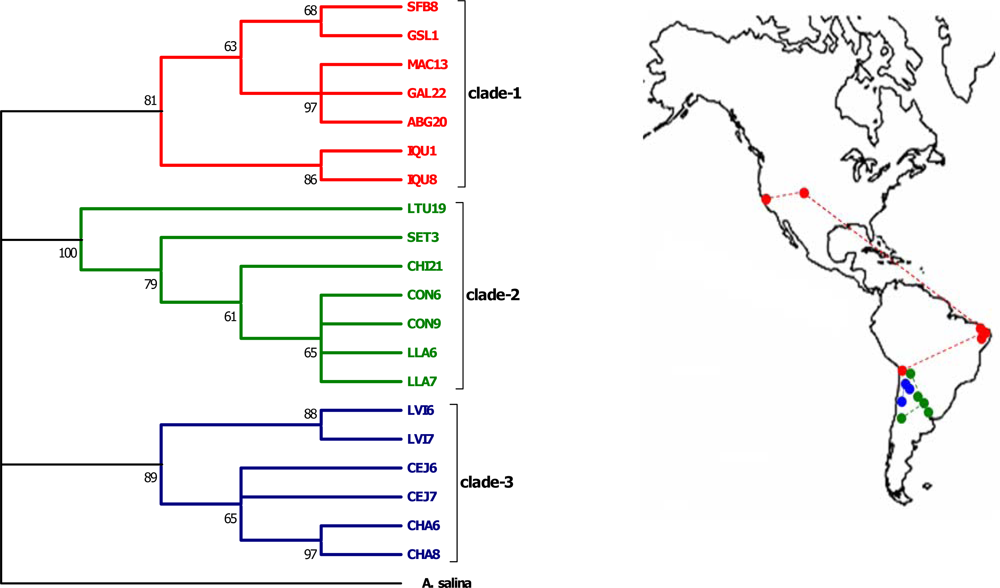
<p>The pairwise 16S and COI genetic distance matrices were significantly correlated (Mantel test: <italic>Z</italic> = 0.88, <italic>r</italic> = 0.99, <italic>p</italic> &lt; 0.001, 1000 randomizations). Three well-differentiated clades with high nodal support were recovered with the mitochondrial DNA data. The same topology was also recovered when considering third codon positions for the COI gene (data not shown). The maximum parsimony analysis of the concatenated genes (16S + COI) recovered 124 most parsimonious trees (tree length = 230). The consensus phylogeny is shown in <xref ref-type="fig" rid="f1-ijms-10-05455">Figure 1</xref>. The first clade consists of the North American populations SFB, GSL, the Brazilian feral populations MAC, GAL, ABG, and the northernmost Chilean population of IQU. In the second clade, the Chilean populations of CON and LLA are clustered with all three Argentinean representatives (LTU, SET, CHI). The third clade consists of the remaining Chilean populations (LVI, CEJ, CHA). Analysis of population structure on the basis of the mitochondrial DNA topology revealed a strong pattern of population differentiation. The <italic>K</italic><sub>ST</sub> statistic was 0.74 (<italic>p</italic> &lt; 0.001, 10,000 randomizations) meaning that sequence differences segregate according to clade origin. In addition, there was no evidence for an isolation-by-distance pattern as judged by the lack of correlation between genetic and geographic distances, excluding the three Brazilian feral populations (Mantel test: <italic>Z</italic> = 130.43, <italic>r</italic> = 0.21, <italic>p</italic> = 0.13).</p>
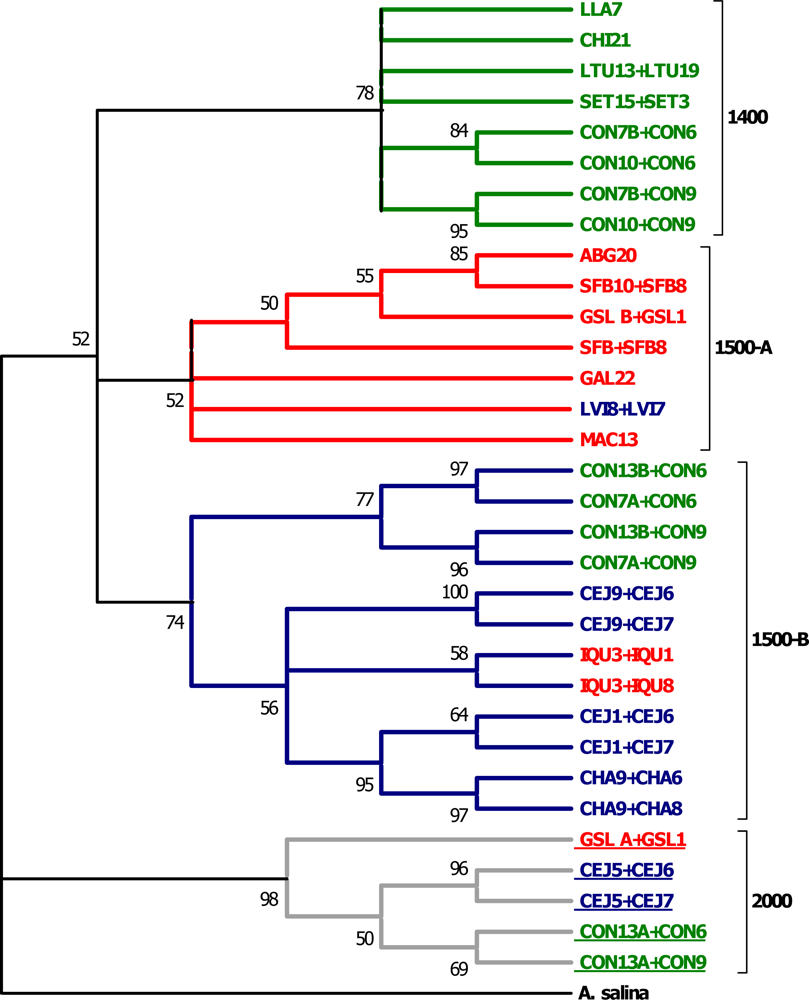
<p>For the combined nuclear data, significant correlation was also evident between the ITS1 and p26 genetic divergence matrices (Mantel test: <italic>Z</italic> = 2.85, <italic>r</italic> = 0.98, <italic>p</italic> &lt; 0.05, 1000 randomizations). The inferred phylogeny using maximum parsimony (38 equally parsimonious trees, tree length = 1224) is shown in <xref ref-type="fig" rid="f2-ijms-10-05455">Figure 2</xref>. Four groups are recovered corresponding to the different lengths of the p26 alleles (1400, 1500, and 2000 bp) with the 1500 bp group splitting further in two clusters. The most divergent group is the one bearing the 2000 bp haplotypes: it shares a more distant common ancestor with the others groups (see <xref ref-type="fig" rid="f2-ijms-10-05455">Figure 2</xref>), with distance values of 8.2% (2000 <italic>versus</italic> 1500) and 7.2% (2000 <italic>versus</italic> 1400), while 1500 <italic>versus</italic> 1400 equals 4.8%. Interestingly, the 2000 bp group retains a similar phylogenetic structure with that of the entire mitochondrial DNA tree (contains representatives from the three mitochondrial DNA clades). The remaining three groups (1400, 1500-A, 1500-B) are characterized by various degrees of cohesion and concordance to the recovered mitochondrial clades. Of particular importance are the LVI and IQU denoted haplotypes whose closest relatives reside in different mitochondrial and nuclear clades. It should be emphasized that allele lengths (1400, 1500, 2000) are used only as tags in the nuclear phylogeny; the resulting groups are based solely on sequence differences/similarities since gaps were considered as missing data.</p></sec></sec>
<sec sec-type="discussion">
<label>3.</label>
<title>Discussion</title>
<p>We have employed a battery of mitochondrial (16S, COI) and nuclear (ITS1, p26) markers to investigate patterns of genealogical concordance in the hypersaline branchiopod <italic>A. franciscana</italic>. The current study is the first dedicated attempt to explore the historical phylogeography of this model anostracan using sequence data from several loci. Although limited by current standards, our data set provides strong evidence for an advanced state of phylogenetic congruence across loci in the investigated lineages.</p>
<sec>
<label>3.1.</label>
<title>Mitochondrial Genealogy</title>
<p>The inferred mitochondrial genealogy is a typical example of pronounced phylogenetic gaps between allopatric lineages. The presence of three reciprocally monophyletic mitochondrial phylogroups (clades 1–3, see <xref ref-type="fig" rid="f1-ijms-10-05455">Figure 1</xref>) with statistically significant support is reminiscent of phylogeographic discontinuities modulated by long-term extrinsic barriers to genetic exchange or low gender-specific dispersal and gene flow (see [<xref ref-type="bibr" rid="b1-ijms-10-05455">1</xref>]). Between-clade distances for 16S and COI range from 2.2 to 4.2%, with a proportion of interclade differentiation of 81.3%.</p>
<p>Our results are in agreement with previous estimates based on allozymes reporting considerable differentiation (mean genetic distance of 12.6%, [<xref ref-type="bibr" rid="b37-ijms-10-05455">37</xref>]) and substructuring (mean <italic>F</italic><sub>ST</sub> = 0.24, [<xref ref-type="bibr" rid="b38-ijms-10-05455">38</xref>]) between geographic populations of the <italic>A. franciscana</italic> group. For South American <italic>A. franciscana</italic> populations, mean <italic>F</italic><sub>ST</sub> values range from 0.38 (allozymes, [<xref ref-type="bibr" rid="b39-ijms-10-05455">39</xref>]) to 0.91 (16S RFLPs, [<xref ref-type="bibr" rid="b40-ijms-10-05455">40</xref>]). Marked genetic distances have also been reported between Mexican and North American <italic>A. franciscana</italic> [<xref ref-type="bibr" rid="b41-ijms-10-05455">41</xref>]. In a study of the intraspecific phylogeography of the Mediterranean <italic>A. salina</italic> [<xref ref-type="bibr" rid="b42-ijms-10-05455">42</xref>], COI distances between higher-level clades (as determined by nested clade phylogeographic analysis) ranged from 1.1 to 2.7%. The authors found a pattern of extensive regional endemism, suggestive of an early Pleistocene split of Mediterranean lineages and subsequent population isolation in a number of glacial refugia. Analogous interpretations have also been advanced to explain the presence of localized distinct phylogroups in the rotifer <italic>Brachionus plicatilis</italic> (mean COI divergence 2.8%) from the Iberian Peninsula [<xref ref-type="bibr" rid="b43-ijms-10-05455">43</xref>] and the freshwater cladoceran <italic>Daphnia magna</italic> (COI divergences 0.73–1.74%) from Europe [<xref ref-type="bibr" rid="b13-ijms-10-05455">13</xref>].</p>
<p>Our mitochondrial DNA data point to a similar pattern of regional endemism and phylogeographic structure at the microscale, typically seen in continental zooplankters [<xref ref-type="bibr" rid="b43-ijms-10-05455">43</xref>]. The substantial amount of genetic differentiation between phylogroups, the support of monophyly of clades, and the absence of co-distributed lineages reflect accumulation of mutational differences following population separation. In other words, the lineage sorting process has been completed and the mitochondrial genealogy conveys a strong signal of historical fragmentation. Alternatively, gene flow between proximate populations may have been severely restricted in contemporary time, a possibility which can be effectively evaluated with additional and more extensive sampling.</p>
<p>Informative insights to the observed regional patterns of lineage endemism may be provided by consideration of biogeographic data pertinent to South America and, in particular, to the recent geological history of the Andes mountain range. Recent data indicate that the final phase of the central Andean uplift took place between 6.0 and 2.7 mya [<xref ref-type="bibr" rid="b44-ijms-10-05455">44</xref>] affecting the diversification of taxa on either side of the mountain range [<xref ref-type="bibr" rid="b45-ijms-10-05455">45</xref>]. Divergence rates for snapping shrimp COI sequences have been calculated at 1.4% per million years [<xref ref-type="bibr" rid="b46-ijms-10-05455">46</xref>] and useful approximations are allowed when sequence divergences are in the order of &lt;8%. Implementation of the above COI rate yields an estimated time of divergence between the most distantly related mitochondrial clades (clades 2 and 3, 4.2%) at 3.0 mya which is just before the last uplift of the Andes, in the late Pliocene. This is a strong indication that the Andean orogeny had a major effect on lineage splitting between clades 2 and 3 and extant populations have probably descended from gene pools which persisted through the recent periods of repeated glaciations. Thus, our results imply a longer demographic history than that expected by populations evolving during postglacial times. This is a signature of potential isolated refugial areas on both slopes of the Andes [<xref ref-type="bibr" rid="b45-ijms-10-05455">45</xref>]. A rather similar pattern of spatial structuring of distinct genetic lineages has also been observed for <italic>A. persimilis</italic> populations on either side of the Andes [<xref ref-type="bibr" rid="b11-ijms-10-05455">11</xref>]. Although such interpretations may involve a large margin of error, they provide an evolutionary timescale of lineage separations on which, given additional data, a more statistical phylogeographic framework can be devised (see [<xref ref-type="bibr" rid="b47-ijms-10-05455">47</xref>,<xref ref-type="bibr" rid="b48-ijms-10-05455">48</xref>]).</p></sec>
<sec>
<label>3.2.</label>
<title>Nuclear Genealogy</title>
<p>The most salient feature of the inferred phylogeny is the incomplete lineage sorting of nuclear genes. Under neutrality, the expected time for lineage sorting to reciprocal monophyly is fourfold longer for nuclear lineages than for mitochondrial lineages [<xref ref-type="bibr" rid="b2-ijms-10-05455">2</xref>]. Thus, due to a fourfold larger effective population size, the coalescent process proceeds more slowly for alleles at nuclear genes than for mitochondrial haplotypes. The nuclear tree quite clearly captures a snapshot of the above process for the ITS1 and p26 allelic lineages. In addition, due to the stochastic nature of genetic drift, its effects, simply by chance, may have not been registered strongly in the investigated nuclear loci. The dynamics of the specific sequences may also be involved by virtue of their being influenced by different forces, as ITS1 is a spacer region and p26 an intron region.</p>
<p>The incomplete sorting of ancestral polymorphisms is most apparent for the 1500 bp group of p26 alleles, and particularly for 1500-B (see <xref ref-type="fig" rid="f2-ijms-10-05455">Figure 2</xref>), which shows higher sequence diversity (0.4–14.8%) compared with the other groups of allelic lineages (1400, 2000) and contains representatives of all the respective mitochondrial clades. This paraphyletic pattern, as well as the subtopologies within the other groups (1400, 1500-A), may have likely arisen as a result of male-mediated dispersal. This mechanism erodes geographic structure in nuclear genes, yet leaves the mitochondrial DNA phylogeny unaffected (see [<xref ref-type="bibr" rid="b49-ijms-10-05455">49</xref>]). It is also worth noting that the 1500-B allelic lineage is represented by populations with the highest proximity, a fact relating to the previous dispersal scenario. Moreover, allozyme analyses of South American <italic>A. franciscana</italic> have identified the populations of LVI and IQU as the most divergent ones, bearing a mixture of both private and shared polymorphisms [<xref ref-type="bibr" rid="b39-ijms-10-05455">39</xref>]. An obvious critical requirement for the dispersal mechanism is that transported cysts developing into females do not reproduce with resident males. Although there is currently no evidence for intraspecific directionality in reproduction, clues may be obtained from the interspecific level where such a mechanism seems to work [<xref ref-type="bibr" rid="b12-ijms-10-05455">12</xref>]. Together, these findings support the view that gene flow has been operating to such a degree as to prevent genetic differentiation by genetic drift or, alternatively, selection has favoured the maintenance of certain alleles in South American sites. It is interesting to see that populations CON and CEJ (together with GSL from North America) display a pattern of polymorphism for the p26 allelic lineages. In particular, all three p26 alleles are found in the CON population (1400, 1500, 2000) whereas for CEJ and GSL two p26 alleles were detected (1500, 2000) with the 1500 alleles grouped in different lineages for each population (see <xref ref-type="fig" rid="f2-ijms-10-05455">Figure 2</xref>). Although additional data are needed to explain the distribution of this polymorphism, it could be tentatively ascribed to the fact that the three populations (members of distinct mitochondrial clades, see <xref ref-type="fig" rid="f1-ijms-10-05455">Figure 1</xref>) represent the most ancestral stocks (possibly refugial sites) from which lineage colonization and subsequent random loss occurred.</p>
<p>Irrespective of the specific etiology for the observed nuclear genealogy, the overall phylogeographic evidence in the investigated <italic>A. franciscana</italic> populations supports a genealogical phase at the interval between gene splitting and population fragmentation. Put differently, this interval is where speciation occurs. The mitochondrial DNA evidence upholds a specific demographic independence between sets of <italic>A. franciscana</italic> populations. This is registered in the presence of reciprocally monophyletic clades, being, by definition, genetically distinct and free of exchange. Depending on the evolutionary timescale, these population sets may qualify as evolutionary significant units [<xref ref-type="bibr" rid="b50-ijms-10-05455">50</xref>], thus justifying to a large extent arguments for incipient speciation in <italic>A. franciscana</italic>. Our data come to reinforce previous evidence on significant population differentiation in <italic>A. franciscana</italic>. A distinct correlation between chromocentre frequency and latitude, certain types of aneuploidy as registered in fluctuating chromosome numbers, extreme examples of ecological isolation, and an association between habitat type and heterozygosity in <italic>A. franciscana</italic> populations [<xref ref-type="bibr" rid="b23-ijms-10-05455">23</xref>] are all conducive to lineage diversification and suggest the presence of both geographical and ecological forms. However, before solid statements on the possible superspecies status of <italic>A. franciscana</italic> are made, more thorough phylogeographic nuclear sequence assays, accounting for the temporal and spatial aspects of population genealogical structure, are needed in order to unite the observed genetic attributes of the species with its postulated past biogeography.</p></sec></sec>
<sec>
<label>4.</label>
<title>Experimental Section</title>
<sec sec-type="methods">
<label>4.1.</label>
<title>Populations Analyzed and Data Assembly</title>
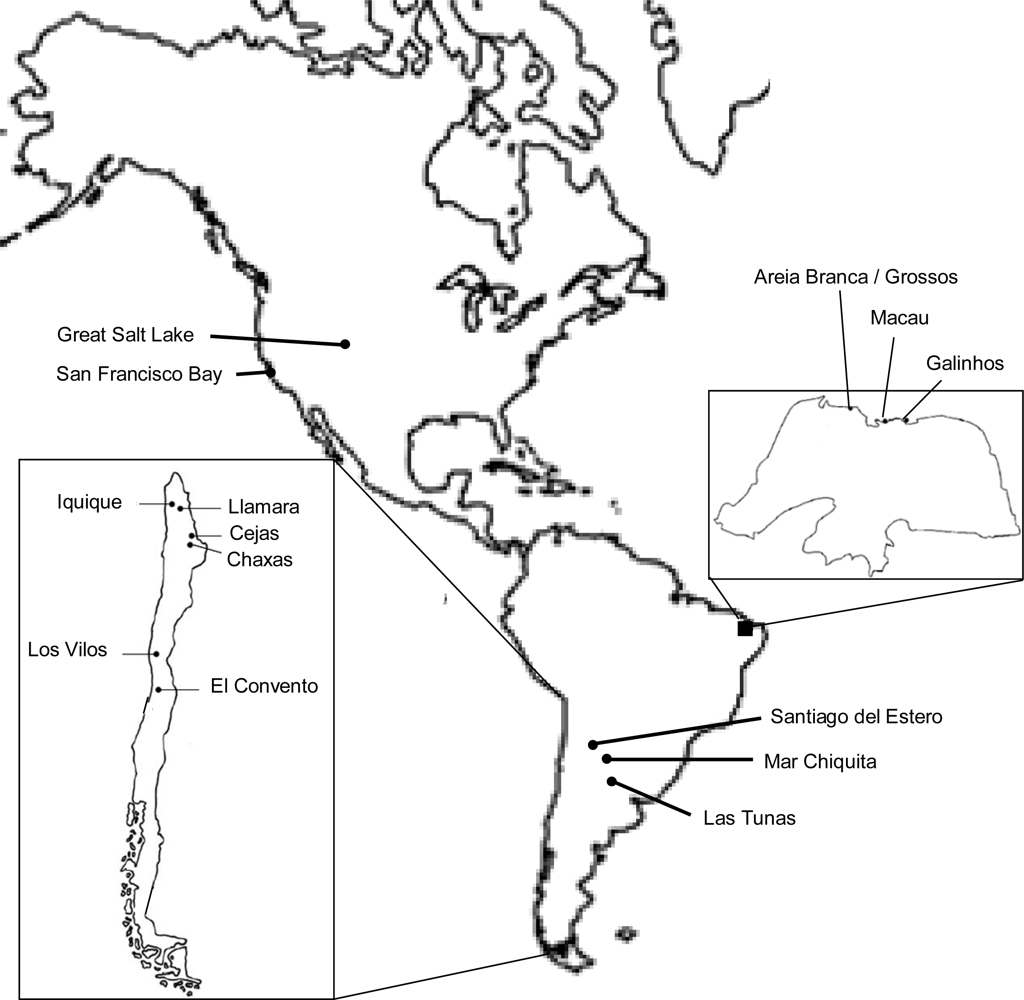
<p>We analyzed 14 <italic>A. franciscana</italic> populations from North (USA) and South America (Brazil, Chile, Argentina) (see <xref ref-type="fig" rid="f3-ijms-10-05455">Figure 3</xref>, <xref ref-type="table" rid="t2-ijms-10-05455">Table 2</xref>). The three Brazilian feral populations originate from material inoculated more than 30 years ago in the respective sites [<xref ref-type="bibr" rid="b28-ijms-10-05455">28</xref>]. We used published ITS1 and 16S rRNA sequences from Baxevanis <italic>et al</italic>. [<xref ref-type="bibr" rid="b11-ijms-10-05455">11</xref>] and Kappas <italic>et al</italic>. [<xref ref-type="bibr" rid="b12-ijms-10-05455">12</xref>] and also obtained novel sequences of these markers following the protocols by Kappas <italic>et al</italic>. [<xref ref-type="bibr" rid="b12-ijms-10-05455">12</xref>] (for GenBank accession numbers see <xref ref-type="table" rid="t1-ijms-10-05455">Table 1</xref>). Additionally, we amplified a 601 bp fragment of the mitochondrial cytochrome oxidase subunit I (COI) gene region and the entire second intron of the nuclear p26 gene. Whenever possible, we used the same individuals to those registered in GenBank for ITS1 and 16S rRNA.</p>
<p>For COI, a set of newly designed primers were employed (available upon request) based on deposited COI sequences of Anostraca. PCR conditions were: 4 min at 94 °C, 40 cycles of 50 sec at 94 °C, 50 sec at 50 °C, 50 sec at 72 °C and a final extension of 5 min at 72 °C. Total reaction volumes of 25 μL consisted of 2.5 μL template DNA, 5 μL 5 × PCR buffer, 2.5 mM MgCl<sub>2</sub>, 1 mM dNTPs, 0.001 mM of each primer and 1.25 U of <italic>Taq</italic> DNA polymerase (Expand High Fidelity<sup>PLUS</sup> PCR System, Roche).</p>
<p>For p26, PCR conditions are detailed in Maniatsi <italic>et al</italic>. [<xref ref-type="bibr" rid="b29-ijms-10-05455">29</xref>]. In all cases, bands were purified prior to direct sequencing (complementary strands). All amplifications were performed on a PTC-100<sup>®</sup> Peltier thermal cycler (MJ Research). Sequencing reactions were electrophoresed on a PRISM 3730xl DNA analyzer (Applied Biosystems). The newly derived COI and p26 gene sequences were deposited in GenBank (see <xref ref-type="table" rid="t1-ijms-10-05455">Table 1</xref>). Sequences were aligned using ClustalX 1.8 [<xref ref-type="bibr" rid="b30-ijms-10-05455">30</xref>]. In all cases (16S, COI, ITS1, p26), genealogies were rooted using <italic>A. salina</italic> as outgroup (accession numbers: 16S: FJ007839, COI: GU248381, ITS1: DQ201303, p26: GU248407).</p></sec>
<sec sec-type="methods">
<label>4.2.</label>
<title>Sequence Analysis and Phylogenetic Reconstruction</title>
<p>Newly derived sequences were subjected to BLAST searches for confirmation of homology. For all data sets we conducted tests for homogeneity of base frequencies, substitution saturation, and presence of phylogenetic signal following the methods in Kappas <italic>et al</italic>. [<xref ref-type="bibr" rid="b12-ijms-10-05455">12</xref>]. Values of genetic diversity within and distance between populations were computed in MEGA version 4 [<xref ref-type="bibr" rid="b31-ijms-10-05455">31</xref>]. Corrected distances were used based on the best-fit substitution model as determined by Modeltest 3.7 [<xref ref-type="bibr" rid="b32-ijms-10-05455">32</xref>].</p>
<p>Phylogenetic reconstruction was implemented in PAUP* 4.0b10 [<xref ref-type="bibr" rid="b33-ijms-10-05455">33</xref>] under maximum parsimony. Phylogenetic inference was based on concatenated sequence data (mitochondrial: 16S + COI; nuclear: ITS1 + p26). Prior to data combination, conflicting phylogenetic signal was evaluated through Mantel tests on the corresponding genetic distance matrices. For each joint data set, trees were generated using heuristic searches with TBR (tree-bisection-reconnection) branch swapping and 500 random taxon additions. Nodal support was assessed by 1000 bootstrap replicates. Gaps were treated as missing data. Phylogenetic analysis was also conducted considering third codon positions only for COI.</p>
<p>For mitochondrial DNA, we evaluated isolation-by-distance (IBD) patterns by correlating geographic and genetic distances (corrected) between <italic>A. franciscana</italic> populations. We used the IBDWS version 3.14 (Isolation by Distance Web Service, [<xref ref-type="bibr" rid="b34-ijms-10-05455">34</xref>]) to perform Mantel tests (both raw and log-transformed matrices, 30,000 randomizations) and Reduced Major Axis (RMA) regression analysis. We also tested for the presence of phylogeographic structure using DnaSP version 5 [<xref ref-type="bibr" rid="b35-ijms-10-05455">35</xref>]. We used the nucleotide sequence-based <italic>K</italic><sub>ST</sub> statistic as given in Hudson <italic>et al</italic>. [<xref ref-type="bibr" rid="b36-ijms-10-05455">36</xref>] in order to control for the presence of unique haplotypes in different groupings. Group assignment was based on the inferred topology during phylogenetic reconstruction. Statistical significance was assessed using a permutation test (10,000 randomizations).</p></sec></sec></body>
<back>
<ack>
<p>We thank the Guest Editor, Alan Templeton, for the invitation to contribute our study to this special issue on “Cladistic Analysis and Molecular Evolution”. This work has been partially supported by PENED project (03ED402) on stress proteins. The technical support of S. Papakostas is greatly acknowledged.</p></ack>
<ref-list>
<title>References and Notes</title>
<ref id="b1-ijms-10-05455"><label>1.</label><citation citation-type="book"><person-group person-group-type="author"><name><surname>Avise</surname><given-names>JC</given-names></name></person-group><source>Phylogeography: The History and Formation of Species</source><edition>2nd Ed</edition><publisher-name>Harvard University Press</publisher-name><publisher-loc>Cambridge, MA, USA</publisher-loc><year>2000</year></citation></ref>
<ref id="b2-ijms-10-05455"><label>2.</label><citation citation-type="book"><person-group person-group-type="author"><name><surname>Avise</surname><given-names>JC</given-names></name></person-group><source>Molecular Markers, Natural History, and Evolution</source><edition>2nd Ed</edition><publisher-name>Sinauer Associates, Inc</publisher-name><publisher-loc>Sunderland, MA, USA</publisher-loc><year>2004</year></citation></ref>
<ref id="b3-ijms-10-05455"><label>3.</label><citation citation-type="journal"><person-group person-group-type="author"><name><surname>Bernardi</surname><given-names>G</given-names></name><name><surname>Sordino</surname><given-names>P</given-names></name><name><surname>Powers</surname><given-names>DA</given-names></name></person-group><article-title>Concordant mitochondrial and nuclear DNA phylogenies for populations of the teleost fish <italic>Fundulus heteroclitus</italic></article-title><source>Proc. Natl. Acad. Sci. USA</source><year>1993</year><volume>90</volume><fpage>9271</fpage><lpage>9274</lpage><pub-id pub-id-type="doi">10.1073/pnas.90.20.9271</pub-id><pub-id pub-id-type="pmid">8105474</pub-id></citation></ref>
<ref id="b4-ijms-10-05455"><label>4.</label><citation citation-type="journal"><person-group person-group-type="author"><name><surname>Burton</surname><given-names>RS</given-names></name><name><surname>Lee</surname><given-names>B-N</given-names></name></person-group><article-title>Nuclear and mitochondrial gene genealogies and allozyme polymorphism across a major phylogeographic break in the copepod <italic>Tigriopus californicus</italic></article-title><source>Proc. Natl. Acad. Sci. USA</source><year>1994</year><volume>91</volume><fpage>5197</fpage><lpage>5201</lpage><pub-id pub-id-type="doi">10.1073/pnas.91.11.5197</pub-id><pub-id pub-id-type="pmid">7910968</pub-id></citation></ref>
<ref id="b5-ijms-10-05455"><label>5.</label><citation citation-type="journal"><person-group person-group-type="author"><name><surname>Willett</surname><given-names>CS</given-names></name><name><surname>Ladner</surname><given-names>JT</given-names></name></person-group><article-title>Investigations of fine-scale phylogeography in <italic>Tigriopus californicus</italic> reveal historical patterns of population divergence</article-title><source>BMC Evol. Biol</source><year>2009</year><volume>9</volume><fpage>139</fpage><pub-id pub-id-type="doi">10.1186/1471-2148-9-139</pub-id><pub-id pub-id-type="pmid">19549324</pub-id></citation></ref>
<ref id="b6-ijms-10-05455"><label>6.</label><citation citation-type="journal"><person-group person-group-type="author"><name><surname>Mills</surname><given-names>S</given-names></name><name><surname>Lunt</surname><given-names>DH</given-names></name><name><surname>Gómez</surname><given-names>A</given-names></name></person-group><article-title>Global isolation by distance despite strong regional phylogeography in a small metazoan</article-title><source>BMC Evol. Biol</source><year>2007</year><volume>7</volume><fpage>225</fpage><pub-id pub-id-type="doi">10.1186/1471-2148-7-225</pub-id><pub-id pub-id-type="pmid">17999774</pub-id></citation></ref>
<ref id="b7-ijms-10-05455"><label>7.</label><citation citation-type="journal"><person-group person-group-type="author"><name><surname>Adamowicz</surname><given-names>SJ</given-names></name><name><surname>Petrusek</surname><given-names>A</given-names></name><name><surname>Colbourne</surname><given-names>JK</given-names></name><name><surname>Hebert</surname><given-names>PDN</given-names></name><name><surname>Witt</surname><given-names>JDS</given-names></name></person-group><article-title>The scale of divergence: A phylogenetic appraisal of intercontinental allopatric speciation in a passively dispersed freshwater zooplankton genus</article-title><source>Mol. Phylogenet. Evol</source><year>2009</year><volume>50</volume><fpage>423</fpage><lpage>436</lpage><pub-id pub-id-type="doi">10.1016/j.ympev.2008.11.026</pub-id><pub-id pub-id-type="pmid">19124080</pub-id></citation></ref>
<ref id="b8-ijms-10-05455"><label>8.</label><citation citation-type="journal"><person-group person-group-type="author"><name><surname>Gajardo</surname><given-names>GM</given-names></name><name><surname>Sorgeloos</surname><given-names>P</given-names></name><name><surname>Beardmore</surname><given-names>JA</given-names></name></person-group><article-title>Inland hypersaline lakes and the brine shrimp <italic>Artemia</italic> as simple models for biodiversity analysis at the population level</article-title><source>Saline Syst</source><year>2006</year><volume>2</volume><fpage>14</fpage><pub-id pub-id-type="doi">10.1186/1746-1448-2-14</pub-id><pub-id pub-id-type="pmid">17132175</pub-id></citation></ref>
<ref id="b9-ijms-10-05455"><label>9.</label><citation citation-type="journal"><person-group person-group-type="author"><name><surname>Green</surname><given-names>AJ</given-names></name><name><surname>Sánchez</surname><given-names>MI</given-names></name><name><surname>Amat</surname><given-names>F</given-names></name><name><surname>Figuerola</surname><given-names>J</given-names></name><name><surname>Hontoria</surname><given-names>F</given-names></name><name><surname>Ruiz</surname><given-names>O</given-names></name><name><surname>Hortas</surname><given-names>F</given-names></name></person-group><article-title>Dispersal of invasive and native brine shrimps <italic>Artemia</italic> (Anostraca) <italic>via</italic> waterbirds</article-title><source>Limnol. Oceanogr</source><year>2005</year><volume>50</volume><fpage>737</fpage><lpage>742</lpage><pub-id pub-id-type="doi">10.4319/lo.2005.50.2.0737</pub-id></citation></ref>
<ref id="b10-ijms-10-05455"><label>10.</label><citation citation-type="book"><person-group person-group-type="author"><name><surname>Mayr</surname><given-names>E</given-names></name></person-group><source>Animal Species and Evolution</source><publisher-name>Belknap Press</publisher-name><publisher-loc>Cambridge, MA, USA</publisher-loc><year>1963</year></citation></ref>
<ref id="b11-ijms-10-05455"><label>11.</label><citation citation-type="journal"><person-group person-group-type="author"><name><surname>Baxevanis</surname><given-names>AD</given-names></name><name><surname>Kappas</surname><given-names>I</given-names></name><name><surname>Abatzopoulos</surname><given-names>TJ</given-names></name></person-group><article-title>Molecular phylogenetics and asexuality in the brine shrimp <italic>Artemia</italic></article-title><source>Mol. Phylogenet. Evol</source><year>2006</year><volume>40</volume><fpage>724</fpage><lpage>738</lpage><pub-id pub-id-type="doi">10.1016/j.ympev.2006.04.010</pub-id><pub-id pub-id-type="pmid">16753307</pub-id></citation></ref>
<ref id="b12-ijms-10-05455"><label>12.</label><citation citation-type="journal"><person-group person-group-type="author"><name><surname>Kappas</surname><given-names>I</given-names></name><name><surname>Baxevanis</surname><given-names>AD</given-names></name><name><surname>Maniatsi</surname><given-names>S</given-names></name><name><surname>Abatzopoulos</surname><given-names>TJ</given-names></name></person-group><article-title>Porous genomes and species integrity in the branchiopod <italic>Artemia</italic></article-title><source>Mol. Phylogenet. Evol</source><year>2009</year><volume>52</volume><fpage>192</fpage><lpage>204</lpage><pub-id pub-id-type="doi">10.1016/j.ympev.2009.03.012</pub-id><pub-id pub-id-type="pmid">19306934</pub-id></citation></ref>
<ref id="b13-ijms-10-05455"><label>13.</label><citation citation-type="journal"><person-group person-group-type="author"><name><surname>de Gelas</surname><given-names>K</given-names></name><name><surname>de Meester</surname><given-names>L</given-names></name></person-group><article-title>Phylogeography of <italic>Daphnia magna</italic> in Europe</article-title><source>Mol. Ecol</source><year>2005</year><volume>14</volume><fpage>753</fpage><lpage>764</lpage><pub-id pub-id-type="doi">10.1111/j.1365-294X.2004.02434.x</pub-id><pub-id pub-id-type="pmid">15723667</pub-id></citation></ref>
<ref id="b14-ijms-10-05455"><label>14.</label><citation citation-type="journal"><person-group person-group-type="author"><name><surname>King</surname><given-names>JL</given-names></name><name><surname>Hanner</surname><given-names>R</given-names></name></person-group><article-title>Cryptic species in a “living fossil” lineage: Taxonomic and phylogenetic relationships within the genus<italic>Lepidurus</italic> (Crustacea: Notostraca) in North America</article-title><source>Mol. Phylogenet. Evol</source><year>1998</year><volume>10</volume><fpage>23</fpage><lpage>36</lpage><pub-id pub-id-type="doi">10.1006/mpev.1997.0470</pub-id><pub-id pub-id-type="pmid">9751915</pub-id></citation></ref>
<ref id="b15-ijms-10-05455"><label>15.</label><citation citation-type="journal"><person-group person-group-type="author"><name><surname>Lee</surname><given-names>CE</given-names></name></person-group><article-title>Global phylogeography of a cryptic copepod species complex and reproductive isolation between genetically proximate “populations”</article-title><source>Evolution</source><year>2000</year><volume>54</volume><fpage>2014</fpage><lpage>2027</lpage><pub-id pub-id-type="pmid">11209778</pub-id></citation></ref>
<ref id="b16-ijms-10-05455"><label>16.</label><citation citation-type="journal"><person-group person-group-type="author"><name><surname>Witt</surname><given-names>JDS</given-names></name><name><surname>Hebert</surname><given-names>PDN</given-names></name></person-group><article-title>Cryptic species diversity and evolution in the amphipod genus <italic>Hyalella</italic> within central glaciated North America: A molecular phylogenetic approach</article-title><source>Can. J. Fish. Aquat. Sci</source><year>2000</year><volume>57</volume><fpage>687</fpage><lpage>698</lpage><pub-id pub-id-type="doi">10.1139/f99-285</pub-id></citation></ref>
<ref id="b17-ijms-10-05455"><label>17.</label><citation citation-type="journal"><person-group person-group-type="author"><name><surname>Gómez</surname><given-names>A</given-names></name><name><surname>Serra</surname><given-names>M</given-names></name><name><surname>Carvalho</surname><given-names>GR</given-names></name><name><surname>Lunt</surname><given-names>DH</given-names></name></person-group><article-title>Speciation in ancient cryptic complexes: Evidence from the molecular phylogeny of <italic>Brachionus plicatilis</italic> (Rotifera)</article-title><source>Evolution</source><year>2002</year><volume>56</volume><fpage>1431</fpage><lpage>1444</lpage><pub-id pub-id-type="pmid">12206243</pub-id></citation></ref>
<ref id="b18-ijms-10-05455"><label>18.</label><citation citation-type="journal"><person-group person-group-type="author"><name><surname>Papakostas</surname><given-names>S</given-names></name><name><surname>Triantafyllidis</surname><given-names>A</given-names></name><name><surname>Kappas</surname><given-names>I</given-names></name><name><surname>Abatzopoulos</surname><given-names>TJ</given-names></name></person-group><article-title>The utility of the 16S gene in investigating cryptic speciation within the <italic>Brachionus plicatilis</italic> species complex</article-title><source>Mar. Biol</source><year>2005</year><volume>147</volume><fpage>1129</fpage><lpage>1139</lpage><pub-id pub-id-type="doi">10.1007/s00227-005-0012-7</pub-id></citation></ref>
<ref id="b19-ijms-10-05455"><label>19.</label><citation citation-type="journal"><person-group person-group-type="author"><name><surname>De Meester</surname><given-names>L</given-names></name><name><surname>Gómez</surname><given-names>A</given-names></name><name><surname>Okamura</surname><given-names>B</given-names></name><name><surname>Schwenk</surname><given-names>K</given-names></name></person-group><article-title>The Monopolization Hypothesis and the dispersal–gene flow paradox in aquatic organisms</article-title><source>Acta Oecol</source><year>2002</year><volume>23</volume><fpage>121</fpage><lpage>135</lpage><pub-id pub-id-type="doi">10.1016/S1146-609X(02)01145-1</pub-id></citation></ref>
<ref id="b20-ijms-10-05455"><label>20.</label><citation citation-type="journal"><person-group person-group-type="author"><name><surname>Triantaphyllidis</surname><given-names>GV</given-names></name><name><surname>Abatzopoulos</surname><given-names>TJ</given-names></name><name><surname>Sorgeloos</surname><given-names>P</given-names></name></person-group><article-title>Review of the biogeography of the genus <italic>Artemia</italic> (Crustacea, Anostraca)</article-title><source>J. Biogeogr</source><year>1998</year><volume>25</volume><fpage>213</fpage><lpage>226</lpage><pub-id pub-id-type="doi">10.1046/j.1365-2699.1998.252190.x</pub-id></citation></ref>
<ref id="b21-ijms-10-05455"><label>21.</label><citation citation-type="book"><person-group person-group-type="author"><name><surname>van Stappen</surname><given-names>G</given-names></name></person-group><article-title>Zoogeography</article-title><source>Artemia: Basic and Applied Biology</source><edition>1st Ed</edition><person-group person-group-type="editor"><name><surname>Abatzopoulos</surname><given-names>TJ</given-names></name><name><surname>Beardmore</surname><given-names>JA</given-names></name><name><surname>Clegg</surname><given-names>JS</given-names></name><name><surname>Sorgeloos</surname><given-names>P</given-names></name></person-group><publisher-name>Kluwer Academic Publishers</publisher-name><publisher-loc>Dordrecht, The Netherlands</publisher-loc><year>2002</year><fpage>171</fpage><lpage>224</lpage></citation></ref>
<ref id="b22-ijms-10-05455"><label>22.</label><citation citation-type="book"><person-group person-group-type="author"><name><surname>Lenz</surname><given-names>PH</given-names></name></person-group><article-title>Ecological studies on <italic>Artemia</italic>: A review</article-title><source>Artemia Research and Its Applications. Ecology, Culturing, Use in Aquaculture</source><person-group person-group-type="editor"><name><surname>Sorgeloos</surname><given-names>P</given-names></name><name><surname>Bengtson</surname><given-names>DA</given-names></name><name><surname>Decleir</surname><given-names>W</given-names></name><name><surname>Jaspers</surname><given-names>E</given-names></name></person-group><publisher-name>Universa Press</publisher-name><publisher-loc>Wetteren, Belgium</publisher-loc><year>1987</year><volume>3</volume><fpage>5</fpage><lpage>18</lpage></citation></ref>
<ref id="b23-ijms-10-05455"><label>23.</label><citation citation-type="book"><person-group person-group-type="author"><name><surname>Abatzopoulos</surname><given-names>TJ</given-names></name><name><surname>Beardmore</surname><given-names>JA</given-names></name><name><surname>Clegg</surname><given-names>JS</given-names></name><name><surname>Sorgeloos</surname><given-names>P</given-names></name></person-group><source>Artemia: Basic and Applied Biology</source><edition>1st Ed</edition><publisher-name>Kluwer Academic Publishers</publisher-name><publisher-loc>Dordrecht, The Netherlands</publisher-loc><year>2002</year></citation></ref>
<ref id="b24-ijms-10-05455"><label>24.</label><citation citation-type="journal"><person-group person-group-type="author"><name><surname>Abatzopoulos</surname><given-names>TJ</given-names></name><name><surname>Kappas</surname><given-names>I</given-names></name><name><surname>Bossier</surname><given-names>P</given-names></name><name><surname>Sorgeloos</surname><given-names>P</given-names></name><name><surname>Beardmore</surname><given-names>JA</given-names></name></person-group><article-title>Genetic characterization of <italic>Artemia tibetiana</italic> (Crustacea: Anostraca)</article-title><source>Biol. J. Linn. Soc</source><year>2002</year><volume>75</volume><fpage>333</fpage><lpage>344</lpage><pub-id pub-id-type="doi">10.1111/j.1095-8312.2002.tb02074.x</pub-id></citation></ref>
<ref id="b25-ijms-10-05455"><label>25.</label><citation citation-type="book"><person-group person-group-type="author"><name><surname>Lenz</surname><given-names>PH</given-names></name><name><surname>Browne</surname><given-names>RA</given-names></name></person-group><article-title>Ecology of <italic>Artemia</italic></article-title><source>Artemia Biology</source><edition>1st Ed</edition><person-group person-group-type="editor"><name><surname>Browne</surname><given-names>RA</given-names></name><name><surname>Sorgeloos</surname><given-names>P</given-names></name><name><surname>Trotman</surname><given-names>CAN</given-names></name></person-group><publisher-name>CRC Press</publisher-name><publisher-loc>Boca Raton, FL, USA</publisher-loc><year>1991</year><fpage>237</fpage><lpage>253</lpage></citation></ref>
<ref id="b26-ijms-10-05455"><label>26.</label><citation citation-type="journal"><person-group person-group-type="author"><name><surname>Kappas</surname><given-names>I</given-names></name><name><surname>Abatzopoulos</surname><given-names>TJ</given-names></name><name><surname>Van Hoa</surname><given-names>N</given-names></name><name><surname>Sorgeloos</surname><given-names>P</given-names></name><name><surname>Beardmore</surname><given-names>JA</given-names></name></person-group><article-title>Genetic and reproductive differentiation of <italic>Artemia franciscana</italic> in a new environment</article-title><source>Mar. Biol</source><year>2004</year><volume>146</volume><fpage>103</fpage><lpage>117</lpage><pub-id pub-id-type="doi">10.1007/s00227-004-1420-9</pub-id></citation></ref>
<ref id="b27-ijms-10-05455"><label>27.</label><citation citation-type="journal"><person-group person-group-type="author"><name><surname>Bowen</surname><given-names>ST</given-names></name><name><surname>Fogarino</surname><given-names>EA</given-names></name><name><surname>Hitchner</surname><given-names>KN</given-names></name><name><surname>Dana</surname><given-names>GL</given-names></name><name><surname>Chow</surname><given-names>VHS</given-names></name><name><surname>Buoncristiani</surname><given-names>MR</given-names></name><name><surname>Carl</surname><given-names>JR</given-names></name></person-group><article-title>Ecological isolation in <italic>Artemia</italic>: Population differences in tolerance of anion concentrations</article-title><source>J. Crust. Biol</source><year>1985</year><volume>5</volume><fpage>106</fpage><lpage>129</lpage><pub-id pub-id-type="doi">10.2307/1548224</pub-id></citation></ref>
<ref id="b28-ijms-10-05455"><label>28.</label><citation citation-type="journal"><person-group person-group-type="author"><name><surname>Camara</surname><given-names>MR</given-names></name></person-group><article-title>Dispersal of <italic>Artemia franciscana</italic> Kellogg (Crustacea; Anostraca) populations in the coastal saltworks of Rio Grande do Norte, northeastern Brazil</article-title><source>Hydrobiologia</source><year>2001</year><volume>466</volume><fpage>145</fpage><lpage>148</lpage><pub-id pub-id-type="doi">10.1023/A:1014575001333</pub-id></citation></ref>
<ref id="b29-ijms-10-05455"><label>29.</label><citation citation-type="journal"><person-group person-group-type="author"><name><surname>Maniatsi</surname><given-names>S</given-names></name><name><surname>Baxevanis</surname><given-names>AD</given-names></name><name><surname>Abatzopoulos</surname><given-names>TJ</given-names></name></person-group><article-title>The intron 2 of p26 gene: A novel genetic marker for discriminating the two most commercially important <italic>Artemia franciscana</italic> subspecies</article-title><source>J. Biol. Res. (Thessalon.)</source><year>2009</year><volume>11</volume><fpage>73</fpage><lpage>82</lpage></citation></ref>
<ref id="b30-ijms-10-05455"><label>30.</label><citation citation-type="journal"><person-group person-group-type="author"><name><surname>Thompson</surname><given-names>JD</given-names></name><name><surname>Gibson</surname><given-names>TJ</given-names></name><name><surname>Plewniak</surname><given-names>F</given-names></name><name><surname>Jeanmougin</surname><given-names>F</given-names></name><name><surname>Higgins</surname><given-names>DG</given-names></name></person-group><article-title>The ClustalX windows interface: Flexible strategies for multiple sequence alignment aided by quality analysis tools</article-title><source>Nucleic Acids Res</source><year>1997</year><volume>25</volume><fpage>4876</fpage><lpage>4882</lpage><pub-id pub-id-type="doi">10.1093/nar/25.24.4876</pub-id><pub-id pub-id-type="pmid">9396791</pub-id></citation></ref>
<ref id="b31-ijms-10-05455"><label>31.</label><citation citation-type="journal"><person-group person-group-type="author"><name><surname>Tamura</surname><given-names>K</given-names></name><name><surname>Dudley</surname><given-names>J</given-names></name><name><surname>Nei</surname><given-names>M</given-names></name><name><surname>Kumar</surname><given-names>S</given-names></name></person-group><article-title>MEGA4: Molecular Evolutionary Genetics Analysis (MEGA) software version 4.0</article-title><source>Mol. Biol. Evol</source><year>2007</year><volume>24</volume><fpage>1596</fpage><lpage>1599</lpage><pub-id pub-id-type="doi">10.1093/molbev/msm092</pub-id><pub-id pub-id-type="pmid">17488738</pub-id></citation></ref>
<ref id="b32-ijms-10-05455"><label>32.</label><citation citation-type="journal"><person-group person-group-type="author"><name><surname>Posada</surname><given-names>D</given-names></name><name><surname>Crandall</surname><given-names>KA</given-names></name></person-group><article-title>Modeltest: Testing the model of DNA substitution</article-title><source>Bioinformatics</source><year>1998</year><volume>14</volume><fpage>817</fpage><lpage>818</lpage><pub-id pub-id-type="doi">10.1093/bioinformatics/14.9.817</pub-id><pub-id pub-id-type="pmid">9918953</pub-id></citation></ref>
<ref id="b33-ijms-10-05455"><label>33.</label><citation citation-type="book"><person-group person-group-type="author"><name><surname>Swofford</surname><given-names>DL</given-names></name></person-group><source>PAUP* Phylogenetic Analysis Using Parsimony (* and Other Methods) Version 4</source><publisher-name>Sinauer Associates</publisher-name><publisher-loc>Sunderland, MA, USA</publisher-loc><year>1998</year></citation></ref>
<ref id="b34-ijms-10-05455"><label>34.</label><citation citation-type="journal"><person-group person-group-type="author"><name><surname>Jensen</surname><given-names>JL</given-names></name><name><surname>Bohonak</surname><given-names>AJ</given-names></name><name><surname>Kelley</surname><given-names>ST</given-names></name></person-group><article-title>Isolation by distance, web service</article-title><source>BMC Genet</source><year>2005</year><volume>6</volume><fpage>13</fpage><pub-id pub-id-type="pmid">15760479</pub-id></citation></ref>
<ref id="b35-ijms-10-05455"><label>35.</label><citation citation-type="journal"><person-group person-group-type="author"><name><surname>Librado</surname><given-names>P</given-names></name><name><surname>Rozas</surname><given-names>J</given-names></name></person-group><article-title>DnaSP v5: A software for comprehensive analysis of DNA polymorphism data</article-title><source>Bioinformatics</source><year>2009</year><volume>25</volume><fpage>1451</fpage><lpage>1452</lpage><pub-id pub-id-type="doi">10.1093/bioinformatics/btp187</pub-id><pub-id pub-id-type="pmid">19346325</pub-id></citation></ref>
<ref id="b36-ijms-10-05455"><label>36.</label><citation citation-type="journal"><person-group person-group-type="author"><name><surname>Hundson</surname><given-names>RR</given-names></name><name><surname>Boos</surname><given-names>DD</given-names></name><name><surname>Kaplan</surname><given-names>NL</given-names></name></person-group><article-title>A statistical test for detecting geographic subdivision</article-title><source>Mol. Biol. Evol</source><year>1992</year><volume>9</volume><fpage>138</fpage><lpage>151</lpage><pub-id pub-id-type="pmid">1552836</pub-id></citation></ref>
<ref id="b37-ijms-10-05455"><label>37.</label><citation citation-type="other"><person-group person-group-type="author"><name><surname>Abreu-Grobois</surname><given-names>FA</given-names></name></person-group><source>Population Genetics of Artemia</source>Ph.D. Thesis; University of Wales: Swansea, UK, <year>1983</year></citation></ref>
<ref id="b38-ijms-10-05455"><label>38.</label><citation citation-type="book"><person-group person-group-type="author"><name><surname>Beardmore</surname><given-names>JA</given-names></name><name><surname>Abreu-Grobois</surname><given-names>FA</given-names></name></person-group><article-title>Taxonomy and evolution in the brine shrimp <italic>Artemia</italic></article-title><source>Protein Polymorphism: Adaptive and Taxonomic Significance</source><person-group person-group-type="editor"><name><surname>Oxford</surname><given-names>GS</given-names></name><name><surname>Rollinson</surname><given-names>D</given-names></name></person-group><publisher-name>Academic Press</publisher-name><publisher-loc>London, UK</publisher-loc><year>1983</year><fpage>153</fpage><lpage>164</lpage></citation></ref>
<ref id="b39-ijms-10-05455"><label>39.</label><citation citation-type="journal"><person-group person-group-type="author"><name><surname>Gajardo</surname><given-names>G</given-names></name><name><surname>Da Conceicao</surname><given-names>M</given-names></name><name><surname>Weber</surname><given-names>L</given-names></name><name><surname>Beardmore</surname><given-names>JA</given-names></name></person-group><article-title>Genetic variability and interpopulational differentiation of <italic>Artemia</italic> strains from South America</article-title><source>Hydrobiologia</source><year>1995</year><volume>302</volume><fpage>21</fpage><lpage>29</lpage><pub-id pub-id-type="doi">10.1007/BF00006396</pub-id></citation></ref>
<ref id="b40-ijms-10-05455"><label>40.</label><citation citation-type="journal"><person-group person-group-type="author"><name><surname>Gajardo</surname><given-names>G</given-names></name><name><surname>Crespo</surname><given-names>J</given-names></name><name><surname>Triantafyllidis</surname><given-names>A</given-names></name><name><surname>Tzika</surname><given-names>A</given-names></name><name><surname>Baxevanis</surname><given-names>AD</given-names></name><name><surname>Kappas</surname><given-names>I</given-names></name><name><surname>Abatzopoulos</surname><given-names>TJ</given-names></name></person-group><article-title>Species identification of Chilean <italic>Artemia</italic> populations based on mitochondrial DNA RFLP analysis</article-title><source>J. Biogeogr</source><year>2004</year><volume>31</volume><fpage>547</fpage><lpage>555</lpage><pub-id pub-id-type="doi">10.1111/j.1365-2699.2003.01046.x</pub-id></citation></ref>
<ref id="b41-ijms-10-05455"><label>41.</label><citation citation-type="journal"><person-group person-group-type="author"><name><surname>Tizol-Correa</surname><given-names>R</given-names></name><name><surname>Maeda-Martínez</surname><given-names>AM</given-names></name><name><surname>Weekers</surname><given-names>PHH</given-names></name><name><surname>Torrentera</surname><given-names>L</given-names></name><name><surname>Murugan</surname><given-names>G</given-names></name></person-group><article-title>Biodiversity of the brine shrimp <italic>Artemia</italic> from tropical salterns in southern México and Cuba</article-title><source>Current Sci</source><year>2009</year><volume>96</volume><fpage>81</fpage><lpage>87</lpage></citation></ref>
<ref id="b42-ijms-10-05455"><label>42.</label><citation citation-type="journal"><person-group person-group-type="author"><name><surname>Muñoz</surname><given-names>J</given-names></name><name><surname>Gómez</surname><given-names>A</given-names></name><name><surname>Green</surname><given-names>AJ</given-names></name><name><surname>Figuerola</surname><given-names>J</given-names></name><name><surname>Amat</surname><given-names>F</given-names></name><name><surname>Rico</surname><given-names>C</given-names></name></person-group><article-title>Phylogeography and local endemism of the native Mediterranean brine shrimp <italic>Artemia salina</italic> (Branchiopoda: Anostraca)</article-title><source>Mol. Ecol</source><year>2008</year><volume>17</volume><fpage>3160</fpage><lpage>3177</lpage><pub-id pub-id-type="doi">10.1111/j.1365-294X.2008.03818.x</pub-id><pub-id pub-id-type="pmid">18510585</pub-id></citation></ref>
<ref id="b43-ijms-10-05455"><label>43.</label><citation citation-type="journal"><person-group person-group-type="author"><name><surname>Gómez</surname><given-names>A</given-names></name><name><surname>Carvalho</surname><given-names>GR</given-names></name><name><surname>Lunt</surname><given-names>DH</given-names></name></person-group><article-title>Phylogeography and regional endemism of a passively dispersing zooplankter: mtDNA variation of rotifer resting egg banks</article-title><source>Proc. R. Soc. Lond. B</source><year>2000</year><volume>267</volume><fpage>2189</fpage><lpage>2197</lpage><pub-id pub-id-type="doi">10.1098/rspb.2000.1268</pub-id></citation></ref>
<ref id="b44-ijms-10-05455"><label>44.</label><citation citation-type="journal"><person-group person-group-type="author"><name><surname>Gregory-Wodzicki</surname><given-names>KM</given-names></name></person-group><article-title>Uplift history of the Central and Northern Andes: A review</article-title><source>Geol. Soc. Am. Bull</source><year>2000</year><volume>112</volume><fpage>1091</fpage><lpage>1105</lpage><pub-id pub-id-type="doi">10.1130/0016-7606(2000)112&lt;1091:UHOTCA&gt;2.0.CO;2</pub-id></citation></ref>
<ref id="b45-ijms-10-05455"><label>45.</label><citation citation-type="journal"><person-group person-group-type="author"><name><surname>Ramírez</surname><given-names>CC</given-names></name><name><surname>Salazar</surname><given-names>M</given-names></name><name><surname>Palma</surname><given-names>RE</given-names></name><name><surname>Cordero</surname><given-names>C</given-names></name><name><surname>Mezabasso</surname><given-names>L</given-names></name></person-group><article-title>Phylogeographical analysis of neotropical <italic>Rhagoletis</italic> (Diptera: Tephritidae): Did the Andes uplift contribute to current morphological differences?</article-title><source>Neotrop. Entomol</source><year>2008</year><volume>37</volume><fpage>651</fpage><lpage>661</lpage><pub-id pub-id-type="doi">10.1590/S1519-566X2008000600005</pub-id><pub-id pub-id-type="pmid">19169552</pub-id></citation></ref>
<ref id="b46-ijms-10-05455"><label>46.</label><citation citation-type="journal"><person-group person-group-type="author"><name><surname>Knowlton</surname><given-names>N</given-names></name><name><surname>Weigt</surname><given-names>LA</given-names></name></person-group><article-title>New dates and new rates for divergence across the Isthmus of Panama</article-title><source>Proc. R. Soc. Lond. B</source><year>1998</year><volume>265</volume><fpage>2257</fpage><lpage>2263</lpage><pub-id pub-id-type="doi">10.1098/rspb.1998.0568</pub-id></citation></ref>
<ref id="b47-ijms-10-05455"><label>47.</label><citation citation-type="journal"><person-group person-group-type="author"><name><surname>Templeton</surname><given-names>AR</given-names></name></person-group><article-title>Nested clade analyses of phylogeographic data: Testing hypotheses about gene flow and population history</article-title><source>Mol. Ecol</source><year>1998</year><volume>7</volume><fpage>381</fpage><lpage>397</lpage><pub-id pub-id-type="doi">10.1046/j.1365-294x.1998.00308.x</pub-id><pub-id pub-id-type="pmid">9627999</pub-id></citation></ref>
<ref id="b48-ijms-10-05455"><label>48.</label><citation citation-type="journal"><person-group person-group-type="author"><name><surname>Templeton</surname><given-names>AR</given-names></name></person-group><article-title>Using phylogeographic analyses of gene trees to test species status and processes</article-title><source>Mol. Ecol</source><year>2001</year><volume>10</volume><fpage>779</fpage><lpage>791</lpage><pub-id pub-id-type="pmid">11298987</pub-id></citation></ref>
<ref id="b49-ijms-10-05455"><label>49.</label><citation citation-type="journal"><person-group person-group-type="author"><name><surname>Palumbi</surname><given-names>SR</given-names></name><name><surname>Baker</surname><given-names>SC</given-names></name></person-group><article-title>Contrasting population structure from nuclear intron sequences and mtDNA of humpback whales</article-title><source>Mol. Biol. Evol</source><year>1994</year><volume>11</volume><fpage>426</fpage><lpage>435</lpage><pub-id pub-id-type="pmid">7912407</pub-id></citation></ref>
<ref id="b50-ijms-10-05455"><label>50.</label><citation citation-type="journal"><person-group person-group-type="author"><name><surname>Ryder</surname><given-names>OA</given-names></name></person-group><article-title>Species conservation and the dilemma of subspecies</article-title><source>Trends Ecol. Evol</source><year>1986</year><volume>1</volume><fpage>9</fpage><lpage>10</lpage><pub-id pub-id-type="doi">10.1016/0169-5347(86)90059-5</pub-id></citation></ref></ref-list>
<sec sec-type="display-objects">
<title>Figures and Tables</title>
<fig id="f1-ijms-10-05455" position="float">
<label>Figure 1.</label>
<caption>
<p>Consensus maximum parsimony phylogeny (50% majority rule of 124 most parsimonious trees, tree length = 230) of concatenated 16S and COI <italic>A. franciscana</italic> haplotypes. Values at nodes indicate bootstrap support based on 1000 pseudoreplicates. The geographic distribution of the recovered clades (connected by dashed lines for illustration purposes only) is shown on the map. The phylogeny is rooted with <italic>A. salina</italic>.</p></caption><graphic xlink:href="ijms-10-05455f1.gif"/></fig>
<fig id="f2-ijms-10-05455" position="float">
<label>Figure 2.</label>
<caption>
<p>Consensus maximum parsimony phylogeny (50% majority rule of 38 most parsimonious trees, tree length = 1224) of concatenated p26 and ITS1 A. franciscana haplotypes. Values at nodes indicate bootstrap support based on 1000 pseudoreplicates. The order of concatenation is denoted as p26 + ITS1. Designations lacking a plus sign indicate concatenation of sequences from the same individual. The recovered groups (1400, 1500-A, 1500-B, 2000) are used as tags for the observed p26 alleles (see text). Colors (green, red, blue) correspond to the respective mitochondrial clades (see <xref ref-type="fig" rid="f1-ijms-10-05455">Figure 1</xref>). Haplotypes of the distinct 2000 group (gray) are underlined. The phylogeny is rooted with A. salina.</p></caption><graphic xlink:href="ijms-10-05455f2.gif"/></fig>
<fig id="f3-ijms-10-05455" position="float">
<label>Figure 3.</label>
<caption>
<p>Map showing the locations of the <italic>Artemia franciscana</italic> populations analyzed.</p></caption><graphic xlink:href="ijms-10-05455f3.gif"/></fig>
<table-wrap id="t1-ijms-10-05455" position="float">
<label>Table 1.</label>
<caption>
<p>List of <italic>Artemia franciscana</italic> individuals analyzed and GenBank accession numbers of sequences.</p></caption>
<table frame="hsides" rules="groups">
<thead>
<tr>
<th valign="middle" align="center"><bold>Individuals</bold></th>
<th valign="middle" align="center"><bold>16S</bold></th>
<th valign="middle" align="center"><bold>COI</bold></th>
<th valign="middle" align="center"><bold>ITS1</bold></th></tr></thead>
<tbody>
<tr>
<td valign="top" align="left">SFB8</td>
<td valign="top" align="center">FJ007826<xref ref-type="table-fn" rid="tfn1-ijms-10-05455">a</xref></td>
<td valign="top" align="center">X69067</td>
<td valign="top" align="center">DQ201292<xref ref-type="table-fn" rid="tfn2-ijms-10-05455">b</xref></td></tr>
<tr>
<td valign="top" align="left">GSL1</td>
<td valign="top" align="center">FJ007825<xref ref-type="table-fn" rid="tfn1-ijms-10-05455">a</xref></td>
<td valign="top" align="center"><underline>GU248372</underline></td>
<td valign="top" align="center">DQ201300<xref ref-type="table-fn" rid="tfn2-ijms-10-05455">b</xref></td></tr>
<tr>
<td valign="top" align="left">LVI6, LVI7</td>
<td valign="top" align="center">FJ007833<xref ref-type="table-fn" rid="tfn1-ijms-10-05455">a</xref>, FJ007834<xref ref-type="table-fn" rid="tfn1-ijms-10-05455">a</xref></td>
<td valign="top" align="center"><underline>GU248379, GU248380</underline></td>
<td valign="top" align="center">-, FJ004929<xref ref-type="table-fn" rid="tfn1-ijms-10-05455">a</xref></td></tr>
<tr>
<td valign="top" align="left">CEJ6, CEJ7</td>
<td valign="top" align="center">FJ007831<xref ref-type="table-fn" rid="tfn1-ijms-10-05455">a</xref>, FJ007832<xref ref-type="table-fn" rid="tfn1-ijms-10-05455">a</xref></td>
<td valign="top" align="center"><underline>GU248375, GU248376</underline></td>
<td valign="top" align="center">FJ004925<xref ref-type="table-fn" rid="tfn1-ijms-10-05455">a</xref>, FJ004935<xref ref-type="table-fn" rid="tfn1-ijms-10-05455">a</xref></td></tr>
<tr>
<td valign="top" align="left">CHA6, CHA8</td>
<td valign="top" align="center">FJ007829<xref ref-type="table-fn" rid="tfn1-ijms-10-05455">a</xref>, FJ007830<xref ref-type="table-fn" rid="tfn1-ijms-10-05455">a</xref></td>
<td valign="top" align="center"><underline>GU248377, GU248378</underline></td>
<td valign="top" align="center">FJ004928<xref ref-type="table-fn" rid="tfn1-ijms-10-05455">a</xref>, FJ004926<xref ref-type="table-fn" rid="tfn1-ijms-10-05455">a</xref></td></tr>
<tr>
<td valign="top" align="left">LLA6, LLA7</td>
<td valign="top" align="center">FJ007820<xref ref-type="table-fn" rid="tfn1-ijms-10-05455">a</xref>, FJ007821<xref ref-type="table-fn" rid="tfn1-ijms-10-05455">a</xref></td>
<td valign="top" align="center"><underline>GU248365, GU248366</underline></td>
<td valign="top" align="center">-, FJ004939<xref ref-type="table-fn" rid="tfn1-ijms-10-05455">a</xref></td></tr>
<tr>
<td valign="top" align="left">CON6, CON9</td>
<td valign="top" align="center">FJ007823<xref ref-type="table-fn" rid="tfn1-ijms-10-05455">a</xref>, FJ007822<xref ref-type="table-fn" rid="tfn1-ijms-10-05455">a</xref></td>
<td valign="top" align="center"><underline>GU248363, GU248364</underline></td>
<td valign="top" align="center">FJ004941<xref ref-type="table-fn" rid="tfn1-ijms-10-05455">a</xref>, FJ004942<xref ref-type="table-fn" rid="tfn1-ijms-10-05455">a</xref></td></tr>
<tr>
<td valign="top" align="left">IQU1, IQU8</td>
<td valign="top" align="center">FJ007827<xref ref-type="table-fn" rid="tfn1-ijms-10-05455">a</xref>, FJ007828<xref ref-type="table-fn" rid="tfn1-ijms-10-05455">a</xref></td>
<td valign="top" align="center"><underline>GU248373, GU248374</underline></td>
<td valign="top" align="center">DQ201296<xref ref-type="table-fn" rid="tfn1-ijms-10-05455">a</xref>, FJ004927<xref ref-type="table-fn" rid="tfn1-ijms-10-05455">a</xref></td></tr>
<tr>
<td valign="top" align="left">MAC13</td>
<td valign="top" align="center"><underline>GU248382</underline></td>
<td valign="top" align="center"><underline>GU248371</underline></td>
<td valign="top" align="center"><underline>GU252102</underline></td></tr>
<tr>
<td valign="top" align="left">ABG20</td>
<td valign="top" align="center"><underline>GU248383</underline></td>
<td valign="top" align="center"><underline>GU248369</underline></td>
<td valign="top" align="center"><underline>GU252103</underline></td></tr>
<tr>
<td valign="top" align="left">GAL22</td>
<td valign="top" align="center"><underline>GU248384</underline></td>
<td valign="top" align="center"><underline>GU248370</underline></td>
<td valign="top" align="center"><underline>GU252104</underline></td></tr>
<tr>
<td valign="top" align="left">CHI21</td>
<td valign="top" align="center"><underline>GU248385</underline></td>
<td valign="top" align="center"><underline>GU248362</underline></td>
<td valign="top" align="center"><underline>GU252105</underline></td></tr>
<tr>
<td valign="top" align="left">LTU19</td>
<td valign="top" align="center"><underline>GU248386</underline></td>
<td valign="top" align="center"><underline>GU248368</underline></td>
<td valign="top" align="center"><underline>GU252106</underline></td></tr>
<tr>
<td valign="top" align="left">SET3</td>
<td valign="top" align="center"><underline>GU248387</underline></td>
<td valign="top" align="center"><underline>GU248367</underline></td>
<td valign="top" align="center"><underline>GU252107</underline></td></tr>
<tr>
<td valign="top" align="center" colspan="4"><hr/><bold>p26</bold><hr/></td></tr>
<tr>
<td valign="top" align="center">2000 bp</td>
<td valign="top" align="center" colspan="2">1500 bp</td>
<td valign="top" align="center">1400 bp</td></tr>
<tr>
<td valign="top" align="left" colspan="4"><hr/></td></tr>
<tr>
<td valign="top" align="center">GSL_A<xref ref-type="table-fn" rid="tfn3-ijms-10-05455">c</xref></td>
<td valign="top" align="center">SFB<xref ref-type="table-fn" rid="tfn3-ijms-10-05455">c</xref></td>
<td valign="top" align="center"><underline>CON13B (GU248398)</underline></td>
<td valign="top" align="center"><underline>LLA7 (GU248402)</underline></td></tr>
<tr>
<td valign="top" align="center"><underline>CEJ5 (GU248389)</underline></td>
<td valign="top" align="center"><underline>SFB10 (GU248391)</underline></td>
<td valign="top" align="center"><underline>CON7A (GU248397)</underline></td>
<td valign="top" align="center"><underline>CON7B (GU248401)</underline></td></tr>
<tr>
<td valign="top" align="center"><underline>CON13A (GU248388)</underline></td>
<td valign="top" align="center">GSL_B<xref ref-type="table-fn" rid="tfn3-ijms-10-05455">c</xref></td>
<td valign="top" align="center"><underline>IQU3 (GU248396)</underline></td>
<td valign="top" align="center"><underline>CON10 (GU248405)</underline></td></tr>
<tr><td valign="top" align="center"/>
<td valign="top" align="center"><underline>LVI8 (GU248393)</underline></td>
<td valign="top" align="center"><underline>MAC13 (GU248406)</underline></td>
<td valign="top" align="center"><underline>CHI21 (GU248404)</underline></td></tr>
<tr><td valign="top" align="center"/>
<td valign="top" align="center"><underline>CEJ9 (GU248399)</underline></td>
<td valign="top" align="center"><underline>ABG20 (GU248392)</underline></td>
<td valign="top" align="center"><underline>LTU13 (GU248400)</underline></td></tr>
<tr><td valign="top" align="center"/>
<td valign="top" align="center"><underline>CEJ1 (GU248395)</underline></td>
<td valign="top" align="center"><underline>GAL22 (GU248390)</underline></td>
<td valign="top" align="center"><underline>SET15 (GU248403)</underline></td></tr>
<tr><td valign="top" align="center"/>
<td valign="top" align="center"><underline>CHA9 (GU248394)</underline></td><td valign="top" align="center"/><td valign="top" align="center"/></tr></tbody></table>
<table-wrap-foot><fn id="tfn1-ijms-10-05455">
<label>a:</label>
<p>[<xref ref-type="bibr" rid="b12-ijms-10-05455">12</xref>];</p></fn><fn id="tfn2-ijms-10-05455">
<label>b:</label>
<p>[<xref ref-type="bibr" rid="b11-ijms-10-05455">11</xref>];</p></fn><fn id="tfn3-ijms-10-05455">
<label>c:</label>
<p>[<xref ref-type="bibr" rid="b29-ijms-10-05455">29</xref>]; Underlined sequences were obtained in this study.</p></fn></table-wrap-foot></table-wrap>
<table-wrap id="t2-ijms-10-05455" position="float">
<label>Table 2.</label>
<caption>
<p>List of <italic>Artemia franciscana</italic> populations analyzed.</p></caption>
<table frame="hsides" rules="rows">
<thead>
<tr>
<th valign="top" align="center"><bold>Population</bold><break/><bold>(abbreviation)</bold></th>
<th valign="top" align="center"><bold>Country</bold></th>
<th valign="top" align="center"><bold>Geographic coordinates</bold></th></tr></thead>
<tbody>
<tr>
<td valign="middle" align="center">San Francisco Bay<break/>(SFB)</td>
<td valign="middle" align="center">USA</td>
<td valign="middle" align="center">37°28′N<break/>122°30′W</td></tr>
<tr>
<td valign="middle" align="center">Great Salt Lake<break/>(GSL)</td>
<td valign="middle" align="center">USA</td>
<td valign="middle" align="center">40°59′N<break/>112°24′W</td></tr>
<tr>
<td valign="middle" align="center">Macau<break/>(MAC)</td>
<td valign="middle" align="center">Brazil</td>
<td valign="middle" align="center">5°06′S<break/>36°38′W</td></tr>
<tr>
<td valign="middle" align="center">Areia Branca/Grossos<break/>(ABG)</td>
<td valign="middle" align="center">Brazil</td>
<td valign="middle" align="center">4°57′S<break/>37°08′W</td></tr>
<tr>
<td valign="middle" align="center">Galinhos<break/>(GAL)</td>
<td valign="middle" align="center">Brazil</td>
<td valign="middle" align="center">5°07′S<break/>36°23′W</td></tr>
<tr>
<td valign="middle" align="center">Los Vilos<break/>(LVI)</td>
<td valign="middle" align="center">Chile</td>
<td valign="middle" align="center">31°58′S<break/>71°25′W</td></tr>
<tr>
<td valign="middle" align="center">Cejas<break/>(CEJ)</td>
<td valign="middle" align="center">Chile</td>
<td valign="middle" align="center">23°02′S<break/>68°13′W</td></tr>
<tr>
<td valign="middle" align="center">Chaxas<break/>(CHA)</td>
<td valign="middle" align="center">Chile</td>
<td valign="middle" align="center">22°47′S<break/>67°58′W</td></tr>
<tr>
<td valign="middle" align="center">Llamara<break/>(LLA)</td>
<td valign="middle" align="center">Chile</td>
<td valign="middle" align="center">21°18′S<break/>69°37′W</td></tr>
<tr>
<td valign="middle" align="center">El Convento<break/>(CON)</td>
<td valign="middle" align="center">Chile</td>
<td valign="middle" align="center">33°52′S<break/>71°44′W</td></tr>
<tr>
<td valign="middle" align="center">Iquique<break/>(IQU)</td>
<td valign="middle" align="center">Chile</td>
<td valign="middle" align="center">20°40′S<break/>70°15′W</td></tr>
<tr>
<td valign="middle" align="center">Mar Chiquita<break/>(CHI)</td>
<td valign="middle" align="center">Argentina</td>
<td valign="middle" align="center">30°39′S<break/>62°36′W</td></tr>
<tr>
<td valign="middle" align="center">Las Tunas<break/>(LTU)</td>
<td valign="middle" align="center">Argentina</td>
<td valign="middle" align="center">33°45′S<break/>62°19′W</td></tr>
<tr>
<td valign="middle" align="center">Santiago del Estero<break/>(SET)</td>
<td valign="middle" align="center">Argentina</td>
<td valign="middle" align="center">27°21′S<break/>64°13′W</td></tr></tbody></table></table-wrap></sec></back></article>