<?xml version="1.0" encoding="UTF-8"?>
<!DOCTYPE article PUBLIC "-//NLM//DTD Journal Publishing DTD v2.3 20070202//EN" "journalpublishing.dtd">
<article xmlns:xlink="http://www.w3.org/1999/xlink" xml:lang="en" article-type="research-article">
<front>
<journal-meta>
<journal-id journal-id-type="publisher-id">ijms</journal-id>
<journal-title>International Journal of Molecular Sciences</journal-title>
<abbrev-journal-title>Int. J. Mol. Sci.</abbrev-journal-title>
<issn pub-type="epub">1422-0067</issn>
<publisher>
<publisher-name>Molecular Diversity Preservation International (MDPI)</publisher-name></publisher></journal-meta>
<article-meta>
<article-id pub-id-type="doi">10.3390/ijms10010116</article-id>
<article-id pub-id-type="publisher-id">ijms-10-00116</article-id>
<article-categories>
<subj-group>
<subject>Article</subject></subj-group></article-categories>
<title-group>
<article-title>Function Annotation of an SBP-box Gene in <italic>Arabidopsis</italic> Based on Analysis of Co-expression Networks and Promoters</article-title></title-group>
<contrib-group>
<contrib contrib-type="author">
<name><surname>Wang</surname><given-names>Yi</given-names></name><xref ref-type="aff" rid="af1-ijms-10-00116">1</xref></contrib>
<contrib contrib-type="author">
<name><surname>Hu</surname><given-names>Zongli</given-names></name><xref ref-type="aff" rid="af1-ijms-10-00116">1</xref></contrib>
<contrib contrib-type="author">
<name><surname>Yang</surname><given-names>Yuxin</given-names></name><xref ref-type="aff" rid="af1-ijms-10-00116">1</xref></contrib>
<contrib contrib-type="author">
<name><surname>Chen</surname><given-names>Xuqing</given-names></name><xref ref-type="aff" rid="af1-ijms-10-00116">1</xref><xref ref-type="aff" rid="af2-ijms-10-00116">2</xref></contrib>
<contrib contrib-type="author">
<name><surname>Chen</surname><given-names>Guoping</given-names></name><xref ref-type="aff" rid="af1-ijms-10-00116">1</xref><xref ref-type="corresp" rid="C1">*</xref></contrib></contrib-group>
<aff id="af1-ijms-10-00116">
<label>1</label>College of Bioengineering, Chongqing University, Chongqing 400030, P.R. China. E-Mails:
<email>dna.wangyi@yahoo.com.cn</email> (Y. W.);
<email>huzongli71@yahoo.com.cn</email> (Z. H.);
<email>yangyuxin@sina.com.cn</email> (Y. Y.);
<email>chenxvqing@sina.com</email> (X. C.)</aff>
<aff id="af2-ijms-10-00116">
<label>2</label>Beijing Research Center of Agro-Biotechnology, Beijing 100089, P.R.China</aff>
<author-notes>
<corresp id="C1">* Author to whom correspondence should be addressed; E-Mail:
<email>chenguoping@cqu.edu.cn</email>; Tel. +86-23-63112674; Fax: +86-23-63112674</corresp></author-notes>
<pub-date pub-type="collection">
<month>1</month>
<year>2009</year></pub-date>
<pub-date pub-type="epub">
<day>2</day>
<month>1</month>
<year>2009</year></pub-date>
<volume>10</volume>
<issue>1</issue>
<fpage>116</fpage>
<lpage>132</lpage>
<history>
<date date-type="received">
<day>21</day>
<month>10</month>
<year>2008</year></date>
<date date-type="rev-recd">
<day>15</day>
<month>12</month>
<year>2008</year></date>
<date date-type="accepted">
<day>18</day>
<month>12</month>
<year>2008</year></date></history>
<permissions>
<copyright-statement>© 2009 by the authors; licensee Molecular Diversity Preservation International, Basel, Switzerland. This article is an open-access article distributed under the terms and conditions of the Creative Commons Attribution license (<ext-link xlink:href="http://creativecommons.org/licenses/by/3.0/" ext-link-type="uri">http://creativecommons.org/licenses/by/3.0/</ext-link>).</copyright-statement>
<copyright-year>2009</copyright-year>
<license license-type="open-access">
<p>This article is an open-access article distributed under the terms and conditions of the Creative Commons Attribution license (<ext-link xlink:href="http://creativecommons.org/licenses/by/3.0/" ext-link-type="uri">http://creativecommons.org/licenses/by/3.0/</ext-link>).</p></license></permissions>
<abstract>
<p>The SQUAMOSA PROMOTER BINDING PROTEIN–LIKE (SPL) gene family is an SBP-box transcription family in <italic>Arabidopsis</italic>. While several physiological responses to SPL genes have been reported, their biological role remains elusive. Here, we use a combined analysis of expression correlation, the interactome, and promoter content to infer the biological role of the SPL genes in <italic>Arabidopsis thaliana</italic>. Analysis of the SPL-correlated gene network reveals multiple functions for SPL genes. Network analysis shows that SPL genes function by controlling other transcription factor families and have relatives with membrane protein transport activity. The interactome analysis of the correlation genes suggests that SPL genes also take part in metabolism of glucose, inorganic salts, and ATP production. Furthermore, the promoters of the correlated genes contain a core binding cis-element (GTAC). All of these analyses suggest that SPL genes have varied functions in <italic>Arabidopsis</italic>.</p></abstract>
<kwd-group>
<kwd>Arabidopsis</kwd>
<kwd>SPL</kwd>
<kwd>co-expression</kwd>
<kwd>network</kwd>
<kwd>promoter</kwd></kwd-group></article-meta></front>
<body>
<sec sec-type="intro">
<title>1. Introduction</title>
<p>Transcription factors (TFs) are DNA-binding proteins that regulate gene expression at the level of mRNA transcription. In plants, as in all living organisms, transcription factors are an important level of gene regulation. Many families of transcription factors have been identified in plants. Analysis of the <italic>Arabidopsis</italic> genome reveals 29 classes of transcription factors, 16 of which appear to be unique to plants [<xref ref-type="bibr" rid="b1-ijms-10-00116">1</xref>]. One of these contains a DNA binding domain referred to as the SQUAMOSA PROMOTER BINDING PROTEIN (SBP) domain and is encoded by the SBP-box, a feature characteristic of the <italic>Arabidopsis</italic> SQUAMOSA PROMOTER BINDING PROTEIN–LIKE (SPL) gene family [<xref ref-type="bibr" rid="b2-ijms-10-00116">2</xref>, <xref ref-type="bibr" rid="b3-ijms-10-00116">3</xref>].</p>
<p>The first SBP-domain proteins, which were isolated from snapdragon [<xref ref-type="bibr" rid="b4-ijms-10-00116">4</xref>], showed <italic>in vitro</italic> binding to a sequence motif in the promoter region of the floral meristem identity gene SQUAMOSA [<xref ref-type="bibr" rid="b5-ijms-10-00116">5</xref>]. Since then, SBP-box genes have been identified in many plants. For example, the <italic>Arabidopsis</italic> genome alone contains 16 SPL genes [<xref ref-type="bibr" rid="b3-ijms-10-00116">3</xref>].</p>
<p>A number of physiological and biochemical studies have implicated the SBP-box gene in the regulation of plant tissue development. SPL3 may interact <italic>in vivo</italic> with promoters of the AP1 or CAL MADS-box genes of the SQUAMOSA family to act as a positive transcriptional regulator modulating floral development [<xref ref-type="bibr" rid="b2-ijms-10-00116">2</xref>]. An SPL gene is involved in the early stages of microsporogenesis and megasporogenesis [<xref ref-type="bibr" rid="b6-ijms-10-00116">6</xref>] and as well as the development of normal plant architecture [<xref ref-type="bibr" rid="b7-ijms-10-00116">7</xref>]. This family of genes was also associated with maize kernel development [<xref ref-type="bibr" rid="b8-ijms-10-00116">8</xref>] and tomato fruit ripeness [<xref ref-type="bibr" rid="b9-ijms-10-00116">9</xref>]. Very recently, a study showed that the SBP-box genes SPL9 and SPL15, which are regulated by microRNAs, control shoot maturation in <italic>Arabidopsis</italic> [<xref ref-type="bibr" rid="b10-ijms-10-00116">10</xref>].</p>
<p>Despite an increasing body of physiological and biochemical data, the biological role of the SBP-box transcription family remains elusive. In order to infer a biological role for it, we took advantage of the large repositories of <italic>Arabidopsis thaliana</italic> microarray data to study the co-expression gene with SPL. We identified 112 genes whose expression most highly correlated with them in response to various treatments and during development. Furthermore, we analyzed the promoters of these genes in order to identify the regulatory motifs. The results of our study predict that the SBP-box transcription family is involved in plant tissue development, responses to abiotic and biotic stresses, and the activation of other transcription factors and membrane proteins. Furthermore, we demonstrate how computational analyses linking expression data with regulatory information from studies of promoter elements can provide novel insights into the function of a transcription family whose function is unclear.</p></sec>
<sec sec-type="materials|methods">
<title>2. Materials and Methods</title>
<sec sec-type="methods">
<title>2.1. Identification of correlated genes and GO analysis</title>
<p>A total of 1,779 Affymetrix raw data Cel files were downloaded from the AtGenExpress and GEO sites [<xref ref-type="bibr" rid="b11-ijms-10-00116">11</xref>–<xref ref-type="bibr" rid="b13-ijms-10-00116">13</xref>]. All of them were derived from the Affymetrix ATH1 gene GeneChip microarray for Arabidopsis, and the samples contained at least two replicate chips. The required probe set-to-locus mappings for the ATH chip were obtained from TAIR (<ext-link xlink:href="ftp://ftp.arabidopsis.org/home/tair/Microarrays/Affymetrix" ext-link-type="ftp">ftp://ftp.arabidopsis.org/home/tair/Microarrays/Affymetrix</ext-link>, version 2-5-2007).</p>
<p>Normalization of the raw data Cel files was performed in R using the MAS5 algorithms, which are implemented in the affy package available from the BioConductor project [<xref ref-type="bibr" rid="b14-ijms-10-00116">14</xref>, <xref ref-type="bibr" rid="b15-ijms-10-00116">15</xref>]. R scripts were used to calculate non-parametric correlation coefficients (Spearman’s rho) between the expression of SPL genes and the expression of each of the ~22,000 genes represented on the Affymetrix array used to generate this dataset. We ranked the genes according to the correlation coefficients and reported genes that were most positively correlated with SPL gene expression. The p-values were calculated using bivariate normal distribution, with p representing the probability of observing an equal or larger positive or negative correlation by chance. For details of the method, see the article by Wei [<xref ref-type="bibr" rid="b16-ijms-10-00116">16</xref>].</p>
<p>To characterize the correlated genes, the web-based ‘Classification SuperViewer’ program (<ext-link xlink:href="http://bar.utoronto.ca/ntools/cgi-bin/ntools_classification_superviewer.cgi" ext-link-type="uri">http://bar.utoronto.ca/ntools/cgi-bin/ntools_classification_superviewer.cgi</ext-link>) was used to search for differential distributions of gene ontology (GO) and biological terms within the correlation genes.</p></sec>
<sec sec-type="methods">
<title>2.2. Arabidopsis interactome network and clustering analysis</title>
<p>The <italic>Arabidopsis</italic> interactome network was built by the AtPID. The AtPID (<italic>Arabidopsis thaliana</italic> <underline>P</underline>rotein <underline>I</underline>nteractome <underline>D</underline>atabase) represents a centralized platform for depicting and integrating information pertaining to protein-protein interaction networks, domain architecture, ortholog information, and GO annotation in the <italic>Arabidopsis thaliana</italic> proteome. We mapped the correlated genes to the network and also selected the first neighbors of the genes. To identify the function of SPL-correlated proteins in network clusters, the latest versions of the Biological Network Gene Ontology (BiNGO) [<xref ref-type="bibr" rid="b17-ijms-10-00116">17</xref>] and GOlorize tools [<xref ref-type="bibr" rid="b18-ijms-10-00116">18</xref>] were used for the statistical evaluation of groups of proteins. This evaluation was carried out using existing annotations of the Gene Ontology Consortium (<ext-link xlink:href="http://www.geneontology.org" ext-link-type="uri">http://www.geneontology.org</ext-link>).</p></sec>
<sec sec-type="methods">
<title>2.3. Promoter analysis</title>
<p>Applications in the web-based promoter analysis program Promomer [<xref ref-type="bibr" rid="b19-ijms-10-00116">19</xref>] were used to analyze the promoters (−1 kb upstream of the predicted translation start site) of the 112 genes showing the strongest correlations to SPL genes. The Promomer program aims to provide a user-friendly, web-based interface to accomplish two goals: (1) to identify statistically over-represented elements in a gene or a group of genes in <italic>Arabidopsis</italic> using the enumerative method, and (2) to find the number and position of occurrences of an element in genes across the <italic>Arabidopsis</italic> genome or in a subgroup of genes.</p></sec></sec>
<sec sec-type="results">
<title>3. Results</title>
<sec>
<title>3.1. Expression correlation and gene ontology (GO) analyses</title>
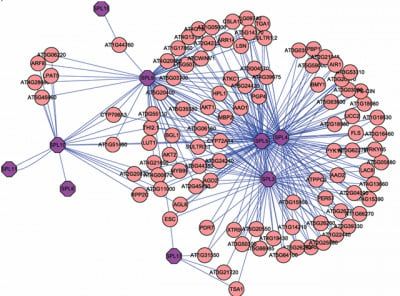
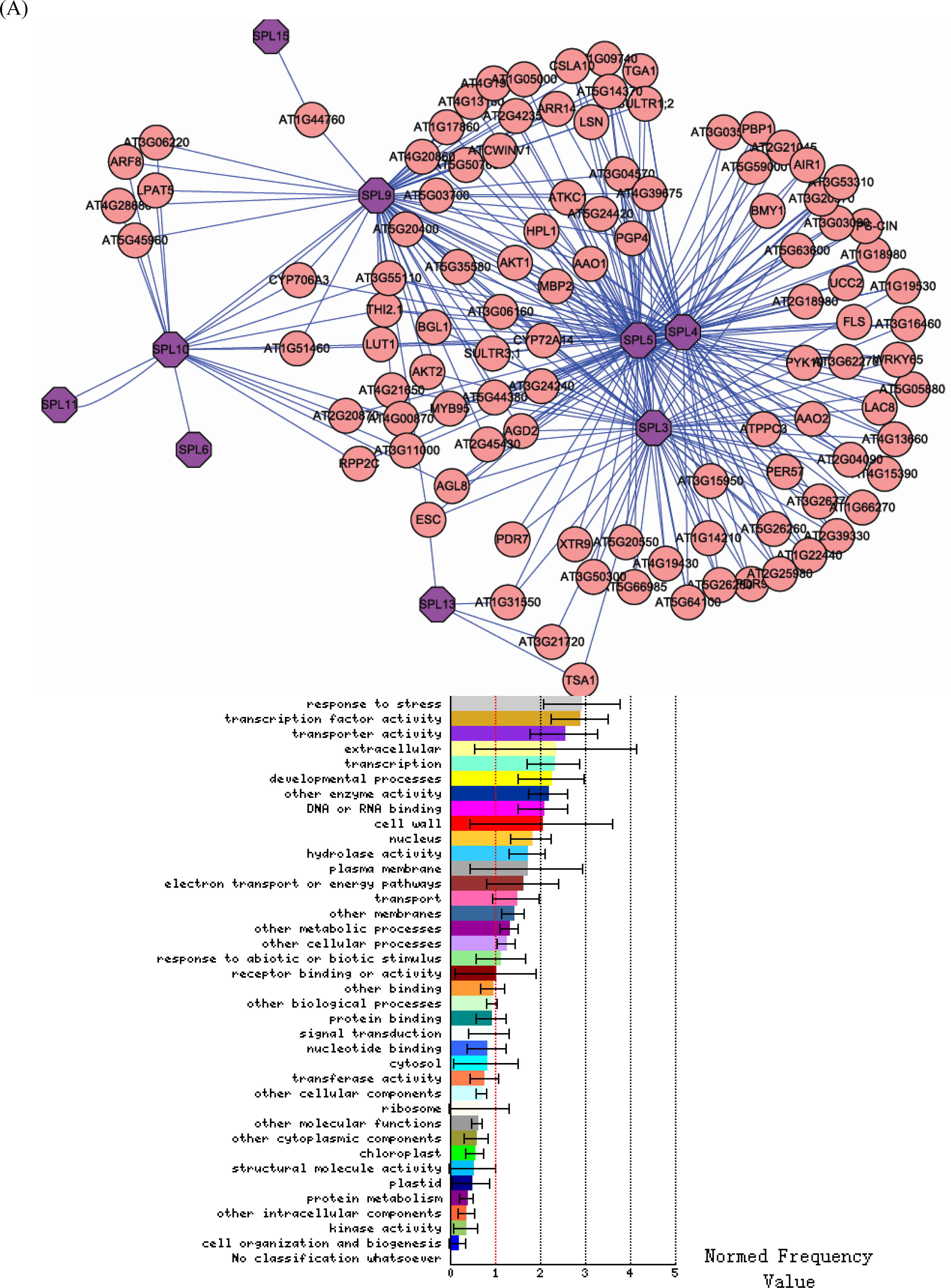
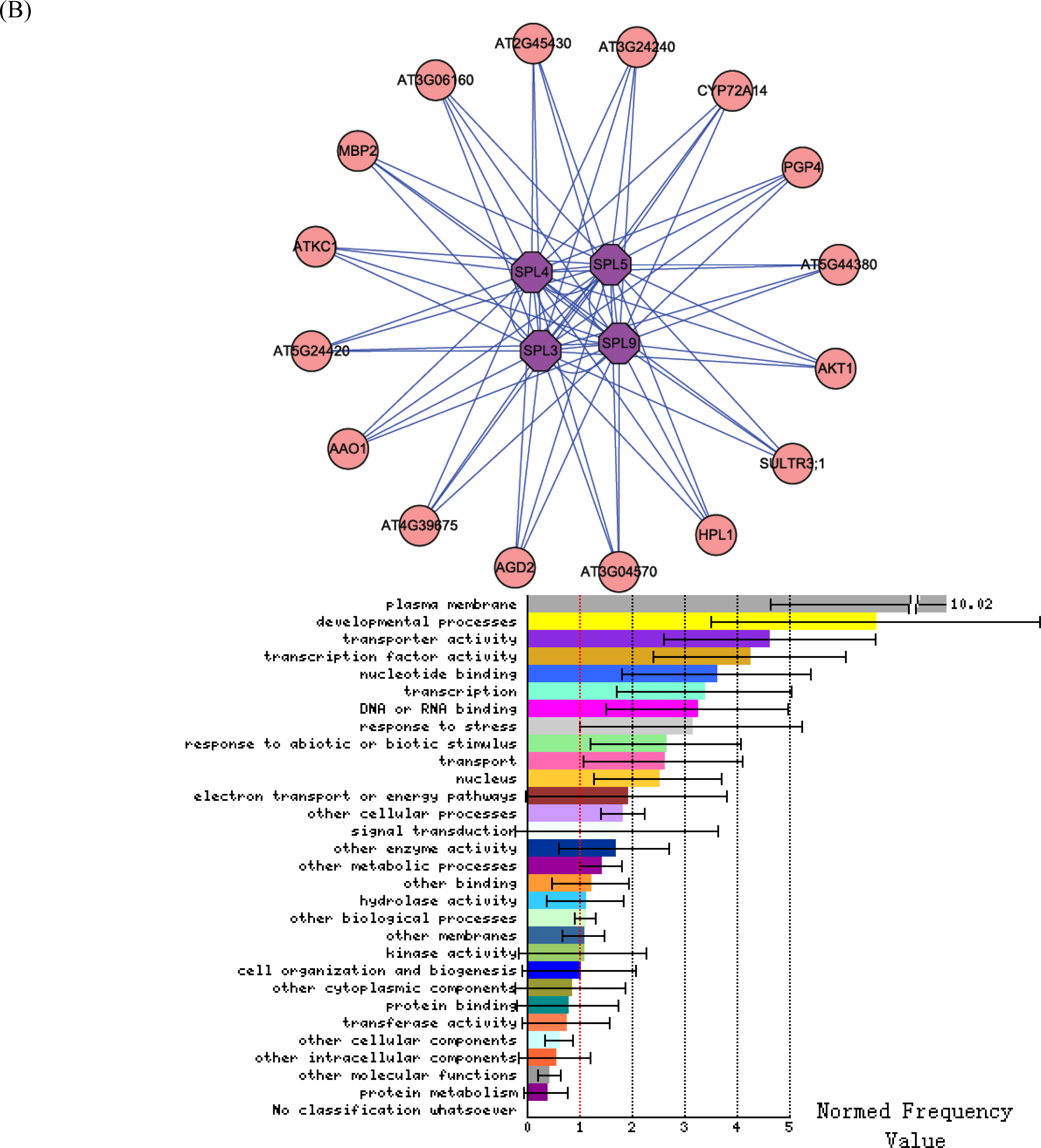
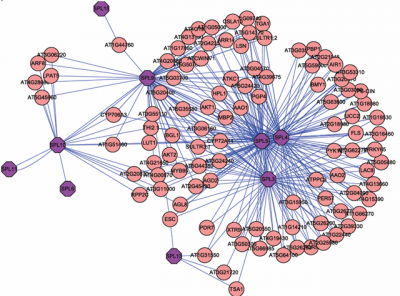
<p>In the first step of the analyses, we extracted and ranked the 112 genes whose expression most tightly correlates with that of SPL genes (<xref ref-type="table" rid="t1-ijms-10-00116">Table 1</xref>). We took advantage of a visualization tool called Cytoscape to view expression data and analysis results. Using the available data regarding correlations between different <italic>Arabidopsis</italic> genes, we constructed a network composed of the SPL genes and their co-expressed genes. This network contains 112 <italic>Arabidopsis</italic> genes (nodes) and 294 correlations (edges) (<xref ref-type="fig" rid="f1-ijms-10-00116">Figure 1A</xref>). Three interesting facts are observed from the co-expression network. First, some SPL genes are absent from the network, including SPL1, SPL2, SPL6, SPL7, SPL8, SPL12, SPL14 and SPL16. This reflects the current lack of knowledge regarding correlations between these SPL genes and other genes. Second, many genes correlate with SPL3, SPL4, SPL5, and SPL9; some genes correlate with SPL10 and SPL13; while SPL11 and SPL15 have only one co-expression gene. Third, within the co-expression network, there is a region comprising four SPL genes that contain 20 <italic>Arabidopsis</italic> genes (nodes) and 79 correlations (edges) (<xref ref-type="fig" rid="f1-ijms-10-00116">Figure 1B</xref>).</p>
<p>In order to identify a functional role for SPL genes, the correlated genes were analyzed in a web-based gene ontology (GO) analysis tool to identify any bias in GO functional annotation terms in the correlated genes compared to the remainder of the <italic>A. thaliana</italic> genome (Supplementary <xref ref-type="table" rid="t1-ijms-10-00116">Table 1</xref>). When GO clustering was applied to the 112 co-expression genes, some GO biological categories were retrieved. Most of these related to stress response, transporter activity, and transcription factor activity (<xref ref-type="fig" rid="f1-ijms-10-00116">Figure 1A</xref>). Other biological processes identified were associated with extracellular activities, development processes, and enzyme activity (<xref ref-type="fig" rid="f1-ijms-10-00116">Figure 1A</xref>). Thus, given previous work [<xref ref-type="bibr" rid="b3-ijms-10-00116">3</xref>] suggesting that SPL genes play a role in controlling plant development, we can infer that SPL genes may not only do this but also take part in many other biological processes. In the co-expression network, a complex related to development and the plasma membrane was found (<xref ref-type="fig" rid="f1-ijms-10-00116">Figure 1B</xref>). We presume that the complex is very important for SPL gene function of development (<xref ref-type="fig" rid="f1-ijms-10-00116">Figure 1B</xref>), and SPL proteins may form heterodimers or multimers to carry out their functions.</p></sec>
<sec sec-type="methods">
<title>3.2. Interactome analysis</title>
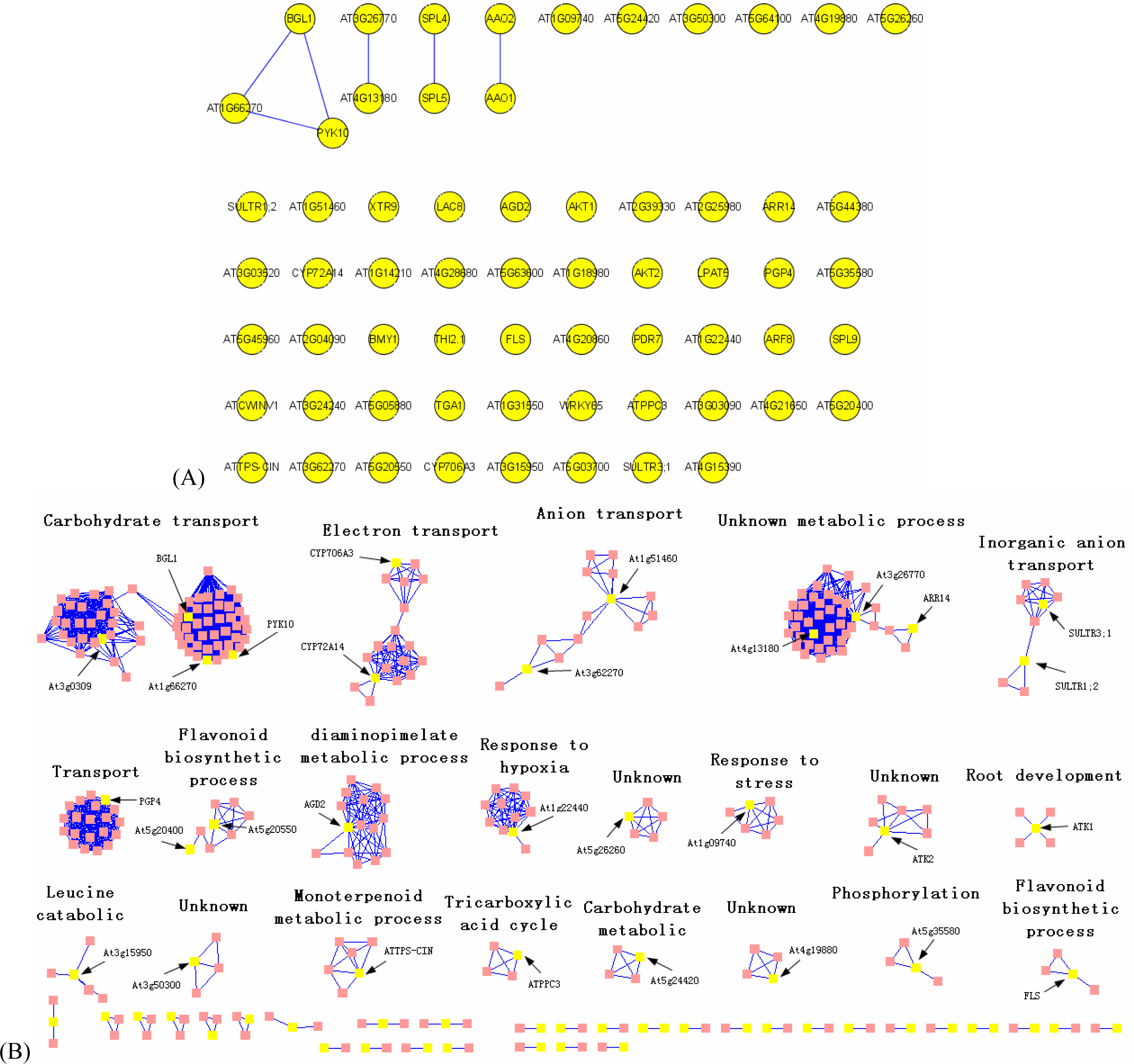
<p>To evaluate functional associations between co-expressed proteins, we mapped the genes whose expression was correlated with SPL genes using the <italic>Arabidopsis thaliana</italic> interactome network (<xref ref-type="fig" rid="f2-ijms-10-00116">Figure 2A</xref>). Since pairs of interacting proteins are more likely to contain similar GO annotations than pairs of unrelated proteins, annotations of neighbor proteins in the network can be used to make predictions of functions. In particular, the GO annotations allow functional assignment of uncharacterized gene products, such when At3g62270 was identified in a large-scale interactome mapping study of anion transport (<xref ref-type="fig" rid="f2-ijms-10-00116">Figure 2B</xref>).</p>
<p>Cluster analysis of this network suggested the molecular mechanisms underlying the function of SPL genes. Analysis of the connected sub-graphs and their GO terms identified functional modules enriched for carbohydrate transport, electron transport, anion transport, flavonoid biosynthetic processes, diaminopimelate metabolic processes, response to hypoxia and stress, and root development (<xref ref-type="fig" rid="f2-ijms-10-00116">Figure 2B</xref>). Many genes and proteins co-expressed with SPL genes are located in these modules, which supports their role in a diversity of physiology processes. These observations support the theory that the network modeled here constitutes a framework that can guide in-depth experimental study of genes and proteins related to SPL gene function in <italic>Arabidopsis</italic>.</p></sec>
<sec sec-type="methods">
<title>3.3. Promoter analysis</title>
<p>The shared expression profiles of the 112 correlated genes in response to development and stress suggests that these genes are under the same regulatory control and are thus likely to share cis-elements in their promoter regions. Since these genes are co-expressed with SPL genes, we hypothesized that they might be directly regulated by SPL genes. The cis-element of the SBP-box transcription factor is unclear. To reveal which DNA motif can bind to SPL genes, we analyzed the promoter regions of these genes 1 kb upstream of the predicted transcription start site. We also analyzed aspects of shared transcriptional activation sites on these genes for the presence of known plant cis-elements.</p>
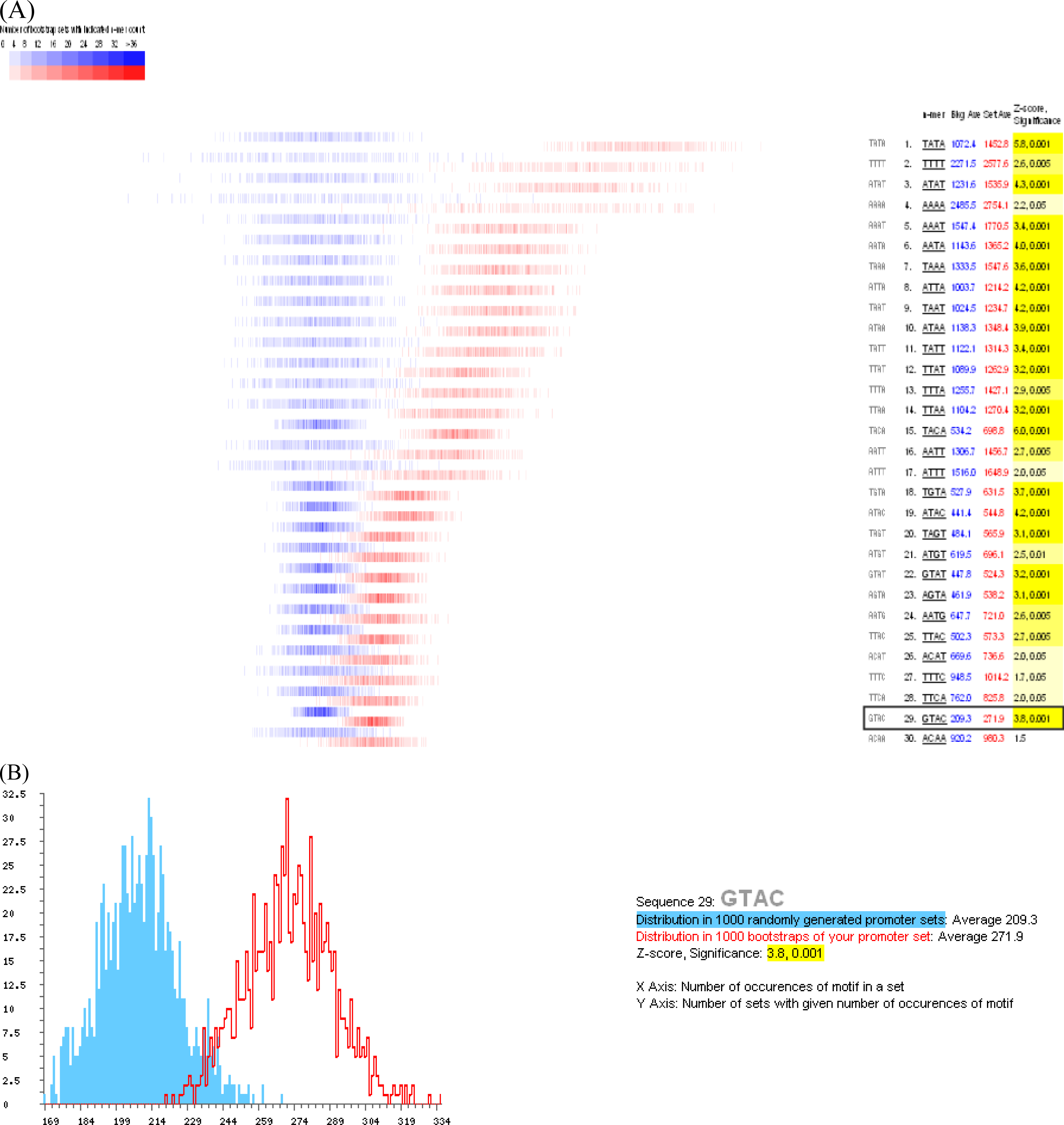
<p>Based on previous research [<xref ref-type="bibr" rid="b3-ijms-10-00116">3</xref>, <xref ref-type="bibr" rid="b20-ijms-10-00116">20</xref>–<xref ref-type="bibr" rid="b22-ijms-10-00116">22</xref>], we hypothesized that the GTAC motif was the cis-element common to the SBP-box genes. Indeed, our analysis showed the GTAC motif to be a statistically over-represented element (<xref ref-type="fig" rid="f3-ijms-10-00116">Figure 3</xref>). Two distributions were created from 1,000 bootstrapped sets, each containing the same number of genes. The first was obtained by sampling for the frequency of occurrence of an element from the correlated genes cluster promoter set bootstrapped 1,000 times; the second was obtained from the same bootstrapping process carried out on 1,000 whole genome promoter data sets containing the same number of sequences as the cluster set. The distribution of occurrence of a given element in both data sets was then obtained and plotted [<xref ref-type="bibr" rid="b23-ijms-10-00116">23</xref>] and significant differences were highlighted (Supplementary <xref ref-type="fig" rid="f1-ijms-10-00116">Figure 1</xref>). For comparison, significant tetramers whose expression is unrelated to that of SPL genes are also shown.</p>
<p>The analysis (Supplementary Table 2) indicates that the invariant core GTAC motif is present in 100/112 of our correlated genes a total of 271.9 times, which is higher than the average of 209.3 times across 1,000 randomly-generated promoter sets (<xref ref-type="fig" rid="f3-ijms-10-00116">Figure 3</xref>). The promoter analysis indicates that multiple copies of the SBP-box elements are present in a high percentage of SPL-correlated genes. The core GTAC motifs are significantly enriched compared to expected frequencies, suggesting that they are important regulatory elements in these co-expressed genes.</p></sec></sec>
<sec sec-type="discussion">
<title>4. Discussion</title>
<p>Although transcription factors are generally low expressed, microarray has been widely used for transcription factors expression research [<xref ref-type="bibr" rid="b24-ijms-10-00116">24</xref>–<xref ref-type="bibr" rid="b26-ijms-10-00116">26</xref>]. With recent interest in co-expression, transcription factors co-expression has emerged as a novel holistic approach for their function analysis. For example, MADS-box proteins form specific homo- and heterodimers and even higher order complexes to conduct their functions [<xref ref-type="bibr" rid="b27-ijms-10-00116">27</xref>, <xref ref-type="bibr" rid="b28-ijms-10-00116">28</xref>]. Specific interactions among MADS proteins require that they are present in the same cells and tissues under the same developmental stages, and correspondingly it has been shown that transcripts with overlapping expression patterns are preferred as protein interaction partners [<xref ref-type="bibr" rid="b29-ijms-10-00116">29</xref>, <xref ref-type="bibr" rid="b30-ijms-10-00116">30</xref>]. Roosa <italic>et al</italic>. used co-expression method identify correlation genes with MADS in <italic>Gerbera hybrida</italic>, they found that MADS proteins not only might correlate with themselves but also correlated with MYB factors [<xref ref-type="bibr" rid="b31-ijms-10-00116">31</xref>]. In our analysis, we used microarray data to classify co-expression network of SPL genes. We think the network may help us to infer the function of SPL genes.</p>
<sec>
<title>4.1. SPL genes may play a key role in the stress response</title>
<p>Transcriptional control of the expression of stress-responsive genes is a crucial part of plant responses to a range of abiotic and biotic stresses. Research carried out in recent years [<xref ref-type="bibr" rid="b23-ijms-10-00116">23</xref>] has been productive in identifying transcription factors that are important for regulating plant responses to these stresses. SPL genes have not been shown to be affected by stress in <italic>Arabidopsis</italic>. Nevertheless, our GO analysis revealed that some genes correlated with SPL genes were involved in the stress response (Supplementary <xref ref-type="table" rid="t1-ijms-10-00116">Table 1</xref>). These genes include P57 (GO: 0006979, response to oxidative stress), AKT1 (GO: 0009651, response to salt stress), At3g16460 (GO: 0009409, response to cold), ATPPC3 (GO: 0009414, response to water deprivation), and ATCWINV1 (GO: 0009611, response to wounding).</p>
<p>In addition, two transcription factors (TGA1 and WRKY65) that belong to the bZIP and WRKY families, respectively, are co-expressed with SPL genes. bZIPs are a large family of transcription factors in plants, and 75 members are present in <italic>Arabidopsis</italic> [<xref ref-type="bibr" rid="b32-ijms-10-00116">32</xref>]. One class of bZIP proteins that is linked to stress responses comprises the TGA/octopine synthase (ocs)-element-binding factor (OBF) proteins. These bind to the activation sequence-1 (as-1)/ocs element, which regulates the expression of some stress-responsive genes such as PR-1 and GLUTATHIONE S-TRANSFERASE6 (GST6) [<xref ref-type="bibr" rid="b33-ijms-10-00116">33</xref>, <xref ref-type="bibr" rid="b34-ijms-10-00116">34</xref>]. In <italic>Arabidopsis</italic>, seven members of the TGA/OBF family play a role in plant defense, xenobiotic stress responses, and development. WRKY proteins are a novel family of transcription factors that are unique to plants and that form a large, 74-member family in <italic>Arabidopsis</italic>. WRKY proteins contain either one or two WRKY domains, which is 60-residue region that contains the amino acid sequence WRKYGQK and a motif similar to zinc fingers. Certain WRKY family members show enhanced expression or DNA-binding activity following induction by a range of pathogens, defense signals, and wounding [<xref ref-type="bibr" rid="b35-ijms-10-00116">35</xref>]. Since the two transcription families are very important for plant response to stress, and because SPL genes can control some stress-responsive genes, we speculate that SPL genes also play a key role in the stress response.</p></sec>
<sec>
<title>4.2. A complex control network linking SPL genes and other transcription families</title>
<p>Our GO analysis shows transcription activity to be an important function for co-expressed genes. SPL genes can activate other transcription factor families, including B3, bZIP, WRKY, MYB, bHLH, and MADs-box. We believe that SPL genes function by controlling the expression of these transcription families. For example, the expression of AGL8 (FUL), a MADs-box gene, correlates with SPL gene expression. In another study, the MADs-box gene AP1 was also found to be activated by SBP-box genes [<xref ref-type="bibr" rid="b2-ijms-10-00116">2</xref>]. The proteins AP1 and FUL may serve as hubs between the flower induction pathway, which is comprised of interacting proteins such as SVP, SOC1, and AGL24, and the floral organ identity proteins. Both AP1 and FUL have dual functions in floral meristem identity (early function) and floral organ determination (late function) [<xref ref-type="bibr" rid="b36-ijms-10-00116">36</xref>, <xref ref-type="bibr" rid="b37-ijms-10-00116">37</xref>]. This is consistent with the fact that the flowering proteins and floral homeotic proteins come together to form dimers.</p>
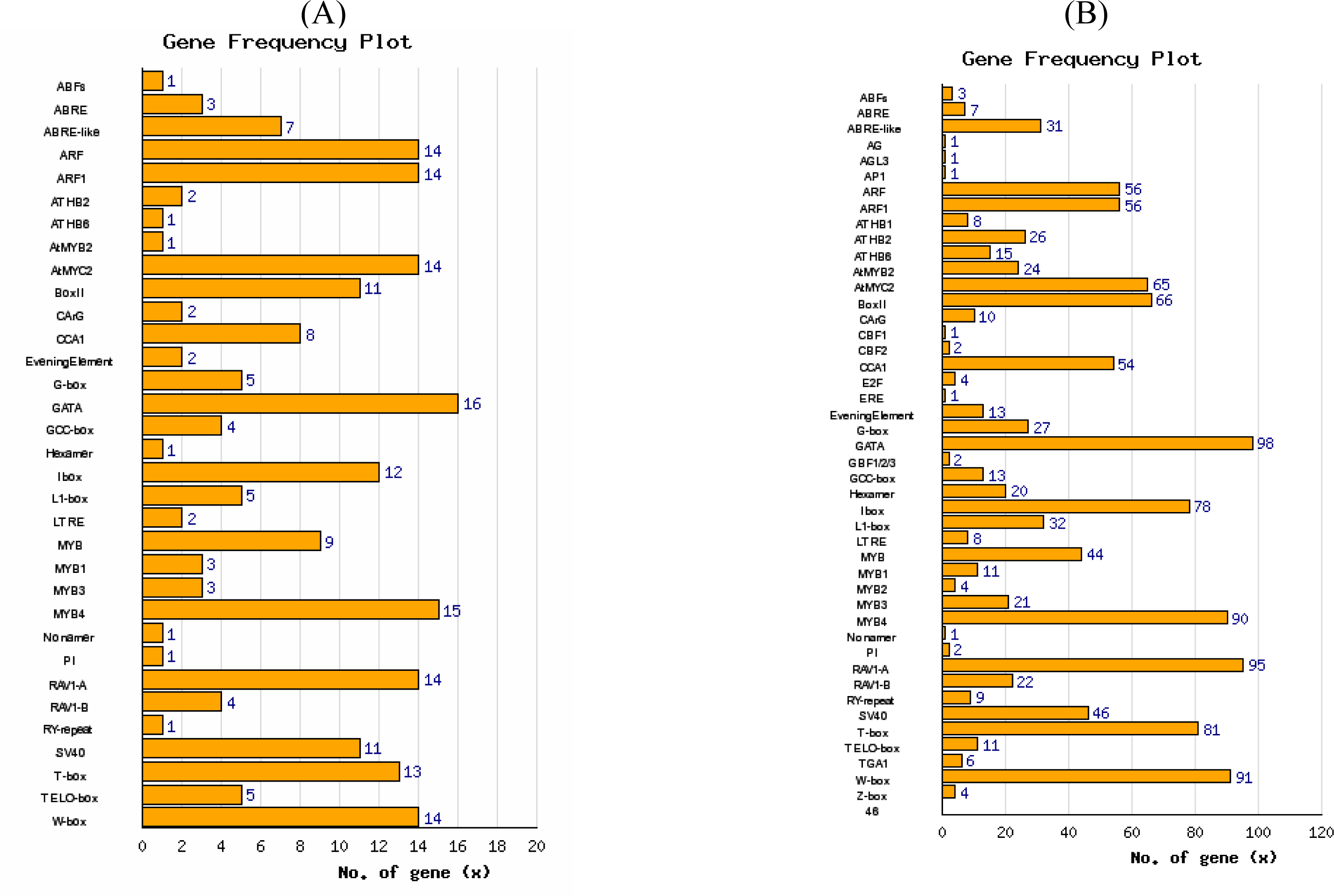
<p>Analysis of cis-elements suggests an even more complex picture: (1) SPL genes may be activated by other transcription families (<xref ref-type="fig" rid="f4-ijms-10-00116">Figure 4A</xref>), and (2) the 112 genes correlated to SPL genes in our analysis may be controlled by other transcription families (<xref ref-type="fig" rid="f4-ijms-10-00116">Fig 4B</xref>). We therefore hypothesize a complex control network linking SPL genes with other transcription families.</p></sec>
<sec>
<title>4.3. SPL genes and integral membrane proteins</title>
<p>An integral membrane protein (IMP) is a protein molecule (or assembly of proteins) that is permanently attached to the biological membrane. In the co-expression network of SPL genes, some IMP genes correlate with SPL genes. These include ATK1 and ATK2 (ARABIDOPSIS K TRANSPORTER), ATVGT1 (sugar transporter family protein), PGP4 (P-GLYCOPROTEIN 4), SULTR1;2 (SULFATE TRANSPORTER 1;2), At3g55110 (ABC transporter family protein), and some genes encoding ligands of membrane proteins. The IMPs encoded by these genes include transporters, channels, receptors, enzymes, structural membrane-anchoring domains, proteins involved in accumulation and transduction of energy and sugar, and proteins responsible for the stress response. Our analysis of genes correlated with SPL genes leads us to speculate that SPL genes may participate in development, stress responses, and other biological processes by controlling the expression of IMPs. In addition, some SPL proteins have a transmembrane domain, which suggest that SPL may have interaction with IMPs.</p></sec>
<sec>
<title>4.4. SPL genes may regulate themselves</title>
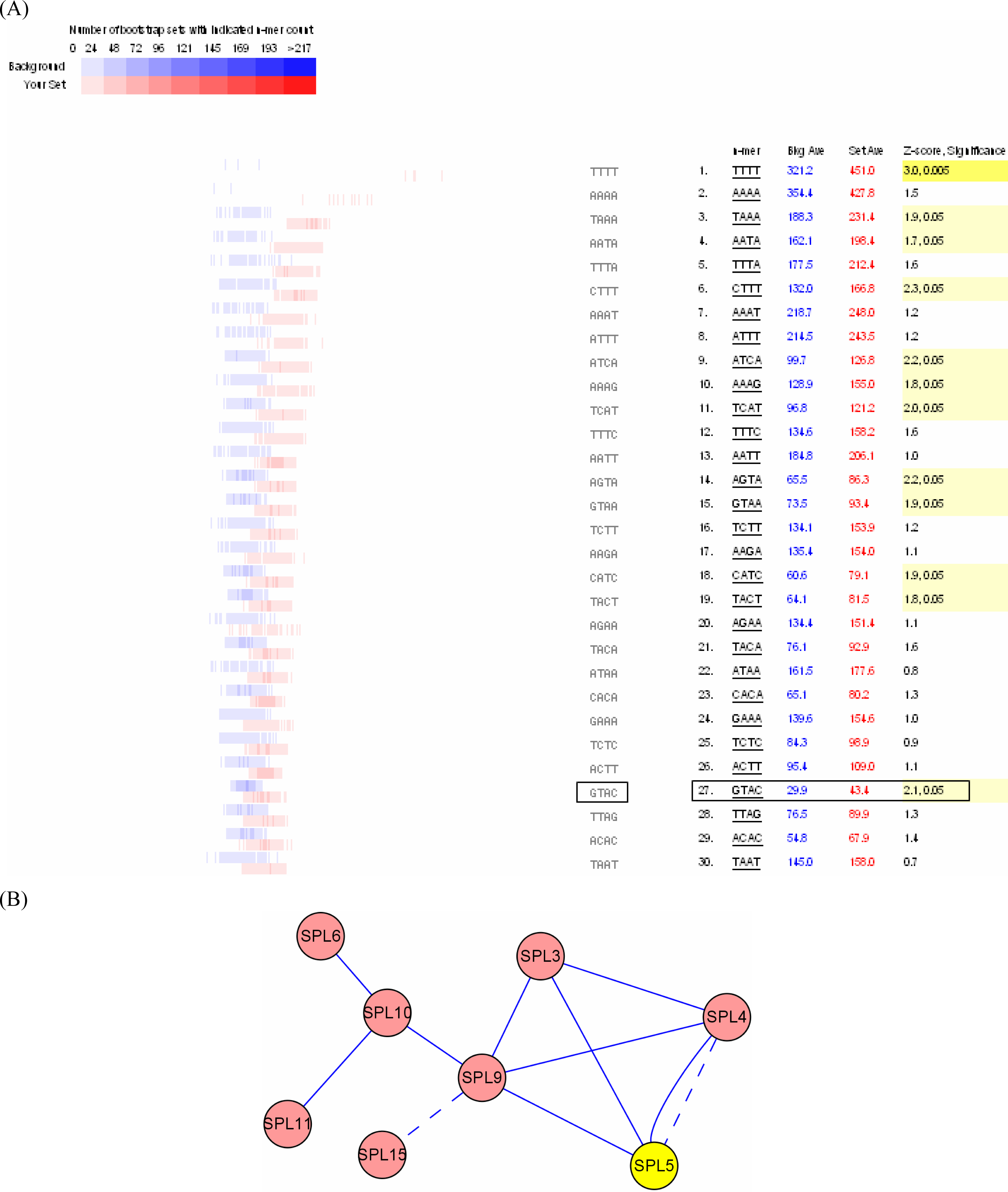
<p>Our analysis indicates that the cis-element shared by SPL genes, the GTAC motif, is necessary for binding of SPL proteins to DNA. In the co-expression network, the expression of some SPL genes correlates with that of other SPL genes; these genes may form a complex within the network (<xref ref-type="fig" rid="f1-ijms-10-00116">Figure 1B</xref>). Therefore, we propose that SPL genes regulate themselves. Using promoter analysis, we found the GTAC motif to be present in the 1 kb upstream region in 13/16 of SPL genes a total of 56 times (Supplementary Table 3), which was significantly higher than the occurrence in tetramer sets of randomly selected promoters (<xref ref-type="fig" rid="f5-ijms-10-00116">Figure 5A</xref>). In the AtPID database [<xref ref-type="bibr" rid="b38-ijms-10-00116">38</xref>], we found that SPL9 can interact with SPL15, and SPL4 can interact with SPL5. SPL genes may therefore regulate themselves using a feedback loop based on protein interactions and transcriptional regulation (<xref ref-type="fig" rid="f5-ijms-10-00116">Figure 5B</xref>).</p></sec>
<sec>
<title>4.5. SPL genes have varied functions</title>
<p>The SBP-box gene family belongs to a group of plant-specific zinc finger protein genes that encodes plant-specific transcription factors. The proteins encoded by SBP-box genes bind specifically to promoters of the floral meristem identity gene SQUAMOSA and its orthologous genes [<xref ref-type="bibr" rid="b2-ijms-10-00116">2</xref>, <xref ref-type="bibr" rid="b3-ijms-10-00116">3</xref>, <xref ref-type="bibr" rid="b6-ijms-10-00116">6</xref>]. Except for the presence of a conserved SBP-box/domain, the SPL genes vary substantially in their genomic organization, transcript size, and the size and sequences of their encoded proteins. The position of the SBP domain within the protein also varies [<xref ref-type="bibr" rid="b39-ijms-10-00116">39</xref>]. The different gene structures and the divergence of amino acid sequences among different SPL genes provide us with some hints that SBP transcription factors may have a variety of physiological functions. To date, several important and divergent biological processes regulated by SBP-box genes have been reported. These include flower and fruit development [<xref ref-type="bibr" rid="b2-ijms-10-00116">2</xref>, <xref ref-type="bibr" rid="b4-ijms-10-00116">4</xref>, <xref ref-type="bibr" rid="b8-ijms-10-00116">8</xref>, <xref ref-type="bibr" rid="b9-ijms-10-00116">9</xref>], architecture formation [<xref ref-type="bibr" rid="b40-ijms-10-00116">40</xref>], sporogenesis [<xref ref-type="bibr" rid="b6-ijms-10-00116">6</xref>], response to copper and fungal toxin [<xref ref-type="bibr" rid="b7-ijms-10-00116">7</xref>, <xref ref-type="bibr" rid="b41-ijms-10-00116">41</xref>], and control of GA level [<xref ref-type="bibr" rid="b42-ijms-10-00116">42</xref>].</p>
<p>Our co-expression analysis has revealed that SPL genes may play a role in the stress response. Network analysis suggests that SPL genes function by controlling other transcription factor families, and that they have relatives encoding proteins involved in membrane protein transport. The interactome of the correlated genes has shown that SPL genes may also take part in glucose, inorganic salt, and ATP production. Notably, some SPL genes are not detected in our co-expression analysis. Among them, SPL8 can affect pollen sac development [<xref ref-type="bibr" rid="b6-ijms-10-00116">6</xref>], and SPL14 plays a role in plant development and sensitivity to fumonisin B1 [<xref ref-type="bibr" rid="b7-ijms-10-00116">7</xref>]. All of the available evidence suggests that SPL genes have varied functions in <italic>Arabidopsis</italic>.</p></sec></sec>
<sec>
<title>5. Conclusion</title>
<p>The SPL gene family belongs to a group of plant-specific zinc finger protein genes that encodes plant-specific transcription factors. The expression of SPL genes are significantly correlated with that of genes involved in the defense response pathway in response to various biotic and abiotic stress. The expression of SPL genes are correlated with other transcription factors gene and some integral membrane proteins. Additionally, like the MADS-box genes, some SPL genes are correlated with themselves. Furthermore, the promoters of the correlated genes contain a core binding cis-element (GTAC). All of these analyses suggest that SPL genes have varied functions in <italic>Arabidopsis</italic>.</p></sec>
<sec>
<title>Appendix: Supplementary Material</title>
<p>Supplementary material is available from <ext-link xlink:href="http://dx.doi.org/10.3390/ijms10010116" ext-link-type="uri">http://dx.doi.org/10.3390/ijms10010116</ext-link></p></sec></body>
<back>
<ack>
<title>Acknowledgments</title>
<p>This study was supported by the National Natural Science Foundation of China (NO. 30600044, 30771463) and Natural Science Foundation of Chongqing of China (No. cstc, 2007BB1197, 2007BB1198).</p></ack>
<ref-list>
<title>References</title>
<ref id="b1-ijms-10-00116"><label>1.</label><citation citation-type="journal"><person-group person-group-type="author"><name><surname>Riechmann</surname><given-names>JL</given-names></name><name><surname>Heard</surname><given-names>J</given-names></name><name><surname>Martin</surname><given-names>G</given-names></name><name><surname>Reuber</surname><given-names>L</given-names></name><name><surname>Jiang</surname><given-names>C</given-names></name><name><surname>Keddie</surname><given-names>J</given-names></name><name><surname>Adam</surname><given-names>L</given-names></name><name><surname>Pineda</surname><given-names>O</given-names></name><name><surname>Ratcliffe</surname><given-names>OJ</given-names></name><name><surname>Samaha</surname><given-names>RR</given-names></name><etal/></person-group><article-title>Arabidopsis transcription factors: genome-wide comparative analysis among eukaryotes</article-title><source>Science</source><year>2000</year><volume>290</volume><fpage>2105</fpage><lpage>2110</lpage><pub-id pub-id-type="doi">10.1126/science.290.5499.2105</pub-id><pub-id pub-id-type="pmid">11118137</pub-id></citation></ref>
<ref id="b2-ijms-10-00116"><label>2.</label><citation citation-type="journal"><person-group person-group-type="author"><name><surname>Cardon</surname><given-names>GH</given-names></name><name><surname>Hohmann</surname><given-names>S</given-names></name><name><surname>Nettesheim</surname><given-names>K</given-names></name><name><surname>Saedler</surname><given-names>H</given-names></name><name><surname>Huijser</surname><given-names>P</given-names></name></person-group><article-title>Functional analysis of the Arabidopsis thaliana SBP-box gene SPL3: a novel gene involved in the floral transition</article-title><source>Plant J</source><year>1997</year><volume>12</volume><fpage>367</fpage><lpage>77</lpage><pub-id pub-id-type="doi">10.1046/j.1365-313X.1997.12020367.x</pub-id><pub-id pub-id-type="pmid">9301089</pub-id></citation></ref>
<ref id="b3-ijms-10-00116"><label>3.</label><citation citation-type="journal"><person-group person-group-type="author"><name><surname>Cardon</surname><given-names>G</given-names></name><name><surname>Hohmann</surname><given-names>S</given-names></name><name><surname>Klein</surname><given-names>J</given-names></name><name><surname>Nettesheim</surname><given-names>K</given-names></name><name><surname>Saedler</surname><given-names>H</given-names></name><name><surname>Huijser</surname><given-names>P</given-names></name></person-group><article-title>Molecular characterisation of the Arabidopsis SBP-box genes</article-title><source>Gene</source><year>1999</year><volume>237</volume><fpage>91</fpage><lpage>104</lpage><pub-id pub-id-type="doi">10.1016/S0378-1119(99)00308-X</pub-id><pub-id pub-id-type="pmid">10524240</pub-id></citation></ref>
<ref id="b4-ijms-10-00116"><label>4.</label><citation citation-type="journal"><person-group person-group-type="author"><name><surname>Klein</surname><given-names>J</given-names></name><name><surname>Saedler</surname><given-names>H</given-names></name><name><surname>Huijser</surname><given-names>P</given-names></name></person-group><article-title>A new family of DNA binding proteins includes putative transcriptional regulators of the Antirrhinum majus floral meristem identity gene SQUAMOSA</article-title><source>Mol. Gen. Genet</source><year>1996</year><volume>250</volume><fpage>7</fpage><lpage>16</lpage><pub-id pub-id-type="pmid">8569690</pub-id></citation></ref>
<ref id="b5-ijms-10-00116"><label>5.</label><citation citation-type="journal"><person-group person-group-type="author"><name><surname>Huijser</surname><given-names>P</given-names></name><name><surname>Klein</surname><given-names>J</given-names></name><name><surname>Lonnig</surname><given-names>WE</given-names></name><name><surname>Meijer</surname><given-names>H</given-names></name><name><surname>Saedler</surname><given-names>H</given-names></name><name><surname>Sommer</surname><given-names>H</given-names></name></person-group><article-title>Bracteomania, an inflorescence anomaly, is caused by the loss of function of the MADS-box gene squamosa in Antirrhinum majus</article-title><source>EMBO J</source><year>1992</year><volume>11</volume><fpage>1239</fpage><lpage>49</lpage><pub-id pub-id-type="pmid">1563342</pub-id></citation></ref>
<ref id="b6-ijms-10-00116"><label>6.</label><citation citation-type="journal"><person-group person-group-type="author"><name><surname>Unte</surname><given-names>US</given-names></name><name><surname>Sorensen</surname><given-names>AM</given-names></name><name><surname>Pesaresi</surname><given-names>P</given-names></name><name><surname>Gandikota</surname><given-names>M</given-names></name><name><surname>Leister</surname><given-names>D</given-names></name><name><surname>Saedler</surname><given-names>H</given-names></name><name><surname>Huijser</surname><given-names>P</given-names></name></person-group><article-title>SPL8, an SBP-box gene that affects pollen sac development in Arabidopsis</article-title><source>Plant Cell</source><year>2003</year><volume>15</volume><fpage>1009</fpage><lpage>1019</lpage><pub-id pub-id-type="doi">10.1105/tpc.010678</pub-id><pub-id pub-id-type="pmid">12671094</pub-id></citation></ref>
<ref id="b7-ijms-10-00116"><label>7.</label><citation citation-type="journal"><person-group person-group-type="author"><name><surname>Stone</surname><given-names>JM</given-names></name><name><surname>Liang</surname><given-names>X</given-names></name><name><surname>Nekl</surname><given-names>ER</given-names></name><name><surname>Stiers</surname><given-names>JJ</given-names></name></person-group><article-title>Arabidopsis AtSPL14, a plant-specific SBP-domain transcription factor, participates in plant development and sensitivity to fumonisin B1</article-title><source>Plant J</source><year>2005</year><volume>41</volume><fpage>744</fpage><lpage>754</lpage><pub-id pub-id-type="doi">10.1111/j.1365-313X.2005.02334.x</pub-id><pub-id pub-id-type="pmid">15703061</pub-id></citation></ref>
<ref id="b8-ijms-10-00116"><label>8.</label><citation citation-type="journal"><person-group person-group-type="author"><name><surname>Wang</surname><given-names>H</given-names></name><name><surname>Nussbaum-Wagler</surname><given-names>T</given-names></name><name><surname>Li</surname><given-names>B</given-names></name><name><surname>Zhao</surname><given-names>Q</given-names></name><name><surname>Vigouroux</surname><given-names>Y</given-names></name><name><surname>Faller</surname><given-names>M</given-names></name><name><surname>Bomblies</surname><given-names>K</given-names></name><name><surname>Lukens</surname><given-names>L</given-names></name><name><surname>Doebley</surname><given-names>JF</given-names></name></person-group><article-title>The origin of the naked grains of maize</article-title><source>Nature</source><year>2005</year><volume>436</volume><fpage>714</fpage><lpage>719</lpage><pub-id pub-id-type="doi">10.1038/nature03863</pub-id><pub-id pub-id-type="pmid">16079849</pub-id></citation></ref>
<ref id="b9-ijms-10-00116"><label>9.</label><citation citation-type="journal"><person-group person-group-type="author"><name><surname>Manning</surname><given-names>K</given-names></name><name><surname>Tor</surname><given-names>M</given-names></name><name><surname>Poole</surname><given-names>M</given-names></name><name><surname>Hong</surname><given-names>Y</given-names></name><name><surname>Thompson</surname><given-names>AJ</given-names></name><name><surname>King</surname><given-names>GJ</given-names></name><name><surname>Giovannoni</surname><given-names>JJ</given-names></name><name><surname>Seymour</surname><given-names>GB</given-names></name></person-group><article-title>A naturally occurring epigenetic mutation in a gene encoding an SBP-box transcription factor inhibits tomato fruit ripening</article-title><source>Nat. Genet</source><year>2006</year><volume>38</volume><fpage>948</fpage><lpage>952</lpage><pub-id pub-id-type="doi">10.1038/ng1841</pub-id><pub-id pub-id-type="pmid">16832354</pub-id></citation></ref>
<ref id="b10-ijms-10-00116"><label>10.</label><citation citation-type="journal"><person-group person-group-type="author"><name><surname>Schwarz</surname><given-names>S</given-names></name><name><surname>Grande</surname><given-names>AV</given-names></name><name><surname>Bujdoso</surname><given-names>N</given-names></name><name><surname>Saedler</surname><given-names>H</given-names></name><name><surname>Huijser</surname><given-names>P</given-names></name></person-group><article-title>The microRNA regulated SBP-box genes SPL9 and SPL15 control shoot maturation in Arabidopsis</article-title><source>Plant Mol. Biol</source><year>2008</year><volume>67</volume><fpage>183</fpage><lpage>95</lpage><pub-id pub-id-type="doi">10.1007/s11103-008-9310-z</pub-id><pub-id pub-id-type="pmid">18278578</pub-id></citation></ref>
<ref id="b11-ijms-10-00116"><label>11.</label><citation citation-type="journal"><person-group person-group-type="author"><name><surname>Schmid</surname><given-names>M</given-names></name><name><surname>Davison</surname><given-names>TS</given-names></name><name><surname>Henz</surname><given-names>SR</given-names></name><name><surname>Pape</surname><given-names>UJ</given-names></name><name><surname>Demar</surname><given-names>M</given-names></name><name><surname>Vingron</surname><given-names>M</given-names></name><name><surname>Scholkopf</surname><given-names>B</given-names></name><name><surname>Weigel</surname><given-names>D</given-names></name><name><surname>Lohmann</surname><given-names>JU</given-names></name></person-group><article-title>A gene expression map of Arabidopsis thaliana development</article-title><source>Nat. Genet</source><year>2005</year><volume>37</volume><fpage>501</fpage><lpage>506</lpage><pub-id pub-id-type="doi">10.1038/ng1543</pub-id><pub-id pub-id-type="pmid">15806101</pub-id></citation></ref>
<ref id="b12-ijms-10-00116"><label>12.</label><citation citation-type="journal"><person-group person-group-type="author"><name><surname>Barrett</surname><given-names>T</given-names></name><name><surname>Troup</surname><given-names>DB</given-names></name><name><surname>Wilhite</surname><given-names>SE</given-names></name><name><surname>Ledoux</surname><given-names>P</given-names></name><name><surname>Rudnev</surname><given-names>D</given-names></name><name><surname>Evangelista</surname><given-names>C</given-names></name><name><surname>Kim</surname><given-names>IF</given-names></name><name><surname>Soboleva</surname><given-names>A</given-names></name><name><surname>Tomashevsky</surname><given-names>M</given-names></name><name><surname>Edgar</surname><given-names>R</given-names></name></person-group><article-title>NCBI GEO: mining tens of millions of expression profiles—database and tools update</article-title><source>Nucleic Acids Res</source><year>2007</year><volume>35</volume><fpage>D760</fpage><lpage>D765</lpage><pub-id pub-id-type="doi">10.1093/nar/gkl887</pub-id><pub-id pub-id-type="pmid">17099226</pub-id></citation></ref>
<ref id="b13-ijms-10-00116"><label>13.</label><citation citation-type="journal"><person-group person-group-type="author"><name><surname>Kilian</surname><given-names>J</given-names></name><name><surname>Whitehead</surname><given-names>D</given-names></name><name><surname>Horak</surname><given-names>J</given-names></name><name><surname>Wanke</surname><given-names>D</given-names></name><name><surname>Weinl</surname><given-names>S</given-names></name><name><surname>Batistic</surname><given-names>O</given-names></name><name><surname>D’Angelo</surname><given-names>C</given-names></name><name><surname>Bornberg-Bauer</surname><given-names>E</given-names></name><name><surname>Kudla</surname><given-names>J</given-names></name><name><surname>Harter</surname><given-names>K</given-names></name></person-group><article-title>The AtGenExpress global stress expression data set: Protocols, evaluation and model data analysis of UV-B light, drought and cold stress responses</article-title><source>Plant J</source><year>2007</year><volume>50</volume><fpage>347</fpage><lpage>363</lpage><pub-id pub-id-type="doi">10.1111/j.1365-313X.2007.03052.x</pub-id><pub-id pub-id-type="pmid">17376166</pub-id></citation></ref>
<ref id="b14-ijms-10-00116"><label>14.</label><citation citation-type="journal"><person-group person-group-type="author"><name><surname>Irizarry</surname><given-names>RA</given-names></name><name><surname>Bolstad</surname><given-names>BM</given-names></name><name><surname>Collin</surname><given-names>F</given-names></name><name><surname>Cope</surname><given-names>LM</given-names></name><name><surname>Hobbs</surname><given-names>B</given-names></name><name><surname>Speed</surname><given-names>TP</given-names></name></person-group><article-title>Summaries of Affymetrix GeneChip probe level data</article-title><source>Nucleic Acids Res</source><year>2003</year><volume>31</volume><fpage>e15</fpage><pub-id pub-id-type="doi">10.1093/nar/gng015</pub-id><pub-id pub-id-type="pmid">12582260</pub-id></citation></ref>
<ref id="b15-ijms-10-00116"><label>15.</label><citation citation-type="journal"><person-group person-group-type="author"><name><surname>Qin</surname><given-names>LX</given-names></name><name><surname>Beyer</surname><given-names>RP</given-names></name><name><surname>Hudson</surname><given-names>FN</given-names></name><name><surname>Linford</surname><given-names>NJ</given-names></name><name><surname>Morris</surname><given-names>DE</given-names></name><name><surname>Kerr</surname><given-names>KF</given-names></name></person-group><article-title>Evaluation of methods for oligonucleotide array data via quantitative real-time PCR</article-title><source>BMC Bioinformatics</source><year>2006</year><volume>7</volume><fpage>23</fpage><pub-id pub-id-type="doi">10.1186/1471-2105-7-23</pub-id><pub-id pub-id-type="pmid">16417622</pub-id></citation></ref>
<ref id="b16-ijms-10-00116"><label>16.</label><citation citation-type="journal"><person-group person-group-type="author"><name><surname>Wei</surname><given-names>H</given-names></name><name><surname>Persson</surname><given-names>S</given-names></name><name><surname>Mehta</surname><given-names>T</given-names></name><name><surname>Srinivasasainagendra</surname><given-names>V</given-names></name><name><surname>Chen</surname><given-names>L</given-names></name><name><surname>Page</surname><given-names>GP</given-names></name><name><surname>Somerville</surname><given-names>C</given-names></name><name><surname>Loraine</surname><given-names>A</given-names></name></person-group><article-title>Transcriptional coordination of the metabolic network in Arabidopsis</article-title><source>Plant Physiol</source><year>2006</year><volume>142</volume><fpage>762</fpage><lpage>774</lpage><pub-id pub-id-type="doi">10.1104/pp.106.080358</pub-id><pub-id pub-id-type="pmid">16920875</pub-id></citation></ref>
<ref id="b17-ijms-10-00116"><label>17.</label><citation citation-type="journal"><person-group person-group-type="author"><name><surname>Maere</surname><given-names>S</given-names></name><name><surname>Heymans</surname><given-names>K</given-names></name><name><surname>Kuiper</surname><given-names>M</given-names></name></person-group><article-title>BiNGO: A Cytoscape plugin to assess overrepresentation of gene ontology categories in biological networks</article-title><source>Bioinformatics</source><year>2005</year><volume>21</volume><fpage>3448</fpage><lpage>3449</lpage><pub-id pub-id-type="doi">10.1093/bioinformatics/bti551</pub-id><pub-id pub-id-type="pmid">15972284</pub-id></citation></ref>
<ref id="b18-ijms-10-00116"><label>18.</label><citation citation-type="journal"><person-group person-group-type="author"><name><surname>Garcia</surname><given-names>O</given-names></name><name><surname>Saveanu</surname><given-names>C</given-names></name><name><surname>Cline</surname><given-names>M</given-names></name><name><surname>Fromont-Racine</surname><given-names>M</given-names></name><name><surname>Jacquier</surname><given-names>A</given-names></name><name><surname>Schwikowski</surname><given-names>B</given-names></name><name><surname>Aittokallio</surname><given-names>T</given-names></name></person-group><article-title>GOlorize: A Cytoscape plug-in for network visualization with Gene Ontology-based layout and coloring</article-title><source>Bioinformatics</source><year>2007</year><volume>23</volume><fpage>394</fpage><lpage>396</lpage><pub-id pub-id-type="doi">10.1093/bioinformatics/btl605</pub-id><pub-id pub-id-type="pmid">17127678</pub-id></citation></ref>
<ref id="b19-ijms-10-00116"><label>19.</label><citation citation-type="journal"><person-group person-group-type="author"><name><surname>Toufighi</surname><given-names>K</given-names></name><name><surname>Brady</surname><given-names>SM</given-names></name><name><surname>Austin</surname><given-names>R</given-names></name><name><surname>Ly</surname><given-names>E</given-names></name><name><surname>Provart</surname><given-names>NJ</given-names></name></person-group><article-title>The Botany Array Resource: e-Northerns, Expression Angling, and promoter analyses</article-title><source>Plant J</source><year>2005</year><volume>43</volume><fpage>153</fpage><lpage>163</lpage><pub-id pub-id-type="doi">10.1111/j.1365-313X.2005.02437.x</pub-id><pub-id pub-id-type="pmid">15960624</pub-id></citation></ref>
<ref id="b20-ijms-10-00116"><label>20.</label><citation citation-type="journal"><person-group person-group-type="author"><name><surname>Kropat</surname><given-names>J</given-names></name><name><surname>Tottey</surname><given-names>S</given-names></name><name><surname>Birkenbihl</surname><given-names>RP</given-names></name><name><surname>Depege</surname><given-names>N</given-names></name><name><surname>Huijser</surname><given-names>P</given-names></name><name><surname>Merchant</surname><given-names>S</given-names></name></person-group><article-title>A regulator of nutritional copper signaling in Chlamydomonas is an SBP domain protein that recognizes the GTAC core of copper response element</article-title><source>Proc. Natl. Acad. Sci. USA</source><year>2005</year><volume>102</volume><fpage>18730</fpage><lpage>18735</lpage><pub-id pub-id-type="doi">10.1073/pnas.0507693102</pub-id><pub-id pub-id-type="pmid">16352720</pub-id></citation></ref>
<ref id="b21-ijms-10-00116"><label>21.</label><citation citation-type="journal"><person-group person-group-type="author"><name><surname>Birkenbihl</surname><given-names>RP</given-names></name><name><surname>Jach</surname><given-names>G</given-names></name><name><surname>Saedler</surname><given-names>H</given-names></name><name><surname>Huijser</surname><given-names>P</given-names></name></person-group><article-title>Functional dissection of the plant-specific SBP-domain: Overlap of the DNA-binding and nuclear localization domains</article-title><source>J. Mol. Biol</source><year>2005</year><volume>352</volume><fpage>585</fpage><lpage>596</lpage><pub-id pub-id-type="doi">10.1016/j.jmb.2005.07.013</pub-id><pub-id pub-id-type="pmid">16095614</pub-id></citation></ref>
<ref id="b22-ijms-10-00116"><label>22.</label><citation citation-type="journal"><person-group person-group-type="author"><name><surname>Liang</surname><given-names>X</given-names></name><name><surname>Nazarenus</surname><given-names>TJ</given-names></name><name><surname>Stone</surname><given-names>JM</given-names></name></person-group><article-title>Identification of a consensus DNA-binding site for the Arabidopsis thaliana SBP domain transcription factor, AtSPL14, and binding kinetics by surface plasmon resonance</article-title><source>Biochemistry</source><year>2008</year><volume>47</volume><fpage>3645</fpage><lpage>3653</lpage><pub-id pub-id-type="doi">10.1021/bi701431y</pub-id><pub-id pub-id-type="pmid">18302343</pub-id></citation></ref>
<ref id="b23-ijms-10-00116"><label>23.</label><citation citation-type="journal"><person-group person-group-type="author"><name><surname>Chen</surname><given-names>W</given-names></name><name><surname>Provart</surname><given-names>NJ</given-names></name><name><surname>Glazebrook</surname><given-names>J</given-names></name><name><surname>Katagiri</surname><given-names>F</given-names></name><name><surname>Chang</surname><given-names>HS</given-names></name><name><surname>Eulgem</surname><given-names>T</given-names></name><name><surname>Mauch</surname><given-names>F</given-names></name><name><surname>Luan</surname><given-names>S</given-names></name><name><surname>Zou</surname><given-names>G</given-names></name><name><surname>Whitham</surname><given-names>SA</given-names></name><etal/></person-group><article-title>Expression profile matrix of Arabidopsis transcription factor genes suggests their putative functions in response to environmental stresses</article-title><source>Plant Cell</source><year>2002</year><volume>14</volume><fpage>559</fpage><lpage>574</lpage><pub-id pub-id-type="doi">10.1105/tpc.010410</pub-id><pub-id pub-id-type="pmid">11910004</pub-id></citation></ref>
<ref id="b24-ijms-10-00116"><label>24.</label><citation citation-type="journal"><person-group person-group-type="author"><name><surname>Jain</surname><given-names>M</given-names></name><name><surname>Nijhawan</surname><given-names>A</given-names></name><name><surname>Arora</surname><given-names>R</given-names></name><name><surname>Agarwal</surname><given-names>P</given-names></name><name><surname>Ray</surname><given-names>S</given-names></name><name><surname>Sharma</surname><given-names>P</given-names></name><name><surname>Kapoor</surname><given-names>S</given-names></name><name><surname>Tyagi</surname><given-names>AK</given-names></name><name><surname>Khurana</surname><given-names>JP</given-names></name></person-group><article-title>F-box proteins in rice. Genome-wide analysis, classification, temporal and spatial gene expression during panicle and seed development, and regulation by light and abiotic stress</article-title><source>Plant Physiol</source><year>2007</year><volume>143</volume><fpage>1467</fpage><lpage>1483</lpage><pub-id pub-id-type="doi">10.1104/pp.106.091900</pub-id><pub-id pub-id-type="pmid">17293439</pub-id></citation></ref>
<ref id="b25-ijms-10-00116"><label>25.</label><citation citation-type="journal"><person-group person-group-type="author"><name><surname>Arora</surname><given-names>R</given-names></name><name><surname>Agarwal</surname><given-names>P</given-names></name><name><surname>Ray</surname><given-names>S</given-names></name><name><surname>Singh</surname><given-names>AK</given-names></name><name><surname>Singh</surname><given-names>VP</given-names></name><name><surname>Tyagi</surname><given-names>AK</given-names></name><name><surname>Kapoor</surname><given-names>S</given-names></name></person-group><article-title>MADS-box gene family in rice: Genome-wide identification, organization and expression profiling during reproductive development and stress</article-title><source>BMC Genomics</source><year>2007</year><volume>8</volume><fpage>242</fpage><pub-id pub-id-type="doi">10.1186/1471-2164-8-242</pub-id><pub-id pub-id-type="pmid">17640358</pub-id></citation></ref>
<ref id="b26-ijms-10-00116"><label>26.</label><citation citation-type="journal"><person-group person-group-type="author"><name><surname>Nijhawan</surname><given-names>A</given-names></name><name><surname>Jain</surname><given-names>M</given-names></name><name><surname>Tyagi</surname><given-names>AK</given-names></name><name><surname>Khurana</surname><given-names>JP</given-names></name></person-group><article-title>Genomic survey and gene expression analysis of the basic leucine zipper transcription factor family in rice</article-title><source>Plant Physiol</source><year>2008</year><volume>146</volume><fpage>333</fpage><lpage>350</lpage><pub-id pub-id-type="pmid">18065552</pub-id></citation></ref>
<ref id="b27-ijms-10-00116"><label>27.</label><citation citation-type="journal"><person-group person-group-type="author"><name><surname>Egea-Cortines</surname><given-names>M</given-names></name><name><surname>Saedler</surname><given-names>H</given-names></name><name><surname>Sommer</surname><given-names>H</given-names></name></person-group><article-title>Ternary complex formation between the MADS-box proteins SQUAMOSA, DEFICIENS and GLOBOSA is involved in the control of floral architecture in Antirrhinum majus</article-title><source>EMBO J</source><year>1999</year><volume>18</volume><fpage>5370</fpage><lpage>5379</lpage><pub-id pub-id-type="doi">10.1093/emboj/18.19.5370</pub-id><pub-id pub-id-type="pmid">10508169</pub-id></citation></ref>
<ref id="b28-ijms-10-00116"><label>28.</label><citation citation-type="journal"><person-group person-group-type="author"><name><surname>Honma</surname><given-names>T</given-names></name><name><surname>Goto</surname><given-names>K</given-names></name></person-group><article-title>Complexes of MADS-box proteins are sufficient to convert leaves into floral organs</article-title><source>Nature</source><year>2001</year><volume>409</volume><fpage>525</fpage><lpage>529</lpage><pub-id pub-id-type="doi">10.1038/35054083</pub-id><pub-id pub-id-type="pmid">11206550</pub-id></citation></ref>
<ref id="b29-ijms-10-00116"><label>29.</label><citation citation-type="journal"><person-group person-group-type="author"><name><surname>Immink</surname><given-names>RG</given-names></name><name><surname>Ferrario</surname><given-names>S</given-names></name><name><surname>Busscher-Lange</surname><given-names>J</given-names></name><name><surname>Kooiker</surname><given-names>M</given-names></name><name><surname>Busscher</surname><given-names>M</given-names></name><name><surname>Angenent</surname><given-names>GC</given-names></name></person-group><article-title>Analysis of the petunia MADS-box transcription factor family. <italic>Mol. Genet.</italic></article-title><source>Genomics</source><year>2003</year><volume>268</volume><fpage>598</fpage><lpage>606</lpage></citation></ref>
<ref id="b30-ijms-10-00116"><label>30.</label><citation citation-type="journal"><person-group person-group-type="author"><name><surname>de Folter</surname><given-names>S</given-names></name><name><surname>Immink</surname><given-names>RG</given-names></name><name><surname>Kieffer</surname><given-names>M</given-names></name><name><surname>Parenicova</surname><given-names>L</given-names></name><name><surname>Henz</surname><given-names>SR</given-names></name><name><surname>Weigel</surname><given-names>D</given-names></name><name><surname>Busscher</surname><given-names>M</given-names></name><name><surname>Kooiker</surname><given-names>M</given-names></name><name><surname>Colombo</surname><given-names>L</given-names></name><name><surname>Kater</surname><given-names>MM</given-names></name><etal/></person-group><article-title>Comprehensive interaction map of the Arabidopsis MADS Box transcription factors</article-title><source>Plant Cell</source><year>2005</year><volume>17</volume><fpage>1424</fpage><lpage>1433</lpage><pub-id pub-id-type="doi">10.1105/tpc.105.031831</pub-id><pub-id pub-id-type="pmid">15805477</pub-id></citation></ref>
<ref id="b31-ijms-10-00116"><label>31.</label><citation citation-type="journal"><person-group person-group-type="author"><name><surname>Laitinen</surname><given-names>RA</given-names></name><name><surname>Broholm</surname><given-names>S</given-names></name><name><surname>Albert</surname><given-names>VA</given-names></name><name><surname>Teeri</surname><given-names>TH</given-names></name><name><surname>Elomaa</surname><given-names>P</given-names></name></person-group><article-title>Patterns of MADS-box gene expression mark flower-type development in Gerbera hybrida (Asteraceae)</article-title><source>BMC Plant Biol</source><year>2006</year><volume>6</volume><fpage>11</fpage><pub-id pub-id-type="doi">10.1186/1471-2229-6-11</pub-id><pub-id pub-id-type="pmid">16762082</pub-id></citation></ref>
<ref id="b32-ijms-10-00116"><label>32.</label><citation citation-type="journal"><person-group person-group-type="author"><name><surname>Jakoby</surname><given-names>M</given-names></name><name><surname>Weisshaar</surname><given-names>B</given-names></name><name><surname>Droge-Laser</surname><given-names>W</given-names></name><name><surname>Vicente-Carbajosa</surname><given-names>J</given-names></name><name><surname>Tiedemann</surname><given-names>J</given-names></name><name><surname>Kroj</surname><given-names>T</given-names></name><name><surname>Parcy</surname><given-names>F</given-names></name></person-group><article-title>bZIP transcription factors in Arabidopsis</article-title><source>Trends Plant Sci</source><year>2002</year><volume>7</volume><fpage>106</fpage><lpage>111</lpage><pub-id pub-id-type="doi">10.1016/S1360-1385(01)02223-3</pub-id><pub-id pub-id-type="pmid">11906833</pub-id></citation></ref>
<ref id="b33-ijms-10-00116"><label>33.</label><citation citation-type="journal"><person-group person-group-type="author"><name><surname>Lebel</surname><given-names>E</given-names></name><name><surname>Heifetz</surname><given-names>P</given-names></name><name><surname>Thorne</surname><given-names>L</given-names></name><name><surname>Uknes</surname><given-names>S</given-names></name><name><surname>Ryals</surname><given-names>J</given-names></name><name><surname>Ward</surname><given-names>E</given-names></name></person-group><article-title>Functional analysis of regulatory sequences controlling PR-1 gene expression in Arabidopsis</article-title><source>Plant J</source><year>1998</year><volume>16</volume><fpage>223</fpage><lpage>233</lpage><pub-id pub-id-type="doi">10.1046/j.1365-313x.1998.00288.x</pub-id><pub-id pub-id-type="pmid">9839467</pub-id></citation></ref>
<ref id="b34-ijms-10-00116"><label>34.</label><citation citation-type="journal"><person-group person-group-type="author"><name><surname>Chen</surname><given-names>W</given-names></name><name><surname>Singh</surname><given-names>KB</given-names></name></person-group><article-title>The auxin, hydrogen peroxide and salicylic acid induced expression of the Arabidopsis GST6 promoter is mediated in part by an ocs element</article-title><source>Plant J</source><year>1999</year><volume>19</volume><fpage>667</fpage><lpage>677</lpage><pub-id pub-id-type="doi">10.1046/j.1365-313x.1999.00560.x</pub-id><pub-id pub-id-type="pmid">10571852</pub-id></citation></ref>
<ref id="b35-ijms-10-00116"><label>35.</label><citation citation-type="journal"><person-group person-group-type="author"><name><surname>Eulgem</surname><given-names>T</given-names></name><name><surname>Rushton</surname><given-names>PJ</given-names></name><name><surname>Robatzek</surname><given-names>S</given-names></name><name><surname>Somssich</surname><given-names>IE</given-names></name></person-group><article-title>The WRKY superfamily of plant transcription factors</article-title><source>Trends Plant Sci</source><year>2000</year><volume>5</volume><fpage>199</fpage><lpage>206</lpage><pub-id pub-id-type="doi">10.1016/S1360-1385(00)01600-9</pub-id><pub-id pub-id-type="pmid">10785665</pub-id></citation></ref>
<ref id="b36-ijms-10-00116"><label>36.</label><citation citation-type="journal"><person-group person-group-type="author"><name><surname>Mandel</surname><given-names>MA</given-names></name><name><surname>Gustafson-Brown</surname><given-names>C</given-names></name><name><surname>Savidge</surname><given-names>B</given-names></name><name><surname>Yanofsky</surname><given-names>MF</given-names></name></person-group><article-title>Molecular characterization of the Arabidopsis floral homeotic gene APETALA1</article-title><source>Nature</source><year>1992</year><volume>360</volume><fpage>273</fpage><lpage>237</lpage><pub-id pub-id-type="doi">10.1038/360273a0</pub-id><pub-id pub-id-type="pmid">1359429</pub-id></citation></ref>
<ref id="b37-ijms-10-00116"><label>37.</label><citation citation-type="journal"><person-group person-group-type="author"><name><surname>Ferrandiz</surname><given-names>C</given-names></name><name><surname>Gu</surname><given-names>Q</given-names></name><name><surname>Martienssen</surname><given-names>R</given-names></name><name><surname>Yanofsky</surname><given-names>MF</given-names></name></person-group><article-title>Redundant regulation of meristem identity and plant architecture by FRUITFULL, APETALA1 and CAULIFLOWER</article-title><source>Development</source><year>2000</year><volume>127</volume><fpage>725</fpage><lpage>734</lpage><pub-id pub-id-type="pmid">10648231</pub-id></citation></ref>
<ref id="b38-ijms-10-00116"><label>38.</label><citation citation-type="journal"><person-group person-group-type="author"><name><surname>Cui</surname><given-names>J</given-names></name><name><surname>Li</surname><given-names>P</given-names></name><name><surname>Li</surname><given-names>G</given-names></name><name><surname>Xu</surname><given-names>F</given-names></name><name><surname>Zhao</surname><given-names>C</given-names></name><name><surname>Li</surname><given-names>Y</given-names></name><name><surname>Yang</surname><given-names>Z</given-names></name><name><surname>Wang</surname><given-names>G</given-names></name><name><surname>Yu</surname><given-names>Q</given-names></name><name><surname>Shi</surname><given-names>T</given-names></name></person-group><article-title>AtPID: Arabidopsis thaliana protein interactome database--an integrative platform for plant systems biology</article-title><source>Nucleic Acids Res</source><year>2008</year><volume>36</volume><fpage>D999</fpage><lpage>1008</lpage><pub-id pub-id-type="pmid">17962307</pub-id></citation></ref>
<ref id="b39-ijms-10-00116"><label>39.</label><citation citation-type="journal"><person-group person-group-type="author"><name><surname>Guo</surname><given-names>AY</given-names></name><name><surname>Zhu</surname><given-names>QH</given-names></name><name><surname>Gu</surname><given-names>X</given-names></name><name><surname>Ge</surname><given-names>S</given-names></name><name><surname>Yang</surname><given-names>J</given-names></name><name><surname>Luo</surname><given-names>J</given-names></name></person-group><article-title>Genome-wide identification and evolutionary analysis of the plant specific SBP-box transcription factor family</article-title><source>Gene</source><year>2008</year><volume>418</volume><fpage>1</fpage><lpage>8</lpage><pub-id pub-id-type="doi">10.1016/j.gene.2008.03.016</pub-id><pub-id pub-id-type="pmid">18495384</pub-id></citation></ref>
<ref id="b40-ijms-10-00116"><label>40.</label><citation citation-type="journal"><person-group person-group-type="author"><name><surname>Becraft</surname><given-names>PW</given-names></name><name><surname>Bongard-Pierce</surname><given-names>DK</given-names></name><name><surname>Sylvester</surname><given-names>AW</given-names></name><name><surname>Poethig</surname><given-names>RS</given-names></name><name><surname>Freeling</surname><given-names>M</given-names></name></person-group><article-title>The liguleless-1 gene acts tissue specifically in maize leaf development</article-title><source>Dev. Biol</source><year>1990</year><volume>141</volume><fpage>220</fpage><lpage>232</lpage><pub-id pub-id-type="doi">10.1016/0012-1606(90)90117-2</pub-id><pub-id pub-id-type="pmid">2391003</pub-id></citation></ref>
<ref id="b41-ijms-10-00116"><label>41.</label><citation citation-type="journal"><person-group person-group-type="author"><name><surname>Eriksson</surname><given-names>M</given-names></name><name><surname>Moseley</surname><given-names>JL</given-names></name><name><surname>Tottey</surname><given-names>S</given-names></name><name><surname>Del Campo</surname><given-names>JA</given-names></name><name><surname>Quinn</surname><given-names>J</given-names></name><name><surname>Kim</surname><given-names>Y</given-names></name><name><surname>Merchant</surname><given-names>S</given-names></name></person-group><article-title>Genetic dissection of nutritional copper signaling in chlamydomonas distinguishes regulatory and target genes</article-title><source>Genetics</source><year>2004</year><volume>168</volume><fpage>795</fpage><lpage>807</lpage><pub-id pub-id-type="doi">10.1534/genetics.104.030460</pub-id><pub-id pub-id-type="pmid">15514054</pub-id></citation></ref>
<ref id="b42-ijms-10-00116"><label>42.</label><citation citation-type="journal"><person-group person-group-type="author"><name><surname>Zhang</surname><given-names>H</given-names></name><name><surname>Rong</surname><given-names>H</given-names></name><name><surname>Pilbeam</surname><given-names>D</given-names></name></person-group><article-title>Signalling mechanisms underlying the morphological responses of the root system to nitrogen in Arabidopsis thaliana</article-title><source>J. Exp. Bot</source><year>2007</year><volume>58</volume><fpage>2329</fpage><lpage>2338</lpage><pub-id pub-id-type="doi">10.1093/jxb/erm114</pub-id><pub-id pub-id-type="pmid">17578866</pub-id></citation></ref></ref-list>
<sec sec-type="display-objects">
<title>Figures and Table</title>
<fig id="f1-ijms-10-00116" position="float">
<label>Figure 1.</label>
<caption>
<p>Co-expression network and GO analysis of SPL genes. (A) A network composed of SPL and correlated genes. GO analysis shows that the network is involved in extensive functions. (B) A complex within the co-expression network and its function.</p></caption>
<graphic xlink:href="ijms-10-00116f1a.gif"/>
<graphic xlink:href="ijms-10-00116f1b.gif"/></fig>
<fig id="f2-ijms-10-00116" position="float">
<label>Figure 2.</label>
<caption>
<p>Network analysis of the <italic>Arabidopsis</italic> interactome showing direct interactions between co-expressed gene products and their first neighbors. (A) Direct interactions between correlated gene products. (B) Direct interactions between correlated gene products and their first neighbors. Some sub-networks show enrichment in GO terms (functional modules). Arrows indicate the SPL-correlated gene nodes present in these functional modules.</p></caption>
<graphic xlink:href="ijms-10-00116f2.gif"/></fig>
<fig id="f3-ijms-10-00116" position="float">
<label>Figure 3.</label>
<caption>
<p>Promoter analysis of SPL co-expression genes. (A) The distribution of the occurrence of the GTAC motif in 1000 sets of SPL-correlated genes promoters randomly selected from the <italic>Arabidopsis</italic> genome. (B) Distribution in 1000 randomly generated promoter sets: Average 209.3. Distribution in 1000 bootstraps of our promoter set: Average 271.9. Z-score, Significance: 3.8,0.01.</p></caption>
<graphic xlink:href="ijms-10-00116f3.gif"/></fig>
<fig id="f4-ijms-10-00116" position="float">
<label>Figure 4.</label>
<caption>
<p>Known <italic>cis-</italic>element analysis of (A) SPL genes and (B) genes co-expressed with SPL genes.</p></caption>
<graphic xlink:href="ijms-10-00116f4.gif"/></fig>
<fig id="f5-ijms-10-00116" position="float">
<label>Figure 5.</label>
<caption>
<p>Promoter and network analysis of SPL genes. (A) The distribution of the occurrence of the GTAC motif in 1000 sets of SPL genes promoters randomly selected from the <italic>Arabidopsis</italic> genome. Distribution in 1,000 randomly generated promoter sets: Average 29.7. Distribution in 1,000 bootstraps of our promoter set: Average 42.9. Z-score, Significance: 2.2,0.05. (B) A putative network of SPL genes (a solid line indicates co-expression, and a dashed line indicates protein interactions).</p></caption>
<graphic xlink:href="ijms-10-00116f5.gif"/></fig>
<table-wrap id="t1-ijms-10-00116" position="float">
<label>Table 1.</label>
<caption>
<p>List of genes that are expression correlated with SPL in our analysis.</p></caption>
<table frame="hsides" rules="groups">
<thead>
<tr>
<th align="left">AGI ID</th>
<th align="left">Annotation</th>
<th align="left">AGI ID</th>
<th align="left">Annotation</th></tr></thead>
<tbody>
<tr>
<td align="left">AT5G20960</td>
<td align="left">ALDEHYDE OXIDASE 1</td>
<td align="left">AT3G18850</td>
<td align="left">LPAT5__LPAT5</td></tr>
<tr>
<td align="left">AT1G52030</td>
<td align="left">MYROSINASE-BINDING PROTEIN 2</td>
<td align="left">AT4G00870</td>
<td align="left">basic helix-loop-helix (bHLH) family protein</td></tr>
<tr>
<td align="left">AT2G26650</td>
<td align="left">ARABIDOPSIS K TRANSPORTER 1</td>
<td align="left">AT5G37020</td>
<td align="left">ARF8</td></tr>
<tr>
<td align="left">AT3G55110</td>
<td align="left">ABC transporter family protein</td>
<td align="left">AT3G09260</td>
<td align="left">phosphate starvation-response 3.1 oxidoreductase, 2OG-Fe(II) oxygenase family</td></tr>
<tr>
<td align="left">AT4G15440</td>
<td align="left">HYDROPEROXIDE LYASE 1</td>
<td align="left">AT5G20400</td>
<td align="left">protein</td></tr>
<tr>
<td align="left">AT3G06160</td>
<td align="left">transcriptional factor B3 family protein</td>
<td align="left">AT4G19430</td>
<td align="left">unknown protein</td></tr>
<tr>
<td align="left">AT5G44380</td>
<td align="left">FAD-binding domain-containing protein</td>
<td align="left">AT5G17820</td>
<td align="left">peroxidase 57 (PER57) (P57) (PRXR10)</td></tr>
<tr>
<td align="left">AT5G60910</td>
<td align="left">FUL</td>
<td align="left">AT3G06220</td>
<td align="left">DNA binding / transcription factor</td></tr>
<tr>
<td align="left">AT2G42200</td>
<td align="left">SPL9</td>
<td align="left">AT5G45960</td>
<td align="left">GDSL-motif lipase/hydrolase family protein</td></tr>
<tr>
<td align="left">AT2G45430</td>
<td align="left">DNA-binding protein-related</td>
<td align="left">AT4G21650</td>
<td align="left">subtilase family protein UCC2__UCC2 (UCLACYANIN 2); copper</td></tr>
<tr>
<td align="left">AT3G04570</td>
<td align="left">DNA-binding protein-related</td>
<td align="left">AT2G44790</td>
<td align="left">ion binding</td></tr>
<tr>
<td align="left">AT4G32650</td>
<td align="left">ARABIDOPSIS THALIANA K+ RECTIFYING CHANNEL 1</td>
<td align="left">AT3G28500</td>
<td align="left">60S acidic ribosomal protein P2 (RPP2C)</td></tr>
<tr>
<td align="left">AT3G14680</td>
<td align="left">CYP72A14</td>
<td align="left">AT4G12550</td>
<td align="left">Auxin-Induced in Root cultures 1</td></tr>
<tr>
<td align="left">AT1G20900</td>
<td align="left">ESCAROLA</td>
<td align="left">AT4G20860</td>
<td align="left">FAD-binding domain-containing protein</td></tr>
<tr>
<td align="left">AT1G60680</td>
<td align="left">ARF-GAP DOMAIN 2</td>
<td align="left">AT4G28680</td>
<td align="left">tyrosine decarboxylase, putative</td></tr>
<tr>
<td align="left">AT3G53130</td>
<td align="left">LUTEIN DEFICIENT 1</td>
<td align="left">AT5G63600</td>
<td align="left">flavonol synthase, putative</td></tr>
<tr>
<td align="left">AT3G51895</td>
<td align="left">SULFATE TRANSPORTER 1</td>
<td align="left">AT2G01760</td>
<td align="left">ARABIDOPSIS RESPONSE REGULATOR 14</td></tr>
<tr>
<td align="left">AT2G47000</td>
<td align="left">P-GLYCOPROTEIN 4</td>
<td align="left">AT5G59000</td>
<td align="left">zinc finger (C3HC4-type RING finger) family protein</td></tr>
<tr>
<td align="left">AT4G39675</td>
<td align="left">unknown protein</td>
<td align="left">AT5G03700</td>
<td align="left">PAN domain-containing protein</td></tr>
<tr>
<td align="left">AT5G24420</td>
<td align="left">glucosamine/galactosamine-6-phosphate isomerase-related</td>
<td align="left">AT2G21045</td>
<td align="left">similar to unknown protein</td></tr>
<tr>
<td align="left">AT3G24240</td>
<td align="left">leucine-rich repeat transmembrane protein kinase, putative</td>
<td align="left">AT5G50760</td>
<td align="left">auxin-responsive family protein</td></tr>
<tr>
<td align="left">AT1G72260</td>
<td align="left">toxin receptor binding</td>
<td align="left">AT3G15950</td>
<td align="left">(TSA1-LIKE); unknown protein</td></tr>
<tr>
<td align="left">AT3G15270</td>
<td align="left">SPL5</td>
<td align="left">AT1G17860</td>
<td align="left">trypsin and protease inhibitor family protein</td></tr>
<tr>
<td align="left">AT2G33810</td>
<td align="left">SPL3</td>
<td align="left">AT2G20870</td>
<td align="left">cell wall protein precursor, putative</td></tr>
<tr>
<td align="left">AT1G53160</td>
<td align="left">SPL4</td>
<td align="left">AT5G20550</td>
<td align="left">oxidoreductase</td></tr>
<tr>
<td align="left">AT5G05880</td>
<td align="left">UDP-glucosyl transferase family protein</td>
<td align="left">AT1G05000</td>
<td align="left">tyrosine specific protein phosphatase family protein</td></tr>
<tr>
<td align="left">AT1G24070</td>
<td align="left">Cellulose synthase-like A10</td>
<td align="left">AT3G43600</td>
<td align="left">AAO2</td></tr>
<tr>
<td align="left">AT3G20370</td>
<td align="left">MATH domain-containing protein</td>
<td align="left">AT4G22200</td>
<td align="left">Arabidopsis K+ transporter 2</td></tr>
<tr>
<td align="left">AT5G26280</td>
<td align="left">MATH domain-containing protein</td>
<td align="left">AT3G21720</td>
<td align="left">isocitrate lyase, putative</td></tr>
<tr>
<td align="left">AT1G51460</td>
<td align="left">ABC transporter family protein</td>
<td align="left">AT1G52410</td>
<td align="left">TSK-ASSOCIATING PROTEIN 1</td></tr>
<tr>
<td align="left">AT3G16460</td>
<td align="left">jacalin lectin family protein</td>
<td align="left">AT4G19880</td>
<td align="left">similar to unknown protein</td></tr>
<tr>
<td align="left">AT3G53480</td>
<td align="left">PLEIOTROPIC DRUG RESISTANCE 9</td>
<td align="left">AT2G18980</td>
<td align="left">peroxidase, putative</td></tr>
<tr>
<td align="left">AT5G44620</td>
<td align="left">CYP706A3</td>
<td align="left">AT1G18980</td>
<td align="left">germin-like protein, putative</td></tr>
<tr>
<td align="left">AT5G01040</td>
<td align="left">laccase 8</td>
<td align="left">AT4G13180</td>
<td align="left">short-chain dehydrogenase</td></tr>
<tr>
<td align="left">AT5G65210</td>
<td align="left">TGA1</td>
<td align="left">AT5G63590</td>
<td align="left">Flavonol synthase</td></tr>
<tr>
<td align="left">AT1G52400</td>
<td align="left">BGL1</td>
<td align="left">AT3G03090</td>
<td align="left">ATVGT1__sugar transporter family protein</td></tr>
<tr>
<td align="left">AT5G14370</td>
<td align="left">similar to CIL</td>
<td align="left">AT3G25820</td>
<td align="left">TERPENE SYNTHASE-LIKE SEQUENCE-1,8-CINEOLE</td></tr>
<tr>
<td align="left">AT1G66270</td>
<td align="left">beta-glucosidase</td>
<td align="left">AT4G15210</td>
<td align="left">BETA-AMYLASE</td></tr>
<tr>
<td align="left">AT5G02030</td>
<td align="left">HB-6_RPL_LSN_BLH9_BLR_PNY_RPL_VAN__LSN</td>
<td align="left">AT2G42350</td>
<td align="left">zinc finger family protein</td></tr>
<tr>
<td align="left">AT4G13660</td>
<td align="left">pinoresinol-lariciresinol reductase, putative</td>
<td align="left">AT3G50300</td>
<td align="left">transferase family protein</td></tr>
<tr>
<td align="left">AT4G15390</td>
<td align="left">transferase family protein</td>
<td align="left">AT3G03520</td>
<td align="left">phosphoesterase family protein</td></tr>
<tr>
<td align="left">AT5G64100</td>
<td align="left">peroxidase, putative</td>
<td align="left">AT1G15210</td>
<td align="left">PLEIOTROPIC DRUG RESISTANCE 7</td></tr>
<tr>
<td align="left">AT1G78000</td>
<td align="left">SULFATE TRANSPORTER 1;2</td>
<td align="left">AT3G16420</td>
<td align="left">PYK10-BINDING PROTEIN 1</td></tr>
<tr>
<td align="left">AT1G29280</td>
<td align="left">WRKY DNA-binding protein 65</td>
<td align="left">AT3G13790</td>
<td align="left">ARABIDOPSIS THALIANA CELL WALL INVERTASE 1</td></tr>
<tr>
<td align="left">AT2G39330</td>
<td align="left">jacalin lectin family protein</td>
<td align="left">AT3G62270</td>
<td align="left">anion exchange family protein</td></tr>
<tr>
<td align="left">AT1G09740</td>
<td align="left">ethylene-responsive protein, putative</td>
<td align="left">AT4G25820</td>
<td align="left">XYLOGLUCAN ENDOTRANSGLYCOSYLASE 9</td></tr>
<tr>
<td align="left">AT1G22440</td>
<td align="left">alcohol dehydrogenase, putative</td>
<td align="left">AT1G27370</td>
<td align="left">SPL10</td></tr>
<tr>
<td align="left">AT5G26260</td>
<td align="left">MATH domain-containing protein</td>
<td align="left">AT5G66985</td>
<td align="left">unknown protein</td></tr>
<tr>
<td align="left">AT2G25980</td>
<td align="left">jacalin lectin family protein</td>
<td align="left">AT3G26770</td>
<td align="left">short-chain dehydrogenase</td></tr>
<tr>
<td align="left">AT1G31550</td>
<td align="left">carboxylic ester hydrolase/lipase</td>
<td align="left">AT3G11000</td>
<td align="left">similar to kelch repeat-containing protein</td></tr>
<tr>
<td align="left">AT1G19530</td>
<td align="left">unknown protein</td>
<td align="left">AT3G14940</td>
<td align="left">PHOSPHOENOLPYRUVATE CARBOXYLASE 3</td></tr>
<tr>
<td align="left">AT1G74430</td>
<td align="left">AtMYB95</td>
<td align="left">AT1G44760</td>
<td align="left">universal stress protein (USP) family protein</td></tr>
<tr>
<td align="left">AT2G04090</td>
<td align="left">MATE efflux family protein</td>
<td align="left">AT1G14210</td>
<td align="left">ribonuclease T2 family protein</td></tr>
<tr>
<td align="left">AT5G35580</td>
<td align="left">kinase</td>
<td align="left">AT1G27360</td>
<td align="left">SPL11</td></tr>
<tr>
<td align="left">AT3G53310</td>
<td align="left">transcriptional factor B3 family protein</td>
<td align="left">AT1G69170</td>
<td align="left">SPL6</td></tr>
<tr>
<td align="left">AT5G50570</td>
<td align="left">SPL13</td>
<td align="left">AT3G57920</td>
<td align="left">SPL15</td></tr></tbody></table></table-wrap></sec></back></article>