Abstract
The purpose of this work is the synthesis of 2,3-butanedione (diacetyl) by selective oxidation of 2-butanone (methyl ethyl ketone) in the presence of O2 and H2O2 30% as oxidants. All the tests were performed over several selective oxidation zeolite catalysts, synthesized and characterized in our laboratory.
Introduction
2,3-Butanedione or diacetyl, a flavor compound having a distinct buttery character accumulates during alcoholic and malolactic fermentation of wine and beer. The synthesis of 2,3-butanedione has been reported by heterogeneous catalysis, using Cs-K/V2O5 [1,2,3,4].
Experimental
Catalyst preparation, characterization and catalytic activity
All the samples were prepared by sol-gel method using raw amorphous SiO2/HeteroatomO2 gels. The following reactants were used: TEOS (tetraethylorthosilicate), as source of Silicon. TiPOT (tetraisopropylorthotitanate) and TNBOT (tetrabutylorthotitanate) as raw material for titanium. ferric nitrate as source of Iron. vanadyl sulfate as source of vanadium. TPAOH (tetrapropylammonium hydroxide) and TBAOH (tetrabutylammonium hydroxide) as template for TS-1; TEAOH (tetraethylammonium hydroxide) for TiBEA; DTMA (dodecyltrimethylammonium bromide) for MCM-41 and HMTBOH (N,N’-hexamethylenebis [tributylammonium hydroxide]) for NCL-1 zeolite. The final product was filtered, washed with distilled water, dried at 110°C and calcined at 500°C for 12 h. We obtained the following zeolites: TS-1, Fe-Si, Ti-Beta, Fe-Beta, Ti-NCL-1, Ti-MCM-41 and VS-1. The catalysts were characterized by AA, XRD- Synchrotron, BET, FT-IR and TPD of templates [5]. The standard reactions of oxidation of 2-butanone (methyl ethyl ketone, MEC, Sintorgan 99%) were performed in a flow reactor using oxygen as oxidant, the results are showed in table 1. According with the dates in table 1, the VS-1 sample is active and selective for the synthesis of 2,3-butanedione, Fe-Beta sample is active but the selectivity is poor. In addition, this reaction was performed in presence of H2O2/MEK=6 and W/F=20ghmol−1 over VS−1 obtaining low conversion (7% at 200°C) but high selectivity to diacetyl. The reaction products were analyzed by Gas Chromatography with a capillary ATWax column of 30m and Mass Spectroscopy using a GC-MS 823.
Table 1.
MEC conversion and selectivity to 2,3-butanedione using O2, over zeolites at different reaction conditions.
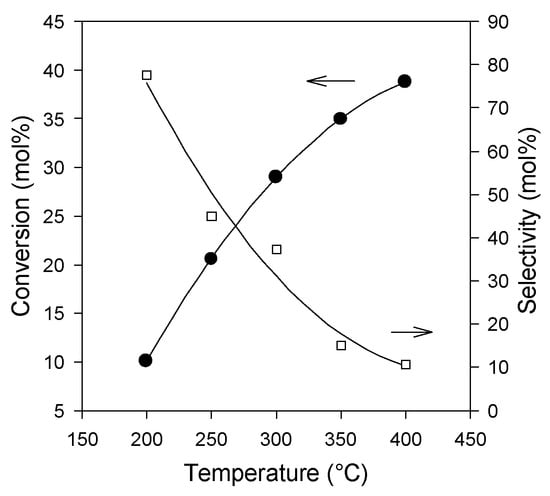
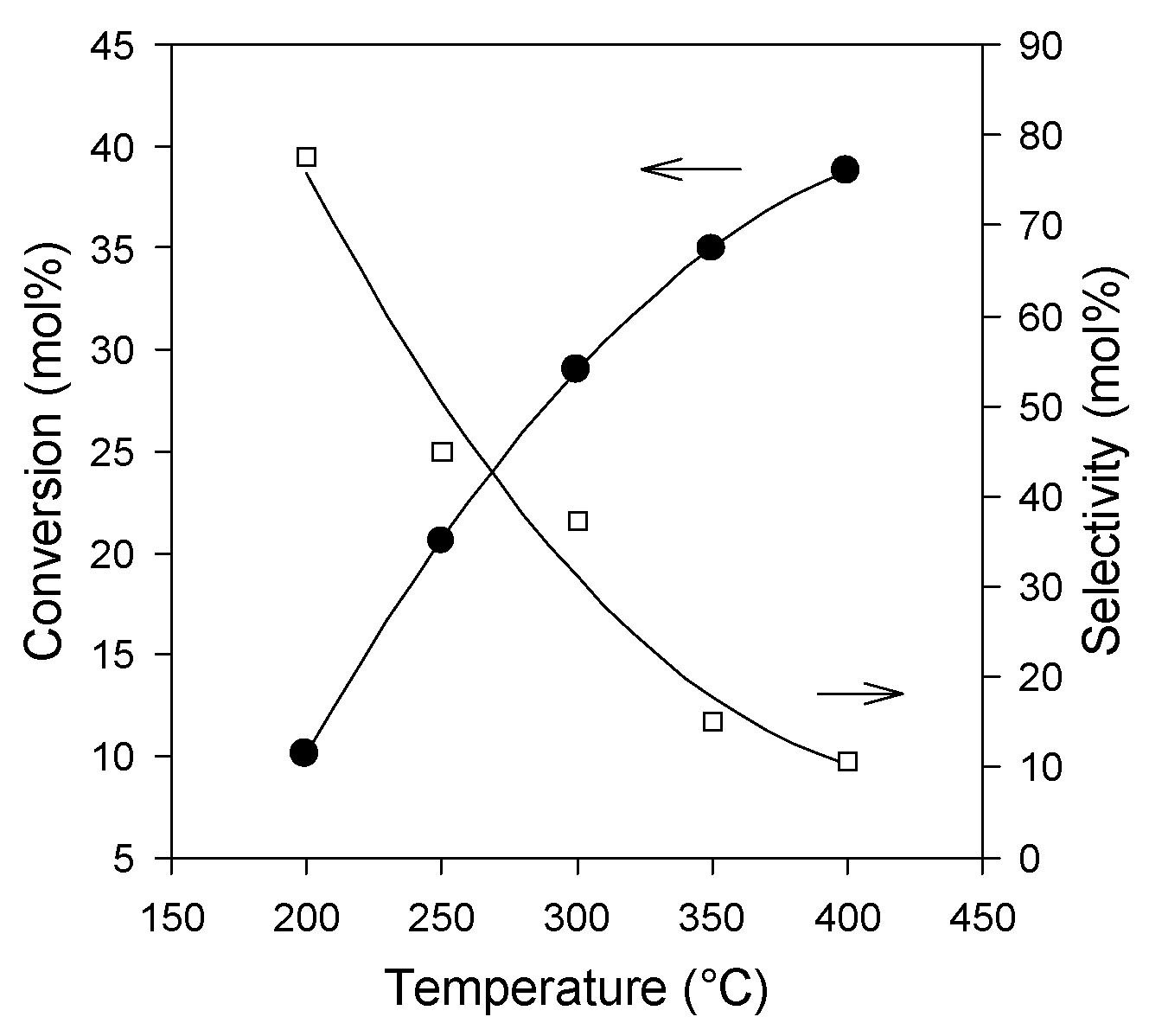
The influence of reaction temperature on the oxidation of 2-butanone is shown in Fig. 1. In this figure the conversion and selectivity versus temperature are plotted for VS-1 and O2 as oxidant. We can observe that the conversion increases with temperature but the selectivity decreases notably.
Figure 1.
Activity of VS-1. O2/MEK=3.4 and W/F=24g.h.mol−1.
References and Notes
- Jahan, I.; Kung, H. H. Ind. Chem. Res. 1992, 31, 2329.
- Ai, M. J. Catal. 1984, 89, 413. [CrossRef]
- Takita, Y.; Nita, K.; Maheara, T.; Yamazoe, N.; Seiyama, T. J. Catal. 1977, 50, 364. [CrossRef]
- Takita, Y.; Hori, F.; Yamazoe, N.; Seiyama, T. Bull. Chem. Soc. Jpn. 1987, 60, 2757. [CrossRef]
- Anunziata, O.A.; Pierella, L.B.; Beltramone, A.R. Stud. Surf. Sci. Catal. 1999, 125, 523.