Abstract
The Birch alkylation products are very unstable. We are showing, in this communication, the results of a theoretical study that compares different decomposition reaction mechanisms. The conclusions are in agreement with our experimental results.
Introduction
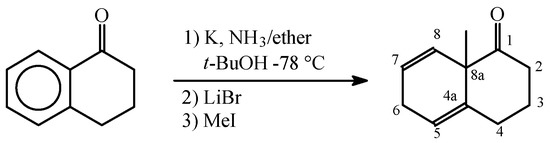
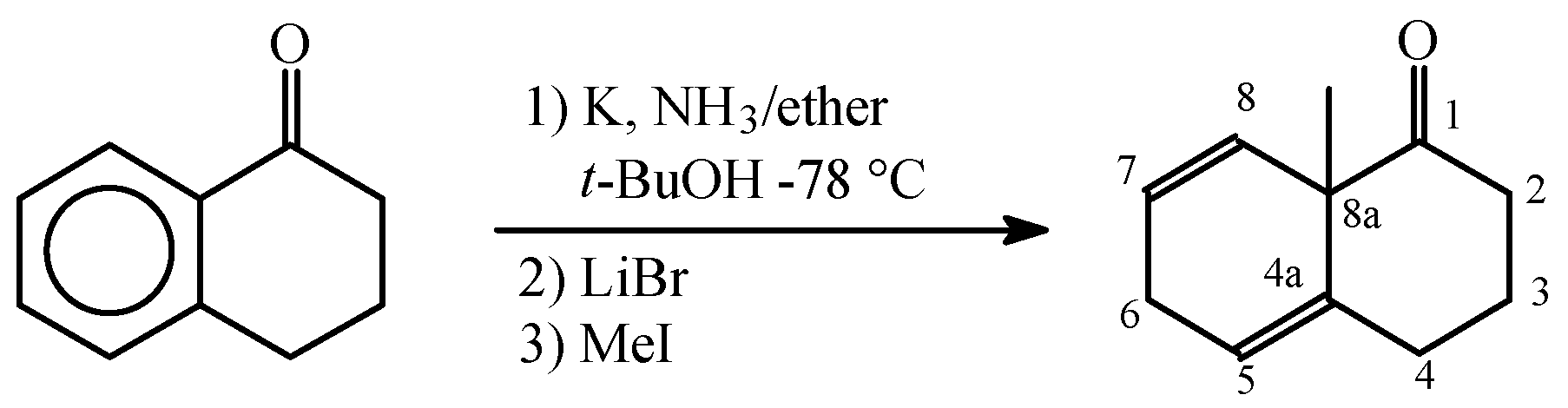
Our research group have been working in Birch reductive alkylation reactions of bencylic ketones for several years[1]. An example of the outcome of this type of reactions is showed in the Figure 1. The 8a-Alkykl-1,2,3,4,6,8a-hexahydro-naphtalen-1-ones, produced in this reaction have a high functionality but, at the same time, a high instability.
Figure 1.
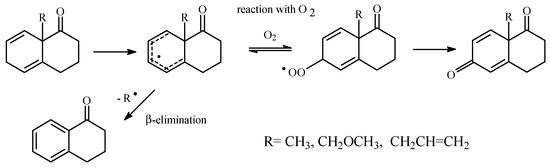
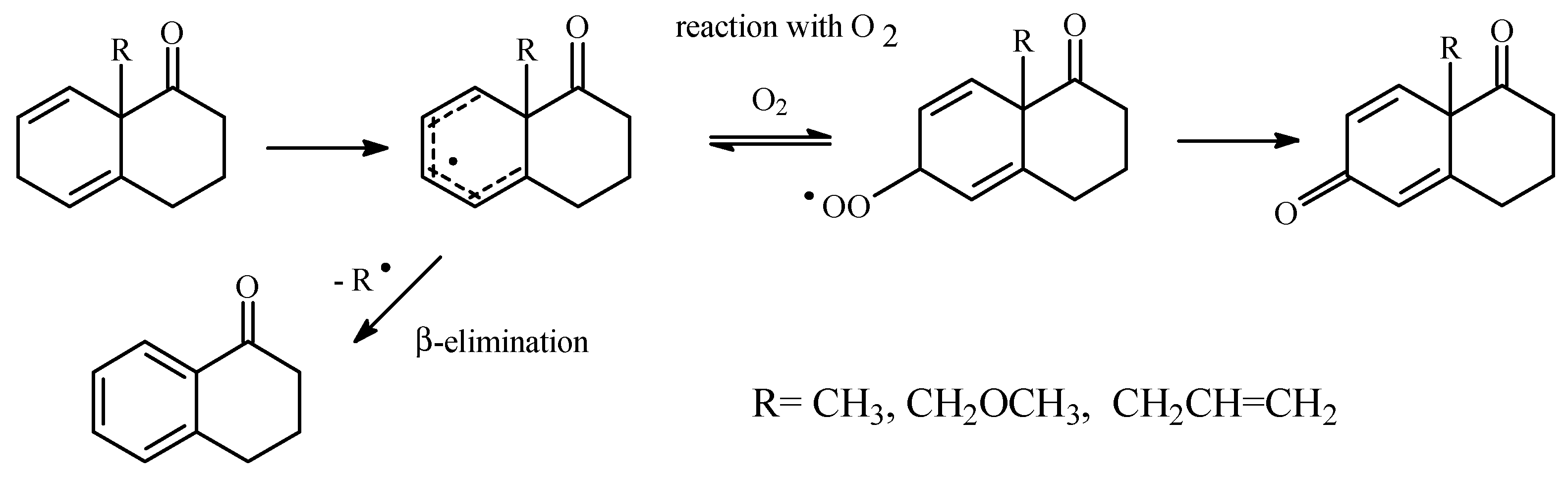
In the course of our work, we soon found that this instability leads in a short time to α- tetralone as the main decomposition product. According to a work reported by Beckwith[2] on the decomposition behavior of substituted 2,5-ciclohexadienes, the main decomposition product is that formed through an allylic oxidation. He proposes a mechanism that begins with the formation of a radical in the allylic position, which then may follow two different pathways: a) reaction with oxygen to produce a dienone, or b) promoting a β-elimination to achieve aromaticity. Therefore, Beckwith’s results for the monocyclic compounds indicated a preference for the oxidation pathway.
By extending the mechanism proposed by Beckwith to the bicyclic systems we conclude, in function of our experimental results, that for them, the β elimination reaction pathway is favored over their reaction with oxygen to form the peroxi radical that leads to the dienone.
Results and Discussion
To explain the pathway preference shown by the bicyclic system, we used semiempirical methods (AM1-UHF) to study the energy associated to both process in a series of substitued bicyclic dienes (R = methyl, allyl and metoxymethyl) Scheme 1. In the first place we search for the minimum energy conformations for the reactives and products. Then, using quadratic synchronous transit methodology we search for the transition states. For the reaction with oxygen we consider its approximation from both sides of the diene to produce both α and β peroxi-radicals.
Scheme 1.
For comparison, we also performed a similar analysis for 1-Carboximetil-1-methyl-cyclohexa-2,5-diene; the Birch alkylation product of methyl benzoate. The analysis of activation energys for the different reactions (oxidation vs. β-elimination) are in agreement with the experimental results found. We have also analyzed the influence of the different radical leaving groups (methyl, allyl and metoxymethyl) in the β-elimination reactions.
Acknowledgements
Universidad Nacional de Rosario – CONICET.
References and Notes
- (a) Vila, A. J.; Cravero, R. M.; González-Sierra, M. Tetrahedron Lett. 1991, 32, 1929–1932. (b) Vila, A. J.; Cravero, R. M.; González-Sierra, M. Tetrahedron 1993, 49, 4511–4526. (c) Labadie, G. R.; Cravero, R. M.; González-Sierra, M. Synth. Comm. 1996, 26, 4671–4684. (d) Labadie, G.R.; Cravero, R. M.; González-Sierra, M. submitted.
- Beckwith, A. L. J.; O´Shea, D. M.; Roberts, D. H. J. Am. Chem. Soc. 1986, 108, 6408–09.