

A Comparative Study of the Characteristics of Cross-Linked, Oxidized and Dual-Modified Rice Starches

Abstract
:1. Introduction
2. Results and Discussion
2.1. Swelling Power (SP), Solubility and Paste Clarity of Starches

| Starch samples | Swelling power (g/g) | Solubility (%) | Paste clarity (%T650) |
|---|---|---|---|
| Native | 10.1 ± 0.3 c | 7.2 ± 0.3 c | 3.8 ± 0.1 d |
| Cross-linked | 13.9 ± 0.3 a | 6.1 ± 0.4 d | 1.8 ± 0.07 e |
| Oxidized | 0.6 ± 0.02 e | 12.3 ± 0.01 a | 86.4 ± 2.3 a |
| Oxidized cross-linked | 11.6 ± 0.4 b | 8.5 ± 0.4 b | 4.9 ± 0.2 c |
| Cross-linked oxidized | 9.0 ± 0.5 d | 4.7 ± 0.3 e | 10.6 ± 3.2 b |
2.2. Pasting Properties
| Starch samples | Pasting Temp (°C) | Paste viscosity (cP) | |||
|---|---|---|---|---|---|
| Peak | Final | Breakdown | Setback | ||
| Native | 79.2 ± 0.5 a | 3096 ± 39 c | 3327 ± 40 b | 1474 ± 16 c | 1705 ± 20 b |
| Cross-linked | 79.2 ± 0.5 a | 3346 ± 40 a | 3526 ± 43 a | 1764 ± 20 a | 1944 ± 21 a |
| Oxidized | 72.6 ± 0.4 d | 498 ± 7 e | 12 ± 2 e | 439 ± 6 e | 62 ± 2 e |
| Oxidized cross-linked | 77.5 ± 0.4 b | 3198 ± 40 b | 2152 ± 26 c | 1640 ± 18 b | 594 ± 8 c |
| Cross-linked oxidized | 75.4 ± 0.3 c | 2875 ± 34 d | 1968 ± 28 d | 1012 ± 14 d | 105 ± 3 d |
2.3. Thermal Analysis
| Starch samples | to (°C) | tp (°C) | Δ Hgel (J/g) |
|---|---|---|---|
| Native | 59.3 ± 0.6 c | 87.6 ± 0.6 c | 9.84 ± 0.22 c |
| Cross-linked | 83.7 ± 0.8 a | 94.6 ± 0.9 a | 11.47 ± 0.26 a |
| Oxidized | 57.5 ± 0.4 e | 84.1 ± 0.5 e | 8.94 ± 0.19 d |
| Oxidized cross-linked | 58.4 ± 0.5 d | 86.1 ± 0.5 d | 11.04 ± 0.23 b |
| Cross-linked oxidized | 65.6 ± 0.6 b | 90.5 ± 0.6 b | 11.13 ± 0.25 b |
| Starch samples | to (°C) | tp (°C) | Δ Hret (J/g) |
|---|---|---|---|
| Native | 39.6 ± 0.4 c | 50.1 ± 0.5 c | 4.6 ± 0.1 b |
| Cross-linked | 42.5 ± 0.5 a | 54.2 ± 0.6 a | 5.3 ± 0.2 a |
| Oxidized | 34.2 ± 0.1 e | 47.5 ± 0.3 e | 3.2 ± 0.0 d |
| Oxidized cross-linked | 38.8 ± 0.3 d | 49.7 ± 0.5 d | 3.9 ± 0.1 c |
| Cross-linked oxidized | 41.6 ± 0.4 b | 53.0 ± 0.7 b | 2.1 ± 0.0 e |
2.4. Flowing Characteristics
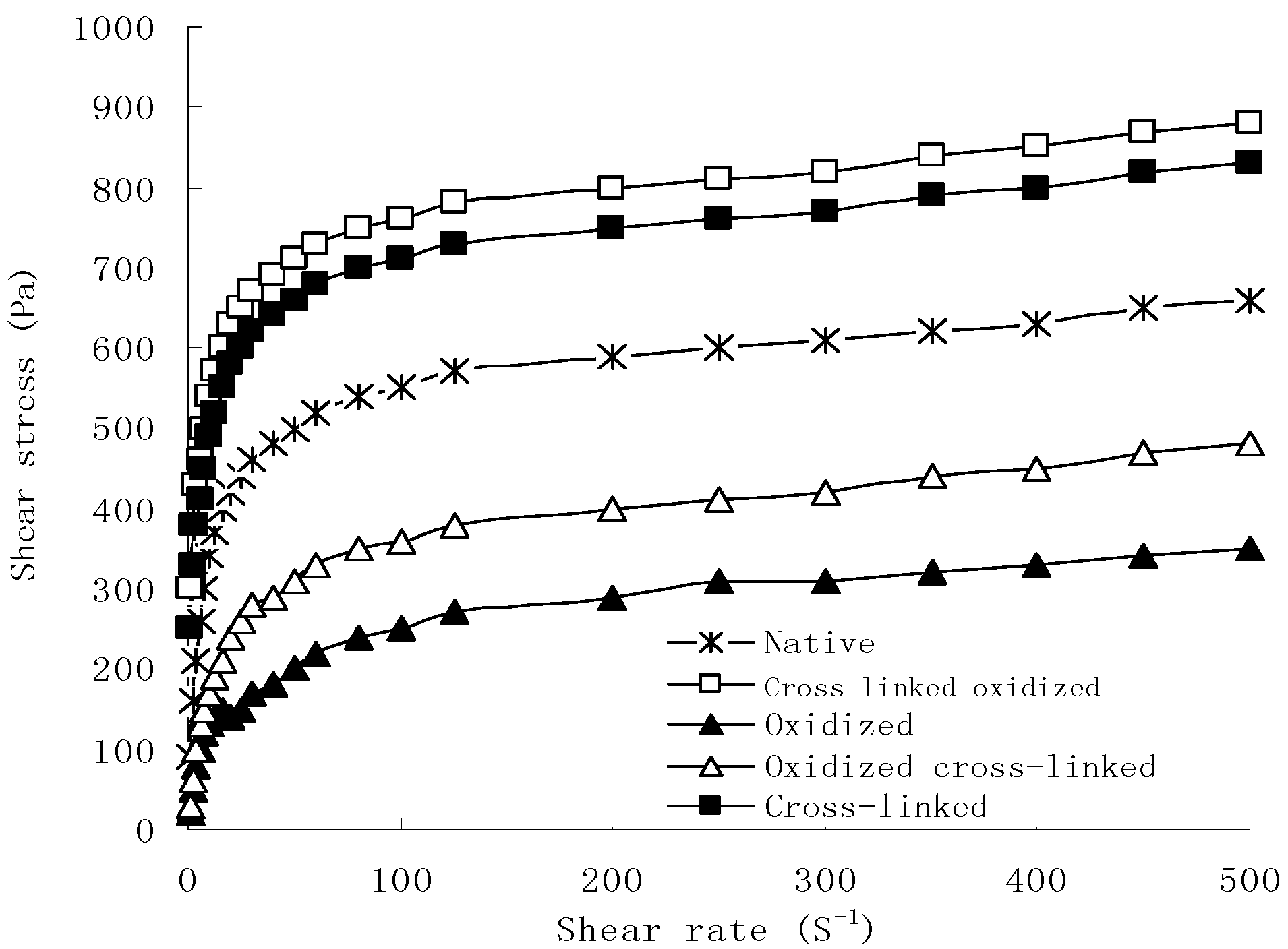
2.5. Morphological Characteristics
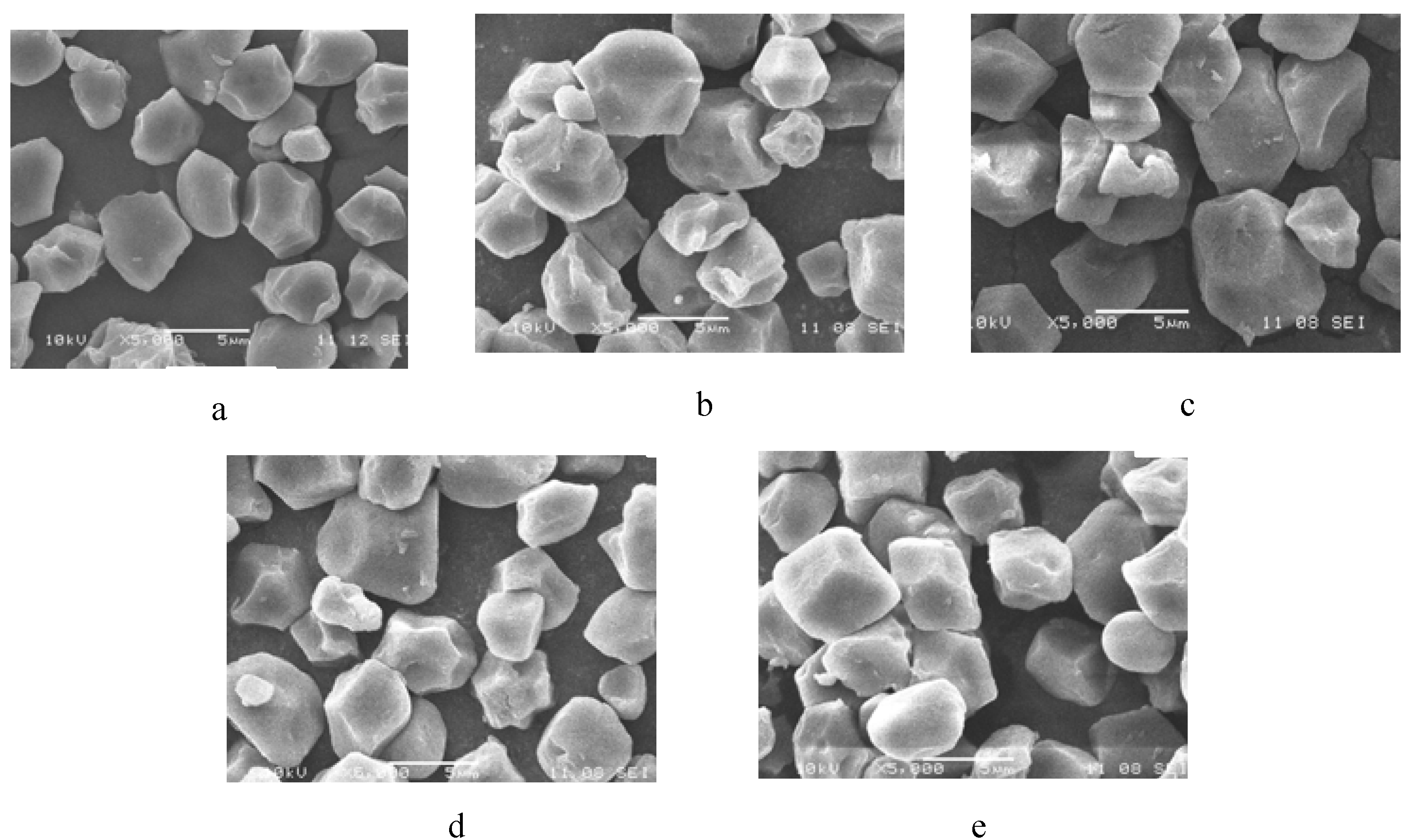
3. Experimental
3.1. Materials
3.2. Preparation of Cross-Linked Rice Starch
3.3. Preparation of Oxidized Rice Starch
3.4. Preparation of Dual-Modified Rice Starch
3.5. Determination of Swelling Power (SP), Solubility and Paste Clarity


3.6. Pasting Properties
3.7. Differential Scanning Calorimetry (DSC)
3.8. Measurement of Flow Behavior
3.9. Morphological Properties
3.10. Statistical Analyses
4. Conclusions
References
- Singh, J.; Kaur, L.; McCarthy, O.J. Factors influencing the physico-chemical, morphological, thermal and rheological properties of some chemically modified starches for food applications—A review. Food Hydrocolloid. 2007, 21, 1–22. [Google Scholar] [CrossRef]
- Kaur, M.; Oberoi, D.P.S.; Sogi, D.S.; Gill, B.S. Physico-chemical, morphological and pasting properties of acid treated starches from different botanical sources. J. Food Sci. Technol. 2011, 48, 460–465. [Google Scholar] [CrossRef]
- Wang, Y.J.; Wang, L. Physicochemical properties of common and waxy corn starches oxidized by different levels of sodium hypochlorite. Carbohydr. Polym. 2003, 52, 207–217. [Google Scholar]
- Raina, C.S.; Singh, S.; Bawa, A.S.; Saxena, D.C. Some characteristics of acetylated, cross-linked and dual modified Indian rice starches. Eur. Food Res. Technol. 2006, 223, 561–570. [Google Scholar] [CrossRef]
- Lawal, O.S. Composition, physicochemical properties and retrogradation characteristics of native, oxidized, acetylated and acid-thinned new cocoyam (Xanthosoma sagittifolium) starch. Food Chem. 2004, 87, 205–218. [Google Scholar] [CrossRef]
- Ačkar, D.; Šubarić, D.; Babić, J.; Miličević, B.; Jozinović, A. Modification of wheat starch with succinic acid/acetanhydride and azelaic acid/acetanhydride mixtures. II. Chemical and physical properties. J. Food Sci. Technol. 2012. [Google Scholar] [CrossRef]
- Atichokudomchai, N.; Varavinit, S. Characterization and utilization of acid-modified cross-linked Tapioca starch in pharmaceutical tablets. Carbohydr. Polym. 2003, 53, 263–270. [Google Scholar] [CrossRef]
- Wattanachant, S.; Muhammad, K.; Hashim, D.M.; Rahman, R.A. Effect of crosslinking reagents and hydroxypropylation levels on dual-modified sago starch properties. Food Chem. 2003, 8, 463–471. [Google Scholar]
- Kaur, L.; Singh, J.; Singh, N. Effect of cross-linking on some properties of potato (Solanum tuberosum L.) starches. J. Sci. Food Agric. 2006, 86, 1945–1954. [Google Scholar]
- Yeh, A.-I.; Yeh, S.-L. Some characteristics of hydroxypropylated and cross-linked rice starch. Cereal Chem. 1993, 70, 596–601. [Google Scholar]
- Adebowale, K.O.; Lawal, O.S. Functional properties and retrogradation behaviour of native and chemically modified starch of Mucuna bean (Mucuna pruriens). J.Sci. Food Agric. 2003, 83, 1541–1546. [Google Scholar]
- Sandhu, K.S.; Kaur, M.; Singh, N.; Lim, S.-T. A comparison of native and oxidized normal and waxy corn starches: Physicochemical, thermal, morphological and pasting properties. LWT-Food Sci. Technol. 2008, 41, 1000–1010. [Google Scholar]
- Leach, H.W.; McCowen, L.D.; Schoch, T.J. Structure of the starch granule. I. Swelling and solubility patterns of various starches. Cereal Chem. 1950, 36, 534–544. [Google Scholar]
- Jyothi, A.N.; Moorthy, S.N.; Rajasekharan, K.N. Effect of cross-linking with epichlorohydrin on the properties of cassava (Manihot esculenta crantz) starch. Starch 2006, 58, 292–299. [Google Scholar] [CrossRef]
- Hodge, J.E.; Osman, E.M. Carbohydrates. In Food Chemistry; Fennema, O.R., Ed.; Marcel Dekker: New York, NY, USA, 1996; p. 47. [Google Scholar]
- Zheng, G.H.; Han, H.L.; Bhatty, R.S. Functional properties of cross-linked and hydroxipropylated waxy hull-less barley starches. Cereal Chem. 1999, 76, 182–188. [Google Scholar] [CrossRef]
- Morton, M.W.; Solarek, D. Starch derivatives: Production and Uses. In Starch Chemistry and Technology; Whistler, R.L., BeMiller, J.N., Paschall, E.F., Eds.; Academic Press: New York, NY, USA, 1984; pp. 311–366. [Google Scholar]
- Kartha, K.P.R.; Srivastava, H.C. Reaction of epichlorohydrin with carbohydrate polymers. Starch 1985, 37, 297–306. [Google Scholar] [CrossRef]
- Liu, H.; Ramsden, L.; Corke, H. Physical properties of cross-linked and acetylated normal and waxy rice starch. Starch 1999, 51, 249–252. [Google Scholar]
- Adebowale, K.O.; Afolabi, T.A.; Lawal, O.S. Isolation, chemical modification and physicochemical characterization of Bambarra groundut (Voandzeia subterranean) starch and flour. Food Chem. 2002, 78, 305–311. [Google Scholar] [CrossRef]
- Ferrero, C.; Martin, M.N.; Zantzky, N.E. Corn-starch-xanthan gum interaction and its effect on the stability during storage of frozen gelatinized suspensions. Starch 1994, 46, 300–305. [Google Scholar] [CrossRef]
- Hoover, R.; Senanayake, S.P.J.N. Composition and physicochemical properties of oat starches. Food Res. Int. 1996, 29, 15–26. [Google Scholar] [CrossRef]
- Sodhi, N.S.; Singh, N. Characteristics of acetylated starches prepared using starches separated from different rice starch. J.Food Eng. 2005, 70, 117–127. [Google Scholar] [CrossRef]
- Gibinski, M.; Kowalski, S.; Sady, M.; Krawontka, J.; Tomasik, P.; Sikora, M. Thickening of sweet and sour sauces with various polysaccharide combinations. J.Food Eng. 2006, 75, 407–414. [Google Scholar] [CrossRef]
- Van Hung, P.; Morita, N. Effect of granule sizes on physicochemical properties of cross-linked and acetylated wheat starches. Starch 2005, 57, 413–420. [Google Scholar] [CrossRef]
- Reddy, I.; Seib, P.A. Modified waxy wheat starch compared to modified waxy corn starch. J. Cereal Sci. 2000, 31, 25–39. [Google Scholar] [CrossRef]
- Autio, K.; Suortti, T.; Hamunen, A.; Poutanen, K. Heat-induced structural changes of acid-hydrolysed and hypochlorite-oxidized barley starches. Carbohydr. Polym. 1996, 29, 155–161. [Google Scholar] [CrossRef]
- Sasaki, T.; Matsuki, J. Effect of wheat starch structure on swelling power. Cereal Chem. 1998, 75, 525–529. [Google Scholar] [CrossRef]
- Perera, C.; Hoover, R. Influence of hydroxypropylation on retrogradation properties of native, defatted and heat-moisture treated potato starches. Food Chem. 1999, 64. [Google Scholar]
- Xiao, H.; Lin, Q.; Liu, G.Q. Effect of cross-linking and enzymatic hydrolysis composite modification on the properties of Rice Starches. Molecules 2012, 17, 8136–8146. [Google Scholar] [CrossRef]
- Sample Availability: Not available.
© 2012 by the authors; licensee MDPI, Basel, Switzerland. This article is an open-access article distributed under the terms and conditions of the Creative Commons Attribution license (http://creativecommons.org/licenses/by/3.0/).
Share and Cite
Xiao, H.-X.; Lin, Q.-L.; Liu, G.-Q.; Yu, F.-X. A Comparative Study of the Characteristics of Cross-Linked, Oxidized and Dual-Modified Rice Starches. Molecules 2012, 17, 10946-10957. https://doi.org/10.3390/molecules170910946
Xiao H-X, Lin Q-L, Liu G-Q, Yu F-X. A Comparative Study of the Characteristics of Cross-Linked, Oxidized and Dual-Modified Rice Starches. Molecules. 2012; 17(9):10946-10957. https://doi.org/10.3390/molecules170910946
Chicago/Turabian StyleXiao, Hua-Xi, Qin-Lu Lin, Gao-Qiang Liu, and Feng-Xiang Yu. 2012. "A Comparative Study of the Characteristics of Cross-Linked, Oxidized and Dual-Modified Rice Starches" Molecules 17, no. 9: 10946-10957. https://doi.org/10.3390/molecules170910946