<?xml version="1.0" encoding="UTF-8"?>
<!DOCTYPE article PUBLIC "-//NLM//DTD Journal Publishing DTD v2.3 20070202//EN" "journalpublishing.dtd">
<article xmlns:mml="http://www.w3.org/1998/Math/MathML" xmlns:xlink="http://www.w3.org/1999/xlink" xml:lang="en" article-type="rapid-communication">
  <front>
    <journal-meta>
      <journal-id journal-id-type="publisher-id">molecules</journal-id>
      <journal-title>Molecules</journal-title>
      <abbrev-journal-title abbrev-type="publisher">Molecules</abbrev-journal-title>
      <abbrev-journal-title abbrev-type="pubmed">Molecules</abbrev-journal-title>
      <issn pub-type="epub">1420-3049</issn>
      <publisher>
        <publisher-name>MDPI</publisher-name>
      </publisher>
    </journal-meta>
    <article-meta>
      <article-id pub-id-type="doi">10.3390/molecules17089835</article-id>
      <article-id pub-id-type="publisher-id">molecules-17-09835</article-id>
      <article-categories>
        <subj-group>
          <subject>Communication</subject>
        </subj-group>
      </article-categories>
      <title-group>
        <article-title>Towards Recyclable NAD(P)H Regeneration Catalysts</article-title>
      </title-group>
	  <contrib-group>
        <contrib contrib-type="author">
          <name>
            <surname>de Torres</surname>
            <given-names>Miriam</given-names>
          </name>
          <xref rid="af1-molecules-17-09835" ref-type="aff">1</xref>
          <xref rid="fn1-molecules-17-09835" ref-type="fn">†</xref>
        </contrib>
        <contrib contrib-type="author">
          <name>
            <surname>Dimroth</surname>
            <given-names>Jonas</given-names>
          </name>
          <xref rid="af2-molecules-17-09835" ref-type="aff">2</xref>
          <xref rid="fn2-molecules-17-09835" ref-type="fn">‡</xref>
        </contrib>
        <contrib contrib-type="author">
          <name>
            <surname>Arends</surname>
            <given-names>Isabel W. C. E.</given-names>
          </name>
          <xref rid="af3-molecules-17-09835" ref-type="aff">3</xref>
        </contrib>
        <contrib contrib-type="author">
          <name>
            <surname>Keilitz</surname>
            <given-names>Juliane</given-names>
          </name>
          <xref rid="af4-molecules-17-09835" ref-type="aff">4</xref>
          <xref rid="fn3-molecules-17-09835" ref-type="corresp">#</xref>
        </contrib>
        <contrib contrib-type="author">
          <name>
            <surname>Hollmann</surname>
            <given-names>Frank</given-names>
          </name>
          <xref rid="af3-molecules-17-09835" ref-type="aff">3</xref>
          <xref rid="c1-molecules-17-09835" ref-type="corresp">*</xref>
        </contrib>
      </contrib-group>
      
      <aff id="af1-molecules-17-09835"><label>1 </label>Departamento de Química Orgánica, Universidad de Zaragoza, Pedro Cerbuna 12, E-50009, Spain</aff>
      <aff id="af2-molecules-17-09835"><label>2 </label>Department of Chemistry, Technische Universiät Berlin, Straße des 17, Juni 124, Berlin 10623, Germany</aff>
      <aff id="af3-molecules-17-09835"><label>3 </label>Department of Biotechnology, Delft University of Technology, Julianalaan 136, Delft 2628BL, The Netherlands; Email: <email>i.w.c.e.arends@tudelft.nl</email></aff>
      <aff id="af4-molecules-17-09835"><label>4 </label>Freie Universität Berlin, Institute of Chemistry and Biochemistry, Takustraße 3, Berlin 14195, Germany</aff>
      
      <author-notes>
        <fn id="fn1-molecules-17-09835">
          <label>†</label>
          <p>Current address: Institute for Molecules and Materials, Radboud University, Heyendaalseweg 135, Nijmegen 6525 AJ, The Netherlands; Email: <email>mtorres@science.ru.nl.</email></p>
        </fn>
        <fn id="fn2-molecules-17-09835">
          <label>‡</label>
          <p>Current address: Molecular Design Institute and Department of Chemistry, New York University, 100 Washington Square East, New York, NY 10003, USA; Email: <email>jonas.dimroth@nyu.edu.</email></p>
        </fn>
		<fn id="fn3-molecules-17-09835">
		<label>#</label>
		<p>Current address: Department of Chemistry, University of Toronto, 80 St. George Street, Toronto, Ontario M5S 3H6, Canada; Email: <email>jkeilitz@chem.utoronto.ca.</email></p></fn>
        <corresp id="c1-molecules-17-09835"><label>*</label> Author to whom correspondence should be addressed; Email: <email>f.hollmann@tudelft.nl</email>; Tel.: +31-15-278-1957; Fax: +31-15-278-1415.</corresp>
      </author-notes>
      <pub-date pub-type="epub">
        <day>15</day>
        <month>08</month>
        <year>2012</year>
      </pub-date>
      <pub-date pub-type="collection">
	  <month>08</month>
        <year>2012</year>
      </pub-date>
      <volume>17</volume>
      <issue>8</issue>
      <fpage>9835</fpage>
      <lpage>9841</lpage>
      <history>
        <date date-type="received">
          <day>14</day>
          <month>06</month>
          <year>2012</year>
        </date>
        <date date-type="rev-recd">
          <day>01</day>
          <month>08</month>
          <year>2012</year>
        </date>
        <date date-type="accepted">
          <day>08</day>
          <month>08</month>
          <year>2012</year>
        </date>
      </history>
      <permissions>
        <copyright-statement>©  2012 by the authors; licensee MDPI, Basel, Switzerland.</copyright-statement>
        <copyright-year>2012</copyright-year>
        <license xmlns:xlink="http://www.w3.org/1999/xlink" license-type="open-access" xlink:href="http://creativecommons.org/licenses/by/3.0/">
          <p>This article is an open-access article distributed under the terms and conditions of the Creative Commons Attribution license (<uri>http://creativecommons.org/licenses/by/3.0/</uri>).</p>
        </license>
      </permissions>
      <abstract>
        <p>Rh(III)-TsDPEN, an immobilized analog of the well-known [Cp<bold>*</bold>Rh(bpy)(H<sub>2</sub>O)]<sup>2+</sup> was evaluated as a heterogeneous, recyclable regeneration catalyst for reduced oxidoreductase cofactors [NAD(P)H]. Repeated use of this catalyst was established and the catalytic properties were initially investigated. Apparently, Rh(III)-TsDPEN is prone to severe diffusion limitations, necessitating further developments. Overall, a promising concept for chemoenzymatic redox catalysis is proposed, which may overcome some of the current limitations such as catalyst cost and incompatibility of Rh with some biocatalysts.</p>
      </abstract>
      <kwd-group>
        <kwd>biocatalysis</kwd>
        <kwd>cofactor regeneration</kwd>
        <kwd>chemoenzymatic cascades</kwd>
        <kwd>immobilized catalysts</kwd>
      </kwd-group>
    </article-meta>
  </front>
  <body>
    <sec sec-type="intro">
      <title>1. Introduction</title>
      <p>Pentamethylcyclopentadienyl rhodium-complexes ([Cp*Rh(L<sup>⌒</sup>L)]<sup>n+</sup>, wherein L<sup>⌒</sup>L is a bidentate ligand) have received considerable interest as non-enzymatic regeneration catalysts for reduced nicotinamide cofactors and flavin cofactors [<xref ref-type="bibr" rid="B1-molecules-17-09835">1</xref>,<xref ref-type="bibr" rid="B2-molecules-17-09835">2</xref>,<xref ref-type="bibr" rid="B3-molecules-17-09835">3</xref>,<xref ref-type="bibr" rid="B4-molecules-17-09835">4</xref>,<xref ref-type="bibr" rid="B5-molecules-17-09835">5</xref>,<xref ref-type="bibr" rid="B6-molecules-17-09835">6</xref>,<xref ref-type="bibr" rid="B7-molecules-17-09835">7</xref>,<xref ref-type="bibr" rid="B8-molecules-17-09835">8</xref>,<xref ref-type="bibr" rid="B9-molecules-17-09835">9</xref>,<xref ref-type="bibr" rid="B10-molecules-17-09835">10</xref>,<xref ref-type="bibr" rid="B11-molecules-17-09835">11</xref>]. In particular their very broad activity spectrum with respect to temperature and pH makes them interesting, broadly applicable alternatives to the commonly used enzymatic systems [<xref ref-type="bibr" rid="B12-molecules-17-09835">12</xref>].</p>
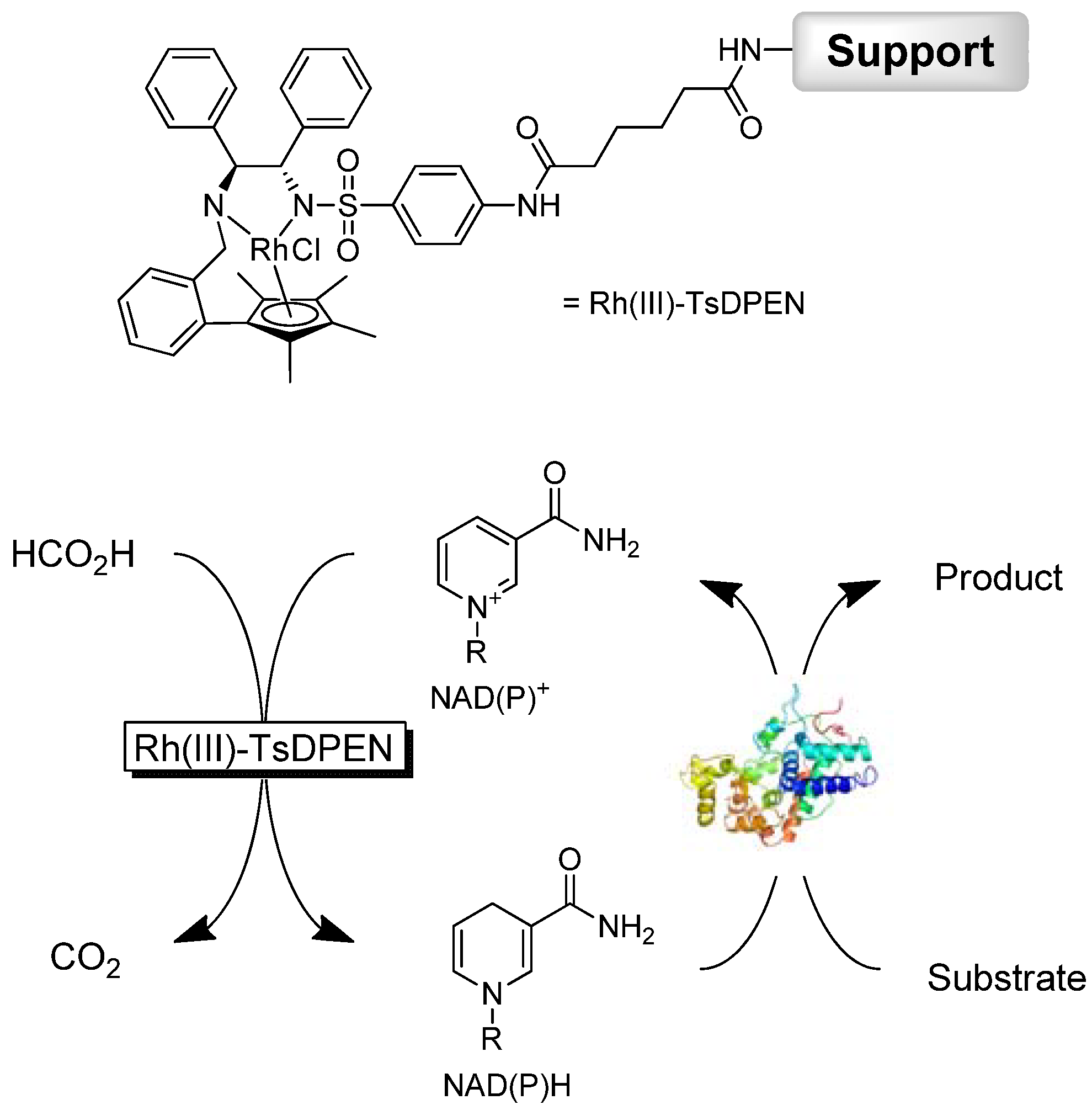
      <p>Some challenges, however, still have to be met <italic>en route</italic> to practical applicability of this regeneration concept. Particularly, recycling of the precious Rh-catalyst has so far been seldom addressed. Also, the mutual inactivation of regeneration- and biocatalyst [<xref ref-type="bibr" rid="B13-molecules-17-09835">13</xref>,<xref ref-type="bibr" rid="B14-molecules-17-09835">14</xref>,<xref ref-type="bibr" rid="B15-molecules-17-09835">15</xref>] calls for a solution to achieve robust chemoenzymatic reactions schemes. Recently, Lütz and coworkers reported on a polymer-modified version of the well-known [Cp*Rh(bpy)(H<sub>2</sub>O)]<sup>2+</sup>[<xref ref-type="bibr" rid="B14-molecules-17-09835">14</xref>]. Here, mass-enlargement of the transition metal catalyst enabled spatial separation from the enzyme by membranes and thereby prevented the above-mentioned inactivation. Inspired by these works we became interested in the recently described tethered Rh(III)-TsDPEN complex (<xref ref-type="scheme" rid="molecules-17-09835-f004">Scheme 1</xref>). This heterogenized version of the piano-stool Cp*Rh complex has been described as efficient and recyclable transfer hydrogenation catalyst [<xref ref-type="bibr" rid="B16-molecules-17-09835">16</xref>,<xref ref-type="bibr" rid="B17-molecules-17-09835">17</xref>] Therefore, we evaluated Rh(III)-TsDPEN as recyclable alternative to the commonly used low-molecular weight [Cp*Rh(bpy)(H<sub>2</sub>O)]<sup>2+</sup> complexes.</p>
      <fig id="molecules-17-09835-f004" position="anchor">
        <object-id pub-id-type="pii">molecules-17-09835-scheme1_Scheme 1</object-id>
        <label>Scheme 1</label>
        <caption>
          <p>Immobilized Cp*Rh complex (Rh(III)-TsDPEN) evaluated in this study; and its application to promote NAD(P)H-regeneration. Support: Surface-functionalized poly(ethylene) sinter chips [<xref ref-type="bibr" rid="B17-molecules-17-09835">17</xref>].</p>
        </caption>
        <graphic xmlns:xlink="http://www.w3.org/1999/xlink" xlink:href="molecules-17-09835-g004.tif"/>
      </fig>
    </sec>
    <sec sec-type="results">
      <title>2. Results and Discussion</title>
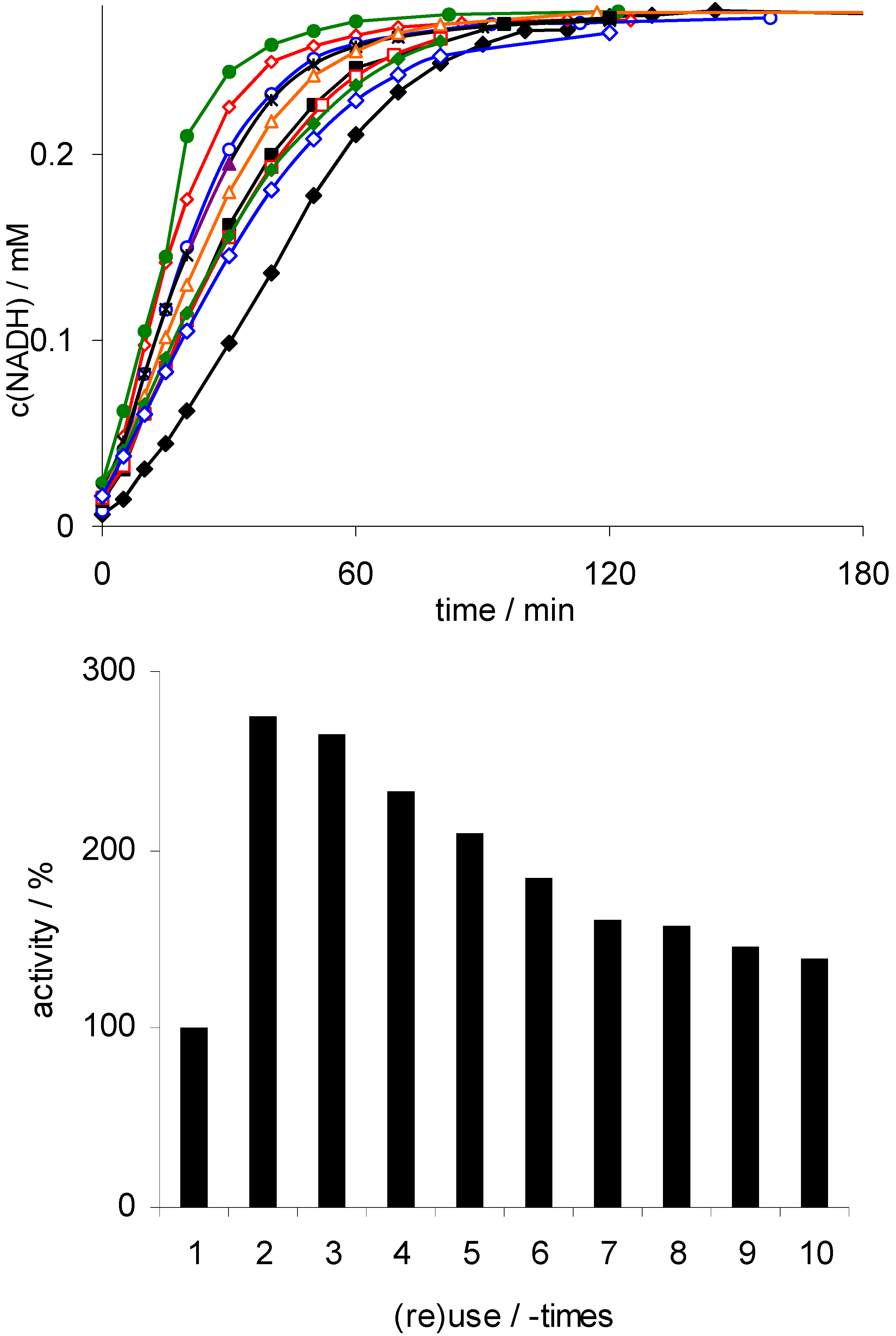
      <p>Indeed, incubation of Rh(III)-TsDPEN with either NAD<sup>+</sup> or NADP<sup>+</sup> in the presence of formate (as reductant) lead to the formation of the enzymatically active reduced NAD(P)H (as demonstrated by UV/Vis spectroscopy and by activity assays with NADH-dependent dehydrogenases, data not shown). Encouraged by these results, we further investigated the catalytic properties of Rh(III)-TsDPEN with respect to activity and stability. <xref ref-type="fig" rid="molecules-17-09835-f001">Figure 1</xref> shows the results of a first recycling experiment performed under arbitrarily chosen conditions.</p>
      <fig id="molecules-17-09835-f001" position="anchor">
        <label>Figure 1</label>
        <caption>
          <p>Recycling experiments with Rh(III)-TsDPEN. Upper: time courses of the single experiments (1:<inline-graphic xmlns:xlink="http://www.w3.org/1999/xlink" xlink:href="molecules-17-09835-i001.tif"/>; 2:<inline-graphic xmlns:xlink="http://www.w3.org/1999/xlink" xlink:href="molecules-17-09835-i002.tif"/>; 3:<inline-graphic xmlns:xlink="http://www.w3.org/1999/xlink" xlink:href="molecules-17-09835-i003.tif"/>; 4:<inline-graphic xmlns:xlink="http://www.w3.org/1999/xlink" xlink:href="molecules-17-09835-i004.tif"/>; 5:<inline-graphic xmlns:xlink="http://www.w3.org/1999/xlink" xlink:href="molecules-17-09835-i005.tif"/>; 6:<inline-graphic xmlns:xlink="http://www.w3.org/1999/xlink" xlink:href="molecules-17-09835-i006.tif"/>; 7:<inline-graphic xmlns:xlink="http://www.w3.org/1999/xlink" xlink:href="molecules-17-09835-i007.tif"/>; 8:<inline-graphic xmlns:xlink="http://www.w3.org/1999/xlink" xlink:href="molecules-17-09835-i008.tif"/>; 9:<inline-graphic xmlns:xlink="http://www.w3.org/1999/xlink" xlink:href="molecules-17-09835-i009.tif"/>; 10:<inline-graphic xmlns:xlink="http://www.w3.org/1999/xlink" xlink:href="molecules-17-09835-i010.tif"/>); lower: initial rates. Conditions: 50 mg Rh(III)-TsDPEN (0.35 μmol), c(NAD<sup>+</sup>)<sub>0</sub> = 0.25 mM, 50 mM phosphate buffer pH 7, T = 30 °C, c(NaHCO<sub>2</sub>) = 150 mM, 1,000 rpm; 100% corresponds to an NADH-generation rate of 0.21 mM·h<sup>−1</sup>.</p>
        </caption>
        <graphic xmlns:xlink="http://www.w3.org/1999/xlink" xlink:href="molecules-17-09835-g001.tif"/>
      </fig>
      <p>Interestingly, an almost 3-fold activation of the catalyst was observed after the first use, which was followed by a gradual decrease during the successive experiments converging to approx 140% of the initial activity in the tenth use. Currently, we can only speculate about the nature of these observations. The initial activation may be rationalized by a displacement of the Cl<sup>−</sup> counter ion in the Rh ligand sphere by water and/or phosphate. This should facilitate coordination of formate to the Rh central atom to form the catalytically active hydrido complex. Possibly then, the Rh-central atom is slowly poisoned by buffer impurities. Principally also leaching of the metal catalyst from the solid support could occur, however at least under storage conditions, no leaching was detectable. Further investigations will be necessary to fully understand the apparent ‘deactivation’ and to exclude leaching under reaction conditions.</p>
      <p>It is also interesting to note that the catalytic activity of Rh(III)-TsDPEN was some 40% higher at pH 6. The decrease of both the initial activation and the subsequent activity, were less pronounced than at pH 7 (Supporting Information). However, similar effects have been reported for Rh(III)-TsDPEN in asymmetric transfer hydrogenation reactions (ATH) under acidic conditions [<xref ref-type="bibr" rid="B16-molecules-17-09835">16</xref>].</p>
      <p>It should be mentioned here that compared to the commonly used [Cp*Rh(bpy)(H<sub>2</sub>O)]<sup>2+</sup> performance reported previously, the activity of Rh(III)-TsDPEN fell back approximately one order of magnitude (TOF of 2.5 h<sup>−1</sup> as compared to approximately 36 h<sup>−1</sup> under comparable conditions, respectively). To a large extent this is due to the difference in the bidentate ligand used. Using Cp*Rh complexed with a (biotinylated) aminosulfonamide ligand also lead to a reduction in NAD<sup>+</sup>-reduction to approximately 4 h<sup>−1</sup> (as determined for the soluble catalyst) [<xref ref-type="bibr" rid="B18-molecules-17-09835">18</xref>]. Hence, further optimization of the ligand system may lead to significant improvements in the catalyst activity. Nevertheless, also compared to the soluble aminosulfonamide-complexed catalyst, a significantly lower rate was observed for which we suspected diffusion limitation to be responsible. In fact, the shaking rate of the reaction vessel had a significant influence on the overall rate (supporting information).</p>
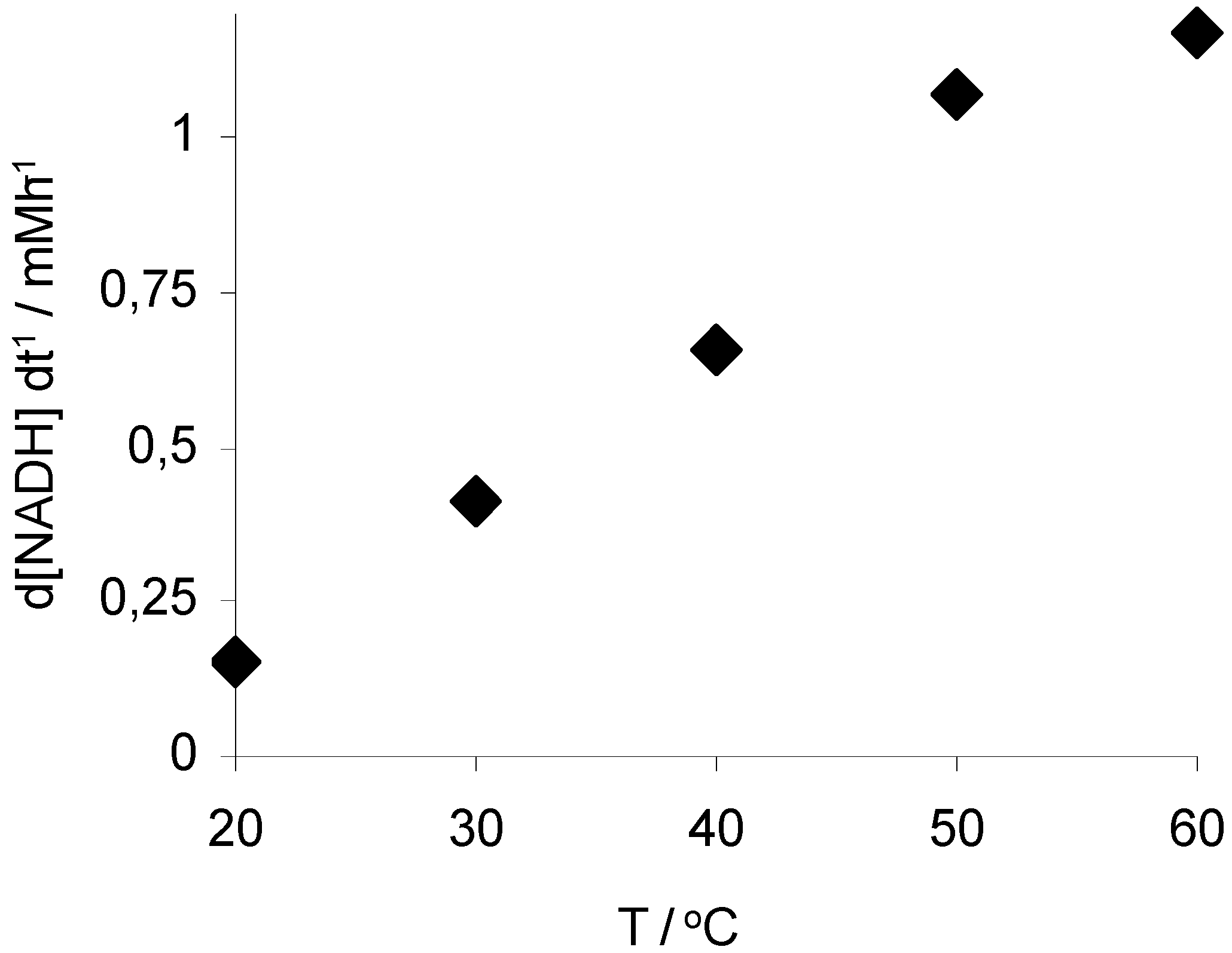
      <p>This hypothesis is also supported by the, at first unexpected, activity profile of Rh(III)-TsDPEN with temperature (<xref ref-type="fig" rid="molecules-17-09835-f002">Figure 2</xref>). In contrast to our previous experience [<xref ref-type="bibr" rid="B12-molecules-17-09835">12</xref>] the NAD<sup>+</sup> reduction rate correlated only linearly with temperature. This apparent deviation from exponential behavior may be rationalized assuming diffusion of the substrates (HCO<sub>2</sub><sup>−</sup> and/or NAD(P)<sup>+</sup>, respectively) to be overall rate limiting. According to the Stokes-Einstein equation [<xref ref-type="bibr" rid="B19-molecules-17-09835">19</xref>] the diffusion coefficient correlates linearly with temperature. An abnormal correlation of activity and temperature (&gt;50 °C) was also observed using supported Rh(III)-TsDPEN as an ATH-catalyst. The authors hypothesized CO formation and subsequent catalyst inhibition to account for this observation [<xref ref-type="bibr" rid="B16-molecules-17-09835">16</xref>]. However, further experiments will be necessary to clarify this issue.</p>
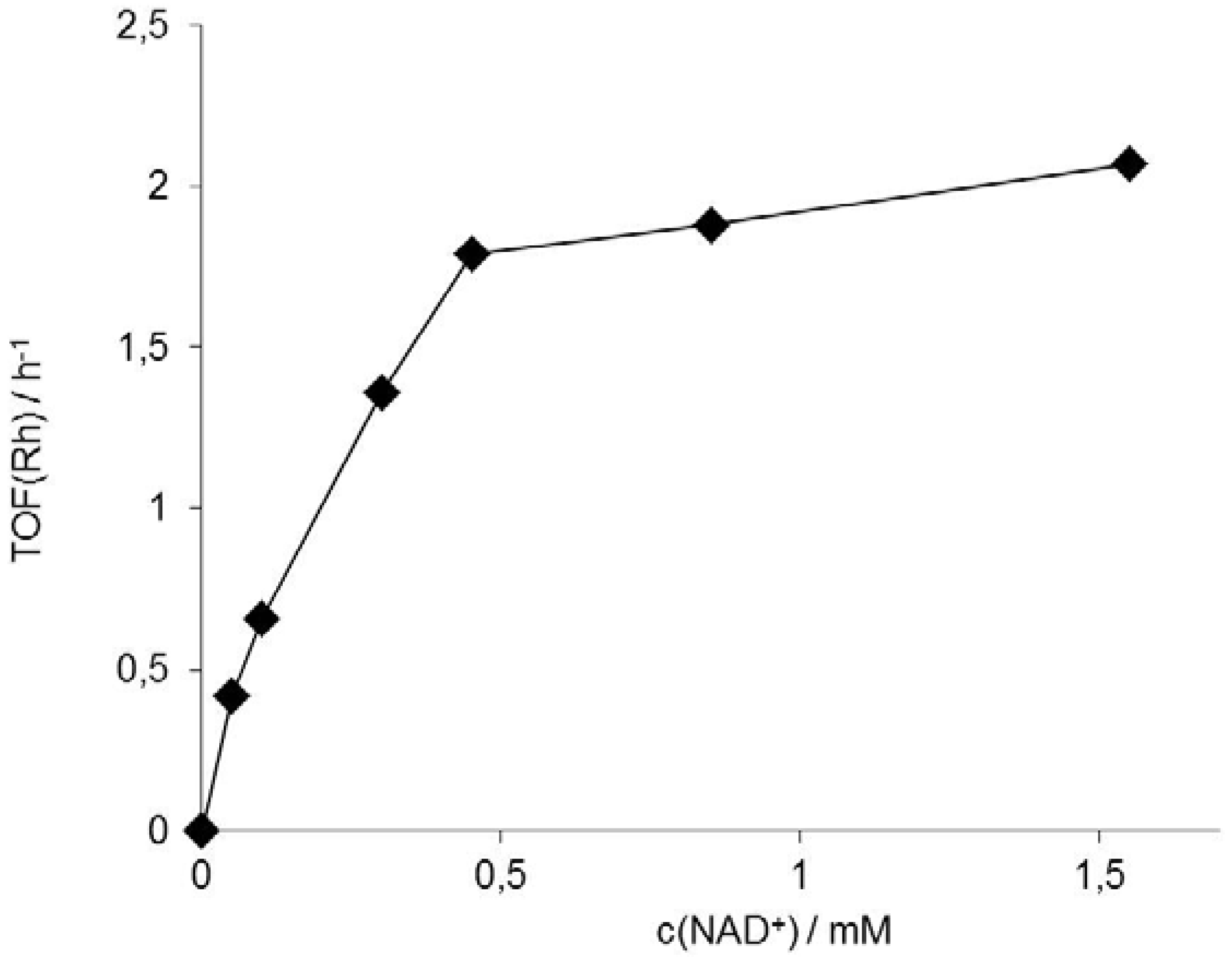
      <p>Therefore, we investigated the kinetic parameters of the Rh(III)-TsDPEN-driven reduction of NAD<sup>+</sup> in some more detail. Due to the coordination equilibrium of both formate and NAD<sup>+</sup> to the Rh-central atom, a Michelis-Menten-type behavior of Rh(III)-TsDPEN activity on c(NAD<sup>+</sup>) and c(HCO<sub>2</sub><sup>−</sup>) can be expected [<xref ref-type="bibr" rid="B2-molecules-17-09835">2</xref>]. In fact, this saturation type behavior was found also in case of Rh(III)-TsDPEN (<xref ref-type="fig" rid="molecules-17-09835-f003">Figure 3</xref>). While the apparent K<sub>M</sub> value for formate (approximately 10 mM) was comparable to previously reported values, K<sub>M</sub>(NAD<sup>+</sup>) was significantly increased to approximately 250 μM (as compared to only 9 μM for [Cp*Rh(bpy)(H<sub>2</sub>O)]<sup>2+</sup>) [<xref ref-type="bibr" rid="B12-molecules-17-09835">12</xref>]. Obviously, heterogenization affects the low-molecular weight formate ion to a lesser extent than the relatively large NAD<sup>+</sup>. V<sub>max</sub> estimated from these experiments was around 2.5 h<sup>−1</sup> (expressed as Rh turnover frequency). As mentioned above, this is one order of magnitude lower than determined for the soluble [Cp*Rh(bpy)(H<sub>2</sub>O)]<sup>2+</sup> complex. It remains to be investigated whether this is due to the difference in the chelating ligand, the reduced flexibility of the Cp* ligand or results from the heterogeneous nature of Rh(III)-TsDPEN.</p>
	  <fig id="molecules-17-09835-f002" position="anchor">
        <label>Figure 2</label>
        <caption>
          <p>Temperature-dependence of the NAD<sup>+</sup>-reduction. Conditions: 50 mg Rh(III)-TsDPEN (0.35 μmol), c(NAD<sup>+</sup>)0 = 0.25 mM, c(NaHCO<sub>2</sub>) = 150 mM, 1,000 rpm.</p>
        </caption>
        <graphic xmlns:xlink="http://www.w3.org/1999/xlink" xlink:href="molecules-17-09835-g002.tif"/>
      </fig>
      
      <fig id="molecules-17-09835-f003" position="anchor">
        <label>Figure 3</label>
        <caption>
          <p>Dependence of Rh(III)-TsDPEN activity on c(NAD<sup>+</sup>)<sub>0</sub>, expressed as TOF(Rh). Conditions: 50 mg Rh(III)-TsDPEN (0.35 μmol), T = 30 °C, c(NaHCO<sub>2</sub>) = 150 mM, 1,000 rpm.</p>
        </caption>
        <graphic xmlns:xlink="http://www.w3.org/1999/xlink" xlink:href="molecules-17-09835-g003.tif"/>
      </fig>
    </sec>
    <sec sec-type="methods">
      <title>3. Experimental</title>
      <p>Chemicals. Rh(III)-TsDPEN was prepared as previously described [<xref ref-type="bibr" rid="B17-molecules-17-09835">17</xref>]. All other chemicals were purchased from Sigma-Aldrich (Zwijndrecht, Netherlands) in the highest purity available and used as received.</p>
      <p>Recycling experiments were performed on 2 mL scale using 50 mg of Rh(III)-TsDPEN suspended in buffer (potassium phosphate, 50 mM, pH 7) at 30 °C. The reaction mixture was supplemented with 150 mM NaHCO<sub>2</sub> and 0.25 mM NAD<sup>+</sup> (final concentrations) and shaken at 1,000 rpm. At intervals, samples were withdrawn and analyzed spectrophotometrically (340 nm, ε = 6.22 mM<sup>−1</sup>cm<sup>−1</sup>). After each reaction, the catalyst was filtered off, washed with distilled water and either reused immediately or after storage at room temperature.</p>
      <p>Kinetic measurements were performed as described above only varying the parameters (concentrations, temperature) as indicated in the figure captions. </p>
    </sec>
    <sec sec-type="conclusions">
      <title>4. Conclusions</title>
      <p>Overall, we have demonstrated the application of an immobilized, recyclable Rh-catalyst for the regeneration of reduced nicotinamide cofactors. Admittedly, the catalyst reported here is not practical to promote NAD(P)H-dependent redox reactions on a preparative scale. Mainly its catalytic performance is somewhat lower than that of comparable soluble counterparts and this severely impairs its applicability. However, the results presented here strongly support the assumption of diffusion (especially of the large nicotinamide cofactors) being overall rate limiting. Hence, this study lays the basis for further catalyst improvements, e.g., supports with higher porosity and for alternative ligand systems. Nevertheless, it was demonstrated that the immobilized Rh catalyst can be reused at least 10 times. Further studies to fully understand the factors influencing Rh(III)-TsDPEN-activity and to elucidate its potential in redox biocatalysis are currently underway.</p>
    </sec>
    <sec sec-type="supplementary-material">
      <title>Supplementary Materials</title>
      <p>Supplementary materials can be accessed at: <uri>http://www.mdpi.com/1420-3049/17/8/9835/s1</uri>.</p>
    </sec>
    
  </body>
  <back><ack>
      <title>Acknowledgments</title>
      <p>Financial support by the European Community Marie Curie Networks for Initial Training fellowship in the Project “BIOTRAINS” FP7-PEOPLE-ITN-2008-238531) is acknowledged. </p>
      
    </ack>
    <ref-list>
      <title>References</title>
      <ref id="B1-molecules-17-09835">
        <label>1.</label>
        <citation citation-type="journal">
          <person-group person-group-type="author">
            <name>
              <surname>Hollmann</surname>
              <given-names>F.</given-names>
            </name>
            <name>
              <surname>Arends</surname>
              <given-names>I.W.C.E.</given-names>
            </name>
            <name>
              <surname>Buehler</surname>
              <given-names>K.</given-names>
            </name>
          </person-group>
          <article-title>Biocatalytic Redox Reactions for Organic Synthesis: Nonconventional Regeneration Methods</article-title>
          <source>ChemCatChem</source>
          <year>2010</year>
          <volume>2</volume>
          <fpage>762</fpage>
          <lpage>782</lpage>
          <pub-id pub-id-type="doi">10.1002/cctc.201000069</pub-id>
        </citation>
      </ref>
      <ref id="B2-molecules-17-09835">
        <label>2.</label>
        <citation citation-type="journal">
          <person-group person-group-type="author">
            <name>
              <surname>Lee</surname>
              <given-names>S.H.</given-names>
            </name>
            <name>
              <surname>Nam</surname>
              <given-names>D.H.</given-names>
            </name>
            <name>
              <surname>Kim</surname>
              <given-names>J.H.</given-names>
            </name>
            <name>
              <surname>Baeg</surname>
              <given-names>J.-O.</given-names>
            </name>
            <name>
              <surname>Park</surname>
              <given-names>C.B.</given-names>
            </name>
          </person-group>
          <article-title>Eosin Y-Sensitized Artificial Photosynthesis by Highly Efficient Visible-Light-Driven Regeneration of Nicotinamide Cofactor</article-title>
          <source>ChemBioChem</source>
          <year>2009</year>
          <volume>10</volume>
          <fpage>1621</fpage>
          <lpage>1624</lpage>
          <pub-id pub-id-type="doi">10.1002/cbic.200900156</pub-id>
        </citation>
      </ref>
      <ref id="B3-molecules-17-09835">
        <label>3.</label>
        <citation citation-type="journal">
          <person-group person-group-type="author">
            <name>
              <surname>Song</surname>
              <given-names>H.K.</given-names>
            </name>
            <name>
              <surname>Lee</surname>
              <given-names>S.H.</given-names>
            </name>
            <name>
              <surname>Won</surname>
              <given-names>K.</given-names>
            </name>
            <name>
              <surname>Park</surname>
              <given-names>J.H.</given-names>
            </name>
            <name>
              <surname>Kim</surname>
              <given-names>J.K.</given-names>
            </name>
            <name>
              <surname>Lee</surname>
              <given-names>H.</given-names>
            </name>
            <name>
              <surname>Moon</surname>
              <given-names>S.J.</given-names>
            </name>
            <name>
              <surname>Kim</surname>
              <given-names>D.K.</given-names>
            </name>
            <name>
              <surname>Park</surname>
              <given-names>C.B.</given-names>
            </name>
          </person-group>
          <article-title>Electrochemical regeneration of NADH enhanced by platinum nanoparticles</article-title>
          <source>Angew. Chem. Int. Ed.</source>
          <year>2008</year>
          <volume>47</volume>
          <fpage>1749</fpage>
          <lpage>1752</lpage>
        <pub-id pub-id-type="doi">10.1002/anie.200703632</pub-id></citation>
      </ref>
      <ref id="B4-molecules-17-09835">
        <label>4.</label>
        <citation citation-type="journal">
          <person-group person-group-type="author">
            <name>
              <surname>Kim</surname>
              <given-names>J.H.</given-names>
            </name>
            <name>
              <surname>Lee</surname>
              <given-names>S.H.</given-names>
            </name>
            <name>
              <surname>Lee</surname>
              <given-names>J.S.</given-names>
            </name>
            <name>
              <surname>Lee</surname>
              <given-names>M.</given-names>
            </name>
            <name>
              <surname>Park</surname>
              <given-names>C.B.</given-names>
            </name>
          </person-group>
          <article-title>Zn-containing porphyrin as a biomimetic light-harvesting molecule for biocatalyzed artificial photosynthesis</article-title>
          <source>Chem. Commun.</source>
          <year>2011</year>
          <volume>47</volume>
          <fpage>10227</fpage>
          <lpage>10229</lpage>
        <pub-id pub-id-type="doi">10.1039/c1cc12222c</pub-id></citation>
      </ref>
      <ref id="B5-molecules-17-09835">
        <label>5.</label>
        <citation citation-type="journal">
          <person-group person-group-type="author">
            <name>
              <surname>Kim</surname>
              <given-names>J.H.</given-names>
            </name>
            <name>
              <surname>Lee</surname>
              <given-names>M.</given-names>
            </name>
            <name>
              <surname>Lee</surname>
              <given-names>J.S.</given-names>
            </name>
            <name>
              <surname>Park</surname>
              <given-names>C.B.</given-names>
            </name>
          </person-group>
          <article-title>Self-Assembled Light-Harvesting Peptide Nanotubes for Mimicking Natural Photosynthesis</article-title>
          <source>Angew. Chem. Int. Ed.</source>
          <year>2012</year>
          <volume>51</volume>
          <fpage>517</fpage>
          <lpage>520</lpage>
        <pub-id pub-id-type="doi">10.1002/anie.201103244</pub-id></citation>
      </ref>
      <ref id="B6-molecules-17-09835">
        <label>6.</label>
        <citation citation-type="journal">
          <person-group person-group-type="author">
            <name>
              <surname>Kohlmann</surname>
              <given-names>C.</given-names>
            </name>
            <name>
              <surname>Greiner</surname>
              <given-names>L.</given-names>
            </name>
            <name>
              <surname>Leitner</surname>
              <given-names>W.</given-names>
            </name>
            <name>
              <surname>Wandrey</surname>
              <given-names>C.</given-names>
            </name>
            <name>
              <surname>Lütz</surname>
              <given-names>S.</given-names>
            </name>
          </person-group>
          <article-title>Ionic Liquids as Performance Additives for Electroenzymatic Syntheses</article-title>
          <source>Chem. Eur. J.</source>
          <year>2009</year>
          <volume>15</volume>
          <fpage>11692</fpage>
          <lpage>11700</lpage>
        <pub-id pub-id-type="doi">10.1002/chem.200901046</pub-id><pub-id pub-id-type="pmid">19777513</pub-id></citation>
      </ref>
      <ref id="B7-molecules-17-09835">
        <label>7.</label>
        <citation citation-type="journal">
          <person-group person-group-type="author">
            <name>
              <surname>Hildebrand</surname>
              <given-names>F.</given-names>
            </name>
            <name>
              <surname>Lütz</surname>
              <given-names>S.</given-names>
            </name>
          </person-group>
          <article-title>Electroenzymatic synthesis of chiral alcohols in an aqueous-organic two-phase system</article-title>
          <source>Tetrahedron: Asymmetry</source>
          <year>2007</year>
          <volume>18</volume>
          <fpage>1187</fpage>
          <lpage>1193</lpage>
          <pub-id pub-id-type="doi">10.1016/j.tetasy.2007.05.002</pub-id>
        </citation>
      </ref>
      <ref id="B8-molecules-17-09835">
        <label>8.</label>
        <citation citation-type="journal">
          <person-group person-group-type="author">
            <name>
              <surname>de Gonzalo</surname>
              <given-names>G.</given-names>
            </name>
            <name>
              <surname>Ottolina</surname>
              <given-names>G.</given-names>
            </name>
            <name>
              <surname>Carrea</surname>
              <given-names>G.</given-names>
            </name>
            <name>
              <surname>Fraaije</surname>
              <given-names>M.W.</given-names>
            </name>
          </person-group>
          <article-title>[Cp*Rh(bpy)(H<sub>2</sub>O)]<sup>2+</sup> as a coenzyme substitute in enzymatic oxidations catalyzed by Baeyer-Villiger monooxygenases</article-title>
          <source>Chem. Commun.</source>
          <year>2005</year>
          <fpage>3724</fpage>
          <lpage>3726</lpage>
        </citation>
      </ref>
      <ref id="B9-molecules-17-09835">
        <label>9.</label>
        <citation citation-type="journal">
          <person-group person-group-type="author">
            <name>
              <surname>Bernard</surname>
              <given-names>J.</given-names>
            </name>
            <name>
              <surname>van Heerden</surname>
              <given-names>E.</given-names>
            </name>
            <name>
              <surname>Arends</surname>
              <given-names>I.W.C.E.</given-names>
            </name>
            <name>
              <surname>Opperman</surname>
              <given-names>D.J.</given-names>
            </name>
            <name>
              <surname>Hollmann</surname>
              <given-names>F.</given-names>
            </name>
          </person-group>
          <article-title>Chemoenzymatic reduction of conjugated C=C-bonds</article-title>
          <source>ChemCatChem</source>
          <year>2012</year>
          <volume>4</volume>
          <fpage>196</fpage>
          <lpage>199</lpage>
          <pub-id pub-id-type="doi">10.1002/cctc.201100312</pub-id>
        </citation>
      </ref>
      <ref id="B10-molecules-17-09835">
        <label>10.</label>
        <citation citation-type="journal">
          <person-group person-group-type="author">
            <name>
              <surname>Mifsud Grau</surname>
              <given-names>M.</given-names>
            </name>
            <name>
              <surname>Poizat</surname>
              <given-names>M.</given-names>
            </name>
            <name>
              <surname>Arends</surname>
              <given-names>I.W.C.E.</given-names>
            </name>
            <name>
              <surname>Hollmann</surname>
              <given-names>F.</given-names>
            </name>
          </person-group>
          <article-title>Phosphite-driven regeneration of reduced enzyme cofactors</article-title>
          <source>Appl. Organometal. Chem.</source>
          <year>2010</year>
          <volume>24</volume>
          <fpage>380</fpage>
          <lpage>385</lpage>
        </citation>
      </ref>
      <ref id="B11-molecules-17-09835">
        <label>11.</label>
        <citation citation-type="journal">
          <person-group person-group-type="author">
            <name>
              <surname>Hollmann</surname>
              <given-names>F.</given-names>
            </name>
            <name>
              <surname>Schmid</surname>
              <given-names>A.</given-names>
            </name>
          </person-group>
          <article-title>Towards [Cp*Rh(bpy)(H<sub>2</sub>O)]<sup>2+</sup>-promoted P450 catalysis: Direct regeneration of CytC</article-title>
          <source>J. Inorg. Biochem.</source>
          <year>2009</year>
          <volume>103</volume>
          <fpage>313</fpage>
          <lpage>315</lpage>
          <pub-id pub-id-type="doi">10.1016/j.jinorgbio.2008.11.005</pub-id>
        </citation>
      </ref>
      <ref id="B12-molecules-17-09835">
        <label>12.</label>
        <citation citation-type="journal">
          <person-group person-group-type="author">
            <name>
              <surname>Hollmann</surname>
              <given-names>F.</given-names>
            </name>
            <name>
              <surname>Witholt</surname>
              <given-names>B.</given-names>
            </name>
            <name>
              <surname>Schmid</surname>
              <given-names>A.</given-names>
            </name>
          </person-group>
          <article-title>[Cp*Rh(bpy)(H<sub>2</sub>O)]<sup>2+</sup>: A versatile tool for efficient and non-enzymatic regeneration of nicotinamide and flavin coenzymes</article-title>
          <source>J. Mol. Catal. B Enzym.</source>
          <year>2002</year>
          <volume>19-20</volume>
          <fpage>167</fpage>
          <lpage>176</lpage>
          <pub-id pub-id-type="doi">10.1016/S1381-1177(02)00164-9</pub-id>
        </citation>
      </ref>
      <ref id="B13-molecules-17-09835">
        <label>13.</label>
        <citation citation-type="journal">
          <person-group person-group-type="author">
            <name>
              <surname>Poizat</surname>
              <given-names>M.</given-names>
            </name>
            <name>
              <surname>Arends</surname>
              <given-names>I.W.C.E.</given-names>
            </name>
            <name>
              <surname>Hollmann</surname>
              <given-names>F.</given-names>
            </name>
          </person-group>
          <article-title>On the nature of mutual interaction between [Cp*Rh(bpy)(H<sub>2</sub>O)]<sup>2+</sup> and enzymes—Analysis and potential remedies</article-title>
          <source>J. Mol. Catal. B Enzym.</source>
          <year>2010</year>
          <volume>63</volume>
          <fpage>149</fpage>
          <lpage>156</lpage>
          <pub-id pub-id-type="doi">10.1016/j.molcatb.2010.01.006</pub-id>
        </citation>
      </ref>
      <ref id="B14-molecules-17-09835">
        <label>14.</label>
        <citation citation-type="journal">
          <person-group person-group-type="author">
            <name>
              <surname>Hildebrand</surname>
              <given-names>F.</given-names>
            </name>
            <name>
              <surname>Lütz</surname>
              <given-names>S.</given-names>
            </name>
          </person-group>
          <article-title>Stable Electroenzymatic Processes by Catalyst Separation</article-title>
          <source>Chem. Eur. J.</source>
          <year>2009</year>
          <volume>15</volume>
          <fpage>4998</fpage>
          <lpage>5001</lpage>
          <pub-id pub-id-type="doi">10.1002/chem.200900219</pub-id>
        </citation>
      </ref>
      <ref id="B15-molecules-17-09835">
        <label>15.</label>
        <citation citation-type="journal">
          <person-group person-group-type="author">
            <name>
              <surname>Haquette</surname>
              <given-names>P.</given-names>
            </name>
            <name>
              <surname>Talbi</surname>
              <given-names>B.</given-names>
            </name>
            <name>
              <surname>Barilleau</surname>
              <given-names>L.</given-names>
            </name>
            <name>
              <surname>Madern</surname>
              <given-names>N.</given-names>
            </name>
            <name>
              <surname>Fosse</surname>
              <given-names>C.</given-names>
            </name>
            <name>
              <surname>Salmain</surname>
              <given-names>M.</given-names>
            </name>
          </person-group>
          <article-title>Chemically engineered papain as artificial formate dehydrogenase for NAD(P)H regeneration</article-title>
          <source>Org. Biomol. Chem.</source>
          <year>2011</year>
          <volume>9</volume>
          <fpage>5720</fpage>
          <lpage>5727</lpage>
        <pub-id pub-id-type="doi">10.1039/c1ob05482a</pub-id><pub-id pub-id-type="pmid">21695322</pub-id></citation>
      </ref>
      <ref id="B16-molecules-17-09835">
        <label>16.</label>
        <citation citation-type="journal">
          <person-group person-group-type="author">
            <name>
              <surname>Dimroth</surname>
              <given-names>J.</given-names>
            </name>
            <name>
              <surname>Schedler</surname>
              <given-names>U.</given-names>
            </name>
            <name>
              <surname>Keilitz</surname>
              <given-names>J.</given-names>
            </name>
            <name>
              <surname>Haag</surname>
              <given-names>R.</given-names>
            </name>
            <name>
              <surname>Schomäcker</surname>
              <given-names>R.</given-names>
            </name>
          </person-group>
          <article-title>New Polymer-Supported Catalysts for the Asymmetric Transfer Hydrogenation of Acetophenone in Water—Kinetic and Mechanistic Investigations</article-title>
          <source>Adv. Synth. Catal.</source>
          <year>2011</year>
          <volume>353</volume>
          <fpage>1335</fpage>
          <lpage>1344</lpage>
          <pub-id pub-id-type="doi">10.1002/adsc.201000955</pub-id>
        </citation>
      </ref>
      <ref id="B17-molecules-17-09835">
        <label>17.</label>
        <citation citation-type="journal">
          <person-group person-group-type="author">
            <name>
              <surname>Dimroth</surname>
              <given-names>J.</given-names>
            </name>
            <name>
              <surname>Keilitz</surname>
              <given-names>J.</given-names>
            </name>
            <name>
              <surname>Schedler</surname>
              <given-names>U.</given-names>
            </name>
            <name>
              <surname>Schomäcker</surname>
              <given-names>R.</given-names>
            </name>
            <name>
              <surname>Haag</surname>
              <given-names>R.</given-names>
            </name>
          </person-group>
          <article-title>Immobilization of a Modified Tethered Rhodium(III)-p-Toluenesulfonyl-1,2-diphenylethylenediamine Catalyst on Soluble and Solid Polymeric Supports and Successful Application to Asymmetric Transfer Hydrogenation of Ketones</article-title>
          <source>Adv. Synth. Catal.</source>
          <year>2010</year>
          <volume>352</volume>
          <fpage>2497</fpage>
          <lpage>2506</lpage>
        <pub-id pub-id-type="doi">10.1002/adsc.201000340</pub-id></citation>
      </ref>
      <ref id="B18-molecules-17-09835">
        <label>18.</label>
        <citation citation-type="journal">
          <person-group person-group-type="author">
            <name>
              <surname>Köhler</surname>
              <given-names>V.</given-names>
            </name>
            <name>
              <surname>Wilson</surname>
              <given-names>Y.M.</given-names>
            </name>
            <name>
              <surname>Dürrenberger</surname>
              <given-names>M.</given-names>
            </name>
            <name>
              <surname>Ghislieri</surname>
              <given-names>D.</given-names>
            </name>
            <name>
              <surname>Churakova</surname>
              <given-names>E.</given-names>
            </name>
            <name>
              <surname>Quinto</surname>
              <given-names>T.</given-names>
            </name>
            <name>
              <surname>Knörr</surname>
              <given-names>L.</given-names>
            </name>
            <name>
              <surname>Häussinger</surname>
              <given-names>D.</given-names>
            </name>
            <name>
              <surname>Hollmann</surname>
              <given-names>F.</given-names>
            </name>
            <name>
              <surname>Turner</surname>
              <given-names>N.J.</given-names>
            </name>
            <etal/>
          </person-group>
          <article-title>New Synthetic Cascades by Combining Biocatalysts with Artificial Metalloenzymes</article-title>
          <source>Nat. Chem.</source>
          <year>2012</year>
          <comment>submitted</comment>
        </citation>
      </ref>
      <ref id="B19-molecules-17-09835">
        <label>19.</label>
        <citation citation-type="journal">
          <person-group person-group-type="author">
            <name>
              <surname>Einstein</surname>
              <given-names>A.</given-names>
            </name>
          </person-group>
          <article-title>The motion of elements suspended in static liquids as claimed in the molecular kinetic theory of heat</article-title>
          <source>Ann. Phys.-Berlin</source>
          <year>1905</year>
          <volume>17</volume>
          <fpage>549</fpage>
          <lpage>560</lpage>
          <pub-id pub-id-type="doi">10.1002/andp.19053220806</pub-id>
        </citation>
      </ref>
    </ref-list>
	<fn-group><fn><p><italic>Sample Availability</italic>: Samples of the compound Rh(III)-TsDPEN are available from the authors.</p></fn></fn-group>
  </back>
</article>