<?xml version="1.0" encoding="UTF-8"?>
<!DOCTYPE article PUBLIC "-//NLM//DTD Journal Publishing DTD v2.3 20070202//EN" "journalpublishing.dtd">
<article xmlns:mml="http://www.w3.org/1998/Math/MathML" xmlns:xlink="http://www.w3.org/1999/xlink" xml:lang="en" article-type="research-article">
  <front>
    <journal-meta>
      <journal-id journal-id-type="publisher-id">molecules</journal-id>
      <journal-title>Molecules</journal-title>
      <abbrev-journal-title abbrev-type="publisher">Molecules</abbrev-journal-title>
      <abbrev-journal-title abbrev-type="pubmed">Molecules</abbrev-journal-title>
      <issn pub-type="epub">1420-3049</issn>
      <publisher>
        <publisher-name>MDPI</publisher-name>
      </publisher>
    </journal-meta>
    <article-meta>
      <article-id pub-id-type="doi">10.3390/molecules17089010</article-id>
      <article-id pub-id-type="publisher-id">molecules-17-09010</article-id>
      <article-categories>
        <subj-group>
          <subject>Article</subject>
        </subj-group>
      </article-categories>
      <title-group>
        <article-title>Chiral Zn(II)-Bisamidine Complex as a Lewis-Brønsted Combined Acid Catalyst: Application to Asymmetric Mukaiyama Aldol Reactions of <italic>α</italic>-Ketoesters</article-title>
      </title-group>
      <contrib-group>
        <contrib contrib-type="author">
          <name>
            <surname>Gotoh</surname>
            <given-names>Ryo</given-names>
          </name>
        </contrib>
        <contrib contrib-type="author">
          <name>
            <surname>Yamanaka</surname>
            <given-names>Masahiro</given-names>
          </name>
          <xref rid="c1-molecules-17-09010" ref-type="corresp">*</xref>
        </contrib>
      </contrib-group>
      <aff id="af1-molecules-17-09010">Department of Chemistry and Research Center for Smart Molecules, Rikkyo University, Toshima-Ku, Tokyo 171-8501, Japan</aff>
      <author-notes>
        <corresp id="c1-molecules-17-09010"><label>*</label> Author  to whom correspondence should be addressed; Email: <email>myamanak@rikkyo.ac.jp</email>; 
Tel./Fax: +81-3-3985-2395.</corresp>
      </author-notes>
      <pub-date pub-type="epub">
        <day>30</day>
        <month>07</month>
        <year>2012</year>
      </pub-date>
      <pub-date pub-type="collection"><month>08</month>
        <year>2012</year>
      </pub-date>
      <volume>17</volume>
      <issue>8</issue>
      <fpage>9010</fpage>
      <lpage>9022</lpage>
      <history>
        <date date-type="received">
          <day>11</day>
          <month>07</month>
          <year>2012</year>
        </date>
        <date date-type="rev-recd">
          <day>21</day>
          <month>07</month>
          <year>2012</year>
        </date>
        <date date-type="accepted">
          <day>21</day>
          <month>07</month>
          <year>2012</year>
        </date>
      </history>
      <permissions>
        <copyright-statement>© 2012 by the authors; licensee MDPI, Basel, Switzerland.</copyright-statement>
        <copyright-year>2012</copyright-year>
        <license xmlns:xlink="http://www.w3.org/1999/xlink" license-type="open-access" xlink:href="http://creativecommons.org/licenses/by/3.0/">
          <p>This article is an open-access article distributed under the terms and conditions of the Creative Commons Attribution license (http://creativecommons.org/licenses/by/3.0/).</p>
        </license>
      </permissions>
      <abstract>
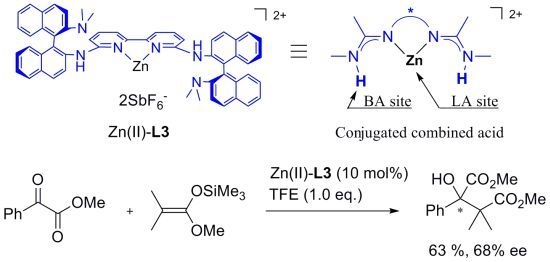
        <p> Focusing on the steric and electronic properties of the resonance-stabilized amidine framework, a cationic metal-bisamidine complex was designed as a conjugated combined Lewis-Brønsted acid catalyst. The chiral Zn(II)-bisamidine catalyst prepared from the 2,2'-bipyridyl derived bisamidine ligand, ZnCl<sub>2</sub>, and AgSbF<sub>6</sub> promoted asymmetric Mukaiyama aldol reaction of <italic>α</italic>-ketoester and <italic>α</italic>,<italic>α</italic>-disubstituted silyl enol ether to afford the <italic>α</italic>-hydroxyester having sequential quarternary carbons in good yield, albeit with low enantioselectivity. Addition of 1.0 equivalent of the fluoroalcohol having suitable acidity and bulkiness dramatically increased the enantioselectivity (up to 68% <italic>ee</italic>). DFT calculations suggested that this additive effect would be caused by self-assembly of the fluoroalcohol on the Zn(II)-bisamidine catalyst.</p>
      </abstract>
      <kwd-group>
        <kwd>Lewis-Brønstedcombined acid</kwd>
        <kwd>bisamidine</kwd>
        <kwd>asymmetric Mukaiyama aldol reaction</kwd>
        <kwd><italic>α</italic>-ketoester</kwd>
      </kwd-group>
    </article-meta>
  </front>
  <body>
    <sec sec-type="intro">
      <title>1. Introduction</title>
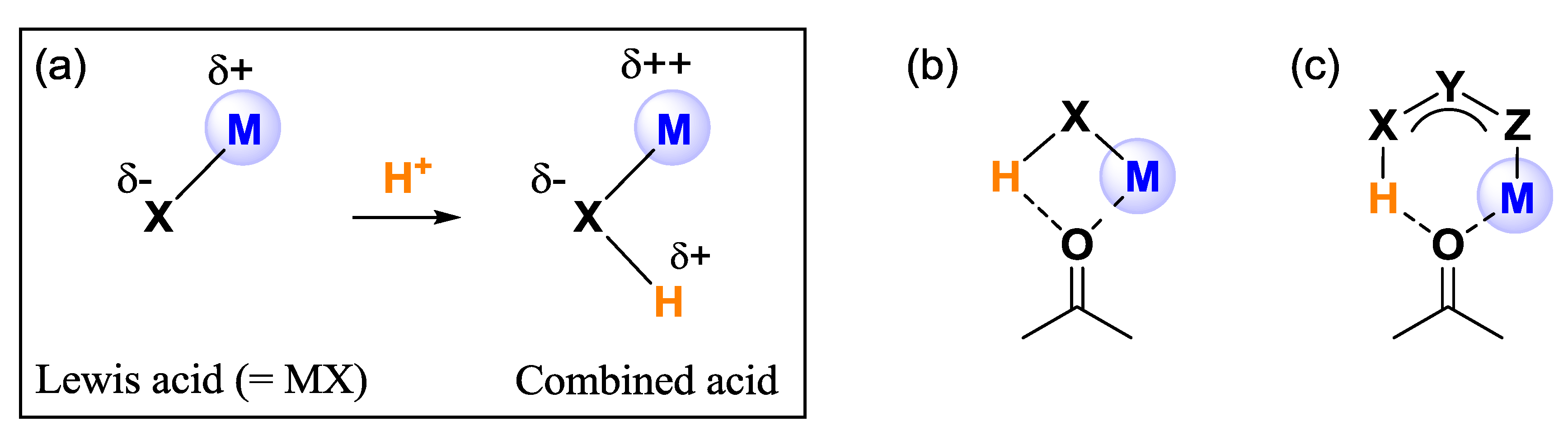
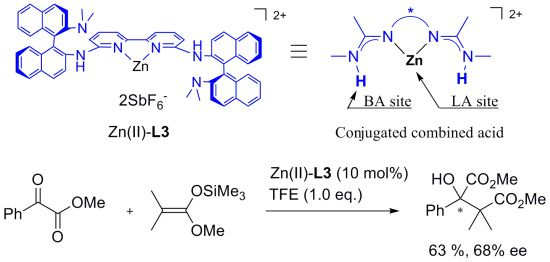
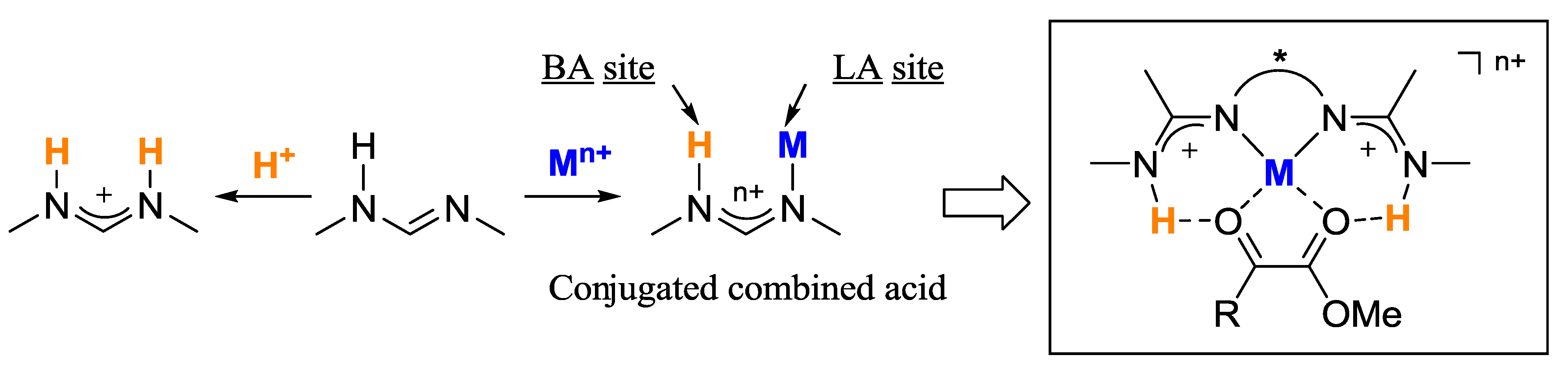
      <p>Lewis-Brønsted combined acid catalysts promote higher catalytic activity and stereoselectivity than the individual acid catalysts through the dual effects of enhancement of Lewis acidity and the intramolecular hydrogen-bonding interaction of additional Brønsted acid sites (<xref ref-type="fig" rid="molecules-17-09010-f001">Figure 1</xref>a) [<xref ref-type="bibr" rid="B1-molecules-17-09010">1</xref>]. Since the late 1990s, various types of Brønsted acid-assisted chiral Lewis acid catalysts have been developed and are regarded as an efficient catalyst design for asymmetric reactions [<xref ref-type="bibr" rid="B2-molecules-17-09010">2</xref>,<xref ref-type="bibr" rid="B3-molecules-17-09010">3</xref>,<xref ref-type="bibr" rid="B4-molecules-17-09010">4</xref>,<xref ref-type="bibr" rid="B5-molecules-17-09010">5</xref>,<xref ref-type="bibr" rid="B6-molecules-17-09010">6</xref>,<xref ref-type="bibr" rid="B7-molecules-17-09010">7</xref>,<xref ref-type="bibr" rid="B8-molecules-17-09010">8</xref>,<xref ref-type="bibr" rid="B9-molecules-17-09010">9</xref>,<xref ref-type="bibr" rid="B10-molecules-17-09010">10</xref>,<xref ref-type="bibr" rid="B11-molecules-17-09010">11</xref>,<xref ref-type="bibr" rid="B12-molecules-17-09010">12</xref>,<xref ref-type="bibr" rid="B13-molecules-17-09010">13</xref>,<xref ref-type="bibr" rid="B14-molecules-17-09010">14</xref>]. Based on Yamamoto’s combined acid concept, we proposed double activation phenomena of carbonyl compounds caused by simultaneous coordination of Lewis acid and Brønsted acid sites of the combined acid catalyst. In contrast to the previously reported combined acid catalysts, in which doubly coordination of both acid sites would form a labile four-membered complex (<xref ref-type="fig" rid="molecules-17-09010-f001">Figure 1</xref>b), the three-centered conjugated scaffold would form a more stable six-membered complex (<xref ref-type="fig" rid="molecules-17-09010-f001">Figure 1</xref>c).</p>
      <fig id="molecules-17-09010-f001" position="anchor">
        <label>Figure 1</label>
        <caption>
          <p>(<bold>a</bold>) Schematic concept of Lewis-Brønstedcombined acid catalyst; (<bold>b</bold>) Double activation by the normal combined acid; (<bold>c</bold>) Double activation by the conjugated combined acid.</p>
        </caption>
        <graphic xmlns:xlink="http://www.w3.org/1999/xlink" xlink:href="molecules-17-09010-g001.tif"/>
      </fig>
      <p>Focusing on the steric and electronic properties of the the resonance-stabilized amidine framework, we designed a novel conjugated Lewis-Brønsted combined acid catalyst. Amidinium cation is significantly stabilized by delocalization of positive charge on two N atoms. The electronic flexibility of the amidine framework should induce similar electronic delocalization in the cationic metal amidine complex. When coordinating of cationic metal ions (M<sup>n+</sup>) instead of proton (H<sup>+</sup>), positive charge in the metal amidine complex could be delocalized to enhance Brønsted acidity of the NH moiety in the parent amidine. We eventually designed the cationic metal bisamidine catalyst, which should be thermodynamically stabilized by bidentate coordination of two amidine moieties (<xref ref-type="fig" rid="molecules-17-09010-f002">Figure 2</xref>).</p>
      <fig id="molecules-17-09010-f002" position="anchor">
        <label>Figure 2</label>
        <caption>
          <p>Design of the metal bisamidine complex as a Lewis-Brønstedcombined acid catalyst.</p>
        </caption>
        <graphic xmlns:xlink="http://www.w3.org/1999/xlink" xlink:href="molecules-17-09010-g002.tif"/>
      </fig>
      <p>Various chiral bisamidines have been recently developed as chiral Brønsted acid catalysts [<xref ref-type="bibr" rid="B15-molecules-17-09010">15</xref>,<xref ref-type="bibr" rid="B16-molecules-17-09010">16</xref>,<xref ref-type="bibr" rid="B17-molecules-17-09010">17</xref>,<xref ref-type="bibr" rid="B18-molecules-17-09010">18</xref>,<xref ref-type="bibr" rid="B19-molecules-17-09010">19</xref>] and chiral ligands [<xref ref-type="bibr" rid="B20-molecules-17-09010">20</xref>]. To our best knowledge, however, there has been no report of bisamidine-based combined acid catalysis. For our initial studies, our designed cationic Zn(II)-bisamidine catalyst was applied in the reaction of an <italic>α</italic>-ketoester and an <italic>α</italic>,<italic>α</italic>-disubstituted silyl enol ether to overcome the present limitations of the asymmetric Mukaiyama aldol reaction [<xref ref-type="bibr" rid="B21-molecules-17-09010">21</xref>]. The catalytic asymmetric Mukaiyama aldol reaction of <italic>α</italic>-ketoesters has been recently identified as an efficient synthetic tool for making a chiral quaternary carbon center. Evans has reported pioneering studies of asymmetric addition of thioester-derived enolsilanes to pyruvate esters catalyzed by the chiral Cu(II)-bisoxazoline complexes [<xref ref-type="bibr" rid="B22-molecules-17-09010">22</xref>,<xref ref-type="bibr" rid="B23-molecules-17-09010">23</xref>,<xref ref-type="bibr" rid="B24-molecules-17-09010">24</xref>]. Bolm has also reported highly enantioselective additions of various ketone-derived enolsilanes to methyl pyruvate catalyzed by a chiral Cu(II)-oxazolinyl sulfoximine [<xref ref-type="bibr" rid="B25-molecules-17-09010">25</xref>,<xref ref-type="bibr" rid="B26-molecules-17-09010">26</xref>]. However, the use of aryl substituted <italic>α</italic>-ketoesters or ester-derived enolsilanes is still rather limited. Hoveyda developed the chiral AgF<sub>2</sub>-pyridyl Schiff base catalyzed reaction of alkyl/aryl substituted <italic>α</italic>-ketoesters [<xref ref-type="bibr" rid="B27-molecules-17-09010">27</xref>]. Pagenkopf reported a significant expansion in substrate scope to include ester-derived enolsilanes and alkyl/aryl substituted <italic>α</italic>-ketoesters [<xref ref-type="bibr" rid="B28-molecules-17-09010">28</xref>]. Despite the synthetic value of <italic>α</italic>-hydroxyesters having sequential quarternary carbons, the reactions of <italic>α</italic>-ketoesters and <italic>α</italic>,<italic>α</italic>-disubstituted silyl enol ethers have been quite rare [<xref ref-type="bibr" rid="B29-molecules-17-09010">29</xref>,<xref ref-type="bibr" rid="B30-molecules-17-09010">30</xref>].</p>
    </sec>
    <sec sec-type="results">
      <title>2. Results and Discussion</title>
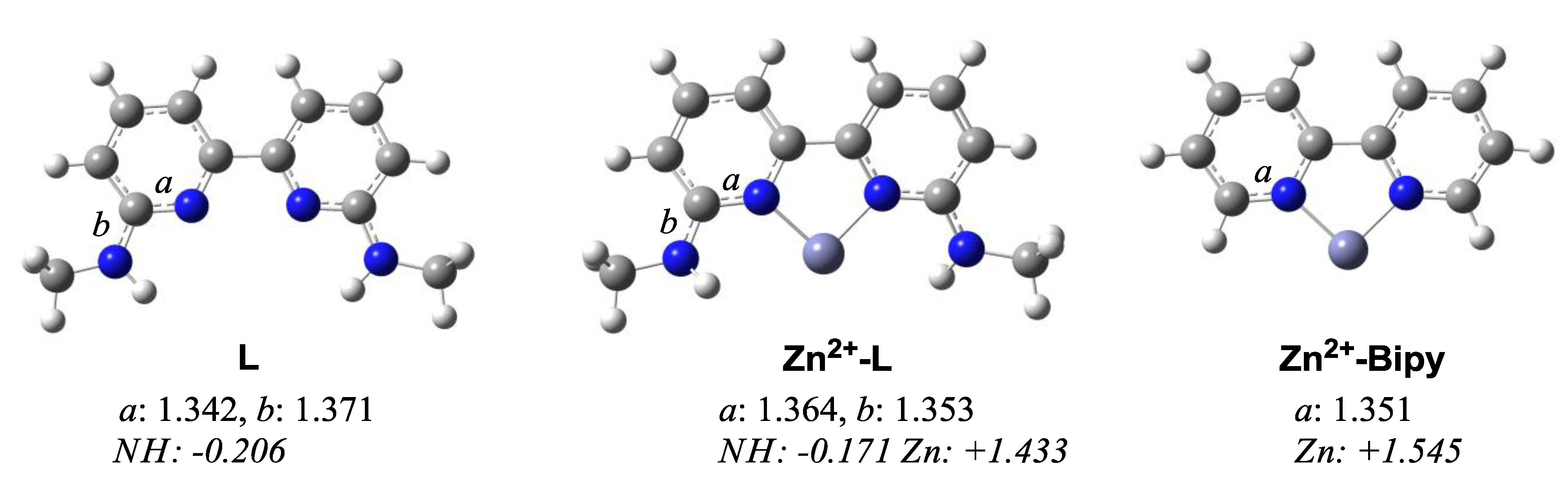
      <p>As a preliminary computational study, we investigated the dual effects of Lewis and Brønsted acids on the cationic metal bisamidine complex by DFT calculations (<xref ref-type="fig" rid="molecules-17-09010-f003">Figure 3</xref>) [<xref ref-type="bibr" rid="B31-molecules-17-09010">31</xref>]. In spite of the structurally stable aromatic ring in the 2,2'-bipyridine framework, the difference of the bond lengths between <italic>a</italic> and <italic>b</italic> in the amidine moiety becomes smaller upon coordination of the Zn(II) cation. The natural charge of the NH moiety in <bold>Zn<sup>2+</sup></bold>-<bold>L</bold> (−0.171) was more positive than in <bold>L</bold> (−0.206). Furthermore, <bold>Zn<sup>2+</sup></bold>-<bold>Bipy</bold> exhibited a greater degree of the positive charge on the Zn(II) center (+1.545) than <bold>Zn<sup>2+</sup></bold>-<bold>L</bold> (+1.433). These natural charge differences suggested delocalization of the positive charge via the amidine framework to increase Brønsted acidity of the NH proton. In a manner similar to the amidinium complex, the efficient charge delocalization in the amidine moiety was also induced in <bold>Zn<sup>2+</sup></bold>-<bold>L</bold>. These DFT calculations predicted that the cationic Zn(II)-bisamidine complex such as <bold>Zn<sup>2+</sup></bold>-<bold>L</bold> would have a unique catalytic ability incorporating Lewis acid and Brønsted acid functions. </p>
      <fig id="molecules-17-09010-f003" position="anchor">
        <label>Figure 3</label>
        <caption>
          <p>DFT calculations of bisamidine ligand (L), Zn(II)-bisamidine (<bold>Zn<sup>2+</sup></bold>-<bold>L</bold>), and Zn(II)-bipyridine (<bold>Zn<sup>2+</sup></bold>-<bold>Bipy</bold>)complexes (B3LYP/LANL2DZ for Zn, 6-31G* for the rest). Bond lengths are shown in Å. NBO charges are shown in <italic>italics</italic>.</p>
        </caption>
        <graphic xmlns:xlink="http://www.w3.org/1999/xlink" xlink:href="molecules-17-09010-g003.tif"/>
      </fig>
      <p>First, we compared the catalytic activities of the cationic metal complex prepared with <bold>L1</bold> and <bold>L2</bold>, ZnCl<sub>2</sub>, and 2.0 equivalents of AgSbF<sub>6</sub> under stoichiometric conditions (<xref ref-type="table" rid="molecules-17-09010-t001">Table 1</xref>). In the Zn(II), Cu(II), and Fe(II)-catalyzed Mukaiyama aldol reaction of methyl benzoylformate (<bold>1a</bold>) and dimethylketene methyl trimethylsilyl acetal (<bold>2</bold>), <bold>L1</bold> derived catalysts gave the product <bold>3a</bold> in better yields than the corresponding <bold>L2</bold> derived catalyst. This indicates that the presence of the amidine unit is essential for the higher catalytic activity, which would be caused by the Brønsted acid function at the NH moiety. Based on the promising results of the Zn(II)-<bold>L1</bold> catalyst, various counteranions, SbF<sub>6</sub><sup>−</sup>, BF<sub>4</sub><sup>−</sup>, and TfO<sup>−</sup> were explored under catalytic conditions (the reaction was carried out in CH<sub>2</sub>Cl<sub>2</sub> at −78 °C for 15 h in the presence of 10 mol% Zn(II)-<bold>L1</bold>). The highest yield of 89% was achieved by use of SbF<sub>6</sub><sup>−</sup> (BF<sub>4</sub><sup>−</sup>: 68%, TfO<sup>−</sup>: 57%). </p>
      <table-wrap id="molecules-17-09010-t001" position="anchor">
        <object-id pub-id-type="pii">molecules-17-09010-t001_Table 1</object-id>
        <label>Table 1</label>
        <caption>
          <p>Metal-bisamidine catalyzed reaction of <bold>1a</bold> and <bold>2</bold> under stoichiometric condition.</p>
        </caption>
        <table>
          <thead>
            <tr style="border-bottom:solid thin">
              <th align="center" valign="top">Entry</th>
              <th align="center" valign="top">MX<sub>2</sub></th>
              <th align="center" valign="top">Ligand</th>
              <th align="center" valign="top">Yield (%) 
              <italic><sup>a</sup></italic></th>
              <th align="center" valign="top">Ligand</th>
              <th align="center" valign="top">Yield (%) 
              <italic><sup>a</sup></italic></th>
            </tr>
          </thead>
          <tbody>
            <tr>
              <td align="center" valign="top">1</td>
              <td align="center" valign="top">CuCl<sub>2</sub></td>
              <td align="center" valign="top">
                <bold>L1</bold>
              </td>
              <td align="center" valign="top">28</td>
              <td align="center" valign="top">
                <bold>L2</bold>
              </td>
              <td align="center" valign="top">13</td>
            </tr>
            <tr>
              <td align="center" valign="top">2</td>
              <td align="center" valign="top">ZnCl<sub>2</sub></td>
              <td align="center" valign="top">
                <bold>L1</bold>
              </td>
              <td align="center" valign="top">51 (89) 
              <italic><sup>b</sup></italic></td>
              <td align="center" valign="top">
                <bold>L2</bold>
              </td>
              <td align="center" valign="top">30</td>
            </tr>
            <tr>
              <td align="center" valign="top">3</td>
              <td align="center" valign="top">FeCl<sub>2</sub></td>
              <td align="center" valign="top">
                <bold>L1</bold>
              </td>
              <td align="center" valign="top">48</td>
              <td align="center" valign="top">
                <bold>L2</bold>
              </td>
              <td align="center" valign="top">15 <inline-graphic xmlns:xlink="http://www.w3.org/1999/xlink" xlink:href="molecules-17-09010-i001.tif"/></td>
            </tr>
          </tbody>
        </table>
      <table-wrap-foot><fn><p><italic>Notes</italic>: <italic><sup>a</sup></italic> Determined by <sup>1</sup>H-NMR analysis of crude mixture; <italic><sup>b</sup></italic> 10 mol% of Zn(II)-<bold>L1</bold> catalyst was used for 15 h.</p></fn></table-wrap-foot>
	  </table-wrap>
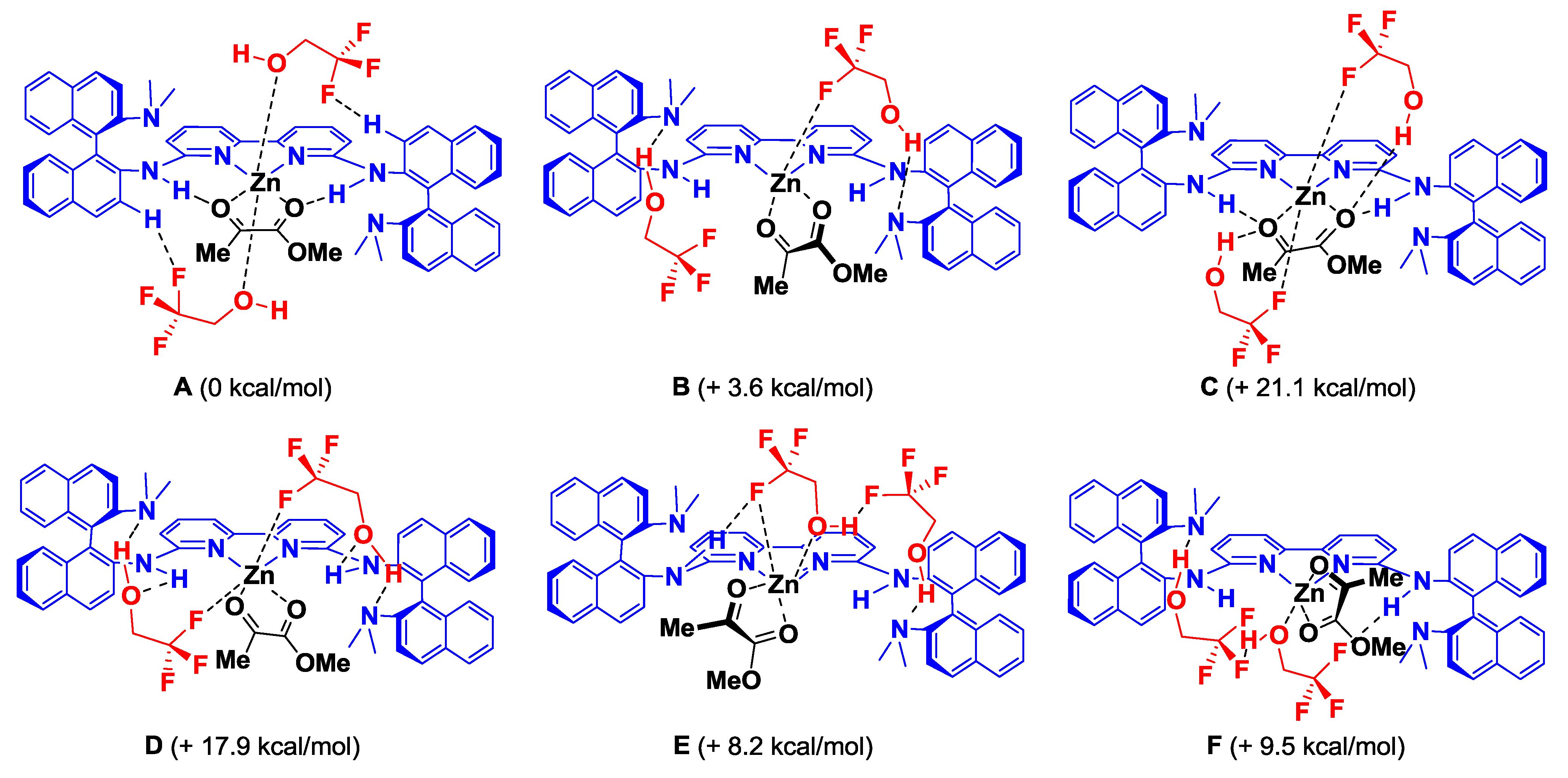
      <p>The (<italic>R</italic>)-DABN derived chiral bisamidine ligand <bold>L3</bold> was developed for the catalytic asymmetric version (<xref ref-type="table" rid="molecules-17-09010-t002">Table 2</xref>). The asymmetric Mukaiyama aldol reaction of <bold>1a</bold> and <bold>2</bold> was catalyzed by 10 mol% of Zn(II)-<bold>L3</bold> to afford <bold>3a</bold> in moderate yield with 26% <italic>ee</italic> (Entry 1). On the other hand, both Zn(II)-<bold>L4</bold> and Zn(II)-<bold>L5</bold> catalysts proved much less selective (Entries 2 and 3). The NMe<sub>2</sub> group in the DABN moiety performed better than either smaller or larger amino groups. In some cases, it has been recognized that achiral additives can be beneficial for catalytic activity and the stereocontrol ability of chiral catalysts [<xref ref-type="bibr" rid="B32-molecules-17-09010">32</xref>]. Fluoroalcohol, in particular, has emerged as an efficient additive for promoting catalyst turnover in addition reactions of enolsilanes [<xref ref-type="bibr" rid="B26-molecules-17-09010">26</xref>,<xref ref-type="bibr" rid="B33-molecules-17-09010">33</xref>,<xref ref-type="bibr" rid="B34-molecules-17-09010">34</xref>,<xref ref-type="bibr" rid="B35-molecules-17-09010">35</xref>]. These reports encouraged us to examine the additive effect of trifluoroethanol (TFE), which acts as a proton source to regenerate the active catalyst or coordinates on the active catalyst to form a more efficient chiral environment at the reaction centre. Addition of 20 mol% of TFE slightly improved yield (71%) and enantioselectivity (35% <italic>ee</italic>, Entry 4). The enantioselectivity was increased with increasing of the amount of the additional TFE. Addition of 1.0 equivalent of TFE provided the optimal enantoselectivity of up to 50% <italic>ee</italic> (Entry 5), while an excess amount of TFE would affect solvent polarity to decrease the enantioselectivity (Entry 6). We predicted that the present additive effect would be caused by self-assembly of the fluoroalcohol on the Zn(II)-<bold>L3</bold> catalyst. To investigate our prediction, DFT calculations for the reactive complex models of the Zn(II)-<bold>L3</bold> and <italic>α</italic>-ketoester with/without TFE were carried out (<xref ref-type="fig" rid="molecules-17-09010-f004">Figure 4</xref> and <xref ref-type="fig" rid="molecules-17-09010-f005">Figure 5</xref>).</p>
     <fig id="molecules-17-09010-f004" position="anchor">
        <label>Figure 4</label>
        <caption>
          <p>Schematic geometries for the assembled complex models (<bold>A</bold>–<bold>F</bold>) of Zn(II)-<bold>L3</bold> and <italic>α</italic>-ketoester with TFE and the relative energies (B3LYP/LANL2DAZ for Zn, 6-31G* for the rest).</p>
        </caption>
        <graphic xmlns:xlink="http://www.w3.org/1999/xlink" xlink:href="molecules-17-09010-g004.tif"/>
      </fig>
      <fig id="molecules-17-09010-f005" position="anchor">
        <label>Figure 5</label>
        <caption>
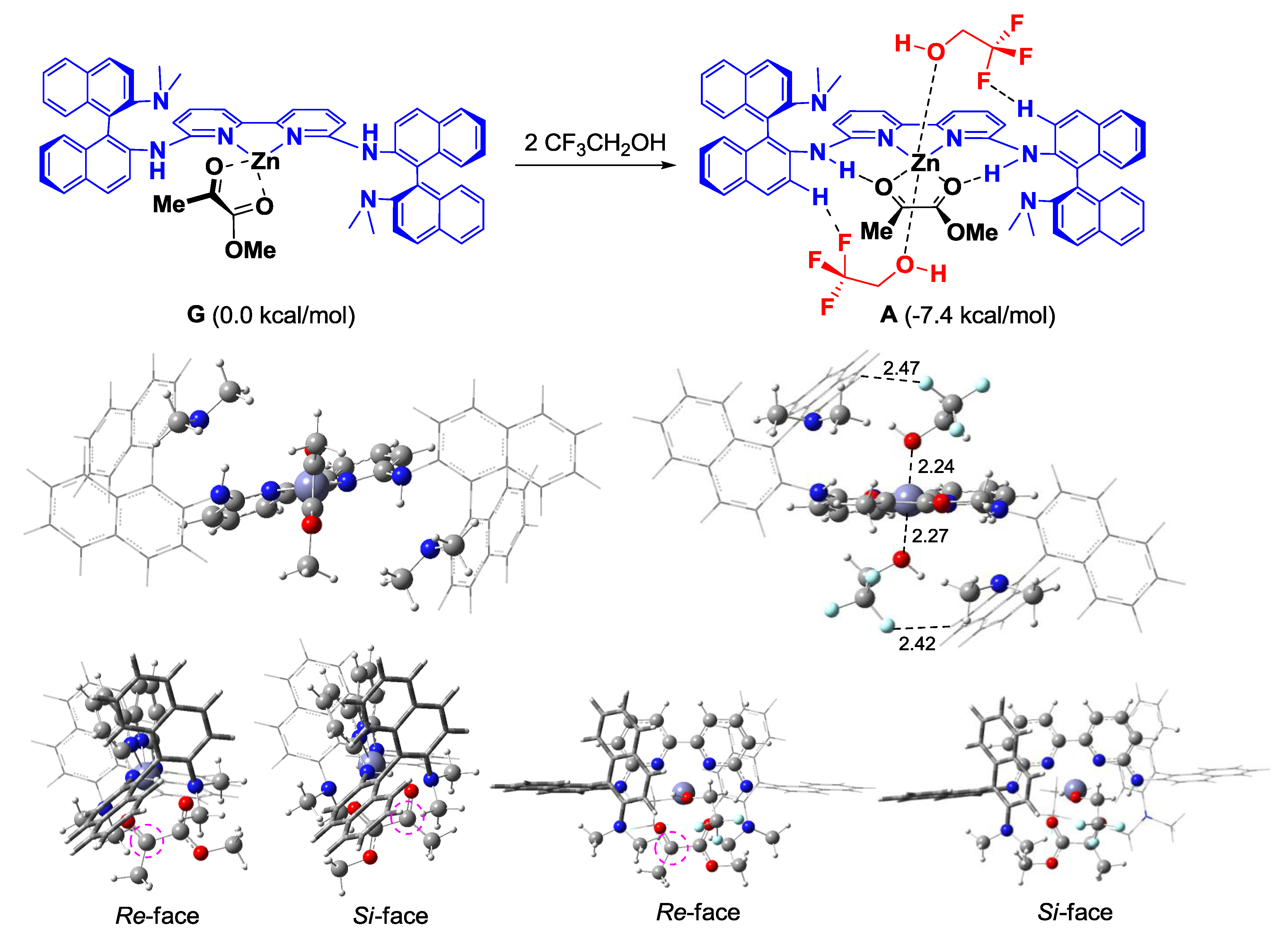
          <p>DFT calculations for the TFE addition effect in the complex of Zn(II)-<bold>L3</bold> and <italic>α</italic>-ketoester (B3LYP/LANL2DAZ for Zn, 6-31G* for the rest). Bond lengths are shown in Å.</p>
        </caption>
        <graphic xmlns:xlink="http://www.w3.org/1999/xlink" xlink:href="molecules-17-09010-g005.tif"/>
      </fig>
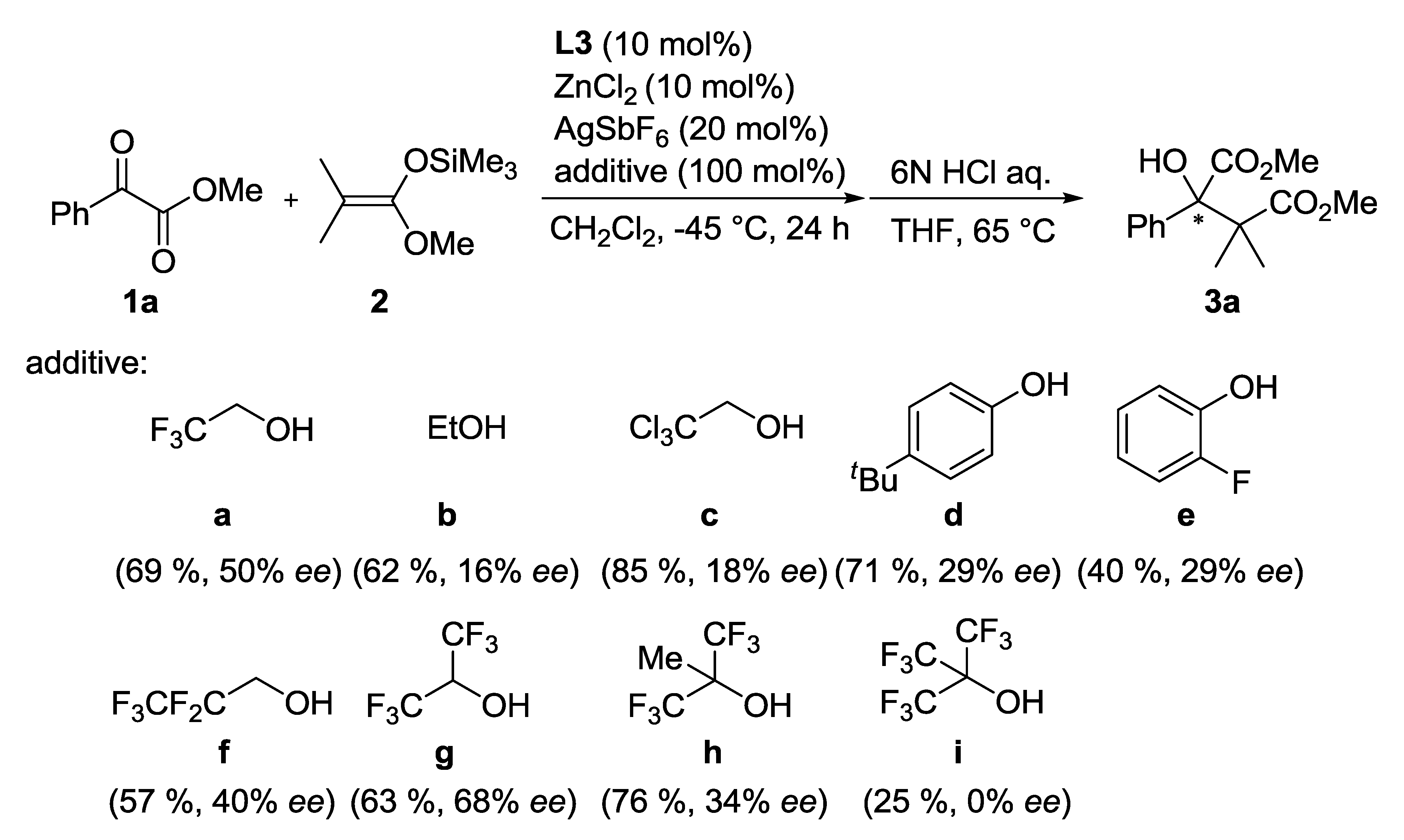
      <p>Focusing on the TFE coordination to Zn(II)-<bold>L3</bold> and <italic>α</italic>-ketoester, methyl pyruvate was used in the chemical models to reduce the computational costs. Six assembled complex models (<bold>A</bold>–<bold>F</bold>) were optimized (B3LYP/LANL2DAZ for Zn, 6-31G* for the rest). The assembled complex <bold>A</bold> found to be most stable (<xref ref-type="fig" rid="molecules-17-09010-f004">Figure 4</xref>). The structural properties of the parent complex <bold>G</bold> were dramatically changed by coordination with two molecules of TFE (<xref ref-type="fig" rid="molecules-17-09010-f005">Figure 5</xref>). Whereas <bold>G</bold> has the tetrahedral Zn(II) centre, an octahedral hexacoordinated Zn(II) centre was formed in <bold>A</bold>. The hydrogen-bonding between F and binaphthyl hydrogen atoms (2.42 Å, 2.47 Å) and the Zn-O interaction (2.24 Å, 2.27 Å) stabilized <bold>A</bold> by 7.4 kcal/mol in Gibbs free energy. These structural changes would enhance enantiofacial differentiation at the carbonyl group (dotted purple circles in <xref ref-type="fig" rid="molecules-17-09010-f005">Figure 5</xref>). There is no enantiofacial differentiation at the carbonyl group in <bold>G</bold>. In contrast, <italic>Si</italic>-facial attack of <bold>2</bold> in <bold>A</bold> would be prevented by the steric hindrance of TFE to increase the enantioselectivity. This computational prediction was supported by the stoichiometric reaction with 2.0 equivalents of TFE yielding <bold>3a</bold> with 46% <italic>ee</italic> (almost the same enantioselectivity under catalytic condition, Entry 5 in <xref ref-type="table" rid="molecules-17-09010-t002">Table 2</xref>). To further improve the enantioselectivity, other alcohol additives were examined (<xref ref-type="scheme" rid="molecules-17-09010-f006">Scheme 1</xref>).</p>
    <table-wrap id="molecules-17-09010-t002" position="anchor">
        <object-id pub-id-type="pii">molecules-17-09010-t002_Table 2</object-id>
        <label>Table 2</label>
        <caption>
          <p>Metal-bisamidine catalyzed reaction of <bold>1a</bold> and <bold>2</bold> under stoichiometric conditions.</p>
        </caption>
         <table>
          <thead>
            <tr style="border-bottom:solid thin">
              <th align="center" valign="top">Entry</th>
              <th align="center" valign="top">Ligand</th>
              <th align="center" valign="top">Y eq. of TFE</th>
              <th align="center" valign="top">Yield (%) 
              <italic><sup>a</sup></italic></th>
              <th align="center" valign="top">ee (%) 
              <italic><sup>b</sup></italic></th>
            </tr>
          </thead>
          <tbody>
            <tr>
              <td align="center" valign="top">1</td>
              <td align="center" valign="top"><bold>L3</bold></td>
              <td align="center" valign="top">-</td>
              <td align="center" valign="top">60</td>
              <td align="center" valign="top">26</td>
            </tr>
            <tr>
              <td align="center" valign="top">2</td>
              <td align="center" valign="top"><bold>L4</bold></td>
              <td align="center" valign="top">-</td>
              <td align="center" valign="top">81</td>
              <td align="center" valign="top">1</td>
            </tr>
            <tr>
              <td align="center" valign="top">3</td>
              <td align="center" valign="top"><bold>L5</bold></td>
              <td align="center" valign="top">-</td>
              <td align="center" valign="top">53</td>
              <td align="center" valign="top">0</td>
            </tr>
            <tr>
              <td align="center" valign="top">4</td>
              <td align="center" valign="top"><bold>L3</bold></td>
              <td align="center" valign="top">0.2</td>
              <td align="center" valign="top">71</td>
              <td align="center" valign="top">35</td>
            </tr>
            <tr>
              <td align="center" valign="top">5</td>
              <td align="center" valign="top"><bold>L3</bold></td>
              <td align="center" valign="top">1.0</td>
              <td align="center" valign="top">69</td>
              <td align="center" valign="top">50</td>
            </tr>
            <tr>
              <td align="center" valign="top">6</td>
              <td align="center" valign="top"><bold>L3</bold></td>
              <td align="center" valign="top">5.0</td>
              <td align="center" valign="top">68</td>
              <td align="center" valign="top">33 <inline-graphic xmlns:xlink="http://www.w3.org/1999/xlink" xlink:href="molecules-17-09010-i001.tif"/></td>
            </tr>
          </tbody>
        </table>
      <table-wrap-foot><fn><p><italic>Notes</italic><bold>:</bold><italic> <sup>a</sup></italic> Determined by <sup>1</sup>H-NMR analysis of the reaction crude mixtures. <italic><sup>b</sup></italic> Determined by chiral HPLC analysis.</p>
      </fn></table-wrap-foot>
      </table-wrap>
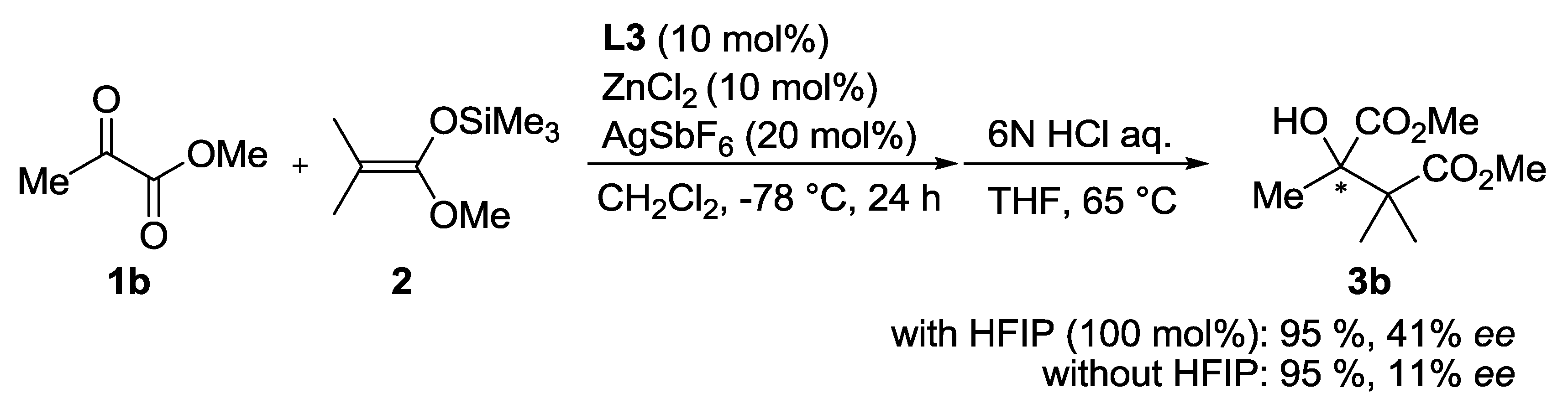
	  <p>Whereas ethanol (<bold>b</bold>), trichloroethanol (<bold>c</bold>), and phenol derivatives (<bold>d</bold> and <bold>e</bold>) exhibited no positive impact on the enantioselectivity, 2,2,3,3,3-pentafluoro-1-propanol (<bold>f</bold>) slightly increased the enantioselectivity (40% <italic>ee</italic>). Aliphatic fluorinated alcohols yielded promising results in the initial screening. After investigation of various aliphatic fluorinated alcohols, hexafluoroisopropyl alcohol (HFIP, <bold>g</bold>) was found to be the most efficient alcohol additive and the highest enantioselectivity was achieved (68% <italic>ee</italic>). A more sterically demanding alcohol, 1,1,1,3,3,3-hexafluoro-2-methyl-2-propanol (<bold>h</bold>), exhibited lower enantioselectivity than HFIP (34% <italic>ee</italic>). The more bulky and acidic alcohol tris(trifluoromethyl)methanol (<bold>i</bold>), promoted the achiral pathway to exhibit no enantioselectivity. Therefore, aliphatic fluorinated alcohols having suitable acidity and bulkiness exerted a significant impact on the enantiofacial control of Zn(II)-<bold>L3</bold>. A similar additive effect was observed when methyl pyruvate (<bold>1b</bold>) was used as electrophile. The Zn(II)-<bold>L3</bold> catalyzed reaction of <bold>1</bold><bold>b</bold> and <bold>2</bold> readily proceeds at −78 °C to afford <bold>3b</bold> in 95% yield with 11% <italic>ee</italic>. Addition of 1.0 equivalent of HFIP led to the same yield (95%) and an increase in the enantioselectivity to 41% <italic>ee</italic> (<xref ref-type="scheme" rid="molecules-17-09010-f007">Scheme 2</xref>). The lower ee value of <bold>3b</bold> than <bold>3a</bold> indicates that Me group would be too small to achieve the enantiofacial discrimination controlled by the Zn(II)-<bold>L3</bold> catalyst.</p>
      <fig id="molecules-17-09010-f006" position="anchor">
        <object-id pub-id-type="pii">molecules-17-09010-scheme1_Scheme 1</object-id>
        <label>Scheme 1</label>
        <caption>
          <p>Screening of alcohol additives.</p>
        </caption>
        <graphic xmlns:xlink="http://www.w3.org/1999/xlink" xlink:href="molecules-17-09010-g006.tif"/>
      </fig>
      <fig id="molecules-17-09010-f007" position="anchor">
        <object-id pub-id-type="pii">molecules-17-09010-scheme2_Scheme 2</object-id>
        <label>Scheme 2</label>
        <caption>
          <p>Zn(II)-<bold>L3</bold> catalyzed reaction of <bold>1b</bold> and <bold>2</bold> with or without HFIP.</p>
        </caption>
        <graphic xmlns:xlink="http://www.w3.org/1999/xlink" xlink:href="molecules-17-09010-g007.tif"/>
      </fig>
    </sec>
    <sec sec-type="methods">
      <title>3. Experimental</title>
      <sec>
        <title>3.1. General</title>
        <p>All reactions were performed under nitrogen atmosphere with magnetic stirring in dried glassware. AgOTf, AgBF<sub>4</sub>, ZnCl<sub>2</sub>, CuCl<sub>2</sub>, FeCl<sub>2</sub>·4H<sub>2</sub>O, were purchased from Sigma-Aldrich Japan K. K. (Tokyo, Japan). Dimethylketene methyl trimethylsilyl acetal was purchased from Tokyo Chemical Industry Co., Ltd. (Tokyo, Japan). (<italic>R</italic>)-1,1'-binaphthyl-2,2'-diamine ((<italic>R</italic>)-DABN), methyl phenylglyoxylate, methyl pyruvate were purchased from Wako Pure Chemical Industries, Ltd. (Tokyo, Japan) All dehydrated solvents were purchased from Kanto Chemical Co., Inc. (Tokyo, Japan) Enantiomeric excess was determined on a Shimadzu HPLC system with UV detection or a Shimadzu GC system. <sup>1</sup>H-NMR and <sup>13</sup>C-NMR spectra were recorded on a JEOL JNM-ECX400 spectrometer. Chemical shifts in CDCl<sub>3</sub> were reported in ppm from tetramethylsilane as the internal standard (CDCl<sub>3</sub>: δ = 0) for <sup>1</sup>H-NMR and from the solvent resonance (CDCl<sub>3</sub>: δ = 77.0) for <sup>13</sup>C-NMR. Infrared (IR) spectra were recorded on a JASCO FT/IR-230 Fourier transform infrared spectrophotometer. High resolution mass was performed by JEOL JMS-GC mate II. Purification of the products was performed by column chromatography on silica gel 60N (spherical, neutral, Kanto Chemical Co., Inc), Wakogel 50NH<sub>2</sub> (Wako Pure Chemical Industries, Ltd.) or activated alumina (about 75 μm).</p>
      </sec>
      <sec>
        <title>3.2. Synthesis of the 2,2'-Bipyridyl Derived Bisamidine Ligands</title>
        <sec>
          <title>3.2.1. Synthesis of 6,6'-Dibromo-2,2'-dipyridyl</title>
          <p>To a solution of 2,6-dibromopyridine (1.17 g, 5.0 mmol) in Et<sub>2</sub>O (10 mL), <italic>n</italic>-BuLi (1.67 M solution in hexane, 6.6 mL, 11 mmol) was added dropwise at −78 °C over 1 h, and then CuCl<sub>2</sub> (1.01 g, 7.5 mmol) was added to the reaction mixture. After stirring for 30 min, the reaction mixture was bubbled by O<sub>2</sub> for 24 h at −78 °C. To the reaction mixture 6 N HCl aq. (15 mL) was added, and then filtered through B üchner funnel. The residue was purified by recrystallization from AcOEt gave 6,6'-dibromo-2,2'-dipyridyl as a white powder in 28% yield.</p>
        </sec>
        <sec>
          <title>3.2.2. Synthesis of the (<italic>R</italic>)-DABN Derivatives</title>
          <p>(<italic>R</italic>)-<italic>N,N</italic>-Dimethyl-1,1'-binaphthalene-2,2'-diamine [(<italic>R</italic>)-NMe<sub>2</sub>-DABN] was prepared according to the previously reported method [<xref ref-type="bibr" rid="B36-molecules-17-09010">36</xref>]. To a solution of (<italic>R</italic>)-1,1'-binaphthalene-2,2'-diamine [(<italic>R</italic>)- DABN] (516.0 mg, 2.0 mmol) and AcOH (1.2 mL, 20 mmol) in CH<sub>2</sub>Cl<sub>2</sub> (10 mL) was added acetic anhydride (0.2 mL, 2.0 mmol) at 0 °C under N<sub>2</sub>. The reaction mixture was stirred for 20 h at room temperature, and then 1 N NaOH aq. was added to adjust the solution to pH &gt; 7. The solution was extracted by CH<sub>2</sub>Cl<sub>2</sub> and the combined organic layers were washed with brine, dried over Na<sub>2</sub>SO<sub>4</sub>, and then concentrated under reduced pressure. The crude mixture was purified by column chromatography on silica gel 60N (AcOEt/hexane = 2/1) to afford N-[(<italic>1R</italic>)-2'-amino-1,1'-binaphthalen-2-yl]acetamide [(<italic>R</italic>)-Ac-DABN] as a colorless oil in 75% yield. To a solution of (<italic>R</italic>)-Ac-DABN (0.49 g, 1.5 mmol) and aqueous formaldehyde (37%, 1.48 mL, 17.5 mmol) in THF (19 mL) was added NaBH<sub>3</sub>CN (0.19 mg, 10.3 mmol). The reaction mixture was stirred for 15 min at room temperature followed by addition of AcOH (1.9 mL). After stirring for 4 h at room temperature, 1 N NaOH aq. was added to adjust the solution to pH &gt; 7. The solution was extracted by CH<sub>2</sub>Cl<sub>2</sub> and the combined organic layers were washed with brine, dried over Na<sub>2</sub>SO<sub>4</sub>, and then concentrated under reduced pressure. The crude mixture was purified by column chromatography on silica gel 60N (AcOEt/hexane = 1/5) to afford the <italic>N</italic>-[(<italic>1R</italic>)-2'-(dimethylamino)-1,1'-binaphthalen-2-yl]acetamide [(<italic>R</italic>)-Ac-NMe<sub>2</sub>-DABN] as a brown powder in quantitative yield. To a solution of (<italic>R</italic>)-Ac-NMe<sub>2</sub>-DABN (529 mg, 1.5 mmol) in EtOH (5 mL) was added 4 N HCl (5 mL). The reaction mixture was stirred for 24 h at 75 °C, and then 1 N NaOH aq. was added to adjust the solution to pH &gt; 7. The solution was extracted by CH<sub>2</sub>Cl<sub>2</sub> and the combined organic layers were washed with brine, dried over Na<sub>2</sub>SO<sub>4</sub>, and then concentrated under reduced pressure. The crude mixture was purified by column chromatography on silica gel 60N (AcOEt/hexane = 1/10) to afford (<italic>1R</italic>)-<italic>N,N</italic>-dimethyl-1,1'-binaphthalene-2,2'-diamine [(<italic>R</italic>)-NMe<sub>2</sub>-DABN] as a white powder in 90% yield.</p>
          <p>To a solution of (<italic>R</italic>)-Ac-DABN (93 mg, 0.29 mmol) in DMF (1.5 mL), 1,5-dibromopentane (345 mg, 1.5 mmol) and Et<sub>3</sub>N (0.3 mL, 3.0 mmol) were added. The reaction mixture was stirred for 2 ddy at 150 °C followed by addition of water (5 mL). The solution was extracted by CH<sub>2</sub>Cl<sub>2</sub> and the combined organic layers were washed with brine, dried over Na<sub>2</sub>SO<sub>4</sub>, and then concentrated under reduced pressure. To a solution of the crude residue in EtOH (2 mL) was added 6 N HCl aq. (2 mL). After stirring for 24 h at 85 °C, 1 N NaOH aq. was added to adjust the solution to pH &gt; 7. The solution was extracted by CH<sub>2</sub>Cl<sub>2</sub> and the combined organic layers were washed with brine, dried over Na<sub>2</sub>SO<sub>4</sub>, and then concentrated under reduced pressure. The crude mixture was purified by column chromatography on silica gel 60N (AcOEt/hexane = 1/10) to afford (<italic>1R</italic>)-2'-(1-piperidinyl)-1,1'-binaphthalen-2-amine [(<italic>R</italic>)-C<sub>5</sub>H<sub>10</sub>N-DABN] as a white powder in 66% yield.</p>
        </sec>
        <sec>
          <title>3.2.3. Synthesis of <bold>L1</bold>, <bold>L3</bold>, <bold>L4</bold>, and <bold>L5</bold></title>
          <p>2,2'-Bipyridyl linked bisamidines <bold>L1</bold>, <bold>L3</bold>, <bold>L4</bold>, and <bold>L5</bold> were prepared according to the C-N coupling method reported by Buchwald [<xref ref-type="bibr" rid="B37-molecules-17-09010">37</xref>]. A solution of Pd(dba)<sub>2</sub> (6.8 mg, 0.012 mmol) and racemic-BINAP (14.8 mg, 0.024 mmol) in toluene (2 mL) under N<sub>2</sub> was stirred for 20 min at room temperature. 6,6'-Dibromo-2,2'-dipyridyl (153.5 mg 0.49 mmol), <italic><sup>t</sup></italic>BuONa (119.5 mg, 1.25 mmol) and the primary amine (<bold>L1</bold>: BnNH<sub>2</sub>, <bold>L3</bold>: (<italic>R</italic>)-NMe<sub>2</sub>-DABN, <bold>L4</bold>: (<italic>R</italic>)-Ac-DABN, <bold>L5</bold>: (<italic>R</italic>)-C<sub>5</sub>H<sub>10</sub>N-DABN, 1.0 mmol) were added to the solution at room temperature followed by stirring or 24 h at 110 °C. The solution was filtered through Celite and concentrated under reduced pressure. </p>
          <p>For <bold>L1</bold>, <bold>L3</bold>, and <bold>L5</bold>: The crude mixture was purified by column chromatography on activated alumina (<bold>L1</bold>: AcOEt/CH<sub>2</sub>Cl<sub>2</sub> = 1/1, <bold>L3</bold>: AcOEt/hexane = 1/3) or silica gel 60N (<bold>L5</bold>: AcOEt/hexane = 1/15) to afford the 2,2'-bipyridyl linked bisamidine as a white powder (<bold>L1</bold>: 99%, <bold>L3</bold>: 99%, <bold>L5</bold>: 51%).</p>
          <p>For <bold>L4</bold>: To a solution of the crude residue in EtOH (2 mL) was added 6 N HCl aq. (2 mL). After stirring for 24 h at 85 °C, 1 N NaOH aq. was added to adjust the solution to pH &gt; 7. The solution was extracted by CH<sub>2</sub>Cl<sub>2</sub> and the combined organic layers were washed with brine and dried over Na<sub>2</sub>SO<sub>4</sub>. The crude mixture was purified by column chromatography on silica gel 60N (AcOEt/ hexane = 1/3) to afford <bold>L4</bold> as a white powder in 99% yield.</p>
          <p><bold>L1</bold>: <sup>1</sup>H-NMR (400 MHz, CDCl<sub>3</sub>): δ 7.64 (d, <italic>J</italic> = 7.6 Hz, 2H), 7.50 (m, 2H) 7.40 (d, <italic>J</italic> = 7.2 Hz, 4H), 7.34 (m, 4H), 7.28 (m, 2H), 6.38 (d, <italic>J</italic> = 7.6 Hz, 2H), 4.97 (br, 2H), 4.60 (s, 4H); <sup>13</sup>C-NMR (100 MHz, CDCl<sub>3</sub>): δ 158.3, 139.9, 138.5, 128.9, 127.8, 127.8, 127.4, 110.8, 107.2, 46.7; IR ν 3392, 3055, 2831, 2785, 1572, 1500, 1429, 1335 cm<sup>−1</sup>; HRMS Calcd for C<sub>24</sub>H<sub>2</sub><sub>3</sub>N<sub>4</sub> [M+H]: 367.1923; Found: 367.1948.</p>
          <p><bold>L3</bold>: <sup>1</sup>H-NMR (400 MHz, CDCl<sub>3</sub>): δ 8.28 (d, <italic>J</italic> = 9.2 Hz 2H), 7.90 (m, 6H), 7.81 (d, <italic>J</italic> = 8.4 Hz, 2H), 7.67 (m, 2H), 7.47 (m, 4H), 7.33(m, 2H), 7.27 (m, 2H), 7.20 (m, 2H), 7.12 (m, 6H), 6.68 (s, 2H), 6.63 (d, <italic>J</italic> = 8.0 Hz, 2H), 2.51 (s, 12H); <sup>13</sup>C-NMR (100 MHz, CDCl<sub>3</sub>): δ 155.6, 155.0, 150.4, 138.3, 137.2, 134.4, 134.2, 130.5, 130.0, 129.9, 128.4, 128.3, 128.2, 126.8, 126.6, 126.4, 125.6, 124.3, 124.1, 124.0, 122.6, 121.7, 119.6, 112.6, 109.5, 43.6; IR ν 3395, 3054, 2930, 2867, 2831, 2784, 1571, 1501, 1442, 1428, 1334 cm<sup>−1</sup>; HRMS Calcd for C<sub>54</sub>H<sub>45</sub>N<sub>6</sub> [M+H]: 777.3706; Found: 777.3377.</p>
          <p><bold>L4</bold>: <sup>1</sup>H-NMR (400 MHz, CDCl<sub>3</sub>): δ 8.57 (d, <italic>J</italic> = 8.8 Hz 2H), 7.98 (d, <italic>J</italic> = 8.8 Hz, 2H) 7.88 (d, <italic>J</italic> = 8.0 Hz, 2H), 7.80 (m, 4H), 7.74 (m, 2H), 7.48 (m, 2H), 7.34 (m, 2H), 7.24–7.04 (m, 12H), 6.53 (d, <italic>J</italic> = 7.6 Hz, 2H), 6.36 (s, 2H), 3.67 (s, 4H); <sup>13</sup>C-NMR (100 MHz, CDCl<sub>3</sub>): δ 154.8, 154.6, 142.9, 138.2, 137.9, 133.9, 133.3, 130.2, 129.9, 128.7, 128.3, 128.2, 128.1, 127.0, 126.7, 125.0, 124.0, 123.9, 122.5, 120.5, 119.0, 118.2, 113.0, 111.6, 110.5; IR ν 3470, 3381, 3051, 1617, 1463, 1335, 1310, 1270 cm<sup>−1</sup>; HRMS Calcd for C<sub>50</sub>H<sub>37</sub>N<sub>6</sub> [M+H]: 721.3080; Found: 721.3436.</p>
          <p><bold>L5</bold>: <sup>1</sup>H-NMR (400 MHz, CDCl<sub>3</sub>): δ 8.30 (d, <italic>J</italic> = 8.8 Hz, 2H), 7.93 (m, 4H) 7.84 (m, 4H), 7.69 (d, <italic>J</italic> = 7.6 Hz, 2H), 7.48 (m, 4H), 7.32 (m, 4H), 7.20–7.05 (m, 8H), 7.00 (d, <italic>J</italic> = 4.0 Hz, 2H), 6.65 (d, <italic>J</italic> = 8.0 Hz, 2H), 2.85 (m, 8H), 1.26–1.17 (m, 12H); <sup>13</sup>C-NMR (100 MHz, CDCl<sub>3</sub>): δ 155.1, 154.8, 150.4, 138.0, 136.6, 134.1, 133.8, 130.2, 130.1, 129.6, 127.9, 127.9, 126.3, 126.1, 126.1, 125.7, 125.1, 124.0, 123.6, 123.3, 121.1, 121.1, 120.0, 112.1, 109.3, 52.9, 26.1, 24.1; IR ν 3393, 3054, 2929, 2850, 2796, 1572, 1501, 1443, 1429, 1337 cm<sup>−1</sup>; HRMS Calcd for C<sub>60</sub>H<sub>53</sub>N<sub>6</sub> [M+H]: 857.4332; Found: 857.4039.</p>
        </sec>
      </sec>
      <sec>
        <title>3.3. General Procedure for Asymmetric Mukaiyama Aldol Reaction of <bold>1a</bold> and <bold>2</bold> (<xref ref-type="scheme" rid="molecules-17-09010-f006">Scheme 1</xref>)</title>
        <p>Under a N<sub>2</sub> atmosphere, a solution of ZnCl<sub>2</sub> (1.4 mg, 0.01 mmol) and <bold>L3</bold> (7.8 mg, 0.01 mmol) in CH<sub>3</sub>CN was stirred at room temperature for 20 min. The solvent was removed under reduced pressure and AgSbF<sub>6</sub> (6.9 mg, 0.02 mmol) was added under N<sub>2</sub>. The residue was stirred in CH<sub>2</sub>Cl<sub>2</sub> (0.5 mL) at room temperature for 30 min followed by addition of HFIP (16.8 mg, 0.1 mmol). After stirring at room temperature for 20 min, <bold>1a</bold> (16.4 mg, 0.1 mmol), <bold>2</bold> (17.9 mg, 0.1 mmol) were added to the solution and the mixture was stirred at −45 °C. The reaction was quenched by filtration through silica gel 60N. After concentration under reduced pressure, the residue was dissolved in THF (0.5 mL). 6 N HCl aq. was added and the solution was stirred at 65 °C. The solution was extracted by CH<sub>2</sub>Cl<sub>2</sub> and the combined organic layers were washed with brine, dried over Na<sub>2</sub>SO<sub>4</sub>, and then concentration under reduced pressure. The crude mixture was purified by column chromatography on silica gel 60N (AcOEt/Hexane = 1/15) to afford <bold>3a</bold> as white crystals (63% yield).</p>
        <p><italic>Dimethyl-2,2-dimethyl-3-hydroxy-3-phenylbutanedioate</italic> (<bold>3a</bold>) [<xref ref-type="bibr" rid="B38-molecules-17-09010">38</xref>]. <bold>3a</bold> is a known compound. white crystals: IR ν 3474, 2955, 1706, 1442, 1356 cm<sup>−1</sup>; <sup>1</sup>H-NMR (400 MHz, CDCl<sub>3</sub>): δ 7.57 (d, <italic>J</italic> = 6.4 Hz, 2H), 7.37–7.30 (m, 3H), 4.70 (s, 1H), 3.81 (s, 3H), 3.74 (s, 3H), 1.36 (s, 3H), 1.13 (s, 3H); <sup>13</sup>C-NMR (100 MHz, CDCl<sub>3</sub>) δ = 178.7, 174.3, 136.9, 128.0, 127.5, 127.3, 81.9, 52.9, 52.4, 50.4, 22.7, 21.5; EI-MS <italic>m/z</italic> = 266 [M]<sup>+</sup> for C<sub>14</sub>H<sub>18</sub>O<sub>5</sub>; Enantiomeric excess was determined by chiral HPLC analysis (68% <italic>ee</italic>, DAICEL CHIRALPAK OD-H, 2-propanol/<italic>n</italic>-hexane = 5/95, flow rate 1.0 mL/min, wavelength = 220 nm, t<sub>minor</sub> = 5.9 min and t<sub>major</sub> = 7.5 min).</p>
        <p><italic>Dimethyl-3-hydroxy-2,2,3-trimethylbutanedioate</italic> (<bold>3b</bold>) [<xref ref-type="bibr" rid="B38-molecules-17-09010">38</xref>]. <bold>3b</bold> is a known compound. pale yellow oil.: IR ν 3511, 2954, 1728, 1439, 1374 cm<sup>−1</sup>; <sup>1</sup>H-NMR (400 MHz, CDCl<sub>3</sub>): δ 3.94 (s, 1H), 3.77 (s, 3H), 3.70 (s, 3H), 1.43 (s, 3H), 1.28 (s, 6H). <sup>13</sup>C-NMR (100 MHz, CDCl<sub>3</sub>) δ = 176.8, 175.9, 78.0, 52.7, 52.2, 49.3, 21.6, 20.9, 20.6; EI-MS <italic>m/z</italic> = 205 [M+H]<sup>+</sup> for C<sub>9</sub>H<sub>16</sub>O<sub>5</sub>; Enantiomeric excess was determined by chiral GC analysis (41% <italic>ee</italic>, Cyclodex-<italic>β</italic> column, 100 °C, t<sub>minor</sub> = 37.5 min and t<sub>major</sub> = 38.4 min).</p>
      </sec>
    </sec>
    <sec sec-type="conclusions">
      <title>4. Conclusions</title>
      <p>In summary, we developed asymmetric Mukaiyama aldol reaction of <italic>α</italic>,<italic>α</italic>-disubstituted silyl enol ether and <italic>α</italic>-ketoester promoted by the rationally designed chiral Zn(II)-bisamidine catalyst, which exhibited an unique catalytic ability incorporating Lewis acid and Brønsted acid functions. Aliphatic fluorinated alcohols having suitable acidity and bulkiness dramatically enhanced the enantioselectivity. DFT calculations revealed self-assembly of the fluorinated alcohol exerted a significant impact on the active catalyst structure to enhance enantiofacial control. Although DFT calculations predicted <italic>Re</italic>-facial attack leading to the <italic>R</italic> configured product would be preferred, the absolute configuration of the product has not been determined yet. Studies on further improvement of the cationic metal-bisamidine catalyst system and determination of the absolute configuration of the product are currently underway.</p>
    </sec>
    </body>
  <back>
    <notes>
      <title>Supplementary Materials</title>
      <p>Supplementary materials can be accessed at: <uri>http://www.mdpi.com/1420-3049/17/8//9010/s1</uri>.</p>
    </notes>
    <ack>
      <title>Acknowledgments</title>
      <p>This work was supported by a Grantin-Aid for Young Scientists (B) from JSPS (Grant No. 20750082). </p>
    </ack>
  <ref-list>
      <title>References</title>
      <ref id="B1-molecules-17-09010">
        <label>1.</label>
        <citation citation-type="journal">
          <person-group person-group-type="author">
            <name>
              <surname>Yamamoto</surname>
              <given-names>H.</given-names>
            </name>
            <name>
              <surname>Futatsugi</surname>
              <given-names>K.</given-names>
            </name>
          </person-group>
          <article-title>Designer acids”: Combined acid catalysis for asymmetric synthesis</article-title>
          <source>Angew. Chem. Int. Ed. Engl.</source>
          <year>2005</year>
          <volume>44</volume>
          <fpage>1924</fpage>
          <lpage>1942</lpage>
          <pub-id pub-id-type="doi">10.1002/anie.200460394</pub-id>
        </citation>
      </ref>
      <ref id="B2-molecules-17-09010">
        <label>2.</label>
        <citation citation-type="journal">
          <person-group person-group-type="author">
            <name>
              <surname>Maruoka</surname>
              <given-names>K.</given-names>
            </name>
            <name>
              <surname>Sakurai</surname>
              <given-names>M.</given-names>
            </name>
            <name>
              <surname>Fujiwara</surname>
              <given-names>J.</given-names>
            </name>
            <name>
              <surname>Yamamoto</surname>
              <given-names>H.</given-names>
            </name>
          </person-group>
          <article-title>Asymmetric Diels-Alder reaction directed toward chiral anthracycline intermediates</article-title>
          <source>Tetrahedron</source>
          <year>1986</year>
          <volume>27</volume>
          <fpage>4895</fpage>
          <lpage>4898</lpage>
          <pub-id pub-id-type="doi">10.1016/S0040-4039(00)85091-1</pub-id>
        </citation>
      </ref>
      <ref id="B3-molecules-17-09010">
        <label>3.</label>
        <citation citation-type="journal">
          <person-group person-group-type="author">
            <name>
              <surname>Furuta</surname>
              <given-names>K.</given-names>
            </name>
            <name>
              <surname>Miwa</surname>
              <given-names>Y.</given-names>
            </name>
            <name>
              <surname>Iwanaga</surname>
              <given-names>K.</given-names>
            </name>
            <name>
              <surname>Yamamoto</surname>
              <given-names>H.</given-names>
            </name>
          </person-group>
          <article-title>Acyloxyborane: An activating device for carboxylic acids</article-title>
          <source>J. Am. Chem. Soc.</source>
          <year>1988</year>
          <volume>110</volume>
          <fpage>6254</fpage>
          <lpage>6255</lpage>
          <pub-id pub-id-type="doi">10.1021/ja00226a055</pub-id>
        </citation>
      </ref>
      <ref id="B4-molecules-17-09010">
        <label>4.</label>
        <citation citation-type="journal">
          <person-group person-group-type="author">
            <name>
              <surname>Ishihara</surname>
              <given-names>K.</given-names>
            </name>
            <name>
              <surname>Miyata</surname>
              <given-names>M.</given-names>
            </name>
            <name>
              <surname>Hattori</surname>
              <given-names>K.</given-names>
            </name>
            <name>
              <surname>Tada</surname>
              <given-names>T.</given-names>
            </name>
            <name>
              <surname>Yamamoto</surname>
              <given-names>H.Y.</given-names>
            </name>
          </person-group>
          <article-title>A new chiral BLA promoter for asymmetric aza Diels-Alder and Aldol-type reactions of imines</article-title>
          <source>J. Am. Chem. Soc.</source>
          <year>1994</year>
          <volume>116</volume>
          <fpage>10520</fpage>
          <lpage>10524</lpage>
        <pub-id pub-id-type="doi">10.1021/ja00102a019</pub-id></citation>
      </ref>
      <ref id="B5-molecules-17-09010">
        <label>5.</label>
        <citation citation-type="journal">
          <person-group person-group-type="author">
            <name>
              <surname>Ishihara</surname>
              <given-names>K.</given-names>
            </name>
            <name>
              <surname>Yamamoto</surname>
              <given-names>H.</given-names>
            </name>
          </person-group>
          <article-title>Brønsted acid assisted chiral Lewis acid (BLA) catalyst for asymmetric Diels-Alder reaction</article-title>
          <source>J. Am. Chem. Soc.</source>
          <year>1994</year>
          <volume>116</volume>
          <fpage>1561</fpage>
          <lpage>1562</lpage>
          <pub-id pub-id-type="doi">10.1021/ja00083a048</pub-id>
        </citation>
      </ref>
      <ref id="B6-molecules-17-09010">
        <label>6.</label>
        <citation citation-type="journal">
          <person-group person-group-type="author">
            <name>
              <surname>Ishihara</surname>
              <given-names>K.</given-names>
            </name>
            <name>
              <surname>Kurihara</surname>
              <given-names>H.</given-names>
            </name>
            <name>
              <surname>Yamamoto</surname>
              <given-names>H.</given-names>
            </name>
          </person-group>
          <article-title>A new powerful and practical BLA catalyst for highly enantioselective Diels-Alder reaction: An extreme acceleration of reaction rate by Brønsted acid</article-title>
          <source>J. Am. Chem. Soc.</source>
          <year>1996</year>
          <volume>118</volume>
          <fpage>3049</fpage>
          <lpage>3050</lpage>
          <pub-id pub-id-type="doi">10.1021/ja954060u</pub-id>
        </citation>
      </ref>
      <ref id="B7-molecules-17-09010">
        <label>7.</label>
        <citation citation-type="journal">
          <person-group person-group-type="author">
            <name>
              <surname>Ishihara</surname>
              <given-names>K.</given-names>
            </name>
            <name>
              <surname>Kurihara</surname>
              <given-names>H.</given-names>
            </name>
            <name>
              <surname>Matsumoto</surname>
              <given-names>M.</given-names>
            </name>
            <name>
              <surname>Yamamoto</surname>
              <given-names>H.</given-names>
            </name>
          </person-group>
          <article-title>Design of Brønsted acid-assisted chiral Lewis acid (BLA) catalysts for highly enantioselective Diels-Alder reactions</article-title>
          <source>J. Am. Chem. Soc.</source>
          <year>1998</year>
          <volume>120</volume>
          <fpage>6920</fpage>
          <lpage>6930</lpage>
          <pub-id pub-id-type="doi">10.1021/ja9810282</pub-id>
        </citation>
      </ref>
      <ref id="B8-molecules-17-09010">
        <label>8.</label>
        <citation citation-type="journal">
          <person-group person-group-type="author">
            <name>
              <surname>Corey</surname>
              <given-names>E.J.</given-names>
            </name>
            <name>
              <surname>Shibata</surname>
              <given-names>T.</given-names>
            </name>
            <name>
              <surname>Lee</surname>
              <given-names>T.W.</given-names>
            </name>
          </person-group>
          <article-title>Asymmetric Diels-Alder reactions catalyzed by a triflic acid activated chiral oxazaborolidine</article-title>
          <source>J. Am. Chem. Soc.</source>
          <year>2002</year>
          <volume>124</volume>
          <fpage>3808</fpage>
          <lpage>3809</lpage>
          <pub-id pub-id-type="doi">10.1021/ja025848x</pub-id>
        </citation>
      </ref>
      <ref id="B9-molecules-17-09010">
        <label>9.</label>
        <citation citation-type="journal">
          <person-group person-group-type="author">
            <name>
              <surname>Ryu</surname>
              <given-names>D.H.</given-names>
            </name>
            <name>
              <surname>Lee</surname>
              <given-names>T.W.</given-names>
            </name>
            <name>
              <surname>Corey</surname>
              <given-names>E.J.</given-names>
            </name>
          </person-group>
          <article-title>Broad-spectrum enantioselective Diels-Alder catalysis by chiral, cationic oxazaborolidines</article-title>
          <source>J. Am. Chem. Soc.</source>
          <year>2002</year>
          <volume>124</volume>
          <fpage>9992</fpage>
          <lpage>9993</lpage>
          <pub-id pub-id-type="doi">10.1021/ja027468h</pub-id>
        </citation>
      </ref>
      <ref id="B10-molecules-17-09010">
        <label>10.</label>
        <citation citation-type="journal">
          <person-group person-group-type="author">
            <name>
              <surname>Ryu</surname>
              <given-names>D.H.</given-names>
            </name>
            <name>
              <surname>Corey</surname>
              <given-names>E.J.</given-names>
            </name>
          </person-group>
          <article-title>Triflimide activation of a chiral oxazaborolidine leads to a more general catalytic system for enantioselective Diels-Alder addition</article-title>
          <source>J. Am. Chem. Soc.</source>
          <year>2003</year>
          <volume>125</volume>
          <fpage>6388</fpage>
          <lpage>6390</lpage>
          <pub-id pub-id-type="doi">10.1021/ja035393r</pub-id>
        </citation>
      </ref>
      <ref id="B11-molecules-17-09010">
        <label>11.</label>
        <citation citation-type="journal">
          <person-group person-group-type="author">
            <name>
              <surname>Payette</surname>
              <given-names>J.N.</given-names>
            </name>
            <name>
              <surname>Yamamoto</surname>
              <given-names>H.</given-names>
            </name>
          </person-group>
          <article-title>Regioselective and asymmetric Diels-Alder reaction of 1- and 2-substituted cyclopentadienes catalyzed by a Brønsted acid activated chiral oxazaborolidine</article-title>
          <source>J. Am. Chem. Soc.</source>
          <year>2007</year>
          <volume>129</volume>
          <fpage>9536</fpage>
          <lpage>9537</lpage>
          <pub-id pub-id-type="doi">10.1021/ja0735958</pub-id>
        </citation>
      </ref>
      <ref id="B12-molecules-17-09010">
        <label>12.</label>
        <citation citation-type="journal">
          <person-group person-group-type="author">
            <name>
              <surname>Hu</surname>
              <given-names>G.</given-names>
            </name>
            <name>
              <surname>Huang</surname>
              <given-names>L.</given-names>
            </name>
            <name>
              <surname>Huang</surname>
              <given-names>R.H.</given-names>
            </name>
            <name>
              <surname>Wulff</surname>
              <given-names>W.D.</given-names>
            </name>
          </person-group>
          <article-title>Evidence for a boroxinate based Brønsted acid derivative of VAPOL as the active catalyst in the catalytic asymmetric aziridination reaction</article-title>
          <source>J. Am. Chem. Soc.</source>
          <year>2009</year>
          <volume>131</volume>
          <fpage>15615</fpage>
          <lpage>15617</lpage>
        <pub-id pub-id-type="doi">10.1021/ja904589k</pub-id><pub-id pub-id-type="pmid">19813716</pub-id></citation>
      </ref>
      <ref id="B13-molecules-17-09010">
        <label>13.</label>
        <citation citation-type="journal">
          <person-group person-group-type="author">
            <name>
              <surname>Rauniyar</surname>
              <given-names>V.</given-names>
            </name>
            <name>
              <surname>Hall</surname>
              <given-names>D.G.</given-names>
            </name>
          </person-group>
          <article-title>Rationally improved chiral Brønsted acid for catalytic enantioselective allylboration of aldehydes with an expanded reagent scope</article-title>
          <source>J. Org. Chem.</source>
          <year>2009</year>
          <volume>74</volume>
          <fpage>4236</fpage>
          <lpage>4241</lpage>
          <pub-id pub-id-type="doi">10.1021/jo900553f</pub-id>
        </citation>
      </ref>
      <ref id="B14-molecules-17-09010">
        <label>14.</label>
        <citation citation-type="journal">
          <person-group person-group-type="author">
            <name>
              <surname>Lv</surname>
              <given-names>J.</given-names>
            </name>
            <name>
              <surname>Li</surname>
              <given-names>X.</given-names>
            </name>
            <name>
              <surname>Zhong</surname>
              <given-names>L.</given-names>
            </name>
            <name>
              <surname>Luo</surname>
              <given-names>S.</given-names>
            </name>
            <name>
              <surname>Cheng</surname>
              <given-names>J.-P.</given-names>
            </name>
          </person-group>
          <article-title>Asymmetric binary-acid catalysis with chiral phosphoric acid and MgF<sub>2</sub>: catalytic enantioselective Friedel-Crafts reactions of <italic>β,γ</italic>-unsaturated <italic>α</italic>-ketoesters</article-title>
          <source>Org. Lett.</source>
          <year>2010</year>
          <volume>12</volume>
          <fpage>1096</fpage>
          <lpage>1099</lpage>
        <pub-id pub-id-type="doi">10.1021/ol1000928</pub-id><pub-id pub-id-type="pmid">20131819</pub-id></citation>
      </ref>
      <ref id="B15-molecules-17-09010">
        <label>15.</label>
        <citation citation-type="journal">
          <person-group person-group-type="author">
            <name>
              <surname>Nugent</surname>
              <given-names>B.M.</given-names>
            </name>
            <name>
              <surname>Yoder</surname>
              <given-names>R.A.</given-names>
            </name>
            <name>
              <surname>Johnston</surname>
              <given-names>J.N.</given-names>
            </name>
          </person-group>
          <article-title>Chiral proton catalysis: A catalytic enantioselective direct Aza-Henry reaction</article-title>
          <source>J. Am. Chem. Soc.</source>
          <year>2004</year>
          <volume>126</volume>
          <fpage>3418</fpage>
          <lpage>3419</lpage>
          <pub-id pub-id-type="doi">10.1021/ja031906i</pub-id>
        </citation>
      </ref>
      <ref id="B16-molecules-17-09010">
        <label>16.</label>
        <citation citation-type="journal">
          <person-group person-group-type="author">
            <name>
              <surname>Singh</surname>
              <given-names>A.</given-names>
            </name>
            <name>
              <surname>Yoder</surname>
              <given-names>R.A.</given-names>
            </name>
            <name>
              <surname>Shen</surname>
              <given-names>B.</given-names>
            </name>
            <name>
              <surname>Johnston</surname>
              <given-names>J.N.</given-names>
            </name>
          </person-group>
          <article-title>Chiral proton catalysis: Enantioselective Brønsted acid catalyzed additions of nitroacetic acid derivatives as glycine equivalents</article-title>
          <source>J. Am. Chem. Soc.</source>
          <year>2007</year>
          <volume>129</volume>
          <fpage>3466</fpage>
          <lpage>3467</lpage>
        <pub-id pub-id-type="doi">10.1021/ja068073r</pub-id><pub-id pub-id-type="pmid">17341075</pub-id></citation>
      </ref>
      <ref id="B17-molecules-17-09010">
        <label>17.</label>
        <citation citation-type="journal">
          <person-group person-group-type="author">
            <name>
              <surname>Davis</surname>
              <given-names>T.A.</given-names>
            </name>
            <name>
              <surname>Wilt</surname>
              <given-names>J.C.</given-names>
            </name>
            <name>
              <surname>Johnston</surname>
              <given-names>J.N.</given-names>
            </name>
          </person-group>
          <article-title>Bifunctional asymmetric catalysis: Amplification of Brønsted basicity can orthogonally increase the reactivity of a chiral Brønsted acid</article-title>
          <source>J. Am. Chem. Soc.</source>
          <year>2010</year>
          <volume>132</volume>
          <fpage>2880</fpage>
          <lpage>2882</lpage>
          <pub-id pub-id-type="doi">10.1021/ja908814h</pub-id>
        </citation>
      </ref>
      <ref id="B18-molecules-17-09010">
        <label>18.</label>
        <citation citation-type="journal">
          <person-group person-group-type="author">
            <name>
              <surname>Akalay</surname>
              <given-names>D.</given-names>
            </name>
            <name>
              <surname>Dürner</surname>
              <given-names>G.</given-names>
            </name>
            <name>
              <surname>Bats</surname>
              <given-names>J.W.</given-names>
            </name>
            <name>
              <surname>Bolte</surname>
              <given-names>M.</given-names>
            </name>
            <name>
              <surname>Göbel</surname>
              <given-names>M.W.</given-names>
            </name>
          </person-group>
          <article-title>Synthesis of C<sub>2</sub>-Symmetric Bisamidines: A New Type of Chiral Metal-Free Lewis Acid Analogue Interacting with Carbonyl Groups</article-title>
          <source>J. Org. Chem.</source>
          <year>2007</year>
          <volume>72</volume>
          <fpage>5618</fpage>
          <lpage>5624</lpage>
          <pub-id pub-id-type="doi">10.1021/jo070534j</pub-id>
        </citation>
      </ref>
      <ref id="B19-molecules-17-09010">
        <label>19.</label>
        <citation citation-type="journal">
          <person-group person-group-type="author">
            <name>
              <surname>Akalay</surname>
              <given-names>D.</given-names>
            </name>
            <name>
              <surname>Dürner</surname>
              <given-names>G.</given-names>
            </name>
            <name>
              <surname>Bats</surname>
              <given-names>J. W.</given-names>
            </name>
            <name>
              <surname>Göbel</surname>
              <given-names>M.W.</given-names>
            </name>
          </person-group>
          <article-title>C<sub>2</sub>-symmetric bisamidines: Chiral Brønsted bases catalysing the Diels-Alder reaction of anthrones</article-title>
          <source>Beilstein J. Org. Chem.</source>
          <year>2008</year>
          <volume>4</volume>
          <pub-id pub-id-type="doi">10.3762/bjoc.4.28</pub-id>
        </citation>
      </ref>
      <ref id="B20-molecules-17-09010">
        <label>20.</label>
        <citation citation-type="journal">
          <person-group person-group-type="author">
            <name>
              <surname>Miyata</surname>
              <given-names>K.</given-names>
            </name>
            <name>
              <surname>Kutsuna</surname>
              <given-names>H.</given-names>
            </name>
            <name>
              <surname>Kawakami</surname>
              <given-names>S.</given-names>
            </name>
            <name>
              <surname>Kitamura</surname>
              <given-names>M.</given-names>
            </name>
          </person-group>
          <article-title>A Chiral Bidentate sp2-N Ligand, 
Naph-diPIM: Application to CpRu-Catalyzed Asymmetric Dehydrative C-, N-, and O-Allylation</article-title>
          <source>Angew. Chem. Int. Ed. Engl.</source>
          <year>2011</year>
          <volume>50</volume>
          <fpage>4649</fpage>
          <lpage>4653</lpage>
          <pub-id pub-id-type="doi">10.1002/anie.201100772</pub-id>
        </citation>
      </ref>
      <ref id="B21-molecules-17-09010">
        <label>21.</label>
		<note>
		<p>Catalytic enantioselective aldol additions to ketones, see:
        <citation citation-type="journal">
          <person-group person-group-type="author">
            <name>
              <surname> Adachi</surname>
              <given-names>S.</given-names>
            </name>
            <name>
              <surname>Harada</surname>
              <given-names>T.</given-names>
            </name>
          </person-group>
          <article-title>Catalytic Enantioselective Aldol additions to ketones</article-title>
          <source>Eur. J. Org. Chem.</source>
          <year>2009</year>
          <fpage>3661</fpage>
          <lpage>3671</lpage>
          <pub-id pub-id-type="doi">10.1002/ejoc.200900166</pub-id>
        </citation>
      </p>
	  </note>
	  </ref>
      <ref id="B22-molecules-17-09010">
        <label>22.</label>
        <citation citation-type="journal">
          <person-group person-group-type="author">
            <name>
              <surname>Evans</surname>
              <given-names>D.A.</given-names>
            </name>
            <name>
              <surname>Kozlowski</surname>
              <given-names>M.C.</given-names>
            </name>
            <name>
              <surname>Burgey</surname>
              <given-names>C.S.</given-names>
            </name>
            <name>
              <surname>MacMillan</surname>
              <given-names>D.W.C.</given-names>
            </name>
          </person-group>
          <article-title><italic>C</italic><sub>2</sub>-symmetric copper(II) complexes as chiral Lewis acids. Catalytic enantioselective aldol additions of enolsilanes to pyruvate esters</article-title>
          <source>J. Am. Chem. Soc.</source>
          <year>1997</year>
          <volume>119</volume>
          <fpage>7893</fpage>
          <lpage>7894</lpage>
          <pub-id pub-id-type="doi">10.1021/ja971521y</pub-id>
        </citation>
      </ref>
      <ref id="B23-molecules-17-09010">
        <label>23.</label>
        <citation citation-type="journal">
          <person-group person-group-type="author">
            <name>
              <surname>Evans</surname>
              <given-names>D.A.</given-names>
            </name>
            <name>
              <surname>MacMillan</surname>
              <given-names>D.W.C.</given-names>
            </name>
            <name>
              <surname>Campos</surname>
              <given-names>K.R.</given-names>
            </name>
          </person-group>
          <article-title><italic>C<sub>2</sub></italic>-Symmetric tin(II) complexes as chiral Lewis acids. Catalytic enantioselective <italic>anti</italic> aldol additions of enolsilanes to glyoxylate and pyruvate esters</article-title>
          <source>J. Am. Chem. Soc.</source>
          <year>1997</year>
          <volume>119</volume>
          <fpage>10859</fpage>
          <lpage>10860</lpage>
        <pub-id pub-id-type="doi">10.1021/ja972547s</pub-id></citation>
      </ref>
      <ref id="B24-molecules-17-09010">
        <label>24.</label>
        <citation citation-type="journal">
          <person-group person-group-type="author">
            <name>
              <surname>Evans</surname>
              <given-names>D.A.</given-names>
            </name>
            <name>
              <surname>Burgey</surname>
              <given-names>C.S.</given-names>
            </name>
            <name>
              <surname>Kozlowski</surname>
              <given-names>M.C.</given-names>
            </name>
            <name>
              <surname>Tregay</surname>
              <given-names>S.W.</given-names>
            </name>
          </person-group>
          <article-title><italic>C</italic><sub>2</sub>-Symmetric copper(II) complexes as chiral Lewis acids. Scope and mechanism of the catalytic enantioselective aldol additions of enolsilanes to pyruvate esters</article-title>
          <source>J. Am. Chem. Soc.</source>
          <year>1999</year>
          <volume>121</volume>
          <fpage>686</fpage>
          <lpage>699</lpage>
          <pub-id pub-id-type="doi">10.1021/ja982983u</pub-id>
        </citation>
      </ref>
      <ref id="B25-molecules-17-09010">
        <label>25.</label>
        <citation citation-type="journal">
          <person-group person-group-type="author">
            <name>
              <surname>Langner</surname>
              <given-names>M.</given-names>
            </name>
            <name>
              <surname>Bolm</surname>
              <given-names>C.</given-names>
            </name>
          </person-group>
          <article-title><italic>C</italic><sub>1</sub>-Symmetric sulfoximines as ligands in copper-catalyzed asymmetric Mukaiyama-type aldol reactions</article-title>
          <source>Angew. Chem. Int. Ed. Engl.</source>
          <year>2004</year>
          <volume>43</volume>
          <fpage>5984</fpage>
          <lpage>5987</lpage>
          <pub-id pub-id-type="doi">10.1002/anie.200460953</pub-id>
        </citation>
      </ref>
      <ref id="B26-molecules-17-09010">
        <label>26.</label>
        <citation citation-type="journal">
          <person-group person-group-type="author">
            <name>
              <surname>Sedelmeier</surname>
              <given-names>J.</given-names>
            </name>
            <name>
              <surname>Hammerer</surname>
              <given-names>T.</given-names>
            </name>
            <name>
              <surname>Bolm</surname>
              <given-names>C.</given-names>
            </name>
          </person-group>
          <article-title><italic>C</italic><sub>1</sub>-Symmetric oxazolinyl sulfoximines as ligands in copper-catalyzed asymmetric Mukaiyama aldol reactions</article-title>
          <source>Org. Lett.</source>
          <year>2008</year>
          <volume>10</volume>
          <fpage>917</fpage>
          <lpage>920</lpage>
          <pub-id pub-id-type="doi">10.1021/ol703065x</pub-id>
        </citation>
      </ref>
      <ref id="B27-molecules-17-09010">
        <label>27.</label>
        <citation citation-type="journal">
          <person-group person-group-type="author">
            <name>
              <surname>Akullian</surname>
              <given-names>L.C.</given-names>
            </name>
            <name>
              <surname>Snapper</surname>
              <given-names>M.L.</given-names>
            </name>
            <name>
              <surname>Hoveyda</surname>
              <given-names>A.H.</given-names>
            </name>
          </person-group>
          <article-title>A chiral Ag-based catalyst for practical, efficient, and highly enantioselective additions of enolsilanes to <italic>α</italic>-ketoesters</article-title>
          <source>J. Am. Chem. Soc.</source>
          <year>2006</year>
          <volume>128</volume>
          <fpage>6532</fpage>
          <lpage>6533</lpage>
          <pub-id pub-id-type="doi">10.1021/ja061166o</pub-id>
        </citation>
      </ref>
      <ref id="B28-molecules-17-09010">
        <label>28.</label>
        <citation citation-type="journal">
          <person-group person-group-type="author">
            <name>
              <surname>Engers</surname>
              <given-names>J.L.</given-names>
            </name>
            <name>
              <surname>Pagenkopf</surname>
              <given-names>B.L.</given-names>
            </name>
          </person-group>
          <article-title>A general asymmetric aldol reaction of silyl ketene acetals derived from simple esters to aryl <italic>α</italic>-keto esters</article-title>
          <source>Eur. J. Org. Chem.</source>
          <year>2009</year>
          <fpage>6109</fpage>
          <lpage>6111</lpage>
        </citation>
      </ref>
      <ref id="B29-molecules-17-09010">
        <label>29.</label>
        <citation citation-type="journal">
          <person-group person-group-type="author">
            <name>
              <surname>Ohkouchi</surname>
              <given-names>M.</given-names>
            </name>
            <name>
              <surname>Masui</surname>
              <given-names>D.</given-names>
            </name>
            <name>
              <surname>Yamaguchi</surname>
              <given-names>M.</given-names>
            </name>
            <name>
              <surname>Yamagishi</surname>
              <given-names>T.</given-names>
            </name>
          </person-group>
          <article-title>Efficient Mukaiyama aldol reaction by silver(I) carboxylate-bis(phosphine) catalysts</article-title>
          <source>Nippon Kagaku Kaishi</source>
          <year>2002</year>
          <fpage>223</fpage>
          <lpage>229</lpage>
        </citation>
      </ref>
      <ref id="B30-molecules-17-09010">
        <label>30.</label>
		<note>
		<p>Synthesis of α-hydroxyester having sequential quarternary carbons by asymmetric Mukaiyama aldol reaction of methyl pyruvate and cyclopropyl silylketenehemithioacetal, see:
        <citation citation-type="journal">
          <person-group person-group-type="author">
            <name>
              <surname>Siegel</surname>
              <given-names>D.S.</given-names>
            </name>
            <name>
              <surname>Piizzi</surname>
              <given-names>G.</given-names>
            </name>
            <name>
              <surname>Piersanti</surname>
              <given-names>G.</given-names>
            </name>
            <name>
              <surname>Movassaghi</surname>
              <given-names>M.</given-names>
            </name>
          </person-group>
          <article-title>Enantioselective total synthesis of (−)-Acylfulvene and (−)-Irofulven</article-title>
          <source>J. Org. Chem.</source>
          <year>2009</year>
          <volume>74</volume>
          <fpage>9292</fpage>
          <lpage>9304</lpage>
          <pub-id pub-id-type="doi">10.1021/jo901926z</pub-id>
        </citation>
		</p>
      </note>
	  </ref>
      <ref id="B31-molecules-17-09010">
        <label>31.</label>
        <citation citation-type="book">
          <person-group person-group-type="author">
            <name>
              <surname>Frisch</surname>
              <given-names>M.J.</given-names>
            </name>
            <name>
              <surname>Trucks</surname>
              <given-names>G.W.</given-names>
            </name>
            <name>
              <surname>Schlegel</surname>
              <given-names>H.B.</given-names>
            </name>
            <name>
              <surname>Scuseria</surname>
              <given-names>G.E.</given-names>
            </name>
            <name>
              <surname>Robb</surname>
              <given-names>M.A.</given-names>
            </name>
            <name>
              <surname>Cheeseman</surname>
              <given-names>J.R.</given-names>
            </name>
            <name>
              <surname>Montgomery</surname>
              <given-names>J.A.</given-names>
              <suffix>Jr.</suffix>
            </name>
            <name>
              <surname>Vreven</surname>
              <given-names>T.</given-names>
            </name>
            <name>
              <surname>Kudin</surname>
              <given-names>K.N.</given-names>
            </name>
            <name>
              <surname>Burant</surname>
              <given-names>J.C.</given-names>
            </name>
            <etal/>
          </person-group>
          <source>Gaussian 03, Revision E.01</source>
          <publisher-name>Gaussian, Inc.</publisher-name>
          <publisher-loc>Wallingford, CT, USA</publisher-loc>
          <year>2004</year>
        </citation>
      </ref>
      <ref id="B32-molecules-17-09010">
        <label>32.</label>
        <citation citation-type="journal">
          <person-group person-group-type="author">
            <name>
              <surname>Vogl</surname>
              <given-names>E.M.</given-names>
            </name>
            <name>
              <surname>Gröger</surname>
              <given-names>H.</given-names>
            </name>
            <name>
              <surname>Shibasaki</surname>
              <given-names>M.</given-names>
            </name>
          </person-group>
          <article-title>Towards perfect asymmetric catalysis: Additives and cocatalysts</article-title>
          <source>Angew. Chem. Int. Ed. Engl.</source>
          <year>1999</year>
          <volume>38</volume>
          <fpage>1570</fpage>
          <lpage>1577</lpage>
          <pub-id pub-id-type="doi">10.1002/(SICI)1521-3773(19990601)38:11&lt;1570::AID-ANIE1570&gt;3.0.CO;2-Y</pub-id>
        </citation>
      </ref>
      <ref id="B33-molecules-17-09010">
        <label>33.</label>
        <citation citation-type="journal">
          <person-group person-group-type="author">
            <name>
              <surname>Evans</surname>
              <given-names>D.A.</given-names>
            </name>
            <name>
              <surname>Rovis</surname>
              <given-names>T.</given-names>
            </name>
            <name>
              <surname>Kozlowski</surname>
              <given-names>M.C.</given-names>
            </name>
            <name>
              <surname>Tedrow</surname>
              <given-names>J.S.</given-names>
            </name>
          </person-group>
          <article-title><italic>C</italic><sub>2</sub>-Symmetric Cu(II) complexes as chiral Lewis acids. Catalytic enantioselective Michael addition of silylketene acetals to alkylidene malonates</article-title>
          <source>J. Am. Chem. Soc.</source>
          <year>1999</year>
          <volume>121</volume>
          <fpage>1994</fpage>
          <lpage>1995</lpage>
          <pub-id pub-id-type="doi">10.1021/ja983864h</pub-id>
        </citation>
      </ref>
      <ref id="B34-molecules-17-09010">
        <label>34.</label>
        <citation citation-type="journal">
          <person-group person-group-type="author">
            <name>
              <surname>Evans</surname>
              <given-names>D.A.</given-names>
            </name>
            <name>
              <surname>Willis</surname>
              <given-names>M.C.</given-names>
            </name>
            <name>
              <surname>Johnston</surname>
              <given-names>J.N.</given-names>
            </name>
          </person-group>
          <article-title>Catalytic enantioselective Michael additions to unsaturated ester derivatives using chiral copper(II) Lewis acid complexes</article-title>
          <source>Org. Lett.</source>
          <year>1999</year>
          <volume>1</volume>
          <fpage>865</fpage>
          <lpage>868</lpage>
          <pub-id pub-id-type="doi">10.1021/ol9901570</pub-id>
        </citation>
      </ref>
      <ref id="B35-molecules-17-09010">
        <label>35.</label>
        <citation citation-type="journal">
          <person-group person-group-type="author">
            <name>
              <surname>Shuklov</surname>
              <given-names>I.A.</given-names>
            </name>
            <name>
              <surname>Dubrovina</surname>
              <given-names>N.V.</given-names>
            </name>
            <name>
              <surname>Börner</surname>
              <given-names>A.</given-names>
            </name>
          </person-group>
          <article-title>Fluorinated alcohols as solvents, cosolvents and additives in homogeneous catalysis</article-title>
          <source>Synthesis</source>
          <year>2007</year>
          <fpage>2925</fpage>
          <lpage>2943</lpage>
        </citation>
      </ref>
      <ref id="B36-molecules-17-09010">
        <label>36.</label>
        <citation citation-type="journal">
          <person-group person-group-type="author">
            <name>
              <surname>Wang</surname>
              <given-names>J.</given-names>
            </name>
            <name>
              <surname>Li</surname>
              <given-names>H.</given-names>
            </name>
            <name>
              <surname>Duan</surname>
              <given-names>W.</given-names>
            </name>
            <name>
              <surname>Zu</surname>
              <given-names>L.</given-names>
            </name>
            <name>
              <surname>Wang</surname>
              <given-names>W.</given-names>
            </name>
          </person-group>
          <article-title>Organocatalytic asymmetric Michael addition of 2,4-pentandione to nitroolefins</article-title>
          <source>Org. Lett.</source>
          <year>2005</year>
          <volume>21</volume>
          <fpage>4713</fpage>
          <lpage>4716</lpage>
        </citation>
      </ref>
      <ref id="B37-molecules-17-09010">
        <label>37.</label>
        <citation citation-type="journal">
          <person-group person-group-type="author">
            <name>
              <surname>Wolfe</surname>
              <given-names>J.P.</given-names>
            </name>
            <name>
              <surname>Wagaw</surname>
              <given-names>S.</given-names>
            </name>
            <name>
              <surname>Buchwald</surname>
              <given-names>S.L.</given-names>
            </name>
          </person-group>
          <article-title>An Improved Catalyst System for Aromatic Carbon-Nitrogen Bond Formation: The Possible Involvement of Bis(Phosphine) Palladium Complexes as Key Intermediates</article-title>
          <source>J. Am. Chem. Soc.</source>
          <year>1996</year>
          <volume>118</volume>
          <fpage>7215</fpage>
          <lpage>7216</lpage>
          <pub-id pub-id-type="doi">10.1021/ja9608306</pub-id>
        </citation>
      </ref>
      <ref id="B38-molecules-17-09010">
        <label>38.</label>
        <citation citation-type="journal">
          <person-group person-group-type="author">
            <name>
              <surname>Doucet</surname>
              <given-names>H.</given-names>
            </name>
            <name>
              <surname>Parrain</surname>
              <given-names>J.-L.</given-names>
            </name>
            <name>
              <surname>Santelli</surname>
              <given-names>M.</given-names>
            </name>
          </person-group>
          <article-title>Ruthenium(II) and palladium(II) complexes mediated addition of ketene silyl ketal to aldehydes and ketones: Remarkable influence of the nature of the ligand</article-title>
          <source>Synlett</source>
          <year>2000</year>
          <fpage>871</fpage>
          <lpage>873</lpage>
        </citation>
      </ref>
    </ref-list>
  </back>
</article>