<?xml version="1.0" encoding="UTF-8"?>
<!DOCTYPE article PUBLIC "-//NLM//DTD Journal Publishing DTD v2.3 20070202//EN" "journalpublishing.dtd">
<article xmlns:mml="http://www.w3.org/1998/Math/MathML" xmlns:xlink="http://www.w3.org/1999/xlink" xml:lang="en" article-type="research-article">
  <front>
    <journal-meta>
      <journal-id journal-id-type="publisher-id">molecules</journal-id>
      <journal-title>Molecules</journal-title>
      <abbrev-journal-title abbrev-type="publisher">Molecules</abbrev-journal-title>
      <abbrev-journal-title abbrev-type="pubmed">Molecules</abbrev-journal-title>
      <issn pub-type="epub">1420-3049</issn>
      <publisher>
        <publisher-name>MDPI</publisher-name>
      </publisher>
    </journal-meta>
    <article-meta>
      <article-id pub-id-type="doi">10.3390/molecules17044717</article-id>
      <article-id pub-id-type="publisher-id">molecules-17-04717</article-id>
      <article-categories>
        <subj-group>
          <subject>Article</subject>
        </subj-group>
      </article-categories>
      <title-group>
        <article-title>Synthesis, Molecular Docking and Preliminary <italic>in-Vitro</italic> Cytotoxic Evaluation of Some Substituted Tetrahydro-naphthalene (2',3',4',6'-Tetra-<italic>O</italic>-Acetyl-β-<sc>D</sc>-Gluco/-Galactopyranosyl) Derivatives</article-title>
      </title-group>
      <contrib-group>
        <contrib contrib-type="author">
          <name>
            <surname>Al-Mutairi</surname>
            <given-names>Maha S.</given-names>
          </name>
          <xref rid="af1-molecules-17-04717" ref-type="aff">1</xref>
        </contrib>
        <contrib contrib-type="author">
          <name>
            <surname>Al-Abdullah</surname>
            <given-names>Ebtehal S.</given-names>
          </name>
          <xref rid="af1-molecules-17-04717" ref-type="aff">1</xref>
        </contrib>
        <contrib contrib-type="author">
          <name>
            <surname>Haiba</surname>
            <given-names>Mogedda E.</given-names>
          </name>
          <xref rid="af1-molecules-17-04717" ref-type="aff">1</xref>
          <xref rid="af2-molecules-17-04717" ref-type="aff">2</xref>
        </contrib>
        <contrib contrib-type="author">
          <name>
            <surname>Khedr</surname>
            <given-names>Mohammed A.</given-names>
          </name>
          <xref rid="af3-molecules-17-04717" ref-type="aff">3</xref>
        </contrib>
        <contrib contrib-type="author">
          <name>
            <surname>Zaghary</surname>
            <given-names>Wafaa A.</given-names>
          </name>
          <xref rid="af1-molecules-17-04717" ref-type="aff">1</xref>
          <xref rid="af3-molecules-17-04717" ref-type="aff">3</xref>
          <xref rid="c1-molecules-17-04717" ref-type="corresp">*</xref>
        </contrib>
      </contrib-group>
      <aff id="af1-molecules-17-04717"><label>1</label> Department of Pharmaceutical Chemistry, Faculty of Pharmacy, King Saud University, Riyadh 11451, Saudi Arabia</aff>
      <aff id="af2-molecules-17-04717"><label>2</label> Department of Medicinal Chemistry, National Research Center, Dokki, Cairo 12622, Egypt</aff>
      <aff id="af3-molecules-17-04717"><label>3</label> Department of Pharmaceutical Chemistry, Faculty of Pharmacy, Helwan University, Ain Helwan, Cairo 11795, Egypt</aff>
      <author-notes>
        <corresp id="c1-molecules-17-04717"><label>*</label> Author to whom correspondence should be addressed; Email: <email>wzaghary@ksu.edu.sa</email>; Tel.: +966-1-291-4843; Fax: +966-1-206-4501.</corresp>
      </author-notes>
      <pub-date pub-type="epub">
        <day>23</day>
        <month>04</month>
        <year>2012</year>
      </pub-date>
      <pub-date pub-type="collection"><month>04</month>
        <year>2012</year>
      </pub-date>
      <volume>17</volume>
      <issue>4</issue>
      <fpage>4717</fpage>
      <lpage>4732</lpage>
      <history>
        <date date-type="received">
          <day>14</day>
          <month>02</month>
          <year>2012</year>
        </date>
        <date date-type="rev-recd">
          <day>09</day>
          <month>04</month>
          <year>2012</year>
        </date>
        <date date-type="accepted">
          <day>13</day>
          <month>04</month>
          <year>2012</year>
        </date>
      </history>
      <permissions>
        <copyright-statement>©  2012 by the authors; licensee MDPI, Basel, Switzerland.</copyright-statement>
        <copyright-year>2012</copyright-year>
        <license xmlns:xlink="http://www.w3.org/1999/xlink" license-type="open-access" xlink:href="http://creativecommons.org/licenses/by/3.0/">
          <p>This article is an open-access article distributed under the terms and conditions of the Creative Commons Attribution license (http://creativecommons.org/licenses/by/3.0/).</p>
        </license>
      </permissions>
      <abstract>
        <p> A facile, convenient and high yielding synthesis of novel <italic>S</italic>-glycosides and <italic>N</italic>-glycosides incorporating 1,2,3,4-tetrahydronaphthalene and or 1,2-dihydropyridines moieties has been described. The aglycons <bold>2</bold>, <bold>4</bold>, and <bold>7</bold> were coupled with different activated halosugars in the presence of basic and acidic medium. The preliminary <italic>in-vitro</italic> cytotoxic evaluation revealed that compounds <bold>3c</bold>, <bold>3f</bold>, <bold>5c</bold> and <bold>7b</bold> show promising activity. A molecular docking study was performed against tyrosine kinase (TK) (PDB code: 1t46) by Autodock Vina. The docking output was analyzed and some compounds have shown hydrogen bond (H-B) formation with reasonable distances ranged from 2.06 A° to 3.06 A° with Thr 670 and Cys 673 residues found in the specified pocket. No hydrogen bond was observed with either Glu 640 nor Asp 810 residues, as was expected from pdbsum.</p>
      </abstract>
      <kwd-group>
        <kwd>tetrahydronaphthalene</kwd>
        <kwd>pyridine</kwd>
        <kwd>glycoside</kwd>
        <kwd>cytotoxic</kwd>
        <kwd>molecular docking</kwd>
      </kwd-group>
    </article-meta>
  </front>
  <body>
    <sec sec-type="intro">
      <title>1. Introduction</title>
      <p>Tetrahydronaphthalene derivatives have attracted significant attention in the field of drug discovery because of their wide array of pharmacological activities, including action as non-steroidal glucocorticoid receptor modulators, anticancer, analgesic, anti-inflammatory, antimicrobial, antiplatelet aggregation, hypotensive, antiarrhythmic and anti-HIV effects [<xref ref-type="bibr" rid="B1-molecules-17-04717">1</xref>,<xref ref-type="bibr" rid="B2-molecules-17-04717">2</xref>,<xref ref-type="bibr" rid="B3-molecules-17-04717">3</xref>,<xref ref-type="bibr" rid="B4-molecules-17-04717">4</xref>,<xref ref-type="bibr" rid="B5-molecules-17-04717">5</xref>,<xref ref-type="bibr" rid="B6-molecules-17-04717">6</xref>,<xref ref-type="bibr" rid="B7-molecules-17-04717">7</xref>,<xref ref-type="bibr" rid="B8-molecules-17-04717">8</xref>,<xref ref-type="bibr" rid="B9-molecules-17-04717">9</xref>,<xref ref-type="bibr" rid="B10-molecules-17-04717">10</xref>,<xref ref-type="bibr" rid="B11-molecules-17-04717">11</xref>]. Additionally, pyridine analogs are very important class of heterocyclic compounds that have remarkable pharmacological activities as PDE4 inhibitors, analgesic, antifungal, antimalarial, anti-inflammatory, antibacterial, anti-HIV, antitumor and antiviral properties [<xref ref-type="bibr" rid="B12-molecules-17-04717">12</xref>,<xref ref-type="bibr" rid="B13-molecules-17-04717">13</xref>,<xref ref-type="bibr" rid="B14-molecules-17-04717">14</xref>,<xref ref-type="bibr" rid="B15-molecules-17-04717">15</xref>,<xref ref-type="bibr" rid="B16-molecules-17-04717">16</xref>,<xref ref-type="bibr" rid="B17-molecules-17-04717">17</xref>].</p>
      <p>On the other hand recent advances have implicated the role of tyrosine kinases (TK) in the physiology of cancer. Though their activity is tightly regulated in normal cells, they may acquire transforming functions due to mutation(s), over expression leading to malignancy [<xref ref-type="bibr" rid="B18-molecules-17-04717">18</xref>,<xref ref-type="bibr" rid="B19-molecules-17-04717">19</xref>]. The activation of cancer cells can be blocked by selective tyrosine kinase inhibitors and thus considered to be a promising target for anticancer drug discovery. Tyrosine kinases are important mediators of the signal transduction process, leading to cell proliferation, differentiation, migration, metabolism and apoptosis. Tyrosine kinases are a family of enzymes, which catalyzes phosphorylation of select tyrosine residues in target proteins, using ATP. They are implicated in several steps of neoplastic development and progression. Tyrosine kinase signaling pathways normally prevent deregulated proliferation or contribute to sensitivity towards apoptotic stimuli. These signaling pathways are often genetically or epigenetically altered in cancer cells to impart a selection advantage to the cancer cells [<xref ref-type="bibr" rid="B20-molecules-17-04717">20</xref>,<xref ref-type="bibr" rid="B21-molecules-17-04717">21</xref>,<xref ref-type="bibr" rid="B22-molecules-17-04717">22</xref>].</p>
      <p>Regarding the above mentioned findings and our previous reports [<xref ref-type="bibr" rid="B23-molecules-17-04717">23</xref>] and [<xref ref-type="bibr" rid="B24-molecules-17-04717">24</xref>], the main goal of the present work was to design, synthesize and investigate the anticancer activity of some novel pyridine-tetrahydronaphthalene derivatives carrying carbohydrate residues attached through <italic>S</italic>-glycosidic or <italic>N</italic>-glycosidic bond formation. A molecular docking study was performed in order to interpret the activity expressed by compounds <bold>3c</bold>, <bold>3f</bold>, <bold>5b</bold>, <bold>5c</bold>, <bold>7a</bold> and <bold>7b</bold>.</p>
    </sec>
    <sec sec-type="results">
      <title>2. Results and Discussion</title>
      <sec>
        <title>2.1. Chemistry</title>
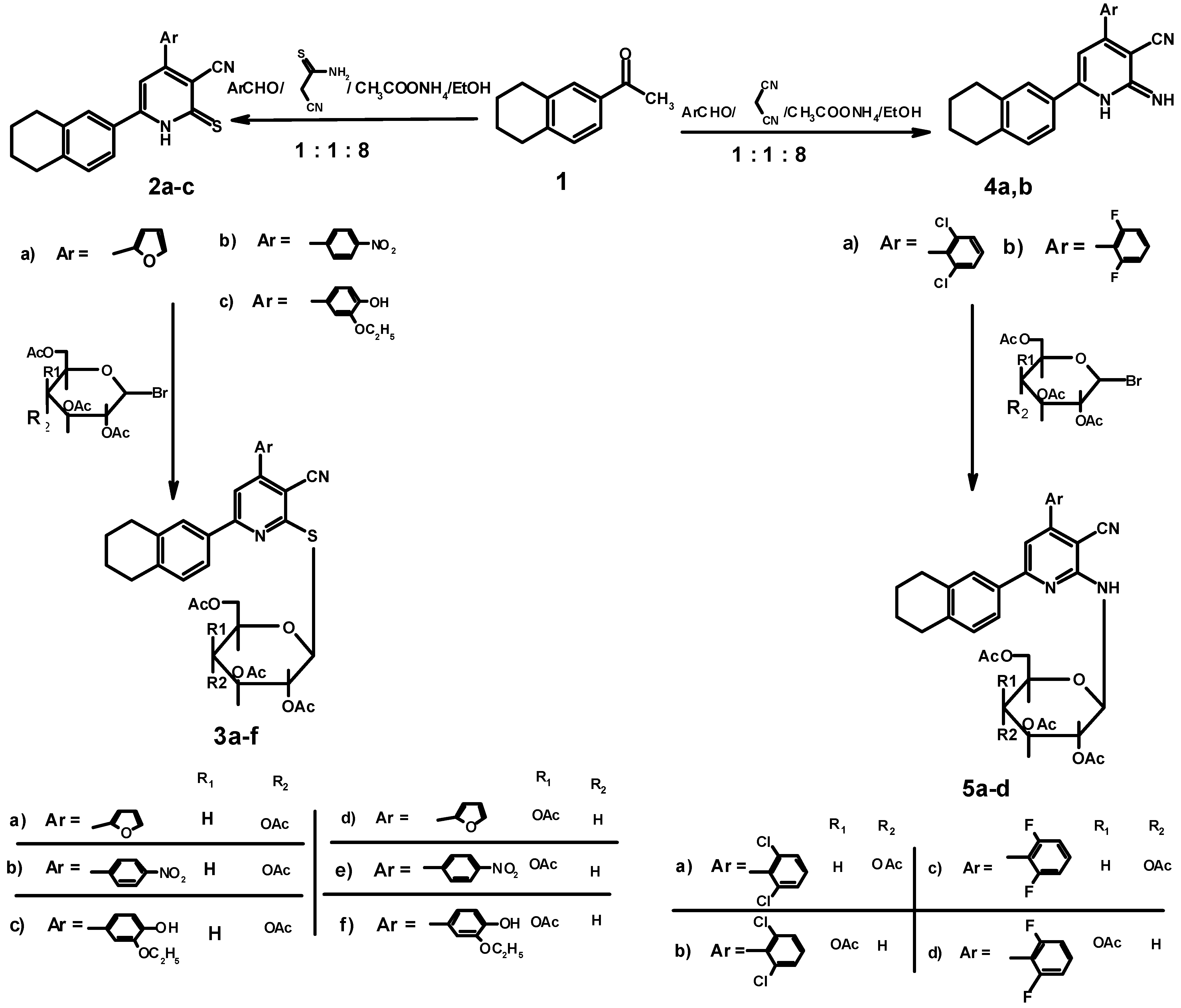
        <p>A series of <italic>S</italic>-glycosides and <italic>N</italic>-glycosides was designed in such a way that they incorporate a tetrahydronaphthalene derivative attached to a glycosyl moiety through a <italic>S</italic>-linkage or <italic>N</italic>-linkage. Synthesis of our desired compounds was achieved by allowing the acetyl derivative 1-(1,2,3,4-tetrahydronaphthaline-6-yl)ethanone (<bold>1</bold>) to react directly with the appropriate aromatic aldehyde and cyanothioacetamide in the presence of ammonium acetate, to afford the corresponding 2-thioxo(1H)pyridines <bold>2a</bold><bold>–c</bold>, respectively (<xref ref-type="scheme" rid="molecules-17-04717-f001">Scheme 1</xref>, <xref ref-type="table" rid="molecules-17-04717-t001">Table 1</xref>). The coupling between the aglycon and the activated cyclic sugars (2',3',4',6'-<italic>O</italic>-acetyl-α-<sc>D</sc>-gluco- (or galato-) pyranosyl bromide was achieved in a basic medium to give the corresponding thioglycoside derivatives <bold>3a–f</bold> in a good yields, respectively (<xref ref-type="scheme" rid="molecules-17-04717-f001">Scheme 1</xref>, <xref ref-type="table" rid="molecules-17-04717-t001">Table 1</xref>). The structures of thioglycosides <bold>3a</bold><bold>–f</bold> were established and confirmed on the basis of their elemental analysis and spectral data (IR, <sup>1</sup>H-NMR, <sup>13</sup>C-NMR and MS, cf. Experimental).</p>
        <fig id="molecules-17-04717-f001" position="anchor">
          <object-id pub-id-type="pii">molecules-17-04717-f001_Scheme 1</object-id>
          <label>Scheme 1</label>
          <caption>
            <p>Synthetic pathways to compounds <bold>2a–c</bold>, <bold>3a–f</bold>, <bold>4a,b</bold> and <bold>5a–d</bold>.</p>
          </caption>
          <graphic xmlns:xlink="http://www.w3.org/1999/xlink" xlink:href="molecules-17-04717-g001.tif"/>
        </fig>
        <table-wrap id="molecules-17-04717-t001" position="anchor">
          <object-id pub-id-type="pii">molecules-17-04717-t001_Table 1</object-id>
          <label>Table 1</label>
          <caption>
            <p>Physicochemical properties of the newly synthesized compounds <bold>2a</bold>, <bold>3a–f</bold>, <bold>5a–d</bold>, <bold>7a</bold>, <bold>7b</bold>, <bold>8a</bold> and <bold>8b</bold>.</p>
          </caption>
          <table rules="cols" style="border:solid thin">
<thead>
              <tr>
                <th style="border-bottom:solid thin" align="center" valign="middle">Comp No.</th>
                <th style="border-bottom:solid thin" align="center" valign="middle">Ar</th>
                <th style="border-bottom:solid thin" align="center" valign="middle">R<sub>1</sub></th>
                <th style="border-bottom:solid thin" align="center" valign="middle">R<sub>2</sub></th>
                <th style="border-bottom:solid thin" align="center" valign="middle">MP (°C)</th>
                <th style="border-bottom:solid thin" align="center" valign="middle">Cryst.Solv.</th>
                <th style="border-bottom:solid thin" align="center" valign="middle">Yield %</th>
                <th style="border-bottom:solid thin" align="center" valign="middle">Molecular Formula (Mol. Wt.)</th>
              </tr>
            </thead>
            <tbody>
              <tr>
                <td align="center" valign="middle">
                  <bold>2a</bold>
                </td>
                <td align="center" valign="middle">-C<sub>4</sub>H<sub>3</sub>O</td>
                <td align="center" valign="middle">---</td>
                <td align="center" valign="middle">---</td>
                <td align="center" valign="middle">245–247</td>
                <td align="center" valign="middle">Ethanol/H<sub>2</sub>O</td>
                <td align="center" valign="middle">80</td>
                <td align="center" valign="middle">C<sub>20</sub>H<sub>16</sub>N<sub>2</sub>OS (332)</td>
              </tr>
              <tr>
                <td align="center" valign="middle">
                  <bold>3a</bold>
                </td>
                <td align="center" valign="middle">-C<sub>4</sub>H<sub>3</sub>O</td>
                <td align="center" valign="middle">H</td>
                <td align="center" valign="middle">OAc</td>
                <td align="center" valign="middle">194–196</td>
                <td align="center" valign="middle">Ethanol/H<sub>2</sub>O</td>
                <td align="center" valign="middle">76</td>
                <td align="center" valign="middle">C<sub>34</sub>H<sub>34</sub>N<sub>2</sub>O<sub>10</sub>S (662)</td>
              </tr>
              <tr>
                <td align="center" valign="middle">
                  <bold>3b</bold>
                </td>
                <td align="center" valign="middle">4-NO<sub>2-</sub>C<sub>6</sub>H<sub>5</sub></td>
                <td align="center" valign="middle">H</td>
                <td align="center" valign="middle">OAc</td>
                <td align="center" valign="middle">172–174</td>
                <td align="center" valign="middle">Ethanol/H<sub>2</sub>O</td>
                <td align="center" valign="middle">75</td>
                <td align="center" valign="middle">C<sub>36</sub>H<sub>35</sub>N<sub>3</sub>O<sub>11</sub>S (717)</td>
              </tr>
              <tr>
                <td align="center" valign="middle">
                  <bold>3c</bold>
                </td>
                <td align="center" valign="middle">3-EtO,4-OH-C<sub>6</sub>H<sub>4</sub></td>
                <td align="center" valign="middle">H</td>
                <td align="center" valign="middle">OAc</td>
                <td align="center" valign="middle">118–120</td>
                <td align="center" valign="middle">Ethanol/H<sub>2</sub>O</td>
                <td align="center" valign="middle">68</td>
                <td align="center" valign="middle">C<sub>38</sub>H<sub>40</sub>N<sub>2</sub>O<sub>11</sub>S (732)</td>
              </tr>
              <tr>
                <td align="center" valign="middle">
                  <bold>3d</bold>
                </td>
                <td align="center" valign="middle">-C<sub>4</sub>H<sub>3</sub>O</td>
                <td align="center" valign="middle">OAc</td>
                <td align="center" valign="middle">H</td>
                <td align="center" valign="middle">215–217</td>
                <td align="center" valign="middle">Ethanol/H<sub>2</sub>O</td>
                <td align="center" valign="middle">75</td>
                <td align="center" valign="middle">C<sub>34</sub>H<sub>34</sub>N<sub>2</sub>O<sub>10</sub>S (662)</td>
              </tr>
              <tr>
                <td align="center" valign="middle">
                  <bold>3e</bold>
                </td>
                <td align="center" valign="middle">4-NO<sub>2-</sub>C<sub>6</sub>H<sub>5</sub></td>
                <td align="center" valign="middle">OAc</td>
                <td align="center" valign="middle">H</td>
                <td align="center" valign="middle">140–142</td>
                <td align="center" valign="middle">Ethanol/H<sub>2</sub>O</td>
                <td align="center" valign="middle">76</td>
                <td align="center" valign="middle">C<sub>36</sub>H<sub>35</sub>N<sub>3</sub>O<sub>11</sub>S (717)</td>
              </tr>
              <tr>
                <td align="center" valign="middle">
                  <bold>3f</bold>
                </td>
                <td align="center" valign="middle">3-EtO-4-OH-C<sub>6</sub>H<sub>4</sub></td>
                <td align="center" valign="middle">OAc</td>
                <td align="center" valign="middle">H</td>
                <td align="center" valign="middle">175–177</td>
                <td align="center" valign="middle">Ethanol/H<sub>2</sub>O</td>
                <td align="center" valign="middle">79</td>
                <td align="center" valign="middle">C<sub>38</sub>H<sub>40</sub>N<sub>2</sub>O<sub>11</sub>S (732)</td>
              </tr>
              <tr>
                <td align="center" valign="middle">
                  <bold>5a</bold>
                </td>
                <td align="center" valign="middle">2,6-Cl<sub>2</sub>-C<sub>6</sub>H<sub>4</sub></td>
                <td align="center" valign="middle">H</td>
                <td align="center" valign="middle">OAc</td>
                <td align="center" valign="middle">192–194</td>
                <td align="center" valign="middle">Ethanol/H<sub>2</sub>O</td>
                <td align="center" valign="middle">65</td>
                <td align="center" valign="middle">C<sub>36</sub>H<sub>35</sub>Cl<sub>2</sub>N<sub>3</sub>O<sub>9</sub> (724)</td>
              </tr>
              <tr>
                <td align="center" valign="middle">
                  <bold>5b</bold>
                </td>
                <td align="center" valign="middle">2,6-Cl<sub>2</sub>-C<sub>6</sub>H<sub>4</sub></td>
                <td align="center" valign="middle">OAc</td>
                <td align="center" valign="middle">H</td>
                <td align="center" valign="middle">205–207</td>
                <td align="center" valign="middle">Ethanol/H<sub>2</sub>O</td>
                <td align="center" valign="middle">70</td>
                <td align="center" valign="middle">C<sub>36</sub>H<sub>35</sub>Cl<sub>2</sub>N<sub>3</sub>O<sub>9</sub> (724)</td>
              </tr>
              <tr>
                <td align="center" valign="middle">
                  <bold>5c</bold>
                </td>
                <td align="center" valign="middle">2,6-F<sub>2</sub>-C<sub>6</sub>H<sub>4</sub></td>
                <td align="center" valign="middle">H</td>
                <td align="center" valign="middle">OAc</td>
                <td align="center" valign="middle">107–109</td>
                <td align="center" valign="middle">Ethanol/H<sub>2</sub>O</td>
                <td align="center" valign="middle">66</td>
                <td align="center" valign="middle">C<sub>36</sub>H<sub>35</sub>F<sub>2</sub>N<sub>3</sub>O<sub>9</sub> (691)</td>
              </tr>
              <tr>
                <td align="center" valign="middle">
                  <bold>5d</bold>
                </td>
                <td align="center" valign="middle">2,6-F<sub>2</sub>-C<sub>6</sub>H<sub>4</sub></td>
                <td align="center" valign="middle">OAc</td>
                <td align="center" valign="middle">H</td>
                <td align="center" valign="middle">132–134</td>
                <td align="center" valign="middle">Ethanol/H<sub>2</sub>O</td>
                <td align="center" valign="middle">72</td>
                <td align="center" valign="middle">C<sub>36</sub>H<sub>35</sub>F<sub>2</sub>N<sub>3</sub>O<sub>9</sub> (691)</td>
              </tr>
              <tr>
                <td align="center" valign="middle">
                  <bold>7a</bold>
                </td>
                <td align="center" valign="middle">2,6-Cl<sub>2</sub>-C<sub>6</sub>H<sub>4</sub></td>
                <td align="center" valign="middle">---</td>
                <td align="center" valign="middle">---</td>
                <td align="center" valign="middle">180–182</td>
                <td align="center" valign="middle">Ethanol/H<sub>2</sub>O</td>
                <td align="center" valign="middle">95</td>
                <td align="center" valign="middle">C<sub>22</sub>H<sub>18</sub>C<sub>l2</sub>N<sub>2</sub>O<sub>2</sub> (413)</td>
              </tr>
              <tr>
                <td align="center" valign="middle">
                  <bold>7b</bold>
                </td>
                <td align="center" valign="middle">2,6-F<sub>2</sub>-C<sub>6</sub>H<sub>4</sub></td>
                <td align="center" valign="middle">---</td>
                <td align="center" valign="middle">---</td>
                <td align="center" valign="middle">170–172</td>
                <td align="center" valign="middle">Ethanol/H<sub>2</sub>O</td>
                <td align="center" valign="middle">92</td>
                <td align="center" valign="middle">C<sub>22</sub>H<sub>18</sub>F<sub>2</sub>N<sub>2</sub>O<sub>2</sub> (380)</td>
              </tr>
              <tr>
                <td align="center" valign="middle">
                  <bold>8a</bold>
                </td>
                <td align="center" valign="middle">2,6-Cl<sub>2</sub>-C<sub>6</sub>H<sub>4</sub></td>
                <td align="center" valign="middle">OAc</td>
                <td align="center" valign="middle">H</td>
                <td align="center" valign="middle">230–232</td>
                <td align="center" valign="middle">Ethanol/H<sub>2</sub>O</td>
                <td align="center" valign="middle">86</td>
                <td align="center" valign="middle">C<sub>36</sub>H<sub>36</sub>Cl<sub>2</sub>N<sub>2</sub>O<sub>11</sub> (743)</td>
              </tr>
              <tr>
                <td align="center" valign="middle">
                  <bold>8b</bold>
                </td>
                <td align="center" valign="middle">2,6-F<sub>2</sub>-C<sub>6</sub>H<sub>4</sub></td>
                <td align="center" valign="middle">OAc</td>
                <td align="center" valign="middle">H</td>
                <td align="center" valign="middle">155–157</td>
                <td align="center" valign="middle">Ethanol/H<sub>2</sub>O</td>
                <td align="center" valign="middle">85</td>
                <td align="center" valign="middle">C<sub>36</sub>H<sub>36</sub>F<sub>2</sub>N<sub>2</sub>O<sub>11</sub> (710)</td>
              </tr>
            </tbody>
          </table>
        </table-wrap>
        <p>Also, one-step synthesis of 2-imino (1H)pyridines <bold>4a,b</bold> was accomplished by heating the acetyl derivative <bold>1</bold> with malononitrile and the appropriate aldehyde in the presence of ammonium acetate (<xref ref-type="scheme" rid="molecules-17-04717-f001">Scheme 1</xref>, <xref ref-type="table" rid="molecules-17-04717-t001">Table 1</xref>). The authors used these intermediate aglycones for the preparation of the new glycosides <bold>5a–d</bold> (<xref ref-type="scheme" rid="molecules-17-04717-f001">Scheme 1</xref>, <xref ref-type="table" rid="molecules-17-04717-t001">Table 1</xref>). The formation of <italic>N</italic>-glycosides <bold>5a–d</bold> was proven using spectral data (IR, <sup>1</sup>H-NMR, <sup>13</sup>C-NMR and MS).</p>
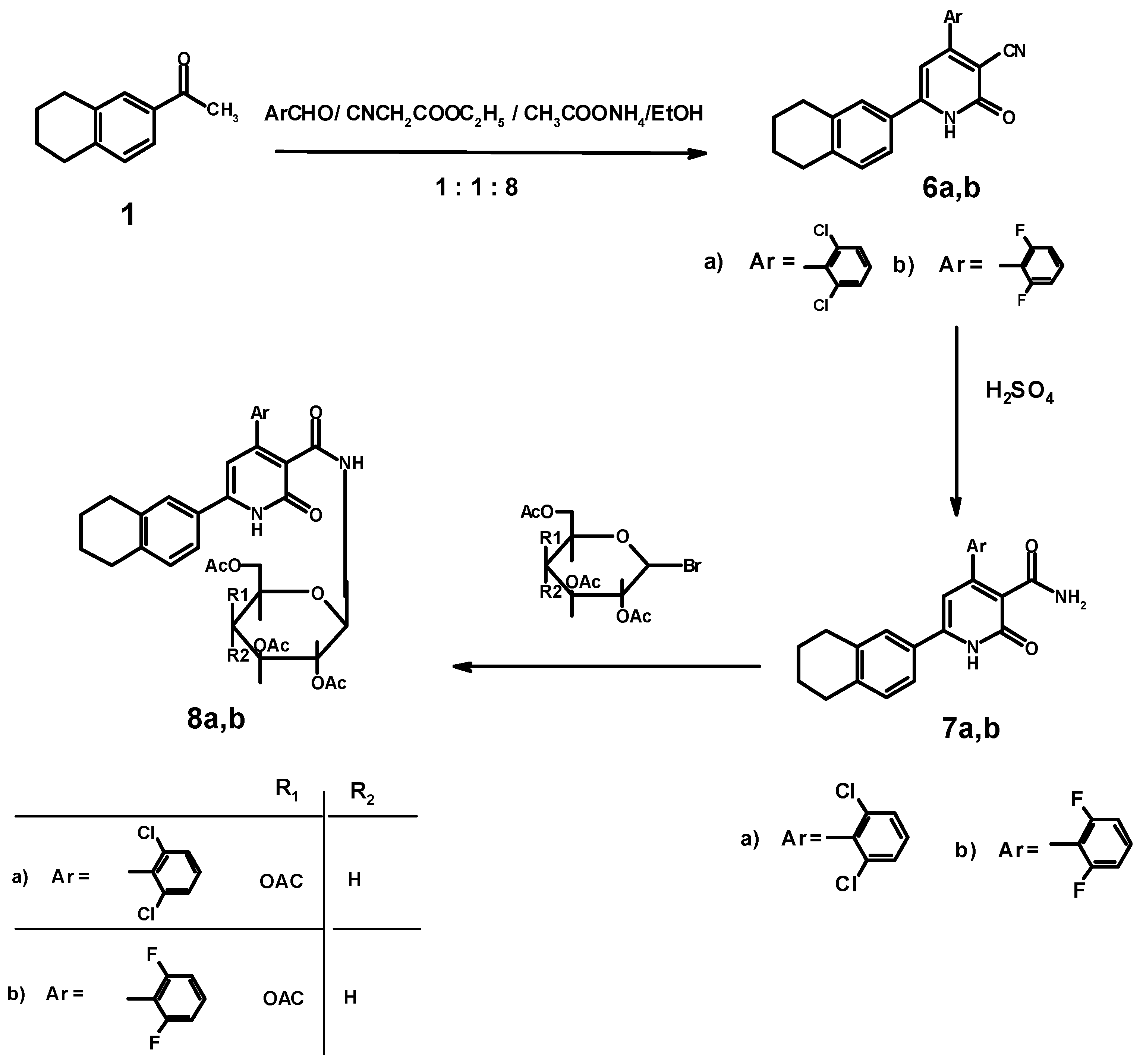
        <p>On the other hand, the one pot reaction of compound <bold>1</bold> with the appropriate aromatic aldehyde and ethyl cyanoacetate in the presence of ammonium acetate, afforded the corresponding pyridones <bold>6a,b</bold>, respectively (<xref ref-type="scheme" rid="molecules-17-04717-f002">Scheme 2</xref>, <xref ref-type="table" rid="molecules-17-04717-t001">Table 1</xref>). Hydrolysis of <bold>6a,b</bold> in the presence of conc. sulphuric acid afforded the amide derivatives <bold>7a,b</bold> in good yield. Finally the coupling between the aglycons <bold>7a,b</bold> and the activated cyclic sugar 2',3',4',6'-tetra-<italic>O</italic>-α-<sc>D</sc>-galactopyranosyl bromide gave the corresponding <italic>N</italic>-glycosides <bold>8a,b</bold> in a good yield respectively. The structures of <italic>N</italic>-glycosides <bold>8a,b</bold> were established and confirmed for the reaction products on the basis of their spectral data.</p>
        <fig id="molecules-17-04717-f002" position="anchor">
          <object-id pub-id-type="pii">molecules-17-04717-f002_Scheme 2</object-id>
          <label>Scheme 2</label>
          <caption>
            <p>Synthetic pathways to compounds <bold>6a,b</bold>, <bold>7a,b</bold> and <bold>8a,b</bold>.</p>
          </caption>
          <graphic xmlns:xlink="http://www.w3.org/1999/xlink" xlink:href="molecules-17-04717-g002.tif"/>
        </fig>
      </sec>
      <sec>
        <title>2.2. Molecular Modeling Study</title>
        <sec>
          <title>Docking Using Autodock Vina</title>
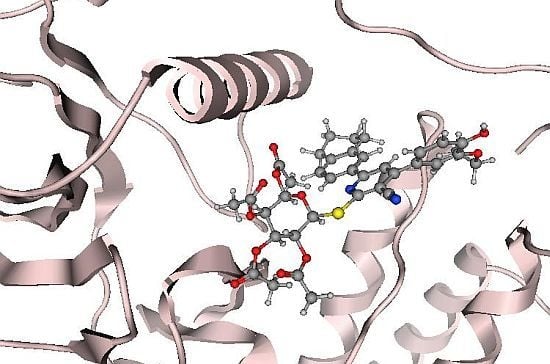
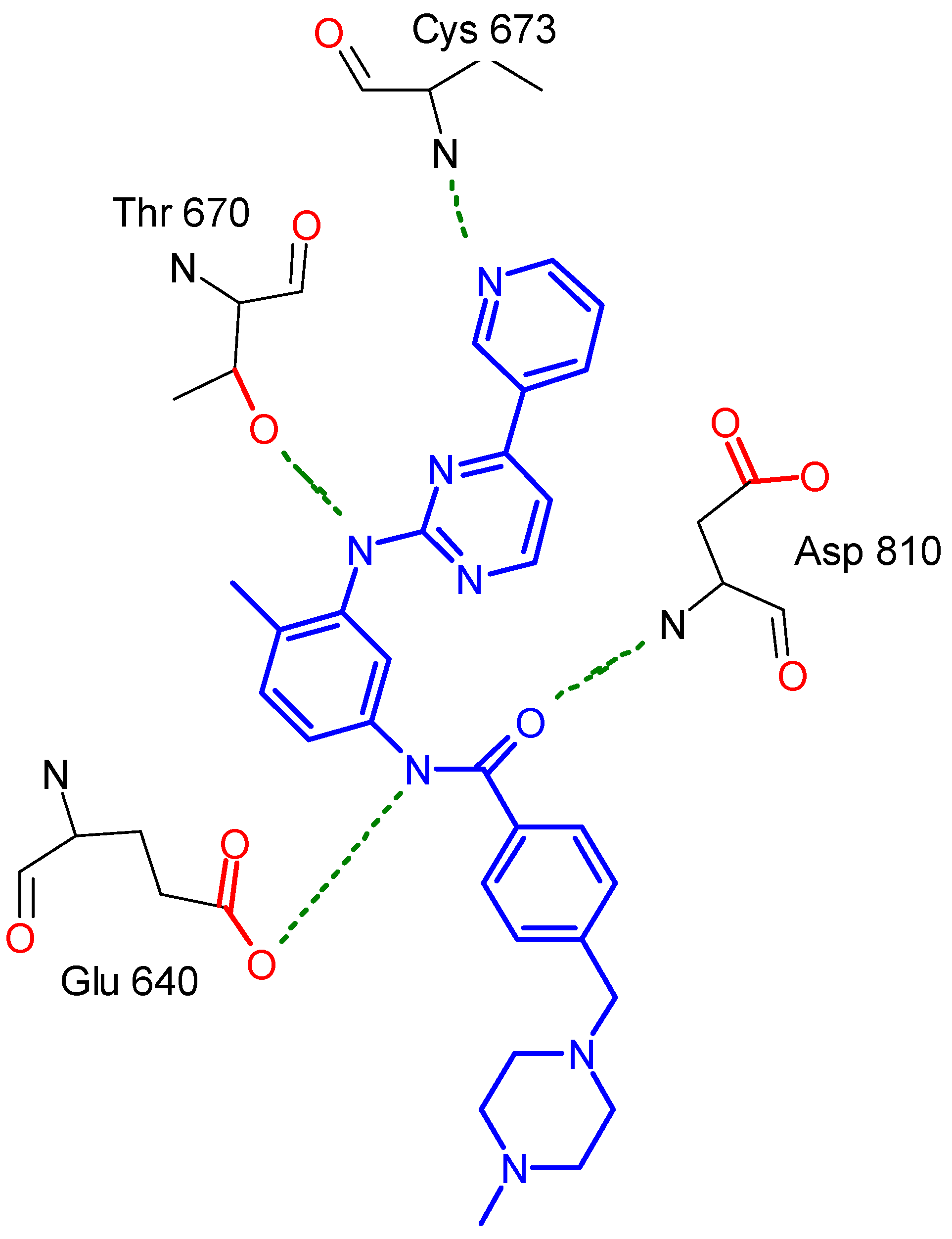
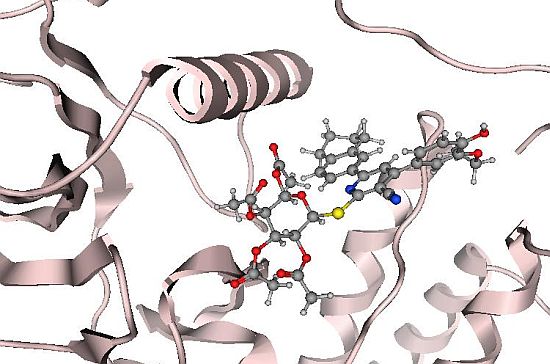
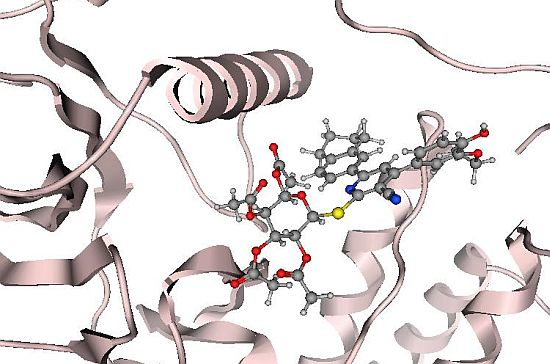
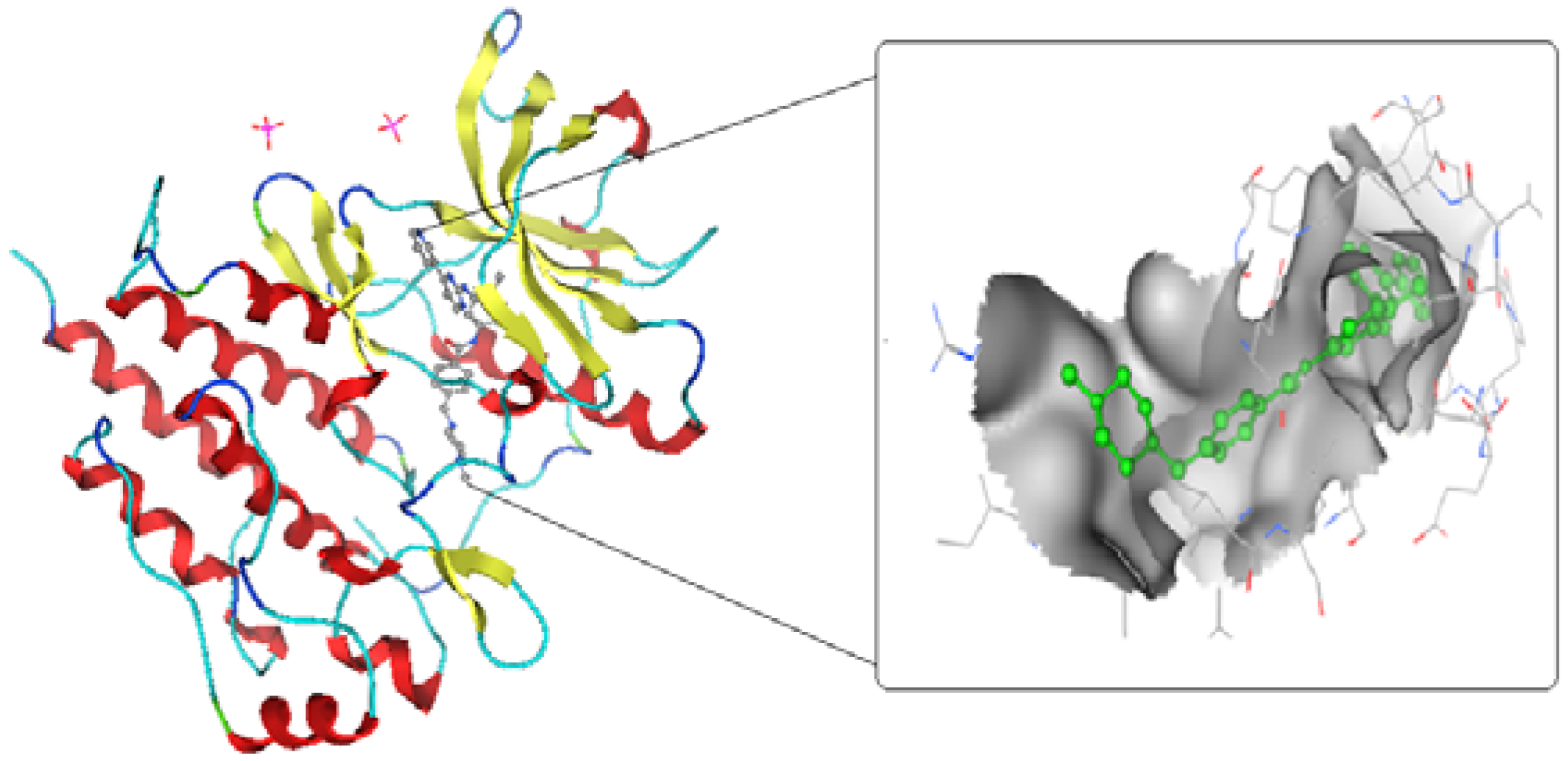
          <p>The tyrosine kinase (TK) crystal structure (PBD code = 1t46) was downloaded (<xref ref-type="fig" rid="molecules-17-04717-f003">Figure 1</xref>). In order to find the important residues that form interactions with that inhibitor, the pdbsum server was used. It was found that Cys 673, Thr 670, Glu 640 and Asp 810 formed some interactions with different moieties of the inhibitor (<xref ref-type="fig" rid="molecules-17-04717-f004">Figure 2</xref>).</p>
          <fig id="molecules-17-04717-f003" position="anchor">
            <label>Figure 1</label>
            <caption>
              <p>Showing the active site at which the inhibitor complexed.</p>
            </caption>
            <graphic xmlns:xlink="http://www.w3.org/1999/xlink" xlink:href="molecules-17-04717-g003.tif"/>
          </fig>
          <fig id="molecules-17-04717-f004" position="anchor">
            <label>Figure 2</label>
            <caption>
              <p>A representation image simulating the interactions that was found in pdbsum, showing the most visible interactions that were formed with the complexed ligand.</p>
            </caption>
            <graphic xmlns:xlink="http://www.w3.org/1999/xlink" xlink:href="molecules-17-04717-g004.tif"/>
          </fig>
          <p>The affinity of any small molecule can be considered to be a unique tool in the field of drug design, as there is a relationship between the affinity of organic molecules and the free binding energy and this can contribute in prediction and interpretation of the activity of organic compounds toward a specific target protein. Here we used the Autodock Vina [<xref ref-type="bibr" rid="B25-molecules-17-04717">25</xref>,<xref ref-type="bibr" rid="B26-molecules-17-04717">26</xref>] program for docking and to obtain the affinities and RMSD (root mean square deviation) of all compounds.</p>
          <p>The most visible feature that was observed in the docking output that all compounds fitted well inside the same docking site and hence, the next step was to compare their affinities and try to rank them as observed in the previous table and then to measure the ligands’ interaction to find out which ones interact well and correlate that to the activity.</p>
          <p>The six compounds with the highest calculated affinities were found to be compounds <bold>7b</bold>, <bold>3f</bold>, <bold>5c</bold>, <bold>5b</bold>, <bold>3c</bold> and <bold>7a</bold>, respectively (−11.6, −11.4, −11.2, −11.0, −10.7 and −10.3 Kcal/mol). Compounds <bold>3c</bold> and <bold>7b</bold> were found to have low RMSD values that reflect their better fit as they were expected to have a conformation with a low deviation from the expected best binding mode. No clear correlation between the biological activity and the calculated affinity was observed. The only observation that was found that the active compounds have the best affinities regardless of their ranking in activity.</p>
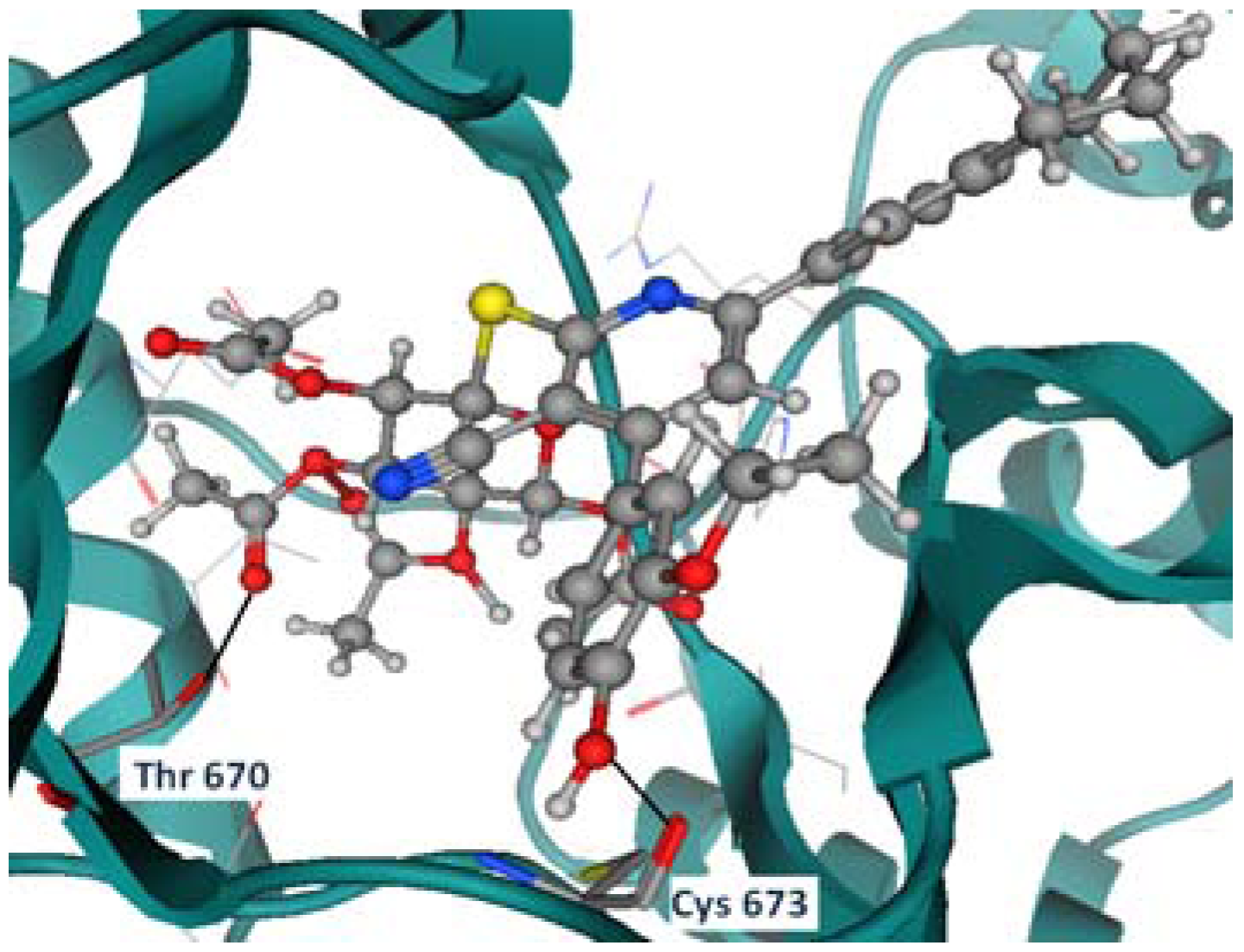
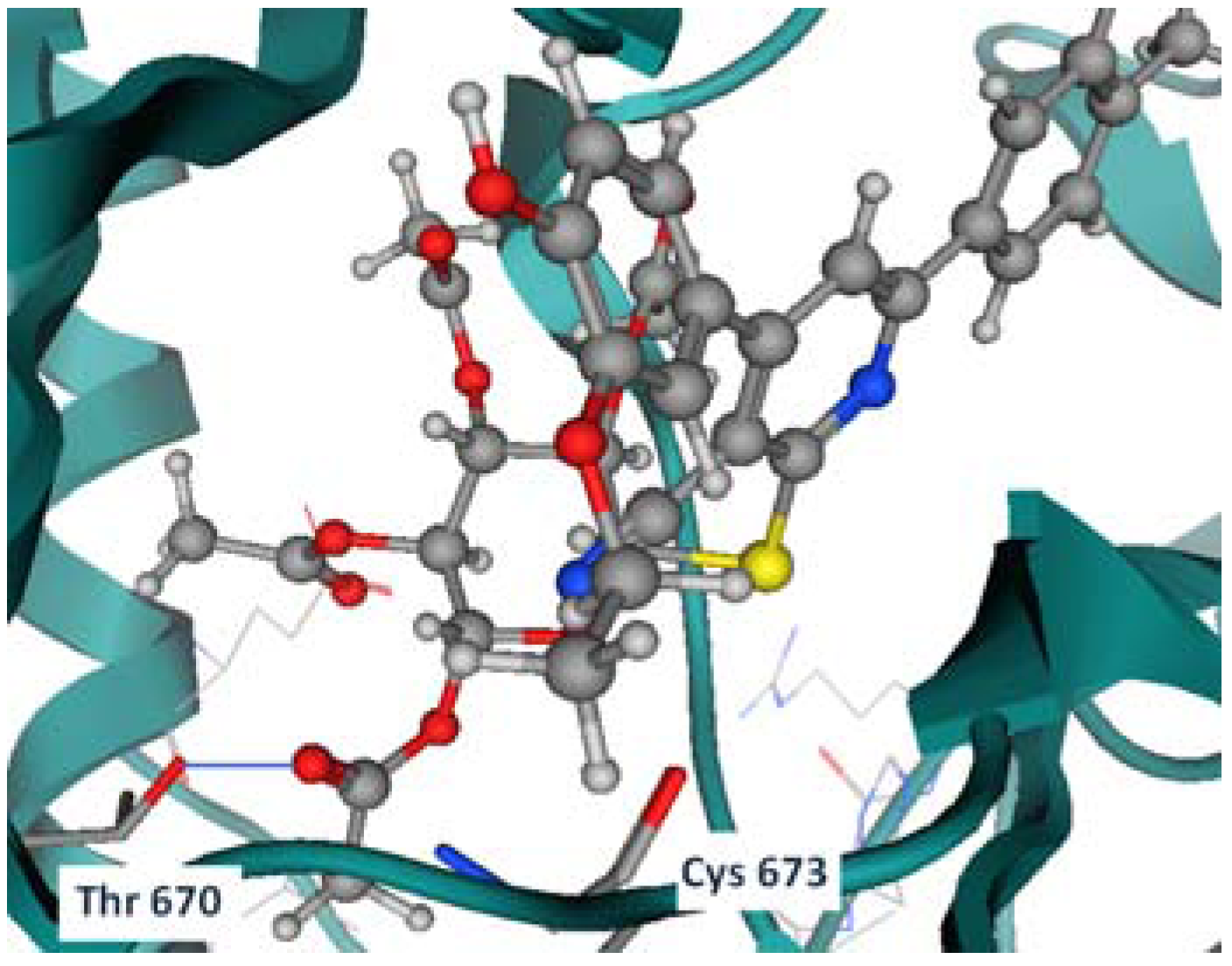
          <p>Regarding the best mode of interaction for each compound of these six compounds, the docking output was visualized to determine these interactions. It was important to concentrate on the previously mentioned residues (Cys 673, Thr 670, Glu 640 and Asp 810) whether they were involved in these interactions or not. For compound <bold>3c</bold> THR 670 (<xref ref-type="fig" rid="molecules-17-04717-f005">Figure 3</xref>) was the major residue for making hydrogen bond with one of the acetyl groups found in the side chains of this compound.</p>
          <fig id="molecules-17-04717-f005" position="anchor">
            <label>Figure 3</label>
            <caption>
              <p>Compound <bold>3c</bold> showing hydrogen bond with Thr 670 with the -CH<sub>3</sub>CO of the compound.</p>
            </caption>
            <graphic xmlns:xlink="http://www.w3.org/1999/xlink" xlink:href="molecules-17-04717-g005.tif"/>
          </fig>
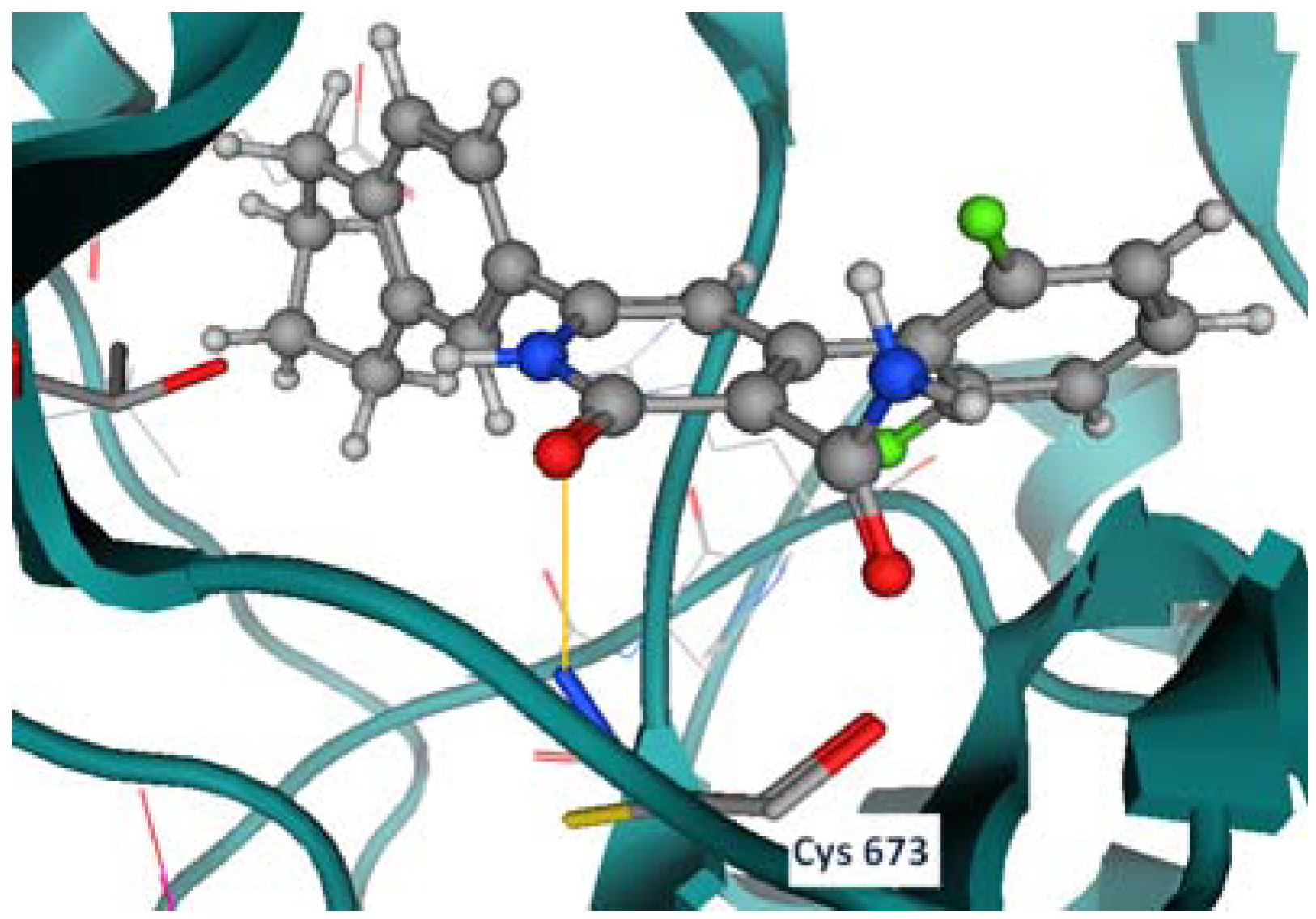
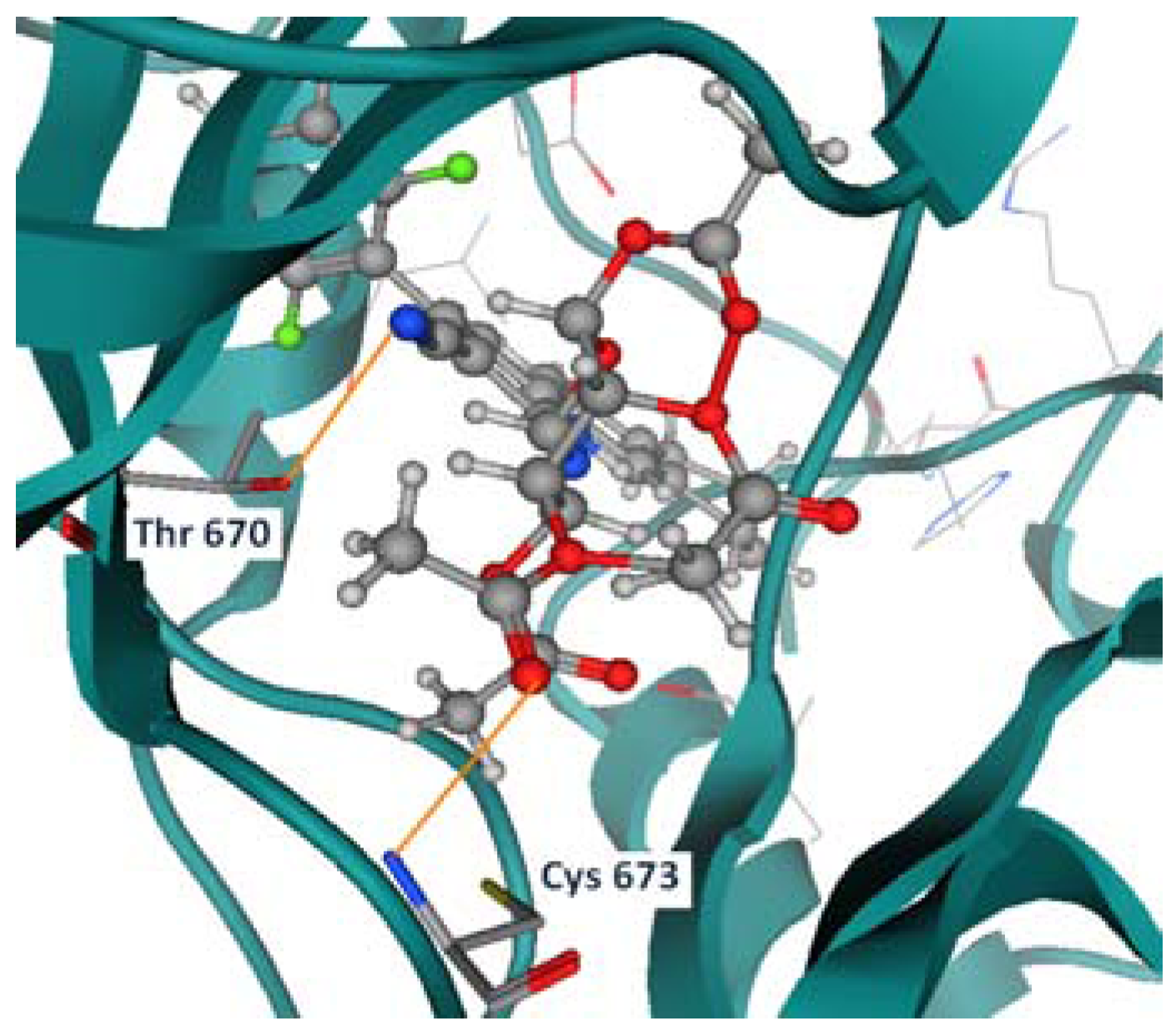
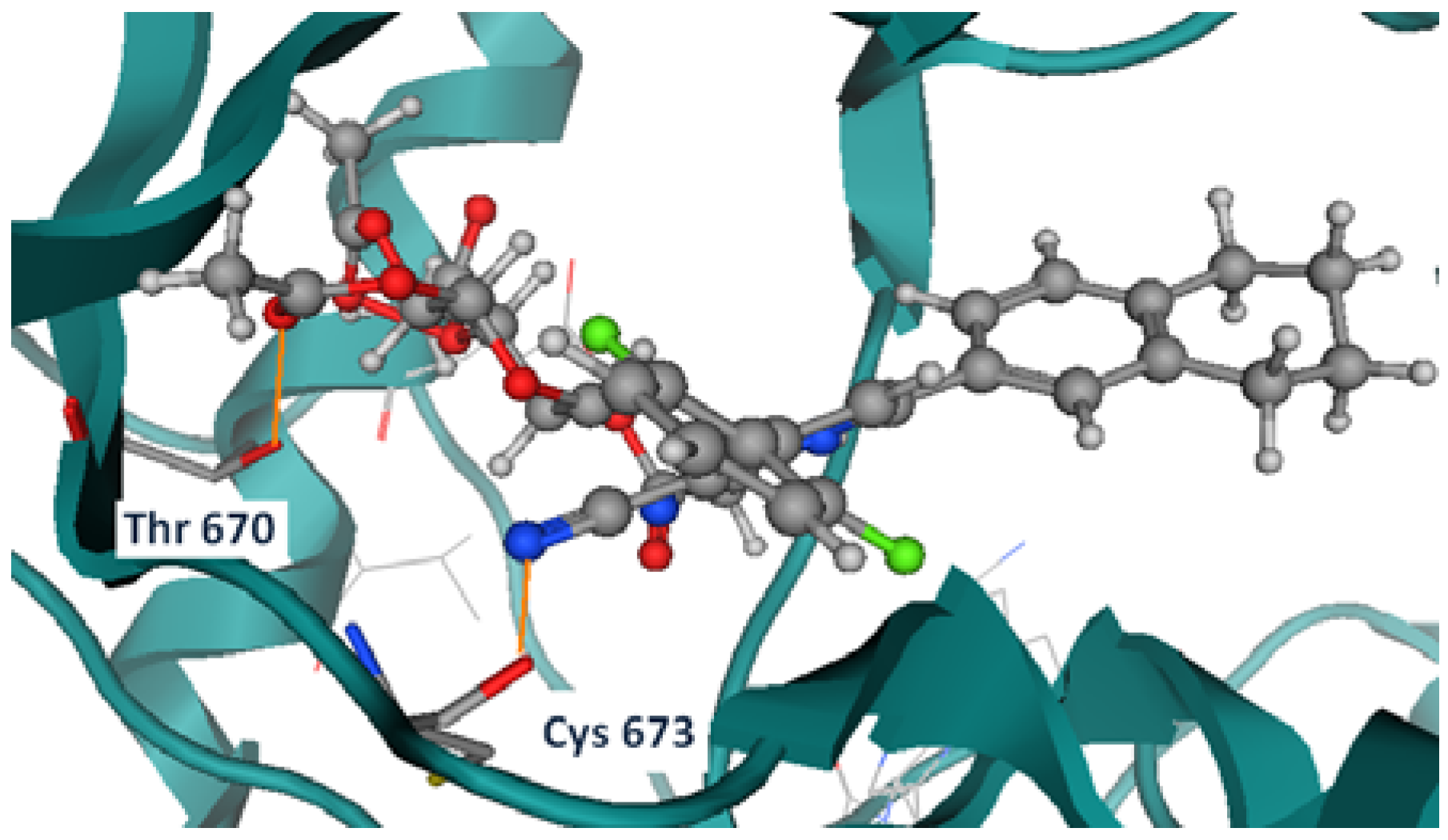
          <p>Compound <bold>3f</bold> shows two hydrogen bonds with Thr 670 and Cys 673 (<xref ref-type="fig" rid="molecules-17-04717-f006">Figure 4</xref>). Compounds <bold>5c</bold>, <bold>5b</bold>, and <bold>7b</bold> have shown the same hydrogen bond with the previously mentioned residues as well (Thr 670, and Cys 673), as shown in <xref ref-type="fig" rid="molecules-17-04717-f007">Figure 5</xref>, <xref ref-type="fig" rid="molecules-17-04717-f008">Figure 6</xref>, <xref ref-type="fig" rid="molecules-17-04717-f009">Figure 7</xref>.</p>
          <fig id="molecules-17-04717-f006" position="anchor">
            <label>Figure 4</label>
            <caption>
              <p>Compound <bold>3f</bold> hydrogen bond formation with Thr 670 and Cys 673.</p>
            </caption>
            <graphic xmlns:xlink="http://www.w3.org/1999/xlink" xlink:href="molecules-17-04717-g006.tif"/>
          </fig>
          <fig id="molecules-17-04717-f007" position="anchor">
            <label>Figure 5</label>
            <caption>
              <p>Compound <bold>5c</bold> hydrogen bond formation with Thr 670 and Cys 673.</p>
            </caption>
            <graphic xmlns:xlink="http://www.w3.org/1999/xlink" xlink:href="molecules-17-04717-g007.tif"/>
          </fig>
          <fig id="molecules-17-04717-f008" position="anchor">
            <label>Figure 6</label>
            <caption>
              <p>Compound <bold>5b</bold> hydrogen bond formation with Thr 670 and Cys 673.</p>
            </caption>
            <graphic xmlns:xlink="http://www.w3.org/1999/xlink" xlink:href="molecules-17-04717-g008.tif"/>
          </fig>
          <fig id="molecules-17-04717-f009" position="anchor">
            <label>Figure 7</label>
            <caption>
              <p>Compound <bold>7b</bold> hydrogen bond formation with Cys 673.</p>
            </caption>
            <graphic xmlns:xlink="http://www.w3.org/1999/xlink" xlink:href="molecules-17-04717-g009.tif"/>
          </fig>
        </sec>
      </sec>
      <sec>
        <title>2.3. <italic>In Vitro</italic> Cytotoxic Screening</title>
        <p>Some of the newly synthesized compounds were tested at the Department of Tumor Pathology, National Cancer Institute, Cairo, Egypt. Ehrlich Ascites Carcinoma (EAC) cells were used for cytotoxic activity screening. The selected synthesized analogues <bold>2b</bold>, <bold>3a–f</bold>, <bold>5b</bold>, <bold>5c</bold>, <bold>7a</bold> and <bold>7b</bold> were tested for <italic>in vitro</italic> cytotoxic activity at two different concentrations. The results (<xref ref-type="table" rid="molecules-17-04717-t002">Table 2</xref>) are expressed in the form of the percentage of non-viable cells [<xref ref-type="bibr" rid="B27-molecules-17-04717">27</xref>]. The <italic>in vitro </italic>evaluation revealed that <bold>3c</bold>, <bold>3f</bold>, <bold>5c</bold> and <bold>7b</bold> show promising activity. This provides a new class of antitumor agents for further biological evaluation.</p>
        <table-wrap id="molecules-17-04717-t002" position="anchor">
          <object-id pub-id-type="pii">molecules-17-04717-t002_Table 2</object-id>
          <label>Table 2</label>
          <caption>
            <p>The effect of the tested compounds on the viability of tumor cell <italic>in vitro</italic>. The calculated affinities and RMSD for some of the newly synthesized compounds.</p>
          </caption>
          <table rules="cols" style="border:solid thin">
<thead>
              <tr>
                <th rowspan="2" style="border-bottom:solid thin" align="center" valign="middle">Compound</th>
                <th colspan="2" style="border-bottom:solid thin" align="center" valign="middle">Anticancer effect % inhibition of cell viability</th>
                <th rowspan="2" style="border-bottom:solid thin" align="center" valign="middle">Affinity Kcal/mol</th>
                <th rowspan="2" style="border-bottom:solid thin" align="center" valign="middle">RMSD Deviation from best mode</th>
    </tr>
              <tr>
                <th style="border-bottom:solid thin" align="center" valign="middle">100 µg/mL</th>
                <th style="border-bottom:solid thin" align="center" valign="middle">50 µg/mL</th>
    </tr>
            </thead>
            <tbody>
              <tr>
                <td align="center" valign="middle">
                  <bold>2b</bold>
                </td>
                <td align="center" valign="middle">0</td>
                <td align="center" valign="middle">0</td>
                <td align="center" valign="middle">−9.5</td>
                <td align="center" valign="middle">7.07</td>
              </tr>
              <tr>
                <td align="center" valign="middle">
                  <bold>3a</bold>
                </td>
                <td align="center" valign="middle">0</td>
                <td align="center" valign="middle">0</td>
                <td align="center" valign="middle">−8.3</td>
                <td align="center" valign="middle">9.5</td>
              </tr>
              <tr>
                <td align="center" valign="middle">
                  <bold>3b</bold>
                </td>
                <td align="center" valign="middle">0</td>
                <td align="center" valign="middle">0</td>
                <td align="center" valign="middle">−7.7</td>
                <td align="center" valign="middle">11.6</td>
              </tr>
              <tr>
                <td align="center" valign="middle">
                  <bold>3c</bold>
                </td>
                <td align="center" valign="middle">70%</td>
                <td align="center" valign="middle">50%</td>
                <td align="center" valign="middle">−10.7</td>
                <td align="center" valign="middle">4.02</td>
              </tr>
              <tr>
                <td align="center" valign="middle">
                  <bold>3d</bold>
                </td>
                <td align="center" valign="middle">0</td>
                <td align="center" valign="middle">0</td>
                <td align="center" valign="middle">−6.6</td>
                <td align="center" valign="middle">10.3</td>
              </tr>
              <tr>
                <td align="center" valign="middle">
                  <bold>3e</bold>
                </td>
                <td align="center" valign="middle">0</td>
                <td align="center" valign="middle">0</td>
                <td align="center" valign="middle">−7.4</td>
                <td align="center" valign="middle">9.2</td>
              </tr>
              <tr>
                <td align="center" valign="middle">
                  <bold>3f</bold>
                </td>
                <td align="center" valign="middle">10%</td>
                <td align="center" valign="middle">0</td>
                <td align="center" valign="middle">−11.4</td>
                <td align="center" valign="middle">9.0</td>
              </tr>
              <tr>
                <td align="center" valign="middle">
                  <bold>5b</bold>
                </td>
                <td align="center" valign="middle">0</td>
                <td align="center" valign="middle">0</td>
                <td align="center" valign="middle">−11.0</td>
                <td align="center" valign="middle">9.3</td>
              </tr>
              <tr>
                <td align="center" valign="middle">
                  <bold>5c</bold>
                </td>
                <td align="center" valign="middle">40%</td>
                <td align="center" valign="middle">7%</td>
                <td align="center" valign="middle">−11.2</td>
                <td align="center" valign="middle">9.5</td>
              </tr>
              <tr>
                <td align="center" valign="middle">
                  <bold>7a</bold>
                </td>
                <td align="center" valign="middle">0</td>
                <td align="center" valign="middle">0</td>
                <td align="center" valign="middle">−10.3</td>
                <td align="center" valign="middle">7.2</td>
              </tr>
              <tr>
                <td align="center" valign="middle">
                  <bold>7b</bold>
                </td>
                <td align="center" valign="middle">20%</td>
                <td align="center" valign="middle">15%</td>
                <td align="center" valign="middle">−11.6</td>
                <td align="center" valign="middle">4.6</td>
              </tr>
            </tbody>
          </table>
        </table-wrap>
      </sec>
    </sec>
    <sec sec-type="methods">
      <title>3. Experimental</title>
      <sec>
        <title>3.1. Chemistry</title>
        <sec>
          <title>3.1.1. General</title>
          <p>Melting points (°C, uncorrected) were determined in open glass capillaries using a Barnstead 9001 Electrothermal melting point apparatus. Infrared (IR) spectra were recorded on a Perkin Elmer FT-IR Spectrum BX Spectrometer at cm<sup>−1</sup> scale using KBr discs. <sup>1</sup>H-NMR and <sup>13</sup>C-NMR were recorded on a JEOL 300 MHz Spectrometer; chemical shifts are expressed in δ (ppm) with reference to TMS. The mass spectra were run at 70 ev with Packard 5890 Thewlett GC/MS Spectrometer, using the Electron Ionization (EI) technique. Elemental analyses (C, H, N) were carried out at the Microanalytical Data Center, Faculty of Science, Cairo, Egypt, and were in full agreement with the proposed structures within ±0.4% of the theoretical values. Thin layer chromatography was performed on precoated (0.75 mm) silica gel GF254 plates (E. Merck, Germany). Visualization was performed by illumination with UV light source (254 nm). Compounds <bold>2b</bold>, <bold>2c</bold>, <bold>4a</bold>, <bold>4b</bold>, <bold>6a</bold> and <bold>6b</bold> were prepared using the previously published procedures [<xref ref-type="bibr" rid="B10-molecules-17-04717">10</xref>] and [<xref ref-type="bibr" rid="B11-molecules-17-04717">11</xref>] as described below (<xref ref-type="scheme" rid="molecules-17-04717-f001">Scheme 1</xref> and <xref ref-type="scheme" rid="molecules-17-04717-f002">Scheme 2</xref>).</p>
        </sec>
        <sec>
          <title>3.1.2. Synthesis of <italic>4-Aryl-6-(1,2,3,4-tetrahydronaphthalen-6-yl)-2-thioxo-1,2-dihydropyridine-3-carbonitriles</italic> <bold>2a–c</bold></title>
          <p>A mixture of 6-acetyltetraline <bold>1</bold> (0.3 g, 0.0017 mol), 2-cyanothioacetamide (0.17 g, 0.0017 mol), the an appropriate aromatic aldehyde, namely 2-furfural, <italic>p</italic>-nitrobenzaldehyde, and/or 3-ethoxy-4-hydroxybenzaldehyde (0.00172 mol) and excess ammonium acetate (1.05 g, 0.0137 mol) was gently refluxed in absolute ethanol (15 mL) for 3–8 h. On cooling, the separated solid was filtered off, washed successively with water, and then with ether and recrystallized with aqueous ethanol to give <bold>2a–c</bold> respectively (<xref ref-type="table" rid="molecules-17-04717-t001">Table 1</xref>).</p>
          <p><italic>4-(Furan-2-yl)-6-(1,2,3,4-tetrahydronaphthalen-6-yl)-2-thioxo)-1,2-dihydropyridine-3-carbonitrile</italic> (<bold>2a</bold>). IR: (υ, cm<sup>−1</sup>) 3,300 (NH), 2,200 (CN) and 1,206 (C-O). <sup>1</sup>H-NMR (DMSO-d<sub>6</sub>): δ 1.76 (m, 4H, -CH<sub>2</sub>-CH<sub>2</sub>-), 2.78 [m, 4H, 2(CH<sub>2</sub>)] attached to the aromatic ring of tetrahydronaphthalene), 6.89–8.61 (m, 7H, aromatic protons &amp; pyridine-H) and 13.9 (NH). <sup>13</sup>C-NMR (DMSO-d<sub>6</sub>): δ 22.9 (-CH<sub>2</sub>-CH<sub>2</sub>-), 29.2 [2(CH<sub>2</sub>)] attached to the aromatic ring of tetrahydronaphthalene), 114.2 (CN), 106.2, 107.6, 117.7, 117.9, 125.66, 128.7, 129.3, 129.8, 137.8, 141.5, 142.1, 147.5, 148.3, 152.6, 180.4 (Ar-C), MS, <italic>m/z</italic> (%): (M<sup>+</sup>, 332, 0.05%).</p>
        </sec>
        <sec>
          <title>3.1.3. Synthesis of <italic>4-Aryl-6-(1,2,3,4-tetrahydronaphthalen-6-yl)-2-(2',3',4',6'-tetra-O-acetyl-β-<sc>D</sc>-gluco and galactopyranosyl thio)pyridine-3-carbonitriles</italic> <bold>3a–f</bold></title>
          <p>A mixture of <bold>2a</bold><bold>–c</bold> (0.01 mol) in ethanol (10 mL) and potassium hydroxide (0.56 g, 0.01 mol) in distilled water (6 mL) was added to a solution of 2,3,4,6-tetra-<italic>O</italic>-acetyl-α-<sc>D</sc>-gluco- or galactopyranosyl bromide (4.10 g, 0.01 mol) in acetone (30 mL). The reaction mixture was stirred at room temperature until completion (TLC) 20–24 h. and then the solution was evaporated and poured onto ice/cold water. The formed solid product was collected by filtration. The residue was washed with distilled water to remove the formed potassium bromide. The resulting solid product was dried and crystallized from dilute ethanol (<xref ref-type="table" rid="molecules-17-04717-t001">Table 1</xref>).</p>
          <p><italic>4-(Furan-2-yl)-6-(1,2,3,4-tetrahydronaphthalen-6-yl)-2-(2',3',4',6'-tetra-O-acetyl-β-</italic><italic><sc>D</sc>-glucopyranosylthio)pyridine-3-carbonitrile</italic> (<bold>3a</bold>). IR: (υ, cm<sup>−1</sup>) 2937 (CH, alkane), 2,216 (CN), 1,748 (C=O) and 1,230 (C-O). <sup>1</sup>H-NMR (DMSO-d<sub>6</sub>): δ 1.78 (m, 4H, -CH<sub>2</sub>-CH<sub>2</sub>-), 2.02–2.03 (4s, 12H, 4 × CH<sub>3</sub>CO), 2.88 [m, 4H, 2(CH<sub>2</sub>)] attached to the aromatic ring of tetrahydronaphthalene), 4.02–4.06 (m, 2H, 6'-H<sub>2</sub>) 4.31 (m, 1H, 5'-H), 5.03 (t, 1H, 4'-H) 5.26 (t, 1H, 3'-H), 5.71 (t, 1H, 2'-H), 6.24 (d, 1H, 1'-H) and 6.84–8.13 (m, 7H, aromatic protons and pyridine-H). <sup>13</sup>C-NMR (DMSO-d<sub>6</sub>): δ 22.9 (-CH<sub>2</sub>-CH<sub>2</sub>-), 29.2 [2(CH<sub>2</sub>)] attached to the aromatic ring of tetrahydronaphthalene), 115.7 (CN), 62.29 (CH<sub>2</sub>, C-6'), 68.20 (C-4'), 69.76 (C-2'), 73.1 (C-3'), 75.17 (C-5'), 83.90 (C-1'), 106–180 (Ar-C) and 169.5–170.3 (4 × CO). MS, <italic>m/z</italic> (%): (M<sup>+</sup>, 662, 0.03%).</p>
          <p><italic>4-(4-Nitrophenyl)-6-(1,2,3,4-tetrahydronaphthalen-6-yl)-2-(2',3',4',6'-tetra-O-acetyl-β-</italic><italic><sc>D</sc>-glucopyranosylthio)pyridine-3-carbonitrile</italic> (<bold>3b</bold>). IR: (υ, cm<sup>−1</sup>) 2,930 (CH, alkane), 2,217 (CN), 1,752 (C=O) and 1,348 &amp; 1,528 (NO<sub>2</sub>). <sup>1</sup>H-NMR (DMSO-d<sub>6</sub>): δ 1.75 (m, 4H, -CH<sub>2</sub>-CH<sub>2</sub>-), 2.04 (4s, 12H, 4 × CH<sub>3</sub>CO), 2.76 [m, 4H, 2(CH<sub>2</sub>)] attached to the aromatic ring of tetrahydronaphthalene), 4.04–4.06 (m, 2H, 6'-H<sub>2</sub>) 4.35 (m, 1H, 5'-H), 5.05 (t, 1H, 4'-H) 5.24 (t, 1H, 3'-H), 5.74 (t, 1H, 2'-H), 6.31 (d, 1H, 1'-H) and 7.1–8.4 (m, 8H, aromatic protons and pyridine-H). <sup>13</sup>C-NMR (DMSO-d<sub>6</sub>): δ 22.18 (-CH<sub>2</sub>-CH<sub>2</sub>-), 19.62–19.90 (4 × -COCH<sub>3</sub>), 28.65 [2(CH<sub>2</sub>)] attached to the aromatic ring of tetrahydronaphthalene), 61.5 (CH<sub>2</sub>, C-6'), 67.2 (C-4'), 69.5 (C-2'), 72.9 (C-3'), 74.6 (C-5'), 79.6 (C-1'), 115.46 (CN), 102–147 (Ar-C), 169.5 (4 × CO).MS, <italic>m/z</italic> (%): (M<sup>+</sup>, 717, 1.34%).</p>
          <p><italic>4-(3-Ethoxy-4-hydroxyphenyl)-6-(1,2,3,4-tetrahydronaphthalen-6-yl)-2-(2',3',4',6'-tetra-O-acetyl-β-</italic><italic><sc>D</sc>-glucopyranosyl thio)pyridine-3-carbonitrile</italic> (<bold>3c</bold>). IR: (υ, cm<sup>−1</sup>) 3,458 (OH), 2,937 (CH, alkane), 2,216 (CN), 1,754 (C=O) and 1,125 (C-O). <sup>1</sup>H-NMR (DMSO-d<sub>6</sub>): δ 1.36 (t, 3H, OCH<sub>2</sub>CH<sub>3</sub>), 1.78 (m, 4H, -CH<sub>2</sub>-CH<sub>2</sub>-), 1.9–2.03 (4s, 12H, 4 × CH<sub>3</sub>CO), 2.87 [m, 4H, 2(CH<sub>2</sub>)] attached to the aromatic ring of tetrahydronaphthalene), 4.01–4.35 (m, 5H, 6'-H<sub>2</sub>, 5'-H &amp; OCH<sub>2</sub>CH<sub>3</sub>), 4.9 (t, 1H, 4'-H) 5.2 (t, 1H, 3'-H), 5.7 (t, 1H, 2'-H), 6.29 (d, 1H, 1'-H) 6.94–8.1 (m, 7H, aromatic protons &amp; pyridine-H) and 9.6 (OH). <sup>13</sup>C-NMR (DMSO-d<sub>6</sub>): δ 14.49 (-OCH<sub>2</sub>CH<sub>3</sub>), 20.28 (4 × -COCH<sub>3</sub>), 22.49 (-CH<sub>2</sub>-CH<sub>2</sub>-), 28.63 [2(CH<sub>2</sub>)] attached to the aromatic ring of tetrahydronaphthalene), 61.54 (CH<sub>2</sub>, C-6'), 63.89 (-O-CH<sub>2</sub>-CH<sub>3</sub>), 67.52 (C-4'), 69.50 (C-2'), 72.89 (C-3'), 74.63 (C-5'), 79.60 (C-1'), 115.75 (CN), 113–158 (Ar-C) and 169.45 (4 × CO). MS, <italic>m/z</italic> (%): (M<sup>+</sup>, 732, 12.15%).</p>
          <p><italic>4-(Furan-2-yl)-6-(1,2,3,4-tetrahydronaphthalen-6-yl)-2-(2',3',4',6'-tetra-O-acetyl-β-</italic><italic><sc>D</sc>-galactopyranosyl thio)pyridine-3-carbonitrile</italic> (<bold>3d</bold>). IR: (υ, cm<sup>−1</sup>) 2,936 (CH, alkane), 2,216 (CN), 1,754 (C=O) and 1,239 (C-O). <sup>1</sup>H-NMR (DMSO-d<sub>6</sub>) δ 1.78 (m, 4H, -CH<sub>2</sub>-CH<sub>2</sub>-), 1.96–2.14 (4s, 12H, 4 × CH<sub>3</sub>CO), 2.88 [m, 4H, 2(CH<sub>2</sub>)] attached to the aromatic ring of tetrahydronaphthalene), 3.95 (m, 2H, 6'-H<sub>2</sub>), 4.10 (m, 1H, 5'-H), 4.53 (t, 1H, 4'-H) 5.25 (t, 1H, 3'-H), 5.41 (t, 1H, 2'-H), 6.22 (d, 1H, 1'-H), 6.8–8.1 (m, 7H, aromatic protons and pyridine-H). <sup>13</sup>C-NMR (DMSO-d<sub>6</sub>): δ 22.9 (-CH2-CH2-), 29.2 (2(CH<sub>2</sub>) attached to the aromatic ring of tetrahydronaphthalene), 115.7 (CN), 61.70 (CH2, C-6'), 67.74 (C-4'), 69.45 (C-2'), 72.64 (C-3'), 74.97 (C-5'), 84.74 (C-1'), 106–180 (Ar-C) and 169.03–169.87 (4 × CO). MS, <italic>m/z</italic> (%): (M<sup>+</sup>, 662, 0.71%).</p>
          <p><italic>4-(4-Nitrophenyl)-6-(1,2,3,4-tetrahydronaphthalen-6-yl)-2-(2',3',4',6'-tetra-O-acetyl-β-</italic><italic><sc>D</sc>-galactopyranosyl thio)pyridine-3-carbonitrile</italic> (<bold>3e</bold>). IR: (υ, cm<sup>−1</sup>) 2,932 (CH, alkane), 2,217 (CN), 1751 (C=O) and 1,348 &amp; 1,528 (NO<sub>2</sub>). <sup>1</sup>H-NMR (DMSO-d<sub>6</sub>): δ 1.76 (m, 4H, -CH<sub>2</sub>-CH<sub>2</sub>-), 1.97–2.14 (4s, 12H, 4 × CH<sub>3</sub>CO), 2.77 [m, 4H, 2(CH<sub>2</sub>)] attached to the aromatic ring of tetrahydronaphthalene), 3.94 (m, 2H, 6'-H<sub>2</sub>), 4.08 (m, 1H, 5'-H), 4.55 (t, 1H, 4'-H) 5.30 (t, 1H, 3'-H), 5.40 (t, 1H, 2'-H), 6.25 (d, 1H, 1'-H) and 7.21–8.43 (m, 8H, aromatic protons and pyridine-H). <sup>13</sup>C-NMR (DMSO-d<sub>6</sub>): δ 22.2 (-CH<sub>2</sub>-CH<sub>2</sub>-), 19.6–19.9 (4 × -COCH<sub>3</sub>), 28.82 (2(CH<sub>2</sub>) attached to the aromatic ring of tetrahydronaphthalene), 61.28 (CH<sub>2</sub>, C-6'), 65.23 (C-4'), 66.67 (C-2'), 71.34 (C-3'), 74.46 (C-5'), 80.75 (C-1'), 115.46 (CN), 102–147 (Ar-C), 169.56–169.70 (4 × -CO of COCH<sub>3</sub> groups). MS, <italic>m/z</italic> (%): (M<sup>+</sup> −1,716, 8.9%).</p>
          <p><italic>4-(3-Ethoxy-4-hydroxyphenyl)-6-(1,2,3,4-tetrahydronaphthalen-6-yl)-2-(2',3',4',6'-tetra-O-acetyl-β-</italic><italic><sc>D</sc>-galactopyranosyl thio)pyridine-3-carbonitrile</italic> (<bold>3f</bold>). IR: (υ, cm<sup>−1</sup>) 3,458 (OH), 2,217 (CN), 1,752 (C=O) and 1,056 (C-O). <sup>1</sup>H-NMR (DMSO-d<sub>6</sub>): δ 1.39 (t, 3H, OCH<sub>2</sub>CH<sub>3</sub>), 1.80 (m, 4H, -CH<sub>2</sub>-CH<sub>2</sub>-), 1.96–2.06 (4s, 12H, 4 × CH<sub>3</sub>CO), 2.79 [m, 4H, 2(CH<sub>2</sub>)] attached to the aromatic ring of tetrahydronaphthalene), 4.08 (m, 2H, 6'-H<sub>2</sub>) 4.11 (m, 1H, 5'-H), 4.13 (t, 2H, -OCH<sub>2</sub>CH<sub>3</sub>) 4.5 (t, 1H, 4'-H) 5.26–5.65 (t, 2H, 3'-H &amp; 2'-H), 6.25 (d, 1H, 1'-H) and 6.98–8.08 (m, 7H, aromatic protons and pyridine-H). <sup>13</sup>C-NMR (DMSO-d<sub>6</sub>): δ 13.96 (-OCH<sub>2</sub>CH<sub>3</sub>) 19.62–19.85 (4 × -COCH<sub>3</sub>), 22.17 (-CH<sub>2</sub>-CH<sub>2</sub>-), 28.81 [2(CH<sub>2</sub>)] attached to the aromatic ring of tetrahydronaphthalene), 61.25 (CH<sub>2</sub>, C-6'), 64.06 (-O-CH<sub>2</sub>-CH<sub>3</sub>), 65.27 (C-4'), 66.73 (C-2'), 71.40(C-3'), 74.34 (C-5'), 80.69 (C-1'), 115.6 (CN), 110–147 (Ar-C) and 168.56–169.52 (4 × CO). MS, <italic>m/z</italic> (%): (M<sup>+</sup>, 732, 6.9%).</p>
        </sec>
        <sec>
          <title>3.1.4. Synthesis of <italic>4-Aryl-6-(1,2,3,4-tetrahydronaphthalen-6-yl)-2-(2',3',4',6'-tetra-O-acetyl-β-<sc>D</sc>-gluco and galactopyranosyl imino)pyridine-3-carbonitriles</italic> <bold>5a–d</bold></title>
          <p>To a solution of <bold>4a</bold> and/or <bold>4b</bold> (0.001 mol) in acetone (10 mL), 2,3,4,6-tetra-<italic>O</italic>-acetyl-α-<sc>D</sc>-gluco- or galactopyranosyl bromide (4.10 g, 0.01 mol) was added. A few drops of acetic acid were added and the reaction mixture was heated with stirring on a water bath at 40–50 °C for 25 h. The reaction mixture was cooled and then poured onto ice water. The formed precipitate was washed for several times with water and recrystallized from aqueous ethanol (<xref ref-type="table" rid="molecules-17-04717-t001">Table 1</xref>).</p>
          <p><italic>4-(2,6-Dichlorophenyl)-6-(1,2,3,4-tetrahydronaphthalen-6-yl)-2-(2'</italic><italic>,3'</italic><italic>,4'</italic><italic>,6'</italic><italic>-tetra-O-acetyl-β-</italic><italic>D</italic><italic>-gluco-</italic><italic>pyranosyl imino)pyridine-3-carbonitrile</italic> (<bold>5a</bold>). IR: (υ, cm<sup>−1</sup>) 3,450 (NH), 2,990 (CH<sub>2</sub>), 2,216 (CN), 1,750 (C=O). <sup>1</sup>H-NMR (DMSO-d<sub>6</sub>): δ 1.79 (m, 4H, tetrahydronaphthalene CH<sub>2</sub>), 1.98–2.29 (4s, 12H, 4 × CH<sub>3</sub>CO) 2.81 (m, 4H, tetrahydronaphthalene CH<sub>2</sub>), 4.09 (s, 2H, 6'-H), 4.54 (m, 1H, 5'-H), 4.64 (m, 2H, 4'-H, 3'-H), 5.46 (t, 1H, 2'-H), 5.95 (d, 1H, 1'H), 7.14–7.84 (m, 7H, Ar-H and pyridine-H). <sup>13</sup>C-NMR (DMSO-d<sub>6</sub>): 20.65–20.87 (4 × -COCH<sub>3</sub>), δ 22.2 (-CH<sub>2</sub>-CH<sub>2</sub>-), 28.7 (2(CH<sub>2</sub>) attached to the aromatic ring of tetrahydronaphthalene), 61.9 (CH<sub>2</sub>, C-6'), 68.4 (C-4'), 68.8 (C-2'), 73.9 (C-3'), 75.25 (C-5'), 81.9 (C-1'), 115 (CN), 106–176 (Ar-C &amp; pyridine-C), 169.5–170.3 (4 × CO). MS, <italic>m/z</italic> (%): (M<sup>+</sup> +1, 725, 4.47%).</p>
          <p><italic>4-(2,6-Dichlorophenyl)-6-(1,2,3,4-tetrahydronaphthalen-6-yl)-2-(2',3',4',6'-tetra-O-acetyl-β-</italic><italic><sc>D</sc>-galactopyranosyl imino)pyridine-3-carbonitrile</italic> (<bold>5b</bold>). IR: (υ, cm<sup>−1</sup>) 3,360 (NH), 2,929 (CH<sub>2</sub>), 2,212 (CN), 1,737 (C=O). <sup>1</sup>H-NMR (DMSO-d<sub>6</sub>): δ 1.74 (m, 4H, tetrahydronaphthalene CH<sub>2</sub>), 2–2.01 (4s, 12H, 4 × CH<sub>3</sub>CO) 2.76 (m, 4H, tetrahydronaphthalene CH<sub>2</sub>), 4.01–4.06 (s, 2H, 6'-H), 4.51 (m, 1H, 5'-H), 4.71 (t, 1H, 4'), 5.47 (t, 1H, 3'-H), 5.62 (t, 1H, 2'-H), 6.53 (d, 1H, 1'H), 7.14–7.84 (m, 7H, Ar-H and pyridine-H). <sup>13</sup>C-NMR (DMSO-d<sub>6</sub>): 20.69–19.89 (4 × -COCH<sub>3</sub>), 22.17 (-CH<sub>2</sub>-CH<sub>2</sub>-), 28.81 (2(CH<sub>2</sub>) attached to the aromatic ring of tetrahydronaphthalene), 61.94 (CH<sub>2</sub>, C-6'), 66.22 (C-4'), 68.01 (C-2'), 71.73(C-3'), 74.33 (C-5'), 82.28 (C-1'), 115.6 (CN), 111–180 (Ar-C &amp; pyridine C) and 169.56–170.33(4 × CO).MS, <italic>m/z</italic> (%): (M<sup>+</sup> +1, 725, 3%).</p>
          <p><italic>4-(2,6-Difluorophenyl)-6-(1,2,3,4-tetrahydronaphthalen-6-yl)-2-(2',3',4',6'-tetra-O-acetyl-β-</italic><italic><sc>D</sc>-glucopyranosyl imino)pyridine-3-carbonitrile</italic> (<bold>5c</bold>).IR: (υ, cm<sup>−1</sup>) 3,359 (NH), 2,932 (CH<sub>2</sub>), 2,214 (CN), 1,750 (C=O). <sup>1</sup>H-NMR (DMSO-d<sub>6</sub>): δ 1.75 (m, 4H, tetrahydronaphthalene CH<sub>2</sub>), 2–2.02 (4s, 12H, 4 × CH<sub>3</sub>CO) 2.77 (m, 4H, tetrahydronaphthalene CH<sub>2</sub>), 4.02 (s, 2H, 6'-H), 4.18 (m, 1H, 5'-H), 4.70 (t, 1H, 4'), 4.92 (t, 1H, 3'-H), 5.25 (t, 1H, 2'-H), 6.62 (d, 1H, 1'H), 7.15–8.55 (m, 7H, Ar-H and pyridine-H). MS, <italic>m/z</italic> (%):<sup>13</sup>C-NMR (DMSO-d<sub>6</sub>): 20.65–20.87 (4 × -COCH<sub>3</sub>), δ 22.4 (-CH<sub>2</sub>-CH<sub>2</sub>-), 28.91 (2(CH<sub>2</sub>) attached to the aromatic ring of tetrahydronaphthalene), 61.9 (CH<sub>2</sub>, C-6'), 68.4 (C-4'), 68.8 (C-2'), 73.9 (C-3'), 75.25 (C-5'), 81.9 (C-1'), 115.8 (CN), 111.52–174.1 (Ar-C and pyridine-C), 169.5–170.3 (4 × CO). MS, <italic>m/z</italic> (%): (M<sup>+</sup>, 691, 16%).</p>
          <p><italic>4-(2,6-Difluorophenyl)-6-(1,2,3,4-tetrahydronaphthalen-6-yl)-2-(2',3',4',6'-tetra-O-acetyl-β-</italic><italic><sc>D</sc>-galactopyranosyl imino)pyridine-3-carbonitrile</italic> (<bold>5d</bold>). IR: (υ, cm<sup>−1</sup>) 3,430 (NH), 2,990 (CH<sub>2</sub>), 2,217 (CN), 1,750 (C=O). <sup>1</sup>H-NMR (DMSO-d<sub>6</sub>): δ 1.75 (m, 4H, tetrahydronaphthalene CH<sub>2</sub>), 1.99–2.01 (4s, 12H, 4 × CH<sub>3</sub>CO) 2.76 (m, 4H, tetrahydronaphthalene CH<sub>2</sub>), 4.05 (s, 2H, 6'-H), 4.2 (m, 1H, 5'-H), 4.68 (t, 1H, 4'), 4.95 (t, 1H, 3'-H), 5.37 (t, 1H, 2'-H), 6.65 (d, 1H, 1'H), 7.15–9.54 (m, 7H, Ar-H and pyridine-H). <sup>13</sup>C-NMR (DMSO-d<sub>6</sub>): 20.69–19.89 (4 × -COCH<sub>3</sub>), 22.17 (-CH<sub>2</sub>-CH<sub>2</sub>-), 28.81 (2(CH<sub>2</sub>) attached to the aromatic ring of tetrahydronaphthalene), 61.94 (CH<sub>2</sub>, C-6'), 66.22 (C-4'), 68.01 (C-2'), 71.73(C-3'), 74.33 (C-5'), 82.28 (C-1'), 115 (CN), 111–176 (Ar-C and pyridine C) and 169.56–170.33 (4 × CO). MS, <italic>m/z</italic> (%): (M<sup>+</sup>, 691, 2%).</p>
        </sec>
        <sec>
          <title>3.1.5. Synthesis of <italic>4-Aryl-6-(1,2,3,4-tetrahydronaphthalen-6-yl)-2-oxo-1,2-dihydropyridine-3-carboxamides</italic> <bold>7a,b</bold></title>
          <p>A mixture of <bold>6a,b</bold> (0.01 mol) and conc. sulphuric acid (15 mL) was stirred at room temperature 6 h, and then poured on cold water. The formed solid product was collected by filtration and recrystallized from ethanol to give <bold>7a,b</bold> (<xref ref-type="table" rid="molecules-17-04717-t001">Table 1</xref>).</p>
          <p><italic>4-(2,6-Dichlorophenyl-6-(1,2,3,4-tetrahydronaphthalen-6-yl)-2-oxo)-1,2-dihydropyridine-3-carboxamide</italic> (<bold>7a</bold>). IR: (υ, cm<sup>−1</sup>) br. 3,382 (NH &amp; NH<sub>2</sub>), 2,931 (CH<sub>2</sub>) and 1,668 (C=O). <sup>1</sup>H-NMR (DMSO-d<sub>6</sub>): δ 1.69 (m, 4H, -CH<sub>2</sub>-CH<sub>2</sub>-), 2.70 [m, 4H, 2(CH<sub>2</sub>)] attached to the aromatic ring of tetrahydronaphthalene), 4.03 (br. s, 2H, NH<sub>2</sub>) and 6.40–8.89 (m, 7H, aromatic protons and pyridine-H). <sup>13</sup>C-NMR (DMSO-d<sub>6</sub>): δ 22.97 (-CH<sub>2</sub>-CH<sub>2</sub>-), 29.23 [2(CH<sub>2</sub>)] attached to the aromatic ring of tetrahydronaphthalene), 107.17, 118.39, 124.78, 128.05, 128.42, 129.20, 129.56, 131.71, 137.98, 140.12, 140.68, 149.39, 153.11 (Ar-C), 163.88, 164.97 (2C=O). MS, <italic>m/z</italic> (%): (M<sup>+</sup>, 413, 14%).</p>
          <p><italic>4-(2,6-Difluorophenyl)-6-(1,2,3,4-tetrahydronaphthalen-6-yl)-2-oxo-1,2-dihydropyridine-3-carboxamide</italic> (<bold>7b</bold>). IR: (υ, cm<sup>−1</sup>) br. 3,380 (NH &amp; NH<sub>2</sub>), 2,932 (CH<sub>2</sub>) and 1,666 (C=O). <sup>1</sup>H-NMR (DMSO-d<sub>6</sub>): δ 1.69 (m, 4H, -CH<sub>2</sub>-CH<sub>2</sub>-), 2.71 (m, 4H, 2(CH<sub>2</sub>) attached to the aromatic ring of tetrahydronaphthalene), 3.34 (br. s, 2H, NH<sub>2</sub>), 6.55–8.72 (m, 7H, aromatic protons &amp; pyridine-H) and 12.5 (NH). <sup>13</sup>C-NMR (DMSO-d<sub>6</sub>): δ 22.98 (-CH<sub>2</sub>-CH<sub>2</sub>-), 29.18 (2(CH<sub>2</sub>) attached to the aromatic ring of tetrahydronaphthalene, 108.16, 111.59, 112.45, 118.37, 120.53, 123.07, 124.80, 128.41, 129.45, 130.15, 137.91, 140.51, 145.09, 148.75, 157.87, 159.81 (Ar-C), 163.20, 165.54 (2C=O). MS, <italic>m/z</italic> (%): (M<sup>+</sup>, 380, 23%).</p>
        </sec>
        <sec>
          <title>3.1.6. <italic>Synthesis of 4-Aryl-N-(2',3',4',6'-tetra-O-acetyl-β-<sc>D</sc>-galactopyranosyl)-6-(1,2,3,4-tetrahydro-naphthalen-6-yl)-2-oxo-1,2-dihydro pyridine-3-carboxamides</italic> <bold>8a,b</bold></title>
          <p>To a solution of <bold>7a</bold> and/or <bold>7b</bold> (0.001 mol) in acetone (10 mL), 2,3,4,6-tetra-<italic>O</italic>-acetyl-α-<sc>D</sc>-gluco- or galactopyranosyl bromide (4.10 g, 0.01 mol) was added. Few drops of acetic acid were added and the reaction mixture was heated with stirring on a water bath at 40–50 °C for 25 h. The reaction mixture was cooled and then poured onto ice water. The formed precipitate was washed for several times with water and recrystallized from ethanol (<xref ref-type="table" rid="molecules-17-04717-t001">Table 1</xref>).</p>
          <p><italic>4-(2,6-Dichlorophenyl-</italic><italic>N-(2'</italic><italic>,3'</italic><italic>,4'</italic><italic>,6'</italic><italic>-tetra-O-acetyl-β-</italic><italic>D</italic><italic>-galactopyranosyl)-6-(1,2,3,4-tetrahydronaphthalen-6-yl)-2-oxo)-1,2-dihydropyridine-3-carboxamide</italic> (<bold>8a</bold>). IR: (υ, cm<sup>−1</sup>) <sup>1</sup>H-NMR (DMSO-d<sub>6</sub>): δ 1.73 (m, 4H, -CH2-CH2-), 1.90–2.08 (4s, 12H, 4 × CH<sub>3</sub>CO), 2.75 [m, 4H, 2(CH<sub>2</sub>)] attached to the aromatic ring of tetrahydronaphthalene), 3.93 (m, 2H, 6'-H2) 4.08 (m, 1H, 5'-H), 4.20 (t, 1H, 4'-H) 5.15–5.17 (t, 2H, 3'-H &amp; 2'-H), 5.35 (d, 1H, 1'-H), 6.42–8.99 (m, 7H, aromatic protons and pyridine-H) and 12.67 (NH). <sup>13</sup>C-NMR (DMSO-d<sub>6</sub>): δ 19.85–20.04 (4 × -COCH3), 22.98 (-CH<sub>2</sub>-CH<sub>2</sub>-), 29.14 [2(CH<sub>2</sub>)] attached to the aromatic ring of tetrahydronaphthalene), 61.25 (CH<sub>2</sub>, C-6'), 65.88 (C-4'), 67.34 (C-2'), 72.1 (C-3'), 74.34 (C-5'), 80.23 (C-1'), 107.17–153.09 (Ar-C) and 163.87–190.99 (6 × CO). MS, <italic>m/z</italic> (%): (M<sup>+</sup> +1, 744, 10.96).</p>
          <p><italic>4-(2,6-Difluorophenyl-</italic><italic>N-(2'</italic><italic>,3'</italic><italic>,4'</italic><italic>,6'</italic><italic>-tetra-O-acetyl-β-</italic><italic>D</italic><italic>-galactopyranosyl)-6-(1,2,3,4-tetrahydronaphthalen-6-yl)-2-oxo)-1,2-dihydropyridine-3-carboxamide</italic> (<bold>8b</bold>). IR: (υ, cm<sup>−1</sup>). <sup>1</sup>H-NMR (DMSO-d<sub>6</sub>): δ 1.73 (m, 4H, -CH<sub>2</sub>-CH<sub>2</sub>-), 1.99–2.08 (4s, 12H, 4 × CH<sub>3</sub>CO), 2.74 (m, 4H, 2(CH<sub>2</sub>) attached to the aromatic ring of tetrahydronaphthalene), 3.92 (m, 2H, 6'-H2) 4.08 (m, 1H, 5'-H), 4.56 (t, 1H, 4'-H) 5.15–5.17 (t, 2H, 3'-H &amp; 2'-H), 5.40 (d, 1H, 1'-H), 6.59–9.48 (m, 7H, aromatic protons and pyridine-H) and 12.66 (NH). <sup>13</sup>C-NMR (DMSO-d<sub>6</sub>): δ 19.85–20.04 (4 × -COCH<sub>3</sub>), 22.98 (-CH<sub>2</sub>-CH<sub>2</sub>-), 29.14 (2(CH<sub>2</sub>) attached to the aromatic ring of tetrahydronaphthalene), 61.25 (CH<sub>2</sub>, C-6'), 65.88 (C-4'), 67.34 (C-2'), 72.1(C-3'), 74.34 (C-5'), 80.23 (C-1'), 108.17–159.79 (Ar-C) and 163.22–170.33 (6 × CO). MS, <italic>m/z</italic> (%): (M<sup>+</sup>, 710, 8.66).</p>
        </sec>
      </sec>
      <sec>
        <title>3.2. Molecular Modelling</title>
        <p>Autodock vina allows the flexible docking of ligands into their site of action. It has the ability to use all the rotable bonds of the ligands to give a number of conformations from which the best mode could be deduced. The crystal structure of tyrosine kinase was downloaded from protein data bank [<xref ref-type="bibr" rid="B28-molecules-17-04717">28</xref>]. Pdb code = 1t46 was written in search area of the pdbsum by clicking on find tap the complexed inhibitor will be viewed showing all possible interactions with the binding site [<xref ref-type="bibr" rid="B29-molecules-17-04717">29</xref>]. All compounds were built and saved as pdbqt format and docking with Autodock Vina was performed according to the specified condition in which the grid box was adjusted to have center x = 24.15, center_y = 22.8, and center_z = 12.9 by these centres the pocket with the main residues were involved inside the box.</p>
      </sec>
      <sec>
        <title>3.3. <italic>In Vitro</italic> Cytotoxic Screening</title>
        <sec>
          <title>3.3.1. Tumor</title>
          <p>Ehrlich Ascites Carcinoma (EAC) cells was kindly provided by the National Cancer Institute (Cairo University, Cairo, Egypt). The tumor line was maintained in female Swiss albino mice by weekly intra-peritoneal injection of 2.5 × 10<sup>5</sup> cells/mouse according to the method recommended by the Egyptian National Cancer Institute, Cairo University. Such developed tumor is characterized by its moderate rapid growth which could not kill the animal due to the accumulation of ascites before about 14 days after transplantation. Cells were counted before injection using the bright line haemocytometer and dilutions made by physiological saline. The desired number of cells was injected in a volume of 0.5 mL/mouse. Solid Ehrlich carcinoma was induced by inoculation of 2.5 × 10<sup>5</sup> cells in the back between the thighs of each animal [<xref ref-type="bibr" rid="B30-molecules-17-04717">30</xref>].</p>
        </sec>
        <sec>
          <title>3.3.2. Animals</title>
          <p>Adult female Swiss albino mice, obtained from the animal house of Cairo Cancer Institute (Cairo University, Egypt) weighing 18–22 g were used. The local committee approved the design of the experiments, and the protocol conforms to the guidelines of the National Institutes of Health (NIH). The animals were maintained on a standard pellet diet and tap water <italic>ad libitum</italic>.</p>
        </sec>
        <sec>
          <title>3.3.3. <italic>In Vitro</italic> Test for Cytotoxic Effect</title>
          <p>A set of sterile test tubes were used, where 2.5 × 10<sup>5</sup> tumor cells per ml were suspended in phosphate buffer saline, then 25, 50, 100 µg/mL of the test compound were added to the suspension, kept at 37 °C for 2 h. Trypan blue dye exclusion test was then carried out to calculate the percentage of non-viable cells [<xref ref-type="bibr" rid="B27-molecules-17-04717">27</xref>].</p>
        </sec>
      </sec>
    </sec>
    <sec sec-type="conclusions">
      <title>4. Conclusions</title>
      <p>Some substituted tetrahydronaphthalene (2,3,4,6-tetra-<italic>O</italic>-acetyl-β-<sc>D</sc>-gluco/-galactopyranosyl) derivatives were synthesized and tested for their anticancer activity. The preliminary <italic>in vitro</italic> cytotoxicity evaluation revealed that five compounds show promised activity. This encouraged us to do a molecular docking study to find out a suitable binding mode for these compounds. The docking was done against TK and the docking output was analyzed. The compounds have shown hydrogen bond formation with a reasonable distance ranging from 2.06 A° to 3.06 A° with Thr 670 and Cys 673 residues. No hydrogen bond was observed with neither Glu 640 nor Asp 810 residues as was expected from pdbsum. From that we can conclude that substituted tetrahydronaphthalene (2,3,4,6-tetra-<italic>O</italic>-acetyl-β-<sc>D</sc>-gluco/-galactopyranosyl) compounds may provide more activity by further study trying to modify their substitutions to give new derivatives with expected improved anticancer activity and that may be the subject of our future work.</p>
    </sec>
  </body>
  <back>
    <ack>
      <title>Acknowledgments</title>
      <p>This research project was supported by a grant from the “Research Center of the Center for Female Scientific and Medical Colleges”, Deanship of Scientific Research, King Saud University.</p>
    </ack>
    <ref-list>
      <title>References and Notes</title>
      <ref id="B1-molecules-17-04717">
        <label>1.</label>
        <citation citation-type="journal">
          <person-group person-group-type="author">
            <name>
              <surname>Barker</surname>
              <given-names>M.</given-names>
            </name>
            <name>
              <surname>Clackers</surname>
              <given-names>M.</given-names>
            </name>
            <name>
              <surname>Copley</surname>
              <given-names>R.</given-names>
            </name>
            <name>
              <surname>Demaine</surname>
              <given-names>D.A.</given-names>
            </name>
            <name>
              <surname>Inglis</surname>
              <given-names>G.G.A.</given-names>
            </name>
            <name>
              <surname>Johnston</surname>
              <given-names>M.J.</given-names>
            </name>
            <name>
              <surname>Jones</surname>
              <given-names>H.T.</given-names>
            </name>
            <name>
              <surname>Haas</surname>
              <given-names>M.V.</given-names>
            </name>
            <name>
              <surname>House</surname>
              <given-names>D.</given-names>
            </name>
            <name>
              <surname>Loiseau</surname>
              <given-names>R.</given-names>
            </name>
            <etal/>
          </person-group>
          <article-title>Dissociated nonsteroidal glucocorticoid receptor modulators; discovery of the agonist trigger in a tetrahydronaphthalene-benzoxazine series</article-title>
          <source>J. Med. Chem.</source>
          <year>2006</year>
          <volume>49</volume>
          <fpage>4216</fpage>
          <lpage>4231</lpage>
        <pub-id pub-id-type="doi">10.1021/jm060302x</pub-id><pub-id pub-id-type="pmid">16821781</pub-id></citation>
      </ref>
      <ref id="B2-molecules-17-04717">
        <label>2.</label>
        <citation citation-type="journal">
          <person-group person-group-type="author">
            <name>
              <surname>Amin</surname>
              <given-names>K.M.</given-names>
            </name>
            <name>
              <surname>El-Zahar</surname>
              <given-names>M.I.</given-names>
            </name>
            <name>
              <surname>Anwar</surname>
              <given-names>M.</given-names>
            </name>
            <name>
              <surname>Kamel</surname>
              <given-names>M.</given-names>
            </name>
            <name>
              <surname>Mohamad</surname>
              <given-names>M.</given-names>
            </name>
          </person-group>
          <article-title>Synthesis and anticancer activity of novel tetralin-6-yl pyridine and tetralin-6-yl pyrimidine derivatives</article-title>
          <source>Acta Pol. Pharm.</source>
          <year>2009</year>
          <volume>66</volume>
          <fpage>279</fpage>
          <lpage>291</lpage>
        <pub-id pub-id-type="pmid">19645328</pub-id></citation>
      </ref>
      <ref id="B3-molecules-17-04717">
        <label>3.</label>
        <citation citation-type="journal">
          <person-group person-group-type="author">
            <name>
              <surname>Dong</surname>
              <given-names>Y.Z.</given-names>
            </name>
            <name>
              <surname>Shi</surname>
              <given-names>Q.</given-names>
            </name>
            <name>
              <surname>Nakagawa-Goto</surname>
              <given-names>K.</given-names>
            </name>
            <name>
              <surname>Wu</surname>
              <given-names>P.C.</given-names>
            </name>
            <name>
              <surname>Bastow</surname>
              <given-names>K.F.</given-names>
            </name>
            <name>
              <surname>Morris-Natschke</surname>
              <given-names>S.L.</given-names>
            </name>
            <name>
              <surname>Lee</surname>
              <given-names>K.H.</given-names>
            </name>
          </person-group>
          <article-title>Antitumor agents 269. Non-aromatic ring-A neotanshinlactone analog, TNO, as a new class of potent antitumor agents</article-title>
          <source>Bioorg. Med. Chem. Lett.</source>
          <year>2009</year>
          <volume>19</volume>
          <fpage>6289</fpage>
          <lpage>6292</lpage>
        <pub-id pub-id-type="doi">10.1016/j.bmcl.2009.09.092</pub-id><pub-id pub-id-type="pmid">19819136</pub-id></citation>
      </ref>
      <ref id="B4-molecules-17-04717">
        <label>4.</label>
        <citation citation-type="journal">
          <person-group person-group-type="author">
            <name>
              <surname>Zaghary</surname>
              <given-names>W.A.</given-names>
            </name>
          </person-group>
          <article-title>Synthesis of some tetrahydronaphthalene derivatives of expected analgesic and anti-inflammatory activities</article-title>
          <source>Bull. Fac. Pharm. Cairo Univ.</source>
          <year>2007</year>
          <volume>45</volume>
          <fpage>391</fpage>
          <lpage>400</lpage>
        </citation>
      </ref>
      <ref id="B5-molecules-17-04717">
        <label>5.</label>
        <citation citation-type="journal">
          <person-group person-group-type="author">
            <name>
              <surname>Ates-Alagoz</surname>
              <given-names>Z.</given-names>
            </name>
            <name>
              <surname>Yildiz</surname>
              <given-names>S.</given-names>
            </name>
            <name>
              <surname>Buyukbingol</surname>
              <given-names>E.</given-names>
            </name>
          </person-group>
          <article-title>Antimicrobial activities of some tetrahydronaphthalene-benzimidazole derivatives</article-title>
          <source>Chemotherapy</source>
          <year>2007</year>
          <volume>53</volume>
          <fpage>110</fpage>
          <lpage>113</lpage>
        <pub-id pub-id-type="doi">10.1159/000100011</pub-id><pub-id pub-id-type="pmid">17310118</pub-id></citation>
      </ref>
      <ref id="B6-molecules-17-04717">
        <label>6.</label>
        <citation citation-type="journal">
          <person-group person-group-type="author">
            <name>
              <surname>Takami</surname>
              <given-names>M.</given-names>
            </name>
            <name>
              <surname>Tsukada</surname>
              <given-names>W.</given-names>
            </name>
          </person-group>
          <article-title>Effect of DP-1904, a thromboxane synthetase inhibitor, on antigen- and spasmogen-induced bronchoconstriction in rodents</article-title>
          <source>Eur. J. Pharmacol.</source>
          <year>1999</year>
          <volume>366</volume>
          <fpage>253</fpage>
          <lpage>259</lpage>
          <pub-id pub-id-type="doi">10.1016/S0014-2999(98)00931-5</pub-id>
        </citation>
      </ref>
      <ref id="B7-molecules-17-04717">
        <label>7.</label>
        <citation citation-type="journal">
          <person-group person-group-type="author">
            <name>
              <surname>Hussain</surname>
              <given-names>R.A.</given-names>
            </name>
            <name>
              <surname>Dickey</surname>
              <given-names>J.K.</given-names>
            </name>
            <name>
              <surname>Rosser</surname>
              <given-names>M.P.</given-names>
            </name>
            <name>
              <surname>Matson</surname>
              <given-names>J.A.</given-names>
            </name>
            <name>
              <surname>Kozlowski</surname>
              <given-names>M.R.</given-names>
            </name>
            <name>
              <surname>Brittain</surname>
              <given-names>R.J.</given-names>
            </name>
            <name>
              <surname>Webb</surname>
              <given-names>M.L.</given-names>
            </name>
            <name>
              <surname>Rose</surname>
              <given-names>P.M.</given-names>
            </name>
            <name>
              <surname>Fernandes</surname>
              <given-names>P.A.</given-names>
            </name>
          </person-group>
          <article-title>Novel class of non-peptidic endothelin antagonists isolated from the medicinal herb phyllanthus niruri</article-title>
          <source>J. Nat. Prod.</source>
          <year>1995</year>
          <volume>58</volume>
          <fpage>1515</fpage>
          <lpage>1520</lpage>
        <pub-id pub-id-type="doi">10.1021/np50124a006</pub-id></citation>
      </ref>
      <ref id="B8-molecules-17-04717">
        <label>8.</label>
        <citation citation-type="journal">
          <person-group person-group-type="author">
            <name>
              <surname>Chalina</surname>
              <given-names>E.G.</given-names>
            </name>
            <name>
              <surname>Chakarova</surname>
              <given-names>L.</given-names>
            </name>
          </person-group>
          <article-title>Synthesis, hypotensive and antiarrhythmic activities of 3-alkyl-1-(2-hydroxy-5,8-dimethoxy-1,2,3,4-tetrahydro-3-naphthalenyl)ureas or thioureas and their guanidine analogues</article-title>
          <source>Eur. J. Med. Chem.</source>
          <year>1998</year>
          <volume>33</volume>
          <fpage>975</fpage>
          <lpage>983</lpage>
        <pub-id pub-id-type="doi">10.1016/S0223-5234(99)80022-1</pub-id></citation>
      </ref>
      <ref id="B9-molecules-17-04717">
        <label>9.</label>
        <citation citation-type="journal">
          <person-group person-group-type="author">
            <name>
              <surname>Li</surname>
              <given-names>X.-N.</given-names>
            </name>
            <name>
              <surname>Lei</surname>
              <given-names>C.</given-names>
            </name>
            <name>
              <surname>Yang</surname>
              <given-names>L.-M.</given-names>
            </name>
            <name>
              <surname>Li</surname>
              <given-names>H.-M.</given-names>
            </name>
            <name>
              <surname>Huang</surname>
              <given-names>S.-X.</given-names>
            </name>
            <name>
              <surname>Du</surname>
              <given-names>X.</given-names>
            </name>
            <name>
              <surname>Pu</surname>
              <given-names>J.-X.</given-names>
            </name>
            <name>
              <surname>Xiao</surname>
              <given-names>W.-L.</given-names>
            </name>
            <name>
              <surname>Zheng</surname>
              <given-names>Y.-T.</given-names>
            </name>
            <name>
              <surname>Sun</surname>
              <given-names>H.-D.</given-names>
            </name>
          </person-group>
          <article-title>Three new arylnaphthalene lignans from <italic>Schisandra propinqua</italic> var <italic>sinensis</italic></article-title>
          <source>Fitoterapia</source>
          <year>2012</year>
          <volume>83</volume>
          <fpage>249</fpage>
          <lpage>252</lpage>
        <pub-id pub-id-type="doi">10.1016/j.fitote.2011.11.006</pub-id><pub-id pub-id-type="pmid">22100376</pub-id></citation>
      </ref>
      <ref id="B10-molecules-17-04717">
        <label>10.</label>
        <citation citation-type="journal">
          <person-group person-group-type="author">
            <name>
              <surname>Kamel</surname>
              <given-names>M.M.</given-names>
            </name>
            <name>
              <surname>Fathalla</surname>
              <given-names>O.A.</given-names>
            </name>
            <name>
              <surname>Rizk</surname>
              <given-names>M.Z.</given-names>
            </name>
            <name>
              <surname>Kassam</surname>
              <given-names>E.M.M.</given-names>
            </name>
            <name>
              <surname>Zaghary</surname>
              <given-names>W.A.</given-names>
            </name>
          </person-group>
          <article-title>Synthesis and the effect of some new 2(1H)pyridinethione on <italic>Biomphalaria Alexandrina</italic> snails enzymes</article-title>
          <source>Egypt J. Pharm. Sci.</source>
          <year>1994</year>
          <volume>35</volume>
          <fpage>355</fpage>
          <lpage>364</lpage>
        </citation>
      </ref>
      <ref id="B11-molecules-17-04717">
        <label>11.</label>
        <citation citation-type="journal">
          <person-group person-group-type="author">
            <name>
              <surname>Al-Abdullah</surname>
              <given-names>E.S.</given-names>
            </name>
          </person-group>
          <article-title>Synthesis and anticancer activity of some novel tetralin-6-yl-pyrazoline, 2-thioxopyrimidine, 2-oxopyridine, 2-thioxo-pyridine and 2-iminopyridine derivatives</article-title>
          <source>Molecules</source>
          <year>2011</year>
          <volume>16</volume>
          <fpage>3410</fpage>
          <lpage>3419</lpage>
          <pub-id pub-id-type="doi">10.3390/molecules16043410</pub-id>
        </citation>
      </ref>
      <ref id="B12-molecules-17-04717">
        <label>12.</label>
        <citation citation-type="journal">
          <person-group person-group-type="author">
            <name>
              <surname>Reddy</surname>
              <given-names>T.R.</given-names>
            </name>
            <name>
              <surname>Reddy</surname>
              <given-names>G.R.</given-names>
            </name>
            <name>
              <surname>Reddy</surname>
              <given-names>L.S.</given-names>
            </name>
            <name>
              <surname>Jammula</surname>
              <given-names>S.</given-names>
            </name>
            <name>
              <surname>Lingappa</surname>
              <given-names>Y.</given-names>
            </name>
            <name>
              <surname>Kapavarapu</surname>
              <given-names>R.</given-names>
            </name>
            <name>
              <surname>Meda</surname>
              <given-names>C.L.T.</given-names>
            </name>
            <name>
              <surname>Parsa</surname>
              <given-names>K.V.L.</given-names>
            </name>
            <name>
              <surname>Pal</surname>
              <given-names>M.</given-names>
            </name>
          </person-group>
          <article-title>MontmorilloniteK-10 mediated green synthesis of cyano pyridines: Their evaluation as potential inhibitors of PDE4</article-title>
          <source>Eur. J. Med. Chem.</source>
          <year>2012</year>
          <volume>48</volume>
          <fpage>265</fpage>
          <lpage>274</lpage>
        <pub-id pub-id-type="doi">10.1016/j.ejmech.2011.12.024</pub-id><pub-id pub-id-type="pmid">22217868</pub-id></citation>
      </ref>
      <ref id="B13-molecules-17-04717">
        <label>13.</label>
        <citation citation-type="journal">
          <person-group person-group-type="author">
            <name>
              <surname>ztürk</surname>
              <given-names>G.</given-names>
            </name>
            <name>
              <surname>Erol</surname>
              <given-names>D.D.</given-names>
            </name>
            <name>
              <surname>Uzbay</surname>
              <given-names>T.</given-names>
            </name>
            <name>
              <surname>Aytemir</surname>
              <given-names>M.D.</given-names>
            </name>
          </person-group>
          <article-title>Synthesis of 4(1H)-pyridinone derivatives and investigation of analgesic and antiinflammatory activities</article-title>
          <source>Farmaco</source>
          <year>2001</year>
          <volume>56</volume>
          <fpage>251</fpage>
          <lpage>256</lpage>
        <pub-id pub-id-type="doi">10.1016/S0014-827X(01)01083-7</pub-id><pub-id pub-id-type="pmid">11421252</pub-id></citation>
      </ref>
      <ref id="B14-molecules-17-04717">
        <label>14.</label>
        <citation citation-type="journal">
          <person-group person-group-type="author">
            <name>
              <surname>Storck</surname>
              <given-names>P.</given-names>
            </name>
            <name>
              <surname>Aubertin</surname>
              <given-names>A.</given-names>
            </name>
            <name>
              <surname>Grierson</surname>
              <given-names>D.S.</given-names>
            </name>
          </person-group>
          <article-title>Tosylation/mesylation of 4-hydroxy-3-nitro-2-pyridinones as an activation step in the construction of dihydropyrido[3,4-b] benzo[f][1,4]thiazepin-1-one based anti-HIV agents</article-title>
          <source>Tetrahedron Lett.</source>
          <year>2005</year>
          <volume>46</volume>
          <fpage>2919</fpage>
          <lpage>2922</lpage>
        <pub-id pub-id-type="doi">10.1016/j.tetlet.2005.02.128</pub-id></citation>
      </ref>
      <ref id="B15-molecules-17-04717">
        <label>15.</label>
        <citation citation-type="journal">
          <person-group person-group-type="author">
            <name>
              <surname>Ebeid</surname>
              <given-names>M.Y.</given-names>
            </name>
            <name>
              <surname>Kamel</surname>
              <given-names>M.M.</given-names>
            </name>
            <name>
              <surname>Abdalla</surname>
              <given-names>N.</given-names>
            </name>
            <name>
              <surname>Kassem</surname>
              <given-names>E.M.M.</given-names>
            </name>
            <name>
              <surname>Abdou</surname>
              <given-names>W.A.</given-names>
            </name>
          </person-group>
          <article-title>New tetrahydronaphthyl pyridones of possible analgesic activity</article-title>
          <source>Bull. Fac. Pharm. Cairo Univ.</source>
          <year>1991</year>
          <volume>29</volume>
          <fpage>15</fpage>
          <lpage>19</lpage>
        </citation>
      </ref>
      <ref id="B16-molecules-17-04717">
        <label>16.</label>
        <citation citation-type="journal">
          <person-group person-group-type="author">
            <name>
              <surname>Cocco</surname>
              <given-names>M.T.</given-names>
            </name>
            <name>
              <surname>Congiu</surname>
              <given-names>C.</given-names>
            </name>
            <name>
              <surname>Onnis</surname>
              <given-names>V.</given-names>
            </name>
          </person-group>
          <article-title>New bis(pyridyl)methane derivatives from 4-hydroxy-2-pyridones: Synthesis and antitumoral activity</article-title>
          <source>Eur. J. Med. Chem.</source>
          <year>2003</year>
          <volume>38</volume>
          <fpage>37</fpage>
          <lpage>47</lpage>
        <pub-id pub-id-type="doi">10.1016/S0223-5234(02)00002-8</pub-id><pub-id pub-id-type="pmid">12593915</pub-id></citation>
      </ref>
      <ref id="B17-molecules-17-04717">
        <label>17.</label>
        <citation citation-type="journal">
          <person-group person-group-type="author">
            <name>
              <surname>Patel</surname>
              <given-names>N.B.</given-names>
            </name>
            <name>
              <surname>Patel</surname>
              <given-names>H.R.</given-names>
            </name>
          </person-group>
          <article-title>Characterization and pharmacological evaluation of new pyridine analogs</article-title>
          <source>Arab. J. Chem.</source>
          <year>2012</year>
          <volume>5</volume>
          <fpage>81</fpage>
          <lpage>91</lpage>
        <pub-id pub-id-type="doi">10.1016/j.arabjc.2010.07.028</pub-id></citation>
      </ref>
      <ref id="B18-molecules-17-04717">
        <label>18.</label>
        <citation citation-type="journal">
          <person-group person-group-type="author">
            <name>
              <surname>Roskoski</surname>
              <given-names>R.</given-names>
            </name>
          </person-group>
          <article-title>Scr kinase regulation by phosphorylation and dephosphorylation</article-title>
          <source>Biochem. Biophys. Res. Commun.</source>
          <year>2005</year>
          <volume>331</volume>
          <fpage>1</fpage>
          <lpage>14</lpage>
        <pub-id pub-id-type="doi">10.1016/j.bbrc.2005.03.012</pub-id><pub-id pub-id-type="pmid">15845350</pub-id></citation>
      </ref>
      <ref id="B19-molecules-17-04717">
        <label>19.</label>
        <citation citation-type="journal">
          <person-group person-group-type="author">
            <name>
              <surname>Weisheit</surname>
              <given-names>S.</given-names>
            </name>
            <name>
              <surname>Liebmann</surname>
              <given-names>C.</given-names>
            </name>
          </person-group>
          <article-title>Allosteric modulation by protein kinase Cε leads to modified responses of EGF receptor towards tyrosine inhibitors</article-title>
          <source>Cell. Signal.</source>
          <year>2012</year>
          <volume>24</volume>
          <fpage>422</fpage>
          <lpage>434</lpage>
        <pub-id pub-id-type="doi">10.1016/j.cellsig.2011.09.010</pub-id><pub-id pub-id-type="pmid">21964064</pub-id></citation>
      </ref>
      <ref id="B20-molecules-17-04717">
        <label>20.</label>
        <citation citation-type="journal">
          <person-group person-group-type="author">
            <name>
              <surname>Dickson</surname>
              <given-names>R.B.</given-names>
            </name>
            <name>
              <surname>Salomon</surname>
              <given-names>D.S.</given-names>
            </name>
            <name>
              <surname>Lippman</surname>
              <given-names>M.E.</given-names>
            </name>
          </person-group>
          <article-title>Tyrosine kinase receptor-nuclear protooncogene interactions in breast cancer</article-title>
          <source>Cancer Treat Res.</source>
          <year>1992</year>
          <volume>61</volume>
          <fpage>249</fpage>
          <lpage>273</lpage>
        <pub-id pub-id-type="pmid">1360236</pub-id></citation>
      </ref>
      <ref id="B21-molecules-17-04717">
        <label>21.</label>
        <citation citation-type="journal">
          <person-group person-group-type="author">
            <name>
              <surname>Arighi</surname>
              <given-names>E.</given-names>
            </name>
            <name>
              <surname>Borrello</surname>
              <given-names>M.G.</given-names>
            </name>
            <name>
              <surname>Sariola</surname>
              <given-names>H.</given-names>
            </name>
          </person-group>
          <article-title>RET tyrosine kinase signaling in development and cancer</article-title>
          <source>Cytokine Growth Factor Rev.</source>
          <year>2005</year>
          <volume>16</volume>
          <fpage>441</fpage>
          <lpage>467</lpage>
        <pub-id pub-id-type="doi">10.1016/j.cytogfr.2005.05.010</pub-id><pub-id pub-id-type="pmid">15982921</pub-id></citation>
      </ref>
      <ref id="B22-molecules-17-04717">
        <label>22.</label>
        <citation citation-type="journal">
          <person-group person-group-type="author">
            <name>
              <surname>Kim</surname>
              <given-names>H.G.</given-names>
            </name>
            <name>
              <surname>Hwang</surname>
              <given-names>S.Y.</given-names>
            </name>
            <name>
              <surname>Aaronson</surname>
              <given-names>S.A.</given-names>
            </name>
            <name>
              <surname>Mandinova</surname>
              <given-names>A.</given-names>
            </name>
            <name>
              <surname>Lee</surname>
              <given-names>S.W.</given-names>
            </name>
          </person-group>
          <article-title>DDR1 receptor tyrosine kinase promotes prosurvival pathway through Notch1 activation</article-title>
          <source>J. Biol. Chem.</source>
          <year>2011</year>
          <volume>286</volume>
          <fpage>17672</fpage>
          <lpage>17681</lpage>
        <pub-id pub-id-type="doi">10.1074/jbc.M111.236612</pub-id><pub-id pub-id-type="pmid">21398698</pub-id></citation>
      </ref>
      <ref id="B23-molecules-17-04717">
        <label>23.</label>
        <citation citation-type="journal">
          <person-group person-group-type="author">
            <name>
              <surname>Elgemeie</surname>
              <given-names>G.H.</given-names>
            </name>
            <name>
              <surname>Zaghary</surname>
              <given-names>W.A.</given-names>
            </name>
            <name>
              <surname>Amin</surname>
              <given-names>K.M.</given-names>
            </name>
            <name>
              <surname>Nasr</surname>
              <given-names>T.M.</given-names>
            </name>
          </person-group>
          <article-title>A direct route to a new class of acrylamide thioglycosides</article-title>
          <source>J. Carbohydr. Chem.</source>
          <year>2008</year>
          <volume>27</volume>
          <fpage>373</fpage>
          <lpage>378</lpage>
        <pub-id pub-id-type="doi">10.1080/07328300802262786</pub-id></citation>
      </ref>
      <ref id="B24-molecules-17-04717">
        <label>24.</label>
        <citation citation-type="journal">
          <person-group person-group-type="author">
            <name>
              <surname>Elgemeie</surname>
              <given-names>G.H.</given-names>
            </name>
            <name>
              <surname>Zaghary</surname>
              <given-names>W.A.</given-names>
            </name>
            <name>
              <surname>Amin</surname>
              <given-names>K.M.</given-names>
            </name>
            <name>
              <surname>Nasr</surname>
              <given-names>T.M.</given-names>
            </name>
          </person-group>
          <article-title>First synthesis of thiophene thioglycosides</article-title>
          <source>J. Carbohydr. Chem.</source>
          <year>2009</year>
          <volume>28</volume>
          <fpage>161</fpage>
          <lpage>178</lpage>
        <pub-id pub-id-type="doi">10.1080/07328300902789209</pub-id></citation>
      </ref>
      <ref id="B25-molecules-17-04717">
        <label>25.</label>
        <citation citation-type="journal">
          <person-group person-group-type="author">
            <name>
              <surname>Sanner</surname>
              <given-names>M.F.</given-names>
            </name>
          </person-group>
          <article-title>Python: A programming language for software integration and development</article-title>
          <source>J. Mol. Graph. Model.</source>
          <year>1999</year>
          <volume>17</volume>
          <fpage>57</fpage>
          <lpage>61</lpage>
        <pub-id pub-id-type="pmid">10660911</pub-id></citation>
      </ref>
      <ref id="B26-molecules-17-04717">
        <label>26.</label>
        <citation citation-type="journal">
          <person-group person-group-type="author">
            <name>
              <surname>Trott</surname>
              <given-names>O.</given-names>
            </name>
            <name>
              <surname>Olson</surname>
              <given-names>A.J.</given-names>
            </name>
          </person-group>
          <article-title>Autodock vina: Improving the speed and accuracy of docking with a new scoring function, efficient optimization and multithreading</article-title>
          <source>J. Comput. Chem.</source>
          <year>2010</year>
          <volume>31</volume>
          <fpage>455</fpage>
          <lpage>461</lpage>
        <pub-id pub-id-type="pmid">19499576</pub-id></citation>
      </ref>
      <ref id="B27-molecules-17-04717">
        <label>27.</label>
        <citation citation-type="journal">
          <person-group person-group-type="author">
            <name>
              <surname>Mclimans</surname>
              <given-names>W.F.</given-names>
            </name>
            <name>
              <surname>Davis</surname>
              <given-names>E.V.</given-names>
            </name>
            <name>
              <surname>Glover</surname>
              <given-names>F.L.</given-names>
            </name>
            <name>
              <surname>Rake</surname>
              <given-names>G.W.</given-names>
            </name>
          </person-group>
          <article-title>The submerged culture of mammalian cells: The spinner culture</article-title>
          <source>J. Immunol.</source>
          <year>1957</year>
          <volume>79</volume>
          <fpage>428</fpage>
          <lpage>433</lpage>
        <pub-id pub-id-type="pmid">13491853</pub-id></citation>
      </ref>
      <ref id="B28-molecules-17-04717">
        <label>28.</label>
        <citation citation-type="web">
		<collab>Protein Data Bank</collab>
          <access-date>(accessed on 9 April 2012)</access-date>
          <comment>Available online:<ext-link xmlns:xlink="http://www.w3.org/1999/xlink" xlink:href="http://www.pdb.org/pdb/" ext-link-type="uri">http://www.pdb.org/pdb/</ext-link></comment>
        </citation>
      </ref>
      <ref id="B29-molecules-17-04717">
        <label>29.</label>
        <citation citation-type="web">
		<collab>PDBsum</collab>
          <access-date>(accessed on 9 April 2012)</access-date>
          <comment>Available online:<ext-link xmlns:xlink="http://www.w3.org/1999/xlink" xlink:href="http://www.ebi.ac.uk/pdbsum/" ext-link-type="uri">http://www.ebi.ac.uk/pdbsum/</ext-link></comment>
        </citation>
      </ref>
      <ref id="B30-molecules-17-04717">
        <label>30.</label>
        <citation citation-type="journal">
          <person-group person-group-type="author">
            <name>
              <surname>Fahim</surname>
              <given-names>F.A.</given-names>
            </name>
            <name>
              <surname>Esmat</surname>
              <given-names>A.Y.</given-names>
            </name>
            <name>
              <surname>Mady</surname>
              <given-names>E.A.</given-names>
            </name>
            <name>
              <surname>Amin</surname>
              <given-names>M.A.</given-names>
            </name>
          </person-group>
          <article-title>Serum LDH and ALP isozyme activities in mice bearing solid Ehrlich carcinoma and/or treated with maximum tolerated dose (MTD) of aloin</article-title>
          <source>Dis. Markers</source>
          <year>1997</year>
          <volume>13</volume>
          <fpage>183</fpage>
          <lpage>193</lpage>
        <pub-id pub-id-type="pmid">9405931</pub-id></citation>
      </ref>
    </ref-list>
 <fn-group>
  <fn>
    <p><italic>Sample Availability</italic>: Samples of the compounds <bold>1</bold>, <bold>2</bold> and <bold>4</bold> are available from the authors.</p>
  </fn>
 </fn-group>	  
  </back>
</article>