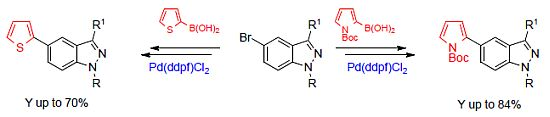
<?xml version="1.0" encoding="UTF-8"?>
<!DOCTYPE article PUBLIC "-//NLM//DTD Journal Publishing DTD v2.3 20070202//EN" "journalpublishing.dtd">
<article xmlns:mml="http://www.w3.org/1998/Math/MathML" xmlns:xlink="http://www.w3.org/1999/xlink" xml:lang="en" article-type="research-article">
  <front>
    <journal-meta>
      <journal-id journal-id-type="publisher-id">molecules</journal-id>
      <journal-title>Molecules</journal-title>
      <abbrev-journal-title abbrev-type="publisher">Molecules</abbrev-journal-title>
      <abbrev-journal-title abbrev-type="pubmed">Molecules</abbrev-journal-title>
      <issn pub-type="epub">1420-3049</issn>
      <publisher>
        <publisher-name>MDPI</publisher-name>
      </publisher>
    </journal-meta>
    <article-meta>
      <article-id pub-id-type="doi">10.3390/molecules17044508</article-id>
      <article-id pub-id-type="publisher-id">molecules-17-04508</article-id>
      <article-categories>
        <subj-group>
          <subject>Article</subject>
        </subj-group>
      </article-categories>
      <title-group>
        <article-title>The Suzuki Reaction Applied to the Synthesis of Novel Pyrrolyl and Thiophenyl Indazoles </article-title>

      </title-group>
      
      <contrib-group>
        <contrib contrib-type="author">
          <name>
            <surname>Migliorini</surname>
            <given-names>Antonella</given-names>
          </name>
          <xref rid="af1-molecules-17-04508" ref-type="aff">1</xref>
        </contrib>
        <contrib contrib-type="author">
          <name>
            <surname>Oliviero</surname>
            <given-names>Chiara</given-names>
          </name>
          <xref rid="af1-molecules-17-04508" ref-type="aff">1</xref>
        </contrib>
        <contrib contrib-type="author">
          <name>
            <surname>Gasperi</surname>
            <given-names>Tecla</given-names>
          </name>
          <xref rid="af2-molecules-17-04508" ref-type="aff">2</xref>
        </contrib>
        <contrib contrib-type="author">
          <name>
            <surname>Loreto</surname>
            <given-names>Maria Antonietta</given-names>
          </name>
          <xref rid="af1-molecules-17-04508" ref-type="aff">1</xref>
          <xref rid="c1-molecules-17-04508" ref-type="corresp">*</xref>
        </contrib>
      </contrib-group>
      <aff id="af1-molecules-17-04508"><label>1 </label>Department of Chemistry, “Sapienza” University of Rome, P.le A. Moro 5, I-00185 Roma, Italy; Email: <email>antonella.migliorini@gmail.com</email> (A.M.); <email>chiara.oliviero@yahoo.it</email> (C.O.)</aff>
      <aff id="af2-molecules-17-04508"><label>2 </label>Department of Mechanical and Industrial Engineering and CISDiC, University of Studies “Roma Tre”, via della Vasca Navale 79, I-00146 Roma, Italy; Email: <email>tgasperi@uniroma3.it</email></aff>
      <author-notes>
        <corresp id="c1-molecules-17-04508"><label>*</label> Author to whom correspondence should be addressed; Email: <email>mariaantonietta.loreto@uniroma1.it</email>; Tel.: +39-06-4991-3668; Fax: +39-0649-0631.</corresp>
      </author-notes>
      <pub-date pub-type="epub">
        <day>16</day>
        <month>04</month>
        <year>2012</year>
      </pub-date>
      <pub-date pub-type="collection"><month>04</month>
        <year>2012</year>
      </pub-date>
      <volume>17</volume>
      <issue>4</issue>
      <fpage>4508</fpage>
      <lpage>4521</lpage>
      <history>
        <date date-type="received">
          <day>20</day>
          <month>02</month>
          <year>2012</year>
        </date>
        <date date-type="rev-recd">
          <day>05</day>
          <month>04</month>
          <year>2012</year>
        </date>
        <date date-type="accepted">
          <day>09</day>
          <month>04</month>
          <year>2012</year>
        </date>
      </history>
      <permissions>
        <copyright-statement>©  2012 by the authors; licensee MDPI, Basel, Switzerland.</copyright-statement>
        <copyright-year>2012</copyright-year>
        <license xmlns:xlink="http://www.w3.org/1999/xlink" license-type="open-access" xlink:href="http://creativecommons.org/licenses/by/3.0/">
          <p>This article is an open-access article distributed under the terms and conditions of the Creative Commons Attribution license (http://creativecommons.org/licenses/by/3.0/).</p>
        </license>
      </permissions>
      <abstract>
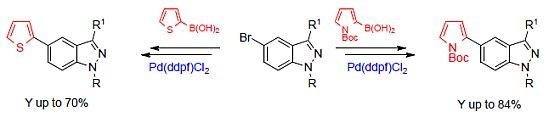
        <p>The paper describes the Suzuki cross-coupling of a variety of <italic>N </italic>and <italic>C</italic>-3 substituted 5-bromoindazoles with <italic>N</italic>-Boc-2-pyrrole and 2-thiopheneboronic acids. The reactions, performed in the presence of K<sub>2</sub>CO<sub>3</sub>, dimethoxyethane and Pd(dppf)Cl<sub>2</sub> as catalyst, gave the corresponding adducts in good yields. The methodology allows the facile production of indazole-based heteroaryl compounds, a unique architectural motif that is ubiquitous in biologically active molecules.</p>
      </abstract>
      <kwd-group>
        <kwd>indazoles</kwd>
        <kwd>pyrrole</kwd>
        <kwd>thiophene</kwd>
        <kwd>Suzuki cross-coupling</kwd>
        <kwd>heterobiaryl compounds</kwd>
      </kwd-group>
    </article-meta>
  </front>
  <body>
    <sec sec-type="intro">
      <title>1. Introduction</title>
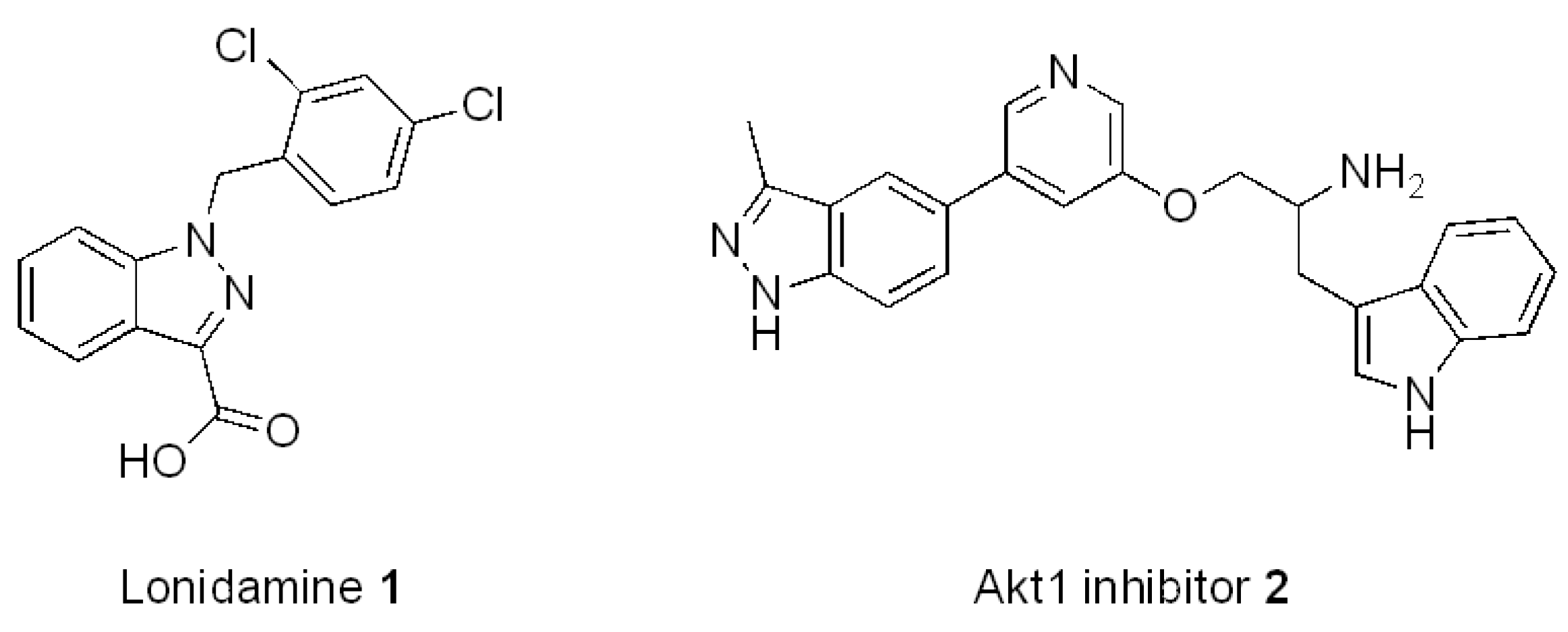
      <p>Indazole, the indole bioisoster, is a highly utilized pharmacophore [<xref ref-type="bibr" rid="B1-molecules-17-04508">1</xref>] found in many biologically active compounds such as lonidamine (<bold>1</bold>) [<xref ref-type="bibr" rid="B2-molecules-17-04508">2</xref>], a molecule with anticancer activity, or the Akt1 inhibitor <bold>2</bold> (<xref ref-type="fig" rid="molecules-17-04508-f001">Figure 1</xref>) [<xref ref-type="bibr" rid="B3-molecules-17-04508">3</xref>].</p>
      
      <p>Due to the broad variety of their biological activities, the synthesis of indazole derivatives as well as the functionalization of the indazole ring system have recently been reviewed [<xref ref-type="bibr" rid="B4-molecules-17-04508">4</xref>,<xref ref-type="bibr" rid="B5-molecules-17-04508">5</xref>,<xref ref-type="bibr" rid="B6-molecules-17-04508">6</xref>,<xref ref-type="bibr" rid="B7-molecules-17-04508">7</xref>,<xref ref-type="bibr" rid="B8-molecules-17-04508">8</xref>,<xref ref-type="bibr" rid="B9-molecules-17-04508">9</xref>,<xref ref-type="bibr" rid="B10-molecules-17-04508">10</xref>,<xref ref-type="bibr" rid="B11-molecules-17-04508">11</xref>,<xref ref-type="bibr" rid="B12-molecules-17-04508">12</xref>], especially in the context of drug development. During the last years, indazole derivatives bearing aryl groups on the 5 or 6 position have been prepared and identified as potent, selective glucocorticoid receptor agonists and antagonists [<xref ref-type="bibr" rid="B13-molecules-17-04508">13</xref>] or inhibitors of protein kinase c-zeta [<xref ref-type="bibr" rid="B14-molecules-17-04508">14</xref>]. Conversely, to the best of our knowledge, the functionalization of the indazole ring with aromatic heterocycles like pyrrole and thiophene has been less explored. Among the very few reported examples, some recent patents have described 3-substituted-5-thienyl-1<italic>H-</italic>indazole as ligands for nicotinic acetylcholine receptors [<xref ref-type="bibr" rid="B15-molecules-17-04508">15</xref>] or inhibitors of kinase activity [<xref ref-type="bibr" rid="B16-molecules-17-04508">16</xref>,<xref ref-type="bibr" rid="B17-molecules-17-04508">17</xref>]. Likewise, only 6-pyrrolyl-indazoles have recently been disclosed for their inhibitory activity of glycogen synthase kinase-3, and their synthesis was performed starting from pyrrolylbenzonitriles [<xref ref-type="bibr" rid="B18-molecules-17-04508">18</xref>].</p>
      <fig id="molecules-17-04508-f001" position="anchor">
        <label>Figure 1</label>
        <caption>
          <p>Relevant molecules with an indazole moiety.</p>
        </caption>
        <graphic xmlns:xlink="http://www.w3.org/1999/xlink" xlink:href="molecules-17-04508-g001.tif"/>
      </fig>
      <p>As part of the effort to discover novel indazole derivatives as valuable building blocks in medicinal chemistry [<xref ref-type="bibr" rid="B19-molecules-17-04508">19</xref>], we were looking for an efficient and effective synthetic protocol of wide applicability towards 5-(pyrrol-2-yl)- and 5-(thiophen-2-yl)-1<italic>H</italic>-indazoles. The Suzuki reaction provides a very reliable method for the preparation of biaryl derivatives [<xref ref-type="bibr" rid="B20-molecules-17-04508">20</xref>]. However, although simple aryl halides and aryl boronic acids are widespread employed coupling partners, the corresponding reactions involving their heteroaryl analogues are noticeably fewer [<xref ref-type="bibr" rid="B21-molecules-17-04508">21</xref>,<xref ref-type="bibr" rid="B22-molecules-17-04508">22</xref>,<xref ref-type="bibr" rid="B23-molecules-17-04508">23</xref>,<xref ref-type="bibr" rid="B24-molecules-17-04508">24</xref>,<xref ref-type="bibr" rid="B25-molecules-17-04508">25</xref>,<xref ref-type="bibr" rid="B26-molecules-17-04508">26</xref>,<xref ref-type="bibr" rid="B27-molecules-17-04508">27</xref>,<xref ref-type="bibr" rid="B28-molecules-17-04508">28</xref>]. Herein, we report our initial investigations on the Suzuki cross-coupling between differently <italic>N-</italic>substituted 5-bromo-indazoles and pyrrole- or thiopheneboronic acids.</p>
    </sec>
    <sec sec-type="results">
      <title>2. Results and Discussion</title>
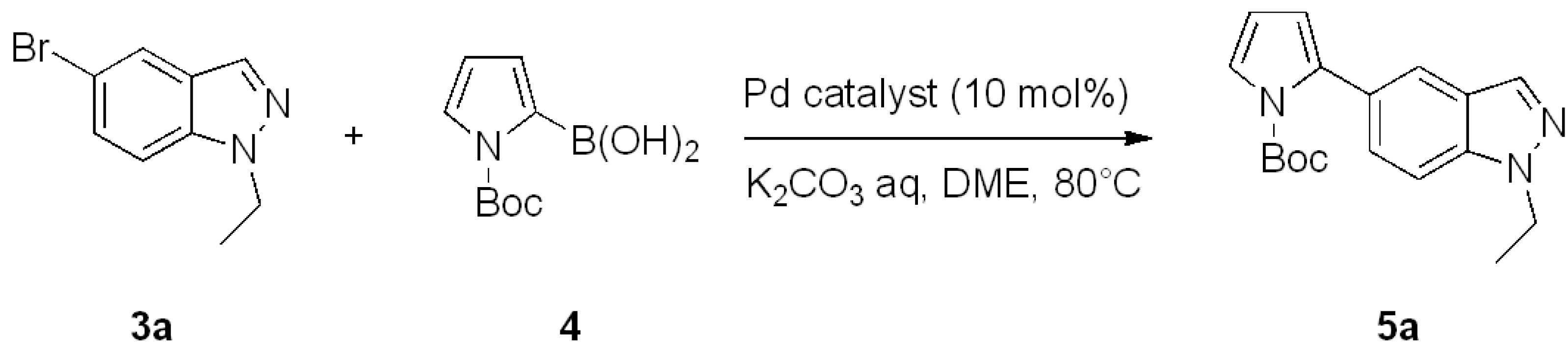
      <p>In order to determine the optimal reaction conditions we began by studying the cross-coupling of 5-bromo-1-ethyl-1<italic>H</italic>-indazole (<bold>3a</bold>) with <italic>N</italic>-Boc-2-pyrroleboronic acid (<bold>4</bold>) [<xref ref-type="bibr" rid="B29-molecules-17-04508">29</xref>] as a pilot reaction (<xref ref-type="fig" rid="molecules-17-04508-f002">Scheme 1</xref>). Indazole <bold>3a</bold> was prepared by the alkylation of the 5-bromo-1<italic>H</italic>-indazole with ethyl bromide [<xref ref-type="bibr" rid="B30-molecules-17-04508">30</xref>]. In the presence of cesium carbonate (Cs<sub>2</sub>CO<sub>3</sub>), a 1.2:1 ratio of <bold>3a</bold> and the <italic>N</italic>-2 isomer <bold>3g</bold> was obtained. The two regioisomers were purified and identified by comparison of their spectral data with that reported for similar <italic>N</italic>-alkylated indazoles [<xref ref-type="bibr" rid="B31-molecules-17-04508">31</xref>].</p>
      <fig id="molecules-17-04508-f002" position="anchor">
        <object-id pub-id-type="pii">molecules-17-04508-scheme1_Scheme 1</object-id>
        <label>Scheme 1</label>
        <caption>
          <p>Suzuki cross-coupling of 5-bromo-1-ethyl-1<italic>H</italic>-indazole and <italic>N</italic>-Boc-2-pyrroleboronic acid.</p>
        </caption>
        <graphic xmlns:xlink="http://www.w3.org/1999/xlink" xlink:href="molecules-17-04508-g002.tif"/>
      </fig>
      <p>The Suzuki reaction was carried out by employing K<sub>2</sub>CO<sub>3</sub> as base, dimethoxyethane as solvent and heating the reaction mixture at 80 °C. As shown in <xref ref-type="table" rid="molecules-17-04508-t001">Table 1</xref>, we examined four palladium catalysts and found that [1,1'-bis(diphenylphosphino)ferrocene]palladium(II) dichloride [Pd(dppf)Cl<sub>2</sub>] [<xref ref-type="bibr" rid="B32-molecules-17-04508">32</xref>] was the best choice, affording the coupling product in high yield after only two hours. Interestingly, bis(tricyclohexylphosphine)palladium [Pd(PCy<sub>3</sub>)<sub>2</sub>] yielded the product in modest yield, although generally the electron richness and the sterical hindrance of the phosphinic ligands make it an efficient palladium source for cross-coupling reaction [<xref ref-type="bibr" rid="B33-molecules-17-04508">33</xref>,<xref ref-type="bibr" rid="B34-molecules-17-04508">34</xref>]. The commonly used tetrakis(triphenyl-phosphine)palladium [Pd(PPh<sub>3</sub>)<sub>4</sub>] and bis(triphenylphosphine)palladium(II) dichloride [Pd(PPh<sub>3</sub>)2Cl<sub>2</sub>] were less effective than [Pd(dppf)Cl<sub>2</sub>] for this transformation, affording the final product after longer reaction times and in lower yields.</p>
      <table-wrap id="molecules-17-04508-t001" position="anchor">
        <object-id pub-id-type="pii">molecules-17-04508-t001_Table 1</object-id>
        <label>Table 1</label>
        <caption>
          <p>Screening of palladium catalysts for the Suzuki coupling of 5-bromo-1-ethyl-1<italic>H</italic>-indazole and <italic>N</italic>-Boc-2-pyrroleboronic acid.</p>
        </caption>
        <table>
          <thead>
            <tr>
              <th align="center" valign="middle">Entry</th>
              <th align="center" valign="middle">Pd catalyst</th>
              <th align="center" valign="middle">Reaction Time</th>
              <th align="center" valign="middle">5a Yield </th>
            </tr>
          </thead>
          <tbody>
            <tr>
              <td align="center" valign="middle">1</td>
              <td align="center" valign="middle">Pd(PPh<sub>3</sub>)<sub>4</sub></td>
              <td align="center" valign="middle">4 h</td>
              <td align="center" valign="middle">22%</td>
            </tr>
            <tr>
              <td align="center" valign="middle">2</td>
              <td align="center" valign="middle">Pd(PPh<sub>3</sub>)<sub>2</sub>Cl<sub>2</sub></td>
              <td align="center" valign="middle">4 h</td>
              <td align="center" valign="middle">75%</td>
            </tr>
            <tr>
              <td align="center" valign="middle">3</td>
              <td align="center" valign="middle">Pd(PCy<sub>3</sub>)<sub>2</sub></td>
              <td align="center" valign="middle">2 h</td>
              <td align="center" valign="middle">57%</td>
            </tr>
            <tr>
              <td align="center" valign="middle">4</td>
              <td align="center" valign="middle">Pd(dppf)Cl<sub>2</sub></td>
              <td align="center" valign="middle">2 h</td>
              <td align="center" valign="middle">84%</td>
            </tr>
          </tbody>
        </table>
      </table-wrap>
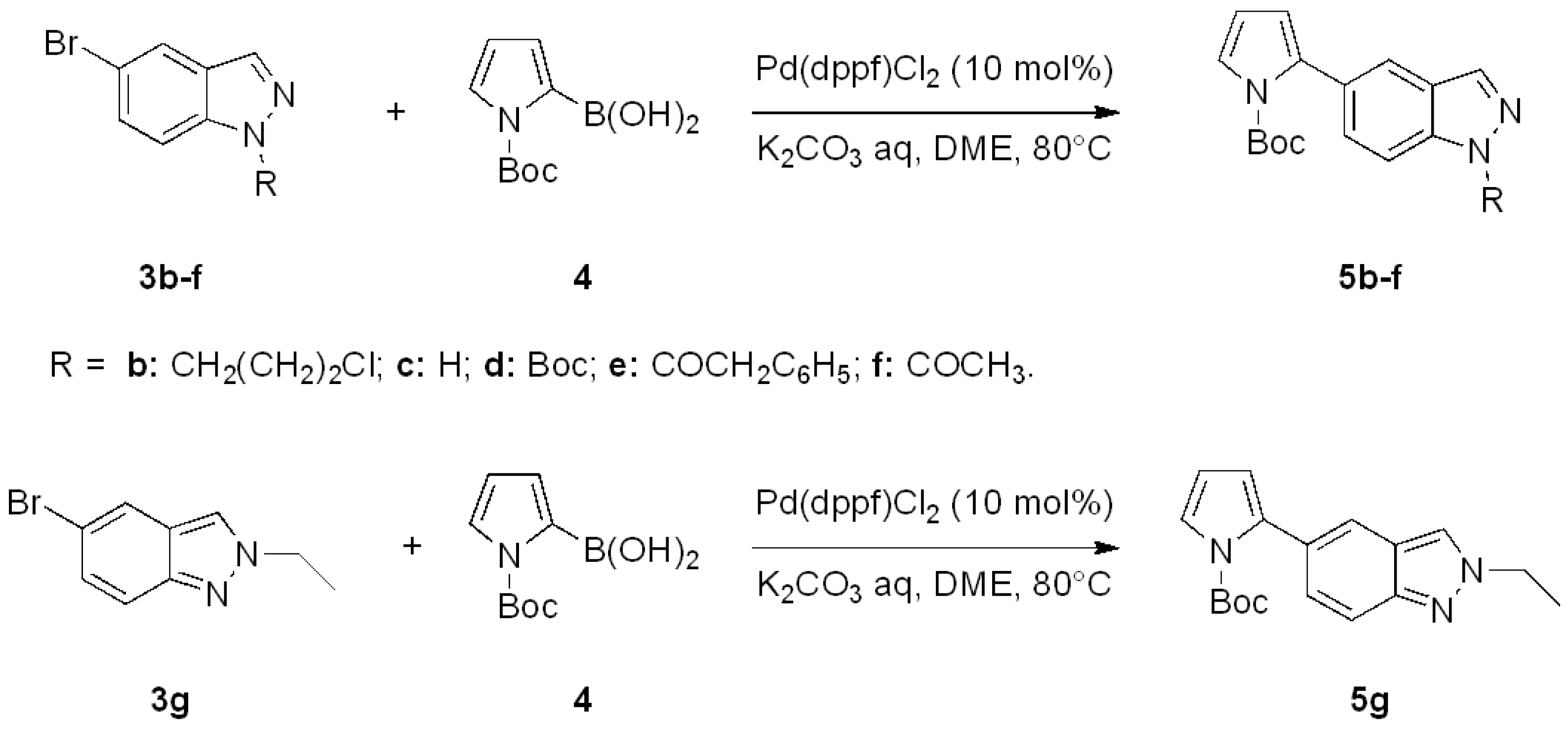
      <p>Having identified Pd(dppf)Cl<sub>2</sub> as the most suitable catalyst, in order to explore the versatility of this type of Suzuki coupling, a series of 5-bromoindazoles bearing alkyl or acyl groups on the <italic>N</italic>-1 or <italic>N</italic>-2 positions were prepared [<xref ref-type="bibr" rid="B30-molecules-17-04508">30</xref>,<xref ref-type="bibr" rid="B35-molecules-17-04508">35</xref>,<xref ref-type="bibr" rid="B36-molecules-17-04508">36</xref>,<xref ref-type="bibr" rid="B37-molecules-17-04508">37</xref>,<xref ref-type="bibr" rid="B38-molecules-17-04508">38</xref>] and tested with Boc-protected-2-pyrroleboronic acid <bold>4</bold> (<xref ref-type="fig" rid="molecules-17-04508-f003">Scheme 2</xref>).</p>
      <fig id="molecules-17-04508-f003" position="anchor">
        <object-id pub-id-type="pii">molecules-17-04508-scheme2_Scheme 2</object-id>
        <label>Scheme 2</label>
        <caption>
          <p>Synthesis of 5-(pyrrol-2-yl)-1<italic>H</italic>-indazoles by the Suzuki cross-coupling.</p>
        </caption>
        <graphic xmlns:xlink="http://www.w3.org/1999/xlink" xlink:href="molecules-17-04508-g003.tif"/>
      </fig>
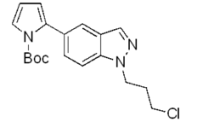
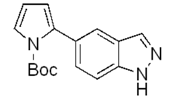
      <p>In all cases the expected coupling products were obtained in very modest to quite good yields and fully characterized (<xref ref-type="table" rid="molecules-17-04508-t002">Table 2</xref>). The lower yields registered for the <italic>N</italic>-acyl-indazoles <bold>3e</bold> and <bold>3f</bold> may be a consequence of the facile deacylation of these substrates under basic conditions [<xref ref-type="bibr" rid="B39-molecules-17-04508">39</xref>]. This is confirmed by the isolation of <bold>5c</bold> (30% yield) as an additional product in their reaction mixtures. The reaction was also performed on the unsubstituted 5-bromoindazole <bold>3c</bold> and afforded the corresponding product <bold>5c</bold> in 50% yield, due to the likely formation of side-products, not further investigated. Moreover, it is worthy to note that the <italic>N</italic>-Boc-indazole <bold>3d</bold> resulted to be a very good substrate for the cross-coupling. The easy removal of the Boc group would make the coupling product <bold>5d</bold> a valuable building block in the synthesis of new interesting indazole-based molecules.</p>
      
      <p>On the basis of these positive results, we extended the scope of the Suzuki cross-coupling to the synthesis of 5-(thiophen-2-yl)-1<italic>H</italic>-indazoles. Thiophene, like pyrrole, is found in a variety of natural products and pharmaceutically interesting compounds [<xref ref-type="bibr" rid="B40-molecules-17-04508">40</xref>]. In addition, polythiophenes, which are often prepared via Suzuki-Miyaura processes, are highly conducting polymers that possess good processing qualities [<xref ref-type="bibr" rid="B41-molecules-17-04508">41</xref>].</p>
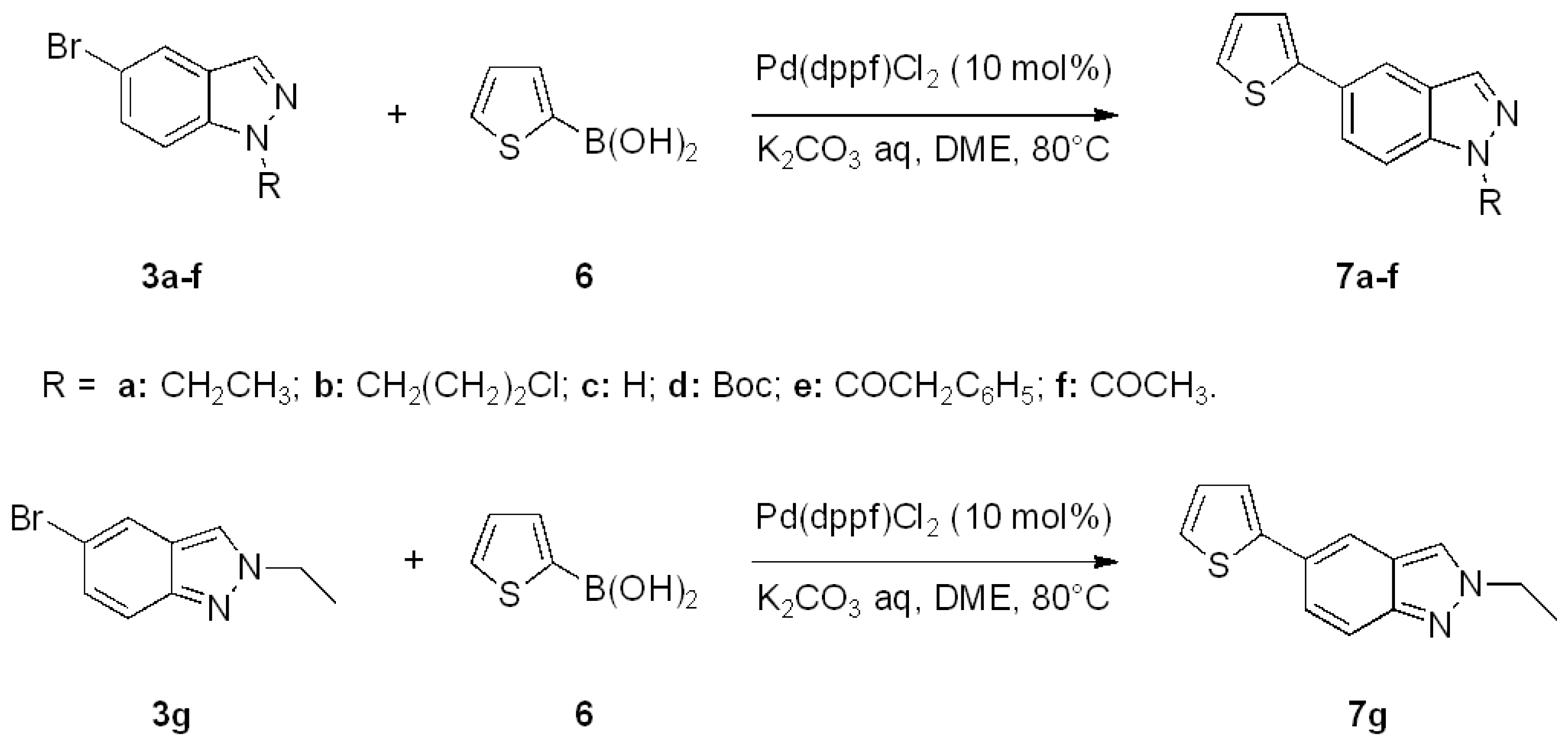
      <p>The coupling with 2-thiopheneboronic acid (<bold>6</bold>) was carried out under the same reaction conditions previously employed and gave the expected 5-(thiophen-2-yl)-1<italic>H</italic>-indazoles <bold>7a</bold><bold>−g</bold> (<xref ref-type="fig" rid="molecules-17-04508-f004">Scheme 3</xref>).</p>
      <fig id="molecules-17-04508-f004" position="anchor">
        <object-id pub-id-type="pii">molecules-17-04508-scheme3_Scheme 3</object-id>
        <label>Scheme 3</label>
        <caption>
          <p>Synthesis of 5-(thiophen-2-yl)-1<italic>H</italic>-indazoles by the Suzuki cross-coupling.</p>
        </caption>
        <graphic xmlns:xlink="http://www.w3.org/1999/xlink" xlink:href="molecules-17-04508-g004.tif"/>
      </fig>
      <p>With respect to the corresponding coupling reactions with 2-pyrroleboronic acid <bold>4</bold>, the products were obtained in lower yields (<xref ref-type="table" rid="molecules-17-04508-t002">Table 2</xref>), due to the tendency of thiopheneboronic acids to undergo protodeboronation and the formation of a side-product identified as the thiophene dimer [<xref ref-type="bibr" rid="B22-molecules-17-04508">22</xref>].</p>
      <table-wrap id="molecules-17-04508-t002" position="anchor">
        <object-id pub-id-type="pii">molecules-17-04508-t002_Table 2</object-id>
        <label>Table 2</label>
        <caption>
          <p>Suziki cross-coupling reaction for the synthesis of 5-(pyrrol-2-yl)- and 5-(thiophen-2-yl)-1<italic>H</italic>-indazoles.</p>
        </caption>
        <table>
          <thead>
            <tr>
              <th align="center" valign="middle">Entry</th>
              <th align="center" valign="middle">Products 5</th>
              <th align="center" valign="middle">Yield 5 <sup>[a]</sup></th>
              <th align="center" valign="middle">Products 7</th>
              <th align="center" valign="middle">Yield 7 <sup>[a]</sup></th>
            </tr>
          </thead>
          <tbody>
            <tr>
              <td align="center" valign="middle">a</td>
              <td align="center" valign="middle"><inline-graphic xmlns:xlink="http://www.w3.org/1999/xlink" xlink:href="molecules-17-04508-i002.tif"/></td>
              <td align="center" valign="middle">84%</td>
              <td align="center" valign="middle"><inline-graphic xmlns:xlink="http://www.w3.org/1999/xlink" xlink:href="molecules-17-04508-i003.tif"/></td>
              <td align="center" valign="middle">60%</td>
            </tr>
            <tr>
              <td align="center" valign="middle">b</td>
              <td align="center" valign="middle"><inline-graphic xmlns:xlink="http://www.w3.org/1999/xlink" xlink:href="molecules-17-04508-i004.tif"/></td>
              <td align="center" valign="middle">74%</td>
              <td align="center" valign="middle"><inline-graphic xmlns:xlink="http://www.w3.org/1999/xlink" xlink:href="molecules-17-04508-i005.tif"/></td>
              <td align="center" valign="middle">62%</td>
            </tr>
            <tr>
              <td align="center" valign="middle">c</td>
              <td align="center" valign="middle"><inline-graphic xmlns:xlink="http://www.w3.org/1999/xlink" xlink:href="molecules-17-04508-i006.tif"/></td>
              <td align="center" valign="middle">50%</td>
              <td align="center" valign="middle"><inline-graphic xmlns:xlink="http://www.w3.org/1999/xlink" xlink:href="molecules-17-04508-i007.tif"/></td>
              <td align="center" valign="middle">traces</td>
            </tr>
            <tr>
              <td align="center" valign="middle">d</td>
              <td align="center" valign="middle"><inline-graphic xmlns:xlink="http://www.w3.org/1999/xlink" xlink:href="molecules-17-04508-i008.tif"/></td>
              <td align="center" valign="middle">81%</td>
              <td align="center" valign="middle"><inline-graphic xmlns:xlink="http://www.w3.org/1999/xlink" xlink:href="molecules-17-04508-i009.tif"/></td>
              <td align="center" valign="middle">70%</td>
            </tr>
            <tr>
              <td align="center" valign="middle">e</td>
              <td align="center" valign="middle"><inline-graphic xmlns:xlink="http://www.w3.org/1999/xlink" xlink:href="molecules-17-04508-i0010.tif"/></td>
              <td align="center" valign="middle">45%</td>
              <td align="center" valign="middle"><inline-graphic xmlns:xlink="http://www.w3.org/1999/xlink" xlink:href="molecules-17-04508-i0011.tif"/></td>
              <td align="center" valign="middle">30%</td>
            </tr>
            <tr>
              <td align="center" valign="middle">f</td>
              <td align="center" valign="middle"><inline-graphic xmlns:xlink="http://www.w3.org/1999/xlink" xlink:href="molecules-17-04508-i0012.tif"/></td>
              <td align="center" valign="middle">30%</td>
              <td align="center" valign="middle"><inline-graphic xmlns:xlink="http://www.w3.org/1999/xlink" xlink:href="molecules-17-04508-i0013.tif"/></td>
              <td align="center" valign="middle">35%</td>
            </tr>
            <tr>
              <td align="center" valign="middle">g</td>
              <td align="center" valign="middle"><inline-graphic xmlns:xlink="http://www.w3.org/1999/xlink" xlink:href="molecules-17-04508-i0014.tif"/></td>
              <td align="center" valign="middle">92%</td>
              <td align="center" valign="middle"><inline-graphic xmlns:xlink="http://www.w3.org/1999/xlink" xlink:href="molecules-17-04508-i0015.tif"/></td>
              <td align="center" valign="middle">87%</td>
            </tr>
          </tbody>
        </table>
        <table-wrap-foot>
        <fn>
        <p><sup>[a]</sup> Isolated Yields.</p>
        </fn>
        </table-wrap-foot>
      </table-wrap>
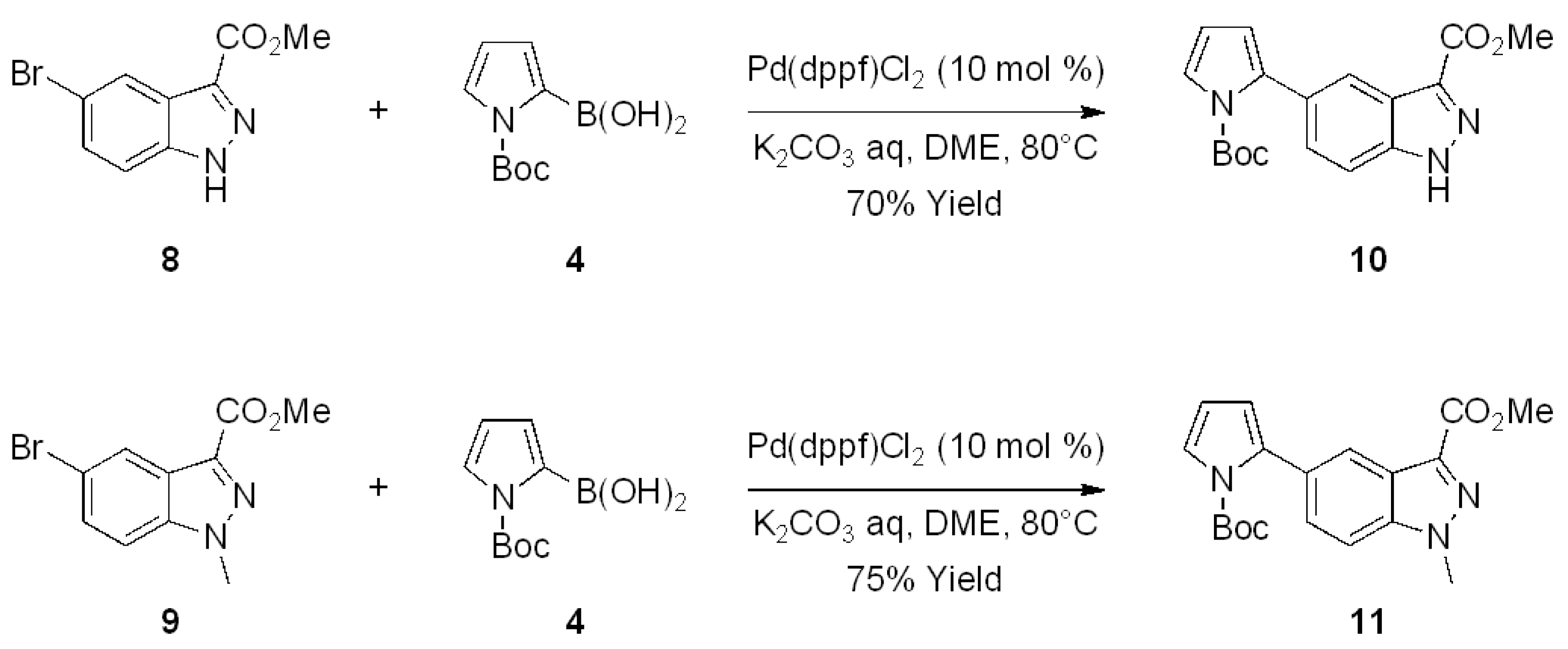
      <p>On the bases of the described successful results and in view of the interest in <italic>C</italic>-3 substituted indazole derivatives reported in the literature [<xref ref-type="bibr" rid="B5-molecules-17-04508">5</xref>], a preliminary study for the extension of the above reaction to <italic>C</italic>-3 substituted indazoles has been also initiated. To this purpose, 5-bromo-1<italic>H</italic>-indazole-3-carboxylic acid methyl ester (<bold>8</bold>, <xref ref-type="fig" rid="molecules-17-04508-f005">Scheme 4</xref>) was prepared by a known esterification of 5-bromo-1<italic>H</italic>-indazole-3-carboxylic acid, reported to afford <bold>8</bold> as the unique product [<xref ref-type="bibr" rid="B42-molecules-17-04508">42</xref>]. However, in our hands, the protocol gave a 1:1 mixture of two products identified as <bold>8</bold> and the corresponding unprecedented 1-methyl derivative <bold>9</bold>, respectively.</p>
      <p>Therefore, both substrates <bold>8</bold> and <bold>9</bold> were reacted with the Boc-protected-2-pyrroleboronic acid <bold>4</bold> (<xref ref-type="fig" rid="molecules-17-04508-f005">Scheme 4</xref>) and gave the corresponding 3-substituted-(5-pyrrol-2-yl)-indazoles <bold>10</bold> and <bold>11</bold>, thus indicating that the <italic>C</italic>-3 substituent doesn’t invalidate the success of the Suzuki reaction. The extension of this methodology to variously <italic>C</italic>-3 functionalized indazole derivatives by using pyrrole and thiophene boronic acids is currently under investigation. </p>
      <fig id="molecules-17-04508-f005" position="anchor">
        <object-id pub-id-type="pii">molecules-17-04508-scheme4_Scheme 4</object-id>
        <label>Scheme 4</label>
        <caption>
          <p>Synthesis of 3-substituted-(5-pyrrol-2-yl)-indazoles by the Suzuki cross-coupling.</p>
        </caption>
        <graphic xmlns:xlink="http://www.w3.org/1999/xlink" xlink:href="molecules-17-04508-g005.tif"/>
      </fig>
      
    </sec>
    <sec sec-type="methods">
      <title>3. Experimental</title>
      <sec>
        <title>3.1. General Experimental Methods</title>
        <p>Solvents and common reagents were purchased from a commercial source and used without further purification. <italic>N</italic>-Boc-2-pyrroleboronic acid <bold>4</bold> was prepared according to the literature procedure [<xref ref-type="bibr" rid="B29-molecules-17-04508">29</xref>]. 2-Thiopheneboronic acid <bold>6</bold> and 5-bromo-1<italic>H</italic>-indazole-3-carboxylic acid were purchased from a commercial source. All reactions were monitored by thin layer chromatography (TLC) carried out on Merck F-254 a silica glass plates and visualized with UV light. The resulting mixtures were purified by flash column chromatography on silica gel by eluting, unless otherwise stated, with hexane/ethyl acetate, 8:2. <sup>1</sup>H-NMR spectra were recorded on Varian Gemini 300 (300 MHz) instrument. Chemical shifts are expressed in parts per million (δ scale) and are referenced to the residual protons of the NMR solvent (CHCl<sub>3</sub>: δ 7.26); (s) = singlet; (d) = doublet; (t) = triplet; (q) = quartet; (dd) = double doublet; (ddd) = double double doublet; (dt) = double triplet; (dq) = double quartet; (m) = multiplet. Coupling constants (<italic>J</italic>) are expressed in Hz. <sup>13</sup>C-NMR spectra were recorded on Varian Gemini 300 (75 MHz). Chemical shifts are expressed in parts per million (δ scale) and are referenced to the residual carbons of the NMR solvent (CHCl<sub>3</sub>: δ 77.0). Infrared Spectra (IR) were obtained using a Perkin-Elmer 1600 (FT-IR, Walthman, MA, USA); data are presented as the frequency of absorption (cm<sup>−1</sup>). HRMS Spectra were recorded with Micromass Q-TOF <italic>micro</italic> Mass Spectrometer (Waters, Milford, MA, USA).</p>
        <p><italic>5-Bromo-1-ethyl-1H-indazole</italic> <bold>3a</bold> [<xref ref-type="bibr" rid="B30-molecules-17-04508">30</xref>]. To a solution of 5-bromo-1<italic>H</italic>-indazole (500 mg, 2.55 mmol) in anhydrous DMF (8 mL), ethyl bromide (3.85 mmol, 0.60 mL) was added at room temperature, followed by an excess of Cs<sub>2</sub>CO<sub>3</sub> (2.5 g, 7.65 mmol). After stirring the reaction mixture at room temperature for 3 h, 2 N HCl was added until a neutral pH was reached. The aqueous layer was extracted with ethyl acetate and the combined organic extracts were dried over anhydrous Na<sub>2</sub>SO<sub>4</sub>. After filtration, the solvent was removed in <italic>vacuo </italic>and the residue was purified by flash column chromatography. Yield: 227 mg (1 mmol, 40%); dark orange viscous liquid; <italic>R<sub>f</sub></italic> = 0.47. <sup>1</sup>H-NMR: <italic>δ</italic> = 1.45 (t, 3H, CH<sub>3,</sub> <italic>J</italic> = 7.3 Hz), 4.35 (q, 2H, CH<sub>2</sub>, <italic>J</italic> = 7.3 Hz), 7.21 (d, 1H, ArH, <italic>J</italic> = 8.9 Hz), 7.36 (dd, 1H, ArH, <italic>J</italic> = 1.8 Hz, <italic>J </italic>= 8.9 Hz), 7.77–7.81 (m, 1H, ArH), 7.88 (s, 1H, ArH) ppm. <sup>13</sup>C-NMR: <italic>δ</italic> = 15.1, 44.1, 110.5, 113.7, 123.7, 125.8, 129.3, 132.2, 137.9 ppm. HRMS: calcd. for C<sub>9</sub>H<sub>10</sub>BrN<sub>2</sub> 225.0027; found 225.0032.</p>
        <p><italic>5-Bromo-2-ethyl-2H-indazole</italic> (<bold>3g</bold>) [<xref ref-type="bibr" rid="B30-molecules-17-04508">30</xref>,<xref ref-type="bibr" rid="B43-molecules-17-04508">43</xref>]. This compound was obtained in the alkylation of 5-bromo-1<italic>H</italic>-indazole with ethyl bromide together with <bold>3a</bold> (<bold>3a</bold>/<bold>3g</bold> = 1.2/1). Yield: 178 mg (0.80 mmol, 31%); dark orange viscous liquid; <italic>R<sub>f</sub></italic> = 0.12. <sup>1</sup>H-NMR: <italic>δ</italic> = 1.62 (t, 3H, CH<sub>3</sub>, <italic>J</italic> = 7.3 Hz), 4.45 (q, 2H, CH<sub>2</sub>, <italic>J</italic> = 7.3 Hz), 7.32 (dd, 1H, ArH, <italic>J</italic> = 1.8 Hz, <italic>J</italic> = 9.1 Hz), 7.58 (dd, 1H, ArH, <italic>J</italic> = 0.8 Hz, <italic>J</italic> = 9.1 Hz), 7.77−7.80 (m, 1H, ArH), 7.85 (s, 1H, ArH) ppm. <sup>13</sup>C-NMR: <italic>δ</italic> = 15.9, 48.9, 111.4, 115.2, 119.3, 121.6, 122.4, 129.6, 147.4 ppm. HRMS: calcd. for C<sub>9</sub>H<sub>10</sub>BrN<sub>2</sub> 225.0027; found 225.0027.</p>
        <p><italic>5-Bromo-1-(3-chloro-propyl)-1H-indazole</italic> (<bold>3b</bold>) [<xref ref-type="bibr" rid="B44-molecules-17-04508">44</xref>]. Compound <bold>3b</bold> was prepared from 5-bromo-1<italic>H</italic>-indazole (500 mg, 2.55 mmol) and 1-bromo-3-chloropropane (3.85 mmol, 0.40 mL) according to the procedure described for <bold>3a</bold>. After solvent evaporation, the crude mixture was chromatographed over silica gel. Yield: 352 mg (1.3 mmol, 50%); dark orange viscous liquid; <italic>R<sub>f</sub></italic> = 0.62. <sup>1</sup>H-NMR: <italic>δ</italic> = 2.35–2.43 (m, 2H, CH<sub>2</sub>C<italic>H</italic><sub>2</sub>CH<sub>2</sub>), 3.46 (t, 2H, C<italic>H</italic><sub>2</sub>Cl, <italic>J</italic> = 5.8 Hz), 4.54 (t, 2H, CH<sub>2</sub>N, <italic>J</italic> = 6.0 Hz), 7.38 (dd, 1H, ArH, <italic>J</italic> = 0.8 Hz, <italic>J</italic> = 8.9 Hz), 7.46 (dd, 1H, ArH, <italic>J</italic> = 1.8 Hz, <italic>J</italic> = 8.9 Hz), 7.84−7.88 (m, 1H, ArH), 7.95 (s, 1H, ArH) ppm. <sup>13</sup>C-NMR: <italic>δ</italic> = 32.6, 42.0, 45.7, 110.6, 113.9, 123.7, 125.6, 129.7, 132.9, 138.8 ppm. HRMS: calcd. for C<sub>10</sub>H<sub>11</sub>BrClN<sub>2</sub> 272.9794; found 272.9800. The <italic>N</italic>-2 isomer was isolated as minor product. Yield: 69 mg (0.25 mmol, 10%); dark orange viscous liquid; <italic>R</italic><sub>f</sub> = 0.47. <sup>1</sup>H-NMR: <italic>δ</italic> = 2.42−2.50 (m, 2H, CH<sub>2</sub>C<italic>H</italic><sub>2</sub>CH<sub>2</sub>), 3.42 (t, 2H, C<italic>H</italic><sub>2</sub>Cl, <italic>J</italic> = 5.8 Hz), 4.59 (t, 2H, CH<sub>2</sub>N, <italic>J</italic> = 6.4 Hz), 7.34 (dd, 1H, ArH, <italic>J</italic> = 1.8 Hz, <italic>J</italic> = 9.1Hz), 7.57 (dd, 1H, ArH, <italic>J</italic> = 0.8 Hz, <italic>J</italic> = 9.1 Hz), 7.79−7.83 (m, 1H, ArH), 7.92 (s, 1H, ArH) ppm. <sup>13</sup>C-NMR: <italic>δ</italic> = 32.9, 41.6, 50.6, 110.3, 115.4, 119.4, 122.5, 123.3, 129.9, 147.8 ppm. HRMS: calcd. for C<sub>10</sub>H<sub>11</sub>BrClN<sub>2</sub> 272.9794; found 272.9792. </p>
        <p><italic>5-Bromo-indazole-1-carboxylic acid tert-butyl ester</italic> (<bold>3d</bold>). Compound <bold>3d</bold> was prepared from 5-bromo-1<italic>H</italic>-indazole (500 mg, 2.55 mmol) and Boc<sub>2</sub>O (583 mg, 2.68 mmol) according to the literature procedure and the spectral data were in agreement with those reported in the literature [<xref ref-type="bibr" rid="B36-molecules-17-04508">36</xref>]. Yield: 558 mg (1.89 mmol, 74%).</p>
        <p><italic>1-(5-Bromo-indazol-1-yl)-2-phenyl-ethanone</italic> (<bold>3e</bold>). Compound <bold>3e</bold> was prepared from 5-bromo-1<italic>H</italic>-indazole (500 mg, 2.55 mmol) and phenylacetyl chloride (3.85 mmol, 0.50 mL) according to the procedure described for <bold>3a</bold>. After solvent evaporation, the crude mixture was chromatographed over silica gel. Yield: 360 mg (1.15 mmol, 45%); dark orange viscous liquid; <italic>R</italic><sub>f</sub> = 0.85. <sup>1</sup>H-NMR: <italic>δ</italic> = 4.52 (s, 2H, CH<sub>2</sub>C=O), 7.25−7.50 (m, 5H, ArH), 7.63 (dd, 1H, ArH, <italic>J</italic> = 1.8, <italic>J</italic> = 8.8 Hz), 7.86−7.89 (m, 1H, ArH), 8.11 (s, 1H, ArH), 8.32 (dd, 1H, ArH, <italic>J </italic>= 0.7 Hz, <italic>J</italic> = 8.8 Hz) ppm. <sup>13</sup>C-NMR: <italic>δ</italic> = 41.7, 117.1, 117.9, 120.3, 123.8, 127.5, 128.2, 128.9, 129.9, 132.7, 133.9, 139.0, 171.6 ppm. IR (CHCl<sub>3</sub>):  <inline-graphic xmlns:xlink="http://www.w3.org/1999/xlink" xlink:href="molecules-17-04508-i001.tif"/> = 1728 cm<sup>−1</sup>. HRMS: calcd. for C<sub>15</sub>H<sub>11</sub>BrN<sub>2</sub>NaO 336.9952; found 336.9949.</p>
        <p><italic>1-(5-Bromo-indazol-1-yl)-ethanone</italic> (<bold>3f</bold>) [<xref ref-type="bibr" rid="B38-molecules-17-04508">38</xref>]. To a solution of 5-bromo-1<italic>H</italic>-indazole (500 mg, 2.55 mmol) in anhydrous DCM (48 mL) was added acetic anhydride (0.45 mL, 5.10 mmol), pyridine (403 mg, 0.40 mL, 5.10 mmol) and dimethylaminopyridine (DMAP) in a catalytic amount. The solution was stirred at 40 °C overnight. The organic phase was washed with water (2 × 50 mL), 1N HCl (2 × 50 mL), NaHCO<sub>3</sub> (aq) (2 × 50 mL) and brine (2 × 50 mL) and then dried over anhydrous Na<sub>2</sub>SO<sub>4</sub>. The solvent was removed <italic>in vacuo</italic> to give <bold>3f</bold>. Yield: 833 mg (3.50 mmol, 70%); dark orange viscous liquid; <italic>R<sub>f</sub></italic> = 0.87. <sup>1</sup>H-NMR: <italic>δ</italic> = 2.81 (s, 3H, CH<sub>3</sub>), 7.65 (dd, 1H, ArH, <italic>J</italic> = 1.8, <italic>J</italic> = 8.8 Hz), 7.87−7.90 (m, 1H, ArH), 8.08 (s, 1H, ArH), 8.34 (dd, 1H, ArH, <italic>J</italic> = 0.7 Hz, <italic>J</italic> = 8.8 Hz) ppm. <sup>13</sup>C-NMR: <italic>δ</italic> = 22.9, 115.8, 116.6, 122.4, 126.8, 131.4, 136.7, 137.5, 169.9. IR (CHCl<sub>3</sub>): <inline-graphic xmlns:xlink="http://www.w3.org/1999/xlink" xlink:href="molecules-17-04508-i001.tif"/> = 1726 cm<sup>−1</sup>. HRMS: calcd. for C<sub>9</sub>H<sub>7</sub>BrN<sub>2</sub>NaO 260.9639; found 260.9644.</p>
        <p><italic>5-Bromo-1H-indazole-3-carboxylic acid methyl ester</italic> (<bold>8</bold>) and <italic>5-Bromo-1-methyl-1H-indazole-3-carboxylic acid methyl ester</italic> (<bold>9</bold>). Compounds <bold>8</bold> and <bold>9</bold> were obtained from 5-bromo-1<italic>H</italic>-indazole-3-carboxylic acid (160 mg, 0.66 mmol) by applying an esterification procedure reported to afford <bold>8</bold> as the unique product [<xref ref-type="bibr" rid="B42-molecules-17-04508">42</xref>]. However, in our hands, the protocol gave a 1:1 mixture of two products that were separated by chromatography. The first compound was identified as <bold>8</bold> and showed spectral data in agreement with those reported in literature [<xref ref-type="bibr" rid="B42-molecules-17-04508">42</xref>]. Yield: 61 mg (0.24 mmol, 36%). The second compound was identified as <bold>9</bold>. Yield: 59 mg (0.22 mmol, 34%); <italic>R</italic><sub>f</sub> = 0.7 (hexane/ethyl acetate, 1:1). <sup>1</sup>H-NMR: <italic>δ</italic> = 4.03 (s, 3H, CO<sub>2</sub>CH<sub>3</sub>), 4.48 (s, 3H, NCH<sub>3</sub>), 7.41 (dd, 1H, ArH, <italic>J</italic> = 1.8 Hz, <italic>J</italic> = 9.1 Hz), 7.63 (dd, 1H, ArH, <italic>J</italic> = 0.7 Hz, <italic>J</italic> = 9.1 Hz), 8.13−8.15 (m, 1H, ArH) ppm. <sup>13</sup>C-NMR: <italic>δ</italic> = 41.8, 52.3, 119.3, 119.9, 123.7, 127.3, 128.9, 131.4, 145.9, 161.0 ppm. HRMS: calcd. for C<sub>10</sub>H<sub>10</sub>BrN<sub>2</sub>O<sub>2</sub> 268.9926; found 268.9930.</p>
        <p>
          <italic>3.2. General Procedure for the Suzuki Coupling Reaction</italic>
        </p>
        <p>A solution of bromo indazole <bold>3</bold> (1 mmol) and [1,1'-bis(diphenylphosphino)ferrocene]palladium(II) dichloride [Pd(dppf)Cl<sub>2</sub>] (10%) in anhydrous DME (10 mL) was stirred under a flow of argon for 1 h. To the solution were added sequentially 1-(<italic>tert</italic>-butoxycarbonyl)pyrrole-2-boronic acid (<bold>4</bold>) or 2-thiopheneboronic acid (<bold>6</bold>) (2 mmol) in anhydrous DME (2.6 mL) and potassium carbonate (2 mmol) in water (2.5 mL). The mixture was heated to 80 °C for 2 h and allowed to cool. The reaction mixture was then poured into aqueous saturated NaHCO<sub>3</sub> solution and extracted with ethyl acetate. The organic layers were combined, washed with brine and dried over Na<sub>2</sub>SO<sub>4</sub>. The solution was concentrated <italic>in vacuo</italic> and the residue was purified by flash column chromatography on silica gel to give the desired product.</p>
        <p><italic>2-(1-Ethyl-1H-indazol-5-yl)-pyrrole-1-carboxylic acid tert-butyl ester </italic>(<bold>5a</bold>). Yield: 261 mg (0.84 mmol, 84%); dark orange viscous liquid; <italic>R</italic><sub>f</sub> = 0.28. <sup>1</sup>H-NMR: <italic>δ</italic> = 1.34 (s, 9H, CH<sub>3</sub>), 1.52 (t, 3H, CH<sub>3</sub>, <italic>J</italic> = 7.3 Hz), 4.44 (q, 2H, CH<sub>2</sub>, <italic>J </italic>= 7.3 Hz), 6.19−6.25 (m, 2H, ArH), 7.25−7.26 (m, 1H, ArH), 7.34−7.36 (m, 1H, ArH), 7.38 (s, 1H, ArH), 7.69 (m, 1H, ArH), 7.99 (s, 1H, ArH) ppm. <sup>13</sup>C-NMR <italic>δ</italic> = 15.2, 27.9, 44.3, 83.7, 108.2, 110.5, 114.4, 121.2, 122.4, 123.7, 127.3, 129.1, 133.8, 135.2, 139.1, 149.6 ppm. IR (CHCl<sub>3</sub>):  <inline-graphic xmlns:xlink="http://www.w3.org/1999/xlink" xlink:href="molecules-17-04508-i001.tif"/> = 1733 cm<sup>−1</sup>. HRMS: calcd. for C<sub>18</sub>H<sub>21</sub>N<sub>3</sub>NaO<sub>2</sub> 334.1531; found 334.1526.</p>
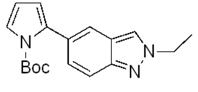
        <p><italic>2-(2-Ethyl-2H-indazol-5-yl)-pyrrole-1-carboxylic acid tert-butyl ester</italic> (<bold>5g</bold>). Yield: 286 mg (0.92 mmol, 92%); dark orange viscous liquid; <italic>R</italic><sub>f</sub> = 0.32 (hexane/ethyl acetate, 7:3). <sup>1</sup>H-NMR: <italic>δ</italic> = 1.33 (s, 9H, CH<sub>3</sub>), 1.61 (t, 3H, CH<sub>3,</sub><italic>J</italic> = 7.3 Hz), 4.46 (q, 2H, CH<sub>2</sub>, <italic>J</italic> = 7.3 Hz), 6.18−6.23 (m, 2H, ArH), 7.25 (dd, 1H, ArH, <italic>J</italic> =1.8 Hz, <italic>J</italic> = 8.9 Hz), 7.35−7.36 (m, 1H, ArH), 7.60 (m, 1H, ArH), 7.65 (dd, 1H, ArH, <italic>J </italic>= 0.8 Hz, <italic>J </italic>= 8.9 Hz), 7.99 (s, 1H, ArH) ppm. <sup>13</sup>C-NMR: <italic>δ</italic> = 16.1, 27.9, 48.7, 83.7, 110.7, 114.5, 116.3, 119.6, 121.6, 122.4, 122.5, 128.1, 128.8, 135.8, 148.2, 149.6 ppm. IR (CHCl<sub>3</sub>): <inline-graphic xmlns:xlink="http://www.w3.org/1999/xlink" xlink:href="molecules-17-04508-i001.tif"/> = 1725 cm<sup>−1</sup>. HRMS: calcd. for C<sub>18</sub>H<sub>21</sub>N<sub>3</sub>NaO<sub>2</sub> 334.1531; found 334.1536.</p>
        <p><italic>2</italic>-[1-(3-Chloro-propyl)-1H-indazol-5-yl]-p<italic>yrrole-1-carboxylic acid tert-butyl ester</italic> (<bold>5b</bold>). Yield: 267 mg (0.74 mmol, 74%); dark orange viscous liquid; <italic>R<sub>f</sub></italic> = 0.62. <sup>1</sup>H-NMR: <italic>δ</italic> = 1.34 (s, 9H, CH<sub>3</sub>), 2.37−2.46 (m, 2H, CH<sub>2</sub>C<italic>H</italic><sub>2</sub>CH<sub>2</sub>), 3.49 (t, 2H, CH<sub>2</sub>Cl, <italic>J </italic>= 6.3 Hz), 4.57 (t, 2H, CH<sub>2</sub>N, <italic>J </italic>= 6.3 Hz), 6.19−6.25 (m, 2H, ArH), 7.35−7.41 (m, 2H, ArH), 7.43−7.49 (m, 1H, ArH), 7.69 (m, 1H, ArH), 8.01 (s, 1H, ArH) ppm. <sup>13</sup>C-NMR: <italic>δ</italic> = 27.9, 32.7, 42.1, 45.6, 83.7, 108.0, 110.8, 114.7, 121.3, 122.5, 123.8, 127.5, 129.1, 133.9, 135.3, 139.3, 149.6 ppm. IR (CHCl<sub>3</sub>):  <inline-graphic xmlns:xlink="http://www.w3.org/1999/xlink" xlink:href="molecules-17-04508-i001.tif"/> = 1725 cm<sup>−1</sup>. HRMS: calcd. for C<sub>19</sub>H<sub>22</sub>ClN<sub>3</sub>NaO<sub>2</sub> 382.1298; found 382.1299.</p>
        <p><italic>2-(1H-Indazol-5-yl)-pyrrole-1-carboxylic acid tert-butyl ester</italic> (<bold>5c</bold>). Yield: 141 mg (0.50 mmol, 50%); dark orange viscous liquid; <italic>R<sub>f</sub></italic> = 0.28 (hexane/ethyl acetate, 7:3). <sup>1</sup>H-NMR: <italic>δ</italic> = 1.34 (s, 9H, CH<sub>3</sub>), 6.21−6.27 (m, 2H, ArH), 7.37−7.49 (m, 3H, ArH), 7.74 (s, 1H, ArH), 8.11 (s, 1H, ArH) ppm. <sup>13</sup>C-NMR: <italic>δ</italic> = 27.9, 83.8, 109.0, 110.8, 114.8, 121.0, 122.5, 123.0, 127.7, 129.5, 135.0, 135.4, 139.6, 149.6 ppm. IR (CHCl<sub>3</sub>):  <inline-graphic xmlns:xlink="http://www.w3.org/1999/xlink" xlink:href="molecules-17-04508-i001.tif"/> = 1734, 3469 cm<sup>−1</sup>. HRMS: calcd. for C<sub>16</sub>H<sub>17</sub>N<sub>3</sub>NaO<sub>2</sub> 306,1218; found 306.1223.</p>
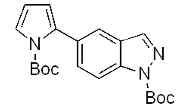
        <p><italic>5-(1-tert-Butoxycarbonyl-1H-pyrrol-2-yl)-indazole-1-carboxylic acid tert-butyl ester</italic> (<bold>5d</bold>). Yield: 310 mg (0.81 mmol, 81%); dark orange viscous liquid; <italic>R</italic><sub>f</sub> = 0.67 (hexane/ethyl acetate, 7:3). <sup>1</sup>H-NMR: <italic>δ</italic> =1.35 (s, 9H, CH<sub>3</sub>), 1.73 (s, 9H, CH<sub>3</sub>), 6.26−6.21 (m, 2H, ArH), 7.38−7.36 (m, 1H, ArH), 7.52 (dd, 1H, ArH, <italic>J</italic> = 1.6 Hz, <italic>J</italic> = 8.7 Hz), 7.70−7.69 (m, 1H, ArH), 8.14 (dd, 1H, ArH, <italic>J</italic> = 0.7 Hz, <italic>J</italic> = 8.7 Hz), 8.17 (s, 1H, ArH) ppm. <sup>13</sup>C-NMR: <italic>δ</italic> = 27.9, 28.4, 83.8, 85.2, 108.2, 111.3, 118.4, 119.0, 123.6, 124.5, 128.7, 130.3, 135.2, 135.4, 139.3, 149.3, 149.7 ppm. IR (CHCl<sub>3</sub>):  <inline-graphic xmlns:xlink="http://www.w3.org/1999/xlink" xlink:href="molecules-17-04508-i001.tif"/> = 1736, 1737 cm<sup>−1</sup>. HRMS: calcd. for C<sub>21</sub>H<sub>25</sub>N<sub>3</sub>NaO<sub>4</sub> 406.1743; found 406.1740.</p>
        <p><italic>2-(1-Phenylacetyl-1H-indazol-5-yl)-pyrrole-1-carboxylic acid tert-butyl ester</italic> (<bold>5e</bold>). Yield: 180 mg (0.45 mmol, 45%); yellow viscous liquid; <italic>R</italic><sub>f</sub> = 0.42. <sup>1</sup>H-NMR: <italic>δ</italic> = 1.35 (s, 9H, CH<sub>3</sub>), 4.54 (s, 2H, CH<sub>2</sub>), 6.21−6.27 (m, 2H, ArH), 7.26−7.44 (m, 6H, ArH), 7.52 (dd, 1H, ArH, <italic>J</italic> = 1.6 Hz, <italic>J</italic> = 8.7 Hz), 7.71 (m, 1H, ArH), 8.17 (s, 1H, ArH), 8.41 (dd, 1H, ArH, <italic>J</italic> = 0.7 Hz, <italic>J</italic> = 8.7 Hz) ppm. <sup>13</sup>C-NMR: <italic>δ</italic> = 27.9, 41.6, 83.8, 108.9, 112.2, 116.2, 118.3, 119.3, 123.9, 124.5, 127.4, 128.3, 129.0, 129.7, 133.4, 135.9, 138.2, 140.8, 149.7, 171.6 ppm. IR (CHCl<sub>3</sub>):  <inline-graphic xmlns:xlink="http://www.w3.org/1999/xlink" xlink:href="molecules-17-04508-i001.tif"/> = 1731, 1739 cm<sup>−1</sup>. HRMS: calcd. for C<sub>24</sub>H<sub>23</sub>N<sub>3</sub>NaO<sub>3</sub> 424.1637; found 413.1632.</p>
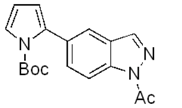
        <p><italic>2-(1-Acetyl-1H-indazol-5-yl)-pyrrole-1-carboxylic acid tert-butyl ester</italic> (<bold>5f</bold>). Yield: 97.5 mg (0.30 mmol, 30%); yellow viscous liquid; <italic>R</italic><sub>f</sub> = 0.79 (hexane/ethyl acetate, 9:1). <sup>1</sup>H-NMR: <italic>δ</italic> = 1.35 (s, 9H, CH<sub>3</sub>), 2.83 (s, 3H, CH<sub>3</sub>), 6.22−6.26 (m, 2H, ArH), 7.36−7.38 (m, 1H, ArH), 7.55 (dd, 1H, ArH, <italic>J</italic> = 1.6 Hz, <italic>J</italic> = 8.7 Hz), 7.70−7.71 (m, 1H, ArH), 8.13 (s, 1H, ArH), 8.41 (dd, 1H, ArH, <italic>J</italic> = 0.7 Hz, <italic>J</italic> = 8.7 Hz) ppm. <sup>13</sup>C-NMR: <italic>δ</italic> = 23.2, 27.9, 84.0, 110.9, 114.7, 115.3, 120.9, 122.9, 126.2, 128.7, 131.3, 131.7, 134.4, 140.8, 149.7, 171.3 ppm. IR (CHCl<sub>3</sub>):  <inline-graphic xmlns:xlink="http://www.w3.org/1999/xlink" xlink:href="molecules-17-04508-i001.tif"/> = 1719, 1778 cm<sup>−1</sup>. HRMS: calcd. for C<sub>18</sub>H<sub>19</sub>N<sub>3</sub>NaO<sub>3</sub> 348.1324; found 348.1320.</p>
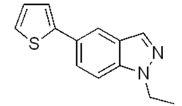
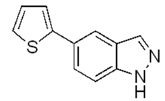
        <p><italic>1-Ethyl-5-thiophen-2-yl-1H-indazole </italic>(<bold>7a</bold>). Yield: 137 mg (0.60 mmol, 60%); brown solid, m.p. 104–106 °C; <italic>R</italic><sub>f</sub> = 0.55 (hexane/ethyl acetate, 6:4). <sup>1</sup>H-NMR: <italic>δ</italic> = 1.59 (t, 3H, CH<sub>3</sub>, <italic>J</italic> = 7.3 Hz), 4.43 (q, 2H, CH<sub>2</sub>, <italic>J</italic> = 7.3 Hz), 7.07−7.10 (m, 1H, ArH), 7.25−7.30 (m, 2H, ArH), 7.39 (d, 1H, ArH, <italic>J=</italic> 8.7 Hz), 7.65 (dd, 1H, ArH, <italic>J</italic> = 1.6 Hz, <italic>J</italic> = 8.7 Hz), 7.94 (m, 1H, ArH), 8.01 (s, 1H, ArH) ppm. <sup>13</sup>C-NMR: <italic>δ</italic> = 15.2, 44.1, 109.7, 118.3, 121.1, 124.4, 124.8, 125.7, 127.6, 128.2, 133.4, 138.5, 145.1 ppm. IR (CHCl<sub>3</sub>):  <inline-graphic xmlns:xlink="http://www.w3.org/1999/xlink" xlink:href="molecules-17-04508-i001.tif"/> = 2988, 3002 cm<sup>−1</sup>. HRMS: calcd. for C<sub>13</sub>H<sub>13</sub>N<sub>2</sub>S 229.0799; found 229.0803.</p>
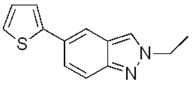
        <p><italic>2-Ethyl-5-thiophen-2-yl-2H-indazole</italic> (<bold>7g</bold>). Yield: 198 mg (0.87 mmol, 87%); brown solid, m.p. 100–103 °C; <italic>R</italic><sub>f</sub> = 0.42. <sup>1</sup>H-NMR: <italic>δ</italic> = 1.63 (t, 3H, CH<sub>3</sub>, <italic>J</italic> = 7.3 Hz), 4.46 (q, 2H, CH<sub>2</sub>, <italic>J</italic> = 7.3 Hz), 7.06−7.09 (m, 1H, ArH), 7.25 (m, 1H, ArH), 7.30 (m, 1H, ArH), 7.58 (dd, 1H, ArH, <italic>J</italic> = 1.6 Hz, <italic>J</italic> = 8.7 Hz), 7.73 (m, 1H, ArH), 7.86 (m, 1H, ArH), 7.91 (s, 1H, ArH) ppm. <sup>13</sup>C-NMR: <italic>δ</italic> = 16.2, 48.8; 109.7, 116.8, 118.1, 121.5, 122.5, 122.6, 122.9, 124.3, 125.7, 128.2, 145.5 ppm IR (CHCl<sub>3</sub>): <inline-graphic xmlns:xlink="http://www.w3.org/1999/xlink" xlink:href="molecules-17-04508-i001.tif"/> = 2978, 3037 cm<sup>−1</sup>. HRMS: calcd. for C<sub>13</sub>H<sub>13</sub>N<sub>2</sub>S 229.0799; found 229.0803.</p>
        <p><italic>1-(3-Chloro-propyl)-5-thiophen-2-yl-1H-indazole</italic> (<bold>7b</bold>). Yield: 171 mg (0.62 mmol, 62%); brown solid, m.p. 105–107 °C; <italic>R</italic><sub>f</sub> = 0.75 (hexane/ethyl acetate, 7:3). <sup>1</sup>H-NMR: <italic>δ</italic> = 2.30−2.46 (m, 2H, CH<sub>2</sub>CH<sub>2</sub>CH<sub>2</sub>), 3.49 (t, 2H, CH<sub>2</sub>Cl, <italic>J</italic> = 6.3 Hz), 4.57 (t, 2H, CH<sub>2</sub>N, <italic>J</italic> = 6.3 Hz), 7.09−7.10 (m, 1H, ArH), 7.25−7.30 (m, 2H, ArH), 7.49 (d, 1H, ArH, <italic>J</italic> = 8.7 Hz), 7.68 (dd, 1H, ArH, <italic>J</italic> = 1.6 Hz, <italic>J</italic> = 8.7 Hz), 7.94 (m, 1H, ArH), 8.03 (s, 1H, ArH) ppm. <sup>13</sup>C-NMR: δ = 32.7, 42.1, 45.6, 109.1, 118.3, 122.9, 124.5, 124.6, 125.9, 127.9, 128.2, 134.1, 139.6, 144.9 ppm IR (CHCl<sub>3</sub>):  <inline-graphic xmlns:xlink="http://www.w3.org/1999/xlink" xlink:href="molecules-17-04508-i001.tif"/> = 2966, 3001 cm<sup>−1</sup>. HRMS: calcd. for C<sub>14</sub>H<sub>14</sub>ClN<sub>2</sub>S 277.0566; found 277.0567.</p>
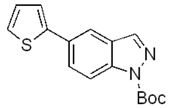
        <p><italic>5-Thiophen-2-yl-indazole-1-carboxylic acid tert-butyl ester </italic>(<bold>7d</bold>). Yield: 210 mg (0.70 mmol, 70%); brown solid, m.p. 112–113 °C; <italic>R</italic><sub>f</sub> = 0.39 (hexane/ethyl acetate, 9:1). <sup>1</sup>H-NMR: <italic>δ</italic> = 1.73 (s, 9H, CH<sub>3</sub>), 7.11 (m, 1H, ArH), 7.30 (m, 1H, ArH), 7.33 (dd, 1H, ArH, <italic>J </italic>= 1.6 Hz, <italic>J</italic> = 8.7 Hz), 7.79 (dd, 1H, ArH, <italic>J</italic> = 0.7 Hz, <italic>J</italic> = 8.7 Hz), 7.92 (m, 1H, ArH), 8.17 (m, 2H, ArH) ppm. <sup>13</sup>C-NMR: <italic>δ</italic> = 28.4, 85.2, 115.2, 118.0, 123.6, 125.2, 126.7, 127.8, 128.4, 130.7, 139.3, 139.8, 144.0, 149.3 ppm. IR (CHCl<sub>3</sub>):  <inline-graphic xmlns:xlink="http://www.w3.org/1999/xlink" xlink:href="molecules-17-04508-i001.tif"/> = 1743, 3001 cm<sup>−1</sup>. HRMS: calcd. for C<sub>16</sub>H<sub>16</sub>N<sub>2</sub>NaO<sub>2</sub>S 323.0830; found 323.0827.</p>
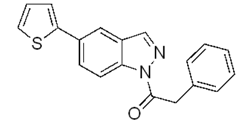
        <p><italic>2-Phenyl-1-(5-thiophen-2-yl-indazol-1-yl)-ethanone</italic> (<bold>7e</bold>). Yield: 95 mg (0.30 mmol, 30%); brown solid, m.p. 114–116 °C; <italic>R</italic><sub>f</sub> = 0.49. <sup>1</sup>H-NMR: <italic>δ</italic> = 4.54 (s, 2H, CH<sub>2</sub>), 7.11 (m, 2H, ArH), 7.29−7.45 (m, 6H, ArH), 7.81 (dd, 1H, ArH, <italic>J</italic> = 1.6 Hz, <italic>J</italic> = 8.7 Hz), 7.93 (m, 1H, ArH), 8.17 (s, 1H, ArH), 8.43 (dd, 1H, ArH, <italic>J</italic> = 0.7 Hz, <italic>J</italic> = 8.7 Hz) ppm. <sup>13</sup>C-NMR: <italic>δ</italic> = 41.8, 116.2, 117.8, 123.8, 125.3, 127.3, 128.3, 128.4, 128.5, 128.6, 128.8, 130.2, 130.8, 131.6, 135.2, 140.3, 171.6 ppm. IR (CHCl<sub>3</sub>):  <inline-graphic xmlns:xlink="http://www.w3.org/1999/xlink" xlink:href="molecules-17-04508-i001.tif"/> = 1713, 3001 cm<sup>−1</sup>. HRMS: calcd. for C<sub>19</sub>H<sub>14</sub>N<sub>2</sub>NaOS 341.0724; found 341.0727.</p>
        <p><italic>1-(5-Thiophen-2-yl-indazol-1-yl)-ethanone </italic>(<bold>7f</bold>). Yield: 85 mg (0.35 mmol, 35%); brown solid, m.p. 116–117 °C; <italic>R</italic><sub>f</sub> = 0.37 (hexane/ethyl acetate, 9:1). <sup>1</sup>H-NMR: <italic>δ</italic> = 2.79 (s, 3H, CH<sub>3</sub>), 7.09−7.12 (m, 1H, ArH), 7.30−7.36 (m, 2H, ArH), 7.81 (dd, 1H, ArH, <italic>J</italic> = 1.7 Hz, <italic>J</italic> = 8.7 Hz), 7.92−7.94 (m, 1H, ArH), 8.13 (s, 1H, ArH), 8.43 (d, 1H, ArH, <italic>J</italic> = 8.7 Hz) ppm. <sup>13</sup>C-NMR: <italic>δ</italic> = 23.2, 116.1, 117.8, 123.8, 125.3, 127.2, 128.3, 128.4, 131.5, 138.5, 139.9, 143.8, 171.5 ppm. IR (CHCl<sub>3</sub>): <inline-graphic xmlns:xlink="http://www.w3.org/1999/xlink" xlink:href="molecules-17-04508-i001.tif"/> = 1713 cm<sup>−1</sup>. HRMS: calcd. for C<sub>13</sub>H<sub>10</sub>N<sub>2</sub>NaOS 265.0411; found 265.0412.</p>
        <p><italic>5-(1-tert-Butoxycarbonyl-1H-pyrrol-2-yl)-1H-indazole-3-carboxylic acid methyl ester</italic> (<bold>10</bold>). Compound <bold>10</bold> was prepared from 5-bromo-1<italic>H</italic>-indazole-3-carboxylic acid methyl ester <bold>8</bold> (61 mg, 0.24 mmol) and 2-pyrroleboronic acid <bold>4</bold> (99 mg, 0.47 mmol) according to the general procedure for the Suzuki coupling reaction. Yield: 57 mg (0.17 mmol, 70%); orange viscous liquid; <italic>R<sub>f</sub></italic> = 0.27 (hexane/ethyl acetate, 1:1). <sup>1</sup>H-NMR: <italic>δ</italic> = 1.34 (s, 9H, CH<sub>3</sub>), 4.05 (s, 3H, OCH<sub>3</sub>), 6.26−6.29 (m, 2H, ArH), 7.37−7.41 (m, 1H, ArH), 7.48 (dd, 1H, ArH, <italic>J </italic>= 1.5 Hz, <italic>J</italic> = 8.8 Hz), 7.67 (d, 1H, ArH, <italic>J</italic> = 8.8 Hz), 8.17−8.20 (m, 1H, ArH), ppm. <sup>13</sup>C-NMR: <italic>δ</italic> = 27.9, 51.3, 83.8, 108.8, 110.7, 114.6, 115.0, 122.6, 123.0, 123.6, 129.1, 134.9, 140.5, 141.7, 150.2, 171.0 ppm. IR (CHCl<sub>3</sub>): <inline-graphic xmlns:xlink="http://www.w3.org/1999/xlink" xlink:href="molecules-17-04508-i001.tif"/> = 1728, 1774 cm<sup>−1</sup>. HRMS: calcd. for C<sub>18</sub>H<sub>19</sub>N<sub>3</sub>NaO<sub>4</sub> 364.1273; found 364.1270.</p>
        <p><italic>5-(1-tert-Butoxycarbonyl-1H-pyrrol-2-yl)-1-methyl-1H-indazole-3-carboxylic acid methyl ester</italic> (<bold>11</bold>). Compound <bold>11</bold> was prepared from 5-bromo-1-methyl-1<italic>H</italic>-indazole-3-carboxylic acid methyl ester <bold>9</bold> (59 mg, 0.22 mmol) and 2-pyrroleboronic acid <bold>4</bold> (91 mg, 0.43 mmol) according to the general procedure for the Suzuki coupling reaction. Yield: 58 mg (0.16 mmol, 75%); brown solid, m.p. 102–104 °C; <italic>R</italic><sub>f</sub> = 0.35 (hexane/ethyl acetate, 1:1). <sup>1</sup>H-NMR: <italic>δ</italic> = 1.32 (s, 9H, CH<sub>3</sub>), 4.01 (s, 3H, OCH<sub>3</sub>), 4.52 (s, 3H, NCH<sub>3</sub>), 6.22−6.31 (m, 2H, ArH), 7.30−7.43 (m, 1H, ArH), 7.69−7.75 (m, 1H, ArH), 7.67 (d, 1H, ArH, <italic>J </italic>= 8.8 Hz), 8.17−8.20 (m, 1H, ArH), ppm. <sup>13</sup>C-NMR: <italic>δ</italic> = 27.9, 42.6, 51.5, 83.8, 108.3, 110.4, 114.3, 115.0, 122.5, 123.6, 124.0, 128.9, 134.1, 139.7, 141.8, 150.1, 171.1 ppm. IR (CHCl<sub>3</sub>): <inline-graphic xmlns:xlink="http://www.w3.org/1999/xlink" xlink:href="molecules-17-04508-i001.tif"/> = 1716, 1774 cm<sup>−1</sup>. HRMS: calcd. for C<sub>19</sub>H<sub>21</sub>N<sub>3</sub>NaO<sub>4</sub> 378.1430; found 378.1434.</p>
      </sec>
    </sec>
    <sec sec-type="conclusions">
      <title>4. Conclusions</title>
      <p>In summary, this work establishes that indazoles bearing alkyl or acyl groups at either the <italic>N</italic>-1 or <italic>N</italic>-2 positions are suitable substrates for Suzuki cross-coupling reactions with pyrrole- and thiophene-boronic acids. We found that in the presence of Pd(dppf)Cl<sub>2 </sub>as palladium catalyst, the Suzuki reactions proceed in relatively short times (2 h) and in good yields. The best results were obtained when <italic>N</italic>-alkyl and <italic>N</italic>-Boc indazoles were employed as starting materials. Moreover, it was demonstrated that even bromoindazoles bearing a carbomethoxy group on <italic>C</italic>-3 are good coupling partners in these reactions. To the best of our knowledge, this is the first systematic study of Suzuki reactions between various 5-bromoindazoles and 2-pyrrole- or 2-thiopheneboronic acids. This could provide a promising access to new heterobiaryl compounds, valuable building blocks for use in medicinal chemistry.</p>
    </sec>
  </body>
  <back>
    <ack>
      <title>Acknowledgements</title>
      <p>We thank the “Sapienza” University of Rome for financial support. (National Project “Nuovi pirroli funzionalizzati con anti-infiammatori per la realizzazione di nanoparticelle bioattive”).</p>
    </ack>
    <ref-list>
      <title>References and Notes</title>
      <ref id="B1-molecules-17-04508">
        <label>1.</label>
        <citation citation-type="journal">
          <person-group person-group-type="author">
            <name>
              <surname>Cerecetto</surname>
              <given-names>H.</given-names>
            </name>
            <name>
              <surname>Gerpe</surname>
              <given-names>A.</given-names>
            </name>
            <name>
              <surname>González</surname>
              <given-names>M.</given-names>
            </name>
            <name>
              <surname>Arán</surname>
              <given-names>V.J.</given-names>
            </name>
            <name>
              <surname>de Ocáriz</surname>
              <given-names>C.O.</given-names>
            </name>
          </person-group>
          <article-title>Pharmacological properties of indazole derivatives: Recent developments</article-title>
          <source>Mini Rev. Med. Chem.</source>
          <year>2005</year>
          <volume>5</volume>
          <fpage>869</fpage>
          <lpage>878</lpage>
        <pub-id pub-id-type="doi">10.2174/138955705774329564</pub-id><pub-id pub-id-type="pmid">16250831</pub-id></citation>
      </ref>
      <ref id="B2-molecules-17-04508">
        <label>2.</label>
        <citation citation-type="journal">
          <person-group person-group-type="author">
            <name>
              <surname>de Lena</surname>
              <given-names>M.</given-names>
            </name>
            <name>
              <surname>Lorusso</surname>
              <given-names>V.</given-names>
            </name>
            <name>
              <surname>Latorre</surname>
              <given-names>A.</given-names>
            </name>
            <name>
              <surname>Fanizza</surname>
              <given-names>G.</given-names>
            </name>
            <name>
              <surname>Gargano</surname>
              <given-names>G.</given-names>
            </name>
            <name>
              <surname>Caporusso</surname>
              <given-names>L.</given-names>
            </name>
            <name>
              <surname>Guida</surname>
              <given-names>M.</given-names>
            </name>
            <name>
              <surname>Catino</surname>
              <given-names>A.</given-names>
            </name>
            <name>
              <surname>Crucitta</surname>
              <given-names>E.</given-names>
            </name>
            <name>
              <surname>Sambiasi</surname>
              <given-names>D.</given-names>
            </name>
            <etal/>
          </person-group>
          <article-title>Paclitaxel, cisplatin and lonidamide in advanced ovarian cancer. A phase II study</article-title>
          <source>Eur. J. Cancer</source>
          <year>2001</year>
          <volume>37</volume>
          <fpage>364</fpage>
          <lpage>368</lpage>
        <pub-id pub-id-type="doi">10.1016/S0959-8049(00)00400-7</pub-id><pub-id pub-id-type="pmid">11239758</pub-id></citation>
      </ref>
      <ref id="B3-molecules-17-04508">
        <label>3.</label>
        <citation citation-type="journal">
          <person-group person-group-type="author">
            <name>
              <surname>Woods</surname>
              <given-names>K.W.</given-names>
            </name>
            <name>
              <surname>Fischer</surname>
              <given-names>J.P.</given-names>
            </name>
            <name>
              <surname>Claiborne</surname>
              <given-names>A.</given-names>
            </name>
            <name>
              <surname>Li</surname>
              <given-names>T.</given-names>
            </name>
            <name>
              <surname>Thomas</surname>
              <given-names>S.A.</given-names>
            </name>
            <name>
              <surname>Zhu</surname>
              <given-names>G.</given-names>
            </name>
            <name>
              <surname>Diebold</surname>
              <given-names>R.B.</given-names>
            </name>
            <name>
              <surname>Liu</surname>
              <given-names>X.</given-names>
            </name>
            <name>
              <surname>Shi</surname>
              <given-names>Y.</given-names>
            </name>
            <name>
              <surname>Klinghofer</surname>
              <given-names>V.</given-names>
            </name>
            <etal/>
          </person-group>
          <article-title>Synthesis and SAR of indazole-pyridine based protein kinase B/Akt inhibitors</article-title>
          <source>Bioorg. Med. Chem.</source>
          <year>2006</year>
          <volume>14</volume>
          <fpage>6832</fpage>
          <lpage>6846</lpage>
        <pub-id pub-id-type="doi">10.1016/j.bmc.2006.06.047</pub-id><pub-id pub-id-type="pmid">16843670</pub-id></citation>
      </ref>
      <ref id="B4-molecules-17-04508">
        <label>4.</label>
        <citation citation-type="journal">
          <person-group person-group-type="author">
            <name>
              <surname>Zhao</surname>
              <given-names>D.</given-names>
            </name>
            <name>
              <surname>You</surname>
              <given-names>J.</given-names>
            </name>
            <name>
              <surname>Hu</surname>
              <given-names>C.</given-names>
            </name>
          </person-group>
          <article-title>Recent progress in coupling of two heteroarenes</article-title>
          <source>Chem. Eur. J.</source>
          <year>2011</year>
          <volume>17</volume>
          <fpage>5466</fpage>
          <lpage>5492</lpage>
        <pub-id pub-id-type="doi">10.1002/chem.201003039</pub-id><pub-id pub-id-type="pmid">21506178</pub-id></citation>
      </ref>
      <ref id="B5-molecules-17-04508">
        <label>5.</label>
        <citation citation-type="journal">
          <person-group person-group-type="author">
            <name>
              <surname>Fraile</surname>
              <given-names>A.</given-names>
            </name>
            <name>
              <surname>Martín</surname>
              <given-names>M.R.</given-names>
            </name>
            <name>
              <surname>Ruano</surname>
              <given-names>J.L.G.</given-names>
            </name>
            <name>
              <surname>Díaz</surname>
              <given-names>J.A.</given-names>
            </name>
            <name>
              <surname>Arranz</surname>
              <given-names>E.</given-names>
            </name>
          </person-group>
          <article-title>Efficient synthesis of new 3-heteroaryl-1-functionalized 1H-indazoles</article-title>
          <source>Tetrahedron</source>
          <year>2011</year>
          <volume>67</volume>
          <fpage>100</fpage>
          <lpage>105</lpage>
        <pub-id pub-id-type="doi">10.1016/j.tet.2010.11.021</pub-id></citation>
      </ref>
      <ref id="B6-molecules-17-04508">
        <label>6.</label>
        <citation citation-type="journal">
          <person-group person-group-type="author">
            <name>
              <surname>Salovich</surname>
              <given-names>J.M.</given-names>
            </name>
            <name>
              <surname>Lindsley</surname>
              <given-names>C.W.</given-names>
            </name>
            <name>
              <surname>Hopkins</surname>
              <given-names>C.R.</given-names>
            </name>
          </person-group>
          <article-title>Synthesis of 1,3-diarylsubstituted indazoles utilizing a Suzuki cross-coupling/deprotection/<italic>N</italic>-arylation sequence</article-title>
          <source>Tetrahedron Lett.</source>
          <year>2010</year>
          <volume>51</volume>
          <fpage>3796</fpage>
          <lpage>3799</lpage>
        <pub-id pub-id-type="doi">10.1016/j.tetlet.2010.05.060</pub-id><pub-id pub-id-type="pmid">20606711</pub-id></citation>
      </ref>
      <ref id="B7-molecules-17-04508">
        <label>7.</label>
        <citation citation-type="journal">
          <person-group person-group-type="author">
            <name>
              <surname>Schmidt</surname>
              <given-names>A.</given-names>
            </name>
            <name>
              <surname>Beutler</surname>
              <given-names>A.</given-names>
            </name>
            <name>
              <surname>Snovydovych</surname>
              <given-names>B.</given-names>
            </name>
          </person-group>
          <article-title>Recent advances in the chemistry of indazoles</article-title>
          <source>Eur. J. Org. Chem.</source>
          <year>2008</year>
          <fpage>4073</fpage>
          <lpage>4095</lpage>
        </citation>
      </ref>
      <ref id="B8-molecules-17-04508">
        <label>8.</label>
        <citation citation-type="journal">
          <person-group person-group-type="author">
            <name>
              <surname>Schnürch</surname>
              <given-names>M.</given-names>
            </name>
            <name>
              <surname>Flasik</surname>
              <given-names>R.</given-names>
            </name>
            <name>
              <surname>Khan</surname>
              <given-names>A.F.</given-names>
            </name>
            <name>
              <surname>Spina</surname>
              <given-names>M.</given-names>
            </name>
            <name>
              <surname>Mihovilovic</surname>
              <given-names>M.D.</given-names>
            </name>
            <name>
              <surname>Stanetty</surname>
              <given-names>P.</given-names>
            </name>
          </person-group>
          <article-title>Cross-coupling reactions on azoles with two and more heteroatoms</article-title>
          <source>Eur. J. Org. Chem.</source>
          <year>2006</year>

          <fpage>3283</fpage>
          <lpage>3307</lpage>
        </citation>
      </ref>
      <ref id="B9-molecules-17-04508">
        <label>9.</label>
        <citation citation-type="journal">
          <person-group person-group-type="author">
            <name>
              <surname>El Kazzouli</surname>
              <given-names>S.</given-names>
            </name>
            <name>
              <surname>Bouissane</surname>
              <given-names>L.</given-names>
            </name>
            <name>
              <surname>Khouili</surname>
              <given-names>M.</given-names>
            </name>
            <name>
              <surname>Guillaumet</surname>
              <given-names>G.</given-names>
            </name>
          </person-group>
          <article-title>Synthesis of 4-substituted and 3,4-disubstituted indazole derivatives by palladium-mediated cross-coupling reactions</article-title>
          <source>Tetrahedron Lett.</source>
          <year>2005</year>
          <volume>46</volume>
          <fpage>6163</fpage>
          <lpage>6167</lpage>
        <pub-id pub-id-type="doi">10.1016/j.tetlet.2005.06.080</pub-id></citation>
      </ref>
      <ref id="B10-molecules-17-04508">
        <label>10.</label>
        <citation citation-type="journal">
          <person-group person-group-type="author">
            <name>
              <surname>Witulski</surname>
              <given-names>B.</given-names>
            </name>
            <name>
              <surname>Azcon</surname>
              <given-names>J.R.</given-names>
            </name>
            <name>
              <surname>Alayrac</surname>
              <given-names>C.</given-names>
            </name>
            <name>
              <surname>Arnautu</surname>
              <given-names>A.</given-names>
            </name>
            <name>
              <surname>Collot</surname>
              <given-names>V.</given-names>
            </name>
            <name>
              <surname>Rault</surname>
              <given-names>S.</given-names>
            </name>
          </person-group>
          <article-title>Sequential sonogashira and suzuki cross-coupling reactions in the indole and indazole series</article-title>
          <source>Synthesis</source>
          <year>2005</year>
          <volume>5</volume>
          <fpage>771</fpage>
          <lpage>780</lpage>
        </citation>
      </ref>
      <ref id="B11-molecules-17-04508">
        <label>11.</label>
        <citation citation-type="journal">
          <person-group person-group-type="author">
            <name>
              <surname>Bräse</surname>
              <given-names>S.</given-names>
            </name>
            <name>
              <surname>Gil</surname>
              <given-names>C.</given-names>
            </name>
            <name>
              <surname>Knepper</surname>
              <given-names>K.</given-names>
            </name>
          </person-group>
          <article-title>The recent impact of solid-phase synthesis on medicinally relevant benzoannelated nitrogen heterocycles</article-title>
          <source>Bioorg. Med. Chem.</source>
          <year>2002</year>
          <volume>10</volume>
          <fpage>2415</fpage>
          <lpage>2437</lpage>
        <pub-id pub-id-type="doi">10.1016/S0968-0896(02)00025-1</pub-id><pub-id pub-id-type="pmid">12057632</pub-id></citation>
      </ref>
      <ref id="B12-molecules-17-04508">
        <label>12.</label>
        <citation citation-type="journal">
          <person-group person-group-type="author">
            <name>
              <surname>Collot</surname>
              <given-names>V.</given-names>
            </name>
            <name>
              <surname>Dallemagne</surname>
              <given-names>P.</given-names>
            </name>
            <name>
              <surname>Bovy</surname>
              <given-names>P.R.</given-names>
            </name>
            <name>
              <surname>Rault</surname>
              <given-names>S.</given-names>
            </name>
          </person-group>
          <article-title>Suzuki-type cross-coupling reaction of 3-iodoindazoles with aryl boronic acids: a general and flexible route to 3-arylindazoles</article-title>
          <source>Tetrahedron</source>
          <year>1999</year>
          <volume>55</volume>
          <fpage>6917</fpage>
          <lpage>6922</lpage>
        <pub-id pub-id-type="doi">10.1016/S0040-4020(99)00324-5</pub-id></citation>
      </ref>
      <ref id="B13-molecules-17-04508">
        <label>13.</label>
        <citation citation-type="journal">
          <person-group person-group-type="author">
            <name>
              <surname>Yates</surname>
              <given-names>C.M.</given-names>
            </name>
            <name>
              <surname>Brown</surname>
              <given-names>P.J.</given-names>
            </name>
            <name>
              <surname>Stewart</surname>
              <given-names>E.L.</given-names>
            </name>
            <name>
              <surname>Patten</surname>
              <given-names>C.</given-names>
            </name>
            <name>
              <surname>Austin</surname>
              <given-names>R.J.H.</given-names>
            </name>
            <name>
              <surname>Holt</surname>
              <given-names>J.A.</given-names>
            </name>
            <name>
              <surname>Maglich</surname>
              <given-names>J.M.</given-names>
            </name>
            <name>
              <surname>Angell</surname>
              <given-names>D.C.</given-names>
            </name>
            <name>
              <surname>Sasse</surname>
              <given-names>R.Z.</given-names>
            </name>
            <name>
              <surname>Taylor</surname>
              <given-names>S.J.</given-names>
            </name>
            <etal/>
          </person-group>
          <article-title>Structure guided design of 5-arylindazole glucocorticoid receptor agonists and antagonists</article-title>
          <source>J. Med. Chem.</source>
          <year>2010</year>
          <volume>53</volume>
          <fpage>4531</fpage>
          <lpage>4544</lpage>
        <pub-id pub-id-type="doi">10.1021/jm100447c</pub-id><pub-id pub-id-type="pmid">20469868</pub-id></citation>
      </ref>
      <ref id="B14-molecules-17-04508">
        <label>14.</label>
        <citation citation-type="journal">
          <person-group person-group-type="author">
            <name>
              <surname>Trujillo</surname>
              <given-names>J.I.</given-names>
            </name>
            <name>
              <surname>Kiefer</surname>
              <given-names>J.R.</given-names>
            </name>
            <name>
              <surname>Huang</surname>
              <given-names>W.</given-names>
            </name>
            <name>
              <surname>Thorarensen</surname>
              <given-names>A.</given-names>
            </name>
            <name>
              <surname>Xing</surname>
              <given-names>L.</given-names>
            </name>
            <name>
              <surname>Caspers</surname>
              <given-names>N.L.</given-names>
            </name>
            <name>
              <surname>Day</surname>
              <given-names>J.E.</given-names>
            </name>
            <name>
              <surname>Mathis</surname>
              <given-names>K.J.</given-names>
            </name>
            <name>
              <surname>Kretzmer</surname>
              <given-names>K.K.</given-names>
            </name>
            <name>
              <surname>Reitz</surname>
              <given-names>B.A.</given-names>
            </name>
            <etal/>
          </person-group>
          <article-title>2-(6-Phenyl-1<italic>H</italic>-indazol-3-yl)-1<italic>H</italic>-benzo[<italic>d</italic>]imidazoles: Design and synthesis of a potent and isoform selective PKC-ζ inhibitor</article-title>
          <source>Bioorg. Med. Chem. Lett.</source>
          <year>2009</year>
          <volume>19</volume>
          <fpage>908</fpage>
          <lpage>911</lpage>
        <pub-id pub-id-type="doi">10.1016/j.bmcl.2008.11.105</pub-id><pub-id pub-id-type="pmid">19097791</pub-id></citation>
      </ref>
      <ref id="B15-molecules-17-04508">
        <label>15.</label>
        <citation citation-type="patent">
          <person-group person-group-type="author">
            <name>
              <surname>Xie</surname>
              <given-names>W.</given-names>
            </name>
            <name>
              <surname>Herbert</surname>
              <given-names>B.</given-names>
            </name>
            <name>
              <surname>Ma</surname>
              <given-names>J.</given-names>
            </name>
            <name>
              <surname>Nguyen</surname>
              <given-names>T.M.</given-names>
            </name>
            <name>
              <surname>Schumacher</surname>
              <given-names>R.A.</given-names>
            </name>
            <name>
              <surname>Gauss</surname>
              <given-names>C.</given-names>
            </name>
            <name>
              <surname>Theim</surname>
              <given-names>A.</given-names>
            </name>
          </person-group>
          <article-title>Indoles, 1<italic>H</italic>-indazoles, 1,2-benzisoxazoles, and 1,2-benzisothiazoles, and preparation and uses thereof</article-title>
          <patent>WO2005/063767</patent>
          <day>14</day>
          <month>July</month>
          <year>2005</year>
        </citation>
      </ref>
      <ref id="B16-molecules-17-04508">
        <label>16.</label>
        <citation citation-type="patent">
          <person-group person-group-type="author">
            <name>
              <surname>Yasuma</surname>
              <given-names>T.</given-names>
            </name>
            <name>
              <surname>Sasaki</surname>
              <given-names>S.</given-names>
            </name>
            <name>
              <surname>Ujikawa</surname>
              <given-names>O.</given-names>
            </name>
            <name>
              <surname>Miyamoto</surname>
              <given-names>Y.</given-names>
            </name>
            <name>
              <surname>Gwaltney</surname>
              <given-names>S.L.</given-names>
            </name>
            <name>
              <surname>Cao</surname>
              <given-names>S.X.</given-names>
            </name>
            <name>
              <surname>Jennings</surname>
              <given-names>A.</given-names>
            </name>
          </person-group>
          <article-title>Preparation of indazole compounds as glucokinase activators for treating diabetes and obesity</article-title>
          <patent>WO2008/156757</patent>
          <day>24</day>
          <month>December</month>
          <year>2008</year>
        </citation>
      </ref>
      <ref id="B17-molecules-17-04508">
        <label>17.</label>
        <citation citation-type="patent">
          <person-group person-group-type="author">
            <name>
              <surname>Kerns</surname>
              <given-names>J.K.</given-names>
            </name>
            <name>
              <surname>Edwards</surname>
              <given-names>C.</given-names>
            </name>
          </person-group>
          <article-title>Preparation of indazole carboxamides as IKKβ kinase inhibitors for a treatment of a variety of disorders</article-title>
          <patent>WO2006/002434</patent>
          <day>5</day>
          <month>January</month>
          <year>2006</year>
        </citation>
      </ref>
      <ref id="B18-molecules-17-04508">
        <label>18.</label>
        <citation citation-type="journal">
          <person-group person-group-type="author">
            <name>
              <surname>Witherington</surname>
              <given-names>J.</given-names>
            </name>
            <name>
              <surname>Bordas</surname>
              <given-names>V.</given-names>
            </name>
            <name>
              <surname>Gaiba</surname>
              <given-names>A.</given-names>
            </name>
            <name>
              <surname>Naylor</surname>
              <given-names>A.</given-names>
            </name>
            <name>
              <surname>Rawlings</surname>
              <given-names>A.D.</given-names>
            </name>
            <name>
              <surname>Slingsby</surname>
              <given-names>B.P.</given-names>
            </name>
            <name>
              <surname>Smith</surname>
              <given-names>D.G.</given-names>
            </name>
            <name>
              <surname>Takle</surname>
              <given-names>A.K.</given-names>
            </name>
            <name>
              <surname>Ward</surname>
              <given-names>R.W.</given-names>
            </name>
          </person-group>
          <article-title>6-Heteroaryl-pyrazolo[3,4-b]pyridines:potent and selective inhibitors of glycogen synthase kinase-3 (GSK-3)</article-title>
          <source>Bioorg. Med. Chem. Lett.</source>
          <year>2003</year>
          <volume>13</volume>
          <fpage>3059</fpage>
          <lpage>3062</lpage>
        <pub-id pub-id-type="doi">10.1016/S0960-894X(03)00646-2</pub-id><pub-id pub-id-type="pmid">12941333</pub-id></citation>
      </ref>
      <ref id="B19-molecules-17-04508">
        <label>19.</label>
        <citation citation-type="confproc">
          <person-group person-group-type="author">
            <name>
              <surname>Gasperi</surname>
              <given-names>T.</given-names>
            </name>
            <name>
              <surname>Loreto</surname>
              <given-names>M.A.</given-names>
            </name>
            <name>
              <surname>Norcia</surname>
              <given-names>G.</given-names>
            </name>
            <name>
              <surname>Tardella</surname>
              <given-names>P.A.</given-names>
            </name>
            <name>
              <surname>Furlotti</surname>
              <given-names>G.</given-names>
            </name>
          </person-group>
          <article-title>Regioselective synthesis of <italic>N</italic>-2 substituted indazoles as precursors of new pharmacophores</article-title>
          <source>Proceedings of XXIII Congresso Nazionale della Società Chimica Italiana</source>
          <conf-loc>Sorrento, Na, Italy</conf-loc>
          <conf-date>July 2009</conf-date>
        </citation>
      </ref>
      <ref id="B20-molecules-17-04508">
        <label>20.</label>
        <citation citation-type="journal">
          <person-group person-group-type="author">
            <name>
              <surname>Prieto</surname>
              <given-names>M.</given-names>
            </name>
            <name>
              <surname>Zurita</surname>
              <given-names>E.</given-names>
            </name>
            <name>
              <surname>Rosa</surname>
              <given-names>E.</given-names>
            </name>
            <name>
              <surname>Muñoz</surname>
              <given-names>L.</given-names>
            </name>
            <name>
              <surname>Lloyd-Williams</surname>
              <given-names>P.</given-names>
            </name>
            <name>
              <surname>Giralt</surname>
              <given-names>E.</given-names>
            </name>
          </person-group>
          <article-title>Arylboronic acid and arylpinacolboronate esters in Suzuki coupling reactions involving indoles. Partner role swapping and heterocycle protection</article-title>
          <source>J. Org. Chem.</source>
          <year>2004</year>
          <volume>69</volume>
          <fpage>6812</fpage>
          <lpage>6820</lpage>
        <pub-id pub-id-type="doi">10.1021/jo0491612</pub-id><pub-id pub-id-type="pmid">15387606</pub-id></citation>
      </ref>
      <ref id="B21-molecules-17-04508">
        <label>21.</label>
        <citation citation-type="journal">
          <person-group person-group-type="author">
            <name>
              <surname>Tyrrell</surname>
              <given-names>E.</given-names>
            </name>
            <name>
              <surname>Brookes</surname>
              <given-names>P.</given-names>
            </name>
          </person-group>
          <article-title>The synthesis and applications of hetherocyclic boronic acids</article-title>
          <source>Synthesis</source>
          <year>2003</year>
          <fpage>469</fpage>
          <lpage>483</lpage>
        </citation>
      </ref>
      <ref id="B22-molecules-17-04508">
        <label>22.</label>
        <citation citation-type="journal">
          <person-group person-group-type="author">
            <name>
              <surname>Billingsley</surname>
              <given-names>K.</given-names>
            </name>
            <name>
              <surname>Buchwald</surname>
              <given-names>S.L.</given-names>
            </name>
          </person-group>
          <article-title>High efficient monophosphine-based catalyst for the palladium-catalyzed Suzuki–Miyaura reaction of heteroaryl halides and heteroaryl boronic acids and esters</article-title>
          <source>J. Am. Chem. Soc.</source>
          <year>2007</year>
          <volume>129</volume>
          <fpage>3358</fpage>
          <lpage>3366</lpage>
        <pub-id pub-id-type="doi">10.1021/ja068577p</pub-id><pub-id pub-id-type="pmid">17326639</pub-id></citation>
      </ref>
      <ref id="B23-molecules-17-04508">
        <label>23.</label>
        <citation citation-type="journal">
          <person-group person-group-type="author">
            <name>
              <surname>Barder</surname>
              <given-names>T.E.</given-names>
            </name>
            <name>
              <surname>Buchwald</surname>
              <given-names>S.L.</given-names>
            </name>
          </person-group>
          <article-title>Efficient catalyst fort he Suzuki-Miyaura coupling of potassium aryl trifluoroborates with aryl chlorides</article-title>
          <source>Org. Lett.</source>
          <year>2004</year>
          <volume>6</volume>
          <fpage>2649</fpage>
          <lpage>2652</lpage>
        <pub-id pub-id-type="doi">10.1021/ol0491686</pub-id><pub-id pub-id-type="pmid">15281735</pub-id></citation>
      </ref>
      <ref id="B24-molecules-17-04508">
        <label>24.</label>
        <citation citation-type="journal">
          <person-group person-group-type="author">
            <name>
              <surname>Kondolff</surname>
              <given-names>I.</given-names>
            </name>
            <name>
              <surname>Doucet</surname>
              <given-names>H.</given-names>
            </name>
            <name>
              <surname>Santelli</surname>
              <given-names>M.</given-names>
            </name>
          </person-group>
          <article-title>Suzuki coupling reactions of heteroarylboronic acids with aryl halides and arylboronic acids with heteroaryl bromides using a tetraphosphine/palladium catalyst</article-title>
          <source>Synlett</source>
          <year>2005</year>
          <volume>13</volume>
          <fpage>2057</fpage>
          <lpage>2061</lpage>
        </citation>
      </ref>
      <ref id="B25-molecules-17-04508">
        <label>25.</label>
        <citation citation-type="journal">
          <person-group person-group-type="author">
            <name>
              <surname>Thompson</surname>
              <given-names>A.E.</given-names>
            </name>
            <name>
              <surname>Hughes</surname>
              <given-names>G.</given-names>
            </name>
            <name>
              <surname>Batsanov</surname>
              <given-names>A.S.</given-names>
            </name>
            <name>
              <surname>Bryce</surname>
              <given-names>M.R.</given-names>
            </name>
            <name>
              <surname>Parry</surname>
              <given-names>P.R.</given-names>
            </name>
            <name>
              <surname>Tarbit</surname>
              <given-names>B.</given-names>
            </name>
          </person-group>
          <article-title>Palladium-catalyzed cross-coupling reactions of pyridylboronic acids with heteroaryl halides bearing a primary amine group: Synthesis of highly substituted bipyridines and pyrazinopyridines</article-title>
          <source>J. Org. Chem.</source>
          <year>2005</year>
          <volume>70</volume>
          <fpage>388</fpage>
          <lpage>390</lpage>
        <pub-id pub-id-type="doi">10.1021/jo0402226</pub-id><pub-id pub-id-type="pmid">15624958</pub-id></citation>
      </ref>
      <ref id="B26-molecules-17-04508">
        <label>26.</label>
        <citation citation-type="journal">
          <person-group person-group-type="author">
            <name>
              <surname>Kudo</surname>
              <given-names>N.</given-names>
            </name>
            <name>
              <surname>Perseghini</surname>
              <given-names>M.</given-names>
            </name>
            <name>
              <surname>Fu</surname>
              <given-names>G.C.</given-names>
            </name>
          </person-group>
          <article-title>A versatile method for suzuki cross-coupling reactions of nitrogen heterocycles</article-title>
          <source>Angew Chem. Weinheim Bergstr. Ger.</source>
          <year>2006</year>
          <volume>45</volume>
          <fpage>1282</fpage>
          <lpage>1284</lpage>
        </citation>
      </ref>
      <ref id="B27-molecules-17-04508">
        <label>27.</label>
        <citation citation-type="journal">
          <person-group person-group-type="author">
            <name>
              <surname>Guram</surname>
              <given-names>A.S.</given-names>
            </name>
            <name>
              <surname>King</surname>
              <given-names>A.O.</given-names>
            </name>
            <name>
              <surname>Allen</surname>
              <given-names>J.G.</given-names>
            </name>
            <name>
              <surname>Wang</surname>
              <given-names>X.</given-names>
            </name>
            <name>
              <surname>Schenkel</surname>
              <given-names>L.B.</given-names>
            </name>
            <name>
              <surname>Chan</surname>
              <given-names>J.</given-names>
            </name>
            <name>
              <surname>Bunel</surname>
              <given-names>E.E.</given-names>
            </name>
            <name>
              <surname>Faul</surname>
              <given-names>M.M.</given-names>
            </name>
            <name>
              <surname>Larsen</surname>
              <given-names>R.D.</given-names>
            </name>
            <name>
              <surname>Martinelli</surname>
              <given-names>M.J.</given-names>
            </name>
            <etal/>
          </person-group>
          <article-title>New Air-stable catalysts for general and efficient Suzuki-Miyaura cross-coupling reactions of heteroaryl chlorides</article-title>
          <source>Org. Lett.</source>
          <year>2006</year>
          <volume>8</volume>
          <fpage>1787</fpage>
          <lpage>1789</lpage>
        <pub-id pub-id-type="doi">10.1021/ol060268g</pub-id><pub-id pub-id-type="pmid">16623551</pub-id></citation>
      </ref>
      <ref id="B28-molecules-17-04508">
        <label>28.</label>
        <citation citation-type="journal">
          <person-group person-group-type="author">
            <name>
              <surname>Kitamura</surname>
              <given-names>Y.</given-names>
            </name>
            <name>
              <surname>Sako</surname>
              <given-names>S.</given-names>
            </name>
            <name>
              <surname>Tsutsui</surname>
              <given-names>A.</given-names>
            </name>
            <name>
              <surname>Monguchi</surname>
              <given-names>Y.</given-names>
            </name>
            <name>
              <surname>Maegawa</surname>
              <given-names>T.</given-names>
            </name>
            <name>
              <surname>Kitade</surname>
              <given-names>Y.</given-names>
            </name>
            <name>
              <surname>Sajikia</surname>
              <given-names>H.</given-names>
            </name>
          </person-group>
          <article-title>Ligand-free and heterogeneous palladium on carbon-catalyzed hetero-Suzuki–Miyaura cross-coupling</article-title>
          <source>Adv. Synth. Catal.</source>
          <year>2010</year>
          <volume>352</volume>
          <fpage>718</fpage>
          <lpage>730</lpage>
          <pub-id pub-id-type="doi">10.1002/adsc.200900638</pub-id>
        </citation>
      </ref>
      <ref id="B29-molecules-17-04508">
        <label>29.</label>
        <citation citation-type="journal">
          <person-group person-group-type="author">
            <name>
              <surname>Kelly</surname>
              <given-names>T.A.</given-names>
            </name>
            <name>
              <surname>Fuchs</surname>
              <given-names>V.U.</given-names>
            </name>
            <name>
              <surname>Perry</surname>
              <given-names>C.W.</given-names>
            </name>
            <name>
              <surname>Snow</surname>
              <given-names>R.J.</given-names>
            </name>
          </person-group>
          <article-title>The efficient synthesis and simple resolution of a prolineboronate ester suitable for enzyme-inhibition studies</article-title>
          <source>Tetrahedron</source>
          <year>1993</year>
          <volume>49</volume>
          <fpage>1009</fpage>
          <lpage>1016</lpage>
        <pub-id pub-id-type="doi">10.1016/S0040-4020(01)86281-5</pub-id></citation>
      </ref>
      <ref id="B30-molecules-17-04508">
        <label>30.</label>
        <citation citation-type="patent">
          <person-group person-group-type="author">
            <name>
              <surname>Scott</surname>
              <given-names>J.D.</given-names>
            </name>
            <name>
              <surname>Stamford</surname>
              <given-names>A.W.</given-names>
            </name>
            <name>
              <surname>Gilbert</surname>
              <given-names>E.J.</given-names>
            </name>
            <name>
              <surname>Cumming</surname>
              <given-names>J.N.</given-names>
            </name>
            <name>
              <surname>Iserloh</surname>
              <given-names>U.</given-names>
            </name>
            <name>
              <surname>Wang</surname>
              <given-names>L.</given-names>
            </name>
            <name>
              <surname>Li</surname>
              <given-names>W.</given-names>
            </name>
          </person-group>
          <article-title>Iminothiadiazine dioxide compounds as BACE inhibitors and their preparation, compositions and use in the treatment of pathologies associated with beta-amyloid protein</article-title>
          <patent>WO/2011044187</patent>
          <day>24</day>
          <month>April</month>
          <year>2011</year>
        </citation>
      </ref>
      <ref id="B31-molecules-17-04508">
        <label>31.</label>
        <citation citation-type="journal">
          <person-group person-group-type="author">
            <name>
              <surname>Teixeira</surname>
              <given-names>F.C.</given-names>
            </name>
            <name>
              <surname>Ramos</surname>
              <given-names>H.</given-names>
            </name>
            <name>
              <surname>Antunes</surname>
              <given-names>I.F.</given-names>
            </name>
            <name>
              <surname>Curto</surname>
              <given-names>M.J.M.</given-names>
            </name>
            <name>
              <surname>Duarte</surname>
              <given-names>M.T.</given-names>
            </name>
            <name>
              <surname>Bento</surname>
              <given-names>I.</given-names>
            </name>
          </person-group>
          <article-title>Synthesis and structural characterization of 1- and 2-substituted indazoles: ester and carboxylic acid derivatives</article-title>
          <source>Molecules</source>
          <year>2006</year>
          <volume>11</volume>
          <fpage>867</fpage>
          <lpage>889</lpage>
        <pub-id pub-id-type="doi">10.3390/11110867</pub-id><pub-id pub-id-type="pmid">18007393</pub-id></citation>
      </ref>
      <ref id="B32-molecules-17-04508">
        <label>32.</label>
        <citation citation-type="journal">
          <person-group person-group-type="author">
            <name>
              <surname>Gusev</surname>
              <given-names>O.V.</given-names>
            </name>
            <name>
              <surname>Peganova</surname>
              <given-names>T.A.</given-names>
            </name>
            <name>
              <surname>Kalsin</surname>
              <given-names>A.M.</given-names>
            </name>
            <name>
              <surname>Vologdin</surname>
              <given-names>N.V.</given-names>
            </name>
            <name>
              <surname>Petrovskii</surname>
              <given-names>P.V.</given-names>
            </name>
            <name>
              <surname>Lyssenko</surname>
              <given-names>K.A.</given-names>
            </name>
            <name>
              <surname>Tsvetkov</surname>
              <given-names>A.V.</given-names>
            </name>
            <name>
              <surname>Beletskaya</surname>
              <given-names>I.P.</given-names>
            </name>
          </person-group>
          <article-title>Palladium complexes with metallocene-bridged bidentate diphosphine ligands: synthesis, structure, and catalytic activity in amination and cross-coupling reactions</article-title>
          <source>Organometallics</source>
          <year>2006</year>
          <volume>25</volume>
          <fpage>2750</fpage>
          <lpage>2760</lpage>
        <pub-id pub-id-type="doi">10.1021/om050869w</pub-id></citation>
      </ref>
      <ref id="B33-molecules-17-04508">
        <label>33.</label>
        <citation citation-type="journal">
          <person-group person-group-type="author">
            <name>
              <surname>Shen</surname>
              <given-names>W.</given-names>
            </name>
          </person-group>
          <article-title>Palladium catalyzed coupling of aryl chlorides with arylboronic acids</article-title>
          <source>Tetrahedron Lett.</source>
          <year>1997</year>
          <volume>38</volume>
          <fpage>5575</fpage>
          <lpage>5578</lpage>
        <pub-id pub-id-type="doi">10.1016/S0040-4039(97)01261-6</pub-id></citation>
      </ref>
      <ref id="B34-molecules-17-04508">
        <label>34.</label>
        <citation citation-type="patent">
          <person-group person-group-type="author">
            <name>
              <surname>Gillespie</surname>
              <given-names>P.</given-names>
            </name>
            <name>
              <surname>Goodnow</surname>
              <given-names>R.A.J.</given-names>
            </name>
            <name>
              <surname>Tilley</surname>
              <given-names>J.W.</given-names>
            </name>
          </person-group>
          <article-title>Preparation of biaryloxymethylarenecarboxylic acids as antidiabetics</article-title>
          <patent>WO2006/058648</patent>
          <day>8</day>
          <month>June</month>
          <year>2006</year>
        </citation>
      </ref>
      <ref id="B35-molecules-17-04508">
        <label>35.</label>
        <citation citation-type="journal">
          <person-group person-group-type="author">
            <name>
              <surname>Yang</surname>
              <given-names>J.</given-names>
            </name>
            <name>
              <surname>Gharagozloo</surname>
              <given-names>P.</given-names>
            </name>
          </person-group>
          <article-title>Reaction of indazole with terminal di-bromoalkanes and their subsequent thermal cyclization: A facile entry into fused indazole ring system</article-title>
          <source>Synth. Commun.</source>
          <year>2005</year>
          <volume>35</volume>
          <fpage>409</fpage>
          <lpage>415</lpage>
        <pub-id pub-id-type="doi">10.1081/SCC-200048947</pub-id></citation>
      </ref>
      <ref id="B36-molecules-17-04508">
        <label>36.</label>
        <citation citation-type="journal">
          <person-group person-group-type="author">
            <name>
              <surname>Slade</surname>
              <given-names>D.J.</given-names>
            </name>
            <name>
              <surname>Pelz</surname>
              <given-names>N.F.</given-names>
            </name>
            <name>
              <surname>Bodnar</surname>
              <given-names>W.</given-names>
            </name>
            <name>
              <surname>Lampe</surname>
              <given-names>J.W.</given-names>
            </name>
            <name>
              <surname>Watson</surname>
              <given-names>P.S.</given-names>
            </name>
          </person-group>
          <article-title>Indazoles: Regioselective protection and subsequent amine coupling reaction</article-title>
          <source>J. Org. Chem.</source>
          <year>2009</year>
          <volume>74</volume>
          <fpage>6331</fpage>
          <lpage>6334</lpage>
        <pub-id pub-id-type="doi">10.1021/jo9006656</pub-id><pub-id pub-id-type="pmid">19618957</pub-id></citation>
      </ref>
      <ref id="B37-molecules-17-04508">
        <label>37.</label>
        <citation citation-type="journal">
          <person-group person-group-type="author">
            <name>
              <surname>Clutterbuck</surname>
              <given-names>L.A.</given-names>
            </name>
            <name>
              <surname>Posada</surname>
              <given-names>C.G.</given-names>
            </name>
            <name>
              <surname>Visintin</surname>
              <given-names>C.</given-names>
            </name>
            <name>
              <surname>Riddall</surname>
              <given-names>D.R.</given-names>
            </name>
            <name>
              <surname>Lancaster</surname>
              <given-names>B.</given-names>
            </name>
            <name>
              <surname>Gane</surname>
              <given-names>P.J.</given-names>
            </name>
            <name>
              <surname>Garthwaite</surname>
              <given-names>J.</given-names>
            </name>
            <name>
              <surname>Selwood</surname>
              <given-names>D.L.</given-names>
            </name>
          </person-group>
          <article-title>Oxadiazolylindazole sodium channel modulators are neuroprotective toward hippocampal neurones</article-title>
          <source>J. Med. Chem.</source>
          <year>2009</year>
          <volume>52</volume>
          <fpage>2694</fpage>
          <lpage>2707</lpage>
        <pub-id pub-id-type="doi">10.1021/jm801180p</pub-id><pub-id pub-id-type="pmid">19341281</pub-id></citation>
      </ref>
      <ref id="B38-molecules-17-04508">
        <label>38.</label>
        <citation citation-type="journal">
          <person-group person-group-type="author">
            <name>
              <surname>Crestey</surname>
              <given-names>F.</given-names>
            </name>
            <name>
              <surname>Lohou</surname>
              <given-names>E.</given-names>
            </name>
            <name>
              <surname>Stiebing</surname>
              <given-names>S.</given-names>
            </name>
            <name>
              <surname>Collot</surname>
              <given-names>V.</given-names>
            </name>
            <name>
              <surname>Rault</surname>
              <given-names>S.</given-names>
            </name>
          </person-group>
          <article-title>Protected indazole boronic acid pinacolyl esters: facile syntheses and studies of reactivities in Suzuki-Miyaura cross-coupling and hydroxydeboronation reactions</article-title>
          <source>Synlett</source>
          <year>2009</year>
          <fpage>615</fpage>
          <lpage>619</lpage>
        </citation>
      </ref>
      <ref id="B39-molecules-17-04508">
        <label>39.</label>
        <citation citation-type="journal">
          <person-group person-group-type="author">
            <name>
              <surname>de Rouville</surname>
              <given-names>H.J.</given-names>
            </name>
            <name>
              <surname>Villenave</surname>
              <given-names>D.</given-names>
            </name>
            <name>
              <surname>Rapenne</surname>
              <given-names>G.</given-names>
            </name>
          </person-group>
          <article-title>Synthesis of a photoswitchable azobenzene-functionalized tris(indazol-1-yl) borate ligand and its ruthenium(II) cyclopentadienide complex</article-title>
          <source>Tetrahedron</source>
          <year>2010</year>
          <volume>66</volume>
          <fpage>1885</fpage>
          <lpage>1891</lpage>
        <pub-id pub-id-type="doi">10.1016/j.tet.2010.01.024</pub-id></citation>
      </ref>
      <ref id="B40-molecules-17-04508">
        <label>40.</label>
        <citation citation-type="journal">
          <person-group person-group-type="author">
            <name>
              <surname>Mishra</surname>
              <given-names>R.</given-names>
            </name>
            <name>
              <surname>Jha</surname>
              <given-names>K.K.</given-names>
            </name>
            <name>
              <surname>Kumar</surname>
              <given-names>S.</given-names>
            </name>
            <name>
              <surname>Tomer</surname>
              <given-names>I.</given-names>
            </name>
          </person-group>
          <article-title>Synthesis, properties and biological activity of thiophene: A review</article-title>
          <source>DerPharma Chemica</source>
          <year>2011</year>
          <volume>3</volume>
          <fpage>38</fpage>
          <lpage>54</lpage>
        </citation>
      </ref>
      <ref id="B41-molecules-17-04508">
        <label>41.</label>
        <citation citation-type="journal">
          <person-group person-group-type="author">
            <name>
              <surname>Miyakoshi</surname>
              <given-names>R.</given-names>
            </name>
            <name>
              <surname>Yokoyama</surname>
              <given-names>A.</given-names>
            </name>
            <name>
              <surname>Yokozawa</surname>
              <given-names>T.</given-names>
            </name>
          </person-group>
          <article-title>Development of catalyst-transfer condensation polymerization. Synthesis of <italic>p</italic>-conjugated polymers with controlled molecular weight and low polydispersity</article-title>
          <source>J. Polym. Sci. Part A: Polym. Chem.</source>
          <year>2008</year>
          <volume>46</volume>
          <fpage>753</fpage>
          <lpage>765</lpage>
        <pub-id pub-id-type="doi">10.1002/pola.22389</pub-id></citation>
      </ref>
      <ref id="B42-molecules-17-04508">
        <label>42.</label>
        <citation citation-type="journal">
          <person-group person-group-type="author">
            <name>
              <surname>Schmidt</surname>
              <given-names>A.</given-names>
            </name>
            <name>
              <surname>Snovydovych</surname>
              <given-names>B.</given-names>
            </name>
            <name>
              <surname>Habeck</surname>
              <given-names>T.</given-names>
            </name>
            <name>
              <surname>Dröttboom</surname>
              <given-names>P.</given-names>
            </name>
            <name>
              <surname>Gjikaj</surname>
              <given-names>M.</given-names>
            </name>
            <name>
              <surname>Adam</surname>
              <given-names>A.</given-names>
            </name>
          </person-group>
          <article-title><italic>N</italic>-heterocyclic carbenes of 5-haloindazoles generated by decarboxylation of 5-haloindazolium-3-carboxylates</article-title>
          <source>Eur. J. Org. Chem.</source>
          <year>2007</year>
          <fpage>4909</fpage>
          <lpage>4916</lpage>
        </citation>
      </ref>
      <ref id="B43-molecules-17-04508">
        <label>43.</label>
        <citation citation-type="patent">
          <person-group person-group-type="author">
            <name>
              <surname>Britton</surname>
              <given-names>T.C.</given-names>
            </name>
            <name>
              <surname>Dehlinger</surname>
              <given-names>V.</given-names>
            </name>
            <name>
              <surname>Fivush</surname>
              <given-names>A.M.</given-names>
            </name>
            <name>
              <surname>Hollinshead</surname>
              <given-names>S.P.</given-names>
            </name>
            <name>
              <surname>Vokits</surname>
              <given-names>B.P.</given-names>
            </name>
          </person-group>
          <article-title>3-Indazolyl-4-pyridinylisothiazoles as mGluR receptor inhibitors and their preparation, pharmaceutical compositions and use in the treatment of anxiety</article-title>
          <patent>WO2009/123855</patent>
          <day>8</day>
          <month>October</month>
          <year>2009</year>
        </citation>
      </ref>
      <ref id="B44-molecules-17-04508">
        <label>44.</label>
        <citation citation-type="patent">
          <person-group person-group-type="author">
            <name>
              <surname>Guzzo</surname>
              <given-names>P.</given-names>
            </name>
          </person-group>
          <article-title>Preparation of 5-pyridinone substituted indazoles as melanin-concentrating hormone (MCH1) receptor selective antagonists</article-title>
          <patent>WO2009/015037</patent>
          <day>29</day>
          <month>January</month>
          <year>2009</year>
        </citation>
      </ref>
    </ref-list>
    <fn-group>
    <fn>
    <p><italic>Sample Availability</italic>: Samples of the compounds <bold>7a</bold>, <bold>7b</bold> and <bold>7g</bold> are available from the authors.</p>
    </fn>
    </fn-group>
  </back>
</article>