
<?xml version="1.0" encoding="UTF-8"?>
<!DOCTYPE article PUBLIC "-//NLM//DTD Journal Publishing DTD v2.3 20070202//EN" "journalpublishing.dtd">
<article xmlns:mml="http://www.w3.org/1998/Math/MathML" xmlns:xlink="http://www.w3.org/1999/xlink" xml:lang="en" article-type="rapid-communication">
  <front>
    <journal-meta>
      <journal-id journal-id-type="publisher-id">molecules</journal-id>
      <journal-title>Molecules</journal-title>
      <abbrev-journal-title abbrev-type="publisher">Molecules</abbrev-journal-title>
      <abbrev-journal-title abbrev-type="pubmed">Molecules</abbrev-journal-title>
      <issn pub-type="epub">1420-3049</issn>
      <publisher>
        <publisher-name>MDPI</publisher-name>
      </publisher>
    </journal-meta>
    <article-meta>
      <article-id pub-id-type="doi">10.3390/molecules17044313</article-id>
      <article-id pub-id-type="publisher-id">molecules-17-04313</article-id>
      <article-categories>
        <subj-group>
          <subject>Communication</subject>
        </subj-group>
      </article-categories>
      <title-group>
        <article-title>New Methodology for the Synthesis of Thiobarbiturates Mediated by Manganese(III) Acetate</article-title>
      </title-group>
      <contrib-group>
        <contrib contrib-type="author">
          <name>
            <surname>Bouhlel</surname>
            <given-names>Ahlem</given-names>
          </name>
        </contrib>
        <contrib contrib-type="author">
          <name>
            <surname>Curti</surname>
            <given-names>Christophe</given-names>
          </name>
        </contrib>
        <contrib contrib-type="author">
          <name>
            <surname>Vanelle</surname>
            <given-names>Patrice</given-names>
          </name>
          <xref rid="c1-molecules-17-04313" ref-type="corresp">*</xref>
        </contrib>
      </contrib-group>
      <aff id="af1-molecules-17-04313">Laboratoire de Pharmaco-Chimie Radicalaire, Faculté de Pharmacie, Institut de Chimie Radicalaire ICR, UMR 7273, Aix-Marseille Univ, CNRS, 27 Bd Jean Moulin, CS 30064, 13385 Marseille Cedex 05, France</aff>
      <author-notes>
        <corresp id="c1-molecules-17-04313"><label>*</label> Author to whom correspondence should be addressed; Email: <email>patrice.vanelle@univ-amu.fr</email>; Tel.: +33-491-835-580; Fax: +33-491-794-677.</corresp>
      </author-notes>
      <pub-date pub-type="epub">
        <day>10</day>
        <month>04</month>
        <year>2012</year>
      </pub-date>
      <pub-date pub-type="collection"><month>04</month>
        <year>2012</year>
      </pub-date>
      <volume>17</volume>
      <issue>4</issue>
      <fpage>4313</fpage>
      <lpage>4325</lpage>
      <history>
        <date date-type="received">
          <day>15</day>
          <month>03</month>
          <year>2012</year>
        </date>
        <date date-type="rev-recd">
          <day>30</day>
          <month>03</month>
          <year>2012</year>
        </date>
        <date date-type="accepted">
          <day>31</day>
          <month>03</month>
          <year>2012</year>
        </date>
      </history>
      <permissions>
        <copyright-statement>©  2012 by the authors; licensee MDPI, Basel, Switzerland.</copyright-statement>
        <copyright-year>2012</copyright-year>
        <license xmlns:xlink="http://www.w3.org/1999/xlink" license-type="open-access" xlink:href="http://creativecommons.org/licenses/by/3.0/">
          <p>This article is an open-access article distributed under the terms and conditions of the Creative Commons Attribution license (http://creativecommons.org/licenses/by/3.0/).</p>
        </license>
      </permissions>
      <abstract>
        <p> A three step synthesis of various thiobarbiturate derivatives <bold>17</bold>–<bold>24</bold> was established. The first step is mediated by Mn(OAc)<sub>3</sub>, in order to generate a carbon-carbon bond between a terminal alkene and malonate. Derivatives <bold>1</bold>–<bold>8</bold> were obtained in moderate to good yields under mild conditions. This key step allows synthesis of a wide variety of lipophilic thiobarbiturates, which could be tested for their anticonvulsive or anesthesic potential.</p>
      </abstract>
      <kwd-group>
        <kwd>manganese(III) acetate</kwd>
        <kwd>barbiturates</kwd>
        <kwd>radical</kwd>
      </kwd-group>
    </article-meta>
  </front>
  <body>
    <sec sec-type="intro">
      <title>1. Introduction</title>
      <p>Manganese(III) acetate has been extensively explored during the past decades, and it remains an useful tool for carbon-carbon bond formation [<xref ref-type="bibr" rid="B1-molecules-17-04313">1</xref>,<xref ref-type="bibr" rid="B2-molecules-17-04313">2</xref>]. Its specificity to carbonyl derivatives allows a wide variety of radical synthetic applications, as studied on acetoacetate [<xref ref-type="bibr" rid="B3-molecules-17-04313">3</xref>], β-ketoesters [<xref ref-type="bibr" rid="B4-molecules-17-04313">4</xref>], β-ketonitriles [<xref ref-type="bibr" rid="B5-molecules-17-04313">5</xref>,<xref ref-type="bibr" rid="B6-molecules-17-04313">6</xref>] and β-ketosulfones [<xref ref-type="bibr" rid="B7-molecules-17-04313">7</xref>,<xref ref-type="bibr" rid="B8-molecules-17-04313">8</xref>,<xref ref-type="bibr" rid="B9-molecules-17-04313">9</xref>]. Malonate derivatives, key-step substrates for barbiturates synthesis [<xref ref-type="bibr" rid="B10-molecules-17-04313">10</xref>,<xref ref-type="bibr" rid="B11-molecules-17-04313">11</xref>], are also useful substrates for manganese(III) acetate-mediated reactions [<xref ref-type="bibr" rid="B12-molecules-17-04313">12</xref>,<xref ref-type="bibr" rid="B13-molecules-17-04313">13</xref>]. In continuation of our research program centered on the design and synthesis of original molecules with pharmacological properties [<xref ref-type="bibr" rid="B14-molecules-17-04313">14</xref>,<xref ref-type="bibr" rid="B15-molecules-17-04313">15</xref>,<xref ref-type="bibr" rid="B16-molecules-17-04313">16</xref>,<xref ref-type="bibr" rid="B17-molecules-17-04313">17</xref>,<xref ref-type="bibr" rid="B18-molecules-17-04313">18</xref>], we propose herein a manganese(III) acetate-mediated multistep synthesis of new original barbiturates.</p>
      <p>Barbiturate derivatives are a well-known pharmacological class with anticonvulsive, sedative and anesthetic properties [<xref ref-type="bibr" rid="B19-molecules-17-04313">19</xref>]. Original barbiturates were also recently reported as matrix metalloproteinase inhibitors with potent pharmacological applications against focal cerebral ischemia after acute stroke [<xref ref-type="bibr" rid="B20-molecules-17-04313">20</xref>] and cancer cells invasiveness inhibitors [<xref ref-type="bibr" rid="B21-molecules-17-04313">21</xref>]. Barbiturate derivatives also show antitubercular [<xref ref-type="bibr" rid="B22-molecules-17-04313">22</xref>], PPAR-γ agonist [<xref ref-type="bibr" rid="B23-molecules-17-04313">23</xref>,<xref ref-type="bibr" rid="B24-molecules-17-04313">24</xref>,<xref ref-type="bibr" rid="B25-molecules-17-04313">25</xref>] and protein kinase C inhibitor [<xref ref-type="bibr" rid="B26-molecules-17-04313">26</xref>] activities. </p>
      <p>The lipophilicity of barbiturates is an important parameter which enhances anesthetic onset [<xref ref-type="bibr" rid="B27-molecules-17-04313">27</xref>]. It can be improved by replacing oxygen by a sulfur [<xref ref-type="bibr" rid="B28-molecules-17-04313">28</xref>], as seen with the very short acting barbiturate thiopenthal. Substituents on the carbons of the barbituric acid scaffold also have a great influence on the pharmacological activity [<xref ref-type="bibr" rid="B27-molecules-17-04313">27</xref>,<xref ref-type="bibr" rid="B29-molecules-17-04313">29</xref>]. Our methodology allows synthesis of a wide variety of substituted barbiturates, which could be tested for their anticonvulsive or anesthetic potentialities.</p>
    </sec>
    <sec sec-type="results">
      <title>2. Results and Discussion</title>
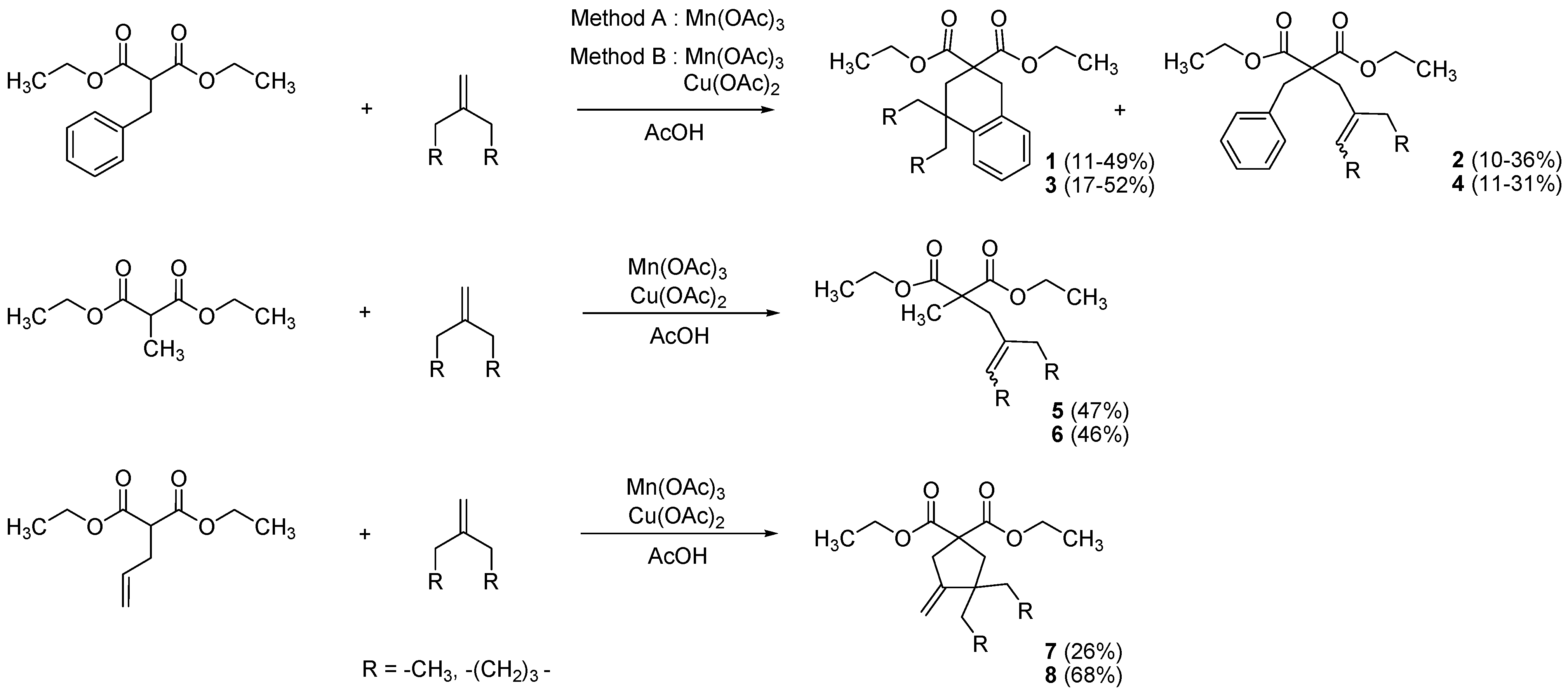
      <p>Starting from malonate barbiturate precursors, reproducible methodology for synthesis of various and highly functionalized derivatives was established. As reported in previously described mechanisms [<xref ref-type="bibr" rid="B30-molecules-17-04313">30</xref>], Mn(OAc)<sub>3</sub> and malonates in acetic acid form a Mn<sup>3+</sup>-enolate complex. Mn<sup>3+</sup> is reduced in Mn<sup>2+</sup>, generating a carbon centered radical between carbonyl groups. This radical reacts with terminal alkene, generating a carbon-carbon bond.</p>
      <p>Depending on the malonate substituent, several reactions may occur and in order to investigate a larger variety of barbiturate synthesis possibilities, we have studied three of them. Results are reported in <xref ref-type="scheme" rid="molecules-17-04313-f001">Scheme 1</xref>.</p>
      <fig id="molecules-17-04313-f001" position="anchor">
        <object-id pub-id-type="pii">molecules-17-04313-f001_Scheme 1</object-id>
        <label>Scheme 1</label>
        <caption>
          <p>Mn(OAc)<sub>3</sub> reactivity towards various malonate derivatives.</p>
        </caption>
        <graphic xmlns:xlink="http://www.w3.org/1999/xlink" xlink:href="molecules-17-04313-g001.tif"/>
      </fig>
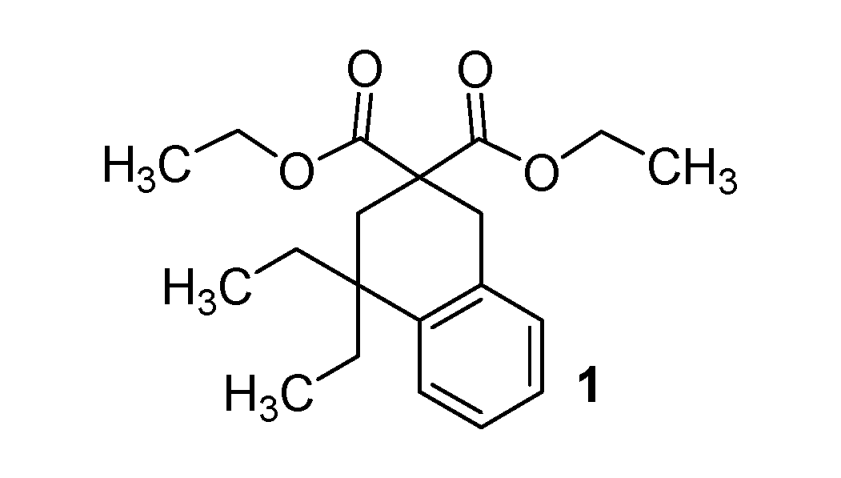
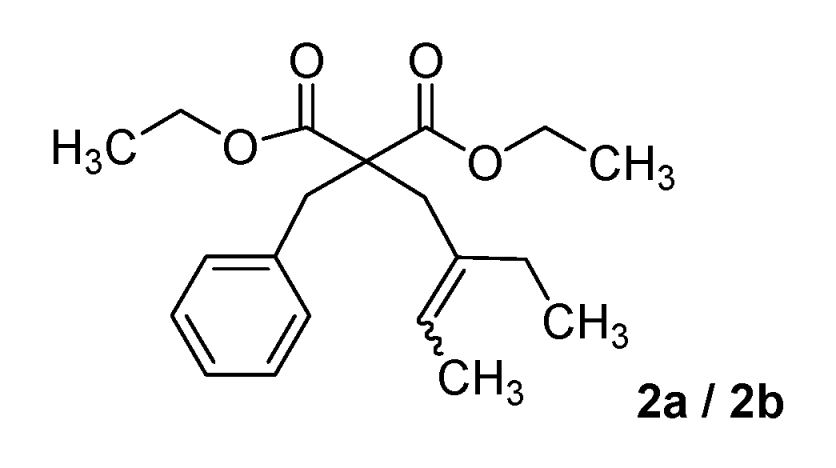
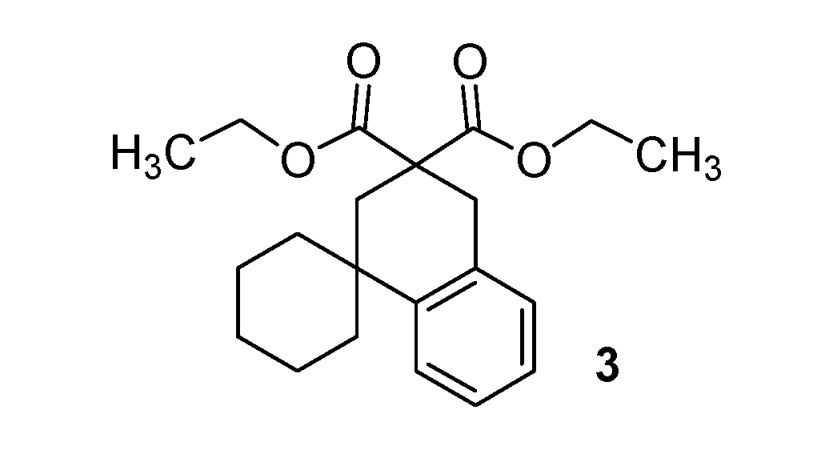
      <p>As reported by Citterio and coworkers [<xref ref-type="bibr" rid="B31-molecules-17-04313">31</xref>,<xref ref-type="bibr" rid="B32-molecules-17-04313">32</xref>,<xref ref-type="bibr" rid="B33-molecules-17-04313">33</xref>], benzylmalonate allowed synthesis of two derivatives: Tetralines <bold>1</bold>,<bold>3</bold> from radical aromatic substitution, and elimination products <bold>2</bold>,<bold>4</bold>. We have previously reported different methods for optimizing yields of these two products [<xref ref-type="bibr" rid="B34-molecules-17-04313">34</xref>]. For conditions favoring spirocyclic tetralin <bold>1</bold>,<bold>3</bold> formation, we divided up the Mn(OAc)<sub>3</sub> to ensure moderate oxidizing conditions (<italic>method A</italic>). Tetralins <bold>1</bold>,<bold>3</bold> were obtained as the major compound (49–52%) and alkenes <bold>2</bold>,<bold>4</bold> were observed as secondary products (10–11%). Stronger oxidative conditions [Cu(OAc)<sub>2</sub> + Mn(OAc)<sub>3</sub>, <italic>method B</italic>] afforded an increase in elimination products <bold>2</bold>,<bold>4</bold> (31–36%), while these conditions drastically decreased yields of tetralines <bold>1</bold>,<bold>3</bold> (11–17%).</p>
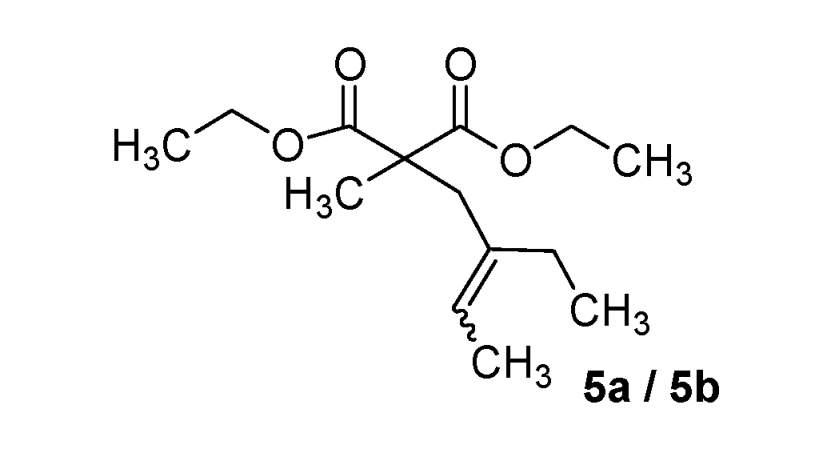
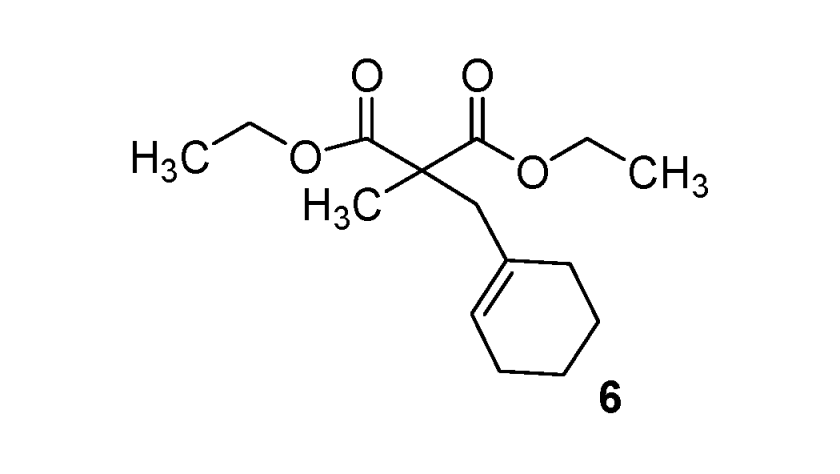
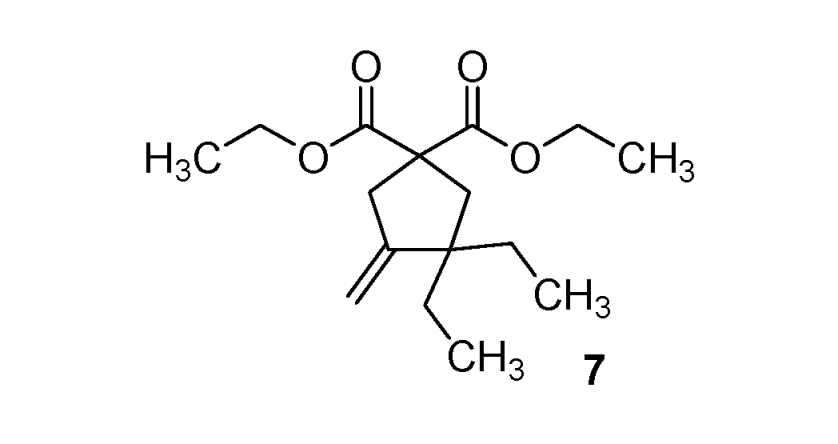
      <p>With methyl malonate, only elimination products <bold>5</bold>–<bold>6</bold> were obtained with moderate yields (46–47%). With allyl malonate, cyclization generates a cyclopentane ring [<xref ref-type="bibr" rid="B35-molecules-17-04313">35</xref>], and annulation products <bold>7</bold>–<bold>8</bold> were synthesized (26–68%). These three different reactivities depend on the malonate substituents, and allow access to a wide variety of substituted substrates for barbiturate synthesis.</p>
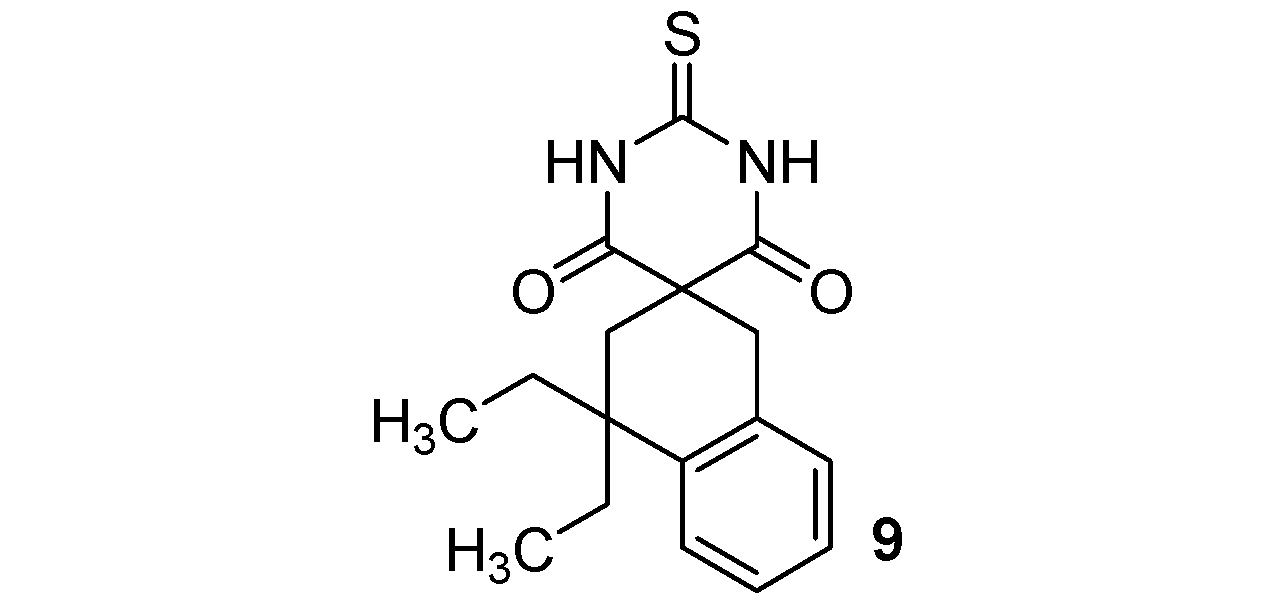
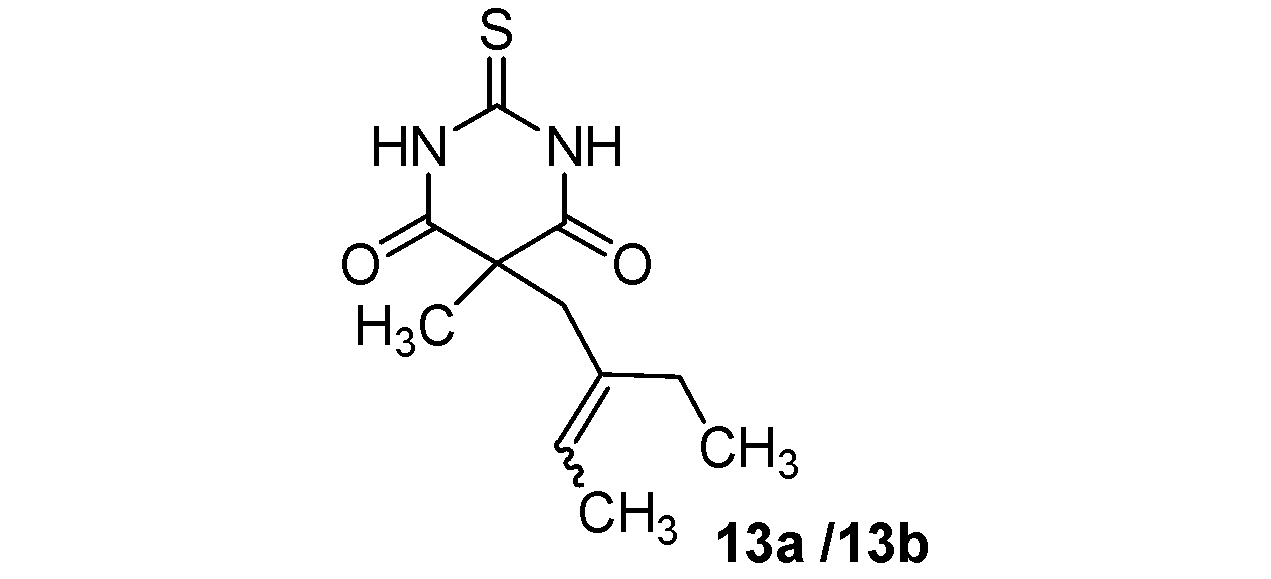
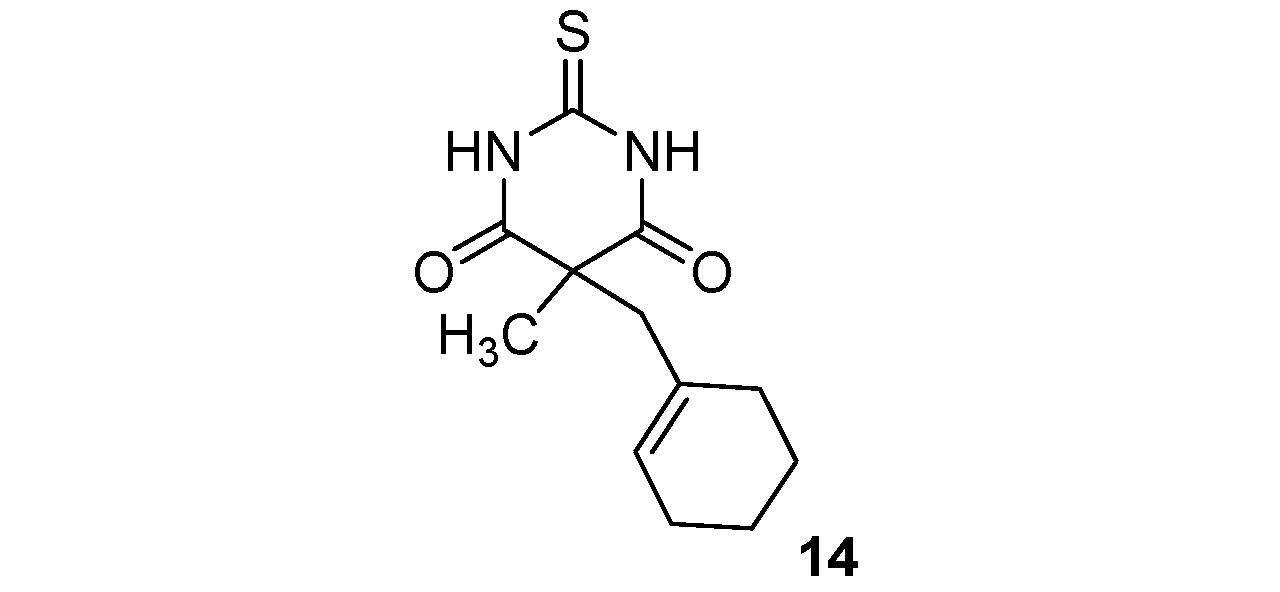
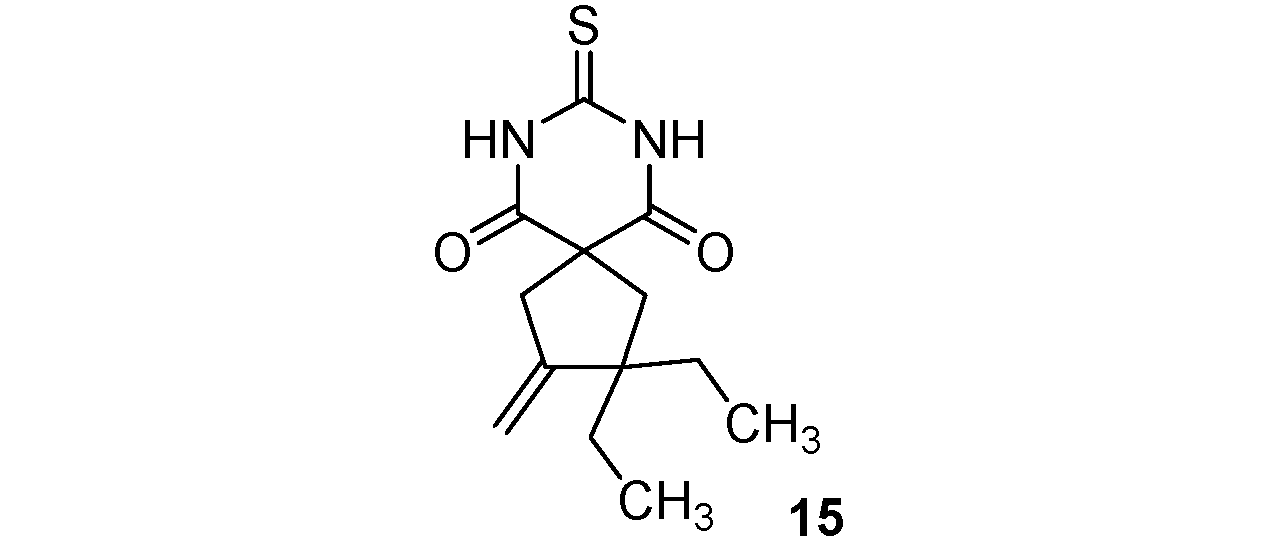
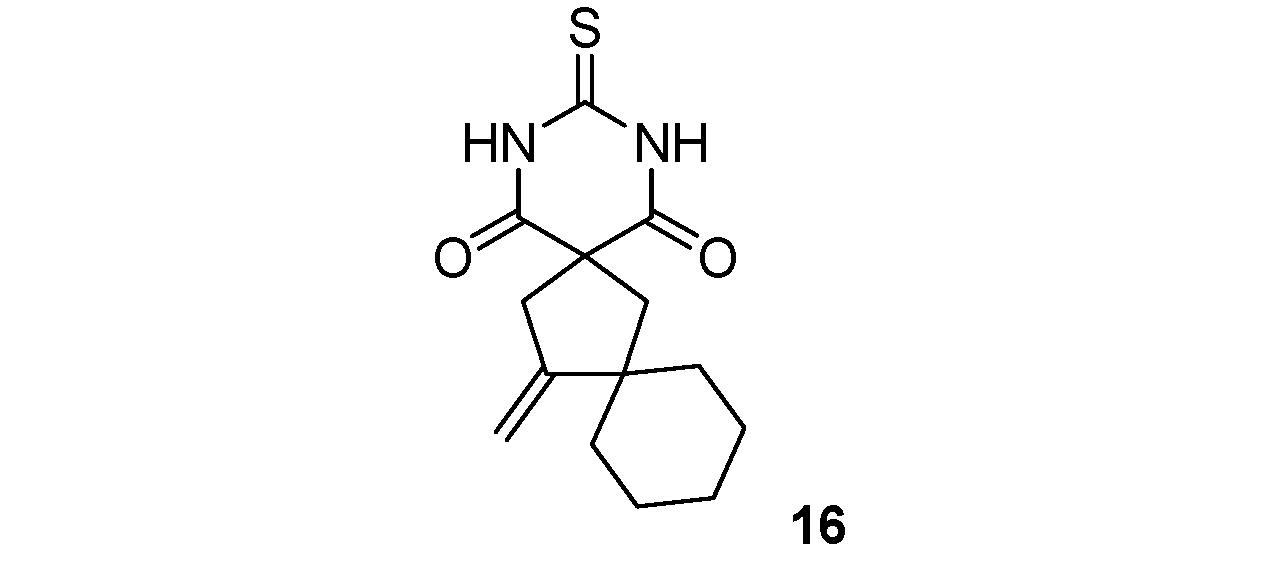
      <p><italic>C</italic>-Functionalized malonates <bold>1</bold>–<bold>8</bold> thus obtained reacted with thiourea [<xref ref-type="bibr" rid="B36-molecules-17-04313">36</xref>], forming thiobarbituric scaffolds <bold>9</bold>–<bold>16</bold> in moderate to good yields (46–90%). Results are summarized in <xref ref-type="scheme" rid="molecules-17-04313-f002">Scheme 2</xref> and <xref ref-type="table" rid="molecules-17-04313-t001">Table 1</xref>.</p>
      <fig id="molecules-17-04313-f002" position="anchor">
        <object-id pub-id-type="pii">molecules-17-04313-f002_Scheme 2</object-id>
        <label>Scheme 2</label>
        <caption>
          <p>Thiobarbituric acid synthesis from malonates <bold>1</bold>–<bold>8</bold>.</p>
        </caption>
        <graphic xmlns:xlink="http://www.w3.org/1999/xlink" xlink:href="molecules-17-04313-g002.tif"/>
      </fig>
      <table-wrap id="molecules-17-04313-t001" position="anchor">
        <object-id pub-id-type="pii">molecules-17-04313-t001_Table 1</object-id>
        <label>Table 1</label>
        <caption>
          <p>Thiobarbituric acids <bold>9</bold>–<bold>16</bold> synthesis from malonates <bold>1</bold>–<bold>8</bold>.</p>
        </caption>
        <table rules="all">
          <thead>
            <tr>
              <th align="center" valign="middle">Entry</th>
              <th align="center" valign="middle">R<sub>1</sub>,R<sub>2</sub> (malonate)</th>
              <th align="center" valign="middle">Product</th>
              <th align="center" valign="middle">Yields</th>
            </tr>
          </thead>
          <tbody>
            <tr>
              <td align="center" valign="middle">1</td>
              <td align="center" valign="middle">
                <inline-graphic xmlns:xlink="http://www.w3.org/1999/xlink" xlink:href="molecules-17-04313-i001.tif"/>
              </td>
              <td align="center" valign="middle">
                <inline-graphic xmlns:xlink="http://www.w3.org/1999/xlink" xlink:href="molecules-17-04313-i002.tif"/>
              </td>
              <td align="center" valign="middle">53%</td>
            </tr>
            <tr>
              <td align="center" valign="middle">2</td>
              <td align="center" valign="middle">
                <inline-graphic xmlns:xlink="http://www.w3.org/1999/xlink" xlink:href="molecules-17-04313-i003.tif"/>
              </td>
              <td align="center" valign="middle">
                <inline-graphic xmlns:xlink="http://www.w3.org/1999/xlink" xlink:href="molecules-17-04313-i004.tif"/>
              </td>
              <td align="center" valign="middle">46%</td>
            </tr>
            <tr>
              <td align="center" valign="middle">3</td>
              <td align="center" valign="middle">
                <inline-graphic xmlns:xlink="http://www.w3.org/1999/xlink" xlink:href="molecules-17-04313-i005.tif"/>
              </td>
              <td align="center" valign="middle">
                <inline-graphic xmlns:xlink="http://www.w3.org/1999/xlink" xlink:href="molecules-17-04313-i006.tif"/>
              </td>
              <td align="center" valign="middle">64%</td>
            </tr>
            <tr>
              <td align="center" valign="middle">4</td>
              <td align="center" valign="middle">
                <inline-graphic xmlns:xlink="http://www.w3.org/1999/xlink" xlink:href="molecules-17-04313-i007.tif"/>
              </td>
              <td align="center" valign="middle">
                <inline-graphic xmlns:xlink="http://www.w3.org/1999/xlink" xlink:href="molecules-17-04313-i008.tif"/>
              </td>
              <td align="center" valign="middle">88%</td>
            </tr>
            <tr>
              <td align="center" valign="middle">5</td>
              <td align="center" valign="middle">
                <inline-graphic xmlns:xlink="http://www.w3.org/1999/xlink" xlink:href="molecules-17-04313-i009.tif"/>
              </td>
              <td align="center" valign="middle">
                <inline-graphic xmlns:xlink="http://www.w3.org/1999/xlink" xlink:href="molecules-17-04313-i010.tif"/>
              </td>
              <td align="center" valign="middle">75%</td>
            </tr>
            <tr>
              <td align="center" valign="middle">6</td>
              <td align="center" valign="middle">
                <inline-graphic xmlns:xlink="http://www.w3.org/1999/xlink" xlink:href="molecules-17-04313-i011.tif"/>
              </td>
              <td align="center" valign="middle">
                <inline-graphic xmlns:xlink="http://www.w3.org/1999/xlink" xlink:href="molecules-17-04313-i012.tif"/>
              </td>
              <td align="center" valign="middle">90%</td>
            </tr>
            <tr>
              <td align="center" valign="middle">7</td>
              <td align="center" valign="middle">
                <inline-graphic xmlns:xlink="http://www.w3.org/1999/xlink" xlink:href="molecules-17-04313-i013.tif"/>
              </td>
              <td align="center" valign="middle">
                <inline-graphic xmlns:xlink="http://www.w3.org/1999/xlink" xlink:href="molecules-17-04313-i014.tif"/>
              </td>
              <td align="center" valign="middle">70%</td>
            </tr>
            <tr>
              <td align="center" valign="middle">8</td>
              <td align="center" valign="middle">
                <inline-graphic xmlns:xlink="http://www.w3.org/1999/xlink" xlink:href="molecules-17-04313-i015.tif"/>
              </td>
              <td align="center" valign="middle">
                <inline-graphic xmlns:xlink="http://www.w3.org/1999/xlink" xlink:href="molecules-17-04313-i016.tif"/>
              </td>
              <td align="center" valign="middle">54%</td>
            </tr>
          </tbody>
        </table>
      </table-wrap>
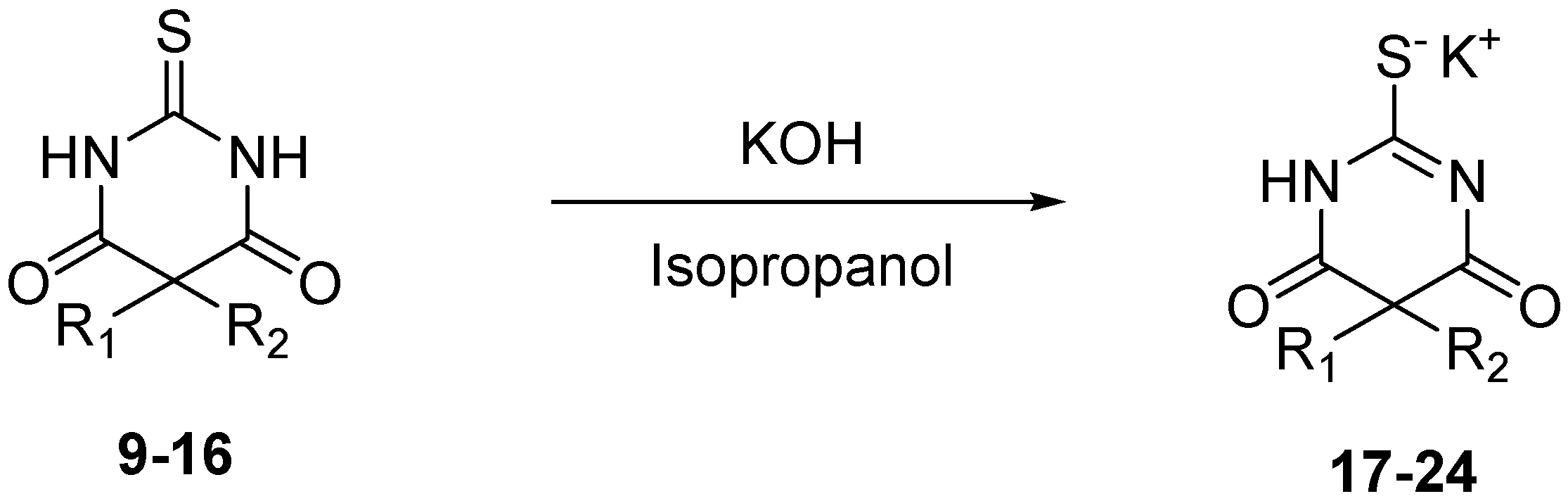
      <p>Finally, in order to synthesize intravenous administrable thiobarbiturates, each thiobarbituric acid was turned into the corresponding salt with potassium hydroxide in isopropanol [<xref ref-type="bibr" rid="B37-molecules-17-04313">37</xref>], as reported in <xref ref-type="scheme" rid="molecules-17-04313-f003">Scheme 3</xref>.</p>
      <fig id="molecules-17-04313-f003" position="anchor">
        <object-id pub-id-type="pii">molecules-17-04313-f003_Scheme 3</object-id>
        <label>Scheme 3</label>
        <caption>
          <p>Thiobarbituric acid to thiobarbiturate salt formation.</p>
        </caption>
        <graphic xmlns:xlink="http://www.w3.org/1999/xlink" xlink:href="molecules-17-04313-g003.tif"/>
      </fig>
    </sec>
    <sec sec-type="methods">
      <title>3. Experimental</title>
      <sec>
        <title>3.1. General</title>
        <p>Microwave-assisted reactions were performed in a multimode microwave oven (ETHOS Synth Lab Station, Ethos start, Milestone Inc., Shelton, CT, USA). Melting points were determined with a B-540 Büchi melting point apparatus. <sup>1</sup>H-NMR (200 MHz) and <sup>13</sup>C-NMR (50 MHz) spectra were recorded on a Bruker ARX 200 spectrometer in CDCl<sub>3</sub> or D<sub>2</sub>O at the Service interuniversitaire de RMN de la Faculté de Pharmacie de Marseille. The <sup>1</sup>H-NMR chemical shifts are reported as parts per million downfield from tetramethylsilane (Me<sub>4</sub>Si), and the <sup>13</sup>C-NMR chemical shifts were referenced to the solvent peaks: CDCl<sub>3</sub> (76.9 ppm) or DMSO-<italic>d<sub>6</sub></italic> (39.6 ppm). Absorptions are reported with the following notations: s, singlet; bs, broad singlet; d, doublet; t, triplet; q, quartet; m, a more complex multiplet or overlapping multiplets. Elemental analysis and mass spectra which were run on an API-QqToF mass spectrometer were carried out at the Spectropole de la Faculté des Sciences Saint-Jérôme site. Silica gel 60 (Merck, particle size 0.040–0.063 nm, 70–230 mesh ASTM) was used for flash column chromatography. TLC were performed on 5 cm × 10 cm aluminium plates coated with silica gel 60 F-254 (Merck, Gernsteim, Germany) in an appropriate solvent.</p>
      </sec>
      <sec>
        <title>3.2. General Procedure for the Synthesis of Substituted Malonates <bold>1–8</bold></title>
        <p><italic>Method A</italic>: A solution of manganese(III) acetate dihydrate (1.68 mmol, 0.45 g) in glacial acetic acid (55 mL) was heated under microwave irradiation (200 W, 80 °C) for 15 min, until dissolution. Then, the reaction mixture was cooled down to 60 °C, and a solution of malonate (3.99 mmol, 1 equiv.) and alkene (11.97 mmol, 3 equiv.) in glacial acetic acid (5 mL) was added. The mixture was heated under microwave irradiation (200 W, 80 °C) for 20 min. Then, the reaction mixture was cooled down to 60 °C once more, and a second portion of manganese(III) acetate dihydrate (1.68 mmol, 0.45 g) was added. The mixture was heated under microwave irradiation (200 W, 80 °C) for 20 min. The addition of manganese(III) acetate dihydrate (1.68 mmol, 0.45 g) was repeated three times under the same conditions every 20 min. successively. The reaction mixture was poured into cold water (100 mL), and extracted with chloroform (3 × 70 mL). The organic extracts were collected, washed with saturated aqueous NaHCO<sub>3</sub> (3 × 50 mL) and brine (3 × 50 mL), dried over MgSO<sub>4</sub>, filtrated, and concentrated under vacuum. The crude product was purified by silica gel chromatography with ethyl acetate/petroleum ether (0.5/9.5) to give corresponding compounds <bold>1</bold>–<bold>4</bold>.</p>
        <p><italic>Method B</italic>: A solution of manganese(III) acetate dihydrate (8.38 mmol, 2.24 g, 2.1 equiv.) and copper(II) acetate monohydrate (3.99 mmol, 0.80 g, 1 equiv.) in glacial acetic acid (55 mL) was heated under microwave irradiation (200 W, 80 °C) for 15 min, until dissolution. Then, the reaction mixture was cooled down to 60 °C, and a solution of malonate (3.99 mmol, 1 equiv.) and alkene (7.98 mmol, 3 equiv.) in glacial acetic acid (5 mL) was added. The mixture was heated under microwave irradiation (200 W, 80 °C) for 60 min. The reaction mixture was poured into cold water (100 mL), and extracted with chloroform (3 × 70 mL). The organic extracts were collected, washed with saturated aqueous NaHCO<sub>3</sub> (3 × 50 mL) and brine (3 × 50 mL), dried over MgSO<sub>4</sub>, filtrated, and concentrated under vacuum. The crude product was purified by silica gel chromatography with ethyl acetate/petroleum ether (0.5/9.5) to give corresponding compounds <bold>1</bold>–<bold>8</bold>.</p>
        <p><italic>Diethyl 4</italic>,<italic>4-diethyl-3</italic>,<italic>4-dihydronaphthalene-2</italic>,<italic>2(1H)-dicarboxylate</italic> (<bold>1</bold>). Colorless oil; yields: 49% (<italic>method A</italic>), 11% (<italic>method B</italic>); <sup>1</sup>H-NMR (CDCl<sub>3</sub>) <italic>δ</italic><sub>H</sub> 0.77 (t, <italic>J</italic> = 7.3, 6H, 2CH<sub>3</sub>), 1.22 (t, <italic>J = </italic>7.2, 6H, 2CH<sub>3</sub>), 1.52–1.68 (m, 4H, 2CH<sub>2</sub>), 2.32 (s, 2H, CH<sub>2</sub>), 3.17 (s, 2H, CH<sub>2</sub>), 4.08–4.21 (m, 4H, 2CH<sub>2</sub>), 7.10–7.18 (m, 4H, 4CH). <sup>13</sup>C-NMR (CDCl<sub>3</sub>) <italic>δ</italic><sub>C</sub> 8.3 (2CH<sub>3</sub>), 13.8 (2CH<sub>3</sub>), 33.1 (CH<sub>2</sub>), 33.3 (2CH<sub>2</sub>), 35.4 (CH<sub>2</sub>), 40.2 (C), 52.5 (C), 61.2 (2CH<sub>2</sub>), 125.5 (CH), 126.2 (CH), 126.5 (CH), 128.6 (CH), 134.2 (C), 141.5 (C), 172.9 (2C). HMRS (ESI): <italic>m/z</italic> calcd for C<sub>20</sub>H<sub>28</sub>O<sub>4</sub>[M+H<sup>+</sup>]: 333.2060. Found: 333.2061. </p>
        <p><italic>Diethyl 2-benzyl-2-(2-ethylbut-2-enyl)malonate</italic> (<bold>2a/2b</bold>) (50:50 inseparable mixture of <italic>Z/E</italic> isomers). Colorless oil; yields: 10% (<italic>method A</italic>), 36% (<italic>method B</italic>); <sup>1</sup>H-NMR (CDCl<sub>3</sub>) <italic>δ</italic><sub>H</sub> 0.89–0.99 (m, 3H, CH<sub>3</sub>), 1.12–1.22 (m, 6H, 2CH<sub>3</sub>), 1.54–1.64 (m, 3H, CH<sub>3</sub>), 1.93–2.04 (m, 2H, CH<sub>2</sub>), 2.63 and 2.80 (s, 2H, CH<sub>2</sub>), 3.24 and 3.26 (s, 2H, CH<sub>2</sub>), 4.03–4.15 (m, 4H, 2CH<sub>2</sub>), 5.26–5.42 (m, 1H, CH), 7.11–7.36 (m, 5H, 5CH). <sup>13</sup>C-NMR (CDCl<sub>3</sub>) <italic>δ</italic><sub>C</sub> 12.7 (CH<sub>3</sub>), 12.8 and 13.2 (CH<sub>3</sub>), 13.8 and 13.9 (2CH<sub>3</sub>), 23.3 and 29.6 (CH<sub>2</sub>), 33.5 and 40.6 (CH<sub>2</sub>), 39.1 and 39.2 (CH<sub>2</sub>), 58.9 and 59.0 (C), 61.1 (2CH<sub>2</sub>), 122.2 and 123.0 (CH), 126.7 (CH), 128.0 (2CH), 130.1 (2CH), 130.2 (C), 136.8 and 137.3 (C), 171.5 and 171.6 (2C). HMRS (ESI): <italic>m/z</italic> calcd for C<sub>20</sub>H<sub>28</sub>O<sub>4</sub> [M+H<sup>+</sup>]: 333.2060. Found: 333.2063.</p>
        <p><italic>Diethyl 2</italic><italic>'</italic><italic>H-spiro[cyclohexane-1</italic>,<italic>1</italic><italic>'</italic><italic>-naphtalene]-3</italic><italic>'</italic>,<italic>3</italic><italic>'</italic><italic>(4</italic><italic>'</italic><italic>H)-dicarboxylate</italic> (<bold>3</bold>). [<xref ref-type="bibr" rid="B34-molecules-17-04313">34</xref>] Colorless oil; yields: 52% (<italic>method A</italic>), 17% (<italic>method B</italic>); <sup>1</sup>H-NMR (CDCl<sub>3</sub>) <italic>δ</italic><sub>H</sub> 1.22 (t, <italic>J = </italic>7.1, 6H, 2CH<sub>3</sub>), 1.47–1.80 (m, 10H, 5CH<sub>2</sub>), 2.46 (s, 2H, CH<sub>2</sub>), 3.19 (s, 2H, CH<sub>2</sub>), 4.14 (q, <italic>J = </italic>7.1, 2H, CH<sub>2</sub>), 4.15 (q, <italic>J = </italic>7.1, 2H, CH<sub>2</sub>), 7.10–7.23 (m, 3H, 3CH), 7.35–7.39 (m, 1H, 1CH). <sup>13</sup>C-NMR (CDCl<sub>3</sub>) <italic>δ</italic><sub>C</sub> 13.9 (2CH<sub>3</sub>), 21.9 (2CH<sub>2</sub>), 25.9 (CH<sub>2</sub>), 34.9 (CH<sub>2</sub>), 35.6 (CH<sub>2</sub>), 36.8 (C), 39.6 (2CH<sub>2</sub>), 52.4 (C), 61.26 (2CH<sub>2</sub>), 125.8 (CH), 126.1 (CH), 126.5 (CH), 128.7 (CH), 133.4 (C), 144.0 (C), 171.8 (2C). Anal. Calcd for C<sub>21</sub>H<sub>28</sub>O<sub>4</sub>: C, 73.23; H, 8.19. Found: C, 73.40; H, 8.50. </p>
        <p><italic>Diethyl 2-benzyl-2-(cyclohexenylmethyl)malonate</italic> (<bold>4</bold>). [<xref ref-type="bibr" rid="B34-molecules-17-04313">34</xref>] Colorless oil; yields: 11% (<italic>method A</italic>), 31% (<italic>method B</italic>); <sup>1</sup>H-NMR (CDCl<sub>3</sub>) <italic>δ</italic><sub>H</sub> 1.20 (t, <italic>J = </italic>7.1, 6H, 2CH<sub>3</sub>), 1.55–1.59 (m, 4H, 2CH<sub>2</sub>), 1.90–2.00 (m, 4H, 2CH<sub>2</sub>), 2.58 (s, 2H, CH<sub>2</sub>), 3.26 (s, 2H, CH<sub>2</sub>), 4.12 (q, <italic>J = </italic>7.1, 4H, 2CH<sub>2</sub>), 5.52 (s, 1H, 1CH), 7.11–7.24 (m, 5H, 5CH). <sup>13</sup>C-NMR (CDCl<sub>3</sub>) <italic>δ</italic><sub>C</sub> 13.9 (2CH<sub>3</sub>), 22.1 (CH<sub>2</sub>), 23.0 (CH<sub>2</sub>), 25.5 (CH<sub>2</sub>), 29.2 (CH<sub>2</sub>), 39.0 (CH<sub>2</sub>), 41.4 (CH<sub>2</sub>), 58.7 (C), 61.0 (2CH<sub>2</sub>), 126.4 (CH), 126.7 (CH), 128.0 (2CH), 130.1 (2CH), 133.1 (C), 136.7 (C), 171.4 (2C). Anal. Calcd for C<sub>21</sub>H<sub>28</sub>O<sub>4</sub>: C, 73.23; H, 8.19. Found: C, 72.95; H, 8.35. </p>
        <p><italic>Diethyl 2-(2-ethylbut-2-enyl)-2-methylmalonate</italic> (<bold>5a/5b</bold>) (50:50 inseparable mixture of <italic>Z/E </italic>isomers). Colorless oil; yields: 47% (<italic>method B</italic>); <sup>1</sup>H-NMR (CDCl<sub>3</sub>) <italic>δ</italic><sub>H</sub> 0.81–0.93 (m, 3H, CH<sub>3</sub>), 1.14–1.21 (m, 6H, 2CH<sub>3</sub>), 1.27 (s, 3H, CH<sub>3</sub>), 1.48–1.53 (m, 3H, CH<sub>3</sub>), 1.65–1.96 (m, 2H, CH<sub>2</sub>), 2.57 and 2.71 (s, 2H, CH<sub>2</sub>), 4.04–4.15 (m; 4H, 2CH<sub>2</sub>), 5.13 and 5.34 (m, 1H, 1CH). <sup>13</sup>C-NMR (CDCl<sub>3</sub>) <italic>δ</italic><sub>C</sub> 12.4 (CH<sub>3</sub>), 12.6 and 12.9 (CH<sub>3</sub>), 13.7 and 13.8 (CH<sub>3</sub>), 19.2 and 19.7 (CH<sub>3</sub>), 22.9 and 29.7 (CH<sub>2</sub>), 33.6 and 40.8 (CH<sub>2</sub>), 53.2 and 53.4 (C), 60.9 and 61.0 (2CH<sub>2</sub>), 122.4 and 123.4 (CH), 136.6 and 136.8 (C), 172.3 and 172.5 (2C). HMRS (ESI): <italic>m/z</italic> calcd for C<sub>14</sub>H<sub>24</sub>O<sub>4</sub> [M+H<sup>+</sup>]: 257.1747. Found: 257.1743.</p>
        <p><italic>Diethyl 2-(cyclohexenylmethyl)-2-methylmalonate</italic> (<bold>6</bold>). Colorless oil; yields: 46% (<italic>method B</italic>); <sup>1</sup>H-NMR (CDCl<sub>3</sub>) <italic>δ</italic><sub>H</sub> 1.23 (t, <italic>J = </italic>7.1 Hz, 6H, 2CH<sub>3</sub>), 1.34 (s, 3H, CH<sub>3</sub>), 1.44–1.58 (m, 4H, 2CH<sub>2</sub>), 1.73–2.03 (m, 4H, 2CH<sub>2</sub>), 2.58 (s, 2H, CH<sub>2</sub>), 4.15 (q, <italic>J = </italic>7.1, 2CH<sub>2</sub>), 5.43 (s, 1H, 1CH). <sup>13</sup>C-NMR (CDCl<sub>3</sub>) <italic>δ</italic><sub>C</sub> 14.0 (2CH<sub>3</sub>), 19.9 (CH<sub>3</sub>), 22.0 (CH<sub>2</sub>), 22.9 (CH<sub>2</sub>), 25.4 (CH<sub>2</sub>), 29.2 (CH<sub>2</sub>), 43.7 (CH<sub>2</sub>), 53.3 (C), 61.1 (2CH<sub>2</sub>), 126.6 (CH), 132.9 (C), 172.6 (2C). HMRS (ESI): <italic>m/z</italic> calcd for C<sub>15</sub>H<sub>24</sub>O<sub>4</sub> [M+H<sup>+</sup>]: 269.1747. Found: 269.1754.</p>
        <p><italic>Diethyl 3</italic>,<italic>3-diethyl-4-methylenecyclopentane-1</italic>,<italic>1-dicarboxylate </italic>(<bold>7</bold>). Colorless oil; yields: 26% (<italic>method B</italic>); <sup>1</sup>H-NMR (CDCl<sub>3</sub>) <italic>δ</italic><sub>H</sub> 0.79 (t, <italic>J = </italic>7.3, 6H, 2CH<sub>3</sub>), 1.24 (t, <italic>J = </italic>7.1, 6H, 2CH<sub>3</sub>), 1.33–1.41 (m, 4H, 2CH<sub>2</sub>), 2.29 (s, 2H, CH<sub>2</sub>), 2.98–3.00 (m, 2H, CH<sub>2</sub>), 4.17 (q, <italic>J = </italic>7.1, 4H, 2CH<sub>2</sub>), 4.65 (bs, 1H, CH), 4.95 (bs, 1H, CH). <sup>13</sup>C-NMR (CDCl<sub>3</sub>) <italic>δ</italic><sub>C </sub>8.6 (2CH<sub>3</sub>), 14.0 (2CH<sub>3</sub>), 29.9 (2CH<sub>2</sub>), 41.8 (CH<sub>2</sub>), 43.3 (CH<sub>2</sub>), 48.5 (C), 57.3 (C), 61.4 (2CH<sub>2</sub>), 106.0 (CH<sub>2</sub>), 154.8 (C), 172.3 (2C). HMRS (ESI): <italic>m/z</italic> calcd for C<sub>16</sub>H<sub>26</sub>O<sub>4</sub> [M+H<sup>+</sup>]: 283.1904. Found: 283.1906.</p>
        <p><italic>Diethyl 4-methylenespir</italic>o[4.5]d<italic>ecane-2</italic>,<italic>2-dicarboxylate</italic> (<bold>8</bold>). Colorless oil; yields: 68% (<italic>method B</italic>); <sup>1</sup>H-NMR (CDCl<sub>3</sub>) <italic>δ</italic><sub>H</sub> 1.22 (t, <italic>J = </italic>7.2, 6H, 2CH<sub>3</sub>), 1.33–1.66 (m, 10H, 5CH<sub>2</sub>), 2.33 (s, 2H, CH<sub>2</sub>), 3.01 (bs, 2H, CH<sub>2</sub>), 4.15 (q, <italic>J = </italic>7.1, 4H, 2CH<sub>2</sub>), 4.77 (bs, 1H, CH), 4.87 (bs, 1H, CH). <sup>13</sup>C-NMR (CDCl<sub>3</sub>) <italic>δ</italic><sub>C</sub> 13.9 (2CH<sub>3</sub>), 23.2 (2CH<sub>2</sub>), 25.8 (CH<sub>2</sub>), 38.0 (2CH<sub>2</sub>), 40.8 (CH<sub>2</sub>), 42.6 (CH<sub>2</sub>), 45.6 (C), 57.9 (C), 61.4 (2CH<sub>2</sub>), 104.6 (CH<sub>2</sub>), 158.4 (C), 172.1 (2C). HMRS (ESI): <italic>m/z</italic> calcd for C<sub>17</sub>H<sub>26</sub>O<sub>4</sub>[M+H<sup>+</sup>]: 295.1904. Found: 295.1903.</p>
      </sec>
      <sec>
        <title>3.3. General Procedure for the Synthesis of Thiobarbituric Acids <bold>9–16</bold></title>
        <p>Thiourea (1.25 g, 16.38 mmol, 6 equiv.) was added to a solution of malonate <bold>1–8</bold> (2.73 mmol, 1 equiv.) in dry DMSO (3 mL). Then, a solution 1M of potassium <italic>tert</italic>-butoxide (0.67 g, 6.0 mmol, 2.2 equiv.) was added dropwise. The solution was stirred for 4 h under inert atmosphere and at rt (starting from malonates <bold>1, 3, 7, 8</bold>) or at 50 °C (starting from malonates <bold>2, 4, 5, 6</bold>). The solution was diluted with ethyl acetate (15 mL) and washed with a solution of 1 N hydrochloric acid. The layers were separated and the aqueous phase was extracted with ethyl acetate. The collected organic phase was washed with brine, dried over anhydrous Na<sub>2</sub>SO<sub>4</sub>, filtered and the solvent was removed <italic>in vacuo</italic>. The residue was purified with column chromatography (CH<sub>2</sub>Cl<sub>2</sub>/petroleum ether, 8:2), affording the corresponding thiobarbituric acids <bold>9–16</bold>.</p>
        <p><italic>4</italic>,<italic>4-Diethyl-2</italic><italic>'</italic><italic>-thioxo-3</italic>,<italic>4-dihydro-1H</italic>,<italic>2</italic><italic>'</italic><italic>H-spiro[naphthalene-2</italic>,<italic>5</italic><italic>'</italic><italic>-pyrimidine]-4</italic><italic>'</italic>,<italic>6</italic><italic>'</italic><italic>(1</italic><italic>'</italic><italic>H</italic>,<italic>3</italic><italic>'</italic><italic>H)-dione</italic> (<bold>9</bold>). White solid; m.p. 151 °C (cyclohexane); yields: 53% <sup>1</sup>H-NMR (CDCl<sub>3</sub>) <italic>δ</italic><sub>H</sub> 0.76 (t, <italic>J = </italic>7.4, 6H, 2CH<sub>3</sub>), 1.67–1.80 (m, 4H, 2CH<sub>2</sub>), 2.23 (s, 2H, CH<sub>2</sub>), 3.28 (s, 2H, CH<sub>2</sub>), 7.12–7.36 (m, 4H, 4CH), 8.99 (bs, 2H). <sup>13</sup>C-NMR (CDCl<sub>3</sub>) <italic>δ</italic><sub>C</sub> 8.4 (2CH<sub>3</sub>), 31.5 (2CH<sub>2</sub>), 34.3 (CH<sub>2</sub>), 38.2 (CH<sub>2</sub>), 52.2 (C), 53.4 (C), 126.0 (CH), 126.2 (CH), 126.8 (CH), 128.5 (CH), 132.4 (C), 140.9 (C), 170.4 (2C), 176.0 (C). HMRS (ESI): <italic>m/z</italic> calcd for C<sub>17</sub>H<sub>20</sub>N<sub>2</sub>O<sub>2</sub>S [M+H<sup>+</sup>]: 317.1318. Found: 317.1317.</p>
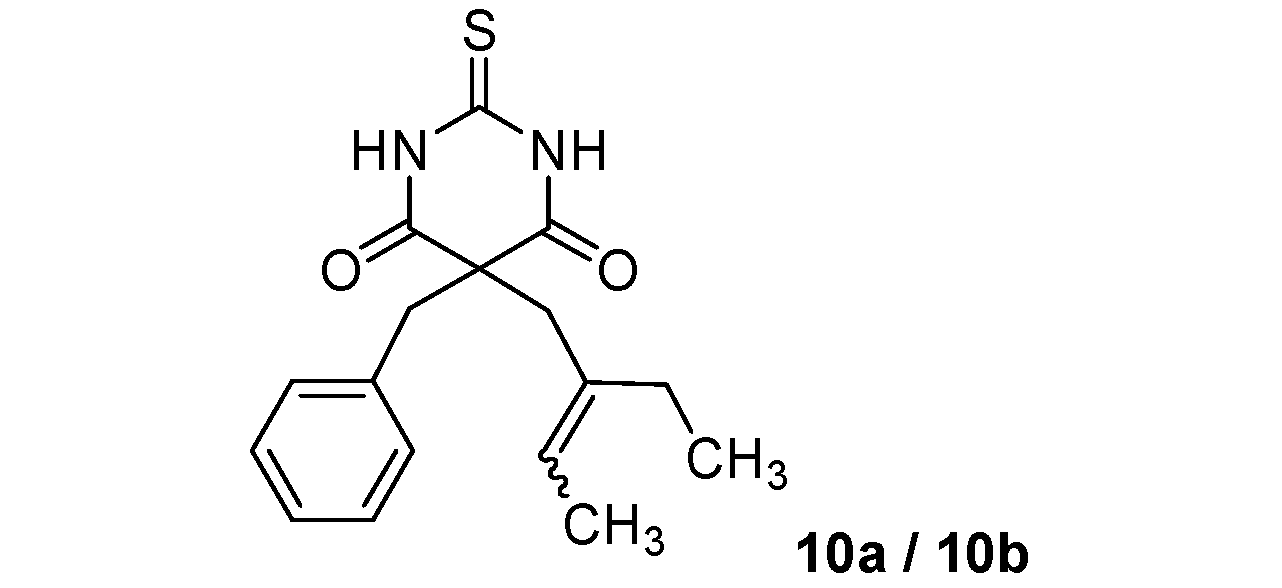
        <p><italic>5-Benzyl-5-(2-ethylbut-2-enyl)-2-thioxo-dihydropyrimidine-4</italic>,<italic>6(1H</italic>,<italic>5H)-dione </italic>(<bold>10a/10b</bold>) (50:50 inseparable mixture of <italic>Z/E </italic>isomers). White solid; m.p. 182 °C (cyclohexane); yields: 46% <sup>1</sup>H-NMR (CDCl<sub>3</sub>) <italic>δ</italic><sub>H</sub> 0.90–0.99 (m, 3H, CH<sub>3</sub>), 1.53–1.66 (m, 3H, CH<sub>3</sub>), 1.85–2.02 (m, 2H, CH<sub>2</sub>), 2.87 and 3.00 (s, 2H, CH<sub>2</sub>), 3.30 and 3.38 (s, 2H, CH<sub>2</sub>), 5.19–5.30 and 5.41–5.52 (m, 1H, CH), 7.07–7.24 (m, 5H, 5CH), 8.84 (bs, 2H). <sup>13</sup>C-NMR (CDCl<sub>3</sub>) <italic>δ</italic><sub>C</sub> 12.6 and 13.0 (CH<sub>3</sub>), 13.4 and 13.7 (CH<sub>3</sub>), 23.4 and 29.9 (CH<sub>2</sub>), 39.1 and 44.9 (CH<sub>2</sub>), 45.0 and 45.2 (CH<sub>2</sub>), 58.0 and 59.0 (C), 124.6 and 124.8 (CH), 127.9 (CH), 128.9 (2CH), 129.5 and 129.6 (2CH), 134.2 and 134.3 (C), 134.7 and 135.7 (C), 169.6 (2C), 175.3 (C). <italic>m/z</italic> calcd for C<sub>17</sub>H<sub>20</sub>N<sub>2</sub>O<sub>2</sub>S [M+H<sup>+</sup>]: 317.1318. Found: 317.1323.</p>
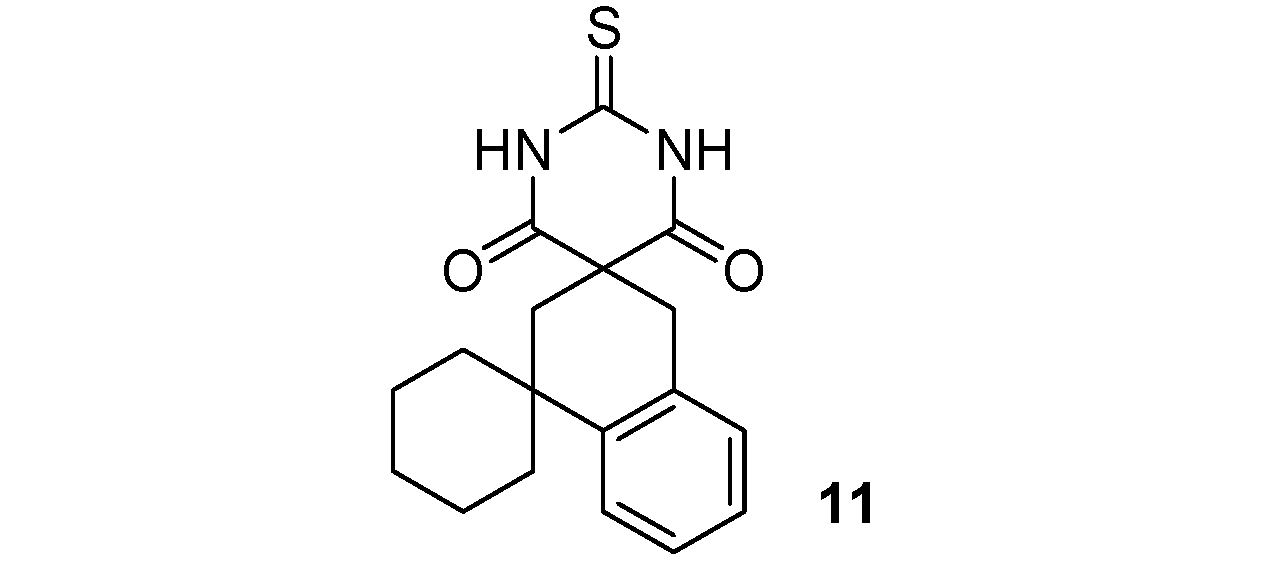
        <p><italic>2</italic><italic>"</italic><italic>-Thioxo-2</italic><italic>"</italic><italic>H</italic>,<italic>4</italic><italic>'</italic><italic>H-dispiro[cyclohexane-1</italic>,<italic>1</italic><italic>'</italic><italic>-naphtalene-3</italic><italic>'</italic>,<italic>5</italic><italic>"</italic><italic>-pyrimidine]-4</italic><italic>"</italic>,<italic>6</italic><italic>"</italic><italic>(1</italic><italic>"</italic><italic>H,3</italic><italic>"</italic><italic>H)-dione </italic>(<bold>11</bold>). White solid; m.p. 200–202 °C (ethyl alcohol); yields: 64% <sup>1</sup>H-NMR (CDCl<sub>3</sub>) <italic>δ</italic><sub>H</sub> 1.49–1.84 (m, 10H, 5CH<sub>2</sub>), 2.35 (s, 2H, CH<sub>2</sub>), 3.31 (s, 2H, CH<sub>2</sub>), 7.12–7.41 (m, 4H, 4CH), 9.33 (bs, 2H, 2NH). <sup>13</sup>C-NMR (CDCl<sub>3</sub>) <italic>δ</italic><sub>C</sub> 22.0 (2CH<sub>2</sub>), 25.7 (CH<sub>2</sub>), 33.6 (CH<sub>2</sub>), 37.8 (C), 38.1 (2CH<sub>2</sub>), 38.3 (CH<sub>2</sub>), 52.2 (C), 125.1 (CH), 126.1 (CH), 127.2 (CH), 128.5 (CH), 132.1 (C), 143.8 (C), 170.2 (2C), 176.0 (C). HMRS (ESI): <italic>m/z</italic> calcd for C<sub>18</sub>H<sub>20</sub>N<sub>2</sub>O<sub>2</sub>S [M+H<sup>+</sup>]: 329.1318. Found: 329.1317.</p>
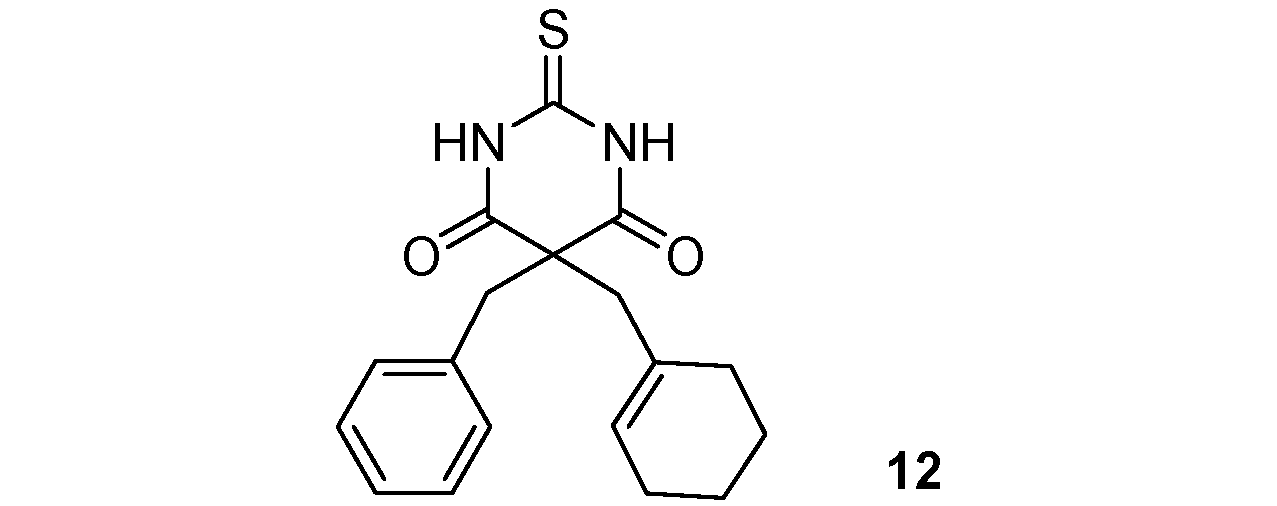
        <p><italic>5-Benzyl-5-(cyclohexenylmethyl)-2-thioxo-dihydropyrimidine-4</italic>,<italic>6(1H</italic>,<italic>5H)-dione</italic> (<bold>12</bold>). Colorless oil; yields: 88% <sup>1</sup>H-NMR (CDCl<sub>3</sub>) <italic>δ</italic><sub>H</sub> 1.35–2.04 (m, 8H, 4CH<sub>2</sub>), 2.82 (s, 2H, CH<sub>2</sub>), 3.31 (s, 2H, CH<sub>2</sub>), 5.50 (s, 1H, 1CH), 7.13–7.26 (m, 5H, 5CH), 8.98 (bs, 2H, 2NH). <sup>13</sup>C-NMR (CDCl<sub>3</sub>) <italic>δ</italic><sub>C</sub> 21.9 (CH<sub>2</sub>), 22.8 (CH<sub>2</sub>), 23.6 (CH<sub>2</sub>), 29.8 (CH<sub>2</sub>), 44.5 (CH<sub>2</sub>), 47.6 (CH<sub>2</sub>), 58.9 (C), 127.7 (CH), 127.8 (CH), 128.8 (2CH), 129.5 (2CH), 131.5 (C), 134.3 (C), 169.7 (2C), 175.4 (C). HMRS (ESI): <italic>m/z</italic> calcd for C<sub>18</sub>H<sub>20</sub>N<sub>2</sub>O<sub>2</sub>S [M+NH<sub>4</sub><sup>+</sup>]: 346.1584. Found: 346.1579. </p>
        <p><italic>5-(2-Ethylbut-2-enyl)-5-methyl-2-thioxo-dihydropyrimidine-4</italic>,<italic>6(1H</italic>,<italic>5H)-dione</italic> (<bold>13a/13b</bold>) (50:50 inseparable mixture of <italic>Z/E</italic> isomers). Colorless oil; yields: 75% <sup>1</sup>H-NMR (CDCl<sub>3</sub>) <italic>δ</italic><sub>H</sub> 0.87–0.97 (m, 3H, CH<sub>3</sub>), 1.54–1.61 (m, 3H, CH<sub>3</sub>), 1.57 (s, 3H, CH<sub>3</sub>), 1.80–2.01 (m, 2H, CH<sub>2</sub>), 2.70 and 2.82 (s, 2H, CH<sub>2</sub>), 5.18 and 5.47 (m, 1H, CH), 9.05 (bs, 2H, 2NH). <sup>13</sup>C-NMR (CDCl<sub>3</sub>) <italic>δ</italic><sub>C</sub> 12.6 and 13.0 (CH<sub>3</sub>), 13.3 and 13.9 (CH<sub>3</sub>), 23.1 and 23.3 (CH<sub>3</sub>), 23.5 and 29.9 (CH<sub>2</sub>), 40.4 and 46.2 (CH<sub>2</sub>), 51.0 and 51.9 (C), 124.5 and 125.0 (CH), 134.8 and 135.9 (C), 170.5 and 170.6 (2C), 176.0 (C). Anal. Calcd for C<sub>11</sub>H<sub>16</sub>N<sub>2</sub>O<sub>2</sub>S: C, 54.98; H, 6.71; N, 11.66. Found: C, 55.15; H, 6.86; N, 11.63.</p>
        <p><italic>5-(Cyclohexenylmethyl)-5-methyl-2-thioxo-dihydropyrimidine-4</italic>,<italic>6(1H</italic>,<italic>5H)-dione</italic> (<bold>14</bold>). White solid; m.p. 160–164 °C (ethyl alcohol); yields: 90% <sup>1</sup>H-NMR (CDCl<sub>3</sub>) <italic>δ</italic><sub>H</sub> 1.37–1.52 (m, 4H, 2CH<sub>2</sub>), 1.57 (s, 3H, CH<sub>3</sub>), 1.76–1.98 (m, 4H, 2CH<sub>2</sub>), 2.65 (s, 2H, CH<sub>2</sub>), 5.44 (s, 1H, 1CH), 9.61 (bs, 2H, 2NH). <sup>13</sup>C-NMR (CDCl<sub>3</sub>) <italic>δ</italic><sub>C</sub> 21.8 (CH<sub>2</sub>), 22.8 (CH<sub>2</sub>), 23.0 (CH<sub>3</sub>), 25.4 (CH<sub>2</sub>), 29.7 (CH<sub>2</sub>), 48.5 (CH<sub>2</sub>), 51.8 (C), 127.5 (CH), 131.6 (C), 170.9 (2C), 176.2 (C). HMRS (ESI): <italic>m/z</italic> calcd for C<sub>12</sub>H<sub>16</sub>N<sub>2</sub>O<sub>2</sub>S [M+H<sup>+</sup>]: 253.1005. Found: 253.1007.</p>
        <p><italic>2</italic>,<italic>2-Diethyl-3-methylene-8-thioxo-7</italic>,<italic>9-diazaspiro[4.5]decane-6</italic>,<italic>10-dione</italic> (<bold>15</bold>). White solid; m.p. 194–196 °C (cyclohexane); yields: 70% <sup>1</sup>H-NMR (CDCl<sub>3</sub>) <italic>δ</italic><sub>H</sub> 0.83 (t, <italic>J = </italic>7.4, 6H, 2CH<sub>3</sub>), 1.43–1.70 (m, 4H, 2CH<sub>2</sub>), 2.27 (s, 2H, CH<sub>2</sub>), 3.03 (bs, 2H, CH<sub>2</sub>), 4.77 (bs, 1H, CH), 5.01 (bs, 1H, CH), 8.96 (bs, 2H, 2NH). <sup>13</sup>C-NMR (CDCl<sub>3</sub>) <italic>δ</italic><sub>C</sub> 8.7 (2CH<sub>3</sub>), 29.0 (2CH<sub>2</sub>), 44.4 (CH<sub>2</sub>), 47.2 (CH<sub>2</sub>), 49.9 (C), 54.3 (C), 107.4 (CH<sub>2</sub>), 153.4 (C), 170.7 (2C), 176.1 (C). HMRS (ESI): <italic>m/z</italic> calcd for C<sub>13</sub>H<sub>18</sub>N<sub>2</sub>O<sub>2</sub>S [M+NH<sub>4</sub><sup>+</sup>]: 284.1427. Found: 284.1434.</p>
        <p><italic>14-Methylene-3-thioxo-2</italic>,<italic>4-diazadispiro[5.1.5.2]pentadecane-1</italic>,<italic>5-dione</italic> (<bold>16</bold>). White solid; m.p. 177 °C (isopropanol); yields: 54% <sup>1</sup>H-NMR (CDCl<sub>3</sub>) <italic>δ</italic><sub>H</sub> 1.22–1.47 (m, 6H, 2CH<sub>3</sub>), 1.66–1.77 (m, 4H, 2CH<sub>2</sub>), 2.33 (s, 2H, CH<sub>2</sub>), 3.06 (s, 2H, CH<sub>2</sub>), 4.89–4.93 (m, 2H, CH<sub>2</sub>), 9.09 (bs, 2H, 2NH). <sup>13</sup>C-NMR (CDCl<sub>3</sub>) <italic>δ</italic><sub>C</sub> 23.2 (2CH<sub>2</sub>), 25.7 (CH<sub>2</sub>), 37.5 (2CH<sub>2</sub>), 44.0 (CH<sub>2</sub>), 45.2 (CH<sub>2</sub>), 46.8 (C), 55.0 (C), 105.4 (CH<sub>2</sub>), 157.4 (C), 170.7 (2C), 176.2 (C). HMRS (ESI): <italic>m/z</italic> calcd for C<sub>14</sub>H<sub>18</sub>N<sub>2</sub>O<sub>2</sub>S [M+NH<sub>4</sub><sup>+</sup>]: 296.1427. Found: 296.1422.</p>
      </sec>
      <sec>
        <title>3.4. General Procedure for Salification of Barbituric Acids to Barbiturate Potassium Salts <bold>17–24</bold></title>
        <p>A suspension of potassium hydroxide (0.02 g, 0.36 mmol, 1 equiv.) in isopropanol (5 mL) was stirred under inert atmosphere. The corresponding barbituric acid <bold>9–16</bold> (0.36 mmol, 1 equiv.) was added, and reaction was monitored by TLC until the barbituric acid disappeared. Isopropanol was removed <italic>in vacuo</italic>, and corresponding barbiturates <bold>17–24</bold> were obtained without further purification. </p>
        <p><italic>Potassium 4</italic>,<italic>4-diethyl-4</italic><italic>'</italic>,<italic>6</italic><italic>'</italic><italic>-dioxo-1</italic><italic>'</italic>,<italic>3</italic>,<italic>4</italic>,<italic>6</italic><italic>'</italic><italic>-tetrahydro-1H</italic>,<italic>4</italic><italic>'</italic><italic>H-spiro[naphthalene-2</italic>,<italic>5</italic><italic>'</italic><italic>-pyrimidine]-2</italic><italic>'</italic><italic>-thiolate</italic> (<bold>17</bold>). White solid; m.p. 161–163 °C (isopropanol); yields: 77%; <sup>1</sup>H-NMR (D<sub>2</sub>O) <italic>δ</italic><sub>H</sub> 0.72 (s, 3H, CH<sub>3</sub>), 0.99 (s, 3H, CH<sub>3</sub>), 1.42–1.79 (m, 4H, 2CH<sub>2</sub>), 2.38 (d, <italic>J</italic> = 15.4, 1H, CH<sub>2</sub>), 2.53 (d, <italic>J</italic> = 15.4, 1H, CH<sub>2</sub>), 3.13 (d, <italic>J</italic> = 16.4, 1H, CH<sub>2</sub>), 3.40 (d, <italic>J</italic> = 16.4, 1H, CH<sub>2</sub>), 7.35–7.41 (m, 4H, 4CH). <sup>13</sup>C-NMR (D<sub>2</sub>O) <italic>δ</italic><sub>C</sub> 8.4 (CH<sub>3</sub>), 8.5 (CH<sub>3</sub>), 32.9 (CH<sub>2</sub>), 35.1 (CH<sub>2</sub>), 35.2 (CH<sub>2</sub>), 35.8 (CH<sub>2</sub>), 41.2 (C), 57.2 (C), 126.5 (CH), 127.0 (CH), 127.9 (CH), 129.1 (CH), 136.2 (C), 142.8 (C), 177.0 (2C), 178.9 (C). HMRS (ESI): <italic>m/z</italic> calcd for C<sub>17</sub>H<sub>19</sub>N<sub>2</sub>O<sub>2</sub>S<sup>−</sup> M: 315.1173. Found: 315.1183. </p>
        <p><italic>Potassium 5-benzyl-5-[2-ethylbut-2-en-1-yl]-4</italic>,<italic>6-thioxo-1</italic>,<italic>4</italic>,<italic>5</italic>,<italic>6-tetrahydropyrimidine-2-thiolate</italic> (<bold>18a/</bold> <bold>18b</bold>) (50:50 inseparable mixture of <italic>Z/E </italic>isomers). White solid; m.p. 142–144 °C (isopropanol); yields: 78%; <sup>1</sup>H-NMR (D<sub>2</sub>O) <italic>δ</italic><sub>H</sub> 0.98–1.05 (m, 3H, CH<sub>3</sub>), 1.61–1.73 (m, 3H, CH<sub>2</sub>), 1.93–2.12 (m, 2H, CH<sub>2</sub>), 2.89 and 3.01 (s, 2H, CH<sub>2</sub>), 3.28 and 3.38 (s, 2H, CH<sub>2</sub>), 5.11 and 5.51 (bs, 1H, 1CH), 7.22–7.39 (m, 5H, 5CH). <sup>13</sup>C-NMR (D<sub>2</sub>O) <italic>δ</italic><sub>C</sub> 12.6 and 12.7 (CH<sub>3</sub>), 13.2 and 13.3 (CH<sub>3</sub>), 23.6 and 29.8 (CH<sub>2</sub>), 39.3 and 44.8 (CH<sub>2</sub>), 45.0 and 45.9 (CH<sub>2</sub>), 57.6 (C), 122.7 and 123.8 (CH), 128.0 (CH), 129.1 (2CH), 129.9 (2CH), 135.9 (C), 138.0 (C), 172.9 (C), 179.6 (2C). HMRS (ESI): <italic>m/z</italic> calcd for C<sub>17</sub>H<sub>19</sub>N<sub>2</sub>O<sub>2</sub>S<sup>−</sup> M: 315.1173. Found: 315.1180. </p>
        <p><italic>Potassium 4</italic><italic>"</italic>,<italic>6</italic><italic>"</italic><italic>-dioxo-1</italic><italic>"</italic>,<italic>6</italic><italic>"</italic><italic>-dihydro-4</italic><italic>'</italic><italic>H</italic>,<italic>4</italic><italic>"</italic><italic>H-dispiro[cyclohexane-1</italic>,<italic>1</italic><italic>'</italic><italic>-naphtalene-3</italic><italic>'</italic>,<italic>5</italic><italic>"</italic><italic>-pyrimidine]-2</italic><italic>"</italic><italic>-thiolate</italic> (<bold>19</bold>). White solid; m.p. 216–218 °C (isopropanol); yields: 70%; <sup>1</sup>H-NMR (D<sub>2</sub>O) <italic>δ</italic><sub>H</sub> 1.38–2.25 (m, 10H, 5CH<sub>2</sub>), 2.40 (bs, 1H, CH<sub>2</sub>), 3.08–3.68 (m, 3H, CH<sub>2</sub>), 7.40–7.58 (m, 3H, 3CH), 7.72–7.78 (m, 1H, 1CH). <sup>13</sup>C-NMR (D<sub>2</sub>O) <italic>δ</italic><sub>C</sub> 22.1 (CH<sub>2</sub>), 22.4 (CH<sub>2</sub>), 26.0 (CH<sub>2</sub>), 35.8 (CH<sub>2</sub>), 37.6 (CH<sub>2</sub>), 37.7 (C), 38.2 (CH<sub>2</sub>), 42.0 (CH<sub>2</sub>), 56.9 (C), 126.8 (CH), 127.2 (CH), 127.3 (CH), 129.3 (CH), 135.3 (C), 144.7 (C), 176.5 (C), 178.8 (C), 181.5 (C). HMRS (ESI): <italic>m/z</italic> calcd for C<sub>18</sub>H<sub>19</sub>N<sub>2</sub>O<sub>2</sub>S<sup>−</sup> M: 327.1173. Found: 327.1184.</p>
        <p><italic>Potassium 5-benzyl-5-(cyclohex-1-en-1-ylmethyl)-4</italic>,<italic>6-dioxo-1</italic>,<italic>4</italic>,<italic>5</italic>,<italic>6-tetrahydropyrimidine-2-thiolate</italic> (<bold>20</bold>). White solid; m.p. 143 °C (isopropanol); yields: 84% <sup>1</sup>H-NMR (D<sub>2</sub>O) <italic>δ</italic><sub>H</sub> 1.36–1.60 (m, 4H, 2CH<sub>2</sub>), 1.74–2.00 (m, 4H, 2CH<sub>2</sub>), 2.70 (s, 2H, CH<sub>2</sub>), 3.18 (s, 2H, CH<sub>2</sub>), 5.39 (s, 1H, 1CH), 7.06–7.11 (m, 2H, 2CH), 7.26–7.30 (m, 3H, 3CH). <sup>13</sup>C-NMR (D<sub>2</sub>O) <italic>δ</italic><sub>C</sub> 22.3 (CH<sub>2</sub>), 23.3 (CH<sub>2</sub>), 25.7 (CH<sub>2</sub>), 29.8 (CH<sub>2</sub>), 45.5 (CH<sub>2</sub>), 47.6 (CH<sub>2</sub>), 57.3 (C), 126.2 (CH), 127.8 (CH), 129.1 (2CH), 129.9 (2CH), 134.0 (C), 136.6 (C), 181.5 (2C), 192.6 (C). HMRS (ESI): <italic>m/z</italic> calcd for C<sub>18</sub>H<sub>19</sub>N<sub>2</sub>O<sub>2</sub>S<sup>−</sup> M: 327.1173. Found: 327.1173. </p>
        <p><italic>Potassium 5-[2-ethylbut-2-en-1-yl]-5-methyl-4</italic>,<italic>6-dioxo-1</italic>,<italic>4</italic>,<italic>5</italic>,<italic>6-tetrahydropyrimidine-2-thiolate </italic>(<bold>21a/</bold> <bold>21b</bold>) (50:50 inseparable mixture of <italic>Z/E </italic>isomers). White solid; m.p. 174–176 °C (isopropanol); yields: 28% <sup>1</sup>H-NMR (D<sub>2</sub>O) <italic>δ</italic><sub>H</sub> 0.82–0.98 (m, 3H, CH<sub>3</sub>), 1.32–1.42 (m, 3H, CH<sub>3</sub>), 1.49–1.56 (m, 3H, CH<sub>3</sub>), 1.76–2.05 (m, 2H, CH<sub>2</sub>), 2.54–2.69 (m, 2H, CH<sub>2</sub>), 5.01 and 5.45 (bs, 1H, 1CH). <sup>13</sup>C-NMR (D<sub>2</sub>O) <italic>δ</italic><sub>C</sub> 12.8 and 13.0 (CH<sub>3</sub>), 13.2 and 14.0 (CH<sub>3</sub>), 21.0 and 22.7 (CH<sub>3</sub>), 23.7 and 30.2 (CH<sub>2</sub>), 38.5 and 44.8 (CH<sub>2</sub>), 56.7 and 57.0 (C), 123.1 and 123.8 (CH), 138.3 and 139.1 (C), 177.8 and 177.9 (C), 180.0 and 180.1 (C), 181.5 and 181.6 (C). HMRS (ESI): <italic>m/z</italic> calcd for C<sub>11</sub>H<sub>15</sub>N<sub>2</sub>O<sub>2</sub>S<sup>−</sup> M: 239.0860. Found: 239.0857.</p>
        <p><italic>Potassium 5-(cyclohex-1-en-1-ylmethyl)-5-methyl-4</italic>,<italic>6-dioxo-1</italic>,<italic>4</italic>,<italic>5</italic>,<italic>6-tetrahydropyrimidine-2-thiolate </italic>(<bold>22</bold>). White solid; m.p. 177 °C (isopropanol); yields: 69% <sup>1</sup>H-NMR (D<sub>2</sub>O) <italic>δ</italic><sub>H</sub> 1.47 (s, 3H, CH<sub>3</sub>), 1.45–1.61 (m, 4H, 2CH<sub>2</sub>), 1.84–2.09 (m, 4H, 2CH<sub>2</sub>), 2.55 (s, 2H, CH<sub>2</sub>), 5.41 (s, 1H, 1CH). <sup>13</sup>C-NMR (D<sub>2</sub>O) <italic>δ</italic><sub>C</sub> 22.4 (CH<sub>2</sub>), 22.5 (CH<sub>3</sub>), 23.3 (CH<sub>2</sub>), 25.7 (CH<sub>2</sub>), 29.6 (CH<sub>2</sub>), 47.4 (CH<sub>2</sub>), 56.8 (C), 126.7 (CH), 134.9 (C), 177.9 (2C), 181.6 (C). HMRS (ESI): <italic>m/z</italic> calcd for C<sub>12</sub>H<sub>15</sub>N<sub>2</sub>O<sub>2</sub>S<sup>−</sup> M: 251.0860. Found: 251.0859.</p>
        <p><italic>Potassium 2</italic>,<italic>2-diethyl-3-methylene-6</italic>,<italic>10-dioxo-7</italic>,<italic>9-diazaspiro[4.5]dec-7-ene-8-thiolate</italic> (<bold>23</bold>). White solid; decomp. 270 °C (isopropanol); yields: 88% <sup>1</sup>H-NMR (D<sub>2</sub>O) <italic>δ</italic><sub>H</sub> 0.72–0.83 (m, 6H, 2CH<sub>3</sub>), 1.14–1.53 (m, 4H, 2CH<sub>2</sub>), 2.27 (s, 2H, CH<sub>2</sub>), 2.84 (d, <italic>J</italic> = 16.3, 1H, CH<sub>2</sub>), 3.04 (d, <italic>J</italic> = 16.3, 1H, CH<sub>2</sub>), 4.72 (bs, 1H, CH), 5.01 (bs, 1H, CH). <sup>13</sup>C-NMR (D<sub>2</sub>O) <italic>δ</italic><sub>C</sub> 8.6 (CH<sub>3</sub>), 8.7 (CH<sub>3</sub>), 30.5 (CH<sub>2</sub>), 31.0 (CH<sub>2</sub>), 41.7 (CH<sub>2</sub>), 45.0 (CH<sub>2</sub>), 49.1 (C), 62.5 (C), 105.8 (CH<sub>2</sub>), 157.2 (C), 176.7 (C), 179.1 (C), 182.1 (C). HMRS (ESI): <italic>m/z</italic> calcd for C<sub>13</sub>H<sub>17</sub>N<sub>2</sub>O<sub>2</sub>S<sup>−</sup> M: 265.1016. Found: 265.1025.</p>
        <p><italic>Potassium 14-methylene-1</italic>,<italic>5-dioxo-2</italic>,<italic>4-diazaspiro[5.1.5.2]pentadec-2-ene-3-thiolate</italic> (<bold>24</bold>). White solid; m.p. 174–176 °C (isopropanol); yields: 53% <sup>1</sup>H-NMR (D<sub>2</sub>O) <italic>δ</italic><sub>H</sub> 1.13–1.65 (m, 10H, 5CH<sub>2</sub>), 2.25 (d, <italic>J = </italic>14.0, 1H, CH<sub>2</sub>), 2.40 (d, <italic>J = </italic>14.0, 1H, CH<sub>2</sub>), 2.88 (d, <italic>J = </italic>16.4, 1H, CH<sub>2</sub>), 3.04 (d, <italic>J = </italic>16.4, 1H, CH<sub>2</sub>), 4.86 (bs, CH), 4.96 (bs, CH). <sup>13</sup>C-NMR (D<sub>2</sub>O) <italic>δ</italic><sub>C</sub> 22.8 (CH<sub>2</sub>), 22.9 (CH<sub>2</sub>), 37.6 (CH<sub>2</sub>), 38.6 (CH<sub>2</sub>), 40.1 (CH<sub>2</sub>), 44.0 (CH<sub>2</sub>), 45.7 (C), 62.3 (C), 104.0 (CH<sub>2</sub>), 160.7 (C), 175.9 (C), 178.3 (C). 1C not observed in these conditions. HMRS (ESI): <italic>m/z</italic> calcd for C<sub>14</sub>H<sub>17</sub>N<sub>2</sub>O<sub>2</sub>S<sup>−</sup> M: 277.1016. Found: 277.1009.</p>
      </sec>
    </sec>
    <sec sec-type="conclusions">
      <title>4. Conclusions</title>
      <p>We have synthesized eight new functionalized thiobarbiturates by a three steps synthesis, thanks to Mn(OAc)<sub>3</sub> radical reactivity. This methodology allows <italic>C</italic>-functionalization of barbituric acid with a wide variety of scaffolds, such as aromatic, aliphatic and spirocyclic moieties. Derivatives thus obtained could be tested for their anesthetic potentialities, but also for targeting anticonvulsive leads.</p>
    </sec>
  </body>
  <back>
    <ack>
      <title>Acknowledgements</title>
      <p>This work was supported by the Centre National de la Recherche Scientifique and Aix-Marseille University. We would like to express our thanks to V. Remusat for recording the NMR spectra and V. Monnier for recording the mass spectra.</p>
    </ack>
    <ref-list>
      <title>References and Notes</title>
      <ref id="B1-molecules-17-04313">
        <label>1.</label>
        <citation citation-type="journal">
          <person-group person-group-type="author">
            <name>
              <surname>Snider</surname>
              <given-names>B.B.</given-names>
            </name>
          </person-group>
          <article-title>Manganese(III)-based oxidative free-radical cyclizations</article-title>
          <source>Chem. Rev.</source>
          <year>1996</year>
          <volume>96</volume>
          <fpage>339</fpage>
          <lpage>363</lpage>
        <pub-id pub-id-type="doi">10.1021/cr950026m</pub-id><pub-id pub-id-type="pmid">11848756</pub-id></citation>
      </ref>
      <ref id="B2-molecules-17-04313">
        <label>2.</label>
        <citation citation-type="journal">
          <person-group person-group-type="author">
            <name>
              <surname>Demir</surname>
              <given-names>A.S.</given-names>
            </name>
            <name>
              <surname>Emrullahoglu</surname>
              <given-names>M.</given-names>
            </name>
          </person-group>
          <article-title>Manganese(III) acetate: A versatile reagent in organic chemistry</article-title>
          <source>Curr. Org. Synth.</source>
          <year>2007</year>
          <volume>4</volume>
          <fpage>321</fpage>
          <lpage>350</lpage>
        <pub-id pub-id-type="doi">10.2174/157017907781369289</pub-id></citation>
      </ref>
      <ref id="B3-molecules-17-04313">
        <label>3.</label>
        <citation citation-type="journal">
          <person-group person-group-type="author">
            <name>
              <surname>Dombroski</surname>
              <given-names>M.A.</given-names>
            </name>
            <name>
              <surname>Snider</surname>
              <given-names>B.B.</given-names>
            </name>
          </person-group>
          <article-title>Manganese(III)-Based oxidative free-radical. Cyclizations of γ,γ-<italic>bis</italic>(allylic) acetoacetates</article-title>
          <source>Tetrahedron</source>
          <year>1992</year>
          <volume>48</volume>
          <fpage>1417</fpage>
          <lpage>1426</lpage>
          <pub-id pub-id-type="doi">10.1016/S0040-4020(01)92231-8</pub-id>
        </citation>
      </ref>
      <ref id="B4-molecules-17-04313">
        <label>4.</label>
        <citation citation-type="journal">
          <person-group person-group-type="author">
            <name>
              <surname>Kates</surname>
              <given-names>S.A.</given-names>
            </name>
            <name>
              <surname>Dombroski</surname>
              <given-names>M.A.</given-names>
            </name>
            <name>
              <surname>Snider</surname>
              <given-names>B.B.</given-names>
            </name>
          </person-group>
          <article-title>Manganese(III)-based oxidative free-radical cyclization of unsaturated beta-keto esters, 1,3-diketones, and malonate diesters</article-title>
          <source>J. Org. Chem.</source>
          <year>1990</year>
          <volume>55</volume>
          <fpage>2427</fpage>
          <lpage>2436</lpage>
          <pub-id pub-id-type="doi">10.1021/jo00295a035</pub-id>
        </citation>
      </ref>
      <ref id="B5-molecules-17-04313">
        <label>5.</label>
        <citation citation-type="journal">
          <person-group person-group-type="author">
            <name>
              <surname>Chuang</surname>
              <given-names>C.-P.</given-names>
            </name>
            <name>
              <surname>Tsai</surname>
              <given-names>A.-I.</given-names>
            </name>
          </person-group>
          <article-title>A novel oxidative free radical reaction between 2-amino-1,4-benzoquinones and benzoylacetonitriles</article-title>
          <source>Tetrahedron</source>
          <year>2007</year>
          <volume>63</volume>
          <fpage>9712</fpage>
          <lpage>9717</lpage>
        <pub-id pub-id-type="doi">10.1016/j.tet.2007.07.008</pub-id></citation>
      </ref>
      <ref id="B6-molecules-17-04313">
        <label>6.</label>
        <citation citation-type="journal">
          <person-group person-group-type="author">
            <name>
              <surname>Logoglu</surname>
              <given-names>E.</given-names>
            </name>
            <name>
              <surname>Yilmaz</surname>
              <given-names>M.</given-names>
            </name>
            <name>
              <surname>Katircioglu</surname>
              <given-names>H.</given-names>
            </name>
            <name>
              <surname>Yakut</surname>
              <given-names>M.</given-names>
            </name>
            <name>
              <surname>Mercan</surname>
              <given-names>S.</given-names>
            </name>
          </person-group>
          <article-title>Synthesis and biological activity studies of furan derivatives</article-title>
          <source>Med. Chem. Res.</source>
          <year>2010</year>
          <volume>19</volume>
          <fpage>490</fpage>
          <lpage>497</lpage>
        <pub-id pub-id-type="doi">10.1007/s00044-009-9206-8</pub-id></citation>
      </ref>
      <ref id="B7-molecules-17-04313">
        <label>7.</label>
        <citation citation-type="journal">
          <person-group person-group-type="author">
            <name>
              <surname>Curti</surname>
              <given-names>C.</given-names>
            </name>
            <name>
              <surname>Crozet</surname>
              <given-names>M.D.</given-names>
            </name>
            <name>
              <surname>Vanelle</surname>
              <given-names>P.</given-names>
            </name>
          </person-group>
          <article-title>Microwave-assisted manganese(III) acetate based oxidative cyclizations of alkenes with β-ketosulfones</article-title>
          <source>Tetrahedron</source>
          <year>2009</year>
          <volume>65</volume>
          <fpage>200</fpage>
          <lpage>205</lpage>
        <pub-id pub-id-type="doi">10.1016/j.tet.2008.10.080</pub-id></citation>
      </ref>
      <ref id="B8-molecules-17-04313">
        <label>8.</label>
        <citation citation-type="journal">
          <person-group person-group-type="author">
            <name>
              <surname>Bouhlel</surname>
              <given-names>A.</given-names>
            </name>
            <name>
              <surname>Curti</surname>
              <given-names>C.</given-names>
            </name>
            <name>
              <surname>Dumètre</surname>
              <given-names>A.</given-names>
            </name>
            <name>
              <surname>Laget</surname>
              <given-names>M.</given-names>
            </name>
            <name>
              <surname>Crozet</surname>
              <given-names>M.D.</given-names>
            </name>
            <name>
              <surname>Azas</surname>
              <given-names>N.</given-names>
            </name>
            <name>
              <surname>Vanelle</surname>
              <given-names>P.</given-names>
            </name>
          </person-group>
          <article-title>Synthesis and evaluation of original amidoximes as antileishmanial agents</article-title>
          <source>Bioorg. Med. Chem.</source>
          <year>2010</year>
          <volume>18</volume>
          <fpage>7310</fpage>
          <lpage>7320</lpage>
        <pub-id pub-id-type="doi">10.1016/j.bmc.2010.06.099</pub-id><pub-id pub-id-type="pmid">20833057</pub-id></citation>
      </ref>
      <ref id="B9-molecules-17-04313">
        <label>9.</label>
        <citation citation-type="journal">
          <person-group person-group-type="author">
            <name>
              <surname>Paloque</surname>
              <given-names>L.</given-names>
            </name>
            <name>
              <surname>Bouhlel</surname>
              <given-names>A.</given-names>
            </name>
            <name>
              <surname>Curti</surname>
              <given-names>C.</given-names>
            </name>
            <name>
              <surname>Dumètre</surname>
              <given-names>A.</given-names>
            </name>
            <name>
              <surname>Verhaeghe</surname>
              <given-names>P.</given-names>
            </name>
            <name>
              <surname>Azas</surname>
              <given-names>N.</given-names>
            </name>
            <name>
              <surname>Vanelle</surname>
              <given-names>P.</given-names>
            </name>
          </person-group>
          <article-title>Synthesis and evaluation of monoamidoxime derivatives: Toward new antileishmanial compounds</article-title>
          <source>Eur. J. Med. Chem.</source>
          <year>2011</year>
          <volume>46</volume>
          <fpage>2984</fpage>
          <lpage>2991</lpage>
        <pub-id pub-id-type="doi">10.1016/j.ejmech.2011.04.026</pub-id><pub-id pub-id-type="pmid">21555166</pub-id></citation>
      </ref>
      <ref id="B10-molecules-17-04313">
        <label>10.</label>
        <citation citation-type="journal">
          <person-group person-group-type="author">
            <name>
              <surname>Biltz</surname>
              <given-names>H.</given-names>
            </name>
            <name>
              <surname>Witteck</surname>
              <given-names>H.</given-names>
            </name>
          </person-group>
          <article-title>Alkylated and acylated barbituric acids</article-title>
          <source>Ber. Dtsch. Chem. Ges.</source>
          <year>1921</year>
          <volume>54</volume>
          <fpage>1035</fpage>
          <lpage>1059</lpage>
        <pub-id pub-id-type="doi">10.1002/cber.19210540519</pub-id></citation>
      </ref>
      <ref id="B11-molecules-17-04313">
        <label>11.</label>
        <citation citation-type="journal">
          <person-group person-group-type="author">
            <name>
              <surname>Clark-Lewis</surname>
              <given-names>J.W.</given-names>
            </name>
            <name>
              <surname>Thompson</surname>
              <given-names>M.J.</given-names>
            </name>
          </person-group>
          <article-title>Preparation of 1,3-dimethylbarbituric acid and formation of 5-ethoxycarbonylacetyl-1,3-dimethylbarbituric acid</article-title>
          <source>J. Chem. Soc.</source>
          <year>1959</year>
          <fpage>1628</fpage>
          <lpage>1629</lpage>
        </citation>
      </ref>
      <ref id="B12-molecules-17-04313">
        <label>12.</label>
        <citation citation-type="journal">
          <person-group person-group-type="author">
            <name>
              <surname>Nguyen</surname>
              <given-names>V.</given-names>
            </name>
            <name>
              <surname>Nishino</surname>
              <given-names>H.</given-names>
            </name>
          </person-group>
          <article-title>Novel synthesis of dihydropyrans and 2,8-dioxabicylo[3.3.0]oct-3-enes using Mn(III)-based oxidative cyclization</article-title>
          <source>Tetrahedron Lett.</source>
          <year>2004</year>
          <volume>45</volume>
          <fpage>3373</fpage>
          <lpage>3377</lpage>
          <pub-id pub-id-type="doi">10.1016/j.tetlet.2004.03.019</pub-id>
        </citation>
      </ref>
      <ref id="B13-molecules-17-04313">
        <label>13.</label>
        <citation citation-type="journal">
          <person-group person-group-type="author">
            <name>
              <surname>Tsubusaki</surname>
              <given-names>T.</given-names>
            </name>
            <name>
              <surname>Nishino</surname>
              <given-names>H.</given-names>
            </name>
          </person-group>
          <article-title>Manganese(III)-mediated facile synthesis of 3,4-dihydro-2(1H)-quinolinones: Selectivity of the 6-endo and 5-exo cyclization</article-title>
          <source>Tetrahedron</source>
          <year>2009</year>
          <volume>65</volume>
          <fpage>9448</fpage>
          <lpage>9459</lpage>
        <pub-id pub-id-type="doi">10.1016/j.tet.2009.08.068</pub-id></citation>
      </ref>
      <ref id="B14-molecules-17-04313">
        <label>14.</label>
        <citation citation-type="journal">
          <person-group person-group-type="author">
            <name>
              <surname>Delmas</surname>
              <given-names>F.</given-names>
            </name>
            <name>
              <surname>Gasquet</surname>
              <given-names>M.</given-names>
            </name>
            <name>
              <surname>Timon-David</surname>
              <given-names>P.</given-names>
            </name>
            <name>
              <surname>Madadi</surname>
              <given-names>N.</given-names>
            </name>
            <name>
              <surname>Vanelle</surname>
              <given-names>P.</given-names>
            </name>
            <name>
              <surname>Vaille</surname>
              <given-names>A.</given-names>
            </name>
            <name>
              <surname>Maldonado</surname>
              <given-names>J.</given-names>
            </name>
          </person-group>
          <article-title>Synthesis and <italic>in vitro</italic> anti-protozoan activity of new 5-nitrothiophene oxime ether derivatives</article-title>
          <source>Eur. J. Med. Chem.</source>
          <year>1993</year>
          <volume>28</volume>
          <fpage>23</fpage>
          <lpage>27</lpage>
          <pub-id pub-id-type="doi">10.1016/0223-5234(93)90075-P</pub-id>
        </citation>
      </ref>
      <ref id="B15-molecules-17-04313">
        <label>15.</label>
        <citation citation-type="journal">
          <person-group person-group-type="author">
            <name>
              <surname>Baraldi</surname>
              <given-names>P.G.</given-names>
            </name>
            <name>
              <surname>El-Kashef</surname>
              <given-names>H.</given-names>
            </name>
            <name>
              <surname>Farghaly</surname>
              <given-names>A.R.</given-names>
            </name>
            <name>
              <surname>Vanelle</surname>
              <given-names>P.</given-names>
            </name>
            <name>
              <surname>Fruttarolo</surname>
              <given-names>F.</given-names>
            </name>
          </person-group>
          <article-title>Synthesis of new pyrazolo[4,3-e]-1,2,4-triazolo[1,5-c]pyrimidines and related heterocycles</article-title>
          <source>Tetrahedron</source>
          <year>2004</year>
          <volume>60</volume>
          <fpage>5093</fpage>
          <lpage>5104</lpage>
        <pub-id pub-id-type="doi">10.1016/j.tet.2004.04.010</pub-id></citation>
      </ref>
      <ref id="B16-molecules-17-04313">
        <label>16.</label>
        <citation citation-type="journal">
          <person-group person-group-type="author">
            <name>
              <surname>Boufatah</surname>
              <given-names>N.</given-names>
            </name>
            <name>
              <surname>Gellis</surname>
              <given-names>A.</given-names>
            </name>
            <name>
              <surname>Maldonado</surname>
              <given-names>J.</given-names>
            </name>
            <name>
              <surname>Vanelle</surname>
              <given-names>P.</given-names>
            </name>
          </person-group>
          <article-title>Efficient microwave-assisted synthesis of new sulfonylbenzimidazole-4,7-diones: Heterocyclic quinones with potential antitumor activity</article-title>
          <source>Tetrahedron</source>
          <year>2004</year>
          <volume>60</volume>
          <fpage>9131</fpage>
          <lpage>9137</lpage>
        <pub-id pub-id-type="doi">10.1016/j.tet.2004.07.070</pub-id></citation>
      </ref>
      <ref id="B17-molecules-17-04313">
        <label>17.</label>
        <citation citation-type="journal">
          <person-group person-group-type="author">
            <name>
              <surname>Verhaeghe</surname>
              <given-names>P.</given-names>
            </name>
            <name>
              <surname>Azas</surname>
              <given-names>N.</given-names>
            </name>
            <name>
              <surname>Gasquet</surname>
              <given-names>M.</given-names>
            </name>
            <name>
              <surname>Hutter</surname>
              <given-names>S.</given-names>
            </name>
            <name>
              <surname>Ducros</surname>
              <given-names>C.</given-names>
            </name>
            <name>
              <surname>Laget</surname>
              <given-names>M.</given-names>
            </name>
            <name>
              <surname>Rault</surname>
              <given-names>S.</given-names>
            </name>
            <name>
              <surname>Rathelot</surname>
              <given-names>P.</given-names>
            </name>
            <name>
              <surname>Vanelle</surname>
              <given-names>P.</given-names>
            </name>
          </person-group>
          <article-title>Synthesis and antiplasmodial activity of new 4-aryl-2-trichloromethylquinazolines</article-title>
          <source>Bioorg. Med. Chem. Lett.</source>
          <year>2008</year>
          <volume>18</volume>
          <fpage>396</fpage>
          <lpage>401</lpage>
        <pub-id pub-id-type="doi">10.1016/j.bmcl.2007.10.027</pub-id><pub-id pub-id-type="pmid">17981462</pub-id></citation>
      </ref>
      <ref id="B18-molecules-17-04313">
        <label>18.</label>
        <citation citation-type="journal">
          <person-group person-group-type="author">
            <name>
              <surname>Kabri</surname>
              <given-names>Y.</given-names>
            </name>
            <name>
              <surname>Gellis</surname>
              <given-names>A.</given-names>
            </name>
            <name>
              <surname>Vanelle</surname>
              <given-names>P.</given-names>
            </name>
          </person-group>
          <article-title>Microwave-assisted synthesis in aqueous medium of new quinazoline derivatives as anticancer agent precursors</article-title>
          <source>Green Chem.</source>
          <year>2009</year>
          <volume>11</volume>
          <fpage>201</fpage>
          <lpage>208</lpage>
        <pub-id pub-id-type="doi">10.1039/b816723k</pub-id></citation>
      </ref>
      <ref id="B19-molecules-17-04313">
        <label>19.</label>
        <citation citation-type="journal">
          <person-group person-group-type="author">
            <name>
              <surname>Smith</surname>
              <given-names>M.C.</given-names>
            </name>
            <name>
              <surname>Riskin</surname>
              <given-names>B.J.</given-names>
            </name>
          </person-group>
          <article-title>The clinical use of barbiturates in neurological disorders</article-title>
          <source>Drugs</source>
          <year>1991</year>
          <volume>42</volume>
          <fpage>365</fpage>
          <lpage>378</lpage>
        <pub-id pub-id-type="doi">10.2165/00003495-199142030-00003</pub-id><pub-id pub-id-type="pmid">1720379</pub-id></citation>
      </ref>
      <ref id="B20-molecules-17-04313">
        <label>20.</label>
        <citation citation-type="journal">
          <person-group person-group-type="author">
            <name>
              <surname>Nagel</surname>
              <given-names>S.</given-names>
            </name>
            <name>
              <surname>von Heinemann</surname>
              <given-names>P.</given-names>
            </name>
            <name>
              <surname>Heiland</surname>
              <given-names>S.</given-names>
            </name>
            <name>
              <surname>Koziol</surname>
              <given-names>J.</given-names>
            </name>
            <name>
              <surname>Gardner</surname>
              <given-names>H.</given-names>
            </name>
            <name>
              <surname>Wagner</surname>
              <given-names>S.</given-names>
            </name>
          </person-group>
          <article-title>Selective MMP-inhibition with Ro 28-2653 in acute experimental stroke—A magnetic resonance imaging efficacy study</article-title>
          <source>Brain Res.</source>
          <year>2011</year>
          <volume>1368</volume>
          <fpage>264</fpage>
          <lpage>270</lpage>
          <pub-id pub-id-type="doi">10.1016/j.brainres.2010.10.057</pub-id>
        </citation>
      </ref>
      <ref id="B21-molecules-17-04313">
        <label>21.</label>
        <citation citation-type="journal">
          <person-group person-group-type="author">
            <name>
              <surname>Wang</surname>
              <given-names>J.</given-names>
            </name>
            <name>
              <surname>Medina</surname>
              <given-names>C.</given-names>
            </name>
            <name>
              <surname>Radomski</surname>
              <given-names>M.W.</given-names>
            </name>
            <name>
              <surname>Gilmer</surname>
              <given-names>J.F.</given-names>
            </name>
          </person-group>
          <article-title>N-substituted homopiperazine barbiturates as gelatinase inhibitors</article-title>
          <source>Bioorg. Med. Chem.</source>
          <year>2011</year>
          <volume>19</volume>
          <fpage>4985</fpage>
          <lpage>4999</lpage>
        <pub-id pub-id-type="doi">10.1016/j.bmc.2011.06.055</pub-id><pub-id pub-id-type="pmid">21764590</pub-id></citation>
      </ref>
      <ref id="B22-molecules-17-04313">
        <label>22.</label>
        <citation citation-type="journal">
          <person-group person-group-type="author">
            <name>
              <surname>Vijaya</surname>
              <given-names>L.S.</given-names>
            </name>
            <name>
              <surname>Thirupathi</surname>
              <given-names>R.Y.</given-names>
            </name>
            <name>
              <surname>Suresh</surname>
              <given-names>K.B.</given-names>
            </name>
            <name>
              <surname>Narsimha</surname>
              <given-names>R.P.</given-names>
            </name>
            <name>
              <surname>Crooks</surname>
              <given-names>P.A.</given-names>
            </name>
            <name>
              <surname>Rajitha</surname>
              <given-names>B.</given-names>
            </name>
          </person-group>
          <article-title>Synthesis and evaluation of chromenyl barbiturates and thiobarbiturates as potential antitubercular agents</article-title>
          <source>Bioorg. Med. Chem. Lett.</source>
          <year>2011</year>
          <volume>21</volume>
          <fpage>4329</fpage>
          <lpage>4331</lpage>
        <pub-id pub-id-type="doi">10.1016/j.bmcl.2011.05.055</pub-id><pub-id pub-id-type="pmid">21684158</pub-id></citation>
      </ref>
      <ref id="B23-molecules-17-04313">
        <label>23.</label>
        <citation citation-type="journal">
          <person-group person-group-type="author">
            <name>
              <surname>Al-Najjar</surname>
              <given-names>B.O.</given-names>
            </name>
            <name>
              <surname>Wahab</surname>
              <given-names>H.A.</given-names>
            </name>
            <name>
              <surname>Muhammad</surname>
              <given-names>T.S.T.</given-names>
            </name>
            <name>
              <surname>Shu-Chien</surname>
              <given-names>A.C.</given-names>
            </name>
            <name>
              <surname>Noruddin</surname>
              <given-names>N.A.A.</given-names>
            </name>
            <name>
              <surname>Taha</surname>
              <given-names>M.O.</given-names>
            </name>
          </person-group>
          <article-title>Discovery of new nanomolar peroxisome proliferator-activated receptor γ activators via elaborate ligand-based modeling</article-title>
          <source>Eur. J. Med. Chem.</source>
          <year>2011</year>
          <volume>46</volume>
          <fpage>2513</fpage>
          <lpage>2529</lpage>
        <pub-id pub-id-type="doi">10.1016/j.ejmech.2011.03.040</pub-id><pub-id pub-id-type="pmid">21482446</pub-id></citation>
      </ref>
      <ref id="B24-molecules-17-04313">
        <label>24.</label>
        <citation citation-type="journal">
          <person-group person-group-type="author">
            <name>
              <surname>Ma</surname>
              <given-names>L.</given-names>
            </name>
            <name>
              <surname>Li</surname>
              <given-names>S.</given-names>
            </name>
            <name>
              <surname>Zheng</surname>
              <given-names>H.</given-names>
            </name>
            <name>
              <surname>Chen</surname>
              <given-names>J.</given-names>
            </name>
            <name>
              <surname>Lin</surname>
              <given-names>L.</given-names>
            </name>
            <name>
              <surname>Ye</surname>
              <given-names>X.</given-names>
            </name>
            <name>
              <surname>Chen</surname>
              <given-names>Z.</given-names>
            </name>
            <name>
              <surname>Xu</surname>
              <given-names>Q.</given-names>
            </name>
            <name>
              <surname>Chen</surname>
              <given-names>T.</given-names>
            </name>
            <name>
              <surname>Yang</surname>
              <given-names>J.</given-names>
            </name>
            <etal/>
          </person-group>
          <article-title>Synthesis and biological activity of novel barbituric and thiobarbituric acid derivatives against non-alcoholic fatty liver disease</article-title>
          <source>Eur. J. Med. Chem.</source>
          <year>2011</year>
          <volume>46</volume>
          <fpage>2003</fpage>
          <lpage>2010</lpage>
        <pub-id pub-id-type="doi">10.1016/j.ejmech.2011.02.033</pub-id><pub-id pub-id-type="pmid">21429633</pub-id></citation>
      </ref>
      <ref id="B25-molecules-17-04313">
        <label>25.</label>
        <citation citation-type="journal">
          <person-group person-group-type="author">
            <name>
              <surname>Zheng</surname>
              <given-names>H.</given-names>
            </name>
            <name>
              <surname>Li</surname>
              <given-names>S.</given-names>
            </name>
            <name>
              <surname>Ma</surname>
              <given-names>L.</given-names>
            </name>
            <name>
              <surname>Cheng</surname>
              <given-names>L.</given-names>
            </name>
            <name>
              <surname>Deng</surname>
              <given-names>C.</given-names>
            </name>
            <name>
              <surname>Chen</surname>
              <given-names>Z.</given-names>
            </name>
            <name>
              <surname>Xie</surname>
              <given-names>C.</given-names>
            </name>
            <name>
              <surname>Xiang</surname>
              <given-names>M.</given-names>
            </name>
            <name>
              <surname>Jiang</surname>
              <given-names>W.</given-names>
            </name>
            <name>
              <surname>Chen</surname>
              <given-names>L.</given-names>
            </name>
          </person-group>
          <article-title>A novel agonist of PPAR-γ based on barbituric acid alleviates the development of non-alcoholic fatty liver disease by regulating adipocytokine expression and preventing insulin resistance</article-title>
          <source>Eur. J. Pharmacol.</source>
          <year>2011</year>
          <volume>659</volume>
          <fpage>244</fpage>
          <lpage>251</lpage>
          <pub-id pub-id-type="doi">10.1016/j.ejphar.2011.03.033</pub-id>
        </citation>
      </ref>
      <ref id="B26-molecules-17-04313">
        <label>26.</label>
        <citation citation-type="journal">
          <person-group person-group-type="author">
            <name>
              <surname>Gruber</surname>
              <given-names>P.</given-names>
            </name>
            <name>
              <surname>Rechfeld</surname>
              <given-names>F.</given-names>
            </name>
            <name>
              <surname>Kirchmair</surname>
              <given-names>J.</given-names>
            </name>
            <name>
              <surname>Hauser</surname>
              <given-names>N.</given-names>
            </name>
            <name>
              <surname>Boehler</surname>
              <given-names>M.</given-names>
            </name>
            <name>
              <surname>Garczarczyk</surname>
              <given-names>D.</given-names>
            </name>
            <name>
              <surname>Langer</surname>
              <given-names>T.</given-names>
            </name>
            <name>
              <surname>Hofmann</surname>
              <given-names>J.</given-names>
            </name>
          </person-group>
          <article-title>Barbituric acid derivative BAS 02104951 inhibits PKCε, PKCη, PKCε/RACK2 interaction, Elk-1 phosphorylation in HeLa and PKCε and η translocation in PC3 cells following TPA-induction</article-title>
          <source>J. Biochem.</source>
          <year>2011</year>
          <volume>149</volume>
          <fpage>331</fpage>
          <lpage>336</lpage>
        <pub-id pub-id-type="doi">10.1093/jb/mvq147</pub-id><pub-id pub-id-type="pmid">21186251</pub-id></citation>
      </ref>
      <ref id="B27-molecules-17-04313">
        <label>27.</label>
        <citation citation-type="book">
          <person-group person-group-type="author">
            <name>
              <surname>Soine</surname>
              <given-names>W.</given-names>
            </name>
          </person-group>
          <article-title>Sedative-Hypnotics</article-title>
          <source>Foye’s Principles of Medicinal Chemistry</source>
          <edition>6th</edition>
          <person-group person-group-type="editor">
            <name>
              <surname>Foye</surname>
              <given-names>W.O.</given-names>
            </name>
            <name>
              <surname>Lemke</surname>
              <given-names>T.L.</given-names>
            </name>
            <name>
              <surname>Williams</surname>
              <given-names>D.A.</given-names>
            </name>
          </person-group>
          <publisher-name>Lippincott Williams &amp; Wilkins</publisher-name>
          <publisher-loc>Baltimore, MD, USA</publisher-loc>
          <year>2007</year>
          <fpage>504</fpage>
          <lpage>520</lpage>
        </citation>
      </ref>
      <ref id="B28-molecules-17-04313">
        <label>28.</label>
        <citation citation-type="journal">
          <person-group person-group-type="author">
            <name>
              <surname>Kepczyńska</surname>
              <given-names>E.</given-names>
            </name>
            <name>
              <surname>Obłoza</surname>
              <given-names>E.</given-names>
            </name>
            <name>
              <surname>Stasiewicz-Urban</surname>
              <given-names>A.</given-names>
            </name>
            <name>
              <surname>Bojarski</surname>
              <given-names>J.</given-names>
            </name>
            <name>
              <surname>Pyka</surname>
              <given-names>A.</given-names>
            </name>
          </person-group>
          <article-title>Lipophilicity of thiobarbiturates determined by TLC</article-title>
          <source>Acta Pol. Pharm.</source>
          <year>2007</year>
          <volume>64</volume>
          <fpage>295</fpage>
          <lpage>302</lpage>
        <pub-id pub-id-type="pmid">18536154</pub-id></citation>
      </ref>
      <ref id="B29-molecules-17-04313">
        <label>29.</label>
        <citation citation-type="journal">
          <person-group person-group-type="author">
            <name>
              <surname>Toon</surname>
              <given-names>S.</given-names>
            </name>
            <name>
              <surname>Rowland</surname>
              <given-names>M.</given-names>
            </name>
          </person-group>
          <article-title>Structure-pharmacokinetic relationships among the barbiturates in the rat</article-title>
          <source>J. Pharmacol. Exp. Ther.</source>
          <year>1983</year>
          <volume>225</volume>
          <fpage>752</fpage>
          <lpage>763</lpage>
        <pub-id pub-id-type="pmid">6864531</pub-id></citation>
      </ref>
      <ref id="B30-molecules-17-04313">
        <label>30.</label>
        <citation citation-type="journal">
          <person-group person-group-type="author">
            <name>
              <surname>Snider</surname>
              <given-names>B.B.</given-names>
            </name>
            <name>
              <surname>Patricia</surname>
              <given-names>J.J.</given-names>
            </name>
            <name>
              <surname>Kates</surname>
              <given-names>S.A.</given-names>
            </name>
          </person-group>
          <article-title>Mechanism of manganese(III)-based. Oxidation of β-keto esters</article-title>
          <source>J. Org. Chem.</source>
          <year>1988</year>
          <volume>53</volume>
          <fpage>2137</fpage>
          <lpage>2143</lpage>
          <pub-id pub-id-type="doi">10.1021/jo00245a001</pub-id>
        </citation>
      </ref>
      <ref id="B31-molecules-17-04313">
        <label>31.</label>
        <citation citation-type="journal">
          <person-group person-group-type="author">
            <name>
              <surname>Citterio</surname>
              <given-names>A.</given-names>
            </name>
            <name>
              <surname>Sebastiano</surname>
              <given-names>R.</given-names>
            </name>
            <name>
              <surname>Marion</surname>
              <given-names>A.</given-names>
            </name>
          </person-group>
          <article-title>Synthesis of substituted tetrahydronaphthalenes by manganese(III), cerium(IV), and iron(III) oxidation of substituted diethyl alpha-benzylmalonates in the presence of olefins</article-title>
          <source>J. Org. Chem.</source>
          <year>1991</year>
          <volume>56</volume>
          <fpage>5328</fpage>
          <lpage>5335</lpage>
        <pub-id pub-id-type="doi">10.1021/jo00018a023</pub-id></citation>
      </ref>
      <ref id="B32-molecules-17-04313">
        <label>32.</label>
        <citation citation-type="journal">
          <person-group person-group-type="author">
            <name>
              <surname>Santi</surname>
              <given-names>R.</given-names>
            </name>
            <name>
              <surname>Bergamini</surname>
              <given-names>F.</given-names>
            </name>
            <name>
              <surname>Citterio</surname>
              <given-names>A.</given-names>
            </name>
            <name>
              <surname>Sebastiano</surname>
              <given-names>R.</given-names>
            </name>
            <name>
              <surname>Nicolini</surname>
              <given-names>M.</given-names>
            </name>
          </person-group>
          <article-title>Reactivity of malonyl radicals. Synthesis of substituted dihydronaphthalenes by manganese(III) oxidation of diethyl alpha-benzylmalonate in the presence of alkynes</article-title>
          <source>J. Org. Chem.</source>
          <year>1992</year>
          <volume>57</volume>
          <fpage>4250</fpage>
          <lpage>4255</lpage>
        <pub-id pub-id-type="doi">10.1021/jo00041a034</pub-id></citation>
      </ref>
      <ref id="B33-molecules-17-04313">
        <label>33.</label>
        <citation citation-type="journal">
          <person-group person-group-type="author">
            <name>
              <surname>Bergamini</surname>
              <given-names>F.</given-names>
            </name>
            <name>
              <surname>Citterio</surname>
              <given-names>A.</given-names>
            </name>
            <name>
              <surname>Gatti</surname>
              <given-names>N.</given-names>
            </name>
            <name>
              <surname>Nicolini</surname>
              <given-names>M.</given-names>
            </name>
            <name>
              <surname>Santi</surname>
              <given-names>R.</given-names>
            </name>
            <name>
              <surname>Sebastiano</surname>
              <given-names>R.</given-names>
            </name>
          </person-group>
          <article-title>Metal-induced electrochemical oxidation of diethyl benzylmalonates in the presence of alkenes and alkynes. Synthesis of substituted tetrahydro- and dihydronaphthalenes</article-title>
          <source>J. Chem. Res. (S)</source>
          <year>1993</year>
          <volume>9</volume>
          <fpage>364</fpage>
          <lpage>365</lpage>
        </citation>
      </ref>
      <ref id="B34-molecules-17-04313">
        <label>34.</label>
        <citation citation-type="journal">
          <person-group person-group-type="author">
            <name>
              <surname>Bouhlel</surname>
              <given-names>A.</given-names>
            </name>
            <name>
              <surname>Curti</surname>
              <given-names>C.</given-names>
            </name>
            <name>
              <surname>Vanelle</surname>
              <given-names>P.</given-names>
            </name>
          </person-group>
          <article-title>Access to original spirocyclic derivatives via inter- or intramolecular reaction mediated by manganese(III) acetate</article-title>
          <source>Tetrahedron</source>
          <year>2012</year>
          <volume>68</volume>
          <fpage>3596</fpage>
          <lpage>3604</lpage>
        <pub-id pub-id-type="doi">10.1016/j.tet.2012.03.004</pub-id></citation>
      </ref>
      <ref id="B35-molecules-17-04313">
        <label>35.</label>
        <citation citation-type="journal">
          <person-group person-group-type="author">
            <name>
              <surname>Snider</surname>
              <given-names>B.B.</given-names>
            </name>
            <name>
              <surname>Buckman</surname>
              <given-names>B.O.</given-names>
            </name>
          </person-group>
          <article-title>Manganese(III) based oxidative free-radical annulations</article-title>
          <source>Tetrahedron</source>
          <year>1989</year>
          <volume>45</volume>
          <fpage>6969</fpage>
          <lpage>6978</lpage>
        <pub-id pub-id-type="doi">10.1016/S0040-4020(01)89163-8</pub-id></citation>
      </ref>
      <ref id="B36-molecules-17-04313">
        <label>36.</label>
        <citation citation-type="journal">
          <person-group person-group-type="author">
            <name>
              <surname>Jagodzinska</surname>
              <given-names>M.</given-names>
            </name>
            <name>
              <surname>Huguenot</surname>
              <given-names>F.</given-names>
            </name>
            <name>
              <surname>Candiani</surname>
              <given-names>G.</given-names>
            </name>
            <name>
              <surname>Zanda</surname>
              <given-names>M.</given-names>
            </name>
          </person-group>
          <article-title>Assessing the bioisosterism of the trifluoromethyl group with a protease probe</article-title>
          <source>Chem. Med. Chem.</source>
          <year>2009</year>
          <volume>4</volume>
          <fpage>49</fpage>
          <lpage>51</lpage>
        <pub-id pub-id-type="pmid">19065645</pub-id></citation>
      </ref>
      <ref id="B37-molecules-17-04313">
        <label>37.</label>
        <citation citation-type="journal">
          <person-group person-group-type="author">
            <name>
              <surname>Sun</surname>
              <given-names>T.</given-names>
            </name>
            <name>
              <surname>Watson</surname>
              <given-names>S.</given-names>
            </name>
            <name>
              <surname>Manchanda</surname>
              <given-names>R.</given-names>
            </name>
          </person-group>
          <article-title>Disclosed are new phenobarbital salts, methods of preparation, and uses thereof. U.S. Patent 0035904, 11 February 2010</article-title>
          <source>Chem. Abstr.</source>
          <year>2010</year>
          <volume>152</volume>
          <fpage>223581</fpage>
        </citation>
      </ref>
    </ref-list>
 <fn-group>
  <fn>
    <p><italic>Sample Availability</italic>: Samples of the compounds <bold>6, 8, 10, 15, 17–24</bold> are available from the authors.</p>
  </fn>
 </fn-group>	  
  </back>
</article>