<?xml version="1.0" encoding="UTF-8"?>
<!DOCTYPE article PUBLIC "-//NLM//DTD Journal Publishing DTD v2.3 20070202//EN" "journalpublishing.dtd">
<article xmlns:mml="http://www.w3.org/1998/Math/MathML" xmlns:xlink="http://www.w3.org/1999/xlink" xml:lang="en" article-type="research-article">
  <front>
    <journal-meta>
      <journal-id journal-id-type="publisher-id">molecules</journal-id>
      <journal-title>Molecules</journal-title>
      <abbrev-journal-title abbrev-type="publisher">Molecules</abbrev-journal-title>
      <abbrev-journal-title abbrev-type="pubmed">Molecules</abbrev-journal-title>
      <issn pub-type="epub">1420-3049</issn>
      <publisher>
        <publisher-name>MDPI</publisher-name>
      </publisher>
    </journal-meta>
    <article-meta>
      <article-id pub-id-type="doi">10.3390/molecules17044209</article-id>
      <article-id pub-id-type="publisher-id">molecules-17-04209</article-id>
      <article-categories>
        <subj-group>
          <subject>Article</subject>
        </subj-group>
      </article-categories>
      <title-group>
        <article-title>Synthesis and NMR Spectral Studies of the 7-C<sub>60</sub>-Adduct of <italic>N</italic>,<italic>N</italic>-(Tetrachlorophthaloyl) Dehydroabietylamine</article-title>
      </title-group>
      <contrib-group>
        <contrib contrib-type="author">
          <name>
            <surname>Zhou</surname>
            <given-names>Zhi</given-names>
          </name>
          <xref rid="af1-molecules-17-04209" ref-type="aff">1</xref>
          <xref rid="af2-molecules-17-04209" ref-type="aff">2</xref>
          <xref rid="c1-molecules-17-04209" ref-type="corresp">*</xref>
        </contrib>
        <contrib contrib-type="author">
          <name>
            <surname>Lin</surname>
            <given-names>Zhongxiang</given-names>
          </name>
          <xref rid="af1-molecules-17-04209" ref-type="aff">1</xref>
        </contrib>
      </contrib-group>
      <aff id="af1-molecules-17-04209"><label>1 </label>College of Chemical Engineering, Nanjing Forestry University, Nanjing 210037, China</aff>
      <aff id="af2-molecules-17-04209"><label>2 </label>College of Life and Environmental Sciences, Kaili University, Kaili, Guizhou 556011, China</aff>
      <author-notes>
        <corresp id="c1-molecules-17-04209"><label>*</label> Author to whom correspondence should be addressed; Email: <email>zhou86zhi@163.com</email>; Tel./Fax: +86-25-8542-7065.</corresp>
      </author-notes>
      <pub-date pub-type="epub">
        <day>05</day>
        <month>04</month>
        <year>2012</year>
      </pub-date>
      <pub-date pub-type="collection">
        <month>04</month>
        <year>2012</year>
      </pub-date>
      <volume>17</volume>
      <issue>4</issue>
      <fpage>4209</fpage>
      <lpage>4218</lpage>
      <history>
        <date date-type="received">
          <day>04</day>
          <month>03</month>
          <year>2012</year>
        </date>
        <date date-type="rev-recd">
          <day>25</day>
          <month>03</month>
          <year>2012</year>
        </date>
        <date date-type="accepted">
          <day>27</day>
          <month>03</month>
          <year>2012</year>
        </date>
      </history>
      <permissions>
        <copyright-statement>© 2012 by the authors; licensee MDPI, Basel, Switzerland.</copyright-statement>
        <copyright-year>2012</copyright-year>
        <license xmlns:xlink="http://www.w3.org/1999/xlink" license-type="open-access" xlink:href="http://creativecommons.org/licenses/by/3.0/">
          <p>This article is an open-access article distributed under the terms and conditions of the Creative Commons Attribution license (http://creativecommons.org/licenses/by/3.0/).</p>
        </license>
      </permissions>
      <abstract>
        <p>The 7-C<sub>60</sub>-adduct of <italic>N</italic>,<italic>N-</italic>(tetrachlorophthaloyl)dehydroabietylamine was synthesized for the first time and characterized by IR, UV-vis, mass and NMR spectral studies. The <sup>1</sup>H-NMR and <sup>13</sup>C-NMR resonance signals of the new compound are unambiguously assigned by using homo- and heteronuclear 2D NMR spectroscopic techniques such as COSY, ROESY, HSQC and HMBC. The <italic>C<sub>1</sub></italic> symmetric structure with 6,6-junction of compound was determined.</p>
      </abstract>
      <kwd-group>
        <kwd>7-C<sub>60</sub>-adduct of <italic>N</italic>,<italic>N</italic>-(tetrachlorophthaloyl)dehydroabietylamine</kwd>
        <kwd><sup>1</sup>H-NMR</kwd>
        <kwd><sup>13</sup>C-NMR</kwd>
        <kwd>2D NMR</kwd>
        <kwd><italic>C<sub>1</sub></italic> symmetric structure</kwd>
      </kwd-group>
    </article-meta>
  </front>
  <body>
    <sec sec-type="intro">
      <title>1. Introduction</title>
      <p>Dehydroabietylamine, which possesses an aromatic diterpene structure with three rings and a reactive amino group and is the main component of disproportionated rosin amine, can be easily isolated from the latter. Dehydroabietylamine and its derivatives have attracted considerable interest due to their wide range of uses such as chiral resolution agents [<xref ref-type="bibr" rid="B1-molecules-17-04209">1</xref>,<xref ref-type="bibr" rid="B2-molecules-17-04209">2</xref>], antibacterial substances [<xref ref-type="bibr" rid="B3-molecules-17-04209">3</xref>,<xref ref-type="bibr" rid="B4-molecules-17-04209">4</xref>] and chiral surfactants [<xref ref-type="bibr" rid="B5-molecules-17-04209">5</xref>,<xref ref-type="bibr" rid="B6-molecules-17-04209">6</xref>].</p>
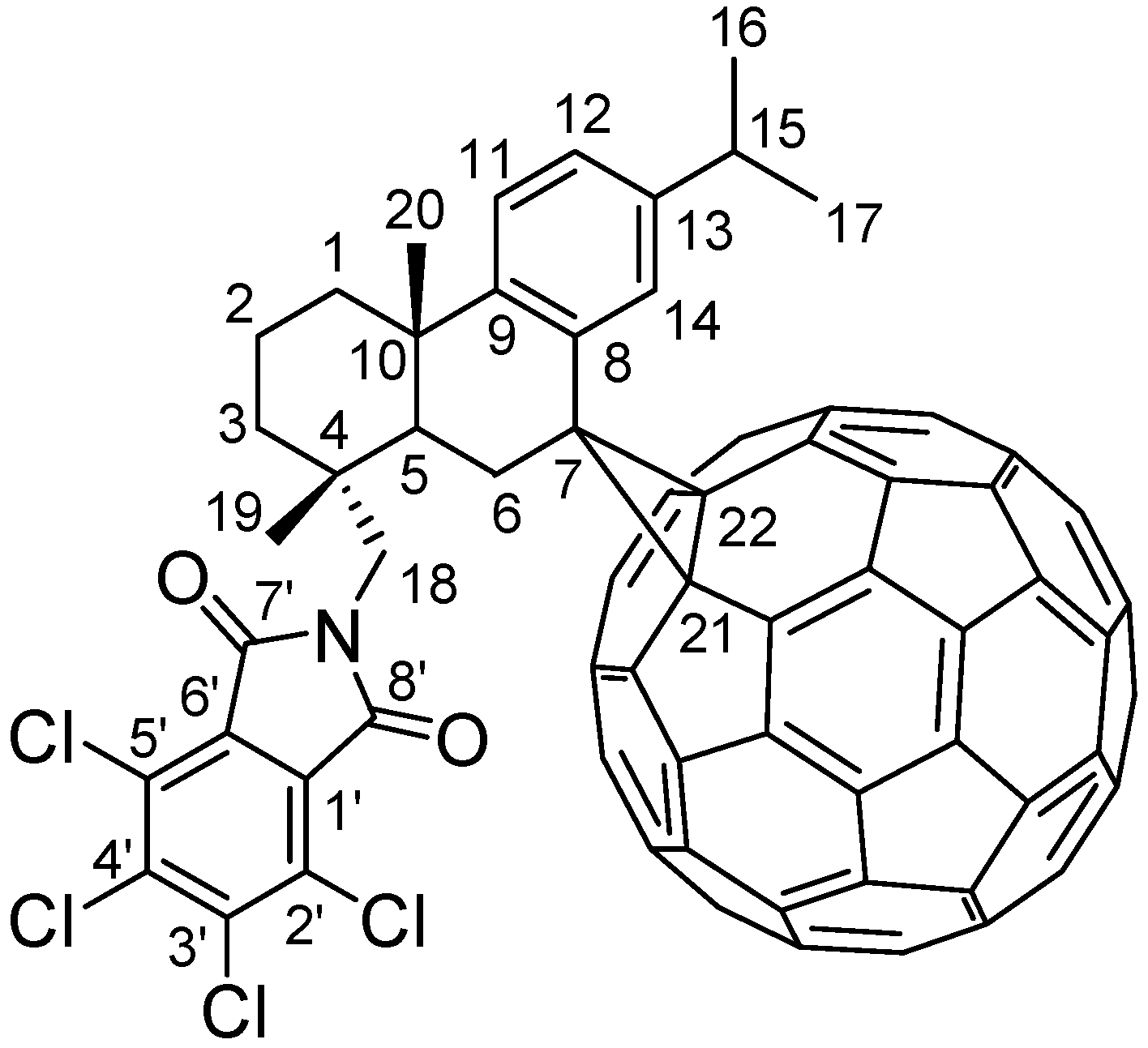
      <p>Since the discovery of C<sub>60</sub>, its peculiar cage structure has attracted great attention. Cycloaddition reactions of C<sub>60</sub>, especially 1,3-dipolar addition reactions, have been the subject of a large variety of studies and shown to be a useful methods for the synthesis of functionalized fullerene derivatives [<xref ref-type="bibr" rid="B7-molecules-17-04209">7</xref>,<xref ref-type="bibr" rid="B8-molecules-17-04209">8</xref>,<xref ref-type="bibr" rid="B9-molecules-17-04209">9</xref>,<xref ref-type="bibr" rid="B10-molecules-17-04209">10</xref>,<xref ref-type="bibr" rid="B11-molecules-17-04209">11</xref>]. These results prompted us to study new cycloadducts of dehydroabietylamine with C<sub>60</sub> as a part of an on-going program for the development of new rosin amine derivatives with potential biological or material properties. So far, the majority of the studies on the chemical transformations of dehydroabietylamine have focused on the amine group and benzene ring, but the chemical transformation in other skeleton has seldom been reported. In this paper, we report the synthesis for the first time of the 7-C60-adduct of <italic>N,N</italic>-(tetrachlorophthaloyl)dehydroabietylamine (<bold>5</bold>, <xref ref-type="fig" rid="molecules-17-04209-f001">Figure 1</xref>) and describe the structure determination of the new compound, along with its detailed <sup>1</sup>H- and <sup>13</sup>C-NMR assignments.</p>
      <fig id="molecules-17-04209-f001" position="anchor">
        <label>Figure 1</label>
        <caption>
          <p>Chemical structure of 7-C<sub>60</sub>-adduct of <italic>N,N</italic>-(tetrachlorophthaloyl)dehydroabietylamine (<bold>5</bold>).</p>
        </caption>
        <graphic xmlns:xlink="http://www.w3.org/1999/xlink" xlink:href="molecules-17-04209-g001.tif"/>
      </fig>
    </sec>
    <sec sec-type="results">
      <title>2. Results and Discussion</title>
      <sec sec-type="methods">
        <title>2.1. Synthesis Procedures</title>
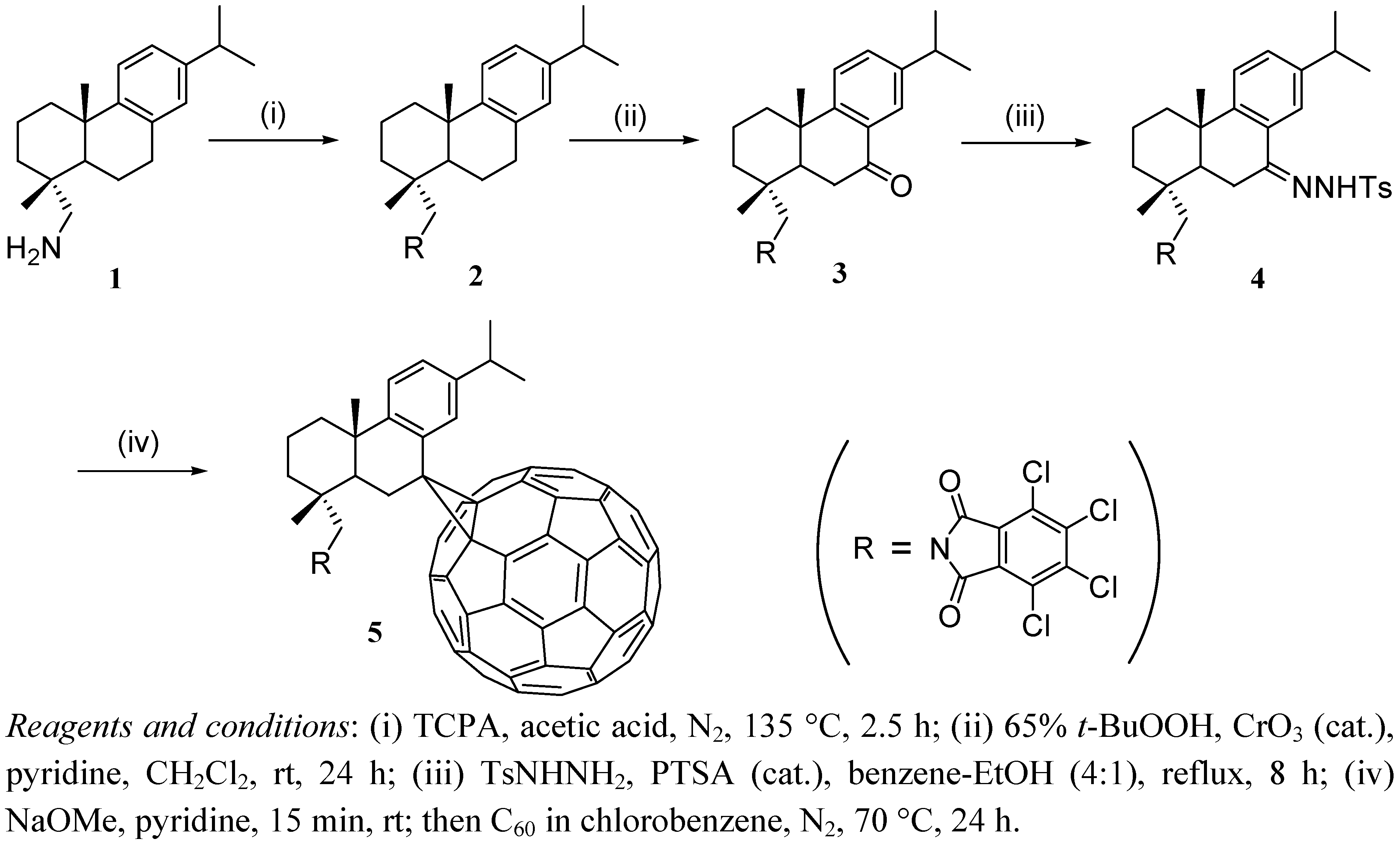
        <p>The general procedure for the synthesis of compound <bold>5</bold> is shown in <xref ref-type="fig" rid="molecules-17-04209-f004">Scheme 1</xref>. Dehydroabietylamine (<bold>1</bold>) was prepared as described in the literature [<xref ref-type="bibr" rid="B12-molecules-17-04209">12</xref>]. Dehydroabietylamine reacted with tetrachlorophthalic anhydride (TCPA, an amino protecting group) to give compound <bold>2</bold>, which then was transformed into <bold>3</bold> by C-7 benzylic oxidation. Subsequently, the reaction of <bold>3</bold> with <italic>p</italic>-tosylhydrazide yielded <italic>p</italic>-tosylhydrazone <bold>4</bold>. Compound <bold>5</bold> was prepared according to the reported method [<xref ref-type="bibr" rid="B13-molecules-17-04209">13</xref>]. According to the literature [<xref ref-type="bibr" rid="B13-molecules-17-04209">13</xref>], heating a solution of the <italic>p</italic>-tosylhydrazone with C<sub>60</sub> at 70 °C afford the [<xref ref-type="bibr" rid="B5-molecules-17-04209">5</xref>,<xref ref-type="bibr" rid="B6-molecules-17-04209">6</xref>]-open isomer. However, in our experiment, no traces of this expected [<xref ref-type="bibr" rid="B5-molecules-17-04209">5</xref>,<xref ref-type="bibr" rid="B6-molecules-17-04209">6</xref>]-open isomer were found and the only isolated product was the [<xref ref-type="bibr" rid="B6-molecules-17-04209">6</xref>,<xref ref-type="bibr" rid="B6-molecules-17-04209">6</xref>]-closed isomer (methanofullerene), which is likely due to a rearrangement of the 5,6-open isomer into the thermodynamically more stable 6,6-closed isomer at 70 °C.</p>
      </sec>
      <sec>
        <title>2.2. Analysis of Compound <italic><bold>5</bold></italic></title>
        <sec>
          <title>2.2.1. IR, UV-Vis and Mass Spectrum Analysis of Compound <bold>5</bold></title>
          <p>The IR spectrum of compound <bold>5</bold> showed bands indicating the presence of the different expected functional groups: Characteristic asymmetric and symmetric stretching bands of the imide carbonyl (C=O) at 1,776 and 1,721 cm<sup>−</sup><sup>1</sup> and at 526 cm<sup>−</sup><sup>1</sup> for the C<sub>60</sub> skeleton. In the UV-vis spectrum, the characteristic absorptions for the methanofullerenes was also observed at 436.50, 697.00 nm [<xref ref-type="bibr" rid="B13-molecules-17-04209">13</xref>]. Meanwhile, the structure of compound <bold>5</bold> as a monoadduct was supported by the matrix-assisted laser desorption/ionization time of flight mass spectrum (MALDI-TOF MS) which display the expected peak at <italic>m</italic><italic>/</italic><italic>z</italic> 1,271.4.</p>
        <fig id="molecules-17-04209-f004" position="anchor">
          <label>Scheme 1</label>
          <caption>
            <p>Preparation of compound <bold>5</bold>.</p>
          </caption>
          <graphic xmlns:xlink="http://www.w3.org/1999/xlink" xlink:href="molecules-17-04209-g004.tif"/>
        </fig>
        </sec>
        <sec>
          <title>2.2.2. <sup>1</sup>H-NMR Spectrum Analysis of Compound <bold>5</bold></title>
          <p>The <sup>1</sup>H-, <sup>13</sup>C-NMR and 2D NMR spectra for compound <bold>5</bold> are summarized in <xref ref-type="table" rid="molecules-17-04209-t001">Table 1</xref>.</p>
          <table-wrap id="molecules-17-04209-t001" position="anchor">
            <object-id pub-id-type="pii">molecules-17-04209-t001_Table 1</object-id>
            <label>Table 1</label>
            <caption>
              <p><sup>1</sup>H- and <sup>13</sup>C-NMR data, <sup>1</sup>H-<sup>1</sup>H correlations in COSY, ROESY spectra and <sup>1</sup>H-<sup>13</sup>C correlations in HSQC, HMBC spectra for compound <bold>5</bold>.</p>
            </caption>
            <table>
              <thead>
                <tr>
                  <th align="left" valign="top">C</th>
                  <th align="left" valign="top"><italic>δ</italic><sub>C</sub> (ppm)</th>
                  <th align="left" valign="top">H</th>
                  <th align="left" valign="top"><italic>δ</italic><sub>H</sub> (ppm)</th>
                  <th align="left" valign="top">HSQC</th>
                  <th align="left" valign="top">HMBC</th>
                  <th align="left" valign="top">COSY</th>
                  <th align="left" valign="top">ROESY</th>
                </tr>
              </thead>
              <tbody>
                <tr>
                  <td align="left" valign="top">1</td>
                  <td align="left" valign="top">39.48</td>
                  <td align="left" valign="top">1<italic>β</italic></td>
                  <td align="left" valign="top">2.39 (br d, <italic>J</italic> = 11.9 Hz)</td>
                  <td align="left" valign="top">H-1<italic>β</italic>, 1<italic>α</italic></td>
                  <td align="left" valign="top">H-20, 2, 3<italic>α</italic></td>
                  <td align="left" valign="top">H-1<italic>α</italic>, 2</td>
                  <td align="left" valign="top">H-20, 11, 2, 1<italic>α</italic></td>
                </tr>
                <tr>
                  <td align="left" valign="top"> </td>
                  <td align="left" valign="top"> </td>
                  <td align="left" valign="top">1<italic>α</italic></td>
                  <td align="left" valign="top">1.79–1.74 (m)</td>
                  <td align="left" valign="top"> </td>
                  <td align="left" valign="top"> </td>
                  <td align="left" valign="top">H-1<italic>β</italic>, 2</td>
                  <td align="left" valign="top">H-5, 11, 1<italic>β</italic></td>
                </tr>
                <tr>
                  <td align="left" valign="top">2</td>
                  <td align="left" valign="top">18.18</td>
                  <td align="left" valign="top">2</td>
                  <td align="left" valign="top">1.85–1.79 (m, 2H)</td>
                  <td align="left" valign="top">H-2</td>
                  <td align="left" valign="top"> </td>
                  <td align="left" valign="top">H-3<italic>β</italic>, 3<italic>α</italic>, 1<italic>β</italic>, 1<italic>α</italic></td>
                  <td align="left" valign="top">H-19, 3<italic>β</italic>, 3<italic>α</italic>, 1<italic>β</italic></td>
                </tr>
                <tr>
                  <td align="left" valign="top">3</td>
                  <td align="left" valign="top">37.52</td>
                  <td align="left" valign="top">3<italic>β</italic></td>
                  <td align="left" valign="top">1.58 (br d, <italic>J</italic> = 13.0 Hz)</td>
                  <td align="left" valign="top">H-3<italic>β</italic>, 3<italic>α</italic></td>
                  <td align="left" valign="top">H-19, 18<italic>α</italic>, 18<italic>β</italic></td>
                  <td align="left" valign="top">H-3<italic>α</italic>, 2</td>
                  <td align="left" valign="top">H-19, 3<italic>α</italic>, 2</td>
                </tr>
                <tr>
                  <td align="left" valign="top"> </td>
                  <td align="left" valign="top"> </td>
                  <td align="left" valign="top">3<italic>α</italic></td>
                  <td align="left" valign="top">1.53–1.47 (m)</td>
                  <td align="left" valign="top"> </td>
                  <td align="left" valign="top"> </td>
                  <td align="left" valign="top">H-3<italic>β</italic>, 2</td>
                  <td align="left" valign="top">H-5, 18<italic>α</italic>, 3<italic>β</italic>, 2</td>
                </tr>
                <tr>
                  <td align="left" valign="top">4</td>
                  <td align="left" valign="top">40.89</td>
                  <td align="left" valign="top">―</td>
                  <td align="left" valign="top">―</td>
                  <td align="left" valign="top">―</td>
                  <td align="left" valign="top">H-19, 5, 18<italic>α</italic>, 18<italic>β</italic>, 6<italic>β</italic></td>
                  <td align="left" valign="top">―</td>
                  <td align="left" valign="top">―</td>
                </tr>
                <tr>
                  <td align="left" valign="top">5</td>
                  <td align="left" valign="top">48.67</td>
                  <td align="left" valign="top">5</td>
                  <td align="left" valign="top">1.97 (dd, <italic>J</italic> = 10.3, 9.2 Hz)</td>
                  <td align="left" valign="top">H-5</td>
                  <td align="left" valign="top">H-19, 20, 18<italic>α</italic>, 18<italic>β</italic>, 6<italic>α</italic>, 6<italic>β</italic></td>
                  <td align="left" valign="top">H-6<italic>β</italic>, 6<italic>α</italic></td>
                  <td align="left" valign="top">H-3<italic>α</italic>, 1<italic>α</italic>, 6<italic>α</italic>, 18<italic>α</italic>, 2 </td>
                </tr>
                <tr>
                  <td align="left" valign="top">6</td>
                  <td align="left" valign="top">28.35</td>
                  <td align="left" valign="top">6<italic>β</italic></td>
                  <td align="left" valign="top">3.65 (dd, <italic>J</italic> = 14.1, 10.5 Hz)</td>
                  <td align="left" valign="top">H-6<italic>β</italic>, 6<italic>α</italic></td>
                  <td align="left" valign="top">C-6/H-5</td>
                  <td align="left" valign="top">H-5, 6<italic>α</italic></td>
                  <td align="left" valign="top">H-19, 20, 6<italic>α</italic></td>
                </tr>
                <tr>
                  <td align="left" valign="top"> </td>
                  <td align="left" valign="top"> </td>
                  <td align="left" valign="top">6<italic>α</italic></td>
                  <td align="left" valign="top">3.41 (dd, <italic>J</italic> = 14.1, 8.8 Hz)</td>
                  <td align="left" valign="top"> </td>
                  <td align="left" valign="top"> </td>
                  <td align="left" valign="top">H-5, 6<italic>β</italic></td>
                  <td align="left" valign="top">H-5, 6<italic>β</italic>, 18<italic>α</italic></td>
                </tr>
                <tr>
                  <td align="left" valign="top">7</td>
                  <td align="left" valign="top">44.61</td>
                  <td align="left" valign="top">―</td>
                  <td align="left" valign="top">―</td>
                  <td align="left" valign="top">―</td>
                  <td align="left" valign="top">H-6<italic>α</italic>, 6<italic>β</italic>, 14, 11</td>
                  <td align="left" valign="top">―</td>
                  <td align="left" valign="top">―</td>
                </tr>
                <tr>
                  <td align="left" valign="top">8</td>
                  <td align="left" valign="top">132.15</td>
                  <td align="left" valign="top">―</td>
                  <td align="left" valign="top">―</td>
                  <td align="left" valign="top">―</td>
                  <td align="left" valign="top">H-6<italic>β</italic>, 11, </td>
                  <td align="left" valign="top">―</td>
                  <td align="left" valign="top">―</td>
                </tr>
                <tr>
                  <td align="left" valign="top">9</td>
                  <td align="left" valign="top">150.35</td>
                  <td align="left" valign="top">―</td>
                  <td align="left" valign="top">―</td>
                  <td align="left" valign="top">―</td>
                  <td align="left" valign="top">H-14, 12, 20, 5</td>
                  <td align="left" valign="top">―</td>
                  <td align="left" valign="top">―</td>
                </tr>
                <tr>
                  <td align="left" valign="top">10</td>
                  <td align="left" valign="top">38.83</td>
                  <td align="left" valign="top">―</td>
                  <td align="left" valign="top">―</td>
                  <td align="left" valign="top">―</td>
                  <td align="left" valign="top">H-20, 5, 6<italic>α</italic>, 2, 11</td>
                  <td align="left" valign="top">―</td>
                  <td align="left" valign="top">―</td>
                </tr>
                <tr>
                  <td align="left" valign="top">11</td>
                  <td align="left" valign="top">123.40</td>
                  <td align="left" valign="top">11</td>
                  <td align="left" valign="top">7.43 (d, <italic>J</italic> = 8.1 Hz)</td>
                  <td align="left" valign="top">H-11</td>
                  <td align="left" valign="top">H-12</td>
                  <td align="left" valign="top">H-12</td>
                  <td align="left" valign="top">H-1<italic>β</italic>, 1<italic>α</italic>, 12</td>
                </tr>
                <tr>
                  <td align="left" valign="top">12</td>
                  <td align="left" valign="top">126.09</td>
                  <td align="left" valign="top">12</td>
                  <td align="left" valign="top">7.28 (dd, <italic>J</italic> = 8.1, 1.8 Hz)</td>
                  <td align="left" valign="top">H-12</td>
                  <td align="left" valign="top">H-15, 11, 14</td>
                  <td align="left" valign="top">H-11</td>
                  <td align="left" valign="top">H-15, 11, 16</td>
                </tr>
                <tr>
                  <td align="left" valign="top">13</td>
                  <td align="left" valign="top">145.43</td>
                  <td align="left" valign="top">―</td>
                  <td align="left" valign="top">―</td>
                  <td align="left" valign="top">―</td>
                  <td align="left" valign="top">H-16, 17, 15, 11</td>
                  <td align="left" valign="top">―</td>
                  <td align="left" valign="top">―</td>
                </tr>
                <tr>
                  <td align="left" valign="top">14</td>
                  <td align="left" valign="top">126.42</td>
                  <td align="left" valign="top">14</td>
                  <td align="left" valign="top">8.40 (d, <italic>J</italic> = 1.8 Hz)</td>
                  <td align="left" valign="top">H-14</td>
                  <td align="left" valign="top">H-12, 15</td>
                  <td align="left" valign="top">―</td>
                  <td align="left" valign="top">―</td>
                </tr>
                <tr>
                  <td align="left" valign="top">15</td>
                  <td align="left" valign="top">33.92</td>
                  <td align="left" valign="top">15</td>
                  <td align="left" valign="top">2.99 (septet, <italic>J</italic> = 6.7 Hz)</td>
                  <td align="left" valign="top">H-15</td>
                  <td align="left" valign="top">H-16, 17, 12, 14</td>
                  <td align="left" valign="top">H-16, 17</td>
                  <td align="left" valign="top">H-16, 17, 12</td>
                </tr>
                <tr>
                  <td align="left" valign="top">16</td>
                  <td align="left" valign="top">23.70</td>
                  <td align="left" valign="top">16</td>
                  <td align="left" valign="top">1.30 (d, <italic>J</italic> = 6.8 Hz, 3H)</td>
                  <td align="left" valign="top">H-16</td>
                  <td align="left" valign="top">H-15, 17, </td>
                  <td align="left" valign="top">H-15</td>
                  <td align="left" valign="top">H-15, 12</td>
                </tr>
                <tr>
                  <td align="left" valign="top">17</td>
                  <td align="left" valign="top">24.49</td>
                  <td align="left" valign="top">17</td>
                  <td align="left" valign="top">1.32 (d, <italic>J</italic> = 7.0 Hz, 3H)</td>
                  <td align="left" valign="top">H-17</td>
                  <td align="left" valign="top">H-15, 16</td>
                  <td align="left" valign="top">H-15</td>
                  <td align="left" valign="top">H-15</td>
                </tr>
                <tr>
                  <td align="left" valign="top">18</td>
                  <td align="left" valign="top">50.45</td>
                  <td align="left" valign="top">18<italic>β</italic></td>
                  <td align="left" valign="top">3.88 (d, <italic>J</italic> = 13.6 Hz)</td>
                  <td align="left" valign="top">H-18<italic>β</italic>, 18<italic>α</italic></td>
                  <td align="left" valign="top">H-19, 5 </td>
                  <td align="left" valign="top">H-18<italic>α</italic></td>
                  <td align="left" valign="top">H-18<italic>α</italic>, 19</td>
                </tr>
                <tr>
                  <td align="left" valign="top"> </td>
                  <td align="left" valign="top"> </td>
                  <td align="left" valign="top">18<italic>α</italic></td>
                  <td align="left" valign="top">3.59 (d, <italic>J</italic> = 13.6 Hz)</td>
                  <td align="left" valign="top"> </td>
                  <td align="left" valign="top"> </td>
                  <td align="left" valign="top">H-18<italic>β</italic></td>
                  <td align="left" valign="top">H-18<italic>β</italic>, 5, 3<italic>α</italic>, 6<italic>α</italic></td>
                </tr>
                <tr>
                  <td align="left" valign="top">19</td>
                  <td align="left" valign="top">18.89</td>
                  <td align="left" valign="top">19</td>
                  <td align="left" valign="top">1.31 (s, 3H)</td>
                  <td align="left" valign="top">H-19</td>
                  <td align="left" valign="top">H-5, 18<italic>α</italic>, 18<italic>β</italic></td>
                  <td align="left" valign="top">―</td>
                  <td align="left" valign="top">H-20, 6<italic>β</italic>, 18<italic>β</italic>, 3<italic>β</italic>, 2</td>
                </tr>
                <tr>
                  <td align="left" valign="top">20</td>
                  <td align="left" valign="top">22.50</td>
                  <td align="left" valign="top">20</td>
                  <td align="left" valign="top">1.86 (s, 3H)</td>
                  <td align="left" valign="top">H-20</td>
                  <td align="left" valign="top">H-1<italic>α</italic>, 5</td>
                  <td align="left" valign="top">―</td>
                  <td align="left" valign="top">H-19, 6<italic>β</italic>, 1<italic>β</italic></td>
                </tr>
                <tr>
                  <td align="left" valign="top">21,22</td>
                  <td align="left" valign="top">84.80</td>
                  <td align="left" valign="top">―</td>
                  <td align="left" valign="top">―</td>
                  <td align="left" valign="top">―</td>
                  <td align="left" valign="top">H-6<italic>α</italic>, 6<italic>β</italic></td>
                  <td align="left" valign="top">―</td>
                  <td align="left" valign="top">―</td>
                </tr>
                <tr>
                  <td align="left" valign="top"> </td>
                  <td align="left" valign="top">77.66</td>
                  <td align="left" valign="top">―</td>
                  <td align="left" valign="top">―</td>
                  <td align="left" valign="top">―</td>
                  <td align="left" valign="top">H-6<italic>α</italic></td>
                  <td align="left" valign="top">―</td>
                  <td align="left" valign="top">―</td>
                </tr>
                <tr>
                  <td align="left" valign="top">1',6'</td>
                  <td align="left" valign="top">127.52</td>
                  <td align="left" valign="top">―</td>
                  <td align="left" valign="top">―</td>
                  <td align="left" valign="top">―</td>
                  <td align="left" valign="top">―</td>
                  <td align="left" valign="top">―</td>
                  <td align="left" valign="top">―</td>
                </tr>
                <tr>
                  <td align="left" valign="top">2',5'</td>
                  <td align="left" valign="top">129.76</td>
                  <td align="left" valign="top">―</td>
                  <td align="left" valign="top">―</td>
                  <td align="left" valign="top">―</td>
                  <td align="left" valign="top">―</td>
                  <td align="left" valign="top">―</td>
                  <td align="left" valign="top">―</td>
                </tr>
                <tr>
                  <td align="left" valign="top">3',4'</td>
                  <td align="left" valign="top">140.35</td>
                  <td align="left" valign="top">―</td>
                  <td align="left" valign="top">―</td>
                  <td align="left" valign="top">―</td>
                  <td align="left" valign="top">―</td>
                  <td align="left" valign="top">―</td>
                  <td align="left" valign="top">―</td>
                </tr>
                <tr>
                  <td align="left" valign="top">7',8'</td>
                  <td align="left" valign="top">164.51</td>
                  <td align="left" valign="top">―</td>
                  <td align="left" valign="top">―</td>
                  <td align="left" valign="top">―</td>
                  <td align="left" valign="top">H-18<italic>α</italic>, 18<italic>β</italic></td>
                  <td align="left" valign="top">―</td>
                  <td align="left" valign="top">―</td>
                </tr>
                <tr>
                  <td align="left" valign="top">C<sub>60</sub></td>
                  <td align="left" valign="top">150.74–137.82</td>
                  <td align="left" valign="top">―</td>
                  <td align="left" valign="top">―</td>
                  <td align="left" valign="top">―</td>
                  <td align="left" valign="top">―</td>
                  <td align="left" valign="top">―</td>
                  <td align="left" valign="top">―</td>
                </tr>
              </tbody>
            </table>
          </table-wrap>
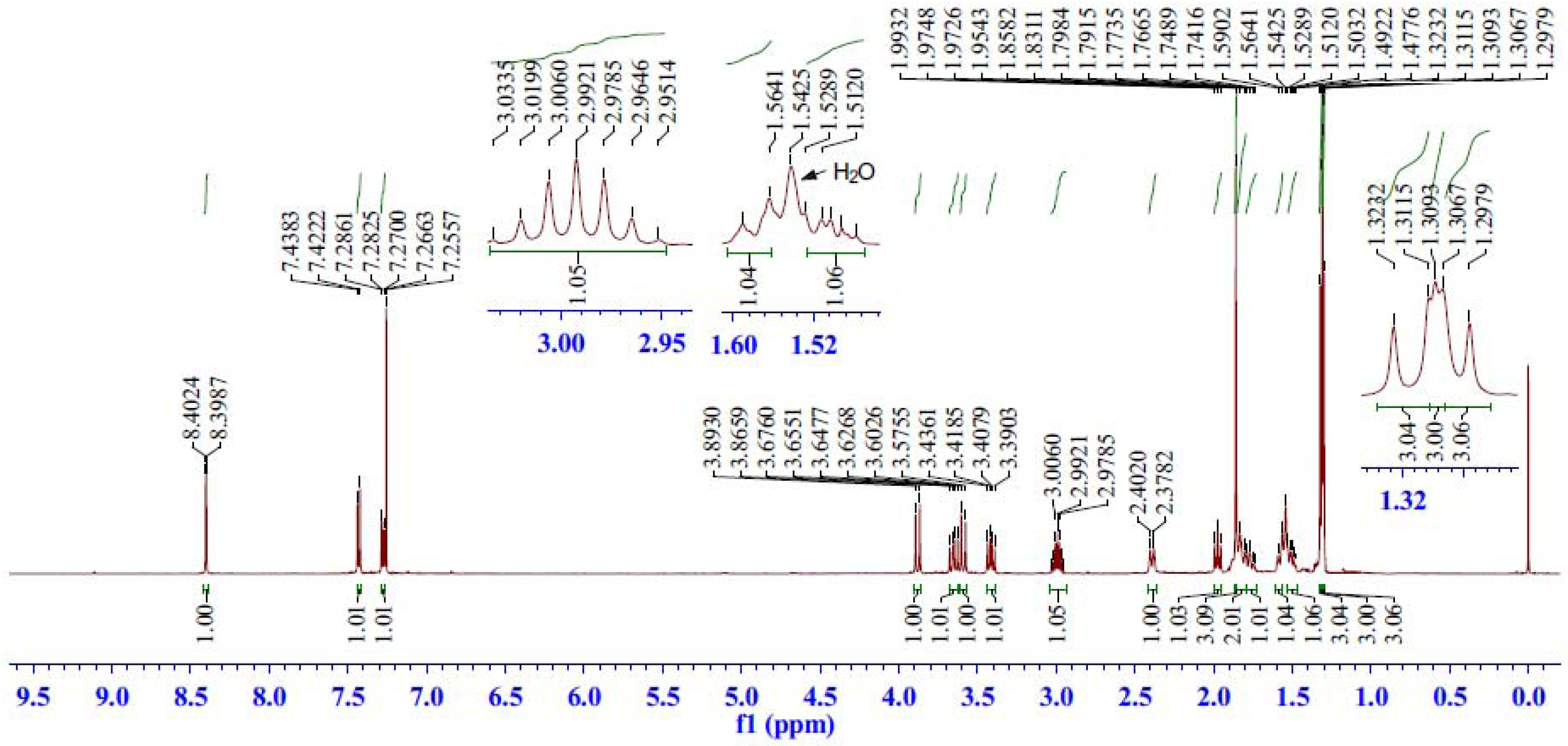
          <p>First, the assignment of some protons is easily accomplished by analysis of the <sup>1</sup>H-NMR chemical shifts, signal multiplicity and coupling constants. The signals of the aromatic protons (7.26–8.40 ppm) can be readily identified by their chemical environment (<xref ref-type="fig" rid="molecules-17-04209-f002">Figure 2</xref>). </p>
          <fig id="molecules-17-04209-f002" position="anchor">
            <label>Figure 2</label>
            <caption>
              <p><sup>1</sup>H-NMR spectrum of compound <bold>5</bold>.</p>
            </caption>
            <graphic xmlns:xlink="http://www.w3.org/1999/xlink" xlink:href="molecules-17-04209-g002.tif"/>
          </fig>
          <p>The H-11 signal appeared as a doublet with coupling constants <italic>J</italic><sub>11,12</sub> = 8.1 Hz at 7.43 ppm, while the H-14 signal appeared at 8.40 ppm as a doublet with a lower coupling constant values <italic>J</italic><sub>14,12</sub> = 1.8 Hz because of the long distance between H-14 and H-12. H-12 signal appeared as a double doublet with <italic>J</italic><sub>12,11</sub> = 8.1 and <italic>J</italic><sub>12,14</sub> = 1.8 Hz at 7.28 ppm. The septet at 2.99 ppm (<italic>J</italic> = 6.7 Hz) was assigned to H-15 proton. In the higher frequency region there are three double doublets and two doublets at <italic>δ</italic><sub>H</sub> 3.65 (dd, <italic>J</italic> = 14.1, 10.5 Hz), 3.41 (dd, <italic>J = </italic>14.1, 8.8 Hz) 1.97 (dd, <italic>J</italic> = 10.3, 9.2 Hz), 3.88 (d, <italic>J</italic> = 13.6 Hz) and 3.59 ppm (d, <italic>J</italic> = 13.6 Hz). Of the five signals, <italic>δ</italic><sub>H</sub> 3.88 and 3.59 ppm doublets were assigned to H-18 (H-18<italic>β</italic> and H-18<italic>α</italic>) on the basis of the correlations of <italic>δ</italic><sub>C</sub> 50.45 ppm/H-18<italic>β</italic>, 18<italic>α</italic> in the HSQC spectrum, while <italic>δ</italic><sub>H</sub> 3.65 and 3.41 ppm double doublets were assigned to the H-6 (H-6<italic>β</italic> and H-6<italic>α</italic>) on the basis of the correlations of <italic>δ</italic><sub>C</sub> 28.35 ppm/H-6<italic>β</italic>, 6<italic>α</italic> in the HSQC spectrum. The remaining double doublet at <italic>δ</italic><sub>H</sub> 1.97 ppm was assigned to H-5. To distinguish the non-equivalent H-18 and H-6 protons, we found that <italic>δ</italic><sub>H</sub> 3.59 and 3.41 ppm showed ROE correlations with H-5, but <italic>δ</italic><sub>H</sub> 3.88 and 3.65 ppm showed no ROE correlations with H-5 in the ROESY spectrum. Therefore, we assigned H-18<italic>α</italic> at <italic>δ </italic>3.59, H-6<italic>α</italic> at <italic>δ </italic>3.41, H-18<italic>β</italic> at <italic>δ </italic>3.88 and H-6<italic>β</italic> at <italic>δ </italic>3.65 ppm.</p>
          <p>The signals of four-methyl group protons appeared as two singlets and two doublets. The two singlets, one at <italic>δ</italic><sub>H</sub> 1.86 ppm was assigned to H-20 methyl protons, and the other at <italic>δ</italic><sub>H</sub> 1.31 ppm was assigned to H-19 methyl protons based on the correlations of <italic>δ</italic><sub>H</sub> 1.86/H-19, 6<italic>β</italic> and <italic>δ</italic><sub>H</sub> 1.31/H-20, 6<italic>β</italic>, 18<italic>β</italic> in the ROESY spectrum. The doublet at <italic>δ</italic><sub>H</sub> 1.30 ppm was readily assigned to H-16 methyl protons in the isopropyl moiety due to the <italic>δ</italic><sub>H</sub> 1.30/H-15 correlation in the COSY spectrum and <italic>δ</italic><sub>H</sub> 1.30/H-15, 12 correlations in the ROESY spectrum. The remaining doublet at <italic>δ</italic><sub>H</sub> 1.32 ppm was assigned to H-17 methyl protons.</p>
          <p>Finally, the signals of the remaining three-methylene group protons (H-1, 2, 3) appeared as two broad doublets and three multiplets. The broad doublet at <italic>δ</italic><sub>H</sub> 2.39 ppm and the multiplet at <italic>δ</italic><sub>H</sub> 1.79–1.74 ppm were, respectively, assigned to H-1<italic>β</italic> and H-1<italic>α</italic> due to the correlations of <italic>δ</italic><sub>H</sub> 2.39/1.79–1.74/<italic>δ</italic><sub>C</sub> 39.48 ppm in the HSQC spectrum and <italic>δ</italic><sub>H</sub> 2.39/H-20, 11, <italic>δ</italic><sub>H</sub> 1.79–1.74/H-5, 11 in the ROESY spectrum. Similarly, the broad doublet at <italic>δ</italic><sub>H</sub> 1.58 ppm and the multiplet at <italic>δ</italic><sub>H</sub> 1.53–1.47 ppm were, respectively, assigned to H-3<italic>β</italic> and H-3<italic>α</italic> based on the correlations of <italic>δ</italic><sub>H</sub> 1.58/1.53–1.47/<italic>δ</italic><sub>C</sub> 37.52 ppm in the HSQC spectrum and <italic>δ</italic><sub>H</sub> 1.58/H-19, <italic>δ</italic><sub>H</sub> 1.53–1.47/H-5, 18<italic>α</italic> in the ROESY spectrum. The remaining multiplet at <italic>δ</italic><sub>H</sub> 1.85–1.79 ppm was assigned to H-2, which also be demonstrated by the correlations of <italic>δ</italic><sub>H</sub> 1.85–1.79/H-3<italic>β</italic>, 3<italic>α</italic>, 1<italic>β</italic>, 1<italic>α</italic> in the COSY spectrum.</p>
        </sec>
        <sec>
          <title>2.2.3. <sup>13</sup>C-NMR Spectrum Analysis of Compound <bold>5</bold></title>
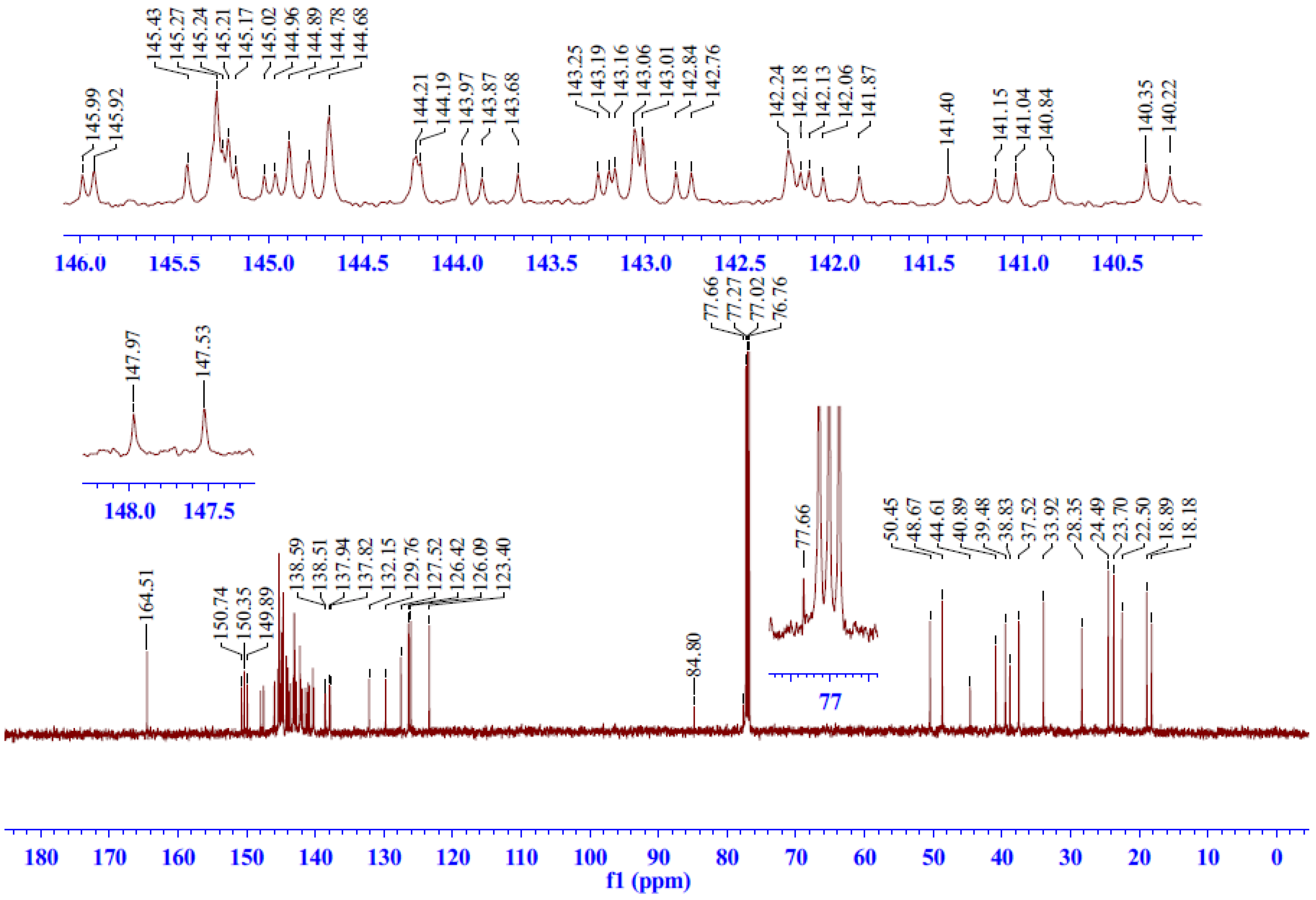
          <p>The proton noise decoupled <sup>13</sup>C-NMR spectrum (<xref ref-type="fig" rid="molecules-17-04209-f003">Figure 3</xref>) displayed 24 and 43 resonance signals respectively for (tetrachlorophthaloyl)dehydroabietylamine moiety and C<sub>60</sub> moiety of compound <bold>5</bold>. In the <sup>13</sup>C-NMR spectrum, the signal at <italic>δ</italic><sub>C</sub> 164.51 ppm could be assigned to C-7', 8', which was supported by the cross peaks of <italic>δ</italic><sub>C</sub> 164.51 ppm/H-18<italic>α</italic>, 18<italic>β</italic> in the HMBC spectrum. </p>
          <p>In the HSQC spectrum, the signals at <italic>δ</italic><sub>C</sub> 23.70, 24.49, 18.89 and 22.50 ppm were attributed to C-16, 17, 19, 20 methyl carbon atoms due to the cross peaks of <italic>δ</italic><sub>C</sub> 23.70/H-16, <italic>δ</italic><sub>C</sub> 24.49/H-17, <italic>δ</italic><sub>C</sub> 18.89/H-19 and <italic>δ</italic><sub>C</sub> 22.50/H-20. In addition, the signals at <italic>δ</italic><sub>C</sub> 18.18, 39.48, 37.52, 28.35 and 50.45 ppm were attributed to C-2, 1, 3, 6, 18 methylene carbon atoms due to the cross peaks of <italic>δ</italic><sub>C </sub>18.18/H-2, <italic>δ</italic><sub>C</sub> 39.48/H-1<italic>α</italic>,1<italic>β</italic>, <italic>δ</italic><sub>C</sub> 37.52/H-3<italic>α</italic>, 3<italic>β</italic>, <italic>δ</italic><sub>C</sub> 28.35/H-6<italic>α</italic>, 6<italic>β</italic> and <italic>δ</italic><sub>C</sub> 50.45/H-18<italic>α</italic>, 18<italic>β</italic>. The resonance signals at <italic>δ</italic><sub>C</sub> 48.67 and 33.92 ppm were assigned to methine carbon atoms C-5 and C-15 based on the cross peaks of <italic>δ</italic><sub>C</sub> 48.67/H-5 and <italic>δ</italic><sub>C</sub> 33.92/H-15. The HSQC spectrum also revealed the cross peaks between aromatic hydrogens H-11, 12, 14 and their corresponding carbon atoms. From the HSQC spectrum, we can clearly assign C-11 at <italic>δ</italic><sub>C</sub> 123.40, C-12 at <italic>δ</italic><sub>C</sub> 126.09 and C-14 at <italic>δ</italic><sub>C</sub> 126.42 ppm.</p>
          <fig id="molecules-17-04209-f003" position="anchor">
            <label>Figure 3</label>
            <caption>
              <p><sup>13</sup>C-NMR spectrum of compound <bold>5</bold>.</p>
            </caption>
            <graphic xmlns:xlink="http://www.w3.org/1999/xlink" xlink:href="molecules-17-04209-g003.tif"/>
          </fig>
          <p>The quaternary carbon atoms were assigned by using the long-range correlated HMBC experiment. The signals at <italic>δ</italic><sub>C</sub> 40.89, 132.15, 150.35, 38.83 and 145.43 ppm were assigned to C-4, 8, 9, 10, 13 quaternary carbon atoms because of the long-range cross peaks of <italic>δ</italic><sub>C</sub> 40.89 ppm/H-19, 5, 18<italic>α</italic>, 18<italic>β</italic>, 6<italic>β</italic>, <italic>δ</italic><sub>C</sub> 132.15 ppm/H-6<italic>β</italic>, 11, <italic>δ</italic><sub>C</sub> 150.35 ppm/H-14, 12, 20, 5, <italic>δ</italic><sub>C</sub> 38.83 ppm/H-20, 5, 6<italic>α</italic>, 2, 11 and <italic>δ</italic><sub>C</sub> 145.43 ppm/H-16, 17, 15, 11. The signals at <italic>δ</italic><sub>C</sub> 44.61, 84.80, 77.66 ppm were assigned to C-7 and the sp<sup>3</sup>-hybridized bridgehead carbon atom C-21, 22 on the cyclopropyl moiety due to the long-range cross peaks of <italic>δ</italic><sub>C</sub> 44.61 ppm/H-6<italic>α</italic>, 6<italic>β</italic>, 14, 11, <italic>δ</italic><sub>C</sub> 84.80 ppm/H-6<italic>α</italic>, 6<italic>β</italic> and <italic>δ</italic><sub>C</sub> 77.66 ppm/H-6<italic>α</italic>. This pattern is unambiguously diagnostic for <italic>C<sub>1</sub></italic> symmetric structure with 6,6-junction [<xref ref-type="bibr" rid="B14-molecules-17-04209">14</xref>,<xref ref-type="bibr" rid="B15-molecules-17-04209">15</xref>].</p>
          <p>Only four signals were observed in the tetrachlorophthaloyl moiety due to the symmetry of C-7', 8', C-1', 6', C-2', 5' and C-3', 4'. The carbon signals at <italic>δ</italic><sub>C</sub> 127.52, 129.76, 140.35 ppm can be assigned to C-1', 6', C-2', 5' and C-3', 4' [<xref ref-type="bibr" rid="B16-molecules-17-04209">16</xref>]. The remaining 41 resonance signals between <italic>δ</italic><sub>C</sub> 150.74–137.82 ppm were attributed to C<sub>60</sub>-sp<sup>2</sup> carbon atoms (due to the overlapping, only 41 resonance signals for C<sub>60</sub>-sp<sup>2</sup> carbon atoms were observed, maximum 58 sp<sup>2</sup>-carbon resonance signals).</p>
        </sec>
      </sec>
    </sec>
    <sec sec-type="methods">
      <title>3. Experimental</title>
      <sec>
        <title>3.1. General</title>
        <p>1D (<sup>1</sup>H and <sup>13</sup>C) and 2D NMR experiments were performed on a Bruker AVANCE AV-500 NMR spectrometer (500.13 MHz for <sup>1</sup>H and 125.77 MHz for <sup>13</sup>C). The samples were dissolved in 0.5 mL CDCl<sub>3</sub>, <sup>1</sup>H-NMR and <sup>13</sup>C-NMR spectra were recorded using TMS as an internal reference. Chemical shifts were reported in parts per million (ppm). FT infrared (IR) spectrum were recorded as KBr pellets on a Nicolet 360 FT-IR spectrometer and UV-vis spectra on a Shimadzu UV-2550 UV-VIS spectrometer. ESI mass spectrometric were obtained on Agilent 1100 Capillary LC/Micromass Q-Tof Micro mass spectrometer. Matrix-assisted laser desorption ionization time-of-flight (MALDI-TOF) mass spectra was performed on a Bruker Daltonics Autoflex III mass spectrometer using <italic>α</italic>-cyano-4-hydroxycinnamic acid (CHCA) as a matrix in a negative-ion reflector mode. All chemicals and solvents were obtained from commercial sources and used as received or dried according to standard procedures. Column chromatography was performed on silica gel (ZCXⅡ, 100–200 mesh). Chemical reactions were monitored by thin layer chromatography using precoated silica gel GF254 plates.</p>
      </sec>
      <sec>
        <title>3.2. Preparation of N,N-(Tetrachlorophthaloyl)dehydroabietylamine (<italic><bold>2</bold></italic>)</title>
        <p>A mixture of tetrachlorophthalic anhydride (5 g, 17.5 mmol), dehydroabietylamine (5 g, 17.5 mmol), and glacial acetic acid (60 mL) was stirred under N<sub>2</sub> at 135 °C for 2.5 h. Then the mixture was cooled and poured into 250 mL of ice water. The solid was filtered, washed successively with distilled water and ethanol, dried in vacuo to give the crude product, which was purified by column chromatography on silica gel (petroleum ether-toluene, 2:1) to yield <bold>2</bold> as a white solid (7.11 g, 73.4%), m.p. 220–221 °C. IR <italic>ν</italic><sub>max</sub>/cm<sup>–1</sup>: 2934, 2860, 1776, 1714, 1630, 1498, 1430, 1392, 1369, 1338, 1297, 1200, 1091, 1069, 879, 820, 736, 556, 476; <sup>1</sup>H-NMR: <italic>δ</italic> 7.13 (d, <italic>J</italic> = 7.9 Hz, 1H), 6.96 (dd, <italic>J</italic> = 8.2, 1.5 Hz, 1H), 6.91 (s, 1H), 3.68 (d, <italic>J</italic> = 13.7 Hz, 1H), 3.55 (d, <italic>J</italic> = 13.7 Hz, 1H), 2.98–2.96 (m, 2H), 2.81 (septet, <italic>J</italic> = 6.9 Hz, 1H), 2.26 (br d, <italic>J</italic> = 12.5 Hz, 1H), 2.22–2.18 (m, 1H), 1.86–1.79 (m, 1H), 1.75–1.62 (m, 2H), 1.49 (dd, <italic>J</italic> = 13.4, 1.2 Hz, 1H), 1.44–1.28 (m, 3H, H-1<italic>α</italic>), 1.23 (s, 3H), 1.21 (d, <italic>J</italic> = 7.0 Hz, 6H), 1.05 (s, 3H); <sup>13</sup>C-NMR: <italic>δ</italic> 164.50 (2C=O, imide), 147.09, 145.69, 140.07 (2C, -N(CO)<sub>2</sub><italic>C</italic><sub>6</sub>Cl<sub>4</sub>), 134.86, 129.58 (2C, -N(CO)<sub>2</sub><italic>C</italic><sub>6</sub>Cl<sub>4</sub>), 127.52 (2C, -N(CO)<sub>2</sub><italic>C</italic><sub>6</sub>Cl<sub>4</sub>), 127.05, 123.82, 123.78, 49.89, 45.39, 39.53, 38.09, 37.61, 37.21, 33.44, 30.07, 25.81, 23.96, 23.94, 19.45, 19.06, 18.45; TOF MS (ES<sup>−</sup>) <italic>m/z</italic> 524.3 ([M(<sup>35</sup>Cl<sub>4</sub>)–C<sub>2</sub>H<sub>3</sub>]<sup>−</sup>), 526.2 ([M(<sup>35</sup>Cl<sub>3</sub><sup>37</sup>Cl)–C<sub>2</sub>H<sub>3</sub>]<sup>−</sup>), 528.2 ([M(<sup>35</sup>Cl<sub>2</sub><sup>37</sup>Cl<sub>2</sub>)–C<sub>2</sub>H<sub>3</sub>]<sup>−</sup>). Anal. Calcd for C<sub>28</sub>H<sub>29</sub>Cl<sub>4</sub>NO<sub>2</sub> (553.3): C, 60.78; H, 5.28; N, 2.53. Found: C, 60.37; H, 5.35; N, 2.48.</p>
      </sec>
      <sec>
        <title>3.3. Preparation of 7-oxo-N,N-(Tetrachlorophthaloyl)dehydroabietylamine (<italic><bold>3</bold></italic>)</title>
        <p>To a mixture of CrO<sub>3</sub> (45 mg, 0.45 mmol) and CH<sub>2</sub>Cl<sub>2</sub> (90 mL), 65% <italic>t</italic>-BuOOH (11.6 mL, 72.3 mmol) and pyridine (0.073 mL, 0.904 mmol) were added. After stirring at room temperature for 3 min, compound <bold>2</bold> (5 g, 9.035 mmol) was added. Stirring continued at room temperature for 24 h, the mixture was concentrated to about 15 mL <italic>in vacuo</italic> at 30 °C, then poured into methanol (60 mL). The precipitate formed was filtered and washed with methanol to give a crude product, which was purified by column chromatography on silica gel (toluene-ethyl acetate, 20:0.5) to afford compound <bold>3</bold> as a white solid (3.51 g, 68.5%), m.p. 224–226 °C. IR <italic>ν</italic><sub>max</sub>/cm<sup>–1</sup>: 2961, 2930, 2865, 1777, 1716, 1684, 1608, 1561, 1515, 1489, 1456, 1430, 1377, 1342, 1297, 1248, 1197, 1093, 977, 912, 831, 797, 738, 613, 558, 500, 471; <sup>1</sup>H-NMR: <italic>δ</italic> 7.89 (d, <italic>J</italic> = 2.1 Hz, 1H), 7.39 (dd, <italic>J</italic> = 8.1, 2.0 Hz, 1H), 7.27 (d, <italic>J</italic> = 7.3 Hz, 1H), 3.64 (d, <italic>J</italic> = 13.7 Hz, 1H), 3.51 (d, <italic>J</italic> = 13.7 Hz, 1H), 3.06 (dd, <italic>J</italic> = 18.0, 3.7 Hz, 1H), 2.93 (septet, <italic>J</italic> = 6.9 Hz, 1H), 2.76 (dd, <italic>J</italic> = 18.0, 14.0 Hz, 1H), 2.32 (br d, <italic>J</italic> = 12.8 Hz, 1H), 2.00 (dd, <italic>J</italic> = 13.9, 3.5 Hz, 1H), 1.75–1.70 (m, 2H), 1.60–1.48 (m, 2H), 1.45–1.34 (m, 1H), 1.28 (s, 3H), 1.25 (d, <italic>J</italic> = 7.0 Hz, 6H), 1.12 (s, 3H); <sup>13</sup>C-NMR: <italic>δ</italic> 198.61 (C=O), 164.34 (2C=O, imide), 153.18, 146.89, 140.06 (2C, -N(CO)<sub>2</sub><italic>C</italic><sub>6</sub>Cl<sub>4</sub>), 132.48, 130.66, 129.60 (2C, -N(CO)<sub>2</sub><italic>C</italic><sub>6</sub>Cl<sub>4</sub>), 127.44 (2C, -N(CO)<sub>2</sub><italic>C</italic><sub>6</sub>Cl<sub>4</sub>), 125.18, 123.34, 49.71, 45.36, 39.16, 37.86, 37.29, 36.82, 36.34, 33.58, 24.18, 23.81, 18.72, 18.00; TOF MS (ES<sup>+</sup>) <italic>m/z</italic> 565.9 [M(<sup>35</sup>Cl<sub>4</sub>)+H]<sup>+</sup>, 567.9 [M(<sup>35</sup>Cl<sub>3</sub><sup>37</sup>Cl)+H]<sup>+</sup>, 569.9 [M(<sup>35</sup>Cl<sub>2</sub><sup>37</sup>Cl<sub>2</sub>)+H]<sup>+</sup>, 571.9 [M(<sup>35</sup>Cl<sup>37</sup>Cl<sub>3</sub>)+H]<sup>+</sup>, 573.9 [M(<sup>37</sup>Cl<sub>4</sub>)+H]<sup>+</sup>; Anal. Calcd for C<sub>28</sub>H<sub>27</sub>Cl<sub>4</sub>NO<sub>3</sub> (567.3): C, 59.28; H, 4.80; N, 2.47. Found: C, 57.66; H, 4.95; N, 2.31.</p>
      </sec>
      <sec>
        <title>3.4. Preparation of N,N-(Tetrachlorophthaloyl)dehydroabietylamine p-Tosylhydrazone (<italic><bold>4</bold></italic>)</title>
        <p>To a solution of compound <bold>3</bold> (3 g, 5.288 mmol) in benzene (120 mL) and ethanol (30 mL), <italic>p</italic>-toluenesulfonyl hydrazide (1.65 g, 8.86 mmol) and <italic>p</italic>-toluenesulfonic acid (82 mg, 0.476 mmol) were added. The reaction mixture was stirred and refluxed during 8 h under N<sub>2</sub>. After cooling to room temperature, the mixture was concentrated under vacuum, cooled in an ice bath and the precipitate was collected by filtration, and washed with ethanol. The crude product was purified by column chromatography on silica gel (toluene-ethyl acetate, 20:0.4) to yield <bold>4</bold> as a white solid (3.41 g, 87.8%), m.p. 218–220 °C. IR <italic>ν</italic><sub>max</sub>/cm<sup>–1</sup>: 3224, 3065, 2927, 2860, 1779, 1719, 1595, 1489, 1433, 1380, 1329, 1199, 1163, 1086, 1017, 978, 914, 810, 737, 708, 664, 631, 574, 541, 498, 468; <sup>1</sup>H-NMR: <italic>δ </italic>8.08 (s, 1H, NH), 8.02 (d, <italic>J</italic> = 8.4 Hz, 2H, <italic>o</italic>-HArSO<sub>2</sub>-), 7.79 (d, <italic>J</italic> = 1.8 Hz, 1H), 7.33 (d, <italic>J</italic> = 8.1 Hz, 2H, <italic>m</italic>-HArSO<sub>2</sub>-), 7.14 (dd, <italic>J</italic> = 8.1, 1.9 Hz, 1H), 7.10 (d, <italic>J</italic> = 8.2 Hz, 1H), 3.61 (d, <italic>J</italic> = 14.1 Hz, 1H), 3.50 (d, <italic>J</italic> = 14.1 Hz, 1H), 3.15 (dd, <italic>J</italic> = 17.3, 4.1 Hz, 1H), 2.87 (septet, <italic>J</italic> = 6.9 Hz, 1H), 2.43 (s, 3H, <italic>CH<sub>3</sub></italic>ArSO<sub>2</sub>-), 2.40 (dd, <italic>J</italic> = 17.2, 13.4 Hz, 1H), 2.21 (br d, <italic>J</italic> = 12.5 Hz, 1H), 1.73–1.63 (m, 4H), 1.51 (dd, <italic>J</italic> = 13.3, 3.9 Hz, 1H), 1.44–1.35 (m, 1H), 1.24 (d, 3H, <italic>J</italic> = 6.9 Hz), 1.23 (d, 3H, <italic>J</italic> = 6.9 Hz), 1.14 (s, 3H), 1.08 (s, 3H); <sup>13</sup>C-NMR: <italic>δ </italic>164.46 (2C=O, imide), 153.38 (C=N), 148.89, 146.25, 143.90 (<italic>p</italic>-ArSO<sub>2</sub>-), 140.15 (2C, -N(CO)<sub>2</sub><italic>C</italic><sub>6</sub>Cl<sub>4</sub>), 135.69 (<italic>p</italic>-ArCH<sub>3</sub>), 129.77, 129.64 (2C, -N(CO)<sub>2</sub><italic>C</italic><sub>6</sub>Cl<sub>4</sub>), 129.42 (2C, <italic>m</italic>-ArSO<sub>2</sub>-), 128.51, 128.42 (2C, <italic>o</italic>-ArSO<sub>2</sub>-), 127.34 (2C, -N(CO)<sub>2</sub><italic>C</italic><sub>6</sub>Cl<sub>4</sub>), 123.09, 122.61, 49.36, 42.78, 39.44, 37.28, 37.27, 37.11, 33.53, 23.90, 23.72, 23.63, 21.58 (<italic>CH<sub>3</sub></italic>ArSO<sub>2</sub>-), 19.03, 18.02; TOF MS (ES<sup>+</sup>) <italic>m/z</italic> 733.9 ([M(<sup>35</sup>Cl<sub>4</sub>)+H]<sup>+</sup>), 735.9 ([M(<sup>35</sup>Cl<sub>3</sub><sup>37</sup>Cl)+H]<sup>+</sup>), 737.9 ([M(<sup>35</sup>Cl<sub>2</sub><sup>37</sup>Cl<sub>2</sub>)+H]<sup>+</sup>), 739.9 ([M(<sup>35</sup>Cl<sup>37</sup>Cl<sub>3</sub>)+H]<sup>+</sup>). Anal. Calcd for C<sub>35</sub>H<sub>35</sub>Cl<sub>4</sub>N<sub>3</sub>O<sub>4</sub>S (735.5): C, 57.15; H, 4.80; N, 5.71. Found: C, 57.53; H, 4.71; N, 5.86.</p>
      </sec>
      <sec>
        <title>3.5. Preparation of 7-C<sub>60</sub>-Adduct of N,N-(Tetrachlorophthaloyl)dehydroabietylamine (<italic><bold>5</bold></italic>)</title>
        <p>Compound <bold>4</bold> (408.9 mg, 0.556 mmol) was dissolved in dry pyridine (7 mL) in a dried three-necked flask under N<sub>2</sub>. Then, NaOMe (31.2 mg, 0.578 mmol) was added, and the mixture was stirred for 15 min at room temperature. A solution of C<sub>60</sub> (200 mg, 0.278 mmol) in chlorobenzene (55 mL) was added and the mixture was stirred at 70 °C for 24 h. After cooling to room temperature the solvent was evaporated <italic>in vacuo</italic>, the residue was column chromatographed on silica gel, pre-eluted with CS<sub>2</sub> to remove unreacted C<sub>60</sub> (67.7 mg) and then with CS<sub>2</sub>-CHCl<sub>3</sub> (10:1) to give 5 as a dark brown solid (145 mg, 41%). IR <italic>ν</italic><sub>max</sub>/cm<sup>−1</sup>: 3430, 2923, 2858, 1776, 1721, 1628, 1559, 1514, 1459, 1427, 1372, 1334, 1163, 1059, 893, 825, 740, 555, 526, 472; UV-vis (CHCl<sub>3</sub>) λ<sub>max</sub> (nm): 697.00, 493.00, 436.50; <sup>1</sup>H-NMR: <italic>δ</italic> 8.40 (d, <italic>J</italic> = 1.8 Hz, 1H), 7.43 (d, <italic>J</italic> = 8.1 Hz, 1H), 7.28 (dd, <italic>J</italic> = 8.1, 1.8 Hz, 1H), 3.88 (d, <italic>J</italic> = 13.6 Hz, 1H), 3.65 (dd, <italic>J</italic> = 14.1, 10.5 Hz, 1H), 3.59 (d, <italic>J</italic> = 13.6 Hz, 1H), 2.99 (septet, <italic>J</italic> = 6.7 Hz, 1H), 2.39 (br d, <italic>J</italic> = 11.9 Hz, 1H), 1.97 (dd, <italic>J</italic> = 10.3, 9.2 Hz, 1H), 1.86 (s, 3H), 1.85–1.79 (m, 2H), 1.79–1.74 (m, 1H), 1.58 (br d, <italic>J</italic> = 13.0 Hz, 1H), 1.53–1.47 (m, 1H), 1.32 (d, <italic>J</italic> = 7.0 Hz, 3H), 1.31 (s, 3H), 1.30 (d, <italic>J</italic> = 6.8 Hz, 3H); <sup>13</sup>C-NMR: <italic>δ</italic> 164.51 (2C=O, imide), 150.74, 150.35, 149.89, 147.97, 147.53, 145.99, 145.92, 145.43, 145.27, 145.24, 145.21, 145.17, 145.02, 144.96, 144.89, 144.78, 144.68, 144.21, 144.19, 143.97, 143.87, 143.68, 143.25, 143.19, 143.16, 143.06, 143.01, 142.84, 142.76, 142.24, 142.18, 142.13, 142.06, 141.87, 141.40, 141.15, 141.04, 140.84, 140.35 (2C, -N(CO)<sub>2</sub><italic>C</italic><sub>6</sub>Cl<sub>4</sub>), 140.22, 138.59, 138.51, 137.94, 137.82, 132.15, 129.76 (2C, -N(CO)<sub>2</sub><italic>C</italic><sub>6</sub>Cl<sub>4</sub>), 127.52 (2C, -N(CO)<sub>2</sub><italic>C</italic><sub>6</sub>Cl<sub>4</sub>), 126.42, 126.09, 123.40, 84.80, 77.66, 50.45, 48.67, 44.61, 40.89, 39.48, 38.83, 37.52, 33.92, 28.35, 24.49, 23.70, 22.50, 18.89, 18.18; MALDI-TOF MS (matrix: CHCA, reflectron negative) <italic>m/z</italic> 1269.4 M<sup>−</sup>(<sup>35</sup>Cl<sub>4</sub>), 1271.4 M<sup>−</sup>(<sup>35</sup>Cl<sub>3</sub><sup>37</sup>Cl), 1273.4 M<sup>−</sup>(<sup>35</sup>Cl<sub>2</sub><sup>37</sup>Cl<sub>2</sub>), 1275.4 M<sup>−</sup>(<sup>35</sup>Cl<sup>37</sup>Cl<sub>3</sub>); Anal. Calcd for C<sub>88</sub>H<sub>27</sub>Cl<sub>4</sub>NO<sub>2</sub> (1271.97): C, 83.09; H, 2.14; N, 1.10. Found: C, 82.48; H, 2.20; N, 1.04.</p>
      </sec>
    </sec>
    <sec sec-type="conclusions">
      <title>4. Conclusions</title>
      <p>In conclusion, the new compound <bold>5</bold> was synthesized from dehydroabietylamine, the assignments of the proton and carbon signals for 7-C<sub>60</sub>-adduct of <italic>N</italic>,<italic>N</italic>-(tetrachlorophthaloyl)dehydroabietylamine were made possible by using 1D and 2D NMR techniques including <sup>1</sup>H-, <sup>13</sup>C-NMR, COSY, ROESY, HSQC and HMBC experiments. The two peaks at <italic>δ</italic><sub>C</sub> 84.80, 77.66 ppm in the <sup>13</sup>C-NMR spectra correspond to the sp<sup>3</sup>-hybridized bridgehead carbons on the cyclopropyl moiety. This pattern is unambiguously diagnostic for <italic>C<sub>1</sub></italic> symmetric structure with 6,6-junction. All the spectral data support and confirm the proposed structure of the target compound.</p>
    </sec>
  </body>
  <back>
    <ack>
      <title>Acknowledgments</title>
      <p>The authors wish to thank the financial support of the National Natural Science Foundation of China (No. 30871989).</p>
    </ack>
    <ref-list>
      <title>References and Notes</title>
      <ref id="B1-molecules-17-04209">
        <label>1.</label>
        <citation citation-type="journal">
          <person-group person-group-type="author">
            <name>
              <surname>Bolchi</surname>
              <given-names>C.</given-names>
            </name>
            <name>
              <surname>Pallavicini</surname>
              <given-names>M.</given-names>
            </name>
            <name>
              <surname>Fumagalli</surname>
              <given-names>L.</given-names>
            </name>
            <name>
              <surname>Rusconi</surname>
              <given-names>C.</given-names>
            </name>
            <name>
              <surname>Binda</surname>
              <given-names>M.</given-names>
            </name>
            <name>
              <surname>Valoti</surname>
              <given-names>E.</given-names>
            </name>
          </person-group>
          <article-title>Resolution of 2-substituted 1,4-benzodioxanes by entrainment</article-title>
          <source>Tetrahedron Asymmetry</source>
          <year>2007</year>
          <volume>18</volume>
          <fpage>1038</fpage>
          <lpage>1041</lpage>
        <pub-id pub-id-type="doi">10.1016/j.tetasy.2007.04.026</pub-id></citation>
      </ref>
      <ref id="B2-molecules-17-04209">
        <label>2.</label>
        <citation citation-type="journal">
          <person-group person-group-type="author">
            <name>
              <surname>Bolchi</surname>
              <given-names>C.</given-names>
            </name>
            <name>
              <surname>Fumagalli</surname>
              <given-names>L.</given-names>
            </name>
            <name>
              <surname>Moroni</surname>
              <given-names>B.</given-names>
            </name>
            <name>
              <surname>Pallavicini</surname>
              <given-names>M.</given-names>
            </name>
            <name>
              <surname>Valoti</surname>
              <given-names>E.</given-names>
            </name>
          </person-group>
          <article-title>A short entry to enantiopure 2-substituted 1,4-benzodioxanes by efficient resolution methods</article-title>
          <source>Tetrahedron Asymmetry</source>
          <year>2003</year>
          <volume>14</volume>
          <fpage>3779</fpage>
          <lpage>3785</lpage>
        <pub-id pub-id-type="doi">10.1016/j.tetasy.2003.09.012</pub-id></citation>
      </ref>
      <ref id="B3-molecules-17-04209">
        <label>3.</label>
        <citation citation-type="journal">
          <person-group person-group-type="author">
            <name>
              <surname>Wilkerson</surname>
              <given-names>W.W.</given-names>
            </name>
            <name>
              <surname>Galbraith</surname>
              <given-names>W.</given-names>
            </name>
            <name>
              <surname>Delucca</surname>
              <given-names>I.</given-names>
            </name>
          </person-group>
          <article-title>Topical antiinflammatory dehydroabietymine derivatives. IV</article-title>
          <source>Bioorg. Med. Chem. Lett.</source>
          <year>1993</year>
          <volume>3</volume>
          <fpage>2087</fpage>
          <lpage>2092</lpage>
          <pub-id pub-id-type="doi">10.1016/S0960-894X(01)81022-2</pub-id>
        </citation>
      </ref>
      <ref id="B4-molecules-17-04209">
        <label>4.</label>
        <citation citation-type="journal">
          <person-group person-group-type="author">
            <name>
              <surname>Wilkerson</surname>
              <given-names>W.W.</given-names>
            </name>
            <name>
              <surname>Delucca</surname>
              <given-names>I.</given-names>
            </name>
            <name>
              <surname>Galbraith</surname>
              <given-names>W.</given-names>
            </name>
            <name>
              <surname>Gans</surname>
              <given-names>K.</given-names>
            </name>
            <name>
              <surname>Harris</surname>
              <given-names>R.</given-names>
            </name>
            <name>
              <surname>Jaffee</surname>
              <given-names>B.</given-names>
            </name>
            <name>
              <surname>Kerr</surname>
              <given-names>J.</given-names>
            </name>
          </person-group>
          <article-title>Antiinflammatory phospholipase-A<sub>2</sub> inhibitors. I</article-title>
          <source>Eur. J. Med. Chem.</source>
          <year>1991</year>
          <volume>26</volume>
          <fpage>667</fpage>
          <lpage>676</lpage>
          <pub-id pub-id-type="doi">10.1016/0223-5234(91)90116-5</pub-id>
        </citation>
      </ref>
      <ref id="B5-molecules-17-04209">
        <label>5.</label>
        <citation citation-type="journal">
          <person-group person-group-type="author">
            <name>
              <surname>Wang</surname>
              <given-names>Y.</given-names>
            </name>
            <name>
              <surname>Song</surname>
              <given-names>Z.Q.</given-names>
            </name>
          </person-group>
          <article-title>Synthesis of zwitterionic surface active agents from dehydroabietic amine and correlation between their structures and performance</article-title>
          <source>Chem. Ind. For. Prod.</source>
          <year>1996</year>
          <volume>16</volume>
          <fpage>1</fpage>
          <lpage>6</lpage>
        </citation>
      </ref>
      <ref id="B6-molecules-17-04209">
        <label>6.</label>
        <citation citation-type="journal">
          <person-group person-group-type="author">
            <name>
              <surname>Wang</surname>
              <given-names>Y.</given-names>
            </name>
            <name>
              <surname>Song</surname>
              <given-names>Z.Q.</given-names>
            </name>
            <name>
              <surname>Liang</surname>
              <given-names>M.L.</given-names>
            </name>
          </person-group>
          <article-title>Synthesis and characteristics of quaternary ammonium cationic surfactants from <italic>N</italic>-dehydroabietyl-<italic>N,N</italic>-<italic>bis</italic>(hydroxyethyl)amine</article-title>
          <source>Chem. Ind. For. Prod.</source>
          <year>1997</year>
          <volume>17</volume>
          <fpage>6</fpage>
          <lpage>10</lpage>
        </citation>
      </ref>
      <ref id="B7-molecules-17-04209">
        <label>7.</label>
        <citation citation-type="journal">
          <person-group person-group-type="author">
            <name>
              <surname>Friedman</surname>
              <given-names>S.H.</given-names>
            </name>
            <name>
              <surname>DeCamp</surname>
              <given-names>D.L.</given-names>
            </name>
            <name>
              <surname>Sijbesma</surname>
              <given-names>R.P.</given-names>
            </name>
            <name>
              <surname>Srdanov</surname>
              <given-names>G.</given-names>
            </name>
            <name>
              <surname>Wudl</surname>
              <given-names>F.</given-names>
            </name>
            <name>
              <surname>Kenyon</surname>
              <given-names>G.L.</given-names>
            </name>
          </person-group>
          <article-title>Inhibition of the HIV-1 protease by fullerene derivatives: Model building studies and experimental verification</article-title>
          <source>J. Am. Chem. Soc.</source>
          <year>1993</year>
          <volume>115</volume>
          <fpage>6506</fpage>
          <lpage>6509</lpage>
        <pub-id pub-id-type="doi">10.1021/ja00068a005</pub-id></citation>
      </ref>
      <ref id="B8-molecules-17-04209">
        <label>8.</label>
        <citation citation-type="journal">
          <person-group person-group-type="author">
            <name>
              <surname>Zhao</surname>
              <given-names>G.J.</given-names>
            </name>
            <name>
              <surname>He</surname>
              <given-names>Y.J.</given-names>
            </name>
            <name>
              <surname>Xu</surname>
              <given-names>Z.</given-names>
            </name>
            <name>
              <surname>Hou</surname>
              <given-names>J.H.</given-names>
            </name>
            <name>
              <surname>Zhang</surname>
              <given-names>M.J.</given-names>
            </name>
            <name>
              <surname>Min</surname>
              <given-names>J.</given-names>
            </name>
            <name>
              <surname>Chen</surname>
              <given-names>H.Y.</given-names>
            </name>
            <name>
              <surname>Ye</surname>
              <given-names>M.F.</given-names>
            </name>
            <name>
              <surname>Hong</surname>
              <given-names>Z.R.</given-names>
            </name>
            <name>
              <surname>Yang</surname>
              <given-names>Y.</given-names>
            </name>
            <etal/>
          </person-group>
          <article-title>Effect of carbon chain length in the substituent of PCBM-like molecules on their photovoltaic properties</article-title>
          <source>Adv. Funct. Mater.</source>
          <year>2010</year>
          <volume>20</volume>
          <fpage>1480</fpage>
          <lpage>1487</lpage>
        <pub-id pub-id-type="doi">10.1002/adfm.200902447</pub-id></citation>
      </ref>
      <ref id="B9-molecules-17-04209">
        <label>9.</label>
        <citation citation-type="journal">
          <person-group person-group-type="author">
            <name>
              <surname>Sánchez</surname>
              <given-names>L.</given-names>
            </name>
            <name>
              <surname>Rispens</surname>
              <given-names>M.T.</given-names>
            </name>
            <name>
              <surname>Hummelen</surname>
              <given-names>J.C.</given-names>
            </name>
          </person-group>
          <article-title>A supramolecular array of fullerenes byquadruple hydrogen bonding</article-title>
          <source>Angew. Chem. Weinheim Bergstr. Ger.</source>
          <year>2002</year>
          <volume>41</volume>
          <fpage>838</fpage>
          <lpage>840</lpage>
        </citation>
      </ref>
      <ref id="B10-molecules-17-04209">
        <label>10.</label>
        <citation citation-type="journal">
          <person-group person-group-type="author">
            <name>
              <surname>Li</surname>
              <given-names>W.S.</given-names>
            </name>
            <name>
              <surname>Yamamoto</surname>
              <given-names>Y.</given-names>
            </name>
            <name>
              <surname>Fukushima</surname>
              <given-names>T.</given-names>
            </name>
            <name>
              <surname>Saeki</surname>
              <given-names>A.</given-names>
            </name>
            <name>
              <surname>Seki</surname>
              <given-names>S.</given-names>
            </name>
            <name>
              <surname>Tagawa</surname>
              <given-names>S.</given-names>
            </name>
            <name>
              <surname>Masunaga</surname>
              <given-names>H.</given-names>
            </name>
            <name>
              <surname>Sasaki</surname>
              <given-names>S.</given-names>
            </name>
            <name>
              <surname>Takata</surname>
              <given-names>M.</given-names>
            </name>
            <name>
              <surname>Aida</surname>
              <given-names>T.</given-names>
            </name>
          </person-group>
          <article-title>Amphiphilic molecular design as a rational strategy for tailoring bicontinuous electron donor and acceptor arrays: Photoconductive liquid crystalline oligothiophene-C<sub>60</sub> dyads</article-title>
          <source>J. Am. Chem. Soc.</source>
          <year>2008</year>
          <volume>130</volume>
          <fpage>8886</fpage>
          <lpage>8887</lpage>
        <pub-id pub-id-type="doi">10.1021/ja802757w</pub-id><pub-id pub-id-type="pmid">18558683</pub-id></citation>
      </ref>
      <ref id="B11-molecules-17-04209">
        <label>11.</label>
        <citation citation-type="journal">
          <person-group person-group-type="author">
            <name>
              <surname>Gómez</surname>
              <given-names>R.</given-names>
            </name>
            <name>
              <surname>Segura</surname>
              <given-names>J.L.</given-names>
            </name>
          </person-group>
          <article-title>Synthesis of a π-conjugated oligomer-fullerene dyad through a versatile [6,6] diphenylmethanofullerene carboxylic acid</article-title>
          <source>Tetrahedron</source>
          <year>2009</year>
          <volume>65</volume>
          <fpage>540</fpage>
          <lpage>546</lpage>
        <pub-id pub-id-type="doi">10.1016/j.tet.2008.10.077</pub-id></citation>
      </ref>
      <ref id="B12-molecules-17-04209">
        <label>12.</label>
        <citation citation-type="journal">
          <person-group person-group-type="author">
            <name>
              <surname>Wang</surname>
              <given-names>D.L.</given-names>
            </name>
            <name>
              <surname>Niu</surname>
              <given-names>Z.M.</given-names>
            </name>
            <name>
              <surname>Liu</surname>
              <given-names>H.D.</given-names>
            </name>
          </person-group>
          <article-title>Purification and characterization of optically active resolving reagent dehydroabietylamine</article-title>
          <source>Beijing Ligong Daxue Xuebao</source>
          <year>2004</year>
          <volume>24</volume>
          <fpage>357</fpage>
          <lpage>359</lpage>
        </citation>
      </ref>
      <ref id="B13-molecules-17-04209">
        <label>13.</label>
        <citation citation-type="journal">
          <person-group person-group-type="author">
            <name>
              <surname>Hummelen</surname>
              <given-names>J.C.</given-names>
            </name>
            <name>
              <surname>Knight</surname>
              <given-names>B.W.</given-names>
            </name>
            <name>
              <surname>LePeq</surname>
              <given-names>F.</given-names>
            </name>
            <name>
              <surname>Wudl</surname>
              <given-names>F.</given-names>
            </name>
            <name>
              <surname>Yao</surname>
              <given-names>J.</given-names>
            </name>
            <name>
              <surname>Wilkins</surname>
              <given-names>C.L.</given-names>
            </name>
          </person-group>
          <article-title>Preparation and characterization of fulleroid and methanofullerene derivatives</article-title>
          <source>J. Org. Chem.</source>
          <year>1995</year>
          <volume>60</volume>
          <fpage>532</fpage>
          <lpage>538</lpage>
        <pub-id pub-id-type="doi">10.1021/jo00108a012</pub-id></citation>
      </ref>
      <ref id="B14-molecules-17-04209">
        <label>14.</label>
        <citation citation-type="journal">
          <person-group person-group-type="author">
            <name>
              <surname>Liu</surname>
              <given-names>S.Z.</given-names>
            </name>
            <name>
              <surname>Tang</surname>
              <given-names>G.S.</given-names>
            </name>
          </person-group>
          <article-title>Symmetry, Cage Structure of [60]Fullerene Derivatives and <sup>13</sup>C-NMR Spectroscopy (in Chinese)</article-title>
          <source>Prog. Chem.</source>
          <year>2004</year>
          <volume>16</volume>
          <fpage>561</fpage>
          <lpage>573</lpage>
        </citation>
      </ref>
      <ref id="B15-molecules-17-04209">
        <label>15.</label>
        <citation citation-type="journal">
          <person-group person-group-type="author">
            <name>
              <surname>Khalilov</surname>
              <given-names>L.M.</given-names>
            </name>
            <name>
              <surname>Tulyabaev</surname>
              <given-names>A.R.</given-names>
            </name>
            <name>
              <surname>Tuktarov</surname>
              <given-names>A.R.</given-names>
            </name>
          </person-group>
          <article-title>Homo- and methano[60]fullerenes with chiral attached moieties—<sup>1</sup>H and <sup>13</sup>C-NMR chemical shift assignments and diastereotopicity effects</article-title>
          <source>Magn. Reson. Chem.</source>
          <year>2011</year>
          <volume>49</volume>
          <fpage>768</fpage>
          <lpage>774</lpage>
        <pub-id pub-id-type="pmid">22102505</pub-id></citation>
      </ref>
      <ref id="B16-molecules-17-04209">
        <label>16.</label>
        <citation citation-type="patent">
          <person-group person-group-type="author">
            <name>
              <surname>Li</surname>
              <given-names>Z.J.</given-names>
            </name>
            <name>
              <surname>Zhang</surname>
              <given-names>S.N.</given-names>
            </name>
            <name>
              <surname>Cui</surname>
              <given-names>J.R.</given-names>
            </name>
            <name>
              <surname>Li</surname>
              <given-names>S.C.</given-names>
            </name>
            <name>
              <surname>Li</surname>
              <given-names>Q.</given-names>
            </name>
            <name>
              <surname>Huang</surname>
              <given-names>H.Q.</given-names>
            </name>
            <name>
              <surname>Cai</surname>
              <given-names>M.S.</given-names>
            </name>
          </person-group>
          <article-title>Glycosyl phthalic imidine compounds with anti-inflammatory activity (in Chinese)</article-title>
          <source>C.N. Patent</source>
          <patent>1,594,342A</patent>
          <year>2005</year>
        </citation>
      </ref>
    </ref-list>
	<fn-group>
	<fn>
	<p><italic>Sample Availability</italic>: Samples of the compounds <bold>2</bold>–<bold>5</bold> are available from the authors.</p>
	</fn>
	</fn-group>
  </back>
</article>