
Substituted N-Benzylpyrazine-2-carboxamides: Synthesis and Biological Evaluation †


 ,
,
Abstract
:1. Introduction
2. Results and Discussion
2.1. Chemistry


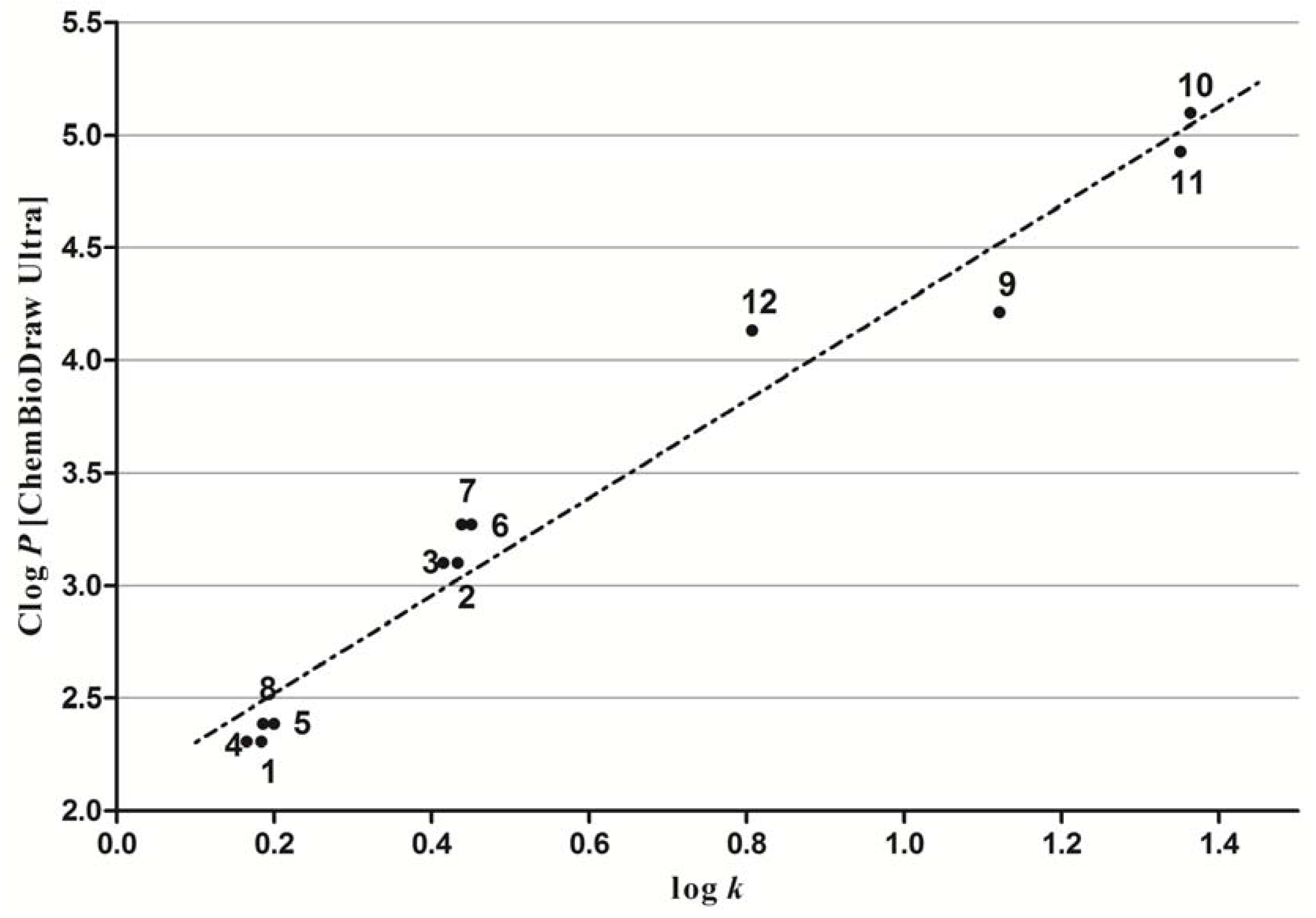
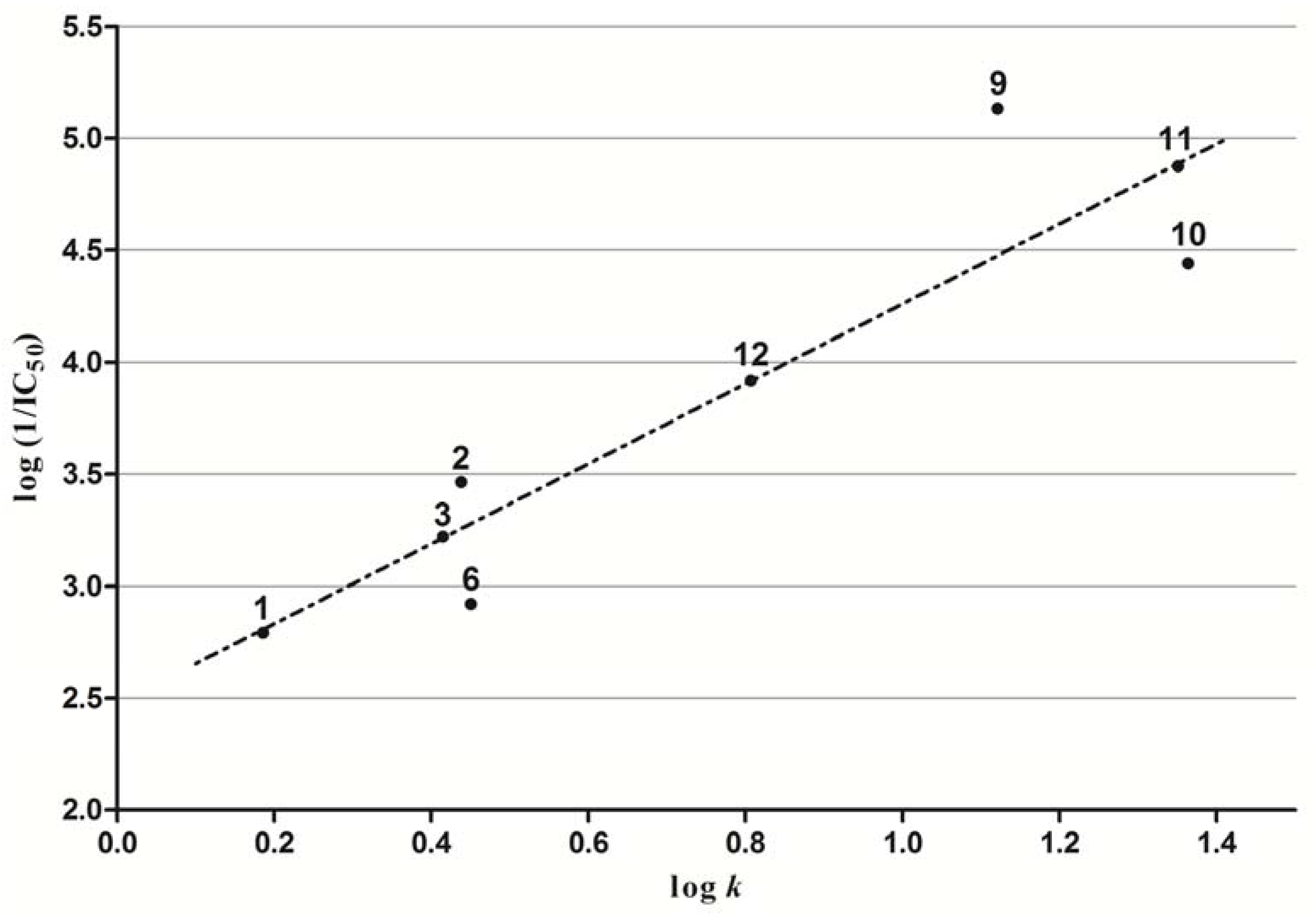
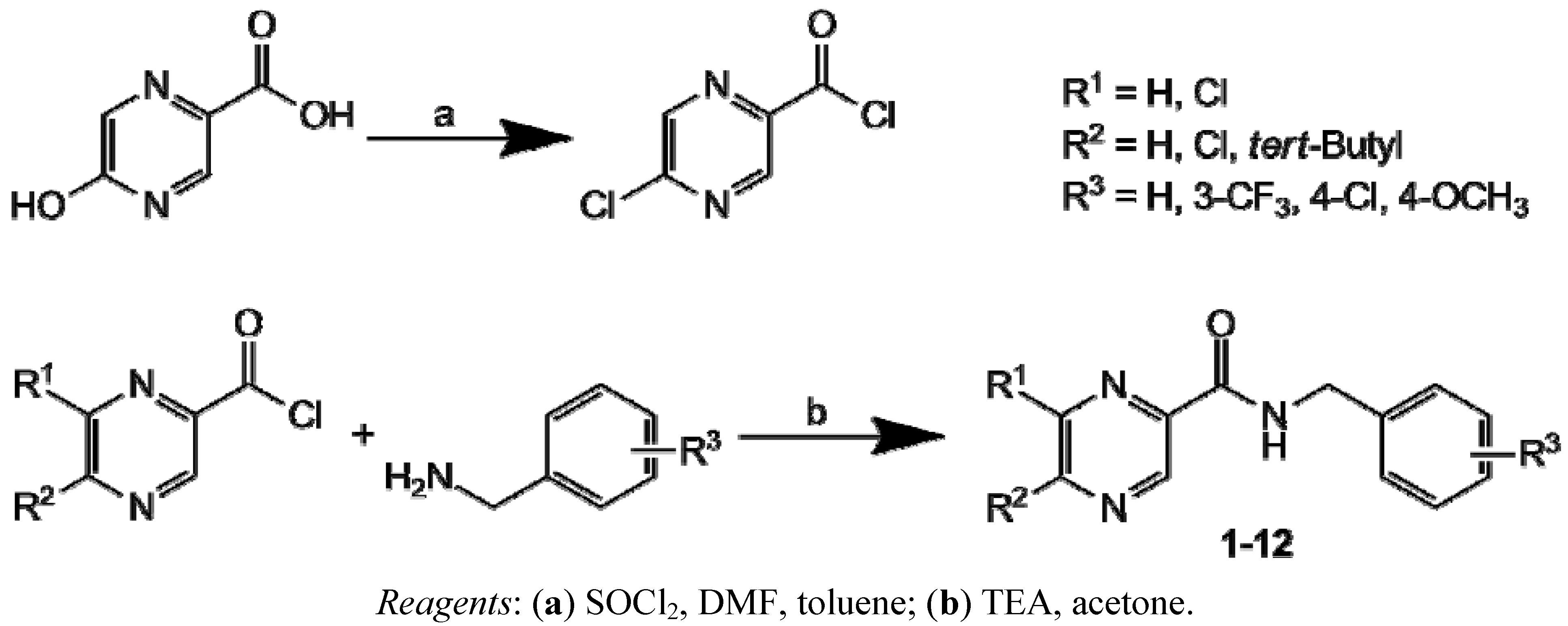
| Compounds | R1 | R2 | R3 | log P | Clog P | log k | IC50 [µmol/L] |
|---|---|---|---|---|---|---|---|
| 1 | H | Cl | H | 1.56 | 2.3852 | 0.1862 | 1623.0 |
| 2 | H | Cl | 3-CF3 | 2.48 | 3.2682 | 0.4384 | 345.8 |
| 3 | H | Cl | 4-Cl | 2.12 | 3.0982 | 0.4150 | 604.0 |
| 4 | H | Cl | 4-OCH3 | 1.43 | 2.3042 | 0.1655 | ND |
| 5 | Cl | H | H | 1.56 | 2.3852 | 0.2002 | ND |
| 6 | Cl | H | 3-CF3 | 2.48 | 3.2682 | 0.4507 | 1207.0 |
| 7 | Cl | H | 4-Cl | 2.12 | 3.0982 | 0.4335 | ND |
| 8 | Cl | H | 4-OCH3 | 1.43 | 2.3042 | 0.1838 | ND |
| 9 | Cl | (CH3)3C | H | 3.69 | 4.2112 | 1.1215 | 7.4 |
| 10 | Cl | (CH3)3C | 3-CF3 | 4.61 | 5.0942 | 1.3638 | 36.3 |
| 11 | Cl | (CH3)3C | 4-Cl | 4.25 | 4.9242 | 1.3511 | 13.4 |
| 12 | Cl | (CH3)3C | 4-OCH3 | 3.56 | 4.1302 | 0.8071 | 121.6 |
| DCMU | – | – | – | – | – | – | 1.9 |
2.2. Lipophilicity

2.3. Biological Activity
2.3.1. In Vitro Antimycobacterial Evaluation
| Compounds | MIC [µg/mL] | TM e MIC [µmol/L] | |||
|---|---|---|---|---|---|
| M. tuberculosis H37Rv a | M. aviumb | M. aviumc | M. kansasiid | ||
| 1 | 25 (100) | 100 | 100 | 100 | 125/125 |
| 2 | 25 (79) | 25 | 100 | 50 | 15.62/15.62 |
| 3 | 12.5 (44) | 100 | 100 | 100 | 125/125 |
| 4 | 25 (90) | 100 | 50 | 100 | 250/250 |
| 5 | 12.5 (50) | 100 | 100 | 50 | 250/500 |
| 6 | 12.5 (39) | 25 | 100 | 100 | 62.5/125 |
| 7 | 12.5 (44) | 100 | 12.5 | 100 | 125/125 |
| 8 | 6.25 (22) | 100 | 50 | 100 | 500/500 |
| 9 | 25 (82) | 25 | 50 | 100 | 250/500 |
| 10 | 6.25 (16) | 25 | 25 | 25 | 250/250 |
| 11 | 12.5 (36) | 50 | 50 | 50 | 250/500 |
| 12 | 6.25 (18) | 12.5 | 6.25 | 3.125 | 250/500 |
| PZA | 6.25–12.5 (50–101) | >100 | >100 | >100 | – |
| INH | 1.56 (11) | 12.5–25 | 12.5 | 12.5 | – |
| FLU | – | – | – | – | 1.95/3.91 |
2.3.2. In Vitro Antifungal Evaluation
2.3.3. In Vitro Antibacterial Evaluation
2.3.4. Inhibition of Photosynthetic Electron Transport (PET)


3. Experimental
3.1. General
3.2. Synthesis of N-Benzylpyrazine-2-carboxamides
3.3. Data of Prepared Target Compounds
3.4. HPLC Lipophilicity Determination (Capacity Factor k/ Calculated Log k)
3.5. Lipophilicity Calculations
3.6. Biological Methods
3.6.1. Evaluation of In Vitro Antimycobacterial Activity
3.6.2. Evaluation of In Vitro Antifungal Activity
3.6.3. Study of the Inhibition of Oxygen Evolution rate in Spinach Chloroplasts
3.6.4. Study of Fluorescence of Chlorophyll a and Aromatic Amino Acids in Spinach Chloroplasts
4. Conclusions
Acknowledgements
Conflict of Interest
- Sample Availability: Samples of the compounds are available from the authors.
References
- WHO. 2011/2012 Tuberculosis Global Facts. Available online: http://www.who.int/tb/publications/2011/factsheet_tb_2011.pdf (accessed on 14 September 2012).
- Goletti, D.; Weissman, D.; Jackson, R.W.; Graham, N.M.; Vlahov, D.; Klein, R.S.; Munsiff, S.S.; Ortona, L.; Cauda, R.; Fauci, A.S. Effect of Mycobacterium tuberculosis on HIV replication. Role of immune activation. J. Immunol. 1996, 157, 1271–1278. [Google Scholar]
- Lima, C.H.S.; Bispo, M.L.F.; de Souza, M.V.N. Pirazinamida: Um Fármaco Essencial no Tratamento da Tuberculose. Rev. Virtual Quim. 2011, 3, 159–180. [Google Scholar]
- Zhang, Y.; Mitchison, D. The curious characteristics of pyrazinamide: A review. Int. J. Tubercul. Lung Dis. 2003, 7, 6–21. [Google Scholar]
- Konno, K.; Feldmann, F.M.; McDermott, W. Pyrazinamide susceptibility and amidase activity of tubercle bacilli. Am. Rev. Respir. Dis. 1967, 95, 461–469. [Google Scholar]
- Scorpio, A.; Zhang, Y. Mutations in pncA, a gene encoding pyrazinamidase/nicotinamidase, cause resistance to the antituberculous drug pyrazinamide in tubercle bacillus. Nat. Med. 1996, 2, 662–667. [Google Scholar] [CrossRef]
- Zhang, Y.; Wade, M.M.; Scorpio, A.; Zhang, H.; Sun, Z. Mode of action of pyrazinamide: disruption of Mycobacterium tuberculosis membrane transport and energetics by pyrazinoic acid. J. Antimicrob. Chemother. 2003, 52, 790–795. [Google Scholar] [CrossRef]
- Ngo, S.C.; Zimhony, O.; Chung, W.J.; Sayahi, H.; Jacobs, W.R., Jr.; Welch, J.T. Inhibition of isolated mycobacterium tuberculosis fatty acid synthase I by pyrazinamide analogs. Antimicrob. Agents Chemother. 2007, 51, 2430–2435. [Google Scholar] [CrossRef]
- Zimhony, O.; Cox, J.S.; Welch, J.T.; Vilcheze, C.; Jacobs, W.R. Pyrazinamide inhibits the eukaryotic-like fatty acid synthetase I (FAS-I) of Mycobacterium tuberculosis. Nat. Med. 2000, 6, 1043–1047. [Google Scholar] [CrossRef]
- Zimhony, O.; Vilcheze, C.; Arai, M.; Welch, J.T.; Jacobs, W.R. Pyrazinoic acid and its n-propyl ester inhibit fatty acid synthase type I in replicating tubercle bacilli. Antimicrob. Agents Chemother. 2007, 51, 752–754. [Google Scholar] [CrossRef]
- Sayahi, H.; Zimhony, O.; Jacobs, W.R.; Shekhtman, A.; Welch, J.T. Pyrazinamide, but not pyrazinoic acid, is a competitive inhibitor of NADPH binding to Mycobacterium tuberculosis fatty acid synthase I. Bioorg. Med. Chem. Lett. 2011, 21, 4804–4807. [Google Scholar] [CrossRef]
- Boshoff, H.I.; Mizrahi, V.; Barry, C.E. Effects of pyrazinamide on fatty acid synthesis by whole mycobacterial cells and purified fatty acid synthase I. J. Bacteriol. 2002, 184, 2167–2172. [Google Scholar] [CrossRef]
- Shi, W.; Zhang, X.; Jiang, X.; Yuan, H.; Lee, J.S.; Barry, C.E., 3rd; Wang, H.; Zhang, W.; Zhang, Y. Pyrazinamide inhibits trans-translation in Mycobacterium tuberculosis. Science 2011, 333, 1630–1632. [Google Scholar] [CrossRef]
- Doležal, M.; Kráľová, K. Synthesis and Evaluation of Pyrazine Derivatives with Herbicidal Activity. In Herbicides, Theory and Applications; Soloneski, S., Larramendy, M.L., Eds.; InTech: Vienna, Austria, 2011; pp. 581–610. [Google Scholar]
- Dolezal, M.; Zitko, J.; Osicka, Z.; Kunes, J.; Vejsova, M.; Buchta, V.; Dohnal, J.; Jampilek, J.; Kralova, K. Synthesis, antimycobacterial, antifungal and photosynthesis-inhibiting activity of chlorinated N-phenylpyrazine-2-carboxamide. Molecules 2010, 15, 8567–8581. [Google Scholar] [CrossRef]
- Dolezal, M.; Cmedlova, P.; Palek, L.; Vinsova, J.; Kunes, J.; Buchta, V.; Jampilek, J.; Kralova, K. Synthesis and antimycobacterial evaluation of substituted pyrazinecarboxamides. Eur. J. Med. Chem. 2008, 43, 1105–1113. [Google Scholar] [CrossRef]
- Doležal, M.; Tumová, L.; Kešetovičová, D.; Tuma, J.; Kráľová, K. Substituted N-phenylpyrazine-2-carboxamides, their synthesis and evaluation as herbicides and abiotic elicitors. Molecules 2007, 12, 2589–2598. [Google Scholar] [CrossRef]
- Doležal, M.; Kráľová, K.; Šeršeň, F.; Miletín, M. The site of action of pyrazine-2-carboxylic acids in the photosynthetic apparatus. Folia Pharm. Univ. Carol. 2001, 26, 13–20. [Google Scholar]
- Dolezal, M.; Kesetovic, D.; Zitko, J. Antimycobacterial evaluation of pyrazinoic acid reversible derivatives. Curr. Pharm. Des. 2011, 17, 3506–3514. [Google Scholar] [CrossRef]
- Matulenko, M.A.; Lee, C.H.; Jiang, M.; Frey, R.R.; Cowart, M.D.; Bayburt, E.K.; DiDomenico, S. 5-(3-Bromophenyl)-7-(6-morpholin-4-ylpyridin-3-yl)pyrido[2,3-d]pyrimidin-4-ylamine: Structure-activity relationships of 7-substituted heteroaryl analogs as non-nucleoside adenosine kinase inhibitors. Bioorg. Med. Chem. 2005, 13, 3705–3720. [Google Scholar] [CrossRef]
- Abe, Y.; Shigeta, Y.; Uchimaru, F.; Okada, S.; Ozasayma, E. Methyl 6-methoxypyrazine-2-carboxylate. JP Patent 44012898, 1969. Chem. Abstr. 1969, 71, 112979. [Google Scholar]
- Doležal, M.; Hartl, J.; Miletín, M.; Macháček, M.; Kráľová, K. Synthesis and photosynthesis-inhibiting activity of some anilides of substituted pyrazine-2-carboxylic acids. Chem. Pap. 1999, 53, 126–130. [Google Scholar]
- Jones, R.N.; Barry, A.L. Optimal dilution susceptibility testing conditions, recommendations for MIC interpretation, and quality-control guidelines for the ampicillin-sulbactam combination. J. Clin. Microbiol. 1987, 25, 1920–1925. [Google Scholar]
- Zitko, J.; Doležal, M.; Svobodová, M.; Vejsová, M.; Kuneš, J.; Kučera, R.; Jílek, P. Synthesis and antimycobacterial properties of N-substituted 6-amino-5-cyanopyrazine-2-carboxamides. Bioorg. Med. Chem. 2011, 19, 1471–1476. [Google Scholar] [CrossRef]
- Govindjee. Sixty-three years since Kautsky: Chlorophyll a fluorescence. Aust. J. Plant Physiol. 1995, 22, 131–160. [CrossRef]
- Kráľová, K.; Šerseň, F.; Kubicová, L.; Waisser, K. Inhibitory effects of substituted benzanilides on Photosynthetic electron transport in spinach chloroplasts. Chem. Pap. 1999, 53, 328–331. [Google Scholar]
- Kubicová, L.; Kráľová, K.; Šerseň, F.; Gregor, J.; Waisser, K. Effects of substituted salicylanilides on the photosynthetic apparatus of spinach chloroplasts. Folia Pharm. Univ. Carol. 2000, 25, 89–96. [Google Scholar]
- Clayden, J. Organic Chemistry; Oxford University Press: Oxford, UK, 2008; pp. 276–296. [Google Scholar]
- National Committee for Clinical Laboratory Standards (NCCLS), Method for Antifungal Disc Diffusion Susceptibility Testing of Yeasts: Approved Guideline M44-A; NCCLS: Wayne, PA, USA, 2004.
- Doležal, M.; Jampílek, J.; Osička, Z.; Kuneš, J.; Buchta, V.; Víchová, P. Substituted 5-aroylpyrazine-2-carboxylic acid derivatives: synthesis and biological activity. Farmaco 2003, 58, 1105–1111. [Google Scholar] [CrossRef]
- Masarovičová, E.; Kráľová, K. Approaches to measuring plant photosynthesis activity. In Handbook of Photosyntheis, 2nd; Pessarakli, M., Ed.; Taylor & Francis group: Boca Raton, FL, USA, 2005; pp. 617–656. [Google Scholar]
- Kráľová, K.; Šeršeň, F.; Sidóová, E. Photosynthesis Inhibition produced by 2-alkylthio-6-R-benzothiazoles. Chem. Pap. 1992, 46, 348–350. [Google Scholar]
- Fedke, C. Biochemistry and Physiology of Herbicide Action; Springer Verlag: Berlin, Germany, 1982. [Google Scholar]
© 2012 by the authors; licensee MDPI, Basel, Switzerland. This article is an open-access article distributed under the terms and conditions of the Creative Commons Attribution license (http://creativecommons.org/licenses/by/3.0/).
Share and Cite
Servusová, B.; Eibinová, D.; Doležal, M.; Kubíček, V.; Paterová, P.; Peško, M.; Kráľová, K. Substituted N-Benzylpyrazine-2-carboxamides: Synthesis and Biological Evaluation. Molecules 2012, 17, 13183-13198. https://doi.org/10.3390/molecules171113183
Servusová B, Eibinová D, Doležal M, Kubíček V, Paterová P, Peško M, Kráľová K. Substituted N-Benzylpyrazine-2-carboxamides: Synthesis and Biological Evaluation. Molecules. 2012; 17(11):13183-13198. https://doi.org/10.3390/molecules171113183
Chicago/Turabian StyleServusová, Barbora, Drahomíra Eibinová, Martin Doležal, Vladimír Kubíček, Pavla Paterová, Matúš Peško, and Katarína Kráľová. 2012. "Substituted N-Benzylpyrazine-2-carboxamides: Synthesis and Biological Evaluation" Molecules 17, no. 11: 13183-13198. https://doi.org/10.3390/molecules171113183
APA StyleServusová, B., Eibinová, D., Doležal, M., Kubíček, V., Paterová, P., Peško, M., & Kráľová, K. (2012). Substituted N-Benzylpyrazine-2-carboxamides: Synthesis and Biological Evaluation. Molecules, 17(11), 13183-13198. https://doi.org/10.3390/molecules171113183