<?xml version="1.0" encoding="UTF-8"?>
<!DOCTYPE article PUBLIC "-//NLM//DTD Journal Publishing DTD v2.3 20070202//EN" "journalpublishing.dtd">
<article xmlns:mml="http://www.w3.org/1998/Math/MathML" xmlns:xlink="http://www.w3.org/1999/xlink" xml:lang="en" article-type="addendum">
  <front>
    <journal-meta>
      <journal-id journal-id-type="publisher-id">molecules</journal-id>
      <journal-title>Molecules</journal-title>
      <abbrev-journal-title abbrev-type="publisher">Molecules</abbrev-journal-title>
      <abbrev-journal-title abbrev-type="pubmed">Molecules</abbrev-journal-title>
      <issn pub-type="epub">1420-3049</issn>
      <publisher>
        <publisher-name>MDPI</publisher-name>
      </publisher>
    </journal-meta>
    <article-meta>
      <article-id pub-id-type="doi">10.3390/molecules171113175</article-id>
      <article-id pub-id-type="publisher-id">molecules-17-13175</article-id>
      <article-categories>
        <subj-group>
          <subject>Addendum</subject>
        </subj-group>
      </article-categories>
      <title-group>
        <article-title>Spiculisporic Acids B–D, Three New <italic>γ</italic>-Butenolide Derivatives from a Sea Urchin-Derived Fungus <italic>Aspergillus</italic> sp. HDf2</article-title>
      </title-group>     
      <contrib-group>
        <contrib contrib-type="author">
          <name>
            <surname>Wang</surname>
            <given-names>Rong</given-names>
          </name>
          <xref rid="fn1-molecules-17-13175" ref-type="fn">†</xref>
        </contrib>
        <contrib contrib-type="author">
          <name>
            <surname>Liu</surname>
            <given-names>Tian-Mi</given-names>
          </name>
          <xref rid="fn1-molecules-17-13175" ref-type="fn">†</xref>
        </contrib>
        <contrib contrib-type="author">
          <name>
            <surname>Shen</surname>
            <given-names>Ming-Hui</given-names>
          </name>
        </contrib>
        <contrib contrib-type="author">
          <name>
            <surname>Yang</surname>
            <given-names>Ming-Qiu</given-names>
          </name>
        </contrib>
        <contrib contrib-type="author">
          <name>
            <surname>Feng</surname>
            <given-names>Quan-Ying</given-names>
          </name>
        </contrib>
        <contrib contrib-type="author">
          <name>
            <surname>Tang</surname>
            <given-names>Xian-Ming</given-names>
          </name>
        </contrib>
        <contrib contrib-type="author">
          <name>
            <surname>Li</surname>
            <given-names>Xiang-Min</given-names>
          </name>
          <xref rid="c1-molecules-17-13175" ref-type="corresp">*</xref>
        </contrib>
      </contrib-group>
       <aff id="af1-molecules-17-13175">Hainan Provincial Fisheries Research Institute, Haikou 570203, Hainan, China</aff>
	  <author-notes>
        <fn id="fn1-molecules-17-13175">
          <label>† </label>
          <p>These authors contributed equally to this work.</p>
        </fn>
        <corresp id="c1-molecules-17-13175"><label>*</label> Author  to whom correspondence should be addressed; Email: <email>hn.lxm@163.com</email> ;  Tel.: +86-898-6651-7579; Fax: +86-898-6652-7571.</corresp>
      </author-notes>
      <pub-date pub-type="epub">
        <day>05</day>
        <month>11</month>
        <year>2012</year>
      </pub-date>
      <pub-date pub-type="collection">
        <month>11</month>
		<year>2012</year>
      </pub-date>
      <volume>17</volume>
      <issue>11</issue>
      <fpage>13175</fpage>
      <lpage>13182</lpage>
      <history>
        <date date-type="received">
          <day>18</day>
          <month>10</month>
          <year>2012</year>
        </date>
        <date date-type="rev-recd">
          <day>30</day>
          <month>10</month>
          <year>2012</year>
        </date>
        <date date-type="accepted">
          <day>31</day>
          <month>10</month>
          <year>2012</year>
        </date>
      </history>
      <permissions>
        <copyright-statement>©  2012 by the authors; licensee MDPI, Basel, Switzerland.</copyright-statement>
        <copyright-year>2012</copyright-year>
        <license xmlns:xlink="http://www.w3.org/1999/xlink" license-type="open-access" xlink:href="http://creativecommons.org/licenses/by/3.0/">
          <p>This article is an open-access article distributed under the terms and conditions of the Creative Commons Attribution license (http://creativecommons.org/licenses/by/3.0/).</p>
        </license>
      </permissions>
      <abstract>
        <p>Three new <italic>γ</italic>-butenolide derivatives <bold>1</bold>–<bold>3</bold>, named spiculisporic acids B–D, were isolated from the culture of <italic>Aspergillus</italic> sp. HDf2, a marine-derived fungus that resides in the sea urchin, <italic>Anthocidaris crassispina</italic>. The structures of <bold>1</bold>–<bold>3</bold> were elucidated on the basis of spectroscopic methods, including MS and 2D NMR techniques. Their <italic>in vitro</italic> cytotoxic activities against two cell lines (SGC-7901, human gastric adenocarcinoma and SPC-A-1, human lung adenocarcinoma) and inhibitory activities against <italic>Staphylococcus aureus</italic> ATCC 51650 were investigated. </p>
      </abstract>
      <kwd-group>
        <kwd><italic>γ</italic>-butenolide derivatives</kwd>
        <kwd>spiculisporic acids B–D</kwd>
        <kwd><italic>Aspergillus</italic> sp.</kwd>
        <kwd>marine fungus</kwd>
      </kwd-group>
    </article-meta>
  </front>
  <body>
    <sec sec-type="intro">
      <title>1. Introduction</title>
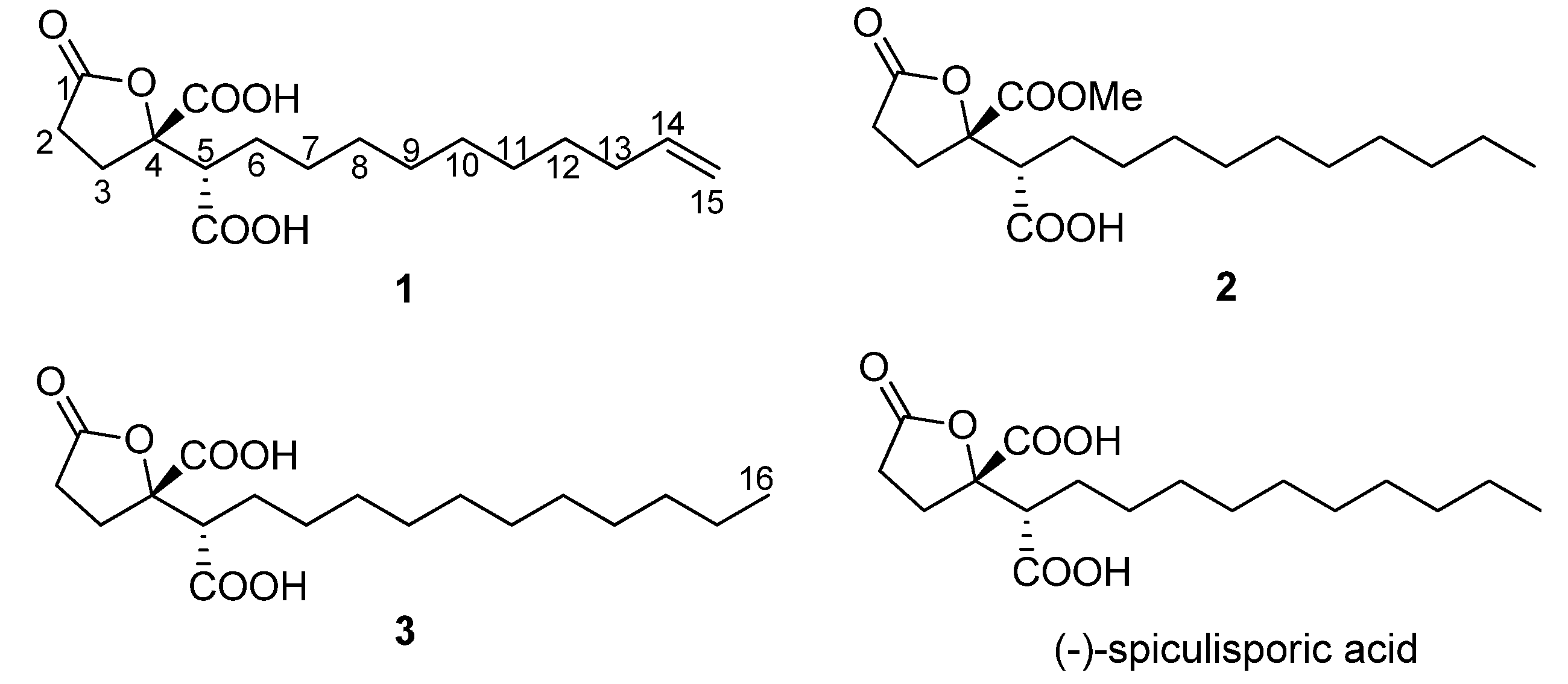
      <p>Microorganisms of marine origin have proven to be a rich source of novel and/or biologically active natural products with promising pharmacological properties [<xref ref-type="bibr" rid="B1-molecules-17-13175">1</xref>,<xref ref-type="bibr" rid="B2-molecules-17-13175">2</xref>,<xref ref-type="bibr" rid="B3-molecules-17-13175">3</xref>,<xref ref-type="bibr" rid="B4-molecules-17-13175">4</xref>]. In related studies, the Tsukamoto laboratory reported a new antimicrobial anthraquinone (monodictyquinone A) from a sea urchin-derived fungus <italic>Monodictys</italic> sp. [<xref ref-type="bibr" rid="B5-molecules-17-13175">5</xref>]. In our search for new natural products from marine-derived microorganisms, the fungus <italic>Aspergillus</italic> sp. HDf2 was isolated from the sea urchin <italic>Anthocidaris crassispina</italic>, collected from the seashore of Qionghai, Hainan, China. The genus <italic>Aspergillus</italic> (Trichocomaceae) is one of the most prolific fungi that produce a variety of secondary metabolites with novel structures and interesting bioactivities [<xref ref-type="bibr" rid="B6-molecules-17-13175">6</xref>]. Subsequent chemical study on the fermentation broth of the fungus <italic>Aspergillus</italic> sp. HDf2 led to the isolation of three new <italic>γ</italic>-butenolide derivatives, the structures of which were similar to that of spiculisporic acid [<xref ref-type="bibr" rid="B7-molecules-17-13175">7</xref>,<xref ref-type="bibr" rid="B8-molecules-17-13175">8</xref>], and these compounds were thus named as spiculisporic acids B–D (compounds <bold>1</bold>–<bold>3</bold>, <xref ref-type="fig" rid="molecules-17-13175-f001">Figure 1</xref>). Their structures were elucidated by comprehensive spectroscopic analyses. Herein we report the isolation, structural determination, bioactivities of these new natural products.</p>
      <fig id="molecules-17-13175-f001" position="float">
        <label>Figure 1</label>
        <caption>
          <p>Structures of compounds <bold>1</bold>–<bold>3</bold>. </p>
        </caption>
        <graphic xmlns:xlink="http://www.w3.org/1999/xlink" xlink:href="molecules-17-13175-g001.tif"/>
      </fig>
    </sec>
    <sec sec-type="results">
      <title>2. Results and Discussion</title>
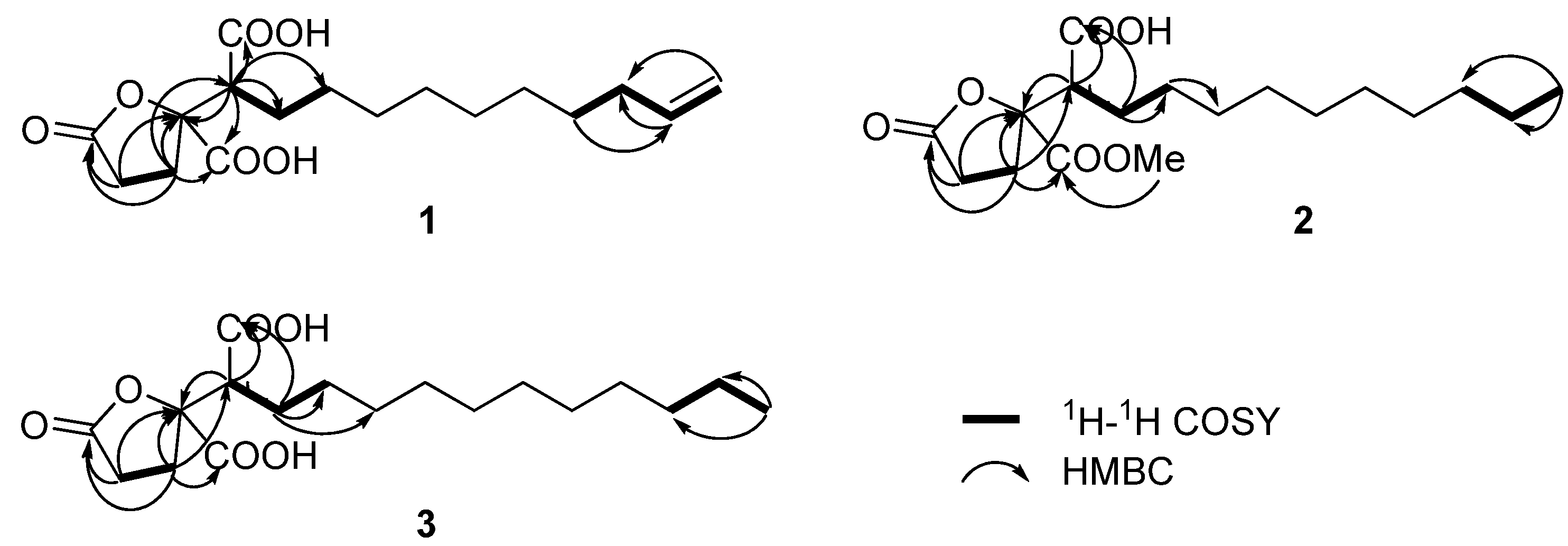
      <p>Spiculisporic acid B (<bold>1</bold>) was isolated as a white solid, with the molecular formula C<sub>17</sub>H<sub>26</sub>O<sub>6</sub> (five degrees of unsaturation) as derived from ESI high-resolution mass spectrometry ([M−H]<sup>−</sup> at <italic>m/z</italic> 325.1664, calculated 325.1657) and <sup>1</sup>H- and <sup>13</sup>C-NMR spectral data (<xref ref-type="table" rid="molecules-17-13175-t001">Table 1</xref> and <xref ref-type="table" rid="molecules-17-13175-t002">Table 2</xref>). The <sup>13</sup>C-NMR showed three carbonyl carbons at <italic>δ</italic><sub>C</sub> 178.5, 175.5, and 174.2, one olefinic methine carbon at <italic>δ</italic><sub>C</sub> 140.2, one olefinic methylene carbon at <italic>δ</italic><sub>C</sub> 114.8, one oxygen bearing quaternary carbon at <italic>δ</italic><sub>C</sub> 88.2, one methine carbon at <italic>δ</italic><sub>C</sub> 52.5, and ten aliphatic carbons in the upfield (<italic>δ</italic><sub>C</sub> 35.0 to 28.9) region. The <sup>1</sup>H-NMR spectrum displayed signals of one terminal vinyl group at <italic>δ</italic><sub>H</sub> 5.81 (ddt, <italic>J</italic> = 16.1, 10.2, 6.8 Hz, H-14), 4.98 (br d, <italic>J</italic> = 16.1 Hz, H-15a), and 4.91 (br d, <italic>J</italic> = 10.2 Hz, H-15b), and 21 aliphatic protons. Together, these data indicate that compound <bold>1</bold> has one double bond and three carbonyls, which account for 4 out of the 5 degrees of unsaturation required by the molecular formula, so spiculisporic acid B must contain a ring. The structural information for <bold>1</bold> was determined from a series of 2D NMR analyses, including HSQC, <sup>1</sup>H-<sup>1</sup>H COSY, and HMBC spectra (<xref ref-type="fig" rid="molecules-17-13175-f002">Figure 2</xref>). The <sup>1</sup>H-<sup>1</sup>H COSY experiment revealed a correlation between H-2 (<italic>δ</italic><sub>H</sub> 2.60) and H-3 (<italic>δ</italic><sub>H</sub> 2.49), and a seperate spin system, H<sub>2</sub>C=CH-CH<sub>2</sub>-(CH<sub>2</sub>)<sub>6</sub>-CH<sub>2</sub>-CH-. The methine proton H-14 was coupled with the methylene protons H-13 (<italic>δ</italic><sub>H</sub> 2.04) and H-15, and the methylene proton H-13 was coupled with the methylene proton at H-12 (<italic>δ</italic><sub>H</sub> 1.37). The correlations between the methylene proton H-6a (<italic>δ</italic><sub>H</sub> 1.85) and H-5 [<italic>δ</italic><sub>H</sub> 3.01 (br d, <italic>J</italic> = 9.2 Hz)] and H-7 (<italic>δ</italic><sub>H</sub> 1.25–1.37) were observed in the <sup>1</sup>H-<sup>1</sup>H COSY spectrum. HMBC correlations from H-5 to C-4 (<italic>δ</italic><sub>C</sub> 88.2) and two carbonyl carbons (<italic>δ</italic><sub>C</sub> 175.5 and 174.2), from H-3 to C-1 (<italic>δ</italic><sub>C</sub> 178.5), C-4, C-5 (<italic>δ</italic><sub>C</sub> 52.5), and one of the carbonyl carbons (<italic>δ</italic><sub>C</sub> 174.2), and from H-2 to C-1 and C-4, were observed. These observations allowed the structure of <bold>1</bold> to be determined as shown in <xref ref-type="fig" rid="molecules-17-13175-f001">Figure 1</xref>. </p>
      <table-wrap id="molecules-17-13175-t001" position="float">
        <object-id pub-id-type="pii">molecules-17-13175-t001_Table 1</object-id>
        <label>Table 1</label>
        <caption>
          <p><sup>1</sup>H-NMR spectral data (500 MHz, CD<sub>3</sub>OD) of compounds <bold>1</bold>–<bold>3</bold>.</p>
        </caption>
        <table>
          <thead>
            <tr align="center">
              <th valign="middle">Position</th>
              <th valign="middle">1</th>
              <th valign="middle">2</th>
              <th valign="middle">3</th>
            </tr>
          </thead>
          <tbody>
            <tr align="center">
              <td valign="middle">2</td>
              <td valign="middle">2.60 (m)</td>
              <td valign="middle">2.59 (m)</td>
              <td valign="middle">2.59 (m)</td>
            </tr>
            <tr align="center">
              <td valign="middle">3</td>
              <td valign="middle">2.49 (m)</td>
              <td valign="middle">2.48 (m)</td>
              <td valign="middle">2.46 (m)</td>
            </tr>
            <tr align="center">
              <td valign="middle">4-COOMe </td>
              <td valign="middle"> </td>
              <td valign="middle">3.80 (s)</td>
              <td valign="middle"> </td>
            </tr>
            <tr align="center">
              <td valign="middle">5</td>
              <td valign="middle">3.01 (br d, 
              <italic>J</italic> = 9.2)</td>
              <td valign="middle">2.97 (dd, 
              <italic>J</italic> = 10.8, 2.5)</td>
              <td valign="middle">3.03 (dd, 
              <italic>J</italic> = 11.0, 3.0)</td>
            </tr>
            <tr align="center">
              <td valign="middle">6</td>
              <td valign="middle">1.85 (m); 1.50 (m)</td>
              <td valign="middle">1.82 (m); 1.51 (m)</td>
              <td valign="middle">1.85 (m); 1.53 (m)</td>
            </tr>
            <tr align="center">
              <td valign="middle">7</td>
              <td valign="middle">1.25–1.37 (m) 
              <italic><sup>a</sup></italic></td>
              <td valign="middle">1.43 (m); 1.32 (m)</td>
              <td valign="middle">1.42 (m); 1.32 (m)</td>
            </tr>
            <tr align="center">
              <td valign="middle">8</td>
              <td valign="middle">1.25–1.37 (m) 
              <italic><sup>a</sup></italic></td>
              <td valign="middle">1.25–1.37 (m) 
              <italic><sup>b</sup></italic></td>
              <td valign="middle">1.25–1.38 (m) 
              <italic><sup>c</sup></italic></td>
            </tr>
            <tr align="center">
              <td valign="middle">9</td>
              <td valign="middle">1.25–1.37 (m) 
              <italic><sup>a</sup></italic></td>
              <td valign="middle">1.25–1.37 (m) 
              <italic><sup>b</sup></italic></td>
              <td valign="middle">1.25–1.38 (m) 
              <italic><sup>c</sup></italic></td>
            </tr>
            <tr align="center">
              <td valign="middle">10</td>
              <td valign="middle">1.25–1.37 (m) 
              <italic><sup>a</sup></italic></td>
              <td valign="middle">1.25–1.37 (m) 
              <italic><sup>b</sup></italic></td>
              <td valign="middle">1.25–1.38 (m) 
              <italic><sup>c</sup></italic></td>
            </tr>
            <tr align="center">
              <td valign="middle">11</td>
              <td valign="middle">1.25–1.37 (m) 
              <italic><sup>a</sup></italic></td>
              <td valign="middle">1.25–1.37 (m) 
              <italic><sup>b</sup></italic></td>
              <td valign="middle">1.25–1.38 (m) 
              <italic><sup>c</sup></italic></td>
            </tr>
            <tr align="center">
              <td valign="middle">12</td>
              <td valign="middle">1.37 (m)</td>
              <td valign="middle">1.25–1.37 (m) 
              <italic><sup>b</sup></italic></td>
              <td valign="middle">1.25–1.38 (m) 
              <italic><sup>c</sup></italic></td>
            </tr>
            <tr align="center">
              <td valign="middle">13</td>
              <td valign="middle">2.04 (m)</td>
              <td valign="middle">1.25–1.37 (m) 
              <italic><sup>b</sup></italic></td>
              <td valign="middle">1.25–1.38 (m) 
              <italic><sup>c</sup></italic></td>
            </tr>
            <tr align="center">
              <td valign="middle">14</td>
              <td valign="middle">5.81 (ddt, 
              <italic>J</italic> = 16.1, 10.2, 6.8)</td>
              <td valign="middle">1.25–1.37 (m) 
              <italic><sup>b</sup></italic></td>
              <td valign="middle">1.25–1.38 (m) 
              <italic><sup>c</sup></italic></td>
            </tr>
            <tr align="center">
              <td valign="middle">15</td>
              <td valign="middle">4.98 (br d, <italic>J</italic> = 16.1)<break/>4.91 (br d, <italic>J</italic> = 10.2)</td>
              <td valign="middle">0.90 (t, 
              <italic>J</italic> = 6.8)</td>
              <td valign="middle">1.25–1.38 (m)
              <italic><sup>c</sup></italic></td>
            </tr>
            <tr align="center">
              <td valign="middle">16</td>
              <td valign="middle"> </td>
              <td valign="middle"> </td>
              <td valign="middle">0.90 (t, 
              <italic>J</italic> = 7.0)</td>
            </tr>
          </tbody>
      </table>
	  <table-wrap-foot><fn><p><italic><sup>a</sup></italic><italic><sup>−c</sup></italic> Overlapping signals.</p></fn></table-wrap-foot>
      </table-wrap>
      <table-wrap id="molecules-17-13175-t002" position="float">
        <object-id pub-id-type="pii">molecules-17-13175-t002_Table 2</object-id>
        <label>Table 2</label>
        <caption>
          <p><sup>13</sup>C-NMR spectral data (125 MHz, CD<sub>3</sub>OD) of compounds <bold>1</bold>–<bold>3</bold>.</p>
        </caption>
        <table>
          <thead>
            <tr>
              <th align="center" valign="middle">Position</th>
              <th align="center" valign="middle">1</th>
              <th align="center" valign="middle">2</th>
              <th align="center" valign="middle">3</th>
            </tr>
          </thead>
          <tbody>
            <tr>
              <td align="center" valign="middle">1</td>
              <td align="center" valign="middle">178.5 (s)</td>
              <td align="center" valign="middle">178.0 (s)</td>
              <td align="center" valign="middle">178.7 (s)</td>
            </tr>
            <tr>
              <td align="center" valign="middle">2</td>
              <td align="center" valign="middle">28.9 (t)
              <italic><sup>a</sup></italic></td>
              <td align="center" valign="middle">28.7 (t)</td>
              <td align="center" valign="middle">29.0 (t)
              <italic><sup>e</sup></italic></td>
            </tr>
            <tr>
              <td align="center" valign="middle">3</td>
              <td align="center" valign="middle">30.3 (t)</td>
              <td align="center" valign="middle">30.5 (t)</td>
              <td align="center" valign="middle">30.6 (t)
              <italic><sup>d</sup></italic></td>
            </tr>
            <tr>
              <td align="center" valign="middle">4</td>
              <td align="center" valign="middle">88.2 (s)</td>
              <td align="center" valign="middle">88.2 (s)</td>
              <td align="center" valign="middle">88.7 (s)</td>
            </tr>
            <tr>
              <td align="center" valign="middle">4-COOH</td>
              <td align="center" valign="middle">174.2 (s)</td>
              <td align="center" valign="middle"> </td>
              <td align="center" valign="middle">174.9 (s)</td>
            </tr>
            <tr>
              <td align="center" valign="middle">4-CO</td>
              <td align="center" valign="middle"> </td>
              <td align="center" valign="middle">172.8 (s)</td>
              <td align="center" valign="middle"> </td>
            </tr>
            <tr>
              <td align="center" valign="middle">OMe</td>
              <td align="center" valign="middle"> </td>
              <td align="center" valign="middle">53.6 (q)</td>
              <td align="center" valign="middle"> </td>
            </tr>
            <tr>
              <td align="center" valign="middle">5</td>
              <td align="center" valign="middle">52.5 (d)</td>
              <td align="center" valign="middle">52.9 (d)</td>
              <td align="center" valign="middle">52.7 (d)</td>
            </tr>
            <tr>
              <td align="center" valign="middle">5-COOH</td>
              <td align="center" valign="middle">175.5 (s)</td>
              <td align="center" valign="middle">175.2 (s)</td>
              <td align="center" valign="middle">175.8 (s)</td>
            </tr>
            <tr>
              <td align="center" valign="middle">6</td>
              <td align="center" valign="middle">29.2 (t)</td>
              <td align="center" valign="middle">28.9 (t) 
              <italic><sup>b</sup></italic></td>
              <td align="center" valign="middle">29.1 (t)</td>
            </tr>
            <tr>
              <td align="center" valign="middle">7</td>
              <td align="center" valign="middle">28.9 (t)
              <italic><sup>a</sup></italic></td>
              <td align="center" valign="middle">28.9 (t) 
              <italic><sup>b</sup></italic></td>
              <td align="center" valign="middle">29.0 (t) 
              <italic><sup>e</sup></italic></td>
            </tr>
            <tr>
              <td align="center" valign="middle">8</td>
              <td align="center" valign="middle">30.7 (t)
              <italic><sup>f</sup></italic></td>
              <td align="center" valign="middle">30.5 (t) 
              <italic><sup>c,g</sup></italic></td>
              <td align="center" valign="middle">30.6 (t)
              <italic><sup> d</sup></italic></td>
            </tr>
            <tr>
              <td align="center" valign="middle">9</td>
              <td align="center" valign="middle">30.4 (t)
              <italic><sup>f</sup></italic></td>
              <td align="center" valign="middle">30.4 (t) 
              <italic><sup>g</sup></italic></td>
              <td align="center" valign="middle">30.6 (t) 
              <italic><sup>d,h</sup></italic></td>
            </tr>
            <tr>
              <td align="center" valign="middle">10</td>
              <td align="center" valign="middle">30.5 (t)
              <italic><sup>f</sup></italic></td>
              <td align="center" valign="middle">30.5 (t) 
              <italic><sup>c,g</sup></italic></td>
              <td align="center" valign="middle">30.8 (t) 
              <italic><sup>h</sup></italic></td>
            </tr>
            <tr>
              <td align="center" valign="middle">11</td>
              <td align="center" valign="middle">30.5 (t)
              <italic><sup>f</sup></italic></td>
              <td align="center" valign="middle">30.8 (t) 
              <italic><sup>g</sup></italic></td>
              <td align="center" valign="middle">30.9 (t) 
              <italic><sup>h</sup></italic></td>
            </tr>
            <tr>
              <td align="center" valign="middle">12</td>
              <td align="center" valign="middle">30.2 (t)</td>
              <td align="center" valign="middle">30.7 (t) 
              <italic><sup>g</sup></italic></td>
              <td align="center" valign="middle">30.7 (t) 
              <italic><sup>h</sup></italic></td>
            </tr>
            <tr>
              <td align="center" valign="middle">13</td>
              <td align="center" valign="middle">35.0 (t)</td>
              <td align="center" valign="middle">33.1 (t)</td>
              <td align="center" valign="middle">30.5 (t)</td>
            </tr>
            <tr>
              <td align="center" valign="middle">14</td>
              <td align="center" valign="middle">140.2 (d)</td>
              <td align="center" valign="middle">23.8 (t)</td>
              <td align="center" valign="middle">33.2 (t)</td>
            </tr>
            <tr>
              <td align="center" valign="middle">15</td>
              <td align="center" valign="middle">114.8 (t)</td>
              <td align="center" valign="middle">14.5 (q)</td>
              <td align="center" valign="middle">23.8 (t)</td>
            </tr>
            <tr>
              <td align="center" valign="middle">16</td>
              <td align="center" valign="middle"> </td>
              <td align="center" valign="middle"> </td>
              <td align="center" valign="middle">14.5 (q)</td>
            </tr>
          </tbody>
      </table>
	  <table-wrap-foot><fn><p><italic><sup>a</sup></italic><italic><sup>−e</sup></italic> Overlapping signals. <italic><sup>f</sup></italic><italic><sup>−h</sup></italic> Interchangeable signals.</p></fn></table-wrap-foot>
      </table-wrap>
      <fig id="molecules-17-13175-f002" position="float">
        <label>Figure 2</label>
        <caption>
          <p><sup>1</sup>H-<sup>1</sup>H COSY and selected HMBC correlations of compounds <bold>1</bold>–<bold>3</bold>.</p>
        </caption>
        <graphic xmlns:xlink="http://www.w3.org/1999/xlink" xlink:href="molecules-17-13175-g002.tif"/>
      </fig>
      <p>To confirm the absolute configuration of <bold>1</bold>, through comparison of its chemical shifts for C-4 (<italic>δ</italic><sub>C</sub> 88.2) and C-5 (<italic>δ</italic><sub>C</sub> 52.5) with those of the known compounds (−)-spiculisporic acid (<italic>δ</italic><sub>C</sub> 88.1, 52.5) and (−)-epispiculisporic acid (<italic>δ</italic><sub>C</sub> 88.0, 51.9) [<xref ref-type="bibr" rid="B7-molecules-17-13175">7</xref>,<xref ref-type="bibr" rid="B8-molecules-17-13175">8</xref>], we tentatively propose the absolute configuration at C-4 and C-5 in <bold>1</bold> to be 4<italic>S</italic> and 5<italic>S</italic> as (−)-spiculisporic acid. Thus, the structure was identified as (4<italic>S</italic>,5<italic>S</italic>)-4-(5-carboxyl-undecyl-14-enyl)-1-oxo-tetrahydrofuran-4-carboxyl acid, named spiculisporic acid B. </p>
      <p>Spiculisporic acid C (<bold>2</bold>) was obtained as a waxy solid that analyzed for the molecular formula C<sub>18</sub>H<sub>30</sub>O<sub>6</sub> by HR-ESI-MS data ([M+Na]<sup>+</sup><italic> m/z</italic> 365.1927), and by comprehensive analysis of NMR data. This formula differed by the addition of CH<sub>2</sub> to the molecular formula of spiculisporic acid [<xref ref-type="bibr" rid="B7-molecules-17-13175">7</xref>,<xref ref-type="bibr" rid="B8-molecules-17-13175">8</xref>], suggesting an additional methylene or methyl group had been added to the structure. The <sup>1</sup>H and <sup>13</sup>C-NMR data for <bold>2</bold> were almost identical to those of spiculisporic acid, except for the presence of a new oxygenated methyl group (<italic>δ</italic><sub>C</sub> 53.6, <italic>δ</italic><sub>H</sub> 3.80). The HMBC spectrum showed a strong correlation between the oxygenated methyl protons and carbonyl carbon at <italic>δ</italic><sub>C</sub> 172.8, which was correlated with H-3 (<italic>δ</italic><sub>H</sub> 2.48), thus indicating the position of the methoxyl group. Based on the HSQC, <sup>1</sup>H-<sup>1</sup>H COSY, and HMBC analyses of <bold>2 </bold>(<xref ref-type="fig" rid="molecules-17-13175-f002">Figure 2</xref>), and the good comparison of NMR data of C-4 (<italic>δ</italic><sub>C</sub> 88.2) and C-5 (<italic>δ</italic><sub>C</sub> 52.9) in <bold>2</bold> to those from (−)-spiculisporic acid, we proposed the structure of <bold>2</bold> to be (4<italic>S</italic>,5<italic>S</italic>)-4-(5-carboxyl-undecyl)-1-oxo-tetrahydrofuran-4-carboxyl acid methyl ester, named spiculisporic acid C. It was possible that the methoxyl group in <bold>2</bold> was a result of a reaction with methanol in the procedure of isolation. </p>
      <p>Spiculisporic acid D (<bold>3</bold>), isolated as a pale white solid, gave a [M+Na]<sup>+</sup> ion peak at <italic>m/z</italic> 365.1940 in its positive-mode HR-ESI-MS, indicating its molecular formula to be C<sub>18</sub>H<sub>30</sub>O<sub>6</sub>, which was the same as that of <bold>2</bold>. Through detailed analyses of the <sup>1</sup>H- and <sup>13</sup>C-NMR spectra of <bold>3</bold>, the major difference between <bold>3</bold> and spiculisporic acid was the presence of a new methylene group in the aliphatic chain. Unambiguous assignments of <sup>1</sup>H- and <sup>13</sup>C-NMR data were obtained by interpretation of HSQC, <sup>1</sup>H-<sup>1</sup>H COSY, and HMBC data (<xref ref-type="fig" rid="molecules-17-13175-f002">Figure 2</xref>), confirming the structure for <bold>3</bold> as shown. The absolute configuration of <bold>3</bold>, determined by comparison of NMR data of C-4 (<italic>δ</italic><sub>C</sub> 88.7) and C-5 (<italic>δ</italic><sub>C</sub> 52.7) in <bold>3</bold>with those of (−)-spiculisporic acid, was elucidated as (4<italic>S</italic>,5<italic>S</italic>)-4-(5-carboxyl-dodecyl)-1-oxo-tetrahydrofuran-4-carboxyl acid, named spiculisporic acid D. </p>
      <p>Compounds <bold>1</bold>–<bold>3</bold> were subjected to cytotoxic activity tests against two cell lines, SGC-7901 and SPC-A-1 by MTT methods [<xref ref-type="bibr" rid="B9-molecules-17-13175">9</xref>]. However, none of these compounds were active with IC<sub>50</sub> &gt; 50 μg/mL. Compounds <bold>1</bold>–<bold>3</bold> showed antibacterial activities against <italic>Staphylococcus aureus</italic> ATCC 51650 with inhibition zone of 9.6, 11.6, and 11.5 mm at 20 mg/mL, while the diameter of inhibition zone of the positive control was 23.6 mm. Spiculisporic acid, a fermentation adduct from the culture broth of <italic>Penicillium spiculisporum</italic> has found potential use as new controlled release carriers of active chemicals [<xref ref-type="bibr" rid="B7-molecules-17-13175">7</xref>], and commercial application as a biosurfactant for metal decontamination processes to remove hard, large metal cations from water [<xref ref-type="bibr" rid="B10-molecules-17-13175">10</xref>]. These interesting properties of spiculisporic acids B–D are currently under investigation.</p>
    </sec>
    <sec sec-type="methods">
      <title>3. Experimental</title>
      <sec sec-type="methods">
        <title>3.1. General Experimental Procedures</title>
        <p>Optical rotations were taken on a Rudolph Autopol III. UV spectra were measured on a Hitachi U-3000 spectrophotometer, and IR spectra (KBr) were obtained on a Nicolet 380 FT-IR spectrometer. NMR spectra were recorded on a Bruker AVIII-500 spectrometer at 500 MHz for <sup>1</sup>H-NMR and at 125 MHz for <sup>13</sup>C-NMR. Chemical shifts are given in <italic>δ</italic> (ppm) and referenced to the solvent signal (methanol-<italic>d</italic><sub>4</sub>, <italic>δ</italic><sub>H</sub> 3.31, <italic>δ</italic><sub>C</sub> 49.1) as the internal standard, and coupling constants (<italic>J</italic>) are reported in Hz. HR-ESI-MS spectra were recorded on a Agilent 6210 TOF LC/MS mass spectrometer. Silica gel (200–300 mesh) for column chromatography (CC) and silica GF<sub>254</sub> (10–20 mm) for TLC were obtained from Qingdao Marine Chemical Factory (Qingdao, China). YMC ODS gel (50 μm) was purchased from Shanghai HANKING Instrument &amp; Equipment Co., Ltd. (Shanghai, China) Sephadex LH-20 for chromatography was purchased from Merck (Darmstadt, Germany). Semipreparative HPLC was performed on a Hitachi L-7110 pump, and UV detector L-7400 equipped with a Waters ODS column (5 μm, 250 × 4.6 mm).</p>
      </sec>
      <sec>
        <title>3.2. Fungal Material and Cultivation</title>
        <p>The fungus <italic>Aspergillus</italic> sp. HDf2 was isolated and identified by one of the authors (R.W.) from the gut of a healthy sea urchin <italic>Anthocidaris crassispina</italic> collected from the seashore of Qionghai, Hainan, China, in October 2009. A voucher specimen with the code HNF-HD02 is deposited in the Hainan Provincial Fisheries Research Institute. The fungus was cultivated on MEA solid medium composed of 20 g/L malt extract, 20 g/L sucrose, 1 g/L peptone, 20 g/L agar and deionized water for 5 days at 28 °C. Agar plugs were used to inoculate in 1000-mL Erlenmeyer flasks, each containing 300 mL of ME liquid media. Fermentation was carried out on a rotary shaker (140 rpm) at 26 °C for 12 days in 40 × 1,000 mL Erlenmeyer flasks.</p>
      </sec>
      <sec>
        <title>3.3. Extraction and Isolation</title>
        <p>The filtrate (12 L) of the fermented culture broth was extracted three times with EtOAc (12 L × 4) at room temperature, and the organic solvent was evaporated to dryness under reduced pressure to afford a yellow crude extract (4.1 g), which was subjected to silica gel (41 g, 200–300 mesh) CC (4 × 75 cm) eluted with a gradient of CHCl<sub>3</sub>–MeOH (v/v 100:0, 100:1, 100:2, 100:4, 100:8, 100:16 and 0:100, each 600 mL) to give seven fractions. The CHCl<sub>3</sub>–MeOH (100:4) fraction (710.3 mg) was further purified by Sephadex LH-20 CC (1.5 × 30 cm) eluting with MeOH (500 mL) and then by ODS CC (2.5 × 40 cm) with a gradient of MeOH-H<sub>2</sub>O (v/v 50:50, 65:35, 80:20, 100:0, each 400 mL) to afford a fraction (110.5 mg) (MeOH–H<sub>2</sub>O, 80:20) containing <bold>1</bold>–<bold>3</bold>, which were purified by semipreparative reversed-phase HPLC [2 mL/min; MeOH-0.1% TFA in H2O (78:22)] (<bold>1</bold>, 10.3 mg, <italic>t</italic><sub>R</sub> = 16.0 min; <bold>2</bold>, 16.2 mg, <italic>t</italic><sub>R</sub> = 27.8 min; <bold>3</bold>, 22.6 mg, <italic>t</italic><sub>R</sub> = 29.6 min). All these compounds were stored at 4 °C.</p>
        <p><italic>Spiculisporic acid</italic> <italic>B</italic> (<bold>1</bold>): (4<italic>S</italic>,5<italic>S</italic>)-4-(5-Carboxylundecyl-14-enyl)-1-oxo-tetrahydrofuran-4-carboxylic acid. White solid; [<italic>α</italic>]<sup>30</sup><sub>D</sub> = −4.8 (c = 0.028, EtOH); UV (MeOH) <italic>λ</italic><sub>max</sub> (log <italic>ε</italic>): 199 (3.07), 215 (3.89) nm; IR (KBr) <italic>ν</italic><sub>max</sub>: 2912, 2853, 1711, 1688, 1415, 1272, 1175, 932 cm<sup>−1</sup>; <sup>1</sup>H and <sup>13</sup>C-NMR spectral data are listed in <xref ref-type="table" rid="molecules-17-13175-t001">Table 1</xref> and <xref ref-type="table" rid="molecules-17-13175-t002">Table 2</xref>; HR-ESI-MS: <italic>m/z</italic> 325.1664 [M−H]<sup>−</sup> (calculated for C<sub>17</sub>H<sub>25</sub>O<sub>6</sub>, 325.1657).</p>
        <p><italic>Spiculisporic acid</italic> <italic>C</italic> (<bold>2</bold>): (4<italic>S</italic>,5<italic>S</italic>)-4-(5-Carboxylundecyl)-1-oxo-tetrahydrofuran-4-carboxylic acid methyl ester. Waxy solid; [<italic>α</italic>]<sup>30</sup><sub>D</sub> = −24.7 (c = 0.078, EtOH); UV (MeOH) <italic>λ</italic><sub>max</sub> (log <italic>ε</italic>): 214 (3.18) nm; IR (KBr) <italic>ν</italic><sub>max</sub>: 2921, 2855, 1716, 1663, 1412, 1274, 1183, 952 cm<sup>−1</sup>; <sup>1</sup>H and <sup>13</sup>C-NMR spectral data are listed in <xref ref-type="table" rid="molecules-17-13175-t001">Table 1</xref> and <xref ref-type="table" rid="molecules-17-13175-t002">Table 2</xref>; HR-ESI-MS: <italic>m/z</italic> 365.1927 [M+Na]<sup>+</sup> (calculated for C<sub>18</sub>H<sub>30</sub>O<sub>6</sub>Na, 365.1935).</p>
        <p><italic>Spiculisporic acid</italic> <italic>D</italic> (<bold>3</bold>): (4<italic>S</italic>,5<italic>S</italic>)-4-(5-Carboxyldodecyl)-1-oxo-tetrahydrofuran-4-carboxylic acid. Pale white solid; [<italic>α</italic>]<sup>30</sup><sub>D</sub> = −11.8 (c = 0.028, EtOH); UV (MeOH) <italic>λ</italic><sub>max</sub> (log <italic>ε</italic>): 212 (3.22) nm; IR (KBr) <italic>ν</italic><sub>max</sub>: 2918, 2860, 1721, 1657, 1423, 1268, 1175, 944 cm<sup>−1</sup>; <sup>1</sup>H and <sup>13</sup>C-NMR spectral data are listed in <xref ref-type="table" rid="molecules-17-13175-t001">Table 1</xref> and <xref ref-type="table" rid="molecules-17-13175-t002">Table 2</xref>; HR-ESI-MS: <italic>m/z</italic> 365.1940 [M+Na]<sup>+</sup> (calculated for C<sub>18</sub>H<sub>30</sub>O<sub>6</sub>Na, 365.1935).</p>
      </sec>
      <sec>
        <title>3.4. <italic>In Vitro</italic> Cytotoxicity Test</title>
        <p>The cytotoxic activities for compounds <bold>1</bold>–<bold>3</bold> were tested <italic>in vitro</italic> against two cell lines, SGC-7901 (human gastric adenocarcinoma) and SPC-A-1 (human lung adenocarcinoma), which were purchased from the Jiangsu Provincial Center for Disease Prevention and Control. The purity of the tested compounds and doxorubicin·HCl was determined to be over 95% by using the HPLC-DAD method. The cytotoxic <italic>in vitro</italic> effects on these tested cell were assessed by the IC<sub>50</sub> values, and determined by the MTT [3-(4,5-dimethylthiazol-2-yl)-2,5-diphenyltetrazolium bromide] colometric method [<xref ref-type="bibr" rid="B8-molecules-17-13175">8</xref>]. Each set of test was conducted three times to confirm reproducibility of the results. The compounds were dissolved in DMSO (dimethyl sulfoxide). Doxorubicin·HCl was used as a positive control, and the medium without test compound as a negative control in the bioassay.</p>
      </sec>
      <sec>
        <title>3.5. Antibacterial Test</title>
        <p>Compounds <bold>1</bold>–<bold>3</bold> were tested for <italic>in vitro</italic> antimicrobial activity against <italic>Staphylococcus aureus</italic> ATCC51650 by the filter paper disc agar diffusion method. The NA medium was mixed with 2 mL of suspension containing 1 × 10<sup>5</sup> ~ 1 × 10<sup>7</sup> cfu/mL of <italic>Staphylococcus aureus</italic>, and then poured into petri-plates. 2 μL 20 mg/mL of the isolated compounds dissolved in DMSO were impregnated on sterile filter paper discs (6 mm diameter) and then were applied on the surface of the solidified agar plates. Every sample was tested in triplicate. Streptomycin sulfate (2 μL, 20 mg/mL) was used as positive control. The test plates were incubated at 37 °C for 24 h. Then the diameters of the inhibition zones including the 6 mm disc diameter were measured.</p>
      </sec>
    </sec>
    <sec sec-type="conclusions">
      <title>4. Conclusions</title>
      <p>In our screening for new secondary metabolites from marine-derived fungi associated with marine animals from the coast of Hainan Island, three new secondary metabolites <bold>1</bold>–<bold>3</bold>, named spiculisporic acids B–D were isolated from a sea urchin (<italic>Anthocidaris crassispina</italic>)-associated fungus <italic>Aspergillus</italic> sp. HDf2 for the first time and characterized. Their structures were elucidated by NMR spectroscopic methods, and the absolute configurations were determined by comparing the chemical shifts of their chiral carbons with those of related known analogues. The compounds displayed no cytotoxic activity against human gastric adenocarcinoma cell line SGC-7901 and human lung adenocarcinoma cell line SPC-A-1 with IC<sub>50</sub> &gt; 50 μg/mL. Compounds <bold>1</bold>–<bold>3</bold> showed weak antibacterial activities against <italic>Staphylococcus aureus</italic> ATCC 51650 at 20 mg/mL. Further research into their new activities is in progress.</p>
    </sec>
    <sec sec-type="supplementary-material">
      <title>Supplementary Materials</title>
      <p>Supplementary materials can be accessed at: <uri>http://www.mdpi.com/1420-3049/17/11/13175/s1</uri>.</p>
    </sec>    
  </body>
  <back>
    <ack><title>Acknowledgments</title>
      <p>This work was supported by funds for the Science and Technology Program of Hainan Province to Promote the Research and Development of Marine Resources, and the Fundamental Research Foundation for Youth, Hainan Provincial Fisheries Research Institute (No.20091006).</p></ack>
	<fn-group><fn><p><italic>Samples Availability</italic>: Samples are available from the authors.</p></fn></fn-group>
	<ref-list>
      <title>References</title>
      <ref id="B1-molecules-17-13175">
        <label>1.</label>
        <citation citation-type="journal">
          <person-group person-group-type="author">
            <name>
              <surname>Li</surname>
              <given-names>D.</given-names>
            </name>
            <name>
              <surname>Xu</surname>
              <given-names>Y.</given-names>
            </name>
            <name>
              <surname>Shao</surname>
              <given-names>C.L.</given-names>
            </name>
            <name>
              <surname>Yang</surname>
              <given-names>R.Y.</given-names>
            </name>
            <name>
              <surname>Zheng</surname>
              <given-names>C.J.</given-names>
            </name>
            <name>
              <surname>Chen</surname>
              <given-names>Y.Y.</given-names>
            </name>
            <name>
              <surname>Fu</surname>
              <given-names>X.M.</given-names>
            </name>
            <name>
              <surname>Qian</surname>
              <given-names>P.Y.</given-names>
            </name>
            <name>
              <surname>She</surname>
              <given-names>Z.G.</given-names>
            </name>
            <name>
              <surname>de Voogd</surname>
              <given-names>N.J.</given-names>
            </name>
            <etal/>
          </person-group>
          <article-title>Antibacterial bisabolane-type sesquiterpenoids from the sponge-derived fungus <italic>Aspergillus</italic> sp</article-title>
          <source>Mar. Drugs</source>
          <year>2012</year>
          <volume>10</volume>
          <fpage>234</fpage>
          <lpage>241</lpage>
          <pub-id pub-id-type="doi">10.3390/md10010234</pub-id>
        </citation>
      </ref>
      <ref id="B2-molecules-17-13175">
        <label>2.</label>
        <citation citation-type="journal">
          <person-group person-group-type="author">
            <name>
              <surname>Gao</surname>
              <given-names>S.S.</given-names>
            </name>
            <name>
              <surname>Li</surname>
              <given-names>X.M.</given-names>
            </name>
            <name>
              <surname>Du</surname>
              <given-names>F.Y.</given-names>
            </name>
            <name>
              <surname>Li</surname>
              <given-names>C.S.</given-names>
            </name>
            <name>
              <surname>Proksch</surname>
              <given-names>P.</given-names>
            </name>
            <name>
              <surname>Wang</surname>
              <given-names>B.G.</given-names>
            </name>
          </person-group>
          <article-title>Secondary metabolites from a marine-derived endophytic fungus <italic>Penicillium chrysogenum</italic> QEN-24S</article-title>
          <source>Mar. Drugs</source>
          <year>2011</year>
          <volume>9</volume>
          <fpage>59</fpage>
          <lpage>70</lpage>
        </citation>
      </ref>
      <ref id="B3-molecules-17-13175">
        <label>3.</label>
        <citation citation-type="journal">
          <person-group person-group-type="author">
            <name>
              <surname>Blunt</surname>
              <given-names>J.W.</given-names>
            </name>
            <name>
              <surname>Copp</surname>
              <given-names>B.R.</given-names>
            </name>
            <name>
              <surname>Munro</surname>
              <given-names>M.H.G.</given-names>
            </name>
            <name>
              <surname>Northcote</surname>
              <given-names>P.T.</given-names>
            </name>
            <name>
              <surname>Prinsep</surname>
              <given-names>M.R.</given-names>
            </name>
          </person-group>
          <article-title>Marine natural products</article-title>
          <source>Nat. Prod. Rep.</source>
          <year>2011</year>
          <volume>28</volume>
          <fpage>196</fpage>
          <lpage>268</lpage>
          <pub-id pub-id-type="doi">10.1039/c005001f</pub-id>
        </citation>
      </ref>
      <ref id="B4-molecules-17-13175">
        <label>4.</label>
        <citation citation-type="journal">
          <person-group person-group-type="author">
            <name>
              <surname>Kwon</surname>
              <given-names>H.C.</given-names>
            </name>
            <name>
              <surname>Kauffman</surname>
              <given-names>C.A.</given-names>
            </name>
            <name>
              <surname>Jensen</surname>
              <given-names>P.R.</given-names>
            </name>
            <name>
              <surname>Fenical</surname>
              <given-names>W.</given-names>
            </name>
          </person-group>
          <article-title>Marinisporolides, Polyene-polyol macrolides from a marine actinomycete of the new genus “<italic>Marinispora</italic>”</article-title>
          <source>J. Org. Chem.</source>
          <year>2009</year>
          <volume>74</volume>
          <fpage>675</fpage>
          <lpage>684</lpage>
        <pub-id pub-id-type="doi">10.1021/jo801944d</pub-id><pub-id pub-id-type="pmid">19132943</pub-id></citation>
      </ref>
      <ref id="B5-molecules-17-13175">
        <label>5.</label>
        <citation citation-type="journal">
          <person-group person-group-type="author">
            <name>
              <surname>El-Beih</surname>
              <given-names>A.A.</given-names>
            </name>
            <name>
              <surname>Kawabata</surname>
              <given-names>T.</given-names>
            </name>
            <name>
              <surname>Koimaru</surname>
              <given-names>K.</given-names>
            </name>
            <name>
              <surname>Ohta</surname>
              <given-names>T.</given-names>
            </name>
            <name>
              <surname>Tsukamoto</surname>
              <given-names>S.</given-names>
            </name>
          </person-group>
          <article-title>Monodictyquinone A: A new antimicrobial anthraquinone from a sea urchin-derived fungus <italic>Monodictys</italic> sp</article-title>
          <source>Chem. Pharm. Bull.</source>
          <year>2007</year>
          <volume>55</volume>
          <fpage>1097</fpage>
          <lpage>1098</lpage>
          <pub-id pub-id-type="doi">10.1248/cpb.55.1097</pub-id>
        </citation>
      </ref>
      <ref id="B6-molecules-17-13175">
        <label>6.</label>
        <citation citation-type="journal">
          <person-group person-group-type="author">
            <name>
              <surname>Keller</surname>
              <given-names>N.P.</given-names>
            </name>
            <name>
              <surname>Turner</surname>
              <given-names>G.</given-names>
            </name>
            <name>
              <surname>Bennett</surname>
              <given-names>J.W.</given-names>
            </name>
          </person-group>
          <article-title>Fungal secondary metabolism—From biochemistry to genomics</article-title>
          <source>Nat. Rev. Microbiol.</source>
          <year>2005</year>
          <volume>3</volume>
          <fpage>937</fpage>
          <lpage>947</lpage>
          <pub-id pub-id-type="doi">10.1038/nrmicro1286</pub-id>
        </citation>
      </ref>
      <ref id="B7-molecules-17-13175">
        <label>7.</label>
        <citation citation-type="journal">
          <person-group person-group-type="author">
            <name>
              <surname>Brown</surname>
              <given-names>S.P.</given-names>
            </name>
            <name>
              <surname>Goodwin</surname>
              <given-names>N.C.</given-names>
            </name>
            <name>
              <surname>MacMillan</surname>
              <given-names>D.W.C.</given-names>
            </name>
          </person-group>
          <article-title>The first enantioselective organocatalytic Mukaiyama-Michael reaction: A direct method for the synthesis of enantioenriched γ-Butenolide Architecture</article-title>
          <source>J. Am. Chem. Soc.</source>
          <year>2003</year>
          <volume>125</volume>
          <fpage>1192</fpage>
          <lpage>1194</lpage>
          <pub-id pub-id-type="doi">10.1021/ja029095q</pub-id>
        </citation>
      </ref>
      <ref id="B8-molecules-17-13175">
        <label>8.</label>
        <citation citation-type="journal">
          <person-group person-group-type="author">
            <name>
              <surname>Asano</surname>
              <given-names>M.</given-names>
            </name>
            <name>
              <surname>Kameda</surname>
              <given-names>S.</given-names>
            </name>
          </person-group>
          <article-title>Spiculisporic acid, a metabolic product of Penicillium</article-title>
          <source>Rept. Jpn. Assoc. Adv. Sci.</source>
          <year>1942</year>
          <volume>17</volume>
          <fpage>60</fpage>
          <lpage>64</lpage>
        </citation>
      </ref>
      <ref id="B9-molecules-17-13175">
        <label>9.</label>
        <citation citation-type="journal">
          <person-group person-group-type="author">
            <name>
              <surname>Mosmann</surname>
              <given-names>T.</given-names>
            </name>
          </person-group>
          <article-title>Rapid colorimetric assay for cellular growth and survival: Application to proliferation and cytotoxicity assays</article-title>
          <source>J. Immun. Methods</source>
          <year>1983</year>
          <volume>65</volume>
          <fpage>55</fpage>
          <lpage>63</lpage>
          <pub-id pub-id-type="doi">10.1016/0022-1759(83)90303-4</pub-id>
        </citation>
      </ref>
      <ref id="B10-molecules-17-13175">
        <label>10.</label>
        <citation citation-type="journal">
          <person-group person-group-type="author">
            <name>
              <surname>Pekdemir</surname>
              <given-names>T.</given-names>
            </name>
            <name>
              <surname>Tokunaga</surname>
              <given-names>S.</given-names>
            </name>
            <name>
              <surname>Ishigami</surname>
              <given-names>Y.</given-names>
            </name>
            <name>
              <surname>Hong</surname>
              <given-names>H.-J.</given-names>
            </name>
          </person-group>
          <article-title>Removal of cadmium or lead from polluted water by biological amphiphiles</article-title>
          <source>J. Surfactants Deterg.</source>
          <year>2000</year>
          <volume>3</volume>
          <fpage>43</fpage>
          <lpage>46</lpage>
          <pub-id pub-id-type="doi">10.1007/s11743-000-0111-6</pub-id>
        </citation>
      </ref>
    </ref-list>
  </back>
</article>