<?xml version="1.0" encoding="UTF-8"?>
<!DOCTYPE article PUBLIC "-//NLM//DTD Journal Publishing DTD v2.3 20070202//EN" "journalpublishing.dtd">
<article xmlns:mml="http://www.w3.org/1998/Math/MathML" xmlns:xlink="http://www.w3.org/1999/xlink" xml:lang="en" article-type="research-article">
  <front>
    <journal-meta>
      <journal-id journal-id-type="publisher-id">molecules</journal-id>
      <journal-title>Molecules</journal-title>
      <abbrev-journal-title abbrev-type="publisher">Molecules</abbrev-journal-title>
      <abbrev-journal-title abbrev-type="pubmed">Molecules</abbrev-journal-title>
      <issn pub-type="epub">1420-3049</issn>
      <publisher>
        <publisher-name>MDPI</publisher-name>
      </publisher>
    </journal-meta>
    <article-meta>
      <article-id pub-id-type="doi">10.3390/molecules171012003</article-id>
      <article-id pub-id-type="publisher-id">molecules-17-12003</article-id>
      <article-categories>
        <subj-group>
          <subject>Article</subject>
        </subj-group>
      </article-categories>
      <title-group>
        <article-title>Synthesis and Antiplasmodial Activity of Betulinic Acid and Ursolic Acid Analogues</article-title>
      </title-group>      
      <contrib-group>
        <contrib contrib-type="author">
          <name>
            <surname>Innocente</surname>
            <given-names>Adrine M.</given-names>
          </name>
          <xref rid="af1-molecules-17-12003" ref-type="aff">1</xref>
        </contrib>
        <contrib contrib-type="author">
          <name>
            <surname>Silva</surname>
            <given-names>Gloria N. S.</given-names>
          </name>
          <xref rid="af1-molecules-17-12003" ref-type="aff">1</xref>
        </contrib>
        <contrib contrib-type="author">
          <name>
            <surname>Cruz</surname>
            <given-names>Laura Nogueira</given-names>
          </name>
          <xref rid="af2-molecules-17-12003" ref-type="aff">2</xref>
        </contrib>
        <contrib contrib-type="author">
          <name>
            <surname>Moraes</surname>
            <given-names>Miriam S.</given-names>
          </name>
          <xref rid="af2-molecules-17-12003" ref-type="aff">2</xref>
        </contrib>
        <contrib contrib-type="author">
          <name>
            <surname>Nakabashi</surname>
            <given-names>Myna</given-names>
          </name>
          <xref rid="af2-molecules-17-12003" ref-type="aff">2</xref>
        </contrib>
        <contrib contrib-type="author">
          <name>
            <surname>Sonnet</surname>
            <given-names>Pascal</given-names>
          </name>
          <xref rid="af3-molecules-17-12003" ref-type="aff">3</xref>
        </contrib>
        <contrib contrib-type="author">
          <name>
            <surname>Gosmann</surname>
            <given-names>Grace</given-names>
          </name>
          <xref rid="af1-molecules-17-12003" ref-type="aff">1</xref>
        </contrib>
        <contrib contrib-type="author">
          <name>
            <surname>Garcia</surname>
            <given-names>Célia R. S.</given-names>
          </name>
          <xref rid="af2-molecules-17-12003" ref-type="aff">2</xref>
        </contrib>
        <contrib contrib-type="author">
          <name>
            <surname>Gnoatto</surname>
            <given-names>Simone C. B.</given-names>
          </name>
          <xref rid="af1-molecules-17-12003" ref-type="aff">1</xref>
          <xref rid="c1-molecules-17-12003" ref-type="corresp">*</xref>
        </contrib>
      </contrib-group>
      <aff id="af1-molecules-17-12003"><label>1 </label>Laboratório de Fitoquímica e Síntese Orgânica, Faculdade de Farmácia, Programa de Pós-Graduação em Ciências Farmacêuticas, Universidade Federal do Rio Grande do Sul. Av. Ipiranga, 2752, Porto Alegre 90610-000, RS, Brazil; Email: <email>a_innocente@yahoo.com.br</email> (A.M.I.);  <email>glorianarjara@yahoo.com.br</email> (G.N.S.S.); <email>grace.gosmann@ufrgs.br</email> (G.G.)</aff>
      <aff id="af2-molecules-17-12003"><label>2 </label>Laboratório de Biologia Celular e Molecular de <italic>Plasmodium</italic>, Departamento de Fisiologia, Instituto de Biociências, Universidade de São Paulo, USP. Rua do Matão, travessa 14, 321, São Paulo 05508-900, SP, Brazil; Email: <email>laurancruz@gmail.com</email> (L.N.C.); <email>miradun@yahoo.com.br</email> (M.S.M.); <email>mnakab@ib.usp.br</email> (M.N.); <email>cgarcia@usp.br</email> (C.R.S.G.)</aff>
      <aff id="af3-molecules-17-12003"><label>3 </label>Laboratoire des Glucides, FRE CNRS 3517, UFR de Pharmacie Université de Picardie Jules Verne1, Rue des Louvels, 80037 Amiens cedex 1, France </aff>
	  <author-notes>
        <corresp id="c1-molecules-17-12003"><label>*</label> Author  to whom correspondence should be addressed; Email: <email>simone.gnoatto@ufrgs.br</email>; Tel.: +55-51-3308-5451; Fax: +55-51-3308-5313.</corresp>
      </author-notes>
      <pub-date pub-type="epub">
        <day>12</day>
        <month>10</month>
        <year>2012</year>
      </pub-date>
      <pub-date pub-type="collection">
        <month>10</month>
		<year>2012</year>
      </pub-date>
      <volume>17</volume>
      <issue>10</issue>
      <fpage>12003</fpage>
      <lpage>12014</lpage>
      <history>
        <date date-type="received">
          <day>17</day>
          <month>09</month>
          <year>2012</year>
        </date>
        <date date-type="rev-recd">
          <day>24</day>
          <month>09</month>
          <year>2012</year>
        </date>
        <date date-type="accepted">
          <day>07</day>
          <month>10</month>
          <year>2012</year>
        </date>
      </history>
      <permissions>
        <copyright-statement>©  2012 by the authors; licensee MDPI, Basel, Switzerland.</copyright-statement>
        <copyright-year>2012</copyright-year>
        <license xmlns:xlink="http://www.w3.org/1999/xlink" license-type="open-access" xlink:href="http://creativecommons.org/licenses/by/3.0/">
          <p>This article is an open-access article distributed under the terms and conditions of the Creative Commons Attribution license (http://creativecommons.org/licenses/by/3.0/).</p>
        </license>
      </permissions>
      <abstract>
        <p>More than 40% of the World population is at risk of contracting malaria, which affects primarily poor populations in tropical and subtropical areas. Antimalarial pharmacotherapy has utilised plant-derived products such as quinine and artemisinin as well as their derivatives. However, worldwide use of these antimalarials has caused the spread of resistant parasites, resulting in increased malaria morbidity and mortality. Considering that the literature has demonstrated the antimalarial potential of triterpenes, specially betulinic acid (<bold>1</bold>) and ursolic acid (<bold>2</bold>), this study investigated the antimalarial activity against <italic>P. falciparum </italic>chloroquine-sensitive 3D7 strain of some new derivatives of <bold>1</bold> and <bold>2</bold> with modifications at C-3 and C-28. The antiplasmodial study employed flow cytometry and spectrofluorimetric analyses using YOYO-1, dihydroethidium and Fluo4/AM for staining. Among the six analogues obtained, compounds <bold>1c</bold> and <bold>2c</bold> showed excellent activity (IC<sub>50</sub> = 220 and 175 nM, respectively) while <bold>1a</bold> and <bold>b</bold> demonstrated good activity (IC<sub>50</sub> = 4 and 5 μM, respectively). After cytotoxicity evaluation against HEK293T cells, <bold>1a</bold> was not toxic, while <bold>1c</bold> and <bold>2c</bold> showed IC<sub>50 </sub>of 4 μM and a selectivity index (SI) value of 18 and 23, respectively. Moreover, compound <bold>2c</bold>, which presents the best antiplasmodial activity, is involved in the calcium-regulated pathway(s). </p>
      </abstract>
      <kwd-group>
        <kwd>triterpenes</kwd>
        <kwd>betulinic acid</kwd>
        <kwd>ursolic acid</kwd>
        <kwd>malaria</kwd>
        <kwd><italic>P. falciparum</italic></kwd>
        <kwd>cytotoxicity</kwd>
        <kwd>calcium</kwd>
      </kwd-group>
    </article-meta>
  </front>
  <body>
    <sec sec-type="intro">
      <title>1. Introduction</title>
      <p>Malaria is responsible for some 216 million clinical cases and 655,000 deaths annually, especially among children and pregnant women [<xref ref-type="bibr" rid="B1-molecules-17-12003">1</xref>]. Due to the spread of resistant parasites, the development of new medicines is imperative for the control and eradication of malaria [<xref ref-type="bibr" rid="B2-molecules-17-12003">2</xref>]. </p>
      <p>Among the first antimalarial substances, the cinchona alkaloids (such as quinine and quinidine) were shown to arrest the development of malignant tertian malaria parasites. Subsequently, the sesquiterpene lactone artemisinin was obtained from <italic>Artemisia annua</italic>, and became very important for the control of malarial infection, resulting in the development of more potent derivatives, such as artemether and artesunate [<xref ref-type="bibr" rid="B3-molecules-17-12003">3</xref>]. Thus the partnership between medicinal and natural products chemistry is an important strategy in innovative drug discovery [<xref ref-type="bibr" rid="B4-molecules-17-12003">4</xref>,<xref ref-type="bibr" rid="B5-molecules-17-12003">5</xref>]. In this sense, the chemical modification of natural products having antimalarial activities may be one promising method for developing more effective and less toxic antimalarial drugs.</p>
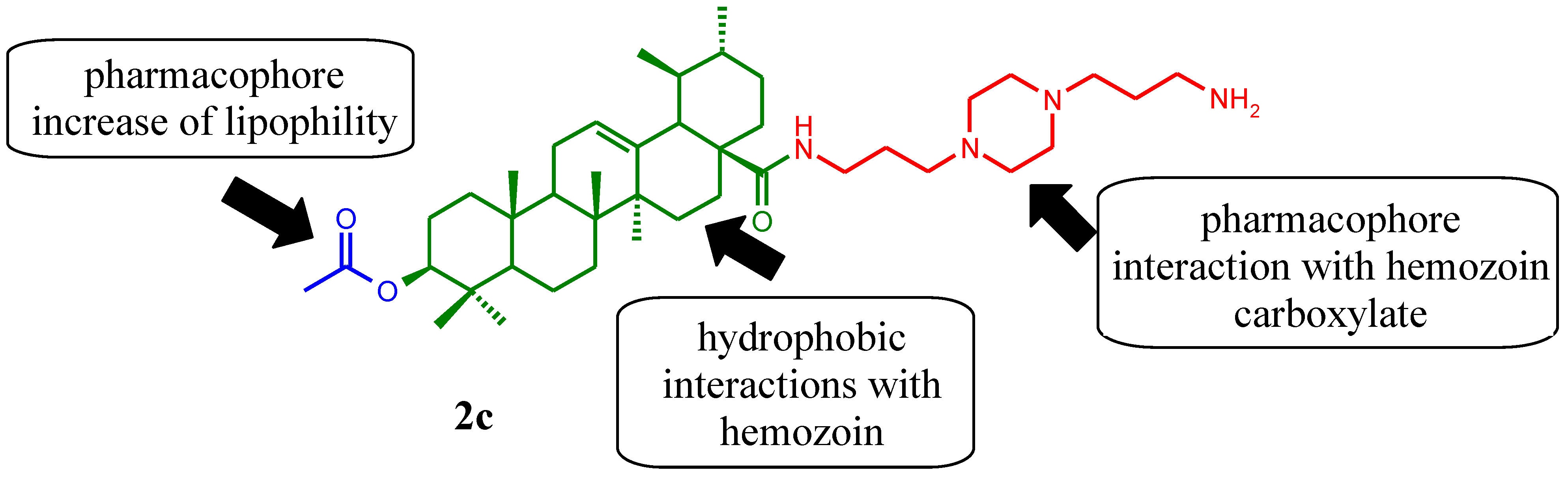
      <p>Many studies regarding triterpenes and their derivatives possessing antimalarial activity which highlight two triterpenes, betulinic and ursolic acids, are reported [<xref ref-type="bibr" rid="B6-molecules-17-12003">6</xref>,<xref ref-type="bibr" rid="B7-molecules-17-12003">7</xref>,<xref ref-type="bibr" rid="B8-molecules-17-12003">8</xref>,<xref ref-type="bibr" rid="B9-molecules-17-12003">9</xref>,<xref ref-type="bibr" rid="B10-molecules-17-12003">10</xref>]. For example, Ziegler and co-workers described the anti-<italic>Plasmodium</italic> activity on the 3D7 strain of betulinic acid and its analogues and reported that treatment with these compounds resulted in modified erythrocyte membranes. While betulinic acid was active, with an IC<sub>50 </sub>value of 13.9 µM, the most active analogue was methyl betulinate (IC<sub>50</sub> 7 µM) [<xref ref-type="bibr" rid="B7-molecules-17-12003">7</xref>]. However, in a murine malarial model of <italic>P. berghei</italic> betulinic acid was ineffective at 250 mg/kg/day [<xref ref-type="bibr" rid="B6-molecules-17-12003">6</xref>]. We developed some piperazinyl derivatives of ursolic acid obtaining three antimalarial compounds potent against the <italic>P. falciparum</italic> chloroquine-sensitive Thai strain, including compound <bold>2c</bold> possessing an IC<sub>50</sub> value of 167 nM [<xref ref-type="bibr" rid="B10-molecules-17-12003">10</xref>] (<xref ref-type="fig" rid="molecules-17-12003-f001">Figure 1</xref>). Moreover, we could demonstrate the importance of the triterpene skeleton bearing an acetyl group at C-3 and the piperazine moiety was also identified as a pharmacophore.</p>
      <p>These derivatives were designed based on studies reporting that piperazine derivatives have antimalarial action [<xref ref-type="bibr" rid="B11-molecules-17-12003">11</xref>,<xref ref-type="bibr" rid="B12-molecules-17-12003">12</xref>]. For example, a series of bisacridine derivatives coupled with bisaminopropylpiperazine were found to have significant antimalarial effects when tested <italic>in vitro</italic> for antimalarial activity against the <italic>P. falciparum</italic> chloroquine-resistant FcB1R strain [<xref ref-type="bibr" rid="B11-molecules-17-12003">11</xref>].</p>
      <fig id="molecules-17-12003-f001" position="float">
        <label>Figure 1</label>
        <caption>
          <p>Strategy used to obtain <italic>N</italic>-{3-[4-(3-aminopropyl)piperazinyl]propyl}-3-<italic>O</italic>-acetylursolamide derivatives as antimalarial agents.</p>
        </caption>
        <graphic xmlns:xlink="http://www.w3.org/1999/xlink" xlink:href="molecules-17-12003-g001.tif"/>
      </fig>
	  <p>Until the moment little is known about mechanism of action for triterpenes, with reports for hematin and modification at erythrocyte membrane actions. [<xref ref-type="bibr" rid="B7-molecules-17-12003">7</xref>,<xref ref-type="bibr" rid="B10-molecules-17-12003">10</xref>]. Because Ca<sup>2+</sup> homeostasis and signalling are fundamental for parasite survival [<xref ref-type="bibr" rid="B13-molecules-17-12003">13</xref>,<xref ref-type="bibr" rid="B14-molecules-17-12003">14</xref>,<xref ref-type="bibr" rid="B15-molecules-17-12003">15</xref>], the mechanism involved in calcium homeostasis within malaria parasites has been investigated as a potential target against malaria [<xref ref-type="bibr" rid="B16-molecules-17-12003">16</xref>].</p>
      <p>In continuation of our research, the present study investigated new piperazinyl derivatives at C-28 of acetyl betulinic acid (compounds <bold>1a</bold>–<bold>c</bold>) comparing them with those of the ursolic acid (compounds <bold>2a</bold>–<bold>c</bold>) as prototypes for new antimalarial compounds against the <italic>P. falciparum </italic>chloroquine-sensitive 3D7 strain. Further the cytotoxicity <italic>in vitro</italic> was estimated and a novel antimalarial mechanism of action for triterpenes was also revealed. </p>
    </sec>
    <sec sec-type="results">
      <title>2. Results and Discussion</title>
      <sec>
        <title>2.1. Chemical Synthesis</title>
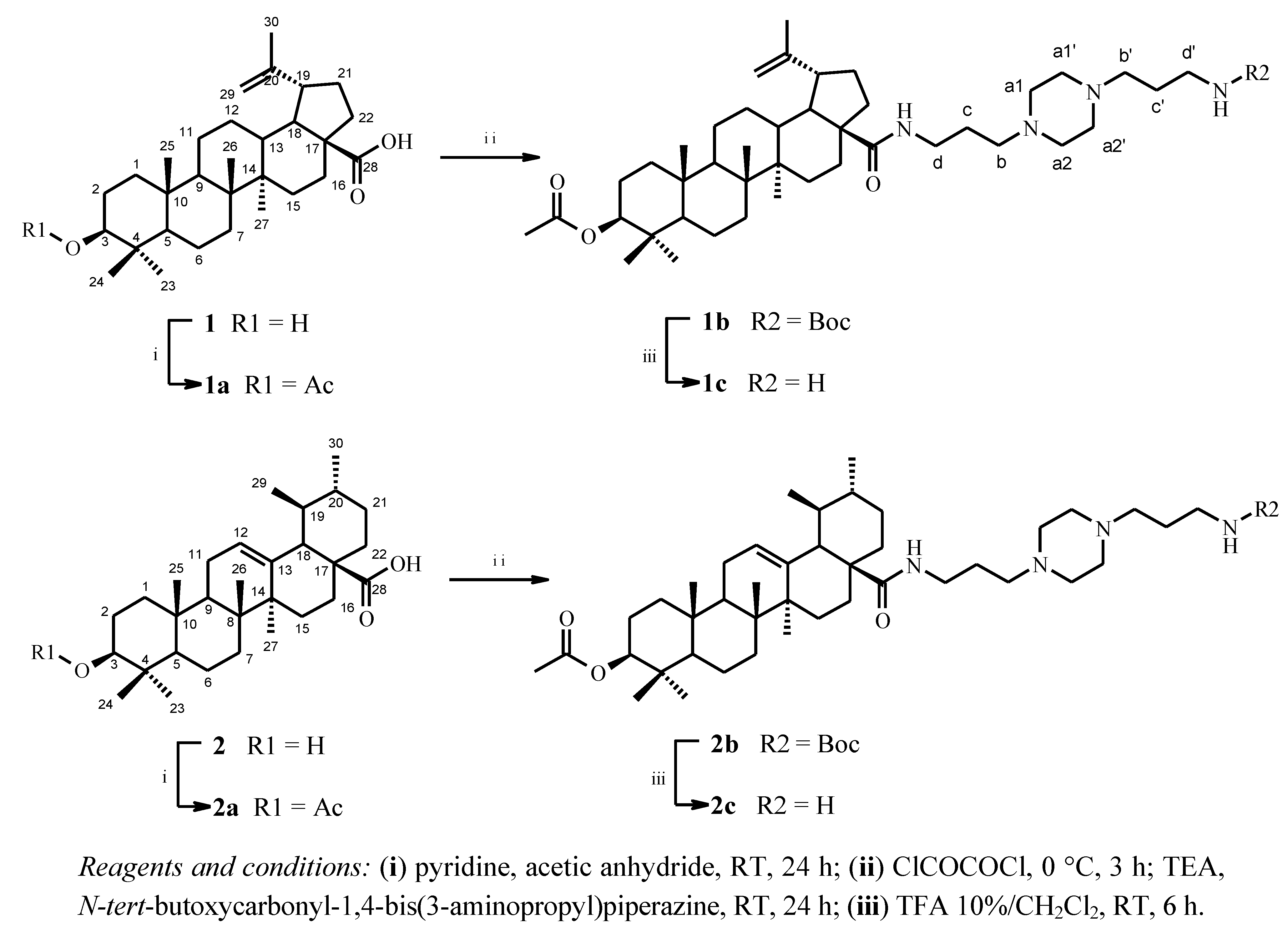
        <p>After being isolated from natural sources, the importance of the C-3 hydroxyl group of betulinic and ursolic acids <bold>1</bold> and <bold>2</bold> was ascertained through usual acetylation (<xref ref-type="scheme" rid="molecules-17-12003-f004">Scheme 1</xref>). The acetylated compounds numbered <bold>1a</bold> and <bold>2a</bold> were obtained in 98% yield. The coupling reaction of <bold>1a</bold> and <bold>2a </bold>with <italic>N-tert</italic>-butoxycarbonyl-1,4-bis(3-aminopropyl)piperazine occurred following activation of the carboxylic acid at C-17 with oxalyl chloride as previously described [<xref ref-type="bibr" rid="B10-molecules-17-12003">10</xref>]. The corresponding derivatives <bold>1b</bold> and <bold>2b</bold> were then isolated in 80% yield. Treatment with 10% trifluoroacetic acid/dichloromethane removed the <italic>tert</italic>-butoxycarbonyl (Boc) to provide compounds <bold>1c</bold> and <bold>2c</bold> in 70% yield (<xref ref-type="scheme" rid="molecules-17-12003-f004">Scheme 1</xref>). All compounds were fully characterised by spectroscopic data. </p>
      </sec>
      <sec>
        <title>2.2. Antiplasmodial Assay</title>
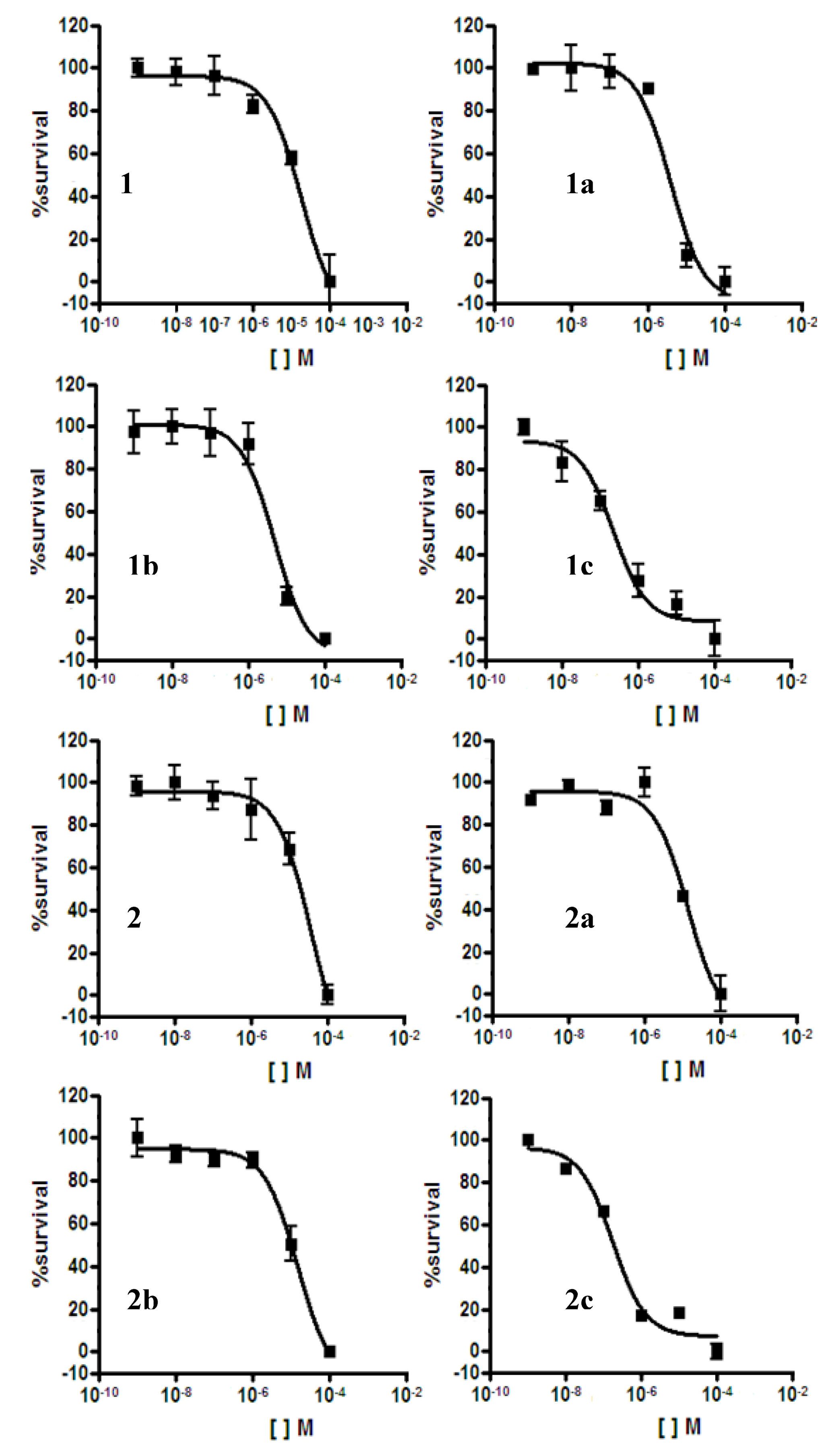
        <p>All compounds were evaluated <italic>in vitro</italic> against the <italic>P. falciparum </italic>chloroquine-sensitive 3D7 strain in comparison to chloroquine which IC<sub>50</sub> value was 29 nM. Compound <bold>1</bold> showed moderate activity (IC<sub>50</sub> 18 µM) and <bold>2</bold> was inactive (IC<sub>50</sub> 36 µM) (<xref ref-type="fig" rid="molecules-17-12003-f002">Figure 2</xref>, <xref ref-type="table" rid="molecules-17-12003-t001">Table 1</xref>) which results are in agreement with those of the literature [<xref ref-type="bibr" rid="B6-molecules-17-12003">6</xref>,<xref ref-type="bibr" rid="B17-molecules-17-12003">17</xref>,<xref ref-type="bibr" rid="B18-molecules-17-12003">18</xref>].</p>
        <p>Acetylated derivatives <bold>1a</bold> and <bold>2a</bold> showed better antimalarial activity than their aglycones (IC<sub>50</sub> values of 4 and 14 µM, respectively) (<xref ref-type="fig" rid="molecules-17-12003-f002">Figure 2</xref>, <xref ref-type="table" rid="molecules-17-12003-t001">Table 1</xref>). The highest values were obtained for the piperazinyl derivatives <bold>1c</bold> (IC<sub>50</sub> 220 nM) and <bold>2c</bold> (IC<sub>50</sub> 175 nM). Protected compounds <bold>1b</bold> and <bold>2b</bold> presented IC<sub>50</sub> values of 5 and 15 µM, respectively, demonstrating a lower capacity to reduce parasitemia in comparison to unprotected compounds. As shown in <xref ref-type="fig" rid="molecules-17-12003-f002">Figure 2</xref>, the piperazine group contributed to a significant improvement in activity as also reported [<xref ref-type="bibr" rid="B19-molecules-17-12003">19</xref>].</p>
        <fig id="molecules-17-12003-f004" position="float">
          <object-id pub-id-type="pii">molecules-17-12003-scheme1_Scheme 1</object-id>
          <label>Scheme 1</label>
          <caption>
            <p>Synthesis of <italic>N</italic>-{3-[4-(3-aminopropyl)piperazinyl]propyl}-3-<italic>O</italic>-acetyl betulinamides <bold>1a</bold>–<bold>c</bold> and <italic>N</italic>-{3-[4-(3-aminopropyl)piperazinyl]propyl}-3-<italic>O</italic>-acetylursolamides <bold>2a</bold>–<bold>c</bold>. </p>
          </caption>
          <graphic xmlns:xlink="http://www.w3.org/1999/xlink" xlink:href="molecules-17-12003-g004.tif"/>
        </fig>		
      </sec>
      <sec>
        <title>2.3. Cytotoxicity Assay</title>
        <p>The active derivatives <bold>1a</bold>–<bold>c</bold> and <bold>2c</bold> were evaluated for their cytotoxicity in human embryonic kidney cells (HEK293T) by monitoring the number of living cells at the same concentrations used to evaluate the antiplasmodial activity (100, 10, 1, 0.1, 0.01 and 0.001 µM). Many research groups have tried to find cytotoxicity activity from triterpenoids, including betulinic acid and their derivatives. Thibeault <italic>et al.</italic> presented cytotoxicity results of lupane-type triterpenoid glyceryl esters. Betulinic acid showed values of 18 to 57 µM in several cell lines [<xref ref-type="bibr" rid="B20-molecules-17-12003">20</xref>].</p>
        <fig id="molecules-17-12003-f002" position="float">
          <label>Figure 2</label>
          <caption>
            <p>Drug concentration response curves of betulinic and ursolic acid acetylated derivatives <bold>1a</bold> and <bold>2a</bold>, coupled <bold>1b</bold> and <bold>2b</bold> and deprotected piperazinyl derivatives <bold>1c</bold> and <bold>2c</bold> against the chloroquine-sensitive <italic>P. falciparum </italic>strain 3D7 strain. The results are representative of three independent experiments (n = 3). </p>
          </caption>
          <graphic xmlns:xlink="http://www.w3.org/1999/xlink" xlink:href="molecules-17-12003-g002.tif"/>
        </fig>
		 <table-wrap id="molecules-17-12003-t001" position="float">
          <object-id pub-id-type="pii">molecules-17-12003-t001_Table 1</object-id>
          <label>Table 1</label>
          <caption>
            <p>Antiplasmodial and cytotoxic activity of compounds <bold>1</bold>, <bold>1a</bold>–<bold>c</bold> and <bold>2</bold>, <bold>2a</bold>–<bold>c</bold>. The results are representative of three independent experiments (n = 3).</p>
          </caption>
          <table>
            <thead>
              <tr>
                <th rowspan="2" align="center" valign="middle">Compounds</th>
                <th rowspan="2" align="center" valign="middle">IC<sub>50</sub> (µM)  
                <italic>P. falciparum </italic>3D7</th>
                <th colspan="2" align="center" valign="middle" style="border-bottom: solid thin">IC<sub>50</sub> (µM) HEK293T</th>
                <th rowspan="2" align="center" valign="middle">Selectivity Index (SI) 48 h</th>
              </tr>
              <tr>
                <th align="center" valign="middle">24 h</th>
                <th align="center" valign="middle">48 h</th>
              </tr>
            </thead>
            <tbody>
              <tr>
                <td align="center" valign="middle">1</td>
                <td align="center" valign="middle">18</td>
                <td align="center" valign="middle">-</td>
                <td align="center" valign="middle">-</td>
                <td align="center" valign="middle">-</td>
              </tr>
              <tr>
                <td align="center" valign="middle">1a</td>
                <td align="center" valign="middle">4</td>
                <td align="center" valign="middle">&gt;100</td>
                <td align="center" valign="middle">&gt;100</td>
                <td align="center" valign="middle">-</td>
              </tr>
              <tr>
                <td align="center" valign="middle">1b</td>
                <td align="center" valign="middle">5</td>
                <td align="center" valign="middle">4</td>
                <td align="center" valign="middle">4</td>
                <td align="center" valign="middle">0.8</td>
              </tr>
              <tr>
                <td align="center" valign="middle">1c</td>
                <td align="center" valign="middle">0.220</td>
                <td align="center" valign="middle">4</td>
                <td align="center" valign="middle">4</td>
                <td align="center" valign="middle">18</td>
              </tr>
              <tr>
                <td align="center" valign="middle">2</td>
                <td align="center" valign="middle">36</td>
                <td align="center" valign="middle">-</td>
                <td align="center" valign="middle">-</td>
                <td align="center" valign="middle">-</td>
              </tr>
              <tr>
                <td align="center" valign="middle">2a</td>
                <td align="center" valign="middle">14</td>
                <td align="center" valign="middle">-</td>
                <td align="center" valign="middle">-</td>
                <td align="center" valign="middle">-</td>
              </tr>
              <tr>
                <td align="center" valign="middle">2b</td>
                <td align="center" valign="middle">15</td>
                <td align="center" valign="middle">-</td>
                <td align="center" valign="middle">-</td>
                <td align="center" valign="middle">-</td>
              </tr>
              <tr>
                <td align="center" valign="middle">2c</td>
                <td align="center" valign="middle">0.175</td>
                <td align="center" valign="middle">4</td>
                <td align="center" valign="middle">4</td>
                <td align="center" valign="middle">23</td>
              </tr>
            </tbody>
</table>
        </table-wrap>   
		<p>On the other hand, the cytotoxicity of heterocyclic triteprenoids derived from betulin and betulinic acid was tested against seven tumor and two normal fibroblast cell lines showing activity values from 1.0 to 55.5 µmol/L [<xref ref-type="bibr" rid="B21-molecules-17-12003">21</xref>]. The results displayed in <xref ref-type="table" rid="molecules-17-12003-t001">Table 1</xref> show that <bold>1a</bold> was not cytotoxic at the tested concentrations, while the piperazinyl derivatives <bold>1b</bold>, <bold>c</bold> and <bold>2c</bold> showed IC<sub>50</sub> values of 4 µM. Moreover, the most active compounds <bold>1c</bold> and <bold>2c</bold> presented SI values of 18 and 23, respectively, being considered non-toxic.</p>
      </sec>
      <sec>
        <title>2.4. Infected Erythrocytes: Loading with the Calcium Indicator Fluo4/AM</title>
        <p>Like most eukaryotic cells, malaria parasites have internal Ca<sup>2</sup><sup>+ </sup>pools responsible for regulation of signalling processes during invasion, maturation and division that can be mobilised upon agonist stimulation in the plasma membrane [<xref ref-type="bibr" rid="B22-molecules-17-12003">22</xref>]. The effect of compound <bold>2c </bold>through modulation of one or more calcium pathways in <italic>P. falciparum </italic>(3D7) was demonstrated using the fluorescent calcium probe Fluo4/AM. This molecule was chosen because it has the highest selectivity index (23, <xref ref-type="table" rid="molecules-17-12003-t001">Table 1</xref>). </p>
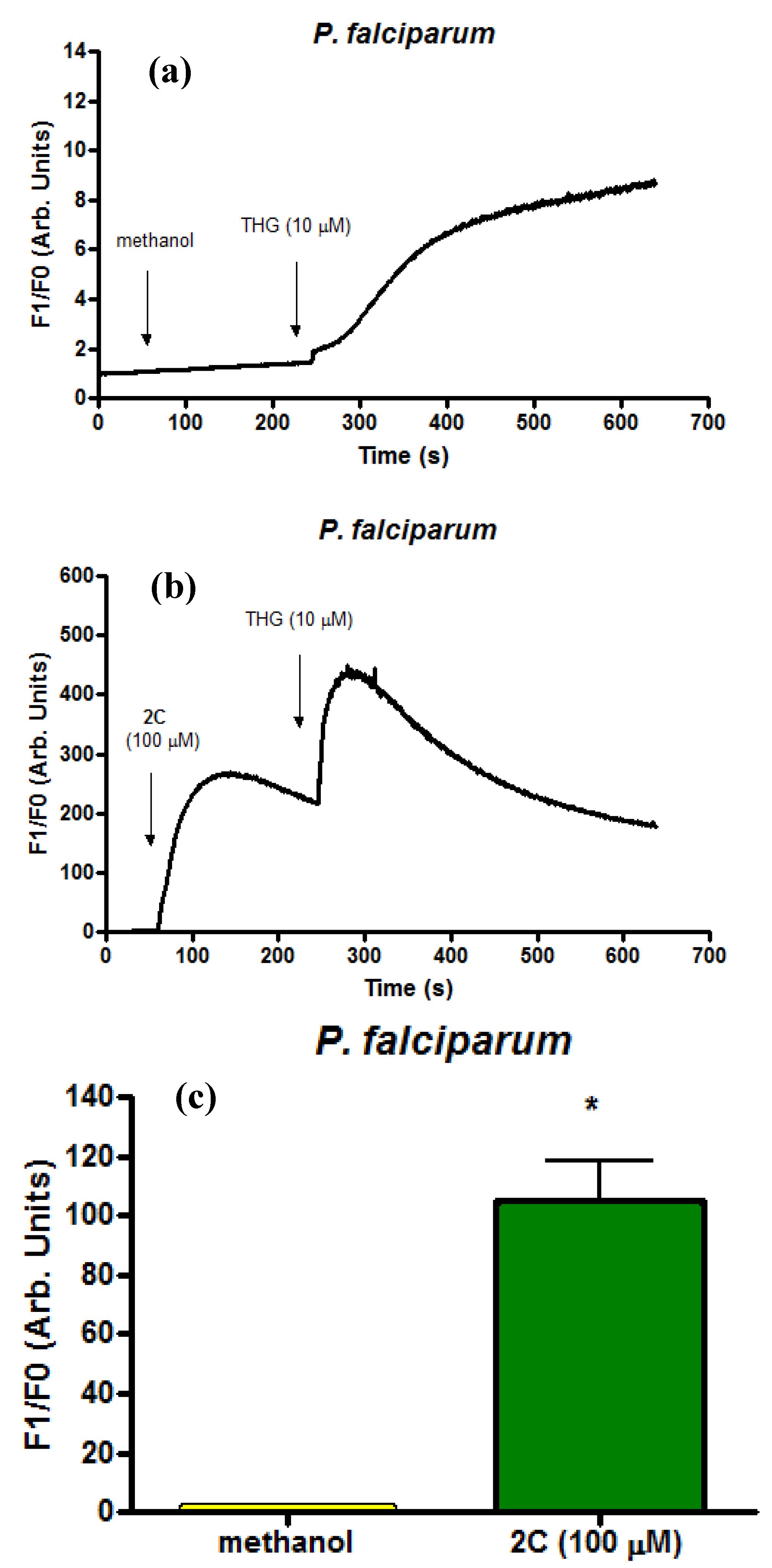
        <p>The typical rise in cytosolic calcium in isolated parasites after addition of compound <bold>2c</bold> (100 µM) and thapsigargin (THG) (10 µM) is presented in <xref ref-type="fig" rid="molecules-17-12003-f003">Figure 3</xref>a–c. Because THG has been known to modulate Ca<sup>2+</sup> via inhibition of sarco-endoplasmatic reticulum Ca<sup>2+</sup> ATPase (SERCA) [<xref ref-type="bibr" rid="B23-molecules-17-12003">23</xref>], it was used as the control in this experiment. The control experiment (with methanol addition) showed clearly that the solvent did not elicit calcium increase within the parasites (<xref ref-type="fig" rid="molecules-17-12003-f003">Figure 3</xref>a). On the contrary, when THG was added after compound <bold>2c</bold>, the calcium increase was greater than the conventional calcium mobilisation observed with the control one (<xref ref-type="fig" rid="molecules-17-12003-f003">Figure 3</xref>b). These results indicated that <bold>2c</bold> can modulate parasite calcium homeostasis.</p>
        <fig id="molecules-17-12003-f003" position="float">
          <label>Figure 3</label>
          <caption>
            <p>Modulation of the <italic>Plasmodium </italic>calcium pathway(s) involved in the mechanism of action of compound <bold>2c</bold>. Representative traces of the change in Fluo4/AM) fluorescence over time upon addition of solvent (<bold>a</bold>) or <bold>2c</bold> (100 µM) (<bold>b</bold>) in <italic>P. falciparum</italic> followed by THG (10 µM) addition. (<bold>c</bold>) Bar graph analysis of Ca<sup>2+</sup> concentrations in Fluo4/AM-labelled <italic>P. falciparum </italic>isolated parasites (10<sup>8</sup> cells mL<sup>−1</sup>) after addition of <bold>2c</bold> (100 µM). Data presented (104.9 a.u. ± 13.65, n = 9, <italic>P </italic>= 0.0004) were in <italic>P. falciparum.</italic> <italic>P</italic> values (<bold>*</bold>) were calculated by comparison with methanol (0.05%) (1.46 a.u. ± 0.057, n = 4). Bars represent the means and SEM values. The fluorescence was measured continuously (acquisition every 0.5 s). The results are representative of three independent experiments performed in triplicate. </p>
          </caption>
          <graphic xmlns:xlink="http://www.w3.org/1999/xlink" xlink:href="molecules-17-12003-g003.tif"/>
        </fig>
      </sec>
    </sec>
    <sec sec-type="methods">
      <title>3. Experimental</title>
      <sec>
        <title>3.1. General</title>
        <p>Infrared spectra (IR) were obtained using a PerkinElmer FT-IR System Spectrum BX instrument. <sup>1</sup>H and <sup>13</sup>C-NMR spectra were recorded on Varian Inova 300 and Varian VNMRS 300 spectrometers using TMS as internal standard. Chemical shifts are reported in parts per million (δ). An UltrOTOF (BrukerDaltonics) mass spectrometer was used to obtain HR-EI-MS spectra. Melting points were determined using a Koffler instrument. All reactions were monitored by thin-layer chromatography on Merck silica plates GF using different solvent systems. Column chromatography was carried out on silica gel GF (Merck, 60–230 mesh) using gradient mixtures (CH<sub>2</sub>Cl<sub>2</sub>/methanol). All reagents were purchased as analytical grade. All solvents were dried and distilled prior use. Dichloromethane was dried over CaCl<sub>2</sub> for 24 h then was submitted to reflux. </p>
      </sec>
      <sec>
        <title>3.2. Plant Material and Isolation of Triterpenes</title>
        <p>The betulinic acid was obtained from <italic>Platanus acerifolia</italic>. A voucher specimen (ICN 182537) is on deposit in the Botany Department Herbarium of Universidade Federal do Rio Grande do Sul, Porto Alegre, Brazil. The peel of <italic>Malus domestica </italic>was a byproduct from the juice industry company Tecnovin S.A., Vacaria, RS, Brazil, and was used to obtain the ursolic acid. Both powdered dried materials were separately subjected to reflux with ethanol 60% (250 mL, 2 h). Then, after removing the ethanol under vacuum, each residual aqueous phase was separately extracted with ethyl acetate, and the organic phase was evaporated to dryness to obtain a residue that was submitted to recrystallisation. The betulinic acid was recrystallized from methanol, while ursolic acid was recrystallized using acetonitrile. <italic>Betulinic acid </italic>(<bold>1</bold>). Yield 1.5%. Its structure was confirmed by spectroscopic methods which were in agreement with literature data [<xref ref-type="bibr" rid="B6-molecules-17-12003">6</xref>,<xref ref-type="bibr" rid="B7-molecules-17-12003">7</xref>]. <italic>Ursolic acid </italic>(<bold>2</bold>). Yield 4%. Its structure was confirmed by spectroscopic methods and literature data [<xref ref-type="bibr" rid="B10-molecules-17-12003">10</xref>]. </p>
      </sec>
      <sec>
        <title>3.3. Chemical Synthesis</title>
        <p>The ursolic acid derivatives were prepared using a semisynthetic route developed by Gnoatto and co-workers which details of the chemistry and structural elucidation were described previously [<xref ref-type="bibr" rid="B10-molecules-17-12003">10</xref>]. Briefly, the acetylated ursolic acid <bold>2a</bold> was submitted to a coupling reaction with <italic>N</italic>-Boc-bisaminopropylpiperazine in basic conditions to obtain <bold>2b</bold>, and then the deprotected analogue <bold>2c</bold> was obtained by removing the <italic>N</italic>-Boc-amino group. All structural assignments were compared with the published data [<xref ref-type="bibr" rid="B10-molecules-17-12003">10</xref>]. The betulinic acid derivatives were obtained using an analogous route. </p>
        <p><italic>3-O-Acetylbetulinic acid </italic>(<bold>1a</bold>). Yield 98%. It was prepared from the corresponding aglycone <bold>1</bold> by usual acetylation [<xref ref-type="bibr" rid="B10-molecules-17-12003">10</xref>]. </p>
        <p><italic>N-{3-[4-(3-Aminopropyl)piperazinopropyl]</italic><italic>terbutylcarbamate}-3-acetylbetulinamide</italic> (<bold>1b</bold>). Oxalyl chloride (0.15 mL, 1.7 mmol) was added to <bold>1a</bold> (285 mg, 0.57 mmol) dissolved in CH<sub>2</sub>Cl<sub>2</sub> (30 mL) at 0 °C, and the resulting solution was stirred under N<sub>2</sub> for 3 h. Subsequently, triethylamine (0.5 mL, 3.4 mmol) and then <italic>tert</italic>-butyl 3-[4-(3-aminopropyl)piperazinylpropyl]carbamate (510 mg, 1.7 mmol) were added to the reaction, which was then stirred for 24 h at room temperature. Next, water was added and the resulting product was extracted with CH<sub>2</sub>Cl<sub>2</sub> (3 × 30 mL); the organic layers were combined, dried over Na<sub>2</sub>SO<sub>4</sub> and evaporated under vacuum to afford <bold>1b</bold> as a white solid. Yield: 80%; m.p. 129 °C; IR (ATR cm<sup>−1</sup>): 3406 (NH); 2943 (C-H); 1777 (C=O acetyl); 1687 (C=O amide); 1555 (C=C); 1425 (C-O); 1380 (C-H); 1259 (C-O-C); 1176 (C-N). <sup>1</sup>H-NMR (CDCl<sub>3</sub>, δ): 0.84 (s, 3H, H<sub>26</sub>); 0.85 (s, 3H, H<sub>27</sub>); 0.87 (s, 3H, H<sub>25</sub>); 0.95 (s, 3H, H<sub>23</sub>); 0.97 (s, 3H, H<sub>24</sub>); 1.29 (d, 4H, H<sub>11</sub>, H<sub>12</sub>); 1.38 (m, 3H, H<sub>6</sub>, H<sub>9</sub>); 1.45 (s, 9H, <underline>H<sub>3</sub>C</underline>-Boc); 1.55 (t, 4H, H<sub>15</sub>, H<sub>7</sub>); 1.65 (m, 6H, H<sub>13</sub>, 2 × CH<sub>2</sub>, H<sub>5</sub>); 1.69 (s, 3H H<sub>30</sub>); 1.76 (t, 4H, H<sub>16</sub>, H<sub>1</sub>) 1.97 (t, 3H, H<sub>18</sub>, H<sub>2</sub>); 2.04 (s, 3H, H<sub>3</sub>C-COO-); 2.47 (m, 15H, H<sub>1</sub>, 7 × CH<sub>2</sub>); 3.19 (m, 2H, CH<sub>2</sub>); 3.32 (m, 4H, 2 × CH<sub>2</sub>); 4.48 (dd, 1H, H<sub>3</sub>); 4.59 (brs,1H, H<sub>29a</sub>); 4.75 (brs, 1H, H<sub>29b</sub>); 5.36 (1H, NH); 6.86 (1H, NH). <sup>13</sup>C-NMR (CDCl<sub>3</sub>, δ): 14.55; 16.14; 16.22; 16.43; 18.17; 19.46; 20.94; 20.20; 23.68; 21.22 (<underline>H<sub>3</sub>C</underline>-COO-); 25.57; 26.42; 28.41 (<underline>H<sub>3</sub>C</underline>-Boc); 29.41; 30.91; 33.84; 34.93; 37.12; 37.58; 37.77; 38.39; 38.46; 39.55; 39.87; 40.76; 42.42; 46.68; 50.20; 50.57; 53.10; 53.45; 55.48 (4C); 56.73; 57.85; 75.80; 78.79 (Cq-Boc); 80.93; 109.23; 151.04; 156.0 (CO-Boc); 170.90 (H<sub>3</sub>C-<underline>CO</underline>O-); 176.14 (C-28). HRMS (ESI-MS, <italic>m/z</italic>); [M+H]<sup>+</sup>: Calcd. for C<sub>47</sub>H<sub>80</sub>N<sub>4</sub>O<sub>5</sub>: 781.1619; Found: 781.6175. </p>
        <p><italic>N-{3-[4-(3-aminopropyl)piperazinyl]</italic><italic>propyl}-3-acetylbetulinamide</italic> (<bold>1c</bold>). The <italic>N</italic>-Boc-amino protecting group of compound <bold>1b</bold> was removed using trifluoroacetic acid 10%/dichloromethane mixture according to the literature [<xref ref-type="bibr" rid="B10-molecules-17-12003">10</xref>], resulting in the deprotected analogue <bold>1c</bold>. Yield 70%; m.p. 120 °C. Its spectroscopic data were similar to those of <bold>1b</bold>, excepting for the absence of the <italic>N</italic>-Boc-amino signals. HRMS (ESI-MS, <italic>m/z</italic>), [M+H]<sup>+</sup>: Calcd. for C<sub>40</sub>H<sub>72</sub>N<sub>4</sub>O<sub>3</sub>: 681.0461; Found: 681.5712. </p>
      </sec>
      <sec>
        <title>3.4. Antiplasmodial Assay</title>
        <p>The chloroquine-sensitive 3D7 strain of <italic>P. falciparum</italic> was grown in RPMI (Gibco/Life Technologies, Grand Island, NY, USA) containing 37.5 mM HEPES, supplemented with 7 mM D-glucose, 6 mM NaOH, 25 mL gentamicin sulphate, 2 mM L-glutamine and 10% human serum albumin. The strains were maintained in human erythrocytes in a gas mixture containing 5% O<sub>2</sub>, 5% CO<sub>2</sub> and 90% N<sub>2</sub> [<xref ref-type="bibr" rid="B24-molecules-17-12003">24</xref>]. The culture was synchronised by 10% sorbitol treatment [<xref ref-type="bibr" rid="B25-molecules-17-12003">25</xref>]. The antimalarial activity was measured using the microdilution technique <italic>in vitro</italic>. Red cells with parasitemia between 1–2% and 2% hematocrit were incubated with the compounds <bold>1</bold>, <bold>1a</bold>–<bold>c</bold> and <bold>2</bold>, <bold>2a</bold>–<bold>c</bold> for 48 h. Samples were dissolved in water, dimethylsulfoxide (DMSO) or methanol and serially diluted with the culture medium. To evaluate parasitemia, Giemsa staining and flow cytometric analysis were used. The concentration of the drug required to inhibit parasite growth was determined by comparing the fluorescence incorporated into the treated and untreated cultures (control). The concentration causing 50% inhibition (IC<sub>50</sub>) was determined from the drug concentration response curve. Methanol and DMSO were used at the maximum concentration of 0.1% and did not inhibit parasite growth.</p>
      </sec>
      <sec>
        <title>3.5. Cytotoxicity Assay</title>
        <p>Human embryonic kidney (HEK293T) cells were cultured in surface area 75 cm<sup>2</sup> (Greiner Bio-One, Frickenhausen, Germany) vented tissue culture flasks at 37 °C in a humidified atmosphere containing 5% CO<sub>2</sub> in Dulbecco’s modified essential medium (Gibco/Life Technologies, Grand Island, NY, USA) supplemented with 10% (v/v) foetal bovine serum, 100 U/mL penicillin and 100 µg/mL streptomycin. After 24 h, 50 µl of each drug was added with 0.5% DMSO or methanol to a single well. The cells were incubated with the test drugs for an additional 24 and 48 h and then harvested with trypsin, gently pelleted by centrifugation and re-suspended in PBS. The cells were stained with dihydroethidium solution (10 mg/mL in phosphate buffered saline), gently vortexed and incubated for 40 min at 37 °C in the dark. Ten thousand gated events were acquired for each sample (FACSCalibur BD and CellQuest software was used for analysis).</p>
      </sec>
      <sec>
        <title>3.6. Infected Erythrocytes: Loading with the Calcium Indicator Fluo4/AM</title>
        <p>Erythrocytes (RBCs) infected by <italic>P. falciparum</italic> (3D7) at the trophozoite stage were lysed with 10 mg/mL saponin (in phosphate-buffered saline) in the presence of 20 µg/mL protease inhibitors (pepstatin A, leupeptin, antipain and chymostatin) and benzamidine (0.5 mmol/L). Erythrocyte membranes were then removed through centrifugation (8700 rpm for 10 min at 4 °C). The parasites were washed three times in buffer M (116 mM NaCl, 5.4 mM KCl, 0.8 mM MgSO<sub>4</sub>, 5.5 mM <italic>D</italic>-glucose, 50 mM MOPS, pH 7.3) with CaCl<sub>2</sub> (2 mM). The parasites were then re-suspended in the same buffer with Fluo4-AM (5 μM) probenecid (1.8 mM), an inhibitor of organic anion transport (to prevent dye sequestration and release), 20 mg/mL protease inhibitors (pepstatin A, leupeptin, antipain and chymostatin) and benzamidine (0.5 mmol/L) for 50 min at 37 °C. The parasite suspension was then washed three times with buffer M. Spectrofluorimetric measurements were performed in a Shimadzu RF-5301 PC instrument at 37 °C with isolated <italic>P. falciparum</italic> (3D7) parasites (10<sup>8</sup> cells mL<sup>−1</sup>) incubated with MOPS buffer in a 1 mL cuvette. Compound <bold>2c</bold> (100 μM) and THG (10 μM) were added during time course experiments, and excitation/emission wavelengths were adjusted to 505/530 nm for Fluo4-AM. Methanol (0.05%) was used as a control. Addition of the detergent digitonin induced the maximum increase in calcium that was abolished by addition of the calcium chelator EGTA.</p>
      </sec>
      <sec>
        <title>3.7. Statistical Analysis</title>
        <p>Student’s test was chosen for comparisons between two groups, whereas repeated ANOVA measures were used for comparisons among more than two groups. The results are expressed as the mean ± SEM of at least three individual experiments. <italic>P </italic>&lt; 0.05 was considered a statistically significant difference. GraphPad Prism software (San Diego, CA) was used for all statistical tests.</p>
      </sec>
    </sec>
    <sec sec-type="conclusions">
      <title>4. Conclusions</title>
      <p>In this study, we synthesized new piperazinyl derivatives of betulinic and ursolic acids considering the previous active designed compounds. The best compounds, <bold>1c </bold>and <bold>2c</bold>, showed IC<sub>50</sub> values in the range of 175 to 220 nM against the <italic>P. falciparum</italic> chloroquine-sensitive 3D7 strain, and they are considered non-toxic (SI &gt; 10 μM). The observed changes in calcium homeostasis demonstrated that ursolic acid derivative <bold>2c</bold> led to an increase in intracellular ion concentrations in <italic>P. falciparum. </italic>In conclusion, compound <bold>2c</bold> is a new potent antimalarial prototype that disrupts <italic>Plasmodium </italic>calcium homeostasis. </p>
    </sec>
  </body>
  <back>
    <ack>
      <title>Acknowledgements</title>
      <p>This work was supported by grants and financial support from Instituto Nacional de Ciência e Tecnologia para Inovação Farmacêutica (INCT-if, Brazil), Conselho Nacional de Desenvolvimento Científico e Tecnológico (CNPq-Brazil), Coordenação de Aperfeiçoamento de Pessoal de Nível Superior (CAPES-Brazil), Fundação de Amparo à Pesquisa do Estado de São Paulo (FAPESP, Brazil) and Fundação de Amparo à Pesquisa do Estado do Rio Grande do Sul (FAPERGS, Brazil). Laura N. Cruz and Miriam S. Moraes received a FAPESP fellowship. We also thank Norberto Peporine Lopes (USP-RP, Brazil) for the HRMS analyses and Tecnovin do Brasil, RS, for supplying the apple material. </p>
      </ack>
	<fn-group><fn><p><italic>Sample Availability</italic>: Samples of the compounds are available from the authors. </p></fn></fn-group>
    <ref-list>
      <title>References</title>
      <ref id="B1-molecules-17-12003">
        <label>1.</label>
        <citation citation-type="web">
		<collab>WHO</collab>          
          <article-title>World Malaria Report</article-title>
          <year>2011</year>
          <access-date>(accessed on 11 August 2012)</access-date>
          <comment>Available online:<ext-link xmlns:xlink="http://www.w3.org/1999/xlink" xlink:href="http://www.who.int/malaria/world_malaria_report_2011/en/" ext-link-type="uri">http://www.who.int/malaria/world_malaria_report_2011/en/</ext-link></comment>
        </citation>
      </ref>
      <ref id="B2-molecules-17-12003">
        <label>2.</label>
        <citation citation-type="journal">
          <person-group person-group-type="author">
            <name>
              <surname>Mita</surname>
              <given-names>T.</given-names>
            </name>
            <name>
              <surname>Tanabe</surname>
              <given-names>K.</given-names>
            </name>
            <name>
              <surname>Kita</surname>
              <given-names>K.</given-names>
            </name>
          </person-group>
          <article-title>Spread and evolution of <italic>Plasmodium falciparum </italic>drug resistance</article-title>
          <source>Parasitol. Int.</source>
          <year>2009</year>
          <volume>58</volume>
          <fpage>201</fpage>
          <lpage>209</lpage>
          <pub-id pub-id-type="doi">10.1016/j.parint.2009.04.004</pub-id>
        </citation>
      </ref>
      <ref id="B3-molecules-17-12003">
        <label>3.</label>
        <citation citation-type="journal">
          <person-group person-group-type="author">
            <name>
              <surname>White</surname>
              <given-names>N.J.</given-names>
            </name>
          </person-group>
          <article-title>Qinghaosu (artemisinin): The price of success</article-title>
          <source>Science</source>
          <year>2008</year>
          <volume>320</volume>
          <fpage>330</fpage>
          <lpage>334</lpage>
          <pub-id pub-id-type="doi">10.1126/science.1155165</pub-id>
        </citation>
      </ref>
      <ref id="B4-molecules-17-12003">
        <label>4.</label>
        <citation citation-type="journal">
          <person-group person-group-type="author">
            <name>
              <surname>Frearson</surname>
              <given-names>J.A.</given-names>
            </name>
            <name>
              <surname>Wyatt</surname>
              <given-names>P.G.</given-names>
            </name>
            <name>
              <surname>Gilbert</surname>
              <given-names>I.H.</given-names>
            </name>
            <name>
              <surname>Fairlamb</surname>
              <given-names>A.H.</given-names>
            </name>
          </person-group>
          <article-title>Target assessment for antiparasitic drug discovery</article-title>
          <source>Trends Parasitol.</source>
          <year>2007</year>
          <volume>23</volume>
          <fpage>589</fpage>
          <lpage>595</lpage>
          <pub-id pub-id-type="doi">10.1016/j.pt.2007.08.019</pub-id>
        </citation>
      </ref>
      <ref id="B5-molecules-17-12003">
        <label>5.</label>
        <citation citation-type="journal">
          <person-group person-group-type="author">
            <name>
              <surname>Krettli</surname>
              <given-names>A.U.</given-names>
            </name>
            <name>
              <surname>Adebayo</surname>
              <given-names>J.O.</given-names>
            </name>
            <name>
              <surname>Krettli</surname>
              <given-names>L.G.</given-names>
            </name>
          </person-group>
          <article-title>Testing of natural products and synthetic molecules aiming at new antimalarials</article-title>
          <source>Curr. Drug Targets</source>
          <year>2009</year>
          <volume>10</volume>
          <fpage>261</fpage>
          <lpage>270</lpage>
          <pub-id pub-id-type="doi">10.2174/138945009787581203</pub-id>
        </citation>
      </ref>
      <ref id="B6-molecules-17-12003">
        <label>6.</label>
        <citation citation-type="journal">
          <person-group person-group-type="author">
            <name>
              <surname>Steele</surname>
              <given-names>J.C.P.</given-names>
            </name>
            <name>
              <surname>Warhurst</surname>
              <given-names>D.C.</given-names>
            </name>
            <name>
              <surname>Kirby</surname>
              <given-names>G.C.</given-names>
            </name>
            <name>
              <surname>Simmonds</surname>
              <given-names>M.S.J.</given-names>
            </name>
          </person-group>
          <article-title><italic>In vitro</italic> and <italic>in vivo</italic> evaluation of betulinic acid as an antimalarial</article-title>
          <source>Phytother. Res.</source>
          <year>1999</year>
          <volume>13</volume>
          <fpage>115</fpage>
          <lpage>119</lpage>
          <pub-id pub-id-type="doi">10.1002/(SICI)1099-1573(199903)13:2&lt;115::AID-PTR404&gt;3.0.CO;2-1</pub-id>
        </citation>
      </ref>
      <ref id="B7-molecules-17-12003">
        <label>7.</label>
        <citation citation-type="journal">
          <person-group person-group-type="author">
            <name>
              <surname>Ziegler</surname>
              <given-names>H.L.</given-names>
            </name>
            <name>
              <surname>Franzyk</surname>
              <given-names>H.</given-names>
            </name>
            <name>
              <surname>Sairafianpour</surname>
              <given-names>M.</given-names>
            </name>
            <name>
              <surname>Tabatabai</surname>
              <given-names>M.</given-names>
            </name>
            <name>
              <surname>Tehrani</surname>
              <given-names>M.D.</given-names>
            </name>
            <name>
              <surname>Bagherzadeh</surname>
              <given-names>K.</given-names>
            </name>
          </person-group>
          <article-title>Erythrocyte membrane modifying agents and the inhibition of <italic>Plasmodium falciparum</italic> growth: Structure-activity relationships for betulinic acid analogues</article-title>
          <source>Bioorg. Med. Chem.</source>
          <year>2004</year>
          <volume>12</volume>
          <fpage>119</fpage>
          <lpage>127</lpage>
          <pub-id pub-id-type="doi">10.1016/j.bmc.2003.10.010</pub-id>
        </citation>
      </ref>
      <ref id="B8-molecules-17-12003">
        <label>8.</label>
        <citation citation-type="journal">
          <person-group person-group-type="author">
            <name>
              <surname>Liu</surname>
              <given-names>J.</given-names>
            </name>
          </person-group>
          <article-title>Oleanolic acid and ursolic acid: Research perspectives</article-title>
          <source>J. Ethnopharmacol.</source>
          <year>2005</year>
          <volume>100</volume>
          <fpage>92</fpage>
          <lpage>94</lpage>
          <pub-id pub-id-type="doi">10.1016/j.jep.2005.05.024</pub-id>
        </citation>
      </ref>
      <ref id="B9-molecules-17-12003">
        <label>9.</label>
        <citation citation-type="journal">
          <person-group person-group-type="author">
            <name>
              <surname>Yogeeswari</surname>
              <given-names>P.</given-names>
            </name>
            <name>
              <surname>Sriram</surname>
              <given-names>D.</given-names>
            </name>
          </person-group>
          <article-title>Betulinic acid and its derivatives: A review on their biological properties</article-title>
          <source>Curr. Med. Chem.</source>
          <year>2005</year>
          <volume>12</volume>
          <fpage>657</fpage>
          <lpage>666</lpage>
          <pub-id pub-id-type="doi">10.2174/0929867053202214</pub-id>
        </citation>
      </ref>
      <ref id="B10-molecules-17-12003">
        <label>10.</label>
        <citation citation-type="journal">
          <person-group person-group-type="author">
            <name>
              <surname>Gnoatto</surname>
              <given-names>S.C.B.</given-names>
            </name>
            <name>
              <surname>Susplugas</surname>
              <given-names>S.</given-names>
            </name>
            <name>
              <surname>Dalla Vechia</surname>
              <given-names>L.</given-names>
            </name>
            <name>
              <surname>Ferreira</surname>
              <given-names>T.B.</given-names>
            </name>
            <name>
              <surname>Dassonville-Klimpt</surname>
              <given-names>A.</given-names>
            </name>
            <name>
              <surname>Zimmer</surname>
              <given-names>K.R.</given-names>
            </name>
            <name>
              <surname>Demailly</surname>
              <given-names>C.</given-names>
            </name>
            <name>
              <surname>Da Nascimento</surname>
              <given-names>S.</given-names>
            </name>
            <name>
              <surname>Guillon</surname>
              <given-names>J.</given-names>
            </name>
            <name>
              <surname>Grellier</surname>
              <given-names>P.</given-names>
            </name>
            <etal/>
          </person-group>
          <article-title>Pharmacomodulation on the 3-acetylursolic acid skeleton: Design, Synthesis, And biological evaluation of novel <italic>N</italic>-{3-[4-(3-aminopropyl)piperazinyl]propyl}-3-<italic>O</italic>-acetylursolamide derivatives as antimalarial agents</article-title>
          <source>Bioorg. Med. Chem.</source>
          <year>2008</year>
          <volume>16</volume>
          <fpage>771</fpage>
          <lpage>782</lpage>
          <pub-id pub-id-type="doi">10.1016/j.bmc.2007.10.031</pub-id>
        </citation>
      </ref>
      <ref id="B11-molecules-17-12003">
        <label>11.</label>
        <citation citation-type="journal">
          <person-group person-group-type="author">
            <name>
              <surname>Girault</surname>
              <given-names>S.</given-names>
            </name>
            <name>
              <surname>Grellier</surname>
              <given-names>P.</given-names>
            </name>
            <name>
              <surname>Berecibar</surname>
              <given-names>A.</given-names>
            </name>
            <name>
              <surname>Maes</surname>
              <given-names>L.</given-names>
            </name>
            <name>
              <surname>Lemiere</surname>
              <given-names>P.</given-names>
            </name>
            <name>
              <surname>Mouray</surname>
              <given-names>E.</given-names>
            </name>
          </person-group>
          <article-title>Antiplasmodial activity and cytotoxicity of bis-, tris-, and tetraquinolines with linear or cyclic amino linkers</article-title>
          <source>J. Med. Chem.</source>
          <year>2001</year>
          <volume>44</volume>
          <fpage>1658</fpage>
          <lpage>1665</lpage>
          <pub-id pub-id-type="doi">10.1021/jm001096a</pub-id>
        </citation>
      </ref>
      <ref id="B12-molecules-17-12003">
        <label>12.</label>
        <citation citation-type="journal">
          <person-group person-group-type="author">
            <name>
              <surname>Ryckebusch</surname>
              <given-names>A.</given-names>
            </name>
            <name>
              <surname>Deprez-Poulain</surname>
              <given-names>R.</given-names>
            </name>
            <name>
              <surname>Debreu-Fontaine</surname>
              <given-names>M.A.</given-names>
            </name>
            <name>
              <surname>Vandaele</surname>
              <given-names>R.</given-names>
            </name>
            <name>
              <surname>Mouray</surname>
              <given-names>E.</given-names>
            </name>
            <name>
              <surname>Grellier</surname>
              <given-names>P.</given-names>
            </name>
          </person-group>
          <article-title>Parallel synthesis and anti-malarial activity of a sulfonamide library</article-title>
          <source>Bioorg. Med. Chem. Lett.</source>
          <year>2002</year>
          <volume>12</volume>
          <fpage>2595</fpage>
          <lpage>2598</lpage>
          <pub-id pub-id-type="doi">10.1016/S0960-894X(02)00475-4</pub-id>
        </citation>
      </ref>
      <ref id="B13-molecules-17-12003">
        <label>13.</label>
        <citation citation-type="journal">
          <person-group person-group-type="author">
            <name>
              <surname>Beraldo</surname>
              <given-names>F.H.</given-names>
            </name>
            <name>
              <surname>Almeida</surname>
              <given-names>F.M.</given-names>
            </name>
            <name>
              <surname>da Silva</surname>
              <given-names>A.M.</given-names>
            </name>
            <name>
              <surname>Garcia</surname>
              <given-names>C.R.S.</given-names>
            </name>
          </person-group>
          <article-title>Cyclic AMP and calcium interplay as second messengers in melatonin-dependent regulation of <italic>Plasmodium falciparum</italic> cell cycle</article-title>
          <source>J.Cell Biol.</source>
          <year>2005</year>
          <volume>170</volume>
          <fpage>551</fpage>
          <lpage>557</lpage>
          <pub-id pub-id-type="doi">10.1083/jcb.200505117</pub-id>
        </citation>
      </ref>
      <ref id="B14-molecules-17-12003">
        <label>14.</label>
        <citation citation-type="journal">
          <person-group person-group-type="author">
            <name>
              <surname>Beraldo</surname>
              <given-names>F.H.</given-names>
            </name>
            <name>
              <surname>Mikoshiba</surname>
              <given-names>K.</given-names>
            </name>
            <name>
              <surname>Garcia</surname>
              <given-names>C.R.S.</given-names>
            </name>
          </person-group>
          <article-title>Human malarial parasite, <italic>Plasmodium falciparum</italic>, displays capacitative calcium entry: 2-Aminoethyl diphenylborinate blocks the signal transduction pathway of melatonin action on the <italic>P. falciparum</italic> cell cycle</article-title>
          <source>J. Pineal Res.</source>
          <year>2007</year>
          <volume>43</volume>
          <fpage>360</fpage>
          <lpage>364</lpage>
          <pub-id pub-id-type="doi">10.1111/j.1600-079X.2007.00486.x</pub-id>
        </citation>
      </ref>
      <ref id="B15-molecules-17-12003">
        <label>15.</label>
        <citation citation-type="journal">
          <person-group person-group-type="author">
            <name>
              <surname>Garcia</surname>
              <given-names>C.R.S.</given-names>
            </name>
            <name>
              <surname>Azevedo</surname>
              <given-names>M.F.</given-names>
            </name>
            <name>
              <surname>Wunderlich</surname>
              <given-names>G.</given-names>
            </name>
            <name>
              <surname>Budu</surname>
              <given-names>A.</given-names>
            </name>
            <name>
              <surname>Young</surname>
              <given-names>J.A.</given-names>
            </name>
            <name>
              <surname>Bannister</surname>
              <given-names>L.</given-names>
            </name>
          </person-group>
          <article-title><italic>Plasmodium</italic> in the postgenomic era: New insights into the molecular cell biology of malaria parasites</article-title>
          <source>Int. Rev. Cell Mol. Biol.</source>
          <year>2008</year>
          <volume>266</volume>
          <fpage>85</fpage>
          <lpage>156</lpage>
          <pub-id pub-id-type="doi">10.1016/S1937-6448(07)66003-1</pub-id>
        </citation>
      </ref>
      <ref id="B16-molecules-17-12003">
        <label>16.</label>
        <citation citation-type="journal">
          <person-group person-group-type="author">
            <name>
              <surname>Koyama</surname>
              <given-names>F.C.</given-names>
            </name>
            <name>
              <surname>Chakrabarti</surname>
              <given-names>D.</given-names>
            </name>
            <name>
              <surname>Garcia</surname>
              <given-names>C.R.S.</given-names>
            </name>
          </person-group>
          <article-title>Molecular machinery of signal transduction and cell cycle regulation in <italic>Plasmodium</italic></article-title>
          <source>Mol. Biochem. Parasitol.</source>
          <year>2009</year>
          <volume>165</volume>
          <fpage>1</fpage>
          <lpage>7</lpage>
          <pub-id pub-id-type="doi">10.1016/j.molbiopara.2009.01.003</pub-id>
        </citation>
      </ref>
      <ref id="B17-molecules-17-12003">
        <label>17.</label>
        <citation citation-type="journal">
          <person-group person-group-type="author">
            <name>
              <surname>Traore-Keita</surname>
              <given-names>F.</given-names>
            </name>
            <name>
              <surname>Gasquet</surname>
              <given-names>M.</given-names>
            </name>
            <name>
              <surname>Di Giorgio</surname>
              <given-names>C.</given-names>
            </name>
            <name>
              <surname>Ollivier</surname>
              <given-names>E.</given-names>
            </name>
            <name>
              <surname>Delmas</surname>
              <given-names>F.</given-names>
            </name>
            <name>
              <surname>Keita</surname>
              <given-names>A.</given-names>
            </name>
            <name>
              <surname>Doumbo</surname>
              <given-names>O.</given-names>
            </name>
            <name>
              <surname>Balansard</surname>
              <given-names>G.</given-names>
            </name>
            <name>
              <surname>Timon-David</surname>
              <given-names>P.</given-names>
            </name>
          </person-group>
          <article-title>Antimalarial activity of four plants used in traditional medicine in Mali</article-title>
          <source>Phytother. Res.</source>
          <year>2000</year>
          <volume>14</volume>
          <fpage>45</fpage>
          <lpage>47</lpage>
          <pub-id pub-id-type="doi">10.1002/(SICI)1099-1573(200002)14:1&lt;45::AID-PTR544&gt;3.0.CO;2-C</pub-id>
        </citation>
      </ref>
      <ref id="B18-molecules-17-12003">
        <label>18.</label>
        <citation citation-type="journal">
          <person-group person-group-type="author">
            <name>
              <surname>Duker-Eshun</surname>
              <given-names>G.</given-names>
            </name>
            <name>
              <surname>Jaroszewski</surname>
              <given-names>J.W.</given-names>
            </name>
            <name>
              <surname>Asomaning</surname>
              <given-names>W.A.</given-names>
            </name>
            <name>
              <surname>Oppong-Boachie</surname>
              <given-names>F.</given-names>
            </name>
            <name>
              <surname>Brogger Christensen</surname>
              <given-names>S.</given-names>
            </name>
          </person-group>
          <article-title>Antiplasmodial constituents of <italic>Cajanus cajan</italic></article-title>
          <source>Phytother. Res.</source>
          <year>2004</year>
          <volume>18</volume>
          <fpage>128</fpage>
          <lpage>130</lpage>
          <pub-id pub-id-type="doi">10.1002/ptr.1375</pub-id>
        </citation>
      </ref>
      <ref id="B19-molecules-17-12003">
        <label>19.</label>
        <citation citation-type="journal">
          <person-group person-group-type="author">
            <name>
              <surname>Barea</surname>
              <given-names>C.</given-names>
            </name>
            <name>
              <surname>Pabón</surname>
              <given-names>A.</given-names>
            </name>
            <name>
              <surname>Galiano</surname>
              <given-names>S.</given-names>
            </name>
            <name>
              <surname>Pérez-Silanes</surname>
              <given-names>S.</given-names>
            </name>
            <name>
              <surname>Gonzalez</surname>
              <given-names>G.</given-names>
            </name>
            <name>
              <surname>Deyssard</surname>
              <given-names>C.</given-names>
            </name>
            <name>
              <surname>Monge</surname>
              <given-names>A.</given-names>
            </name>
            <name>
              <surname>Deharo</surname>
              <given-names>E.</given-names>
            </name>
            <name>
              <surname>Aldana</surname>
              <given-names>I.</given-names>
            </name>
          </person-group>
          <article-title>Antiplasmodial and leishmanicidal activities of 2-cyano-3-(4-phenylpiperazine-1-carboxamido) quinoxaline 1,4-dioxide derivatives</article-title>
          <source>Molecules</source>
          <year>2012</year>
          <volume>17</volume>
          <fpage>9451</fpage>
          <lpage>9461</lpage>
          <pub-id pub-id-type="doi">10.3390/molecules17089451</pub-id>
        </citation>
      </ref>
      <ref id="B20-molecules-17-12003">
        <label>20.</label>
        <citation citation-type="journal">
          <person-group person-group-type="author">
            <name>
              <surname>Thibeault</surname>
              <given-names>D.</given-names>
            </name>
            <name>
              <surname>Gauthier</surname>
              <given-names>C.</given-names>
            </name>
            <name>
              <surname>Legault</surname>
              <given-names>J.</given-names>
            </name>
            <name>
              <surname>Bouchard</surname>
              <given-names>J.</given-names>
            </name>
            <name>
              <surname>Gagné</surname>
              <given-names>L.</given-names>
            </name>
            <name>
              <surname>Pichette</surname>
              <given-names>A.</given-names>
            </name>
          </person-group>
          <article-title>Synthesis and cytotoxicity of lupane-type triterpenoid glyceryl esters</article-title>
          <source>Bioorg. Med. Chem. Lett.</source>
          <year>2012</year>
          <volume>22</volume>
          <fpage>4735</fpage>
          <lpage>4739</lpage>
          <pub-id pub-id-type="doi">10.1016/j.bmcl.2012.05.073</pub-id>
        </citation>
      </ref>
      <ref id="B21-molecules-17-12003">
        <label>21.</label>
        <citation citation-type="journal">
          <person-group person-group-type="author">
            <name>
              <surname>Urban</surname>
              <given-names>M.</given-names>
            </name>
            <name>
              <surname>Vlk</surname>
              <given-names>M.</given-names>
            </name>
            <name>
              <surname>Dzubak</surname>
              <given-names>P.</given-names>
            </name>
            <name>
              <surname>Hajduch</surname>
              <given-names>M.</given-names>
            </name>
            <name>
              <surname>Sarek</surname>
              <given-names>J.</given-names>
            </name>
          </person-group>
          <article-title>Cytotoxic heterocyclic triterpenoids derived from betulin and betulinic acid</article-title>
          <source>Bioorg. Med. Chem. Lett.</source>
          <year>2012</year>
          <volume>20</volume>
          <fpage>3666</fpage>
          <lpage>3674</lpage>
          <pub-id pub-id-type="doi">10.1016/j.bmc.2012.03.066</pub-id>
        </citation>
      </ref>
      <ref id="B22-molecules-17-12003">
        <label>22.</label>
        <citation citation-type="journal">
          <person-group person-group-type="author">
            <name>
              <surname>Gazarini</surname>
              <given-names>M.L.</given-names>
            </name>
            <name>
              <surname>Thomas</surname>
              <given-names>A.P.</given-names>
            </name>
            <name>
              <surname>Pozzan</surname>
              <given-names>T.</given-names>
            </name>
            <name>
              <surname>Garcia</surname>
              <given-names>C.R.S.</given-names>
            </name>
          </person-group>
          <article-title>Calcium signaling in a low calcium environment: How the intracellular malaria parasite solves the problem</article-title>
          <source>Cell Biol.</source>
          <year>2003</year>
          <volume>161</volume>
          <fpage>103</fpage>
          <lpage>110</lpage>
          <pub-id pub-id-type="doi">10.1083/jcb.200212130</pub-id>
        </citation>
      </ref>
      <ref id="B23-molecules-17-12003">
        <label>23.</label>
        <citation citation-type="journal">
          <person-group person-group-type="author">
            <name>
              <surname>Varotti</surname>
              <given-names>F.P.</given-names>
            </name>
            <name>
              <surname>Beraldo</surname>
              <given-names>F.H.</given-names>
            </name>
            <name>
              <surname>Gazarini</surname>
              <given-names>M.L.</given-names>
            </name>
            <name>
              <surname>Garcia</surname>
              <given-names>C.R.S.</given-names>
            </name>
          </person-group>
          <article-title><italic>Plasmodium falciparum</italic> malaria parasites display a THG-sensitive Ca<sup>2+</sup> pool</article-title>
          <source>Cell Calcium</source>
          <year>2003</year>
          <volume>33</volume>
          <fpage>137</fpage>
          <lpage>144</lpage>
          <pub-id pub-id-type="doi">10.1016/S0143-4160(02)00224-5</pub-id>
        </citation>
      </ref>
      <ref id="B24-molecules-17-12003">
        <label>24.</label>
        <citation citation-type="journal">
          <person-group person-group-type="author">
            <name>
              <surname>Trager</surname>
              <given-names>W.</given-names>
            </name>
            <name>
              <surname>Jensen</surname>
              <given-names>J.B.</given-names>
            </name>
          </person-group>
          <article-title>Human malaria parasites in continuous culture</article-title>
          <source>Science</source>
          <year>1976</year>
          <volume>193</volume>
          <fpage>673</fpage>
          <lpage>675</lpage>
        <pub-id pub-id-type="doi">10.1126/science.781840</pub-id><pub-id pub-id-type="pmid">781840</pub-id></citation>
      </ref>
      <ref id="B25-molecules-17-12003">
        <label>25.</label>
        <citation citation-type="journal">
          <person-group person-group-type="author">
            <name>
              <surname>Lambros</surname>
              <given-names>C.</given-names>
            </name>
            <name>
              <surname>Vanderberg</surname>
              <given-names>J.P.J.</given-names>
            </name>
          </person-group>
          <article-title>Synchronization of <italic>Plasmodium falciparum</italic> erythrocytic stages in culture</article-title>
          <source>Parasitology</source>
          <year>1979</year>
          <volume>65</volume>
          <fpage>418</fpage>
          <lpage>420</lpage>
          <pub-id pub-id-type="doi">10.2307/3280287</pub-id>
        </citation>
      </ref>
    </ref-list>
  </back>
</article>