
Flavonoids from Praxelis clematidea R.M. King and Robinson Modulate Bacterial Drug Resistance

Abstract
:1. Introduction
2. Results and Discussion


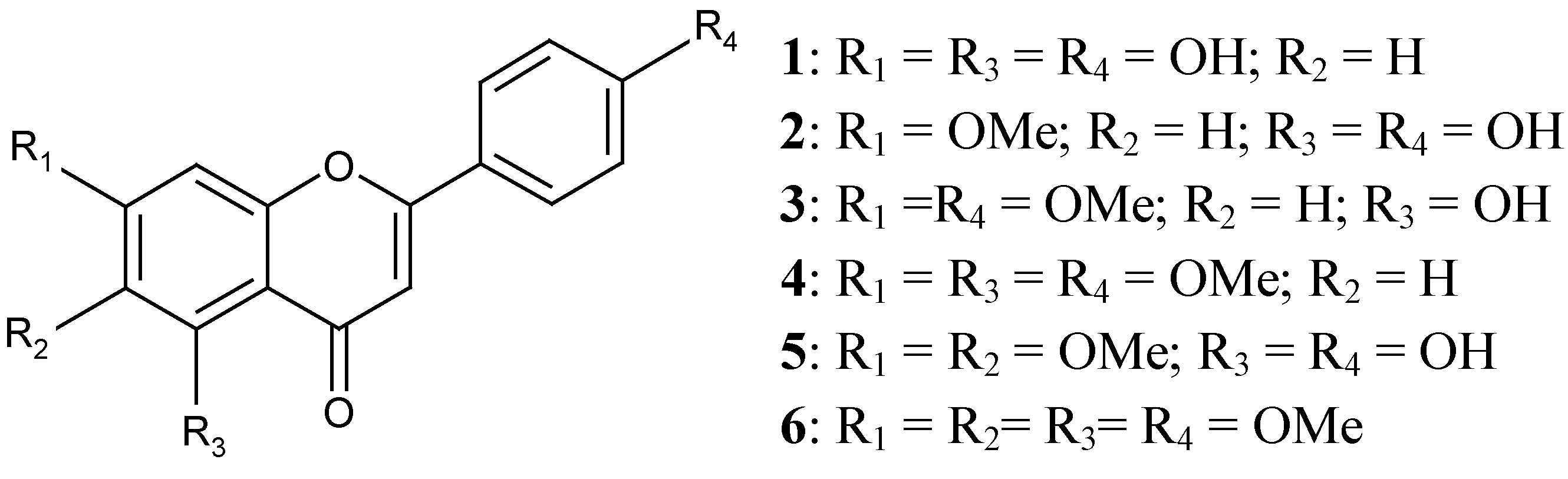
| Flavones | MIC (µg/mL) | ||
|---|---|---|---|
| Norfloxacin | Ethidium bromide | Pefloxacin | |
| None | 128 | 32 | 16 |
| 1 | 128 | 32 | 16 |
| 2 | 64 (2×) a | 16 (2×) | 16 |
| 3 | 64 (2×) | 16 (2×) | 16 |
| 4 | 16 (8×) | 8 (4×) | 16 |
| 5 | 32 (4×) | 8 (4×) | 16 |
| 6 | 8 (16×) | 2 (16×) | 16 |
3. Experimental
3.1. General
3.2. Plant Material
3.3. Extraction and Isolation
3.4. Bacterial Strains
3.5. Antibiotics and Chemicals
3.6. Drug Susceptibility Testing and Modulation Assay
3.7. Log P Estimation
4. Conclusions
Acknowledgements
References
- Zomlefer, W.B. Guide to Flowering Plant Families; University of North Carolina Press: Chapel Hill, NC, USA, 1994; p. 430. [Google Scholar]
- Maas, M.; Petereit, F.; Hensel, A. Caffeic acid derivatives from Eupatorium perfoliatum L. Molecules 2009, 14, 36–45. [Google Scholar]
- Bigovic, D.; Brankovic, S.; Kitic, D.; Radenkovic, M.; Jankovic, T.; Savikin, K.; Zivanovic, S. Relaxant effect of the ethanol extract of Helichrysum plicatum (Asteraceae) on isolated rat ileum contractions. Molecules 2010, 15, 3391–3401. [Google Scholar] [CrossRef]
- Ozgen, U.; Sevindik, H.; Kazaz, C.; Yigit, D.; Kandemir, A.; Secen, H.; Calis, I. A new sulfated α-ionone glycoside from Sonchus erzincanicus Matthews. Molecules 2010, 15, 2593–2599. [Google Scholar] [CrossRef]
- Brown, G.D. The biosynthesis of artemisinin (Qinghaosu) and the phytochemistry of Artemisia annua L. (Qinghao). Molecules 2010, 15, 7603–7698. [Google Scholar] [CrossRef]
- Gasparetto, J.C.; Campos, F.R.; Budel, J.M.; Pontarolo, R. Mikania glomerata Spreng. and M. laevigata Sch. Bip. ex Baker, Asteraceae: Agronomic, genetic, anatomical, chemical, pharmacological, toxicological studies and its use in herbal therapy programs in Brazil. Rev. Bras. Farmacogn. 2010, 20, 627–640. [Google Scholar] [CrossRef]
- Khan, A.L.; Hussain, J.; Hamayun, M.; Gilani, S.A.; Ahmad, S.; Rehman, G.; Kim, Y.H.; Kang, S.M.; Lee, I.J. Secondary metabolites from Inula britannica L. and their biological activities. Molecules 2010, 15, 1562–1577. [Google Scholar] [CrossRef]
- Lima Silva, F.; Fischer, D.C.H.; Tavares, J.F.; Silva, M.S.; Athayde-Filho, P.F.; Barbosa-Filho, J.M. Compilation of secondary metabolites from Bidens pilosa L. Molecules 2011, 16, 1070–1102. [Google Scholar] [CrossRef]
- Sánchez-Mendoza, M.E.; Reyes-Ramírez, A.; Cruz-Antonio, L.; Martinez-Jiménez, L.; Rodríguez-Silverio, J.; Arrieta, J. Bioassay-guided isolation of an anti-ulcer compound, tagitinin C, from Tithonia diversifolia: Role of nitric oxide, prostaglandins and sulfhydryls. Molecules 2011, 16, 665–674. [Google Scholar]
- De Souza Falcão, H.; Leite, J.A.; Barbosa-Filho, J.M.; Athayde-Filho, P.F.; de Oliveira Chaves, M.C.; Moura, M.D.; Ferreira, A.L.; de Almeida, A.B.A.; Souza-Brito, A.R.M.; de Fátima Foemiga Melo Diniz Diniz, M.; Batista, L.M. Gastric and duodenal antiulcer activity of alkaloids: A review. Molecules 2008, 13, 3198–3223. [Google Scholar]
- Oladipupo, L.A.; Adebola, O.O. Chemical composition of the essential oils of the flowers, leaves and stems of two Senecio polyanthemoides Sch. Bip. samples from South Africa. Molecules 2009, 14, 2077–2086. [Google Scholar] [CrossRef]
- Kurdelas, R.R.; Lima, B.; Tapia, A.; Egly Feresin, G.; Gonzalez Sierra, M.; Rodríguez, M.V.; Zacchino, S.; Enriz, R.D.; Freile, M.L. Antifungal activity of extracts and prenylated coumarins isolated from Baccharis darwinii Hook & Arn. (Asteraceae). Molecules 2010, 15, 4898–4907. [Google Scholar] [CrossRef]
- Chaturvedula, V.S.P.; Prakash, I. A new diterpene glycoside from Stevia rebaudiana. Molecules 2010, 16, 2937–2943. [Google Scholar] [CrossRef]
- Hsu, T.W.; Peng, C.I.; Wang, C.M. Austroeupatorium inulifolium (Kunth) King & Robinson (Asteraceae), a Nwely Naturalized Plant in Taiwan. Taiwania 2006, 51, 41–46. [Google Scholar]
- Ortiz, J.V.C. Resposta de dipterous endofagos de capítulos de Praxelis clematidea (Grisebach) King & Robinson (Eupatorieae-Asteraceae) a concentração de recurso e ao isolamento entre plantas. Dissertação de Mestrado. Programa de Pós-Graduação em Ecologia.; Universidade Estadual de Campinas, Instituto de Biologia: Campinas, São Paulo, Brazil, 1997. [Google Scholar]
- Bohlmann, F.; Wegner, P.; Jakupovic, J.; King, R.M. Structure and synthesis of the methyl ester of N-(acetoxy) jasmonoylphenylalanine from Praxelis clematidea. Tetrahedron 1984, 40, 2537–2540. [Google Scholar] [CrossRef]
- Wang, Z.H.; Christie, P.; Chen, Q.B.; Liu, X.X.; Xie, L.L.; Bai, C.J.; Li, X.L. Allelopathic potential and chemical constituents of volatile oil from Praxelis clematidea. Allelopathy J. 2006, 18, 225–235. [Google Scholar]
- Falcão, H.S. Avaliação da atividade antiulcerogênica do extrato etanólico bruto e fase clorofórmica obtidos das partes aéreas de Praxelis clematidea (Griseb.) R. M. King & H. Robinson em modelos animais; Masters Dissertation, Federal University of Paraíba: João Pessoa, Paraíba, Brazil, 2007. [Google Scholar]
- Emerenciano, V.P.; Militão, J.S.L.T.; Campos, C.C.; Romoff, P.; Kaplan, M.A.C.; Zambon, M.; Brant, A.J.C. Flavonoids as chemotaxonomic markers for Asteraceae. Biochem. Syst. Ecol. 2001, 29, 947–957. [Google Scholar] [CrossRef]
- Cushnie, T.P.T.; Lamb, A.J. Antimicrobial activity of flavonoids. Int. J. Antimicrob. Agents 2005, 26, 343–356. [Google Scholar] [CrossRef]
- Mota, K.S.L.; Dias, G.E.N.; Pinto, M.E.F.; Luiz-Ferreira, A.; Monteiro Souza-Brito, A.R.; Hiruma-Lima, C.A.; Barbosa-Filho, J.M.; Batista, L.M. Flavonoids with gastroprotective activity. Molecules 2009, 14, 979–1012. [Google Scholar] [CrossRef]
- Piddock, L.J.V. Clinically relevant chromosomally encoded multidrug resistance efflux pumps in bacterial. Clin. Microbiol. Rev. 2006, 19, 382–402. [Google Scholar] [CrossRef]
- Demain, A.L.; Sanchez, S. Microbial drug discovery: 80 years of progress. J. Antibiot. 2009, 62, 5–16. [Google Scholar] [CrossRef]
- Kaatz, G.W.; Seo, S.M.; Ruble, C.A. Efflux-mediated fluoroquinolone resistance in Staphylococcus aureus. Antimicrob. Agents Chemother. 1993, 37, 1086–1094. [Google Scholar] [CrossRef]
- Marquez, B.; Neuville, L.; Moreau, N.J.; Genet, J.; dos Santos, A.F.; Caño de Andrade, M.C.; Sant’Ana, A.E.G. Multidrug resistance reversal agent from Jatropha elliptica. Phytochemistry 2005, 66, 1804–1811. [Google Scholar] [CrossRef]
- Gibbons, S. Plants as a source of bacterial resistance modulators and anti-infective agents. Phytochem. Rev. 2005, 4, 63–78. [Google Scholar] [CrossRef]
- Gibbons, S. Phytochemicals for bacterial resistance—Strengths, weaknesses and opportunities. Planta Med. 2008, 74, 594–602. [Google Scholar] [CrossRef]
- Stavri, M.; Piddock, L.J.V.; Gibbons, S. Bacterial efflux pump inhibitors from natural sources. J. Antimicrob. Chemother. 2007, 59, 1247–1260. [Google Scholar] [CrossRef]
- Guz, N.R.; Stermitz, F.R.; Johnson, J.B.; Beeson, T.D.; Willen, S. Flavonolignan and flavone inhibitors of a Staphylococcus aureus multidrug resistance pump: Structure-activity relationships. J. Med. Chem. 2001, 44, 261–268. [Google Scholar] [CrossRef]
- Stermitz, F.R.; Scriven, L.N.; Tegos, G.; Lewis, K. Two flavonols from Artemisa annua which potentiate the activity of berberine and against a norfloxacin resistant strain of Staphylococcus aureus. Planta Med. 2002, 68, 1140–1141. [Google Scholar] [CrossRef]
- Silva, D.A.; Falcão-Silva, V.S.; Gomes, A.Y.S.; Costa, D.A.; Lemos, V.S.; Agra, M.F.; Braz-Filho, R.; Siqueira-Júnior, J.P.; Sousa, M.F.W. Triterpenes and phenolic compounds isolated from the aerial parts of Herissantia tiubae and evaluation of 5,4’,-dihydroxy-3,6,7,8,3’-pentamethoxy-flavone as modulator of bacterial drug resistance. Pharm. Biol. 2009, 47, 279–284. [Google Scholar] [CrossRef]
- Falcão-Silva, V.S.; Silva, D.A.; Souza, M.F.V.; Siqueira-Junior, J.P. Modulation of drug resistance in Staphylococcus aureus by a kaempferol glycoside from Herissantia tiubae (Malvaceae). Phytother. Res. 2009, 23, 1367–1370. [Google Scholar] [CrossRef]
- Almeida, J.R.G.S.; Sobral da Silva, M.; da-Cunha, E.V.L.; de Athayde-Filho, P.F.; Melo Diniz, M.F.F.; da Silva, M.G.; Takemura, O.S.; Barbosa-Filho, J.M. Chemical constituents and analgesic activity of Conocliniopsis prasiifolia. Pharm. Biol. 2006, 44, 76–78. [Google Scholar] [CrossRef]
- Agrawal, P.K. Carbon-13 NMR of Flavonoids; Elsevier: New York, NY, USA, 1989. [Google Scholar]
- Markham, P.; Westhaus, E.; Klyachko, K.; Johnson, M.E.; Neyfakh, A. Multiple novel inhibitors of the NorA multidrug transporter of Staphylococcus aureus. Antimicrob. Agents Chemother. 1999, 43, 2404–2408. [Google Scholar]
- Kaatz, G.W.; Seo, S.M. Inducible NorA-mediated multidrug resistance in Staphylococcus aureus. Antimicrob. Agents Chemother. 1995, 39, 2650–2655. [Google Scholar] [CrossRef]
- Sample Availability: Samples of the compounds are available from the authors.
© 2011 by the authors; licensee MDPI, Basel, Switzerland. This article is an open access article distributed under the terms and conditions of the Creative Commons Attribution license ( http://creativecommons.org/licenses/by/3.0/).
Share and Cite
Maia, G.L.d.A.; Falcão-Silva, V.d.S.; Aquino, P.G.V.; Araújo-Júnior, J.X.d.; Tavares, J.F.; Silva, M.S.d.; Rodrigues, L.C.; Siqueira-Júnior, J.P.d.; Barbosa-Filho, J.M. Flavonoids from Praxelis clematidea R.M. King and Robinson Modulate Bacterial Drug Resistance. Molecules 2011, 16, 4828-4835. https://doi.org/10.3390/molecules16064828
Maia GLdA, Falcão-Silva VdS, Aquino PGV, Araújo-Júnior JXd, Tavares JF, Silva MSd, Rodrigues LC, Siqueira-Júnior JPd, Barbosa-Filho JM. Flavonoids from Praxelis clematidea R.M. King and Robinson Modulate Bacterial Drug Resistance. Molecules. 2011; 16(6):4828-4835. https://doi.org/10.3390/molecules16064828
Chicago/Turabian StyleMaia, Gabriela Lemos de Azevedo, Vivyanne dos Santos Falcão-Silva, Pedro Gregório Vieira Aquino, João Xavier de Araújo-Júnior, Josean Fechine Tavares, Marcelo Sobral da Silva, Luis Cezar Rodrigues, José Pinto de Siqueira-Júnior, and José Maria Barbosa-Filho. 2011. "Flavonoids from Praxelis clematidea R.M. King and Robinson Modulate Bacterial Drug Resistance" Molecules 16, no. 6: 4828-4835. https://doi.org/10.3390/molecules16064828