
Eucalyptus oleosa Essential Oils: Chemical Composition and Antimicrobial and Antioxidant Activities of the Oils from Different Plant Parts (Stems, Leaves, Flowers and Fruits)

Abstract
:Abbreviations
| DPPH | 1,1-diphenyl-2-picrylhydrazyl |
| ABTS | 2,2’-azinobis-3-ethyl-benzothiazoline-6-sulphonate |
| IC50 | half maximal inhibitory concentration |
| GC-FID | Gas Chromatography - Flame Ionization Detector |
| GC-MS | Gas Chromatography - Mass Spectrometry |
| KI | Kovats index |
| R2 | Correlation coefficient |
1. Introduction
2. Results and Discussion
2.1. Chemical composition of the essential oils

| Peak | KI | Compounds | Stems | Adult leaves | Fruits | Immature flowers |
|---|---|---|---|---|---|---|
| 1 | 936 | α-Pinene | 5.2 | 1.7 | 2.6 | 2.2 |
| 2 | 951 | α-Fenchene | 1.9 | 0.0 | ||
| 3 | 954 | Camphene | 0.4 | 3.4 | 0.5 | 0.2 |
| 4 | 976 | Sabinene | 0.2 | 0.6 | ||
| 5 | 1025 | p-Cymene | 6.8 | 10.6 | 9.0 | 9.2 |
| 6 | 1028 | Limonene | 4.2 | 1.5 | 0.7 | 1.6 |
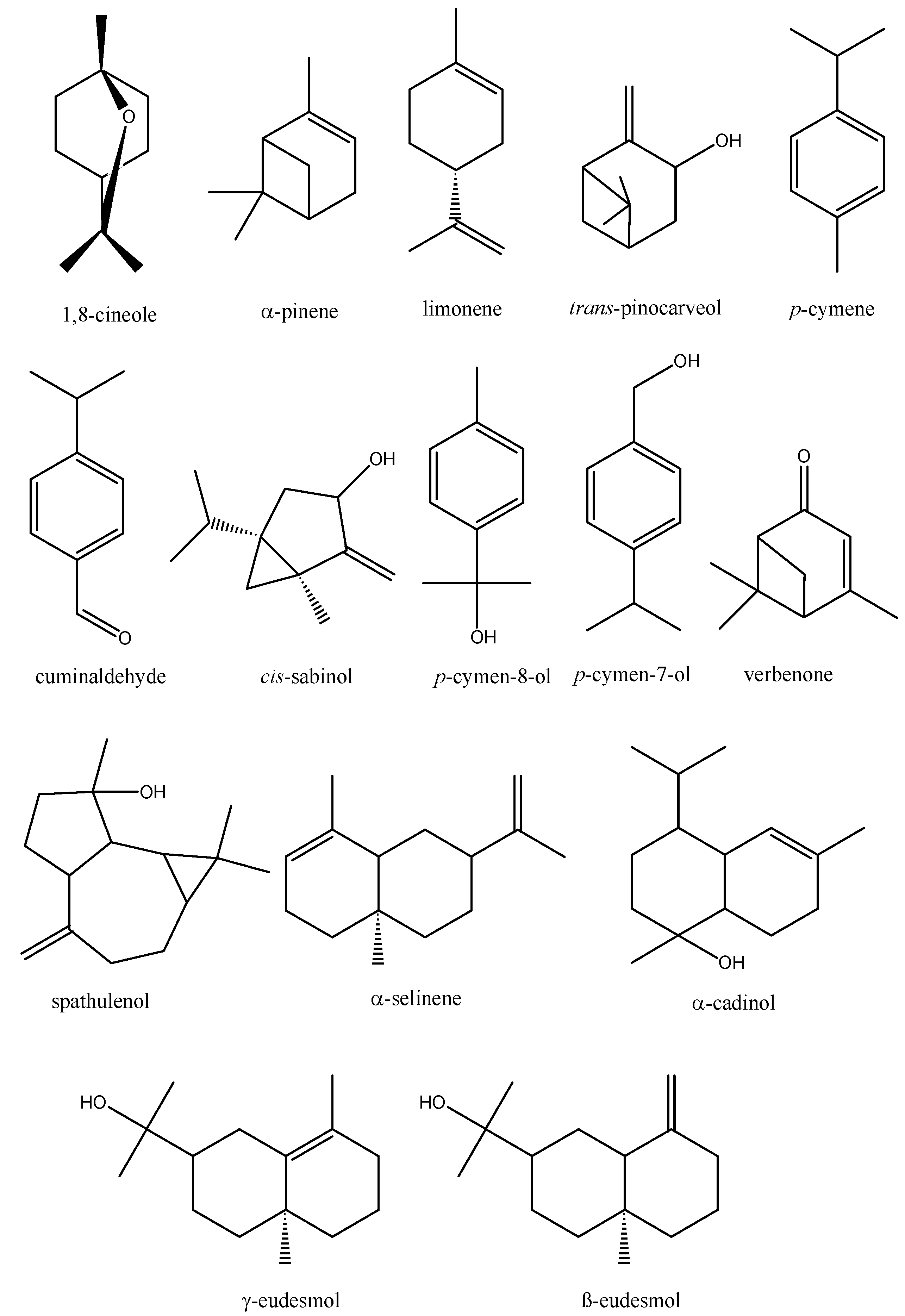
| 7 | 1030 | 1,8-Cineole | 31.5 | 8.7 | 29.1 | 47.0 |
| 8 | 1033 | β-Phellandrene | 0.2 | 0.1 | ||
| 9 | 1057 | γ-Terpinene | 0.4 | 0.7 | 0.4 | 0.5 |
| 10 | 1086 | α-Terpinolene | 0.3 | 0.2 | 0.1 | 0.2 |
| 11 | 1091 | Methyl benzoate | 0.3 | |||
| 12 | 1108 | endo-Fenchol | 0.1 | 0.2 | ||
| 13 | 1137 | 4-Acetyl-1-methylcyclohexene | 1.1 | 0.6 | 0.4 | |
| 14 | 1138 | trans-2-Caren-4-ol* | 0.7 | 0.2 | 0.2 | |
| 15 | 1140 | cis-Sabinol | 3.1 | 4.2 | 2.5 | 1.0 |
| 16 | 1141 | trans-Pinocarveol | 9.9 | 0.1 | 0.1 | |
| 17 | 1166 | Borneol | 0.9 | 0.5 | 0.3 | 1.1 |
| 18 | 1168 | Pinocarvone | 3.5 | 1.8 | 1.0 | 0.3 |
| 19 | 1185 | p-Cymen-8-ol | 1.9 | 4.4 | 1.2 | 1.4 |
| 20 | 1195 | Myrtenal | 0.3 | 1.0 | 0.3 | 0.2 |
| 21 | 1202 | Myrtenol | 0.5 | 0.7 | 0.3 | 0.2 |
| 22 | 1208 | Verbenone | 2.1 | 3.7 | 1.4 | 0.8 |
| 23 | 1231 | cis-Carveol | 0.1 | 0.1 | ||
| 24 | 1235 | Neral | 0.1 | 0.1 | ||
| 25 | 1237 | Pulegone | 0.3 | 0.2 | 0.1 | 0.3 |
| 26 | 1237 | Cuminaldehyde | 2.2 | 3.1 | 0.9 | 1.2 |
| 27 | 1280 | Piperitone | 0.4 | 0.3 | 0.1 | |
| 28 | 1286 | Bornyl acetate | 1.1 | 0.0 | ||
| 29 | 1288 | p-Cymen-7-ol | 1.1 | 4.0 | 0.8 | 0.8 |
| 30 | 1302 | Carvacrol | 1.6 | 0.4 | 0.4 | |
| 31 | 1320 | Methyl geranate | 0.6 | 0.1 | 0.2 | |
| 32 | 1340 | Methyl 2-methoxybenzoate* | 0.1 | |||
| 33 | 1354 | exo-2-Hydroxycineole acetate* | 0.3 | 0.1 | 0.2 | |
| 34 | 1373 | Isoledene* | 0.3 | 0.1 | ||
| 35 | 1380 | α-Copaene* | 0.2 | 0.1 | ||
| 36 | 1388 | β-Bourbonene | 0.4 | 1.7 | 0.4 | |
| 37 | 1404 | Methyl eugenol | 0.3 | 0.0 | ||
| 38 | 1407 | α-Gurjunene | 0.2 | 0.5 | ||
| 39 | 1456 | γ-Selinene | 0.4 | 0.5 | 0.3 | |
| 40 | 1480 | γ-Muurolene | 0.6 | 0.3 | ||
| 41 | 1487 | β-Selinene | 1.3 | 1.1 | ||
| 42 | 1493 | Viridiflorene | 0.3 | 0.6 | ||
| 43 | 1516 | α-Selinene | 0.5 | 10.0 | 2.1 | |
| 44 | 1526 | δ-Cadinene | 0.8 | 1.2 | 1.4 | |
| 45 | 1527 | Calamenene | 0.4 | 0.3 | 0.5 | 0.4 |
| 46 | 1565 | Ledol | 1.0 | 1.2 | 1.0 | |
| 47 | 1576 | Spathulenol | 3.5 | 16.1 | 3.4 | 0.0 |
| 48 | 1578 | Globulol | 0.4 | 0.7 | 0.9 | 0.7 |
| 49 | 1580 | β-Caryophyllene oxide | 0.5 | 1.1 | 0.7 | 0.8 |
| 50 | 1590 | Viridiflorol | 0.6 | 1.1 | 2.3 | 1.4 |
| 51 | 1596 | Guaiol | 1.6 | 2.8 | 0.0 | |
| 52 | 1620 | (+)-Spathulenol | 0.6 | 0.2 | ||
| 53 | 1648 | γ-Eudesmol | 5.6 | 15.0 | 16.4 | 12.5 |
| 54 | 1650 | α-Cadinol | 1.0 | 2.0 | 3.3 | 2.3 |
| 55 | 1651 | β-Eudesmol | 3.2 | 1.0 | 0.0 | |
| 56 | 1805 | Nootkatone* | 0.3 | 0.5 | 0.5 | 0.3 |
| 57 | nd | Dihydroumbellulone | 0.5 | 0.4 | 0.2 | 0.3 |
| 58 | nd | Methyl ionone* | 0.1 | 0.1 | 0.2 | |
| 59 | nd | 5,7-Dimethyl-1-tetralone* | 0.4 | 0.6 | 0.3 | 0.3 |
| 60 | nd | trans-Longipinocarveol* | 0.4 | 0.0 | ||
| 61 | nd | Platambin* | 0.7 | 0.3 | 0.1 | |
| Total | 98.8 | 99.1 | 99.6 | 99.1 | ||
| Monoterpene hydrocarbons | 12.6 | 7.5 | 4.5 | 5.5 | ||
| Monoterpenes Oxygenated | 52.9 | 21.2 | 35.9 | 51.9 | ||
| Sesquiterpenes hydrocarbons | 1.8 | 1.1 | 16.7 | 7.3 | ||
| Sesquiterpenes Oxygenated | 16.7 | 43.2 | 29.0 | 19.4 | ||
| Others | 14.9 | 24.6 | 13.1 | 14.6 | ||
| Phenolics | 0.0 | 1.6 | 0.4 | 0.4 | ||
| Extraction yields (%) | 0.52 | 0.45 | 1.12 | 0.53 | ||

2.2. Antioxidant activity
| Samples | DPPH assay | ABTS assay |
|---|---|---|
| Stems | > 10000 | 43.5 ± 1.4 |
| Adult leaves | 1536.3 ± 40.5 | 13.0 ± 0.6 |
| Fruits | 441.1 ± 12.7 | 51.0 ± 1.3 |
| Immature flowers | 1270.4 ± 33.4 | 79.3 ± 1.9 |
| vit C | 4.4 ± 0.2 | 1.9 ± 0.1 |
2.3. Antimicrobial activity
| The minimal inhibitory concentration (MIC (mg/mL)) | ||||||||||||
|---|---|---|---|---|---|---|---|---|---|---|---|---|
| Gram-positive bacteria | Gram-negative bacteria | Yeast | Fungi | |||||||||
| Samples | B. subtilis | S. aureus | L. monocytogenes | P. aeruginosa | S. enterica | E. coli | K. pneumoniae | S. cerevisiae | C. albicans | A. ochraceus | M. ramamnianus | F. culmorum |
| Stems | 1.94 | 1.94 | 1.94 | 2.91 | 2.91 | 1.94 | 2.91 | 2.91 | 2.91 | 3.88 | 3.88 | 3.88 |
| Adult leaves | 4.65 | 1.86 | 1.86 | 6.51 | 2.79 | 2.79 | 4.65 | 4.65 | 4.65 | 4.65 | 6.51 | 4.65 |
| Immature flowers | 0.93 | 1.86 | 1.86 | 2.79 | 1.86 | 1.86 | 1.86 | 2.79 | 2.79 | 2.79 | 2.79 | 3.72 |
| Fruits | 4 | 2.4 | 2.4 | 6 | 3.2 | 3.2 | 2.4 | 3.2 | 4 | 6 | 6 | 3.2 |
| Ampicillin | 0.02 | 0.02 | 0.02 | 0.005 | 0.02 | 0.02 | 0.01 | 0.015 | 0.015 | 0.02 | 0.02 | 0.02 |
| Nalidixic acid | 0.02 | 0.02 | 0.02 | 0.013 | 0.02 | 0.02 | 0.013 | 0.008 | 0.02 | 0.02 | 0.02 | 0.02 |
| Nystatin | 0.02 | 0.008 | 0.008 | 0.02 | 0.02 | 0.02 | 0.015 | 0.02 | 0.02 | 0.01 | 0.02 | 0.015 |
3. Experimental
3.1. Plant materials
3.2. Isolation of essential oils
3.3. Chemicals
3.4. Gas chromatography and gas chromatography-mass spectrometry
3.4.1. Gas chromatography
3.4.2. Gas chromatography/mass spectrometry (GC-MS)
3.5. Antioxidant activity
3.5.1. DPPH Radical scavenging assay
3.5.2. ABTS radical-scavenging assay
3.6. Microbial strains
3.7. MIC agar dilution assay
3.8. Statistical analysis
4. Conclusions
Acknowledgements
References
- Wilson, P.G.; O'Brien, M.M.; Gadek, P.A.; Quinn, C.J. Myrtaceae revisited: A reassessment of infrafamilial groups. Am. J. Bot. 2001, 88, 2013–2025. [Google Scholar] [CrossRef]
- Batish, D.R.; Singh, H.P.; Kohli, R.K.; Kaur, S. Eucalyptus essential oil as a natural pesticide. For.Ecol. Manage. 2008, 256, 2166–2174. [Google Scholar]
- Oyedeji, A.O.; Olawore, O.N.; Ekundayo, O.; Koenig, W.A. Volatile leaf oil constituents of three Eucalyptus species from Nigeria. Flav.Fragr. J. 1999, 14, 241–244. [Google Scholar]
- Jae-Seoun Hur, J.S.; Ahn, S.Y.; Koh, Y.J.; Lee, C. Antimicrobial properties of cold-tolerant Eucalyptus species against phytopathogenic fungi and food-borne bacterial pathogens. Plant Pathol.J. 2000, 16, 286–289. [Google Scholar]
- Tsiri, D.; Kretsi, O.; Chinou, I.B.; Spyropoulos, C.G. Composition of fruit volatiles and annual changes in the volatiles of leaves Eucalyptus camaldulensis dehn. growing in Greece. Flavour Fragr. J. 2003, 18, 244–247. [Google Scholar] [CrossRef]
- Sefidkon, F.; Assareh, M.H.; Abravesh, Z.; Barazandeh, M.M. Chemical composition of the essential oils of four cultivated Eucalyptus species in Iran as medicinal plants (E. microtheca, E. spathulata, E. largiflorens and E. torquata). Iran J. Pharm. Res. 2007, 6, 135–140. [Google Scholar]
- Penfold, A.R.; Willis, J.L. The Eucalyptus, Botany, Cultivation, Chemistry, and Utilisation; Leonard Hill (Books) Ltd.: London, UK, 1961; pp. 270–276, Chapter 12. [Google Scholar]
- Giamakis, A.; Kretsi, O.; Chinou, I.; Spyropoulos, C.G. Eucalyptus Camaldulensis: Volatiles from immature flowers and high production of 1.8-cineole and β-pinene by in vitro cultures. Phytochemistry 2001, 58, 351–335. [Google Scholar]
- Barton, A.F.M.; Tjandra, J.; Nicholas, P.G. Chemical evaluation of volatile oils in Eucalyptus species. J. Agr. Food Chem. 1989, 37, 1253–1257. [Google Scholar]
- Ahmad, N.R.; Hanif, M.A.; Rashid, U. Chemical compositional and intra provenance variation for content of essential oil in Eucalyptus crebra. Asian Plant Sci. 2005, 4, 519–523. [Google Scholar] [CrossRef]
- Cimanga, K.; Kambu, K.; Tona, L.; Apers, S.; De Bruyne, T.; Hermans, N.; Totte, J.; Pieters, L.; Vlietinck, A.J. Correlation between chemical composition and antibacterial activity of essential oils of some aromatic medicinal plants growing in the Democratic Republic of Congo. J. Ethnopharmacol. 2002, 79, 213–220. [Google Scholar] [CrossRef]
- Lee, K.-G.; Shibamoto, T. Antioxidant activities of volatile components isolated from Eucalyptus species. J. Sci. Food Agr. 2001, 81, 1573–1597. [Google Scholar] [CrossRef]
- Bignell, C.M.; Dunlop, P.J.; Brophy, J.J.; Jackson, J.F. Volatile leaf oils of some south-Western and southern Australian species of the genus Eucalyptus. Part V. subgenus symphyomyrtus, section bisectaria, series oleosae. Flavour Fragr. J. 1994, 10, 313–317. [Google Scholar]
- Dunlop, P.J.; Bignell, C.M.; Hibbert, D.B.; Brooker, M.I.H. Use of gas chromatograms of the essential oils of the genus Eucalyptus for taxonomic purposes: E. subser. Euglobulares (Blakely). Flavour Fragr. J. 2003, 18, 162–169. [Google Scholar] [CrossRef]
- Elaissi, A.; Medini, H.; Chraief, I.; Marzouk, H.; Bannour, F.; Farhat, F.; Ben Salah, M.; Chemli, R.; Khouja, M.L. Contribution to the qualitative and quantitative study of eleven Eucalyptus species essential oil harvested of Hajeb's Layoun arboreta (Tunisia). Rev. Arid Areas 2007, 1, 173–178. [Google Scholar]
- Naceur Ben-Marzoug, H.; Bouajila, J.; Ennajar, M.; Lebrihi, A.; Mathieu, F.; Couderc, F.; Abderraba, M.; Romdhane, M. Eucalyptus (gracilis, oleosa, salubris and salmonophloia) essential oils: Their chemical composition and antioxidant and antimicrobial activities. J. Med. Food 2010, 13, 1005–1012. [Google Scholar]
- Blois, M.S. Antioxidant determination by use of free radical stable. Nature 1958, 181, 1199–1200. [Google Scholar] [CrossRef]
- Re, R.; Pellegrini, N.; Proteggente, A.; Pannala, A.; Yang, M.; Rice-Evans, C. Antioxidant activity applying an improved ABTS radical cation decolorization assay. Free Radic. Biol. Med. 1999, 26, 1231–1237. [Google Scholar]
- Boussaada, O.; Ammar, S.; Saidana, D.; Chriaa, J.; Chraif, I.; Daami, M.; Helal, A.N.; Mighri, Z. Chemical composition and antimicrobial activity of volatile components from capitula and aerial parts of Rhaponticum acaule DC growing wild in Tunisia. Microbiol. Res. 2008, 163, 87–95. [Google Scholar] [CrossRef]
- Ruberto, G.; Baratta, M.T. Antioxidant activity of selected essential oil components in two lipid model systems. Food Chem. 2000, 69, 167–174. [Google Scholar] [CrossRef]
- Lado, C.; Then, M.; Varga, I.; Szoke, E.; Szentmihalyi, K. Antioxidant property of volatile oils determined by the ferric reducing ability. Z. Naturfor. 2004, 59, 354–358. [Google Scholar]
- Burt, S. Essential oils: Their antibacterial properties and potential applications in Foods-a review. Int. J. Food Microbiol. 2004, 94, 223–253. [Google Scholar] [CrossRef]
- Ennajar, M.; Bouajila, J.; Lebrihi, A.; Mathieu, F.; Abderraba, M.; Raies, A.; Romdhane, M. Chemical composition, antimicrobial and antioxidant activities of essential oils and various extracts of Juniperus phoenicea. L (cupressacees). J. Food Sci. 2009, 74, 364–371. [Google Scholar]
- Nada, B.; Mirjana, S.; Valerija, D. Phytochemical composition and antimicrobial activity of Satureja montana L. and Satureja cuneifolia Ten. essential oils. Acta Bot. Croat. 2005, 64, 313–322. [Google Scholar]
- Tabanca, N.; Demirci, F.; Demirci, B.; Wedge, D.E.; Can Baser, K.H. Composition, enantiomeric distribution, and antimicrobial activity of Tanacetum argenteum subsp. flabellifolium essential oil. J. Pharm. Biomed. Anal. 2007, 45, 714–719. [Google Scholar] [CrossRef]
- Sample Availability: Samples of the compounds are available from the authors.
© 2011 by the authors; licensee MDPI, Basel, Switzerland. This article is an open access article distributed under the terms and conditions of the Creative Commons Attribution license ( http://creativecommons.org/licenses/by/3.0/).
Share and Cite
Marzoug, H.N.B.; Romdhane, M.; Lebrihi, A.; Mathieu, F.; Couderc, F.; Abderraba, M.; Khouja, M.L.; Bouajila, J. Eucalyptus oleosa Essential Oils: Chemical Composition and Antimicrobial and Antioxidant Activities of the Oils from Different Plant Parts (Stems, Leaves, Flowers and Fruits). Molecules 2011, 16, 1695-1709. https://doi.org/10.3390/molecules16021695
Marzoug HNB, Romdhane M, Lebrihi A, Mathieu F, Couderc F, Abderraba M, Khouja ML, Bouajila J. Eucalyptus oleosa Essential Oils: Chemical Composition and Antimicrobial and Antioxidant Activities of the Oils from Different Plant Parts (Stems, Leaves, Flowers and Fruits). Molecules. 2011; 16(2):1695-1709. https://doi.org/10.3390/molecules16021695
Chicago/Turabian StyleMarzoug, Hajer Naceur Ben, Mehrez Romdhane, Ahmed Lebrihi, Florence Mathieu, François Couderc, Manef Abderraba, Mohamed Larbi Khouja, and Jalloul Bouajila. 2011. "Eucalyptus oleosa Essential Oils: Chemical Composition and Antimicrobial and Antioxidant Activities of the Oils from Different Plant Parts (Stems, Leaves, Flowers and Fruits)" Molecules 16, no. 2: 1695-1709. https://doi.org/10.3390/molecules16021695
APA StyleMarzoug, H. N. B., Romdhane, M., Lebrihi, A., Mathieu, F., Couderc, F., Abderraba, M., Khouja, M. L., & Bouajila, J. (2011). Eucalyptus oleosa Essential Oils: Chemical Composition and Antimicrobial and Antioxidant Activities of the Oils from Different Plant Parts (Stems, Leaves, Flowers and Fruits). Molecules, 16(2), 1695-1709. https://doi.org/10.3390/molecules16021695