
- Review

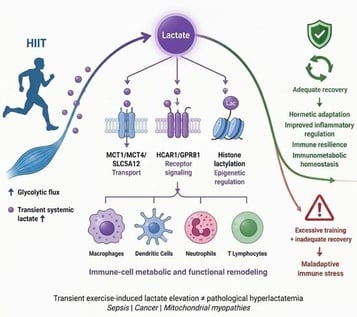
High-intensity interval training (HIIT) is widely recognized as an effective strategy for improving cardiorespiratory fitness and metabolic health. Beyond these physiological benefits, growing evidence indicates that HIIT may also induce beneficial immunometabolic adaptations. A key exercise-responsive metabolite in this context is lactate, which is increasingly being recognized not as a metabolic waste product but as a bioactive signaling metabolite capable of coordinating metabolic, inflammatory, and immune processes. This narrative review examines current evidence suggesting a potential role for exercise-induced lactate in immune responses associated with HIIT. We summarize the molecular pathways through which lactate may interact with immune cells, including uptake via monocarboxylate transporters (MCT1/MCT4) and SLC5A12, receptor-dependent signaling through GPR81/HCAR1, and epigenetic regulation via histone lactylation. We further discuss the cell-specific effects of lactate on macrophages, dendritic cells, neutrophils, and T lymphocytes, highlighting how these mechanisms may influence immune-cell metabolism, inflammatory regulation, and functional remodeling. A central concept emerging from the current literature is that the biological actions of lactate are highly dependent on the kinetics, duration, and physiological context of exposure. Unlike pathological lactate elevations observed in conditions such as cancer, sepsis, or mitochondrial myopathies—the latter potentially involving an exaggerated lactate response during exercise due to impaired oxidative metabolism—HIIT generates transient systemic lactate elevations as part of a coordinated neuroendocrine and metabolic response. When combined with adequate recovery, these repeated metabolic perturbations may promote hormetic adaptations characterized by improved inflammatory regulation, enhanced immune resilience, and more efficient immunometabolic homeostasis. Conversely, excessive training loads or inadequate recovery may shift these responses toward maladaptive immune stress. Overall, current evidence suggests a paradigm shift in exercise immunology in which lactate should be regarded as one component of an integrated immunometabolic signaling network rather than simply as a marker of anaerobic metabolism. Future mechanistic studies integrating lactate kinetics, immune-cell phenotyping, transporter expression, and lactate-dependent post-translational modifications are needed to clarify the extent to which lactate may contribute to exercise-induced immune remodeling and to guide the development of immunologically informed HIIT protocols.
Muscles
3 September 2026