

Skip to Content

Membranes

Membranes is an international, peer-reviewed, open access journal covering the broad aspects of the science and technology of both biological and non-biological membranes, published monthly online by MDPI. The Membrane Society of Australasia (MSA) and Polish Membrane Society (PTMem) are affiliated with Membranes and their members receive discounts on the article processing charges. 

Get Alerted

Add your email address to receive forthcoming issues of this journal.

All Articles (5,226)

Cells exhibit a membrane potential due to the differential distribution of ions and the density of channels, pumps, and exchangers. It is known in larval Drosophila that the membrane potential gravitates towards the equilibrium potential of K+ due to the high density of K2P channels. Higher extracellular Ca2+ ([Ca2+]o) tends to drive the resting membrane potential to a more negative state, while lowering it has an opposite effect. The expression of the K2P channel and NALCN was altered genetically to determine the sensitivity to changes in [Ca2+]o, and computational simulations using the theoretical Goldman-Hodgkin-Katz equation allowed estimating changes in ion (Na+) permeability due to altered function of the NALCN. Increasing [Ca2+]o hyperpolarized the membrane potential, and decreasing [Ca2+]o depolarized it, likely because Ca2+ ions block NALCN. An accessory protein to NALCN and NALCN itself were targeted by RNAi. Overexpression of K2P channels and decreased NALCN function reduced the effect of altered [Ca2+]o on membrane potential. Given the limited understanding of how altered membrane potentials affect cells, this study provides a foundation for future investigations into how cells respond to variations in [Ca2+]o under altered K2P and NALCN expression.

Membranes

11 September 2026

The effect on membrane potential for the parental strain UAS-ORK1-NC with serial changes in [Ca2+]o. (A) Membrane potential for six individual preparations bathed in 1 mM [Ca2+]o, then switched to 0 mM and back to 1 mM, followed by 5 mM and back to 1 mM, with intracellular electrode recording. Each line represents an individual preparation. (B) The average (±SEM) of the percent change in the membrane from the initial values bathed in 1 mM [Ca2+]o to each condition in the series of bath changes in [Ca2+]o. Note that, even when replaced with the bathing medium back to 1 mM [Ca2+]o, the preparations still showed a depolarization.
Despite the robust mechanical and chemical stability that make hollow flat-sheet ceramic membranes highly attractive for membrane bioreactors (MBRs), the fundamental relationship between their structural design, specifically pore size and structural symmetry, and biological fouling behavior remains elusive. To decouple the effects of membrane architecture on fouling mechanisms, a series of symmetric and asymmetric hollow flat-sheet alumina membranes were systematically engineered. Symmetric architectures with tunable pore sizes were fabricated by controlling aggregate particle sizes, whereas asymmetric counterparts featuring distinct separation layer thicknesses were developed via a tailored dip-coating process. Long-term operational evaluations treating municipal wastewater uncovered a counterintuitive phenomenon. Asymmetric membranes, despite yielding superior retention, experienced markedly accelerated transmembrane pressure evolution and severe cake layer fouling compared to the symmetric supports. Resistance-in-series analysis coupled with classical filtration models demonstrated that thicker separation layers and larger pore sizes were associated with shifts in the dominant fouling mechanism toward rapid and dense cake layer formation, which significantly exacerbated irreversible biological fouling. Furthermore, advanced spectroscopic and high-throughput sequencing techniques revealed that structurally complex asymmetric layers were associated with shifts in extracellular polymeric substances and specific fouling-associated bacterial phyla at the membrane interface. Ultimately, these findings underscore the necessity of architectural optimization to mitigate biofouling and prolong the operational lifespan of ceramic membranes, highlighting the sustainable advantages of symmetric structures.

Membranes

10 September 2026

(a) Schematic Diagram of the Hollow Flat Ceramic Membrane Production Process. (b) Schematic Diagram of Ceramic MBR.

Efficient interfacial water dissociation is essential for reducing the operating voltage of bipolar membranes (BPMs), whereas aggregation and nonuniform distribution of nanoscale catalysts can limit active-site utilization. In this study, polydopamine-modified halloysite nanotubes (PDA@HNTs) were used as a support for β-FeOOH loading to construct a composite catalytic interlayer for BPMs. XRD, FTIR, XPS, SEM, TEM, EDS mapping, contact-angle measurements, electrochemical tests, and bipolar membrane electrodialysis were used to evaluate the interlayer structure and membrane performance. At 50 mA cm−2, the β-FeOOH-PDA@HNTs-BPM exhibited a transmembrane voltage of 0.94 V, compared with 2.15 V for the blank BPM, while the interfacial water-dissociation resistance decreased from 3.873 to 0.980 Ω. After 48 h of continuous operation, the voltage increased only from 0.94 to 0.98 V. In electrodialysis, the membrane achieved a current efficiency of 81.4% and an energy consumption of 3.3 kWh kg−1 after 180 min. PDA-functionalized HNTs promote the dispersion and interfacial association of β-FeOOH, improve interfacial wettability and catalytic-site accessibility, and thereby enhance water dissociation and acid/base production in BPMs.

Membranes

10 September 2026

Schematic fabrication procedure of β-FeOOH-PDA@HNTs-BPM.

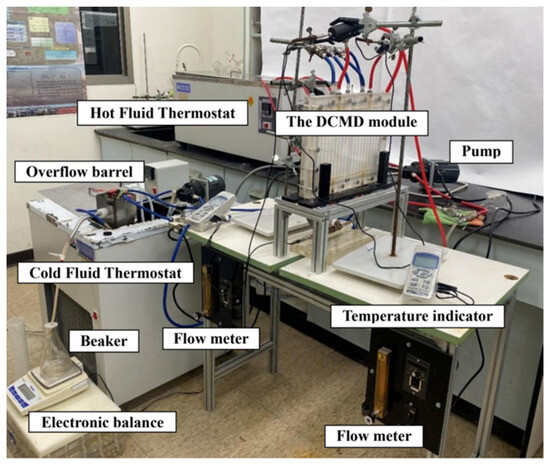
Membrane distillation, a separation technology, has drawn wide attention in industries such as seawater desalination and high-salinity wastewater treatment. However, conventional steady-flow operation suffers from flux decline and membrane fouling, while standard square-wave and sine-wave pulsations provide limited enhancement and stability. To address these issues, this study introduces heartbeat-mimicking pulsatile flow. Its effects on membrane distillation performance were evaluated through comparative (steady vs. pulsatile) experiments, a three-level orthogonal experiment, and tests with various feed solutions and modified membranes. Results show that, under baseline conditions, the heartbeat-mimicking pulsatile flow yielded a 17.5% higher average flux than steady flow, while its conductivity increase was only 25%, far below the 93% for steady flow. In the orthogonal experiment, the heartbeat-mimicking waveform accounted for the largest proportion of total variance (50.1%) among the tested parameters. Furthermore, compared to traditional sine or square waves, this biomimetic pulsation features unique acceleration-rest characteristics, making it highly applicable to complex feed solutions and effectively mitigating membrane fouling. This study aims to identify a new pulsation mode that can overcome the limitations of steady-flow membrane distillation.

Membranes

9 September 2026

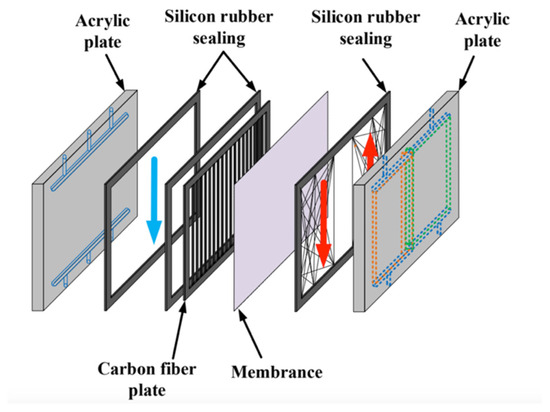
Schematic of the membrane distillation process: (a) macroscopic physical structure; (b) magnified microscopic interface of (a); (c) corresponding spatial driving force (temperature/pressure) gradients; (d) breakdown of mass transfer steps based on the interface in (b).

Highly Accessed Articles

News & Conferences

Latest Issues

Open for Submission

Journal Sections

XFacebookLinkedIn
Membranes - ISSN 2077-0375