
 Open Access
 - Article

17 Pages
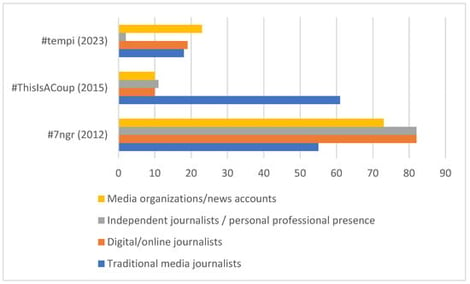
This study examines journalists’ use of Twitter/X during three periods of political and social crisis in Greece between 2012 and 2023. Using a comparative longitudinal design, it analyses three crisis-related discussions associated with the hashtags #7ngr (2012 Greek elections), #ThisIsACoup (2015 bailout crisis), and #tempi (2023 Tempi train disaster), with the aim of exploring differences in journalistic presence and communication practices across distinct stages in the development of the platform. For each case, an analytical sample of 1000 posts was examined over a defined event-related period, and posts originating from identifiable journalistic accounts were retained for further analysis. Quantitative content analysis was used to classify both the types of journalistic accounts represented and their communication practices. The findings reveal distinct configurations across the three cases rather than a uniform or linear pattern of change. Information dissemination was the dominant journalistic practice in the 2012 sample, while opinion and commentary were more prominent in 2015. In the 2023 Tempi case, information dissemination remained important, but civic engagement accounted for a notable share of journalistic posts, indicating that journalists participated in the broader public discussion surrounding the event beyond a strictly informational role. The composition of journalistic accounts also varied across the three cases, demonstrating the coexistence of traditional media journalists, digital journalists, individual professional accounts, and news organizations within the platform environment. Overall, the study shows that journalists’ use of Twitter/X during crises is characterized by a changing balance among informational, interpretive, opinion-based, and participatory practices, which varies across different event contexts and stages of the platform’s development.
Journal. Media
1 October 2026