
You are currently viewing a new version of our website. To view the old version click .

Crystals

Crystals is an international, peer-reviewed, open access journal on crystallography published monthly online by MDPI. 
The Professional Committee of Key Materials and Technology for Electronic Components (PC-KMTEC) is affiliated with Crystals and its members receive discounts on the article processing charges.
Quartile Ranking JCR - Q2 (Crystallography)

All Articles (10,471)

  • Correction
  • Open Access

In the original publication [...]

8 January 2026
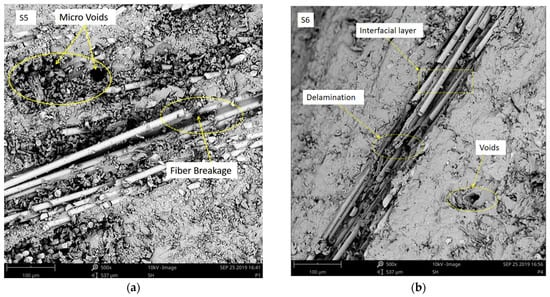
SEM image of (a) S5 and (b) S6 laminate after fracture.

Two-dimensional (2D) powders constitute an important class of molecular thin films where a specific close-packed plane forms parallel to the substrate surface, while there is no preferred lateral ordering. Using results from classic lattice reduction theory, a systematic scheme is proposed in order to determine the 3D surface unit cell for 2D powders in reciprocal space. The approach is based on a sorted set of lengths of the in-plane components of the scattering vector, which is directly obtained from the scattering pattern. After a first match is established, a refinement procedure is presented that makes full use of the complete set of scattering vectors and, as such, corrects for small experimental errors and ensures a good overall match with the observed reflections. After identifying the in-plane components, the full 3D surface unit cell can be found in a straightforward way.

7 January 2026

Unit cells of very different shapes can produce the same 2D lattice. The first four unit cells from left to right are primitive unit cells and the right-most cell is the unit cell of the centered rectangular lattice with two lattice points per unit cell, which best reflects the symmetry of the shown lattice. The task of crystallography is to specify rules for a unique “best” unit cell. This cell is defined by the requirement that two lattice vectors be chosen with the shortest length and an enclosed angle as close to 90° as possible. This would be the cell in the center and these are the cells we will be concerned with in the following. Republished from Ref. [28] courtesy of the National Institute of Standards and Technology.

Blue calcite mineral formations occurring within Paleozoic marbles of Central Anatolia have been investigated in terms of their mineralogical and geochemical characteristics, as well as their potential for use as ornamental stones or decorative objects. XRD analyses of samples with different color tones (white, grayish-blue, and blue) revealed that the white sample contains only calcite, the grayish-blue samples include calcite and dolomite, while the blue sample contains calcite and quartz. XRF and ICP-MS analyses indicate a marked enrichment of trace elements such as Fe, Cr, and Ni in the blue sample, and Mn and Fe in the grayish-blue samples, suggesting these elements may influence the observed color variations. The presence of dolomite in grayish-blue samples and quartz in the blue sample corresponds to elevated MgO and SiO2 contents, respectively. Based on their distinct colors, textures, transparency, and other aesthetic properties, the grayish-blue and blue marbles show significant potential for use as decorative stones or ornamental objects.

6 January 2026

Regional geological map of the study area and its surroundings (adopted from Başıbüyük, 2006) [33].

An attractive cryogenic near-zero thermal expansion (ZTE) behavior was achieved in the Mn3Cu0.5Ge0.5N0.78C0.22 compound, spanning a broad temperature window of 120 K (5 K to 125 K) with an average coefficient of thermal expansion (CTE) of α = 0.68 × 10⁻⁶ K−1. Furthermore, the effect of sintering temperature and holding time on thermal expansion and magnetic properties were investigated. Two distinct magnetic phase transitions are evident in the magnetization–temperature (M-T) curve of Mn3Cu0.5Ge0.5N0.78C0.22, which precede the near-ZTE behavior. These two antiferromagnetic (AFM)-like ordering transitions are hypothesized to play a pivotal role in governing the ZTE behavior, as they induce two episodes of negative thermal expansion (NTE). The realization of ZTE behavior is thus attributed to the counterbalance of these two NTE contributions, which can be effectively tuned by varying the carbon content or optimizing the sintering process parameters. Collectively, these results demonstrate significant potential for the design of diverse cryogenic functional materials.

4 January 2026

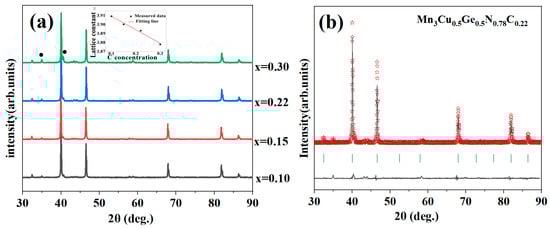
The crystal structure of Mn3Cu0.5Ge0.5N1−xCx (x = 0.1, 0.15, 0.22, and 0.3): (a) Room-temperature X-ray diffraction patterns of Mn3Cu0.5Ge0.5N1−xCx (x = 0.1, 0.15, 0.22 and 0.3), the inset illustrates the lattice constant as a function of C content; (b) Rietveld refinement of Mn3Cu0.5Ge0.5N0.78C0.22 XRD pattern. The red asterisks are the experimental data points, the gray line is the calculated fit, the black line is the difference curve, and the green lines are the Bragg positions.

News & Conferences

Issues

Open for Submission

Editor's Choice

Reprints of Collections

Microstructure and Mechanical Behaviour of Structural Materials
Reprint

Microstructure and Mechanical Behaviour of Structural Materials

Editors: Saif Haider Kayani, Byung-Joo Kim
Advanced Technologies in Graphene-Based Materials
Reprint

Advanced Technologies in Graphene-Based Materials

Editors: Justina Gaidukevic, Jurgis Barkauskas

Get Alerted

Add your email address to receive forthcoming issues of this journal.

XFacebookLinkedIn
Crystals - ISSN 2073-4352