<?xml version="1.0" encoding="UTF-8"?>
<!DOCTYPE article PUBLIC "-//NLM//DTD Journal Publishing DTD v2.3 20070202//EN" "journalpublishing.dtd">
<article xmlns:mml="http://www.w3.org/1998/Math/MathML" xmlns:xlink="http://www.w3.org/1999/xlink" xml:lang="en" article-type="research-article">
  <front>
    <journal-meta>
      <journal-id journal-id-type="publisher-id">biology</journal-id>
      <journal-title>Biology</journal-title>
      <abbrev-journal-title abbrev-type="publisher">Biology</abbrev-journal-title>
      <abbrev-journal-title abbrev-type="pubmed">Biology</abbrev-journal-title>
      <issn pub-type="epub">2079-7737</issn>
      <publisher>
        <publisher-name>MDPI</publisher-name>
      </publisher>
    </journal-meta>
    <article-meta>
      <article-id pub-id-type="doi">10.3390/biology2010142</article-id>
      <article-id pub-id-type="publisher-id">biology-02-00142</article-id>
      <article-categories>
        <subj-group>
          <subject>Article</subject>
        </subj-group>
      </article-categories>
      <title-group>
        <article-title>Thermodynamic Stability of Psychrophilic and Mesophilic Pheromones of the Protozoan Ciliate <italic>Euplotes</italic></article-title>
      </title-group>
      
      <contrib-group>
        <contrib contrib-type="author">
          <name>
            <surname>Geralt</surname>
            <given-names>Michael</given-names>
          </name>
          <xref rid="af1-biology-02-00142" ref-type="aff">1</xref>
        </contrib>
        <contrib contrib-type="author">
          <name>
            <surname>Alimenti</surname>
            <given-names>Claudio</given-names>
          </name>
          <xref rid="af2-biology-02-00142" ref-type="aff">2</xref>
        </contrib>
        <contrib contrib-type="author">
          <name>
            <surname>Vallesi</surname>
            <given-names>Adriana</given-names>
          </name>
          <xref rid="af2-biology-02-00142" ref-type="aff">2</xref>
        </contrib>
        <contrib contrib-type="author">
          <name>
            <surname>Luporini</surname>
            <given-names>Pierangelo</given-names>
          </name>
          <xref rid="af2-biology-02-00142" ref-type="aff">2</xref>
          <xref rid="c1-biology-02-00142" ref-type="corresp">*</xref>
        </contrib>
        <contrib contrib-type="author">
          <name>
            <surname>Wüthrich</surname>
            <given-names>Kurt</given-names>
          </name>
          <xref rid="af1-biology-02-00142" ref-type="aff">1</xref>
          <xref rid="af3-biology-02-00142" ref-type="aff">3</xref>
          <xref rid="c1-biology-02-00142" ref-type="corresp">*</xref>
        </contrib>
      </contrib-group>
      <aff id="af1-biology-02-00142"><label>1 </label>Department of Molecular Biology, The Scripps Research Institute, La Jolla, CA 92037, USA; E-Mail: <email>mgeralt@scripps.edu</email></aff>
      <aff id="af2-biology-02-00142"><label>2 </label>Department of Environmental and Natural Sciences, University of Camerino, Camerino 62032, Italy; E-Mails: <email>claudio.alimenti@unicam.it</email> (C.A.); <email>adriana.vallesi@unicam.it</email> (A.V.)</aff>
      <aff id="af3-biology-02-00142"><label>3 </label>Skaggs Institute for Chemical Biology, The Scripps Research Institute, La Jolla, CA 92037, USA</aff>
	  <author-notes>
        <corresp id="c1-biology-02-00142"><label>*</label> Authors to whom correspondence should be addressed; E-Mails: <email>piero.luporini@unicam.it</email> (P.L.); <email>wuthrich@mol.biol.ethz.ch</email> (K.W.); Tel.: +39-0737-403229 (P.L.); Fax: +39-0737-403290 (P.L.); Tel.: +1-858-784-8011 (K.W.); Fax: +1-858-784-8014 (K.W.).</corresp>
      </author-notes>
      <pub-date pub-type="epub">
        <day>14</day>
        <month>01</month>
        <year>2013</year>
      </pub-date>
      <pub-date pub-type="collection"> <month>03</month>
        <year>2013</year>
      </pub-date>
      <volume>2</volume>
      <issue>1</issue>
      <fpage>142</fpage>
      <lpage>150</lpage>
      <history>
        <date date-type="received">
          <day>06</day>
          <month>12</month>
          <year>2012</year>
        </date>
        <date date-type="rev-recd">
          <day>27</day>
          <month>12</month>
          <year>2012</year>
        </date>
        <date date-type="accepted">
          <day>31</day>
          <month>12</month>
          <year>2012</year>
        </date>
      </history>
      <permissions>
        <copyright-statement>© 2013 by the authors; licensee MDPI, Basel, Switzerland.</copyright-statement>
        <copyright-year>2013</copyright-year>
        <license xmlns:xlink="http://www.w3.org/1999/xlink" license-type="open-access" xlink:href="http://creativecommons.org/licenses/by/3.0/">
          <p>This article is an open-access article distributed under the terms and conditions of the Creative Commons Attribution license (http://creativecommons.org/licenses/by/3.0/).</p>
        </license>
      </permissions>
      <abstract>
        <p>Three psychrophilic protein pheromones (E<italic>n</italic>-1, E<italic>n</italic>-2 and E<italic>n</italic>-6) from the polar ciliate, <italic>Euplotes nobilii</italic>, and six mesophilic pheromones (E<italic>r</italic>-1, E<italic>r</italic>-2, E<italic>r</italic>-10, E<italic>r</italic>-11, E<italic>r</italic>-22 and E<italic>r</italic>-23) from the temperate-water sister species, <italic>Euplotes raikovi</italic>,were studied in aqueous solution for their thermal unfolding and refolding based on the temperature dependence of their circular dichroism (CD) spectra. The three psychrophilic proteins showed thermal unfolding with mid points in the temperature range 55–70 °C. In contrast, no unfolding was observed for any of the six mesophilic proteins and their regular secondary structures were maintained up to 95 °C. Possible causes of these differences are discussed based on comparisons of the NMR structures of the nine proteins.</p>
      </abstract>
      <kwd-group>
        <kwd>protein denaturation</kwd>
        <kwd>protein stability</kwd>
        <kwd>circular dichroism spectroscopy</kwd>
        <kwd>psychrophilic proteins</kwd>
        <kwd>chemical signals</kwd>
      </kwd-group>
    </article-meta>
  </front>
  <body>
    <sec sec-type="intro">
      <title>1. Introduction</title>
      <p>Protozoan ciliates represent a major micro-eukaryotic component of the polar ecosystem [<xref ref-type="bibr" rid="B1-biology-02-00142">1</xref>,<xref ref-type="bibr" rid="B2-biology-02-00142">2</xref>], which can readily be collected from every aquatic habitat for use in stable laboratory cultures [<xref ref-type="bibr" rid="B3-biology-02-00142">3</xref>]. Strains of <italic>Euplotes</italic> species such as <italic>E. patella</italic>, <italic>E. raikovi</italic>, <italic>E. octocarinatus</italic> and <italic>E. crassus</italic> inhabiting non-polar temperate waters, and of <italic>E. nobilii</italic> inhabiting Arctic and Antarctic waters are capable of secreting cell type-specific signaling proteins genetically specified at a single multi-allelic locus (designated as <italic>mating-type</italic>, or <italic>mat</italic> locus) [<xref ref-type="bibr" rid="B4-biology-02-00142">4</xref>,<xref ref-type="bibr" rid="B5-biology-02-00142">5</xref>]. These water-borne “pheromones” are functionally associated with the genetic mechanism of the mating types and act as prototypic autocrine (autologous) growth factors and as paracrine (heterologous) inducers of mating pair formation [<xref ref-type="bibr" rid="B6-biology-02-00142">6</xref>,<xref ref-type="bibr" rid="B7-biology-02-00142">7</xref>]. In addition to the full-length coding gene sequences [<xref ref-type="bibr" rid="B8-biology-02-00142">8</xref>,<xref ref-type="bibr" rid="B9-biology-02-00142">9</xref>,<xref ref-type="bibr" rid="B10-biology-02-00142">10</xref>], the three-dimensional molecular structures of a significant number of pheromones were determined by NMR spectroscopy in solution, firstly, from the temperate-water species, <italic>E. raikovi</italic> [<xref ref-type="bibr" rid="B11-biology-02-00142">11</xref>,<xref ref-type="bibr" rid="B12-biology-02-00142">12</xref>,<xref ref-type="bibr" rid="B13-biology-02-00142">13</xref>,<xref ref-type="bibr" rid="B14-biology-02-00142">14</xref>,<xref ref-type="bibr" rid="B15-biology-02-00142">15</xref>,<xref ref-type="bibr" rid="B16-biology-02-00142">16</xref>,<xref ref-type="bibr" rid="B17-biology-02-00142">17</xref>], and subsequently from the polar-water species, <italic>E. nobilii</italic> [<xref ref-type="bibr" rid="B18-biology-02-00142">18</xref>,<xref ref-type="bibr" rid="B19-biology-02-00142">19</xref>,<xref ref-type="bibr" rid="B20-biology-02-00142">20</xref>]. These mesophilic (<italic>E. raikovi</italic>) and psychrophilic (<italic>E. nobilii</italic>) pheromone families, both characterized by small, helical and disulfide-rich proteins of 37 to 63 amino acids, thus represent an interesting source of material for structure based comparative studies of protein adaptation to cold.</p>
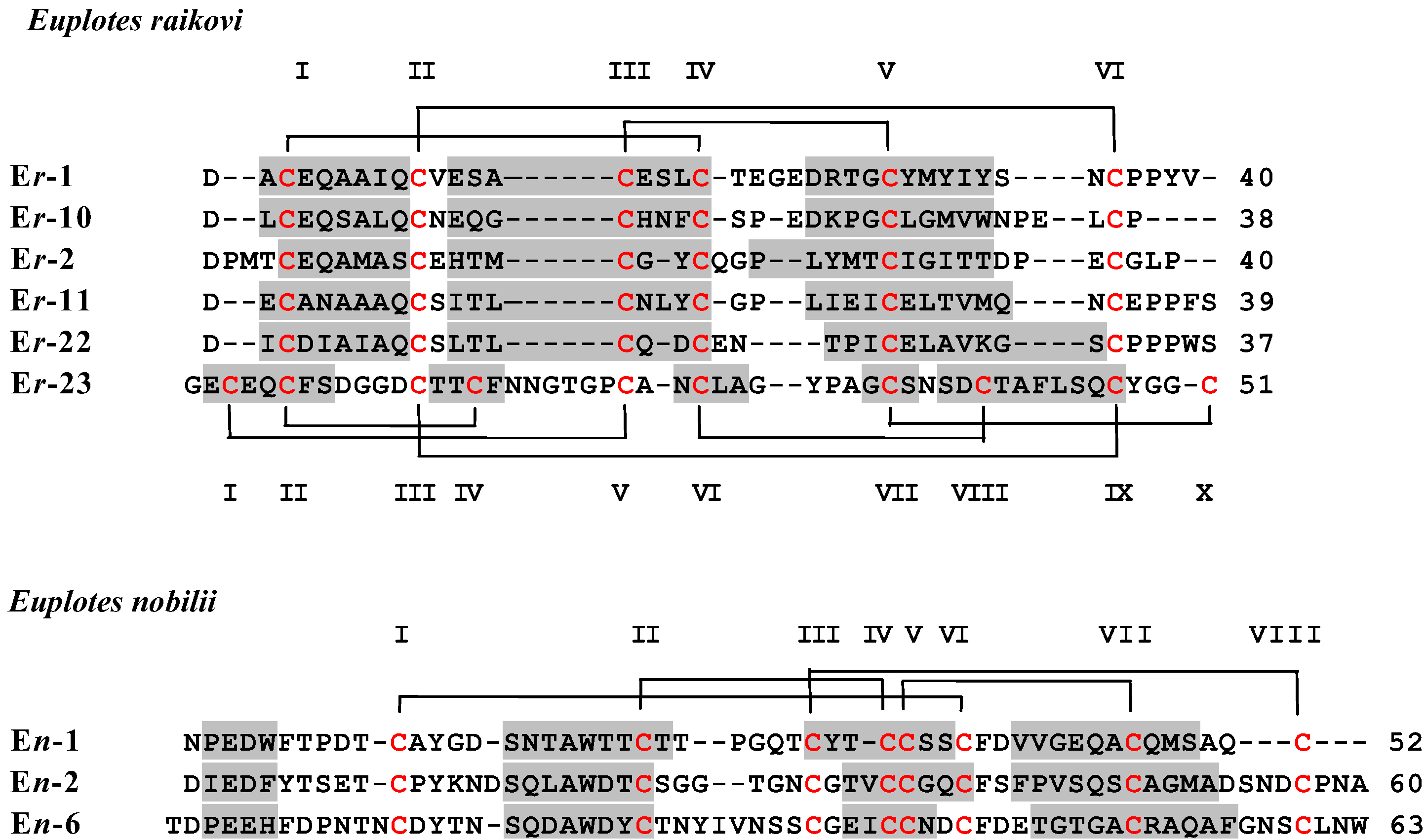
      <p>Here we present data on the thermal denaturation of the three pheromones E<italic>n</italic>-1, E<italic>n</italic>-2 and E<italic>n</italic>-6 from the psychrophilic pheromone family of <italic>E. nobilii</italic>, and the six pheromones E<italic>r</italic>-1, E<italic>r</italic>-2, E<italic>r</italic>-10, E<italic>r</italic>-11, E<italic>r</italic>-22 and E<italic>r</italic>-23 from the mesophilic pheromone family of <italic>E. raikovi</italic> (<xref ref-type="fig" rid="biology-02-00142-f001">Figure 1</xref>)<italic>.</italic> Considering that NMR solution structures are available for all the nine proteins, and for one (<italic>i.e.</italic>, E<italic>r</italic>-1) is available also the crystallographic structure [<xref ref-type="bibr" rid="B21-biology-02-00142">21</xref>], we expect that these data will be of interest for in-depth studies of correlations between molecular protein structure, thermodynamic stability, and cold adaptation.</p>
      <fig id="biology-02-00142-f001" position="float">
        <label>Figure 1</label>
        <caption>
          <p>Amino acid sequences of <italic>E. nobilii</italic> and <italic>E. raikovi</italic> pheromones. The sequence alignment was maximized by insertion of gaps. Cysteines are marked in red and by progressive Roman numerals, and their pairing into disulfide bonds is indicated by brackets. The sequence regions involved in the formation of helical structures are shadowed. The PDB codes of the pheromone NMR and crystal (E<italic>r</italic>-1) structures are the following: E<italic>r</italic>-1, 1ERC, 1ERl; E<italic>r</italic>-2, 1ERD; E<italic>r</italic>-10, 1ERP; E<italic>r</italic>-11, 1ERY; E<italic>r</italic>-22, 1HD6; E<italic>r</italic>-23, 1HA8; E<italic>n</italic>-1, 2NSV; E<italic>n</italic>-2, 2NSW; E<italic>n</italic>-6, 2JMS.</p>
        </caption>
        <graphic xmlns:xlink="http://www.w3.org/1999/xlink" xlink:href="biology-02-00142-g001.tif"/>
      </fig>
    </sec>
    <sec>
      <title>2. Materials and Methods</title>
      <p>The isolation and purification of the nine proteins investigated in this paper has previously been described [<xref ref-type="bibr" rid="B22-biology-02-00142">22</xref>,<xref ref-type="bibr" rid="B23-biology-02-00142">23</xref>,<xref ref-type="bibr" rid="B24-biology-02-00142">24</xref>,<xref ref-type="bibr" rid="B25-biology-02-00142">25</xref>]. Lyophilized samples of each pheromone were dissolved in 20 mM sodium phosphate buffer at pH 6.0 and diluted to a protein concentration of 20 µM before aliquoting into a 0.1 cm path length quartz cuvette. CD experiments were recorded using the Temperature/Wavelength Scan software supplied with the Jasco 815 CD spectrophotometer. Melting curves over the range 20–95 °C were measured at a constant wavelength of 220 nm by increasing the temperature at a rate of 1.0 or 0.5 °C/min. Wavelength scans from 260–190 nm were measured at 5 °C intervals.</p>
      <p>In additional exploratory studies, the chemical denaturants guanidine-HCl and urea were added to solutions of the mesophilic pheromones E<italic>r</italic>-1, E<italic>r</italic>-10, E<italic>r</italic>-22 and E<italic>r-</italic>23 to further test their stabilities. In particular melting curves were recorded for E<italic>r</italic>-1 in 7.8 M urea and 20 mM sodium phosphate at pH 6.0, 6 M guanidine-HCl and 20 mM sodium phosphate at pH 6.0, 4 M guanidine-HCl and 20 mM sodium phosphate at pH 6.0, 4.5 and 3.0, and 6 M urea at pH 3.0. Similar analyses on E<italic>r</italic>-10, E<italic>r</italic>-22 and E<italic>r</italic>-23 were performed using 4 M guanidine-HCl in 20 mM formic acid at pH 2.0.</p>
    </sec>
    <sec sec-type="results">
      <title>3. Results</title>
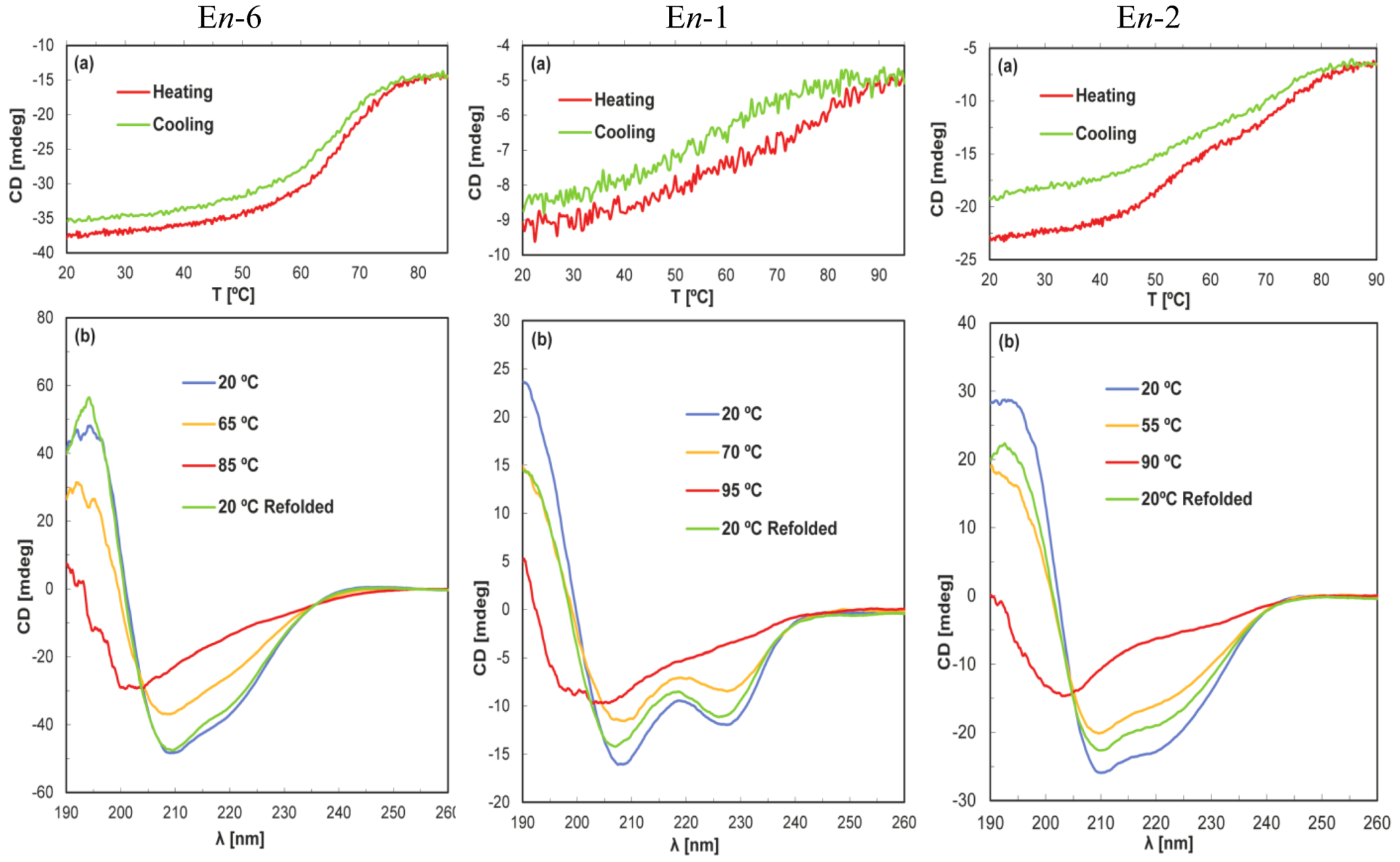
      <p>For all the three psychrophilic pheromones E<italic>n</italic>-1, E<italic>n</italic>-2, and E<italic>n</italic>-6 of <italic>E. nobilii</italic>, the CD spectra (<xref ref-type="fig" rid="biology-02-00142-f002">Figure 2</xref>) show that the regular secondary structures are unfolded at 95 °C, and that this unfolding is reversible upon cooling of the solutions to the starting temperature at 20 °C. Nevertheless, among the individual proteins there are appreciable variations with regard to the shape of the thermal unfolding curves. For E<italic>n</italic>-6 a nearly symmetrical sigmoidal denaturation curve was observed with a midpoint near 65 °C, and a sigmoidal curve was also obtained for the refolding upon cooling of the solution; in addition, only a very small loss of protein was recorded during the unfolding/refolding procedure. On the other hand, E<italic>n</italic>-1 and E<italic>n</italic>-2 showed more sluggish unfolding transitions, and for E<italic>n</italic>-2 there was an indication that the unfolding and refolding processes involve equilibria between more than two states. For the present qualitative survey of the stability of these three proteins we retain that, similar to E<italic>n</italic>-6, the regular secondary structures in E<italic>n</italic>-1 and E<italic>n</italic>-2 are unfolded at 95 °C and refolded upon cooling of the solutions to 20 °C.</p>
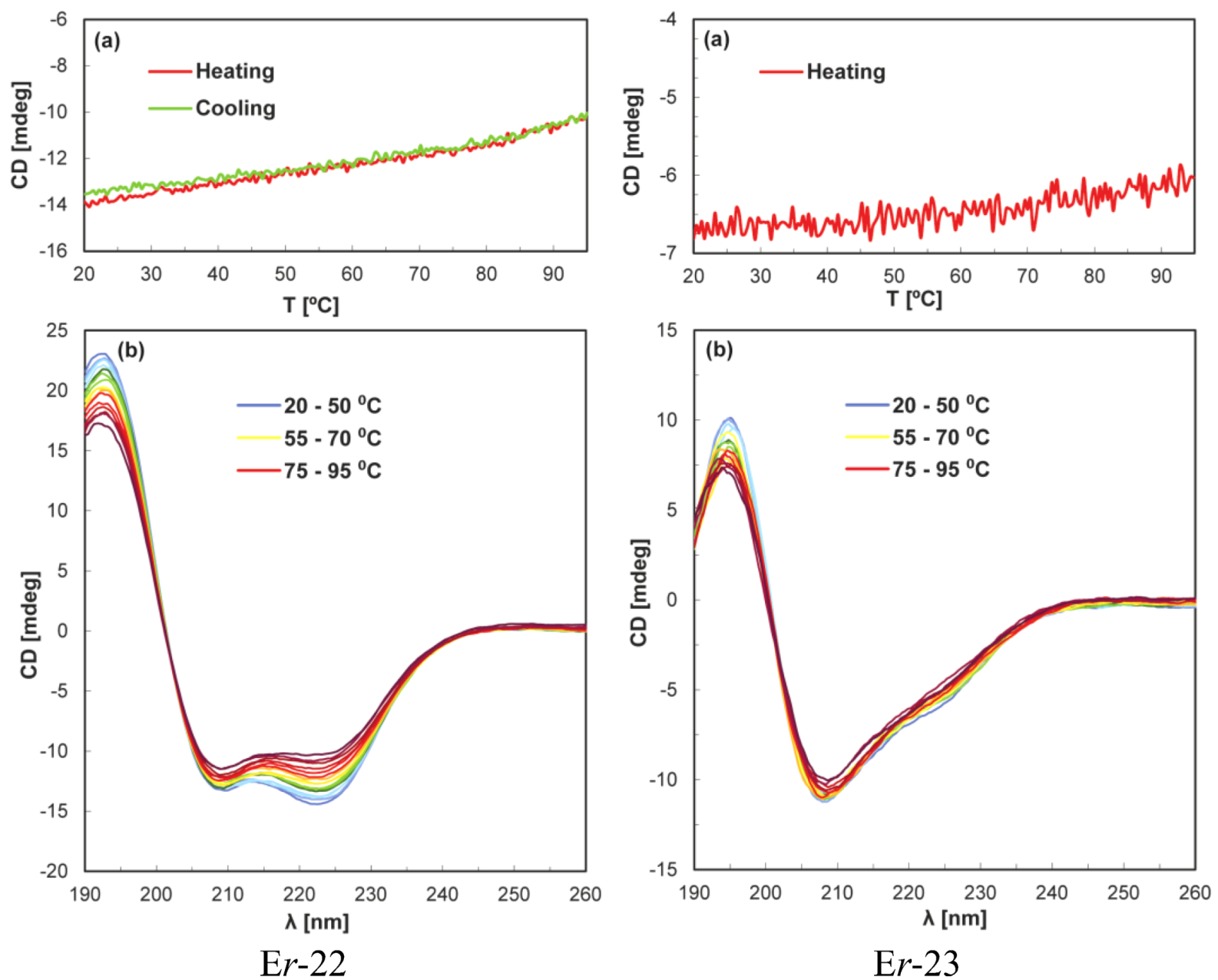
      <p>In the family of the six mesophilic pheromones E<italic>r</italic>-1, E<italic>r</italic>-2, E<italic>r</italic>-10, E<italic>r</italic>-11, E<italic>r</italic>-22, and E<italic>r</italic>-23 from <italic>E. raikovi</italic>, the regular secondary structures manifested in the CD spectra at 20 °C were found to be maintained up to the highest temperature studied (<xref ref-type="fig" rid="biology-02-00142-f002">Figure 2</xref>). The temperature dependence of the signal intensity at 220 nm did not provide evidence for unfolding, and for E<italic>r</italic>-22 the small reduction of the signal intensity at the higher temperatures appeared to be fully reversible upon solution cooling. The data recorded for this pheromone are representative of the observations made with the other pheromones E<italic>r</italic>-1, E<italic>r</italic>-2, E<italic>r</italic>-10, and E<italic>r</italic>-11. Also the pheromone E<italic>r</italic>-23 showed qualitatively similar behavior, but it was clearly the most stable member of the <italic>E. raikovi</italic> mesophilic protein family since it did not undergo denaturation (<xref ref-type="fig" rid="biology-02-00142-f003">Figure 3</xref>).</p>
	  <fig id="biology-02-00142-f002" position="float">
        <label>Figure 2</label>
        <caption>
          <p>Temperature-induced denaturation of the <italic>E. nobilii</italic> psychrophilic pheromones E<italic>n</italic>-6, E<italic>n</italic>-1 and E<italic>n</italic>-2 monitored by CD spectroscopy. (<bold>a</bold>) Temperature variation of the signal intensity at 220 nm during heating and cooling over the range from 20 °C to 95 °C. (<bold>b</bold>) CD spectra at different temperatures, as indicated by the color code in the figure. The protein concentration was 20 µM in 20 mM sodium phosphate at pH 6.0, and the cell length 0.1 cm. The temperature variation of the signal intensity at 220 nm in panels (<bold>a</bold>) was recorded at a rate of 1.0 °C/min. Scans were recorded with a speed of 100 nm/min, in 5 °C intervals over the temperature range of panels (<bold>a</bold>); for improved clarity, only four traces are shown in panels (<bold>b</bold>).</p>
        </caption>
        <graphic xmlns:xlink="http://www.w3.org/1999/xlink" xlink:href="biology-02-00142-g002.tif"/>
      </fig>
      
      <p>In view of the high thermal stability of the <italic>E. raikovi</italic> pheromones in neutral aqueous solution, we also performed exploratory experiments with the addition of chemical denaturants (see Materials and Methods). These experiments provided further indications of the remarkably high stability of these proteins. We did not observe their full unfolding in the temperature range 20–95 °C with the solution conditions listed in the Materials and Methods section, although partial melting within this temperature range was observed for some of them.</p>
    </sec>
    <sec sec-type="discussion">
      <title>4. Discussion</title>
      <p>The psychrophilic and mesophilic pheromone families of the protozoan ciliate <italic>Euplotes</italic> studied here are both represented by single-domain small disulfide-rich proteins, which have usually been shown to be outstandingly stable with regard to thermal denaturation in aqueous solution [<xref ref-type="bibr" rid="B26-biology-02-00142">26</xref>,<xref ref-type="bibr" rid="B27-biology-02-00142">27</xref>,<xref ref-type="bibr" rid="B28-biology-02-00142">28</xref>]. However, despite their extensive homology on the level of the amino acid sequences and three-dimensional structures, the psychrophilic <italic>E. nobilii</italic> pheromones showed a significantly lower thermal stability than their mesophilic <italic>E. raikovi</italic> counterparts. This finding coincides with observations derived from comparisons between other psychrophilic and mesophilic homologous proteins [<xref ref-type="bibr" rid="B29-biology-02-00142">29</xref>,<xref ref-type="bibr" rid="B30-biology-02-00142">30</xref>,<xref ref-type="bibr" rid="B31-biology-02-00142">31</xref>,<xref ref-type="bibr" rid="B32-biology-02-00142">32</xref>,<xref ref-type="bibr" rid="B33-biology-02-00142">33</xref>]. However, while these comparisons are essentially based on individual proteins from distantly related organisms, our finding involves families of proteins with known NMR solution structures [<xref ref-type="bibr" rid="B11-biology-02-00142">11</xref>,<xref ref-type="bibr" rid="B12-biology-02-00142">12</xref>,<xref ref-type="bibr" rid="B13-biology-02-00142">13</xref>,<xref ref-type="bibr" rid="B14-biology-02-00142">14</xref>,<xref ref-type="bibr" rid="B15-biology-02-00142">15</xref>,<xref ref-type="bibr" rid="B16-biology-02-00142">16</xref>,<xref ref-type="bibr" rid="B17-biology-02-00142">17</xref>,<xref ref-type="bibr" rid="B18-biology-02-00142">18</xref>,<xref ref-type="bibr" rid="B19-biology-02-00142">19</xref>,<xref ref-type="bibr" rid="B20-biology-02-00142">20</xref>,<xref ref-type="bibr" rid="B21-biology-02-00142">21</xref>] from two closely related species [<xref ref-type="bibr" rid="B34-biology-02-00142">34</xref>,<xref ref-type="bibr" rid="B35-biology-02-00142">35</xref>]. It therefore provides data which, at least in principle, are more reliable (being unaffected by the evolutionary noise which is intrinsic to comparisons between distantly related systems) for further detailed analyses by other groups of researchers who are interested in studying the correlations between protein structure, thermodynamic stability, and cold-adaptation.</p>
	  <fig id="biology-02-00142-f003" position="float">
        <label>Figure 3</label>
        <caption>
          <p>Temperature-induced denaturation of the <italic>E. raikovi</italic> mesophilic pheromones E<italic>r</italic>-22 and E<italic>r</italic>-23 monitored by CD spectroscopy. E<italic>r</italic>-22 has been taken as representative of the other <italic>E. raikovi</italic> pheromones E<italic>r</italic>-1, E<italic>r</italic>-2, E<italic>r</italic>-10 and E<italic>r</italic>-11. Same experimental conditions and presentations as in <xref ref-type="fig" rid="biology-02-00142-f002">Figure 2</xref>, except that all the spectra recorded in 5 °C temperature intervals are shown in panels (<bold>b</bold>).</p>
        </caption>
        <graphic xmlns:xlink="http://www.w3.org/1999/xlink" xlink:href="biology-02-00142-g003.tif"/>
      </fig>
      
      <p>As previously discussed [<xref ref-type="bibr" rid="B3-biology-02-00142">3</xref>,<xref ref-type="bibr" rid="B10-biology-02-00142">10</xref>,<xref ref-type="bibr" rid="B21-biology-02-00142">21</xref>], the two homologous protein families of <italic>E. nobilii</italic> psychrophilic pheromones and <italic>E. raikovi</italic> mesophilic pheromones differ significantly in the composition of polar, hydrophobic and aromatic amino acids, in global hydrophilicity and hydrophobicity, as well as in various aspects of their three-dimensional structures. It will now be interesting to explore the extent to which these physico-chemical and structural variations can be related to variations of the stability of the folded proteins. Two structural features distinctive of the two pheromone families appear to be particularly promising starting points for further investigations into the structural basis of the observed differences in the thermal stability of these proteins. One is the <italic>N</italic>-terminal elongation of 10 to 12 residues, which is common to all the <italic>E. nobilii</italic> pheromones and has no counterparts in any of the <italic>E. raikovi</italic> pheromones. It includes only a 3<sub>10</sub>-helical turn as regular secondary structure and is devoid of connections through disulfide bonds to other parts of the proteins. Secondly, there is a higher density of disulfide bonds in the mesophilic <italic>E. raikovi</italic> pheromones than in the psychrophilic ones of <italic>E. nobilii</italic>. On average, the <italic>E. raikovi</italic> pheromones contain one disulfide bond per 13 amino acid residues, while in the <italic>E. nobilii</italic> pheromones there is one disulfide bond per 15 residues. In particular, the high density of one disulfide bond per 10 residues appears to be the dominant feature that makes E<italic>r</italic>-23 most stable among the <italic>E. raikovi</italic> pheromones, notwithstanding that E<italic>r</italic>-23 mimics the <italic>E. nobilii</italic> psychrophilic pheromones with regard to the contents of polar and hydrophobic residues as well as the aliphatic index.</p>
    </sec>
    <sec sec-type="conclusions">
      <title>5. Conclusions</title>
      <p>The key observation reported in this paper is that the <italic>E. nobilii</italic> and <italic>E. raikovi</italic> pheromone families show a thermal denaturation behavior that is uniform among their members and significantly divergent between them. The mesophilic <italic>E. raikovi</italic> pheromones have higher stability by at least 30 °C when compared to the psychrophilic <italic>E. nobilii</italic> pheromones. Given the small size of these water-borne signaling proteins and the availability of their three-dimensional structures, the data presented in this communication should be of interest for systematic investigations of protein adaptation to cold environments.</p>
    </sec>
    
  </body>
  <back>
  <ack>
      <title>Acknowledgments</title>
      <p>The authors are grateful to R. Glockshuber (ETH, Zürich) for helpful discussions. This research was financially supported by the National Program for Antarctic Research (PNRA).</p>
    </ack>
    <ref-list>
      <title>References</title>
      <ref id="B1-biology-02-00142">
        <label>1.</label>
        <citation citation-type="book">
          <person-group person-group-type="author">
            <name>
              <surname>Petz</surname>
              <given-names>W.</given-names>
            </name>
          </person-group>
          <article-title>Ciliates</article-title>
          <source>Antarctic Marine Protists</source>
          <person-group person-group-type="editor">
            <name>
              <surname>Scott</surname>
              <given-names>F.J.</given-names>
            </name>
            <name>
              <surname>Marchant</surname>
              <given-names>H.J.</given-names>
            </name>
          </person-group>
          <publisher-name>Australian Biological Resources Study</publisher-name>
          <publisher-loc>Canberra and Australian Antarctic Division, Hobart, Australia</publisher-loc>
          <year>2005</year>
          <fpage>347</fpage>
          <lpage>448</lpage>
        </citation>
      </ref>
      <ref id="B2-biology-02-00142">
        <label>2.</label>
        <citation citation-type="journal">
          <person-group person-group-type="author">
            <name>
              <surname>Petz</surname>
              <given-names>W.</given-names>
            </name>
            <name>
              <surname>Valbonesi</surname>
              <given-names>A.</given-names>
            </name>
            <name>
              <surname>Schiftner</surname>
              <given-names>U.</given-names>
            </name>
            <name>
              <surname>Quesada</surname>
              <given-names>A.</given-names>
            </name>
            <name>
              <surname>Cynan Ellis-Evans</surname>
              <given-names>J.</given-names>
            </name>
          </person-group>
          <article-title>Ciliate biogeography in Antarctic and Arctic freshwater ecosystems: endemism or global distribution of species?</article-title>
          <source>FEMS Microbiol. Ecol.</source>
          <year>2007</year>
          <volume>59</volume>
          <fpage>396</fpage>
          <lpage>408</lpage>
          <pub-id pub-id-type="doi">10.1111/j.1574-6941.2006.00259.x</pub-id>
        </citation>
      </ref>
      <ref id="B3-biology-02-00142">
        <label>3.</label>
        <citation citation-type="journal">
          <person-group person-group-type="author">
            <name>
              <surname>Di Giuseppe</surname>
              <given-names>G.</given-names>
            </name>
            <name>
              <surname>Erra</surname>
              <given-names>F.</given-names>
            </name>
            <name>
              <surname>Dini</surname>
              <given-names>F.</given-names>
            </name>
            <name>
              <surname>Alimenti</surname>
              <given-names>C.</given-names>
            </name>
            <name>
              <surname>Vallesi</surname>
              <given-names>A.</given-names>
            </name>
            <name>
              <surname>Pedrini</surname>
              <given-names>B.</given-names>
            </name>
            <name>
              <surname>Wüthrich</surname>
              <given-names>K.</given-names>
            </name>
            <name>
              <surname>Luporini</surname>
              <given-names>P.</given-names>
            </name>
          </person-group>
          <article-title>Antarctic and Arctic populations of the ciliate Euplotes nobilii show common pheromone-mediated cell-cell signaling and cross-mating</article-title>
          <source>Proc. Natl. Acad. Sci. USA</source>
          <year>2011</year>
          <volume>108</volume>
          <fpage>3181</fpage>
          <lpage>3186</lpage>
        <pub-id pub-id-type="doi">10.1073/pnas.1019432108</pub-id><pub-id pub-id-type="pmid">21300903</pub-id></citation>
      </ref>
      <ref id="B4-biology-02-00142">
        <label>4.</label>
        <citation citation-type="journal">
          <person-group person-group-type="author">
            <name>
              <surname>Luporini</surname>
              <given-names>P.</given-names>
            </name>
            <name>
              <surname>Alimenti</surname>
              <given-names>C.</given-names>
            </name>
            <name>
              <surname>Ortenzi</surname>
              <given-names>C.</given-names>
            </name>
            <name>
              <surname>Vallesi</surname>
              <given-names>A.</given-names>
            </name>
          </person-group>
          <article-title>Ciliate mating type and their specific protein pheromones</article-title>
          <source>Acta Protozool.</source>
          <year>2005</year>
          <volume>44</volume>
          <fpage>89</fpage>
          <lpage>101</lpage>
        </citation>
      </ref>
      <ref id="B5-biology-02-00142">
        <label>5.</label>
        <citation citation-type="journal">
          <person-group person-group-type="author">
            <name>
              <surname>Alimenti</surname>
              <given-names>C.</given-names>
            </name>
            <name>
              <surname>Vallesi</surname>
              <given-names>A.</given-names>
            </name>
            <name>
              <surname>Federici</surname>
              <given-names>S.</given-names>
            </name>
            <name>
              <surname>di Giuseppe</surname>
              <given-names>G.</given-names>
            </name>
            <name>
              <surname>Dini</surname>
              <given-names>F.</given-names>
            </name>
            <name>
              <surname>Carratore</surname>
              <given-names>V.</given-names>
            </name>
            <name>
              <surname>Luporini</surname>
              <given-names>P.</given-names>
            </name>
          </person-group>
          <article-title>Isolation and structural characterization of two water-borne pheromones from <italic>Euplotes crassus</italic>, a ciliate commonly known to carry membrane-bound pheromones</article-title>
          <source>J. Eukaryot. Microbiol.</source>
          <year>2011</year>
          <volume>58</volume>
          <fpage>234</fpage>
          <lpage>241</lpage>
          <pub-id pub-id-type="doi">10.1111/j.1550-7408.2011.00535.x</pub-id>
        </citation>
      </ref>
      <ref id="B6-biology-02-00142">
        <label>6.</label>
        <citation citation-type="journal">
          <person-group person-group-type="author">
            <name>
              <surname>Vallesi</surname>
              <given-names>A.</given-names>
            </name>
            <name>
              <surname>Giuli</surname>
              <given-names>G.</given-names>
            </name>
            <name>
              <surname>Bradshaw</surname>
              <given-names>R.A.</given-names>
            </name>
            <name>
              <surname>Luporini</surname>
              <given-names>P.</given-names>
            </name>
          </person-group>
          <article-title>Autocrine mitogenic activity of pheromone produced by the protozoan ciliate <italic>Euplotes</italic> <italic>raikovi</italic></article-title>
          <source>Nature</source>
          <year>1995</year>
          <volume>376</volume>
          <fpage>522</fpage>
          <lpage>524</lpage>
          <pub-id pub-id-type="doi">10.1038/376522a0</pub-id>
        </citation>
      </ref>
      <ref id="B7-biology-02-00142">
        <label>7.</label>
        <citation citation-type="journal">
          <person-group person-group-type="author">
            <name>
              <surname>Vallesi</surname>
              <given-names>A.</given-names>
            </name>
            <name>
              <surname>Ballarini</surname>
              <given-names>P.</given-names>
            </name>
            <name>
              <surname>di Pretoro</surname>
              <given-names>B.</given-names>
            </name>
            <name>
              <surname>Alimenti</surname>
              <given-names>C.</given-names>
            </name>
            <name>
              <surname>Miceli</surname>
              <given-names>C.</given-names>
            </name>
            <name>
              <surname>Luporini</surname>
              <given-names>P.</given-names>
            </name>
          </person-group>
          <article-title>Autocrine, mitogenic pheromone receptor loop of the ciliate <italic>Euplotes raikovi</italic>: Pheromone-induced receptor internalization</article-title>
          <source>Eukaryot. Cell</source>
          <year>2005</year>
          <volume>4</volume>
          <fpage>1221</fpage>
          <lpage>1227</lpage>
          <pub-id pub-id-type="doi">10.1128/EC.4.7.1221-1227.2005</pub-id>
        </citation>
      </ref>
      <ref id="B8-biology-02-00142">
        <label>8.</label>
        <citation citation-type="journal">
          <person-group person-group-type="author">
            <name>
              <surname>La Terza</surname>
              <given-names>A.</given-names>
            </name>
            <name>
              <surname>Dobri</surname>
              <given-names>N.</given-names>
            </name>
            <name>
              <surname>Alimenti</surname>
              <given-names>C.</given-names>
            </name>
            <name>
              <surname>Vallesi</surname>
              <given-names>A.</given-names>
            </name>
            <name>
              <surname>Luporini</surname>
              <given-names>P.</given-names>
            </name>
          </person-group>
          <article-title>The water-borne protein signals (pheromones) of the Antarctic ciliated protozoan <italic>Euplotes nobilii</italic>: Structure of the gene coding for the E<italic>n</italic>-6 pheromone</article-title>
          <source>Can. J. Microbiol.</source>
          <year>2009</year>
          <volume>5</volume>
          <fpage>57</fpage>
          <lpage>62</lpage>
        </citation>
      </ref>
      <ref id="B9-biology-02-00142">
        <label>9.</label>
        <citation citation-type="journal">
          <person-group person-group-type="author">
            <name>
              <surname>Vallesi</surname>
              <given-names>A.</given-names>
            </name>
            <name>
              <surname>Alimenti</surname>
              <given-names>C.</given-names>
            </name>
            <name>
              <surname>La Terza</surname>
              <given-names>A.</given-names>
            </name>
            <name>
              <surname>di Giuseppe</surname>
              <given-names>G.</given-names>
            </name>
            <name>
              <surname>Dini</surname>
              <given-names>F.</given-names>
            </name>
            <name>
              <surname>Luporini</surname>
              <given-names>P.</given-names>
            </name>
          </person-group>
          <article-title>Characterization of the pheromone gene family of an Antarctic and Arctic protozoan ciliate, <italic>Euplotes nobilii</italic></article-title>
          <source>Mar. Genomics</source>
          <year>2009</year>
          <volume>2</volume>
          <fpage>27</fpage>
          <lpage>32</lpage>
          <pub-id pub-id-type="doi">10.1016/j.margen.2009.04.001</pub-id>
        </citation>
      </ref>
      <ref id="B10-biology-02-00142">
        <label>10.</label>
        <citation citation-type="journal">
          <person-group person-group-type="author">
            <name>
              <surname>Vallesi</surname>
              <given-names>A.</given-names>
            </name>
            <name>
              <surname>Alimenti</surname>
              <given-names>C.</given-names>
            </name>
            <name>
              <surname>Pedrini</surname>
              <given-names>B.</given-names>
            </name>
            <name>
              <surname>di Giuseppe</surname>
              <given-names>G.</given-names>
            </name>
            <name>
              <surname>Dini</surname>
              <given-names>F.</given-names>
            </name>
            <name>
              <surname>Wüthrich</surname>
              <given-names>K.</given-names>
            </name>
            <name>
              <surname>Luporini</surname>
              <given-names>P.</given-names>
            </name>
          </person-group>
          <article-title>Coding genes and molecular structures of the diffusible signalling proteins (pheromones) of the polar ciliate, <italic>Euplotes nobilii</italic></article-title>
          <source>Mar. Genomics</source>
          <year>2012</year>
          <volume>8</volume>
          <fpage>9</fpage>
          <lpage>13</lpage>
          <pub-id pub-id-type="doi">10.1016/j.margen.2012.03.004</pub-id>
        </citation>
      </ref>
      <ref id="B11-biology-02-00142">
        <label>11.</label>
        <citation citation-type="journal">
          <person-group person-group-type="author">
            <name>
              <surname>Brown</surname>
              <given-names>L.R.</given-names>
            </name>
            <name>
              <surname>Mronga</surname>
              <given-names>S.</given-names>
            </name>
            <name>
              <surname>Bradshaw</surname>
              <given-names>R.A.</given-names>
            </name>
            <name>
              <surname>Ortenzi</surname>
              <given-names>C.</given-names>
            </name>
            <name>
              <surname>Luporini</surname>
              <given-names>P.</given-names>
            </name>
            <name>
              <surname>Wüthrich</surname>
              <given-names>K.</given-names>
            </name>
          </person-group>
          <article-title>Nuclear magnetic resonance solution structure of the pheromone E<italic>r</italic>-10 from the ciliated protozoan <italic>Euplotes raikovi</italic></article-title>
          <source>J. Mol. Biol.</source>
          <year>1993</year>
          <volume>231</volume>
          <fpage>800</fpage>
          <lpage>816</lpage>
          <pub-id pub-id-type="doi">10.1006/jmbi.1993.1327</pub-id>
        </citation>
      </ref>
      <ref id="B12-biology-02-00142">
        <label>12.</label>
        <citation citation-type="journal">
          <person-group person-group-type="author">
            <name>
              <surname>Mronga</surname>
              <given-names>S.</given-names>
            </name>
            <name>
              <surname>Luginbühl</surname>
              <given-names>P.</given-names>
            </name>
            <name>
              <surname>Brown</surname>
              <given-names>L.R.</given-names>
            </name>
            <name>
              <surname>Ortenzi</surname>
              <given-names>C.</given-names>
            </name>
            <name>
              <surname>Luporini</surname>
              <given-names>P.</given-names>
            </name>
            <name>
              <surname>Bradshaw</surname>
              <given-names>R.A.</given-names>
            </name>
            <name>
              <surname>Wüthrich</surname>
              <given-names>K.</given-names>
            </name>
          </person-group>
          <article-title>The NMR solution structure of the pheromone E<italic>r</italic>-1 from the ciliated protozoan <italic>Euplotes raikovi</italic></article-title>
          <source>Protein Sci.</source>
          <year>1994</year>
          <volume>3</volume>
          <fpage>1527</fpage>
          <lpage>1536</lpage>
          <pub-id pub-id-type="doi">10.1002/pro.5560030918</pub-id>
        </citation>
      </ref>
      <ref id="B13-biology-02-00142">
        <label>13.</label>
        <citation citation-type="journal">
          <person-group person-group-type="author">
            <name>
              <surname>Ottiger</surname>
              <given-names>M.</given-names>
            </name>
            <name>
              <surname>Szyperski</surname>
              <given-names>T.</given-names>
            </name>
            <name>
              <surname>Luginbühl</surname>
              <given-names>P.</given-names>
            </name>
            <name>
              <surname>Ortenzi</surname>
              <given-names>C.</given-names>
            </name>
            <name>
              <surname>Luporini</surname>
              <given-names>P.</given-names>
            </name>
            <name>
              <surname>Bradshaw</surname>
              <given-names>R.A.</given-names>
            </name>
            <name>
              <surname>Wüthrich</surname>
              <given-names>K.</given-names>
            </name>
          </person-group>
          <article-title>The NMR solution structure of the pheromone E<italic>r</italic>-2 from the ciliated protozoan <italic>Euplotes raikovi</italic></article-title>
          <source>Protein Sci.</source>
          <year>1994</year>
          <volume>3</volume>
          <fpage>1517</fpage>
          <lpage>1526</lpage>
        </citation>
      </ref>
      <ref id="B14-biology-02-00142">
        <label>14.</label>
        <citation citation-type="journal">
          <person-group person-group-type="author">
            <name>
              <surname>Luginbühl</surname>
              <given-names>P.</given-names>
            </name>
            <name>
              <surname>Ottiger</surname>
              <given-names>M.</given-names>
            </name>
            <name>
              <surname>Mronga</surname>
              <given-names>S.</given-names>
            </name>
            <name>
              <surname>Wüthrich</surname>
              <given-names>K.</given-names>
            </name>
          </person-group>
          <article-title>Structure comparison of the NMR structures of the pheromones E<italic>r</italic>-1, E<italic>r</italic>-10, and E<italic>r</italic>-2 from <italic>Euplotes raikovi</italic></article-title>
          <source>Protein Sci.</source>
          <year>1994</year>
          <volume>3</volume>
          <fpage>1537</fpage>
          <lpage>1546</lpage>
          <pub-id pub-id-type="doi">10.1002/pro.5560030919</pub-id>
        </citation>
      </ref>
      <ref id="B15-biology-02-00142">
        <label>15.</label>
        <citation citation-type="journal">
          <person-group person-group-type="author">
            <name>
              <surname>Luginbühl</surname>
              <given-names>P.</given-names>
            </name>
            <name>
              <surname>Wu</surname>
              <given-names>J.</given-names>
            </name>
            <name>
              <surname>Zerbe</surname>
              <given-names>O.</given-names>
            </name>
            <name>
              <surname>Ortenzi</surname>
              <given-names>C.</given-names>
            </name>
            <name>
              <surname>Luporini</surname>
              <given-names>P.</given-names>
            </name>
            <name>
              <surname>Wüthrich</surname>
              <given-names>K.</given-names>
            </name>
          </person-group>
          <article-title>The NMR solution structure of the pheromone E<italic>r</italic>-11 from the ciliated protozoan <italic>Euplotes</italic> <italic>raikovi</italic></article-title>
          <source>Protein Sci.</source>
          <year>1996</year>
          <volume>5</volume>
          <fpage>1512</fpage>
          <lpage>1522</lpage>
          <pub-id pub-id-type="doi">10.1002/pro.5560050807</pub-id>
        </citation>
      </ref>
      <ref id="B16-biology-02-00142">
        <label>16.</label>
        <citation citation-type="journal">
          <person-group person-group-type="author">
            <name>
              <surname>Liu</surname>
              <given-names>A.</given-names>
            </name>
            <name>
              <surname>Luginbühl</surname>
              <given-names>P.</given-names>
            </name>
            <name>
              <surname>Zerbe</surname>
              <given-names>O.</given-names>
            </name>
            <name>
              <surname>Ortenzi</surname>
              <given-names>C.</given-names>
            </name>
            <name>
              <surname>Luporini</surname>
              <given-names>P.</given-names>
            </name>
            <name>
              <surname>Wüthrich</surname>
              <given-names>K.</given-names>
            </name>
          </person-group>
          <article-title>NMR structure of the pheromone E<italic>r</italic>-22 from <italic>Euplotes raikovi</italic></article-title>
          <source>J. Biomol. NMR</source>
          <year>2001</year>
          <volume>19</volume>
          <fpage>75</fpage>
          <lpage>78</lpage>
          <pub-id pub-id-type="doi">10.1023/A:1008332922256</pub-id>
        </citation>
      </ref>
      <ref id="B17-biology-02-00142">
        <label>17.</label>
        <citation citation-type="journal">
          <person-group person-group-type="author">
            <name>
              <surname>Zahn</surname>
              <given-names>R.</given-names>
            </name>
            <name>
              <surname>Damberger</surname>
              <given-names>F.</given-names>
            </name>
            <name>
              <surname>Ortenzi</surname>
              <given-names>C.</given-names>
            </name>
            <name>
              <surname>Luporini</surname>
              <given-names>P.</given-names>
            </name>
            <name>
              <surname>Wüthrich</surname>
              <given-names>K.</given-names>
            </name>
          </person-group>
          <article-title>NMR structure of the <italic>Euplotes raikovi</italic> pheromone E<italic>r</italic>-23 and identification of its five disulfide bonds</article-title>
          <source>J. Mol. Biol.</source>
          <year>2001</year>
          <volume>313</volume>
          <fpage>923</fpage>
          <lpage>931</lpage>
          <pub-id pub-id-type="doi">10.1006/jmbi.2001.5099</pub-id>
        </citation>
      </ref>
      <ref id="B18-biology-02-00142">
        <label>18.</label>
        <citation citation-type="journal">
          <person-group person-group-type="author">
            <name>
              <surname>Placzek</surname>
              <given-names>W.J.</given-names>
            </name>
            <name>
              <surname>Etezady-Esfarjani</surname>
              <given-names>T.</given-names>
            </name>
            <name>
              <surname>Herrmann</surname>
              <given-names>T.</given-names>
            </name>
            <name>
              <surname>Pedrini</surname>
              <given-names>B.</given-names>
            </name>
            <name>
              <surname>Peti</surname>
              <given-names>W.</given-names>
            </name>
            <name>
              <surname>Alimenti</surname>
              <given-names>C.</given-names>
            </name>
            <name>
              <surname>Luporini</surname>
              <given-names>P.</given-names>
            </name>
            <name>
              <surname>Wüthrich</surname>
              <given-names>K.</given-names>
            </name>
          </person-group>
          <article-title>Cold-adapted signal proteins: NMR structures of pheromones from the Antarctic ciliate <italic>Euplotes nobilii</italic></article-title>
          <source>IUBMB Life</source>
          <year>2007</year>
          <volume>59</volume>
          <fpage>578</fpage>
          <lpage>585</lpage>
          <pub-id pub-id-type="doi">10.1080/15216540701258165</pub-id>
        </citation>
      </ref>
      <ref id="B19-biology-02-00142">
        <label>19.</label>
        <citation citation-type="journal">
          <person-group person-group-type="author">
            <name>
              <surname>Pedrini</surname>
              <given-names>B.</given-names>
            </name>
            <name>
              <surname>Placzek</surname>
              <given-names>W.J.</given-names>
            </name>
            <name>
              <surname>Koculi</surname>
              <given-names>E.</given-names>
            </name>
            <name>
              <surname>Alimenti</surname>
              <given-names>C.</given-names>
            </name>
            <name>
              <surname>La Terza</surname>
              <given-names>A.</given-names>
            </name>
            <name>
              <surname>Luporini</surname>
              <given-names>P.</given-names>
            </name>
            <name>
              <surname>Wüthrich</surname>
              <given-names>K.</given-names>
            </name>
          </person-group>
          <article-title>Cold-adaptation in sea-waterborne signal proteins: Sequence and NMR structure of the pheromone E<italic>n</italic>-6 from the Antarctic ciliate <italic>Euplotes nobilii</italic></article-title>
          <source>J. Mol. Biol.</source>
          <year>2007</year>
          <volume>372</volume>
          <fpage>277</fpage>
          <lpage>286</lpage>
          <pub-id pub-id-type="doi">10.1016/j.jmb.2007.06.046</pub-id>
        </citation>
      </ref>
      <ref id="B20-biology-02-00142">
        <label>20.</label>
        <citation citation-type="journal">
          <person-group person-group-type="author">
            <name>
              <surname>Alimenti</surname>
              <given-names>C.</given-names>
            </name>
            <name>
              <surname>Vallesi</surname>
              <given-names>A.</given-names>
            </name>
            <name>
              <surname>Pedrini</surname>
              <given-names>B.</given-names>
            </name>
            <name>
              <surname>Wüthrich</surname>
              <given-names>K.</given-names>
            </name>
            <name>
              <surname>Luporini</surname>
              <given-names>P.</given-names>
            </name>
          </person-group>
          <article-title>Molecular cold-adaptation: Comparative analysis of two homologous families of psychrophilic and mesophilic signal proteins of the protozoan ciliate <italic>Euplotes</italic></article-title>
          <source>IUBMB Life</source>
          <year>2009</year>
          <volume>61</volume>
          <fpage>838</fpage>
          <lpage>845</lpage>
          <pub-id pub-id-type="doi">10.1002/iub.228</pub-id>
        </citation>
      </ref>
      <ref id="B21-biology-02-00142">
        <label>21.</label>
        <citation citation-type="journal">
          <person-group person-group-type="author">
            <name>
              <surname>Weiss</surname>
              <given-names>M.S.</given-names>
            </name>
            <name>
              <surname>Anderson</surname>
              <given-names>D.H.</given-names>
            </name>
            <name>
              <surname>Raffioni</surname>
              <given-names>S.</given-names>
            </name>
            <name>
              <surname>Bradshaw</surname>
              <given-names>R.A.</given-names>
            </name>
            <name>
              <surname>Ortenzi</surname>
              <given-names>C.</given-names>
            </name>
            <name>
              <surname>Luporini</surname>
              <given-names>P.</given-names>
            </name>
            <name>
              <surname>Eisenberg</surname>
              <given-names>D.A.</given-names>
            </name>
          </person-group>
          <article-title>Cooperative model for ligand recognition and cell adhesion: Evidence from the molecular packing in the 1.6 Å crystal structure of the pheromone E<italic>r</italic>-1 from the ciliate protozoan <italic>Euplotes raikovi</italic></article-title>
          <source>Proc. Natl. Acad. Sci. USA</source>
          <year>1995</year>
          <volume>92</volume>
          <fpage>10172</fpage>
          <lpage>10176</lpage>
        <pub-id pub-id-type="doi">10.1073/pnas.92.22.10172</pub-id><pub-id pub-id-type="pmid">7479748</pub-id></citation>
      </ref>
      <ref id="B22-biology-02-00142">
        <label>22.</label>
        <citation citation-type="journal">
          <person-group person-group-type="author">
            <name>
              <surname>Concetti</surname>
              <given-names>A.</given-names>
            </name>
            <name>
              <surname>Raffioni</surname>
              <given-names>S.</given-names>
            </name>
            <name>
              <surname>Miceli</surname>
              <given-names>C.</given-names>
            </name>
            <name>
              <surname>Barra</surname>
              <given-names>D.</given-names>
            </name>
            <name>
              <surname>Luporini</surname>
              <given-names>P.</given-names>
            </name>
          </person-group>
          <article-title>Purification to apparent homogeneity of the mating pheromone of <italic>mat-1 Euplotes raikovi</italic></article-title>
          <source>J. Biol. Chem.</source>
          <year>1986</year>
          <volume>61</volume>
          <fpage>10582</fpage>
          <lpage>10587</lpage>
        </citation>
      </ref>
      <ref id="B23-biology-02-00142">
        <label>23.</label>
        <citation citation-type="journal">
          <person-group person-group-type="author">
            <name>
              <surname>Raffioni</surname>
              <given-names>S.</given-names>
            </name>
            <name>
              <surname>Miceli</surname>
              <given-names>C.</given-names>
            </name>
            <name>
              <surname>Vallesi</surname>
              <given-names>A.</given-names>
            </name>
            <name>
              <surname>Chowdhury</surname>
              <given-names>S.K.</given-names>
            </name>
            <name>
              <surname>Chait</surname>
              <given-names>B.T.</given-names>
            </name>
            <name>
              <surname>Luporini</surname>
              <given-names>P.</given-names>
            </name>
            <name>
              <surname>Bradshaw</surname>
              <given-names>R.A.</given-names>
            </name>
          </person-group>
          <article-title>Primary structure od the <italic>Euplotes raikovi</italic> pheromones: Comparison of five sequences of pheromones from cell with variable mating interactions</article-title>
          <source>Proc. Natl. Acad. Sci. USA</source>
          <year>1992</year>
          <volume>89</volume>
          <fpage>2071</fpage>
          <lpage>2075</lpage>
        <pub-id pub-id-type="doi">10.1073/pnas.89.6.2071</pub-id><pub-id pub-id-type="pmid">1549567</pub-id></citation>
      </ref>
      <ref id="B24-biology-02-00142">
        <label>24.</label>
        <citation citation-type="journal">
          <person-group person-group-type="author">
            <name>
              <surname>Alimenti</surname>
              <given-names>C.</given-names>
            </name>
            <name>
              <surname>Ortenzi</surname>
              <given-names>C.</given-names>
            </name>
            <name>
              <surname>Carratore</surname>
              <given-names>V.</given-names>
            </name>
            <name>
              <surname>Luporini</surname>
              <given-names>P.</given-names>
            </name>
          </person-group>
          <article-title>Structural characterization of protein pheromone from a cold-adapted (Antarctic) single-cell eukaryote, the ciliate <italic>Euplotes nobilii</italic></article-title>
          <source>FEBS Lett.</source>
          <year>2002</year>
          <volume>514</volume>
          <fpage>329</fpage>
          <lpage>332</lpage>
          <pub-id pub-id-type="doi">10.1016/S0014-5793(02)02393-1</pub-id>
        </citation>
      </ref>
      <ref id="B25-biology-02-00142">
        <label>25.</label>
        <citation citation-type="journal">
          <person-group person-group-type="author">
            <name>
              <surname>Alimenti</surname>
              <given-names>C.</given-names>
            </name>
            <name>
              <surname>Ortenzi</surname>
              <given-names>C.</given-names>
            </name>
            <name>
              <surname>Carratore</surname>
              <given-names>V.</given-names>
            </name>
            <name>
              <surname>Luporini</surname>
              <given-names>P.</given-names>
            </name>
          </person-group>
          <article-title>Structural characterization of E<italic>n</italic>-1, a cold-adapted protein pheromone isolated from the Antarctic ciliate <italic>Euplotes nobilii</italic></article-title>
          <source>Biochem. Biophys. Acta</source>
          <year>2003</year>
          <volume>1621</volume>
          <fpage>17</fpage>
          <lpage>21</lpage>
          <pub-id pub-id-type="doi">10.1016/S0304-4165(03)00011-4</pub-id>
        </citation>
      </ref>
      <ref id="B26-biology-02-00142">
        <label>26.</label>
        <citation citation-type="journal">
          <person-group person-group-type="author">
            <name>
              <surname>Devi</surname>
              <given-names>V.S.</given-names>
            </name>
            <name>
              <surname>Sprecher</surname>
              <given-names>C.B.</given-names>
            </name>
            <name>
              <surname>Hunziker</surname>
              <given-names>P.</given-names>
            </name>
            <name>
              <surname>Mittl</surname>
              <given-names>P.R.</given-names>
            </name>
            <name>
              <surname>Bosshard</surname>
              <given-names>H.R.</given-names>
            </name>
            <name>
              <surname>Jelesarov</surname>
              <given-names>I.</given-names>
            </name>
          </person-group>
          <article-title>Disulfide formation and stability of a cysteine-rich repeat protein from <italic>Helicobacter pylori</italic></article-title>
          <source>Biochemistry</source>
          <year>2006</year>
          <volume>45</volume>
          <fpage>1599</fpage>
          <lpage>1607</lpage>
        <pub-id pub-id-type="doi">10.1021/bi052352u</pub-id><pub-id pub-id-type="pmid">16460007</pub-id></citation>
      </ref>
      <ref id="B27-biology-02-00142">
        <label>27.</label>
        <citation citation-type="journal">
          <person-group person-group-type="author">
            <name>
              <surname>Trivedi</surname>
              <given-names>M.V.</given-names>
            </name>
            <name>
              <surname>Laurence</surname>
              <given-names>J.S.</given-names>
            </name>
            <name>
              <surname>Siahaan</surname>
              <given-names>T.J.</given-names>
            </name>
          </person-group>
          <article-title>The Role of thiols and disulfides on protein stability</article-title>
          <source>Curr. Protein Pept. Sci.</source>
          <year>2009</year>
          <volume>10</volume>
          <fpage>614</fpage>
          <lpage>625</lpage>
          <pub-id pub-id-type="doi">10.2174/138920309789630534</pub-id>
        </citation>
      </ref>
      <ref id="B28-biology-02-00142">
        <label>28.</label>
        <citation citation-type="book">
          <person-group person-group-type="author">
            <name>
              <surname>Fass</surname>
              <given-names>D.</given-names>
            </name>
          </person-group>
          <article-title>Disulfide bonding in protein biophysics</article-title>
          <source>Annual Review of Biophysics</source>
          <person-group person-group-type="editor">
            <name>
              <surname>Rees</surname>
              <given-names>D.C.</given-names>
            </name>
          </person-group>
          <publisher-name>Annual Reviews</publisher-name>
          <publisher-loc>Palo Alto, CA, USA</publisher-loc>
          <year>2012</year>
          <volume>Volume 41</volume>
          <fpage>63</fpage>
          <lpage>79</lpage>
        </citation>
      </ref>
      <ref id="B29-biology-02-00142">
        <label>29.</label>
        <citation citation-type="journal">
          <person-group person-group-type="author">
            <name>
              <surname>Aghajari</surname>
              <given-names>N.</given-names>
            </name>
            <name>
              <surname>Feller</surname>
              <given-names>G.</given-names>
            </name>
            <name>
              <surname>Gerday</surname>
              <given-names>C.</given-names>
            </name>
            <name>
              <surname>Haser</surname>
              <given-names>R.</given-names>
            </name>
          </person-group>
          <article-title>Structures of the psychrophilic <italic>Alteromonas</italic> <italic>haloplanctis</italic> α-amylase give insights into cold adaptation at a molecular level</article-title>
          <source>Structure</source>
          <year>1998</year>
          <volume>6</volume>
          <fpage>1503</fpage>
          <lpage>1516</lpage>
          <pub-id pub-id-type="doi">10.1016/S0969-2126(98)00149-X</pub-id>
        </citation>
      </ref>
      <ref id="B30-biology-02-00142">
        <label>30.</label>
        <citation citation-type="journal">
          <person-group person-group-type="author">
            <name>
              <surname>Bae</surname>
              <given-names>E.</given-names>
            </name>
            <name>
              <surname>Phillips</surname>
              <given-names>G.N.</given-names>
              <suffix>Jr.</suffix>
            </name>
          </person-group>
          <article-title>Structure and analysis of highly homologous psychrophilic, mesophilic, and thermophilic adenylate kinases</article-title>
          <source>J. Biol. Chem.</source>
          <year>2004</year>
          <volume>279</volume>
          <fpage>28202</fpage>
          <lpage>28208</lpage>
          <pub-id pub-id-type="doi">10.1074/jbc.M401865200</pub-id>
        </citation>
      </ref>
      <ref id="B31-biology-02-00142">
        <label>31.</label>
        <citation citation-type="journal">
          <person-group person-group-type="author">
            <name>
              <surname>Fedoy</surname>
              <given-names>A.E.</given-names>
            </name>
            <name>
              <surname>Yang</surname>
              <given-names>N.</given-names>
            </name>
            <name>
              <surname>Martinez</surname>
              <given-names>A.</given-names>
            </name>
            <name>
              <surname>Leiros</surname>
              <given-names>H.K.</given-names>
            </name>
            <name>
              <surname>Steen</surname>
              <given-names>I.H.</given-names>
            </name>
          </person-group>
          <article-title>Structural and functional properties of isocitrate dehydrogenase from the psychrophilic bacterium <italic>Desulfotalea psychrophila</italic> reveal a cold-active enzyme with an unusual high thermal stability</article-title>
          <source>J. Mol. Biol.</source>
          <year>2007</year>
          <volume>372</volume>
          <fpage>130</fpage>
          <lpage>149</lpage>
          <pub-id pub-id-type="doi">10.1016/j.jmb.2007.06.040</pub-id>
        </citation>
      </ref>
      <ref id="B32-biology-02-00142">
        <label>32.</label>
        <citation citation-type="journal">
          <person-group person-group-type="author">
            <name>
              <surname>Garcia-Arribas</surname>
              <given-names>O.</given-names>
            </name>
            <name>
              <surname>Mateo</surname>
              <given-names>R.</given-names>
            </name>
            <name>
              <surname>Melanie</surname>
              <given-names>M.</given-names>
            </name>
            <name>
              <surname>Tomczak</surname>
              <given-names>M.M.</given-names>
            </name>
            <name>
              <surname>Davies</surname>
              <given-names>P.L.</given-names>
            </name>
            <name>
              <surname>Mateu</surname>
              <given-names>M.G.</given-names>
            </name>
          </person-group>
          <article-title>Thermodynamic stability of a cold-adapted protein, type III antifreeze protein, and energetic contribution of salt bridges</article-title>
          <source>Protein Sci.</source>
          <year>2007</year>
          <volume>16</volume>
          <fpage>227</fpage>
          <lpage>238</lpage>
        <pub-id pub-id-type="pmid">17189482</pub-id></citation>
      </ref>
      <ref id="B33-biology-02-00142">
        <label>33.</label>
        <citation citation-type="journal">
          <person-group person-group-type="author">
            <name>
              <surname>Lockwood</surname>
              <given-names>B.L.</given-names>
            </name>
            <name>
              <surname>Somero</surname>
              <given-names>G.N.</given-names>
            </name>
          </person-group>
          <article-title>Functional determinants of temperature adaptation in enzymes of cold- <italic>versus</italic> warm-adapted mussels (genus <italic>Mytilus</italic>)</article-title>
          <source>Mol. Biol. Evol.</source>
          <year>2012</year>
          <volume>29</volume>
          <fpage>3061</fpage>
          <lpage>3070</lpage>
          <pub-id pub-id-type="doi">10.1093/molbev/mss111</pub-id>
        </citation>
      </ref>
      <ref id="B34-biology-02-00142">
        <label>34.</label>
        <citation citation-type="journal">
          <person-group person-group-type="author">
            <name>
              <surname>Vallesi</surname>
              <given-names>A.</given-names>
            </name>
            <name>
              <surname>di Giuseppe</surname>
              <given-names>G.</given-names>
            </name>
            <name>
              <surname>Dini</surname>
              <given-names>F.</given-names>
            </name>
            <name>
              <surname>Luporini</surname>
              <given-names>P.</given-names>
            </name>
          </person-group>
          <article-title>Pheromone evolution in the protozoan ciliate, <italic>Euplotes</italic>: The ability to synthesize diffusibile forms is ancestral and secondarily lost</article-title>
          <source>Mol. Phylogenet. Evol.</source>
          <year>2008</year>
          <volume>47</volume>
          <fpage>439</fpage>
          <lpage>442</lpage>
          <pub-id pub-id-type="doi">10.1016/j.ympev.2007.11.025</pub-id>
        </citation>
      </ref>
      <ref id="B35-biology-02-00142">
        <label>35.</label>
        <citation citation-type="journal">
          <person-group person-group-type="author">
            <name>
              <surname>Jiang</surname>
              <given-names>J.</given-names>
            </name>
            <name>
              <surname>Zhang</surname>
              <given-names>Q.</given-names>
            </name>
            <name>
              <surname>Warren</surname>
              <given-names>A.</given-names>
            </name>
            <name>
              <surname>Al-Rasheid</surname>
              <given-names>K.A.</given-names>
            </name>
            <name>
              <surname>Song</surname>
              <given-names>W.</given-names>
            </name>
          </person-group>
          <article-title>Morphology and SSUrRNA gene-based phylogeny of two marine <italic>Euplotes</italic> species, <italic>E. orientalis</italic> spec. nov. and <italic>E. raikovi</italic> (Ciliophora, Euplotida)</article-title>
          <source>Eur. J. Protisotol.</source>
          <year>2010</year>
          <volume>46</volume>
          <fpage>121</fpage>
          <lpage>132</lpage>
        <pub-id pub-id-type="doi">10.1016/j.ejop.2009.11.003</pub-id></citation>
      </ref>
    </ref-list>
  </back>
</article>