
<?xml version="1.0" encoding="UTF-8"?>
<!DOCTYPE article PUBLIC "-//NLM//DTD Journal Publishing DTD v2.3 20070202//EN" "journalpublishing.dtd">
<article xmlns:mml="http://www.w3.org/1998/Math/MathML" xmlns:xlink="http://www.w3.org/1999/xlink" xml:lang="en" article-type="research-article">
  <front>
    <journal-meta>
      <journal-id journal-id-type="publisher-id">antibiotics</journal-id>
      <journal-title>Antibiotics</journal-title>
      <abbrev-journal-title abbrev-type="publisher">Antibiotics</abbrev-journal-title>
      <abbrev-journal-title abbrev-type="pubmed">Antibiotics</abbrev-journal-title>
      <issn pub-type="epub">2079-6382</issn>
      <publisher>
        <publisher-name>MDPI</publisher-name>
      </publisher>
    </journal-meta>
    <article-meta>
      <article-id pub-id-type="doi">10.3390/antibiotics1010017</article-id>
      <article-id pub-id-type="publisher-id">antibiotics-01-00017</article-id>
      <article-categories>
        <subj-group>
          <subject>Article</subject>
        </subj-group>
      </article-categories>
      <title-group>
        <article-title>Gelation Behavior of 5-Chloro-8-hydroxyquinoline, an Antituberculosis Agent in Aqueous Alcohol Solutions</article-title>
      </title-group>
      <contrib-group>
        <contrib contrib-type="author">
          <name>
            <surname>Kolehmainen</surname>
            <given-names>Erkki</given-names>
          </name>
          <xref rid="c1-antibiotics-01-00017" ref-type="corresp">*</xref>
        </contrib>
        <contrib contrib-type="author">
          <name>
            <surname>Salo</surname>
            <given-names>Hannu</given-names>
          </name>
        </contrib>
        <contrib contrib-type="author">
          <name>
            <surname>Korpela</surname>
            <given-names>Jukka</given-names>
          </name>
        </contrib>
      </contrib-group>
      <aff id="af1-antibiotics-01-00017">Department of Chemistry, University of Jyväskylä, P.O. Box 35, FIN-40014 Jyväskylä, Finland; Email: <email>hannu.t.salo@jyu.fi</email> (H.S.); <email>jukka.p.korpela@jyu.fi</email> (J.K.)</aff>
      <author-notes>
        <corresp id="c1-antibiotics-01-00017"><label>*</label> Author to whom correspondence should be addressed; Email: <email>erkki.t.kolehmainen@jyu.fi</email>; Tel.: +358-40-805-3695; Fax: +358-14-260-2501.</corresp>
      </author-notes>
      <pub-date pub-type="epub">
        <day>19</day>
        <month>09</month>
        <year>2012</year>
      </pub-date>
      <pub-date pub-type="collection"><month>09</month>
        <year>2012</year>
      </pub-date>
      <volume>1</volume>
      <issue>1</issue>
      <fpage>17</fpage>
      <lpage>24</lpage>
      <history>
        <date date-type="received">
          <day>30</day>
          <month>07</month>
          <year>2012</year>
        </date>
        <date date-type="rev-recd">
          <day>23</day>
          <month>08</month>
          <year>2012</year>
        </date>
        <date date-type="accepted">
          <day>10</day>
          <month>09</month>
          <year>2012</year>
        </date>
      </history>
      <permissions>
        <copyright-statement>©  2012 by the authors; licensee MDPI, Basel, Switzerland.</copyright-statement>
        <copyright-year>2012</copyright-year>
        <license xmlns:xlink="http://www.w3.org/1999/xlink" license-type="open-access" xlink:href="http://creativecommons.org/licenses/by/3.0/">
          <p>This article is an open-access article distributed under the terms and conditions of the Creative Commons Attribution license (http://creativecommons.org/licenses/by/3.0/).</p>
        </license>
      </permissions>
      <abstract>
        <p>It was shown that 5-chloro-8-hydroxyquinoline, an antituberculosis agent, gels aqueous alcohol solutions efficiently. Thermal stability and gel-to-sol transition temperature of 1% gel in CD<sub>3</sub>OD/D<sub>2</sub>O (2:1) was studied by <sup>1</sup>H-NMR. Fibrous structures of four xerogels have been characterized by scanning electron microscope.</p>
      </abstract>
      <kwd-group>
        <kwd>gel</kwd>
        <kwd>5-chloro-8-hydroxyquinoline</kwd>
        <kwd>
          <italic>Mycobacterium tuberculosis</italic>
        </kwd>
      </kwd-group>
    </article-meta>
  </front>
  <body>
    <sec sec-type="intro">
      <title>1. Introduction</title>
      <p>Tuberculosis (TB) is one of the most serious infectious diseases caused by a single pathogen. One-third of the human population is reported to be latently infected with <italic>Mycobacterium tuberculosis</italic>, and millions of lives are lost every year [<xref ref-type="bibr" rid="B1-antibiotics-01-00017">1</xref>].</p>
      <p>In addition to many known antituberculosis drugs in use [<xref ref-type="bibr" rid="B2-antibiotics-01-00017">2</xref>], 5-chloro-8-hydroxyquinoline or 5-chloroquinol-8-ol (Cloxyquine) has shown to incur <italic>in vitro</italic> activities against <italic>Mycobacterium tuberculosis</italic> [<xref ref-type="bibr" rid="B3-antibiotics-01-00017">3</xref>]. Also, 8-hydroxyquinoline itself is effective against <italic>Mycobacterium tuberculosis </italic>[<xref ref-type="bibr" rid="B4-antibiotics-01-00017">4</xref>] and some derivatives are shown to act as antibacterial agents that target intra- and extracellular Gram-negative pathogens [<xref ref-type="bibr" rid="B5-antibiotics-01-00017">5</xref>]. Further, a novel polymorph of 5-chloro-8-hydroxyquinoline with improved water solubility and faster dissolution rate has been reported which can improve the bioavailability of the drug [<xref ref-type="bibr" rid="B6-antibiotics-01-00017">6</xref>]. In addition, tacrine-8-hydroxyquinoline hybrids have been shown to have potential as multifunctional agents for the treatment of Alzheimer’s disease and have copper(II) complexing properties [<xref ref-type="bibr" rid="B7-antibiotics-01-00017">7</xref>]. It has also been recently shown that some related mixed ligand transition metal complexes have antituberculosis activity [<xref ref-type="bibr" rid="B8-antibiotics-01-00017">8</xref>]. The importance of mixed ligand transition metal complexes in drug development is further, more generally, described [<xref ref-type="bibr" rid="B9-antibiotics-01-00017">9</xref>,<xref ref-type="bibr" rid="B10-antibiotics-01-00017">10</xref>] </p>
      <p>Drug resistance in <italic>Mycobacterium tuberculosis</italic> was shown to be related to pharmacokinetic/pharmacodynamic (PK/PD) factors [<xref ref-type="bibr" rid="B11-antibiotics-01-00017">11</xref>]. Therefore the gelation ability of this potential drug in aqueous solution can be of extreme importance owing to its usability in controlled release applications [<xref ref-type="bibr" rid="B12-antibiotics-01-00017">12</xref>]. </p>
      <p>In conjunction with our interest in low molecular weight supramolecular (self assembling) gelators [<xref ref-type="bibr" rid="B13-antibiotics-01-00017">13</xref>] we are now reporting our study on the gelation behavior of 5-chloro-8-hydroxyquinoline in aqueous alcohol solutions. These gelation properties can probably be related also with the supramolecular synthon pattern in solid cloxiquine, reported recently [<xref ref-type="bibr" rid="B14-antibiotics-01-00017">14</xref>]. We consider that these results can help in tailoring better drug delivery and pharmaceutical formulation combating tuberculosis. </p>
    </sec>
    <sec sec-type="results">
      <title>2. Results and Discussion</title>
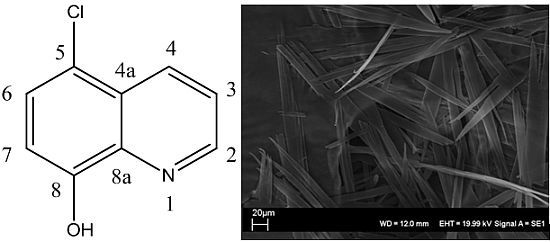
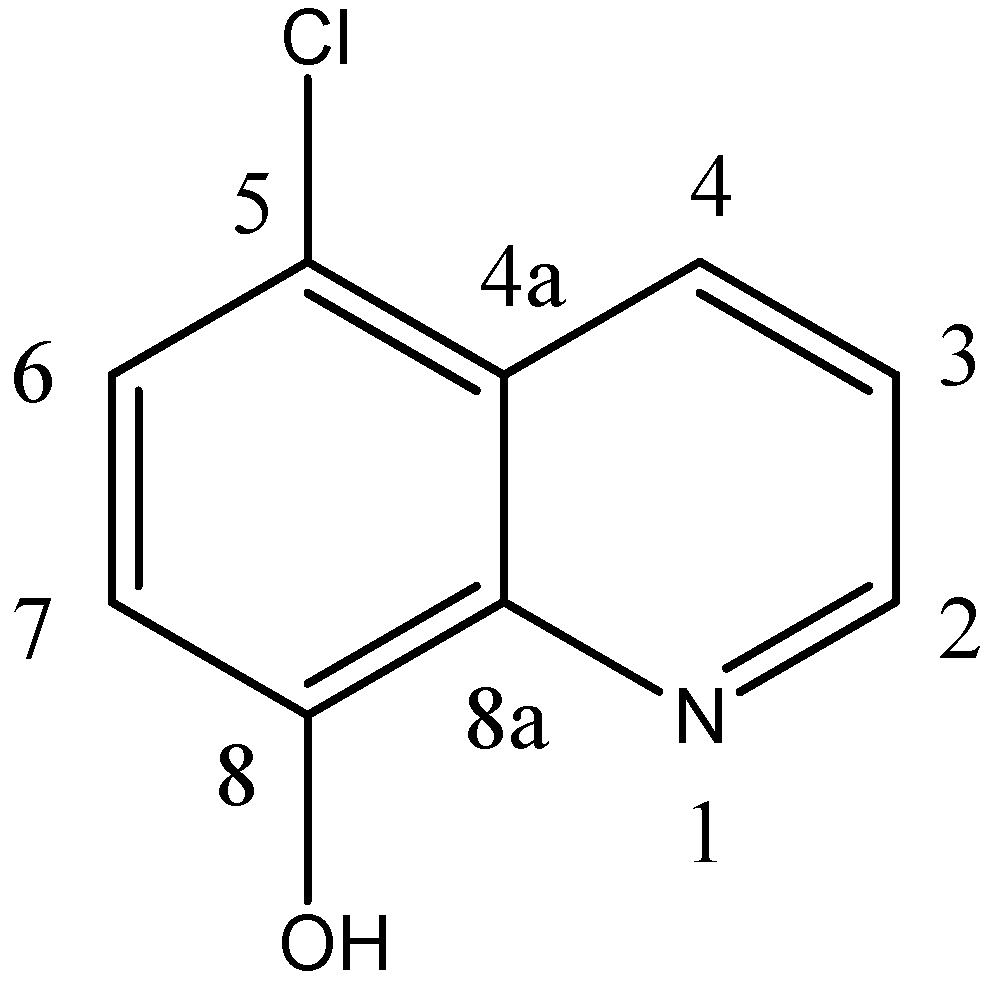
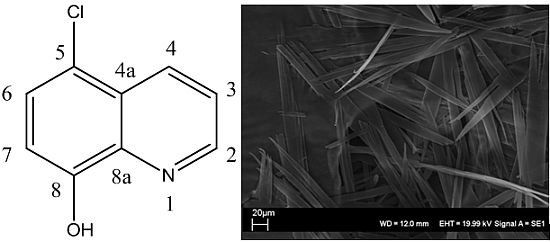
      <p><xref ref-type="fig" rid="antibiotics-01-00017-f001">Figure 1</xref> shows the structure and numbering of 5-chloro-8-hydroxyquinoline.</p>
      <fig id="antibiotics-01-00017-f001" position="anchor">
        <label>Figure 1</label>
        <caption>
          <p>The structure and numbering of 5-chloro-8-hydroxyquinoline.</p>
        </caption>
        <graphic xmlns:xlink="http://www.w3.org/1999/xlink" xlink:href="antibiotics-01-00017-g001.tif"/>
      </fig>
      <p><xref ref-type="table" rid="antibiotics-01-00017-t001">Table 1</xref> lists the gelation data in various aqueous alcohol solutions at 295 K. The gel formation was observed by the test tube inversion method. Systematic temperature studies of all gels were not performed. However, for 1% 5-chloro-8-hydroxyquinoline gel in CD<sub>3</sub>OD/D<sub>2</sub>O (2:1) the gel-to-sol temperature was between +28 °C and +30 °C observed by <sup>1</sup>H-NMR.</p>
      <table-wrap id="antibiotics-01-00017-t001" position="anchor">
        <object-id pub-id-type="pii">antibiotics-01-00017-t001_Table 1</object-id>
        <label>Table 1</label>
        <caption>
          <p>Gelation data of 5-chloro-8-hydroxyquinoline (cloxiquine).</p>
        </caption>
        <table>
          <thead>
            <tr>
              <th align="center" valign="middle">Entry</th>
              <th align="center" valign="middle">Solvent system</th>
              <th align="center" valign="middle">[cloxiquine] gel stability</th>
            </tr>
          </thead>
          <tbody>
            <tr>
              <td align="center" valign="middle">1</td>
              <td align="center" valign="middle">1:1 EtOH/H<sub>2</sub>O</td>
              <td align="center" valign="middle">1.0% very stable</td>
            </tr>
            <tr>
              <td align="center" valign="middle">2</td>
              <td align="center" valign="middle">1:1 EtOH/H<sub>2</sub>O</td>
              <td align="center" valign="middle">0.75% stable</td>
            </tr>
            <tr>
              <td align="center" valign="middle">3</td>
              <td align="center" valign="middle">1:1 EtOH/H<sub>2</sub>O</td>
              <td align="center" valign="middle">0.5% stable</td>
            </tr>
            <tr>
              <td align="center" valign="middle">4</td>
              <td align="center" valign="middle">1:2 EtOH/H<sub>2</sub>O</td>
              <td align="center" valign="middle">1.0% stable</td>
            </tr>
            <tr>
              <td align="center" valign="middle">5</td>
              <td align="center" valign="middle">1:2 EtOH/H<sub>2</sub>O</td>
              <td align="center" valign="middle">0.5% stable</td>
            </tr>
            <tr>
              <td align="center" valign="middle">6</td>
              <td align="center" valign="middle">1:2 EtOH/H<sub>2</sub>O</td>
              <td align="center" valign="middle">0.2% poor</td>
            </tr>
            <tr>
              <td align="center" valign="middle">7</td>
              <td align="center" valign="middle">1:4 EtOH/H<sub>2</sub>O</td>
              <td align="center" valign="middle">1.0% stable</td>
            </tr>
            <tr>
              <td align="center" valign="middle">8</td>
              <td align="center" valign="middle">2:1 MeOH/H<sub>2</sub>O</td>
              <td align="center" valign="middle">1.0% very stable</td>
            </tr>
            <tr>
              <td align="center" valign="middle">9</td>
              <td align="center" valign="middle">2:1 MeOH/H<sub>2</sub>O</td>
              <td align="center" valign="middle">0.75% stable</td>
            </tr>
            <tr>
              <td align="center" valign="middle">10</td>
              <td align="center" valign="middle">2:1 MeOH/H<sub>2</sub>O</td>
              <td align="center" valign="middle">0.5% precipitate</td>
            </tr>
            <tr>
              <td align="center" valign="middle">11</td>
              <td align="center" valign="middle">1:2 MeOH/H<sub>2</sub>O</td>
              <td align="center" valign="middle">1.0% precipitate</td>
            </tr>
            <tr>
              <td align="center" valign="middle">12</td>
              <td align="center" valign="middle">1:4 MeOH/H<sub>2</sub>O</td>
              <td align="center" valign="middle">1.0% precipitate</td>
            </tr>
            <tr>
              <td align="center" valign="middle">13</td>
              <td align="center" valign="middle">2:1 1-PrOH/H<sub>2</sub>O</td>
              <td align="center" valign="middle">1.0% precipitate</td>
            </tr>
            <tr>
              <td align="center" valign="middle">14</td>
              <td align="center" valign="middle">1:1 1-PrOH/H<sub>2</sub>O</td>
              <td align="center" valign="middle">2.0% very stable</td>
            </tr>
            <tr>
              <td align="center" valign="middle">15</td>
              <td align="center" valign="middle">1:1 1-PrOH/H<sub>2</sub>O</td>
              <td align="center" valign="middle">1.0% stable</td>
            </tr>
            <tr>
              <td align="center" valign="middle">16</td>
              <td align="center" valign="middle">1:1 1-PrOH/H<sub>2</sub>O</td>
              <td align="center" valign="middle">0.75% poor</td>
            </tr>
            <tr>
              <td align="center" valign="middle">17</td>
              <td align="center" valign="middle">1:1 1-PrOH/H<sub>2</sub>O</td>
              <td align="center" valign="middle">0.5% precipitate</td>
            </tr>
            <tr>
              <td align="center" valign="middle">18</td>
              <td align="center" valign="middle">1:2 1-PrOH/H<sub>2</sub>O</td>
              <td align="center" valign="middle">1.0% stable</td>
            </tr>
            <tr>
              <td align="center" valign="middle">19</td>
              <td align="center" valign="middle">1:4 1-PrOH/H<sub>2</sub>O</td>
              <td align="center" valign="middle">1.0% stable</td>
            </tr>
            <tr>
              <td align="center" valign="middle">20</td>
              <td align="center" valign="middle">1:4 1-PrOH/H<sub>2</sub>O</td>
              <td align="center" valign="middle">0,5% stable</td>
            </tr>
            <tr>
              <td align="center" valign="middle">21</td>
              <td align="center" valign="middle">1:4 1-PrOH/H<sub>2</sub>O</td>
              <td align="center" valign="middle">0.2% stable</td>
            </tr>
            <tr>
              <td align="center" valign="middle">22</td>
              <td align="center" valign="middle">1:4 1-PrOH/H<sub>2</sub>O</td>
              <td align="center" valign="middle">0.1% stable</td>
            </tr>
            <tr>
              <td align="center" valign="middle">23</td>
              <td align="center" valign="middle">1:8 1-PrOH/H<sub>2</sub>O</td>
              <td align="center" valign="middle">1.0% precipitate</td>
            </tr>
            <tr>
              <td align="center" valign="middle">24</td>
              <td align="center" valign="middle">1:10 1-PrOH/H<sub>2</sub>O</td>
              <td align="center" valign="middle">1.0% precipitate</td>
            </tr>
            <tr>
              <td align="center" valign="middle">25</td>
              <td align="center" valign="middle">1:1 2-PrOH/H<sub>2</sub>O</td>
              <td align="center" valign="middle">2.0% stable</td>
            </tr>
            <tr>
              <td align="center" valign="middle">26</td>
              <td align="center" valign="middle">1:1 2-PrOH/H<sub>2</sub>O</td>
              <td align="center" valign="middle">1.0% stable</td>
            </tr>
            <tr>
              <td align="center" valign="middle">27</td>
              <td align="center" valign="middle">1:1 2-PrOH/H<sub>2</sub>O</td>
              <td align="center" valign="middle">0.5% stable</td>
            </tr>
            <tr>
              <td align="center" valign="middle">28</td>
              <td align="center" valign="middle">1:1 2-PrOH/H<sub>2</sub>O</td>
              <td align="center" valign="middle">0.2% poor</td>
            </tr>
            <tr>
              <td align="center" valign="middle">29</td>
              <td align="center" valign="middle">1:2 2-PrOH/H<sub>2</sub>O</td>
              <td align="center" valign="middle">1% (g) stable</td>
            </tr>
            <tr>
              <td align="center" valign="middle">30</td>
              <td align="center" valign="middle">1:4 2-PrOH/H<sub>2</sub>O</td>
              <td align="center" valign="middle">1% precipitate</td>
            </tr>
          </tbody>
        </table>
      </table-wrap>
      <p>As can be seen, increasing the concentration of 5-chloro-8-hydroxyquinoline results in a better stability of the formed gels. However, 5-chloro-8-hydroxyquinoline is not a real hydrogelator because increasing the water molar ratio generally results in a precipitate formation.</p>
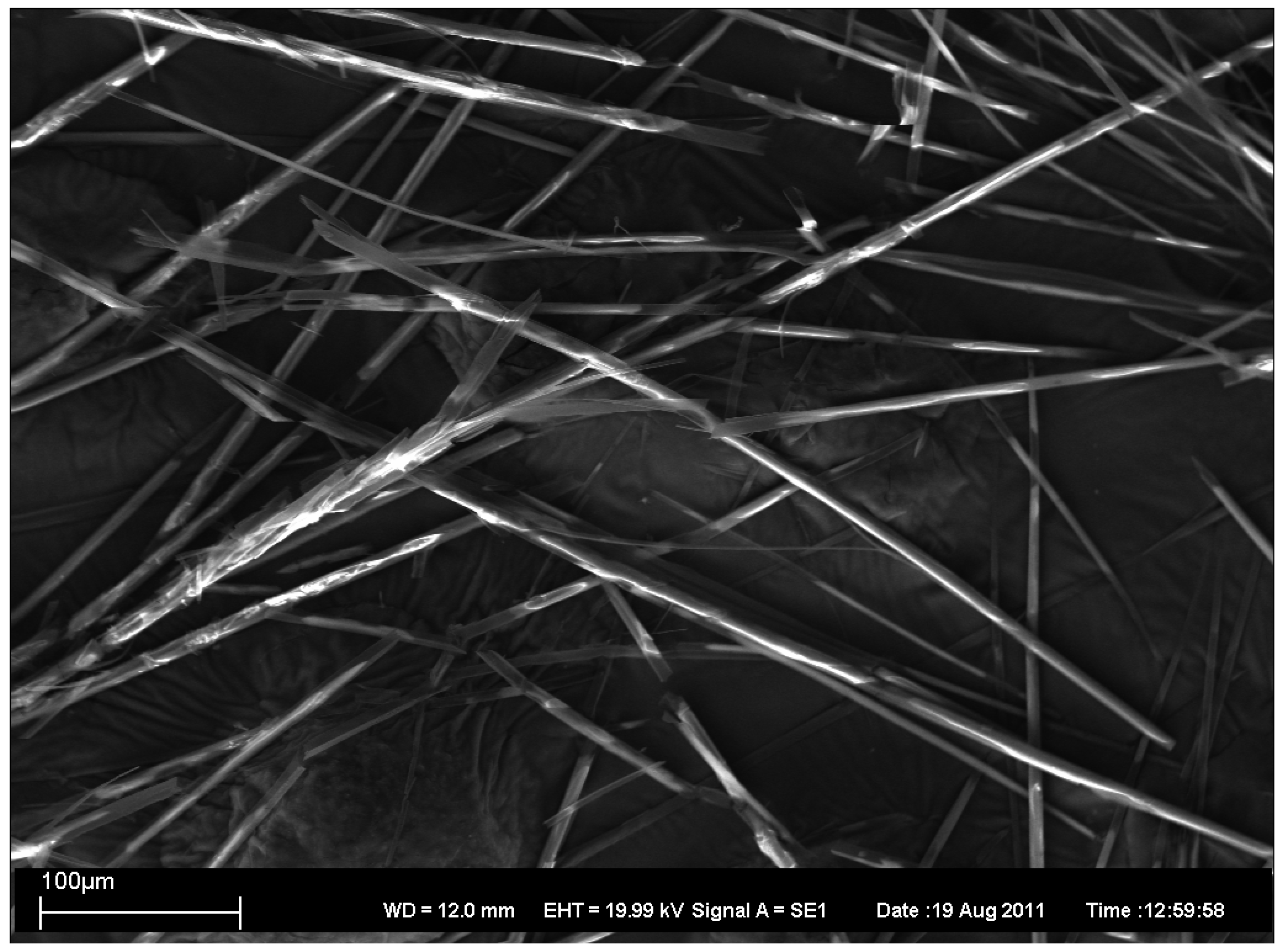
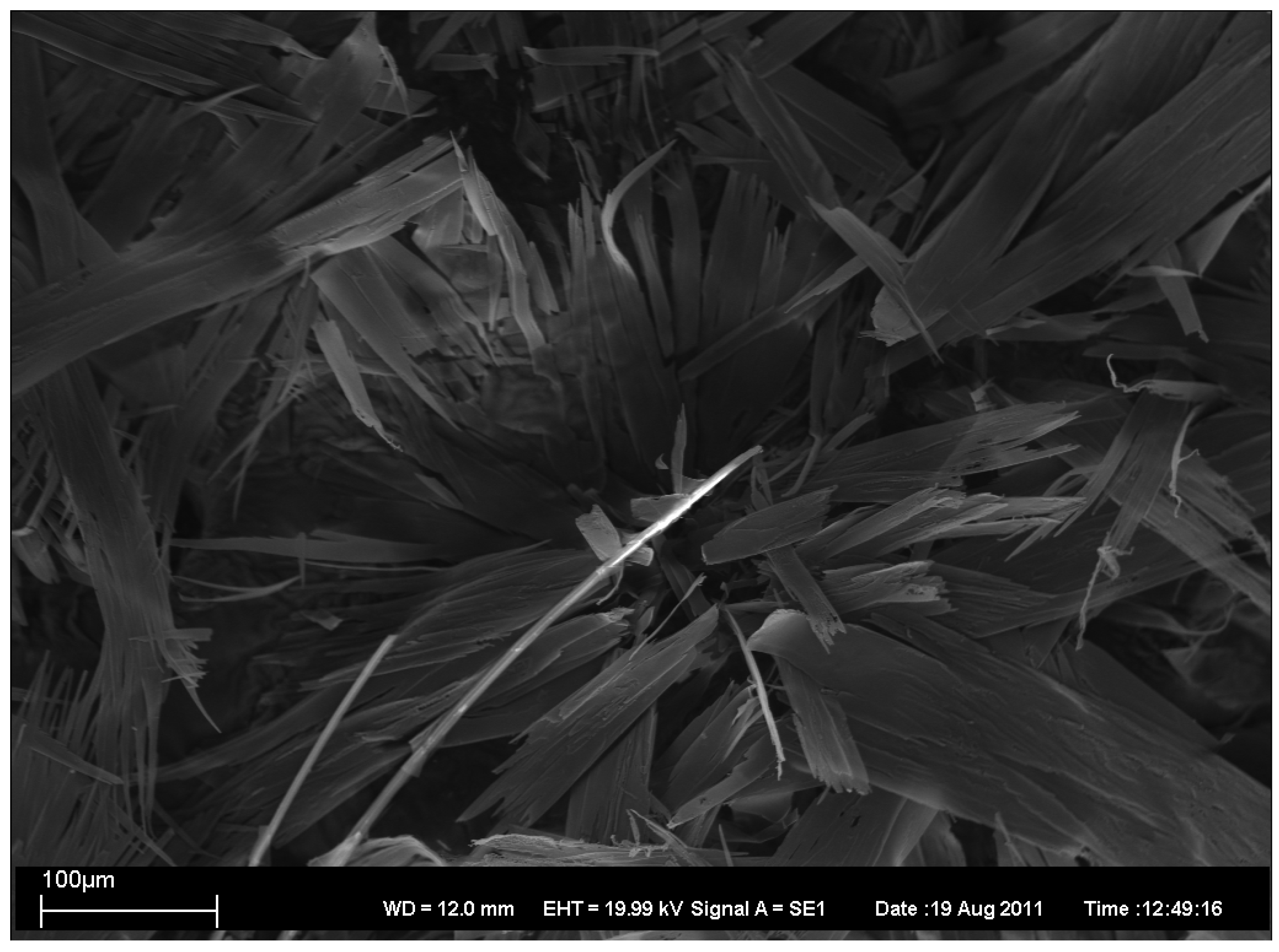
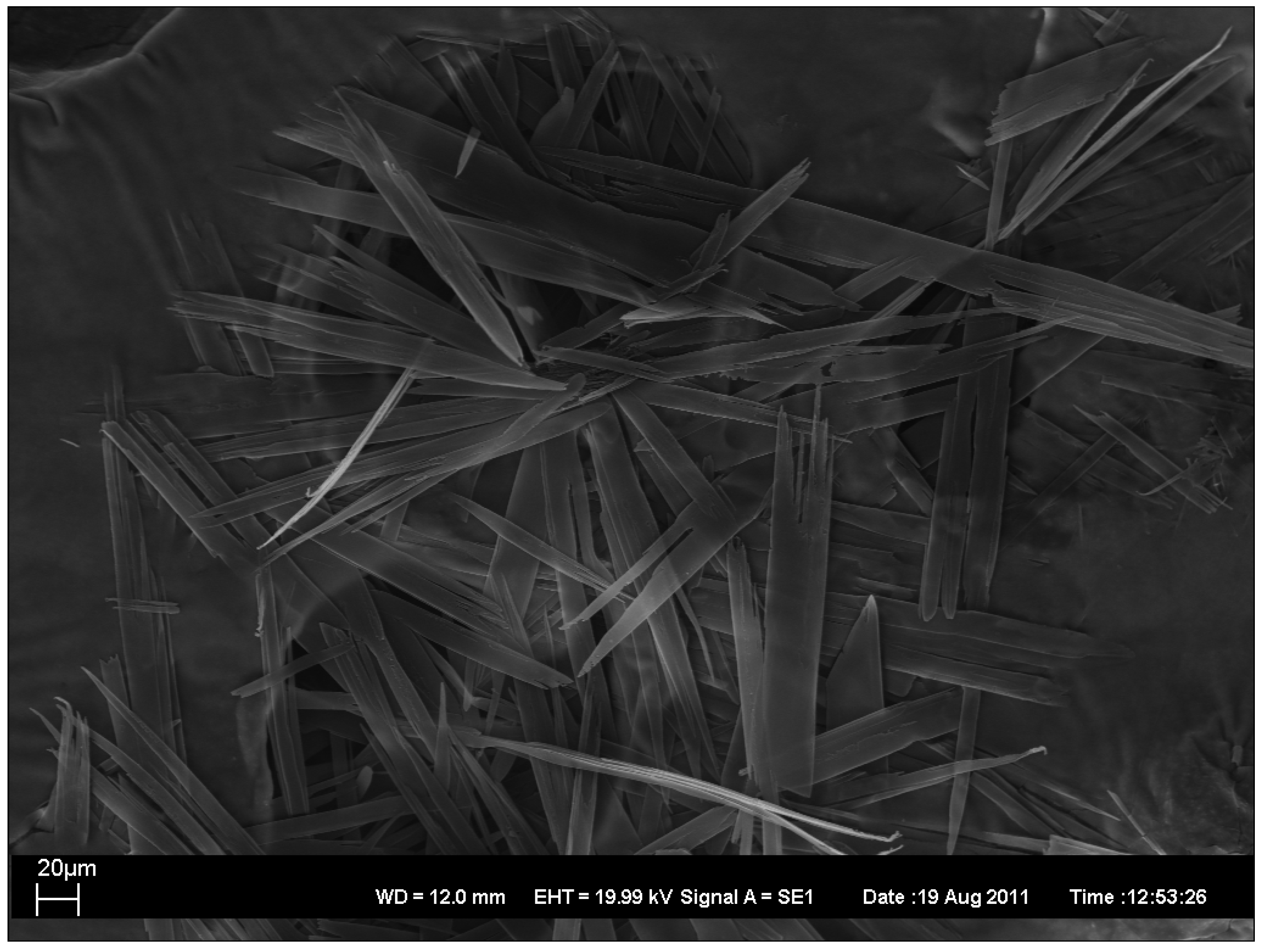
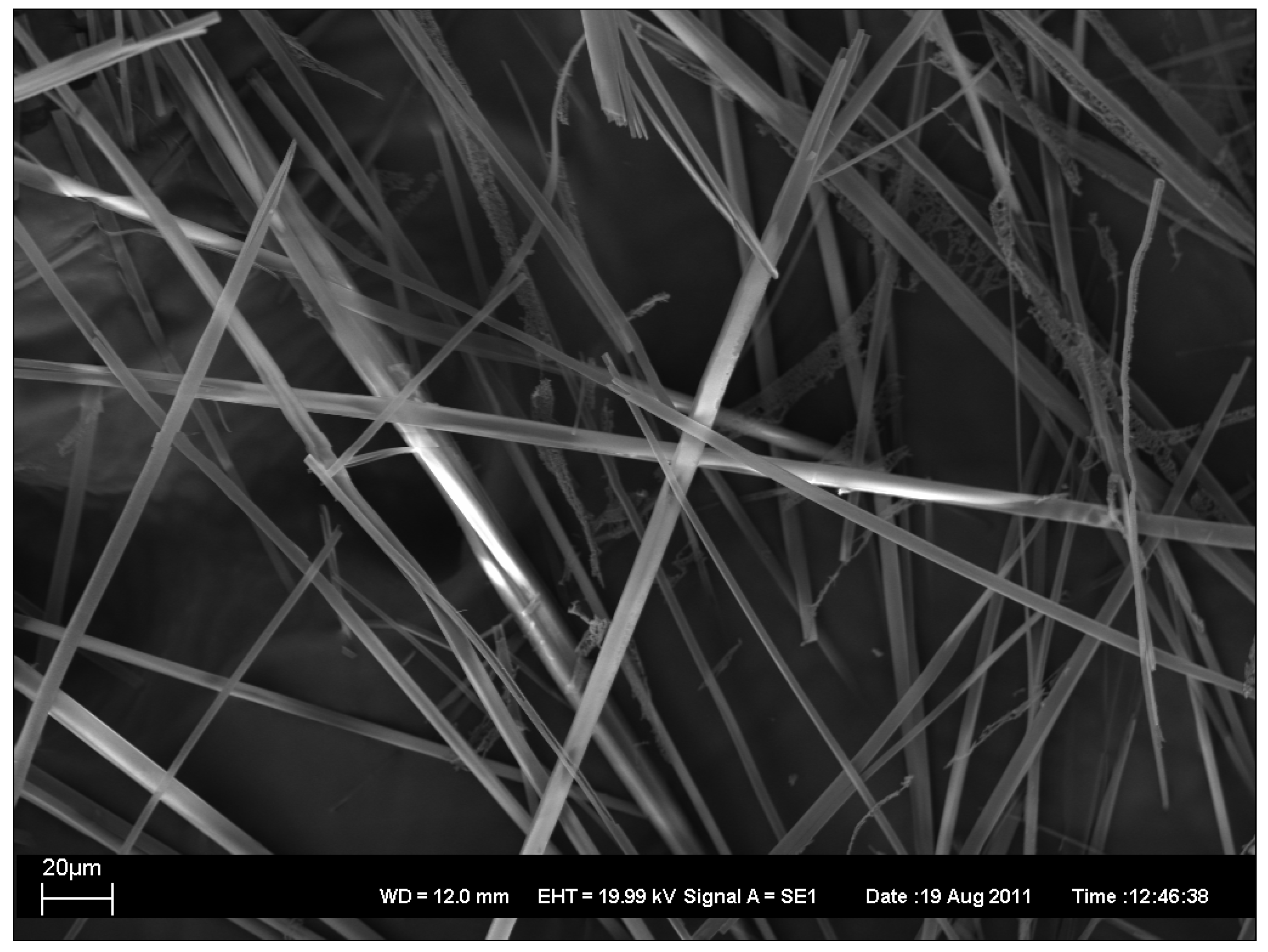
      <p>In addition, the topography of the gels was characterized by the electron microscopy. Four xerogels have been characterized by scanning electron microscopy (SEM), as described in <xref ref-type="fig" rid="antibiotics-01-00017-f002">Figure 2</xref>, <xref ref-type="fig" rid="antibiotics-01-00017-f003">Figure 3</xref>, <xref ref-type="fig" rid="antibiotics-01-00017-f004">Figure 4</xref>, <xref ref-type="fig" rid="antibiotics-01-00017-f005">Figure 5</xref>. </p>
      <fig id="antibiotics-01-00017-f002" position="anchor">
        <label>Figure 2</label>
        <caption>
          <p>SEM image of xerogel from 1:1 EtOH/water 1% gel.</p>
        </caption>
        <graphic xmlns:xlink="http://www.w3.org/1999/xlink" xlink:href="antibiotics-01-00017-g002.tif"/>
      </fig>
      <fig id="antibiotics-01-00017-f003" position="anchor">
        <label>Figure 3</label>
        <caption>
          <p>SEM image of xerogel from 2:1 MeOH/water 1% gel.</p>
        </caption>
        <graphic xmlns:xlink="http://www.w3.org/1999/xlink" xlink:href="antibiotics-01-00017-g003.tif"/>
      </fig>
      <fig id="antibiotics-01-00017-f004" position="anchor">
        <label>Figure 4</label>
        <caption>
          <p>SEM image of xerogel from 1:1 1-PrOH/water 2% gel.</p>
        </caption>
        <graphic xmlns:xlink="http://www.w3.org/1999/xlink" xlink:href="antibiotics-01-00017-g004.tif"/>
      </fig>
      <fig id="antibiotics-01-00017-f005" position="anchor">
        <label>Figure 5</label>
        <caption>
          <p>SEM image of xerogel from 1:1 1-PrOH/water 1% gel.</p>
        </caption>
        <graphic xmlns:xlink="http://www.w3.org/1999/xlink" xlink:href="antibiotics-01-00017-g005.tif"/>
      </fig>
      <p>As can be seen, SEM images 2–5 revealed the presence of long rod-like structures with variable rod diameters. However, there exists some variation in the width and the length of the rods. In xerogels from 1:1 EtOH/water 1% gel (<xref ref-type="fig" rid="antibiotics-01-00017-f002">Figure 2</xref>) and from 1:1 1-PrOH/water 1% gel (<xref ref-type="fig" rid="antibiotics-01-00017-f005">Figure 5</xref>) the width variation is clearly larger and the average widths is greater than in the others (<xref ref-type="fig" rid="antibiotics-01-00017-f003">Figure 3</xref> and <xref ref-type="fig" rid="antibiotics-01-00017-f004">Figure 4</xref>) which also show less bundled structures. In all xerogels, rods reveal no or very weak branching and the overall structure can thus be considered as an open-type network. The fractures of the network seen in <xref ref-type="fig" rid="antibiotics-01-00017-f005">Figure 5</xref> are probably due to the faster evaporation of the solvent.</p>
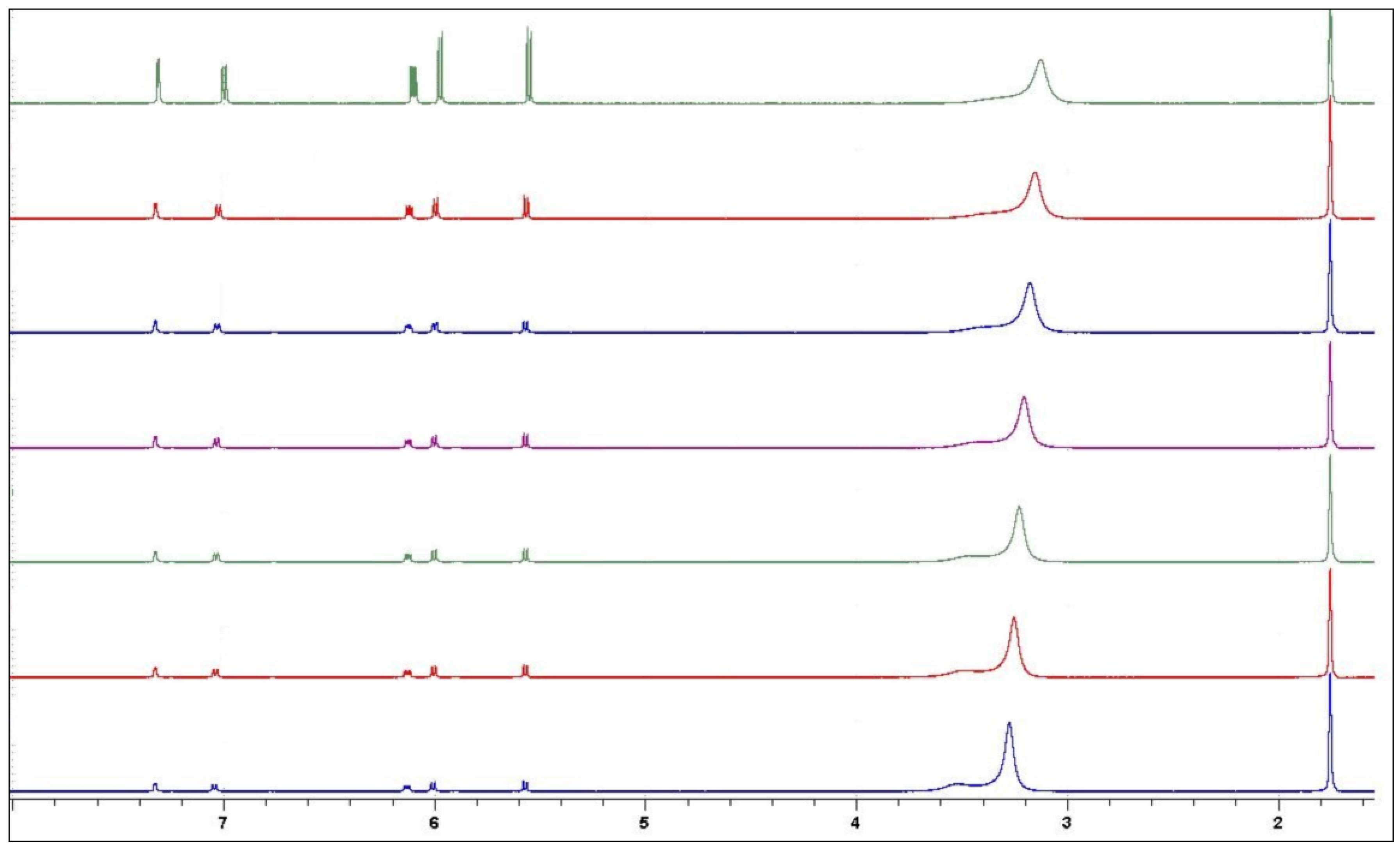
      <p>The gel-to-sol transformation was studied by variable temperature NMR. This technique was successfully used recently in gel-to-sol transformation studies [<xref ref-type="bibr" rid="B15-antibiotics-01-00017">15</xref>]. <xref ref-type="fig" rid="antibiotics-01-00017-f006">Figure 6</xref> describes 500 MHz <sup>1</sup>H-NMR spectra of 1.0% 5-chloro-8-hydroxyquinoline in CD<sub>3</sub>OD/D<sub>2</sub>O (2:1) from +18 °C (bottom) to +30 °C (top) in 2 °C steps. As can be seen, a clear increase in the signal intensity happens between +28 °C and +30 °C. This means that the number of motionally limited or NMR “silent” molecules of the gel [<xref ref-type="bibr" rid="B16-antibiotics-01-00017">16</xref>] decreases significantly between these two temperatures owing to the gel-to-sol transformation where the molecular motion of 5-chloro-8-hydroxyquinoline is no longer restricted. Although this gel-to-sol change happens below the physiological conditions this finding suggests that the gel stability could be improved by other modifications of solvent systems. </p>
    </sec>
    <sec sec-type="methods">
      <title>3. Experimental</title>
      <p>5-Chloro-8-hydroxyquinoline (95%) was purchased from Sigma-Aldrich and used without purification because its <sup>1</sup>H-NMR spectrum did not reveal any impurity signals [<xref ref-type="bibr" rid="B17-antibiotics-01-00017">17</xref>]. All solvents were also from commercial sources and used as obtained. Deionized water was from our own laboratory. The samples were prepared by weighing an accurate amount of 5-chloro-8-hydroxyquinoline in a known volume of the solvent system in a test tube. After that the mixture was heated in a water bath until the solute dissolves. Then the test tube was closed and allowed to cool to room temperature. The gel formation was detected by the tube inversion technique as non-mobility of the sample and by visual inspection.</p>
      <fig id="antibiotics-01-00017-f006" position="anchor">
        <label>Figure 6</label>
        <caption>
          <p>Variable temperature 500 MHz <sup>1</sup>H-NMR spectra of 1.0% 5-chloro-8-hydroxy-quinoline in CD<sub>3</sub>OD/D<sub>2</sub>O (2:1) from +18 °C (bottom) to +30 °C (top) in 2 °C steps. The clearincrease in the signal intensity between +28 °C and +30 °C is due to the gel-to-sol transformation.</p>
        </caption>
        <graphic xmlns:xlink="http://www.w3.org/1999/xlink" xlink:href="antibiotics-01-00017-g006.tif"/>
      </fig>
      <p>SEM images have been taken with Zeiss EVO 50 scanning electron microscope. In <xref ref-type="fig" rid="antibiotics-01-00017-f002">Figure 2</xref>, <xref ref-type="fig" rid="antibiotics-01-00017-f003">Figure 3</xref>, <xref ref-type="fig" rid="antibiotics-01-00017-f004">Figure 4</xref>, <xref ref-type="fig" rid="antibiotics-01-00017-f005">Figure 5</xref> are also given the working distance 12.0 mm and acceleration voltage 19.99 kV.</p>
      <p>VT <sup>1</sup>H-NMR spectra were run with Bruker Avance DRX 500 FT NMR spectrometer in CD<sub>3</sub>OD/D<sub>2</sub>O 2:1-mixture using 30° flip angle and 4 scans. The chemical shift scale is referenced to the trace signal of CHD<sub>2</sub>OD at 3.31 ppm from internal TMS.</p>
    </sec>
    <sec sec-type="conclusions">
      <title>4. Conclusions</title>
      <p>It was shown that 5-chloro-8-hydroxyquinoline, an antituberculosis agent, efficiently gels aqueous alcohol solutions. A variable temperature <sup>1</sup>H-NMR study reveals that the gel-to-sol transition of 1.0% 5-chloro-8-hydroxy-12-quinoline in CD<sub>3</sub>OD/D<sub>2</sub>O (2:1) happens between +28 °C and +30 °C. Although this gel-to-sol transition takes place below the physiological conditions, this finding suggests that the gel stability could be improved by other modifications of solvent systems. This finding can be useful for the drug delivery and preparation of pharmaceutical formulations of 5-chloro-8-hydroxyquinoline.</p>
    </sec>
  </body>
  <back>
    <ack>
      <title>Acknowledgments</title>
      <p>We are grateful to Esa Haapaniemi for his help in VT NMR runs.</p>
    </ack>
    <notes>
      <title>Conflict of Interest</title>
      <p>The authors declare no conflict of interest. </p>
    </notes>
    <ref-list>
      <title>References</title>
      <ref id="B1-antibiotics-01-00017">
        <label>1.</label>
        <citation citation-type="journal">
          <person-group person-group-type="author">
            <name>
              <surname>Dye</surname>
              <given-names>C.</given-names>
            </name>
          </person-group>
          <article-title>Global epidemiology of tuberculosis</article-title>
          <source>Lancet</source>
          <year>2006</year>
          <volume>367</volume>
          <fpage>938</fpage>
          <lpage>940</lpage>
          <pub-id pub-id-type="doi">10.1016/S0140-6736(06)68384-0</pub-id>
        </citation>
      </ref>
      <ref id="B2-antibiotics-01-00017">
        <label>2.</label>
        <citation citation-type="journal">
          <person-group person-group-type="author">
            <name>
              <surname>Ahmad</surname>
              <given-names>Z.</given-names>
            </name>
            <name>
              <surname>Makaya</surname>
              <given-names>N.H.</given-names>
            </name>
            <name>
              <surname>Grosset</surname>
              <given-names>J.</given-names>
            </name>
          </person-group>
          <article-title>History of drug discovery: Early evaluation studies and lessons learnt from them</article-title>
          <source>Prog. Respir. Res.</source>
          <year>2011</year>
          <volume>40</volume>
          <fpage>2</fpage>
          <lpage>9</lpage>
          <pub-id pub-id-type="doi">10.1159/000324894</pub-id>
        </citation>
      </ref>
      <ref id="B3-antibiotics-01-00017">
        <label>3.</label>
        <citation citation-type="journal">
          <person-group person-group-type="author">
            <name>
              <surname>Hongmanee</surname>
              <given-names>P.</given-names>
            </name>
            <name>
              <surname>Rukseree</surname>
              <given-names>K.</given-names>
            </name>
            <name>
              <surname>Buabut</surname>
              <given-names>B.</given-names>
            </name>
            <name>
              <surname>Somsri</surname>
              <given-names>B.</given-names>
            </name>
            <name>
              <surname>Prasit</surname>
              <given-names>P.</given-names>
            </name>
          </person-group>
          <article-title><italic>In vitro</italic> activities of cloxyquin (5-chloroquinolin-8-ol) against <italic>Mycobacterium tuberculosis</italic></article-title>
          <source>Antimicrob. Agents Chemother.</source>
          <year>2007</year>
          <volume>51</volume>
          <fpage>1105</fpage>
          <lpage>1106</lpage>
          <pub-id pub-id-type="doi">10.1128/AAC.01310-06</pub-id>
        </citation>
      </ref>
      <ref id="B4-antibiotics-01-00017">
        <label>4.</label>
        <citation citation-type="journal">
          <person-group person-group-type="author">
            <name>
              <surname>Darby</surname>
              <given-names>C.M.</given-names>
            </name>
            <name>
              <surname>Nathan</surname>
              <given-names>C.F.</given-names>
            </name>
          </person-group>
          <article-title>Killing of non-replicating <italic>Mycobacterium tuberculosis</italic> by 8-hydroxy-quinoline</article-title>
          <source>J. Antimicrob. Chemother.</source>
          <year>2010</year>
          <volume>65</volume>
          <fpage>1424</fpage>
          <lpage>1427</lpage>
          <pub-id pub-id-type="doi">10.1093/jac/dkq145</pub-id>
        </citation>
      </ref>
      <ref id="B5-antibiotics-01-00017">
        <label>5.</label>
        <citation citation-type="journal">
          <person-group person-group-type="author">
            <name>
              <surname>Enquist</surname>
              <given-names>P.-A.</given-names>
            </name>
            <name>
              <surname>Gylfe</surname>
              <given-names>Å.</given-names>
            </name>
            <name>
              <surname>Hägglund</surname>
              <given-names>U.</given-names>
            </name>
            <name>
              <surname>Lindström</surname>
              <given-names>P.</given-names>
            </name>
            <name>
              <surname>Norberg-Scherman</surname>
              <given-names>H.</given-names>
            </name>
            <name>
              <surname>Sundin</surname>
              <given-names>C.</given-names>
            </name>
            <name>
              <surname>Elofsson</surname>
              <given-names>M.</given-names>
            </name>
          </person-group>
          <article-title>Derivatives of 8-hydroxyquinoline-Antibacterial agents that target intra- and extracellular Gram-negative pathogens</article-title>
          <source>Bioorg. Med. Chem. Lett.</source>
          <year>2012</year>
          <volume>22</volume>
          <fpage>3550</fpage>
          <lpage>3553</lpage>
          <pub-id pub-id-type="doi">10.1016/j.bmcl.2012.03.096</pub-id>
        </citation>
      </ref>
      <ref id="B6-antibiotics-01-00017">
        <label>6.</label>
        <citation citation-type="journal">
          <person-group person-group-type="author">
            <name>
              <surname>Ma</surname>
              <given-names>Z.</given-names>
            </name>
            <name>
              <surname>Moulton</surname>
              <given-names>B.</given-names>
            </name>
          </person-group>
          <article-title>A novel polymorph of 5-chloro-8-hydroxyquinoline with improved water solubility and faster dissolution rate</article-title>
          <source>J. Chem. Crystallogr.</source>
          <year>2009</year>
          <volume>39</volume>
          <fpage>913</fpage>
          <lpage>918</lpage>
          <pub-id pub-id-type="doi">10.1007/s10870-009-9591-3</pub-id>
        </citation>
      </ref>
      <ref id="B7-antibiotics-01-00017">
        <label>7.</label>
        <citation citation-type="journal">
          <person-group person-group-type="author">
            <name>
              <surname>Fernández-Bachiller</surname>
              <given-names>M.I.</given-names>
            </name>
            <name>
              <surname>Pérez</surname>
              <given-names>C.</given-names>
            </name>
            <name>
              <surname>González-Munoz</surname>
              <given-names>G.C.</given-names>
            </name>
            <name>
              <surname>Conde</surname>
              <given-names>S.</given-names>
            </name>
            <name>
              <surname>López</surname>
              <given-names>M.G.</given-names>
            </name>
            <name>
              <surname>Villarroya</surname>
              <given-names>M.</given-names>
            </name>
            <name>
              <surname>García</surname>
              <given-names>A.G.</given-names>
            </name>
            <name>
              <surname>Rodríguez-Franco</surname>
              <given-names>M.I.</given-names>
            </name>
          </person-group>
          <article-title>Novel tacrine-8-hydroxyquinoline hybrids as multifunctional agents for the treatment of Alzheimer’s disease, with neuroprotective, cholinergic, antioxidant, and copper-complexing properties</article-title>
          <source>J. Med. Chem.</source>
          <year>2010</year>
          <volume>53</volume>
          <fpage>4927</fpage>
          <lpage>4937</lpage>
        <pub-id pub-id-type="doi">10.1021/jm100329q</pub-id><pub-id pub-id-type="pmid">20545360</pub-id></citation>
      </ref>
      <ref id="B8-antibiotics-01-00017">
        <label>8.</label>
        <citation citation-type="journal">
          <person-group person-group-type="author">
            <name>
              <surname>Kharadia</surname>
              <given-names>G.J.</given-names>
            </name>
            <name>
              <surname>Patel</surname>
              <given-names>J.R.</given-names>
            </name>
            <name>
              <surname>Dholakiy</surname>
              <given-names>B.Z.</given-names>
            </name>
          </person-group>
          <article-title>Antituberculosis, antifungal and thermal activity of mixed ligand transition metal complexes</article-title>
          <source>Appl. Organomet. Chem.</source>
          <year>2010</year>
          <volume>24</volume>
          <fpage>821</fpage>
          <lpage>827</lpage>
          <pub-id pub-id-type="doi">10.1002/aoc.1711</pub-id>
        </citation>
      </ref>
      <ref id="B9-antibiotics-01-00017">
        <label>9.</label>
        <citation citation-type="journal">
          <person-group person-group-type="author">
            <name>
              <surname>Ma</surname>
              <given-names>Z.</given-names>
            </name>
            <name>
              <surname>Moulton</surname>
              <given-names>B.</given-names>
            </name>
          </person-group>
          <article-title>Mixed-Ligand Coordination Species: A Promising Approach for “Second-Generation” Drug Development</article-title>
          <source>Cryst. Growth Des.</source>
          <year>2007</year>
          <volume>7</volume>
          <fpage>196</fpage>
          <lpage>198</lpage>
          <pub-id pub-id-type="doi">10.1021/cg060602f</pub-id>
        </citation>
      </ref>
      <ref id="B10-antibiotics-01-00017">
        <label>10.</label>
        <citation citation-type="journal">
          <person-group person-group-type="author">
            <name>
              <surname>Ma</surname>
              <given-names>Z.</given-names>
            </name>
            <name>
              <surname>Moulton</surname>
              <given-names>B.</given-names>
            </name>
          </person-group>
          <article-title>Supramolecular medicinal chemistry: Mixed-ligand coordination complexes</article-title>
          <source>Mol. Pharm.</source>
          <year>2007</year>
          <volume>4</volume>
          <fpage>373</fpage>
          <lpage>385</lpage>
          <pub-id pub-id-type="doi">10.1021/mp070013k</pub-id>
        </citation>
      </ref>
      <ref id="B11-antibiotics-01-00017">
        <label>11.</label>
        <citation citation-type="journal">
          <person-group person-group-type="author">
            <name>
              <surname>Pasipanodya</surname>
              <given-names>J.G.</given-names>
            </name>
            <name>
              <surname>Gumbo</surname>
              <given-names>T.</given-names>
            </name>
          </person-group>
          <article-title>A new evolutionary and pharmacokinetic-pharmacodynamic scenario for rapid emergence of resistance to single and multiple anti-tuberculosis drugs</article-title>
          <source>Curr. Opin. Pharmacol.</source>
          <year>2011</year>
          <volume>11</volume>
          <fpage>457</fpage>
          <lpage>463</lpage>
          <pub-id pub-id-type="doi">10.1016/j.coph.2011.07.001</pub-id>
        </citation>
      </ref>
      <ref id="B12-antibiotics-01-00017">
        <label>12.</label>
        <citation citation-type="journal">
          <person-group person-group-type="author">
            <name>
              <surname>Sangeetha</surname>
              <given-names>N.M.</given-names>
            </name>
            <name>
              <surname>Maitra</surname>
              <given-names>U.</given-names>
            </name>
          </person-group>
          <article-title>Supramolecular gels: Functions and uses</article-title>
          <source>Chem. Soc. Rev.</source>
          <year>2005</year>
          <volume>34</volume>
          <fpage>821</fpage>
          <lpage>836</lpage>
          <pub-id pub-id-type="doi">10.1039/b417081b</pub-id>
        </citation>
      </ref>
      <ref id="B13-antibiotics-01-00017">
        <label>13.</label>
        <citation citation-type="journal">
          <person-group person-group-type="author">
            <name>
              <surname>Svobodová</surname>
              <given-names>H.</given-names>
            </name>
            <name>
              <surname>Noponen</surname>
              <given-names>V.</given-names>
            </name>
            <name>
              <surname>Kolehmainen</surname>
              <given-names>E.</given-names>
            </name>
            <name>
              <surname>Sievänen</surname>
              <given-names>E.</given-names>
            </name>
          </person-group>
          <article-title>Recent advances in steroidal supramolecular gels</article-title>
          <source>RSC Adv.</source>
          <year>2012</year>
          <volume>2</volume>
          <fpage>7840</fpage>
          <lpage>7847</lpage>
        </citation>
      </ref>
      <ref id="B14-antibiotics-01-00017">
        <label>14.</label>
        <citation citation-type="journal">
          <person-group person-group-type="author">
            <name>
              <surname>Latosińska</surname>
              <given-names>J.N.</given-names>
            </name>
            <name>
              <surname>Latosińska</surname>
              <given-names>M.</given-names>
            </name>
            <name>
              <surname>Tomczak</surname>
              <given-names>M.A.</given-names>
            </name>
            <name>
              <surname>Seliger</surname>
              <given-names>J.</given-names>
            </name>
            <name>
              <surname>Žagar</surname>
              <given-names>V.</given-names>
            </name>
          </person-group>
          <article-title>Supramolecular synthon pattern in solid clioquinol and cloxiquine (APIs of antibacterial, antifungal, antiaging and antituberculosis drugs) studied by <sup>35</sup>Cl NQR, <sup>1</sup>H-<sup>17</sup>O and <sup>1</sup>H-<sup>14</sup>N NQDR and DFT/QTAIM</article-title>
          <source>J. Mol. Model.</source>
          <year>2011</year>
          <volume>17</volume>
          <fpage>1781</fpage>
          <lpage>1800</lpage>
          <pub-id pub-id-type="doi">10.1007/s00894-010-0876-4</pub-id>
        </citation>
      </ref>
      <ref id="B15-antibiotics-01-00017">
        <label>15.</label>
        <citation citation-type="journal">
          <person-group person-group-type="author">
            <name>
              <surname>Svobodová</surname>
              <given-names>H.</given-names>
            </name>
            <name>
              <surname>Nonappa</surname>
            </name>
            <name>
              <surname>Lahtinen</surname>
              <given-names>M.</given-names>
            </name>
            <name>
              <surname>Wimmer</surname>
              <given-names>Z.</given-names>
            </name>
            <name>
              <surname>Kolehmainen</surname>
              <given-names>E.</given-names>
            </name>
          </person-group>
          <article-title>A steroid-based gelator of A(LS)<sub>2</sub> type: Tuning gel properties by metal coordination</article-title>
          <source>Soft Matter</source>
          <year>2012</year>
          <volume>8</volume>
          <fpage>3840</fpage>
          <lpage>3847</lpage>
        </citation>
      </ref>
      <ref id="B16-antibiotics-01-00017">
        <label>16.</label>
        <citation citation-type="journal">
          <person-group person-group-type="author">
            <name>
              <surname>Iqbal</surname>
              <given-names>S.</given-names>
            </name>
            <name>
              <surname>Rodríguez-LLansola</surname>
              <given-names>F.</given-names>
            </name>
            <name>
              <surname>Escuder</surname>
              <given-names>B.</given-names>
            </name>
            <name>
              <surname>Miravet</surname>
              <given-names>J.F.</given-names>
            </name>
            <name>
              <surname>Verbruggen</surname>
              <given-names>I.</given-names>
            </name>
            <name>
              <surname>Willemis</surname>
              <given-names>R.</given-names>
            </name>
          </person-group>
          <article-title>HRMAS <sup>1</sup>H-NMR as a tool for the study of supramolecular gels</article-title>
          <source>Soft Matter</source>
          <year>2010</year>
          <volume>6</volume>
          <fpage>1875</fpage>
          <lpage>1878</lpage>
          <pub-id pub-id-type="doi">10.1039/b926785a</pub-id>
        </citation>
      </ref>
      <ref id="B17-antibiotics-01-00017">
        <label>17.</label>
        <citation citation-type="web">
          <article-title>Spectral Database for Organic Compounds</article-title>
          <access-date>(accessed on 18 September 2012)</access-date>
          <comment>Available online:<ext-link xmlns:xlink="http://www.w3.org/1999/xlink" xlink:href="http://riodb01.ibase.aist.go.jp/sdbs/cgi-bin/cre_index.cgi?lang=eng" ext-link-type="uri">http://riodb01.ibase.aist.go.jp/sdbs/cgi-bin/cre_index.cgi?lang=eng</ext-link></comment>
        </citation>
      </ref>
    </ref-list>
  </back>
</article>