<?xml version="1.0" encoding="UTF-8"?>
<!DOCTYPE article PUBLIC "-//NLM//DTD Journal Publishing DTD v2.3 20070202//EN" "journalpublishing.dtd">
<article xmlns:xlink="http://www.w3.org/1999/xlink" xml:lang="en" article-type="review-article">
<front>
<journal-meta>
<journal-id journal-id-type="publisher-id">Journal of Functional Biomaterials</journal-id>
<journal-title>Journal of Functional Biomaterials</journal-title>
<issn pub-type="epub">2079-4983</issn>
<publisher>
<publisher-name>Molecular Diversity Preservation International (MDPI)</publisher-name></publisher></journal-meta>
<article-meta>
<article-id pub-id-type="doi">10.3390/jfb2030088</article-id>
<article-id pub-id-type="publisher-id">jfb-02-00088</article-id>
<article-categories>
<subj-group>
<subject>Review</subject></subj-group></article-categories>
<title-group>
<article-title>Micro- and Nanoengineering Approaches to Control Stem Cell-Biomaterial Interactions</article-title></title-group>
<contrib-group>
<contrib contrib-type="author">
<name><surname>Dolatshahi-Pirouz</surname><given-names>Alireza</given-names></name><xref ref-type="aff" rid="af1-jfb-02-00088"><sup>1</sup></xref><xref ref-type="aff" rid="af2-jfb-02-00088"><sup>2</sup></xref></contrib>
<contrib contrib-type="author">
<name><surname>Nikkhah</surname><given-names>Mehdi</given-names></name><xref ref-type="aff" rid="af1-jfb-02-00088"><sup>1</sup></xref><xref ref-type="aff" rid="af2-jfb-02-00088"><sup>2</sup></xref></contrib>
<contrib contrib-type="author">
<name><surname>Kolind</surname><given-names>Kristian</given-names></name><xref ref-type="aff" rid="af3-jfb-02-00088"><sup>3</sup></xref></contrib>
<contrib contrib-type="author">
<name><surname>Dokmeci</surname><given-names>Mehmet R.</given-names></name><xref ref-type="aff" rid="af1-jfb-02-00088"><sup>1</sup></xref><xref ref-type="aff" rid="af2-jfb-02-00088"><sup>2</sup></xref></contrib>
<contrib contrib-type="author">
<name><surname>Khademhosseini</surname><given-names>Ali</given-names></name><xref ref-type="aff" rid="af1-jfb-02-00088"><sup>1</sup></xref><xref ref-type="aff" rid="af2-jfb-02-00088"><sup>2</sup></xref><xref ref-type="aff" rid="af4-jfb-02-00088"><sup>4</sup></xref><xref ref-type="corresp" rid="c1-jfb-02-00088"><sup>*</sup></xref></contrib></contrib-group>
<aff id="af1-jfb-02-00088">
<label>1</label> Center for Biomedical Engineering, Department of Medicine, Brigham and Women's Hospital,Harvard Medical School, Boston, MA 02139, USA; E-Mails: <email>adolatshahi-pirouz@rics.bwh.harvard.edu</email> (A.D.-P.); <email>mnikkhah@rics.bwh.harvard.edu</email> (M.N.); <email>mehmetd@mit.edu</email> (M.R.D.)</aff>
<aff id="af2-jfb-02-00088">
<label>2</label> Harvard-MIT Division of Health Sciences and Technology, Massachusetts Institute of Technology,Cambridge, MA 02139, USA</aff>
<aff id="af3-jfb-02-00088">
<label>3</label> Interdisciplinary Nanoscience Center (iNANO), Aarhus University, DK-8000 Aarhus C, Denmark;E-Mail: <email>kristian.kolind@inano.au.dk</email></aff>
<aff id="af4-jfb-02-00088">
<label>4</label> Wyss Institute for Biologically Inspired Engineering, Harvard University, Cambridge,MA 02139, USA</aff>
<author-notes>
<corresp id="c1-jfb-02-00088">
<label>*</label> Author to whom correspondence should be addressed; E-Mail: <email>alik@rics.bwh.harvard.edu</email>; Tel.: +61-7388-9271.</corresp></author-notes>
<pub-date pub-type="collection">
<year>2011</year></pub-date>
<pub-date pub-type="epub">
<day>24</day>
<month>06</month>
<year>2011</year></pub-date>
<volume>2</volume>
<issue>3</issue>
<fpage>88</fpage>
<lpage>106</lpage>
<history>
<date date-type="received">
<day>24</day>
<month>05</month>
<year>2011</year></date>
<date date-type="rev-recd">
<day>11</day>
<month>06</month>
<year>2011</year></date>
<date date-type="accepted">
<day>21</day>
<month>06</month>
<year>2011</year></date></history>
<permissions>
<copyright-statement>© 2011 by the authors; licensee MDPI, Basel, Switzerland.</copyright-statement>
<copyright-year>2011</copyright-year>
<license>
<p>This article is an open access article distributed under the terms and conditions of the Creative Commons Attribution license, http://creativecommons.org/licenses/by/3.0/).</p></license></permissions>
<abstract>
<p>As our population ages, there is a greater need for a suitable supply of engineered tissues to address a range of debilitating ailments. Stem cell based therapies are envisioned to meet this emerging need. Despite significant progress in controlling stem cell differentiation, it is still difficult to engineer human tissue constructs for transplantation. Recent advances in micro- and nanofabrication techniques have enabled the design of more biomimetic biomaterials that may be used to direct the fate of stem cells. These biomaterials could have a significant impact on the next generation of stem cell based therapies. Here, we highlight the recent progress made by micro- and nanoengineering techniques in the biomaterials field in the context of directing stem cell differentiation. Particular attention is given to the effect of surface topography, chemistry, mechanics and micro- and nanopatterns on the differentiation of embryonic, mesenchymal and neural stem cells.</p></abstract>
<kwd-group>
<kwd>micro- and nanotopography</kwd>
<kwd>microwells</kwd>
<kwd>microarrays</kwd>
<kwd>embryonic and adult stem cells</kwd>
<kwd>stem cell therapy</kwd></kwd-group></article-meta></front>
<body>
<sec sec-type="intro">
<label>1.</label>
<title>Introduction</title>
<p>With the increasing number of patients suffering from damaged or diseased organs and the shortage of organ donors, the need for methods to construct human tissues outside the body has risen. To address this issue, the interdisciplinary field of tissue engineering has emerged in the past few years to generate biological tissue constructs that maintain or enhance normal tissue function [<xref ref-type="bibr" rid="b1-jfb-02-00088">1</xref>,<xref ref-type="bibr" rid="b2-jfb-02-00088">2</xref>].</p>
<p>One of the current challenges in the development of tissue engineered constructs is the lack of a renewable cell source. Embryonic, induced pluripotent and adult stem cells are promising cell sources in therapeutic and regenerative medicine. Due to their ability to self-renew and differentiate into various cell types, these cells could potentially be cultured and harvested for regeneration of damaged, injured and aged tissue [<xref ref-type="bibr" rid="b3-jfb-02-00088">3</xref>,<xref ref-type="bibr" rid="b4-jfb-02-00088">4</xref>]. Embryonic stem cells (ESC) are pluripotent with the ability to differentiate into cells of all three germ layers, ectoderm, endoderm, and mesoderm, whereas adult stem cells (ASC) are multipotent with the capacity to differentiate into a limited number of cell types [<xref ref-type="bibr" rid="b5-jfb-02-00088">5</xref>]. For instance, mesenchymal stem cells (MSCs) which reside in the bone marrow, can differentiate into bone (osteoblasts) [<xref ref-type="bibr" rid="b6-jfb-02-00088">6</xref>], muscle (myoblasts) [<xref ref-type="bibr" rid="b7-jfb-02-00088">7</xref>], fat (adipocytes) [<xref ref-type="bibr" rid="b8-jfb-02-00088">8</xref>] and cartilage (chrondocytes) [<xref ref-type="bibr" rid="b5-jfb-02-00088">5</xref>] cells, while neural stem cells (NSCs) either give rise to support cells in the nervous system of vertebrates (astrocytes and oligodendrocytes) or neurons [<xref ref-type="bibr" rid="b9-jfb-02-00088">9</xref>].</p>
<p><italic>In vivo</italic>, differentiation and self-renewal of stem cells is dominated by signals from their surrounding microenvironment [<xref ref-type="bibr" rid="b10-jfb-02-00088">10</xref>]. This microenvironment or “niche” is composed of other cell types as well as numerous chemical, mechanical and topographical cues at the micro- and nanoscale, which are believed to serve as signaling mechanisms to control the cell behavior [<xref ref-type="bibr" rid="b11-jfb-02-00088">11</xref>]. For instance, extracellular matrix (ECM) molecules such as collagen [<xref ref-type="bibr" rid="b12-jfb-02-00088">12</xref>] as well as the basement membrane of the tissue matrix [<xref ref-type="bibr" rid="b13-jfb-02-00088">13</xref>] contain micro- and nanoscale features. Tissue stiffness is also known to vary depending on the organ type, disease state and aging process [<xref ref-type="bibr" rid="b14-jfb-02-00088">14</xref>-<xref ref-type="bibr" rid="b16-jfb-02-00088">16</xref>]. In tissue culture, stem cell differentiation has traditionally been controlled by the addition of soluble factors to the growth media [<xref ref-type="bibr" rid="b17-jfb-02-00088">17</xref>]. However, despite much research, most stem cell differentiation protocols yield heterogeneous cell types [<xref ref-type="bibr" rid="b18-jfb-02-00088">18</xref>,<xref ref-type="bibr" rid="b19-jfb-02-00088">19</xref>]. Therefore, it is desirable to use more biomimetic <italic>in vitro</italic> culture conditions to regulate stem cell differentiation and self-renewal.</p>
<p>Recent advances in micro- and nanofabrication technology have paved the way to create substrates with precise micro- and nanocues, variable stiffness and chemical composition to better mimic the <italic>in vivo</italic> microenvironment [<xref ref-type="bibr" rid="b2-jfb-02-00088">2</xref>,<xref ref-type="bibr" rid="b20-jfb-02-00088">20</xref>,<xref ref-type="bibr" rid="b21-jfb-02-00088">21</xref>]. By employing approaches such as self-assembled monolayers (SAMs), microcontact printing, e-beam, photo- and soft lithography, tissue engineers aim to incorporate topographical, mechanical and chemical cues into biomaterials to control stem cell fate decisions [<xref ref-type="bibr" rid="b2-jfb-02-00088">2</xref>,<xref ref-type="bibr" rid="b21-jfb-02-00088">21</xref>,<xref ref-type="bibr" rid="b22-jfb-02-00088">22</xref>]. This review highlights recent progress made by using micro- and nanoengineered biomaterials to direct the fate of stem cells, with particular emphasis on ESCs, MSCs and NSCs.</p></sec>
<sec sec-type="materials">
<label>2.</label>
<title>Biomaterials with Micro- and Nanoscale Features for Directing Stem Cell Fate</title>
<sec>
<label>2.1.</label>
<title>Stem Cell Niche in Vivo</title>
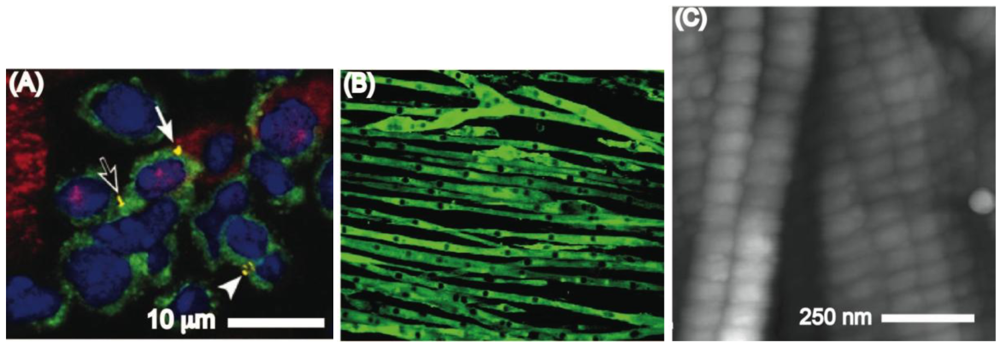
<p>In the body the cellular microenvironment is comprised of other cells, matrix, and soluble factors that regulate the resulting cell behavior [<xref ref-type="bibr" rid="b22-jfb-02-00088">22</xref>,<xref ref-type="bibr" rid="b23-jfb-02-00088">23</xref>]. Direct cell-cell contact is an important regulator of cellular processes as well as tissue architecture. For instance, cell-cell contacts regulate the cardiac stem cell microenvironment (<xref ref-type="fig" rid="f1-jfb-02-00088">Figure 1A</xref>) and direct mature cardiomyocytes to form fibrous microstructures (<xref ref-type="fig" rid="f1-jfb-02-00088">Figure 1A</xref>) [<xref ref-type="bibr" rid="b24-jfb-02-00088">24</xref>]. Furthermore, during myogenesis, myoblasts assemble into microscale tubes (<xref ref-type="fig" rid="f1-jfb-02-00088">Figure 1B</xref>) [<xref ref-type="bibr" rid="b25-jfb-02-00088">25</xref>]. Nanotopographies in the basement membrane also affect cells [<xref ref-type="bibr" rid="b26-jfb-02-00088">26</xref>]. These topographies are mainly composed of networks of nanoscale pores, ridges, and fibers made by ECM molecules such as collagen, fibronectin and laminin [<xref ref-type="bibr" rid="b26-jfb-02-00088">26</xref>]. In addition, hydroxyapatite crystals and cell adhesive proteins such as osteopontin, osteocalcin and fibronectin can bind to collagen fibers (<xref ref-type="fig" rid="f1-jfb-02-00088">Figure 1C</xref>) [<xref ref-type="bibr" rid="b26-jfb-02-00088">26</xref>,<xref ref-type="bibr" rid="b27-jfb-02-00088">27</xref>] resulting in discrete nanopatterns of cell adhesive and mineral patches [<xref ref-type="bibr" rid="b26-jfb-02-00088">26</xref>]. In summary, cells encounter and respond to topography in the <italic>in vivo</italic> environment at length scales ranging from the nano- to microscale [<xref ref-type="bibr" rid="b26-jfb-02-00088">26</xref>]. It is therefore important to incorporate features at such length scales into the development of biomaterial-based platforms suitable for stem cell therapies.</p></sec>
<sec>
<label>2.2.</label>
<title>Stem Cell Interactions with Microtopographies</title>
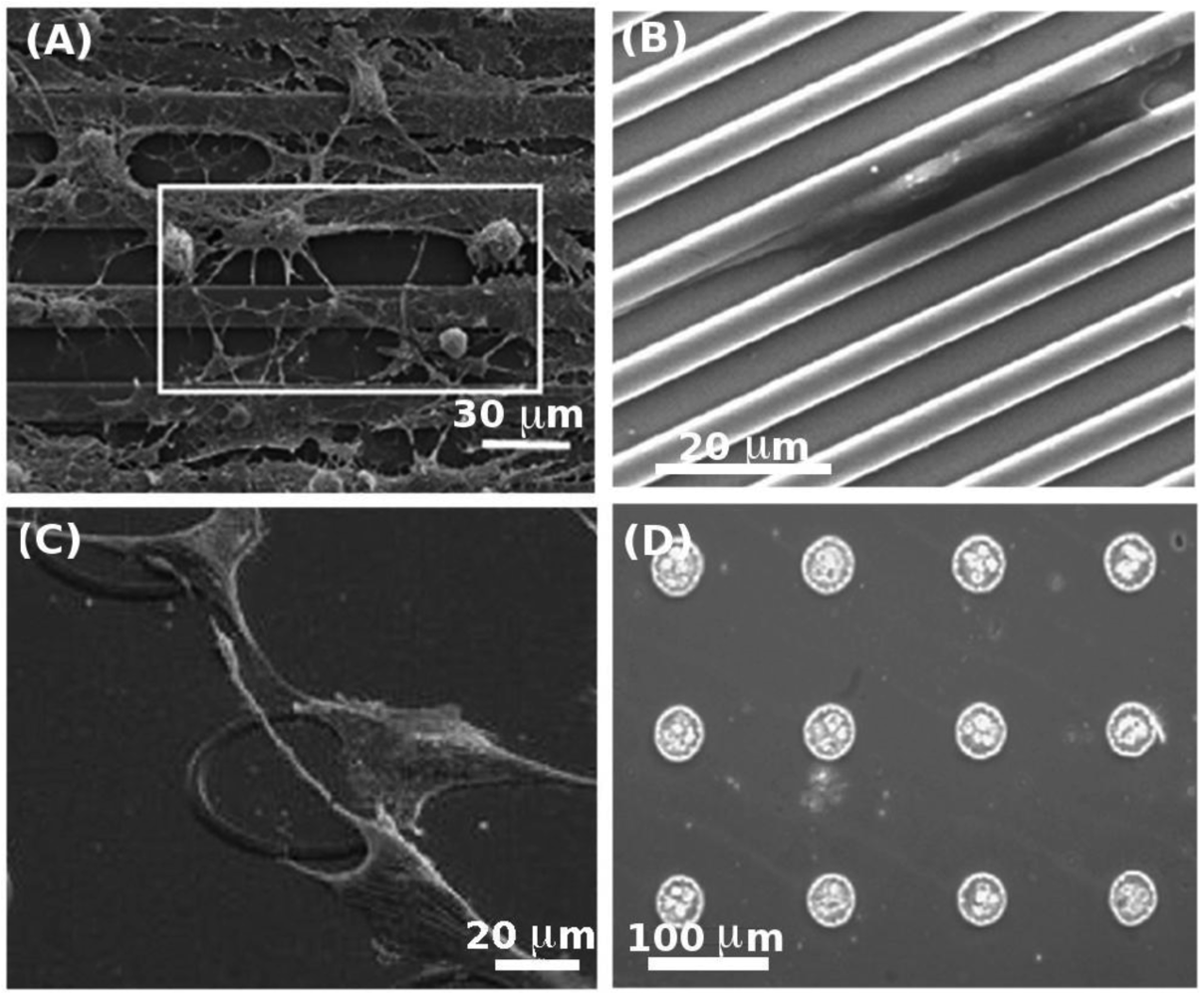
<p>With the advances in photo- and soft lithographic techniques, there has been a growing interest towards fabrication of micro- and nanotopographies to address fundamental questions related to cell-substrate interactions. An excellent example is the alignment of cells along microgrooves, a phenomenon known as contact guidance [<xref ref-type="bibr" rid="b28-jfb-02-00088">28</xref>-<xref ref-type="bibr" rid="b31-jfb-02-00088">31</xref>]. Microstructures also influence basic cellular processes such as adhesion [<xref ref-type="bibr" rid="b32-jfb-02-00088">32</xref>-<xref ref-type="bibr" rid="b37-jfb-02-00088">37</xref>], migration [<xref ref-type="bibr" rid="b38-jfb-02-00088">38</xref>-<xref ref-type="bibr" rid="b40-jfb-02-00088">40</xref>], proliferation [<xref ref-type="bibr" rid="b41-jfb-02-00088">41</xref>,<xref ref-type="bibr" rid="b42-jfb-02-00088">42</xref>] and differentiation [<xref ref-type="bibr" rid="b43-jfb-02-00088">43</xref>,<xref ref-type="bibr" rid="b44-jfb-02-00088">44</xref>]. Recently, there has been significant interest towards utilizing microscale topographies in controlling stem cell behavior. Most of these studies have examined the effect of microgrooved topographies on alignment, morphology and differentiation of stem cells. In a study by Mallapragada <italic>et al.</italic> [<xref ref-type="bibr" rid="b45-jfb-02-00088">45</xref>], adult rat hippocampal progenitor cells (AHPCs) exhibited an elongated morphology along microgrooved laminin coated polystyrene (PS) substrates (<xref ref-type="fig" rid="f2-jfb-02-00088">Figure 2A</xref>). On these substrates, the elongated morphology of the cells remained intact after seeding cortical astrocytes with the AHPCs, and the differentiation of AHPCs towards an early neural phenotype (III β-tubulin) was enhanced after co-culturing. Likewise, mouse mesenchymal stem cells (mMSCs) were shown to exhibit an elongated morphology when cultured on microgrooves [<xref ref-type="bibr" rid="b46-jfb-02-00088">46</xref>] (<xref ref-type="fig" rid="f2-jfb-02-00088">Figure 2B</xref>). A number of studies have investigated the effect of microgroove widths on differentiation of MSCs [<xref ref-type="bibr" rid="b44-jfb-02-00088">44</xref>,<xref ref-type="bibr" rid="b47-jfb-02-00088">47</xref>]. It was shown that the differentiation of MSCs into neural-like cells was less pronounced on the 4 μm wide microgrooves compared to narrower 1 and 2 μm microgrooves. In addition, MSCs on 1 μm and 2 μm grooves showed an upregulation of the expression neurogenic markers such as microtubule associate protein 2 (MAP2) and neural nuclei (NeuN) [<xref ref-type="bibr" rid="b44-jfb-02-00088">44</xref>]. In another study, Kurpinski <italic>et al.</italic> [<xref ref-type="bibr" rid="b47-jfb-02-00088">47</xref>] applied a uniaxial strain to an elastomeric PDMS substrate containing parallel microgrooves on its surface. The uniaxial mechanical stimuli resulted in stem cell alignment along the microgrooves and an increase in cell proliferation. It was also evident that there was an increased expression of calponin 1, a gene-marker of smooth muscle cell contractility after 2 and 4 days of culture under induced mechanical strain.</p>
<p>The shape of the microtopographies has also been shown to be important in stem cell behavior [<xref ref-type="bibr" rid="b48-jfb-02-00088">48</xref>,<xref ref-type="bibr" rid="b49-jfb-02-00088">49</xref>]. For example Engel <italic>et al.</italic>, [<xref ref-type="bibr" rid="b48-jfb-02-00088">48</xref>] developed ring and square shaped poly(methyl methacrylate) (PMMA) patterns to control the attachment of rat MSCs (rMSCs) (<xref ref-type="fig" rid="f2-jfb-02-00088">Figure 2C</xref>). They showed that the attachment of rMSCs was most favorable to ring shaped microstructures compared to other geometries, while cell proliferation and differentiation were the same on the microstructured and flat surfaces. In another study [<xref ref-type="bibr" rid="b49-jfb-02-00088">49</xref>], hMSCs were cultured on concave and convex shaped poly(L-Lactic-Acid) (PLLA) microtopographies. More than 50% of cells expressed CD71 after 10 days on the concave and convex surfaces confirming that hMSCs maintained their proliferative ability. Additionally the authors observed enhanced cell spreading on concave surfaces compared to the convex ones.</p>
<p>Non-adhesive microscale structures also direct cell differentiation. For example, it is widely recognized that the differentiation of ESCs into various cell types could benefit from cell aggregates called embryoid bodies (EBs) [<xref ref-type="bibr" rid="b50-jfb-02-00088">50</xref>]. Typically, EBs are generated in non-adhesive dishes to yield cell aggregates of various sizes. To generate more homogenous EBs, the hanging drop method is used, however this technique is cumbersome and difficult to scale-up [<xref ref-type="bibr" rid="b51-jfb-02-00088">51</xref>]. Recently, microtopography has been employed to generate homogenously sized EBs by trapping cells inside microwells with different diameters [<xref ref-type="bibr" rid="b52-jfb-02-00088">52</xref>]. For example, non-adhesive PEG microwells have been used to generate and retrieve EBs of controlled sizes [<xref ref-type="bibr" rid="b53-jfb-02-00088">53</xref>]. Such microwells have also been shown to direct the differentiation of stem cells by modulating the size of EBs [<xref ref-type="bibr" rid="b43-jfb-02-00088">43</xref>]. In particular, larger EBs (450 μm) resulted in more cardiac cells whereas smaller EBs (150 μm) generated more endothelial cells. This behavior was shown to be regulated by the differential expression of non-canonical Wnt pathway molecules, Wnt5a and Wnt11. Overall, the above-mentioned studies demonstrated the potential of microstructures for creating EBs with a homogenous size distribution and in directing the fate of ESCs.</p></sec>
<sec>
<label>2.3.</label>
<title>Stem Cell Behavior on Micropatterned Surfaces</title>
<p>Micropatterned substrates have been used extensively to pattern cells on substrates and to control the resulting cell shape [<xref ref-type="bibr" rid="b8-jfb-02-00088">8</xref>,<xref ref-type="bibr" rid="b54-jfb-02-00088">54</xref>-<xref ref-type="bibr" rid="b56-jfb-02-00088">56</xref>]. These studies have revealed that cell shape is an important regulator of apoptosis [<xref ref-type="bibr" rid="b54-jfb-02-00088">54</xref>,<xref ref-type="bibr" rid="b56-jfb-02-00088">56</xref>], proliferation and differentiation [<xref ref-type="bibr" rid="b55-jfb-02-00088">55</xref>]. For instance, McBeath <italic>et al.</italic> [<xref ref-type="bibr" rid="b55-jfb-02-00088">55</xref>] demonstrated that hMSCs that were spread on large protein patterns differentiated into osteogenic cells, while rounded cells on smaller patterns generated adipogenic cells. In another study, Kilian <italic>et al.</italic> [<xref ref-type="bibr" rid="b8-jfb-02-00088">8</xref>] explored the differentiation of hMSCs into osteogenic and adipogenic cells on different micropatterns. It was shown that cell attachment on ellipsoid and star shaped fibronectin micropatterns enhanced the differentiation into bone cells compared to square shaped geometries.</p>
<p>Micropatterns have also been used to demonstrate a relationship between NSCs shape and differentiation. Solanki <italic>et al.</italic> [<xref ref-type="bibr" rid="b9-jfb-02-00088">9</xref>] was able to control the fate of rat NSCs (rNSCs) by varying the geometry and dimensions (10–250 μm) of laminin patterns. They reported that grid patterns resulted in axon-like outgrowths from the cell body accompanied by neural differentiation, while square shaped islands resulted in an increase in the number of cells expressing astrocyte markers. Likewise, a more stellate-like cell morphology was observed by Ruiz <italic>et al.</italic> [<xref ref-type="bibr" rid="b57-jfb-02-00088">57</xref>] on grid shaped micropatterns compared to a nonpatterned surface. The stellate morphology resulted in an enhanced expression of the neural marker β-TubIII. In summary, these reports [<xref ref-type="bibr" rid="b8-jfb-02-00088">8</xref>,<xref ref-type="bibr" rid="b9-jfb-02-00088">9</xref>,<xref ref-type="bibr" rid="b57-jfb-02-00088">57</xref>] validate the feasibility of controlling the fate of both MSCs and NSCs by culturing cells on micropatterned surfaces.</p></sec>
<sec>
<label>2.4.</label>
<title>Nanoscale Engineering Approaches for Controlling Stem Cell Fate</title>
<p>Early studies of cells on nanostructured surfaces have mainly focused on nanogrooves. These studies have demonstrated that nanoscale grooves can direct cell alignment and migration through contact guidance even on feature sizes that were only 30 nm deep [<xref ref-type="bibr" rid="b58-jfb-02-00088">58</xref>-<xref ref-type="bibr" rid="b61-jfb-02-00088">61</xref>]. Moreover, studies have shown that stem cell alignment on nanogrooves lead to a more pronounced differentiation profile. In the paper by Lee <italic>et al.</italic>, polymeric nanogrooves (350 nm wide) were used to demonstrate a correlation between cell alignment and hESCs differentiation into the neuronal linage [<xref ref-type="bibr" rid="b62-jfb-02-00088">62</xref>]. A similar relationship between the alignment of hMSCs and their neuronal differentiation was shown using 350 nm wide grooves by Yim <italic>et al.</italic> [<xref ref-type="bibr" rid="b63-jfb-02-00088">63</xref>]. With the advances in the nanofabrication technology, other topographies have now become available for use in stem cell studies. For example, approaches such as polymer phase separation [<xref ref-type="bibr" rid="b64-jfb-02-00088">64</xref>-<xref ref-type="bibr" rid="b66-jfb-02-00088">66</xref>], metal anodization [<xref ref-type="bibr" rid="b67-jfb-02-00088">67</xref>-<xref ref-type="bibr" rid="b69-jfb-02-00088">69</xref>], dip-pen nanolithography [<xref ref-type="bibr" rid="b70-jfb-02-00088">70</xref>], colloidal lithography [<xref ref-type="bibr" rid="b71-jfb-02-00088">71</xref>-<xref ref-type="bibr" rid="b73-jfb-02-00088">73</xref>], UV-assisted capillary force lithography [<xref ref-type="bibr" rid="b62-jfb-02-00088">62</xref>,<xref ref-type="bibr" rid="b74-jfb-02-00088">74</xref>,<xref ref-type="bibr" rid="b75-jfb-02-00088">75</xref>] molecular beam epitaxy (MBE) [<xref ref-type="bibr" rid="b76-jfb-02-00088">76</xref>-<xref ref-type="bibr" rid="b78-jfb-02-00088">78</xref>], and glancing angle deposition [<xref ref-type="bibr" rid="b79-jfb-02-00088">79</xref>,<xref ref-type="bibr" rid="b80-jfb-02-00088">80</xref>] have been employed to fabricate sub-100 nm nanotubes, islands, and pyramids.</p>
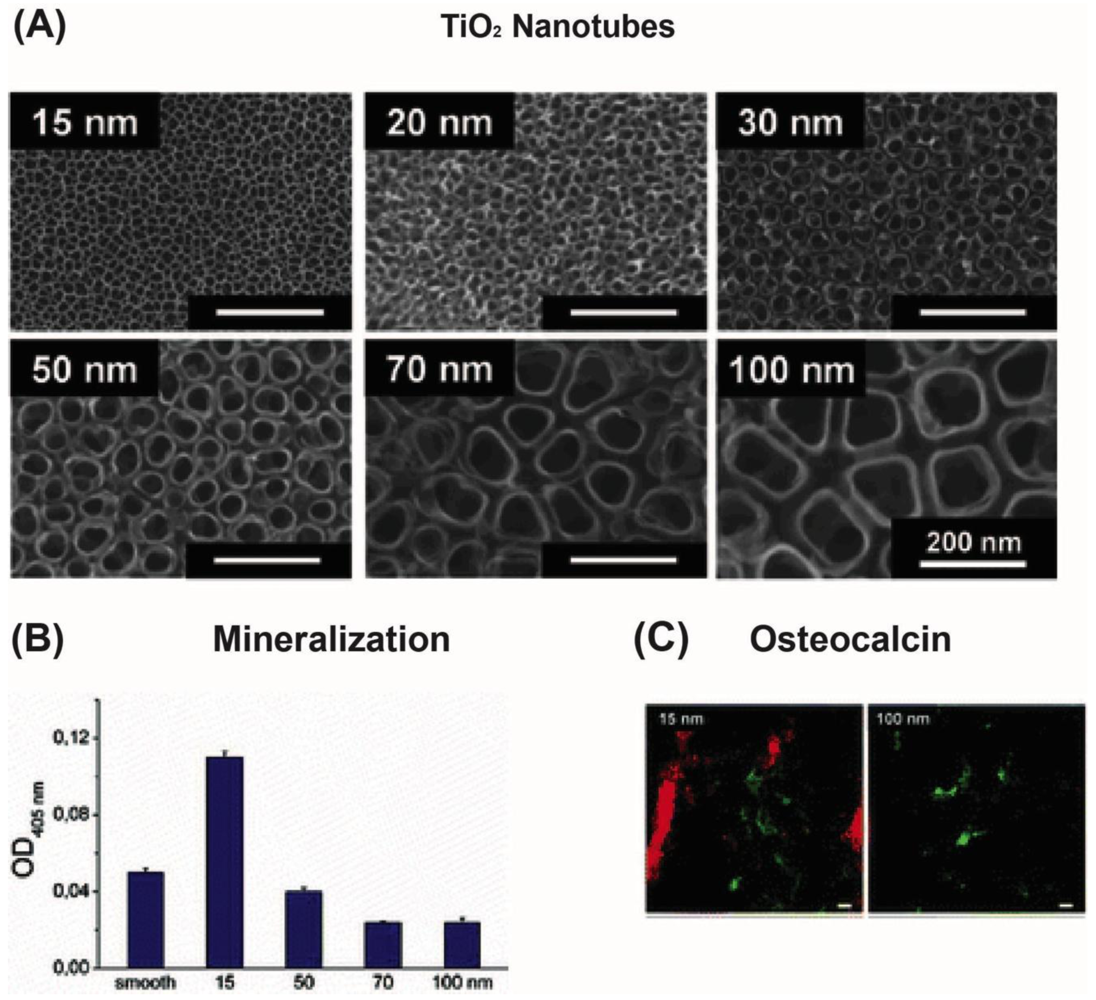
<p>It has been shown that the nanostructured surfaces can direct MSCs into osteogenic cells [<xref ref-type="bibr" rid="b6-jfb-02-00088">6</xref>,<xref ref-type="bibr" rid="b67-jfb-02-00088">67</xref>,<xref ref-type="bibr" rid="b68-jfb-02-00088">68</xref>,<xref ref-type="bibr" rid="b81-jfb-02-00088">81</xref>-<xref ref-type="bibr" rid="b83-jfb-02-00088">83</xref>]. Much of this focus has been on MSCs interaction with vertical TiO<sub>2</sub> nanotubes fabricated by metal anodization [<xref ref-type="bibr" rid="b6-jfb-02-00088">6</xref>,<xref ref-type="bibr" rid="b67-jfb-02-00088">67</xref>,<xref ref-type="bibr" rid="b68-jfb-02-00088">68</xref>,<xref ref-type="bibr" rid="b81-jfb-02-00088">81</xref>,<xref ref-type="bibr" rid="b82-jfb-02-00088">82</xref>]. Park <italic>et al.</italic> [<xref ref-type="bibr" rid="b67-jfb-02-00088">67</xref>,<xref ref-type="bibr" rid="b68-jfb-02-00088">68</xref>] performed extensive studies on the behavior of rMSCs on TiO<sub>2</sub> nanotubes with tube diameters in the range of 15 to 100 nm (<xref ref-type="fig" rid="f3-jfb-02-00088">Figure 3A</xref>) [<xref ref-type="bibr" rid="b67-jfb-02-00088">67</xref>,<xref ref-type="bibr" rid="b68-jfb-02-00088">68</xref>]. A more pronounced cell response was observed on smaller nanotubes (15–30 nm), where cell adhesion, spreading, bone mineralization (<xref ref-type="fig" rid="f3-jfb-02-00088">Figure 3B</xref>) and bone marker expression (<xref ref-type="fig" rid="f3-jfb-02-00088">Figure 3C</xref>) were found to be enhanced compared to flat TiO<sub>2</sub> [<xref ref-type="bibr" rid="b68-jfb-02-00088">68</xref>,<xref ref-type="bibr" rid="b69-jfb-02-00088">69</xref>,<xref ref-type="bibr" rid="b84-jfb-02-00088">84</xref>]. Moreover, by examining the cytoskeletal structure of the cells, more focal contacts were observed on the smallest nanotubes [<xref ref-type="bibr" rid="b67-jfb-02-00088">67</xref>], in agreement with the upregulated stem cell differentiation observed on the 15 and 30 nm nanotubes [<xref ref-type="bibr" rid="b85-jfb-02-00088">85</xref>]. Other groups have observed similar behavior for hMSCs and rMSCs that were cultured on 70 and 100 nm TiO<sub>2</sub> nanotubes [<xref ref-type="bibr" rid="b6-jfb-02-00088">6</xref>,<xref ref-type="bibr" rid="b86-jfb-02-00088">86</xref>]. For example, a higher alkaline phosphate activity was observed on 80 nm nanotubes followed by a larger mineralization of calcium and phosphate [<xref ref-type="bibr" rid="b86-jfb-02-00088">86</xref>]. Furthermore, Oh <italic>et al.</italic> [<xref ref-type="bibr" rid="b6-jfb-02-00088">6</xref>] found that the expression of bone proteins such as osteopontin and osteocalcin were significantly higher on 100 nm nanotubes. In conclusion, there is a strong indication that generation of nanotubes by metal anodization could enhance the performance of orthopedic titanium implants. This is either linked directly to mechanical stresses transmitted from the nanostructures to the cell nucleus [<xref ref-type="bibr" rid="b87-jfb-02-00088">87</xref>-<xref ref-type="bibr" rid="b89-jfb-02-00088">89</xref>] or indirectly by structural modulation of ECM proteins to expose cell adhesive domains [<xref ref-type="bibr" rid="b90-jfb-02-00088">90</xref>-<xref ref-type="bibr" rid="b92-jfb-02-00088">92</xref>] or a combination of both.</p>
<p>As described previously, the nanoscale chemical and topographical cues <italic>in vivo</italic> have different shapes and sizes. By employing UV-assisted capillary force lithography it is possible to examine stem cell behavior on nanotopographies with various chemistries, shapes and sizes [<xref ref-type="bibr" rid="b23-jfb-02-00088">23</xref>,<xref ref-type="bibr" rid="b62-jfb-02-00088">62</xref>,<xref ref-type="bibr" rid="b75-jfb-02-00088">75</xref>]. In a study by You <italic>et al.</italic> [<xref ref-type="bibr" rid="b75-jfb-02-00088">75</xref>], the osteogenic differentiation of hMSCs on polyurethane acrylate nanogrooves and columns with different sizes were investigated. They noticed that the highest expression of osteogenic markers and alkaline phosphatase activity was on the 400 nm wide nanocolumns.</p>
<p>Moreover, the distribution of topographical cues in the stem cell microenvironment may also influence stem cell behavior. Dalby <italic>et al.</italic> [<xref ref-type="bibr" rid="b83-jfb-02-00088">83</xref>] found that surfaces composed of nanopits with controlled disorder resulted in increased expression of osteogenic markers relative to surfaces consisting of either highly ordered or randomly displaced nanopits. In another study by Hunt and coworkers [<xref ref-type="bibr" rid="b70-jfb-02-00088">70</xref>], dip-pen nanolithography was used to fabricate nanopatterns with different chemistries and spacings for analysis of stem cell behavior [<xref ref-type="bibr" rid="b70-jfb-02-00088">70</xref>]. Specifically, they patterned thiolated molecules terminated with various chemistries (including carboxyl, amino, methyl and hydroxyl) onto gold surfaces. The chemically functionalized islands were 70 nm wide with inter-island spacing that ranged from 140 to 1000 nm. They cultured hMSCs on the fabricated surfaces and found that the adhesion and expression of several stem cell markers depended on the specific chemistry and the distance between the nanoscale islands [<xref ref-type="bibr" rid="b70-jfb-02-00088">70</xref>]. This approach provided an efficient method to precisely control size, spacing and chemistry of nanofabricated patterns and could in theory be used to fabricate randomly ordered nanoscale islands. Thus, various nanoscale fabrication methods can be used to create nanostructured surfaces for directing stem cell differentiation. These approaches are implemented in 2D, therefore to further advance the use of these systems to regulate stem cell behavior, it is necessary to implement the nanosculpturing in a 3D environment to better replicate the <italic>in vivo</italic> environment of the stem cells.</p></sec></sec>
<sec>
<label>3.</label>
<title>The Role of Chemical Moieties and Substrate Stiffness on Stem Cell Fate</title>
<sec>
<label>3.1.</label>
<title>Chemically Functionalized Surfaces</title>
<p>The stem cell microenvironment consists of numerous molecular cues including proteins and polysaccharides. It is becoming increasingly clear that the biochemical cues in the cellular microenvironment to a large extent determine processes such as cell attachment, proliferation and differentiation [<xref ref-type="bibr" rid="b93-jfb-02-00088">93</xref>]. By using SAMs to coat surfaces, it is possible to test stem cell behavior on a range of chemistries [<xref ref-type="bibr" rid="b94-jfb-02-00088">94</xref>,<xref ref-type="bibr" rid="b95-jfb-02-00088">95</xref>]. Wu and coworkers [<xref ref-type="bibr" rid="b95-jfb-02-00088">95</xref>] used SAMs with different chain lengths and hydrophobic head groups to develop various surface hydrophobicities. They observed that an increase in surface hydrophobicity resulted in higher hESC proliferation and differentiation [<xref ref-type="bibr" rid="b95-jfb-02-00088">95</xref>]. In the future, such SAM coated surfaces could potentially be used to control cell size and enhance the differentiation profile of hESCs <italic>in vitro</italic>.</p>
<p>SAMS conjugated to various ligands, such as peptides or proteins, have also been synthesized and used in stem cell studies [<xref ref-type="bibr" rid="b96-jfb-02-00088">96</xref>-<xref ref-type="bibr" rid="b99-jfb-02-00088">99</xref>]. For example, surfaces functionalized with RGD ligands increased osteogenic [<xref ref-type="bibr" rid="b100-jfb-02-00088">100</xref>-<xref ref-type="bibr" rid="b103-jfb-02-00088">103</xref>], chondrogenic [<xref ref-type="bibr" rid="b104-jfb-02-00088">104</xref>] and neurogenic [<xref ref-type="bibr" rid="b105-jfb-02-00088">105</xref>] differentiation of stem cells compared to non-functionalized substrates. Although many studies have used RGD functionalized surfaces, different polymer coatings have likewise been used to induce stem cell differentiation. In one approach, Joy <italic>et al.</italic> [<xref ref-type="bibr" rid="b106-jfb-02-00088">106</xref>] coated surfaces with different polymer compositions and observed that the surface chemistry had a significant influence on the osteogenic and adipogenic differentiation of hMSCs. However, after functionalization with RGD ligands, no differences were found in the expression of these markers between surfaces coated with different polymers. The fact that immobilized adhesive ligands can override the effect of the underlying polymer coating can have important implications in designing polymer-based biomaterials. In conclusion, altering the surface chemistry influences the behavior of stem cells and their differentiation in a notable way.</p></sec>
<sec>
<label>3.2.</label>
<title>Substrate Stiffness</title>
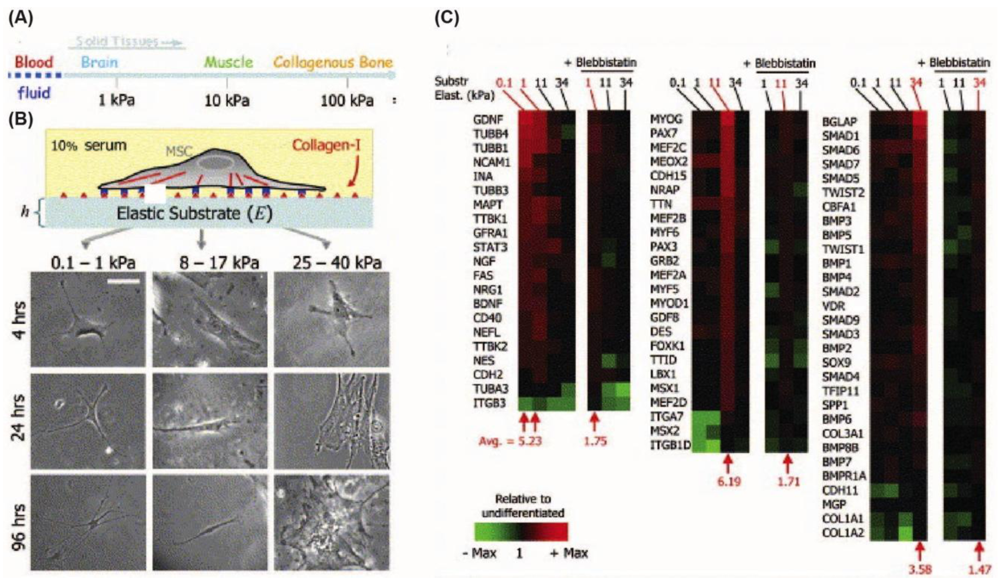
<p>Mammalian cells can sense the elasticity of the substrates on which they are cultured [<xref ref-type="bibr" rid="b7-jfb-02-00088">7</xref>]. This is caused by transmission of mechanical forces between substrate and cell, which generates contractile forces in the cell. These contractile forces in turn influence cell behaviors such as spreading [<xref ref-type="bibr" rid="b107-jfb-02-00088">107</xref>,<xref ref-type="bibr" rid="b108-jfb-02-00088">108</xref>], migration [<xref ref-type="bibr" rid="b109-jfb-02-00088">109</xref>], proliferation [<xref ref-type="bibr" rid="b110-jfb-02-00088">110</xref>] and apoptosis [<xref ref-type="bibr" rid="b111-jfb-02-00088">111</xref>]. Pitelka and coworkers [<xref ref-type="bibr" rid="b112-jfb-02-00088">112</xref>] provided early evidence in 1979 that substrate stiffness also affects differentiation. They found that mouse epithelial cells (mECs) differentiate better on softer collagen substrates compared to harder plastic tissue culture dishes. In another study, myoblasts were seeded on substrates with different stiffness [<xref ref-type="bibr" rid="b113-jfb-02-00088">113</xref>] to show that actin/myosin striation, as it is seen in natural muscle, occurred only on the substrates with mechanical properties similar to that of a muscle [<xref ref-type="bibr" rid="b114-jfb-02-00088">114</xref>]. More recently, Engler <italic>et al.</italic> [<xref ref-type="bibr" rid="b7-jfb-02-00088">7</xref>] cultured hMSCs on a polyacrylamide gel homogeneously coated with collagen I ligands. The substrates had variable stiffness representing that of nerve (0.1–1 kPa), muscle (8–17 kPa) and bone tissue (25–40 kPa) and it was it was observed that the hMSCs differentiated along the neurogenic, myogenic and osteogenic lineage, respectively (<xref ref-type="fig" rid="f4-jfb-02-00088">Figure 4</xref>) [<xref ref-type="bibr" rid="b7-jfb-02-00088">7</xref>]. Cooper-White and coworkers [<xref ref-type="bibr" rid="b113-jfb-02-00088">113</xref>] further hypothesized that ECM proteins could influence hMSCs fate and therefore analyzed the combined effect of various ECM proteins (collagen I, collagen IV, laminin, and fibronectin). Their results revealed a significant interplay between ECM proteins and the underlying substrate elasticity affecting the myo- or osteogenic differentiation patterns. These studies suggest that both the elastic modulus of the substrate and the coated ECM proteins play a significant role in hMSC differentiation [<xref ref-type="bibr" rid="b7-jfb-02-00088">7</xref>,<xref ref-type="bibr" rid="b113-jfb-02-00088">113</xref>].</p>
<p><italic>In vivo</italic>, stem cells exist in 3D microenvironments, hence it is important to understand the effect of 3D matrix stiffness on stem cell differentiation. Over the past few years, many new techniques have emerged to fabricate 3D constructs with precise mechanical properties [<xref ref-type="bibr" rid="b93-jfb-02-00088">93</xref>]. In particular, hydrogels have proven as a promising tool for the fabrication of 3D microenvironments [<xref ref-type="bibr" rid="b115-jfb-02-00088">115</xref>-<xref ref-type="bibr" rid="b121-jfb-02-00088">121</xref>]. In one study Pek <italic>et al.</italic> [<xref ref-type="bibr" rid="b116-jfb-02-00088">116</xref>] used a thixotropic polyethylene glycol-silica (PEG-silica) to generate 3D gels with different stiffnesses [<xref ref-type="bibr" rid="b116-jfb-02-00088">116</xref>]. Their findings showed that the highest expression of neural (ENO2), myogenic (MYOG) and osteogenic (Runx2, OC) markers occurred on gels corresponding to low (7 Pa), intermediate (25 Pa) and high (75 Pa) gel stiffness respectively, consistent with previous findings on 2D surfaces [<xref ref-type="bibr" rid="b7-jfb-02-00088">7</xref>].</p></sec>
<sec sec-type="materials">
<label>3.3.</label>
<title>High-Throughput Screening of Stem Cell Differentiation on Biomaterials</title>
<p>Most of today's biomaterials are prepared and tested individually for various applications. This process is time-consuming and expensive. An emerging approach in the development of biomaterials has been the use of combinatorial high-throughput screening methods to lower the cost and the experimentation time. This approach can be applied to stem cell bioengineering by simultaneously examining numerous parameters on stem cell fate. Kohn and co-workers [<xref ref-type="bibr" rid="b122-jfb-02-00088">122</xref>] developed one of the first high-throughput biomaterial library systems in 1997. By employing polyacrylates, they successfully generated a microarray with 112 different combinations and used the array to examine fibroblast proliferation.</p>
<p>Microarray printing technologies have been more widely used in the biomaterials field over the past few years to screen for various stem cell material-interactions [<xref ref-type="bibr" rid="b100-jfb-02-00088">100</xref>,<xref ref-type="bibr" rid="b123-jfb-02-00088">123</xref>,<xref ref-type="bibr" rid="b124-jfb-02-00088">124</xref>]. For example, Flaim <italic>et al.</italic> [<xref ref-type="bibr" rid="b124-jfb-02-00088">124</xref>] used a DNA spotter to develop an ECM matrix microarray for probing the differentiation of primary rat hepatocyte cells (rHCs) and mESCs towards an early hepatic phenotype, by using five different proteins (collagen I, collagen III, collagen IV, laminin and fibronectin) in 32 combinations. This platform was used to identify specific ECM mixtures, containing either collagen I or fibronectin, that directed mESCs into a hepatic fate.</p>
<p>The differentiation profile of hESCs have also been examined on high-throughput biomaterial platforms [<xref ref-type="bibr" rid="b123-jfb-02-00088">123</xref>,<xref ref-type="bibr" rid="b125-jfb-02-00088">125</xref>,<xref ref-type="bibr" rid="b126-jfb-02-00088">126</xref>]. The growth of hESCs on arrays with 18 different laminin-derived peptides was investigated by Derda <italic>et al.</italic> [<xref ref-type="bibr" rid="b125-jfb-02-00088">125</xref>]. Their results revealed that the RNIAEIIKDI laminin peptide resulted in undifferentiated cells, while LGTIPG peptide promoted differentiation. Thus, they demonstrated that high-throughput platforms can be used to quickly identify peptide sequences that can regulate stem cell fate. In another study by Anderson <italic>et al.</italic> [<xref ref-type="bibr" rid="b123-jfb-02-00088">123</xref>], the growth and differentiation of hESCs into cytokeratin positive cells on a microarray containing 1728 polymer mixtures were examined. Later, they investigated additional parameters such as root mean square roughness (0 –100 nm), stiffness (0.002 –2.262 GPa) and wettability (30–110°). They found that surface wettability and the elastic modulus of the polymers modulated the colony formation frequency (CFF) of hESCs, while surface roughness did not have a significant effect [<xref ref-type="bibr" rid="b126-jfb-02-00088">126</xref>]. Taken together, these studies show that high-throughput screening platforms could more rapidly identify important parameters in culture dishes for better control of stem cell fate.</p></sec></sec>
<sec sec-type="conclusions">
<label>4.</label>
<title>Conclusions</title>
<p>Surface topography as well as micro- and nanoscale chemical patterns on biomaterials have proven to be efficient methods to direct stem cell behavior. In addition, substrate stiffness and chemical cues are important factors in controlling stem cell fate. Further advances in controlling stem cell fate could be achieved by combining the above mentioned parameters in a more scalable and combinatorial manner to address the complexity of the natural stem cell niche. Overall, it is becoming clearer that the advances in micro- and nanoengineering can be used to precisely control stem cell behavior through cell-substrate interactions with enormous potential implications in science and medicine.</p></sec></body>
<back>
<sec sec-type="display-objects">
<title>Figures</title>
<fig id="f1-jfb-02-00088" position="float">
<label>Figure 1.</label>
<caption>
<p>(<bold>A</bold>) Cluster of cardiac stem cells (green) and lineage committed cells (red). The yellow regions stain for connexin 43 (Published with permission from PNAS [<xref ref-type="bibr" rid="b24-jfb-02-00088">24</xref>]); (<bold>B</bold>) A fluorescent image in which myoblast actin filaments are stained green and the myoblasts nuclei are shown as dark elongated spots. Each myoblast tube is measured to be approximately 12.5 μm in diameter (Published with permission from Am Physiol Soc [<xref ref-type="bibr" rid="b25-jfb-02-00088">25</xref>]); (<bold>C</bold>) Atomic force microscopy images of the D-band patterns on collagen I (Published with permission from Royal society Publishing [<xref ref-type="bibr" rid="b27-jfb-02-00088">27</xref>]).</p></caption>
<graphic xlink:href="jfb-02-00088f1.gif"/></fig>
<fig id="f2-jfb-02-00088" position="float">
<label>Figure 2.</label>
<caption>
<p>(<bold>A</bold>) Co-culture of adult rat hippocampal progenitor cells (AHPCs) with astrocytes on microgrooved PS substrate. The square illustrates how the cells align in the same direction as the microgrooves (Published with permission from Elsevier [<xref ref-type="bibr" rid="b45-jfb-02-00088">45</xref>]); (<bold>B</bold>) Elongation of mouse mesenchymal stem cells (mMSCs) inside microgrooves on a silicon substrate (Published with permission from Elsevier [<xref ref-type="bibr" rid="b46-jfb-02-00088">46</xref>]); (<bold>C</bold>) Attachment of rMSCs on ring shaped PMMA microstructures (Published with permissions from Elsevier [<xref ref-type="bibr" rid="b48-jfb-02-00088">48</xref>]); (<bold>D</bold>) Formation of embryoid bodies (EBs) using an array of PEG microwells (Published with permission from Elsevier [<xref ref-type="bibr" rid="b53-jfb-02-00088">53</xref>]).</p></caption>
<graphic xlink:href="jfb-02-00088f2.gif"/></fig>
<fig id="f3-jfb-02-00088" position="float">
<label>Figure 3.</label>
<caption>
<p>(<bold>A</bold>) Scanning electron micrographs of the TiO<sub>2</sub>-nanotubes (15, 20, 30, 50, 70, 100 nm); (<bold>B</bold>) Plot of alkaline phosphatase activity <italic>versus</italic> nanotube diameter; (<bold>C</bold>) Osteocalcin (red) and F-actin (green) staining of cells seeded on 15 nm and 100 nm TiO<sub>2</sub>-nanotubes. The scale bar is 20 μm (Published with permission from ACS publications [<xref ref-type="bibr" rid="b67-jfb-02-00088">67</xref>]).</p></caption>
<graphic xlink:href="jfb-02-00088f3.gif"/></fig>
<fig id="f4-jfb-02-00088" position="float">
<label>Figure 4.</label>
<caption>
<p>(<bold>A</bold>) The elastic moduli of different solid tissues ranging from blood to collagenous bone; (<bold>B</bold>) The images show how different substrate stiffness values influence cell morphology. Scale bar is 20 μm; (<bold>C</bold>) Microarray profiling of differentiation marker expression on substrates with different stiffnesses. The microarray profiling showed that neurogenic markers were highest on 0.1–1 kPa gels, while myogenic markers were highest on 11 kPa gels and osteogenic markers were highest on 34 kPa gels. (Published with permission from Elsevier [<xref ref-type="bibr" rid="b7-jfb-02-00088">7</xref>]).</p></caption>
<graphic xlink:href="jfb-02-00088f4.gif"/></fig></sec>
<ack>
<p>AK acknowledges funding from the National Institutes of Health (HL092836, DE019024, EB008392, DE021468, AR05837, EB012597, HL099073), the National Science Foundation CAREER Award (DMR 0847287) and the office of Naval Research Young Investigator Award. ADP is grateful for the postdoctoral fellowship grant awarded by the Danish Council for Technology and Innovation, and the University of Aarhus for administration of the grant.</p></ack>
<ref-list>
<title>References</title>
<ref id="b1-jfb-02-00088"><label>1.</label><citation citation-type="journal"><person-group person-group-type="author"><name><surname>Griffith</surname><given-names>L.G.</given-names></name><name><surname>Naughton</surname><given-names>G.</given-names></name></person-group><article-title>Tissue engineering-current challenges and expanding opportunities</article-title><source>Science</source><year>2002</year><volume>295</volume><fpage>1009</fpage><lpage>1014</lpage><pub-id pub-id-type="doi">10.1126/science.1069210</pub-id><pub-id pub-id-type="pmid">11834815</pub-id></citation></ref>
<ref id="b2-jfb-02-00088"><label>2.</label><citation citation-type="journal"><person-group person-group-type="author"><name><surname>Khademhosseini</surname><given-names>A.</given-names></name><name><surname>Langer</surname><given-names>R.</given-names></name><name><surname>Borenstein</surname><given-names>J.</given-names></name><name><surname>Vacanti</surname><given-names>J.P.</given-names></name></person-group><article-title>Microscale technologies for tissue engineering and biology</article-title><source>Proc. Natl. Acad. Sci. USA</source><year>2006</year><volume>103</volume><fpage>2480</fpage><lpage>2487</lpage><pub-id pub-id-type="doi">10.1073/pnas.0507681102</pub-id><pub-id pub-id-type="pmid">16477028</pub-id></citation></ref>
<ref id="b3-jfb-02-00088"><label>3.</label><citation citation-type="book"><person-group person-group-type="author"><name><surname>Sorensen</surname><given-names>M.L.</given-names></name></person-group><source>Stem Cell Applications in Diseases</source><publisher-name>Nova Biomedical Books</publisher-name><publisher-loc>New York, NY, USA</publisher-loc><year>2008</year></citation></ref>
<ref id="b4-jfb-02-00088"><label>4.</label><citation citation-type="book"><person-group person-group-type="author"><name><surname>Zipori</surname><given-names>D.</given-names></name></person-group><source>Biology of Stem Cells and the Molecular Basis of the Stem State (Stem Cell Biology and Regenerative Medicine)</source><publisher-name>Humana Press</publisher-name><publisher-loc>New York, NY, USA</publisher-loc><year>2009</year></citation></ref>
<ref id="b5-jfb-02-00088"><label>5.</label><citation citation-type="journal"><person-group person-group-type="author"><name><surname>Zandstra</surname><given-names>P.W.</given-names></name><name><surname>Nagy</surname><given-names>A.</given-names></name></person-group><article-title>Stem cell bioengineering</article-title><source>Annu. Rev. Biomed. Eng.</source><year>2001</year><volume>3</volume><fpage>275</fpage><lpage>305</lpage><pub-id pub-id-type="doi">10.1146/annurev.bioeng.3.1.275</pub-id><pub-id pub-id-type="pmid">11447065</pub-id></citation></ref>
<ref id="b6-jfb-02-00088"><label>6.</label><citation citation-type="journal"><person-group person-group-type="author"><name><surname>Oh</surname><given-names>S.</given-names></name><name><surname>Brammer</surname><given-names>K.S.</given-names></name><name><surname>Li</surname><given-names>J.Y.S.</given-names></name><name><surname>Teng</surname><given-names>D.</given-names></name><name><surname>Engler</surname><given-names>A.J.</given-names></name><name><surname>Chien</surname><given-names>S.</given-names></name><name><surname>Jin</surname><given-names>S.</given-names></name></person-group><article-title>Stem cell fate dictated solely by altered nanotube dimension</article-title><source>Proc. Natl. Acad. Sci. USA</source><year>2009</year><volume>106</volume><fpage>2130</fpage><lpage>2135</lpage><pub-id pub-id-type="doi">10.1073/pnas.0813200106</pub-id><pub-id pub-id-type="pmid">19179282</pub-id></citation></ref>
<ref id="b7-jfb-02-00088"><label>7.</label><citation citation-type="journal"><person-group person-group-type="author"><name><surname>Engler</surname><given-names>A.J.</given-names></name><name><surname>Sen</surname><given-names>S.</given-names></name><name><surname>Sweeney</surname><given-names>H.L.</given-names></name><name><surname>Discher</surname><given-names>D.E.</given-names></name></person-group><article-title>Matrix elasticity directs stem cell lineage specification</article-title><source>Cell</source><year>2006</year><volume>126</volume><fpage>677</fpage><lpage>689</lpage><pub-id pub-id-type="doi">10.1016/j.cell.2006.06.044</pub-id><pub-id pub-id-type="pmid">16923388</pub-id></citation></ref>
<ref id="b8-jfb-02-00088"><label>8.</label><citation citation-type="journal"><person-group person-group-type="author"><name><surname>Kilian</surname><given-names>K.A.</given-names></name><name><surname>Bugarija</surname><given-names>B.</given-names></name><name><surname>Lahn</surname><given-names>B.T.</given-names></name><name><surname>Mrksich</surname><given-names>M.</given-names></name></person-group><article-title>Geometric cues for directing the differentiation of mesenchymal stem cells</article-title><source>Proc. Natl. Acad. Sci. USA</source><year>2010</year><volume>107</volume><fpage>4872</fpage><lpage>7487</lpage><pub-id pub-id-type="doi">10.1073/pnas.0903269107</pub-id><pub-id pub-id-type="pmid">20194780</pub-id></citation></ref>
<ref id="b9-jfb-02-00088"><label>9.</label><citation citation-type="journal"><person-group person-group-type="author"><name><surname>Solanki</surname><given-names>A.</given-names></name><name><surname>Solanki</surname><given-names>A.</given-names></name><name><surname>Shah</surname><given-names>S.</given-names></name><name><surname>Memoli</surname><given-names>K.A.</given-names></name><name><surname>Park</surname><given-names>S.Y.</given-names></name><name><surname>Hong</surname><given-names>S.</given-names></name><name><surname>Lee</surname><given-names>K.-B.</given-names></name></person-group><article-title>Controlling differentiation of neural stem cells using extracellular matrix protein patterns</article-title><source>Small</source><year>2010</year><volume>6</volume><fpage>2509</fpage><lpage>2513</lpage><pub-id pub-id-type="doi">10.1002/smll.201001341</pub-id><pub-id pub-id-type="pmid">20859950</pub-id></citation></ref>
<ref id="b10-jfb-02-00088"><label>10.</label><citation citation-type="journal"><person-group person-group-type="author"><name><surname>Moore</surname><given-names>K.A.</given-names></name><name><surname>Lemischka</surname><given-names>I.R.</given-names></name></person-group><article-title>Stem cells and their niches</article-title><source>Science</source><year>2006</year><volume>311</volume><fpage>1880</fpage><lpage>1885</lpage><pub-id pub-id-type="doi">10.1126/science.1110542</pub-id><pub-id pub-id-type="pmid">16574858</pub-id></citation></ref>
<ref id="b11-jfb-02-00088"><label>11.</label><citation citation-type="journal"><person-group person-group-type="author"><name><surname>Place</surname><given-names>E.S.</given-names></name><name><surname>Evans</surname><given-names>N.D.</given-names></name><name><surname>Stevens</surname><given-names>M.M.</given-names></name></person-group><article-title>Complexity in biomaterials for tissue engineering</article-title><source>Nat. Mater.</source><year>2009</year><volume>8</volume><fpage>457</fpage><lpage>470</lpage><pub-id pub-id-type="doi">10.1038/nmat2441</pub-id><pub-id pub-id-type="pmid">19458646</pub-id></citation></ref>
<ref id="b12-jfb-02-00088"><label>12.</label><citation citation-type="journal"><person-group person-group-type="author"><name><surname>Pamula</surname><given-names>E.</given-names></name><name><surname>de Cupere</surname><given-names>V.</given-names></name><name><surname>Dufrêne</surname><given-names>Y.F.</given-names></name><name><surname>Rouxhet</surname><given-names>P.G.</given-names></name></person-group><article-title>Nanoscale organization of adsorbed collagen: Influence of substrate hydrophobicity and adsorption time</article-title><source>J. Colloid Interface Sci.</source><year>2004</year><volume>271</volume><fpage>80</fpage><lpage>91</lpage><pub-id pub-id-type="doi">10.1016/j.jcis.2003.11.012</pub-id><pub-id pub-id-type="pmid">14757080</pub-id></citation></ref>
<ref id="b13-jfb-02-00088"><label>13.</label><citation citation-type="journal"><person-group person-group-type="author"><name><surname>Goodman</surname><given-names>S.L.</given-names></name><name><surname>Sims</surname><given-names>P.A.</given-names></name><name><surname>Albrecht</surname><given-names>R.M.</given-names></name></person-group><article-title>Three-dimensional extracellular matrix textured biomaterials</article-title><source>Biomaterials</source><year>1996</year><volume>17</volume><fpage>2087</fpage><lpage>2095</lpage><pub-id pub-id-type="doi">10.1016/0142-9612(96)00016-6</pub-id><pub-id pub-id-type="pmid">8902242</pub-id></citation></ref>
<ref id="b14-jfb-02-00088"><label>14.</label><citation citation-type="journal"><person-group person-group-type="author"><name><surname>Gefen</surname><given-names>A.</given-names></name><name><surname>Gefen</surname><given-names>N.</given-names></name><name><surname>Zhu</surname><given-names>Q.</given-names></name><name><surname>Raghupathi</surname><given-names>R.</given-names></name><name><surname>Margulies</surname><given-names>S.S.</given-names></name></person-group><article-title>Age-dependent changes in material properties of the brain and braincase of the rat</article-title><source>J. Neurotrauma</source><year>2003</year><volume>20</volume><fpage>1163</fpage><lpage>1177</lpage><pub-id pub-id-type="doi">10.1089/089771503770802853</pub-id><pub-id pub-id-type="pmid">14651804</pub-id></citation></ref>
<ref id="b15-jfb-02-00088"><label>15.</label><citation citation-type="journal"><person-group person-group-type="author"><name><surname>Engler</surname><given-names>A.J.</given-names></name><name><surname>Griffin</surname><given-names>M.A.</given-names></name><name><surname>Sen</surname><given-names>S.</given-names></name><name><surname>Bönnemann</surname><given-names>C.G.</given-names></name><name><surname>Sweeney</surname><given-names>H.L.</given-names></name><name><surname>Discher</surname><given-names>D.E.</given-names></name></person-group><article-title>Myotubes differentiate optimally on substrates with tissue-like stiffness: Pathological implications for soft or stiff microenvironments</article-title><source>J. Cell Biol.</source><year>2004</year><volume>166</volume><fpage>877</fpage><lpage>887</lpage><pub-id pub-id-type="doi">10.1083/jcb.200405004</pub-id><pub-id pub-id-type="pmid">15364962</pub-id></citation></ref>
<ref id="b16-jfb-02-00088"><label>16.</label><citation citation-type="journal"><person-group person-group-type="author"><name><surname>Mitchell</surname><given-names>G.F.</given-names></name><name><surname>Parise</surname><given-names>H.</given-names></name><name><surname>Benjamin</surname><given-names>E.J.</given-names></name><name><surname>Larson</surname><given-names>M.G.</given-names></name><name><surname>Keyes</surname><given-names>M.J.</given-names></name><name><surname>Vita</surname><given-names>J.A.</given-names></name><name><surname>Vasan</surname><given-names>R.S.</given-names></name><name><surname>Levy</surname><given-names>D.</given-names></name></person-group><article-title>Changes in arterial stiffness and wave reflection with advancing age in healthy men and women: The Framingham Heart Study</article-title><source>Hypertension</source><year>2004</year><volume>43</volume><fpage>1239</fpage><lpage>1245</lpage><pub-id pub-id-type="doi">10.1161/01.HYP.0000128420.01881.aa</pub-id><pub-id pub-id-type="pmid">15123572</pub-id></citation></ref>
<ref id="b17-jfb-02-00088"><label>17.</label><citation citation-type="journal"><person-group person-group-type="author"><name><surname>Pittenger</surname><given-names>M.F.</given-names></name><name><surname>Mackay</surname><given-names>A.M.</given-names></name><name><surname>Beck</surname><given-names>S.C.</given-names></name><name><surname>Jaiswal</surname><given-names>R.K.</given-names></name><name><surname>Douglas</surname><given-names>R.</given-names></name><name><surname>Mosca</surname><given-names>J.D.</given-names></name><name><surname>Moorman</surname><given-names>M.A.</given-names></name><name><surname>Simonetti</surname><given-names>D.W.</given-names></name><name><surname>Craig</surname><given-names>S.</given-names></name><name><surname>Marshak</surname><given-names>D.R.</given-names></name></person-group><article-title>Multilineage potential of adult human mesenchymal stem cells</article-title><source>Science</source><year>1999</year><volume>284</volume><fpage>143</fpage><lpage>147</lpage><pub-id pub-id-type="doi">10.1126/science.284.5411.143</pub-id><pub-id pub-id-type="pmid">10102814</pub-id></citation></ref>
<ref id="b18-jfb-02-00088"><label>18.</label><citation citation-type="journal"><person-group person-group-type="author"><name><surname>Ding</surname><given-names>S.</given-names></name><name><surname>Schultz</surname><given-names>P.G.</given-names></name></person-group><article-title>A role for chemistry in stem cell biology</article-title><source>Nat. Biotechnol.</source><year>2004</year><volume>22</volume><fpage>833</fpage><lpage>840</lpage><pub-id pub-id-type="doi">10.1038/nbt987</pub-id><pub-id pub-id-type="pmid">15229546</pub-id></citation></ref>
<ref id="b19-jfb-02-00088"><label>19.</label><citation citation-type="journal"><person-group person-group-type="author"><name><surname>Hwang</surname><given-names>N.S.</given-names></name><name><surname>Varghese</surname><given-names>S.</given-names></name><name><surname>Elisseeff</surname><given-names>J.</given-names></name></person-group><article-title>Controlled differentiation of stem cells</article-title><source>Adv. Drug Delivery Rev.</source><year>2008</year><volume>60</volume><fpage>199</fpage><lpage>214</lpage><pub-id pub-id-type="doi">10.1016/j.addr.2007.08.036</pub-id></citation></ref>
<ref id="b20-jfb-02-00088"><label>20.</label><citation citation-type="journal"><person-group person-group-type="author"><name><surname>Park</surname><given-names>T.H.</given-names></name><name><surname>Shuler</surname><given-names>M.L.</given-names></name></person-group><article-title>Integration of cell culture and microfabrication technology</article-title><source>Biotechnol. Prog.</source><year>2003</year><volume>19</volume><fpage>243</fpage><lpage>253</lpage><pub-id pub-id-type="doi">10.1021/bp020143k</pub-id><pub-id pub-id-type="pmid">12675556</pub-id></citation></ref>
<ref id="b21-jfb-02-00088"><label>21.</label><citation citation-type="journal"><person-group person-group-type="author"><name><surname>Bettinger</surname><given-names>C.J.</given-names></name><name><surname>Langer</surname><given-names>R.</given-names></name><name><surname>Borenstein</surname><given-names>J.T.</given-names></name></person-group><article-title>Engineering substrate topography at the micro- and nanoscale to control cell function</article-title><source>Angew. Chem. Int. Ed.</source><year>2009</year><volume>48</volume><fpage>5406</fpage><lpage>5415</lpage><pub-id pub-id-type="doi">10.1002/anie.200805179</pub-id></citation></ref>
<ref id="b22-jfb-02-00088"><label>22.</label><citation citation-type="book"><person-group person-group-type="author"><name><surname>Pollard</surname><given-names>T.D.</given-names></name><name><surname>Earnshaw</surname><given-names>W.C.</given-names></name><name><surname>Lippincott-Schwartz</surname><given-names>J.</given-names></name></person-group><source>Cell Biology</source><edition>2nd ed.</edition><publisher-name>Elsevier Inc.</publisher-name><publisher-loc>Philadelphia, PA, USA</publisher-loc><year>2008</year></citation></ref>
<ref id="b23-jfb-02-00088"><label>23.</label><citation citation-type="journal"><person-group person-group-type="author"><name><surname>Gupta</surname><given-names>K.</given-names></name><name><surname>Kim</surname><given-names>D.H.</given-names></name><name><surname>Ellison</surname><given-names>D.</given-names></name><name><surname>Smith</surname><given-names>C.</given-names></name><name><surname>Kundu</surname><given-names>A.</given-names></name><name><surname>Tuan</surname><given-names>J.</given-names></name><name><surname>Suh</surname><given-names>K.Y.</given-names></name><name><surname>Levchenko</surname><given-names>A.</given-names></name></person-group><article-title>Lab-on-a-chip devices as an emerging platform for stem cell biology</article-title><source>Lab chip</source><year>2010</year><volume>10</volume><fpage>2019</fpage><lpage>2031</lpage><pub-id pub-id-type="doi">10.1039/c004689b</pub-id><pub-id pub-id-type="pmid">20556297</pub-id></citation></ref>
<ref id="b24-jfb-02-00088"><label>24.</label><citation citation-type="journal"><person-group person-group-type="author"><name><surname>Urbanek</surname><given-names>K.</given-names></name><name><surname>Cesselli</surname><given-names>D.</given-names></name><name><surname>Rota</surname><given-names>M.</given-names></name><name><surname>Nascimbene</surname><given-names>A.</given-names></name><name><surname>de Angelis</surname><given-names>A.</given-names></name><name><surname>Hosoda</surname><given-names>T.</given-names></name><name><surname>Bearzi</surname><given-names>C.</given-names></name><name><surname>Boni</surname><given-names>A.</given-names></name><name><surname>Bolli</surname><given-names>R.</given-names></name><name><surname>Kajstura</surname><given-names>J.</given-names></name><etal/></person-group><article-title>Stem cell niches in the adult mouse heart</article-title><source>Proc. Natl. Acad. Sci. USA</source><year>2006</year><volume>103</volume><fpage>9226</fpage><lpage>9231</lpage><pub-id pub-id-type="doi">10.1073/pnas.0600635103</pub-id><pub-id pub-id-type="pmid">16754876</pub-id></citation></ref>
<ref id="b25-jfb-02-00088"><label>25.</label><citation citation-type="journal"><person-group person-group-type="author"><name><surname>Stevenson</surname><given-names>E.J.</given-names></name><name><surname>. Koncarevic</surname><given-names>A.</given-names></name><name><surname>Giresi</surname><given-names>P.G.</given-names></name><name><surname>Jackman</surname><given-names>R.W.</given-names></name><name><surname>Kandarian</surname><given-names>S.C.</given-names></name></person-group><article-title>Transcriptional profile of a myotube starvation model of atrophy</article-title><source>J. Appl. Physiol.</source><year>2005</year><volume>98</volume><fpage>1396</fpage><lpage>406</lpage><pub-id pub-id-type="doi">10.1152/japplphysiol.01055.2004</pub-id><pub-id pub-id-type="pmid">15608089</pub-id></citation></ref>
<ref id="b26-jfb-02-00088"><label>26.</label><citation citation-type="journal"><person-group person-group-type="author"><name><surname>Stevens</surname><given-names>M.M.</given-names></name><name><surname>George</surname><given-names>J.H.</given-names></name></person-group><article-title>Exploring and engineering the cell surface interface</article-title><source>Science</source><year>2005</year><volume>310</volume><fpage>1135</fpage><lpage>1138</lpage><pub-id pub-id-type="doi">10.1126/science.1106587</pub-id><pub-id pub-id-type="pmid">16293749</pub-id></citation></ref>
<ref id="b27-jfb-02-00088"><label>27.</label><citation citation-type="journal"><person-group person-group-type="author"><name><surname>Janko</surname><given-names>M.</given-names></name><name><surname>Zink</surname><given-names>A.</given-names></name><name><surname>Gigler</surname><given-names>A.M.</given-names></name><name><surname>Heckl</surname><given-names>W.M.</given-names></name><name><surname>Stark</surname><given-names>R.W.</given-names></name></person-group><article-title>Nanostructure and mechanics of mummified type I collagen from the 5300-year-old Tyrolean Iceman</article-title><source>Proc. Biol. Sci.</source><year>2010</year><volume>277</volume><fpage>2301</fpage><lpage>2309</lpage><pub-id pub-id-type="doi">10.1098/rspb.2010.0377</pub-id><pub-id pub-id-type="pmid">20356896</pub-id></citation></ref>
<ref id="b28-jfb-02-00088"><label>28.</label><citation citation-type="journal"><person-group person-group-type="author"><name><surname>Flemming</surname><given-names>R.G.</given-names></name><name><surname>Murphy</surname><given-names>C.J.</given-names></name><name><surname>Abrams</surname><given-names>G.A.</given-names></name><name><surname>Goodman</surname><given-names>S.L.</given-names></name><name><surname>Nealey</surname><given-names>P.F.</given-names></name></person-group><article-title>Effects of synthetic micro- and nano-structured surfaces on cell behavior</article-title><source>Biomaterials</source><year>1999</year><volume>20</volume><fpage>573</fpage><lpage>588</lpage><pub-id pub-id-type="doi">10.1016/S0142-9612(98)00209-9</pub-id><pub-id pub-id-type="pmid">10213360</pub-id></citation></ref>
<ref id="b29-jfb-02-00088"><label>29.</label><citation citation-type="journal"><person-group person-group-type="author"><name><surname>Walboomers</surname><given-names>X.F.</given-names></name><name><surname>Croes</surname><given-names>H.J.</given-names></name><name><surname>Ginsel</surname><given-names>L.A.</given-names></name><name><surname>Jansen</surname><given-names>J.A.</given-names></name></person-group><article-title>Growth behavior of fibroblasts on microgrooved polystyrene</article-title><source>Biomaterials</source><year>1998</year><volume>19</volume><fpage>1861</fpage><lpage>1868</lpage><pub-id pub-id-type="doi">10.1016/S0142-9612(98)00093-3</pub-id><pub-id pub-id-type="pmid">9855187</pub-id></citation></ref>
<ref id="b30-jfb-02-00088"><label>30.</label><citation citation-type="journal"><person-group person-group-type="author"><name><surname>Walboomers</surname><given-names>X.F.</given-names></name><name><surname>Monaghan</surname><given-names>W.</given-names></name><name><surname>Curtis</surname><given-names>A.S.</given-names></name><name><surname>Jansen</surname><given-names>J.A.</given-names></name></person-group><article-title>Attachment of fibroblasts on smooth and microgrooved polystyrene</article-title><source>J. Biomed. Mater. Res.</source><year>1999</year><volume>46</volume><fpage>212</fpage><lpage>220</lpage><pub-id pub-id-type="doi">10.1002/(SICI)1097-4636(199908)46:2&lt;212::AID-JBM10&gt;3.0.CO;2-Y</pub-id><pub-id pub-id-type="pmid">10379999</pub-id></citation></ref>
<ref id="b31-jfb-02-00088"><label>31.</label><citation citation-type="journal"><person-group person-group-type="author"><name><surname>Bettinger</surname><given-names>C.J.</given-names></name><name><surname>Orrick</surname><given-names>B.</given-names></name><name><surname>Misra</surname><given-names>A.</given-names></name><name><surname>Langer</surname><given-names>R.</given-names></name><name><surname>Borenstein</surname><given-names>J.T.</given-names></name></person-group><article-title>Microfabrication of poly (glycerol-sebacate) for contact guidance applications</article-title><source>Biomaterials</source><year>2006</year><volume>27</volume><fpage>2558</fpage><lpage>2565</lpage><pub-id pub-id-type="doi">10.1016/j.biomaterials.2005.11.029</pub-id><pub-id pub-id-type="pmid">16386300</pub-id></citation></ref>
<ref id="b32-jfb-02-00088"><label>32.</label><citation citation-type="journal"><person-group person-group-type="author"><name><surname>Strobl</surname><given-names>J.S.</given-names></name><name><surname>Nikkhah</surname><given-names>M.</given-names></name><name><surname>Agah</surname><given-names>M.</given-names></name></person-group><article-title>Actions of the anti-cancer drug suberoylanilide hydroxamic acid (SAHA) on human breast cancer cytoarchitecture in silicon microstructures</article-title><source>Biomaterials</source><year>2010</year><volume>31</volume><fpage>7043</fpage><lpage>7050</lpage><pub-id pub-id-type="doi">10.1016/j.biomaterials.2010.05.023</pub-id><pub-id pub-id-type="pmid">20579727</pub-id></citation></ref>
<ref id="b33-jfb-02-00088"><label>33.</label><citation citation-type="journal"><person-group person-group-type="author"><name><surname>Lu</surname><given-names>J.</given-names></name><name><surname>Rao</surname><given-names>M.P.</given-names></name><name><surname>MacDonald</surname><given-names>N.C.</given-names></name><name><surname>Khang</surname><given-names>D.</given-names></name><name><surname>Webster</surname><given-names>T.J.</given-names></name></person-group><article-title>Improved endothelial cell adhesion and proliferation on patterned titanium surfaces with rationally designed, micrometer to nanometer features</article-title><source>Acta Biomater.</source><year>2008</year><volume>4</volume><fpage>192</fpage><lpage>201</lpage><pub-id pub-id-type="doi">10.1016/j.actbio.2007.07.008</pub-id><pub-id pub-id-type="pmid">17851147</pub-id></citation></ref>
<ref id="b34-jfb-02-00088"><label>34.</label><citation citation-type="journal"><person-group person-group-type="author"><name><surname>Teixeira</surname><given-names>A.I.</given-names></name><name><surname>Abrams</surname><given-names>G.A.</given-names></name><name><surname>Bertics</surname><given-names>P.J.</given-names></name><name><surname>Murphy</surname><given-names>C.J.</given-names></name><name><surname>Nealey</surname><given-names>P.F.</given-names></name></person-group><article-title>Epithelial contact guidance on well-defined micro- and nanostructured substrates</article-title><source>J. Cell Sci.</source><year>2003</year><volume>116</volume><fpage>1881</fpage><lpage>1892</lpage><pub-id pub-id-type="doi">10.1242/jcs.00383</pub-id><pub-id pub-id-type="pmid">12692189</pub-id></citation></ref>
<ref id="b35-jfb-02-00088"><label>35.</label><citation citation-type="journal"><person-group person-group-type="author"><name><surname>Turner</surname><given-names>A.M.</given-names></name><name><surname>Dowell</surname><given-names>N.</given-names></name><name><surname>Turner</surname><given-names>S.W.</given-names></name><name><surname>Kam</surname><given-names>L.</given-names></name><name><surname>Isaacson</surname><given-names>M.</given-names></name><name><surname>Turner</surname><given-names>J.N.</given-names></name><name><surname>Craighead</surname><given-names>H.G.</given-names></name><name><surname>Shain</surname><given-names>W.</given-names></name></person-group><article-title>Attachment of astroglial cells to microfabricated pillar arrays of different geometries</article-title><source>J. Biomed. Mater. Res.</source><year>2000</year><volume>51</volume><fpage>430</fpage><lpage>441</lpage><pub-id pub-id-type="doi">10.1002/1097-4636(20000905)51:3&lt;430::AID-JBM18&gt;3.0.CO;2-C</pub-id><pub-id pub-id-type="pmid">10880086</pub-id></citation></ref>
<ref id="b36-jfb-02-00088"><label>36.</label><citation citation-type="journal"><person-group person-group-type="author"><name><surname>Nikkhah</surname><given-names>M.</given-names></name><name><surname>Strobl</surname><given-names>J.S.</given-names></name><name><surname>de Vita</surname><given-names>R.</given-names></name><name><surname>Agah</surname><given-names>M.</given-names></name></person-group><article-title>The cytoskeletal organization of breast carcinoma and fibroblast cells inside three dimensional (3-D) isotropic silicon microstructures</article-title><source>Biomaterials</source><year>2010</year><volume>31</volume><fpage>4552</fpage><lpage>4561</lpage><pub-id pub-id-type="doi">10.1016/j.biomaterials.2010.02.034</pub-id><pub-id pub-id-type="pmid">20207413</pub-id></citation></ref>
<ref id="b37-jfb-02-00088"><label>37.</label><citation citation-type="journal"><person-group person-group-type="author"><name><surname>Nikkhah</surname><given-names>M.</given-names></name><name><surname>Strobl</surname><given-names>J.S.</given-names></name><name><surname>Peddi</surname><given-names>B.</given-names></name><name><surname>Agah</surname><given-names>M.</given-names></name></person-group><article-title>Cytoskeletal role in differential adhesion patterns of normal fibroblasts and breast cancer cells inside silicon microenvironments</article-title><source>Biomed. Microdevices</source><year>2009</year><volume>11</volume><fpage>585</fpage><lpage>595</lpage><pub-id pub-id-type="doi">10.1007/s10544-008-9268-2</pub-id><pub-id pub-id-type="pmid">19089620</pub-id></citation></ref>
<ref id="b38-jfb-02-00088"><label>38.</label><citation citation-type="journal"><person-group person-group-type="author"><name><surname>Miyoshi</surname><given-names>H.</given-names></name><name><surname>Ju</surname><given-names>J.</given-names></name><name><surname>Lee</surname><given-names>S.M.</given-names></name><name><surname>Cho</surname><given-names>D.J.</given-names></name><name><surname>Ko</surname><given-names>J.S.</given-names></name><name><surname>Yamagata</surname><given-names>Y.</given-names></name><name><surname>Adachi</surname><given-names>T.</given-names></name></person-group><article-title>Control of highly migratory cells by microstructured surface based on transient change in cell behavior</article-title><source>Biomaterials</source><year>2010</year><volume>31</volume><fpage>8539</fpage><lpage>8545</lpage><pub-id pub-id-type="doi">10.1016/j.biomaterials.2010.07.076</pub-id><pub-id pub-id-type="pmid">20727586</pub-id></citation></ref>
<ref id="b39-jfb-02-00088"><label>39.</label><citation citation-type="journal"><person-group person-group-type="author"><name><surname>Tzvetkova-Chevolleau</surname><given-names>T.</given-names></name><name><surname>Stéphanou</surname><given-names>A.</given-names></name><name><surname>Fuard</surname><given-names>D.</given-names></name><name><surname>Ohayon</surname><given-names>J.</given-names></name><name><surname>Schiavone</surname><given-names>P.</given-names></name><name><surname>Tracqui</surname><given-names>P.</given-names></name></person-group><article-title>The motility of normal and cancer cells in response to the combined influence of the substrate rigidity and anisotropic microstructure</article-title><source>Biomaterials</source><year>2008</year><volume>29</volume><fpage>1541</fpage><lpage>1551</lpage><pub-id pub-id-type="doi">10.1016/j.biomaterials.2007.12.016</pub-id><pub-id pub-id-type="pmid">18191193</pub-id></citation></ref>
<ref id="b40-jfb-02-00088"><label>40.</label><citation citation-type="journal"><person-group person-group-type="author"><name><surname>Mai</surname><given-names>J.Y.</given-names></name><name><surname>Sun</surname><given-names>C.</given-names></name><name><surname>Li</surname><given-names>S.</given-names></name><name><surname>Zhang</surname><given-names>X.</given-names></name></person-group><article-title>A microfabricated platform probing cytoskeleton dynamics using multidirectional topographical cues</article-title><source>Biomed. Microdevices</source><year>2007</year><volume>9</volume><fpage>523</fpage><lpage>531</lpage><pub-id pub-id-type="doi">10.1007/s10544-007-9060-8</pub-id><pub-id pub-id-type="pmid">17516174</pub-id></citation></ref>
<ref id="b41-jfb-02-00088"><label>41.</label><citation citation-type="journal"><person-group person-group-type="author"><name><surname>den Braber</surname><given-names>E.T.</given-names></name><name><surname>de Ruijter</surname><given-names>J.E.</given-names></name><name><surname>Smits</surname><given-names>H.T.</given-names></name><name><surname>Ginsel</surname><given-names>L.A.</given-names></name><name><surname>von Recum</surname><given-names>A.F.</given-names></name><name><surname>Jansen</surname><given-names>J.A.</given-names></name></person-group><article-title>Quantitative analysis of cell proliferation and orientation on substrata with uniform parallel surface micro-grooves</article-title><source>Biomaterials</source><year>1996</year><volume>17</volume><fpage>1093</fpage><lpage>1099</lpage><pub-id pub-id-type="doi">10.1016/0142-9612(96)85910-2</pub-id><pub-id pub-id-type="pmid">8718969</pub-id></citation></ref>
<ref id="b42-jfb-02-00088"><label>42.</label><citation citation-type="journal"><person-group person-group-type="author"><name><surname>Matsuzaka</surname><given-names>K.</given-names></name><name><surname>Walboomers</surname><given-names>F.</given-names></name><name><surname>de Ruijter</surname><given-names>A.</given-names></name><name><surname>Jansen</surname><given-names>J.A.</given-names></name></person-group><article-title>Effect of microgrooved poly-l-lactic (PLA) surfaces on proliferation, cytoskeletal organization, and mineralized matrix formation of rat bone marrow cells</article-title><source>Clin. Oral Implants Res.</source><year>2000</year><volume>11</volume><fpage>325</fpage><lpage>333</lpage><pub-id pub-id-type="doi">10.1034/j.1600-0501.2000.011004325.x</pub-id><pub-id pub-id-type="pmid">11168225</pub-id></citation></ref>
<ref id="b43-jfb-02-00088"><label>43.</label><citation citation-type="journal"><person-group person-group-type="author"><name><surname>Hwang</surname><given-names>Y.S.</given-names></name><name><surname>Chung</surname><given-names>B.G.</given-names></name><name><surname>Ortmann</surname><given-names>D.</given-names></name><name><surname>Hattori</surname><given-names>N.</given-names></name><name><surname>Moeller</surname><given-names>H.C.</given-names></name><name><surname>Khademhosseini</surname><given-names>A.</given-names></name></person-group><article-title>Microwell-mediated control of embryoid body size regulates embryonic stem cell fate via differential expression of WNT5a and WNT11</article-title><source>Proc. Natl. Acad. Sci. USA</source><year>2009</year><volume>106</volume><fpage>16978</fpage><lpage>16983</lpage><pub-id pub-id-type="doi">10.1073/pnas.0905550106</pub-id><pub-id pub-id-type="pmid">19805103</pub-id></citation></ref>
<ref id="b44-jfb-02-00088"><label>44.</label><citation citation-type="journal"><person-group person-group-type="author"><name><surname>Kim</surname><given-names>S.J.</given-names></name><name><surname>Lee</surname><given-names>J.K.</given-names></name><name><surname>Kim</surname><given-names>J.W.</given-names></name><name><surname>Jung</surname><given-names>J.W.</given-names></name><name><surname>Seo</surname><given-names>K.</given-names></name><name><surname>Park</surname><given-names>S.B.</given-names></name><name><surname>Roh</surname><given-names>K.H.</given-names></name><name><surname>Lee</surname><given-names>S.R.</given-names></name><name><surname>Hong</surname><given-names>Y.H.</given-names></name><name><surname>Kim</surname><given-names>S.J.</given-names></name><etal/></person-group><article-title>Surface modification of polydimethylsiloxane (PDMS) induced proliferation and neural-like cells differentiation of umbilical cord blood-derived mesenchymal stem cells</article-title><source>J. Mater. Sci. Mater. Med.</source><year>2008</year><volume>19</volume><fpage>2953</fpage><lpage>2962</lpage><pub-id pub-id-type="doi">10.1007/s10856-008-3413-6</pub-id><pub-id pub-id-type="pmid">18360798</pub-id></citation></ref>
<ref id="b45-jfb-02-00088"><label>45.</label><citation citation-type="journal"><person-group person-group-type="author"><name><surname>Recknor</surname><given-names>J.B.</given-names></name><name><surname>Sakaguchi</surname><given-names>D.S.</given-names></name><name><surname>Mallapragada</surname><given-names>S.K.</given-names></name></person-group><article-title>Directed growth and selective differentiation of neural progenitor cells on micropatterned polymer substrates</article-title><source>Biomaterials</source><year>2006</year><volume>27</volume><fpage>4098</fpage><lpage>4108</lpage><pub-id pub-id-type="doi">10.1016/j.biomaterials.2006.03.029</pub-id><pub-id pub-id-type="pmid">16616776</pub-id></citation></ref>
<ref id="b46-jfb-02-00088"><label>46.</label><citation citation-type="journal"><person-group person-group-type="author"><name><surname>Zahor</surname><given-names>D.</given-names></name><name><surname>Radko</surname><given-names>A.</given-names></name><name><surname>Vago</surname><given-names>R.</given-names></name><name><surname>Gheber</surname><given-names>L.</given-names></name></person-group><article-title>Organization of mesenchymal stem cells is controlled by micropatterned silicon substrates</article-title><source>Mater. Sci. Eng. C</source><year>2007</year><volume>27</volume><fpage>117</fpage><lpage>121</lpage><pub-id pub-id-type="doi">10.1016/j.msec.2006.03.005</pub-id></citation></ref>
<ref id="b47-jfb-02-00088"><label>47.</label><citation citation-type="journal"><person-group person-group-type="author"><name><surname>Kurpinski</surname><given-names>K.</given-names></name><name><surname>Chu</surname><given-names>J.</given-names></name><name><surname>Hashi</surname><given-names>C.</given-names></name><name><surname>Li</surname><given-names>S.</given-names></name></person-group><article-title>Anisotropic mechanosensing by mesenchymal stem cells</article-title><source>Proc. Natl. Acad. Sci. USA</source><year>2006</year><volume>103</volume><fpage>16095</fpage><lpage>100</lpage><pub-id pub-id-type="doi">10.1073/pnas.0604182103</pub-id><pub-id pub-id-type="pmid">17060641</pub-id></citation></ref>
<ref id="b48-jfb-02-00088"><label>48.</label><citation citation-type="journal"><person-group person-group-type="author"><name><surname>Engel</surname><given-names>E.</given-names></name><name><surname>Martínez</surname><given-names>E.</given-names></name><name><surname>Mills</surname><given-names>C.A.</given-names></name><name><surname>Funes</surname><given-names>M.</given-names></name><name><surname>Planell</surname><given-names>J.A.</given-names></name><name><surname>Samitier</surname><given-names>J.</given-names></name></person-group><article-title>Mesenchymal stem cell differentiation on microstructured poly (methyl methacrylate) substrates</article-title><source>Ann. Anat.</source><year>2009</year><volume>191</volume><fpage>136</fpage><lpage>144</lpage><pub-id pub-id-type="doi">10.1016/j.aanat.2008.07.013</pub-id><pub-id pub-id-type="pmid">19008086</pub-id></citation></ref>
<ref id="b49-jfb-02-00088"><label>49.</label><citation citation-type="journal"><person-group person-group-type="author"><name><surname>Lee</surname><given-names>I.C.</given-names></name><name><surname>Lee</surname><given-names>Y.T.</given-names></name><name><surname>Yu</surname><given-names>B.Y.</given-names></name><name><surname>Lai</surname><given-names>J.Y.</given-names></name><name><surname>Young</surname><given-names>T.H.</given-names></name></person-group><article-title>The behavior of mesenchymal Stem cells on micropatterned PLLA membranes</article-title><source>J. Biomed. Mater. Res. A</source><year>2009</year><volume>91A</volume><fpage>929</fpage><lpage>938</lpage><pub-id pub-id-type="doi">10.1002/jbm.a.32309</pub-id></citation></ref>
<ref id="b50-jfb-02-00088"><label>50.</label><citation citation-type="journal"><person-group person-group-type="author"><name><surname>Itskovitz-Eldor</surname><given-names>J.</given-names></name><name><surname>Schuldiner</surname><given-names>M.</given-names></name><name><surname>Karsenti</surname><given-names>D.</given-names></name><name><surname>Eden</surname><given-names>A.</given-names></name><name><surname>Yanuka</surname><given-names>O.</given-names></name><name><surname>Amit</surname><given-names>M.</given-names></name><name><surname>Soreq</surname><given-names>H.</given-names></name><name><surname>Benvenisty</surname><given-names>N.</given-names></name></person-group><article-title>Differentiation of human embryonic stem cells into embryoid bodies compromising the three embryonic germ layers</article-title><source>Mol. Med.</source><year>2000</year><volume>6</volume><fpage>88</fpage><lpage>95</lpage><pub-id pub-id-type="pmid">10859025</pub-id></citation></ref>
<ref id="b51-jfb-02-00088"><label>51.</label><citation citation-type="journal"><person-group person-group-type="author"><name><surname>Banerjee</surname><given-names>M.</given-names></name><name><surname>Bhonde</surname><given-names>R.R.</given-names></name></person-group><article-title>Application of hanging drop technique for stem cell differentiation and cytotoxicity studies</article-title><source>Cytotechnology</source><year>2006</year><volume>51</volume><fpage>1</fpage><lpage>5</lpage><pub-id pub-id-type="doi">10.1007/s10616-006-9001-z</pub-id><pub-id pub-id-type="pmid">19002889</pub-id></citation></ref>
<ref id="b52-jfb-02-00088"><label>52.</label><citation citation-type="journal"><person-group person-group-type="author"><name><surname>Khademhosseini</surname><given-names>A.</given-names></name><name><surname>Ferreira</surname><given-names>L.</given-names></name><name><surname>Blumling</surname><given-names>J.</given-names></name><name><surname>Yeh</surname><given-names>J.</given-names></name><name><surname>Karp</surname><given-names>J.M.</given-names></name><name><surname>Fukuda</surname><given-names>J.</given-names></name><name><surname>Langer</surname><given-names>R.</given-names></name></person-group><article-title>Co-culture of human embryonic stem cells with murine embryonic fibroblasts on microwell-patterned substrates</article-title><source>Biomaterials</source><year>2006</year><volume>27</volume><fpage>5968</fpage><lpage>5977</lpage><pub-id pub-id-type="doi">10.1016/j.biomaterials.2006.06.035</pub-id><pub-id pub-id-type="pmid">16901537</pub-id></citation></ref>
<ref id="b53-jfb-02-00088"><label>53.</label><citation citation-type="journal"><person-group person-group-type="author"><name><surname>Karp</surname><given-names>J.M.</given-names></name><name><surname>Yeh</surname><given-names>J.</given-names></name><name><surname>Eng</surname><given-names>G.</given-names></name><name><surname>Fukuda</surname><given-names>J.</given-names></name><name><surname>Blumling</surname><given-names>J.</given-names></name><name><surname>Suh</surname><given-names>K.Y.</given-names></name><name><surname>Cheng</surname><given-names>J.</given-names></name><name><surname>Mahdavi</surname><given-names>A.</given-names></name><name><surname>Borenstein</surname><given-names>J.</given-names></name><name><surname>Langer</surname><given-names>R.</given-names></name><name><surname>Khademhosseini</surname><given-names>A.</given-names></name></person-group><article-title>Controlling size, shape and homogeneity of embryoid bodies using poly(ethylene glycol) microwells</article-title><source>Lab Chip</source><year>2007</year><volume>7</volume><fpage>786</fpage><lpage>794</lpage><pub-id pub-id-type="doi">10.1039/b705085m</pub-id><pub-id pub-id-type="pmid">17538722</pub-id></citation></ref>
<ref id="b54-jfb-02-00088"><label>54.</label><citation citation-type="journal"><person-group person-group-type="author"><name><surname>Chen</surname><given-names>C.S.</given-names></name><name><surname>Mrksich</surname><given-names>M.</given-names></name><name><surname>Huang</surname><given-names>S.</given-names></name><name><surname>Whitesides</surname><given-names>G.M.</given-names></name><name><surname>Ingber</surname><given-names>D.E.</given-names></name></person-group><article-title>Geometric control of cell life and death</article-title><source>Science</source><year>1997</year><volume>276</volume><fpage>1425</fpage><lpage>1428</lpage><pub-id pub-id-type="doi">10.1126/science.276.5317.1425</pub-id><pub-id pub-id-type="pmid">9162012</pub-id></citation></ref>
<ref id="b55-jfb-02-00088"><label>55.</label><citation citation-type="journal"><person-group person-group-type="author"><name><surname>McBeath</surname><given-names>R.</given-names></name><name><surname>Pirone</surname><given-names>D.M.</given-names></name><name><surname>Nelson</surname><given-names>C.M.</given-names></name><name><surname>Bhadriraju</surname><given-names>K.</given-names></name><name><surname>Chen</surname><given-names>C.S.</given-names></name></person-group><article-title>Cell shape, cytoskeletal tension, and RhoA regulate stem cell lineage commitment</article-title><source>Dev. Cell</source><year>2004</year><volume>6</volume><fpage>483</fpage><lpage>495</lpage><pub-id pub-id-type="doi">10.1016/S1534-5807(04)00075-9</pub-id><pub-id pub-id-type="pmid">15068789</pub-id></citation></ref>
<ref id="b56-jfb-02-00088"><label>56.</label><citation citation-type="journal"><person-group person-group-type="author"><name><surname>Singhvi</surname><given-names>R.</given-names></name><name><surname>Kumar</surname><given-names>A.</given-names></name><name><surname>Lopez</surname><given-names>G.P.</given-names></name><name><surname>Stephanopoulos</surname><given-names>G.N.</given-names></name><name><surname>Wang</surname><given-names>D.I.</given-names></name></person-group><article-title>Engineering cell shape and function</article-title><source>Science</source><year>1994</year><volume>264</volume><fpage>696</fpage><lpage>698</lpage><pub-id pub-id-type="doi">10.1126/science.8171320</pub-id><pub-id pub-id-type="pmid">8171320</pub-id></citation></ref>
<ref id="b57-jfb-02-00088"><label>57.</label><citation citation-type="journal"><person-group person-group-type="author"><name><surname>Ruiz</surname><given-names>A.</given-names></name><name><surname>Buzanska</surname><given-names>L.</given-names></name><name><surname>Gilliland</surname><given-names>D.</given-names></name><name><surname>Rauscher</surname><given-names>H.</given-names></name><name><surname>Sirghi</surname><given-names>L.</given-names></name><name><surname>Sobanski</surname><given-names>T.</given-names></name><name><surname>Zychowicz</surname><given-names>M.</given-names></name><name><surname>Ceriotti</surname><given-names>L.</given-names></name><name><surname>Bretagnol</surname><given-names>F.</given-names></name><name><surname>Coecke</surname><given-names>S.</given-names></name><etal/></person-group><article-title>Micro-stamped surfaces for the patterned growth of neural stem cells</article-title><source>Biomaterials</source><year>2008</year><volume>29</volume><fpage>4766</fpage><lpage>4774</lpage><pub-id pub-id-type="doi">10.1016/j.biomaterials.2008.08.017</pub-id><pub-id pub-id-type="pmid">18819707</pub-id></citation></ref>
<ref id="b58-jfb-02-00088"><label>58.</label><citation citation-type="journal"><person-group person-group-type="author"><name><surname>Clark</surname><given-names>P.</given-names></name><name><surname>Connolly</surname><given-names>P.</given-names></name><name><surname>Curtis</surname><given-names>A.S.</given-names></name><name><surname>Dow</surname><given-names>J.A.</given-names></name><name><surname>Wilkinson</surname><given-names>C.D.</given-names></name></person-group><article-title>Cell guidance by ultrafine topography <italic>in vitro</italic></article-title><source>J. Cell Sci.</source><year>1991</year><volume>99</volume><fpage>73</fpage><lpage>77</lpage><pub-id pub-id-type="pmid">1757503</pub-id></citation></ref>
<ref id="b59-jfb-02-00088"><label>59.</label><citation citation-type="journal"><person-group person-group-type="author"><name><surname>Wojciak-Stothard</surname><given-names>B.</given-names></name><name><surname>Curtis</surname><given-names>A.</given-names></name><name><surname>Monaghan</surname><given-names>W.</given-names></name><name><surname>MacDonald</surname><given-names>K.</given-names></name><name><surname>Wilkinson</surname><given-names>C.</given-names></name></person-group><article-title>Guidance and activation of murine macrophages by nanometric scale topography</article-title><source>Exp. Cell Res.</source><year>1996</year><volume>223</volume><fpage>426</fpage><lpage>435</lpage><pub-id pub-id-type="doi">10.1006/excr.1996.0098</pub-id><pub-id pub-id-type="pmid">8601420</pub-id></citation></ref>
<ref id="b60-jfb-02-00088"><label>60.</label><citation citation-type="journal"><person-group person-group-type="author"><name><surname>Rajnicek</surname><given-names>A.</given-names></name><name><surname>Britland</surname><given-names>S.</given-names></name><name><surname>McCaig</surname><given-names>C.</given-names></name></person-group><article-title>Contact guidance of CNS neurites on grooved quartz: Influence of groove dimensions, neuronal age and cell type</article-title><source>J. Cell Sci.</source><year>1997</year><volume>110</volume><fpage>2905</fpage><lpage>2913</lpage><pub-id pub-id-type="pmid">9359873</pub-id></citation></ref>
<ref id="b61-jfb-02-00088"><label>61.</label><citation citation-type="journal"><person-group person-group-type="author"><name><surname>Wilkinson</surname><given-names>C.D.W.</given-names></name><name><surname>Curtis</surname><given-names>A.S.G.</given-names></name><name><surname>Crossan</surname><given-names>J.</given-names></name></person-group><article-title>Nanofabrication in cellular engineering</article-title><source>J. Vac. Sci. Technol. B</source><year>1998</year><volume>16</volume><fpage>3132</fpage><lpage>3136</lpage><pub-id pub-id-type="doi">10.1116/1.590451</pub-id></citation></ref>
<ref id="b62-jfb-02-00088"><label>62.</label><citation citation-type="journal"><person-group person-group-type="author"><name><surname>Lee</surname><given-names>M.R.</given-names></name><name><surname>Kwon</surname><given-names>K.W.</given-names></name><name><surname>Jung</surname><given-names>H.</given-names></name><name><surname>Kim</surname><given-names>H.N.</given-names></name><name><surname>Suh</surname><given-names>K.Y.</given-names></name><name><surname>Kim</surname><given-names>K.</given-names></name><name><surname>Kim</surname><given-names>K.S.</given-names></name></person-group><article-title>Direct differentiation of human embryonic stem cells into selective neurons on nanoscale ridge/groove pattern arrays</article-title><source>Biomaterials</source><year>2010</year><volume>31</volume><fpage>4360</fpage><lpage>4366</lpage><pub-id pub-id-type="doi">10.1016/j.biomaterials.2010.02.012</pub-id><pub-id pub-id-type="pmid">20202681</pub-id></citation></ref>
<ref id="b63-jfb-02-00088"><label>63.</label><citation citation-type="journal"><person-group person-group-type="author"><name><surname>Yim</surname><given-names>E.K.</given-names></name><name><surname>Pang</surname><given-names>S.W.</given-names></name><name><surname>Leong</surname><given-names>K.W.</given-names></name></person-group><article-title>Synthetic nanostructures inducing differentiation of human mesenchymal stem cells into neuronal lineage</article-title><source>Exp. Cell Res.</source><year>2007</year><volume>313</volume><fpage>1820</fpage><lpage>1829</lpage><pub-id pub-id-type="doi">10.1016/j.yexcr.2007.02.031</pub-id><pub-id pub-id-type="pmid">17428465</pub-id></citation></ref>
<ref id="b64-jfb-02-00088"><label>64.</label><citation citation-type="journal"><person-group person-group-type="author"><name><surname>Dalby</surname><given-names>M.J.</given-names></name><name><surname>Riehleô</surname><given-names>M.O.</given-names></name><name><surname>Johnstone</surname><given-names>H.</given-names></name><name><surname>Affrossman</surname><given-names>S.</given-names></name><name><surname>Curtis</surname><given-names>A.S.</given-names></name></person-group><article-title><italic>In vitro</italic> reaction of endothelial cells to polymer demixed nanotopography</article-title><source>Biomaterials</source><year>2002</year><volume>23</volume><fpage>2945</fpage><lpage>2954</lpage><pub-id pub-id-type="doi">10.1016/S0142-9612(01)00424-0</pub-id><pub-id pub-id-type="pmid">12069336</pub-id></citation></ref>
<ref id="b65-jfb-02-00088"><label>65.</label><citation citation-type="journal"><person-group person-group-type="author"><name><surname>Affrossman</surname><given-names>S.</given-names></name><name><surname>Bertrand</surname><given-names>P.</given-names></name><name><surname>Hartshorne</surname><given-names>M.</given-names></name><name><surname>Kiff</surname><given-names>T.</given-names></name><name><surname>Leonard</surname><given-names>D.</given-names></name><name><surname>Pethrick</surname><given-names>R.A.</given-names></name><name><surname>Richards</surname><given-names>R.W.</given-names></name></person-group><article-title>Surface segregation in blends of polystyrene and perfluorohexane double end capped polystyrene studied by static SIMS, ISS, and XPS</article-title><source>Macromolecules</source><year>1996</year><volume>29</volume><fpage>5432</fpage><lpage>5437</lpage><pub-id pub-id-type="doi">10.1021/ma950900d</pub-id></citation></ref>
<ref id="b66-jfb-02-00088"><label>66.</label><citation citation-type="journal"><person-group person-group-type="author"><name><surname>Dalby</surname><given-names>M.J.</given-names></name><name><surname>Riehle</surname><given-names>M.O.</given-names></name><name><surname>Johnstone</surname><given-names>H.</given-names></name><name><surname>Affrossman</surname><given-names>S.</given-names></name><name><surname>Curtis</surname><given-names>A.S.G.</given-names></name></person-group><article-title>Investigating the limits of filopodial sensing: A brief report using SEM to image the interaction between 10 nm high nano-topography and fibroblast filopodia</article-title><source>Cell Biol. Int.</source><year>2004</year><volume>28</volume><fpage>229</fpage><lpage>236</lpage><pub-id pub-id-type="doi">10.1016/j.cellbi.2003.12.004</pub-id><pub-id pub-id-type="pmid">14984750</pub-id></citation></ref>
<ref id="b67-jfb-02-00088"><label>67.</label><citation citation-type="journal"><person-group person-group-type="author"><name><surname>Park</surname><given-names>J.</given-names></name><name><surname>Bauer</surname><given-names>S.</given-names></name><name><surname>von der Mark</surname><given-names>K.</given-names></name><name><surname>Schmuki</surname><given-names>P.</given-names></name></person-group><article-title>Nanosize and vitality: TiO2 nanotube diameter directs cell fate</article-title><source>Nano Lett.</source><year>2007</year><volume>7</volume><fpage>1686</fpage><lpage>1691</lpage><pub-id pub-id-type="doi">10.1021/nl070678d</pub-id><pub-id pub-id-type="pmid">17503870</pub-id></citation></ref>
<ref id="b68-jfb-02-00088"><label>68.</label><citation citation-type="journal"><person-group person-group-type="author"><name><surname>Park</surname><given-names>J.</given-names></name><name><surname>Bauer</surname><given-names>S.</given-names></name><name><surname>Schmuki</surname><given-names>P.</given-names></name><name><surname>von der Mark</surname><given-names>K.</given-names></name></person-group><article-title>Narrow window in nanoscale dependent activation of endothelial cell growth and differentiation on TiO2 nanotube surfaces</article-title><source>Nano Lett.</source><year>2009</year><volume>9</volume><fpage>3157</fpage><lpage>3164</lpage><pub-id pub-id-type="doi">10.1021/nl9013502</pub-id><pub-id pub-id-type="pmid">19653637</pub-id></citation></ref>
<ref id="b69-jfb-02-00088"><label>69.</label><citation citation-type="journal"><person-group person-group-type="author"><name><surname>Park</surname><given-names>J.</given-names></name><name><surname>Bauer</surname><given-names>S.</given-names></name><name><surname>Schlegel</surname><given-names>K.A.</given-names></name><name><surname>Neukam</surname><given-names>F.W.</given-names></name></person-group><article-title>TiO2 nanotube surfaces: 15 nm-an optimal length scale of surface topography for cell adhesion and differentiation</article-title><source>Small</source><year>2009</year><volume>5</volume><fpage>666</fpage><lpage>671</lpage><pub-id pub-id-type="doi">10.1002/smll.200801476</pub-id><pub-id pub-id-type="pmid">19235196</pub-id></citation></ref>
<ref id="b70-jfb-02-00088"><label>70.</label><citation citation-type="journal"><person-group person-group-type="author"><name><surname>Curran</surname><given-names>J.M.</given-names></name><name><surname>Stokes</surname><given-names>R.</given-names></name><name><surname>Irvine</surname><given-names>E.</given-names></name><name><surname>Graham</surname><given-names>D.</given-names></name><name><surname>Amro</surname><given-names>N.A.</given-names></name><name><surname>Sanedrin</surname><given-names>R.G.</given-names></name><name><surname>Jamil</surname><given-names>H.</given-names></name><name><surname>Hunt</surname><given-names>J.A.</given-names></name></person-group><article-title>Introducing dip pen nanolithography as a tool for controlling stem cell behaviour: unlocking the potential of the next generation of smart materials in regenerative medicine</article-title><source>Lab Chip</source><year>2010</year><volume>10</volume><fpage>1662</fpage><lpage>1670</lpage><pub-id pub-id-type="doi">10.1039/c004149a</pub-id><pub-id pub-id-type="pmid">20390207</pub-id></citation></ref>
<ref id="b71-jfb-02-00088"><label>71.</label><citation citation-type="journal"><person-group person-group-type="author"><name><surname>Denis</surname><given-names>F.A.</given-names></name><name><surname>Hanarp</surname><given-names>P.</given-names></name><name><surname>Sutherland</surname><given-names>D.S.</given-names></name><name><surname>Dufrene</surname><given-names>Y.F.</given-names></name></person-group><article-title>Fabrication of nanostructured polymer surfaces using colloidal lithography and spin-coating</article-title><source>Nano Lett.</source><year>2002</year><volume>2</volume><fpage>1419</fpage><lpage>1425</lpage><pub-id pub-id-type="doi">10.1021/nl025750g</pub-id></citation></ref>
<ref id="b72-jfb-02-00088"><label>72.</label><citation citation-type="journal"><person-group person-group-type="author"><name><surname>Dolatshahi-Pirouz</surname><given-names>A.</given-names></name><name><surname>Jensen1</surname><given-names>T.</given-names></name><name><surname>Vorup-Jensen</surname><given-names>T.</given-names></name><name><surname>Bech</surname><given-names>R.</given-names></name><name><surname>Chevallier</surname><given-names>J.</given-names></name><name><surname>Besenbacher</surname><given-names>F.</given-names></name><name><surname>Foss</surname><given-names>M.</given-names></name><name><surname>Sutherland</surname><given-names>D.S.</given-names></name></person-group><article-title>Synthesis of functional nanomaterials via colloidal mask templating and glancing angle deposition (GLAD)</article-title><source>Adv. Eng. Mater.</source><year>2010</year><volume>12</volume><fpage>899</fpage><lpage>905</lpage><pub-id pub-id-type="doi">10.1002/adem.201000120</pub-id></citation></ref>
<ref id="b73-jfb-02-00088"><label>73.</label><citation citation-type="journal"><person-group person-group-type="author"><name><surname>Dolatshahi-Pirouz</surname><given-names>A.</given-names></name><name><surname>Sutherland</surname><given-names>D.S.</given-names></name><name><surname>Foss</surname><given-names>M.</given-names></name><name><surname>Besenbacher</surname><given-names>F.</given-names></name></person-group><article-title>Growth characteristics of inclined columns produced by Glancing Angle Deposition (GLAD) and colloidal lithography</article-title><source>Appl. Surf. Sci.</source><year>2011</year><volume>257</volume><fpage>2226</fpage><lpage>2230</lpage><pub-id pub-id-type="doi">10.1016/j.apsusc.2010.09.079</pub-id></citation></ref>
<ref id="b74-jfb-02-00088"><label>74.</label><citation citation-type="journal"><person-group person-group-type="author"><name><surname>Jeong</surname><given-names>H.E.</given-names></name><name><surname>Kwak</surname><given-names>R.</given-names></name><name><surname>Khademhosseini</surname><given-names>A.</given-names></name><name><surname>Suh</surname><given-names>K.Y.</given-names></name></person-group><article-title>UV-assisted capillary force lithography for engineering biomimetic multiscale hierarchical structures: From lotus leaf to gecko foot hairs</article-title><source>Nanoscale</source><year>2009</year><volume>1</volume><fpage>331</fpage><lpage>338</lpage><pub-id pub-id-type="doi">10.1039/b9nr00106a</pub-id><pub-id pub-id-type="pmid">20648269</pub-id></citation></ref>
<ref id="b75-jfb-02-00088"><label>75.</label><citation citation-type="journal"><person-group person-group-type="author"><name><surname>You</surname><given-names>M.H.</given-names></name><name><surname>Kwak</surname><given-names>M.K.</given-names></name><name><surname>Kim</surname><given-names>D.H.</given-names></name><name><surname>Kim</surname><given-names>K.</given-names></name><name><surname>Levchenko</surname><given-names>A.</given-names></name><name><surname>Kim</surname><given-names>D.Y.</given-names></name><name><surname>Suh</surname><given-names>K.Y.</given-names></name></person-group><article-title>Synergistically enhanced osteogenic differentiation of human mesenchymal stem cells by culture on nanostructured surfaces with induction media</article-title><source>Biomacromolecules</source><year>2010</year><volume>11</volume><fpage>1856</fpage><lpage>1862</lpage><pub-id pub-id-type="doi">10.1021/bm100374n</pub-id><pub-id pub-id-type="pmid">20568737</pub-id></citation></ref>
<ref id="b76-jfb-02-00088"><label>76.</label><citation citation-type="journal"><person-group person-group-type="author"><name><surname>Dolatshahi-Pirouz</surname><given-names>A.</given-names></name><name><surname>Jensen</surname><given-names>T.H.L.</given-names></name><name><surname>Kraft</surname><given-names>D.C.</given-names></name><name><surname>Foss</surname><given-names>M.</given-names></name></person-group><article-title>Fibronectin adsorption, cell adhesion, and proliferation on nanostructured tantalum surfaces</article-title><source>ACS Nano</source><year>2010</year><volume>4</volume><fpage>2874</fpage><lpage>2882</lpage><pub-id pub-id-type="doi">10.1021/nn9017872</pub-id><pub-id pub-id-type="pmid">20443575</pub-id></citation></ref>
<ref id="b77-jfb-02-00088"><label>77.</label><citation citation-type="journal"><person-group person-group-type="author"><name><surname>Pennisi</surname><given-names>C.P.</given-names></name><name><surname>Sevcencuô</surname><given-names>C.</given-names></name><name><surname>Dolatshahi-Pirouz</surname><given-names>A.</given-names></name><name><surname>Foss</surname><given-names>M.</given-names></name><name><surname>Hansen</surname><given-names>J.L.</given-names></name><name><surname>Larsen</surname><given-names>A.N.</given-names></name><name><surname>Zachar</surname><given-names>V.</given-names></name><name><surname>Besenbacher</surname><given-names>F.</given-names></name><name><surname>Yoshida</surname><given-names>K.</given-names></name></person-group><article-title>Responses of fibroblasts and glial cells to nanostructured platinum surfaces</article-title><source>Nanotechnology</source><year>2009</year><volume>20</volume><fpage>385103</fpage><pub-id pub-id-type="doi">10.1088/0957-4484/20/38/385103</pub-id><pub-id pub-id-type="pmid">19713588</pub-id></citation></ref>
<ref id="b78-jfb-02-00088"><label>78.</label><citation citation-type="journal"><person-group person-group-type="author"><name><surname>Mo</surname><given-names>Y.</given-names></name><name><surname>Savage</surname><given-names>D.E.</given-names></name><name><surname>Swartzentruber</surname><given-names>B.S.</given-names></name><name><surname>Lagally</surname><given-names>M.G.</given-names></name></person-group><article-title>Kinetic pathway in Stranski-Krastanov growth of Ge on Si(001)</article-title><source>Phys. Rev. Lett.</source><year>1990</year><volume>65</volume><fpage>1020</fpage><lpage>1023</lpage><pub-id pub-id-type="doi">10.1103/PhysRevLett.65.1020</pub-id><pub-id pub-id-type="pmid">10043085</pub-id></citation></ref>
<ref id="b79-jfb-02-00088"><label>79.</label><citation citation-type="journal"><person-group person-group-type="author"><name><surname>Dolatshahi-Pirouz</surname><given-names>A.</given-names></name><name><surname>Pennisi</surname><given-names>C.P.</given-names></name><name><surname>Skeldal</surname><given-names>S.</given-names></name><name><surname>Foss</surname><given-names>M.</given-names></name><name><surname>Chevallier</surname><given-names>J.</given-names></name><name><surname>Zachar</surname><given-names>V.</given-names></name><name><surname>Andreasen</surname><given-names>P.</given-names></name><name><surname>Yoshida</surname><given-names>K.</given-names></name><name><surname>Besenbacher</surname><given-names>F.</given-names></name></person-group><article-title>The influence of glancing angle deposited nano-rough platinum surfaces on the adsorption of fibrinogen and the proliferation of primary human fibroblasts</article-title><source>Nanotechnology</source><year>2009</year><volume>20</volume><fpage>095101</fpage><pub-id pub-id-type="doi">10.1088/0957-4484/20/9/095101</pub-id><pub-id pub-id-type="pmid">19417476</pub-id></citation></ref>
<ref id="b80-jfb-02-00088"><label>80.</label><citation citation-type="journal"><person-group person-group-type="author"><name><surname>Dolatshahi-Pirouz</surname><given-names>A.</given-names></name><name><surname>Hovgaard</surname><given-names>M.B.</given-names></name><name><surname>Rechendorff</surname><given-names>K.</given-names></name><name><surname>Chevallier</surname><given-names>J.</given-names></name><name><surname>Foss</surname><given-names>M.</given-names></name><name><surname>Besenbacher</surname><given-names>F.</given-names></name></person-group><article-title>Scaling behavior of the surface roughness of platinum films grown by oblique angle deposition</article-title><source>Phys. Rev. B</source><year>2008</year><volume>77</volume><fpage>115427</fpage><pub-id pub-id-type="doi">10.1103/PhysRevB.77.115427</pub-id></citation></ref>
<ref id="b81-jfb-02-00088"><label>81.</label><citation citation-type="journal"><person-group person-group-type="author"><name><surname>Kim</surname><given-names>H.S.</given-names></name><name><surname>Myung</surname><given-names>Y.</given-names></name><name><surname>Cho</surname><given-names>Y.J.</given-names></name><name><surname>Jang</surname><given-names>D.M.</given-names></name><name><surname>Jung</surname><given-names>C.S.</given-names></name><name><surname>Park</surname><given-names>J.</given-names></name><name><surname>Ahn</surname><given-names>J.P.</given-names></name></person-group><article-title>Three-dimensional structure of twinned and zigzagged one-dimensional nanostructures using electron tomography</article-title><source>Nano Lett.</source><year>2010</year><volume>10</volume><fpage>1682</fpage><lpage>1691</lpage><pub-id pub-id-type="doi">10.1021/nl1000168</pub-id><pub-id pub-id-type="pmid">20387795</pub-id></citation></ref>
<ref id="b82-jfb-02-00088"><label>82.</label><citation citation-type="journal"><person-group person-group-type="author"><name><surname>Mooney</surname><given-names>E.</given-names></name><name><surname>Dockery</surname><given-names>P.</given-names></name><name><surname>Greiser</surname><given-names>U.</given-names></name><name><surname>Murphy</surname><given-names>M.</given-names></name><name><surname>Barron</surname><given-names>V.</given-names></name></person-group><article-title>Carbon nanotubes and mesenchymal stem cells: Biocompatibility, proliferation and differentiation</article-title><source>Nano Lett.</source><year>2008</year><volume>8</volume><fpage>2137</fpage><lpage>2143</lpage><pub-id pub-id-type="doi">10.1021/nl073300o</pub-id><pub-id pub-id-type="pmid">18624387</pub-id></citation></ref>
<ref id="b83-jfb-02-00088"><label>83.</label><citation citation-type="journal"><person-group person-group-type="author"><name><surname>Dalby</surname><given-names>M.J.</given-names></name><name><surname>Gadegaard</surname><given-names>N.</given-names></name><name><surname>Tare</surname><given-names>R.</given-names></name><name><surname>Andar</surname><given-names>A.</given-names></name><name><surname>Riehle</surname><given-names>M.O.</given-names></name><name><surname>Herzyk</surname><given-names>P.</given-names></name><name><surname>Wilkinson</surname><given-names>C.D.</given-names></name><name><surname>Oreffo</surname><given-names>R.O.</given-names></name></person-group><article-title>The control of human mesenchymal cell differentiation using nanoscale symmetry and disorder</article-title><source>Nat. Mater.</source><year>2007</year><volume>6</volume><fpage>997</fpage><lpage>1003</lpage><pub-id pub-id-type="doi">10.1038/nmat2013</pub-id><pub-id pub-id-type="pmid">17891143</pub-id></citation></ref>
<ref id="b84-jfb-02-00088"><label>84.</label><citation citation-type="journal"><person-group person-group-type="author"><name><surname>Agrawal</surname><given-names>A.</given-names></name><name><surname>Park</surname><given-names>J.</given-names></name><name><surname>Ryu</surname><given-names>D.Y.</given-names></name><name><surname>Hammond</surname><given-names>P.T.</given-names></name><name><surname>Russell</surname><given-names>T.P.</given-names></name><name><surname>McKinley</surname><given-names>G.H.</given-names></name></person-group><article-title>Controlling the location and spatial extent of nanobubbles using hydrophobically nanopatterned surfaces</article-title><source>Nano Lett.</source><year>2005</year><volume>5</volume><fpage>1751</fpage><lpage>1756</lpage><pub-id pub-id-type="doi">10.1021/nl051103o</pub-id><pub-id pub-id-type="pmid">16159218</pub-id></citation></ref>
<ref id="b85-jfb-02-00088"><label>85.</label><citation citation-type="journal"><person-group person-group-type="author"><name><surname>Burridge</surname><given-names>K.</given-names></name><name><surname>Chrzanowska-Wodnicka</surname><given-names>M.</given-names></name></person-group><article-title>Focal adhesions, contractility, and signaling</article-title><source>Annu. Rev. Cell Dev. Biol.</source><year>1996</year><volume>12</volume><fpage>463</fpage><lpage>518</lpage><pub-id pub-id-type="doi">10.1146/annurev.cellbio.12.1.463</pub-id><pub-id pub-id-type="pmid">8970735</pub-id></citation></ref>
<ref id="b86-jfb-02-00088"><label>86.</label><citation citation-type="journal"><person-group person-group-type="author"><name><surname>Popat</surname><given-names>K.C.</given-names></name><name><surname>Leoni</surname><given-names>L.</given-names></name><name><surname>Grimes</surname><given-names>C.A.</given-names></name><name><surname>Desai</surname><given-names>T.A.</given-names></name></person-group><article-title>Influence of engineered titania nanotubular surfaces on bone cells</article-title><source>Biomaterials</source><year>2007</year><volume>28</volume><fpage>3188</fpage><lpage>3197</lpage><pub-id pub-id-type="doi">10.1016/j.biomaterials.2007.03.020</pub-id><pub-id pub-id-type="pmid">17449092</pub-id></citation></ref>
<ref id="b87-jfb-02-00088"><label>87.</label><citation citation-type="journal"><person-group person-group-type="author"><name><surname>Berger</surname><given-names>S.L.</given-names></name></person-group><article-title>The complex language of chromatin regulation during transcription</article-title><source>Nature</source><year>2007</year><volume>447</volume><fpage>407</fpage><lpage>412</lpage><pub-id pub-id-type="doi">10.1038/nature05915</pub-id><pub-id pub-id-type="pmid">17522673</pub-id></citation></ref>
<ref id="b88-jfb-02-00088"><label>88.</label><citation citation-type="journal"><person-group person-group-type="author"><name><surname>Maniotis</surname><given-names>A.J.</given-names></name><name><surname>Bojanowski</surname><given-names>K.</given-names></name><name><surname>Ingber</surname><given-names>D.E.</given-names></name></person-group><article-title>Mechanical continuity and reversible chromosome disassembly within intact genomes removed from living cells</article-title><source>J. Cell. Biochem.</source><year>1997</year><volume>65</volume><fpage>114</fpage><lpage>130</lpage><pub-id pub-id-type="doi">10.1002/(SICI)1097-4644(199704)65:1&lt;114::AID-JCB12&gt;3.0.CO;2-K</pub-id><pub-id pub-id-type="pmid">9138086</pub-id></citation></ref>
<ref id="b89-jfb-02-00088"><label>89.</label><citation citation-type="journal"><person-group person-group-type="author"><name><surname>Maniotis</surname><given-names>A.J.</given-names></name><name><surname>Chen</surname><given-names>C.S.</given-names></name><name><surname>Ingber</surname><given-names>D.E.</given-names></name></person-group><article-title>Demonstration of mechanical connections between integrins cytoskeletal filaments, and nucleoplasm that stabilize nuclear structure</article-title><source>Proc. Natl. Acad. Sci. USA</source><year>1997</year><volume>94</volume><fpage>849</fpage><lpage>854</lpage><pub-id pub-id-type="doi">10.1073/pnas.94.3.849</pub-id><pub-id pub-id-type="pmid">9023345</pub-id></citation></ref>
<ref id="b90-jfb-02-00088"><label>90.</label><citation citation-type="journal"><person-group person-group-type="author"><name><surname>Dolatshahi-Pirouz</surname><given-names>A.</given-names></name><name><surname>Rechendorff</surname><given-names>K.</given-names></name><name><surname>Hovgaard</surname><given-names>M.B.</given-names></name><name><surname>Foss</surname><given-names>M.</given-names></name><name><surname>Chevallier</surname><given-names>J.</given-names></name><name><surname>Besenbacher</surname><given-names>F.</given-names></name></person-group><article-title>Bovine serum albumin adsorption on nano-rough platinum surfaces studied by QCM-D</article-title><source>Colloids Surf. B</source><year>2008</year><volume>66</volume><fpage>53</fpage><lpage>59</lpage><pub-id pub-id-type="doi">10.1016/j.colsurfb.2008.05.010</pub-id></citation></ref>
<ref id="b91-jfb-02-00088"><label>91.</label><citation citation-type="journal"><person-group person-group-type="author"><name><surname>Dolatshahi-Pirouz</surname><given-names>A.</given-names></name><name><surname>Skeldal</surname><given-names>S.</given-names></name><name><surname>Hovgaard</surname><given-names>M.B.</given-names></name><name><surname>Jensen</surname><given-names>T.</given-names></name><name><surname>Foss</surname><given-names>M.</given-names></name><name><surname>Chevallier</surname><given-names>J.</given-names></name><name><surname>Besenbacher</surname><given-names>F.</given-names></name></person-group><article-title>Influence of nanoroughness and detailed surface morphology on structural properties and water-coupling capabilities of surface-bound fibrinogen films</article-title><source>J. Phys. Chem. C</source><year>2009</year><volume>113</volume><fpage>4406</fpage><lpage>4412</lpage><pub-id pub-id-type="doi">10.1021/jp808488f</pub-id></citation></ref>
<ref id="b92-jfb-02-00088"><label>92.</label><citation citation-type="journal"><person-group person-group-type="author"><name><surname>Roach</surname><given-names>P.</given-names></name><name><surname>Farrar</surname><given-names>D.</given-names></name><name><surname>Perry</surname><given-names>C.C.</given-names></name></person-group><article-title>Surface tailoring for controlled protein adsorption: Effect of topography at the nanometer scale and chemistry</article-title><source>J. Am. Chem. Soc.</source><year>2006</year><volume>128</volume><fpage>3939</fpage><lpage>3945</lpage><pub-id pub-id-type="doi">10.1021/ja056278e</pub-id><pub-id pub-id-type="pmid">16551101</pub-id></citation></ref>
<ref id="b93-jfb-02-00088"><label>93.</label><citation citation-type="book"><person-group person-group-type="author"><name><surname>Ratner</surname><given-names>B.D.</given-names></name></person-group><source>Biomaterials Science: An Introduction to Materials in Medicine</source><edition>2nd ed.</edition><publisher-name>Elsevier Academic Press</publisher-name><publisher-loc>Amsterdam, The Netherlands</publisher-loc><year>2004</year></citation></ref>
<ref id="b94-jfb-02-00088"><label>94.</label><citation citation-type="journal"><person-group person-group-type="author"><name><surname>Phillips</surname><given-names>J.E.</given-names></name><name><surname>Petrie</surname><given-names>T.A.</given-names></name><name><surname>Creighton</surname><given-names>F.P.</given-names></name><name><surname>García</surname><given-names>A.J.</given-names></name></person-group><article-title>Human mesenchymal stem cell differentiation on self-assembled monolayers presenting different surface chemistries</article-title><source>Acta Biomater.</source><year>2010</year><volume>6</volume><fpage>12</fpage><lpage>20</lpage><pub-id pub-id-type="doi">10.1016/j.actbio.2009.07.023</pub-id><pub-id pub-id-type="pmid">19632360</pub-id></citation></ref>
<ref id="b95-jfb-02-00088"><label>95.</label><citation citation-type="journal"><person-group person-group-type="author"><name><surname>Valamehr</surname><given-names>B.</given-names></name><name><surname>Jonas</surname><given-names>S.J.</given-names></name><name><surname>Polleux</surname><given-names>J.</given-names></name><name><surname>Qiao</surname><given-names>R.</given-names></name><name><surname>Guo</surname><given-names>S.</given-names></name><name><surname>Gschweng</surname><given-names>E.H.</given-names></name><name><surname>Stiles</surname><given-names>B.</given-names></name><name><surname>Kam</surname><given-names>K.</given-names></name><name><surname>Luo</surname><given-names>T.-J.M.</given-names></name><name><surname>Witte</surname><given-names>O.N.</given-names></name><etal/></person-group><article-title>Hydrophobic surfaces for enhanced differentiation of embryonic stem cell-derived embryoid bodies</article-title><source>Proc. Natl. Acad. Sci. USA</source><year>2008</year><volume>105</volume><fpage>14459</fpage><lpage>14464</lpage><pub-id pub-id-type="doi">10.1073/pnas.0807235105</pub-id><pub-id pub-id-type="pmid">18791068</pub-id></citation></ref>
<ref id="b96-jfb-02-00088"><label>96.</label><citation citation-type="journal"><person-group person-group-type="author"><name><surname>Keselowsky</surname><given-names>B.G.</given-names></name><name><surname>Collard</surname><given-names>D.M.</given-names></name><name><surname>Garcia</surname><given-names>A.J.</given-names></name></person-group><article-title>Integrin binding specificity regulates biomaterial surface chemistry effects on cell differentiation</article-title><source>Proc. Natl. Acad. Sci. USA</source><year>2005</year><volume>102</volume><fpage>5953</fpage><lpage>5957</lpage><pub-id pub-id-type="doi">10.1073/pnas.0407356102</pub-id><pub-id pub-id-type="pmid">15827122</pub-id></citation></ref>
<ref id="b97-jfb-02-00088"><label>97.</label><citation citation-type="journal"><person-group person-group-type="author"><name><surname>Shin</surname><given-names>H.</given-names></name><name><surname>Temenoff</surname><given-names>J.S.</given-names></name><name><surname>Bowden</surname><given-names>G.C.</given-names></name><name><surname>Zygourakis</surname><given-names>K.</given-names></name><name><surname>Farach-Carson</surname><given-names>M.C.</given-names></name><name><surname>Yaszemski</surname><given-names>M.J.</given-names></name><name><surname>Mikos</surname><given-names>A.G.</given-names></name></person-group><article-title>Osteogenic differentiation of rat bone marrow stromal cells cultured on Arg-Gly-Asp modified hydrogels without dexamethasone and beta-glycerol phosphate</article-title><source>Biomaterials</source><year>2005</year><volume>26</volume><fpage>3645</fpage><lpage>3654</lpage><pub-id pub-id-type="doi">10.1016/j.biomaterials.2004.09.050</pub-id><pub-id pub-id-type="pmid">15621255</pub-id></citation></ref>
<ref id="b98-jfb-02-00088"><label>98.</label><citation citation-type="journal"><person-group person-group-type="author"><name><surname>Saha</surname><given-names>K.</given-names></name><name><surname>Irwin</surname><given-names>E.F.</given-names></name><name><surname>Kozhukh</surname><given-names>J.</given-names></name><name><surname>Schaffer</surname><given-names>D.V.</given-names></name><name><surname>Healy</surname><given-names>K.E.</given-names></name></person-group><article-title>Biomimetic interfacial interpenetrating polymer networks control neural stem cell behavior</article-title><source>J. Biomed. Mater. Res. A</source><year>2007</year><volume>81A</volume><fpage>240</fpage><lpage>249</lpage><pub-id pub-id-type="doi">10.1002/jbm.a.30986</pub-id></citation></ref>
<ref id="b99-jfb-02-00088"><label>99.</label><citation citation-type="journal"><person-group person-group-type="author"><name><surname>Shin</surname><given-names>H.</given-names></name><name><surname>Zygourakis</surname><given-names>K.</given-names></name><name><surname>Farach-Carson</surname><given-names>M.C.</given-names></name><name><surname>Yaszemski</surname><given-names>M.J.</given-names></name><name><surname>Mikos</surname><given-names>A.G.</given-names></name></person-group><article-title>Modulation of differentiation and mineralization of marrow stromal cells cultured on biomimetic hydrogels modified with Arg-Gly-Asp containing peptides</article-title><source>J. Biomed. Mater. Res. A</source><year>2004</year><volume>69A</volume><fpage>535</fpage><lpage>543</lpage><pub-id pub-id-type="doi">10.1002/jbm.a.30027</pub-id></citation></ref>
<ref id="b100-jfb-02-00088"><label>100.</label><citation citation-type="journal"><person-group person-group-type="author"><name><surname>Anderson</surname><given-names>J.M.</given-names></name><name><surname>Kushwaha</surname><given-names>M.</given-names></name><name><surname>Tambralli</surname><given-names>A.</given-names></name><name><surname>Bellis</surname><given-names>S.L.</given-names></name><name><surname>Camata</surname><given-names>R.P.</given-names></name><name><surname>Jun</surname><given-names>H.-W.</given-names></name></person-group><article-title>Osteogenic differentiation of human mesenchymal stem cells directed by extracellular matrix-mimicking ligands in a biomimetic self-assembled peptide amphiphile nanomatrix</article-title><source>Biomacromolecules</source><year>2009</year><volume>10</volume><fpage>2935</fpage><lpage>2944</lpage><pub-id pub-id-type="doi">10.1021/bm9007452</pub-id><pub-id pub-id-type="pmid">19746964</pub-id></citation></ref>
<ref id="b101-jfb-02-00088"><label>101.</label><citation citation-type="journal"><person-group person-group-type="author"><name><surname>Paletta</surname><given-names>J.R.J.</given-names></name><name><surname>Bockelmann</surname><given-names>S.</given-names></name><name><surname>Walz</surname><given-names>A.</given-names></name><name><surname>Theisen</surname><given-names>C.</given-names></name><name><surname>Wendorff</surname><given-names>J.H.</given-names></name><name><surname>Greiner</surname><given-names>A.</given-names></name><name><surname>Fuchs-Winkelmann</surname><given-names>S.</given-names></name><name><surname>Schofer</surname><given-names>M.D.</given-names></name></person-group><article-title>RGD-functionalisation of PLLA nanofibers by surface coupling using plasma treatment: influence on stem cell differentiation</article-title><source>J. Mater. Sci. Mater. Med.</source><year>2010</year><volume>21</volume><fpage>1363</fpage><lpage>1369</lpage><pub-id pub-id-type="doi">10.1007/s10856-009-3947-2</pub-id><pub-id pub-id-type="pmid">19943087</pub-id></citation></ref>
<ref id="b102-jfb-02-00088"><label>102.</label><citation citation-type="journal"><person-group person-group-type="author"><name><surname>Park</surname><given-names>J.S.</given-names></name><name><surname>Yang</surname><given-names>H.N.</given-names></name><name><surname>Jeon</surname><given-names>S.Y.</given-names></name><name><surname>Woo</surname><given-names>D.G.</given-names></name><name><surname>Na</surname><given-names>K.</given-names></name><name><surname>Park</surname><given-names>K.-H.</given-names></name></person-group><article-title>Osteogenic differentiation of human mesenchymal stem cells using RGD-modified BMP-2 coated microspheres</article-title><source>Biomaterials</source><year>2010</year><volume>31</volume><fpage>6239</fpage><lpage>6248</lpage><pub-id pub-id-type="doi">10.1016/j.biomaterials.2010.05.002</pub-id><pub-id pub-id-type="pmid">20537381</pub-id></citation></ref>
<ref id="b103-jfb-02-00088"><label>103.</label><citation citation-type="journal"><person-group person-group-type="author"><name><surname>Hosseinkhani</surname><given-names>H.</given-names></name><name><surname>Hosseinkhani</surname><given-names>M.</given-names></name><name><surname>Tian</surname><given-names>F.</given-names></name><name><surname>Kobayashi</surname><given-names>H.</given-names></name><name><surname>Tabata</surname><given-names>Y.</given-names></name></person-group><article-title>Osteogenic differentiation of mesenchymal stem cells in self-assembled peptide-amphiphile nanofibers</article-title><source>Biomaterials</source><year>2006</year><volume>27</volume><fpage>4079</fpage><lpage>4086</lpage><pub-id pub-id-type="doi">10.1016/j.biomaterials.2006.03.030</pub-id><pub-id pub-id-type="pmid">16600365</pub-id></citation></ref>
<ref id="b104-jfb-02-00088"><label>104.</label><citation citation-type="journal"><person-group person-group-type="author"><name><surname>Re'em</surname><given-names>T.</given-names></name><name><surname>Tsur-Gang</surname><given-names>O.</given-names></name><name><surname>Cohen</surname><given-names>S.</given-names></name></person-group><article-title>The effect of immobilized RGD peptide in macroporous alginate scaffolds on TGF beta 1-induced chondrogenesis of human mesenchymal stem cells</article-title><source>Biomaterials</source><year>2010</year><volume>31</volume><fpage>6746</fpage><lpage>6755</lpage><pub-id pub-id-type="doi">10.1016/j.biomaterials.2010.05.025</pub-id><pub-id pub-id-type="pmid">20542332</pub-id></citation></ref>
<ref id="b105-jfb-02-00088"><label>105.</label><citation citation-type="journal"><person-group person-group-type="author"><name><surname>Ananthanarayanan</surname><given-names>B.</given-names></name><name><surname>Little</surname><given-names>L.</given-names></name><name><surname>Schaffer</surname><given-names>D.V.</given-names></name><name><surname>Healy</surname><given-names>K.E.</given-names></name><name><surname>Tirrell</surname><given-names>M.</given-names></name></person-group><article-title>Neural stem cell adhesion and proliferation on phospholipid bilayers functionalized with RGD peptides</article-title><source>Biomaterials</source><year>2010</year><volume>31</volume><fpage>8706</fpage><lpage>8715</lpage><pub-id pub-id-type="doi">10.1016/j.biomaterials.2010.07.104</pub-id><pub-id pub-id-type="pmid">20728935</pub-id></citation></ref>
<ref id="b106-jfb-02-00088"><label>106.</label><citation citation-type="journal"><person-group person-group-type="author"><name><surname>Joy</surname><given-names>A.</given-names></name><name><surname>Cohen</surname><given-names>D.M.</given-names></name><name><surname>Luk</surname><given-names>A.</given-names></name><name><surname>Anim-Danso</surname><given-names>E.</given-names></name><name><surname>Chen</surname><given-names>C.</given-names></name><name><surname>Kohn</surname><given-names>J.</given-names></name></person-group><article-title>Control of surface chemistry, substrate stiffness, and cell function in a novel terpolymer methacrylate library</article-title><source>Langmuir</source><year>2011</year><volume>27</volume><fpage>1891</fpage><lpage>1899</lpage><pub-id pub-id-type="doi">10.1021/la103722m</pub-id><pub-id pub-id-type="pmid">21226505</pub-id></citation></ref>
<ref id="b107-jfb-02-00088"><label>107.</label><citation citation-type="journal"><person-group person-group-type="author"><name><surname>Pelham</surname><given-names>R.J.</given-names></name><name><surname>Wang</surname><given-names>Y.L.</given-names></name></person-group><article-title>Cell locomotion and focal adhesions are regulated by substrate flexibility</article-title><source>Proc. Natl. Acad. Sci. USA</source><year>1997</year><volume>94</volume><fpage>13661</fpage><lpage>13665</lpage><pub-id pub-id-type="doi">10.1073/pnas.94.25.13661</pub-id><pub-id pub-id-type="pmid">9391082</pub-id></citation></ref>
<ref id="b108-jfb-02-00088"><label>108.</label><citation citation-type="journal"><person-group person-group-type="author"><name><surname>Discher</surname><given-names>D.E.</given-names></name><name><surname>Janmey</surname><given-names>P.</given-names></name><name><surname>Wang</surname><given-names>Y.L.</given-names></name></person-group><article-title>Tissue cells feel and respond to the stiffness of their substrate</article-title><source>Science</source><year>2005</year><volume>310</volume><fpage>1139</fpage><lpage>1143</lpage><pub-id pub-id-type="doi">10.1126/science.1116995</pub-id><pub-id pub-id-type="pmid">16293750</pub-id></citation></ref>
<ref id="b109-jfb-02-00088"><label>109.</label><citation citation-type="journal"><person-group person-group-type="author"><name><surname>Guo</surname><given-names>W.H.</given-names></name><name><surname>Frey</surname><given-names>M.T.</given-names></name><name><surname>Burnham</surname><given-names>N.A.</given-names></name><name><surname>Wang</surname><given-names>Y.-L.</given-names></name></person-group><article-title>Substrate rigidity regulates the formation and maintenance of tissues</article-title><source>Biophys. J.</source><year>2006</year><volume>90</volume><fpage>2213</fpage><lpage>2220</lpage><pub-id pub-id-type="doi">10.1529/biophysj.105.070144</pub-id><pub-id pub-id-type="pmid">16387786</pub-id></citation></ref>
<ref id="b110-jfb-02-00088"><label>110.</label><citation citation-type="journal"><person-group person-group-type="author"><name><surname>Peyton</surname><given-names>S.R.</given-names></name><name><surname>Raub</surname><given-names>C.B.</given-names></name><name><surname>Keschrumrus</surname><given-names>V.P.</given-names></name><name><surname>Putnam</surname><given-names>A.J.</given-names></name></person-group><article-title>The use of poly(ethylene glycol) hydrogels to investigate the impact of ECM chemistry and mechanics on smooth muscle cells</article-title><source>Biomaterials</source><year>2006</year><volume>27</volume><fpage>4881</fpage><lpage>4893</lpage><pub-id pub-id-type="doi">10.1016/j.biomaterials.2006.05.012</pub-id><pub-id pub-id-type="pmid">16762407</pub-id></citation></ref>
<ref id="b111-jfb-02-00088"><label>111.</label><citation citation-type="journal"><person-group person-group-type="author"><name><surname>Wang</surname><given-names>H.B.</given-names></name><name><surname>Dembo</surname><given-names>M.</given-names></name><name><surname>Wang</surname><given-names>Y.L.</given-names></name></person-group><article-title>Substrate flexibility regulates growth and apoptosis of normal but not transformed cells</article-title><source>Am. J. Physiol. Cell Physiol.</source><year>2000</year><volume>279</volume><fpage>C1345</fpage><lpage>C1350</lpage><pub-id pub-id-type="pmid">11029281</pub-id></citation></ref>
<ref id="b112-jfb-02-00088"><label>112.</label><citation citation-type="journal"><person-group person-group-type="author"><name><surname>Emerman</surname><given-names>J.T.</given-names></name><name><surname>Burwen</surname><given-names>S.J.</given-names></name><name><surname>Pitelka</surname><given-names>D.R.</given-names></name></person-group><article-title>Substrate properties influencing ultrastructural differentiation of mammary epithelial-cells in culture</article-title><source>Tissue Cell</source><year>1979</year><volume>11</volume><fpage>109</fpage><lpage>119</lpage><pub-id pub-id-type="doi">10.1016/0040-8166(79)90011-9</pub-id><pub-id pub-id-type="pmid">572104</pub-id></citation></ref>
<ref id="b113-jfb-02-00088"><label>113.</label><citation citation-type="journal"><person-group person-group-type="author"><name><surname>Rowlands</surname><given-names>A.S.</given-names></name><name><surname>George</surname><given-names>P.A.</given-names></name><name><surname>Cooper-White</surname><given-names>J.J.</given-names></name></person-group><article-title>Directing osteogenic and myogenic differentiation of MSCs: interplay of stiffness and adhesive ligand presentation</article-title><source>Am. J. Physiol. Cell Physiol.</source><year>2008</year><volume>295</volume><fpage>C1037</fpage><lpage>C1044</lpage><pub-id pub-id-type="doi">10.1152/ajpcell.67.2008</pub-id><pub-id pub-id-type="pmid">18753317</pub-id></citation></ref>
<ref id="b114-jfb-02-00088"><label>114.</label><citation citation-type="journal"><person-group person-group-type="author"><name><surname>Engler</surname><given-names>A.J.</given-names></name><name><surname>Griffin</surname><given-names>M.A.</given-names></name><name><surname>Sen</surname><given-names>S.</given-names></name><name><surname>Bönnemann</surname><given-names>C.G.</given-names></name><name><surname>Lee Sweeney</surname><given-names>H.</given-names></name><name><surname>Discher</surname><given-names>D.E.</given-names></name></person-group><article-title>Myotubes differentiate optimally on substrates with tissue-like stiffness: Pathological implications for soft or stiff microenvironments</article-title><source>J. Cell Biol.</source><year>2004</year><volume>166</volume><fpage>877</fpage><lpage>887</lpage><pub-id pub-id-type="doi">10.1083/jcb.200405004</pub-id><pub-id pub-id-type="pmid">15364962</pub-id></citation></ref>
<ref id="b115-jfb-02-00088"><label>115.</label><citation citation-type="journal"><person-group person-group-type="author"><name><surname>Coutinho</surname><given-names>D.F.</given-names></name><name><surname>Sant</surname><given-names>S.V.</given-names></name><name><surname>Shin</surname><given-names>H.</given-names></name><name><surname>Oliveira</surname><given-names>J.T.</given-names></name><name><surname>Gomes</surname><given-names>M.E.</given-names></name><name><surname>Neves</surname><given-names>N.M.</given-names></name></person-group><article-title>Modified Gellan Gum hydrogels with tunable physical and mechanical properties</article-title><source>Biomaterials</source><year>2010</year><volume>31</volume><fpage>7494</fpage><lpage>7502</lpage><pub-id pub-id-type="doi">10.1016/j.biomaterials.2010.06.035</pub-id><pub-id pub-id-type="pmid">20663552</pub-id></citation></ref>
<ref id="b116-jfb-02-00088"><label>116.</label><citation citation-type="journal"><person-group person-group-type="author"><name><surname>Pek</surname><given-names>Y.S.</given-names></name><name><surname>Wan</surname><given-names>A.C.A.</given-names></name><name><surname>Ying</surname><given-names>J.Y.</given-names></name></person-group><article-title>The effect of matrix stiffness on mesenchymal stem cell differentiation in a 3D thixotropic gel</article-title><source>Biomaterials</source><year>2010</year><volume>31</volume><fpage>385</fpage><lpage>391</lpage><pub-id pub-id-type="doi">10.1016/j.biomaterials.2009.09.057</pub-id><pub-id pub-id-type="pmid">19811817</pub-id></citation></ref>
<ref id="b117-jfb-02-00088"><label>117.</label><citation citation-type="journal"><person-group person-group-type="author"><name><surname>Saha</surname><given-names>K.</given-names></name><name><surname>Keung</surname><given-names>A.J.</given-names></name><name><surname>Irwin</surname><given-names>E.F.</given-names></name><name><surname>Li</surname><given-names>Y.</given-names></name><name><surname>Little</surname><given-names>L.</given-names></name><name><surname>Schaffer</surname><given-names>D.V.</given-names></name><name><surname>Healy</surname><given-names>K.E.</given-names></name></person-group><article-title>Substrate modulus directs neural stem cell behavior</article-title><source>Biophys. J.</source><year>2008</year><volume>95</volume><fpage>4426</fpage><lpage>4438</lpage><pub-id pub-id-type="doi">10.1529/biophysj.108.132217</pub-id><pub-id pub-id-type="pmid">18658232</pub-id></citation></ref>
<ref id="b118-jfb-02-00088"><label>118.</label><citation citation-type="journal"><person-group person-group-type="author"><name><surname>Li</surname><given-names>Y.J.</given-names></name><name><surname>Chung</surname><given-names>E.H.</given-names></name><name><surname>Rodriguez</surname><given-names>R.T.</given-names></name><name><surname>Firpo</surname><given-names>M.T.</given-names></name><name><surname>Healy</surname><given-names>K.E.</given-names></name></person-group><article-title>Hydrogels as artificial matrices for human embryonic stem cell self-renewal</article-title><source>J. Biomed. Mater. Res. A</source><year>2006</year><volume>79A</volume><fpage>1</fpage><lpage>5</lpage><pub-id pub-id-type="doi">10.1002/jbm.a.30732</pub-id></citation></ref>
<ref id="b119-jfb-02-00088"><label>119.</label><citation citation-type="journal"><person-group person-group-type="author"><name><surname>Khademhosseini</surname><given-names>A.</given-names></name><name><surname>Langer</surname><given-names>R.</given-names></name></person-group><article-title>Microengineered hydrogels for tissue engineering</article-title><source>Biomaterials</source><year>2007</year><volume>28</volume><fpage>5087</fpage><lpage>5092</lpage><pub-id pub-id-type="doi">10.1016/j.biomaterials.2007.07.021</pub-id><pub-id pub-id-type="pmid">17707502</pub-id></citation></ref>
<ref id="b120-jfb-02-00088"><label>120.</label><citation citation-type="journal"><person-group person-group-type="author"><name><surname>Yeh</surname><given-names>J.</given-names></name><name><surname>Ling</surname><given-names>Y.</given-names></name><name><surname>Karp</surname><given-names>J.M.</given-names></name><name><surname>Gantz</surname><given-names>J.</given-names></name><name><surname>Chandawarkar</surname><given-names>A.</given-names></name><name><surname>Eng</surname><given-names>G.</given-names></name><name><surname>Blumling</surname><given-names>J.</given-names><suffix>III.</suffix></name><name><surname>Langer</surname><given-names>R.</given-names></name><name><surname>Khademhosseini</surname><given-names>A.</given-names></name></person-group><article-title>Micromolding of shape-controlled, harvestable cell-laden hydrogels</article-title><source>Biomaterials</source><year>2006</year><volume>27</volume><fpage>5391</fpage><lpage>5398</lpage><pub-id pub-id-type="doi">10.1016/j.biomaterials.2006.06.005</pub-id><pub-id pub-id-type="pmid">16828863</pub-id></citation></ref>
<ref id="b121-jfb-02-00088"><label>121.</label><citation citation-type="journal"><person-group person-group-type="author"><name><surname>Nichol</surname><given-names>J.W.</given-names></name><name><surname>Koshy</surname><given-names>S.T.</given-names></name><name><surname>Bae</surname><given-names>H.</given-names></name><name><surname>Hwang</surname><given-names>C.M.</given-names></name><name><surname>Yamanlar</surname><given-names>S.</given-names></name><name><surname>Khademhosseini</surname><given-names>A.</given-names></name></person-group><article-title>Cell-laden microengineered gelatin methacrylate hydrogels</article-title><source>Biomaterials</source><year>2010</year><volume>31</volume><fpage>5536</fpage><lpage>5544</lpage><pub-id pub-id-type="doi">10.1016/j.biomaterials.2010.03.064</pub-id><pub-id pub-id-type="pmid">20417964</pub-id></citation></ref>
<ref id="b122-jfb-02-00088"><label>122.</label><citation citation-type="journal"><person-group person-group-type="author"><name><surname>Brocchini</surname><given-names>S.</given-names></name><name><surname>James</surname><given-names>K.</given-names></name><name><surname>Tangpasuthadol</surname><given-names>V.</given-names></name><name><surname>Kohn</surname><given-names>J.</given-names></name></person-group><article-title>A combinatorial approach for polymer design</article-title><source>J. Am. Chem. Soc.</source><year>1997</year><volume>119</volume><fpage>4553</fpage><lpage>4554</lpage><pub-id pub-id-type="doi">10.1021/ja970389z</pub-id></citation></ref>
<ref id="b123-jfb-02-00088"><label>123.</label><citation citation-type="journal"><person-group person-group-type="author"><name><surname>Anderson</surname><given-names>D.G.</given-names></name><name><surname>Levenberg</surname><given-names>S.</given-names></name><name><surname>Langer</surname><given-names>R.</given-names></name></person-group><article-title>Nanoliter-scale synthesis of arrayed biomaterials and application to human embryonic stem cells</article-title><source>Nat. Biotechnol.</source><year>2004</year><volume>22</volume><fpage>863</fpage><lpage>866</lpage><pub-id pub-id-type="doi">10.1038/nbt981</pub-id><pub-id pub-id-type="pmid">15195101</pub-id></citation></ref>
<ref id="b124-jfb-02-00088"><label>124.</label><citation citation-type="journal"><person-group person-group-type="author"><name><surname>Flaim</surname><given-names>C.J.</given-names></name><name><surname>Chien</surname><given-names>S.</given-names></name><name><surname>Bhatia</surname><given-names>S.N.</given-names></name></person-group><article-title>An extracellular matrix microarray for probing cellular differentiation</article-title><source>Nat. Methods</source><year>2005</year><volume>2</volume><fpage>119</fpage><lpage>125</lpage><pub-id pub-id-type="doi">10.1038/nmeth736</pub-id><pub-id pub-id-type="pmid">15782209</pub-id></citation></ref>
<ref id="b125-jfb-02-00088"><label>125.</label><citation citation-type="journal"><person-group person-group-type="author"><name><surname>Derda</surname><given-names>R.</given-names></name><name><surname>Li</surname><given-names>L.</given-names></name><name><surname>Orner</surname><given-names>B.P.</given-names></name><name><surname>Lewis</surname><given-names>R.L.</given-names></name><name><surname>Thomson</surname><given-names>J.A.</given-names></name><name><surname>Kiessling</surname><given-names>L.L.</given-names></name></person-group><article-title>Defined substrates for human embryonic stem cell growth identified from surface arrays</article-title><source>ACS Chem. Biol.</source><year>2007</year><volume>2</volume><fpage>347</fpage><lpage>355</lpage><pub-id pub-id-type="doi">10.1021/cb700032u</pub-id><pub-id pub-id-type="pmid">17480050</pub-id></citation></ref>
<ref id="b126-jfb-02-00088"><label>126.</label><citation citation-type="journal"><person-group person-group-type="author"><name><surname>Mei</surname><given-names>Y.</given-names></name><name><surname>Saha</surname><given-names>K.</given-names></name><name><surname>Bogatyrev</surname><given-names>S.R.</given-names></name><name><surname>Yang</surname><given-names>J.</given-names></name><name><surname>Hook</surname><given-names>A.L.</given-names></name><name><surname>Kalcioglu</surname><given-names>Z.I.</given-names></name><name><surname>Cho</surname><given-names>S.-W.</given-names></name><name><surname>Mitalipova</surname><given-names>M.</given-names></name><name><surname>Pyzocha</surname><given-names>N.</given-names></name><name><surname>Rojas</surname><given-names>F.</given-names></name><etal/></person-group><article-title>Combinatorial development of biomaterials for clonal growth of human pluripotent stem cells</article-title><source>Nat. Mater.</source><year>2010</year><volume>9</volume><fpage>768</fpage><lpage>778</lpage><pub-id pub-id-type="doi">10.1038/nmat2812</pub-id><pub-id pub-id-type="pmid">20729850</pub-id></citation></ref></ref-list></back></article>