
<?xml version="1.0" encoding="UTF-8"?>
<!DOCTYPE article PUBLIC "-//NLM//DTD Journal Publishing DTD v2.3 20070202//EN" "journalpublishing.dtd">
<article xmlns:mml="http://www.w3.org/1998/Math/MathML" xmlns:xlink="http://www.w3.org/1999/xlink" xml:lang="en" article-type="research-article">
  <front>
    <journal-meta>
      <journal-id journal-id-type="publisher-id">religions</journal-id>
      <journal-title>Religions</journal-title>
      <abbrev-journal-title abbrev-type="publisher">Religions</abbrev-journal-title>
      <abbrev-journal-title abbrev-type="pubmed">Religions</abbrev-journal-title>
      <issn pub-type="epub">2077-1444</issn>
      <publisher>
        <publisher-name>MDPI</publisher-name>
      </publisher>
    </journal-meta>
    <article-meta>
      <article-id pub-id-type="doi">10.3390/rel3030833</article-id>
      <article-id pub-id-type="publisher-id">religions-03-00833</article-id>
      <article-categories>
        <subj-group>
          <subject>Article</subject>
        </subj-group>
      </article-categories>
      <title-group>
        <article-title>Ecclesial Opposition to Large-Scale Mining on Samar: Neoliberalism Meets the Church of the Poor in a Wounded Land</article-title>
      </title-group>
      <contrib-group>
        <contrib contrib-type="author">
          <name>
            <surname>Holden</surname>
            <given-names>William Norman</given-names>
          </name>
        </contrib>
      </contrib-group>
      <aff id="af1-religions-03-00833">Department of Geography, University of Calgary, Calgary, Alberta, T2N-1N4, Canada; Email: <email>wnholden@ucalgary.ca</email>; Tel.: +1-403-220-4886</aff>
      <pub-date pub-type="epub">
        <day>07</day>
        <month>09</month>
        <year>2012</year>
      </pub-date>
      <pub-date pub-type="collection">
        <month>09</month>
        <year>2012</year>
      </pub-date>
      <volume>3</volume>
      <issue>3</issue>
      <fpage>833</fpage>
      <lpage>861</lpage>
      <history>
        <date date-type="received">
          <day>16</day>
          <month>07</month>
          <year>2012</year>
        </date>
        <date date-type="rev-recd">
          <day>20</day>
          <month>08</month>
          <year>2012</year>
        </date>
        <date date-type="accepted">
          <day>30</day>
          <month>08</month>
          <year>2012</year>
        </date>
      </history>
      <permissions>
        <copyright-statement>© 2012 by the authors; licensee MDPI, Basel, Switzerland.</copyright-statement>
        <copyright-year>2012</copyright-year>
        <license xmlns:xlink="http://www.w3.org/1999/xlink" license-type="open-access" xlink:href="http://creativecommons.org/licenses/by/3.0/">
          <p>This article is an open-access article distributed under the terms and conditions of the Creative Commons Attribution license (http://creativecommons.org/licenses/by/3.0/).</p>
        </license>
      </permissions>
      <abstract>
        <p>In recent years, the government of the Philippines (adhering to the precepts of neoliberalism) has promoted large-scale mining as a method of stimulating economic development. Mining, an activity with substantial potential for environmental harm, is staunchly opposed by the Roman Catholic Church in the Philippines, particularly on the island of Samar. The crux of the church’s opposition to mining are the adverse environmental consequences that mining may impose upon the rural poor who, engaging in subsistence agriculture and aquaculture, are vitally dependent upon access to natural resources. Should there be a mining-related environmental disruption, these people will be thrust from subsistence into destitution. The commitment of the church to act on behalf of the poor emanates from the conciliar documents of the Second Vatican Council (1962–1965), the fertile ground for liberation theology in the Philippines provided by the Marcos dictatorship (1972–1986), and by the commitment of the church in its 1992 Second Plenary Council to become a church of the poor. Samar contains quality mineralization set amid a wealth of biodiversity, grinding poverty, a simmering Maoist insurgency, and a vulnerability to natural hazards such as typhoons and El Niño induced drought. The opposition of the church to mining on Samar demonstrates the commitment of the church to be a church of the poor and how this praxis stands in contradistinction to the intellectual hegemony of neoliberalism.</p>
      </abstract>
      <kwd-group>
        <kwd>Catholicism</kwd>
        <kwd>church of the poor</kwd>
        <kwd>liberation theology</kwd>
        <kwd>Philippines</kwd>
        <kwd>Samar</kwd>
        <kwd>mining</kwd>
        <kwd>neoliberalism</kwd>
      </kwd-group>
    </article-meta>
  </front>
  <body>
    <sec sec-type="intro">
      <title>1. Introduction</title>
      <p>On 1 May 2012 Francisco Canayong, an anti-mining activist in the municipality of Salcedo, in the province of Eastern Samar on the Philippine island of Samar, was travelling on his tricycle when he was stopped by a group of unidentified men and killed [<xref ref-type="bibr" rid="B1-religions-03-00833">1</xref>]. Canayong’s killing outraged the bishops of the three Samareño Roman Catholic Dioceses so profoundly that, on 15 May 2012, all three issued a joint pastoral letter proclaiming their sadness at his murder and commending his “principled work for the truth and the environment” ([<xref ref-type="bibr" rid="B2-religions-03-00833">2</xref>], p. 1). </p>
      <p>Pastoral letters are not casual documents; they “contain guidelines and official positions extracted from the universal dogmas of the Roman Catholic Church and the encyclicals of the Roman Pontiff” ([<xref ref-type="bibr" rid="B3-religions-03-00833">3</xref>], p. 175). The joint issuance of a pastoral letter regarding the killing of an anti-mining activist by three bishops demonstrates the depth of the commitment of the church on the island of Samar in its opposition to large-scale mining. The church is often perceived to be a conservative institution, aligned with the rich and powerful of society, but in the Philippines the church has come to firmly oppose mining. Where this opposition has become quite pronounced is on the island of Samar, an island that has derived its name from the Samareño word <italic>samad</italic> meaning “wound” ([<xref ref-type="bibr" rid="B4-religions-03-00833">4</xref>], p. i). This name is fitting because “Samar” is well known as one of the poorest parts of the Philippines; it “is a land that continues to bleed from gaping and festering wounds of impoverishment and backwardness” ([<xref ref-type="bibr" rid="B4-religions-03-00833">4</xref>], p. i). While mining may appear to be something capable of providing prosperity for the Samarnons its widespread environmental effects and concentrated economic benefits make it a problematic vehicle for achieving development and, consequently, it has come to be opposed by a church that has placed itself on the side of the poor and marginalized. This article examines ecclesial opposition to mining on Samar and contextualizes this within the “clash of opposing paradigms of society, wealth, and power” ([<xref ref-type="bibr" rid="B4-religions-03-00833">4</xref>], p. i) currently underway on that island. </p>
    </sec>
    <sec>
      <title>2. Neoliberal Mining in the Philippines</title>
      <sec>
        <title>2.1. Neoliberalism</title>
        <p>The term “neoliberalism” refers to a set of economic polices emphasizing free trade, privatization, deregulation, and the retreat of the state from matters of wealth redistribution and social service provision [<xref ref-type="bibr" rid="B5-religions-03-00833">5</xref>]. “Neoliberalism” is a theory proposing the advancement of human welfare through the liberation of entrepreneurial freedoms within “an institutional framework characterized by strong property rights, free markets, and free trade” ([<xref ref-type="bibr" rid="B6-religions-03-00833">6</xref>], p. 3). “At the heart of neoliberalism, as an abstract principle, is the notion that markets should solve all economic problems” ([<xref ref-type="bibr" rid="B7-religions-03-00833">7</xref>], p. 5). “Neo” is prefixed upon the word “liberalism” because the genesis of neoliberalism is the teaching of the classical liberals, such as Adman Smith and David Ricardo. These philosophers considered any restraint on free competition as an interference with the natural efficiency of market mechanisms, which would inevitably lead to “social stagnation, political corruption, and the creation of unresponsive state bureaucracies” ([<xref ref-type="bibr" rid="B8-religions-03-00833">8</xref>], p. 72).</p>
        <p>Perhaps the most influential institution in the promulgation of neoliberalism has been the World Bank [<xref ref-type="bibr" rid="B9-religions-03-00833">9</xref>]. Created in 1944 the World Bank was designed to provide financial and technical assistance to developing countries. Then, during the 1960s, it began to influence developing country governments who had recently seen military coups (often aided by the United States) replace nationalist governments with transnational governments engaging in export promotion. By the late 1970s and early 1980s, the World Bank began imposing neoliberal polices upon developing countries by attaching conditions to loans made to them. These conditions typically involved changes to tariffs, tax rates, interest rates and public spending by the recipient nations. Eventually, after having received a steady diet of free market advice from the World Bank, almost all of the countries in the developing world restructured their economies in accordance with the precepts of neoliberalism [<xref ref-type="bibr" rid="B10-religions-03-00833">10</xref>]. </p>
        <p>Because of the importance placed by neoliberalism on attracting multinational corporations into developing countries a term frequently used in conjunction with neoliberalism is globalization, the tendency for economic interdependencies to occur on a global scale. Although activities have occurred on a global scale for years, neoliberalism, with its heavy emphasis on free trade, has led to an amplification of globalization [<xref ref-type="bibr" rid="B11-religions-03-00833">11</xref>]. Indeed, globalization and neoliberalism have a powerful synergy between them with the former being used to justify the implementation of neoliberal economic policies. Globalization can be thought of as providing authority to neoliberal arguments for unimpeded access to markets and freer trade thus creating the context wherein openness to the global market becomes the inevitable route to prosperity and progress [<xref ref-type="bibr" rid="B12-religions-03-00833">12</xref>].</p>
      </sec>
      <sec>
        <title>2.2. Neoliberalism and Mining</title>
        <p>Just as the World Bank has encouraged foreign direct investment as a development strategy, it has also specifically encouraged foreign direct investment in mining [<xref ref-type="bibr" rid="B13-religions-03-00833">13</xref>]. This began to become apparent when two highly influential World Bank publications emerged during the early 1990s [<xref ref-type="bibr" rid="B14-religions-03-00833">14</xref>,<xref ref-type="bibr" rid="B15-religions-03-00833">15</xref>]. These reports argued against public ownership of mining companies in developing countries, placing an emphasis on mining projects aimed primarily at production for export instead of for the domestic economy, and they made it clear that the World Bank’s emphasis was on opening up the mining sector in developing countries to direct investment from multinational mining companies. These reports had a substantial impact on the crafting of mining codes [<xref ref-type="bibr" rid="B16-religions-03-00833">16</xref>] and more than 90 states have adopted new mining laws, or revised existing ones, in an effort to increase foreign investment in mining [<xref ref-type="bibr" rid="B17-religions-03-00833">17</xref>].</p>
        <p>A good example of how neoliberalism has encouraged mining as a development strategy comes from the Fraser Institute, a neoliberal think tank located in Vancouver, British Columbia, Canada, which envisages “a free and prosperous world where individuals benefit from greater choice, competitive markets, and personal responsibility” ([<xref ref-type="bibr" rid="B18-religions-03-00833">18</xref>], p. i). According to the Fraser Institute, the encouragement of foreign direct investment by mining companies is an essential averment of development because “developing nations [are those] which most need the new jobs and increased prosperity that mining can produce” ([<xref ref-type="bibr" rid="B18-religions-03-00833">18</xref>], p. 7).</p>
      </sec>
      <sec>
        <title>2.3. Neoliberal Mining in the Philippines</title>
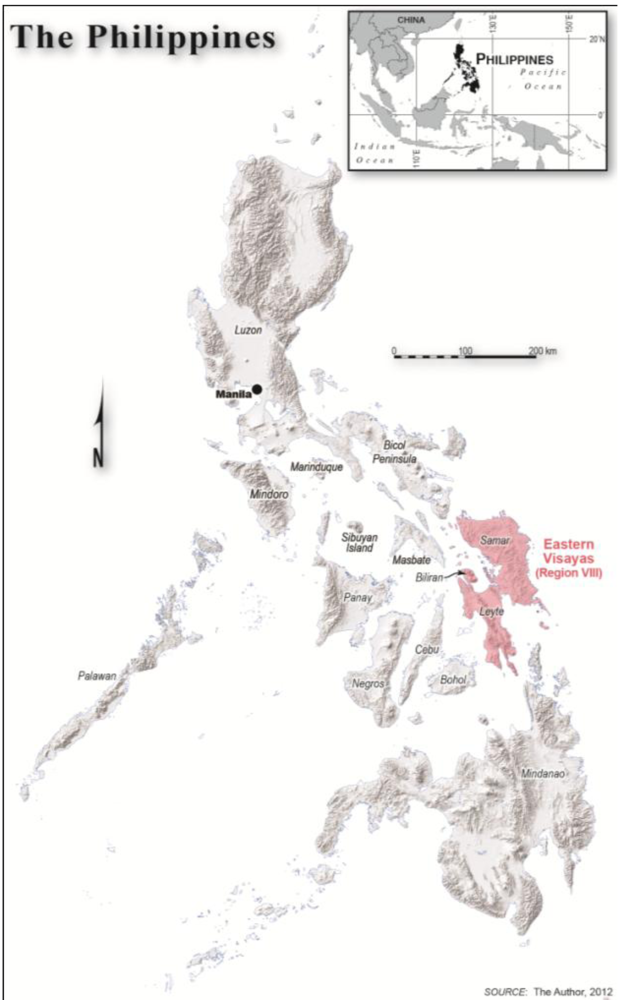
        <p>The Philippines, an archipelago of approximately 7,100 islands located in Southeast Asia (<xref ref-type="fig" rid="religions-03-00833-f001">Figure 1</xref>), has long been reputed to be accommodating to the prescriptions of neoliberalism [<xref ref-type="bibr" rid="B19-religions-03-00833">19</xref>] and the acceptance of neoliberalism there is widely attributed to the Presidency of Fidel Ramos (1992–1998), which implemented a program entitled “Philippines 2000” aimed at making the Philippines a developed country by the year 2000 [<xref ref-type="bibr" rid="B20-religions-03-00833">20</xref>]. Possibly the best example of the government’s embrace of neoliberalism has been its promotion of large-scale mining by multinational corporations [<xref ref-type="bibr" rid="B21-religions-03-00833">21</xref>]. The archipelago is well endowed with nonferrous metals (metals other than iron) such as copper, gold, lead, nickel, and zinc [<xref ref-type="bibr" rid="B21-religions-03-00833">21</xref>]. In 1995, in an effort to stimulate economic development, President Ramos signed into law the Mining Act of 1995 (Republic Act 7942), which contained a number of incentives to encourage mining such as: tax holidays; duty-free capital equipment imports; value-added tax exemptions; tax deductions for operations posting losses; accelerated depreciation; guarantees of the right of profit repatriation; and freedom from expropriation [<xref ref-type="bibr" rid="B21-religions-03-00833">21</xref>]. By the beginning of the twenty-first century the government of the Philippines had placed great expectations upon mining. Romulo L. Neri, Director General of the National Economic Development Authority, indicated that mining can create 240,000 jobs [<xref ref-type="bibr" rid="B22-religions-03-00833">22</xref>]. Poverty eradication will occur because mining will result “in inducing greater economic growth, attracting more investments, creating more jobs and relieving poverty particularly in rural areas” ([<xref ref-type="bibr" rid="B22-religions-03-00833">22</xref>], p. 18). “Communities that play host to mining activities also benefit from improved infrastructures as well as other livelihood opportunities that these activities bring” ([<xref ref-type="bibr" rid="B22-religions-03-00833">22</xref>], p. 16). At the seventh Asia Pacific Mining Conference and Exhibition held in June 2007, President Macapagal-Arroyo declared that mining would “serve as a leading engine for Philippine economic growth, becoming a source of revenue and wealth to allow the government to seriously bring down the level of poverty in the country” ([<xref ref-type="bibr" rid="B23-religions-03-00833">23</xref>], p. 120). These efforts to attract foreign mining companies have been quite successful and from 2004 to 2010 investment in mining increased, on average, by 30 percent each year [<xref ref-type="bibr" rid="B24-religions-03-00833">24</xref>]</p>
        <fig id="religions-03-00833-f001" position="anchor">
          <label>Figure 1</label>
          <caption>
            <p>The Philippines, an Archipelago of Approximately 7,100 Islands Located in Southeast Asia. </p>
          </caption>
          <graphic xmlns:xlink="http://www.w3.org/1999/xlink" xlink:href="religions-03-00833-g001.tif"/>
        </fig>
      </sec>
    </sec>
    <sec>
      <title>3. The Church of the Poor</title>
      <sec>
        <title>3.1. Historical Background</title>
        <p>Throughout much of history the Roman Catholic Church was aligned with the rich and powerful and, with few exceptions, showed little concern for the poor and marginalized. The church traditionally justified this orientation by using an approach known as the distinction of planes (or dualism), which argued there were two planes of existence: the sacred plane, the concern of the church; and the secular plane, the concern of secular society [<xref ref-type="bibr" rid="B25-religions-03-00833">25</xref>]. Any potential destabilizing influences emerging from a discussion of Jesus’ love for the poor in the scriptures were blunted by making it abundantly clear that any poverty being referred to was spiritual poverty and not material poverty [<xref ref-type="bibr" rid="B25-religions-03-00833">25</xref>]. </p>
        <p>In the late nineteenth century, however, changes began to occur within the church wherein it began to show concern for social issues. In 1891, Pope Leo XIII issued an encyclical <italic>Rerum Novarum </italic>which marked “the beginning of a new path” ([<xref ref-type="bibr" rid="B26-religions-03-00833">26</xref>], p. 54). This encyclical was in response to the industrial revolution and it set out “the rights of the weak, the dignity of the poor, and the obligations of the rich” and its “central theme [was] the just ordering of society ([<xref ref-type="bibr" rid="B26-religions-03-00833">26</xref>], p. 56). </p>
        <p>In 1931, during the Great Depression, Pope Puis XI issued the encyclical <italic>Quadragesimo Anno</italic>. In this encyclical, “the expansion of the influence of financial groups, both nationally and internationally, was added to the effects of industrialization” ([<xref ref-type="bibr" rid="B26-religions-03-00833">26</xref>], p. 57). It was made clear that “salaries should be proportional not only to the needs of the worker but also to those of the worker’s family” ([<xref ref-type="bibr" rid="B26-religions-03-00833">26</xref>], p. 57). Liberalism, “understood as unlimited competition between economic forces,” was rejected as a basis for the ordering of society ([<xref ref-type="bibr" rid="B26-religions-03-00833">26</xref>], p. 57). </p>
        <p>During the Papacy of John XXIII two important encyclicals were issued furthering the church’s departure from its dualistic conception of spirituality. In 1961, Pope John XXIII issued <italic>Mater et Magistra</italic>, which called the church “to cooperate in building with all men and women an authentic communion. In this was economic growth will not be limited to satisfying men’s needs but it will also promote their dignity” ([<xref ref-type="bibr" rid="B26-religions-03-00833">26</xref>], p. 60). Two years later, Pope John XXIII issued <italic>Pacem in Terris</italic>, an encyclical imploring the world community to “tackle and solve problems of an economic, social, political, or cultural character” ([<xref ref-type="bibr" rid="B26-religions-03-00833">26</xref>], p. 61). Eventually, by the second Vatican Council (1962 to 1965), the commitment made by the church to social issues in these preceding encyclicals had made it become increasingly apparent to many in the church that the distinction of planes had been a mistake. As Mabunga ([<xref ref-type="bibr" rid="B27-religions-03-00833">27</xref>]. p. 175) wrote:</p>
		<disp-quote>
        <p>When the Roman Catholic Church opened the Second Vatican Council in the 1960s, she was obliged to recognize and confront the rapid changes and the situation of humankind in the world. The church declared her gravest error to be the dichotomization between faith and practice; between professional and social activity, on the one hand, and the religious life on the other. </p>
		</disp-quote>
        <p>During the second Vatican Council (or “Vatican II”), the church became determined to bring itself up to date and it took on the crucial role of addressing issues of poverty, economics, and social justice [<xref ref-type="bibr" rid="B28-religions-03-00833">28</xref>]. This led to a shift in Catholic teaching away from a purely spiritual understanding of salvation and towards a greater commitment to challenge unjust social structures [<xref ref-type="bibr" rid="B29-religions-03-00833">29</xref>]. It was in Latin America where the church first responded to Vatican II with a degree of rapidity and the concept of liberation theology, an interpretation of Christianity from the experience of the poor, began to emerge [<xref ref-type="bibr" rid="B29-religions-03-00833">29</xref>]. When Vatican II described the role of the church as service to the world, Latin American theologians placed this within the context of their world of poverty and quickly came to see this as a vehicle for social involvement [<xref ref-type="bibr" rid="B29-religions-03-00833">29</xref>]. It was in this context that the <italic>Confederación Episcopal Latinoamerica </italic>(Latin American Episcopal Confederation or CELAM) met in <italic>Medellín</italic>, Colombia in August of 1968 and placed the weight of the church on the side of the poor. One of the most important organizers of this conference was the Peruvian priest Gustavo Gutiérrez. In July of 1968 (one month before Medellin) Gutiérrez presented a paper in Chimbote, Peru entitled <italic>Hacia una Teologia de la Liberación</italic> (Towards a Theology of Liberation), which presented liberation theology as a theological rationale for doing pastoral work among the poor. With the presentation of this paper, with the publication of Gutiérrez’s 1971 book <italic>A Theology of Liberation</italic>, and with publication of works by other writers (such as Leonardo Boff and Jon Sobrino), the concept of liberation theology began to emerge. At its core is the concept of the preferential option for the poor; they are to be taken into account first. Liberation theology also entails their participation; the poor must be afforded a choice about what happens to them. </p>
        <p>As a result of Vatican II, and the emergence of liberation theology, the Roman Catholic Church transformed itself from an institution supportive of the established social order to an institution containing a sector engaged in activism on behalf of the poor that may be referred to as “the church of the poor.” By no means does the entirety (or even majority) of the church constitute this church of the poor but those who constitute this church play a role disproportionate to their numbers, particularly since they are the ones in direct contact with the poor [<xref ref-type="bibr" rid="B29-religions-03-00833">29</xref>]. </p>
      </sec>
      <sec>
        <title>3.2. From Vatican II to PCP II: The Church of the Poor in the Philippines</title>
        <p>The Philippines has a long history of Roman Catholicism with the first mass in the Philippines being celebrated on 31 March 1521 [<xref ref-type="bibr" rid="B30-religions-03-00833">30</xref>]. However, during the Spanish colonial period (1568 to 1898) the church “taught a mystified and otherworldly version of Christianity to indoctrinate and subdue the masses for their conquerors” ([<xref ref-type="bibr" rid="B31-religions-03-00833">31</xref>], p. 30). With a heavy reliance upon a distinction of planes approach to spirituality it was not surprising that throughout much of history the church in the archipelago became aligned with the rich and powerful and acted in near total disregard of the poor and marginalized [<xref ref-type="bibr" rid="B31-religions-03-00833">31</xref>]. One of the best examples of this was the fact that during the 1930s and 1940s many members of the Catholic hierarchy in the islands were supporters of Spain’s General Franco ([<xref ref-type="bibr" rid="B32-religions-03-00833">32</xref>], p. 386). Indeed, the church engaged in displays of reactionary behavior as recently as the 1950s when Father John Delaney, the parish priest for the Catholic community at the University of the Philippines Diliman, launched a crusade “to ‘cleanse’ the campus of ‘atheists’” ([<xref ref-type="bibr" rid="B33-religions-03-00833">33</xref>], p. 38). </p>
        <p>Nevertheless, by the 1960s, with profound changes occurring worldwide within the church as a result of Vatican II, the church in the Philippines began to make a commitment to act as a church of the poor [<xref ref-type="bibr" rid="B34-religions-03-00833">34</xref>]. What accelerated this commitment more than anything else were the worsening conditions encountered by the poor during the dictatorship of President Ferdinand Marcos (1972–1986). During the 1970s, many Filipino lay persons, sisters, and priests began to develop a critical awareness of the depredations of the Marcos regime and this caused them to act on behalf of the poor [<xref ref-type="bibr" rid="B35-religions-03-00833">35</xref>]. In the words of Suarez, “The alteration of the ideological orientation of priests and church laity into reformist or revolutionary line was largely a product of the Marcos era” ([<xref ref-type="bibr" rid="B36-religions-03-00833">36</xref>], p. 470). At this time English translations of Gutiérrez’s writing were beginning to circulate in the archipelago and these came to “define the church’s mission as facilitating humankind’s ‘total liberation’” ([<xref ref-type="bibr" rid="B37-religions-03-00833">37</xref>], p. 208). “For Filipino Christians,” wrote Mendoza, “the role that Latin American liberation theology has played in the shaping of their political consciousness cannot be overemphasized” ([<xref ref-type="bibr" rid="B38-religions-03-00833">38</xref>], p. 19). Activism on behalf of the poor received an additional impetus when Bishops such as Bishop Antonio Fortich, Bishop Julio Xavier Labayen, and Bishop Francisco Claver sided with the poor articulating their concern for them despite the oppressive conditions prevailing under martial law [<xref ref-type="bibr" rid="B39-religions-03-00833">39</xref>]. Eventually, as a result of the 1991 Second Plenary Council of the Philippines (PCP II), the Church, as a whole, decided that it must become a “Church of the Poor” ([<xref ref-type="bibr" rid="B40-religions-03-00833">40</xref>], p. 48). As Ramos-Llana ([<xref ref-type="bibr" rid="B41-religions-03-00833">41</xref>], p. 61) wrote:</p>
		<disp-quote>
        <p>Essentially the vision of the church in the Philippines in PCP II is to become a Church of the Poor- a church whose members are ‘in solidarity with the poor,’ and who ‘collaborate with the poor themselves and with others to uplift the poor from their poverty.’ </p>
		</disp-quote>
      </sec>
      <sec>
        <title>3.3. Ecclesial Opposition to Mining in the Philippines</title>
        <p>Perhaps the most salient example of the church’s commitment to act on behalf of the poor is its opposition to mining. As Karaos ([<xref ref-type="bibr" rid="B42-religions-03-00833">42</xref>], p. 53) stated:</p>
		<disp-quote>
        <p>One social issue on which the Catholic Church has not remained silent in the face of what she perceives as injustices committed against the poor is that of mining. On this particular issue, the Philippine bishops have given credible witness to PCP II’s vision of a Church of the Poor. They have spoken out strongly against large-scale mining in a series of pastoral statements, marshaled the organizational resources and networks of the Church behind their advocacy, and shown remarkable solidarity with their poor and marginalized constituents. </p>
		</disp-quote>
        <p>The principal objection of the church to mining is its effect upon the environmental and <xref ref-type="table" rid="religions-03-00833-t001">Table 1</xref> discusses some of mining’s more salient environmental effects. Discovering, extracting and processing minerals is widely regarded as an environmentally and socially disruptive activity and environmental impacts can occur during exploration, mine development, mine operation and long after a mine has closed down [<xref ref-type="bibr" rid="B43-religions-03-00833">43</xref>].</p>
        <p>What makes mining’s environmental effects such a serious concern in the Philippines is the vulnerability of the archipelago’s rural poor, people who are engaged in subsistence agriculture and aquaculture, to any from of environmental disruption. Perhaps the best description of the importance of natural resources to the poor is that given by Broad ([<xref ref-type="bibr" rid="B44-religions-03-00833">44</xref>], p. 814):</p>
		<disp-quote>
        <p>To live, poor people eat and sell the fish they catch or the crops they grow-and typically those who manage to subsist in this way do so with very little margin. Natural resource degradation often becomes an immediate and life-and livelihood-threatening crisis- a question of survival. </p>

		</disp-quote>
        <p>Concerned that mining’s environmental effects will disrupt the environment depended upon by the poor and, in doing so, deprive them of their livelihoods the Catholic Bishops Conference of the Philippines (CBCP), the collective body of all bishops in the archipelago, has declared its opposition to mining in pastoral letters in 1998, 2006, and 2008 [<xref ref-type="bibr" rid="B45-religions-03-00833">45</xref>]. In the vanguard of this anti-mining campaign have been the bishops of the Eastern Visayas; these bishops have been the most outspoken advocates within the hierarchy in articulating their opposition to large-scale mining [<xref ref-type="bibr" rid="B45-religions-03-00833">45</xref>]. The island of Samar is located within the Eastern Visayas and the church on Samar has been an active opponent of mining. Attention now turns toward the particularities of the island of Samar. </p>
        <table-wrap id="religions-03-00833-t001" position="anchor">
          <object-id pub-id-type="pii">religions-03-00833-t001_Table 1</object-id>
          <label>Table 1</label>
          <caption>
            <p>Mining’s Environmental Effects [<xref ref-type="bibr" rid="B46-religions-03-00833">46</xref>].</p>
          </caption>
          <table rules="all" style="border: solid thin">
            <thead>
              <tr>
                <th align="center" valign="middle">Environmental Effect</th>
                <th align="center" valign="middle">What This Entails</th>
              </tr>
            </thead>
            <tbody>
              <tr>
                <td align="center" valign="middle">Hazardous Chemicals</td>
                <td align="left" valign="middle">Cyanide is frequently used as a processing agent in gold and silver mining and mercury is frequently produced as a by-product during mining. Spills of these chemicals can constitute a substantial threat to human health. </td>
              </tr>
              <tr>
                <td align="center" valign="middle">Water Contamination</td>
                <td align="left" valign="middle">Acid mine drainage can occur if the ore body contains iron and sulfur and if these minerals are exposed to water and oxygen. Acid mine drainage poses a serious threat to all aquatic biota and can lead to the mobilization of heavy metals such as arsenic, mercury, cadmium, and lead.</td>
              </tr>
              <tr>
                <td align="center" valign="middle">Air Pollution</td>
                <td align="left" valign="middle">Fugitive dust emissions from mining activities may cause serious respiratory problems in humans and lead to the asphyxia of plants and trees.</td>
              </tr>
              <tr>
                <td align="center" valign="middle">Deforestation</td>
                <td align="left" valign="middle">The removal of trees in open pit mining reduces habitat for endemic species and leads to more rapid runoff and flooding during the rainy season.</td>
              </tr>
              <tr>
                <td align="center" valign="middle">Water Siltation</td>
                <td align="left" valign="middle">Increased erosion leads to siltation of water systems and the degradation of fish habitat.</td>
              </tr>
              <tr>
                <td align="center" valign="middle">Water Depletion</td>
                <td align="left" valign="middle">Mining’s heavy use of water, in mineral processing and in pit dewatering, leads to a diminution of groundwater resources.</td>
              </tr>
            </tbody>
          </table>
        </table-wrap>
      </sec>
    </sec>
    <sec>
      <title>4. Samar: the Wounded Land</title>
      <sec>
        <title>4.1. The Physical Geography of Samar</title>
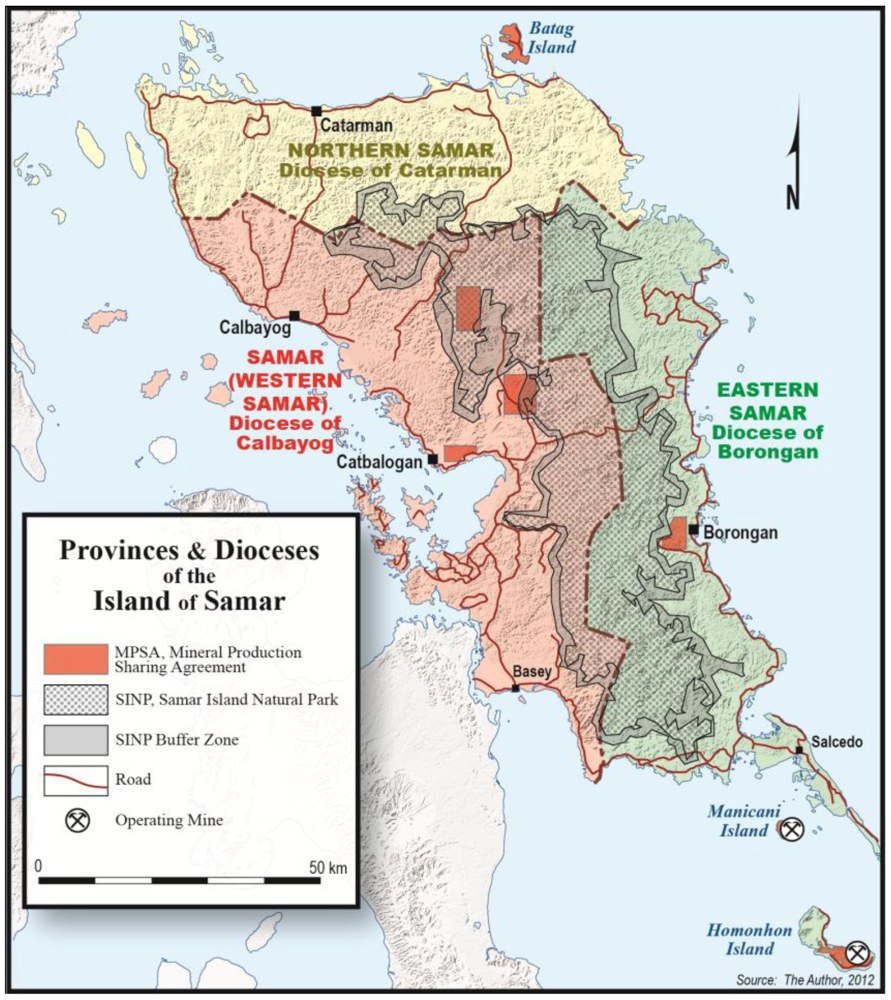
        <p>The government of the Philippines has divided the archipelago up into a number of regions for administrative regions and Samar, along with Biliran and Leyte, is located in the Eastern Visayas Region (Region VIII) (<xref ref-type="fig" rid="religions-03-00833-f001">Figure 1</xref>). Samar, with a total land area of 13,560 square kilometers is the third largest island of the Philippine archipelago [<xref ref-type="bibr" rid="B47-religions-03-00833">47</xref>]. In 1965, Republic Act 4221 divided Samar into three provinces (<xref ref-type="fig" rid="religions-03-00833-f002">Figure 2</xref>): Samar (referred to herein as “Western Samar”), with 5,591 square kilometers of land area; Northern Samar, with 3,498 square kilometers of land area; and Eastern Samar, with 4,471 square kilometers of land area [<xref ref-type="bibr" rid="B47-religions-03-00833">47</xref>]. Although the mountains on Samar are lower (between 200 meters and 800 meters) than on other islands in the Philippines, Samar’s terrain is rugged and hilly and two-thirds of its land area has a slope of over 18 degrees [<xref ref-type="bibr" rid="B47-religions-03-00833">47</xref>]. Samar has a wet climate, receiving over 3,000 millimeters of rainfall every year and, consequently, is covered with lush tropical rainforests and has the archipelago’s largest remaining tract of unfragmented lowland tropical rainforest, much of which consists of old growth tropical rainforest [<xref ref-type="bibr" rid="B47-religions-03-00833">47</xref>]. </p>
        <fig id="religions-03-00833-f002" position="anchor">
          <label>Figure 2</label>
          <caption>
            <p>Samar, the Wounded Land.</p>
          </caption>
          <graphic xmlns:xlink="http://www.w3.org/1999/xlink" xlink:href="religions-03-00833-g002.tif"/>
        </fig>
        <p>Samar is renowned for its biodiversity and the World Wildlife Fund has designated the island as a Global 200 Eco-Region [<xref ref-type="bibr" rid="B47-religions-03-00833">47</xref>]. Its large tract of tropical rainforest “supports highly diversified populations of rare, endemic, endangered and economically significant species, many of which are of global importance” ([<xref ref-type="bibr" rid="B48-religions-03-00833">48</xref>], p. 1). To protect the biodiversity of Samar the Samar Island Natural Park (SINP) was created by Presidential Proclamation Number 442 issued by President Gloria Macapagal-Arroyo on 13 August 2003 [<xref ref-type="bibr" rid="B49-religions-03-00833">49</xref>]. The SINP (<xref ref-type="fig" rid="religions-03-00833-f002">Figure 2</xref>) consists of a 3,333 square kilometer core area, wherein there are substantial land use restrictions, surrounded by a 1,245 square kilometer buffer zone that “is intended to provide an added layer of protection to the [protected area] while at the same time providing regulated benefits and livelihood opportunities to local communities” ([<xref ref-type="bibr" rid="B49-religions-03-00833">49</xref>], p. 15).</p>
        <p>Samar is also well known as an island prone to natural hazards such as typhoons and El Niño induced drought [<xref ref-type="bibr" rid="B50-religions-03-00833">50</xref>]. Much of the Philippines are at risk from typhoons and each year about 20 of them, equivalent to 25 percent of the total number of such events in the world, occur in Philippine waters [<xref ref-type="bibr" rid="B50-religions-03-00833">50</xref>]. Approximately 95 percent of these originate in the Pacific Ocean, south and east of the archipelago, between the months of July to November and travel in a northwesterly direction mainly affecting the eastern half of the country, particularly the island of Samar [<xref ref-type="bibr" rid="B50-religions-03-00833">50</xref>]. The provinces of Western Samar and Northern Samar are considered to be at high risk of typhoons while Eastern Samar is at a medium risk to typhoons [<xref ref-type="bibr" rid="B50-religions-03-00833">50</xref>]. The Philippines are also vulnerable to drought conditions associated with the El Niño Southern Oscillation, a phenomenon wherein climatic conditions in the tropical Pacific reverse themselves and what is normal in the eastern Pacific (high air pressure and low levels of precipitation) becomes prevalent in the western Pacific, while what is normal in the western Pacific (low air pressure and high levels of precipitation) becomes prevalent in the eastern Pacific [<xref ref-type="bibr" rid="B50-religions-03-00833">50</xref>]. All three of the Samareño provinces are at medium risk of El Niño induced drought [<xref ref-type="bibr" rid="B50-religions-03-00833">50</xref>]. </p>
      </sec>
      <sec>
        <title>4.2. The Human Geography of Samar</title>
        <p>In 2010, Samar had a population of approximately 1.8 million people with 733,377 people residing in Western Samar, 589,013 people living in Northern Samar, and 428,877 people residing in Eastern Samar [<xref ref-type="bibr" rid="B51-religions-03-00833">51</xref>]. The overwhelming majority of Samareños live in coastal areas and approximately 93 percent of all people live in a municipality with coastal access [<xref ref-type="bibr" rid="B52-religions-03-00833">52</xref>]. </p>
        <p>The population of Samar is overwhelmingly Christian, there is no appreciable Muslim population on the island [<xref ref-type="bibr" rid="B52-religions-03-00833">52</xref>] and there are no indigenous peoples (those having a historical continuity with the pre-Islamic and pre-Hispanic religions of the archipelago) residing in the Eastern Visayas [<xref ref-type="bibr" rid="B53-religions-03-00833">53</xref>]. There are three Roman Catholic Dioceses on the island (<xref ref-type="fig" rid="religions-03-00833-f002">Figure 2</xref>): the Diocese of Calbayog, corresponding to Western Samar; the Diocese of Catarman, corresponding to Northern Samar; and the Diocese of Borongan, corresponding to Eastern Samar. According to Bishop Crispin Varquez, the Bishop of the Diocese of Borongan, approximately 85 percent of all Samarnons are Roman Catholics [<xref ref-type="bibr" rid="B54-religions-03-00833">54</xref>].</p>
        <p>The most striking feature of Samar is poverty [<xref ref-type="bibr" rid="B55-religions-03-00833">55</xref>]. The three provinces of Samar have traditionally belonged to the poorest provinces in the Philippines [<xref ref-type="bibr" rid="B56-religions-03-00833">56</xref>]. In 2005, Western Samar had a poverty rate of 52 percent, Northern Samar had a poverty rate of 53 percent, and Eastern Samar had a poverty rate of 44 percent [<xref ref-type="bibr" rid="B57-religions-03-00833">57</xref>]. Where poverty becomes particularly acute is in rural areas and when these 2005 poverty rates were looked at for rural areas they increased to 55 percent, 57 percent, and 48 percent respectively [<xref ref-type="bibr" rid="B57-religions-03-00833">57</xref>]. The vast majority of Samareños engage in subsistence agriculture and aquaculture, “crop growing and fishing are Samar’s main occupation” ([<xref ref-type="bibr" rid="B58-religions-03-00833">58</xref>], p. 140). According to Father Cesar Aculan, the Social Action Director of the Diocese of Calbayog, forty-five percent of the population of Western Samar depends on aquatic resources for their livelihoods [<xref ref-type="bibr" rid="B59-religions-03-00833">59</xref>]. An excellent description of poverty on Samar is that provided by two Belgian doctors:</p>
		<disp-quote>
        <p>Samar is without a doubt the poorest place we have seen in the Philippines. The people are deprived of the most elementary government services. The island has only a coastal road. The many barrios in the interior are not considered important enough for roads to be built. The traffic is carried out on the many waterways, which cut up the island, with small unmotorized prows, or on foot. The rivers are crossed by means of a simple bamboo bridge, with an improvised raft of banana stems or by wading through the stream. In the rainy season, many villages are cut off for months from the outside world. </p>
		<attrib>[<xref ref-type="bibr" rid="B60-religions-03-00833">60</xref>], p. 92</attrib>
		</disp-quote>
        <p>Since the 1970s, there has been an emigration of Samarnons off of the island in search of jobs [<xref ref-type="bibr" rid="B61-religions-03-00833">61</xref>]. When interviewed by the author in November 2009 Carlos Conde, a journalist who has written for the International Herald Tribune, related how well over half of his recent interviews in Metro Manila were of recent migrants from the islands of Samar and Leyte [<xref ref-type="bibr" rid="B62-religions-03-00833">62</xref>]. In Tondo, the sprawling shantytown northwest of Manila, there is a large population of migrants from the Eastern Visayas who have moved to Manila looking for better opportunities.</p>
      </sec>
      <sec>
        <title>4.3. Samar: An Insurgency Hotbed</title>
        <p>Samar is a part of the Philippines where there is a substantial amount of conflict between the Armed Forces of the Philippines (AFP) and the New People’s Army (NPA), the armed wing of the Communist Party of the Philippines (CPP) [<xref ref-type="bibr" rid="B63-religions-03-00833">63</xref>]. Since coming into being in 1969 the NPA has been engaged in hostilities against the AFP in an attempt to overthrow the Philippine state [<xref ref-type="bibr" rid="B64-religions-03-00833">64</xref>]. With heavily forested and rugged terrain to operate in, and a large population of poor people to recruit from, there has been substantial NPA activity on Samar. In 2003, the NPA had a presence (or what could be called a “mass base”) in 52 percent of all barangays (villages) in Western Samar, 61 percent of all barangays in Northern Samar, and 46 percent of all barangays in Eastern Samar [<xref ref-type="bibr" rid="B65-religions-03-00833">65</xref>]. “No discussion about Samar will be complete or adequate without an account of that radical ferment in the island” ([<xref ref-type="bibr" rid="B66-religions-03-00833">66</xref>], p. 186). “Samar is among the areas in the Philippines, where the NPA is believed to be strong and growing” ([<xref ref-type="bibr" rid="B66-religions-03-00833">66</xref>], p. 186). “Samar is not only a biodiversity ‘hotspot’ but it is also an insurgency ‘hotbed’” ([<xref ref-type="bibr" rid="B67-religions-03-00833">67</xref>], p. 128). </p>
      </sec>
      <sec>
        <title>4.4. Human Rights Abuses in the Wounded Land</title>
        <p>Samar has been a part of the Philippines where a substantial amount of human rights violations have occurred. In the archipelago, since 2001, there has been a wave of extrajudicial killings wherein people involved in social activism have been assassinated. It is widely believed that many of these killings have been carried out by the AFP to destroy the mass base of the CPP by attacking left-wing activists who are members of legal organizations affiliated with it or sympathetic to it [<xref ref-type="bibr" rid="B68-religions-03-00833">68</xref>]. The government is aware of these killings but its response is that they are the result of an NPA internal purge [<xref ref-type="bibr" rid="B68-religions-03-00833">68</xref>]. This explanation is offered because, at various times (and in various places) during, the 1980s, the NPA (concerned that AFP agents had infiltrated it) conducted an internal purge costing the lives of hundreds of its own members. Activists concerned about the killings reject this assertion outright, as Human Rights Watch ([<xref ref-type="bibr" rid="B69-religions-03-00833">69</xref>], p. 71) wrote, “Experts on the NPA have found no evidence that large-scale intra-NPA killings have persisted beyond the early 1990s, and that the current killings do not reflect the typical pattern of killings by the NPA” </p>
        <p>According to Karapatan, a nongovernmental organization (NGO) engaged in human rights activism in the Philippines, from January 2001 to December 2011, there were 1,273 extrajudicial killings nationwide and 133, or 10.45 percent, of those occurred in the Eastern Visayas [<xref ref-type="bibr" rid="B70-religions-03-00833">70</xref>]. The Eastern Visayas constitute only seven percent of the land area of the Philippines, and only four percent of the population, so this region of the country experienced a disproportionate number of extrajudicial killings. While Karapatan did not decompose their numbers on a province-by-province basis, it is well known that Samar has experienced a disproportionate number of assassinations. Attorney Al Parreno is an authority on the extrajudicial killings [<xref ref-type="bibr" rid="B71-religions-03-00833">71</xref>] and, according to Attorney Parreno, “Samar is one of the front lines of the extrajudicial killings” and the violence on Samar “is a concoction of many things” [<xref ref-type="bibr" rid="B72-religions-03-00833">72</xref>]. On Samar there is poverty, corruption, political alliances between politicians and soldiers, political alliances between politicians and rebels and there is also mining with the massive amounts of money that it involves. Given that Attorney Parreno’s identification of mining as an exacerbating factor with respect to the human rights situation on Samar attention now turns towards mining in the wounded land and the church’s opposition to mining.</p>
      </sec>
    </sec>
    <sec>
      <title>5. Ecclesial Opposition to Mining on Samar</title>
      <sec>
        <title>5.1. Mining and Mineral Resources of Samar</title>
        <p>Samar is well endowed with mineral deposits attracting the attention of the mining industry [<xref ref-type="bibr" rid="B73-religions-03-00833">73</xref>]. On Samar there are two active and five proposed mining projects (<xref ref-type="fig" rid="religions-03-00833-f002">Figure 2</xref>), all seven of which are mineral production sharing agreements (MPSAs), production agreements facilitated by the Mining Act of 1995 that can last for up to 25 years, are approved by the Mines and Geosciences Bureau (MGB) of the Department of Environment and Natural Resources (DENR), and require no more than 40 percent foreign ownership [<xref ref-type="bibr" rid="B74-religions-03-00833">74</xref>]. Both of the active mines are found in Eastern Samar and they are the chromite mine on Homonhon Island and the nickel mine on Manicani Island; the former has been in operation since 1989 and the latter has been in operation since 1992 [<xref ref-type="bibr" rid="B74-religions-03-00833">74</xref>]. The five inactive mines are: the MPSA for bauxite on Batag Island in Northern Samar; the MPSA for bauxite in Western Samar (contained entirely within the SINP); the MPSA for bauxite in Western Samar (overlapping with the boundary of the SINP); the MPSA for manganese east of Catbalogan, in Western Samar; and the MPSA for manganese between the SINP buffer zone and Borongan, in Eastern Samar [<xref ref-type="bibr" rid="B74-religions-03-00833">74</xref>]. The government is strongly encouraging mining on Samar and on 4 February 2012 Roger De Dios, the MGB Director for the Eastern Visayas stated he viewed mining as something that can generate a “thrust toward growth and progress” [<xref ref-type="bibr" rid="B75-religions-03-00833">75</xref>]. </p>
      </sec>
      <sec>
        <title>5.2. Mining’s Impacts upon the Poor</title>
        <p>While some specific examples of ecclesial opposition to mining are set out in <xref ref-type="table" rid="religions-03-00833-t002">Table 2</xref>, the first major objection of the church to mining on Samar is a concern that its environmental effects (see <xref ref-type="table" rid="religions-03-00833-t001">Table 1</xref>) may worsen the conditions of the poor, many of whom are engaged in subsistence agriculture and aquaculture. Bishop Crispin Varquez stated that the church is opposed to large-scale mining conducted in an irresponsible manner and large-scale mining is irresponsible because of its environmental effects, which can make poor people poorer as their ability to earn a livelihood can be degraded. Father Cesar Aculan holds the view that with large-scale mining, land and resources have been degraded and people have been pushed into poverty. Evidence of mining impacting the rural poor can be found on Homonhon Island. Villardo Abueme, the President of the Homonhon Environment Resources Organization, stated that mining has caused forest denudation and water siltation [<xref ref-type="bibr" rid="B76-religions-03-00833">76</xref>]. Most of the people on Homonhon Island are fisherfolk and farmers and mining has reduced fish catches as well as the amount of arable land. As a result of mining, people must now buy drinking water, which makes them even poorer. In Abueme’s words, “We have become poorer with mining.” Similarly there are also examples of mining impacting the rural poor on Manicani Island. Narcissa Baddilla, the Coordinator of the Save Manicani Movement, stated mining has reduced the amount of land available to farmers and siltation into the ocean has impacted fishing; these environmental effects have damaged the livelihoods of the island’s residents [<xref ref-type="bibr" rid="B77-religions-03-00833">77</xref>]. Before mining, agriculture and fishing could sustain the inhabitants of Manicani Island but since mining people have been made substantially poorer. </p>
        <table-wrap id="religions-03-00833-t002" position="anchor">
          <object-id pub-id-type="pii">religions-03-00833-t002_Table 2</object-id>
          <label>Table 2</label>
          <caption>
            <p>Examples of Ecclesial Activism against Mining on Samar.</p>
          </caption>
          <table rules="all" style="border: solid thin">
            <thead>
              <tr>
                <th align="center" valign="middle">Date</th>
                <th align="center" valign="middle">Ecclesial Action Against Mining</th>
              </tr>
            </thead>
            <tbody>
              <tr>
                <td align="center" valign="middle">16 July 2003</td>
                <td align="left" valign="middle">In response to information it had received regarding heavy siltation in the seas near Homonhon and Manicani islands the Diocese of Borongan asked the Secretary of the Department of Environment and Natural Resources (DENR) to conduct an investigation into the impact of mining operations on those islands [<xref ref-type="bibr" rid="B78-religions-03-00833">78</xref>].</td>
              </tr>
              <tr>
                <td align="center" valign="middle">8 August 2003</td>
                <td align="left" valign="middle">A protest caravan, organized by all three dioceses, started from Catarman, Borongan, and Basey and ended in Catbalogan to protest the 5 December 2002 granting of Mineral Production Sharing Agreements for bauxite mining in the interior of Samar [<xref ref-type="bibr" rid="B78-religions-03-00833">78</xref>].</td>
              </tr>
              <tr>
                <td align="center" valign="middle">27 September 2003</td>
                <td align="left" valign="middle">The Diocese of Calbayog, lauded Western Samar for passing a 50 year moratorium on large-scale mining. The Dioceses of Borongan and Catarman both urged their respective provinces to follow suit [<xref ref-type="bibr" rid="B78-religions-03-00833">78</xref>]. </td>
              </tr>
              <tr>
                <td align="center" valign="middle">22 July 2004</td>
                <td align="left" valign="middle">The Diocese of Borongan articulated its opposition to government efforts promoting mining and stating that it will not surrender its call for the preservation of the Samar Island Natural Park as well as an island wide ban on mining [<xref ref-type="bibr" rid="B78-religions-03-00833">78</xref>].</td>
              </tr>
              <tr>
                <td align="center" valign="middle">5 March 2006</td>
                <td align="left" valign="middle">The Diocese of Borongan sent a letter to the DENR secretary asking for the cancellation of mining on Homonhon island. The letter stated that mining on Homonhon island has done harm to the environment and little to alleviate poverty [<xref ref-type="bibr" rid="B79-religions-03-00833">79</xref>].</td>
              </tr>
              <tr>
                <td align="center" valign="middle">10 March 2006</td>
                <td align="left" valign="middle">Father Cesar Aculan, the Social Action Director of the Diocese of Calbayog, testified before a committee of the Philippine Senate and referred to the logging and mining industries as “twin industries of mass destruction” and called for a cleansing of the DENR of corrupt officials who act as fixers for those industries [<xref ref-type="bibr" rid="B80-religions-03-00833">80</xref>]. </td>
              </tr>
              <tr>
                <td align="center" valign="middle">29 February 2008</td>
                <td align="left" valign="middle">The three Samareño bishops, in conjunction with the bishops of Leyte, issued a pastoral letter warning that recent flooding in the Eastern Visayas is attributable to irresponsible mining. The bishops also stated that environmental abuse for money gives only minimal compensation and temporary employment to the poor [<xref ref-type="bibr" rid="B81-religions-03-00833">81</xref>].</td>
              </tr>
              <tr>
                <td align="center" valign="middle">22 October 2010</td>
                <td align="left" valign="middle">The three Samarnon bishops, along with the other Eastern Visayan bishops, signed a pastoral letter warning that relying upon mining to act as a form of development will lead to a threatening of the ability of people to draw their life’s sustenance [<xref ref-type="bibr" rid="B82-religions-03-00833">82</xref>].</td>
              </tr>
              <tr>
                <td align="center" valign="middle">21 March 2011 </td>
                <td align="left" valign="middle">The Diocese of Borongan again called for an end to mining on Homonhon island [<xref ref-type="bibr" rid="B83-religions-03-00833">83</xref>].</td>
              </tr>
              <tr>
                <td align="center" valign="middle">2 February 2012</td>
                <td align="left" valign="middle">The Diocese of Borongan appealed to President Benigno Aquino to impose a moratorium on mining in Eastern Samar to prevent further environmental degradation and to preserve farming and fishing [<xref ref-type="bibr" rid="B84-religions-03-00833">84</xref>].</td>
              </tr>
              <tr>
                <td align="center" valign="middle">19 March 2012</td>
                <td align="left" valign="middle">All three Samareño dioceses, along with the other dioceses in the Eastern Visayas and a group of protestant churches, signed an ecumenical pledge to condemn and oppose large-scale mining [<xref ref-type="bibr" rid="B85-religions-03-00833">85</xref>]. </td>
              </tr>
              <tr>
                <td align="center" valign="middle">15 May 2012 </td>
                <td align="left" valign="middle">All three Samarnon dioceses issued a joint pastoral letter expressing their outrage at the 1 May 2012 killing of Francisco Canayong, an anti-mining activist in Salcedo, Eastern Samar [<xref ref-type="bibr" rid="B86-religions-03-00833">86</xref>].</td>
              </tr>
            </tbody>
          </table>
        </table-wrap>
      </sec>
      <sec>
        <title>5.3. Mining and Samar’s Vulnerability to Natural Hazards</title>
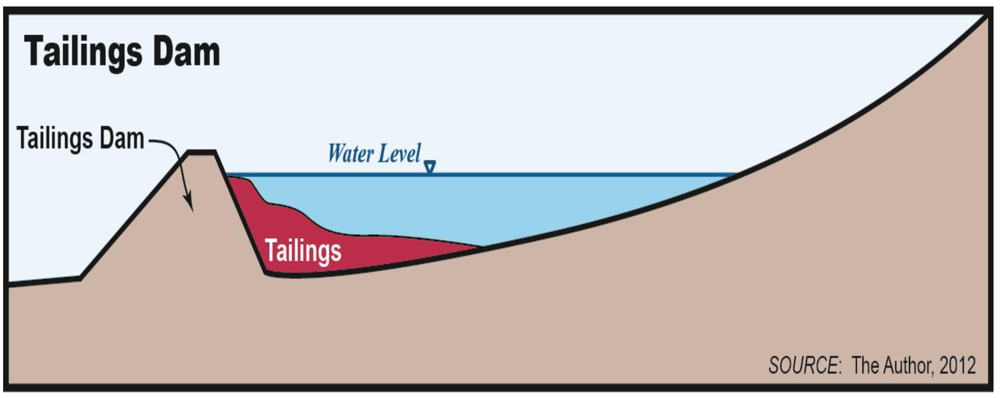
        <p>Members of the church are concerned about mining’s environmental effects interacting with Samar’s vulnerability to natural hazards and the former being aggravated by the latter. Typhoons are a hazard with a substantial potential for adverse interactions with mining. Modern mining methods generate substantial amounts of finely grained wastes known as “tailings.” Often these tailings are highly acidic and the principal methods of dealing with them is by placing them behind a “tailings dam” in a “tailings pond” (<xref ref-type="fig" rid="religions-03-00833-f003">Figure 3</xref>). </p>
        <fig id="religions-03-00833-f003" position="anchor">
          <label>Figure 3</label>
          <caption>
            <p>Subaqueous Tailings Disposal.</p>
          </caption>
          <graphic xmlns:xlink="http://www.w3.org/1999/xlink" xlink:href="religions-03-00833-g003.tif"/>
        </fig>
        <p>Should one of these tailings dams fail there will be a release of contaminants into the environment, an event that will significantly worsen environmental conditions [<xref ref-type="bibr" rid="B87-religions-03-00833">87</xref>]. A typhoon, with its strong winds and associated heavy rains is quite capable of causing a tailings dam failure and worldwide the most frequent cause of tailings dam failures have been heavy rainfall events [<xref ref-type="bibr" rid="B87-religions-03-00833">87</xref>]. Father Juderick Calumpiano, the Social Action Director of the Diocese of Borongan, is of the view that there is a danger of typhoons causing mining wastes to spill from tailings ponds, which are usually located in upland areas, and contaminating lowland areas where farming and fishing occur [<xref ref-type="bibr" rid="B88-religions-03-00833">88</xref>]. Father Alejandro Galo, a member of the Diocesan Commission on Social Action, Justice, and Peace of the Diocese of Borongan, stated that the overflowing of a tailings dam can contaminate the sea as well as cause flash flooding [<xref ref-type="bibr" rid="B89-religions-03-00833">89</xref>]. Villardo Abueme stated that the possibility of a typhoon impacting the tailings dam on Homonhon Island is one of the biggest fears of the people there and that many people leave Homonhon Island when a typhoon is likely but people never did this before mining took place. </p>
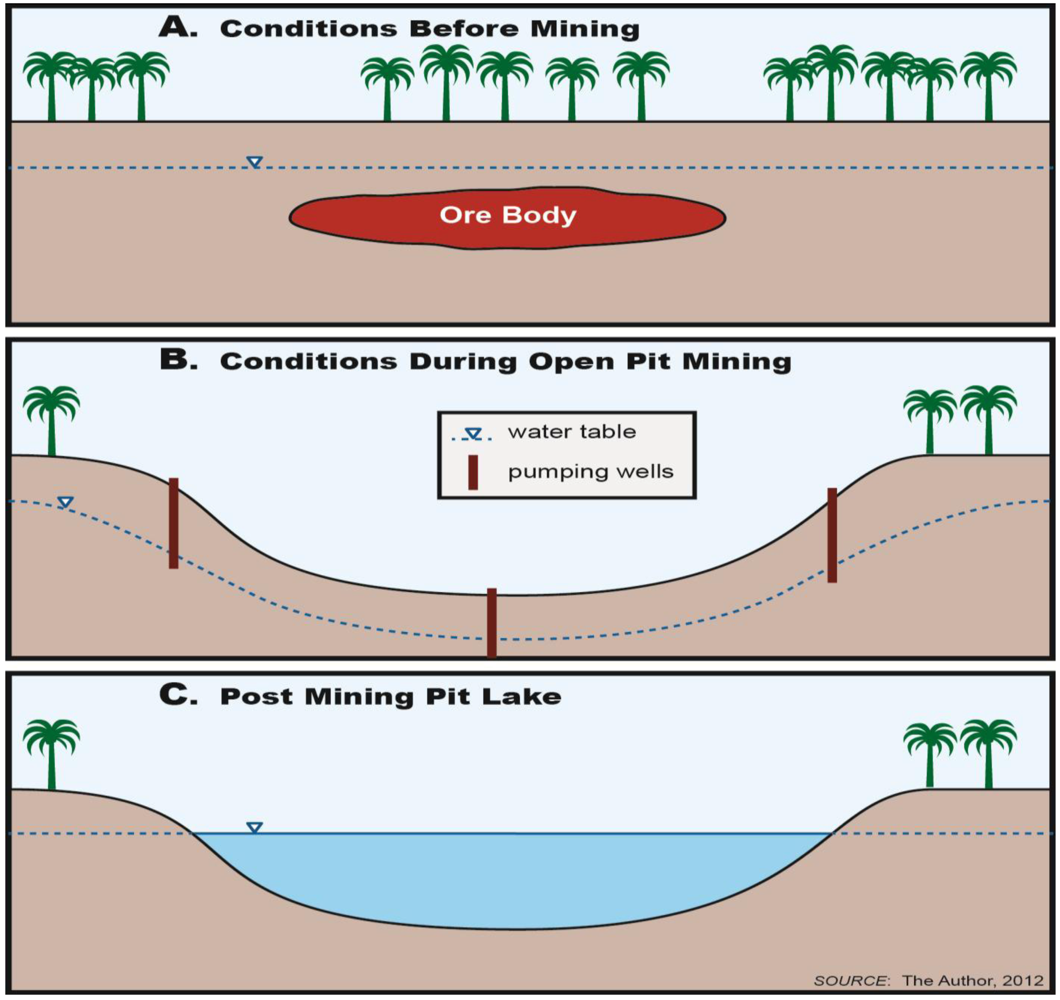
        <p>El Niño induced drought is another hazard capable of adversely interacting with mining. Mines are heavy water users [<xref ref-type="bibr" rid="B90-religions-03-00833">90</xref>] and the most obvious effect of mining upon water availability is through water table drawdown associated with mine dewatering. Often ore bodies will be found below the water table (<xref ref-type="fig" rid="religions-03-00833-f004">Figure 4</xref>A) and this will involve mining operations going below the water table (<xref ref-type="fig" rid="religions-03-00833-f004">Figure 4</xref>B), in the case of an open pit mine, a lake will form within the pit where the ground water reestablishes itself (<xref ref-type="fig" rid="religions-03-00833-f004">Figure 4</xref>C). To prevent pit lakes from forming mines engage in mine pit dewatering, continually pumping groundwater out of the pit. While this may prevent a pit from flooding it will involve the drawing down of the water table over large areas, creating long-term ground water deficits and affecting surface water flows as well as springs [<xref ref-type="bibr" rid="B90-religions-03-00833">90</xref>]. Mine pit dewatering during an El Niño induced drought (when reduced precipitation places increased reliance upon groundwater), can lead to a disruption of water supplies.</p>
        <fig id="religions-03-00833-f004" position="anchor">
          <label>Figure 4</label>
          <caption>
            <p>The Process of Mine Pit Dewatering. </p>
          </caption>
          <graphic xmlns:xlink="http://www.w3.org/1999/xlink" xlink:href="religions-03-00833-g004.tif"/>
        </fig>
        <p>Members of the church are concerned about mining adversely interacting with El Niño induced drought on Samar. According to Father Cesar Aculan, water table drawdown has been observed in Western Samar during droughts and that the church is worried about mining’s impact on water resources. Father Alejandro Galo indicated that on Manicani Island almost all water comes from rain water and whenever there is a drought there are serious disruptions in the water supply. Narcissa Baddilla confirmed this stating that during an El Niño there will be a noticeable decrease in groundwater, particularly in the immediate vicinity of the mine, and that groundwater can only be extracted for one hour each day. Similarly, on Homonhon Island, Villardo Abueme has observed mining’s effect on groundwater availability during an El Niño and indicated that whenever there are three weeks of sunny weather there will be a reduction in groundwater; this was never the case before mining. </p>
      </sec>
      <sec>
        <title>5.4. A Lack of Faith in Technology</title>
        <p>Closely related to the interaction between mining’s environmental effects and Samar’s vulnerability to natural hazards are the claims made by the mining industry that it has the skills and technologies to reduce these risks to an inconsequential level [<xref ref-type="bibr" rid="B91-religions-03-00833">91</xref>]. Such claims exemplify the concept of ecological modernization, a view that environmental problems “can be resolved through appropriate technology and industrial retooling” ([<xref ref-type="bibr" rid="B92-religions-03-00833">92</xref>], p. 10). To Bebbington <italic>et al.</italic> ([<xref ref-type="bibr" rid="B93-religions-03-00833">93</xref>], p. 900) the claims of the mining industry that its use of technology can minimize natural hazards “constitute a discourse of ecological modernization <italic>par excellence</italic>.” The mining industry likes to depict itself as having undergone a profound transformation from the “old mining,” which damaged the environment, had dangerous workplaces and operated in complete disregard for the needs of adjacent communities, to the “new mining,” which is socially and environmentally responsible and uses technology to ensure the management of environmental risk [<xref ref-type="bibr" rid="B93-religions-03-00833">93</xref>]. </p>
        <p>Members of the church reject the confident assurances of the mining industry’s that it has the skills and technologies to reduce risks to an inconsequential level. Father Cesar Aculan stated that the mining industry should prove that they indeed have the skills and technologies capable of reducing these risks somewhere else in the world and then come to Samar to use them. Father Cesar also expressed concern about the fact that many multinational mining companies are from countries, such as Australia and Canada, which have population densities much lower than that on Samar. Father Juderick Calumpiano was incredulous that the mining industry would even make such a claim and expressed a view that such claims are only being made because the mining industry expects profits from the extraction of Samar’s mineral resources. </p>
      </sec>
      <sec>
        <title>5.5. The Threat Mining Poses to Samar’s Biodiversity</title>
        <p>An important component of ecclesial opposition to mining on Samar is the threat mining poses to the biodiversity of the island. According to Bishop Crispin Varquez, Samar’s biodiversity is an important component of the church’s opposition to mining. As indicated in <xref ref-type="fig" rid="religions-03-00833-f002">Figure 2</xref>, there is one MPSA for bauxite that is contained entirely within the SINP and there is an MPSA for bauxite overlapping with the SINP. There is nothing prohibiting these two mines from commencing production since their MPSAs were granted on 5 December 2002 and Presidential Proclamation Number 442 “stated that any valid contract, permit or license for the extraction or utilization of natural resources previously granted were to be respected” ([<xref ref-type="bibr" rid="B94-religions-03-00833">94</xref>], p. 18). Father Cesar Aculan stated that protecting the SINP is an important part of the church’s advocacy and he is a member of the Protected Areas Management Board governing the park. Father Cesar would like to see legislation passed by the Philippine Congress making the SINP a protected area and to this end the church supports House Bill 3219, a bill introduced in the House of Representatives by Eastern Samar Representative Ben Evardone, which would make SINP into a protected area. If more formal protected area status could be established by legislation, SINP could become an ecotourism destination. Father Cesar Aculan also articulated his concern about climate change and Samar’s biodiversity can play a substantial role in ameliorating the impacts of anthropogenic greenhouse gas emissions because its forest can accumulate over 2 million tons of carbon dioxide emissions a year [<xref ref-type="bibr" rid="B95-religions-03-00833">95</xref>]. </p>
      </sec>
      <sec>
        <title>5.6. Mining and Militarization</title>
        <p>A particularly serious concern of the Samareño church in its opposition to mining is the militarization of mining areas. Samar has a substantial amount of NPA activity; there have been several instances on other islands in the Philippines where the NPA have attacked mining operations [<xref ref-type="bibr" rid="B96-religions-03-00833">96</xref>], and, on 3 April 2012 the National Democratic Front Eastern Visayas (NDFP-EV), an umbrella group of left wing organizations in the Eastern Visayas including the CPP and NPA, stated: </p>
		<disp-quote>
        <p>The New People’s Army is under orders to dismantle large-scale mining projects and to attack and disarm the military, paramilitary, police and private security guarding these projects until they are forced to shut down. </p>
		<attrib>[<xref ref-type="bibr" rid="B97-religions-03-00833">97</xref>]</attrib>
		</disp-quote>
        <p>With the NPA having attacked mines in other parts of the archipelago, and with saber rattling coming from the NDFP-EV, Father Alejandro Galo expressed his concern that mining areas will be militarized and this is what has happened on Manicani Island. Maria Patalinghug-Vasquez is the Central and Eastern Visayas Coordinator of Task Force Detainees of the Philippines (TFDP), a human rights NGO created by the Association of Major Religious Superiors of the Philippines in 1974 [<xref ref-type="bibr" rid="B98-religions-03-00833">98</xref>]. According to Patalinghug-Vasquez the AFP deployed troops to Manicani Island, which it declared a “hotbed of the NPA,” during 2005 to protect the mine from the NPA. The most serious aspect of the militarization of mining areas is the intimidating atmosphere it provides. To Maria Patalinghug-Vasquez the real reason the AFP sent troops to Manicani Island was to intimidate people into discontinuing their opposition to the mine. It simply is not true that Manicani Island is a “hotbed of the NPA.” In the opinion of Father Juderick Calumpiano it is very difficult to oppose mining when an area becomes militarized. Narcissa Baddilla has been accused of being a member of the NPA. In her experience on Manicani Island, “Every time people oppose mining they will be branded as members of the NPA.” </p>
      </sec>
      <sec>
        <title>5.7. Mining and Human Rights Abuses</title>
        <p>Intimately related to the militarization of mining areas are human rights abuses. Maria Patalinghug-Vasquez stated that there is a direct relationship between mining and human rights violations. In 2001 the Save Manicani Movement had erected a barricade outside of the mine on Manicani Island and on 30 April 2001 a 14 year old boy was killed by a truck from that mining company when it broke through the barricade. On 9 March 2005, a Philippine National Police Regional Mobile Group was deployed to Manicani Island to remove this barricade and approximately 70 people were injured when the barricade was violently dispersed [<xref ref-type="bibr" rid="B99-religions-03-00833">99</xref>]. To Father Cesar Aculan the human rights violations that accompany mining are a serious concern, as illustrated by the killing of Francisco Canayong. Villardo Abueme is of the view that mining will cause more extrajudicial killings because this is a way of silencing the voice of the people and he has personally known people who have been killed for opposing mining. Attorney Parreno attributes the killing of anti-mining activists to the close links between mining and the military. As a result of the NPA attacks on mines, the mining industry has developed strong security concerns and this has led to the use of the military for security and military men solve problems by using violence; in Attorney Parreno’s words “Lawyers sue, reporters write, and soldiers kill.” </p>
      </sec>
      <sec>
        <title>5.8. Mining is not Development</title>
        <p>Ultimately the church rejects the view of the government that mining can serve as an agent of development. Bishop Crispin Varquez stated he “really disagrees” with the Eastern Visayan MGB Director Roger De Dios that mining can generate a “thrust toward growth and progress.” To Bishop Crispin, mining will not bring development and it will not elevate the poor from poverty. When asked whether he regards mining as something capable of generating development Father Cesar Aculan responded by asking, “At the end of the day, who will benefit from this and who will absorb the negative aspects of this?” Father Cesar then stated, “We want to develop but not at the expense of the community.” To Father Cesar, the two “engines of growth” on Samar are agriculture and fishing. These are what should be developed and these are what people depend upon. These are not, however, given priority and mining will destroy these “twin engines of growth.” In Father Cesar’s opinion, “Mining is not an option for poverty alleviation.” Father Juderick Calumpiano responded to the question of whether he viewed mining as an agent of development by stating that a more people friendly mining regime is needed; the way mining is being done will not bring “development” only poverty. </p>
        <p>One specific objection of the church to mining is the scope for employment availed by modern mining, a highly capital intensive industry. Father Alejandro Galo is of the view that mining is not a source of development because it is a capital intensive industry, not a labor intensive industry and, accordingly does not create a lot of jobs. Father Cesar Aculan has never received answers to questions such as: what kind of work will mining generate, who will be hired by mining, and how much will people be paid? Father Juderick Calumpiano stated that the general public needs to be developed but mining provides almost no jobs. These concerns about mining’s low scope for employment creation appear to be well founded when one takes into account that in 2001 mining was responsible for only 0.3 percent of all employment in the Philippines; by 2009, notwithstanding the aggressive efforts of the government to promote mining over the intervening eight years, this number grew to only 0.5 percent of all employment in the archipelago [<xref ref-type="bibr" rid="B100-religions-03-00833">100</xref>]. </p>
        <p>The church also objects to the role mining can play as an agent of development because there is barely any mineral processing in the Philippines and none whatsoever on Samar; minerals, such as the chromite mined on Homonhon Island, “are not processed in Samar or the Philippines itself, but [are] exported as raw material for products manufactured overseas such as stainless steel” ([<xref ref-type="bibr" rid="B101-religions-03-00833">101</xref>], p. 172). Father Alejandro Galo specifically raised this objection and it is a well-founded one because the government is viewed as having a “weak resolve” to “promote metal-based value added industrialization” ([<xref ref-type="bibr" rid="B102-religions-03-00833">102</xref>], p. 203).</p>
        <p>A term frequently used by members of Filipino civil society critical of the government’s efforts to promote mining is “development aggression.” Development aggression can be defined as, “The process of displacing people from their land and homes to make way for development schemes that are being imposed from above without consent or public debate” ([<xref ref-type="bibr" rid="B103-religions-03-00833">103</xref>], p. 334). Members of the Samareño church viewed mining as development aggression. To Bishop Crispin Varquez, mining will only bring progress if it is responsible mining and irresponsible mining is development aggression. Father Cesar Aculan considers mining to be development aggression because the people of Samar do not have a choice about whether or not mining should go ahead and their voices are not respected. In Narcissa Baddilla’s view mining is development aggression because “only the capitalists will become richer while they leave [Manicani Island] devastated.” After mining the people on the island will be left poorer, farming will be destroyed, and so will be the sea. </p>
      </sec>
    </sec>
    <sec sec-type="discussion">
      <title>6. Discussion</title>
      <sec>
        <title>6.1. The Effectiveness of Ecclesial Opposition</title>
        <p>The extent of, and reasons for, the church’s opposition to mining have now been discussed but how effective has this opposition been? Nationwide the church’s opposition to mining has been quite intense, according to one writer, “A profound cleavage presently obtains in the Philippine State that divides Church and Government on mining issues” and “when it comes to the issue of mining, this church is, today, one and quite tenacious” ([<xref ref-type="bibr" rid="B104-religions-03-00833">104</xref>], p. 4). The global mining industry has taken note of the church’s opposition to mining and an unnamed exploration company president stated “[In the Philippines], NGOs, peasants and church groups override [the] government constantly. You can spend millions developing a property in the Philippines, only to have it swept away by peasants, lobby groups [and] churches” ([<xref ref-type="bibr" rid="B105-religions-03-00833">105</xref>], p. 49). </p>
        <p>Just as the church has been effective opposing mining throughout the archipelago, it has also been effective opposing mining on Samar. To Father Cesar Aculan, the effectiveness of ecclesial opposition to mining on Samar can be demonstrated by the enactment of moratoriums banning large-scale mining by all three of the provinces on the island. In 2003 Western Samar imposed a 50 year large-scale mining moratorium while Eastern Samar imposed an indefinite moratorium on the development of any new large-scale mines (subject to a “grandfathering” provision allowing existing mining operations, such as those on Homonhon Island and Manicani Island, to continue operations) [<xref ref-type="bibr" rid="B106-religions-03-00833">106</xref>]. That same year also saw Northern Samar pass a resolution opposing any mining operations on Batag Island (<xref ref-type="fig" rid="religions-03-00833-f002">Figure 2</xref>) and in 2007 this was followed by a province wide mining moratorium banning all forms of large-scale mining for 50 years [<xref ref-type="bibr" rid="B106-religions-03-00833">106</xref>]. These moratoriums came about largely due to the protest caravan organized by the Samareño dioceses in August 2003 (<xref ref-type="table" rid="religions-03-00833-t002">Table 2</xref>); almost 200 vehicles were in the caravan and all sectors of society were involved; in the words of Father Cesar, “before the caravan we were only three provinces but after the caravan we became an island.” </p>
        <p>The church has provided substantial assistance to civil society organizations in their anti-mining advocacy and Father Cesar Aculan is of the view that it would be much harder for civil society organizations to oppose mining without the help of the church. To Father Cesar many Samarnons see the church as a leader in society and it has a high level of credibility; consequently it is a big part of the local community. In the opinion of Maria Patalinghug-Vasquez, TFDP (a church NGO) has also been effective in its anti-mining advocacy by working with the government of Eastern Samar to have its anti-mining moratorium passed and by providing paralegal training and legal services for the Save Manicani Movement. </p>
        <p>Narcissa Baddilla stated that the church has been a “very big help” to the Save Manicani Movement by providing them with networking, funding, and moral support. The Diocese of Borongan has put them in touch with Misereor, the German Catholic Foundation, and the Philippine-Misereor-Partnership (PMP) has deemed Manicani Island to be one of 16 sites of struggle in the archipelago where there are mining operations that must be stopped [<xref ref-type="bibr" rid="B107-religions-03-00833">107</xref>]. The assistance provided by TFDP was also helpful and TFDP was the first outside NGO to provide the Save Manicani Movement with assistance. Their advocacy would be harder without the assistance of the church as it has an important role in society that is of help to them. </p>
        <p>Those affiliated with the management of the SINP regard the church’s advocacy as being highly effective. It can be noted that the protest caravan organized by the Samareño dioceses ended in Catbalogan on 8 August 2003 (<xref ref-type="table" rid="religions-03-00833-t002">Table 2</xref>) and only five days later, on 13 August 2003, the Presidential Proclamation creating the SINP was issued! The United Nations Development Program ([<xref ref-type="bibr" rid="B108-religions-03-00833">108</xref>], p. 9) regards “the representations by the Bishops of the three Catholic dioceses on the island” as a major impetus for the proclamation of the SINP. Similarly the Samar Island Biodiversity Project of the Department of Environment and Natural Resources ([<xref ref-type="bibr" rid="B109-religions-03-00833">109</xref>], p. 126) declared the Social Action Centers of the three Dioceses to have been “in the forefront of advocacy for the environment” and to have “contributed significantly in creating public awareness on environmental issues.” </p>
      </sec>
      <sec>
        <title>6.2. The Influence of the Church of the Poor</title>
        <p>The opposition of the church to mining on Samar demonstrates the commitment of the church to be a church of the poor in a number of ways. The Vatican II documents have been influential on the church as has <italic>Populorum Progressio</italic>, an encyclical issued by Pope Paul VI in 1967. To both Bishop Crispin Varquez and Father Cesar Aculan, <italic>Populorum Progressio</italic>, has been an important part of their work with its call for authentic human development. Bishop Crispin also made it clear how the extraction of minerals should be done, not only for the benefit of those alive today but also for the benefit of future generations. While this may be thought of in the context of “sustainable development,” made ubiquitous by its 1987 definition as “development that meets the needs of the present without compromising the ability of future generations to meet their own needs” ([<xref ref-type="bibr" rid="B110-religions-03-00833">110</xref>], p. 43), this concept was also raised in <italic>Populorum Progressio</italic> twenty years earlier when it stated:</p>
		<disp-quote>
        <p>We are the heirs of earlier generations, and we reap benefits from the efforts of our contemporaries; we are under obligation to all men. Therefore we cannot disregard the welfare of those who will come after us to increase the human family. The reality of human solidarity brings us not only benefits but also obligations.</p>
		<attrib>[<xref ref-type="bibr" rid="B111-religions-03-00833">111</xref>], p. 5</attrib>
		</disp-quote>
        <p>Father Cesar Aculan was a seminarian during the Marcos dictatorship. During this time Father Cesar was influenced by liberation theology and was able to see it within the context of Filipino society. Father Cesar was influenced by the similarities between Latin American society (where the liberation theologians wrote) and Filipino society; to him, this is why issues such as mining must not be seen as a purely environmental issue but also as a human rights issue because mining not only disrupts the biophysical environment but, by degrading natural resources upon which many poor people rely, it further impoverishes them. This is what writers on the topic of liberation theology call the “ecology of the poor” [<xref ref-type="bibr" rid="B112-religions-03-00833">112</xref>,<xref ref-type="bibr" rid="B113-religions-03-00833">113</xref>,<xref ref-type="bibr" rid="B114-religions-03-00833">114</xref>,<xref ref-type="bibr" rid="B115-religions-03-00833">115</xref>]. </p>
        <p>A theme that is central to liberation theology is the concept of the preferential option for the poor [<xref ref-type="bibr" rid="B116-religions-03-00833">116</xref>]. Father Juderick Calumpiano saw mining as violating the preferential option for the poor because the poor are the voiceless and they are helpless to stop mining. Mining companies will manipulate the poor by paying them a token amount of money for their consent; the poor will then receive the costs of mining (a degraded environment) while the rich receive its benefits. To Bishop Crispin Varquez, mining will deny the poor of their preferential option by displacing them from their lands and livelihoods. </p>
        <p>The call of PCP II to make the church into a “church of the poor” is an important component of the church’s opposition to mining [<xref ref-type="bibr" rid="B117-religions-03-00833">117</xref>]. Bishop Crispin Varquez stated that this is an influence on him in his opposition to mining. Father Cesar Aculan related how the call of PCP II for the church to become a “church of the poor” has been an important influence on him; indeed, this is the vision of the Diocese of Calbayog. Similarly, Father Juderick Calumpiano stated that he was influenced by the call to make the church into a “church of the poor” in PCP II and that “those who have less in life should be cared for more” and that the poor need the most care because they are the most vulnerable. </p>
        <p>Members of the church related their concerns about Samar’s natural hazards, namely typhoons and El Niño induced drought, interacting with mining and generating even more pronounced environmental degradation. These members of the church also rejected the claims of the mining industry that technology can overcome these natural hazards, an important tenet of ecological modernization. Father Juderick Calumpiano and Father Alejandro Galo felt that the interaction of natural hazards with mining exemplifies an important point made in PCP II, namely that disasters are not just the result of the forces of nature but are a result of greed. As PCP II stated ([<xref ref-type="bibr" rid="B118-religions-03-00833">118</xref>], p. 112):</p>
		<disp-quote>
        <p>Because the integrity of God’s creation is violated our people suffer the destruction brought about by droughts and floods. Those disasters cannot be traced merely to the uncontrollable powers of nature, but also to human greed for short term economic gain. </p>
		</disp-quote>
        <p>The opposition of the church to large-scale mining on Samar is not just a localized phenomenon; rather, it is a manifestation of the commitment of the Roman Catholic Church to act as a church of the poor. This commitment is a vital component of the social teachings of the church, what Father Cesar Aculan calls “the best kept secret of the church.”</p>
      </sec>
      <sec>
        <title>6.3. The Church of the Poor in Contradistinction to Neoliberalism</title>
        <p>An important aspect of the activism of the church against mining is how it exemplifies the church’s opposition to neoliberalism, the intellectual motivation behind the government’s aggressive promotion of mining [<xref ref-type="bibr" rid="B119-religions-03-00833">119</xref>]. Acting under the assumption that “a rising tide lifts all boats,” neoliberalism maintains that the elimination of poverty can best be secured through free markets and free trade and that the role of government is to “create a good business climate rather than look to the needs and well-being of the population at large” ([<xref ref-type="bibr" rid="B120-religions-03-00833">120</xref>], p. 150). Just as the church has objected to mining, in particular, it has also objected to neoliberalism, in general. On 12 July 2010, the CBCP wrote a letter to President Aquino and in that letter the CBCP stated, “We question the neoliberal pitch that there is no other path to development except through further economic liberalization, especially in the mining industry” ([<xref ref-type="bibr" rid="B121-religions-03-00833">121</xref>], p. 1). This wording, reminiscent of <italic>Quadragesimo Anno </italic>written 79 years earlier, reinforces the important principle in Catholic social thought that unlimited competition between economic forces cannot constitute the only basis for an ordering of society.</p>
        <p>On Samar, Father Cesar Aculan regards the world’s poor countries, such as the Philippines, as the losers under neoliberalism. Their local economies will disappear and they will be unable to market their own products for sale. Today, Father Cesar no longer sees local products being sold in markets on Samar and to him this is a radical change and it entails the opening up of an economy without restrictions. To Father Juderick Calumpiano, neoliberalism puts profits before people. Father Juderick favors economic growth as long as it actually helps the poor, those who need help the most; instead neoliberalism only helps the rich.</p>
        <p>To the church of the poor, neoliberalism is an ideology seeking “to present itself as a natural law, though in fact, it was created by human beings and represents only the interests of certain classes of people” ([<xref ref-type="bibr" rid="B122-religions-03-00833">122</xref>], p. 296). When neoliberals discussed the benefits accruing to society from an enhancement of individual freedom they were not discussing the freedom of the poor and marginalized but, instead, meant the freedom of the rich and powerful. As Peet and Hartwick ([<xref ref-type="bibr" rid="B123-religions-03-00833">123</xref>], p. 100) wrote:</p>
		<disp-quote>
        <p>Clearly the neoliberals [were] not talking about workers in factories, nor women in families, nor peasants on plantations. They [meant], by the free individual, the entrepreneur, the capitalist, the boss. And they [meant], by freedom, the opportunity to make money. </p>
		</disp-quote>
      </sec>
      <sec>
        <title>6.4. The Church of the Poor as a Counter-Hegemonic Discourse</title>
        <p>At the outset of this article the influence of neoliberalism in the developing world was discussed. Neoliberalism has been so intellectually successful it has acquired the status of a hegemonic discourse, something that has “achieved the supreme power of being widely taken as scientific and resulting in an optimal world” ([124, p. 4) Indeed, neoliberalism has become so hegemonic that protest against it has come to be seen as an “offence against Reason, Progress, Order, and the Best World Ever Known to Man” ([<xref ref-type="bibr" rid="B124-religions-03-00833">124</xref>], p. 4).</p>
        <p>However, as neoliberalism has failed to provide the prosperity it promises, criticisms against it have been leveled and “local ‘backlashes’ against it have emerged on every continent except Antarctica” ([<xref ref-type="bibr" rid="B125-religions-03-00833">125</xref>], p. 3). As reactions against neoliberalism have emerged, oppositional groups have constructed counter-hegemonic discourses challenging its narrative of unlimited prosperity through unfettered markets [<xref ref-type="bibr" rid="B126-religions-03-00833">126</xref>]. The church of the poor, as demonstrated here on the island of Samar, provides an example of such a counter-hegemonic discourse challenging neoliberal hegemony. Counter-hegemonic discourses derive their persuasive powers from “the collective wills of oppressed peoples, from the experience of the poor and downtrodden, from pangs of hunger, and the cries of sick children” ([<xref ref-type="bibr" rid="B127-religions-03-00833">127</xref>], p. 23). This is what the church of the poor does as it takes the perspective of the poor and oppressed as a starting point; it focuses on the experiences of suffering and marginalization among the poor and provides a framework wherein these experiences are given meaning ascribed to unjust societal structures [<xref ref-type="bibr" rid="B128-religions-03-00833">128</xref>]. The focus of the causes of poverty and injustice become shifted from the “self” (the oppressed and exploited) to the “other” (the oppressor and exploiter). Today, nearly all moral theologians stress the importance of the widespread social and economic exclusion generated by the new world order, and its neoliberal adjustment programs [<xref ref-type="bibr" rid="B129-religions-03-00833">129</xref>]. </p>
      </sec>
    </sec>
    <sec sec-type="conclusions">
      <title>7. Conclusions</title>
      <p>Samar is an island where there is a “clash of opposing paradigms of society, wealth, and power” ([<xref ref-type="bibr" rid="B130-religions-03-00833">130</xref>], p. i). On one hand, there are the forces encouraging mining on Samar: the government of the Philippines, an institution adhering to the principles of neoliberalism; and the firms of the mining industry, the primary agents of neoliberalism. These forces want to extract minerals from Samar and sell them on global markets. If these forces are successful there could be irreversible environmental degradation, the biodiversity of Samar could be destroyed, and Samar’s poor, subsistence farmers and subsistence fisherfolk, could be thrust from subsistence into destitution. On the other hand, there are the forces opposing mining on Samar: the communities immediately affected by mining projects, such as those on Homonhon Island and Manicani Island; those desirous of seeing the SINP preserved as a way of preserving biodiversity and generating ecotourism; the NPA, which regards mining corporations as a manifestation of the capitalist order it is seeking to destroy; and the Roman Catholic Church. The church is adamantly opposed to mining due to the effects it may have upon Samar’s poor.</p>
      <p>For much of its history the church was aligned with the rich and powerful and, with few exceptions, showed little concern for the poor and marginalized. However, with the advent of the church of the poor, many in the church have come to act on behalf of the poor and marginalized. This is what has happened in various countries around the world such as Guatemala [<xref ref-type="bibr" rid="B131-religions-03-00833">131</xref>], this is what has happened nationwide in the Philippines [<xref ref-type="bibr" rid="B131-religions-03-00833">131</xref>], and this is very much what is happening on Samar. </p>
      <p>As the twenty-first century unfolds, the church of the poor may become a formidable opponent of neoliberalism in the developing world where 70 percent of the world’s Christians reside [<xref ref-type="bibr" rid="B132-religions-03-00833">132</xref>]. Berryman ([<xref ref-type="bibr" rid="B133-religions-03-00833">133</xref>], p. 15) may have been writing with oracularity in 1997 when he stated “The legacy of the progressive church may yet be picked up by a younger generation that has come of age in the world of globalization, and shares a passion for justice.” </p>
    </sec>
  </body>
  <back>
    <ref-list>
      <title>References and Notes</title>
      <ref id="B1-religions-03-00833">
        <label>1.</label>
        <citation citation-type="web">
          <person-group person-group-type="author">
            <name>
              <surname>Nicart</surname>
              <given-names>A.F.</given-names>
            </name>
          </person-group>
          <article-title>Environmentalist Killed, 3 Samar Bishops Cry for Justice</article-title>
          <publisher-name>Philippine Information Agency</publisher-name>
          <day>17</day>
          <month>May</month>
          <year>2012</year>
          <access-date>(access on 10 June 2012)</access-date>
          <comment>Available online:<ext-link xmlns:xlink="http://www.w3.org/1999/xlink" xlink:href="http://www.pia.gov.ph/news/index.php?article=1231336974282" ext-link-type="uri">http://www.pia.gov.ph/news/index.php?article=1231336974282</ext-link></comment>
        </citation>
      </ref>
      <ref id="B2-religions-03-00833">
        <label>2.</label>
        <citation citation-type="book">
          <collab>Dioceses of Borongan, Calbayog, and Catarman</collab>
          <source>A Prayer and Cry for Justice: Joint Pastoral Letter of Samar Island Catholic Bishops on the Brutal Murder of Francisco “Mano Francing” Canayong</source>
          <publisher-name>Diocese of Borongan</publisher-name>
          <publisher-loc>Borongan</publisher-loc>
          <year>2012</year>
        </citation>
      </ref>
      <ref id="B3-religions-03-00833">
        <label>3.</label>
        <citation citation-type="book">
          <person-group person-group-type="author">
            <name>
              <surname>Mabunga</surname>
              <given-names>R.G.</given-names>
            </name>
          </person-group>
          <article-title>Church witnessing: Values reflected in and the laity’s response to the pastoral letters of the Catholic Bishops’ Conference of the Philippines</article-title>
          <source>Democracy and Citizenship in Filipino Political Culture</source>
          <person-group person-group-type="editor">
            <name>
              <surname>Diokino</surname>
              <given-names>M.S.I.</given-names>
            </name>
          </person-group>
          <publisher-name>The Third World Studies Center</publisher-name>
          <publisher-loc>Quezon City</publisher-loc>
          <year>1997</year>
          <volume>1</volume>
          <fpage>175</fpage>
          <lpage>189</lpage>
        </citation>
      </ref>
      <ref id="B4-religions-03-00833">
        <label>4.</label>
        <citation citation-type="book">
          <person-group person-group-type="author">
            <name>
              <surname>Santos</surname>
              <given-names>R.A.M.</given-names>
            </name>
            <name>
              <surname>Lagos</surname>
              <given-names>B.O.</given-names>
            </name>
          </person-group>
          <article-title>The Untold People’s History: Samar Philippines</article-title>
          <publisher-name>Sidelakes Press</publisher-name>
          <publisher-loc>Los Angeles</publisher-loc>
          <year>2004</year>
        </citation>
      </ref>
      <ref id="B5-religions-03-00833">
        <label>5.</label>
        <citation citation-type="book">
          <person-group person-group-type="author">
            <name>
              <surname>Ward</surname>
              <given-names>K.</given-names>
            </name>
            <name>
              <surname>England</surname>
              <given-names>K.</given-names>
            </name>
          </person-group>
          <article-title>Introduction: Reading Neoliberalization</article-title>
          <source>Neoliberalization: States, Networks, Peoples</source>
          <person-group person-group-type="editor">
            <name>
              <surname>Ward</surname>
              <given-names>K</given-names>
            </name>
            <name>
              <surname>England</surname>
              <given-names>K.</given-names>
            </name>
          </person-group>
          <publisher-name>Blackwell</publisher-name>
          <publisher-loc>Oxford</publisher-loc>
          <year>2007</year>
          <fpage>1</fpage>
          <lpage>22</lpage>
        </citation>
      </ref>
      <ref id="B6-religions-03-00833">
        <label>6.</label>
        <citation citation-type="book">
          <person-group person-group-type="author">
            <name>
              <surname>Harvey</surname>
              <given-names>D.</given-names>
            </name>
          </person-group>
          <source>A Brief History of Neoliberalism</source>
          <publisher-name>Oxford University Press</publisher-name>
          <publisher-loc>Oxford</publisher-loc>
          <year>2005</year>
        </citation>
      </ref>
      <ref id="B7-religions-03-00833">
        <label>7.</label>
        <citation citation-type="book">
          <person-group person-group-type="author">
            <name>
              <surname>Blakeley</surname>
              <given-names>R.</given-names>
            </name>
          </person-group>
          <source>State Terrorism and Neoliberalism: The North in the South</source>
          <publisher-name>Routledge</publisher-name>
          <publisher-loc>London</publisher-loc>
          <year>2009</year>
        </citation>
      </ref>
      <ref id="B8-religions-03-00833">
        <label>8.</label>
        <citation citation-type="book">
          <person-group person-group-type="author">
            <name>
              <surname>Tyner</surname>
              <given-names>J.A.</given-names>
            </name>
          </person-group>
          <source>The Philippines: Mobilities, Identities, Globalization</source>
          <publisher-name>Routledge</publisher-name>
          <publisher-loc>London</publisher-loc>
          <year>2009</year>
        </citation>
      </ref>
      <ref id="B9-religions-03-00833">
        <label>9.</label>
        <citation citation-type="book">
          <person-group person-group-type="author">
            <name>
              <surname>Broad</surname>
              <given-names>R.</given-names>
            </name>
            <name>
              <surname>Cavanagh</surname>
              <given-names>J.</given-names>
            </name>
          </person-group>
          <source>Development Redefined: How the Market Met Its Match</source>
          <publisher-name>Paradigm</publisher-name>
          <publisher-loc>London</publisher-loc>
          <year>2009</year>
        </citation>
      </ref>
      <ref id="B10-religions-03-00833">
        <label>10.</label>
        <citation citation-type="book">
          <person-group person-group-type="author">
            <name>
              <surname>Bello</surname>
            </name>
            <name>
              <surname>Docena</surname>
              <given-names>H.</given-names>
            </name>
            <name>
              <surname>de Guzman</surname>
              <given-names>M.</given-names>
            </name>
            <name>
              <surname>Malig</surname>
              <given-names>M.L.</given-names>
            </name>
          </person-group>
          <source>The Anti-Development State: The Political Economy of Permanent Crisis in the Philippines</source>
          <publisher-name>Anvil Publishing</publisher-name>
          <publisher-loc>Manila</publisher-loc>
          <year>2009</year>
        </citation>
      </ref>
      <ref id="B11-religions-03-00833">
        <label>11.</label>
        <note>
          <p>See ref. <xref ref-type="bibr" rid="B5-religions-03-00833">5</xref>.</p>
        </note>
      </ref>
      <ref id="B12-religions-03-00833">
        <label>12.</label>
        <note>
          <p>See ref. <xref ref-type="bibr" rid="B8-religions-03-00833">8</xref>.</p>
        </note>
      </ref>
      <ref id="B13-religions-03-00833">
        <label>13.</label>
        <citation citation-type="journal">
          <person-group person-group-type="author">
            <name>
              <surname>Bebbington</surname>
              <given-names>A.</given-names>
            </name>
            <name>
              <surname>Hinojosa</surname>
              <given-names>I.</given-names>
            </name>
            <name>
              <surname>Bebbington</surname>
              <given-names>D.H.</given-names>
            </name>
            <name>
              <surname>Burneo</surname>
              <given-names>M.</given-names>
            </name>
            <name>
              <surname>Warnaars</surname>
              <given-names>X.</given-names>
            </name>
          </person-group>
          <article-title>Contention and Ambiguity: Mining and the Possibilities of Development</article-title>
          <source>Development and Change</source>
          <year>2008</year>
          <volume>39</volume>
          <fpage>887</fpage>
          <lpage>914</lpage>
          <issue>6</issue>
        <pub-id pub-id-type="doi">10.1111/j.1467-7660.2008.00517.x</pub-id></citation>
      </ref>
      <ref id="B14-religions-03-00833">
        <label>14.</label>
        <citation citation-type="gov">
          <collab>World Bank</collab>
          <article-title>Strategy for African Mining. World Bank Technical Paper Number 181 Africa Technical Department Series Mining Unit, Industry and Energy Division</article-title>
          <publisher-name>World Bank</publisher-name>
          <publisher-loc>Washington</publisher-loc>
          <year>1992</year>
        </citation>
      </ref>
      <ref id="B15-religions-03-00833">
        <label>15.</label>
        <citation citation-type="book">
          <collab>Strongman</collab>
          <source>Strategies to Attract New Investment for African Mining</source>
          <publisher-name>World Bank</publisher-name>
          <publisher-loc>Washington</publisher-loc>
          <year>1994</year>
        </citation>
      </ref>
      <ref id="B16-religions-03-00833">
        <label>16.</label>
        <citation citation-type="book">
          <person-group person-group-type="author">
            <name>
              <surname>Moody</surname>
              <given-names>R.</given-names>
            </name>
          </person-group>
          <source>Rocks and Hard Places: The Globalization of Mining</source>
          <publisher-name>Zed Books</publisher-name>
          <publisher-loc>London</publisher-loc>
          <year>2007</year>
        </citation>
      </ref>
      <ref id="B17-religions-03-00833">
        <label>17.</label>
        <citation citation-type="book">
          <person-group person-group-type="author">
            <name>
              <surname>Bridge</surname>
              <given-names>G.</given-names>
            </name>
          </person-group>
          <article-title>Acts of Enclosure: Claim Staking and Land Conversion in Guyana’s Gold Fields</article-title>
          <source>Neoliberal Environments: False Promises and Unnatural Consequences</source>
          <person-group person-group-type="editor">
            <name>
              <surname>Heynen</surname>
              <given-names>N.</given-names>
            </name>
            <name>
              <surname>Mccarthy</surname>
              <given-names>J.</given-names>
            </name>
            <name>
              <surname>Prudham</surname>
              <given-names>S.</given-names>
            </name>
            <name>
              <surname>Robbins</surname>
              <given-names>P.</given-names>
            </name>
          </person-group>
          <publisher-name>Routledge</publisher-name>
          <publisher-loc>London</publisher-loc>
          <year>2007</year>
          <fpage>74</fpage>
          <lpage>76</lpage>
        </citation>
      </ref>
      <ref id="B18-religions-03-00833">
        <label>18.</label>
        <citation citation-type="book">
          <collab>Fraser Institute</collab>
          <source>Fraser Institute Annual Survey of Mining Companies 2011/2012</source>
          <publisher-name>Fraser Institute</publisher-name>
          <publisher-loc>Vancouver</publisher-loc>
          <year>2012</year>
        </citation>
      </ref>
      <ref id="B19-religions-03-00833">
        <label>19.</label>
        <citation citation-type="journal">
          <person-group person-group-type="author">
            <name>
              <surname>Quimpo</surname>
              <given-names>N.G.</given-names>
            </name>
          </person-group>
          <article-title>The Philippines: Predatory Regime, Growing Authoritarian Features</article-title>
          <source>The Pacific Review</source>
          <year>2009</year>
          <volume>22</volume>
          <fpage>335</fpage>
          <lpage>353</lpage>
          <issue>3</issue>
          <pub-id pub-id-type="doi">10.1080/09512740903068388</pub-id>
        </citation>
      </ref>
      <ref id="B20-religions-03-00833">
        <label>20.</label>
        <note>
          <p>See ref. <xref ref-type="bibr" rid="B10-religions-03-00833">10</xref>.</p>
        </note>
      </ref>
      <ref id="B21-religions-03-00833">
        <label>21.</label>
        <citation citation-type="book">
          <person-group person-group-type="author">
            <name>
              <surname>Holden</surname>
              <given-names>W.N.</given-names>
            </name>
            <name>
              <surname>Jacobson</surname>
              <given-names>R.D.</given-names>
            </name>
          </person-group>
          <source>Mining and Natural Hazard Vulnerability in the Philippines: Digging to Development or Digging to Disaster</source>
          <publisher-name>Anthem Press</publisher-name>
          <publisher-loc>London</publisher-loc>
          <year>2012</year>
        </citation>
      </ref>
      <ref id="B22-religions-03-00833">
        <label>22.</label>
        <citation citation-type="book">
          <person-group person-group-type="author">
            <name>
              <surname>Neri</surname>
              <given-names>R.L.</given-names>
            </name>
          </person-group>
          <source>Importance of the Mining Sector to the Philippine Economy</source>
          <publisher-name>National Economic Development Authority</publisher-name>
          <publisher-loc>Manila</publisher-loc>
          <year>2005</year>
        </citation>
      </ref>
      <ref id="B23-religions-03-00833">
        <label>23.</label>
        <citation citation-type="book">
          <person-group person-group-type="author">
            <name>
              <surname>Ilagan</surname>
              <given-names>L.</given-names>
            </name>
          </person-group>
          <article-title>Legislative Actions on the Mining Issue in the Philippines</article-title>
          <source>Mining and Women in Asia: Experiences of Women Protecting Their Communities and Human Rights against Corporate Mining</source>
          <person-group person-group-type="editor">
            <name>
              <surname>Yocogan-Diano</surname>
              <given-names>V.</given-names>
            </name>
          </person-group>
          <publisher-name>Asia Pacific Forum on Women, Law and Development</publisher-name>
          <publisher-loc>Chiang Mai</publisher-loc>
          <year>2009</year>
          <volume>115-123</volume>
        </citation>
      </ref>
      <ref id="B24-religions-03-00833">
        <label>24.</label>
        <note>
          <p>See ref. <xref ref-type="bibr" rid="B21-religions-03-00833">21</xref>.</p>
        </note>
      </ref>
      <ref id="B25-religions-03-00833">
        <label>25.</label>
        <citation citation-type="book">
          <person-group person-group-type="author">
            <name>
              <surname>Holden</surname>
              <given-names>W.N.</given-names>
            </name>
            <name>
              <surname>Jacobson</surname>
              <given-names>R.D.</given-names>
            </name>
          </person-group>
          <article-title>Ecclesial Opposition to Nonferrous Metals Mining in Guatemala and the Philippines: Neoliberalism Encounters the Church of the Poor</article-title>
          <source>Engineering the Earth: The Impacts of MegaEngineering Projects</source>
          <person-group person-group-type="editor">
            <name>
              <surname>Brunn</surname>
              <given-names>S.</given-names>
            </name>
          </person-group>
          <publisher-name>Kluwer</publisher-name>
          <publisher-loc>Dordreccht</publisher-loc>
          <year>2011</year>
          <fpage>383</fpage>
          <lpage>411</lpage>
        </citation>
      </ref>
      <ref id="B26-religions-03-00833">
        <label>26.</label>
        <citation citation-type="book">
          <collab>Pontifical Council for Justice and Peace</collab>
          <source>Compendium of the Social Doctrine of the Church</source>
          <publisher-name>Libreia Editrice Vaticana</publisher-name>
          <publisher-loc>Vatican City</publisher-loc>
          <year>2004</year>
        </citation>
      </ref>
      <ref id="B27-religions-03-00833">
        <label>27.</label>
        <note>
          <p>See ref. <xref ref-type="bibr" rid="B3-religions-03-00833">3</xref>.</p>
        </note>
      </ref>
      <ref id="B28-religions-03-00833">
        <label>28.</label>
        <citation citation-type="book">
          <person-group person-group-type="author">
            <name>
              <surname>Ramos-Llana</surname>
              <given-names>M.</given-names>
            </name>
          </person-group>
          <article-title>The Church of the Poor in the Province of Albay: The Diocesan Social Action Center of Legazpi</article-title>
          <source>Becoming a Church of the Poor: Philippine Catholicism after the Second Plenary Council</source>
          <person-group person-group-type="editor">
            <name>
              <surname>Dionisio</surname>
              <given-names>E.R.</given-names>
            </name>
          </person-group>
          <publisher-name>John J. Carroll Institute on Church and Social Issues</publisher-name>
          <publisher-loc>Quezon City</publisher-loc>
          <year>2011</year>
          <fpage>61</fpage>
          <lpage>72</lpage>
        </citation>
      </ref>
      <ref id="B29-religions-03-00833">
        <label>29.</label>
        <note>
          <p>See ref. <xref ref-type="bibr" rid="B25-religions-03-00833">25</xref>.</p>
        </note>
      </ref>
      <ref id="B30-religions-03-00833">
        <label>30.</label>
        <citation citation-type="book">
          <person-group person-group-type="author">
            <name>
              <surname>Borrinaga</surname>
              <given-names>R.O.</given-names>
            </name>
          </person-group>
          <article-title>Barangay Triana: The Right Site of the First Mass in Limasawa in 1521</article-title>
          <source>Leyte-Samar Shadows: Essays on the History of Eastern Visayas</source>
          <person-group person-group-type="editor">
            <name>
              <surname>Borrinaga</surname>
              <given-names>R.O.</given-names>
            </name>
          </person-group>
          <publisher-name>New Day Publishers</publisher-name>
          <publisher-loc>Quezon City</publisher-loc>
          <year>2008</year>
          <fpage>1</fpage>
          <lpage>10</lpage>
        </citation>
      </ref>
      <ref id="B31-religions-03-00833">
        <label>31.</label>
        <citation citation-type="book">
          <person-group person-group-type="author">
            <name>
              <surname>Nadeau</surname>
              <given-names>K.M.</given-names>
            </name>
          </person-group>
          <source>The History of the Philippines</source>
          <publisher-name>Greenwood Press</publisher-name>
          <publisher-loc>Westport</publisher-loc>
          <year>2008</year>
        </citation>
      </ref>
      <ref id="B32-religions-03-00833">
        <label>32.</label>
        <citation citation-type="book">
          <person-group person-group-type="author">
            <name>
              <surname>Constantino</surname>
              <given-names>R.</given-names>
            </name>
          </person-group>
          <source>The Philippines: A Past Revisited</source>
          <publisher-name>Tala Publishing Service</publisher-name>
          <publisher-loc>Quezon City</publisher-loc>
          <year>1975</year>
        </citation>
      </ref>
      <ref id="B33-religions-03-00833">
        <label>33.</label>
        <citation citation-type="book">
          <person-group person-group-type="author">
            <name>
              <surname>Ordonez</surname>
              <given-names>E.A.</given-names>
            </name>
          </person-group>
          <article-title>Recrudescence</article-title>
          <source>Serve the People: Ang Kasaysayan ng Radikal na Kilusan sa Unibersidad ng Pilipinas</source>
          <person-group person-group-type="editor">
            <name>
              <surname>Lumbera</surname>
              <given-names>B.</given-names>
            </name>
            <name>
              <surname>Taguiwalo</surname>
              <given-names>J.</given-names>
            </name>
            <name>
              <surname>Tolentino</surname>
              <given-names>R.</given-names>
            </name>
            <name>
              <surname>Guillermo</surname>
              <given-names>R.</given-names>
            </name>
            <name>
              <surname>Alamon</surname>
              <given-names>A.</given-names>
            </name>
          </person-group>
          <publisher-name>IBON Books</publisher-name>
          <publisher-loc>Quezon City</publisher-loc>
          <year>2008</year>
          <fpage>37</fpage>
          <lpage>40</lpage>
        </citation>
      </ref>
      <ref id="B34-religions-03-00833">
        <label>34.</label>
        <citation citation-type="journal">
          <person-group person-group-type="author">
            <name>
              <surname>Holden</surname>
              <given-names>W.N.</given-names>
            </name>
            <name>
              <surname>Nadeau</surname>
              <given-names>K.M.</given-names>
            </name>
          </person-group>
          <article-title>Philippine Liberation Theology and Social Development in Anthropological Perspective</article-title>
          <source>Philippine Quarterly of Culture and Society</source>
          <year>2010</year>
          <volume>38</volume>
          <fpage>89</fpage>
          <lpage>129</lpage>
          <issue>2</issue>
        </citation>
      </ref>
      <ref id="B35-religions-03-00833">
        <label>35.</label>
        <citation citation-type="book">
          <person-group person-group-type="author">
            <name>
              <surname>Danenberg</surname>
              <given-names>T.</given-names>
            </name>
            <name>
              <surname>Ronquillo</surname>
              <given-names>C</given-names>
            </name>
            <name>
              <surname>de Mesa</surname>
              <given-names>J.</given-names>
            </name>
            <name>
              <surname>Villegas</surname>
              <given-names>E.</given-names>
            </name>
            <name>
              <surname>Piers</surname>
              <given-names>M.</given-names>
            </name>
          </person-group>
          <source>Fired from within: Spirituality in the Social Movement</source>
          <publisher-name>Institute of Spirituality in Asia</publisher-name>
          <publisher-loc>Manila</publisher-loc>
          <year>2007</year>
        </citation>
      </ref>
      <ref id="B36-religions-03-00833">
        <label>36.</label>
        <citation citation-type="book">
          <person-group person-group-type="author">
            <name>
              <surname>Suarez</surname>
              <given-names>O.S.</given-names>
            </name>
          </person-group>
          <source>Protestantism and Authoritarian Politics: The politics of Repression and the Future of Ecumenical Witness in the Philippines</source>
          <publisher-name>New Day Publishers</publisher-name>
          <publisher-loc>Quezon City</publisher-loc>
          <year>1999</year>
        </citation>
      </ref>
      <ref id="B37-religions-03-00833">
        <label>37.</label>
        <citation citation-type="book">
          <person-group person-group-type="author">
            <name>
              <surname>Jones</surname>
              <given-names>G.R.</given-names>
            </name>
          </person-group>
          <source>Red Revolution: Inside the Philippine Guerrilla Movement</source>
          <publisher-name>Westview Press</publisher-name>
          <publisher-loc>Boulder</publisher-loc>
          <year>1989</year>
        </citation>
      </ref>
      <ref id="B38-religions-03-00833">
        <label>38.</label>
        <citation citation-type="book">
          <person-group person-group-type="author">
            <name>
              <surname>Mendoza</surname>
              <given-names>E.</given-names>
            </name>
          </person-group>
          <source>Radical and Evangelical: Portrait of a Filipino Christian</source>
          <publisher-name>New Day Publishers</publisher-name>
          <publisher-loc>Quezon City</publisher-loc>
          <year>1999</year>
        </citation>
      </ref>
      <ref id="B39-religions-03-00833">
        <label>39.</label>
        <citation citation-type="book">
          <person-group person-group-type="author">
            <name>
              <surname>Youngblood</surname>
              <given-names>R.L.</given-names>
            </name>
          </person-group>
          <article-title>Marcos against the Church: Economic Development and Political Repression in the Philippines</article-title>
          <publisher-name>CornellUniversity Press</publisher-name>
          <publisher-loc>New York</publisher-loc>
          <year>1990</year>
        </citation>
      </ref>
      <ref id="B40-religions-03-00833">
        <label>40.</label>
        <citation citation-type="book">
          <collab>Catholic Bishops Conference of the Philippines</collab>
          <source>Acts and Decrees of the Second Plenary Council of the Philippines</source>
          <publisher-name>Pauline Publishing House</publisher-name>
          <publisher-loc>Pasay City</publisher-loc>
          <year>1992</year>
        </citation>
      </ref>
      <ref id="B41-religions-03-00833">
        <label>41.</label>
        <note>
          <p>See ref. <xref ref-type="bibr" rid="B28-religions-03-00833">28</xref>.</p>
        </note>
      </ref>
      <ref id="B42-religions-03-00833">
        <label>42.</label>
        <citation citation-type="book">
          <person-group person-group-type="author">
            <name>
              <surname>Karaos</surname>
              <given-names>A.M.</given-names>
            </name>
          </person-group>
          <article-title>The Church and the Environment: Prophets against the Mines</article-title>
          <source>Becoming a Church of the Poor: Philippine Catholicism after the Second Plenary Council</source>
          <person-group person-group-type="editor">
            <name>
              <surname>Dionisio</surname>
              <given-names>E.R.</given-names>
            </name>
          </person-group>
          <publisher-name>John J. Carroll Institute on Church and Social Issues</publisher-name>
          <publisher-loc>Quezon City</publisher-loc>
          <year>2011</year>
          <fpage>53</fpage>
          <lpage>60</lpage>
        </citation>
      </ref>
      <ref id="B43-religions-03-00833">
        <label>43.</label>
        <note>
          <p>See ref. <xref ref-type="bibr" rid="B13-religions-03-00833">13</xref>.</p>
        </note>
      </ref>
      <ref id="B44-religions-03-00833">
        <label>44.</label>
        <citation citation-type="journal">
          <person-group person-group-type="author">
            <name>
              <surname>Broad</surname>
              <given-names>R.</given-names>
            </name>
          </person-group>
          <article-title>The Poor and the Environment: Friends or Foes?</article-title>
          <source>World Development</source>
          <year>1994</year>
          <volume>22</volume>
          <fpage>811</fpage>
          <lpage>822</lpage>
          <issue>6</issue>
          <pub-id pub-id-type="doi">10.1016/0305-750X(94)90055-8</pub-id>
        </citation>
      </ref>
      <ref id="B45-religions-03-00833">
        <label>45.</label>
        <note>
          <p>See ref. <xref ref-type="bibr" rid="B42-religions-03-00833">42</xref>.</p>
        </note>
      </ref>
      <ref id="B46-religions-03-00833">
        <label>46.</label>
        <citation citation-type="book">
          <person-group person-group-type="author">
            <name>
              <surname>Quimpo</surname>
              <given-names>F.</given-names>
            </name>
          </person-group>
          <article-title>Current Trends in World Mining</article-title>
          <source>Mining and Women in Asia: Experiences of Women Protecting Their Communities and Human Rights against Corporate Mining</source>
          <person-group person-group-type="editor">
            <name>
              <surname>Yocogan-Diano</surname>
              <given-names>V.</given-names>
            </name>
          </person-group>
          <publisher-name>Asia Pacific Forum on Women, Law and Development</publisher-name>
          <publisher-loc>Chiang Mai</publisher-loc>
          <year>2009</year>
          <fpage>72</fpage>
          <lpage>87</lpage>
        </citation>
      </ref>
      <ref id="B47-religions-03-00833">
        <label>47.</label>
        <note>
          <p>See ref. <xref ref-type="bibr" rid="B4-religions-03-00833">4</xref>.</p>
        </note>
      </ref>
      <ref id="B48-religions-03-00833">
        <label>48.</label>
        <citation citation-type="book">
          <person-group person-group-type="author">
            <name>
              <surname>Rosales</surname>
              <given-names>R.M.</given-names>
            </name>
            <name>
              <surname>Francisco</surname>
              <given-names>H.A.</given-names>
            </name>
          </person-group>
          <article-title>Estimating Non-Use Values of the Samar Island Forest Reserve</article-title>
          <publisher-name>United States Agency for International Development</publisher-name>
          <publisher-loc>Washington</publisher-loc>
          <year>2000</year>
        </citation>
      </ref>
      <ref id="B49-religions-03-00833">
        <label>49.</label>
        <citation citation-type="book">
          <collab>United Nations Development Program</collab>
          <source>Samar Island Biodiversity Project: Final Report of the Terminal Evaluation Mission</source>
          <publisher-name>United Nations Development Program</publisher-name>
          <publisher-loc>New York</publisher-loc>
          <year>2006</year>
        </citation>
      </ref>
      <ref id="B50-religions-03-00833">
        <label>50.</label>
        <note>
          <p>See ref. <xref ref-type="bibr" rid="B21-religions-03-00833">21</xref>.</p>
        </note>
      </ref>
      <ref id="B51-religions-03-00833">
        <label>51.</label>
        <citation citation-type="web">
          <article-title>National Statistics Office, Philippines in Figures, 2012</article-title>
          <access-date>(accessed on 12 June 2012)</access-date>
          <comment>Available online:<ext-link xmlns:xlink="http://www.w3.org/1999/xlink" xlink:href="http://www.census.gov.ph/data/census2010/index.html" ext-link-type="uri">http://www.census.gov.ph/data/census2010/index.html</ext-link></comment>
        </citation>
      </ref>
      <ref id="B52-religions-03-00833">
        <label>52.</label>
        <citation citation-type="book">
          <person-group person-group-type="author">
            <name>
              <surname>Monsod</surname>
              <given-names>S.C.</given-names>
            </name>
            <name>
              <surname>Monsod</surname>
              <given-names>T.C.</given-names>
            </name>
          </person-group>
          <source>Philippines: Case Study on Human Development Progress Towards the MDG at the Sun-National Level, Human Development Report Office Occasional Paper, Background Paper for HDR 2003</source>
          <publisher-name>United Nations Development Program</publisher-name>
          <publisher-loc>New York</publisher-loc>
          <year>2003</year>
        </citation>
      </ref>
      <ref id="B53-religions-03-00833">
        <label>53.</label>
        <note>
          <p>See ref. <xref ref-type="bibr" rid="B49-religions-03-00833">49</xref>.</p>
        </note>
      </ref>
      <ref id="B54-religions-03-00833">
        <label>54.</label>
        <citation citation-type="other">
          <person-group person-group-type="author">
            <name>
              <surname>Varquez</surname>
              <given-names>C.</given-names>
            </name>
          </person-group>
          <article-title>Bishop, Diocese of Borongan</article-title>
          <source>Personal Interview</source>
          <publisher-loc>Borongan</publisher-loc>
          <conf-loc>Borongan, Eastern Samar</conf-loc>
          <conf-date>4 June 2012</conf-date>
        </citation>
      </ref>
      <ref id="B55-religions-03-00833">
        <label>55.</label>
        <note>
          <p>See ref. <xref ref-type="bibr" rid="B4-religions-03-00833">4</xref>.</p>
        </note>
      </ref>
      <ref id="B56-religions-03-00833">
        <label>56.</label>
        <note>
          <p>See ref. <xref ref-type="bibr" rid="B49-religions-03-00833">49</xref>.</p>
        </note>
      </ref>
      <ref id="B57-religions-03-00833">
        <label>57.</label>
        <citation citation-type="book">
          <collab>National Statistical Coordination Board</collab>
          <source>Estimation of Local Poverty in the Philippines</source>
          <publisher-name>National Statistical Coordination Board</publisher-name>
          <publisher-loc>Quezon City</publisher-loc>
          <year>2005</year>
        </citation>
      </ref>
      <ref id="B58-religions-03-00833">
        <label>58.</label>
        <note>
          <p>See ref. <xref ref-type="bibr" rid="B4-religions-03-00833">4</xref>.</p>
        </note>
      </ref>
      <ref id="B59-religions-03-00833">
        <label>59.</label>
        <citation citation-type="other">
          <person-group person-group-type="author">
            <name>
              <surname>Aculan</surname>
              <given-names>C.</given-names>
            </name>
          </person-group>
          <article-title>Father, Social Action Director, Diocese of Calbayog</article-title>
          <source>Personal Interview</source>
          <conf-loc>Catbalogan, Samar, Philippines</conf-loc>
          <conf-date>6 June 2012</conf-date>
        </citation>
      </ref>
      <ref id="B60-religions-03-00833">
        <label>60.</label>
        <citation citation-type="book">
          <person-group person-group-type="author">
            <name>
              <surname>De Belder</surname>
              <given-names>B.</given-names>
            </name>
            <name>
              <surname>Vanobberghen</surname>
              <given-names>R.</given-names>
            </name>
          </person-group>
          <source>Kasama: The Philippine Struggle for Health Care and Liberation through the Eyes of Two Belgian Doctors</source>
          <publisher-name>Anti-Imperialist League</publisher-name>
          <publisher-loc>Brussels</publisher-loc>
          <year>1999</year>
        </citation>
      </ref>
      <ref id="B61-religions-03-00833">
        <label>61.</label>
        <note>
          <p>See ref. <xref ref-type="bibr" rid="B4-religions-03-00833">4</xref>.</p>
        </note>
      </ref>
      <ref id="B62-religions-03-00833">
        <label>62.</label>
        <citation citation-type="other">
          <person-group person-group-type="author">
            <name>
              <surname>Conde</surname>
              <given-names>C.</given-names>
            </name>
          </person-group>
          <article-title>Journalist, International Herald Tribune</article-title>
          <source>Personal Interview</source>
          <conf-loc>Quezon City</conf-loc>
          <conf-date>12 November 2009</conf-date>
        </citation>
      </ref>
      <ref id="B63-religions-03-00833">
        <label>63.</label>
        <citation citation-type="gov">
          <collab>International Crisis Group</collab>
          <source>The Communist Insurgency in the Philippines: Tactics and Talks. Asia Report No. 202</source>
          <publisher-name>International Crisis Group</publisher-name>
          <publisher-loc>Brussels</publisher-loc>
          <year>2011</year>
        </citation>
      </ref>
      <ref id="B64-religions-03-00833">
        <label>64.</label>
        <citation citation-type="book">
          <person-group person-group-type="author">
            <name>
              <surname>Rutten</surname>
              <given-names>R.</given-names>
            </name>
          </person-group>
          <article-title>Introduction: Cadres in Action, Cadres in Context</article-title>
          <source>Brokering a Revolution: Cadres in a Philippine Insurgency</source>
          <person-group person-group-type="editor">
            <name>
              <surname>Rutten</surname>
              <given-names>R.</given-names>
            </name>
          </person-group>
          <publisher-name>Ateneo de Manila Press</publisher-name>
          <publisher-loc>Quezon City</publisher-loc>
          <year>2008</year>
          <fpage>1</fpage>
          <lpage>34</lpage>
        </citation>
      </ref>
      <ref id="B65-religions-03-00833">
        <label>65.</label>
        <note>
          <p>See ref. <xref ref-type="bibr" rid="B52-religions-03-00833">52</xref>.</p>
        </note>
      </ref>
      <ref id="B66-religions-03-00833">
        <label>66.</label>
        <note>
          <p>See ref. <xref ref-type="bibr" rid="B4-religions-03-00833">4</xref>.</p>
        </note>
      </ref>
      <ref id="B67-religions-03-00833">
        <label>67.</label>
        <citation citation-type="book">
          <collab>Samar Island Biodiversity Project</collab>
          <source>Samar Island Natural Park Management Manual</source>
          <publisher-name>Department of Environment and Natural Resources</publisher-name>
          <publisher-loc>Quezon City</publisher-loc>
          <year>2006</year>
        </citation>
      </ref>
      <ref id="B68-religions-03-00833">
        <label>68.</label>
        <citation citation-type="journal">
          <person-group person-group-type="author">
            <name>
              <surname>Holden</surname>
              <given-names>W.N.</given-names>
            </name>
          </person-group>
          <article-title>A Neoliberal Landscape of Terror: Extrajudicial Killings in the Philippines</article-title>
          <source>Acme</source>
          <year>2012</year>
          <volume>11</volume>
          <fpage>145</fpage>
          <lpage>176</lpage>
          <issue>1</issue>
        </citation>
      </ref>
      <ref id="B69-religions-03-00833">
        <label>69.</label>
        <citation citation-type="book">
          <collab>Human Rights Watch</collab>
          <source>The Philippines: Scared Silent: Impunity for Extrajudicial Killings in the Philippines</source>
          <publisher-name>Human Rights Watch</publisher-name>
          <publisher-loc>New York</publisher-loc>
          <year>2007</year>
        </citation>
      </ref>
      <ref id="B70-religions-03-00833">
        <label>70.</label>
        <citation citation-type="book">
          <collab>Karapatan</collab>
          <source>Karapatan 2011 Report on the Human Rights Situation in the Philippines</source>
          <publisher-name>Karapatan</publisher-name>
          <publisher-loc>Quezon City</publisher-loc>
          <year>2011</year>
        </citation>
      </ref>
      <ref id="B71-religions-03-00833">
        <label>71.</label>
        <citation citation-type="book">
          <person-group person-group-type="author">
            <name>
              <surname>Parreno</surname>
              <given-names>A.A.</given-names>
            </name>
          </person-group>
          <source>Report on the Philippine Extrajudicial Killings (2001–August 2010)</source>
          <publisher-name>The Asia Foundation</publisher-name>
          <publisher-loc>San Francisco</publisher-loc>
          <year>2010</year>
        </citation>
      </ref>
      <ref id="B72-religions-03-00833">
        <label>72.</label>
        <citation citation-type="other">
          <person-group person-group-type="author">
            <name>
              <surname>Parreno</surname>
              <given-names>A.A.</given-names>
            </name>
          </person-group>
          <article-title>Human Rights Activist</article-title>
          <source>Personal Interview</source>
          <conf-loc>Manila, Philippines</conf-loc>
          <conf-date>7 June 2012</conf-date>
        </citation>
      </ref>
      <ref id="B73-religions-03-00833">
        <label>73.</label>
        <note>
          <p>See ref. <xref ref-type="bibr" rid="B49-religions-03-00833">49</xref>.</p>
        </note>
      </ref>
      <ref id="B74-religions-03-00833">
        <label>74.</label>
        <citation citation-type="web">
          <article-title>Department of Environment and Natural Resources, Mines and Geosciences Bureau, Mining Tenements Management Division, Complete List of Existing Mineral Production Sharing Agreements, as of 30 June 2012</article-title>
          <access-date>(accessed on 5 July 2012)</access-date>
          <comment>Available online:<ext-link xmlns:xlink="http://www.w3.org/1999/xlink" xlink:href="http://www.mgb.gov.ph/Files/Permits/Applications/May_2011_MPSA_2A.pdf" ext-link-type="uri">http://www.mgb.gov.ph/Files/Permits/Applications/May_2011_MPSA_2A.pdf</ext-link></comment>
        </citation>
      </ref>
      <ref id="B75-religions-03-00833">
        <label>75.</label>
        <citation citation-type="web">
          <article-title>Department of Environment and Natural Resources, Mines and Geosciences Bureau, RD De Dios Extends IEC to SIPPAD, Warns of Social Repercussions on Mining Moratorium</article-title>
          <year>2012</year>
          <access-date>(accessed on 5 July 2012)</access-date>
          <comment>Available online:<ext-link xmlns:xlink="http://www.w3.org/1999/xlink" xlink:href="http://web.evis.net.ph/lineagencies/mgb/mgb_drupal/mgb/?q=content/rd-de-dios-extends-iec-sippad-warns-social-repercussions-mining-moratorium" ext-link-type="uri">http://web.evis.net.ph/lineagencies/mgb/mgb_drupal/mgb/?q=content/rd-de-dios-extends-iec-sippad-warns-social-repercussions-mining-moratorium</ext-link></comment>
        </citation>
      </ref>
      <ref id="B76-religions-03-00833">
        <label>76.</label>
        <citation citation-type="other">
          <person-group person-group-type="author">
            <name>
              <surname>Abueme</surname>
              <given-names>V.C.</given-names>
            </name>
          </person-group>
          <article-title>President, Homonhon Environment Resources Organization</article-title>
          <source>Personal Interview</source>
          <conf-loc>Borongan, Eastern Samar, Philippines</conf-loc>
          <conf-date>4 June 2012</conf-date>
        </citation>
      </ref>
      <ref id="B77-religions-03-00833">
        <label>77.</label>
        <citation citation-type="other">
          <person-group person-group-type="author">
            <name>
              <surname>Baddilla</surname>
              <given-names>N.</given-names>
            </name>
          </person-group>
          <article-title>Coordinator, Save Manicani Movement, Borongan</article-title>
          <source>Personal Interview</source>
          <conf-loc>Eastern Samar, Philippines</conf-loc>
          <conf-date>5 June 2012</conf-date>
        </citation>
      </ref>
      <ref id="B78-religions-03-00833">
        <label>78.</label>
        <citation citation-type="book">
          <collab>Justice Peace Integrity of Creation Commission-Association of Major Religious Superiors of the Philippines</collab>
          <source>The Church’s Perspective on Mining in the Philippines</source>
          <publisher-name>Justice Peace Integrity of Creation Commission-Association of Major Religious Superiors of the Philippines</publisher-name>
          <publisher-loc>Quezon City</publisher-loc>
          <year>2007</year>
        </citation>
      </ref>
      <ref id="B79-religions-03-00833">
        <label>79.</label>
        <citation citation-type="web">
          <person-group person-group-type="author">
            <name>
              <surname>Gabieta</surname>
              <given-names>J.A.</given-names>
            </name>
          </person-group>
          <article-title>Samar Clergy Want Chromite Mining Permit Cancelled</article-title>
          <source>Philippine Daily Inquirer</source>
          <year>2006</year>
          <comment>Available online:<ext-link xmlns:xlink="http://www.w3.org/1999/xlink" xlink:href="http://news.inq7.net/regions/index.php?index=1&amp;story_id=68350." ext-link-type="uri">http://news.inq7.net/regions/index.php?index=1&amp;story_id=68350.</ext-link></comment>
        </citation>
      </ref>
      <ref id="B80-religions-03-00833">
        <label>80.</label>
        <note>
          <p>See ref. <xref ref-type="bibr" rid="B78-religions-03-00833">78</xref>.</p>
        </note>
      </ref>
      <ref id="B81-religions-03-00833">
        <label>81.</label>
        <citation citation-type="web">
          <person-group person-group-type="author">
            <name>
              <surname>Cabuenas</surname>
              <given-names>C.G.</given-names>
            </name>
          </person-group>
          <article-title>Samar, Leyte Bishops Appeal for Environment Protection</article-title>
          <source>Philippine Daily Inquirer</source>
          <day>29</day>
          <month>February</month>
          <year>2008</year>
          <comment>Available online:<ext-link xmlns:xlink="http://www.w3.org/1999/xlink" xlink:href="http://www.inquirer.net/specialreports/theenvironmentreport/view.php?db=1&amp;article=20080229-121978." ext-link-type="uri">http://www.inquirer.net/specialreports/theenvironmentreport/view.php?db=1&amp;article=20080229-121978.</ext-link></comment>
        </citation>
      </ref>
      <ref id="B82-religions-03-00833">
        <label>82.</label>
        <citation citation-type="web">
          <collab>GMA News</collab>
          <article-title>6 Bishops Appeal to Government: Stop Mining in Eastern Visayas</article-title>
          <source>GMA News</source>
          <day>31</day>
          <month>October</month>
          <year>2010</year>
          <comment>Available online:<ext-link xmlns:xlink="http://www.w3.org/1999/xlink" xlink:href="http://www.gmanetwork.com/news/story/204773/news/regions/6-bishops-appeal-to-govt-stop-mining-in-eastern-visayas." ext-link-type="uri">http://www.gmanetwork.com/news/story/204773/news/regions/6-bishops-appeal-to-govt-stop-mining-in-eastern-visayas.</ext-link></comment>
        </citation>
      </ref>
      <ref id="B83-religions-03-00833">
        <label>83.</label>
        <citation citation-type="web">
          <person-group person-group-type="author">
            <name>
              <surname>Quirante</surname>
              <given-names>N.I.</given-names>
            </name>
          </person-group>
          <article-title>Bishop backs anti-mining group in Homonhon</article-title>
          <source>Philippine Information Agency</source>
          <year>2011</year>
          <comment>Available online:<ext-link xmlns:xlink="http://www.w3.org/1999/xlink" xlink:href="http://www.pia.gov.ph/?m=1&amp;t=1&amp;id=23491." ext-link-type="uri">http://www.pia.gov.ph/?m=1&amp;t=1&amp;id=23491.</ext-link></comment>
        </citation>
      </ref>
      <ref id="B84-religions-03-00833">
        <label>84.</label>
        <citation citation-type="web">
          <collab>CBCP News</collab>
          <article-title>Samar Bishops Outraged Over Killing of Anti-Mining Advocate</article-title>
          <source>CBCP News</source>
          <year>2012</year>
          <comment>Available online:<ext-link xmlns:xlink="http://www.w3.org/1999/xlink" xlink:href="http://www.cbcpnews.com/?q=node/19480." ext-link-type="uri">http://www.cbcpnews.com/?q=node/19480.</ext-link></comment>
        </citation>
      </ref>
      <ref id="B85-religions-03-00833">
        <label>85.</label>
        <citation citation-type="web">
          <collab>Samar News</collab>
          <article-title>An ecumenical pledge to condemn and oppose large-scale mining in Eastern Visayas, Masbate province and all over the country</article-title>
          <source>Samar News</source>
          <day>19</day>
          <month>March</month>
          <year>2012</year>
          <comment>Available online:<ext-link xmlns:xlink="http://www.w3.org/1999/xlink" xlink:href="http://www.samarnews.com/news2012/mar/b691.htm." ext-link-type="uri">http://www.samarnews.com/news2012/mar/b691.htm.</ext-link></comment>
        </citation>
      </ref>
      <ref id="B86-religions-03-00833">
        <label>86.</label>
        <citation citation-type="other">86. See ref. 2.</citation>
      </ref>
      <ref id="B87-religions-03-00833">
        <label>87.</label>
        <note>
          <p>See ref. <xref ref-type="bibr" rid="B21-religions-03-00833">21</xref>.</p>
        </note>
      </ref>
      <ref id="B88-religions-03-00833">
        <label>88.</label>
        <citation citation-type="other">
          <person-group person-group-type="author">
            <name>
              <surname>Calumpiano</surname>
              <given-names>J.</given-names>
            </name>
          </person-group>
          <article-title>Father. Chairman, Diocesan Commission on Social Action, Justice, and Peace, Diocese of Borongan</article-title>
          <source>Personal Interview</source>
          <conf-loc>Diocese of Borongan, Borongan, Eastern Samar, Philippines</conf-loc>
          <conf-date>4 June 2012</conf-date>
        </citation>
      </ref>
      <ref id="B89-religions-03-00833">
        <label>89.</label>
        <citation citation-type="other">
          <person-group person-group-type="author">
            <name>
              <surname>Galo</surname>
              <given-names>A.</given-names>
            </name>
          </person-group>
          <article-title>Father. Member, Diocesan Commission on Social Action, Justice, and Peace, Diocese of Borongan</article-title>
          <source>Personal Interview</source>
          <conf-loc>Diocese of Borongan, Borongan, Eastern Samar, Philippines</conf-loc>
          <conf-date>4 June 2012</conf-date>
        </citation>
      </ref>
      <ref id="B90-religions-03-00833">
        <label>90.</label>
        <note>
          <p>See ref. <xref ref-type="bibr" rid="B21-religions-03-00833">21</xref>.</p>
        </note>
      </ref>
      <ref id="B91-religions-03-00833">
        <label>91.</label>
        <citation citation-type="journal">
          <person-group person-group-type="author">
            <name>
              <surname>Holden</surname>
              <given-names>W.N.</given-names>
            </name>
          </person-group>
          <article-title>A Lack of Faith in Technology? Civil Society Opposition to Large-Scale Mining in the Philippines</article-title>
          <source>The International Journal of Science in Society</source>
          <year>2011</year>
          <volume>2</volume>
          <fpage>274</fpage>
          <lpage>299</lpage>
          <issue>2</issue>
        </citation>
      </ref>
      <ref id="B92-religions-03-00833">
        <label>92.</label>
        <citation citation-type="journal">
          <person-group person-group-type="author">
            <name>
              <surname>Emel</surname>
              <given-names>J.</given-names>
            </name>
            <name>
              <surname>Krueger</surname>
              <given-names>R.</given-names>
            </name>
          </person-group>
          <article-title>Spoken but not Heard: The Promise of the Precautionary Principle for Natural Resource Development</article-title>
          <source>Local Environment</source>
          <year>2003</year>
          <volume>8</volume>
          <fpage>9</fpage>
          <lpage>25</lpage>
          <issue>1</issue>
          <pub-id pub-id-type="doi">10.1080/135498303200041304</pub-id>
        </citation>
      </ref>
      <ref id="B93-religions-03-00833">
        <label>93.</label>
        <note>
          <p>See ref. <xref ref-type="bibr" rid="B13-religions-03-00833">13</xref>.</p>
        </note>
      </ref>
      <ref id="B94-religions-03-00833">
        <label>94.</label>
        <note>
          <p>See ref. <xref ref-type="bibr" rid="B49-religions-03-00833">49</xref>.</p>
        </note>
      </ref>
      <ref id="B95-religions-03-00833">
        <label>95.</label>
        <note>
          <p>See ref. <xref ref-type="bibr" rid="B67-religions-03-00833">67</xref>.</p>
        </note>
      </ref>
      <ref id="B96-religions-03-00833">
        <label>96.</label>
        <note>
          <p>See ref. <xref ref-type="bibr" rid="B21-religions-03-00833">21</xref>.</p>
        </note>
      </ref>
      <ref id="B97-religions-03-00833">
        <label>97.</label>
        <citation citation-type="web">
          <collab>National Democratic Front of the Philippines, Eastern Visayas</collab>
          <article-title>NDF-EV is in solidarity with the stand of church leaders in the region against large-scale mining</article-title>
          <day>3</day>
          <month>April</month>
          <year>2012</year>
          <comment>Available online:<ext-link xmlns:xlink="http://www.w3.org/1999/xlink" xlink:href="http://www.samarnews.com/news2012/apr/b734.htm." ext-link-type="uri">http://www.samarnews.com/news2012/apr/b734.htm.</ext-link></comment>
        </citation>
      </ref>
      <ref id="B98-religions-03-00833">
        <label>98.</label>
        <citation citation-type="other">
          <person-group person-group-type="author">
            <name>
              <surname>Patalinghug-Vasquez</surname>
              <given-names>M.</given-names>
            </name>
          </person-group>
          <article-title>Central and Eastern Visayas Coordinator, Task Force Detainees of the Philippines</article-title>
          <source>Personal Interview</source>
          <conf-loc>Cebu City, Philippines</conf-loc>
          <conf-date>12 June 2005</conf-date>
        </citation>
      </ref>
      <ref id="B99-religions-03-00833">
        <label>99.</label>
        <citation citation-type="web">
          <article-title>Citizens’ Council for Human Rights. “Documented Cases of Human Rights Violations.” January 2004 to June 2006</article-title>
          <comment>Available online:<ext-link xmlns:xlink="http://www.w3.org/1999/xlink" xlink:href="http://www.pinoyhr.net/reports/CCHRcases.pdf." ext-link-type="uri">http://www.pinoyhr.net/reports/CCHRcases.pdf.</ext-link></comment>
        </citation>
      </ref>
      <ref id="B100-religions-03-00833">
        <label>100.</label>
        <note>
          <p>See ref. <xref ref-type="bibr" rid="B21-religions-03-00833">21</xref>.</p>
        </note>
      </ref>
      <ref id="B101-religions-03-00833">
        <label>101.</label>
        <note>
          <p>See ref. <xref ref-type="bibr" rid="B4-religions-03-00833">4</xref>.</p>
        </note>
      </ref>
      <ref id="B102-religions-03-00833">
        <label>102.</label>
        <citation citation-type="journal">
          <person-group person-group-type="author">
            <name>
              <surname>Ofreneo</surname>
              <given-names>R.E.</given-names>
            </name>
          </person-group>
          <article-title>Failure to Launch: Industrialization in Metal-Rich Philippines</article-title>
          <source>Journal of the Asia Pacific Economy</source>
          <year>2009</year>
          <volume>14</volume>
          <fpage>194</fpage>
          <lpage>209</lpage>
          <issue>2</issue>
          <pub-id pub-id-type="doi">10.1080/13547860902786037</pub-id>
        </citation>
      </ref>
      <ref id="B103-religions-03-00833">
        <label>103.</label>
        <citation citation-type="journal">
          <person-group person-group-type="author">
            <name>
              <surname>Nadeau</surname>
              <given-names>K.M.</given-names>
            </name>
          </person-group>
          <article-title>Christians against Globalization in the Philippines</article-title>
          <source>Urban Anthropology</source>
          <year>2005</year>
          <volume>34</volume>
          <fpage>317</fpage>
          <lpage>339</lpage>
          <issue>4</issue>
        </citation>
      </ref>
      <ref id="B104-religions-03-00833">
        <label>104.</label>
        <citation citation-type="journal">
          <person-group person-group-type="author">
            <name>
              <surname>Avila</surname>
              <given-names>C.</given-names>
            </name>
          </person-group>
          <article-title>The Philippine Church on Mining Issues</article-title>
          <source>Impact: Asian Magazine for Human Transformation</source>
          <year>2008</year>
          <volume>42</volume>
          <fpage>4</fpage>
          <lpage>7</lpage>
          <issue>3</issue>
        </citation>
      </ref>
      <ref id="B105-religions-03-00833">
        <label>105.</label>
        <citation citation-type="book">
          <collab>Fraser Institute</collab>
          <source>Fraser Institute Annual Survey of Mining Companies 2010/2011</source>
          <publisher-name>Fraser Institute</publisher-name>
          <publisher-loc>Vancouver</publisher-loc>
          <year>2011</year>
        </citation>
      </ref>
      <ref id="B106-religions-03-00833">
        <label>106.</label>
        <note>
          <p>See ref. <xref ref-type="bibr" rid="B21-religions-03-00833">21</xref>.</p>
        </note>
      </ref>
      <ref id="B107-religions-03-00833">
        <label>107.</label>
        <note>
          <p>See ref. <xref ref-type="bibr" rid="B42-religions-03-00833">42</xref>.</p>
        </note>
      </ref>
      <ref id="B108-religions-03-00833">
        <label>108.</label>
        <note>
          <p>See ref. <xref ref-type="bibr" rid="B49-religions-03-00833">49</xref>.</p>
        </note>
      </ref>
      <ref id="B109-religions-03-00833">
        <label>109.</label>
        <note>
          <p>See ref. <xref ref-type="bibr" rid="B67-religions-03-00833">67</xref>.</p>
        </note>
      </ref>
      <ref id="B110-religions-03-00833">
        <label>110.</label>
        <citation citation-type="book">
          <collab>World Commission on Environment and Development</collab>
          <source>Our Common Future</source>
          <publisher-name>Oxford University Press</publisher-name>
          <publisher-loc>Oxford</publisher-loc>
          <year>1987</year>
        </citation>
      </ref>
      <ref id="B111-religions-03-00833">
        <label>111.</label>
        <citation citation-type="book">
          <person-group person-group-type="author">
            <name>
              <surname>Paul</surname>
              <given-names>VI.</given-names>
            </name>
          </person-group>
          <article-title>Populorum Progressio. Encyclical of Pope Paul VI on the Development of Peoples</article-title>
          <publisher-name>Vatican</publisher-name>
          <publisher-loc>Vatican City</publisher-loc>
          <year>1967</year>
        </citation>
      </ref>
      <ref id="B112-religions-03-00833">
        <label>112.</label>
        <citation citation-type="journal">
          <person-group person-group-type="author">
            <name>
              <surname>Kater</surname>
              <given-names>J.L.</given-names>
            </name>
          </person-group>
          <article-title>Whatever Happened to Liberation Theology? New Directions for Theological Reflection in Latin America</article-title>
          <source>Anglican Theological Review</source>
          <year>2001</year>
          <volume>30</volume>
          <fpage>735</fpage>
          <lpage>773</lpage>
          <issue>4</issue>
        </citation>
      </ref>
      <ref id="B113-religions-03-00833">
        <label>113.</label>
        <citation citation-type="book">
          <person-group person-group-type="author">
            <name>
              <surname>Tombs</surname>
              <given-names>D.</given-names>
            </name>
          </person-group>
          <article-title>Latin American Liberation Theology Faces the Future</article-title>
          <source>Faith in the Millennium</source>
          <person-group person-group-type="editor">
            <name>
              <surname>Porter</surname>
              <given-names>S.E.</given-names>
            </name>
            <name>
              <surname>Haynes</surname>
              <given-names>M.A.</given-names>
            </name>
            <name>
              <surname>Tombs.</surname>
              <given-names>D.</given-names>
            </name>
          </person-group>
          <publisher-name>Sheffield Academic Press</publisher-name>
          <publisher-loc>Sheffield</publisher-loc>
          <year>2001</year>
          <fpage>32</fpage>
          <lpage>58</lpage>
        </citation>
      </ref>
      <ref id="B114-religions-03-00833">
        <label>114.</label>
        <citation citation-type="journal">
          <person-group person-group-type="author">
            <name>
              <surname>Baltodano</surname>
              <given-names>S.</given-names>
            </name>
          </person-group>
          <article-title>Pastoral Care in Latin America</article-title>
          <source>American Journal of Pastoral Counseling</source>
          <year>2002</year>
          <volume>5</volume>
          <fpage>191</fpage>
          <lpage>224</lpage>
          <issue>3</issue>
          <pub-id pub-id-type="doi">10.1300/J062v05n03_02</pub-id>
        </citation>
      </ref>
      <ref id="B115-religions-03-00833">
        <label>115.</label>
        <citation citation-type="journal">
          <person-group person-group-type="author">
            <name>
              <surname>Brackley</surname>
              <given-names>D.</given-names>
            </name>
            <name>
              <surname>Schubeck</surname>
              <given-names>T.L.</given-names>
            </name>
          </person-group>
          <article-title>Moral Theology in Latin America</article-title>
          <source>Theological Studies</source>
          <year>2002</year>
          <volume>63</volume>
          <fpage>123</fpage>
          <lpage>160</lpage>
        </citation>
      </ref>
      <ref id="B116-religions-03-00833">
        <label>116.</label>
        <citation citation-type="book">
          <person-group person-group-type="author">
            <name>
              <surname>Gutiérrez</surname>
              <given-names>G.</given-names>
            </name>
          </person-group>
          <source>A Theology of Liberation</source>
          <edition>15th Anniversary</edition>
          <publisher-name>Orbis Books, Maryknoll</publisher-name>
          <publisher-loc>New York</publisher-loc>
          <year>1988</year>
        </citation>
      </ref>
      <ref id="B117-religions-03-00833">
        <label>117.</label>
        <note>
          <p>See ref. <xref ref-type="bibr" rid="B42-religions-03-00833">42</xref>.</p>
        </note>
      </ref>
      <ref id="B118-religions-03-00833">
        <label>118.</label>
        <note>
          <p>See ref. <xref ref-type="bibr" rid="B40-religions-03-00833">40</xref>.</p>
        </note>
      </ref>
      <ref id="B119-religions-03-00833">
        <label>119.</label>
        <note>
          <p>See ref. <xref ref-type="bibr" rid="B21-religions-03-00833">21</xref>.</p>
        </note>
      </ref>
      <ref id="B120-religions-03-00833">
        <label>120.</label>
        <citation citation-type="journal">
          <person-group person-group-type="author">
            <name>
              <surname>Harvey</surname>
              <given-names>D.</given-names>
            </name>
          </person-group>
          <article-title>Neoliberalism as Creative Destruction</article-title>
          <source>Geografiska Annaler B</source>
          <year>2006</year>
          <volume>88</volume>
          <fpage>145</fpage>
          <lpage>158</lpage>
          <issue>2</issue>
          <pub-id pub-id-type="doi">10.1111/j.0435-3684.2006.00211.x</pub-id>
        </citation>
      </ref>
      <ref id="B121-religions-03-00833">
        <label>121.</label>
        <citation citation-type="other">
          <collab>Catholic Bishops Conference of the Philippines</collab>
          <source>Letter to President Benigno Aquino</source>
          <publisher-name>Catholic Bishops Conference of the Philippines</publisher-name>
          <publisher-loc>Manila</publisher-loc>
          <year>2010</year>
        </citation>
      </ref>
      <ref id="B122-religions-03-00833">
        <label>122.</label>
        <note>
          <p>See ref. <xref ref-type="bibr" rid="B35-religions-03-00833">35</xref>.</p>
        </note>
      </ref>
      <ref id="B123-religions-03-00833">
        <label>123.</label>
        <citation citation-type="book">
          <person-group person-group-type="author">
            <name>
              <surname>Peet</surname>
              <given-names>R.</given-names>
            </name>
            <name>
              <surname>Hartwick</surname>
              <given-names>E.</given-names>
            </name>
          </person-group>
          <source>Theories of Development: Contentions, Arguments, Alternatives</source>
          <publisher-name>Guildford Press</publisher-name>
          <publisher-loc>New York</publisher-loc>
          <year>2009</year>
        </citation>
      </ref>
      <ref id="B124-religions-03-00833">
        <label>124.</label>
        <citation citation-type="book">
          <person-group person-group-type="author">
            <name>
              <surname>Peet</surname>
              <given-names>R.</given-names>
            </name>
          </person-group>
          <source>Unholy Trinity: The IMF, World Bank and WTO</source>
          <publisher-name>Zed Books</publisher-name>
          <publisher-loc>London</publisher-loc>
          <year>2003</year>
        </citation>
      </ref>
      <ref id="B125-religions-03-00833">
        <label>125.</label>
        <note>
          <p>See ref. <xref ref-type="bibr" rid="B9-religions-03-00833">9</xref>.</p>
        </note>
      </ref>
      <ref id="B126-religions-03-00833">
        <label>126.</label>
        <citation citation-type="book">
          <person-group person-group-type="author">
            <name>
              <surname>Watts</surname>
              <given-names>M.</given-names>
            </name>
          </person-group>
          <article-title>What might resistance to neoliberalism consist of?</article-title>
          <source>Neoliberal Environments: False Promises and Unnatural Consequences</source>
          <person-group person-group-type="editor">
            <name>
              <surname>Heynen</surname>
              <given-names>N.</given-names>
            </name>
            <name>
              <surname>Mccarthy</surname>
              <given-names>J.</given-names>
            </name>
            <name>
              <surname>Prudham</surname>
              <given-names>S.</given-names>
            </name>
            <name>
              <surname>Robbins</surname>
              <given-names>P.</given-names>
            </name>
          </person-group>
          <publisher-name>Routledge</publisher-name>
          <publisher-loc>London</publisher-loc>
          <year>2007</year>
          <fpage>273</fpage>
          <lpage>278</lpage>
        </citation>
      </ref>
      <ref id="B127-religions-03-00833">
        <label>127.</label>
        <note>
          <p>See ref. <xref ref-type="bibr" rid="B124-religions-03-00833">124</xref>.</p>
        </note>
      </ref>
      <ref id="B128-religions-03-00833">
        <label>128.</label>
        <citation citation-type="journal">
          <person-group person-group-type="author">
            <name>
              <surname>Moksnes</surname>
              <given-names>H.</given-names>
            </name>
          </person-group>
          <article-title>Suffering for Justice in Chiapas: Religion and the Globalization of Ethnic Identity</article-title>
          <source>The Journal of Peasant Studies</source>
          <year>2005</year>
          <volume>32</volume>
          <fpage>584</fpage>
          <lpage>607</lpage>
          <issue>2</issue>
          <pub-id pub-id-type="doi">10.1080/03066150500267040</pub-id>
        </citation>
      </ref>
      <ref id="B129-religions-03-00833">
        <label>129.</label>
        <note>
          <p>See ref. <xref ref-type="bibr" rid="B115-religions-03-00833">115</xref>.</p>
        </note>
      </ref>
      <ref id="B130-religions-03-00833">
        <label>130.</label>
        <note>
          <p>See ref. <xref ref-type="bibr" rid="B4-religions-03-00833">4</xref>.</p>
        </note>
      </ref>
      <ref id="B131-religions-03-00833">
        <label>131.</label>
        <note>
          <p>See ref. <xref ref-type="bibr" rid="B25-religions-03-00833">25</xref>.</p>
        </note>
      </ref>
      <ref id="B132-religions-03-00833">
        <label>132.</label>
        <citation citation-type="book">
          <person-group person-group-type="author">
            <name>
              <surname>Boff</surname>
              <given-names>L.</given-names>
            </name>
          </person-group>
          <source>Global Civilization: Challenges to Society and Christianity</source>
          <publisher-name>Equinox</publisher-name>
          <publisher-loc>London</publisher-loc>
          <year>2005</year>
        </citation>
      </ref>
      <ref id="B133-religions-03-00833">
        <label>133.</label>
        <citation citation-type="journal">
          <person-group person-group-type="author">
            <name>
              <surname>Berryman</surname>
              <given-names>P.</given-names>
            </name>
          </person-group>
          <article-title>Church and revolution: Reflections on Liberation Theology</article-title>
          <source>NACLA Report on the Americas</source>
          <year>1997</year>
          <volume>30</volume>
          <fpage>10</fpage>
          <lpage>15</lpage>
          <issue>5</issue>
        </citation>
      </ref>
    </ref-list>
  </back>
</article>