

Sacred Psychotherapy in the “Age of Authenticity”: Healing and Cultural Revivalism in Contemporary Finland

Abstract
: Like other European countries, contemporary Finland has witnessed an explosion of healing modalities designatable as “New Age” (though not without profound controversy, [1]). This paper focuses on Finnish courses in lament (wept song, tuneful weeping with words) that combine healing conceived along psychotherapeutic lines and lessons from the lament tradition of rural Karelia, a region some Finns regard as their cultural heartland. A primary goal of the paper is to explicate a concept of “authenticity” emerging in lament courses, in which disclosing the depths of one's feelings is supported not only by invoking “psy- “discourses of self-help, but also by construing the genuine emotional self-disclosure that characterizes neolamentation as a sacred activity and a vital contribution to the welfare of the Finnish people.1. Introduction/Background
The relations between religions/spiritualities new and old on the one hand and psychotherapies per se (as opposed to shamanism interpreted as a form of psychoanalytic intervention [2]) are complex and shifting. To grossly oversimplify, early (i.e., nineteenth century) psychiatry clearly reflected its roots in magic while doing its best to distance itself from those roots [3]. During the twentieth century that distancing trend continued in some contexts, while other contexts witnessed a sort of hybridity that is so visible today in what is commonly labeled the “New Age” scene. In a previous article [4], I investigated an example of the magical roots of psychiatric modernism in Bangladesh and its hostile stance toward “superstition.” This local form of psychiatric modernism encompasses strict rejection of Islamic medicine at least in the form in which it is now practiced in rural Bangladesh. The article demonstrated that the letters section of Bangladesh's only popular psychiatry/psychology magazine contains discourse structures that help us understand the hostility of Bangladeshi psychiatry and its insecurity. That insecurity may reflect the surprising presence, in the psychiatrist-editors' responses to messages published in the letters column, of poetic, parallelistic formations whose similarities to ritual discourse around the world are striking.
The present paper describes a very different scenario, involving no hostility at all between psychotherapeutic ideas and spiritualities of the self. It concerns examples that typify certain forms of “post-secular” [5] spirituality in blending postmodern “freedom of self-determination” [6] and “humanistic expressivism” [7]—both of which are related to contemporary discourses of authenticity—with an experience of the sacred. The example is the proliferation of healing courses in Finland, and one such course in particular—Hoitava Itku, ‘Healing Lament,’ courses offered by Äänellä Itkijät, ‘Those Who Cry With Voice [Words]’ (hereafter, ÄI-Lamenters). ÄI may be the only cultural revivalist group in the world to focus on lament, and it certainly is the only one in Finland.
1.1. Historical Background and Finnish Context of New Spiritualities
1.1.1. A Pocket Religious History of Finland
Finland's earliest exposure to Christianity—roughly a thousand years ago—was to its Eastern Orthodox branch. In the twelfth century, however, Swedish-led Crusades pushed Eastern Orthodoxy back to the eastern part of what is now Finland. In the sixteenth century Swedish influence brought about another change—the country's mass conversion to Lutheranism.1 Karelia, in the east, remained largely Orthodox. During the nineteenth century, after Sweden was forced to cede the territory of Finland to Russia, of which it became a Grand Duchy, the Czars began to encourage Finland's version of the romantic nationalism sweeping Europe. In Finland's quest to become a modern nation like Germany, its cultural elites spread out across the territory in search of a body of folklore that would compare to Germany's. They found in Karelia a mythic fons et origo of “Finnish” culture [8]—despite the clear differences between the two, and particularly religious differences. This attribution of sacredness to Karelia is of foundational importance to the Finnish lament “revival”2 and to “Karelianist” politics ([8-10]) which space does not allow me to describe.
Ketola and Martikainen, in their study of contemporary religious communities in Finland [11], divide these communities into 10 categories, including “Western Esoteric Traditions and the New Age,” whose manifestations would include groups/congregations and magazines [12] that develop themes familiar around the world of contemporary religion/spirituality. For example, a Yoga school in Helsinki is said to emanate “spirituality, well-being, individuality, and sociality” [13]. Junnonaho ([14], pp. 88, 93) has found widespread acceptance of what he calls “New Age ideas” both in surveys of Finns and in New Age institutions in Finland—“metaphysical book shops, groups of psychic and mental development, alternative health centers, and practically all possible groups of so-called alternative religiosity.” A spiritual eclecticism or “mixing of codes” pervades such institutions and their counterparts elsewhere in the world [15].
Having invoked the label “New Age,” it is important to explain why I prefer instead, following Charles Taylor, to speak of ours as the “Age of Authenticity” [16].3 Although some do find a consistent set of core beliefs and practices across the scope of “New Age” phenomena [17,18],4 for others the sheer diversity of spiritualities, practices, beliefs, etc. that are commonly described under the rubric of “New Age” is a sign that the term is problematic [1]. Moreover, at least in my recordings, lamenters never self-identified with the New Age, but did speak movingly of their commitment to authenticity.
What I address in this paper is the surprising connection between a value (authenticity) that receives its fullest treatment, perhaps, in the works of psychologist Carl Rogers [19], but that turns out to be regarded by ÄI-Lamenters as sacred. This can just as well be described as the penetration of religious notions into the psychological sphere, or the penetration of psychological notions into the sphere of religion. Kivivuori argued in the 1990s [20] that a psychological mindset was penetrating all social institutions—in Finland as elsewhere. However, more recent work by Utriainen, Hovi, and Broo [5], underscores the mutual interpenetration of sacred and secular discourses pertaining to healing. “Officially secular spaces, such as hospitals have been in a modern north-European country such as Finland, include ‘pockets’ where religious language (but in a changed form…) or other practices are now increasingly found” ([5], p. 6). Utriainen and her colleagues cite “‘therapy’, ‘holism’ and ‘spirituality’ [as…] some of the key labels by the use of which religious practices and beliefs enter many … formerly secular institutions and places” ([5], p. 8). However, the creation of that kind of hybridity relies equally on invocations of “authenticity” as in this advertisement for a course described as an aito identiteettikurssi intense löytäjälle “authentic-identity course to find yourself” ([20], p. 11), translation by the present author).
Before turning to a thorough description of Finnish lament courses, the next major section paints, with large brush strokes, the Western historical context for the emergence of religious and therapeutic hybrids in Finland. That context is the emergence in the West over the last two-and-a-half centuries of a modern self obsessed tendency, with a very particular sort of “experience” and a very particular kind of “authenticity,” and the more recent partial displacement of organized religions by spiritualities. Note that “authenticity” is commonly used in two very different senses by, for example, folklorists [21] (as well as performers) versus sociologists (e.g. Heelas) and anthropologists (Lindholm [22]) of religion. We will be concerned with authenticity as “faithfulness” not to tradition, but “to the self” [23].
1.1.2. Psychiatry, Psychotherapy, and the Sacred Self: Broader Background
It is important to acknowledge both the deep historic roots of contemporary religious subjectivism as part of the Western “genealogy of the self” [24], and its relative uniqueness to late- or post-modernity. Thus on the one hand, some features of the modern Authentic Self (features that Heelas, for example [25], labels “New Age”) have Augustinian and even classical Greek roots. Yet the emergence in the West of a self that is both source and object of spiritual practice, and the apotheosis of experience and authentic self-expression—started in the seventeenth century and blossomed in the late eighteen century. These flowerings included Pietism in Finland ([26] and [27], pp. 49-50) and elsewhere ([28], p. 302), and Methodist “experience meetings” ([24], p. 887).
1.1.3. The Evolution of Psychiatry, Psychotherapies, and the Expressive/Experiential/Authentic Self in Europe and the U.S.
What Nikolas Rose calls “the psy disciplines,” i.e., “the psychosciences and disciplines— psychology, psychiatry, and their cognates”—have become crucial to modern technologies of the self, including those reproduced in Finnish lament courses, especially to the extent that they reflect “psy.” “It has become impossible to conceive of personhood, to experience one's own or another's personhood, or to govern oneself or others without psy,” ([29], pp. 2, 34).
At approximately the same time as Methodist meetings emerged, psychiatry was taking shape in Scotland, Germany, and France [30]. The particular French history invoked here illustrates the interweaving of psychiatry and religion. According to Goldstein, pioneering nineteenth century French psychiatrist Jean-Martin Charcot (1825-1893) worked and wrote at a time of particular religious fervor, focused for example on healing miracles. Charcot's article on the topic, though intended as a pronouncement of psychiatric authority was, “like so much of the activity of the Salpêtrière school, … a response to religious life in France, in this case the flourishing miracle cult at Lourdes” [31] as cited by [32], p. 381.)
At the time Charcot's article appeared, British psychiatry and its scientific model of the self was also entering into dialogue with popular religious trends like demonology and Pentecostalism. Hayward [3] explores the exchange between these currents in the late nineteenth and early twentieth century. The writings and practices of nineteenth- and twentieth-century spiritualists and Pentecostalists reveal the influence of psychiatry, indeed. However, this was not a simple story of scientific models driving out religious beliefs;
rather, a much more textured process took place in which spiritual practitioners actively incorporated contemporary psychiatric, neurological, and epidemiologic knowledge as part of a general attempt to make sense of their supernatural experiences. The incipient disciplines of psychiatry and biomedicine did not depose religious conceptions of exorcism and possession; instead, psychological and neurological concepts became just one more part of the practical repertoire of techniques upon which demonologists drew in order to achieve their spiritual aims and personal goals. Scientific ideas that might have been formulated to advance the projects of materialism or secularization could always be expropriated by religious practitioners to sustain an antagonistic program of magical or supernatural practice [3], p. 39).
Meanwhile, psychotherapy was largely unknown in the early twentieth-century U.S., but underwent a wild popularization between 1906 and 1910. This historical moment is of interest to us here because it involved an unprecedented collaboration between American psychotherapists and churches. Caplan [33] has shown us that psychotherapy's popularization in the U.S. can be traced, largely, to the “Emmanuel Movement.” Originating in Boston's Emmanuel [Episcopal] Church, the movement entailed an “unprecedented medical-pastoral venture.” “The psychotherapy movement's appeal transcended denominational boundaries: Baptists, Presbyterians, Congregationalists, Unitarians, and Universalists all enlisted in the cause” [33], p. 290). Notably this tentative merger of interests did not involve the sacralization of the self and its authentic expression. These emerged only with New Age per se, later in the century.
These French, British, and American histories can be seen as predecessors of postmodernity, with its unabashed hybrids of the modern and the traditional, and as foreshadowings of those contemporary ideas of “personal growth” therapy and personal spirituality seen in lament and other healing courses in Finland. In our “Age of Authenticity,” “therapies multiply which promise to help you find yourself, realize yourself, release your true self, and so on” [16], p. 475). During the twentieth century, self-control and a high tolerance for role-playing came to be regarded as “self-destructive and fraudulent. Instead, we want to discover and express our essential selves in rapturous church services, in charged therapy sessions … [and] intense personal relationships” [22], p. 65).
We can think of the byways through which what Heelas calls “New Age” thought and practice emerged fully into twentieth-century currents as long roads with origins in the nineteenth century, or as radicalizations of nineteenth-century trends.
The New Age provides a spiritual—and thus radicalized—rendering of the assumptions and values of [nineteenth-century] humanistic expressivism. Humanistic expressivists think in terms of self-development. They … concentrate on what it is to be a person … [and] have faith in what the inner, psychological realm has to offer. Attaching significance to self-exploration and seeking to express all that one can be, their values include “awareness,” “insight,” “empathy,” “creativity,” “autonomy,” “authenticity,” being loving” and seeking “fulfillment” [7], p. 115; emphasis added).
So, despite its historic roots, the massive subjectivization of Western culture—including mass/popular culture, cut off to a large extent from organized religion—only occurred in the twentieth century, as Taylor, Heelas, Lindholm, and others have noted. And it is only with this twentieth-century popularization of new forms of spirituality that religion and its connections with nation-states (see the state religions of Europe, some of which are rapidly losing members) is increasingly being displaced:
[What] Charles Taylor calls “the massive subjective turn of modern culture”—favors those forms of [“subjective-life”] spirituality which resource one's subjectivities and treats them as a fundamental source of significance, and undermines those forms of religion which do not. Experienced as the heart of life and flowing through the unique experiences that comprise personal life, holistic spirituality can appeal to the increasing number of free spirits in the culture—people who exercise their autonomy by trusting their own experience to find ways of “deepening,”5 thereby “elevating,” the quality of their subjective lives, their intimate relationships, their sense of fulfillment and authenticity [34], p. 57, emphasis added).
What Heelas calls “subjective-life spirituality” is not simply individualization by another name. Subjectivism refers to the apotheosis of “forms of spirituality which cater for subjective-life tasks-offering individuals a sense of harmony and serenity, for example” [35], p. 78. However, this “subjectivism” need not be of the Lone Ranger sort.
The direction that subjective-life may take as it extends out beyond its autonomous basis can vary. Our findings suggest that this variation can be thought of in terms of a spectrum between two poles. At one extreme lies what we will call individuated subjectivism and at the other relational subjectivism, with many intermediate positions in between [35], pp. 95-96, emphasis added).
Like “individuated subjectivism,” “relational subjectivism” embraces “self-expression and fulfillment …doing ‘what feels right,’ ‘following your heart,’ [and] ‘being true to yourself,’” but “relational subjectivity is all about ‘the we of me’—developing one's own subjective-life, be/coming oneself, relating to one's life, through one's relationships” ([35], pp. 80, 97).
Relational subjectivism is indeed what we find in Finnish lament courses. ÄI-Lamenters invoke something like the concept of relational subjectivism precisely, if seemingly paradoxically, when explaining the sanctity of lamenting in contemporary groups. But the significance of the “relational subjectivism” model becomes even clearer insofar as it helps explain something mentioned again in the Conclusion—the predominance of women in lament courses.
They key to solving the puzzle is that more women than men tend to emphasize relational subjective-life, and conversely that more men than women tend to emphasize the individuated or distinct variant. Accordingly, since subjective wellbeing culture and the holistic milieu is so relational, their provisions or activities attract subjectively orientated women (in particular) who seek to develop their subjective-lives through associational encounters. …[More men than women, at least in data collected by Heelas et al] seek to develop their subjective-lives by going out into the world to achieve and compete whilst retaining their own boundaries and sense of being in control [35], p. 98.
We have sketched the background of rapidly spreading forms of spirituality, many of which include a healing element, and their Finnish incarnation. It is time now to paint the background of Finnish lament courses in particular, i.e., tracing the history of Karelian lament and adding an ethnographic description of the courses.
1.2. Fieldwork with ÄI-Lamenters
This article is based on 11 months of ethnographic fieldwork in 2008-2009, six weeks more in 2010, and shorter trips earlier in the decade focused on the “lament revival” in contemporary Finland and particularly on the revivalist organization, ‘Those Who Cry With Words’ (ÄI-Lamenters, introduced earlier). My fieldwork included participant-observation in, and audio and video recording of, six lament courses; interviews with 12 lament course participants (alumni); four interviews with a group of women, and especially Aino Pusa, who live in the small Finnish town of Ähtäri (in southern Pohjanmaa, the Finnish region whose people are best known for maintaining a stiff upper lip) and who, in the years since they participated in a lament course, have continued as a group of “lament sisters”; and analysis of media coverage of the “revival,” including four documentaries on the contemporary Finnish lamenters, including Laurinen's [36], and Härmä's [37].
My investigation, though it builds on excellent earlier work on “the three lives of Karelian lament,” the latest being the “revival” [38-40], is unique in several ways. First, English-language ethnographic studies in Finland are quite rare.6 Second, as far as I know, only one other investigator of contemporary lament has participated and not just observed or recorded, performing his own laments with others, and that was in Venezuela [41]. Third, this is the first anthropological investigation of a movement referring to itself as a “lament revival.” Besides my own ethnographic data, I also draw on archival data interpreted with the help of contemporary folklorists (Heidi Haapoja;7 [42,43]; Irma-Riitta Järvinen, personal communication, June 2010) in constructing my argument.
1.2.1. Lament Roots and Contemporary Lament Classes
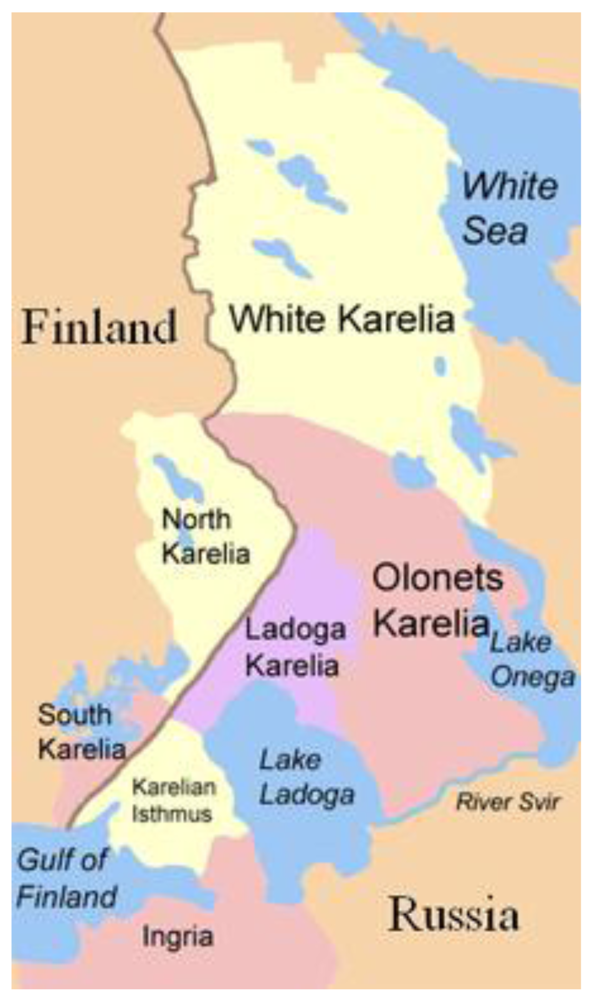
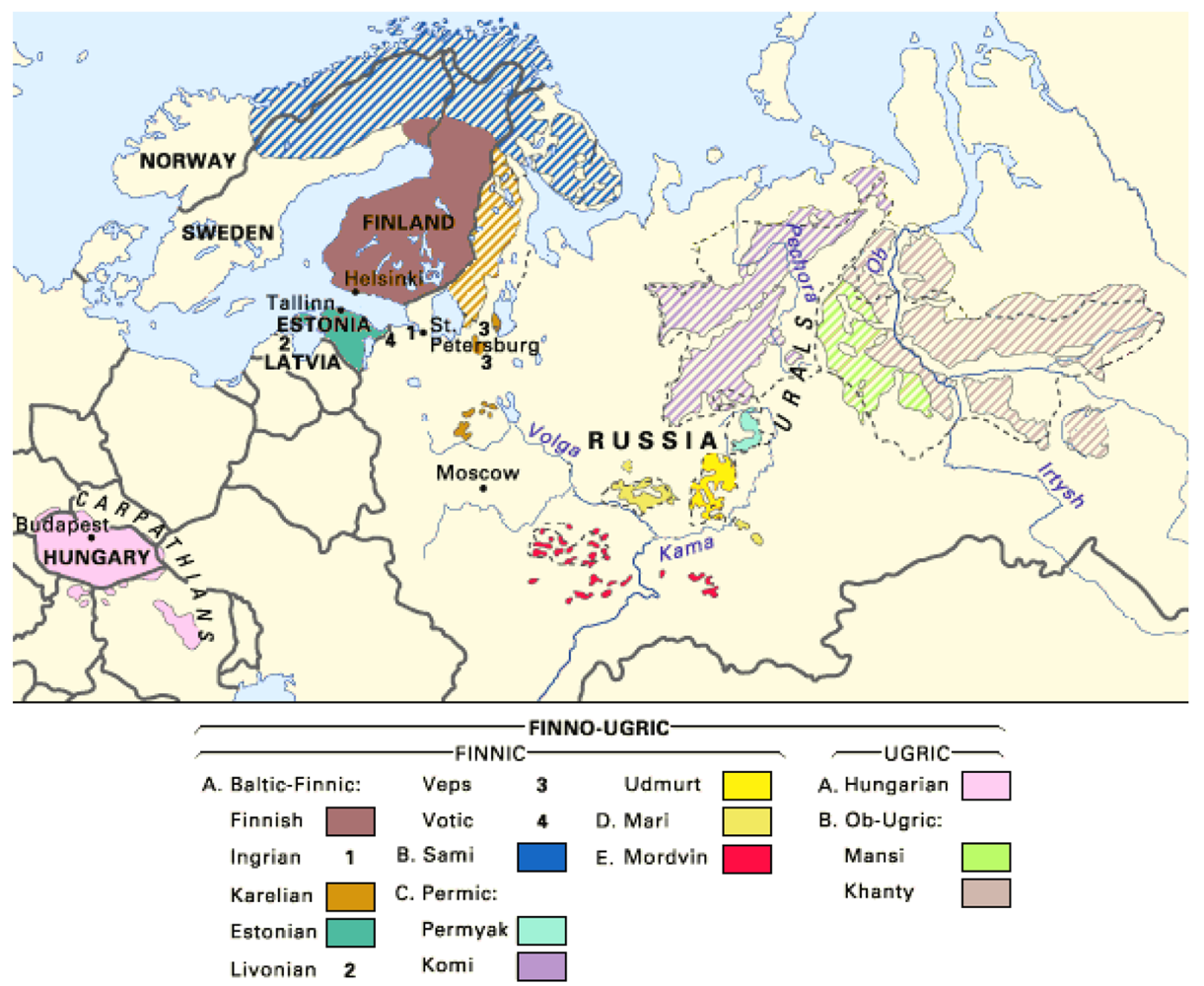
One might regard crying with words and melody (lament) as a global tradition, as some teachers regard shamanism. Traditional performances of ritual lament were once extremely widespread [44]. In many societies lamentation served to hasten and safeguard a dead soul's journey to the other world. This and other ritual functions were pervasive in the ancient Near East (see [45], for a description of five millennia of lamenting in Egypt). Crucially for our purposes, a magico-ritual function defined itkuvirret ‘laments’ in Karelia—an area straddling the Finnish-Russian border (see Figure 1, below)8— as well as among Komis, Mordvins, and other Finnic peoples (see Figure 2)—until the 1970′s (personal communication: Eila Stepanova, August 2010) when, some 70 years after the disappearance of wedding laments, funerary laments were becoming moribund [21,46-49].
Laments' performative function—guiding the dead to the afterworld—rendered them sacred for thousands of years, at least in the eyes of women. Their perspective contrasted sharply with the views, for example, of Solon, Plato, and other Greeks who each tried to at least control if not eradicate this women's practice. And from the birth of the Christianity until roughly a century ago, churchly pronouncements against lament became more and more harsh, and the implementation of bans on lament apparently became more violent ([50] and [44]. On the surface it is ironic that an increasing number of Finnish women accept as pyhä, ‘sacred,’ what churches have for 2000 years attempted to eradicate. But it is in fact not ironic at all, since the sacredness of this women's tradition has probably always been a prime motivation for attacks on it, whether from Christianity, Islam, Hinduism, or the apparent secularism of recently urbanized populations [44].
In many Karelian regions, villagers were baptized members of the Russian Orthodox Church. However, priests were unable to visit these villages more than once a year, at which time babies born in the preceding year would be baptized, weddings would be blessed or sacralized, and funerals over which women had largely officiated—particularly by performing laments—would be recapitulated following Orthodox ritual. In such Karelian villages, kansan ortodoksisuus ‘folk Orthodoxy’ predominated. This village religion included the following beliefs (interview with Alexandra Stepanova, April 2009):
“There was some kind of communication between the departed, and the living, those who remained, relatives”
“The departed hear only lament words” [i.e., they understand only the itkukieli, ‘lament register’]
“Of course people knew about God… but there were REALLY a lot of other gods.” As one elderly lamenter asked Stepanova, “Well, don't you understand that this is my chief deity and the others are minor ones in submission [alamaisiaan] to God?” RST
Scholars like Elizabeth Tolbert have described expert lamenters (itkiänaiset, ‘lament women’) as “female shamans.” Some knew spells as well as they knew the lament register. Also, even if itkijänaiset did not make the soul journey along with the dead in funeral laments (as male shamans might in different circumstances), they could certainly be said to enter trance states. Only thus could their sung-wept feelings take on the magical power through which they blessed the dead, brides, etc., as Tolbert makes clear:
To understand the musical procedures used in the lament [including musical masking], the shamanistic elements in the lament must be kept in mind: magico-religious power associated with lamenting as evidenced in the etymological associations of lamenting with sorcery, verbal descriptions of the power of the lament and its necessity for the success of ritual, the dangers of lament performance and soul loss, and shamanistic cosmological conceptions which show up in the form and function of lament [48], p. 54).
The micro level of [traditional Karelian] lament structure consists primarily of the musical consequences of the icons of crying. They signal and validate the presence of spiritual power by their direct index of emotional involvement. The ritual context of the lament suggests overwhelmingly that the micro-tonal and micro-rhythmic variations are essential to the process of creating an effective performance, and are not merely the result of individual catharsis. These micro-parameters are an indication that the lamenter has reached a trance-like state and successfully contacted the other world ([51], p. 90).
The preceding has indicated various reasons that Karelian itkuvirret, ‘laments,’ would be considered pyhä, ‘sacred,’ and why it is that I present even a highly modified version of the lament tradition as a spiritual practice. It is to these modified neolaments that we must now turn.
1.2.2. The Twentieth-Century History, and the Three Lives, of Karelian Lament
Karelian lament has had “three lives” [39]. The first stretched from an era temporally undefined except by its characterization as one of “tradition” to roughly 1900, when performances of wedding laments disappeared and funeral laments began to decline. The second life began after World War II, when Karelian women lamented the loss of their homes—a loss shared by several hundred thousand Karelians evacuating their villages in territory newly transferred to the Soviet Union (a form of war reparations demanded of Finland). Throughout the first and second lives of Karelian lament, the itkukieli ‘lament language [i.e., lament register]’ was mandatory for all performances, both ritual and “occasional” or personal/situational laments (personal communication: Eila Stepanova, August 2010). The features of the lament register included free meter, pervasive alliteration, and —most important by far for our purposes—a conventional set of at least 1400 “metaphoric” or “formulaic expressions,” “circumlocutions,” or “substitute names”9 obligatorily used to avoid addressing the dead, or the bride, etc. “directly,” i.e., by kin term [52].
Why this esoteric register of Karelian? As itkijänaiset ‘lament women’ have explained to at least two generations of researchers, the true addressees of their laments—several classes of spirits-understood only this register. Most mortals had a harder time with it. It is possible that itkijänaiset from interrelated Finnic groups that shared overlapping lament traditions—Ingrians and Vepsians, for example—understood each other (personal communication: Eila Stepanova, August 2010), but that Finns, who may never have had a lament tradition of their own,10 would not have understood much at all of old Karelian laments.
Although the idea that a metaphoric and thus “indirect” register would appeal to spirits might strike some as surprising, it is in fact noted in the linguistic anthropological literature. The trick is to take the itkukieli (the traditional Karelian lament register) as one of a class, i.e., as an “honorific register,” which is a term intended to include all of the phenomena Silverstein mentions:
This trope—the “I am saying something to you, but not in such a way as to pin you down as addressee”—is at work in the metaphoric indirection of the itkukieli [52].Note how all maximally respectful language… mitigates communication. Whether one is talking about speech level phenomena in the classic cases of Japanese, Javanese (Errington 1988), etc., or mother-in-law or similar registers in Aboriginal Australian societies, or speech of-and-to the gods in Yurok (Buckley 1984), all the indexically marked ways of speaking have this attenuated and/or tropic denotational effect, in effect constituting denotation by “hint” and by allusion [53], pp. 349-350).
1.2.3. Contemporary Lament Classes
Revivalist lament courses that started in the late 1990s, and particularly courses taught by ÄI-Lamenters, represent the third life of Karelian lament. In this third life, the Finnish language—not Karelian—dominates; thus one must speak Finnish to participate in ÄI-lament courses. Most of these courses are gatherings of ten or so women as students, together with Pirkko Fihlman and Tuomas Rounakari, the man who almost always co-teaches courses with Fihlman and a successful musician. The two-and-a-half day weekend courses consist of lectures on the Karelian tradition, the “revival,” lament technique, etc.; the playing of archival recordings of old lamenters and a video recording of the very first course (1998); in-class singing and lamenting exercises; homework (polishing the lament that each student performs on Sunday); and, ideally, a debriefing Sunday afternoon as the course ends. Students are middle-class women, i.e., those who can afford both the time and the registration fee. Courses attract people of many professions, but consistently women who practice various forms of therapy—psychodrama, art, and sex therapy, for example—or who have allied professions such as psychiatric nursing. Over the years of offering courses, probably at least 20% of the 700 trainees have had a strong Karelian background. Finally, it is not unusual to have several students who have taken, if not lament classes, other “healing” courses.
According to my interviews, a minority of lament course alumnae “become lamenters.” The path for those who do wish to continue is typically to take more courses. Out of some 750 students who have taken lament courses since the late 1990s, only a dozen or less have later performed in public. It is unclear how many of the 750 continue to lament in private for personal benefit. Somewhat surprisingly, the few who have gone on to perform publicly are neither consistently from the east (Karelia) nor western Finland. Moreover, when those who lack any known Karelian roots and indeed who originate from Pohjanmaa (mentioned above) do become lamenters, the irony of their lives is not lost on them.
What makes the lament courses unique vis-à-vis other healing courses in Finland and elsewhere is the balance struck in lament courses between psychodynamic concepts of therapy or healing and a very particular linguistic-cultural-ritual-musical tradition. ÄI-Lament teachers mention both the sacredness of traditional lamenting and such hybrid phrases such as itkuprossessi, the ‘lament process,’ which evokes the formation of trust and intimacy in the lament group, the preparation of one's own lament, and the catharsis experienced in lamenting before the group.
Pirkko Fihlman's ideas of language, derived from older generations of lamenters, contrast sharply with those of many psychotherapists and assertiveness trainers in affirming the importance of learning a particular linguistic convention to be used in self-expression—namely, minäviesti or “I-language” [54]. I-language is taught or at least advocated in other Finnish settings, including a graduate program in art therapy (as reported by a student whom I interviewed) and Lutheran confirmation classes [55-56].
Why should ÄI-Lament courses devote substantial amounts of time to teaching about Karelian, rather than Finnish, lamenting? According to Nenola [21,57], there had never been a lament tradition in western Finland. This fact accords with a widespread stereotype that tends to be reproduced by Finns and outsiders alike—the stereotype of the “silent” or “emotionally inexpressive Finn” [58-61]. A recent survey I conducted in Finland (n = 200) revealed agreement with the stereotype that “Finns” have difficulty expressing their feelings (Wilce, unpublished data). I was taken aback when a focus group of six university students in Jyväskylä not only indicated agreement with the stereotype, but asserted that the situation has not changed with their generation. The stereotype best fits men, and those living in western Finland, the extreme being the region of Pohjanmaa or Ostrobothnia, with a strong Swedish heritage.
Pirkko Fihlman (interview, 2003) has described lament as a tool to help modern people, by which she means modern Finns. According to her ÄI-Lament co-teacher Tuomas Rounakari, one can look at the lament revival as offering to western Finns elements of eastern culture (that of eastern Finns but particularly Karelians, most of whom now live in Russia, not Finland). In lament courses, Fihlman or Rounakari will occasionally draw explicit contrasts between the Karelian cultural tradition they are teaching and western Finnish culture. For example, Rounakari has said more than once that in Karelia people say, “Cry that thing until it's ready/ until the end,” while the western Finnish tendency is to tell someone who is upset or crying, “You'll manage, you'll manage—so don't collapse there beside me” (said during the 2009 Annual Meeting of ÄI-Lamenters.).
We return to such representations of Finns in the Conclusion, in discussing the stakes for lament courses. Meanwhile, in section 2 below, I present an analysis of lamenters' discourse, and especially their echoing of other discourses.
2. Results and Discussion
2.1. Tropes of the Experiential Self and their Use in Lament Courses
2.1.1. The trope of interiority
Whatever it might owe to classical Greek and biblical discourse (e.g. Romans 7:22, II Corinthians 4:16), we see a very marked movement in the last several centuries of western discourse toward an embrace of “internalization” and “the trope of interiority” (“compelling metaphors of the spatial distinctions of inner and outer” that enable the imagination of “the internal fixity of the self and… of gender identity [62], p. 171) with the acceleration traceable to the rise and spread of Protestant theologies of the person [63]. Throughout the nineteenth century psy-disciplines played their role, but we can attribute the increasing dominance of the interior model of the self to psychoanalysis in particular (see Wachtel's [64] critical account of this history).
The trope of interiority plays a major role in ÄI-Lament courses. It is not necessarily the case that interiority or internalization per se are valued above exteriority and externalization. In fact, the conviction on the part of ÄI-Lament teachers that the point of lamenting is catharsis, or the authentic expression of what is inside, does not at all threaten the notion of the self's residence in an inner castle of some sort. It is the inner self whose voice or “contents” must be expressed, and that conviction is key to understanding Finnish manifestations of expressivist subjective-spirituality. In the 2009 annual meeting of the ÄI-Lamenters, Paavo Kärkkäinen (a life coach with much experience lamenting, and one of the panelists in the annual meeting's featured discussion) described lamenting as both a promising means of purging oneself of very deep feelings, and a practice that must avoid the pitfalls of hörheltäminen, ‘psychobabble.’ In response to Kärkkäinen, a female Lutheran priest in the audience said that true lamenting “is not verbiage/rhetoric but inner feeling.”11
Pirkko Fihlman of ÄI-Lamenters sometimes depicts “inner feelings” as the object of healing via Hoitava Itku, ‘Healing Lament,’ courses). She said, for example, “And this old Karelian lament tradition is that by which we healed those sisäisiä tunteita, ‘inner feelings.’” Fihlman stresses the link between the Karelian lament tradition and ÄI-classes, asserting that traditional lamentation was about healing inner feelings and that Fihlman's practice is but the latest link in that tradition.
2.1.2. “The Trope of Depth” ([65], p. 283)
To be the latest link in a tradition does not mean pure replication. ÄI-Lamenters are innovators and not just replicators. They encourage deep self-expression, not literal faithfulness to traditional forms. From Pirkko Fihlman's perspective, despite making little use of the traditional metaphor corpus, what ÄI-Lamenters teach is the itkukieli—simply modernized. In fact she says that only the itkukieli is capable of reaching and healing “the deep feelings” about which her students compose their laments. Quite often, Fihlman and her co-teacher Tuomas Rounakari use the phrase kuvakieli ‘picture [pictorial] language’ for (their version of) the itkukieli. “The picture-language speaks syvemmin ‘more deeply’ [than everyday Finnish],” said Fihlman during an interview.
In asking Fihlman and others about the semiotic register appropriate to lament, I sometimes broke the register into its component pieces, inquiring about the relative importance of one facet or another in making the register as special as it was/is, and the process of healing. Just speaking one's feelings— the very thing encouraged in courses oriented toward “I-language” in Finland or elsewhere—is for Fihlman inadequate. “The feeling,” says Fihlman, “goes deeper with the [addition of the] melody.” This statement accurately reflects her central semiotic ideology [66], p. 17)—that the combination of feeling with weeping, melody, and words “heals” at a deep level. “Pure crying doesn‘t touch that syvintä tunnetta, ‘deepest feeling,’” said Fihlman in a February 2009 lament course.
It is not only problems to be healed but also the power to heal that is located in the depths. In the same 2009 course, Tuomas Rounakari said, “And somehow, while crying, of course, one goes like into a deep trance.”12 This description of lament as trance-experience may come particularly easily to Rounakari's mind, given that he engages in shamanistic rituals, and knows very well both from ethnographic work in Siberia and from his own experience just what shamanic trance consists of (and see my discussion of the trance-like experience of traditional Karelian itkijänaiset, lament-women, above.). When other ÄI-Lamenters, or others who offer healing courses in Finland, refer to “going deeper,” they are reflecting a form of discourse that is in widespread use in what Heelas and his colleagues call “subjective-life” (or “inner-life”) spirituality. It is crucial, however, to recognize special features of “relational subjectivism” (introduced earlier):
And unlike individuated (let alone life-as) modes of subjective-life, relational subjectivism is associated with the tendency to go deeper: one finds out more about oneself by discussing one's anger with a close friend or by dealing with jealousy with a lover, for example [35], p. 97).
The two tropes discussed thus far—tropes of interiority and depth—overlap, though only partially. To call a feeling deep may denote its intensity; referring to an “inner feeling” rarely if ever directly denotes intensity. And those two overlap with tropes of authenticity.
2.1.3. Authenticity, Nakedness, and Daring/Courage
ÄI-Lamenter's way of blending therapeutic jargon and the discourse of cultural revivalism has again and again taken me aback. I have also repeatedly been surprised at ÄI leaders' insistence not only that lamenting with supportive others is sacred, but that the sacredness is about the shared emotion, the deep connection between people that it produces, as might stories in a therapy group. However, in this Age of Authenticity, the sacralization of transparent emotional “sharing” is not uncommon. Carrie Kemp, writing about “Journey of Reconciliation with Inactive Catholics,” asserts that “a church without members who speak from their sacred authenticity will have no soul” ([67] emphasis added). From the perspective of “subjective-life spirituality” and in particular its relational face, “sacred authenticity” (see also [68], pp. 40-41) is something we as humans at least potentially possess. Authentic self-expression requires courage, even daring. Mustering the courage to engage in deep emotional sharing of the kind that defines lament courses is also celebrated in the contemporary American intentional community pseudonymized as “the Aurora Commons.” In their article entitled “Performing Authentic Selfhood in an Intentional Community,” Holden and Schrock describe “courageous performances, especially those concerned with overcoming fear, were often ritualized to heighten the perceived sacredness of authenticity” [69], p. 210; emphasis added).
As concrete images of the courage required by authentic self-performance ÄI-Lamenters sometimes use the metaphor of daring to be naked or even without skin. We find the same metaphor on self-identified “New Age” websites [70].13 During debriefing at the end of a March 2009 lament course, one student said appreciatively, “Here [in the course], when you are quite naked with your feelings, you are not that beautiful or that clever.” We could paraphrase thus: Here we strip off our defenses, our attempts to project invulnerability, and embrace radical openness. This becoming naked is part of what Pirkko Fihlman and Tuomas Rounakari see as the sacredness of lament. In a 2010 interview, Rounakari said, “In lament there is that kind of state of spiritual nakedness that IS holy.”
Fihlman also uses the metaphor of a threshold one dares to cross, that threshold sometimes being a watery surface below which one dares to dive.
There is a threshold. One must dare to dive somehow under the surface and be without skin. And it's a threshold for many. But when one dares to go14 then the [aitous] ‘authenticity’ comes to the fore. Lament must be always [aito] ‘authentic.’ The feeling that one transmits to the other person has to be authentic. … If one faces some other person's feelings in an authentic way it is, it is a great treasure. We have many here who have attended lament courses present here, and you know we are like sisters because we have faced each other authentically. It's that kind of eternal friendship that will last and it's fantastic in these days.15
In a conversation with two foreigners who had both participated in lament courses (my wife and myself), Fihlman said (in English), “What we have shared, it's holy for us.” We hear the same theme in this exchange between Fihlman and a former student (Aino Pusa) who is now a very active, often public lamenter:
Fihlman: Laments are not like things in every other sort of place but they are areas where the deepest feelings a person had are touched. And then lament should always start with that kind of—I start my laments with a prayer.
Pusa: Like I said in the beginning, it's such a sacred thing.
For Pusa, it seems clear that not only a preceding prayer, but the process by which the deepest feelings of performer (and audience) are touched, makes lament “a sacred thing.”
We have seen thus far that, as a reflection of relational-subjectivism, neolamenting is both therapeutic and sacred. But if lamenting is some sort of therapy, what sort is it? If we encounter an abundance of psychotherapeutic terms in lament courses, as we do, what school of psychotherapy do they reflect?
2.2. What Sort of “Psychotherapy” Do These Courses Represent?
We have touched on the issue of how Finnish lament courses combine therapeutic jargon with talk of a precious cultural heritage that is still sacred to those who participate in it. There is much to say, however, about the more specifically psychotherapeutic discourse manifest in lament courses. Parallels between the courses described herein and group therapy, especially examples like Esalen [71], are obvious. In addition to that, Pirkko Fihlman at least once echoed the jargon of Transactional Analysis: “We have noticed that in lamenting the adult ‘me’ can go can go to the abandoned wounded child…” The lamenters' emphasis on authenticity also brings to mind Rogerian therapy [72]. As one alumna said in an interview about her lament course, “One had courage in lamenting to be what one is. One didn't try to be more or less.”
But the play of surfaces and depths we have been exploring in the tropes of interiority and depth is a special concern of psychoanalytic thought and practice. The following section thus focuses on jargon used by ÄI-Lamenters that derives from psychodynamic and particularly Freudian therapy.
The trope of depth pervades psychoanalytic discourse and its popular echoes (where one typically hears of the “subconscious” rather than “unconscious” mind). Lament teachers like Pirkko Fihlman refer to the depths as the buried locus of the most recalcitrant feelings, traumas, problems, to be dealt with in context of therapy, course, etc. In a 2009 lament course, Fihlman invokes the alitajunta, ‘beneath awareness, subconscious’ thus:
With this lament the idea came to me … how healing this lamenting is. And I was able to get rid of those sorts of things that I never have become ‘aware/conscious’ [tiedostanut] of those things that happened in childhood—these kinds of bad feelings and fears and agonies.… in our lament courses… one dares to face those feelings that have stayed unconscious [alitajunta].
Lamenters also make indirect reference to repression (“damming up”) and catharsis, as when Pirkko said during the same course, “And when I made that lament I realized how healing lament is. Because the kinds of things that I had dammed up came out, and they were related to those fears and depressions/ agonies I experienced as a … child.”
One young course alumna had become exceptionally familiar with the psychological self-help literature and its indirect Freudian roots. She referred to defense mechanisms in our April 2009 interview:
Working through [one's] feelings is the key and the solution. That painful matter can be handled a lot better when using those metaphors through this the defense mechanism will break—it breaks more easily when word-images are used, not in that raw way of [speaking about] things And there I have a personal goal to learn to save oneself [from that]. So one might speak of things more beautifully in order that one might dare then to face those painful things. If I have too much of a habit of speaking too directly and it—it might be— it's one of those defense mechanisms of mine that when one speaks directly. Then one doesn't have to feel [even] if one would speak about one's own. I should speak about things more beautiful and then I would have more courage to face those painful things, a bit more metaphorically [through word-images] facing the feelings would be easier perhaps.
This alumna embraced the lament course on a number of levels, affirming that the course was aptly named (Hoitava Itku ‘Healing Lament’), that the traditions of people far to the east of her had much to contribute to Finland, and that the lament course “process” in many ways mimics the ideal process followed by psychodynamically oriented therapists. But the emphasis on metaphor, using metaphoric language in one's lament—a theme, as we have seen, that many lamenters touch on—deserves analytic attention of its own. In the following section we explore the efficacy of metaphor from both magical-traditional and a modernist-psychotherapeutic perspectives.
3. Conclusions
3.1. What Is Unique About Lament Courses, and What Do They Tell Us About Culture?
The ÄI-Lamenters' threefold emphasis on a particular cultural-historical tradition, psy-oriented healing, and a hybrid (whether we call it “postmodern” [15,73] or “New Age” [74,75]) of traditional and “post-secular” religion—rural Karelian folk Orthodoxy, Finnish civil religion, and “the sacred-authentic”—is unique. New spiritualities and the courses that help propagate them tend to be eclectic, rather than borrowing—as ÄI-Lamenters do—from one “local” tradition (the problematique of “locality” having being discussed above). Lament courses offer up traditional Karelian laments (and lament-women) as models, but they also evoke various psychotherapies (especially depth/psychoanalytic), albeit not by name. Other courses in Finland—courses that I have attended, or about which I asked a dozen course alumnae in interviews—teach self-help or healing techniques with no particular local or nearby cultural roots. Those other courses use less psy-jargon vis-à-vis ÄI-Lament courses, and lack any particular focus on authenticity. The specific cultural tradition that ÄI is “reviving” is like nothing else that students of “subjective-life spirituality” have written about, combining music, weeping, words governed by the rules of a traditional register, and traditional beliefs about its sacred function.
In the postmodern supermarket, it might be relatively easy to find courses that mix psychotherapeutic with spiritual discourse and even a discourse on “a cultural tradition” like shamanism. It is much more unusual, if not totally unique, to uncover a course that teaches a cultural tradition: a) that is at least putatively “local” (see discussion above); b) that is already treated with interest and respect in the media (dozens upon dozens of articles and Finnish public radio and television stories going back at least to the 1970s, before the “revival”); c) that appeals to a “psy-ready” constituency (those who believe that weeping means catharsis and catharsis means expressing previously unconscious contents, as Fihlman has said); but d) that also had a sacred function that revivalists are incorporating into their teaching and their public and private claims about lamenting.
As I have just indicated, ÄI-Lament courses commonly address “culture”, but “culture” is a complex signifier in ÄI representations. It is associated with territory as well as emotional styles (remember Rounakari's contrast). Although little Karelian territory still belongs to Finland—most of it being Russian—it is fairly common in lament course discussions to blur the international boundary. The categories “Finland” and “Finns” could thus either exclude or include “Karelians.” Course participants and alumni might therefore represent “Karelian culture” as Self or Other. Because of this complexity, the question of “locality,” and especially whether or not to count Karelia as “local,” is vexing.16
The fact that ÄI-Lamenters invest much time in talking about culture reminds us of something Urban [76] has emphasized—i.e., that culture is a layered semiotic phenomenon, and that metacultural reflections are exceedingly important in the ongoing reproduction (or lack thereof) of cultural forms. The explicit reflections in lament courses on the meaning of the very signifiers that constitute neolaments (“culture,” “authenticity”) is indeed striking. Beyond neolament circles, I have noted above that Finns engage in metacultural discourse, joining others in self-stereotyping. One lament course alumna interviewed in 2009 said, “We have created a quiet and fine culture, but on the other hand, inside of that culture people are longing… [saying,] ‘I would like to let loose!’” Do Finns resist authentic emotional disclosure of the type that defines lament courses (as per the stereotype), or so they secretly long for it, as the interviewee indicated? I would argue that the point is not what the right answer is, or which is true; the point, rather, concerns both as examples of metacultural discourse that is significant in itself.
How so? ÄI-Lament leaders engage in similar metacultural discourse, as the example from Tuomas Rounakari illustrated, and such representations justify intervening in the evolution of Finnish culture, challenging the purported tendency Finns have to resist such things as lamenting. Their representations define the moral-religious stakes of intervening. Revivalist lamenting is not simply and straightforwardly therapeutic; the role that psychotherapeutic notions play in this drama is not simply about individual needs and individual decisions (to seek help or not). Rather, ÄI's goal is as much to effect a cultural transformation as it is to offer psy-oriented healing.
3.2. Metaphors, Indirectness, and Authenticity
ÄI-Lamenters agree with other voices in the Finnish lament revival on the importance of authentic performance, and regard the metaphoric register that characterizes modern as well as traditional laments as a key part of the healing quality of lamenting. Yet questions surrounding the itkukieli or ‘lament register’ and its metaphoric nature are among the most divisive within the larger circle of those who make the Karelian lament tradition their concern. This includes Finno-Karelian revivalists who remain separate from ÄI-Lamenters, as well as scholars, some of whom are ethnic Karelians. ÄI rejects the others' strict (“authentic”) interpretation of the old corpus of metaphors, emphasizing the sense of “authenticity” as faithfulness to one's inner experience, while not rejecting the indirectness cultivated by metaphoric speech. The old corpus was traditionally followed exclusively, not used as set of models on which to improvise, as it is in ÄI courses. Yet ÄI nonetheless locates authenticity, in part, in the metaphoric nature of the “new” itkukieli. Such complexities deserve more investigation.
Here we find what may be most interesting about this phenomenon—whereas psy-discourse typically equates authenticity (which it values highly) with directness, ÄI-Lamenters and course alumni speak of metaphoric indirectness as at the very least a strategic aid to deep, effective, and authentic self-expression. As noted above, one course alumna considers direct speech a “defense mechanism” vis-à-vis the potentially more emotional “beautiful speech.” Given the increasing hegemony of ideologies of directness [63,72,77], ÄI-Lamenters seem to have found a via media between what is perceived as the overly rigid and personally distanced corpus of traditional indirect forms and the modern-everyday register of Finnish that Pirkko Fihlman considers abrupt and thus impolite or uncaring.
3.3. The Sacredness of Lament vis-à-vis a Psy-Influenced Vision of Authenticity
There are several sources for the putatively sacred nature of even neolamentation. The first would be its traditional counterpart with its religious function, connecting singer(s) and spirits. Indeed, whatever may be their perspective on the therapeutic quality of neolamenting and on the traditional metaphor corpus, the two women who have played the biggest role in the lament revival have in dreams, like their forebears, experienced contact with the recent dead and with other ancestors. But it is the attribution of the sacredness of lament to a second phenomenon—the ability of the “lament process” unfolding over the three-day period of a lament course to facilitate emotionally authentic “sharing,” which is itself deemed sacred—that is especially striking (Striking, that is, despite the fact that this attribution of sacredness reflects other popular manifestations of the Age of Authenticity, including philosophical work, [78], p. 20, where “I-Thou,” which Buber calls simply “relation,” is “holy”). Indeed even the founder of ÄI-Lamenters, Pirkko Fihlman, has expressed surprise at the intensity of interpersonal connections achieved in “the lament process.”
The features of the lament register as used traditionally, especially metaphoric indirection, had a strongly if not exclusively sacred function—establishing communication with the spirits. Psychoanalysis has always concerned itself with metaphors and other tropes, and newly emerging psychodynamic therapies include one centrally concerning itself with metaphors ([79-81]. However, tropes arising in dream narratives, for example, serve to simultaneously obscure and reveal psychic significance—not to link analysands with the spirit world.
Nonetheless, any implication that the spiritual and psychotherapeutic dimensions of lamenting with metaphoric language are mutually exclusive is false. ÄI-Lamenters reject literal faithfulness to the Karelian lament register, yet produce their own consistently metaphoric register. The latter answers to the call to produce discourse that is an authentic self-expression—the call that, for Charles Taylor, defines ours as the Age of Authenticity [16]. Although leaders like Pirkko Fihlman credit her laments with helping her communicate with the dead—the realm of the traditional-sacred in Karelia—the expressive function of the distinct Finnish-Karelian neolament register ÄI-Lamenters are crafting may be just as sacred, but for a different reason. Even the use of metaphors in modern laments is sacred to Fihlman insofar as it helps produce in (and between) lamenter and audience a deep emotional resonance. But metaphors alone cannot produce such resonance in audiences. If they are to produce a sacred form of intersubjectivity laments must reflect authentic feelings. The production of such feelings in lament courses simultaneously reflects the apotheosized “subjective-life” (in which courses contributing to the growth of the self play a major role) and the subjectivized spiritual life. And it is because of this hybridity of the spiritual and the therapeutic that the stakes of the “lament revival” from the perspective of ÄI-Lamenters—nothing less than helping Finns express the feelings that they ostensibly hold within, to their detriment—are so high.
Hence, the healing quality of lament practice is not a value, but somehow connected to what is now, in the Age of Authenticity, ultimate value [35]. From a slightly different perspective, if the practice of naked authenticity is sacred, as revivalist leaders claim, then the disposition of Finnish people toward that practice (something with which ÄI leaders are very concerned) cannot be a matter of indifference. Despite the concern that ÄI leaders have about Finnish men, it is not surprising that group lamenting appeals mainly to (middle-class Finnish) women. The conclusion of Heelas et al ([35], p. 98) fits the Finnish case: “more women than men tend to emphasize relational subjective-life, and conversely … more men than women tend to emphasize the individuated or distinct variant.”
Presently, there is too little theoretical work in anthropology on authenticity as faithfulness to one's own experience, particularly in the context of religion (Lindholm's work being an exception [22]). The finding that, in the lament groups, authenticity potentiates a kind of I-Thou encounter that is sacred, and the uncovering of an ideological struggle among activists in the larger lament movement (beyond the confines of ÄI-Lamenters) over two definitions of authenticity—one oriented toward transmission of a tradition, the other oriented to the experiential and reflexively authentic self—may stimulate the anthropology of religion to look again at “authenticity.” The internal debates among lamenters, and the apparent durability of both definitions, sometimes locked in a dialogue as is the case among Finnish lamenters, indicate the level of sophistication required in our theorizing of authenticity.
It is hoped that this article will help jump start anthropological work on authenticity and healing under the umbrella of sacredness in today's world. Future work should address, among other things, the contrast and tension between the two versions of authenticity in relation to Urban's [76] distinction between metacultures of tradition (under which would fall “authenticity-as-faithful-replication) vs. metacultures of newness (under which would fall “authenticity-as-faithfulness-to-inner-self”).
Acknowledgments
This material is based upon work supported by the National Science Foundation under Grant No. 0822512. Any opinions, findings, and conclusions or recommendations expressed in this material are those of the author and do not necessarily reflect the views of the National Science Foundation.
Support also came from Michael Stevenson, George Gumerman IV, and Robert Trotter at Northern Arizona University, and to Pertti Anttonen and the Department of Folkloristics at Helsinki University. My heartfelt gratitude goes to all those in Finland who gave generously of their time, advice, instruction, correction, etc.
Finally, thanks to the editors of Religions and to the three anonymous reviewers, whose comments were enormously helpful. Whatever flaws remain in the argument are solely the author's responsibility.
References
- M. Wood. Possession, Power and the New Age: Ambiguities of Authority in Neoliberal Societies. Aldershot, UK: Ashgate, 2008. [Google Scholar]
- C. Lévi-Strauss. The effectiveness of symbols. In In Structural Anthropology. New York, NY, USA: Basic Books, 1963, pp. 186–205. [Google Scholar]
- R. Hayward. “Demonology, neurology, and medicine in edwardian britain.” Bull. Hist. Med. 78 (2004): 37–58. [Google Scholar]
- J.M. Wilce. “Scientizing bangladeshi psychiatry: Parallelism, enregisterment, and the cure for a magic complex.” Lang. Soc. 37 (2008): 91–114. [Google Scholar]
- T. Utriainen, T. Hovi, and M. Broo. The post-secular position and enchanted bodies. In In Religion and the Body. Edited by T. Ahlbäck, and B. Dahla. Åbo, Finland: Donner Institute for Research in Religious and Cultural History, 2011. [Google Scholar]
- C. Taylor. The malaise of Modernity. Concord, Canada: House of Anansi, 1991. [Google Scholar]
- P. Heelas. The New Age Movement: The Celebration of the Self and the Sacralization of Modernity. Oxford, UK: Blackwell Publishers, 1996. [Google Scholar]
- P.J. Anttonen. Tradition through Modernity: Postmodernism and the Nation-State in Folklore Scholarship. Helsinki, Finland: Finnish Folklore Society, 2005, Volume 15. [Google Scholar]
- P.J. Anttonen. Folklore, history and the “story of finland”. In Dynamics of Tradition: Perspectives on Oral Poetry and Folk Belief (Essays in Hounour of Anna-Leena Siikala on Her 60th Birthday 1st January 2003). Edited by L. Tarkka. Helsinki, Finland: Finnish Literature Society, 2003, Volume 13, pp. 48–66. [Google Scholar]
- U. Vento. “The role of the kalevala in finnish culture and politics.” Nord. J. Afr. Stud. 1 (1992): 82–93. [Google Scholar]
- K. Ketola, and T. Martikainen. The religion in finland project. In Religion & Society: Cross-Disciplinary European Perspectives. Edited by V. Mortensen. Aarhus, Danmark: University of Aarhus, 2006, pp. 81–89. [Google Scholar]
- P. Mikkonen. New age in finland: A view through finnish new age magazines. In Beyond the Mainstream: The Emergence of Religious Pluralism in Finland, Estonia and Russia. Edited by J. Kaplan. Helsinki, Finland: SKS, 2000, pp. 255–272. [Google Scholar]
- M. Rautaniemi. Henkisyys, hyvinvointi, yksilöllisyys ja sosiaalisuus helsingin astanga joogakoulussa [Spirituality, Well-Being, Individuality, and Sociality in the Ashtanga Yoga School of Helsinki]. Helsinki, Finland: Helsingin Yliopisto, 2010. [Google Scholar]
- M. Junnonaho. “On the finnish present-day religiosity and the new age thought.” Stud. Folklore Popular Relig. 3 (1999): 87–94. [Google Scholar]
- C. Jencks. What is postmodernism? London, UK, New York, NY, USA: Academy Editions/St. Martin's Press, 1989. [Google Scholar]
- C. Taylor. The age of authenticity. In A Secular Age. Edited by C. Taylor. Cambridge, MA, USA: Harvard University Press, 2007, pp. 473–504. [Google Scholar]
- W.J. Hanegraaff. “New age religion and secularization.” Numen 47 (2000): 288–312. [Google Scholar]
- H.B. Urban. “The cult of ecstasy: Tantrism, the new age, and the spiritual logic of late capitalism.” Hist. Relig. 39 (2000): 268–304. [Google Scholar]
- C. Rogers. Client-Centered Therapy: Its Current Practice, Implications, and Theory. Boston, MA, USA: Houghton Mifflin Company, 1951. [Google Scholar]
- J. Kivivuori. Psykokulttuuri: Sosiologinen näkökulma arjen psykologisoitumisen prosessiin [psychoculture: A sociological viewpoint to the psychologisation of everyday life]. Tampere and Helsinki, Finland: Hanki ja jää, 1991. [Google Scholar]
- A. Nenola. Inkerin itkuvirret - ingrian laments. Helsinki, Finland: Finnish Literature Society, 2002. [Google Scholar]
- C. Lindholm. Culture and Authenticity. Malden, MA, USA: Blackwell Publishers, 2008. [Google Scholar]
- L. Trilling. Sincerity and Authenticity. Cambridge, MA, USA: Harvard University Press, 1972. [Google Scholar]
- R.R. Desjarlais. “Struggling along: The possibilities for experience among the homeless mentally ill.” Am. Anthropol. 96 (1994): 886–901. [Google Scholar]
- P. Heelas. Spiritualities of Life: New Age Romanticism and Consumptive Capitalism. Malden, MA, USA: Wiley-Blackwell, 2008. [Google Scholar]
- D.J. Ollila. The Formative Period of the Finnish Evangelical Lutheran Church in America or Suomi Synod. Boston, MA, USA: Theology Doctorate, Boston University, 1963. [Google Scholar]
- P. Kivisto. Immigrant Socialists in the United States: The Case of Finns and the Left. Rutherford, NJ, USA: Fairleigh Dickinson University Press, 1984. [Google Scholar]
- C. Taylor. Sources of the Self: The Making of the Modern Identity. Cambridge, MA, USA: Harvard University Press, 1989. [Google Scholar]
- N. Rose. Inventing Ourselves: Psychology, Power, and Personhood. Cambridge, UK: Cambridge University Press, 1996. [Google Scholar]
- P. A. Pinel. Treatise on Insanity, in Which are Contained the Principles of a New and More Practical Nosology of Maniacal Disorders than Has Yet Been Offered to the Public [Original Title: Traité médico-philosophique sur l'aliénation mentale, ou la manie.]. Sheffield, UK: Todd, 1806. [Google Scholar]
- J.M. Charcot. “La foi qui guérit.” Rev. Hebd. 1892 (1892): 112–132. [Google Scholar]
- J. Goldstein. Console and Classify: The French Psychiatric Profession in the Nineteenth Century. New York, NY, USA: Cambridge University Press, 1987. [Google Scholar]
- E. Caplan. “Popularizing american psychotherapy: The emmanuel movement, 1906-1910.” Hist. Psychol. 1 (1998): 289–314. [Google Scholar]
- P. Heelas. “Challenging secularization theory: The growth of “new age” spiritualities of life.” Hedgehog Rev. 8 (2006): 46–58. [Google Scholar]
- P. Heelas, L. Woodhead, B. Seel, B. Szerszynski, and K. Tusting. The Spiritual Revolution: Why Religion is Giving Way to Spirituality. Malden, MA, USA: Blackwell Publishing, 2005. [Google Scholar]
- T. Laurinen, and M. Leinonen. Martta kuikka - aito itkijä. Helsinki, Finland: Videotallenne, 2001. [Google Scholar]
- I. Härmä. Huomisen muistoja [tomorrow's memories]. In TBC. Helsinki, Finland: Guerillafilms Ltd., Finnish Film Foundation, 2004, 28 min. [Google Scholar]
- A.-L. Tenhunen. “Itku on nykynaiselle hoitomuoto: Itkuvirsikursilla ripsivärit jäävät kotiin [lament is for contemporary women a form of therapy: Mascara at a lament workshop challenges the validity of home.” Uusi Kansanmusiikki 3 (1999): 13–15. [Google Scholar]
- A.-L. Tenhunen. Itkuvirren kolme elämää: Itkuvirsien käytön muuttuminen [the three lives of lament: Transformations in lament behavior]. Helsinki, Finland: SKS, 2006. [Google Scholar]
- A.-L. Tenhunen. “Times change, laments revive.” Fin. Music Q. 2007 (2007): 30–36. [Google Scholar]
- C. Briggs. “Theorizing modernity conspiratorially: Science, scale, and the political economy of public discourse in explanations of a cholera epidemic.” Am. Ethnol. 31 (2004): 164–187. [Google Scholar]
- E. Stepanova. Reflections of Belief Systems in Karelian and Lithuanian Laments: Shared Systems of Traditional Referentiality? Baltic Worldview: From Mythology to Folklore, Vilnius, Lithuania, 8–10 July 2009; Edited by J. Harris, and E. Lyle. Vilnius, Lithuania: Institute of Lithuanian Literature and Folklore, 2009.
- E. Stepanova. Itkukielen metaforat ja itkujen dramaturgia [the metaphors of lament register and the dramaturgy of lament. In Kantele, runolaulu, ja itkuvirsi (juminkeon julkaisuja, nro 76). Edited by P. Huttu-Hiltonen, Frog, J. Seppänen, and E. Stepanova. Jyväskylä, Finland: Juminkekko, 2009, Volume 25, pp. 13–113. [Google Scholar]
- J.M. Wilce. Crying Shame: Metaculture, Modernity, and the Exaggerated Death of Lament. Malden, MA, USA: Blackwell Publishers, 2009. [Google Scholar]
- E. Wickett. ““For our destinies”: The funerary lament of upper egypt.” Ph.D. Thesis, University of Pennsylvania, Philadelphia, PA, USA, 1993. [Google Scholar]
- L. Honko. Balto-finnic lament poetry. In Studia Fennica 17. Helsinki, Finland: Finnish Literature Society, 1974. [Google Scholar]
- U. Konkka. Ikuinen ikävä: Karjalaiset riitti-itkut [eternal longing: Karelian ritual laments]. Helsinki, Finland: Suomalaisen Kirjallisuuden Seura (SKS), 1985, Volume 428. [Google Scholar]
- E. Tolbert. Magico-religious power and gender in the karelian lament. In Music, Gender, and Culture. Edited by M. Herndon, and S. Zigler. Wilhelmshaven, Germany: International Council for Traditional Music, Florian Noetzel Verlag, 1990, Volume 1, pp. 41–56. [Google Scholar]
- E.D. Tolbert. The voice of lament: Female vocality and performative efficacy in the finnish-karelian itkuvirsi. In Embodied Voices: Representing Female Vocality in Western Culture. Edited by L.C. Dunn, and N.A. Jones. New York, NY, USA: Cambridge University Press, 1994, pp. 179–194. [Google Scholar]
- S. Ó'Súilleabhaín. Irish Wake Amusements (caitheamh aimsire ar thórraimh). Dublin & Cork, Ireland: Mercier Press, 1967. [Google Scholar]
- E. Tolbert. “Women cry with words: Symbolization of affect in the karelian lament.” Yearb. Tradit Music 22 (1990): 80–105. [Google Scholar]
- Wilce, J. Karelian itkukieli as honorific register. Unpublished work
- M. Silverstein. ““Direct” and “indirect” communicative acts in semiotic perspective.” J. Pragmat. 42 (2010): 337–353. [Google Scholar]
- S.B. Cottler, and J.J. Guerra. Assertion Training: A Humanistic-Behavioral Guide to Self-Dignity. Champaign, IL, USA: Research Press, 1979. [Google Scholar]
- M.P. Aalto. Elämän puu: Rippikoululaisen kirja [the tree of life: A book for confirmation class students]. Tampere, Finland: Kirjapaja, 2007. [Google Scholar]
- Evangelical-Lutheran-Church-of-Finland Surun kohtaaminen (facing sorrow/grief). Available online: http://www.evl.fi/kkh/to/kkn/koulu/suru.htm (accessed on 17 February 2009).
- A. Nenola. Studies in Ingrian Laments. Helsinki, Finland: Finnish Academy of Sciences, 1982, Volume 234. [Google Scholar]
- J. Lehtonen, and K. Sajavaara. The silent finn. In Perspectives on Silence. Edited by D. Tannen, and M. Saville-Troike. Norwood, NJ: Ablex, 1985, pp. 193–201. [Google Scholar]
- K. Sajavaara, and J. Lehtonen. The silent finn revisited. In Silence: Interdisciplinary Perspectives. Edited by A. Jaworsky. Berlin, Germany: Mouton de Gruyter, 1997, pp. 263–283. [Google Scholar]
- T. Tulviste, L. Mizera, B. de Geer, and M.-T. Tryggvason. “A silent finn, a silent finno-ugric, or a silent nordic? A comparative study of estonian, finnish, and swedish mother-adolescent interactions.” Appl. Psycholinguist. 24 (2003): 249–265. [Google Scholar]
- M.-T. Tryggvason. “Communicative behavior in family conversation: Comparison of amount of talk in finnish, swedish-finnish, and swedish families.” J. Pragmat. 38 (2006): 1795–1810. [Google Scholar]
- J. Butler. Gender Trouble: Feminism and the Subversion of Identity. New York, NY, USA: Routledge, 1990. [Google Scholar]
- W. Keane. “From fetishism to sincerity: On agency, the speaking subject, and their historicity in the context of religious conversion.” Comp. Stud. Soc. Hist. 39 (1997): 674–693. [Google Scholar]
- P.L. Wachtel. “The surface and the depths: The metaphor of depth in psychoanalysis and the ways in which it can mislead.” Contemp. Psychoanal. 39 (2003): 5–26. [Google Scholar]
- D. Donoghue. “Review: Hannah arendt's “the life of the mind”.” Hudson Rev. 32 (1979): 281–288. [Google Scholar]
- W. Keane. Christian Moderns: Freedom and Fetish in the Mission Encounter. Berkeley and Los Angeles, CA, USA: University of California Press, 2007. [Google Scholar]
- C. Kemp. Catholics Can Come Home Again!: A Guide for the Journey of Reconciliation with Inactive Catholics. Mahwah, NJ, USA: Paulist Press, 2001. [Google Scholar]
- R.M. Creditor. Living in the dream. In Walking with Life. Edited by R.B.S. Artson, and D. Silver. Bel Air, CA, USA: Ziegler School of Rabbinic Studies, American Jewish University, 2009. [Google Scholar]
- D. Holden, and D. Schrock. Performing authentic selfhood in an intentional community. In Authenticity in Culture, Self, and Society. Edited by P. Vannini, and J.P. Williams. Surrey, Burlington, UK: Ashgate, 2009, pp. 203–218. [Google Scholar]
- GoddessLight. The quantum awakening ∼ update. Available online: http://www.myspace.com/sevelinaasenova/blog (accessed on 9 October 2011).
- R. Holloman. “Ritual opening and individual transformation: Rites of passage at esalen.” Am. Anthropol. 76 (1974): 265–280. [Google Scholar]
- B. Smith. “Ideologies of the speaking subject in the psychotherapeutic theory and practice of carl rogers.” J. Ling. Anthropol. 15 (2005): 258–272. [Google Scholar]
- J.A. Walter. The Revival of Death. Florence, KY, USA: Taylor & Francis/Routledge, 1994. [Google Scholar]
- F. Myers. “Culture making: Performing aboriginality at the asia society gallery.” Am. Ethnol. 21 (1994): 679–699. [Google Scholar]
- M. Hill. “Inca of the blood, inca of the soul: Embodiment, emotion, and racialization in the peruvian mystical tourist industry.” J. Am. Acad. Relig. 76 (2008): 251–279. [Google Scholar]
- G. Urban. Metaculture: How Culture Moves through the World. Minneapolis, MN, USA: University of Minnesota Press, 2001. [Google Scholar]
- M.Z. Rosaldo. “I have nothing to hide: The language of ilongot oratory.” Lang. Soc. 2 (1973): 193–223. [Google Scholar]
- M. Buber. I and Thou. London, UK: Continuum, 2004. [Google Scholar]
- R.R. Kopp. Metaphor Therapy: Using Client-Generated Metaphors in Psychotherapy. Brisol, PA, USA: Brunner/ Mazel, 1995. [Google Scholar]
- M.V. Adams. “Metaphors in psychoanalytic theory and therapy.” Clin. Soc. Work J. 25 (1997): 27–39. [Google Scholar]
- M. Dwairy. “Culture analysis and metaphor psychotherapy with arab-muslim clients.” J. Clin. Psychol. 65 (2009): 199–209. [Google Scholar]
- 1I am indebted to Junnonaho (1999) for the preceding account of Finland's religious history.
- 2I put “revival” in quote marks first because it is a word lament activists themselves use, but also because, to others, their claim to be reviving Karelian lament is controversial.
- 3Despite some advantages the phrase “Age of Authenticity” has over “New Age,” at least for my purposes here, there is also evidence that our age is one of spectacle, glittering surfaces, and performance that makes authenticity appear merely modern in postmodern times. This critique will be developed in a later publication.
- 4For Hanegraaff at least part of that core is “a supposedly university spirituality based on the primacy of personal inner experience.”
- 5Apart from headers, I have used bold or bold-italic throughout the article to indicate terms that are central to the discourse of Finnish neolamenters and other healers.
- 6For an exception, see the rich ethnographic work of Karen Armstrong (2004).
- 7Heidi Haapoja served as my research assistant/ expert consultant from September 2008 through June 2010. My debt to her is enormous.
- 8There are, as Map 2 shows, many Karelias. Eila Stepanova (personal communication, August 2010) points out that in each, lament had its own life.
- 9This list of alternative terms for the “circumlocutions” that mark lament registers in the Ingrian (Nenola 2002) and Karelian (A. Stepanova 2003) derives from Eila Stepanova, personal communication, August 2010).
- 10The issue of whether or not Western Finns once had their own lament tradition is controversial, with most revivalists affirming and some key scholars denying it.
- 11Unless noted otherwise quotations from others such as Pirkko Fihlman are presented in translation. I am enormously grateful to Heidi Haapoja, Elli-Noora Virkkunen, and Pinja Haukkavaara for their help with transcription and translation.
- 12Rounakari uses the extremely common impersonal, “missing person,” or “zero person” construction here (which I have translated with “one…”).
- 13“Allow yourself to unfold into the beauteous creature that you are. Contemplate and reveal the sacredness of your sexuality as the nakedness of that which you are, presents itself in a multitude of ways. Could you stand up on stage in front of all who those you love and be naked? Can you be seen in fullness in the naked truth of all that you have lied about? Will the un-doings of your past re-string you to play a new song, a new note, and a new tune? People will notice that you vibrate differently in the harmonics of your new energy” (GoddessLight March 12, 2008; last accessed July 13, 2011.)
- 14Fihlman leaves this “going” underspecified. She might mean “going” “under the surface” or “over the threshold.”
- 15Note here two indirect invocations of the sacred—being “like sisters” (certainly an expression heard within religious or spiritual groups) and fostering “eternal friendship.” These are two tokens of a religious register that also happens to center on authenticity.
- 16As one reviewer put it, “The ‘locality’ of these traditions appears to be as much of a local (!), cultural conception as it appears to be an analytic one.”
© 2011 by the authors; licensee MDPI, Basel, Switzerland. This article is an open access article distributed under the terms and conditions of the Creative Commons Attribution license (http://creativecommons.org/licenses/by/3.0/).
Share and Cite
Wilce, J.M. Sacred Psychotherapy in the “Age of Authenticity”: Healing and Cultural Revivalism in Contemporary Finland. Religions 2011, 2, 566-589. https://doi.org/10.3390/rel2040566
Wilce JM. Sacred Psychotherapy in the “Age of Authenticity”: Healing and Cultural Revivalism in Contemporary Finland. Religions. 2011; 2(4):566-589. https://doi.org/10.3390/rel2040566
Chicago/Turabian StyleWilce, James M. 2011. "Sacred Psychotherapy in the “Age of Authenticity”: Healing and Cultural Revivalism in Contemporary Finland" Religions 2, no. 4: 566-589. https://doi.org/10.3390/rel2040566
APA StyleWilce, J. M. (2011). Sacred Psychotherapy in the “Age of Authenticity”: Healing and Cultural Revivalism in Contemporary Finland. Religions, 2(4), 566-589. https://doi.org/10.3390/rel2040566

