


Abstract
As religious moderation is becoming one of the alternative solutions to prevent religious extremism behavior in Indonesian Muslims, research regarding becoming religiously moderate is essential. This research aimed to (1) construct Islamic Religious Moderation Intentions instruments. Intentions are usually shaped by knowledge and attitudes. For this reason, we also (2) constructed the instrument of Islamic Religious Moderation Knowledge and Islamic Religious Moderation Attitudes. Finally, we tried to (3) discover the intention of becoming religiously moderate in Indonesian Muslims by testing the knowledge and attitudes of religiously moderate. The participants consisted of 305 Indonesian Muslims from any religious organizational affiliation. First, we constructed the instruments from the theoretical definition of knowledge, attitudes, and intentions. Confirmatory factor analysis was used to validate the instruments. Moreover, the hypothesis was tested with multiple regression analysis. This research found three valid instruments regarding Islamic religious moderation: (1) Islamic Religious Moderation Knowledge, (2) Islamic Religious Moderation Attitudes, and (3) Islamic Religious Moderation Intentions. The hypothesis test results show a significant influence of knowledge and attitudes in forming religious moderation intentions in Indonesian Muslims. Therefore, to have any intentions of becoming a moderate Muslim, one should know “what Islamic moderation is” and have a positive attitude toward Islamic moderation. Further dissemination regarding religious moderation should be put into action to increase the knowledge and attitudes in Indonesian Muslim society.
1. Introduction
Religious moderation, since it was echoed and recorded by the Indonesian (Kementerian Agama 2019), aims to bring the community to a moderate religious understanding that is not extreme in attitude in the context of realizing a harmonious and peaceful life in diversity in Indonesia (Kementerian Agama 2019). Moreover, religious moderation is included in Indonesia’s National Medium-Term Development Plan (RPJMN) 2020–2024.
Within Islam itself, religious moderation is understood similarly to “wasathiyyah”, which is not new in Islam. Many Muslim scholars have studied, discussed, and published their thoughts related to the concept of “wasathiyyah” in national and international forums when viewing their journeys, starting from the Charte of Moderation in Religious Practice, which the PERGAS Singapore organization initiated in 2003, then the International Center for Moderation in Kuwait in 2004, followed by the Amman Message 2004, Assembly for Moderate Islamic Thought and Culture in Jordan 2004, and the Makkah Declaration, Saudi Arabia, in 2005. In addition, there is also Al-Qardhawi’s Center for Islamic Moderation and Renewal in Doha, Qatar, 2008; the Global Movement of Moderates Foundation (GMMF) in Kuala Lumpur, Malaysia, 2012; and the Institute’s Wasathiyyah Malaysia (IWM), 2013 (Kamali 2015). The Bogor Message in Indonesia 2018 came to the concept of religious moderation formulated by the Ministry of Religion of the Republic of Indonesia in 2019.
Conferences, declarations, and scientific discussions about religious moderation have been given special attention in Islam. Several researchers have been discussing this conceptual building. In Indonesia, for example, knowledge about religious moderation presented by both academic institutions and scholars is relatively easy to find, such as the knowledge of religious moderation presented by Quraish Shihab in his book Wasathiyyah: Islamic Insights on Religious Moderation in 2020. He tried to present how the concept of Islamic wasathiyyah can bridge the understanding of religious moderation through the approach and study of the Qur’an (Ulinnuha and Nafisah 2020). On the contrary, Suhartawan (2021) suggested that the knowledge contained in the Qur’an about religious moderation directs humans’ potential toward the benefit of religious and state institutions, educates future generations, builds cross-generational collaboration, and improves the quality of a more open religious understanding. Moreover, it can create a dialogue culture between religious and state leaders.
With the above phenomenon, the problem is, thus far, that the concept of religious moderation seems to have a top–bottom cycle, where scholars, politicians, and academics offer a concept of religious moderation that is considered mature enough to be socialized and realized in social life without any consideration of digging deeper into the knowledge and knowledge of the community first about the concept of religious moderation itself. Thus far, studies involving the public on religious moderation are considered less comprehensive. Such research is usually only observational research of religious and cultural practices attached to society. Further research exploring whether the community has adequate understanding and knowledge in interpreting the concept of religious moderation is essential.
Public knowledge regarding religious moderation needs to be explored further, considering its relationship with the community’s attitude. Here, a distinction must be made between the understanding of religious moderation and religious understanding. Several studies have shown that good religious understanding sometimes does not represent a good understanding and awareness of religious moderation. Adawiyah et al. (2021) showed that the understanding of religious moderation in adolescents in West Java, Indonesia, is below average. In contrast, their understanding of religion is considered good. From this perspective, the relationship between a person’s religious understanding cannot be confirmed to be correlated with their awareness of religious moderation. The massive diversity of religious understanding is inseparable from the massive media use in spreading religious teachings; this might also spread extremist religious teachings.
In response to this, the purposes of this study were (1) to test the construct validity of Islamic moderation knowledge, Islamic moderation attitudes, and Islamic moderation intentions and (2) to test the intention of becoming moderate according to knowledge, attitudes, and demographic variables (gender, age, educational background, and religious affiliation).
1.1. Religious Moderation and Religious Extremism
Religious moderation is generally understood as representing moderate religious views or knowledge, attitudes, behaviors, ethics, and relationships (Manshur and Husni 2020). Meanwhile, religious extremism is understood as views, attitudes, and behaviors that are significantly excessive in representing religious norms or values. Sometimes, such extremism causes social deviations in individuals and groups (Beelmann 2020). Moderation and extremism are sometimes simply understood as contradictory concepts. The two concepts are a unified whole formed from a person or group (Saroglou 2011). Wibisono et al. (2019) found that moderate religious attitudes have a boundary line when a person/group is called moderate and when it is called extreme in religion, both in theological, ritual, and social dimensions and in politics. However, the widely published literature only discusses and relates the term “moderate” to Islamic political movements that accept the currents of modern change (Athanasoulia 2020; Kourgiotis 2020; Schwedler 2013; White 2012). Therefore, this has resulted in the political dimension dominating the “religious moderation” label. Like the term “extreme”, contemporary moderation today also has an interpretation that only focuses on one-dimensional (politics) and does not touch on other dimensions. Even though it is possible that a person/group can be extreme on one dimension, it can also be moderate (Wibisono et al. 2019).
As for the context of Islam in Indonesia, the term religious moderation was unfamiliar (Ali 2020) until the Ministry of Religion’s concept was formulated in 2019. Theoretical studies related to the literacy of the idea of religious moderation have been carried out by many researchers in recent years, such as Abidin (2021); Maghfiroh et al. (2020); Riniti Rahayu and Surya Wedra Lesmana (2020); Salamah et al. (2020); Ulinnuha and Nafisah (2020); Zuhriah (2020); Akhmadi (2019); Junaedi (2019); Sutrisno (2019). In general, the literature converges on the concept of religious moderation formulated by the Ministry of Religion in 2019 with the addition of various discussions and interpretations, such as the attitudes of tawazun (balanced), ’itidal (straight and firm), tasamuh (tolerance), musawah (egalitarian), shura (deliberation), islah (reform), aulawiyyah (puts priority), and tathawwur wa ibtikar (dynamic and innovative) (Fahri and Zainuri 2019). The complete picture centers only on a general conceptual presentation of religious moderation in Indonesia, not yet on its measurement.
Research regarding measuring religious moderation was carried out by Ali (2020), who tried to measure the extent to which public university students in Central Kalimantan are religiously moderate. As a result, he stated that from the behavioral aspect, students show tolerant behaviors, are committed to nationality, reject violence, and are accommodating of the local culture. Meanwhile, from the aspect of religious methods, students are moderate in responding to religious issues. They prefer to uphold a noble character with the Islamic identity of rahmatan lilalamin (grace to the world) rather than use violence. This research has limitations in that the indicators of religious moderation are incomplete because they were only based on the 2019 Ministry of Religion’s concept. The limitation is that the participants were only students who tend to be familiar with campus diversity and receive religious courses.
Based on the limitations of previous studies, this study tried to measure religious moderation with indicators that were initiated in the Bogor Minutes and involved the general public (not just students) in the hope of displaying more varied data. The concept of the Bogor Minutes was deemed to represent the dimension of religious moderation put forward by the Ministry of Religion; thus, the indicators used in this study were established by taking into account the values of the 2018 Bogor Minutes (Ramadhan and Syauqillah 2018), which include:
- Tawassuth, which is the attitude of always taking the middle way or the straight path with truth, without being extreme (excessive) in one option/way/point of view or practice;
- ’Itidal, which means balance and justice based on the principle of fairness that is proportional and not extreme or excessive;
- Tasamuh, which is intended to recognize and respect diversity in all aspects of life;
- Shura relies on consultation and problem solving through deliberation to reach a consensus;
- Ishlah, which is involved in reform and constructive good deeds for ordinary people;
- Qudwah, which involves efforts to pioneer noble initiatives and lead human welfare;
- Muwwatanah accepts Indonesian nationality and plurality and commitment as a good citizen.
Unlike the previous research mentioned above, this research focused on quantitatively measuring the psychological paradigm of people’s knowledge and attitudes toward their intentions in religious moderation—which, thus far, has not been found in the Indonesian context. Moreover, the indicators of religious moderation used were from the 2018 Bogor Minutes concept; this was more comprehensive than using the 2019 Ministry of Religion’s concept of religious moderation, which (according to the author) is not complete enough to accommodate the concept of religious moderation. The limitations of the 2019 Ministry of Religion’s concept of religious moderation can be seen in Ali’s research (2020) on measuring religious moderation among Indonesian students in Central Kalimantan. Thus, the Bogor Minutes concept, which has seven indicators, is considered more representative, conceptually, of religious moderation.
1.2. Knowledge, Attitudes, and Intentions
Knowledge, attitudes, and participation intentions are based on the rationality theory of action (Fishbein and Ajzen 1975). The four fundamental concepts are beliefs, attitudes, intentions, and habits. Beliefs involve knowledge and insight to give birth to opinions that lead individuals to an attitude toward an object (both information and phenomena), attitudes involve the emotions and responses of an object, intentions refer to the goal of the behavior, and habits involve action. In this theory, Fishbein and Ajzen believed that a person’s habits/behaviors are divided into intentions and attitudes, influenced by the knowledge or insight they have/receive. The critical assumption, in theory, is that knowledge and attitudes affect a person’s behavior/habits only through behavioral intentions (Fishbein and Ajzen 1975).
The American Psychological Association (APA) Dictionary defines knowledge as a state of recognizing something or being aware of its existence, resulting from experience or learning (Vandenbos 2015). Yates and Chandler (1991) stated that knowledge is the availability of information stored mentally in a person, both adults and children. Meanwhile, Stenberg (Yates and Chandler 1991) explained that knowledge is a fundamental component of intelligence, where intelligence can make someone build compelling knowledge to gain abilities and expertise.
The APA defines attitude as a relatively enduring and general evaluation of an object, person, group, problem, or concept, ranging from negative to positive. Attitudes provide a summary of the evaluation of an object based on certain beliefs, emotions, and past behavior toward a said object so that one can rate the object in negative to positive dimensions (Vandenbos 2015). Eagly and Chaiken in (Haddock and Maio 2008) argued that attitudes are psychological tendencies expressed by evaluating certain entities based on their level of liking or disliking. Haddock and Maio (2008) concluded that attitudes include an evaluative assessment of something in the form of likes or dislikes and agreement or disagreement about an object or person (Haddock and Maio 2008). Fishbein and Ajzen said that an attitude is a learned predisposition to respond consistently favorably or unfavorably about a particular object. It was further explained that everyone forms a belief about an object. This belief is related to how someone attributes the object so that favorable and unfavorable attitudes are formed (Fishbein and Ajzen 1975).
The APA defines intentions as conscious decisions before performing a behavior. In general, intentions are the direction of a person’s mind, resulting in conscious and unconscious decisions (Vandenbos 2015). Furthermore, Ajzen said that intentions are a dispositional behavior that meets the right time and opportunity (Ajzen 2005).
In the context of religious moderation, there are at least three aspects of the four offered by Fishbein and Ajzen that are relevant to the phenomenon, namely, (1) knowledge about religious moderation in society, (2) community attitudes in responding to information and phenomena related to religious moderation, (3) and the intentions of active community participation in responding to religious leaders.
Blakemore and Decety (2001) described a person’s internal mental state, such as intentions related to sensory experiences in producing action. A sensory experience is a form of knowledge, and thus it can be said that a person’s actions are the result of the interaction between intentions and knowledge (Blakemore and Decety 2001). Knowledge/insight plays a vital role in shaping one’s actions. Insightful behaviors are better than behaviors without insight/knowledge. Knowledge is also related to intentions. People who have and understand knowledge about behaviors increase their intentions to perform said behaviors (Gusti 2016; Mccaffery et al. 2003). Attitudes toward behaviors are also positively related to intentions (Gusti 2016; Kumar et al. 2012; Maichum et al. 2016; Ramayah et al. 2012). The theory of planned behavior also states that attitudes influence the intentions to perform a behavior (Ajzen 1991).
Few researchers have carried out studies on the relationship between knowledge, attitudes, and intentions in the dimension of religious moderation. Still, at least in other scientific dimensions, it can be found, such as in entrepreneurship, where Sulung et al. (2020) empirically proved that knowledge, attitudes, and religiosity positively affect the entrepreneurial intentions of customers in Indonesia. Moreover, in the business economy, Putri et al. (2019) proved an indirect influence between people’s knowledge and religiosity on the intention to buy halal products in Indonesia. Gusti (2016), in his study related to students’ knowledge, attitudes, and intentions in sustainable waste management, suggested a significant influence between knowledge and attitudes toward students’ intentions in sustainable waste management in Padang, Indonesia, elementary schools. Thus, the hypothesis proposed by this study is that people intend to participate in supporting moderate religious leaders because they already know religious moderation and already have a positive attitude toward religious moderation.
2. Materials and Methods
2.1. Participants
The participants comprised 305 Indonesian Muslims from any religious organization affiliation. Of the total sample, 67.2% were female, and 32.8% were male. Meanwhile, demographic data regarding age were dominated by respondents aged 21–30, which comprised 50% of the sample. The mean age showed a value of 25.127, meaning that, on average, the participants were 25 years old. The level of education shown was as follows: Islamic universities dominated with 51.1%, followed by Islamic schools with 18.4%, general (non-Islamic) schools with 15.4%, and, finally, general (non-Islamic) universities with 15.1%. The demographic information of the participants can be seen in Table 1.
Table 1.
Participant information.
2.2. Data Collection
The data were collected through a Google Form. The participants agreed to complete a questionnaire measuring Islamic religious moderation, attitudes, and religious moderation intentions. The questionnaires were distributed to the participants through social media platforms, such as Facebook and WhatsApp. The participants had to be at least 18 years old. The Checklist for Reporting Results of Internet E-Surveys (CHERRIES) was applied as follows: (1) The survey was anonymous and did not require any personal data, (2) the study was approved by the IRB (UIN Syarif Hidayatullah Jakarta ethical clearance No.159.A/LP2M/HM-01.5/08/2021), and (3) the participants were informed about the length of time required for the survey, data storage, the investigator, and the purpose of the study before being asked to fill out an informed consent form agreeing to participate.
2.3. Instruments
The instruments were the (1) Islamic Religious Moderation Knowledge, (2) Islamic Religious Moderation Attitudes, and (3) Islamic Religious Moderation Intentions scales. We constructed the instruments from the theoretical definition of knowledge, attitudes, and intentions from the APA Dictionary (Vandenbos 2015). According to the Bogor Minutes, we adapted them to the context of religious moderation (Ramadhan and Syauqillah 2018).
The Islamic Religious Moderation Knowledge consisted of three dimensions: (1) the availability of information held by the respondents about religious moderation, (2) the respondents’ reasoning about religious moderation, and (3) identification of the respondents about religious moderation. These three dimensions contain the characteristic of religious moderation, namely Tawassuth (middle path/straight path with truth and not extreme in one view), I’tidal (balance and justice), Tasamuh (respect for the diversity of life), shura (deliberation for consensus agreement), Ishlah (participation of constructive goodness for the benefit of all), Qudwah (good initiatives for the glory and welfare of humans), and Muwwathanah (accommodating the state, nation, and culture). These characteristics were also used as indicators to measure attitudes toward religious moderation. For further information, see Appendix A.
Islamic Religious Moderation Attitudes consisted of (Haddock and Maio 2008) (1) beliefs (the respondent’s thoughts and beliefs about religious moderation), (2) emotions (the respondent’s feelings about religious moderation), and (3) past behaviors (the respondent’s experiences associated with religious moderation). These three dimensions contain the characteristic of religious moderation (Tawassuth, I’tidal, Tasamuh, Ishlah, Qudwah, Muwwathanah).
Islamic Religious Moderation Intentions included two dimensions: (1) directing the mind, where the respondent consciously decides to choose a moderate religious leader/figure, and (2) directing the behavior, where respondents consciously support a moderate religious leader/figure and participate in spreading the contents of their teachings.
All items of each instrument can be seen in Appendix A.
2.4. Data Analysis
Confirmatory factor analysis was used to validate the instruments using Lisrel 8.70, and the hypothesis was tested with multiple regression analysis using IBM SPSS Statistics 20. To determine the differences between categories, educational background and religious affiliation were coded as dummy variables. The educational background consisted of Islamic schools, non-Islamic schools, Islamic universities, and non-Islamic universities. These were coded as “1” for Islamic universities and schools, while non-Islamic universities and non-Islamic schools were coded as “0”. Religious affiliations comprised Nahdatul Ulama, Muhammadiyyah, Sarekat Islam, Tarbiyah Islamiyah, Thoriqoh Dasuqiyah, Salafi, and unaffiliated. These categories were coded as “1” (Nahdatul Ulama) or “0” (non-Nahdatul Ulama).
3. Results
3.1. Results of the Construct Validity Test Using Confirmatory Factor Analysis
- Islamic Religious Moderation Knowledge Scale
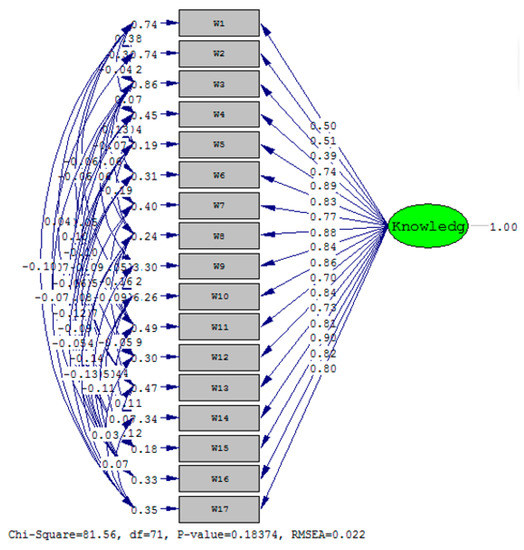
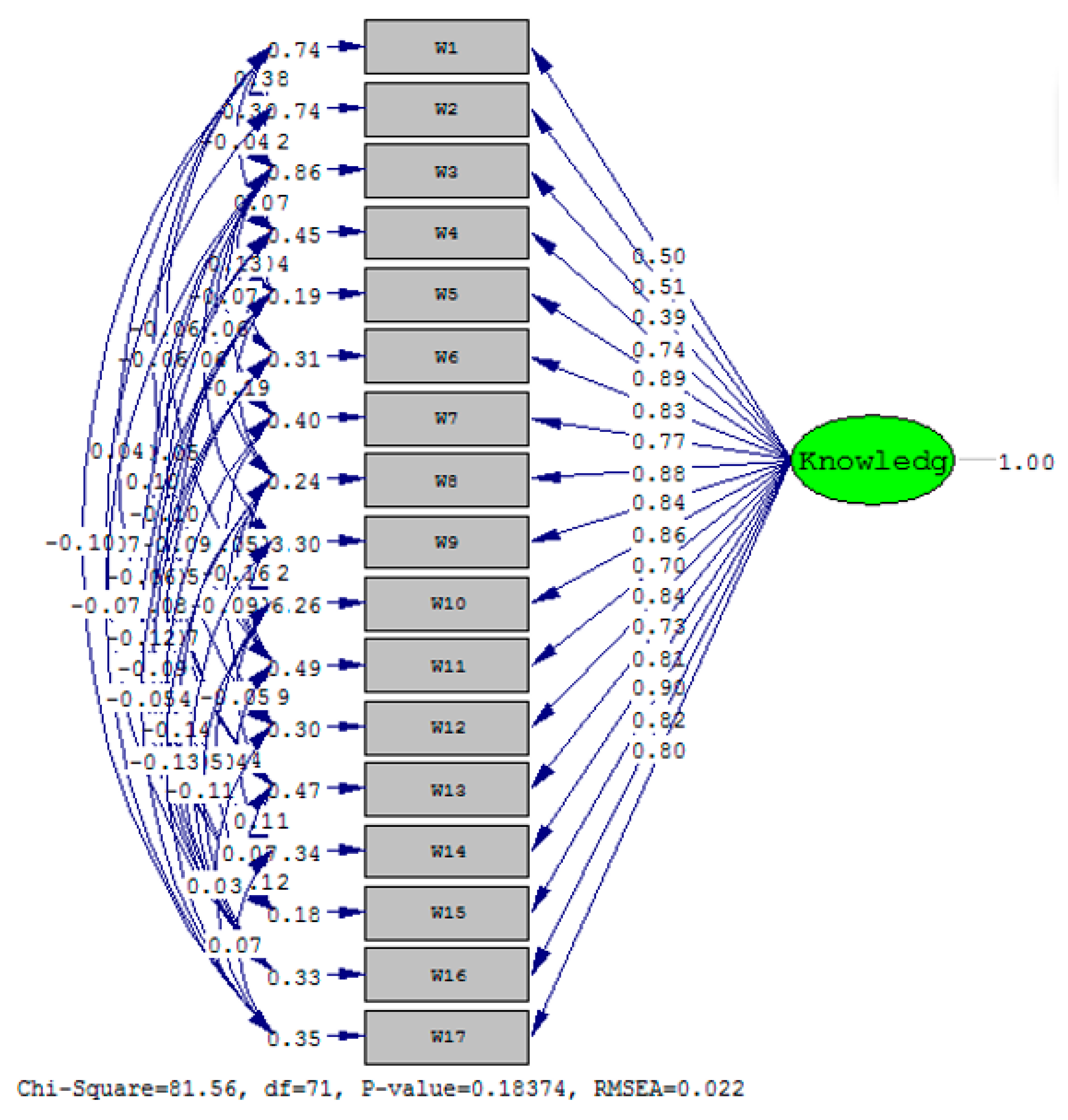
The Islamic Religious Moderation Knowledge Scale consisted of 17 items. The results of CFA with a one-factor model obtained a model fit with chi-square = 81.56, df = 71, p-value of chi-square = 0.183, and RMSEA = 0.022. The results of the validity of each item had a t-value > 1.96, which can be seen in Table 2, indicating that all items are valid for measuring the variables. The path diagram of religious moderation knowledge scale can be seen in Figure 1.
Table 2.
Results of CFA of the Islamic Religious Moderation Knowledge Scale.
Figure 1.
Diagram of CFA of the Islamic Religious Moderation Knowledge Scale.
- 2.
- Islamic Religious Moderation Attitudes Scale
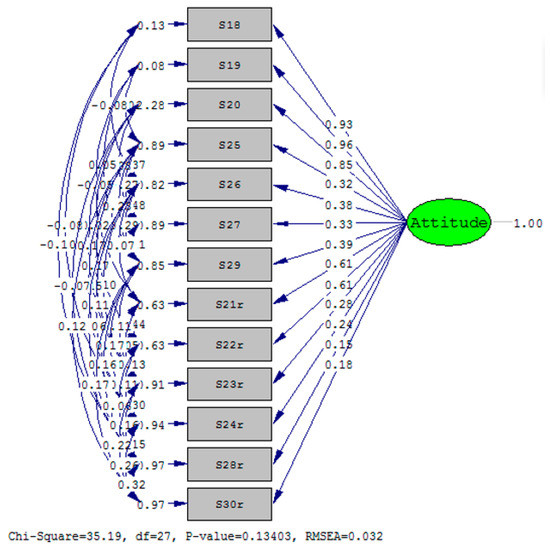
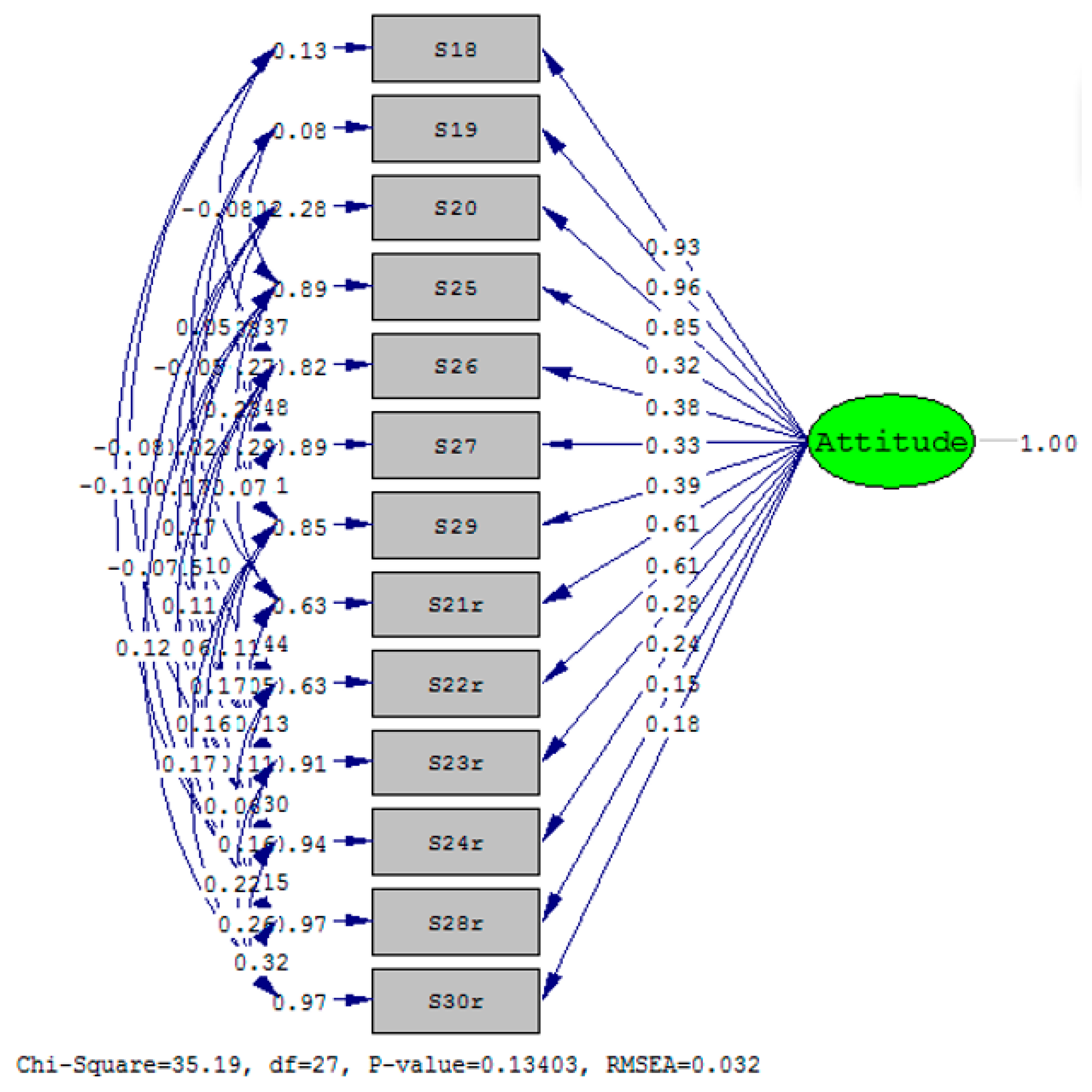
The Islamic Religious Moderation Attitudes Scale consisted of 13 items. The results of CFA with a one-factor model obtained a fit model chi-square = 35.19, df = 27, p-value of chi-square = 0.134, and RMSEA = 0.032. The results of the validity of each item had a t-value > 1.96, which can be seen in Table 3, indicating that all items are valid for measuring the variables. The path diagram of religious moderation attitudes scale can be seen in Figure 2.
Table 3.
Results of CFA of the Islamic Religious Moderation Attitudes Scale.
Figure 2.
Diagram of CFA of the Islamic Religious Moderation Attitudes Scale.
- 3.
- Islamic Religious Moderation Intentions Scale
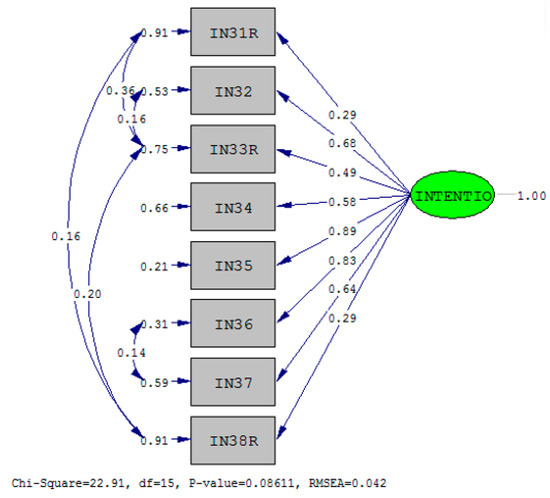
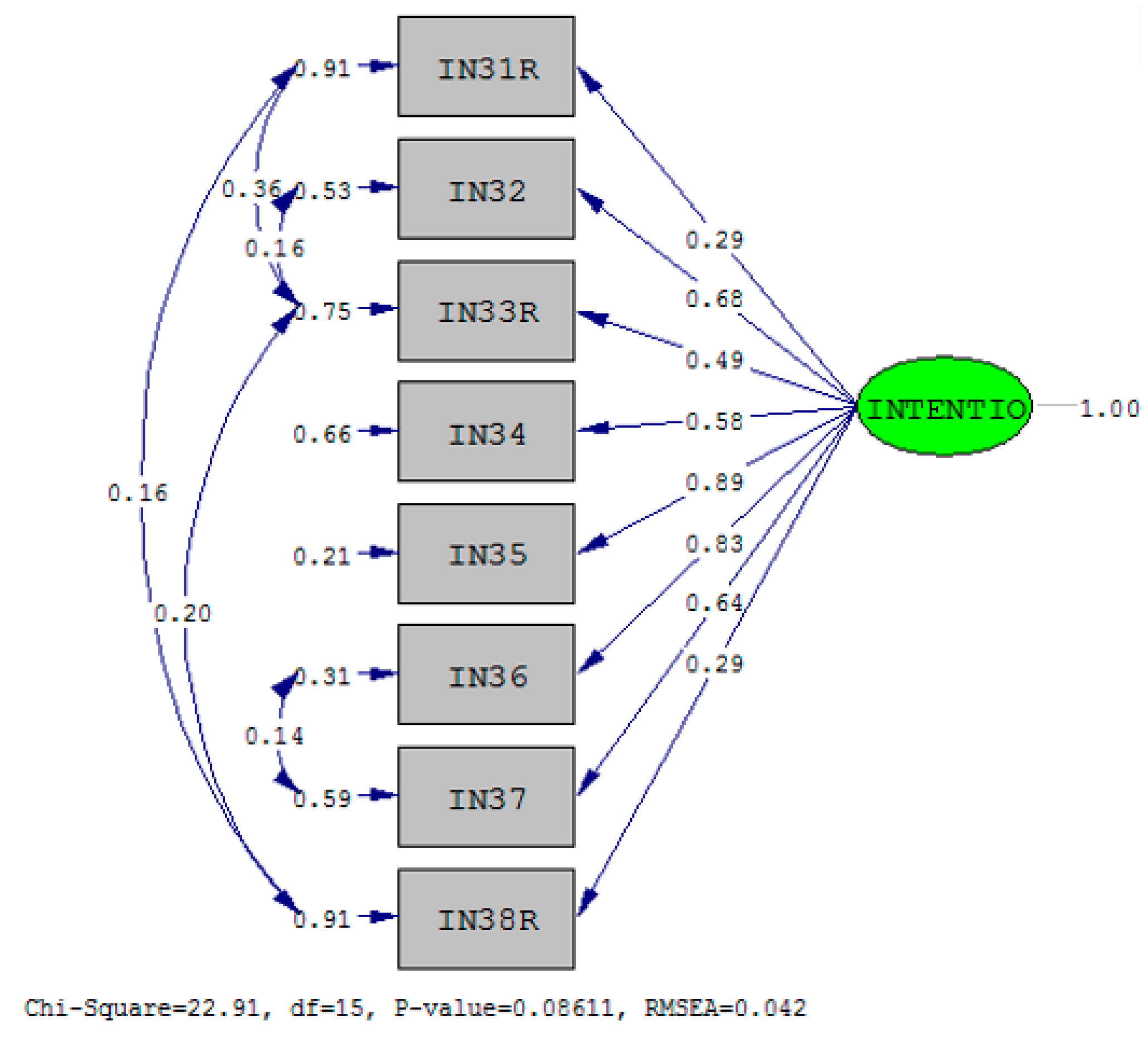
The Islamic Religious Moderation Intentions Scale consisted of eight items. The results of CFA with a one-factor model obtained a fit model chi-square = 22.91, df = 15, p-value of chi-square = 0.08, and RMSEA = 0.042. The results of the validity of each item had a t-value > 1.96, which can be seen in Table 4, indicating that all items are valid for measuring the variables. The path diagram of religious moderation intentions scale can be seen in Figure 3.
Table 4.
Results of CFA of the Islamic Religious Moderation Intentions Scale.
Figure 3.
Diagram of CFA of the Islamic Religious Moderation Intentions Scale.
3.2. Multiple Regression Analysis
Multiple regression analysis obtained an R-square value of 0.315, which means that 31.5% of the variation of the intentions variable can be explained by knowledge, attitudes, and demographic variables (gender, age, education background, and religious affiliation) shown in Table 5. Meanwhile, the remaining 68.5% is explained by other variables outside of this study. The F-test was significant, with a significance of 0.00, as shown in Table 6.
Table 5.
R-square.
Table 6.
F-test.
Based on Table 7, the regression equation from this study is:
Table 7.
The regression coefficient of the independent variables.
Islamic religious moderation intentions = 19.639 + 0.318 attitudes + 0.263 knowledge + 0.013 age + 1.226 gender + 1.043 educational background − 0.183 religious affiliation
The regression coefficient of each independent variable in the multiple regression analysis is explained below:
- The attitude variable’s regression coefficient was 0.318 with sig = 0.000, indicating that the attitude variable has a significant effect on the intentions of Islamic religious moderation.
- The regression coefficient for the knowledge variable was 0.263 with sig = 0.000, indicating that the knowledge variable has a significant effect on the intentions of religious moderation.
- The regression coefficient for the age variable was 0.013 with sig = 0.822, indicating no significant effect between age and the intentions of religious moderation; there is no guarantee that the elderly have better intentions to become moderately religious.
- The regression coefficient for the gender variable was 1.226 with sig = 0.214, indicating no significant effect between gender and the intentions of religious moderation.
- The regression coefficient for the educational background was 1.043 with sig = 0.292, indicating no significant effect between Islamic universities and Islamic schools and non-Islamic universities and non-Islamic schools on the intentions of religious moderation.
- The regression coefficient for religious affiliation was −0.183 with sig = 0.862, indicating no significant effect between Nahdatul Ulama and non-Nahdatul Ulama religious affiliations on the intentions of religious moderation.
4. Discussion
The results show a significant influence of knowledge and attitudes on forming religious moderation intention in Indonesian Muslims. Meanwhile, the demographic variables (age, gender, educational background, and religious affiliation) could not significantly explain Islamic religious moderation. The results align with the theory of knowledge, attitudes, and participation intentions based on the theory of the rationality of action proposed by Fishbein and Ajzen in 1975. They introduced four basic concepts: beliefs, attitudes, intentions, and habits (Fishbein and Ajzen 1975). Beliefs involve knowledge and insights to give birth to opinions that lead individuals to an attitude toward an object (both information and phenomena), attitudes involve emotions and responses toward an object, intentions refer to the goal of behavior, and habits involve action.
In the context of religious moderation, there are at least three aspects of the four offered by Fishbein and Ajzen, namely, insight or knowledge about religious moderation in society, community attitudes in responding to information and phenomena related to religious moderation, and the intentions of active community participation in responding to moderate religious leaders. Thus, people have the intention to participate in supporting moderate religious leaders because they already have insight and knowledge about religious moderation; they also have a positive attitude toward religious moderation. The limitation of this study is not analyzing the habits of action; thus, further research is essential to reach a comprehensive explanation.
No one demographic variable had a significant effect in explaining the intention of becoming moderately religious. In other words, religious moderation is not dependent on age, gender, educational background, or religious affiliation. Some research about intentions has also found no significant effect of age (Hatak et al. 2015), gender, educational background, and religious affiliation in explaining intentions.
Furthermore, we performed an additional analysis to explain the intention to participate in the research. From the demographic background, we can see that participants who responded to this research were dominated by those affiliated with moderate Islamic organizations such as Nahdhatul Ulama and Muhammadiyyah. As for fundamental religious affiliations such as Salafis, they were reluctant to participate in this research because their characteristics tend to be exclusive. From the additional focus group discussion session, we found that when participants from fundamental religious affiliations read the information for this research, they believed that the topic of religious moderation was not a good topic for their group. They also tend to hold a negative attitude regarding this topic and consequently lack any intention to participate. It can be assumed that when an individual limits themselves from the knowledge/information about religious moderation, their attitudes become hostile toward religious moderation. Interestingly, further research should develop hypotheses regarding religious affiliations in response to religious moderation.
5. Conclusions
This research found three valid instruments regarding Islamic religious moderation: (1) Islamic Religious Moderation Knowledge, (2) Islamic Religious Moderation Attitudes, and (3) Islamic Religious Moderation Intentions. The instruments were constructed from the theoretical definition of knowledge, attitudes, and intentions and the confirmatory factor analysis technique to validate the instruments. Moreover, the hypothesis tested with multiple regression analysis significantly influenced knowledge and attitudes in forming religious moderation intentions in Indonesian Muslims. The importance of becoming religiously moderate is in its prevention of radicalism. Moderation, in the application, may prevent society from becoming extremist. To have moderate intentions, one should know moderation in religiosity and hold positive attitudes toward religious moderation. The challenges come when individuals limit themselves from knowledge/information about religious moderation, turning their attitudes toward religious moderation hostile.
Author Contributions
Conceptualization, R.L., M.F. and I.S.; methodology R.L., M.F. and N.F.M.; software, R.L. and N.F.M.; validation, R.L., M.F. and N.F.M.; formal analysis, R.L., M.F. and N.F.M.; investigation, R.L., M.F., I.S. and N.F.M.; resources, R.L. and M.F.; data curation, R.L., M.F., I.S. and N.F.M.; writing—original draft preparation, R.L., M.F., I.S. and N.F.M.; writing—review and editing, R.L.; visualization, R.L., M.F. and N.F.M.; supervision, R.L., I.S.; project administration, N.F.M.; funding acquisition, R.L., I.S. All authors have read and agreed to the published version of the manuscript.
Funding
This research was funded by UIN Syarif Hidayatullah Jakarta.
Institutional Review Board Statement
The study was conducted in accordance with the Declaration of Helsinki and approved by the Institutional Review Board statement (UIN Syarif Hidayatullah Jakarta ethical clearance No.159.A/LP2M/HM-01.5/08/2021).
Informed Consent Statement
Informed consent was obtained from all subjects involved in the study. We anticipated no risks associated with the study. The information we collected in this study was anonymous, and the data collected were maintained and kept for research or educational purposes only.
Data Availability Statement
The data presented in this study are available upon request from the corresponding author.
Acknowledgments
We acknowledge the support given by the UIN Syarif Hidayatullah Jakarta for the 2021 research grant.
Conflicts of Interest
The authors declare no conflict of interest.
Appendix A
Table A1.
Religious moderation knowledge.
Table A2.
Religious moderation attitudes.
Table A3.
Religious moderation intentions.
References
- Abidin, Achmad Zainal. 2021. Nilai-Nilai Moderasi Beragama Dalam Permendikbud No. 37 Tahun 2018. [Religious Moderation Values in Permendikbud No. 37 Year 2018]. JIRA: Jurnal Inovasi Dan Riset Akademik 2: 729–36. [Google Scholar] [CrossRef] [Scilit]
- Adawiyah, Rabiah Al, Clara Ignatia Tobing, and Otih Handayani. 2021. Pemahaman Moderasi Beragama Dan Prilaku Intoleran Terhadap Remaja Di Kota-Kota Besar Di Jawa Barat. [Understanding Religious Moderation and Tolerance of Adolescents in West Java’s Big Cities]. Jurnal Keamanan Nasional 6: 161–83. [Google Scholar] [CrossRef] [Scilit]
- Ajzen, Icek. 1991. The Theory of Planned Behavior. Organizational Behavior and Human Decision Processes 50: 179–11. [Google Scholar] [CrossRef] [Scilit]
- Ajzen, Icek. 2005. Attitudes, Personality, and Behavior, 2nd ed. New York: Open University Press. [Google Scholar]
- Akhmadi, Agus. 2019. Moderasi Beragama Dalam Keragaman Indonesia. [Religious Moderation In Indonesia’s Diversity]. Balai Diklat Keagamaan Surabaya 13: 11. [Google Scholar]
- Ali, Nuraliah. 2020. Measuring Religious Moderation among Muslim Students at Public Colleges in Kalimantan Facing Disruption Era. Inferensi: Jurnal Penelitian Sosial Keagamaan 14: 1–24. [Google Scholar] [CrossRef] [Scilit]
- Athanasoulia, Stella. 2020. From ‘Soft’ to ‘Hard’ to ‘Moderate’: Islam in the Dilemmas of Post-2011 Saudi Foreign Policy. Religions 11: 211. [Google Scholar] [CrossRef] [Scilit]
- Beelmann, Andreas. 2020. A Social-Developmental Model of Radicalization: A Systematic Integration of Existing Theories and Empirical Research. International Journal of Conflict and Violence (Ijcv) 14: 1–14. [Google Scholar] [CrossRef]
- Blakemore, Sarah-Jayne, and Jean Decety. 2001. From the Perception of Action to the Understanding of Intention. Nature Reviews Neuroscience 2: 561–67. [Google Scholar] [CrossRef] [Scilit]
- Fahri, Mohamad, and Ahmad Zainuri. 2019. Moderasi Beragama Di Indonesia. [Religious Moderation in Indonesia]. Intizar 25: 6. [Google Scholar] [CrossRef]
- Fishbein, Martin, and Icek Ajzen. 1975. Belief, Attitude, Intention, and Behavior: An Introduction to Theory and Research. Massachusetts: Addison-Wesley Publishing Company, Inc. [Google Scholar]
- Gusti, Aria. 2016. The Relationship of Knowledge, Attitudes, and Behavioral Intentions of Sustainable Waste Management on Primary School Students in City of Padang, Indonesia. International Journal of Applied Environmental Sciences 11: 10. [Google Scholar]
- Haddock, Geoffrey, and Gregory Richard Maio. 2008. Attitudes: Content, Structure, and Functions, 4th ed. An Introduction to Social Psychology: A European Perspective. Oxford: Blackwell, p. 22. [Google Scholar]
- Hatak, Isabella, Rainer Harms, and Matthias Fink. 2015. Age, job identification, and entrepreneurial intention. Journal of Managerial Psychology 30: 38–53. [Google Scholar] [CrossRef] [Scilit]
- Junaedi, Edi. 2019. Inilah Moderasi Beragama Perspektif Kementerian Agama. [From the Ministry of Religion’s point of view, this is Religious Moderation]. Puslitbang Bimas Agama Dan Layanan Keagamaaan, Balitbang Dan Diklat Kemenag Ri 18: 10. [Google Scholar]
- Kamali, Mohammad Hashim. 2015. The Middle Path of Moderation in Islam: The Qurʼānic Principle of Wasaṭiyyah. Oxford: Oxford University Press. [Google Scholar]
- Kementerian Agama, ed. 2019. Moderasi Beragama (Cetakan Pertama), 1st ed. Religious Moderation. Jakarta: Badan Litbang Dan Diklat Kementerian Agama Ri. [Google Scholar]
- Kourgiotis, Panos. 2020. ‘Moderate Islam’ Made in the United Arab Emirates: Public Diplomacy and the Politics of Containment. Religions 11: 43. [Google Scholar] [CrossRef] [Scilit]
- Kumar, Ramesh, Charles Ramendran, and Peter Yacob. 2012. E Ployees’ Fit to the Orga Izatio Al Culture A D The. International Journal of Academic Research in Business and Social Sciences 2: 35. [Google Scholar]
- Maghfiroh, Shinta Lailatul, Siti Rohmah, and Muhammad Hamdan Yuwafik. 2020. Reinterpretasi Makna Moderasi Beragama Dalam Konteks Era Pasca Kebenaran (Post-Truth). [In the Post-Truth Era, a Reinterpretation of the Meaning of Religious Moderation]. Hikmah, Uin Sunan Ampel Surabaya 14: 199–30. [Google Scholar]
- Maichum, Kamonthip, Surakiat Parichatnon, and Ke-Chung Peng. 2016. Application of the Extended Theory of Planned Behavior Model to Investigate Purchase Intention of Green Products Among Thai Consumers. Sustainability 8: 1077. [Google Scholar] [CrossRef] [Scilit]
- Manshur, Fadlil Munawwar, and Husni Husni. 2020. Promoting Religious Moderation Through Literary-Based Learning: A Quasi-Experimental Study. International Journal of Advanced Science and Technology 29: 5849–55. [Google Scholar]
- Mccaffery, Kirsten, Jane Wardle, and Jo Waller. 2003. Knowledge, Attitudes, and Behavioral Intentions about the Early Detection Of Colorectal Cancer in the United Kingdom. Preventive Medicine 36: 525–35. [Google Scholar] [CrossRef] [Scilit]
- Putri, Ilma Savira, Sri Daryanti, and Alia Rachma Ningtias. 2019. The Influence Of Knowledge And Religiosity With Mediation of Attitude Toward The Intention of Repurchasing Halal Cosmetics. Paper present at the 12th International Conference on Business And Management Research (Icbmr 2018), Bali, Indonesia, November 7–8. [Google Scholar] [CrossRef] [Scilit]
- Ramadhan, Jelang, and Muhamad Syauqillah. 2018. An Order to Build the Resilience in the Muslim World Against Islamophobia: The Advantage of Bogor Message in Diplomacy World & Islamic Studies. Jurnal Middle East and Islamic Studies 5: 22. [Google Scholar]
- Ramayah, Thurasamy, Jason Wai Chow Lee, and Shuwen Lim. 2012. Sustaining The Environment Through Recycling: An Empirical Study. Journal of Environmental Management 102: 141–47. [Google Scholar] [CrossRef] [Scilit]
- Riniti Rahayu, Luh, and Putu Surya Wedra Lesmana. 2020. Potensi Peran Perempuan Dalam Mewujudkan Moderasi Beragama Di Indonesia. [Women’s Potential Contribution to Religious Moderation in Indonesia]. Pustaka: Jurnal Ilmu-Ilmu Budaya 20: 31. [Google Scholar] [CrossRef] [Scilit]
- Salamah, Nur, Muhammad Arief Nugroho, and Puspo Nugroho. 2020. Upaya Menyemai Moderasi Beragama Mahasiswa Iain Kudus Melalui Paradigma Ilmu Islam Terapan. [Using the paradigm of Applied Islamic Sciences, efforts to sow religious moderation among other Kudus students]. Quality 8: 269. [Google Scholar] [CrossRef] [Scilit]
- Saroglou, Vassilis. 2011. Believing, Bonding, Behaving, and Belonging: The Big Four Religious Dimensions and Cultural Variation. Journal of Cross-Cultural Psychology 42: 1320–40. [Google Scholar] [CrossRef] [Scilit]
- Schwedler, Jillian. 2013. Islamists in Power? Inclusion, Moderation, and the Arab Uprisings. Middle East Development Journal 5: 1350006. [Google Scholar] [CrossRef] [Scilit]
- Suhartawan, Budi. 2021. Wawasan Al-Quran Tentang Moderasi Beragama. [Insights from the Quran on Religious Moderation]. Jurnal Kajian Ilmu Al-Qur’an Dan Tafsir 1: 50–64. [Google Scholar]
- Sulung, Liyu Adhi Kasari, Niken Iwani Surya Putri, Muhammad Miqdad Robbani, and Kirana Rukmayuninda Ririh. 2020. Religion, Attitude, and Entrepreneurial Intention in Indonesia. The Southeast Asian Journal of Management 14: 44–62. [Google Scholar]
- Sutrisno, Edy. 2019. Aktualisasi Moderasi Beragama Di Lembaga Pendidikan. [Religious Moderation in Educational Institutions as a Reality]. Jurnal Bimas Islam 12: 323–48. [Google Scholar] [CrossRef] [Scilit]
- Ulinnuha, Muhammad, and Mamluatun Nafisah. 2020. Moderasi Beragama Perspektif Hasbi Ash-Shiddieqy, Hamka, Dan Quraish Shihab. [Hasbi Ash-Shiddieqy, Hamka, and Quraish Shihab’s Perspectives on Religious Moderation]. Suhuf 13: 55–76. [Google Scholar] [CrossRef] [Scilit]
- Vandenbos, Gary R., ed. 2015. Apa Dictionary of Psychology, 2nd ed. Washington, DC: American Psychological Association. [Google Scholar] [CrossRef] [Scilit]
- White, Joshua T. 2012. Beyond Moderation: Dynamics of Political Islam In Pakistan. Contemporary South Asia 20: 179–94. [Google Scholar] [CrossRef] [Scilit]
- Wibisono, Susilo, Winnifred R. Louis, and Jolanda Jetten. 2019. A Multidimensional Analysis of Religious Extremism. Frontiers in Psychology 10: 2560. [Google Scholar] [CrossRef] [Scilit]
- Yates, Gregory C. R., and Margaret Chandler. 1991. The Cognitive Psychology of Knowledge: Basic Research Findings And Educational Implications. Australian Journal of Education 35: 131–53. [Google Scholar] [CrossRef] [Scilit]
- Zuhriah, Antik Milatus. 2020. Tokoh Agama Dalam Pendidikan Toleransi Beragama Di Kabupaten Lumajang. [Religious Leaders in Lumajang Regency Teaching Religious Tolerance]. Tarbiyatuna: Jurnal Pendidikan Islam 13: 56. [Google Scholar] [CrossRef] [Scilit]

Publisher’s Note: MDPI stays neutral with regard to jurisdictional claims in published maps and institutional affiliations. |
© 2022 by the authors. Licensee MDPI, Basel, Switzerland. This article is an open access article distributed under the terms and conditions of the Creative Commons Attribution (CC BY) license (https://creativecommons.org/licenses/by/4.0/).