
<?xml version="1.0" encoding="UTF-8"?>
<!DOCTYPE article PUBLIC "-//NLM//DTD Journal Publishing DTD v2.3 20070202//EN" "journalpublishing.dtd">
<article xmlns:mml="http://www.w3.org/1998/Math/MathML" xmlns:xlink="http://www.w3.org/1999/xlink" xml:lang="en" article-type="research-article">
  <front>
    <journal-meta>
      <journal-id journal-id-type="publisher-id">agriculture</journal-id>
      <journal-title>Agriculture</journal-title>
      <abbrev-journal-title abbrev-type="publisher">Agriculture</abbrev-journal-title>
      <abbrev-journal-title abbrev-type="pubmed">Agriculture</abbrev-journal-title>
      <issn pub-type="epub">2077-0472</issn>
      <publisher>
        <publisher-name>MDPI</publisher-name>
      </publisher>
    </journal-meta>
    <article-meta>
      <article-id pub-id-type="doi">10.3390/agriculture3010072</article-id>
      <article-id pub-id-type="publisher-id">agriculture-03-00072</article-id>
      <article-categories>
        <subj-group>
          <subject>Article</subject>
        </subj-group>
      </article-categories>
      <title-group>
        <article-title>Crop and Soil Responses to Using Corn Stover as a Bioenergy Feedstock: Observations from the Northern US Corn Belt</article-title>
      </title-group>
      
      <contrib-group>
        <contrib contrib-type="author">
          <name>
            <surname>Johnson</surname>
            <given-names>Jane M. F.</given-names>
          </name>
          <xref rid="af1-agriculture-03-00072" ref-type="aff">1</xref>
          <xref rid="c1-agriculture-03-00072" ref-type="corresp">*</xref>
        </contrib>
        <contrib contrib-type="author">
          <name>
            <surname>Acosta-Martinez</surname>
            <given-names>Veronica</given-names>
          </name>
          <xref rid="af2-agriculture-03-00072" ref-type="aff">2</xref>
        </contrib>
        <contrib contrib-type="author">
          <name>
            <surname>Cambardella</surname>
            <given-names>Cynthia A.</given-names>
          </name>
          <xref rid="af3-agriculture-03-00072" ref-type="aff">3</xref>
        </contrib>
        <contrib contrib-type="author">
          <name>
            <surname>Barbour</surname>
            <given-names>Nancy W.</given-names>
          </name>
          <xref rid="af1-agriculture-03-00072" ref-type="aff">1</xref>
        </contrib>
      </contrib-group>
      <aff id="af1-agriculture-03-00072"><label>1 </label>USDA-Agricultural Research Service, North Central Soil Conservation Research Laboratory, 803 Iowa Ave., Morris, MN 56267, USA; E-Mail: <email>Nancy.barbour@ars.usda.gov</email></aff>
      <aff id="af2-agriculture-03-00072"><label>2 </label>USDA-Agricultural Research Service, Cropping Systems Research Laboratory, Wind Erosion and Water Conservation Unit, 3810 4th Street, Lubbock, TX 79415, USA; E-Mail: <email>Veronica.acosta-martinez@ars.usda.gov</email></aff>
      <aff id="af3-agriculture-03-00072"><label>3 </label>USDA-Agricultural Research Service, National Laboratory of Agriculture and the Environment Agroecosystems Management Research Unit 2110 University BLVD, Ames, IA 50011, USA; E-Mail: <email>cindy.cambardella@ars.usda.gov </email></aff>
      <author-notes>
        <corresp id="c1-agriculture-03-00072"><label>*</label> Author  to whom correspondence should be addressed; E-Mail: <email>Jane.johnson@ars.usda.gov</email>; Tel.: +1-320-589-3411; Fax: +1-320-589-3787.</corresp>
      </author-notes>
      <pub-date pub-type="epub">
        <day>06</day>
        <month>02</month>
        <year>2013</year>
      </pub-date>
      <pub-date pub-type="collection"><month>03</month>
        <year>2013</year>
      </pub-date>
      <volume>3</volume>
      <issue>1</issue>
      <fpage>72</fpage>
      <lpage>89</lpage>
      <history>
        <date date-type="received">
          <day>21</day>
          <month>12</month>
          <year>2012</year>
        </date>
        <date date-type="rev-recd">
          <day>31</day>
          <month>01</month>
          <year>2013</year>
        </date>
        <date date-type="accepted">
          <day>31</day>
          <month>01</month>
          <year>2013</year>
        </date>
      </history>
      <permissions>
        <copyright-statement>©  2013 by the authors; licensee MDPI, Basel, Switzerland.</copyright-statement>
        <copyright-year>2013</copyright-year>
        <license xmlns:xlink="http://www.w3.org/1999/xlink" license-type="open-access" xlink:href="http://creativecommons.org/licenses/by/3.0/">
          <p>This article is an open access article distributed under the terms and conditions of the Creative Commons Attribution license (http://creativecommons.org/licenses/by/3.0/).</p>
        </license>
      </permissions>
      <abstract>
        <p>Corn (<italic>Zea mays</italic> L.) stover is a potential bioenergy feedstock, but little is known about the impacts of reducing stover return on yield and soil quality in the Northern US Corn Belt. Our study objectives were to measure the impact of three stover return rates (Full (~7.8 Mg ha<sup>−1</sup> yr<sup>−1</sup>), Moderate (~3.8 Mg ha<sup>−1</sup> yr<sup>−1</sup>) or Low (~1.5 Mg ha yr<sup>−1</sup>) Return) on corn and soybean (<italic>Glycine max</italic>. L [Merr.]) yields and on soil dynamic properties on a chisel-tilled (Chisel) field, and well- (NT1995) or newly- (NT2005) established no-till managed fields. Stover return rate did not affect corn and soybean yields except under NT1995 where Low Return (2.88 Mg ha<sup>−1</sup>) reduced yields compared with Full and Moderate Return (3.13 Mg ha<sup>−1</sup>). In NT1995 at 0–5 cm depth, particulate organic matter in Full Return and Moderate Return (14.3 g kg<sup>−1</sup>) exceeded Low Return (11.3 g kg<sup>−1</sup>). In NT2005, acid phosphatase activity was reduced about 20% in Low Return compared to Full Return. Also the Low Return had an increase in erodible-sized dry aggregates at the soil surface compared to Full Return. Three or fewer cycles of stover treatments revealed little evidence for short-term impacts on crop yield, but detected subtle soil changes that indicate repeated harvests may have negative consequences if stover removed. </p>
      </abstract>
      <kwd-group>
        <kwd>cellulosic feedstock</kwd>
        <kwd>sustainability</kwd>
        <kwd>residue management</kwd>
        <kwd>bioenergy</kwd>
        <kwd>dry aggregate stability</kwd>
        <kwd>FAME</kwd>
        <kwd>particulate organic matter</kwd>
        <kwd>microbial biomass</kwd>
        <kwd>soil organic carbon</kwd>
      </kwd-group>
    </article-meta>
  </front>
  <body>
    <sec sec-type="intro">
      <title>1. Introduction</title>
      <p>Corn stover is a potential bioenergy feedstock especially in the US Corn Belt. Within the region, about 25 million hectares of land are managed as corn, which averages 10 Mg ha<sup>−1 </sup>grain yield with numerous counties reporting averages ≥12 Mg ha<sup>−1</sup> [<xref ref-type="bibr" rid="B1-agriculture-03-00072">1</xref>]. This extensive production acreage coupled with high yields justifies using corn stover as a potential major bioenergy feedstock [<xref ref-type="bibr" rid="B2-agriculture-03-00072">2</xref>]. Although stover has potential as a feedstock for the nascent cellulosic energy platforms [<xref ref-type="bibr" rid="B2-agriculture-03-00072">2</xref>,<xref ref-type="bibr" rid="B3-agriculture-03-00072">3</xref>,<xref ref-type="bibr" rid="B4-agriculture-03-00072">4</xref>], crop residues provide a plethora of soil and environmental benefits that impact productivity and soil quality. Crop response to stover harvest varies from highly detrimental to moderately positive depending on the soil, microclimate and other management practices [<xref ref-type="bibr" rid="B5-agriculture-03-00072">5</xref>,<xref ref-type="bibr" rid="B6-agriculture-03-00072">6</xref>,<xref ref-type="bibr" rid="B7-agriculture-03-00072">7</xref>]. Reducing stover return may trigger short-term yield responses, increases in soil erosion or incremental decreases in soil quality reducing inherent soil productivity.</p>
      <p>Erosion control via residue management has long been documented, and has well-established management guidelines based on percentage soil coverage [<xref ref-type="bibr" rid="B5-agriculture-03-00072">5</xref>,<xref ref-type="bibr" rid="B8-agriculture-03-00072">8</xref>,<xref ref-type="bibr" rid="B9-agriculture-03-00072">9</xref>]; but aggressive stover harvest can denude the soil surface even in the absence of tillage [<xref ref-type="bibr" rid="B10-agriculture-03-00072">10</xref>]. Thus, it is prudent to document that adequate soil coverage is maintained, as a reduction in surface residue is expected when residues are harvested. Even where water erosion risk is minimal due to level topography, exposed soil is at risk to wind erosion. Soil aggregates &lt;0.84 mm in diameter, determined by rotary sieving dry soil, have been positively related to soil wind erodibility [<xref ref-type="bibr" rid="B11-agriculture-03-00072">11</xref>,<xref ref-type="bibr" rid="B12-agriculture-03-00072">12</xref>]. An increase in small aggregates due to residue removal is indicative of structural changes associated with increased potential risk for wind erosion. Percentage soil coverage and dry aggregate size distribution are readily measured preliminary indicators of soil erosion risk. </p>
      <p>Residue management guidelines for erosion control are well-established, but the amount of corn stover needed for maintaining soil organic C and other soil parameters are not available. Residue inputs required to maintain soil organic C can exceed those required for controlling erosion [<xref ref-type="bibr" rid="B13-agriculture-03-00072">13</xref>]. A recent review [<xref ref-type="bibr" rid="B5-agriculture-03-00072">5</xref>], reported 2.5 ± 1.7 Mg C ha<sup>−1</sup> (<italic>n</italic> = 28) from crop residue was needed to avoid a loss in soil organic carbon. The vast majority of included studies, from multiple crops and climatic regions, were based on tilled systems rather than systems managed without tillage. Additional data is needed to establish minimum residue return rates for maintaining soil organic C. Measuring statistically valid changes in soil organic C is hampered by temporal and spatial variability [<xref ref-type="bibr" rid="B14-agriculture-03-00072">14</xref>,<xref ref-type="bibr" rid="B15-agriculture-03-00072">15</xref>]. Near-surface (0–15 cm) POM, an important source of C for the soil microbial community, has been successfully used as an early predictor of management-induced changes in soil organic matter [<xref ref-type="bibr" rid="B16-agriculture-03-00072">16</xref>,<xref ref-type="bibr" rid="B17-agriculture-03-00072">17</xref>]. </p>
      <p>Microbial communities contribute to nutrient cycling and microbial products formed during residue decomposition contribute to the formation and stabilization of soil aggregates. Changes in microbial activity may explain how reducing residue returned to the soil caused an increase in smaller dry aggregates and reduce the number of water stable aggregates [<xref ref-type="bibr" rid="B18-agriculture-03-00072">18</xref>]. Although, biological parameters may respond to reduced residue returned in as few as two years [<xref ref-type="bibr" rid="B19-agriculture-03-00072">19</xref>], in the United States Corn Belt information concerning the amount of stover needed to support the microbial component is scarce [<xref ref-type="bibr" rid="B18-agriculture-03-00072">18</xref>,<xref ref-type="bibr" rid="B20-agriculture-03-00072">20</xref>]. </p>
      <p>Future scenarios of using stover as bioenergy feedstock in the United States assume no tillage management because of its potential to reduce erosion [<xref ref-type="bibr" rid="B2-agriculture-03-00072">2</xref>]. While the acreage managed without tillage across much of the United States has increased, no till acreage has not increased throughout the Northern Corn Belt. For example, less than 5% of land area in Minnesota, which is one of the top five corn producing states within the United States, is managed without tillage [<xref ref-type="bibr" rid="B21-agriculture-03-00072">21</xref>] and no tillage corn acreage has declined. While no tillage may also accrue soil organic C the rate of accumulation and time to steady state may vary [<xref ref-type="bibr" rid="B22-agriculture-03-00072">22</xref>]. Thus, impacts of reducing stover returned on the soil quality may differ among tillage managements and the time since converting to no tillage management. </p>
      <p>Harvesting stover for bioenergy feedstock changes the rate of residue remaining; however, crop and soil parameters respond to the amount of residue returned not to the amount removed. The objectives of this study were to measure the early impacts of three corn stover return rates on corn and soybean yield and on soil dynamic properties under chisel and no-till managements.</p>
    </sec>
    <sec>
      <title>2. Material and Methods</title>
      <p>Three independent studies were conducted in adjacent experimental (~0.5 ha) fields with &lt;2% slope and contrasting primary tillage [tilled with a chisel plow (Chisel), no-till since 1995 (NT1995), and no-till since 2005 (NT2005)]. These fields were located at the Swan Lake Research Farm (45°41′ N lat; 95°48′ W long; elevation 370 m). The local thirty-year (1971–2000) average annual precipitation is 645 mm and mean monthly temperatures ranges from −13.1 °C in January to 21.7 °C in July [<xref ref-type="bibr" rid="B23-agriculture-03-00072">23</xref>]. Each study field had 24 (6.1 m by 22.9 m) plots arranged in a randomized complete block design with three stover return treatments (Full Return, Moderate Return and Low Return), both phases of a corn soybean rotation and four replications. Randomization occurred within a study but not among study fields, so comparison were made within but not among study fields. </p>
      <sec>
        <title>2.1. Characterization and History of Study Fields</title>
        <p>The field managed with annual chisel plowing (Chisel), had two similarly textured Barnes-Aastad complexes. Using USDA-SCS soil maps [<xref ref-type="bibr" rid="B24-agriculture-03-00072">24</xref>] plots were arranged to block soil variability within replications, therefore three replications were on Barnes soil (fine-loamy, mixed, superactive, frigid Calcic Hapludoll) with the fourth replication on Aastad (fine-loamy, mixed, superactive, frigid Pachic Hapludoll). Both the NT2005 and NT1995 fields were established on an area mapped nearly exclusively as Barnes. All fields were managed with a corn/soybean rotation, with both crops present each year.</p>
        <p>Prior to 2005, the Chisel field had been moldboard plowed (&gt;20 cm) in the fall after harvest with one or two disking (~10–15 cm depth) operations prior to planting. Beginning in 2005, the moldboard plow was replaced with a chisel plow (~20 cm) but seedbed preparation remained the same. For at least ten years prior to establishing this stover study, the NT1995 had been managed without tillage. During the previous years, both NT1995 and Chisel were planted to continuous corn (10 years) or in a corn-soybean rotation (four years). The pre-experimental cropping history for NT2005 was a corn, soybean, wheat (<italic>Triticum aestivum</italic> L.) rotation with moldboard plow tillage (&gt;20 cm) each fall after harvest for at least 10 years. This field was last moldboard plowed in 2004. </p>
      </sec>
      <sec>
        <title>2.2. Corn Stover Return Treatments</title>
        <p>Corn stover return treatments were initiated in 2005 on Chisel and NT1995 and in 2006 on NT2005. In the Full Return treatment, only grain was harvested with all stover including cob material retained in the field. The amount of stover returned in Full Return was assumed to be the same as the stover yield measured at physiological maturity (described in <xref ref-type="sec" rid="sec2dot3-agriculture-03-00072">section 2.3</xref>). The other two treatments correspond to (1) a Moderate Return rate intended to balance stover harvest with maintaining soil quality, and (2) a Low Return rate intended to maximize stover harvested. The methods used for implementing the stover return treatments were based on equipment availability. Between 2005 and 2008 after grain harvest, a two-row, flail-knife forage harvester, which cut the stalks at or below 10 cm from the soil surface, was used in four of the eight rows (Moderate Return) or all (Low Return) rows in the plot area to remove corn stover. Between 2009 and 2011, a prototype one-pass combine was used at two cutting-heights; just below the ear (about 65 to 70 cm) (Moderate Return) and about 10 cm above soil surface (Low Return). The amount of stover returned was determined annually by collecting standing stalk, plus all material on the ground in a 0.762 m<sup>2 </sup>area. </p>
      </sec>
      <sec id="sec2dot3-agriculture-03-00072">
        <title>2.3. Agronomic Management</title>
        <p>All fields were planted with glyphosate-tolerant corn (Croplan 296TS) and soybean (508-M8) with both crop phases present each year. Planting density was 78,000 (Chisel) and 81,500 plants ha<sup>−1</sup> (NT19995 and NT2005) for corn and 247,400 plants ha<sup>−1</sup> for soybeans in all fields. Listing even-year crop first, the rotations were designated corn-soybean or soybean-corn. Corn plots received 10 and 15 kg N and P of starter fertilizer in 2005 through 2008. Prior to planting in 2009 to 2011 all plots in all fields received knife-injected (5–7 cm) 21, 34, 65 and 52 kg ha<sup>−1</sup> of N, P, K and S, respectively; plus, an additional 4 and 6 kg ha<sup>−1</sup> of N and P was applied when planting corn. Nitrogen fertilizer was applied annually during the corn phase as side-dressed anhydrous ammonia with average annual application rates of 136, 139 and 148 kg N ha<sup>−1</sup> applied in Chisel, NT2005 and NT1995, respectively. Side-dress rates were based on spring soil tests (0–30 cm) and the ARS Nitrogen-decision aid [<xref ref-type="bibr" rid="B25-agriculture-03-00072">25</xref>]. Weeds were controlled in both crops with two glyphosate applications annually; insecticides were only applied to soybean. </p>
        <p>Corn and soybean grain yield at standard grain water contents of 15.5 and 13 g kg<sup>−1</sup>, respectively were based on harvest with a two-row plot scale combine. Soybean straw production was determined on plants collected from a 0.76 m<sup>2 </sup>area prior to leaf-drop R6 [<xref ref-type="bibr" rid="B26-agriculture-03-00072">26</xref>]. At physiological maturity, corn was collected from 1.5 m<sup>2</sup> to determine stover yield. Corn stover and soybean straw were reported as dry mass per area, based on oven-dried (60 °C) mass. Harvest index [<xref ref-type="bibr" rid="B27-agriculture-03-00072">27</xref>] was calculated as dry grain divided by dry grain plus stover.</p>
      </sec>
      <sec>
        <title>2.4. Soil Parameters</title>
        <p>In the fall of 2005, baseline soil samples were collected for all fields using a Giddings (Giddings Machine Company, Windsor, CO, USA) hydraulic probe (5.33 cm i.d.) to 100 cm as recommended by Liebig <italic>et al.</italic> [<xref ref-type="bibr" rid="B28-agriculture-03-00072">28</xref>]. Three soil cores taken in each plot were divided into six depth increments (0–5, 5–10, 10–20, 20–30, 30–60, and 60–100 cm). Soil from the 0–5 and 5–10 cm depth increments was passed through a 2 mm sieve. A subsample (~50-g) was air-dried for POM isolation while soil was oven-dried at 37 °C for chemical analyses. Soil from one core was used for determining soil bulk density at depth intervals below 10 cm. Cores were assumed to be uncompressed when the core length equaled the whole depth [<xref ref-type="bibr" rid="B29-agriculture-03-00072">29</xref>]. In the surface 0–5 and 5–10 cm increments, a hand-held soil probe (5 cm i.d.) was used to collect a sample for bulk density. Soil texture was determined using the hydrometer method [<xref ref-type="bibr" rid="B30-agriculture-03-00072">30</xref>,<xref ref-type="bibr" rid="B31-agriculture-03-00072">31</xref>]. Soil pH (1:1 CaCl<sub>2</sub>) [<xref ref-type="bibr" rid="B32-agriculture-03-00072">32</xref>], total C and N (LECO TRU-SPEC CN analyzer; LECO Corporation, St. Joseph, MI), inorganic C [<xref ref-type="bibr" rid="B33-agriculture-03-00072">33</xref>], Olsen P and extractable K [<xref ref-type="bibr" rid="B34-agriculture-03-00072">34</xref>] were determined. Organic C was calculated as the difference between total combustible C and inorganic C as these are calcareous soils. Particulate organic matter was isolated from air-dried soil as described by Cambardella and Elliot [<xref ref-type="bibr" rid="B16-agriculture-03-00072">16</xref>]. The mass of POM independent of sand [<xref ref-type="bibr" rid="B35-agriculture-03-00072">35</xref>] was determined by weight loss on ignition using a method by Schulte [<xref ref-type="bibr" rid="B36-agriculture-03-00072">36</xref>] as reported by Cambardella <italic>et al.</italic> [<xref ref-type="bibr" rid="B17-agriculture-03-00072">17</xref>]. In 2009, to obtain an early prediction of changes in soil organic matter due stover return rate, POM was isolated and bulk density determined from soil collected at the surface 0–5 and 5–10 cm as described above. As previously described for baseline samples, in the fall of 2010 (following harvest and preceding tillage in Chisel), soil samples were collected to 100 cm depth and assessed for bulk density, pH, total C and N by combustion, inorganic C, Olsen P and extractable K.</p>
        <p>Percent soil coverage and dry aggregate size distribution were used as indicators for treatment induced changes in soil erosion potential. Soil coverage was assessed annually by the transect method [<xref ref-type="bibr" rid="B37-agriculture-03-00072">37</xref>,<xref ref-type="bibr" rid="B38-agriculture-03-00072">38</xref>]. The transect method, which does not require a minimum residue size, counts the number of times a 15 m tape with 100 equidistant marks intersects visible residue. Soil for dry aggregate size distribution was collected in the summer of 2011 within about 5 cm of the soil surface after removing visible surface residue. Dry aggregate size distribution using the method described by Chepil [<xref ref-type="bibr" rid="B39-agriculture-03-00072">39</xref>] and Pikul <italic>et al.</italic> [<xref ref-type="bibr" rid="B40-agriculture-03-00072">40</xref>] was determined using a rotary sieve operating at 6-rpm to separate air-dried soil into six aggregate size groupings: 0–0.5, 0.5–1.0, 1–2, 2–3, 3–5, 5–9, and 9–20 mm. Total soil mass in aggregates &lt;20 mm and mass of each aggregate size was determined.</p>
        <p>Biological parameters (microbial biomass and composition and enzyme activities) were evaluated on soil samples collected in 2008 prior to spring agronomic operations from Full and Low Return in all fields using a hand-held probe. Soil cores were divided into 0–5 and 5–10 cm depth increments. Soil MBC and MBN were determined on the field-moist samples, with a dry equivalent mass of 15-g, by the chloroform-fumigation-extraction method using 0.5 M K<sub>2</sub>SO<sub>4</sub> as an extractant [<xref ref-type="bibr" rid="B41-agriculture-03-00072">41</xref>,<xref ref-type="bibr" rid="B42-agriculture-03-00072">42</xref>]. Organic C and N were quantified using a CN analyzer (Shimadzu Model TOC-V/CPH-TN; Shimadzu Scientific Instruments, Columbia, MD, USA). Microbial biomass C was calculated as (organic C extracted from fumigated soil minus organic C extracted from non-fumigated soil) divided by a k<sub>EC</sub> factor of 0.45 [<xref ref-type="bibr" rid="B43-agriculture-03-00072">43</xref>]. The soil MBN was calculated similarly, but used a k<sub>EN</sub> factor of 0.54 [<xref ref-type="bibr" rid="B44-agriculture-03-00072">44</xref>]. These factors correct for biomass solubilized during the fumigation-extraction [<xref ref-type="bibr" rid="B45-agriculture-03-00072">45</xref>]. Each sample had duplicate analyses and results are expressed on a dry-weight basis. Soil water content was determined after drying soil at 105 °C for 48 h.</p>
        <p>Soil microbial community structure was characterized using fatty acid methyl esters (FAME) analysis on field-moist soil samples using the Microbial Identification System (MIS, Microbial ID, Inc., Newark, DE, USA) procedure as applied for soil analyses [<xref ref-type="bibr" rid="B46-agriculture-03-00072">46</xref>,<xref ref-type="bibr" rid="B47-agriculture-03-00072">47</xref>]. Briefly, the method consists of four steps: (1) saponification of fatty acids in 3 g field-moist soil with 3 mL 3.75 M NaOH (methanol:water, 1:1) solution under heat (100 °C) for 30 min; (2) methylation of fatty acids by adding 6 mL of 6 M HCl in aqueous methanol (1:0.85) under heat (80 °C) for 10 min; (3) extraction of the FAME with 3 mL of 1:1 hexane:methyl-tert butyl-ether solution and rotating the samples end-over-end for 10 min; and (4) washing the organic phases with 1.2 % diluted NaOH by rotating the tubes end-over-end for 5 min. The organic phase was analyzed in a 6890 GC Series II (Hewlett Packard, Wilmington, DE) equipped with a flame ionization detector and 25m × 0.2 mm fused silica capillary column using ultra high purity hydrogen as the carrier gas. The temperature program was ramped from 170 °C to 250 °C at 5 °C min<sup>−1</sup>. Fatty acids were identified and their relative peak areas (percent) were determined with respect to the other fatty acids in a sample using the MIS Aerobe method of the MIDI system (Microbial ID, Inc., Newark, DE, USA). </p>
        <p>Enzyme activities, β-glucosidase, β-glucosaminidase, and acid phosphatase were assayed as indicators of C, C and N, and P biogeochemical cycling potential, respectively. These enzyme activities were assayed using 1g of air-dried soil with their appropriate substrate and incubated for 1 h (37 °C) at their optimal pH as described by Tabatabai [<xref ref-type="bibr" rid="B48-agriculture-03-00072">48</xref>] and Parham and Deng [<xref ref-type="bibr" rid="B49-agriculture-03-00072">49</xref>]. Enzyme activities were assayed in duplicate with one control, to which substrate was added after incubation and subtracted from the sample value. </p>
      </sec>
      <sec>
        <title>2.5. Statistical Analysis</title>
        <p>The impact of corn stover return was assessed on three fields differing in tillage management, but these experiments were not designed to make direct statistical comparisons among tillage management effects. Data on soil properties and crop yield within each field were analyzed using PROC MIXED of SAS version 9.2 [<xref ref-type="bibr" rid="B50-agriculture-03-00072">50</xref>] with residue return and crop phase considered as fixed effects and replication as a random effect. Crop yield and percentage soil-coverage data were evaluated using PROC MIXED, but including years as a random effect. Mean separation and multiple comparisons were obtained with a LSMEANS statement within PROC MIXED [<xref ref-type="bibr" rid="B50-agriculture-03-00072">50</xref>]. Additional analysis of the FAME profiles was completed using principal component analysis (PCA) plots of the correlation matrix for each soil depth with a 95% confidence ellipse to determine separation due to stover return (Full Return <italic>vs.</italic> Low Return) on the microbial community structure using R statistical software [<xref ref-type="bibr" rid="B51-agriculture-03-00072">51</xref>] with the Vegan package for PCA [<xref ref-type="bibr" rid="B52-agriculture-03-00072">52</xref>]. The R software was also used to evaluate the three enzyme activities together as affected by stover return according to PCA plots. Significance for all data is reported at <italic>P</italic> ≤ 0.05.</p>
      </sec>
    </sec>
    <sec sec-type="results">
      <title>3. Results</title>
      <sec>
        <title>3.1. Return Rates and Crop Production</title>
        <p>The mass of stover returned in each field is summarized in <xref ref-type="table" rid="agriculture-03-00072-t001">Table 1</xref>. In Chisel, the Moderate Return had 51% and Low Return had 22% stover returned compared to the Full Return. In NT2005, Moderate Return and Low Return had 46% and 15% stover returned, respectively, compared to Full Return. Similarly in NT1995, the Moderate Return had 50% stover and the Low Return had 21% stover returned compared to the Full Return. Corn was rotated with soybeans so the average total residue (Corn stover plus soybean straw) returned reflects the soybean contribution. </p>
        <table-wrap id="agriculture-03-00072-t001" position="float">
          <object-id pub-id-type="pii">agriculture-03-00072-t001_Table 1</object-id>
          <label>Table 1</label>
          <caption>
            <p>Average dry residue (corn stover and soybean straw) and dry corn stover retained from 2005 to 2011 in Chisel and No tillage since 1995 (NT1995) fields and from 2006 to 2011 in no tillage since 2005 (NT2005) field. Corn stover remaining measured except in 2006, when corn stover remaining in the field was estimated from measured 2005 and 2007 stover yield and the ratio of returned stover. (Mean ± standard error, <italic>n</italic> = 8).</p>
          </caption>
          <table>
            <thead>
              <tr>
                <th align="center" valign="middle"> </th>
                <th align="center" valign="middle"><sup>a</sup> Average annual residue returned</th>
                <th align="center" valign="middle"><sup>b</sup> Average corn stover returned</th>
              </tr>
            </thead>
            <tbody>
              <tr>
                <td align="center" valign="middle">Return Rate</td>
                <td colspan="2" align="center" valign="middle">Mg ha<sup>−1</sup></td>
              </tr>
              <tr>
                <td align="center" valign="middle"> </td>
                <td colspan="2" align="center" valign="middle"><underline>Chisel</underline></td>
              </tr>
              <tr>
                <td align="center" valign="middle">Full</td>
                <td align="center" valign="middle">5.99 ± 0.24</td>
                <td align="center" valign="middle">7.97 ± 0.25</td>
              </tr>
              <tr>
                <td align="center" valign="middle">Moderate</td>
                <td align="center" valign="middle">4.42 ± 0.10</td>
                <td align="center" valign="middle">4.10 ± 0.15</td>
              </tr>
              <tr>
                <td align="center" valign="middle">Low</td>
                <td align="center" valign="middle">3.00 ± 0.20</td>
                <td align="center" valign="middle">1.72 ± 0.16 </td>
              </tr>
              <tr>
                <td align="center" valign="middle"> </td>
                <td colspan="2" align="center" valign="middle"><underline>NT2005</underline></td>
              </tr>
              <tr>
                <td align="center" valign="middle">Full</td>
                <td align="center" valign="middle">6.15 ± 0.13 </td>
                <td align="center" valign="middle">8.05 ± 0.33</td>
              </tr>
              <tr>
                <td align="center" valign="middle">Moderate</td>
                <td align="center" valign="middle">3.99 ± 0.13</td>
                <td align="center" valign="middle">3.67 ± 0.21</td>
              </tr>
              <tr>
                <td align="center" valign="middle">Low</td>
                <td align="center" valign="middle">2.96 ± 0.13 </td>
                <td align="center" valign="middle">1.20 ± 0.13 </td>
              </tr>
              <tr>
                <td align="center" valign="middle"> </td>
                <td colspan="2" align="center" valign="middle"><underline>NT1995</underline></td>
              </tr>
              <tr>
                <td align="center" valign="middle">Full</td>
                <td align="center" valign="middle">5.73 ± 0.21</td>
                <td align="center" valign="middle">7.33 ± 0.28</td>
              </tr>
              <tr>
                <td align="center" valign="middle">Moderate</td>
                <td align="center" valign="middle">4.06 ± 0.24 </td>
                <td align="center" valign="middle">3.65 ± 0.25</td>
              </tr>
              <tr>
                <td align="center" valign="middle">Low</td>
                <td align="center" valign="middle">2.82 ± 0.29 </td>
                <td align="center" valign="middle">1.57 ± 0.22</td>
              </tr>
            </tbody>
          </table>
          <table-wrap-foot>
          <fn>
           <p><sup>a</sup> Includes both corn stover and soybean residue; <sup>b</sup> Corn stover return rate applied every other growing season during corn phase of rotation. </p>
          </fn>
          </table-wrap-foot>
        </table-wrap>
       
        <p>Within any year, stover return rate did not affect grain or residue yield for either crop. Averaged over six-years (2006–2011 for Chisel and NT1995), or over five-years (2007-2011 for NT2005), stover return rate only significantly altered yield in NT1995 (<xref ref-type="table" rid="agriculture-03-00072-t002">Table 2</xref>). In NT1995, a soybean grain average was similar between Full Return and Moderate Return, which averaged 8% more than Low Return. The corn harvest index was similar among treatments in all fields: Chisel (0.52), NT1995 (0.51), and NT2005 (0.50) fields. </p>
        <table-wrap id="agriculture-03-00072-t002" position="float">
          <object-id pub-id-type="pii">agriculture-03-00072-t002_Table 2</object-id>
          <label>Table 2</label>
          <caption>
            <p>Corn grain (15.5 g kg<sup>−1</sup> grain water content), dry corn stover, soybean grain (13 g kg<sup>−1</sup> grain water content) and dry soybean straw averaged from 2005 to 2011 in Chisel and No tillage since 1995 (NT1995) fields and from 2006 to 2011 in no tillage since 2005 (NT2005) field. </p>
          </caption>
          <table>
            <thead>
              <tr>
                <th align="center" valign="middle"> </th>
                <th align="center" valign="middle">Corn grain</th>
                <th align="center" valign="middle">Dry Stover</th>
                <th align="center" valign="middle">Soybean</th>
                <th align="center" valign="middle">Dry straw</th>
              </tr>
            </thead>
            <tbody>
              <tr>
                <td align="center" valign="middle">Return Rate</td>
                <td colspan="4" align="center" valign="middle">Mg ha<sup>−1</sup></td>
              </tr>
              <tr>
                <td align="center" valign="middle"/>
                <td colspan="4" align="center" valign="middle">Chisel</td>
              </tr>
              <tr>
                <td align="center" valign="middle">Full</td>
                <td align="center" valign="middle">9.81</td>
                <td align="center" valign="middle">7.73</td>
                <td align="center" valign="middle">3.21</td>
                <td align="center" valign="middle">4.30</td>
              </tr>
              <tr>
                <td align="center" valign="middle">Moderate</td>
                <td align="center" valign="middle">10.2</td>
                <td align="center" valign="middle">7.81</td>
                <td align="center" valign="middle">3.25</td>
                <td align="center" valign="middle">4.07</td>
              </tr>
              <tr>
                <td align="center" valign="middle">Low</td>
                <td align="center" valign="middle">10.3</td>
                <td align="center" valign="middle">8.12</td>
                <td align="center" valign="middle">3.37</td>
                <td align="center" valign="middle">4.72</td>
              </tr>
              <tr>
                <td align="center" valign="middle"/>
                <td colspan="4" align="center" valign="middle"><underline>NT2005</underline></td>
              </tr>
              <tr>
                <td align="center" valign="middle">Full</td>
                <td align="center" valign="middle">9.49</td>
                <td align="center" valign="middle">8.41</td>
                <td align="center" valign="middle">3.39</td>
                <td align="center" valign="middle">4.79</td>
              </tr>
              <tr>
                <td align="center" valign="middle">Moderate</td>
                <td align="center" valign="middle">9.75</td>
                <td align="center" valign="middle">7.97</td>
                <td align="center" valign="middle">3.43</td>
                <td align="center" valign="middle">4.28</td>
              </tr>
              <tr>
                <td align="center" valign="middle">Low</td>
                <td align="center" valign="middle">9.56</td>
                <td align="center" valign="middle">8.42</td>
                <td align="center" valign="middle">3.47</td>
                <td align="center" valign="middle">5.27</td>
              </tr>
              <tr>
                <td align="center" valign="middle"/>
                <td colspan="4" align="center" valign="middle"><underline>NT1995</underline></td>
              </tr>
              <tr>
                <td align="center" valign="middle">Full</td>
                <td align="center" valign="middle">8.19</td>
                <td align="center" valign="middle">7.29</td>
                <td align="center" valign="middle">3.13a<sup>a</sup></td>
                <td align="center" valign="middle">4.50</td>
              </tr>
              <tr>
                <td align="center" valign="middle">Moderate</td>
                <td align="center" valign="middle">8.40</td>
                <td align="center" valign="middle">7.02</td>
                <td align="center" valign="middle">3.13a</td>
                <td align="center" valign="middle">4.41</td>
              </tr>
              <tr>
                <td align="center" valign="middle">Low</td>
                <td align="center" valign="middle">7.69</td>
                <td align="center" valign="middle">7.09</td>
                <td align="center" valign="middle">2.88b</td>
                <td align="center" valign="middle">4.91</td>
              </tr>
            </tbody>
          </table>
          <table-wrap-foot>
          <fn>
          <p><sup>a</sup> The absence of letters within a tillage experiment indicates there were no significant differences detected <italic>P</italic> ≤ 0.05.</p>
          </fn>
          </table-wrap-foot>
        </table-wrap>
        
      </sec>
      <sec>
        <title>3.2. Soil Parameters</title>
        <p>These clay loam soils were near neutral to slightly acidic in the 0-10 cm depth (<xref ref-type="table" rid="agriculture-03-00072-t003">Table 3</xref>), overlaying a calcareous, alkaline subsoil &gt;30 cm (data not shown). Bulk density ranged from 1.24 to 1.37 g cm<sup>−3</sup> in the 0–5 cm depth and ranged from 1.29 to 1.41 g cm<sup>−3</sup> in the 5 to 10 cm depth increments, increasing to &gt;1.5 g cm<sup>−3</sup> below 30 cm. Total soil C ranged from 16 to 29 g kg<sup>−1</sup>, remaining fairly constant throughout the soil profile, but below 30 cm most of soil C was inorganic C (data not shown). Soil P and K availability were considered high to very high for the region [<xref ref-type="bibr" rid="B53-agriculture-03-00072">53</xref>]. Soil organic C, total N and POM content declined from the surface 0–5 to 5–10 cm depth in all three fields. </p>
        <table-wrap id="agriculture-03-00072-t003" position="float">
          <object-id pub-id-type="pii">agriculture-03-00072-t003_Table 3</object-id>
          <label>Table 3</label>
          <caption>
            <p>Initial near-surface soil properties were determined on soil collected during fall 2005 from three fields differing in tillage management. </p>
          </caption>
          <table>
            <thead>
              <tr>
                <th align="center" valign="middle">Depth</th>
                <th align="center" valign="middle">Sand</th>
                <th align="center" valign="middle">Clay</th>
                <th align="center" valign="middle">pH CaCl<sub>2</sub></th>
                <th align="center" valign="middle">Bulk density</th>
                <th align="center" valign="middle">Total C</th>
                <th align="center" valign="middle">Organic C</th>
                <th align="center" valign="middle">Total N</th>
                <th align="center" valign="middle">POM <sup>a</sup></th>
                <th align="center" valign="middle">P<sub>ext</sub></th>
                <th align="center" valign="middle">K<sub>ext</sub></th>
              </tr>
            </thead>
            <tbody>
              <tr>
                <td align="center" valign="middle">cm</td>
                <td colspan="2" align="center" valign="middle">g kg<sup>−1</sup></td>
                <td align="center" valign="middle"> </td>
                <td align="center" valign="middle">g cm<sup>−3</sup></td>
                <td colspan="6" align="center" valign="middle">g kg<sup>−1</sup></td>
              </tr>
              <tr>
                <td colspan="11" align="center" valign="middle"><underline>Chisel</underline></td>
              </tr>
              <tr>
                <td align="center" valign="middle">0–5</td>
                <td align="center" valign="middle">360</td>
                <td align="center" valign="middle">280</td>
                <td align="center" valign="middle">6.79</td>
                <td align="center" valign="middle">1.26</td>
                <td align="center" valign="middle">25.8</td>
                <td align="center" valign="middle">24.8</td>
                <td align="center" valign="middle">2.14</td>
                <td align="center" valign="middle">8.2</td>
                <td align="center" valign="middle">20.7</td>
                <td align="center" valign="middle">178</td>
              </tr>
              <tr>
                <td align="center" valign="middle">5–10</td>
                <td align="center" valign="middle">350</td>
                <td align="center" valign="middle">280</td>
                <td align="center" valign="middle">6.77</td>
                <td align="center" valign="middle">1.29</td>
                <td align="center" valign="middle">23.3</td>
                <td align="center" valign="middle">22.3</td>
                <td align="center" valign="middle">1.94</td>
                <td align="center" valign="middle">5.9</td>
                <td align="center" valign="middle">16.7</td>
                <td align="center" valign="middle">153</td>
              </tr>
              <tr>
                <td colspan="11" align="center" valign="middle"><underline>NT2005</underline></td>
              </tr>
              <tr>
                <td align="center" valign="middle">0–5</td>
                <td align="center" valign="middle">370</td>
                <td align="center" valign="middle">270</td>
                <td align="center" valign="middle">6.04</td>
                <td align="center" valign="middle">1.24</td>
                <td align="center" valign="middle">25.5</td>
                <td align="center" valign="middle">25.4</td>
                <td align="center" valign="middle">2.28</td>
                <td align="center" valign="middle">9.5</td>
                <td align="center" valign="middle">26.3</td>
                <td align="center" valign="middle">250</td>
              </tr>
              <tr>
                <td align="center" valign="middle">5–10</td>
                <td align="center" valign="middle">370</td>
                <td align="center" valign="middle">260</td>
                <td align="center" valign="middle">5.98</td>
                <td align="center" valign="middle">1.38</td>
                <td align="center" valign="middle">22.1</td>
                <td align="center" valign="middle">22.0</td>
                <td align="center" valign="middle">2.02</td>
                <td align="center" valign="middle">7.4</td>
                <td align="center" valign="middle">23.0</td>
                <td align="center" valign="middle">155</td>
              </tr>
              <tr>
                <td colspan="11" align="center" valign="middle"><underline>NT 1995</underline></td>
              </tr>
              <tr>
                <td align="center" valign="middle">0–5</td>
                <td align="center" valign="middle">430</td>
                <td align="center" valign="middle">230</td>
                <td align="center" valign="middle">6.06</td>
                <td align="center" valign="middle">1.37</td>
                <td align="center" valign="middle">27.9</td>
                <td align="center" valign="middle">27.5</td>
                <td align="center" valign="middle">2.43</td>
                <td align="center" valign="middle">14.7</td>
                <td align="center" valign="middle">34.9</td>
                <td align="center" valign="middle">178</td>
              </tr>
              <tr>
                <td align="center" valign="middle">5–10</td>
                <td align="center" valign="middle">420</td>
                <td align="center" valign="middle">240</td>
                <td align="center" valign="middle">6.27</td>
                <td align="center" valign="middle">1.41</td>
                <td align="center" valign="middle">20.9</td>
                <td align="center" valign="middle">20.4</td>
                <td align="center" valign="middle">1.87</td>
                <td align="center" valign="middle">6.3</td>
                <td align="center" valign="middle">17.2</td>
                <td align="center" valign="middle">132</td>
              </tr>
            </tbody>
          </table>
          <table-wrap-foot>
          <fn>
          <p><sup>a</sup> Abbreviations: particulate organic matter (POM), Olsen extractable P (P<sub>ext</sub>) and extractable K (K<sub>ext</sub>).</p>
          </fn>
          </table-wrap-foot>
        </table-wrap>
        
        <p>A reduction POM as a result of reducing stover return was detected in NT1995 at 0–5 cm soil depth (<xref ref-type="table" rid="agriculture-03-00072-t004">Table 4</xref>). In NT1995 at 0–5 cm depth, POM was similar for Full and Moderate Return (14.0 g kg<sup>−1</sup> soil), but reduced in Low Return (11.3 g kg<sup>−1</sup> soil). In NT1995, although not significant, patterns in total N and soil organic C mirrored POM results. Total soil N concentrations of 2.5, 2.4, and 2.2 g N kg<sup>−1</sup> soil and soil organic C concentrations of 28.8, 27.0 and 26.2 g C kg<sup>−1</sup> soil were detected for the Full Return, Moderate Return and Low Return, respectively. In Chisel and NT2005, no discernible patterns for POM, SOC or total soil N were detected as a result of stover return rate. In all three fields, P, K, pH and bulk density were similar to baseline sampling and among stover treatments at all depth increment to 100 cm (data not shown).</p>
        <table-wrap id="agriculture-03-00072-t004" position="float">
          <object-id pub-id-type="pii">agriculture-03-00072-t004_Table 4</object-id>
          <label>Table 4</label>
          <caption>
            <p>Effect of stover return rate on particulate organic matter (POM), soil organic carbon (SOC) and total N. Means within a column followed by different letters differ at <italic>P</italic> ≤ 0.05. </p>
          </caption>
          <table>
             <tbody>
              <tr>
                <td rowspan="2" align="center" valign="middle">Stover return</td>
                <td align="center" valign="middle">Depth </td>
                <td align="center" valign="middle">POM</td>
                <td align="center" valign="middle">SOC</td>
                <td align="center" valign="middle">Total N</td>
              </tr>
              <tr>
                <td align="center" valign="middle">cm</td>
                <td colspan="3" align="center" valign="middle">g kg<sup>−1</sup> soil</td>
              </tr>
              <tr>
                <td colspan="5" align="center" valign="middle" style="border-top: solid thin"><underline>Chisel</underline></td>
              </tr>
              <tr>
                <td align="center" valign="middle">Full </td>
                <td rowspan="3" align="center" valign="middle">0–5</td>
                <td align="center" valign="middle">7.42</td>
                <td align="center" valign="middle">25.9</td>
                <td align="center" valign="middle">2.19</td>
              </tr>
              <tr>
                <td align="center" valign="middle">Moderate</td>
                <td align="center" valign="middle">7.23</td>
                <td align="center" valign="middle">24.1</td>
                <td align="center" valign="middle">2.11</td>
              </tr>
              <tr>
                <td align="center" valign="middle">Low</td>
                <td align="center" valign="middle">7.18</td>
                <td align="center" valign="middle">26.3</td>
                <td align="center" valign="middle">2.23</td>
              </tr>
              <tr>
                <td align="center" valign="middle">Full </td>
                <td rowspan="3" align="center" valign="middle">5–10</td>
                <td align="center" valign="middle">5.78</td>
                <td align="center" valign="middle">23.9</td>
                <td align="center" valign="middle">2.07</td>
              </tr>
              <tr>
                <td align="center" valign="middle">Moderate</td>
                <td align="center" valign="middle">5.82</td>
                <td align="center" valign="middle">22.5</td>
                <td align="center" valign="middle">2.02</td>
              </tr>
              <tr>
                <td align="center" valign="middle">Low</td>
                <td align="center" valign="middle">5.66</td>
                <td align="center" valign="middle">25.0</td>
                <td align="center" valign="middle">2.18</td>
              </tr>
              <tr>
                <td colspan="5" align="center" valign="middle"><underline>NT 2005</underline></td>
              </tr>
              <tr>
                <td align="center" valign="middle">Full </td>
                <td rowspan="3" align="center" valign="middle">0–5</td>
                <td align="center" valign="middle">10.42</td>
                <td align="center" valign="middle">26.7</td>
                <td align="center" valign="middle">2.27</td>
              </tr>
              <tr>
                <td align="center" valign="middle">Moderate</td>
                <td align="center" valign="middle">9.60</td>
                <td align="center" valign="middle">26.5</td>
                <td align="center" valign="middle">2.25</td>
              </tr>
              <tr>
                <td align="center" valign="middle">Low</td>
                <td align="center" valign="middle">10.78</td>
                <td align="center" valign="middle">26.9</td>
                <td align="center" valign="middle">2.27</td>
              </tr>
              <tr>
                <td align="center" valign="middle">Full </td>
                <td rowspan="3" align="center" valign="middle">5–10</td>
                <td align="center" valign="middle">5.25</td>
                <td align="center" valign="middle">23.7</td>
                <td align="center" valign="middle">2.19</td>
              </tr>
              <tr>
                <td align="center" valign="middle">Moderate</td>
                <td align="center" valign="middle">5.53</td>
                <td align="center" valign="middle">23.0</td>
                <td align="center" valign="middle">2.09</td>
              </tr>
              <tr>
                <td align="center" valign="middle">Low</td>
                <td align="center" valign="middle">5.40</td>
                <td align="center" valign="middle">23.5</td>
                <td align="center" valign="middle">2.14</td>
              </tr>
              <tr>
                <td colspan="5" align="center" valign="middle"><underline>NT1995</underline></td>
              </tr>
              <tr>
                <td align="center" valign="middle">Full </td>
                <td rowspan="3" align="center" valign="middle">0–5</td>
                <td align="center" valign="middle">14.5a</td>
                <td align="center" valign="middle">28.8</td>
                <td align="center" valign="middle">2.46</td>
              </tr>
              <tr>
                <td align="center" valign="middle">Moderate</td>
                <td align="center" valign="middle">14.0a</td>
                <td align="center" valign="middle">27.0</td>
                <td align="center" valign="middle">2.36</td>
              </tr>
              <tr>
                <td align="center" valign="middle">Low</td>
                <td align="center" valign="middle">11.3b</td>
                <td align="center" valign="middle">26.2</td>
                <td align="center" valign="middle">2.27</td>
              </tr>
              <tr>
                <td align="center" valign="middle">Full </td>
                <td rowspan="3" align="center" valign="middle">5–10</td>
                <td align="center" valign="middle">5.56</td>
                <td align="center" valign="middle">23.1</td>
                <td align="center" valign="middle">2.14</td>
              </tr>
              <tr>
                <td align="center" valign="middle">Moderate</td>
                <td align="center" valign="middle">5.48</td>
                <td align="center" valign="middle">22.7</td>
                <td align="center" valign="middle">2.10</td>
              </tr>
              <tr>
                <td align="center" valign="middle">Low</td>
                <td align="center" valign="middle">4.76</td>
                <td align="center" valign="middle">22.9</td>
                <td align="center" valign="middle">2.10</td>
              </tr>
            </tbody>
          </table>
        </table-wrap>
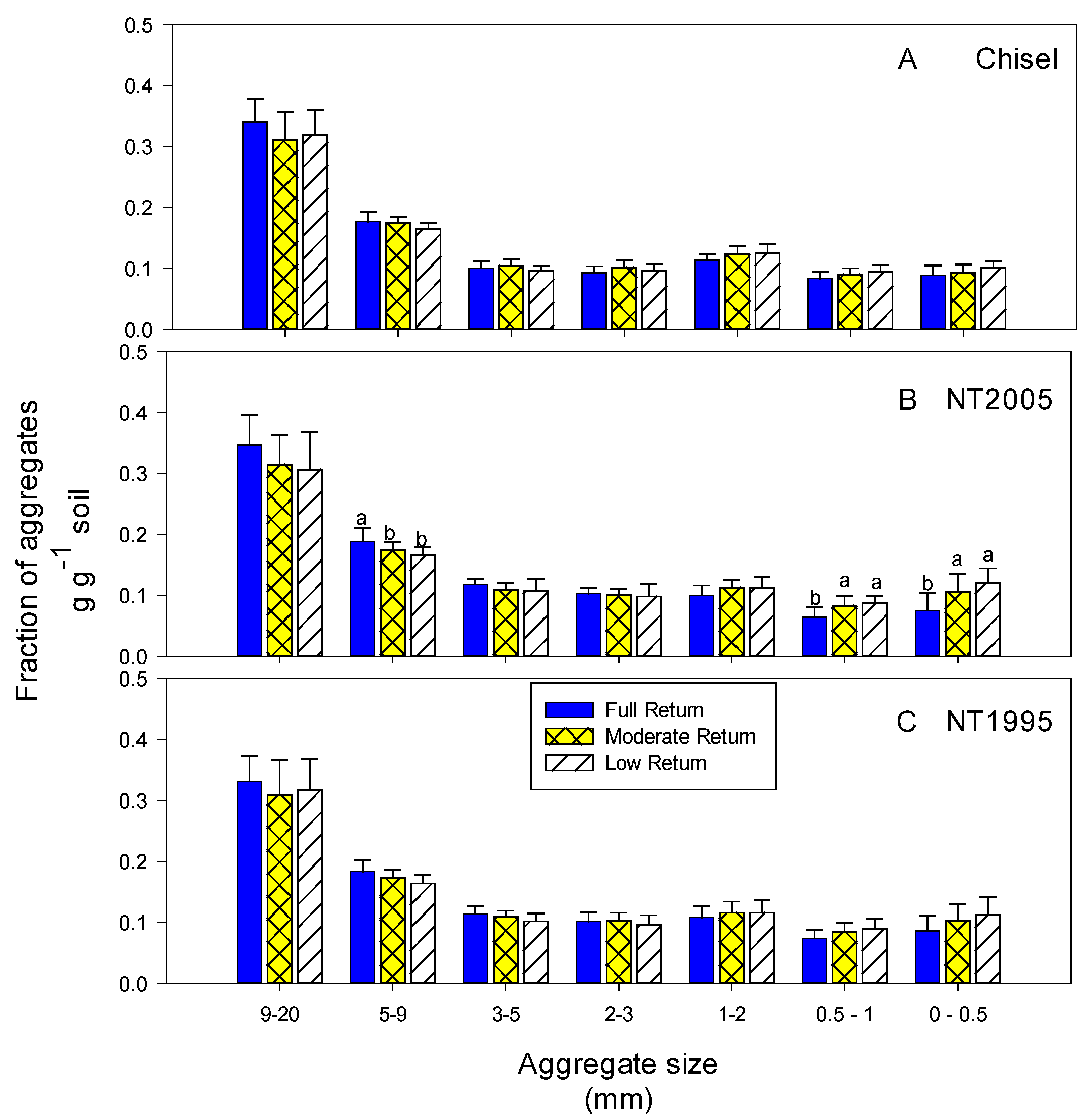
        <p>Both the percentage of soil coverage and dry aggregate size distribution revealed potential for increased soil erosion risk if stover were removed. For example, the percentage of soil coverage declined proportionally to rate of residue returned (Full &gt; Moderate &gt; Low Return) (data not shown). Additionally, intensive tillage at the Chisel field showed &lt;20% of the soil covered for all stover treatments, including Full Return, where all residues (stover and soybean stubble) were returned; whereas, NT2005 and NT1995 had at least 45% of the soil covered even in Low Return. In NT2005, significant increases in aggregates &lt;1 mm and significant decreases in aggregates 5–9 mm were measured in Low Return compared to Full Return (<xref ref-type="fig" rid="agriculture-03-00072-f001">Figure 1</xref>). Low Return had 15% and 60% more aggregates in the 0–0.5 and 0.5–1 mm classes, respectively, compared to Full Return, but Full Return had 14% more 5–9 mm aggregates compared to Low Return, with Moderate Return intermediate. In Chisel and NT1995, although means of aggregate distribution displayed a similar trend to the NT2005, no statistically significant increase in the frequency of aggregates &lt;1 mm was detected. </p>
        <fig id="agriculture-03-00072-f001" position="float">
          <label>Figure 1</label>
          <caption>
            <p>Dry aggregate size distribution as affected by stover return rates in (<bold>A</bold>) a chisel plowed field (<bold>B</bold>) a field managed without tillage since 2005 and (<bold>C</bold>) a field managed without tillage since 1995. Bars represent mean with standard error (<italic>n</italic> = 12), which are labeled with different letters when they differ at <italic>P</italic> ≤ 0.05. </p>
          </caption>
          <graphic xmlns:xlink="http://www.w3.org/1999/xlink" xlink:href="agriculture-03-00072-g001.tif"/>
        </fig>
        <p>In all fields, biological parameters such as MBC, MBN, and the activities of acid phosphatase, β-glucosaminidase or β-glucosidase were not altered by stover return rate (<xref ref-type="table" rid="agriculture-03-00072-t005">Table 5</xref>), except for acid phosphatase activity, which was reduced about 20% under Low Return compared to Full Return at the 0–5 cm depth in NT2005. The stover return rate treatments affected FAME profiles only in Chisel. In this field at the 0–5 cm depth, the fungal indicator 16:1ω5c had a greater abundance in Full Return compared to Low Return. At the 5–10 cm depth, the bacterial indicator <italic>i</italic>17:0 and fungal indicator 18:3ω6c had a greater abundance in Low Return compared to Full Return. The PCA plot to evaluate indicators of microbial community structure and function did not separate between Low and Full Return.</p>
        <table-wrap id="agriculture-03-00072-t005" position="float">
          <object-id pub-id-type="pii">agriculture-03-00072-t005_Table 5</object-id>
          <label>Table 5</label>
          <caption>
            <p>Biological parameters as affected by stover return rates in three fields with different tillage management. </p>
          </caption>
          <table>
             <tbody>
              <tr>
                <td align="center" valign="middle"/>
                <td align="center" valign="middle"/>
                <td colspan="2" align="center" valign="middle">Microbial Biomass</td>
                <td colspan="3" align="center" valign="middle">Enzyme Activities</td>
                <td align="center" valign="middle">Bacterial fatty acid</td>
                <td colspan="2" align="center" valign="middle">Fungal fatty acids</td>
              </tr>
              <tr>
                <td rowspan="2" align="center" valign="middle">StoverReturn Rate</td>
                <td align="center" valign="middle">Depth</td>
                <td align="center" valign="middle">C</td>
                <td align="center" valign="middle">N</td>
                <td align="center" valign="middle">Acid Phosphatase</td>
                <td align="center" valign="middle">β-Glucos aminidase</td>
                <td align="center" valign="middle">β-Gluco sidase</td>
                <td align="center" valign="middle"><italic>i</italic>17:0</td>
                <td align="center" valign="middle">16:1ω5c</td>
                <td align="center" valign="middle">18:3ω6c</td>
              </tr>
              <tr style="border-top: solid thin">
                <td align="center" valign="middle" style="border-top: solid thin">cm</td>
                <td colspan="2" align="center" valign="middle" style="border-top: solid thin">mg g<sup>−1</sup> soil</td>
                <td colspan="3" align="center" valign="middle" style="border-top: solid thin">mg PN kg<sup>−1</sup> soil h<sup>−1</sup></td>
                <td colspan="3" align="center" valign="middle" style="border-top: solid thin">Nano-mol g<sup>−1</sup> soil</td>
              </tr>
              <tr>
                <td colspan="10" align="center" valign="middle"><underline>Chisel</underline></td>
              </tr>
              <tr>
                <td align="center" valign="middle">Full</td>
                <td rowspan="2" align="center" valign="middle">0–5</td>
                <td align="center" valign="middle">729</td>
                <td align="center" valign="middle">35.5</td>
                <td align="center" valign="middle">269</td>
                <td align="center" valign="middle">23.3</td>
                <td align="center" valign="middle">138</td>
                <td align="center" valign="middle">0.74</td>
                <td align="center" valign="middle">7.31a<sup>a</sup></td>
                <td align="center" valign="middle">0.86</td>
              </tr>
              <tr>
                <td align="center" valign="middle">Low</td>
                <td align="center" valign="middle">744</td>
                <td align="center" valign="middle">32.0</td>
                <td align="center" valign="middle">289</td>
                <td align="center" valign="middle">23.0</td>
                <td align="center" valign="middle">137</td>
                <td align="center" valign="middle">0.83</td>
                <td align="center" valign="middle">5.97b</td>
                <td align="center" valign="middle">0.84</td>
              </tr>
              <tr>
                <td align="center" valign="middle">Full</td>
                <td rowspan="2" align="center" valign="middle">5–10</td>
                <td align="center" valign="middle">669</td>
                <td align="center" valign="middle">29.7</td>
                <td align="center" valign="middle">293</td>
                <td align="center" valign="middle">21.5</td>
                <td align="center" valign="middle">121</td>
                <td align="center" valign="middle">0.72b</td>
                <td align="center" valign="middle">9.14</td>
                <td align="center" valign="middle">0.83b</td>
              </tr>
              <tr>
                <td align="center" valign="middle">Low</td>
                <td align="center" valign="middle">704</td>
                <td align="center" valign="middle">28.0</td>
                <td align="center" valign="middle">288</td>
                <td align="center" valign="middle">20.5</td>
                <td align="center" valign="middle">131</td>
                <td align="center" valign="middle">0.79a</td>
                <td align="center" valign="middle">7.72</td>
                <td align="center" valign="middle">0.97a</td>
              </tr>
              <tr>
                <td colspan="10" align="center" valign="middle"><underline>NT2005</underline></td>
              </tr>
              <tr>
                <td align="center" valign="middle">Full</td>
                <td rowspan="2" align="center" valign="middle">0–5</td>
                <td align="center" valign="middle">823</td>
                <td align="center" valign="middle">34.0</td>
                <td align="center" valign="middle">464 a</td>
                <td align="center" valign="middle">35.3</td>
                <td align="center" valign="middle">178</td>
                <td align="center" valign="middle">0.84</td>
                <td align="center" valign="middle">7.54</td>
                <td align="center" valign="middle">1.22</td>
              </tr>
              <tr>
                <td align="center" valign="middle">Low</td>
                <td align="center" valign="middle">804</td>
                <td align="center" valign="middle">33.8</td>
                <td align="center" valign="middle">366 b</td>
                <td align="center" valign="middle">31.9</td>
                <td align="center" valign="middle">180</td>
                <td align="center" valign="middle">1.00</td>
                <td align="center" valign="middle">7.55</td>
                <td align="center" valign="middle">1.22</td>
              </tr>
              <tr>
                <td align="center" valign="middle">Full</td>
                <td rowspan="2" align="center" valign="middle">5–10</td>
                <td align="center" valign="middle">705</td>
                <td align="center" valign="middle">23.7</td>
                <td align="center" valign="middle">313</td>
                <td align="center" valign="middle">23.3</td>
                <td align="center" valign="middle">129</td>
                <td align="center" valign="middle">0.92</td>
                <td align="center" valign="middle">9.41</td>
                <td align="center" valign="middle">1.16</td>
              </tr>
              <tr>
                <td align="center" valign="middle">Low</td>
                <td align="center" valign="middle">788</td>
                <td align="center" valign="middle">27.0</td>
                <td align="center" valign="middle">312</td>
                <td align="center" valign="middle">23.5</td>
                <td align="center" valign="middle">133</td>
                <td align="center" valign="middle">0.85</td>
                <td align="center" valign="middle">10.11</td>
                <td align="center" valign="middle">1.15</td>
              </tr>
              <tr>
                <td colspan="10" align="center" valign="middle"><underline>NT1995</underline></td>
              </tr>
              <tr>
                <td align="center" valign="middle">Full</td>
                <td rowspan="2" align="center" valign="middle">0–5</td>
                <td align="center" valign="middle">1010</td>
                <td align="center" valign="middle">55.0</td>
                <td align="center" valign="middle">405</td>
                <td align="center" valign="middle">44.5</td>
                <td align="center" valign="middle">258</td>
                <td align="center" valign="middle">0.56</td>
                <td align="center" valign="middle">7.50</td>
                <td align="center" valign="middle">0.75</td>
              </tr>
              <tr>
                <td align="center" valign="middle">Low</td>
                <td align="center" valign="middle">937</td>
                <td align="center" valign="middle">41.6</td>
                <td align="center" valign="middle">388</td>
                <td align="center" valign="middle">37.8</td>
                <td align="center" valign="middle">222</td>
                <td align="center" valign="middle">0.64</td>
                <td align="center" valign="middle">6.76</td>
                <td align="center" valign="middle">0.70</td>
              </tr>
              <tr>
                <td align="center" valign="middle">Full</td>
                <td rowspan="2" align="center" valign="middle">5–10</td>
                <td align="center" valign="middle">809</td>
                <td align="center" valign="middle">27.0</td>
                <td align="center" valign="middle">241</td>
                <td align="center" valign="middle">19.6</td>
                <td align="center" valign="middle">118</td>
                <td align="center" valign="middle">0.74</td>
                <td align="center" valign="middle">12.8</td>
                <td align="center" valign="middle">1.11</td>
              </tr>
              <tr>
                <td align="center" valign="middle">Low</td>
                <td align="center" valign="middle">774</td>
                <td align="center" valign="middle">21.5</td>
                <td align="center" valign="middle">244</td>
                <td align="center" valign="middle">16.9</td>
                <td align="center" valign="middle">103</td>
                <td align="center" valign="middle">0.81</td>
                <td align="center" valign="middle">9.45</td>
                <td align="center" valign="middle">1.11</td>
              </tr>
            </tbody>
          </table>
          <table-wrap-foot>
          <fn>
           <p><sup>a</sup> The absence of letters within a tillage experiment and depth indicates there were no significant differences detected <italic>P</italic> ≤ 0.05.</p>
          </fn>
          </table-wrap-foot>
        </table-wrap>
       
      </sec>
    </sec>
    <sec sec-type="discussion">
      <title>4. Discussion</title>
      <sec>
        <title>4.1. Return Rates and Crop Production</title>
        <p>This study showed that corn grain and stover yields were not impacted on any field as a result of stover harvest. These crop responses contrast the dramatic corn and soybean yield reductions observed for dry land corn in Nebraska [<xref ref-type="bibr" rid="B54-agriculture-03-00072">54</xref>]. However, corn yield was not reduced in South Dakota [<xref ref-type="bibr" rid="B18-agriculture-03-00072">18</xref>], Iowa [<xref ref-type="bibr" rid="B7-agriculture-03-00072">7</xref>] nor in Minnesota even after 29 years of silage harvest [<xref ref-type="bibr" rid="B55-agriculture-03-00072">55</xref>]. The dramatic short-term responses in Nebraska were attributed to reduced water availability and increased soil temperatures. The lack of short-term response in our current studies suggests stover treatments did not result in yield-reducing changes in the microclimate. This observation is encouraging from both a bioenergy and agronomic perspective because, at least in the short-term, yields were not compromised by reducing corn stover returned.</p>
        <p>Our studies may suggest yield response to corn stover return rates may depend upon tillage. For example, in the field under longer term no-till management (NT1995), a small impact on soybean grain yield was observed when an average of 1.6 Mg ha<sup>−1</sup> yr<sup>−1</sup> stover was returned. Karlen <italic>et al.</italic> [<xref ref-type="bibr" rid="B7-agriculture-03-00072">7</xref>], reported decreases in soybean yield following stover harvest that was attributed to K deficiency. The K removed in the harvested stover was sufficient to decrease yield [<xref ref-type="bibr" rid="B7-agriculture-03-00072">7</xref>]. While it is possible K availability is contributing to the soybean response in NT1995, it is unlikely as K was added annually since 2009. However, the slight decline in soybean grain yield occurred in NT1995, which also had a decline in POM. This suggests that tillage management may be an important factor for maintaining productivity in biofuel cropping systems. Although, it may be speculative at this time, it warrants reassessing POM and other soil quality parameters in the future on these fields. </p>
      </sec>
      <sec>
        <title>4.2. Soil Parameters</title>
        <p>It was anticipated that returning less stover would reduce the percentage of soil covered and thus, soil erodibility potential. Implementing stover return rate treatments with a forage harvester or a one-pass combine provided sufficient coverage against early growing-season erosive forces in NT1995 and NT2005, but in the Chisel even Full Return failed to provide at least 30% soil coverage. The other parameter used to assess soil erosion risk was dry aggregate size distribution. The increased fraction of aggregates &lt;1 mm under Low Return indicates that stover removal reduces aggregate size and stability. A similar shift, in dry aggregate size distribution toward fewer large aggregates and more small aggregates and a decline in wet aggregate stability was reported after four stover removal cycles in a corn-soybean rotation [<xref ref-type="bibr" rid="B18-agriculture-03-00072">18</xref>]. Even though the differences were not significant in the Chisel and NT1995 fields, the overall pattern for dry aggregate distribution implies that the fraction of small aggregates may be increasing and larger (more stable) aggregates decreasing. These observations suggest repeated Low Return associated with stover harvest has the potential to slowly decrease soil aggregate stability leaving it more prone to the degrading forces of wind and water. Thus, dry aggregate size distribution and wet aggregate stability should be reassessed after additional treatment cycles to determine the long-term sustainability of the reducing stover return. </p>
        <p>Whole soil POM has been established as an indicator of soil organic matter change [<xref ref-type="bibr" rid="B16-agriculture-03-00072">16</xref>,<xref ref-type="bibr" rid="B35-agriculture-03-00072">35</xref>,<xref ref-type="bibr" rid="B40-agriculture-03-00072">40</xref>]. Soil organic matter was predicted to decline if stover return rate provided insufficient raw inputs [<xref ref-type="bibr" rid="B5-agriculture-03-00072">5</xref>,<xref ref-type="bibr" rid="B56-agriculture-03-00072">56</xref>,<xref ref-type="bibr" rid="B57-agriculture-03-00072">57</xref>]. In NT1995 after two treatment cycles, decreased total POM concentration in the 0–5 cm depth increment suggested insufficient residue was provided at Low Return to sustain soil organic matter over time. Similar decreases in POM were also reported after four stover removal cycles in another corn-soybean rotation [<xref ref-type="bibr" rid="B18-agriculture-03-00072">18</xref>]. Total residue (including soybean straw) returned in the Low Return for all fields was ≤3.0 Mg residue ha yr<sup>−1</sup>. In a South Dakota corn-soybean rotation, 3.6 Mg residue ha<sup>−1</sup> yr<sup>−1</sup> was needed to maintain soil organic C [<xref ref-type="bibr" rid="B58-agriculture-03-00072">58</xref>]. Our findings are consistent in that more stover needs to be returned during the corn phase to compensate for the lack of residue during the soybean phase. Furthermore, Huggins <italic>et al.</italic> [<xref ref-type="bibr" rid="B59-agriculture-03-00072">59</xref>] found that about twice the amount of soybean derived C compared to corn derived C was needed to maintain soil organic C because soybean in the rotation accelerated the turnover of soil organic matter. </p>
        <p>The clay loam soils in these studies had relatively high soil organic carbon, POM, and microbial communities compared to semiarid sandy soils [<xref ref-type="bibr" rid="B60-agriculture-03-00072">60</xref>], which may have prevented changes in microbial biomass, community structure or enzyme activities from being detectable. In contrast, decreases in MBC and MBN in response to annual residue harvest on a sandy loam soil were detected in as few as two years by Kashwaha <italic>et al.</italic> [<xref ref-type="bibr" rid="B19-agriculture-03-00072">19</xref>]. Stetson <italic>et al.</italic> [<xref ref-type="bibr" rid="B61-agriculture-03-00072">61</xref>] reported mixed results to stover harvest in a corn/soybean rotation as changes in labile C pools or glomalin—a soil protein related to mycorrhizal populations—were not detected while total microbial activity measured by fluoresceine diacetate was reduced. Perhaps our study shows the benefits of a system where the plant biomass is removed every other year for biofuel production rather than intensively removing it every year. Additionally, although these fields with different tillage managements were not statistically compared, the higher fungal indicator 16:1ω5c (an arbuscular mycorrhizal indicator) in Full Return compared to Low Return in the Chisel field may suggest more residue is needed in tilled fields to encourage soil conditions conducive to maintaining mycorrhizal populations. As changes in other microbial FAMEs were not detected, long-term impacts of residue return rates on the soil microbial community remain to be determined. </p>
      </sec>
    </sec>
    <sec sec-type="conclusions">
      <title>5. Conclusions</title>
      <p>This study showed little evidence for short-term impacts on crop yield and soil properties from three or fewer cycles of low stover return, which mimicked harvesting corn stover as a bioenergy feedstock within the Northern US Corn Belt. Our data does not suggest immediate negative impacts of biomass removal as few differences were found in crop yields, however, long-term studies are warranted to monitor changes that often take longer to be detected in soils (<italic>i.e.</italic>, organic matter content). Declining POM concentration in NT1995 suggests soil organic matter gains previously achieved by continuous no till management may be lost if too little stover is repeatedly returned. The shift in dry aggregate size distribution toward smaller aggregates with Low Return is consistent with a loss of soil structure and the potential for soil degradation. Likewise, shifts in biological parameters also suggest insufficient returns may cause undesirable shifts in the microbial community. Our early trends need to be confirmed with continued monitoring, so that yield potentials are achieved and the soil resource is safeguarded as society seeks to meet multiple demands from agricultural commodities including bioenergy feedstock.</p>
    </sec>
   
  </body>
  <back>
   <ack>
      <title>Acknowledgments</title>
      <p>Authors thank the following: reviewers for insightful suggestions; Beth Burmeister for carefully proof-reading but take full responsibility for any errors; and Jon Cotton, Jay Hanson, Charles Hennen, Brooke Knicke, Scott Larson, Jodi Ochmacht and Chad Rollofson for their technical assistance in maintaining the plots, sample and chemical analysis collection; and Stuart Birrell, Iowa State University for use of the one-pass prototype combine.</p>
      <p>Funding for this project provide by the USDA-Agricultural Research funding, as part of the USDA-ARS-REAP project. Additional funding the North Central Regional SunGrant Center at South Dakota State University through a grant provided by the USDOE—Office of Biomass Programs under award number DE-FC36-05GO85041 and provided by customers of Xcel Energy through a grant from the Renewable Development Fund. </p>
    </ack>
    <notes>
      <title>Conflict of Interest</title>
      <p>The use of trade, firm, or corporation names in this publication is for the information and convenience of the reader. Such use does not constitute an official endorsement or approval by the United States Department of Agriculture or the Agricultural Research Service of any product or service to the exclusion of others that may be suitable. USDA-ARS is an equal opportunity provider and employer.</p>
      <p>Legal Notice: This report was prepared as a result of work sponsored by funding from the customer-supported Xcel Energy Renewable Development Fund administered by NSP. It does not necessarily represent the views of NSP, its employees, and/or the Renewable Development Board. NSP, its employees, contractors, and subcontractors make no warranty, express or implied, and assume no legal liability for the information in this report; nor does any party represent that that use of this information will not infringe upon privately owned rights. This report has not been approved or disapproved by NSP nor has NSP passed upon the accuracy or adequacy of the information in this report.</p>
    </notes>
    <ref-list>
      <title>References</title>
      <ref id="B1-agriculture-03-00072">
        <label>1.</label>
        <citation citation-type="web">
          <article-title>USDA National Agriculture Statistics Service</article-title>
          
          <comment>Available online:<ext-link xmlns:xlink="http://www.w3.org/1999/xlink" xlink:href="http://quickstats.nass.usda.gov/" ext-link-type="uri">http://quickstats.nass.usda.gov/</ext-link></comment>
		  <access-date>(accessed on 18 December 2012)</access-date>
        </citation>
      </ref>
      <ref id="B2-agriculture-03-00072">
        <label>2.</label>
        <citation citation-type="web">
          <article-title>US DOE U.S. Billion-ton update: Biomass supply for a bioenergy and bioproducts industry. R.D. Perlack and b.J. Stokes (leads), ornl/tm-2011/224</article-title>
          
          <comment>Available online:<ext-link xmlns:xlink="http://www.w3.org/1999/xlink" xlink:href="http://www1.eere.energy.gov/biomass/pdfs/billion_ton_update.pdf" ext-link-type="uri">http://www1.eere.energy.gov/biomass/pdfs/billion_ton_update.pdf</ext-link></comment>
		  <access-date>(accessed on 9 August 2012)</access-date>
        </citation>
      </ref>
      <ref id="B3-agriculture-03-00072">
        <label>3.</label>
        <citation citation-type="web">
          <person-group person-group-type="author">
            <name>
              <surname>Perlack</surname>
              <given-names>R.D.</given-names>
            </name>
            <name>
              <surname>Wright</surname>
              <given-names>L.L.</given-names>
            </name>
            <name>
              <surname>Turhollow</surname>
              <given-names>A.</given-names>
            </name>
            <name>
              <surname>Graham</surname>
              <given-names>R.L.</given-names>
            </name>
            <name>
              <surname>Stokes</surname>
              <given-names>B.</given-names>
            </name>
            <name>
              <surname>Erbach</surname>
              <given-names>D.C.</given-names>
            </name>
          </person-group>
          <article-title>Biomass as feedstock for a bioenergy and bioproducts industry: The technical feasibility of a billion-ton annual supply</article-title>
          
          <comment>Available online:<ext-link xmlns:xlink="http://www.w3.org/1999/xlink" xlink:href="http://www.eere.energy.gov/biomass/pdfs/final_billionton_vision_report2.pdf" ext-link-type="uri">http://www.eere.energy.gov/biomass/pdfs/final_billionton_vision_report2.pdf</ext-link></comment>
		  <access-date>(accessed on 6 August 2012)</access-date>
        </citation>
      </ref>
      <ref id="B4-agriculture-03-00072">
        <label>4.</label>
        <citation citation-type="web">
          <article-title>BRDB Increasing feedstock production for biofuels: Economic drivers, environmental implications, and the role of research</article-title>
          
          <comment>Available online:<ext-link xmlns:xlink="http://www.w3.org/1999/xlink" xlink:href="http://www.usbiomassboard.gov/pdfs/increasing_feedstock_revised.pdf" ext-link-type="uri">http://www.usbiomassboard.gov/pdfs/increasing_feedstock_revised.pdf</ext-link></comment>
		  <access-date>(accessed on 6 August 2012)</access-date>
        </citation>
      </ref>
      <ref id="B5-agriculture-03-00072">
        <label>5.</label>
        <citation citation-type="book">
          <person-group person-group-type="author">
            <name>
              <surname>Johnson</surname>
              <given-names>J.M.F.</given-names>
            </name>
            <name>
              <surname>Papiernik</surname>
              <given-names>S.K.</given-names>
            </name>
            <name>
              <surname>Mikha</surname>
              <given-names>M.M.</given-names>
            </name>
            <name>
              <surname>Spokas</surname>
              <given-names>K.A.</given-names>
            </name>
            <name>
              <surname>Tomer</surname>
              <given-names>M.D.</given-names>
            </name>
            <name>
              <surname>Weyers</surname>
              <given-names>S.L.</given-names>
            </name>
          </person-group>
          <article-title>Soil processes and residue harvest management</article-title>
          <source>Carbon Management, Fuels, and Soil Quality</source>
          <person-group person-group-type="editor">
            <name>
              <surname>Lal</surname>
              <given-names>R.</given-names>
            </name>
            <name>
              <surname>Stewart</surname>
              <given-names>B.A.</given-names>
            </name>
          </person-group>
          <publisher-name>Taylor and Francis, LLC</publisher-name>
          <publisher-loc>New York, NY, USA</publisher-loc>
          <year>2010</year>
          <fpage>1</fpage>
          <lpage>44</lpage>
        </citation>
      </ref>
      <ref id="B6-agriculture-03-00072">
        <label>6.</label>
        <citation citation-type="journal">
          <person-group person-group-type="author">
            <name>
              <surname>Wilhelm</surname>
              <given-names>W.W.</given-names>
            </name>
            <name>
              <surname>Johnson</surname>
              <given-names>J.M.F.</given-names>
            </name>
            <name>
              <surname>Hatfield</surname>
              <given-names>J.L.</given-names>
            </name>
            <name>
              <surname>Voorhees</surname>
              <given-names>W.B.</given-names>
            </name>
            <name>
              <surname>Linden</surname>
              <given-names>D.R.</given-names>
            </name>
          </person-group>
          <article-title>Crop and soil productivity response to corn residue removal: A literature review</article-title>
          <source>Agron. J.</source>
          <year>2004</year>
          <volume>96</volume>
          <fpage>1</fpage>
          <lpage>17</lpage>
          <pub-id pub-id-type="doi">10.2134/agronj2004.0001</pub-id>
        </citation>
      </ref>
      <ref id="B7-agriculture-03-00072">
        <label>7.</label>
        <citation citation-type="journal">
          <person-group person-group-type="author">
            <name>
              <surname>Karlen</surname>
              <given-names>D.L.</given-names>
            </name>
            <name>
              <surname>Birell</surname>
              <given-names>S.J.</given-names>
            </name>
            <name>
              <surname>Hess</surname>
              <given-names>J.R.</given-names>
            </name>
          </person-group>
          <article-title>A five-year assessment of corn stover harvest in central iowa, USA</article-title>
          <source>Soil Tillage Res.</source>
          <year>2011</year>
          <volume>115–116</volume>
          <fpage>47</fpage>
          <lpage>55</lpage>
          <pub-id pub-id-type="doi">10.1016/j.still.2011.06.006</pub-id>
        </citation>
      </ref>
      <ref id="B8-agriculture-03-00072">
        <label>8.</label>
        <citation citation-type="journal">
          <person-group person-group-type="author">
            <name>
              <surname>Lindstrom</surname>
              <given-names>M.J.</given-names>
            </name>
          </person-group>
          <article-title>Effects of residue harvesting on water runoff, soil erosion and nutrient loss</article-title>
          <source>Agric. Ecosyst. Environ.</source>
          <year>1986</year>
          <volume>16</volume>
          <fpage>103</fpage>
          <lpage>112</lpage>
          <pub-id pub-id-type="doi">10.1016/0167-8809(86)90097-6</pub-id>
        </citation>
      </ref>
      <ref id="B9-agriculture-03-00072">
        <label>9.</label>
        <citation citation-type="book">
          <person-group person-group-type="author">
            <name>
              <surname>Skidmore</surname>
              <given-names>E.L.</given-names>
            </name>
            <name>
              <surname>Siddoway</surname>
              <given-names>F.H.</given-names>
            </name>
          </person-group>
          <article-title>Crop residue requirements to control wind erosion</article-title>
          <source>Crop Residue Management Systems; Asa Special Publication Number 31</source>
          <person-group person-group-type="editor">
            <name>
              <surname>Oschwald</surname>
              <given-names>W.R.</given-names>
            </name>
            <name>
              <surname>Stelly</surname>
              <given-names>M.</given-names>
            </name>
            <name>
              <surname>Kral</surname>
              <given-names>D.M.</given-names>
            </name>
            <name>
              <surname>Nauseef</surname>
              <given-names>J.H.</given-names>
            </name>
          </person-group>
          <publisher-name>ASA, CSSA, and SSSA</publisher-name>
          <publisher-loc>Madison, WI, USA</publisher-loc>
          <year>1978</year>
          <fpage>17</fpage>
          <lpage>33</lpage>
        </citation>
      </ref>
      <ref id="B10-agriculture-03-00072">
        <label>10.</label>
        <citation citation-type="journal">
          <person-group person-group-type="author">
            <name>
              <surname>Wilhelm</surname>
              <given-names>W.W.</given-names>
            </name>
            <name>
              <surname>Hess</surname>
              <given-names>J.R.</given-names>
            </name>
            <name>
              <surname>Karlen</surname>
              <given-names>D.L.</given-names>
            </name>
            <name>
              <surname>Johnson</surname>
              <given-names>J.M.F.</given-names>
            </name>
            <name>
              <surname>Muth</surname>
              <given-names>D.J.</given-names>
            </name>
            <name>
              <surname>Baker</surname>
              <given-names>J.M.</given-names>
            </name>
            <name>
              <surname>Gollany</surname>
              <given-names>H.T.</given-names>
            </name>
            <name>
              <surname>Novak</surname>
              <given-names>J.M.</given-names>
            </name>
            <name>
              <surname>Stott</surname>
              <given-names>D.E.</given-names>
            </name>
            <name>
              <surname>Varvel</surname>
              <given-names>G.E.</given-names>
            </name>
          </person-group>
          <article-title>Review: Balancing limiting factors and economic drivers for sustainable midwestern us agricultural residue feedstock supplies</article-title>
          <source>Ind. Biotechnol.</source>
          <year>2010</year>
          <volume>6</volume>
          <fpage>271</fpage>
          <lpage>287</lpage>
        <pub-id pub-id-type="doi">10.1089/ind.2010.6.271</pub-id></citation>
      </ref>
      <ref id="B11-agriculture-03-00072">
        <label>11.</label>
        <citation citation-type="journal">
          <person-group person-group-type="author">
            <name>
              <surname>Merrill</surname>
              <given-names>S.D.</given-names>
            </name>
            <name>
              <surname>Black</surname>
              <given-names>A.L.</given-names>
            </name>
            <name>
              <surname>Fryrear</surname>
              <given-names>D.W.</given-names>
            </name>
            <name>
              <surname>Saleh</surname>
              <given-names>A.</given-names>
            </name>
            <name>
              <surname>Zobeck</surname>
              <given-names>T.M.</given-names>
            </name>
            <name>
              <surname>Halvorson</surname>
              <given-names>A.D.</given-names>
            </name>
            <name>
              <surname>Tanaka</surname>
              <given-names>D.L.</given-names>
            </name>
          </person-group>
          <article-title>Soil wind erosion hazard of spring wheat-fallow as affected by long-term climate and tillage</article-title>
          <source>Soil Sci. Soc. Am. J.</source>
          <year>1999</year>
          <volume>63</volume>
          <fpage>1768</fpage>
          <lpage>1777</lpage>
        <pub-id pub-id-type="doi">10.2136/sssaj1999.6361768x</pub-id></citation>
      </ref>
      <ref id="B12-agriculture-03-00072">
        <label>12.</label>
        <citation citation-type="journal">
          <person-group person-group-type="author">
            <name>
              <surname>Chepil</surname>
              <given-names>W.S.</given-names>
            </name>
          </person-group>
          <article-title>Properties of soil which influence wind erosion: 11. Dry aggregate structure as an index of erodibility</article-title>
          <source>Soil Sci.</source>
          <year>1950</year>
          <volume>69</volume>
          <fpage>403</fpage>
          <lpage>414</lpage>
          <pub-id pub-id-type="doi">10.1097/00010694-195005000-00006</pub-id>
        </citation>
      </ref>
      <ref id="B13-agriculture-03-00072">
        <label>13.</label>
        <citation citation-type="journal">
          <person-group person-group-type="author">
            <name>
              <surname>Wilhelm</surname>
              <given-names>W.W.</given-names>
            </name>
            <name>
              <surname>Johnson</surname>
              <given-names>J.M.F.</given-names>
            </name>
            <name>
              <surname>Karlen</surname>
              <given-names>D.L.</given-names>
            </name>
            <name>
              <surname>Lightle</surname>
              <given-names>D.T.</given-names>
            </name>
          </person-group>
          <article-title>Corn stover to sustain soil organic carbon further constrains biomass supply</article-title>
          <source>Agron. J.</source>
          <year>2007</year>
          <volume>99</volume>
          <fpage>1665</fpage>
          <lpage>1667</lpage>
        <pub-id pub-id-type="doi">10.2134/agronj2007.0150</pub-id></citation>
      </ref>
      <ref id="B14-agriculture-03-00072">
        <label>14.</label>
        <citation citation-type="journal">
          <person-group person-group-type="author">
            <name>
              <surname>Schrumpf</surname>
              <given-names>M.</given-names>
            </name>
            <name>
              <surname>Schulze</surname>
              <given-names>E.D.</given-names>
            </name>
            <name>
              <surname>Kaiser</surname>
              <given-names>K.</given-names>
            </name>
            <name>
              <surname>Schumacher</surname>
              <given-names>J.</given-names>
            </name>
          </person-group>
          <article-title>How accurately can soil organic carbon stocks and stock changes be quantified by soil inventories?</article-title>
          <source>Biogeosci. Discuss.</source>
          <year>2011</year>
          <volume>8</volume>
          <fpage>723</fpage>
          <lpage>769</lpage>
          <pub-id pub-id-type="doi">10.5194/bgd-8-723-2011</pub-id>
        </citation>
      </ref>
      <ref id="B15-agriculture-03-00072">
        <label>15.</label>
        <citation citation-type="journal">
          <person-group person-group-type="author">
            <name>
              <surname>VandenBygaart</surname>
              <given-names>A.J.</given-names>
            </name>
            <name>
              <surname>Bremer</surname>
              <given-names>E.</given-names>
            </name>
            <name>
              <surname>McConkey</surname>
              <given-names>B.G.</given-names>
            </name>
            <name>
              <surname>Ellert</surname>
              <given-names>B.H.</given-names>
            </name>
            <name>
              <surname>Janzen</surname>
              <given-names>H.H.</given-names>
            </name>
            <name>
              <surname>Angers</surname>
              <given-names>D.A.</given-names>
            </name>
            <name>
              <surname>Carter</surname>
              <given-names>M.R.</given-names>
            </name>
            <name>
              <surname>Drury</surname>
              <given-names>C.F.</given-names>
            </name>
            <name>
              <surname>Lafond</surname>
              <given-names>G.P.</given-names>
            </name>
            <name>
              <surname>McKenzie</surname>
              <given-names>R.H.</given-names>
            </name>
          </person-group>
          <article-title>Impact of sampling depth on differences in soil carbon stocks in long-term agroecosystem experiments</article-title>
          <source>Soil Sci. Soc. Am. J.</source>
          <year>2011</year>
          <volume>75</volume>
          <fpage>226</fpage>
          <lpage>234</lpage>
          <pub-id pub-id-type="doi">10.2136/sssaj2010.0099</pub-id>
        </citation>
      </ref>
      <ref id="B16-agriculture-03-00072">
        <label>16.</label>
        <citation citation-type="journal">
          <person-group person-group-type="author">
            <name>
              <surname>Cambardella</surname>
              <given-names>C.A.</given-names>
            </name>
            <name>
              <surname>Elliot</surname>
              <given-names>E.T.</given-names>
            </name>
          </person-group>
          <article-title>Particulate soil organic matter changes across a grassland cultivation sequence</article-title>
          <source>Soil Sci. Soc. Am. J.</source>
          <year>1992</year>
          <volume>56</volume>
          <fpage>777</fpage>
          <lpage>783</lpage>
          <pub-id pub-id-type="doi">10.2136/sssaj1992.03615995005600030017x</pub-id>
        </citation>
      </ref>
      <ref id="B17-agriculture-03-00072">
        <label>17.</label>
        <citation citation-type="book">
          <person-group person-group-type="author">
            <name>
              <surname>Cambardella</surname>
              <given-names>C.A.</given-names>
            </name>
            <name>
              <surname>Gajda</surname>
              <given-names>A.M.</given-names>
            </name>
            <name>
              <surname>Doran</surname>
              <given-names>J.W.</given-names>
            </name>
            <name>
              <surname>Wienhold</surname>
              <given-names>B.J.</given-names>
            </name>
            <name>
              <surname>Kettler</surname>
              <given-names>T.A.</given-names>
            </name>
          </person-group>
          <article-title>Estimation of particulate and total organic matter by weight loss-on-ignition</article-title>
          <source>Assessment Methods for Soil Carbon</source>
          <person-group person-group-type="editor">
            <name>
              <surname>Lal</surname>
              <given-names>R.</given-names>
            </name>
            <name>
              <surname>Kimball</surname>
              <given-names>J.M.</given-names>
            </name>
            <name>
              <surname>Follet</surname>
              <given-names>R.F.</given-names>
            </name>
            <name>
              <surname>Stewart</surname>
              <given-names>B.A.</given-names>
            </name>
          </person-group>
          <publisher-name>Lewis Publishers</publisher-name>
          <publisher-loc>Boca Raton, FL, USA</publisher-loc>
          <year>2001</year>
          <fpage>349</fpage>
          <lpage>359</lpage>
        </citation>
      </ref>
      <ref id="B18-agriculture-03-00072">
        <label>18.</label>
        <citation citation-type="journal">
          <person-group person-group-type="author">
            <name>
              <surname>Hammerbeck</surname>
              <given-names>A.L.</given-names>
            </name>
            <name>
              <surname>Stetson</surname>
              <given-names>S.J.</given-names>
            </name>
            <name>
              <surname>Osborne</surname>
              <given-names>S.L.</given-names>
            </name>
            <name>
              <surname>Schumacher</surname>
              <given-names>T.E.</given-names>
            </name>
            <name>
              <surname>Pikul</surname>
              <given-names>J.L.</given-names>
              <suffix>Jr.</suffix>
            </name>
          </person-group>
          <article-title>Corn residue removal impact on soil aggregates in a no-till corn/soybean rotation</article-title>
          <source>Soil Sci. Soc. Am. J.</source>
          <year>2012</year>
          <volume>4</volume>
          <fpage>1390</fpage>
          <lpage>1398</lpage>
        </citation>
      </ref>
      <ref id="B19-agriculture-03-00072">
        <label>19.</label>
        <citation citation-type="journal">
          <person-group person-group-type="author">
            <name>
              <surname>Kushwaha</surname>
              <given-names>C.P.</given-names>
            </name>
            <name>
              <surname>Tripathi</surname>
              <given-names>S.K.</given-names>
            </name>
            <name>
              <surname>Singh</surname>
              <given-names>K.P.</given-names>
            </name>
          </person-group>
          <article-title>Variations in soil microbial biomass and n availability due to residue and tillage management in a dryland rice agroecosystem</article-title>
          <source>Soil Tillage Res.</source>
          <year>2000</year>
          <volume>56</volume>
          <fpage>153</fpage>
          <lpage>166</lpage>
          <pub-id pub-id-type="doi">10.1016/S0167-1987(00)00135-5</pub-id>
        </citation>
      </ref>
      <ref id="B20-agriculture-03-00072">
        <label>20.</label>
        <citation citation-type="journal">
          <person-group person-group-type="author">
            <name>
              <surname>Karlen</surname>
              <given-names>D.L.</given-names>
            </name>
            <name>
              <surname>Wollenhaupt</surname>
              <given-names>N.C.</given-names>
            </name>
            <name>
              <surname>Erbach</surname>
              <given-names>D.C.</given-names>
            </name>
            <name>
              <surname>Berry</surname>
              <given-names>E.C.</given-names>
            </name>
            <name>
              <surname>Swan</surname>
              <given-names>J.B.</given-names>
            </name>
            <name>
              <surname>Eash</surname>
              <given-names>N.S.</given-names>
            </name>
            <name>
              <surname>Jordahl</surname>
              <given-names>J.L.</given-names>
            </name>
          </person-group>
          <article-title>Crop residue effects on soil quality following 10-years of no-till corn</article-title>
          <source>Soil Tillage Res.</source>
          <year>1994</year>
          <volume>31</volume>
          <fpage>149</fpage>
          <lpage>167</lpage>
          <pub-id pub-id-type="doi">10.1016/0167-1987(94)90077-9</pub-id>
        </citation>
      </ref>
      <ref id="B21-agriculture-03-00072">
        <label>21.</label>
        <citation citation-type="web">
          <article-title>CTIC National crop residue management survey conservation tillage data, 2002</article-title>
          
          <comment>Available online:<ext-link xmlns:xlink="http://www.w3.org/1999/xlink" xlink:href="http://www2.ctic.purdue.edu/CTIC/CRM.html" ext-link-type="uri">http://www2.ctic.purdue.edu/CTIC/CRM.html</ext-link></comment>
		  <access-date>(accessed on 6 August 2012)</access-date>
        </citation>
      </ref>
      <ref id="B22-agriculture-03-00072">
        <label>22.</label>
        <citation citation-type="journal">
          <person-group person-group-type="author">
            <name>
              <surname>West</surname>
              <given-names>T.O.</given-names>
            </name>
            <name>
              <surname>Marland</surname>
              <given-names>G.</given-names>
            </name>
            <name>
              <surname>King</surname>
              <given-names>A.W.</given-names>
            </name>
            <name>
              <surname>Post</surname>
              <given-names>W.M.</given-names>
            </name>
            <name>
              <surname>Jain</surname>
              <given-names>A.K.</given-names>
            </name>
            <name>
              <surname>Andrasko</surname>
              <given-names>K.</given-names>
            </name>
          </person-group>
          <article-title>Carbon management response curves: Estimates of temporal soil carbon dynamics</article-title>
          <source>Environ. Manag.</source>
          <year>2004</year>
          <volume>33</volume>
          <fpage>507</fpage>
          <lpage>518</lpage>
        </citation>
      </ref>
      <ref id="B23-agriculture-03-00072">
        <label>23.</label>
        <citation citation-type="gov">
        <collab>NOAA-NCDC</collab>
           
          <source>Climatography of the United States No. 81: 21 Minnesota</source>
          <publisher-name>U.S. Department of Commerce National Oceanic and Atmospheric Administration, National Climatic Data Center</publisher-name>
          <publisher-loc>Asheville, NC, USA</publisher-loc>
          <year>2002</year>
        </citation>
      </ref>
      <ref id="B24-agriculture-03-00072">
        <label>24.</label>
        <citation citation-type="gov">
        <collab>USDA-SCS</collab>
           
          <source>Soil Survey Stevens County, Minnesota</source>
          <publisher-name>U.S. Department of Agriculture Soil Conservation Service</publisher-name>
          <publisher-loc>Washington, DC, USA</publisher-loc>
          <year>1971</year>
        </citation>
      </ref>
      <ref id="B25-agriculture-03-00072">
        <label>25.</label>
        <citation citation-type="web">
          <person-group person-group-type="author">
            <name>
              <surname>Olness</surname>
              <given-names>A.E.</given-names>
            </name>
            <name>
              <surname>Lopez</surname>
              <given-names>D.</given-names>
            </name>
            <name>
              <surname>Archer</surname>
              <given-names>D.W.</given-names>
            </name>
            <name>
              <surname>Cordes</surname>
              <given-names>J.</given-names>
            </name>
            <name>
              <surname>Sweeney</surname>
              <given-names>C.</given-names>
            </name>
            <name>
              <surname>Mattson</surname>
              <given-names>N.</given-names>
            </name>
            <name>
              <surname>Rinke</surname>
              <given-names>J.L.</given-names>
            </name>
            <name>
              <surname>Voorhees</surname>
              <given-names>W.B.</given-names>
            </name>
          </person-group>
          <article-title>The ars nitrogen decision aid</article-title>
          
          <comment>Available online:<ext-link xmlns:xlink="http://www.w3.org/1999/xlink" xlink:href="http://www.ars.usda.gov/services/software/download.htm?softwareid=85" ext-link-type="uri">http://www.ars.usda.gov/services/software/download.htm?softwareid=85</ext-link></comment>
		  <access-date>(accessed on 6 August 2012)</access-date>
        </citation>
      </ref>
      <ref id="B26-agriculture-03-00072">
        <label>26.</label>
        <citation citation-type="journal">
          <person-group person-group-type="author">
            <name>
              <surname>Fehr</surname>
              <given-names>W.R.</given-names>
            </name>
            <name>
              <surname>Caviness</surname>
              <given-names>C.E.</given-names>
            </name>
            <name>
              <surname>Burmood</surname>
              <given-names>D.T.</given-names>
            </name>
            <name>
              <surname>Pennington</surname>
              <given-names>J.S.</given-names>
            </name>
          </person-group>
          <article-title>Stage of development descriptions of soybeans, <italic>glycine max </italic>(l.) merrill</article-title>
          <source>Crop Sci.</source>
          <year>1971</year>
          <volume>11</volume>
          <fpage>929</fpage>
          <lpage>931</lpage>
          <pub-id pub-id-type="doi">10.2135/cropsci1971.0011183X001100060051x</pub-id>
        </citation>
      </ref>
      <ref id="B27-agriculture-03-00072">
        <label>27.</label>
        <citation citation-type="journal">
          <person-group person-group-type="author">
            <name>
              <surname>Donald</surname>
              <given-names>C.M.</given-names>
            </name>
            <name>
              <surname>Hamblin</surname>
              <given-names>J.</given-names>
            </name>
          </person-group>
          <article-title>The biological yield and harvest index of cereals as an agronomic and plant breeding criteria</article-title>
          <source>Adv. Agron.</source>
          <year>1976</year>
          <volume>28</volume>
          <fpage>361</fpage>
          <lpage>405</lpage>
        </citation>
      </ref>
      <ref id="B28-agriculture-03-00072">
        <label>28.</label>
        <citation citation-type="book">
          <person-group person-group-type="author">
            <name>
              <surname>Liebig</surname>
              <given-names>M.</given-names>
            </name>
            <name>
              <surname>Varvel</surname>
              <given-names>G.</given-names>
            </name>
            <name>
              <surname>Honeycutt</surname>
              <given-names>W.</given-names>
            </name>
          </person-group>
          <article-title>Chapter 1. Guidelines for site description and soil sampling, processing, analysis, and archiving</article-title>
          <source>GRACEnet Sampling Protocols</source>
          <person-group person-group-type="editor">
            <name>
              <surname>Follett</surname>
              <given-names>R.</given-names>
            </name>
          </person-group>
          <publisher-name>USDA-Agricultural Research Service</publisher-name>
          <publisher-loc>Washington, DC, USA</publisher-loc>
          <year>2010</year>
          <fpage>1</fpage>
          <lpage>5</lpage>
        </citation>
      </ref>
      <ref id="B29-agriculture-03-00072">
        <label>29.</label>
        <citation citation-type="book">
          <person-group person-group-type="author">
            <name>
              <surname>Burt</surname>
              <given-names>R.</given-names>
            </name>
          </person-group>
          <source>Nrcs Soil Survey Laboratory Methods Manual Report No. 42, Version 4.0, November 2004</source>
          <publisher-name>USDA-NRCS</publisher-name>
          <publisher-loc>Washington, DC, USA</publisher-loc>
          <year>2004</year>
          <fpage>700</fpage>
        </citation>
      </ref>
      <ref id="B30-agriculture-03-00072">
        <label>30.</label>
        <citation citation-type="journal">
          <person-group person-group-type="author">
            <name>
              <surname>Day</surname>
              <given-names>P.R.</given-names>
            </name>
          </person-group>
          <article-title>Report of the committee on physical analyses, 1954–55</article-title>
          <source>Soil Sci. Soc. Am. J.</source>
          <year>1956</year>
          <volume>20</volume>
          <fpage>167</fpage>
          <lpage>169</lpage>
          <pub-id pub-id-type="doi">10.2136/sssaj1956.03615995002000020007x</pub-id>
        </citation>
      </ref>
      <ref id="B31-agriculture-03-00072">
        <label>31.</label>
        <citation citation-type="book">
          <person-group person-group-type="author">
            <name>
              <surname>Page</surname>
              <given-names>A.L.</given-names>
            </name>
            <name>
              <surname>Miller</surname>
              <given-names>R.H.</given-names>
            </name>
            <name>
              <surname>Keeney</surname>
              <given-names>D.R.</given-names>
            </name>
          </person-group>
          <source>Methods of Soil Analysis, Part 1. Physical and Mineralogical Methods—Agron. Monogr. No. 9</source>
          <edition>2nd</edition>
          <publisher-name>ASA</publisher-name>
          <publisher-loc>Madison, WI, USA</publisher-loc>
          <year>1986</year>
        </citation>
      </ref>
      <ref id="B32-agriculture-03-00072">
        <label>32.</label>
        <citation citation-type="book">
          <person-group person-group-type="author">
            <name>
              <surname>Thomas</surname>
              <given-names>G.W.</given-names>
            </name>
          </person-group>
          <article-title>Soil ph and soil acidity</article-title>
          <source>Methods of Soil Analysis, Part 3 Chemical Methods; SSSA Book Series 5</source>
          <person-group person-group-type="editor">
            <name>
              <surname>Bigham</surname>
              <given-names>J.M.</given-names>
            </name>
            <name>
              <surname>Bartels</surname>
              <given-names>J.M.</given-names>
            </name>
            <name>
              <surname>Sparks</surname>
              <given-names>D.L.</given-names>
            </name>
            <name>
              <surname>Page</surname>
              <given-names>A.L.</given-names>
            </name>
            <name>
              <surname>Helmke</surname>
              <given-names>P.A.</given-names>
            </name>
            <name>
              <surname>Loeppert</surname>
              <given-names>R.H.</given-names>
            </name>
            <name>
              <surname>Soltanpour</surname>
              <given-names>P.N.</given-names>
            </name>
            <name>
              <surname>Tabatabai</surname>
              <given-names>M.A.</given-names>
            </name>
            <name>
              <surname>Johnston</surname>
              <given-names>C.T.</given-names>
            </name>
            <name>
              <surname>Sumner</surname>
              <given-names>M.E.</given-names>
            </name>
          </person-group>
          <publisher-name>SSSA and ASA</publisher-name>
          <publisher-loc>Madison, WI, USA</publisher-loc>
          <year>1996</year>
          <fpage>475</fpage>
          <lpage>490</lpage>
        </citation>
      </ref>
      <ref id="B33-agriculture-03-00072">
        <label>33.</label>
        <citation citation-type="journal">
          <person-group person-group-type="author">
            <name>
              <surname>Wagner</surname>
              <given-names>S.W.</given-names>
            </name>
            <name>
              <surname>Hanson</surname>
              <given-names>J.D.</given-names>
            </name>
            <name>
              <surname>Olness</surname>
              <given-names>A.</given-names>
            </name>
            <name>
              <surname>Voorhees</surname>
              <given-names>W.B.</given-names>
            </name>
          </person-group>
          <article-title>A volumetric inorganic carbon analysis system</article-title>
          <source>Soil Sci. Soc. Am. J.</source>
          <year>1998</year>
          <volume>62</volume>
          <fpage>690</fpage>
          <lpage>693</lpage>
          <pub-id pub-id-type="doi">10.2136/sssaj1998.03615995006200030021x</pub-id>
        </citation>
      </ref>
      <ref id="B34-agriculture-03-00072">
        <label>34.</label>
        <citation citation-type="book">
          <person-group person-group-type="author">
            <name>
              <surname>Bigham</surname>
              <given-names>J.M.</given-names>
            </name>
            <name>
              <surname>Bartels</surname>
              <given-names>J.M.</given-names>
            </name>
            <name>
              <surname>Sparks</surname>
              <given-names>D.L.</given-names>
            </name>
            <name>
              <surname>Page</surname>
              <given-names>A.L.</given-names>
            </name>
            <name>
              <surname>Helmke</surname>
              <given-names>P.A.</given-names>
            </name>
            <name>
              <surname>Loeppert</surname>
              <given-names>R.H.</given-names>
            </name>
            <name>
              <surname>Soltanpour</surname>
              <given-names>P.N.</given-names>
            </name>
            <name>
              <surname>Tabatabai</surname>
              <given-names>M.A.</given-names>
            </name>
            <name>
              <surname>Johnston</surname>
              <given-names>C.T.</given-names>
            </name>
            <name>
              <surname>Sumner</surname>
              <given-names>M.E.</given-names>
            </name>
          </person-group>
          <source>Methods of Soil Analysis. Part 3 Chemical Methods; SSSA Book Series No. 5</source>
          <publisher-name>SSSA and ASA</publisher-name>
          <publisher-loc>Madison, WI, USA</publisher-loc>
          <year>1996</year>
        </citation>
      </ref>
      <ref id="B35-agriculture-03-00072">
        <label>35.</label>
        <citation citation-type="journal">
          <person-group person-group-type="author">
            <name>
              <surname>Gale</surname>
              <given-names>W.J.</given-names>
            </name>
            <name>
              <surname>Cambardella</surname>
              <given-names>C.A.</given-names>
            </name>
          </person-group>
          <article-title>Carbon dynamics of surface residue- and root-derived organic matter under simulated no-till</article-title>
          <source>Soil Sci. Soc. Am. J.</source>
          <year>2000</year>
          <volume>64</volume>
          <fpage>190</fpage>
          <lpage>195</lpage>
          <pub-id pub-id-type="doi">10.2136/sssaj2000.641190x</pub-id>
        </citation>
      </ref>
      <ref id="B36-agriculture-03-00072">
        <label>36.</label>
        <citation citation-type="book">
          <person-group person-group-type="author">
            <name>
              <surname>Schulte</surname>
              <given-names>E.E.</given-names>
            </name>
          </person-group>
          <article-title>Recommmended soil organic matter tests</article-title>
          <source>Recommended Chemical Soil Test Procedures for the North Central Region, Ncr publ. No. 221 (revised)</source>
          <person-group person-group-type="editor">
            <name>
              <surname>Dahnke</surname>
              <given-names>W.C.</given-names>
            </name>
          </person-group>
          <publisher-name>Cooperative Extension Service, North Dakota State University</publisher-name>
          <publisher-loc>Fargo, ND, USA</publisher-loc>
          <year>1988</year>
          <fpage>29</fpage>
          <lpage>31</lpage>
        </citation>
      </ref>
      <ref id="B37-agriculture-03-00072">
        <label>37.</label>
        <citation citation-type="journal">
          <person-group person-group-type="author">
            <name>
              <surname>Richards</surname>
              <given-names>B.K.</given-names>
            </name>
            <name>
              <surname>Wafter</surname>
              <given-names>M.F.</given-names>
            </name>
            <name>
              <surname>Muck</surname>
              <given-names>R.E.</given-names>
            </name>
          </person-group>
          <article-title>Variation in line transect measurements of crop residue cover</article-title>
          <source>J. Soil Water Conserv.</source>
          <year>1984</year>
          <volume>39</volume>
          <fpage>60</fpage>
          <lpage>61</lpage>
        </citation>
      </ref>
      <ref id="B38-agriculture-03-00072">
        <label>38.</label>
        <citation citation-type="journal">
          <person-group person-group-type="author">
            <name>
              <surname>Laflen</surname>
              <given-names>J.M.</given-names>
            </name>
            <name>
              <surname>Amemiya</surname>
              <given-names>M.</given-names>
            </name>
            <name>
              <surname>Hintz</surname>
              <given-names>E.A.</given-names>
            </name>
          </person-group>
          <article-title>Measuring crop residue cover</article-title>
          <source>J. Soil Water Conserv.</source>
          <year>1981</year>
          <volume>36</volume>
          <fpage>341</fpage>
          <lpage>343</lpage>
        </citation>
      </ref>
      <ref id="B39-agriculture-03-00072">
        <label>39.</label>
        <citation citation-type="journal">
          <person-group person-group-type="author">
            <name>
              <surname>Chepil</surname>
              <given-names>W.S.</given-names>
            </name>
          </person-group>
          <article-title>A compact rotary sieve and the importance of dry sieving in physical soil analysis</article-title>
          <source>Soil Sci. Soc. Am. J.</source>
          <year>1962</year>
          <volume>26</volume>
          <fpage>4</fpage>
          <lpage>6</lpage>
          <pub-id pub-id-type="doi">10.2136/sssaj1962.03615995002600010002x</pub-id>
        </citation>
      </ref>
      <ref id="B40-agriculture-03-00072">
        <label>40.</label>
        <citation citation-type="journal">
          <person-group person-group-type="author">
            <name>
              <surname>Pikul</surname>
              <given-names>J.L.</given-names>
              <suffix>Jr.</suffix>
            </name>
            <name>
              <surname>Chilom</surname>
              <given-names>G.</given-names>
            </name>
            <name>
              <surname>Rice</surname>
              <given-names>J.</given-names>
            </name>
            <name>
              <surname>Eynard</surname>
              <given-names>A.</given-names>
            </name>
            <name>
              <surname>Schumacher</surname>
              <given-names>T.E.</given-names>
            </name>
            <name>
              <surname>Nichols</surname>
              <given-names>K.</given-names>
            </name>
            <name>
              <surname>Johnson</surname>
              <given-names>J.M.F.</given-names>
            </name>
            <name>
              <surname>Wright</surname>
              <given-names>S.</given-names>
            </name>
            <name>
              <surname>Caesar</surname>
              <given-names>T.</given-names>
            </name>
            <name>
              <surname>Ellsbury</surname>
              <given-names>M.</given-names>
            </name>
          </person-group>
          <article-title>Organic matter and water stability of field aggregates affected by tillage in south dakota</article-title>
          <source>Soil Sci. Soc. Am. J.</source>
          <year>2009</year>
          <volume>73</volume>
          <fpage>197</fpage>
          <lpage>206</lpage>
        <pub-id pub-id-type="doi">10.2136/sssaj2007.0184</pub-id></citation>
      </ref>
      <ref id="B41-agriculture-03-00072">
        <label>41.</label>
        <citation citation-type="journal">
          <person-group person-group-type="author">
            <name>
              <surname>Brookes</surname>
              <given-names>P.C.</given-names>
            </name>
            <name>
              <surname>Landman</surname>
              <given-names>A.</given-names>
            </name>
            <name>
              <surname>Pruden</surname>
              <given-names>G.</given-names>
            </name>
            <name>
              <surname>Jenkinson</surname>
              <given-names>D.S.</given-names>
            </name>
          </person-group>
          <article-title>Chloroform fumigation and the release of soil nitrogen: A rapid direct extraction method to measure microbial biomass nitrogen in soil</article-title>
          <source>Soil. Biol. Biochem.</source>
          <year>1985</year>
          <volume>17</volume>
          <fpage>837</fpage>
          <lpage>842</lpage>
          <pub-id pub-id-type="doi">10.1016/0038-0717(85)90144-0</pub-id>
        </citation>
      </ref>
      <ref id="B42-agriculture-03-00072">
        <label>42.</label>
        <citation citation-type="journal">
          <person-group person-group-type="author">
            <name>
              <surname>Vance</surname>
              <given-names>E.D.</given-names>
            </name>
            <name>
              <surname>Brookes</surname>
              <given-names>P.C.</given-names>
            </name>
            <name>
              <surname>Jenkinson</surname>
              <given-names>D.S.</given-names>
            </name>
          </person-group>
          <article-title>An extraction method for measuring soil microbial biomass C</article-title>
          <source>Soil Biol. Biochem.</source>
          <year>1987</year>
          <volume>19</volume>
          <fpage>703</fpage>
          <lpage>707</lpage>
          <pub-id pub-id-type="doi">10.1016/0038-0717(87)90052-6</pub-id>
        </citation>
      </ref>
      <ref id="B43-agriculture-03-00072">
        <label>43.</label>
        <citation citation-type="journal">
          <person-group person-group-type="author">
            <name>
              <surname>Wu</surname>
              <given-names>J.R.</given-names>
            </name>
            <name>
              <surname>Jorgensen</surname>
              <given-names>G.</given-names>
            </name>
            <name>
              <surname>Pommerening</surname>
              <given-names>B.</given-names>
            </name>
            <name>
              <surname>Chaussod</surname>
              <given-names>R.</given-names>
            </name>
            <name>
              <surname>Brooke</surname>
              <given-names>P.C.</given-names>
            </name>
          </person-group>
          <article-title>Measurement of soil microbial biomass C by fumigation-extraction—An automated procedure</article-title>
          <source>Soil Biol. Biochem.</source>
          <year>1990</year>
          <volume>25</volume>
          <fpage>1435</fpage>
          <lpage>1441</lpage>
        </citation>
      </ref>
      <ref id="B44-agriculture-03-00072">
        <label>44.</label>
        <citation citation-type="book">
          <person-group person-group-type="author">
            <name>
              <surname>Jenkinson</surname>
              <given-names>D.S.</given-names>
            </name>
          </person-group>
          <article-title>Determination of microbial biomass carbon and nitrogen in soil</article-title>
          <source>Advances in Nitrogen Cycling in Agricultural Ecosystems</source>
          <person-group person-group-type="editor">
            <name>
              <surname>Wilson</surname>
              <given-names>J.R.</given-names>
            </name>
          </person-group>
          <publisher-name>CAB, Int</publisher-name>
          <publisher-loc>Wallingford, UK</publisher-loc>
          <year>1988</year>
          <fpage>368</fpage>
          <lpage>386</lpage>
        </citation>
      </ref>
      <ref id="B45-agriculture-03-00072">
        <label>45.</label>
        <citation citation-type="journal">
          <person-group person-group-type="author">
            <name>
              <surname>Jenkinson</surname>
              <given-names>D.S.</given-names>
            </name>
            <name>
              <surname>Brookes</surname>
              <given-names>P.C.</given-names>
            </name>
            <name>
              <surname>Powlson</surname>
              <given-names>D.S.</given-names>
            </name>
          </person-group>
          <article-title>Measuring soil microbial biomass</article-title>
          <source>Soil Biol. Biochem.</source>
          <year>2004</year>
          <volume>36</volume>
          <fpage>5</fpage>
          <lpage>7</lpage>
        <pub-id pub-id-type="doi">10.1016/j.soilbio.2003.10.002</pub-id></citation>
      </ref>
      <ref id="B46-agriculture-03-00072">
        <label>46.</label>
        <citation citation-type="journal">
          <person-group person-group-type="author">
            <name>
              <surname>Cavigelli</surname>
              <given-names>M.A.</given-names>
            </name>
            <name>
              <surname>Robertson</surname>
              <given-names>G.P.</given-names>
            </name>
            <name>
              <surname>Klug</surname>
              <given-names>M.J.</given-names>
            </name>
          </person-group>
          <article-title>Fatty acid methyl ester (fame) profiles as measures of soil microbial community structure</article-title>
          <source>Plant Soil</source>
          <year>1995</year>
          <volume>170</volume>
          <fpage>99</fpage>
          <lpage>113</lpage>
          <pub-id pub-id-type="doi">10.1007/BF02183058</pub-id>
        </citation>
      </ref>
      <ref id="B47-agriculture-03-00072">
        <label>47.</label>
        <citation citation-type="journal">
          <person-group person-group-type="author">
            <name>
              <surname>Acosta-Martínez</surname>
              <given-names>V.</given-names>
            </name>
            <name>
              <surname>Zobeck</surname>
              <given-names>T.M.</given-names>
            </name>
            <name>
              <surname>Allen</surname>
              <given-names>V.</given-names>
            </name>
          </person-group>
          <article-title>Soil microbial, chemical and physical properties in continuous cotton and integrated crop-livestock systems</article-title>
          <source>Soil Sci. Soc. Am. J.</source>
          <year>2004</year>
          <volume>68</volume>
          <fpage>1875</fpage>
          <lpage>1884</lpage>
          <pub-id pub-id-type="doi">10.2136/sssaj2004.1875</pub-id>
        </citation>
      </ref>
      <ref id="B48-agriculture-03-00072">
        <label>48.</label>
        <citation citation-type="book">
          <person-group person-group-type="author">
            <name>
              <surname>Tabatabai</surname>
              <given-names>M.A.</given-names>
            </name>
          </person-group>
          <article-title>Soil enzymes</article-title>
          <source>Methods of Soil Analysis. Part 2. Microbiological and Biochemical Properties; SSSA Book Series No. 5</source>
          <person-group person-group-type="editor">
            <name>
              <surname>Weaver</surname>
              <given-names>R.W.</given-names>
            </name>
            <name>
              <surname>Angle</surname>
              <given-names>J.S.</given-names>
            </name>
            <name>
              <surname>Bottomley</surname>
              <given-names>P.S.</given-names>
            </name>
          </person-group>
          <publisher-name>SSSA</publisher-name>
          <publisher-loc>Madison, WI, USA</publisher-loc>
          <year>1994</year>
          <fpage>775</fpage>
          <lpage>833</lpage>
        </citation>
      </ref>
      <ref id="B49-agriculture-03-00072">
        <label>49.</label>
        <citation citation-type="journal">
          <person-group person-group-type="author">
            <name>
              <surname>Parham</surname>
              <given-names>J.A.</given-names>
            </name>
            <name>
              <surname>Deng</surname>
              <given-names>S.P.</given-names>
            </name>
          </person-group>
          <article-title>Detection, quantification and characterization of <italic>b</italic>-glucosaminidase activity in soil</article-title>
          <source>Soil Biol. Biochem.</source>
          <year>2000</year>
          <volume>32</volume>
          <fpage>1183</fpage>
          <lpage>1190</lpage>
          <pub-id pub-id-type="doi">10.1016/S0038-0717(00)00034-1</pub-id>
        </citation>
      </ref>
      <ref id="B50-agriculture-03-00072">
        <label>50.</label>
        <citation citation-type="other">
        <collab>SAS Institute</collab>
         
          <source>SAS System for Windows, Release 9.2</source>
          <publisher-name>SAS Inst.</publisher-name>
          <publisher-loc>Cary, NC, USA</publisher-loc>
          <year>2009</year>
        </citation>
      </ref>
      <ref id="B51-agriculture-03-00072">
        <label>51.</label>
        <citation citation-type="web">
        <collab>R Development Core Team</collab>
          
          <article-title>R: A Language and Environment for Statistical Computing, Version 2.13.1</article-title>
          
          <comment>Available online:<ext-link xmlns:xlink="http://www.w3.org/1999/xlink" xlink:href="http://www.R-project.org/" ext-link-type="uri">http://www.R-project.org/</ext-link></comment>
		  <access-date>(accessed on 6 August 2012)</access-date>
        </citation>
      </ref>
      <ref id="B52-agriculture-03-00072">
        <label>52.</label>
        <citation citation-type="web">
          <person-group person-group-type="author">
            <name>
              <surname>Oksanen</surname>
              <given-names>J.</given-names>
            </name>
            <name>
              <surname>Blanchet</surname>
              <given-names>F.G.</given-names>
            </name>
            <name>
              <surname>Kindt</surname>
              <given-names>R.</given-names>
            </name>
            <name>
              <surname>Legendre</surname>
              <given-names>P.</given-names>
            </name>
            <name>
              <surname>Minchin</surname>
              <given-names>P.R.</given-names>
            </name>
            <name>
              <surname>O’Hara</surname>
              <given-names>R.B.</given-names>
            </name>
            <name>
              <surname>Simpson</surname>
              <given-names>G.L.</given-names>
            </name>
            <name>
              <surname>Solymos</surname>
              <given-names>P.</given-names>
            </name>
            <name>
              <surname>Henry</surname>
              <given-names>M.</given-names>
            </name>
            <name>
              <surname>Stevens</surname>
              <given-names>H.</given-names>
            </name>
            <name>
              <surname>Wagner</surname>
              <given-names>H.</given-names>
            </name>
          </person-group>
          <article-title>Vegan: Community Ecology Package, R Package, Version 1.17–8</article-title>
          
          <comment>Available online:<ext-link xmlns:xlink="http://www.w3.org/1999/xlink" xlink:href="http://CRAN.R-project.org/package=vegan" ext-link-type="uri">http://CRAN.R-project.org/package=vegan</ext-link></comment>
		  <access-date>(accessed on 6 August 2012)</access-date>
        </citation>
      </ref>
      <ref id="B53-agriculture-03-00072">
        <label>53.</label>
        <citation citation-type="web">
          <person-group person-group-type="author">
            <name>
              <surname>Rehm</surname>
              <given-names>G.W.</given-names>
            </name>
            <name>
              <surname>Randall</surname>
              <given-names>G.W.</given-names>
            </name>
            <name>
              <surname>Lamb</surname>
              <given-names>J.</given-names>
            </name>
            <name>
              <surname>Eliason</surname>
              <given-names>R.</given-names>
            </name>
          </person-group>
          <article-title>Fertilizing corn in minnesota, fo-3790-c</article-title>
           
          <comment>Available online:<ext-link xmlns:xlink="http://www.w3.org/1999/xlink" xlink:href="http://www.extension.umn.edu/distribution/cropsystems/components/DC3790.pdf" ext-link-type="uri">http://www.extension.umn.edu/distribution/cropsystems/components/DC3790.pdf</ext-link></comment>
		  <access-date>(accessed on 6 August 2012)</access-date>
        </citation>
      </ref>
      <ref id="B54-agriculture-03-00072">
        <label>54.</label>
        <citation citation-type="journal">
          <person-group person-group-type="author">
            <name>
              <surname>Power</surname>
              <given-names>J.F.</given-names>
            </name>
            <name>
              <surname>Wilhelm</surname>
              <given-names>W.W.</given-names>
            </name>
            <name>
              <surname>Doran</surname>
              <given-names>J.W.</given-names>
            </name>
          </person-group>
          <article-title>Crop residue effects on soil environment and dryland maize and soya bean production</article-title>
          <source>Soil Tillage Res.</source>
          <year>1986</year>
          <volume>8</volume>
          <fpage>101</fpage>
          <lpage>111</lpage>
          <pub-id pub-id-type="doi">10.1016/0167-1987(86)90326-0</pub-id>
        </citation>
      </ref>
      <ref id="B55-agriculture-03-00072">
        <label>55.</label>
        <citation citation-type="journal">
          <person-group person-group-type="author">
            <name>
              <surname>Wilts</surname>
              <given-names>A.R.</given-names>
            </name>
            <name>
              <surname>Reicosky</surname>
              <given-names>D.C.</given-names>
            </name>
            <name>
              <surname>Allmaras</surname>
              <given-names>R.R.</given-names>
            </name>
            <name>
              <surname>Clapp</surname>
              <given-names>C.E.</given-names>
            </name>
          </person-group>
          <article-title>Long-term corn residue effects: Harvest alternatives, soil carbon turnover, and root-derived carbon</article-title>
          <source>Soil Sci. Soc. Am. J.</source>
          <year>2004</year>
          <volume>68</volume>
          <fpage>1342</fpage>
          <lpage>1351</lpage>
          <pub-id pub-id-type="doi">10.2136/sssaj2004.1342</pub-id>
        </citation>
      </ref>
      <ref id="B56-agriculture-03-00072">
        <label>56.</label>
        <citation citation-type="journal">
          <person-group person-group-type="author">
            <name>
              <surname>Blanco-Canqui</surname>
              <given-names>H.</given-names>
            </name>
            <name>
              <surname>Lal</surname>
              <given-names>R.</given-names>
            </name>
          </person-group>
          <article-title>Crop residue removal impacts on soil productivity and environmental quality</article-title>
          <source>Crit. Rev. Plant Sci.</source>
          <year>2009</year>
          <volume>28</volume>
          <fpage>139</fpage>
          <lpage>163</lpage>
          <pub-id pub-id-type="doi">10.1080/07352680902776507</pub-id>
        </citation>
      </ref>
      <ref id="B57-agriculture-03-00072">
        <label>57.</label>
        <citation citation-type="journal">
          <person-group person-group-type="author">
            <name>
              <surname>Johnson</surname>
              <given-names>J.M.F.</given-names>
            </name>
            <name>
              <surname>Allmaras</surname>
              <given-names>R.R.</given-names>
            </name>
            <name>
              <surname>Reicosky</surname>
              <given-names>D.C.</given-names>
            </name>
          </person-group>
          <article-title>Estimating source carbon from crop residues, roots and rhizodeposits using the national grain-yield database</article-title>
          <source>Agron. J.</source>
          <year>2006</year>
          <volume>98</volume>
          <fpage>622</fpage>
          <lpage>636</lpage>
          <pub-id pub-id-type="doi">10.2134/agronj2005.0179</pub-id>
        </citation>
      </ref>
      <ref id="B58-agriculture-03-00072">
        <label>58.</label>
        <citation citation-type="journal">
          <person-group person-group-type="author">
            <name>
              <surname>Clay</surname>
              <given-names>D.E.</given-names>
            </name>
            <name>
              <surname>Carlson</surname>
              <given-names>C.G.</given-names>
            </name>
            <name>
              <surname>Clay</surname>
              <given-names>S.A.</given-names>
            </name>
            <name>
              <surname>Reese</surname>
              <given-names>C.</given-names>
            </name>
            <name>
              <surname>Liu</surname>
              <given-names>Z.</given-names>
            </name>
            <name>
              <surname>Chang</surname>
              <given-names>J.</given-names>
            </name>
            <name>
              <surname>Ellsbury</surname>
              <given-names>M.M.</given-names>
            </name>
          </person-group>
          <article-title>Theoretical derivation of stable and nonisotopic approaches for assessing soil organic carbon turnover</article-title>
          <source>Agron. J.</source>
          <year>2006</year>
          <volume>98</volume>
          <fpage>443</fpage>
          <lpage>450</lpage>
        <pub-id pub-id-type="doi">10.2134/agronj2005.0066</pub-id></citation>
      </ref>
      <ref id="B59-agriculture-03-00072">
        <label>59.</label>
        <citation citation-type="journal">
          <person-group person-group-type="author">
            <name>
              <surname>Huggins</surname>
              <given-names>D.R.</given-names>
            </name>
            <name>
              <surname>Allmaras</surname>
              <given-names>R.R.</given-names>
            </name>
            <name>
              <surname>Clapp</surname>
              <given-names>C.E.</given-names>
            </name>
            <name>
              <surname>Lamb</surname>
              <given-names>J.A.</given-names>
            </name>
            <name>
              <surname>Randall</surname>
              <given-names>G.W.</given-names>
            </name>
          </person-group>
          <article-title>Corn-soybean sequence and tillage effects on soil carbon dynamics and storage</article-title>
          <source>Soil Sci. Soc. Am. J.</source>
          <year>2007</year>
          <volume>71</volume>
          <fpage>145</fpage>
          <lpage>154</lpage>
        <pub-id pub-id-type="doi">10.2136/sssaj2005.0231</pub-id></citation>
      </ref>
      <ref id="B60-agriculture-03-00072">
        <label>60.</label>
        <citation citation-type="journal">
          <person-group person-group-type="author">
            <name>
              <surname>Cotton</surname>
              <given-names>J.</given-names>
            </name>
            <name>
              <surname>Acosta-Martínez</surname>
              <given-names>V.</given-names>
            </name>
            <name>
              <surname>Moore-Kucera</surname>
              <given-names>J.</given-names>
            </name>
            <name>
              <surname>Burow</surname>
              <given-names>G.</given-names>
            </name>
          </person-group>
          <article-title>Early changes due to sorghum biofuel cropping systems in soil microbial communities and metabolic functioning</article-title>
          <source>Biol Fertil Soils</source>
          <year>2012</year>
          <fpage>1</fpage>
          <lpage>11</lpage>
        </citation>
      </ref>
      <ref id="B61-agriculture-03-00072">
        <label>61.</label>
        <citation citation-type="journal">
          <person-group person-group-type="author">
            <name>
              <surname>Stetson</surname>
              <given-names>S.J.</given-names>
            </name>
            <name>
              <surname>Osborne</surname>
              <given-names>S.L.</given-names>
            </name>
            <name>
              <surname>Schumacher</surname>
              <given-names>T.E.</given-names>
            </name>
            <name>
              <surname>Eynard</surname>
              <given-names>A.</given-names>
            </name>
            <name>
              <surname>Chilom</surname>
              <given-names>G.</given-names>
            </name>
            <name>
              <surname>Rice</surname>
              <given-names>J.</given-names>
            </name>
            <name>
              <surname>Nichols</surname>
              <given-names>K.A.</given-names>
            </name>
            <name>
              <surname>Pikul</surname>
              <given-names>J.L.</given-names>
              <suffix>Jr.</suffix>
            </name>
          </person-group>
          <article-title>Corn residue removal impact on topsoil organic carbon in a corn-soybean rotation</article-title>
          <source>Soil Sci. Soc. Am. J.</source>
          <year>2012</year>
          <pub-id pub-id-type="doi">10.2136/sssaj2011.0420</pub-id>
        </citation>
      </ref>
    </ref-list>
  </back>
</article>