


Abstract
Water is crucial for socio-economic development and healthy ecosystems. With the actual population growth and in view of future water scarcity, development calls for improved sectorial allocation of groundwater and surface water for domestic, agricultural and industrial use. Instead of intensifying the pressure on water resources, leading to conflicts among users and excessive pressure on the environment, sewage effluents, after pre-treatment, provide an alternative nutrient-rich water source for agriculture in the vicinity of cities. Water scarcity often occurs in arid and semiarid regions affected by droughts and large climate variability and where the choice of crop to be grown is limited by the environmental factors. Jatropha has been introduced as a potential renewable energy resource since it is claimed to be drought resistant and can be grown on marginal sites. Sewage effluents provide a source for water and nutrients for cultivating jatropha, a combined plant production/effluent treatment system. Nevertheless, use of sewage effluents for irrigation in arid climates carries the risk of salinization. Thus, potential irrigation with sewage effluents needs to consider both the water requirement of the crop and those needed for controlling salinity build-up in the top soil. Using data from a case study in Southern Morocco, irrigation requirements were calculated using CROPWAT 8.0. We present here crop evapotranspiration during the growing period, required irrigation, the resulting nutrient input and the related risk of salinization from the irrigation of jatropha with sewage effluent.
Keywords:
Jatropha curcas L.; sewage water; salinity; Morocco; irrigation requirement; N-P-K balance 1. Introduction
Agricultural systems are increasingly under pressure from competition for water from urban areas and industrial activities. Both increasing population and climate change additionally constrain global and regional water resources [1]. Most affected by this are arid and semi-arid regions. Taking the Maghreb region as an example, largely depending on precipitation as the sole water input [2], the supply of both water for drinking and for irrigation is equally important [3]. Morocco, classified as a water scarce country [4], with about 32 million inhabitants (July 2010) [3], needs to manage its water supply in a way that satisfies the needs of human consumption, agriculture, industry and tourism. The world bank projected a widening gap between water availability and water withdrawal for this country [4]. Inter-annual fluctuations in water availability aggravate climate change impacts and, thus, will lead to a decrease of 10 to 15% of available water by 2050 [4].
Agriculture contributed 15% to Morocco’s GDP in 2009 [3], but requires 80% of the available fresh water. In Morocco, water availability differs significantly between regions. The Northern part receives about 1000 mm precipitation per year, whereas the Southern part only receives about 200 mm a−1 (e.g. Tan-Tan in the Presaharan zone). In Southern Morocco, animal production on grasslands is the most important agricultural activity. Crop farming only amounts to 2% of the agricultural land and is mainly situated in close proximity to the cities [5]. Since the country’s freshwater resources are limited and partly over-exploited (exploitation rate of groundwater = 114% water [6]), using non-conventional water sources, such as treated sewage effluents (TSE), represents a potential alternative for irrigation, since TSE contain considerable amounts of nutrients (N-P-K) and are generally available close to cities. Globally, the amount and availability of wastewater is the only source of water that will increase in the coming years. In Morocco, 700 mil m3 in 2011, (predicted to increase to 900 mil m3 in 2020) of water from settlements were discharged without treatment into the environment and just about 70 mil m3 are being re-used each year [7]; thus, there is a large potential for increased used of waste water in agriculture in Morocco. However, the use of TSE in agricultural production can lead to the build-up of soil salinity, the leaching of nutrients into the groundwater [8] and may present a health risks due to pathogens if not properly treated [9]. Nevertheless, water and nutrient supply can be ensured if the crop to be irrigated is carefully selected with regard to potential salinization and pollution of the groundwater. Thus, potential crops need to be salt tolerant, adapted to arid areas and, due to the health risk, ideally should be used for non-food products.
Morocco’s energy supply is based almost entirely on the import of fossil fuel with fluctuating prices and potentially negative effects for the environment [10]. In this context, the production of biofuels for energy, particularly in the rural and remote areas, becomes increasingly interesting. Among the biofuel crops, Jatropha curcas, a multipurpose tropical oil crop, claimed to be suitable for growth under adverse conditions, such as drought, low nutrient supply and salinity [11], may be a suitable option for biofuel production from plantations irrigated with wastewater. According to a worldwide study on jatropha, no production areas have been identified yet in Morocco [12]. Whereas for countries like Egypt, encouraging results for oil tree/shrub species have been reported, the assessment of jatropha cultivation in Morocco and Tunisia did not yield congruent results [12,13], indicating the need for more research before embarking on large-scale plantations. Therefore, the study reported here used the Southern region of Morocco as a case study to investigate the possibility of using waste water for jatropha cultivation. It constitutes, thus, an early attempt to estimate potential biomass production, the input requirements in terms of water and fertilizer and the environmental effects on jatropha growth. For this, the model CROPWAT 8.0 [14] was used to estimate the water requirements of jatropha. The necessary physiological and phenological data on jatropha were derived from literature and from our own research data. The irrigation water properties were provided from a waste water treatment plant in Benslimane, Morocco. The case study used the town of Tan-Tan situated in a semi-arid environment where jatropha can be grown, which produces about 45 liters of waste water per capita per day, resulting in approximately 1 mil m3 per year [15]. Based on climate information for Tan-Tan [16], CROPWAT 8.0 was parameterized to estimate the water use and the potential soil salinization on an irrigated jatropha plantation.
2. Results and Discussion
2.1. Water Requirements
Cumulative crop evapotranspiration (ETc) was estimated to total 780 mm per growing season (March–September) (Figure 1). The calculations were based on the climate data for Tan-Tan (Table 1) and the assumed crop coefficient values (Kc) (Table 2). Since this study aims at the potential use of available wastewater for large-scale jatropha cultivation in Tan-Tan, assessment of ETc, effective rainfall [14] and irrigation requirements (IR) are presented on a monthly basis (Figure 1), instead of daily time steps that are common for drip irrigation systems. The average daily ETc varied between 1.7 and 5.4 mm day−1 during the growing season. Effective rain during the growing period totaled 15 mm (Figure 1). IR increased with the advancing season and was highest at mid-season. Total minimum IR over the growing period reached 765 mm (Figure 1) without considering the leaching fraction. In detail, the IR was in the range of 51 mm (=1.7 mm day−1) in September to 160 mm (=5.3 mm day−1) in June.
The use of secondary TSE is increasingly discussed in Morocco [15]. Irrigating energy crops, such as Jatropha curcas with TSE in close proximity to wastewater treatment plants, offers additional possibilities to further purify the water, reduces risks of pollution through uncontrolled dumping of waste water and provides additional energy resources through biofuel production. To evaluate the sustainability of such a system, the water requirements and the nutrient balance of a TSE-irrigated jatropha plantation in Southern Morocco were exemplarily studied. The results provide a basis for identifying some environmental and agronomic impacts of such a system.
Figure 1.
Daily crop evapotranspiration (ETc), reference evapotranspiration (ETo), effective rainfall (Eff. Rain) and basic irrigation requirements (IR) of jatropha in the reference climate during one growing period (March–September).
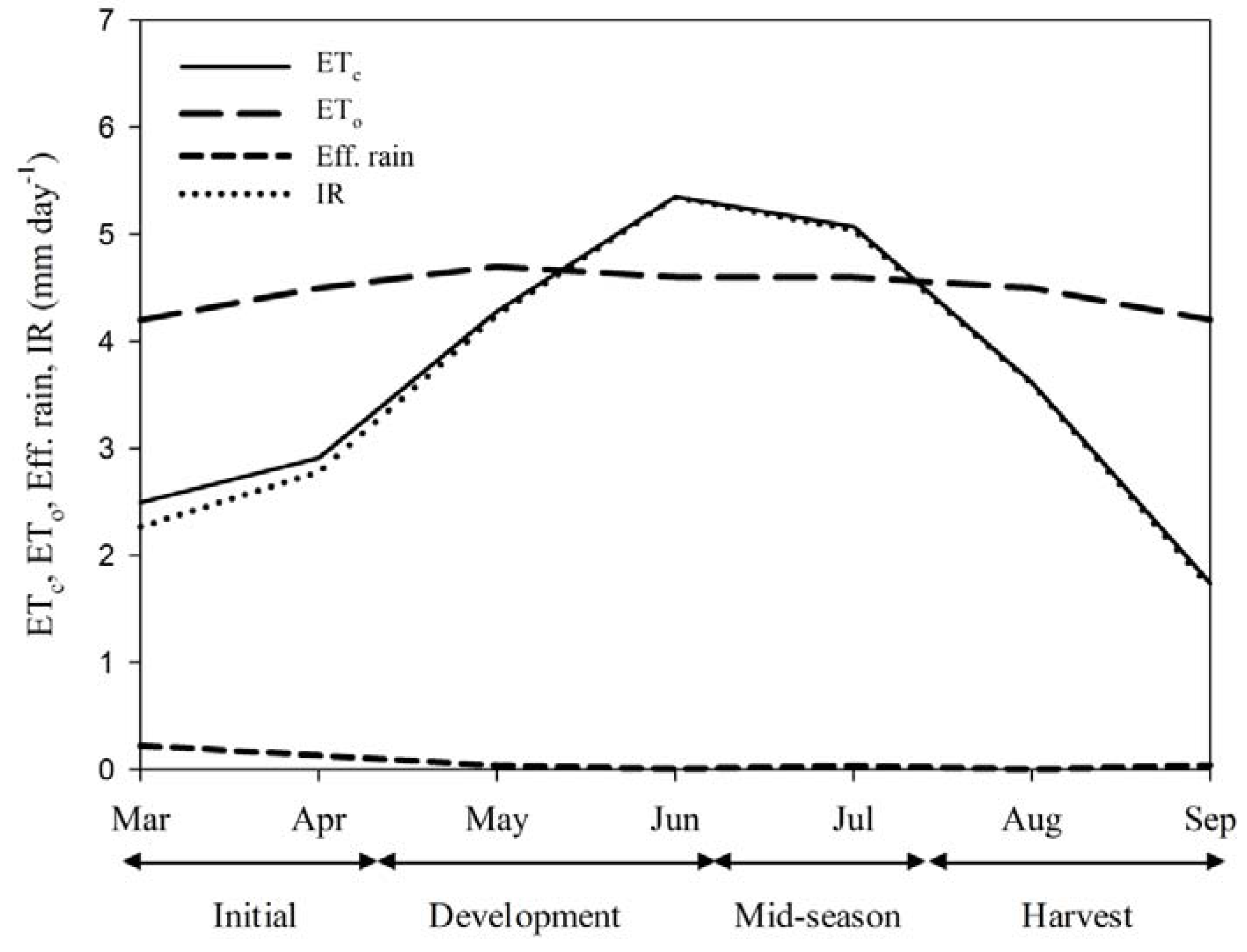
Table 1.
Monthly means of minimum temperature (Tmin), maximum temperature (Tmax), air humidity (RHair), wind speed (Wind), sunshine duration (Sun) and rainfall (Rain). Solar radiation (Rad) and reference evapotranspiration (ETo) (calculated with CROPWAT 8.0) in Tan-Tan, Morocco.
Table 2.
Input parameters for calculating crop evapotranspiration of a potential jatropha plantation in the reference climate of Tan-Tan Morocco with CROPWAT 8.0.
The area of a jatropha plantation that could be irrigated with a given amount of TSE depends on the gross irrigation requirements (IRg), which in turn depend on the crop evapotranspiration (ETc) and the leaching fraction (LF). Assuming a LF of 0 or 0.5, the IRg would amount to 1787 and 2761 mm respectively. Thus, the amount of effluent produced by the treatment plant in Tan-Tan would allow irrigation of an area of 41 to 64 ha for jatropha cultivation. Assuming an average seed yield of 1.52 t ha−1 [17] with a 28% oil content [18], 17 to 27 tons of oil could be produced.
The water requirements calculated here are based on several parameters, such as Kc or salinity tolerance levels, whose values were derived from previous studies either conducted in different environments or in greenhouses and, thus, still need to be validated under semi-arid field conditions. However, the results for the crop evapotranspiration (the plant’s water demand) are in line with several other reports [19,20]. In contrast, the ETc calculated here, differs considerably from a study on jatropha plants in Egypt in spite of similar climatic and soil conditions (sandy texture, low organic carbon content) [13]. In the Egyptian study, different irrigation treatments were related to seed yields. The highest yield was obtained by irrigating the trees with 100% ETo, (ETc = ETo), implying a Kc of 1. Surprisingly, the gross irrigation requirements during the 7.5 months cropping season were only 0.178 m3 per tree [13]. By extrapolating the individual IRg to an assumed planting density of 2500 trees ha−1 seasonal, IRg amounts to just 45 mm. This is, compared to the annual transpiration water use of 144 mm of the four-year-old, non-irrigated South African plants [21], 70% lower than the pure transpiration water loss measured in South Africa during nine months and equals only 11% of the ETc modeled by Jongschaap et al. (2009) [22].
Gush and Moodley (2007) [23] reported basal crop coefficients (Kcb) of 0.04–0.26 for four-year-old trees and 0.15–0.76 for 12-year-old trees. They divided the observed daily transpiration values by calculated ETo-values to calculate Kcb. Under South Africa’s climatic conditions with high temperatures, high VPD and annual precipitation of about 550 mm, it is likely that the plants at least occasionally suffered from water deficit. Despite jatropha’s hardiness, its photosynthetic activity and transpiration rates have been shown to decrease during water scarcity [24,25]. Hence, the obtained values from rain-fed jatropha plants reflect its water use under non-standard conditions and are most likely lower than Kcb obtained from jatropha plants with optimum water supply. For irrigated conditions as in the present study, Kcb derived under standard conditions according to Allen et al. (1998) are more appropriate, since drought stress effects are excluded [26].
A recent study on biomass production and allocation of jatropha seedlings under drought stress and optimal conditions resulted in Kcb-values for immature jatropha plants ranging from 0.51 to 0.60 [24]. These coefficients exceeded those calculated by Gush and Moodley (2007) [23] for four-year-old jatropha, but were more or less similar to that of 12-year-old plants. In both studies, Ke (soil evaporation coefficient) was not mentioned, and therefore, the data were used as a base for the Kc estimations in this study, since data entry in CROPWAT 8.0 requires the total Kc and does not distinguish between Ke and Kcb. To accurately calculate water use and irrigation requirements of jatropha, the evaporation component represented by Ke needs to be determined over a wider range of environments and reflected in the Kc input for CROPWAT 8.0. Along this line, Jongschaap et al. (2009) [22], for example, used the data of Gush and Moodley (2007) [23] to model the ETc of a South African jatropha plantation. They simulated a total crop evapotranspiration of 405 mm for one growing season (8.5 months). This is 48% less than the ETc calculated in this study for jatropha in Morocco for a seven-month growing period (Table 3), indicating that the environmental influence, particularly vapor pressure deficit, on the water requirements of such a plantation is not fully captured by Kc alone. ETc resulting from this study represents the potential water requirements of a jatropha plantation solely for Southern Morocco under field conditions. In order to allow transfer of these results to other regions, ETc calculation should follow a dual coefficient approach [26] to better reflect additional environmental effects on water use, particularly when irrigation systems other than drip irrigation may be used. Thus, Ke, Kcb and Kc, the respective yield response factors, and rooting depth, need to be established across a larger variety of systems and environments.
Table 3.
N, P, K, Na+ and K+ inputs (kg ha−1) from effluent irrigation at different leaching fractions (LF) corresponding to both crop evapotranspiration (ETc, mm) and gross irrigation requirement (IRg, mm) in mm per growing season (March–September).
TSE contains relatively large amounts of nutrients (Table 3) that are potentially available for plant production, while at the same time, the nutrients will be removed from the effluent, thus increasing the quality of the remaining water.
2.2. Soil Salinity
Jatropha is known to survive extended drought spells [27]. However, it is not particularly efficient in water use, and seedlings are only moderately tolerant to salinity [28]. Furthermore, seed yield and growth of jatropha have been shown to be strongly reduced by salt stress [11,29]. According to Ayers and Westcot (1985) [30], a LF between 0.2 and 0.4 would allow maintaining average long-term soil salinity in the root zone between 2.4 and 3.7 dS m−1, which is in the range for moderately sensitive to moderately tolerant crops [30]. However, long term irrigation with TSE may lead to salt accumulation in the root-zone [31,32].
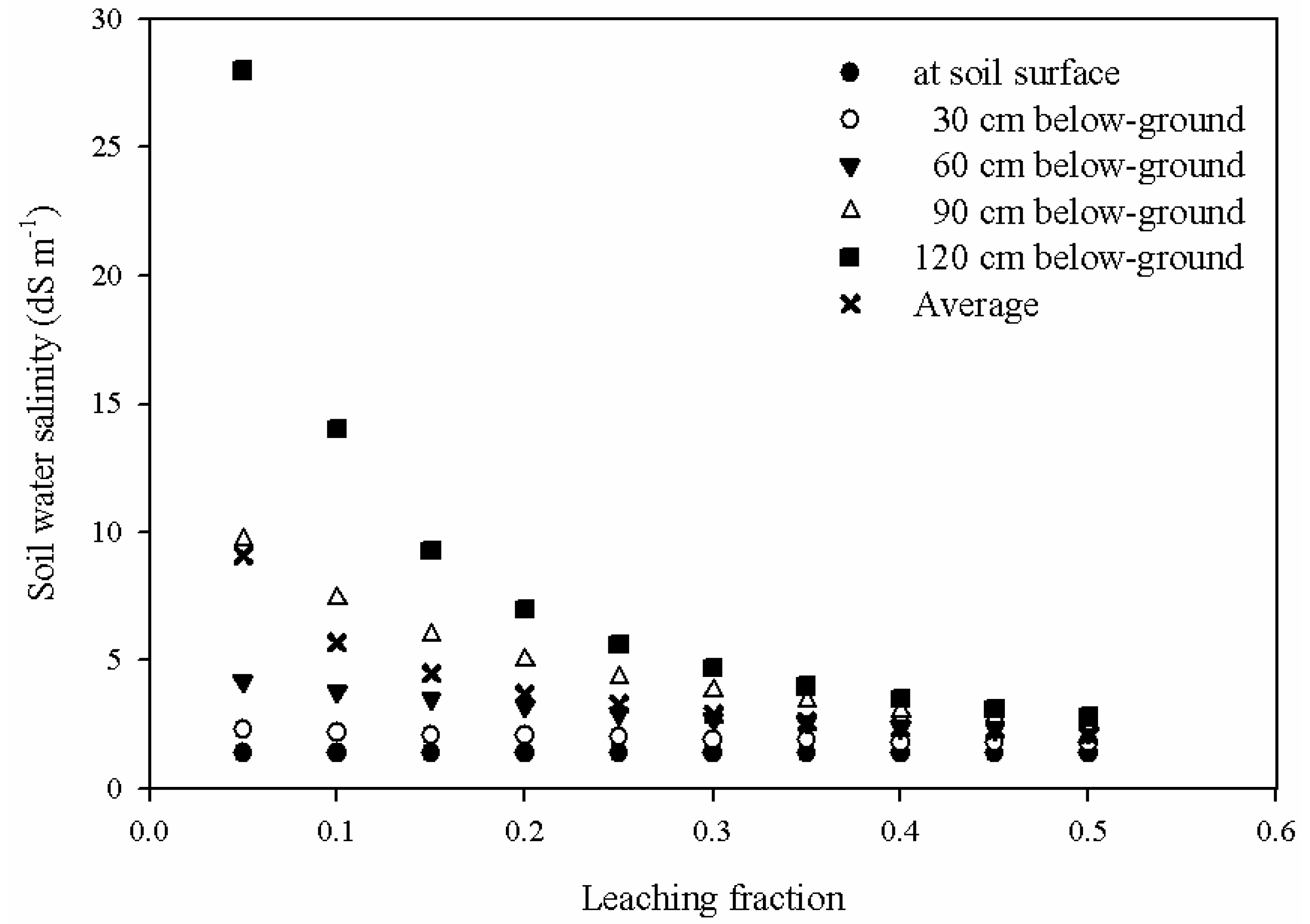
In order to calculate the salt build-up in the soil, different leaching fractions (LF) were used to modify water use results from CROPWAT 8.0. This allowed calculating the development of the soil electrical conductivity (EC) and the resulting additional water requirements to control soil salinity build-up. Varying the leaching fraction from 0.05 to 0.5 at the soil surface and at 30 cm depth resulted in soil EC of 1.4 and 2.8 dS m−1, respectively (Figure 2). At 60 cm depth, soil salinity was still below the average salinity of the whole profile. At 90 cm below ground, EC varied from 2 to 9 dS m−1 for the highest (0.5) and the lowest (0.05) leaching fraction, respectively, and was higher than the average EC of the whole profile. At 120 cm, soil salinity increased exponentially with decreasing leaching factor. Depending on the leaching fraction, IRg increased from 1787 mm (without leaching) per growing season to 2716 mm (LF = 0.5) for 100% ETc (Table 3).
Figure 2.
Simulated average soil water salinity (expressed as electrical conductivity) at the soil surface, 30 cm, 60 cm, 90 cm and 120 cm below ground and average root-zone salinity resulting from different leaching fractions.
In irrigated agriculture, the concentrations of total dissolved solids and the proportion of sodium (Na) in irrigation water have long been recognized as key factors for classifying water as suitable, problematic or unsuitable [33]. Irrigation with TSE often leads to elevated soil Na concentrations [8,34] that may have negative effects on crop growth and yield [30,35], since they adversely affect water availability and may lead to toxic levels of Na in plant tissues.
Leaf K/Na ratio is considered a reliable indicator of yield loss [36], taking into account that Na uptake may reduce internal K availability. Silva et al. (2009) [37] reported that, due to severe ionic imbalances, toxicity symptoms (interveinal leaf necrosis) in young jatropha occurred if the K/Na ratio was below 0.5. A study on adult jatropha [29] reported, K/Na ratios of 1.74 and 0.72 under 2 and 5 dS m−1 of soil salinity, respectively, induce a reduction in canopy transpiration. Therefore, the salinity level of 1.3 dS m−1 of the TSE in Morocco (available data were reported for the wastewater treatment plant in Bensilmane) (within the range of 0.12 to 2.65 for 0 to 300 mmol L−1 NaCl in the nutrient solution [29]), would still be acceptable for irrigation of adult jatropha, considering the entire soil profile (Fig. 2). Reducing the LF to 0.4, EC at 120 cm already reached 5 dS m−1, whereas a LF of 0.3, 5 dS m−1 is already reached within the defined root zone at given irrigation intensities. A LF smaller than 0.5, therefore, has to be considered as critical for the growth of jatropha under irrigation with TSE in the Tan-Tan area.
2.3. Nutrient Requirement
As irrigation requirement increased with including a leaching fraction, so did the nutrient supply through TSE. The nutrient input of N, P and K was calculated using the water quality data of Kouraa et al. (2002) [38]. Average concentrations in the effluent were multiplied by the basic irrigation requirements plus LF:
 where C is the matter concentration (mg L−1) and AW is the applied water (L).
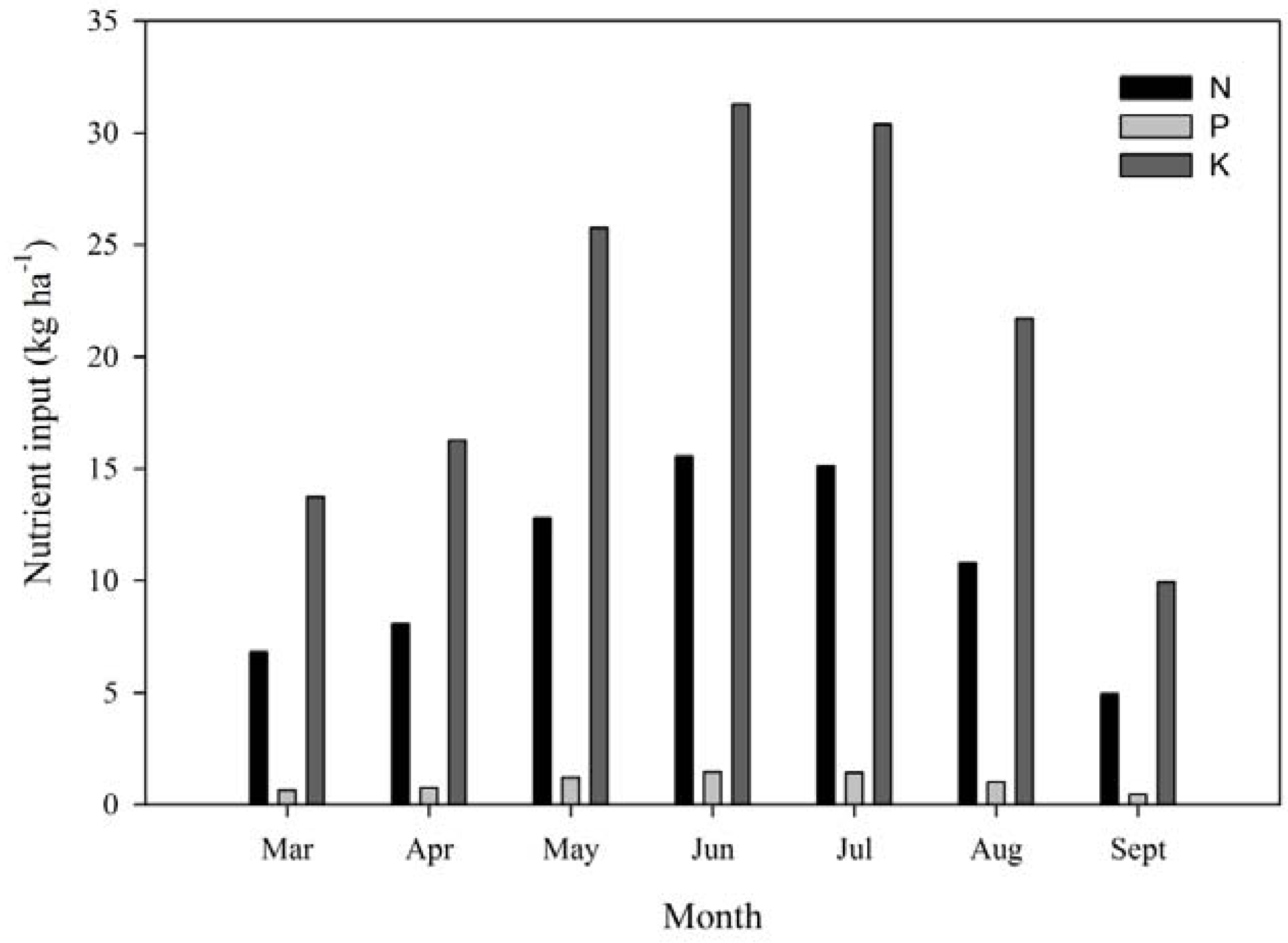
Total mineral N (Nmin), mineral P (PO4-P) and (K) increased from 80 to 151, from 7 to 14 and from 160 to 304 kg ha−1, respectively, with an increasing LF from 0.05 to 0.5 (Table 3). With minimum leaching factor (0.00), nutrient load corresponded to 76kg N ha−1, 7 kg P ha−1 and 152 kg K ha−1 during the growing season. In detail, nutrient delivery from the effluent was highest in June, with an N, P and K input of 16, 1 and 31 kg ha−1, respectively. Until September, it decreased constantly to a monthly input of 5 kg N ha−1, 0.5 kg P ha−1 and 10 kg K ha−1 (Figure 3).
Figure 3.
N-P-K input from effluent irrigation (IR = 779 mm, LF = 0) during one growing period of jatropha in Tan-Tan, Morocco.
Assuming a potential seed yield of 1.52 t ha−1 [17], with a total aboveground biomass of 7.7 t ha−1 reported by Gosh et al. (2007) [17], of which approximately 75% are seasonally produced new biomass [39] jatropha would absorb in total 178 kg N ha−1, 10 kg P ha−1 and 147 kg K ha−1, respectively (Table 4).
At present, there are no precise fertilizer recommendations for jatropha available. The plant is known to respond well to nutrient supply [40]. According to the biomass partitioning suggested by Jongschaap et al. (2007) [41] the share of the fruits is 1.7 t DM, which is in the range of moderate yields compared to the wide range of seed yield reported (0.2 to 7 t ha−1) [40,41].
The IR of a mature jatropha (more than three years old [24]) plantation under Southern Moroccan climate was calculated to be 779 mm per growing season (LF = 0). This would theoretically deliver a total amount of 76 kg of N, 7 kg of P and 149 kg of K per hectare and growing season. An irrigation amount of 1113 mm per growing season (LF = 0.3) would deliver 108, 10 and 217 kg of N, P and K, respectively, per hectare. If an irrigation amount of 1559 mm per growing season (LF = 0.5) was applied, the corresponding N-P-K amounts would increase to 151 kg N, 14 kg P and 304 kg K, respectively.
Table 4.
Estimated biomass partitioning of jatropha (% of aboveground biomass) and the corresponding N, P and K stocks in the seasonal newly developed parts (estimated at 75% of the total dry weight of standing biomass [39]) of the jatropha plant (percentage and element weigh, kg) [17,39,42,43] based on above ground biomass (DM) of 7.7 t ha−1 including seed yield of 1.52 t.
It was calculated that a jatropha above ground DM production of 7.7 t ha−1 would fix a total amount of 178 kg N ha−1, 10 kg P ha−1 and 147 kg K ha−1 in the biomass during the growing season (Table 4). Compared to the potential input of N, P and K from 779 mm of TSE (=ETc) (LF = 0), there would be a lack of N (−102 kg) and P (−3 kg) a surplus of K (+5 kg). Assuming LF values between 0.3 and 0.5 with an irrigation of 1113 mm to 1559 mm, respectively, plant demand for K largely would exceed the requirements and P supply would largely be satisfied, whereas supply of N would still not be sufficient. This irrigation amount would exceed the minimum water requirement (500–600 mm) to obtain moderate seed yield [22], but soil salinity will be kept at a tolerable level. The question is if the plants are able to take up the entire nutrient load of the effluent. According to Janssen et al. (2005) [44] the nutrient value of TSE for crops can be estimated from target yield, soil fertility and use efficiency of the added nutrients. For N, losses by leaching and volatilization can be considerable, whereas accumulation is negligible. Elevated concentrations of mineral N, especially NO3-N, have been found in the soil solution after TSE irrigation [45,46,47]. Leal et al. (2010) [48] reported N concentrations of up to 388 mg L−1 in the soil solution of TSE irrigated sugarcane throughout the growing season. However, the corresponding N concentrations in the effluent were 32 mg L−1. In contrast, the TSE used in this study has Nmin concentrations of only 10 mg L−1. Regarding the relatively low nutrient contents of the TSE here and assuming irrigation according to the ETc, no great leaching risks are expected.
Phosphorus, in contrast, is not easily leached, but may accumulate strongly under irrigation with high pH TSE, leading to an increase of soil pH [8,49]. For K, both leaching and accumulation is found, but since it is easy to mobilize again, it can be considered as plant available [44]. In order to accurately assess the nutrient availability, the amount of nutrients lost through leaching and the overall suitability of TSE to supplement nutrient management in bioenergy plantations, more information is needed relating irrigation with TSE to soil properties and plant nutrient requirements.
3. Materials and Methods
3.1. Location of the Case Study Area
Tan-Tan province (−11.15°W, 28.45°N, 200 m.a.s.l.), located in the region of Guelmim-Es Semara, was chosen to represent the reference climate for Southern Morocco. This region is characterized by semi-arid climate with a cold winter and a hot and dry summer (average minimum and maximum monthly temperature of 14 and 25 °C, respectively) (Table 1) and an annual total rainfall of 112 mm typically occurring from October to February (average of 60 years data in monthly value [16]), where the number of rainy days is at most 30.
The soils in the Southern regions of Morocco are predominantly sandy. Major soil orders are Entisols, Aridisols and dunes [50]. In the FAO Classification [51], this corresponds to Regosols, Lithosols, Rankers, Yermosols and Xerosols. In this region, erosion by wind is common, because of vegetation scarcity and secondary salinization takes place. In the valley, saline soils are frequent.
3.2. Model Parameterization
In order to be able to accurately estimate water use and water extraction from the soil under cultivation with jatropha, it was necessary to estimate the parameters describing evapotranspiration and water uptake specific for jatropha. CROPWAT 8.0 needs rooting depths and crop coefficients (Kc), according to phenological stages, as inputs in order to estimate evapotranspiration. These parameters were not available for jatropha within the model and, therefore, were derived either from earlier experiments [29] or from the literature. Although experiments [24] were performed under high CO2 concentration in a greenhouse, the results are in agreement with the results reported by Gush and Modley [23]; therefore, the Kc value for the initial and development stage were taken from Achten et al. (2010) [24] for field grown adult jatropha. Additionally, the coefficient value (Kc) during mid- and late-season, and the duration of growth stages were taken from Abou Kheira and Atta (2008) [13]. Planting date was set to the 1st of March. The dual crop coefficient procedure suggested by Allen et al. (1998) [52] was applied to convert basal crop coefficients into a single crop coefficient. Additionally, rooting depth was set to 0.3 and 1.2 m [52] for initial and mid-season, respectively, and critical depletion fraction to 0.4 [24] (40% plant available water [53]). The yield response factor (to water supply [14]) was set to 0.5 (initial stage) and 1 (all other stages). Sandy soils are common in the Southern regions of Morocco; the default values from the “UNSODA sand” soil characterized in the CROPWAT 8.0 database were selected. This soil type is characterized by a total available soil moisture of 180 mm m−1, maximum infiltration rate of 120 mm day−1, a maximum rooting depth of 120 cm, an initial soil moisture depletion of 20% and an initial available soil moisture of 144 mm m−1.
3.3. Calculations
3.3.1. Irrigation Requirements (IR)
Knowledge of the water requirements of jatropha under Southern Morocco’s typical climatic conditions is crucial to identify the potential effects of the treated sewage effluent (TSE) irrigation on the soil-plant system. Crop characteristics are described in Table 2, and IR was calculated using CROPWAT 8.0 model [14].
3.3.2. Leaching Fractions (LF)
Depending on water quality and the crop sensitivity to salinity, leaching fraction (LF) varies. This fraction is relevant to estimate IR and, therefore, salt accumulation and nutrient load in the soil, especially in the root-zone. In this study, a wide range of LF (0.05, 0.1, 0.15, 0.2, 0.25, 0.3, 0.35, 0.4, 0.45 and 0.5) was assumed, independently of the given electrical conductivity (EC) value of the TSE used as irrigation water (Table 2) and of the salinity tolerance of adult jatropha that had been rarely studied.
3.3.3. Gross Irrigation Requirement (IRg)
The gross irrigation requirements (IRg) can be calculated according to Phocaides (2000) [54]:
 where
where
- IRg is the gross irrigation requirement (mm),
- ETc is the average crop evapotranspiration (mm),
- Pe is the effective rainfall (mm),
- Kr is the reduction factor for crop cover (= 0.85 [13]),
- IR is the basic irrigation requirement (mm),
- and Ea is the irrigation efficiency (=0.8 corresponding to micro-irrigation system [54].
The water requirement necessary to generate a certain LF for high frequency sprinkler or drip irrigation can be calculated according to Ayers and Westcot, 1985 [30]:
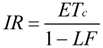 where
where
- IR Applied water (mm),
- ETc Crop evapotranspiration (mm),
- LF Leaching fraction.
3.4. Nutrient Requirements and Water Quality
Fertilizer application effects on seed yield of field-grown jatropha at adult stage had been roughly estimated [41]. To assess the nutrient requirement for adult jatropha, we compared the nutrient content (N, P and K) of TSE in Morocco and that of the jatropha plant, assuming an above ground biomass production of 7.7 t ha−1, including 20% of the seed yield (corresponding to 1.52 t ha−1) [17,41]. Above ground biomass partitioning has been adapted from Rajaona et al. (2011) [39], allocating 15% of dry mass (DM) to leaves and the rest to coat, stem and branches. We could not integrate the absorption of nutrients by below ground biomass (roots) of jatropha, as these data have never been published. Within the wide range of nutrient composition of jatropha components [41], a complete data set from Saturino et al. (2005) [42] and Pacheco et al. (2007) [43] has been selected.
We used the water quality data reported by Kouraa et al. (2002) [38] from a combined stabilization pond system in Benslimane, Morocco, to represent a modern type of waste water treatment plant (Table 5). In this combined system, pre-treatment is followed by anaerobic, aerated and facultative treatments; then, water is retained in storage reservoirs. This procedure allows the production of a high effluent water quality and the scheduling of irrigation independently from the daily outflow rates of the waste water treatment plants [38].
Table 5.
Average values for physical and chemical characteristics of treated sewage effluent (Range in TSE) from different studies in the world [8,34,55,56,57]. Average values of treated sewage effluent (TSE) from a wastewater treatment plant in Benslimane, Morocco [38].
3.5. Soil Salinity
Soil salinity has been calculated according to the FAO Irrigation and Drainage Paper 29 using the average electrical conductivity of the irrigation water (ECsw average) and the leaching fraction in the root-zone [30]. Five points in the root zone were used to characterize salt accumulation: at soil surface, 30, 60, 90 and 120 cm below ground.
4. Conclusions
In the global context, it is evident that effluent reuse in agriculture will increase in water scarce countries in the near future, particularly in the vicinity of cities. This is necessary to release precious freshwater resources for the drinking water supply of the growing urban areas and to ensure irrigation. In this study, the water requirements of a jatropha plantation in Southern Morocco irrigated with TSE were determined. Depending on the leaching fraction needed to control salinity build-up in the soil, a surface of 41–64 ha (6 to 9 m2 inhabitant−1) could be irrigated. Since jatropha has been reported to be salt sensitive, the use of waste water while controlling soil salinity has to be considered, even if the nutrient and water supply can be satisfied. The N content of TSE at the considered irrigation requirement is not sufficient to produce a moderate seed yield, while P and K demand can be easily satisfied. The feasibility of such an irrigation system depends to a large extent on environmental factors, such as climate, soils and the overall water availability, and thus, transferability of the model results presented here needs to be studied further.
References and Note
- Sala, O.E.; Stuart Chapin, F., III; Armesto, J.J.; Berlow, E.; Bloomfield, J.; Dirzo, R.; Huber-Sanwald, E.; Huenneke, L.F.; Jackson, R.B.; Kinzig, A.; et al. Global biodiversity scenarios for the year 2100. Science 2000, 287, 1770–1774. [Google Scholar]
- Abdelfadel, A.B.; Driouech, F. Climate change and its impacts on water resources in the Maghreb region. Available online: http://www.arabwatercouncil.org/administrator/Modules/Events/IWRA%20Morocco%20Paper (accessed on 21 November 2012).
- Coqk, S. Link Global Markets: Trade Information Packet—Kingdom of Morocco; World Trade Center: San Diego, Country, 2011; p. 77. [Google Scholar]
- The World Bank, Project Performance Assessment Report: Morocco—Water Resources Management Project; Independent Evaluation Group (World Bank): Washington, DC, USA, 2009; p. 67.
- Berkat, O.; Tazi, M. Country pasture/forage resources profiles Morocco. Available online: http://www.fao.org/ag/AGP/AGPC/doc/Counprof/Morocco/morocco.htm (accessed on 21 November 2012).
- Frenken, K. L'irrigation en Afrique en chiffres: Enquête AQUASTAT—2005; Organisation des Nations Unies pour l’Alimentation et l’Agriculture: Rome, Italy, 2005; p. 652. [Google Scholar]
- United Nations Economic Commission for Africa, Water Resources Development in North Africa: Summary of Subregional Report; UNECA: Tanger, Morocco, 2005.
- Da Fonseca, A.F.; Herpin, U.; De Paula, A.M.; Victória, R.L.; Melfi, A.J. Agricultural use of treated sewage effluents: Agronomic and environmental implications and perspectives for Brazil. Sci. Agric. 2007, 64, 194–209. [Google Scholar] [CrossRef]
- Shon, H.K.; Vigneswaran, S.; Snyder, S.A. Effluent Organic Matter (EfOM) in Wastewater: Constituents, Effects, and Treatment. Crit. Rev. Env. Sci. Tec. 2006, 36, 327–374. [Google Scholar] [CrossRef]
- Ministère de l'énergie des Mines de l'Eau et de l'environnement Secteur de l'énergie, chiffre clés. Available online: http://www.mem.gov.ma/ChiffresCles/Energie/ChiffreEnergie.htm (accessed on 21 November 2012).
- Silva, E.N.; Ribeiro, R.V.; Ferreira-Silva, S.L.; Viégas, R.A.; Silveira, J.A.G. Comparative effects of salinity and water stress on photosynthesis, water relations and growth of Jatropha curcas plants. J. Arid Environ. 2010, 74, 1130–1137. [Google Scholar] [CrossRef]
- GEXSI, Global Market Study on Jatropha; Jatropha alliance: London, UK, 2008; p. 187.
- Abou Kheira, A.A.; Atta, N.M.M. Response of Jatropha curcas L. to water deficit: Yield, water use efficiency and oilseed characteristics. Biomass Bioenergy 2009, 33, 1343–1350. [Google Scholar] [CrossRef]
- Swennenhuis, J. CROPWAT 8.0; Food and Agriculture Oganization of the United Nations: Rome, Italy, 2009. [Google Scholar]
- KFW—Entwiklungsbank, Morocco: Drinking Water Supply Guelmim/Tan Tan and Youssoufia/Chemaia; KFW—Entwiklungsbank: Frankfurt am Main, Germany, 2006.
- Grieser, J. CLIMWAT 2.0; Food and Agriculture Oganization of the United Nations: Rome, Italy, 2006. [Google Scholar]
- Ghosh, A.; Patolia, J.S.; Chaudharry, D.R.; Chikara, J.; Rao, S.N.; Kumar, D.; Boricha, G.N.; Zala, A. In Response of Jatropha curcasunder Different Spacing to Jatropha De-Oiled Cake; FACT Foundation: Wageningen, The Netherlands, 2007. [Google Scholar]
- Kaushik, N.; Kumar, K.; Kumar, S.; Kaushik, N.; Roy, S. Genetic variability and divergence studies in seed traits and oil content of Jatropha (Jatropha curcas L.) accessions. Biomass Bioenergy 2007, 31, 497–502. [Google Scholar] [CrossRef]
- Daey Ouwens, K.; Francis, G.; Franken, Y.J.; Rijssenbeek, W.; Riedacker, A.; Foidl, N.; Jongschaap, R.E.E.; Bindraban, P.S. Position Paper on Jatropha curcas State of the Art, Small and Large Scale Project Development; Foundation FACT: Wageningen, The Netherlands, 2007. [Google Scholar]
- Maes, W.H.; Trabucco, A.; Achten, W.M.J.; Muys, B. Climatic growing conditions of Jatropha curcas L. Biomass Bioenergy 2009, 33, 1481–1485. [Google Scholar]
- Holl, M.A.; Gush, M.B.; Hallowes, J.; Versfeld, D.B. Jatropha curcasin South Africa: An Assessment of Its Water Use and Bio-Physical Potential; WRC: Pretoria, South Africa, 2007. [Google Scholar]
- Jongschaap, R.E.E.; Blesgraaf, R.A.R.; Bogaard, T.A.; van Loo, E.N.; Savenije, H.H.G. The water footprint of bioenergy from Jatropha. curcas L. Proc. Natl. Acad. Sci. USA 2009, 106, E92–E92. [Google Scholar]
- Gush, M.B.; Moodley, M. Water Use Assessment of Jatropha curcas; Report No. 1497/1/07 (Chapter 4). In An Assessment of Its Water Use and Biophysical Potential; Holl, M.A., Gush, M.B., Hallowes, J., Versfeld, D.B., Eds.; Water Research Commission: Pretoria, South Africa, 2007. [Google Scholar]
- Achten, W.M.J.; Maes, W.H.; Reubens, B.; Mathijs, E.; Singh, V.P.; Verchot, L.; Muys, B. Biomass production and allocation in Jatropha curcas L. seedlings under different levels of drought stress. Biomass Bioenergy 2010, 34, 667–676. [Google Scholar]
- Rajaona, A.M.; Brueck, H.; Asch, F. Leaf gas exchange characteristics of Jatropha as affected by Nitrogen supply, leaf age and atmospheric vapor pressure deficit. J. Agron. Crop Sci. 2012, in press. [Google Scholar]
- Allen, R.G.; Pereira, L.S.; Raes, D.; Smith, M. Crop Evapotranspiration: Guidelines for Computing Crop Water Requirements Irrigation and Drainage; Paper No. 56; Food and Agriculture Organization of the United Nations: Rome, Italy, 1998. [Google Scholar]
- Dos Santos, C.M.; Verissimo, V.; Wanderley Filho, H.C.d.L.; Ferreira, V.M.; Cavalcante, P.G.d.S.; Rolim, E.V.; Endres, L. Seasonal variations of photosynthesis, gas exchange, quantum efficiency of photosystem II and biochemical responses of Jatropha curcas L. grown in semi-humid and semi-arid areas subject to water stress. Ind. Crop Prod. 2013, 41, 203–213. [Google Scholar]
- Li, G.T. The photosynthesis and water use efficiency of eight garden tree species. For. Res. 2002, 15, 291–296. [Google Scholar]
- Rajaona, A.; Seckinger, C.; Brueck, H.; Asch, F. Effect of salinity on canopy water vapor conductance of young and 3-years old Jatropha curcas L. J. Arid Environ. 2012, 87, 35–41. [Google Scholar] [CrossRef]
- Ayers, R.S.; Westcot, D.W. Water Quality for Agriculture Irrigation and Drainage; Paper No. 29 Rev. 1; Food and Agriculture Organization of the United Nations: Rome, Italy, 1985. [Google Scholar]
- Lado, M.; Ben-Hur, M. Treated domestic sewage irrigation effects on soil hydraulic properties in arid and semiarid zones: A review. Soil Till. Res. 2009, 106, 152–163. [Google Scholar] [CrossRef]
- Balks, M.R.; Bond, W.J.; Smith, C.J. Effects of sodium accumulation on soil physical properties under an effluent-irrigated plantation. Soil Res. 1998, 36, 821–830. [Google Scholar]
- Tanji, K.K.; Kielen, N.C. Agricultural Drainage Water Management in Arid and Semi-Arid Areas; Irrigation and Drainage Paper No. 61; FAO: Rome, Italy, 2002. [Google Scholar]
- Prescod, M.B. Wastewater Treatment and Use in Agriculture; Irrigation and Drainage Paper No. 47; Food and Agriculture Organization of the United Nations: Rome, Italy, 1992. [Google Scholar]
- Kijne, J.W.; Rathapar, S.A.; Woperis, M.C.S.; Sahrawat, K.L. How to Manage Salinity in Irrigated Lands: A Selective Review with Particular Reference to Irrigation in Developing Countries; International Water Management Institute: Colombo, Sri Lanka, 1998; p. 44. [Google Scholar]
- Asch, F.; Dinkuhn, M.; Dörffling, K.; Miezan, K. Leaf K/Na ratio predicts salinity induced yield loss in irrigated rice. Euphytica 2000, 113, 109–118. [Google Scholar] [CrossRef]
- Da Silva, E.N.; Silveira, J.A.G.; Fernandes, C.R.R.; Dutra, A.T.B.; de Aragão, R.M. Ion uptake and growth of physic nut under different salinity levels. Rev. Cienc. Agron. 2009, 40, 240–246. [Google Scholar]
- Kouraa, A.; Fethi, F.; Fahde, A.; Lahlou, A.; Ouazzani, N. Reuse of urban wastewater treated by a combined stabilisation pond system in Benslimane (Morocco). Urban Water 2002, 4, 373–378. [Google Scholar] [CrossRef]
- Rajaona, A.; Brueck, H.; Asch, F. Effect of pruning history on growth and dry mass partitioning of Jatropha on a plantation site in Madagascar. Biomass Bioenergy 2011, 35, 4892–4900. [Google Scholar] [CrossRef]
- Achten, W.M.J.; Verchot, L.; Franken, Y.J.; Mathijs, E.; Singh, V.P.; Aerts, R.; Muys, B. Jatropha bio-diesel production and use. Biomass Bioenergy 2008, 32, 1063–1084. [Google Scholar] [CrossRef]
- Jongschaap, R.E.E.; Corré, W.J.; Bindraban, P.S.; Brandenburg, W.A. Global Jatropha curcas Evaluation, Breeding and Propagation Programme; Wageningen UR: Wageningen, The Netherlands, 2007; p. 66. [Google Scholar]
- Saturnino, H.M.; Pacheco, D.D.; Kakida, J.; Tominaga, N.; Gonc, A.N.P. Cultura do pinhao-manso (Jatropha. curcas L.). In EPAMIG-Informe Agropecuário; EPAMIG: Belo Horizonte, Brazil, 2005; Volume 26, pp. 44–78. [Google Scholar]
- Pacheco, D.D.; Saturino, H.M.; Santos, D.A.; da Souza, R.P.D.; de Almeida Junior, A.B.; Robeiro, D.P.; Antunes, P.D. Avaliçao nutritional de pinhão-manso em função de cálcio e magnésio usado como corretivos de acidez de solo. Powerpoint presentation for EPAMIG-Informe Agropecuário. 2007. [Google Scholar]
- Janssen, B.H.; Boesveld, H.; Rodriguez, M.J. Some theoretical considerations on evaluating wastewater as a source of N, P and K for crops. Irrig. Drain. 2005, 54, S35–S47. [Google Scholar]
- Johns, G.G.; McConchie, D.M. Irrigation of bananas with secondary treated sewage effluent. I. Field evaluation of effect on plant nutrients and additional elements in leaf, pulp and soil. Aust. J. Agric. Res. 1994, 45, 1601–1617. [Google Scholar] [CrossRef]
- Speir, T.W.; Van Schaik, A.P.; Kettles, H.A.; Vincent, K.W.; Campbell, D.J. Soil and stream-water impacts of sewage effluent irrigation onto steeply sloping land. J. Environ. Qual. 1999, 28, 1105–1114. [Google Scholar]
- Barton, L.; Schipper, L.A.; Barkle, G.F.; McLeod, M.; Speir, T.W.; Taylor, M.D.; McGill, A.C.; Van Schaik, A.P.; Fitzgerald, N.B.; Pandey, S.P. Land application of domestic effluent onto four soil types: Plant uptake and nutrient leaching. J. Environ. Qual. 2005, 34, 635–643. [Google Scholar] [CrossRef]
- Leal, R.M.P.; Firme, L.P.; Herpin, U.; da Fonseca, A.F.; Montes, C.l.R.; dos Santos Dias, C.T.; Melfi, A.J. Carbon and nitrogen cycling in a tropical Brazilian soil cropped with sugarcane and irrigated with wastewater. Agric. Water Manag. 2010, 97, 271–276. [Google Scholar] [CrossRef]
- Stewart, H.T.L.; Hopmans, P.; Flinn, D.W.; Hillman, T.J. Nutrient accumulation in trees and soil following irrigation with municipal effluent in Australia. Environ. Pollut. 1990, 63, 155–177. [Google Scholar] [CrossRef]
- USDA NRCS Global soil region map. Available online: http://soils.usda.gov/use/worldsoils/mapindex/order.html (accessed on 21 November 2012).
- IUSS Working group WRB, World Reference Base for Soil Resources 2006, First Update 2007; World Soil Resources Report No. 103; Food and Agriculture Organization of the United Nations: Rome, Italy, 2007.
- Krishnamurthy, L.; Zaman-Allah, M.; Marimuthu, S.; Wani, S.P.; Kesava Rao, A.V.R. Root growth in Jatropha and its implications for drought adaptation. Biomass Bioenergy 2012, 39, 247–252. [Google Scholar] [CrossRef]
- Sadras, V.O.; Milroy, S.P. Soil-water thresholds for the responses of leaf expansion and gas exchange: A review. Field Crop Res. 1996, 47, 253–266. [Google Scholar] [CrossRef]
- Phocaides, A. Technical Handbook on Pressurized Irrigation Techniques; Food and Agriculture Organization of the United Nations: Rome, Italy, 2000. [Google Scholar]
- Bouwer, H.; Chaney, R.L. Land treatment of wastewater. Adv. Agron. 1974, 26, 133–176. [Google Scholar] [CrossRef]
- Asano, T.; Pettygrove, G. Using reclaimed municipal wastewater for irrigation. Calif. Agric. 1987, 41, 15–18. [Google Scholar]
- Feigin, A.; Bielorai, H.; Dag, Y.; Kipnis, T.; Giskin, M. The Nitrogen factor in the management of effluent-irrigated soils. Soil Sci. 1978, 125, 248–254. [Google Scholar] [CrossRef]
© 2012 by the authors; licensee MDPI, Basel, Switzerland. This article is an open-access article distributed under the terms and conditions of the Creative Commons Attribution license (http://creativecommons.org/licenses/by/3.0/).