
Taro Leaf Blight—A Threat to Food Security

 ,
,
Abstract
:1. Introduction
2. History of Taro Leaf Blight Epidemics and Impacts
3. Diseases Symptoms
4. Origin, Dispersal and Distribution of Disease
5. Biology of the Pathogen
5.1. Host Range
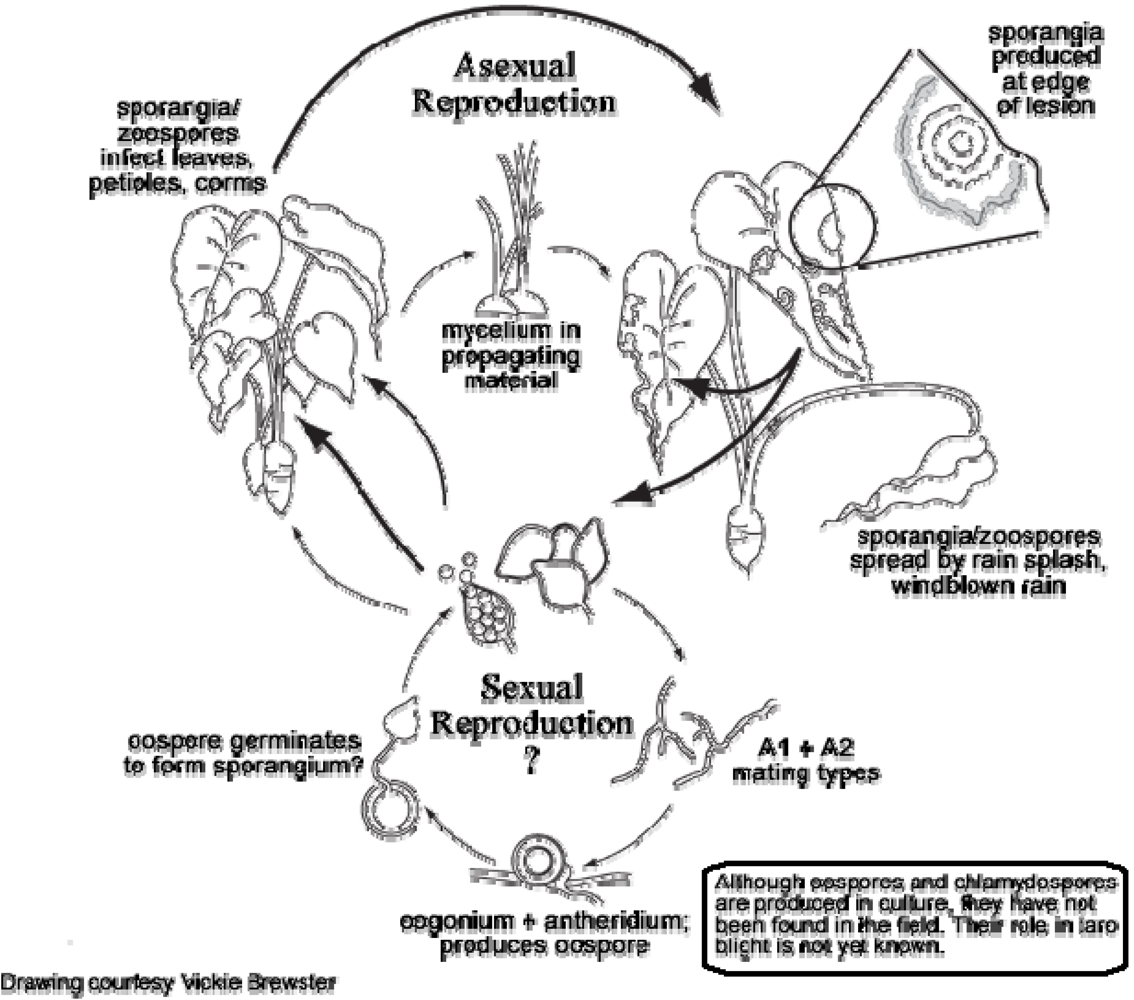
5.2. Life Cycle

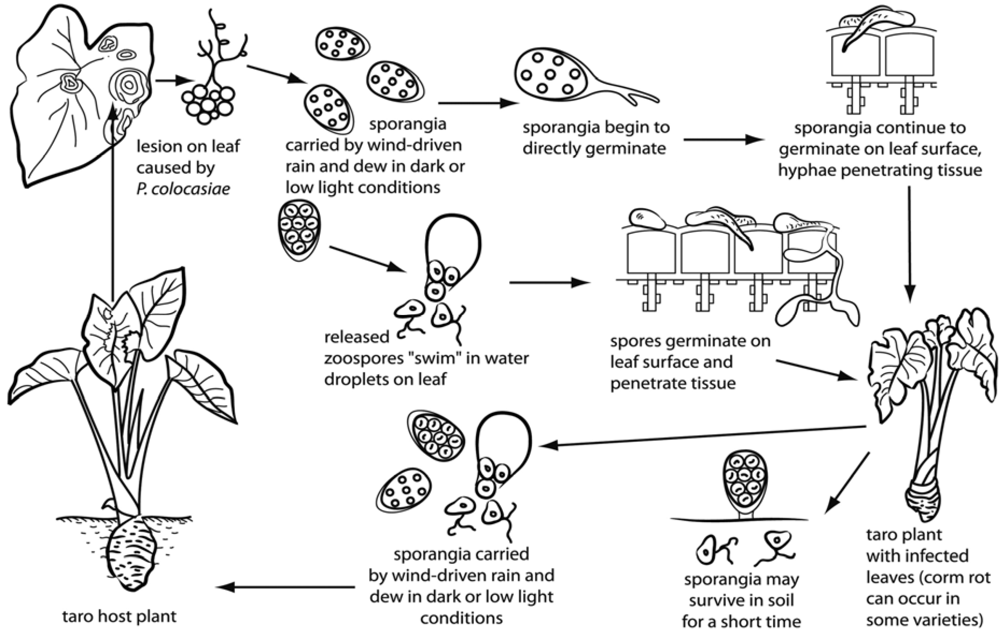
5.3. Infection Process and Conditions
5.4. Genetic Variability and Heterothallism
6. Disease Epidemiology
7. Disease Management Strategies
7.1. Cultural and Biological Control
7.2. Chemical Control
7.3. Resistant Cultivars and Genetic Resources
7.4. Breeding for Resistance to Taro Leaf Blight
8. Role of Regional Networks for Controlling Taro Leaf Blight
9. Way Forward for Mitigating Impact of TLB on Food Security
Acknowledgments
References
- Rao, R.; Hunter, D.; Eyzaguirre, P.; Matthews, P. Ethnobotany and global diversity of taro. In The Global Diversity of Taro: Ethnobotany and Conservation; Ramanatha Rao, V., Matthews, P.J., Ezyaguire, P.B., Hunter, D., Eds.; Bioversity International: Rome, Italy, 2010; pp. 2–5. [Google Scholar]
- FAOSTAT. FAO Statistical Database, 2010. FAOSTAT Web site. Available online: http://faostat.fao.org/ (accessed on 15 June 2012).
- Hunter, D.; Iosefa, T. Chemical control of taro leaf blight. In Proceedings of Taro Leaf Blight Seminar, Alafua, Western Samoa, 22–26 November, 1993; South Pacific Commission: Noumea, New Caledonia, 1996; pp. 26–27. [Google Scholar]
- Fisher, M.C.; Henk, D.A.; Briggs, C.J.; Brownstein, J.S.; Madoff, L.C.; McGraw, S.L.; Gurr, S.J. Emerging fungal threats to animal, plant and ecosystem health. Nature 2012, 484, 186–194. [Google Scholar]
- Brunt, J.; Hunter, D.; Delp, C. A Bibliography of Taro Leaf Blight; Secretariat of the Pacific Community: Noumea, New Caledonia, 2001; pp. 1–10. [Google Scholar]
- Kohler, F.; Pellegrin, F.; Jackson, G.V.H.; MacKenzie, E. Taro. In Diseases of Cultivated Crops in Pacific Island Countries; Secretariat of the Pacific Community: Noumea, New Caledonia, 1997. [Google Scholar]
- Jackson, G.V.H. Taro leaf bligh. In Pest Advisory Leaflet; the Plant Protection Service of the Secretariat of the Pacific Community: Noumea, New Caledonia, 1999; Volume No. 3, p. 2. [Google Scholar]
- Singh, D.; Guaf, J.; Okpul, T.; Wiles, G.; Hunter, D. Taro (Colocasia esculenta) variety release recommendations for Papua New Guinea based on multi-location trials. N. Z. J. Crop Horticult. Sci. 2006, 34, 163–171. [Google Scholar] [CrossRef]
- Trujillo, E.E. Diseases of the Genus Colocasia in the Pacific Area and their control. In Proceedings of the International Symposium on Tropical Root Crops, St Augustine, Trinidad, 2–8 April 1967; 2.
- Trujillo, E.E.; Aragaki, M. Taro blight and its control. Hawaii Farm Sci. 1964, 13, 11–13. [Google Scholar]
- Nelson, S.; Brooks, F.; Teves, G. Taro Leaf Blight in Hawaii; Plant Disease Bulletin No. PD-71. University of Hawaii: Manoa, HI, USA, 2011. [Google Scholar]
- Paiki, F.A. Symptoms of taro leaf blight disease (Phytophthora colocasiae) and relationship with yield components in Biak, Irian Jaya. Sci. New Guin. 1996, 21, 153–157. [Google Scholar]
- Sar, S.A.; Wayi, B.M.; Ghodake, R.D. Review of research in Papua New Guinea for sustainable production of taro (Colocasia esculenta). Trop. Agr. Trinidad 1998, 75, 134–138. [Google Scholar]
- Jackson, G.V.H.; Gollifer, D.E. Storage rots of taro, Colocasia esculenta, in the British Solomon Island. Ann. Appl. Biol. 1975, 80, 217–230. [Google Scholar] [CrossRef]
- Chan, E.; Milne, M.; Fleming, E. The causes and consequences of taro leaf blight in Samoa and the implications for trade patterns in taro in the South Pacific region. Trop. Agr. Trinidad 1998, 75, 93–98. [Google Scholar]
- Guarino, L. Taro leaf blight in Cameroon? 2010. Available online: http://agro.biodiver.se/2010/07/taro-leaf-blight-in-cameroon/ (accessed on 15 May 2012).
- Bandyopadhyay, R.; Sharma, K.; Onyeka, T.J.; Aregbesola, A.; Kumar, P.L. First report of taro (Colocasia esculenta) leaf blight caused by Phytophthora colocasiae in Nigeria. Plant Dis. 2011, 95, 618. [Google Scholar]
- Omane, E.; Oduro, K.A.; Cornelius, E.W.; Opoku, I.Y.; Akrofi, A.Y.; Sharma, K.; Kumar, P.L.; Bandyopadhyay, R. First report of leaf blight of taro (Colocasia esculenta) caused by Phytophthora colocasiae in Ghana. Plant Dis. 2012, 96, 292. [Google Scholar]
- Jackson, G.V.H. Taro leaf bligh. In Advisory Leaflet No. 3; South Pacific Commission: Noumea, New Caledonia, 1977; p. 4. [Google Scholar]
- Jackson, G.V.H. Brief summary of situation in the region and comments on available assistance for long-term regional projects on taro leaf blight control. In Proceedings of Taro Leaf Blight Seminar, Alafua, Western Samoa, 22–26 November 1993; South Pacific Commission: Noumea, New Caledonia, 1996; pp. 71–74. [Google Scholar]
- Carpenter, C.W. Report of the plant pathologist. Rept. Hawaii Agric. Expt. Stn. 1920, 49–54. [Google Scholar]
- Trujillo, E.E. Taro leaf blight research in the American Pacific. Agr. Dev. Am. Pac. Bull. 1996, 1, 1–3. [Google Scholar]
- Hunter, D.; Pouono, K.; Semisi, S. The impact of taro leaf blight in the Pacific Islands with special reference to Samoa. J. S. Pac. Agr. 1998, 5, 44–56. [Google Scholar]
- Wall, G.C. Life after blight: The current taro leaf blight status on Guam. In Proceedings of Taro Leaf Blight Seminar, Alafua, Western Samoa, 22-26 November 1993; South Pacific Commission: Noumea, New Caledonia, 1996; pp. 39–40. [Google Scholar]
- Barrau, J. Subsistence Agriculture in Polynesia and Micronesia; Technical Bulletin No. 223; Bernie, P. Bishop Museum: Hawaii, HI, USA, 1961. [Google Scholar]
- Jackson, G.V.H. Taro Leaf Blight Control Strategies; First Consultancy Mission Report for AusAID/MAFFM/WSFSP; International Development Support Services Pty Ltd.: Melbourne, Australia, 1996; p. 34. [Google Scholar]
- Primo, A. Colocasia taro on Pohnpei Island. In Proceedings of the Sustainable Taro Culture for the Pacific Conference, Honolulu, Hawaii, 24–25 September 1992; Hawaii Institute of Tropical Agriculture and Human Resources: Manoa, HI, USA, 1993; pp. 6–8. [Google Scholar]
- Bourke, R.M. The decline of taro and taro irrigation in Papua New Guinea. In Irrigated Taro (Colocasia esculenta) in the Indo-Pacific: Biological, Historical and Social Perspectives; Spriggs, M., Addison, D., Matthews, P., Eds.; Senri Ethnological Studies 78, National Museum of Ethnology: Osaka, Japan, 2012; pp. 255–264. [Google Scholar]
- Hunter, D.; Iosefa, T.; Delp, C.; Fonoti, P. Beyond taro leaf blight: A participatory approach for plant breeding and selection for taro improvement in Samoa. In Proceedings of the International Symposium on Participatory Plant Breeding and Participatory Plant Genetic Resource Enhancement, Pokhara, Nepal, 1–5 May 2000; CIAT: Cali, Colombia, 2001; pp. 219–227. [Google Scholar]
- Singh, D.; Okpul, T.; Iramu, E.; Wagih, M.; Sivan, P. Breeding taro for food security in PNG. In Proceedings of the Papua New Guinea Food and Nutrition 2000 Conference, Lae, Papua New Guinea, 26–30 June 2000; pp. 749–751.
- Putter, C.A.J. Taro Blight (Phytophthora colocasiae) in Western Samoa; FAO Mission Report No. TCP/SAM/2353; FAO: Italy, Rome, 1993.
- Packard, J.C. The Bougainville Taro Blight; University of Hawaii: Honolulu, HI, USA, 1975; p. 144. [Google Scholar]
- Liloqula, R.; Saelea, J.; Levela, H. The taro breeding program in Solomon Islands. In Proceedings of Taro Leaf Blight Seminar, Alafua, Western Samoa, 22–26 November 1993; South Pacific Commission: Noumea, New Caledonia, 1996; pp. 143–147. [Google Scholar]
- Iramu, E. Breeding Taro (Colocasia esculenta) for Leaf Blight Resistance. Master’s Thesis, University of Technology, Lae, Papua New Guinea, 2003. [Google Scholar]
- Gurr, P. The taro leaf blight situation in American Samoa. In Proceedings of Taro Leaf Blight Seminar, Alafua, Western Samoa, 22–26 November 1993; South Pacific Commission: Noumea, New Caledonia, 1996; pp. 35–38. [Google Scholar]
- Semisi, S.T. Taro leaf blight disease, Phytophthora colocasiae, in Western Samoa. In Proceedings of Taro Leaf Blight Seminar, Alafua, Western Samoa, 22-26 November 1993; South Pacific Commission: Noumea, New Caledonia, 1996; pp. 63–68. [Google Scholar]
- Brooks, F.E. Detached-leaf bioassay for evaluating taro resistance to Phytophthora colocasiae. Plant Dis. 2008, 92, 126–131. [Google Scholar] [CrossRef]
- Putter, C.A.J. Taro Blight (Phytophthora colocasiae) in Western Samoa; Technical Report for Western Samoa Farming Systems Project; Ministry of Agriculture, Forestry, Fisheries and Meteorology; MAFFM: Apia, Samoa, 1996; p. 8.
- Paulson, D.D.; Rogers, S. Maintaining subsistence security in Western Samoa. Geoforum 1997, 28, 173–187. [Google Scholar]
- Fullerton, R.; Tyson, J. Overview of leaf diseases of taro. In Proceedings of Taro Pathology and Breeding Workshop, Alafua Campus, Samoa, 5–7 November 2001; pp. 4–7.
- Brooks, F.E. Taro leaf blight. Plant Health Instr 2005. [Google Scholar]
- Jackson, G.V.H.; Gollifer, D.E. Disease and pest problems of taro (Colocasia esculenta L. Schott) in the British Solomon Islands. Trop. Pest Manag 1975, 21, 45–53. [Google Scholar]
- Jackson, G.V.H.; Gollifer, D.E.; Newhook, F.J. Studies on the taro leaf blight fungus Phytophthora colocasiae in Solomon Islands: Control by fungicides and spacing. Ann. Appl. Biol. 1980, 96, 1–10. [Google Scholar]
- Ooka, J.J. Taro diseases. In Proceedings of Taking Taro into the 1990s: A Taro Conference, Hilo, HI, USA, 17 August 1989; University of Hawaii: Honolulu, HI, USA, 1990; pp. 51–59. [Google Scholar]
- Zentmyer, G.A. Origin and distribution of four species of Phytophthora. Trans. Brit. Mycol. Soc. 1988, 91, 367–378. [Google Scholar]
- Zhang, K.M.; Zheng, F.C.; Li, Y.D.; Ann, P.J.; Ko, W.H. Isolates of Phytophthora colocasiae from Hainan Island in China: Evidence suggesting an Asian origin of this species. Mycologia 1994, 86, 108–112. [Google Scholar] [CrossRef]
- Ko, W.H. Mating-type distribution of Phytophthora colocasiae on the island of Hawaii. Mycologia 1979, 71, 434–437. [Google Scholar] [CrossRef]
- Ann, P.J.; Kao, C.W.; Ko, W.H. Mating-type distribution of Phytophthora colocasiae in Taiwan. Mycopathologia 1986, 93, 193–194. [Google Scholar] [CrossRef]
- Narula, K.L.; Mehrotra, R.S. Occurrence of A1 mating type of Phytophthora colocasiae. Ind. Phytopathol. 1981, 33, 603–604. [Google Scholar]
- Misra, R.S.; Mishra, A.K.; Sharma, K.; Jeeva, M.L.; Hegde, V. Characterisation of Phytophthora colocasiae isolates associated with leaf blight of taro in India. Arch. Phytopathol. Plant Prot. 2011, 44, 581–591. [Google Scholar] [CrossRef]
- Tyson, J.L.; Fullerton, R.A. Mating types of Phytophthora colocasiae from the Pacific region, India and South-east Asia. Australas. Plant Dis. Notes 2007, 2, 111–112. [Google Scholar] [CrossRef]
- Ho, H.H.; Hu, Y.N.; Zhuang, W.Y.; Liang, Z.R. Mating types of heterothallic species of Phytophthora in China. Acta Mycol. Sinica 1983, 2, 187–191. [Google Scholar]
- Fullerton, R.; Tyson, J. The biology of Phytophthora colocasiae and implication for its management and control. In Proceedings of the Third Taro Symposium, Nadi, Fiji Islands, 21-23 May 2003; Secretariat of the Pacific Community: Noumea, New Caledonia, 2004; pp. 107–111. [Google Scholar]
- Oliver, D. Bougainville: A Personal History; University Press of Hawaii: Honolulu, HI, USA, 1973. [Google Scholar]
- Weston, W.H., Jr. Report on plant diseases in Guam. In Guam Agricultural Experiment Station Report; Guam Agricultural Experiment Station: Guam, 1918; pp. 45–62. [Google Scholar]
- Commonwealth Mycological Institute, Distribution Maps of Plant Diseases, 3rd edCommonwealth Agricultural Bureau: Wallingford, CT, USA, 1997.
- Misra, R.S.; Sharma, K.; Mishra, A.K. Phytophthora leaf blight of taro (Colocasia esculenta)—A review. The Asian Australas. J. Plant Sci. Biotechnol. 2008, 2, 55–63. [Google Scholar]
- Phytophthora Species in the Environment and Nursery Settings New Pest Response Guidelines; Technical Report; USDA, Animal and Plant Health Inspection Services (APHIS): Riverdale, MD, USA, 2010.
- Putter, C.A.J. Phenology and Epidemiology of Phytophthora colocasiae Racib. on Taro in the East West Province, Papua New Guinea. Ph.D. Thesis, University of PNG, Papua New Guinea, 1976. [Google Scholar]
- Quitugua, R.J.; Trujillo, E.E. Survival of Phytophthora colocasiae in field soil at various temperatures and water matric potentials. Plant Dis. 1998, 82, 203–207. [Google Scholar]
- Lebot, V.; Herail, C.; Pardales, J.; Gunua, T.; Prana, M.; Thongjiem, M.; Viet, N. Isozyme and RAPD variation among Phytophthora colocasiae isolates from South-east Asia and the Pacific. Plant Pathol. 2003, 52, 303–313. [Google Scholar] [CrossRef]
- Thankappan, M. Leaf blight of taro-a review. J. Root Crop. 1985, 11, 1–8. [Google Scholar]
- Butler, E.J.; Kulkarni, G.S. Colocasia blight caused by Phytophthora colocasiae Rac. Mem. Dep. Agr. Ind. Bot. Ser. 1913, 5, 233–261. [Google Scholar]
- Adams, E. Farmers use both chemical and cultural methods to control TLB. IRETA S. Pac. Agr. News 1999, 16, 7. [Google Scholar]
- Amosa, F.; Wati, P. Effects of Taro/Maize Intercropping Systems on the Incidence of and Severity of Taro Leaf Blight; Technical Report in 1995 Annual Research Report; University of the South Pacific: Apia, Samoa, 1997; pp. 1–2. [Google Scholar]
- Palomar, M.K.; Mangaoang, Y.C.; Palermo, V.G.; Escuadra, G.E.; Posas, M.B. Biocontrol of root crop diseases through microbial antagonism. In Proceedings of the 4th Asia-Pacific Biotechnology Congress and 30th Annual Convention of the PSM, Laguna, Philippines, 16-18 May 2001; pp. 56–62.
- Lebot, V. CIRAD, Port Vila, Vanuatu. Personal communication, 2012. [Google Scholar]
- Trujillo, E.E. Taro leaf blight in Micronesia and Hawaii. In Proceedings of Taro Leaf Blight Seminar, Alafua, Western Samoa, 22–26 November 1993; South Pacific Commission: Noumea, New Caledonia, 1996; pp. 41–43. [Google Scholar]
- Singh, D.; Okpul, T.; Gunua, T.; Hunter, D. Inheritance studies in taro cultivar “Bangkok” for resistance to taro leaf blight. J. S. Pac. Agr. 2001, 8, 22–25. [Google Scholar]
- Robinson, R.A. Aroids. In Return to Resistance; AgAccess: Davis, CA, USA, 1996; pp. 237–238. [Google Scholar]
- Singh, D.; Okpul, T.; Hunter, D. Taro leaf blight control strategies: Disease resistance. In Proceedings of Taro Pathology and Breeding Workshop, Alafua Campus, Samoa, 5–7 November 2001; SPC: Suva, Fiji, 2002; pp. 44–45. [Google Scholar]
- Patel, M.Z.; Saelea, J.; Jackson, G.V.H. Breeding strategies for controlling diseases of taro in Solomon Islands. In Proceedings of the Sixth symposium of the International Society for Tropical Root Crops, Lima, Peru, 21-26 February 1983; International Potato Center: Lima, Peru, 1984; pp. 143–149. [Google Scholar]
- Ivancic, A.; Kokoa, P.; Simin, A.; Gunua, T. Mendelian studies of resistance to taro leaf blight. In Proceedings of the Second Taro Symposium, Manokwari, Indonesia, 23–24 November 1994; Cenderawasih University: Manokwari, Indonesia, 1996; pp. 97–100. [Google Scholar]
- Ivancic, A.; Lebot, V. The Genetics and Breeding of Taro; Editions Quae: Montpellier, France, 2000. [Google Scholar]
- Ho, P.K.; Ramsden, L. Mechanisms of taro resistance to leaf blight. Trop. Agr. Trinidad 1998, 75, 39–44. [Google Scholar]
- Sharma, K.; Mishra, A.; Misra, R. Identification and characterization of differentially expressed genes in the resistance reaction in taro infected with Phytophthora colocasiae. Mol. Biol. Rep. 2009, 36, 1291–1297. [Google Scholar] [CrossRef]
- Greenough, D.R.; Trujillo, E.E.; Wall, G. Effects of Nitrogen, Calcium, and/or Potassium Nutrition on the Resistance and/or Susceptibility of Polynesian Taros, Colocasia esculenta, to the Taro Leaf Blight, Caused by the Fungus Phytophthora colocasiae; Technical Report in ADAP Project Accomplishment Report, Year 8–9; Agricultural Development in the American Pacific Project: Honolulu, HI, USA, 1996; pp. 19–25.
- Trujillo, E.; Wall, G.; Greenough, D.; Tilialo, R. Effects of Nitrogen, Calcium, and/or Potassium Nutrition on the Resistance and/or Susceptibility of Polynesian Taros, Colocasia esculenta, to the Taro Leaf Blight, Caused by the Fungus Phytophthora colocasiae; Technical Report in ADAP Project Accomplishment Report, Year 8–9; Agricultural Development in the American Pacific Project: Honolulu, HI, USA, 1997; pp. 27–40.
- Lebot, V.; Prana, M.S.; Kreike, N.; van Eck, H.; Pardales, J.; Okpul, T.; Gendua, T.; Thongkiem, M.; Hue, H.; Viet, N.; et al. Characterisation of taro (Colocasia esculenta (L.) Schott) genetic resources in South-east Asia and Oceania. Genet. Resour. Crop Evolut. 2004, 51, 381–392. [Google Scholar]
- Mace, E.S.; Mathur, P.N.; Izquierdo, L.; Hunter, D.; Taylor, M.B.; Singh, D.; DeLacy, I.H.; Jackson, G.V.H.; Godwin, I.D. Rationalisation of taro germplasm collections in the Pacific island region using SSR markers. Plant Genet. Resour. 2006, 4, 210–220. [Google Scholar] [CrossRef]
- Singh, D.; Mace, E.S.; Godwin, I.D.; Mathur, P.N.; Okpul, T.; Taylor, M.; Hunter, D.; Kambuou, R.; Rao, V.R.; Jackson, G. Assessment and rationalization of genetic diversity of Papua New Guinea taro (Colocasia esculenta) using SSR DNA fingerprinting. Genet. Resour. Crop Evolut. 2008, 55, 811–822. [Google Scholar] [CrossRef]
- Taro Research by College of Tropical Agriculture and Human Resources (CTAHR); Background Paper, CTAHR Cooperative Extension Service, University of Hawaii: Manoa, HI, USA, 2009; 1–37.
- Edison, S.; Sreekumari, M.T.; Pillai, S.V.; Sheela, M.N. Diversity and genetic resources of taro in India. In Proceedings of Third Taro Symposium, Nadi, Fiji Islands, 21-23 May 2003; Secretariat of the Pacific Community: Noumea, New Caledonia, 2004; pp. 85–88. [Google Scholar]
- Dey, T.K.; Ali, M.S.; Bhuiyan, M.K.R.; Siddique, A.M. Screening of Colocasia esculenta (L.) Schott lines to leaf blight. J. Root Crop. 1993, 19, 62–65. [Google Scholar]
- Gollifer, D.E.; Brown, J.F. Phytophthora leaf blight of Colocasia esculenta in the British Solomon Islands. Papua New Guinea Agr. J. 1974, 25, 6–11. [Google Scholar]
- Singh, D.; Hunter, D.; Iosefa, T.; Fonoti, P.; Okpul, T.; Delp, C. Improving taro production in the South Pacific through breeding and selection. In The Global Diversity of Taro: Ethnobotany and Conservation; Ramanatha Rao, V., Matthews, P.J., Ezyaguire, P.B., Hunter, D., Eds.; Bioversity International: Rome, Italy, 2010; pp. 168–184. [Google Scholar]
- Iramu, E.T.; Akanda, S.; Wagih, M.E.; Singh, D.; Fullerton, R.A. Evaluation of methods for screening taro (Colocasia esculenta) genotypes for resistance to leaf blight caused by Phytophthora colocasiae. Papua New Guinea J. Agr. For. 2004, 47, 37–44. [Google Scholar]
- Okpul, T.; Ivancic, A.; Simin, A. Evaluation of leaf blight resistant taro (Colocasia esculenta) varieties for Bubia, Morobe province, Papua New Guine. Papua New Guinea J. Agr. For. Fish. 1997, 40, 13–18. [Google Scholar]
- Okpul, T.; Singh, D.; Wagih, M.; Wiles, G.; Hunter, D. Improved Taro Varieties with Resistance to Taro Leaf Blight for Papua New Guinean Farmers; NARI Technical Bulletin Series No. 3; National Agricultural Research Institute: Lae, Papua New Guinea, 2002. [Google Scholar]
- Guaf, J.; Komolong, B. Impact assessment of three Taro (Colocasia esculenta) varieties in the Morobe Province, Papua New Guinea. Papua New Guin. J. Agr. For. Fish. 2006, 49, 19–27. [Google Scholar]
- Yalu, A.; Singh, D.; Yadav, S. Taro Improvement and Development in Papua New Guinea—A Success Story; Technical Report; Asia Pacific Association of Agricultural Research Institutions: Bangkok, Thailand, 2009; pp. 1–37.
- Trujillo, E.E.; Menezes, T.D.; Cavaletto, C.G.; Shimabuku, R.; Fukuda, S.K. Promising New Taro Cultivars with Resistance to Taro Leaf Blight: “Pa‘lehua”, “Pa‘akala”, and “Pauakea”; Technical Report New Plants for Hawaii NPH-7; University of Hawaii: Manoa, HI, USA, 2002.
- Cho, J.J.; Yamakawa, R.A.; Hollyer, J. Hawaiian Kalo, past and future. In Sustainable Agriculture; SCM-1; University of Hawaii: Honolulu, HI, USA, 2007; pp. 1–8. [Google Scholar]
- Iosefa, T.; Taylor, M.; Hunter, D.; Tuia, V.S. Supporting farmers’ access to the global gene pool and participatory selection in taro in the Pacific. In Community Biodiversity Management: Promoting Resilience and the Conservation of Plant Genetic Resources; De Boef, W.S., Peroni, N., Subedi, A., Thijssen, M.H., Eds.; Earthscan Publications: London, UK, 2012. [Google Scholar]
- Iosefa, T.; Taylor, M.; Hunter, D.; Tuia, V.S. The taro improvement program in Samoa: sharing genetic resources through networking. In FAO RAP-NIAS Plant Genetic Resources in Asia and the Pacific: Impacts and Future Directions; FAO Regional Office for Asia and the Pacific: Bangkok, Thailand, 2012; pp. 25–40. [Google Scholar]
- Lebot, V.; Aradhya, K.M. Isozyme variation in taro (Colocasia esculenta (L.) Schott.) in Asia and Oceania. Euphytica 1991, 56, 55–66. [Google Scholar]
- Lebot, V.; Ivancic, A.; Abraham, K. The geographical distribution of allelic diversity, a practical means of preserving and using minor root crop genetic resources. Exp. Agr. 2005, 41, 475–489. [Google Scholar]
- Lebot, V. A taro network for South-east Asia and Oceania (TANSAO). SABRAO J. 1997, 29, 61–62. [Google Scholar]
- Taylor, M.; Hunter, D.; Rao, V.R.; Jackson, G.V.H.; Sivan, P.; Guarino, L. Taro collecting and conservation in the Pacific region. In The Global Diversity of Taro: Ethnobotany and Conservation; Ramanatha Rao, V., Matthews, P.J., Ezyaguire, P.B., Hunter, D., Eds.; Bioversity International: Rome, Italy, 2010; pp. 150–167. [Google Scholar]
- International Network for Edible Aroids. Available online: www.ediblearoids.org (accessed on 9 June 2012).
- Lebot, V.; Simeoni, P.; Jackson, G. Networking with food crops: a new approach in the Pacific. In Plant Genetic Resources in the Pacific: Towards Regional Cooperation in Conservation and Management; Wells, K.F., Eldridge, K.G., Eds.; Australian Centre for International Agricultural Research: Canberra, Australia, 2001; pp. 82–85. [Google Scholar]
© 2012 by the authors; licensee MDPI, Basel, Switzerland. This article is an open-access article distributed under the terms and conditions of the Creative Commons Attribution license (http://creativecommons.org/licenses/by/3.0/).
Share and Cite
Singh, D.; Jackson, G.; Hunter, D.; Fullerton, R.; Lebot, V.; Taylor, M.; Iosefa, T.; Okpul, T.; Tyson, J. Taro Leaf Blight—A Threat to Food Security. Agriculture 2012, 2, 182-203. https://doi.org/10.3390/agriculture2030182
Singh D, Jackson G, Hunter D, Fullerton R, Lebot V, Taylor M, Iosefa T, Okpul T, Tyson J. Taro Leaf Blight—A Threat to Food Security. Agriculture. 2012; 2(3):182-203. https://doi.org/10.3390/agriculture2030182
Chicago/Turabian StyleSingh, Davinder, Grahame Jackson, Danny Hunter, Robert Fullerton, Vincent Lebot, Mary Taylor, Tolo Iosefa, Tom Okpul, and Joy Tyson. 2012. "Taro Leaf Blight—A Threat to Food Security" Agriculture 2, no. 3: 182-203. https://doi.org/10.3390/agriculture2030182