
<?xml version="1.0" encoding="UTF-8"?>
<!DOCTYPE article PUBLIC "-//NLM//DTD Journal Publishing DTD v2.3 20070202//EN" "journalpublishing.dtd">
<article xmlns:mml="http://www.w3.org/1998/Math/MathML" xmlns:xlink="http://www.w3.org/1999/xlink" xml:lang="en" article-type="research-article">
  <front>
    <journal-meta>
      <journal-id journal-id-type="publisher-id">agriculture</journal-id>
      <journal-title>Agriculture</journal-title>
      <abbrev-journal-title abbrev-type="publisher">Agriculture</abbrev-journal-title>
      <abbrev-journal-title abbrev-type="pubmed">Agriculture</abbrev-journal-title>
      <issn pub-type="epub">2077-0472</issn>
      <publisher>
        <publisher-name>MDPI</publisher-name>
      </publisher>
    </journal-meta>
    <article-meta>
      <article-id pub-id-type="doi">10.3390/agriculture2020109</article-id>
      <article-id pub-id-type="publisher-id">agriculture-02-00109</article-id>
      <article-categories>
        <subj-group>
          <subject>Article</subject>
        </subj-group>
      </article-categories>
      <title-group>
        <article-title>Use of Biofungicides for Controlling Plant Diseases to Improve Food Availability</article-title>
      </title-group>
      <contrib-group>
        <contrib contrib-type="author">
          <name>
            <surname>De Cal</surname>
            <given-names>Antonieta</given-names>
          </name>
          <xref rid="af1-agriculture-02-00109" ref-type="aff">1</xref>
        </contrib>
        <contrib contrib-type="author">
          <name>
            <surname>Larena</surname>
            <given-names>Inmaculada</given-names>
          </name>
          <xref rid="af1-agriculture-02-00109" ref-type="aff">1</xref>
        </contrib>
        <contrib contrib-type="author">
          <name>
            <surname>Guijarro</surname>
            <given-names>Belén</given-names>
          </name>
          <xref rid="af2-agriculture-02-00109" ref-type="aff">2</xref>
        </contrib>
        <contrib contrib-type="author">
          <name>
            <surname>Melgarejo</surname>
            <given-names>Paloma</given-names>
          </name>
          <xref rid="af1-agriculture-02-00109" ref-type="aff">1</xref>
          <xref rid="c1-agriculture-02-00109" ref-type="corresp">*</xref>
        </contrib>
      </contrib-group>
      <aff id="af1-agriculture-02-00109"><label>1 </label>Department of Plant Protection, INIA, Carretera de La Coruña km 7. 28040 Madrid, Spain; Email: <email>cal@inia.es</email> (A.D.C.); <email>ilarena@inia.es</email> (I.L.)</aff>
      <aff id="af2-agriculture-02-00109"><label>2 </label>Department of Botany, Biological Sciences 2, La Trobe University, Bundoora, Vic. 3086, Australia; Email: <email>B.Guijarrodiaz-otero@latrobe.edu.au</email></aff>
      <author-notes>
        <corresp id="c1-agriculture-02-00109"><label>*</label> Author to whom correspondence should be addressed; Email: <email>melgar@inia.esTel</email>; Tel.: +34-913476839; Fax: +34-913475722.</corresp>
      </author-notes>
      <pub-date pub-type="epub">
        <day>21</day>
        <month>05</month>
        <year>2012</year>
      </pub-date>
      <pub-date pub-type="collection">
        <month>06</month><year>2012</year>
      </pub-date>
      <volume>2</volume>
      <issue>2</issue>
      <fpage>109</fpage>
      <lpage>124</lpage>
      <history>
        <date date-type="received">
          <day>29</day>
          <month>03</month>
          <year>2012</year>
        </date>
        <date date-type="rev-recd">
          <day>07</day>
          <month>05</month>
          <year>2012</year>
        </date>
        <date date-type="accepted">
          <day>11</day>
          <month>05</month>
          <year>2012</year>
        </date>
      </history>
      <permissions>
        <copyright-statement>© 2012 by the authors; licensee MDPI, Basel, Switzerland.</copyright-statement>
        <copyright-year>2012</copyright-year>
        <license xmlns:xlink="http://www.w3.org/1999/xlink" license-type="open-access" xlink:href="http://creativecommons.org/licenses/by/3.0/">
          <p>This article is an open-access article distributed under the terms and conditions of the Creative Commons Attribution license (http://creativecommons.org/licenses/by/3.0/).</p>
        </license>
      </permissions>
      <abstract>
        <p>Biological control of fungal plant pathogens can improve global food availability, one of the three pillars of food security, by reducing crop losses, particularly for low-income farmers. However, the interrelationships of many environmental variables can result in multiple interactions among the organisms and their environment, several of which might contribute to effective biological control. Here, we present an advanced survey of the nature and practice of biological control when it is used to control brown rot in stone fruit. Specifically, we describe the population dynamics of <italic>Penicillium frequentans</italic> and <italic>Epicoccum nigrum</italic> and their efficacy as biocontrol agents against brown rot disease under field conditions. The size of <italic>P. frequentans</italic> population after an application of a <italic>P. frequentans</italic> conidial formulation during the crop season is bigger than that of <italic>E. nigrum</italic> following the application of an <italic>E. nigrum</italic> conidial formulation. Moreover, applications of a <italic>P. frequentans</italic> conidial formulation during the crop season also caused a higher reduction in the number of <italic>Monilinia</italic> spp. conidia on the fruit surface than that found after applications of an <italic>E. nigrum</italic> formulation during the growing season.</p>
      </abstract>
      <kwd-group>
        <kwd>
          <italic>Penicillium frequentans</italic>
        </kwd>
        <kwd>
          <italic>Epicoccum nigrum</italic>
        </kwd>
        <kwd>brown rot</kwd>
        <kwd>stone fruit</kwd>
        <kwd>population dynamics</kwd>
        <kwd>biocontrol</kwd>
      </kwd-group>
    </article-meta>
  </front>
  <body>
    <sec sec-type="intro">
      <title>1. Introduction</title>
      <p>Plant diseases need to be controlled in order to maintain global food availability, one of the three pillars of food security, and different approaches can be used to prevent, mitigate, or control plant diseases. In addition to good agronomic and horticultural practices, growers can apply chemical fertilizers and pesticides to their crops, and such applications have contributed significantly to spectacular improvements in food security. Finding non-chemical strategies for controlling crop diseases is of considerable interest because of environmental and health concerns about the widespread use of synthetic pesticides [<xref ref-type="bibr" rid="B1-agriculture-02-00109">1</xref>]. Nowadays, strict regulations on chemical pesticide use exist, and the political pressure to remove the most hazardous chemicals from the market is increasing. Therefore, the use of synthetic pesticides will probably be progressively reduced in the future, and this reduction will be accompanied by an increased reliance on the use of microorganisms as antagonists of plant pathogens [<xref ref-type="bibr" rid="B1-agriculture-02-00109">1</xref>]. However, controlling the wide spectrum of pathogens using microorganisms still remains an unfulfilled goal in commercial agriculture.</p>
      <p>The main shortcoming of microbiological control is its lack of reliability, and several reasons can account for this limitation. Firstly, the population dynamics of the biological antagonist, the diversity of the natural population of the pathogen, and the natural climatic conditions are much more variable than those that are used in the laboratory to study the modes of actions of a biological control agent (BCA). Secondly, the climatic conditions that most favor the development of the pathogen might not be the same as the conditions that are required for the maximum expression of a BCA’s antagonistic activities [<xref ref-type="bibr" rid="B2-agriculture-02-00109">2</xref>]. Therefore, much more research should be devoted to identifying the environmental conditions that are required for the expression of a BCA’s beneficial effects under field conditions in order to make microbiological control more reliable. </p>
      <p>Brown rot caused by <italic>Monilinia</italic> spp. is an economically important fungal disease of stone fruit, and is responsible for substantial pre- and postharvest losses [<xref ref-type="bibr" rid="B3-agriculture-02-00109">3</xref>]. Brown rot can be caused by the three <italic>Monilinia</italic> spp., namely <italic>M. laxa</italic>, <italic>M. fructicola</italic>, and <italic>M. fructigena</italic> [<xref ref-type="bibr" rid="B3-agriculture-02-00109">3</xref>]. Preharvest rains, the accumulation of excess moisture on fruit, wind, and the movement of insect vectors usually increase the incidence of brown rot [<xref ref-type="bibr" rid="B4-agriculture-02-00109">4</xref>]. Pre- and postharvest application of fungicides and insecticides to the fruit at proper intervals, the careful handling of harvested fruit in order to avoid wounding, proper pre- and postharvest sanitation, the rapid cooling of the harvested fruit and its storage at 0°C are all currently-used methods for decreasing brown rot incidence [<xref ref-type="bibr" rid="B5-agriculture-02-00109">5</xref>,<xref ref-type="bibr" rid="B6-agriculture-02-00109">6</xref>,<xref ref-type="bibr" rid="B7-agriculture-02-00109">7</xref>]. Despite the use of these disease control methods, brown rot at postharvest can still occur and cause significant crop losses [<xref ref-type="bibr" rid="B7-agriculture-02-00109">7</xref>,<xref ref-type="bibr" rid="B8-agriculture-02-00109">8</xref>,<xref ref-type="bibr" rid="B9-agriculture-02-00109">9</xref>]. Direct yield losses result from the infection of flowers (flower and twig blight), and from fruit rot at the preharvest, harvest, and postharvest stages [<xref ref-type="bibr" rid="B10-agriculture-02-00109">10</xref>]. Although the fruit can be infected with <italic>Monilinia</italic> spp. at any stage of its development, the disease only becomes severe when the fruit begins to ripen [<xref ref-type="bibr" rid="B11-agriculture-02-00109">11</xref>,<xref ref-type="bibr" rid="B12-agriculture-02-00109">12</xref>,<xref ref-type="bibr" rid="B13-agriculture-02-00109">13</xref>]. Susceptibility of peach fruit to <italic>M. laxa</italic> infection is usually greatest between the 32nd and 34th week of growth when the endocarp and pericarp are completely formed [<xref ref-type="bibr" rid="B13-agriculture-02-00109">13</xref>]. Postharvest losses are typically more severe than preharvest losses [<xref ref-type="bibr" rid="B10-agriculture-02-00109">10</xref>], and routinely occur during the fruit’s storage and transport [<xref ref-type="bibr" rid="B8-agriculture-02-00109">8</xref>]. Furthermore, development of pathogen resistance to synthetic pesticides [<xref ref-type="bibr" rid="B14-agriculture-02-00109">14</xref>,<xref ref-type="bibr" rid="B15-agriculture-02-00109">15</xref>,<xref ref-type="bibr" rid="B16-agriculture-02-00109">16</xref>,<xref ref-type="bibr" rid="B17-agriculture-02-00109">17</xref>,<xref ref-type="bibr" rid="B18-agriculture-02-00109">18</xref>], strong public opinion against the use of synthetic fungicides and insecticides, and the health risks that are associated with their application have made non-agrochemical products undesirable for controlling brown rot disease [<xref ref-type="bibr" rid="B19-agriculture-02-00109">19</xref>,<xref ref-type="bibr" rid="B20-agriculture-02-00109">20</xref>].</p>
      <p><italic>Epicoccum nigrum</italic> Link and <italic>Penicillium frequentans</italic> Westling are two common constituents of the resident mycobiota of peach twigs and flowers [<xref ref-type="bibr" rid="B21-agriculture-02-00109">21</xref>]. These two fungi have been shown to reduce twig blight caused by <italic>M. laxa</italic> in experimental stone fruit orchards [<xref ref-type="bibr" rid="B22-agriculture-02-00109">22</xref>,<xref ref-type="bibr" rid="B23-agriculture-02-00109">23</xref>,<xref ref-type="bibr" rid="B24-agriculture-02-00109">24</xref>] and postharvest brown rot caused by <italic>M. laxa</italic> and <italic>M. fructigena</italic> in laboratory assays [<xref ref-type="bibr" rid="B25-agriculture-02-00109">25</xref>,<xref ref-type="bibr" rid="B26-agriculture-02-00109">26</xref>,<xref ref-type="bibr" rid="B27-agriculture-02-00109">27</xref>]. Competition and antibiosis are the mode of action of these two fungal antagonists [<xref ref-type="bibr" rid="B24-agriculture-02-00109">24</xref>,<xref ref-type="bibr" rid="B28-agriculture-02-00109">28</xref>,<xref ref-type="bibr" rid="B29-agriculture-02-00109">29</xref>]. The major impediment in the commercialization of biocontrol products is the development of a formulation that will retain the same efficacy that is observed in laboratory assays in commercial orchards [<xref ref-type="bibr" rid="B30-agriculture-02-00109">30</xref>]. <italic>E. nigrum</italic> and <italic>P. frequentans</italic> have shown good potential for development as a commercial BCA against the brown rot of peach fruit [<xref ref-type="bibr" rid="B25-agriculture-02-00109">25</xref>,<xref ref-type="bibr" rid="B27-agriculture-02-00109">27</xref>,<xref ref-type="bibr" rid="B31-agriculture-02-00109">31</xref>]. Despite taking precautions to enhance BCA survival, severe environmental conditions may drastically limit a BCA’s ability to establish itself at its target site on the host [<xref ref-type="bibr" rid="B32-agriculture-02-00109">32</xref>]. Understanding the underlying ecological mechanisms of disease control and the population dynamics of a BCA in the environment is required when a BCA is proposed as a replacement for the existing methods of disease control [<xref ref-type="bibr" rid="B33-agriculture-02-00109">33</xref>]. Hence, the effect of inoculum type, the application frequency, and the time of application need to be zealously studied in order to ensure the efficacy of biological control [<xref ref-type="bibr" rid="B34-agriculture-02-00109">34</xref>,<xref ref-type="bibr" rid="B35-agriculture-02-00109">35</xref>]. </p>
      <p>Therefore, this article is an advanced survey of the nature and practice of biological control when it is used to control brown rot in stone fruit. This review will (i) describe the population dynamics of <italic>Penicillium frequentans</italic> and <italic>Epicoccum nigrum</italic> and their efficacy as BCAs against brown rot disease under field conditions, (ii) explore the relationships between antagonistic populations and biological control, and (iii) briefly outline future directions that might lead to the development of more diverse and effective BCAs. </p>
    </sec>
    <sec sec-type="results">
      <title>2. Results and Discussion</title>
      <p><italic>P. frequentans</italic> and <italic>E. nigrum</italic> are effective biofungicides because they can reduce the number of <italic>Monilinia</italic> spp. conidia on fruit surfaces. The number of <italic>Monilinia</italic> spp. conidia on peach and nectarine fruit surfaces that were treated with either an <italic>E. nigrum</italic> or <italic>P. frequentans</italic> conidial formulation, as measured by the area under the conidial number of <italic>Monilinia</italic> spp. progress curve (AUncMOPC) are significantly lower (<italic>p</italic>= 0.05) than that found on untreated fruit surfaces (<xref ref-type="table" rid="agriculture-02-00109-t001">Table 1</xref> and <xref ref-type="table" rid="agriculture-02-00109-t002">Table 2</xref>). A positive relationship between the conidial numbers of <italic>Monilinia</italic> spp. on peach surfaces and the incidence of latent infection has been reported [<xref ref-type="bibr" rid="B36-agriculture-02-00109">36</xref>], and these latent infections are also related to the incidence of postharvest brown rot [<xref ref-type="bibr" rid="B12-agriculture-02-00109">12</xref>]. The number of <italic>Monilinia</italic> spp. conidia on non-treated nectarine and peach surfaces increases from flowering to harvest. The numbers of <italic>Monilinia</italic> spp. conidia on fruit surfaces also increase rapidly during the pit hardening stage and during the month immediately before harvest, and the levels can be as high as 10<sup>3.4</sup>–10<sup>4.5</sup> conidia per fruit surface. The highest levels of <italic>Monilinia</italic> spp. conidia on the fruit surface are usually found at harvest. The smallest <italic>Monilinia</italic> spp. conidial population was recorded on peach and nectarine fruit surfaces that were treated with a <italic>P. frequentans</italic> conidial formulation, followed by treatment with an <italic>E. nigrum</italic> conidial formulation and a fungicide (<xref ref-type="table" rid="agriculture-02-00109-t001">Table 1</xref> and <xref ref-type="table" rid="agriculture-02-00109-t002">Table 2</xref>). In a previous study, we showed that an application of fresh <italic>E. nigrum</italic> or <italic>P. frequentans</italic> conidia at bloom and at preharvest reduced the incidence of postharvest brown rot in commercial peach orchards [<xref ref-type="bibr" rid="B31-agriculture-02-00109">31</xref>,<xref ref-type="bibr" rid="B37-agriculture-02-00109">37</xref>]. It has also been reported that preharvest application of other fungal BCAs, such as <italic>Metschnikowia fructicola</italic>, can also reduce the incidence of postharvest rot infections in stored strawberries [<xref ref-type="bibr" rid="B38-agriculture-02-00109">38</xref>]. Smilanick <italic>et al.</italic> [<xref ref-type="bibr" rid="B39-agriculture-02-00109">39</xref>] reported that preharvest infection of nectarines and peaches by <italic>Monilinia</italic> spp. could be the reason for poor control of brown rot when BCAs against this disease are applied postharvest. </p>
      <table-wrap id="agriculture-02-00109-t001" position="anchor">
        <object-id pub-id-type="pii">agriculture-02-00109-t001_Table 1</object-id>
        <label>Table 1</label>
        <caption>
          <p>Effect of the <italic>Epicoccum nigrum</italic> (FOR7) and <italic>Penicillium frequentans</italic> (FOR8) conidial formulations on the area under progress curve for the number of <italic>Monilinia</italic> spp. conidia (AUncMOPC) and the number of <italic>E. nigrum</italic> or <italic>P. frequentans</italic> conidia (AUncPC), and the area under progress curve for the number of colony-forming units (CFU) of <italic>E. nigrum</italic> or <italic>P. frequentans</italic> (AUcfuPC) for the surfaces of “Red September” peaches from a commercial orchard in Alfarrás, Spain in 2004 and 2005.</p>
        </caption>
        <table>
          <thead>
            <tr>
              <th align="left" valign="middle">Year</th>
              <th align="left" valign="middle">Formulation</th>
              <th align="right" valign="middle">AUncMOPC</th>
              <th align="right" valign="middle">AUncPC</th>
              <th align="right" valign="middle">AUcfuPC</th>
            </tr>
          </thead>
          <tbody>
            <tr>
              <td rowspan="4" align="left" valign="middle">2004</td>
              <td align="left" valign="middle">FOR7</td>
              <td align="right" valign="middle">149,902 b</td>
              <td align="right" valign="middle">3.59 × 10<sup>6</sup> a</td>
              <td align="right" valign="middle">43,873 a</td>
            </tr>
            <tr>
              <td align="left" valign="middle">FOR8</td>
              <td align="right" valign="middle">70,801 c</td>
              <td align="right" valign="middle">1.55 × 10<sup>7</sup> b</td>
              <td align="right" valign="middle">168,521 b</td>
            </tr>
            <tr>
              <td align="left" valign="middle">cyproconazole</td>
              <td align="right" valign="middle">241,333 b</td>
              <td align="right" valign="middle">-</td>
              <td align="right" valign="middle">-</td>
            </tr>
            <tr>
              <td align="left" valign="middle">control</td>
              <td align="right" valign="middle">837,524 a</td>
              <td align="right" valign="middle">-</td>
              <td align="right" valign="middle">-</td>
            </tr>
            <tr>
              <td rowspan="4" align="left" valign="middle">2005</td>
              <td align="left" valign="middle">FOR7</td>
              <td align="right" valign="middle">479,941 b</td>
              <td align="right" valign="middle">1.37 × 10<sup>7</sup> b</td>
              <td align="right" valign="middle">152,798 b</td>
            </tr>
            <tr>
              <td align="left" valign="middle">FOR8</td>
              <td align="right" valign="middle">49,326 c</td>
              <td align="right" valign="middle">1.39 × 10<sup>7</sup> b</td>
              <td align="right" valign="middle">83,866 a</td>
            </tr>
            <tr>
              <td align="left" valign="middle">tebuconazole</td>
              <td align="right" valign="middle">408,852 b</td>
              <td align="right" valign="middle">-</td>
              <td align="right" valign="middle">-</td>
            </tr>
            <tr>
              <td align="left" valign="middle">control</td>
              <td align="right" valign="middle">565,004 a</td>
              <td align="right" valign="middle">-</td>
              <td align="right" valign="middle">-</td>
            </tr>
            <tr>
              <td align="left" valign="middle"/>
              <td align="left" valign="middle">MSE</td>
              <td align="right" valign="middle">1.96 × 10<sup>11</sup></td>
              <td align="right" valign="middle">1.80 × 10<sup>13</sup></td>
              <td align="right" valign="middle">4.19 × 10<sup>9</sup></td>
            </tr>
          </tbody>
        </table>
		<table-wrap-foot><fn>
      <p>*Data are the mean of four replicates. Data were analyzed by analysis of variance. Means followed by the same letter in each column were not significantly different according to the Student–Newman–Keuls multiple range test (<italic>p</italic>=0.05). MSE, mean squared error.</p>
		</fn></table-wrap-foot>
      </table-wrap>
      <table-wrap id="agriculture-02-00109-t002" position="anchor">
        <object-id pub-id-type="pii">agriculture-02-00109-t002_Table 2</object-id>
        <label>Table 2</label>
        <caption>
          <p>Effect of the <italic>Epicoccum nigrum</italic> (FOR7) and <italic>Penicillium frequentans</italic> (FOR8) conidial formulations on the area under progress curve for the number of conidia of <italic>Monilinia</italic> spp. (AUncMOPC) and the number of <italic>E. nigrum</italic> or <italic>P. frequentans</italic> conidia (AUncPC), and the area under progress curve for the number of colony-forming units (CFU) of <italic>E. nigrum</italic> or <italic>P. frequentans</italic> (AUcfuPC) for the surfaces of “Autumn Free” nectarines from a commercial orchard in Sudanell, Spain in 2004 and 2005.</p>
        </caption>
        <table>
          <thead>
            <tr>
              <th align="left" valign="middle">Year</th>
              <th align="left" valign="middle">Formulation</th>
              <th align="right" valign="middle">AUncMOPC</th>
              <th align="right" valign="middle">AUncPC</th>
              <th align="right" valign="middle">AUcfuPC</th>
            </tr>
          </thead>
          <tbody>
            <tr>
              <td rowspan="4" align="left" valign="middle">2004</td>
              <td align="left" valign="middle">FOR7</td>
              <td align="right" valign="middle">2,663,570 a</td>
              <td align="right" valign="middle">4.29 × 10<sup>6</sup> a</td>
              <td align="right" valign="middle">33,753 a</td>
            </tr>
            <tr>
              <td align="left" valign="middle">FOR8</td>
              <td align="right" valign="middle">621,875 b</td>
              <td align="right" valign="middle">2.54 × 10<sup>7</sup> b</td>
              <td align="right" valign="middle">644,628 c</td>
            </tr>
            <tr>
              <td align="left" valign="middle">cyproconazole</td>
              <td align="right" valign="middle">2,559,080 a</td>
              <td align="right" valign="middle">-</td>
              <td align="right" valign="middle">-</td>
            </tr>
            <tr>
              <td align="left" valign="middle">control</td>
              <td align="right" valign="middle">3,121,590 a</td>
              <td align="right" valign="middle">-</td>
              <td align="right" valign="middle">-</td>
            </tr>
            <tr>
              <td rowspan="4" align="left" valign="middle">2005</td>
              <td align="left" valign="middle">FOR7</td>
              <td align="right" valign="middle">356,349 b</td>
              <td align="right" valign="middle">8.27 × 10<sup>6</sup> a</td>
              <td align="right" valign="middle">43,995 a</td>
            </tr>
            <tr>
              <td align="left" valign="middle">FOR8</td>
              <td align="right" valign="middle">59,868 c</td>
              <td align="right" valign="middle">1.92 × 10<sup>7</sup> b</td>
              <td align="right" valign="middle">138,062 b</td>
            </tr>
            <tr>
              <td align="left" valign="middle">tebuconazole</td>
              <td align="right" valign="middle">308,256 b</td>
              <td align="right" valign="middle">-</td>
              <td align="right" valign="middle">-</td>
            </tr>
            <tr>
              <td align="left" valign="middle">control</td>
              <td align="right" valign="middle">419,585 b</td>
              <td align="right" valign="middle">-</td>
              <td align="right" valign="middle">-</td>
            </tr>
            <tr>
              <td align="left" valign="middle"/>
              <td align="left" valign="middle">MSE</td>
              <td align="right" valign="middle">1.56 × 10<sup>14</sup></td>
              <td align="right" valign="middle">1.71 × 10<sup>14</sup></td>
              <td align="right" valign="middle">1.31 × 10<sup>10</sup></td>
            </tr>
          </tbody>
        </table>
<table-wrap-foot><fn>
      <p>*Data are the mean of four replicates. Data were analyzed by analysis of variance. Means followed by the same letter in each column were not significantly different according to the Student–Newman–Keuls multiple range test (<italic>p</italic>=0.05). MSE, mean squared error.</p>
</fn></table-wrap-foot>
      </table-wrap>
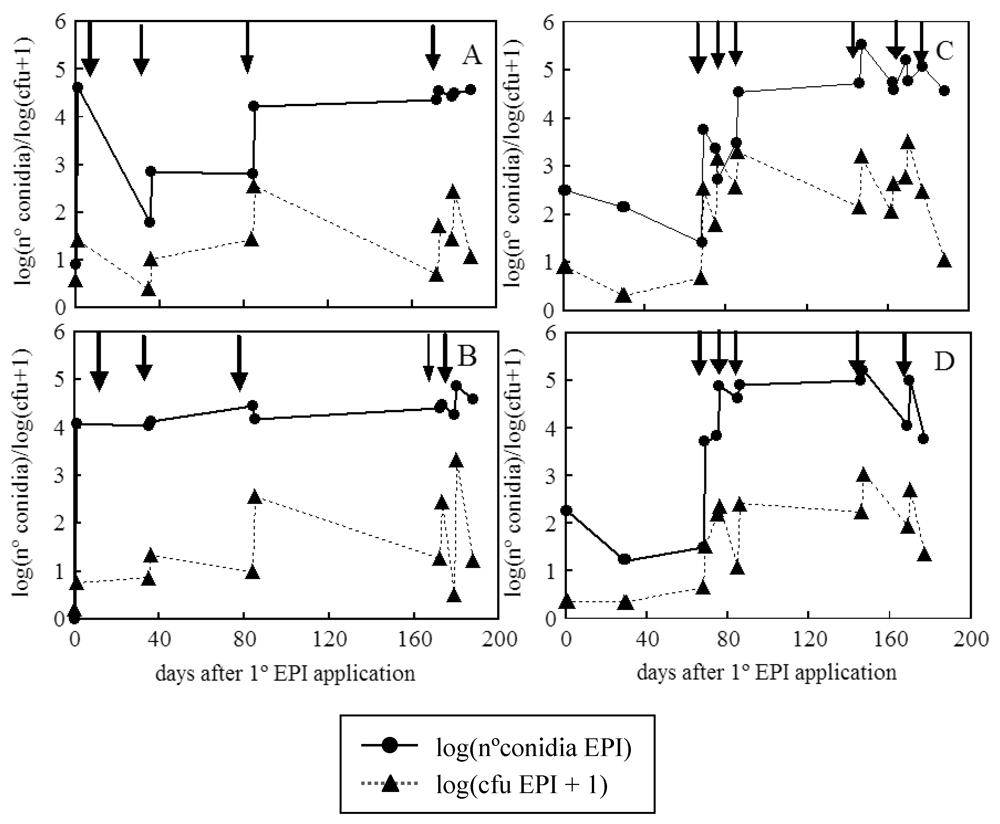
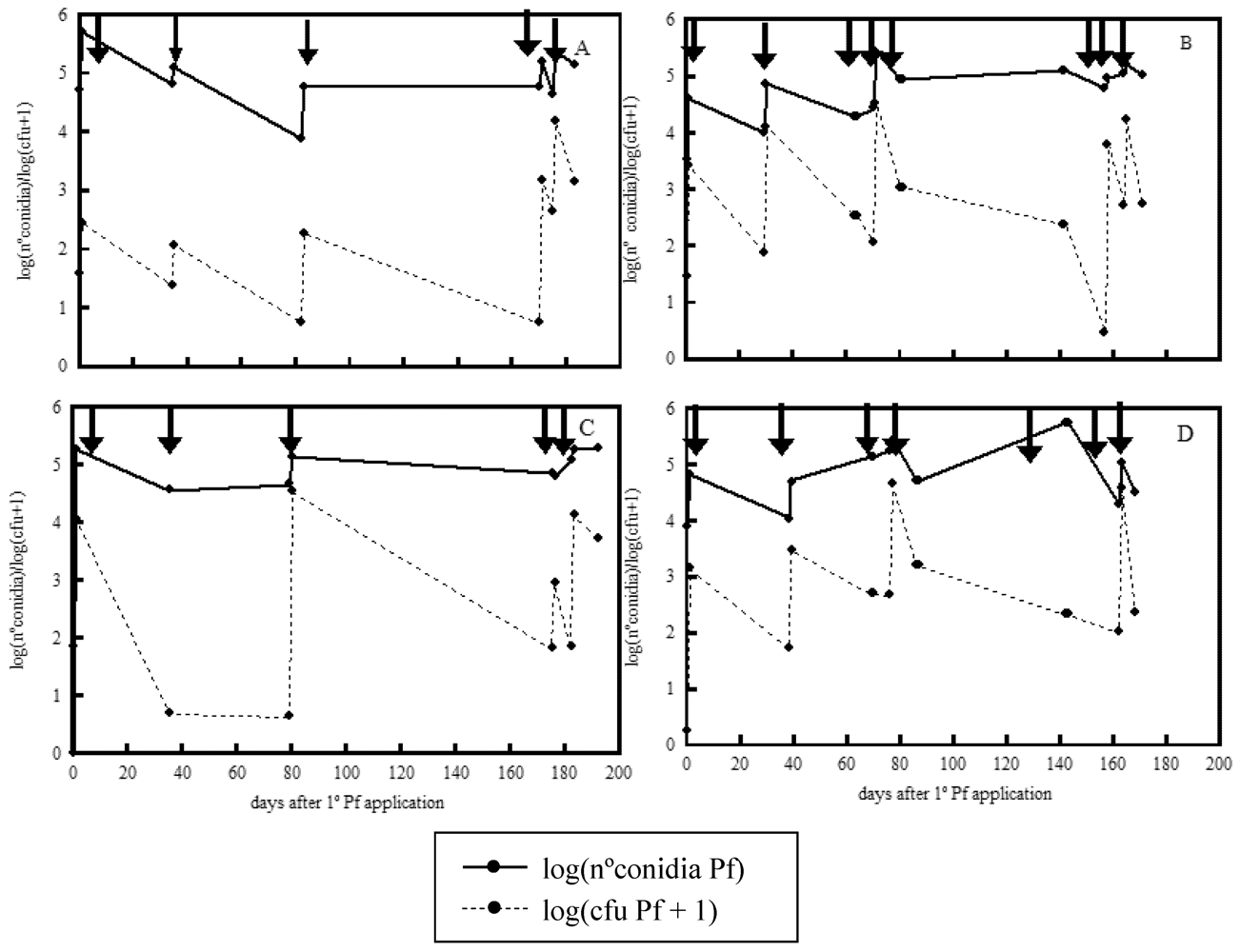
      <p>One of the goals of a population dynamics study is to identify recurring patterns in the dynamics of the population, and to acquire knowledge on the mechanisms that generate these patterns [<xref ref-type="bibr" rid="B40-agriculture-02-00109">40</xref>]. The population dynamics of <italic>E. nigrum</italic> and <italic>P. frequentans</italic> in two commercial orchards in 2004 and 2005 are shown in <xref ref-type="fig" rid="agriculture-02-00109-f001">Figure 1</xref> and <xref ref-type="fig" rid="agriculture-02-00109-f002">Figure 2</xref>, respectively. We found that the number of conidia (AUncPC) and the number of colony-forming units (CFUs) (AUcfuPC) for peach and nectarines trees that were treated with a <italic>P. frequentans</italic> conidial formulation were significantly higher (<italic>p</italic> = 0.05) than those for those trees that were treated with an <italic>E. nigrum</italic> conidial formulation (<xref ref-type="table" rid="agriculture-02-00109-t001">Table 1</xref> and <xref ref-type="table" rid="agriculture-02-00109-t002">Table 2</xref>). In all instances, the number of <italic>E. nigrum</italic> and <italic>P. frequentans</italic> conidia on the peach surfaces (flowers or fruit) at each sampling date in every orchard was 100- to 1000-fold higher than the number of CFUs on Petri dishes that contained potato dextrose agar (PDA). Significantly larger <italic>E. nigrum</italic> and <italic>P. frequentans</italic> populations (<italic>p</italic>= 0.05) were present on the fruit surfaces 15 days before harvest (15–30% for the conidial populations and 80–100% for the number of CFUs) than on the flower surfaces in the early spring (<xref ref-type="fig" rid="agriculture-02-00109-f001">Figure 1</xref> and <xref ref-type="fig" rid="agriculture-02-00109-f002">Figure 2</xref>). The number of <italic>E. nigrum</italic> and <italic>P. frequentans</italic> conidia remained fairly constant on the fruit surfaces over the period from petal fall to the first preharvest treatment with the conidial formulations (<xref ref-type="fig" rid="agriculture-02-00109-f001">Figure 1</xref> and <xref ref-type="fig" rid="agriculture-02-00109-f002">Figure 2</xref>). Although the conidial concentration in the <italic>E. nigrum</italic> or <italic>P. frequentans</italic> formulations that were applied to the peach trees were the same, the size of the <italic>P. frequentans</italic> population on the surfaces was higher than that of the <italic>E. nigrum</italic> population.</p>
      <p>Effective colonization, a large population size, and the viability of a BCA on plant surfaces are all essential for successful biocontrol of plant diseases [<xref ref-type="bibr" rid="B41-agriculture-02-00109">41</xref>]. We found that the numbers of <italic>E. nigrum</italic> and <italic>P. frequentans</italic> conidia are always significantly higher (<italic>p</italic> = 0.05) immediately following application of their conidial formulations when compared with those found at other sampling times (<xref ref-type="fig" rid="agriculture-02-00109-f001">Figure 1</xref> and <xref ref-type="fig" rid="agriculture-02-00109-f002">Figure 2</xref>). It is possible that the greater number of <italic>P. frequentans</italic> conidia on the fruit surfaces may be due to a better adhesive ability than <italic>E. nigrum</italic> conidia, despite the ten-fold larger size of <italic>E. nigrum</italic> conidia [<xref ref-type="bibr" rid="B42-agriculture-02-00109">42</xref>]. In addition, the cell wall of <italic>E. nigrum</italic> conidia is composed of two layers whose outer layer is thick, studded with wart-like knobs, and pigmented by indole melanin [<xref ref-type="bibr" rid="B42-agriculture-02-00109">42</xref>]. </p>
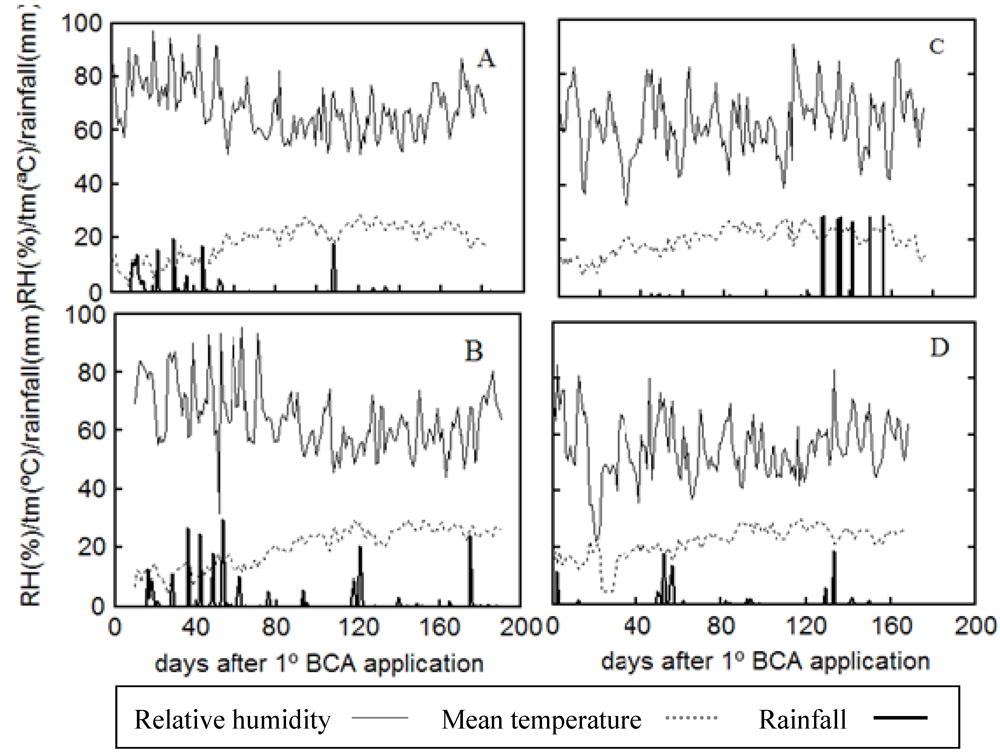
      <p>The dynamics of individual populations within the epiphytic community are determined by the rates of immigration, emigration, growth, and death. Each of these factors is strongly influenced by the physical environment, chemical treatment, mean air temperature (tm), the relative humidity (RH), the amount of wind and rainfall, and solar radiation [<xref ref-type="bibr" rid="B40-agriculture-02-00109">40</xref>]. Hence, any climatic change, such as an increase in environmental temperature or drought stress, has the potential to affect a BCA’s performance and impact a food security agenda. Since fresh conidia without additives are more susceptible to environmental stress than dried conidial formulations, improving inoculum quality in such a manner as to reduce its susceptibility to environmental stresses is one way to increase the preharvest efficacy of BCAs [<xref ref-type="bibr" rid="B43-agriculture-02-00109">43</xref>]. We found that the sizes of the two BCA populations on the surface of peaches that were treated by either the FOR7 or FOR8 conidial formulation are much higher than those on the surfaces of peaches that were treated with fresh conidia without any additives [<xref ref-type="bibr" rid="B27-agriculture-02-00109">27</xref>,<xref ref-type="bibr" rid="B31-agriculture-02-00109">31</xref>]. We also found that the size of <italic>E. nigrum</italic> indigenous population was also lower than that of <italic>P. frequentans</italic>. Furthermore, application of both biological formulations always increased the size of the indigenous population of the fungi by 100- to 1000-fold on peach surfaces during the crop season in all tested orchards.</p>
      <fig id="agriculture-02-00109-f001" position="anchor">
        <label>Figure 1</label>
        <caption>
          <p>Population dynamics of <italic>Epicoccum nigrum</italic> (EPI) after five or six applications of the FOR7 <italic>E. nigrum</italic> conidial formulation. The data are displayed as the logarithm of the number of conidia and the number of colony-forming units (CFU + 1) that were recovered from flowers or fruit in (A) 2004 and (B) 2005 in a commercial orchard in Alfarrás, Spain, and in (C) 2004 and (D) 2005 in a commercial orchard in Sudanell, Spain. The number of <italic>E. nigrum</italic> conidia was counted in a hemocytometer under a light microscope (×100). The numbers of CFUs of <italic>E. nigrum</italic> per square centimeter of surface of the Petri dish that contained potato dextrose agar that was supplemented with 0.5 g L<sup>−1</sup>streptomycin were counted with the naked eye. Data are the mean of four replicates, with 10 flowers or five fruits per replicate. The vertical arrows show the times of the EPI applications.</p>
        </caption>
        <graphic xmlns:xlink="http://www.w3.org/1999/xlink" xlink:href="agriculture-02-00109-g001.tif"/>
      </fig>
      <fig id="agriculture-02-00109-f002" position="anchor">
        <label>Figure 2</label>
        <caption>
          <p>Population dynamics of <italic>Penicillium frequentans</italic> (Pf) after five or eight applications the FOR8 <italic>P. frequentans</italic> conidial formulation. The data are displayed as the logarithm of the number of conidia and the number of colony-forming units (CFU + 1) that were recovered from flowers or fruit in 2004 (A) and 2005 (B) in a commercial orchard in Alfarrás, Spain, and in 2004 (C) and 2005 (D) from a commercial orchard in Sudanell, Spain. The numbers of <italic>P. frequentans</italic> conidia were counted in a hemocytometer under a light microscope (×100). The number of CFUs of <italic>P. frequentans</italic> per square centimeter of surface of the Petri dish containing potato dextrose agar that was supplemented with 0.5 g L<sup>−1</sup> streptomycin was counted with the naked eye. Data are the mean of four replicates, with 10 flowers or five fruits per replicate. The vertical arrows show the times of the Pf applications.</p>
        </caption>
        <graphic xmlns:xlink="http://www.w3.org/1999/xlink" xlink:href="agriculture-02-00109-g002.tif"/>
      </fig>	  
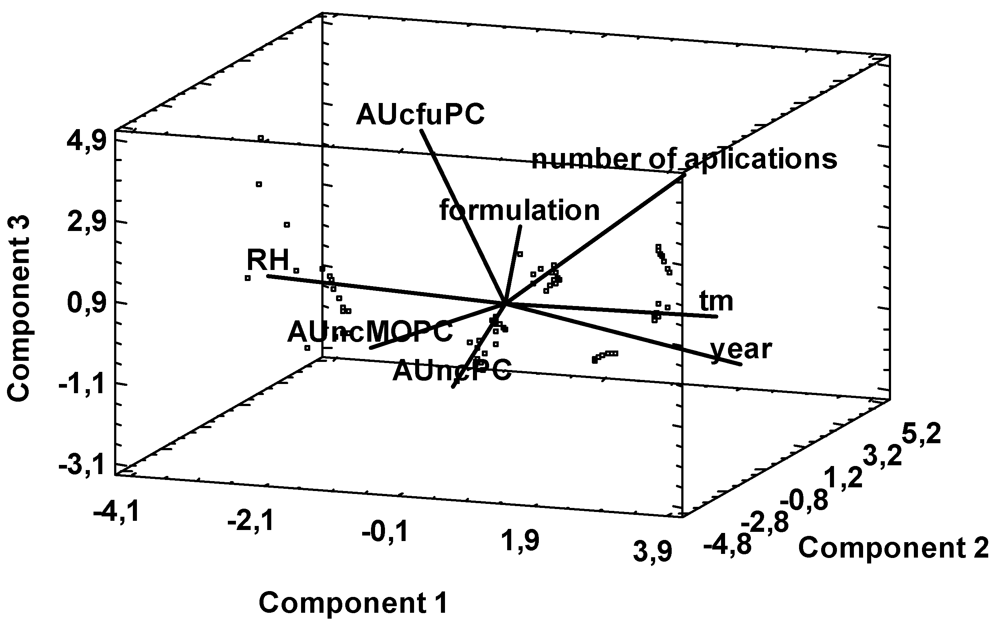
      <p>A principal component analysis (PCA) was undertaken to extract the linear composites of the number of <italic>Monilinia</italic> spp., <italic>E. nigrum</italic> and <italic>P. frequentans</italic> conidia on the nectarine and peach surfaces, the number of applications, the year of application, the formulation type, the tm, and the RH (<xref ref-type="fig" rid="agriculture-02-00109-f003">Figure 3</xref>). According to the results of the PCA, we found that only the first three components had eigenvalues greater than one, and when combined, components 1, 2, and 3 accounted for 77.6% of the total variance, 41.3%, 23.5%, and 12.9%, respectively. The variance in the number of <italic>Monilinia</italic> spp. on fruit surface is mainly dependent on the number of <italic>E. nigrum</italic> and <italic>P. frequentans</italic>, the formulation type, and the RH (<xref ref-type="fig" rid="agriculture-02-00109-f004">Figure 4</xref>). All were on the negative side of the first principal component axis, while the number of applications, the year of application, and the tm were on the positive side (<xref ref-type="fig" rid="agriculture-02-00109-f004">Figure 4</xref>). The AUncMOPC and climatic conditions were on the negative side of the second principal component (<xref ref-type="fig" rid="agriculture-02-00109-f004">Figure 4</xref>). On other hand, the AUncMOPC, the AUcfuPC, the RH, and the formulation type were closely grouped on the positive side of the third principal component axis (<xref ref-type="fig" rid="agriculture-02-00109-f004">Figure 4</xref>). Shaw <italic>et al.</italic> [<xref ref-type="bibr" rid="B44-agriculture-02-00109">44</xref>] reported that the severity of a fungal disease in fruit is a function of temperature and wetness duration under controlled conditions. De Cal <italic>et al.</italic> [<xref ref-type="bibr" rid="B45-agriculture-02-00109">45</xref>] studied the population dynamics of <italic>E. nigrum</italic> on peaches and nectarines in order to find a method for promoting its colonization on fruit surfaces and improve its biocontrol efficacy against brown rot. They reported that the number of pit hardening and preharvest applications of the <italic>E. nigrum</italic> conidial formulations and RH accounted for 96% of the variability in the viability of the <italic>E. nigrum</italic> conidial population on the peach surfaces. In another study, Guijarro <italic>et al.</italic> [<xref ref-type="bibr" rid="B46-agriculture-02-00109">46</xref>] studied the population dynamics of <italic>P. frequentans</italic> on peach flower and fruit surfaces after different field treatments of six different <italic>P. frequentans</italic> conidia formulations. They found that size the <italic>P. frequentans</italic> conidial population on the surfaces was dependent upon application of the formulation to the blooming flowers and pre-harvested fruit, the RH, and the tm.</p>
      <fig id="agriculture-02-00109-f003" position="anchor">
        <label>Figure 3</label>
        <caption>
          <p>Daily rainfall (mm), mean temperature (tm ºC) and relative humidity (% RH) during (A) 2004 and (B) 2005 in the commercial orchard in Alfarrás, Spain, and (C) 2004 and (D) 2005 in the commercial orchard in Sudanell, Spain.</p>
        </caption>
        <graphic xmlns:xlink="http://www.w3.org/1999/xlink" xlink:href="agriculture-02-00109-g003.tif"/>
      </fig>
      <fig id="agriculture-02-00109-f004" position="anchor">
        <label>Figure 4</label>
        <caption>
          <p>Principal component analysis to the number of <italic>Monilinia</italic> spp. (AUncMOPC), the number of <italic>E. nigrum</italic> and <italic>P. frequentans</italic> conidia and cfu (AUncPC and AUcfuPC) on nectarine and peach surfaces, the number of applications, the year of application, the formulation type, the mean temperature (tm), and the relative humidity (RH). The first three components accounted for 41.3%, 23.5%, and 12.9% of the total variance, respectively.</p>
        </caption>
        <graphic xmlns:xlink="http://www.w3.org/1999/xlink" xlink:href="agriculture-02-00109-g004.tif"/>
      </fig>
      <p>Preharvest application and optimization of BCAs require considerable understanding of the crop system, the pathogen’s epidemiology, and the biology, ecology, and population dynamics of the antagonists and their interactions [<xref ref-type="bibr" rid="B47-agriculture-02-00109">47</xref>]. The results of our studies suggest that the size of <italic>P. frequentans</italic> population after an application of a <italic>P. frequentans</italic> conidial formulation during the crop season is larger than that of <italic>E. nigrum</italic> following the application of an <italic>E. nigrum</italic> conidial formulation. Moreover, applications of a <italic>P. frequentans</italic> conidial formulation during the crop season also caused a greater reduction in the number of <italic>Monilinia</italic> spp. conidia on the fruit surface than that found after applications of an <italic>E. nigrum</italic> formulation during the growing season. </p>
    </sec>
    <sec>
      <title>3. Experimental Section</title>
      <sec>
        <title>3.1. Cultures and Formulations</title>
        <p>Conidia of <italic>E. nigrum</italic> (ATCC No 96794) and <italic>P. frequentans</italic> (ATCC No 66108) were produced in a solid fermentation system [<xref ref-type="bibr" rid="B48-agriculture-02-00109">48</xref>,<xref ref-type="bibr" rid="B49-agriculture-02-00109">49</xref>]. For production of the FOR7 <italic>E. nigrum</italic> conidial formulation, fresh <italic>E. nigrum</italic> conidia were suspended after centrifugation in a 1% KCl + 1.25% sodium alginate solution in 250 mL centrifuge tubes. The tubes were shaken on a vortex mixer (Reax Top, Heildolph, Rose Scientific Ltd. Alberta, Canada) for 10 seconds and kept for 10 min. at room temperature (20–25°C). For production of the FOR8 <italic>P. frequentans</italic> conidial formulation, fresh <italic>P. frequentans</italic> conidia were suspended in 2% methyl cellulose +10% glucose solution in 250 mL centrifuge tubes, which were then processed in the identical manner as described above. Each conidial suspension was filtered through 2µm filter paper in a Büchner funnel, and the filtrate was then mixed with silica powder at a ratio that was necessary to obtain granulation [<xref ref-type="bibr" rid="B26-agriculture-02-00109">26</xref>,<xref ref-type="bibr" rid="B27-agriculture-02-00109">27</xref>]. The granules were dried in a fluid bed dryer (FBD model 350s, Burkard Manufacturing Co Ltd., Hertfordshire, UK) at its highest air flow rate at 40°C [<xref ref-type="bibr" rid="B25-agriculture-02-00109">25</xref>,<xref ref-type="bibr" rid="B50-agriculture-02-00109">50</xref>]. The moisture content of each final conidial formulation was measured using a humidity analyzer (BOECKEL, GmbH &amp; Co, Hamburg, Germany). Germination of the dried conidia was assessed using a previously described bioassay [<xref ref-type="bibr" rid="B25-agriculture-02-00109">25</xref>,<xref ref-type="bibr" rid="B50-agriculture-02-00109">50</xref>]. Conidia were dried to reduce their moisture content to between 5% and 10% and their germinability was as high as 80% after drying [<xref ref-type="bibr" rid="B26-agriculture-02-00109">26</xref>,<xref ref-type="bibr" rid="B50-agriculture-02-00109">50</xref>].</p>
      </sec>
      <sec>
        <title>3.2. Treatments and Experimental Design</title>
        <p>Four field surveys were carried out in two commercial peach (<italic>Prunus persica</italic> “Red September”) and nectarine (<italic>Prunus persica</italic> var. <italic>nectarina</italic> (Aiton) Maxim “Autumn Free”) orchards which were located in Alfarrás (UTM: 298197, 4634045), and Sudanell (UTM: 297230, 4603615), Lleida, Cataluña, Spain over two growing seasons in 2004 and 2005. The size of the orchards ranged from 3–5 hectares. The planting distances between rows and trees ranged from 2–4 metres in the Alfarras orchard, and 4–5 metres in the Sudanell orchard. The experimental design of each experiment was a randomized complete block design in which four replications (four blocks) were used, and three trees comprised the sample unit for each treatment and replication. Three barrier trees were used to separate the blocks and the treatments in order to avoid inter plot interference and protect the untreated trees from the fungicidal sprays. Daily measurements of mean tm, rainfall (mm), and RH were collected by automated weather monitors, which were located 0.5–5 km from each orchard. The average daily tm, rainfall, and RH were calculated for each orchard and for each treatment period. The treatment periods were (a) day of first biocontrol treatment to one day before the second treatment; (b) day of second biocontrol treatment to one day before the third treatment; (c) day of third biocontrol treatment to one day before the fourth treatment, and (d) day of fourth biocontrol treatment to one day before the fifth treatment. The trees were treated 5–8 times with the FOR7 and FOR8 conidial formulations in each experiment during the growing season: once at the pink blossom stage, once at the shuck-split stage, 1–3 times at the pit hardening stage, and 1–3 times at preharvest. All treatments were applied using a backpack sprayer (operating pressure 10 bar, hollow cone nozzle 1 mm) in the morning. Standard crop protection practices were applied in the two commercial orchards during the surveys. No specific fungicide against <italic>Monilinia</italic> spp. was applied during the surveys, except when trees in the same orchard were treated with either an experimental conidial formulation or a fungicide. When applied, the specific fungicides were: Caddy Pepite 10 (cyproconazole 10% WG; Bayer Cropscience, S.L. Valencia, Spain) in 2004 (ALF04 and SUD04); and Folicur 25RW (tebuconazole 25% WG; Bayer Hispania Industrial, S.A., Barcelona, Spain) in 2005 (ALF05 and SUD05). All treatments were carefully applied in non-windy conditions. </p>
      </sec>
      <sec>
        <title>3.3. Population Dynamics of <italic>E. nigrum</italic> and <italic>P. frequentans</italic></title>
        <p>In order to investigate the population dynamics of <italic>E. nigrum</italic> and <italic>P. frequentans</italic> following the application of each conidial formulation, 10 flowers or five fruits per sample unit (a sample unit corresponded to three trees and four replications for each treatment) were sampled in each orchard. The fruit and flower samples were taken at random different heights and locations in the canopy of each tree in a manner to ensure that the entire canopy of each tree was sampled. The sampling was undertaken 11 times in 2004 and 12 times in 2005. In the laboratory, each sample unit was suspended in containers that contained sterile distilled water (SDW) and shaken for 30 min. at 150 rev min<sup>−1</sup> in a rotary shaker. Each suspension was then decanted to centrifuge tubes, which were then centrifuged at 4°C for 10 min. at 14,040<italic>g</italic>. The recovered pellet was resuspended in 5 mL SDW (concentrate). The population size of <italic>E. nigrum</italic> and <italic>P. frequentans</italic> in each suspension was estimated from (i) the number of conidia and (ii) the number of CFUs of <italic>E. nigrum</italic> and <italic>P. frequentans</italic> per flower or fruit. The numbers of <italic>E. nigrum</italic> and <italic>P. frequentans</italic> conidia were counted in a hemocytometer under a light microscope (×100). The number of CFUs of <italic>E. nigrum</italic> and <italic>P. frequentans</italic> per Petri dish that contained PDA (Difco, Detroit, MI, USA) which was supplemented with 0.5 g L<sup>−1</sup> streptomycin was counted with the naked eye. Aliquots (100 µL) of 10- and 100-fold dilutions of each concentrate and each concentrate were spread onto the Petri dishes that contained the amended PDA. Three replicate dishes were used for each replicate, dilution, and concentrate. The Petri dishes were maintained at 20–25°C for 5–7 days in the dark before counting the number of CFUs [<xref ref-type="bibr" rid="B51-agriculture-02-00109">51</xref>]. The control for this assay was flowers and fruit from the Sudanell orchard which did not receive any treatment in 2005 (SUD05) and flowers and fruit from the Alfarrás orchard in 2005 (ALF05). Morphological characterization of <italic>E. nigrum</italic> and <italic>P. frequentans</italic> conidia in the CFUs was used to confirm their identity. </p>
      </sec>
      <sec>
        <title>3.4. Biocontrol Efficacy of <italic>E. nigrum</italic> and <italic>P. frequentans</italic> Conidial Formulations</title>
        <p>In order to evaluate the effect of <italic>E. nigrum</italic> and <italic>P. frequentans</italic> conidial formulations on the number of <italic>Monilinia</italic> spp. conidia on peach surfaces, we used the same flower and fruit samples that were used to estimate the number of <italic>P. frequentans</italic> and <italic>E. nigrum</italic> on the flower or fruit samples. </p>
      </sec>
      <sec>
        <title>3.5. Data Analysis</title>
        <p>Progress curves for the conidial numbers of <italic>E. nigrum, P. frequentans,</italic> and <italic>Monilinia</italic> spp., and for CFUs of <italic>E. nigrum</italic> and <italic>P. frequentans</italic> for each treatment at the different sampling dates were generated for each orchard and year. The area under each progress curve for the number of <italic>E. nigrum</italic> and <italic>P. frequentans</italic> conidia (AUncPC) or <italic>Monilinia</italic> spp. conidia (AUncMOPC), and the number of CFUs of <italic>E. nigrum and P. frequentans</italic> (AUcfuPC) for each orchard and year were calculated by trapezoidal integration on an Excel spreadsheet using the following formulae that are based on those used by Campbell and Madden [<xref ref-type="bibr" rid="B52-agriculture-02-00109">52</xref>]:</p>
        <p><italic>AUncPC =</italic> Σ<italic><sub>i</sub></italic><sub>=1</sub><italic><sup>n</sup></italic><sup>−1</sup>[(<italic>t<sub>i</sub></italic><sub>+1</sub><italic>− t<sub>i</sub></italic>)(<italic>NC<sub>i</sub> + NC<sub>i</sub></italic><sub>+1</sub>)/2]        (1)</p>
        <p><italic>AUncMONPC =</italic> Σ<italic><sub>i</sub></italic><sub>=1</sub><italic><sup>n</sup></italic><sup>−1</sup>[(<italic>t<sub>i</sub></italic><sub>+1</sub><italic>− t<sub>i</sub></italic>)(<italic>NCMO<sub>i</sub> + NCMO<sub>i</sub></italic><sub>+1</sub>)/2]        (2)</p>
        <p><italic>AUcfuPC =</italic> Σ<italic><sub>i</sub></italic><sub>=1</sub><italic><sup>n</sup></italic><sup>−1</sup>[(<italic>t<sub>i</sub></italic><sub>+1</sub><italic>− t<sub>i</sub></italic>)(<italic>CFU<sub>i</sub> + CFU<sub>i</sub></italic><sub>+1</sub>)<italic>/</italic>2]        (3)</p>
        <p>where “<italic>t</italic>” is “days from full flowering to harvest”, “NC” or “NCMO” are “the number of conidia at each sampling date for <italic>E. nigrum</italic> and <italic>P. frequentans</italic> or <italic>Monilinia</italic> spp., respectively”, “CFU” is “the number of CFUs at each sampling date for <italic>E. nigrum</italic> and <italic>P. frequentans</italic>”, and “<italic>n</italic>” is “the number of sampling dates”. </p>
        <p>Data of the AUncMOPC, and AUncPC and the AUcfuPC for each formulation and for each orchard were analyzed by a factorial analysis of variance [<xref ref-type="bibr" rid="B53-agriculture-02-00109">53</xref>]. When the F-test showed a significant difference at <italic>p</italic> ≤ 0.05, the treatment means were compared by Student–Newman–Keuls multiple range test (<italic>p</italic> = 0.05) [<xref ref-type="bibr" rid="B53-agriculture-02-00109">53</xref>]. </p>
        <p>The number of <italic>Monilinia</italic> spp., <italic>E. nigrum</italic> and <italic>P. frequentans</italic> conidia on nectarine and peach surfaces and climatic conditions from all experiments were analyzed by a principal component analysis [<xref ref-type="bibr" rid="B54-agriculture-02-00109">54</xref>] and only those components whose eigenvalues were greater or equal to 1.0 were extracted. The analysis was done with Statgraphics Centurion XVI v. 16.1.03 (StatPoint, Inc., Herndon, VA, USA).</p>
      </sec>
    </sec>
    <sec sec-type="conclusions">
      <title>4. Conclusions</title>
      <p>Biological control of brown rot in stone fruit caused by <italic>Monilinia</italic> spp. is very dependent on BCA density on the flower or fruit surface and the RH. One way to improve the performance of a fungal BCA is to develop an efficacious conidial formulation. The size of <italic>P. frequentans</italic> population after an application of a <italic>P. frequentans</italic> conidial formulation during the crop season is bigger than that of <italic>E. nigrum</italic> following the application of an <italic>E. nigrum</italic> conidial formulation. Moreover, applications of a <italic>P. frequentans</italic> conidial formulation during the crop season also caused a greater reduction in the number of <italic>Monilinia</italic> spp. conidia on the fruit surface than that found after applications of an <italic>E. nigrum</italic> formulation during the growing season. Finally, the potency of the <italic>E. nigrum</italic> conidial formulation is the same as that of fungicide.</p>
    </sec>
  </body>
  <back>
    <ack>
      <title>Acknowledgments</title>
      <p>This work was carried out with financial support from AGL2002-4396-CO2 (Plan Nacional de I+D+I, Ministerio de Educación y Ciencia, Spain), RTA2005-0077-CO2, and from RM2010-00013. The authors wish to thank Y. Herranz and M.T. Morales Clemente for their technical support. The authors also wish to thank Arieh Bomzon, Consulwrite (<uri>www.consulwrite.com</uri>) for his editorial assistance in preparing this review.</p>
    </ack>
    <ref-list>
      <title>References</title>
      <ref id="B1-agriculture-02-00109">
        <label>1.</label>
        <citation citation-type="journal">
          <person-group person-group-type="author">
            <name>
              <surname>Alabouvette</surname>
              <given-names>C.</given-names>
            </name>
            <name>
              <surname>Olivain</surname>
              <given-names>C.</given-names>
            </name>
            <name>
              <surname>Steinberg</surname>
              <given-names>C.</given-names>
            </name>
          </person-group>
          <article-title>Biological control of plant diseases: The European situation</article-title>
          <source>Eur. J. Plant Pathol.</source>
          <year>2006</year>
          <volume>114</volume>
          <fpage>329</fpage>
          <lpage>341</lpage>
          <pub-id pub-id-type="doi">10.1007/s10658-005-0233-0</pub-id>
        </citation>
      </ref>
      <ref id="B2-agriculture-02-00109">
        <label>2.</label>
        <citation citation-type="journal">
          <person-group person-group-type="author">
            <name>
              <surname>Nicot</surname>
              <given-names>P.C.</given-names>
            </name>
            <name>
              <surname>Decognet</surname>
              <given-names>V.</given-names>
            </name>
            <name>
              <surname>Fruit</surname>
              <given-names>L.</given-names>
            </name>
            <name>
              <surname>Bardin</surname>
              <given-names>M.</given-names>
            </name>
            <name>
              <surname>Trottin</surname>
              <given-names>Y.</given-names>
            </name>
          </person-group>
          <article-title>Combined effect of microclimate and dose of application on the efficacy of biocontrol agents for the protection of pruning wounds on tomatoes against <italic>Botrytis cinerea</italic></article-title>
          <source>Bulletin IOBC/SROP</source>
          <year>2002</year>
          <volume>25</volume>
          <fpage>73</fpage>
          <lpage>76</lpage>
        </citation>
      </ref>
      <ref id="B3-agriculture-02-00109">
        <label>3.</label>
        <citation citation-type="book">
          <person-group person-group-type="author">
            <name>
              <surname>Byrde</surname>
              <given-names>R.J.</given-names>
            </name>
            <name>
              <surname>Willetts</surname>
              <given-names>H.J.</given-names>
            </name>
          </person-group>
          <source>The Brown Rot Fungi of Fruit. Their Biology and Control.</source>
          <edition>1st</edition>
          <publisher-name>Pergamon Press</publisher-name>
          <publisher-loc>Oxford, UK</publisher-loc>
          <year>1977</year>
          <fpage>171</fpage>
        </citation>
      </ref>
      <ref id="B4-agriculture-02-00109">
        <label>4.</label>
        <citation citation-type="journal">
          <person-group person-group-type="author">
            <name>
              <surname>Ahmadi</surname>
              <given-names>H.</given-names>
            </name>
            <name>
              <surname>Biasi</surname>
              <given-names>W.V.</given-names>
            </name>
            <name>
              <surname>Mitcham</surname>
              <given-names>E.J.</given-names>
            </name>
          </person-group>
          <article-title>Control of brown rot decay of nectarines with 15% carbon dioxide atmosphere</article-title>
          <source>J. Am. Soc. Hort. Sci.</source>
          <year>1999</year>
          <volume>124</volume>
          <fpage>708</fpage>
          <lpage>712</lpage>
        </citation>
      </ref>
      <ref id="B5-agriculture-02-00109">
        <label>5.</label>
        <citation citation-type="journal">
          <person-group person-group-type="author">
            <name>
              <surname>Sommer</surname>
              <given-names>N.F.</given-names>
            </name>
          </person-group>
          <article-title>Role of controlled environments in suppression of post-harvest diseases</article-title>
          <source>Can. J. Plant Pathol.</source>
          <year>1985</year>
          <volume>7</volume>
          <fpage>331</fpage>
          <lpage>339</lpage>
        <pub-id pub-id-type="doi">10.1080/07060668509501700</pub-id></citation>
      </ref>
      <ref id="B6-agriculture-02-00109">
        <label>6.</label>
        <citation citation-type="journal">
          <person-group person-group-type="author">
            <name>
              <surname>Osorio</surname>
              <given-names>J.M.</given-names>
            </name>
            <name>
              <surname>Adaskaveg</surname>
              <given-names>J.E.</given-names>
            </name>
            <name>
              <surname>Ogawa</surname>
              <given-names>J.W.</given-names>
            </name>
          </person-group>
          <article-title>Comparative efficacy and systemic activity of iprodione and the experimental anilide E-0858 for control of brown rot on peach fruit</article-title>
          <source>Plant Dis.</source>
          <year>1993</year>
          <volume>77</volume>
          <fpage>1140</fpage>
          <lpage>1143</lpage>
          <pub-id pub-id-type="doi">10.1094/PD-77-1140</pub-id>
        </citation>
      </ref>
      <ref id="B7-agriculture-02-00109">
        <label>7.</label>
        <citation citation-type="journal">
          <person-group person-group-type="author">
            <name>
              <surname>Hong</surname>
              <given-names>C.X.</given-names>
            </name>
            <name>
              <surname>Michailides</surname>
              <given-names>T.J.</given-names>
            </name>
            <name>
              <surname>Holtz</surname>
              <given-names>B.A.</given-names>
            </name>
          </person-group>
          <article-title>Effects of wounding, inoculum density, and biological control agents on postharvest brown rot of stone fruit</article-title>
          <source>Plant Dis.</source>
          <year>1998</year>
          <volume>82</volume>
          <fpage>1210</fpage>
          <lpage>1216</lpage>
          <pub-id pub-id-type="doi">10.1094/PDIS.1998.82.11.1210</pub-id>
        </citation>
      </ref>
      <ref id="B8-agriculture-02-00109">
        <label>8.</label>
        <citation citation-type="book">
          <person-group person-group-type="author">
            <name>
              <surname>Ogawa</surname>
              <given-names>J.M.</given-names>
            </name>
            <name>
              <surname>Zehr</surname>
              <given-names>E.I.</given-names>
            </name>
            <name>
              <surname>Biggs</surname>
              <given-names>A.R.</given-names>
            </name>
          </person-group>
          <article-title>Brown rot</article-title>
          <source>Compendium of Stone Fruit Diseases</source>
          <person-group person-group-type="editor">
            <name>
              <surname>Ogawa</surname>
              <given-names>J.M.</given-names>
            </name>
            <name>
              <surname>Zehr</surname>
              <given-names>E.I.</given-names>
            </name>
            <name>
              <surname>Bird</surname>
              <given-names>G.W.</given-names>
            </name>
            <name>
              <surname>Ritchie</surname>
              <given-names>D.F.</given-names>
            </name>
            <name>
              <surname>Uriu</surname>
              <given-names>K.</given-names>
            </name>
            <name>
              <surname>Uyemoto</surname>
              <given-names>J.K.</given-names>
            </name>
          </person-group>
          <publisher-name>APS Press</publisher-name>
          <publisher-loc>St. Paul,  MN, USA</publisher-loc>
          <year>1995</year>
          <fpage>7</fpage>
          <lpage>10</lpage>
        </citation>
      </ref>
      <ref id="B9-agriculture-02-00109">
        <label>9.</label>
        <citation citation-type="journal">
          <person-group person-group-type="author">
            <name>
              <surname>Hong</surname>
              <given-names>C.X.</given-names>
            </name>
            <name>
              <surname>Holtz</surname>
              <given-names>B.A.</given-names>
            </name>
            <name>
              <surname>Morgan</surname>
              <given-names>D.P.</given-names>
            </name>
            <name>
              <surname>Michailides</surname>
              <given-names>T.J.</given-names>
            </name>
          </person-group>
          <article-title>Significance of thinned fruit as a source of the secondary inoculum of <italic>Monilinia fructicola</italic> in California nectarine orchards</article-title>
          <source>Plant Dis.</source>
          <year>1997</year>
          <volume>81</volume>
          <fpage>519</fpage>
          <lpage>524</lpage>
          <pub-id pub-id-type="doi">10.1094/PDIS.1997.81.5.519</pub-id>
        </citation>
      </ref>
      <ref id="B10-agriculture-02-00109">
        <label>10.</label>
        <citation citation-type="journal">
          <person-group person-group-type="author">
            <name>
              <surname>Villarino</surname>
              <given-names>M.</given-names>
            </name>
            <name>
              <surname>Melgarejo</surname>
              <given-names>P.</given-names>
            </name>
            <name>
              <surname>Usall</surname>
              <given-names>J.</given-names>
            </name>
            <name>
              <surname>Segarra</surname>
              <given-names>J.</given-names>
            </name>
            <name>
              <surname>Lamarca</surname>
              <given-names>N.</given-names>
            </name>
            <name>
              <surname>De Cal</surname>
              <given-names>A.</given-names>
            </name>
          </person-group>
          <article-title>Secondary inoculum dynamics of <italic>Monilinia</italic> spp. and relationship to the incidence of postharvest brown rot in peaches and the weather conditions during the growing season</article-title>
          <source>Eur. J. Plant Pathol.</source>
          <year>2012</year>
          <pub-id pub-id-type="doi">10.1007/s10658-011-9931-y</pub-id>
        </citation>
      </ref>
      <ref id="B11-agriculture-02-00109">
        <label>11.</label>
        <citation citation-type="journal">
          <person-group person-group-type="author">
            <name>
              <surname>Xu</surname>
              <given-names>X.-M.</given-names>
            </name>
            <name>
              <surname>Bertone</surname>
              <given-names>C.</given-names>
            </name>
            <name>
              <surname>Berrie</surname>
              <given-names>A.</given-names>
            </name>
          </person-group>
          <article-title>Effects of wounding, fruit age and wetness duration on the development of cherry brown rot in the UK</article-title>
          <source>Plant Pathol.</source>
          <year>2007</year>
          <volume>56</volume>
          <fpage>114</fpage>
          <lpage>119</lpage>
        </citation>
      </ref>
      <ref id="B12-agriculture-02-00109">
        <label>12.</label>
        <citation citation-type="journal">
          <person-group person-group-type="author">
            <name>
              <surname>Gell</surname>
              <given-names>I.</given-names>
            </name>
            <name>
              <surname>De Cal</surname>
              <given-names>A.</given-names>
            </name>
            <name>
              <surname>Torres</surname>
              <given-names>R.</given-names>
            </name>
            <name>
              <surname>Usall</surname>
              <given-names>J.</given-names>
            </name>
            <name>
              <surname>Melgarejo</surname>
              <given-names>P.</given-names>
            </name>
          </person-group>
          <article-title>Relationship between the incidence of latent infections caused by <italic>Monilinia</italic> spp. and the incidence of brown rot of peach fruit: Factors affecting latent infection</article-title>
          <source>Eur. J. Plant Pathol.</source>
          <year>2008</year>
          <volume>121</volume>
          <fpage>487</fpage>
          <lpage>498</lpage>
          <pub-id pub-id-type="doi">10.1007/s10658-008-9268-3</pub-id>
        </citation>
      </ref>
      <ref id="B13-agriculture-02-00109">
        <label>13.</label>
        <citation citation-type="journal">
          <person-group person-group-type="author">
            <name>
              <surname>Villarino</surname>
              <given-names>M.</given-names>
            </name>
            <name>
              <surname>Sandin-España</surname>
              <given-names>P.</given-names>
            </name>
            <name>
              <surname>Melgarejo</surname>
              <given-names>P.</given-names>
            </name>
            <name>
              <surname>De Cal</surname>
              <given-names>A.</given-names>
            </name>
          </person-group>
          <article-title>High chlorogenic and neochlorogenic acid levels in immature peach reduce <italic>Monilinia laxa</italic> infection by interfering with fungal melanin biosynthesis</article-title>
          <source>J. Agr. Food Chem.</source>
          <year>2011</year>
          <volume>59</volume>
          <fpage>3205</fpage>
          <lpage>3213</lpage>
        <pub-id pub-id-type="doi">10.1021/jf104251z</pub-id></citation>
      </ref>
      <ref id="B14-agriculture-02-00109">
        <label>14.</label>
        <citation citation-type="journal">
          <person-group person-group-type="author">
            <name>
              <surname>Penrose</surname>
              <given-names>L.J.</given-names>
            </name>
            <name>
              <surname>Davis</surname>
              <given-names>K.C.</given-names>
            </name>
            <name>
              <surname>Koffmann</surname>
              <given-names>W.</given-names>
            </name>
          </person-group>
          <article-title>The distribution of benomyl-tolerant <italic>Slerotinia fructicola</italic> (Wint.) Rehm in stone fruit orchards in New South Wales and comparative studies with susceptible isolates</article-title>
          <source>Aust. J. Agric. Res.</source>
          <year>1979</year>
          <volume>30</volume>
          <fpage>307</fpage>
          <lpage>319</lpage>
          <pub-id pub-id-type="doi">10.1071/AR9790307</pub-id>
        </citation>
      </ref>
      <ref id="B15-agriculture-02-00109">
        <label>15.</label>
        <citation citation-type="journal">
          <person-group person-group-type="author">
            <name>
              <surname>Penrose</surname>
              <given-names>L.J.</given-names>
            </name>
          </person-group>
          <article-title>Prolonged field persistence of resistance to benomyl in <italic>Monilinia fructicola</italic></article-title>
          <source>Crop Prot.</source>
          <year>1990</year>
          <volume>9</volume>
          <fpage>190</fpage>
          <lpage>192</lpage>
          <pub-id pub-id-type="doi">10.1016/0261-2194(90)90162-Z</pub-id>
        </citation>
      </ref>
      <ref id="B16-agriculture-02-00109">
        <label>16.</label>
        <citation citation-type="journal">
          <person-group person-group-type="author">
            <name>
              <surname>Elmer</surname>
              <given-names>P.A.G.</given-names>
            </name>
            <name>
              <surname>Gaunt</surname>
              <given-names>R.E.</given-names>
            </name>
          </person-group>
          <article-title>Effect of frequency of dicarboximide applications on resistant populations of <italic>Monilinia fructicola</italic> and brown rot in New Zealand orchards</article-title>
          <source>Crop Prot.</source>
          <year>1993</year>
          <volume>12</volume>
          <fpage>83</fpage>
          <lpage>88</lpage>
          <pub-id pub-id-type="doi">10.1016/0261-2194(93)90132-3</pub-id>
        </citation>
      </ref>
      <ref id="B17-agriculture-02-00109">
        <label>17.</label>
        <citation citation-type="journal">
          <person-group person-group-type="author">
            <name>
              <surname>Falconi</surname>
              <given-names>C.J.</given-names>
            </name>
            <name>
              <surname>Mendgen</surname>
              <given-names>K.</given-names>
            </name>
          </person-group>
          <article-title>Epiphytic fungi on apple leaves and their value for control of the postharvest pathogens <italic>Botrytis cinerea</italic>, <italic>Monilinia fructigena</italic> and <italic>Penicillium expansum</italic></article-title>
          <source>J. Plant Dis. Prot.</source>
          <year>1994</year>
          <volume>101</volume>
          <fpage>38</fpage>
          <lpage>47</lpage>
        </citation>
      </ref>
      <ref id="B18-agriculture-02-00109">
        <label>18.</label>
        <citation citation-type="journal">
          <person-group person-group-type="author">
            <name>
              <surname>Sanoamuang</surname>
              <given-names>N.</given-names>
            </name>
            <name>
              <surname>Gaunt</surname>
              <given-names>R.E.</given-names>
            </name>
          </person-group>
          <article-title>Persistence and fitness of carbendazim- and dicarboximide-resistant isolates of <italic>Monilinia fructicola</italic> (Wint.) Honey in flowers, shoots and fruit of stone fruit</article-title>
          <source>Plant Pathol.</source>
          <year>1995</year>
          <volume>44</volume>
          <fpage>448</fpage>
          <lpage>457</lpage>
          <pub-id pub-id-type="doi">10.1111/j.1365-3059.1995.tb01667.x</pub-id>
        </citation>
      </ref>
      <ref id="B19-agriculture-02-00109">
        <label>19.</label>
        <citation citation-type="journal">
          <person-group person-group-type="author">
            <name>
              <surname>Adaskaveg</surname>
              <given-names>J.E.</given-names>
            </name>
            <name>
              <surname>Förster</surname>
              <given-names>H.</given-names>
            </name>
            <name>
              <surname>Gubler</surname>
              <given-names>W.D.</given-names>
            </name>
            <name>
              <surname>Teviotdale</surname>
              <given-names>B.L.</given-names>
            </name>
            <name>
              <surname>Thompson</surname>
              <given-names>D.F.</given-names>
            </name>
          </person-group>
          <article-title>Reduced risk fungicides: A new way of managing brown rot and other fungal diseases of stone fruit crops</article-title>
          <source>Cal. Agric.</source>
          <year>2004</year>
          <volume>59</volume>
          <fpage>109</fpage>
          <lpage>114</lpage>
        </citation>
      </ref>
      <ref id="B20-agriculture-02-00109">
        <label>20.</label>
        <citation citation-type="book">
          <person-group person-group-type="author">
            <name>
              <surname>Malavolta</surname>
              <given-names>C.</given-names>
            </name>
            <name>
              <surname>Cross</surname>
              <given-names>J.V.</given-names>
            </name>
            <name>
              <surname>Cravedi</surname>
              <given-names>P.</given-names>
            </name>
            <name>
              <surname>Jörg</surname>
              <given-names>E.</given-names>
            </name>
          </person-group>
          <article-title>Guidelines for Integrated Production of Stone Fruits</article-title>
          <source>Technical Guideline III, IOBC wprs Bulletin</source>
          <publisher-name>International Organization for Biological and integrated Control of Noxious Animals and Plants, West Palaearctic Regional Section</publisher-name>
          <publisher-loc>Dijon, France</publisher-loc>
          <year>2003</year>
          <volume>26</volume>
        </citation>
      </ref>
      <ref id="B21-agriculture-02-00109">
        <label>21.</label>
        <citation citation-type="journal">
          <person-group person-group-type="author">
            <name>
              <surname>Melgarejo</surname>
              <given-names>P.</given-names>
            </name>
            <name>
              <surname>Carrillo</surname>
              <given-names>R.</given-names>
            </name>
            <name>
              <surname>Sagasta</surname>
              <given-names>E.M.</given-names>
            </name>
          </person-group>
          <article-title>Mycoflora of peach twigs and flowers and its possible significance in biological control of <italic>Monilinia laxa</italic></article-title>
          <source>Trans. Br. Mycol. Soc.</source>
          <year>1985</year>
          <volume>85</volume>
          <fpage>313</fpage>
          <lpage>317</lpage>
          <pub-id pub-id-type="doi">10.1016/S0007-1536(85)80194-7</pub-id>
        </citation>
      </ref>
      <ref id="B22-agriculture-02-00109">
        <label>22.</label>
        <citation citation-type="journal">
          <person-group person-group-type="author">
            <name>
              <surname>Melgarejo</surname>
              <given-names>P.</given-names>
            </name>
            <name>
              <surname>Carrillo</surname>
              <given-names>R.</given-names>
            </name>
            <name>
              <surname>Sagasta</surname>
              <given-names>E.M.</given-names>
            </name>
          </person-group>
          <article-title>Potential for biological control of <italic>Monilinia laxa</italic> in peach twigs</article-title>
          <source>Crop Prot.</source>
          <year>1986</year>
          <volume>5</volume>
          <fpage>422</fpage>
          <lpage>426</lpage>
          <pub-id pub-id-type="doi">10.1016/0261-2194(86)90076-1</pub-id>
        </citation>
      </ref>
      <ref id="B23-agriculture-02-00109">
        <label>23.</label>
        <citation citation-type="journal">
          <person-group person-group-type="author">
            <name>
              <surname>De Cal</surname>
              <given-names>A.</given-names>
            </name>
            <name>
              <surname>Sagasta</surname>
              <given-names>E.M.</given-names>
            </name>
            <name>
              <surname>Melgarejo</surname>
              <given-names>P.</given-names>
            </name>
          </person-group>
          <article-title>Biological control of peach twig blight (<italic>Monilinia laxa</italic>) with <italic>Penicillium frequentans</italic></article-title>
          <source>Plant Pathol.</source>
          <year>1990</year>
          <volume>39</volume>
          <fpage>612</fpage>
          <lpage>618</lpage>
          <pub-id pub-id-type="doi">10.1111/j.1365-3059.1990.tb02542.x</pub-id>
        </citation>
      </ref>
      <ref id="B24-agriculture-02-00109">
        <label>24.</label>
        <citation citation-type="journal">
          <person-group person-group-type="author">
            <name>
              <surname>Madrigal</surname>
              <given-names>C.</given-names>
            </name>
            <name>
              <surname>Pascual</surname>
              <given-names>S.</given-names>
            </name>
            <name>
              <surname>Melgarejo</surname>
              <given-names>P.</given-names>
            </name>
          </person-group>
          <article-title>Biological control of peach twig blight (<italic>Monilinia laxa</italic>) with <italic>Epicoccum nigrum</italic></article-title>
          <source>Plant Pathol.</source>
          <year>1994</year>
          <volume>43</volume>
          <fpage>554</fpage>
          <lpage>561</lpage>
          <pub-id pub-id-type="doi">10.1111/j.1365-3059.1994.tb01590.x</pub-id>
        </citation>
      </ref>
      <ref id="B25-agriculture-02-00109">
        <label>25.</label>
        <citation citation-type="journal">
          <person-group person-group-type="author">
            <name>
              <surname>Guijarro</surname>
              <given-names>B.</given-names>
            </name>
            <name>
              <surname>Larena</surname>
              <given-names>I.</given-names>
            </name>
            <name>
              <surname>Melgarejo</surname>
              <given-names>P.</given-names>
            </name>
            <name>
              <surname>De Cal</surname>
              <given-names>A.</given-names>
            </name>
          </person-group>
          <article-title>Effect of drying on conidial viability of <italic>Penicillium frequentans</italic>, a biological control agent against peach brown rot disease caused by <italic>Monilinia</italic> spp</article-title>
          <source>Biocontr. Sci. Technol.</source>
          <year>2006</year>
          <volume>16</volume>
          <fpage>257</fpage>
          <lpage>269</lpage>
          <pub-id pub-id-type="doi">10.1080/09583150500335897</pub-id>
        </citation>
      </ref>
      <ref id="B26-agriculture-02-00109">
        <label>26.</label>
        <citation citation-type="journal">
          <person-group person-group-type="author">
            <name>
              <surname>Guijarro</surname>
              <given-names>B.</given-names>
            </name>
            <name>
              <surname>Melgarejo</surname>
              <given-names>P.</given-names>
            </name>
            <name>
              <surname>De Cal</surname>
              <given-names>A.</given-names>
            </name>
          </person-group>
          <article-title>Effect of stabilizers on the shelf-life of <italic>Penicillium frequentans</italic> conidia and their efficacy as a biological agent against peach brown rot</article-title>
          <source>Int. J. Food Microbiol.</source>
          <year>2007</year>
          <volume>113</volume>
          <fpage>117</fpage>
          <lpage>124</lpage>
          <pub-id pub-id-type="doi">10.1016/j.ijfoodmicro.2006.06.024</pub-id>
        </citation>
      </ref>
      <ref id="B27-agriculture-02-00109">
        <label>27.</label>
        <citation citation-type="journal">
          <person-group person-group-type="author">
            <name>
              <surname>Larena</surname>
              <given-names>I.</given-names>
            </name>
            <name>
              <surname>De Cal</surname>
              <given-names>A.</given-names>
            </name>
            <name>
              <surname>Melgarejo</surname>
              <given-names>P.</given-names>
            </name>
          </person-group>
          <article-title>Effects of stabilizers on shelf-life of Epicoccum nigrum formulations and their relationship with biocontrol of postharvest brown rot by <italic>Monilinia</italic> of peaches</article-title>
          <source>J. Appl. Microbiol.</source>
          <year>2007</year>
          <volume>102</volume>
          <fpage>570</fpage>
          <lpage>582</lpage>
        <pub-id pub-id-type="pmid">17241364</pub-id></citation>
      </ref>
      <ref id="B28-agriculture-02-00109">
        <label>28.</label>
        <citation citation-type="journal">
          <person-group person-group-type="author">
            <name>
              <surname>De Cal</surname>
              <given-names>A.</given-names>
            </name>
            <name>
              <surname>Sagasta</surname>
              <given-names>E.M.</given-names>
            </name>
            <name>
              <surname>Melgarejo</surname>
              <given-names>P.</given-names>
            </name>
          </person-group>
          <article-title>Antifungal substances produced by <italic>Penicillium frequentans</italic> and their relationship to the biocontrol of <italic>Monilinia laxa</italic></article-title>
          <source>Phytopathol.</source>
          <year>1988</year>
          <volume>78</volume>
          <fpage>888</fpage>
          <lpage>893</lpage>
          <pub-id pub-id-type="doi">10.1094/Phyto-78-888</pub-id>
        </citation>
      </ref>
      <ref id="B29-agriculture-02-00109">
        <label>29.</label>
        <citation citation-type="journal">
          <person-group person-group-type="author">
            <name>
              <surname>De Cal</surname>
              <given-names>A.</given-names>
            </name>
            <name>
              <surname>Melgarejo</surname>
              <given-names>P.</given-names>
            </name>
          </person-group>
          <article-title>Interactions of and mycoflora of peach twigs</article-title>
          <source>Mycol. Res.</source>
          <year>1992</year>
          <volume>96</volume>
          <fpage>1105</fpage>
          <lpage>1113</lpage>
          <pub-id pub-id-type="doi">10.1016/S0953-7562(09)80122-6</pub-id>
        </citation>
      </ref>
      <ref id="B30-agriculture-02-00109">
        <label>30.</label>
        <citation citation-type="journal">
          <person-group person-group-type="author">
            <name>
              <surname>Janisiewicz</surname>
              <given-names>W.J.</given-names>
            </name>
            <name>
              <surname>Jeffers</surname>
              <given-names>S.N.</given-names>
            </name>
          </person-group>
          <article-title>Efficacy of commercial formulation of two biofungicides for control of blue mold and gray mold of apples in cold storage</article-title>
          <source>Crop Prot.</source>
          <year>1997</year>
          <volume>16</volume>
          <fpage>629</fpage>
          <lpage>633</lpage>
          <pub-id pub-id-type="doi">10.1016/S0261-2194(97)00048-3</pub-id>
        </citation>
      </ref>
      <ref id="B31-agriculture-02-00109">
        <label>31.</label>
        <citation citation-type="journal">
          <person-group person-group-type="author">
            <name>
              <surname>Guijarro</surname>
              <given-names>B.</given-names>
            </name>
            <name>
              <surname>Melgarejo</surname>
              <given-names>P.</given-names>
            </name>
            <name>
              <surname>De Cal</surname>
              <given-names>A.</given-names>
            </name>
          </person-group>
          <article-title>Effects of different biological formulations of <italic>Penicillium frequentans</italic> on brown rot of peaches</article-title>
          <source>Biol. Control</source>
          <year>2007</year>
          <volume>42</volume>
          <fpage>86</fpage>
          <lpage>96</lpage>
          <pub-id pub-id-type="doi">10.1016/j.biocontrol.2007.03.014</pub-id>
        </citation>
      </ref>
      <ref id="B32-agriculture-02-00109">
        <label>32.</label>
        <citation citation-type="book">
          <person-group person-group-type="author">
            <name>
              <surname>Burges</surname>
              <given-names>H.D.</given-names>
            </name>
            <name>
              <surname>Jones</surname>
              <given-names>K.A.</given-names>
            </name>
          </person-group>
          <article-title>Trends in formulation of microorganisms and future research requirements</article-title>
          <source>Formulation of Microbial Biopesticides</source>
          <edition>1st</edition>
          <person-group person-group-type="editor">
            <name>
              <surname>Burges</surname>
              <given-names>H.D.</given-names>
            </name>
          </person-group>
          <publisher-name>Kluwer Academic Publishers</publisher-name>
          <publisher-loc>Dordrecht, The Netherlands</publisher-loc>
          <year>1998</year>
          <fpage>311</fpage>
          <lpage>332</lpage>
        </citation>
      </ref>
      <ref id="B33-agriculture-02-00109">
        <label>33.</label>
        <citation citation-type="journal">
          <person-group person-group-type="author">
            <name>
              <surname>Collins</surname>
              <given-names>D.P.</given-names>
            </name>
            <name>
              <surname>Jacobsen</surname>
              <given-names>B.J.</given-names>
            </name>
            <name>
              <surname>Maxwell</surname>
              <given-names>B.</given-names>
            </name>
          </person-group>
          <article-title>Spatial and temporal population dynamics of a phyllosphere colonizing <italic>Bacillus subtilis</italic> biological control agent of sugar beet Cercospora leaf spot</article-title>
          <source>Biol. Control</source>
          <year>2003</year>
          <volume>26</volume>
          <fpage>224</fpage>
          <lpage>232</lpage>
          <pub-id pub-id-type="doi">10.1016/S1049-9644(02)00146-9</pub-id>
        </citation>
      </ref>
      <ref id="B34-agriculture-02-00109">
        <label>34.</label>
        <citation citation-type="journal">
          <person-group person-group-type="author">
            <name>
              <surname>Jones</surname>
              <given-names>E.E.</given-names>
            </name>
            <name>
              <surname>Mead</surname>
              <given-names>A.</given-names>
            </name>
            <name>
              <surname>Whipps</surname>
              <given-names>J.M.</given-names>
            </name>
          </person-group>
          <article-title>Effect of inoculum type and timing of application of Coniothyrium minitans on Sclerotinia sclerotiorum: Control of sclerotinia disease in glasshouse lettuce</article-title>
          <source>Plant Pathol.</source>
          <year>2004</year>
          <volume>53</volume>
          <fpage>611</fpage>
          <lpage>620</lpage>
          <pub-id pub-id-type="doi">10.1111/j.1365-3059.2004.01071.x</pub-id>
        </citation>
      </ref>
      <ref id="B35-agriculture-02-00109">
        <label>35.</label>
        <citation citation-type="journal">
          <person-group person-group-type="author">
            <name>
              <surname>Jones</surname>
              <given-names>E.E.</given-names>
            </name>
            <name>
              <surname>Clarkson</surname>
              <given-names>J.P.</given-names>
            </name>
            <name>
              <surname>Mead</surname>
              <given-names>A.</given-names>
            </name>
            <name>
              <surname>Whipps</surname>
              <given-names>J.M.</given-names>
            </name>
          </person-group>
          <article-title>Effect of inoculum type and timing of application of <italic>Coniothyrium minitans</italic> on <italic>Sclerotinia sclerotiorum</italic>: Influence on apothecial production</article-title>
          <source>Plant Pathol. </source>
          <year>2004</year>
          <volume>53</volume>
          <fpage>621</fpage>
          <lpage>628</lpage>
          <pub-id pub-id-type="doi">10.1111/j.1365-3059.2004.01068.x</pub-id>
        </citation>
      </ref>
      <ref id="B36-agriculture-02-00109">
        <label>36.</label>
        <citation citation-type="journal">
          <person-group person-group-type="author">
            <name>
              <surname>Gell</surname>
              <given-names>I.</given-names>
            </name>
            <name>
              <surname>De Cal</surname>
              <given-names>A.</given-names>
            </name>
            <name>
              <surname>Torres</surname>
              <given-names>R.</given-names>
            </name>
            <name>
              <surname>Usall</surname>
              <given-names>J.</given-names>
            </name>
            <name>
              <surname>Melgarejo</surname>
              <given-names>P.</given-names>
            </name>
          </person-group>
          <article-title>Conidial density of <italic>Monilinia</italic> app. on peach fruit surfaces in relation to the incidences of latent infections and brown rot</article-title>
          <source>Eur. J. Plant Pathol.</source>
          <year>2009</year>
          <volume>123</volume>
          <fpage>415</fpage>
          <lpage>424</lpage>
          <pub-id pub-id-type="doi">10.1007/s10658-008-9378-y</pub-id>
        </citation>
      </ref>
      <ref id="B37-agriculture-02-00109">
        <label>37.</label>
        <citation citation-type="journal">
          <person-group person-group-type="author">
            <name>
              <surname>Larena</surname>
              <given-names>I.</given-names>
            </name>
            <name>
              <surname>Torres</surname>
              <given-names>R.</given-names>
            </name>
            <name>
              <surname>De Cal</surname>
              <given-names>A.</given-names>
            </name>
            <name>
              <surname>Liñán</surname>
              <given-names>M.</given-names>
            </name>
            <name>
              <surname>Melgarejo</surname>
              <given-names>P.</given-names>
            </name>
            <name>
              <surname>Domenichini</surname>
              <given-names>P.</given-names>
            </name>
            <name>
              <surname>Bellini</surname>
              <given-names>A.</given-names>
            </name>
            <name>
              <surname>Mandrin</surname>
              <given-names>J.F.</given-names>
            </name>
            <name>
              <surname>Lichou</surname>
              <given-names>J.</given-names>
            </name>
            <name>
              <surname>Ochoa de Eribe</surname>
              <given-names>X.</given-names>
            </name>
            <name>
              <surname>Usall</surname>
              <given-names>J.</given-names>
            </name>
          </person-group>
          <article-title>Biological control of post-harvest brown rot (<italic>Monilinia</italic> spp.) of peaches by field applications of <italic>Epicoccum nigrum</italic></article-title>
          <source>Biol. Control</source>
          <year>2005</year>
          <volume>32</volume>
          <fpage>305</fpage>
          <lpage>310</lpage>
          <pub-id pub-id-type="doi">10.1016/j.biocontrol.2004.10.010</pub-id>
        </citation>
      </ref>
      <ref id="B38-agriculture-02-00109">
        <label>38.</label>
        <citation citation-type="journal">
          <person-group person-group-type="author">
            <name>
              <surname>Kurtzman</surname>
              <given-names>C.</given-names>
            </name>
            <name>
              <surname>Droby</surname>
              <given-names>S.</given-names>
            </name>
          </person-group>
          <article-title><italic>Metschnikowia fructicola</italic>, a new ascosporic yeast with potential for biocontrol of postharvest fruit rots</article-title>
          <source>Syst. Appl. Microbiol.</source>
          <year>2001</year>
          <volume>24</volume>
          <fpage>395</fpage>
          <lpage>399</lpage>
          <pub-id pub-id-type="doi">10.1078/0723-2020-00045</pub-id>
        </citation>
      </ref>
      <ref id="B39-agriculture-02-00109">
        <label>39.</label>
        <citation citation-type="journal">
          <person-group person-group-type="author">
            <name>
              <surname>Smilanick</surname>
              <given-names>J.L.</given-names>
            </name>
            <name>
              <surname>Dennis-Arue</surname>
              <given-names>R.</given-names>
            </name>
            <name>
              <surname>Bosch</surname>
              <given-names>J.R.</given-names>
            </name>
            <name>
              <surname>Gonzales</surname>
              <given-names>A.R.</given-names>
            </name>
            <name>
              <surname>Henson</surname>
              <given-names>D.</given-names>
            </name>
            <name>
              <surname>Janisiewicz</surname>
              <given-names>W.J.</given-names>
            </name>
          </person-group>
          <article-title>Control postharvest rot of nectarines and peaches by <italic>Pseudomonas</italic> species</article-title>
          <source>Crop Prot.</source>
          <year>1993</year>
          <volume>12</volume>
          <fpage>513</fpage>
          <lpage>520</lpage>
          <pub-id pub-id-type="doi">10.1016/0261-2194(93)90092-W</pub-id>
        </citation>
      </ref>
      <ref id="B40-agriculture-02-00109">
        <label>40.</label>
        <citation citation-type="journal">
          <person-group person-group-type="author">
            <name>
              <surname>Kinkel</surname>
              <given-names>L.L.</given-names>
            </name>
          </person-group>
          <article-title>Microbial population dynamics on leaves</article-title>
          <source>Annu. Rev. Phytopathol.</source>
          <year>1997</year>
          <volume>35</volume>
          <fpage>327</fpage>
          <lpage>347</lpage>
          <pub-id pub-id-type="doi">10.1146/annurev.phyto.35.1.327</pub-id>
        </citation>
      </ref>
      <ref id="B41-agriculture-02-00109">
        <label>41.</label>
        <citation citation-type="journal">
          <person-group person-group-type="author">
            <name>
              <surname>Cartwright</surname>
              <given-names>K.D.</given-names>
            </name>
            <name>
              <surname>Benson</surname>
              <given-names>D.M.</given-names>
            </name>
          </person-group>
          <article-title>Optimization of biological control of <italic>Rhizoctonia</italic> stem rot on poinsettia by <italic>Paecilomyces lilacinus</italic> and <italic>Pseudomonas cepacia</italic></article-title>
          <source>Plant Dis.</source>
          <year>1995</year>
          <volume>79</volume>
          <fpage>301</fpage>
          <lpage>308</lpage>
          <pub-id pub-id-type="doi">10.1094/PD-79-0301</pub-id>
        </citation>
      </ref>
      <ref id="B42-agriculture-02-00109">
        <label>42.</label>
        <citation citation-type="book">
          <person-group person-group-type="author">
            <name>
              <surname>Domsch</surname>
              <given-names>K.H.</given-names>
            </name>
            <name>
              <surname>Gams</surname>
              <given-names>W.</given-names>
            </name>
            <name>
              <surname>Anderson</surname>
              <given-names>T.H.</given-names>
            </name>
          </person-group>
          <source>Compendium of Soil Fungi</source>
          <edition>1st</edition>
          <publisher-name>Academic Press</publisher-name>
          <publisher-loc>New York, NY, USA</publisher-loc>
          <year>1980</year>
          <fpage>1264</fpage>
        </citation>
      </ref>
      <ref id="B43-agriculture-02-00109">
        <label>43.</label>
        <citation citation-type="journal">
          <person-group person-group-type="author">
            <name>
              <surname>Teixidó</surname>
              <given-names>N.</given-names>
            </name>
            <name>
              <surname>Viñas</surname>
              <given-names>I.</given-names>
            </name>
            <name>
              <surname>Usall</surname>
              <given-names>J.</given-names>
            </name>
            <name>
              <surname>Magan</surname>
              <given-names>N.</given-names>
            </name>
          </person-group>
          <article-title>Control of blue mold of apples by preharvest application of <italic>Candida sake</italic> grown in media with different water activity</article-title>
          <source>Phytopathol.</source>
          <year>1998</year>
          <volume>88</volume>
          <fpage>960</fpage>
          <lpage>964</lpage>
          <pub-id pub-id-type="doi">10.1094/PHYTO.1998.88.9.960</pub-id>
        </citation>
      </ref>
      <ref id="B44-agriculture-02-00109">
        <label>44.</label>
        <citation citation-type="journal">
          <person-group person-group-type="author">
            <name>
              <surname>Shaw</surname>
              <given-names>D.A.</given-names>
            </name>
            <name>
              <surname>Adaskaveg</surname>
              <given-names>J.E.</given-names>
            </name>
            <name>
              <surname>Ogawa</surname>
              <given-names>J.M.</given-names>
            </name>
          </person-group>
          <article-title>Influence of wetness period and temperature on infection and development of shot-hole disease of almond caused by <italic>Wilsonomyces carpophilus</italic></article-title>
          <source>Phytopathol.</source>
          <year>1990</year>
          <volume>80</volume>
          <fpage>749</fpage>
          <lpage>756</lpage>
          <pub-id pub-id-type="doi">10.1094/Phyto-80-749</pub-id>
        </citation>
      </ref>
      <ref id="B45-agriculture-02-00109">
        <label>45.</label>
        <citation citation-type="journal">
          <person-group person-group-type="author">
            <name>
              <surname>De Cal</surname>
              <given-names>A.</given-names>
            </name>
            <name>
              <surname>Larena</surname>
              <given-names>I.</given-names>
            </name>
            <name>
              <surname>Liñán</surname>
              <given-names>M.</given-names>
            </name>
            <name>
              <surname>Torres</surname>
              <given-names>R.</given-names>
            </name>
            <name>
              <surname>Lamarca</surname>
              <given-names>N.</given-names>
            </name>
            <name>
              <surname>Usall</surname>
              <given-names>J.</given-names>
            </name>
            <name>
              <surname>Domenichini</surname>
              <given-names>P.</given-names>
            </name>
            <name>
              <surname>Bellini</surname>
              <given-names>A.</given-names>
            </name>
            <name>
              <surname>Eribe</surname>
              <given-names>X.O.</given-names>
            </name>
            <name>
              <surname>Melgarejo</surname>
              <given-names>P.</given-names>
            </name>
          </person-group>
          <article-title>Population dynamics of <italic>Epicoccum nigrum</italic>, a biocontrol agent against brown rot in stone fruit</article-title>
          <source>J. Appl. Microbiol.</source>
          <year>2009</year>
          <volume>106</volume>
          <fpage>592</fpage>
          <lpage>605</lpage>
          <pub-id pub-id-type="doi">10.1111/j.1365-2672.2008.04030.x</pub-id>
        </citation>
      </ref>
      <ref id="B46-agriculture-02-00109">
        <label>46.</label>
        <citation citation-type="journal">
          <person-group person-group-type="author">
            <name>
              <surname>Guijarro</surname>
              <given-names>B.</given-names>
            </name>
            <name>
              <surname>Melgarejo</surname>
              <given-names>P.</given-names>
            </name>
            <name>
              <surname>Torres</surname>
              <given-names>R.</given-names>
            </name>
            <name>
              <surname>Lamarca</surname>
              <given-names>N.</given-names>
            </name>
            <name>
              <surname>Usall</surname>
              <given-names>J.</given-names>
            </name>
            <name>
              <surname>De Cal</surname>
              <given-names>A.</given-names>
            </name>
          </person-group>
          <article-title><italic>Penicillium frequentans</italic> population dynamic on peach surfaces after its application against brown rot in orchards</article-title>
          <source>J. Appl. Microbiol.</source>
          <year>2008</year>
          <volume>104</volume>
          <fpage>659</fpage>
          <lpage>671</lpage>
          <pub-id pub-id-type="doi">10.1111/j.1365-2672.2007.03596.x</pub-id>
        </citation>
      </ref>
      <ref id="B47-agriculture-02-00109">
        <label>47.</label>
        <citation citation-type="journal">
          <person-group person-group-type="author">
            <name>
              <surname>Andrews</surname>
              <given-names>J.H.</given-names>
            </name>
          </person-group>
          <article-title>Biological control in the phyllosphere</article-title>
          <source>Annu. Rev. Phytopathol.</source>
          <year>1992</year>
          <volume>30</volume>
          <fpage>603</fpage>
          <lpage>635</lpage>
          <pub-id pub-id-type="doi">10.1146/annurev.py.30.090192.003131</pub-id>
        </citation>
      </ref>
      <ref id="B48-agriculture-02-00109">
        <label>48.</label>
        <citation citation-type="journal">
          <person-group person-group-type="author">
            <name>
              <surname>De Cal</surname>
              <given-names>A.</given-names>
            </name>
            <name>
              <surname>Larena</surname>
              <given-names>I.</given-names>
            </name>
            <name>
              <surname>Guijarro</surname>
              <given-names>B.</given-names>
            </name>
            <name>
              <surname>Melgarejo</surname>
              <given-names>P.</given-names>
            </name>
          </person-group>
          <article-title>Mass production of conidia of <italic>Penicillium frequentans</italic>, a biocontrol agent against brown rot of stone fruits</article-title>
          <source>Biocontrol Sc. Technol.</source>
          <year>2002</year>
          <volume>12</volume>
          <fpage>715</fpage>
          <lpage>725</lpage>
          <pub-id pub-id-type="doi">10.1080/0958315021000039897</pub-id>
        </citation>
      </ref>
      <ref id="B49-agriculture-02-00109">
        <label>49.</label>
        <citation citation-type="journal">
          <person-group person-group-type="author">
            <name>
              <surname>Larena</surname>
              <given-names>I.</given-names>
            </name>
            <name>
              <surname>De Cal</surname>
              <given-names>A.</given-names>
            </name>
            <name>
              <surname>Melgarejo</surname>
              <given-names>P.</given-names>
            </name>
          </person-group>
          <article-title>Solid substrate production of <italic>Epicoccum nigrum</italic> conidia for biological control of brown rot on stone fruits</article-title>
          <source>Int. J. Food Microbiol.</source>
          <year>2004</year>
          <volume>94</volume>
          <fpage>161</fpage>
          <lpage>167</lpage>
          <pub-id pub-id-type="doi">10.1016/j.ijfoodmicro.2004.01.007</pub-id>
        </citation>
      </ref>
      <ref id="B50-agriculture-02-00109">
        <label>50.</label>
        <citation citation-type="journal">
          <person-group person-group-type="author">
            <name>
              <surname>Larena</surname>
              <given-names>I.</given-names>
            </name>
            <name>
              <surname>De Cal</surname>
              <given-names>A.</given-names>
            </name>
            <name>
              <surname>Liñán</surname>
              <given-names>M.</given-names>
            </name>
            <name>
              <surname>Melgarejo</surname>
              <given-names>P.</given-names>
            </name>
          </person-group>
          <article-title>Drying of <italic>Epicoccum nigrum</italic> conidia for obtaining a shelf-stable biological product against brown rot disease</article-title>
          <source>J. Appl. Microbiol.</source>
          <year>2003</year>
          <volume>94</volume>
          <fpage>508</fpage>
          <lpage>514</lpage>
          <pub-id pub-id-type="doi">10.1046/j.1365-2672.2003.01860.x</pub-id>
        </citation>
      </ref>
      <ref id="B51-agriculture-02-00109">
        <label>51.</label>
        <citation citation-type="journal">
          <person-group person-group-type="author">
            <name>
              <surname>Lacey</surname>
              <given-names>J.</given-names>
            </name>
            <name>
              <surname>Hill</surname>
              <given-names>S.T.</given-names>
            </name>
            <name>
              <surname>Edwards</surname>
              <given-names>M.A.</given-names>
            </name>
          </person-group>
          <article-title>Microorganisms in stored grains, their enumeration and significance</article-title>
          <source>Trop. Stored Prod. Inf.</source>
          <year>1980</year>
          <volume>39</volume>
          <fpage>19</fpage>
          <lpage>33</lpage>
        </citation>
      </ref>
      <ref id="B52-agriculture-02-00109">
        <label>52.</label>
        <citation citation-type="book">
          <person-group person-group-type="author">
            <name>
              <surname>Campbell</surname>
              <given-names>C.L.</given-names>
            </name>
            <name>
              <surname>Madden</surname>
              <given-names>L.V.</given-names>
            </name>
          </person-group>
          <source>Introduction to Plant Disease Epidemiology</source>
          <edition>1st</edition>
          <publisher-name>Wiley-Interscience</publisher-name>
          <publisher-loc>New York, NY, USA</publisher-loc>
          <year>1990</year>
          <fpage>523</fpage>
        </citation>
      </ref>
      <ref id="B53-agriculture-02-00109">
        <label>53.</label>
        <citation citation-type="book">
          <person-group person-group-type="author">
            <name>
              <surname>Snedecor</surname>
              <given-names>G.W.</given-names>
            </name>
            <name>
              <surname>Cochran</surname>
              <given-names>W.G.</given-names>
            </name>
          </person-group>
          <source>Statistical Methods</source>
          <edition>7th</edition>
          <publisher-name>Iowa State University Press</publisher-name>
          <publisher-loc>Ames, IA, USA</publisher-loc>
          <year>1980</year>
        </citation>
      </ref>
      <ref id="B54-agriculture-02-00109">
        <label>54.</label>
        <citation citation-type="journal">
          <person-group person-group-type="author">
            <name>
              <surname>Madden</surname>
              <given-names>L.</given-names>
            </name>
            <name>
              <surname>Pennypacker</surname>
              <given-names>S.P.</given-names>
            </name>
          </person-group>
          <article-title>Principal Component analysis of tomato early blight epidemics</article-title>
          <source>Phytopathol. Z. J. Phytopathol.</source>
          <year>1979</year>
          <volume>95</volume>
          <fpage>364</fpage>
          <lpage>369</lpage>
        <pub-id pub-id-type="doi">10.1111/j.1439-0434.1979.tb01611.x</pub-id></citation>
      </ref>
    </ref-list>
  </back>
</article>