<?xml version="1.0" encoding="UTF-8"?>
<!DOCTYPE article PUBLIC "-//NLM//DTD Journal Publishing DTD v2.3 20070202//EN" "journalpublishing.dtd">
<article xmlns:mml="http://www.w3.org/1998/Math/MathML" xmlns:xlink="http://www.w3.org/1999/xlink" xml:lang="en" article-type="review-article">
  <front>
    <journal-meta>
      <journal-id journal-id-type="publisher-id">membranes</journal-id>
      <journal-title>Membranes</journal-title>
      <abbrev-journal-title abbrev-type="publisher">Membranes</abbrev-journal-title>
      <abbrev-journal-title abbrev-type="pubmed">Membranes</abbrev-journal-title>
      <issn pub-type="epub">2077-0375</issn>
      <publisher>
        <publisher-name>MDPI</publisher-name>
      </publisher>
    </journal-meta>
    <article-meta>
      <article-id pub-id-type="doi">10.3390/membranes2030553</article-id>
      <article-id pub-id-type="publisher-id">membranes-02-00553</article-id>
      <article-categories>
        <subj-group>
          <subject>Review</subject>
        </subj-group>
      </article-categories>
      <title-group>
        <article-title>Polymer Electrolytes for Lithium/Sulfur Batteries</article-title>
      </title-group>
      
      <contrib-group>
        <contrib contrib-type="author">
          <name>
            <surname>Zhao</surname>
            <given-names>Yan</given-names>
          </name>
        </contrib>
        <contrib contrib-type="author">
          <name>
            <surname>Zhang</surname>
            <given-names>Yongguang</given-names>
          </name>
        </contrib>
        <contrib contrib-type="author">
          <name>
            <surname>Gosselink</surname>
            <given-names>Denise</given-names>
          </name>
        </contrib>
        <contrib contrib-type="author">
          <name>
            <surname>Doan</surname>
            <given-names>The Nam Long</given-names>
          </name>
        </contrib>
        <contrib contrib-type="author">
          <name>
            <surname>Sadhu</surname>
            <given-names>Mikhail</given-names>
          </name>
        </contrib>
        <contrib contrib-type="author">
          <name>
            <surname>Cheang</surname>
            <given-names>Ho-Jae</given-names>
          </name>
        </contrib>
        <contrib contrib-type="author">
          <name>
            <surname>Chen</surname>
            <given-names>Pu</given-names>
          </name>
          <xref rid="c1-membranes-02-00553" ref-type="corresp">*</xref>
        </contrib>
      </contrib-group>
     <aff id="af1-membranes-02-00553">Department of Chemical Engineering, University of Waterloo, 200 University Avenue West, Waterloo, Ontario N2L3G1, Canada; Email: <email>y236zhao@uwaterloo.ca</email> (Y.Z.); <email>y378zhan@uwaterloo.ca</email> (Y.Z.); <email>denise@uwaterloo.ca</email> (D.G.); <email>doannamlong@yahoo.com</email> (T.N.L.D.); <email>mikhailsadhu@hotmail.com</email> (M.S.); <email>hcheang@uwaterloo.ca</email> (H.-J.C.)</aff>
      <author-notes>
        <corresp id="c1-membranes-02-00553"><label>*</label> Author  to whom correspondence should be addressed; Email: <email>p4chen@uwaterloo.ca</email>; Tel.: +1-519-888-4567 ext. 35586; Fax: +1-519-746-4979.</corresp>
      </author-notes>
      <pub-date pub-type="epub">
        <day>09</day>
        <month>08</month>
        <year>2012</year>
      </pub-date>
      <pub-date pub-type="collection">
        <month>09</month>
        <year>2012</year>
      </pub-date>
      <volume>2</volume>
      <issue>3</issue>
      <fpage>553</fpage>
      <lpage>564</lpage>
      <history>
        <date date-type="received">
          <day>09</day>
          <month>05</month>
          <year>2012</year>
        </date>
        <date date-type="rev-recd">
          <day>16</day>
          <month>07</month>
          <year>2012</year>
        </date>
        <date date-type="accepted">
          <day>17</day>
          <month>07</month>
          <year>2012</year>
        </date>
      </history>
      <permissions>
        <copyright-statement>© 2012 by the authors; licensee MDPI, Basel, Switzerland.</copyright-statement>
        <copyright-year>2012</copyright-year>
        <license xmlns:xlink="http://www.w3.org/1999/xlink" license-type="open-access" xlink:href="http://creativecommons.org/licenses/by/3.0/">
          <p>This article is an open-access article distributed under the terms and conditions of the Creative Commons Attribution license (http://creativecommons.org/licenses/by/3.0/).</p>
        </license>
      </permissions>
      <abstract>
        <p>This review evaluates the characteristics and advantages of employing polymer electrolytes in lithium/sulfur (Li/S) batteries. The main highlights of this study constitute detailed information on the advanced developments for solid polymer electrolytes and gel polymer electrolytes, used in the lithium/sulfur battery. This includes an in-depth analysis conducted on the preparation and electrochemical characteristics of the Li/S batteries based on these polymer electrolytes.</p>
      </abstract>
      <kwd-group>
        <kwd>polymer electrolyte</kwd>
        <kwd>lithium-sulfur battery</kwd>
        <kwd>solid polymer electrolyte</kwd>
        <kwd>gel polymer electrolyte</kwd>
      </kwd-group>
    </article-meta>
  </front>
  <body>
    <sec sec-type="intro">
      <title>1. Introduction</title>
      <p>With the rapid exhaustion of limited resources such as fossil fuels and their global environmental issues, the modern society’s sustainability depends on the development of ecological alternative power sources such as solar and wind energy, and low-emission transportation such as hybrid and electric vehicles. High energy-density batteries are an essential part of such systems and there is an insatiable demand for its improvement. Secondary lithium-ion batteries (LIBs) dominate the market for portable electronics (e.g., cellular phones, notebook computers, camcorders) [<xref ref-type="bibr" rid="B1-membranes-02-00553">1</xref>,<xref ref-type="bibr" rid="B2-membranes-02-00553">2</xref>,<xref ref-type="bibr" rid="B3-membranes-02-00553">3</xref>], but are still not economically attractive for large scale and transportation applications. </p>
      <p>Although tremendous progress has been achieved in the field of LIBs, the transition metal oxides and phosphates typically used as cathode materials have maximum theoretical capacity limited to about 200 mAh·g<sup>−1</sup> (of which only 170 mAh·g<sup>−1</sup> can be practically achieved) [<xref ref-type="bibr" rid="B4-membranes-02-00553">4</xref>,<xref ref-type="bibr" rid="B5-membranes-02-00553">5</xref>,<xref ref-type="bibr" rid="B6-membranes-02-00553">6</xref>,<xref ref-type="bibr" rid="B7-membranes-02-00553">7</xref>]. The energy limitations, along with the high cost and ecological concerns of these materials, can restrict their practical application in large scale scenarios.</p>
      <p>An alternative technology under intense development is the lithium/sulfur battery (Li/S). Elemental sulfur has higher theoretical capacity (1672 mAh·g<sup>−1</sup>) and specific energy (2600 Wh·kg<sup>−1</sup>) than conventional cathode materials. Sulfur is also a low cost, abundant, and environmentally friendly natural resource [<xref ref-type="bibr" rid="B8-membranes-02-00553">8</xref>], making it a very promising cathode material candidate, especially for large scale energy storage applications [<xref ref-type="bibr" rid="B9-membranes-02-00553">9</xref>]. However, Li/S batteries suffer from inefficient utilization of cathode materials and poor cyclability [<xref ref-type="bibr" rid="B9-membranes-02-00553">9</xref>,<xref ref-type="bibr" rid="B10-membranes-02-00553">10</xref>], both essentially due to the insulating nature of S and the solubility of polysulfides in liquid organic electrolytes [<xref ref-type="bibr" rid="B11-membranes-02-00553">11</xref>,<xref ref-type="bibr" rid="B12-membranes-02-00553">12</xref>,<xref ref-type="bibr" rid="B13-membranes-02-00553">13</xref>,<xref ref-type="bibr" rid="B14-membranes-02-00553">14</xref>].</p>
      <p>Successful operation of Li/S batteries has been achieved through the development of composites of sulfur with carbonaceous [<xref ref-type="bibr" rid="B5-membranes-02-00553">5</xref>,<xref ref-type="bibr" rid="B15-membranes-02-00553">15</xref>,<xref ref-type="bibr" rid="B16-membranes-02-00553">16</xref>,<xref ref-type="bibr" rid="B17-membranes-02-00553">17</xref>,<xref ref-type="bibr" rid="B18-membranes-02-00553">18</xref>,<xref ref-type="bibr" rid="B19-membranes-02-00553">19</xref>,<xref ref-type="bibr" rid="B20-membranes-02-00553">20</xref>,<xref ref-type="bibr" rid="B21-membranes-02-00553">21</xref>,<xref ref-type="bibr" rid="B22-membranes-02-00553">22</xref>,<xref ref-type="bibr" rid="B23-membranes-02-00553">23</xref>] and polymeric [<xref ref-type="bibr" rid="B24-membranes-02-00553">24</xref>,<xref ref-type="bibr" rid="B25-membranes-02-00553">25</xref>,<xref ref-type="bibr" rid="B26-membranes-02-00553">26</xref>,<xref ref-type="bibr" rid="B27-membranes-02-00553">27</xref>] materials. In these composites, the S particles are embedded into the conductive carbon or polymer matrices [<xref ref-type="bibr" rid="B5-membranes-02-00553">5</xref>,<xref ref-type="bibr" rid="B21-membranes-02-00553">21</xref>,<xref ref-type="bibr" rid="B28-membranes-02-00553">28</xref>], which enhance the electronic conductivity of the composite and hinder the dissolution of polysulfides into the electrolyte [<xref ref-type="bibr" rid="B13-membranes-02-00553">13</xref>,<xref ref-type="bibr" rid="B14-membranes-02-00553">14</xref>,<xref ref-type="bibr" rid="B28-membranes-02-00553">28</xref>,<xref ref-type="bibr" rid="B29-membranes-02-00553">29</xref>,<xref ref-type="bibr" rid="B30-membranes-02-00553">30</xref>]. </p>
      <p>Another strategy to improve the capacity and cyclability of Li/S batteries is the electrolyte optimization so as to reduce the loss of sulfur by dissolution in the liquid electrolyte [<xref ref-type="bibr" rid="B14-membranes-02-00553">14</xref>,<xref ref-type="bibr" rid="B31-membranes-02-00553">31</xref>,<xref ref-type="bibr" rid="B32-membranes-02-00553">32</xref>,<xref ref-type="bibr" rid="B33-membranes-02-00553">33</xref>,<xref ref-type="bibr" rid="B34-membranes-02-00553">34</xref>,<xref ref-type="bibr" rid="B35-membranes-02-00553">35</xref>]. Among the possible electrolyte modifications, replacement of the common liquid organic electrolytes with polymer electrolytes has proved promising and efficient. </p>
      <p>Polymer electrolyte may generally be defined as a membrane that possesses transport properties comparable to that of common liquid ionic solutions [<xref ref-type="bibr" rid="B36-membranes-02-00553">36</xref>]. Although the study of polymer electrolyte was started in 1973 by Fenton <italic>et al.</italic> [<xref ref-type="bibr" rid="B37-membranes-02-00553">37</xref>], its technological importance was appreciated in the early 1980s [<xref ref-type="bibr" rid="B38-membranes-02-00553">38</xref>]. Since then, a large number of polymer electrolyte systems have been prepared and characterized. It is possible and convenient to group all the polymer systems into two broad categories, <italic>i.e.</italic>, pure solid polymer electrolyte (SPE) and plasticized or gel polymer electrolyte systems (GPE).</p>
      <p>The first category, pure solid polymer electrolyte, is composed of lithium salts (e.g., LiClO<sub>4</sub>, LiBF<sub>4</sub>, LiPF<sub>6</sub>, LiAsF<sub>6</sub>, LiCF<sub>3</sub>SO<sub>3</sub>, LiN(CF<sub>3</sub>SO<sub>2</sub>)<sub>2</sub>, LiC(CF<sub>3</sub>SO<sub>2</sub>)<sub>3</sub>) dissolved in high molecular weight polyether hosts, (e.g., PEO and PPO) which acts as solid solvents [<xref ref-type="bibr" rid="B39-membranes-02-00553">39</xref>]. The ionic conduction mechanism of SPE is intimately associated with the local segmental motions of the polymer. The second category of polymer electrolyte, gel polymer electrolyte, is characterized by a higher ambient ionic conductivity but poorer mechanical properties when compared with SPE. GPE is usually obtained by incorporating a larger quantity of liquid electrolyte to a polymer matrix that is capable of forming a stable gel polymer host structure. </p>
      <p>Polymer electrolytes have several obvious advantages over their liquid electrolyte. Among the advantages of these electrolytes, they include no internal shorting, leakage of electrolytes and no non-combustible reaction products at the electrode surface existing in the liquid electrolytes [<xref ref-type="bibr" rid="B40-membranes-02-00553">40</xref>,<xref ref-type="bibr" rid="B41-membranes-02-00553">41</xref>,<xref ref-type="bibr" rid="B42-membranes-02-00553">42</xref>,<xref ref-type="bibr" rid="B43-membranes-02-00553">43</xref>,<xref ref-type="bibr" rid="B44-membranes-02-00553">44</xref>]. The pre-requisites for a polymer electrolyte for lithium batteries are: high ionic conductivity at ambient and subambient temperatures, good mechanical strength, appreciable transference number, thermal and electrochemical stabilities, and better compatibility with electrodes [<xref ref-type="bibr" rid="B41-membranes-02-00553">41</xref>,<xref ref-type="bibr" rid="B42-membranes-02-00553">42</xref>,<xref ref-type="bibr" rid="B43-membranes-02-00553">43</xref>,<xref ref-type="bibr" rid="B45-membranes-02-00553">45</xref>]. In particular, for Li/S battery, it is expected that the polymer membrane can act as a physical barrier, which can help control the dissolution of the sulfide anions from the cathode and also prevent the attack of the same anions at the anode [<xref ref-type="bibr" rid="B46-membranes-02-00553">46</xref>].</p>
      <p>Herein, this article does not intend to review the modification of cathodes or liquid electrolytes, but it focuses on the applications of polymer electrolytes in Li/S batteries. In this review, the preparation and electrochemical properties of polymer electrolytes are studied based on the catalogue of polymer electrolytes. The electrochemical characteristics of the Li/S batteries based on these polymer electrolytes, related to the performance of their cells, are also discussed here.</p>
    </sec>
    <sec>
      <title>2. Dry Solid Polymer Electrolytes in Li/S Batteries</title>
      <p>In dry solid polymer electrolytes, the polymer host itself is used as a solid solvent along with lithium salt and it does not contain any organic liquids. As a polymer host, the high molecular weight poly(ethylene oxide) (PEO)-based solid polymer electrolytes are emerging as the best candidates to be used because of their solvation power, complexation ability and ion transport mechanism directly connected with the alkaline salt (Li<sup>+</sup>). However, the ionic conductivity of PEO-lithium salts (LiX) electrolytes at ambient temperature (10<sup>−7</sup>–10<sup>−6</sup> S·cm<sup>−1</sup>) is not high enough for most practical applications. In order to overcome this problem, consistent research efforts have been devoted to improve the ionic conductivity of PEO-LiX (X = ClO<sub>4</sub><sup>−</sup>, CF<sub>3</sub>SO<sub>3</sub><sup>−</sup>, BF<sub>4</sub><sup>−</sup>, PF<sub>6</sub><sup>−</sup>, <italic>etc.</italic>) solid polymer electrolytes [<xref ref-type="bibr" rid="B42-membranes-02-00553">42</xref>,<xref ref-type="bibr" rid="B47-membranes-02-00553">47</xref>].</p>
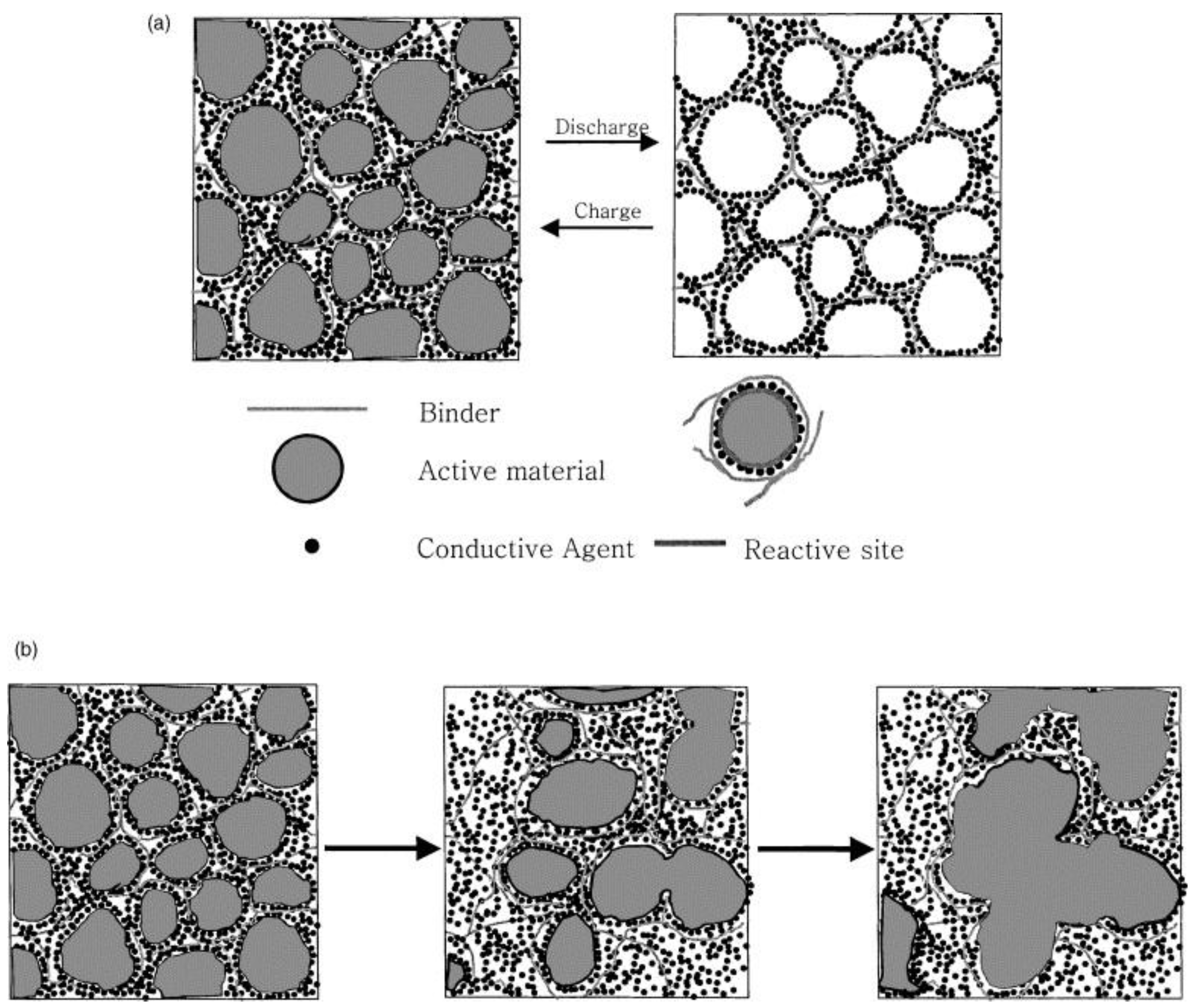
      <p>In Jeon <italic>et al.</italic>’s study [<xref ref-type="bibr" rid="B48-membranes-02-00553">48</xref>], LiClO<sub>4</sub> was chosen to dissolve in high molecular weight polymer host-PEO which acted as solid solvents. Dry polymer electrolyte made of PEO with tetra(ethylene glycol dimethyl ether) was employed into Li/S cells to study issues such as the fading capacity and low sulfur utilization. According to the change in morphologies for a composite sulfur cathode, which was obtained by scanning electron microscopy (SEM), a model for the change in morphology of the composite cathode was built as shown in <xref ref-type="fig" rid="membranes-02-00553-f001">Figure 1</xref>. The authors offered us a mechanism for the capacity fading was mainly due to the heterogeneity and worsening distribution of sulfur along with cycling.</p>
      
      <p>Some researchers have been trying to further improve the conductivity by the use of inorganic ceramic filler such as Al<sub>2</sub>O<sub>3</sub>, SiO<sub>2</sub>, TiO<sub>2</sub> and ZrO<sub>2</sub> in the host polymer matrix [<xref ref-type="bibr" rid="B49-membranes-02-00553">49</xref>,<xref ref-type="bibr" rid="B50-membranes-02-00553">50</xref>,<xref ref-type="bibr" rid="B51-membranes-02-00553">51</xref>,<xref ref-type="bibr" rid="B52-membranes-02-00553">52</xref>,<xref ref-type="bibr" rid="B53-membranes-02-00553">53</xref>,<xref ref-type="bibr" rid="B54-membranes-02-00553">54</xref>,<xref ref-type="bibr" rid="B55-membranes-02-00553">55</xref>,<xref ref-type="bibr" rid="B56-membranes-02-00553">56</xref>,<xref ref-type="bibr" rid="B57-membranes-02-00553">57</xref>].</p>
      <p>In Shin <italic>et al.</italic>’s study [<xref ref-type="bibr" rid="B58-membranes-02-00553">58</xref>], (PEO)<sub>10</sub>LiCF<sub>3</sub>SO<sub>3</sub> polymer electrolyte with titanium oxide (Ti<italic><sub>n</sub></italic>O<sub>2<italic>n</italic>−1</sub>, <italic>n</italic> = 1, 2) was introduced into Li/S system, and they not only investigated the ionic conductivity and interfacial stability of this dry polymer electrolyte but also the discharge characteristics of Li/S cells with (PEO)<sub>10</sub>LiCF<sub>3</sub>SO<sub>3</sub> polymer electrolyte. From the results of this study, titanium oxide is a good candidate as ceramic filler in (PEO)<sub>10</sub>LiCF<sub>3</sub>SO<sub>3</sub> dry polymer electrolyte. Titanium Oxide filler has a size of sub-micron and several micron consisting of various phases that were prepared by ball milling for 100 h, which wereintroduced into the (PEO)<sub>10</sub>LiCF<sub>3</sub>SO<sub>3</sub> polymer electrolyte. The addition of titanium oxide containing Ti<sub>2</sub>O<sub>3</sub>, TiO and Ti<sub>2</sub>O into the (PEO)<sub>10</sub>LiCF<sub>3</sub>SO<sub>3</sub> polymer electrolyte improved the ionic conductivity due to the change of –C–O–C– vibration and ionic structure of polymer electrolyte by the decrease in crystallinity of PEO polymer electrolyte, and the interface resistance between polymer electrolyte and lithium electrode was remarkably decreased by lowering the contact area between lithium and electrolyte. </p>
      <fig id="membranes-02-00553-f001" position="anchor">
        <label>Figure 1</label>
        <caption>
          <p>Model for morphology change of composite cathode during charge-discharge:(<bold>a</bold>) ideal case;(<bold>b</bold>) real case [<xref ref-type="bibr" rid="B48-membranes-02-00553">48</xref>]. </p>
        </caption>
        <graphic xmlns:xlink="http://www.w3.org/1999/xlink" xlink:href="membranes-02-00553-g001.tif"/>
      </fig>
      <p>In Jeong <italic>et al.</italic>’s study [<xref ref-type="bibr" rid="B59-membranes-02-00553">59</xref>], (PEO)<sub>6</sub>LiBF<sub>4</sub> polymer electrolyte was prepared under three different mixing conditions: stirred polymer electrolyte, ball-milled polymer electrolyte and ball-milled polymer electrolyte with 10 wt % Al<sub>2</sub>O<sub>3</sub>. The Li/S cell containing ball-milled (PEO)<sub>6</sub>LiBF<sub>4</sub>-Al<sub>2</sub>O<sub>3</sub> polymer electrolyte delivered a high initial discharge of 1670 mAh·g<sup>−1</sup>, which was better than the cells with stirred (PEO)<sub>6</sub>LiBF<sub>4</sub> polymer electrolyte or (PEO)<sub>6</sub>LiBF<sub>4</sub> ball-milled polymer electrolyte. And also the cycle performance of Li/(PEO)<sub>6</sub>LiBF<sub>4</sub>/S cell was also remarkably improved with the addition of Al<sub>2</sub>O<sub>3</sub>.</p>
      <p>(PEO)<sub>20</sub>Li(CF<sub>3</sub>SO<sub>2</sub>)<sub>2</sub>N-γLiAlO<sub>2</sub> was prepared and introduced into Li/S battery in Wen <italic>et al.</italic>’s study [<xref ref-type="bibr" rid="B60-membranes-02-00553">60</xref>]. The all-solid-state Li/S cell with PEO based polymer electrolyte operating at 75 °C exhibited an average capacity of 290 mAh·g<sup>−1</sup> in 50 cycles. The cycle-stability of Li/S polymer battery was improved by amending the method to prepare the sulfur composite cathode by blending sulfur and PEO by thermal melting at 180 °C in a sealed container. The SEM results confirmed the mechanism of capacity fading [<xref ref-type="bibr" rid="B48-membranes-02-00553">48</xref>], which suggested that the capacity of Li/S polymer battery was mostly suffered from aggregation of sulfur or lithium sulfide during cycling.</p>
      <p>This research group did a further study to combine (PEO)<sub>18</sub>Li(CF<sub>3</sub>SO<sub>2</sub>)<sub>2</sub>N-SiO<sub>2</sub> polymer electrolyte and sulfur/mesoporous-carbon composite cathode as an all solid state polymer battery [<xref ref-type="bibr" rid="B29-membranes-02-00553">29</xref>]. The conductivity of the PEO based electrolyte could reach 5 × 10<sup>−4</sup> S·cm<sup>−1</sup> at 70 °C. In the sulfur cathode, mesoporous carbon sphere with the uniform channels was employed as the conductive agent, and sulfur was penetrated into those channels by a co-heating method. By this, the prepared all solid state polymer battery showed excellent cycling performance with a reversible discharge capacity of about 800 mAh·g<sup>−1</sup> at 70 °C after 25 cycles.</p>
      <p>In summary, the reason for the choosing PEO as the polymer host is mainly due to that PEO usually form stable dry complexes exhibiting a relatively higher ionic conductivity than other solvating polymers [<xref ref-type="bibr" rid="B61-membranes-02-00553">61</xref>]. The sequential oxyethylene group: –CH<sub>2</sub>–CH<sub>2</sub>–O–, and the polar groups: –O–, –H–, –C–H–, in the polymer chains can well dissolve the ionic salts [<xref ref-type="bibr" rid="B43-membranes-02-00553">43</xref>,<xref ref-type="bibr" rid="B44-membranes-02-00553">44</xref>,<xref ref-type="bibr" rid="B62-membranes-02-00553">62</xref>]. In the further study, new polymer electrolyte structures, based on the modified PEO main polymer chain with grafted polymers, block copolymers, cross-linked polymer networks, which resulted in polymer electrolytes with a lower degree of crystallinity and a low glass transition temperature <italic>T</italic><sub>g</sub>, can be considered to employed into Li/S battery system.</p>
    </sec>
    <sec>
      <title>3. Gel Polymer Electrolytes in Li/S Batteries</title>
      <p>In the point of view of dry solid polymer, the main obstacle is still the ionic conductivity, which is generally below 10<sup>−3</sup> S·cm<sup>−1</sup> and not enough for practical application. At room temperature, the all solid state Li/S batteries usually showed poor performance. As a result, gel polymer electrolytes were developed [<xref ref-type="bibr" rid="B63-membranes-02-00553">63</xref>,<xref ref-type="bibr" rid="B64-membranes-02-00553">64</xref>,<xref ref-type="bibr" rid="B65-membranes-02-00553">65</xref>], which can be regarded as an intermediate state between typical liquid electrolytes and dry solid polymer electrolytes. In gel polymer electrolytes, the liquid component is trapped in the polymer matrix, thereby preventing leakage of liquid electrolyte. Therefore, the pore structure of the polymer membrane is the key component and is especially important for the ionic conductivity. In Li/S battery, to date, several types of polymer membranes have been developed and characterized, such as those based on poly(ethylene oxide) (PEO), poly(vinylidene fluoride) (PVDF) and poly(vinylidene fluoride)-hexafluoropropylene (PVDF-HFP).</p>
      <sec>
        <title>3.1. PEO-Based Gel Polymer Electrolyte</title>
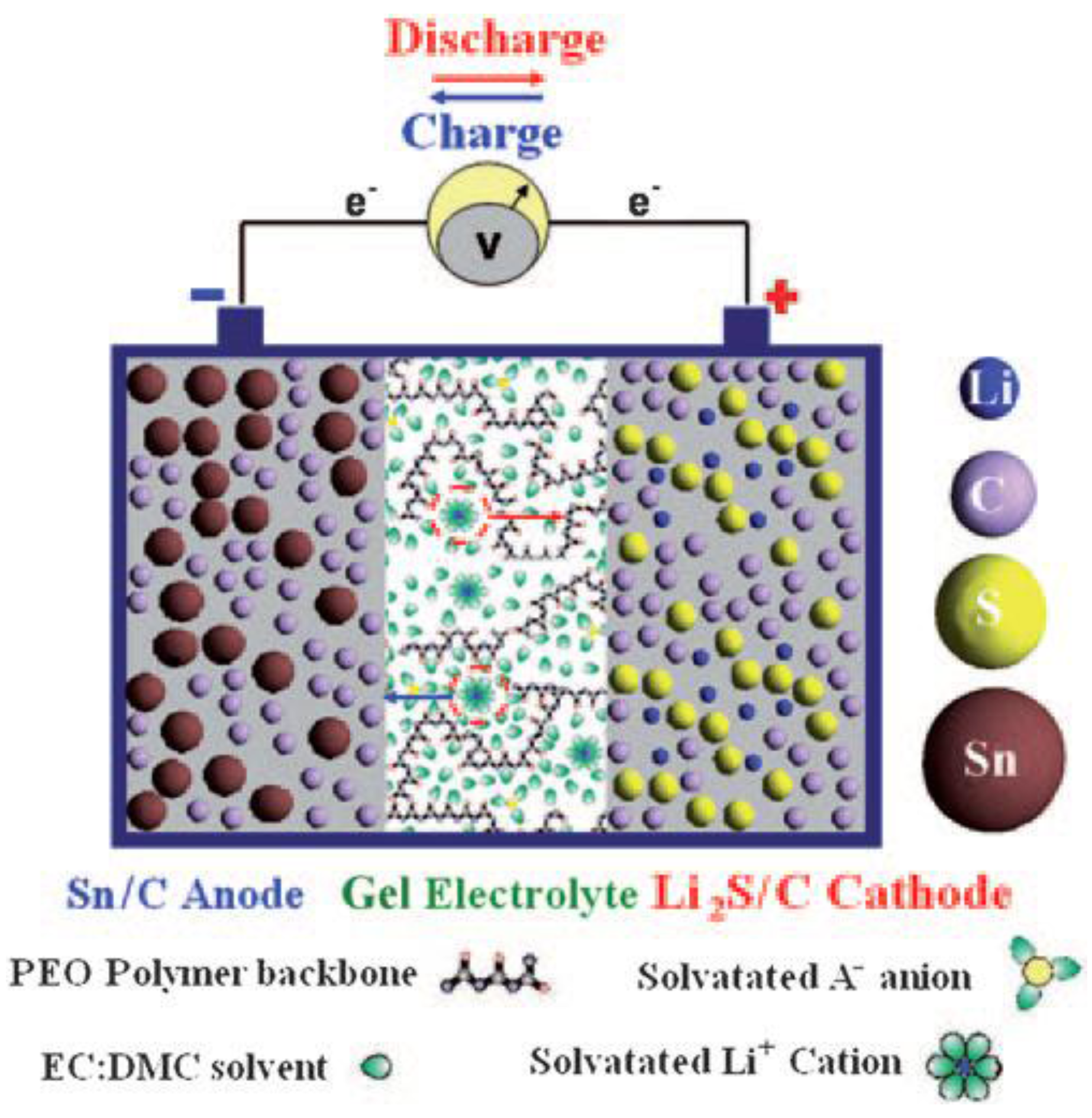
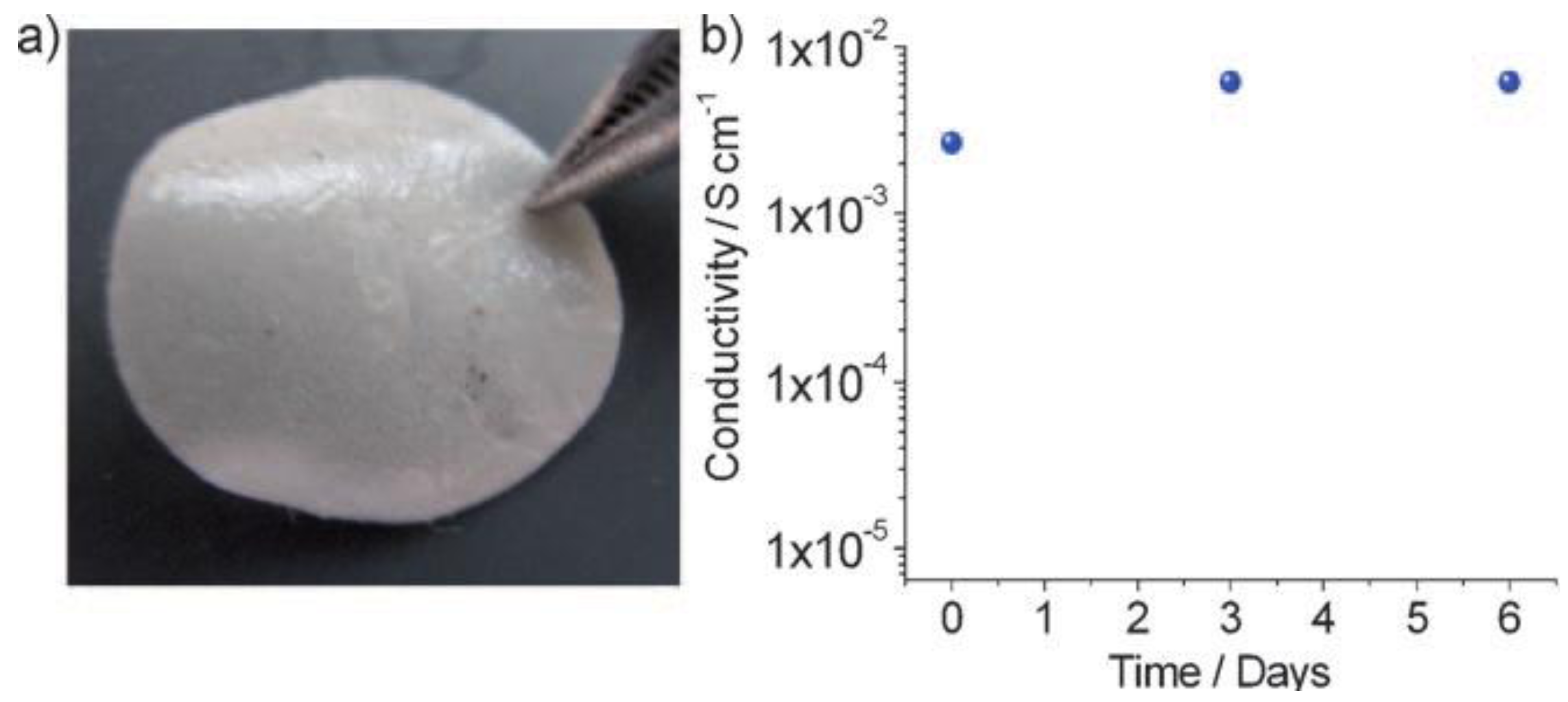
        <p>Important progress was recently made by Scrosati and co-workers [<xref ref-type="bibr" rid="B66-membranes-02-00553">66</xref>], who built a lithium metal-free new battery version as <xref ref-type="fig" rid="membranes-02-00553-f002">Figure 2</xref> shows. They also renewed the electrolyte component by replacing the common liquid organic solutions with a gel-type polymer membrane, formed by trapping ethylene carbonate/dimethylcarbonate lithium hexafluorophosphate (EC: DMC/LiPF<sub>6</sub>) solution saturated with lithium sulfide in a polyethylene oxide/lithium trifluoromethanesulfonate (PEO/LiCF<sub>3</sub>SO<sub>3</sub>) polymer matrix [<xref ref-type="bibr" rid="B67-membranes-02-00553">67</xref>]. A dispersed zirconia ceramic filler enhanced the mechanical properties of the gel and improved liquid retention within its bulk [<xref ref-type="bibr" rid="B68-membranes-02-00553">68</xref>]. Impedance studies [<xref ref-type="bibr" rid="B69-membranes-02-00553">69</xref>] indicate that the resistance of the as-prepared GPE is low and stable with time with a high conductivity approaching 10<sup>−2</sup> S·cm<sup>−1</sup> (<xref ref-type="fig" rid="membranes-02-00553-f003">Figure 3</xref>). With the assembly of the Sn/C anode, Li<sub>2</sub>S/C cathode and PEO based GPE, this polymer battery showed a high initial discharge of about 1200 mAh·g<sup>−1</sup> at 38 mA·cm<sup>−2</sup>·g<sup>−1</sup> (capacity calculated based on Li<sub>2</sub>S mass only).</p>
        <fig id="membranes-02-00553-f002" position="anchor">
          <label>Figure 2</label>
          <caption>
            <p>Sketch of the Sn/C/CGPE/ Li<sub>2</sub>S/C polymer battery developed herein. The battery is formed by a Sn/C composite anode, a PEO based gel polymer electrolyte, and a Li<sub>2</sub>S/C cathode. PEO = poly(ethylene oxide) [<xref ref-type="bibr" rid="B66-membranes-02-00553">66</xref>].</p>
          </caption>
          <graphic xmlns:xlink="http://www.w3.org/1999/xlink" xlink:href="membranes-02-00553-g002.tif"/>
        </fig>
        <fig id="membranes-02-00553-f003" position="anchor">
          <label>Figure 3</label>
          <caption>
            <p>Characteristics of the PEO based gel polymer membrane to be used as electrolyte separator in the lithium-sulfur battery: (<bold>a</bold>) Appearance of the membrane; (<bold>b</bold>) Time evolution of the conductivity at room temperature [<xref ref-type="bibr" rid="B66-membranes-02-00553">66</xref>].</p>
          </caption>
          <graphic xmlns:xlink="http://www.w3.org/1999/xlink" xlink:href="membranes-02-00553-g003.tif"/>
        </fig>
      </sec>
      <sec>
        <title>3.2. PVDF-Based Gel Polymer Electrolyte</title>
        <p>Poly(vinylidene fluoride) (PVDF) has received great attention as a membrane material with regard to its outstanding properties such as high mechanical strength, thermal stability, chemical resistance, and high hydrophobicity [<xref ref-type="bibr" rid="B70-membranes-02-00553">70</xref>]. By virtue of its various appealing properties, PVDF has been chosen as a suitable polymer host. PVDF-based polymer electrolytes are expected to be highly anodically stable due to the strongly electron-withdrawing functional group (–C–F). Furthermore, PVDF itself has a high dielectric constant (ε = 8.4) for a polymer, which can assist in greater ionization of lithium salts, and thus provide a high concentration of charge carriers [<xref ref-type="bibr" rid="B39-membranes-02-00553">39</xref>,<xref ref-type="bibr" rid="B71-membranes-02-00553">71</xref>].</p>
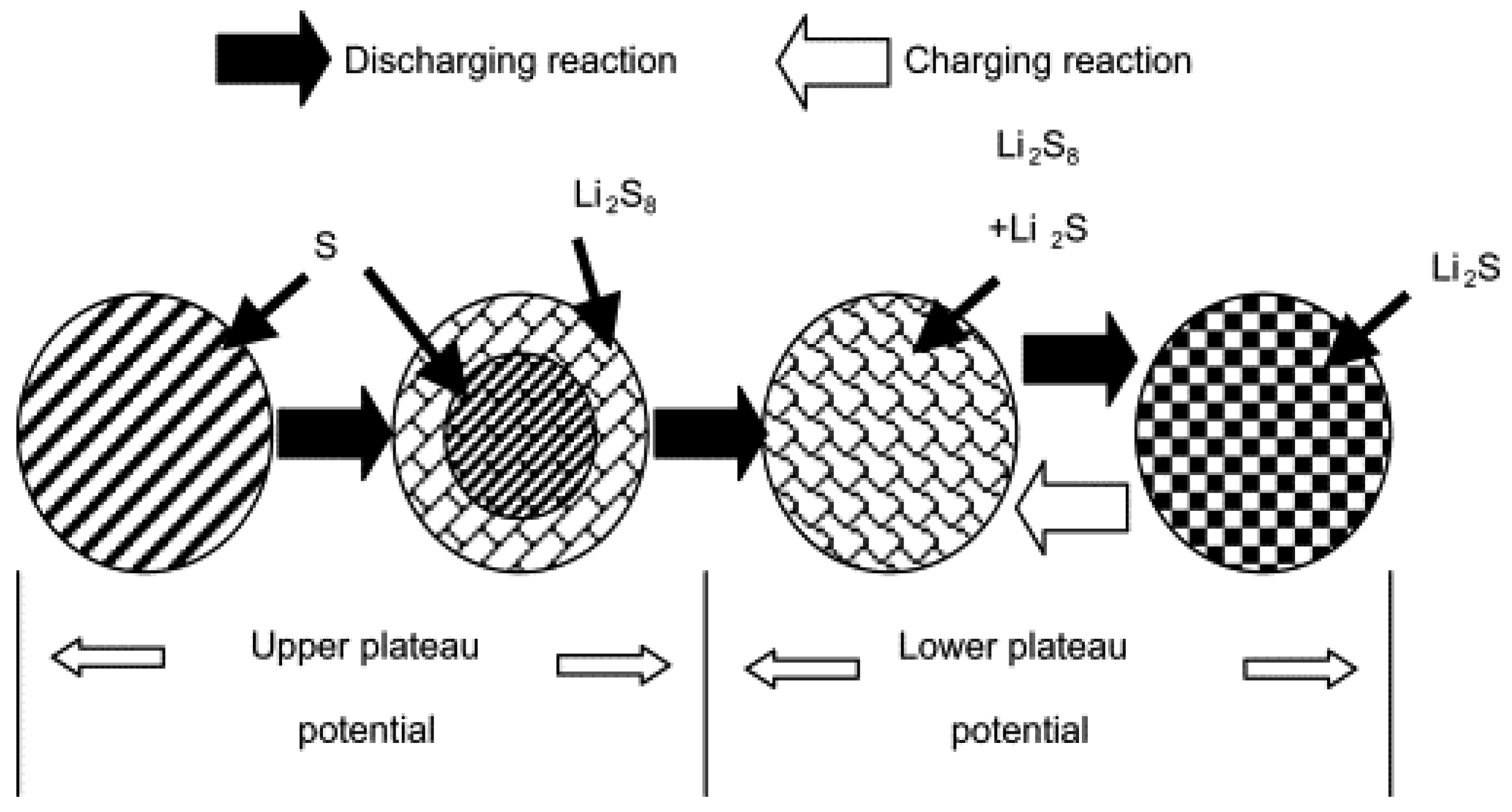
        <p>A detailed discussion regarding the discharge process of Li/PVDF/S was presented by Ryu <italic>et al.</italic> [<xref ref-type="bibr" rid="B72-membranes-02-00553">72</xref>]. The PVDF gel polymer electrolyte was prepared by LiCF<sub>3</sub>SO<sub>3</sub> as lithium-ion resource, tetraglyme as plasticizer, and PVDF as a gelling agent in THF solvent in Ar atmosphere. A freestanding PVDF electrolyte film was obtained after the solvent was evaporated at room temperature. By using PVDF polymer electrolyte, the Li/S cell had two plateaus-like potential regions and a discharge capacity of 1268 mAh·g<sup>−1</sup> at the first discharge. The discharge capacity decreased to 1028 mAh·g<sup>−1</sup> and the upper plateau region disappeared after second discharge. From XRD and DSC results of the sulfur electrode, a model was built as shown in <xref ref-type="fig" rid="membranes-02-00553-f004">Figure 4</xref> to suggest that elemental sulfur disappeared and changed into Li<sub>2</sub>S<sub>n</sub> (<italic>n</italic> &gt; 4) at the upper plateau region and Li<sub>2</sub>S was formed at the low plateau region. </p>
        <fig id="membranes-02-00553-f004" position="anchor">
          <label>Figure 4</label>
          <caption>
            <p>The discharge and charge reaction model of lithium/sulfur cell [<xref ref-type="bibr" rid="B72-membranes-02-00553">72</xref>].</p>
          </caption>
          <graphic xmlns:xlink="http://www.w3.org/1999/xlink" xlink:href="membranes-02-00553-g004.tif"/>
        </fig>
      </sec>
      <sec>
        <title>3.3. PVDF-HFP Based Gel Polymer Electrolyte</title>
        <p>Poly(vinylidene fluoride)-hexafluoropropylene (PVDF-HFP) has drawn the attention of many researchers due to its appealing properties. The high dielectric constant of ε = 8.4 facilitates for higher concentration of charge carriers, and it also comprises of both amorphous and crystalline phase; the amorphous phase of the polymer helps for higher ionic conduction, whereas the crystalline phase acts as a mechanical support for the polymer electrolyte [<xref ref-type="bibr" rid="B73-membranes-02-00553">73</xref>,<xref ref-type="bibr" rid="B74-membranes-02-00553">74</xref>,<xref ref-type="bibr" rid="B75-membranes-02-00553">75</xref>].</p>
        <p>Shin <italic>et al.</italic> [<xref ref-type="bibr" rid="B76-membranes-02-00553">76</xref>] reported the preparation and performance of PVDF-HFP gel electrolyte in Li/S batteries. The PVDF-HFP gel polymer electrolyte with tetra ethylene glycol dimethylether (TEGDME) as a plasticizer, LiCF<sub>3</sub>SO<sub>3</sub>, LiBF<sub>4</sub> and LiPF<sub>6</sub> as lithium salt and acetone as solvent was prepared by solvent casting of slurry that mixed PVDF-HFP copolymer with acetone and salt using a ball-milling technique. This polymer electrolyte showed high mechanical property and good ionic conductivity (4.99 × 10<sup>−4</sup> S·cm<sup>−1</sup> at room temperature). As ball-milled gel polymer electrolytes were introduced into Li/S cells with sulfur as cathode and lithium as the anode. The first specific discharge capacities with discharge rate of 0.14 mA·cm<sup>−2</sup> at room temperature were about 575 and 765 mAh·g<sup>−1</sup>. The melting temperature of crystalline PVDF-HFP was found to decrease, which may be due to the decrease of crystallinity by scission of the polymer chain during ball milling. Therefore, it was concluded that the ball-milling technique could be a very promising preparative technique for the preparation of slurry for polymer electrolytes.</p>
        <p>In Wang et al’s study [<xref ref-type="bibr" rid="B15-membranes-02-00553">15</xref>,<xref ref-type="bibr" rid="B24-membranes-02-00553">24</xref>], a gel polymer electrolyte was formed by trapping a liquid electrolyte of PC-EC-DEC (1:4:5 v/v) containing 1 M LiPF<sub>6</sub> in a dry PVDF-HFP/SiO<sub>2</sub> polymer matrix. And this dry PVDF-HFP/SiO<sub>2</sub> film with abundant pore structure was prepared by phase separation method. The ionic conductivity of resulting gel polymer electrolyte was about 1.2 × 10<sup>−3</sup> S·cm<sup>−1</sup> at room temperature. This gel polymer electrolyte was introduced into the cells with sulfur/active carbon composite cathode and sulfur/polyacrylonitrile (S/PAN) composite, respectively. The cell with S/PAN composite cathode exhibited a specific capacity up to 850 mA·g<sup>−1</sup> in the initial and remained above 600 mAh·g<sup>−1</sup> after 50 cycles. With elemental sulfur incorporated in porous carbon, S/C composite exhibited reversible capacity of 440 mAh·g<sup>−1</sup> at current density of 0.3 mA·cm<sup>−2</sup>.</p>
        <p>In summary, gel polymer electrolyte was considered as liquid electrolyte trapped in the polymer membrane. When the bulk of the membrane was composed of connected micropores, the ion conductivity of the gel polymer electrolyte mainly depended on the property of the liquid electrolyte. Otherwise, if the prepared membrane did not have many connected pores, the transfer of Li<sup>+</sup> mainly happens in the polymer membrane [<xref ref-type="bibr" rid="B77-membranes-02-00553">77</xref>]. Therefore, in the further study, modifying the pore structure of the membrane and changing the crystallinity of the polymer matrix were developed as the most important strategies to improve Li<sup>+</sup> transport and ion conductivity of GPE in Li/S battery . The former was mainly achieved by optimizing the preparation methods and the latter by modifications of polymer matrix, such as blending, copolymer and cross-linking, compounding, and adding nanofillers [<xref ref-type="bibr" rid="B77-membranes-02-00553">77</xref>].</p>
      </sec>
    </sec>
    <sec sec-type="conclusions">
      <title>4. Conclusions</title>
      <p>Li/S batteries provide much hope, but also many challenges. In general, the main problem in an Li/S battery is its poor cyclic ability, which is mainly caused by polysulfides dissolving into the electrolyte. To solve this problem, the polymer electrolyte is introduced into Li/S battery. As discussed above, with employment of a dry polymer electrolyte and gel polymer electrolyte, the cell showed a better cycle performance. However, problems in Li/S batteries, such as aggregation of sulfur or lithium sulfide during cycling, could not be solved merely by modifying the electrolyte. Together with advances in anodes and cathodes, the development of polymer electrolytes with high conductivity, high compatibility and mechanical strength, can offer a promising future for Li/S batteries.</p>
    </sec>

  </body>
  <back>
    <ack>
    <title>Acknowledgments</title>
      <p>This research was financially supported by Positec, the Natural Sciences and Engineering Research Council of Canada (NSERC), Canadian Foundation for Innovation (CFI) and the Canada Research Chairs (CRC) program. One of the authors (YZ) thanks the China Scholarship Council for Study Abroad Scholarship. </p>
    </ack>
    <ref-list>
      <title>References</title>
      <ref id="B1-membranes-02-00553">
        <label>1.</label>
        <citation citation-type="journal">
          <person-group person-group-type="author">
            <name>
              <surname>Song</surname>
              <given-names>D.</given-names>
            </name>
            <name>
              <surname>Ikuta</surname>
              <given-names>H.</given-names>
            </name>
            <name>
              <surname>Uchida</surname>
              <given-names>T.</given-names>
            </name>
            <name>
              <surname>Wakihara</surname>
              <given-names>M.</given-names>
            </name>
          </person-group>
          <article-title>The spinel phases LiAl<sub><italic>y</italic></sub>Mn<sub>2−<italic>y</italic></sub>O<sub>4</sub> (<italic>y</italic> = 0, 1/12, 1/9, 1/6, 1/3) and Li(Al,M)<sub>1/6</sub>Mn<sub>11/6</sub>O<sub>4</sub> (M = Cr, Co) as the cathode for rechargeable lithium batteries</article-title>
          <source>Solid State Ionics</source>
          <year>1999</year>
          <volume>117</volume>
          <fpage>151</fpage>
          <lpage>156</lpage>
          <pub-id pub-id-type="doi">10.1016/S0167-2738(98)00258-6</pub-id>
        </citation>
      </ref>
      <ref id="B2-membranes-02-00553">
        <label>2.</label>
        <citation citation-type="journal">
          <person-group person-group-type="author">
            <name>
              <surname>Bakenov</surname>
              <given-names>Z.</given-names>
            </name>
            <name>
              <surname>Taniguchi</surname>
              <given-names>I.</given-names>
            </name>
          </person-group>
          <article-title>Electrochemical performance of nanostructured LiM<sub>x</sub>Mn<sub>2−x</sub>O<sub>4</sub> (M = Coand Al) powders at highcharge-discharge operations</article-title>
          <source>Solid State Ionics</source>
          <year>2005</year>
          <volume>176</volume>
          <fpage>1027</fpage>
          <lpage>1034</lpage>
          <pub-id pub-id-type="doi">10.1016/j.ssi.2005.02.004</pub-id>
        </citation>
      </ref>
      <ref id="B3-membranes-02-00553">
        <label>3.</label>
        <citation citation-type="journal">
          <person-group person-group-type="author">
            <name>
              <surname>Kang</surname>
              <given-names>B.</given-names>
            </name>
            <name>
              <surname>Ceder</surname>
              <given-names>G.</given-names>
            </name>
          </person-group>
          <article-title>Battery materials for ultrafast charging and discharging</article-title>
          <source>Nature</source>
          <year>2009</year>
          <volume>458</volume>
          <fpage>190</fpage>
          <lpage>193</lpage>
        <pub-id pub-id-type="doi">10.1038/nature07853</pub-id><pub-id pub-id-type="pmid">19279634</pub-id></citation>
      </ref>
      <ref id="B4-membranes-02-00553">
        <label>4.</label>
        <citation citation-type="journal">
          <person-group person-group-type="author">
            <name>
              <surname>Whittingham</surname>
              <given-names>M.S.</given-names>
            </name>
          </person-group>
          <article-title>Lithium batteries and cathode materials</article-title>
          <source>Chem. Rev.</source>
          <year>2004</year>
          <volume>104</volume>
          <fpage>4271</fpage>
          <lpage>4302</lpage>
          <pub-id pub-id-type="doi">10.1021/cr020731c</pub-id>
        </citation>
      </ref>
      <ref id="B5-membranes-02-00553">
        <label>5.</label>
        <citation citation-type="journal">
          <person-group person-group-type="author">
            <name>
              <surname>Ji</surname>
              <given-names>X.L.</given-names>
            </name>
            <name>
              <surname>Lee</surname>
              <given-names>K.T.</given-names>
            </name>
            <name>
              <surname>Nazar</surname>
              <given-names>L.F.</given-names>
            </name>
          </person-group>
          <article-title>A highly ordered nanostructured carbon-sulphur cathode forlithium-sulphur batteries</article-title>
          <source>Nat. Mater.</source>
          <year>2009</year>
          <volume>8</volume>
          <fpage>500</fpage>
          <lpage>506</lpage>
          <pub-id pub-id-type="doi">10.1038/nmat2460</pub-id>
        </citation>
      </ref>
      <ref id="B6-membranes-02-00553">
        <label>6.</label>
        <citation citation-type="journal">
          <person-group person-group-type="author">
            <name>
              <surname>Sun</surname>
              <given-names>Y.K.</given-names>
            </name>
            <name>
              <surname>Myung</surname>
              <given-names>S.T.</given-names>
            </name>
            <name>
              <surname>Park</surname>
              <given-names>B.C.</given-names>
            </name>
            <name>
              <surname>Prakash</surname>
              <given-names>J.</given-names>
            </name>
            <name>
              <surname>Belharouak</surname>
              <given-names>I.</given-names>
            </name>
            <name>
              <surname>Amine</surname>
              <given-names>K.</given-names>
            </name>
          </person-group>
          <article-title>High-energy cathode material for long-life and safe lithium batteries</article-title>
          <source>Nat. Mater.</source>
          <year>2009</year>
          <volume>8</volume>
          <fpage>320</fpage>
          <lpage>324</lpage>
        <pub-id pub-id-type="doi">10.1038/nmat2418</pub-id><pub-id pub-id-type="pmid">19305398</pub-id></citation>
      </ref>
      <ref id="B7-membranes-02-00553">
        <label>7.</label>
        <citation citation-type="journal">
          <person-group person-group-type="author">
            <name>
              <surname>Yang</surname>
              <given-names>Y.</given-names>
            </name>
            <name>
              <surname>McDowell</surname>
              <given-names>M.T.</given-names>
            </name>
            <name>
              <surname>Jackson</surname>
              <given-names>A.</given-names>
            </name>
            <name>
              <surname>Cha</surname>
              <given-names>J.J.</given-names>
            </name>
            <name>
              <surname>Hong</surname>
              <given-names>S.S.</given-names>
            </name>
            <name>
              <surname>Cui</surname>
              <given-names>Y.</given-names>
            </name>
          </person-group>
          <article-title>New nanostructured Li<sub>2</sub>S/silicon rechargeable battery with high specific energy</article-title>
          <source>Nano Lett.</source>
          <year>2010</year>
          <volume>10</volume>
          <fpage>1486</fpage>
          <lpage>1491</lpage>
          <pub-id pub-id-type="doi">10.1021/nl100504q</pub-id>
        </citation>
      </ref>
      <ref id="B8-membranes-02-00553">
        <label>8.</label>
        <citation citation-type="book">
          <person-group person-group-type="author">
            <name>
              <surname>Tischer</surname>
              <given-names>R.P.</given-names>
            </name>
          </person-group>
          <source>The Sulfur Electrode</source>
          <publisher-name>Academic Press</publisher-name>
          <publisher-loc>New York, NY, USA</publisher-loc>
          <year>1983</year>
        </citation>
      </ref>
      <ref id="B9-membranes-02-00553">
        <label>9.</label>
        <citation citation-type="journal">
          <person-group person-group-type="author">
            <name>
              <surname>Marmorstein</surname>
              <given-names>D.</given-names>
            </name>
            <name>
              <surname>Yu</surname>
              <given-names>T.H.</given-names>
            </name>
            <name>
              <surname>Striebel</surname>
              <given-names>K.A.</given-names>
            </name>
            <name>
              <surname>McLarnon</surname>
              <given-names>F.R.</given-names>
            </name>
            <name>
              <surname>Hou</surname>
              <given-names>J.</given-names>
            </name>
            <name>
              <surname>Cairns</surname>
              <given-names>E.J.</given-names>
            </name>
          </person-group>
          <article-title>Electrochemical performance of lithium/sulfur cells with three different polymer electrolytes</article-title>
          <source>J. Power Sources</source>
          <year>2000</year>
          <volume>89</volume>
          <fpage>219</fpage>
          <lpage>226</lpage>
          <pub-id pub-id-type="doi">10.1016/S0378-7753(00)00432-8</pub-id>
        </citation>
      </ref>
      <ref id="B10-membranes-02-00553">
        <label>10.</label>
        <citation citation-type="journal">
          <person-group person-group-type="author">
            <name>
              <surname>Yamin</surname>
              <given-names>H.</given-names>
            </name>
            <name>
              <surname>Peled</surname>
              <given-names>E.</given-names>
            </name>
          </person-group>
          <article-title>Electrochemistry of a nonaqueous lithium/sulfur cell</article-title>
          <source>J. Power Sources</source>
          <year>1983</year>
          <volume>9</volume>
          <fpage>281</fpage>
          <lpage>287</lpage>
          <pub-id pub-id-type="doi">10.1016/0378-7753(83)87029-3</pub-id>
        </citation>
      </ref>
      <ref id="B11-membranes-02-00553">
        <label>11.</label>
        <citation citation-type="journal">
          <person-group person-group-type="author">
            <name>
              <surname>Rauh</surname>
              <given-names>R.D.</given-names>
            </name>
            <name>
              <surname>Abraham</surname>
              <given-names>K.M.</given-names>
            </name>
            <name>
              <surname>Pearson</surname>
              <given-names>G.F.</given-names>
            </name>
            <name>
              <surname>Surprenant</surname>
              <given-names>J.K.</given-names>
            </name>
            <name>
              <surname>Brummer</surname>
              <given-names>S.B.</given-names>
            </name>
          </person-group>
          <article-title>A lithium/dissolved sulfur battery with an organic electrolyte</article-title>
          <source>J. Electrochem. Soc.</source>
          <year>1979</year>
          <volume>126</volume>
          <fpage>523</fpage>
          <lpage>527</lpage>
          <pub-id pub-id-type="doi">10.1149/1.2129079</pub-id>
        </citation>
      </ref>
      <ref id="B12-membranes-02-00553">
        <label>12.</label>
        <citation citation-type="journal">
          <person-group person-group-type="author">
            <name>
              <surname>Yamin</surname>
              <given-names>H.</given-names>
            </name>
            <name>
              <surname>Gorenshtein</surname>
              <given-names>A.</given-names>
            </name>
            <name>
              <surname>Penciner</surname>
              <given-names>J.</given-names>
            </name>
            <name>
              <surname>Sternberg</surname>
              <given-names>Y.</given-names>
            </name>
            <name>
              <surname>Peled</surname>
              <given-names>E.</given-names>
            </name>
          </person-group>
          <article-title>Lithium sulfur battery</article-title>
          <source>J. Electrochem. Soc.</source>
          <year>1988</year>
          <volume>135</volume>
          <fpage>1045</fpage>
          <lpage>1048</lpage>
          <pub-id pub-id-type="doi">10.1149/1.2095868</pub-id>
        </citation>
      </ref>
      <ref id="B13-membranes-02-00553">
        <label>13.</label>
        <citation citation-type="journal">
          <person-group person-group-type="author">
            <name>
              <surname>Shim</surname>
              <given-names>J.</given-names>
            </name>
            <name>
              <surname>Striebel</surname>
              <given-names>K.A.</given-names>
            </name>
            <name>
              <surname>Cairns</surname>
              <given-names>E.J.</given-names>
            </name>
          </person-group>
          <article-title>The lithium/sulfur rechargeable cell</article-title>
          <source>J. Electrochem. Soc.</source>
          <year>2002</year>
          <volume>149</volume>
          <fpage>A1321</fpage>
          <lpage>A1325</lpage>
          <pub-id pub-id-type="doi">10.1149/1.1503076</pub-id>
        </citation>
      </ref>
      <ref id="B14-membranes-02-00553">
        <label>14.</label>
        <citation citation-type="journal">
          <person-group person-group-type="author">
            <name>
              <surname>Cheon</surname>
              <given-names>S.E.</given-names>
            </name>
            <name>
              <surname>Ko</surname>
              <given-names>K.S.</given-names>
            </name>
            <name>
              <surname>Cho</surname>
              <given-names>J.H.</given-names>
            </name>
            <name>
              <surname>Kim</surname>
              <given-names>S.W.</given-names>
            </name>
            <name>
              <surname>Chin</surname>
              <given-names>E.Y.</given-names>
            </name>
            <name>
              <surname>Kim</surname>
              <given-names>H.T.</given-names>
            </name>
          </person-group>
          <article-title>Rechargeable lithium sulfur battery</article-title>
          <source>J. Electrochem. Soc.</source>
          <year>2003</year>
          <volume>150</volume>
          <fpage>A796</fpage>
          <lpage>A799</lpage>
        <pub-id pub-id-type="doi">10.1149/1.1571532</pub-id></citation>
      </ref>
      <ref id="B15-membranes-02-00553">
        <label>15.</label>
        <citation citation-type="journal">
          <person-group person-group-type="author">
            <name>
              <surname>Wang</surname>
              <given-names>J.L.</given-names>
            </name>
            <name>
              <surname>Yang</surname>
              <given-names>J.</given-names>
            </name>
            <name>
              <surname>Xie</surname>
              <given-names>J.Y.</given-names>
            </name>
            <name>
              <surname>Xu</surname>
              <given-names>N.X.</given-names>
            </name>
            <name>
              <surname>Li</surname>
              <given-names>Y.</given-names>
            </name>
          </person-group>
          <article-title>Sulfur-carbon nano-composite as cathode for rechargeable lithium battery based on gel electrolyte</article-title>
          <source>Electrochem. Commun.</source>
          <year>2002</year>
          <volume>4</volume>
          <fpage>499</fpage>
          <lpage>502</lpage>
          <pub-id pub-id-type="doi">10.1016/S1388-2481(02)00358-2</pub-id>
        </citation>
      </ref>
      <ref id="B16-membranes-02-00553">
        <label>16.</label>
        <citation citation-type="journal">
          <person-group person-group-type="author">
            <name>
              <surname>Han</surname>
              <given-names>S.C.</given-names>
            </name>
            <name>
              <surname>Song</surname>
              <given-names>M.S.</given-names>
            </name>
            <name>
              <surname>Lee</surname>
              <given-names>H.</given-names>
            </name>
            <name>
              <surname>Kim</surname>
              <given-names>H.S.</given-names>
            </name>
            <name>
              <surname>Ahn</surname>
              <given-names>H.J.</given-names>
            </name>
            <name>
              <surname>Lee</surname>
              <given-names>J.Y.</given-names>
            </name>
          </person-group>
          <article-title>Effect of multiwalled carbon nanotubes on electrochemical properties of lithium/sulfur rechargeable batteries</article-title>
          <source>J. Electrochem. Soc.</source>
          <year>2003</year>
          <volume>150</volume>
          <fpage>A889</fpage>
          <lpage>A893</lpage>
        <pub-id pub-id-type="doi">10.1149/1.1576766</pub-id></citation>
      </ref>
      <ref id="B17-membranes-02-00553">
        <label>17.</label>
        <citation citation-type="journal">
          <person-group person-group-type="author">
            <name>
              <surname>Zheng</surname>
              <given-names>W.</given-names>
            </name>
            <name>
              <surname>Liu</surname>
              <given-names>Y.W.</given-names>
            </name>
            <name>
              <surname>Hu</surname>
              <given-names>X.G.</given-names>
            </name>
            <name>
              <surname>Zhang</surname>
              <given-names>C.F.</given-names>
            </name>
          </person-group>
          <article-title>Novel Nanosized Adsorbing Sulfur Composite Cathode Materials for the Advanced Secondary Lithium Batteries</article-title>
          <source>Electrochim. Acta</source>
          <year>2006</year>
          <volume>51</volume>
          <fpage>1330</fpage>
          <lpage>1335</lpage>
          <pub-id pub-id-type="doi">10.1016/j.electacta.2005.06.021</pub-id>
        </citation>
      </ref>
      <ref id="B18-membranes-02-00553">
        <label>18.</label>
        <citation citation-type="journal">
          <person-group person-group-type="author">
            <name>
              <surname>Yuan</surname>
              <given-names>L.X.</given-names>
            </name>
            <name>
              <surname>Yuan</surname>
              <given-names>H.P.</given-names>
            </name>
            <name>
              <surname>Qiu</surname>
              <given-names>X.P.</given-names>
            </name>
            <name>
              <surname>Chen</surname>
              <given-names>L.Q.</given-names>
            </name>
            <name>
              <surname>Zhu</surname>
              <given-names>W.T.</given-names>
            </name>
          </person-group>
          <article-title>Improvement of cycle property of sulfur-coated multi-walled carbon nanotubes composite cathode for lithium/sulfur batteries</article-title>
          <source>J. Power Sources</source>
          <year>2009</year>
          <volume>189</volume>
          <fpage>1141</fpage>
          <lpage>1146</lpage>
          <pub-id pub-id-type="doi">10.1016/j.jpowsour.2008.12.149</pub-id>
        </citation>
      </ref>
      <ref id="B19-membranes-02-00553">
        <label>19.</label>
        <citation citation-type="journal">
          <person-group person-group-type="author">
            <name>
              <surname>Chen</surname>
              <given-names>S.R.</given-names>
            </name>
            <name>
              <surname>Zhai</surname>
              <given-names>Y.P.</given-names>
            </name>
            <name>
              <surname>Xu</surname>
              <given-names>G.L.</given-names>
            </name>
            <name>
              <surname>Jiang</surname>
              <given-names>Y.X.</given-names>
            </name>
            <name>
              <surname>Zhao</surname>
              <given-names>D.Y.</given-names>
            </name>
            <name>
              <surname>Li</surname>
              <given-names>J.T.</given-names>
            </name>
            <name>
              <surname>Huang</surname>
              <given-names>L.</given-names>
            </name>
            <name>
              <surname>Sun</surname>
              <given-names>S.G.</given-names>
            </name>
          </person-group>
          <article-title>Ordered mesoporous carbon/sulfur nanocomposite of high performances as cathode for lithium-sulfur battery</article-title>
          <source>Electrochem. Acta</source>
          <year>2011</year>
          <volume>56</volume>
          <fpage>9549</fpage>
          <lpage>9555</lpage>
          <pub-id pub-id-type="doi">10.1016/j.electacta.2011.03.005</pub-id>
        </citation>
      </ref>
      <ref id="B20-membranes-02-00553">
        <label>20.</label>
        <citation citation-type="journal">
          <person-group person-group-type="author">
            <name>
              <surname>Wang</surname>
              <given-names>J.</given-names>
            </name>
            <name>
              <surname>Chew</surname>
              <given-names>S.Y.</given-names>
            </name>
            <name>
              <surname>Zhao</surname>
              <given-names>Z.W.</given-names>
            </name>
            <name>
              <surname>Ashraf</surname>
              <given-names>S.</given-names>
            </name>
            <name>
              <surname>Wexler</surname>
              <given-names>D.</given-names>
            </name>
            <name>
              <surname>Chen</surname>
              <given-names>J.</given-names>
            </name>
            <name>
              <surname>Ng</surname>
              <given-names>S.H.</given-names>
            </name>
            <name>
              <surname>Chou</surname>
              <given-names>S.L.</given-names>
            </name>
            <name>
              <surname>Liu</surname>
              <given-names>H.K.</given-names>
            </name>
          </person-group>
          <article-title>Sulfur-mesoporous carbon composites in conjunction with a novel ionic liquid electrolyte for lithium rechargeable batteries</article-title>
          <source>Carbon</source>
          <year>2008</year>
          <volume>46</volume>
          <fpage>229</fpage>
          <lpage>235</lpage>
        <pub-id pub-id-type="doi">10.1016/j.carbon.2007.11.007</pub-id></citation>
      </ref>
      <ref id="B21-membranes-02-00553">
        <label>21.</label>
        <citation citation-type="journal">
          <person-group person-group-type="author">
            <name>
              <surname>Zhang</surname>
              <given-names>B.</given-names>
            </name>
            <name>
              <surname>Qin</surname>
              <given-names>X.</given-names>
            </name>
            <name>
              <surname>Li</surname>
              <given-names>G.R.</given-names>
            </name>
            <name>
              <surname>Gao</surname>
              <given-names>X.P.</given-names>
            </name>
          </person-group>
          <article-title>Enhancement of long stability of sulfur cathode by encapsulating sulfur into micropores of carbon spheres</article-title>
          <source>Energy Environ. Sci.</source>
          <year>2010</year>
          <volume>3</volume>
          <fpage>1531</fpage>
          <lpage>1537</lpage>
        <pub-id pub-id-type="doi">10.1039/c002639e</pub-id></citation>
      </ref>
      <ref id="B22-membranes-02-00553">
        <label>22.</label>
        <citation citation-type="journal">
          <person-group person-group-type="author">
            <name>
              <surname>Zhang</surname>
              <given-names>B.</given-names>
            </name>
            <name>
              <surname>Lai</surname>
              <given-names>C.</given-names>
            </name>
            <name>
              <surname>Zhou</surname>
              <given-names>Z.</given-names>
            </name>
            <name>
              <surname>Gao</surname>
              <given-names>X.P.</given-names>
            </name>
          </person-group>
          <article-title>Preparation and electrochemical properties of sulfur-acetylene black composites as cathode materials</article-title>
          <source>Electrochim. Acta</source>
          <year>2009</year>
          <volume>54</volume>
          <fpage>3708</fpage>
          <lpage>3713</lpage>
          <pub-id pub-id-type="doi">10.1016/j.electacta.2009.01.056</pub-id>
        </citation>
      </ref>
      <ref id="B23-membranes-02-00553">
        <label>23.</label>
        <citation citation-type="journal">
          <person-group person-group-type="author">
            <name>
              <surname>Wang</surname>
              <given-names>H.L.</given-names>
            </name>
            <name>
              <surname>Yang</surname>
              <given-names>Y.</given-names>
            </name>
            <name>
              <surname>Liang</surname>
              <given-names>Y.Y.</given-names>
            </name>
            <name>
              <surname>Robinson</surname>
              <given-names>J.T.</given-names>
            </name>
            <name>
              <surname>Li</surname>
              <given-names>Y.G.</given-names>
            </name>
            <name>
              <surname>Jackson</surname>
              <given-names>A.</given-names>
            </name>
            <name>
              <surname>Cui</surname>
              <given-names>Y.</given-names>
            </name>
            <name>
              <surname>Dai</surname>
              <given-names>H.J.</given-names>
            </name>
          </person-group>
          <article-title>Graphene-wrapped sulfur particles as a rechargeable lithium-sulfur battery cathode material with high capacity and cycling stability</article-title>
          <source>Nano Lett.</source>
          <year>2011</year>
          <volume>11</volume>
          <fpage>2644</fpage>
          <lpage>2647</lpage>
        <pub-id pub-id-type="doi">10.1021/nl200658a</pub-id><pub-id pub-id-type="pmid">21699259</pub-id></citation>
      </ref>
      <ref id="B24-membranes-02-00553">
        <label>24.</label>
        <citation citation-type="journal">
          <person-group person-group-type="author">
            <name>
              <surname>Wang</surname>
              <given-names>J.L.</given-names>
            </name>
            <name>
              <surname>Yang</surname>
              <given-names>J.</given-names>
            </name>
            <name>
              <surname>Wan</surname>
              <given-names>C.R.</given-names>
            </name>
            <name>
              <surname>Du</surname>
              <given-names>K.</given-names>
            </name>
            <name>
              <surname>Xie</surname>
              <given-names>J.Y.</given-names>
            </name>
            <name>
              <surname>Xu</surname>
              <given-names>N.X.</given-names>
            </name>
          </person-group>
          <article-title>Sulfur composite cathode materials for rechargeable Lithium batteries</article-title>
          <source>Adv. Funct. Mater.</source>
          <year>2003</year>
          <volume>13</volume>
          <fpage>487</fpage>
          <lpage>492</lpage>
          <pub-id pub-id-type="doi">10.1002/adfm.200304284</pub-id>
        </citation>
      </ref>
      <ref id="B25-membranes-02-00553">
        <label>25.</label>
        <citation citation-type="journal">
          <person-group person-group-type="author">
            <name>
              <surname>Wang</surname>
              <given-names>J.</given-names>
            </name>
            <name>
              <surname>Chen</surname>
              <given-names>J.</given-names>
            </name>
            <name>
              <surname>Konstantinov</surname>
              <given-names>K.</given-names>
            </name>
            <name>
              <surname>Zhao</surname>
              <given-names>L.</given-names>
            </name>
            <name>
              <surname>Ng</surname>
              <given-names>S.H.</given-names>
            </name>
            <name>
              <surname>Wang</surname>
              <given-names>G.X.</given-names>
            </name>
            <name>
              <surname>Guo</surname>
              <given-names>Z.P.</given-names>
            </name>
            <name>
              <surname>Liu</surname>
              <given-names>H.K.</given-names>
            </name>
          </person-group>
          <article-title>Sulfur-polypyrrole composite positive electrode materials for rechargeable lithium batteries</article-title>
          <source>Electrochim. Acta</source>
          <year>2006</year>
          <volume>51</volume>
          <fpage>4634</fpage>
          <lpage>4638</lpage>
        <pub-id pub-id-type="doi">10.1016/j.electacta.2005.12.046</pub-id></citation>
      </ref>
      <ref id="B26-membranes-02-00553">
        <label>26.</label>
        <citation citation-type="journal">
          <person-group person-group-type="author">
            <name>
              <surname>Sun</surname>
              <given-names>M.M.</given-names>
            </name>
            <name>
              <surname>Zhang</surname>
              <given-names>S.C.</given-names>
            </name>
            <name>
              <surname>Jiang</surname>
              <given-names>T.</given-names>
            </name>
            <name>
              <surname>Zhang</surname>
              <given-names>L.</given-names>
            </name>
            <name>
              <surname>Yu</surname>
              <given-names>J.H.</given-names>
            </name>
          </person-group>
          <article-title>Nano-wire networks of sulfurpolypyrrole composite cathode materials for rechargeable lithium batteries</article-title>
          <source>Electrochem. Commun</source>
          <year>2008</year>
          <volume>10</volume>
          <fpage>1819</fpage>
          <lpage>1822</lpage>
        <pub-id pub-id-type="doi">10.1016/j.elecom.2008.09.012</pub-id></citation>
      </ref>
      <ref id="B27-membranes-02-00553">
        <label>27.</label>
        <citation citation-type="journal">
          <person-group person-group-type="author">
            <name>
              <surname>Liang</surname>
              <given-names>X.</given-names>
            </name>
            <name>
              <surname>Liu</surname>
              <given-names>Y.</given-names>
            </name>
            <name>
              <surname>Wen</surname>
              <given-names>Z.Y.</given-names>
            </name>
            <name>
              <surname>Huang</surname>
              <given-names>L.Z.</given-names>
            </name>
            <name>
              <surname>Wang</surname>
              <given-names>X.Y.</given-names>
            </name>
            <name>
              <surname>Zhang</surname>
              <given-names>H.</given-names>
            </name>
          </person-group>
          <article-title>A nano-structured and highly ordered polypyrrole-sulfur cathode for lithium-sulfur batteries</article-title>
          <source>J. Power Sources</source>
          <year>2011</year>
          <volume>196</volume>
          <fpage>6951</fpage>
          <lpage>6955</lpage>
          <pub-id pub-id-type="doi">10.1016/j.jpowsour.2010.11.132</pub-id>
        </citation>
      </ref>
      <ref id="B28-membranes-02-00553">
        <label>28.</label>
        <citation citation-type="journal">
          <person-group person-group-type="author">
            <name>
              <surname>Zhang</surname>
              <given-names>Y.G.</given-names>
            </name>
            <name>
              <surname>Bakenov</surname>
              <given-names>Z.</given-names>
            </name>
            <name>
              <surname>Zhao</surname>
              <given-names>Y.</given-names>
            </name>
            <name>
              <surname>Konarov</surname>
              <given-names>A.</given-names>
            </name>
            <name>
              <surname>Doan</surname>
              <given-names>T.N.L.</given-names>
            </name>
            <name>
              <surname>Malik</surname>
              <given-names>M.</given-names>
            </name>
            <name>
              <surname>Paron</surname>
              <given-names>T.</given-names>
            </name>
            <name>
              <surname>Chen</surname>
              <given-names>P.</given-names>
            </name>
          </person-group>
          <article-title>One-step synthesis of branched sulfur/polypyrrole nanocomposite cathode for lithium rechargeable batteries</article-title>
          <source>J. Power Sources</source>
          <year>2012</year>
          <volume>208</volume>
          <fpage>1</fpage>
          <lpage>8</lpage>
          <pub-id pub-id-type="doi">10.1016/j.jpowsour.2012.02.006</pub-id>
        </citation>
      </ref>
      <ref id="B29-membranes-02-00553">
        <label>29.</label>
        <citation citation-type="journal">
          <person-group person-group-type="author">
            <name>
              <surname>Liang</surname>
              <given-names>X.</given-names>
            </name>
            <name>
              <surname>Wen</surname>
              <given-names>Z.</given-names>
            </name>
            <name>
              <surname>Liu</surname>
              <given-names>Y.</given-names>
            </name>
            <name>
              <surname>Zhang</surname>
              <given-names>H.</given-names>
            </name>
            <name>
              <surname>Huang</surname>
              <given-names>L.</given-names>
            </name>
            <name>
              <surname>Jin</surname>
              <given-names>J.</given-names>
            </name>
          </person-group>
          <article-title>Highly dispersed sulfur in ordered mesoporous carbon sphere as a composite cathode for rechargeable polymer Li/S battery</article-title>
          <source>J. Power Sources</source>
          <year>2011</year>
          <volume>196</volume>
          <fpage>3655</fpage>
          <lpage>3658</lpage>
          <pub-id pub-id-type="doi">10.1016/j.jpowsour.2010.12.052</pub-id>
        </citation>
      </ref>
      <ref id="B30-membranes-02-00553">
        <label>30.</label>
        <citation citation-type="journal">
          <person-group person-group-type="author">
            <name>
              <surname>Mikhaylik</surname>
              <given-names>Y.V.</given-names>
            </name>
            <name>
              <surname>Akridge</surname>
              <given-names>J.R.</given-names>
            </name>
          </person-group>
          <article-title>Polysulfide shuttle study in the Li/S battery system</article-title>
          <source>J. Electrochem. Soc.</source>
          <year>2004</year>
          <volume>151</volume>
          <fpage>A1969</fpage>
          <lpage>A1976</lpage>
          <pub-id pub-id-type="doi">10.1149/1.1806394</pub-id>
        </citation>
      </ref>
      <ref id="B31-membranes-02-00553">
        <label>31.</label>
        <citation citation-type="journal">
          <person-group person-group-type="author">
            <name>
              <surname>Liang</surname>
              <given-names>X.</given-names>
            </name>
            <name>
              <surname>Wen</surname>
              <given-names>Z.</given-names>
            </name>
            <name>
              <surname>Liu</surname>
              <given-names>Y.</given-names>
            </name>
            <name>
              <surname>Wu</surname>
              <given-names>M.</given-names>
            </name>
            <name>
              <surname>Jin</surname>
              <given-names>J.</given-names>
            </name>
            <name>
              <surname>Zhang</surname>
              <given-names>H.</given-names>
            </name>
            <name>
              <surname>Wu</surname>
              <given-names>X.</given-names>
            </name>
          </person-group>
          <article-title>Improved cycling performances of lithium sulfur batteries with LiNO<sub>3</sub><sup>−</sup> modified electrolyte</article-title>
          <source>J. Power Sources</source>
          <year>2011</year>
          <volume>196</volume>
          <fpage>9839</fpage>
          <lpage>9843</lpage>
          <pub-id pub-id-type="doi">10.1016/j.jpowsour.2011.08.027</pub-id>
        </citation>
      </ref>
      <ref id="B32-membranes-02-00553">
        <label>32.</label>
        <citation citation-type="journal">
          <person-group person-group-type="author">
            <name>
              <surname>Choi</surname>
              <given-names>J.W.</given-names>
            </name>
            <name>
              <surname>Kim</surname>
              <given-names>J.K.</given-names>
            </name>
            <name>
              <surname>Cheruvally</surname>
              <given-names>G.</given-names>
            </name>
            <name>
              <surname>Ahn</surname>
              <given-names>J.H.</given-names>
            </name>
            <name>
              <surname>Ahn</surname>
              <given-names>H.J.</given-names>
            </name>
            <name>
              <surname>Kim</surname>
              <given-names>K.W.</given-names>
            </name>
          </person-group>
          <article-title>Rechargeable lithium/sulfur battery with suitable mixed liquid electrolytes</article-title>
          <source>Electrochimica. Acta</source>
          <year>2007</year>
          <volume>52</volume>
          <fpage>2075</fpage>
          <lpage>2082</lpage>
          <pub-id pub-id-type="doi">10.1016/j.electacta.2006.08.016</pub-id>
        </citation>
      </ref>
      <ref id="B33-membranes-02-00553">
        <label>33.</label>
        <citation citation-type="journal">
          <person-group person-group-type="author">
            <name>
              <surname>Chang</surname>
              <given-names>D.R.</given-names>
            </name>
            <name>
              <surname>Lee</surname>
              <given-names>S.H.</given-names>
            </name>
            <name>
              <surname>Kim</surname>
              <given-names>S.W.</given-names>
            </name>
            <name>
              <surname>Kim</surname>
              <given-names>H.T.</given-names>
            </name>
          </person-group>
          <article-title>Binary electrolyte based on tetra(ethylene glycol) dimethyl ether and 1,3-dioxolane for lithium-sulfur battery</article-title>
          <source>J. Power Sources</source>
          <year>2002</year>
          <volume>112</volume>
          <fpage>452</fpage>
          <lpage>460</lpage>
          <pub-id pub-id-type="doi">10.1016/S0378-7753(02)00418-4</pub-id>
        </citation>
      </ref>
      <ref id="B34-membranes-02-00553">
        <label>34.</label>
        <citation citation-type="journal">
          <person-group person-group-type="author">
            <name>
              <surname>Kim</surname>
              <given-names>S.</given-names>
            </name>
            <name>
              <surname>Jung</surname>
              <given-names>Y.</given-names>
            </name>
            <name>
              <surname>Park</surname>
              <given-names>S.J.</given-names>
            </name>
          </person-group>
          <article-title>Effects of imidazolium salts on discharge performance of rechargeable lithium-sulfur cells containing organic solvent electrolytes</article-title>
          <source>J. Power Sources</source>
          <year>2005</year>
          <volume>152</volume>
          <fpage>272</fpage>
          <lpage>277</lpage>
          <pub-id pub-id-type="doi">10.1016/j.jpowsour.2005.03.003</pub-id>
        </citation>
      </ref>
      <ref id="B35-membranes-02-00553">
        <label>35.</label>
        <citation citation-type="journal">
          <person-group person-group-type="author">
            <name>
              <surname>Choi</surname>
              <given-names>J.W.</given-names>
            </name>
            <name>
              <surname>Cheruvally</surname>
              <given-names>G.</given-names>
            </name>
            <name>
              <surname>Kim</surname>
              <given-names>D.S.</given-names>
            </name>
            <name>
              <surname>Ahn</surname>
              <given-names>J.H.</given-names>
            </name>
            <name>
              <surname>Kim</surname>
              <given-names>K.W.</given-names>
            </name>
            <name>
              <surname>Ahn</surname>
              <given-names>H.J.</given-names>
            </name>
          </person-group>
          <article-title>Rechargeable lithium/sulfur battery with liquid electrolytes containing toluene as additive</article-title>
          <source>J. Power Sources</source>
          <year>2008</year>
          <volume>183</volume>
          <fpage>441</fpage>
          <lpage>445</lpage>
          <pub-id pub-id-type="doi">10.1016/j.jpowsour.2008.05.038</pub-id>
        </citation>
      </ref>
      <ref id="B36-membranes-02-00553">
        <label>36.</label>
        <citation citation-type="journal">
          <person-group person-group-type="author">
            <name>
              <surname>Stephan</surname>
              <given-names>A.M.</given-names>
            </name>
          </person-group>
          <article-title>Review on gel polymer electrolytes for lithium batteries</article-title>
          <source>Eur. Polym. J.</source>
          <year>2006</year>
          <volume>42</volume>
          <fpage>21</fpage>
          <lpage>42</lpage>
          <pub-id pub-id-type="doi">10.1016/j.eurpolymj.2005.09.017</pub-id>
        </citation>
      </ref>
      <ref id="B37-membranes-02-00553">
        <label>37.</label>
        <citation citation-type="journal">
          <person-group person-group-type="author">
            <name>
              <surname>Fenton</surname>
              <given-names>D.E.</given-names>
            </name>
            <name>
              <surname>Parker</surname>
              <given-names>J.M.</given-names>
            </name>
            <name>
              <surname>Wright</surname>
              <given-names>P.V.</given-names>
            </name>
          </person-group>
          <article-title>Complexes of alkali metal ions with poly(ethylene oxide)</article-title>
          <source>Polymer</source>
          <year>1973</year>
          <volume>14</volume>
          <fpage>589</fpage>
        </citation>
      </ref>
      <ref id="B38-membranes-02-00553">
        <label>38.</label>
        <citation citation-type="book">
          <person-group person-group-type="author">
            <name>
              <surname>Shriver</surname>
              <given-names>D.F.</given-names>
            </name>
            <name>
              <surname>Bruce</surname>
              <given-names>P.G.</given-names>
            </name>
          </person-group>
          <source>Solid State Electrochemistry</source>
          <publisher-name>Cambridge University Press</publisher-name>
          <publisher-loc>Cambridge, UK</publisher-loc>
          <year>1995</year>
          <fpage>95</fpage>
        </citation>
      </ref>
      <ref id="B39-membranes-02-00553">
        <label>39.</label>
        <citation citation-type="journal">
          <person-group person-group-type="author">
            <name>
              <surname>Song</surname>
              <given-names>J.Y.</given-names>
            </name>
            <name>
              <surname>Wang</surname>
              <given-names>Y.Y.</given-names>
            </name>
            <name>
              <surname>Wan</surname>
              <given-names>C.C.</given-names>
            </name>
          </person-group>
          <article-title>Review of gel-type polymer electrolytes for lithium-ion batteries</article-title>
          <source>J. Power Sources</source>
          <year>1999</year>
          <volume>77</volume>
          <fpage>183</fpage>
          <lpage>197</lpage>
          <pub-id pub-id-type="doi">10.1016/S0378-7753(98)00193-1</pub-id>
        </citation>
      </ref>
      <ref id="B40-membranes-02-00553">
        <label>40.</label>
        <citation citation-type="book">
          <person-group person-group-type="author">
            <name>
              <surname>Gray</surname>
              <given-names>F.M.</given-names>
            </name>
          </person-group>
          <source>Solid Polymer Electrolytes-Fundamentals and Technological Applications</source>
          <publisher-name>VCH</publisher-name>
          <publisher-loc>New York, NY, USA</publisher-loc>
          <year>1991</year>
        </citation>
      </ref>
      <ref id="B41-membranes-02-00553">
        <label>41.</label>
        <citation citation-type="book">
          <person-group person-group-type="author">
            <name>
              <surname>Scrosati</surname>
              <given-names>B.</given-names>
            </name>
          </person-group>
          <source>Applications of Electroactive Polymers</source>
          <publisher-name>Chapman Hall</publisher-name>
          <publisher-loc>London, UK</publisher-loc>
          <year>1993</year>
        </citation>
      </ref>
      <ref id="B42-membranes-02-00553">
        <label>42.</label>
        <citation citation-type="book">
          <person-group person-group-type="author">
            <name>
              <surname>Gray</surname>
              <given-names>F.M.</given-names>
            </name>
          </person-group>
          <source>Polymer Electrolytes</source>
          <publisher-name>The Royal Society of Chemistry</publisher-name>
          <publisher-loc>Canterbury, UK</publisher-loc>
          <year>1997</year>
        </citation>
      </ref>
      <ref id="B43-membranes-02-00553">
        <label>43.</label>
        <citation citation-type="book">
          <person-group person-group-type="author">
            <name>
              <surname>MacCallum</surname>
              <given-names>J.R.</given-names>
            </name>
            <name>
              <surname>Vincent</surname>
              <given-names>C.A.</given-names>
            </name>
          </person-group>
          <source>Polymer Electrolytes Reviews-I</source>
          <publisher-name>Elsevier</publisher-name>
          <publisher-loc>London, UK</publisher-loc>
          <year>1987</year>
        </citation>
      </ref>
      <ref id="B44-membranes-02-00553">
        <label>44.</label>
        <citation citation-type="book">
          <person-group person-group-type="author">
            <name>
              <surname>MacCallum</surname>
              <given-names>J.R.</given-names>
            </name>
            <name>
              <surname>Vincent</surname>
              <given-names>C.A.</given-names>
            </name>
          </person-group>
          <source>Polymer Electrolytes Reviews-II</source>
          <publisher-name>Elsevier</publisher-name>
          <publisher-loc>London, UK</publisher-loc>
          <year>1989</year>
        </citation>
      </ref>
      <ref id="B45-membranes-02-00553">
        <label>45.</label>
        <citation citation-type="journal">
          <person-group person-group-type="author">
            <name>
              <surname>Idris</surname>
              <given-names>N.H.</given-names>
            </name>
            <name>
              <surname>Rahman</surname>
              <given-names>M.M.</given-names>
            </name>
            <name>
              <surname>Wang</surname>
              <given-names>J.Z.</given-names>
            </name>
            <name>
              <surname>Liu</surname>
              <given-names>H.K.</given-names>
            </name>
          </person-group>
          <article-title>Microporous gel polymer electrolytes for lithium rechargeable battery application</article-title>
          <source>J. Power Sources</source>
          <year>2012</year>
          <volume>201</volume>
          <fpage>294</fpage>
          <lpage>300</lpage>
          <pub-id pub-id-type="doi">10.1016/j.jpowsour.2011.10.141</pub-id>
        </citation>
      </ref>
      <ref id="B46-membranes-02-00553">
        <label>46.</label>
        <citation citation-type="journal">
          <person-group person-group-type="author">
            <name>
              <surname>Kim</surname>
              <given-names>K.M.</given-names>
            </name>
            <name>
              <surname>Park</surname>
              <given-names>N.G.</given-names>
            </name>
            <name>
              <surname>Ryu</surname>
              <given-names>K.S.</given-names>
            </name>
            <name>
              <surname>Chang</surname>
              <given-names>S.H.</given-names>
            </name>
          </person-group>
          <article-title>Characteristics of PVdF-HFP/TiO<sub>2</sub> composite membrane electrolytes prepared by phase inversion and conventional casting methods</article-title>
          <source>Electrochim. Acta</source>
          <year>2006</year>
          <volume>51</volume>
          <fpage>5636</fpage>
          <lpage>5644</lpage>
          <pub-id pub-id-type="doi">10.1016/j.electacta.2006.02.038</pub-id>
        </citation>
      </ref>
      <ref id="B47-membranes-02-00553">
        <label>47.</label>
        <citation citation-type="journal">
          <person-group person-group-type="author">
            <name>
              <surname>Weston</surname>
              <given-names>J.E.</given-names>
            </name>
            <name>
              <surname>Steele</surname>
              <given-names>B.C.H.</given-names>
            </name>
          </person-group>
          <article-title>Effects of inert fillers on the mechanical and electrochemical properties of lithium salt-poly(ethylene oxide) polymer electrolytes</article-title>
          <source>Solid State Ionics</source>
          <year>1982</year>
          <volume>7</volume>
          <fpage>75</fpage>
          <lpage>79</lpage>
          <pub-id pub-id-type="doi">10.1016/0167-2738(82)90072-8</pub-id>
        </citation>
      </ref>
      <ref id="B48-membranes-02-00553">
        <label>48.</label>
        <citation citation-type="journal">
          <person-group person-group-type="author">
            <name>
              <surname>Jeon</surname>
              <given-names>B.H.</given-names>
            </name>
            <name>
              <surname>Yeon</surname>
              <given-names>J.H.</given-names>
            </name>
            <name>
              <surname>Kim</surname>
              <given-names>K.M.</given-names>
            </name>
            <name>
              <surname>Chung</surname>
              <given-names>I.J.</given-names>
            </name>
          </person-group>
          <article-title>Preparation and electrochemical properties of lithium-sulfur polymer batteries</article-title>
          <source>J. Power Sources</source>
          <year>2002</year>
          <volume>109</volume>
          <fpage>89</fpage>
          <lpage>97</lpage>
          <pub-id pub-id-type="doi">10.1016/S0378-7753(02)00050-2</pub-id>
        </citation>
      </ref>
      <ref id="B49-membranes-02-00553">
        <label>49.</label>
        <citation citation-type="journal">
          <person-group person-group-type="author">
            <name>
              <surname>Croce</surname>
              <given-names>F.</given-names>
            </name>
            <name>
              <surname>Persi</surname>
              <given-names>L.</given-names>
            </name>
            <name>
              <surname>Scrosati</surname>
              <given-names>B.</given-names>
            </name>
            <name>
              <surname>Serraino-Fiory</surname>
              <given-names>F.</given-names>
            </name>
            <name>
              <surname>Plichta</surname>
              <given-names>E.</given-names>
            </name>
            <name>
              <surname>Hendrickson</surname>
              <given-names>M.A.</given-names>
            </name>
          </person-group>
          <article-title>Role of the ceramic fillers in enhancing the transport properties of composite polymer electrolytes</article-title>
          <source>Electrochim. Acta</source>
          <year>2001</year>
          <volume>46</volume>
          <fpage>2457</fpage>
          <lpage>2461</lpage>
          <pub-id pub-id-type="doi">10.1016/S0013-4686(01)00458-3</pub-id>
        </citation>
      </ref>
      <ref id="B50-membranes-02-00553">
        <label>50.</label>
        <citation citation-type="journal">
          <person-group person-group-type="author">
            <name>
              <surname>Dissanayake</surname>
              <given-names>M.A.K.L.</given-names>
            </name>
            <name>
              <surname>Jayathilake</surname>
              <given-names>P.A.R.D.</given-names>
            </name>
            <name>
              <surname>Bokalawela</surname>
              <given-names>R.S.P.</given-names>
            </name>
            <name>
              <surname>Albinsson</surname>
              <given-names>I.</given-names>
            </name>
            <name>
              <surname>Mellander</surname>
              <given-names>B.E.</given-names>
            </name>
          </person-group>
          <article-title>Effect of concentration and grain size of alumina filler on the ionic conductivity enhancement of the (PEO)<sub>9</sub>LiCF<sub>3</sub>SO<sub>3</sub>:Al<sub>2</sub>O<sub>3</sub> composite polymer electrolyte</article-title>
          <source>J. Power Sources</source>
          <year>2003</year>
          <volume>119–121</volume>
          <fpage>409</fpage>
          <lpage>414</lpage>
        </citation>
      </ref>
      <ref id="B51-membranes-02-00553">
        <label>51.</label>
        <citation citation-type="journal">
          <person-group person-group-type="author">
            <name>
              <surname>Ahn</surname>
              <given-names>J.H.</given-names>
            </name>
            <name>
              <surname>Wang</surname>
              <given-names>G.X.</given-names>
            </name>
            <name>
              <surname>Liu</surname>
              <given-names>H.K.</given-names>
            </name>
            <name>
              <surname>Dou</surname>
              <given-names>S.X.</given-names>
            </name>
          </person-group>
          <article-title>Nanoparticle-dispersed PEO polymer electrolytes for Li batteries</article-title>
          <source>J. Power Sources</source>
          <year>2003</year>
          <volume>119–121</volume>
          <fpage>422</fpage>
          <lpage>426</lpage>
        </citation>
      </ref>
      <ref id="B52-membranes-02-00553">
        <label>52.</label>
        <citation citation-type="journal">
          <person-group person-group-type="author">
            <name>
              <surname>Appetecchi</surname>
              <given-names>G.B.</given-names>
            </name>
            <name>
              <surname>Croce</surname>
              <given-names>F.</given-names>
            </name>
            <name>
              <surname>Persi</surname>
              <given-names>L.</given-names>
            </name>
            <name>
              <surname>Ronci</surname>
              <given-names>F.</given-names>
            </name>
            <name>
              <surname>Scrosati</surname>
              <given-names>B.</given-names>
            </name>
          </person-group>
          <article-title>Transport and interfacial properties of composite polymer electrolyte</article-title>
          <source>Electrochim. Acta</source>
          <year>2000</year>
          <volume>45</volume>
          <fpage>1481</fpage>
          <lpage>1490</lpage>
          <pub-id pub-id-type="doi">10.1016/S0013-4686(99)00363-1</pub-id>
        </citation>
      </ref>
      <ref id="B53-membranes-02-00553">
        <label>53.</label>
        <citation citation-type="journal">
          <person-group person-group-type="author">
            <name>
              <surname>Jayathilake</surname>
              <given-names>P.A.R.D.</given-names>
            </name>
            <name>
              <surname>Dissanayake</surname>
              <given-names>M.A.K.L.</given-names>
            </name>
            <name>
              <surname>Albinsson</surname>
              <given-names>I.</given-names>
            </name>
            <name>
              <surname>Mellander</surname>
              <given-names>B.E.</given-names>
            </name>
          </person-group>
          <article-title>Effect of nano-porous Al<sub>2</sub>O<sub>3</sub> on thermal, dielectric and transport properties of the (PEO)<sub>9</sub>LiTFSI polymer electrolyte system</article-title>
          <source>Electrochim. Acta</source>
          <year>2002</year>
          <volume>47</volume>
          <fpage>3257</fpage>
          <lpage>3268</lpage>
        <pub-id pub-id-type="doi">10.1016/S0013-4686(02)00243-8</pub-id></citation>
      </ref>
      <ref id="B54-membranes-02-00553">
        <label>54.</label>
        <citation citation-type="journal">
          <person-group person-group-type="author">
            <name>
              <surname>Lin</surname>
              <given-names>C.W.</given-names>
            </name>
            <name>
              <surname>Hung</surname>
              <given-names>C.L.</given-names>
            </name>
            <name>
              <surname>Venkateswarlu</surname>
              <given-names>M.</given-names>
            </name>
            <name>
              <surname>Hwang</surname>
              <given-names>B.J.</given-names>
            </name>
          </person-group>
          <article-title>Influence of TiO<sub>2</sub> nano-particles on the transport properties of composite polymer electrolyte for lithium-ion batteries</article-title>
          <source>J. Power Sources</source>
          <year>2005</year>
          <volume>146</volume>
          <fpage>397</fpage>
          <lpage>401</lpage>
          <pub-id pub-id-type="doi">10.1016/j.jpowsour.2005.03.028</pub-id>
        </citation>
      </ref>
      <ref id="B55-membranes-02-00553">
        <label>55.</label>
        <citation citation-type="journal">
          <person-group person-group-type="author">
            <name>
              <surname>Xi</surname>
              <given-names>J.</given-names>
            </name>
            <name>
              <surname>Qiu</surname>
              <given-names>X.</given-names>
            </name>
            <name>
              <surname>Ma</surname>
              <given-names>X.</given-names>
            </name>
            <name>
              <surname>Cui</surname>
              <given-names>M.</given-names>
            </name>
            <name>
              <surname>Yang</surname>
              <given-names>J.</given-names>
            </name>
            <name>
              <surname>Tang</surname>
              <given-names>X.</given-names>
            </name>
            <name>
              <surname>Zhu</surname>
              <given-names>W.</given-names>
            </name>
            <name>
              <surname>Chen</surname>
              <given-names>L.</given-names>
            </name>
          </person-group>
          <article-title>Composite polymer electrolyte doped with mesoporous silica SBA-15 for lithium polymer battery</article-title>
          <source>Solid State Ionics</source>
          <year>2005</year>
          <volume>176</volume>
          <fpage>1249</fpage>
          <lpage>1260</lpage>
          <pub-id pub-id-type="doi">10.1016/j.ssi.2005.02.016</pub-id>
        </citation>
      </ref>
      <ref id="B56-membranes-02-00553">
        <label>56.</label>
        <citation citation-type="journal">
          <person-group person-group-type="author">
            <name>
              <surname>Chung</surname>
              <given-names>S.H.</given-names>
            </name>
            <name>
              <surname>Wang</surname>
              <given-names>Y.</given-names>
            </name>
            <name>
              <surname>Persi</surname>
              <given-names>L.</given-names>
            </name>
            <name>
              <surname>Croce</surname>
              <given-names>F.</given-names>
            </name>
            <name>
              <surname>Greenbaum</surname>
              <given-names>S.G.</given-names>
            </name>
            <name>
              <surname>Scrosati</surname>
              <given-names>B.</given-names>
            </name>
            <name>
              <surname>Plichta</surname>
              <given-names>E.</given-names>
            </name>
          </person-group>
          <article-title>Enhancement of ion transport in polymer electrolytes by addition of nanoscale inorganic oxides</article-title>
          <source>J. Power Sources</source>
          <year>2001</year>
          <volume>97–98</volume>
          <fpage>644</fpage>
          <lpage>648</lpage>
          <pub-id pub-id-type="doi">10.1016/S0378-7753(01)00748-0</pub-id>
        </citation>
      </ref>
      <ref id="B57-membranes-02-00553">
        <label>57.</label>
        <citation citation-type="journal">
          <person-group person-group-type="author">
            <name>
              <surname>Croce</surname>
              <given-names>F.</given-names>
            </name>
            <name>
              <surname>Settimi</surname>
              <given-names>L.</given-names>
            </name>
            <name>
              <surname>Scrosati</surname>
              <given-names>B.</given-names>
            </name>
          </person-group>
          <article-title>Superacid ZrO<sub>2</sub>-added, composite polymer electrolytes with improved transport properties</article-title>
          <source>Electrochem. Commun.</source>
          <year>2006</year>
          <volume>8</volume>
          <fpage>364</fpage>
          <lpage>368</lpage>
          <pub-id pub-id-type="doi">10.1016/j.elecom.2005.12.002</pub-id>
        </citation>
      </ref>
      <ref id="B58-membranes-02-00553">
        <label>58.</label>
        <citation citation-type="journal">
          <person-group person-group-type="author">
            <name>
              <surname>Shin</surname>
              <given-names>J.H.</given-names>
            </name>
            <name>
              <surname>Kim</surname>
              <given-names>K.W.</given-names>
            </name>
            <name>
              <surname>Ahn</surname>
              <given-names>H.J.</given-names>
            </name>
            <name>
              <surname>Ahn</surname>
              <given-names>J.H.</given-names>
            </name>
          </person-group>
          <article-title>Electrochemical properties and interfacial stability of (PEO)<sub>10</sub>LiCF<sub>3</sub>SO<sub>3</sub>-Ti<sub><italic>n</italic></sub>O<sub>2<italic>n</italic>-1</sub> composite polymer electrolytes for lithium/sulfur battery</article-title>
          <source>Mater. Sci. Eng. B</source>
          <year>2002</year>
          <volume>95</volume>
          <fpage>148</fpage>
          <lpage>156</lpage>
          <pub-id pub-id-type="doi">10.1016/S0921-5107(02)00226-X</pub-id>
        </citation>
      </ref>
      <ref id="B59-membranes-02-00553">
        <label>59.</label>
        <citation citation-type="journal">
          <person-group person-group-type="author">
            <name>
              <surname>Jeong</surname>
              <given-names>S.S.</given-names>
            </name>
            <name>
              <surname>Lim</surname>
              <given-names>Y.T.</given-names>
            </name>
            <name>
              <surname>Choi</surname>
              <given-names>Y.J.</given-names>
            </name>
            <name>
              <surname>Cho</surname>
              <given-names>G.B.</given-names>
            </name>
            <name>
              <surname>Kim</surname>
              <given-names>K.W.</given-names>
            </name>
            <name>
              <surname>Ahn</surname>
              <given-names>H.J.</given-names>
            </name>
            <name>
              <surname>Cho</surname>
              <given-names>K.K.</given-names>
            </name>
          </person-group>
          <article-title>Electrochemical properties of lithium sulfur cells using PEO polymer electrolytes prepared under three different mixing conditions</article-title>
          <source>J. Power Sources</source>
          <year>2007</year>
          <volume>174</volume>
          <fpage>745</fpage>
          <lpage>750</lpage>
          <pub-id pub-id-type="doi">10.1016/j.jpowsour.2007.06.108</pub-id>
        </citation>
      </ref>
      <ref id="B60-membranes-02-00553">
        <label>60.</label>
        <citation citation-type="journal">
          <person-group person-group-type="author">
            <name>
              <surname>Zhu</surname>
              <given-names>X.</given-names>
            </name>
            <name>
              <surname>Wen</surname>
              <given-names>Z.</given-names>
            </name>
            <name>
              <surname>Gu</surname>
              <given-names>Z.</given-names>
            </name>
            <name>
              <surname>Lin</surname>
              <given-names>Z.</given-names>
            </name>
          </person-group>
          <article-title>Electrochemical characterization and performance improvement of lithium/sulfur polymer batteries</article-title>
          <source>J. Power Sources</source>
          <year>2005</year>
          <volume>139</volume>
          <fpage>269</fpage>
          <lpage>273</lpage>
          <pub-id pub-id-type="doi">10.1016/j.jpowsour.2004.07.002</pub-id>
        </citation>
      </ref>
      <ref id="B61-membranes-02-00553">
        <label>61.</label>
        <citation citation-type="journal">
          <person-group person-group-type="author">
            <name>
              <surname>Agrawa</surname>
              <given-names>R.C.</given-names>
            </name>
            <name>
              <surname>Pandey</surname>
              <given-names>G.P.</given-names>
            </name>
          </person-group>
          <article-title>Solid polymer electrolytes: Materialdesigning and all-solid-state batteryapplications: An overview</article-title>
          <source>J. Phys. D Appl. Phys.</source>
          <year>2008</year>
          <volume>41</volume>
          <fpage>223001</fpage>
          <pub-id pub-id-type="doi">10.1088/0022-3727/41/22/223001</pub-id>
        </citation>
      </ref>
      <ref id="B62-membranes-02-00553">
        <label>62.</label>
        <citation citation-type="book">
          <person-group person-group-type="author">
            <name>
              <surname>Gray</surname>
              <given-names>F.M.</given-names>
            </name>
          </person-group>
          <source>Polymer Electrolytes: Fundamentals and Technological Applications</source>
          <publisher-name>VCH</publisher-name>
          <publisher-loc>New York, NY, USA</publisher-loc>
          <year>1991</year>
        </citation>
      </ref>
      <ref id="B63-membranes-02-00553">
        <label>63.</label>
        <citation citation-type="book">
          <person-group person-group-type="author">
            <name>
              <surname>Wu</surname>
              <given-names>Y.P.</given-names>
            </name>
            <name>
              <surname>Zhang</surname>
              <given-names>H.P.</given-names>
            </name>
            <name>
              <surname>Wu</surname>
              <given-names>F.</given-names>
            </name>
            <name>
              <surname>Li</surname>
              <given-names>Z.H.</given-names>
            </name>
          </person-group>
          <source>Polymer Lithium-Ion Batteries</source>
          <publisher-name>Chemical Industry Press</publisher-name>
          <publisher-loc>Beijing, China</publisher-loc>
          <year>2007</year>
        </citation>
      </ref>
      <ref id="B64-membranes-02-00553">
        <label>64.</label>
        <citation citation-type="journal">
          <person-group person-group-type="author">
            <name>
              <surname>Xu</surname>
              <given-names>J.J.</given-names>
            </name>
            <name>
              <surname>Ye</surname>
              <given-names>H.</given-names>
            </name>
          </person-group>
          <article-title>Polymer gel electrolytes based on oligomeric polyether/cross-linked PMMA blends prepared via in situ polymerization</article-title>
          <source>Electrochem. Commun.</source>
          <year>2005</year>
          <volume>7</volume>
          <fpage>829</fpage>
          <lpage>835</lpage>
          <pub-id pub-id-type="doi">10.1016/j.elecom.2005.04.034</pub-id>
        </citation>
      </ref>
      <ref id="B65-membranes-02-00553">
        <label>65.</label>
        <citation citation-type="patent">
          <person-group person-group-type="author">
            <name>
              <surname>Oliver</surname>
              <given-names>M.</given-names>
            </name>
          </person-group>
          <article-title>Blended Polymer Gel Electrolytes</article-title>
          <source>U.S. Patent</source>
          <patent>5,658,685</patent>
          <day>19</day>
          <month>August</month>
          <year>1997</year>
        </citation>
      </ref>
      <ref id="B66-membranes-02-00553">
        <label>66.</label>
        <citation citation-type="journal">
          <person-group person-group-type="author">
            <name>
              <surname>Hassoun</surname>
              <given-names>J.</given-names>
            </name>
            <name>
              <surname>Scrosati</surname>
              <given-names>B.</given-names>
            </name>
          </person-group>
          <article-title>A high-performance polymer tin sulfur lithium ion battery</article-title>
          <source>Angew. Chem. Int. Ed.</source>
          <year>2010</year>
          <volume>49</volume>
          <fpage>2371</fpage>
          <lpage>2374</lpage>
          <pub-id pub-id-type="doi">10.1002/anie.200907324</pub-id>
        </citation>
      </ref>
      <ref id="B67-membranes-02-00553">
        <label>67.</label>
        <citation citation-type="book">
          <person-group person-group-type="author">
            <name>
              <surname>Scrosati</surname>
              <given-names>B.</given-names>
            </name>
          </person-group>
          <article-title>Lithium polymer electrolytes</article-title>
          <source>Advances in Lithium Ion Batteries</source>
          <person-group person-group-type="editor">
            <name>
              <surname>Scrosati</surname>
              <given-names>S.</given-names>
            </name>
          </person-group>
          <publisher-name>Kluwer Academic/Plenum Publishers</publisher-name>
          <publisher-loc>New York, NY, USA</publisher-loc>
          <year>2002</year>
          <fpage>251</fpage>
          <lpage>266</lpage>
        </citation>
      </ref>
      <ref id="B68-membranes-02-00553">
        <label>68.</label>
        <citation citation-type="journal">
          <person-group person-group-type="author">
            <name>
              <surname>Appetecchi</surname>
              <given-names>G.B.</given-names>
            </name>
            <name>
              <surname>Romagnoli</surname>
              <given-names>P.</given-names>
            </name>
            <name>
              <surname>Scrosati</surname>
              <given-names>B.</given-names>
            </name>
          </person-group>
          <article-title>Composite gel membranes: A new class of improved polymer electrolytes for lithium batteries</article-title>
          <source>Electrochem. Commun.</source>
          <year>2001</year>
          <volume>3</volume>
          <fpage>281</fpage>
          <lpage>284</lpage>
          <pub-id pub-id-type="doi">10.1016/S1388-2481(01)00137-0</pub-id>
        </citation>
      </ref>
      <ref id="B69-membranes-02-00553">
        <label>69.</label>
        <citation citation-type="book">
          <person-group person-group-type="author">
            <name>
              <surname>MacDonald</surname>
              <given-names>J.R.</given-names>
            </name>
            <name>
              <surname>Barsoukov</surname>
              <given-names>E.</given-names>
            </name>
          </person-group>
          <source>Impedance Spectroscopy, Theory, Experiment and Applications</source>
          <edition>2nd</edition>
          <publisher-name>Wiley-Interscience</publisher-name>
          <publisher-loc>Hoboken, NJ, USA</publisher-loc>
          <year>2005</year>
        </citation>
      </ref>
      <ref id="B70-membranes-02-00553">
        <label>70.</label>
        <citation citation-type="journal">
          <person-group person-group-type="author">
            <name>
              <surname>Liu</surname>
              <given-names>F.</given-names>
            </name>
            <name>
              <surname>Hashim</surname>
              <given-names>N.A.</given-names>
            </name>
            <name>
              <surname>Liu</surname>
              <given-names>Y.</given-names>
            </name>
            <name>
              <surname>Abed</surname>
              <given-names>M.R.M.</given-names>
            </name>
            <name>
              <surname>Li</surname>
              <given-names>K.</given-names>
            </name>
          </person-group>
          <article-title>Progress in the production and modification of PVDF membranes</article-title>
          <source>J. Membrane Sci.</source>
          <year>2011</year>
          <volume>375</volume>
          <fpage>1</fpage>
          <lpage>27</lpage>
          <pub-id pub-id-type="doi">10.1016/j.memsci.2011.03.014</pub-id>
        </citation>
      </ref>
      <ref id="B71-membranes-02-00553">
        <label>71.</label>
        <citation citation-type="journal">
          <person-group person-group-type="author">
            <name>
              <surname>Watanabe</surname>
              <given-names>M.</given-names>
            </name>
            <name>
              <surname>Kanba</surname>
              <given-names>M.</given-names>
            </name>
            <name>
              <surname>Matsuda</surname>
              <given-names>H.</given-names>
            </name>
            <name>
              <surname>Mizoguchi</surname>
              <given-names>K.</given-names>
            </name>
            <name>
              <surname>Shinohara</surname>
              <given-names>I.</given-names>
            </name>
            <name>
              <surname>Tsuchida</surname>
              <given-names>E.</given-names>
            </name>
            <name>
              <surname>Tsunemi</surname>
              <given-names>K.</given-names>
            </name>
          </person-group>
          <article-title>High lithium ionic conductivity of polymeric solid electrolytes</article-title>
          <source>Makromol. Chem Rapid Commun.</source>
          <year>1981</year>
          <volume>2</volume>
          <fpage>741</fpage>
          <lpage>744</lpage>
        <pub-id pub-id-type="doi">10.1002/marc.1981.030021208</pub-id></citation>
      </ref>
      <ref id="B72-membranes-02-00553">
        <label>72.</label>
        <citation citation-type="journal">
          <person-group person-group-type="author">
            <name>
              <surname>Ryu</surname>
              <given-names>H.S.</given-names>
            </name>
            <name>
              <surname>Ahn</surname>
              <given-names>H.J.</given-names>
            </name>
            <name>
              <surname>Kim</surname>
              <given-names>K.W.</given-names>
            </name>
            <name>
              <surname>Ahn</surname>
              <given-names>J.H.</given-names>
            </name>
            <name>
              <surname>Lee</surname>
              <given-names>J.Y.</given-names>
            </name>
          </person-group>
          <article-title>Discharge process of Li/PVdF/S cells at room temperature</article-title>
          <source>J. Power Sources</source>
          <year>2006</year>
          <volume>153</volume>
          <fpage>360</fpage>
          <lpage>364</lpage>
          <pub-id pub-id-type="doi">10.1016/j.jpowsour.2005.05.037</pub-id>
        </citation>
      </ref>
      <ref id="B73-membranes-02-00553">
        <label>73.</label>
        <citation citation-type="journal">
          <person-group person-group-type="author">
            <name>
              <surname>Stephan</surname>
              <given-names>A.M.</given-names>
            </name>
            <name>
              <surname>Nahm</surname>
              <given-names>K.S.</given-names>
            </name>
            <name>
              <surname>Kulandainathan</surname>
              <given-names>M.A.</given-names>
            </name>
            <name>
              <surname>Ravi</surname>
              <given-names>G.</given-names>
            </name>
            <name>
              <surname>Wilson</surname>
              <given-names>J.</given-names>
            </name>
          </person-group>
          <article-title>Poly(vinylidene fluoride-hexafluoropropylene) (PVdF-HFP) based composite electrolytes for lithium batteries</article-title>
          <source>Eur. Polym. J.</source>
          <year>2006</year>
          <volume>42</volume>
          <fpage>1728</fpage>
          <lpage>1734</lpage>
        <pub-id pub-id-type="doi">10.1016/j.eurpolymj.2006.02.006</pub-id></citation>
      </ref>
      <ref id="B74-membranes-02-00553">
        <label>74.</label>
        <citation citation-type="journal">
          <person-group person-group-type="author">
            <name>
              <surname>Stephan</surname>
              <given-names>M.A.</given-names>
            </name>
            <name>
              <surname>Dale</surname>
              <given-names>T.</given-names>
            </name>
          </person-group>
          <article-title>Charge-discharge studies on a lithium cell composed of PVdF-HFP polymer membranes prepared by phase inversion technique with a nanocomposite cathode</article-title>
          <source>J. Power Sources</source>
          <year>2003</year>
          <volume>119–121</volume>
          <fpage>460</fpage>
          <lpage>467</lpage>
          <pub-id pub-id-type="doi">10.1016/S0378-7753(03)00198-8</pub-id>
        </citation>
      </ref>
      <ref id="B75-membranes-02-00553">
        <label>75.</label>
        <citation citation-type="journal">
          <person-group person-group-type="author">
            <name>
              <surname>Stephan</surname>
              <given-names>M.A.</given-names>
            </name>
            <name>
              <surname>Dale</surname>
              <given-names>T.</given-names>
            </name>
          </person-group>
          <article-title>Characterization of PVdF-HFP polymer membranes prepared by phase inversion technique I: Morphology and charge discharge studies</article-title>
          <source>Electrochim. Acta</source>
          <year>2003</year>
          <volume>48</volume>
          <fpage>2143</fpage>
          <lpage>2148</lpage>
          <pub-id pub-id-type="doi">10.1016/S0013-4686(03)00197-X</pub-id>
        </citation>
      </ref>
      <ref id="B76-membranes-02-00553">
        <label>76.</label>
        <citation citation-type="journal">
          <person-group person-group-type="author">
            <name>
              <surname>Shin</surname>
              <given-names>J.H.</given-names>
            </name>
            <name>
              <surname>Jung</surname>
              <given-names>S.S.</given-names>
            </name>
            <name>
              <surname>Kim</surname>
              <given-names>K.W.</given-names>
            </name>
            <name>
              <surname>Ahn</surname>
              <given-names>H.J.</given-names>
            </name>
          </person-group>
          <article-title>Preparation and characterization of plasticized polymer electrolytes based on the PVdF-HFP copolymer for lithium/sulfur battery</article-title>
          <source>J. Mater. Sci. Mater. Electron.</source>
          <year>2002</year>
          <volume>13</volume>
          <fpage>727</fpage>
          <lpage>733</lpage>
          <pub-id pub-id-type="doi">10.1023/A:1021521207247</pub-id>
        </citation>
      </ref>
      <ref id="B77-membranes-02-00553">
        <label>77.</label>
        <citation citation-type="journal">
          <person-group person-group-type="author">
            <name>
              <surname>Li</surname>
              <given-names>G.C.</given-names>
            </name>
            <name>
              <surname>Li</surname>
              <given-names>Z.H.</given-names>
            </name>
            <name>
              <surname>Zhang</surname>
              <given-names>P.</given-names>
            </name>
            <name>
              <surname>Zhang</surname>
              <given-names>H.P.</given-names>
            </name>
            <name>
              <surname>Wu</surname>
              <given-names>Y.P.</given-names>
            </name>
          </person-group>
          <article-title>Research on a gel polymer electrolyte for Li-ionbatteries</article-title>
          <source>Pure Appl. Chem.</source>
          <year>2008</year>
          <volume>80</volume>
          <fpage>2553</fpage>
          <lpage>2563</lpage>
          <pub-id pub-id-type="doi">10.1351/pac200880112553</pub-id>
        </citation>
      </ref>
    </ref-list>
  </back>
</article>