<?xml version="1.0" encoding="UTF-8"?>
<!DOCTYPE article PUBLIC "-//NLM//DTD Journal Publishing DTD v2.3 20070202//EN" "journalpublishing.dtd">
<article xmlns:mml="http://www.w3.org/1998/Math/MathML" xmlns:xlink="http://www.w3.org/1999/xlink" xml:lang="en" article-type="research-article">
  <front>
    <journal-meta>
      <journal-id journal-id-type="publisher-id">applsci</journal-id>
      <journal-title>Applied Sciences</journal-title>
      <abbrev-journal-title abbrev-type="publisher">Appl. Sci.</abbrev-journal-title>
      <abbrev-journal-title abbrev-type="pubmed">Appl. Sci.</abbrev-journal-title>
      <issn pub-type="epub">2076-3417</issn>
      <publisher>
        <publisher-name>MDPI</publisher-name>
      </publisher>
    </journal-meta>
    <article-meta>
      <article-id pub-id-type="doi">10.3390/app2010192</article-id>
      <article-id pub-id-type="publisher-id">applsci-02-00192</article-id>
      <article-categories>
        <subj-group>
          <subject>Article</subject>
        </subj-group>
      </article-categories>
      <title-group>
        <article-title>Stain Resistance of Cotton Fabrics before and after Finishing with Admicellar Polymerization</article-title>
      </title-group>
      <contrib-group>
        <contrib contrib-type="author">
          <name>
            <surname>Hanumansetty</surname>
            <given-names>Srinivas</given-names>
          </name>
          <xref rid="af1-applsci-02-00192" ref-type="aff">1</xref>
        </contrib>
        <contrib contrib-type="author">
          <name>
            <surname>Maity</surname>
            <given-names>Jayanta</given-names>
          </name>
          <xref rid="af1-applsci-02-00192" ref-type="aff">1</xref>
        </contrib>
        <contrib contrib-type="author">
          <name>
            <surname>Foster</surname>
            <given-names>Rod</given-names>
          </name>
          <xref rid="af2-applsci-02-00192" ref-type="aff">2</xref>
        </contrib>
        <contrib contrib-type="author">
          <name>
            <surname>O’Rear</surname>
            <given-names>Edgar A.</given-names>
          </name>
          <xref rid="af1-applsci-02-00192" ref-type="aff">1</xref>
          <xref rid="af2-applsci-02-00192" ref-type="aff">2</xref>
          <xref rid="c1-applsci-02-00192" ref-type="corresp">*</xref>
        </contrib>
      </contrib-group>
      <aff id="af1-applsci-02-00192"><label>1 </label>School of Chemical, Biological and Materials Engineering and Institute of Applied Surfactant Research, University of Oklahoma, 100 E. Boyd SEC T335, Norman, OK 73019, USA; Email: <email>hanu.srinivas@ou.edu</email> (S.H.); <email>jayanta_june@yahoo.co.in</email>(J.M.)</aff>
      <aff id="af2-applsci-02-00192"><label>2 </label>Synthesized Nano Coatings, 1009 Bentbrook Pl., Norman, OK 73072, USA; Email: <email>rodfoster@yahoo.com</email> </aff>
      <author-notes>
        <corresp id="c1-applsci-02-00192"><label>*</label> Author to whom correspondence should be addressed; Email: <email>eorear@ou.edu</email>; Tel.: +1-405-325-5811; Fax: +1-405-325-5813.</corresp>
      </author-notes>
      <pub-date pub-type="epub">
        <day>05</day>
        <month>03</month>
        <year>2012</year>
      </pub-date>
      <pub-date pub-type="collection"><month>03</month>
        <year>2012</year>
      </pub-date>
      <volume>2</volume>
      <issue>1</issue>
      <fpage>192</fpage>
      <lpage>205</lpage>
      <history>
        <date date-type="received">
          <day>18</day>
          <month>01</month>
          <year>2012</year>
        </date>
        <date date-type="rev-recd">
          <day>24</day>
          <month>02</month>
          <year>2012</year>
        </date>
        <date date-type="accepted">
          <day>27</day>
          <month>02</month>
          <year>2012</year>
        </date>
      </history>
      <permissions>
        <copyright-statement>© 2012 by the authors; licensee MDPI, Basel, Switzerland.</copyright-statement>
        <copyright-year>2012</copyright-year>
        <license xmlns:xlink="http://www.w3.org/1999/xlink" license-type="open-access" xlink:href="http://creativecommons.org/licenses/by/3.0/">
          <p>This article is an open-access article distributed under the terms and conditions of the Creative Commons Attribution license (http://creativecommons.org/licenses/by/3.0/).</p>
        </license>
      </permissions>
      <abstract>
        <p>Environmental concerns related to perfluoroctanoic acid (PFOA) led to a re-examination of the methods for imparting stain resistance and stain repellency to textiles. Non-PFOA fluoropolymer finishes have been formed on cotton knits by admicellar polymerization, a surface analogue of emulsion polymerization. Fabric samples were characterized by a drop test, contact angle measurements, SEM, elemental analysis and durability studies. Stain resistance and stain release properties were assessed by reflectance and AATCC tests with results comparing favorably with swatches from commercially available garments. Admicellar polymerization enabled the formation of durable finishes that exhibited high performance in stain resistance and stain repellency.</p>
      </abstract>
      <kwd-group>
        <kwd>admicellar polymerization</kwd>
        <kwd>cotton</kwd>
        <kwd>stain resistance</kwd>
        <kwd>stain release</kwd>
        <kwd>fluoropolymer</kwd>
      </kwd-group>
    </article-meta>
  </front>
  <body>
    <sec sec-type="intro">
      <title>1. Introduction</title>
      <p>In recent years, several technologies have been developed for modifying cotton blends and cotton as multi-functional textiles. Surface modification of cotton fabrics can impart wrinkle free finishes, self-cleaning properties, anti-microbial activity, UV protection, and flame retardancy [<xref ref-type="bibr" rid="B1-applsci-02-00192">1</xref>,<xref ref-type="bibr" rid="B2-applsci-02-00192">2</xref>]. Self-cleaning features include stain release and stain repellent or resistant finishes [<xref ref-type="bibr" rid="B3-applsci-02-00192">3</xref>]. The latter of these, acts to block the uptake of the blemishing agent. Liquids like coffee, soda, oil and water, bead up on fabric when spilled and can be wiped off without staining the fabric. In contrast, a stain release fiber coating may allow oil and aqueous staining materials to penetrate the fabric and then, when the fabric is laundered, ideally enables the stain to be easily removed. </p>
      <p>Fluorochemical coatings dominate the stain repellency textile apparel market. Out of all existing textile chemicals, only fluorochemicals have shown the unique property to provide fabrics a sufficiently low surface energy coating able to resist penetration of both oil and water-based stains (polar and non-polar liquids). Unfortunately, fabrics modified with fluorochemicals by conventional textile finishing methods often show poor performance with laundering or wear [<xref ref-type="bibr" rid="B4-applsci-02-00192">4</xref>].</p>
      <p>Application of perfluorochemicals can be accomplished in a variety of ways, many of which impart hydrophobicity and/or oleophobicity to fabrics in addition to other desirable properties. Scientists at the German Textile Research Centre North West, for example, obtained a hydrophobic coating of perfluoro-4-methylpent-2-ene by photonic surface treatment with a pulsed UV-laser [<xref ref-type="bibr" rid="B1-applsci-02-00192">1</xref>]. Similarly, pulsed plasma polymerization of monomers with long perfluoroalkyl chains by Badyal and co-workers yielded a hydrophobic thin film coating [<xref ref-type="bibr" rid="B5-applsci-02-00192">5</xref>]. Superhydrophobic mats have been prepared with initiated chemical vapor deposition involving polymerization of perfluoroalkylethyl methacrylate [<xref ref-type="bibr" rid="B6-applsci-02-00192">6</xref>] while Gleason and co-workers used initiated chemical vapor deposition to coat electrospun non-woven fabrics, also with superhydrophobic character [<xref ref-type="bibr" rid="B7-applsci-02-00192">7</xref>]. In a very different approach, direct fluorination of twaron fiber with elemental fluorine not only changed the nature of the fiber surface, it also increased mechanical and thermal properties of a fiber composite [<xref ref-type="bibr" rid="B8-applsci-02-00192">8</xref>]. Sol-gel methods have been successfully employed to impart oil/water repellency and anti-bacterial capability to cotton using fluorocarbon polymer/SiO<sub>2</sub> and silver nanoparticle-doped silica hybrid materials, respectively [<xref ref-type="bibr" rid="B9-applsci-02-00192">9</xref>,<xref ref-type="bibr" rid="B10-applsci-02-00192">10</xref>]. Lastly, nanoparticles of fluorochemical coated silica and of gold have been applied to cotton and other fabrics to create a chemically inert fiber surface with superlyophobic properties [<xref ref-type="bibr" rid="B11-applsci-02-00192">11</xref>,<xref ref-type="bibr" rid="B12-applsci-02-00192">12</xref>,<xref ref-type="bibr" rid="B13-applsci-02-00192">13</xref>,<xref ref-type="bibr" rid="B14-applsci-02-00192">14</xref>,<xref ref-type="bibr" rid="B15-applsci-02-00192">15</xref>,<xref ref-type="bibr" rid="B16-applsci-02-00192">16</xref>]. This broad range of approaches reflects the interest and challenges in this area.</p>
      <p>Admicellar polymerization is an in situ polymerization reaction proceeding within surfactant aggregates formed at the interface between the substrate and a supernatant solution. The technique, a surface analogue of emulsion polymerization, has been used to form a variety of polymeric thin films on different solids such as polystyrene and poly methyl methacrylate over silica and alumina [<xref ref-type="bibr" rid="B17-applsci-02-00192">17</xref>,<xref ref-type="bibr" rid="B18-applsci-02-00192">18</xref>,<xref ref-type="bibr" rid="B19-applsci-02-00192">19</xref>,<xref ref-type="bibr" rid="B20-applsci-02-00192">20</xref>]. Recently, admicellar polymerization has been expanded into the textile area with application of finishes to impart functionality like flame retardancy, blocking of UV radiation, and water repellency [<xref ref-type="bibr" rid="B21-applsci-02-00192">21</xref>,<xref ref-type="bibr" rid="B22-applsci-02-00192">22</xref>,<xref ref-type="bibr" rid="B23-applsci-02-00192">23</xref>]. This method is a simple, water-based process using low energy and a small amount of chemicals. Since the thickness of the film formed is typically on the order of nanometers to tens of nanometers, the fabric surfaces retain softness and feel. </p>
      <p>In this paper we examine the use of admicellar polymerization to prepare knit type cotton fabric with stain release/stain resistant features. The fluoropolymer finishes are characterized by standard and improvised test methods and compared to commercially available stain release/stain resistant fabrics for performance and durability. </p>
    </sec>
    <sec>
      <title>2. Experimental Section</title>
      <sec>
        <title>2.1. Materials</title>
        <p>Interlock type knit cotton fabric was purchased from Alamac American Knits (Lumberton, North Carolina, USA). The fabric was scoured and then prior to use, rinsed several times in a washing machine until it was free from surfactant. Reference samples from a commercially available, off-the-shelf stain resistant knit shirt (designated Ref. 1) and from commercially available, off-the-shelf stain resistant woven slacks (Ref. 2) were purchased from local stores for comparison purposes. Short and long chain partially fluorinated alkyl acrylates were purchased from Synquest labs Inc. (USA) while fluorosurfactants were obtained from Mason Chemicals (USA). A water soluble persulfate initiator and an acrylamide bonding agent were purchased from Sigma Aldrich (USA). All chemicals were used without further purification. </p>
      </sec>
      <sec>
        <title>2.2. Preparation of Samples, Admicellar Polymerization</title>
        <p>Modification of interlock knit cotton swatches was carried out in 24 mL glass vials. Reaction media consisted of fluorsurfactants at the cmc and either a short chain or long chain fluoroalkyl acrylate ester fluoromonomer (5 mM) with the corresponding respective polyacrylates designated as PA1 and PA2. Concentrations of initiator (5 mM) and bonding agent (1 mmol/g) in DI water at pH 4 were added to vials. Swatches of washed cotton fabric weighing 2.0 g were added to the vials. The reaction was carried out at 80 °C in a shaker bath at 80 rpm with an adsolubilization period of 2 h and a polymerization time of 2 h before being rinsed and dried in an oven at 80 °C. Samples were repeatedly home laundered using detergent (Tide) in a laboratory washing machine at 30 °C for 20 min and dried in conventional tumble dryer at 60 °C for 45 min to test durability of treated fabric.</p>
      </sec>
      <sec>
        <title>2.3. Characterization of Treated Fabric</title>
        <p>Modified cotton knits and reference samples were characterized by wetting times, static contact angle determination, SEM, elemental analysis, stain resistance and stain recovery measurements.</p>
        <sec>
          <title>2.3.1. Water Repellency Tests</title>
          <p>Two test methods were employed for assessing water repellency. The first involved a simple drop test, with 20 µL water being deposited from a pipette at a height of 1 cm. Time for absorption of water (wetting time) on a fabric surface in the drop test was determined up to maximum of 30 min, at which point the sample passed. A second method was performed according to AATCC test method 22 (spray test). This method requires larger samples that were prepared by carrying out admicellar polymerization in a Werner Mathis Labomat Type BFA 16 beaker dyeing unit.</p>
        </sec>
        <sec>
          <title>2.3.2. Contact Angle Analysis</title>
          <p>Contact angle is a quantitative measure of the wetting of a solid by a liquid, which can evaluate the potential for water and stain repellency. We performed static contact angle measurements using an optical tensiometer (KSV T2000) and software supplied with the instrument. A 20 µL drop of distilled, deionized water of surface tension 72.75 mN/m was deposited on fabric by syringe from a height of 2 cm. Observations occurred over a 10 min period with replicates at five different sites on the fabric. </p>
        </sec>
        <sec>
          <title>2.3.3. SEM Study</title>
          <p>SEM images of modified and unmodified interlock swatches were taken using a JEOL JSM 880 after the samples were sputter coated with a thin layer of gold. Elemental analyses were carried out using ZEISS 960A SEM equipped with Oxford Link energy dispersive spectroscopy (EDS) with a thin window and using IXRF EDS 2008 software at beam energy of 5 keV. Elemental analyses provided an indication of fluorine content at the surface of the fibers. </p>
        </sec>
        <sec>
          <title>2.3.4. Stain Recovery and Stain Resistance Tests</title>
          <p>Stain tests were performed on untreated control and treated fabric samples and compared to results for the commercial reference samples. Standardized measurements followed AATCC test method 130, referred to as the oily stain release method, and AATCC test method 118, referred to as the oil repellency test. In AATCC test method 118, 50 µL drops of different grades of hydrocarbon oil specified in the protocol are applied to the fabric material and scored on a scale from 1 to 8. Higher values indicate the point at which ever lighter aliphatic oils penetrate the fabric in a period of 30 s or less and thus greater oil repellency. In AATCC test method 130, the fabric is placed on a blotting paper and 5 drops corn oil of 40 µL each are deposited in the center. A blotting paper is laid on top followed by a 5 lb weight for 60 s. The fabric is washed in the specified manner at 41 °C and evaluated according to the test protocol. To further assess stain resistance and recovery, we examined the effects of common staining materials like oil, mustard and ketchup by reflectance measurements of the fabric samples. Stain resistance measurements were performed after wiping with tissue paper while stain recovery evaluation was done after washing. Reflectance was determined by using an Ultrascan colorimeter (Hunter Lab) at a wavelength of 440 nm. Percentage of stain resistance and percentage of stain recovery were calculated using the formulas </p>
          <p><disp-formula id="applsci-02-00192-i001">
         <inline-graphic xmlns:xlink="http://www.w3.org/1999/xlink" xlink:href="applsci-02-00192-i001.tif"/>

         </disp-formula></p>
          <p><disp-formula id="applsci-02-00192-i002">
         <inline-graphic xmlns:xlink="http://www.w3.org/1999/xlink" xlink:href="applsci-02-00192-i002.tif"/>

         </disp-formula></p>
        </sec>
        <sec>
          <title>2.3.5. Tensile Strength Measurement</title>
          <p>Dumbbell-shaped samples were punched out (using dumbbell shaped die cutter, ASTM D638) from fabric. Tensile strength measurements were performed at room temperature using computerized model testing machine (SSTM tester from United Testing Systems) at a speed of 0.5 in/min according to ASTM D1708. Four measurements for each sample were done.</p>
        </sec>
      </sec>
    </sec>
    <sec sec-type="results">
      <title>3. Results and Discussion</title>
      <sec>
        <title>3.1. appearance of Thin Film</title>
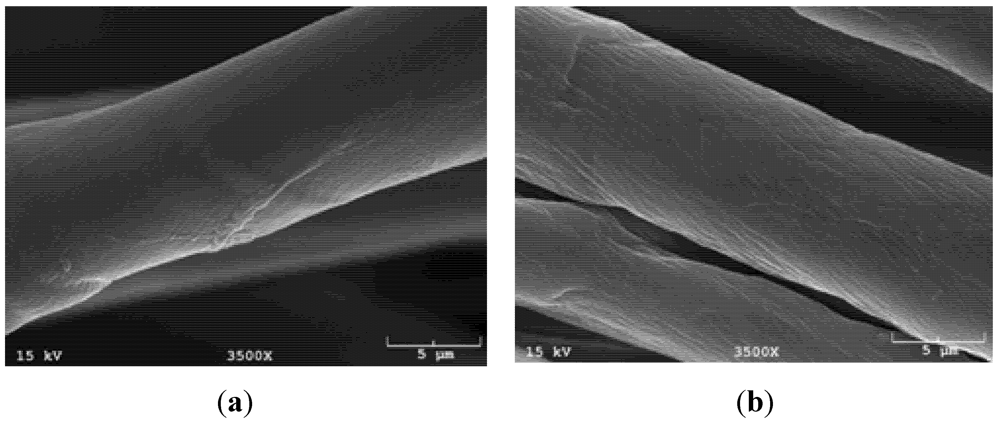
        <p>SEM images and elemental analysis of the fabric samples before and after admicellar polymerization were obtained. <xref ref-type="fig" rid="applsci-02-00192-f001">Figure 1</xref>(a,b) shows fibers in the untreated cotton fabric samples, the surface of fibers is smooth with striations evident in places. It is devoid of polymer aggregates and any other agglomerations over the surface.</p>
        <fig id="applsci-02-00192-f001" position="anchor">
          <label>Figure 1</label>
          <caption>
            <p>Untreated fibers of interlock knit cotton.</p>
          </caption>
          <graphic xmlns:xlink="http://www.w3.org/1999/xlink" xlink:href="applsci-02-00192-g001.tif"/>
        </fig>
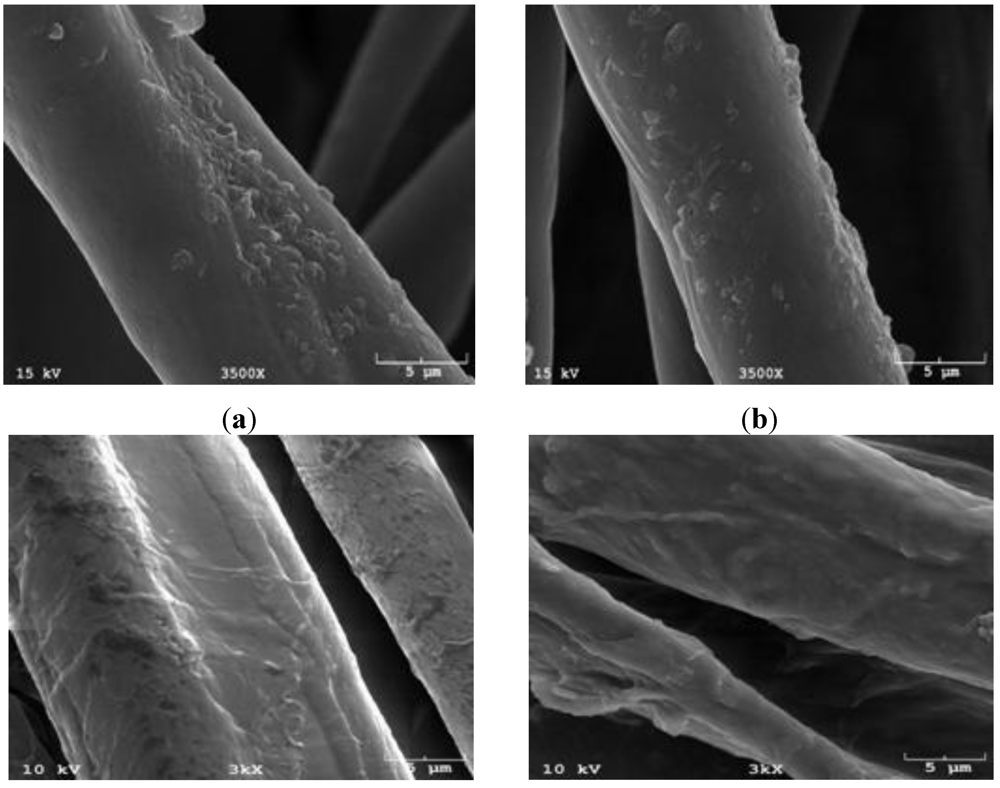
        <p><xref ref-type="fig" rid="applsci-02-00192-f002">Figure 2</xref>(a,b) shows fibers of treated cotton fabric with PA1 after modification by admicellar polymerization. Compared to untreated samples shown in <xref ref-type="fig" rid="applsci-02-00192-f001">Figure 1</xref>, striations are not visible while a coarse, bumpy appearance indicates formation of fluoropolymer on the fiber surface. <xref ref-type="fig" rid="applsci-02-00192-f002">Figure 2</xref>(c,d) shows fibers in the treated cotton fabric with PA2. In this case, striations are also not visible and fluoropolymer coating can be seen on the surface of fibers. With the longer chain fluorocarbon of PA2, the coating appears to be more evenly spread as a uniform layer. It is evident in both cases that the coatings are thin.</p>
        <fig id="applsci-02-00192-f002" position="anchor">
          <label>Figure 2</label>
          <caption>
            <p>Interlock knit cotton fibers treated with PA1 (a,b) and PA2(c,d).</p>
          </caption>
          <graphic xmlns:xlink="http://www.w3.org/1999/xlink" xlink:href="applsci-02-00192-g002.tif"/>
        </fig>
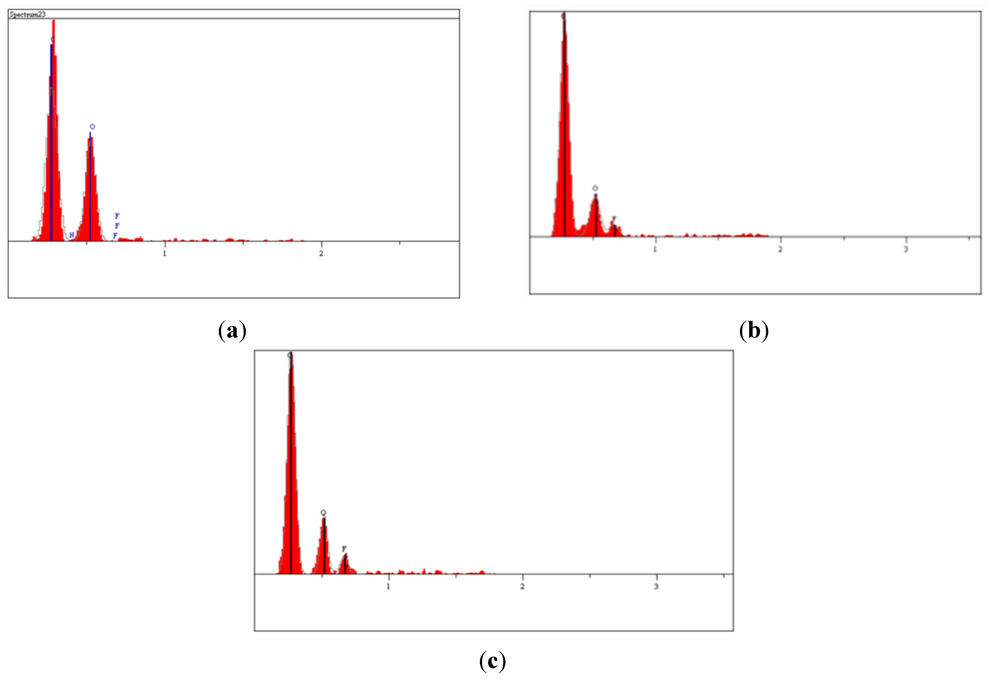
        <p>The EDS spectrum of an untreated control sample (<xref ref-type="fig" rid="applsci-02-00192-f003">Figure 3</xref>a) does not exhibit a significant fluorine peak with the resulting elemental analysis for carbon, nitrogen, oxygen and fluorine indicating a fluorine content of only 0.33 atomic%. Carbon and oxygen, the main constituents of the cellulose substrate, give strong peaks. In treated fabrics (<xref ref-type="fig" rid="applsci-02-00192-f003">Figure 3</xref>(b,c)), distinct peaks are observed for fluorine along with those for carbon and oxygen. Fluorine content in PA1 was 6.89% while in PA2 was 10.53%, consistent with the longer fluorocarbon chains of the latter. The levels of carbon and oxygen observed reflect contributions from penetration of the electron beam through the film and/or regions where the fiber surface was not covered.</p>
        <fig id="applsci-02-00192-f003" position="anchor">
          <label>Figure 3</label>
          <caption>
            <p>Energy dispersive spectroscopy (EDS) spectrum of: (<bold>a</bold>) untreated fiber (<bold>b</bold>) treated fiber with PA1 (<bold>c</bold>) treated fiber with PA2.</p>
          </caption>
          <graphic xmlns:xlink="http://www.w3.org/1999/xlink" xlink:href="applsci-02-00192-g003.tif"/>
        </fig>
      </sec>
      <sec>
        <title>3.2. Mechanical Characterization</title>
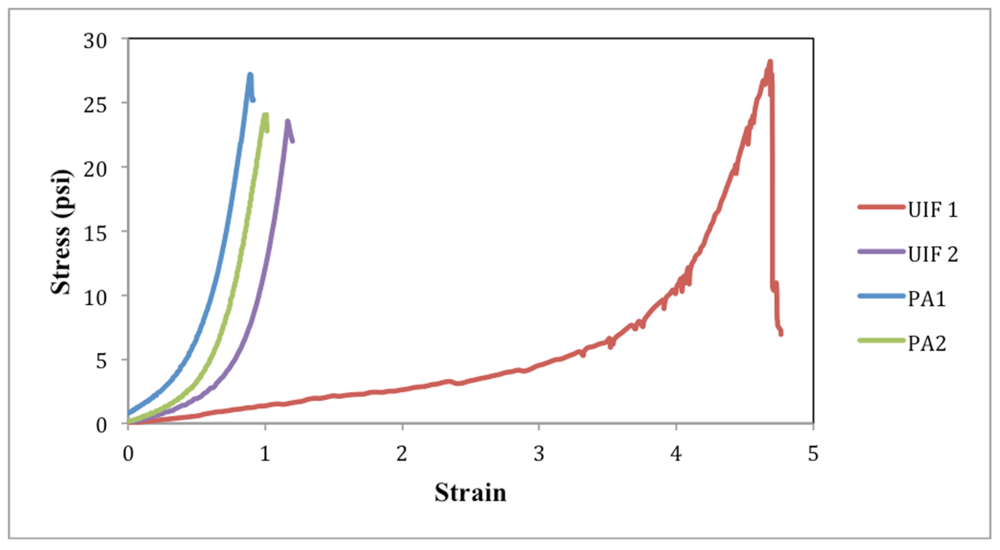
        <p><xref ref-type="fig" rid="applsci-02-00192-f004">Figure 4</xref> shows stress-strain relationships of untreated fabric and treated fabric with two formulations PA1 and PA2. UIF1 and UIF2 are results of untreated interlock fabric in two orthogonal directions indicating anisotropic behavior. The Young’s moduli of treated fabrics PA1 and PA2 correspond to the higher modulus of the untreated interlock knit, regardless of direction. Greater stiffness of PA1 and PA2 suggest the adhesion between fibers due to formation of polymer bridges between fibers. Between PA1 and PA2, Young’s modulus does not differ greatly but PA1 is somewhat stiffer than PA2. These trends mirror observations previously reported for plain and modified pique fabric [<xref ref-type="bibr" rid="B21-applsci-02-00192">21</xref>]. Although the Young’s modulus increases, these fabrics retain soft feel after modification.</p>
        <fig id="applsci-02-00192-f004" position="anchor">
          <label>Figure 4</label>
          <caption>
            <p>Stress-strain plot of untreated fabric and treated fabric with formulations PA1 and PA2.</p>
          </caption>
          <graphic xmlns:xlink="http://www.w3.org/1999/xlink" xlink:href="applsci-02-00192-g004.tif"/>
        </fig>
      </sec>
      <sec>
        <title>3.3. Water Repellency Tests</title>
        <p>Evaluation of fabric hydrophobicity is difficult to assess by any one method. The drop test enables a quick and easy determination, while multiple methods of testing help us to know performance and quality of the material more precisely. To ascertain the water-repellency characteristics of the fabric, the resistance of the fabric to surface penetration by a spray and resistance to surface wetting should be measured. Tests have to be carried out in combination with each other in order to obtain a complete understanding of performance. Samples were assessed for performance using drop test, spray test and contact angle measurement. </p>
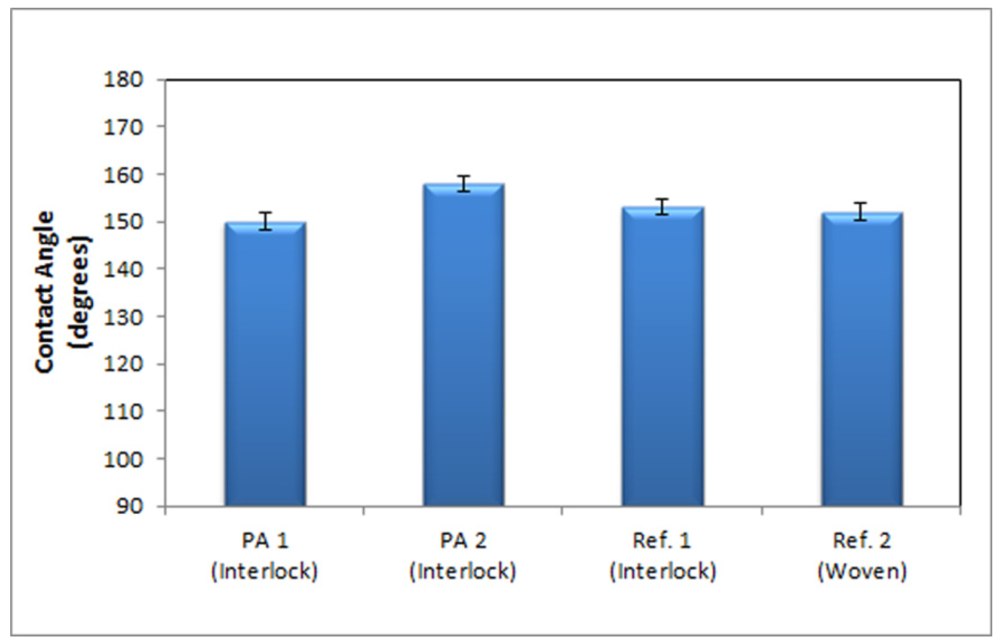
        <p>Interlock cotton knit modified with polyacrylates PA1 and PA2 displayed drop test results greater than 30 min. In fact, superhydrophobic character was found with contact angles of 150° for PA1 and 160° for PA2. <xref ref-type="fig" rid="applsci-02-00192-f005">Figure 5</xref> shows static contact angle results for the various fabric samples, all of which displayed strong hydrophobic character. With a contact angle near 160°, PA2 had the highest value observed. The remaining fabric samples have contact angles around 150° or less. Contact angles in this range result from a combination of chemical composition and surface microstructure. The microstructure includes fibers within the cotton yarns and possibly texture on the surface of the fibers due to the presence of the fluoropolymer. The SEM and EDS data suggest that the higher fluorocarbon content explains why PA2 exhibits a higher contact angle than PA1. </p>
        <fig id="applsci-02-00192-f005" position="anchor">
          <label>Figure 5</label>
          <caption>
            <p>Comparison of contact angles for treated and commercial reference samples.</p>
          </caption>
          <graphic xmlns:xlink="http://www.w3.org/1999/xlink" xlink:href="applsci-02-00192-g005.tif"/>
        </fig>
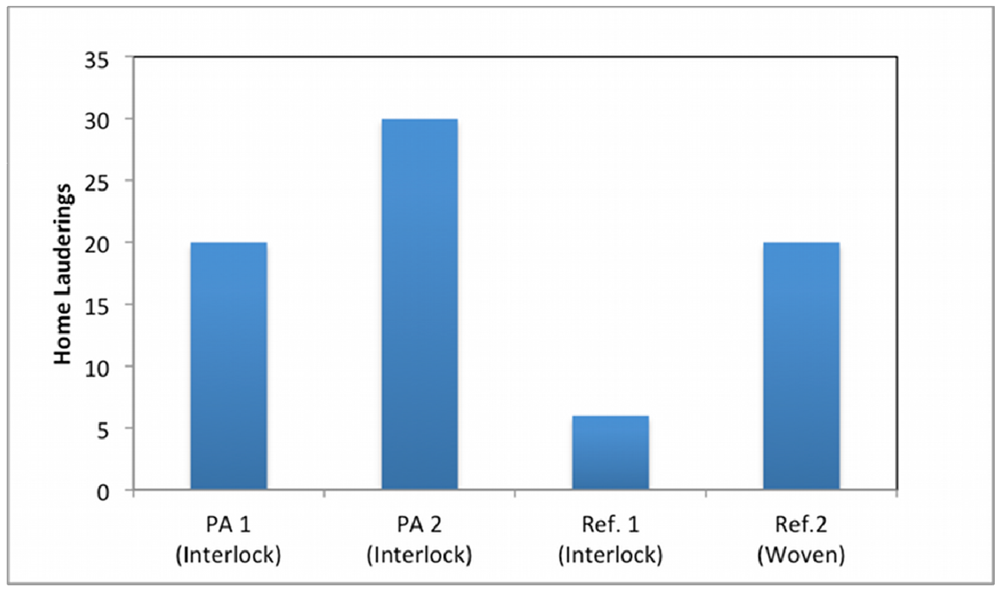
        <p>Samples were repeatedly home laundered with washing and drying steps to gauge durability characteristics. Results for the drop test with number of laundering cycles appear in <xref ref-type="fig" rid="applsci-02-00192-f006">Figure 6</xref>. Treated fabric with PA1 passes with as many as 20 washes while PA2 can hold its treatment up to 30 home launderings. As shown above, PA2 has greater fluorine content and, as such, would be expected to have lower solubility which might explain its ability to endure more home launderings. Findings for fabrics modified by admicellar polymerization were compared to commercial materials. The off-the-shelf knit sample (Ref. 1) fared poorly as it failed the drop test after only 5 washes. The interlock knit material PA1 with the lower fluorochemical content compared well to the woven commercial sample (Ref. 2) with both passing the drop test for 20 washes. The interlock knit PA2 surpassed them all with 30 washes.</p>
        <fig id="applsci-02-00192-f006" position="anchor">
          <label>Figure 6</label>
          <caption>
            <p>Comparison of durability of treated fabrics with commercial reference samples by the drop test.</p>
          </caption>
          <graphic xmlns:xlink="http://www.w3.org/1999/xlink" xlink:href="applsci-02-00192-g006.tif"/>
        </fig>
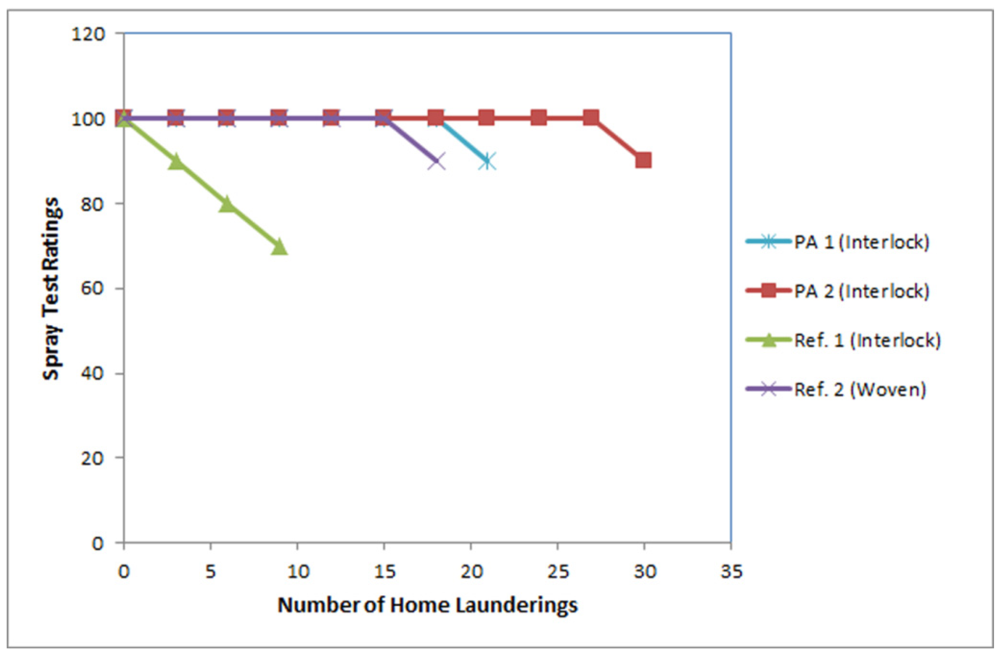
        <p>In the spray test (AATCC 22), repellency of fabric is assessed in a dynamic system by comparison to wetting patterns on a standard chart. Measurements of spray test rating were made after a series of home laundering which were discontinued once the fabric failed the drop test. From <xref ref-type="fig" rid="applsci-02-00192-f007">Figure 7</xref>, the interlock commercial sample (Ref. 1) is seen to exhibit a decrease in performance with each home laundering down to a rating of 60 when the drop test result was less than 30 min. The woven material (Ref. 2) performed well with a rating of 100 up to 15 home launderings where it decreased to a rating of 90. Performance of PA1 was comparable to the woven fabric. Notably, PA2 showed substantially greater durability. Trends observed among the different fabric samples by the spray test were consistent with those of the drop test.</p>
        <fig id="applsci-02-00192-f007" position="anchor">
          <label>Figure 7</label>
          <caption>
            <p>Comparison of spray test of treated fabric and commercial samples.</p>
          </caption>
          <graphic xmlns:xlink="http://www.w3.org/1999/xlink" xlink:href="applsci-02-00192-g007.tif"/>
        </fig>
      </sec>
      <sec>
        <title>3.4. Oil Repellency</title>
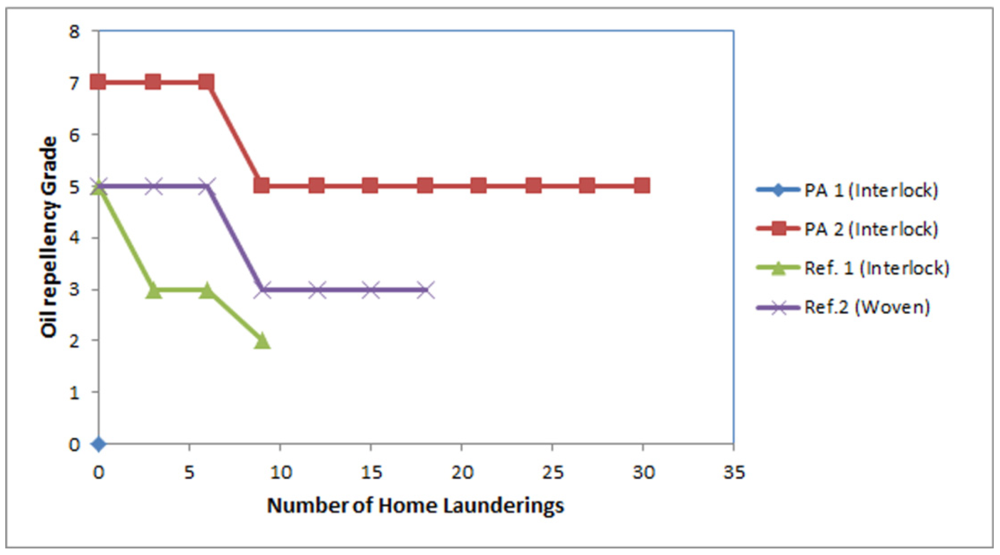
        <p>Oil test results performed according to AATCC test method 118 are reported in <xref ref-type="fig" rid="applsci-02-00192-f008">Figure 8</xref>. Treated fabric with PA1 did not show any oil repellency. In contrast, application of PA2 by admicellar polymerization yielded an initial oil repellency of grade 7. This value dropped to grade 5 after half a dozen home launderings and then remained at grade 5 after many cycles. In fact, it was in these oil repellency tests where the effects of the longer chain fluoroalkyl moiety in polyacrylate PA2 were most evident in its effect on oil repellency. Both off-the-shelf reference samples were rated initially at grade 5. However, interlock sample Ref. 1 degraded rapidly to ratings of 3 and 2. The performance of the woven fabric Ref. 2 paralleled that of PA2, only 2 grades lower throughout. With the exception of PA1, the oil test results for durability corresponded to findings by the water repellency tests. </p>
        <fig id="applsci-02-00192-f008" position="anchor">
          <label>Figure 8</label>
          <caption>
            <p>Comparison of oil test for treated fabric with commercial reference samples.</p>
          </caption>
          <graphic xmlns:xlink="http://www.w3.org/1999/xlink" xlink:href="applsci-02-00192-g008.tif"/>
        </fig>
      </sec>
      <sec>
        <title>3.5. Stain Recovery and Stain Resistance</title>
        <p>The main advantage of a stain resistant and stain recovery finish for fabric is that, when a spill occurs, it can be cleaned easily. Removal of stains during low temperature home launderings is often recommended. Assessment of performance under such conditions can be done according to standard tests, such as AATCC test 130. Results for stain release (<xref ref-type="table" rid="applsci-02-00192-t001">Table 1</xref>) roughly followed the oil repellency findings except the woven commercial fabric received a lower rating than the commercial interlock fabric. At a grade of 4.5, sample PA2 received the highest rating of the group and PA1 the poorest at 1.</p>
<table-wrap id="applsci-02-00192-t001" position="float">
          <object-id pub-id-type="pii">applsci-02-00192-t001_Table 1</object-id>
          <label>Table 1</label>
          <caption>
            <p>Stain release grades according to AATCC test method 130.</p>
          </caption>
          <table>
            <thead>
              <tr>
                <th align="center" valign="middle">Types of fabric</th>
                <th align="center" valign="middle">Stain release grade</th>
              </tr>
            </thead>
            <tbody>
              <tr style="border-top:solid thin">
                <td align="left" valign="middle">Interlock (PA1)</td>
                <td align="center" valign="middle">1</td>
              </tr>
              <tr>
                <td align="left" valign="middle">Interlock (PA2)</td>
                <td align="center" valign="middle">4.5</td>
              </tr>
              <tr>
                <td align="left" valign="middle">Interlock (Ref. 1)</td>
                <td align="center" valign="middle">3</td>
              </tr>
              <tr>
                <td align="left" valign="middle">Woven (Ref. 2)</td>
                <td align="center" valign="middle">2</td>
              </tr>
            </tbody>
  </table>
        </table-wrap>
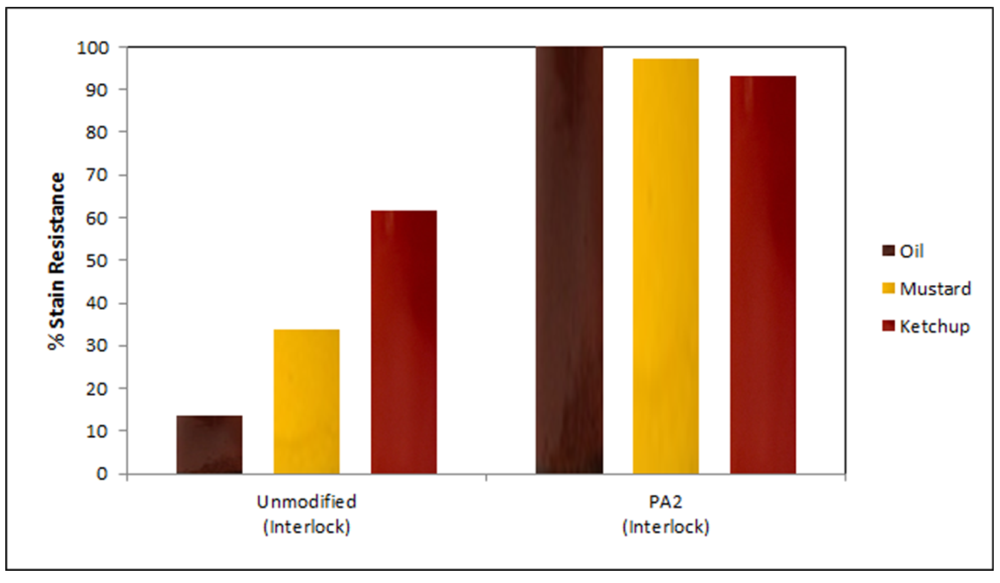
        <p>Fabrics were stained with oil, mustard and ketchup in additional tests. On the basis of the oil repellency and oil release results, sample PA1 was excluded from further testing. After wiping the stain with a tissue paper, stains remained visibly attached to untreated cotton, but, for treated fabric with PA2, all the stains were wiped away. To quantify this, we measured the reflectance of the fabric after wiping the stains for oil, mustard and ketchup. <xref ref-type="fig" rid="applsci-02-00192-f009">Figure 9</xref> shows the stain resistance performance of treated cotton with PA2 and untreated cotton. PA2 exposed to oil showed stain resistance of 100% indicating oil can be wiped off immediately. When stains were dropped on untreated cotton, stains penetrated and contributed to lower reflectance. For treated cotton, the various agents did not penetrate and could be wiped off easily so reflectance retuned nearly to 100%.</p>
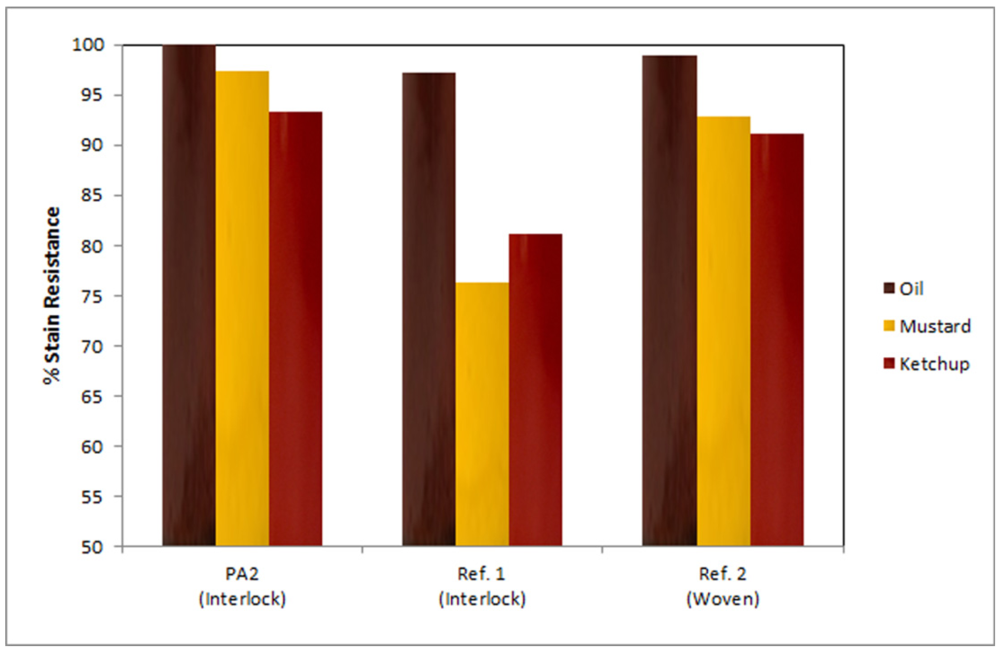
         <p>Staining tests were also performed on the commercial reference samples and compared with PA2. <xref ref-type="fig" rid="applsci-02-00192-f010">Figure 10</xref> presents reflectance measurements of stain resistance for treated and reference samples after exposure to oil, mustard and ketchup. All fabrics performed well in resisting blemishes by oil. Overall, PA2 performed comparably to the woven commercial material and outperformed the commercial knit. The commercial interlock type fabric (Ref. 1) showed poor performance compared to the fabric modified by admicellar polymerization with only about 75% of stain resistance with mustard and about 80% with ketchup. It is a significant finding that the coated cotton knit could function at a level comparable to a fabric with a tighter weave.</p>
        <fig id="applsci-02-00192-f009" position="anchor">
          <label>Figure 9</label>
          <caption>
            <p>Stain resistance for untreated and treated fabric with PA2 with different staining agents.</p>
          </caption>
          <graphic xmlns:xlink="http://www.w3.org/1999/xlink" xlink:href="applsci-02-00192-g009.tif"/>
        </fig>
       <fig id="applsci-02-00192-f010" position="anchor">
          <label>Figure 10</label>
          <caption>
            <p>Stain resistance comparison for PA2 and commercial fabrics with different stains.</p>
          </caption>
          <graphic xmlns:xlink="http://www.w3.org/1999/xlink" xlink:href="applsci-02-00192-g010.tif"/>
        </fig>
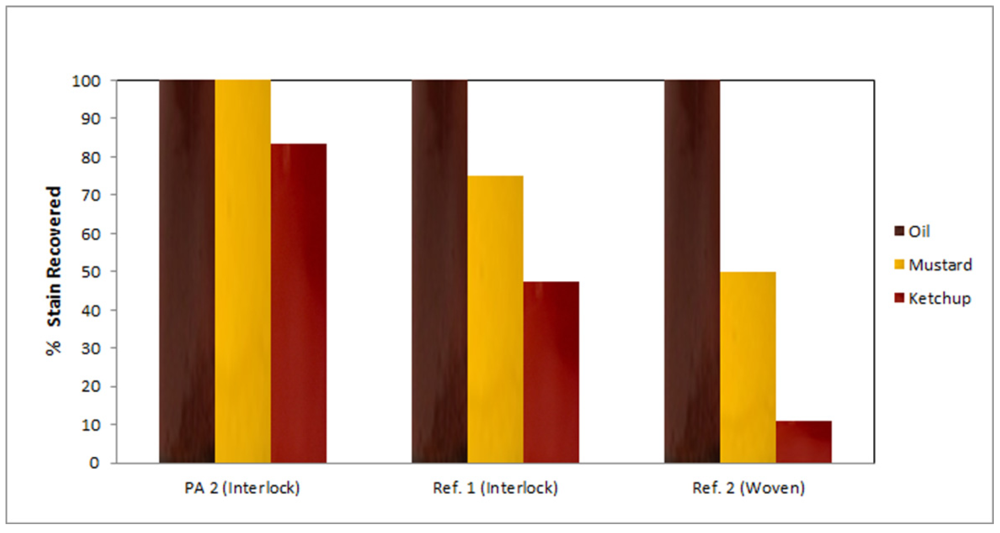
        <p>Similar experiments for stain recovery of the fabric were carried out by doing one home laundering and then assessing the level of stain recovery using reflectance measurements. Results for stain recovery are presented in <xref ref-type="fig" rid="applsci-02-00192-f011">Figure 11</xref>. All materials perform well in removal of oil by washing. Otherwise, stain recovery of PA2 was substantially better than the reference samples.</p>
        <fig id="applsci-02-00192-f011" position="anchor">
          <label>Figure 11</label>
          <caption>
            <p>Stain recovery of treated fabric with PA2 compared to commercial reference fabrics.</p>
          </caption>
          <graphic xmlns:xlink="http://www.w3.org/1999/xlink" xlink:href="applsci-02-00192-g011.tif"/>
        </fig>
      </sec>
    </sec>
    <sec>
      <title>4. Conclusion</title>
      <p>Application of fluorocarbon finishes by admicellar polymerization can yield durable cotton fabrics with excellent stain resistance and stain recovery properties. Performance of these fabrics, prepared in a laboratory, compare well to that of commercial production materials examined. </p>
    </sec>
  </body>
  <back>
    <ack>
      <title>Acknowledgements</title>
      <p>This project was supported in part by funds provided by the Oklahoma Center for the Advancement of Science and Technology (OCAST), which is gratefully acknowledged. The authors express appreciation to Preston Larson for his help with SEM and elemental analysis. </p>
    </ack><notes>
      <title>Conflict of Interest</title>
      <p>Author Edgar O’Rear is affiliated with both The University of Oklahoma and SyntheSized Nano Coatings, Inc. The conflict of interest is under a management plan administered in accordance with the policies and procedures of the University of Oklahoma.</p>
    </notes>
    <ref-list>
      <title>References</title>
      <ref id="B1-applsci-02-00192">
        <label>1.</label>
        <citation citation-type="journal">
          <person-group person-group-type="author">
            <name>
              <surname>Holme</surname>
              <given-names>I.</given-names>
            </name>
          </person-group>
          <article-title>Innovative technologies for high performance textiles</article-title>
          <source>Color Technol.</source>
          <year>2007</year>
          <volume>123</volume>
          <fpage>59</fpage>
          <lpage>73</lpage>
          <pub-id pub-id-type="doi">10.1111/j.1478-4408.2007.00064.x</pub-id>
        </citation>
      </ref>
      <ref id="B2-applsci-02-00192">
        <label>2.</label>
        <citation citation-type="journal">
          <person-group person-group-type="author">
            <name>
              <surname>Sawhney</surname>
              <given-names>A.P.S.</given-names>
            </name>
            <name>
              <surname>Condon</surname>
              <given-names>B.</given-names>
            </name>
            <name>
              <surname>Singh</surname>
              <given-names>K.V.</given-names>
            </name>
            <name>
              <surname>Pang</surname>
              <given-names>S.S.</given-names>
            </name>
            <name>
              <surname>Li</surname>
              <given-names>G.</given-names>
            </name>
            <name>
              <surname>Hui</surname>
              <given-names>D.</given-names>
            </name>
          </person-group>
          <article-title>Modern applications of nanotechnology in textiles</article-title>
          <source>Text. Res. J.</source>
          <year>2008</year>
          <volume>78</volume>
          <fpage>731</fpage>
          <lpage>739</lpage>
          <pub-id pub-id-type="doi">10.1177/0040517508091066</pub-id>
        </citation>
      </ref>
      <ref id="B3-applsci-02-00192">
        <label>3.</label>
        <citation citation-type="web">
          <person-group person-group-type="author">
            <name>
              <surname>Vazquez</surname>
              <given-names>F.</given-names>
            </name>
          </person-group>
          <article-title>Silicone softeners for stain repellent and stain resistance fabric finishing</article-title>
          <source>Dyes and Chemicals.</source>
          <year>2004</year>
          <access-date>(accessed on 27 January 2012)</access-date>
          <comment>Available online:<ext-link xmlns:xlink="http://www.w3.org/1999/xlink" xlink:href="http://www.fibre2fashion.com/industry-article/7/619/silicone-softeners-for-stain-repellent-and-stain-release-fabric-finishing6.asp" ext-link-type="uri">http://www.fibre2fashion.com/industry-article/7/619/silicone-softeners-for-stain-repellent-and-stain-release-fabric-finishing6.asp</ext-link></comment>
        </citation>
      </ref>
      <ref id="B4-applsci-02-00192">
        <label>4.</label>
        <citation citation-type="journal">
          <person-group person-group-type="author">
            <name>
              <surname>Kathirvelu</surname>
              <given-names>S.</given-names>
            </name>
            <name>
              <surname>D’Souza</surname>
              <given-names>L.</given-names>
            </name>
            <name>
              <surname>Dhurai</surname>
              <given-names>B.</given-names>
            </name>
          </person-group>
          <article-title>Study of stain-eliminating textiles using ZnO nanoparticles</article-title>
          <source>J. Tex. I</source>
          <year>2010</year>
          <volume>101</volume>
          <fpage>520</fpage>
          <lpage>526</lpage>
          <pub-id pub-id-type="doi">10.1080/00405000802563693</pub-id>
        </citation>
      </ref>
      <ref id="B5-applsci-02-00192">
        <label>5.</label>
        <citation citation-type="journal">
          <person-group person-group-type="author">
            <name>
              <surname>Badyal</surname>
              <given-names>J.P.</given-names>
            </name>
          </person-group>
          <article-title>Beyond the surface-cold plasmas are streamlining the surface coating</article-title>
          <source>Chem. Br.</source>
          <year>2001</year>
          <volume>37</volume>
          <fpage>45</fpage>
          <lpage>46</lpage>
        </citation>
      </ref>
      <ref id="B6-applsci-02-00192">
        <label>6.</label>
        <citation citation-type="journal">
          <person-group person-group-type="author">
            <name>
              <surname>Bubert</surname>
              <given-names>H. </given-names>
            </name>
          </person-group>
          <article-title>Surface and thin film analysis</article-title>
          <source>Ullmann’s Encycl. Ind. Chem. </source>
          <year>2011</year>
          <comment>pub2.</comment>
          <pub-id pub-id-type="doi">10.1002/ 14356007.b06_023</pub-id>
        </citation>
      </ref>
      <ref id="B7-applsci-02-00192">
        <label>7.</label>
        <citation citation-type="journal">
          <person-group person-group-type="author">
            <name>
              <surname>Ma</surname>
              <given-names>M.L.</given-names>
            </name>
            <name>
              <surname>Gupta</surname>
              <given-names>M.</given-names>
            </name>
            <name>
              <surname>Zhai</surname>
              <given-names>L.</given-names>
            </name>
            <name>
              <surname>Gleason</surname>
              <given-names>K. K.</given-names>
            </name>
            <name>
              <surname>Cohen</surname>
              <given-names>R. E.</given-names>
            </name>
            <name>
              <surname>Rubner</surname>
              <given-names>M. F.</given-names>
            </name>
            <name>
              <surname>Rutledge</surname>
              <given-names>G. C. </given-names>
            </name>
          </person-group>
          <article-title>Decorated electrospun fibers exhibiting superhydrophobicity</article-title>
          <source>Adv. Mater. </source>
          <year>2007</year>
          <volume>19</volume>
          <fpage>255</fpage>
          <lpage>259</lpage>
        <pub-id pub-id-type="doi">10.1002/adma.200601449</pub-id></citation>
      </ref>
      <ref id="B8-applsci-02-00192">
        <label>8.</label>
        <citation citation-type="journal">
          <person-group person-group-type="author">
            <name>
              <surname>Maity</surname>
              <given-names>J.</given-names>
            </name>
            <name>
              <surname>Jacob</surname>
              <given-names>C.</given-names>
            </name>
            <name>
              <surname>Das</surname>
              <given-names>C.K.</given-names>
            </name>
            <name>
              <surname>Singh</surname>
              <given-names>R.P.</given-names>
            </name>
          </person-group>
          <article-title>Direct fluorination of Twaron fiber and investigation of mechanical thermal and morphological properties of high density polyethylene and Twaron fiber composites</article-title>
          <source>J. Appl. Polym. Sci.</source>
          <year>2008</year>
          <volume>107</volume>
          <fpage>3739</fpage>
          <lpage>3749</lpage>
          <pub-id pub-id-type="doi">10.1002/app.27510</pub-id>
        </citation>
      </ref>
      <ref id="B9-applsci-02-00192">
        <label>9.</label>
        <citation citation-type="journal">
          <person-group person-group-type="author">
            <name>
              <surname>Tarimala</surname>
              <given-names>S.</given-names>
            </name>
            <name>
              <surname>Kothari</surname>
              <given-names>N.</given-names>
            </name>
            <name>
              <surname>Abidi</surname>
              <given-names>N.</given-names>
            </name>
            <name>
              <surname>Hequet</surname>
              <given-names>E.</given-names>
            </name>
            <name>
              <surname>Fralick</surname>
              <given-names>J.</given-names>
            </name>
            <name>
              <surname>Dai</surname>
              <given-names>L.L.</given-names>
            </name>
          </person-group>
          <article-title>New approach to antibacterial treatment of cotton fabric with silver nanoparticle–doped silica using sol-gel process</article-title>
          <source>J. Appl. Polym. Sci.</source>
          <year>2006</year>
          <volume>101</volume>
          <fpage>2938</fpage>
          <lpage>2943</lpage>
        <pub-id pub-id-type="doi">10.1002/app.23443</pub-id></citation>
      </ref>
      <ref id="B10-applsci-02-00192">
        <label>10.</label>
        <citation citation-type="journal">
          <person-group person-group-type="author">
            <name>
              <surname>Yeh</surname>
              <given-names>J.-T.</given-names>
            </name>
            <name>
              <surname>Chen</surname>
              <given-names>C.-L.</given-names>
            </name>
            <name>
              <surname>Huang</surname>
              <given-names>K.-S.</given-names>
            </name>
          </person-group>
          <article-title>Preparation and application of fluorocarbon polymer/SiO<sub>2</sub> hybrid materials, part 2: Water and oil repellent processing for cotton fabrics by sol-gel method</article-title>
          <source>J. Appl. Polym. Sci.</source>
          <year>2007</year>
          <volume>103</volume>
          <fpage>3019</fpage>
          <lpage>3024</lpage>
          <pub-id pub-id-type="doi">10.1002/app.25048</pub-id>
        </citation>
      </ref>
      <ref id="B11-applsci-02-00192">
        <label>11.</label>
        <citation citation-type="journal">
          <person-group person-group-type="author">
            <name>
              <surname>Wang</surname>
              <given-names>T.</given-names>
            </name>
            <name>
              <surname>Hu</surname>
              <given-names>X.</given-names>
            </name>
            <name>
              <surname>Dong</surname>
              <given-names>S.</given-names>
            </name>
          </person-group>
          <article-title>A general route to transform normal hydrophilic cloths into superhydrophobic surfaces</article-title>
          <source>Chem. Commun.</source>
          <year>2007</year>
          <fpage>1849</fpage>
          <lpage>1851</lpage>
        </citation>
      </ref>
      <ref id="B12-applsci-02-00192">
        <label>12.</label>
        <citation citation-type="journal">
          <person-group person-group-type="author">
            <name>
              <surname>Hoefnagels</surname>
              <given-names>H.F.</given-names>
            </name>
            <name>
              <surname>Wu</surname>
              <given-names>D.</given-names>
            </name>
            <name>
              <surname>de With</surname>
              <given-names>G.</given-names>
            </name>
            <name>
              <surname>Ming</surname>
              <given-names>W.</given-names>
            </name>
          </person-group>
          <article-title>Biomimetic superhydrophobic and highly oleophobic cotton textiles</article-title>
          <source>Langmuir</source>
          <year>2007</year>
          <volume>23</volume>
          <fpage>13158</fpage>
          <lpage>13163</lpage>
          <pub-id pub-id-type="doi">10.1021/la702174x</pub-id>
        </citation>
      </ref>
      <ref id="B13-applsci-02-00192">
        <label>13.</label>
        <citation citation-type="journal">
          <person-group person-group-type="author">
            <name>
              <surname>Xue</surname>
              <given-names>C.H.</given-names>
            </name>
            <name>
              <surname>Jia</surname>
              <given-names>S.T.</given-names>
            </name>
            <name>
              <surname>Chen</surname>
              <given-names>H.Z.</given-names>
            </name>
            <name>
              <surname>Wang</surname>
              <given-names>M.</given-names>
            </name>
          </person-group>
          <article-title>Superhydrophobic cotton fabrics prepared by sol-gel coating of TiO2 and surface hydrophobization</article-title>
          <source>Sci. Technol. Adv. Mater. </source>
          <year>2008</year>
          <volume>9</volume>
          <pub-id pub-id-type="doi">10.1088/1468-6996/9/3/035001</pub-id>
        </citation>
      </ref>
      <ref id="B14-applsci-02-00192">
        <label>14.</label>
        <citation citation-type="journal">
          <person-group person-group-type="author">
            <name>
              <surname>Wang</surname>
              <given-names>H.</given-names>
            </name>
            <name>
              <surname>Fang</surname>
              <given-names>J.</given-names>
            </name>
            <name>
              <surname>Cheng</surname>
              <given-names>T.</given-names>
            </name>
            <name>
              <surname>Ding</surname>
              <given-names>J.</given-names>
            </name>
            <name>
              <surname>Qu</surname>
              <given-names>L.</given-names>
            </name>
            <name>
              <surname>Dai</surname>
              <given-names>L.</given-names>
            </name>
            <name>
              <surname>Wang</surname>
              <given-names>X.</given-names>
            </name>
            <name>
              <surname>Lin</surname>
              <given-names>T.</given-names>
            </name>
          </person-group>
          <article-title>One-step coating of fluoro-containing silica nanoparticles for universal generation of surface superhydrophobicity</article-title>
          <source>Chem. Commun.</source>
          <year>2008</year>
          <fpage>877</fpage>
          <lpage>879</lpage>
        </citation>
      </ref>
      <ref id="B15-applsci-02-00192">
        <label>15.</label>
        <citation citation-type="journal">
          <person-group person-group-type="author">
            <name>
              <surname>Leng</surname>
              <given-names>B.</given-names>
            </name>
            <name>
              <surname>Shao</surname>
              <given-names>Z.Z.</given-names>
            </name>
            <name>
              <surname>de With</surname>
              <given-names>G.</given-names>
            </name>
            <name>
              <surname>Ming</surname>
              <given-names>W.</given-names>
            </name>
          </person-group>
          <article-title>Superoleophobic cotton textiles</article-title>
          <source>Langmuir</source>
          <year>2009</year>
          <volume>25</volume>
          <fpage>2456</fpage>
          <lpage>2460</lpage>
          <pub-id pub-id-type="doi">10.1021/la8031144</pub-id>
        </citation>
      </ref>
      <ref id="B16-applsci-02-00192">
        <label>16.</label>
        <citation citation-type="journal">
          <person-group person-group-type="author">
            <name>
              <surname>Zhao</surname>
              <given-names>Y.</given-names>
            </name>
            <name>
              <surname>Tang</surname>
              <given-names>Y.W.</given-names>
            </name>
            <name>
              <surname>Wang</surname>
              <given-names>X.G.</given-names>
            </name>
            <name>
              <surname>Lin</surname>
              <given-names>T.</given-names>
            </name>
          </person-group>
          <article-title>Superhydrophobic cotton fabric fabricated by electrostatic assembly of silica nanoparticles and its remarkable buoyancy</article-title>
          <source>Appl. Surf. Sci.</source>
          <year>2010</year>
          <volume>256</volume>
          <fpage>6736</fpage>
          <lpage>6742</lpage>
        <pub-id pub-id-type="doi">10.1016/j.apsusc.2010.04.082</pub-id></citation>
      </ref>
      <ref id="B17-applsci-02-00192">
        <label>17.</label>
        <citation citation-type="journal">
          <person-group person-group-type="author">
            <name>
              <surname>Luna-Xavier</surname>
              <given-names>J.-L.</given-names>
            </name>
            <name>
              <surname>Guyot</surname>
              <given-names>A.</given-names>
            </name>
            <name>
              <surname>Bourgeat-Lami</surname>
              <given-names>E.</given-names>
            </name>
          </person-group>
          <article-title>Synthesis and characterization of silica/poly (methyl methacrylate) nanocomposite latex particles through emulsion polymerization using a cationic azo initiator</article-title>
          <source>J. Colloid Interface Sci.</source>
          <year>2002</year>
          <volume>250</volume>
          <fpage>82</fpage>
          <lpage>92</lpage>
          <pub-id pub-id-type="doi">10.1006/jcis.2002.8310</pub-id>
        </citation>
      </ref>
      <ref id="B18-applsci-02-00192">
        <label>18.</label>
        <citation citation-type="journal">
          <person-group person-group-type="author">
            <name>
              <surname>O’Haver</surname>
              <given-names>J.H.</given-names>
            </name>
            <name>
              <surname>Harwell</surname>
              <given-names>J.H.</given-names>
            </name>
            <name>
              <surname>O’Rear</surname>
              <given-names>E.A.</given-names>
            </name>
            <name>
              <surname>Snodgrass</surname>
              <given-names>L.J.</given-names>
            </name>
            <name>
              <surname>Waddell</surname>
              <given-names>W.H.</given-names>
            </name>
          </person-group>
          <article-title><italic>In situ</italic> formation of polystyrene in adsorbed surfactant bilayers on precipitated silica</article-title>
          <source>Langmuir</source>
          <year>1994</year>
          <volume>10</volume>
          <fpage>2588</fpage>
          <lpage>2593</lpage>
        <pub-id pub-id-type="doi">10.1021/la00020a017</pub-id></citation>
      </ref>
      <ref id="B19-applsci-02-00192">
        <label>19.</label>
        <citation citation-type="journal">
          <person-group person-group-type="author">
            <name>
              <surname>Wang</surname>
              <given-names>S.</given-names>
            </name>
            <name>
              <surname>Russo</surname>
              <given-names>T.</given-names>
            </name>
            <name>
              <surname>Qiao</surname>
              <given-names>G.G.</given-names>
            </name>
            <name>
              <surname>Solomon</surname>
              <given-names>D.H.</given-names>
            </name>
            <name>
              <surname>Shanks</surname>
              <given-names>R.A.</given-names>
            </name>
          </person-group>
          <article-title>Admicellar polymerization of styrene with divinyl benzene on alumina particles: The synthesis of white reinforcing fillers</article-title>
          <source>J. Mater. Sci.</source>
          <year>2006</year>
          <volume>41</volume>
          <fpage>7474</fpage>
          <lpage>7482</lpage>
        <pub-id pub-id-type="doi">10.1007/s10853-006-0788-y</pub-id></citation>
      </ref>
      <ref id="B20-applsci-02-00192">
        <label>20.</label>
        <citation citation-type="journal">
          <person-group person-group-type="author">
            <name>
              <surname>Karlsson</surname>
              <given-names>P.M.</given-names>
            </name>
            <name>
              <surname>Esbjornsson</surname>
              <given-names>N.B.</given-names>
            </name>
            <name>
              <surname>Holmberg</surname>
              <given-names>K.</given-names>
            </name>
          </person-group>
          <article-title>Admicellar polymerization of methyl methacrylate on aluminum pigments</article-title>
          <source>J. Colloid Interface Sci.</source>
          <year>2009</year>
          <volume>337</volume>
          <fpage>364</fpage>
          <lpage>368</lpage>
        <pub-id pub-id-type="doi">10.1016/j.jcis.2009.05.053</pub-id><pub-id pub-id-type="pmid">19539300</pub-id></citation>
      </ref>
      <ref id="B21-applsci-02-00192">
        <label>21.</label>
        <citation citation-type="journal">
          <person-group person-group-type="author">
            <name>
              <surname>Maity</surname>
              <given-names>J.</given-names>
            </name>
            <name>
              <surname>Kothary</surname>
              <given-names>P.</given-names>
            </name>
            <name>
              <surname>O’Rear</surname>
              <given-names>E.A.</given-names>
            </name>
            <name>
              <surname>Jacob</surname>
              <given-names>C.</given-names>
            </name>
          </person-group>
          <article-title>Preparation and comparison of hydrophobic cotton fabric obtained by direct fluorination and admicellar polymerization of fluoromonomers</article-title>
          <source>Ind. Eng. Chem. Res.</source>
          <year>2010</year>
          <volume>49</volume>
          <fpage>6075</fpage>
          <lpage>6079</lpage>
        <pub-id pub-id-type="doi">10.1021/ie100564y</pub-id></citation>
      </ref>
      <ref id="B22-applsci-02-00192">
        <label>22.</label>
        <citation citation-type="journal">
          <person-group person-group-type="author">
            <name>
              <surname>Siriviriyanun</surname>
              <given-names>A.</given-names>
            </name>
            <name>
              <surname>O’Rear</surname>
              <given-names>E.A.</given-names>
            </name>
            <name>
              <surname>Yanumet</surname>
              <given-names>N.</given-names>
            </name>
          </person-group>
          <article-title>Improvement in the flame retardancy of cotton fabric by admicellar polymerization of 2-acryloyloxyethyl diethyl phosphate using an anionic surfactant</article-title>
          <source>J. Appl. Polym. Sci.</source>
          <year>2008</year>
          <volume>109</volume>
          <fpage>3859</fpage>
          <lpage>3866</lpage>
          <pub-id pub-id-type="doi">10.1002/app.28614</pub-id>
        </citation>
      </ref>
      <ref id="B23-applsci-02-00192">
        <label>23.</label>
        <citation citation-type="journal">
          <person-group person-group-type="author">
            <name>
              <surname>Tragoonwichian</surname>
              <given-names>S.</given-names>
            </name>
            <name>
              <surname>O’Rear</surname>
              <given-names>E.A.</given-names>
            </name>
            <name>
              <surname>Yanumet</surname>
              <given-names>N.</given-names>
            </name>
          </person-group>
          <article-title>Broad ultraviolet protection by copolymerization of 2-[3-(2H-benzotriazol-2-yl)-4-hydroxyphenyl]ethyl methacrylate and 2-hydroxy-4-acryloyloxybenzophenone on cotton via admicellar polymerization</article-title>
          <source>J. Appl. Polym. Sci.</source>
          <year>2008</year>
          <volume>108</volume>
          <fpage>4004</fpage>
          <lpage>4013</lpage>
          <pub-id pub-id-type="doi">10.1002/app.28049</pub-id>
        </citation>
      </ref>
    </ref-list>
  </back>
</article>