<?xml version="1.0" encoding="UTF-8"?>
<!DOCTYPE article PUBLIC "-//NLM//DTD Journal Publishing DTD v2.3 20070202//EN" "journalpublishing.dtd">
<article xmlns:mml="http://www.w3.org/1998/Math/MathML" xmlns:xlink="http://www.w3.org/1999/xlink" xml:lang="en" article-type="research-article">
  <front>
    <journal-meta>
      <journal-id journal-id-type="publisher-id">admsci</journal-id>
      <journal-title>Administrative Sciences</journal-title>
      <abbrev-journal-title abbrev-type="publisher">Adm. Sci.</abbrev-journal-title>
      <abbrev-journal-title abbrev-type="pubmed">Adm. Sci.</abbrev-journal-title>
      <issn pub-type="epub">2076-3387</issn>
      <publisher>
        <publisher-name>MDPI</publisher-name>
      </publisher>
    </journal-meta>
    <article-meta>
      <article-id pub-id-type="doi">10.3390/admsci2030203</article-id>
      <article-id pub-id-type="publisher-id">admsci-02-00203</article-id>
      <article-categories>
        <subj-group>
          <subject>Article</subject>
        </subj-group>
      </article-categories>
      <title-group>
        <article-title>Catching Leaders’ Mood: Contagion Effects in Teams</article-title>
      </title-group>
      
      <contrib-group>
        <contrib contrib-type="author">
          <name>
            <surname>Volmer</surname>
            <given-names>Judith</given-names>
          </name>
        </contrib>
      </contrib-group>
      <aff id="af1-admsci-02-00203">University of Erlangen, Bismarckstr. 6. Erlangen 91054, Germany; Email: <email>judith.volmer@sozpsy.phil.uni-erlangen.de</email>; Tel.: +49-9131-85-22959; Fax: +49-9131-85-27431 </aff>
      <pub-date pub-type="epub">
        <day>29</day>
        <month>08</month>
        <year>2012</year>
      </pub-date>
      <pub-date pub-type="collection"><month>09</month>
        <year>2012</year>
      </pub-date>
      <volume>2</volume>
      <issue>3</issue>
      <fpage>203</fpage>
      <lpage>220</lpage>
      <history>
        <date date-type="received">
          <day>02</day>
          <month>06</month>
          <year>2012</year>
        </date>
        <date date-type="rev-recd">
          <day>30</day>
          <month>07</month>
          <year>2012</year>
        </date>
        <date date-type="accepted">
          <day>30</day>
          <month>07</month>
          <year>2012</year>
        </date>
      </history>
      <permissions>
        <copyright-statement>©  2012 by the authors; licensee MDPI, Basel, Switzerland.</copyright-statement>
        <copyright-year>2012</copyright-year>
        <license xmlns:xlink="http://www.w3.org/1999/xlink" license-type="open-access" xlink:href="http://creativecommons.org/licenses/by/3.0/">
          <p>This article is an open-access article distributed under the terms and conditions of the Creative Commons Attribution license (http://creativecommons.org/licenses/by/3.0/).</p>
        </license>
      </permissions>
      <abstract>
        <p>Much of the behavior at work takes place within teams. Leaders of teams experience different feelings that, in turn, can have an impact on how team members feel and perform. This study examined the effects of leaders’ mood on individual team members’ mood, group affective tone, and team outcomes (actual team performance, potency, and goal commitment) in a laboratory study, with a sample of 63 students working in three-person teams. Furthermore, the study investigated the mediating role of group affective tone in the leaders’ mood–team outcomes relationship. Results demonstrated that leaders influence team members’ individual mood, group affective tone, actual team performance, and potency. Moreover, group affective tone mediated the relationship between team leaders’ mood and potency. Taken together, the findings suggest that in order to enhance subordinates’ work experience and to attain desired outcomes, leaders should be aware of their mood and its potential effects.</p>
      </abstract>
      <kwd-group>
        <kwd>leadership</kwd>
        <kwd>mood contagion</kwd>
        <kwd>group affective tone</kwd>
        <kwd>potency</kwd>
        <kwd>goal commitment</kwd>
        <kwd>actual team performance</kwd>
        <kwd>auditory mood induction</kwd>
      </kwd-group>
    </article-meta>
  </front>
  <body>
    <sec sec-type="intro">
      <title>1. Introduction</title>
      <p>Our feelings and behavior can be strongly influenced by our interactions with others. In today’s work environments, with an increasing emphasis on teamwork, team leaders are considered to play an important role in influencing subordinates’ mood and team outcomes [<xref ref-type="bibr" rid="B1-admsci-02-00203">1</xref>,<xref ref-type="bibr" rid="B2-admsci-02-00203">2</xref>]. Recently, research interest concerning the role of team leaders’ mood on team members’ mood and team outcomes has been rapidly growing [<xref ref-type="bibr" rid="B3-admsci-02-00203">3</xref>,<xref ref-type="bibr" rid="B4-admsci-02-00203">4</xref>,<xref ref-type="bibr" rid="B5-admsci-02-00203">5</xref>,<xref ref-type="bibr" rid="B6-admsci-02-00203">6</xref>,<xref ref-type="bibr" rid="B7-admsci-02-00203">7</xref>,<xref ref-type="bibr" rid="B8-admsci-02-00203">8</xref>]. For example, Sy and colleagues [<xref ref-type="bibr" rid="B6-admsci-02-00203">6</xref>] found that team leaders’ positive mood increased team members’ individual mood and group affective tone (defined as the “consistent or homogeneous affective reactions within a group” [<xref ref-type="bibr" rid="B9-admsci-02-00203">9</xref>]; p. 108), and was positively related to group processes (<italic>i.e.</italic>, effort and group coordination) in a sample of 56 self-managed student teams. In a field study with schoolteachers, Johnson [<xref ref-type="bibr" rid="B10-admsci-02-00203">10</xref>] found that leader affect at work related to follower affect at work via emotional contagion, and influenced followers’ performance (<italic>i.e.</italic>, organizational citizenship behavior). Leaders are considered to be particularly important with regard to how team members feel and perform because they (a) have the power and authority to instruct team members; (b) act as role models; and (c) are depended on by team members [<xref ref-type="bibr" rid="B11-admsci-02-00203">11</xref>]. In comparison to other team members, leaders are considered to be more effective in transferring mood to others and in influencing team outcomes due to their salience within teams [<xref ref-type="bibr" rid="B12-admsci-02-00203">12</xref>]. It has also been shown in research on dating partners that the more powerful partner influences the other partner, yet the reverse is not true [<xref ref-type="bibr" rid="B11-admsci-02-00203">11</xref>,<xref ref-type="bibr" rid="B13-admsci-02-00203">13</xref>]. Because team leaders are usually more powerful than team members, it is particularly important to explore and better understand the effects of leaders’ mood on team members’ feelings and outcomes. </p>
      <p>As a theoretical framework, I refer to Affective Events Theory (AET) [<xref ref-type="bibr" rid="B14-admsci-02-00203">14</xref>]. AET suggests that positive and negative workplace events function as affective events and can affect employees’ feelings, attitudes, and performance. Adapting AET to the present study, leaders’ mood can be seen as an event that has potential implications for team members’ feelings and outcomes [<xref ref-type="bibr" rid="B10-admsci-02-00203">10</xref>]. In line with ideas from positive psychology [<xref ref-type="bibr" rid="B15-admsci-02-00203">15</xref>,<xref ref-type="bibr" rid="B16-admsci-02-00203">16</xref>], with an emphasis on enabling people’s flourishing, I focus the present study on leaders’ positive mood. Consistent with past theorizing, I define <italic>mood</italic> as a generalized feeling state [<xref ref-type="bibr" rid="B17-admsci-02-00203">17</xref>,<xref ref-type="bibr" rid="B18-admsci-02-00203">18</xref>,<xref ref-type="bibr" rid="B19-admsci-02-00203">19</xref>]. Compared to emotions, mood is a less intense state [<xref ref-type="bibr" rid="B20-admsci-02-00203">20</xref>]. I will refer to effects of leaders’ mood on members’ mood as <italic>mood contagion</italic>, which is defined as “the tendency to ‘catch’ (experience/express) another person’s emotions (“his or her emotional appraisals, action tendencies, and instrumental behaviors”)” [<xref ref-type="bibr" rid="B21-admsci-02-00203">21</xref>]. Neumann and Strack describe mood contagion as a two-stage mechanism that comprises the imitation of another person’s emotional behavior [<xref ref-type="bibr" rid="B22-admsci-02-00203">22</xref>], which in turn leads to a congruent mood state [<xref ref-type="bibr" rid="B22-admsci-02-00203">22</xref>,<xref ref-type="bibr" rid="B23-admsci-02-00203">23</xref>,<xref ref-type="bibr" rid="B24-admsci-02-00203">24</xref>]. Simply being exposed to an emotional voice, even when kept cognitively busy, can affect participants’ mood and has been found to occur in different contexts [<xref ref-type="bibr" rid="B25-admsci-02-00203">25</xref>]. </p>
      <p>The present study aims to accomplish three goals: The first goal is to complement the growing—but still scant—empirical research on the effects of leaders’ mood on followers by investigating leaders’ mood effects in a German sample. Earlier studies primarily have used Anglo-American samples (e.g., [<xref ref-type="bibr" rid="B4-admsci-02-00203">4</xref>,<xref ref-type="bibr" rid="B5-admsci-02-00203">5</xref>,<xref ref-type="bibr" rid="B6-admsci-02-00203">6</xref>,<xref ref-type="bibr" rid="B10-admsci-02-00203">10</xref>,<xref ref-type="bibr" rid="B13-admsci-02-00203">13</xref>]), with a few samples from the Netherlands and Korea (e.g., [<xref ref-type="bibr" rid="B7-admsci-02-00203">7</xref>,<xref ref-type="bibr" rid="B8-admsci-02-00203">8</xref>]). Although there are several similarities of leadership within different societal cultures (cf. for instance findings from the GLOBE [Global Leadership and Organizational Behavior Effectiveness] project) [<xref ref-type="bibr" rid="B26-admsci-02-00203">26</xref>], there are also some notable differences. Thus, leadership effects might vary across different cultures. For example, the power distance, which refers to how far society accepts power inequality among individuals [<xref ref-type="bibr" rid="B27-admsci-02-00203">27</xref>,<xref ref-type="bibr" rid="B28-admsci-02-00203">28</xref>], has been found to be higher in Germany compared to the United States and the Netherlands [<xref ref-type="bibr" rid="B29-admsci-02-00203">29</xref>,<xref ref-type="bibr" rid="B30-admsci-02-00203">30</xref>]. Power distance, in turn, has consequences for employees’ expectations and evaluations of leader behavior. Higher power distance implies that team members expect more guidance and instructions from their leaders, and comply more with their supervisors without question [<xref ref-type="bibr" rid="B31-admsci-02-00203">31</xref>]. Given the relatively high power distance in Germany, it is likely that effects transfer from leaders to followers. The present study aims to test mood contagion effects from leaders to followers in a German sample in order to broaden our knowledge of whether findings from earlier studies in different cultures can be replicated in a German sample or whether there are major differences due to societal cultures (e.g., power distance). </p>
      <p>Second, the present study aims to broaden the scope of leaders’ potential impact on followers by examining the influence of leaders’ mood on social-cognitive and motivational variables [<xref ref-type="bibr" rid="B32-admsci-02-00203">32</xref>,<xref ref-type="bibr" rid="B33-admsci-02-00203">33</xref>]; namely, potency and goal commitment. Potency is defined as “the collective belief of a group that it can be effective” [<xref ref-type="bibr" rid="B34-admsci-02-00203">34</xref>] and postulates that a group is optimistic about its abilities and is capable of solving upcoming group tasks. A key difference between potency and collective efficacy is that the former refers to any tasks and demands whereas the latter is more task-specific [<xref ref-type="bibr" rid="B35-admsci-02-00203">35</xref>]. Goal commitment has been defined as “one’s attachment to or determination to reach a goal” [<xref ref-type="bibr" rid="B32-admsci-02-00203">32</xref>] and includes the intention to put effort into goal attainment and to work persistently toward a goal [<xref ref-type="bibr" rid="B36-admsci-02-00203">36</xref>]. It also refers to commitment to an assigned goal [<xref ref-type="bibr" rid="B37-admsci-02-00203">37</xref>]. Increasing team potency and goal commitment are important leadership tasks [<xref ref-type="bibr" rid="B38-admsci-02-00203">38</xref>,<xref ref-type="bibr" rid="B39-admsci-02-00203">39</xref>], and both should be particularly malleable by team leaders. A reason for leaders’ ability to influence potency and goal commitment is that leaders are at the center of team members’ attention and therefore have the power to transfer their beliefs about the team’s capability, as well as the standards for goal attainment, to team members. </p>
      <p>The third goal of the study is to better understand <italic>how</italic> leaders’ mood impacts team outcomes. Building on earlier research on contagion effects [<xref ref-type="bibr" rid="B3-admsci-02-00203">3</xref>,<xref ref-type="bibr" rid="B6-admsci-02-00203">6</xref>,<xref ref-type="bibr" rid="B7-admsci-02-00203">7</xref>,<xref ref-type="bibr" rid="B8-admsci-02-00203">8</xref>], the present study examines the mediating role of group affective tone [<xref ref-type="bibr" rid="B9-admsci-02-00203">9</xref>]. Group affective tone is different from team members’ individual mood because it focuses on consistent reactions within a group and is a homogeneous feeling state that result from comparison with other team members [<xref ref-type="bibr" rid="B9-admsci-02-00203">9</xref>]. In contrast to an earlier field study [<xref ref-type="bibr" rid="B7-admsci-02-00203">7</xref>], the present study examines the mediational effect of group affective tone in a laboratory study, with strong control over potential third variables that might interfere with the research questions. Moreover, the present study—–in addition to team performance and goal commitment—takes potency into account when examining group affective tone as a mediator. Potency is important to consider because it helps to strengthen a group’s motivation [<xref ref-type="bibr" rid="B35-admsci-02-00203">35</xref>]. </p>
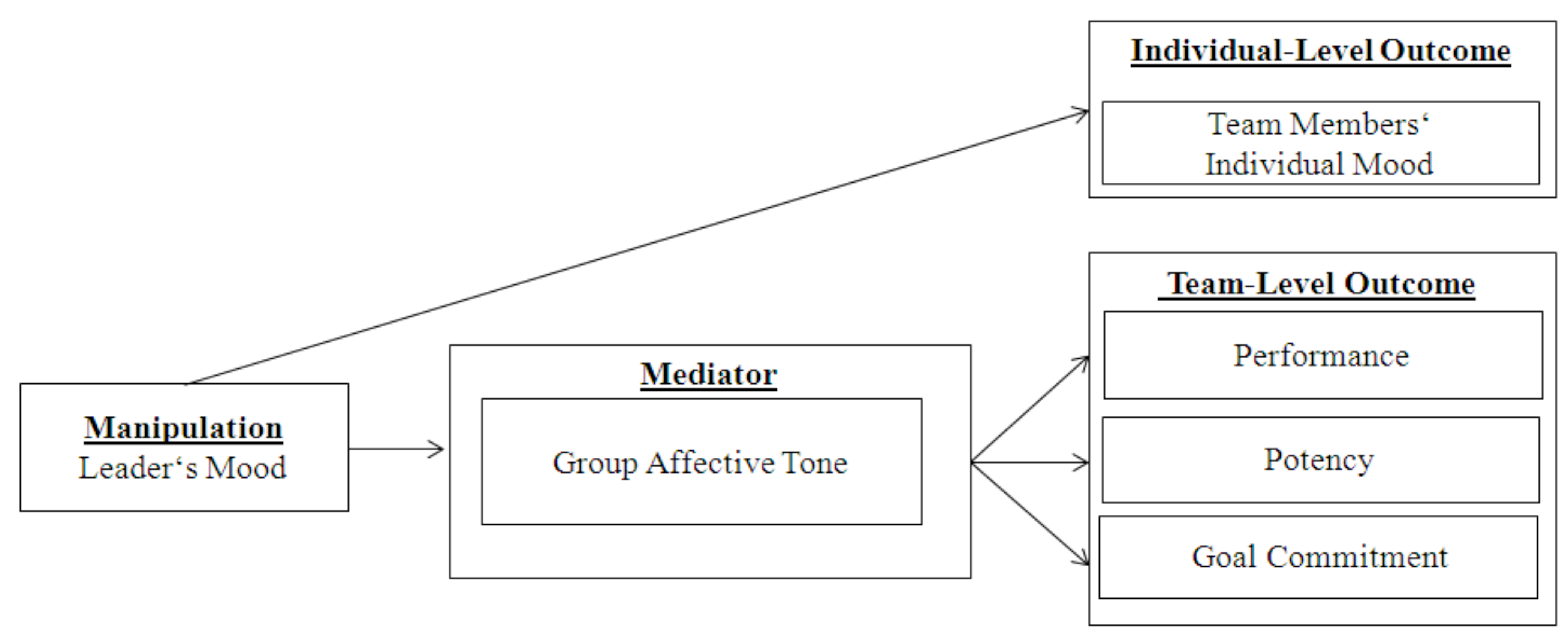
      <p>Theoretically, replicating findings on mood contagion effects from leaders to followers with a German sample adds to the <italic>affective revolution</italic> in I/O-psychology [<xref ref-type="bibr" rid="B40-admsci-02-00203">40</xref>] and points to the special importance of leaders within teams. Expanding the scope of potential outcomes of team leaders’ mood and exploring the teams’ group-level mood as a mediator further broadens our understanding of leaders’ impact on team outcomes. Practically speaking, knowing that leaders’ mood has an impact on followers’ feelings and team outcomes points to the necessity of making leaders aware of their <italic>affective influence</italic>. Taken together, the present study investigates the effects of leaders’ mood on followers’ mood (<italic>i.e.</italic>, individual members’ mood and group affective tone) and team outcomes (<italic>i.e.</italic>, actual team performance, potency, and goal commitment), and examines the mediating role of mood contagion (<italic>i.e.</italic>, group affective tone). The research model is depicted in <xref ref-type="fig" rid="admsci-02-00203-f001">Figure 1</xref>.</p>
      <fig id="admsci-02-00203-f001" position="anchor">
        <label>Figure 1</label>
        <caption>
          <p>Theoretical model.</p>
        </caption>
        <graphic xmlns:xlink="http://www.w3.org/1999/xlink" xlink:href="admsci-02-00203-g001.tif"/>
      </fig>
    </sec>
    <sec>
      <title>2. Leader Mood, Team Members’ Individual Mood, and Group Affective Tone</title>
      <p>Past research has found mood contagion effects in leadership contexts. For example—and as mentioned above—Sy <italic>et al</italic>. found that leaders’ positive mood transmitted to followers [<xref ref-type="bibr" rid="B6-admsci-02-00203">6</xref>]. Other studies have also found empirical evidence for the effects of leaders’ mood on followers [<xref ref-type="bibr" rid="B6-admsci-02-00203">6</xref>,<xref ref-type="bibr" rid="B8-admsci-02-00203">8</xref>,<xref ref-type="bibr" rid="B10-admsci-02-00203">10</xref>]. Sy and colleagues [<xref ref-type="bibr" rid="B6-admsci-02-00203">6</xref>] suggested that team leaders are ideal transmitters of mood because team members pay special attention to the leader’s mood. In addition, they reported evidence showing that team members readily assume team leaders’ mood [<xref ref-type="bibr" rid="B41-admsci-02-00203">41</xref>] and that lower status individuals are more prone to acquire the mood of higher status members than <italic>vice versa</italic> [<xref ref-type="bibr" rid="B11-admsci-02-00203">11</xref>]. Moreover, leaders are considered to be able to transmit their moods to team members easily because they have more opportunities to express their mood to team members, for example, when explaining a task or when being approached by team members for instructions or feedback. Leaders are thought to transfer their mood to followers by mood contagion, which is the automatic and unconscious transfer of mood between individuals [<xref ref-type="bibr" rid="B22-admsci-02-00203">22</xref>]. Building on considerations and empirical findings, I assume that team members with a leader in a positive mood will experience more positive mood compared to team members with a leader in a negative mood. </p>
      <disp-quote>
      <p><italic>Hypothesis 1:</italic> Team members with leaders in a positive mood experience a more positive mood than team members with leaders in a negative mood. </p>
      </disp-quote>
      
      <p>Apart from the effects of leaders’ mood on team members’ mood at the individual level, I also expect effects from leaders’ mood on team members’ mood at the group level (<italic>i.e.</italic>, group affective tone). In comparison to team members’ individual mood, which can be different among team members, group affective tone involves a certain level of homogeneity among team members with regard to their feelings. Consistency of mood states among team members can be expected due to group socialization processes, team norms, standards, and values, and to the exposure of team members to similar affective events, tasks, and demands [<xref ref-type="bibr" rid="B42-admsci-02-00203">42</xref>]. People engage in social comparison processes, which mean that people compare how their own mood compares to other team members’ mood [<xref ref-type="bibr" rid="B3-admsci-02-00203">3</xref>]. As team members allocate their attention to the team leader, there should be a convergence of mood in teams. Similar to the assumptions about mood contagion effects of team leaders’ to followers’ individual mood, I thus postulate that team leaders influence the team’s aggregate of individual members’ mood, or rather, group affective tone. </p>
      <disp-quote><p><italic>Hypothesis 2:</italic> Teams with leaders in a positive mood will have a more positive group affective tone compared to teams with leaders in a negative mood. </p></disp-quote>
      
    </sec>
    <sec>
      <title>3. Leaders’ Mood and Team Outcomes</title>
      <p>Mood has been linked to a variety of performance-related outcomes. Being in a positive mood was found to positively relate to helping behavior, creativity, successful negotiation strategies, and efficient decision making [<xref ref-type="bibr" rid="B43-admsci-02-00203">43</xref>,<xref ref-type="bibr" rid="B44-admsci-02-00203">44</xref>,<xref ref-type="bibr" rid="B45-admsci-02-00203">45</xref>,<xref ref-type="bibr" rid="B46-admsci-02-00203">46</xref>,<xref ref-type="bibr" rid="B47-admsci-02-00203">47</xref>,<xref ref-type="bibr" rid="B48-admsci-02-00203">48</xref>]. Especially important for organizations, positive mood has also been linked to occupational performance [<xref ref-type="bibr" rid="B49-admsci-02-00203">49</xref>,<xref ref-type="bibr" rid="B50-admsci-02-00203">50</xref>]. Positive mood signals a positive person-environment relationship, and is associated with effortless processing strategies, increases the expectation of positive events, and enhances one’s self-efficacy [<xref ref-type="bibr" rid="B51-admsci-02-00203">51</xref>,<xref ref-type="bibr" rid="B52-admsci-02-00203">52</xref>]. Leaders who express positive mood are more liked [<xref ref-type="bibr" rid="B53-admsci-02-00203">53</xref>], and the positive mood could also be interpreted by followers as being on the right track, thus increasing work motivation [<xref ref-type="bibr" rid="B54-admsci-02-00203">54</xref>]. AET [<xref ref-type="bibr" rid="B14-admsci-02-00203">14</xref>] would suggest that leaders’ positive mood is a positive event that triggers positive outcomes, including performance. Empirical findings have also shown that leaders’ positive mood relates positively to team performance. For instance, George and Bettenhausen [<xref ref-type="bibr" rid="B55-admsci-02-00203">55</xref>] found that leader positive mood was positively related to work group sales performance. Likewise, Chi and colleagues [<xref ref-type="bibr" rid="B7-admsci-02-00203">7</xref>] found that leaders’ positive mood was positively associated with sales teams’ performance. Particularly in settings such as the present study, where I framed the task as fun and where it was conducted in an enjoyable setting, positive mood has been shown to be beneficial [<xref ref-type="bibr" rid="B45-admsci-02-00203">45</xref>,<xref ref-type="bibr" rid="B56-admsci-02-00203">56</xref>]. Accordingly, I postulate the following:</p>
      <disp-quote>
            <p><italic>Hypothesis 3:</italic> Teams with leaders in a positive mood will show higher performance compared to teams with leaders in a negative mood. </p>

      </disp-quote>
      <p>Potency is defined as the team’s belief in being capable and effective [<xref ref-type="bibr" rid="B57-admsci-02-00203">57</xref>]. Teams working with leaders in a positive mood will trust their groups’ capabilities more than teams working with leaders in a negative mood. According to the social functional approach of emotion [<xref ref-type="bibr" rid="B58-admsci-02-00203">58</xref>,<xref ref-type="bibr" rid="B59-admsci-02-00203">59</xref>,<xref ref-type="bibr" rid="B60-admsci-02-00203">60</xref>], people use other people’s affective states as information about the other person’s goals, attitudes, and intentions, which in turn influences their own thoughts, attitudes, and actions. According to the social functional approach of emotion, the leader’s positive mood signals to team members that they are on the right track and that the leader is satisfied with the team’s progress. Thus, teams with a leader in a positive mood are likely to have higher potency scores than teams with a leader in a negative mood. Moreover, feeling competent and able to solve problems will result in mastery experience and positive feelings [<xref ref-type="bibr" rid="B52-admsci-02-00203">52</xref>,<xref ref-type="bibr" rid="B61-admsci-02-00203">61</xref>,<xref ref-type="bibr" rid="B62-admsci-02-00203">62</xref>,<xref ref-type="bibr" rid="B63-admsci-02-00203">63</xref>]. In sum, I propose that team leaders’ mood should foster a team’s potency. </p>
      <disp-quote><p><italic>Hypothesis 4:</italic> Teams with leaders in a positive mood will have higher potency compared to teams with leaders in a negative mood. </p></disp-quote>
      
      <p>Goal commitment suggests that team members are motivated to try to achieve goals [<xref ref-type="bibr" rid="B37-admsci-02-00203">37</xref>]. Subordinates who work together with a leader in a positive mood will utilize their energy to focus on the team task, since they feel encouraged by the leader. A leader in a positive mood is able to increase team members’ self-esteem, which has been found to be one of the core predictors of goal commitment [<xref ref-type="bibr" rid="B64-admsci-02-00203">64</xref>]. Leaders in a positive mood are likely to focus on positive aspects of the team task and convey pleasant feelings, which makes team members believe that the team goal is important and valuable, thus increasing the team members’ goal commitment [<xref ref-type="bibr" rid="B7-admsci-02-00203">7</xref>]. Analogous to the considerations about the team leaders’ mood-potency relationship, positive leader mood signals optimism about task completion and gives team members the impression of being on the right track. Taken together, I posit the following:</p>
       <disp-quote><p><italic>Hypothesis 5:</italic> Teams with leaders in a positive mood will have a higher goal commitment compared to teams with leaders in a negative mood. </p></disp-quote>
      
    </sec>
    <sec>
      <title>4. Group Affective Tone as Mediator in the Leaders’ Mood and Team Outcomes Relationship</title>
      <p>Besides the direct effects of leaders’ mood on team outcomes, it is important to better understand how leaders influence team outcomes. According to AET, leaders’ positive mood can be regarded as a positive event. As a consequence, followers’ group-level mood should be raised, which in turn should lead to a variety of positive team outcomes. As outlined earlier, leaders’ positive mood is expected to influence group affective tone (cf. Hypothesis 2). There are several reasons to assume that group affective tone, in turn, should partially mediate the relationship between leaders’ mood and team outcomes (<italic>i.e.</italic>, team performance, potency, and goal commitment). </p>
      <p>With respect to team performance, group affective tone should be favorable because positive group affective tone helps team members to broaden their scope of attention, cognition, and action [<xref ref-type="bibr" rid="B15-admsci-02-00203">15</xref>,<xref ref-type="bibr" rid="B16-admsci-02-00203">16</xref>], and thus increases performance when the context is framed as joyful and pleasant [<xref ref-type="bibr" rid="B45-admsci-02-00203">45</xref>]. On the team level, corresponding empirical evidence has found that positive group-affective tone is positively related with team performance [<xref ref-type="bibr" rid="B7-admsci-02-00203">7</xref>,<xref ref-type="bibr" rid="B65-admsci-02-00203">65</xref>]. </p>
      <p>Likewise, there should be a positive association between group affective tone and potency. Research has shown that positive mood relates positively with self-evaluations [<xref ref-type="bibr" rid="B66-admsci-02-00203">66</xref>], such that individuals in a positive mood evaluate themselves more favorably compared to individuals in a neutral or negative mood. Therefore, I expect that teams with a more positive group affective tone should feel more confident and optimistic about their capabilities; that is, they will have a higher potency. </p>
      <p>For goal commitment, I also expect a positive group affective tone-goal commitment relationship. Building on the mood as information model [<xref ref-type="bibr" rid="B51-admsci-02-00203">51</xref>,<xref ref-type="bibr" rid="B67-admsci-02-00203">67</xref>,<xref ref-type="bibr" rid="B68-admsci-02-00203">68</xref>], which suggests that positive mood is used as feedback to be able to attain a goal, teams with a more positive group affective tone should show higher goal commitment. Accordingly, there is research on the individual level that found that positive affect increases goal commitment [<xref ref-type="bibr" rid="B69-admsci-02-00203">69</xref>,<xref ref-type="bibr" rid="B70-admsci-02-00203">70</xref>]. Taken together and building on the above-mentioned theoretical considerations and empirical findings, I expect group affective tone to partially mediate the impact of team leaders’ mood on team outcomes.</p>
      <disp-quote><p><italic>Hypothesis 6a–c:</italic> Positive group affective tone will partially mediate the relationship between leaders’ mood and (a) team performance, (b) potency, and (c) goal commitment. </p></disp-quote>
      
    </sec>
    <sec>
      <title>5. Method</title>
      <sec>
        <title>5.1. Sample</title>
        <p>Twenty German university students (15 males and 5 females) voluntarily participated in the pretest. On average, participants were in their second year of studies (<italic>M </italic>= 3.17, <italic>SD</italic> = 2.12), and were 24.05 years of age (<italic>SD</italic> = 5.33). Participants were randomly assigned to one of two mood conditions: positive and negative. More specifically, participants in the positive mood condition listened to an optimistic piece of music: Beethoven’s 9th symphony, “Ode an die Freude” [<xref ref-type="bibr" rid="B71-admsci-02-00203">71</xref>]. In contrast, participants in the negative mood condition listened to a dark piece of music: Prokofiev’s piece “Field of death” [<xref ref-type="bibr" rid="B72-admsci-02-00203">72</xref>]. Both pieces of music lasted about 6.5 minutes and were presented via headphones. Music clips have been shown to successfully elicit positive and negative mood [<xref ref-type="bibr" rid="B73-admsci-02-00203">73</xref>,<xref ref-type="bibr" rid="B74-admsci-02-00203">74</xref>]. </p>
      </sec>
      <sec>
        <title>5.2. Measures</title>
        <p><italic>Mood.</italic> Participants’ individual mood was assessed with the Positive and Negative Affect Scale (PANAS; [<xref ref-type="bibr" rid="B75-admsci-02-00203">75</xref>]). Participants indicated on 5-point Likert-type scales (1 = <italic>not at all</italic> to 5 = <italic>very much</italic>) the degree to which they felt each affective state described by the adjectives (positive affect: e.g., enthusiastic, alert, active; negative affect: e.g., nervous, distressed, scared) represented their own mood at the moment. I created a mood score by adding the scores of the positive affect scale to those of the reverse coded negative affect scale. Mood was assessed after listening to the respective music piece (α = 0.85). </p>
      </sec>
      <sec>
        <title>5.3. Results</title>
        <p>An ANCOVA with participant gender as a covariate revealed that participants in the positive mood condition reported higher mood scores (<italic>M </italic>= 4.02, <italic>SD</italic> = 0.43) compared to participants in the negative mood condition (<italic>M </italic>= 3.61; <italic>SD</italic> = 0.51), <italic>F</italic>(1,17) = 4.46, <italic>p</italic> &lt; 0.01. Thus, the mood manipulation was successful and was also used in the main study. </p>
      </sec>
      <sec>
        <title>5.4. Sample</title>
        <p>A total of 63 university students (33 women and 30 men) from various majors of a large German university volunteered and formed 21 same-gender, three-person teams. On average, participants were in their second year of studies (<italic>M </italic>= 2.98, <italic>SD</italic> = 3.06) and were 25.57 years of age (<italic>SD</italic> = 6.64). Participants were recruited on campus by use of flyers. Teams, with their respective members, were randomly assigned to one of two leader mood conditions: positive leader mood and negative leader mood. Within the three-person team, members were randomly assigned to the leader or team member role. </p>
      </sec>
      <sec>
        <title>5.5. Procedure</title>
        <p>Teams participated in a 1-hr experiment. Experimenters were unaware of the hypotheses and goals of the present study. Participants were led to believe that the study concerned team dynamics. After a brief introduction, participants completed a mood scale to measure their baseline mood (Time 1 [T1] baseline mood of leaders and team members). This was done to ensure that there were no mood differences between participants at the beginning of the experiment. </p>
        <p>Leaders were randomly selected among each team and then separated from the rest of the group. Leaders were given a sheet of paper with the picture of a puzzle that teams were to work on as a team task. By providing team leaders with the picture of the final puzzle, team leaders were able to solve the puzzle quickly and efficiently. The puzzle consisted of 300 pieces, which pictured a landscape. Leaders were asked to memorize the picture of the puzzle for 5 min. Other team members did not have the opportunity to see the picture of the finished puzzle. Team leaders were told that they would later perform a puzzle task together with their team members and that they were to lead the other group members while working on the team task of assembling the puzzle. It was also clear to the team leaders that they were the only ones on the team who had extra knowledge of the team task, which reinforced their leader role within their teams. </p>
        <p>Mood was manipulated by presenting one of the pretested two music clips before the leaders were shown the puzzle. After leaders had listened to the respective piece of music, they filled out a mood scale (T2 pre-task mood of leaders). This measure was the manipulation check for the mood induction in leaders. After completing the mood scale, leaders rejoined the rest of their group. While leaders were exposed to music, the other group members were kept busy with the bogus task of filling out word lists. After completing their bogus task, group members also filled out a mood scale (T2 pre-task mood measure of group member mood). Afterwards, group members engaged in the task of correctly putting together as many puzzle pieces as possible within 10 min. </p>
        <p>Once teams had finished the puzzle task or time had run out, all participants completed the post task mood scale (T3 post task mood of leaders and group members) and a questionnaire that included questions on potency and goal commitment. Finally, participants were carefully debriefed, thanked, and given course credit for participation. The incentives were identical in all experimental conditions. </p>
      </sec>
      <sec>
        <title>5.6. Measures</title>
        <p><italic>Mood of individual team members.</italic> Participants’ individual mood was assessed with the positive (happy, joyful, content, cheerful) and negative (sad, frustrated, depressed, dissatisfied) hedonic tone scales of the UWIST mood adjective checklist [<xref ref-type="bibr" rid="B76-admsci-02-00203">76</xref>]. Participants rated the extent to which each of the eight adjectives reflected their current feeling state (‘‘Right now, I’m feeling...’’) on 5-point scales (<italic>not at all</italic> = 1 to <italic>very much</italic> = 5). Mood was assessed after entering the lab (T1), before the task was administered (T2), and after task accomplishment (T3; T1: α = 0.88; T2: α = 0.90; T3: α = 0.88). Following earlier research [<xref ref-type="bibr" rid="B56-admsci-02-00203">56</xref>,<xref ref-type="bibr" rid="B74-admsci-02-00203">74</xref>], I created a mood score by adding the scores of the positive hedonic tone scale to those of the reverse coded negative hedonic tone scale. The values reported are team members’ averaged individual mood scores. </p>
        <p><italic>Group affective tone. </italic>Team members’ individual mood scores (T3) were aggregated in order to obtain a measure of group affective tone. As I was interested in the effect of leaders’ mood on team members, the leaders’ score was excluded. In order to assess whether the aggregation of the mood scores to the group level was justified, I calculated <italic>r</italic><sub>wg </sub>values [<xref ref-type="bibr" rid="B77-admsci-02-00203">77</xref>]. The <italic>r</italic><sub>wg </sub>value—reflecting the level of agreement within a team—for group affective tone was good, with a value of 0.72. Thus, aggregation of individual mood scores to the group level was justified. </p>
        <p><italic>Potency. </italic>Team members rated potency after task accomplishment (T3). More specifically, <italic>potency</italic> was measured with eight items on a 5-point scale from Guzzo <italic>et al</italic>. [<xref ref-type="bibr" rid="B57-admsci-02-00203">57</xref>]. A sample item is “We believe in our competencies” (α = 0.82). The <italic>r</italic><sub>wg </sub>value for potency (<italic>r</italic><sub>wg</sub> = 0.67) justified aggregation.</p>
        <p><italic>Goal commitment. </italic>Likewise, team members rated goal commitment after task accomplishment (T3). <italic>Goal commitment</italic> was measured with eight items on a 5-point scale from Hollenbeck <italic>et al</italic>. [<xref ref-type="bibr" rid="B36-admsci-02-00203">36</xref>]. A sample item is “It was very important for me to achieve the group goal” (α = 0.76). The <italic>r</italic><sub>wg </sub>value for goal commitment (<italic>r</italic><sub>wg</sub> = 0.63) justified aggregation.</p>
        <p><italic>Team performance. </italic>In order to obtain a measure of a team’s objective task performance, I counted the number of correctly assembled puzzle pieces. </p>
      </sec>
      <sec>
        <title>5.7. Results</title>
        <sec>
          <title>5.7.1. Overview</title>
          <p>For data analysis, different statistical procedures were needed due to different research questions and data structures. To test for <italic>differences between the means</italic> of the two experimental conditions, I report results from parametric techniques (<italic>i.e.</italic>, ANCOVAs, <italic>t</italic>-tests), as is recommended [<xref ref-type="bibr" rid="B78-admsci-02-00203">78</xref>]. When <italic>individual-level data</italic> was given with individuals nested in teams, I used hierarchical model (HLM) analyses [<xref ref-type="bibr" rid="B79-admsci-02-00203">79</xref>]. When outcome variables were at the <italic>group level</italic>, I used hierarchical regression analyses [<xref ref-type="bibr" rid="B78-admsci-02-00203">78</xref>] after having shown that group-level aggregation was justified. Means, standard deviations and correlations for the main study variables are shown in <xref ref-type="table" rid="admsci-02-00203-t001">Table 1</xref>.</p>
          <table-wrap id="admsci-02-00203-t001" position="anchor">
            <object-id pub-id-type="pii">admsci-02-00203-t001_Table 1</object-id>
            <label>Table 1</label>
            <caption>
              <p>Descriptive statistics and correlations between main study variables. </p>
            </caption>
            <table>
              <thead>
                <tr>
                  <th align="left" valign="middle"> </th>
                  <th align="center" valign="middle">
                    <italic>M</italic>
                  </th>
                  <th align="center" valign="middle">
                    <italic>SD</italic>
                  </th>
                  <th align="center" valign="middle">1</th>
                  <th align="center" valign="middle">2</th>
                  <th align="center" valign="middle">3</th>
                  <th align="center" valign="middle">4</th>
                  <th align="center" valign="middle">5</th>
                  <th align="center" valign="middle">6</th>
                  <th align="center" valign="middle">7</th>
                  <th align="center" valign="middle">8</th>
                  <th align="center" valign="middle">9</th>
                </tr>
              </thead>
              <tbody>
                <tr>
                  <td align="left" valign="middle">1 Age</td>
                  <td align="center" valign="middle">25.57</td>
                  <td align="center" valign="middle">4.55</td>
                  <td align="center" valign="middle">-</td>
                  <td align="center" valign="middle"> </td>
                  <td align="center" valign="middle"> </td>
                  <td align="center" valign="middle"> </td>
                  <td align="center" valign="middle"> </td>
                  <td align="center" valign="middle"> </td>
                  <td align="center" valign="middle"> </td>
                  <td align="center" valign="middle"> </td>
                  <td align="center" valign="middle"> </td>
                </tr>
                <tr>
                  <td align="left" valign="middle">2 Gender <sup>a</sup></td>
                  <td align="center" valign="middle">-</td>
                  <td align="center" valign="middle">-</td>
                  <td align="center" valign="middle">−0.08</td>
                  <td align="center" valign="middle">-</td>
                  <td align="center" valign="middle"> </td>
                  <td align="center" valign="middle"> </td>
                  <td align="center" valign="middle"> </td>
                  <td align="center" valign="middle"> </td>
                  <td align="center" valign="middle"> </td>
                  <td align="center" valign="middle"> </td>
                  <td align="center" valign="middle"> </td>
                </tr>
                <tr>
                  <td align="left" valign="middle">3 Leader mood manipulation <sup>b</sup></td>
                  <td align="center" valign="middle">-</td>
                  <td align="center" valign="middle">-</td>
                  <td align="center" valign="middle">−0.13</td>
                  <td align="center" valign="middle">0.24</td>
                  <td align="center" valign="middle">-</td>
                  <td align="center" valign="middle"> </td>
                  <td align="center" valign="middle"> </td>
                  <td align="center" valign="middle"> </td>
                  <td align="center" valign="middle"> </td>
                  <td align="center" valign="middle"> </td>
                  <td align="center" valign="middle"> </td>
                </tr>
                <tr>
                  <td align="left" valign="middle">4 Mood T1 (Baseline Mood)</td>
                  <td align="center" valign="middle">3.74</td>
                  <td align="center" valign="middle">0.52</td>
                  <td align="center" valign="middle">0.09</td>
                  <td align="center" valign="middle">−0.06</td>
                  <td align="center" valign="middle">−0.08</td>
                  <td align="center" valign="middle">(0.88)</td>
                  <td align="center" valign="middle"> </td>
                  <td align="center" valign="middle"> </td>
                  <td align="center" valign="middle"> </td>
                  <td align="center" valign="middle"> </td>
                  <td align="left" valign="middle"> </td>
                </tr>
                <tr>
                  <td align="left" valign="middle">5 Mood T2 (Pre-task Mood)</td>
                  <td align="center" valign="middle">3.68</td>
                  <td align="center" valign="middle">0.58</td>
                  <td align="center" valign="middle">0.16</td>
                  <td align="center" valign="middle">−0.01</td>
                  <td align="center" valign="middle">0.06</td>
                  <td align="center" valign="middle">0.86 **</td>
                  <td align="center" valign="middle">(0.90)</td>
                  <td align="center" valign="middle"> </td>
                  <td align="center" valign="middle"> </td>
                  <td align="center" valign="middle"> </td>
                  <td align="center" valign="middle"> </td>
                </tr>
                <tr>
                  <td align="left" valign="middle">6 Mood T3 (Post-task Mood)</td>
                  <td align="center" valign="middle">3.80</td>
                  <td align="center" valign="middle">0.59</td>
                  <td align="center" valign="middle">0.08</td>
                  <td align="center" valign="middle">−0.12</td>
                  <td align="center" valign="middle">0.46 *</td>
                  <td align="center" valign="middle"> 0.59 **</td>
                  <td align="center" valign="middle">0.66 **</td>
                  <td align="center" valign="middle">(0.88)</td>
                  <td align="center" valign="middle"> </td>
                  <td align="center" valign="middle"> </td>
                  <td align="left" valign="middle"> </td>
                </tr>
                <tr>
                  <td align="left" valign="middle">7 Potency</td>
                  <td align="center" valign="middle">3.25</td>
                  <td align="center" valign="middle">0.47</td>
                  <td align="center" valign="middle">0.12</td>
                  <td align="center" valign="middle">0.17</td>
                  <td align="center" valign="middle">0.46 *</td>
                  <td align="center" valign="middle"> 0.31</td>
                  <td align="center" valign="middle">0.56 **</td>
                  <td align="center" valign="middle">0.58 **</td>
                  <td align="center" valign="middle">(0.82)</td>
                  <td align="center" valign="middle"> </td>
                  <td align="left" valign="middle"> </td>
                </tr>
                <tr>
                  <td align="left" valign="middle">8 Goal commitment</td>
                  <td align="center" valign="middle">3.29</td>
                  <td align="center" valign="middle">0.43</td>
                  <td align="center" valign="middle">0.44 *</td>
                  <td align="center" valign="middle">0.05</td>
                  <td align="center" valign="middle">0.37 <sup>+</sup></td>
                  <td align="center" valign="middle"> 0.16</td>
                  <td align="center" valign="middle">0.36</td>
                  <td align="center" valign="middle">0.38</td>
                  <td align="center" valign="middle">0.52 *</td>
                  <td align="center" valign="middle">(0.76)</td>
                  <td align="center" valign="middle"> </td>
                </tr>
                <tr>
                  <td align="left" valign="middle">9 Team performance T3 <sup>c</sup></td>
                  <td align="center" valign="middle">61.86</td>
                  <td align="center" valign="middle">16.68</td>
                  <td align="center" valign="middle">−0.09</td>
                  <td align="center" valign="middle">−0.15</td>
                  <td align="center" valign="middle">0.51 *</td>
                  <td align="center" valign="middle">−0.33</td>
                  <td align="center" valign="middle">−0.15</td>
                  <td align="center" valign="middle">0.18</td>
                  <td align="center" valign="middle">0.28</td>
                  <td align="center" valign="middle">0.19</td>
                  <td align="center" valign="middle">-</td>
                </tr>
              </tbody>
            </table>
            <table-wrap-foot>
            <fn>
            <p>Note. <italic>N</italic> = 21. <sup>a </sup>Gender was coded as 1 = female, 2 = male. <sup>b </sup>Leader mood manipulation was coded as 1 = negative, 2 = positive. <sup>c </sup>T = time. Internal consistency reliabilities are in parentheses along the diagonal (<italic>N</italic> = 42). ** <italic>p</italic> &lt; 0.01. * <italic>p</italic> &lt; 0.05 <sup>+</sup> p = 0.10.</p>
            </fn>
            </table-wrap-foot>
          </table-wrap>
          
        </sec>
        <sec>
          <title>5.7.2. Manipulation Check</title>
          <p>An ANCOVA with the leaders’ mean mood score at T1 (pre-task mood) and gender as covariates revealed successful mood manipulation: A comparison between the positive (<italic>M</italic> = 4.03, <italic>SD</italic> = 0.36) and negative (<italic>M</italic> = 3.68, <italic>SD</italic> = 0.41) leader mood conditions at T2 revealed the expected significant difference, <italic>F</italic>(1,15) = 14.36, <italic>p</italic> &lt; 0.01. As predicted, leaders in the positive mood condition were in a significantly better mood after manipulation compared to leaders in the negative mood condition. Thus, the pretested mood manipulation was successful. </p>
        </sec>
        <sec>
          <title>5.7.3. Test of Hypotheses</title>
          <p><italic>Effects of the leader’s mood on team members’ individual mood and group affective tone. </italic>To test the effect of leaders’ mood on team members’ individual mood, I conducted HLM analyses. It was necessary to use HLM because individuals were nested within teams, with the mood scores being dependent on each other. Following the procedure from Sy and colleagues [<xref ref-type="bibr" rid="B6-admsci-02-00203">6</xref>], the multilevel model read: mood<italic><sub>ij</sub></italic> = <italic>γ</italic><sub>00</sub> + <italic>γ</italic><sub>01</sub> LEADER<italic><sub>j </sub></italic>+ u<italic><sub>oj</sub></italic> + r<italic><sub>ij</sub></italic> with mood<italic><sub>ij</sub></italic> being the mood of the <italic>i</italic>th individual in the <italic>j</italic>th group, <italic>γ</italic><sub>00</sub> standing for the sum of the overall mean, <italic>γ</italic><sub>01</sub> LEADER<italic><sub>j </sub></italic>being a fixed effect for leader mood, where LEADER<italic><sub>j</sub></italic> is positive or negative, and u<italic><sub>oj</sub></italic> being a series of random deviations. As predicted in Hypothesis 1, team members with a leader in a positive mood experienced a more positive mood than team members with a leader in a negative mood, <italic>γ</italic> = 0.5233, <italic>F</italic>(1,19) = 2.35, <italic>p</italic> &lt; 0.05. Thus, Hypothesis 1 was supported. </p>
          <p>In Hypothesis 2, I predicted that team leaders’ mood would be positively associated with group affective tone. A <italic>t</italic>-test showed that teams with a leader in a positive mood had a higher team affective tone (<italic>M</italic> = 4.07, <italic>SD</italic> = 0.58) compared to teams with a leader in a negative mood (<italic>M</italic> = 3.55, <italic>SD</italic> = 0.49), <italic>t</italic>(19) = 2.24, <italic>p</italic> &lt; 0.05 (cf. <xref ref-type="table" rid="admsci-02-00203-t002">Table 2</xref>). Thus, Hypothesis 2 was confirmed. </p>
          <table-wrap id="admsci-02-00203-t002" position="anchor">
            <object-id pub-id-type="pii">admsci-02-00203-t002_Table 2</object-id>
            <label>Table 2</label>
            <caption>
              <p>Effects of leader’s mood condition.</p>
            </caption>
            <table>
              <thead>
                <tr>
                  <th align="center" valign="middle"> </th>
                  <th colspan="2" align="center" valign="middle">Positive Mood</th>
                  <th colspan="2" align="center" valign="middle">Negative Mood</th>
                </tr>
              </thead>
              <tbody>
                <tr>
                  <td align="center" valign="middle">
                    <italic>Variable</italic>
                  </td>
                  <td align="center" valign="middle">
                    <italic>M</italic>
                  </td>
                  <td align="center" valign="middle">
                    <italic>SD</italic>
                  </td>
                  <td align="center" valign="middle">
                    <italic>M</italic>
                  </td>
                  <td align="center" valign="middle">
                    <italic>SD</italic>
                  </td>
                </tr>
                <tr>
                  <td align="center" valign="middle">Group Affective Tone</td>
                  <td align="center" valign="middle">4.07</td>
                  <td align="center" valign="middle">0.58</td>
                  <td align="center" valign="middle">3.55</td>
                  <td align="center" valign="middle">0.49</td>
                </tr>
                <tr>
                  <td align="center" valign="middle">Team Performance </td>
                  <td align="center" valign="middle">70.50</td>
                  <td align="center" valign="middle">16.97</td>
                  <td align="center" valign="middle">54.00</td>
                  <td align="center" valign="middle">12.45</td>
                </tr>
              </tbody>
            </table>
            <table-wrap-foot>
            <fn>
            <p><italic>Note.</italic> <italic>N</italic> = 21.</p>
            </fn>
            </table-wrap-foot>
          </table-wrap>
          
          <p><italic>Effects of the leader’s mood on team outcomes.</italic> In Hypothesis 3, I proposed that teams with a leader in a positive mood would perform better than teams with a leader in a negative mood. In accordance with Hypothesis 3, a <italic>t</italic>-test showed that groups with a leader in a positive mood showed better performance (<italic>M</italic> = 70.50, <italic>SD</italic> = 16.97), measured as the number of assembled puzzle pieces, than did teams with a leader in a negative mood (<italic>M</italic> = 54.00, <italic>SD</italic> = 12.45), <italic>t</italic>(19) = 2.56, <italic>p</italic> &lt; 0.05 (cf. <xref ref-type="table" rid="admsci-02-00203-t002">Table 2</xref>). In Hypothesis 4 and 5, I proposed that teams with a leader in a positive mood would experience higher levels of potency and goal commitment, respectively. As expected, teams with a leader in a positive mood had higher potency ratings (<italic>M </italic>= 3.47, <italic>SD </italic>= 0.54) than did teams with a leader in a negative mood (<italic>M</italic> = 3.04, <italic>SD</italic> = 0.30), <italic>t</italic>(19) = 2.28, <italic>p</italic> &lt; 0.05. For goal commitment, however, although the findings were in the expected direction, there was no significant difference according to the traditional standards between groups with a leader in a positive mood (<italic>M</italic> = 3.56, <italic>SD</italic> = 0.49) and groups with a leader in a negative mood (<italic>M</italic> = 3.24, <italic>SD</italic> = 0.32), <italic>t</italic>(19) = 1.76, <italic>p</italic> &lt; 0.10). Summarizing, Hypotheses 3 and 4 were therefore supported, whereas Hypothesis 5 was not. </p>
        </sec>
        <sec>
          <title>5.7.4. Mediation Analyses</title>
          <p>In Hypotheses 6a–c, I assumed that group affective tone mediates the relationship between leader’s mood and team performance (Hypothesis 6a), potency (Hypothesis 6b), and goal commitment (Hypothesis 6c). For mediation, four conditions had to be met [<xref ref-type="bibr" rid="B80-admsci-02-00203">80</xref>]: Criterion 1 was confirmed if the independent variable (leader’s mood) was related to the mediator (group affective tone). Criterion 2 was met if the independent variable (leader’s mood) was related to the outcome (team performance, potency, and goal commitment, respectively). Criterion 3 was fulfilled if the mediator (group affective tone) was associated with the outcome (team performance, potency, and goal commitment, respectively). Finally, the relationship between the independent variable (leader’s mood) and the outcome (team performance, potency, and goal commitment, respectively) should not have been significant (or reduced significantly for partial mediation) when entered simultaneously with the mediator (Criterion 4). To test these conditions, I ran a number of (hierarchical) regression analyses. </p>
          <p>Criterion 1 was confirmed because there was a positive relationship between leader’s mood and group affective tone (β = 0.46, <italic>p</italic> &lt; 0.05). An inspection of <xref ref-type="table" rid="admsci-02-00203-t003">Table 3</xref> reveals that Criterion 2 was confirmed for team performance (β = 0.51, <italic>p</italic> &lt; 0.05) and potency (β = 0.46, <italic>p</italic> &lt; 0.05), but not for goal commitment according to traditional standards (β = 0.37, <italic>p</italic> &lt; 0.10). Criterion 3 was met for potency (β = 0.58, <italic>p</italic> &lt; 0.01), but not for team performance (β = 0.18, ns) and goal commitment (β = 0.38, <italic>p</italic> &lt; 0.10, see <xref ref-type="table" rid="admsci-02-00203-t003">Table 3</xref>). As can be seen in <xref ref-type="table" rid="admsci-02-00203-t004">Table 4</xref>, the association between leader’s mood and potency (β = 0.46, <italic>p</italic> &lt; 0.05) was no longer significant after entering the mediator (group affective tone) (β = 0.25, ns), but the mediator was significant (β = 0.46, <italic>p</italic> &lt; 0.05). Therefore, Criterion 4 was met for the leader’s mood-potency relationship. As expected, the Sobel test [<xref ref-type="bibr" rid="B81-admsci-02-00203">81</xref>] revealed that group affective tone was a mediator of the relation between leaders’ mood and potency, <italic>z</italic> = 2.29, <italic>p</italic> &lt; 0.05. According to Baron and Kenny [<xref ref-type="bibr" rid="B80-admsci-02-00203">80</xref>], the fact that the independent variable was no longer significant after entering the mediator suggests that the relationships between a leader’s mood and potency was completely mediated by group affective tone. In sum, the findings support Hypothesis 6b, but not 6a and 6c. </p>
          <table-wrap id="admsci-02-00203-t003" position="anchor">
            <object-id pub-id-type="pii">admsci-02-00203-t003_Table 3</object-id>
            <label>Table 3</label>
            <caption>
              <p>Effects of leader’s mood condition and group affective tone.</p>
            </caption>
            <table>
              <thead>
                <tr>
                  <th align="left" valign="middle"> </th>
                  <th align="center" valign="middle">
                    <italic>Team Performance</italic>
                  </th>
                  <th align="center" valign="middle">
                    <italic>Potency</italic>
                  </th>
                  <th align="center" valign="middle">
                    <italic>Goal Commitment</italic>
                  </th>
                </tr>
              </thead>
              <tbody>
                <tr>
                  <td align="left" valign="middle">
                    <italic>Independent Variable</italic>
                  </td>
                  <td align="left" valign="middle"> </td>
                  <td align="left" valign="middle"> </td>
                  <td align="left" valign="middle"> </td>
                </tr>
                <tr>
                  <td align="left" valign="middle">Leader’s Mood</td>
                  <td align="center" valign="middle">0.51 *</td>
                  <td align="center" valign="middle">0.46 *</td>
                  <td align="center" valign="middle">0.37 <sup>+</sup></td>
                </tr>
                <tr>
                  <td align="left" valign="middle">R²</td>
                  <td align="center" valign="middle">0.22 *</td>
                  <td align="center" valign="middle">0.17 *</td>
                  <td align="center" valign="middle">0.10 <sup>+</sup></td>
                </tr>
                <tr>
                  <td align="left" valign="middle">
                    <italic>F</italic>
                  </td>
                  <td align="center" valign="middle">6.55 *</td>
                  <td align="center" valign="middle">5.18 *</td>
                  <td align="center" valign="middle">3.10 <sup>+</sup></td>
                </tr>
                <tr>
                  <td align="left" valign="middle">Group Affective Tone</td>
                  <td align="center" valign="middle">0.18</td>
                  <td align="center" valign="middle">0.58 **</td>
                  <td align="center" valign="middle">0.38 <sup>+</sup></td>
                </tr>
                <tr>
                  <td align="left" valign="middle">R²</td>
                  <td align="center" valign="middle">−0.02</td>
                  <td align="center" valign="middle">0.30 **</td>
                  <td align="center" valign="middle">0.10 <sup>+</sup></td>
                </tr>
                <tr>
                  <td align="left" valign="middle">
                    <italic>F</italic>
                  </td>
                  <td align="center" valign="middle">0.66</td>
                  <td align="center" valign="middle">9.45 **</td>
                  <td align="center" valign="middle">3.12 <sup>+</sup></td>
                </tr>
              </tbody>
            </table>
            <table-wrap-foot>
            <fn>
            <p>Note. <italic>N</italic> = 21, ** <italic>p</italic> &lt; .01. * <italic>p</italic> &lt; 0.05, <sup>+</sup> <italic>p</italic> &lt; 0.10; Standardized betas are provided.</p>
            </fn>
            </table-wrap-foot>
          </table-wrap>
          <table-wrap id="admsci-02-00203-t004" position="anchor">
            <object-id pub-id-type="pii">admsci-02-00203-t004_Table 4</object-id>
            <label>Table 4</label>
            <caption>
              <p>Mediation effect of group affective tone in the leader’s mood and potency relationship.</p>
            </caption>
            <table>
              <thead>
                <tr>
                  <th align="left" valign="middle"> </th>
                  <th colspan="2" align="center" valign="middle">
                    <italic>Potency</italic>
                  </th>
                </tr>
              </thead>
              <tbody>
                <tr>
                  <td align="left" valign="middle">
                    <italic>Independent Variable</italic>
                  </td>
                  <td align="left" valign="middle"> </td>
                  <td align="left" valign="middle"> </td>
                </tr>
                <tr>
                  <td align="left" valign="middle"> </td>
                  <td align="center" valign="middle">Step 1</td>
                  <td align="center" valign="middle">Step 2</td>
                </tr>
                <tr>
                  <td align="left" valign="middle">Leader’s Mood</td>
                  <td align="center" valign="middle">0.46 *</td>
                  <td align="center" valign="middle">0.25</td>
                </tr>
                <tr>
                  <td align="left" valign="middle">Group Affective Tone</td>
                  <td align="center" valign="middle"> </td>
                  <td align="center" valign="middle">0.46 *</td>
                </tr>
                <tr>
                  <td align="left" valign="middle">
                    <italic>Δ R²</italic>
                  </td>
                  <td align="center" valign="middle">0.17 *</td>
                  <td align="center" valign="middle">0.38 *</td>
                </tr>
                <tr>
                  <td align="left" valign="middle">
                    <italic>Δ F</italic>
                  </td>
                  <td align="center" valign="middle">5.18 *</td>
                  <td align="center" valign="middle">5.57 *</td>
                </tr>
              </tbody>
            </table>
            <table-wrap-foot>
            <fn>
             <p>Note. <italic>N</italic> = 21, * <italic>p</italic> &lt; 0.05; Standardized betas are provided.</p>
            </fn>
            </table-wrap-foot>
          </table-wrap>
          
         
        </sec>
      </sec>
      <sec>
        <title>5.8. Discussion</title>
        <p>Taken together, this study reveals that it is useful to pay attention to the mood of leaders because it has important consequences for the entire team. First, the study showed that the mood of leaders is transferred to team members. Team members acquire their leaders’ mood and are influenced by it. Second, the mood of leaders influences teams’ actual performance. Moreover, this study complements previous research by identifying group affective tone as a mediator between leaders’ mood and potency. The present study goes beyond previous findings on the effect of team leaders’ mood on team members, by studying the effects with a different task in a German sample and by broadening the scope of the potential outcomes of team leaders’ mood. The positive mood of a team leader creates consistent, positive affective states within a team, which strengthen a team’s confidence in its own abilities. Potency, as a generalized evaluation of team success—irrespective of the task and context, or of being strong in the face of obstacles [<xref ref-type="bibr" rid="B82-admsci-02-00203">82</xref>]—can be considered to be a competitive strength of teams, particularly in today’s work environments where there are high levels of uncertainty and frequent changes. This study offers practical advice for how team leaders can enhance potency. The findings of the study are in line with predictions from research on emotional contagion [<xref ref-type="bibr" rid="B21-admsci-02-00203">21</xref>,<xref ref-type="bibr" rid="B25-admsci-02-00203">25</xref>] and the social functions of emotions [<xref ref-type="bibr" rid="B58-admsci-02-00203">58</xref>,<xref ref-type="bibr" rid="B59-admsci-02-00203">59</xref>,<xref ref-type="bibr" rid="B60-admsci-02-00203">60</xref>].</p>
        <p>Although participants were not informed about the leaders’ mood, mood was nevertheless induced. One could also consider deliberate attempts to cause mood contagion, which might share links to elements of charismatic leadership. A leader may have the potential to induce team-based emotions, and this influence may be used intentionally—as a way to modify the behavior of team members. Imagine a sports coach who tries to motivate players toward a competitive spirit. In this case, the coach might try to display anger to the players. Such a behavior resembles Machiavellian behavior and requires the leader to know what affective state should be induced to generate the supposed outcome. It should be kept in mind, however, that leaders’ mood regulation might be costly in terms of metabolic processes, social perception, and evaluations, and might also inhibit social exchange processes and personal experiences [<xref ref-type="bibr" rid="B83-admsci-02-00203">83</xref>]. Further research is needed in order to decide on whether purposeful mood interventions are advisable or not. </p>
        <p>As with any study, there are limitations to consider. These limitations could also explain why there was—contrary to expectation—no support for the effect of leaders’ mood on goal commitment, and for the mediating role of group affective tone in the leaders’ mood-team performance and leaders’ mood-goal commitment association, respectively. First, one might question the experimental procedure. In this study, leaders were provided with unique knowledge of the team task [<xref ref-type="bibr" rid="B6-admsci-02-00203">6</xref>]. However, we do not know from this study whether team members’ mood was affected differently, or more strongly, by the team leaders’ mood rather than by the other team members’ mood. An experimental study directly comparing leaders’ mood effects with team members’ mood effects would help to shed light on this open question. Similarly, although I find that there are mood contagion effects in my German sample, future research should use the exact same experimental procedures in order to be able to directly compare the effect sizes from different countries (e.g., the United States, the Netherlands). As outlined earlier, Germany has higher power distance scores compared to other countries, such as the United States or the Netherlands [<xref ref-type="bibr" rid="B26-admsci-02-00203">26</xref>]. Thus, the effect sizes for leaders’ mood on team members should be stronger in Germany because employees expect more guidance and structure.</p>
        <p>Second, this study explored the unidirectional effects of team leaders’ mood on team mood. I found that leaders’ mood can affect team members’ individual mood, group affective tone, team performance, and potency. However, it is also possible that team members’ mood influences team leaders. Although the direction from leaders’ to followers is theoretically more likely [<xref ref-type="bibr" rid="B10-admsci-02-00203">10</xref>,<xref ref-type="bibr" rid="B12-admsci-02-00203">12</xref>,<xref ref-type="bibr" rid="B13-admsci-02-00203">13</xref>], future research should investigate reciprocal effects to determine if team members also transmit their mood to leaders, which would add to a more active approach to leadership by subordinates. </p>
        <p>A third limitation refers to the duration of team task work in this study. Mood induction and joint task accomplishment was time-limited. Thus, it is even more impressive that mood contagion happens even when mood induction and social interaction time are limited. Nevertheless, it would be important to know more about the duration of mood effects in teams in order to estimate long-term effects of leaders’ mood on subordinates. Additionally, the study should be replicated with real work teams, different tasks, and different kinds of mood manipulations. For instance, for other team tasks, such as analytical and complex tasks, and within a different context, leaders’ negative mood can be expected to enhance team performance [<xref ref-type="bibr" rid="B56-admsci-02-00203">56</xref>,<xref ref-type="bibr" rid="B84-admsci-02-00203">84</xref>,<xref ref-type="bibr" rid="B85-admsci-02-00203">85</xref>] because negative mood can improve information processing and information recall [<xref ref-type="bibr" rid="B86-admsci-02-00203">86</xref>], and increase effort [<xref ref-type="bibr" rid="B6-admsci-02-00203">6</xref>]. Future research should also investigate the influence of personality and work characteristics on the effect of leaders’ mood in teams. For example, depending on the extent of neuroticism, autonomy, or expertise level, team members might be differently affected by the team leader [<xref ref-type="bibr" rid="B87-admsci-02-00203">87</xref>,<xref ref-type="bibr" rid="B88-admsci-02-00203">88</xref>]. Future research should examine how these factors influence teams’ subsequent mood states and ability to function effectively. </p>
      </sec>
    </sec>
    <sec sec-type="conclusions">
      <title>6. Conclusions</title>
      <p>Leaders’ mood influences how team members feel and perform. As leaders have the potential to influence team members, leaders must understand the role of moods in team settings, and their special role in influencing their team members’ affect and attitudes toward other team members and tasks. Consequently, leaders should be aware of how their mood can affect other people. </p>
    </sec>
   
  </body>
  <back>
   <ack>
      <title>Acknowledgments</title>
      <p>I would like to thank Andrea E. Abele, Daniel Spurk, and Patrick McLoughlin, as well as three anonymous reviewers, for helpful comments on an earlier draft of this paper. In addition, I am grateful to Anastasia Byler for stylistic advice and professional copy-editing. I would also like to thank my former students: Nicola Beck, Nadezhda Georgieva, Thilo Hauck, Michael Ott, and Kim Wende for their help in data collection. </p>
    </ack>
    <ref-list>
      <title>References</title>
      <ref id="B1-admsci-02-00203">
        <label>1.</label>
        <citation citation-type="journal">
          <person-group person-group-type="author">
            <name>
              <surname>George</surname>
              <given-names>J.M.</given-names>
            </name>
          </person-group>
          <article-title>Emotions and leadership: The role of emotional intelligence</article-title>
          <source>Hum. Rel.</source>
          <year>2000</year>
          <volume>53</volume>
          <fpage>1027</fpage>
          <lpage>1055</lpage>
        <pub-id pub-id-type="doi">10.1177/0018726700538001</pub-id></citation>
      </ref>
      <ref id="B2-admsci-02-00203">
        <label>2.</label>
        <citation citation-type="journal">
          <person-group person-group-type="author">
            <name>
              <surname>McColl-Kennedy</surname>
              <given-names>J.R.</given-names>
            </name>
            <name>
              <surname>Anderson</surname>
              <given-names>R.D.</given-names>
            </name>
          </person-group>
          <article-title>Impact of leadership style and emotions on subordinate performance</article-title>
          <source>Leadersh. Q.</source>
          <year>2002</year>
          <volume>13</volume>
          <fpage>545</fpage>
          <lpage>559</lpage>
          <pub-id pub-id-type="doi">10.1016/S1048-9843(02)00143-1</pub-id>
        </citation>
      </ref>
      <ref id="B3-admsci-02-00203">
        <label>3.</label>
        <citation citation-type="journal">
          <person-group person-group-type="author">
            <name>
              <surname>Barsade</surname>
              <given-names>S.G.</given-names>
            </name>
          </person-group>
          <article-title>The ripple effect: Emotional contagion and its influence on group behaviour</article-title>
          <source>Adm. Sci. Q.</source>
          <year>2002</year>
          <volume>47</volume>
          <fpage>644</fpage>
          <lpage>675</lpage>
          <pub-id pub-id-type="doi">10.2307/3094912</pub-id>
        </citation>
      </ref>
      <ref id="B4-admsci-02-00203">
        <label>4.</label>
        <citation citation-type="journal">
          <person-group person-group-type="author">
            <name>
              <surname>Johnson</surname>
              <given-names>S.K.</given-names>
            </name>
          </person-group>
          <article-title>Do you feel what I feel? Mood contagion and leadership outcomes</article-title>
          <source>Leadersh. Q.</source>
          <year>2009</year>
          <volume>20</volume>
          <fpage>814</fpage>
          <lpage>827</lpage>
          <pub-id pub-id-type="doi">10.1016/j.leaqua.2009.06.012</pub-id>
        </citation>
      </ref>
      <ref id="B5-admsci-02-00203">
        <label>5.</label>
        <citation citation-type="journal">
          <person-group person-group-type="author">
            <name>
              <surname>Totterdell</surname>
              <given-names>P.</given-names>
            </name>
          </person-group>
          <article-title>Catching moods and hitting runs: Mood linkage and subjective performance in professional sport teams</article-title>
          <source>J. Appl. Psychol.</source>
          <year>2000</year>
          <volume>85</volume>
          <fpage>848</fpage>
          <lpage>859</lpage>
          <pub-id pub-id-type="doi">10.1037/0021-9010.85.6.848</pub-id>
        </citation>
      </ref>
      <ref id="B6-admsci-02-00203">
        <label>6.</label>
        <citation citation-type="journal">
          <person-group person-group-type="author">
            <name>
              <surname>Sy</surname>
              <given-names>T.</given-names>
            </name>
            <name>
              <surname>Côtè</surname>
              <given-names>S.</given-names>
            </name>
            <name>
              <surname>Saavedra</surname>
              <given-names>R.</given-names>
            </name>
          </person-group>
          <article-title>The contagious leader: Impact of the leader’s mood on the mood of group members, group affective tone, and group processes</article-title>
          <source>J. Appl. Psychol.</source>
          <year>2005</year>
          <volume>90</volume>
          <fpage>295</fpage>
          <lpage>305</lpage>
        <pub-id pub-id-type="doi">10.1037/0021-9010.90.2.295</pub-id><pub-id pub-id-type="pmid">15769239</pub-id></citation>
      </ref>
      <ref id="B7-admsci-02-00203">
        <label>7.</label>
        <citation citation-type="journal">
          <person-group person-group-type="author">
            <name>
              <surname>Chi</surname>
              <given-names>N.-W.</given-names>
            </name>
            <name>
              <surname>Chung</surname>
              <given-names>Y.Y.</given-names>
            </name>
            <name>
              <surname>Tsai</surname>
              <given-names>W.C.</given-names>
            </name>
          </person-group>
          <article-title>How do happy leaders enhance team success? The mediating roles of transformational leadership, group affective tone, and team processes</article-title>
          <source>J. Appl. Soc. Psychol.</source>
          <year>2011</year>
          <volume>41</volume>
          <fpage>1421</fpage>
          <lpage>1545</lpage>
          <pub-id pub-id-type="doi">10.1111/j.1559-1816.2011.00767.x</pub-id>
        </citation>
      </ref>
      <ref id="B8-admsci-02-00203">
        <label>8.</label>
        <citation citation-type="journal">
          <person-group person-group-type="author">
            <name>
              <surname>Van Kleef</surname>
              <given-names>G.A.</given-names>
            </name>
            <name>
              <surname>Homan</surname>
              <given-names>A.C.</given-names>
            </name>
            <name>
              <surname>Beersma</surname>
              <given-names>B.</given-names>
            </name>
            <name>
              <surname>van Knippenberg</surname>
              <given-names>D.</given-names>
            </name>
            <name>
              <surname>van Knippenberg</surname>
              <given-names>B.</given-names>
            </name>
            <name>
              <surname>Damen</surname>
              <given-names>F.</given-names>
            </name>
          </person-group>
          <article-title>Searing sentiment or cold calculation? The effects of leader emotional displays on team performance depend on follower epistemic motivation</article-title>
          <source>Acad. Manag. J.</source>
          <year>2009</year>
          <volume>52</volume>
          <fpage>562</fpage>
          <lpage>580</lpage>
          <pub-id pub-id-type="doi">10.5465/AMJ.2009.41331253</pub-id>
        </citation>
      </ref>
      <ref id="B9-admsci-02-00203">
        <label>9.</label>
        <citation citation-type="journal">
          <person-group person-group-type="author">
            <name>
              <surname>George</surname>
              <given-names>J.M.</given-names>
            </name>
          </person-group>
          <article-title>Personality, affect, and behaviour in groups</article-title>
          <source>J. Appl. Psychol.</source>
          <year>1990</year>
          <volume>75</volume>
          <fpage>107</fpage>
          <lpage>116</lpage>
          <pub-id pub-id-type="doi">10.1037/0021-9010.75.2.107</pub-id>
        </citation>
      </ref>
      <ref id="B10-admsci-02-00203">
        <label>10.</label>
        <citation citation-type="journal">
          <person-group person-group-type="author">
            <name>
              <surname>Johnson</surname>
              <given-names>S.K.</given-names>
            </name>
          </person-group>
          <article-title>I second that emotion: Effects of emotional contagion and affect on leader and follower outcomes</article-title>
          <source>Leadersh. Q.</source>
          <year>2008</year>
          <volume>19</volume>
          <fpage>1</fpage>
          <lpage>19</lpage>
          <pub-id pub-id-type="doi">10.1016/j.leaqua.2007.12.001</pub-id>
        </citation>
      </ref>
      <ref id="B11-admsci-02-00203">
        <label>11.</label>
        <citation citation-type="journal">
          <person-group person-group-type="author">
            <name>
              <surname>Anderson</surname>
              <given-names>C.</given-names>
            </name>
            <name>
              <surname>Keltner</surname>
              <given-names>D.</given-names>
            </name>
            <name>
              <surname>John</surname>
              <given-names>O.P.</given-names>
            </name>
          </person-group>
          <article-title>Emotional convergence between people over time</article-title>
          <source>J. Personal. Soc. Psychol.</source>
          <year>2003</year>
          <volume>84</volume>
          <fpage>1054</fpage>
          <lpage>1068</lpage>
          <pub-id pub-id-type="doi">10.1037/0022-3514.84.5.1054</pub-id>
        </citation>
      </ref>
      <ref id="B12-admsci-02-00203">
        <label>12.</label>
        <citation citation-type="book">
          <person-group person-group-type="author">
            <name>
              <surname>Connelly</surname>
              <given-names>S.</given-names>
            </name>
            <name>
              <surname>Gaddis</surname>
              <given-names>B.</given-names>
            </name>
            <name>
              <surname>Helton-Fauth</surname>
              <given-names>W.</given-names>
            </name>
          </person-group>
          <article-title>A Closer Look at the Role of Emotions in Charismatic and Transformational Leadership</article-title>
          <source>Transformational and Charismatic Leadership, 2: The Road Ahead</source>
          <person-group person-group-type="editor">
            <name>
              <surname>Yammarino</surname>
              <given-names>F.</given-names>
            </name>
            <name>
              <surname>Avolio</surname>
              <given-names>B.J.</given-names>
            </name>
          </person-group>
          <publisher-name>Elsevier</publisher-name>
          <publisher-loc>St. Louis, MO, USA</publisher-loc>
          <year>2002</year>
        </citation>
      </ref>
      <ref id="B13-admsci-02-00203">
        <label>13.</label>
        <citation citation-type="journal">
          <person-group person-group-type="author">
            <name>
              <surname>Bono</surname>
              <given-names>J.E.</given-names>
            </name>
            <name>
              <surname>Ilies</surname>
              <given-names>R.</given-names>
            </name>
          </person-group>
          <article-title>Charisma, positive emotions and mood contagion</article-title>
          <source>Leadersh. Q.</source>
          <year>2006</year>
          <volume>17</volume>
          <fpage>317</fpage>
          <lpage>334</lpage>
          <pub-id pub-id-type="doi">10.1016/j.leaqua.2006.04.008</pub-id>
        </citation>
      </ref>
      <ref id="B14-admsci-02-00203">
        <label>14.</label>
        <citation citation-type="journal">
          <person-group person-group-type="author">
            <name>
              <surname>Weiss</surname>
              <given-names>H.M.</given-names>
            </name>
            <name>
              <surname>Cropanzano</surname>
              <given-names>R.</given-names>
            </name>
          </person-group>
          <article-title>Affective events theory: A theoretical discussion of the structure, causes and consequences of affective experiences at work</article-title>
          <source>Res Organ. Behav.</source>
          <year>1996</year>
          <volume>18</volume>
          <fpage>1</fpage>
          <lpage>74</lpage>
        </citation>
      </ref>
      <ref id="B15-admsci-02-00203">
        <label>15.</label>
        <citation citation-type="journal">
          <person-group person-group-type="author">
            <name>
              <surname>Fredrickson</surname>
              <given-names>B.L.</given-names>
            </name>
          </person-group>
          <article-title>What good are positive emotions?</article-title>
          <source>Rev. Gen. Psychol.</source>
          <year>1998</year>
          <volume>2</volume>
          <fpage>300</fpage>
          <lpage>319</lpage>
          <pub-id pub-id-type="doi">10.1037/1089-2680.2.3.300</pub-id>
        </citation>
      </ref>
      <ref id="B16-admsci-02-00203">
        <label>16.</label>
        <citation citation-type="journal">
          <person-group person-group-type="author">
            <name>
              <surname>Fredrickson</surname>
              <given-names>B.L.</given-names>
            </name>
          </person-group>
          <article-title>The role of positive emotions in positive psychology:The broaden-and-build theory of positive emotions</article-title>
          <source>Am. Psychol.</source>
          <year>2001</year>
          <volume>56</volume>
          <fpage>218</fpage>
          <lpage>226</lpage>
          <pub-id pub-id-type="doi">10.1037/0003-066X.56.3.218</pub-id>
        </citation>
      </ref>
      <ref id="B17-admsci-02-00203">
        <label>17.</label>
        <citation citation-type="journal">
          <person-group person-group-type="author">
            <name>
              <surname>Abele</surname>
              <given-names>A.E.</given-names>
            </name>
            <name>
              <surname>Petzold</surname>
              <given-names>P.</given-names>
            </name>
          </person-group>
          <article-title>How does mood operate in an impression formation task? An information inte<italic>gration approach</italic></article-title>
          <source>Eur. J. Soc. Psychol.</source>
          <year>1994</year>
          <volume>24</volume>
          <fpage>173</fpage>
          <lpage>188</lpage>
          <pub-id pub-id-type="doi">10.1002/ejsp.2420240113</pub-id>
        </citation>
      </ref>
      <ref id="B18-admsci-02-00203">
        <label>18.</label>
        <citation citation-type="book">
          <person-group person-group-type="author">
            <name>
              <surname>Clark</surname>
              <given-names>M.S.</given-names>
            </name>
            <name>
              <surname>Isen</surname>
              <given-names>A.M.</given-names>
            </name>
          </person-group>
          <article-title>Toward Understanding the Relationship between Feeling States and Social Behavior</article-title>
          <source>Cognitive Social Psychology</source>
          <person-group person-group-type="editor">
            <name>
              <surname>Hastorf</surname>
              <given-names>A.</given-names>
            </name>
            <name>
              <surname>Isen</surname>
              <given-names>A.M.</given-names>
            </name>
          </person-group>
          <publisher-name>Elsevier</publisher-name>
          <publisher-loc>New York, NY, USA</publisher-loc>
          <year>1982</year>
          <fpage>73</fpage>
          <lpage>108</lpage>
        </citation>
      </ref>
      <ref id="B19-admsci-02-00203">
        <label>19.</label>
        <citation citation-type="book">
          <person-group person-group-type="author">
            <name>
              <surname>Clore</surname>
              <given-names>G.L.</given-names>
            </name>
            <name>
              <surname>Schwarz</surname>
              <given-names>N.</given-names>
            </name>
            <name>
              <surname>Conway</surname>
              <given-names>M.</given-names>
            </name>
          </person-group>
          <article-title>Affective Causes and Consequences of Social Information Processing</article-title>
          <source>Handbook of Social Cognition</source>
          <person-group person-group-type="editor">
            <name>
              <surname>Wyer</surname>
              <given-names>R.S.</given-names>
            </name>
            <name>
              <surname>Srull</surname>
              <given-names>T.K.</given-names>
            </name>
          </person-group>
          <publisher-name>Erlbaum</publisher-name>
          <publisher-loc>Hillsdale, NJ, USA</publisher-loc>
          <year>1994</year>
          <fpage>323</fpage>
          <lpage>417</lpage>
        </citation>
      </ref>
      <ref id="B20-admsci-02-00203">
        <label>20.</label>
        <citation citation-type="journal">
          <person-group person-group-type="author">
            <name>
              <surname>Kelly</surname>
              <given-names>J.R.</given-names>
            </name>
            <name>
              <surname>Barsade</surname>
              <given-names>S.G.</given-names>
            </name>
          </person-group>
          <article-title>Moods and emotions in small groups and work teams</article-title>
          <source>Org. Beh. Hum. Dec. Proc.</source>
          <year>2001</year>
          <volume>86</volume>
          <fpage>99</fpage>
          <lpage>130</lpage>
          <pub-id pub-id-type="doi">10.1006/obhd.2001.2974</pub-id>
        </citation>
      </ref>
      <ref id="B21-admsci-02-00203">
        <label>21.</label>
        <citation citation-type="book">
          <person-group person-group-type="author">
            <name>
              <surname>Hatfield</surname>
              <given-names>E.</given-names>
            </name>
            <name>
              <surname>Cacioppo</surname>
              <given-names>J.T.</given-names>
            </name>
            <name>
              <surname>Rapson</surname>
              <given-names>R.L.</given-names>
            </name>
            <name>
              <surname>Clark</surname>
              <given-names>M.S.</given-names>
            </name>
          </person-group>
          <source>Primitive Emotional Contagion</source>
          <publisher-name>Sage Publications</publisher-name>
          <publisher-loc>Thousand Oaks, CA, USA</publisher-loc>
          <year>1992</year>
        </citation>
      </ref>
      <ref id="B22-admsci-02-00203">
        <label>22.</label>
        <citation citation-type="journal">
          <person-group person-group-type="author">
            <name>
              <surname>Neumann</surname>
              <given-names>R.</given-names>
            </name>
            <name>
              <surname>Strack</surname>
              <given-names>F.</given-names>
            </name>
          </person-group>
          <article-title>“Mood contagion”: The automatic transfer of mood between persons</article-title>
          <source>J. Personal. Soc. Psychol.</source>
          <year>2000</year>
          <volume>79</volume>
          <fpage>211</fpage>
          <lpage>223</lpage>
          <pub-id pub-id-type="doi">10.1037/0022-3514.79.2.211</pub-id>
        </citation>
      </ref>
      <ref id="B23-admsci-02-00203">
        <label>23.</label>
        <citation citation-type="journal">
          <person-group person-group-type="author">
            <name>
              <surname>Chartrand</surname>
              <given-names>T.L.</given-names>
            </name>
            <name>
              <surname>Bargh</surname>
              <given-names>J.A.</given-names>
            </name>
          </person-group>
          <article-title>The chameleon effect: The perception-behavior link and social interaction</article-title>
          <source>J. Personal. Soc. Psychol.</source>
          <year>1999</year>
          <volume>76</volume>
          <fpage>893</fpage>
          <lpage>910</lpage>
          <pub-id pub-id-type="doi">10.1037/0022-3514.76.6.893</pub-id>
        </citation>
      </ref>
      <ref id="B24-admsci-02-00203">
        <label>24.</label>
        <citation citation-type="journal">
          <person-group person-group-type="author">
            <name>
              <surname>Lakin</surname>
              <given-names>J.L.</given-names>
            </name>
            <name>
              <surname>Jefferis</surname>
              <given-names>V.E.</given-names>
            </name>
            <name>
              <surname>Cheng</surname>
              <given-names>C.M.</given-names>
            </name>
            <name>
              <surname>Chartrand</surname>
              <given-names>T.L.</given-names>
            </name>
          </person-group>
          <article-title>The chameleon effect as social glue: Evidence for the evolutionary significance of nonconscious mimicry</article-title>
          <source>J. Nonverbal Behav.</source>
          <year>2003</year>
          <volume>27</volume>
          <fpage>145</fpage>
          <lpage>162</lpage>
          <pub-id pub-id-type="doi">10.1023/A:1025389814290</pub-id>
        </citation>
      </ref>
      <ref id="B25-admsci-02-00203">
        <label>25.</label>
        <citation citation-type="journal">
          <person-group person-group-type="author">
            <name>
              <surname>Parkinson</surname>
              <given-names>B.</given-names>
            </name>
            <name>
              <surname>Simons</surname>
              <given-names>G.</given-names>
            </name>
          </person-group>
          <article-title>Affecting others: Social appraisal and emotion contagion in everyday decision making</article-title>
          <source>Personal. Soc. Psychol. B</source>
          <year>2009</year>
          <volume>35</volume>
          <fpage>1071</fpage>
          <lpage>1084</lpage>
          <pub-id pub-id-type="doi">10.1177/0146167209336611</pub-id>
        </citation>
      </ref>
      <ref id="B26-admsci-02-00203">
        <label>26.</label>
        <citation citation-type="book">
          <person-group person-group-type="author">
            <name>
              <surname>Brodbeck</surname>
              <given-names>F.C.</given-names>
            </name>
            <name>
              <surname>Chhokar</surname>
              <given-names>J.S.</given-names>
            </name>
            <name>
              <surname>House</surname>
              <given-names>R.J.</given-names>
            </name>
          </person-group>
          <source>Culture and Leadership in 25 Societies: Integration, Conclusions, and Future Directions</source>
          <publisher-name>Lawrence Erlbaum Associates</publisher-name>
          <publisher-loc>Mahwah, NJ, USA</publisher-loc>
          <year>2008</year>
        </citation>
      </ref>
      <ref id="B27-admsci-02-00203">
        <label>27.</label>
        <citation citation-type="book">
          <person-group person-group-type="author">
            <name>
              <surname>Hofstede</surname>
              <given-names>G.</given-names>
            </name>
          </person-group>
          <source>Culture’s Consequences: International Differences in Work Related Values</source>
          <publisher-name>Sage</publisher-name>
          <publisher-loc>Beverly Hills, CA, USA</publisher-loc>
          <year>1980</year>
        </citation>
      </ref>
      <ref id="B28-admsci-02-00203">
        <label>28.</label>
        <citation citation-type="book">
          <person-group person-group-type="author">
            <name>
              <surname>Hofstede</surname>
              <given-names>G.</given-names>
            </name>
          </person-group>
          <source>Culture’s Consequences: Comparing Values, Behaviors, Institutions, and Organizations across Nations</source>
          <publisher-name>Sage</publisher-name>
          <publisher-loc>Newbury Park, CA, USA</publisher-loc>
          <year>2001</year>
        </citation>
      </ref>
      <ref id="B29-admsci-02-00203">
        <label>29.</label>
        <citation citation-type="journal">
          <person-group person-group-type="author">
            <name>
              <surname>Szabo</surname>
              <given-names>E.</given-names>
            </name>
            <name>
              <surname>Brodbeck</surname>
              <given-names>F.C.</given-names>
            </name>
            <name>
              <surname>Den Hartog</surname>
              <given-names>D.N.</given-names>
            </name>
            <name>
              <surname>Reber</surname>
              <given-names>G.</given-names>
            </name>
            <name>
              <surname>Weibler</surname>
              <given-names>J.</given-names>
            </name>
            <name>
              <surname>Wunderer</surname>
              <given-names>R.</given-names>
            </name>
          </person-group>
          <article-title>The Germanic Europe cluster: Where employees have a voice</article-title>
          <source>J. World Bus.</source>
          <year>2002</year>
          <volume>37</volume>
          <fpage>55</fpage>
          <lpage>68</lpage>
          <pub-id pub-id-type="doi">10.1016/S1090-9516(01)00074-8</pub-id>
        </citation>
      </ref>
      <ref id="B30-admsci-02-00203">
        <label>30.</label>
        <citation citation-type="book">
          <person-group person-group-type="author">
            <name>
              <surname>Hoppe</surname>
              <given-names>M.H.</given-names>
            </name>
            <name>
              <surname>Bhagat</surname>
              <given-names>R.S.</given-names>
            </name>
          </person-group>
          <article-title>Leadership in the United States of America: The Leader as Cultural Hero</article-title>
          <source>Culture and Leadership in 25 Societies: Integration, Conclusions, and Future Directions</source>
          <person-group person-group-type="editor">
            <name>
              <surname>Brodbeck</surname>
              <given-names>F.C.</given-names>
            </name>
            <name>
              <surname>Chhokar</surname>
              <given-names>J.S.</given-names>
            </name>
            <name>
              <surname>House</surname>
              <given-names>R.J.</given-names>
            </name>
          </person-group>
          <publisher-name>Lawrence Erlbaum Associates</publisher-name>
          <publisher-loc>Mahwah, NJ, USA</publisher-loc>
          <year>2008</year>
          <fpage>475</fpage>
          <lpage>543</lpage>
        </citation>
      </ref>
      <ref id="B31-admsci-02-00203">
        <label>31.</label>
        <citation citation-type="journal">
          <person-group person-group-type="author">
            <name>
              <surname>Dickson</surname>
              <given-names>M.W.</given-names>
            </name>
            <name>
              <surname>Den Hartog</surname>
              <given-names>D.N.</given-names>
            </name>
            <name>
              <surname>Mitchelson</surname>
              <given-names>J.K.</given-names>
            </name>
          </person-group>
          <article-title>Research on leadership in a cross-cultural context: Making progress, and raising new questions</article-title>
          <source>Leadersh. Quart.</source>
          <year>2003</year>
          <volume>14</volume>
          <fpage>729</fpage>
          <lpage>768</lpage>
          <pub-id pub-id-type="doi">10.1016/j.leaqua.2003.09.002</pub-id>
        </citation>
      </ref>
      <ref id="B32-admsci-02-00203">
        <label>32.</label>
        <citation citation-type="book">
          <person-group person-group-type="author">
            <name>
              <surname>Locke</surname>
              <given-names>E.A.</given-names>
            </name>
            <name>
              <surname>Latham</surname>
              <given-names>G.P.</given-names>
            </name>
          </person-group>
          <source>A Theory of Goal Setting and Task Performance</source>
          <publisher-name>Englewood Cliffs</publisher-name>
          <publisher-loc>Prentice-Hall, NJ, USA</publisher-loc>
          <year>1990</year>
        </citation>
      </ref>
      <ref id="B33-admsci-02-00203">
        <label>33.</label>
        <citation citation-type="journal">
          <person-group person-group-type="author">
            <name>
              <surname>Bandura</surname>
              <given-names>A.</given-names>
            </name>
          </person-group>
          <article-title>Self-efficacy mechanism in human agency</article-title>
          <source>Am. Psychol.</source>
          <year>1982</year>
          <volume>37</volume>
          <fpage>122</fpage>
          <lpage>147</lpage>
          <pub-id pub-id-type="doi">10.1037/0003-066X.37.2.122</pub-id>
        </citation>
      </ref>
      <ref id="B34-admsci-02-00203">
        <label>34.</label>
        <citation citation-type="journal">
          <person-group person-group-type="author">
            <name>
              <surname>Shea</surname>
              <given-names>G.P.</given-names>
            </name>
            <name>
              <surname>Guzzo</surname>
              <given-names>R.A.</given-names>
            </name>
          </person-group>
          <article-title>Groups as human resources</article-title>
          <source>Res. Personal. Hum. Res. Manag.</source>
          <year>1987</year>
          <volume>5</volume>
          <fpage>323</fpage>
          <lpage>356</lpage>
        </citation>
      </ref>
      <ref id="B35-admsci-02-00203">
        <label>35.</label>
        <citation citation-type="journal">
          <person-group person-group-type="author">
            <name>
              <surname>Stajkovic</surname>
              <given-names>A.D.</given-names>
            </name>
            <name>
              <surname>Lee</surname>
              <given-names>D.</given-names>
            </name>
            <name>
              <surname>Nyberg</surname>
              <given-names>A.J.</given-names>
            </name>
          </person-group>
          <article-title>Collective efficacy, group potency, and group performance: Meta-analyses of their relationships, and test of a mediation model</article-title>
          <source>J. Appl. Psychol.</source>
          <year>2009</year>
          <volume>94</volume>
          <fpage>814</fpage>
          <lpage>828</lpage>
        <pub-id pub-id-type="doi">10.1037/a0015659</pub-id><pub-id pub-id-type="pmid">19450017</pub-id></citation>
      </ref>
      <ref id="B36-admsci-02-00203">
        <label>36.</label>
        <citation citation-type="journal">
          <person-group person-group-type="author">
            <name>
              <surname>Hollenbeck</surname>
              <given-names>J.R.</given-names>
            </name>
            <name>
              <surname>Klein</surname>
              <given-names>H.J.</given-names>
            </name>
            <name>
              <surname>O’Leary</surname>
              <given-names>A.M.</given-names>
            </name>
          </person-group>
          <article-title>Investigation of the construct validity of a self-report measure of goal commitment</article-title>
          <source>J. Appl. Psychol.</source>
          <year>1989</year>
          <volume>74</volume>
          <fpage>951</fpage>
          <lpage>956</lpage>
          <pub-id pub-id-type="doi">10.1037/0021-9010.74.6.951</pub-id>
        </citation>
      </ref>
      <ref id="B37-admsci-02-00203">
        <label>37.</label>
        <citation citation-type="journal">
          <person-group person-group-type="author">
            <name>
              <surname>Locke</surname>
              <given-names>E.A.</given-names>
            </name>
            <name>
              <surname>Shaw</surname>
              <given-names>K.N.</given-names>
            </name>
            <name>
              <surname>Saari</surname>
              <given-names>L.M.</given-names>
            </name>
            <name>
              <surname>Latham</surname>
              <given-names>G.P.</given-names>
            </name>
          </person-group>
          <article-title>Goal setting and task performance: 1969–1980</article-title>
          <source>Psychol. Bull.</source>
          <year>1981</year>
          <volume>90</volume>
          <fpage>125</fpage>
          <lpage>152</lpage>
          <pub-id pub-id-type="doi">10.1037/0033-2909.90.1.125</pub-id>
        </citation>
      </ref>
      <ref id="B38-admsci-02-00203">
        <label>38.</label>
        <citation citation-type="journal">
          <person-group person-group-type="author">
            <name>
              <surname>Latham</surname>
              <given-names>G.P.</given-names>
            </name>
          </person-group>
          <article-title>Goal setting: A five-step approach to behaviour change</article-title>
          <source>Organ Dyn.</source>
          <year>2003</year>
          <volume>32</volume>
          <fpage>309</fpage>
          <lpage>318</lpage>
          <pub-id pub-id-type="doi">10.1016/S0090-2616(03)00028-7</pub-id>
        </citation>
      </ref>
      <ref id="B39-admsci-02-00203">
        <label>39.</label>
        <citation citation-type="journal">
          <person-group person-group-type="author">
            <name>
              <surname>Hu</surname>
              <given-names>J.</given-names>
            </name>
            <name>
              <surname>Liden</surname>
              <given-names>R.C.</given-names>
            </name>
          </person-group>
          <article-title>Antecedents of team potency and team effectiveness: An examination of gaol and process clarity and servant leadership</article-title>
          <source>J. Appl. Psychol.</source>
          <year>2011</year>
          <volume>96</volume>
          <fpage>851</fpage>
          <lpage>862</lpage>
          <pub-id pub-id-type="doi">10.1037/a0022465</pub-id>
        </citation>
      </ref>
      <ref id="B40-admsci-02-00203">
        <label>40.</label>
        <citation citation-type="book">
          <person-group person-group-type="author">
            <name>
              <surname>Barsade</surname>
              <given-names>S.G.</given-names>
            </name>
            <name>
              <surname>Brief</surname>
              <given-names>A.P.</given-names>
            </name>
            <name>
              <surname>Spataro</surname>
              <given-names>S.E.</given-names>
            </name>
          </person-group>
          <article-title>The Affective Revolution in Organizational Behavior: The Emergence of A Paradigm</article-title>
          <source>Organizational Behavior the State of the Science</source>
          <person-group person-group-type="editor">
            <name>
              <surname>Greenberg</surname>
              <given-names>J.</given-names>
            </name>
          </person-group>
          <publisher-name>Lawrence Erlbaum</publisher-name>
          <publisher-loc>Hillsdale, NJ, USA</publisher-loc>
          <year>2003</year>
          <volume>2</volume>
          <fpage>3</fpage>
          <lpage>52</lpage>
        </citation>
      </ref>
      <ref id="B41-admsci-02-00203">
        <label>41.</label>
        <citation citation-type="journal">
          <person-group person-group-type="author">
            <name>
              <surname>Lewis</surname>
              <given-names>K.M.</given-names>
            </name>
          </person-group>
          <article-title>When leaders display emotion: How followers respond to negative emotional expression of male and female leaders</article-title>
          <source>J. Organ Behav.</source>
          <year>2000</year>
          <volume>21</volume>
          <fpage>221</fpage>
          <lpage>234</lpage>
          <pub-id pub-id-type="doi">10.1002/(SICI)1099-1379(200003)21:2&lt;221::AID-JOB36&gt;3.0.CO;2-0</pub-id>
        </citation>
      </ref>
      <ref id="B42-admsci-02-00203">
        <label>42.</label>
        <citation citation-type="book">
          <person-group person-group-type="author">
            <name>
              <surname>George</surname>
              <given-names>J.M.</given-names>
            </name>
          </person-group>
          <article-title>Group Affective Tone</article-title>
          <source>Handbook of Work Group Psychology</source>
          <person-group person-group-type="editor">
            <name>
              <surname>West</surname>
              <given-names>M.</given-names>
            </name>
          </person-group>
          <publisher-name>Wiley</publisher-name>
          <publisher-loc>New York, NY, USA</publisher-loc>
          <year>1996</year>
          <fpage>77</fpage>
          <lpage>93</lpage>
        </citation>
      </ref>
      <ref id="B43-admsci-02-00203">
        <label>43.</label>
        <citation citation-type="journal">
          <person-group person-group-type="author">
            <name>
              <surname>Abele</surname>
              <given-names>A.E.</given-names>
            </name>
          </person-group>
          <article-title>Positive versus negative mood influences on problem solving. A review</article-title>
          <source>Pol. Psychol. Bull.</source>
          <year>1992</year>
          <volume>23</volume>
          <fpage>187</fpage>
          <lpage>202</lpage>
        </citation>
      </ref>
      <ref id="B44-admsci-02-00203">
        <label>44.</label>
        <citation citation-type="journal">
          <person-group person-group-type="author">
            <name>
              <surname>Amabile</surname>
              <given-names>T.M.</given-names>
            </name>
            <name>
              <surname>Barsade</surname>
              <given-names>S.G.</given-names>
            </name>
            <name>
              <surname>Mueller</surname>
              <given-names>J.S.</given-names>
            </name>
          </person-group>
          <article-title>Affect and creativity at work</article-title>
          <source>Adm. Sci. Q.</source>
          <year>2005</year>
          <volume>50</volume>
          <fpage>367</fpage>
          <lpage>403</lpage>
          <pub-id pub-id-type="doi">10.2189/asqu.2005.50.3.367</pub-id>
        </citation>
      </ref>
      <ref id="B45-admsci-02-00203">
        <label>45.</label>
        <citation citation-type="journal">
          <person-group person-group-type="author">
            <name>
              <surname>Baas</surname>
              <given-names>M.</given-names>
            </name>
            <name>
              <surname>DeDreu</surname>
              <given-names>C.K.W.</given-names>
            </name>
            <name>
              <surname>Nijstad</surname>
              <given-names>B.A.</given-names>
            </name>
          </person-group>
          <article-title>A meta-analysis of 25 years of mood—Creativity research: Hedonic tone, activation, or regulatory focus?</article-title>
          <source>Psycho. Bull.</source>
          <year>2008</year>
          <volume>134</volume>
          <fpage>779</fpage>
          <lpage>806</lpage>
          <pub-id pub-id-type="doi">10.1037/a0012815</pub-id>
        </citation>
      </ref>
      <ref id="B46-admsci-02-00203">
        <label>46.</label>
        <citation citation-type="journal">
          <person-group person-group-type="author">
            <name>
              <surname>Baron</surname>
              <given-names>R.A.</given-names>
            </name>
          </person-group>
          <article-title>Environmentally induced positive affect: Its impact on self-efficacy, task performance, negotiation, and conflict</article-title>
          <source>J. Appl. Soc. Psychol.</source>
          <year>1990</year>
          <volume>20</volume>
          <fpage>368</fpage>
          <lpage>384</lpage>
          <pub-id pub-id-type="doi">10.1111/j.1559-1816.1990.tb00417.x</pub-id>
        </citation>
      </ref>
      <ref id="B47-admsci-02-00203">
        <label>47.</label>
        <citation citation-type="journal">
          <person-group person-group-type="author">
            <name>
              <surname>Carnevale</surname>
              <given-names>P.J.</given-names>
            </name>
            <name>
              <surname>Isen</surname>
              <given-names>A.M.</given-names>
            </name>
          </person-group>
          <article-title>The influence of positive affect and visual access on the discovery of integrative solutions in bilateral negotiation</article-title>
          <source>Organ. Behav. Hum. Decis.</source>
          <year>1986</year>
          <volume>37</volume>
          <fpage>1</fpage>
          <lpage>13</lpage>
          <pub-id pub-id-type="doi">10.1016/0749-5978(86)90041-5</pub-id>
        </citation>
      </ref>
      <ref id="B48-admsci-02-00203">
        <label>48.</label>
        <citation citation-type="journal">
          <person-group person-group-type="author">
            <name>
              <surname>Forgas</surname>
              <given-names>J.P.</given-names>
            </name>
          </person-group>
          <article-title>On feeling good and getting your way: Mood effects on negotiator cognition and bargaining strategies</article-title>
          <source>J. Personal. Soc. Psychol.</source>
          <year>1986</year>
          <volume>74</volume>
          <fpage>565</fpage>
          <lpage>577</lpage>
        </citation>
      </ref>
      <ref id="B49-admsci-02-00203">
        <label>49.</label>
        <citation citation-type="journal">
          <person-group person-group-type="author">
            <name>
              <surname>Brief</surname>
              <given-names>A.P.</given-names>
            </name>
            <name>
              <surname>Motowidlo</surname>
              <given-names>S.J.</given-names>
            </name>
          </person-group>
          <article-title>Prosocial organizational behaviors</article-title>
          <source>Acad. Manag. Rev.</source>
          <year>1986</year>
          <volume>11</volume>
          <fpage>710</fpage>
          <lpage>725</lpage>
        </citation>
      </ref>
      <ref id="B50-admsci-02-00203">
        <label>50.</label>
        <citation citation-type="journal">
          <person-group person-group-type="author">
            <name>
              <surname>Elfenbein</surname>
              <given-names>H.A.</given-names>
            </name>
          </person-group>
          <article-title>Emotions in organizations: A review and theoretical integration</article-title>
          <source>Acad. Manag. Ann.</source>
          <year>2007</year>
          <volume>1</volume>
          <fpage>371</fpage>
          <lpage>457</lpage>
        </citation>
      </ref>
      <ref id="B51-admsci-02-00203">
        <label>51.</label>
        <citation citation-type="journal">
          <person-group person-group-type="author">
            <name>
              <surname>Schwarz</surname>
              <given-names>N.</given-names>
            </name>
            <name>
              <surname>Clore</surname>
              <given-names>G.L.</given-names>
            </name>
          </person-group>
          <article-title>Mood, misattribution and judgments of well-being: Informative and directive functions of affective states</article-title>
          <source>J. Personal. Soc. Psychol.</source>
          <year>1983</year>
          <volume>45</volume>
          <fpage>513</fpage>
          <lpage>523</lpage>
          <pub-id pub-id-type="doi">10.1037/0022-3514.45.3.513</pub-id>
        </citation>
      </ref>
      <ref id="B52-admsci-02-00203">
        <label>52.</label>
        <citation citation-type="journal">
          <person-group person-group-type="author">
            <name>
              <surname>Thelwell</surname>
              <given-names>R.C.</given-names>
            </name>
            <name>
              <surname>Lane</surname>
              <given-names>A.M.</given-names>
            </name>
            <name>
              <surname>Weston</surname>
              <given-names>N.J.V.</given-names>
            </name>
          </person-group>
          <article-title>Mood states, self-set goals, self-efficacy and performance in academic examinations</article-title>
          <source>Personal. Individ. Differ.</source>
          <year>2007</year>
          <volume>42</volume>
          <fpage>573</fpage>
          <lpage>583</lpage>
        <pub-id pub-id-type="doi">10.1016/j.paid.2006.07.024</pub-id></citation>
      </ref>
      <ref id="B53-admsci-02-00203">
        <label>53.</label>
        <citation citation-type="book">
          <person-group person-group-type="author">
            <name>
              <surname>Cialdini</surname>
              <given-names>R.B.</given-names>
            </name>
          </person-group>
          <source>Influence</source>
          <publisher-name>William Morrow and Company</publisher-name>
          <publisher-loc>New York, NY, USA</publisher-loc>
          <year>1984</year>
        </citation>
      </ref>
      <ref id="B54-admsci-02-00203">
        <label>54.</label>
        <citation citation-type="book">
          <person-group person-group-type="author">
            <name>
              <surname>George</surname>
              <given-names>J.M.</given-names>
            </name>
            <name>
              <surname>Brief</surname>
              <given-names>A.P.</given-names>
            </name>
          </person-group>
          <article-title>Motivational Agendas in the Workplace: The Effects of Feelings on Focus of Attention and Work Motivation</article-title>
          <source>Research in Organizational Behavior: An Annual Series of Analytical Essays and Critical Reviews</source>
          <person-group person-group-type="editor">
            <name>
              <surname>Staw</surname>
              <given-names>B.M.</given-names>
            </name>
            <name>
              <surname>Cummings</surname>
              <given-names>L.L.</given-names>
            </name>
          </person-group>
          <publisher-name>JAI Press, Inc.</publisher-name>
          <publisher-loc>Greenwich, CT, USA</publisher-loc>
          <year>1996</year>
          <fpage>75</fpage>
          <lpage>109</lpage>
        </citation>
      </ref>
      <ref id="B55-admsci-02-00203">
        <label>55.</label>
        <citation citation-type="journal">
          <person-group person-group-type="author">
            <name>
              <surname>George</surname>
              <given-names>J.M.</given-names>
            </name>
            <name>
              <surname>Bettenhausen</surname>
              <given-names>K.</given-names>
            </name>
          </person-group>
          <article-title>Understanding prosocial behavior, sales performance, and turnover: A group level analysis in a service context</article-title>
          <source>J. Appl. Psychol.</source>
          <year>1990</year>
          <volume>75</volume>
          <fpage>698</fpage>
          <lpage>709</lpage>
          <pub-id pub-id-type="doi">10.1037/0021-9010.75.6.698</pub-id>
        </citation>
      </ref>
      <ref id="B56-admsci-02-00203">
        <label>56.</label>
        <citation citation-type="journal">
          <person-group person-group-type="author">
            <name>
              <surname>Klep</surname>
              <given-names>A.</given-names>
            </name>
            <name>
              <surname>Wisse</surname>
              <given-names>B.</given-names>
            </name>
            <name>
              <surname>van der Flier</surname>
              <given-names>H.</given-names>
            </name>
          </person-group>
          <article-title>Interactive affective sharing <italic>versus</italic> non-interactive sharing in work groups: Comparative effects of group affect on work group performance and dynamics</article-title>
          <source>Eur. J. Soc. Psychol.</source>
          <year>2011</year>
          <volume>41</volume>
          <fpage>312</fpage>
          <lpage>323</lpage>
          <pub-id pub-id-type="doi">10.1002/ejsp.775</pub-id>
        </citation>
      </ref>
      <ref id="B57-admsci-02-00203">
        <label>57.</label>
        <citation citation-type="journal">
          <person-group person-group-type="author">
            <name>
              <surname>Guzzo</surname>
              <given-names>R.A.</given-names>
            </name>
            <name>
              <surname>Yost</surname>
              <given-names>P.R.</given-names>
            </name>
            <name>
              <surname>Campbell</surname>
              <given-names>R.J.</given-names>
            </name>
            <name>
              <surname>Shea</surname>
              <given-names>G.P.</given-names>
            </name>
          </person-group>
          <article-title>Potency in groups: Articulating a construct</article-title>
          <source>Br. J. Soc. Psychol.</source>
          <year>1993</year>
          <volume>32</volume>
          <fpage>87</fpage>
          <lpage>106</lpage>
        <pub-id pub-id-type="doi">10.1111/j.2044-8309.1993.tb00987.x</pub-id><pub-id pub-id-type="pmid">8467372</pub-id></citation>
      </ref>
      <ref id="B58-admsci-02-00203">
        <label>58.</label>
        <citation citation-type="journal">
          <person-group person-group-type="author">
            <name>
              <surname>Keltner</surname>
              <given-names>D.</given-names>
            </name>
            <name>
              <surname>Haidt</surname>
              <given-names>J.</given-names>
            </name>
          </person-group>
          <article-title>Social functions of emotions at four levels of analysis</article-title>
          <source>Cogn. Emot.</source>
          <year>1999</year>
          <volume>13</volume>
          <fpage>505</fpage>
          <lpage>521</lpage>
          <pub-id pub-id-type="doi">10.1080/026999399379168</pub-id>
        </citation>
      </ref>
      <ref id="B59-admsci-02-00203">
        <label>59.</label>
        <citation citation-type="journal">
          <person-group person-group-type="author">
            <name>
              <surname>Van Kleef</surname>
              <given-names>G.A.</given-names>
            </name>
          </person-group>
          <article-title>How emotions regulate social life: The emotions as social information (EASI) model</article-title>
          <source>Curr. Dir. Psychol. Sci.</source>
          <year>2009</year>
          <volume>18</volume>
          <fpage>184</fpage>
          <lpage>188</lpage>
          <pub-id pub-id-type="doi">10.1111/j.1467-8721.2009.01633.x</pub-id>
        </citation>
      </ref>
      <ref id="B60-admsci-02-00203">
        <label>60.</label>
        <citation citation-type="journal">
          <person-group person-group-type="author">
            <name>
              <surname>Côté</surname>
              <given-names>S.</given-names>
            </name>
            <name>
              <surname>Hideg</surname>
              <given-names>I.</given-names>
            </name>
          </person-group>
          <article-title>The ability to influence others via emotion displays: A novel dimension of emotional intelligence</article-title>
          <source>Organ. Psychol. Rev.</source>
          <year>2001</year>
          <volume>1</volume>
          <fpage>53</fpage>
          <lpage>71</lpage>
        </citation>
      </ref>
      <ref id="B61-admsci-02-00203">
        <label>61.</label>
        <citation citation-type="book">
          <person-group person-group-type="author">
            <name>
              <surname>Bandura</surname>
              <given-names>A.</given-names>
            </name>
          </person-group>
          <source>Self-Efficacy: The Exercise of Control</source>
          <publisher-name>Freeman</publisher-name>
          <publisher-loc>New York, NY, USA</publisher-loc>
          <year>1997</year>
        </citation>
      </ref>
      <ref id="B62-admsci-02-00203">
        <label>62.</label>
        <citation citation-type="journal">
          <person-group person-group-type="author">
            <name>
              <surname>Gully</surname>
              <given-names>S.M.</given-names>
            </name>
            <name>
              <surname>Incalcaterra</surname>
              <given-names>K.A.</given-names>
            </name>
            <name>
              <surname>Joshi</surname>
              <given-names>A.</given-names>
            </name>
            <name>
              <surname>Beaubien</surname>
              <given-names>J.M.</given-names>
            </name>
          </person-group>
          <article-title>A meta-analysis of team-efficacy, potency, and performance: Interdependence and level of analysis as moderators of observed relationships</article-title>
          <source>J. Appl. Psychol.</source>
          <year>2002</year>
          <volume>87</volume>
          <fpage>819</fpage>
          <lpage>832</lpage>
          <pub-id pub-id-type="doi">10.1037/0021-9010.87.5.819</pub-id>
        </citation>
      </ref>
      <ref id="B63-admsci-02-00203">
        <label>63.</label>
        <citation citation-type="book">
          <person-group person-group-type="author">
            <name>
              <surname>Kanfer</surname>
              <given-names>R.</given-names>
            </name>
            <name>
              <surname>Ackerman</surname>
              <given-names>P.L.</given-names>
            </name>
            <name>
              <surname>Elliot</surname>
              <given-names>A.J.</given-names>
            </name>
            <name>
              <surname>Dweck</surname>
              <given-names>C.S.</given-names>
            </name>
          </person-group>
          <article-title>Work Competence: A Person-Oriented Perspective</article-title>
          <source>Handbook of Competence and Motivation</source>
          <person-group person-group-type="editor">
            <name>
              <surname>Elliot</surname>
              <given-names>A.J.</given-names>
            </name>
            <name>
              <surname>Dweck</surname>
              <given-names>C.S.</given-names>
            </name>
          </person-group>
          <publisher-name>Guilford Publications</publisher-name>
          <publisher-loc>New York, NY, USA</publisher-loc>
          <year>2005</year>
          <fpage>336</fpage>
          <lpage>353</lpage>
        </citation>
      </ref>
      <ref id="B64-admsci-02-00203">
        <label>64.</label>
        <citation citation-type="journal">
          <person-group person-group-type="author">
            <name>
              <surname>Klein</surname>
              <given-names>H.J.</given-names>
            </name>
            <name>
              <surname>Kim</surname>
              <given-names>J.S.</given-names>
            </name>
          </person-group>
          <article-title>A field study of the influence of situational constraints, leader member exchange, and goal commitment on performance</article-title>
          <source>Acad. Manag. J.</source>
          <year>1998</year>
          <volume>41</volume>
          <fpage>88</fpage>
          <lpage>95</lpage>
          <pub-id pub-id-type="doi">10.2307/256900</pub-id>
        </citation>
      </ref>
      <ref id="B65-admsci-02-00203">
        <label>65.</label>
        <citation citation-type="journal">
          <person-group person-group-type="author">
            <name>
              <surname>George</surname>
              <given-names>J.M.</given-names>
            </name>
          </person-group>
          <article-title>Leader positive mood <italic>and</italic> group performance: The case <italic>of </italic>customer service</article-title>
          <source>J. Appl. Psychol.</source>
          <year>1995</year>
          <volume>25</volume>
          <fpage>778</fpage>
          <lpage>794</lpage>
          <pub-id pub-id-type="doi">10.1111/j.1559-1816.1995.tb01775.x</pub-id>
        </citation>
      </ref>
      <ref id="B66-admsci-02-00203">
        <label>66.</label>
        <citation citation-type="journal">
          <person-group person-group-type="author">
            <name>
              <surname>Brown</surname>
              <given-names>J.D.</given-names>
            </name>
            <name>
              <surname>Mankowski</surname>
              <given-names>T.A.</given-names>
            </name>
          </person-group>
          <article-title>Self-esteem, mood, and self-evaluation: Changes in mood and the way you see you</article-title>
          <source>J. Persanal. Soc. Psychol.</source>
          <year>1993</year>
          <volume>64</volume>
          <fpage>421</fpage>
          <lpage>430</lpage>
          <pub-id pub-id-type="doi">10.1037/0022-3514.64.3.421</pub-id>
        </citation>
      </ref>
      <ref id="B67-admsci-02-00203">
        <label>67.</label>
        <citation citation-type="journal">
          <person-group person-group-type="author">
            <name>
              <surname>Forgas</surname>
              <given-names>J.P.</given-names>
            </name>
          </person-group>
          <article-title>On being happy and mistaken: Mood effects on the fundamental attribution error</article-title>
          <source>J. Personal. Soc. Psychol.</source>
          <year>1998</year>
          <volume>75</volume>
          <fpage>318</fpage>
          <lpage>331</lpage>
          <pub-id pub-id-type="doi">10.1037/0022-3514.75.2.318</pub-id>
        </citation>
      </ref>
      <ref id="B68-admsci-02-00203">
        <label>68.</label>
        <citation citation-type="book">
          <person-group person-group-type="author">
            <name>
              <surname>Schwarz</surname>
              <given-names>N.</given-names>
            </name>
          </person-group>
          <article-title>Feelings as Information: Informational and Motivational Functions of Affective States</article-title>
          <source>Handbook of motivation and cognition</source>
          <person-group person-group-type="editor">
            <name>
              <surname>Sorrento</surname>
              <given-names>R.M.</given-names>
            </name>
            <name>
              <surname>Higgins</surname>
              <given-names>E.T.</given-names>
            </name>
          </person-group>
          <publisher-name>Guilford Press</publisher-name>
          <publisher-loc>New York, NY, USA</publisher-loc>
          <year>1990</year>
          <volume>2</volume>
          <fpage>521</fpage>
          <lpage>561</lpage>
        </citation>
      </ref>
      <ref id="B69-admsci-02-00203">
        <label>69.</label>
        <citation citation-type="journal">
          <person-group person-group-type="author">
            <name>
              <surname>Custers</surname>
              <given-names>R.</given-names>
            </name>
            <name>
              <surname>Aarts</surname>
              <given-names>H.</given-names>
            </name>
          </person-group>
          <article-title>Positive affect as implicit motivator: On the nonconscious operation of behavioral goals</article-title>
          <source>J. Personal. Soc. Psychol.</source>
          <year>2005</year>
          <volume>89</volume>
          <fpage>129</fpage>
          <lpage>142</lpage>
        <pub-id pub-id-type="doi">10.1037/0022-3514.89.2.129</pub-id></citation>
      </ref>
      <ref id="B70-admsci-02-00203">
        <label>70.</label>
        <citation citation-type="journal">
          <person-group person-group-type="author">
            <name>
              <surname>Orehek</surname>
              <given-names>E.</given-names>
            </name>
            <name>
              <surname>Bessarabova</surname>
              <given-names>E.</given-names>
            </name>
            <name>
              <surname>Chen</surname>
              <given-names>X.</given-names>
            </name>
            <name>
              <surname>Kruglanski</surname>
              <given-names>A.W.</given-names>
            </name>
          </person-group>
          <article-title>Positive affect as informational feedback in goal pursuit</article-title>
          <source>Motiv. Emot.</source>
          <year>2011</year>
          <volume>35</volume>
          <fpage>44</fpage>
          <lpage>51</lpage>
          <pub-id pub-id-type="doi">10.1007/s11031-010-9197-2</pub-id>
        </citation>
      </ref>
      <ref id="B71-admsci-02-00203">
        <label>71.</label>
        <citation citation-type="other">
          <person-group person-group-type="author">
            <name>
              <surname>Beethoven</surname>
              <given-names>L.V.</given-names>
            </name>
          </person-group>
          <article-title>Ode an die Freude [Recorded by Choir, W.; Orchestra, P.; Muti, R.]</article-title>
          <source>Ode An Die Freude/Ode to Joy—Best of Beethoven [MP3]</source>
          <publisher-name>EMI Classics</publisher-name>
          <publisher-loc>Paris, France</publisher-loc>
          <year>2009</year>
        </citation>
      </ref>
      <ref id="B72-admsci-02-00203">
        <label>72.</label>
        <citation citation-type="other">
          <person-group person-group-type="author">
            <name>
              <surname>Prokofiev</surname>
              <given-names>A.N.</given-names>
            </name>
          </person-group>
          <article-title>The Field of Death [Recorded by Stokowski, L.]</article-title>
          <source>On Prokofiev’s Classics [CD]</source>
          <publisher-name>Future Noise Music Ltd.</publisher-name>
          <publisher-loc>London, UK</publisher-loc>
          <year>2008</year>
        </citation>
      </ref>
      <ref id="B73-admsci-02-00203">
        <label>73.</label>
        <citation citation-type="journal">
          <person-group person-group-type="author">
            <name>
              <surname>Etzel</surname>
              <given-names>J.</given-names>
            </name>
            <name>
              <surname>Johnsen</surname>
              <given-names>E.L.</given-names>
            </name>
            <name>
              <surname>Dickerson</surname>
              <given-names>J.</given-names>
            </name>
            <name>
              <surname>Tranel</surname>
              <given-names>D.</given-names>
            </name>
            <name>
              <surname>Adolphs</surname>
              <given-names>R.</given-names>
            </name>
          </person-group>
          <article-title>Cardiovascular and respiratory responses during musical mood induction</article-title>
          <source>Int. J. Psychophysiol.</source>
          <year>2006</year>
          <volume>61</volume>
          <fpage>57</fpage>
          <lpage>69</lpage>
          <pub-id pub-id-type="doi">10.1016/j.ijpsycho.2005.10.025</pub-id>
        </citation>
      </ref>
      <ref id="B74-admsci-02-00203">
        <label>74.</label>
        <citation citation-type="journal">
          <person-group person-group-type="author">
            <name>
              <surname>Gendolla</surname>
              <given-names>G.H.E.</given-names>
            </name>
            <name>
              <surname>Krüsken</surname>
              <given-names>J.</given-names>
            </name>
          </person-group>
          <article-title>The impact of mood state on cardiovascular response in active coping with an affect-regulative challenge</article-title>
          <source>Int. J. Psychophysiol.</source>
          <year>2001</year>
          <volume>41</volume>
          <fpage>169</fpage>
          <lpage>180</lpage>
          <pub-id pub-id-type="doi">10.1016/S0167-8760(01)00130-1</pub-id>
        </citation>
      </ref>
      <ref id="B75-admsci-02-00203">
        <label>75.</label>
        <citation citation-type="journal">
          <person-group person-group-type="author">
            <name>
              <surname>Watson</surname>
              <given-names>D.</given-names>
            </name>
            <name>
              <surname>Clark</surname>
              <given-names>L.A.</given-names>
            </name>
            <name>
              <surname>Tellegen</surname>
              <given-names>A.</given-names>
            </name>
          </person-group>
          <article-title>Development and validation of brief measures of positive and negative affect: The PANAS scales</article-title>
          <source>J. Personal. Soc. Psychol.</source>
          <year>1988</year>
          <volume>54</volume>
          <fpage>1063</fpage>
          <lpage>1070</lpage>
          <pub-id pub-id-type="doi">10.1037/0022-3514.54.6.1063</pub-id>
        </citation>
      </ref>
      <ref id="B76-admsci-02-00203">
        <label>76.</label>
        <citation citation-type="journal">
          <person-group person-group-type="author">
            <name>
              <surname>Matthews</surname>
              <given-names>G.</given-names>
            </name>
            <name>
              <surname>Jones</surname>
              <given-names>D.M.</given-names>
            </name>
            <name>
              <surname>Chamberlain</surname>
              <given-names>A.G.</given-names>
            </name>
          </person-group>
          <article-title>Refining the measurement of mood: The UWIST mood adjective checklist</article-title>
          <source>Br. J. Psychol.</source>
          <year>1990</year>
          <volume>81</volume>
          <fpage>17</fpage>
          <lpage>42</lpage>
          <pub-id pub-id-type="doi">10.1111/j.2044-8295.1990.tb02343.x</pub-id>
        </citation>
      </ref>
      <ref id="B77-admsci-02-00203">
        <label>77.</label>
        <citation citation-type="journal">
          <person-group person-group-type="author">
            <name>
              <surname>James</surname>
              <given-names>L.R.</given-names>
            </name>
            <name>
              <surname>Demaree</surname>
              <given-names>R.G.</given-names>
            </name>
            <name>
              <surname>Wolf</surname>
              <given-names>G.</given-names>
            </name>
          </person-group>
          <article-title>Estimating within-group interrater reliability with and without response bias</article-title>
          <source>J. Appl. Psychol.</source>
          <year>1989</year>
          <volume>69</volume>
          <fpage>85</fpage>
          <lpage>98</lpage>
        </citation>
      </ref>
      <ref id="B78-admsci-02-00203">
        <label>78.</label>
        <citation citation-type="book">
          <person-group person-group-type="author">
            <name>
              <surname>Bortz</surname>
              <given-names>J.</given-names>
            </name>
            <name>
              <surname>Schuster</surname>
              <given-names>C.</given-names>
            </name>
          </person-group>
          <source>Statistik für Human- und Sozialwissenschaftler</source>
          <edition>7th</edition>
          <publisher-name>Springer</publisher-name>
          <publisher-loc>Heidelberg, Germany</publisher-loc>
          <year>2010</year>
        </citation>
      </ref>
      <ref id="B79-admsci-02-00203">
        <label>79.</label>
        <citation citation-type="book">
          <person-group person-group-type="author">
            <name>
              <surname>Raudenbush</surname>
              <given-names>S.W.</given-names>
            </name>
            <name>
              <surname>Bryk</surname>
              <given-names>A.</given-names>
            </name>
            <name>
              <surname>Cheong</surname>
              <given-names>Y.F.</given-names>
            </name>
            <name>
              <surname>Congdon</surname>
              <given-names>R.</given-names>
            </name>
          </person-group>
          <source>HLM 6: Hierarchical Linear and Nonlinear Modeling</source>
          <publisher-name>Scientific Software International</publisher-name>
          <publisher-loc>Chicago, IL, USA</publisher-loc>
          <year>2004</year>
        </citation>
      </ref>
      <ref id="B80-admsci-02-00203">
        <label>80.</label>
        <citation citation-type="journal">
          <person-group person-group-type="author">
            <name>
              <surname>Baron</surname>
              <given-names>R.M.</given-names>
            </name>
            <name>
              <surname>Kenny</surname>
              <given-names>D.A.</given-names>
            </name>
          </person-group>
          <article-title>The moderator-mediator variable distinction in social psychological research. Conceptual, strategic, and statistical considerations</article-title>
          <source>J. Personal. Soc. Psychol.</source>
          <year>1986</year>
          <volume>51</volume>
          <fpage>1173</fpage>
          <lpage>1182</lpage>
          <pub-id pub-id-type="doi">10.1037/0022-3514.51.6.1173</pub-id>
        </citation>
      </ref>
      <ref id="B81-admsci-02-00203">
        <label>81.</label>
        <citation citation-type="book">
          <person-group person-group-type="author">
            <name>
              <surname>Sobel</surname>
              <given-names>M.E.</given-names>
            </name>
          </person-group>
          <article-title>Asymptotic Intervals for Indirect Effects in Structural Equations Models</article-title>
          <source>Sociological Methodology</source>
          <person-group person-group-type="editor">
            <name>
              <surname>Leinhart</surname>
              <given-names>S.</given-names>
            </name>
          </person-group>
          <publisher-name>Jossey-Bass</publisher-name>
          <publisher-loc>San Francisco, CA, USA</publisher-loc>
          <year>1982</year>
          <fpage>290</fpage>
          <lpage>312</lpage>
        </citation>
      </ref>
      <ref id="B82-admsci-02-00203">
        <label>82.</label>
        <citation citation-type="journal">
          <person-group person-group-type="author">
            <name>
              <surname>Gully</surname>
              <given-names>S.M.</given-names>
            </name>
            <name>
              <surname>Incalcaterra</surname>
              <given-names>K.A.</given-names>
            </name>
            <name>
              <surname>Joshi</surname>
              <given-names>A.</given-names>
            </name>
            <name>
              <surname>Beaubien</surname>
              <given-names>J.M.</given-names>
            </name>
          </person-group>
          <article-title>A meta-analysis of team-efficacy, potency, and performance: Interdependence and level of analysis as moderators of observed relationships</article-title>
          <source>J. Appl. Psychol.</source>
          <year>2002</year>
          <volume>87</volume>
          <fpage>819</fpage>
          <lpage>832</lpage>
          <pub-id pub-id-type="doi">10.1037/0021-9010.87.5.819</pub-id>
        </citation>
      </ref>
      <ref id="B83-admsci-02-00203">
        <label>83.</label>
        <citation citation-type="book">
          <person-group person-group-type="author">
            <name>
              <surname>Saavedra</surname>
              <given-names>R.</given-names>
            </name>
          </person-group>
          <article-title>Kindling Fires and Extinguishing Candles: The Wind of Mood Contagion in Work Groups</article-title>
          <source>Research Companion to Emotion in Organizations</source>
          <person-group person-group-type="editor">
            <name>
              <surname>Ashkanasy</surname>
              <given-names>N.M.</given-names>
            </name>
            <name>
              <surname>Cooper</surname>
              <given-names>C.L.</given-names>
            </name>
          </person-group>
          <publisher-name>Edward Elgar Publishing</publisher-name>
          <publisher-loc>Cheltenham, UK</publisher-loc>
          <year>2008</year>
          <fpage>423</fpage>
          <lpage>440</lpage>
        </citation>
      </ref>
      <ref id="B84-admsci-02-00203">
        <label>84.</label>
        <citation citation-type="journal">
          <person-group person-group-type="author">
            <name>
              <surname>George</surname>
              <given-names>J.M.</given-names>
            </name>
            <name>
              <surname>Zhou</surname>
              <given-names>J.</given-names>
            </name>
          </person-group>
          <article-title>Understanding when bad moods foster creativity and good ones don’t: The role of context and clarity of feelings</article-title>
          <source>J. Appl. Psychol.</source>
          <year>2002</year>
          <volume>87</volume>
          <fpage>687</fpage>
          <lpage>697</lpage>
          <pub-id pub-id-type="doi">10.1037/0021-9010.87.4.687</pub-id>
        </citation>
      </ref>
      <ref id="B85-admsci-02-00203">
        <label>85.</label>
        <citation citation-type="journal">
          <person-group person-group-type="author">
            <name>
              <surname>Kooij-de Bode</surname>
              <given-names>H.J.M.</given-names>
            </name>
            <name>
              <surname>van Knippenberg</surname>
              <given-names>D.</given-names>
            </name>
            <name>
              <surname>van Ginkel</surname>
              <given-names>W.P.</given-names>
            </name>
          </person-group>
          <article-title>Good effects of bad feelings: Negative affectivity and group decision making</article-title>
          <source>Br. J. Manag.</source>
          <year>2010</year>
          <volume>21</volume>
          <fpage>375</fpage>
          <lpage>392</lpage>
        </citation>
      </ref>
      <ref id="B86-admsci-02-00203">
        <label>86.</label>
        <citation citation-type="journal">
          <person-group person-group-type="author">
            <name>
              <surname>Storbeck</surname>
              <given-names>J.</given-names>
            </name>
            <name>
              <surname>Clore</surname>
              <given-names>G.L.</given-names>
            </name>
          </person-group>
          <article-title>Affect influences false memories at encoding: Evidence from recognition data</article-title>
          <source>Emotion</source>
          <year>2011</year>
          <volume>11</volume>
          <fpage>981</fpage>
          <lpage>989</lpage>
          <pub-id pub-id-type="doi">10.1037/a0022754</pub-id>
        </citation>
      </ref>
      <ref id="B87-admsci-02-00203">
        <label>87.</label>
        <citation citation-type="journal">
          <person-group person-group-type="author">
            <name>
              <surname>Sonnentag</surname>
              <given-names>S.</given-names>
            </name>
            <name>
              <surname>Volmer</surname>
              <given-names>J.</given-names>
            </name>
          </person-group>
          <article-title>Individual-level predictors of task-related teamwork processes: The role of expertise and self-efficacy in team meetings</article-title>
          <source>Group Organ. Manag.</source>
          <year>2009</year>
          <volume>34</volume>
          <fpage>37</fpage>
          <lpage>66</lpage>
          <pub-id pub-id-type="doi">10.1177/1059601108329377</pub-id>
        </citation>
      </ref>
      <ref id="B88-admsci-02-00203">
        <label>88.</label>
        <citation citation-type="journal">
          <person-group person-group-type="author">
            <name>
              <surname>Volmer</surname>
              <given-names>J.</given-names>
            </name>
            <name>
              <surname>Spurk</surname>
              <given-names>D.</given-names>
            </name>
            <name>
              <surname>Niessen</surname>
              <given-names>C.</given-names>
            </name>
          </person-group>
          <article-title>Leader-member exchange (LMX), job autonomy, and creative work involvement</article-title>
          <source>Leadersh. Q.</source>
          <year>2012</year>
          <volume>23</volume>
          <fpage>456</fpage>
          <lpage>465</lpage>
          <pub-id pub-id-type="doi">10.1016/j.leaqua.2011.10.005</pub-id>
        </citation>
      </ref>
    </ref-list>
  </back>
</article>