<?xml version="1.0" encoding="UTF-8"?>
<!DOCTYPE article PUBLIC "-//NLM//DTD Journal Publishing DTD v2.3 20070202//EN" "journalpublishing.dtd">
<article xmlns:mml="http://www.w3.org/1998/Math/MathML" xmlns:xlink="http://www.w3.org/1999/xlink" xml:lang="en" article-type="review-article">
  <front>
    <journal-meta>
      <journal-id journal-id-type="publisher-id">geosciences</journal-id>
      <journal-title>Geosciences</journal-title>
      <abbrev-journal-title abbrev-type="publisher">Geosciences</abbrev-journal-title>
      <abbrev-journal-title abbrev-type="pubmed">Geosciences</abbrev-journal-title>
      <issn pub-type="epub">2076-3263</issn>
      <publisher>
        <publisher-name>MDPI</publisher-name>
      </publisher>
    </journal-meta>
    <article-meta>
      <article-id pub-id-type="doi">10.3390/geosciences3010114</article-id>
      <article-id pub-id-type="publisher-id">geosciences-03-00114</article-id>
      <article-categories>
        <subj-group>
          <subject>Review</subject>
        </subj-group>
      </article-categories>
      <title-group>
        <article-title>Evolution of Endemic Species, Ecological Interactions and Geographical Changes in an Insular Environment: A Case Study of Quaternary Mammals of Sicily (Italy, EU)</article-title>
      </title-group>
      
      <contrib-group>
        <contrib contrib-type="author">
          <name>
            <surname>Marra</surname>
            <given-names>Antonella Cinzia</given-names>
          </name>
        </contrib>
      </contrib-group>
      <aff id="af1-geosciences-03-00114">Department of Physics and of Earth Sciences, University of Messina, Viale Ferdinando Stagno d’Alcontres 31, Messina 98166, Italy; E-Mail: <email>amarra@unime.it</email></aff>
      <pub-date pub-type="epub">
        <day>05</day>
        <month>02</month>
        <year>2013</year>
      </pub-date>
      <pub-date pub-type="collection"><month>03</month>
        <year>2013</year>
      </pub-date>
      <volume>3</volume>
      <issue>1</issue>
      <fpage>114</fpage>
      <lpage>139</lpage>
      <history>
        <date date-type="received">
          <day>12</day>
          <month>12</month>
          <year>2012</year>
        </date>
        <date date-type="rev-recd">
          <day>21</day>
          <month>01</month>
          <year>2013</year>
        </date>
        <date date-type="accepted">
          <day>21</day>
          <month>01</month>
          <year>2013</year>
        </date>
      </history>
      <permissions>
        <copyright-statement>©  2013 by the authors; licensee MDPI, Basel, Switzerland.</copyright-statement>
        <copyright-year>2013</copyright-year>
        <license xmlns:xlink="http://www.w3.org/1999/xlink" license-type="open-access" xlink:href="http://creativecommons.org/licenses/by/3.0/">
          <p>This article is an open access article distributed under the terms and conditions of the Creative Commons Attribution license (http://creativecommons.org/licenses/by/3.0/).</p>
        </license>
      </permissions>
      <abstract>
        <p>The Quaternary mammals of Sicily are well known, and five faunal complexes have been distinguished on the basis of bioevents (extinctions and new arrivals) and evolution of endemic species. It is clear that the composition of mammal faunas is strictly related to the dispersal ability of each species and to the paleogeography of the area. Until now, researches have chiefly attributed paleogeographical changes as controlling these dispersals: the sea strait between the island and the Italian peninsula has had different widths and depths over time, operating different kinds of filters on the spreading of terrestrial mammals. Moreover, Sicily and its nearby mainland underwent changes in paleogeography. Some incongruence in bioevents has been attributed to the filter operated by the marine strait, which could have acted in differential ways on large and small mammals. However, the roles of ecological interactions among vertebrate species and their control on bioevents have been greatly underestimated. In this critical review, changes in mammals’ associations are reconsidered not only in terms of biochronology and dispersal ability of taxa through the marine strait, evolution of endemic features, in addition to the paleogeography of the island, but also considering the ecological role of each species and the interactions among the species with each faunal complex.</p>
      </abstract>
      <kwd-group>
        <kwd>Sicily</kwd>
        <kwd>mammals</kwd>
        <kwd>Quaternary</kwd>
        <kwd>endemism</kwd>
        <kwd>island paleobiogeography</kwd>
        <kwd>paleoecology</kwd>
        <kwd>biochronology</kwd>
      </kwd-group>
    </article-meta>
  </front>
  <body>
    <sec sec-type="intro">
      <title>1. Introduction</title>
      <p>In the last few decades, knowledge of the Quaternary mammals of the island of Sicily has increased, allowing new considerations of time periods and systems of faunal dispersals from the surrounding continental areas [<xref ref-type="bibr" rid="B1-geosciences-03-00114">1</xref>,<xref ref-type="bibr" rid="B2-geosciences-03-00114">2</xref>,<xref ref-type="bibr" rid="B3-geosciences-03-00114">3</xref>,<xref ref-type="bibr" rid="B4-geosciences-03-00114">4</xref>,<xref ref-type="bibr" rid="B5-geosciences-03-00114">5</xref>,<xref ref-type="bibr" rid="B6-geosciences-03-00114">6</xref>]. The first mammal community, from the Early Pleistocene age, has been recorded in only one site. Its composition is very interesting and needs more investigation [<xref ref-type="bibr" rid="B1-geosciences-03-00114">1</xref>,<xref ref-type="bibr" rid="B2-geosciences-03-00114">2</xref>]. Later, Sicily experienced four different faunal complexes, characterized by the extinction of some species followed by the dispersal of newcomers from peninsular Italy [<xref ref-type="bibr" rid="B1-geosciences-03-00114">1</xref>,<xref ref-type="bibr" rid="B2-geosciences-03-00114">2</xref>,<xref ref-type="bibr" rid="B5-geosciences-03-00114">5</xref>]. Three faunal complexes include endemic species, evolved in insular conditions. Changes in faunal composition are related to dispersal events, followed by isolation phases, which induced processes of endemism in the pioneer species [<xref ref-type="bibr" rid="B2-geosciences-03-00114">2</xref>,<xref ref-type="bibr" rid="B5-geosciences-03-00114">5</xref>]. Dispersals depend on paleogeographical conditions and on dispersal abilities of the precursor species [<xref ref-type="bibr" rid="B2-geosciences-03-00114">2</xref>,<xref ref-type="bibr" rid="B5-geosciences-03-00114">5</xref>,<xref ref-type="bibr" rid="B6-geosciences-03-00114">6</xref>]. While the main dispersal direction came from Peninsular Italy, some of the earliest arrivals (dubitatively attributed to Late Miocene) from North Africa also need to be considered [<xref ref-type="bibr" rid="B4-geosciences-03-00114">4</xref>].</p>
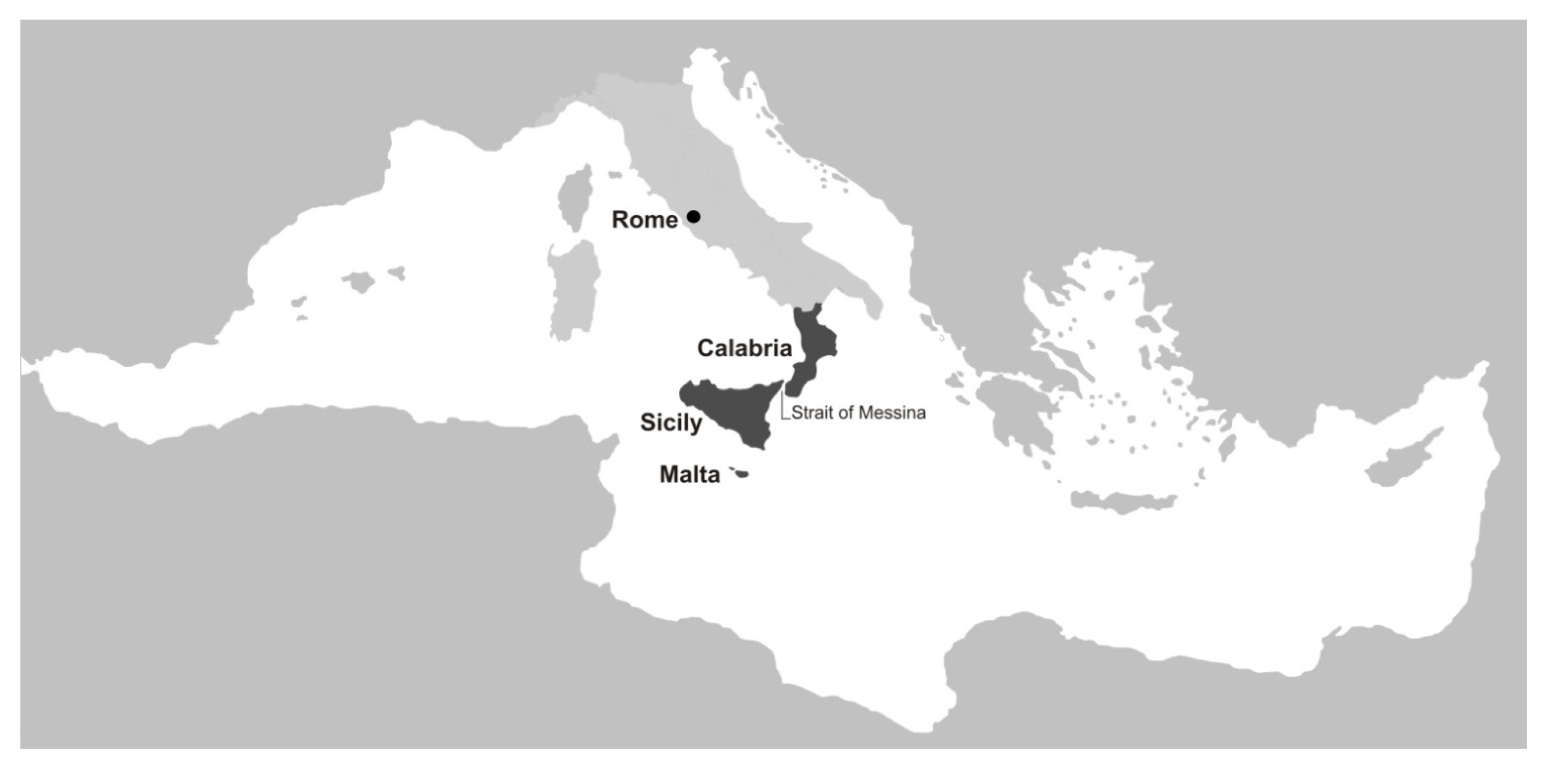
      <p>The spreading of mammals from the Italian mainland to Sicily has not only been shaped by the sea barrier of the Strait of Messina, but also by the physiography of Calabria, the southernmost region of peninsular Italy (<xref ref-type="fig" rid="geosciences-03-00114-f001">Figure 1</xref>; [<xref ref-type="bibr" rid="B6-geosciences-03-00114">6</xref>]). During Early Pleistocene, Calabria and Sicily were fragmented in small islands, constituting an archipelago [<xref ref-type="bibr" rid="B6-geosciences-03-00114">6</xref>]. In the course of Middle Pleistocene, the uplift of inner and coastal plains determined a geographical setting more and more similar to present day [<xref ref-type="bibr" rid="B6-geosciences-03-00114">6</xref>]. Calabria has been the main filter to mammal spreading, especially in the first half of Pleistocene. During late Middle and Late Pleistocene, Calabria acted as a filter for its complex physiography and latitudinal extension. As a matter of fact, all mammals present in late Middle and Late Pleistocene of Calabria spread to Sicily, with the exception of a few species of prairie or mountain environments [<xref ref-type="bibr" rid="B6-geosciences-03-00114">6</xref>]. Moreover, faunal assemblages of Calabria include a lower number of species with respect to central and northern Italy [<xref ref-type="bibr" rid="B6-geosciences-03-00114">6</xref>]. Some species of Sicily are present on Malta [<xref ref-type="bibr" rid="B5-geosciences-03-00114">5</xref>]. Maltese faunal associations are impoverished with respect to Sicilian ones and include mammals which are thought to easily cross sea barriers.</p>
      <fig id="geosciences-03-00114-f001" position="float">
        <label>Figure 1</label>
        <caption>
          <p>Map of Mediterranean area with locations of the regions quoted in the text.</p>
        </caption>
        <graphic xmlns:xlink="http://www.w3.org/1999/xlink" xlink:href="geosciences-03-00114-g001.tif"/>
      </fig>
      <p>Dispersal of mammals from the mainland to the islands depends on their body structure and behavior, in addition to geographical setting [<xref ref-type="bibr" rid="B7-geosciences-03-00114">7</xref>,<xref ref-type="bibr" rid="B8-geosciences-03-00114">8</xref>]. Good fliers and good swimmers clearly have better chances of reaching islands far from the mainland, while animals with more or less pronounced dispersal ability can disperse with some limitations. On the island, pioneer species can evolve adaptations, such as size changes and allometries, giving rise to endemic species or subspecies. They can lose their dispersal ability (e.g., flying attitude) or their defensive adaptations. The character of insular faunas needs to be investigated, not only as changing in species attributes, but also as features of the whole faunal association [<xref ref-type="bibr" rid="B7-geosciences-03-00114">7</xref>,<xref ref-type="bibr" rid="B8-geosciences-03-00114">8</xref>]. Usually, faunal associations on an island are affected by impoverishment in terms of biodiversity and by ecological disharmony [<xref ref-type="bibr" rid="B7-geosciences-03-00114">7</xref>,<xref ref-type="bibr" rid="B8-geosciences-03-00114">8</xref>].</p>
      <p>According to Simpson [<xref ref-type="bibr" rid="B7-geosciences-03-00114">7</xref>], Dermitzakis and Sondaar [<xref ref-type="bibr" rid="B8-geosciences-03-00114">8</xref>] and Sondaar <italic>et al</italic>. [<xref ref-type="bibr" rid="B9-geosciences-03-00114">9</xref>], the composition of insular faunas is related to the way of dispersal: an ecologically balanced fauna, similar to the mainland one, results from a broad land connection, which acts as a corridor, allowing interchanges from one region to another. An impoverished but balanced fauna with absent or slight endemism is related to a land connection with obstacles, acting as a filter to dispersal, where spread is probable for some taxa only. An unbalanced fauna with mainland elements is related to a filter (“pendel route”), such as a narrow sea strait, which is easily crossed by good swimmers and flyers; an endemic fauna with endemic features is related to accidental (‘‘sweepstake’’) transit, as across a wide sea barrier, and spread occurs accidentally and for some taxa only.</p>
      <p>In the case of the Quaternary mammals of Sicily, it is possible to indicate the dispersal ability of mainland ancestors and the endemism degree of insular species, as well as impoverishment and ecological balance of each faunal complex [<xref ref-type="bibr" rid="B5-geosciences-03-00114">5</xref>]. As can be inferred by paleogeographical reconstructions, physiographic changes of Calabria and Sicily determined different possibilities of mammal spreading through time [<xref ref-type="bibr" rid="B2-geosciences-03-00114">2</xref>,<xref ref-type="bibr" rid="B6-geosciences-03-00114">6</xref>,<xref ref-type="bibr" rid="B10-geosciences-03-00114">10</xref>]. Reconstruction of times and ways of dispersal from the mainland, with observations on paleogeography and endemism, makes up the larger part of the literature. However, paleoecology has been considered only in terms of species autoecology and ecological balance of associations [<xref ref-type="bibr" rid="B1-geosciences-03-00114">1</xref>,<xref ref-type="bibr" rid="B4-geosciences-03-00114">4</xref>,<xref ref-type="bibr" rid="B5-geosciences-03-00114">5</xref>]. Very few studies about ecological relationships among species and stability of communities have been conducted.</p>
      <p>The aim of this paper is to present the current state of knowledge and to raise some critical observations and possible re-interpretations. The first step is a critical review of mammal biochronology, being a reference to investigate paleobiogeography, endemism and paleoecology of Quaternary mammals of Sicily. Then, available data are used to give a picture of community structure and interspecific interactions on an island subject to relevant changes in geography and environment. The review of data sourcing from different branches of geology and paleontology, as well as from genetics, enables interesting considerations on time periods and systems of dispersals, on evolution of endemism, and on ecological interactions. It is worth noting that paleobiogeography of Sicily can be ascribed to different types of islands, as a consequence of its deep changes in geography, source availability, and possibilities of mammal dispersals.</p>
    </sec>
    <sec>
      <title>2. Review of Biochronology</title>
      <p>The Quaternary vertebrate fauna of Sicily is presently arranged into five Faunal Complexes (FCs), according to Bonfiglio <italic>et al</italic>. [<xref ref-type="bibr" rid="B1-geosciences-03-00114">1</xref>,<xref ref-type="bibr" rid="B2-geosciences-03-00114">2</xref>] and subsequent integrations [<xref ref-type="bibr" rid="B4-geosciences-03-00114">4</xref>,<xref ref-type="bibr" rid="B5-geosciences-03-00114">5</xref>,<xref ref-type="bibr" rid="B11-geosciences-03-00114">11</xref>]. Data from the cited literature are listed below (obsolete scientific names are rectified in square brackets). Mammal associations and ages are reported; endemic species are indicated by “E”. Although it is not applicable to island associations, the correspondence to the biochronological chart of Italy [<xref ref-type="bibr" rid="B12-geosciences-03-00114">12</xref>,<xref ref-type="bibr" rid="B13-geosciences-03-00114">13</xref>] is indicated, being significant to timespan and changes in mainland faunal associations.</p>
      <list list-type="simple">
      <list-item><label>-</label>
      <p>Monte Pellegrino Faunal Complex</p>
      <p>Mammal association: <italic>Asoriculus burgioi</italic> (E), <italic>Mustelercta</italic> (=<italic>Pannonictis</italic>)<italic> arzilla </italic>(E), <italic>Apodemus maximus </italic>(E), <italic>Leithia</italic> sp. (E), <italic>Maltamys </italic>sp. (E), <italic>Pellegrinia panormensis </italic>(E), <italic>Hypolagus peregrinus </italic>(E). The Monte Pellegrino FC is based on a single faunal assemblage coming from a karst cavity with a problematic depositional setting.</p>
      <p>Age: Pliocene–Early Pleistocene according to Thaler [<xref ref-type="bibr" rid="B14-geosciences-03-00114">14</xref>]; Early Pleistocene, according to Burgio and Fiore [<xref ref-type="bibr" rid="B15-geosciences-03-00114">15</xref>]; Late Villafranchian Mammal Age of the biochronological chart of Italy.</p></list-item>
      <list-item><label>-</label>
      <p><italic>Elephas falconeri</italic> Faunal Complex</p>
      <p>Mammal association: <italic>Crocidura esuae </italic>(E), <italic>Lutra trinacriae </italic>(E), <italic>Vulpes </italic>sp. (dubitative), <italic>Ursus </italic>sp. (“small bear,” dubitative), <italic>Elephas falconeri </italic>[recte <italic>Palaeoloxodon falconeri</italic>] (E), <italic>Leithia cartei </italic>(E), <italic>Leithia melitensis </italic>(E), <italic>Maltamys gollcheri </italic>(E), undetermined bats. The mammal fauna is associated with diversified herpetofauna and avifauna.</p>
      <p>Age: early Middle Pleistocene, probably MIS 22–11; Middle and Late Galerian of the biochronological chart of Italy.</p>
      </list-item>
      <list-item><label>-</label>
      <p><italic>Elephas mnaidriensis</italic> Faunal Complex</p>
      <p>Mammal association: <italic>Crocidura esuae </italic>(E), <italic>Erinaceus europaeus </italic>(E), <italic>Lutra trinacriae </italic>(E), <italic>Crocuta crocuta spelaea</italic>, <italic>Panthera leo</italic>, <italic>Canis lupus</italic>, <italic>Ursus arctos</italic>, <italic>Elephas mnaidriensis </italic>[recte <italic>Palaeoloxodon mnaidriensis</italic>] (E), <italic>Sus scrofa</italic>, <italic>Hippopotamus pentlandi </italic>(E), <italic>Cervus elaphus siciliae </italic>(E), <italic>Dama carburangelensis </italic>(E), <italic>Bos primigenius siciliae </italic>(E), <italic>Bison priscus siciliae </italic>(E), <italic>Leithia melitensis </italic>(E), <italic>Maltamys wiedincitensis </italic>(E), <italic>Microtus </italic>(<italic>Terricola</italic>) sp. In the opinion of Petruso <italic>et al</italic>. [<xref ref-type="bibr" rid="B11-geosciences-03-00114">11</xref>], <italic>Bison priscus siciliae </italic>is erroneously attributed to this faunal complex and must be considered present only in the “Grotta San Teodoro-Pianetti” FC.The mammal fauna is associated with diversified herpetofauna and avifauna.</p>
      <p>Age: late Middle Pleistocene, probably MIS 10–4; Aurelian Mammal Age of the biochronological chart of Italy.</p>
      </list-item>
      <list-item><label>-</label>
      <p>Grotta San Teodoro—Pianetti Faunal Complex</p>
      <p>Mammal association: <italic>Erinaceus europaeus</italic>, <italic>Crocidura </italic>cf.<italic> sicula </italic>(E), <italic>Crocuta crocuta spelaea</italic>, <italic>Canis lupus</italic>, <italic>Vulpes vulpes</italic>, <italic>Ursus arctos</italic>, <italic>Elephas mnaidriensis </italic>[recte <italic>Palaeoloxodon mnaidriensis</italic>] (E), <italic>Sus scrofa</italic>, <italic>Cervus elaphus siciliae </italic>(E), <italic>Bos primigenius siciliae </italic>(E), <italic>Bison priscus siciliae </italic>(E), <italic>Equus hydruntinus</italic>, <italic>Apodemus </italic>cf. <italic>A. sylvaticus</italic>, <italic>Microtus </italic>(<italic>Terricola</italic>) <italic>savii </italic>(E).</p>
      <p>Mammal fauna is associated with herpetofauna and avifauna.</p>
      <p>Age: Late Pleistocene; Grotta San Teodoro: 32,000 ± 4000 yr BP (<sup>230</sup>Th/<sup>234</sup>U dating on a concretion, Bonfiglio <italic>et al</italic>. [<xref ref-type="bibr" rid="B16-geosciences-03-00114">16</xref>]; late Aurelian (Last Glacial cycle, more precisely) according to the biochronology of peninsular Italy.</p>
      
      </list-item>
      <list-item><label>-</label>
      <p>Castello Faunal Complex</p>
      <p>Mammal association: <italic>Erinaceus europaeus</italic>, <italic>Crocidura </italic>cf. <italic>C</italic>. <italic>sicula </italic>(E), <italic>Canis lupus</italic>, <italic>Vulpes vulpes</italic>, <italic> Equus hydruntinus</italic>, <italic>Sus scrofa</italic>, <italic>Cervus elaphus</italic>, <italic>Bos primigenius</italic>, <italic>Equus ferus</italic>, <italic>Microtus </italic>(<italic>Terricola</italic>) <italic>savii</italic>, <italic>Apodemus </italic>cf.<italic> sylvaticus</italic>, <italic>Lepus europaeus</italic>.</p>
      <p>Age: late MIS 3—early MIS 2; late Aurelian (late Glacial) Mammal Age of the biochronological chart of Italy.</p>
      </list-item>
      </list>


      <p>The arrangement of the vertebrate fauna of Sicily proposed in several papers by the research teams coordinated by Bonfiglio and Masini [<xref ref-type="bibr" rid="B1-geosciences-03-00114">1</xref>,<xref ref-type="bibr" rid="B2-geosciences-03-00114">2</xref>,<xref ref-type="bibr" rid="B4-geosciences-03-00114">4</xref>] started from new finds and stratigraphical data and followed, among the others, the significant papers by Vaufrey [<xref ref-type="bibr" rid="B17-geosciences-03-00114">17</xref>], Kotsakis [<xref ref-type="bibr" rid="B18-geosciences-03-00114">18</xref>] and Burgio [<xref ref-type="bibr" rid="B19-geosciences-03-00114">19</xref>].</p>
      <p>Vaufrey [<xref ref-type="bibr" rid="B17-geosciences-03-00114">17</xref>] distinguished a first upper level attributed to Upper Paleolithic and a second lower level named “<italic>terre rouge à elephants</italic>” (=red soil with elephant remains). At Luparello cave, Vaufrey excavated elephant remains having two different sizes, interpreted as two subsequent steps of dwarfism in the Sicilian elephants, moving from the forerunner <italic>Elephas antiquus</italic>. This theory has been accepted for almost 50 years.</p>
      <p>In 1979, Tassos Kotsakis [<xref ref-type="bibr" rid="B18-geosciences-03-00114">18</xref>] provided the first modern chronological study of the fossil vertebrates of Sicily. Kotsakis [<xref ref-type="bibr" rid="B18-geosciences-03-00114">18</xref>] grouped the known local faunal associations into four stages, named by the most representative site, and correlated them to the peninsular Italy biochronology, at that time still in progress [<xref ref-type="bibr" rid="B20-geosciences-03-00114">20</xref>] and here reported only for “historical” purposes. Kotsakis [<xref ref-type="bibr" rid="B18-geosciences-03-00114">18</xref>] defined five faunal “Stages”, from the oldest to the youngest one (obsolete scientific names are rectified in square brackets):</p>
      <list list-type="simple">
      <list-item><label>-</label>
      <p>Monte Pellegrino Stage (fauna characterized by the presence of <italic>Pellegrinia panormensis</italic> associated with <italic>Leithia</italic> sp., a murid, a leporid, and a mustelid); type site: Monte Pellegrino (Palermo); Age: Ruscinian and/or Villafranchian and/or Galerian.</p>
      </list-item>
      <list-item><label>-</label>
      <p>Capo Tindari Stage: fauna characterized by the presence of a large sized <italic>Hippopotamus </italic>sp. associated with <italic>Megaceros messinae</italic> (probably attributable to <italic>Dama carburangelensis</italic>) and <italic>Leithia</italic>; type site: Capo Tindari (Messina); Age: Galerian or Flaminian or Pariolin.</p>
      </list-item>
      <list-item><label>-</label>
       <p>Maccagnone Stage (fauna characterized by the presence of <italic>Elephas mnaidriensis</italic> [recte <italic>Palaeoloxodon mnaidriensis</italic>] associated with <italic>Cervus siciliae</italic> [recte <italic>Cervus elaphus siciliae</italic>], <italic>Leithia melitensis</italic>, <italic>Leithia cartei</italic>), divided into two phases by the presence or absence of <italic>Hippopotamus pentlandi</italic>:</p>
       <p>(a) <italic>Hippopotamus pentlandi</italic> is present; type site: Maccagnone Cave (Palermo); Age: Pariolin, Rianin, Maspinian.</p>
      <p>(b)<italic>Hippopotamus pentlandi</italic> is absent; type site: Carburangeli Cave (Palermo); Age: end of Maspinian, Pontinian.</p>
      </list-item>
      <list-item><label>-</label>
      <p>Spinagallo Stage (fauna characterized by the presence of <italic>Elephas falconeri</italic> [recte <italic>Palaeoloxodon falconeri</italic>] associated with <italic>Leithia melitensis</italic> and <italic>Leithia cartei</italic>); type site: Spinagallo cave (Syracuse); Age: Middle Pontinian.</p>
      </list-item>
      <list-item><label>-</label>
      <p>Castello Stage (fauna characterized by the presence of <italic>Equus hydruntinus</italic> associated with <italic>Cervus elaphus </italic>and <italic>Homo sapiens; </italic>elephants are absent); type site: Castello cave (Palermo); Age: Upper Pontinain.</p>
      </list-item>
      
      </list>


      <p>New stratigraphic evidences from Alcamo [<xref ref-type="bibr" rid="B21-geosciences-03-00114">21</xref>] and Comiso [<xref ref-type="bibr" rid="B22-geosciences-03-00114">22</xref>], also supported by absolute dating [<xref ref-type="bibr" rid="B23-geosciences-03-00114">23</xref>], assigned to the Spinagallo Stage an earlier age than the Maccagnone one. The “classical” interpretation was based on the derivation of <italic>Elephas falconeri</italic> [recte <italic>Palaeoloxodon falconeri</italic>] from <italic>Elephas mnaidriensis </italic>[recte <italic>Palaeoloxodon mnaidriensis</italic>], through an evolutionary process characterized by a progressive reduction in size. On the contrary, the new data were consistent with two different arrivals of elephants and two different dwarfing processes on the forerunners.</p>
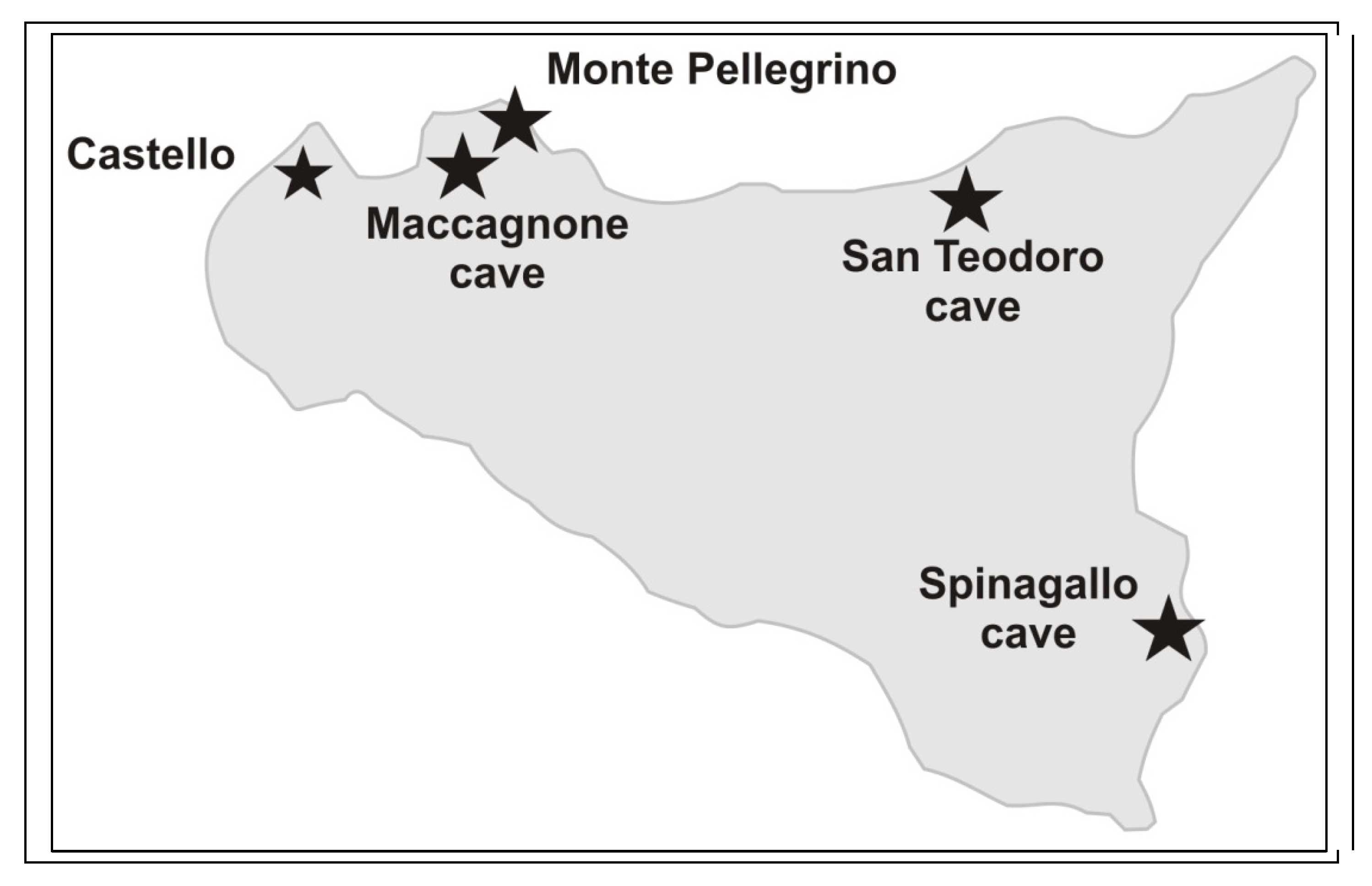
      <p>In light of these new data, Burgio [<xref ref-type="bibr" rid="B19-geosciences-03-00114">19</xref>] redefined the stages by Kotsakis [<xref ref-type="bibr" rid="B18-geosciences-03-00114">18</xref>] (obsolete scientific names are rectified in square brackets; locations of type sites are in <xref ref-type="fig" rid="geosciences-03-00114-f002">Figure 2</xref>).</p>
      <fig id="geosciences-03-00114-f002" position="float">
        <label>Figure 2</label>
        <caption>
          <p>Locations of type-sites representative of faunal complexes of Sicily.</p>
        </caption>
        <graphic xmlns:xlink="http://www.w3.org/1999/xlink" xlink:href="geosciences-03-00114-g002.tif"/>
      </fig>
      
      <list list-type="simple">
      <list-item>
      <label>-</label> 
      <p>Monte Pellegrino Stage (fauna characterized by the presence of <italic>Pellegrinia panormensis</italic>). Faunal associations: <italic>Apodemus maximus</italic>, <italic>Maltamys</italic> cf. <italic>gollcheri</italic>, <italic>Pellegrinia panormensis</italic>, <italic>Hypolagus</italic> sp. [recte <italic>Hypolagus peregrines</italic>], <italic>Soricidae</italic> gen. et sp. indet., <italic>Mustelercta arzilla</italic> [recte <italic>Mustelercta</italic> (= <italic>Pannonictis</italic>) <italic>arzilla</italic>]</p>
      </list-item>
      <list-item>
      <label>-</label> 
      <p>Spinagallo Stage (fauna characterized by the presence of <italic>Elephas falconeri</italic> [recte <italic>Palaeoloxodon falconeri</italic>]). Faunal association: <italic>Leithia melitensis</italic>, <italic>Leithia cartei</italic>, <italic>Crocidura esuae</italic>, <italic>Lutra trinacriae</italic>, <italic>Elephas falconeri</italic> [recte <italic>Palaeoloxodon falconeri</italic>]. Age: 500 ka by absolute dating [<xref ref-type="bibr" rid="B23-geosciences-03-00114">23</xref>]; Mindel-Riss.</p>
      </list-item>
      <list-item>
      <label>-</label> 
      <p>Maccagnone Stage (fauna characterized by the presence of <italic>Elephas mnaidriensis</italic> [recte <italic>Palaeoloxodon mnaidriensis</italic>]). Faunal association: <italic>Leithia melitensis</italic>, <italic>Maltamys wiedinticitensis</italic>, <italic>Crocidura esuae</italic>, <italic>Crocuta crocuta spelaea</italic>, <italic>Panthera leo spelaea</italic>, <italic>Canis lupus</italic>, <italic>Ursus arctos</italic>, <italic>Elephas antiquus</italic> [recte <italic>Palaeoloxodon antiques</italic>], <italic>Elephas mnaidriensis</italic> [recte <italic>Palaeoloxodon mnaidriensis</italic>], <italic>Elephas</italic> sp., <italic>Sus scrofa</italic>, <italic>Hippopotamus pentlandi</italic>, <italic>Hippopotamus</italic> sp., <italic>Cervus elaphus siciliae</italic>, <italic>Dama dama</italic> [recte <italic>Dama carburangelensis</italic>], Megaceros (<italic>s.l.</italic>) <italic>carburangelensis</italic> [recte <italic>Dama carburangelensis</italic>], <italic>Bos primigenius siciliae</italic>, <italic>Bison priscus siciliae</italic>. Age: 200 ka by absolute dating [<xref ref-type="bibr" rid="B23-geosciences-03-00114">23</xref>]; attributable to MIS 5.</p>
      </list-item>
      <list-item><label>-</label> 
      <p>Castello Stage (fauna characterized by the presence of <italic>Equus hydruntinus</italic>). Faunal association: <italic>Hystrix cristata</italic>, <italic>Pytimis savii</italic> [recte <italic>Microtus</italic> (<italic>Terricola</italic>) savii], <italic>Lepus europaeus</italic>, <italic>Erinaceus europaeus</italic>, <italic>Crocidura</italic> sp., <italic>Lynx lynx</italic>, <italic>Felis silvestris</italic>, <italic>Canis lupus</italic>, <italic>Vulpes vulpes</italic>, <italic>Equus caballus</italic> [recte <italic>Equus ferus</italic>], <italic>Equus hydruntinus</italic>, <italic>Sus scrofa</italic>, <italic>Cervus elaphus elaphus</italic>, <italic>Bos primigenius primigenius</italic>, <italic>Homo sapiens sapiens</italic>. Age: some millennia before Holocene (10 ka), Upper Paleolithic.</p>
      </list-item>
       
      </list>
    </sec>
    <sec>
      <title>3. Paleobiogeography, Endemism and Ecological Interactions</title>
      <p>The historical review of biochronology is helpful in understanding the current biochronological framework of Sicily. Papers by Bonfiglio, Masini and colleagues [<xref ref-type="bibr" rid="B1-geosciences-03-00114">1</xref>,<xref ref-type="bibr" rid="B2-geosciences-03-00114">2</xref>,<xref ref-type="bibr" rid="B3-geosciences-03-00114">3</xref>,<xref ref-type="bibr" rid="B4-geosciences-03-00114">4</xref>] greatly improved the current knowledge and represent a good reference, as the studies were based on broad datasets. However, some criticism does exist. The authors correctly abandoned the name “stage” and used the most appropriate term “Faunal Complex” (FC), which is synonymous with “faunal unit.” Faunal complexes are represented by non-overlapping faunal associations well defined in time, space, and ecological attributes (according to the definition of faunal units by Tedford [<xref ref-type="bibr" rid="B24-geosciences-03-00114">24</xref>]). The authors used new denominations for faunal complexes that, in spite of new data, were substantially coincident with the old “stages” stated by Burgio [<xref ref-type="bibr" rid="B19-geosciences-03-00114">19</xref>] in 1997: <italic>Elephas falconeri</italic> FC for the Spinagallo Stage; <italic>Elephas mnaidriensis</italic> FC for the Maccagnone Stage. However, these denominations are inadequate for several reasons:</p>
      <list list-type="simple">
      <list-item><label>-</label>
      <p>faunal complexes are usually stated on the basis of Local Faunal Units (LFAs) and are named by the most representative site [<xref ref-type="bibr" rid="B12-geosciences-03-00114">12</xref>,<xref ref-type="bibr" rid="B13-geosciences-03-00114">13</xref>];</p>
      </list-item>
      <list-item><label>-</label>
      <p>denominations by species names are unusual; moreover, in this case, scientific names are obsolete, being <italic>Elephas falconeri</italic> and <italic>Elephas mnaidriensis</italic> currently named <italic>Palaeoloxodon falconeri</italic> and <italic>Palaeoloxodon mnaidriensis,</italic> respectively [<xref ref-type="bibr" rid="B25-geosciences-03-00114">25</xref>];</p>
      </list-item>
      <list-item><label>-</label>
      <p>the Grotta San Teodoro-Pianetti FC proposed in 2001 [<xref ref-type="bibr" rid="B26-geosciences-03-00114">26</xref>] and updated in 2008 [<xref ref-type="bibr" rid="B16-geosciences-03-00114">16</xref>] includes <italic>Palaeloxodon mnaidriensis</italic>; as a consequence, this latter species is not exclusive of the previous FC;</p>
      </list-item>
      <list-item><label>-</label>
      <p>the names indicated by Burgio [<xref ref-type="bibr" rid="B19-geosciences-03-00114">19</xref>] are maintained in the other FCs: Monte Pellegrino FC and Castello FC;</p>
      </list-item>
      <list-item><label>-</label>
      <p>Spinagallo and Maccagnone caves are particularly significant in the fossil record of mammals of Sicily.</p>
      </list-item>
      </list>
      <p>The old names of the “stages” by Burgio, widely coincident to the updated faunal complexes, can be considered still valid: the <italic>Elephas falconeri</italic> FC can be renamed Spinagallo FC, and the <italic>Elephas mnaidriensis</italic> FC can be renamed Maccagnone FC. These denominations do respect criteria of priority and uniformity, and avoid the use of obsolete scientific names and of a non-exclusive species to indicate a faunal complex, as in the case of <italic>Elephas mnaidriensis</italic> FC. Moreover, the denomination Grotta San Teodoro-Pianetti faunal complex, named by the two LFAs known at present, is unusual and could be simplified as San Teodoro FC, the San Teodoro cave being the most representative site. Another criticism is in the use of both small and large mammals to state faunal complexes and will be a matter of discussion in this paper.</p>
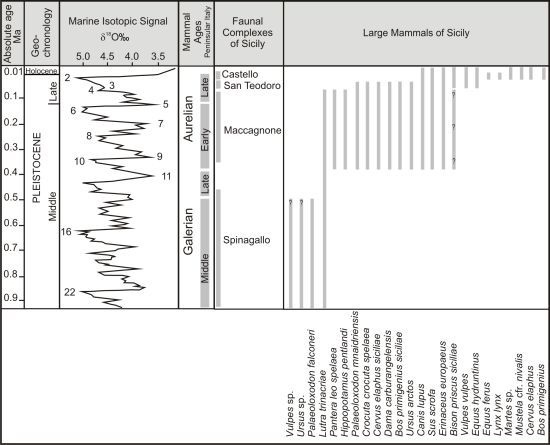
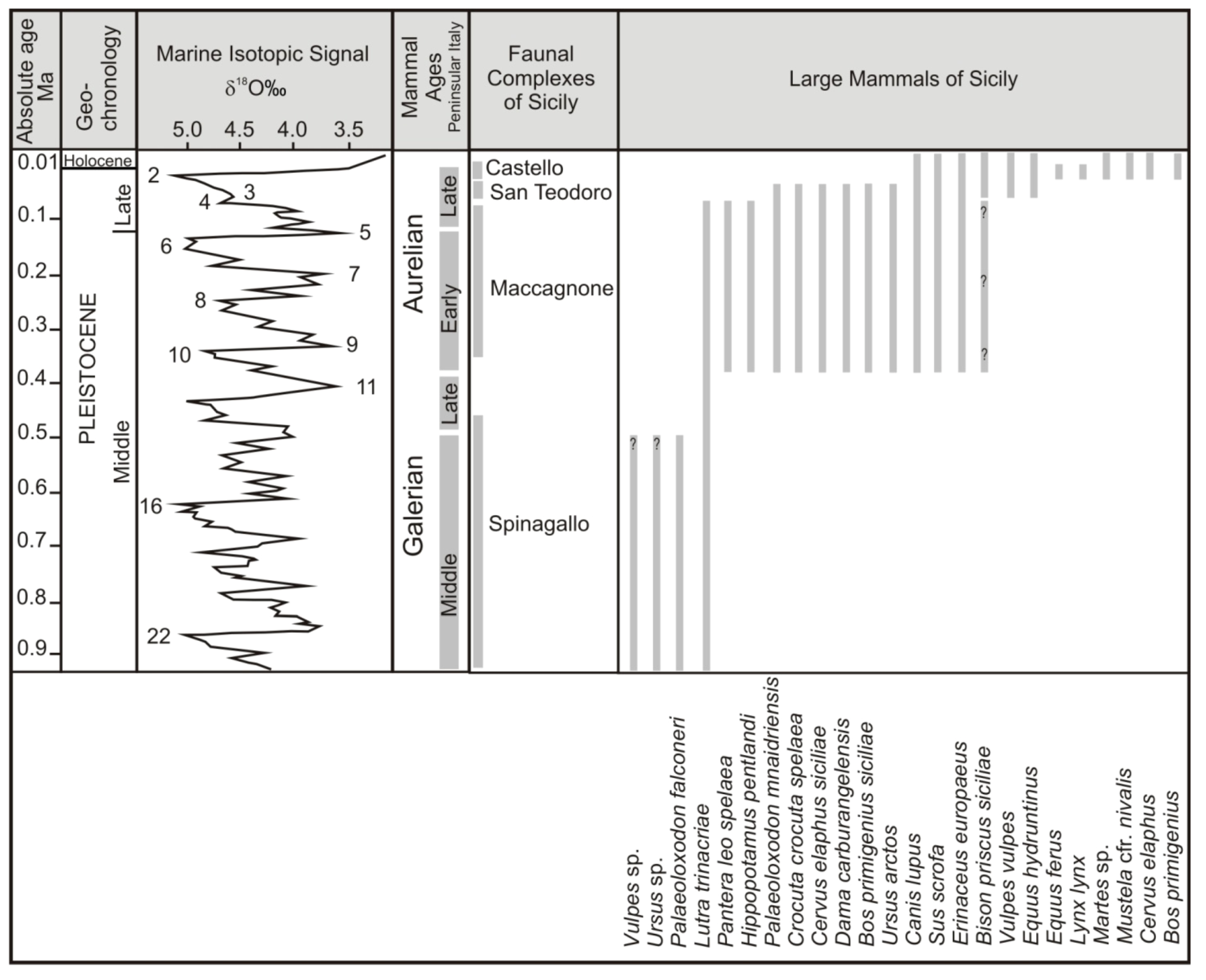
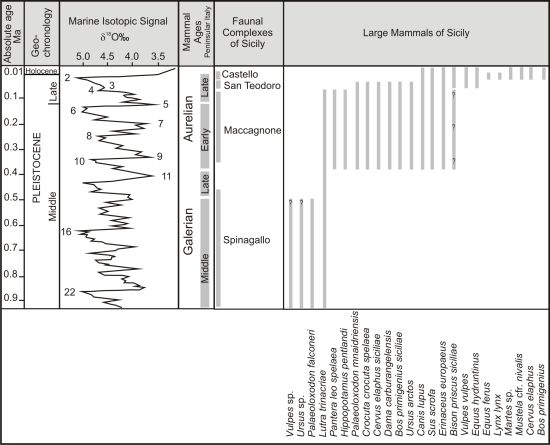
      <p><xref ref-type="fig" rid="geosciences-03-00114-f003">Figure 3</xref> represents a new proposal for a biochronological chart based on the large mammals of Sicily, correlated with the standard mammal biochronology of Italy, the marine isotopic signal, and geochronology. Monte Pellegrino FC includes mainly small mammals and is not included in <xref ref-type="fig" rid="geosciences-03-00114-f003">Figure 3</xref>. The proposed denominations of faunal complexes will be used in the rest of the paper, with replaced ones in brackets (only in headings).</p>
      <fig id="geosciences-03-00114-f003" position="float">
        <label>Figure 3</label>
        <caption>
          <p>Biochronological chart of the faunal complexes of Sicily, correlated with the standard mammal biochronology of Italy, the marine isotopic signal, and geochronology.</p>
        </caption>
        <graphic xmlns:xlink="http://www.w3.org/1999/xlink" xlink:href="geosciences-03-00114-g003.tif"/>
      </fig>
      <sec>
        <title>3.1. Monte Pellegrino Faunal Complex</title>
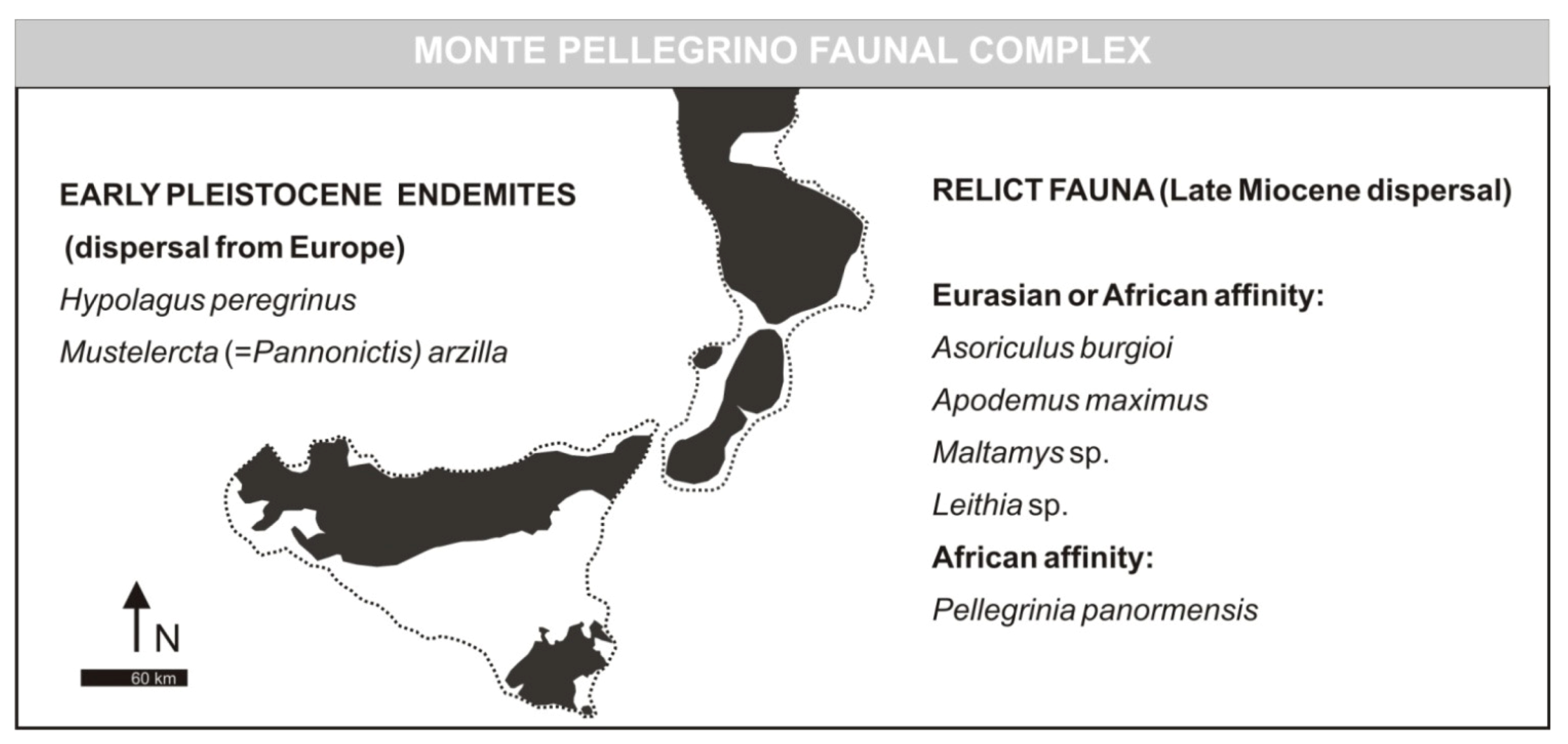
        <p>The Monte Pellegrino faunal complex is likely from the early Pleistocene age and its fauna is endemic, unbalanced, and poorly diversified, mainly composed by small mammals (<xref ref-type="fig" rid="geosciences-03-00114-f004">Figure 4</xref>).</p>
       
        <p>During Early Pleistocene, Sicily was made up of two islands, and the volcano Etna had not yet emerged; Calabria also consisted of two small islands separated by narrow sea straits, while the Strait of Messina was wider than today (<xref ref-type="fig" rid="geosciences-03-00114-f004">Figure 4</xref>) [<xref ref-type="bibr" rid="B6-geosciences-03-00114">6</xref>]. Malta was emergent [<xref ref-type="bibr" rid="B27-geosciences-03-00114">27</xref>].</p>
        <p>Different degrees of endemism, mainly consisting of enlargements of size, have been observed in species composing the FC. <italic>Asoriculus burgioi</italic>, <italic>Apodemus maximus</italic> and <italic>Maltamys</italic> sp. have marked endemic features and are dubitatively considered relics of an undocumented previous fauna, dubitatively spread during Messinian [<xref ref-type="bibr" rid="B28-geosciences-03-00114">28</xref>,<xref ref-type="bibr" rid="B29-geosciences-03-00114">29</xref>]. Thaler [<xref ref-type="bibr" rid="B14-geosciences-03-00114">14</xref>] reported also <italic>Leithia</italic> sp. from Monte Pellegrino. Daams and De Bruijn [<xref ref-type="bibr" rid="B30-geosciences-03-00114">30</xref>] considered an ancient form of <italic>Leithia</italic> as the precursor of <italic>Leithia</italic> and <italic>Maltamys</italic> species present in Middle and Late Pleistocene of Sicily and Malta. The authors identified the ancestor of <italic>Leithia</italic> (and <italic>Maltamys</italic>) in a form of <italic>Eliomys</italic> sp. probably dispersed during Messinian (late Miocene). <italic>Pellegrinia panormensis </italic>has very marked endemic features and has been compared to African Ctenodactilids [<xref ref-type="bibr" rid="B14-geosciences-03-00114">14</xref>]. <italic>Hypolagus peregrinus</italic> and <italic>Mustelercta</italic> (=<italic>Pannonictis</italic>) <italic>arzilla</italic> show moderate endemism, and are considered affine to European forms, dubitatively related to an Early Pleistocene dispersal [<xref ref-type="bibr" rid="B15-geosciences-03-00114">15</xref>,<xref ref-type="bibr" rid="B31-geosciences-03-00114">31</xref>]. There are no fossil records of mammals from the Early Pleistocene of Malta and Calabria [<xref ref-type="bibr" rid="B6-geosciences-03-00114">6</xref>,<xref ref-type="bibr" rid="B27-geosciences-03-00114">27</xref>].</p>
         <fig id="geosciences-03-00114-f004" position="float">
          <label>Figure 4</label>
          <caption>
            <p>Paleobiogeography of the Monte Pellegrino faunal complex.</p>
          </caption>
          <graphic xmlns:xlink="http://www.w3.org/1999/xlink" xlink:href="geosciences-03-00114-g004.tif"/>
        </fig>
      </sec>
      <sec>
        <title>3.2. Spinagallo Faunal Complex (Formerly Elephas falconeri FC)</title>
        <p>The Spinagallo faunal complex is early Middle Pleistocene in age and is strongly impoverished in number of species (<xref ref-type="fig" rid="geosciences-03-00114-f003">Figure 3</xref>), as well as unbalanced in ecological composition [<xref ref-type="bibr" rid="B2-geosciences-03-00114">2</xref>,<xref ref-type="bibr" rid="B5-geosciences-03-00114">5</xref>].</p>
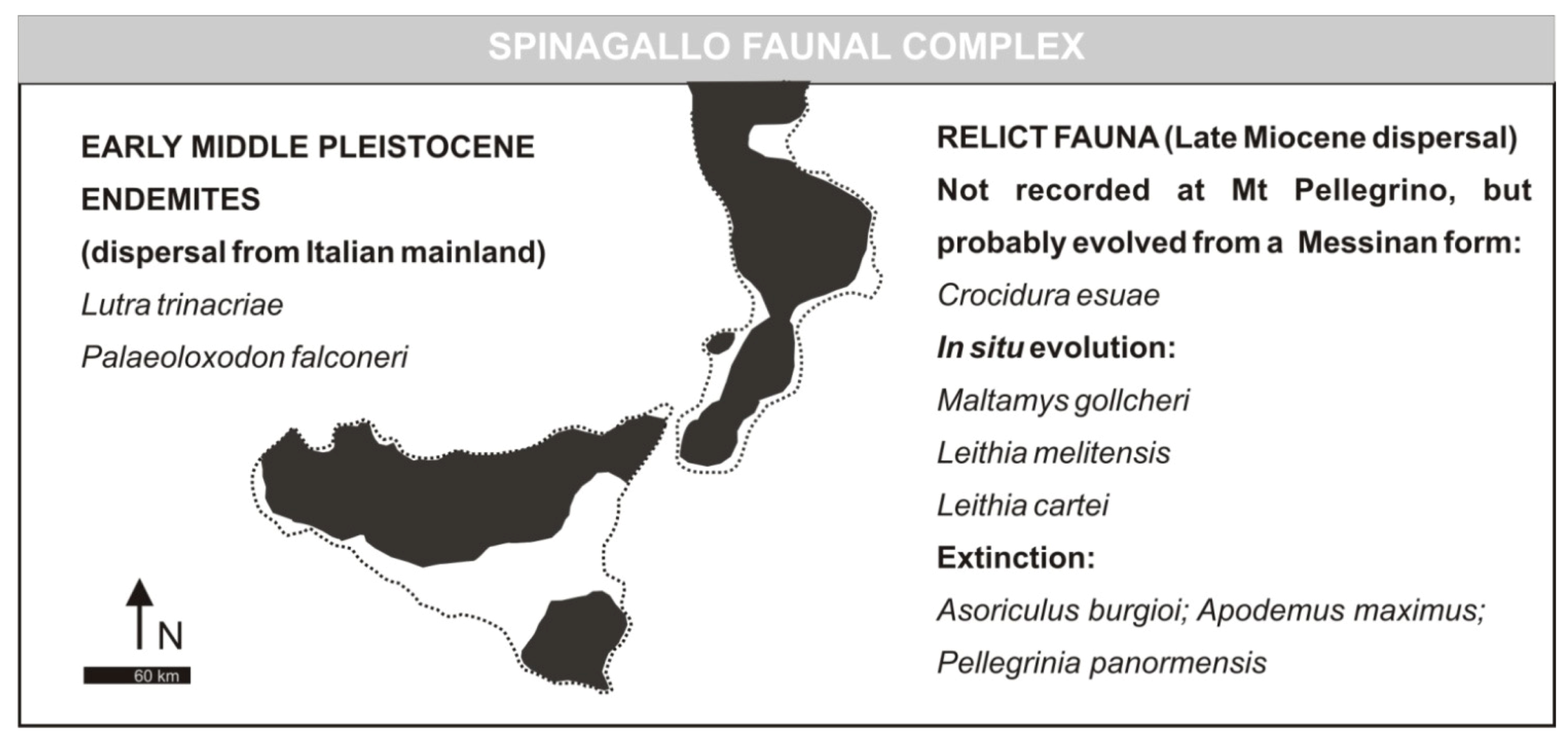
        <p>During early Middle Pleistocene (<xref ref-type="fig" rid="geosciences-03-00114-f005">Figure 5</xref>), Sicily was still consisting of two small islands [<xref ref-type="bibr" rid="B32-geosciences-03-00114">32</xref>]; the Strait of Messina persisted as a sea strait for the entire Quaternary, with some variations in wideness [<xref ref-type="bibr" rid="B10-geosciences-03-00114">10</xref>,<xref ref-type="bibr" rid="B33-geosciences-03-00114">33</xref>]. During Middle Pleistocene, a general uplift influenced all of Calabria, which progressively attained its present shape ([<xref ref-type="bibr" rid="B6-geosciences-03-00114">6</xref>] and references therein). During early Middle Pleistocene, Calabria was a land not easy to cross, characterized by high mountains and few extended plains [<xref ref-type="bibr" rid="B6-geosciences-03-00114">6</xref>]. Malta was emerged [<xref ref-type="bibr" rid="B27-geosciences-03-00114">27</xref>].</p>
        
        <p><italic>Palaeoloxodon antiquus</italic>, probable ancestor of <italic>Palaeoloxodon falconeri </italic>[<xref ref-type="bibr" rid="B25-geosciences-03-00114">25</xref>,<xref ref-type="bibr" rid="B34-geosciences-03-00114">34</xref>], is recorded in northern Calabria, in the “Mercure A” site [<xref ref-type="bibr" rid="B35-geosciences-03-00114">35</xref>], attributed to the Middle Galerian. <italic>Praemegaceros</italic> cf. <italic>P</italic>. <italic>verticornis</italic> and <italic>Dama </italic>cf. <italic>D</italic>. <italic>clactoniana</italic>, recorded at “Mercure A” site, did not disperse to Sicily [<xref ref-type="bibr" rid="B6-geosciences-03-00114">6</xref>]. There are no other records of mammals from Calabria. On Malta, <italic>Palaeoloxodon falconeri</italic> is associated with <italic>Maltamys gollcheri</italic>, <italic>Maltamys wiedincitensis </italic>(dubitative), <italic>Crocidura esuae</italic> and <italic>Lutra euxena</italic>. The Maltese otter is the only species not shared in common with Sicily. Moreover, in Sicily, <italic>Maltamys wiedincitensis</italic>, considered a descendant of <italic>M</italic>. <italic>gollcheri</italic>, is present in the younger Maccagnone FC. Zammit Maempel and De Bruijn [<xref ref-type="bibr" rid="B36-geosciences-03-00114">36</xref>] consider <italic>Maltamys gollcheri</italic> as a junior synonym of <italic>Leithia cartei</italic>, while Masini <italic>et al. </italic>[<xref ref-type="bibr" rid="B4-geosciences-03-00114">4</xref>] consider <italic>Maltamys</italic> sp.–<italic>wiedincitensis</italic>–<italic>gollcheri</italic> as chronospecies and <italic>Leithia cartei</italic> as a distinct species. In both cases, endemic dormice (<italic>Leithia</italic> and <italic>Maltamys</italic>) seem to be derived by taxa recorded at Monte Pellegrino, it follows, therefore, that their ancestors reached Sicily and Malta before Quaternary. The probable ancestor might have been a form of <italic>Eliomys</italic> because the genus was present in both continents during Miocene, though this is not enough to indicate African or European origin [<xref ref-type="bibr" rid="B37-geosciences-03-00114">37</xref>]. Since dormice are susceptible to passive transport on natural rafts and since their phylogeny is uncertain, it is still not clear if their forerunners reached Sicily from Africa or from Italy.</p>
        <fig id="geosciences-03-00114-f005" position="float">
          <label>Figure 5</label>
          <caption>
            <p>Paleobiogeography of the Spinagallo faunal complex.</p>
          </caption>
          <graphic xmlns:xlink="http://www.w3.org/1999/xlink" xlink:href="geosciences-03-00114-g005.tif"/>
        </fig>
        <p>The shrew <italic>Crocidura esuae</italic> is considered by Kotsakis [<xref ref-type="bibr" rid="B38-geosciences-03-00114">38</xref>], Esu <italic>et al.</italic> [<xref ref-type="bibr" rid="B39-geosciences-03-00114">39</xref>], and Sarà [<xref ref-type="bibr" rid="B40-geosciences-03-00114">40</xref>] to be the ancestor of <italic>Crocidura sicula</italic>, a species present in the fossil record since Late Pleistocene (San Teodoro FC) and still living in Sicily, while it is considered to be the descendant of a newcomer that arrived in the Late Pleistocene, according to Masini <italic>et al.</italic> [<xref ref-type="bibr" rid="B4-geosciences-03-00114">4</xref>]. The debate is still open, but genetic and morphological data indicate marked differences among <italic>Crocidura sicula</italic> and species from the Italian peninsula and, alternatively, strong affinities with living afro-tropical forms [<xref ref-type="bibr" rid="B41-geosciences-03-00114">41</xref>,<xref ref-type="bibr" rid="B42-geosciences-03-00114">42</xref>]. Studies on DNA provided by Dubey <italic>et al. </italic>[<xref ref-type="bibr" rid="B43-geosciences-03-00114">43</xref>] consider <italic>Crocidura sicula</italic> to be the descendant of the Saharan shrew <italic>Crocidura tarfayaensis</italic>, with a split between Saharan and Siculo-Maltese clades dated to Messinian. Taxa possibly related to <italic>Crocidura esuae</italic> have not been recorded in the Monte Pellegrino FC, although a Late Miocene spreading from North Africa cannot be excluded. Therefore, this small mammal fauna has been long persistent on Sicily and its spreading, probably by floating on natural rafts, might have occurred before Quaternary in a quite different paleogeographical setting.</p>
        <p>Large mammals reached Sicily by swimming, most likely from peninsular Italy. The forerunners of the dwarf elephant, <italic>Palaeoloxodon falconeri, </italic>and the endemic otter, <italic>Lutra trinacriae,</italic> were good swimmers. Living elephants have been observed swimming the seas, mainly in the Indian Ocean, in order to reach islands [<xref ref-type="bibr" rid="B44-geosciences-03-00114">44</xref>,<xref ref-type="bibr" rid="B45-geosciences-03-00114">45</xref>]. They can swim for long distances, searching a new habitat, and are able to see islands on the horizon and to smell edible food resources [<xref ref-type="bibr" rid="B44-geosciences-03-00114">44</xref>]. Otters have good dispersal ability and they can spread to islands as far as 30 km [<xref ref-type="bibr" rid="B46-geosciences-03-00114">46</xref>]. Therefore, it can be deduced that the ancestors of <italic>Palaeoloxodon falconeri</italic> and <italic>Lutra trinacriae</italic> reached Sicily and small islands of Calabria by swimming. <italic>Palaeoloxodon falconeri</italic> underwent a strong reduction in size, being an adult male high about 120 cm at the scapula, and heavy at about 170 kg [<xref ref-type="bibr" rid="B47-geosciences-03-00114">47</xref>]. Moreover, the dwarf elephant shows important changes in skull morphology and body proportions [<xref ref-type="bibr" rid="B47-geosciences-03-00114">47</xref>]. <italic>Lutra trinacriae</italic> was moderately reduced in size, probably as a consequence of the permanence of its populations on the island [<xref ref-type="bibr" rid="B48-geosciences-03-00114">48</xref>]. Chiroptera are recorded but still undetermined [<xref ref-type="bibr" rid="B2-geosciences-03-00114">2</xref>]. Bats, birds, reptiles, and amphibians associated with mammals enable some paleoecological considerations.</p>
        <p>Small vertebrates other than mammals that probably arrived by transport on natural rafts are: Amphibians (<italic>Bufo</italic> cf. B. <italic>viridis</italic>, <italic>Hyla</italic> sp., and <italic>Discoglossus</italic> cf. <italic>D. pictus</italic>); Reptiles (Chelonia: <italic>Emys orbicularis</italic>, <italic>Testudo hermanni</italic>, and a giant form of <italic>Geochelone</italic> sp.); Squamata: (<italic>Coluber</italic> cf. <italic>viridiflavus</italic>, <italic>Natrix</italic> sp., <italic>Lacerta viridis</italic> and the giant endemic <italic>Lacerta siculomelitensis</italic>) [<xref ref-type="bibr" rid="B2-geosciences-03-00114">2</xref>].</p>
        <p>Avifauna was diversified, with 66 species [<xref ref-type="bibr" rid="B2-geosciences-03-00114">2</xref>,<xref ref-type="bibr" rid="B49-geosciences-03-00114">49</xref>]. Among birds, 24 migrant species have spent winters in Sicily [<xref ref-type="bibr" rid="B49-geosciences-03-00114">49</xref>,<xref ref-type="bibr" rid="B50-geosciences-03-00114">50</xref>]. Fresh waters have been available, as indicated by the presence of Gruiformes and Anseriformes [<xref ref-type="bibr" rid="B50-geosciences-03-00114">50</xref>]. The presence of sedentary birds such as Piciformes, Colombiformes and Passeriformes indicates permanent availability of fruits, seeds and invertebrates [<xref ref-type="bibr" rid="B50-geosciences-03-00114">50</xref>]. Some endemites were present: the giant crane, <italic>Grus melitensis</italic>, the dwarf swan <italic>Cygnus equitum</italic>, the Strigiformes <italic>Tyto mourerchauvireae</italic> and <italic>Aegolius martes</italic>, both giant species, and <italic>Athene trinacriae</italic>, which had lengthened forelimbs [<xref ref-type="bibr" rid="B49-geosciences-03-00114">49</xref>]. <italic>Tyto mourerchauvireae</italic> seem to have evolved from <italic>T. balearica</italic>, an owl common in the Mediterranean area, and was at the top of the food chain [<xref ref-type="bibr" rid="B51-geosciences-03-00114">51</xref>]. This species preyed upon the three species of Gliridae, the shrew <italic>Crocidura</italic>, and several birds [<xref ref-type="bibr" rid="B51-geosciences-03-00114">51</xref>]. The presence in Sicily of large-sized Gliridae could have favored the evolution of <italic>T. mourerchauvireae</italic>, which became extinct in the Maccagnone FC, probably for the arrival of <italic>Bubo bubo</italic> [<xref ref-type="bibr" rid="B51-geosciences-03-00114">51</xref>].</p>
        <p>Guglielmo and Marra [<xref ref-type="bibr" rid="B50-geosciences-03-00114">50</xref>] proposed a reconstruction of the food chain. During the night, Strigiformes preyed on small vertebrates; in daylight, Colombiformes, Passeriformes, and small vertebrates were preyed upon by Falconiformes. Birds’ eggs and nestlings might have been eaten by reptiles, dormice and, occasionally, by otters. Elephants did not have had predators and intra-guild competitors. Their strong reduction in size could be related to these peculiar paleocological conditions, and perhaps it occurred through anticipation of the sexual maturity and shortening of the gestational period [<xref ref-type="bibr" rid="B52-geosciences-03-00114">52</xref>]. In the opinion of Palombo [<xref ref-type="bibr" rid="B47-geosciences-03-00114">47</xref>], the strong reduction in size of <italic>Palaeoloxodon falconeri</italic> could also be related to the availability of niches typical of medium- and large-sized herbivores. The reduced size allowed the persistence of <italic>P</italic>. <italic>falconeri</italic> populations with a number of individuals adequate to avoid extinction. Moreover, a smaller body mass reduced the deep modification of vegetation typically produced by elephants.</p>
      </sec>
      <sec>
        <title>3.3. Maccagnone Faunal Complex (Formerly Elephas mnaidriensis FC)</title>
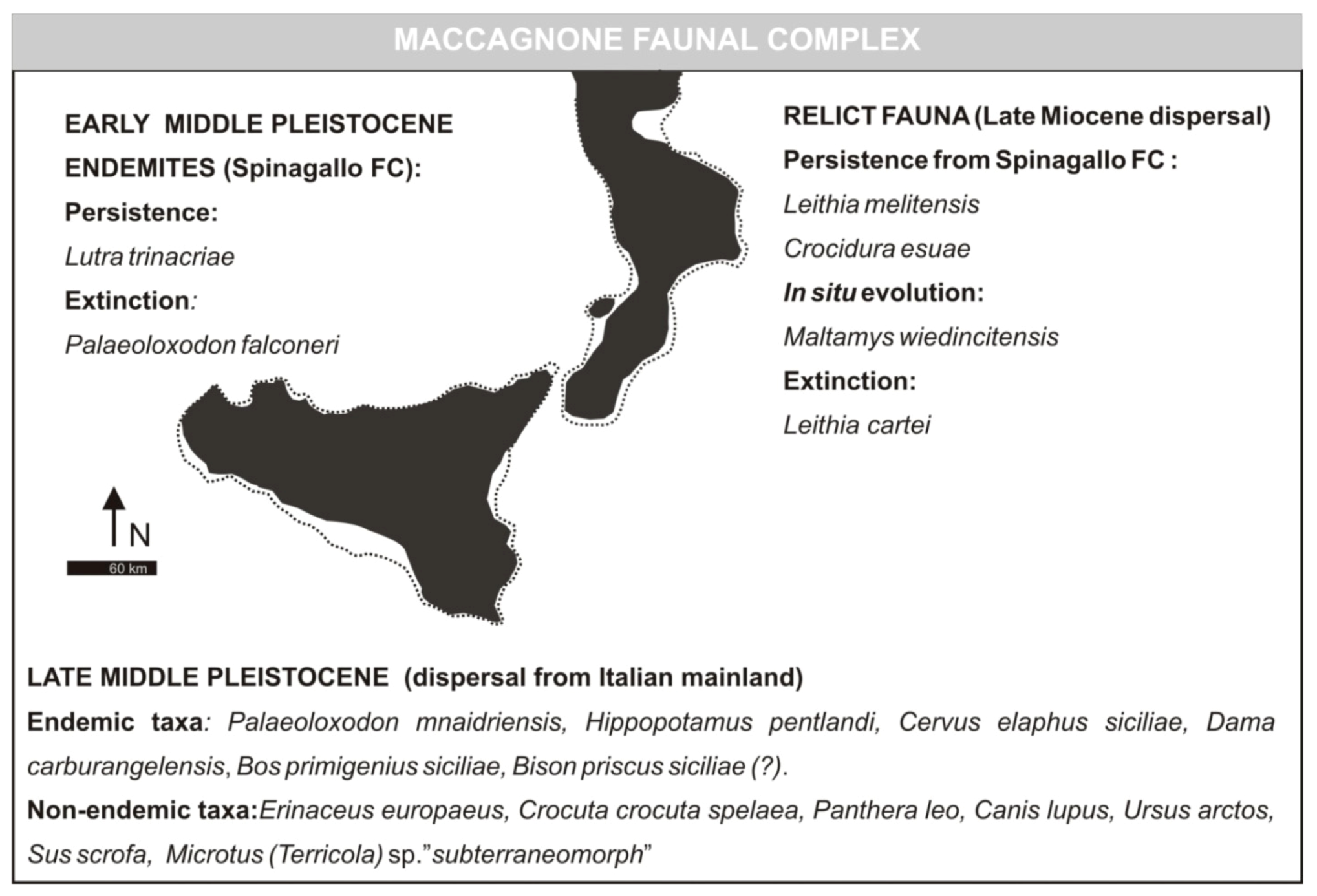
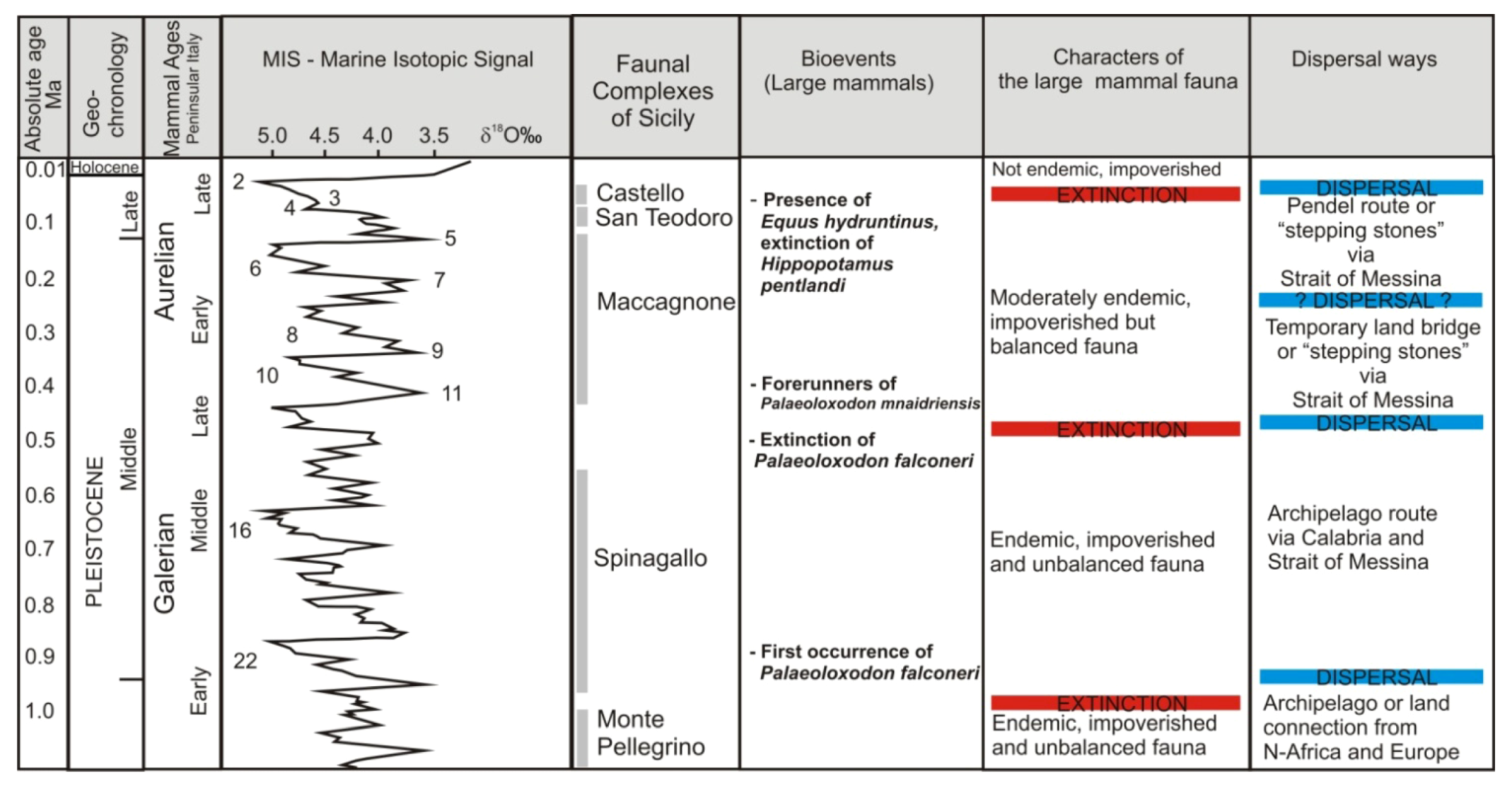
        <p>The Maccagnone faunal complex is late Middle Pleistocene in age and almost completely renewed with respect to the Spinagallo FC (<xref ref-type="fig" rid="geosciences-03-00114-f003">Figure 3</xref>, <xref ref-type="fig" rid="geosciences-03-00114-f006">Figure 6</xref>). Among small mammals, <italic>Leithia melitensis</italic> and <italic>Crocidura esuae</italic> persist from the previous FC; <italic>Maltamys gollcheri</italic> evolves in <italic>Maltamys wiedincitensis</italic> [<xref ref-type="bibr" rid="B2-geosciences-03-00114">2</xref>,<xref ref-type="bibr" rid="B4-geosciences-03-00114">4</xref>,<xref ref-type="bibr" rid="B5-geosciences-03-00114">5</xref>]. <italic>Microtus </italic>(<italic>Terricola</italic>) sp. has “subterraneomorph” characteristics, similar to the European<italic>  Microtus </italic>(<italic>Terricola</italic>) <italic>subterraneus</italic> and could have spread to Sicily during MIS 6 [<xref ref-type="bibr" rid="B53-geosciences-03-00114">53</xref>]. The dwarf elephant <italic>Palaeoloxodon falconeri</italic> became extinct, while <italic>Lutra trinacriae</italic> persists. Large mammal fauna is renewed and represented by an association impoverished but balanced and diversified, with a moderate endemism.</p>
        <fig id="geosciences-03-00114-f006" position="float">
          <label>Figure 6</label>
          <caption>
            <p>Paleobiogeography of the Maccagnone faunal complex.</p>
          </caption>
          <graphic xmlns:xlink="http://www.w3.org/1999/xlink" xlink:href="geosciences-03-00114-g006.tif"/>
        </fig>
        <p>In the late Middle Pleistocene, the geography of Sicily, Malta and Calabria was attaining its present-day shape, with an extension of inner and coastal plains (<xref ref-type="fig" rid="geosciences-03-00114-f006">Figure 6</xref>). The arrival of several new taxa of European origin can be related to favorable conditions of dispersal through the Strait of Messina [<xref ref-type="bibr" rid="B2-geosciences-03-00114">2</xref>,<xref ref-type="bibr" rid="B5-geosciences-03-00114">5</xref>,<xref ref-type="bibr" rid="B47-geosciences-03-00114">47</xref>]. Dispersals might be related to several events that occurred during the stadial oscillations of the sea level in late Middle Pleistocene (MIS 10, MIS 8, and MIS 6 [<xref ref-type="bibr" rid="B47-geosciences-03-00114">47</xref>]), or to a single event that occurred 0.3 Ma (MIS 8 [<xref ref-type="bibr" rid="B4-geosciences-03-00114">4</xref>]). A combination of both the tectonic uplift of Calabria and Sicily and low-stand phases of the sea level likely reduced the relative distance between the two coastlines of the Messina Strait (<xref ref-type="fig" rid="geosciences-03-00114-f006">Figure 6</xref>). The strait has been crossable by large mammals with different dispersal abilities, ranging from good swimmers (elephant, cervids) to animals with more or less limited swimming ability, such as bovids and carnivores.</p>
        <p>The long-term persistence of the small mammal fauna has been attributed to the absence of new competitors, due to a geographical filter active in the Strait of Messina such as a partially emerged sea floor or a swampy lagoon system, crossable only by large mammals [<xref ref-type="bibr" rid="B2-geosciences-03-00114">2</xref>,<xref ref-type="bibr" rid="B4-geosciences-03-00114">4</xref>,<xref ref-type="bibr" rid="B5-geosciences-03-00114">5</xref>]. However, this hypothesis is not easily sustainable, because of the fact that small mammals can follow more dispersal ways than large ones can; they can disperse simply by walking, and also on natural rafts. Furthermore, there is no reason why a partially emerged bridge cannot be crossed by small mammals. And there are no geological data to support the existence of this peculiar land connection. Paleoecology, discussed in the following, can be the key.</p>
        <p>The poor quality of the fossil record in the Middle Pleistocene of Calabria allows limited investigations on the dispersal of the precursors of the Maccagnone FC [<xref ref-type="bibr" rid="B6-geosciences-03-00114">6</xref>]. However, the latest Middle Pleistocene fossil assemblages from Calabria include all the large mammals considered precursors of Middle Pleistocene endemic species of Sicily [<xref ref-type="bibr" rid="B6-geosciences-03-00114">6</xref>]. Their presence in Calabria, when they spread to Sicily thereby originating the Maccagnone FC, can only be hypothesized. More than one dispersal might have occurred. As a matter of fact, “normal” sized elephants found in Sicily at Contrada Fusco (MIS 5) can be interpreted as newcomers, or at least as strong intraspecific variations [<xref ref-type="bibr" rid="B47-geosciences-03-00114">47</xref>]. It is not difficult to imagine elephants that swam several times across the Messina Strait. Among mammals of the Maccagnone FC, only elephant and cervids had swimming attitude, while hippopotamus, wild boar and bear had a good attitude to humid/freshwater environments. Other mammals did not swim, and therefore paleogeography might have been favorable to their dispersal.</p>
        <p>On the basis of the available geological and paleontological data, Marra [<xref ref-type="bibr" rid="B6-geosciences-03-00114">6</xref>] hypothesized a partially emerged “stepping stone” way in the Strait of Messina, available during regressive phases. Mammals could have reach the island crossing the “sill,” an area of the Strait of Messina that is currently deep (80–100 m offshore Sicily) and irregular in its western portion, though shallower (60–100 m offshore Calabria) and smoothed in its eastern part [<xref ref-type="bibr" rid="B54-geosciences-03-00114">54</xref>]. In correspondence to the “sill,” the Strait of Messina is at present 3 km wide. The sea strait had a maximum wideness in Upper Pliocene–Lower Pleistocene; later, it underwent a sensible narrowing, with morphology very similar to present day [<xref ref-type="bibr" rid="B10-geosciences-03-00114">10</xref>,<xref ref-type="bibr" rid="B33-geosciences-03-00114">33</xref>]. The invertebrate fossils and extant forms of marine environment indicate the persistence of elevated hydrodynamics in the Strait of Messina, which exclude the emergence of a land bridge for all Quaternary until now [<xref ref-type="bibr" rid="B10-geosciences-03-00114">10</xref>,<xref ref-type="bibr" rid="B33-geosciences-03-00114">33</xref>]. The tectono-sedimentary evolution of the “sill” indicates a sensible uplift from the late Middle Pleistocene [<xref ref-type="bibr" rid="B10-geosciences-03-00114">10</xref>]. The emergence of small areas of the “sill” during sea-lowering phases occurred since late Middle Pleistocene would be consistent with geopaleontological data and could have allowed “stepping stone” dispersals [<xref ref-type="bibr" rid="B6-geosciences-03-00114">6</xref>]. Also, the possibility of a “pendel route” (<italic>sensu</italic> Dermitzakis and Sondaar [<xref ref-type="bibr" rid="B8-geosciences-03-00114">8</xref>]) has to be taken into account, considering that the Strait of Messina was a narrow sea barrier that enabled the transit of mammals with reduced dispersal abilities. Low-stand phases might be responsible of the faunal renewal on Malta. The faunal association recorded in the late Middle Pleistocene of Malta is impoverished with respect to Sicily and includes <italic>Leithia cartei</italic>, <italic>Maltamys wiedincitensis</italic>, <italic>Lutra euxena</italic>, <italic>Palaeoloxodon mnaidriensis</italic>, <italic>Hippopotamus melitensis</italic>, and <italic>Crocidura esuae</italic> [<xref ref-type="bibr" rid="B5-geosciences-03-00114">5</xref>,<xref ref-type="bibr" rid="B27-geosciences-03-00114">27</xref>]. Small mammals persist, while the dwarf elephant is replaced by the new species spread from Sicily. The Maltese hippopotamus is considered the descendant of <italic>Hippopotamus pentlandi</italic> of Sicily [<xref ref-type="bibr" rid="B5-geosciences-03-00114">5</xref>,<xref ref-type="bibr" rid="B27-geosciences-03-00114">27</xref>]. Connections between Sicily and Malta were occasional and submitted to a strong filter, and only two species with aquatic attitude (elephant, hippopotamus) reached the island. On the other hand, the small island did not offer to possible newcomers source availability comparable to that of Sicily.</p>
        <p>The increasing biodiversity, the moderate endemism of the herbivores, and the presence of non-endemic carnivores (with top predators among them) observed in the Maccagnone FC are indicative of a large island with diversified environments in addition to a paleogeography enabling the dispersion of species with different dispersal abilities [<xref ref-type="bibr" rid="B6-geosciences-03-00114">6</xref>].</p>
        <p>On the island, species evolved endemic features. Large herbivores were moderately modified with respect to the mainland ancestors, showing a slight reduction in size, while carnivores did not evolve endemic features and included top predators [<xref ref-type="bibr" rid="B1-geosciences-03-00114">1</xref>,<xref ref-type="bibr" rid="B2-geosciences-03-00114">2</xref>,<xref ref-type="bibr" rid="B5-geosciences-03-00114">5</xref>]. Medium-sized ruminants (<italic>Cervus elaphus siciliae </italic>and <italic>Dama carburangelensis</italic>) reduced their size (intended as linear dimensions of the skeleton) by about 20%–25% with respect to their ancestors (<italic>Cervus elaphus</italic> and <italic>Dama dama</italic> cf <italic>tiberina</italic>); the large ruminant <italic>Bos primigenius siciliae</italic> reduced its size by about 20% with respect to <italic>Bos primigenius</italic> [<xref ref-type="bibr" rid="B1-geosciences-03-00114">1</xref>,<xref ref-type="bibr" rid="B2-geosciences-03-00114">2</xref>,<xref ref-type="bibr" rid="B55-geosciences-03-00114">55</xref>,<xref ref-type="bibr" rid="B56-geosciences-03-00114">56</xref>]. Endemic features observed in non-ruminant herbivores are of different degrees. <italic>Hippopotamus pentlandi </italic>had not marked endemic features and a reduction of about 10%–15% in linear dimensions with respect to the ancestor <italic>H</italic>. <italic>amphibius</italic> [<xref ref-type="bibr" rid="B57-geosciences-03-00114">57</xref>]. <italic>Palaeoloxodon mnaidriensis</italic> had marked allometries and a strong reduction in size, about 50%–60% with respect to the ancestor <italic>Palaeoloxodon antiquus</italic> [<xref ref-type="bibr" rid="B25-geosciences-03-00114">25</xref>]; some morphological modifications are related to dwarfing processes, but some others might be related to ecological adaptations (<italic>i.e.</italic>, fusion of radius and ulna; [<xref ref-type="bibr" rid="B25-geosciences-03-00114">25</xref>]). Omnivorous (<italic>Sus scrofa</italic> and <italic>Ursus arctos</italic>) and carnivorous (<italic>Canis lupus</italic>, <italic>Crocuta crocuta spelaea</italic>, <italic>Panthera leo spelaea</italic>) large mammals did not modify their size [<xref ref-type="bibr" rid="B2-geosciences-03-00114">2</xref>,<xref ref-type="bibr" rid="B4-geosciences-03-00114">4</xref>,<xref ref-type="bibr" rid="B5-geosciences-03-00114">5</xref>,<xref ref-type="bibr" rid="B58-geosciences-03-00114">58</xref>].</p>
        <p>Small mammal fauna persisted from the Spinagallo FC, with only one new arrival. The reason for this long persistence might be found in paleoecology. Although sustaining the existence of a filtering land bridge, which prevented the spreading of small mammals, Masini <italic>et al.</italic> [<xref ref-type="bibr" rid="B4-geosciences-03-00114">4</xref>] did admit that longer survivorship of small mammals might be due to the equilibrium they established with predators, or to their prolificacy and food requirements. Guglielmo and Marra [<xref ref-type="bibr" rid="B50-geosciences-03-00114">50</xref>] argued that small mammals could have established deep-rooted populations that defeated possible newcomer competition. Moreover, they might have not been affected by the extinction of their primary predator <italic>Tyto mourerchauvireae</italic>, replaced by <italic>Bubo bubo</italic>, having similar body size and predatory attitude [<xref ref-type="bibr" rid="B49-geosciences-03-00114">49</xref>]. The stability of small mammal populations can also be attributable to the absence of possible secondary predators (<italic>i.e.</italic>, small carnivores) that might have perturbed their ecological equilibrium [<xref ref-type="bibr" rid="B50-geosciences-03-00114">50</xref>]. It is worth noting that endemic Gliridae disappeared when <italic>Vulpes vulpes</italic>, their possible secondary predator, entered the island and were replaced by species smaller in size (San Teodoro FC). The life of secondary predators did not depend on the survival of their secondary prey, so the red fox might have caused the extinction of endemic Gliridae [<xref ref-type="bibr" rid="B50-geosciences-03-00114">50</xref>]. Moreover, small mammals can risk overpopulation (especially in conditions of equilibrium with predators), and the evolution of large body size, probably accompanied by lower metabolic rate and greater life duration, might have been a good life strategy [<xref ref-type="bibr" rid="B50-geosciences-03-00114">50</xref>]. Furthermore, ecological niches available for possible newcomers were stably occupied.</p>
        <p>Among small vertebrates, the amphibian <italic>Discoglussus</italic> cf. <italic>pictus</italic> and the Reptiles <italic>Emys orbicularis</italic>, <italic>Testudo hermanni</italic> and <italic>Lacerta siculomelitensis</italic> persisted, while the giant turtle <italic>Geochelone</italic> sp. became extinct [<xref ref-type="bibr" rid="B2-geosciences-03-00114">2</xref>]. The other amphibians (<italic>Bufo</italic> cf. <italic>viridis</italic>, <italic>Hyla</italic> sp.) and Reptiles (<italic>Coluber</italic> cf. <italic>viridiflavus</italic>, <italic>Natrix</italic> sp., <italic>Lacerta viridis</italic>) present in the previous fauna have not been recorded. However, molecular data by their living relatives seem to indicate their long persistence in Sicily [<xref ref-type="bibr" rid="B50-geosciences-03-00114">50</xref>].</p>
        <p>The avifauna underwent several changes [<xref ref-type="bibr" rid="B49-geosciences-03-00114">49</xref>]. The number of migrant birds increased, with taxa preferring fresh waters. Podicipediformes and Pelicaniformes, adapted to marine waters, dispersed to Sicily. Anseriformes were represented by new species and Ciconiformes increased, with some species of swamp environment. Among Caradriformes, <italic>Numenius phaeopus</italic>, a species adapted to humid environments, was present. Passeriformes sensitively decreased. Guglielmo and Marra [<xref ref-type="bibr" rid="B50-geosciences-03-00114">50</xref>] argued for a good availability of humid and fresh water environments. It is likely that a good ichthyofauna was present in the freshwaters, sufficient to sustain the rich avifauna. Endemic Strigiformes disappeared, replaced by <italic>Bubo bubo</italic>. Among Falconiformes, it is worthy of noting the presence of <italic>Aquila heliaca</italic>, a bird able to prey on animals with a weight up to 10 kg (mainly mammals and birds). The eagle was probably a menace for the cubs of many mammal’s species, while the other Falconiformes preyed upon small vertebrates, such as amphibians, reptiles, birds and dormice [<xref ref-type="bibr" rid="B50-geosciences-03-00114">50</xref>].</p>
        <p>Top predators (<italic>Canis lupus</italic>, <italic>Crocuta crocuta spelaea</italic>, and <italic>Panthera leo spelaea</italic>) fed on populations of herbivores, mainly cervids (<italic>Cervus elaphus siciliae</italic> and <italic>Dama carurangelensis</italic>). Bovids, small mammals, and birds have probably been occasional prey, as observed in the behavior of the extant wolves, hyenas, and lions. As scavengers, large predators also fed on dead animals. In conditions of isolation and reduced areas, the slight reduction in size of herbivores might have been a strategy to maintain the number of individuals adequate to avoid extinction. Furthermore, herbivore populations had been numerous enough to feed three species of social predators, which did not evolve endemic features because the size of endemics fell into the variability range of usual prey.</p>
        <p>In the opinion of Palombo [<xref ref-type="bibr" rid="B47-geosciences-03-00114">47</xref>], <italic>Hippopotamus pentlandi</italic> and <italic>Palaeoxodon mnaidriensis</italic>, thanks to their reduction in size, occupied ecological niches vacant on the island, that are respectively those of large horses (grazers) and rhinoceroses (mixed-feeders).</p>
        <p>Omnivorous mammals (<italic>Sus scrofa</italic> and <italic>Ursus arctos</italic>) exploited various food resources, without suffering the effects of isolation.</p>
        <p>Large mammal association is indicative of a composite environment, with prairies and open woods, typical of Mediterranean “<italic>macchia</italic>” (<xref ref-type="table" rid="geosciences-03-00114-t001">Table 1</xref>).</p>
        <table-wrap id="geosciences-03-00114-t001" position="float">
          <object-id pub-id-type="pii">geosciences-03-00114-t001_Table 1</object-id>
          <label>Table 1</label>
          <caption>
            <p>Habitat, Feeding Behavior and Body Mass of endemic large mammals of Sicily. Categories according to Palombo [<xref ref-type="bibr" rid="B5-geosciences-03-00114">5</xref>]. <bold>Habitat</bold>: O = grassland, steppe or savanna; W = forests and closed woodland; Wc = bushland, Mediterranean “macchia” and open woodland. <bold>Feeding</bold><bold> behavior</bold>: Br = browser; Gr = grazer; MF = mixed-feeder; Om = omnivore; P = predator; Sc = scavenger; sP = small predator; SP = superpredator. <bold>Body mass</bold>: &lt;1 kg (class I); 1–10 kg (class II); 10–60 kg (class III); 60–120 kg (class IV); 120–350 kg (class V); 350–850 kg (class VI); &gt;850 kg (class VII).</p>
          </caption>
          <table>
            <thead>
              <tr>
                <th rowspan="2" align="center" valign="middle">Large mammal</th>
                <th rowspan="2" align="center" valign="middle">Habitat</th>
                <th rowspan="2" align="center" valign="middle">Feeding behavior</th>
                <th rowspan="2" align="center" valign="middle">Body mass</th>
                <th colspan="4" align="center" valign="middle">Faunal complexes</th>
              </tr>
              <tr>
                <th valign="middle" style="border-top: solid thin">Spinagallo</th>
                <th valign="middle" style="border-top: solid thin">Maccagnone</th>
                <th valign="middle" style="border-top: solid thin">S. Teodoro</th>
                <th valign="middle" style="border-top: solid thin">Castello</th>
              </tr>
            </thead>
            <tbody>
              <tr>
                <td align="left" valign="middle">
                  <italic>Palaeoloxodon falconeri</italic>
                </td>
                <td align="center" valign="middle">O-Wc</td>
                <td align="center" valign="middle">Br</td>
                <td align="center" valign="middle">V</td>
                <td align="center" valign="middle">X</td>
                <td align="center" valign="middle"> </td>
                <td align="center" valign="middle"> </td>
                <td align="center" valign="middle"> </td>
              </tr>
              <tr>
                <td align="left" valign="middle">
                  <italic>Lutra trinacriae</italic>
                </td>
                <td align="center" valign="middle">F</td>
                <td align="center" valign="middle">sP</td>
                <td align="center" valign="middle">II</td>
                <td align="center" valign="middle">X</td>
                <td align="center" valign="middle">X</td>
                <td align="center" valign="middle"> </td>
                <td align="center" valign="middle"> </td>
              </tr>
              <tr>
                <td align="left" valign="middle">
                  <italic>Panthera leo spelaea</italic>
                </td>
                <td align="center" valign="middle">O</td>
                <td align="center" valign="middle">SP</td>
                <td align="center" valign="middle">V</td>
                <td align="center" valign="middle"> </td>
                <td align="center" valign="middle">X</td>
                <td align="center" valign="middle"> </td>
                <td align="center" valign="middle"> </td>
              </tr>
              <tr>
                <td align="left" valign="middle">
                  <italic>Hippopotamus pentlandi</italic>
                </td>
                <td align="center" valign="middle">O-F</td>
                <td align="center" valign="middle">Gr</td>
                <td align="center" valign="middle">VII</td>
                <td align="center" valign="middle"> </td>
                <td align="center" valign="middle">X</td>
                <td align="center" valign="middle"> </td>
                <td align="center" valign="middle"> </td>
              </tr>
              <tr>
                <td align="left" valign="middle">
                  <italic>Dama carburangelensis</italic>
                </td>
                <td align="center" valign="middle">O-Wc</td>
                <td align="center" valign="middle">MF</td>
                <td align="center" valign="middle">IV</td>
                <td align="center" valign="middle"> </td>
                <td align="center" valign="middle">X</td>
                <td align="center" valign="middle"> </td>
                <td align="center" valign="middle"> </td>
              </tr>
              <tr>
                <td align="left" valign="middle">
                  <italic>Crocuta crocuta spelaea</italic>
                </td>
                <td align="center" valign="middle">O-Wc</td>
                <td align="center" valign="middle">Sc-SP</td>
                <td align="center" valign="middle">III/IV</td>
                <td align="center" valign="middle"> </td>
                <td align="center" valign="middle">X</td>
                <td align="center" valign="middle">X</td>
                <td align="center" valign="middle"> </td>
              </tr>
              <tr>
                <td align="left" valign="middle">
                  <italic>Cervus elaphus siciliae</italic>
                </td>
                <td align="center" valign="middle">Wc</td>
                <td align="center" valign="middle">MF</td>
                <td align="center" valign="middle">V</td>
                <td align="center" valign="middle"> </td>
                <td align="center" valign="middle">X</td>
                <td align="center" valign="middle">X</td>
                <td align="center" valign="middle"> </td>
              </tr>
              <tr>
                <td align="left" valign="middle">
                  <italic>Bison priscus siciliae</italic>
                </td>
                <td align="center" valign="middle">O</td>
                <td align="center" valign="middle">Gr</td>
                <td align="center" valign="middle">VII</td>
                <td align="center" valign="middle"> </td>
                <td align="center" valign="middle">X</td>
                <td align="center" valign="middle">X</td>
                <td align="center" valign="middle"> </td>
              </tr>
              <tr>
                <td align="left" valign="middle">
                  <italic>Bos primimigenius siciliae</italic>
                </td>
                <td align="center" valign="middle">O-Wc</td>
                <td align="center" valign="middle">Gr</td>
                <td align="center" valign="middle">VII</td>
                <td align="center" valign="middle"> </td>
                <td align="center" valign="middle">X</td>
                <td align="center" valign="middle">X</td>
                <td align="center" valign="middle"> </td>
              </tr>
              <tr>
                <td align="left" valign="middle">
                  <italic>Palaeoloxodon mnaidriensis</italic>
                </td>
                <td align="center" valign="middle">O-Wc</td>
                <td align="center" valign="middle">Br</td>
                <td align="center" valign="middle">VII</td>
                <td align="center" valign="middle"> </td>
                <td align="center" valign="middle">X</td>
                <td align="center" valign="middle">X</td>
                <td align="center" valign="middle"> </td>
              </tr>
              <tr>
                <td align="left" valign="middle">
                  <italic>Ursus arctos</italic>
                </td>
                <td align="center" valign="middle">Wc</td>
                <td align="center" valign="middle">Om</td>
                <td align="center" valign="middle">IV</td>
                <td align="center" valign="middle"> </td>
                <td align="center" valign="middle">X</td>
                <td align="center" valign="middle">X</td>
                <td align="center" valign="middle"> </td>
              </tr>
              <tr>
                <td align="left" valign="middle">
                  <italic>Canis lupus</italic>
                </td>
                <td align="center" valign="middle">O-W-Wc</td>
                <td align="center" valign="middle">P</td>
                <td align="center" valign="middle">III</td>
                <td align="center" valign="middle"> </td>
                <td align="center" valign="middle">X</td>
                <td align="center" valign="middle">X</td>
                <td align="center" valign="middle">X</td>
              </tr>
              <tr>
                <td align="left" valign="middle">
                  <italic>Vulpes vulpes</italic>
                </td>
                <td align="center" valign="middle">O-Wc</td>
                <td align="center" valign="middle">sP</td>
                <td align="center" valign="middle">II</td>
                <td align="center" valign="middle"> </td>
                <td align="center" valign="middle">X</td>
                <td align="center" valign="middle">X</td>
                <td align="center" valign="middle">X</td>
              </tr>
              <tr>
                <td align="left" valign="middle">
                  <italic>Sus scrofa</italic>
                </td>
                <td align="center" valign="middle">Wc</td>
                <td align="center" valign="middle">Om</td>
                <td align="center" valign="middle">IV</td>
                <td align="center" valign="middle"> </td>
                <td align="center" valign="middle">X</td>
                <td align="center" valign="middle">X</td>
                <td align="center" valign="middle">X</td>
              </tr>
              <tr>
                <td align="left" valign="middle">
                  <italic>Equus hydruntinus</italic>
                </td>
                <td align="center" valign="middle">O</td>
                <td align="center" valign="middle">Gr</td>
                <td align="center" valign="middle">V</td>
                <td align="center" valign="middle"> </td>
                <td align="center" valign="middle"> </td>
                <td align="center" valign="middle">X</td>
                <td align="center" valign="middle">X</td>
              </tr>
              <tr>
                <td align="left" valign="middle">
                  <italic>Equus ferus</italic>
                </td>
                <td align="center" valign="middle">O</td>
                <td align="center" valign="middle">Gr</td>
                <td align="center" valign="middle">VI/VII</td>
                <td align="center" valign="middle"> </td>
                <td align="center" valign="middle"> </td>
                <td align="center" valign="middle"> </td>
                <td align="center" valign="middle">X</td>
              </tr>
              <tr>
                <td align="left" valign="middle">
                  <italic>Lynx lynx</italic>
                </td>
                <td align="center" valign="middle">W</td>
                <td align="center" valign="middle">P</td>
                <td align="center" valign="middle">III</td>
                <td align="center" valign="middle"> </td>
                <td align="center" valign="middle"> </td>
                <td align="center" valign="middle"> </td>
                <td align="center" valign="middle">X</td>
              </tr>
              <tr>
                <td align="left" valign="middle"><italic>Martes </italic>sp.</td>
                <td align="center" valign="middle">O-Wc</td>
                <td align="center" valign="middle">sP</td>
                <td align="center" valign="middle">II</td>
                <td align="center" valign="middle"> </td>
                <td align="center" valign="middle"> </td>
                <td align="center" valign="middle"> </td>
                <td align="center" valign="middle">X</td>
              </tr>
              <tr>
                <td align="left" valign="middle"><italic>Mustela </italic>cf.<italic> nivalis</italic></td>
                <td align="center" valign="middle">Wc</td>
                <td align="center" valign="middle">sP</td>
                <td align="center" valign="middle">I</td>
                <td align="center" valign="middle"> </td>
                <td align="center" valign="middle"> </td>
                <td align="center" valign="middle"> </td>
                <td align="center" valign="middle">X</td>
              </tr>
              <tr>
                <td align="left" valign="middle">
                  <italic>Cervus elaphus</italic>
                </td>
                <td align="center" valign="middle">Wc</td>
                <td align="center" valign="middle">MF</td>
                <td align="center" valign="middle">V</td>
                <td align="center" valign="middle"> </td>
                <td align="center" valign="middle"> </td>
                <td align="center" valign="middle"> </td>
                <td align="center" valign="middle">X</td>
              </tr>
              <tr>
                <td align="left" valign="middle">
                  <italic>Bos primigenius</italic>
                </td>
                <td align="center" valign="middle">O-Wc</td>
                <td align="center" valign="middle">Gr</td>
                <td align="center" valign="middle">VII</td>
                <td align="center" valign="middle"> </td>
                <td align="center" valign="middle"> </td>
                <td align="center" valign="middle"> </td>
                <td align="center" valign="middle">X</td>
              </tr>
            </tbody>
          </table>
        </table-wrap>
      </sec>
      <sec>
        <title>3.4. San Teodoro Faunal Complex (Formerly Grotta S. Teodoro—Pianetti Faunal Complex)</title>
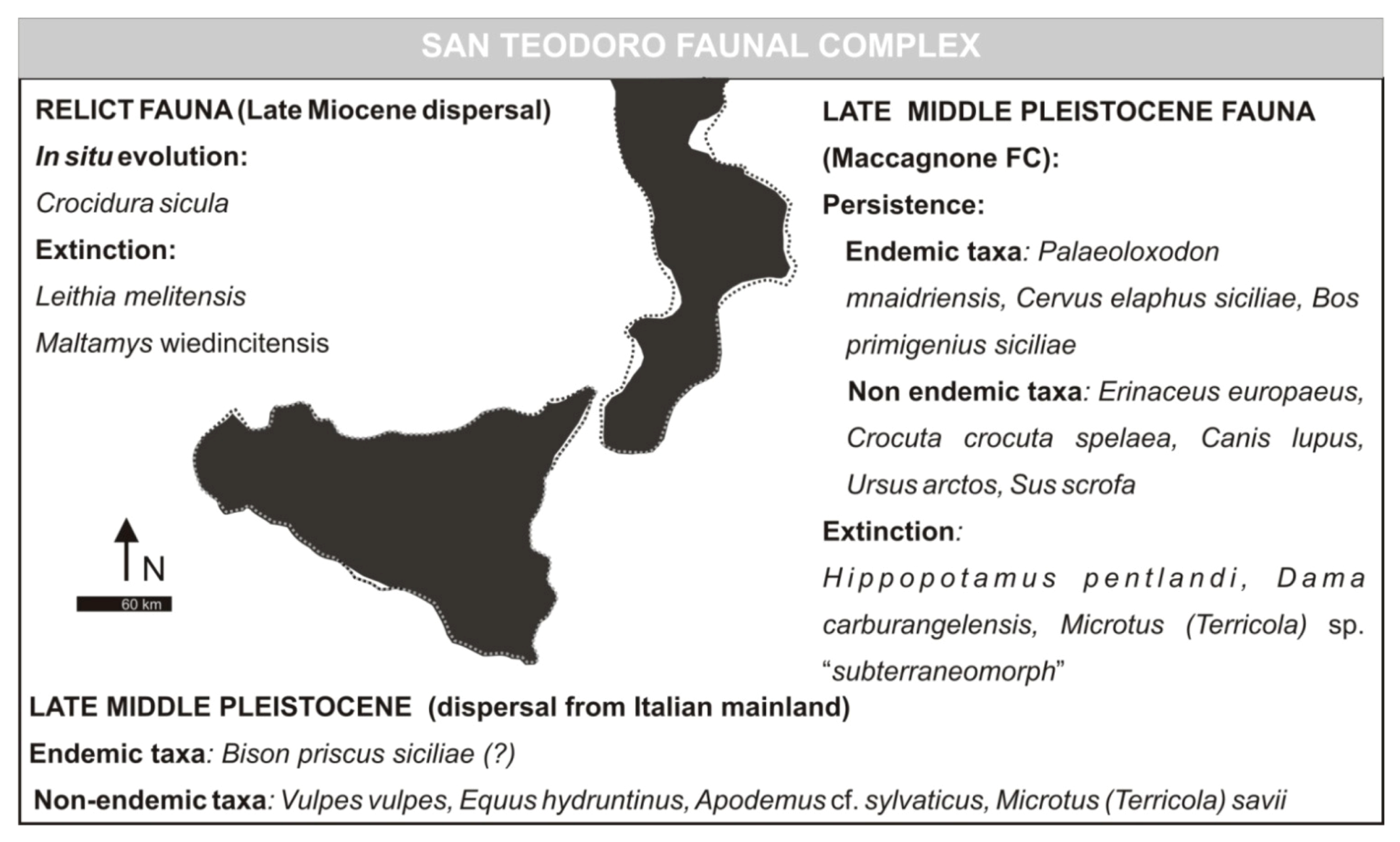
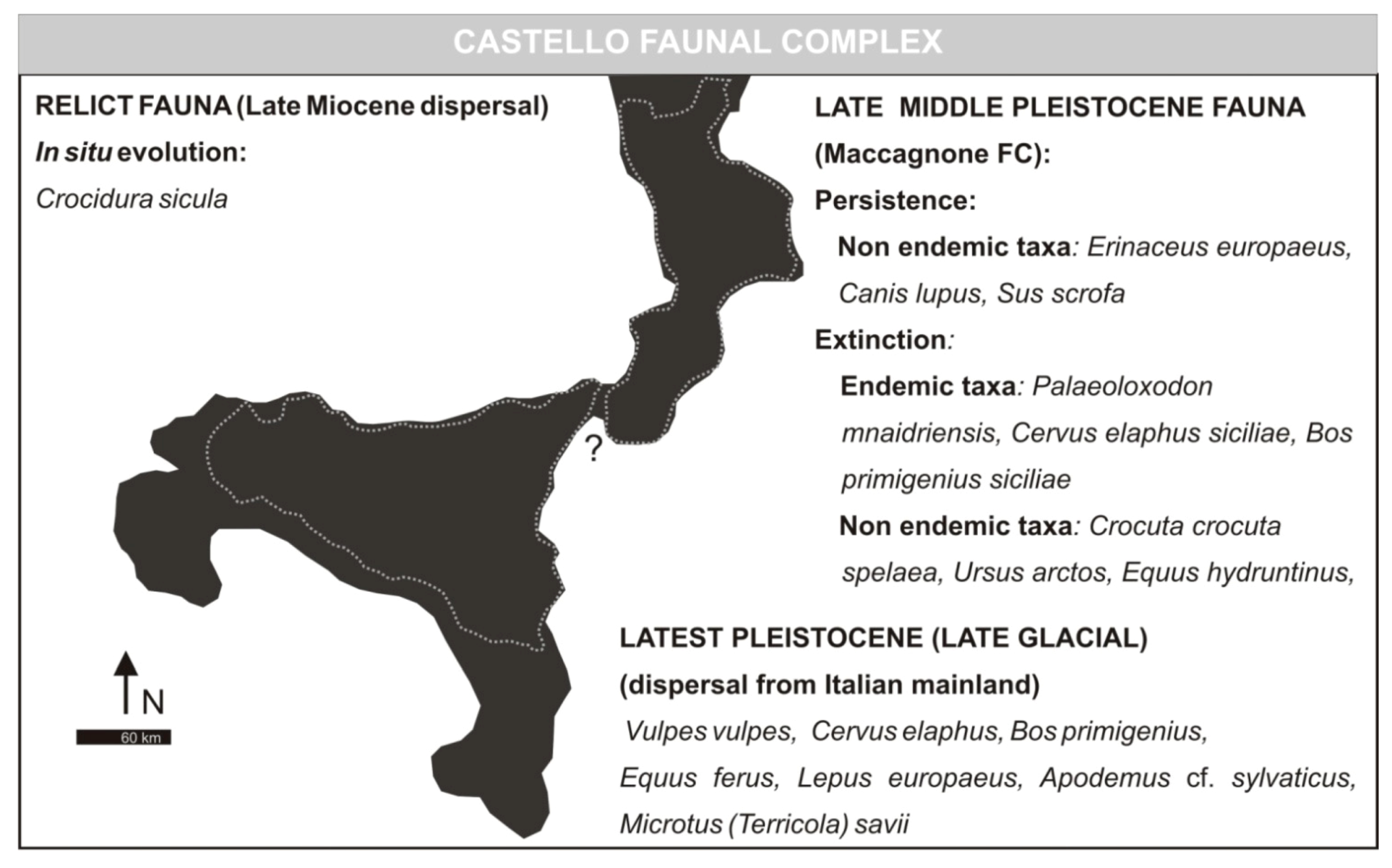
        <p>In the San Teodoro Faunal Complex (<xref ref-type="fig" rid="geosciences-03-00114-f003">Figure 3</xref>), some large mammals of the previous fauna became extinct (<italic>Panthera leo spelaea</italic>, <italic>Hippopotamus pentlandi</italic>, <italic>Dama carburangelensis</italic>) and the newcomers (<italic>Vulpes vulpes</italic>, and <italic>Equus hydruntinus</italic>) did not evolve endemic features [<xref ref-type="bibr" rid="B2-geosciences-03-00114">2</xref>]. <italic>Bison priscus siciliae</italic> might be considered as a newcomer with moderate endemic adaptations, according to Petruso <italic>et al. </italic>[<xref ref-type="bibr" rid="B11-geosciences-03-00114">11</xref>]. As already discussed, the arrival of <italic>Vulpes vulpes</italic> might have been decisive for the extinction of the endemic small mammals’ fauna and the entrance of a renewed stock on the island.</p>
        <p>Among small mammals, the endemites <italic>Leithia melitensis</italic> and <italic>Maltamys wiedincitensis</italic> became extinct, while the new presence of <italic>Apodemus sylvaticus</italic> (non endemic), <italic>Crocidura sicula</italic>, and <italic>Microtus</italic> (<italic>Terricola</italic>) <italic>savii</italic> is recorded. As previously mentioned, <italic>Crocidura sicula</italic> has been considered a descendant of a new immigrant species [<xref ref-type="bibr" rid="B4-geosciences-03-00114">4</xref>] and of <italic>Crocidura esuae</italic> ([<xref ref-type="bibr" rid="B38-geosciences-03-00114">38</xref>,<xref ref-type="bibr" rid="B39-geosciences-03-00114">39</xref>,<xref ref-type="bibr" rid="B40-geosciences-03-00114">40</xref>]. <italic>Microtus</italic> (<italic>Terricola</italic>) <italic>savii</italic> is considered a newcomer, likely dispersing during MIS 4–3, and not a descendent of the <italic>Microtus</italic> (<italic>Terricola</italic>) “subterraneumorph<italic>”</italic> of the Maccagnone FC [<xref ref-type="bibr" rid="B53-geosciences-03-00114">53</xref>], and probably evolved in the endemic <italic>Microtus</italic> (<italic>Terricola</italic>) <italic>savii nebrodensis</italic>, currently present in Sicily [<xref ref-type="bibr" rid="B11-geosciences-03-00114">11</xref>].</p>
        <p>Paleogeography of Sicily and Calabria was similar to nowadays, with some local variations in the coastal lines (<xref ref-type="fig" rid="geosciences-03-00114-f007">Figure 7</xref>). The arrival in Sicily of a new stock of small mammals and some large mammals has been related by Bonfiglio <italic>et al.</italic> [<xref ref-type="bibr" rid="B2-geosciences-03-00114">2</xref>] to the opening of a land bridge as a consequence of a eustatic low stand, and by Marra [<xref ref-type="bibr" rid="B6-geosciences-03-00114">6</xref>] to a “stepping stone” dispersal way. Considerations made for the Maccagnone FC are valid also for the San Teodoro FC: if the hypothesis of a “stepping stone” way can be accepted, small mammals could have been easily spread by natural rafts and/or by swimming crossing a partially emerged “sill”.</p>
        <fig id="geosciences-03-00114-f007" position="float">
          <label>Figure 7</label>
          <caption>
            <p>Paleobiogeography of the San Teodoro faunal complex.</p>
          </caption>
          <graphic xmlns:xlink="http://www.w3.org/1999/xlink" xlink:href="geosciences-03-00114-g007.tif"/>
        </fig>
        <p>The fossil record of Calabria is richer than before and comes from different depositional settings, demonstrating important geographical and environmental changes, such as a wider extension of inner and coastal plains [<xref ref-type="bibr" rid="B6-geosciences-03-00114">6</xref>]. During Late Pleistocene, Calabria was easier to cross than before, and the Strait of Messina was not a strong barrier. As a matter of fact, precursors of the species of the San Teodoro FC have been recorded in Calabria, in assemblages attributable to the early Aurelian and to the late Aurelian [<xref ref-type="bibr" rid="B6-geosciences-03-00114">6</xref>]. Only few mammals that adapted to prairie or mountain environments were present in Calabria and not in Sicily [<xref ref-type="bibr" rid="B6-geosciences-03-00114">6</xref>]: <italic>Equus ferus</italic>, <italic>Stephanorhinus kirchbergensis</italic>, <italic>Capreolus capreolus</italic>, <italic>Capra ibex</italic>, <italic>Rupicapra rupicapra</italic>, and <italic>Meles meles</italic>. <italic>Homo neanderthalensis</italic> was sporadically present in Calabria, but its presence is not recorded in Sicily.</p>
        <p>At Malta, dormice persisted and three new species, strongly endemic (<italic>Cervus</italic> sp., <italic>Microtus </italic>(<italic>Pitimys</italic>)<italic> melitensis</italic>, <italic>Crocidura</italic> sp.), have been recorded [<xref ref-type="bibr" rid="B27-geosciences-03-00114">27</xref>]. Unfortunately, these species are poorly studied. It is evident that the filter between Sicily and Malta was strong.</p>
        <p>Paleoecology of the large mammal association of Sicily is indicative of Mediterranean “<italic>macchia</italic>” (<xref ref-type="table" rid="geosciences-03-00114-t001">Table 1</xref>). The arrival of <italic>Equus hydruntinus</italic>, and possibly of <italic>Bison priscus siciliae</italic>, is corroborated by vegetation reconstructions based upon pollen from coprolites of <italic>Crocuta crocuta spelaea</italic> recorded in the San Teodoro cave, indicating pre-Late Glacial conditions [<xref ref-type="bibr" rid="B59-geosciences-03-00114">59</xref>]. Vegetation was dominated by steppic taxa, but also arboreal taxa, and small percentages of mesophilus taxa were present [<xref ref-type="bibr" rid="B59-geosciences-03-00114">59</xref>]. During the Last Glacial cycle, more precisely, 32,000 ± 4,000 yr BP in Sicily, a wooded steppe biome, with elements representing a variety of local conditions, was present [<xref ref-type="bibr" rid="B59-geosciences-03-00114">59</xref>]. A paleobiome of southern Italy shows the predominance of wooded steppes during Upper Pleistocene [<xref ref-type="bibr" rid="B60-geosciences-03-00114">60</xref>]. The character of the steppe was Mediterranean, indicating relatively cool summers.</p>
        <p>Avifauna was less diversified then earlier, with prevailing migrant species and some Passeriformes [<xref ref-type="bibr" rid="B2-geosciences-03-00114">2</xref>,<xref ref-type="bibr" rid="B61-geosciences-03-00114">61</xref>]. The disappearance of birds typical of humid environments is coherent with the wooded steppe biome.</p>
      </sec>
      <sec>
        <title>3.5. Castello Faunal Complex</title>
        <p>The Castello faunal complex is represented by a mammal fauna low diversified, without endemites and with <italic>Homo sapiens</italic>. These features indicate easier communication between Italy and Sicily: all mammals recorded in Calabria, except for <italic>Martes </italic>sp., are present in the Castello FC (<xref ref-type="fig" rid="geosciences-03-00114-f008">Figure 8</xref>) [<xref ref-type="bibr" rid="B6-geosciences-03-00114">6</xref>].</p>
        
        <p>According to Barrier [<xref ref-type="bibr" rid="B10-geosciences-03-00114">10</xref>] and Di Geronimo [<xref ref-type="bibr" rid="B33-geosciences-03-00114">33</xref>] the Strait of Messina has always had an elevated hydrodynamics, while according to Bonfiglio <italic>et al.</italic> [<xref ref-type="bibr" rid="B2-geosciences-03-00114">2</xref>] and Lambeck <italic>et al.</italic> [<xref ref-type="bibr" rid="B62-geosciences-03-00114">62</xref>] a land bridge emerged 20,000 yr BP (<xref ref-type="fig" rid="geosciences-03-00114-f008">Figure 8</xref>).</p>
        <p>The Castello FC has an ecological assessment still unbalanced but closer to modern ones. Presence of mammals of wooded (<italic>Cervus elaphus</italic>, <italic>Sus scrofa</italic>) and open (<italic>Equus ferus</italic>, <italic>Equus hydruntinus</italic>, <italic>Bos primigenius</italic>, <italic>Lepus europaeus</italic>) environments (<xref ref-type="table" rid="geosciences-03-00114-t001">Table 1</xref>) can be related to the dry conditions of Late Glacial. Amphibians and reptiles are absent from the fossil record. Avifauna was diversified, with species typical of wooded and open environments and with a large number of migrant species.</p>
        <fig id="geosciences-03-00114-f008" position="float">
          <label>Figure 8</label>
          <caption>
            <p>Paleobiogeography of the Castello faunal complex.</p>
          </caption>
          <graphic xmlns:xlink="http://www.w3.org/1999/xlink" xlink:href="geosciences-03-00114-g008.tif"/>
        </fig>
      </sec>
    </sec>
    <sec sec-type="discussion">
      <title>4. Discussion</title>
      <p>The present review started from a reconsideration of the current biochronology of mammals of Sicily. The first part has been devoted to some nomenclature problems, but after the discussion of other available data, it becomes evident that something more substantial is needed. In particular, a formalization of faunal complexes as faunal units having biochronological significance is still lacking. In order to state a formal biochronology, large mammals have to be considered apart from small mammals. The current faunal complexes are based on numerous sites and some of them were formerly excavated without screening for small mammals; it therefore follows that large mammals have to be used to formalize faunal units, as do peninsular ones [<xref ref-type="bibr" rid="B12-geosciences-03-00114">12</xref>]. The biochronological chart of Quaternary large mammals of Sicily presented here (<xref ref-type="fig" rid="geosciences-03-00114-f003">Figure 3</xref>) is correlated to geochronology, the marine isotopic signal, and the mammal ages of Italy, and thus represents a first step to formalization of faunal units.</p>
      <p>Small mammals of the Pleistocene of Italy are currently arranged in zones correlated to small mammal ages of Europe [<xref ref-type="bibr" rid="B63-geosciences-03-00114">63</xref>]. A framework for Sicily is still lacking.</p>
      <p>Review of data on paleogeography and the possibility of dispersals allowed the elaboration of paleobiogeographical maps of Sicily and Calabria (<xref ref-type="fig" rid="geosciences-03-00114-f004">Figure 4</xref>, <xref ref-type="fig" rid="geosciences-03-00114-f005">Figure 5</xref>, <xref ref-type="fig" rid="geosciences-03-00114-f006">Figure 6</xref>, <xref ref-type="fig" rid="geosciences-03-00114-f007">Figure 7</xref>, <xref ref-type="fig" rid="geosciences-03-00114-f008">Figure 8</xref>). The Strait of Messina (<xref ref-type="fig" rid="geosciences-03-00114-f001">Figure 1</xref>) played an important role during the Pleistocene period, being a more or less wide sea barrier between southern Italy (Calabria) and Sicily, controlled by tectonics and eustatism [<xref ref-type="bibr" rid="B2-geosciences-03-00114">2</xref>,<xref ref-type="bibr" rid="B3-geosciences-03-00114">3</xref>,<xref ref-type="bibr" rid="B5-geosciences-03-00114">5</xref>,<xref ref-type="bibr" rid="B6-geosciences-03-00114">6</xref>]. In Early Pleistocene, two sea-straits divided Calabria in three parts, filtering mammal dispersals until their emersion during Early and Middle Pleistocene [<xref ref-type="bibr" rid="B6-geosciences-03-00114">6</xref>].</p>
      <p>For a mammal, the possibility to cross a composite environment is related to its dispersal ability that depends on its anatomy and physiology. Moreover, its settlement on the island depends on available ecological niches and environmental resources, as well as competition and predation. Old and new data suggest an integrated approach, in which the insular species attributes (<italic>i.e.</italic>, dispersal ability, size change, endemism, and adaptive radiation) and the community attributes (<italic>i.e.</italic>, ecological balance and biodiversity) are considered in a biochronological, palaoecological and paleogeographical framework. Furthermore, comparisons with peninsular Italy (in particular Calabria, the southernmost region of peninsular Italy) and the island of Malta, which was part of the insular system, are necessary.</p>
      <p>The possibility that Malta could have represented a dispersal way from Africa might have been considered. However, this hypothesis is not sustainable and not only for the distance from the African mainland. On the basis of the presence of taxa with African affinity in the Monte Pellegrino FC and their degree of endemism, the possible dispersal from northern Africa occurred probably in Late Miocene (Messinian), as already discussed. Malta emerged during Late Miocene and has probably been connected to the small islands of Comino and Sicily until Early Pliocene; fossils of that age have not been recorded [<xref ref-type="bibr" rid="B27-geosciences-03-00114">27</xref>]. No records occur in Calabria, where African fauna might have dispersed. The Quaternary fossil record of Malta is coherent with filtered dispersals from Sicily, which in its turn received faunas from Calabria.</p>
      <p>The most reliable reconstruction is that relics of one or more ancient faunas persisted on Sicily from late Miocene to Pleistocene. In Sicily, a late Miocene faunal assemblage including non-endemic large mammals has been found at Messina (Gravitelli site), but has been lost during the 1908 earthquake. Papers published before the terrible event [<xref ref-type="bibr" rid="B64-geosciences-03-00114">64</xref>,<xref ref-type="bibr" rid="B65-geosciences-03-00114">65</xref>] allowed the review and determinations of species related to Eurasian forms. The assemblage, recovered in lignite deposits, has been attributed to Messinian for a long time, but Rook <italic>et al</italic>. [<xref ref-type="bibr" rid="B66-geosciences-03-00114">66</xref>] attributed it to late Turolian, proposing the existence of a Late Miocene Calabrian–Sicilian bio-province without endemics. These data cannot be used to clarify the character of the fauna of Monte Pellegrino FC and its age. Moreover, the site of Monte Pellegrino is problematic by a stratigraphic point of view, being represented by fissure-filling deposit. However, the fauna of Monte Pellegrino FC could open a window on Late Miocene scenarios: <italic>Asoriculus burgioi</italic>, <italic>Apodemus maximus</italic>, <italic>Maltamys</italic> sp., <italic>Leithia</italic> sp. and <italic>Pellegrinia panormensis</italic> could be descendant of forms spread during Messinian, likely coming from north Africa. Also, <italic>Crocidura esuae</italic> might have been part of this faunal stock. Although the species is not recorded at Monte Pellegrino, its living relative, <italic>Crocidura sicula</italic>, has a consistent genetic distance from European forms and has affinity to African populations dated to Messinian.</p>
      <p>During Quaternary, faunas spread from the Italian peninsula through Calabria and the Strait of Messina (<xref ref-type="fig" rid="geosciences-03-00114-f004">Figure 4</xref>, <xref ref-type="fig" rid="geosciences-03-00114-f005">Figure 5</xref>, <xref ref-type="fig" rid="geosciences-03-00114-f006">Figure 6</xref>, <xref ref-type="fig" rid="geosciences-03-00114-f007">Figure 7</xref>, <xref ref-type="fig" rid="geosciences-03-00114-f008">Figure 8</xref>); Sicily has been an island becoming more and more “continental,” changing its paleogeography from an archipelago made of two small islands, to a large single island. Moreover, Calabria underwent similar paleogeographic conditions, attaining its territorial continuity and extending its plains thanks to the emersion of some areas. Moreover, Calabria has a very elongated shape, and the main part of its territory is mountainous, with reduced inner and coastal plains. For these reasons, and for its latitudinal extension, Calabria represented a strong filter to the spreading of fauna from north to south. Mammals who challenged these lands underwent endemic processes on the island, mainly consisting in enlargements of size for small mammals, and dwarfing of large mammals, with allometries.</p>
      <p>The role of the Strait of Messina in controlling dispersal to Sicily has been greatly overestimated, just because insular associations have been roughly compared to Italian peninsula ones. However, it is widely assumed that, in southern Italy, mammal associations were less diverse than in central or northern Italy, for climatic and geographic reasons. Paleobiography does demonstrate that the sea-strait has been not difficult to cross for mammals, in particular during low-stand phases of the sea level, but they needed to spread to Calabria at first.</p>
      <p>Debates on the full emersion of the Strait of Messina can be passed over by considering a “stepping stone” way. It is coherent with geological data, as well as with paleontological ones, being crossable by the majority of recorded mammals and other vertebrates (amphibians included). It is worth noting that elephants could have swam the Strait of Messina several times. The occurrence of “normal” sized elephants in some Middle and Late Pleistocene sites has been recently emphasized by Herridge [<xref ref-type="bibr" rid="B67-geosciences-03-00114">67</xref>]. Preliminary data indicate the occurrence of large-sized elephants, temporary named “<italic>Palaeoloxodon</italic> sp. -Sicily 3” at Puntali cave, Zà Minica cave (both refereable to Maccagnone FC) and San teodoro cave.</p>
      <p>Dispersal by swimming and natural rafts probably occurred many times during Quaternary and sometimes might have been helped by the emersion of small pieces of land, thanks to the lowering of the sea level during cold stages. From the oldest to the youngest, faunal complexes show increasing biodiversity and decreasing endemism, they progressively lost the character of strong isolation and became more uniform to Calabria, indicating easier connections with mainland.</p>
      <p>In the course of these changes in geography, Sicily offered different environments to pioneer faunas. The vertebrate association of the Maccagnone FC indicates a relatively humid environment, with availability of fresh waters. It appears that wooded areas were alternated to open landscapes and Mediterranean “<italic>macchia.</italic>” In the later association (San Teodoro FC), the climate was more dry, as a consequence of glaciation. Vertebrate associations and vegetation are, according to a steppe biome, related to dry conditions. In terms of interspecific ecological relationships, faunal associations became more complex through time.</p>
      <p>The long persistence of small mammals in Sicily, also in the presence of relevant changes of paleogeography, events of extinctions and new arrivals among large mammals and other vertebrates, is worth noting. As already discussed, the long persistence of small mammals on Sicily could have had ecological reasons: species were deeply rooted on the islands and their niche probably did not change through time; possible competitors found giant relatives and presumably lost the struggle for life; main predators of dormice and shrew have been birds of prey of similar sizes. The extinction of endemic small mammals can be due to the environmental changes of Late Pleistocene, shifted to dry conditions, and to the entrance on the island of <italic>Vulpes vulpes</italic>. The canid was likely the secondary predator of small endemites and did not establish an equilibrium with its occasional prey, thereby causing their extinction.</p>
    </sec>
    <sec sec-type="conclusions">
      <title>5. Conclusions</title>
      <p>Quaternary mammals of Sicily represent a good case study for island biogeography. The wide dataset reviewed in this paper enables considerations on biochronology, bioevents, evolution of endemites, paleoecology and times and ways of dispersals (<xref ref-type="fig" rid="geosciences-03-00114-f009">Figure 9</xref>). The current biochronological framework is well documented, but informal. The names of faunal complexes here proposed avoid ambiguous denominations and open discussions on formalization of biochronology of Sicily.</p>
      <fig id="geosciences-03-00114-f009" position="float">
        <label>Figure 9</label>
        <caption>
          <p>Quaternary mammals of Sicily: bioevents, endemic characters, times and ways of dispersals.</p>
        </caption>
        <graphic xmlns:xlink="http://www.w3.org/1999/xlink" xlink:href="geosciences-03-00114-g009.tif"/>
      </fig>
      <p>Bioevents (<italic>i.e</italic>., extinctions, turnovers) are strictly related to paleogeography of Sicily and surrounding areas, which changed from an archipelago to a large island (<xref ref-type="fig" rid="geosciences-03-00114-f004">Figure 4</xref>, <xref ref-type="fig" rid="geosciences-03-00114-f005">Figure 5</xref>, <xref ref-type="fig" rid="geosciences-03-00114-f006">Figure 6</xref>, <xref ref-type="fig" rid="geosciences-03-00114-f007">Figure 7</xref>, <xref ref-type="fig" rid="geosciences-03-00114-f008">Figure 8</xref>). The role of the Strait of Messina in controlling dispersals from mainland has thus far been overestimated, while Calabria can be considered a first filter. Large mammals have been influenced by relevant bioevents, while small mammals persisted unchanged until Late Pleistocene. As a consequence, faunal complexes can be distinguished on the basis of complete or partial renewal of large mammal faunas. Long persistence of small mammals can be hardly related to selective palaeogeographic filters, while it is more reliably due to a well-established equilibrium with predators, disturbed by the spreading of the red fox during Late Pleistocene. Differences in times and ways of dispersals and in reproduction rates, as well as in occurrence in the fossil record existing between large and small mammals require distinct biochronological frameworks. Paleoecology of vertebrate associations is indicative of changes in the availability of environmental resources. Complexity of interspecific relationships and of ecological niches increased through time.</p>
      <p>Finally, the data reviewed here enable a paleobiogeographical characterization of Sicily. By a biogeographical point of view, islands can be characterized as oceanic islands (never connected to mainland; a strongly impoverished, unbalanced and endemic fauna is expected) or as continental islands (broadly connected to continents in the past; their faunas are impoverished but similar to continental ones, with low endemism and high diversity) [<xref ref-type="bibr" rid="B68-geosciences-03-00114">68</xref>]. However, intermediate types of islands can be defined. Alcover <italic>et al.</italic> [<xref ref-type="bibr" rid="B68-geosciences-03-00114">68</xref>] defined oceanic-like islands as an island connected to mainland in the distant past; the fauna is similar but more diversified with respect to oceanic islands. Marra [<xref ref-type="bibr" rid="B5-geosciences-03-00114">5</xref>] indicated a second type of oceanic-like island, which received diversified faunas through occasional routes from the near mainland. Louchart [<xref ref-type="bibr" rid="B69-geosciences-03-00114">69</xref>] proposed an intermediate type of island, between oceanic and continental ones. In this “intermediate” type, terrestrial carnivorous mammals are missing, while non-flying mammals, mainly rodents, are present and Strigiformes represent the top of the food chain.</p>
      <p>Sicily experienced different types of insular conditions. The Monte Pellegino FC is problematic, but it can be tentatively related to an oceanic-like island <italic>sensu</italic> Alcover <italic>et al</italic>. [<xref ref-type="bibr" rid="B68-geosciences-03-00114">68</xref>], which hosted taxa coming from different lands, maybe from a past land connection in the late Miocene. The Spinagallo FC is probably related to the intermediate type of island suggested by Louchart [<xref ref-type="bibr" rid="B69-geosciences-03-00114">69</xref>]. The MaccagnoneFC and the San Teodoro FC can be indicative of an island that received the faunas spread through varying, sporadic means (natural rafts, active dispersal by swimming or flying), or maybe even a “stepping stone” way. It might correspond to the oceanic-like island of the second type, suggested by Marra [<xref ref-type="bibr" rid="B5-geosciences-03-00114">5</xref>].</p>
      <p>Sicily became more and more “continental” during Late Pleistocene, when exchanges with the mainland were more frequent and the faunal composition indicated a large island, with abundant resources and a well-developed trophic net.</p>
    </sec>
  
  </body>
  <back>
    <ack>
      <title>Acknowledgments</title>
      <p>The author is deeply indebted to: the anonymous reviewers, whose comments improved this paper; Donald R. Prothero, for his critical reading of the paper; the staff of Geosciences. A.C. Marra dedicates this paper to her daughter Gaia. Founds are provided by University of Messina (PRA 2008-2009).</p>
    </ack>
    <ref-list>
      <title>References</title>
      <ref id="B1-geosciences-03-00114">
        <label>1.</label>
        <citation citation-type="journal">
          <person-group person-group-type="author">
            <name>
              <surname>Bonfiglio</surname>
              <given-names>L.</given-names>
            </name>
            <name>
              <surname>Marra</surname>
              <given-names>A.C.</given-names>
            </name>
            <name>
              <surname>Masini</surname>
              <given-names>F.</given-names>
            </name>
          </person-group>
          <article-title>The contribution of Quaternary vertebrates to the paleoenvironmental and paleoclimatic reconstructions in Sicily</article-title>
          <source>Spec. Pubbl. Geol. Soc. London</source>
          <year>2000</year>
          <volume>181</volume>
          <fpage>169</fpage>
          <lpage>182</lpage>
        </citation>
      </ref>
      <ref id="B2-geosciences-03-00114">
        <label>2.</label>
        <citation citation-type="journal">
          <person-group person-group-type="author">
            <name>
              <surname>Bonfiglio</surname>
              <given-names>L.</given-names>
            </name>
            <name>
              <surname>Mangano</surname>
              <given-names>G.</given-names>
            </name>
            <name>
              <surname>Marra</surname>
              <given-names>A.C.</given-names>
            </name>
            <name>
              <surname>Masini</surname>
              <given-names>F.</given-names>
            </name>
            <name>
              <surname>Pavia</surname>
              <given-names>M.</given-names>
            </name>
            <name>
              <surname>Petruso</surname>
              <given-names>D.</given-names>
            </name>
          </person-group>
          <article-title>Pleistocene Calabrian and Sicilian bioprovinces</article-title>
          <source>Geobios. Spec. Mem.</source>
          <year>2002</year>
          <volume>24</volume>
          <fpage>29</fpage>
          <lpage>39</lpage>
        </citation>
      </ref>
      <ref id="B3-geosciences-03-00114">
        <label>3.</label>
        <citation citation-type="journal">
          <person-group person-group-type="author">
            <name>
              <surname>Bonfiglio</surname>
              <given-names>L.</given-names>
            </name>
            <name>
              <surname>di Maggio</surname>
              <given-names>C.</given-names>
            </name>
            <name>
              <surname>Marra</surname>
              <given-names>A.C.</given-names>
            </name>
            <name>
              <surname>Masini</surname>
              <given-names>F.</given-names>
            </name>
            <name>
              <surname>Petruso</surname>
              <given-names>D.</given-names>
            </name>
          </person-group>
          <article-title>Biochronology of Pleistocene vertebrate faunas of Sicily and correlation of verterate bearing deposits with marine deposits</article-title>
          <source>Ital. J. Quat. Sci.</source>
          <year>2003</year>
          <volume>16</volume>
          <fpage>107</fpage>
          <lpage>114</lpage>
        </citation>
      </ref>
      <ref id="B4-geosciences-03-00114">
        <label>4.</label>
        <citation citation-type="journal">
          <person-group person-group-type="author">
            <name>
              <surname>Masini</surname>
              <given-names>F.</given-names>
            </name>
            <name>
              <surname>Petruso</surname>
              <given-names>D.</given-names>
            </name>
            <name>
              <surname>Bonfiglio</surname>
              <given-names>L.</given-names>
            </name>
            <name>
              <surname>Mangano</surname>
              <given-names>G.</given-names>
            </name>
          </person-group>
          <article-title>Origination and extinction patterns of mammals in three central western Mediterranean islands from the Late Miocene to Quaternary</article-title>
          <source>Quat. Int.</source>
          <year>2008</year>
          <volume>182</volume>
          <fpage>63</fpage>
          <lpage>79</lpage>
          <pub-id pub-id-type="doi">10.1016/j.quaint.2007.09.020</pub-id>
        </citation>
      </ref>
      <ref id="B5-geosciences-03-00114">
        <label>5.</label>
        <citation citation-type="journal">
          <person-group person-group-type="author">
            <name>
              <surname>Marra</surname>
              <given-names>A.C.</given-names>
            </name>
          </person-group>
          <article-title>Pleistocene Mammals of Mediterranean Islands</article-title>
          <source>Quat. Int.</source>
          <year>2005</year>
          <volume>129</volume>
          <fpage>5</fpage>
          <lpage>14</lpage>
          <pub-id pub-id-type="doi">10.1016/j.quaint.2004.04.002</pub-id>
        </citation>
      </ref>
      <ref id="B6-geosciences-03-00114">
        <label>6.</label>
        <citation citation-type="journal">
          <person-group person-group-type="author">
            <name>
              <surname>Marra</surname>
              <given-names>A.C.</given-names>
            </name>
          </person-group>
          <article-title>Pleistocene mammal faunas of Calabria</article-title>
          <source>Boll. Soc. Paleontol. Ital.</source>
          <year>2009</year>
          <volume>48</volume>
          <fpage>113</fpage>
          <lpage>122</lpage>
        </citation>
      </ref>
      <ref id="B7-geosciences-03-00114">
        <label>7.</label>
        <citation citation-type="book">
          <person-group person-group-type="author">
            <name>
              <surname>Simpson</surname>
              <given-names>G.G.</given-names>
            </name>
          </person-group>
          <source>The Geography of Evolution</source>
          <publisher-name>Chilton Books</publisher-name>
          <publisher-loc>New York, NY, USA</publisher-loc>
          <year>1965</year>
        </citation>
      </ref>
      <ref id="B8-geosciences-03-00114">
        <label>8.</label>
        <citation citation-type="journal">
          <person-group person-group-type="author">
            <name>
              <surname>Dermitzakis</surname>
              <given-names>M.D.</given-names>
            </name>
            <name>
              <surname>Sondaar</surname>
              <given-names>P.Y.</given-names>
            </name>
          </person-group>
          <article-title>The importance of fossil mammals in reconstructing palaeogeography wight special reference to the Pleistocene Aegean Archipelago</article-title>
          <source>Ann. Geolog. Pays Ellen.</source>
          <year>1978</year>
          <volume>29</volume>
          <fpage>808</fpage>
          <lpage>840</lpage>
        </citation>
      </ref>
      <ref id="B9-geosciences-03-00114">
        <label>9.</label>
        <citation citation-type="book">
          <person-group person-group-type="author">
            <name>
              <surname>Sondaar</surname>
              <given-names>P.Y.</given-names>
            </name>
            <name>
              <surname>Dermitzakis</surname>
              <given-names>M.D.</given-names>
            </name>
            <name>
              <surname>de Vos</surname>
              <given-names>J.</given-names>
            </name>
          </person-group>
          <article-title>The paleogeography and faunal evolution of the land mammals of Crete</article-title>
          <source>Pleistocene and Holocene Fauna of Crete and Its First Settlers</source>
          <person-group person-group-type="editor">
            <name>
              <surname>Reese</surname>
              <given-names>D.S.</given-names>
            </name>
          </person-group>
          <publisher-name>Prehistory Press</publisher-name>
          <publisher-loc>Madison, WI, USA</publisher-loc>
          <year>1996</year>
          <fpage>61</fpage>
          <lpage>67</lpage>
        </citation>
      </ref>
      <ref id="B10-geosciences-03-00114">
        <label>10.</label>
        <citation citation-type="book">
          <person-group person-group-type="author">
            <name>
              <surname>Barrier</surname>
              <given-names>P.</given-names>
            </name>
          </person-group>
          <article-title>Stratigraphie des dépôts pliocènes et quaternaires du Dètroit de Messine [in French]</article-title>
          <source>Le Détroit de Messine (Italie) Évolution Tectono-Sédimentaire Récente (Pliocène et Quaternaire et Environmnt Actuel)</source>
          <person-group person-group-type="editor">
            <name>
              <surname>Barrier</surname>
              <given-names>P.</given-names>
            </name>
            <name>
              <surname>di Geronimo</surname>
              <given-names>I.</given-names>
            </name>
            <name>
              <surname>Montenat</surname>
              <given-names>C.</given-names>
            </name>
          </person-group>
          <publisher-name>Institut Géologique Albert de Lapparent (IGAL)</publisher-name>
          <publisher-loc>Paris, France</publisher-loc>
          <year>1987</year>
          <fpage>59</fpage>
          <lpage>81</lpage>
        </citation>
      </ref>
      <ref id="B11-geosciences-03-00114">
        <label>11.</label>
        <citation citation-type="journal">
          <person-group person-group-type="author">
            <name>
              <surname>Petruso</surname>
              <given-names>D.</given-names>
            </name>
            <name>
              <surname>Sarà</surname>
              <given-names>M.</given-names>
            </name>
            <name>
              <surname>Surdi</surname>
              <given-names>G.</given-names>
            </name>
            <name>
              <surname>Masini</surname>
              <given-names>F.</given-names>
            </name>
          </person-group>
          <article-title>Le faune a mammiferi della Sicilia tra il tardo-glaciale e l’Olocene [in French]</article-title>
          <source>Biogeographia</source>
          <year>2011</year>
          <volume>30</volume>
          <fpage>27</fpage>
          <lpage>39</lpage>
        </citation>
      </ref>
      <ref id="B12-geosciences-03-00114">
        <label>12.</label>
        <citation citation-type="journal">
          <person-group person-group-type="author">
            <name>
              <surname>Gliozzi</surname>
              <given-names>E.</given-names>
            </name>
            <name>
              <surname>Abbazzi</surname>
              <given-names>L.</given-names>
            </name>
            <name>
              <surname>Ambrosetti</surname>
              <given-names>P.</given-names>
            </name>
            <name>
              <surname>Argenti</surname>
              <given-names>P.</given-names>
            </name>
            <name>
              <surname>Azzaroli</surname>
              <given-names>A.</given-names>
            </name>
            <name>
              <surname>Caloi</surname>
              <given-names>L.</given-names>
            </name>
            <name>
              <surname>Capasso Barbato</surname>
              <given-names>L.</given-names>
            </name>
            <name>
              <surname>di Stefano</surname>
              <given-names>G.</given-names>
            </name>
            <name>
              <surname>Esu</surname>
              <given-names>D.</given-names>
            </name>
            <name>
              <surname>Ficcarelli</surname>
              <given-names>G.</given-names>
            </name>
            <etal/>
          </person-group>
          <article-title>Biochronology of selected Mammals, Molluscs, Ostracods from the Middle Pliocene to the Late Pleistocene in Italy. The state of the art</article-title>
          <source>Riv. Ital. Palentol. Strat.</source>
          <year>1997</year>
          <volume>103</volume>
          <fpage>369</fpage>
          <lpage>388</lpage>
        </citation>
      </ref>
      <ref id="B13-geosciences-03-00114">
        <label>13.</label>
        <citation citation-type="journal">
          <person-group person-group-type="author">
            <name>
              <surname>Palombo</surname>
              <given-names>M.R.</given-names>
            </name>
          </person-group>
          <article-title>Biochronology of Plio-Pleistocene mammalian faunas of the Italian peninsula: Knowledge, problems and perspectives</article-title>
          <source>Ital. J. Quat. Sci.</source>
          <year>2004</year>
          <volume>17</volume>
          <fpage>565</fpage>
          <lpage>582</lpage>
        </citation>
      </ref>
      <ref id="B14-geosciences-03-00114">
        <label>14.</label>
        <citation citation-type="journal">
          <person-group person-group-type="author">
            <name>
              <surname>Thaler</surname>
              <given-names>L. </given-names>
            </name>
          </person-group>
          <article-title>Les rongeurs (Rodentia et Lagomorpha) du Monte Pellegrino et la question des anciens isthmus de la Sicilie [in French]</article-title>
          <source>Comptes Rendues de l'Académie de Sciences</source>
          <year>1972</year>
          <volume>274</volume>
          <fpage>188</fpage>
          <lpage>190</lpage>
        </citation>
      </ref>
      <ref id="B15-geosciences-03-00114">
        <label>15.</label>
        <citation citation-type="journal">
          <person-group person-group-type="author">
            <name>
              <surname>Burgio</surname>
              <given-names>E.</given-names>
            </name>
            <name>
              <surname>Fiore</surname>
              <given-names>M.</given-names>
            </name>
          </person-group>
          <article-title><italic>Pannonictis arzilla </italic>(DE GREGORIO, 1886) a “Villafranchian” element in the fauna of Monte Pellegrino (Palermo, Sicily)</article-title>
          <source>Ital. J. Quat. Sci.</source>
          <year>1997</year>
          <volume>10</volume>
          <fpage>65</fpage>
          <lpage>74</lpage>
        </citation>
      </ref>
      <ref id="B16-geosciences-03-00114">
        <label>16.</label>
        <citation citation-type="journal">
          <person-group person-group-type="author">
            <name>
              <surname>Bonfiglio</surname>
              <given-names>L.</given-names>
            </name>
            <name>
              <surname>Esu</surname>
              <given-names>D.</given-names>
            </name>
            <name>
              <surname>Mangano</surname>
              <given-names>G.</given-names>
            </name>
            <name>
              <surname>Masini</surname>
              <given-names>F.</given-names>
            </name>
            <name>
              <surname>Petruso</surname>
              <given-names>D.</given-names>
            </name>
            <name>
              <surname>Soligo</surname>
              <given-names>M.</given-names>
            </name>
            <name>
              <surname>Tuccimei</surname>
              <given-names>P.</given-names>
            </name>
          </person-group>
          <article-title>Late Pleistocene vertebrate-bearing deposits at San Teodoro Cave (Northe-Eastern Sicily): Preliminary data on faunal diversification and chronology</article-title>
          <source>Quat. Int.</source>
          <year>2008</year>
          <volume>190</volume>
          <fpage>26</fpage>
          <lpage>37</lpage>
          <pub-id pub-id-type="doi">10.1016/j.quaint.2007.10.019</pub-id>
        </citation>
      </ref>
      <ref id="B17-geosciences-03-00114">
        <label>17.</label>
        <citation citation-type="journal">
          <person-group person-group-type="author">
            <name>
              <surname>Vaufrey</surname>
              <given-names>R.</given-names>
            </name>
          </person-group>
          <article-title>Les Elephants nains des iles meditérrannéennes et la question des Isthmes Pléistocène [in French]</article-title>
          <source>Archives de l'Institut de Paléontologie Humaine</source>
          <year>1929</year>
          <volume>6</volume>
          <fpage>1</fpage>
          <lpage>220</lpage>
        </citation>
      </ref>
      <ref id="B18-geosciences-03-00114">
        <label>18.</label>
        <citation citation-type="journal">
          <person-group person-group-type="author">
            <name>
              <surname>Kotsakis</surname>
              <given-names>T.</given-names>
            </name>
          </person-group>
          <article-title>Sulle mammalofaune quaternarie siciliane</article-title>
          <source>Boll. Serv. Geol. Ital.</source>
          <year>1979</year>
          <volume>99</volume>
          <fpage>263</fpage>
          <lpage>276</lpage>
        </citation>
      </ref>
      <ref id="B19-geosciences-03-00114">
        <label>19.</label>
        <citation citation-type="book">
          <person-group person-group-type="author">
            <name>
              <surname>Burgio</surname>
              <given-names>E.</given-names>
            </name>
          </person-group>
          <article-title>Le attuali conoscenze sui Mammiferi terrestri quaternary della Sicilia</article-title>
          <comment>[in Italian]</comment>
          <source>Prima Sicilia:Alle Origini Della Società Siciliana</source>
          <person-group person-group-type="editor">
            <name>
              <surname>Tusa</surname>
              <given-names>S.</given-names>
            </name>
          </person-group>
          <publisher-name>Edilprint</publisher-name>
          <publisher-loc>Palermo, Italy</publisher-loc>
          <year>1997</year>
          <fpage>55</fpage>
          <lpage>72</lpage>
        </citation>
      </ref>
      <ref id="B20-geosciences-03-00114">
        <label>20.</label>
        <citation citation-type="journal">
          <person-group person-group-type="author">
            <name>
              <surname>Ambrosetti</surname>
              <given-names>P.</given-names>
            </name>
            <name>
              <surname>Azzaroli</surname>
              <given-names>A.</given-names>
            </name>
            <name>
              <surname>Bonadonna</surname>
              <given-names>F.P.</given-names>
            </name>
            <name>
              <surname>Follieri</surname>
              <given-names>M.</given-names>
            </name>
          </person-group>
          <article-title>A scheme of Pleistocene chronology for the Thyrrenian side of centra Italy</article-title>
          <source>Boll. Soc. Geol. Ital.</source>
          <year>1972</year>
          <volume>91</volume>
          <fpage>169</fpage>
          <lpage>184</lpage>
        </citation>
      </ref>
      <ref id="B21-geosciences-03-00114">
        <label>21.</label>
        <citation citation-type="journal">
          <person-group person-group-type="author">
            <name>
              <surname>Burgio</surname>
              <given-names>E.</given-names>
            </name>
            <name>
              <surname>Cani</surname>
              <given-names>M.</given-names>
            </name>
          </person-group>
          <article-title>Sul ritrovamento di elefanti fossili ad Alcamo (Trapani, Sicilia)</article-title>
          <source>Il Naturalista Sicil.</source>
          <year>1988</year>
          <volume>12</volume>
          <fpage>87</fpage>
          <lpage>97</lpage>
        </citation>
      </ref>
      <ref id="B22-geosciences-03-00114">
        <label>22.</label>
        <citation citation-type="journal">
          <person-group person-group-type="author">
            <name>
              <surname>Bonfiglio</surname>
              <given-names>L.</given-names>
            </name>
            <name>
              <surname>Insacco</surname>
              <given-names>G.</given-names>
            </name>
          </person-group>
          <article-title>Palaeoenvironmental, paleontologic and stratigraphic significante of vertebrate remains in Pleistocene limnic and alluvial deposits from South Eastern Sicily</article-title>
          <source>Palaeogeogr. Palaeoclimatol. Paleoecol.</source>
          <year>1992</year>
          <volume>95</volume>
          <fpage>195</fpage>
          <lpage>208</lpage>
          <pub-id pub-id-type="doi">10.1016/0031-0182(92)90141-Q</pub-id>
        </citation>
      </ref>
      <ref id="B23-geosciences-03-00114">
        <label>23.</label>
        <citation citation-type="journal">
          <person-group person-group-type="author">
            <name>
              <surname>Bada</surname>
              <given-names>J.L.</given-names>
            </name>
            <name>
              <surname>Belluomini</surname>
              <given-names>G.</given-names>
            </name>
            <name>
              <surname>Bonfiglio</surname>
              <given-names>L.</given-names>
            </name>
            <name>
              <surname>Branca</surname>
              <given-names>M.</given-names>
            </name>
            <name>
              <surname>Burgio</surname>
              <given-names>E.</given-names>
            </name>
            <name>
              <surname>Delitala</surname>
              <given-names>L.</given-names>
            </name>
          </person-group>
          <article-title>Isoleucine Epimerization ages of Quaternary Mammals of Sicily</article-title>
          <source>Ital. J. Quat. Sci.</source>
          <year>1991</year>
          <volume>4</volume>
          <fpage>5</fpage>
          <lpage>11</lpage>
        </citation>
      </ref>
      <ref id="B24-geosciences-03-00114">
        <label>24.</label>
        <citation citation-type="confproc">
          <person-group person-group-type="author">
            <name>
              <surname>Tedford</surname>
              <given-names>R.H.</given-names>
            </name>
          </person-group>
          <article-title>Principles and Practices of Mammalian Geochronology in North America</article-title>
          <source>Proceedings of the North American Paleontological Convention</source>
          <conf-loc>Chicago, IL, USA</conf-loc>
          <conf-date>5–7 September 1969</conf-date>
          <fpage>666</fpage>
          <lpage>703</lpage>
          <comment>Part F</comment>
        </citation>
      </ref>
      <ref id="B25-geosciences-03-00114">
        <label>25.</label>
        <citation citation-type="journal">
          <person-group person-group-type="author">
            <name>
              <surname>Ferretti</surname>
              <given-names>M.P.</given-names>
            </name>
          </person-group>
          <article-title>he dwarf elephant <italic>Palaeoloxodon mnaidriensis </italic>from Puntali cave, Carini (Sicily; late Middle Pleistocene): Anatomy, systematics and phylogenetic relationships</article-title>
          <source>Quat. Int.</source>
          <year>2008</year>
          <volume>182</volume>
          <fpage>90</fpage>
          <lpage>108</lpage>
          <pub-id pub-id-type="doi">10.1016/j.quaint.2007.11.003</pub-id>
        </citation>
      </ref>
      <ref id="B26-geosciences-03-00114">
        <label>26.</label>
        <citation citation-type="journal">
          <person-group person-group-type="author">
            <name>
              <surname>Bonfiglio</surname>
              <given-names>L.</given-names>
            </name>
            <name>
              <surname>Mangano</surname>
              <given-names>G.</given-names>
            </name>
            <name>
              <surname>Marra</surname>
              <given-names>A.C.</given-names>
            </name>
            <name>
              <surname>Masini</surname>
              <given-names>F.</given-names>
            </name>
          </person-group>
          <article-title>A new Late Pleistocene vertebrate faunal complex from Sicily (S. Teodoro cave. North-eastern Sicily, Italy)</article-title>
          <source>Boll. Soc. Paleontol. Ital.</source>
          <year>2001</year>
          <volume>40</volume>
          <fpage>149</fpage>
          <lpage>1587</lpage>
        </citation>
      </ref>
      <ref id="B27-geosciences-03-00114">
        <label>27.</label>
        <citation citation-type="book">
          <person-group person-group-type="author">
            <name>
              <surname>Van der Geer</surname>
              <given-names>A.</given-names>
            </name>
            <name>
              <surname>Lyras</surname>
              <given-names>G.</given-names>
            </name>
            <name>
              <surname>de Vos</surname>
              <given-names>J.</given-names>
            </name>
            <name>
              <surname>Dermitzakis</surname>
              <given-names>M.</given-names>
            </name>
          </person-group>
          <source>Evolution of Island Mammals Adaptation and Extinction of Placental Mammals on Islands</source>
          <publisher-name>Wiley-Blackwell</publisher-name>
          <publisher-loc>Hoboken, NJ, USA</publisher-loc>
          <year>2010</year>
        </citation>
      </ref>
      <ref id="B28-geosciences-03-00114">
        <label>28.</label>
        <citation citation-type="journal">
          <person-group person-group-type="author">
            <name>
              <surname>Masini</surname>
              <given-names>F.</given-names>
            </name>
            <name>
              <surname>Sarà</surname>
              <given-names>M.</given-names>
            </name>
          </person-group>
          <article-title><italic>Asoricolus burgioi</italic> sp. nov. (Soricidae, Mammalia) from the Monte Pellegrino faunal complex (Sicily)</article-title>
          <source>Acta Zool. Crac.</source>
          <year>1998</year>
          <volume>41</volume>
          <fpage>111</fpage>
          <lpage>124</lpage>
        </citation>
      </ref>
      <ref id="B29-geosciences-03-00114">
        <label>29.</label>
        <citation citation-type="thesis">
          <person-group person-group-type="author">
            <name>
              <surname>Petruso</surname>
              <given-names>D.</given-names>
            </name>
          </person-group>
          <article-title>Il Contributo dei Micro Mammiferi Alla Stratigrafia e Paleogeografia del Quaternario Continentale Siciliano</article-title>
          <comment>[in Italian]</comment>
          <source>Ph.D. Thesis</source>
          <publisher-name>Universities of Naples and Palermo</publisher-name>
          <publisher-loc>Palermo, Italy</publisher-loc>
          <year>2003</year>
        </citation>
      </ref>
      <ref id="B30-geosciences-03-00114">
        <label>30.</label>
        <citation citation-type="journal">
          <person-group person-group-type="author">
            <name>
              <surname>Daams</surname>
              <given-names>R.</given-names>
            </name>
            <name>
              <surname>de Bruijn</surname>
              <given-names>H.</given-names>
            </name>
          </person-group>
          <article-title>A classification of the Gliridae (Rodentia) on the basis of dental morphology</article-title>
          <source>Hystrix</source>
          <year>1995</year>
          <volume>6</volume>
          <fpage>3</fpage>
          <lpage>50</lpage>
        </citation>
      </ref>
      <ref id="B31-geosciences-03-00114">
        <label>31.</label>
        <citation citation-type="journal">
          <person-group person-group-type="author">
            <name>
              <surname>Fladerer</surname>
              <given-names>F.A.</given-names>
            </name>
            <name>
              <surname>Fiore</surname>
              <given-names>M.</given-names>
            </name>
          </person-group>
          <article-title>The Early Pleistocene insular hare <italic>Hypolagus pellegrinus </italic>sp. nov. from Northern Sicily</article-title>
          <source>Palaeontogr. Ital.</source>
          <year>2002</year>
          <volume>89</volume>
          <fpage>37</fpage>
          <lpage>63</lpage>
        </citation>
      </ref>
      <ref id="B32-geosciences-03-00114">
        <label>32.</label>
        <citation citation-type="book">
          <person-group person-group-type="author">
            <name>
              <surname>Agnesi</surname>
              <given-names>V.</given-names>
            </name>
            <name>
              <surname>Macaluso</surname>
              <given-names>T.</given-names>
            </name>
            <name>
              <surname>Masini</surname>
              <given-names>F.</given-names>
            </name>
          </person-group>
          <article-title>L’ambiente e il clima della Sicilia nell’ultimo milione di anni</article-title>
          <comment>[in Italian]</comment>
          <source>Prima Sicilia:Alle Origini Della Società Siciliana</source>
          <person-group person-group-type="editor">
            <name>
              <surname>Tusa</surname>
              <given-names>S.</given-names>
            </name>
          </person-group>
          <publisher-name>Edilprint</publisher-name>
          <publisher-loc>Palermo, Italy</publisher-loc>
          <year>1997</year>
          <fpage>31</fpage>
          <lpage>53</lpage>
        </citation>
      </ref>
      <ref id="B33-geosciences-03-00114">
        <label>33.</label>
        <citation citation-type="book">
          <person-group person-group-type="author">
            <name>
              <surname>Di Geronimo</surname>
              <given-names>I.</given-names>
            </name>
          </person-group>
          <article-title>Bionomie des peuplements benthiques des sustrats meubles et rocheux plio-quaternaires du Dètroit de Messine [in French]</article-title>
          <source>Le Détroit de Messine (Italie) Évolution Tectono-Sédimentaire Récente (Pliocène et Quaternaire et Environmnt Actuel)</source>
          <comment>[in Italian]</comment>
          <person-group person-group-type="editor">
            <name>
              <surname>Barrier</surname>
              <given-names>P.</given-names>
            </name>
            <name>
              <surname>di Geronimo</surname>
              <given-names>I.</given-names>
            </name>
            <name>
              <surname>Montenat</surname>
              <given-names>C.</given-names>
            </name>
          </person-group>
          <publisher-name>Institut Géologique Albert de Lapparent (IGAL)</publisher-name>
          <publisher-loc>Paris, France</publisher-loc>
          <year>1987</year>
          <fpage>153</fpage>
          <lpage>169</lpage>
        </citation>
      </ref>
      <ref id="B34-geosciences-03-00114">
        <label>34.</label>
        <citation citation-type="journal">
          <person-group person-group-type="author">
            <name>
              <surname>Palombo</surname>
              <given-names>M.R.</given-names>
            </name>
          </person-group>
          <article-title>Climate Change <italic>versus</italic> biotic interaction: A case study of large mammal faunal complexes on the Italian Peninsula from the Pliocene to the Late Pleistocene. New methodological approaches</article-title>
          <source>Cour. Forsch. Senckenberg</source>
          <year>2007</year>
          <volume>259</volume>
          <fpage>13</fpage>
          <lpage>46</lpage>
        </citation>
      </ref>
      <ref id="B35-geosciences-03-00114">
        <label>35.</label>
        <citation citation-type="confproc">
          <person-group person-group-type="author">
            <name>
              <surname>Cavinato</surname>
              <given-names>G.P.</given-names>
            </name>
            <name>
              <surname>Petronio</surname>
              <given-names>C.</given-names>
            </name>
            <name>
              <surname>Sardella</surname>
              <given-names>R.</given-names>
            </name>
          </person-group>
          <article-title>The Mercure River Basin (Southern Italy): Quaternary stratigraphy and large mammal biochronology</article-title>
          <source>The World of Elephants, Proceedinggs of the 1st International Congress</source>
          <conf-loc>Rome</conf-loc>
          <conf-date>16–20 October 2001</conf-date>
          <person-group person-group-type="editor">
            <name>
              <surname>Cavaretta</surname>
              <given-names>G.</given-names>
            </name>
            <name>
              <surname>Gioia</surname>
              <given-names>P.</given-names>
            </name>
            <name>
              <surname>Mussi</surname>
              <given-names>M.</given-names>
            </name>
            <name>
              <surname>Palombo</surname>
              <given-names>M.R.</given-names>
            </name>
          </person-group>
          <publisher-name>Consiglio Nazionale delle Ricerche</publisher-name>
          <publisher-loc>Rome, Italy</publisher-loc>
          <year>2001</year>
          <fpage>187</fpage>
          <lpage>190</lpage>
        </citation>
      </ref>
      <ref id="B36-geosciences-03-00114">
        <label>36.</label>
        <citation citation-type="journal">
          <person-group person-group-type="author">
            <name>
              <surname>Zammit Maempel</surname>
              <given-names>G.</given-names>
            </name>
            <name>
              <surname>de Bruijn</surname>
              <given-names>H.</given-names>
            </name>
          </person-group>
          <article-title>The Plio-Pleistocene Gliridae grom the Mediterranean Islands reconsidered</article-title>
          <source>Proc. K. Ned. Akad. Ser. B Phys.</source>
          <year>1982</year>
          <volume>85</volume>
          <fpage>113</fpage>
          <lpage>128</lpage>
        </citation>
      </ref>
      <ref id="B37-geosciences-03-00114">
        <label>37.</label>
        <citation citation-type="journal">
          <person-group person-group-type="author">
            <name>
              <surname>Filippucci</surname>
              <given-names>M.G.</given-names>
            </name>
            <name>
              <surname>Kotkakis</surname>
              <given-names>T.</given-names>
            </name>
          </person-group>
          <article-title>Biochemical systematic and evolution of Myoxidae</article-title>
          <source>Hystrix</source>
          <year>1994</year>
          <volume>6</volume>
          <fpage>77</fpage>
          <lpage>97</lpage>
        </citation>
      </ref>
      <ref id="B38-geosciences-03-00114">
        <label>38.</label>
        <citation citation-type="journal">
          <person-group person-group-type="author">
            <name>
              <surname>Kotsakis</surname>
              <given-names>T.</given-names>
            </name>
          </person-group>
          <article-title><italic>Crocidura esui</italic> n. sp. (Soricidae, Insectivora) du Plèistocène de Spinagallo (Sicile orientale, Italie) [In French]</article-title>
          <source>Geol. Rom.</source>
          <year>1986</year>
          <volume>23</volume>
          <fpage>51</fpage>
          <lpage>64</lpage>
        </citation>
      </ref>
      <ref id="B39-geosciences-03-00114">
        <label>39.</label>
        <citation citation-type="journal">
          <person-group person-group-type="author">
            <name>
              <surname>Esu</surname>
              <given-names>D.</given-names>
            </name>
            <name>
              <surname>Kotsakis</surname>
              <given-names>T.</given-names>
            </name>
            <name>
              <surname>Burgio</surname>
              <given-names>E.</given-names>
            </name>
          </person-group>
          <article-title>Vertebrati e Molluschi continentali fossili del Pleistocene di Poggio Schinaldo (Palermo, Sicilia)</article-title>
          <comment>[in Italian]</comment>
          <source>Boll. Soc. Geol. Ital.</source>
          <year>1986</year>
          <volume>105</volume>
          <fpage>233</fpage>
          <lpage>241</lpage>
        </citation>
      </ref>
      <ref id="B40-geosciences-03-00114">
        <label>40.</label>
        <citation citation-type="journal">
          <person-group person-group-type="author">
            <name>
              <surname>Sarà</surname>
              <given-names>M.</given-names>
            </name>
          </person-group>
          <article-title>The Sicilian (<italic>Crocidura sicula</italic>) and the Canary (<italic>C.canariensis</italic>) shrew (Mammalia, Soricidae): Peripheral isolate formation and geographic variation</article-title>
          <source>Boll. Zool.</source>
          <year>1995</year>
          <volume>62</volume>
          <fpage>173</fpage>
          <lpage>182</lpage>
          <pub-id pub-id-type="doi">10.1080/11250009509356066</pub-id>
        </citation>
      </ref>
      <ref id="B41-geosciences-03-00114">
        <label>41.</label>
        <citation citation-type="book">
          <person-group person-group-type="author">
            <name>
              <surname>Maddalena</surname>
              <given-names>T.</given-names>
            </name>
            <name>
              <surname>Ruedi</surname>
              <given-names>M.</given-names>
            </name>
          </person-group>
          <article-title>Chromosomal evolution in the genus Crocidura</article-title>
          <source>Advances in the Biology of Shrews</source>
          <person-group person-group-type="editor">
            <name>
              <surname>Merritt</surname>
              <given-names>F.J.</given-names>
            </name>
            <name>
              <surname>Kirkland</surname>
              <given-names>G.L.</given-names>
            </name>
            <name>
              <surname>Rose</surname>
              <given-names>R.K.</given-names>
            </name>
          </person-group>
          <publisher-name>Carnegie Museum of Natural History Special Publication</publisher-name>
          <publisher-loc>Pittsburgh, PA, USA</publisher-loc>
          <year>1994</year>
          <volume>18</volume>
          <fpage>334</fpage>
          <lpage>344</lpage>
        </citation>
      </ref>
      <ref id="B42-geosciences-03-00114">
        <label>42.</label>
        <citation citation-type="journal">
          <person-group person-group-type="author">
            <name>
              <surname>Vogel</surname>
              <given-names>P.</given-names>
            </name>
            <name>
              <surname>Cosson</surname>
              <given-names>J.P.</given-names>
            </name>
            <name>
              <surname>Lòpez Jurado</surname>
              <given-names>L.F.</given-names>
            </name>
          </person-group>
          <article-title>Taxonomic status and origin of the shrews (Soricidae) from the Canary islands inferred from mtDNA comparison with the European <italic>Crocidura </italic>species</article-title>
          <source>Mol. Phyl. Evol.</source>
          <year>2003</year>
          <volume>27</volume>
          <fpage>271</fpage>
          <lpage>282</lpage>
          <pub-id pub-id-type="doi">10.1016/S1055-7903(02)00403-7</pub-id>
        </citation>
      </ref>
      <ref id="B43-geosciences-03-00114">
        <label>43.</label>
        <citation citation-type="journal">
          <person-group person-group-type="author">
            <name>
              <surname>Dubey</surname>
              <given-names>S.</given-names>
            </name>
            <name>
              <surname>Koyasua</surname>
              <given-names>K.</given-names>
            </name>
            <name>
              <surname>Parapanova</surname>
              <given-names>R.</given-names>
            </name>
            <name>
              <surname>Ribic</surname>
              <given-names>M.</given-names>
            </name>
            <name>
              <surname>Hutterere</surname>
              <given-names>R.</given-names>
            </name>
            <name>
              <surname>Vogela</surname>
              <given-names>P.</given-names>
            </name>
          </person-group>
          <article-title>Molecular phylogenetics reveals Messinian, Pliocene, and Pleistocene colonizations of islands by North African shrews</article-title>
          <source>Mol. Phylogenet. Evol.</source>
          <year>2007</year>
          <volume>47</volume>
          <fpage>877</fpage>
          <lpage>882</lpage>
        <pub-id pub-id-type="pmid">18226926</pub-id></citation>
      </ref>
      <ref id="B44-geosciences-03-00114">
        <label>44.</label>
        <citation citation-type="journal">
          <person-group person-group-type="author">
            <name>
              <surname>Johnson</surname>
              <given-names>D.L.</given-names>
            </name>
          </person-group>
          <article-title>Problems in the Land Vertebrate Zoogeography of certain islands and the swimming powers of elephants</article-title>
          <source>J. Biogeog.</source>
          <year>1980</year>
          <volume>7</volume>
          <fpage>383</fpage>
          <lpage>398</lpage>
        <pub-id pub-id-type="doi">10.2307/2844657</pub-id></citation>
      </ref>
      <ref id="B45-geosciences-03-00114">
        <label>45.</label>
        <citation citation-type="book">
          <person-group person-group-type="author">
            <name>
              <surname>Quammen</surname>
              <given-names>D.</given-names>
            </name>
          </person-group>
          <source>The Song of the Dodo. Island Biogeography in an Age of Extinctions</source>
          <publisher-name>Pimlico</publisher-name>
          <publisher-loc>London, UK</publisher-loc>
          <year>1996</year>
          <fpage>1</fpage>
          <lpage>702</lpage>
        </citation>
      </ref>
      <ref id="B46-geosciences-03-00114">
        <label>46.</label>
        <citation citation-type="journal">
          <person-group person-group-type="author">
            <name>
              <surname>Alcover</surname>
              <given-names>J.A.</given-names>
            </name>
            <name>
              <surname>McMinn</surname>
              <given-names>M.</given-names>
            </name>
          </person-group>
          <article-title>Predators of vertebrates on islands</article-title>
          <source>BioScience</source>
          <year>1994</year>
          <volume>44</volume>
          <fpage>12</fpage>
          <lpage>18</lpage>
          <pub-id pub-id-type="doi">10.2307/1312401</pub-id>
        </citation>
      </ref>
      <ref id="B47-geosciences-03-00114">
        <label>47.</label>
        <citation citation-type="journal">
          <person-group person-group-type="author">
            <name>
              <surname>Burgio</surname>
              <given-names>E.</given-names>
            </name>
            <name>
              <surname>Fiore</surname>
              <given-names>M.</given-names>
            </name>
          </person-group>
          <article-title><italic>Nesolutra trinacriae </italic>n. sp. lontra quaternaria della Sicilia</article-title>
          <source>Boll. Soc. Paleontol. Ital.</source>
          <year>1988</year>
          <volume>23</volume>
          <fpage>259</fpage>
          <lpage>275</lpage>
        </citation>
      </ref>
      <ref id="B48-geosciences-03-00114">
        <label>48.</label>
        <citation citation-type="journal">
          <person-group person-group-type="author">
            <name>
              <surname>Palombo</surname>
              <given-names>M.R.</given-names>
            </name>
          </person-group>
          <article-title>How can endemic proboscideans help us to understand the “island rule”? A case study of Mediterranean islands</article-title>
          <source>Quat. Int.</source>
          <year>2007</year>
          <volume>169–170</volume>
          <fpage>105</fpage>
          <lpage>124</lpage>
          <pub-id pub-id-type="doi">10.1016/j.quaint.2006.11.002</pub-id>
        </citation>
      </ref>
      <ref id="B49-geosciences-03-00114">
        <label>49.</label>
        <citation citation-type="journal">
          <person-group person-group-type="author">
            <name>
              <surname>Pavia</surname>
              <given-names>M.</given-names>
            </name>
          </person-group>
          <article-title>The evolution dynamics of the Strigiformes in the mediterranean islands with the description of <italic>Aegolius martae</italic> n. sp. (Aves, Strigidae)</article-title>
          <source>Quat. Int.</source>
          <year>2008</year>
          <volume>182</volume>
          <fpage>80</fpage>
          <lpage>89</lpage>
          <pub-id pub-id-type="doi">10.1016/j.quaint.2007.05.018</pub-id>
        </citation>
      </ref>
      <ref id="B50-geosciences-03-00114">
        <label>50.</label>
        <citation citation-type="journal">
          <person-group person-group-type="author">
            <name>
              <surname>Guglielmo</surname>
              <given-names>M.</given-names>
            </name>
            <name>
              <surname>Marra</surname>
              <given-names>A.C.</given-names>
            </name>
          </person-group>
          <article-title>Le due Sicilie del Pleistocene Medio: osservazioni paleogeografiche</article-title>
          <comment>[in Italian]</comment>
          <source>Biogeographia</source>
          <year>2011</year>
          <volume>30</volume>
          <fpage>11</fpage>
          <lpage>25</lpage>
        </citation>
      </ref>
      <ref id="B51-geosciences-03-00114">
        <label>51.</label>
        <citation citation-type="journal">
          <person-group person-group-type="author">
            <name>
              <surname>Pavia</surname>
              <given-names>M.</given-names>
            </name>
          </person-group>
          <article-title>A new large Barn Owl (Aves, strigiformes, Tytonidae) from the Middle Pleistocene of Sicily, Italy, and its taphonomical significance</article-title>
          <source>Geobios</source>
          <year>2004</year>
          <volume>37</volume>
          <fpage>631</fpage>
          <lpage>641</lpage>
          <pub-id pub-id-type="doi">10.1016/j.geobios.2003.05.007</pub-id>
        </citation>
      </ref>
      <ref id="B52-geosciences-03-00114">
        <label>52.</label>
        <citation citation-type="journal">
          <person-group person-group-type="author">
            <name>
              <surname>Raia</surname>
              <given-names>P.</given-names>
            </name>
            <name>
              <surname>Barbera</surname>
              <given-names>C.</given-names>
            </name>
            <name>
              <surname>Conte</surname>
              <given-names>M.</given-names>
            </name>
          </person-group>
          <article-title>The fast life of a dwarfed elephant</article-title>
          <source>Evol. Morph.</source>
          <year>2003</year>
          <volume>17</volume>
          <fpage>293</fpage>
          <lpage>312</lpage>
        </citation>
      </ref>
      <ref id="B53-geosciences-03-00114">
        <label>53.</label>
        <citation citation-type="journal">
          <person-group person-group-type="author">
            <name>
              <surname>Petruso</surname>
              <given-names>D.</given-names>
            </name>
            <name>
              <surname>Locatelli</surname>
              <given-names>E.</given-names>
            </name>
            <name>
              <surname>Dalla Valle</surname>
              <given-names>C.</given-names>
            </name>
            <name>
              <surname>Masini</surname>
              <given-names>F.</given-names>
            </name>
            <name>
              <surname>Sala</surname>
              <given-names>B.</given-names>
            </name>
          </person-group>
          <article-title>Phylogeny and biogeography of fossil and extant Microtus (Terricola) (Mammalia, Rodentia) of Sicily and the southern Italian peninsula based on current</article-title>
          <source>Quat. Int.</source>
          <year>2011</year>
          <volume>243</volume>
          <fpage>192</fpage>
          <lpage>203</lpage>
          <pub-id pub-id-type="doi">10.1016/j.quaint.2011.03.013</pub-id>
        </citation>
      </ref>
      <ref id="B54-geosciences-03-00114">
        <label>54.</label>
        <citation citation-type="book">
          <person-group person-group-type="author">
            <name>
              <surname>Colantoni</surname>
              <given-names>P.</given-names>
            </name>
          </person-group>
          <article-title>Marine geology of the Strait of Messina</article-title>
          <source>Le Détroit de Messine (Italie) Évolution Tectono-Sédimentaire Récente (Pliocène et Quaternaire et Environmnt Actuel)</source>
          <person-group person-group-type="editor">
            <name>
              <surname>Barrier</surname>
              <given-names>P.</given-names>
            </name>
            <name>
              <surname>Di Geronimo</surname>
              <given-names>I.</given-names>
            </name>
            <name>
              <surname>Montenat</surname>
              <given-names>C.</given-names>
            </name>
          </person-group>
          <publisher-name>Institut Géologique Albert de Lapparent (IGAL)</publisher-name>
          <publisher-loc>Paris, France</publisher-loc>
          <year>1987</year>
          <fpage>191</fpage>
          <lpage>210</lpage>
        </citation>
      </ref>
      <ref id="B55-geosciences-03-00114">
        <label>55.</label>
        <citation citation-type="journal">
          <person-group person-group-type="author">
            <name>
              <surname>Abbazzi</surname>
              <given-names>L.</given-names>
            </name>
            <name>
              <surname>Bonfiglio</surname>
              <given-names>L.</given-names>
            </name>
            <name>
              <surname>Marra</surname>
              <given-names>A.C.</given-names>
            </name>
            <name>
              <surname>Masini</surname>
              <given-names>F.</given-names>
            </name>
          </person-group>
          <article-title>A revision of medium and small sized deer from the Middle and Late Pleistocene of Calabria and Sicily</article-title>
          <source>Boll. Soc. Paleontol. Ital.</source>
          <year>2001</year>
          <volume>40</volume>
          <fpage>115</fpage>
          <lpage>126</lpage>
        </citation>
      </ref>
      <ref id="B56-geosciences-03-00114">
        <label>56.</label>
        <citation citation-type="confproc">
          <person-group person-group-type="author">
            <name>
              <surname>Brugal</surname>
              <given-names>J.P.</given-names>
            </name>
          </person-group>
          <article-title>Cas de ”Nanisme” Insulaire dans L’Auroche [in Franch]</article-title>
          <source>Proceedings of 112th Congrès National des Sociétés Savantes</source>
          <conf-loc>Lyon, France</conf-loc>
          <conf-date>1987</conf-date>
          <fpage>53</fpage>
          <lpage>66</lpage>
        </citation>
      </ref>
      <ref id="B57-geosciences-03-00114">
        <label>57.</label>
        <citation citation-type="confproc">
          <person-group person-group-type="author">
            <name>
              <surname>Marra</surname>
              <given-names>A.C.</given-names>
            </name>
          </person-group>
          <article-title>Pleistocene Hippopotamuses of Mediterranean Islands: Looking for Ancestors</article-title>
          <source>Proceedings of the International Symposium Insular Vertebrate Evolution: The Palaeontological Approach</source>
          <conf-loc>Mollorca, Spain</conf-loc>
          <conf-date>16–19 September 2003</conf-date>
        </citation>
      </ref>
      <ref id="B58-geosciences-03-00114">
        <label>58.</label>
        <citation citation-type="journal">
          <person-group person-group-type="author">
            <name>
              <surname>Marra</surname>
              <given-names>A.C.</given-names>
            </name>
          </person-group>
          <article-title><italic>Ursus arctos </italic>from selected Pleistocene sites of eastern Sicily</article-title>
          <source>Boll. Soc. Paleontol. Ital.</source>
          <year>2003</year>
          <volume>42</volume>
          <fpage>145</fpage>
          <lpage>150</lpage>
        </citation>
      </ref>
      <ref id="B59-geosciences-03-00114">
        <label>59.</label>
        <citation citation-type="journal">
          <person-group person-group-type="author">
            <name>
              <surname>Yll</surname>
              <given-names>R.</given-names>
            </name>
            <name>
              <surname>Carriòn</surname>
              <given-names>J.S.</given-names>
            </name>
            <name>
              <surname>Marra</surname>
              <given-names>A.C.</given-names>
            </name>
            <name>
              <surname>Bonfiglio</surname>
              <given-names>L.</given-names>
            </name>
          </person-group>
          <article-title>Vegetation reconstruction on the basis of pollen in late Pleistocene hyena coprolites from San Teodoro Cave (Sicily, Italy)</article-title>
          <source>Palaeogeogr. Palaeoclim. Palaeoecol.</source>
          <year>2006</year>
          <volume>237</volume>
          <fpage>32</fpage>
          <lpage>39</lpage>
          <pub-id pub-id-type="doi">10.1016/j.palaeo.2005.11.027</pub-id>
        </citation>
      </ref>
      <ref id="B60-geosciences-03-00114">
        <label>60.</label>
        <citation citation-type="journal">
          <person-group person-group-type="author">
            <name>
              <surname>Allen</surname>
              <given-names>J.R.M.</given-names>
            </name>
            <name>
              <surname>Watts</surname>
              <given-names>W.A.</given-names>
            </name>
            <name>
              <surname>Huntley</surname>
              <given-names>B.</given-names>
            </name>
          </person-group>
          <article-title>Weichselian palynostratigraphy, palaeovegetation and palaeoenvironment: The record from Lago Grande di Monticchio, southern Italy</article-title>
          <source>Quat. Int.</source>
          <year>2000</year>
          <volume>74</volume>
          <fpage>91</fpage>
          <lpage>110</lpage>
          <pub-id pub-id-type="doi">10.1016/S1040-6182(00)00067-7</pub-id>
        </citation>
      </ref>
      <ref id="B61-geosciences-03-00114">
        <label>61.</label>
        <citation citation-type="confproc">
          <person-group person-group-type="author">
            <name>
              <surname>Pavia</surname>
              <given-names>M.</given-names>
            </name>
          </person-group>
          <article-title>The Middle Pleistocene Fossil Avifauna from the “<italic>Elephas mnaidriensis </italic>Faunal Complex” of Sicily (Italy). Preliminary Results</article-title>
          <source>The World of Elephants—International Congress, Proceedings of the First International Congress</source>
          <conf-loc>Rome, Italy</conf-loc>
          <conf-date>16–20 October 2001</conf-date>
          <fpage>497</fpage>
          <lpage>501</lpage>
        </citation>
      </ref>
      <ref id="B62-geosciences-03-00114">
        <label>62.</label>
        <citation citation-type="journal">
          <person-group person-group-type="author">
            <name>
              <surname>Lambeck</surname>
              <given-names>K.</given-names>
            </name>
            <name>
              <surname>Antonioli</surname>
              <given-names>F.</given-names>
            </name>
            <name>
              <surname>Purcell</surname>
              <given-names>A.</given-names>
            </name>
            <name>
              <surname>Silenzi</surname>
              <given-names>S.</given-names>
            </name>
          </person-group>
          <article-title>Sea-level change along the Italian coasts for the past 10,000 years</article-title>
          <source>Quat. Sci. Rev.</source>
          <year>2004</year>
          <volume>23</volume>
          <fpage>1567</fpage>
          <lpage>1598</lpage>
          <pub-id pub-id-type="doi">10.1016/j.quascirev.2004.02.009</pub-id>
        </citation>
      </ref>
      <ref id="B63-geosciences-03-00114">
        <label>63.</label>
        <citation citation-type="journal">
          <person-group person-group-type="author">
            <name>
              <surname>Masini</surname>
              <given-names>F.</given-names>
            </name>
            <name>
              <surname>Sala</surname>
              <given-names>B.</given-names>
            </name>
          </person-group>
          <article-title>Large- and small-mammal distribution patterns and chronostratigraphic boundaries from the Late Pliocene to the Middle Pleistocene of the Italian peninsula</article-title>
          <source>Quat. Int.</source>
          <year>2007</year>
          <volume>160</volume>
          <fpage>43</fpage>
          <lpage>56</lpage>
          <pub-id pub-id-type="doi">10.1016/j.quaint.2006.09.008</pub-id>
        </citation>
      </ref>
      <ref id="B64-geosciences-03-00114">
        <label>64.</label>
        <citation citation-type="journal">
          <person-group person-group-type="author">
            <name>
              <surname>Seguenza</surname>
              <given-names>G.</given-names>
            </name>
          </person-group>
          <article-title>I vertebrati fossili della provincia di Messina: Parte II, Mammiferi e Geologia del piano Pontico</article-title>
          <comment>[in Italian]</comment>
          <source>Boll. Soc. Geol. Ital.</source>
          <year>1902</year>
          <volume>21</volume>
          <fpage>115</fpage>
          <lpage>175</lpage>
        </citation>
      </ref>
      <ref id="B65-geosciences-03-00114">
        <label>65.</label>
        <citation citation-type="journal">
          <person-group person-group-type="author">
            <name>
              <surname>Seguenza</surname>
              <given-names>G.</given-names>
            </name>
          </person-group>
          <article-title>Nuovi resti di mammiferi pontici di Gravitelli presso Messina</article-title>
          <comment>[in Italian]</comment>
          <source>Boll. Soc. Geol. Ital.</source>
          <year>1907</year>
          <volume>26</volume>
          <fpage>7</fpage>
          <lpage>122</lpage>
        </citation>
      </ref>
      <ref id="B66-geosciences-03-00114">
        <label>66.</label>
        <citation citation-type="confproc">
          <person-group person-group-type="author">
            <name>
              <surname>Rook</surname>
              <given-names>L.</given-names>
            </name>
            <name>
              <surname>Mazza</surname>
              <given-names>P.</given-names>
            </name>
            <name>
              <surname>Rustioni</surname>
              <given-names>M.</given-names>
            </name>
            <name>
              <surname>Torre</surname>
              <given-names>D.</given-names>
            </name>
          </person-group>
          <article-title>Lands and Endemic Mammals in the Late Miocene of Italy: Paleogeographic Outlines of Tyrrhenian and Adriatic Areas between 11–9 and 7–4 Ma</article-title>
          <source>Proceedings of Environments and Ecosystem Dynamics of the Eurasian Neogene (EEDEN), State of the Art Workshop</source>
          <conf-loc>Lyon, France</conf-loc>
          <conf-date>16–18 November 2000</conf-date>
          <fpage>56</fpage>
          <lpage>58</lpage>
        </citation>
      </ref>
      <ref id="B67-geosciences-03-00114">
        <label>67.</label>
        <citation citation-type="thesis">
          <person-group person-group-type="author">
            <name>
              <surname>Herridge</surname>
              <given-names>V.L.</given-names>
            </name>
          </person-group>
          <article-title>Dwarf Elephants on Mediterranean Islands: A Natural Experiment in Parallel Evolution</article-title>
          <source>Ph.D. Thesis</source>
          <publisher-name>University College London</publisher-name>
          <publisher-loc>London, UK</publisher-loc>
          <year>2010</year>
        </citation>
      </ref>
      <ref id="B68-geosciences-03-00114">
        <label>68.</label>
        <citation citation-type="journal">
          <person-group person-group-type="author">
            <name>
              <surname>Alcover</surname>
              <given-names>J.A.</given-names>
            </name>
            <name>
              <surname>Sans</surname>
              <given-names>A.</given-names>
            </name>
            <name>
              <surname>Palmer</surname>
              <given-names>M.</given-names>
            </name>
          </person-group>
          <article-title>The extent of extinction of mammals on islands</article-title>
          <source>J. Biogeogr.</source>
          <year>1998</year>
          <volume>25</volume>
          <fpage>913</fpage>
          <lpage>918</lpage>
        <pub-id pub-id-type="doi">10.1046/j.1365-2699.1998.00246.x</pub-id></citation>
      </ref>
      <ref id="B69-geosciences-03-00114">
        <label>69.</label>
        <citation citation-type="confproc">
          <person-group person-group-type="author">
            <name>
              <surname>Louchart</surname>
              <given-names>A.</given-names>
            </name>
          </person-group>
          <article-title>Integrating the Fossil Record in the Study of Insular Body Size Evolution: Examples in Owls (Aves: Strigiformes)</article-title>
          <source>Proceedings of the Internation Symposyum Insular Vertebrate Evolution: the Palaeontological Approach</source>
          <conf-loc>Mollorca, Spain</conf-loc>
          <conf-date>16–19 September 2003</conf-date>
          <fpage>155</fpage>
          <lpage>174</lpage>
        </citation>
      </ref>
    </ref-list>
  </back>
</article>