
<?xml version="1.0" encoding="UTF-8"?>
<!DOCTYPE article PUBLIC "-//NLM//DTD Journal Publishing DTD v2.3 20070202//EN" "journalpublishing.dtd">
<article xmlns:mml="http://www.w3.org/1998/Math/MathML" xmlns:xlink="http://www.w3.org/1999/xlink" xml:lang="en" article-type="research-article">
	<front>
		<journal-meta>
			<journal-id journal-id-type="publisher-id">animals</journal-id>
			<journal-title>Animals</journal-title>
			<abbrev-journal-title abbrev-type="publisher">Animals</abbrev-journal-title>
			<abbrev-journal-title abbrev-type="pubmed">Animals</abbrev-journal-title>
			<issn pub-type="epub">2076-2615</issn>
			<publisher>
				<publisher-name>Molecular Diversity Preservation International</publisher-name>
			</publisher>
		</journal-meta>
		<article-meta>
			<article-id pub-id-type="doi">10.3390/ani2010055</article-id>
			<article-id pub-id-type="publisher-id">animals-02-00055</article-id>
			<article-categories>
				<subj-group>
					<subject>Article</subject>
				</subj-group>
			</article-categories>
			<title-group>
				<article-title>Effects of Dietary Fatty Acids on Lipid Traits in the Muscle and Perirenal Fat of Growing Rabbits Fed Mixed Diets</article-title>
			</title-group>
			<contrib-group>
				<contrib contrib-type="author">
					<name>
						<surname>Peiretti</surname>
						<given-names>Pier Giorgio</given-names>
					</name>
					<xref rid="af1-animals-02-00055" ref-type="aff">1</xref>
					<xref rid="c1-animals-02-00055" ref-type="corresp">*</xref>
				</contrib>
			</contrib-group>
			<aff id="af1-animals-02-00055">
				<label>1 </label>Institute of Sciences of Food Production, National Research Council, via Leonardo da Vinci 44, 10095 Grugliasco, Italy; Email: <email>piergiorgio.peiretti@ispa.cnr.it</email>
			</aff>
			<author-notes>
				<corresp id="c1-animals-02-00055">
					<label>*</label>Author to whom correspondence should be addressed; Email: <email>piergiorgio.peiretti@ispa.cnr.it</email>; Tel.: +39-011-670-9233; Fax: +39-011-670-9297</corresp>
			</author-notes>
			<pub-date pub-type="epub">
				<day>22</day>
				<month>02</month>
				<year>2012</year>
			</pub-date>
			<pub-date pub-type="collection">
				<month>01</month>
				<year>2012</year>
			</pub-date>
			<volume>2</volume>
			<issue>1</issue>
			<fpage>55</fpage>
			<lpage>67</lpage>
			<history>
				<date date-type="received">
					<day>16</day>
					<month>01</month>
					<year>2012</year>
				</date>
				<date date-type="rev-recd">
					<day>13</day>
					<month>02</month>
					<year>2012</year>
				</date>
				<date date-type="accepted">
					<day>20</day>
					<month>02</month>
					<year>2012</year>
				</date>
			</history>
			<permissions>
				<copyright-statement>© 2012 by the authors; licensee MDPI, Basel, Switzerland.</copyright-statement>
				<copyright-year>2012</copyright-year>
				<license xmlns:xlink="http://www.w3.org/1999/xlink" license-type="open-access" xlink:href="http://creativecommons.org/licenses/by/3.0/">
					<p>This article is an open-access article distributed under the terms and conditions of the Creative Commons Attribution license (http://creativecommons.org/licenses/by/3.0/).</p>
				</license>
			</permissions>
			<abstract>
			<sec>
					<title>Simple Summary</title><p>Polyunsaturated fatty acids in human foods have been shown to have health benefits. We investigated the potential to incorporate them into rabbit meat by adding them to the diet. Good relationships between dietary fatty acids (FAs) and their content in <italic>longissimus dorsi</italic> muscle and perirenal fat of rabbits was established, especially the latter. The results should make it possible to enhance the polyunsaturated fatty acid content of rabbit meat, with benefits to the health of human consumers.</p>
				</sec>
				<sec>
					<title>Abstract</title>
				<p>The aim of this study was to evaluate the effects of various raw materials (spirulina, curcuma, tomato pomace, false flax, linseed, chia, perilla seeds) as suitable polyunsaturated fatty acid n-3 (n-3 PUFA) sources, on the lipid traits in the <italic>longissimus dorsi</italic> muscle and perirenal fat of growing rabbits. The fatty acid (FA) analyses of the diets, carried out by gas chromatography, differed over a wide range on the basis of the highly varied ingredients in 27 experimental formulations. Among the 29 identified FAs, three from feeds were catabolized in the rabbits, five were <italic>de novo</italic> synthesized and stored chiefly in the muscle. It was possible to linearly characterize the incorporation from the feed to the muscle of 16 FAs. This study has confirmed that the dietary inclusion of various raw materials could be considered as a way of enriching the n-3 PUFA of rabbit meat. A proposal for the prediction of n-3 PUFA from dietary α-linolenic acid (C18:3 n-3) and a panel of another 10 FAs has been made for intramuscular fat (R<sup>2</sup> = 0.94) and perirenal fat (R<sup>2</sup> = 0.96).</p>
			</sec>
			</abstract>
			<kwd-group>
				<kwd>rabbit</kwd>
				<kwd>fatty acids</kwd>
				<kwd>n-3 PUFA</kwd>
				<kwd>
					<italic>longissimus dorsi</italic> muscle</kwd>
				<kwd>perirenal fat</kwd>
				<kwd>oleic acid</kwd>
				<kwd>linoleic acid</kwd>
				<kwd>α-linolenic acid</kwd>
			</kwd-group>
		</article-meta>
	</front>
	<body>
		<sec sec-type="intro">
			<title>1.  Introduction</title><p>One of the main aims of meat researchers is to produce dietetic and healthy meat in order to reduce the saturated fatty acids (FAs) and increase the unsaturated FAs in fat deposits [<xref ref-type="bibr" rid="B1-animals-02-00055">1</xref>]. Rabbit meat has a good nutritional value and is highly valued because of its dietary properties, since it is a lean meat with a low-fat content and less saturated FAs and cholesterol than other meats [<xref ref-type="bibr" rid="B2-animals-02-00055">2</xref>]. These characteristics, together with the possibility of manipulating the composition of the FAs through diet, mean that rabbit meat could be valuable in human nutrition [<xref ref-type="bibr" rid="B3-animals-02-00055">3</xref>]. The data on the chemical composition of rabbit meat, especially those on the fat content and FA profile, exhibit a relatively pronounced diversity and depend on the feeding, age, genotype, breeding and/or physical activity of the animals as well as on the muscle type and the sex of the animals in question [<xref ref-type="bibr" rid="B4-animals-02-00055">4</xref>,<xref ref-type="bibr" rid="B5-animals-02-00055">5</xref>].</p><p>Rabbits, like other monogastric animals, are able to directly incorporate dietary FAs into adipose and intramuscular tissue lipids, thus making it possible to modify the FA profile of rabbits through the strategic use of unsaturated dietary fat sources [<xref ref-type="bibr" rid="B1-animals-02-00055">1</xref>]. Feeding has the highest impact on meat quality and different studies have shown that, after a month of treatment, the FA profile of rabbit muscles can effectively be modified when the rabbits are fed diets with different FA supplementations [<xref ref-type="bibr" rid="B6-animals-02-00055">6</xref>,<xref ref-type="bibr" rid="B7-animals-02-00055">7</xref>]. The administration of an enriched diet during the last two weeks of fattening is sufficient to increase the polyunsaturated fatty acids (n-3 PUFA) content of the meat, thus reducing costs in comparison to a longer treatment [<xref ref-type="bibr" rid="B8-animals-02-00055">8</xref>]. Muscle FA incorporation and reversibility have been demonstrated by Szabó <italic>et al</italic>. [<xref ref-type="bibr" rid="B9-animals-02-00055">9</xref>], who concluded that the dietary fat source can effectively modify the skeletal muscle FA profile when fed in a proper time interval.</p><p>FA levels vary a great deal on the basis of the nature of the rabbit diets [<xref ref-type="bibr" rid="B10-animals-02-00055">10</xref>]. The influence of the FA profile in the diet seems to be more pronounced on the FA composition of adipose tissue than intramuscular fat [<xref ref-type="bibr" rid="B10-animals-02-00055">10</xref>]. A great deal of research has been focused on increasing the n-3 PUFA content in rabbit meat through the diet. As for other monogastric animals, this increase may be performed by supplementing diets with vegetable oil or raw materials rich in n-3 PUFA content [<xref ref-type="bibr" rid="B11-animals-02-00055">11</xref>].</p><p>The effects of various raw materials (spirulina, curcuma, tomato pomace, false flax, linseed, chia, perilla seeds), as suitable unsaturated FA sources, have been the subject of eight experiments concerning the quality of rabbit meat [<xref ref-type="bibr" rid="B12-animals-02-00055">12</xref>,<xref ref-type="bibr" rid="B13-animals-02-00055">13</xref>,<xref ref-type="bibr" rid="B14-animals-02-00055">14</xref>,<xref ref-type="bibr" rid="B15-animals-02-00055">15</xref>,<xref ref-type="bibr" rid="B16-animals-02-00055">16</xref>,<xref ref-type="bibr" rid="B17-animals-02-00055">17</xref>,<xref ref-type="bibr" rid="B18-animals-02-00055">18</xref>,<xref ref-type="bibr" rid="B19-animals-02-00055">19</xref>]. Many of these studies have shown that supplementation is effective in improving the n-3 PUFA content, decreasing the n-6/n-3 ratio and reducing the saturation, atherogenic and thrombogenic indexes of the meat and fat, with consequent benefits on the nutritional quality of rabbit meat for consumers.</p><p>It was considered interesting to study the kinetics and quantitative relationship of FA deposits in rabbit meat. Therefore, the aim of the present research was to model the relationships between these FAs, and particularly in the rabbit tissues and feeds.</p>
		</sec>
		<sec>
			<title>2.  Experimental Section</title><p>The raw materials were tested according to the guidelines for applied nutrition experiments in rabbits [<xref ref-type="bibr" rid="B20-animals-02-00055">20</xref>]. The rabbits were housed individually under standard conditions at 22 °C ± 2 °C in wire cages at a height of 90 cm from the concrete floor. The type of diets, breed, initial mean weight and number of animals for each trial are reported in Table 1. All the diets were pelleted fresh and stored in darkness to avoid auto-oxidation of the lipid sources. The feeds and water were available <italic>ad libitum</italic>.</p>
			<table-wrap id="animals-02-00055-t001" position="anchor">
				<object-id pub-id-type="pii">animals-02-00055-t001_Table 1</object-id>
				<label>Table 1</label>
				<caption>
					<p>Table 1. Data set characteristics.</p>
				</caption>
				<table>
					<thead>
						<tr>
							<th>Reference</th>
							<th>n ∑ 27</th>
							<th>material</th>
							<th>Breed</th>
							<th>(g)</th>
							<th>n. ∑ 246</th>
						</tr>
					</thead>
					<tfoot>
						<tr>
							<td>
								<sup>8</sup> Tomato (<italic>Lycopersicon esculentum</italic> Mill.) pomace supplementation (0, 3 and 6%).</td>
						</tr>
					</tfoot>
					<tbody>
						<tr>
							<td>[12]</td>
							<td>4</td>
							<td>Spirulina / fat level<sup>1</sup>
							</td>
							<td>New Zealand</td>
							<td>2,805</td>
							<td>16</td>
						</tr>
						<tr>
							<td>[13]</td>
							<td>3</td>
							<td>False flax<sup>2</sup>
							</td>
							<td>Crossbred</td>
							<td>2,316</td>
							<td>30</td>
						</tr>
						<tr>
							<td>[14]</td>
							<td>3</td>
							<td>Chia<sup>3</sup>
							</td>
							<td>Crossbred</td>
							<td>1,433</td>
							<td>30</td>
						</tr>
						<tr>
							<td>[15]</td>
							<td>3</td>
							<td>Golden flaxseed<sup>4</sup>
							</td>
							<td>Crossbred</td>
							<td>2,074</td>
							<td>30</td>
						</tr>
						<tr>
							<td>[16]</td>
							<td>4</td>
							<td>Spirulina<sup>5</sup>
							</td>
							<td>Crossbred</td>
							<td>2,034</td>
							<td>40</td>
						</tr>
						<tr>
							<td>[17]</td>
							<td>3</td>
							<td>Perilla<sup>6</sup>
							</td>
							<td>Crossbred</td>
							<td>1,120</td>
							<td>30</td>
						</tr>
						<tr>
							<td>[18]</td>
							<td>4</td>
							<td>Curcuma / oils<sup>7</sup>
							</td>
							<td>Crossbred</td>
							<td>1,512</td>
							<td>40</td>
						</tr>
						<tr>
							<td>[19]</td>
							<td>3</td>
							<td>Tomato pomace<sup>8</sup>
							</td>
							<td>Crossbred</td>
							<td>1,166</td>
							<td>30</td>
						</tr>
					</tbody>
				</table>
			</table-wrap><p>The FA profile of the diets, as well as the perirenal fat and <italic>longissimus dorsi</italic> muscle of the rabbits have been reported in eight papers [<xref ref-type="bibr" rid="B12-animals-02-00055">12</xref>,<xref ref-type="bibr" rid="B13-animals-02-00055">13</xref>,<xref ref-type="bibr" rid="B14-animals-02-00055">14</xref>,<xref ref-type="bibr" rid="B15-animals-02-00055">15</xref>,<xref ref-type="bibr" rid="B16-animals-02-00055">16</xref>,<xref ref-type="bibr" rid="B17-animals-02-00055">17</xref>,<xref ref-type="bibr" rid="B18-animals-02-00055">18</xref>,<xref ref-type="bibr" rid="B19-animals-02-00055">19</xref>]. Lipid extraction was performed on the diets, meat, and fat samples according to Hara and Radin [<xref ref-type="bibr" rid="B21-animals-02-00055">21</xref>], while the transesterification of the FAs was carried out according to Christie [<xref ref-type="bibr" rid="B22-animals-02-00055">22</xref>], with the modifications described by Chouinard<italic/>
				<italic>et al</italic>. [<xref ref-type="bibr" rid="B23-animals-02-00055">23</xref>]. The FAs were analyzed as their methyl esters. The analysis was carried out by gas chromatography, as reported by Peiretti <italic>et al</italic>. [<xref ref-type="bibr" rid="B14-animals-02-00055">14</xref>].</p><p>Linear regression models were developed from the individual data to study the changes in the measured FAs in the rabbit tissues. A complete model was formulated as:</p><p>FAijk = ai + biXjjk + Eijk</p><p>where i is the muscle (M) or the perirenal fat (P) tissue and b is the regression coefficient of the FA on X, which is the FA in the feed of the j<sup>th</sup> group (1–27); k is the individual rabbit within the groups (1–246); E is the random error from the fitting. In this way it was possible to obtain information on the significance of the regression coefficient and on the rate of variation of the same FA in the two tissues (muscle and perirenal fat) through a contrast between the bM and bP coefficients.</p><p>The endogenous pathways of the FAs, were observed in some cases in the tissues but were absent in feed. Since many of these endogenous FAs are n-3 PUFA, a useful index that could be applied to dietetic rabbit meat is the total n-3 PUFA in the edible tissue. This variable, which was assessed in the muscle and in the perirenal fat, was related to all the FAs present in the feed through a regressive linear model as a possible precursor. Non significant variables were excluded from the final partial regression. In order to ascertain the overall representativeness of the diets in the tissues, on the basis of the relative amount of covariation between the diets and the FA profiles, three Pearson correlation coefficients were calculated on 3,792 diet-muscle-perirenal fat triplets concerning 16 available FAs, present in three stages.</p>
			<table-wrap id="animals-02-00055-t002" position="anchor">
				<object-id pub-id-type="pii">animals-02-00055-t002_Table 2</object-id>
				<label>Table 2</label>
				<caption>
					<p>Table 2. Statistics of the recovered or unrecovered FAs, over the whole range detected in the diets (n = 27), in the <italic>longissimus dorsi</italic> muscle (n = 246) and in the perirenal fat (n = 246).</p>
				</caption>
				<table>
					<thead>
						<tr>
							<th>FA</th>
							<th>Diets</th>
							<th/>
							<th/>
							<th>Muscle</th>
							<th/>
							<th/>
							<th>Perirenal</th>
							<th/>
							<th/>
						</tr>
						<tr>
							<th>Mean</th>
							<th>SD</th>
							<th>VC</th>
							<th>Mean</th>
							<th>SD</th>
							<th>VC</th>
							<th>Mean</th>
							<th>SD</th>
							<th>VC</th>
						</tr>
					</thead>
					<tfoot>
						<tr>
							<td>Red:<italic>De novo</italic> synthesis FAs</td>
						</tr>
					</tfoot>
					<tbody>
						<tr>
							<td>C10:0</td>
							<td>0</td>
							<td>0</td>
							<td>-</td>
							<td>0</td>
							<td>0</td>
							<td>-</td>
							<td>0.066</td>
							<td>0.11</td>
							<td>165%</td>
						</tr>
						<tr>
							<td>C12:0</td>
							<td>0.004</td>
							<td>0.019</td>
							<td>539%</td>
							<td>0</td>
							<td>0</td>
							<td>-</td>
							<td>0.12</td>
							<td>0.13</td>
							<td>110%</td>
						</tr>
						<tr>
							<td>C14:0</td>
							<td>0.43</td>
							<td>0.66</td>
							<td>155%</td>
							<td>2.07</td>
							<td>0.42</td>
							<td>20%</td>
							<td>1.87</td>
							<td>0.43</td>
							<td>23%</td>
						</tr>
						<tr>
							<td>C14:1</td>
							<td>0</td>
							<td>0</td>
							<td>-</td>
							<td>0.063</td>
							<td>0.12</td>
							<td>194%</td>
							<td>0.042</td>
							<td>0.08</td>
							<td>183%</td>
						</tr>
						<tr>
							<td>C15:0</td>
							<td>0</td>
							<td>0</td>
							<td>-</td>
							<td>0.36</td>
							<td>0.19</td>
							<td>53%</td>
							<td>0.48</td>
							<td>0.10</td>
							<td>20%</td>
						</tr>
						<tr>
							<td>C16:0</td>
							<td>15.81</td>
							<td>7.16</td>
							<td>45%</td>
							<td>25.78</td>
							<td>3.61</td>
							<td>14%</td>
							<td>23.39</td>
							<td>4.34</td>
							<td>19%</td>
						</tr>
						<tr>
							<td>C16:1 n-7</td>
							<td>0.040</td>
							<td>0.085</td>
							<td>211%</td>
							<td>0.39</td>
							<td>1.16</td>
							<td>295%</td>
							<td>0.68</td>
							<td>1.26</td>
							<td>185%</td>
						</tr>
						<tr>
							<td>C16:1 n-9</td>
							<td>0.24</td>
							<td>0.25</td>
							<td>104%</td>
							<td>2.88</td>
							<td>1.66</td>
							<td>57%</td>
							<td>1.70</td>
							<td>1.21</td>
							<td>71%</td>
						</tr>
						<tr>
							<td>C16:3 n-4</td>
							<td>0</td>
							<td>0</td>
							<td>-</td>
							<td>0.04</td>
							<td>0.12</td>
							<td>280%</td>
							<td>0</td>
							<td>0</td>
							<td>-</td>
						</tr>
						<tr>
							<td>C17:0</td>
							<td>0.56</td>
							<td>1.00</td>
							<td>180%</td>
							<td>0.44</td>
							<td>0.25</td>
							<td>57%</td>
							<td>0.42</td>
							<td>0.25</td>
							<td>60%</td>
						</tr>
						<tr>
							<td>C17:1</td>
							<td>0.008</td>
							<td>0.032</td>
							<td>381%</td>
							<td>0.052</td>
							<td>0.12</td>
							<td>224%</td>
							<td>0.10</td>
							<td>0.15</td>
							<td>154%</td>
						</tr>
						<tr>
							<td>C18:0</td>
							<td>3.43</td>
							<td>1.48</td>
							<td>43%</td>
							<td>5.94</td>
							<td>0.92</td>
							<td>15%</td>
							<td>6.48</td>
							<td>2.32</td>
							<td>36%</td>
						</tr>
						<tr>
							<td>C18:1 n-7</td>
							<td>0.45</td>
							<td>0.42</td>
							<td>93%</td>
							<td>0.78</td>
							<td>0.55</td>
							<td>70%</td>
							<td>0.62</td>
							<td>0.49</td>
							<td>79%</td>
						</tr>
						<tr>
							<td>C18:1 n-9</td>
							<td>22.81</td>
							<td>7.25</td>
							<td>32%</td>
							<td>24.71</td>
							<td>3.88</td>
							<td>16%</td>
							<td>23.85</td>
							<td>5.56</td>
							<td>23%</td>
						</tr>
						<tr>
							<td>C18:2 n-6</td>
							<td>36.43</td>
							<td>13.66</td>
							<td>37%</td>
							<td>23.21</td>
							<td>4.76</td>
							<td>20%</td>
							<td>27.00</td>
							<td>6.57</td>
							<td>24%</td>
						</tr>
						<tr>
							<td>C18:3 n-3</td>
							<td>13.15</td>
							<td>13.67</td>
							<td>104%</td>
							<td>7.79</td>
							<td>7.52</td>
							<td>96%</td>
							<td>9.98</td>
							<td>10.39</td>
							<td>104%</td>
						</tr>
						<tr>
							<td>C18:3 n-6</td>
							<td>0.10</td>
							<td>0.33</td>
							<td>341%</td>
							<td>0.11</td>
							<td>0.23</td>
							<td>215%</td>
							<td>0.14</td>
							<td>0.28</td>
							<td>205%</td>
						</tr>
						<tr>
							<td>C18:4 n-3</td>
							<td>1.97</td>
							<td>5.37</td>
							<td>273%</td>
							<td>0</td>
							<td>0</td>
							<td>-</td>
							<td>0</td>
							<td>0</td>
							<td>-</td>
						</tr>
						<tr>
							<td>C20:0</td>
							<td>0.25</td>
							<td>0.23</td>
							<td>91%</td>
							<td>0</td>
							<td>0</td>
							<td>-</td>
							<td>0.62</td>
							<td>1.35</td>
							<td>216%</td>
						</tr>
						<tr>
							<td>C20:1 n-9</td>
							<td>0.80</td>
							<td>2.12</td>
							<td>264%</td>
							<td>0.33</td>
							<td>1.03</td>
							<td>317%</td>
							<td>0.57</td>
							<td>1.42</td>
							<td>248%</td>
						</tr>
						<tr>
							<td>C20:2 n-6</td>
							<td>0.46</td>
							<td>1.64</td>
							<td>354%</td>
							<td>0.060</td>
							<td>0.19</td>
							<td>315%</td>
							<td>0.19</td>
							<td>0.21</td>
							<td>115%</td>
						</tr>
						<tr>
							<td>C20:3 n-3</td>
							<td>0</td>
							<td>0</td>
							<td>-</td>
							<td>0.029</td>
							<td>0.08</td>
							<td>287%</td>
							<td>0.025</td>
							<td>0.06</td>
							<td>248%</td>
						</tr>
						<tr>
							<td>C20:3 n-6</td>
							<td>0</td>
							<td>0</td>
							<td>-</td>
							<td>0.24</td>
							<td>0.72</td>
							<td>294%</td>
							<td>0</td>
							<td>0</td>
							<td>-</td>
						</tr>
						<tr>
							<td>C20:4 n-6</td>
							<td>0.052</td>
							<td>0.12</td>
							<td>230%</td>
							<td>2.04</td>
							<td>1.20</td>
							<td>59%</td>
							<td>0.074</td>
							<td>0.17</td>
							<td>228%</td>
						</tr>
						<tr>
							<td>C20:5 n-3</td>
							<td>0</td>
							<td>0</td>
							<td>-</td>
							<td>0.023</td>
							<td>0.08</td>
							<td>341%</td>
							<td>0</td>
							<td>0</td>
							<td>-</td>
						</tr>
						<tr>
							<td>C21:0</td>
							<td>0.21</td>
							<td>0.63</td>
							<td>302%</td>
							<td>0.15</td>
							<td>0.69</td>
							<td>458%</td>
							<td>0.034</td>
							<td>0.07</td>
							<td>191%</td>
						</tr>
						<tr>
							<td>C22:1 n-9</td>
							<td>0.18</td>
							<td>0.66</td>
							<td>375%</td>
							<td>0</td>
							<td>0</td>
							<td>-</td>
							<td>0</td>
							<td>0</td>
							<td>-</td>
						</tr>
						<tr>
							<td>C22:4 n-6</td>
							<td>0</td>
							<td>0</td>
							<td>-</td>
							<td>0.15</td>
							<td>0.28</td>
							<td>185%</td>
							<td>0</td>
							<td>0</td>
							<td>-</td>
						</tr>
						<tr>
							<td>C22:6 n-3</td>
							<td>0</td>
							<td>0</td>
							<td>-</td>
							<td>0.084</td>
							<td>0.24</td>
							<td>286%</td>
							<td>0</td>
							<td>0</td>
							<td>-</td>
						</tr>
						<tr>
							<td>Others</td>
							<td>2.64</td>
							<td>3.19</td>
							<td>121%</td>
							<td>2.26</td>
							<td>1.87</td>
							<td>83%</td>
							<td>1.60</td>
							<td>0.99</td>
							<td>62%</td>
						</tr>
						<tr>
							<td>Raw avg.</td>
							<td/>
							<td/>
							<td>
								<italic>207%</italic>
							</td>
							<td/>
							<td/>
							<td>
								<italic>173%</italic>
							</td>
							<td/>
							<td/>
							<td>
								<italic>123%</italic>
							</td>
						</tr>
					</tbody>
				</table>
			</table-wrap><p>The data, expressed as part of the total FAs, were analyzed through regression and correlation analyses using the SPSS [<xref ref-type="bibr" rid="B24-animals-02-00055">24</xref>] software package (version 11.5.1 for Windows, SPSS Inc., USA).</p>
		</sec>
		<sec sec-type="results">
			<title>3.  Results and Discussion</title><p>Table 2 reports the mean content of the FAs that have been detected in the 27 diets and in the two rabbit tissues (246 samples of muscle and 246 samples of perirenal fat, respectively). The study has shown a very high variability of FAs in the diets that resulted from the variation coefficient (VC), which was only limited to less than 50% in 4 FAs but it exceeded 150% in 12 cases out of 20. The FA profiles of the diets, which differed according to the ingredients, are not analytically reported in the present study; as expected, the diets supplemented with oilseed (false flax [<xref ref-type="bibr" rid="B13-animals-02-00055">13</xref>], chia [<xref ref-type="bibr" rid="B14-animals-02-00055">14</xref>], linseed [<xref ref-type="bibr" rid="B15-animals-02-00055">15</xref>], and perilla [<xref ref-type="bibr" rid="B17-animals-02-00055">17</xref>]) had increased proportions of linoleic (C18:2 n-6) and α-linolenic acid (C18:3 n-3) with increasing supplementation level of seeds, while the unsupplemented diets or those supplemented with spirulina [<xref ref-type="bibr" rid="B12-animals-02-00055">12</xref>,<xref ref-type="bibr" rid="B16-animals-02-00055">16</xref>], curcuma [<xref ref-type="bibr" rid="B18-animals-02-00055">18</xref>], or tomato pomace [<xref ref-type="bibr" rid="B19-animals-02-00055">19</xref>] contained large amounts of palmitic (C16:0), oleic (C18:1 n-9) and linoleic acid.</p><p>Different groups of FAs can be observed in Table 2. Only two FAs were totally catabolized: stearidonic acid (C18:4 n-3), common in many diets, and erucic acid (C22:1 n-9), which was only present in the trial on false flax<italic/>(<italic>Camelina sativa </italic>L.) seeds [<xref ref-type="bibr" rid="B13-animals-02-00055">13</xref>]. A lack of lauric acid (C12:0) and arachidic acid (C20:0) was observed in the muscle. Conversely five PUFA (C16:3 n-4, C20:3 n-6, C20:5 n-3, C22:4 n-6, and C22:6 n-3) were found in the muscle profile. Another three <italic>de novo</italic> synthesis FAs (C14:1, C15:0, and C20:3 n-3) were recovered in both tissues, while C10:0 was only found in the perirenal fat.</p><p>When considering at the VC in the muscle and in the perirenal profiles, six FAs (C14:0, C15:0, C16:0, C18:0, C18:1 n-9, and C18:2 n-6) were more stable (VC below 50%), four FAs (C16:1 n-9, C17:0, C18:1 n-7, and C18:3 n-3) showed slight variability with VC 50–100%, but the majority of FAs showed a very high degree of variability (VC &gt; 150%). The raw average of the VC was 207, 173 and 123 % for the diets, the muscle and the perirenal fat, respectively.</p>
			<table-wrap id="animals-02-00055-t003" position="anchor">
				<object-id pub-id-type="pii">animals-02-00055-t003_Table 3</object-id>
				<label>Table 3</label>
				<caption>
					<p>Table 3. Linear regression equations of the fatty acids (FAs) of the <italic>longissimus dorsi</italic> muscle (M), the perirenal fat (P) and of the feed.</p>
				</caption>
				<table>
					<thead>
						<tr>
							<th>FA</th>
							<th>R<sup>2</sup>
							</th>
							<th>MSE</th>
							<th>M</th>
							<th>P</th>
							<th>Sign.</th>
							<th>bM</th>
							<th>Sign.</th>
							<th>bP</th>
							<th>Sign.</th>
							<th>b1#b2</th>
						</tr>
					</thead>
					<tbody>
						<tr>
							<td>C12:0</td>
							<td>0.29</td>
							<td>0.10</td>
							<td>0.00</td>
							<td>0.12</td>
							<td/>
						</tr>
					</tbody>
				</table>
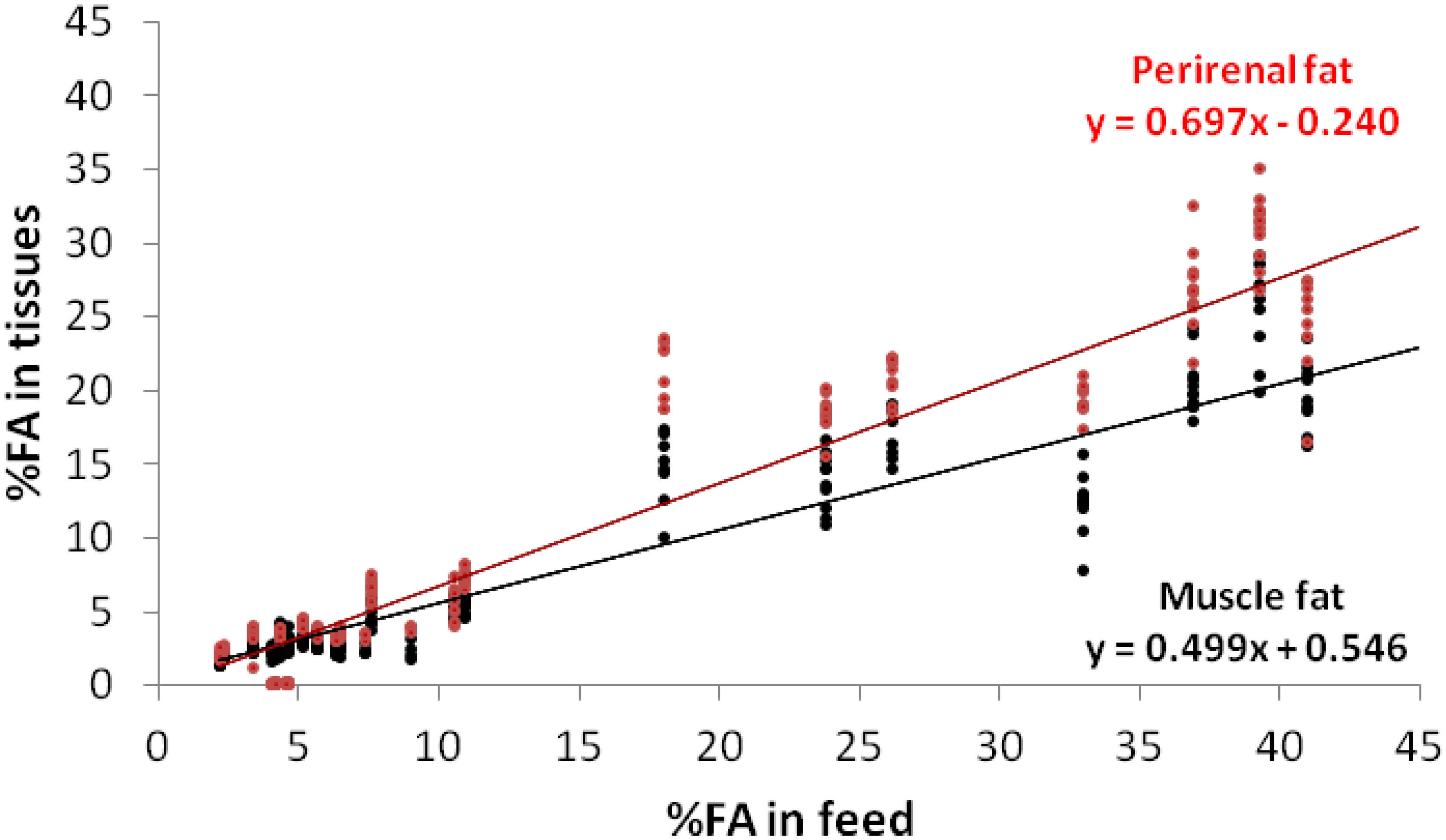
			</table-wrap><p>Table 3 shows the tests of the different concentrations in the two tissues, and the regression coefficients of the FAs in the muscle and perirenal fat on the same FAs of the diets. In general, from this table it emerged that perirenal fat was more reactive than muscle in modifying its FA profile according to the diets and that the two coefficients where not significantly different in only 3 cases out of 16. The FA profile of the muscle, which is more homeostatic, reproduces that of the cell membrane much more than that of the adipocite, in which the characteristics of the depot fat are pre-eminent [<xref ref-type="bibr" rid="B25-animals-02-00055">25</xref>].</p><p>There was a lack of lauric acid and arachidic acid in the muscle, while arachidonic acid (C20:4 n-6) was incorporated in the muscle at a very high ratio (4.04). In the case of integration with a small quantity of erucic acid, which is sometimes present in oil by-products used for animal supplies, this was totally transformed and disappeared from the tissues. The myristic (C14:0), palmitic and oleic acids were more abundant in the muscle than in the perirenal fat; moreover, the myristic and palmitic acids were less influenced by diet than the oleic acid. The γ-linolenic acid (C18:3 n-6), C16:1 n-7, C20:1 n-9, and C20:2 n-6 were more abundant in the perirenal fat than in the muscle.</p><p>The α-linolenic acid was detected in significantly greater concentrations in the perirenal fat than in the <italic>longissimus dorsi</italic> muscle (<xref ref-type="fig" rid="animals-02-00055-f001">Figure 1</xref>). The incorporation rate in the perirenal fat was 40% higher than in the muscle (0.7 <italic>vs.</italic> 0.5). Thus, the difference in the concentration between tissues only became relevant after 10% of integration. Combes [<xref ref-type="bibr" rid="B26-animals-02-00055">26</xref>], considering the results of 14 researches on rabbit nutrition, found a relationship (y = 0.13x + 0.92; R<sup>2</sup> = 0.532) between the α-linolenic acid of rabbit meat (y) and that of the feed (x). In that paper, the range of the FA in the diets was mainly restricted to 0–15% and the response was below 6% in the muscle. Petracci <italic>et al</italic>. [<xref ref-type="bibr" rid="B27-animals-02-00055">27</xref>] reported that α-linolenic acid enrichment has the potential of providing a useful intake of n-3 PUFA to help balance the n-6/n-3 PUFA ratio in rabbit meat.</p>
			<fig id="animals-02-00055-f001" position="anchor">
				<label>Figure 1</label>
				<caption>
					<p>Figure 1. Regressions of the α-linolenic acid (C18:3 n-3) contents in the muscle fat and perirenal fat, according to their contents in the feed.</p>
				</caption>
				<graphic xmlns:xlink="http://www.w3.org/1999/xlink" xlink:href="animals-02-00055-g001.tif"/>
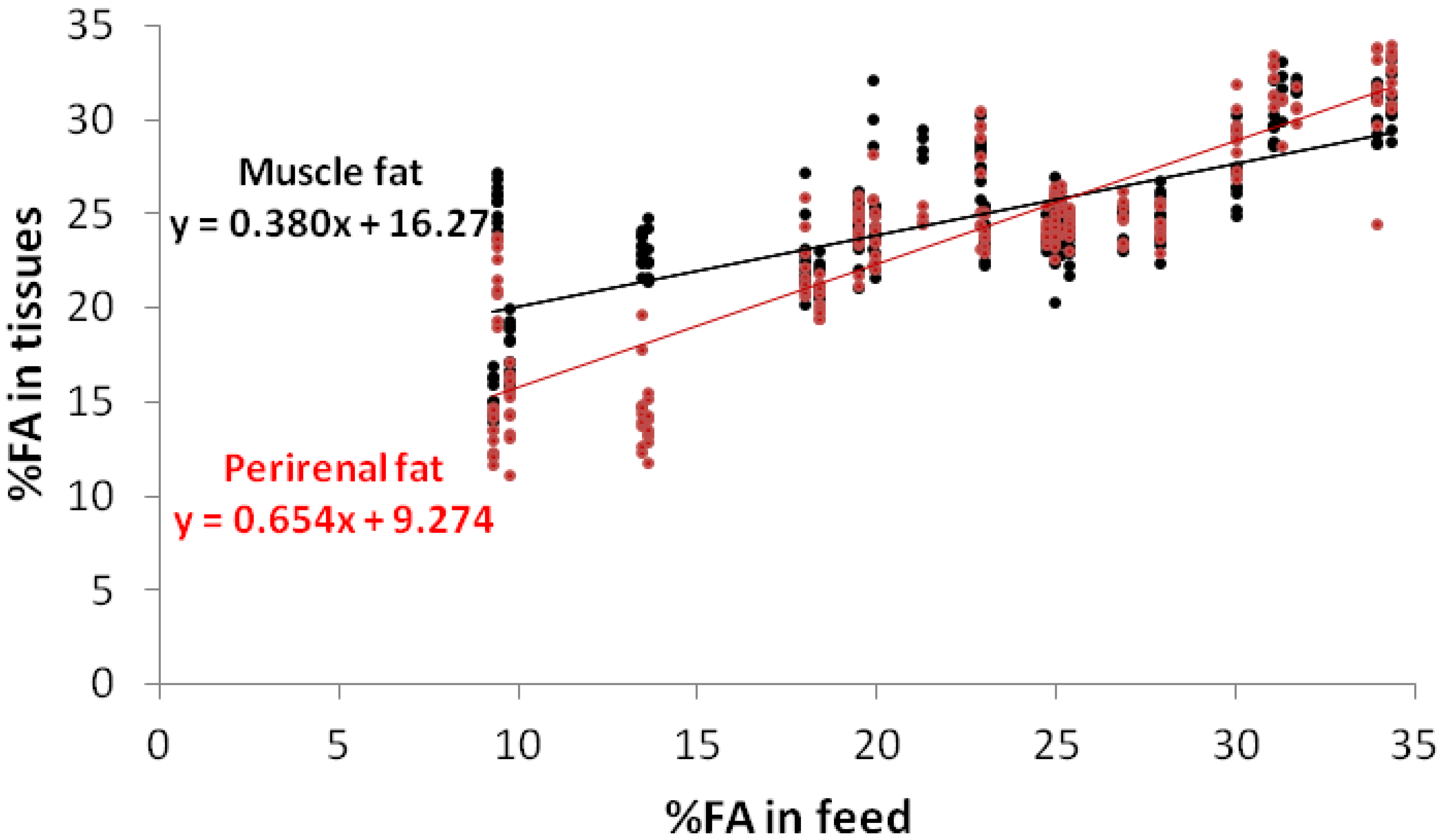
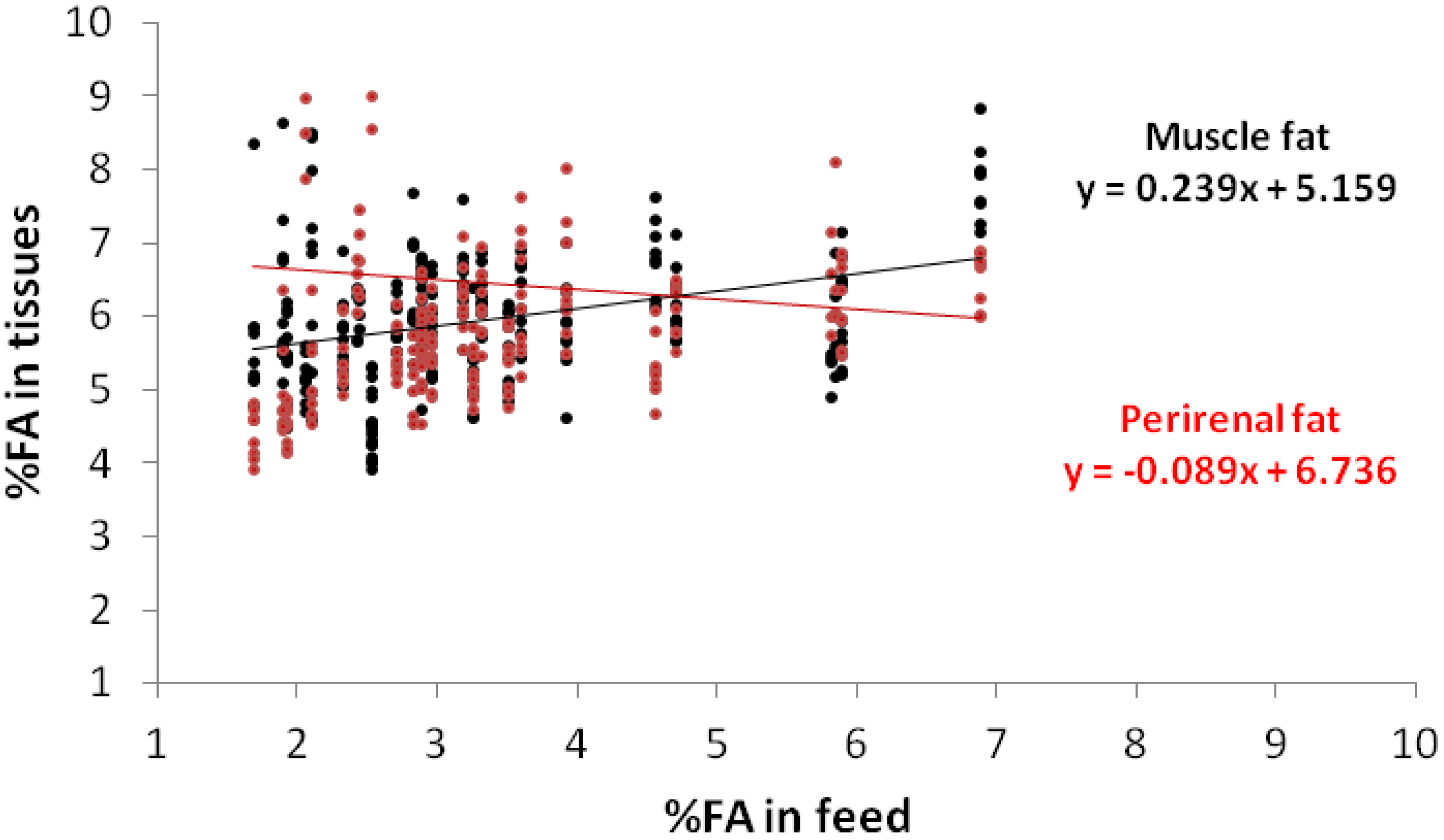
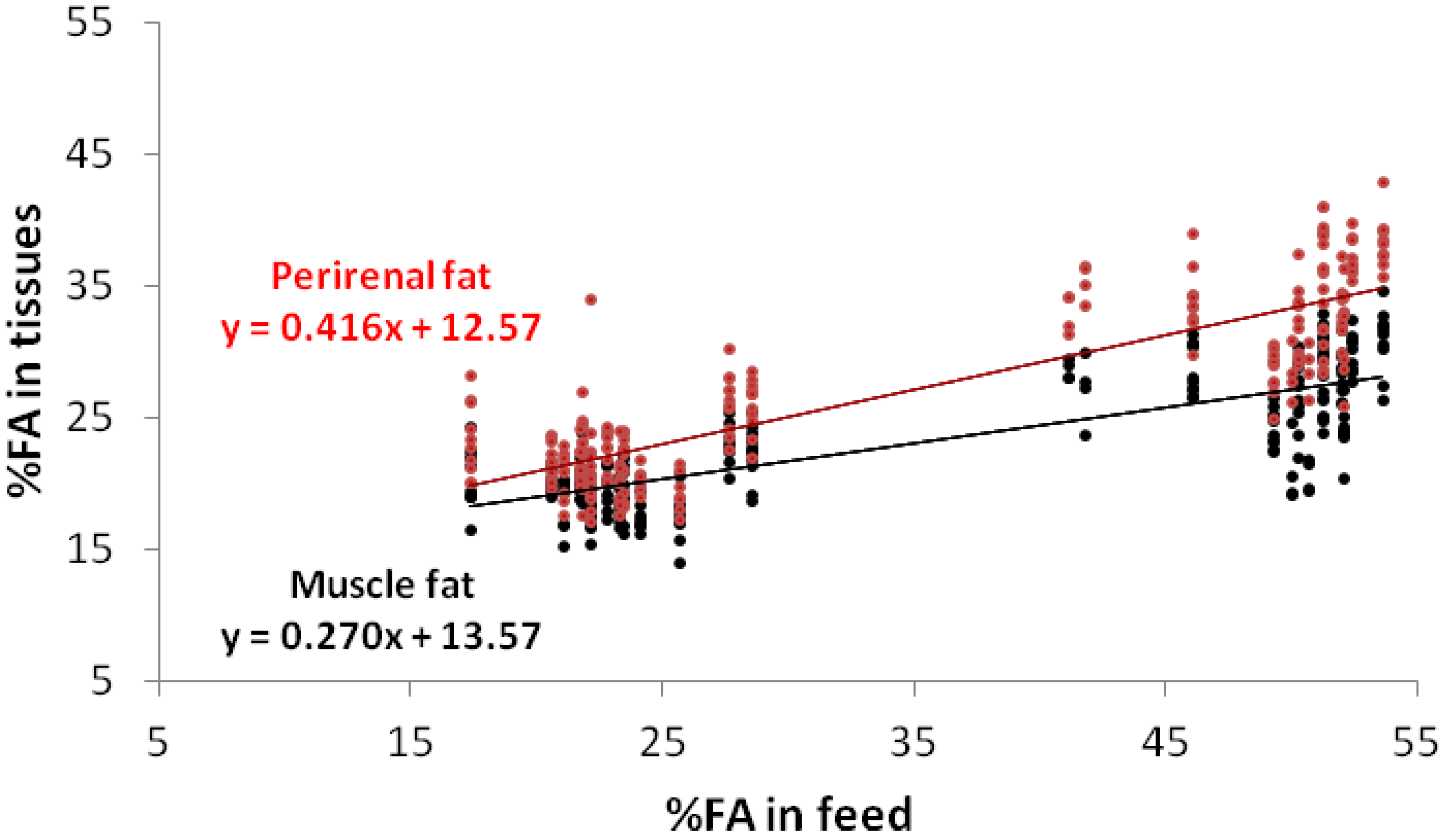
			</fig><p>Many studies have reported that the FA profile of rabbit meat may be favourably modified through the inclusion of raw materials rich in PUFA. Ouhayoun <italic>et al</italic>. [<xref ref-type="bibr" rid="B28-animals-02-00055">28</xref>] found that soya full fat can increase the proportion of linoleic acid in the adipose tissue by 30% of the total FAs. Cobos <italic>et al</italic>. [<xref ref-type="bibr" rid="B29-animals-02-00055">29</xref>] noted that enriching the diets of rabbits with soya, sunflower oil or soya bean oil increased the proportion of unsaturated FAs compared to those obtained using conventional diets. Xiccato <italic>et al</italic>. [<xref ref-type="bibr" rid="B30-animals-02-00055">30</xref>] also observed a high level of unsaturation in rabbit fat. Oliver <italic>et al</italic>. [<xref ref-type="bibr" rid="B3-animals-02-00055">3</xref>] found a clear effect of the composition of the diet on the FA composition of rabbit fat. Szabó <italic>et al</italic>. [<xref ref-type="bibr" rid="B31-animals-02-00055">31</xref>] reported that the FA profile of the <italic>longissimus dorsi</italic> muscle of rabbits effectively reflected that of three types of feed: a commercial pelletted diet and two high-fat diets, one complemented with a saturated animal fat source and the other with an unsaturated fat source (full-fat soya).</p><p>High levels of oleic acid in the diets of rabbits lead to an increase in this acid in the fat and a decrease in palmitic acid, which is regarded as beneficial from the human health point of view [<xref ref-type="bibr" rid="B32-animals-02-00055">32</xref>]. <xref ref-type="fig" rid="animals-02-00055-f002">Figure 2</xref> underlines the results of <xref ref-type="table" rid="animals-02-00055-t003">Table 3</xref> and outlines that the higher reactivity to the diet in the perirenal fat (0.66) than in the muscle (0.39), combined with the homeostasis in the muscle, delineates a real difference in the feeding levels below the 15% level, thereafter no difference was evident. On the contrary, stearic acid showed a mild decline (−0.12), but only in the perirenal fat (<xref ref-type="fig" rid="animals-02-00055-f003">Figure 3</xref>). <xref ref-type="fig" rid="animals-02-00055-f004">Figure 4</xref> shows the percentage of weight of linoleic acid in the muscle and in the perirenal rabbit fat, according to their contents in the diets with trend similar to that of α-linolenic acid.</p>
			<fig id="animals-02-00055-f002" position="anchor">
				<label>Figure 2</label>
				<caption>
					<p>Figure 2. Regressions of the oleic acid (C18:1 n-9) contents in the muscle fat and perirenal fat, according to their contents in the feed.</p>
				</caption>
				<graphic xmlns:xlink="http://www.w3.org/1999/xlink" xlink:href="animals-02-00055-g002.tif"/>
			</fig>
			<fig id="animals-02-00055-f003" position="anchor">
				<label>Figure 3</label>
				<caption>
					<p>Figure 3. Regressions of the stearic acid (C18:0) contents in the muscle fat and perirenal fat, according to their contents in the feed.</p>
				</caption>
				<graphic xmlns:xlink="http://www.w3.org/1999/xlink" xlink:href="animals-02-00055-g003.tif"/>
			</fig>
			<fig id="animals-02-00055-f004" position="anchor">
				<label>Figure 4</label>
				<caption>
					<p>Figure 4. Regressions of the linoleic acid (C18:2 n-6) contents in the muscle fat and perirenal fat, according to their contents in the feed.</p>
				</caption>
				<graphic xmlns:xlink="http://www.w3.org/1999/xlink" xlink:href="animals-02-00055-g004.tif"/>
			</fig><p>Feeding rabbits with diets containing considerable amounts of linoleic acid leads to an increase in the amount of this acid in the perirenal fat, although only up to a certain point [<xref ref-type="bibr" rid="B27-animals-02-00055">27</xref>,<xref ref-type="bibr" rid="B30-animals-02-00055">30</xref>].</p><p>Hernández <italic>et al</italic>. [<xref ref-type="bibr" rid="B33-animals-02-00055">33</xref>] found higher percentages of linoleic and α-linolenic acid in the meat of rabbits fed a diet enriched with 3% linseed oil and 3% sunflower oil, respectively, than in the rabbits fed a diet enriched with 3% animal fat.</p><p>Gigaud and Combes [<xref ref-type="bibr" rid="B34-animals-02-00055">34</xref>] found a closer relationship (y = 1.58x + 21.16; R<sup>2</sup> = 0.894) between the n-3 PUFA content in the meat (y) and in the feed (x).</p><p>Colin <italic>et al</italic>. [<xref ref-type="bibr" rid="B35-animals-02-00055">35</xref>] studied the influence, on meat lipids, of an increase in n-3 PUFA level in the feed with the incorporation of extruded linseed, and found a close relationship (y = 3.58x + 2.48; R<sup>2</sup> = 0.938) between the n-3 PUFA content in the rabbit meat (y) and in the feed (x).</p>
			<table-wrap id="animals-02-00055-t004" position="anchor">
				<object-id pub-id-type="pii">animals-02-00055-t004_Table 4</object-id>
				<label>Table 4</label>
				<caption>
					<p>Table 4. Linear regression equations of the total sum of n-3 PUFA (C18:3 n-3 + C20:3 n-3 + C20:5 n-3 + C22:6 n-3) in the <italic>longissimus dorsi</italic> muscle (M) and in the perirenal fat (P) on percentage of the eleven fatty acids in the feed.</p>
				</caption>
				<table>
					<thead>
						<tr>
							<th>Independent FAs (X)</th>
							<th/>
							<th>Muscle (M)</th>
							<th>Perirenal (P)</th>
						</tr>
					</thead>
					<tbody>
						<tr>
							<td>R2</td>
							<td>0.94</td>
							<td>0.96</td>
						</tr>
						<tr>
							<td>SE</td>
							<td>1.86</td>
							<td>2.06</td>
						</tr>
						<tr>
							<td>Mean</td>
							<td>7.96</td>
							<td>9.98</td>
						</tr>
						<tr>
							<td>Intercept</td>
							<td>aM</td>
							<td>SaM</td>
							<td>Sign.</td>
							<td>aP</td>
							<td>SaP</td>
							<td>Sign.</td>
						</tr>
						<tr>
							<td>−27</td>
							<td>10.3</td>
							<td>0.0136</td>
							<td>−46</td>
							<td>9.7</td>
							<td/>
						</tr>
					</tbody>
				</table>
			</table-wrap><p>In the present work, the n-3 polyunsaturated fatty acids (n-3 PUFA) meat content followed the dietary content (<xref ref-type="fig" rid="animals-02-00055-f001">Figure 1</xref> and <xref ref-type="table" rid="animals-02-00055-t004">Table 4</xref>), but in a unusual way. In fact, considering the 11 dietary FAs significantly related to the n-3 PUFA (R<sup>2</sup> = 0.94 and 0.96, for the muscle and perirenal fat, respectively), the α-linolenic acid, was the only n-3 PUFA in the diets which was incorporated at a 0.7 and 1.0 rate in the two tissues. Lauric acid showed a negative effect on the bio-accumulation of n-3 PUFA in the perirenal fat, but, conversely, palmitoleic acid (C16:1 n-7) strongly favoured an n-3 PUFA increase (7.4 and 7.5). Other FAs contributed positively, namely: miristic acid (4.5 and 7.6); oleic and linoleic acid with slight coefficients of around 0.5, but these FAs are represented massively (over the 50% of the FAs); the long-chain FAs (C20:0, C20:1 n-9, and C20:2 n-6) were also correlated to the n-3 PUFA growth in the rabbit tissues. As far as the etiology of these statistical relationships is concerned the answer may derive from common or concurrent pathways: α-linolenic and linoleic acid serve as the precursor molecules from which the set of FAs belonging to the n-3 and n-6 PUFA family can be synthesized through a series of elongation and desaturation reactions. All the reactions are catalyzed by an enzymatic system consisting of fatty acil-CoA synthetases ∆6 and ∆5 desaturases and the respective elongases. These two FA families not only share these enzymes, but they also compete for the same enzymes [<xref ref-type="bibr" rid="B36-animals-02-00055">36</xref>].</p><p>Reversibility of the FA profile in rabbit muscle has been studied using two dietary fat supplementations [<xref ref-type="bibr" rid="B9-animals-02-00055">9</xref>]. FA incorporation and reversibility in the muscle have been demonstrated and, at the end of the trial, the experimental groups only differed on the basis of the meat contents of the palmitic and linoleic acids. The restitution of the tissue FA profile, following a change in the dietary fat source, can clearly be obtained, but it depends on the magnitude of the proportional change in the FAs in the diet.</p>
			<table-wrap id="animals-02-00055-t005" position="anchor">
				<object-id pub-id-type="pii">animals-02-00055-t005_Table 5</object-id>
				<label>Table 5</label>
				<caption>
					<p>Table 5. Pearson correlations between the FA averages of the experimental groups.</p>
				</caption>
				<table>
					<thead>
						<tr>
							<th/>
							<th>r</th>
							<th>r<sup>2</sup>
							</th>
						</tr>
						<tr>
							<th/>
							<th>Diets</th>
							<th>Muscle</th>
							<th>Perirenal</th>
							<th>Diets</th>
							<th>Muscle</th>
							<th>Perirenal</th>
						</tr>
					</thead>
					<tbody>
						<tr>
							<td>Diets</td>
							<td>1</td>
							<td>0.870</td>
							<td>0.926</td>
							<td>1</td>
							<td>0.756</td>
							<td>0.856</td>
						</tr>
						<tr>
							<td>Muscle</td>
							<td>0.870</td>
							<td>1</td>
							<td>0.975</td>
							<td>0.756</td>
							<td>1</td>
							<td>0.951</td>
						</tr>
						<tr>
							<td>Perirenal</td>
							<td>0.926</td>
							<td>0.975</td>
							<td>1</td>
							<td>0.857</td>
							<td>0.951</td>
							<td>1</td>
						</tr>
					</tbody>
				</table>
			</table-wrap><p>As can be seen in <xref ref-type="table" rid="animals-02-00055-t005">Table 5</xref>, considering the correlations of 3,792 diet-muscle-perirenal fat triplets concerning 16 available FAs, the profiles of the two tissues appeared to be very similar to each other (r<sup>2</sup> = 0.951), but the feeding varieties had a greater impact on the perirenal fat (r<sup>2</sup> = 0.857) and, to a lesser extent, on the muscle (r<sup>2</sup> = 0.756) FA layout; essentially, the overall difference between the tissues in the reflection of the characteristics of the diet, amounted to 10%.</p>
		</sec>
		<sec sec-type="conclusions">
			<title>4.  Conclusions</title><p>The FA profile was clearly influenced by diet composition and it was possible to linearly characterize the incorporation of certain FAs. Our studies on rabbit meat indicate that the dietary inclusion of various raw materials could be considered as a way of achieving the enrichment of both linoleic and α-linolenic acid in the rabbit meat. Further research is needed to identify the optimum conditions necessary to obtain the required dietary results at lower costs. A proposal for the prediction of n-3 PUFA from dietary α-linolenic acid and a panel of another ten FAs has been made.</p>
		</sec>
	</body>
	<back>
		<ack>
			<title>Acknowledgements</title><p>The author declares no conflict of interest.</p>
		</ack>
		<ref-list>
			<title>References</title>
			<ref id="B1-animals-02-00055">
				<label>1.</label>
				<citation citation-type="journal">
					<person-group person-group-type="author">
						<name>
							<surname>Dalle Zotte</surname>
							<given-names>A.</given-names>
						</name>
					</person-group>
					<article-title>Perception of rabbit meat quality and major factors influencing the rabbit carcass and meat quality.</article-title>
					<source>Livest. Prod. Sci.</source>
					<year>2002</year>
					<volume>75</volume>
					<fpage>11</fpage>
					<lpage>32</lpage>
					<pub-id pub-id-type="doi">10.1016/S0301-6226(01)00308-6</pub-id>
				</citation>
			</ref>
			<ref id="B2-animals-02-00055">
				<label>2.</label>
				<citation citation-type="confproc">
					<person-group person-group-type="author">
						<name>
							<surname>Hernández</surname>
							<given-names>P.</given-names>
						</name>
					</person-group>
					<article-title>Enhancement of nutritional quality and safety in rabbit meat.</article-title>
					<source>Proceeding of 9th World Rabbit Congress</source>
					<conf-date>10–13 June 2008</conf-date>
					<conf-loc>Verona, Italy</conf-loc>
				</citation>
			</ref>
			<ref id="B3-animals-02-00055">
				<label>3.</label>
				<citation citation-type="journal">
					<person-group person-group-type="author">
						<name>
							<surname>Diaz</surname>
							<given-names>I.</given-names>
						</name>
						<name>
							<surname>Gispert</surname>
							<given-names>M.</given-names>
						</name>
						<name>
							<surname>Pla</surname>
							<given-names>M.</given-names>
						</name>
						<name>
							<surname>Blasco</surname>
							<given-names>A.</given-names>
						</name>
						<name>
							<surname>Guerrero</surname>
							<given-names>L.</given-names>
						</name>
						<name>
							<surname>Oliver</surname>
							<given-names>M.A.</given-names>
						</name>
					</person-group>
					<article-title>The effect of fat-enriched diets on the perirenal fat quality and sensory characteristics of meat from rabbits.</article-title>
					<source>Meat Sci.</source>
					<year>1997</year>
					<volume>47</volume>
					<fpage>95</fpage>
					<lpage>103</lpage>
					<pub-id pub-id-type="doi">10.1016/S0309-1740(97)00041-7</pub-id>
					<pub-id pub-id-type="pmid">22062620</pub-id>
				</citation>
			</ref>
			<ref id="B4-animals-02-00055">
				<label>4.</label>
				<citation citation-type="journal">
					<person-group person-group-type="author">
						<name>
							<surname>Díaz</surname>
							<given-names>I.</given-names>
						</name>
						<name>
							<surname>Pla</surname>
							<given-names>M.</given-names>
						</name>
						<name>
							<surname>Gil</surname>
							<given-names>M.</given-names>
						</name>
						<name>
							<surname>Blasco</surname>
							<given-names>A.</given-names>
						</name>
						<name>
							<surname>Oliver</surname>
							<given-names>M.À.</given-names>
						</name>
						<name>
							<surname>Ramírez</surname>
							<given-names>J.A.</given-names>
						</name>
					</person-group>
					<article-title>Fatty acid composition of leg meat and perirenal fat of rabbits selected by growth rate.</article-title>
					<source>Food Chem.</source>
					<year>2005</year>
					<volume>90</volume>
					<fpage>251</fpage>
					<lpage>256</lpage>
					<pub-id pub-id-type="doi">10.1016/j.foodchem.2004.04.001</pub-id>
				</citation>
			</ref>
			<ref id="B5-animals-02-00055">
				<label>5.</label>
				<citation citation-type="journal">
					<person-group person-group-type="author">
						<name>
							<surname>Gašperlin</surname>
							<given-names>L.</given-names>
						</name>
						<name>
							<surname>Rajar</surname>
							<given-names>A.</given-names>
						</name>
						<name>
							<surname>Žlender</surname>
							<given-names>B.</given-names>
						</name>
						<name>
							<surname>Polak</surname>
							<given-names>T.</given-names>
						</name>
					</person-group>
					<article-title>Influence of genotype lines, age at slaughter and sexes on the composition of rabbit meat.</article-title>
					<source>Food Technol. Biotechnol.</source>
					<year>2006</year>
					<volume>44</volume>
					<fpage>65</fpage>
					<lpage>73</lpage>
				</citation>
			</ref>
			<ref id="B6-animals-02-00055">
				<label>6.</label>
				<citation citation-type="journal">
					<person-group person-group-type="author">
						<name>
							<surname>Hernández</surname>
							<given-names>P.</given-names>
						</name>
						<name>
							<surname>Pla</surname>
							<given-names>M.</given-names>
						</name>
						<name>
							<surname>Oliver</surname>
							<given-names>M.A.</given-names>
						</name>
						<name>
							<surname>Blasco</surname>
							<given-names>A.</given-names>
						</name>
					</person-group>
					<article-title>Relationships between meat quality measurements in rabbits fed with three diets with different fat type and content.</article-title>
					<source>Meat Sci.</source>
					<year>2000</year>
					<volume>55</volume>
					<fpage>379</fpage>
					<lpage>384</lpage>
					<pub-id pub-id-type="doi">10.1016/S0309-1740(99)00163-1</pub-id>
					<pub-id pub-id-type="pmid">22061568</pub-id>
				</citation>
			</ref>
			<ref id="B7-animals-02-00055">
				<label>7.</label>
				<citation citation-type="journal">
					<person-group person-group-type="author">
						<name>
							<surname>Szabó</surname>
							<given-names>A.</given-names>
						</name>
						<name>
							<surname>Husvéth</surname>
							<given-names>F.</given-names>
						</name>
						<name>
							<surname>Szendrõ</surname>
							<given-names>Z.</given-names>
						</name>
						<name>
							<surname>Repa</surname>
							<given-names>I.</given-names>
						</name>
						<name>
							<surname>Romvári</surname>
							<given-names>R.</given-names>
						</name>
					</person-group>
					<article-title>Effects of transcutaneous electrical nerve stimulation on the fatty acid profile of rabbit <italic>longissimus dorsi</italic> muscle (preliminary report).</article-title>
					<source>J. Anim. Physiol. Anim. Nutr.</source>
					<year>2003</year>
					<volume>87</volume>
					<fpage>309</fpage>
					<lpage>314</lpage>
					<pub-id pub-id-type="doi">10.1046/j.1439-0396.2003.00417.x</pub-id>
				</citation>
			</ref>
			<ref id="B8-animals-02-00055">
				<label>8.</label>
				<citation citation-type="journal">
					<person-group person-group-type="author">
						<name>
							<surname>Cavani</surname>
							<given-names>C.</given-names>
						</name>
						<name>
							<surname>Petracci</surname>
							<given-names>M.</given-names>
						</name>
						<name>
							<surname>Trocino</surname>
							<given-names>A.</given-names>
						</name>
						<name>
							<surname>Xiccato</surname>
							<given-names>G.</given-names>
						</name>
					</person-group>
					<article-title>Advances in research on poultry and rabbit meat quality.</article-title>
					<source>Ital. J. Anim. Sci.</source>
					<year>2009</year>
					<volume>8</volume>
					<fpage>741</fpage>
					<lpage>750</lpage>
				</citation>
			</ref>
			<ref id="B9-animals-02-00055">
				<label>9.</label>
				<citation citation-type="journal">
					<person-group person-group-type="author">
						<name>
							<surname>Szabó</surname>
							<given-names>A.</given-names>
						</name>
						<name>
							<surname>Fébel</surname>
							<given-names>H.</given-names>
						</name>
						<name>
							<surname>Dalle Zotte</surname>
							<given-names>A.</given-names>
						</name>
						<name>
							<surname>Mézes</surname>
							<given-names>M.</given-names>
						</name>
						<name>
							<surname>Szendrő</surname>
							<given-names>Zs.</given-names>
						</name>
						<name>
							<surname>Romvári</surname>
							<given-names>R.</given-names>
						</name>
					</person-group>
					<article-title>Reversibility of the changes of rabbit muscle fatty acid profile.</article-title>
					<source>Ital. J. Food Sci.</source>
					<year>2004</year>
					<volume>16</volume>
					<fpage>69</fpage>
					<lpage>77</lpage>
				</citation>
			</ref>
			<ref id="B10-animals-02-00055">
				<label>10.</label>
				<citation citation-type="journal">
					<person-group person-group-type="author">
						<name>
							<surname>Xiccato</surname>
							<given-names>G.</given-names>
						</name>
					</person-group>
					<article-title>Feeding and meat quality in rabbits: A review.</article-title>
					<source>World Rabbit Sci.</source>
					<year>1999</year>
					<volume>7</volume>
					<fpage>75</fpage>
					<lpage>86</lpage>
				</citation>
			</ref>
			<ref id="B11-animals-02-00055">
				<label>11.</label>
				<citation citation-type="journal">
					<person-group person-group-type="author">
						<name>
							<surname>Dalle Zotte</surname>
							<given-names>A.</given-names>
						</name>
						<name>
							<surname>Szendrő</surname>
							<given-names>Z.</given-names>
						</name>
					</person-group>
					<article-title>The role of rabbit meat as functional food.</article-title>
					<source>Meat Sci.</source>
					<year>2011</year>
					<volume>88</volume>
					<fpage>319</fpage>
					<lpage>331</lpage>
					<pub-id pub-id-type="doi">10.1016/j.meatsci.2011.02.017</pub-id>
					<pub-id pub-id-type="pmid">21392894</pub-id>
				</citation>
			</ref>
			<ref id="B12-animals-02-00055">
				<label>12.</label>
				<citation citation-type="journal">
					<person-group person-group-type="author">
						<name>
							<surname>Meineri</surname>
							<given-names>G.</given-names>
						</name>
						<name>
							<surname>Ingravalle</surname>
							<given-names>F.</given-names>
						</name>
						<name>
							<surname>Radice</surname>
							<given-names>E.</given-names>
						</name>
						<name>
							<surname>Aragno</surname>
							<given-names>M.</given-names>
						</name>
						<name>
							<surname>Peiretti</surname>
							<given-names>P.G.</given-names>
						</name>
					</person-group>
					<article-title>Effects of high fat diets and <italic>Spirulina platensis</italic> supplementation in New Zealand White Rabbits.</article-title>
					<source>J. Anim. Vet. Adv.</source>
					<year>2009</year>
					<volume>8</volume>
					<fpage>2735</fpage>
					<lpage>2744</lpage>
				</citation>
			</ref>
			<ref id="B13-animals-02-00055">
				<label>13.</label>
				<citation citation-type="journal">
					<person-group person-group-type="author">
						<name>
							<surname>Peiretti</surname>
							<given-names>P.G.</given-names>
						</name>
						<name>
							<surname>Mussa</surname>
							<given-names>P.P.</given-names>
						</name>
						<name>
							<surname>Prola</surname>
							<given-names>L.</given-names>
						</name>
						<name>
							<surname>Meineri</surname>
							<given-names>G.</given-names>
						</name>
					</person-group>
					<article-title>Use of different levels of false flax (<italic>Camelina sativa</italic> L.) seed in diets for fattening rabbits.</article-title>
					<source>Livest. Sci.</source>
					<year>2007</year>
					<volume>107</volume>
					<fpage>192</fpage>
					<lpage>198</lpage>
					<pub-id pub-id-type="doi">10.1016/j.livsci.2006.09.015</pub-id>
				</citation>
			</ref>
			<ref id="B14-animals-02-00055">
				<label>14.</label>
				<citation citation-type="journal">
					<person-group person-group-type="author">
						<name>
							<surname>Peiretti</surname>
							<given-names>P.G.</given-names>
						</name>
						<name>
							<surname>Meineri</surname>
							<given-names>G.</given-names>
						</name>
					</person-group>
					<article-title>Effects on growth performance, carcass characteristics, and the fat and meat fatty acid profile of rabbits fed diets with chia (<italic>Salvia hispanica</italic> L.) seed supplements.</article-title>
					<source>Meat Sci.</source>
					<year>2008</year>
					<volume>80</volume>
					<fpage>1116</fpage>
					<lpage>1121</lpage>
					<pub-id pub-id-type="doi">10.1016/j.meatsci.2008.05.003</pub-id>
					<pub-id pub-id-type="pmid">22063845</pub-id>
				</citation>
			</ref>
			<ref id="B15-animals-02-00055">
				<label>15.</label>
				<citation citation-type="journal">
					<person-group person-group-type="author">
						<name>
							<surname>Peiretti</surname>
							<given-names>P.G.</given-names>
						</name>
						<name>
							<surname>Meineri</surname>
							<given-names>G.</given-names>
						</name>
					</person-group>
					<article-title>Effects of diets with increasing levels of golden flaxseed on carcass characteristics, meat quality and lipid traits of growing rabbits.</article-title>
					<source>Ital. J. Anim. Sci.</source>
					<year>2010</year>
					<volume>9</volume>
					<fpage>372</fpage>
					<lpage>377</lpage>
				</citation>
			</ref>
			<ref id="B16-animals-02-00055">
				<label>16.</label>
				<citation citation-type="journal">
					<person-group person-group-type="author">
						<name>
							<surname>Peiretti</surname>
							<given-names>P.G.</given-names>
						</name>
						<name>
							<surname>Meineri</surname>
							<given-names>G.</given-names>
						</name>
					</person-group>
					<article-title>Effects of <italic>Spirulina platensis</italic> supplementation on carcass characteristics, meat quality and lipid traits of growing rabbits.</article-title>
					<source>Livest. Sci.</source>
					<year>2011</year>
					<volume>140</volume>
					<fpage>218</fpage>
					<lpage>224</lpage>
					<pub-id pub-id-type="doi">10.1016/j.livsci.2011.03.031</pub-id>
				</citation>
			</ref>
			<ref id="B17-animals-02-00055">
				<label>17.</label>
				<citation citation-type="journal">
					<person-group person-group-type="author">
						<name>
							<surname>Peiretti</surname>
							<given-names>P.G.</given-names>
						</name>
						<name>
							<surname>Gasco</surname>
							<given-names>L.</given-names>
						</name>
						<name>
							<surname>Brugiapaglia</surname>
							<given-names>A.</given-names>
						</name>
						<name>
							<surname>Gai</surname>
							<given-names>F.</given-names>
						</name>
					</person-group>
					<article-title>Effects of perilla (<italic>Perilla frutescens</italic> L.) seeds supplementation on performance, carcass characteristics, meat quality and fatty acid composition of rabbits.</article-title>
					<source>Livest. Sci.</source>
					<year>2011</year>
					<volume>138</volume>
					<fpage>118</fpage>
					<lpage>124</lpage>
					<pub-id pub-id-type="doi">10.1016/j.livsci.2010.12.007</pub-id>
				</citation>
			</ref>
			<ref id="B18-animals-02-00055">
				<label>18.</label>
				<citation citation-type="journal">
					<person-group person-group-type="author">
						<name>
							<surname>Peiretti</surname>
							<given-names>P.G.</given-names>
						</name>
						<name>
							<surname>Masoero</surname>
							<given-names>G.</given-names>
						</name>
						<name>
							<surname>Meineri</surname>
							<given-names>G.</given-names>
						</name>
					</person-group>
					<article-title>Effects of replacing palm oil with maize oil and Curcuma longa supplementation on the performance, carcass characteristics, meat quality, and fatty acid profile of the perirenal fat and muscle of growing rabbits.</article-title>
					<source>Animal</source>
					<year>2011</year>
					<volume>5</volume>
					<fpage>795</fpage>
					<lpage>801</lpage>
					<pub-id pub-id-type="doi">10.1017/S175173111000234X</pub-id>
					<pub-id pub-id-type="pmid">22440002</pub-id>
				</citation>
			</ref>
			<ref id="B19-animals-02-00055">
				<label>19.</label>
				<citation citation-type="journal">
					<person-group person-group-type="author">
						<name>
							<surname>Peiretti</surname>
							<given-names>P.G.</given-names>
						</name>
						<name>
							<surname>Gai</surname>
							<given-names>F.</given-names>
						</name>
						<name>
							<surname>Rotolo</surname>
							<given-names>L.</given-names>
						</name>
						<name>
							<surname>Gasco</surname>
							<given-names>L.</given-names>
						</name>
					</person-group>
					<article-title>Effects of diets with increasing levels of dried tomato pomace on the performances and apparent digestibility of growing rabbits.</article-title>
					<source>Asian J. Anim. Vet. Adv.</source>
					<year>2012</year>
					<volume>7</volume>
					<fpage>521</fpage>
					<lpage>527</lpage>
					<pub-id pub-id-type="doi">10.3923/ajava.2012.521.527</pub-id>
				</citation>
			</ref>
			<ref id="B20-animals-02-00055">
				<label>20.</label>
				<citation citation-type="journal">
					<person-group person-group-type="author">
						<name>
							<surname>Fernández-Carmona</surname>
							<given-names>J.</given-names>
						</name>
						<name>
							<surname>Blas</surname>
							<given-names>E.</given-names>
						</name>
						<name>
							<surname>Pascual</surname>
							<given-names>J.J.</given-names>
						</name>
						<name>
							<surname>Maertens</surname>
							<given-names>L.</given-names>
						</name>
						<name>
							<surname>Gidenne</surname>
							<given-names>T.</given-names>
						</name>
						<name>
							<surname>Xiccato</surname>
							<given-names>G.</given-names>
						</name>
						<name>
							<surname>García</surname>
							<given-names>J.</given-names>
						</name>
					</person-group>
					<article-title>Recommendations and guidelines for applied nutrition experiments in rabbits.</article-title>
					<source>World Rabbit Science</source>
					<year>2005</year>
					<volume>13</volume>
					<fpage>209</fpage>
					<lpage>228</lpage>
				</citation>
			</ref>
			<ref id="B21-animals-02-00055">
				<label>21.</label>
				<citation citation-type="journal">
					<person-group person-group-type="author">
						<name>
							<surname>Hara</surname>
							<given-names>A.</given-names>
						</name>
						<name>
							<surname>Radin</surname>
							<given-names>N.S.</given-names>
						</name>
					</person-group>
					<article-title>Lipid extraction of tissues with a low-toxicity solvent.</article-title>
					<source>Anal. Biochem.</source>
					<year>1978</year>
					<volume>90</volume>
					<fpage>420</fpage>
					<lpage>426</lpage>
					<pub-id pub-id-type="doi">10.1016/0003-2697(78)90046-5</pub-id>
					<pub-id pub-id-type="pmid">727482</pub-id>
				</citation>
			</ref>
			<ref id="B22-animals-02-00055">
				<label>22.</label>
				<citation citation-type="journal">
					<person-group person-group-type="author">
						<name>
							<surname>Christie</surname>
							<given-names>W.W.</given-names>
						</name>
					</person-group>
					<article-title>A simple procedure for rapid transmethylation of glycerolipids and cholesteryl esters.</article-title>
					<source>J. Lipid Res.</source>
					<year>1982</year>
					<volume>23</volume>
					<fpage>1072</fpage>
					<lpage>1075</lpage>
					<pub-id pub-id-type="pmid">6897259</pub-id>
				</citation>
			</ref>
			<ref id="B23-animals-02-00055">
				<label>23.</label>
				<citation citation-type="journal">
					<person-group person-group-type="author">
						<name>
							<surname>Chouinard</surname>
							<given-names>P.Y.</given-names>
						</name>
						<name>
							<surname>Corneau</surname>
							<given-names>L.</given-names>
						</name>
						<name>
							<surname>Sæbø</surname>
							<given-names>A.</given-names>
						</name>
						<name>
							<surname>Bauman</surname>
							<given-names>D.E.</given-names>
						</name>
					</person-group>
					<article-title>Milk yield and composition during abomasal infusion of conjugated linoleic acids in dairy cows.</article-title>
					<source>J. Dairy Sci.</source>
					<year>1999</year>
					<volume>82</volume>
					<fpage>2737</fpage>
					<lpage>2745</lpage>
					<pub-id pub-id-type="doi">10.3168/jds.S0022-0302(99)75530-X</pub-id>
					<pub-id pub-id-type="pmid">10629821</pub-id>
				</citation>
			</ref>
			<ref id="B24-animals-02-00055">
				<label>24.</label>
				<citation citation-type="book">
					<person-group person-group-type="author">
						<name>
							<surname>Nie</surname>
							<given-names>N.H.</given-names>
						</name>
						<name>
							<surname>Hull</surname>
							<given-names>C.H.</given-names>
						</name>
						<name>
							<surname>Jenkins</surname>
							<given-names>J.G.</given-names>
						</name>
						<name>
							<surname>Steinbrenner</surname>
							<given-names>K.</given-names>
						</name>
						<name>
							<surname>Bent</surname>
							<given-names>D.H.</given-names>
						</name>
					</person-group>
					<source>SPSS Statistical Package for the Social Sciences</source>
					<year>1981</year>
					<publisher-name>McGraw-Hill</publisher-name>
					<publisher-loc>New York, NY, USA</publisher-loc>
				</citation>
			</ref>
			<ref id="B25-animals-02-00055">
				<label>25.</label>
				<citation citation-type="journal">
					<person-group person-group-type="author">
						<name>
							<surname>Bernardini</surname>
							<given-names>M.</given-names>
						</name>
						<name>
							<surname>Dal Bosco</surname>
							<given-names>A.</given-names>
						</name>
						<name>
							<surname>Castellini</surname>
							<given-names>C.</given-names>
						</name>
					</person-group>
					<article-title>Effect of dietary n-3/n-6 ratio on fatty acid composition of liver, meat and perirenal fat in rabbits.</article-title>
					<source>Anim. Sci.</source>
					<year>1999</year>
					<volume>68</volume>
					<fpage>647</fpage>
					<lpage>654</lpage>
				</citation>
			</ref>
			<ref id="B26-animals-02-00055">
				<label>26.</label>
				<citation citation-type="journal">
					<person-group person-group-type="author">
						<name>
							<surname>Combes</surname>
							<given-names>S.</given-names>
						</name>
					</person-group>
					<article-title>Valeur nutritionnelle de la viande de lapin.</article-title>
					<source>INRA Prod. Anim.</source>
					<year>2004</year>
					<volume>17</volume>
					<fpage>373</fpage>
					<lpage>383</lpage>
				</citation>
			</ref>
			<ref id="B27-animals-02-00055">
				<label>27.</label>
				<citation citation-type="journal">
					<person-group person-group-type="author">
						<name>
							<surname>Petracci</surname>
							<given-names>M.</given-names>
						</name>
						<name>
							<surname>Bianchi</surname>
							<given-names>M.</given-names>
						</name>
						<name>
							<surname>Cavani</surname>
							<given-names>C.</given-names>
						</name>
					</person-group>
					<article-title>Development of rabbit meat products fortified with n-3 polyunsaturated fatty acids.</article-title>
					<source>Nutrients</source>
					<year>2009</year>
					<volume>1</volume>
					<fpage>111</fpage>
					<lpage>118</lpage>
					<pub-id pub-id-type="doi">10.3390/nu1020111</pub-id>
					<pub-id pub-id-type="pmid">22253971</pub-id>
				</citation>
			</ref>
			<ref id="B28-animals-02-00055">
				<label>28.</label>
				<citation citation-type="journal">
					<person-group person-group-type="author">
						<name>
							<surname>Ouhayoun</surname>
							<given-names>J.</given-names>
						</name>
						<name>
							<surname>Demarne</surname>
							<given-names>Y.</given-names>
						</name>
						<name>
							<surname>Delmas</surname>
							<given-names>D.</given-names>
						</name>
						<name>
							<surname>Lebas</surname>
							<given-names>F.</given-names>
						</name>
					</person-group>
					<article-title>Utilization de pellicules de colza dans l’alimentation du lapin en croissance. II. Effect sur la qualite des carcasses.</article-title>
					<source>Ann. Zootech.</source>
					<year>1981</year>
					<volume>30</volume>
					<fpage>325</fpage>
					<lpage>333</lpage>
					<pub-id pub-id-type="doi">10.1051/animres:19810305</pub-id>
				</citation>
			</ref>
			<ref id="B29-animals-02-00055">
				<label>29.</label>
				<citation citation-type="journal">
					<person-group person-group-type="author">
						<name>
							<surname>Cobos</surname>
							<given-names>A.</given-names>
						</name>
						<name>
							<surname>Cambero</surname>
							<given-names>M.I.</given-names>
						</name>
						<name>
							<surname>Ordotiez</surname>
							<given-names>J.A.</given-names>
						</name>
						<name>
							<surname>de la Hoz</surname>
							<given-names>L.</given-names>
						</name>
					</person-group>
					<article-title>Effect of fat enriched diets on rabbit meat fatty acid composition.</article-title>
					<source>J. Sci. Food Agric.</source>
					<year>1993</year>
					<volume>62</volume>
					<fpage>83</fpage>
					<lpage>88</lpage>
					<pub-id pub-id-type="doi">10.1002/jsfa.2740620112</pub-id>
				</citation>
			</ref>
			<ref id="B30-animals-02-00055">
				<label>30.</label>
				<citation citation-type="confproc">
					<person-group person-group-type="author">
						<name>
							<surname>Carazzolo</surname>
							<given-names>A.</given-names>
						</name>
						<name>
							<surname>Dalle Zotte</surname>
							<given-names>A.</given-names>
						</name>
						<name>
							<surname>Parigi-Bini</surname>
							<given-names>R.</given-names>
						</name>
						<name>
							<surname>Xiccato</surname>
							<given-names>G.</given-names>
						</name>
					</person-group>
					<article-title>Effect of age, sex and transportation on the composition and sensory properties of rabbit meat.</article-title>
					<source>Proceedings 40th International Congress of Meat Science and Technology</source>
					<fpage>52</fpage>
					<conf-date>28 August–3 September 1994</conf-date>
					<conf-loc>The Hague, The Netherland</conf-loc>
				</citation>
			</ref>
			<ref id="B31-animals-02-00055">
				<label>31.</label>
				<citation citation-type="journal">
					<person-group person-group-type="author">
						<name>
							<surname>Szendrõ</surname>
							<given-names>Zs.</given-names>
						</name>
						<name>
							<surname>Nagy</surname>
							<given-names>I.</given-names>
						</name>
						<name>
							<surname>Fébel</surname>
							<given-names>H.</given-names>
						</name>
						<name>
							<surname>Romvári</surname>
							<given-names>R.</given-names>
						</name>
						<name>
							<surname>Szabó</surname>
							<given-names>A.</given-names>
						</name>
					</person-group>
					<article-title>Fatty acid composition of two different muscles in rabbits: Alterations in response to saturated or unsaturated dietary fatty acid complementation.</article-title>
					<source>World Rabbit Sci.</source>
					<year>2001</year>
					<volume>9</volume>
					<fpage>155</fpage>
					<lpage>158</lpage>
				</citation>
			</ref>
			<ref id="B32-animals-02-00055">
				<label>32.</label>
				<citation citation-type="journal">
					<person-group person-group-type="author">
						<name>
							<surname>Delmas</surname>
							<given-names>D.</given-names>
						</name>
						<name>
							<surname>Demarne</surname>
							<given-names>Y.</given-names>
						</name>
						<name>
							<surname>Bonnet</surname>
							<given-names>M.</given-names>
						</name>
						<name>
							<surname>Kopp</surname>
							<given-names>J.</given-names>
						</name>
						<name>
							<surname>Ouhayoun</surname>
							<given-names>J.</given-names>
						</name>
					</person-group>
					<article-title>Influence de la composition des graisses alimentaires sur les proprietes des lipides perirenaux et la qualiteé de la viande de lapin.</article-title>
					<source>Sci. Alim.</source>
					<year>1987</year>
					<volume>7</volume>
					<fpage>521</fpage>
					<lpage>534</lpage>
				</citation>
			</ref>
			<ref id="B33-animals-02-00055">
				<label>33.</label>
				<citation citation-type="confproc">
					<person-group person-group-type="author">
						<name>
							<surname>Pla</surname>
							<given-names>M.</given-names>
						</name>
						<name>
							<surname>Cesari</surname>
							<given-names>V.</given-names>
						</name>
						<name>
							<surname>Hernández</surname>
							<given-names>P.</given-names>
						</name>
					</person-group>
					<article-title>Effect of the dietary fat on fatty acid composition and oxidative stability of rabbit meat. In</article-title>
					<source>Proceeding of the 53rd International Congress of Meat Science and Technology</source>
					<conf-date>5–10 August 2007</conf-date>
					<conf-loc>Beijing, China</conf-loc>
				</citation>
			</ref>
			<ref id="B34-animals-02-00055">
				<label>34.</label>
				<citation citation-type="confproc">
					<person-group person-group-type="author">
						<name>
							<surname>Combes</surname>
							<given-names>S.</given-names>
						</name>
						<name>
							<surname>Gigaud</surname>
							<given-names>V.</given-names>
						</name>
					</person-group>
					<article-title>The effect of decreasing the omega-6/omega-3 ratio in feed on fatty acid content of rabbit meat to meet human dietary recommendations. In</article-title>
					<source>Proceeding of the 9th World Rabbit Congress</source>
					<conf-date>10–13 June 2008</conf-date>
					<conf-loc>Verona, Italy</conf-loc>
				</citation>
			</ref>
			<ref id="B35-animals-02-00055">
				<label>35.</label>
				<citation citation-type="confproc">
					<person-group person-group-type="author">
						<name>
							<surname>Perrin</surname>
							<given-names>G.</given-names>
						</name>
						<name>
							<surname>Prigent</surname>
							<given-names>A.Y.</given-names>
						</name>
						<name>
							<surname>Charrier</surname>
							<given-names>S.</given-names>
						</name>
						<name>
							<surname>Le Berre</surname>
							<given-names>G.</given-names>
						</name>
						<name>
							<surname>Raguanes</surname>
							<given-names>N.</given-names>
						</name>
						<name>
							<surname>Colin</surname>
							<given-names>M.</given-names>
						</name>
					</person-group>
					<article-title>Influence d’un enrichissement de l’aliment en acides gras oméga 3 provenant de graines de lin extrudées (Tradi-Lin®) sur le lipids et les caractéristiques hédoniques de la viande de lapin.</article-title>
					<source>Proceeding of the 11èmes Journées de la Recherche Cunicole</source>
					<fpage>163</fpage>
					<lpage>166</lpage>
					<conf-date>29–30 November 2005</conf-date>
					<conf-loc>Paris, France</conf-loc>
				</citation>
			</ref>
			<ref id="B36-animals-02-00055">
				<label>36.</label>
				<citation citation-type="book">
					<person-group person-group-type="author">
						<name>
							<surname>Garcia</surname>
							<given-names>P.T.</given-names>
						</name>
					</person-group>
					<article-title>Metabolism of α-linolenic acid (ALA) in meat animals.</article-title>
					<source>Soybean and Nutrition</source>
					<person-group person-group-type="editor">
						<name>
							<surname>El-Shemy</surname>
							<given-names>H.</given-names>
						</name>
						<name>
							<surname>Ed.</surname>
						</name>
					</person-group>
					<year>2011</year>
					<publisher-name>InTech</publisher-name>
					<publisher-loc>Rijeka, Croatia</publisher-loc>
				</citation>
			</ref>
		</ref-list>
	</back>
</article>