<?xml version="1.0" encoding="UTF-8"?>
<!DOCTYPE article PUBLIC "-//NLM//DTD Journal Publishing DTD v2.3 20070202//EN" "journalpublishing.dtd">
<article xmlns:mml="http://www.w3.org/1998/Math/MathML" xmlns:xlink="http://www.w3.org/1999/xlink" xml:lang="en" article-type="review-article">
  <front>
    <journal-meta>
      <journal-id journal-id-type="publisher-id">insects</journal-id>
      <journal-title>Insects</journal-title>
      <abbrev-journal-title abbrev-type="publisher">Insects</abbrev-journal-title>
      <abbrev-journal-title abbrev-type="pubmed">Insects</abbrev-journal-title>
      <issn pub-type="epub">2075-4450</issn>
      <publisher>
        <publisher-name>MDPI</publisher-name>
      </publisher>
    </journal-meta>
    <article-meta>
      <article-id pub-id-type="doi">10.3390/insects3040956</article-id>
      <article-id pub-id-type="publisher-id">insects-03-00956</article-id>
      <article-categories>
        <subj-group>
          <subject>Review</subject>
        </subj-group>
      </article-categories>
      <title-group>
        <article-title>Integrated Management of European Cherry Fruit Fly <italic>Rhagoletis cerasi</italic> (L.): Situation in Switzerland and Europe</article-title>
      </title-group>
      <contrib-group>
        <contrib contrib-type="author">
          <name>
            <surname>Daniel</surname>
            <given-names>Claudia</given-names>
          </name>
          <xref rid="af1-insects-03-00956" ref-type="aff">1</xref>
          <xref rid="c1-insects-03-00956" ref-type="corresp">*</xref>
        </contrib>
        <contrib contrib-type="author">
          <name>
            <surname>Grunder</surname>
            <given-names>Jürg</given-names>
          </name>
          <xref rid="af2-insects-03-00956" ref-type="aff">2</xref>
        </contrib>
      </contrib-group>
      <aff id="af1-insects-03-00956"><label>1</label> Research Institute of Organic Agriculture (FiBL), Ackerstrasse 21, Postfach 219, CH-5070 Frick, Switzerland</aff>
      <aff id="af2-insects-03-00956"><label>2</label> Zurich University of Applied Sciences (ZHAW), Department of Natural Resources Sciences, Grueental, P.O. Box 335, CH-8820 Waedenswil, Switzerland; Email: <email>grng@zhaw.ch</email></aff>
      <author-notes>
        <corresp id="c1-insects-03-00956"><label>*</label> Author  to whom correspondence should be addressed; Email: <email>claudia.daniel@fibl.org</email>; Tel.: +41-0-62-865-72-72; Fax: +41-0-62-865-72-73.</corresp>
      </author-notes>
      <pub-date pub-type="epub">
        <day>16</day>
        <month>10</month>
        <year>2012</year>
      </pub-date>
      <pub-date pub-type="collection"><month>12</month>
        <year>2012</year>
      </pub-date>
      <volume>3</volume>
      <issue>4</issue>
      <fpage>956</fpage>
      <lpage>988</lpage>
      <history>
        <date date-type="received">
          <day>30</day>
          <month>08</month>
          <year>2012</year>
        </date>
        <date date-type="rev-recd">
          <day>28</day>
          <month>09</month>
          <year>2012</year>
        </date>
        <date date-type="accepted">
          <day>08</day>
          <month>10</month>
          <year>2012</year>
        </date>
      </history>
      <permissions>
        <copyright-statement>©  2012 by the authors; licensee MDPI, Basel, Switzerland.</copyright-statement>
        <copyright-year>2012</copyright-year>
        <license xmlns:xlink="http://www.w3.org/1999/xlink" license-type="open-access" xlink:href="http://creativecommons.org/licenses/by/3.0/">
          <p>This article is an open-access article distributed under the terms and conditions of the Creative Commons Attribution license (http://creativecommons.org/licenses/by/3.0/).</p>
        </license>
      </permissions>
      <abstract>
        <p>The European cherry fruit fly, <italic>Rhagoletis cerasi</italic> (L.) (Diptera: Tephritidae), is a highly destructive pest. The low tolerance for damaged fruit requires preventive insecticide treatments for a marketable crop. The phase-out of old insecticides threatens cherry production throughout the European Union (EU). Consequently, new management techniques and tools are needed. With the increasing number of dwarf tree orchards covered against rain to avoid fruit splitting, crop netting has become a viable, cost-effective method of cherry fruit fly control. Recently, a biocontrol method using the entomopathogenic fungus <italic>Beauveria bassiana</italic> has been developed for organic agriculture. However, for most situations, there is still a lack of efficient and environmentally sound insecticides to control this pest. This review summarizes the literature from over one hundred years of research on <italic>R. cerasi</italic> with focus on the biology and history of cherry fruit fly control as well as on antagonists and potential biocontrol organisms. We will present the situation of cherry fruit fly regulation in different European countries, give recommendations for cherry fruit fly control, show gaps in knowledge and identify future research opportunities.</p>
      </abstract>
      <kwd-group>
        <kwd>
          <italic>Rhagoletis cerasi</italic>
        </kwd>
        <kwd>Diptera</kwd>
        <kwd>Tephritidae</kwd>
        <kwd>management</kwd>
        <kwd>IPM</kwd>
        <kwd>organic</kwd>
        <kwd>biology</kwd>
        <kwd>antagonists</kwd>
        <kwd>mortality</kwd>
      </kwd-group>
    </article-meta>
  </front>
  <body>
    <sec sec-type="intro">
      <title>1. Introduction</title>
      <p>The European cherry fruit fly, <italic>Rhagoletis cerasi</italic> (L.) (Diptera: Tephritidae) is the most important pest of sweet cherries in Europe. Without insecticide treatment, up to 100% of fruits can be infested [<xref ref-type="bibr" rid="B1-insects-03-00956">1</xref>]. <italic>R. cerasi</italic> poses a challenge to cherry growers because the tolerance level of the market for damaged fruit is relatively low, with a maximum of 2% of infested fruits. Because fruit fly infested fruit cannot be sorted out, the whole lot is rejected if tolerance levels are exceeded. The disqualification of table cherries to distillery quality considerably reduces the market price, which causes serious financial losses. The low tolerance level is the principal reason for preventive insecticide treatments. The regulatory phase-out of “old” insecticides now threatens cherry production throughout the European Union (EU). The currently used insecticide dimethoate in particular is being challenged due to problems of ecotoxicity and residues. Yellow sticky traps are currently used as an alternative in organic cherry production. However, this strategy is labor-intensive and often does not provide sufficient control [<xref ref-type="bibr" rid="B2-insects-03-00956">2</xref>]. This review will explore the literature of research on <italic>R. cerasi</italic> conducted between 1891 and 2012. In it, we summarize the biology and history of cherry fruit fly control as well as research on antagonists and potential biocontrol organisms. Finally, we will present current practices to control cherry fruit flies in different European countries, recommend strategic practices to reduce cherry fruit fly populations, identify knowledge gaps, and suggest topics suitable for future research.</p>
    </sec>
    <sec>
      <title>2. Taxonomy, Distribution and Host Plants of <italic>R. cerasi</italic></title>
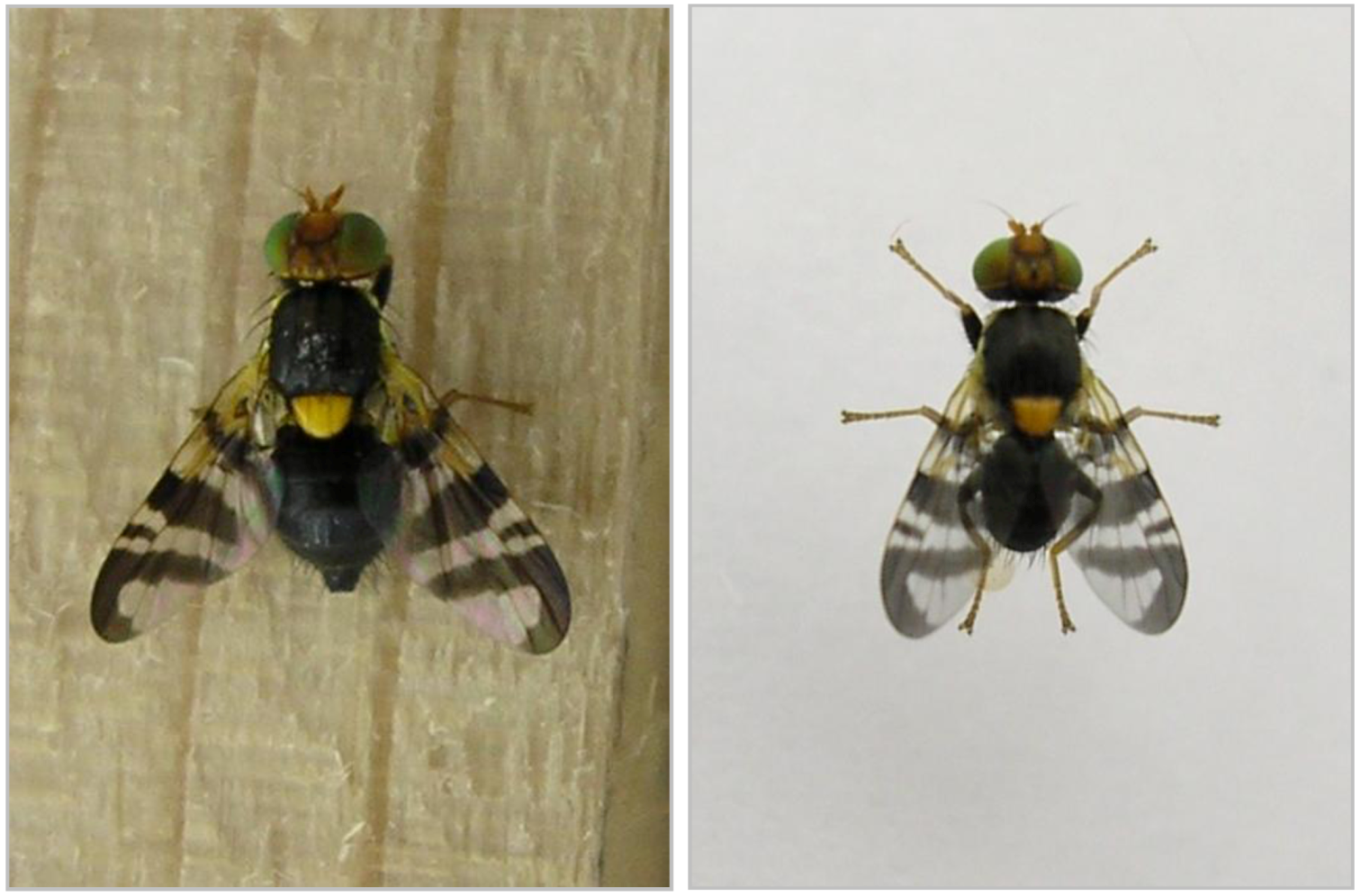
      <p>The European cherry fruit fly (<xref ref-type="fig" rid="insects-03-00956-f001">Figure 1</xref>) belongs to the family of Tephritidae, which has a worldwide distribution of about 4,000 described species in about 500 genera [<xref ref-type="bibr" rid="B3-insects-03-00956">3</xref>]. The genus <italic>Rhagoletis</italic> Loew includes about 65 known species [<xref ref-type="bibr" rid="B4-insects-03-00956">4</xref>]. Most species are oligophagous, attacking only a few closely related host plants. In addition to <italic>R. cerasi</italic>, the American cherry fruit fly species <italic>R. cingulata</italic>, <italic>R. indifferens</italic> and <italic>R. fausta</italic>, as well as the apple maggot <italic>R. pomonella</italic>, the blueberry maggot <italic>R. mendax</italic>, and the walnut infesting species <italic>R. completa</italic> and <italic>R. suavis</italic> are pest insects of economic importance [<xref ref-type="bibr" rid="B5-insects-03-00956">5</xref>]. Host plants of <italic>R. cerasi</italic> include various different <italic>Prunus </italic>sp. (Rosaceae; <italic>P. cerasus</italic>, <italic>P. avium</italic>, <italic>P. serotina</italic>, <italic>P. mahaleb</italic>) [<xref ref-type="bibr" rid="B6-insects-03-00956">6</xref>,<xref ref-type="bibr" rid="B7-insects-03-00956">7</xref>] as well as <italic>Lonicera </italic>sp. (Caprifoliaceae; <italic>L. xylosteum</italic> and <italic>L. tatarica</italic>) [<xref ref-type="bibr" rid="B4-insects-03-00956">4</xref>,<xref ref-type="bibr" rid="B8-insects-03-00956">8</xref>,<xref ref-type="bibr" rid="B9-insects-03-00956">9</xref>,<xref ref-type="bibr" rid="B10-insects-03-00956">10</xref>,<xref ref-type="bibr" rid="B11-insects-03-00956">11</xref>,<xref ref-type="bibr" rid="B12-insects-03-00956">12</xref>].</p>
      <p><italic>R. cerasi</italic> is distributed throughout Europe and temperate regions of Asia [<xref ref-type="bibr" rid="B4-insects-03-00956">4</xref>,<xref ref-type="bibr" rid="B13-insects-03-00956">13</xref>]. Boller <italic>et al</italic>. [<xref ref-type="bibr" rid="B14-insects-03-00956">14</xref>] assumed that there are two races, which were referred to as the northern and southern race. The southern race is found in Italy, Switzerland and Southern Germany, whereas the northern race ranges from the Atlantic Ocean to the Black Sea [<xref ref-type="bibr" rid="B4-insects-03-00956">4</xref>]. However, Riegler and Stauffer [<xref ref-type="bibr" rid="B15-insects-03-00956">15</xref>] showed that the unidirectional cytoplasmatic incompatibility is caused by maternally inherited <italic>Wolbachia</italic> infections. As a consequence, southern females and northern males are interfertile, but crosses between southern males and northern females are sterile [<xref ref-type="bibr" rid="B14-insects-03-00956">14</xref>,<xref ref-type="bibr" rid="B15-insects-03-00956">15</xref>,<xref ref-type="bibr" rid="B16-insects-03-00956">16</xref>,<xref ref-type="bibr" rid="B17-insects-03-00956">17</xref>,<xref ref-type="bibr" rid="B18-insects-03-00956">18</xref>,<xref ref-type="bibr" rid="B19-insects-03-00956">19</xref>,<xref ref-type="bibr" rid="B20-insects-03-00956">20</xref>].</p>
      <p>Recently, the American cherry fruit fly species <italic>Rhagoletis cingulata</italic>, which is closely related to the European cherry fruit fly <italic>R. cerasi</italic>, was introduced to Europe [<xref ref-type="bibr" rid="B21-insects-03-00956">21</xref>,<xref ref-type="bibr" rid="B22-insects-03-00956">22</xref>,<xref ref-type="bibr" rid="B23-insects-03-00956">23</xref>,<xref ref-type="bibr" rid="B24-insects-03-00956">24</xref>,<xref ref-type="bibr" rid="B25-insects-03-00956">25</xref>]. One individual was first observed in Switzerland (canton Ticino) in the 1980s. From 1991 to 1993, there were repeated captures of American cherry fruit flies in the south of the canton Ticino [<xref ref-type="bibr" rid="B26-insects-03-00956">26</xref>]. Until now, no stable populations are known in Switzerland [<xref ref-type="bibr" rid="B27-insects-03-00956">27</xref>]. However, this may be due to insufficient monitoring intensity. A close monitoring in the Rhine Valley (Rheinhessen, Germany) from 2002 to 2004 revealed that the American cherry fruit fly was widespread and established in many orchards [<xref ref-type="bibr" rid="B28-insects-03-00956">28</xref>,<xref ref-type="bibr" rid="B29-insects-03-00956">29</xref>,<xref ref-type="bibr" rid="B30-insects-03-00956">30</xref>]. In 2007 it was first detected in Austria [<xref ref-type="bibr" rid="B25-insects-03-00956">25</xref>]. The American species has a similar biology to the European species. The only differences are that the peak flight activity of the American species occurs two weeks later than the peak flight activity of <italic>R. cerasi</italic>, eggs are deposited in yellow fruit, and sour cherries are also heavily attacked. </p>
      <fig id="insects-03-00956-f001" position="anchor">
        <label>Figure 1</label>
        <caption>
          <p>Adult <italic>R. cerasi</italic>: female (<bold>left</bold>) and male (<bold>right</bold>) with its bright black thorax, yellow scutellum and characteristic wing pattern and a size of 4mm (males) to 5mm (females).</p>
        </caption>
        <graphic xmlns:xlink="http://www.w3.org/1999/xlink" xlink:href="insects-03-00956-g001.tif"/>
      </fig>
    </sec>
    <sec>
      <title>3. Life History <italic>R. cerasi</italic></title>
      <p>Life history characteristics of <italic>R. cerasi</italic>, like those of other oligophagous Tephritid species, are best suited for exploiting resources that are predictable in time and space, but are only available during a short period of the year. A close adaptation of their biology to the fruiting pattern of the host and precision in seasonal synchronization are more important than high reproductive potential and high mobility [<xref ref-type="bibr" rid="B31-insects-03-00956">31</xref>]. Hibernation occurs in the soil in the immediate vicinity of the hosts. Thus there is no need for dispersal flights. Adult emergence and life span are closely correlated with host plant phenology [<xref ref-type="bibr" rid="B5-insects-03-00956">5</xref>]. Pupal carryover for two or more winters is used for “spreading the risk” of failure of the host plants to fruit in a particular year [<xref ref-type="bibr" rid="B31-insects-03-00956">31</xref>,<xref ref-type="bibr" rid="B32-insects-03-00956">32</xref>]. There is only one generation each year and a long obligatory winter diapause [<xref ref-type="bibr" rid="B33-insects-03-00956">33</xref>]. Fecundity is considered to be lower than in the polyvoltine Tephritid species [<xref ref-type="bibr" rid="B5-insects-03-00956">5</xref>]. Relatively unspecific visual and odor stimuli are used to identify oviposition sites. Competition in the larval stages (contest type) is largely avoided by oviposition of only a single egg in each fruit and by the application of a host marking pheromone after oviposition, which ensures an adjustment of larval density to the carrying capacity of the host and maximizes dispersion over available food resources [<xref ref-type="bibr" rid="B34-insects-03-00956">34</xref>]. The mating system of these species is usually resource-based: The males control the oviposition substrates, and mating is often initiated by forced copulation without elaborate courtship behavior [<xref ref-type="bibr" rid="B35-insects-03-00956">35</xref>].</p>
      <sec>
        <title>3.1. Aspects of R. cerasi Biology Relevant for Its Management</title>
        <p><bold>Emergence of adult flies and pre-oviposition period:</bold> Pupal development and adult emergence is influenced by soil temperature in spring [<xref ref-type="bibr" rid="B6-insects-03-00956">6</xref>,<xref ref-type="bibr" rid="B7-insects-03-00956">7</xref>,<xref ref-type="bibr" rid="B36-insects-03-00956">36</xref>,<xref ref-type="bibr" rid="B37-insects-03-00956">37</xref>], by temperature conditions during winter diapause [<xref ref-type="bibr" rid="B38-insects-03-00956">38</xref>,<xref ref-type="bibr" rid="B39-insects-03-00956">39</xref>,<xref ref-type="bibr" rid="B40-insects-03-00956">40</xref>] as well as by the host plants from which the pupae originated [<xref ref-type="bibr" rid="B41-insects-03-00956">41</xref>,<xref ref-type="bibr" rid="B42-insects-03-00956">42</xref>,<xref ref-type="bibr" rid="B43-insects-03-00956">43</xref>,<xref ref-type="bibr" rid="B44-insects-03-00956">44</xref>] and geographic provenance [<xref ref-type="bibr" rid="B45-insects-03-00956">45</xref>,<xref ref-type="bibr" rid="B46-insects-03-00956">46</xref>]. In Switzerland, Austria and Southern Germany, the first flies usually appear in the orchards between mid-May and mid-June [<xref ref-type="bibr" rid="B47-insects-03-00956">47</xref>]. The earliest attempts to develop a forecasting model for the eclosion time of flies were made in the 1930s [<xref ref-type="bibr" rid="B48-insects-03-00956">48</xref>,<xref ref-type="bibr" rid="B49-insects-03-00956">49</xref>,<xref ref-type="bibr" rid="B50-insects-03-00956">50</xref>]. This model was revised and improved in the 1960s [<xref ref-type="bibr" rid="B7-insects-03-00956">7</xref>,<xref ref-type="bibr" rid="B51-insects-03-00956">51</xref>] and 1970s [<xref ref-type="bibr" rid="B38-insects-03-00956">38</xref>,<xref ref-type="bibr" rid="B45-insects-03-00956">45</xref>]. Before oviposition, the adults go through a temperature-dependent maturation period of six to 13 days [<xref ref-type="bibr" rid="B7-insects-03-00956">7</xref>,<xref ref-type="bibr" rid="B47-insects-03-00956">47</xref>,<xref ref-type="bibr" rid="B52-insects-03-00956">52</xref>,<xref ref-type="bibr" rid="B53-insects-03-00956">53</xref>,<xref ref-type="bibr" rid="B54-insects-03-00956">54</xref>,<xref ref-type="bibr" rid="B55-insects-03-00956">55</xref>,<xref ref-type="bibr" rid="B56-insects-03-00956">56</xref>] during which they need to feed on carbohydrates, proteins and water in order for the gonads to mature. Nutrients are obtained from bird feces, honeydew, extrafloral nectaries, and bacterial colonies on leaf and fruit surfaces [<xref ref-type="bibr" rid="B49-insects-03-00956">49</xref>,<xref ref-type="bibr" rid="B57-insects-03-00956">57</xref>,<xref ref-type="bibr" rid="B58-insects-03-00956">58</xref>,<xref ref-type="bibr" rid="B59-insects-03-00956">59</xref>,<xref ref-type="bibr" rid="B60-insects-03-00956">60</xref>,<xref ref-type="bibr" rid="B61-insects-03-00956">61</xref>]. In addition to the temperature and nutritional status of the females, the maturity stage of the cherries can also affect the beginning of oviposition [<xref ref-type="bibr" rid="B53-insects-03-00956">53</xref>]. The life span of flies under field conditions is difficult to estimate and may range between four to seven weeks [<xref ref-type="bibr" rid="B47-insects-03-00956">47</xref>,<xref ref-type="bibr" rid="B49-insects-03-00956">49</xref>,<xref ref-type="bibr" rid="B53-insects-03-00956">53</xref>,<xref ref-type="bibr" rid="B59-insects-03-00956">59</xref>], which leads to a total flight period of seven to 11 weeks [<xref ref-type="bibr" rid="B47-insects-03-00956">47</xref>,<xref ref-type="bibr" rid="B48-insects-03-00956">48</xref>,<xref ref-type="bibr" rid="B62-insects-03-00956">62</xref>].</p>
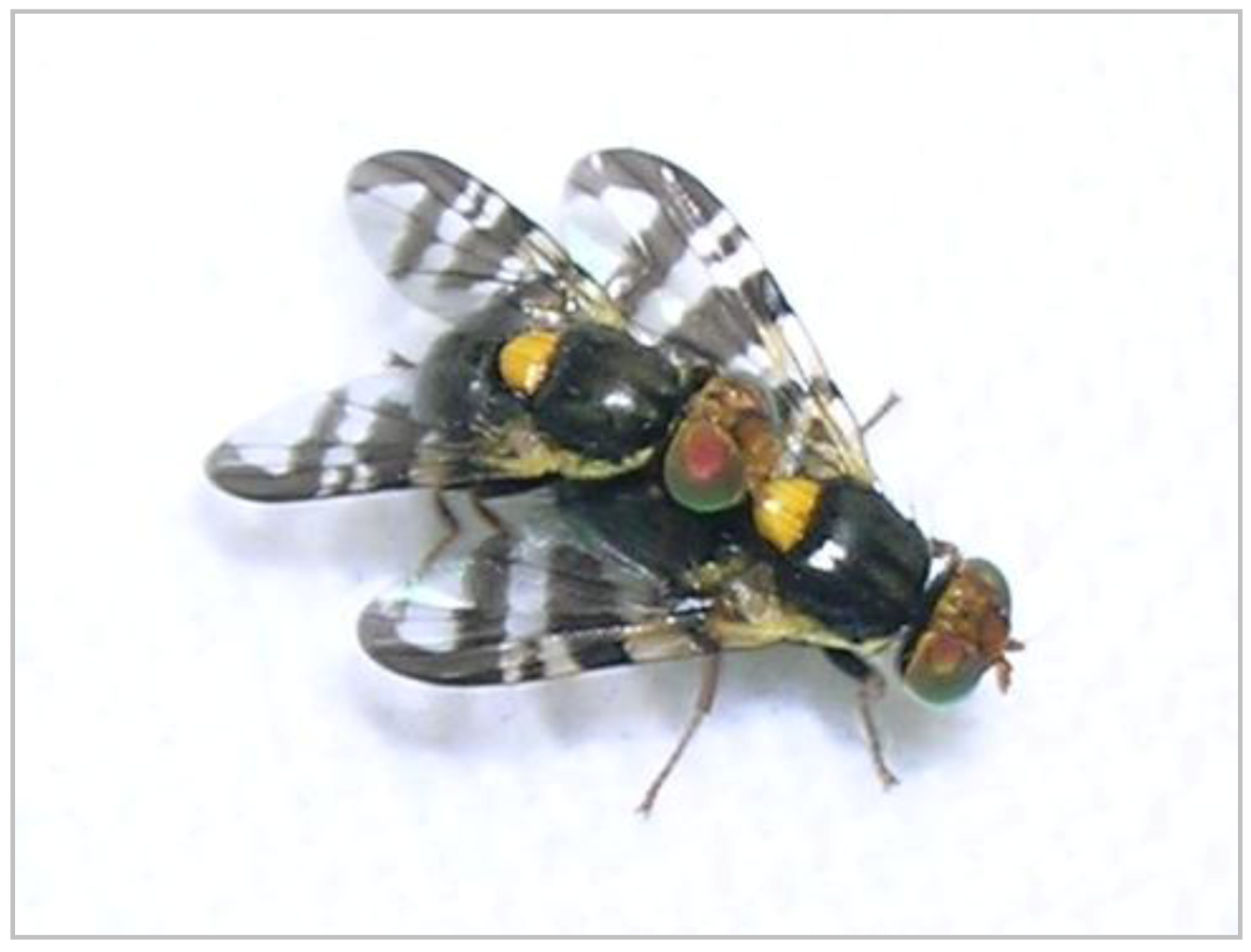
        <p><bold>Mating:</bold> Mating (<xref ref-type="fig" rid="insects-03-00956-f002">Figure 2</xref>) occurs on sunny days with temperatures above 15 °C [<xref ref-type="bibr" rid="B49-insects-03-00956">49</xref>,<xref ref-type="bibr" rid="B63-insects-03-00956">63</xref>]. Host fruit on sunny parts of the trees is used as a mating site. Mating is initiated when a female in search of an oviposition site lands on a fruit occupied by a male [<xref ref-type="bibr" rid="B63-insects-03-00956">63</xref>]. Thus, fly behavior plays a major role in locating mating partners: Due to their preference for host fruits in full sun, the flies aggregate in certain parts of the trees. In these circumstances, an elaborate long-range pheromone might be of minor importance [<xref ref-type="bibr" rid="B64-insects-03-00956">64</xref>]. Nevertheless, it was shown that the males produce a highly species-specific pheromone, which attracts females [<xref ref-type="bibr" rid="B63-insects-03-00956">63</xref>,<xref ref-type="bibr" rid="B64-insects-03-00956">64</xref>,<xref ref-type="bibr" rid="B65-insects-03-00956">65</xref>,<xref ref-type="bibr" rid="B66-insects-03-00956">66</xref>,<xref ref-type="bibr" rid="B67-insects-03-00956">67</xref>,<xref ref-type="bibr" rid="B68-insects-03-00956">68</xref>]. However, contrary to the pheromones of many Lepidoptera, this pheromone seems not to have a long-range attraction [<xref ref-type="bibr" rid="B64-insects-03-00956">64</xref>,<xref ref-type="bibr" rid="B66-insects-03-00956">66</xref>]. It was even hypothesized that the pheromone might function primarily as an aphrodisiac [<xref ref-type="bibr" rid="B5-insects-03-00956">5</xref>]. One to three copulations during a female’s life span are considered to be necessary to maintain high egg fertility [<xref ref-type="bibr" rid="B49-insects-03-00956">49</xref>].</p>
        <fig id="insects-03-00956-f002" position="anchor">
          <label>Figure 2</label>
          <caption>
            <p>Mating of <italic>R. cerasi</italic>.</p>
          </caption>
          <graphic xmlns:xlink="http://www.w3.org/1999/xlink" xlink:href="insects-03-00956-g002.tif"/>
        </fig>
        <p><bold>Dispersal and flight ability:</bold> With the relative stability of the system, <italic>i.e.</italic>, pests that overwinter beneath perennial hosts, there appears to be little impetus for adults to move long distances. Dispersal flights occur only in situations in which flies are deprived of suitable fruits for oviposition: Such as when cherries are destroyed by frost or early harvest or when all fruits are already marked with the host-marking pheromone [<xref ref-type="bibr" rid="B69-insects-03-00956">69</xref>]. Driven by high oviposition pressure, the females leave their original tree [<xref ref-type="bibr" rid="B36-insects-03-00956">36</xref>], and the males follow a little later [<xref ref-type="bibr" rid="B49-insects-03-00956">49</xref>,<xref ref-type="bibr" rid="B69-insects-03-00956">69</xref>]. The flies move from tree to tree until they find a suitable host [<xref ref-type="bibr" rid="B55-insects-03-00956">55</xref>]. Maximum distances of dispersal flights are difficult to evaluate experimentally and might range between 100 and 500 m [<xref ref-type="bibr" rid="B7-insects-03-00956">7</xref>,<xref ref-type="bibr" rid="B55-insects-03-00956">55</xref>,<xref ref-type="bibr" rid="B70-insects-03-00956">70</xref>], in exceptional cases as far as 3 km [<xref ref-type="bibr" rid="B71-insects-03-00956">71</xref>]. Flight studies in the laboratory have shown that flies are capable of flying several kilometers in 24 h if no landing platforms are available [<xref ref-type="bibr" rid="B72-insects-03-00956">72</xref>]. However, within orchards, 95% of the flies move only to neighboring trees of later ripening varieties [<xref ref-type="bibr" rid="B7-insects-03-00956">7</xref>,<xref ref-type="bibr" rid="B73-insects-03-00956">73</xref>], and from there on to <italic>Lonicera </italic>sp. bushes [<xref ref-type="bibr" rid="B69-insects-03-00956">69</xref>].</p>
        <p><bold>Orientation during dispersal flights:</bold> Orientation during dispersal flight is mainly based on visual stimuli. Foliage color, tree shape and tree size play a role in eliciting the arrival of flies. <italic>R. cerasi</italic> is known to be highly responsive to visual stimuli [<xref ref-type="bibr" rid="B74-insects-03-00956">74</xref>], especially to yellow surfaces [<xref ref-type="bibr" rid="B70-insects-03-00956">70</xref>,<xref ref-type="bibr" rid="B75-insects-03-00956">75</xref>,<xref ref-type="bibr" rid="B76-insects-03-00956">76</xref>,<xref ref-type="bibr" rid="B77-insects-03-00956">77</xref>,<xref ref-type="bibr" rid="B78-insects-03-00956">78</xref>]. Prokopy [<xref ref-type="bibr" rid="B79-insects-03-00956">79</xref>] suggested that large yellow surfaces represent a super-normal foliage-type stimulus that elicits food-seeking behavior in <italic>R. cerasi</italic>. In addition to flat yellow surfaces, Prokopy [<xref ref-type="bibr" rid="B79-insects-03-00956">79</xref>] showed that <italic>Rhagoletis</italic> flies also react to red or dark colored spheres of approximately the same size as the host fruit [<xref ref-type="bibr" rid="B77-insects-03-00956">77</xref>,<xref ref-type="bibr" rid="B78-insects-03-00956">78</xref>]. Attraction of fruit flies to spherical objects is believed to represent a response to mating and oviposition site stimuli. However, none of these cues are host-specific. Boller [<xref ref-type="bibr" rid="B70-insects-03-00956">70</xref>] believes that the flies are not able to distinguish between host and non-host trees at greater distances, whereas Katsoyannos <italic>et al</italic>. [<xref ref-type="bibr" rid="B69-insects-03-00956">69</xref>] believes that females can identify trees with fruits at the right ripening stage from a certain distance. However, once the flies arrive at a host tree, they might be able to identify host-specific leaf stimuli with their tarsal contact chemoreceptors [<xref ref-type="bibr" rid="B80-insects-03-00956">80</xref>].</p>
        <p><bold>Oviposition:</bold> Oviposition occurs around noon and during the early afternoon [<xref ref-type="bibr" rid="B81-insects-03-00956">81</xref>] on sunny days when temperatures rise above 16 °C [<xref ref-type="bibr" rid="B44-insects-03-00956">44</xref>,<xref ref-type="bibr" rid="B47-insects-03-00956">47</xref>,<xref ref-type="bibr" rid="B49-insects-03-00956">49</xref>,<xref ref-type="bibr" rid="B82-insects-03-00956">82</xref>]. Weather conditions during the oviposition period are considered to be crucial for the regulation of population densities: The high oviposition activity during long-lasting periods of fine weather can lead to extreme outbreaks of this pest [<xref ref-type="bibr" rid="B50-insects-03-00956">50</xref>]. Both olfactory and visual cues are involved in the choice of suitable fruits for oviposition. However, the visual component appears to dominate. Females recognize the fruit by visual cues based on shape (spherical or hemispherical), size (2.5 to 10.3 mm diameter) and contrast-color against the background (dark shape in front of lighter background) [<xref ref-type="bibr" rid="B5-insects-03-00956">5</xref>,<xref ref-type="bibr" rid="B74-insects-03-00956">74</xref>,<xref ref-type="bibr" rid="B83-insects-03-00956">83</xref>,<xref ref-type="bibr" rid="B84-insects-03-00956">84</xref>]. Once a suitable fruit has been located, the female explores the surface structure (smoothness, softness and shape) by walking in circles on the surface and decides whether or not to oviposit [<xref ref-type="bibr" rid="B83-insects-03-00956">83</xref>,<xref ref-type="bibr" rid="B85-insects-03-00956">85</xref>]. During this exploration, the condition and the chemistry of a fruit might influence oviposition behavior. Cherries at the stage of color change from green to yellow, with a hardened cherry pit, and pulp at least 5 mm thick are preferred for oviposition [<xref ref-type="bibr" rid="B86-insects-03-00956">86</xref>]. The female pierces the fruit with its ovipositor and inserts a single egg just below the skin [<xref ref-type="bibr" rid="B87-insects-03-00956">87</xref>]. After oviposition the females deposit a water-soluble host-marking pheromone by dragging the ovipositor around the fruit surface [<xref ref-type="bibr" rid="B6-insects-03-00956">6</xref>,<xref ref-type="bibr" rid="B63-insects-03-00956">63</xref>,<xref ref-type="bibr" rid="B88-insects-03-00956">88</xref>]. This pheromone prevents further ovipositions into the same fruit [<xref ref-type="bibr" rid="B89-insects-03-00956">89</xref>,<xref ref-type="bibr" rid="B90-insects-03-00956">90</xref>,<xref ref-type="bibr" rid="B91-insects-03-00956">91</xref>]. Under field conditions with high infestation levels, however, multilarval infestations are frequently observed, which suggest multiple ovipositions into the same fruit [<xref ref-type="bibr" rid="B1-insects-03-00956">1</xref>,<xref ref-type="bibr" rid="B92-insects-03-00956">92</xref>,<xref ref-type="bibr" rid="B93-insects-03-00956">93</xref>]. Fecundity seems to depend mainly on the life span of females. Under field conditions, fecundity is thought to range from 30 eggs to as many as 200 eggs per female [<xref ref-type="bibr" rid="B7-insects-03-00956">7</xref>,<xref ref-type="bibr" rid="B47-insects-03-00956">47</xref>,<xref ref-type="bibr" rid="B48-insects-03-00956">48</xref>,<xref ref-type="bibr" rid="B49-insects-03-00956">49</xref>,<xref ref-type="bibr" rid="B56-insects-03-00956">56</xref>,<xref ref-type="bibr" rid="B82-insects-03-00956">82</xref>].</p>
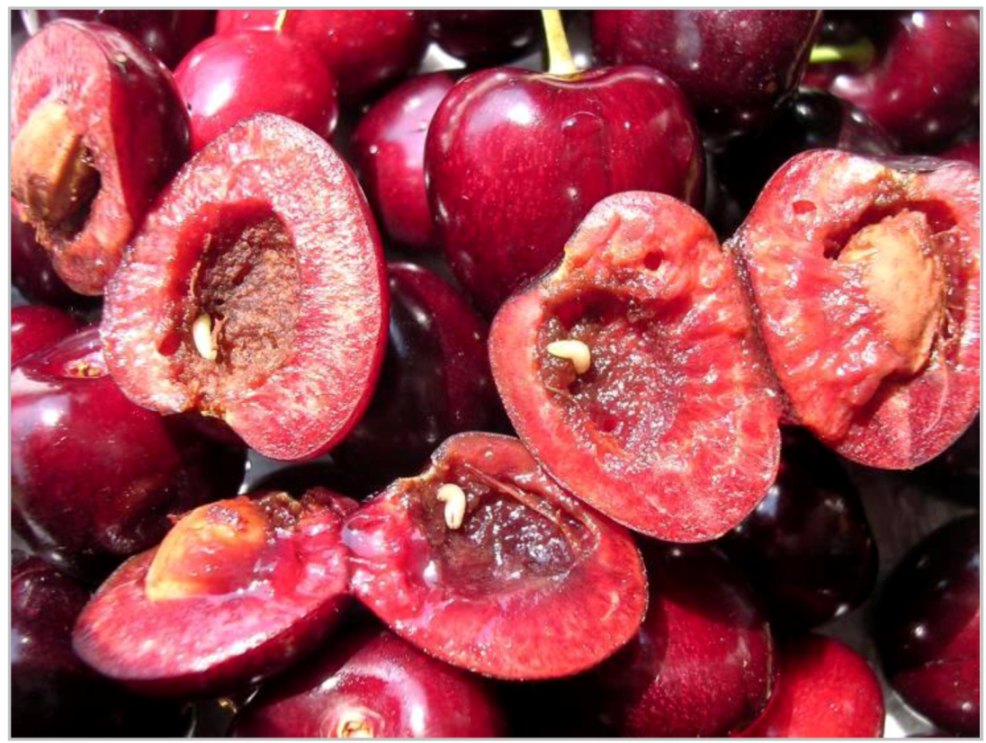
        <p><bold>Egg and larval development:</bold> The white eggs have an approximate length of 0.75 mm and a diameter of 0.25 mm [<xref ref-type="bibr" rid="B49-insects-03-00956">49</xref>,<xref ref-type="bibr" rid="B59-insects-03-00956">59</xref>]. Fertility ranges between 54 and 100% [<xref ref-type="bibr" rid="B82-insects-03-00956">82</xref>,<xref ref-type="bibr" rid="B94-insects-03-00956">94</xref>]. A reduced fertility is mainly observed during prolonged periods of fine weather when copulation is reduced in favor of oviposition or after oviposition in unripe cherries [<xref ref-type="bibr" rid="B94-insects-03-00956">94</xref>]. The duration of embryonic development mainly depends on temperature and ranges between two to ten days [<xref ref-type="bibr" rid="B7-insects-03-00956">7</xref>,<xref ref-type="bibr" rid="B49-insects-03-00956">49</xref>,<xref ref-type="bibr" rid="B50-insects-03-00956">50</xref>,<xref ref-type="bibr" rid="B58-insects-03-00956">58</xref>,<xref ref-type="bibr" rid="B86-insects-03-00956">86</xref>]. After eclosion, the larvae immediately move towards the cherry pit in order to find protection from parasitoids and predators [<xref ref-type="bibr" rid="B56-insects-03-00956">56</xref>]. Larval development lasts between 17 [<xref ref-type="bibr" rid="B7-insects-03-00956">7</xref>,<xref ref-type="bibr" rid="B50-insects-03-00956">50</xref>] and 30 days [<xref ref-type="bibr" rid="B58-insects-03-00956">58</xref>], depending on the temperature and the maturity stage of the cherries. The larvae go through three instars, reaching a final size of approximately 6 mm (<xref ref-type="fig" rid="insects-03-00956-f003">Figure 3</xref>) [<xref ref-type="bibr" rid="B95-insects-03-00956">95</xref>]. During their development, the larvae tunnel in the fruit, macerate the tissue and ingest the broken down pulp [<xref ref-type="bibr" rid="B49-insects-03-00956">49</xref>,<xref ref-type="bibr" rid="B58-insects-03-00956">58</xref>]. Larvae develop better and faster in fruits with higher sugar content and lower acidity [<xref ref-type="bibr" rid="B94-insects-03-00956">94</xref>]. High populations of <italic>R. cerasi </italic>can be therefore observed in sweet cherry orchards, whereas sour cherries usually remain free from high infestations [<xref ref-type="bibr" rid="B96-insects-03-00956">96</xref>,<xref ref-type="bibr" rid="B97-insects-03-00956">97</xref>,<xref ref-type="bibr" rid="B98-insects-03-00956">98</xref>]. </p>
        <fig id="insects-03-00956-f003" position="anchor">
          <label>Figure 3</label>
          <caption>
            <p>Infested cherries.</p>
          </caption>
          <graphic xmlns:xlink="http://www.w3.org/1999/xlink" xlink:href="insects-03-00956-g003.tif"/>
        </fig>
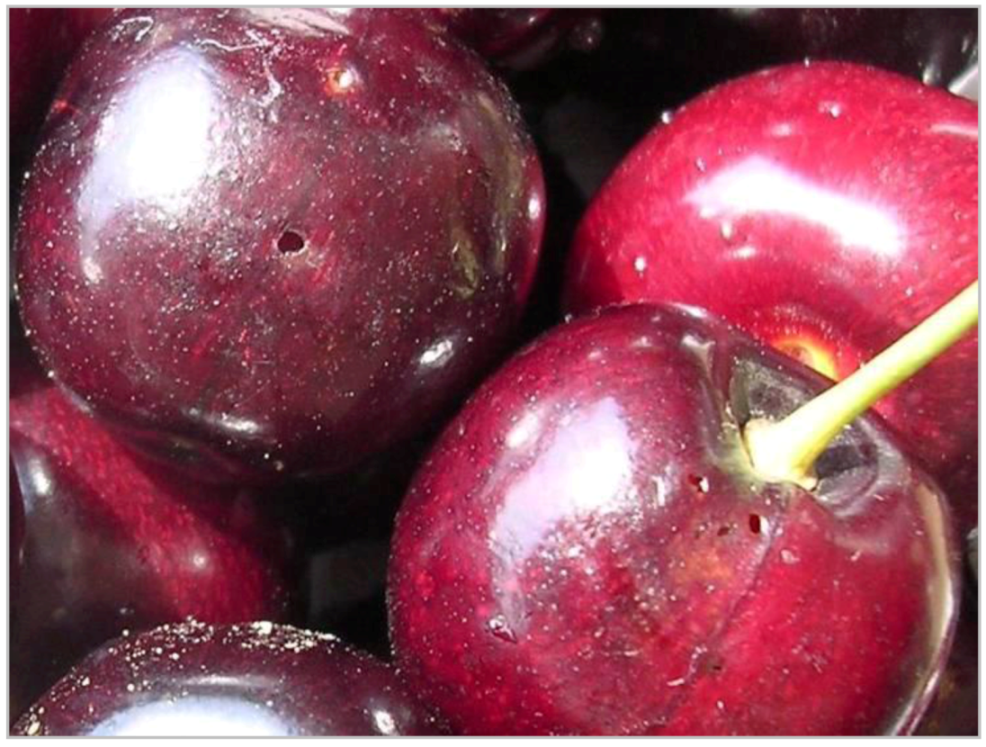
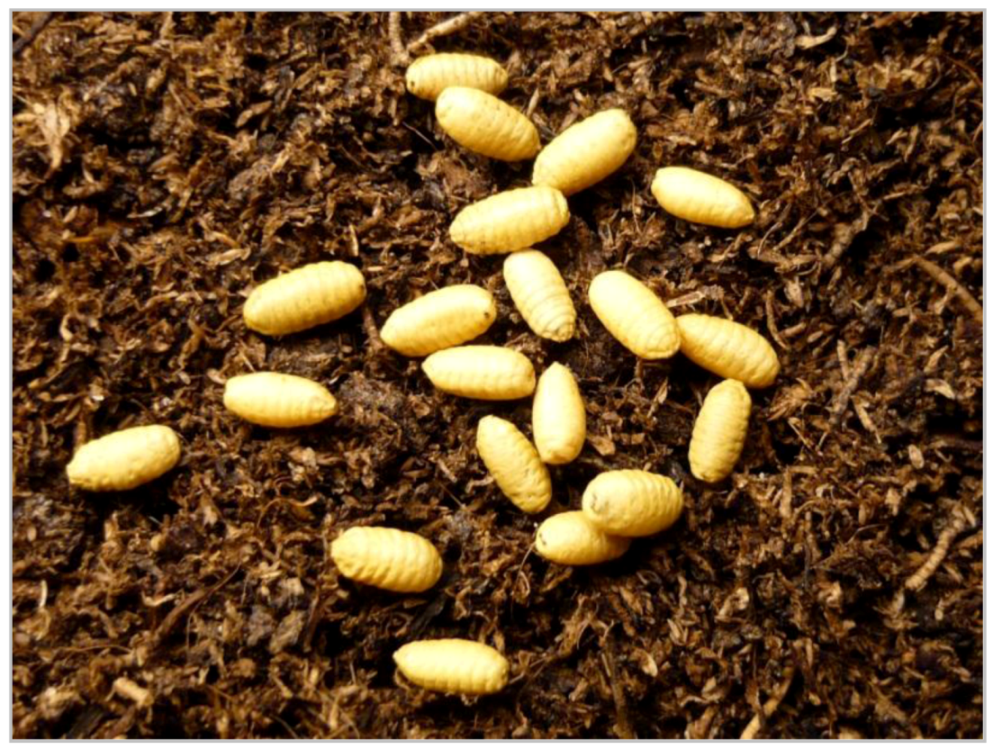
        <p><bold>Pupation:</bold> Around harvest [<xref ref-type="bibr" rid="B56-insects-03-00956">56</xref>], mature larvae bore exit holes through the fruit skin (<xref ref-type="fig" rid="insects-03-00956-f004">Figure 4</xref>), usually close to the fruit stem [<xref ref-type="bibr" rid="B49-insects-03-00956">49</xref>,<xref ref-type="bibr" rid="B99-insects-03-00956">99</xref>]. Under field conditions, pupation usually occurs within three hours after entering the soil [<xref ref-type="bibr" rid="B49-insects-03-00956">49</xref>]. Most pupae are therefore found directly under the tree canopy, especially under the south and southeast parts of the tree, which is also where the highest fruit infestation levels are observed [<xref ref-type="bibr" rid="B100-insects-03-00956">100</xref>]. Pupation depth is mainly influenced by soil type and usually ranges from 2 to 5 cm [<xref ref-type="bibr" rid="B7-insects-03-00956">7</xref>,<xref ref-type="bibr" rid="B56-insects-03-00956">56</xref>,<xref ref-type="bibr" rid="B101-insects-03-00956">101</xref>,<xref ref-type="bibr" rid="B102-insects-03-00956">102</xref>]. The puparium is straw yellow in color, cylindrical, up to 4 mm long and 2 mm in diameter (<xref ref-type="fig" rid="insects-03-00956-f005">Figure 5</xref>) [<xref ref-type="bibr" rid="B8-insects-03-00956">8</xref>,<xref ref-type="bibr" rid="B49-insects-03-00956">49</xref>,<xref ref-type="bibr" rid="B59-insects-03-00956">59</xref>].</p>
        <p><bold>Diapause and pupal mortality:</bold> The cherry fruit fly is a univoltine species: The pupae remain in the soil until the following spring. Overwintering pupae enter diapause and require a chilling period before development can continue. Approximately 180 days at temperatures below 5 °C are required for maximum emergence [<xref ref-type="bibr" rid="B6-insects-03-00956">6</xref>,<xref ref-type="bibr" rid="B7-insects-03-00956">7</xref>,<xref ref-type="bibr" rid="B38-insects-03-00956">38</xref>,<xref ref-type="bibr" rid="B43-insects-03-00956">43</xref>,<xref ref-type="bibr" rid="B103-insects-03-00956">103</xref>]. Pupal mortality during the nine to 10 months of diapause is high and is mainly attributed to unfavorable climatic conditions and predation: Usually only 5% [<xref ref-type="bibr" rid="B104-insects-03-00956">104</xref>] to 15% [<xref ref-type="bibr" rid="B94-insects-03-00956">94</xref>] of the pupae emerge in the following year. A few individuals remain in diapause for an additional year or sometimes for several years [<xref ref-type="bibr" rid="B6-insects-03-00956">6</xref>,<xref ref-type="bibr" rid="B36-insects-03-00956">36</xref>,<xref ref-type="bibr" rid="B49-insects-03-00956">49</xref>,<xref ref-type="bibr" rid="B50-insects-03-00956">50</xref>,<xref ref-type="bibr" rid="B105-insects-03-00956">105</xref>]. This pupal carryover is a highly adaptive trait, ensuring that the population will not perish on account of failure of host plants to fruit in some years. However, literature data on the percentage of pupae diapausing for more than one year show wide ranges: from 1 to 21% [<xref ref-type="bibr" rid="B101-insects-03-00956">101</xref>,<xref ref-type="bibr" rid="B106-insects-03-00956">106</xref>], 10% [<xref ref-type="bibr" rid="B7-insects-03-00956">7</xref>,<xref ref-type="bibr" rid="B49-insects-03-00956">49</xref>,<xref ref-type="bibr" rid="B105-insects-03-00956">105</xref>], 7 to 21% [<xref ref-type="bibr" rid="B36-insects-03-00956">36</xref>], 47% [<xref ref-type="bibr" rid="B50-insects-03-00956">50</xref>] and 25 to 100% [<xref ref-type="bibr" rid="B107-insects-03-00956">107</xref>]. A higher percentage remains in diapause for an additional year more frequently in heavy clay soils than in sandy soils [<xref ref-type="bibr" rid="B36-insects-03-00956">36</xref>].</p>
        <fig id="insects-03-00956-f004" position="anchor">
          <label>Figure 4</label>
          <caption>
            <p>Damaged cherries with exit holes of larvae.</p>
          </caption>
          <graphic xmlns:xlink="http://www.w3.org/1999/xlink" xlink:href="insects-03-00956-g004.tif"/>
        </fig>
        <fig id="insects-03-00956-f005" position="anchor">
          <label>Figure 5</label>
          <caption>
            <p>Pupae of <italic>R. cerasi</italic>.</p>
          </caption>
          <graphic xmlns:xlink="http://www.w3.org/1999/xlink" xlink:href="insects-03-00956-g005.tif"/>
        </fig>
      </sec>
      <sec>
        <title>3.2. Population Dynamics and Mortality Factors</title>
        <p>Many factors (biotic and abiotic) can influence the dynamics of cherry fruit fly populations by directly or indirectly affecting survival and development rates or female fecundity. The most important factors are climatic conditions and host availability. The mortality within one generation can reach 99.6% [<xref ref-type="bibr" rid="B94-insects-03-00956">94</xref>]. However, only a few quantitative studies evaluate the causes of mortality [<xref ref-type="bibr" rid="B108-insects-03-00956">108</xref>]. The basic demographic parameters have been determined by Boller [<xref ref-type="bibr" rid="B94-insects-03-00956">94</xref>]. In cherry production, harvest, and the consequent removal of larvae from the orchard, is considered to be one of the main mortality factors [<xref ref-type="bibr" rid="B94-insects-03-00956">94</xref>]. In addition, temperature and rain have a major impact on mortality. </p>
        <p>Egg and larval stages are well protected inside the cherry. Mortality is generally low during the egg stage [<xref ref-type="bibr" rid="B94-insects-03-00956">94</xref>]. The hatching rate may be reduced when females oviposit in unripe cherries [<xref ref-type="bibr" rid="B94-insects-03-00956">94</xref>]. In addition, some cherry varieties (Schattenmorelle) are known to produce a hard tissue to seclude the eggs [<xref ref-type="bibr" rid="B109-insects-03-00956">109</xref>].</p>
        <p>Destruction of cherries by fungal diseases can also lead to increased egg and larval mortality. The first serious cherry fruit fly infestation was observed in Switzerland between 1930 and 1937—it started only three years after a routine treatment of shothole disease (<italic>Stigmina carpophila</italic>) was introduced: Regular yields also lead to improved life conditions for cherry fruit flies [<xref ref-type="bibr" rid="B110-insects-03-00956">110</xref>,<xref ref-type="bibr" rid="B111-insects-03-00956">111</xref>].</p>
        <p>Different degrees of infestation are due to phenological differences among cherry varieties and weather conditions during oviposition: Early ripening varieties show lower infestation levels because the fruits are harvested before the first flies are ready to oviposit [<xref ref-type="bibr" rid="B47-insects-03-00956">47</xref>,<xref ref-type="bibr" rid="B48-insects-03-00956">48</xref>,<xref ref-type="bibr" rid="B58-insects-03-00956">58</xref>,<xref ref-type="bibr" rid="B98-insects-03-00956">98</xref>]. Generally, the later a cherry variety is harvested, the higher the potential infestation level [<xref ref-type="bibr" rid="B7-insects-03-00956">7</xref>,<xref ref-type="bibr" rid="B98-insects-03-00956">98</xref>]. Sunny conditions during oviposition lead to high infestation levels [<xref ref-type="bibr" rid="B50-insects-03-00956">50</xref>,<xref ref-type="bibr" rid="B102-insects-03-00956">102</xref>]. Rainy conditions during early ripening stages prevent oviposition and mating [<xref ref-type="bibr" rid="B36-insects-03-00956">36</xref>,<xref ref-type="bibr" rid="B49-insects-03-00956">49</xref>,<xref ref-type="bibr" rid="B63-insects-03-00956">63</xref>,<xref ref-type="bibr" rid="B102-insects-03-00956">102</xref>,<xref ref-type="bibr" rid="B112-insects-03-00956">112</xref>] and might lead to a decay of fruits causing first and second instar larvae to die [<xref ref-type="bibr" rid="B110-insects-03-00956">110</xref>]. However, rainy conditions during harvest, which cause the cherries to crack and the farmers to leave the trees unpicked, might increase the infestation level the following year [<xref ref-type="bibr" rid="B7-insects-03-00956">7</xref>]. Differences in sugar content and acidity of cherry varieties lead to differences in larval nutrition and consequently to differences in fecundity of emerging females [<xref ref-type="bibr" rid="B94-insects-03-00956">94</xref>]. Females from sweet cherry orchards therefore usually show a higher fecundity than females from sour cherry orchards.</p>
        <p>The life stages most exposed to climatic conditions and natural enemies are those associated with the soil: mature larvae, pupae and emerging adults. Boller [<xref ref-type="bibr" rid="B94-insects-03-00956">94</xref>] compared the number of larvae dropping from the fruit with the number of pupae in the soil and noted that 35 to 63% of the larvae were not able to pupate because of predation and arid soil conditions. He also monitored the number of pupae in the soil and observed a decline in numbers of pupae during the summer (July, August, September) and during the following spring, which he attributed to predation, parasitism and disease. During emergence, flies are also exposed to different enemies: Boller [<xref ref-type="bibr" rid="B94-insects-03-00956">94</xref>] observed that only 7 to 50% of pupae in the soil during spring produced adult flies. A similar observation was made by Engel [<xref ref-type="bibr" rid="B101-insects-03-00956">101</xref>]: The average number of 147 flies per tree evaluated by treatments with a knockdown insecticide was not consistent with the average number of 9,000 pupae under each tree.</p>
      </sec>
      <sec id="sec3dot3-insects-03-00956">
        <title>3.3. Antagonists of <italic>R. cerasi</italic> and Other Tephritidae</title>
        <p><bold>Viruses:</bold> No literature is available on the effects of viruses on <italic>R. cerasi</italic>. For other Tephritid flies, picornaviruses have been described in <italic>Ceratitis capitata</italic> [<xref ref-type="bibr" rid="B113-insects-03-00956">113</xref>] and in <italic>Bactrocera tryoni</italic> [<xref ref-type="bibr" rid="B114-insects-03-00956">114</xref>]. In addition, reoviruses are known for <italic>Bactrocera oleae</italic> [<xref ref-type="bibr" rid="B115-insects-03-00956">115</xref>,<xref ref-type="bibr" rid="B116-insects-03-00956">116</xref>] and <italic>C. capitata</italic> [<xref ref-type="bibr" rid="B117-insects-03-00956">117</xref>]. No field application strategy has yet been developed for controlling Tephritid flies with viruses.</p>
        <p><bold>Bacteria:</bold> Only few references are available on the use of bacteria to control Tephritid flies, and no references are available for <italic>R. cerasi</italic>. Different isolates of <italic>Bacillus thuringiensis</italic> were screened against larvae and adults of <italic>B. oleae</italic> [<xref ref-type="bibr" rid="B118-insects-03-00956">118</xref>] and <italic>Anastrepha ludens </italic> [<xref ref-type="bibr" rid="B119-insects-03-00956">119</xref>,<xref ref-type="bibr" rid="B120-insects-03-00956">120</xref>]. Endotoxins of different <italic>B. thuringiensis</italic> isolates were tested against adult <italic>C. capitata</italic> [<xref ref-type="bibr" rid="B121-insects-03-00956">121</xref>] and L<sub>3</sub> larvae of <italic>Anastrepha </italic>sp. [<xref ref-type="bibr" rid="B122-insects-03-00956">122</xref>]. <italic>Bacillus pumilis</italic> was tested against adults and larvae of <italic>C. capitata</italic> in laboratory experiments [<xref ref-type="bibr" rid="B123-insects-03-00956">123</xref>]. In field experiments with four to six applications of <italic>B. thuringiensis</italic> per year against the olive fruit fly <italic>B. oleae</italic>, fruit infestation was reduced by 60% to 80% [<xref ref-type="bibr" rid="B124-insects-03-00956">124</xref>].</p>
        <p><bold>Entomopathogenic fungi:</bold> Many studies have been conducted on the control of <italic>C. capitata</italic>, <italic>Anastrepha</italic><italic> fraterculus</italic>, <italic>A. ludens</italic>, <italic>B. oleae</italic> and <italic>B. tryoni</italic> with different entomopathogenic fungi [<xref ref-type="bibr" rid="B125-insects-03-00956">125</xref>,<xref ref-type="bibr" rid="B126-insects-03-00956">126</xref>,<xref ref-type="bibr" rid="B127-insects-03-00956">127</xref>,<xref ref-type="bibr" rid="B128-insects-03-00956">128</xref>,<xref ref-type="bibr" rid="B129-insects-03-00956">129</xref>,<xref ref-type="bibr" rid="B130-insects-03-00956">130</xref>,<xref ref-type="bibr" rid="B131-insects-03-00956">131</xref>,<xref ref-type="bibr" rid="B132-insects-03-00956">132</xref>,<xref ref-type="bibr" rid="B133-insects-03-00956">133</xref>,<xref ref-type="bibr" rid="B134-insects-03-00956">134</xref>,<xref ref-type="bibr" rid="B135-insects-03-00956">135</xref>,<xref ref-type="bibr" rid="B136-insects-03-00956">136</xref>,<xref ref-type="bibr" rid="B137-insects-03-00956">137</xref>,<xref ref-type="bibr" rid="B138-insects-03-00956">138</xref>,<xref ref-type="bibr" rid="B139-insects-03-00956">139</xref>]. Yee and Lacey [<xref ref-type="bibr" rid="B140-insects-03-00956">140</xref>] demonstrated that adult western cherry fruit flies (<italic>R. indifferens</italic>) are susceptible to <italic>Metharizium anisopliae</italic>. Cossentine <italic>et al</italic>. [<xref ref-type="bibr" rid="B141-insects-03-00956">141</xref>] demonstrated that preimaginal <italic>R. indifferens</italic> are susceptible to <italic>Beauveria bassiana</italic>. Until recently, only little was known on fungal pathogens of <italic>R. cerasi</italic>. Wiesmann [<xref ref-type="bibr" rid="B49-insects-03-00956">49</xref>] described adult flies as being susceptible to <italic>Empusa </italic>sp. (Zygomycetes: Entomophthoraceae). In 2009, first evidence was provided that adult <italic>R. cerasi </italic>are susceptible to hyphomycetous fungi [<xref ref-type="bibr" rid="B142-insects-03-00956">142</xref>]. A laboratory screening of different fungus isolates showed that all tested isolates (<italic>B. bassiana</italic>, <italic>M. anisopliae</italic>, <italic>Isaria fumosorosea</italic>, <italic>Isaria farinose</italic>) caused mycosis but virulence varied considerably among the isolates. <italic>B. bassiana</italic> and <italic>I. fumosorosea</italic> caused 90%–100% mortality and had the strongest influence on fecundity. <italic>M. anisopliae</italic> also induced high rates of mortality, while the pathogenicity of <italic>I. farinosa</italic> was low. The effects on L<sub>3</sub> larvae were tested as well: None of the fungal isolates induced mortality in more than 25% of larvae [<xref ref-type="bibr" rid="B142-insects-03-00956">142</xref>]. These results led to the development of a field application strategy using foliar applications of <italic>B. bassiana</italic> against adult flies [<xref ref-type="bibr" rid="B106-insects-03-00956">106</xref>,<xref ref-type="bibr" rid="B143-insects-03-00956">143</xref>].</p>
        <p><bold>Entomopathogenic nematodes:</bold> Various fruit fly species are known to be susceptible to entomopathogenic nematodes [<xref ref-type="bibr" rid="B144-insects-03-00956">144</xref>,<xref ref-type="bibr" rid="B145-insects-03-00956">145</xref>,<xref ref-type="bibr" rid="B146-insects-03-00956">146</xref>,<xref ref-type="bibr" rid="B147-insects-03-00956">147</xref>,<xref ref-type="bibr" rid="B148-insects-03-00956">148</xref>,<xref ref-type="bibr" rid="B149-insects-03-00956">149</xref>,<xref ref-type="bibr" rid="B150-insects-03-00956">150</xref>]. Yee &amp; Lacey [<xref ref-type="bibr" rid="B151-insects-03-00956">151</xref>] showed good efficacy of <italic>Steinernema</italic> sp. against larvae of the western cherry fruit fly <italic>R. indifferens. </italic>Moreover, recent laboratory studies have indicated promising results of entomopathogenic nematodes to control the third instar larvae of <italic>R. cerasi</italic> [<xref ref-type="bibr" rid="B152-insects-03-00956">152</xref>]. However, results of laboratory experiments conducted in the scope of the European COST 850 project were disappointing: In a screening of 18 different nematode strains, the highest mortality rates in third instar larvae were below 30% (observed after application of <italic>Steinernema feltiae</italic> at a concentration of 1 × 10<sup>5</sup> infective juveniles m<sup>−2</sup> on soil, [<xref ref-type="bibr" rid="B153-insects-03-00956">153</xref>]). Field applications of <italic>S. feltiae</italic> and <italic>S. carpocapse</italic> at the rate of 2 × 10<sup>6</sup> infective juveniles m<sup>−2</sup> in a cherry orchard in Aesch (BL, northwestern Switzerland) in June 2003 reduced the emergence rate of adults the following year by only 33% (<italic>S. carpocapse</italic>) and 41% (<italic>S. feltiae</italic>), respectively [<xref ref-type="bibr" rid="B154-insects-03-00956">154</xref>]. Similar results (20% reduction of emerging adults) were obtained by Herz <italic>et al</italic>. [<xref ref-type="bibr" rid="B104-insects-03-00956">104</xref>], who conducted field experiments with <italic>S. feltiae</italic> to control <italic>R. cerasi</italic> and noted that the effect of nematodes was masked by high natural pupal mortality during the winter. Due to the limited time frame and the different spatial activity, the potential for entomopathogenic nematodes for controlling <italic>R. cerasi</italic> under field conditions was considered to be rather small. </p>
        <p><bold>Parasitoids:</bold> Most Tephritid species are attacked by a complex of native parasitoids [<xref ref-type="bibr" rid="B145-insects-03-00956">145</xref>,<xref ref-type="bibr" rid="B155-insects-03-00956">155</xref>]. For <italic>R. cerasi</italic>, 21 species of parasitoids (larval ectoparasitoids, larval endoparasitoids and puparium parasitoids) have been described [<xref ref-type="bibr" rid="B156-insects-03-00956">156</xref>]. No egg parasitoids of <italic>R. cerasi </italic>are mentioned in the literature. In cherry production, however, the effectiveness of larval parasitoids is greatly impaired by the short ovipositor of parasitoid females, which cannot reach <italic>R. cerasi</italic> larvae in large cultivated cherries. Monaco [<xref ref-type="bibr" rid="B157-insects-03-00956">157</xref>] observed that 10 to 30% of <italic>R. cerasi</italic> larvae in wild cherries (<italic>P. mahaleb</italic>) are parasitized by <italic>Utetes </italic>(<italic>Opius) magnus</italic> (Hymenoptera: Braconidae), whereas no parasitization was observed in cultivated cherries. Similar observations were made by Haisch <italic>et al</italic>. [<xref ref-type="bibr" rid="B95-insects-03-00956">95</xref>] and Hoffmeister [<xref ref-type="bibr" rid="B66-insects-03-00956">66</xref>], who noted that <italic>R. cerasi</italic> individuals from <italic>Lonicera </italic>sp. generally showed higher levels of parasitization than individuals from cultivated cherries: <italic>U. magnus</italic> [<xref ref-type="bibr" rid="B66-insects-03-00956">66</xref>] and <italic>Halticoptera laevigata</italic> (Hymenoptera: Pteromalidae) [<xref ref-type="bibr" rid="B66-insects-03-00956">66</xref>,<xref ref-type="bibr" rid="B158-insects-03-00956">158</xref>] have only been observed in individuals from <italic>Lonicera </italic>sp., whereas <italic>Psyttalia </italic>(<italic>Opius) rhagleticola</italic> [<xref ref-type="bibr" rid="B66-insects-03-00956">66</xref>,<xref ref-type="bibr" rid="B159-insects-03-00956">159</xref>] was also found in individuals from cherries—although in lower numbers. Contrary to these observations, Leski [<xref ref-type="bibr" rid="B7-insects-03-00956">7</xref>] showed <italic>P. rhagleticola</italic> to be the principal parasitoid of cherry fruit flies in Poland. However, with parasitization rates of 22 to 32%, <italic>P. rhagleticola</italic> could not control <italic>R. cerasi</italic> populations [<xref ref-type="bibr" rid="B7-insects-03-00956">7</xref>]. Pupal parasitation seems to be more important. <italic>Phygadeuon wiesmanni</italic> (Hymenoptera: Ichneumonidae) occurs throughout Central Europe [<xref ref-type="bibr" rid="B94-insects-03-00956">94</xref>,<xref ref-type="bibr" rid="B160-insects-03-00956">160</xref>,<xref ref-type="bibr" rid="B161-insects-03-00956">161</xref>,<xref ref-type="bibr" rid="B162-insects-03-00956">162</xref>,<xref ref-type="bibr" rid="B163-insects-03-00956">163</xref>,<xref ref-type="bibr" rid="B164-insects-03-00956">164</xref>,<xref ref-type="bibr" rid="B165-insects-03-00956">165</xref>] and has been shown to be responsible for a pupal mortality rate as high as 72% [<xref ref-type="bibr" rid="B94-insects-03-00956">94</xref>,<xref ref-type="bibr" rid="B101-insects-03-00956">101</xref>]. Under bushes of <italic>Lonicera </italic>sp., however<italic>,</italic> the parasitation rates of pupae were found to be higher than under cherry trees [<xref ref-type="bibr" rid="B6-insects-03-00956">6</xref>]. Other puparium parasitoids, such as <italic>Phygadeuon elegans</italic> [<xref ref-type="bibr" rid="B165-insects-03-00956">165</xref>], <italic>Gelis bremeri</italic> (Hymenoptera: Ichneumonidae) [<xref ref-type="bibr" rid="B6-insects-03-00956">6</xref>,<xref ref-type="bibr" rid="B7-insects-03-00956">7</xref>,<xref ref-type="bibr" rid="B66-insects-03-00956">66</xref>], <italic>Polypeza försteri</italic> (Hymenoptera: Diapriidae) [<xref ref-type="bibr" rid="B166-insects-03-00956">166</xref>], and <italic>Spilomicrus hemipterus </italic>(Hymenoptera: Diapriidae) [<xref ref-type="bibr" rid="B66-insects-03-00956">66</xref>], were observed in lower numbers. Until now, no biocontrol strategies based on parasitoids of <italic>R. cerasi</italic> were evaluated under field conditions.</p>
        <p><bold>Predators:</bold> Wiesmann [<xref ref-type="bibr" rid="B49-insects-03-00956">49</xref>] mentions two species of <italic>Odontothrips </italic>sp. (Thysanoptera: Thripidae) attacking the eggs of <italic>R. cerasi</italic>. However, the impact of these predators is considered to be low, as only 10% of the eggs were attacked [<xref ref-type="bibr" rid="B49-insects-03-00956">49</xref>] and as Boller [<xref ref-type="bibr" rid="B94-insects-03-00956">94</xref>] did not observe these predators in his comprehensive studies. Therefore, <italic>R. cerasi</italic> is most likely to be attacked by predators only during the short time span after leaving the fruit and pupation or immediately after emergence. Ants (<italic>Myrmica laevinodis</italic>, Hymenoptera: Formicidae), carabid beetles (<italic>Anisodactylus binotatus</italic>, Coleoptera: Carabidae) or staphylinid beetles (<italic>Paedrus litoralis</italic>, Coleoptera: Staphylinidae) are of particular importance [<xref ref-type="bibr" rid="B94-insects-03-00956">94</xref>,<xref ref-type="bibr" rid="B167-insects-03-00956">167</xref>]. Boller [<xref ref-type="bibr" rid="B94-insects-03-00956">94</xref>] noted that up to 80% of larvae were destroyed by predators before pupation, and that ants seemed to be the most important enemy. According to Boller [<xref ref-type="bibr" rid="B94-insects-03-00956">94</xref>], however, ants are not able to detect and crack the puparia in the soil. This is in contrast to Sajo [<xref ref-type="bibr" rid="B168-insects-03-00956">168</xref>], who observed ants attacking and destroying pupae in the soil. Schwope [<xref ref-type="bibr" rid="B169-insects-03-00956">169</xref>] noted that ants attacked and killed about 40% of the emerging flies. In addition, Boller [<xref ref-type="bibr" rid="B94-insects-03-00956">94</xref>] observed in his experiments that about 15% of pupae were destroyed by small, unidentified organisms, which he believed to be mites.</p>
      </sec>
    </sec>
    <sec>
      <title>4. History of Cherry Fruit Fly Control</title>
      <p>The strategies used to control <italic>R. cerasi</italic> reflect the history of insect control in general. Peaks of research activity for new control strategies coincide with periods of increasing cherry fruit fly populations: The cherry fruit fly usually exhibits four- to five-year periods of high population densities followed by an interval of decline to very low population levels. Boller <italic>et al</italic>. [<xref ref-type="bibr" rid="B170-insects-03-00956">170</xref>] presented the data for Switzerland from 1929 to 1969 and noted that fluctuations in population density were frequently observed throughout Central Europe at the same time. During the first recorded cherry fruit fly outbreak in the 1930s, research mainly focused on bionomics and the behavior of the pest. Initial control methods focused on destruction of infested fruit and the application of inorganic insecticides. During the second wave of high populations in the mid-forties and early fifties, new insecticides (DDT and organophosphorus compounds) were introduced. During the early sixties, the focus shifted toward the development of biotechnical (traps, synthetic host-marking pheromones, and sterile male releases) and biological control methods. Recently, the cherry production is challenged by the withdrawal of insecticides in many countries. The importance of reliable biocontrol strategies is therefore increasing.</p>
      <sec>
        <title>4.1. Before-Insecticide Strategies—1900 to 1935</title>
        <p>Before insecticides were available, farmers knew that an early and complete harvest was the most effective control measure for <italic>R. cerasi</italic> [<xref ref-type="bibr" rid="B8-insects-03-00956">8</xref>,<xref ref-type="bibr" rid="B53-insects-03-00956">53</xref>,<xref ref-type="bibr" rid="B56-insects-03-00956">56</xref>,<xref ref-type="bibr" rid="B58-insects-03-00956">58</xref>,<xref ref-type="bibr" rid="B60-insects-03-00956">60</xref>,<xref ref-type="bibr" rid="B171-insects-03-00956">171</xref>]. Early ripening varieties were recommended for reduced fly damage [<xref ref-type="bibr" rid="B53-insects-03-00956">53</xref>]. The recommendation of eradicating wild and secondary hosts (<italic>Lonicera </italic>sp.) of <italic>R. cerasi</italic> was controversially discussed between Thiem [<xref ref-type="bibr" rid="B9-insects-03-00956">9</xref>] and Wiesmann [<xref ref-type="bibr" rid="B172-insects-03-00956">172</xref>]. However, because the flies from <italic>Lonicera </italic>sp. emerge a few days later than the flies from cherries [<xref ref-type="bibr" rid="B42-insects-03-00956">42</xref>], and because the flies from <italic>Lonicera </italic>sp. show a strong preference for <italic>Lonicera </italic>sp. berries for oviposition [<xref ref-type="bibr" rid="B173-insects-03-00956">173</xref>], it is doubtful whether this recommendation was necessary or justified.</p>
        <p>Because <italic>R. cerasi</italic> pupae spend more than 10 months per year in the soil [<xref ref-type="bibr" rid="B94-insects-03-00956">94</xref>] and because the area of pupation is strictly limited to the surface directly under the canopy of infested trees [<xref ref-type="bibr" rid="B49-insects-03-00956">49</xref>], the possibility of soil treatments was appealing [<xref ref-type="bibr" rid="B159-insects-03-00956">159</xref>]. Soil treatments were considered by different authors: Frank [<xref ref-type="bibr" rid="B174-insects-03-00956">174</xref>] suggested soil cultivation in order to bury the pupae more deeply, whereas Mik [<xref ref-type="bibr" rid="B8-insects-03-00956">8</xref>] recommended compression of the soil surface prior to adult emergence. However, according to the results of Thiem [<xref ref-type="bibr" rid="B6-insects-03-00956">6</xref>], a mechanical treatment of the soil surface is not sufficient. He suggested using creosote on larvae shortly before pupation and Tetrachloroethane to kill the pupae. Wiesmann [<xref ref-type="bibr" rid="B36-insects-03-00956">36</xref>] tested a broad range of different means, such as arsenic compounds, naphthalene, dichlorobenzene, nicotine, and kerosene, to control emerging flies or pupae in the soil. He stated that kerosene treatments completely prevented emergence, but that one out of three experimental trees died and another third were badly damaged. Most authors concluded that soil treatments are ineffective to kill the pupae [<xref ref-type="bibr" rid="B6-insects-03-00956">6</xref>,<xref ref-type="bibr" rid="B49-insects-03-00956">49</xref>,<xref ref-type="bibr" rid="B53-insects-03-00956">53</xref>,<xref ref-type="bibr" rid="B174-insects-03-00956">174</xref>,<xref ref-type="bibr" rid="B175-insects-03-00956">175</xref>]. When organo-chemical insecticides such as DDT became available in the 1950s [<xref ref-type="bibr" rid="B176-insects-03-00956">176</xref>], research on soil treatments was abandoned.</p>
      </sec>
      <sec>
        <title>4.2. First Insecticides Lead Arsenate &amp; DDT—1905 to 1950</title>
        <p>The first insecticides—pyrethrum, rotenone, and lead arsenate—were focused on adult flies and were mainly applied in combination with food baits [<xref ref-type="bibr" rid="B36-insects-03-00956">36</xref>,<xref ref-type="bibr" rid="B54-insects-03-00956">54</xref>,<xref ref-type="bibr" rid="B60-insects-03-00956">60</xref>]. However, the efficacy of pyrethrum and rotenone was poor, and lead arsenate was not considered as an option in most European countries due to its high human toxicity [<xref ref-type="bibr" rid="B53-insects-03-00956">53</xref>]. First organo-chemical insecticides such as DDT became available in the 1950s [<xref ref-type="bibr" rid="B176-insects-03-00956">176</xref>] and led to better results in control of adult flies [<xref ref-type="bibr" rid="B169-insects-03-00956">169</xref>,<xref ref-type="bibr" rid="B177-insects-03-00956">177</xref>,<xref ref-type="bibr" rid="B178-insects-03-00956">178</xref>]. However, applications had to be timed exactly to the emergence of flies and repeated treatments were necessary.</p>
      </sec>
      <sec>
        <title>4.3. Organophosphorus Insecticides—1950 to 2000</title>
        <p>With the development and registration of quick-acting organophosphates and carbamates around 1965, a systemic control of eggs and larvae inside the fruit became possible [<xref ref-type="bibr" rid="B179-insects-03-00956">179</xref>,<xref ref-type="bibr" rid="B180-insects-03-00956">180</xref>]. The emphasis of control shifted from the adult to the egg and larval stages. The application date and therefore the flight period became less important. Applications were timed according to the degradation of the various products, as pesticide residues in the harvested crop had to be avoided [<xref ref-type="bibr" rid="B181-insects-03-00956">181</xref>]. Currently, Dimethoate is still in use in some European countries (<xref ref-type="table" rid="insects-03-00956-t001">Table 1</xref>), whereas Fenthion is no longer registered because of its high avian toxicity. First attempts to find alternatives to Dimethoate applications were already made in the 1960s.</p>
      </sec>
      <sec>
        <title>4.4. Research on Population Dynamics and Biotechnical Approaches—1960 to 1990</title>
        <p>In order to avoid toxic residues on harvested fruit, great efforts were made to find biological or biotechnical control methods. Different approaches were considered: yellow sticky traps, synthetic host-marking pheromones, and sterile insect technique [<xref ref-type="bibr" rid="B14-insects-03-00956">14</xref>,<xref ref-type="bibr" rid="B17-insects-03-00956">17</xref>,<xref ref-type="bibr" rid="B42-insects-03-00956">42</xref>,<xref ref-type="bibr" rid="B170-insects-03-00956">170</xref>].</p>
        <p><bold>Sticky traps</bold> were developed based on the visual preference of the flies for the color yellow [<xref ref-type="bibr" rid="B182-insects-03-00956">182</xref>]. Remund [<xref ref-type="bibr" rid="B75-insects-03-00956">75</xref>] determined that daylight fluorescent yellow-colored flat surfaces were most attractive. Prokopy [<xref ref-type="bibr" rid="B79-insects-03-00956">79</xref>] suggested that large yellow surfaces represented a super-normal foliage-type stimulus eliciting food-seeking behavior in <italic>R. cerasi</italic> and <italic>R. pomonella</italic>. He also hypothesized that flies reacted to yellow on the basis of true color discrimination. This hypothesis was supported by Agee <italic>et al</italic>. [<xref ref-type="bibr" rid="B183-insects-03-00956">183</xref>], who showed that adult <italic>R. cerasi</italic> had a major peak of electroretinographically assessed spectral sensitivity at 485 to 500 nm (yellow green region) and a secondary peak at 365 nm (ultraviolet region). Traps with a sharp increase of reflectance in the 500 to 520 nm region were found to be the most attractive for <italic>R. cerasi</italic> [<xref ref-type="bibr" rid="B183-insects-03-00956">183</xref>,<xref ref-type="bibr" rid="B184-insects-03-00956">184</xref>]. Based on this knowledge, a three-dimensional wing-shaped trap was developed (Rebell<sup>®</sup> amarillo) and is now used throughout Europe for monitoring, forecasting and mass trapping purposes [<xref ref-type="bibr" rid="B185-insects-03-00956">185</xref>]. Moreover, mass trapping of flies by Rebell<sup>®</sup> amarillo became the standard regulation method for <italic>R. cerasi </italic>in organic production. However, in order for mass trapping strategies to be effective, several traps per tree are needed [<xref ref-type="bibr" rid="B2-insects-03-00956">2</xref>]. Remund &amp; Boller [<xref ref-type="bibr" rid="B186-insects-03-00956">186</xref>] suggest using one to eight Rebell<sup>®</sup> traps, depending on the size of tree, on the southeast side of the canopy. Because the traps should be hung in the upper part of the canopy, much labor is involved, thus making this strategy uneconomical for conventional cherry production (<xref ref-type="table" rid="insects-03-00956-t002">Table 2</xref>). </p>
        <p>The use of the <bold>host-marking pheromone</bold> to prevent oviposition was investigated in the 1970s [<xref ref-type="bibr" rid="B88-insects-03-00956">88</xref>,<xref ref-type="bibr" rid="B91-insects-03-00956">91</xref>,<xref ref-type="bibr" rid="B187-insects-03-00956">187</xref>]. In field experiments using naturally derived pheromone, an efficacy of 63 to 90% was observed [<xref ref-type="bibr" rid="B187-insects-03-00956">187</xref>,<xref ref-type="bibr" rid="B188-insects-03-00956">188</xref>]. High synthesis costs, however, prevented the use of this pheromone in commercial cherry growing. In addition, efficacy was low at high infestation levels and under rainy conditions. Moreover, about 10% of the trees had to remain untreated in order to provide unmarked fruits for oviposition [<xref ref-type="bibr" rid="B89-insects-03-00956">89</xref>].</p>
        <p>The <bold>sterile insect technique</bold> for cherry fruit fly control was developed between 1960 and 1980 [<xref ref-type="bibr" rid="B14-insects-03-00956">14</xref>,<xref ref-type="bibr" rid="B71-insects-03-00956">71</xref>,<xref ref-type="bibr" rid="B189-insects-03-00956">189</xref>,<xref ref-type="bibr" rid="B190-insects-03-00956">190</xref>,<xref ref-type="bibr" rid="B191-insects-03-00956">191</xref>]. The sterile insect technique is based on the concept that by overflooding natural populations with mass reared, sterilized insects, a high degree of sterility is induced among the eggs produced in the field [<xref ref-type="bibr" rid="B170-insects-03-00956">170</xref>]. Boller [<xref ref-type="bibr" rid="B71-insects-03-00956">71</xref>] could show that the release of sterile males in an isolated 2.5 km<sup>2</sup> area could reduce infestation below detectable levels. The major bottleneck of this technique is the artificial rearing of the fly [<xref ref-type="bibr" rid="B170-insects-03-00956">170</xref>,<xref ref-type="bibr" rid="B192-insects-03-00956">192</xref>,<xref ref-type="bibr" rid="B193-insects-03-00956">193</xref>,<xref ref-type="bibr" rid="B194-insects-03-00956">194</xref>]. Several points in the insect’s biology complicate rearing: <italic>R. cerasi</italic> is univoltine, has an obligatory diapause of at least 150 days, and <italic>R. cerasi</italic> is monophagous with a strongly selective host choice [<xref ref-type="bibr" rid="B88-insects-03-00956">88</xref>]. The lack of a suitable rearing method for producing enough sterile insects for mass releases prevented this strategy from being commercially introduced.</p>
      </sec>
      <sec>
        <title>4.5. Development of Biocontrol Strategies—1990 to 2010</title>
        <p>Based on first promising laboratory results [<xref ref-type="bibr" rid="B152-insects-03-00956">152</xref>,<xref ref-type="bibr" rid="B195-insects-03-00956">195</xref>], <bold>entomopathogenic nematodes</bold> were considered to be a possible solution for the cherry fruit fly problem. However, field experiments gave disappointing results [<xref ref-type="bibr" rid="B104-insects-03-00956">104</xref>,<xref ref-type="bibr" rid="B154-insects-03-00956">154</xref>] (see <xref ref-type="sec" rid="sec3dot3-insects-03-00956">Section 3.3</xref>). </p>
        <p>The pathogenicity and virulence of different <bold>entomopathogenic fungi</bold> on different life stages of <italic>R. cerasi</italic> were also first evaluated in laboratory experiments. Adult flies were found to be the only life stage susceptible to fungus infection. <italic>B. bassiana</italic> ATCC 74040 showed a high virulence, the flies died during the pre-oviposition period. These results were the first evidence of the susceptibility of <italic>R. cerasi</italic> to infection with hyphomycetous fungi [<xref ref-type="bibr" rid="B142-insects-03-00956">142</xref>]. Field application strategies were therefore focused on adult flies using the fungus isolate <italic>B. bassiana</italic> ATCC 74040, which is formulated in the commercial product Naturalis-L (Intrachem Bio Italia). Repeated applications of Naturalis-L during the flight period of <italic>R. cerasi</italic> were shown to reduce the infestation level of fruits by 60%–70% [<xref ref-type="bibr" rid="B143-insects-03-00956">143</xref>]. The application of Naturalis-L is a suitable and economically reasonable strategy for controlling <italic>R. cerasi</italic> in organic agriculture (<xref ref-type="table" rid="insects-03-00956-t002">Table 2</xref>).</p>
        <p>In addition to the biocontrol strategies, research on <bold>baits</bold> for possible attract-and-kill-strategies have recently been conducted. Although some of the food baits tested in combination with yellow sticky traps were able to double the number of captured flies [<xref ref-type="bibr" rid="B106-insects-03-00956">106</xref>], none of the baits tested showed economic potential as an effective attract-and-kill system or for mass trapping in commercial production (<xref ref-type="table" rid="insects-03-00956-t002">Table 2</xref>). The spinosad GF-120 fruit fly bait (Dow AgroSciences) was tested in several experiments against <italic>R. cerasi</italic> [<xref ref-type="bibr" rid="B196-insects-03-00956">196</xref>]. However, results under humid climate conditions in Switzerland were disappointing. Until now, this strategy is not available for the farmers.</p>
      </sec>
    </sec>
    <sec>
      <title>5. Currently Used Strategies to Control <italic>R. cerasi</italic></title>
      <p>Until recently, one application of <bold>Dimethoate</bold> was the standard for controlling <italic>R. cerasi</italic> in Swiss sweet cherry production, because it is by far the most cost-efficient method (<xref ref-type="table" rid="insects-03-00956-t002">Table 2</xref>)<italic>.</italic> Since 2011, however, this product is no longer registered for use in fruit production in Switzerland because of problems of ecotoxicity and residues on harvested cherries. Two applications of <bold>Acetamiprid</bold> are currently recommended for cherry fruit fly control in Switzerland. The situation in many other European countries is comparable. However, implementation and transition periods differ between the countries. Mainly neonicotinoids and pyrethroids are currently used to control <italic>R. cerasi </italic>(<xref ref-type="table" rid="insects-03-00956-t001">Table 1</xref>).</p>
      <p>The application of <bold>Naturalis-L</bold> (entomopathogenic fungi <italic>B. bassiana</italic>) is considerably more expensive than the application of Dimethoate or Acetamiprid (<xref ref-type="table" rid="insects-03-00956-t002">Table 2</xref>). However, the higher prices obtained for organically grown cherries might justify the higher input for pest control [<xref ref-type="bibr" rid="B106-insects-03-00956">106</xref>]. For good efficacy, four treatments of 0.25% Naturalis-L (5 × 10<sup>4</sup> CFU mL<sup>−1</sup>) with 1,000 L water per hectare should be applied at seven to ten day intervals. The first application should be made five to ten days after the beginning of the flight period. The time period between the last application and harvest should not exceed seven days. Other phytosanitary measures (early and complete harvest; removal of infested cherries) can further enhance the efficacy of Naturalis-L treatments. Because the use of fungicides can interfere with entomopathogenic fungi, close attention has to be paid to the whole pest management program. In Swiss organic cherry production, only sulfur and neem oil are likely to be applied during the critical period. Fortunately, both pesticides were found to be compatible with entomopathogenic fungi [<xref ref-type="bibr" rid="B197-insects-03-00956">197</xref>,<xref ref-type="bibr" rid="B198-insects-03-00956">198</xref>,<xref ref-type="bibr" rid="B199-insects-03-00956">199</xref>]. However, many of the synthetic fungicides used in integrated pest management strategies were found to be highly toxic to <italic>B. bassiana</italic> [<xref ref-type="bibr" rid="B200-insects-03-00956">200</xref>,<xref ref-type="bibr" rid="B201-insects-03-00956">201</xref>]. Among 36 fungicides tested, only three were compatible with <italic>B. bassiana</italic>, whereas insecticides were less toxic: 24 out of 54 tested insecticides interfered with fungus development [<xref ref-type="bibr" rid="B199-insects-03-00956">199</xref>]. In some cases, differences were found among products containing the same active ingredient (Dimethoate) in different formulations. Thus, the integration of mycoinsecticides for cherry fruit fly control in an organic plant protection system seems possible; including mycoinsecticides into integrated pest management programs might, however, be challenging.</p>
      <p>With the increasing number of dwarf tree orchards shielded from rain to prevent the large sized cherry varieties (&gt;24 mm fruit diameter) from splitting, <bold>crop netting</bold> has become a possible method of cherry fruit fly control [<xref ref-type="bibr" rid="B202-insects-03-00956">202</xref>]. Experiments using netting to cover the trees were conducted at the Palatinate Agricultural Service Centre (DLR Rheinpfalz, Germany [<xref ref-type="bibr" rid="B203-insects-03-00956">203</xref>]), at the Bavarian State Research Centre for Agriculture (LfL Bayern, Germany [<xref ref-type="bibr" rid="B204-insects-03-00956">204</xref>]) and at the Research Institute of Organic Agriculture (FiBL, Switzerland, Häseli, personal communication). Available data show that crop netting is a viable, cost-efficient strategy (<xref ref-type="table" rid="insects-03-00956-t002">Table 2</xref>) for protecting cherries from infestation. The “Rantai K” net-type with a mesh size of 1.3 mm was used in all experiments. Netting should be installed before the beginning of the flight period and the netting should remain in place until the latest ripening cherry varieties are harvested.</p>
      <p><bold>Covering the soil</bold> under the tree canopy with netting to prevent the hatching flies from reaching the fruit is another efficient management strategy. The netting can reduce fruit infestation by 91% [<xref ref-type="bibr" rid="B73-insects-03-00956">73</xref>]. Because the flies can survive for a long time under the netting, it is advisable to bury the edges of the netting completely. This, however, leads to high labor costs (<xref ref-type="table" rid="insects-03-00956-t002">Table 2</xref>). Moreover, expensive, fine-mesh netting (0.8 mm mesh width) is considered to be necessary, because young flies after emergence can easily get through nets with mesh widths of 1.3 mm. Nevertheless, this method could be an option for controlling <italic>R. cerasi</italic> in extensively managed standard tree orchards.</p>
      <p><bold>Mass trapping by yellow sticky traps</bold> is considered to be too expensive for commercial production of cherries (<xref ref-type="table" rid="insects-03-00956-t002">Table 2</xref>). Nevertheless, mass trapping may still be the only option for controlling <italic>R. cerasi</italic> in home gardens, in which the application of insecticides is often impossible due to the lack of proper application equipment. Due to the lack of registered alternatives, yellow sticky traps are still widely used in organic cherry production throughout Europe (<xref ref-type="table" rid="insects-03-00956-t001">Table 1</xref>). </p>
        <table-wrap id="insects-03-00956-t001" position="float">
          <object-id pub-id-type="pii">insects-03-00956-t001_Table 1</object-id>
          <label>Table 1</label>
          <caption>
            <p>Situation of cherry fruit fly control in different European countries in 2011.</p>
          </caption>
          <table>
            <thead>
              <tr>
                <th align="left" valign="top">Country harvested area [<xref ref-type="bibr" rid="B205-insects-03-00956">205</xref>]</th>
                <th align="left" valign="top">Management in conventional production</th>
                <th align="left" valign="top">Management in organic production</th>
                <th align="left" valign="top">Reference (personal communication)</th>
              </tr>
            </thead>
            <tbody>
              <tr>
                <td align="left" valign="top">Turkey</td>
                <td align="left" valign="top">Cypermethrin</td>
                <td align="left" valign="top">Azadirachtin</td>
                <td align="left" valign="top">T. Koclu &amp;</td>
              </tr>
              <tr>
                <td align="left" valign="top">[35,800 ha]</td>
                <td align="left" valign="top">Delthamethrin</td>
                <td align="left" valign="top">Mass trapping with yellow sticky traps</td>
                <td align="left" valign="top">(Bornova Plant Protection Research Institute)</td>
              </tr>
              <tr>
                <td align="left" valign="top"/>
                <td align="left" valign="top">Malathion</td>
                <td align="left" valign="top"/>
                <td align="left" valign="top">S. Tezcan</td>
              </tr>
              <tr>
                <td align="left" valign="top"/>
                <td align="left" valign="top">Methomyl</td>
                <td align="left" valign="top"/>
                <td align="left" valign="top">(Ege University, Bornova)</td>
              </tr>
              <tr>
                <td align="left" valign="top"/>
                <td align="left" valign="top">Thiacloprid</td>
                <td align="left" valign="top"/>
                <td align="left" valign="top"/>
              </tr>
              <tr>
                <td align="left" valign="top">Italy</td>
                <td align="left" valign="top">Dimethoate</td>
                <td align="left" valign="top">
                  <italic>Beauveria bassiana</italic>                </td>
                <td align="left" valign="top">F. Molinari</td>
              </tr>
              <tr>
                <td align="left" valign="top">[28,900 ha]</td>
                <td align="left" valign="top">Etofenprox</td>
                <td align="left" valign="top">Crop netting </td>
                <td align="left" valign="top">(Università Cattolica del Sacro Cuore, Piacenza)</td>
              </tr>
              <tr>
                <td align="left" valign="top"/>
                <td align="left" valign="top">Fosmet</td>
                <td align="left" valign="top">Pyrethrum</td>
                <td align="left" valign="top">A. Grassi</td>
              </tr>
              <tr>
                <td align="left" valign="top"/>
                <td align="left" valign="top">Thiamethoxam</td>
                <td align="left" valign="top">Spinosad</td>
                <td align="left" valign="top">(Istituto Agrario di San Michele all’Adige)</td>
              </tr>
              <tr>
                <td align="left" valign="top">Spain</td>
                <td rowspan="2" align="left" valign="top">Lambda-cyhalothrin (bait sprays)</td>
                <td align="left" valign="top">
                  <italic>Beauveria bassiana</italic>                </td>
                <td align="left" valign="top">E. Viñuela</td>
              </tr>
              <tr>
                <td align="left" valign="top">[24,671 ha]</td>
                <td align="left" valign="top">Yellow sticky traps</td>
                <td align="left" valign="top">(Universidad Politécnica de Madrid)</td>
              </tr>
              <tr>
                <td align="left" valign="top">Bulgaria</td>
                <td align="left" valign="top">Alpha-cypermethrin</td>
                <td rowspan="7" align="left" valign="top">Yellow sticky traps</td>
                <td align="left" valign="top">H. Kutinkova</td>
              </tr>
              <tr>
                <td align="left" valign="top">[11,800 ha]</td>
                <td align="left" valign="top">Bifenthrin</td>
                <td align="left" valign="top">(Fruit Growing Institute, Plovdiv)</td>
              </tr>
              <tr>
                <td align="left" valign="top"/>
                <td align="left" valign="top">Cypermethrin</td>
                <td align="left" valign="top"/>
              </tr>
              <tr>
                <td align="left" valign="top"/>
                <td align="left" valign="top">Deltamethrin</td>
                <td align="left" valign="top"/>
              </tr>
              <tr>
                <td align="left" valign="top"/>
                <td align="left" valign="top">Gamma-cyhalothrin</td>
                <td align="left" valign="top"/>
              </tr>
              <tr>
                <td align="left" valign="top"/>
                <td align="left" valign="top">Lambda-cyhalothrin</td>
                <td align="left" valign="top"/>
              </tr>
              <tr>
                <td align="left" valign="top"/>
                <td align="left" valign="top">Zeta-cypermethrin</td>
                <td align="left" valign="top"/>
              </tr>
              <tr>
                <td align="left" valign="top">France</td>
                <td align="left" valign="top">Acetamiprid</td>
                <td rowspan="3" align="left" valign="top">Yellow sticky traps</td>
                <td align="left" valign="top">S. Simon</td>
              </tr>
              <tr>
                <td align="left" valign="top">[10,752 ha]</td>
                <td align="left" valign="top">Dimethoate</td>
                <td align="left" valign="top">(INRA-UERI Gotheron)</td>
              </tr>
              <tr>
                <td align="left" valign="top"/>
                <td align="left" valign="top">Deltamethrine</td>
                <td align="left" valign="top"/>
              </tr>
              <tr>
                <td align="left" valign="top">Greece</td>
                <td align="left" valign="top">Cypermethrin,</td>
                <td rowspan="4" align="left" valign="top">
                  <italic>Beauveria bassiana</italic>                </td>
                <td align="left" valign="top">B.I. Katsoyannos</td>
              </tr>
              <tr>
                <td align="left" valign="top">[10,000 ha]</td>
                <td align="left" valign="top">Deltamethrin,</td>
                <td align="left" valign="top">(University of Thessaloniki)</td>
              </tr>
              <tr>
                <td align="left" valign="top"/>
                <td align="left" valign="top">Dimethoate,</td>
                <td align="left" valign="top"/>
              </tr>
              <tr>
                <td align="left" valign="top"/>
                <td align="left" valign="top">Thiamethoxam</td>
                <td align="left" valign="top"/>
              </tr>
              <tr>
                <td align="left" valign="top">Poland</td>
                <td align="left" valign="top">Acetamiprid</td>
                <td align="left" valign="top">Yellow sticky traps</td>
                <td align="left" valign="top">D. Gajek</td>
              </tr>
              <tr>
                <td align="left" valign="top">[9,903 ha]</td>
                <td align="left" valign="top">Pyrethroids</td>
                <td align="left" valign="top">Soil covering</td>
                <td align="left" valign="top">(Agro Research Consulting, Łowicz)</td>
              </tr>
              <tr>
                <td align="left" valign="top"/>
                <td align="left" valign="top">Thiacloprid</td>
                <td align="left" valign="top"/>
                <td align="left" valign="top"/>
              </tr>
              <tr>
                <td align="left" valign="top">Portugal</td>
                <td align="left" valign="top">Deltamethrin</td>
                <td align="left" valign="top">Azadirachtin</td>
                <td align="left" valign="top">R. Rodrigues</td>
              </tr>
              <tr>
                <td align="left" valign="top">[6,255 ha]</td>
                <td align="left" valign="top">Dimethoate</td>
                <td align="left" valign="top">Yellow sticky traps</td>
                <td align="left" valign="top">(Escola Superior Agrária de Ponte de Lima*2014Instituto Politécnico de Viana do Castelo)</td>
              </tr>
              <tr>
                <td align="left" valign="top">Germany</td>
                <td rowspan="2" align="left" valign="top">No registered insecticide</td>
                <td align="left" valign="top">Use of side effects of pyrethrum applications against aphids</td>
                <td align="left" valign="top">H. Vogt</td>
              </tr>
              <tr>
                <td align="left" valign="top">[5,449 ha]</td>
                <td align="left" valign="top">(Crop netting)</td>
                <td align="left" valign="top">(JKI Dossenheim)</td>
              </tr>
              <tr>
                <td align="left" valign="top">Croatia</td>
                <td rowspan="2" align="left" valign="top">Dimethoate</td>
                <td rowspan="2" align="left" valign="top">Yellow sticky traps</td>
                <td align="left" valign="top">B. Baric</td>
              </tr>
              <tr>
                <td align="left" valign="top">[3,100 ha]</td>
                <td align="left" valign="top">(Faculty of Agriculture, Zagreb)</td>
              </tr>
              <tr>
                <td align="left" valign="top">Austria</td>
                <td rowspan="2" align="left" valign="top">Acetamiprid</td>
                <td rowspan="2" align="left" valign="top">Use of side effects of pyrethrum applications against aphids</td>
                <td align="left" valign="top">C. Lethmayer</td>
              </tr>
              <tr>
                <td align="left" valign="top">[2,400 ha]</td>
                <td align="left" valign="top">(AGES Wien)</td>
              </tr>
              <tr>
                <td align="left" valign="top">Hungaria</td>
                <td align="left" valign="top">Acetamiprid</td>
                <td rowspan="6" align="left" valign="top">Yellow sticky traps</td>
                <td align="left" valign="top">B. Pénzes</td>
              </tr>
              <tr>
                <td align="left" valign="top">[1,795 ha]</td>
                <td align="left" valign="top">Cypermetrin</td>
                <td align="left" valign="top">(Corvinus University, Budapest)</td>
              </tr>
              <tr>
                <td align="left" valign="top"/>
                <td align="left" valign="top">Dimethoate</td>
                <td align="left" valign="top"/>
              </tr>
              <tr>
                <td align="left" valign="top"/>
                <td align="left" valign="top">Lamda-cyhalotrin</td>
                <td align="left" valign="top"/>
              </tr>
              <tr>
                <td align="left" valign="top"/>
                <td align="left" valign="top">Thiachloprid</td>
                <td align="left" valign="top"/>
              </tr>
              <tr>
                <td align="left" valign="top"/>
                <td align="left" valign="top">Thiamethoxam</td>
                <td align="left" valign="top"/>
              </tr>
              <tr>
                <td align="left" valign="top">Albania</td>
                <td rowspan="2" align="left" valign="top">Dimethoate</td>
                <td rowspan="2" align="left" valign="top">No key pest: no organic strategy</td>
                <td align="left" valign="top">E. Isufi</td>
              </tr>
              <tr>
                <td align="left" valign="top">[1,500 ha]</td>
                <td align="left" valign="top">(Institute for organic Agriculture, Durres)</td>
              </tr>
              <tr>
                <td align="left" valign="top">Belgium</td>
                <td align="left" valign="top">Acetamiprid</td>
                <td rowspan="2" align="left" valign="top">Nothing</td>
                <td align="left" valign="top">T. Beliën</td>
              </tr>
              <tr>
                <td align="left" valign="top">[1,224 ha]</td>
                <td align="left" valign="top">Thiacloprid</td>
                <td align="left" valign="top">(PCfruit Belgium)</td>
              </tr>
              <tr>
                <td align="left" valign="top">Switzerland</td>
                <td align="left" valign="top">Acetamiprid</td>
                <td align="left" valign="top">
                  <italic>Beauveria bassiana</italic>                </td>
                <td align="left" valign="top">H. Höhn</td>
              </tr>
              <tr>
                <td align="left" valign="top">[454 ha]</td>
                <td align="left" valign="top">Thiachloprid</td>
                <td align="left" valign="top">Crop netting</td>
                <td align="left" valign="top">(agroscope ACW Wädenswil)</td>
              </tr>
              <tr>
                <td align="left" valign="top"/>
                <td align="left" valign="top">Thiamethoxam</td>
                <td align="left" valign="top">Yellow sticky traps</td>
                <td align="left" valign="top"/>
              </tr>
              <tr>
                <td align="left" valign="top"/>
                <td align="left" valign="top">Crop netting</td>
                <td align="left" valign="top"/>
                <td align="left" valign="top"/>
              </tr>
              <tr>
                <td align="left" valign="top">UK</td>
                <td rowspan="2" align="left" valign="top"><italic>R. cerasi</italic> does not occur in the British Isles</td>
                <td rowspan="2" align="left" valign="top"/>
                <td align="left" valign="top">J. Cross</td>
              </tr>
              <tr>
                <td align="left" valign="top">[447 ha]</td>
                <td align="left" valign="top">(East Malling Research)</td>
              </tr>
              <tr>
                <td align="left" valign="top">Sweden</td>
                <td rowspan="2" align="left" valign="top">No insecticide registered</td>
                <td rowspan="2" align="left" valign="top"/>
                <td align="left" valign="top">B. Rämmert</td>
              </tr>
              <tr>
                <td align="left" valign="top">[160 ha]</td>
                <td align="left" valign="top">(Swedish University of Agricultural Sciences, Uppsala)</td>
              </tr>
              <tr>
                <td align="left" valign="top">Slovenia</td>
                <td align="left" valign="top">Acetamiprid</td>
                <td align="left" valign="top">
                  <italic>Beauveria bassiana</italic>                </td>
                <td align="left" valign="top">Špela Modic,</td>
              </tr>
              <tr>
                <td align="left" valign="top">[92 ha]</td>
                <td align="left" valign="top">Fosmet</td>
                <td align="left" valign="top">Protein baits</td>
                <td align="left" valign="top">(Agricultural Institute of Slovenia, Ljubljana)</td>
              </tr>
            </tbody>
          </table>
        </table-wrap>
        <table-wrap id="insects-03-00956-t002" position="float">
          <object-id pub-id-type="pii">insects-03-00956-t002_Table 2</object-id>
          <label>Table 2</label>
          <caption>
            <p>Costs per hectare of different cherry fruit fly control methods.</p>
          </caption>
          <table>
            <thead>
              <tr>
                <th align="left" valign="top"/>
                <th align="left" valign="top">Intensively managed dwarf-tree orchard</th>
                <th align="left" valign="top">Standard trees in semi-intensive systems</th>
                <th align="left" valign="top">Extensively managed standard trees</th>
              </tr>
            </thead>
            <tbody>
              <tr>
                <td align="left" valign="top">Trees per ha</td>
                <td align="left" valign="top"><underline>800 trees per ha</underline></td>
                <td align="left" valign="top">200 to 500 trees per ha (
                <underline>350 trees per ha</underline>)</td>
                <td align="left" valign="top">50 to 80 trees per ha (
                <underline>65 trees per ha</underline>)</td>
              </tr>
              <tr>
                <td align="left" valign="top">Tree size</td>
                <td align="left" valign="top">height of first branches: 0.5 m, </td>
                <td align="left" valign="top">height of first branches: 1.2 m,</td>
                <td align="left" valign="top">height of first branches: 1.8 m,</td>
              </tr>
              <tr>
                <td align="left" valign="top"/>
                <td align="left" valign="top">tree height: 3.5 m,</td>
                <td align="left" valign="top">tree height: 5 to 6 m,</td>
                <td align="left" valign="top">tree height: 8 to 10 m,</td>
              </tr>
              <tr>
                <td align="left" valign="top"/>
                <td align="left" valign="top">canopy diameter: 3 to 4 m (7 to 12 m<sup>2</sup>)</td>
                <td align="left" valign="top">canopy diameter: 5 to 7 m (20 to 40 m<sup>2</sup>)</td>
                <td align="left" valign="top">canopy diameter: 11 to 13 m (100 to 130 m<sup>2</sup>)</td>
              </tr>
              <tr>
                <td align="left" valign="top">Dimethoate treatment <sup>1</sup></td>
                <td align="left" valign="top">400 L ha<sup>−1</sup> with 0.8 L Perfekthion<sup>®</sup>, one application: materials: 24.20 € + machines: 50.50 € + labour: 13.42 € <underline><bold>= 88.12</bold> </underline><underline><bold>€</bold></underline></td>
                <td align="left" valign="top">400 L ha<sup>−1</sup> with 0.8 L Perfekthion<sup>®</sup>, one application: materials: 24.20 € + machines: 50.50 € + labour: 13.42 € <underline><bold>= 88.12</bold> </underline><underline><bold>€</bold></underline></td>
                <td align="left" valign="top">400 L ha<sup>−1</sup> with 0.8 L Perfekthion<sup>®</sup>, one application: materials: 24.20 € + machines: 50.50 € + labour: 13.42 € <underline><bold>= 88.12</bold> </underline><underline><bold>€</bold></underline></td>
              </tr>
              <tr>
                <td align="left" valign="top">Acetamiprid treatment <sup>2</sup></td>
                <td align="left" valign="top">400 L ha<sup>−1</sup> with 0.32 L kg Gazelle SG, two applications: materials: 184.80 € + machines: 101.00 € + labour: 26.84 € <underline><bold>= 312.64</bold> </underline><underline><bold>€</bold></underline></td>
                <td align="left" valign="top">400 L ha<sup>−1</sup> with 0.32 L kg Gazelle SG, two applications: materials: 184.80 € + machines: 101.00 € + labour: 26.84 € <underline><bold>= 312.64</bold> </underline><underline><bold>€</bold></underline></td>
                <td align="left" valign="top">400 L ha<sup>−1</sup> with 0.32 L kg Gazelle SG, two applications: materials: 184.80 € + machines: 101.00 € + labour: 26.84 € <underline><bold>= 312.64</bold> </underline><underline><bold>€</bold></underline></td>
              </tr>
              <tr>
                <td rowspan="2" align="left" valign="top">Mass trapping with yellow sticky traps <sup>3</sup></td>
                <td rowspan="2" align="left" valign="top">One Rebell<sup>®</sup> trap per tree: materials: 1,812.5 € + labour: 134.19 € <underline><bold>= 1,946.69</bold> </underline><underline><bold>€</bold></underline></td>
                <td align="left" valign="top">Five Rebell<sup>®</sup> traps per tree: materials: 3,964.84 € + labour:</td>
                <td rowspan="2" align="left" valign="top">12 Rebell<sup>®</sup> traps per tree: materials: 1,767.19 € + labour: 785.00 € <underline><bold>= 2,552.18</bold> </underline><underline><bold>€</bold></underline></td>
              </tr>
              <tr>
                <td align="left" valign="top">1,761.21 € <underline><bold>= 5,726.05</bold> </underline><underline><bold>€</bold></underline></td>
              </tr>
              <tr>
                <td align="left" valign="top">Mass trapping with baited yellow sticky traps <sup>4</sup></td>
                <td align="left" valign="top">0.5 Rebell<sup>®</sup> traps per tree with 0.5 TMA-cards: materials: 2,156.25 € + labour: 89.64 € <underline><bold>= 2,245.89</bold> </underline><underline><bold>€</bold></underline></td>
                <td align="left" valign="top">Three Rebell<sup>®</sup> traps per tree with three TMA-cards: materials: 5,660.17 €+ labour: 1,115.90 € <underline><bold>= 6,776.06</bold> </underline><underline><bold>€</bold></underline></td>
                <td align="left" valign="top">Seven Rebell<sup>®</sup> traps per tree with seven TMA-cards: materials: 2,452.73 € + labour: 483.56 € <underline><bold>= 2936.29</bold> </underline><underline><bold>€</bold></underline></td>
              </tr>
              <tr>
                <td align="left" valign="top">Soil covering with netting <sup>5</sup></td>
                <td align="left" valign="top">materials: 930.75 € + labour: 1,610.25 € <underline><bold>= 2,541.00</bold> </underline><underline><bold>€</bold></underline></td>
                <td align="left" valign="top">materials: 930.75 € + labour: 1,610.25 € <underline><bold>=2,541.00</bold> </underline><underline><bold>€</bold></underline></td>
                <td align="left" valign="top">materials: 930.75 € + labour: 1610.25 € <underline><bold>= 2541.00</bold> </underline><underline><bold>€</bold></underline></td>
              </tr>
              <tr>
                <td align="left" valign="top">Application of Naturalis-L <sup>6</sup></td>
                <td align="left" valign="top">800 L ha<sup>−1</sup> with 2 L Naturalis-L, four applications: materials: 515.00 € + machines: 202.00 € + labour: 53.68 € <underline><bold>= 770.68</bold> </underline><underline><bold>€</bold></underline></td>
                <td align="left" valign="top">1,000 L ha<sup>−1</sup> with 2.5 L Naturalis-L, four applications: materials 643.75 € + machines: 202.00 € + labour: 53.68 € <underline><bold>= 899.43</bold> </underline><underline><bold>€</bold></underline></td>
                <td align="left" valign="top">Not possible because of insufficient coverage in the upper parts of the canopy</td>
              </tr>
              <tr>
                <td align="left" valign="top">Crop netting <sup>7</sup></td>
                <td align="left" valign="top">materials: 242.37 € + labour: 268.38 € <underline><bold>= 510.75</bold> </underline><underline><bold>€</bold></underline></td>
                <td align="left" valign="top">Not possible</td>
                <td align="left" valign="top">Not possible</td>
              </tr>
            </tbody>
          </table>
    <table-wrap-foot>
      <fn>
      <p><bold>Explanatory notes:</bold> Standard costs were calculated according to Arbokost [<xref ref-type="bibr" rid="B206-insects-03-00956">206</xref>], a business management simulation program based on data evaluated in Switzerland. This program is provided by the Federal Research Station agroscope ACW Wädenswil and uses the following values: labor costs 13.42 € per hour; machine costs for pesticide application: 50.50 € per ha and application; time for installation and removal of crop netting 20 hours per ha. For investments: discount rate: 3.5%, amendment factor for discounting 0.6; Costs were calculated using Swiss prices for products. Currency was converted assuming an exchange rate of 1 € = 1.60 CHF.
      <list list-type="order">
        <list-item>
          <p>Perfekthion<sup>®</sup> (Dimethoate): 30.25 € per L (Leu Gygax AG, Switzerland), 0.8 L ha<sup>−1</sup>, one application. One hour per application per hectare for machine and labor costs.</p>
        </list-item>
        <list-item>
          <p>Gazelle SG (Acetamiprid): 288.75 € per kg (Stähler Suisse SA), 0.32 kg ha<sup>−1</sup>, two applications. One hour per application per hectare for machine and labor costs.</p>
        </list-item>
        <list-item>
          <p>Rebell<sup>®</sup> amarillo: 2.27 € per trap (Andermatt Biocontrol AG, Switzerland). Labor input for installation and removal: 45 s per trap (dwarf trees), 4.5 min per trap (in standard tree orchards; estimation made by cherry growers). The traps can be cleaned and re-used: labor input 1 h for 10 traps, material input 9.00 € per 10 traps: 22.42 € per 10 traps = 2.24 € per trap (more or less the same price as new traps).</p>
        </list-item>
        <list-item>
          <p>TMA-card: 3.13 € per card (Andermatt Biocontrol AG, Switzerland). Additional time needed to attach the bait to the trap: 15 s per trap.</p>
        </list-item>
        <list-item>
          <p>Biocontrol Net 0.8: 0.85 € m<sup>−2</sup> (Andermatt Biocontrol AG, Switzerland). Because it is not necessary to cover the whole surface, the area covered per ha is reduced to 0.75 ha. Costs for net: 6,375 €; Costs per year (8 years): 930.75 €. Labor input: 120 h (estimated from time needed to set up my experiments).</p>
        </list-item>
        <list-item>
          <p>Naturalis-L: 64.38 € per liter (Andermatt Biocontrol AG, Switzerland), 2–2.5 L ha<sup>−1</sup>, four applications. One hour per application per hectare for machine and labor costs.</p>
        </list-item>
        <list-item>
          <p>Rantai K: 0.77 € m<sup>−2</sup> (Hortima AG, Switzerland). Costs for net: 1,291.50 €. Costs per year (6 years): 242.37 €. Assuming that a plastic cover to shelter the fruits against rain is already installed: time for installation and removal of netting: 20 h. Size of net and time needed was calculated according to Balmer [<xref ref-type="bibr" rid="B203-insects-03-00956">203</xref>] and Balmer (personal communication).</p>
        </list-item>
      </list></p>
      </fn>
    </table-wrap-foot>		
		</table-wrap>
    </sec>
    <sec>
      <title>6. Recommendations for Cherry Fruit Fly Control</title>
      <p>Well-managed orchards are a prerequisite for the effective control of <italic>R. cerasi</italic>: </p>
      <list list-type="bullet">
        <list-item>
          <p>Trees should be regularly pruned and tree height should be limited to 10 m to allow good coverage of spray applications and to facilitate an early and complete harvest of fruit.</p>
        </list-item>
        <list-item>
          <p>For new plantings of extensively managed standard trees, varieties suitable for mechanical harvest should be chosen to enable a quick harvest. Harvesting the cherries early and completely reduces the population level of <italic>R. cerasi</italic> by removing the larvae from the orchards before pupation.</p>
        </list-item>
        <list-item>
          <p>Infested fruits should not be dropped on the ground.</p>
        </list-item>
        <list-item>
          <p>If possible, early ripening cherry varieties should be chosen, because they mature before the majority of the flies are ready to oviposit.</p>
        </list-item>
        <list-item>
          <p>It is recommended not to cut the grass under the tree canopies until shortly before harvest. With a higher plant cover, the soil temperatures remain low, which can delay fly emergence for about ten days [<xref ref-type="bibr" rid="B207-insects-03-00956">207</xref>].</p>
        </list-item>
      </list>
      <p>Knowledge of first fly appearance is important for a proper timing of control measures. Beginning of the flight period can be determined using forecasting models based on soil temperature measured at a depth of 5 cm. Emergence starts at 430 degree days above the temperature threshold of 5 °C [<xref ref-type="bibr" rid="B51-insects-03-00956">51</xref>,<xref ref-type="bibr" rid="B208-insects-03-00956">208</xref>]. Recently, a forecasting model for <italic>R. cerasi</italic> was included into a database [<xref ref-type="bibr" rid="B52-insects-03-00956">52</xref>] for online presentation and decision support [<xref ref-type="bibr" rid="B52-insects-03-00956">52</xref>]. In addition, depots of pupae in the soil can be used for precise monitoring of emergence [<xref ref-type="bibr" rid="B209-insects-03-00956">209</xref>]. Flight period and flight activity of <italic>R. cerasi</italic> can also be monitored using yellow sticky traps (Rebell<sup>®</sup> amarillo). In mid-May prior to fly emergence, one or two traps per cherry variety should be placed on the southeast side of the tree canopy in full sun and should be examined twice a week. As long as fly captures remain below a threshold of 0.25 flies per trap in late ripening varieties with an average yield or below one fly per trap in earlier ripening varieties with an outstanding yield, insecticide treatments can be omitted [<xref ref-type="bibr" rid="B186-insects-03-00956">186</xref>]. However, traps are not good indicators of the real infestation level [<xref ref-type="bibr" rid="B210-insects-03-00956">210</xref>]. Depending on yield, weather conditions and trap position, the economic threshold ranges between two and ten flies per trap. Treatment decisions should therefore be based on the expected yield and the infestation level in the previous year. The infestation level can be estimated using the salt solution test [<xref ref-type="bibr" rid="B211-insects-03-00956">211</xref>]: 100 randomly picked cherries of each cherry variety are crushed until the pits are separated from the pulp. A saturated salt solution (350 g salt per liter water) is added. Floating larvae can be counted after 10 min.</p>
      <p>Based on economic considerations, the following strategies for cherry fruit fly control are recommended.</p>
      <list list-type="bullet">
        <list-item>
          <p>If still registered, one application of Dimethoate at the stage of color change (green to yellow) of cherries is by far the most cost-efficient method.</p>
        </list-item>
        <list-item>
          <p>Alternatively, Neonicotinoid- or Pyrethroid-products provide a good efficacy with reasonable costs.</p>
        </list-item>
        <list-item>
          <p>Crop netting with fine-mesh insect net (1.3 mm) to avoid immigration of flies into the orchard provides efficient control in intensively managed dwarf tree orchards covered by plastic or hail net.</p>
        </list-item>
        <list-item>
          <p>In organic cherry production in orchards without plastic cover or hail net, foliar applications of Naturalis-L (<italic>B. bassiana</italic>) are most suitable.</p>
        </list-item>
        <list-item>
          <p>The use of yellow sticky traps is very expensive and only reasonable if no other control method is available.</p>
        </list-item>
      </list>
      <p>Without the use of systemic insecticides, <italic>R. cerasi</italic> management is still difficult and expensive in extensively managed standard trees. Most of these trees are used to produce cherries for the distillery industry and are not suited to mechanical harvest. Therefore, fruit are usually harvested late, which allows the larvae to pupate in the soil leading to high infestation pressure in the following year. In addition, the grass under the trees is often used for hay or green fodder production. Netting to cover the soil is not always practicable. Mass trapping with traps and baits is expensive, and there are considerable side effects on non-target insects. In addition, cherry growers usually use too few traps per tree, resulting in poor efficacy. Further research is needed to find a strategy for controlling <italic>R. cerasi</italic> in extensively managed standard trees.</p>
    </sec>
    <sec>
      <title>7. Gaps in Knowledge and Future Research Opportunities</title>
      <p>Although during the last 70 years many research projects focused on the development of new regulation strategies for <italic>R. cerasi</italic>, there are still some gaps in knowledge. The following approaches might lead to future regulation methods for <italic>R. cerasi</italic>:</p>
      <p><bold>Mass rearing and release of <italic>Phygadeuon wiesmanni</italic></bold> (Hymenoptera: Ichneumonidae): This pupal parasitoid has been shown to be responsible for a pupal mortality rate as high as 72% under natural conditions [<xref ref-type="bibr" rid="B94-insects-03-00956">94</xref>,<xref ref-type="bibr" rid="B101-insects-03-00956">101</xref>]. A mass rearing and release of this parasitoid might lead to an effective control of <italic>R. cerasi</italic>. Until now only little effort was made towards this strategy.</p>
      <p><bold>Use of the sexual pheromone</bold>: It was shown that the males produce a highly species-specific pheromone, which attracts females [<xref ref-type="bibr" rid="B63-insects-03-00956">63</xref>,<xref ref-type="bibr" rid="B64-insects-03-00956">64</xref>,<xref ref-type="bibr" rid="B65-insects-03-00956">65</xref>,<xref ref-type="bibr" rid="B66-insects-03-00956">66</xref>,<xref ref-type="bibr" rid="B67-insects-03-00956">67</xref>,<xref ref-type="bibr" rid="B68-insects-03-00956">68</xref>]. Until now this pheromone has not been fully identified. Future work on this topic might lead to more effective traps or confusion technique for <italic>R. cerasi</italic>. </p>
      <p><bold><italic>Wolbachia</italic>-induced cytoplasmatic incompatibility:</bold> Infestations by different strains of the endosymbiotic bacterium <italic>Wolbachia</italic> lead to a unidirectional cytoplasmatic incompatibility in <italic>R. cerasi</italic> [<xref ref-type="bibr" rid="B14-insects-03-00956">14</xref>,<xref ref-type="bibr" rid="B15-insects-03-00956">15</xref>,<xref ref-type="bibr" rid="B19-insects-03-00956">19</xref>,<xref ref-type="bibr" rid="B212-insects-03-00956">212</xref>,<xref ref-type="bibr" rid="B213-insects-03-00956">213</xref>]. Because <italic>Wolbachia</italic> infestations can profoundly alter host reproduction, research on this topic might lead to new biocontrol approaches of <italic>R. cerasi</italic>.</p>
      <p><bold>Repellents or mechanical barriers to prevent oviposition:</bold> Oviposition behavior of cherry fruit flies is influenced by host fruit characteristics, such as texture [<xref ref-type="bibr" rid="B88-insects-03-00956">88</xref>], surface structure [<xref ref-type="bibr" rid="B83-insects-03-00956">83</xref>], and chemosensory stimuli [<xref ref-type="bibr" rid="B88-insects-03-00956">88</xref>,<xref ref-type="bibr" rid="B173-insects-03-00956">173</xref>,<xref ref-type="bibr" rid="B214-insects-03-00956">214</xref>]. Altering the surface chemistry of cherry fruits might therefore prevent oviposition. Until now only little research has been done on the reaction of <italic>R. cerasi </italic>to non-host volatiles [<xref ref-type="bibr" rid="B214-insects-03-00956">214</xref>,<xref ref-type="bibr" rid="B215-insects-03-00956">215</xref>]. In addition, physical properties of the fruit surface could be altered: It was shown that oil treatments prevent oviposition of <italic>R. cerasi</italic>, because the flies were not able to penetrate the slippery, oily skin with the ovipositor [<xref ref-type="bibr" rid="B106-insects-03-00956">106</xref>]. Residues on harvested fruit were a drawback with oil applications. However, mechanical barriers seem promising.</p>
    </sec>
  </body>
  <back>
    <ack>
      <title>Acknowledgments</title>
      <p>This review was supported by the institutions FiBL and ZHAW. We thank many colleagues for providing a lot of specific information from different projects, such as COST 850. We thank Christopher Hay and Brian Baker for language editing the manuscript. Special thanks goes to E. Boller and E. Wyss, who supported and helped us to discuss several chapters and also for their critical review of the manuscript.</p>
    </ack>
    <ref-list>
      <title>References and Notes</title>
      <ref id="B1-insects-03-00956">
        <label>1.</label>
        <citation citation-type="book">
          <person-group person-group-type="author">
            <name>
              <surname>Fimiani</surname>
              <given-names>P.</given-names>
            </name>
          </person-group>
          <article-title>Multilarval infestations by <italic>Rhagoletis cerasi</italic> L. (Diptera: Trypetidae) in cherry fruits</article-title>
          <source>Fruit Flies of Economic Importance</source>
          <person-group person-group-type="editor">
            <name>
              <surname>Cavalloro</surname>
              <given-names>R.</given-names>
            </name>
          </person-group>
          <publisher-name>Balkema</publisher-name>
          <publisher-loc>Rotterdam, The Netherlands</publisher-loc>
          <year>1983</year>
          <fpage>52</fpage>
          <lpage>59</lpage>
        </citation>
      </ref>
      <ref id="B2-insects-03-00956">
        <label>2.</label>
        <citation citation-type="journal">
          <person-group person-group-type="author">
            <name>
              <surname>Boller</surname>
              <given-names>E.</given-names>
            </name>
          </person-group>
          <article-title>Zum Verkauf und Einsatz neuer Kirschenfliegenfallen im Jahre 1972</article-title>
          <source>Schweiz. Z. Obst-und Weinbau</source>
          <year>1972</year>
          <volume>108</volume>
          <fpage>84</fpage>
          <lpage>87</lpage>
        </citation>
      </ref>
      <ref id="B3-insects-03-00956">
        <label>3.</label>
        <citation citation-type="journal">
          <person-group person-group-type="author">
            <name>
              <surname>Headrick</surname>
              <given-names>D.H.</given-names>
            </name>
            <name>
              <surname>Goeden</surname>
              <given-names>R.D.</given-names>
            </name>
          </person-group>
          <article-title>The biology of nonfrugivorous tephritid fruit flies</article-title>
          <source>Annu. Rev. Entomol.</source>
          <year>1998</year>
          <volume>43</volume>
          <fpage>217</fpage>
          <lpage>241</lpage>
          <pub-id pub-id-type="doi">10.1146/annurev.ento.43.1.217</pub-id>
        </citation>
      </ref>
      <ref id="B4-insects-03-00956">
        <label>4.</label>
        <citation citation-type="book">
          <person-group person-group-type="author">
            <name>
              <surname>White</surname>
              <given-names>I.M.</given-names>
            </name>
            <name>
              <surname>Elson-Harris</surname>
              <given-names>M.M.</given-names>
            </name>
          </person-group>
          <source>Fruit Flies of Economic Significance: Their Identification and Binomics</source>
          <publisher-name>CAB International</publisher-name>
          <publisher-loc>Wallingford, Oxon, UK</publisher-loc>
          <year>1992</year>
        </citation>
      </ref>
      <ref id="B5-insects-03-00956">
        <label>5.</label>
        <citation citation-type="journal">
          <person-group person-group-type="author">
            <name>
              <surname>Boller</surname>
              <given-names>E.</given-names>
            </name>
            <name>
              <surname>Prokopy</surname>
              <given-names>R.J.</given-names>
            </name>
          </person-group>
          <article-title>Bionomics and management of <italic>Rhagoletis</italic></article-title>
          <source>Annu. Rev. Entomol.</source>
          <year>1976</year>
          <volume>21</volume>
          <fpage>223</fpage>
          <lpage>246</lpage>
          <pub-id pub-id-type="doi">10.1146/annurev.en.21.010176.001255</pub-id>
        </citation>
      </ref>
      <ref id="B6-insects-03-00956">
        <label>6.</label>
        <citation citation-type="journal">
          <person-group person-group-type="author">
            <name>
              <surname>Thiem</surname>
              <given-names>H.</given-names>
            </name>
          </person-group>
          <article-title>Beiträge zur Epidemiologie und Bekämpfung der Kirschfruchtfliege (<italic>Rhagoletis cerasi</italic> L.)</article-title>
          <source>Arb. Physiol. Angew. Entomol. Berl. Dahlem</source>
          <year>1934</year>
          <volume>1</volume>
          <fpage>7</fpage>
          <lpage>79</lpage>
        </citation>
      </ref>
      <ref id="B7-insects-03-00956">
        <label>7.</label>
        <citation citation-type="journal">
          <person-group person-group-type="author">
            <name>
              <surname>Leski</surname>
              <given-names>R.</given-names>
            </name>
          </person-group>
          <article-title>Studia nad biologia i ecologia nasionnicy tzresniowki <italic>Rhagoletis cerasi</italic> L. (Diptera: Trypetidae)</article-title>
          <source>Pol. Pismo Entomol. Ser. B</source>
          <year>1963</year>
          <volume>3-4</volume>
          <fpage>153</fpage>
          <lpage>240</lpage>
        </citation>
      </ref>
      <ref id="B8-insects-03-00956">
        <label>8.</label>
        <citation citation-type="journal">
          <person-group person-group-type="author">
            <name>
              <surname>Mik</surname>
              <given-names>J.</given-names>
            </name>
          </person-group>
          <article-title>Zur Biologie von Rhagoletis cerasi L. nebst einigen Bemerkungen über die Larven und Puparien der Trypetiden und über die Fühler der Musciden-Larven</article-title>
          <source>Wien. Entomol. Ztg.</source>
          <year>1898</year>
          <volume>17</volume>
          <fpage>279</fpage>
          <lpage>313</lpage>
        </citation>
      </ref>
      <ref id="B9-insects-03-00956">
        <label>9.</label>
        <citation citation-type="journal">
          <person-group person-group-type="author">
            <name>
              <surname>Thiem</surname>
              <given-names>H.</given-names>
            </name>
          </person-group>
          <article-title>Über die Bedeutung der wilden Wirtspflanzen der Kirschfruchtfliege (<italic>Rhagoletis cerasi</italic> L.) für die Verbreitung und Bekämpfung des Schädlings</article-title>
          <source>Arb. Physiol. Angew. Entomol. Berl. Dahlem</source>
          <year>1939</year>
          <volume>6</volume>
          <fpage>350</fpage>
          <lpage>359</lpage>
        </citation>
      </ref>
      <ref id="B10-insects-03-00956">
        <label>10.</label>
        <citation citation-type="journal">
          <person-group person-group-type="author">
            <name>
              <surname>Ranner</surname>
              <given-names>H.</given-names>
            </name>
          </person-group>
          <article-title>Untersuchungen zur Biologie und Bekämpfung der Kirschfruchtfliege, <italic>Rhagoletis cerasi</italic> L. (Diptera, Trypetidae)-I. Die Bedeutung der wilden Wirtspflanzen für die Epidemiologie und die ökologische Differenzierung der Kirschfruchtfliege</article-title>
          <source>Pflanzenschutzberichte</source>
          <year>1987</year>
          <volume>48</volume>
          <fpage>42</fpage>
          <lpage>51</lpage>
        </citation>
      </ref>
      <ref id="B11-insects-03-00956">
        <label>11.</label>
        <citation citation-type="journal">
          <person-group person-group-type="author">
            <name>
              <surname>Wiesmann</surname>
              <given-names>R.</given-names>
            </name>
          </person-group>
          <article-title>Befällt die Kirschfliege ausser der Kirsche auch andere Wirte und welche Bedeutung haben diese Wirte</article-title>
          <source>Schweiz. Z. Obst-und Weinbau</source>
          <year>1938</year>
          <volume>47</volume>
          <fpage>348</fpage>
          <lpage>352</lpage>
        </citation>
      </ref>
      <ref id="B12-insects-03-00956">
        <label>12.</label>
        <citation citation-type="journal">
          <person-group person-group-type="author">
            <name>
              <surname>Thiem</surname>
              <given-names>H.</given-names>
            </name>
          </person-group>
          <article-title>Heckenkirschen und Sauerdorn als Wirtspflanzen der Kirschfruchtfliege (<italic>Rhagoletis cerasi </italic>L.)</article-title>
          <source>Nachrichtenbl. Dtsch. Pflanzenschutzd.</source>
          <year>1932</year>
          <volume>12</volume>
          <fpage>41</fpage>
          <lpage>43</lpage>
        </citation>
      </ref>
      <ref id="B13-insects-03-00956">
        <label>13.</label>
        <citation citation-type="journal">
          <person-group person-group-type="author">
            <name>
              <surname>Jaastad</surname>
              <given-names>G.</given-names>
            </name>
          </person-group>
          <article-title>First registration of the Cherry Fruit Fly, <italic>Rhagoletis cerasi</italic> (L.) in western Norway: Distribution, size and origin of the population</article-title>
          <source>Nor. J. Agric. Sci.</source>
          <year>1994</year>
          <volume>8</volume>
          <fpage>203</fpage>
          <lpage>214</lpage>
        </citation>
      </ref>
      <ref id="B14-insects-03-00956">
        <label>14.</label>
        <citation citation-type="journal">
          <person-group person-group-type="author">
            <name>
              <surname>Boller</surname>
              <given-names>E.</given-names>
            </name>
            <name>
              <surname>Russ</surname>
              <given-names>K.</given-names>
            </name>
            <name>
              <surname>Vallo</surname>
              <given-names>V.</given-names>
            </name>
            <name>
              <surname>Bush</surname>
              <given-names>G.L.</given-names>
            </name>
          </person-group>
          <article-title>Incompatible races of European Cherry Fruit Fly, <italic>Rhagoletis cerasi</italic> (Diptera-Tephritidae), their origin and potential use in biological control</article-title>
          <source>Entomol. Exp. Appl.</source>
          <year>1976</year>
          <volume>20</volume>
          <fpage>237</fpage>
          <lpage>247</lpage>
          <pub-id pub-id-type="doi">10.1111/j.1570-7458.1976.tb02640.x</pub-id>
        </citation>
      </ref>
      <ref id="B15-insects-03-00956">
        <label>15.</label>
        <citation citation-type="journal">
          <person-group person-group-type="author">
            <name>
              <surname>Riegler</surname>
              <given-names>M.</given-names>
            </name>
            <name>
              <surname>Stauffer</surname>
              <given-names>C.</given-names>
            </name>
          </person-group>
          <article-title>Wolbachia infections and superinfections in cytoplasmically incompatible populations of the European cherry fruit fly <italic>Rhagoletis cerasi</italic> (Diptera, Tephritidae)</article-title>
          <source>Mol. Ecol.</source>
          <year>2002</year>
          <volume>11</volume>
          <fpage>2425</fpage>
          <lpage>2434</lpage>
          <pub-id pub-id-type="doi">10.1046/j.1365-294X.2002.01614.x</pub-id>
        </citation>
      </ref>
      <ref id="B16-insects-03-00956">
        <label>16.</label>
        <citation citation-type="book">
          <person-group person-group-type="author">
            <name>
              <surname>Boller</surname>
              <given-names>E.</given-names>
            </name>
          </person-group>
          <article-title>Cytoplasmatic incompatibility in <italic>Rhagoletis cerasi</italic></article-title>
          <source>Fruit Flies Their Biology, Natural Enemies and Control</source>
          <person-group person-group-type="editor">
            <name>
              <surname>Robinson</surname>
              <given-names>A.S.</given-names>
            </name>
            <name>
              <surname>Hooper</surname>
              <given-names>G.</given-names>
            </name>
          </person-group>
          <publisher-name>Elsevier</publisher-name>
          <publisher-loc>Amsterdam, The Netherlands</publisher-loc>
          <year>1989</year>
          <volume>3B</volume>
          <fpage>69</fpage>
          <lpage>74</lpage>
        </citation>
      </ref>
      <ref id="B17-insects-03-00956">
        <label>17.</label>
        <citation citation-type="journal">
          <person-group person-group-type="author">
            <name>
              <surname>Matolin</surname>
              <given-names>S.</given-names>
            </name>
          </person-group>
          <article-title>Mechanism causing incompatibility between different strains of <italic>Rhagoletis cerasi</italic> (Diptera, Tephritidae)</article-title>
          <source>Acta Entomol. Bohemoslov.</source>
          <year>1976</year>
          <volume>73</volume>
          <fpage>289</fpage>
          <lpage>292</lpage>
        </citation>
      </ref>
      <ref id="B18-insects-03-00956">
        <label>18.</label>
        <citation citation-type="journal">
          <person-group person-group-type="author">
            <name>
              <surname>Ranner</surname>
              <given-names>H.</given-names>
            </name>
          </person-group>
          <article-title>Untersuchungen zur Biologie und Bekämpfung der Kirschfruchtfliege, <italic>Rhagoletis cerasi</italic> L. (Diptera, Trypetidae)-IV. Statistiche Auswertung von Kreuzenversuchen mit Kirschfliegen verschiedenen Alters and Puppengewichts, verschiedener Wirtspflanzenherkunft und Rassenzugehörigkeit</article-title>
          <source>Pflanzenschutzberichte</source>
          <year>1988</year>
          <volume>49</volume>
          <fpage>74</fpage>
          <lpage>86</lpage>
        </citation>
      </ref>
      <ref id="B19-insects-03-00956">
        <label>19.</label>
        <citation citation-type="journal">
          <person-group person-group-type="author">
            <name>
              <surname>Blümel</surname>
              <given-names>S.</given-names>
            </name>
            <name>
              <surname>Keck</surname>
              <given-names>M.</given-names>
            </name>
            <name>
              <surname>Nowotny</surname>
              <given-names>N.</given-names>
            </name>
            <name>
              <surname>Fiedler</surname>
              <given-names>W.</given-names>
            </name>
            <name>
              <surname>Russ</surname>
              <given-names>K.</given-names>
            </name>
          </person-group>
          <article-title>Nachweis und Therapie von Rickettsia-like organisms (RLO’s) in den Ovarien der Europäischen Kirschfruchtfliege (<italic>Rhagoletis cerasi</italic> L.; Trypetidae): Ein Beitrag zur Frage der unidirektionalen Kreuzungssterilitat dieser Art</article-title>
          <source>Pflanzenschutzberichte</source>
          <year>1991</year>
          <volume>52</volume>
          <fpage>41</fpage>
          <lpage>47</lpage>
        </citation>
      </ref>
      <ref id="B20-insects-03-00956">
        <label>20.</label>
        <citation citation-type="thesis">
          <person-group person-group-type="author">
            <name>
              <surname>Riegler</surname>
              <given-names>M.</given-names>
            </name>
          </person-group>
          <article-title>Der Endosymbiont Wolbachia (alpha-Proteobacteria) in der europäischen Kirschfruchtfliege <italic>Rhagoletis cerasi</italic> (Diptera, Tephritidae): Populationsdynamik und Einfluss auf die Populationsgenetik</article-title>
          <source>Ph.D. thesis</source>
          <publisher-name>Universität für Bodenkultur Wien</publisher-name>
          <publisher-loc>Vienna, Austria</publisher-loc>
          <year>2002</year>
        </citation>
      </ref>
      <ref id="B21-insects-03-00956">
        <label>21.</label>
        <citation citation-type="book">
		<collab>EPPO</collab>
          <article-title><italic>Rhagoletis cingulata</italic> n'est pas present en Allemagne</article-title>
          <publisher-name>Technical report for EPPO reporting service</publisher-name>
          <publisher-loc>Paris, France</publisher-loc>
          <year>2003</year>
        </citation>
      </ref>
      <ref id="B22-insects-03-00956">
        <label>22.</label>
        <citation citation-type="book">
		<collab>EPPO</collab>
          <article-title><italic>Rhagoletis cingulata</italic> occurs in the Netherlands, but not <italic>R. indifferens</italic></article-title>
          <publisher-name>Technical report for EPPO reporting service</publisher-name>
          <publisher-loc>Paris, France</publisher-loc>
          <year>2004</year>
        </citation>
      </ref>
      <ref id="B23-insects-03-00956">
        <label>23.</label>
        <citation citation-type="book">
		<collab>EPPO</collab>
          <article-title>Distribution maps of quarantine pests for Europe-<italic>Rhagoletis cingulata</italic></article-title>
          <publisher-name>Technical report for EPPO reporting service</publisher-name>
          <publisher-loc>Paris, France</publisher-loc>
          <year>2006</year>
        </citation>
      </ref>
      <ref id="B24-insects-03-00956">
        <label>24.</label>
        <citation citation-type="book">
		<collab>EPPO</collab>
          <article-title>CABI <italic>Rhagoletis cingulata</italic> and <italic>Rhagoletis indifferens</italic></article-title>
          <source>Quarantine pests for Europe;</source>
          <edition>2nd</edition>
          <person-group person-group-type="editor">
            <name>
              <surname>Smith</surname>
              <given-names>I.M.</given-names>
            </name>
            <name>
              <surname>McNamara</surname>
              <given-names>D.G.</given-names>
            </name>
            <name>
              <surname>Scott</surname>
              <given-names>P.R.</given-names>
            </name>
            <name>
              <surname>Holderness</surname>
              <given-names>M.</given-names>
            </name>
          </person-group>
          <publisher-name>CAB International</publisher-name>
          <publisher-loc>Wallingford, UK</publisher-loc>
          <year>1996</year>
        </citation>
      </ref>
      <ref id="B25-insects-03-00956">
        <label>25.</label>
        <citation citation-type="journal">
          <person-group person-group-type="author">
            <name>
              <surname>Egartner</surname>
              <given-names>A.</given-names>
            </name>
            <name>
              <surname>Zeisner</surname>
              <given-names>N.</given-names>
            </name>
            <name>
              <surname>Hausdorf</surname>
              <given-names>H.</given-names>
            </name>
            <name>
              <surname>Blümel</surname>
              <given-names>S.</given-names>
            </name>
          </person-group>
          <article-title>First record of <italic>Rhagoletis cingulata</italic> (Loew) (Dipt., Tephritidae) in Austria</article-title>
          <source>EPPO Bull.</source>
          <year>2010</year>
          <volume>40</volume>
          <fpage>158</fpage>
          <lpage>162</lpage>
          <pub-id pub-id-type="doi">10.1111/j.1365-2338.2009.02366.x</pub-id>
        </citation>
      </ref>
      <ref id="B26-insects-03-00956">
        <label>26.</label>
        <citation citation-type="journal">
          <person-group person-group-type="author">
            <name>
              <surname>Boller</surname>
              <given-names>E.</given-names>
            </name>
            <name>
              <surname>Mani</surname>
              <given-names>E.</given-names>
            </name>
          </person-group>
          <article-title>Two North American <italic>Rhagoletis </italic>spp. in Europe</article-title>
          <source>IOBC/WPRS Bull.</source>
          <year>1994</year>
          <volume>17</volume>
          <fpage>83</fpage>
          <lpage>83</lpage>
        </citation>
      </ref>
      <ref id="B27-insects-03-00956">
        <label>27.</label>
        <citation citation-type="book">
          <person-group person-group-type="author">
            <name>
              <surname>Boller</surname>
              <given-names>E.</given-names>
            </name>
          </person-group>
          <article-title>Situationsbericht über nordamerikanische Fruchtfliegenarten in der Schweiz (Diptera: Tephritidae)</article-title>
          <publisher-name>Eidgenössische Forschungsanstalt Obst-, Wein- und Gartenbau Wädenswil</publisher-name>
          <publisher-loc>Waedenswil, Switzerland</publisher-loc>
          <year>2000</year>
          <fpage>5</fpage>
        </citation>
      </ref>
      <ref id="B28-insects-03-00956">
        <label>28.</label>
        <citation citation-type="confproc">
          <person-group person-group-type="author">
            <name>
              <surname>Lampe</surname>
              <given-names>I.</given-names>
            </name>
            <name>
              <surname>Burghause</surname>
              <given-names>F.</given-names>
            </name>
            <name>
              <surname>Krauthausen</surname>
              <given-names>H.J.</given-names>
            </name>
          </person-group>
          <article-title>Introduction and distribution of the American cherry fruit fly Rhagoletis cingulata in the Rhine Valley, Germany</article-title>
          <source>Proceedings of the Plant Protection and Plant Health in Europe</source>
          <conf-loc>Berlin, Germany</conf-loc>
          <conf-date>9-11 June 2005</conf-date>
        </citation>
      </ref>
      <ref id="B29-insects-03-00956">
        <label>29.</label>
        <citation citation-type="journal">
          <person-group person-group-type="author">
            <name>
              <surname>Lampe</surname>
              <given-names>I.</given-names>
            </name>
            <name>
              <surname>Dahlbender</surname>
              <given-names>W.</given-names>
            </name>
            <name>
              <surname>Harzer</surname>
              <given-names>U.</given-names>
            </name>
            <name>
              <surname>Hensel</surname>
              <given-names>G.</given-names>
            </name>
            <name>
              <surname>Krauthausen</surname>
              <given-names>H.J.</given-names>
            </name>
          </person-group>
          <article-title>Die Amerikanische Kirschfruchtfliege (<italic>Rhagoletis cingulata</italic>)-Untersuchungen zum Auftreten in Rheinland-Pfalz</article-title>
          <source>Obstbau</source>
          <year>2006</year>
          <volume>8</volume>
          <fpage>414</fpage>
          <lpage>416</lpage>
        </citation>
      </ref>
      <ref id="B30-insects-03-00956">
        <label>30.</label>
        <citation citation-type="confproc">
          <person-group person-group-type="author">
            <name>
              <surname>Vogt</surname>
              <given-names>H.</given-names>
            </name>
            <name>
              <surname>Köppler</surname>
              <given-names>K.</given-names>
            </name>
            <name>
              <surname>Dahlbender</surname>
              <given-names>W.</given-names>
            </name>
            <name>
              <surname>Hensel</surname>
              <given-names>G.</given-names>
            </name>
          </person-group>
          <article-title>Observations of Rhagoletis cingulata, an invasive species from North America, on cherry in Germany</article-title>
          <source>Proceedings of the International Conference on Integrated Fruit Production, IOBC</source>
          <conf-loc>Woprs, Avignon, France</conf-loc>
          <conf-date>2008</conf-date>
        </citation>
      </ref>
      <ref id="B31-insects-03-00956">
        <label>31.</label>
        <citation citation-type="book">
          <person-group person-group-type="author">
            <name>
              <surname>Zwölfer</surname>
              <given-names>H.</given-names>
            </name>
          </person-group>
          <article-title>Life systems and strategies of ressource exploitation in tephritids</article-title>
          <source>Fruit Flies of Economic Importance</source>
          <person-group person-group-type="editor">
            <name>
              <surname>Cavalloro</surname>
              <given-names>R.</given-names>
            </name>
          </person-group>
          <publisher-name>Balkema</publisher-name>
          <publisher-loc>Rotterdam, The Netherlands</publisher-loc>
          <year>1983</year>
          <fpage>16</fpage>
          <lpage>30</lpage>
        </citation>
      </ref>
      <ref id="B32-insects-03-00956">
        <label>32.</label>
        <citation citation-type="journal">
          <person-group person-group-type="author">
            <name>
              <surname>Moraiti</surname>
              <given-names>C.A.</given-names>
            </name>
            <name>
              <surname>Nakas</surname>
              <given-names>C.T.</given-names>
            </name>
            <name>
              <surname>Papadopoulos</surname>
              <given-names>N.T. </given-names>
            </name>
          </person-group>
          <article-title>Prolonged pupal dormancy is associated with significant fitness cost for adults of <italic>Rhagoletis cerasi</italic> (Diptera: Tephritidae)</article-title>
          <source>J. Insect Physiol.</source>
          <year>2012</year>
          <volume>58</volume>
          <fpage>1128</fpage>
          <lpage>1135</lpage>
          <pub-id pub-id-type="doi">10.1016/j.jinsphys.2012.05.012</pub-id>
        </citation>
      </ref>
      <ref id="B33-insects-03-00956">
        <label>33.</label>
        <citation citation-type="journal">
          <person-group person-group-type="author">
            <name>
              <surname>Bateman</surname>
              <given-names>M.A.</given-names>
            </name>
          </person-group>
          <article-title>The ecology of fruit flies</article-title>
          <source>Annu. Rev. Entomol.</source>
          <year>1972</year>
          <volume>17</volume>
          <fpage>493</fpage>
          <lpage>518</lpage>
          <pub-id pub-id-type="doi">10.1146/annurev.en.17.010172.002425</pub-id>
        </citation>
      </ref>
      <ref id="B34-insects-03-00956">
        <label>34.</label>
        <citation citation-type="book">
          <person-group person-group-type="author">
            <name>
              <surname>Fletcher</surname>
              <given-names>B.S.</given-names>
            </name>
          </person-group>
          <article-title>Life history strategies of tephritid fruit flies</article-title>
          <source>Fruit Flies Their Biology,Natural Enemies and Control.</source>
          <person-group person-group-type="editor">
            <name>
              <surname>Robinson</surname>
              <given-names>A.S.</given-names>
            </name>
            <name>
              <surname>Hooper</surname>
              <given-names>G.</given-names>
            </name>
          </person-group>
          <publisher-name>Elsevier</publisher-name>
          <publisher-loc>Amsterdam, The Netherlands</publisher-loc>
          <year>1989</year>
        </citation>
      </ref>
      <ref id="B35-insects-03-00956">
        <label>35.</label>
        <citation citation-type="book">
          <person-group person-group-type="author">
            <name>
              <surname>Sivinski</surname>
              <given-names>J.</given-names>
            </name>
            <name>
              <surname>Burk</surname>
              <given-names>T.</given-names>
            </name>
          </person-group>
          <article-title>Reproductive and mating behavior</article-title>
          <source>Fruit Flies Their Biology,Natural Enemies and Control.</source>
          <person-group person-group-type="editor">
            <name>
              <surname>Robinson</surname>
              <given-names>A.S.</given-names>
            </name>
            <name>
              <surname>Hooper</surname>
              <given-names>G.</given-names>
            </name>
          </person-group>
          <publisher-name>Elsevier</publisher-name>
          <publisher-loc>Amsterdam, The Netherlands</publisher-loc>
          <year>1989</year>
          <volume>3A</volume>
          <fpage>343</fpage>
          <lpage>351</lpage>
        </citation>
      </ref>
      <ref id="B36-insects-03-00956">
        <label>36.</label>
        <citation citation-type="journal">
          <person-group person-group-type="author">
            <name>
              <surname>Wiesmann</surname>
              <given-names>R.</given-names>
            </name>
          </person-group>
          <article-title>Untersuchungen über die Lebensgeschichte und Bekämpfung der Kirschenfliege <italic>Rhagoletis cerasi</italic> Linné-II. Mitteilung</article-title>
          <source>Landw. Jahrb. Schweiz.</source>
          <year>1934</year>
          <volume>48</volume>
          <fpage>281</fpage>
          <lpage>338</lpage>
        </citation>
      </ref>
      <ref id="B37-insects-03-00956">
        <label>37.</label>
        <citation citation-type="journal">
          <person-group person-group-type="author">
            <name>
              <surname>Kovanci</surname>
              <given-names>O.B.</given-names>
            </name>
            <name>
              <surname>Kovanci</surname>
              <given-names>B.</given-names>
            </name>
          </person-group>
          <article-title>Effect of altitude on seasonal flight activity of <italic>Rhagoletis cerasi</italic> flies (Diptera: Tephritidae)</article-title>
          <source>Bull. Entomol. Res.</source>
          <year>2006</year>
          <volume>96</volume>
          <fpage>345</fpage>
          <lpage>351</lpage>
        <pub-id pub-id-type="pmid">16923201</pub-id></citation>
      </ref>
      <ref id="B38-insects-03-00956">
        <label>38.</label>
        <citation citation-type="journal">
          <person-group person-group-type="author">
            <name>
              <surname>Haisch</surname>
              <given-names>A.</given-names>
            </name>
          </person-group>
          <article-title>Zur Puppendiapause der Kirschenfliege <italic>Rhagoletis ceras</italic>i L.-I. Beeinflussung der diapausierenden Puppen durch unterschiedliche Temperaturen und verschieden lange Kälteexpositionen</article-title>
          <source>J. Appl. Entomol.</source>
          <year>1975</year>
          <volume>79</volume>
          <fpage>1</fpage>
          <lpage>11</lpage>
        </citation>
      </ref>
      <ref id="B39-insects-03-00956">
        <label>39.</label>
        <citation citation-type="journal">
          <person-group person-group-type="author">
            <name>
              <surname>Wiesmann</surname>
              <given-names>R.</given-names>
            </name>
          </person-group>
          <article-title>Untersuchungen über die Diapause der Puppe der Kirschenfliege <italic>Rhagoletis cerasi</italic> L. (Dipt. Trypetid.)</article-title>
          <source>Mitt. Schweiz. Entomol. Ges.</source>
          <year>1950</year>
          <volume>23</volume>
          <fpage>207</fpage>
          <lpage>225</lpage>
        </citation>
      </ref>
      <ref id="B40-insects-03-00956">
        <label>40.</label>
        <citation citation-type="journal">
          <person-group person-group-type="author">
            <name>
              <surname>Haisch</surname>
              <given-names>A.</given-names>
            </name>
            <name>
              <surname>Chwala</surname>
              <given-names>D.</given-names>
            </name>
          </person-group>
          <article-title>ber den Einfluss wechselnder Temperaturen auf den Diapause-Ablauf der Europäischen Kirschfruchtfliege <italic>Rhagoletis cerasi</italic> [Diptera, Trypetidae]</article-title>
          <source>Entomol. Gen.</source>
          <year>1979</year>
          <volume>5</volume>
          <fpage>231</fpage>
          <lpage>239</lpage>
        </citation>
      </ref>
      <ref id="B41-insects-03-00956">
        <label>41.</label>
        <citation citation-type="journal">
          <person-group person-group-type="author">
            <name>
              <surname>Ranner</surname>
              <given-names>H.</given-names>
            </name>
          </person-group>
          <article-title>Untersuchungen zur Biologie und Bekämpfung der Kirschfruchtfliege, <italic>Rhagoletis cerasi</italic> L. (Diptera, Trypetidae)-III. Statistischer Vergleich der Schlupfperioden und Schlupfraten der Kirschfliege</article-title>
          <source>Pflanzenschutzberichte</source>
          <year>1988</year>
          <volume>49</volume>
          <fpage>17</fpage>
          <lpage>26</lpage>
        </citation>
      </ref>
      <ref id="B42-insects-03-00956">
        <label>42.</label>
        <citation citation-type="journal">
          <person-group person-group-type="author">
            <name>
              <surname>Boller</surname>
              <given-names>E.</given-names>
            </name>
            <name>
              <surname>Bush</surname>
              <given-names>G.L.</given-names>
            </name>
          </person-group>
          <article-title>Evidence for genetic variation in populations of the European Cherry Fruit Fly, <italic>Rhagoletis cerasi</italic> (Diptera: Tephritidae) based on physiological parameters and hybridization experiments</article-title>
          <source>Entomol. Exp. Appl.</source>
          <year>1974</year>
          <volume>17</volume>
          <fpage>279</fpage>
          <lpage>293</lpage>
          <pub-id pub-id-type="doi">10.1111/j.1570-7458.1974.tb00345.x</pub-id>
        </citation>
      </ref>
      <ref id="B43-insects-03-00956">
        <label>43.</label>
        <citation citation-type="journal">
          <person-group person-group-type="author">
            <name>
              <surname>Haisch</surname>
              <given-names>A.</given-names>
            </name>
            <name>
              <surname>Forster</surname>
              <given-names>S.</given-names>
            </name>
          </person-group>
          <article-title>Zur herkunftsspezifischen Diapause-Ausprägung der Europäischen Kirschfruchtfliege, <italic>Rhagoletis cerasi</italic> (Diptera: Trypetidae)</article-title>
          <source>Entomol. Ger.</source>
          <year>1975</year>
          <volume>12</volume>
          <fpage>137</fpage>
          <lpage>148</lpage>
        </citation>
      </ref>
      <ref id="B44-insects-03-00956">
        <label>44.</label>
        <citation citation-type="journal">
          <person-group person-group-type="author">
            <name>
              <surname>Thiem</surname>
              <given-names>H.</given-names>
            </name>
          </person-group>
          <article-title>Über die Bedeutung der wilden Wirtspflanzen der Kirschfruchtfliege (<italic>Rhagoletis cerasi</italic> L.) für die Verbreitung und Bekämpfung des Schädlings</article-title>
          <source>Arb. Physiol. Angew. Entomol. Berl. Dahlem</source>
          <year>1940</year>
          <volume>7</volume>
          <fpage>67</fpage>
          <lpage>79</lpage>
        </citation>
      </ref>
      <ref id="B45-insects-03-00956">
        <label>45.</label>
        <citation citation-type="journal">
          <person-group person-group-type="author">
            <name>
              <surname>Baker</surname>
              <given-names>C.R.B.</given-names>
            </name>
            <name>
              <surname>Miller</surname>
              <given-names>G.W.</given-names>
            </name>
          </person-group>
          <article-title>Effect of temperature on postdiapause development of 4 geographical populations of European Cherry Fruit Fly (<italic>Rhagoletis cerasi</italic>)</article-title>
          <source>Entomol. Exp. Appl.</source>
          <year>1978</year>
          <volume>23</volume>
          <fpage>1</fpage>
          <lpage>13</lpage>
          <pub-id pub-id-type="doi">10.1111/j.1570-7458.1978.tb02725.x</pub-id>
        </citation>
      </ref>
      <ref id="B46-insects-03-00956">
        <label>46.</label>
        <citation citation-type="journal">
          <person-group person-group-type="author">
            <name>
              <surname>Papanastasiou</surname>
              <given-names>S.A.</given-names>
            </name>
            <name>
              <surname>Nestel</surname>
              <given-names>D.</given-names>
            </name>
            <name>
              <surname>Diamantidis</surname>
              <given-names>A.D.</given-names>
            </name>
            <name>
              <surname>Nakas</surname>
              <given-names>C.T.</given-names>
            </name>
            <name>
              <surname>Papadopoulos</surname>
              <given-names>N.T.</given-names>
            </name>
          </person-group>
          <article-title>Physiological and biological patterns of a highland and a coastal population of the European cherry fruit fly during diapause</article-title>
          <source>J. Insect Physiol.</source>
          <year>2011</year>
          <volume>57</volume>
          <fpage>83</fpage>
          <lpage>93</lpage>
          <pub-id pub-id-type="doi">10.1016/j.jinsphys.2010.09.008</pub-id>
        </citation>
      </ref>
      <ref id="B47-insects-03-00956">
        <label>47.</label>
        <citation citation-type="journal">
          <person-group person-group-type="author">
            <name>
              <surname>Böhm</surname>
              <given-names>H.</given-names>
            </name>
          </person-group>
          <article-title>Untersuchungen über die Lebensweise und Bekämpfung der Kirschfliege (<italic>Rhagoletis cerasi</italic> L.)</article-title>
          <source>Pflanzenschutzberichte</source>
          <year>1949</year>
          <volume>3</volume>
          <fpage>177</fpage>
          <lpage>185</lpage>
        </citation>
      </ref>
      <ref id="B48-insects-03-00956">
        <label>48.</label>
        <citation citation-type="journal">
          <person-group person-group-type="author">
            <name>
              <surname>Jancke</surname>
              <given-names>O.</given-names>
            </name>
            <name>
              <surname>Böhmel</surname>
              <given-names>W.</given-names>
            </name>
          </person-group>
          <article-title>Beitrag zur Biologie und Bekämpfung der Kirschenfliege</article-title>
          <source>Arb. Biol. Reichsanstalt</source>
          <year>1933</year>
          <volume>20</volume>
          <fpage>443</fpage>
          <lpage>456</lpage>
        </citation>
      </ref>
      <ref id="B49-insects-03-00956">
        <label>49.</label>
        <citation citation-type="journal">
          <person-group person-group-type="author">
            <name>
              <surname>Wiesmann</surname>
              <given-names>R.</given-names>
            </name>
          </person-group>
          <article-title>Untersuchungen über die Lebensgeschichte und Bekämpfung der Kirschenfliege <italic>Rhagoletis cerasi</italic> Linné-I</article-title>
          <source>Mitteilung.Landw. Jahrb. Schweiz.</source>
          <year>1933</year>
          <volume>47</volume>
          <fpage>711</fpage>
          <lpage>760</lpage>
        </citation>
      </ref>
      <ref id="B50-insects-03-00956">
        <label>50.</label>
        <citation citation-type="journal">
          <person-group person-group-type="author">
            <name>
              <surname>Thiem</surname>
              <given-names>H.</given-names>
            </name>
          </person-group>
          <article-title>Untersuchungen zur Biologie der Kirschfruchtfliege (<italic>Rhagoletis cerasi</italic> L.) und ihrer Wirtspflanzen</article-title>
          <source>Arb. Physiol. Angew. Entomol. Berl. Dahlem</source>
          <year>1935</year>
          <volume>2</volume>
          <fpage>24</fpage>
          <lpage>49</lpage>
        </citation>
      </ref>
      <ref id="B51-insects-03-00956">
        <label>51.</label>
        <citation citation-type="journal">
          <person-group person-group-type="author">
            <name>
              <surname>Boller</surname>
              <given-names>E. </given-names>
            </name>
          </person-group>
          <article-title>Auftreten der Kirschenfliege (<italic>Rhagoletis cerasi</italic> L.) und Prognose mittels Bodentemperaturen im Jahre 1963</article-title>
          <source>Schweiz. Z. Obst-und Weinbau</source>
          <year>1964</year>
          <volume>73</volume>
          <fpage>53</fpage>
          <lpage>58</lpage>
        </citation>
      </ref>
      <ref id="B52-insects-03-00956">
        <label>52.</label>
        <citation citation-type="journal">
          <person-group person-group-type="author">
            <name>
              <surname>Samietz</surname>
              <given-names>J.</given-names>
            </name>
            <name>
              <surname>Graf</surname>
              <given-names>B.</given-names>
            </name>
            <name>
              <surname>Höhn</surname>
              <given-names>H.</given-names>
            </name>
            <name>
              <surname>Schaub</surname>
              <given-names>L.</given-names>
            </name>
            <name>
              <surname>Höpli</surname>
              <given-names>H.U.</given-names>
            </name>
          </person-group>
          <article-title>Phenology modelling of major insect pests in fruit orchards from biological basics to decision support: The forecasting tool SOPRA</article-title>
          <source>EPPO Bull.</source>
          <year>2007</year>
          <volume>37</volume>
          <fpage>255</fpage>
          <lpage>260</lpage>
        <pub-id pub-id-type="doi">10.1111/j.1365-2338.2007.01121.x</pub-id></citation>
      </ref>
      <ref id="B53-insects-03-00956">
        <label>53.</label>
        <citation citation-type="journal">
          <person-group person-group-type="author">
            <name>
              <surname>Sprengel</surname>
              <given-names>L.</given-names>
            </name>
          </person-group>
          <article-title>Biologische und epidemiologische Untersuchungen als Grundlage für die Bekämpfung der Kirschfruchtfliege <italic>Rhagoletis cerasi</italic> L</article-title>
          <source>Gartenbauwissenschaft</source>
          <year>1932</year>
          <volume>6</volume>
          <fpage>541</fpage>
          <lpage>553</lpage>
        </citation>
      </ref>
      <ref id="B54-insects-03-00956">
        <label>54.</label>
        <citation citation-type="journal">
          <person-group person-group-type="author">
            <name>
              <surname>Berlese</surname>
              <given-names>A.</given-names>
            </name>
          </person-group>
          <article-title>Probabile methodo di lotta efficace contro la <italic>Ceratitis capitata</italic>, <italic>Rhagoletis cerasi</italic> ed altri Tripetidi</article-title>
          <source>Redia</source>
          <year>1906</year>
          <volume>3</volume>
          <fpage>386</fpage>
          <lpage>388</lpage>
        </citation>
      </ref>
      <ref id="B55-insects-03-00956">
        <label>55.</label>
        <citation citation-type="journal">
          <person-group person-group-type="author">
            <name>
              <surname>Wiesmann</surname>
              <given-names>R.</given-names>
            </name>
          </person-group>
          <article-title>Ergebnisse dreijähriger Untersuchungen über die Biologie und Bekämpfung der Kirschfliege <italic>Rhagoletis cerasi</italic> L. in der Schweiz</article-title>
          <source>Anz. Schadl. J. Pest Sci.</source>
          <year>1935</year>
          <volume>11</volume>
          <fpage>97</fpage>
          <lpage>103</lpage>
        </citation>
      </ref>
      <ref id="B56-insects-03-00956">
        <label>56.</label>
        <citation citation-type="journal">
          <person-group person-group-type="author">
            <name>
              <surname>Wiesmann</surname>
              <given-names>R.</given-names>
            </name>
          </person-group>
          <article-title>Die Kirschfliege und ihre Bekämpfung</article-title>
          <source>Schweiz. Z. Obst-und Weinbau</source>
          <year>1934</year>
          <volume>43</volume>
          <fpage>545</fpage>
          <lpage>550</lpage>
        </citation>
      </ref>
      <ref id="B57-insects-03-00956">
        <label>57.</label>
        <citation citation-type="journal">
          <person-group person-group-type="author">
            <name>
              <surname>Verguin</surname>
              <given-names>J.</given-names>
            </name>
          </person-group>
          <article-title>La mouche des cerises (<italic>Rhagoletis cerasi</italic>)-Etat actuel de la question</article-title>
          <source>Ann. Epiphyties</source>
          <year>1927</year>
          <volume>13</volume>
          <fpage>31</fpage>
          <lpage>44</lpage>
        </citation>
      </ref>
      <ref id="B58-insects-03-00956">
        <label>58.</label>
        <citation citation-type="journal">
          <person-group person-group-type="author">
            <name>
              <surname>Verguin</surname>
              <given-names>J.</given-names>
            </name>
          </person-group>
          <article-title>La mouche de cerises, <italic>Rhagoletis cerasi</italic> L.: Sa biologie, les moyens de la combattre</article-title>
          <source>Rev. Zool. Agricole Appl.</source>
          <year>1928</year>
          <volume>27</volume>
          <fpage>17</fpage>
        </citation>
      </ref>
      <ref id="B59-insects-03-00956">
        <label>59.</label>
        <citation citation-type="journal">
          <person-group person-group-type="author">
            <name>
              <surname>Samoggia</surname>
              <given-names>A.</given-names>
            </name>
          </person-group>
          <article-title>Nota sulla <italic>Rhagoletis cerasi</italic> L</article-title>
          <source>Boll. Lab. Entomol. R. Inst. Super. Agrar.</source>
          <year>1932</year>
          <volume>5</volume>
          <fpage>22</fpage>
          <lpage>48</lpage>
        </citation>
      </ref>
      <ref id="B60-insects-03-00956">
        <label>60.</label>
        <citation citation-type="journal">
          <person-group person-group-type="author">
            <name>
              <surname>Sprengel</surname>
              <given-names>L.</given-names>
            </name>
          </person-group>
          <article-title>Bekämpfung der Kirschfruchtfliege (<italic>Rhagoletis cerasi</italic> L.)</article-title>
          <source>Anz. Schadl. J. Pest Sci.</source>
          <year>1932</year>
          <volume>8</volume>
          <fpage>47</fpage>
          <lpage>51</lpage>
        </citation>
      </ref>
      <ref id="B61-insects-03-00956">
        <label>61.</label>
        <citation citation-type="journal">
          <person-group person-group-type="author">
            <name>
              <surname>Wiesmann</surname>
              <given-names>R.</given-names>
            </name>
          </person-group>
          <article-title>Untersuchungen über das Anködern der Kirschfliege <italic>Rhagoletis cerasi</italic> L</article-title>
          <source>Landw. Jahrb. Schweiz.</source>
          <year>1944</year>
          <volume>58</volume>
          <fpage>803</fpage>
          <lpage>840</lpage>
        </citation>
      </ref>
      <ref id="B62-insects-03-00956">
        <label>62.</label>
        <citation citation-type="journal">
          <person-group person-group-type="author">
            <name>
              <surname>Stamenkovic</surname>
              <given-names>S.</given-names>
            </name>
            <name>
              <surname>Milenkovic</surname>
              <given-names>S.</given-names>
            </name>
            <name>
              <surname>Stamenkovic</surname>
              <given-names>T.</given-names>
            </name>
            <name>
              <surname>Hampson</surname>
              <given-names>C.R.</given-names>
            </name>
            <name>
              <surname>Anderson</surname>
              <given-names>R.L.</given-names>
            </name>
            <name>
              <surname>Perry</surname>
              <given-names>R.L.</given-names>
            </name>
            <name>
              <surname>Webster</surname>
              <given-names>A.D.</given-names>
            </name>
          </person-group>
          <article-title>Population dynamics of <italic>Rhagoletis cerasi</italic> L. (Diptera, Tephritidae) in western Serbia</article-title>
          <source>Act. Hortic.</source>
          <year>1996</year>
          <volume>410</volume>
          <fpage>561</fpage>
          <lpage>565</lpage>
        </citation>
      </ref>
      <ref id="B63-insects-03-00956">
        <label>63.</label>
        <citation citation-type="thesis">
          <person-group person-group-type="author">
            <name>
              <surname>Katsoyannos</surname>
              <given-names>B.I.</given-names>
            </name>
          </person-group>
          <article-title>Zum Reproduktions und Wirtswahlverhalten der Kirschenfliege, <italic>Rhagoletis cerasi</italic> L. (Diptera: Tephritidae)</article-title>
          <source>Ph.D. (Thesis no. 6409) thesis</source>
          <publisher-name>ETH</publisher-name>
          <publisher-loc>Zürich, Switzerland,</publisher-loc>
          <year>1979</year>
        </citation>
      </ref>
      <ref id="B64-insects-03-00956">
        <label>64.</label>
        <citation citation-type="journal">
          <person-group person-group-type="author">
            <name>
              <surname>Katsoyannos</surname>
              <given-names>B.I.</given-names>
            </name>
          </person-group>
          <article-title>Male sex pheromone of <italic>Rhagoletis cerasi</italic> L. (Diptera, Tephritiidae): Factors affecting release and response and its role in mating behavior</article-title>
          <source>J. Appl. Entomol.</source>
          <year>1982</year>
          <volume>94</volume>
          <fpage>187</fpage>
          <lpage>198</lpage>
        </citation>
      </ref>
      <ref id="B65-insects-03-00956">
        <label>65.</label>
        <citation citation-type="journal">
          <person-group person-group-type="author">
            <name>
              <surname>Katsoyannos</surname>
              <given-names>B.I.</given-names>
            </name>
          </person-group>
          <article-title>Female attraction to males in<italic>Rhagoletis cerasi</italic> (Diptera-Tephritidae)</article-title>
          <source>Environ. Entomol.</source>
          <year>1976</year>
          <volume>5</volume>
          <fpage>474</fpage>
          <lpage>476</lpage>
        </citation>
      </ref>
      <ref id="B66-insects-03-00956">
        <label>66.</label>
        <citation citation-type="thesis">
          <person-group person-group-type="author">
            <name>
              <surname>Hoffmeister</surname>
              <given-names>T.</given-names>
            </name>
          </person-group>
          <article-title>Aspekte der Partnerfindung, Konkurrenz und Parasitierung frugivorer Bohrfliegen (Diptera: Tephritidae)Christian Albrechts Universität</article-title>
          <source>Ph.D. thesis</source>
          <publisher-name>Christian Albrechts Universität</publisher-name>
          <publisher-loc>Kiel, Germany</publisher-loc>
          <year>1992</year>
        </citation>
      </ref>
      <ref id="B67-insects-03-00956">
        <label>67.</label>
        <citation citation-type="journal">
          <person-group person-group-type="author">
            <name>
              <surname>Raptopoulos</surname>
              <given-names>D.</given-names>
            </name>
            <name>
              <surname>Haniotakis</surname>
              <given-names>G.</given-names>
            </name>
            <name>
              <surname>Koutsaftikis</surname>
              <given-names>A.</given-names>
            </name>
            <name>
              <surname>Kelly</surname>
              <given-names>D.</given-names>
            </name>
            <name>
              <surname>Mavraganis</surname>
              <given-names>V.</given-names>
            </name>
          </person-group>
          <article-title>Biological activity of chemicals identified from extracts and volatiles of male <italic>Rhagoletis cerasi</italic></article-title>
          <source>J. Chem. Ecol.</source>
          <year>1995</year>
          <volume>21</volume>
          <fpage>1287</fpage>
          <lpage>1297</lpage>
          <pub-id pub-id-type="doi">10.1007/BF02027562</pub-id>
        </citation>
      </ref>
      <ref id="B68-insects-03-00956">
        <label>68.</label>
        <citation citation-type="book">
          <person-group person-group-type="author">
            <name>
              <surname>Katsoyannos</surname>
              <given-names>B.I.</given-names>
            </name>
          </person-group>
          <article-title>Mating Pheromones-<italic>Rhagoletis</italic> ssp</article-title>
          <source>Fruit Flies Their Biology,Natural Enemies and Control</source>
          <person-group person-group-type="editor">
            <name>
              <surname>Robinson</surname>
              <given-names>A.S.</given-names>
            </name>
            <name>
              <surname>Hooper</surname>
              <given-names>G.</given-names>
            </name>
          </person-group>
          <publisher-name>Elsevier</publisher-name>
          <publisher-loc>Amsterdam, The Netherlands</publisher-loc>
          <year>1989</year>
          <volume>3A</volume>
          <fpage>185</fpage>
          <lpage>188</lpage>
        </citation>
      </ref>
      <ref id="B69-insects-03-00956">
        <label>69.</label>
        <citation citation-type="journal">
          <person-group person-group-type="author">
            <name>
              <surname>Katsoyannos</surname>
              <given-names>B.I.</given-names>
            </name>
            <name>
              <surname>Boller</surname>
              <given-names>E.</given-names>
            </name>
            <name>
              <surname>Benz</surname>
              <given-names>G.</given-names>
            </name>
          </person-group>
          <article-title>Das Verhalten der Kirschenfliege, <italic>Rhagoletis cerasi</italic>, L., bei der Auswahl der Wirtspflanzen und ihre Dispersion</article-title>
          <source>Mitt. Schweiz. Entomol. Ges.</source>
          <year>1986</year>
          <volume>59</volume>
          <fpage>315</fpage>
          <lpage>335</lpage>
        </citation>
      </ref>
      <ref id="B70-insects-03-00956">
        <label>70.</label>
        <citation citation-type="journal">
          <person-group person-group-type="author">
            <name>
              <surname>Boller</surname>
              <given-names>E.</given-names>
            </name>
          </person-group>
          <article-title>Neues über die Kirschenfliege: Freilandversuche im Jahr 1969</article-title>
          <source>Schweiz. Z. Obst-und Weinbau</source>
          <year>1969</year>
          <volume>105</volume>
          <fpage>566</fpage>
          <lpage>572</lpage>
        </citation>
      </ref>
      <ref id="B71-insects-03-00956">
        <label>71.</label>
        <citation citation-type="book">
          <person-group person-group-type="author">
            <name>
              <surname>Boller</surname>
              <given-names>E.</given-names>
            </name>
            <name>
              <surname>Remund</surname>
              <given-names>U.</given-names>
            </name>
          </person-group>
          <article-title>Field Feasibility Study for the Application of SIT in <italic>Rhagoletis cerasi</italic> L. in Northwest Switzerland (1976-1979)</article-title>
          <source>Fruit Flies of Economic Importance</source>
          <person-group person-group-type="editor">
            <name>
              <surname>Cavalloro</surname>
              <given-names>R.</given-names>
            </name>
          </person-group>
          <publisher-name>Balkema</publisher-name>
          <publisher-loc>Rotterdam, The Netherlands</publisher-loc>
          <year>1983</year>
          <fpage>366</fpage>
          <lpage>370</lpage>
        </citation>
      </ref>
      <ref id="B72-insects-03-00956">
        <label>72.</label>
        <citation citation-type="journal">
          <person-group person-group-type="author">
            <name>
              <surname>Remund</surname>
              <given-names>U.</given-names>
            </name>
            <name>
              <surname>Boller</surname>
              <given-names>E.</given-names>
            </name>
          </person-group>
          <article-title>Qualitätskontrolle von Insekten: Die Messung von Flugparametern</article-title>
          <source>Z. Angew. Entomol.</source>
          <year>1975</year>
          <volume>78</volume>
          <fpage>113</fpage>
          <lpage>126</lpage>
          <pub-id pub-id-type="doi">10.1111/j.1439-0418.1975.tb04161.x</pub-id>
        </citation>
      </ref>
      <ref id="B73-insects-03-00956">
        <label>73.</label>
        <citation citation-type="confproc">
          <person-group person-group-type="author">
            <name>
              <surname>Daniel</surname>
              <given-names>C.</given-names>
            </name>
            <name>
              <surname>Wyss</surname>
              <given-names>E.</given-names>
            </name>
          </person-group>
          <article-title>Migration und Ausbreitung der Kirschfruchtfliege innerhalb von Obstanlagen<bold>-</bold>Möglichkeit der biologischen Bodenbehandlung</article-title>
          <source>Proceedings of the 10th Wissenschaftstagung Ökologischer Landbau</source>
          <person-group person-group-type="editor">
            <name>
              <surname>Mayer</surname>
              <given-names>J.</given-names>
            </name>
            <name>
              <surname>Alföldi</surname>
              <given-names>T.</given-names>
            </name>
            <name>
              <surname>Leiber</surname>
              <given-names>F.</given-names>
            </name>
            <name>
              <surname>Dubois</surname>
              <given-names>D.</given-names>
            </name>
            <name>
              <surname>Fried</surname>
              <given-names>P.</given-names>
            </name>
            <name>
              <surname>Heckendorn</surname>
              <given-names>F.</given-names>
            </name>
            <name>
              <surname>Hillmann</surname>
              <given-names>E.</given-names>
            </name>
            <name>
              <surname>Klocke</surname>
              <given-names>P.</given-names>
            </name>
            <name>
              <surname>Lüscher</surname>
              <given-names>A.</given-names>
            </name>
            <name>
              <surname>Riedel</surname>
              <given-names>S.</given-names>
            </name>
          </person-group>
          <publisher-name>Verlag Dr. Köster</publisher-name>
          <publisher-loc>Berlin, Germany</publisher-loc>
          <year>2009</year>
          <fpage>300</fpage>
          <lpage>301</lpage>
        </citation>
      </ref>
      <ref id="B74-insects-03-00956">
        <label>74.</label>
        <citation citation-type="journal">
          <person-group person-group-type="author">
            <name>
              <surname>Prokopy</surname>
              <given-names>R.J.</given-names>
            </name>
          </person-group>
          <article-title>Visual responses of European cherry fruit flies-<italic>Rhagoletis cerasi</italic> L. (Diptera, Trypetidae)</article-title>
          <source>Pol. Pismo Entomol.</source>
          <year>1969</year>
          <volume>39</volume>
          <fpage>539</fpage>
          <lpage>566</lpage>
        </citation>
      </ref>
      <ref id="B75-insects-03-00956">
        <label>75.</label>
        <citation citation-type="journal">
          <person-group person-group-type="author">
            <name>
              <surname>Remund</surname>
              <given-names>U.</given-names>
            </name>
          </person-group>
          <article-title>Anwendungsmöglichkeiten einer wirksamen visuellen Wegwerffalle für die Kirschenfliege</article-title>
          <source>Schweiz. Z. Obst-und Weinbau</source>
          <year>1971</year>
          <volume>107</volume>
          <fpage>199</fpage>
          <lpage>205</lpage>
        </citation>
      </ref>
      <ref id="B76-insects-03-00956">
        <label>76.</label>
        <citation citation-type="journal">
          <person-group person-group-type="author">
            <name>
              <surname>Haisch</surname>
              <given-names>A.</given-names>
            </name>
            <name>
              <surname>Forster</surname>
              <given-names>S.</given-names>
            </name>
          </person-group>
          <article-title>Versuche zur Anköderung und zum Fang der Kirschenfliege (<italic>Rhagoletis cerasi</italic> L.)</article-title>
          <source>Anz. Schadl. J. Pest Sci.</source>
          <year>1969</year>
          <volume>42</volume>
          <fpage>97</fpage>
          <lpage>102</lpage>
        <pub-id pub-id-type="doi">10.1007/BF02027733</pub-id></citation>
      </ref>
      <ref id="B77-insects-03-00956">
        <label>77.</label>
        <citation citation-type="journal">
          <person-group person-group-type="author">
            <name>
              <surname>Haisch</surname>
              <given-names>A.</given-names>
            </name>
            <name>
              <surname>Forster</surname>
              <given-names>S.</given-names>
            </name>
          </person-group>
          <article-title>Erfahrungen beim Fang der Kirschenfliege mit Leimtafeln und Leimkugeln</article-title>
          <source>Gesunde Pflanz</source>
          <year>1970</year>
          <volume>22</volume>
          <fpage>1</fpage>
          <lpage>4</lpage>
        </citation>
      </ref>
      <ref id="B78-insects-03-00956">
        <label>78.</label>
        <citation citation-type="book">
          <person-group person-group-type="author">
            <name>
              <surname>Katsoyannos</surname>
              <given-names>B.I.</given-names>
            </name>
          </person-group>
          <article-title>Response to Shape, Size and Color</article-title>
          <source>Fruit Flies Their Biology, Natural Enemies and Control</source>
          <person-group person-group-type="editor">
            <name>
              <surname>Robinson</surname>
              <given-names>A.S.</given-names>
            </name>
            <name>
              <surname>Hooper</surname>
              <given-names>G.</given-names>
            </name>
          </person-group>
          <publisher-name>Elsevier</publisher-name>
          <publisher-loc>Amsterdam, The Netherlands</publisher-loc>
          <year>1989</year>
          <volume>3A</volume>
          <fpage>307</fpage>
          <lpage>324</lpage>
        </citation>
      </ref>
      <ref id="B79-insects-03-00956">
        <label>79.</label>
        <citation citation-type="confproc">
          <person-group person-group-type="author">
            <name>
              <surname>Prokopy</surname>
              <given-names>R.J.</given-names>
            </name>
          </person-group>
          <article-title>Orientation of the apple maggot flies <italic>Rhagoletis pomonella</italic> (Walsh) and European cherry fruit flies<italic> R. cerasi</italic> L. (Diptera: Tephritidae) to visual stimuli</article-title>
          <source>Proceedings of the 13 International Congress of Entomology</source>
          <conf-loc>Moscow, Russia</conf-loc>
          <conf-date>2-9 August 1968</conf-date>
          <fpage>34</fpage>
          <lpage>35</lpage>
        </citation>
      </ref>
      <ref id="B80-insects-03-00956">
        <label>80.</label>
        <citation citation-type="journal">
          <person-group person-group-type="author">
            <name>
              <surname>Städler</surname>
              <given-names>E.</given-names>
            </name>
            <name>
              <surname>Schöni</surname>
              <given-names>R.</given-names>
            </name>
          </person-group>
          <article-title>High sensitivity to sodium in the sugar chemoreceptor of the cherry fruit fly after emergence</article-title>
          <source>Physiol. Entomol.</source>
          <year>1991</year>
          <volume>16</volume>
          <fpage>117</fpage>
          <lpage>129</lpage>
          <pub-id pub-id-type="doi">10.1111/j.1365-3032.1991.tb00548.x</pub-id>
        </citation>
      </ref>
      <ref id="B81-insects-03-00956">
        <label>81.</label>
        <citation citation-type="journal">
          <person-group person-group-type="author">
            <name>
              <surname>Katsoyannos</surname>
              <given-names>B.I.</given-names>
            </name>
            <name>
              <surname>Boller</surname>
              <given-names>E.</given-names>
            </name>
            <name>
              <surname>Benz</surname>
              <given-names>G.</given-names>
            </name>
          </person-group>
          <article-title>Zur Reproduktionsbiologie der Kirschenfliege <italic>Rhagoletis cerasi</italic> L.: Präovipositionsperiode, Tagesperiodizität und Einfluss der Kopulation auf die Fekundität und Fertilität einzeln oder in Gruppen gehaltener Weibchen (Diptera: Tephritidae)</article-title>
          <source>Mitt. Schweiz. Entomol. Ges.</source>
          <year>1987</year>
          <volume>60</volume>
          <fpage>3</fpage>
          <lpage>13</lpage>
        </citation>
      </ref>
      <ref id="B82-insects-03-00956">
        <label>82.</label>
        <citation citation-type="journal">
          <person-group person-group-type="author">
            <name>
              <surname>Boller</surname>
              <given-names>E.</given-names>
            </name>
          </person-group>
          <article-title>Beitrag zur Kenntnis der Eiablage und Fertilität der Kirschenfliege <italic>Rhagoletis cerasi</italic> L</article-title>
          <source>Mitt. Schweiz. Entomol. Ges.</source>
          <year>1966</year>
          <volume>38</volume>
          <fpage>195</fpage>
          <lpage>202</lpage>
        </citation>
      </ref>
      <ref id="B83-insects-03-00956">
        <label>83.</label>
        <citation citation-type="journal">
          <person-group person-group-type="author">
            <name>
              <surname>Wiesmann</surname>
              <given-names>R.</given-names>
            </name>
          </person-group>
          <article-title>Die Orientierung der Kirschfliege, <italic>Rhagoletis cerasi</italic> L., bei der Eiablage. Landw</article-title>
          <source>Jahrb. Schweiz.</source>
          <year>1937</year>
          <volume>51</volume>
          <fpage>1080</fpage>
          <lpage>1109</lpage>
        </citation>
      </ref>
      <ref id="B84-insects-03-00956">
        <label>84.</label>
        <citation citation-type="journal">
          <person-group person-group-type="author">
            <name>
              <surname>Boller</surname>
              <given-names>E.</given-names>
            </name>
          </person-group>
          <article-title>An artifical oviposition device for European Cherry Fruit Fly <italic>Rhagoletis cerasi</italic></article-title>
          <source>J. Econ. Entomol.</source>
          <year>1968</year>
          <volume>61</volume>
          <fpage>850</fpage>
          <lpage>851</lpage>
        </citation>
      </ref>
      <ref id="B85-insects-03-00956">
        <label>85.</label>
        <citation citation-type="book">
          <person-group person-group-type="author">
            <name>
              <surname>Boller</surname>
              <given-names>E.F.</given-names>
            </name>
          </person-group>
          <article-title>Rearing-<italic>Rhagoletis</italic> spp</article-title>
          <source>Fruit Flies Their Biology,Natural Enemies and Control</source>
          <person-group person-group-type="editor">
            <name>
              <surname>Robinson</surname>
              <given-names>A.S.</given-names>
            </name>
            <name>
              <surname>Hooper</surname>
              <given-names>G.</given-names>
            </name>
          </person-group>
          <publisher-name>Elsevier</publisher-name>
          <publisher-loc>Amsterdam, The Netherlands</publisher-loc>
          <year>1989</year>
          <volume>3B</volume>
          <fpage>119</fpage>
          <lpage>127</lpage>
        </citation>
      </ref>
      <ref id="B86-insects-03-00956">
        <label>86.</label>
        <citation citation-type="journal">
          <person-group person-group-type="author">
            <name>
              <surname>Sprengel</surname>
              <given-names>L.</given-names>
            </name>
            <name>
              <surname>Sonntag</surname>
              <given-names>K.</given-names>
            </name>
          </person-group>
          <article-title>Der Flug der Kirschfliege (<italic>Rhagoletis cerasi</italic> L.) in seiner Bedeutung zu Fruchtreife und Witterung, mit grundsätzlichen Erörterungen über die Erfassung der Wetterfaktoren</article-title>
          <source>Anz. Schadl. J. Pest Sci.</source>
          <year>1932</year>
          <volume>8</volume>
          <fpage>1</fpage>
          <lpage>10</lpage>
        </citation>
      </ref>
      <ref id="B87-insects-03-00956">
        <label>87.</label>
        <citation citation-type="journal">
          <person-group person-group-type="author">
            <name>
              <surname>Häfliger</surname>
              <given-names>E.</given-names>
            </name>
          </person-group>
          <article-title>Das Auswahlvermögen der Kirschenfliege bei der Eiablage</article-title>
          <source>Mitt. Schweiz. Entomol. Ges.</source>
          <year>1953</year>
          <volume>26</volume>
          <fpage>258</fpage>
          <lpage>264</lpage>
        </citation>
      </ref>
      <ref id="B88-insects-03-00956">
        <label>88.</label>
        <citation citation-type="journal">
          <person-group person-group-type="author">
            <name>
              <surname>Katsoyannos</surname>
              <given-names>B.I.</given-names>
            </name>
          </person-group>
          <article-title>Oviposition-deterring, male-arresting, fruit-marking pheromone in <italic>Rhagoletis cerasi</italic></article-title>
          <source>Environ. Entomol.</source>
          <year>1975</year>
          <volume>4</volume>
          <fpage>801</fpage>
          <lpage>807</lpage>
        </citation>
      </ref>
      <ref id="B89-insects-03-00956">
        <label>89.</label>
        <citation citation-type="journal">
          <person-group person-group-type="author">
            <name>
              <surname>Aluja</surname>
              <given-names>M.</given-names>
            </name>
            <name>
              <surname>Boller</surname>
              <given-names>E.F.</given-names>
            </name>
          </person-group>
          <article-title>Host marking pheromone of <italic>Rhagoletis cerasi</italic>: Field deployment of synthetic pheromone as a novel cherry fruit fly management strategy</article-title>
          <source>Entomol. Exp. Appl.</source>
          <year>1992</year>
          <volume>65</volume>
          <fpage>141</fpage>
          <lpage>147</lpage>
          <pub-id pub-id-type="doi">10.1111/j.1570-7458.1992.tb01637.x</pub-id>
        </citation>
      </ref>
      <ref id="B90-insects-03-00956">
        <label>90.</label>
        <citation citation-type="journal">
          <person-group person-group-type="author">
            <name>
              <surname>Boller</surname>
              <given-names>E.</given-names>
            </name>
            <name>
              <surname>Aluja</surname>
              <given-names>M.</given-names>
            </name>
          </person-group>
          <article-title>Oviposition deterring pheromone in <italic>Rhagoletis cerasi</italic> L</article-title>
          <source>J. Appl. Entomol.</source>
          <year>1992</year>
          <volume>113</volume>
          <fpage>113</fpage>
          <lpage>119</lpage>
          <pub-id pub-id-type="doi">10.1111/j.1439-0418.1992.tb00644.x</pub-id>
        </citation>
      </ref>
      <ref id="B91-insects-03-00956">
        <label>91.</label>
        <citation citation-type="book">
          <person-group person-group-type="author">
            <name>
              <surname>Hurter</surname>
              <given-names>J.</given-names>
            </name>
            <name>
              <surname>Boller</surname>
              <given-names>E.</given-names>
            </name>
            <name>
              <surname>Städler</surname>
              <given-names>E.</given-names>
            </name>
            <name>
              <surname>Raschdorf</surname>
              <given-names>F.</given-names>
            </name>
            <name>
              <surname>Schreiber</surname>
              <given-names>J.</given-names>
            </name>
          </person-group>
          <article-title>Oviposition-deterring pheromone in <italic>Rhagoletis cerasi</italic> L. Purification and determination of the chemical constitution</article-title>
          <source>Fruit Flies of Economic Importance</source>
          <person-group person-group-type="editor">
            <name>
              <surname>Cavalloro</surname>
              <given-names>R.</given-names>
            </name>
          </person-group>
          <publisher-name>Balkema</publisher-name>
          <publisher-loc>Rotterdam, The Netherlands</publisher-loc>
          <year>1989</year>
          <fpage>147</fpage>
          <lpage>149</lpage>
        </citation>
      </ref>
      <ref id="B92-insects-03-00956">
        <label>92.</label>
        <citation citation-type="journal">
          <person-group person-group-type="author">
            <name>
              <surname>Dederichs</surname>
              <given-names>U.</given-names>
            </name>
          </person-group>
          <article-title>Südbaden: Probleme bei der Kirschenfliegenbekämpfung</article-title>
          <source>Obstbau</source>
          <year>2003</year>
          <volume>8</volume>
          <fpage>408</fpage>
          <lpage>409</lpage>
        </citation>
      </ref>
      <ref id="B93-insects-03-00956">
        <label>93.</label>
        <citation citation-type="journal">
          <person-group person-group-type="author">
            <name>
              <surname>Fimiani</surname>
              <given-names>P.</given-names>
            </name>
          </person-group>
          <article-title>Ricerche bioecologiche sulla mosca della ciliege (<italic>Rhagoletis cerasi</italic> L.) in Campania. II. Distribuzione e intensita delle infestazioni larvali</article-title>
          <source>Boll. Lab. Entomol. Agrar. Filippo Silvestri</source>
          <year>1984</year>
          <volume>41</volume>
          <fpage>13</fpage>
          <lpage>21</lpage>
        </citation>
      </ref>
      <ref id="B94-insects-03-00956">
        <label>94.</label>
        <citation citation-type="journal">
          <person-group person-group-type="author">
            <name>
              <surname>Boller</surname>
              <given-names>E.</given-names>
            </name>
          </person-group>
          <article-title>Der Einfluss natürlicher Reduktionsverfahren auf die Kirschenfliege <italic>Rhagoletis cerasi</italic> L. in der Nordwestschweiz, unter besonderer Berücksichtigung des Puppenstadiums</article-title>
          <source>Schweiz. Landw. Forsch.</source>
          <year>1966</year>
          <volume>5</volume>
          <fpage>154</fpage>
          <lpage>210</lpage>
        </citation>
      </ref>
      <ref id="B95-insects-03-00956">
        <label>95.</label>
        <citation citation-type="journal">
          <person-group person-group-type="author">
            <name>
              <surname>Haisch</surname>
              <given-names>A.</given-names>
            </name>
            <name>
              <surname>Boller</surname>
              <given-names>E.</given-names>
            </name>
            <name>
              <surname>Russ</surname>
              <given-names>K.</given-names>
            </name>
            <name>
              <surname>Vallo</surname>
              <given-names>V.</given-names>
            </name>
            <name>
              <surname>Fimiani</surname>
              <given-names>P.</given-names>
            </name>
          </person-group>
          <article-title>The European Cherry Fruit Fly (<italic>Rhagoletis cerasi</italic> Linné 1758) synopsis and bibliographie</article-title>
          <source>IOBC/WPRS Bull.</source>
          <year>1978</year>
          <volume>1</volume>
          <fpage>1</fpage>
          <lpage>43</lpage>
        </citation>
      </ref>
      <ref id="B96-insects-03-00956">
        <label>96.</label>
        <citation citation-type="journal">
          <person-group person-group-type="author">
            <name>
              <surname>Balazs</surname>
              <given-names>K.</given-names>
            </name>
            <name>
              <surname>Jenser</surname>
              <given-names>G. </given-names>
            </name>
          </person-group>
          <article-title>Significance of the parasitoids and predators in IPM of sour-cherry</article-title>
          <source>IOBC/WPRS Bull.</source>
          <year>2004</year>
          <volume>27</volume>
          <fpage>3</fpage>
          <lpage>7</lpage>
        </citation>
      </ref>
      <ref id="B97-insects-03-00956">
        <label>97.</label>
        <citation citation-type="journal">
          <person-group person-group-type="author">
            <name>
              <surname>Fimiani</surname>
              <given-names>P.</given-names>
            </name>
            <name>
              <surname>Frilli</surname>
              <given-names>F.</given-names>
            </name>
            <name>
              <surname>Inserra</surname>
              <given-names>S.</given-names>
            </name>
            <name>
              <surname>Monaco</surname>
              <given-names>R.</given-names>
            </name>
            <name>
              <surname>Sabatino</surname>
              <given-names>A.</given-names>
            </name>
          </person-group>
          <article-title>Ricerche coordinate su aspetti bioecologici della <italic>Rhagoletis cerasi</italic> in Italia</article-title>
          <source>Boll. Lab. Entomol. Agrar. Filippo Silvestri</source>
          <year>1981</year>
          <volume>38</volume>
          <fpage>159</fpage>
          <lpage>211</lpage>
        </citation>
      </ref>
      <ref id="B98-insects-03-00956">
        <label>98.</label>
        <citation citation-type="journal">
          <person-group person-group-type="author">
            <name>
              <surname>Stamenkovic</surname>
              <given-names>S.</given-names>
            </name>
            <name>
              <surname>Stamenkovic</surname>
              <given-names>T.</given-names>
            </name>
            <name>
              <surname>Milenkovic</surname>
              <given-names>S.</given-names>
            </name>
            <name>
              <surname>Nicolic</surname>
              <given-names>M.</given-names>
            </name>
          </person-group>
          <article-title>Susceptibility of some sweet cherry cultivars to <italic>Rhagoletis cerasi</italic> L. (Diptera, Tephritidae)</article-title>
          <source>Act. Hortic.</source>
          <year>1996</year>
          <volume>410</volume>
          <fpage>555</fpage>
          <lpage>560</lpage>
        </citation>
      </ref>
      <ref id="B99-insects-03-00956">
        <label>99.</label>
        <citation citation-type="book">
          <person-group person-group-type="author">
            <name>
              <surname>Sprengel</surname>
              <given-names>L.</given-names>
            </name>
          </person-group>
          <source>Kirschfruchtfliege und ihre Bekämfung</source>
          <publisher-name>Flugblatt 83, 3. Auflage, Biologische Reichsanstalt für Land- und Forstwirtschaft</publisher-name>
          <publisher-loc>Berlin, Germany</publisher-loc>
          <year>1932</year>
        </citation>
      </ref>
      <ref id="B100-insects-03-00956">
        <label>100.</label>
        <citation citation-type="journal">
          <person-group person-group-type="author">
            <name>
              <surname>Engel</surname>
              <given-names>H.</given-names>
            </name>
          </person-group>
          <article-title>Versuche zur Bekämpfung der Kirschfruchtfliege mit Leimtafeln</article-title>
          <source>Gesunde Pflanz</source>
          <year>1969</year>
          <volume>21</volume>
          <fpage>197</fpage>
          <lpage>202</lpage>
        </citation>
      </ref>
      <ref id="B101-insects-03-00956">
        <label>101.</label>
        <citation citation-type="journal">
          <person-group person-group-type="author">
            <name>
              <surname>Engel</surname>
              <given-names>H.</given-names>
            </name>
          </person-group>
          <article-title>Untersuchungen über die Besatzdichte der Kirschfruchtfliege (<italic>Rhagoletis cerasi</italic> L.)</article-title>
          <source>Z. Pflanzenk Pflanz.</source>
          <year>1976</year>
          <volume>83</volume>
          <fpage>53</fpage>
          <lpage>58</lpage>
        </citation>
      </ref>
      <ref id="B102-insects-03-00956">
        <label>102.</label>
        <citation citation-type="journal">
          <person-group person-group-type="author">
            <name>
              <surname>Ménegaux</surname>
              <given-names>R.</given-names>
            </name>
          </person-group>
          <article-title>Le ver de cerises</article-title>
          <source>Le Naturaliste</source>
          <year>1898</year>
          <volume>20</volume>
          <fpage>212</fpage>
        </citation>
      </ref>
      <ref id="B103-insects-03-00956">
        <label>103.</label>
        <citation citation-type="journal">
          <person-group person-group-type="author">
            <name>
              <surname>Vallo</surname>
              <given-names>V.</given-names>
            </name>
            <name>
              <surname>Remund</surname>
              <given-names>U.</given-names>
            </name>
            <name>
              <surname>Boller</surname>
              <given-names>E.</given-names>
            </name>
          </person-group>
          <article-title>Storage conditions of stock-piled daipausing pupae of <italic>Rhagoletis cerasi</italic> for obtaining high emergence rates</article-title>
          <source>Entomophaga</source>
          <year>1976</year>
          <volume>21</volume>
          <fpage>251</fpage>
          <lpage>256</lpage>
          <pub-id pub-id-type="doi">10.1007/BF02371758</pub-id>
        </citation>
      </ref>
      <ref id="B104-insects-03-00956">
        <label>104.</label>
        <citation citation-type="confproc">
          <person-group person-group-type="author">
            <name>
              <surname>Herz</surname>
              <given-names>A.</given-names>
            </name>
            <name>
              <surname>Köppler</surname>
              <given-names>K.</given-names>
            </name>
            <name>
              <surname>Vogt</surname>
              <given-names>H.</given-names>
            </name>
          </person-group>
          <article-title>Kann der Einsatz entomopathogener Nematoden zur nachhaltigen Bekämpfung der Kirschfruchtfliege beitragen?</article-title>
          <source>Proceedings of the 9. Wissenschaftstagung Ökologischer Landbau</source>
          <person-group person-group-type="editor">
            <name>
              <surname>Zikeli</surname>
              <given-names>S.</given-names>
            </name>
            <name>
              <surname>Claupein</surname>
              <given-names>W.</given-names>
            </name>
            <name>
              <surname>Dabbert</surname>
              <given-names>S.</given-names>
            </name>
            <name>
              <surname>Kaufmann</surname>
              <given-names>B.</given-names>
            </name>
            <name>
              <surname>Müller</surname>
              <given-names>T.</given-names>
            </name>
            <name>
              <surname>Valle Zárate</surname>
              <given-names>A.</given-names>
            </name>
          </person-group>
          <publisher-name>Verlag Dr. Köster</publisher-name>
          <publisher-loc>Berlin, Germany</publisher-loc>
          <year>2007</year>
        </citation>
      </ref>
      <ref id="B105-insects-03-00956">
        <label>105.</label>
        <citation citation-type="journal">
          <person-group person-group-type="author">
            <name>
              <surname>Speyer</surname>
              <given-names>W.</given-names>
            </name>
          </person-group>
          <article-title>Beobachtungen über das Zahlenverhältnis der Geschlechter bei der Kirschfruchtfliege (<italic>Rhagoletis cerasi</italic> L.)</article-title>
          <source>Z. Pflanzenk Pflanz.</source>
          <year>1941</year>
          <volume>51</volume>
          <fpage>330</fpage>
          <lpage>332</lpage>
        </citation>
      </ref>
      <ref id="B106-insects-03-00956">
        <label>106.</label>
        <citation citation-type="thesis">
          <person-group person-group-type="author">
            <name>
              <surname>Daniel</surname>
              <given-names>C.</given-names>
            </name>
          </person-group>
          <article-title>Entomopathogenic fungi as a new strategy to control the European cherry fruit fly <italic>Rhagoletis cerasi</italic> Loew (Diptera: Tephritidae)</article-title>
          <source>Ph.D. thesis</source>
          <publisher-name>Technische Universität München</publisher-name>
          <publisher-loc>München, Germany</publisher-loc>
          <year>2009</year>
        </citation>
      </ref>
      <ref id="B107-insects-03-00956">
        <label>107.</label>
        <citation citation-type="journal">
          <person-group person-group-type="author">
            <name>
              <surname>Sajo</surname>
              <given-names>K.</given-names>
            </name>
          </person-group>
          <article-title>Zur Entwicklung der Kirschfliege</article-title>
          <source>Prometheus</source>
          <year>1902</year>
          <volume>14</volume>
          <fpage>3</fpage>
          <lpage>4</lpage>
        </citation>
      </ref>
      <ref id="B108-insects-03-00956">
        <label>108.</label>
        <citation citation-type="book">
          <person-group person-group-type="author">
            <name>
              <surname>Boller</surname>
              <given-names>E.</given-names>
            </name>
            <name>
              <surname>Remund</surname>
              <given-names>U.</given-names>
            </name>
          </person-group>
          <article-title>Qualitative and quantitative life-table studies in <italic>Rhagoletis cerasi</italic> L. in Nothwest Switzerland</article-title>
          <source>Fruit Flies of Economoc Importance</source>
          <person-group person-group-type="editor">
            <name>
              <surname>Cavalloro</surname>
              <given-names>L.</given-names>
            </name>
          </person-group>
          <publisher-name>Balkema</publisher-name>
          <publisher-loc>Rome, Italy</publisher-loc>
          <year>1989</year>
          <volume>87</volume>
          <fpage>25</fpage>
          <lpage>34</lpage>
        </citation>
      </ref>
      <ref id="B109-insects-03-00956">
        <label>109.</label>
        <citation citation-type="book">
          <person-group person-group-type="author">
            <name>
              <surname>Thiem</surname>
              <given-names>H.</given-names>
            </name>
          </person-group>
          <source>Wie ernte ich madenfreie Kirschen</source>
          <publisher-name>Flugblatt K 13,2. Auflage, Biologische Bundesanstalt Braunschweig</publisher-name>
          <publisher-loc>Braunschweig, Germany</publisher-loc>
          <year>1954</year>
        </citation>
      </ref>
      <ref id="B110-insects-03-00956">
        <label>110.</label>
        <citation citation-type="journal">
          <person-group person-group-type="author">
            <name>
              <surname>Wiesmann</surname>
              <given-names>R. </given-names>
            </name>
          </person-group>
          <article-title>Neue Untersuchungen über die Bekämpfung der Kirschenfliege, <italic>Rhagoletis cerasi</italic> L</article-title>
          <source>Schweiz. Z. Obst-und Weinbau</source>
          <year>1943</year>
          <volume>52</volume>
          <fpage>232</fpage>
          <lpage>252</lpage>
        </citation>
      </ref>
      <ref id="B111-insects-03-00956">
        <label>111.</label>
        <citation citation-type="journal">
          <person-group person-group-type="author">
            <name>
              <surname>Meier</surname>
              <given-names>K. </given-names>
            </name>
          </person-group>
          <article-title>Das Auftreten der Kirschenfliege</article-title>
          <source>Schweiz. Z. Obst-und Weinbau</source>
          <year>1932</year>
          <volume>41</volume>
          <fpage>148</fpage>
          <lpage>150</lpage>
        </citation>
      </ref>
      <ref id="B112-insects-03-00956">
        <label>112.</label>
        <citation citation-type="journal">
          <person-group person-group-type="author">
            <name>
              <surname>Prokopy</surname>
              <given-names>R.J.</given-names>
            </name>
            <name>
              <surname>Boller</surname>
              <given-names>E.</given-names>
            </name>
          </person-group>
          <article-title>Stimuli eliciting oviposition of European Cherry Fruit Flies, <italic>Rhagoletis cerasi</italic> (Diptera: Tephritidae), into inanimate objects</article-title>
          <source>Entomol. Exp. Appl.</source>
          <year>1971</year>
          <volume>14</volume>
          <fpage>1</fpage>
          <lpage>14</lpage>
          <pub-id pub-id-type="doi">10.1111/j.1570-7458.1971.tb00136.x</pub-id>
        </citation>
      </ref>
      <ref id="B113-insects-03-00956">
        <label>113.</label>
        <citation citation-type="book">
          <person-group person-group-type="author">
            <name>
              <surname>Plus</surname>
              <given-names>N.</given-names>
            </name>
            <name>
              <surname>Cavalloro</surname>
              <given-names>R.</given-names>
            </name>
          </person-group>
          <article-title>The viruses of <italic>Ceratitis capitata </italic>Wied. <italic>in vivo</italic> and <italic>in vitro</italic></article-title>
          <source>Fruit Flies of Economic Importance</source>
          <person-group person-group-type="editor">
            <name>
              <surname>Cavalloro</surname>
              <given-names>R.</given-names>
            </name>
          </person-group>
          <publisher-name>Balkema</publisher-name>
          <publisher-loc>Rotterdam, The Netherlands</publisher-loc>
          <year>1983</year>
          <fpage>106</fpage>
          <lpage>112</lpage>
        </citation>
      </ref>
      <ref id="B114-insects-03-00956">
        <label>114.</label>
        <citation citation-type="journal">
          <person-group person-group-type="author">
            <name>
              <surname>Bashiruddin</surname>
              <given-names>J.B.</given-names>
            </name>
            <name>
              <surname>Martin</surname>
              <given-names>J.L.</given-names>
            </name>
            <name>
              <surname>Reinganum</surname>
              <given-names>C.</given-names>
            </name>
          </person-group>
          <article-title>Queensland fruit fly virus, a probable member of Picornaviridae</article-title>
          <source>Arch. Virol.</source>
          <year>1988</year>
          <volume>100</volume>
          <fpage>61</fpage>
          <lpage>74</lpage>
          <pub-id pub-id-type="doi">10.1007/BF01310908</pub-id>
        </citation>
      </ref>
      <ref id="B115-insects-03-00956">
        <label>115.</label>
        <citation citation-type="journal">
          <person-group person-group-type="author">
            <name>
              <surname>Anagnou-Veroniki</surname>
              <given-names>M.</given-names>
            </name>
            <name>
              <surname>Veyrunes</surname>
              <given-names>C.J.</given-names>
            </name>
            <name>
              <surname>Kuhl</surname>
              <given-names>G.</given-names>
            </name>
            <name>
              <surname>Bergoin</surname>
              <given-names>M.</given-names>
            </name>
          </person-group>
          <article-title>A nonoccluded reovirus of the olive fly, <italic>Dacus oleae</italic></article-title>
          <source>J. Gen. Virol.</source>
          <year>1997</year>
          <volume>78</volume>
          <fpage>259</fpage>
          <lpage>263</lpage>
        <pub-id pub-id-type="pmid">9010312</pub-id></citation>
      </ref>
      <ref id="B116-insects-03-00956">
        <label>116.</label>
        <citation citation-type="book">
          <person-group person-group-type="author">
            <name>
              <surname>Manousis</surname>
              <given-names>T.</given-names>
            </name>
            <name>
              <surname>Moore</surname>
              <given-names>N.F.</given-names>
            </name>
          </person-group>
          <article-title>The Serach for Viruses Pathogenic for the Olive Fruit Fly, Dacus oleae Gmelin</article-title>
          <source>Fruit Flies of Economic Importance</source>
          <person-group person-group-type="editor">
            <name>
              <surname>Cavalloro</surname>
              <given-names>R.</given-names>
            </name>
          </person-group>
          <publisher-name>Balkema</publisher-name>
          <publisher-loc>Rotterdam, The Netherlands</publisher-loc>
          <year>1989</year>
          <fpage>349</fpage>
          <lpage>353</lpage>
        </citation>
      </ref>
      <ref id="B117-insects-03-00956">
        <label>117.</label>
        <citation citation-type="book">
          <person-group person-group-type="author">
            <name>
              <surname>Plus</surname>
              <given-names>N.</given-names>
            </name>
          </person-group>
          <article-title>The Reoviruses of Trypetidae, Drosophilidae and Muscidae-A Review</article-title>
          <source>Fruit Flies of Economic Importance</source>
          <person-group person-group-type="editor">
            <name>
              <surname>Cavalloro</surname>
              <given-names>R.</given-names>
            </name>
          </person-group>
          <publisher-name>Balkema</publisher-name>
          <publisher-loc>Rotterdam, The Netherlands</publisher-loc>
          <year>1989</year>
          <fpage>355</fpage>
          <lpage>358</lpage>
        </citation>
      </ref>
      <ref id="B118-insects-03-00956">
        <label>118.</label>
        <citation citation-type="journal">
          <person-group person-group-type="author">
            <name>
              <surname>Alberola</surname>
              <given-names>T.M.</given-names>
            </name>
            <name>
              <surname>Aptosoglou</surname>
              <given-names>S.</given-names>
            </name>
            <name>
              <surname>Arsenakis</surname>
              <given-names>M.</given-names>
            </name>
            <name>
              <surname>Bel</surname>
              <given-names>Y.</given-names>
            </name>
            <name>
              <surname>Delrio</surname>
              <given-names>G.</given-names>
            </name>
            <name>
              <surname>Ellar</surname>
              <given-names>D.J.</given-names>
            </name>
            <name>
              <surname>Ferre</surname>
              <given-names>J.</given-names>
            </name>
            <name>
              <surname> Granero</surname>
              <given-names>F.</given-names>
            </name>
            <name>
              <surname>Guttmann</surname>
              <given-names>D.M.</given-names>
            </name>
            <name>
              <surname>Koliais</surname>
              <given-names>S.</given-names>
            </name>
            <etal/>
          </person-group>
          <article-title>Insecticidal activity of strains of <italic>Bacillus thuringiensis</italic> on larvae and adults of <italic>Bactrocera oleae</italic> Gmelin (Dipt. Tephritidae)</article-title>
          <source>J. Invertebr. Pathol.</source>
          <year>1999</year>
          <volume>74</volume>
          <fpage>127</fpage>
          <lpage>136</lpage>
          <pub-id pub-id-type="doi">10.1006/jipa.1999.4871</pub-id>
        </citation>
      </ref>
      <ref id="B119-insects-03-00956">
        <label>119.</label>
        <citation citation-type="journal">
          <person-group person-group-type="author">
            <name>
              <surname>Robacker</surname>
              <given-names>D.C.</given-names>
            </name>
            <name>
              <surname>Martinez</surname>
              <given-names>J.A.</given-names>
            </name>
            <name>
              <surname>Garcia</surname>
              <given-names>J.A.</given-names>
            </name>
            <name>
              <surname>Diaz</surname>
              <given-names>M.</given-names>
            </name>
            <name>
              <surname>Romero</surname>
              <given-names>C.</given-names>
            </name>
          </person-group>
          <article-title>Toxicity of <italic>Bacillus thuringiensis</italic> to Mexican fruit fly (Diptera: Tephritidae)</article-title>
          <source>J. Econ. Entomol.</source>
          <year>1996</year>
          <volume>89</volume>
          <fpage>104</fpage>
          <lpage>110</lpage>
        </citation>
      </ref>
      <ref id="B120-insects-03-00956">
        <label>120.</label>
        <citation citation-type="journal">
          <person-group person-group-type="author">
            <name>
              <surname>Martinez</surname>
              <given-names>A.J.</given-names>
            </name>
            <name>
              <surname>Robacker</surname>
              <given-names>D.C.</given-names>
            </name>
            <name>
              <surname>Garcia</surname>
              <given-names>J.A.</given-names>
            </name>
          </person-group>
          <article-title>Toxicity of an isolate of <italic>Bacillus thuringiensis</italic> subspecies <italic>darmstadiensis</italic> to adults of the Mexican fruit fly (Diptera: Tephritidae) in the laboratory</article-title>
          <source>J. Econ. Entomol.</source>
          <year>1997</year>
          <volume>90</volume>
          <fpage>130</fpage>
          <lpage>134</lpage>
        <pub-id pub-id-type="pmid">9071889</pub-id></citation>
      </ref>
      <ref id="B121-insects-03-00956">
        <label>121.</label>
        <citation citation-type="journal">
          <person-group person-group-type="author">
            <name>
              <surname>Gingrich</surname>
              <given-names>R.E.</given-names>
            </name>
          </person-group>
          <article-title>Demonstration of <italic>Bacillus thuringiensis</italic> as a potential control agent for the Mediterranean fruit fly <italic>Ceratitis capitata </italic>(Wied.)</article-title>
          <source>J. Appl. Entomol.</source>
          <year>1987</year>
          <volume>104</volume>
          <fpage>378</fpage>
          <lpage>385</lpage>
          <pub-id pub-id-type="doi">10.1111/j.1439-0418.1987.tb00538.x</pub-id>
        </citation>
      </ref>
      <ref id="B122-insects-03-00956">
        <label>122.</label>
        <citation citation-type="journal">
          <person-group person-group-type="author">
            <name>
              <surname>Toledo</surname>
              <given-names>J.</given-names>
            </name>
          </person-group>
          <article-title>Toxicity of <italic>Bacillus thuringiensis</italic> beta-endotoxin to three species of fruit flies (Diptera: Tephritidae)</article-title>
          <source>J. Econ. Entomol.</source>
          <year>1999</year>
          <volume>92</volume>
          <fpage>1052</fpage>
          <lpage>1056</lpage>
        <pub-id pub-id-type="pmid">10582044</pub-id></citation>
      </ref>
      <ref id="B123-insects-03-00956">
        <label>123.</label>
        <citation citation-type="journal">
          <person-group person-group-type="author">
            <name>
              <surname>Molina</surname>
              <given-names>C.A.</given-names>
            </name>
            <name>
              <surname>Caña-Roca</surname>
              <given-names>J.F.</given-names>
            </name>
            <name>
              <surname>Osuna</surname>
              <given-names>A.</given-names>
            </name>
            <name>
              <surname>Vilchez</surname>
              <given-names>S.</given-names>
            </name>
          </person-group>
          <article-title>Selection of a<italic> Bacillus pumilus</italic> strain highly active against <italic>Ceratitis capitata</italic> (Wiedemann) larvae</article-title>
          <source>Appl. Environ. Microb.</source>
          <year>2010</year>
          <volume>76</volume>
          <fpage>1320</fpage>
          <lpage>1327</lpage>
          <pub-id pub-id-type="doi">10.1128/AEM.01624-09</pub-id>
        </citation>
      </ref>
      <ref id="B124-insects-03-00956">
        <label>124.</label>
        <citation citation-type="journal">
          <person-group person-group-type="author">
            <name>
              <surname>Navrozidis</surname>
              <given-names>E.I.</given-names>
            </name>
            <name>
              <surname>Vasara</surname>
              <given-names>E.</given-names>
            </name>
            <name>
              <surname>Karamanlidou</surname>
              <given-names>G.</given-names>
            </name>
            <name>
              <surname>Salpiggidis</surname>
              <given-names>G.K.</given-names>
            </name>
            <name>
              <surname>Koliais</surname>
              <given-names>S.I.</given-names>
            </name>
          </person-group>
          <article-title>Biological control of <italic>Bactocera oleae</italic> (Diptera: Tephritidae) using a Greek <italic>Bacillus thuringiensis</italic> isolate</article-title>
          <source>J. Econ. Entomol.</source>
          <year>2000</year>
          <volume>93</volume>
          <fpage>1657</fpage>
          <lpage>1661</lpage>
          <pub-id pub-id-type="doi">10.1603/0022-0493-93.6.1657</pub-id>
        </citation>
      </ref>
      <ref id="B125-insects-03-00956">
        <label>125.</label>
        <citation citation-type="journal">
          <person-group person-group-type="author">
            <name>
              <surname>Mochi</surname>
              <given-names>D.A.</given-names>
            </name>
            <name>
              <surname>Monteiro</surname>
              <given-names>A.C.</given-names>
            </name>
            <name>
              <surname>de Bortoli</surname>
              <given-names>S.A.</given-names>
            </name>
            <name>
              <surname>Doria</surname>
              <given-names>H.O.S.</given-names>
            </name>
            <name>
              <surname>Barbosa</surname>
              <given-names>J.C.</given-names>
            </name>
          </person-group>
          <article-title>Pathogenicity of <italic>Metarhizium anisopliae</italic> for <italic>Ceratitis capitata</italic> (Wied.) (Diptera: Tephritidae) in soil with different pesticides</article-title>
          <source>Neotrop. Entomol.</source>
          <year>2006</year>
          <volume>35</volume>
          <fpage>382</fpage>
          <lpage>389</lpage>
          <pub-id pub-id-type="doi">10.1590/S1519-566X2006000300014</pub-id>
        </citation>
      </ref>
      <ref id="B126-insects-03-00956">
        <label>126.</label>
        <citation citation-type="journal">
          <person-group person-group-type="author">
            <name>
              <surname>Garcia</surname>
              <given-names>A.T.E.</given-names>
            </name>
            <name>
              <surname>Souza</surname>
              <given-names>H.M.L.D.</given-names>
            </name>
            <name>
              <surname>Messias</surname>
              <given-names>C.L.</given-names>
            </name>
            <name>
              <surname>Piedrabuena</surname>
              <given-names>A.E.</given-names>
            </name>
          </person-group>
          <article-title>Patogenicidade de <italic>Metarhizium anisopliae</italic> nas diferentes fases de desenvolvimento de <italic>Ceratitis capitata</italic> (Wied.) (Diptera, Tephritidae)</article-title>
          <source>Rev. Bras. Entomol.</source>
          <year>1989</year>
          <volume>33</volume>
          <fpage>17</fpage>
          <lpage>24</lpage>
        </citation>
      </ref>
      <ref id="B127-insects-03-00956">
        <label>127.</label>
        <citation citation-type="journal">
          <person-group person-group-type="author">
            <name>
              <surname>Ekesi</surname>
              <given-names>S.</given-names>
            </name>
            <name>
              <surname>Maniania</surname>
              <given-names>N.K.</given-names>
            </name>
            <name>
              <surname>Mohamed</surname>
              <given-names>S.A.</given-names>
            </name>
            <name>
              <surname>Lux</surname>
              <given-names>S.A.</given-names>
            </name>
          </person-group>
          <article-title>Effect of soil application of different formulations of <italic>Metarhizium anisopliae</italic> on African tephritid fruit flies and their associated endoparasitoids</article-title>
          <source>Biol. Control</source>
          <year>2005</year>
          <volume>35</volume>
          <fpage>83</fpage>
          <lpage>91</lpage>
          <pub-id pub-id-type="doi">10.1016/j.biocontrol.2005.06.010</pub-id>
        </citation>
      </ref>
      <ref id="B128-insects-03-00956">
        <label>128.</label>
        <citation citation-type="journal">
          <person-group person-group-type="author">
            <name>
              <surname>Dimbi</surname>
              <given-names>S.</given-names>
            </name>
            <name>
              <surname>Maniania</surname>
              <given-names>N.K.</given-names>
            </name>
            <name>
              <surname>Lux</surname>
              <given-names>S.A.</given-names>
            </name>
            <name>
              <surname>Mueke</surname>
              <given-names>J.M.</given-names>
            </name>
          </person-group>
          <article-title>Effect of constant temperatures on germination, radial growth and virulence of <italic>Metarhizium anisopliae</italic> to three species of African tephritid fruit flies</article-title>
          <source>BioControl</source>
          <year>2004</year>
          <volume>49</volume>
          <fpage>83</fpage>
          <lpage>94</lpage>
          <pub-id pub-id-type="doi">10.1023/B:BICO.0000009397.84153.79</pub-id>
        </citation>
      </ref>
      <ref id="B129-insects-03-00956">
        <label>129.</label>
        <citation citation-type="journal">
          <person-group person-group-type="author">
            <name>
              <surname>Castillo</surname>
              <given-names>M.A.</given-names>
            </name>
            <name>
              <surname>Moya</surname>
              <given-names>P.</given-names>
            </name>
            <name>
              <surname>Hernándeza</surname>
              <given-names>E.</given-names>
            </name>
            <name>
              <surname>Primo-Yúferab</surname>
              <given-names>E.</given-names>
            </name>
          </person-group>
          <article-title>Susceptibility of <italic>Ceratitis capitata</italic> Wiedemann (Diptera: Tephritidae) to entomopathogenic fungi and their extracts</article-title>
          <source>Biol. Control</source>
          <year>2000</year>
          <volume>19</volume>
          <fpage>274</fpage>
          <lpage>282</lpage>
          <pub-id pub-id-type="doi">10.1006/bcon.2000.0867</pub-id>
        </citation>
      </ref>
      <ref id="B130-insects-03-00956">
        <label>130.</label>
        <citation citation-type="journal">
          <person-group person-group-type="author">
            <name>
              <surname>Queseda-Moraga</surname>
              <given-names>E.</given-names>
            </name>
            <name>
              <surname>Ruiz-Garcia</surname>
              <given-names>A.</given-names>
            </name>
            <name>
              <surname>Santiago-Alvarez</surname>
              <given-names>C.</given-names>
            </name>
          </person-group>
          <article-title>Laboratory evaluation of entomopathogenic fungi <italic>Beauveria bassiana </italic>and <italic>Metarhizium anisopliae</italic> against puparia and adults of <italic>Ceratitis capitata</italic> (Diptera: Tephritidae)</article-title>
          <source>J. Econ. Entomol.</source>
          <year>2006</year>
          <volume>99</volume>
          <fpage>1955</fpage>
          <lpage>1966</lpage>
          <pub-id pub-id-type="doi">10.1603/0022-0493-99.6.1955</pub-id>
        </citation>
      </ref>
      <ref id="B131-insects-03-00956">
        <label>131.</label>
        <citation citation-type="journal">
          <person-group person-group-type="author">
            <name>
              <surname>Lezama-Gutierrez</surname>
              <given-names>R.</given-names>
            </name>
            <name>
              <surname>Trujillo-De la Luz</surname>
              <given-names>A.</given-names>
            </name>
            <name>
              <surname>Molina-Ocha</surname>
              <given-names>J.</given-names>
            </name>
            <name>
              <surname>Rebolledo-Dominguez</surname>
              <given-names>O.</given-names>
            </name>
            <name>
              <surname>Pescador</surname>
              <given-names>A.R.</given-names>
            </name>
            <name>
              <surname>Lopez-Edwards</surname>
              <given-names>M.</given-names>
            </name>
            <name>
              <surname>Aluja</surname>
              <given-names>M.</given-names>
            </name>
          </person-group>
          <article-title>Virulence of <italic>Metarhizium anisopliae</italic> on <italic>Anastrepha ludens</italic>: Laboratory and field trials</article-title>
          <source>J. Econ. Entomol.</source>
          <year>2000</year>
          <volume>93</volume>
          <fpage>1080</fpage>
          <lpage>1084</lpage>
          <pub-id pub-id-type="doi">10.1603/0022-0493-93.4.1080</pub-id>
        </citation>
      </ref>
      <ref id="B132-insects-03-00956">
        <label>132.</label>
        <citation citation-type="journal">
          <person-group person-group-type="author">
            <name>
              <surname>De La Rosa</surname>
              <given-names>W.</given-names>
            </name>
            <name>
              <surname>Lopez</surname>
              <given-names>F.L.</given-names>
            </name>
            <name>
              <surname>Liedo</surname>
              <given-names>P.</given-names>
            </name>
          </person-group>
          <article-title><italic>Beauveria bassiana</italic> as a pathogen of the mexican fruit fly (Diptera: Tephritidae) under laboratory conditions</article-title>
          <source>J. Econ. Entomol.</source>
          <year>2002</year>
          <volume>95</volume>
          <fpage>36</fpage>
          <lpage>43</lpage>
          <pub-id pub-id-type="doi">10.1603/0022-0493-95.1.36</pub-id>
        </citation>
      </ref>
      <ref id="B133-insects-03-00956">
        <label>133.</label>
        <citation citation-type="journal">
          <person-group person-group-type="author">
            <name>
              <surname>Toledo</surname>
              <given-names>J.</given-names>
            </name>
            <name>
              <surname>Campos</surname>
              <given-names>S.E.</given-names>
            </name>
            <name>
              <surname>Flores</surname>
              <given-names>S.</given-names>
            </name>
            <name>
              <surname>Liedo</surname>
              <given-names>P.</given-names>
            </name>
            <name>
              <surname>Barrera</surname>
              <given-names>J.F.</given-names>
            </name>
            <name>
              <surname>Villaseñor</surname>
              <given-names>A.</given-names>
            </name>
            <name>
              <surname>Montoya</surname>
              <given-names>P.</given-names>
            </name>
          </person-group>
          <article-title>Horizontal transmission of <italic>Beauveria bassiana</italic> in <italic>Anastrepha ludens </italic>(Diptera: Tephritidae) under laboratory and field cage conditions</article-title>
          <source>J. Econ. Entomol.</source>
          <year>2007</year>
          <volume>100</volume>
          <fpage>291</fpage>
          <lpage>297</lpage>
          <pub-id pub-id-type="doi">10.1603/0022-0493(2007)100[291:HTOBBI]2.0.CO;2</pub-id>
        </citation>
      </ref>
      <ref id="B134-insects-03-00956">
        <label>134.</label>
        <citation citation-type="journal">
          <person-group person-group-type="author">
            <name>
              <surname>Carneiro</surname>
              <given-names>R.M.D.G.</given-names>
            </name>
            <name>
              <surname>Salles</surname>
              <given-names>L.A.B.</given-names>
            </name>
          </person-group>
          <article-title>Patogenicidade de <italic>Paecilomyces fumosoroseus</italic>, isolado CG 260 sobre larvas e pupas de <italic>Anastrepha fraterculus</italic> Wied</article-title>
          <source>An Soc. Entomol. Bras.</source>
          <year>1994</year>
          <volume>23</volume>
          <fpage>341</fpage>
          <lpage>343</lpage>
        </citation>
      </ref>
      <ref id="B135-insects-03-00956">
        <label>135.</label>
        <citation citation-type="journal">
          <person-group person-group-type="author">
            <name>
              <surname>Destefano</surname>
              <given-names>R.H.R.</given-names>
            </name>
            <name>
              <surname>Bechara</surname>
              <given-names>I.J.</given-names>
            </name>
            <name>
              <surname>Messias</surname>
              <given-names>C.L.</given-names>
            </name>
            <name>
              <surname>Piedrabuena</surname>
              <given-names>A.E.</given-names>
            </name>
          </person-group>
          <article-title>Effectiveness of <italic>Metarhizium anisopliae</italic> against immature stages of <italic>Anastrepha fraterculus</italic> fruitfly (Diptera: Tephritidae)</article-title>
          <source>Braz. J. Microb.</source>
          <year>2005</year>
          <volume>36</volume>
          <fpage>94</fpage>
          <lpage>99</lpage>
        </citation>
      </ref>
      <ref id="B136-insects-03-00956">
        <label>136.</label>
        <citation citation-type="journal">
          <person-group person-group-type="author">
            <name>
              <surname>Konstantopoulou</surname>
              <given-names>M.A.</given-names>
            </name>
            <name>
              <surname>Mazomenos</surname>
              <given-names>B.E. </given-names>
            </name>
          </person-group>
          <article-title>Effectiveness of <italic>Metarhizium anisopliae</italic> against immature stages of <italic>Anastrepha fraterculus</italic> fruitfly (Diptera: Tephritidae)</article-title>
          <source>Braz. J. Microb.</source>
          <year>2005</year>
          <volume>36</volume>
          <fpage>94</fpage>
          <lpage>99</lpage>
        </citation>
      </ref>
      <ref id="B137-insects-03-00956">
        <label>137.</label>
        <citation citation-type="journal">
          <person-group person-group-type="author">
            <name>
              <surname>Anagnou-Veroniki</surname>
              <given-names>M.</given-names>
            </name>
            <name>
              <surname>Kontodimas</surname>
              <given-names>D.C.</given-names>
            </name>
            <name>
              <surname>Adamopoulos</surname>
              <given-names>A.D.</given-names>
            </name>
            <name>
              <surname>Tsimboukis</surname>
              <given-names>N.D.</given-names>
            </name>
            <name>
              <surname>Voulgaropoulou</surname>
              <given-names>A.</given-names>
            </name>
          </person-group>
          <article-title>Effects of two fungal based biopesticides on <italic>Bactrocera (Dacus) oleae </italic>(Gmelin) (Diptera: Tephritidae)</article-title>
          <source>IOBC/WPRS Bull.</source>
          <year>2005</year>
          <volume>28</volume>
          <fpage>49</fpage>
          <lpage>51</lpage>
        </citation>
      </ref>
      <ref id="B138-insects-03-00956">
        <label>138.</label>
        <citation citation-type="journal">
          <person-group person-group-type="author">
            <name>
              <surname>Carswell</surname>
              <given-names>I.</given-names>
            </name>
            <name>
              <surname>Spooner-Hart</surname>
              <given-names>R.</given-names>
            </name>
            <name>
              <surname>Milner</surname>
              <given-names>R.J.</given-names>
            </name>
          </person-group>
          <article-title>Laboratory susceptibility of <italic>Musca domestica</italic> L. (Diptera: Muscidae) and <italic>Bactrocera tryoni</italic> (Frogatt) (Diptera: Tephritidae) to an isolate of <italic>Metarhizium anisopliae</italic> (Metsch.) Sorokin</article-title>
          <source>Aust. J. Entomol.</source>
          <year>1998</year>
          <volume>37</volume>
          <fpage>281</fpage>
          <lpage>284</lpage>
          <pub-id pub-id-type="doi">10.1111/j.1440-6055.1998.tb01584.x</pub-id>
        </citation>
      </ref>
      <ref id="B139-insects-03-00956">
        <label>139.</label>
        <citation citation-type="journal">
          <person-group person-group-type="author">
            <name>
              <surname>Garrido-Jurado</surname>
              <given-names>I.</given-names>
            </name>
            <name>
              <surname>Torrent</surname>
              <given-names>J.</given-names>
            </name>
            <name>
              <surname>Barrón</surname>
              <given-names>V.</given-names>
            </name>
            <name>
              <surname>Corpas</surname>
              <given-names>A.</given-names>
            </name>
            <name>
              <surname>Quesada-Moraga</surname>
              <given-names>E.</given-names>
            </name>
          </person-group>
          <article-title>Soil properties affect the availability, movement, and virulence of entomopathogenic fungi conidia against puparia of <italic>Ceratitis capitata</italic> (Diptera: Tephritidae)</article-title>
          <source>Biol. Control</source>
          <year>2011</year>
          <volume>58</volume>
          <fpage>277</fpage>
          <lpage>285</lpage>
          <pub-id pub-id-type="doi">10.1016/j.biocontrol.2011.05.017</pub-id>
        </citation>
      </ref>
      <ref id="B140-insects-03-00956">
        <label>140.</label>
        <citation citation-type="journal">
          <person-group person-group-type="author">
            <name>
              <surname>Yee</surname>
              <given-names>W.L.</given-names>
            </name>
            <name>
              <surname>Lacey</surname>
              <given-names>L.A.</given-names>
            </name>
          </person-group>
          <article-title>Mortality of different life stages of <italic>Rhagoletis indifferens</italic> (Diptera: Tephritidae) exposed to the entomopathogenic fungus <italic>Metarhizium anisopliae</italic></article-title>
          <source>J. Entomol. Sci.</source>
          <year>2005</year>
          <volume>40</volume>
          <fpage>167</fpage>
          <lpage>177</lpage>
        </citation>
      </ref>
      <ref id="B141-insects-03-00956">
        <label>141.</label>
        <citation citation-type="journal">
          <person-group person-group-type="author">
            <name>
              <surname>Cossentine</surname>
              <given-names>J.</given-names>
            </name>
            <name>
              <surname>Thistlewood</surname>
              <given-names>H.</given-names>
            </name>
            <name>
              <surname>Goettel</surname>
              <given-names>M.</given-names>
            </name>
            <name>
              <surname>Jaronski</surname>
              <given-names>S.T.</given-names>
            </name>
          </person-group>
          <article-title>Susceptibility of preimaginal western cherry fruit fly, <italic>Rhagoletis indifferens</italic> (Diptera:Tephritidae) to <italic>Beauveria bassiana</italic> (Balsamo) Vuillemin Clavicipitaceae (Hypocreales)</article-title>
          <source>J. Invertebr. Pathol.</source>
          <year>2010</year>
          <volume>104</volume>
          <fpage>105</fpage>
          <lpage>109</lpage>
          <pub-id pub-id-type="doi">10.1016/j.jip.2010.02.006</pub-id>
        </citation>
      </ref>
      <ref id="B142-insects-03-00956">
        <label>142.</label>
        <citation citation-type="journal">
          <person-group person-group-type="author">
            <name>
              <surname>Daniel</surname>
              <given-names>C.</given-names>
            </name>
            <name>
              <surname>Wyss</surname>
              <given-names>E.</given-names>
            </name>
          </person-group>
          <article-title>Susceptibility of different life stages of the European Cherry Fruit Fly, <italic>Rhagoletis cerasi</italic>, to entomopathogenic fungi</article-title>
          <source>J. Appl. Entomol.</source>
          <year>2009</year>
          <volume>133</volume>
          <fpage>473</fpage>
          <lpage>483</lpage>
          <pub-id pub-id-type="doi">10.1111/j.1439-0418.2009.01410.x</pub-id>
        </citation>
      </ref>
      <ref id="B143-insects-03-00956">
        <label>143.</label>
        <citation citation-type="journal">
          <person-group person-group-type="author">
            <name>
              <surname>Daniel</surname>
              <given-names>C.</given-names>
            </name>
            <name>
              <surname>Wyss</surname>
              <given-names>E.</given-names>
            </name>
          </person-group>
          <article-title>Field applications of <italic>Beauveria bassiana</italic> to control the European Cherry Fruit Fly <italic>Rhagoletis cerasi</italic></article-title>
          <source>J. Appl. Entomol.</source>
          <year>2010</year>
          <volume>134</volume>
          <fpage>675</fpage>
          <lpage>681</lpage>
          <pub-id pub-id-type="doi">10.1111/j.1439-0418.2009.01486.x</pub-id>
        </citation>
      </ref>
      <ref id="B144-insects-03-00956">
        <label>144.</label>
        <citation citation-type="journal">
          <person-group person-group-type="author">
            <name>
              <surname>Gazit</surname>
              <given-names>Y.</given-names>
            </name>
            <name>
              <surname>Rössler</surname>
              <given-names>Y.</given-names>
            </name>
            <name>
              <surname>Glazer</surname>
              <given-names>I.</given-names>
            </name>
          </person-group>
          <article-title>Evaluation of entomopathogenic nematodes for the control of mediteranean fruit fly</article-title>
          <source>Biocontrol Sci. Technol.</source>
          <year>2000</year>
          <volume>10</volume>
          <fpage>157</fpage>
          <lpage>164</lpage>
          <pub-id pub-id-type="doi">10.1080/09583150029297</pub-id>
        </citation>
      </ref>
      <ref id="B145-insects-03-00956">
        <label>145.</label>
        <citation citation-type="book">
          <person-group person-group-type="author">
            <name>
              <surname>Gingrich</surname>
              <given-names>R.E.</given-names>
            </name>
          </person-group>
          <article-title>Biological Control of Tephritid Fruit Flies by Inundative Releases of Natural Enemies</article-title>
          <source>Fruit Flies: Biology and Management</source>
          <person-group person-group-type="editor">
            <name>
              <surname>Aluja</surname>
              <given-names>M.</given-names>
            </name>
            <name>
              <surname>Liedo</surname>
              <given-names>P.</given-names>
            </name>
          </person-group>
          <publisher-name>Springer Verlag</publisher-name>
          <publisher-loc>New York, NY, USA</publisher-loc>
          <year>1993</year>
          <fpage>310</fpage>
          <lpage>318</lpage>
        </citation>
      </ref>
      <ref id="B146-insects-03-00956">
        <label>146.</label>
        <citation citation-type="journal">
          <person-group person-group-type="author">
            <name>
              <surname>Lindgren</surname>
              <given-names>J.E.</given-names>
            </name>
            <name>
              <surname>Vail</surname>
              <given-names>P.V.</given-names>
            </name>
          </person-group>
          <article-title>Response of Mediteranean fruit fly, Melon fly and Oriental fruit fly (Diptera:Tephritidae) to the entomogenous nematode <italic>Steinernema feltiae</italic> in field tests in Hawaii</article-title>
          <source>Environ. Entomol.</source>
          <year>1986</year>
          <volume>19</volume>
          <fpage>383</fpage>
          <lpage>386</lpage>
        </citation>
      </ref>
      <ref id="B147-insects-03-00956">
        <label>147.</label>
        <citation citation-type="journal">
          <person-group person-group-type="author">
            <name>
              <surname>Lindgren</surname>
              <given-names>J.E.</given-names>
            </name>
            <name>
              <surname>Vail</surname>
              <given-names>P.V.</given-names>
            </name>
          </person-group>
          <article-title>Susceptibility of Mediteranean fruit fly, Melon fly and Oriental fruit fly (Diptera:Tephritidae) to the entomogenous nematode <italic>Steinernema feltiae</italic> in laboratoy tests</article-title>
          <source>Environ. Entomol.</source>
          <year>1986</year>
          <volume>15</volume>
          <fpage>465</fpage>
          <lpage>468</lpage>
        </citation>
      </ref>
      <ref id="B148-insects-03-00956">
        <label>148.</label>
        <citation citation-type="journal">
          <person-group person-group-type="author">
            <name>
              <surname>Patterson Stark</surname>
              <given-names>J.E.</given-names>
            </name>
            <name>
              <surname>Lacey</surname>
              <given-names>L.A.</given-names>
            </name>
          </person-group>
          <article-title>Susceptibility of Western cherry fruit fly (Diptera: Tephritidae) to five species of entomopathogenic nematodes in laboratory studies</article-title>
          <source>J. Invertebr. Pathol.</source>
          <year>1999</year>
          <volume>74</volume>
          <fpage>206</fpage>
          <lpage>208</lpage>
          <pub-id pub-id-type="doi">10.1006/jipa.1999.4854</pub-id>
        </citation>
      </ref>
      <ref id="B149-insects-03-00956">
        <label>149.</label>
        <citation citation-type="journal">
          <person-group person-group-type="author">
            <name>
              <surname>Toledo</surname>
              <given-names>J.</given-names>
            </name>
            <name>
              <surname>Ibarra</surname>
              <given-names>J.E.</given-names>
            </name>
            <name>
              <surname>Liedo</surname>
              <given-names>P.</given-names>
            </name>
            <name>
              <surname>Gomez</surname>
              <given-names>A.</given-names>
            </name>
            <name>
              <surname>Rasgado</surname>
              <given-names>M.A.</given-names>
            </name>
            <name>
              <surname>Williams</surname>
              <given-names>T.</given-names>
            </name>
          </person-group>
          <article-title>Infection of <italic>Anastrepha ludens</italic> (Diptera: Tephritidae) larvae by <italic>Heterorhabditis bacteriophora</italic> (Rhabditida: Heterorhabditidae) under laboratory and field conditions</article-title>
          <source>Biocontrol Sci. Technol.</source>
          <year>2005</year>
          <volume>15</volume>
          <fpage>627</fpage>
          <lpage>634</lpage>
          <pub-id pub-id-type="doi">10.1080/09583150500089049</pub-id>
        </citation>
      </ref>
      <ref id="B150-insects-03-00956">
        <label>150.</label>
        <citation citation-type="journal">
          <person-group person-group-type="author">
            <name>
              <surname>Toledo</surname>
              <given-names>J.</given-names>
            </name>
            <name>
              <surname>Rojas</surname>
              <given-names>R.</given-names>
            </name>
            <name>
              <surname>Ibarra</surname>
              <given-names>J.E.</given-names>
            </name>
          </person-group>
          <article-title>Efficiency of <italic>Heterorhabditis bacteriophora </italic>(Nematoda: Heterrhabditidae) on <italic>Anastrepha serpentina</italic> (Diptera: Tephritidae) larvae under laboratory conditions</article-title>
          <source>Fla. Entomol.</source>
          <year>2006</year>
          <volume>89</volume>
          <fpage>524</fpage>
          <lpage>526</lpage>
          <pub-id pub-id-type="doi">10.1653/0015-4040(2006)89[524:EOHBNH]2.0.CO;2</pub-id>
        </citation>
      </ref>
      <ref id="B151-insects-03-00956">
        <label>151.</label>
        <citation citation-type="journal">
          <person-group person-group-type="author">
            <name>
              <surname>Yee</surname>
              <given-names>W.L.</given-names>
            </name>
            <name>
              <surname>Lacey</surname>
              <given-names>A.</given-names>
            </name>
          </person-group>
          <article-title>Stage-specific mortallity of <italic>Rhagoletis indifferens</italic> (Diptera: Tephritidae) exposed to three species of <italic>Steinernema</italic> nematodes</article-title>
          <source>Biol. Control</source>
          <year>2002</year>
          <volume>27</volume>
          <fpage>349</fpage>
          <lpage>356</lpage>
        </citation>
      </ref>
      <ref id="B152-insects-03-00956">
        <label>152.</label>
        <citation citation-type="journal">
          <person-group person-group-type="author">
            <name>
              <surname>Köppler</surname>
              <given-names>K.</given-names>
            </name>
            <name>
              <surname>Peters</surname>
              <given-names>A.</given-names>
            </name>
            <name>
              <surname>Vogt</surname>
              <given-names>H.</given-names>
            </name>
          </person-group>
          <article-title>Initial results in the application of entomopathogenic nematodes against the European cherry fruit fly <italic>Rhagoletis cerasi</italic> L. (Diptera: Tephritidae)</article-title>
          <source>IOBC/WPRS Bull.</source>
          <year>2005</year>
          <volume>28</volume>
          <fpage>13</fpage>
          <lpage>18</lpage>
        </citation>
      </ref>
      <ref id="B153-insects-03-00956">
        <label>153.</label>
        <citation citation-type="journal">
          <person-group person-group-type="author">
            <name>
              <surname>Grunder</surname>
              <given-names>J.</given-names>
            </name>
          </person-group>
          <article-title>Final scientific report/COST Action850. Unpublished work, Agrosope ACW, Waedenswil, Switzerland</article-title>
          <year>2006</year>
        </citation>
      </ref>
      <ref id="B154-insects-03-00956">
        <label>154.</label>
        <citation citation-type="journal">
          <person-group person-group-type="author">
            <name>
              <surname>Kuske</surname>
              <given-names>S.</given-names>
            </name>
            <name>
              <surname>Daniel</surname>
              <given-names>C.</given-names>
            </name>
            <name>
              <surname>Wyss</surname>
              <given-names>E.</given-names>
            </name>
            <name>
              <surname>Sarraquigne</surname>
              <given-names>J.</given-names>
            </name>
            <name>
              <surname>Jermini</surname>
              <given-names>M.</given-names>
            </name>
            <name>
              <surname>Conedera</surname>
              <given-names>M.</given-names>
            </name>
            <name>
              <surname>Grunder</surname>
              <given-names>J. </given-names>
            </name>
          </person-group>
          <article-title>Biocontrol potential of entomopathogenic nematodes against nut and orchard pests</article-title>
          <source>IOBC/WPRS Bull.</source>
          <year>2005</year>
          <volume>28</volume>
          <fpage>163</fpage>
          <lpage>167</lpage>
        </citation>
      </ref>
      <ref id="B155-insects-03-00956">
        <label>155.</label>
        <citation citation-type="journal">
          <person-group person-group-type="author">
            <name>
              <surname>Ovruski</surname>
              <given-names>S.M.</given-names>
            </name>
            <name>
              <surname>Aluja</surname>
              <given-names>M.</given-names>
            </name>
            <name>
              <surname>Sivinski</surname>
              <given-names>J.</given-names>
            </name>
            <name>
              <surname>Wharton</surname>
              <given-names>R.A.</given-names>
            </name>
          </person-group>
          <article-title>Hymenopteran parasitoids on fruit infesting Tephritidae (Diptera) in Latin America and the southern United States: diversity, distribution, taxonomic status and their use in biological control</article-title>
          <source>Integr. Pest Manag. Rev.</source>
          <year>2000</year>
          <volume>5</volume>
          <fpage>81</fpage>
          <lpage>107</lpage>
          <pub-id pub-id-type="doi">10.1023/A:1009652431251</pub-id>
        </citation>
      </ref>
      <ref id="B156-insects-03-00956">
        <label>156.</label>
        <citation citation-type="book">
          <person-group person-group-type="author">
            <name>
              <surname>Hoffmeister</surname>
              <given-names>T.</given-names>
            </name>
          </person-group>
          <article-title>The Parasitoid Complexes of Frugivorous Fruit Flies of Central Europe</article-title>
          <source>Fruit Flies: Biology and Management</source>
          <person-group person-group-type="editor">
            <name>
              <surname>Aluja</surname>
              <given-names>M.</given-names>
            </name>
            <name>
              <surname>Liedo</surname>
              <given-names>P.</given-names>
            </name>
          </person-group>
          <publisher-name>Springer Verlag</publisher-name>
          <publisher-loc>New York, NY, USA</publisher-loc>
          <year>1993</year>
          <fpage>125</fpage>
          <lpage>127</lpage>
        </citation>
      </ref>
      <ref id="B157-insects-03-00956">
        <label>157.</label>
        <citation citation-type="journal">
          <person-group person-group-type="author">
            <name>
              <surname>Monaco</surname>
              <given-names>R.</given-names>
            </name>
          </person-group>
          <article-title>L'<italic>Opius magnus</italic> Fischer (Braconidae), parassita di <italic>Rhagoletis cerasi</italic> L. su <italic>Prunus mahaleb</italic></article-title>
          <source>Entomologica</source>
          <year>1984</year>
          <volume>19</volume>
          <fpage>75</fpage>
          <lpage>80</lpage>
        </citation>
      </ref>
      <ref id="B158-insects-03-00956">
        <label>158.</label>
        <citation citation-type="journal">
          <person-group person-group-type="author">
            <name>
              <surname>Hadersold</surname>
              <given-names>O.</given-names>
            </name>
          </person-group>
          <article-title>Ergebnisse von Parasiten-Zuchten der Zweigstelle Stade der Biologischen Bundesanstalt für Land- und Forstwirtschaft</article-title>
          <source>Arb. Physiol. Angew. Entomol. Berl. Dahlem</source>
          <year>1939</year>
          <volume>6</volume>
          <fpage>1</fpage>
          <lpage>14</lpage>
        </citation>
      </ref>
      <ref id="B159-insects-03-00956">
        <label>159.</label>
        <citation citation-type="journal">
          <person-group person-group-type="author">
            <name>
              <surname>Wiesmann</surname>
              <given-names>R.</given-names>
            </name>
          </person-group>
          <article-title>Untersuchungen über die Lebensgeschichte und Bekämpfung der Kirschenfliege <italic>Rhagoletis cerasi</italic> Linné-III. Mitteilung Untersuchungen und Versuche aus dem Jahre 1934</article-title>
          <source>Landw. Jahrb. Schweiz</source>
          <year>1936</year>
          <volume>50</volume>
          <fpage>811</fpage>
          <lpage>858</lpage>
        </citation>
      </ref>
      <ref id="B160-insects-03-00956">
        <label>160.</label>
        <citation citation-type="journal">
          <person-group person-group-type="author">
            <name>
              <surname>Wiesmann</surname>
              <given-names>R.</given-names>
            </name>
          </person-group>
          <article-title>Ein Parasit der Kirschfliege (<italic>Rhagoletis cerasi</italic> L.)</article-title>
          <source>Mitt Schweiz. Entomol. Ges.</source>
          <year>1933</year>
          <volume>15</volume>
          <fpage>553</fpage>
          <lpage>557</lpage>
        </citation>
      </ref>
      <ref id="B161-insects-03-00956">
        <label>161.</label>
        <citation citation-type="book">
          <person-group person-group-type="author">
            <name>
              <surname>Ahmad</surname>
              <given-names>M.</given-names>
            </name>
            <name>
              <surname>Carl</surname>
              <given-names>K.</given-names>
            </name>
          </person-group>
          <article-title>The natural enemies of <italic>Rhagoletis</italic> in Europe</article-title>
          <publisher-name>Commonwealth Institute of Biological Control</publisher-name>
          <publisher-loc>Delemont, Switzerland</publisher-loc>
          <year>1966</year>
        </citation>
      </ref>
      <ref id="B162-insects-03-00956">
        <label>162.</label>
        <citation citation-type="journal">
          <person-group person-group-type="author">
            <name>
              <surname>Hoffmeister</surname>
              <given-names>T.</given-names>
            </name>
          </person-group>
          <article-title>Factors determining the structure and diversity of parasitoid complexes in Tephritid Fruit Flies</article-title>
          <source>Oecologia</source>
          <year>1992</year>
          <volume>89</volume>
          <fpage>288</fpage>
          <lpage>297</lpage>
        </citation>
      </ref>
      <ref id="B163-insects-03-00956">
        <label>163.</label>
        <citation citation-type="journal">
          <person-group person-group-type="author">
            <name>
              <surname>Vogel</surname>
              <given-names>W.</given-names>
            </name>
          </person-group>
          <article-title>Untersuchungen über parasitische Hymenopteren der Kirschenfliege</article-title>
          <source>Mitt Schweiz. Entomol. Ges.</source>
          <year>1950</year>
          <volume>13</volume>
          <fpage>195</fpage>
          <lpage>199</lpage>
        </citation>
      </ref>
      <ref id="B164-insects-03-00956">
        <label>164.</label>
        <citation citation-type="journal">
          <person-group person-group-type="author">
            <name>
              <surname>Hadersold</surname>
              <given-names>O.</given-names>
            </name>
          </person-group>
          <article-title>Ergebnisse von Parasiten-Zuchten der Zweigstelle Stade der Biologischen Reichsanstalt für Land- und Forstwirtschaft. I. Teil: Ichneumonidae</article-title>
          <source>Arb. Physiol. Angew. Entomol. Berl. Dahlem</source>
          <year>1938</year>
          <volume>5</volume>
          <fpage>21</fpage>
          <lpage>32</lpage>
        </citation>
      </ref>
      <ref id="B165-insects-03-00956">
        <label>165.</label>
        <citation citation-type="book">
          <person-group person-group-type="author">
            <name>
              <surname>Carl</surname>
              <given-names>K.P.</given-names>
            </name>
          </person-group>
          <article-title>Collection of and observation on the natural enemies of <italic>Rhagoletis cerasi</italic></article-title>
          <publisher-name>Commonwealth Institute of Biological Control</publisher-name>
          <publisher-loc>Delemont, Switzerland</publisher-loc>
          <year>1968</year>
        </citation>
      </ref>
      <ref id="B166-insects-03-00956">
        <label>166.</label>
        <citation citation-type="journal">
          <person-group person-group-type="author">
            <name>
              <surname>Sachtleben</surname>
              <given-names>H.</given-names>
            </name>
          </person-group>
          <article-title>Deutsche Parasiten der Kirschfruchtfliege (Hym. Ichneumonoidea und Proctotrypoidea)</article-title>
          <source>Arb. Morphol. Taxonomische Entomol. Berl. Dahlem</source>
          <year>1934</year>
          <volume>1</volume>
          <fpage>76</fpage>
          <lpage>83</lpage>
        </citation>
      </ref>
      <ref id="B167-insects-03-00956">
        <label>167.</label>
        <citation citation-type="journal">
          <person-group person-group-type="author">
            <name>
              <surname>Wiesmann</surname>
              <given-names>R.</given-names>
            </name>
          </person-group>
          <article-title>Die Fauna des Grasbodens unter den Kirschenbäumen</article-title>
          <source>Schweiz. Z. Obst-und Weinbau</source>
          <year>1935</year>
          <volume>44</volume>
          <fpage>244</fpage>
          <lpage>246</lpage>
        </citation>
      </ref>
      <ref id="B168-insects-03-00956">
        <label>168.</label>
        <citation citation-type="journal">
          <person-group person-group-type="author">
            <name>
              <surname>Sajo</surname>
              <given-names>K.</given-names>
            </name>
          </person-group>
          <article-title>Die Kirschfliege <italic>Spilographa cerasi</italic></article-title>
          <source>Pomol. Monatsh.</source>
          <year>1902</year>
          <volume>48</volume>
          <fpage>155</fpage>
          <lpage>157</lpage>
        </citation>
      </ref>
      <ref id="B169-insects-03-00956">
        <label>169.</label>
        <citation citation-type="journal">
          <person-group person-group-type="author">
            <name>
              <surname>Schwope</surname>
              <given-names>D.</given-names>
            </name>
          </person-group>
          <article-title>Untersuchungen zur Anwendung des Wirkstoffnebelverfahrens bei der Bekämpfung der Kirschfruchtfliege (<italic>Rhagoletis cerasi</italic> L.)</article-title>
          <source>Wiss. Z. Martin Luther Univ. Halle Wittenberg</source>
          <year>1957</year>
          <volume>6</volume>
          <fpage>615</fpage>
          <lpage>622</lpage>
        </citation>
      </ref>
      <ref id="B170-insects-03-00956">
        <label>170.</label>
        <citation citation-type="journal">
          <person-group person-group-type="author">
            <name>
              <surname>Boller</surname>
              <given-names>E.</given-names>
            </name>
            <name>
              <surname>Haisch</surname>
              <given-names>A.</given-names>
            </name>
            <name>
              <surname>Russ</surname>
              <given-names>K.</given-names>
            </name>
            <name>
              <surname>Vallo</surname>
              <given-names>V.</given-names>
            </name>
          </person-group>
          <article-title>Economic importance of <italic>Rhagoletis cerasi</italic> L., the feasibility of genetic control and resulting research problems</article-title>
          <source>Entomophaga</source>
          <year>1970</year>
          <volume>15</volume>
          <fpage>305</fpage>
          <lpage>313</lpage>
          <pub-id pub-id-type="doi">10.1007/BF02371008</pub-id>
        </citation>
      </ref>
      <ref id="B171-insects-03-00956">
        <label>171.</label>
        <citation citation-type="journal">
          <person-group person-group-type="author">
            <name>
              <surname>Stellwaag</surname>
              <given-names>F.</given-names>
            </name>
          </person-group>
          <article-title>Bekämpfung der Kirschfruchtfliege</article-title>
          <source>Anz. Schadl. J. Pest Sci.</source>
          <year>1933</year>
          <volume>9</volume>
          <fpage>61</fpage>
          <lpage>65</lpage>
          <pub-id pub-id-type="doi">10.1007/BF02408971</pub-id>
        </citation>
      </ref>
      <ref id="B172-insects-03-00956">
        <label>172.</label>
        <citation citation-type="journal">
          <person-group person-group-type="author">
            <name>
              <surname>Wiesmann</surname>
              <given-names>R.</given-names>
            </name>
          </person-group>
          <article-title>Das Wirtspflanzenproblem der Kirschenfliege <italic>Rhagoletis cerasi</italic> L</article-title>
          <source>Landw. Jahrb. Schweiz.</source>
          <year>1937</year>
          <volume>51</volume>
          <fpage>1031</fpage>
          <lpage>1044</lpage>
        </citation>
      </ref>
      <ref id="B173-insects-03-00956">
        <label>173.</label>
        <citation citation-type="journal">
          <person-group person-group-type="author">
            <name>
              <surname>Boller</surname>
              <given-names>E.</given-names>
            </name>
            <name>
              <surname>Katsoyannos</surname>
              <given-names>B.I.</given-names>
            </name>
            <name>
              <surname>Hippe</surname>
              <given-names>C.</given-names>
            </name>
          </person-group>
          <article-title>Host races of <italic>Rhagoletis cerasi</italic> L. (Dipt., Tephritidae): Effect of prior adult experience on oviposition site preference</article-title>
          <source>J. Appl. Entomol.</source>
          <year>1998</year>
          <volume>122</volume>
          <fpage>231</fpage>
          <lpage>237</lpage>
          <pub-id pub-id-type="doi">10.1111/j.1439-0418.1998.tb01489.x</pub-id>
        </citation>
      </ref>
      <ref id="B174-insects-03-00956">
        <label>174.</label>
        <citation citation-type="journal">
          <person-group person-group-type="author">
            <name>
              <surname>Frank</surname>
              <given-names>B.</given-names>
            </name>
          </person-group>
          <article-title>Über die Kirschenfliege <italic>Spilographa cerasi</italic> und ihre Bekämpfung</article-title>
          <source>Z. Pflanzenk Pflanz.</source>
          <year>1891</year>
          <volume>1</volume>
          <fpage>284</fpage>
          <lpage>287</lpage>
        </citation>
      </ref>
      <ref id="B175-insects-03-00956">
        <label>175.</label>
        <citation citation-type="journal">
          <person-group person-group-type="author">
            <name>
              <surname>Sprengel</surname>
              <given-names>L.</given-names>
            </name>
          </person-group>
          <article-title>Die Kirschfliege und ihre wirtschaftliche Bedeutung</article-title>
          <source>Der Obst-und Gemüsebau</source>
          <year>1931</year>
          <volume>5</volume>
          <fpage>76</fpage>
          <lpage>77</lpage>
        </citation>
      </ref>
      <ref id="B176-insects-03-00956">
        <label>176.</label>
        <citation citation-type="book">
          <person-group person-group-type="author">
            <name>
              <surname>Roessler</surname>
              <given-names>Y.</given-names>
            </name>
          </person-group>
          <article-title>Insecticidal Bait and Cover Sprays</article-title>
          <source>Insecticidal Bait and Cover Sprays</source>
          <person-group person-group-type="editor">
            <name>
              <surname>Robinson</surname>
              <given-names>A.S.</given-names>
            </name>
            <name>
              <surname>Hooper</surname>
              <given-names>G.</given-names>
            </name>
          </person-group>
          <publisher-name>Elsevier</publisher-name>
          <publisher-loc>Amsterdam, The Netherlands</publisher-loc>
          <year>1989</year>
          <volume>3B</volume>
          <fpage>329</fpage>
          <lpage>336</lpage>
        </citation>
      </ref>
      <ref id="B177-insects-03-00956">
        <label>177.</label>
        <citation citation-type="journal">
          <person-group person-group-type="author">
            <name>
              <surname>Fenili</surname>
              <given-names>G.A.</given-names>
            </name>
            <name>
              <surname>Zocchi</surname>
              <given-names>R.</given-names>
            </name>
          </person-group>
          <article-title>Esperienze di lotta contro la <italic>Rhagoletis cerasi</italic> L</article-title>
          <source>Redia</source>
          <year>1954</year>
          <volume>39</volume>
          <fpage>301</fpage>
          <lpage>308</lpage>
        </citation>
      </ref>
      <ref id="B178-insects-03-00956">
        <label>178.</label>
        <citation citation-type="journal">
          <person-group person-group-type="author">
            <name>
              <surname>Vogel</surname>
              <given-names>W.</given-names>
            </name>
          </person-group>
          <article-title>Die Bekämpfung der Kirschenfliege im Jahr 1953</article-title>
          <source>Schweiz. Z. Obst-und Weinbau</source>
          <year>1953</year>
          <volume>62</volume>
          <fpage>87</fpage>
          <lpage>91</lpage>
        </citation>
      </ref>
      <ref id="B179-insects-03-00956">
        <label>179.</label>
        <citation citation-type="journal">
          <person-group person-group-type="author">
            <name>
              <surname>Fenili</surname>
              <given-names>G.A.</given-names>
            </name>
          </person-group>
          <article-title>Nuovo contributo alla conoszenza delle biologia della mosca delle ciliege (<italic>Rhagoletis cerasi</italic> L.) ed ai mezzi di lotta cotro di essa</article-title>
          <source>Redia</source>
          <year>1951</year>
          <volume>36</volume>
          <fpage>267</fpage>
          <lpage>275</lpage>
        </citation>
      </ref>
      <ref id="B180-insects-03-00956">
        <label>180.</label>
        <citation citation-type="journal">
          <person-group person-group-type="author">
            <name>
              <surname>Bartolini</surname>
              <given-names>P.</given-names>
            </name>
            <name>
              <surname>Zocchi</surname>
              <given-names>R.</given-names>
            </name>
          </person-group>
          <article-title>Esperienze di lotta contro la <italic>Rhagoletis cerasi</italic> L</article-title>
          <source>nel 1957. Redia</source>
          <year>1957</year>
          <volume>42</volume>
          <fpage>349</fpage>
          <lpage>358</lpage>
        </citation>
      </ref>
      <ref id="B181-insects-03-00956">
        <label>181.</label>
        <citation citation-type="journal">
          <person-group person-group-type="author">
            <name>
              <surname>Galli</surname>
              <given-names>P.</given-names>
            </name>
          </person-group>
          <article-title>Die Kirschfruchtfliegenbekämpfung steht auf schmaler Basis</article-title>
          <source>Besseres Obst</source>
          <year>2004</year>
          <volume>6</volume>
          <fpage>4</fpage>
          <lpage>7</lpage>
        </citation>
      </ref>
      <ref id="B182-insects-03-00956">
        <label>182.</label>
        <citation citation-type="book">
          <person-group person-group-type="author">
            <name>
              <surname>Boller</surname>
              <given-names>E.</given-names>
            </name>
          </person-group>
          <article-title>Biotechnical Methods for the Management of Fruit Fly Populations</article-title>
          <source>Fruit Flies of Economic Importance</source>
          <person-group person-group-type="editor">
            <name>
              <surname>Cavalloro</surname>
              <given-names>R.</given-names>
            </name>
          </person-group>
          <publisher-name>Balkema</publisher-name>
          <publisher-loc>Rotterdam, The Netherlands</publisher-loc>
          <year>1983</year>
          <fpage>342</fpage>
          <lpage>352</lpage>
        </citation>
      </ref>
      <ref id="B183-insects-03-00956">
        <label>183.</label>
        <citation citation-type="journal">
          <person-group person-group-type="author">
            <name>
              <surname>Agee</surname>
              <given-names>H.R.</given-names>
            </name>
            <name>
              <surname>Boller</surname>
              <given-names>E.</given-names>
            </name>
            <name>
              <surname>Remund</surname>
              <given-names>U.</given-names>
            </name>
            <name>
              <surname>Davis</surname>
              <given-names>J.C.</given-names>
            </name>
            <name>
              <surname>Chambers</surname>
              <given-names>D.L.</given-names>
            </name>
          </person-group>
          <article-title>Spectral sensitivities and visual attractant studies on the Mediterranean Fruit Fly, <italic>Ceratitis capitata</italic> (Wiedemann), Olive Fly, <italic>Dacus oleae </italic>(Gmelin), and the European Cherry Fruit Fly, <italic>Rhagoletis cerasi</italic> (L) (Diptera, Tephritidae)</article-title>
          <source>J. Appl. Entomol.</source>
          <year>1982</year>
          <volume>93</volume>
          <fpage>403</fpage>
          <lpage>412</lpage>
        </citation>
      </ref>
      <ref id="B184-insects-03-00956">
        <label>184.</label>
        <citation citation-type="journal">
          <person-group person-group-type="author">
            <name>
              <surname>Prokopy</surname>
              <given-names>R.J.</given-names>
            </name>
            <name>
              <surname>Boller</surname>
              <given-names>E.</given-names>
            </name>
          </person-group>
          <article-title>Response of European Cherry Fruit Flies to colored rectangles</article-title>
          <source>J. Econ. Entomol.</source>
          <year>1971</year>
          <volume>64</volume>
          <fpage>1444</fpage>
          <lpage>1447</lpage>
        </citation>
      </ref>
      <ref id="B185-insects-03-00956">
        <label>185.</label>
        <citation citation-type="journal">
          <person-group person-group-type="author">
            <name>
              <surname>Remund</surname>
              <given-names>U.</given-names>
            </name>
            <name>
              <surname>Boller</surname>
              <given-names>E.</given-names>
            </name>
          </person-group>
          <article-title>Kirschenfliegenfallen für Prognosewesen und biotechnische Bekämpfung im Vormarsch</article-title>
          <source>Schweiz. Z. Obst-und Weinbau</source>
          <year>1978</year>
          <volume>114</volume>
          <fpage>229</fpage>
          <lpage>232</lpage>
        </citation>
      </ref>
      <ref id="B186-insects-03-00956">
        <label>186.</label>
        <citation citation-type="book">
          <person-group person-group-type="author">
            <name>
              <surname>Remund</surname>
              <given-names>U.</given-names>
            </name>
            <name>
              <surname>Boller</surname>
              <given-names>E.</given-names>
            </name>
          </person-group>
          <article-title>Pièges Visuels Pour la Lutte Biotechnique et Prévision Négative de la Mouche de la Cerise, <italic>Rhagoletis cerasi</italic> L</article-title>
          <source>Fruit Flies of Economic Importance</source>
          <person-group person-group-type="editor">
            <name>
              <surname>Cavalloro</surname>
              <given-names>R.</given-names>
            </name>
          </person-group>
          <publisher-name>Balkema</publisher-name>
          <publisher-loc>Rotterdam, The Netherlands</publisher-loc>
          <year>1983</year>
          <fpage>490</fpage>
          <lpage>494</lpage>
        </citation>
      </ref>
      <ref id="B187-insects-03-00956">
        <label>187.</label>
        <citation citation-type="journal">
          <person-group person-group-type="author">
            <name>
              <surname>Katsoyannos</surname>
              <given-names>B.I.</given-names>
            </name>
            <name>
              <surname>Boller</surname>
              <given-names>E.F.</given-names>
            </name>
          </person-group>
          <article-title>Second field application of oviposition-deterring pheromone of the European cherry fruit fly, <italic>Rhagoletis cerasi</italic> L. (Diptera, Tephritidae)</article-title>
          <source>Z. Angew. Entomol.</source>
          <year>1980</year>
          <volume>89</volume>
          <fpage>278</fpage>
          <lpage>281</lpage>
          <pub-id pub-id-type="doi">10.1111/j.1439-0418.1980.tb03467.x</pub-id>
        </citation>
      </ref>
      <ref id="B188-insects-03-00956">
        <label>188.</label>
        <citation citation-type="journal">
          <person-group person-group-type="author">
            <name>
              <surname>Katsoyannos</surname>
              <given-names>B.I.</given-names>
            </name>
            <name>
              <surname>Boller</surname>
              <given-names>E.F.</given-names>
            </name>
          </person-group>
          <article-title>First field application of oviposition-deterring marking pheromone of European cherry fruit fly <italic>Rhagoletis cerasi</italic> L</article-title>
          <source>Environ. Entomol.</source>
          <year>1976</year>
          <volume>5</volume>
          <fpage>151</fpage>
          <lpage>152</lpage>
        </citation>
      </ref>
      <ref id="B189-insects-03-00956">
        <label>189.</label>
        <citation citation-type="journal">
          <person-group person-group-type="author">
            <name>
              <surname>Boller</surname>
              <given-names>E.</given-names>
            </name>
          </person-group>
          <article-title>Heutiger Stand der Kirschenfliegenforschung in der Schweiz</article-title>
          <source>Schweiz. landw. Forsch.</source>
          <year>1970</year>
          <volume>3/4</volume>
          <fpage>307</fpage>
          <lpage>326</lpage>
        </citation>
      </ref>
      <ref id="B190-insects-03-00956">
        <label>190.</label>
        <citation citation-type="book">
          <person-group person-group-type="author">
            <name>
              <surname>Blümel</surname>
              <given-names>S.</given-names>
            </name>
            <name>
              <surname>Russ</surname>
              <given-names>K.</given-names>
            </name>
          </person-group>
          <article-title>Sterile Insect Technique<bold>-</bold>Manipulation of Races</article-title>
          <source>Fruit Flies Their Biology, Natural Enemies and Control</source>
          <person-group person-group-type="editor">
            <name>
              <surname>Robinson</surname>
              <given-names>A.S.</given-names>
            </name>
            <name>
              <surname>Hooper</surname>
              <given-names>G.</given-names>
            </name>
          </person-group>
          <publisher-name>Elsevier</publisher-name>
          <publisher-loc>Amsterdam, The Netherlands</publisher-loc>
          <year>1989</year>
          <volume>3B</volume>
          <fpage>387</fpage>
          <lpage>389</lpage>
        </citation>
      </ref>
      <ref id="B191-insects-03-00956">
        <label>191.</label>
        <citation citation-type="journal">
          <person-group person-group-type="author">
            <name>
              <surname>Ranner</surname>
              <given-names>H.</given-names>
            </name>
          </person-group>
          <article-title>Untersuchungen zur Biologie und Bekämpfung der Kirschfruchtfliege, <italic>Rhagoletis cerasi</italic> L. (Diptera, Trypetidae)-V. Versuche zur Bekämpfung der Kirschfruchtfliege mit Hilfe der Incompatible Insect Technique (IIT)</article-title>
          <source>Pflanzenschutzberichte</source>
          <year>1990</year>
          <volume>51</volume>
          <fpage>1</fpage>
          <lpage>16</lpage>
        </citation>
      </ref>
      <ref id="B192-insects-03-00956">
        <label>192.</label>
        <citation citation-type="journal">
          <person-group person-group-type="author">
            <name>
              <surname>Boller</surname>
              <given-names>E.</given-names>
            </name>
            <name>
              <surname>Ramser</surname>
              <given-names>E.</given-names>
            </name>
          </person-group>
          <article-title>Die Zucht der Kirschenfliege (<italic>Rhagoletis cerasi</italic> L.) auf künstlichen Substraten</article-title>
          <source>Schweiz. Z. Obst-und Weinbau</source>
          <year>1971</year>
          <volume>107</volume>
          <fpage>174</fpage>
          <lpage>183</lpage>
        </citation>
      </ref>
      <ref id="B193-insects-03-00956">
        <label>193.</label>
        <citation citation-type="journal">
          <person-group person-group-type="author">
            <name>
              <surname>Katsoyannos</surname>
              <given-names>B.I.</given-names>
            </name>
            <name>
              <surname>Boller</surname>
              <given-names>E.</given-names>
            </name>
            <name>
              <surname>Remund</surname>
              <given-names>U.</given-names>
            </name>
          </person-group>
          <article-title>Beitrag zur Entwicklung von Methoden für die Massenzucht der Kirschenfliege <italic>Rhagoletis cerasi</italic> L., auf künstlichen Substraten</article-title>
          <source>Mitt. Schweiz. Entomol. Ges.</source>
          <year>1977</year>
          <volume>50</volume>
          <fpage>25</fpage>
          <lpage>33</lpage>
        </citation>
      </ref>
      <ref id="B194-insects-03-00956">
        <label>194.</label>
        <citation citation-type="journal">
          <person-group person-group-type="author">
            <name>
              <surname>Köppler</surname>
              <given-names>K.</given-names>
            </name>
            <name>
              <surname>Kaffer</surname>
              <given-names>T.</given-names>
            </name>
            <name>
              <surname>Vogt</surname>
              <given-names>H.</given-names>
            </name>
          </person-group>
          <article-title>Substantial progress made in the rearing of the European cherry fruit fly, <italic>Rhagoletis cerasi</italic></article-title>
          <source>Entomol. Exp. Appl.</source>
          <year>2009</year>
          <volume>132</volume>
          <fpage>283</fpage>
          <lpage>288</lpage>
          <pub-id pub-id-type="doi">10.1111/j.1570-7458.2009.00889.x</pub-id>
        </citation>
      </ref>
      <ref id="B195-insects-03-00956">
        <label>195.</label>
        <citation citation-type="journal">
          <person-group person-group-type="author">
            <name>
              <surname>Köppler</surname>
              <given-names>K.</given-names>
            </name>
            <name>
              <surname>Peters</surname>
              <given-names>A.</given-names>
            </name>
            <name>
              <surname>Vogt</surname>
              <given-names>H.</given-names>
            </name>
          </person-group>
          <article-title>Erste Ergebnisse zum Einsatz entomopathogener Nematoden gegen die Kirschfruchtfliege <italic>Rhagoletis cerasi</italic> L</article-title>
          <source>DGaaE-Nachrichten</source>
          <year>2003</year>
          <volume>17</volume>
          <fpage>14</fpage>
          <lpage>15</lpage>
        </citation>
      </ref>
      <ref id="B196-insects-03-00956">
        <label>196.</label>
        <citation citation-type="confproc">
          <person-group person-group-type="author">
            <name>
              <surname>Köppler</surname>
              <given-names>K.</given-names>
            </name>
            <name>
              <surname>Storch</surname>
              <given-names>V.</given-names>
            </name>
            <name>
              <surname>Vogt</surname>
              <given-names>H.</given-names>
            </name>
          </person-group>
          <article-title>Bait sprays-Eine Alternative zur Bekämpfung der Europäischen Kirschfruchtfliege <italic>Rhagoletis cerasi</italic>?</article-title>
          <source>Proceedings of the 12th International Conference on Cultvation Technique and Phytopathological Probelms in Organic Fruit-Growing</source>
          <person-group person-group-type="editor">
            <name>
              <surname>Boos</surname>
              <given-names>M.</given-names>
            </name>
          </person-group>
          <publisher-loc>Weinsberg, Germany</publisher-loc>
          <year>2006</year>
          <fpage>61</fpage>
          <lpage>66</lpage>
        </citation>
      </ref>
      <ref id="B197-insects-03-00956">
        <label>197.</label>
        <citation citation-type="journal">
          <person-group person-group-type="author">
            <name>
              <surname>Luke</surname>
              <given-names>B.M.</given-names>
            </name>
            <name>
              <surname>Bateman</surname>
              <given-names>R.P.</given-names>
            </name>
          </person-group>
          <article-title>Effects of chemical and botanical insecticides used for locust control on <italic>Metarhizium anisopliae var. acridum </italic>conidia after short- to medium-term storage at 30 °C</article-title>
          <source>Biocontrol Sci. Technol.</source>
          <year>2006</year>
          <volume>16</volume>
          <fpage>761</fpage>
          <lpage>766</lpage>
          <pub-id pub-id-type="doi">10.1080/09583150600700206</pub-id>
        </citation>
      </ref>
      <ref id="B198-insects-03-00956">
        <label>198.</label>
        <citation citation-type="journal">
          <person-group person-group-type="author">
            <name>
              <surname>Depieri</surname>
              <given-names>R.A.</given-names>
            </name>
            <name>
              <surname>Martinez</surname>
              <given-names>S.S.</given-names>
            </name>
            <name>
              <surname>Menezes</surname>
              <given-names>A.O.</given-names>
            </name>
          </person-group>
          <article-title>Compatibility of the fungus <italic>Beauveria bassiana</italic> (Bals.) Vuill. (Deuteromycetes) with extracts of neem seeds and leaves and the emulsible oil</article-title>
          <source>Neotrop. Entomol.</source>
          <year>2005</year>
          <volume>34</volume>
          <fpage>601</fpage>
          <lpage>206</lpage>
          <pub-id pub-id-type="doi">10.1590/S1519-566X2005000400010</pub-id>
        </citation>
      </ref>
      <ref id="B199-insects-03-00956">
        <label>199.</label>
        <citation citation-type="journal">
          <person-group person-group-type="author">
            <name>
              <surname>Tamai</surname>
              <given-names>M.A.</given-names>
            </name>
            <name>
              <surname>Alves</surname>
              <given-names>S.B.</given-names>
            </name>
            <name>
              <surname>Lopes</surname>
              <given-names>R.B.</given-names>
            </name>
            <name>
              <surname>Faion</surname>
              <given-names>M.</given-names>
            </name>
            <name>
              <surname>Padulla</surname>
              <given-names>L.F.L.</given-names>
            </name>
          </person-group>
          <article-title>Toxicidade de produtos fitossanitarios para <italic>Beauveria bassiana </italic>(Bals.)Vuill</article-title>
          <source>Arq. Inst. Biol.</source>
          <year>2002</year>
          <volume>69</volume>
          <fpage>89</fpage>
          <lpage>96</lpage>
        </citation>
      </ref>
      <ref id="B200-insects-03-00956">
        <label>200.</label>
        <citation citation-type="journal">
          <person-group person-group-type="author">
            <name>
              <surname>Cavalcanti</surname>
              <given-names>R.S.</given-names>
            </name>
            <name>
              <surname>Junior</surname>
              <given-names>A.M.</given-names>
            </name>
            <name>
              <surname>Souza</surname>
              <given-names>G.C.</given-names>
            </name>
            <name>
              <surname>Arnosti</surname>
              <given-names>A.</given-names>
            </name>
          </person-group>
          <article-title>Efeito dos produtos fitossanitarios fenpropatrina, imidiaclopride, Iprodione e tiometoxam sobre o desenvolvimento</article-title>
          <source>Arq. Inst. Biol.</source>
          <year>2002</year>
          <volume>69</volume>
          <fpage>17</fpage>
          <lpage>22</lpage>
        </citation>
      </ref>
      <ref id="B201-insects-03-00956">
        <label>201.</label>
        <citation citation-type="journal">
          <person-group person-group-type="author">
            <name>
              <surname>Jaros-Su</surname>
              <given-names>J.</given-names>
            </name>
            <name>
              <surname>Groden</surname>
              <given-names>E.</given-names>
            </name>
            <name>
              <surname>Zhang</surname>
              <given-names>J.</given-names>
            </name>
          </person-group>
          <article-title>Effects of selected fungicides and the timing of fungicide application on <italic>Beauveria bassiana</italic> induced mortality of the Colorado Potato Beetle (Coleoptera: Chrysomelidae)</article-title>
          <source>Biol. Control</source>
          <year>1999</year>
          <volume>15</volume>
          <fpage>259</fpage>
          <lpage>269</lpage>
          <pub-id pub-id-type="doi">10.1006/bcon.1999.0724</pub-id>
        </citation>
      </ref>
      <ref id="B202-insects-03-00956">
        <label>202.</label>
        <citation citation-type="journal">
          <person-group person-group-type="author">
            <name>
              <surname>Häseli</surname>
              <given-names>A.</given-names>
            </name>
            <name>
              <surname>Weibel</surname>
              <given-names>F.</given-names>
            </name>
            <name>
              <surname>Tamm</surname>
              <given-names>L.</given-names>
            </name>
          </person-group>
          <article-title>Überdachungen helfen erfolgreich gegen Pilzkrankheiten</article-title>
          <source>Ökologie&amp;Landbau</source>
          <year>2005</year>
          <volume>135</volume>
          <fpage>39</fpage>
          <lpage>40</lpage>
        </citation>
      </ref>
      <ref id="B203-insects-03-00956">
        <label>203.</label>
        <citation citation-type="journal">
          <person-group person-group-type="author">
            <name>
              <surname>Balmer</surname>
              <given-names>M.</given-names>
            </name>
          </person-group>
          <article-title>Kulturschutznetze zur Kontrolle der Kirschfruchtfliege im überdachten Anbau</article-title>
          <source>Obstbau</source>
          <year>2005</year>
          <volume>1</volume>
          <fpage>14</fpage>
          <lpage>16</lpage>
        </citation>
      </ref>
      <ref id="B204-insects-03-00956">
        <label>204.</label>
        <citation citation-type="book">
          <person-group person-group-type="author">
            <name>
              <surname>Geipel</surname>
              <given-names>K.</given-names>
            </name>
          </person-group>
          <article-title>Bekämpfung der Kirschfruchtfliege <italic>Rhagoletis cerasi</italic> L-Abschlussbericht. Bayerische Landesanstalt für Bodenkultur und Pflanzenbau</article-title>
          <publisher-name>Bayerische Landesanstalt für Weinbau und Gartenbau</publisher-name>
          <publisher-loc>Freising, Germany</publisher-loc>
          <year>2002</year>
        </citation>
      </ref>
      <ref id="B205-insects-03-00956">
        <label>205.</label>
        <citation citation-type="web">
          <article-title>FAO FAOSTAT</article-title>
          <access-date>(accessed on 25 January 2011)</access-date>
          <comment>Available online:<ext-link xmlns:xlink="http://www.w3.org/1999/xlink" xlink:href="http://faostat.fao.org/site/567/default.aspx#ancor/" ext-link-type="uri">http://faostat.fao.org/site/567/default.aspx#ancor/</ext-link></comment>
        </citation>
      </ref>
      <ref id="B206-insects-03-00956">
        <label>206.</label>
        <citation citation-type="web">
          <article-title>Arbokost</article-title>
          <access-date>(accessed on 25 August 2007)</access-date>
          <comment>Available online:<ext-link xmlns:xlink="http://www.w3.org/1999/xlink" xlink:href="http://www.acw.admin.ch/themen/00516/01839/01849/index.html?lang=de/" ext-link-type="uri">http://www.acw.admin.ch/themen/00516/01839/01849/index.html?lang=de/</ext-link></comment>
        </citation>
      </ref>
      <ref id="B207-insects-03-00956">
        <label>207.</label>
        <citation citation-type="journal">
          <person-group person-group-type="author">
            <name>
              <surname>Müller</surname>
              <given-names>W.</given-names>
            </name>
          </person-group>
          <article-title>Agrarmeterologische Untersuchungen über das Erstauftreten der Kirschenfliege (<italic>Rhagoletis cerasi</italic> L.) in Österreich</article-title>
          <source>Pflanzenschutzberichte</source>
          <year>1970</year>
          <volume>41</volume>
          <fpage>193</fpage>
          <lpage>209</lpage>
        </citation>
      </ref>
      <ref id="B208-insects-03-00956">
        <label>208.</label>
        <citation citation-type="journal">
          <person-group person-group-type="author">
            <name>
              <surname>Boller</surname>
              <given-names>E.F.</given-names>
            </name>
            <name>
              <surname>Remund</surname>
              <given-names>U.</given-names>
            </name>
          </person-group>
          <article-title>Dix anées d'utilisation de données sur les sommes de températures journalières pour la prévision des vois de <italic>Rhagoletis cerasi</italic> et d' <italic>Eupoecilia ambiguella</italic> au nord de la Suisse</article-title>
          <source>EPPO Bull.</source>
          <year>1983</year>
          <volume>13</volume>
          <fpage>209</fpage>
          <lpage>212</lpage>
          <pub-id pub-id-type="doi">10.1111/j.1365-2338.1983.tb01600.x</pub-id>
        </citation>
      </ref>
      <ref id="B209-insects-03-00956">
        <label>209.</label>
        <citation citation-type="journal">
          <person-group person-group-type="author">
            <name>
              <surname>Russ</surname>
              <given-names>K.</given-names>
            </name>
            <name>
              <surname>Boller</surname>
              <given-names>E.</given-names>
            </name>
            <name>
              <surname>Vallo</surname>
              <given-names>V.</given-names>
            </name>
            <name>
              <surname>Haisch</surname>
              <given-names>A.</given-names>
            </name>
            <name>
              <surname>Sezer</surname>
              <given-names>S.</given-names>
            </name>
          </person-group>
          <article-title>Developement and application of visual traps for monitoring and control of populations of <italic>Rhagoletis cerasi</italic> L</article-title>
          <source>Entomophaga</source>
          <year>1973</year>
          <volume>18</volume>
          <fpage>103</fpage>
          <lpage>116</lpage>
          <pub-id pub-id-type="doi">10.1007/BF02373017</pub-id>
        </citation>
      </ref>
      <ref id="B210-insects-03-00956">
        <label>210.</label>
        <citation citation-type="book">
          <person-group person-group-type="author">
            <name>
              <surname>Fimiani</surname>
              <given-names>P.</given-names>
            </name>
          </person-group>
          <article-title>Pest Status-Mediterranean Region</article-title>
          <source>Fruit Flies Their Biology,Natural Enemies and Control</source>
          <person-group person-group-type="editor">
            <name>
              <surname>Robinson</surname>
              <given-names>A.S.</given-names>
            </name>
            <name>
              <surname>Hooper</surname>
              <given-names>G.</given-names>
            </name>
          </person-group>
          <publisher-name>Elsevier</publisher-name>
          <publisher-loc>Amsterdam, The Netherlands</publisher-loc>
          <year>1989</year>
        </citation>
      </ref>
      <ref id="B211-insects-03-00956">
        <label>211.</label>
        <citation citation-type="journal">
          <person-group person-group-type="author">
            <name>
              <surname>Schneider</surname>
              <given-names>F.</given-names>
            </name>
          </person-group>
          <article-title>Methoden zur Ermittlung des Kirschenfliegenbefalls</article-title>
          <source>Schweiz. Z. Obst-und Weinbau</source>
          <year>1947</year>
          <volume>56</volume>
          <fpage>374</fpage>
          <lpage>375</lpage>
        </citation>
      </ref>
      <ref id="B212-insects-03-00956">
        <label>212.</label>
        <citation citation-type="journal">
          <person-group person-group-type="author">
            <name>
              <surname>Kounatidis</surname>
              <given-names>I.</given-names>
            </name>
          </person-group>
          <article-title>Genetic and cytogenetic analysis of the fruit fly <italic>Rhagoletis cerasi</italic> (Diptera: Tephritidae)</article-title>
          <source>Genome</source>
          <year>2008</year>
          <volume>51</volume>
          <fpage>479</fpage>
          <lpage>491</lpage>
          <pub-id pub-id-type="doi">10.1139/G08-032</pub-id>
        </citation>
      </ref>
      <ref id="B213-insects-03-00956">
        <label>213.</label>
        <citation citation-type="journal">
          <person-group person-group-type="author">
            <name>
              <surname>Arthofer</surname>
              <given-names>W.</given-names>
            </name>
            <name>
              <surname>Riegler</surname>
              <given-names>M.</given-names>
            </name>
            <name>
              <surname>Schneider</surname>
              <given-names>D.</given-names>
            </name>
            <name>
              <surname>Krammer</surname>
              <given-names>M.</given-names>
            </name>
            <name>
              <surname>Miller</surname>
              <given-names>W.J.</given-names>
            </name>
            <name>
              <surname>Stauffer</surname>
              <given-names>C.</given-names>
            </name>
          </person-group>
          <article-title>Hidden Wolbachia diversity in field populations of the European cherry fruit fly, <italic>Rhagoletis cerasi</italic> (Diptera, Tephritidae)</article-title>
          <source>Mol. Ecol.</source>
          <year>2009</year>
          <volume>18</volume>
          <fpage>3816</fpage>
          <lpage>3830</lpage>
          <pub-id pub-id-type="doi">10.1111/j.1365-294X.2009.04321.x</pub-id>
        </citation>
      </ref>
      <ref id="B214-insects-03-00956">
        <label>214.</label>
        <citation citation-type="book">
          <person-group person-group-type="author">
            <name>
              <surname>Levinson</surname>
              <given-names>H.Z.</given-names>
            </name>
            <name>
              <surname>Haisch</surname>
              <given-names>A.</given-names>
            </name>
          </person-group>
          <article-title>Optical and Chemosensory Stimuli Involved in Host Recognition and Oviposition of the Cherry Fruit Fly <italic>Rhagoletis cerasi</italic> L</article-title>
          <source>Optical and Chemosensory Stimuli Involved in Host Recognition and Oviposition of the Cherry Fruit Fly <italic>Rhagoletis cerasi</italic> L</source>
          <person-group person-group-type="editor">
            <name>
              <surname>Cavalloro</surname>
              <given-names>R.</given-names>
            </name>
          </person-group>
          <publisher-name>Balkema</publisher-name>
          <publisher-loc>Rotterdam, The Netherlands</publisher-loc>
          <year>1983</year>
          <fpage>268</fpage>
          <lpage>275</lpage>
        </citation>
      </ref>
      <ref id="B215-insects-03-00956">
        <label>215.</label>
        <citation citation-type="confproc">
          <person-group person-group-type="author">
            <name>
              <surname>Cirio</surname>
              <given-names>U.</given-names>
            </name>
            <name>
              <surname>Vita</surname>
              <given-names>G.</given-names>
            </name>
          </person-group>
          <article-title>Natural chemical substances affecting Cherry Fruit Fly behavior. I. Laboratory trials</article-title>
          <source>Proceedings of the 5th meeting of the IOBC working group on <italic>Rhagoletis cerasi</italic></source>
          <conf-loc>Wädenswil, Switzerland</conf-loc>
          <conf-date>1975</conf-date>
        </citation>
      </ref>
    </ref-list>
  </back>
</article>