<?xml version="1.0" encoding="UTF-8"?>
<!DOCTYPE article PUBLIC "-//NLM//DTD Journal Publishing DTD v2.3 20070202//EN" "journalpublishing.dtd">
<article xmlns:mml="http://www.w3.org/1998/Math/MathML" xmlns:xlink="http://www.w3.org/1999/xlink" xml:lang="en" article-type="review-article">
  <front>
    <journal-meta>
      <journal-id journal-id-type="publisher-id">jpm</journal-id>
      <journal-title>Journal of Personalized Medicine</journal-title>
      <abbrev-journal-title abbrev-type="publisher">JPM</abbrev-journal-title>
      <abbrev-journal-title abbrev-type="pubmed">JPM</abbrev-journal-title>
      <issn pub-type="epub">2075-4426</issn>
      <publisher>
        <publisher-name>MDPI</publisher-name>
      </publisher>
    </journal-meta>
    <article-meta>
      <article-id pub-id-type="doi">10.3390/jpm2040257</article-id>
      <article-id pub-id-type="publisher-id">jpm-02-00257</article-id>
      <article-categories>
        <subj-group>
          <subject>Review</subject>
        </subj-group>
      </article-categories>
      <title-group>
        <article-title>Aligning the Economic Value of Companion Diagnostics and Stratified Medicines </article-title>

      </title-group>
	  <contrib-group>
        <contrib contrib-type="author">
          <name>
            <surname>Blair</surname>
            <given-names>Edward D.</given-names>
          </name>
          <xref rid="c1-jpm-02-00257" ref-type="corresp">*</xref>
        </contrib>
        <contrib contrib-type="author">
          <name>
            <surname>Stratton</surname>
            <given-names>Elyse K.</given-names>
          </name>
        </contrib>
        <contrib contrib-type="author">
          <name>
            <surname>Kaufmann</surname>
            <given-names>Martina</given-names>
          </name>
        </contrib>
      </contrib-group>
      
      <aff id="af1-jpm-02-00257">Integrated Medicines Ltd., Topfield House, Ermine Street, Caxton, Cambridge, CB23 3PQ, UK; Email: <email>elyse.stratton@integratedmedicines.co.uk</email> (E.K.S.); <email>martina.kaufmann@integratedmedicines.co.uk</email> (M.K.)</aff>
      <author-notes>
        <corresp id="c1-jpm-02-00257"><label>*</label> Author to whom correspondence should be addressed; Email: <email>eddie.blair@integratedmedicines.co.uk</email>; Tel.: +44-1954-718-122; Fax: +44-1954-719-743.</corresp>
      </author-notes>
      <pub-date pub-type="epub">
        <day>26</day>
        <month>11</month>
        <year>2012</year>
      </pub-date>
      <pub-date pub-type="collection">
	  <month>12</month>
        <year>2012</year>
      </pub-date>
      <volume>2</volume>
      <issue>4</issue>
      <fpage>257</fpage>
      <lpage>266</lpage>
      <history>
        <date date-type="received">
          <day>01</day>
          <month>10</month>
          <year>2012</year>
        </date>
        <date date-type="rev-recd">
          <day>09</day>
          <month>11</month>
          <year>2012</year>
        </date>
        <date date-type="accepted">
          <day>12</day>
          <month>11</month>
          <year>2012</year>
        </date>
      </history>
      <permissions>
        <copyright-statement>© 2012 by the authors; licensee MDPI, Basel, Switzerland.</copyright-statement>
        <copyright-year>2012</copyright-year>
        <license xmlns:xlink="http://www.w3.org/1999/xlink" license-type="open-access" xlink:href="http://creativecommons.org/licenses/by/3.0/">
          <p>This article is an open-access article distributed under the terms and conditions of the Creative Commons Attribution license (<uri>http://creativecommons.org/licenses/by/3.0/</uri>).</p>
        </license>
      </permissions>
      <abstract>
        <p>The twin forces of payors seeking fair pricing and the rising costs of developing new medicines has driven a closer relationship between pharmaceutical companies and diagnostics companies, because stratified medicines, guided by companion diagnostics, offer better commercial, as well as clinical, outcomes. Stratified medicines have created clinical success and provided rapid product approvals, particularly in oncology, and indeed have changed the dynamic between drug and diagnostic developers. The commercial payback for such partnerships offered by stratified medicines has been less well articulated, but this has shifted as the benefits in risk management, pricing and value creation for all stakeholders become clearer. In this larger healthcare setting, stratified medicine provides both physicians and patients with greater insight on the disease and provides rationale for providers to understand cost-effectiveness of treatment. This article considers how the economic value of stratified medicine relationships can be recognized and translated into better outcomes for all healthcare stakeholders. </p>
      </abstract>
      <kwd-group>
        <kwd>stratified medicines</kwd>
        <kwd>economic value</kwd>
        <kwd>health outcomes</kwd>
        <kwd>multiple stakeholders</kwd>
        <kwd>companion diagnostic</kwd>
        <kwd>regulation</kwd>
        <kwd>reimbursement</kwd>
      </kwd-group>
    </article-meta>
  </front>
  <body>
    <sec sec-type="intro">
      <title>1. Introduction</title>
      <p>For many years, pharmaceutical companies have struggled with declining productivity, increasing development costs and attrition of traditional blockbuster medicines. The impact being that as clinical failure rates increased, so did competition from generics and biosimilars. Healthcare authorities were also introducing increased price scrutiny and seeking ways to limit high payments for high-volume products. </p>
      <p>Stratified medicines (those medicines that treat a particular disease form that is described in part by a companion diagnostic test, either by improved efficacy or reduced side-effects) offer one potential solution to these challenges, while also offering considerable benefits in terms of patient outcomes. The use of biomarkers to identify patients in clinical studies has been shown to both reduce the size and duration of clinical studies, with considerable development cost benefits as well as a higher likelihood of success / reduced attrition rate [<xref ref-type="bibr" rid="B1-jpm-02-00257">1</xref>]. The transition of biomarkers to validated indicators of clinical outcome, in the form of approved companion diagnostics [any diagnostic test (molecular, immuno, point-of-care, tissue-based, <italic>etc.</italic>) that is used to identify patients who will benefit by improved safety or response to a stratified medicine], can help to achieve premium pricing, improve market uptake, market size and market share in such a way that blockbuster revenues are retained [<xref ref-type="bibr" rid="B2-jpm-02-00257">2</xref>,<xref ref-type="bibr" rid="B3-jpm-02-00257">3</xref>,<xref ref-type="bibr" rid="B4-jpm-02-00257">4</xref>,<xref ref-type="bibr" rid="B5-jpm-02-00257">5</xref>]. In addition, there is also evidence that companion diagnostics can protect proprietary medicines from generics late in the product lifecycle [<xref ref-type="bibr" rid="B6-jpm-02-00257">6</xref>]. </p>
      <p>Despite a wide disparity in relative markets and pricing, the relative economic contributions of the companion diagnostic test to a drug-diagnostic co-development programme, in terms of the impact to the net present value (NPV) of the associated stratified medicine is substantial [<xref ref-type="bibr" rid="B7-jpm-02-00257">7</xref>]. The joint diagnostic and drug product also creates new commercial opportunities for strategic pricing and favorable reviews by cost-effectiveness committees, both at the state and private levels [<xref ref-type="bibr" rid="B8-jpm-02-00257">8</xref>,<xref ref-type="bibr" rid="B9-jpm-02-00257">9</xref>]. Ultimately, stratified medicine should also secure product reimbursement by payors by meeting the standards of clinical and commercial efficacy. What began as a clinical risk-mitigation strategy ultimately provides a transition from the blockbuster model to a more sustainable set of combination products which offer blockbuster income to industry [<xref ref-type="bibr" rid="B2-jpm-02-00257">2</xref>,<xref ref-type="bibr" rid="B3-jpm-02-00257">3</xref>], while providing clinical and economic outcomes that benefit other key stakeholders.</p>
    </sec>
    <sec>
      <title>2. Relationship Economics and Relationship Structure</title>
      <p>Several articles and economic models [<xref ref-type="bibr" rid="B10-jpm-02-00257">10</xref>,<xref ref-type="bibr" rid="B11-jpm-02-00257">11</xref>,<xref ref-type="bibr" rid="B12-jpm-02-00257">12</xref>] have assessed the economic uplift of companion diagnostics and perceive three life cycles of product management: (1) diagnostic-drug co-development and co-approval; (2) diagnostic introduction post-approval to revitalize drug product utility; and (3) diagnostics used to segment a patient population for better safety, lower risk and/ or greater efficacy [<xref ref-type="bibr" rid="B13-jpm-02-00257">13</xref>]. In all cases, both diagnostic and drug developers have gained financially, but the economic benefits have largely aggregated to the pharma partner, while undertaking a regulatory submission for diagnostics providers significantly impacts their operating costs. </p>
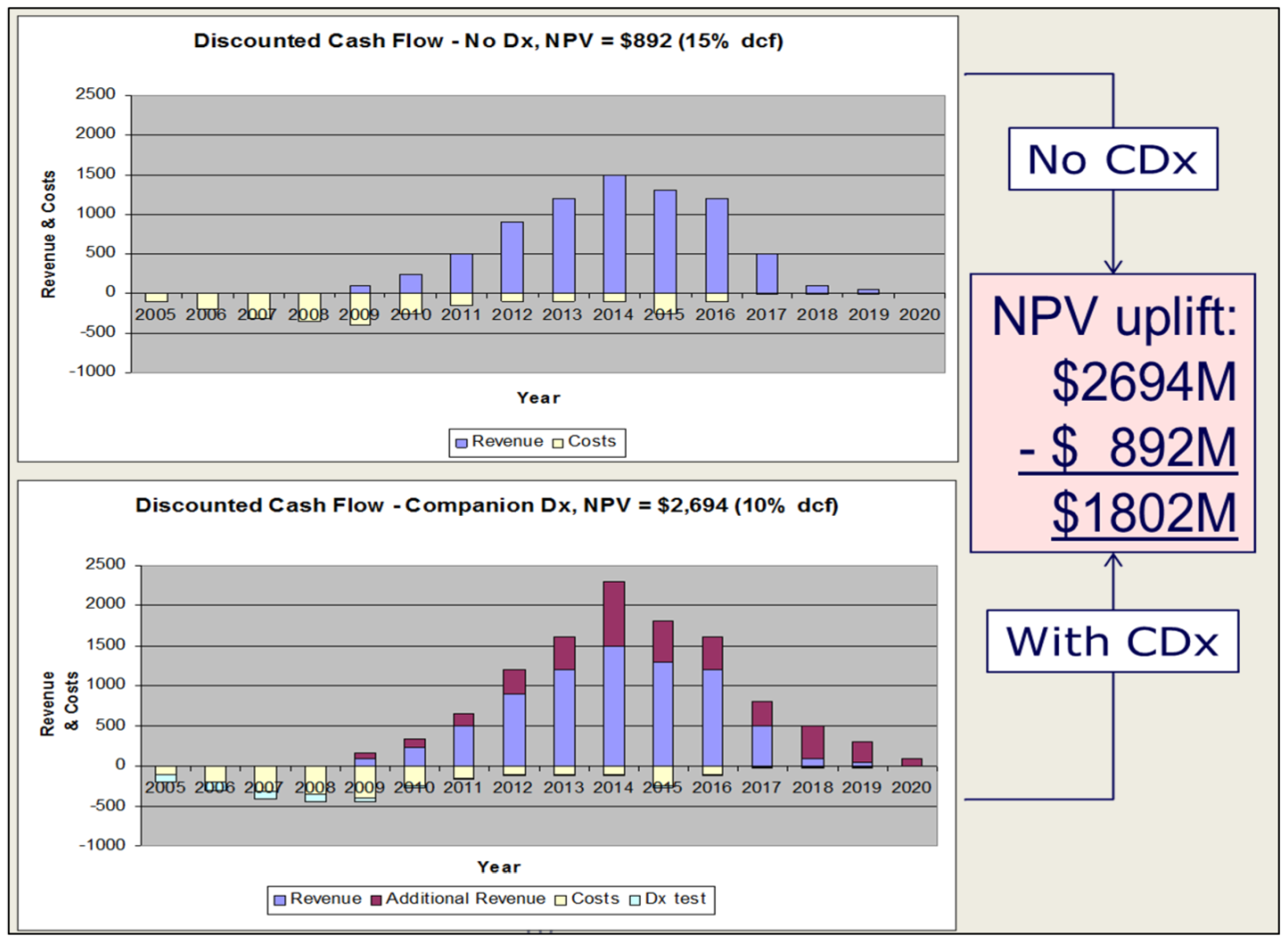
      <p>While it is recognized that the pharma partner (Rx) and the diagnostic partner (Dx) conduct their business on vastly different scales (Rx $1000bn, relevant Dx $10bn sales per annum [<xref ref-type="bibr" rid="B14-jpm-02-00257">14</xref>,<xref ref-type="bibr" rid="B15-jpm-02-00257">15</xref>], companion diagnostic deals are very capital-intensive for the diagnostic partner. Economic quantitation of these benefits over a 20-year period suggests a potential net present value (NPV) uplift of $1.8 bn, from $900 M to $2.7 bn [<xref ref-type="bibr" rid="B7-jpm-02-00257">7</xref>,<xref ref-type="bibr" rid="B16-jpm-02-00257">16</xref>] (see <xref ref-type="fig" rid="jpm-02-00257-f001">Figure 1</xref>). Larger pharma partners recognize that they need to provide financial stability to their test providers to ensure that they are viable through the development and commercialization stages. This has been achieved through secured loans, such as Pfizer’s $25 M investment in Monogram Biosciences [<xref ref-type="bibr" rid="B17-jpm-02-00257">17</xref>], or supporting investment across divisions in the case of Roche Pharma and Roche Diagnostics. The availability of internal diagnostics organizations to pharma divisions, such as at Roche, Abbott and Novartis, does not as yet appear to represent a more favourable structure than use of external diagnostics providers, such as at GSK, Pfizer or AstraZeneca.</p>
      <fig id="jpm-02-00257-f001" position="anchor">
        <label>Figure 1</label>
        <caption>
          <p>Adapted with permission from Blair E.D. (2008)[<xref ref-type="bibr" rid="B7-jpm-02-00257">7</xref>].</p>
        </caption>
        <graphic xmlns:xlink="http://www.w3.org/1999/xlink" xlink:href="jpm-02-00257-g001.tif"/>
      </fig>
      <p>Companion diagnostic development has therefore been concentrated at a small number of organisations with the appropriate financial stability, technical expertise, regulatory knowledge and global reach for commercialization. Of course, there is no single diagnostic partner that fits all of these requirements, and partnership deals should include resources to supplement the regulatory approval and commercial launch process.</p>
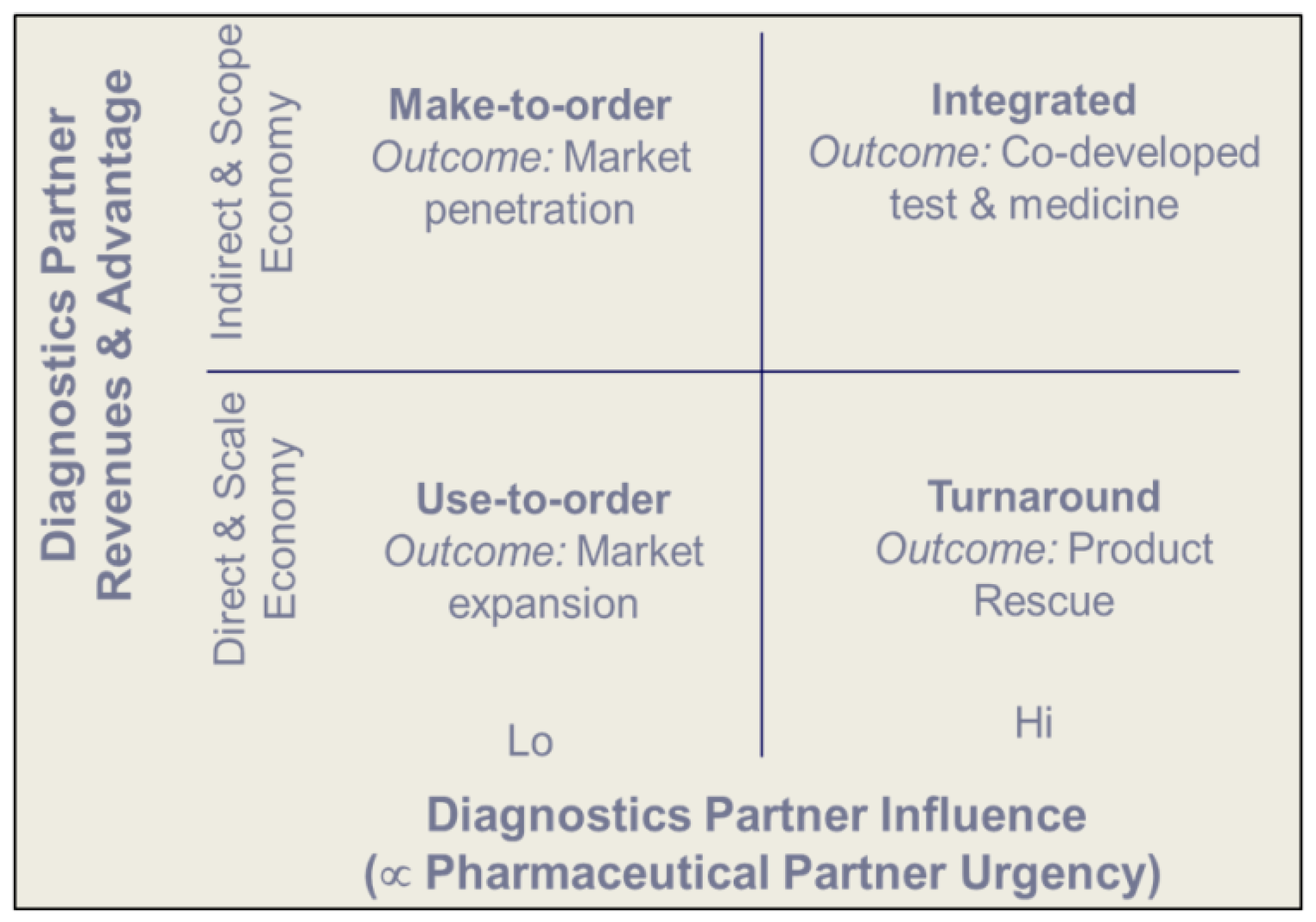
      <p>To more accurately gauge the economic relationship between Rx-Dx partners, we have used value-modeling to look at how simple fee-for-service relationships might translate into risk-sharing relationships [<xref ref-type="bibr" rid="B7-jpm-02-00257">7</xref>,<xref ref-type="bibr" rid="B10-jpm-02-00257">10</xref>,<xref ref-type="bibr" rid="B16-jpm-02-00257">16</xref>]. The structures of these various models are shown in <xref ref-type="fig" rid="jpm-02-00257-f002">Figure 2</xref>. There is a greater risk spread between pharmaceutical probability of success (PoS), estimated at 1-in-60, <italic>vs</italic>. the better than 1-in-5 for the diagnostic, although new regulation may impact on the Dx PoS. Because diagnostics contribute to lowering the clinical and regulatory risk for the pharmaceutical product [<xref ref-type="bibr" rid="B5-jpm-02-00257">5</xref>,<xref ref-type="bibr" rid="B11-jpm-02-00257">11</xref>,<xref ref-type="bibr" rid="B12-jpm-02-00257">12</xref>,<xref ref-type="bibr" rid="B13-jpm-02-00257">13</xref>], there could be an economic case for a hybrid fee-for-service relationship with qualified risk sharing reflected through pharma royalty sharing, especially in the case of strong diagnostic IP or a dominant testing market position. This would offset the capital investment by the diagnostic company and could facilitate the commercial success of the co-launch by providing resources to make the test available widely. To date, there are no published reports of such royalty-sharing but this type of relationship has long been debated.</p>
      <fig id="jpm-02-00257-f002" position="anchor">
        <label>Figure 2</label>
        <caption>
          <p>Rx-Dx Model Relationships. Adapted with permission from Blair E.D. (2010)[<xref ref-type="bibr" rid="B16-jpm-02-00257">16</xref>].</p>
        </caption>
        <graphic xmlns:xlink="http://www.w3.org/1999/xlink" xlink:href="jpm-02-00257-g002.tif"/>
      </fig>
      <p>The structure of these relationships should be guided by associating an Rx Product Profile (Target Product Profile, TPP) with a Dx Product Profile (Target Test Profile, TTP) [<xref ref-type="bibr" rid="B10-jpm-02-00257">10</xref>], with the latter articulating the technical, clinical and commercial performance of a test that will ensure successful development of a linked stratified medicine described by the TPP.</p>
      <p>The economic value of the relationship will also incorporate the contributions of the diagnostic to shorter approval times, premium pricing and clearing reimbursement review hurdles in all payor settings.</p>
    </sec>
    <sec>
      <title>3. Impact on Regulation, Pricing and Reimbursement</title>
      <p>In 2011, multiple product approvals and commercial launches provided clear examples of the benefits of companion diagnostic development and triggered updated regulatory guidance. In the US, the Food and Drug Administration (FDA) issued Draft Guidance on “<italic>In Vitro</italic> Companion Diagnostic Devices” [<xref ref-type="bibr" rid="B18-jpm-02-00257">18</xref>] which supported the methodology used in both the Zelboraf [<xref ref-type="bibr" rid="B19-jpm-02-00257">19</xref>] and Xalkori [<xref ref-type="bibr" rid="B20-jpm-02-00257">20</xref>] regulatory submissions and subsequent companion diagnostic co-approvals in August 2011 [<xref ref-type="bibr" rid="B21-jpm-02-00257">21</xref>]. Both products were rewarded with approvals ahead of their PDUFA dates.</p>
      <p>In Europe, the European Medicines Agency (EMA) released a White Paper on the use of biomarkers in drug development [<xref ref-type="bibr" rid="B22-jpm-02-00257">22</xref>] and the European Commission announced a review and update to the IVD Directive [<xref ref-type="bibr" rid="B23-jpm-02-00257">23</xref>]. According to proposed key changes, companion diagnostics are expected to remain under IVD directive and be listed as class C (high individual risk and/or moderate public risk), conforming with the new GHTF (Global Harmonization Task Force) classification model. The implementation of that model would thus bring them under Notified Body review. Whereas public consultation suggested that the proposed demonstration of clinical utility might not be workable for companion diagnostics, closer cooperation between the IVD Medical Device organization and EMA is considered a positive benefit from the IVDD revisions. A draft was due to be released in early 2012, while the timeline for implementation of the revised IVD directive has still to be defined.</p>
      <p>Pricing for these targeted therapeutics has been established in context of their narrowly defined patient populations, with the strategic intent to expand markets post-approval. Xalkori (critozinib, Pfizer) is priced at $115,200 per annum (approximately $9,600 per month) [<xref ref-type="bibr" rid="B24-jpm-02-00257">24</xref>] and was originally in development as a c-Met inhibitor before the association with the Anaplastic Lymphoma Kinase (ALK) mutation. It is currently in EORTC studies for multiple tumors with MET and/or ALK mutations, as well as separate studies in lymphoma which will expand its “narrow” indication. While the co-approved ALK test, Vysis ALK Break Apart In Situ Hybridisation FISH Probe Kit from Abbott Molecular, is priced higher than similar FISH-based kit tests, at $1500 [<xref ref-type="bibr" rid="B25-jpm-02-00257">25</xref>] (the HER2 FISH test is priced closer to $500), the price does not reflect the full value contribution to the successful commercialisation of the associated therapeutic (see <xref ref-type="table" rid="jpm-02-00257-t001">Table 1</xref>). Approval was based on data of 255 ALK positive patients enrolled in a phase II and a phase I study [<xref ref-type="bibr" rid="B26-jpm-02-00257">26</xref>,<xref ref-type="bibr" rid="B27-jpm-02-00257">27</xref>,<xref ref-type="bibr" rid="B28-jpm-02-00257">28</xref>] meaning that development of Xalkori and its companion diagnostic took only four years from identification of the target to approval [<xref ref-type="bibr" rid="B29-jpm-02-00257">29</xref>,<xref ref-type="bibr" rid="B30-jpm-02-00257">30</xref>] and with ALK positivity considered to be close to 2%–7% [<xref ref-type="bibr" rid="B31-jpm-02-00257">31</xref>], even a highly effective drug would have failed in all-comer trials without patient stratification. In addition to fast approval, this regulatory review paradigm significantly impacts on the size of clinical trial and the associated costs [<xref ref-type="bibr" rid="B32-jpm-02-00257">32</xref>,<xref ref-type="bibr" rid="B33-jpm-02-00257">33</xref>].</p>
      <table-wrap id="jpm-02-00257-t001" position="float">
        <object-id pub-id-type="pii">jpm-02-00257-t001_Table 1</object-id>
        <label>Table 1</label>
        <caption>
          <p>The Price <italic>vs.</italic> Value Imbalance. * Projected Annual Sales 2012 based on HY12 – roche.com.</p>
        </caption>
        <table>
          <thead>
            <tr>
              <th align="center" valign="middle">Targeted Therapy</th>
              <th align="center" valign="middle">Annual Price</th>
              <th align="center" valign="middle">Companion Diagnostic</th>
              <th align="center" valign="middle">Test Price</th>
              <th align="center" valign="middle">Model</th>
              <th align="center" valign="middle">Value</th>
            </tr>
          </thead>
          <tbody>
            <tr>
              <td align="center" valign="middle">Xalkori (critozinib, Pfizer)</td>
              <td align="center" valign="middle">$115,200</td>
              <td align="center" valign="middle">Vysis ALK Break Apart In Situ Hybridisation FISH Probe Kit (Abbott Molecular)</td>
              <td align="center" valign="middle">$1,500</td>
              <td align="center" valign="middle">Rescue (ALK positivity ~7%)</td>
              <td align="center" valign="middle">TBD</td>
            </tr>
            <tr>
              <td align="center" valign="middle"><bold>Zelboraf</bold> (vemurafenib, Plexxikon / Diiachi-Sankyo/ Roche)</td>
              <td align="center" valign="middle">$56,400</td>
              <td align="center" valign="middle">Cobas 4800 BRAF V600 Mutation Test (Roche Molecular)</td>
              <td align="center" valign="middle">$120-$150</td>
              <td align="center" valign="middle">Co-development (BRAF V600E mutation ~40%)</td>
              <td align="center" valign="middle">$144M ($213M*)</td>
            </tr>
            <tr>
              <td align="center" valign="middle">Herceptin (trastuzumab, Genentech / Roche)</td>
              <td align="center" valign="middle">$70,000</td>
              <td align="center" valign="middle">HercepTest (Dako)</td>
              <td align="center" valign="middle">$500</td>
              <td align="center" valign="middle">Rescue (HER-2 expression score 3+ ~ 10%)</td>
              <td align="center" valign="middle">$620M*</td>
            </tr>
          </tbody>
        </table>
      </table-wrap>
      <p>Well ahead of projected view timelines, the FDA also approved Zelboraf (vemurafenib, Plexxikon / Diiachi-Sankyo / Roche) for the treatment of BRAF V600E mutation-positive, inoperable or metastatic melanoma, and co-approved the Cobas 4800 BRAF V600 Mutation Test, a diagnostic test developed by Roche to identify patients eligible for treatment. The pivotal phase III trial was run in a selected patient population of 675 patients with previously untreated, metastatic melanoma with the BRAF V600E mutation and showing a tremendous clinical benefit over chemotherapy [<xref ref-type="bibr" rid="B19-jpm-02-00257">19</xref>].</p>
      <p>With a prevalence of BRAF mutation in melanoma of about 42% (COSMIC database [<xref ref-type="bibr" rid="B34-jpm-02-00257">34</xref>]) and V600E being the most common mutation, the actual clinical benefit would approximately be 50%–60% in an unselected population, so approval might not have been granted. Thus, while identifying the BRAF V600E mutation in metastatic melanoma and pursuing an enrollment strategy based on the Cobas 4800 BRAF V600 Mutation Test by necessity halved the patient population size for vemurafenib early in its development, the strategy also expedited the development timeline and created a new paradigm for phase II/III clinical trial design [<xref ref-type="bibr" rid="B19-jpm-02-00257">19</xref>].</p>
      <p>Based on the data for progression free survival from the pivotal phase III trials, a 6 months treatment period can be assumed, resulting in costs of Zelboraf treatment in the range of $56,400 ($9.400 per month) [<xref ref-type="bibr" rid="B35-jpm-02-00257">35</xref>], depending on the actual treatment duration. Costs for patient selection by the COBAS V600E test are considered to be in the range of $120-$150 [<xref ref-type="bibr" rid="B35-jpm-02-00257">35</xref>], but this test price reflects neither the value that the test brings to the medicine, nor the heavily subsidized development costs borne by Roche Diagnostics. Annual sales of Zelboraf are already $200M and so may exceed 2015 estimates of $372 M [<xref ref-type="bibr" rid="B36-jpm-02-00257">36</xref>] whereas the test is unlikely to exceed annual sales of $10M by 2015–2019 [<xref ref-type="bibr" rid="B37-jpm-02-00257">37</xref>].</p>
    </sec>
    <sec>
      <title>4. Beyond UK NICE, Health Technology Assessment in Germany</title>
      <p>While the higher prices of targeted drugs may conflict with the interests of pricing agencies, there are signs that the agencies may be more amenable to a clearly defined patient population. In its rejection of Yervoy (ipilumumab, Bristol-Myers Squibb)—a human monoclonal antibody for malignant melanoma approved by the FDA in March 2011 [<xref ref-type="bibr" rid="B38-jpm-02-00257">38</xref>]—the UK National Institute for Health and Clinical Effectiveness (NICE) calculated that the £80,000 annual cost was too high per QALY gained, but also went on to state, “Unfortunately, no patient characteristics or biomarkers have yet been identified to help identify this small group of people most likely to gain long-term benefit from receiving ipilimumab” [<xref ref-type="bibr" rid="B39-jpm-02-00257">39</xref>]. Zelboraf, estimated cost of £37,500 for a course of treatment and with a recognised companion diagnostic, has been under review to determine whether its QALY value merits a positive opinion from NICE; in fact it was recently given a negative opinion by NICE [<xref ref-type="bibr" rid="B40-jpm-02-00257">40</xref>]. Given the price of Xalkori (£78,000 per year), the current price of ALK testing (£900) for the ALK testing, and considering the rather low prevalence of ALK translocations, testing all advanced NSCLC patients in order to identify ALK-positive patients might turn out not to be cost effective [<xref ref-type="bibr" rid="B41-jpm-02-00257">41</xref>], an issue noted by others [<xref ref-type="bibr" rid="B10-jpm-02-00257">10</xref>].</p>
      <p>Although regulatory review, pricing and payment committees may all be aware of stratified medicine, there is not yet an integrated system for the process. As an example of the number of agencies involved, we look to Germany’s approach to stratified medicines [<xref ref-type="bibr" rid="B42-jpm-02-00257">42</xref>].</p>
      <p>Germany, a key pharmaceutical and diagnostic market in Europe with nearly 90% of the population being part of the public insurance system, is struggling to contain healthcare costs and to introduce new technologies clinically- and cost-effectively. </p>
      <p>A dedicated federal committee (Common Health Board, GBA) includes representatives from payers, physicians, hospitals and wider (lay) society, and is taking public system reimbursement decisions based on input from companies, medical societies, and governmental institutions. Such government institutions include an independent organization charged with health technology assessment (HTA) called the Institute for Quality and Efficiency in Healthcare (IQWIG), founded in 2004. Based on requests from GBA, therapies as well as diagnostic tests are evaluated by IQWIG. This process may last 12 months or longer and allows companies to engage with IQWIG at certain step and results in a reimbursement recommendation to GBA. For diagnostic tests the complexity is even higher since final reimbursement may only be approved by the 16 individual German Bundesländer (regions).</p>
      <p>Whereas the demonstration of health economic benefit was only introduced to the IQWIG process in 2008, it has now become even more critical for reimbursement of therapeutics due to a recent German health reform [<xref ref-type="bibr" rid="B43-jpm-02-00257">43</xref>], based on which the price for therapeutics is determined by a robust cost-benefit analysis. Stratified medicine approaches that provide either enhanced efficacy or improved safety in the respective selected target population may be allowed premium pricing according to this regulation if the cost-benefit analysis is positive.</p>
      <p>Companion diagnostic tests on the other hand still lack such a value-based approach. As with other diagnostics, they are covered within the DRG (diagnosis related group) fee schedule in the inpatient (hospital) setting and a code-based fee schedule in the outpatient (ambulatory) setting, respectively, a technical procedural cost which does not consider clinical or economic value.</p>
      <p>As Germany is just one of the five major EU markets, the complexities of satisfying EU healthcare stakeholders are complex, evolving and ultimately multiplying. Some headway is being made in this respect through both Europe-wide harmonization of drug and diagnostic regulations, and also many global harmonization activities that include the use of companion diagnostics and stratified medicines [<xref ref-type="bibr" rid="B31-jpm-02-00257">31</xref>].</p>
    </sec>
    <sec sec-type="conclusions">
      <title>5. Conclusions</title>
      <p>When personalized medicine strategies were originally developed over a decade ago, there was little commercial enthusiasm for stratifying patients for therapeutic response, but changes in the clinical and commercial environment also make a strong economic case for stratified medicine. Stratified medicines impact the economic relationship of both large pharma and companion diagnostic test developers by establishing economic risk-sharing in test development and trial operations, introducing regulatory strategy for diagnostic developers and building designated markets for final products. The joint diagnostic and drug product also creates new commercial opportunities for strategic pricing and favorable reviews by cost-effectiveness committees, both at the state and private levels. </p>
      <p>Beyond the co-developer relationship, stratified medicines impact healthcare providers at the points of testing, prescribing and payment and deliver more valuable outcomes to patients when they are receiving the appropriate care.</p>
      <p>Finally, more timely access to safe, highly-effective patient-stratified therapies moves healthcare towards an era of <italic>predictive</italic> medicine, as opposed to <italic>reactive</italic> medicine, with the undoubted benefits of earlier treatment translating to better long-term outcomes. In this respect, it may well be feasible to prolong life, but the challenge of future healthcare is to ensure that quality of life remains commensurate with this longevity.</p>
    </sec>
    
  </body>
  <back><ack>
      <title>Acknowledgments</title>
      <p>Many thanks to our colleagues within IML and beyond for their insights that guided our thinking.</p>
    </ack>
    <notes>
      <title>Conflict of Interest</title>
      <p>The authors declare no conflict of interest. </p>
    </notes>
    <ref-list>
      <title>References</title>
      <ref id="B1-jpm-02-00257">
        <label>1.</label>
        <citation citation-type="journal">
          <person-group person-group-type="author">
            <name>
              <surname>Walker</surname>
              <given-names>I.</given-names>
            </name>
            <name>
              <surname>Newell</surname>
              <given-names>H.</given-names>
            </name>
          </person-group>
          <article-title>Do molecularly targeted agents in oncology have reduced attrition rates?</article-title>
          <source>Nat. Rev. Drug Discov.</source>
          <year>2009</year>
          <volume>8</volume>
          <fpage>15</fpage>
          <lpage>16</lpage>
          <pub-id pub-id-type="doi">10.1038/nrd2758</pub-id>
        </citation>
      </ref>
      <ref id="B2-jpm-02-00257">
        <label>2.</label>
        <citation citation-type="journal">
          <person-group person-group-type="author">
            <name>
              <surname>Trusheim</surname>
              <given-names>M.R.</given-names>
            </name>
            <name>
              <surname>Berndt</surname>
              <given-names>E.R.</given-names>
            </name>
            <name>
              <surname>Douglas</surname>
              <given-names>F.L.</given-names>
            </name>
          </person-group>
          <article-title>Stratified medicine: Strategic and economic implications of combining drugs and clinical biomarkers</article-title>
          <source>Nat. Rev. Drug Discov.</source>
          <year>2007</year>
          <volume>6</volume>
          <fpage>287</fpage>
          <lpage>293</lpage>
        <pub-id pub-id-type="doi">10.1038/nrd2251</pub-id><pub-id pub-id-type="pmid">17380152</pub-id></citation>
      </ref>
      <ref id="B3-jpm-02-00257">
        <label>3.</label>
        <citation citation-type="journal">
          <person-group person-group-type="author">
            <name>
              <surname>Blair</surname>
              <given-names>E.D.</given-names>
            </name>
          </person-group>
          <article-title>Predictive tests and personalised medicine</article-title>
          <source>Drug Discov. World (Autumn)</source>
          <year>2009</year>
          <volume>22</volume>
          <fpage>27</fpage>
          <lpage>31</lpage>
        </citation>
      </ref>
      <ref id="B4-jpm-02-00257">
        <label>4.</label>
        <citation citation-type="journal">
          <person-group person-group-type="author">
            <name>
              <surname>Gilham</surname>
              <given-names>I.</given-names>
            </name>
          </person-group>
          <article-title>Theranostics: An emerging tool in drug discovery and commercialisation</article-title>
          <source>Drug Discov. World (Autumn)</source>
          <year>2002</year>
          <volume>6</volume>
          <fpage>24</fpage>
          <lpage>32</lpage>
        </citation>
      </ref>
      <ref id="B5-jpm-02-00257">
        <label>5.</label>
        <citation citation-type="journal">
          <person-group person-group-type="author">
            <name>
              <surname>Trusheim</surname>
              <given-names>M.R.</given-names>
            </name>
            <name>
              <surname>Burgess</surname>
              <given-names>B.</given-names>
            </name>
            <name>
              <surname>Hu</surname>
              <given-names>S.X.</given-names>
            </name>
            <name>
              <surname>Long</surname>
              <given-names>T.</given-names>
            </name>
            <name>
              <surname>Averbuch</surname>
              <given-names>S.D.</given-names>
            </name>
            <name>
              <surname>Flynn</surname>
              <given-names>A.A.</given-names>
            </name>
            <name>
              <surname>Lieftucht</surname>
              <given-names>A.</given-names>
            </name>
            <name>
              <surname>Mazumder</surname>
              <given-names>A.</given-names>
            </name>
            <name>
              <surname>Milloy</surname>
              <given-names>J.</given-names>
            </name>
            <name>
              <surname>Shaw</surname>
              <given-names>P.M.</given-names>
            </name>
            <etal/>
          </person-group>
          <article-title>Quantifying factors for the success of stratified medicine</article-title>
          <source>Nat. Rev. Drug Discov.</source>
          <year>2011</year>
          <volume>10</volume>
          <fpage>817</fpage>
          <lpage>833</lpage>
          <pub-id pub-id-type="doi">10.1038/nrd3557</pub-id>
        </citation>
      </ref>
      <ref id="B6-jpm-02-00257">
        <label>6.</label>
        <citation citation-type="web">
          <person-group person-group-type="author">
            <name>
              <surname>Agarwal</surname>
              <given-names>A.</given-names>
            </name>
          </person-group>
          <article-title>Overlooked Opportunities</article-title>
          <access-date>(accessed on 20 August 2012)</access-date>
          <comment>Available online:<ext-link xmlns:xlink="http://www.w3.org/1999/xlink" xlink:href="http://www.pharmexec.com/pharmexec/article/articleDetail.jsp?id=574630&amp;pageID=1&amp;sk=&amp;date" ext-link-type="uri">http://www.pharmexec.com/pharmexec/article/articleDetail.jsp?id=574630&amp;pageID=1&amp;sk=&amp;date</ext-link></comment>
        </citation>
      </ref>
      <ref id="B7-jpm-02-00257">
        <label>7.</label>
        <citation citation-type="journal">
          <person-group person-group-type="author">
            <name>
              <surname>Blair</surname>
              <given-names>E.D.</given-names>
            </name>
          </person-group>
          <article-title>Assessing the value-adding impact of diagnostic-type tests on drug development and marketing</article-title>
          <source>Mol. Diagn. Ther.</source>
          <year>2008</year>
          <volume>12</volume>
          <fpage>331</fpage>
          <lpage>337</lpage>
          <pub-id pub-id-type="doi">10.1007/BF03256298</pub-id>
        </citation>
      </ref>
      <ref id="B8-jpm-02-00257">
        <label>8.</label>
        <citation citation-type="journal">
          <person-group person-group-type="author">
            <name>
              <surname>Hughes</surname>
              <given-names>B.</given-names>
            </name>
          </person-group>
          <article-title>The comparative effectiveness challenge</article-title>
          <source>Nat. Rev. Drug Discov.</source>
          <year>2009</year>
          <volume>8</volume>
          <fpage>261</fpage>
          <lpage>263</lpage>
          <pub-id pub-id-type="doi">10.1038/nrd2866</pub-id>
        </citation>
      </ref>
      <ref id="B9-jpm-02-00257">
        <label>9.</label>
        <citation citation-type="journal">
          <person-group person-group-type="author">
            <name>
              <surname>Hughes</surname>
              <given-names>B.</given-names>
            </name>
          </person-group>
          <article-title>Novel risk-sharing scheme puts the spotlight on biomarkers</article-title>
          <source>Nat. Rev. Drug Discov.</source>
          <year>2007</year>
          <volume>6</volume>
          <fpage>945</fpage>
        <pub-id pub-id-type="doi">10.1038/nrd2478</pub-id></citation>
      </ref>
      <ref id="B10-jpm-02-00257">
        <label>10.</label>
        <citation citation-type="journal">
          <person-group person-group-type="author">
            <name>
              <surname>Blair</surname>
              <given-names>E.D.</given-names>
            </name>
            <name>
              <surname>Blakemore</surname>
              <given-names>J.A.</given-names>
            </name>
          </person-group>
          <article-title>Drug-diagnostic co-development: How to harness the value</article-title>
          <source>Drug Discov. Today</source>
          <year>2011</year>
          <volume>16</volume>
          <fpage>902</fpage>
          <lpage>905</lpage>
          <pub-id pub-id-type="doi">10.1016/j.drudis.2011.08.010</pub-id>
        </citation>
      </ref>
      <ref id="B11-jpm-02-00257">
        <label>11.</label>
        <citation citation-type="web">
          <person-group person-group-type="author">
            <name>
              <surname>Allen</surname>
              <given-names>D.</given-names>
            </name>
            <name>
              <surname>Alves</surname>
              <given-names>L.</given-names>
            </name>
            <name>
              <surname>Caruncho</surname>
              <given-names>G.</given-names>
            </name>
            <name>
              <surname>Chin</surname>
              <given-names>D.</given-names>
            </name>
            <name>
              <surname>Cohn</surname>
              <given-names>D.</given-names>
            </name>
            <name>
              <surname>Damle</surname>
              <given-names>B.</given-names>
            </name>
            <name>
              <surname>Dracos</surname>
              <given-names>B.</given-names>
            </name>
            <name>
              <surname>Friend</surname>
              <given-names>S.</given-names>
            </name>
            <name>
              <surname>Ha</surname>
              <given-names>J.</given-names>
            </name>
            <name>
              <surname>Kadar</surname>
              <given-names>A.</given-names>
            </name>
            <etal/>
          </person-group>
          <article-title>The new science of personalized medicine</article-title>
          <access-date>(accessed on 20 August 2012)</access-date>
          <comment>Available online:<ext-link xmlns:xlink="http://www.w3.org/1999/xlink" xlink:href="http://www.PWC.com" ext-link-type="uri">http://www.PWC.com</ext-link></comment>
        </citation>
      </ref>
      <ref id="B12-jpm-02-00257">
        <label>12.</label>
        <citation citation-type="journal">
          <person-group person-group-type="author">
            <name>
              <surname>Davis</surname>
              <given-names>J.C.</given-names>
            </name>
            <name>
              <surname>Furstenthal</surname>
              <given-names>L.</given-names>
            </name>
            <name>
              <surname>Desai</surname>
              <given-names>A.A.</given-names>
            </name>
            <name>
              <surname>Norris</surname>
              <given-names>T.</given-names>
            </name>
            <name>
              <surname>Sutaria</surname>
              <given-names>S.</given-names>
            </name>
            <name>
              <surname>Fleming</surname>
              <given-names>E.</given-names>
            </name>
            <name>
              <surname>Ma</surname>
              <given-names>P.</given-names>
            </name>
          </person-group>
          <article-title>The microeconomics of personalized medicine: Today’s challenge and tomorrow’s promise</article-title>
          <source>Nat. Rev. Drug Discov.</source>
          <year>2009</year>
          <volume>8</volume>
          <fpage>279</fpage>
          <lpage>286</lpage>
        <pub-id pub-id-type="doi">10.1038/nrd2825</pub-id><pub-id pub-id-type="pmid">19300459</pub-id></citation>
      </ref>
      <ref id="B13-jpm-02-00257">
        <label>13.</label>
        <citation citation-type="web">
		<collab>Personalized Medicine Coalition</collab>
          <article-title>The Case for Personalized Medicine 3rd ed</article-title>
          <access-date>(accessed on 20 August 2012)</access-date>
          <comment>Available online:<ext-link xmlns:xlink="http://www.w3.org/1999/xlink" xlink:href="http://www.personalizedmedicinecoalition.org/" ext-link-type="uri">http://www.personalizedmedicinecoalition.org/</ext-link></comment>
        </citation>
      </ref>
      <ref id="B14-jpm-02-00257">
        <label>14.</label>
        <citation citation-type="web">
		<collab>Espicom Healthcare Intelligence</collab>
          <article-title>The World Pharmaceutical Markets Fact Book</article-title>
          <year>2011</year>
          <access-date>(accessed on 20 August 2012)</access-date>
          <comment>Available online:<ext-link xmlns:xlink="http://www.w3.org/1999/xlink" xlink:href="http://www.marketresearch.com/Espicom-Healthcare-Intelligence-v1129/Pharmaceutical-Fact-Book-6485983/" ext-link-type="uri">http://www.marketresearch.com/Espicom-Healthcare-Intelligence-v1129/Pharmaceutical-Fact-Book-6485983/</ext-link></comment>
        </citation>
      </ref>
      <ref id="B15-jpm-02-00257">
        <label>15.</label>
        <citation citation-type="web">
          <article-title>EAC Diagnostics Industry Study</article-title>
          <year>2011</year>
          <access-date>(accessed on 20 August 2012)</access-date>
          <comment>Available online:<ext-link xmlns:xlink="http://www.w3.org/1999/xlink" xlink:href="http://www.eacorp.com" ext-link-type="uri">http://www.eacorp.com</ext-link></comment>
        </citation>
      </ref>
      <ref id="B16-jpm-02-00257">
        <label>16.</label>
        <citation citation-type="journal">
          <person-group person-group-type="author">
            <name>
              <surname>Blair</surname>
              <given-names>E.D.</given-names>
            </name>
          </person-group>
          <article-title>Molecular diagnostics and personalized medicine: Value-assessed opportunities for multiple stakeholders</article-title>
          <source>Pers. Med.</source>
          <year>2010</year>
          <volume>7</volume>
          <fpage>143</fpage>
          <lpage>161</lpage>
          <pub-id pub-id-type="doi">10.2217/pme.10.1</pub-id>
        </citation>
      </ref>
      <ref id="B17-jpm-02-00257">
        <label>17.</label>
        <citation citation-type="web">
          <article-title>Pfizer invests in Monogram</article-title>
          <access-date>(accessed on 20 August 2012)</access-date>
          <comment>Available online:<ext-link xmlns:xlink="http://www.w3.org/1999/xlink" xlink:href="http://www.fiercebiotech.com/story/pfizer-to-invest-25m-in-monogram-biosciences/2006-05-08" ext-link-type="uri">http://www.fiercebiotech.com/story/pfizer-to-invest-25m-in-monogram-biosciences/2006-05-08</ext-link></comment>
        </citation>
      </ref>
      <ref id="B18-jpm-02-00257">
        <label>18.</label>
        <citation citation-type="web">
          <person-group person-group-type="author">
            <name>
              <surname>Mansfield</surname>
              <given-names>E.</given-names>
            </name>
            <name>
              <surname>Leptak</surname>
              <given-names>C.</given-names>
            </name>
          </person-group>
          <article-title>Draft Guidance for Industry and FDA Staff—<italic>In Vitro</italic> Companion Diagnostic Devices</article-title>
          <access-date>(accessed on 20 August 2012)</access-date>
          <comment>Available online:<ext-link xmlns:xlink="http://www.w3.org/1999/xlink" xlink:href="http://www.fda.gov/medicaldevices/deviceregulationandguidance/guidancedocuments/ucm262292.htm" ext-link-type="uri">http://www.fda.gov/medicaldevices/deviceregulationandguidance/guidancedocuments/ucm262292.htm</ext-link></comment>
        </citation>
      </ref>
      <ref id="B19-jpm-02-00257">
        <label>19.</label>
        <citation citation-type="journal">
          <person-group person-group-type="author">
            <name>
              <surname>Chapman</surname>
              <given-names>P.B.</given-names>
            </name>
            <name>
              <surname>Hauschild</surname>
              <given-names>A.</given-names>
            </name>
            <name>
              <surname>Robert</surname>
              <given-names>C.</given-names>
            </name>
            <name>
              <surname>Haanen</surname>
              <given-names>J.B.</given-names>
            </name>
            <name>
              <surname>Ascierto</surname>
              <given-names>P.</given-names>
            </name>
            <name>
              <surname>Larkin</surname>
              <given-names>J.</given-names>
            </name>
            <name>
              <surname>Dummer</surname>
              <given-names>R.</given-names>
            </name>
            <name>
              <surname>Garbe</surname>
              <given-names>C.</given-names>
            </name>
            <name>
              <surname>Testori</surname>
              <given-names>A.</given-names>
            </name>
            <name>
              <surname>Maio</surname>
              <given-names>M.</given-names>
            </name>
            <etal/>
          </person-group>
          <article-title>Improved survival with vemurafenib in melanoma with BRAF V600E mutation</article-title>
          <source>N. Engl. J. Med.</source>
          <year>2011</year>
          <volume>364</volume>
          <fpage>2507</fpage>
          <lpage>2516</lpage>
        <pub-id pub-id-type="doi">10.1056/NEJMoa1103782</pub-id><pub-id pub-id-type="pmid">21639808</pub-id></citation>
      </ref>
      <ref id="B20-jpm-02-00257">
        <label>20.</label>
        <citation citation-type="journal">
          <person-group person-group-type="author">
            <name>
              <surname>Goodman</surname>
              <given-names>M.</given-names>
            </name>
          </person-group>
          <article-title>Xalkori and the Art of Modern Drug Development</article-title>
          <source>In Vivo</source>
		  <month>February</month>
          <year>2012</year>
          <comment>Article No. 2012800030</comment>
        </citation>
      </ref>
      <ref id="B21-jpm-02-00257">
        <label>21.</label>
        <citation citation-type="web">
          <article-title>Food and Drug Administration. FY2011 Innovative Drug Approvals</article-title>
          <access-date>(accessed on 20 August 2012)</access-date>
          <comment>Available online:<ext-link xmlns:xlink="http://www.w3.org/1999/xlink" xlink:href="http://www.fda.gov/AboutFDA/ReportsManualsForms/Reports/ucm276385.htm" ext-link-type="uri">http://www.fda.gov/AboutFDA/ReportsManualsForms/Reports/ucm276385.htm</ext-link></comment>
        </citation>
      </ref>
      <ref id="B22-jpm-02-00257">
        <label>22.</label>
        <citation citation-type="web">
		<collab>European Medicines Agency</collab>
          <article-title>Qualification of novel methodologies for medicine development: Guidance to applicants</article-title>
          <access-date>(accessed on 20 August 2012)</access-date>
          <comment>Available online:<ext-link xmlns:xlink="http://www.w3.org/1999/xlink" xlink:href="http://www.ema.europa.eu/ema/index.jsp?curl=pages/regulation/document_listing/document_listing_000319.jsp&amp;mid=WC0b01ac0580022bb0" ext-link-type="uri">http://www.ema.europa.eu/ema/index.jsp?curl=pages/regulation/document_listing/document_listing_000319.jsp&amp;mid=WC0b01ac0580022bb0</ext-link></comment>
        </citation>
      </ref>
      <ref id="B23-jpm-02-00257">
        <label>23.</label>
        <citation citation-type="other">
          <person-group person-group-type="author">
            <name>
              <surname>Stynen</surname>
              <given-names>D.</given-names>
            </name>
          </person-group>
          <article-title>Revision of Europe’s IVD Directive 98/79/EC—Lessons and results from the Public Consultation document</article-title>
          <source>IVD Technology</source>
          <day>20</day>
          <month>July</month>
          <year>2011</year>
        </citation>
      </ref>
      <ref id="B24-jpm-02-00257">
        <label>24.</label>
        <citation citation-type="web">
          <person-group person-group-type="author">
            <name>
              <surname>Maverick</surname>
              <given-names>N.Y.</given-names>
            </name>
          </person-group>
          <article-title>My take on the Crizotinib / xalkori FDA approval</article-title>
          <access-date>(accessed on 20 August 2012)</access-date>
          <comment>Available online:<ext-link xmlns:xlink="http://www.w3.org/1999/xlink" xlink:href="http://pharmastrategyblog.com/2011/08/my-take-on-the-crizotinibxalkori-fda-approval.html/" ext-link-type="uri">http://pharmastrategyblog.com/2011/08/my-take-on-the-crizotinibxalkori-fda-approval.html/</ext-link></comment>
        </citation>
      </ref>
      <ref id="B25-jpm-02-00257">
        <label>25.</label>
        <citation citation-type="web">
          <person-group person-group-type="author">
            <name>
              <surname>Herper</surname>
              <given-names>M.</given-names>
            </name>
          </person-group>
          <article-title>Gene Test for Pfizer Cancer Drug to Cost $1,500 per Patient</article-title>
          <access-date>(accessed on 20 August 2012)</access-date>
          <comment>Available online:<ext-link xmlns:xlink="http://www.w3.org/1999/xlink" xlink:href="http://www.forbes.com/sites/matthewherper/2011/08/29/gene-test-for-pfizer-cancer-drug-to-cost-1500-per-patient/" ext-link-type="uri">http://www.forbes.com/sites/matthewherper/2011/08/29/gene-test-for-pfizer-cancer-drug-to-cost-1500-per-patient/</ext-link></comment>
        </citation>
      </ref>
      <ref id="B26-jpm-02-00257">
        <label>26.</label>
        <citation citation-type="journal">
          <person-group person-group-type="author">
            <name>
              <surname>Sauter</surname>
              <given-names>G.</given-names>
            </name>
            <name>
              <surname>Lee</surname>
              <given-names>J.A.</given-names>
            </name>
            <name>
              <surname>Slamon</surname>
              <given-names>D.J.</given-names>
            </name>
            <name>
              <surname>Press</surname>
              <given-names>M.F.</given-names>
            </name>
          </person-group>
          <article-title>Reply to V. Arena</article-title>
          <source>et al. J. Clin. Oncol.</source>
          <year>2010</year>
          <volume>28</volume>
          <fpage>e85</fpage>
          <lpage>e88</lpage>
          <pub-id pub-id-type="doi">10.1200/JCO.2009.25.3930</pub-id>
        </citation>
      </ref>
      <ref id="B27-jpm-02-00257">
        <label>27.</label>
        <citation citation-type="journal">
          <person-group person-group-type="author">
            <name>
              <surname>Crino</surname>
              <given-names>L.</given-names>
            </name>
            <name>
              <surname>Kim</surname>
              <given-names>D.</given-names>
            </name>
            <name>
              <surname>Riely</surname>
              <given-names>G.J.</given-names>
            </name>
            <name>
              <surname>Janne</surname>
              <given-names>P.A.</given-names>
            </name>
            <name>
              <surname>Blackhall</surname>
              <given-names>F.H.</given-names>
            </name>
            <name>
              <surname>Camidge</surname>
              <given-names>D.R.</given-names>
            </name>
            <name>
              <surname>Hirsh</surname>
              <given-names>V.</given-names>
            </name>
            <name>
              <surname>Mok</surname>
              <given-names>T.</given-names>
            </name>
            <name>
              <surname>Solomon</surname>
              <given-names>B.J.</given-names>
            </name>
            <name>
              <surname>Park</surname>
              <given-names>K.</given-names>
            </name>
            <etal/>
          </person-group>
          <article-title>Initial phase II results with crizotinib in advanced ALK-positive non-small cell lung cancer (NSCLC): PROFILE 1005</article-title>
          <source>J. Clin. Oncol.</source>
          <year>2011</year>
          <volume>29</volume>
          <supplement>(Suppl.)</supplement>
		  <comment>Abstract 7514</comment>
        </citation>
      </ref>
      <ref id="B28-jpm-02-00257">
        <label>28.</label>
        <citation citation-type="journal">
          <person-group person-group-type="author">
            <name>
              <surname>Kwak</surname>
              <given-names>E.L.</given-names>
            </name>
            <name>
              <surname>Bang</surname>
              <given-names>Y.J.</given-names>
            </name>
            <name>
              <surname>Camidge</surname>
              <given-names>D.R.</given-names>
            </name>
            <name>
              <surname>Shaw</surname>
              <given-names>A.T.</given-names>
            </name>
            <name>
              <surname>Solomon</surname>
              <given-names>B.</given-names>
            </name>
            <name>
              <surname>Maki</surname>
              <given-names>R.G.</given-names>
            </name>
            <name>
              <surname>Ou</surname>
              <given-names>S.H.</given-names>
            </name>
            <name>
              <surname>Dezube</surname>
              <given-names>B.J.</given-names>
            </name>
            <name>
              <surname>Jänne</surname>
              <given-names>P.A.</given-names>
            </name>
            <name>
              <surname>Costa</surname>
              <given-names>D.B.</given-names>
            </name>
            <etal/>
          </person-group>
          <article-title>Anaplastic lymphoma kinase inhibition in non-small-cell lung cancer</article-title>
          <source>N. Engl. J. Med.</source>
          <year>2010</year>
          <volume>363</volume>
          <fpage>1693</fpage>
          <lpage>1703</lpage>
          <pub-id pub-id-type="doi">10.1056/NEJMoa1006448</pub-id>
        </citation>
      </ref>
      <ref id="B29-jpm-02-00257">
        <label>29.</label>
        <citation citation-type="journal">
          <person-group person-group-type="author">
            <name>
              <surname>Camidge</surname>
              <given-names>D.R.</given-names>
            </name>
            <name>
              <surname>Bang</surname>
              <given-names>Y.</given-names>
            </name>
            <name>
              <surname>Kwak</surname>
              <given-names>E.L.</given-names>
            </name>
            <name>
              <surname>Shaw</surname>
              <given-names>A.T.</given-names>
            </name>
            <name>
              <surname>Iafrate</surname>
              <given-names>A.J.</given-names>
            </name>
            <name>
              <surname>Maki</surname>
              <given-names>R.G.</given-names>
            </name>
            <name>
              <surname>Solomon</surname>
              <given-names>B.J.</given-names>
            </name>
            <name>
              <surname>Ou</surname>
              <given-names>S.I.</given-names>
            </name>
            <name>
              <surname>Salgia</surname>
              <given-names>R.</given-names>
            </name>
            <name>
              <surname>Wilner</surname>
              <given-names>K.D.</given-names>
            </name>
            <etal/>
          </person-group>
          <article-title>Progression-free survival (PFS) from a phase I study of crizotinib (PF 02341066) in patients with ALK-positive non-small cell lung cancer (NSCLC)</article-title>
          <source>J. Clin. Oncol.</source>
          <year>2011</year>
          <volume>29</volume>
          <supplement>(Suppl.)</supplement>
		  <comment>Abstract 2501</comment>
        </citation>
      </ref>
      <ref id="B30-jpm-02-00257">
        <label>30.</label>
        <citation citation-type="journal">
          <person-group person-group-type="author">
            <name>
              <surname>Crystal</surname>
              <given-names>A.S.</given-names>
            </name>
            <name>
              <surname>Shaw</surname>
              <given-names>A.T.</given-names>
            </name>
          </person-group>
          <article-title>New Targets in Advanced NSCLC: EML4-ALK</article-title>
          <source>Clin. Adv. Hematol. Oncol.</source>
          <year>2011</year>
          <volume>9</volume>
          <fpage>313</fpage>
          <lpage>331</lpage>
        </citation>
      </ref>
      <ref id="B31-jpm-02-00257">
        <label>31.</label>
        <citation citation-type="journal">
          <person-group person-group-type="author">
            <name>
              <surname>Jemal</surname>
              <given-names>A.</given-names>
            </name>
            <name>
              <surname>Siegel</surname>
              <given-names>R.</given-names>
            </name>
            <name>
              <surname>Xu</surname>
              <given-names>J.</given-names>
            </name>
            <name>
              <surname>Ward</surname>
              <given-names>E.</given-names>
            </name>
          </person-group>
          <article-title>Cancer statistics</article-title>
          <source>Cancer J. Clin.</source>
          <year>2010</year>
          <volume>60</volume>
          <fpage>277</fpage>
          <lpage>300</lpage>
          <pub-id pub-id-type="doi">10.3322/caac.20073</pub-id>
        </citation>
      </ref>
      <ref id="B32-jpm-02-00257">
        <label>32.</label>
        <citation citation-type="journal">
          <person-group person-group-type="author">
            <name>
              <surname>Taube</surname>
              <given-names>S.E.</given-names>
            </name>
            <name>
              <surname>Lively</surname>
              <given-names>T.</given-names>
            </name>
          </person-group>
          <article-title>Challenges in drug and biomarker co-development</article-title>
          <source>Recent Results Cancer Res.</source>
          <year>2012</year>
          <volume>195</volume>
          <fpage>229</fpage>
          <lpage>239</lpage>
          <pub-id pub-id-type="doi">10.1007/978-3-642-28160-0_21</pub-id>
        </citation>
      </ref>
      <ref id="B33-jpm-02-00257">
        <label>33.</label>
        <citation citation-type="journal">
          <person-group person-group-type="author">
            <name>
              <surname>Cheng</surname>
              <given-names>S.</given-names>
            </name>
            <name>
              <surname>Koch</surname>
              <given-names>W.H.</given-names>
            </name>
            <name>
              <surname>Wu</surname>
              <given-names>L.</given-names>
            </name>
          </person-group>
          <article-title>Co-development of a companion diagnostic for targeted cancer therapy</article-title>
          <source>Biotechnology</source>
          <year>2012</year>
          <volume>29</volume>
          <fpage>682</fpage>
          <lpage>688</lpage>
        </citation>
      </ref>
      <ref id="B34-jpm-02-00257">
        <label>34.</label>
        <citation citation-type="web">
          <article-title>COSMIC Database</article-title>
          <access-date>(accessed on 20 August 2012)</access-date>
          <comment>Available online:<ext-link xmlns:xlink="http://www.w3.org/1999/xlink" xlink:href="http://www.sanger.ac.uk/genetics/CGP/cosmic/" ext-link-type="uri">http://www.sanger.ac.uk/genetics/CGP/cosmic/</ext-link></comment>
        </citation>
      </ref>
      <ref id="B35-jpm-02-00257">
        <label>35.</label>
        <citation citation-type="web">
          <article-title>Yervoy <italic>vs</italic>. Zelboraf: Melanoma Drugs Battle for Market Share</article-title>
          <access-date>(accessed on 20 August 2012)</access-date>
          <comment>Available online:<ext-link xmlns:xlink="http://www.w3.org/1999/xlink" xlink:href="http://seekingalpha.com/article/744721-yervoy-vs-zelboraf-melanoma-drugs-battle-for-market-share" ext-link-type="uri">http://seekingalpha.com/article/744721-yervoy-vs-zelboraf-melanoma-drugs-battle-for-market-share</ext-link></comment>
        </citation>
      </ref>
      <ref id="B36-jpm-02-00257">
        <label>36.</label>
        <citation citation-type="web">
          <article-title>Roche Half Year Results 2012</article-title>
          <access-date>(accessed on 20 August 2012)</access-date>
          <comment>Available online:<ext-link xmlns:xlink="http://www.w3.org/1999/xlink" xlink:href="http://www.roche.com/investors/ir_agenda/halfyear-2012.htm" ext-link-type="uri">http://www.roche.com/investors/ir_agenda/halfyear-2012.htm</ext-link></comment>
        </citation>
      </ref>
      <ref id="B37-jpm-02-00257">
        <label>37.</label>
        <citation citation-type="web">
          <article-title>Roche / Plexxikon: vemurafenib set to impact melanoma market</article-title>
          <access-date>(accessed on 20 August 2012)</access-date>
          <comment>Available online:<ext-link xmlns:xlink="http://www.w3.org/1999/xlink" xlink:href="http://www.datamonitor.com/store/News/rocheplexxikon_vemurafenib_set_to_impact_melanoma_market?productid=9F516C6D-E974-47E4-8060-11C464770B05" ext-link-type="uri">http://www.datamonitor.com/store/News/rocheplexxikon_vemurafenib_set_to_impact_melanoma_market?productid=9F516C6D-E974-47E4-8060-11C464770B05</ext-link></comment>
        </citation>
      </ref>
      <ref id="B38-jpm-02-00257">
        <label>38.</label>
        <citation citation-type="web">
		<collab>Food and Drug Administration</collab>
          <article-title>FDA approves new treatment for a type of late-stage skin cancer</article-title>
          <access-date>(accessed on 20 August 2012)</access-date>
          <comment>Available online:<ext-link xmlns:xlink="http://www.w3.org/1999/xlink" xlink:href="http://www.fda.gov/newsevents/newsroom/pressannouncements/ucm1193237.htm" ext-link-type="uri">http://www.fda.gov/newsevents/newsroom/pressannouncements/ucm1193237.htm</ext-link></comment>
        </citation>
      </ref>
      <ref id="B39-jpm-02-00257">
        <label>39.</label>
        <citation citation-type="web">
          <article-title>Uproar as NICE rejects B-MS skin cancer drug Yervoy</article-title>
          <access-date>(accessed on 20 August 2012)</access-date>
          <comment>Available online:<ext-link xmlns:xlink="http://www.w3.org/1999/xlink" xlink:href="http://www.pharmatimes.com/article/11-10-14/Uproar_as_NICE_rejects_B-MS_skin_cancer_drug_Yervoy.aspx" ext-link-type="uri">http://www.pharmatimes.com/article/11-10-14/Uproar_as_NICE_rejects_B-MS_skin_cancer_drug_Yervoy.aspx</ext-link></comment>
        </citation>
      </ref>
      <ref id="B40-jpm-02-00257">
        <label>40.</label>
        <citation citation-type="web">
          <article-title>NICE consults on a new treatment for skin cancer</article-title>
          <access-date>(accessed on 20 August 2012)</access-date>
          <comment>Available online:<ext-link xmlns:xlink="http://www.w3.org/1999/xlink" xlink:href="http://www.nice.org.uk/newsroom/pressreleases/VemurafenibForMelanomaACD.jsp" ext-link-type="uri">http://www.nice.org.uk/newsroom/pressreleases/VemurafenibForMelanomaACD.jsp</ext-link></comment>
        </citation>
      </ref>
      <ref id="B41-jpm-02-00257">
        <label>41.</label>
        <citation citation-type="journal">
          <person-group person-group-type="author">
            <name>
              <surname>Atherly</surname>
              <given-names>A.J.</given-names>
            </name>
            <name>
              <surname>Camidge</surname>
              <given-names>D.R.</given-names>
            </name>
          </person-group>
          <article-title>The cost-effectiveness of screening lung cancer patients for targeted drug sensitivity markers</article-title>
          <source>Br. J. Cancer</source>
          <year>2012</year>
          <volume>106</volume>
          <fpage>1100</fpage>
          <lpage>1106</lpage>
          <pub-id pub-id-type="doi">10.1038/bjc.2012.60</pub-id>
        </citation>
      </ref>
      <ref id="B42-jpm-02-00257">
        <label>42.</label>
        <citation citation-type="journal">
          <person-group person-group-type="author">
            <name>
              <surname>Miller</surname>
              <given-names>I.A.</given-names>
            </name>
            <name>
              <surname>Ashton-Chess</surname>
              <given-names>J.</given-names>
            </name>
            <name>
              <surname>Spolders</surname>
              <given-names>H.</given-names>
            </name>
            <name>
              <surname>Fert</surname>
              <given-names>V.</given-names>
            </name>
            <name>
              <surname>Ferrara</surname>
              <given-names>J.</given-names>
            </name>
            <name>
              <surname>Kroll</surname>
              <given-names>W.</given-names>
            </name>
            <name>
              <surname>Askaa</surname>
              <given-names>J.</given-names>
            </name>
            <name>
              <surname>Larcier</surname>
              <given-names>P.</given-names>
            </name>
            <name>
              <surname>Terry</surname>
              <given-names>P.F.</given-names>
            </name>
            <name>
              <surname>Bruinvels</surname>
              <given-names>A.</given-names>
            </name>
            <etal/>
          </person-group>
          <article-title>Market access challenges in the EU for high medical value diagnostic tests</article-title>
          <source>Pers. Med.</source>
          <year>2011</year>
          <volume>8</volume>
          <fpage>137</fpage>
          <lpage>148</lpage>
          <pub-id pub-id-type="doi">10.2217/pme.11.2</pub-id>
        </citation>
      </ref>
      <ref id="B43-jpm-02-00257">
        <label>43.</label>
        <citation citation-type="web">
          <article-title>Gesetz zur Neuordnung des Arzneimittelmarktes in der gesetzlichen Krankenversicherung (Arzneimittelmarktneuordnungsgesetz – AMNOG)</article-title>
          <access-date>(accessed on 20 August 2012)</access-date>
          <comment>Available online:<ext-link xmlns:xlink="http://www.w3.org/1999/xlink" xlink:href="http://www.bgbl.de/Xaver/start.xav?startbk=Bundesanzeiger_BGBl&amp;bk=Bundesanzeiger_BGBl&amp;start=//*[@attr_id=%27bgbl110s2262.pdf%27]" ext-link-type="uri">http://www.bgbl.de/Xaver/start.xav?startbk=Bundesanzeiger_BGBl&amp;bk=Bundesanzeiger_BGBl&amp;start=//*[@attr_id=%27bgbl110s2262.pdf%27]</ext-link></comment>
        </citation>
      </ref>
    </ref-list>
  </back>
</article>